
GATE XE 2016: Engineering Sciences
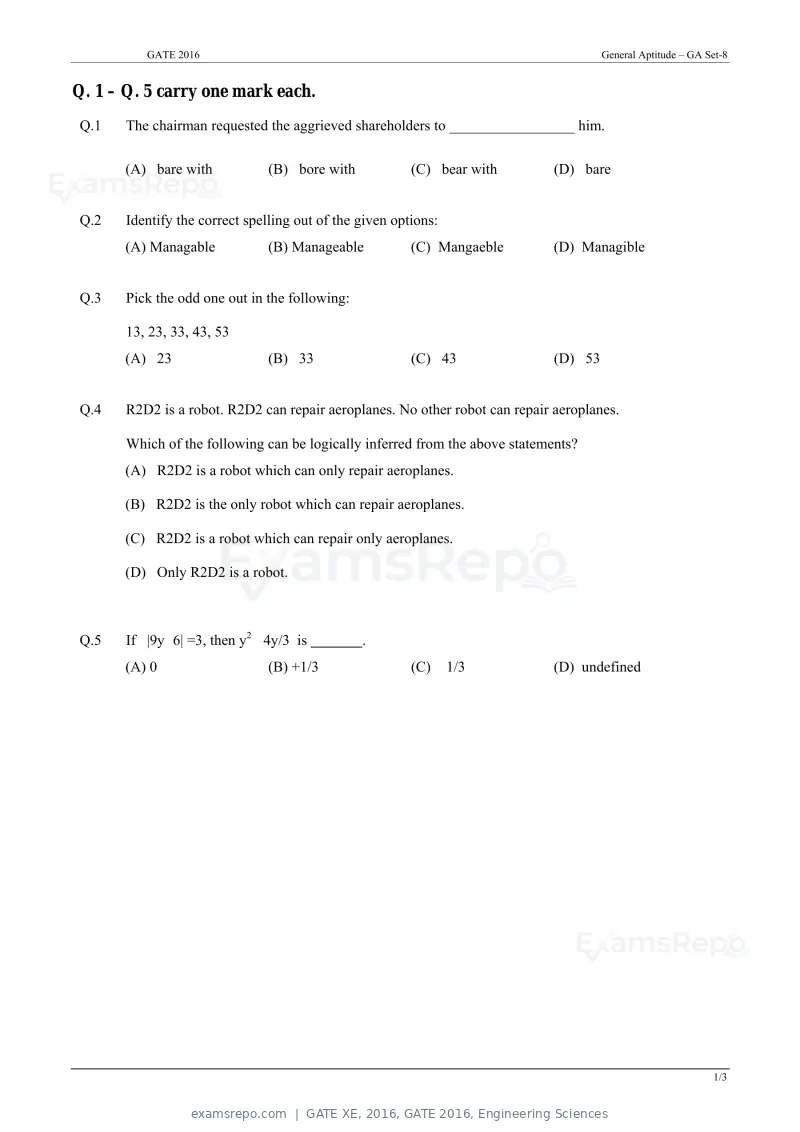
Text of page 1
GATE 2016                                                                    General Aptitude – GA Set-8


Q. 1 – Q. 5 carry one mark each.
Q.1    The chairman requested the aggrieved shareholders to _________________ him.

      (A) bare with             (B) bore with            (C) bear with        (D) bare


Q.2    Identify the correct spelling out of the given options:
      (A) Managable             (B) Manageable           (C) Mangaeble        (D) Managible


Q.3    Pick the odd one out in the following:

       13, 23, 33, 43, 53
      (A) 23                    (B) 33                   (C) 43               (D) 53


Q.4    R2D2 is a robot. R2D2 can repair aeroplanes. No other robot can repair aeroplanes.

       Which of the following can be logically inferred from the above statements?
      (A) R2D2 is a robot which can only repair aeroplanes.

      (B) R2D2 is the only robot which can repair aeroplanes.

      (C) R2D2 is a robot which can repair only aeroplanes.

      (D) Only R2D2 is a robot.


Q.5    If |9y−6| =3, then y2 −4y/3 is           .
      (A) 0                     (B) +1/3                 (C) −1/3             (D) undefined


                                                                                                              1/3
Text of page 2
GATE 2016                                                                    General Aptitude – GA Set-8

Q. 6 – Q. 10 carry two marks each.
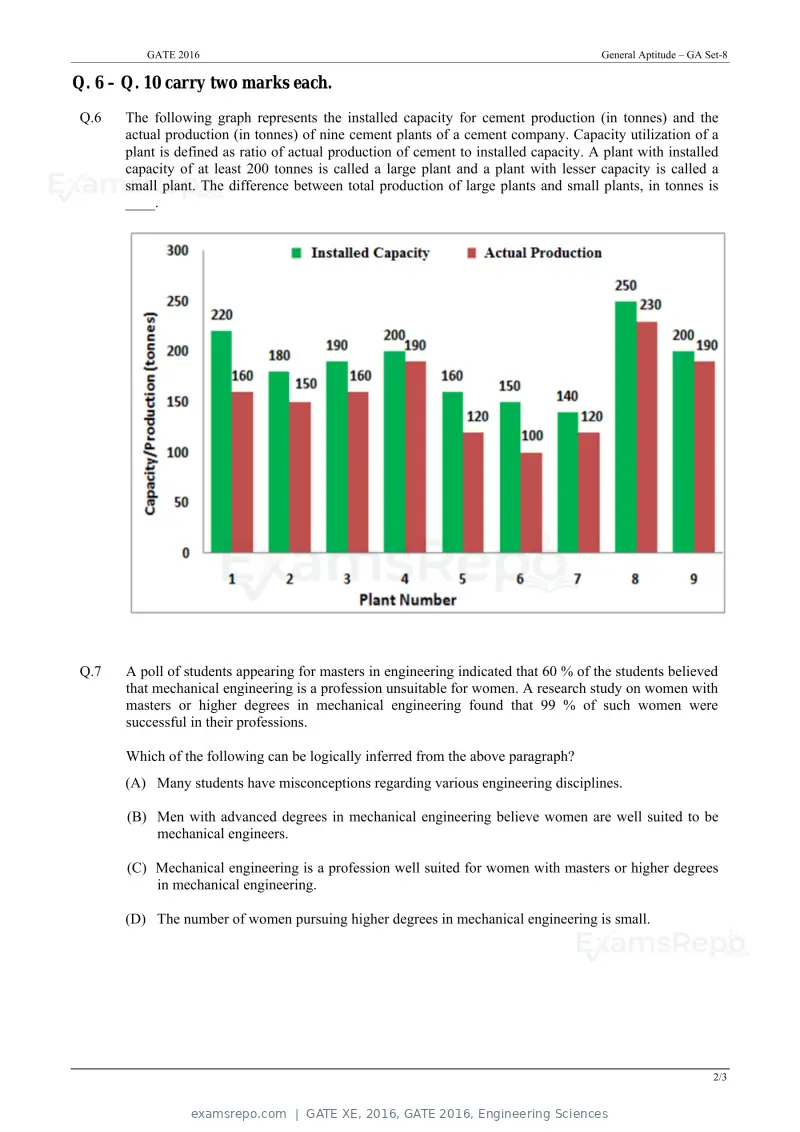
Q.6   The following graph represents the installed capacity for cement production (in tonnes) and the
      actual production (in tonnes) of nine cement plants of a cement company. Capacity utilization of a
      plant is defined as ratio of actual production of cement to installed capacity. A plant with installed
      capacity of at least 200 tonnes is called a large plant and a plant with lesser capacity is called a
      small plant. The difference between total production of large plants and small plants, in tonnes is
      ____.


Q.7   A poll of students appearing for masters in engineering indicated that 60 % of the students believed
      that mechanical engineering is a profession unsuitable for women. A research study on women with
      masters or higher degrees in mechanical engineering found that 99 % of such women were
      successful in their professions.

      Which of the following can be logically inferred from the above paragraph?
      (A) Many students have misconceptions regarding various engineering disciplines.

       (B) Men with advanced degrees in mechanical engineering believe women are well suited to be
           mechanical engineers.

       (C) Mechanical engineering is a profession well suited for women with masters or higher degrees
           in mechanical engineering.

      (D) The number of women pursuing higher degrees in mechanical engineering is small.


                                                                                                              2/3
Text of page 3
GATE 2016                                                                     General Aptitude – GA Set-8

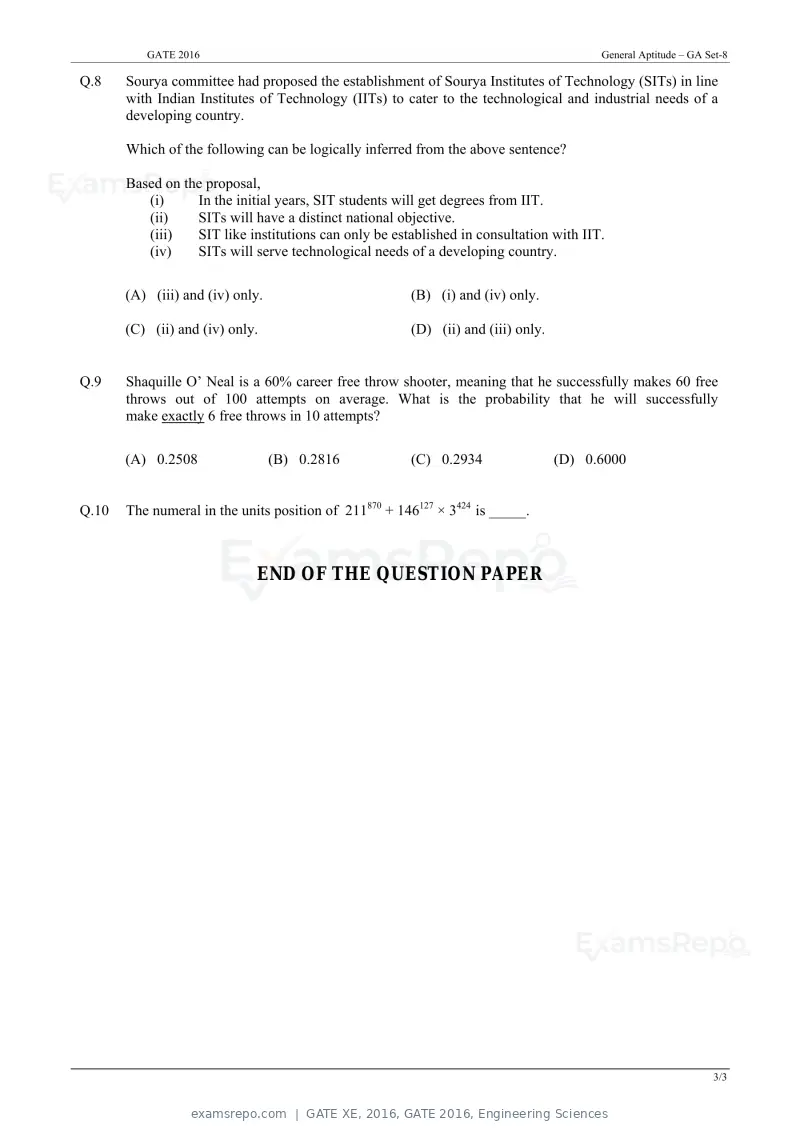
Q.8    Sourya committee had proposed the establishment of Sourya Institutes of Technology (SITs) in line
       with Indian Institutes of Technology (IITs) to cater to the technological and industrial needs of a
       developing country.

       Which of the following can be logically inferred from the above sentence?

       Based on the proposal,
          (i)     In the initial years, SIT students will get degrees from IIT.
          (ii)    SITs will have a distinct national objective.
          (iii)   SIT like institutions can only be established in consultation with IIT.
          (iv)    SITs will serve technological needs of a developing country.

       (A) (iii) and (iv) only.                        (B) (i) and (iv) only.

       (C) (ii) and (iv) only.                         (D) (ii) and (iii) only.


Q.9    Shaquille O’ Neal is a 60% career free throw shooter, meaning that he successfully makes 60 free
       throws out of 100 attempts on average. What is the probability that he will successfully
       make exactly 6 free throws in 10 attempts?

       (A) 0.2508                 (B) 0.2816           (C) 0.2934                 (D) 0.6000


Q.10   The numeral in the units position of 211870 + 146127 × 3424 is _____.


                             END OF THE QUESTION PAPER


                                                                                                               3/3
Text of page 4
GATE 2016                                                               ENGINEERING MATHEMATICS (COMPULSORY) – XE-A

                    A : ENGINEERING MATHEMATICS (COMPULSORY)


Q. 1 – Q. 7 carry one mark each.
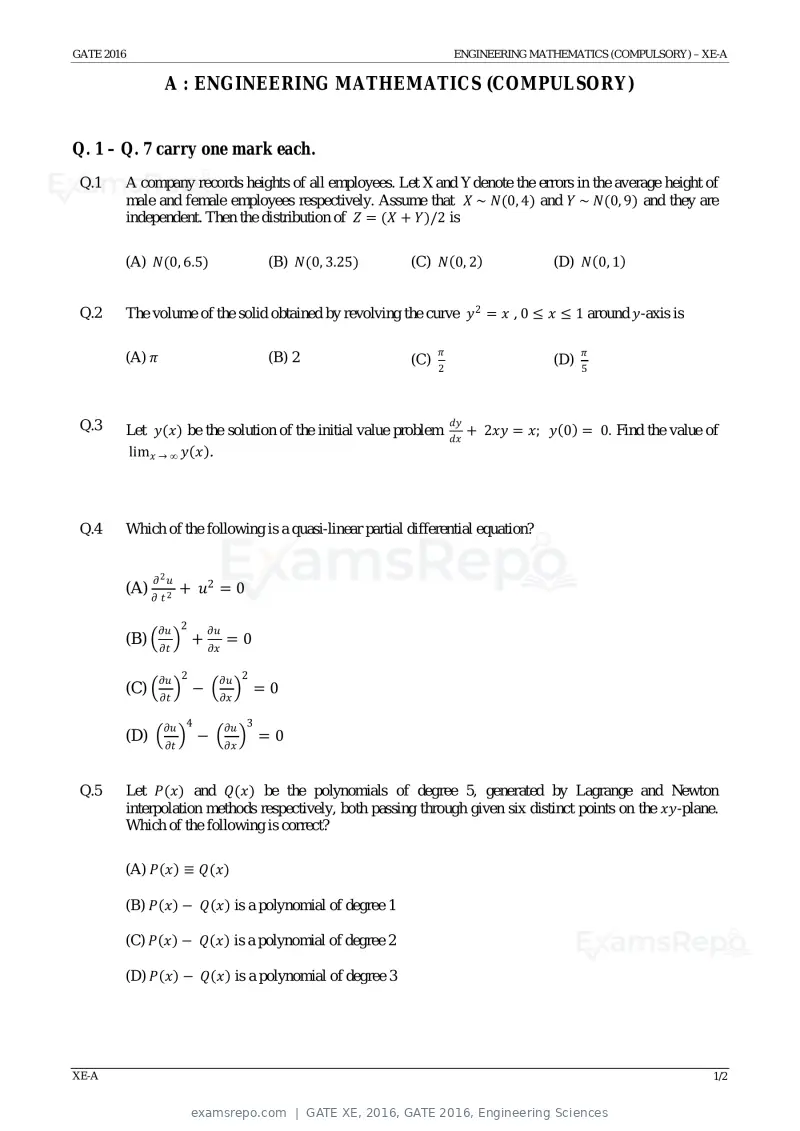
 Q.1        A company records heights of all employees. Let X and Y denote the errors in the average height of
            male and female employees respectively. Assume that XX ~ NN(0, 4) and YY ~ NN(0, 9) and they are
            independent. Then the distribution of ZZ = (XX + YY)/2 is

        (A) NN(0, 6.5)                      (B) NN(0, 3.25)   (C) NN(0, 2)             (D) NN(0, 1)


 Q.2        The volume of the solid obtained by revolving the curve yy 2 = xx , 0 ≤ xx ≤ 1 around yy-axis is

                                                                  ππ                        ππ
        (A) ππ                              (B) 2             (C) 2                    (D) 5


 Q.3                                                                   dddd
            Let yy(xx) be the solution of the initial value problem dddd + 2xxxx = xx; yy(0) = 0. Find the value of
            limxx → ∞ yy(xx).


 Q.4        Which of the following is a quasi-linear partial differential equation?


                ∂∂ 2 uu
        (A) ∂∂ tt 2 + uu2 = 0

                 ∂∂∂∂ 2     ∂∂∂∂
        (B) � ∂∂∂∂ � + ∂∂∂∂ = 0

                  ∂∂∂∂ 2       ∂∂∂∂ 2
        (C) � ∂∂∂∂ � − �∂∂∂∂ � = 0

                   ∂∂∂∂ 4          ∂∂∂∂ 3
        (D) � ∂∂∂∂ � − �∂∂∂∂ � = 0


 Q.5        Let PP(xx) and QQ(xx) be the polynomials of degree 5, generated by Lagrange and Newton
            interpolation methods respectively, both passing through given six distinct points on the xxxx-plane.
            Which of the following is correct?

        (A) PP(xx) ≡ QQ(xx)

        (B) PP(xx) − QQ(xx) is a polynomial of degree 1

        (C) PP(xx) − QQ(xx) is a polynomial of degree 2

        (D) PP(xx) − QQ(xx) is a polynomial of degree 3


XE-A                                                                                                              1/2
Text of page 5
GATE 2016 ENGINEERING MATHEMATICS (COMPULSORY) – XE-A
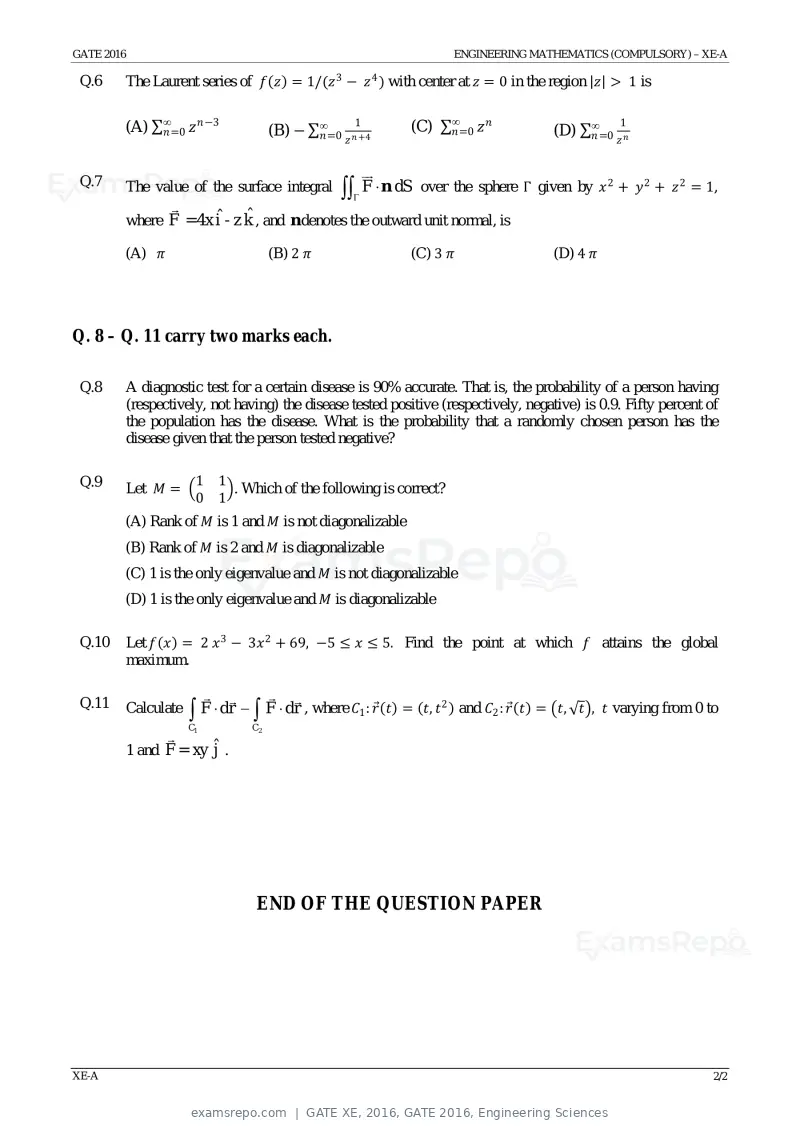
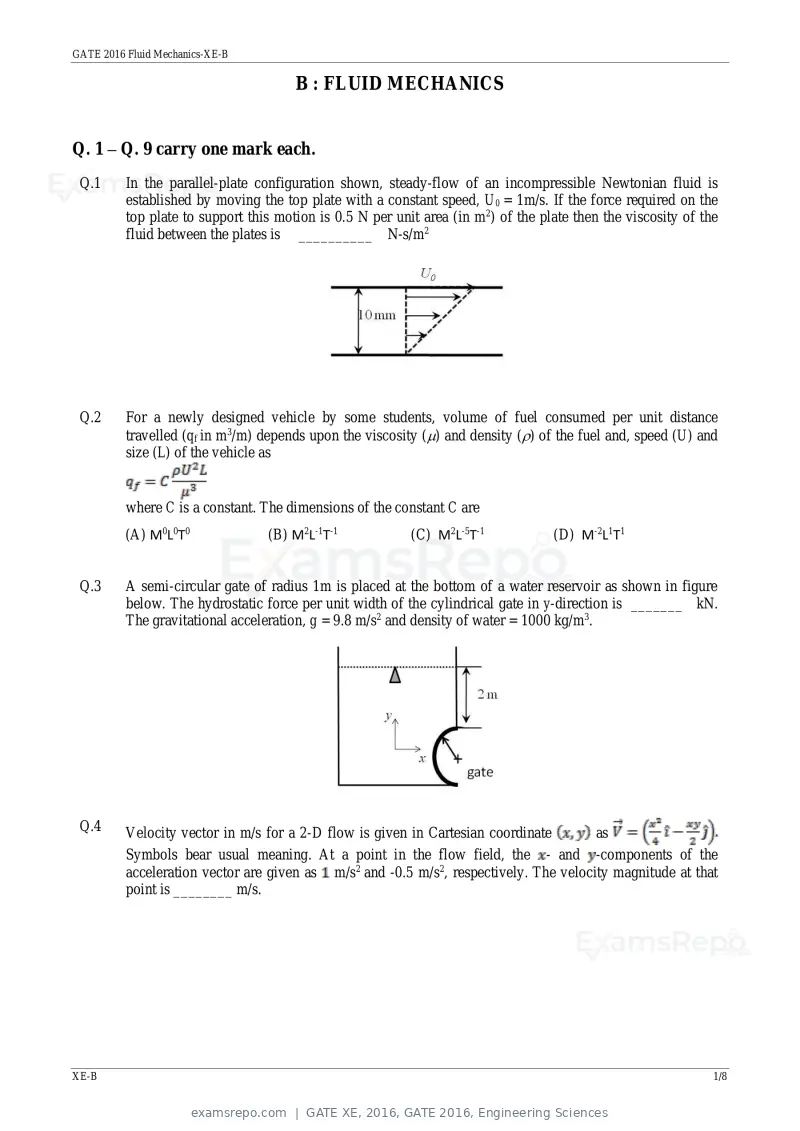
Q.6 The Laurent series of ff(zz) = 1/(zz 3 − zz 4 ) with center at zz = 0 in the region |zz| > 1 is
(A) ∑∞
nn=0 zz
nn−3
(B) − ∑∞
1
nn=0 zz nn +4
(C) ∑∞
nn=0 zz
nn
(D) ∑∞
1
nn=0 zz nn
Q.7 The value of the surface integral ∫∫ F ⋅ n dS over the sphere Γ given by xx 2 + yy2 + zz 2 = 1,
Γ
where F = 4x iˆ - z kˆ , and n denotes the outward unit normal, is
(A) ππ (B) 2 ππ (C) 3 ππ (D) 4 ππ
Q. 8 – Q. 11 carry two marks each.
Q.8 A diagnostic test for a certain disease is 90% accurate. That is, the probability of a person having
(respectively, not having) the disease tested positive (respectively, negative) is 0.9. Fifty percent of
the population has the disease. What is the probability that a randomly chosen person has the
disease given that the person tested negative?
Q.9 1 1
Let MM = � �. Which of the following is correct?
0 1
(A) Rank of MM is 1 and MM is not diagonalizable
(B) Rank of MM is 2 and MM is diagonalizable
(C) 1 is the only eigenvalue and MM is not diagonalizable
(D) 1 is the only eigenvalue and MM is diagonalizable
Q.10 Let ff(xx) = 2 xx 3 − 3xx 2 + 69, −5 ≤ xx ≤ 5. Find the point at which ff attains the global
maximum.
Q.11 Calculate ∫ F ⋅ dr − ∫ F ⋅ dr , where CC1 : rr⃗(tt) = (tt, tt 2 ) and CC2 : rr⃗(tt) = �tt, √tt�, tt varying from 0 to
C1 C2
1 and F = xy ˆj .
END OF THE QUESTION PAPER
XE-A 2/2
Text of page 6
GATE 2016 Fluid Mechanics-XE-B
B : FLUID MECHANICS
Q. 1 – Q. 9 carry one mark each.
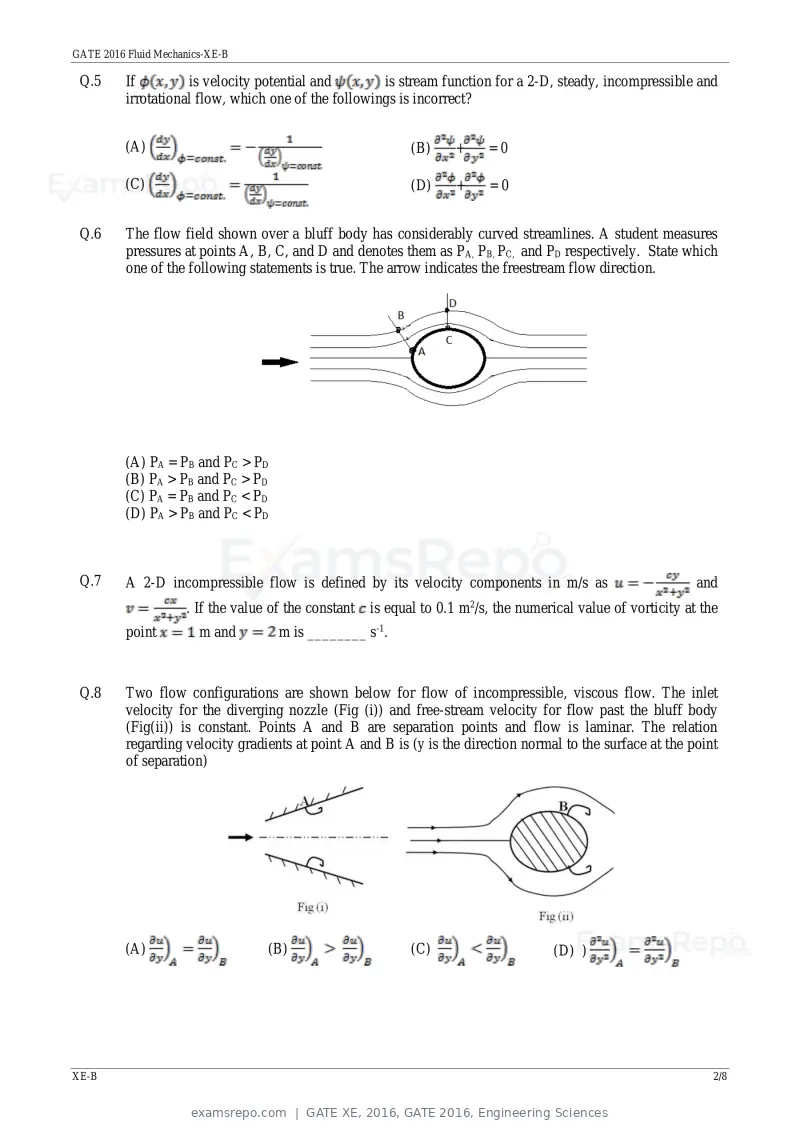
Q.1 In the parallel-plate configuration shown, steady-flow of an incompressible Newtonian fluid is
established by moving the top plate with a constant speed, U0 = 1m/s. If the force required on the
top plate to support this motion is 0.5 N per unit area (in m2) of the plate then the viscosity of the
fluid between the plates is __________ N-s/m2
Q.2 For a newly designed vehicle by some students, volume of fuel consumed per unit distance
travelled (qf in m3/m) depends upon the viscosity () and density () of the fuel and, speed (U) and
size (L) of the vehicle as
where C is a constant. The dimensions of the constant C are
(A) M0L0T0 (B) M2L-1T-1 (C) M2L-5T-1 (D) M-2L1T1
Q.3 A semi-circular gate of radius 1m is placed at the bottom of a water reservoir as shown in figure
below. The hydrostatic force per unit width of the cylindrical gate in y-direction is _______ kN.
The gravitational acceleration, g = 9.8 m/s2 and density of water = 1000 kg/m3.
Q.4 Velocity vector in m/s for a 2-D flow is given in Cartesian coordinate as
Symbols bear usual meaning. At a point in the flow field, the - and -components of the
acceleration vector are given as m/s2 and -0.5 m/s2, respectively. The velocity magnitude at that
point is ________ m/s.
XE-B 1/8
Text of page 7
GATE 2016 Fluid Mechanics-XE-B

 Q.5      If         is velocity potential and        is stream function for a 2-D, steady, incompressible and
          irrotational flow, which one of the followings is incorrect?


          (A)                                                (B)    +     =0

          (C)                                                (D)     +    =0


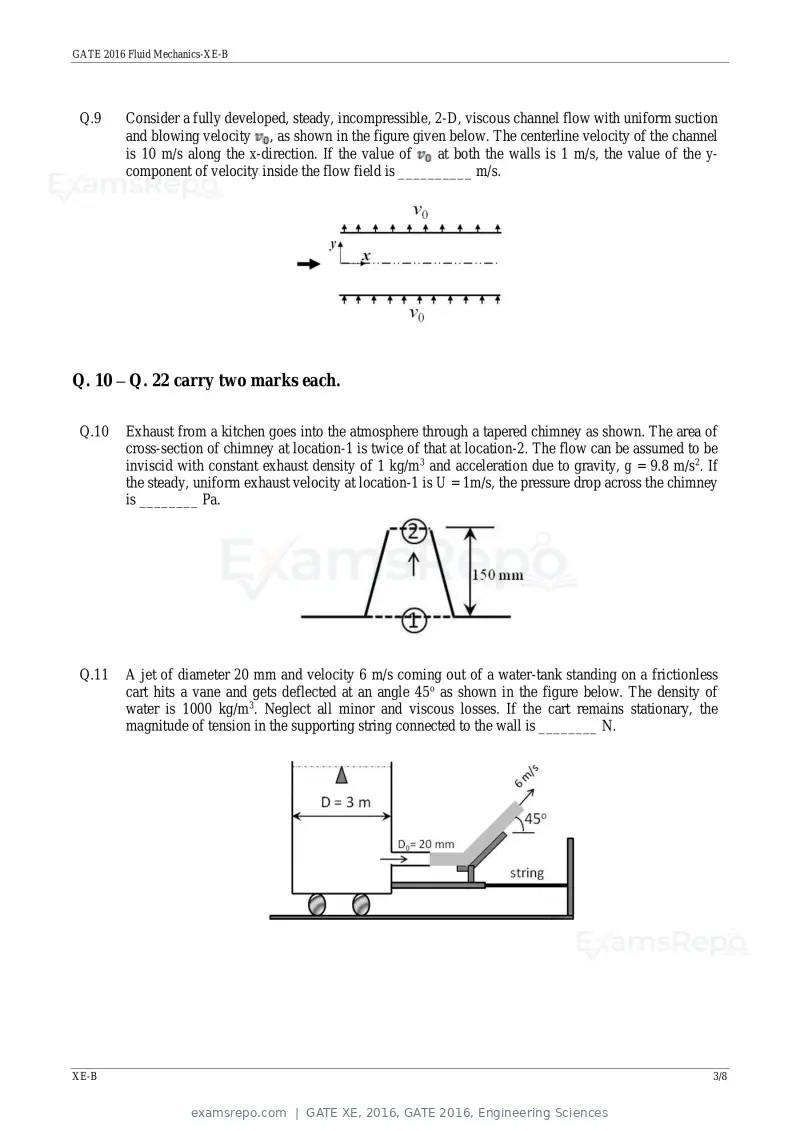
 Q.6      The flow field shown over a bluff body has considerably curved streamlines. A student measures
          pressures at points A, B, C, and D and denotes them as PA, PB, PC, and PD respectively. State which
          one of the following statements is true. The arrow indicates the freestream flow direction.


          (A) PA = PB and PC > PD
          (B) PA > PB and PC > PD
          (C) PA = PB and PC < PD
          (D) PA > PB and PC < PD


 Q.7      A 2-D incompressible flow is defined by its velocity components in m/s as                            and
                     . If the value of the constant   is equal to 0.1 m2/s, the numerical value of vorticity at the
          point         m and        m is ________ s-1.


 Q.8      Two flow configurations are shown below for flow of incompressible, viscous flow. The inlet
          velocity for the diverging nozzle (Fig (i)) and free-stream velocity for flow past the bluff body
          (Fig(ii)) is constant. Points A and B are separation points and flow is laminar. The relation
          regarding velocity gradients at point A and B is (y is the direction normal to the surface at the point
          of separation)


          (A)                      (B)                       (C)                      (D) )


XE-B                                                                                                              2/8
Text of page 8
GATE 2016 Fluid Mechanics-XE-B


 Q.9      Consider a fully developed, steady, incompressible, 2-D, viscous channel flow with uniform suction
          and blowing velocity , as shown in the figure given below. The centerline velocity of the channel
          is 10 m/s along the x-direction. If the value of    at both the walls is 1 m/s, the value of the y-
          component of velocity inside the flow field is __________ m/s.


Q. 10 – Q. 22 carry two marks each.

 Q.10     Exhaust from a kitchen goes into the atmosphere through a tapered chimney as shown. The area of
          cross-section of chimney at location-1 is twice of that at location-2. The flow can be assumed to be
          inviscid with constant exhaust density of 1 kg/m3 and acceleration due to gravity, g = 9.8 m/s2. If
          the steady, uniform exhaust velocity at location-1 is U = 1m/s, the pressure drop across the chimney
          is ________ Pa.


 Q.11     A jet of diameter 20 mm and velocity 6 m/s coming out of a water-tank standing on a frictionless
          cart hits a vane and gets deflected at an angle 45o as shown in the figure below. The density of
          water is 1000 kg/m3. Neglect all minor and viscous losses. If the cart remains stationary, the
          magnitude of tension in the supporting string connected to the wall is ________ N.


XE-B                                                                                                         3/8
Text of page 9
GATE 2016 Fluid Mechanics-XE-B
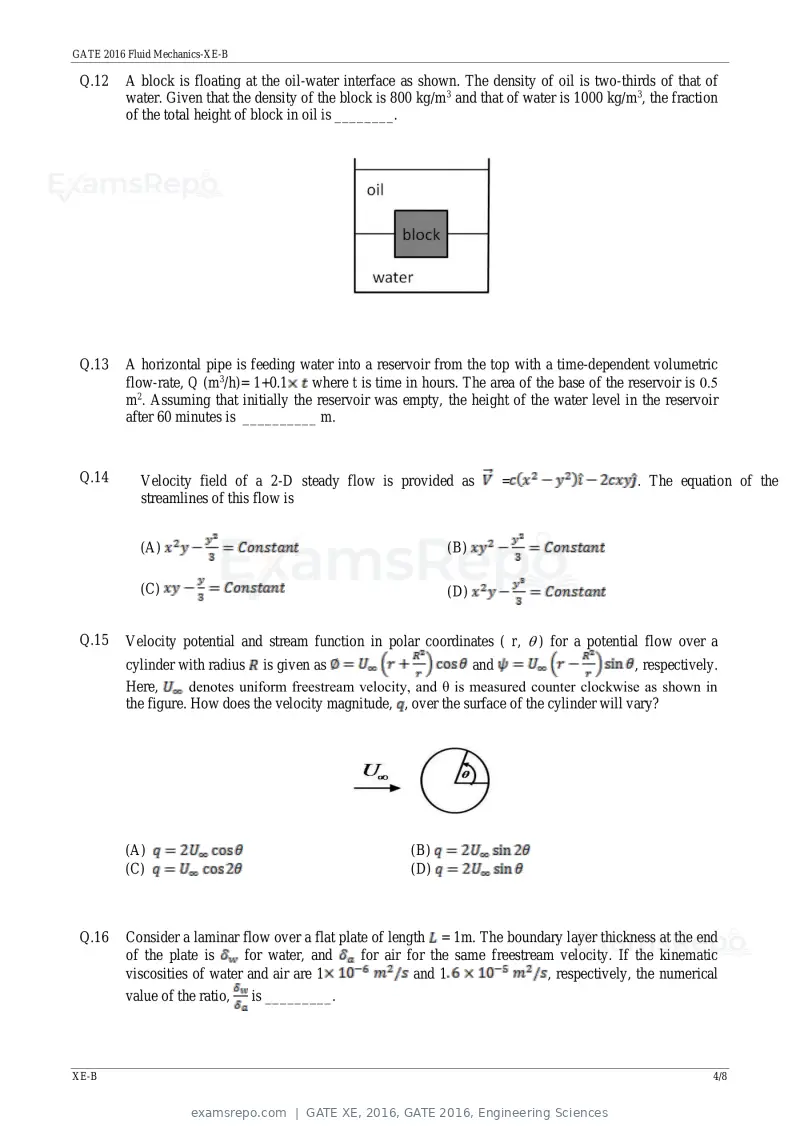
Q.12 A block is floating at the oil-water interface as shown. The density of oil is two-thirds of that of
water. Given that the density of the block is 800 kg/m3 and that of water is 1000 kg/m3, the fraction
of the total height of block in oil is ________.
Q.13 A horizontal pipe is feeding water into a reservoir from the top with a time-dependent volumetric
flow-rate, Q (m3/h)= 1+0.1 where t is time in hours. The area of the base of the reservoir is
m2. Assuming that initially the reservoir was empty, the height of the water level in the reservoir
after 60 minutes is __________ m.
Q.14 Velocity field of a 2-D steady flow is provided as = . The equation of the
streamlines of this flow is
(A) (B)
(C) (D)
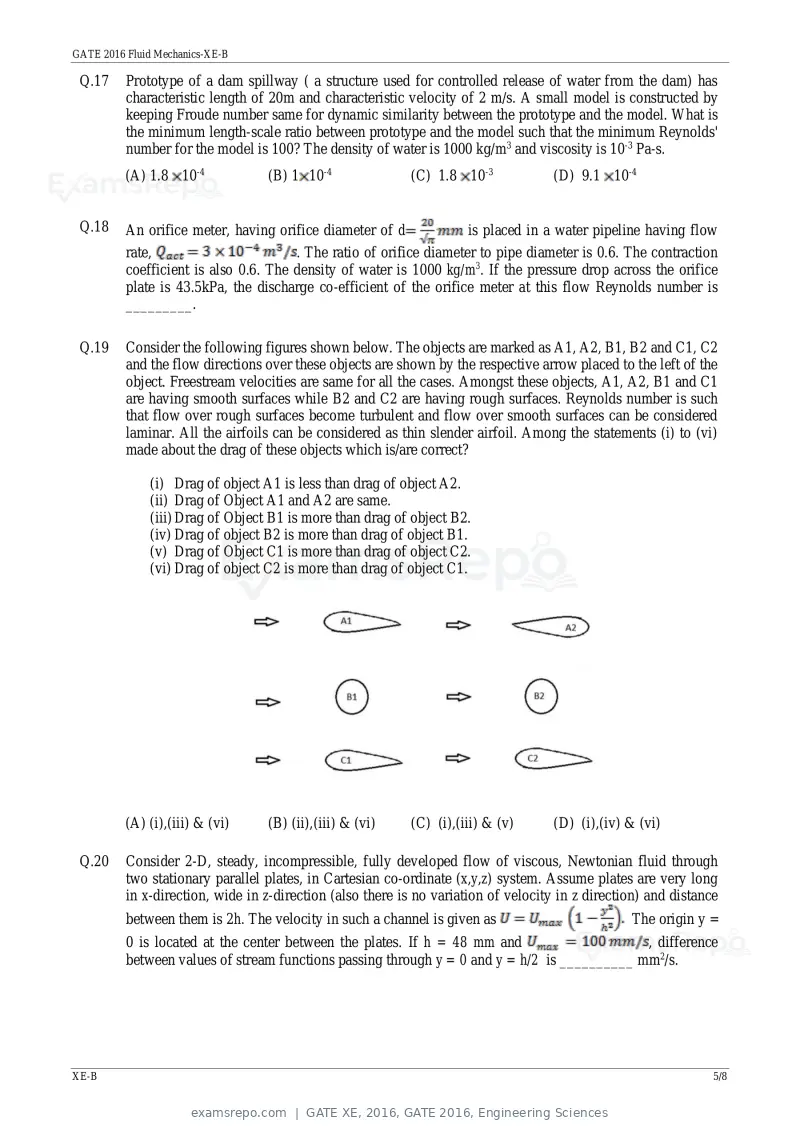
Q.15 Velocity potential and stream function in polar coordinates ( r, ) for a potential flow over a
cylinder with radius is given as and , respectively.
Here, denotes uniform freestream velocity, and θ is measured counter clockwise as shown in
the figure. How does the velocity magnitude, , over the surface of the cylinder will vary?
(A) (B)
(C) (D)
Q.16 Consider a laminar flow over a flat plate of length = 1m. The boundary layer thickness at the end
of the plate is for water, and for air for the same freestream velocity. If the kinematic
viscosities of water and air are 1 and 1 , respectively, the numerical
value of the ratio, is _________.
XE-B 4/8
Text of page 10
GATE 2016 Fluid Mechanics-XE-B

 Q.17     Prototype of a dam spillway ( a structure used for controlled release of water from the dam) has
          characteristic length of 20m and characteristic velocity of 2 m/s. A small model is constructed by
          keeping Froude number same for dynamic similarity between the prototype and the model. What is
          the minimum length-scale ratio between prototype and the model such that the minimum Reynolds'
          number for the model is 100? The density of water is 1000 kg/m3 and viscosity is 10-3 Pa-s.
          (A) 1.8 10-4            (B) 1 10-4                (C) 1.8 10-3             (D) 9.1 10-4


 Q.18     An orifice meter, having orifice diameter of d             is placed in a water pipeline having flow
          rate,                        . The ratio of orifice diameter to pipe diameter is 0.6. The contraction
          coefficient is also 0.6. The density of water is 1000 kg/m3. If the pressure drop across the orifice
          plate is 43.5kPa, the discharge co-efficient of the orifice meter at this flow Reynolds number is
          _________.

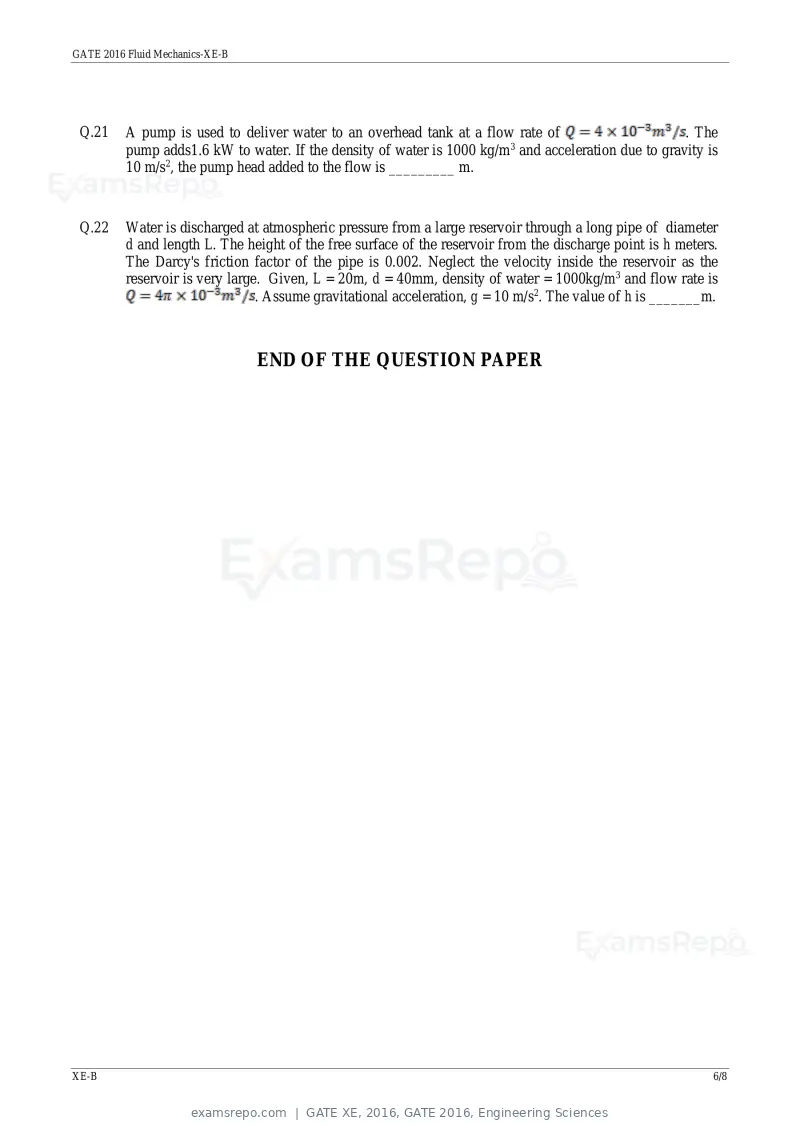
 Q.19     Consider the following figures shown below. The objects are marked as A1, A2, B1, B2 and C1, C2
          and the flow directions over these objects are shown by the respective arrow placed to the left of the
          object. Freestream velocities are same for all the cases. Amongst these objects, A1, A2, B1 and C1
          are having smooth surfaces while B2 and C2 are having rough surfaces. Reynolds number is such
          that flow over rough surfaces become turbulent and flow over smooth surfaces can be considered
          laminar. All the airfoils can be considered as thin slender airfoil. Among the statements (i) to (vi)
          made about the drag of these objects which is/are correct?

              (i) Drag of object A1 is less than drag of object A2.
              (ii) Drag of Object A1 and A2 are same.
              (iii) Drag of Object B1 is more than drag of object B2.
              (iv) Drag of object B2 is more than drag of object B1.
              (v) Drag of Object C1 is more than drag of object C2.
              (vi) Drag of object C2 is more than drag of object C1.


          (A) (i),(iii) & (vi)    (B) (ii),(iii) & (vi)     (C) (i),(iii) & (v)      (D) (i),(iv) & (vi)

 Q.20     Consider 2-D, steady, incompressible, fully developed flow of viscous, Newtonian fluid through
          two stationary parallel plates, in Cartesian co-ordinate (x,y,z) system. Assume plates are very long
          in x-direction, wide in z-direction (also there is no variation of velocity in z direction) and distance
          between them is 2h. The velocity in such a channel is given as                          The origin y =
          0 is located at the center between the plates. If h = 48 mm and                     , difference
          between values of stream functions passing through y = 0 and y = h/2 is __________ mm2/s.


XE-B                                                                                                             5/8
Text of page 11
GATE 2016 Fluid Mechanics-XE-B


 Q.21     A pump is used to deliver water to an overhead tank at a flow rate of                       . The
          pump adds1.6 kW to water. If the density of water is 1000 kg/m3 and acceleration due to gravity is
          10 m/s2, the pump head added to the flow is _________ m.


 Q.22     Water is discharged at atmospheric pressure from a large reservoir through a long pipe of diameter
          d and length L. The height of the free surface of the reservoir from the discharge point is h meters.
          The Darcy's friction factor of the pipe is 0.002. Neglect the velocity inside the reservoir as the
          reservoir is very large. Given, L = 20m, d = 40mm, density of water = 1000kg/m3 and flow rate is
                                 . Assume gravitational acceleration, g = 10 m/s2. The value of h is _______m.


                                 END OF THE QUESTION PAPER


XE-B                                                                                                          6/8
Text of page 12
GATE 2016 Materials Science– XE-C

                                           C : Materials Science


Q. 1 – Q. 9 carry one mark each.
 Q.1      Energy Dispersive Spectroscopy (EDS) in a typical scanning electron microscope enables
          elemental identification by collecting and examining which of the following:

          (A) Secondary electrons from the sample
          (B) Back scattered electrons from the sample
          (C) Characteristic X-rays from the sample
          (D) Diffraction pattern from the sample


 Q.2      Which of the following rotational symmetry is forbidden in a perfectly periodic 3-dimensional
          lattice?
          (A) 1-fold                (B) 3-fold               (C) 5-fold              (D) 6-fold


 Q.3      Which of the following thermodynamic properties shows a discontinuity during a second-order
          phase transition?
          (A) Volume                                         (B) Enthalpy
          (C) Entropy                                        (D) Heat capacity

 Q.4      Cross slip is easily promoted in metals having
          (A) a low stacking fault energy.                   (B) a low grain boundary energy.
          (C) a high stacking fault energy.                  (D) a high grain boundary energy.

 Q.5      For a typical metal at room temperature and atmospheric pressure, the Fermi energy is defined as
          the energy level for which the probability of occupancy is:
          (A) 0                     (B) 0.25                 (C) 0.5                 (D) 1

 Q.6      Number of elements in a tensor of rank 4 is _________________.

 Q.7      Which one of the following effects is the working principle of a thermocouple?
          (A) Thomson               (B) Seebeck              (C) Peltier             (D) Meissner

 Q.8      At equilibrium, the maximum number of phases that can coexist in a ternary system at constant
          pressure is ____________.

 Q.9      Defect-free single crystal alumina (sapphire) is
          (A) opaque and white.                              (B) transparent.
          (C) translucent.                                   (D) opaque and black.


XE-C                                                                                                     1/3
Text of page 13
GATE 2016 Materials Science– XE-C

Q. 10 – Q. 22 carry two marks each.


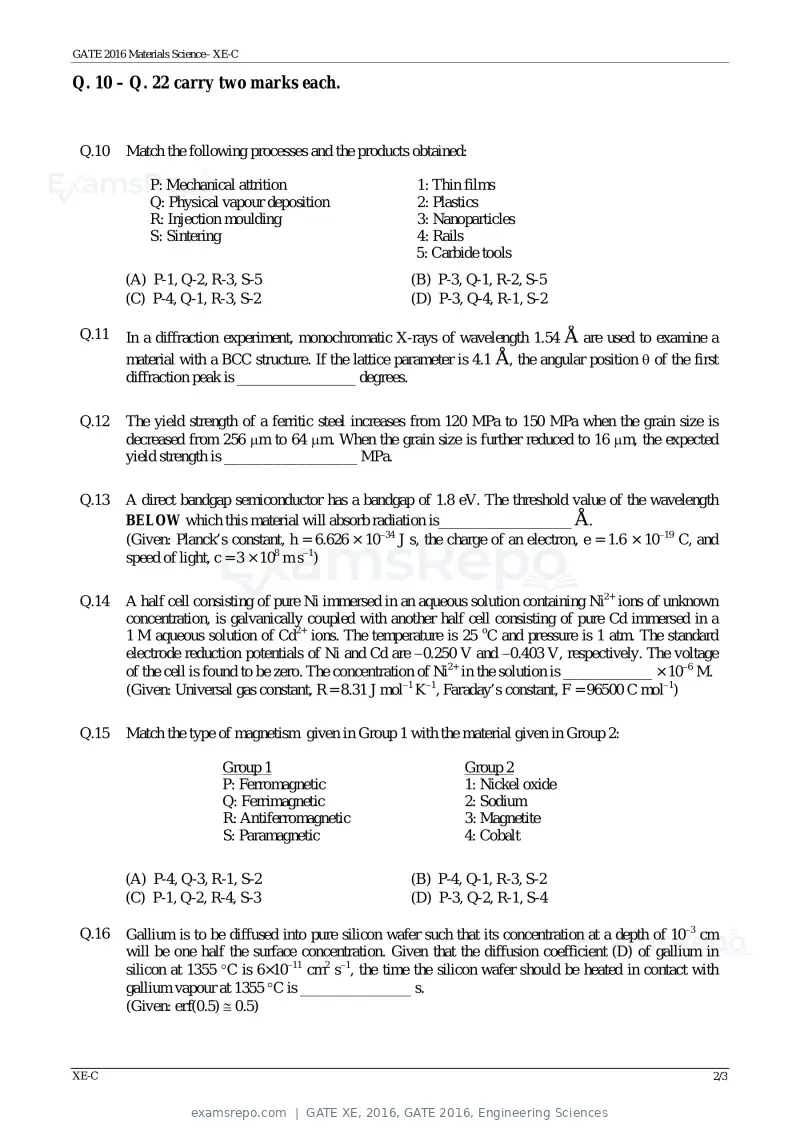
 Q.10     Match the following processes and the products obtained:

               P: Mechanical attrition                     1: Thin films
               Q: Physical vapour deposition               2: Plastics
               R: Injection moulding                       3: Nanoparticles
               S: Sintering                                4: Rails
                                                           5: Carbide tools
          (A) P-1, Q-2, R-3, S-5                          (B) P-3, Q-1, R-2, S-5
          (C) P-4, Q-1, R-3, S-2                          (D) P-3, Q-4, R-1, S-2

 Q.11     In a diffraction experiment, monochromatic X-rays of wavelength 1.54 Å are used to examine a
          material with a BCC structure. If the lattice parameter is 4.1 Å, the angular position θ of the first
          diffraction peak is ________________ degrees.

 Q.12     The yield strength of a ferritic steel increases from 120 MPa to 150 MPa when the grain size is
          decreased from 256 µm to 64 µm. When the grain size is further reduced to 16 µm, the expected
          yield strength is __________________ MPa.

 Q.13     A direct bandgap semiconductor has a bandgap of 1.8 eV. The threshold value of the wavelength
          BELOW which this material will absorb radiation is__________________ Å.
          (Given: Planck’s constant, h = 6.626 × 10⁻³⁴ J s, the charge of an electron, e = 1.6 × 10⁻¹⁹ C, and
          speed of light, c = 3 × 10⁸ m s−1)

 Q.14     A half cell consisting of pure Ni immersed in an aqueous solution containing Ni2+ ions of unknown
          concentration, is galvanically coupled with another half cell consisting of pure Cd immersed in a
          1 M aqueous solution of Cd2+ ions. The temperature is 25 oC and pressure is 1 atm. The standard
          electrode reduction potentials of Ni and Cd are −0.250 V and −0.403 V, respectively. The voltage
          of the cell is found to be zero. The concentration of Ni2+ in the solution is ____________ × 10−6 M.
          (Given: Universal gas constant, R = 8.31 J mol−1 K−1, Faraday’s constant, F = 96500 C mol−1)

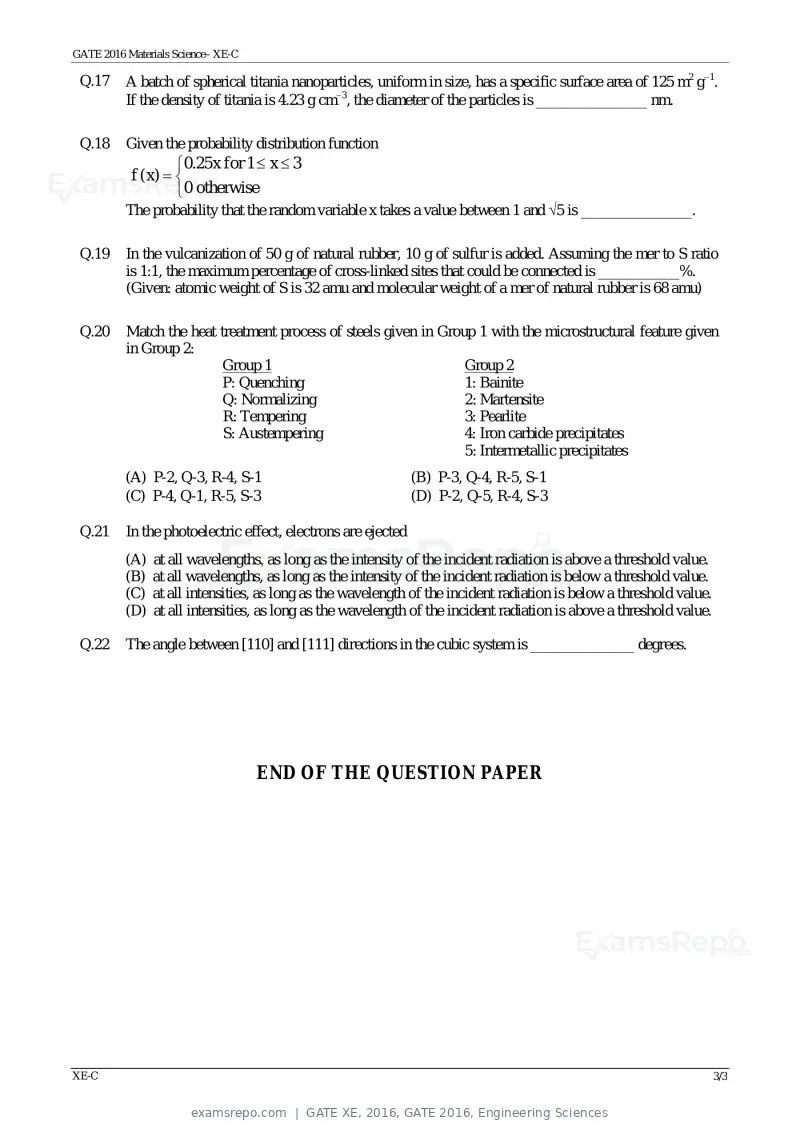
 Q.15     Match the type of magnetism given in Group 1 with the material given in Group 2:

                             Group 1                               Group 2
                             P: Ferromagnetic                      1: Nickel oxide
                             Q: Ferrimagnetic                      2: Sodium
                             R: Antiferromagnetic                  3: Magnetite
                             S: Paramagnetic                       4: Cobalt

          (A) P-4, Q-3, R-1, S-2                          (B) P-4, Q-1, R-3, S-2
          (C) P-1, Q-2, R-4, S-3                          (D) P-3, Q-2, R-1, S-4

 Q.16     Gallium is to be diffused into pure silicon wafer such that its concentration at a depth of 10−3 cm
          will be one half the surface concentration. Given that the diffusion coefficient (D) of gallium in
          silicon at 1355 °C is 6×10⁻¹¹ cm2 s−1, the time the silicon wafer should be heated in contact with
          gallium vapour at 1355 °C is _______________ s.
          (Given: erf(0.5) ≅ 0.5)


XE-C                                                                                                          2/3
Text of page 14
GATE 2016 Materials Science– XE-C
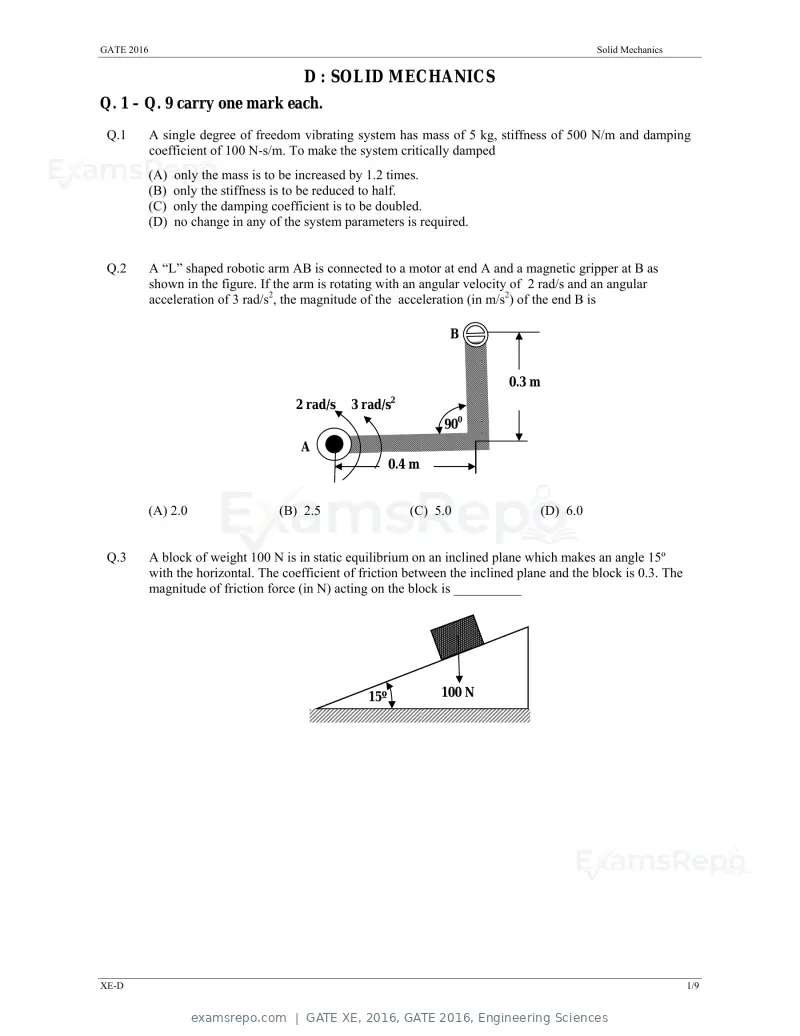
Q.17 A batch of spherical titania nanoparticles, uniform in size, has a specific surface area of 125 m2 g−1.
If the density of titania is 4.23 g cm−3, the diameter of the particles is _______________ nm.
Q.18 Given the probability distribution function
0.25 x for 1 ≤ x ≤ 3
f ( x) =
0 otherwise
The probability that the random variable x takes a value between 1 and √5 is _______________.
Q.19 In the vulcanization of 50 g of natural rubber, 10 g of sulfur is added. Assuming the mer to S ratio
is 1:1, the maximum percentage of cross-linked sites that could be connected is ___________%.
(Given: atomic weight of S is 32 amu and molecular weight of a mer of natural rubber is 68 amu)
Q.20 Match the heat treatment process of steels given in Group 1 with the microstructural feature given
in Group 2:
Group 1 Group 2
P: Quenching 1: Bainite
Q: Normalizing 2: Martensite
R: Tempering 3: Pearlite
S: Austempering 4: Iron carbide precipitates
5: Intermetallic precipitates
(A) P-2, Q-3, R-4, S-1 (B) P-3, Q-4, R-5, S-1
(C) P-4, Q-1, R-5, S-3 (D) P-2, Q-5, R-4, S-3
Q.21 In the photoelectric effect, electrons are ejected
(A) at all wavelengths, as long as the intensity of the incident radiation is above a threshold value.
(B) at all wavelengths, as long as the intensity of the incident radiation is below a threshold value.
(C) at all intensities, as long as the wavelength of the incident radiation is below a threshold value.
(D) at all intensities, as long as the wavelength of the incident radiation is above a threshold value.
Q.22 The angle between [110] and [111] directions in the cubic system is ______________ degrees.
END OF THE QUESTION PAPER
XE-C 3/3
Text of page 15
GATE 2016                                                                                       Solid Mechanics

                                         D : SOLID MECHANICS
Q. 1 – Q. 9 carry one mark each.
 Q.1        A single degree of freedom vibrating system has mass of 5 kg, stiffness of 500 N/m and damping
            coefficient of 100 N-s/m. To make the system critically damped
            (A) only the mass is to be increased by 1.2 times.
            (B) only the stiffness is to be reduced to half.
            (C) only the damping coefficient is to be doubled.
            (D) no change in any of the system parameters is required.


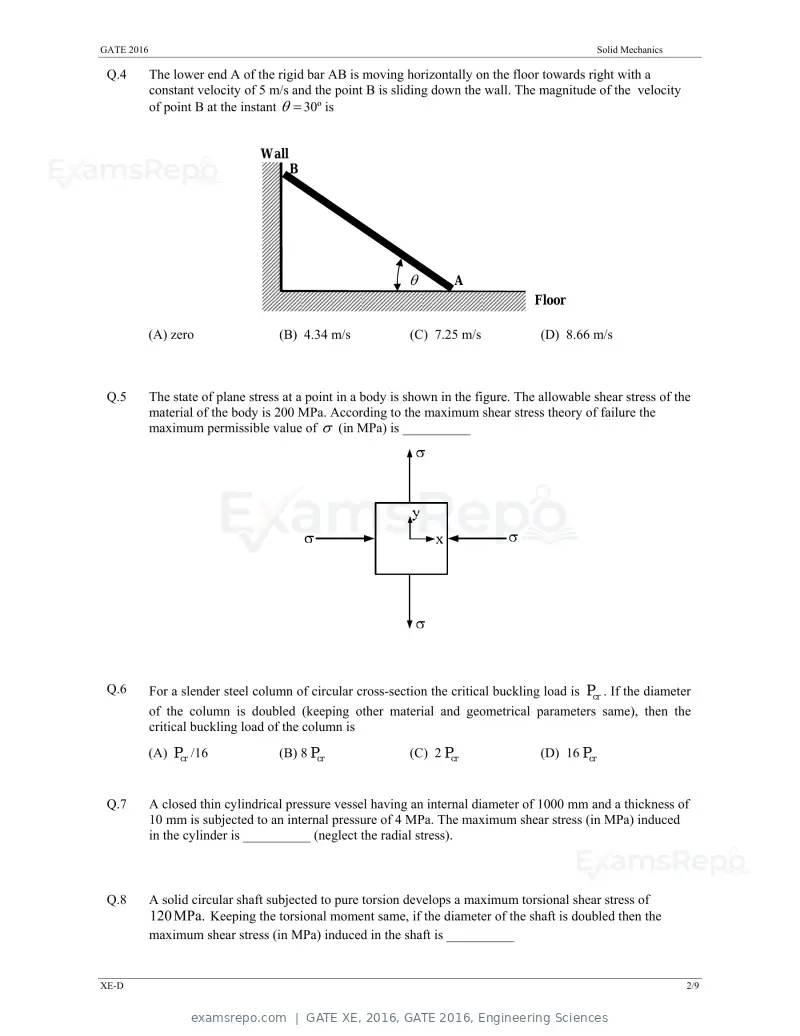
 Q.2        A “L” shaped robotic arm AB is connected to a motor at end A and a magnetic gripper at B as
            shown in the figure. If the arm is rotating with an angular velocity of 2 rad/s and an angular
            acceleration of 3 rad/s2, the magnitude of the acceleration (in m/s2) of the end B is

                                                                    B


                                                                                0.3 m
                                       2 rad/s    3 rad/s2
                                                                   900
                                        A
                                                           0.4 m


            (A) 2.0                 (B) 2.5                   (C) 5.0                 (D) 6.0


 Q.3        A block of weight 100 N is in static equilibrium on an inclined plane which makes an angle 15º
            with the horizontal. The coefficient of friction between the inclined plane and the block is 0.3. The
            magnitude of friction force (in N) acting on the block is __________


                                                     15º           100 N


XE-D                                                                                                                1/9
Text of page 16
GATE 2016 Solid Mechanics
Q.4 The lower end A of the rigid bar AB is moving horizontally on the floor towards right with a
constant velocity of 5 m/s and the point B is sliding down the wall. The magnitude of the velocity
of point B at the instant 30º is
Wall
B
A
Floor
(A) zero (B) 4.34 m/s (C) 7.25 m/s (D) 8.66 m/s
Q.5 The state of plane stress at a point in a body is shown in the figure. The allowable shear stress of the
material of the body is 200 MPa. According to the maximum shear stress theory of failure the
maximum permissible value of (in MPa) is __________
Q.6 For a slender steel column of circular cross-section the critical buckling load is Pcr . If the diameter
of the column is doubled (keeping other material and geometrical parameters same), then the
critical buckling load of the column is
(A) Pcr /16 (B) 8 Pcr (C) 2 Pcr (D) 16 Pcr
Q.7 A closed thin cylindrical pressure vessel having an internal diameter of 1000 mm and a thickness of
10 mm is subjected to an internal pressure of 4 MPa. The maximum shear stress (in MPa) induced
in the cylinder is __________ (neglect the radial stress).
Q.8 A solid circular shaft subjected to pure torsion develops a maximum torsional shear stress of
120 MPa. Keeping the torsional moment same, if the diameter of the shaft is doubled then the
maximum shear stress (in MPa) induced in the shaft is __________
XE-D 2/9
Text of page 17
GATE 2016                                                                                        Solid Mechanics


 Q.9        On a single straight track, a vehicle of mass 500 kg moving with a velocity of 25 m/s strikes
            another vehicle of mass 250 kg moving with a velocity 10 m/s in the same direction. After the
            impact, if both the vehicles stick together, the common velocity (in m/s) with which both the
            vehicles will move together is __________


Q. 10 – Q. 22 carry two marks each.

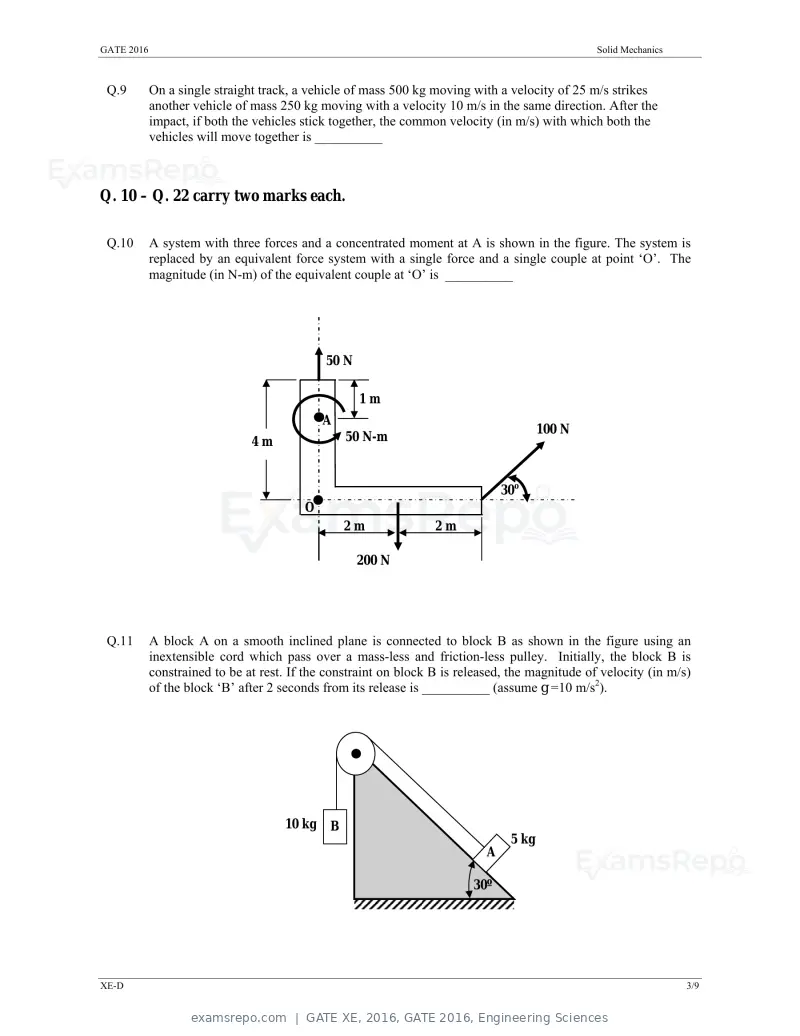
 Q.10       A system with three forces and a concentrated moment at A is shown in the figure. The system is
            replaced by an equivalent force system with a single force and a single couple at point ‘O’. The
            magnitude (in N-m) of the equivalent couple at ‘O’ is __________


                                             50 N

                                                    1m
                                             A
                                                                                        100 N
                               4m                 50 N-m


                                                                                30o
                                         O
                                                  2m              2m

                                                    200 N


 Q.11       A block A on a smooth inclined plane is connected to block B as shown in the figure using an
            inextensible cord which pass over a mass-less and friction-less pulley. Initially, the block B is
            constrained to be at rest. If the constraint on block B is released, the magnitude of velocity (in m/s)
            of the block ‘B’ after 2 seconds from its release is __________ (assume g =10 m/s2).


                                     10 kg    B
                                                                                 5 kg
                                                                            A

                                                                         30º


XE-D                                                                                                               3/9
Text of page 18
GATE 2016 Solid Mechanics
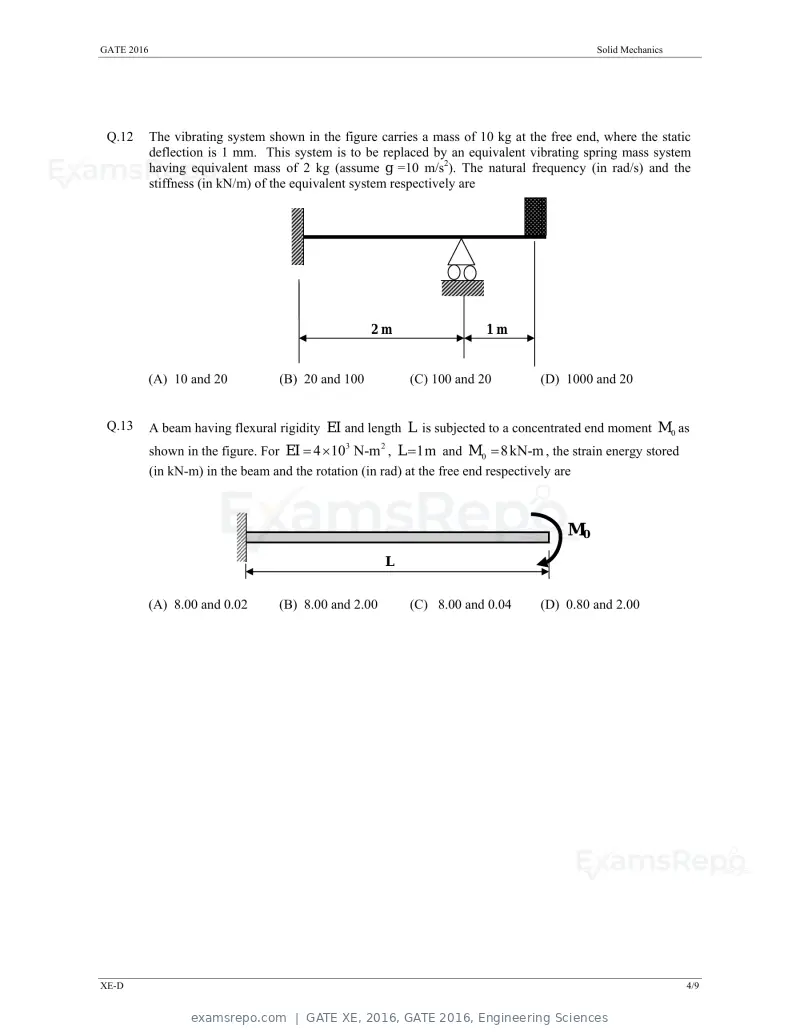
Q.12 The vibrating system shown in the figure carries a mass of 10 kg at the free end, where the static
deflection is 1 mm. This system is to be replaced by an equivalent vibrating spring mass system
having equivalent mass of 2 kg (assume g =10 m/s2). The natural frequency (in rad/s) and the
stiffness (in kN/m) of the equivalent system respectively are
2m 1m
(A) 10 and 20 (B) 20 and 100 (C) 100 and 20 (D) 1000 and 20
Q.13 A beam having flexural rigidity EI and length L is subjected to a concentrated end moment M 0 as
shown in the figure. For EI 4 103 N-m 2 , L 1m and M 0 8 kN-m , the strain energy stored
(in kN-m) in the beam and the rotation (in rad) at the free end respectively are
M0
L
(A) 8.00 and 0.02 (B) 8.00 and 2.00 (C) 8.00 and 0.04 (D) 0.80 and 2.00
XE-D 4/9
Text of page 19
GATE 2016 Solid Mechanics
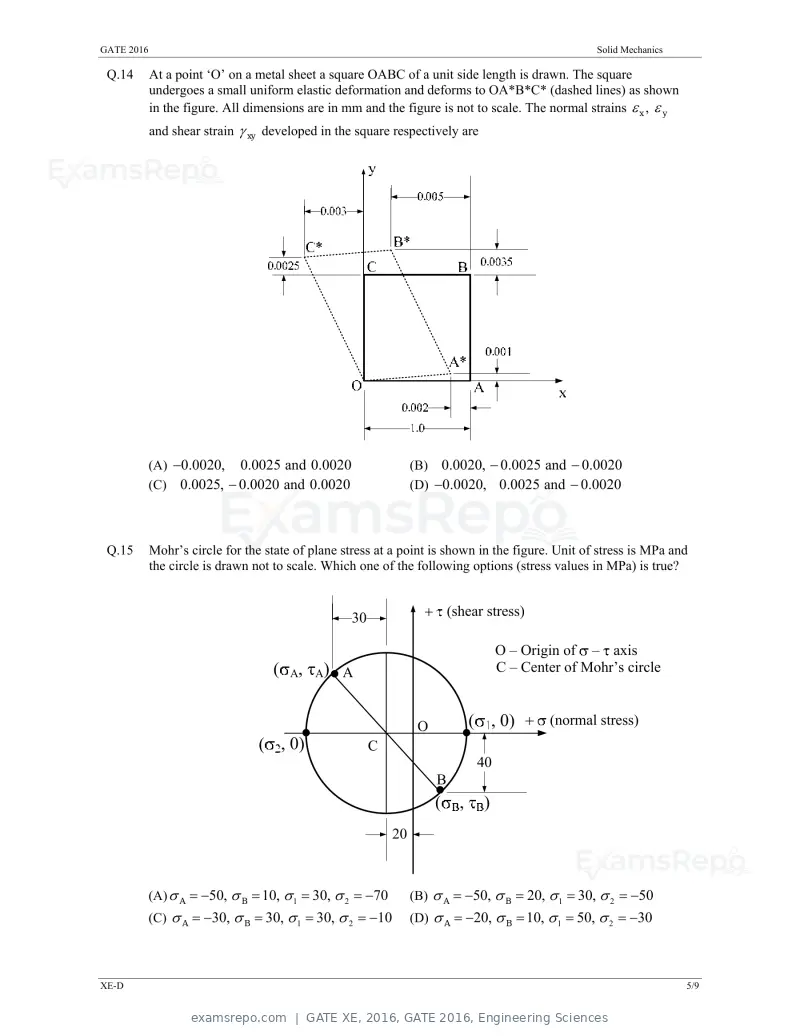
Q.14 At a point ‘O’ on a metal sheet a square OABC of a unit side length is drawn. The square
undergoes a small uniform elastic deformation and deforms to OA*B*C* (dashed lines) as shown
in the figure. All dimensions are in mm and the figure is not to scale. The normal strains x , y
and shear strain xy developed in the square respectively are
(A) 0.0020, 0.0025 and 0.0020 (B) 0.0020, 0.0025 and 0.0020
(C) 0.0025, 0.0020 and 0.0020 (D) 0.0020, 0.0025 and 0.0020
Q.15 Mohr’s circle for the state of plane stress at a point is shown in the figure. Unit of stress is MPa and
the circle is drawn not to scale. Which one of the following options (stress values in MPa) is true?
30 (shear stress)
O – Origin of – axis
( A, A) A C – Center of Mohr’s circle
O ( , 0) (normal stress)
( , 0) C
40
B
( , )
20
(A) A 50, B 10, 1 30, 2 70 (B) A 50, B 20, 1 30, 2 50
(C) A 30, B 30, 1 30, 2 10 (D) A 20, B 10, 1 50, 2 30
XE-D 5/9
Text of page 20
GATE 2016 Solid Mechanics
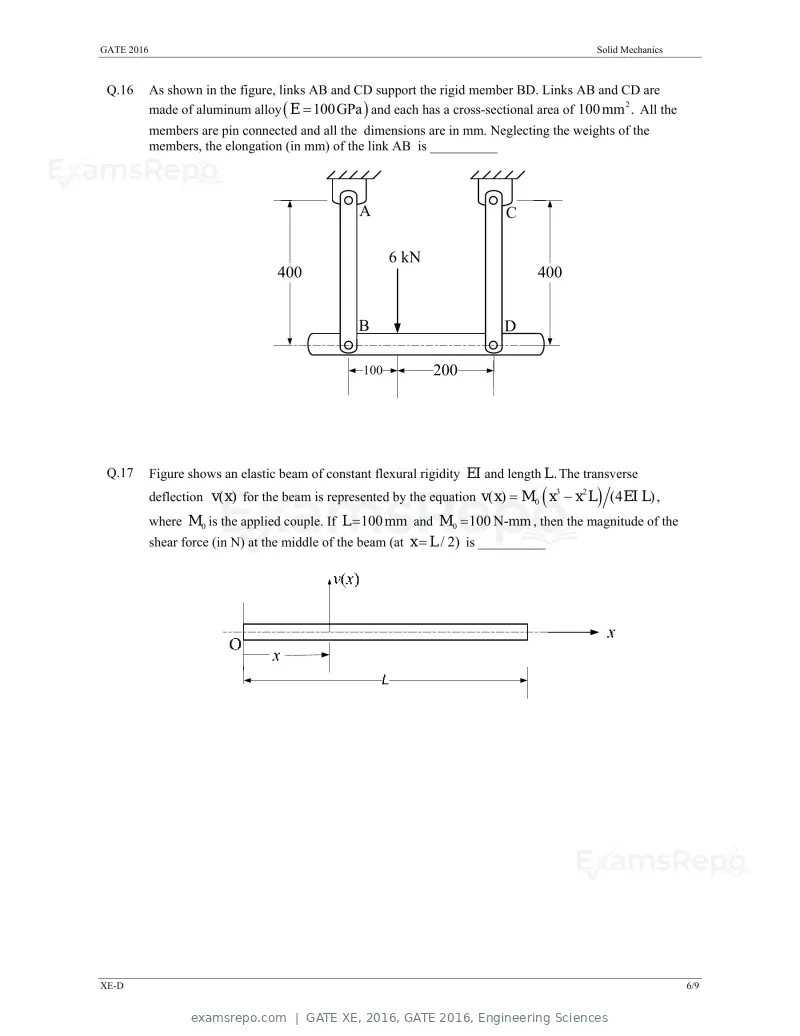
Q.16 As shown in the figure, links AB and CD support the rigid member BD. Links AB and CD are
made of aluminum alloy E 100GPa and each has a cross-sectional area of 100 mm 2 . All the
members are pin connected and all the dimensions are in mm. Neglecting the weights of the
members, the elongation (in mm) of the link AB is __________
A C
6 kN
400 400
B D
100 200
Q.17 Figure shows an elastic beam of constant flexural rigidity EI and length L . The transverse
deflection v( x) for the beam is represented by the equation v( x ) M 0 x 3 x 2 L (4 EI L) ,
where M 0 is the applied couple. If L 100 mm and M 0 100 N-mm , then the magnitude of the
shear force (in N) at the middle of the beam (at x L / 2) is __________
XE-D 6/9
Text of page 21
GATE 2016 Solid Mechanics
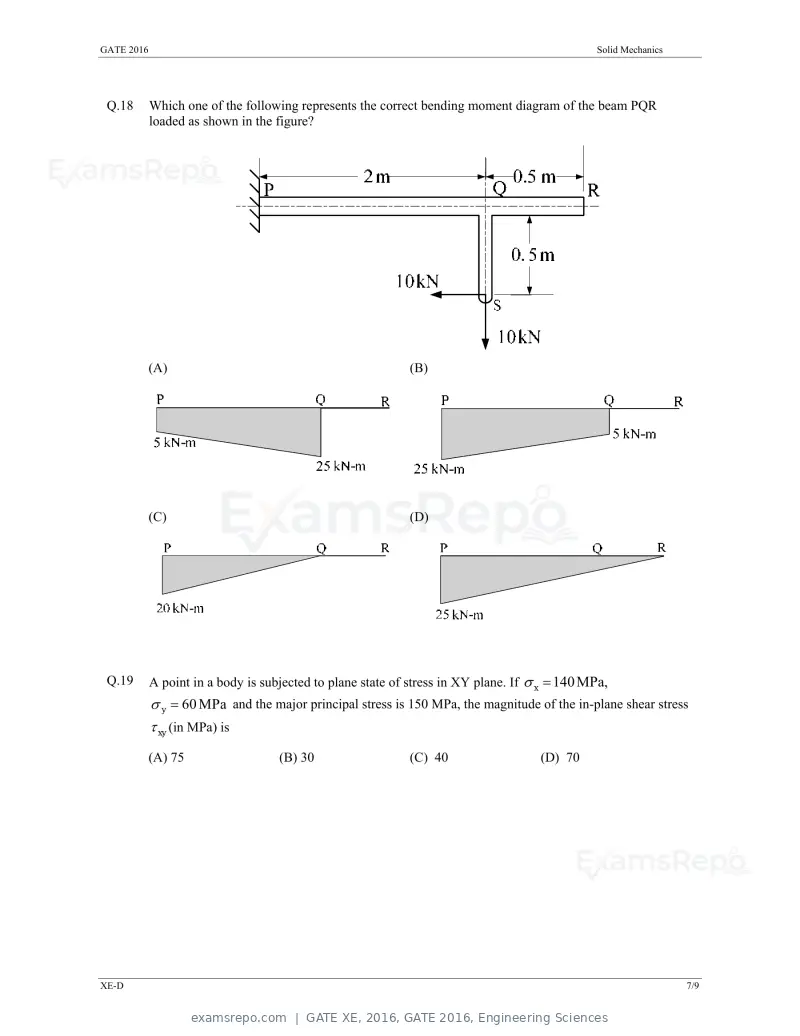
Q.18 Which one of the following represents the correct bending moment diagram of the beam PQR
loaded as shown in the figure?
(A) (B)
(C) (D)
Q.19 A point in a body is subjected to plane state of stress in XY plane. If x 140 MPa,
y 60 MPa and the major principal stress is 150 MPa, the magnitude of the in-plane shear stress
xy (in MPa) is
(A) 75 (B) 30 (C) 40 (D) 70
XE-D 7/9
Text of page 22
GATE 2016 Solid Mechanics
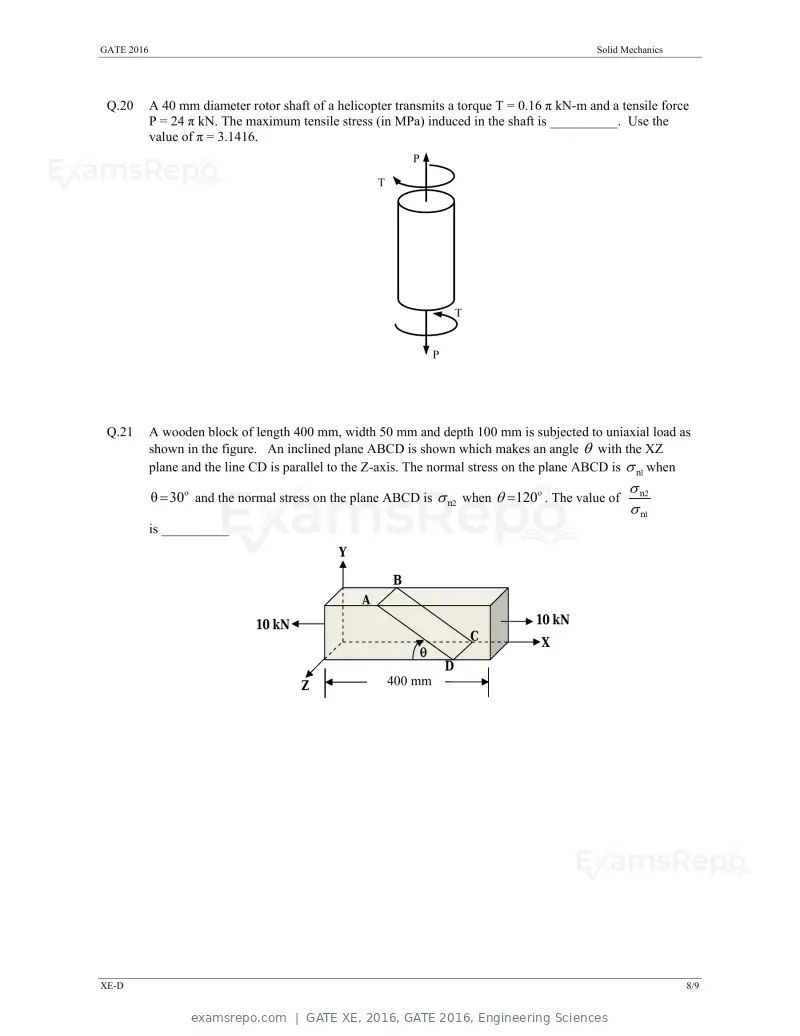
Q.20 A 40 mm diameter rotor shaft of a helicopter transmits a torque T = 0.16 π kN-m and a tensile force
P = 24 π kN. The maximum tensile stress (in MPa) induced in the shaft is __________. Use the
value of π = 3.1416.
P
T
T
P
Q.21 A wooden block of length 400 mm, width 50 mm and depth 100 mm is subjected to uniaxial load as
shown in the figure. An inclined plane ABCD is shown which makes an angle with the XZ
plane and the line CD is parallel to the Z-axis. The normal stress on the plane ABCD is n1 when
n2
θ 30o and the normal stress on the plane ABCD is n 2 when 120o . The value of
n1
is __________
Y
B
A
10 kN 10 kN
C X
D
Z 400 mm
XE-D 8/9
Text of page 23
GATE 2016                                                                                       Solid Mechanics


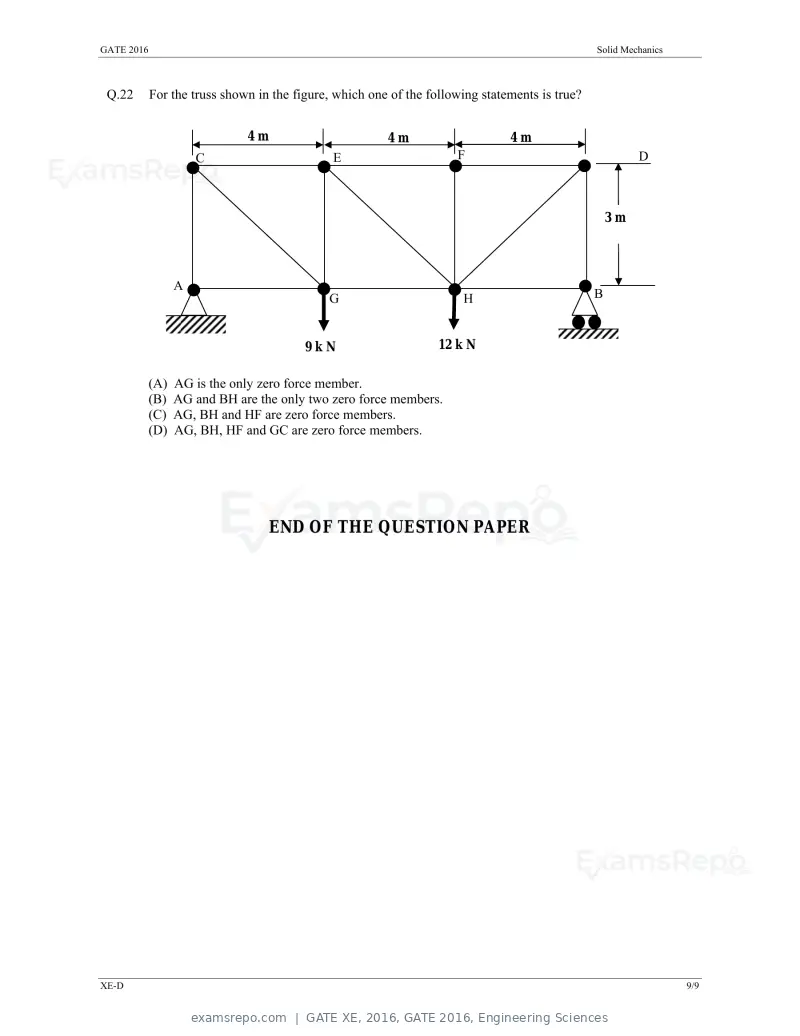
 Q.22       For the truss shown in the figure, which one of the following statements is true?


                              4m                        4m                     4m
                    C                         E                      F                                   D


                                                                                                    3m


                A
                                             G                        H                         B


                                         9kN                      12 k N

            (A) AG is the only zero force member.
            (B) AG and BH are the only two zero force members.
            (C) AG, BH and HF are zero force members.
            (D) AG, BH, HF and GC are zero force members.


                                  END OF THE QUESTION PAPER


XE-D                                                                                                              9/9
Text of page 24
GATE 2016                                                                                    THERMODYNAMICS-XE-E

                                        E : THERMODYNAMICS


Notation used:
P - pressure, V - volume, T - temperature, S - entropy, H - enthalpy, U - internal energy, A - Helmholtz free
energy, Cp - specific heat capacity at constant pressure.
Specific properties are designated by lower case symbols.

Useful data:

Universal gas constant R = 8.314 kJ/(kmol.K)
Cp of air = 1.005 kJ/(kg.K)
Ratio of ideal gas specific heats for air: γ = 1.4
Molecular mass of hydrogen: 2 kg/kmol


Q. 1 – Q. 9 carry one mark each.

 Q.1        Which of the following thermodynamic properties is NOT an intensive property of a
            thermodynamic system:
         (A) Pressure                                        (B) Temperature
         (C) Density                                         (D) Volume

 Q.2        An U-tube manometer shows a height difference of z1 between the two columns for a known gauge
            pressure P1 (both z1 and P1 in appropriate units). If the height difference between the two columns
            is 2z1, then the corresponding gauge pressure will be:
         (A) P1/2                   (B) 2P1                  (C) P1                   (D) 4P1

 Q.3        Water vapour can be treated as an ideal gas,
         (A) for all temperature and pressure
         (B) for sufficiently low pressure, regardless of its temperature
         (C) for very high pressure only
         (D) for sufficiently low temperature, regardless of its pressure

 Q.4        The thermal efficiency of a Carnot engine is 0.5. If the temperature of the cold reservoir is 300 K,
            then the temperature of the hot reservoir is:
         (A) 600 K                  (B) 1200 K               (C) 900 K                (D) 450 K

 Q.5        In a reversible, constant-pressure, non-flow process, heat input is given by
         (A) change in internal energy
         (B) change in enthalpy
         (C) change in entropy
         (D) work output

 Q.6        Moist air undergoes an adiabatic saturation process such that the relative humidity of air increases.
            For this process,
         (A) Dry bulb temperature increases, specific humidity increases
         (B) Dry bulb temperature increases, specific humidity decreases
         (C) Dry bulb temperature decreases, specific humidity increases
         (D) Dry bulb temperature decreases, specific humidity decreases


XE-E                                                                                                                1/6
Text of page 25
GATE 2016                                                                                     THERMODYNAMICS-XE-E


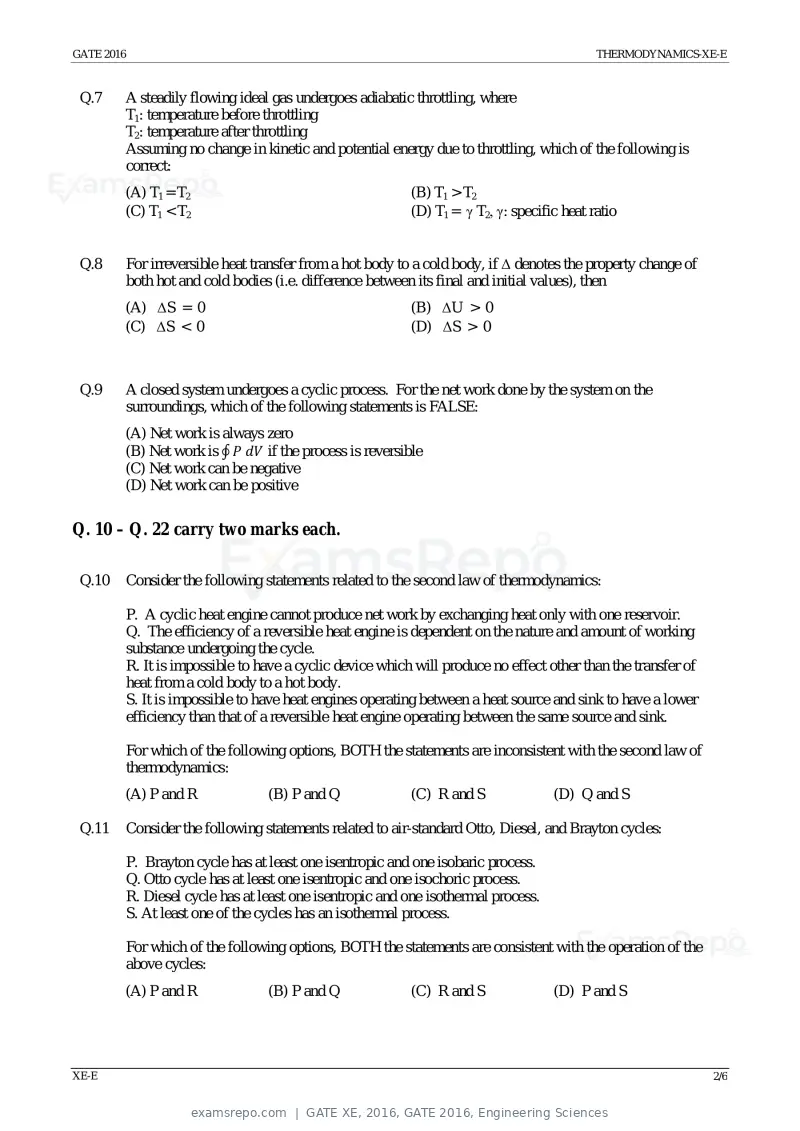
 Q.7        A steadily flowing ideal gas undergoes adiabatic throttling, where
            T1: temperature before throttling
            T2: temperature after throttling
            Assuming no change in kinetic and potential energy due to throttling, which of the following is
            correct:
        (A) T1 = T2                                          (B) T1 > T2
        (C) T1 < T2                                          (D) T1 = γ T2, γ: specific heat ratio


 Q.8        For irreversible heat transfer from a hot body to a cold body, if Δ denotes the property change of
            both hot and cold bodies (i.e. difference between its final and initial values), then
        (A) ΔS = 0                                           (B) ΔU > 0
        (C) ΔS < 0                                           (D) ΔS > 0


 Q.9        A closed system undergoes a cyclic process. For the net work done by the system on the
            surroundings, which of the following statements is FALSE:
        (A) Net work is always zero
        (B) Net work is ∮ PP dddd if the process is reversible
        (C) Net work can be negative
        (D) Net work can be positive


Q. 10 – Q. 22 carry two marks each.

 Q.10       Consider the following statements related to the second law of thermodynamics:

            P. A cyclic heat engine cannot produce net work by exchanging heat only with one reservoir.
            Q. The efficiency of a reversible heat engine is dependent on the nature and amount of working
            substance undergoing the cycle.
            R. It is impossible to have a cyclic device which will produce no effect other than the transfer of
            heat from a cold body to a hot body.
            S. It is impossible to have heat engines operating between a heat source and sink to have a lower
            efficiency than that of a reversible heat engine operating between the same source and sink.

            For which of the following options, BOTH the statements are inconsistent with the second law of
            thermodynamics:
        (A) P and R                 (B) P and Q              (C) R and S              (D) Q and S

 Q.11       Consider the following statements related to air-standard Otto, Diesel, and Brayton cycles:

            P. Brayton cycle has at least one isentropic and one isobaric process.
            Q. Otto cycle has at least one isentropic and one isochoric process.
            R. Diesel cycle has at least one isentropic and one isothermal process.
            S. At least one of the cycles has an isothermal process.

            For which of the following options, BOTH the statements are consistent with the operation of the
            above cycles:
        (A) P and R                 (B) P and Q              (C) R and S              (D) P and S


XE-E                                                                                                              2/6
Text of page 26
GATE 2016                                                                                         THERMODYNAMICS-XE-E

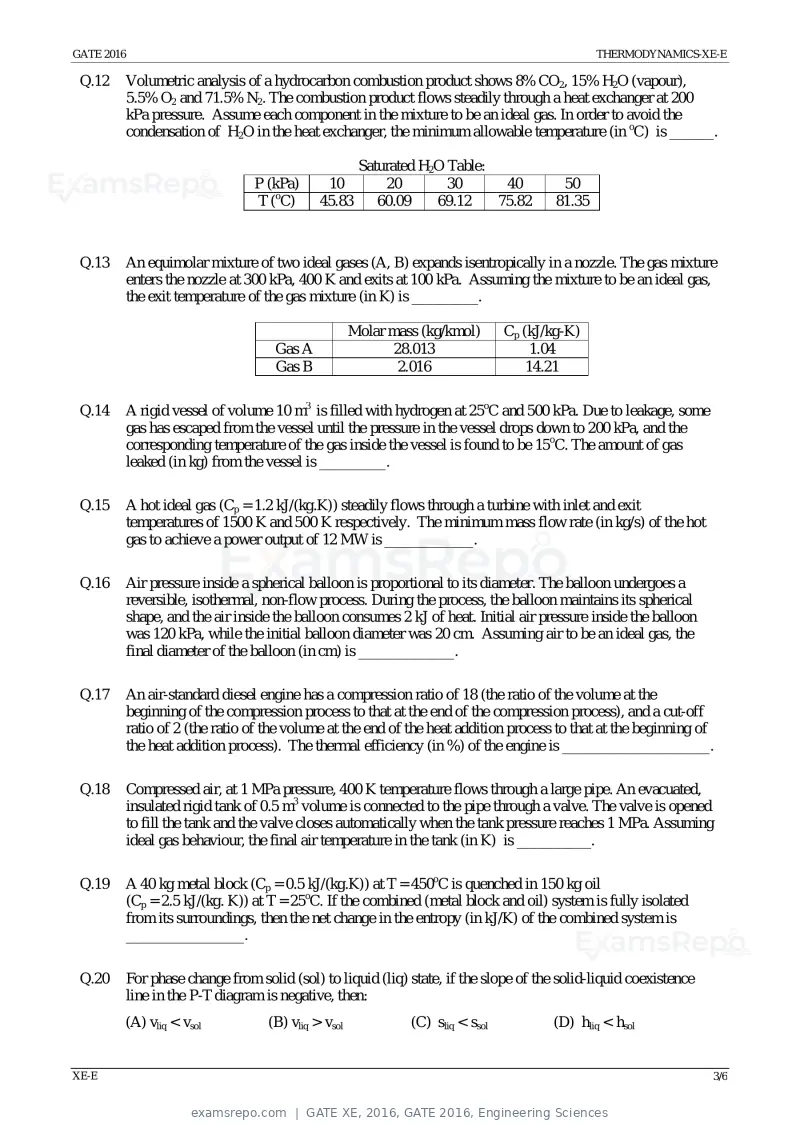
 Q.12       Volumetric analysis of a hydrocarbon combustion product shows 8% CO2, 15% H2O (vapour),
            5.5% O2 and 71.5% N2. The combustion product flows steadily through a heat exchanger at 200
            kPa pressure. Assume each component in the mixture to be an ideal gas. In order to avoid the
            condensation of H2O in the heat exchanger, the minimum allowable temperature (in oC) is ______.

                                                     Saturated H2O Table:
                                  P (kPa)       10       20        30      40              50
                                  T (oC)       45.83    60.09    69.12    75.82           81.35


 Q.13       An equimolar mixture of two ideal gases (A, B) expands isentropically in a nozzle. The gas mixture
            enters the nozzle at 300 kPa, 400 K and exits at 100 kPa. Assuming the mixture to be an ideal gas,
            the exit temperature of the gas mixture (in K) is _________.

                                                       Molar mass (kg/kmol)       Cp (kJ/kg-K)
                                      Gas A                   28.013                   1.04
                                      Gas B                    2.016                  14.21

 Q.14       A rigid vessel of volume 10 m3 is filled with hydrogen at 25oC and 500 kPa. Due to leakage, some
            gas has escaped from the vessel until the pressure in the vessel drops down to 200 kPa, and the
            corresponding temperature of the gas inside the vessel is found to be 15oC. The amount of gas
            leaked (in kg) from the vessel is _________.

 Q.15       A hot ideal gas (Cp = 1.2 kJ/(kg.K)) steadily flows through a turbine with inlet and exit
            temperatures of 1500 K and 500 K respectively. The minimum mass flow rate (in kg/s) of the hot
            gas to achieve a power output of 12 MW is ____________.

 Q.16       Air pressure inside a spherical balloon is proportional to its diameter. The balloon undergoes a
            reversible, isothermal, non-flow process. During the process, the balloon maintains its spherical
            shape, and the air inside the balloon consumes 2 kJ of heat. Initial air pressure inside the balloon
            was 120 kPa, while the initial balloon diameter was 20 cm. Assuming air to be an ideal gas, the
            final diameter of the balloon (in cm) is _____________.

 Q.17       An air-standard diesel engine has a compression ratio of 18 (the ratio of the volume at the
            beginning of the compression process to that at the end of the compression process), and a cut-off
            ratio of 2 (the ratio of the volume at the end of the heat addition process to that at the beginning of
            the heat addition process). The thermal efficiency (in %) of the engine is ____________________.

 Q.18       Compressed air, at 1 MPa pressure, 400 K temperature flows through a large pipe. An evacuated,
            insulated rigid tank of 0.5 m3 volume is connected to the pipe through a valve. The valve is opened
            to fill the tank and the valve closes automatically when the tank pressure reaches 1 MPa. Assuming
            ideal gas behaviour, the final air temperature in the tank (in K) is __________.

 Q.19       A 40 kg metal block (Cp = 0.5 kJ/(kg.K)) at T = 450oC is quenched in 150 kg oil
            (Cp = 2.5 kJ/(kg. K)) at T = 25oC. If the combined (metal block and oil) system is fully isolated
            from its surroundings, then the net change in the entropy (in kJ/K) of the combined system is
            ________________.

 Q.20       For phase change from solid (sol) to liquid (liq) state, if the slope of the solid-liquid coexistence
            line in the P-T diagram is negative, then:
        (A) vliq < vsol              (B) vliq > vsol            (C) sliq < ssol          (D) hliq < hsol


XE-E                                                                                                                3/6
Text of page 27
GATE 2016                                                                                   THERMODYNAMICS-XE-E


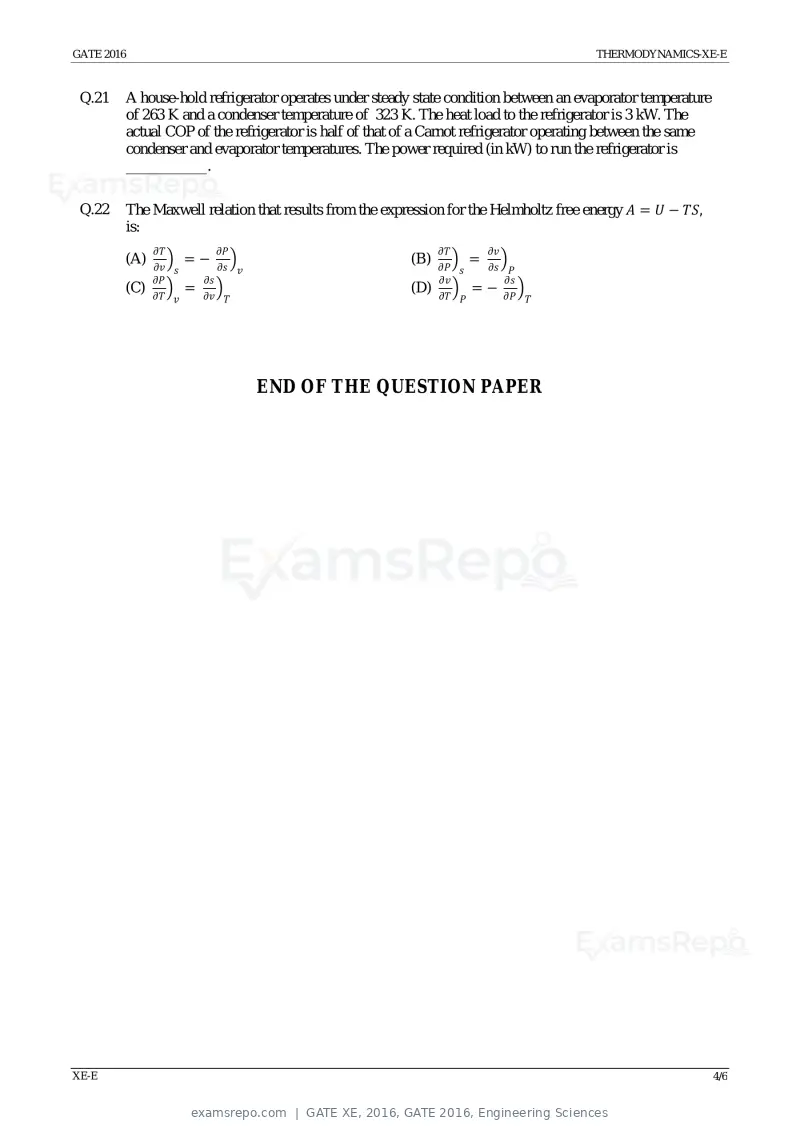
 Q.21       A house-hold refrigerator operates under steady state condition between an evaporator temperature
            of 263 K and a condenser temperature of 323 K. The heat load to the refrigerator is 3 kW. The
            actual COP of the refrigerator is half of that of a Carnot refrigerator operating between the same
            condenser and evaporator temperatures. The power required (in kW) to run the refrigerator is
            ___________.

 Q.22       The Maxwell relation that results from the expression for the Helmholtz free energy AA = UU − TTTT,
            is:
            ∂∂∂∂          ∂∂∂∂                                  ∂∂∂∂     ∂∂∂∂
        (A)      � =− �                                     (B)      � = �
            ∂∂∂∂ ss       ∂∂∂∂ vv                               ∂∂∂∂ ss  ∂∂∂∂ PP
            ∂∂∂∂     ∂∂∂∂                                       ∂∂∂∂          ∂∂∂∂
        (C) ∂∂∂∂ � = ∂∂∂∂ �                                 (D) ∂∂∂∂ � = − ∂∂∂∂ �
                  vv         TT                                       PP           TT


                                    END OF THE QUESTION PAPER


XE-E                                                                                                              4/6
Text of page 28
GATE 2016                                                                                                  XE

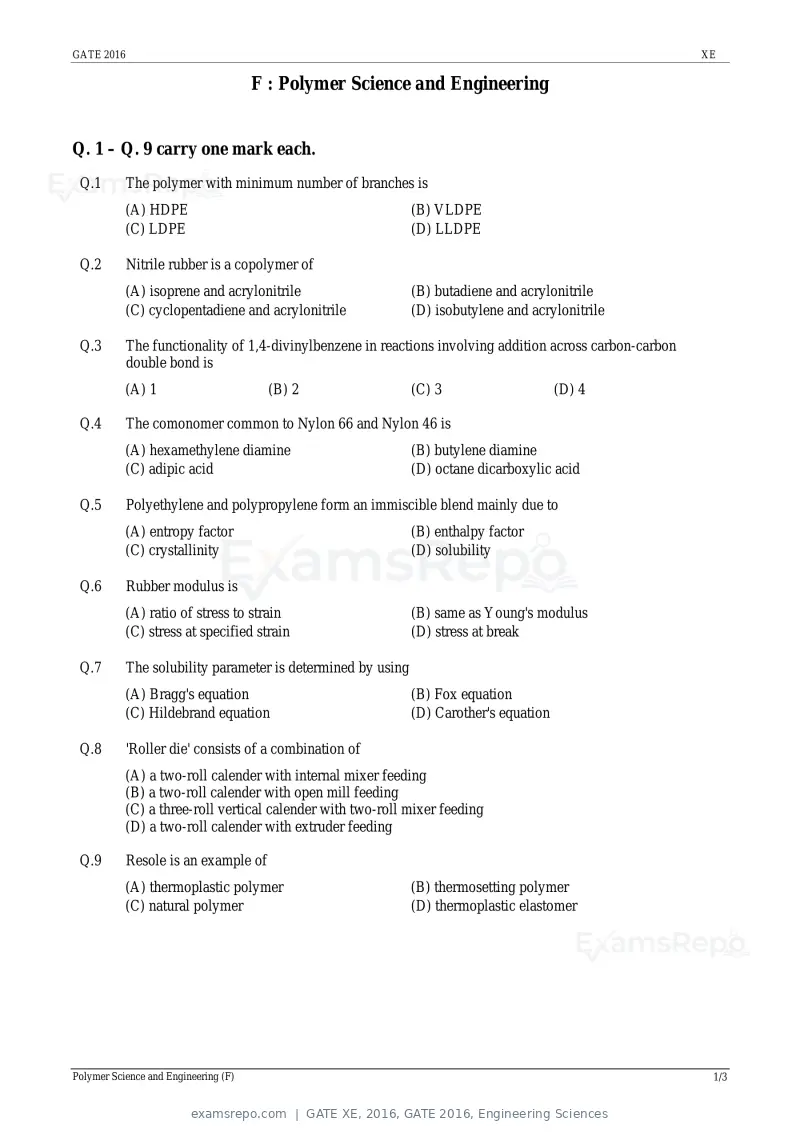
                                      F : Polymer Science and Engineering


Q. 1 – Q. 9 carry one mark each.
 Q.1        The polymer with minimum number of branches is
           (A) HDPE                                           (B) VLDPE
           (C) LDPE                                           (D) LLDPE

 Q.2        Nitrile rubber is a copolymer of
           (A) isoprene and acrylonitrile                     (B) butadiene and acrylonitrile
           (C) cyclopentadiene and acrylonitrile              (D) isobutylene and acrylonitrile

 Q.3        The functionality of 1,4-divinylbenzene in reactions involving addition across carbon-carbon
            double bond is
           (A) 1                       (B) 2                  (C) 3                     (D) 4

 Q.4        The comonomer common to Nylon 66 and Nylon 46 is
           (A) hexamethylene diamine                          (B) butylene diamine
           (C) adipic acid                                    (D) octane dicarboxylic acid

 Q.5        Polyethylene and polypropylene form an immiscible blend mainly due to
           (A) entropy factor                                 (B) enthalpy factor
           (C) crystallinity                                  (D) solubility

 Q.6        Rubber modulus is
           (A) ratio of stress to strain                      (B) same as Young's modulus
           (C) stress at specified strain                     (D) stress at break

 Q.7        The solubility parameter is determined by using
           (A) Bragg's equation                               (B) Fox equation
           (C) Hildebrand equation                            (D) Carother's equation

 Q.8        'Roller die' consists of a combination of
           (A) a two-roll calender with internal mixer feeding
           (B) a two-roll calender with open mill feeding
           (C) a three-roll vertical calender with two-roll mixer feeding
           (D) a two-roll calender with extruder feeding

 Q.9        Resole is an example of
           (A) thermoplastic polymer                          (B) thermosetting polymer
           (C) natural polymer                                (D) thermoplastic elastomer


Polymer Science and Engineering (F)                                                                         1/3
Text of page 29
GATE 2016                                                                                                   XE

Q. 10 – Q. 22 carry two marks each.

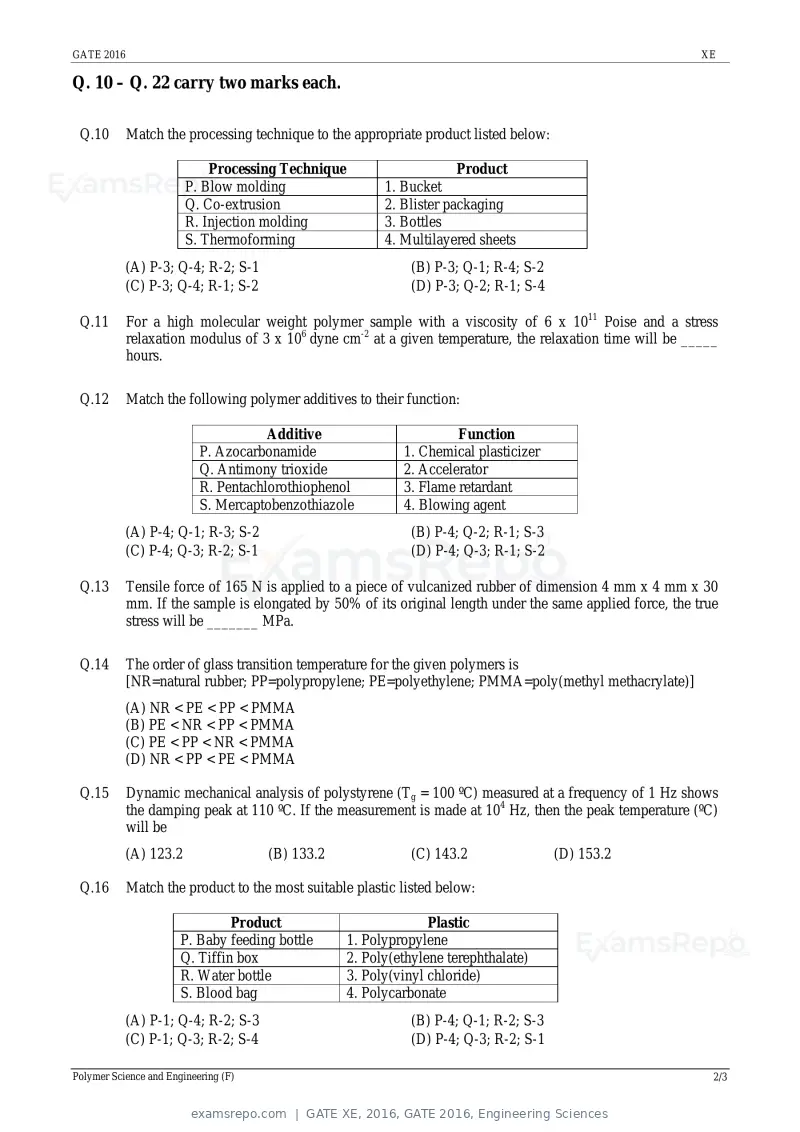
 Q.10       Match the processing technique to the appropriate product listed below:

                            Processing Technique                      Product
                        P. Blow molding                  1. Bucket
                        Q. Co-extrusion                  2. Blister packaging
                        R. Injection molding             3. Bottles
                        S. Thermoforming                 4. Multilayered sheets
           (A) P-3; Q-4; R-2; S-1                            (B) P-3; Q-1; R-4; S-2
           (C) P-3; Q-4; R-1; S-2                            (D) P-3; Q-2; R-1; S-4

 Q.11       For a high molecular weight polymer sample with a viscosity of 6 x 10¹¹ Poise and a stress
            relaxation modulus of 3 x 10⁶ dyne cm-2 at a given temperature, the relaxation time will be _____
            hours.

 Q.12       Match the following polymer additives to their function:

                                      Additive                       Function
                           P. Azocarbonamide                1. Chemical plasticizer
                           Q. Antimony trioxide             2. Accelerator
                           R. Pentachlorothiophenol         3. Flame retardant
                           S. Mercaptobenzothiazole         4. Blowing agent
           (A) P-4; Q-1; R-3; S-2                            (B) P-4; Q-2; R-1; S-3
           (C) P-4; Q-3; R-2; S-1                            (D) P-4; Q-3; R-1; S-2

 Q.13       Tensile force of 165 N is applied to a piece of vulcanized rubber of dimension 4 mm x 4 mm x 30
            mm. If the sample is elongated by 50% of its original length under the same applied force, the true
            stress will be _______ MPa.

 Q.14       The order of glass transition temperature for the given polymers is
            [NR=natural rubber; PP=polypropylene; PE=polyethylene; PMMA=poly(methyl methacrylate)]
           (A) NR < PE < PP < PMMA
           (B) PE < NR < PP < PMMA
           (C) PE < PP < NR < PMMA
           (D) NR < PP < PE < PMMA

 Q.15       Dynamic mechanical analysis of polystyrene (Tg = 100 ºC) measured at a frequency of 1 Hz shows
            the damping peak at 110 ºC. If the measurement is made at 104 Hz, then the peak temperature (ºC)
            will be
           (A) 123.2                  (B) 133.2              (C) 143.2                (D) 153.2

 Q.16       Match the product to the most suitable plastic listed below:

                                Product                          Plastic
                       P. Baby feeding bottle      1. Polypropylene
                       Q. Tiffin box               2. Poly(ethylene terephthalate)
                       R. Water bottle             3. Poly(vinyl chloride)
                       S. Blood bag                4. Polycarbonate
           (A) P-1; Q-4; R-2; S-3                            (B) P-4; Q-1; R-2; S-3
           (C) P-1; Q-3; R-2; S-4                            (D) P-4; Q-3; R-2; S-1

Polymer Science and Engineering (F)                                                                           2/3
Text of page 30
GATE 2016                                                                                                    XE


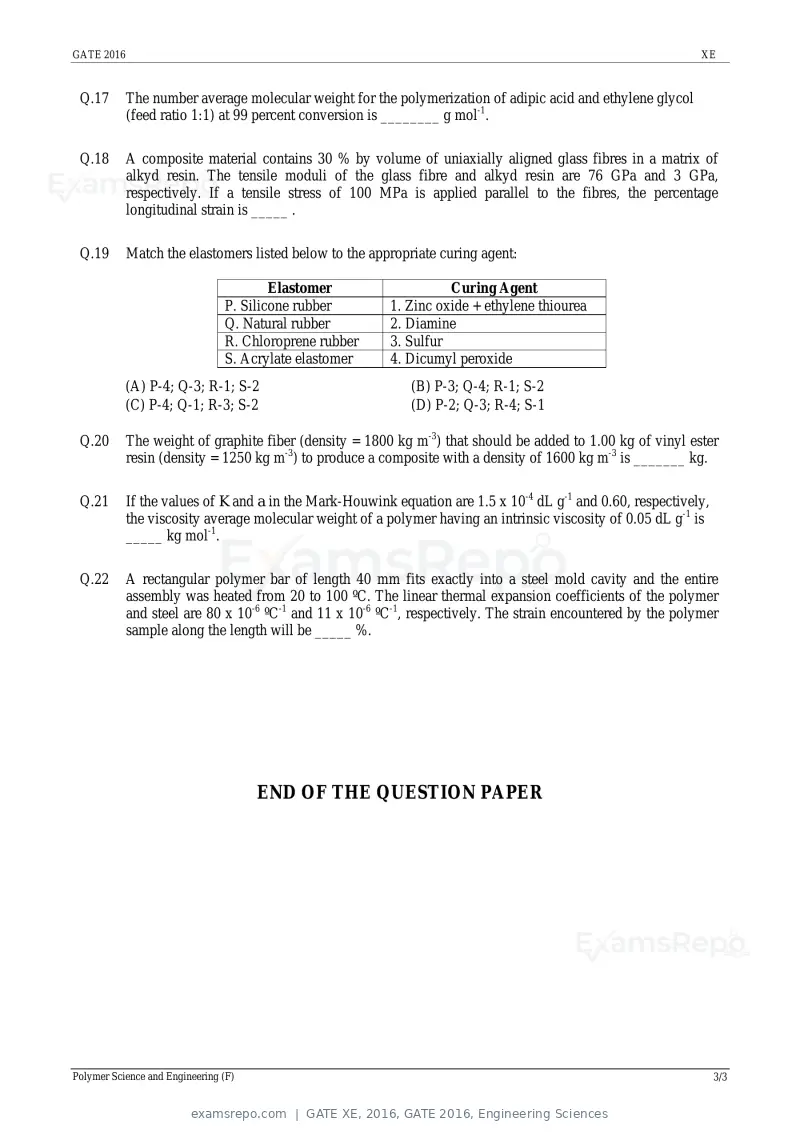
 Q.17       The number average molecular weight for the polymerization of adipic acid and ethylene glycol
            (feed ratio 1:1) at 99 percent conversion is ________ g mol-1.

 Q.18       A composite material contains 30 % by volume of uniaxially aligned glass fibres in a matrix of
            alkyd resin. The tensile moduli of the glass fibre and alkyd resin are 76 GPa and 3 GPa,
            respectively. If a tensile stress of 100 MPa is applied parallel to the fibres, the percentage
            longitudinal strain is _____ .

 Q.19       Match the elastomers listed below to the appropriate curing agent:

                                        Elastomer                 Curing Agent
                                P. Silicone rubber      1. Zinc oxide + ethylene thiourea
                                Q. Natural rubber       2. Diamine
                                R. Chloroprene rubber   3. Sulfur
                                S. Acrylate elastomer   4. Dicumyl peroxide
           (A) P-4; Q-3; R-1; S-2                           (B) P-3; Q-4; R-1; S-2
           (C) P-4; Q-1; R-3; S-2                           (D) P-2; Q-3; R-4; S-1

 Q.20       The weight of graphite fiber (density = 1800 kg m-3) that should be added to 1.00 kg of vinyl ester
            resin (density = 1250 kg m-3) to produce a composite with a density of 1600 kg m-3 is _______ kg.

 Q.21       If the values of K and a in the Mark-Houwink equation are 1.5 x 10⁻⁴ dL g-1 and 0.60, respectively,
            the viscosity average molecular weight of a polymer having an intrinsic viscosity of 0.05 dL g-1 is
            _____ kg mol-1.

 Q.22       A rectangular polymer bar of length 40 mm fits exactly into a steel mold cavity and the entire
            assembly was heated from 20 to 100 ºC. The linear thermal expansion coefficients of the polymer
            and steel are 80 x 10-6 ºC-1 and 11 x 10-6 ºC-1, respectively. The strain encountered by the polymer
            sample along the length will be _____ %.


                                      END OF THE QUESTION PAPER


Polymer Science and Engineering (F)                                                                               3/3
Text of page 31
GATE 2016 Food Technology (XE-G)

                                      G: FOOD TECHNOLOGY
Q. 1 – Q. 9 carry one mark each.
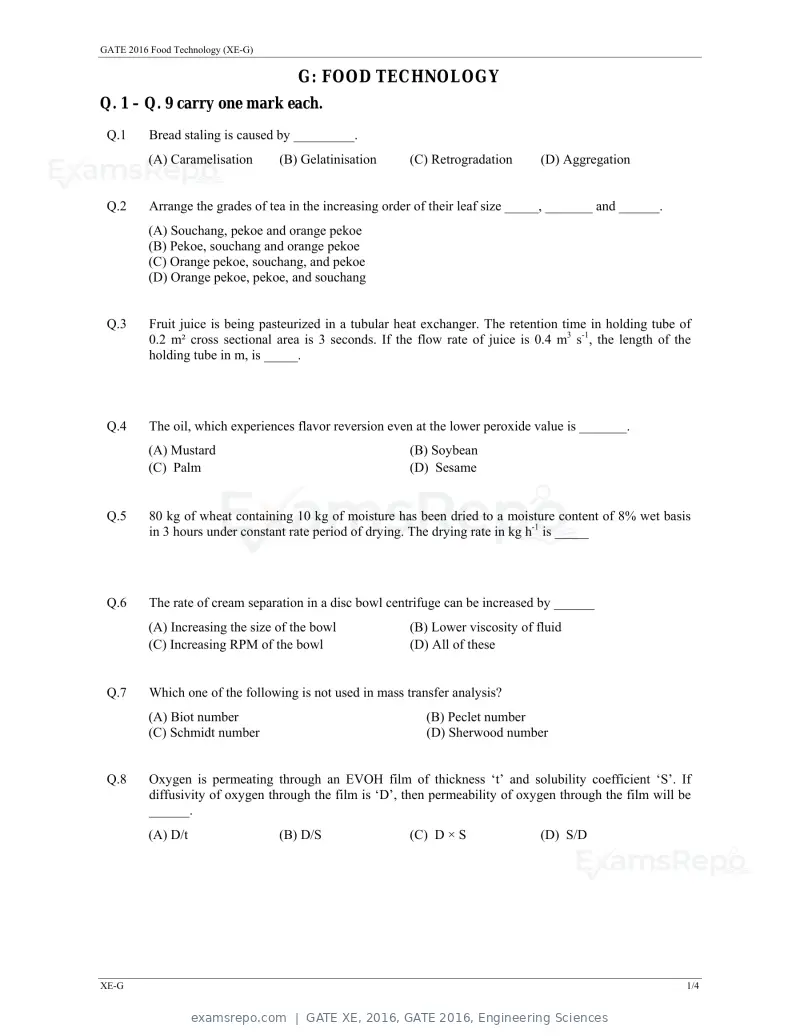
 Q.1      Bread staling is caused by _________.
          (A) Caramelisation       (B) Gelatinisation     (C) Retrogradation      (D) Aggregation


 Q.2      Arrange the grades of tea in the increasing order of their leaf size _____, _______ and ______.
          (A) Souchang, pekoe and orange pekoe
          (B) Pekoe, souchang and orange pekoe
          (C) Orange pekoe, souchang, and pekoe
          (D) Orange pekoe, pekoe, and souchang


 Q.3      Fruit juice is being pasteurized in a tubular heat exchanger. The retention time in holding tube of
          0.2 m² cross sectional area is 3 seconds. If the flow rate of juice is 0.4 m3 s-1, the length of the
          holding tube in m, is _____.


 Q.4      The oil, which experiences flavor reversion even at the lower peroxide value is _______.
          (A) Mustard                                     (B) Soybean
          (C) Palm                                        (D) Sesame


 Q.5      80 kg of wheat containing 10 kg of moisture has been dried to a moisture content of 8% wet basis
          in 3 hours under constant rate period of drying. The drying rate in kg h-1 is _____


 Q.6      The rate of cream separation in a disc bowl centrifuge can be increased by ______
          (A) Increasing the size of the bowl             (B) Lower viscosity of fluid
          (C) Increasing RPM of the bowl                  (D) All of these


 Q.7      Which one of the following is not used in mass transfer analysis?
          (A) Biot number                                    (B) Peclet number
          (C) Schmidt number                                 (D) Sherwood number


 Q.8      Oxygen is permeating through an EVOH film of thickness ‘t’ and solubility coefficient ‘S’. If
          diffusivity of oxygen through the film is ‘D’, then permeability of oxygen through the film will be
          ______.
          (A) D/t                  (B) D/S                (C) D × S               (D) S/D


XE-G                                                                                                         1/4
Text of page 32
GATE 2016 Food Technology (XE-G)
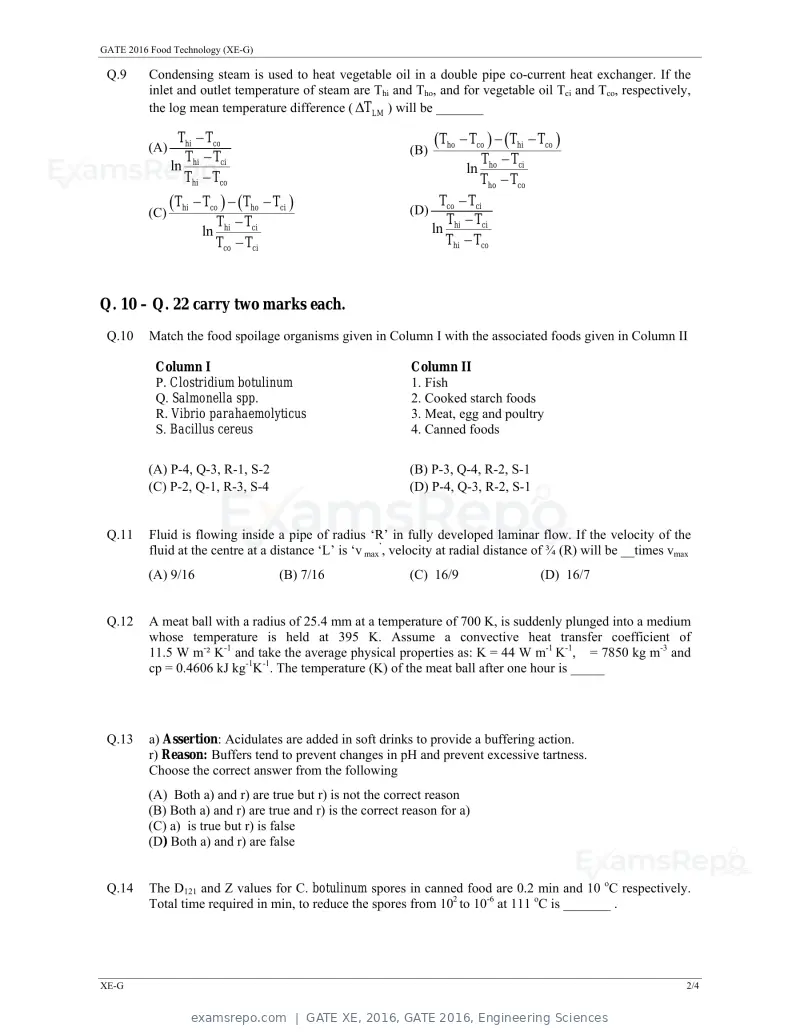
Q.9 Condensing steam is used to heat vegetable oil in a double pipe co-current heat exchanger. If the
inlet and outlet temperature of steam are Thi and Tho, and for vegetable oil Tci and Tco, respectively,
the log mean temperature difference ( TLM ) will be _______
(A)
Thi Tco
(B)
Tho Tco Thi Tco
T T Tho Tci
ln hi ci ln
Thi Tco Tho Tco
(C)
Thi Tco Tho Tci (D)
Tco Tci
Thi Tci T T
ln ln hi ci
Tco Tci Thi Tco
Q. 10 – Q. 22 carry two marks each.
Q.10 Match the food spoilage organisms given in Column I with the associated foods given in Column II
Column I Column II
P. Clostridium botulinum 1. Fish
Q. Salmonella spp. 2. Cooked starch foods
R. Vibrio parahaemolyticus 3. Meat, egg and poultry
S. Bacillus cereus 4. Canned foods
(A) P-4, Q-3, R-1, S-2 (B) P-3, Q-4, R-2, S-1
(C) P-2, Q-1, R-3, S-4 (D) P-4, Q-3, R-2, S-1
Q.11 Fluid is flowing inside a pipe of radius ‘R’ in fully developed laminar flow. If the velocity of the
fluid at the centre at a distance ‘L’ is ‘v max’, velocity at radial distance of ¾ (R) will be __times vmax
(A) 9/16 (B) 7/16 (C) 16/9 (D) 16/7
Q.12 A meat ball with a radius of 25.4 mm at a temperature of 700 K, is suddenly plunged into a medium
whose temperature is held at 395 K. Assume a convective heat transfer coefficient of
11.5 W m-² K-1 and take the average physical properties as: K = 44 W m-1 K-1, ρ = 7850 kg m-3 and
cp = 0.4606 kJ kg-1K-1. The temperature (K) of the meat ball after one hour is _____
Q.13 a) Assertion: Acidulates are added in soft drinks to provide a buffering action.
r) Reason: Buffers tend to prevent changes in pH and prevent excessive tartness.
Choose the correct answer from the following
(A) Both a) and r) are true but r) is not the correct reason
(B) Both a) and r) are true and r) is the correct reason for a)
(C) a) is true but r) is false
(D) Both a) and r) are false
Q.14 The D121 and Z values for C. botulinum spores in canned food are 0.2 min and 10 oC respectively.
Total time required in min, to reduce the spores from 102 to 10-6 at 111 oC is _______ .
XE-G 2/4
Text of page 33
GATE 2016 Food Technology (XE-G)

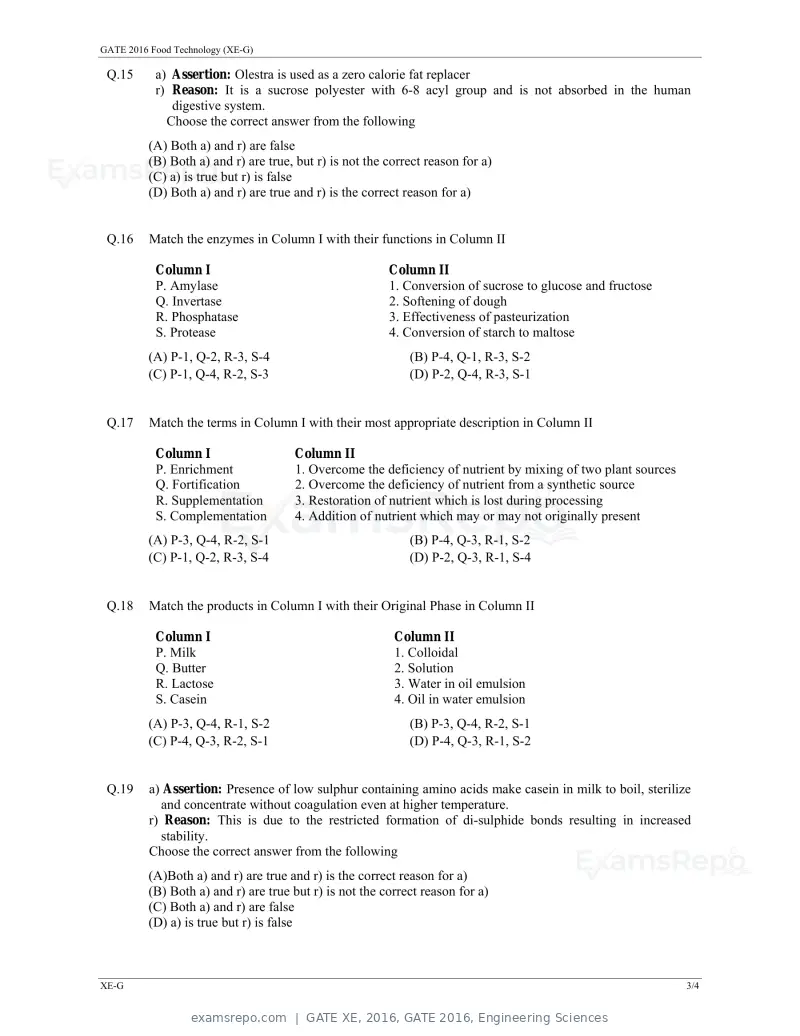
 Q.15      a) Assertion: Olestra is used as a zero calorie fat replacer
           r) Reason: It is a sucrose polyester with 6-8 acyl group and is not absorbed in the human
              digestive system.
             Choose the correct answer from the following
          (A) Both a) and r) are false
          (B) Both a) and r) are true, but r) is not the correct reason for a)
          (C) a) is true but r) is false
          (D) Both a) and r) are true and r) is the correct reason for a)


 Q.16     Match the enzymes in Column I with their functions in Column II

           Column I                                      Column II
           P. Amylase                                    1. Conversion of sucrose to glucose and fructose
           Q. Invertase                                  2. Softening of dough
           R. Phosphatase                                3. Effectiveness of pasteurization
           S. Protease                                   4. Conversion of starch to maltose
          (A) P-1, Q-2, R-3, S-4                             (B) P-4, Q-1, R-3, S-2
          (C) P-1, Q-4, R-2, S-3                             (D) P-2, Q-4, R-3, S-1


 Q.17     Match the terms in Column I with their most appropriate description in Column II

           Column I                   Column II
           P. Enrichment              1. Overcome the deficiency of nutrient by mixing of two plant sources
           Q. Fortification           2. Overcome the deficiency of nutrient from a synthetic source
           R. Supplementation         3. Restoration of nutrient which is lost during processing
           S. Complementation         4. Addition of nutrient which may or may not originally present
          (A) P-3, Q-4, R-2, S-1                             (B) P-4, Q-3, R-1, S-2
          (C) P-1, Q-2, R-3, S-4                             (D) P-2, Q-3, R-1, S-4


 Q.18     Match the products in Column I with their Original Phase in Column II

           Column I                                       Column II
           P. Milk                                        1. Colloidal
           Q. Butter                                      2. Solution
           R. Lactose                                     3. Water in oil emulsion
           S. Casein                                      4. Oil in water emulsion
          (A) P-3, Q-4, R-1, S-2                             (B) P-3, Q-4, R-2, S-1
          (C) P-4, Q-3, R-2, S-1                             (D) P-4, Q-3, R-1, S-2


 Q.19     a) Assertion: Presence of low sulphur containing amino acids make casein in milk to boil, sterilize
            and concentrate without coagulation even at higher temperature.
          r) Reason: This is due to the restricted formation of di-sulphide bonds resulting in increased
            stability.
          Choose the correct answer from the following
          (A)Both a) and r) are true and r) is the correct reason for a)
          (B) Both a) and r) are true but r) is not the correct reason for a)
          (C) Both a) and r) are false
          (D) a) is true but r) is false


XE-G                                                                                                          3/4
Text of page 34
GATE 2016 Food Technology (XE-G)

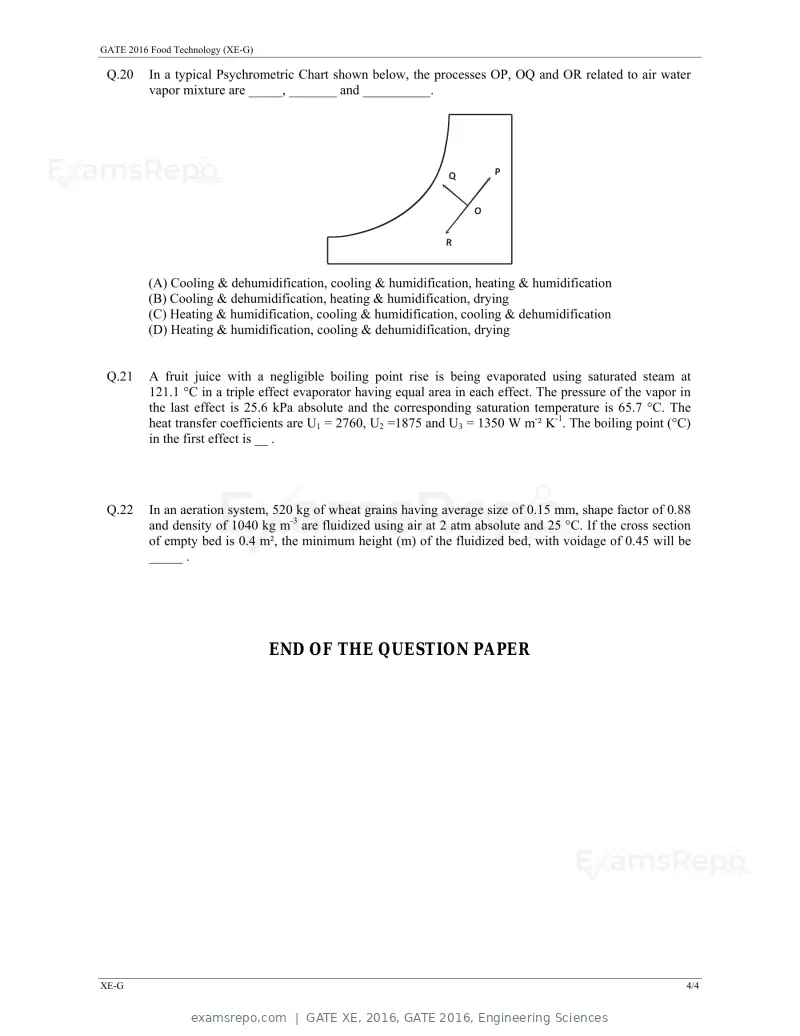
 Q.20     In a typical Psychrometric Chart shown below, the processes OP, OQ and OR related to air water
          vapor mixture are _____, _______ and __________.


                                                                 Q        P


                                                                      O


                                                                 R


          (A) Cooling & dehumidification, cooling & humidification, heating & humidification
          (B) Cooling & dehumidification, heating & humidification, drying
          (C) Heating & humidification, cooling & humidification, cooling & dehumidification
          (D) Heating & humidification, cooling & dehumidification, drying


 Q.21     A fruit juice with a negligible boiling point rise is being evaporated using saturated steam at
          121.1 °C in a triple effect evaporator having equal area in each effect. The pressure of the vapor in
          the last effect is 25.6 kPa absolute and the corresponding saturation temperature is 65.7 °C. The
          heat transfer coefficients are U1 = 2760, U2 =1875 and U3 = 1350 W m-² K-1. The boiling point (°C)
          in the first effect is __ .


 Q.22     In an aeration system, 520 kg of wheat grains having average size of 0.15 mm, shape factor of 0.88
          and density of 1040 kg m-3 are fluidized using air at 2 atm absolute and 25 °C. If the cross section
          of empty bed is 0.4 m², the minimum height (m) of the fluidized bed, with voidage of 0.45 will be
          _____ .


                                   END OF THE QUESTION PAPER


XE-G                                                                                                          4/4
Text of page 35
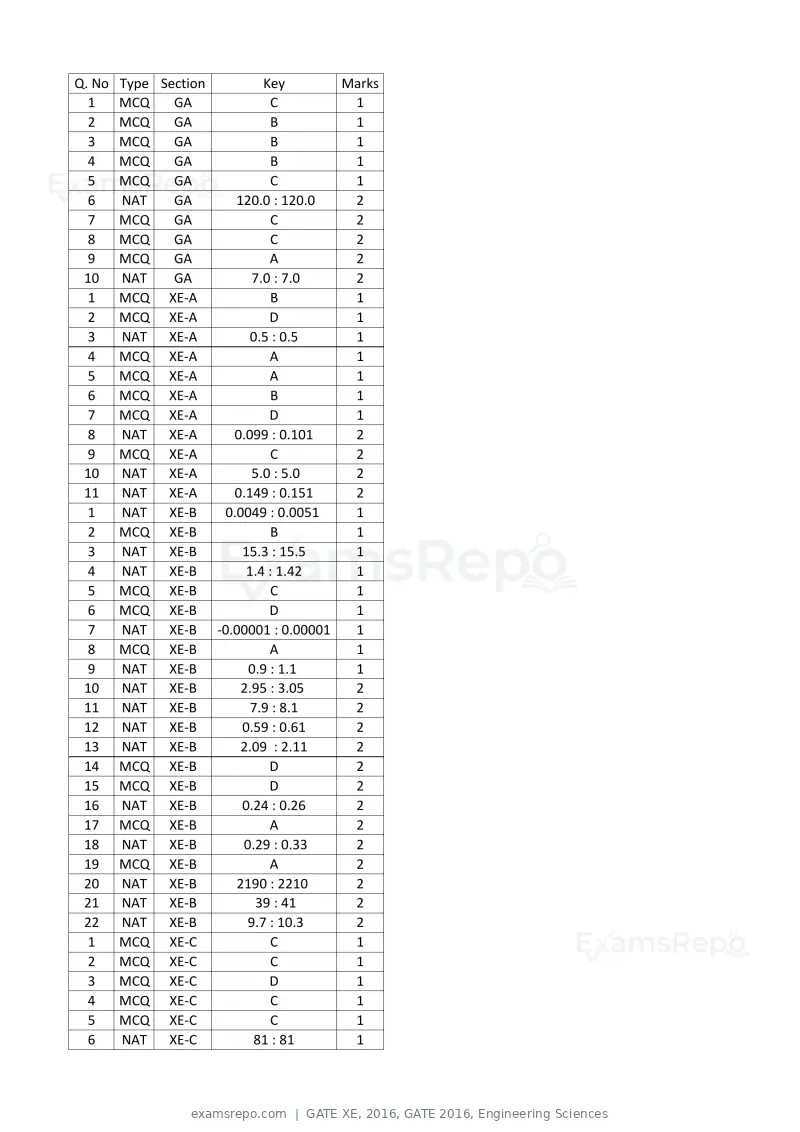
Q. No Type Section        Key      Marks
  1   MCQ    GA            C        1
  2   MCQ    GA            B        1
  3   MCQ    GA            B        1
  4   MCQ    GA            B        1
  5   MCQ    GA            C        1
  6   NAT    GA      120.0 : 120.0  2
  7   MCQ    GA            C        2
  8   MCQ    GA            C        2
  9   MCQ    GA            A        2
 10   NAT    GA         7.0 : 7.0   2
  1   MCQ XE-A             B        1
  2   MCQ XE-A             D        1
  3   NAT XE-A         0.5 : 0.5    1
  4   MCQ XE-A             A        1
  5   MCQ XE-A             A        1
  6   MCQ XE-A             B        1
  7   MCQ XE-A             D        1
  8   NAT XE-A      0.099 : 0.101   2
  9   MCQ XE-A             C        2
 10   NAT XE-A          5.0 : 5.0   2
 11   NAT XE-A      0.149 : 0.151   2
  1   NAT XE-B     0.0049 : 0.0051  1
  2   MCQ XE-B             B        1
  3   NAT XE-B        15.3 : 15.5   1
  4   NAT XE-B         1.4 : 1.42   1
  5   MCQ XE-B             C        1
  6   MCQ XE-B             D        1
  7   NAT XE-B -0.00001 : 0.00001   1
  8   MCQ XE-B             A        1
  9   NAT XE-B         0.9 : 1.1    1
 10   NAT XE-B        2.95 : 3.05   2
 11   NAT XE-B         7.9 : 8.1    2
 12   NAT XE-B        0.59 : 0.61   2
 13   NAT XE-B        2.09 : 2.11   2
 14 MCQ XE-B               D        2
 15 MCQ XE-B               D        2
 16   NAT XE-B        0.24 : 0.26   2
 17 MCQ XE-B               A        2
 18   NAT XE-B        0.29 : 0.33   2
 19 MCQ XE-B               A        2
 20   NAT XE-B       2190 : 2210    2
 21   NAT XE-B          39 : 41     2
 22   NAT XE-B         9.7 : 10.3   2
  1   MCQ XE-C             C        1
  2   MCQ XE-C             C        1
  3   MCQ XE-C             D        1
  4   MCQ XE-C             C        1
  5   MCQ XE-C             C        1
  6   NAT   XE-C        81 : 81     1
Text of page 36
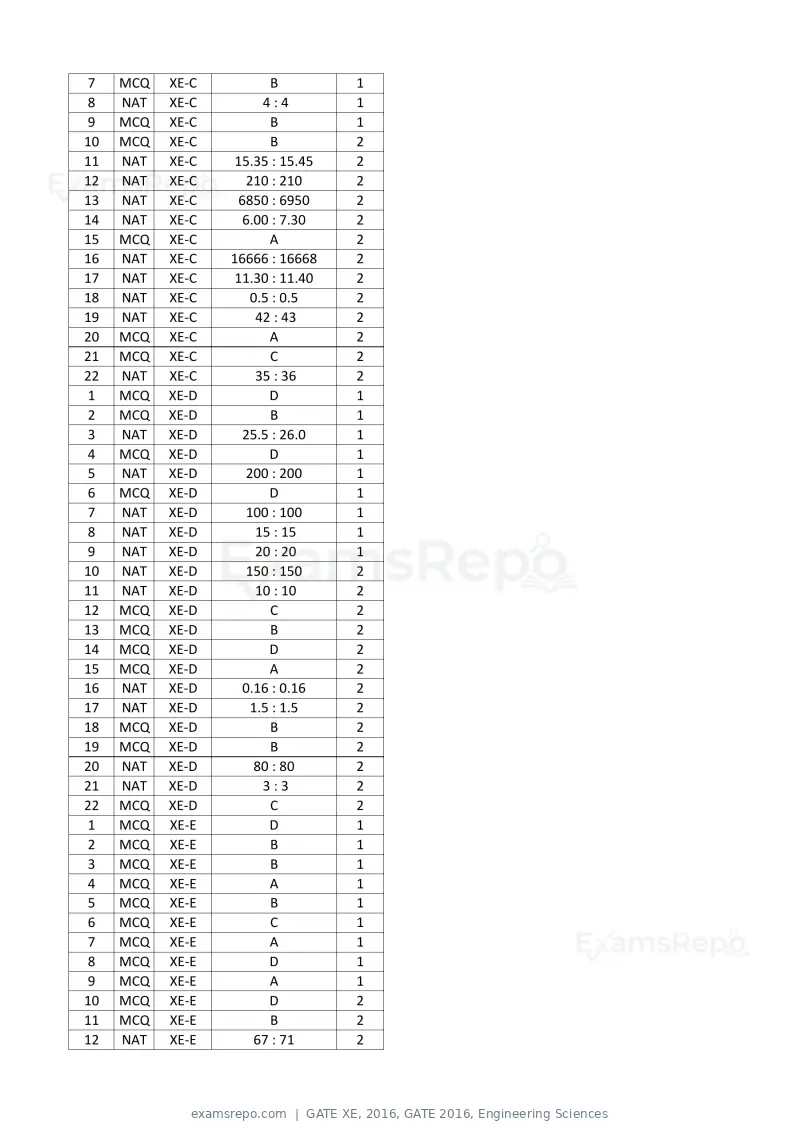
7    MCQ   XE-C         B          1
8    NAT   XE-C        4:4         1
9    MCQ   XE-C         B          1
10   MCQ   XE-C         B          2
11   NAT   XE-C    15.35 : 15.45   2
12   NAT   XE-C     210 : 210      2
13   NAT   XE-C    6850 : 6950     2
14   NAT   XE-C     6.00 : 7.30    2
15   MCQ   XE-C         A          2
16   NAT   XE-C   16666 : 16668    2
17   NAT   XE-C    11.30 : 11.40   2
18   NAT   XE-C      0.5 : 0.5     2
19   NAT   XE-C       42 : 43      2
20   MCQ   XE-C         A          2
21   MCQ   XE-C         C          2
22   NAT   XE-C       35 : 36      2
1    MCQ   XE-D         D          1
2    MCQ   XE-D         B          1
3    NAT   XE-D     25.5 : 26.0    1
4    MCQ   XE-D         D          1
5    NAT   XE-D     200 : 200      1
6    MCQ   XE-D         D          1
7    NAT   XE-D     100 : 100      1
8    NAT   XE-D       15 : 15      1
9    NAT   XE-D       20 : 20      1
10   NAT   XE-D     150 : 150      2
11   NAT   XE-D       10 : 10      2
12   MCQ   XE-D         C          2
13   MCQ   XE-D         B          2
14   MCQ   XE-D         D          2
15   MCQ   XE-D         A          2
16   NAT   XE-D     0.16 : 0.16    2
17   NAT   XE-D      1.5 : 1.5     2
18   MCQ   XE-D         B          2
19   MCQ   XE-D         B          2
20   NAT   XE-D       80 : 80      2
21   NAT   XE-D        3:3         2
22   MCQ   XE-D         C          2
1    MCQ   XE-E         D          1
2    MCQ   XE-E         B          1
3    MCQ   XE-E         B          1
4    MCQ   XE-E         A          1
5    MCQ   XE-E         B          1
6    MCQ   XE-E         C          1
7    MCQ   XE-E         A          1
8    MCQ   XE-E         D          1
9    MCQ   XE-E         A          1
10   MCQ   XE-E         D          2
11   MCQ   XE-E         B          2
12   NAT   XE-E       67 : 71      2
Text of page 37
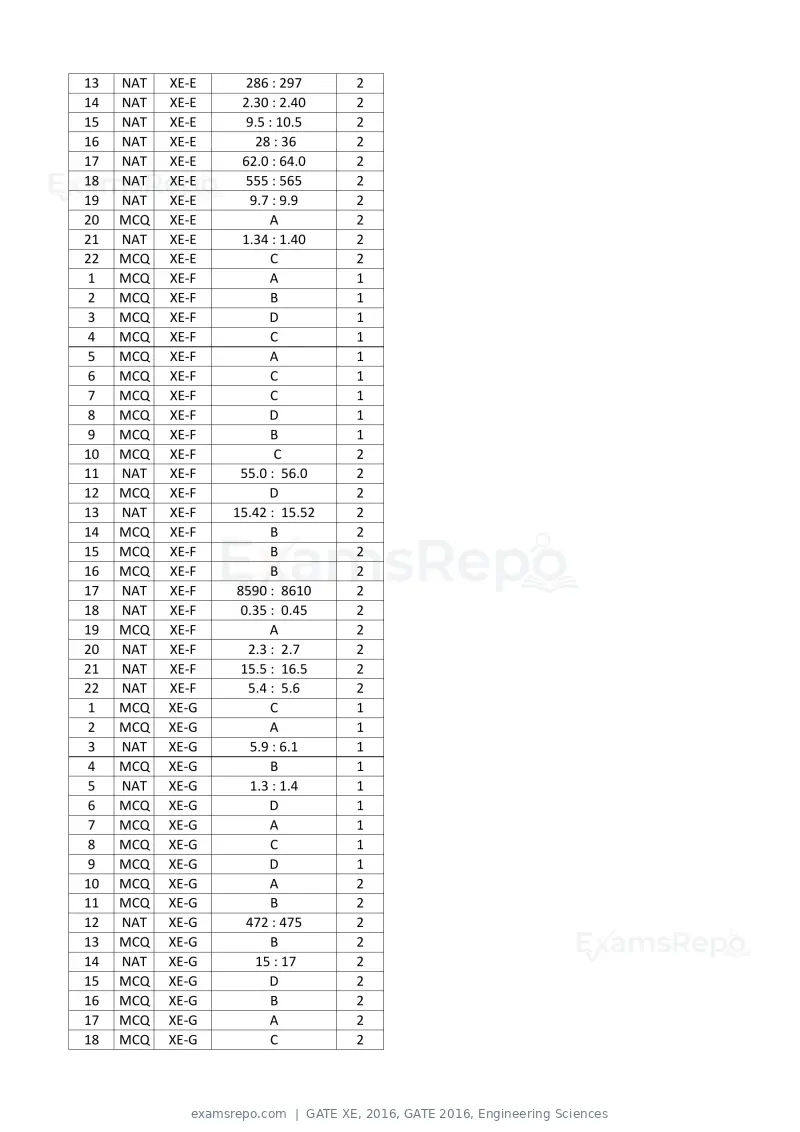
13   NAT   XE-E     286 : 297     2
14   NAT   XE-E    2.30 : 2.40    2
15   NAT   XE-E     9.5 : 10.5    2
16   NAT   XE-E       28 : 36     2
17   NAT   XE-E    62.0 : 64.0    2
18   NAT   XE-E     555 : 565     2
19   NAT   XE-E      9.7 : 9.9    2
20   MCQ   XE-E         A         2
21   NAT   XE-E    1.34 : 1.40    2
22   MCQ   XE-E         C         2
1    MCQ   XE-F         A         1
2    MCQ   XE-F         B         1
3    MCQ   XE-F         D         1
4    MCQ   XE-F         C         1
5    MCQ   XE-F         A         1
6    MCQ   XE-F         C         1
7    MCQ   XE-F         C         1
8    MCQ   XE-F         D         1
9    MCQ   XE-F         B         1
10   MCQ   XE-F          C        2
11   NAT   XE-F    55.0 : 56.0    2
12   MCQ   XE-F         D         2
13   NAT   XE-F   15.42 : 15.52   2
14   MCQ   XE-F         B         2
15   MCQ   XE-F         B         2
16   MCQ   XE-F         B         2
17   NAT   XE-F   8590 : 8610     2
18   NAT   XE-F    0.35 : 0.45    2
19   MCQ   XE-F         A         2
20   NAT   XE-F     2.3 : 2.7     2
21   NAT   XE-F    15.5 : 16.5    2
22   NAT   XE-F     5.4 : 5.6     2
1    MCQ   XE-G         C         1
2    MCQ   XE-G         A         1
3    NAT   XE-G      5.9 : 6.1    1
4    MCQ   XE-G         B         1
5    NAT   XE-G      1.3 : 1.4    1
6    MCQ   XE-G         D         1
7    MCQ   XE-G         A         1
8    MCQ   XE-G         C         1
9    MCQ   XE-G         D         1
10   MCQ   XE-G         A         2
11   MCQ   XE-G         B         2
12   NAT   XE-G     472 : 475     2
13   MCQ   XE-G         B         2
14   NAT   XE-G       15 : 17     2
15   MCQ   XE-G         D         2
16   MCQ   XE-G         B         2
17   MCQ   XE-G         A         2
18   MCQ   XE-G         C         2
Text of page 38
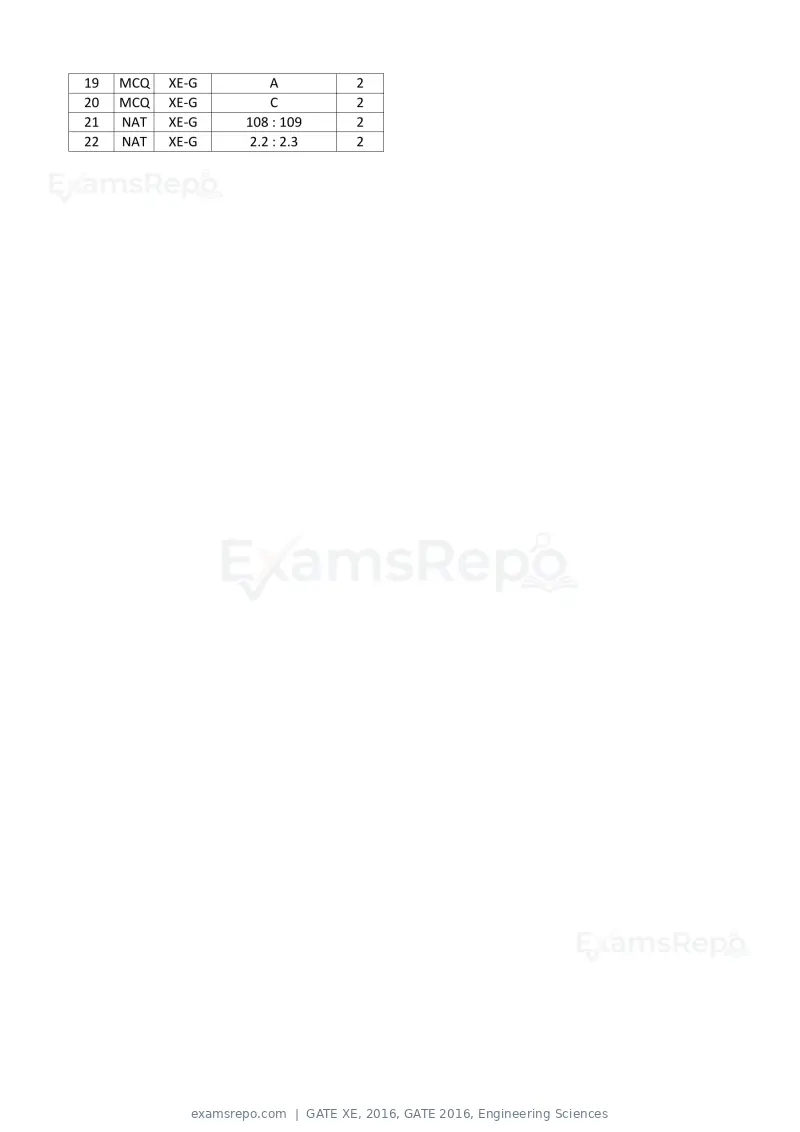
19   MCQ   XE-G       A        2
20   MCQ   XE-G       C        2
21   NAT   XE-G   108 : 109    2
22   NAT   XE-G    2.2 : 2.3   2
Official key not published for this paper.
Page 1 of 38
Source: GATE. Question paper published by GATE.