
GATE XE 2018: Engineering Sciences
Text of page 1
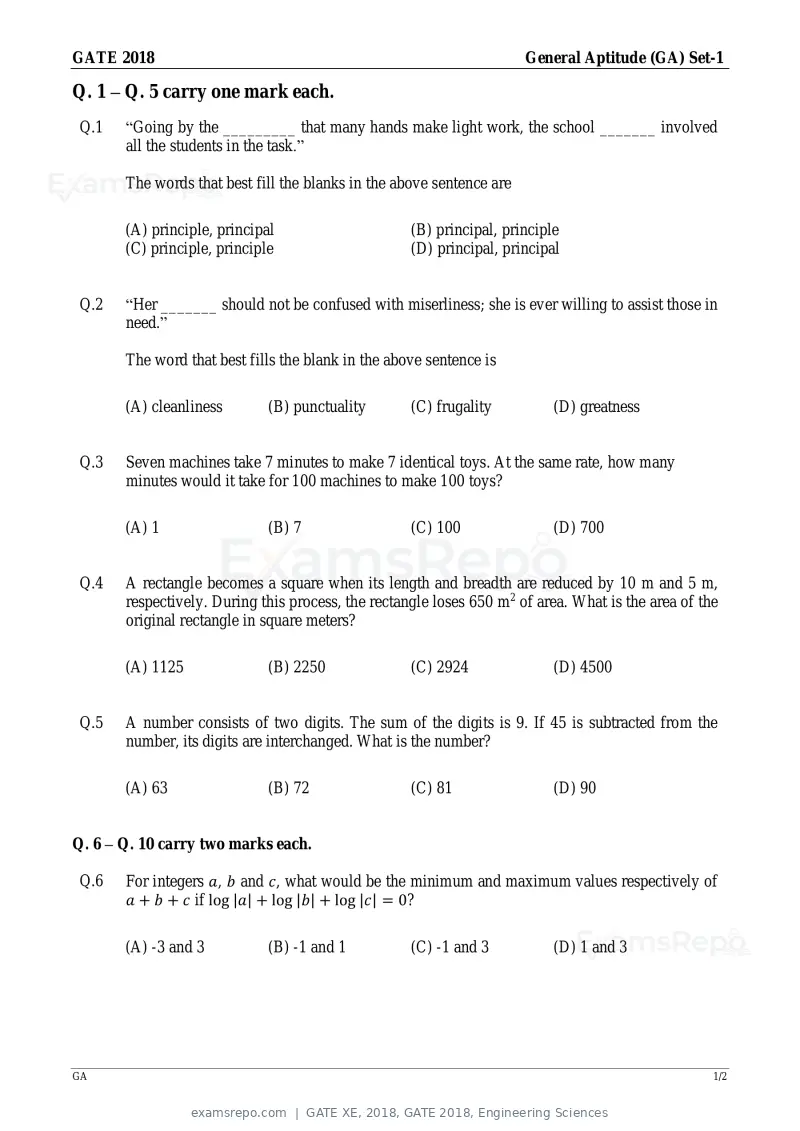
GATE 2018                                                              General Aptitude (GA) Set-1

Q. 1 – Q. 5 carry one mark each.
 Q.1   “Going by the _________ that many hands make light work, the school _______ involved
       all the students in the task.”

       The words that best fill the blanks in the above sentence are

       (A) principle, principal                     (B) principal, principle
       (C) principle, principle                     (D) principal, principal


 Q.2   “Her _______ should not be confused with miserliness; she is ever willing to assist those in
       need.”

       The word that best fills the blank in the above sentence is

       (A) cleanliness       (B) punctuality        (C) frugality         (D) greatness


 Q.3   Seven machines take 7 minutes to make 7 identical toys. At the same rate, how many
       minutes would it take for 100 machines to make 100 toys?

       (A) 1                 (B) 7                  (C) 100               (D) 700


 Q.4   A rectangle becomes a square when its length and breadth are reduced by 10 m and 5 m,
       respectively. During this process, the rectangle loses 650 m2 of area. What is the area of the
       original rectangle in square meters?

       (A) 1125              (B) 2250               (C) 2924              (D) 4500


 Q.5   A number consists of two digits. The sum of the digits is 9. If 45 is subtracted from the
       number, its digits are interchanged. What is the number?

       (A) 63                (B) 72                 (C) 81                (D) 90


Q. 6 – Q. 10 carry two marks each.

 Q.6   For integers a, b and c, what would be the minimum and maximum values respectively of
       a + b + c if log |a| + log |b| + log |c| = 0?

       (A) -3 and 3          (B) -1 and 1           (C) -1 and 3          (D) 1 and 3


GA                                                                                                  1/2
Text of page 2
GATE 2018                                                   General Aptitude (GA) Set-1
 Q.7 Given that a and b are integers and a + a2 b 3 is odd, which one of the following
     statements is correct?

       (A) a and b are both odd                            (B) a and b are both even
       (C) a is even and b is odd                          (D) a is odd and b is even


Q.8    From the time the front of a train enters a platform, it takes 25 seconds for the back of the
       train to leave the platform, while travelling at a constant speed of 54 km/h. At the same
       speed, it takes 14 seconds to pass a man running at 9 km/h in the same direction as the
       train. What is the length of the train and that of the platform in meters, respectively?

       (A) 210 and 140                                     (B) 162.5 and 187.5
       (C) 245 and 130                                     (D) 175 and 200


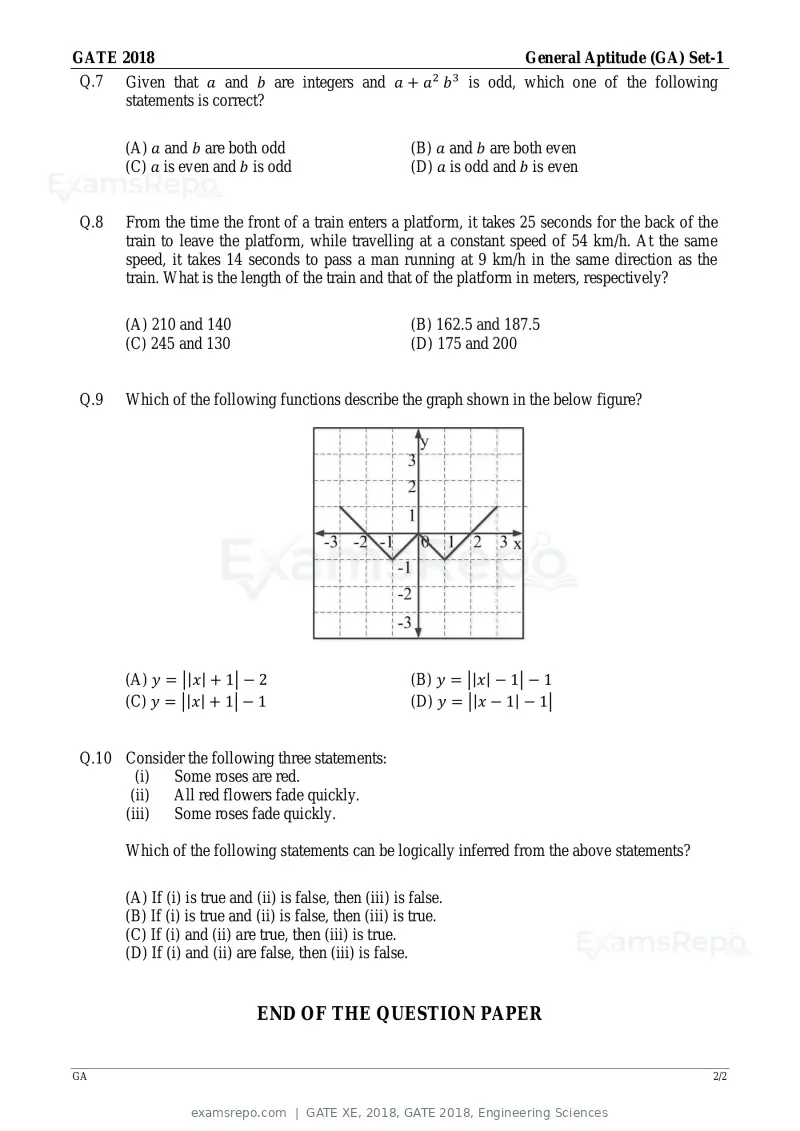
Q.9    Which of the following functions describe the graph shown in the below figure?


       (A) y = ||x| + 1| − 2                               (B) y = ||x| − 1| − 1
       (C) y = ||x| + 1| − 1                               (D) y = ||x − 1| − 1|


Q.10 Consider the following three statements:
       (i) Some roses are red.
      (ii) All red flowers fade quickly.
     (iii) Some roses fade quickly.

       Which of the following statements can be logically inferred from the above statements?

       (A) If (i) is true and (ii) is false, then (iii) is false.
       (B) If (i) is true and (ii) is false, then (iii) is true.
       (C) If (i) and (ii) are true, then (iii) is true.
       (D) If (i) and (ii) are false, then (iii) is false.


                              END OF THE QUESTION PAPER


GA                                                                                                 2/2
Text of page 3
GATE 2018 Engineering Mathematics (XE-A)
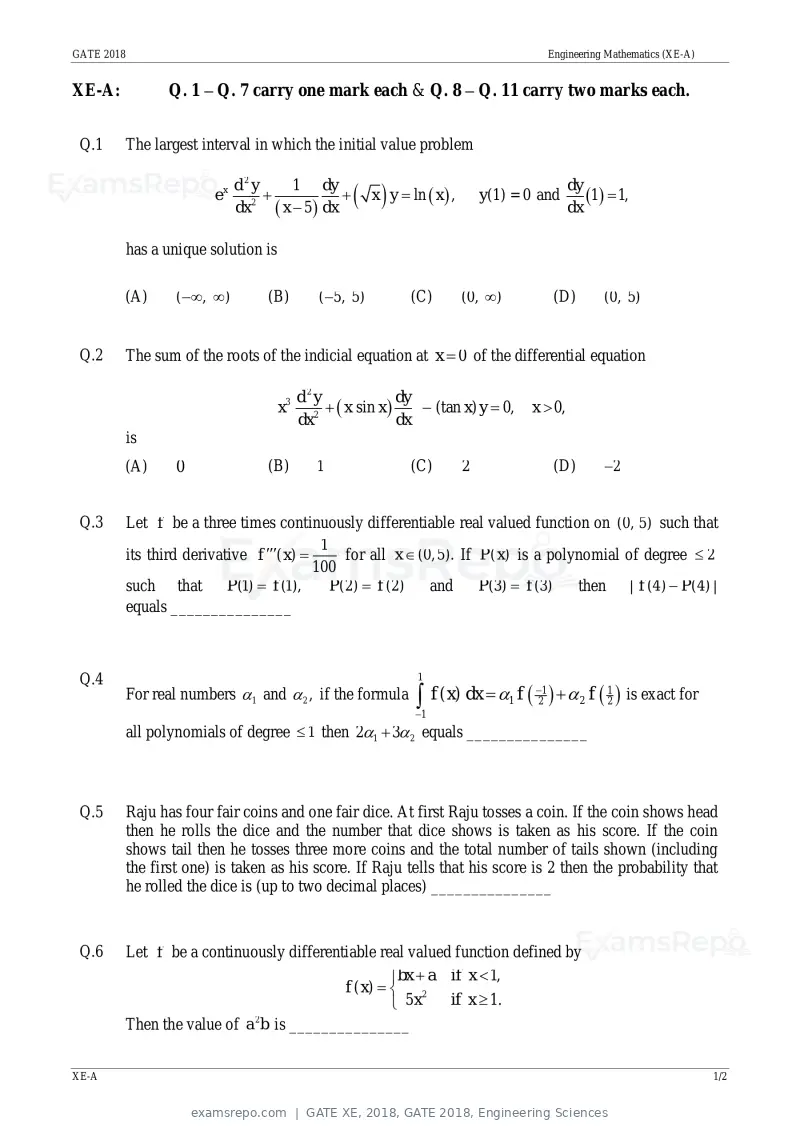
XE-A: Q. 1 – Q. 7 carry one mark each & Q. 8 – Q. 11 carry two marks each.
Q.1 The largest interval in which the initial value problem
ex
d2y
dx 2
1 dy
x 5 dx
x y ln x , y (1) = 0 and
dy
dx
1 1,
has a unique solution is
(A) ( , ) (B) ( 5, 5) (C) (0, ) (D) (0, 5)
Q.2 The sum of the roots of the indicial equation at x 0 of the differential equation
d2y dy
x3 2
x sin x (tan x) y 0, x 0,
dx dx
is
(A) 0 (B) 1 (C) 2 (D) 2
Q.3 Let f be a three times continuously differentiable real valued function on (0, 5) such that
1
its third derivative f ( x) for all x (0, 5). If P ( x ) is a polynomial of degree 2
100
such that P(1) f (1), P(2) f (2) and P(3) f (3) then | f (4) P(4) |
equals _______________
Q.4 1
For real numbers 1 and 2 , if the formula 1 f ( x) dx 1 f 21 2 f 12 is exact for
all polynomials of degree 1 then 21 3 2 equals _______________
Q.5 Raju has four fair coins and one fair dice. At first Raju tosses a coin. If the coin shows head
then he rolls the dice and the number that dice shows is taken as his score. If the coin
shows tail then he tosses three more coins and the total number of tails shown (including
the first one) is taken as his score. If Raju tells that his score is 2 then the probability that
he rolled the dice is (up to two decimal places) _______________
Q.6 Let f be a continuously differentiable real valued function defined by
bx a if x 1,
f ( x) 2
5x if x 1.
Then the value of a 2 b is _______________
XE-A 1/2
Text of page 4
GATE 2018 Engineering Mathematics (XE-A)
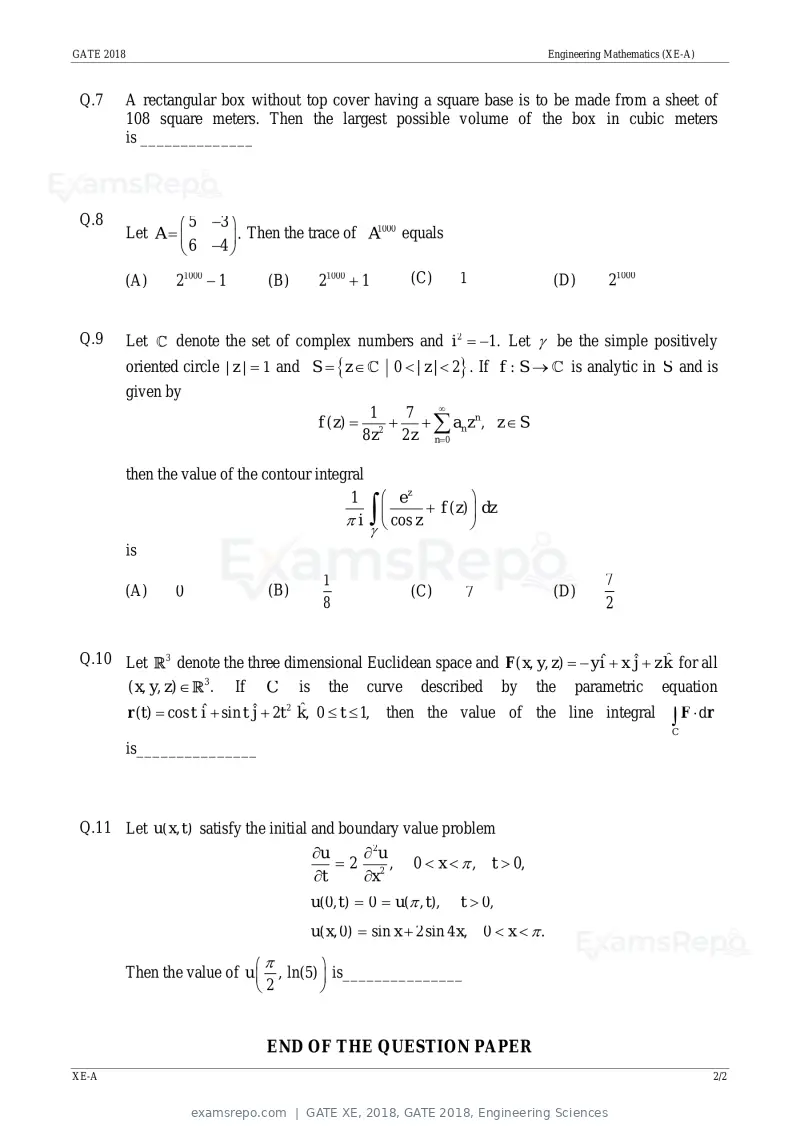
Q.7 A rectangular box without top cover having a square base is to be made from a sheet of
108 square meters. Then the largest possible volume of the box in cubic meters
is ______________
Q.8 5 3
Let A 1000
. Then the trace of A equals
6 4
(A) 21000 1 (B) 21000 1 (C) 1 (D) 21000
Q.9 Let denote the set of complex numbers and i 2 1. Let be the simple positively
oriented circle | z | 1 and S z 0 | z | 2 . If f : S is analytic in S and is
given by
1 7
f ( z) an z n , z S
8 z 2 2 z n 0
then the value of the contour integral
ez
1
f ( z ) dz
i
cos z
is
1 7
(A) 0 (B) (C) 7 (D)
8 2
Q.10 Let 3
denote the three dimensional Euclidean space and F( x, y, z ) y iˆ x ˆj z kˆ for all
( x, y, z ) 3 . If C is the curve described by the parametric equation
r (t ) cos t iˆ sin t ˆj 2t 2 kˆ, 0 t 1, then the value of the line integral F dr
C
is_______________
Q.11 Let u ( x, t ) satisfy the initial and boundary value problem
u 2u
2 2, 0 x , t 0,
t x
u (0, t ) 0 u ( , t ), t 0,
u ( x, 0) sin x 2sin 4 x, 0 x .
Then the value of u , ln(5) is_______________
2
END OF THE QUESTION PAPER
XE-A 2/2
Text of page 5
GATE 2018 Fluid Mechanics (XE (B))
XE (B): Q. 1 – Q. 9 carry one mark each & Q. 10 – Q. 22 carry two marks each.
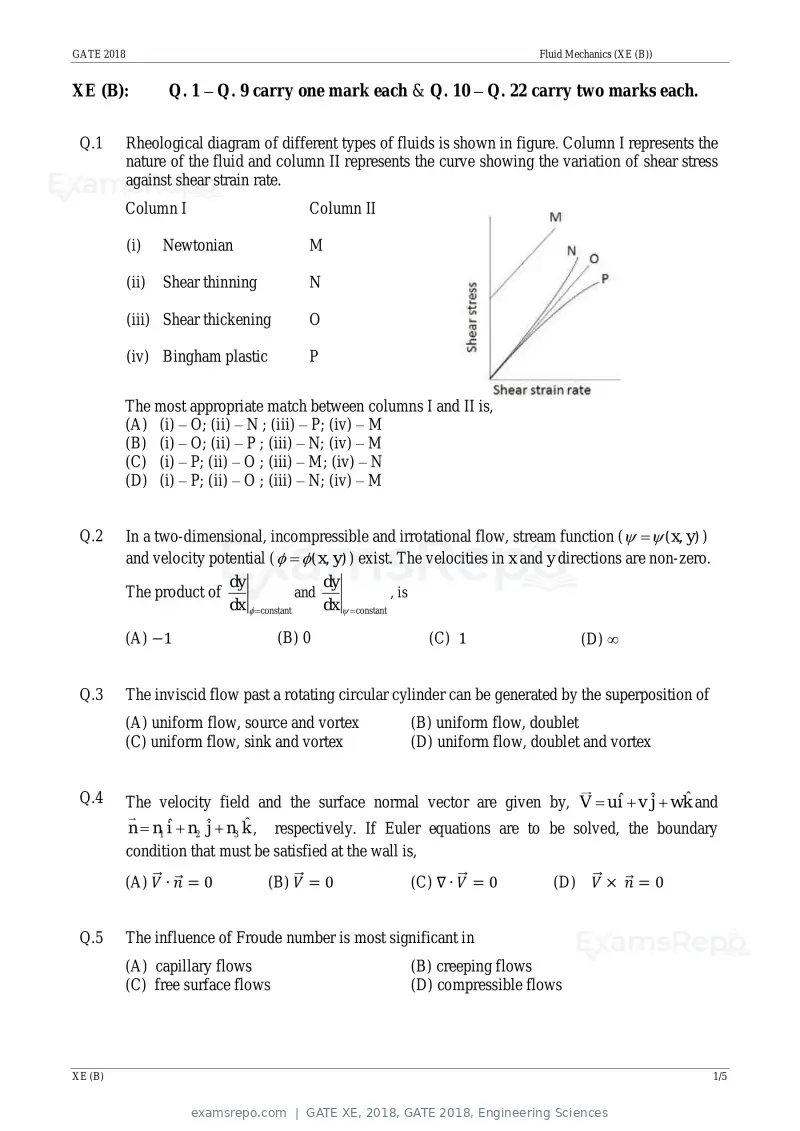
Q.1 Rheological diagram of different types of fluids is shown in figure. Column I represents the
nature of the fluid and column II represents the curve showing the variation of shear stress
against shear strain rate.
Column I Column II
(i) Newtonian M
(ii) Shear thinning N
(iii) Shear thickening O
(iv) Bingham plastic P
The most appropriate match between columns I and II is,
(A) (i) – O; (ii) – N ; (iii) – P; (iv) – M
(B) (i) – O; (ii) – P ; (iii) – N; (iv) – M
(C) (i) – P; (ii) – O ; (iii) – M; (iv) – N
(D) (i) – P; (ii) – O ; (iii) – N; (iv) – M
Q.2 In a two-dimensional, incompressible and irrotational flow, stream function ( ( x, y) )
and velocity potential ( ( x, y) ) exist. The velocities in x and y directions are non-zero.
dy dy
The product of and , is
dx constant dx constant
(A) −1 (B) 0 (C) 1 (D)
Q.3 The inviscid flow past a rotating circular cylinder can be generated by the superposition of
(A) uniform flow, source and vortex (B) uniform flow, doublet
(C) uniform flow, sink and vortex (D) uniform flow, doublet and vortex
Q.4 The velocity field and the surface normal vector are given by, V u iˆ v ˆj wkˆ and
n n iˆ n ˆj n kˆ , respectively. If Euler equations are to be solved, the boundary
1 2 3
condition that must be satisfied at the wall is,
⃗ ∙ n⃗ = 0
(A) V ⃗ =0
(B) V ⃗ =0
(C) ∇ ∙ V ⃗ × n⃗ = 0
(D) V
Q.5 The influence of Froude number is most significant in
(A) capillary flows (B) creeping flows
(C) free surface flows (D) compressible flows
XE (B) 1/5
Text of page 6
GATE 2018 Fluid Mechanics (XE (B))
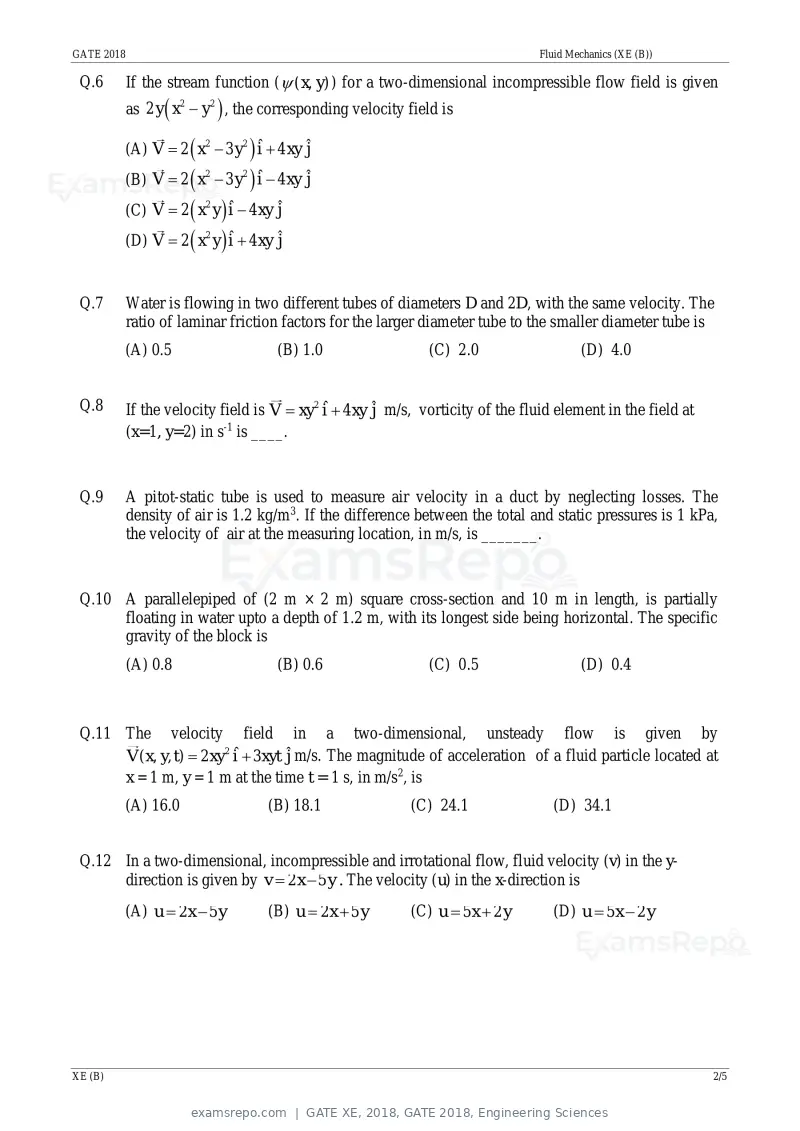
Q.6 If the stream function ( ( x, y) ) for a two-dimensional incompressible flow field is given
as 2y x 2 y 2 , the corresponding velocity field is
(A) V 2 x 2 3 y 2 iˆ 4 xy ˆj
(B) V 2 x 3 y iˆ 4 xy ˆj
2 2
(C) V 2 x y iˆ 4 xy ˆj
2
(D) V 2 x y iˆ 4 xy ˆj
2
Q.7 Water is flowing in two different tubes of diameters D and 2D, with the same velocity. The
ratio of laminar friction factors for the larger diameter tube to the smaller diameter tube is
(A) 0.5 (B) 1.0 (C) 2.0 (D) 4.0
Q.8 If the velocity field is V xy 2 iˆ 4 xy ˆj m/s, vorticity of the fluid element in the field at
(x=1, y=2) in s-1 is ____.
Q.9 A pitot-static tube is used to measure air velocity in a duct by neglecting losses. The
density of air is 1.2 kg/m3. If the difference between the total and static pressures is 1 kPa,
the velocity of air at the measuring location, in m/s, is _______.
Q.10 A parallelepiped of (2 m × 2 m) square cross-section and 10 m in length, is partially
floating in water upto a depth of 1.2 m, with its longest side being horizontal. The specific
gravity of the block is
(A) 0.8 (B) 0.6 (C) 0.5 (D) 0.4
Q.11 The velocity field in a two-dimensional, unsteady flow is given by
V ( x, y, t ) 2 xy 2 iˆ 3xyt ˆj m/s. The magnitude of acceleration of a fluid particle located at
x = 1 m, y = 1 m at the time t = 1 s, in m/s2, is
(A) 16.0 (B) 18.1 (C) 24.1 (D) 34.1
Q.12 In a two-dimensional, incompressible and irrotational flow, fluid velocity (v) in the y-
direction is given by v 2x 5 y . The velocity (u) in the x-direction is
(A) u 2x 5 y (B) u 2x 5 y (C) u 5x 2 y (D) u 5x 2 y
XE (B) 2/5
Text of page 7
GATE 2018 Fluid Mechanics (XE (B))
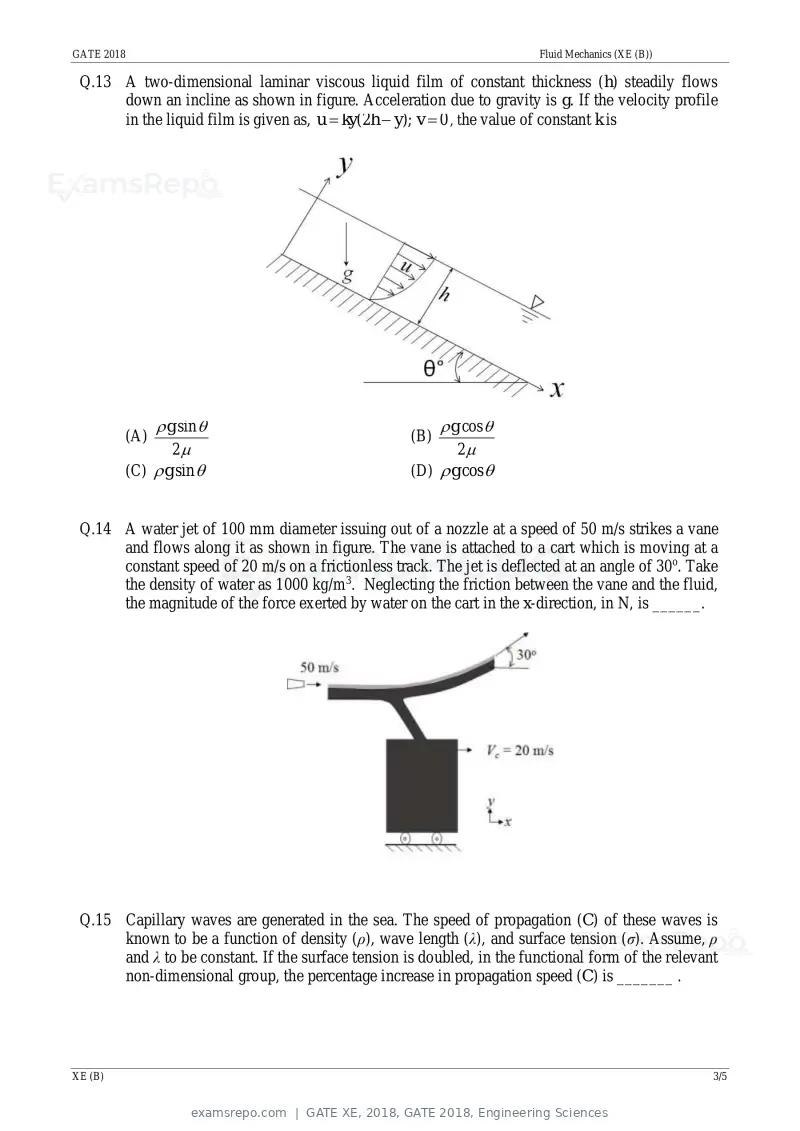
Q.13 A two-dimensional laminar viscous liquid film of constant thickness (h) steadily flows
down an incline as shown in figure. Acceleration due to gravity is g. If the velocity profile
in the liquid film is given as, u ky(2h y); v 0 , the value of constant k is
g sin g cos
(A) (B)
2 2
(C) g sin (D) g cos
Q.14 A water jet of 100 mm diameter issuing out of a nozzle at a speed of 50 m/s strikes a vane
and flows along it as shown in figure. The vane is attached to a cart which is moving at a
constant speed of 20 m/s on a frictionless track. The jet is deflected at an angle of 30o. Take
the density of water as 1000 kg/m3. Neglecting the friction between the vane and the fluid,
the magnitude of the force exerted by water on the cart in the x-direction, in N, is ______.
Q.15 Capillary waves are generated in the sea. The speed of propagation (C) of these waves is
known to be a function of density (ρ), wave length (λ), and surface tension (σ). Assume, ρ
and λ to be constant. If the surface tension is doubled, in the functional form of the relevant
non-dimensional group, the percentage increase in propagation speed (C) is _______ .
XE (B) 3/5
Text of page 8
GATE 2018 Fluid Mechanics (XE (B))
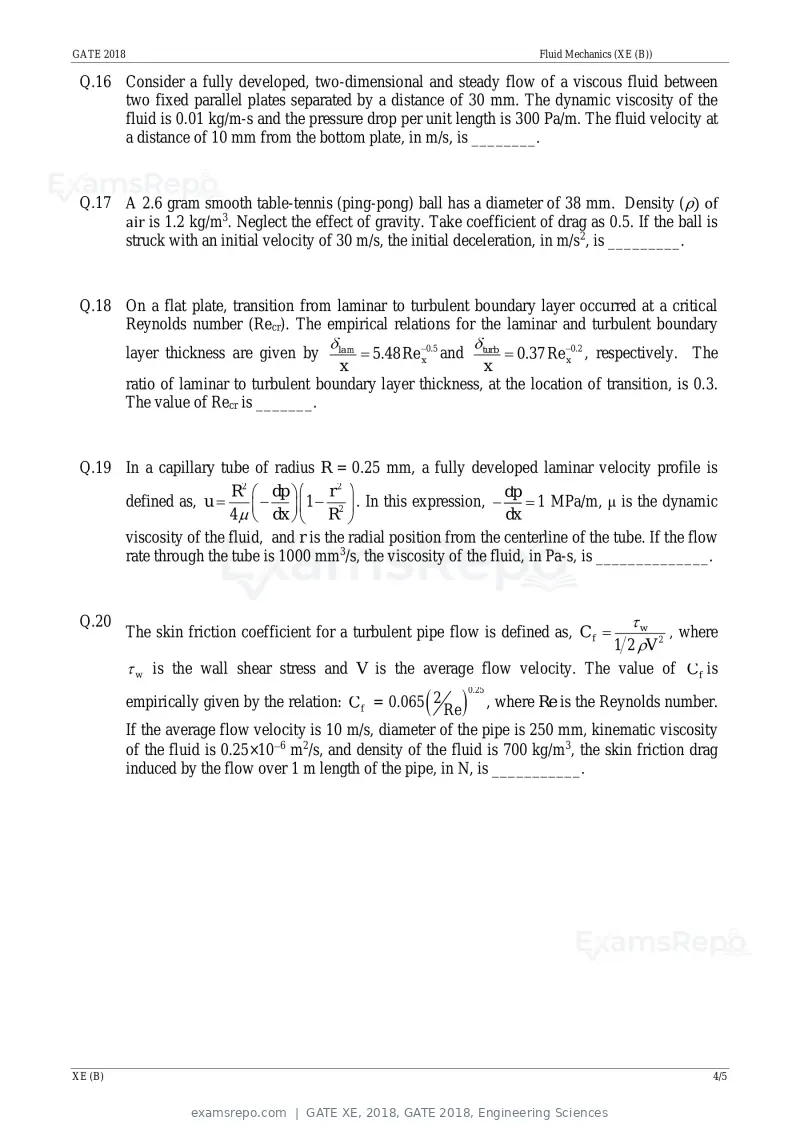
Q.16 Consider a fully developed, two-dimensional and steady flow of a viscous fluid between
two fixed parallel plates separated by a distance of 30 mm. The dynamic viscosity of the
fluid is 0.01 kg/m-s and the pressure drop per unit length is 300 Pa/m. The fluid velocity at
a distance of 10 mm from the bottom plate, in m/s, is ________.
Q.17 A 2.6 gram smooth table-tennis (ping-pong) ball has a diameter of 38 mm. Density (ρ) of
air is 1.2 kg/m3. Neglect the effect of gravity. Take coefficient of drag as 0.5. If the ball is
struck with an initial velocity of 30 m/s, the initial deceleration, in m/s2, is _________.
Q.18 On a flat plate, transition from laminar to turbulent boundary layer occurred at a critical
Reynolds number (Recr). The empirical relations for the laminar and turbulent boundary
layer thickness are given by la m 5.48Rex0.5 and turb 0.37 Rex0.2 , respectively. The
x x
ratio of laminar to turbulent boundary layer thickness, at the location of transition, is 0.3.
The value of Recr is _______.
Q.19 In a capillary tube of radius R = 0.25 mm, a fully developed laminar velocity profile is
R 2 dp r 2 dp
defined as, u 1 2 . In this expression, 1 MPa/m, μ is the dynamic
4 dx R dx
viscosity of the fluid, and r is the radial position from the centerline of the tube. If the flow
rate through the tube is 1000 mm3/s, the viscosity of the fluid, in Pa-s, is ______________.
Q.20 w
The skin friction coefficient for a turbulent pipe flow is defined as, C f , where
1 2 V 2
w is the wall shear stress and V is the average flow velocity. The value of C f is
, where Re is the Reynolds number.
0.25
empirically given by the relation: C f = 0.065 2 Re
If the average flow velocity is 10 m/s, diameter of the pipe is 250 mm, kinematic viscosity
of the fluid is 0.25×10⁶ m2/s, and density of the fluid is 700 kg/m3, the skin friction drag
induced by the flow over 1 m length of the pipe, in N, is ___________.
XE (B) 4/5
Text of page 9
GATE 2018 Fluid Mechanics (XE (B))
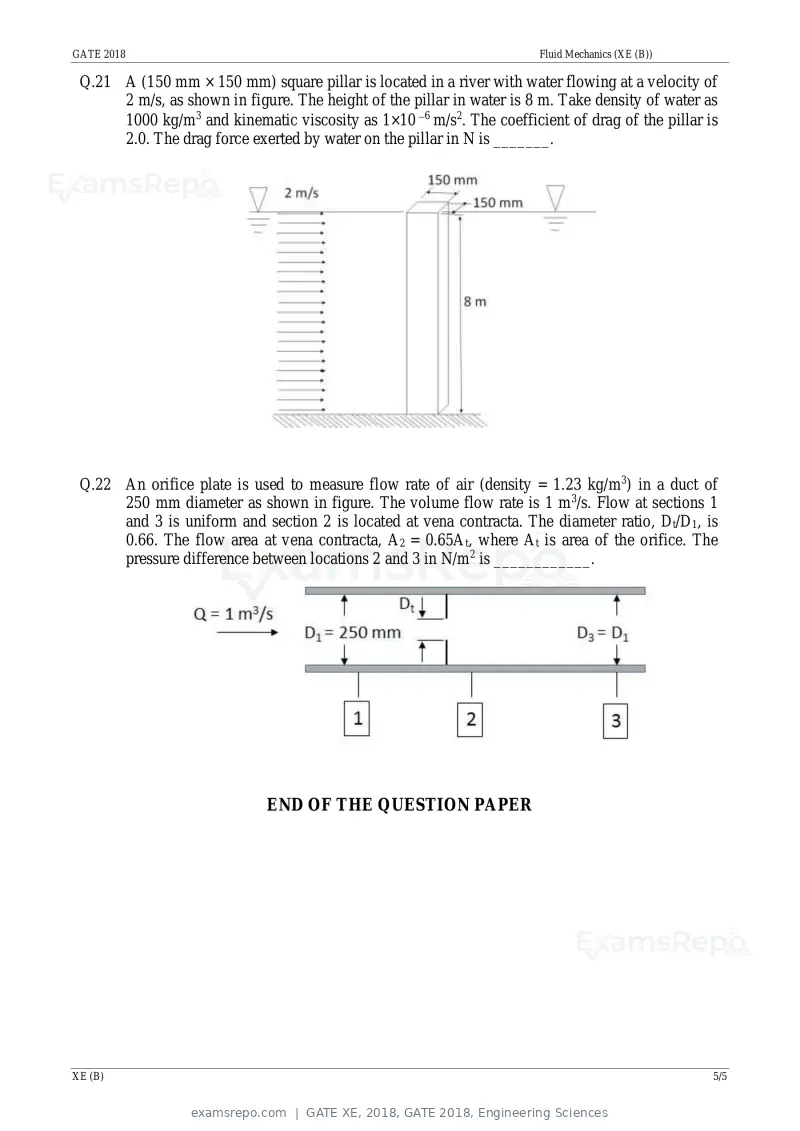
Q.21 A (150 mm × 150 mm) square pillar is located in a river with water flowing at a velocity of
2 m/s, as shown in figure. The height of the pillar in water is 8 m. Take density of water as
1000 kg/m3 and kinematic viscosity as 1×10⁶ m/s2. The coefficient of drag of the pillar is
2.0. The drag force exerted by water on the pillar in N is _______.
Q.22 An orifice plate is used to measure flow rate of air (density = 1.23 kg/m3) in a duct of
250 mm diameter as shown in figure. The volume flow rate is 1 m3/s. Flow at sections 1
and 3 is uniform and section 2 is located at vena contracta. The diameter ratio, Dt/D1, is
0.66. The flow area at vena contracta, A2 = 0.65At, where At is area of the orifice. The
pressure difference between locations 2 and 3 in N/m2 is ____________.
END OF THE QUESTION PAPER
XE (B) 5/5
Text of page 10
GATE 2018 Materials Science (XE-C)
XE (C): Q. 1 – Q. 9 carry one mark each & Q. 10 – Q. 22 carry two marks each.
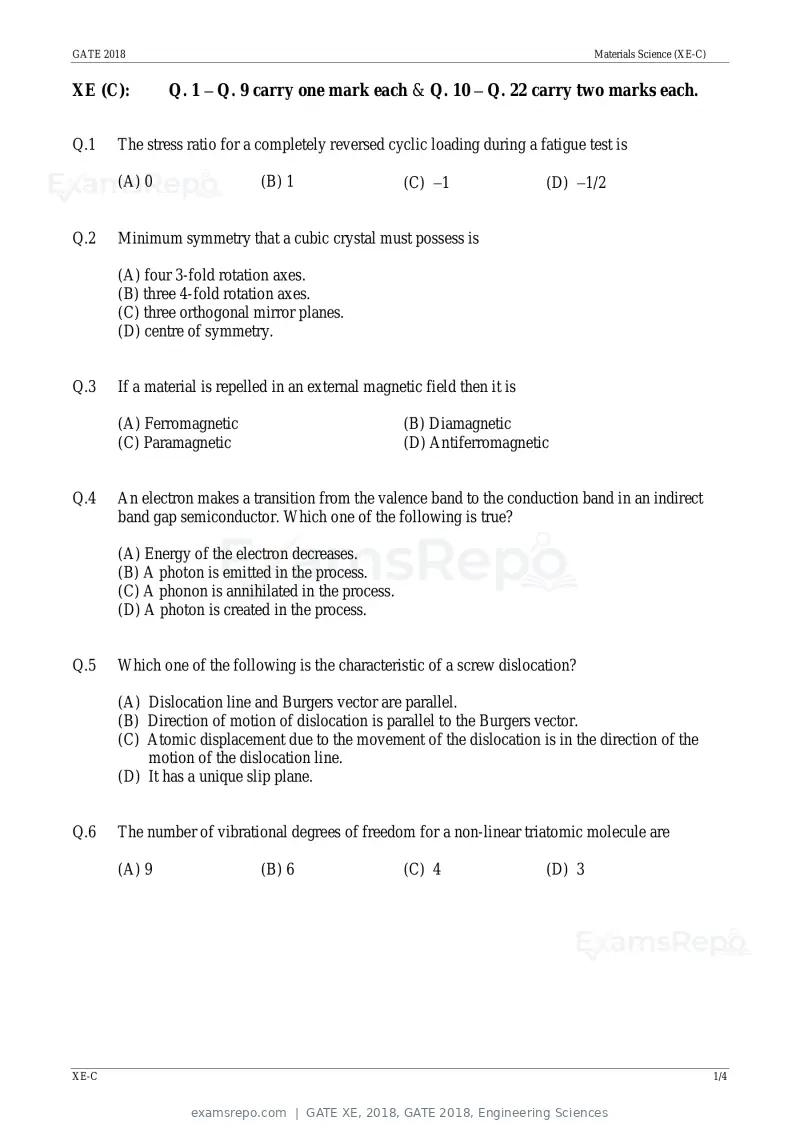
Q.1 The stress ratio for a completely reversed cyclic loading during a fatigue test is
(A) 0 (B) 1 (C) 1 (D) 1/2
Q.2 Minimum symmetry that a cubic crystal must possess is
(A) four 3-fold rotation axes.
(B) three 4-fold rotation axes.
(C) three orthogonal mirror planes.
(D) centre of symmetry.
Q.3 If a material is repelled in an external magnetic field then it is
(A) Ferromagnetic (B) Diamagnetic
(C) Paramagnetic (D) Antiferromagnetic
Q.4 An electron makes a transition from the valence band to the conduction band in an indirect
band gap semiconductor. Which one of the following is true?
(A) Energy of the electron decreases.
(B) A photon is emitted in the process.
(C) A phonon is annihilated in the process.
(D) A photon is created in the process.
Q.5 Which one of the following is the characteristic of a screw dislocation?
(A) Dislocation line and Burgers vector are parallel.
(B) Direction of motion of dislocation is parallel to the Burgers vector.
(C) Atomic displacement due to the movement of the dislocation is in the direction of the
motion of the dislocation line.
(D) It has a unique slip plane.
Q.6 The number of vibrational degrees of freedom for a non-linear triatomic molecule are
(A) 9 (B) 6 (C) 4 (D) 3
XE-C 1/4
Text of page 11
GATE 2018 Materials Science (XE-C)
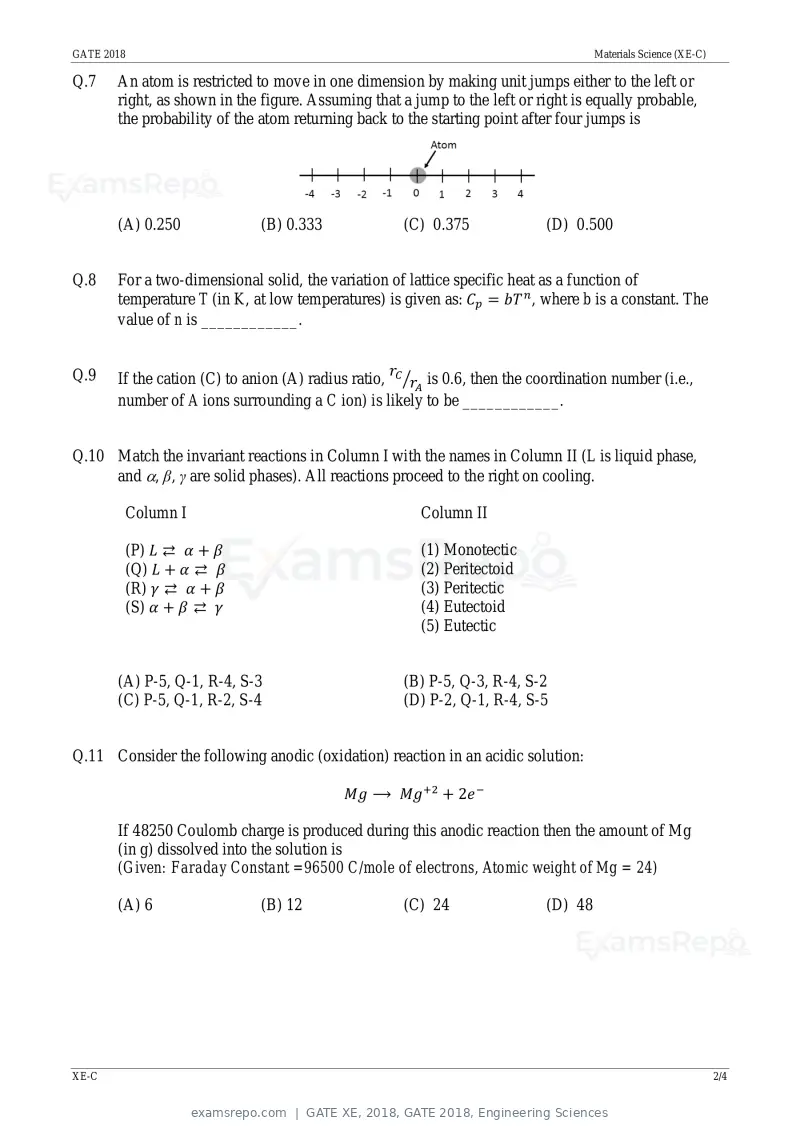
Q.7 An atom is restricted to move in one dimension by making unit jumps either to the left or
right, as shown in the figure. Assuming that a jump to the left or right is equally probable,
the probability of the atom returning back to the starting point after four jumps is
(A) 0.250 (B) 0.333 (C) 0.375 (D) 0.500
Q.8 For a two-dimensional solid, the variation of lattice specific heat as a function of
temperature T (in K, at low temperatures) is given as: Cp = bT n , where b is a constant. The
value of n is ____________.
Q.9 r
If the cation (C) to anion (A) radius ratio, C⁄rA is 0.6, then the coordination number (i.e.,
number of A ions surrounding a C ion) is likely to be ____________.
Q.10 Match the invariant reactions in Column I with the names in Column II (L is liquid phase,
and , β, γ are solid phases). All reactions proceed to the right on cooling.
Column I Column II
(P) L ⇄ α + β (1) Monotectic
(Q) L + α ⇄ β (2) Peritectoid
(R) γ ⇄ α + β (3) Peritectic
(S) α + β ⇄ γ (4) Eutectoid
(5) Eutectic
(A) P-5, Q-1, R-4, S-3 (B) P-5, Q-3, R-4, S-2
(C) P-5, Q-1, R-2, S-4 (D) P-2, Q-1, R-4, S-5
Q.11 Consider the following anodic (oxidation) reaction in an acidic solution:
Mg ⟶ Mg+2 + 2e −
If 48250 Coulomb charge is produced during this anodic reaction then the amount of Mg
(in g) dissolved into the solution is
(Given: Faraday Constant =96500 C/mole of electrons, Atomic weight of Mg = 24)
(A) 6 (B) 12 (C) 24 (D) 48
XE-C 2/4
Text of page 12
GATE 2018 Materials Science (XE-C)
Q.12 An intrinsic semiconductor has conduction electron concentration, n = 1012 cm3. The
mobility of both electrons and holes are identical = 4 104 cm2 V1 s1. If a voltage of
100 V is applied on two parallel end faces of the cube (edge length 1 cm) through Ohmic
contacts, the current through the cube would be (in mA)
(Given: charge of electron = 1.6 1019 C)
(A) 640 (B) 1280 (C) 6400 (D) 12800
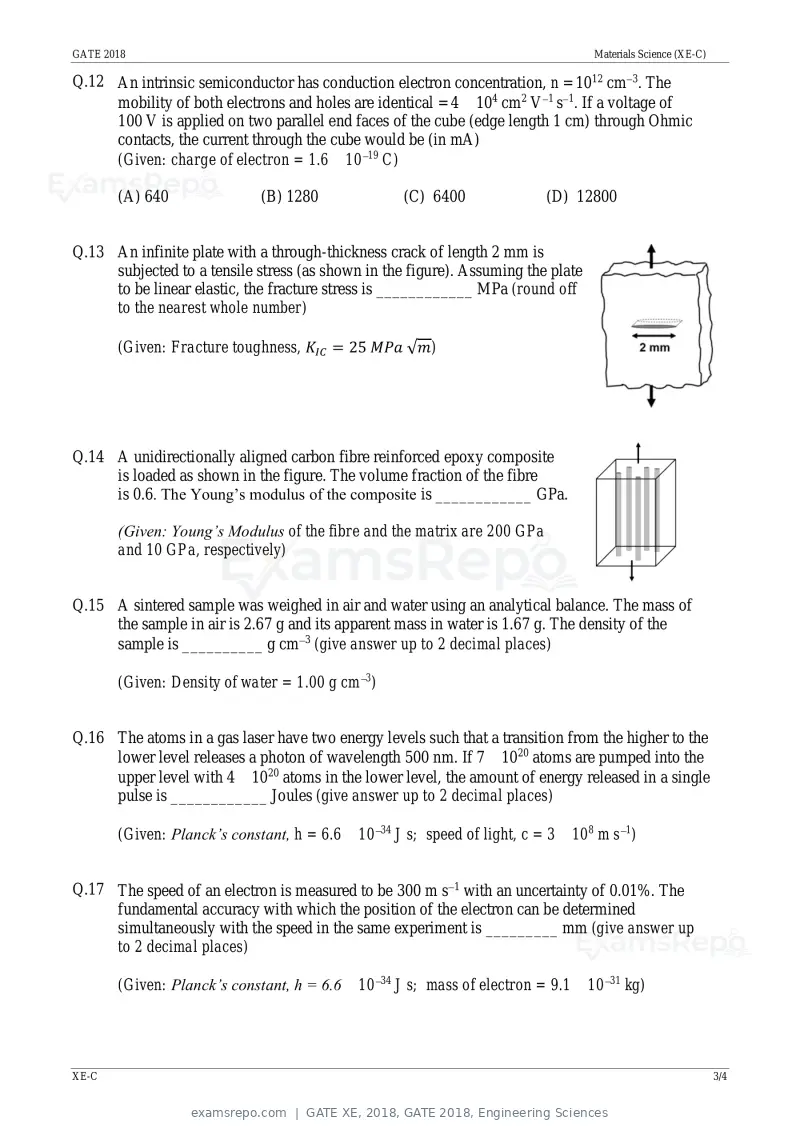
Q.13 An infinite plate with a through-thickness crack of length 2 mm is
subjected to a tensile stress (as shown in the figure). Assuming the plate
to be linear elastic, the fracture stress is ____________ MPa (round off
to the nearest whole number)
(Given: Fracture toughness, KIC = 25 MPa √m)
Q.14 A unidirectionally aligned carbon fibre reinforced epoxy composite
is loaded as shown in the figure. The volume fraction of the fibre
is 0.6. The Young’s modulus of the composite is ____________ GPa.
(Given: Young’s Modulus of the fibre and the matrix are 200 GPa
and 10 GPa, respectively)
Q.15 A sintered sample was weighed in air and water using an analytical balance. The mass of
the sample in air is 2.67 g and its apparent mass in water is 1.67 g. The density of the
sample is __________ g cm3 (give answer up to 2 decimal places)
(Given: Density of water = 1.00 g cm3)
Q.16 The atoms in a gas laser have two energy levels such that a transition from the higher to the
lower level releases a photon of wavelength 500 nm. If 7 1020 atoms are pumped into the
upper level with 4 1020 atoms in the lower level, the amount of energy released in a single
pulse is ____________ Joules (give answer up to 2 decimal places)
(Given: Planck’s constant, h = 6.6 1034 J s; speed of light, c = 3 108 m s1)
Q.17 The speed of an electron is measured to be 300 m s1 with an uncertainty of 0.01%. The
fundamental accuracy with which the position of the electron can be determined
simultaneously with the speed in the same experiment is _________ mm (give answer up
to 2 decimal places)
(Given: Planck’s constant, h = 6.6 1034 J s; mass of electron = 9.1 1031 kg)
XE-C 3/4
Text of page 13
GATE 2018 Materials Science (XE-C)
Q.18 When 3 identical non-interacting spin ½ particles are put in an infinite potential well, the
ground state energy of the system is 18 meV. If instead, seven particles are put inside the
potential well, the new ground state energy is ________ meV.
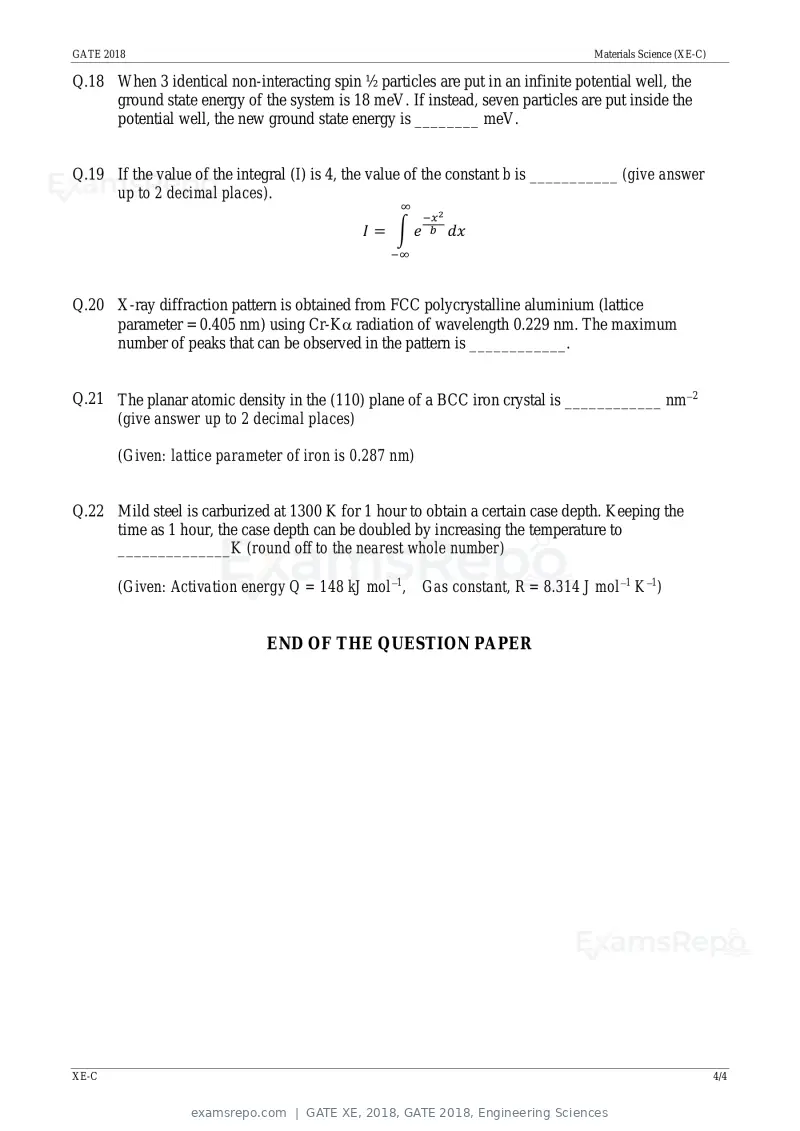
Q.19 If the value of the integral (I) is 4, the value of the constant b is ___________ (give answer
up to 2 decimal places).
∞
−x 2
I = ∫ e b dx
−∞
Q.20 X-ray diffraction pattern is obtained from FCC polycrystalline aluminium (lattice
parameter = 0.405 nm) using Cr-K radiation of wavelength 0.229 nm. The maximum
number of peaks that can be observed in the pattern is ____________.
Q.21 The planar atomic density in the (110) plane of a BCC iron crystal is ____________ nm2
(give answer up to 2 decimal places)
(Given: lattice parameter of iron is 0.287 nm)
Q.22 Mild steel is carburized at 1300 K for 1 hour to obtain a certain case depth. Keeping the
time as 1 hour, the case depth can be doubled by increasing the temperature to
______________K (round off to the nearest whole number)
(Given: Activation energy Q = 148 kJ mol1, Gas constant, R = 8.314 J mol1 K1)
END OF THE QUESTION PAPER
XE-C 4/4
Text of page 14
GATE 2018                                                                         SOLID MECHANICS (XE-D)


XE (D):           Q. 1 – Q. 9 carry one mark each & Q. 10 – Q. 22 carry two marks each.
 Q.1        A thin cylinder (thickness, and diameter, ) with closed ends is subjected to an internal
            pressure, . The ratio of hoop stress to longitudinal stress developed in the wall of the
            cylinder is
        (A) 1:4                   (B) 1:2                  (C) 1:1             (D) 2:1


 Q.2        A steel rod is fixed at one end and free at the other end. The coefficient of thermal
            expansion of the steel is α, and modulus of elasticity is E. If the temperature of the rod is
            increased by ∆ then the stress and strain developed in the rod are respectively
        (A) zero, α∆
        (B) Eα∆ , α∆
        (C) Eα∆ , zero
        (D) zero, zero


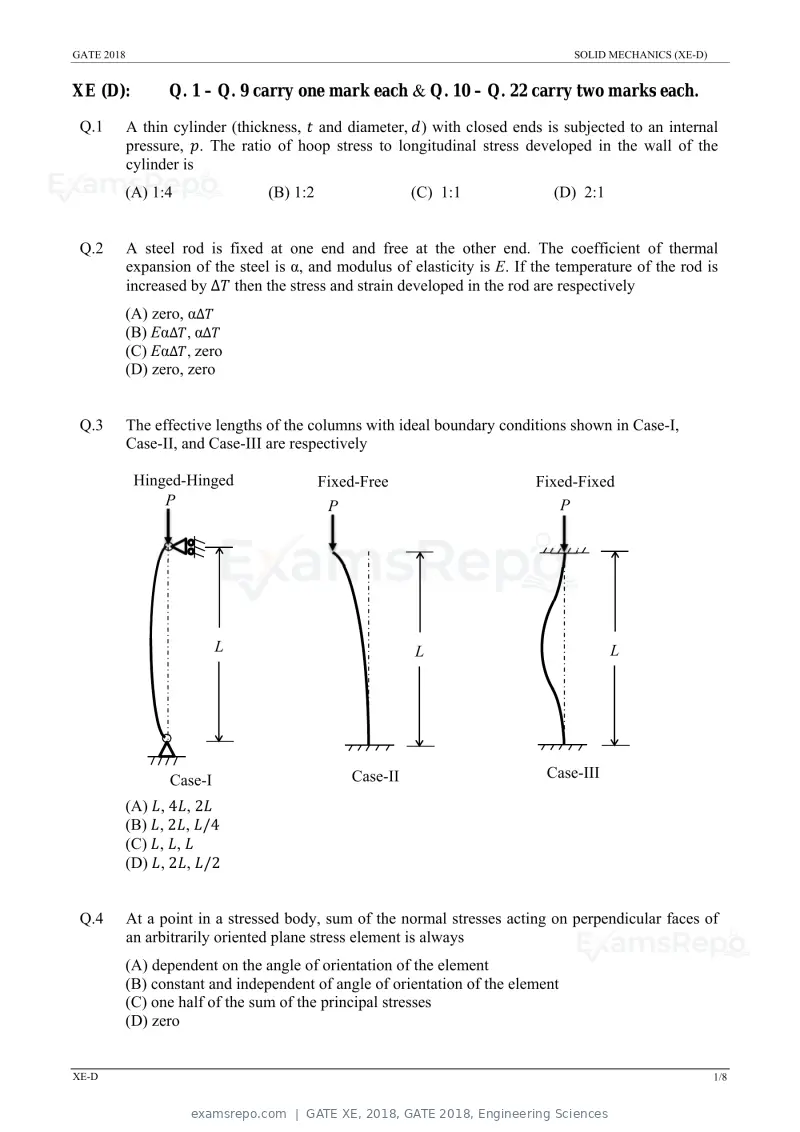
 Q.3        The effective lengths of the columns with ideal boundary conditions shown in Case-I,
            Case-II, and Case-III are respectively

             Hinged-Hinged                  Fixed-Free                      Fixed-Fixed
                 P                           P                                 P


                           L                               L                             L


                  Case-I                         Case-II                      Case-III

        (A)      ,4 ,2
        (B)      , 2 , /4
        (C)      , ,
        (D)      , 2 , /2


 Q.4        At a point in a stressed body, sum of the normal stresses acting on perpendicular faces of
            an arbitrarily oriented plane stress element is always
        (A) dependent on the angle of orientation of the element
        (B) constant and independent of angle of orientation of the element
        (C) one half of the sum of the principal stresses
        (D) zero


XE-D                                                                                                       1/8
Text of page 15
GATE 2018                                                                          SOLID MECHANICS (XE-D)

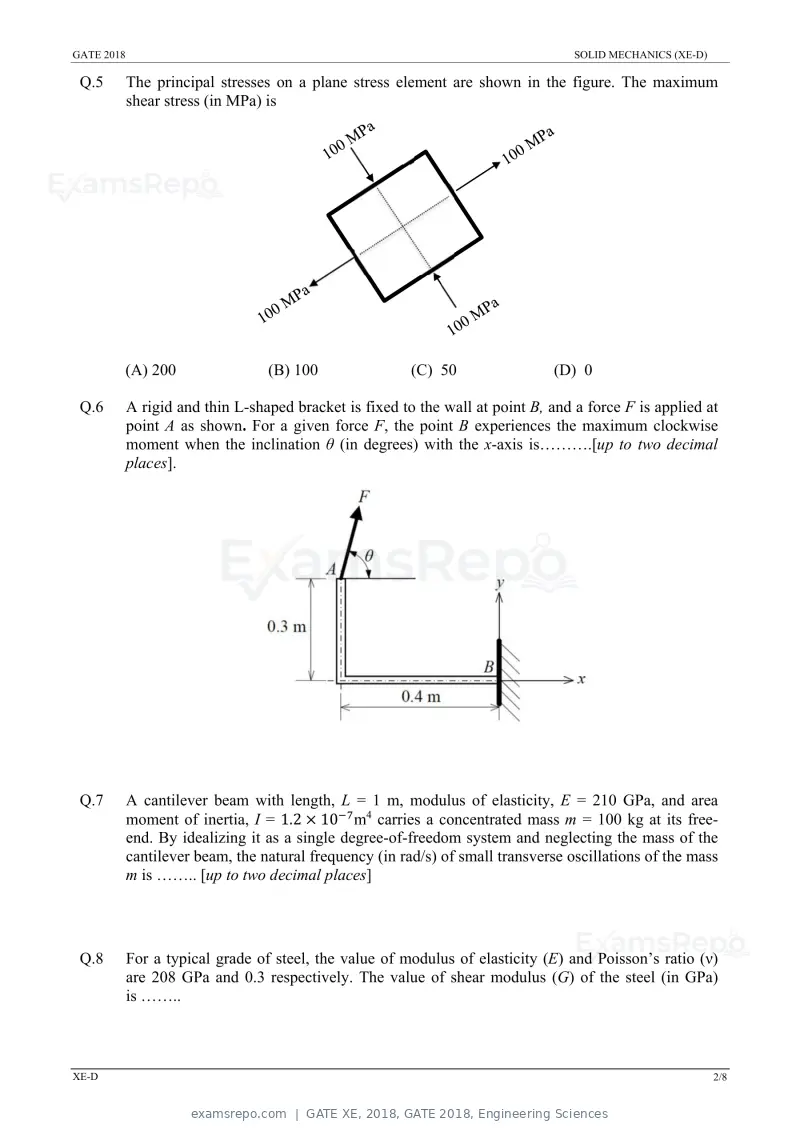
 Q.5        The principal stresses on a plane stress element are shown in the figure. The maximum
            shear stress (in MPa) is


        (A) 200                   (B) 100                (C) 50                (D) 0

 Q.6        A rigid and thin L-shaped bracket is fixed to the wall at point B, and a force F is applied at
            point A as shown. For a given force F, the point B experiences the maximum clockwise
            moment when the inclination θ (in degrees) with the x-axis is……….[up to two decimal
            places].


 Q.7        A cantilever beam with length, L = 1 m, modulus of elasticity, E = 210 GPa, and area
            moment of inertia, I = 1.2 10 m4 carries a concentrated mass m = 100 kg at its free-
            end. By idealizing it as a single degree-of-freedom system and neglecting the mass of the
            cantilever beam, the natural frequency (in rad/s) of small transverse oscillations of the mass
            m is …….. [up to two decimal places]


 Q.8        For a typical grade of steel, the value of modulus of elasticity (E) and Poisson’s ratio (ν)
            are 208 GPa and 0.3 respectively. The value of shear modulus (G) of the steel (in GPa)
            is ……..


XE-D                                                                                                        2/8
Text of page 16
GATE 2018                                                                       SOLID MECHANICS (XE-D)

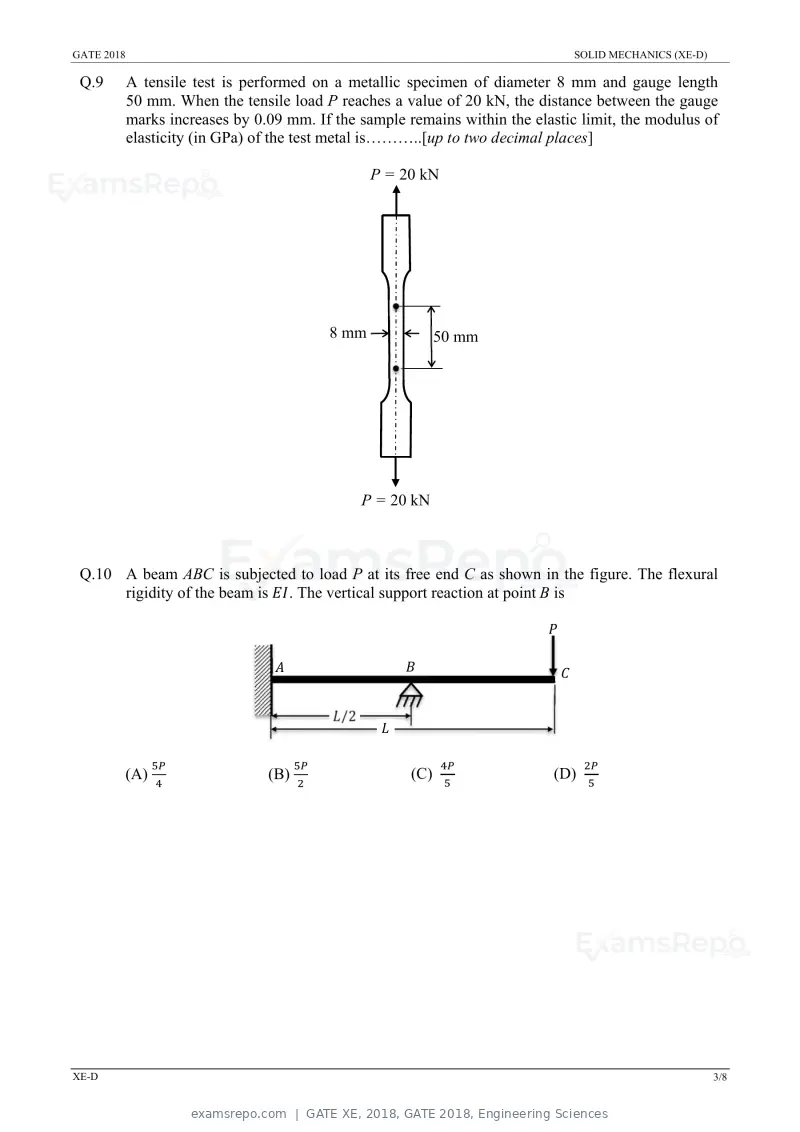
 Q.9        A tensile test is performed on a metallic specimen of diameter 8 mm and gauge length
            50 mm. When the tensile load P reaches a value of 20 kN, the distance between the gauge
            marks increases by 0.09 mm. If the sample remains within the elastic limit, the modulus of
            elasticity (in GPa) of the test metal is………..[up to two decimal places]

                                                  P = 20 kN


                                          8 mm               50 mm


                                                 P = 20 kN


 Q.10 A beam ABC is subjected to load P at its free end C as shown in the figure. The flexural
      rigidity of the beam is . The vertical support reaction at point B is


                                            /2


        (A)                      (B)                   (C)                   (D)


XE-D                                                                                                     3/8
Text of page 17
GATE 2018                                                                        SOLID MECHANICS (XE-D)

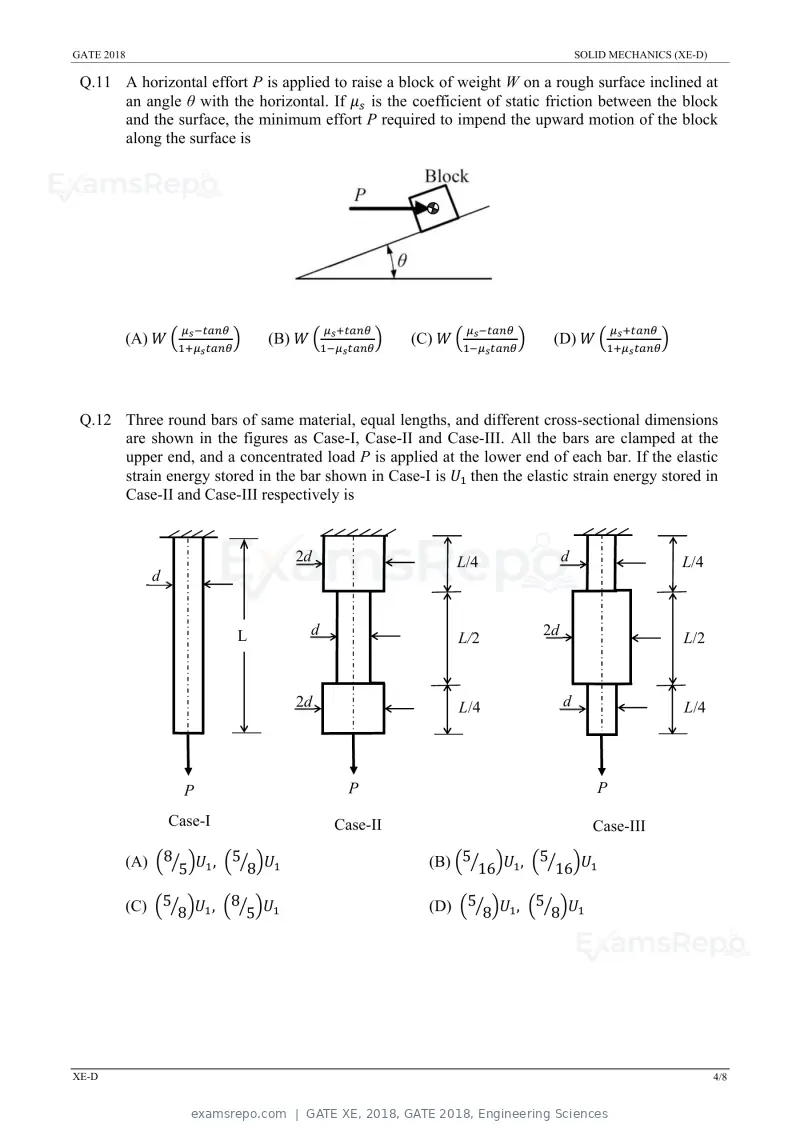
 Q.11 A horizontal effort P is applied to raise a block of weight W on a rough surface inclined at
      an angle θ with the horizontal. If     is the coefficient of static friction between the block
      and the surface, the minimum effort P required to impend the upward motion of the block
      along the surface is


        (A)                       (B)                  (C)                (D)


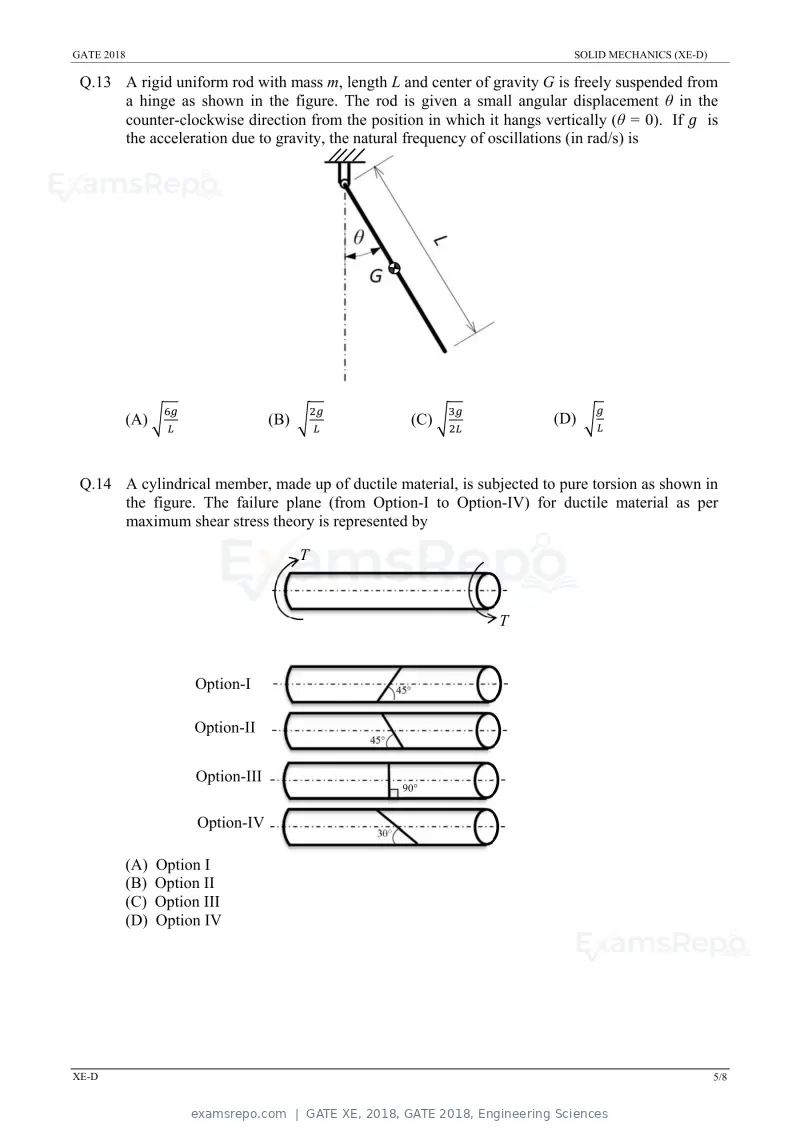
 Q.12 Three round bars of same material, equal lengths, and different cross-sectional dimensions
      are shown in the figures as Case-I, Case-II and Case-III. All the bars are clamped at the
      upper end, and a concentrated load P is applied at the lower end of each bar. If the elastic
      strain energy stored in the bar shown in Case-I is   then the elastic strain energy stored in
      Case-II and Case-III respectively is


                                        2d                   L/4             d                    L/4
              d


                             L           d                              2d
                                                             L/2                                   L/2


                                        2d                   L/4             d                     L/4


                    P                          P                                    P

                  Case-I                     Case-II                                Case-III

        (A) 8 5            , 58                          (B) 5 16    , 5 16

        (C) 5 8            , 85                          (D) 5 8    , 58


XE-D                                                                                                      4/8
Text of page 18
GATE 2018                                                                  SOLID MECHANICS (XE-D)

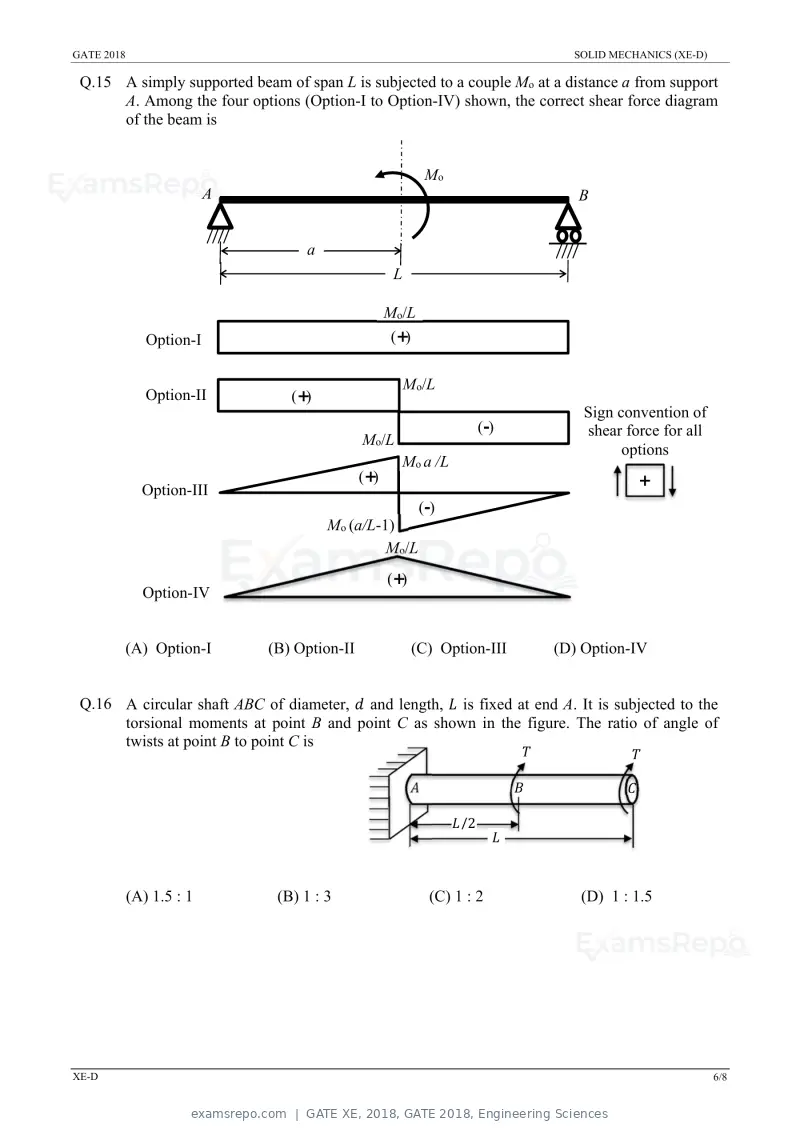
 Q.13 A rigid uniform rod with mass m, length L and center of gravity G is freely suspended from
      a hinge as shown in the figure. The rod is given a small angular displacement θ in the
      counter-clockwise direction from the position in which it hangs vertically (θ = 0). If   is
      the acceleration due to gravity, the natural frequency of oscillations (in rad/s) is


        (A)                    (B)                   (C)                (D)


 Q.14 A cylindrical member, made up of ductile material, is subjected to pure torsion as shown in
      the figure. The failure plane (from Option-I to Option-IV) for ductile material as per
      maximum shear stress theory is represented by

                                     T


                                                                T


                  Option-I                         45°


                  Option-II
                                            45°


                  Option-III
                                                    90°


                  Option-IV
                                             30°


        (A) Option I
        (B) Option II
        (C) Option III
        (D) Option IV


XE-D                                                                                                5/8
Text of page 19
GATE 2018                                                                     SOLID MECHANICS (XE-D)

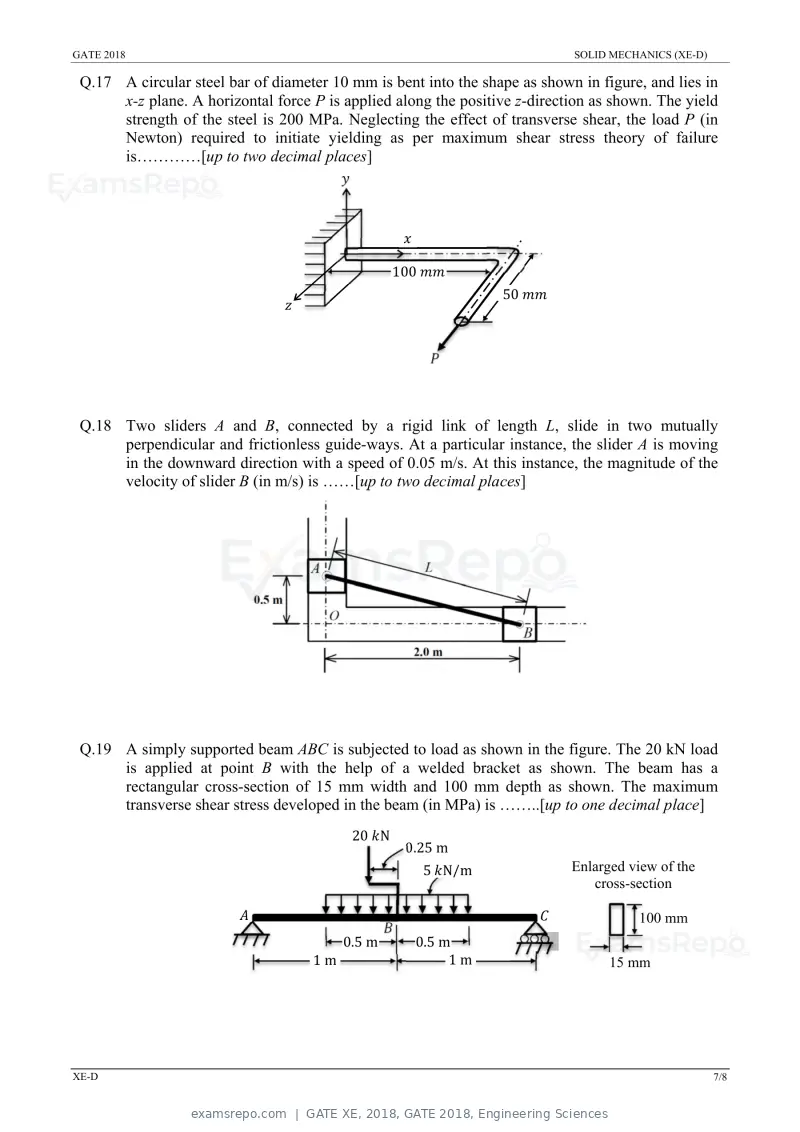
 Q.15 A simply supported beam of span L is subjected to a couple Mo at a distance a from support
      A. Among the four options (Option-I to Option-IV) shown, the correct shear force diagram
      of the beam is


                                                            Mo
                          A                                                    B


                                   a
                                                     L

                                                    Mo/L
               Option-I                              (+)

                                                         Mo/L
               Option-II         (+)
                                                                                Sign convention of
                                                                      (-)       shear force for all
                                              Mo/L
                                                                                      options
                                                      Mo a /L
                                              (+)                                       +
              Option-III
                                                           (-)
                                       Mo (a/L-1)
                                                Mo/L
                                                    (+)
              Option-IV


        (A) Option-I          (B) Option-II               (C) Option-III    (D) Option-IV


 Q.16 A circular shaft ABC of diameter, and length, is fixed at end A. It is subjected to the
      torsional moments at point B and point C as shown in the figure. The ratio of angle of
      twists at point B to point C is


                                                                 /2


            (A) 1.5 : 1        (B) 1 : 3                    (C) 1 : 2          (D) 1 : 1.5


XE-D                                                                                                   6/8
Text of page 20
GATE 2018                                                                   SOLID MECHANICS (XE-D)

 Q.17 A circular steel bar of diameter 10 mm is bent into the shape as shown in figure, and lies in
      x-z plane. A horizontal force P is applied along the positive z-direction as shown. The yield
      strength of the steel is 200 MPa. Neglecting the effect of transverse shear, the load P (in
      Newton) required to initiate yielding as per maximum shear stress theory of failure
      is…………[up to two decimal places]


                                                 100
                                                                 50


 Q.18 Two sliders A and B, connected by a rigid link of length L, slide in two mutually
      perpendicular and frictionless guide-ways. At a particular instance, the slider A is moving
      in the downward direction with a speed of 0.05 m/s. At this instance, the magnitude of the
      velocity of slider B (in m/s) is ……[up to two decimal places]


 Q.19 A simply supported beam ABC is subjected to load as shown in the figure. The 20 kN load
      is applied at point B with the help of a welded bracket as shown. The beam has a
      rectangular cross-section of 15 mm width and 100 mm depth as shown. The maximum
      transverse shear stress developed in the beam (in MPa) is ……..[up to one decimal place]
                                          20 N
                                                  0.25 m
                                                       5 N/m                Enlarged view of the
                                                                               cross-section

                                                                                      100 mm
                                         0.5 m      0.5 m
                                    1m                   1m                       15 mm


XE-D                                                                                                 7/8
Text of page 21
GATE 2018                                                                   SOLID MECHANICS (XE-D)

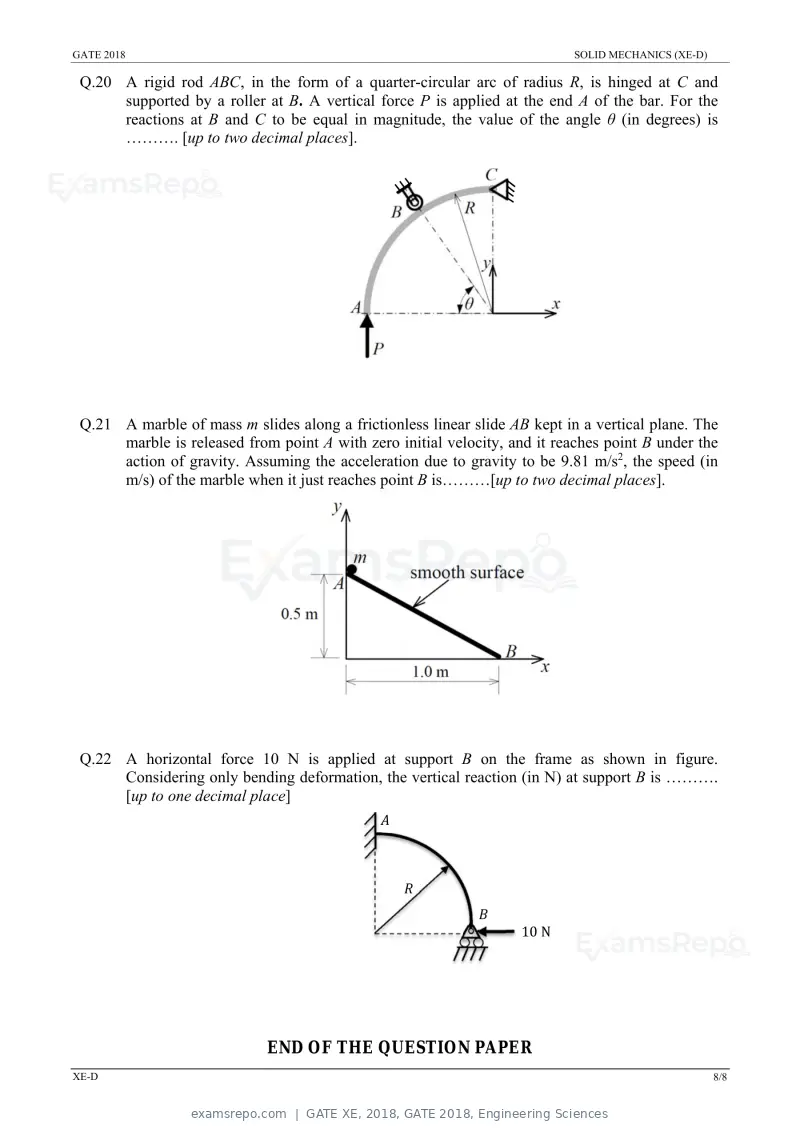
 Q.20 A rigid rod ABC, in the form of a quarter-circular arc of radius R, is hinged at C and
      supported by a roller at B. A vertical force P is applied at the end A of the bar. For the
      reactions at B and C to be equal in magnitude, the value of the angle θ (in degrees) is
      ………. [up to two decimal places].


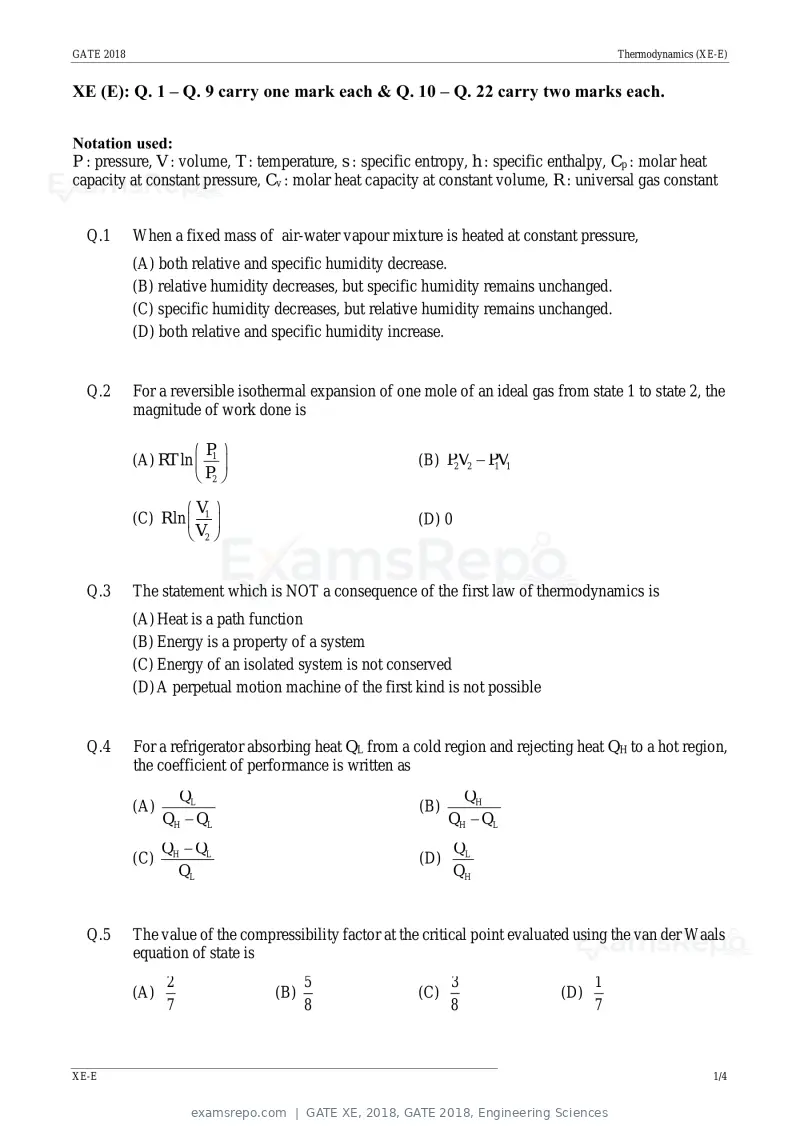
 Q.21 A marble of mass m slides along a frictionless linear slide AB kept in a vertical plane. The
      marble is released from point A with zero initial velocity, and it reaches point B under the
      action of gravity. Assuming the acceleration due to gravity to be 9.81 m/s2, the speed (in
      m/s) of the marble when it just reaches point B is………[up to two decimal places].


 Q.22 A horizontal force 10 N is applied at support B on the frame as shown in figure.
      Considering only bending deformation, the vertical reaction (in N) at support B is ……….
      [up to one decimal place]


                                                                    10 N


                             END OF THE QUESTION PAPER
XE-D                                                                                                 8/8
Text of page 22
GATE 2018 Thermodynamics (XE-E)
XE (E): Q. 1 – Q. 9 carry one mark each & Q. 10 – Q. 22 carry two marks each.
Notation used:
P : pressure, V : volume, T : temperature, s : specific entropy, h : specific enthalpy, Cp : molar heat
capacity at constant pressure, Cv : molar heat capacity at constant volume, R : universal gas constant
Q.1 When a fixed mass of air-water vapour mixture is heated at constant pressure,
(A) both relative and specific humidity decrease.
(B) relative humidity decreases, but specific humidity remains unchanged.
(C) specific humidity decreases, but relative humidity remains unchanged.
(D) both relative and specific humidity increase.
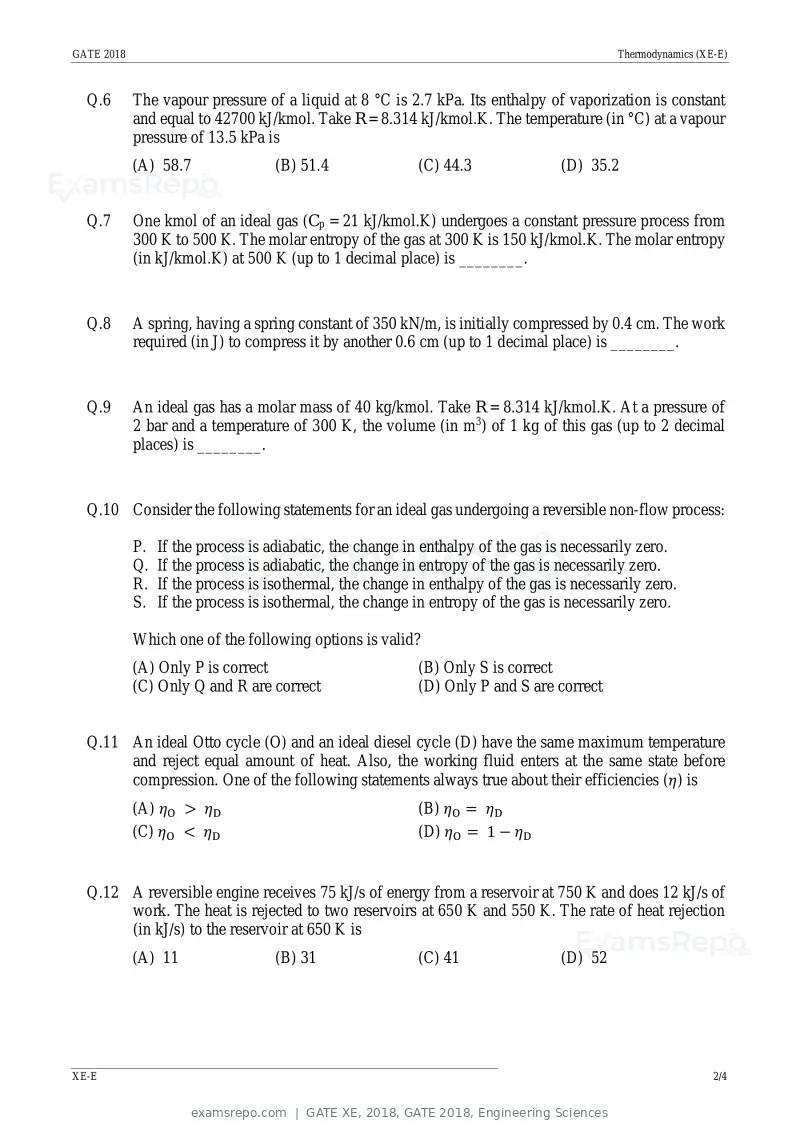
Q.2 For a reversible isothermal expansion of one mole of an ideal gas from state 1 to state 2, the
magnitude of work done is
P
(A) RT ln 1 2 2 PV
(B) PV 1 1
P2
V
(C) R ln 1 (D) 0
V2
Q.3 The statement which is NOT a consequence of the first law of thermodynamics is
(A) Heat is a path function
(B) Energy is a property of a system
(C) Energy of an isolated system is not conserved
(D) A perpetual motion machine of the first kind is not possible
Q.4 For a refrigerator absorbing heat QL from a cold region and rejecting heat QH to a hot region,
the coefficient of performance is written as
QL QH
(A) (B)
QH QL QH QL
QH QL QL
(C) (D)
QL QH
Q.5 The value of the compressibility factor at the critical point evaluated using the van der Waals
equation of state is
2 5 3 1
(A) (B) (C) (D)
7 8 8 7
XE-E 1/4
Text of page 23
GATE 2018                                                                                Thermodynamics (XE-E)


  Q.6       The vapour pressure of a liquid at 8 °C is 2.7 kPa. Its enthalpy of vaporization is constant
            and equal to 42700 kJ/kmol. Take R = 8.314 kJ/kmol.K. The temperature (in °C) at a vapour
            pressure of 13.5 kPa is
            (A) 58.7              (B) 51.4               (C) 44.3               (D) 35.2


  Q.7       One kmol of an ideal gas (Cp = 21 kJ/kmol.K) undergoes a constant pressure process from
            300 K to 500 K. The molar entropy of the gas at 300 K is 150 kJ/kmol.K. The molar entropy
            (in kJ/kmol.K) at 500 K (up to 1 decimal place) is ________.


  Q.8       A spring, having a spring constant of 350 kN/m, is initially compressed by 0.4 cm. The work
            required (in J) to compress it by another 0.6 cm (up to 1 decimal place) is ________.


  Q.9       An ideal gas has a molar mass of 40 kg/kmol. Take R = 8.314 kJ/kmol.K. At a pressure of
            2 bar and a temperature of 300 K, the volume (in m3) of 1 kg of this gas (up to 2 decimal
            places) is ________.


  Q.10 Consider the following statements for an ideal gas undergoing a reversible non-flow process:

            P. If the process is adiabatic, the change in enthalpy of the gas is necessarily zero.
            Q. If the process is adiabatic, the change in entropy of the gas is necessarily zero.
            R. If the process is isothermal, the change in enthalpy of the gas is necessarily zero.
            S. If the process is isothermal, the change in entropy of the gas is necessarily zero.

            Which one of the following options is valid?
            (A) Only P is correct                        (B) Only S is correct
            (C) Only Q and R are correct                 (D) Only P and S are correct


  Q.11 An ideal Otto cycle (O) and an ideal diesel cycle (D) have the same maximum temperature
       and reject equal amount of heat. Also, the working fluid enters at the same state before
       compression. One of the following statements always true about their efficiencies (η) is
            (A) ηO > ηD                                  (B) ηO = ηD
            (C) ηO < ηD                                  (D) ηO = 1 − ηD


  Q.12 A reversible engine receives 75 kJ/s of energy from a reservoir at 750 K and does 12 kJ/s of
       work. The heat is rejected to two reservoirs at 650 K and 550 K. The rate of heat rejection
       (in kJ/s) to the reservoir at 650 K is
            (A) 11                (B) 31                 (C) 41                 (D) 52


XE-E                                                                                                       2/4
Text of page 24
GATE 2018 Thermodynamics (XE-E)
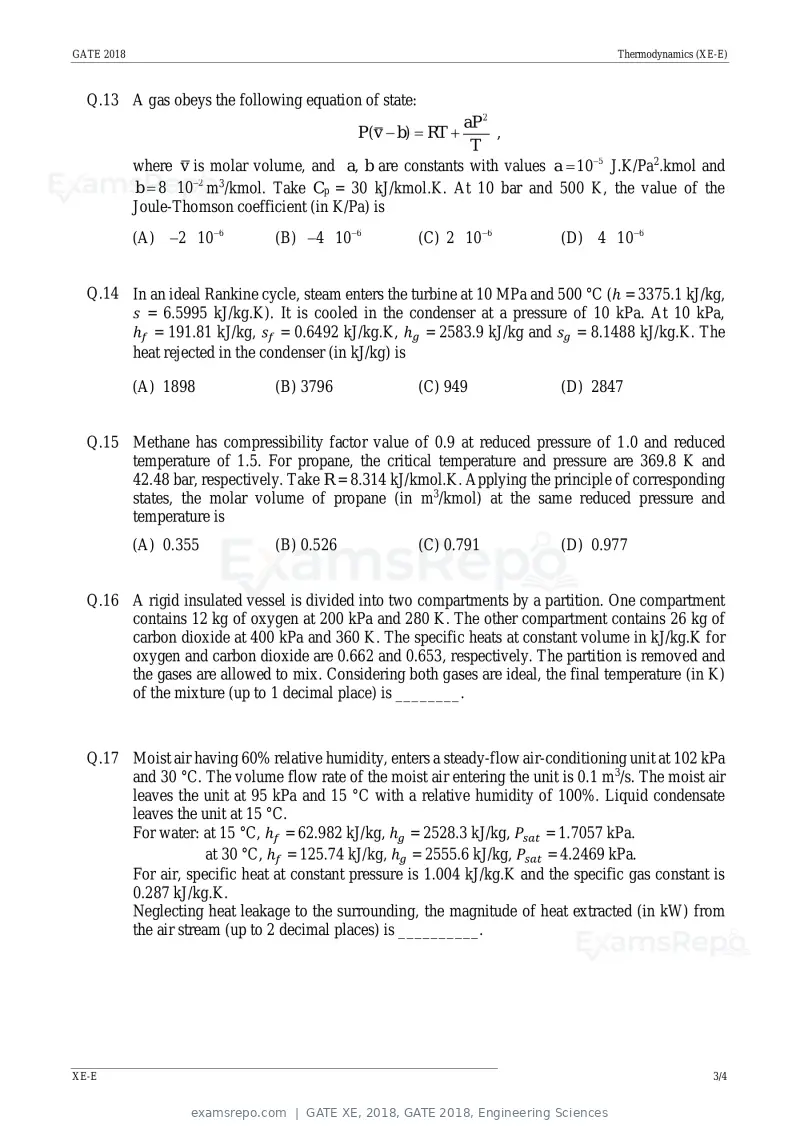
Q.13 A gas obeys the following equation of state:
aP 2
P(v b) RT ,
T
where v is molar volume, and a, b are constants with values a 105 J.K/Pa2.kmol and
b 8 102 m3/kmol. Take Cp = 30 kJ/kmol.K. At 10 bar and 500 K, the value of the
Joule-Thomson coefficient (in K/Pa) is
(A) 2 10 6 (B) 4 10 6 (C) 2 10 6 (D) 4 10 6
Q.14 In an ideal Rankine cycle, steam enters the turbine at 10 MPa and 500 °C (ℎ = 3375.1 kJ/kg,
s = 6.5995 kJ/kg.K). It is cooled in the condenser at a pressure of 10 kPa. At 10 kPa,
ℎf = 191.81 kJ/kg, sf = 0.6492 kJ/kg.K, ℎg = 2583.9 kJ/kg and sg = 8.1488 kJ/kg.K. The
heat rejected in the condenser (in kJ/kg) is
(A) 1898 (B) 3796 (C) 949 (D) 2847
Q.15 Methane has compressibility factor value of 0.9 at reduced pressure of 1.0 and reduced
temperature of 1.5. For propane, the critical temperature and pressure are 369.8 K and
42.48 bar, respectively. Take R = 8.314 kJ/kmol.K. Applying the principle of corresponding
states, the molar volume of propane (in m3/kmol) at the same reduced pressure and
temperature is
(A) 0.355 (B) 0.526 (C) 0.791 (D) 0.977
Q.16 A rigid insulated vessel is divided into two compartments by a partition. One compartment
contains 12 kg of oxygen at 200 kPa and 280 K. The other compartment contains 26 kg of
carbon dioxide at 400 kPa and 360 K. The specific heats at constant volume in kJ/kg.K for
oxygen and carbon dioxide are 0.662 and 0.653, respectively. The partition is removed and
the gases are allowed to mix. Considering both gases are ideal, the final temperature (in K)
of the mixture (up to 1 decimal place) is ________.
Q.17 Moist air having 60% relative humidity, enters a steady-flow air-conditioning unit at 102 kPa
and 30 °C. The volume flow rate of the moist air entering the unit is 0.1 m3/s. The moist air
leaves the unit at 95 kPa and 15 °C with a relative humidity of 100%. Liquid condensate
leaves the unit at 15 °C.
For water: at 15 °C, ℎf = 62.982 kJ/kg, ℎg = 2528.3 kJ/kg, Psat = 1.7057 kPa.
at 30 °C, ℎf = 125.74 kJ/kg, ℎg = 2555.6 kJ/kg, Psat = 4.2469 kPa.
For air, specific heat at constant pressure is 1.004 kJ/kg.K and the specific gas constant is
0.287 kJ/kg.K.
Neglecting heat leakage to the surrounding, the magnitude of heat extracted (in kW) from
the air stream (up to 2 decimal places) is __________.
XE-E 3/4
Text of page 25
GATE 2018 Thermodynamics (XE-E)
Q.18 Air at 150 kPa and 323 K is filled in a rigid vessel of 0.05 m3 capacity. For air, assumed as
an ideal gas, specific heat at constant volume is 0.7163 kJ/kg.K and the specific gas constant
is 0.287 kJ/kg.K. Neglect kinetic and potential energy changes. If 30 kJ of heat is added, the
final temperature (in K) of air (up to 1 decimal place) is __________.
Q.19 Superheated steam at 2 bar and 300 °C, with an enthalpy of 3072.1 kJ/kg, enters a horizontal
adiabatic nozzle with negligible velocity and leaves at 0.2 bar as saturated vapour with an
enthalpy of 2609.9 kJ/kg. Assuming steady flow and neglecting the potential energy changes,
the exit velocity (in m/s) of the steam (up to 1 decimal place) is __________.
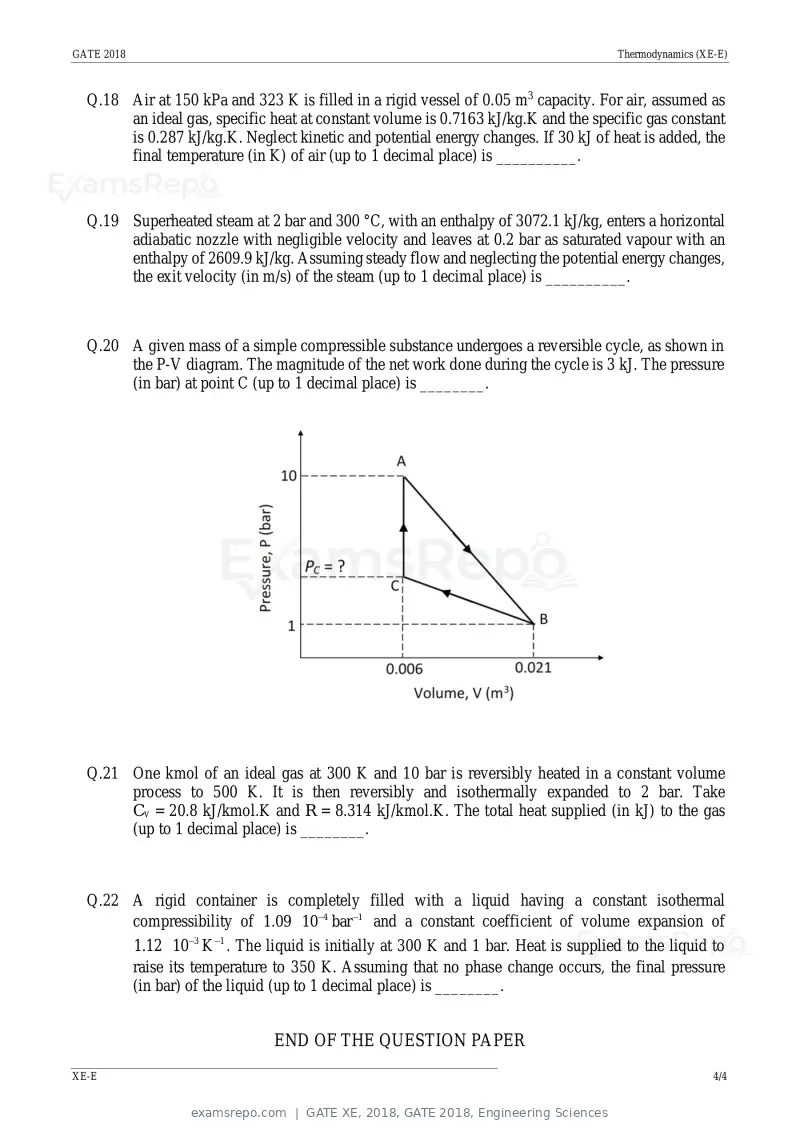
Q.20 A given mass of a simple compressible substance undergoes a reversible cycle, as shown in
the P-V diagram. The magnitude of the net work done during the cycle is 3 kJ. The pressure
(in bar) at point C (up to 1 decimal place) is ________.
Q.21 One kmol of an ideal gas at 300 K and 10 bar is reversibly heated in a constant volume
process to 500 K. It is then reversibly and isothermally expanded to 2 bar. Take
Cv = 20.8 kJ/kmol.K and R = 8.314 kJ/kmol.K. The total heat supplied (in kJ) to the gas
(up to 1 decimal place) is ________.
Q.22 A rigid container is completely filled with a liquid having a constant isothermal
compressibility of 1.09 104 bar 1 and a constant coefficient of volume expansion of
1.12 103 K 1 . The liquid is initially at 300 K and 1 bar. Heat is supplied to the liquid to
raise its temperature to 350 K. Assuming that no phase change occurs, the final pressure
(in bar) of the liquid (up to 1 decimal place) is ________.
END OF THE QUESTION PAPER
XE-E 4/4
Text of page 26
GATE 2018                                                       Polymer Science & Engineering (XE – F)


XE (F):           Q. 1 – Q. 9 carry one mark each & Q. 10 – Q. 22 carry two marks each.
 Q.1        Which one of the following polymers occurs naturally?
         (A) Bakelite            (B) Teflon            (C) Cellulose            (D) Perspex


 Q.2        The order of average molecular weights of a polymer is
         (A) Mz > Mw > Mv > Mn
         (B) Mw > Mz > Mn > Mv
         (C) Mn > Mw > Mv > Mz
         (D) Mz > Mv > Mn > Mw


 Q.3        Rubbers are a class of polymer known for
         (A) High intermolecular forces
         (B) High Tg polymers
         (C) Crystalline polymers
         (D) Low intermolecular forces


 Q.4        Nylon 6 is manufactured from
         (A) Sebacic acid and hexamethylene diamine
         (B) Caprolactam
         (C) Adipic acid and hexamethylene diamine
         (D) Caprolactone


 Q.5        Storage modulus and tan δ of a polymer are experimentally measured by
         (A) Differential scanning calorimetry
         (B) Thermogravimetric analysis
         (C) Thermomechanical analysis
         (D) Dynamic mechanical thermal analysis


 Q.6        A plastic bucket is manufactured by
         (A) Compression moulding
         (B) Injection moulding
         (C) Extrusion
         (D) Blow moulding


 Q.7        The monomers, A and B with reactivity ratios rA and rB, form alternate copolymers when,
         (A) rA = rB = 0         (B) rA = rB = 1       (C) rA > 1, rB > 1       (D) rA < 1, rB < 1


XE – F                                                                                                   1/6
Text of page 27
GATE 2018                                                        Polymer Science & Engineering (XE – F)

 Q.8        The degree of polymerization of a poly(methyl methacrylate) sample having number
            average molecular weight of 1,50,000 g/mol is___________.
            (C = 12, H = 1, O = 16 g/mol).

 Q.9        If the heat of fusion of 100 % crystalline polyethylene is 290 mJ/mg, a sample of
            polyethylene with heat of fusion of 141 mJ/mg will have_______ % crystallinity.


 Q.10 Match the following:

             P. Butyl rubber                              1. Metallocene polymerization
             Q. Cold SBR                                  2. Cationic polymerization
             R. Poly(ethylene terephthalate)              3. Redox polymerization
             S. Polypropylene                             4. Condensation polymerization


         (A) P-3; Q-1; R-2; S-1                         (B) P-2; Q-3; R-1; S-4
         (C) P-4; Q-3; R-1; S-2                         (D) P-2; Q-3; R-4; S-1


 Q.11 Match the following:

             P. Polyaramid                                1. Baby-feeding nipple
             Q. Polytetrafluoroethylene                   2. Optical glasses
             R. Polycarbonate                             3. Non-stick cookware
             S. Poly(dimethyl siloxane)                   4. Bullet-proof jacket

         (A) P-4; Q-3; R-2; S-1                         (B) P-2; Q-3; R-4; S-1
         (C) P-4; Q-1; R-2; S-3                         (D) P-3; Q-4; R-2; S-1


 Q.12 Flexible PVC tubes are used for watering. If some organic solvents are passed through this
      tube, it becomes stiff. This is due to the fact that the organic solvents
         (A) plasticize PVC and raise Tg.
         (B) remove plasticizer and raise Tg.
         (C) remove plasticizer and lower Tg.
         (D) react with PVC and increase Tg


 Q.13 Match the following:

             P. Plastic egg container                     1. Injection moulding
             Q. Water tank                                2. Extrusion
             R. Chair                                     3. Rotational moulding
             S. Cable                                     4. Thermoforming

         (A) P-3; Q-1; R-4; S-2                         (B) P-4; Q-3; R-2; S-1
         (C) P-2; Q-3; R-4; S-1                         (D) P-4; Q-3; R-1; S-2


XE – F                                                                                                    2/6
Text of page 28
GATE 2018                                                         Polymer Science & Engineering (XE – F)

 Q.14 Match the following:

             P. Flame retardant             1. 4-Methyl-2,6-di-t-butyl phenol
             Q. UV absorber                 2. Azocarbonamide
             R. Blowing agent               3. Phenyl salisylate
             S. Antioxidant                 4. Aluminium trihydrate
         (A) P-4; Q-1; R-2; S-3                         (B) P-4; Q-3; R-2; S-1
         (C) P-3; Q-4; R-2; S-1                         (D) P-2; Q-4; R-1; S-3


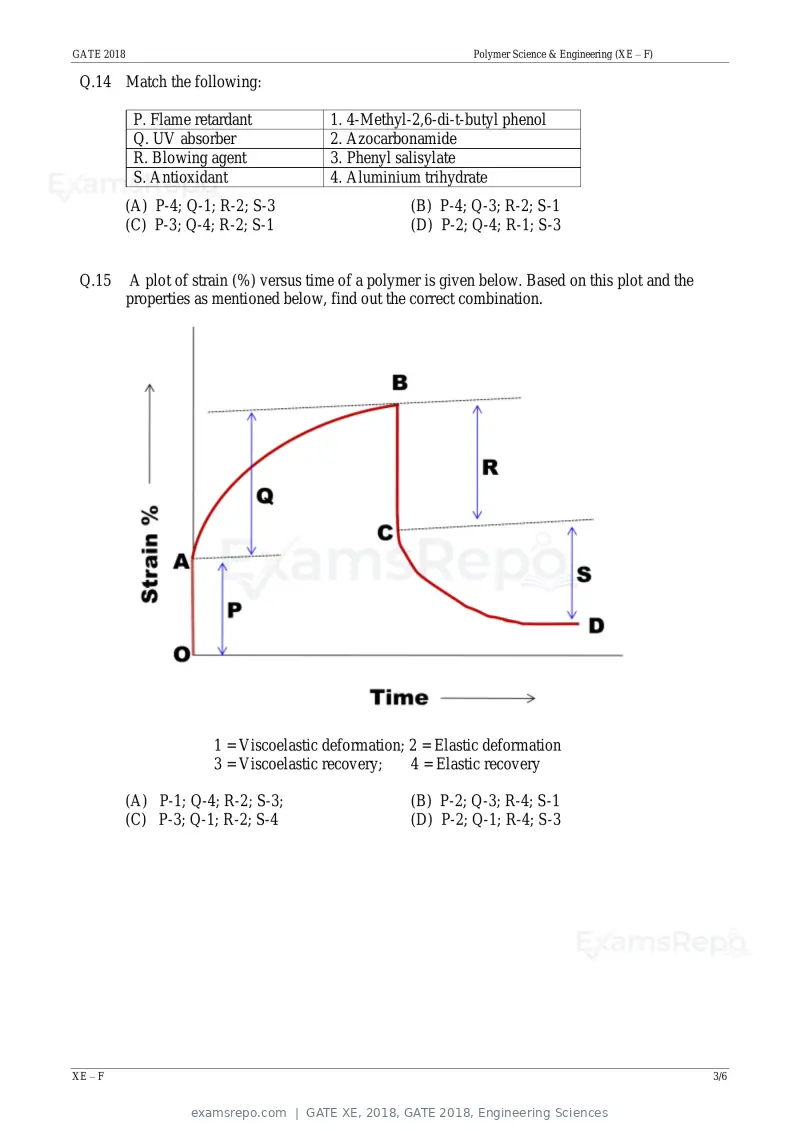
 Q.15        A plot of strain (%) versus time of a polymer is given below. Based on this plot and the
            properties as mentioned below, find out the correct combination.


                         1 = Viscoelastic deformation; 2 = Elastic deformation
                         3 = Viscoelastic recovery;    4 = Elastic recovery

         (A) P-1; Q-4; R-2; S-3;                        (B) P-2; Q-3; R-4; S-1
         (C) P-3; Q-1; R-2; S-4                         (D) P-2; Q-1; R-4; S-3


XE – F                                                                                                     3/6
Text of page 29
GATE 2018                                                      Polymer Science & Engineering (XE – F)

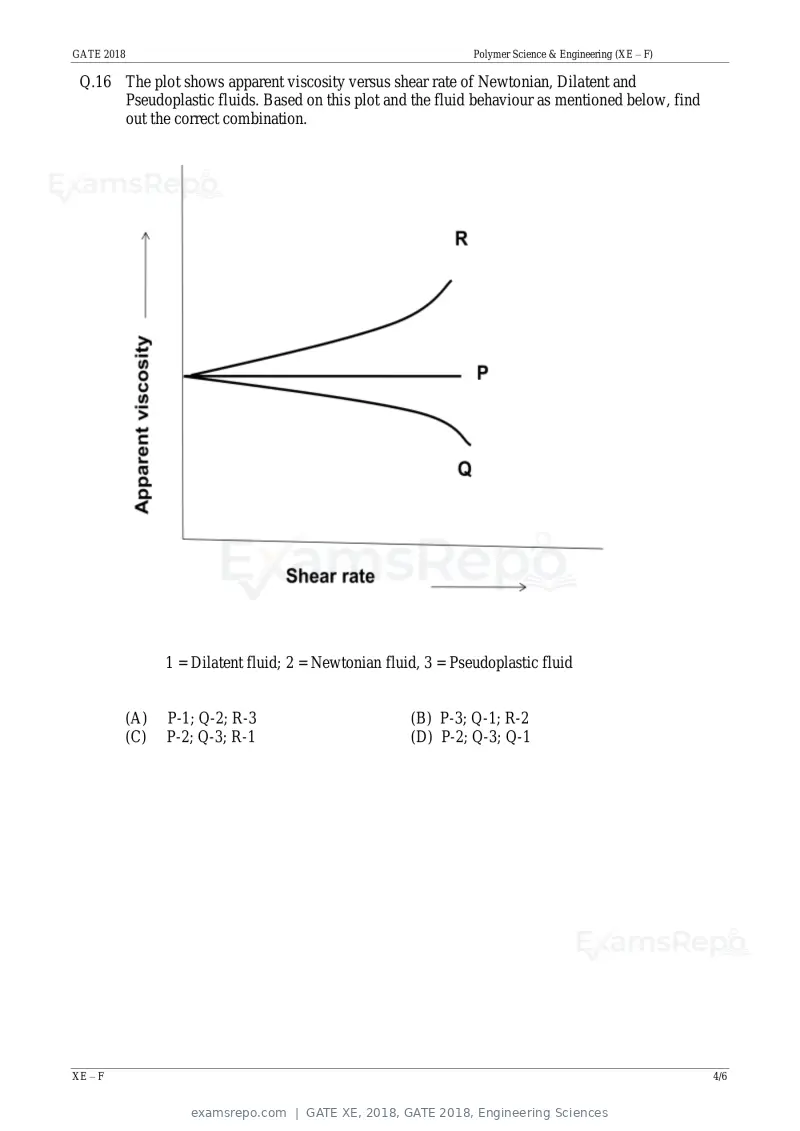
 Q.16 The plot shows apparent viscosity versus shear rate of Newtonian, Dilatent and
      Pseudoplastic fluids. Based on this plot and the fluid behaviour as mentioned below, find
      out the correct combination.


               1 = Dilatent fluid; 2 = Newtonian fluid, 3 = Pseudoplastic fluid


         (A)   P-1; Q-2; R-3                         (B) P-3; Q-1; R-2
         (C)   P-2; Q-3; R-1                         (D) P-2; Q-3; Q-1


XE – F                                                                                                  4/6
Text of page 30
GATE 2018                                                    Polymer Science & Engineering (XE – F)

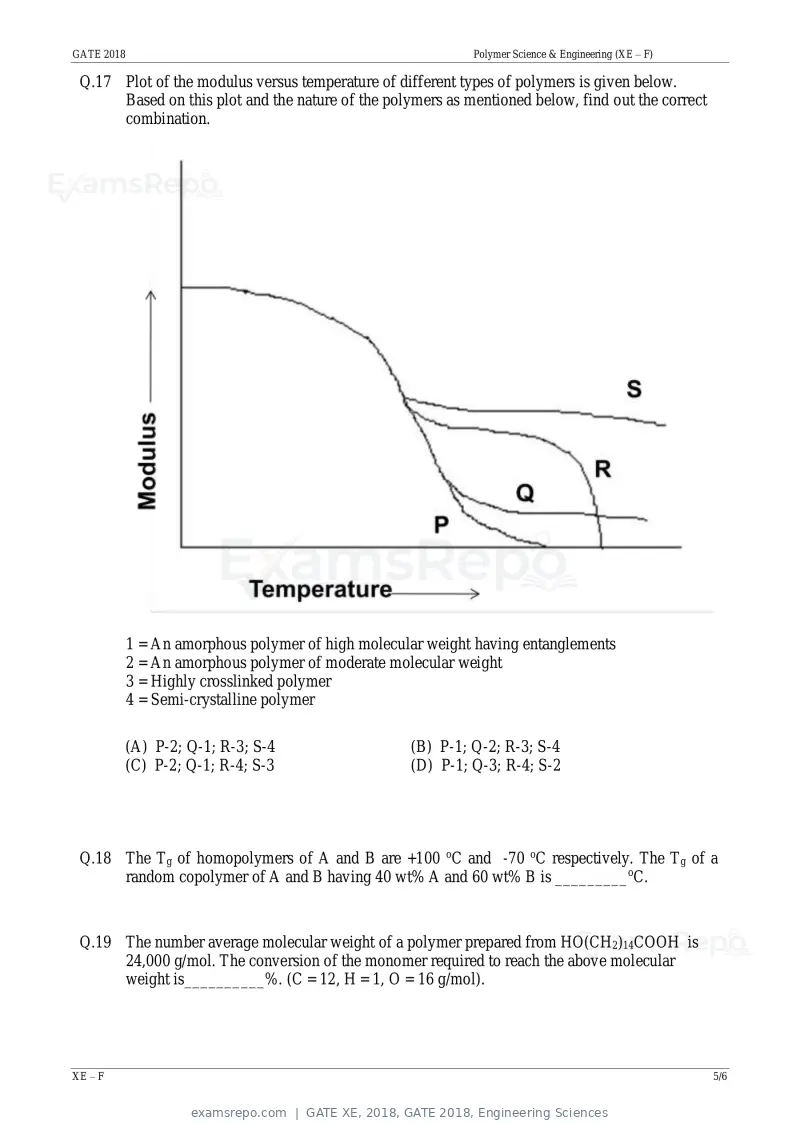
 Q.17 Plot of the modulus versus temperature of different types of polymers is given below.
      Based on this plot and the nature of the polymers as mentioned below, find out the correct
      combination.


            1 = An amorphous polymer of high molecular weight having entanglements
            2 = An amorphous polymer of moderate molecular weight
            3 = Highly crosslinked polymer
            4 = Semi-crystalline polymer

         (A) P-2; Q-1; R-3; S-4                     (B) P-1; Q-2; R-3; S-4
         (C) P-2; Q-1; R-4; S-3                     (D) P-1; Q-3; R-4; S-2


 Q.18 The Tg of homopolymers of A and B are +100 oC and -70 oC respectively. The Tg of a
      random copolymer of A and B having 40 wt% A and 60 wt% B is _________oC.


 Q.19 The number average molecular weight of a polymer prepared from HO(CH2)14COOH is
      24,000 g/mol. The conversion of the monomer required to reach the above molecular
      weight is__________%. (C = 12, H = 1, O = 16 g/mol).


XE – F                                                                                                5/6
Text of page 31
GATE 2018                                                       Polymer Science & Engineering (XE – F)

 Q.20 Glass fibers in nylon provide reinforcement. The modulus of elasticity for each component
      of the composite is; Eglass = 10.5 x 10⁶ psi; Enylon = 0.4 x 10⁶ psi. If the nylon contains
      30 vol % E-glass, the fraction of the applied force is carried by the glass fiber
      is__________. (Assume that both glass fiber and nylon have equal strain).


 Q.21        The solubility parameter of a polymer having cohesive energy density (Ecoh) 43870 J/mol
            and molar volume (V) 136 cm3/mol is _________ (J/cm3)1/2.


 Q.22 The heat of polymerization of styrene is 20 Kcal/mol. Heat of 5 x10⁵ Kcal will be released
      on polymerization of __________ Kg of styrene (C = 12 and H = 1 g/mol).


                                 END OF THE QUESTION PAPER


XE – F                                                                                                   6/6
Text of page 32
GATE 2018                                                                    Food Technology – XE-G

XE (G):       Q. 1 – Q. 9 carry one mark each & Q. 10 – Q. 22 carry two marks each.

  Q.1       Which of the following is oil soluble pigment present in fruits and vegetables?

            (A) Flavonoids         (B) Carotenoids        (C) Anthocyanins                      (D) Tannins


  Q.2       Which of the following represent the group of saturated fatty acids?

            (A) Lauric, Myristic, Arachidic               (B) Palmitic, Linoleic, Linolenic
            (C) Capric, Stearic & Oleic                   (D) Behenic, Caprylic, Arachidonic


  Q.3       The anti-nutritional factor present in fava bean is

            (A) Gossypol                                  (B) Curcine
            (C) Vicine                                    (D) Cyanogen


  Q.4       Irradiation carried out to reduce viable non-spore forming pathogenic bacteria using a dose
            between 3 to 10 kGy is called

            (A) Radurization                               (B) Thermoradiation
            (C) Radappertization                          (D) Radicidation


  Q.5       Identify the correct statement related to the viscosity of Newtonian fluids from the following

            (A) It is not influenced by temperature
            (B) It increases with shearing rate
            (C) It decreases with shearing rate
            (D) It is not influenced by shearing rate


  Q.6       Adult male Wistar rats were fed with a protein based diet. Total 150 g of protein was ingested
            per animal. If the average weight increased from 110 g to 350 g after the end of the
            experiment, the Protein efficiency ratio of the given protein would be _______. (up to two
            decimal points)


  Q.7       The initial moisture content of a food on wet basis is 50.76%. Its moisture content (%) on
            dry basis is _______.(up to two decimal points)

XE-G                                                                                                      1/4
Text of page 33
GATE 2018                                                                   Food Technology – XE-G

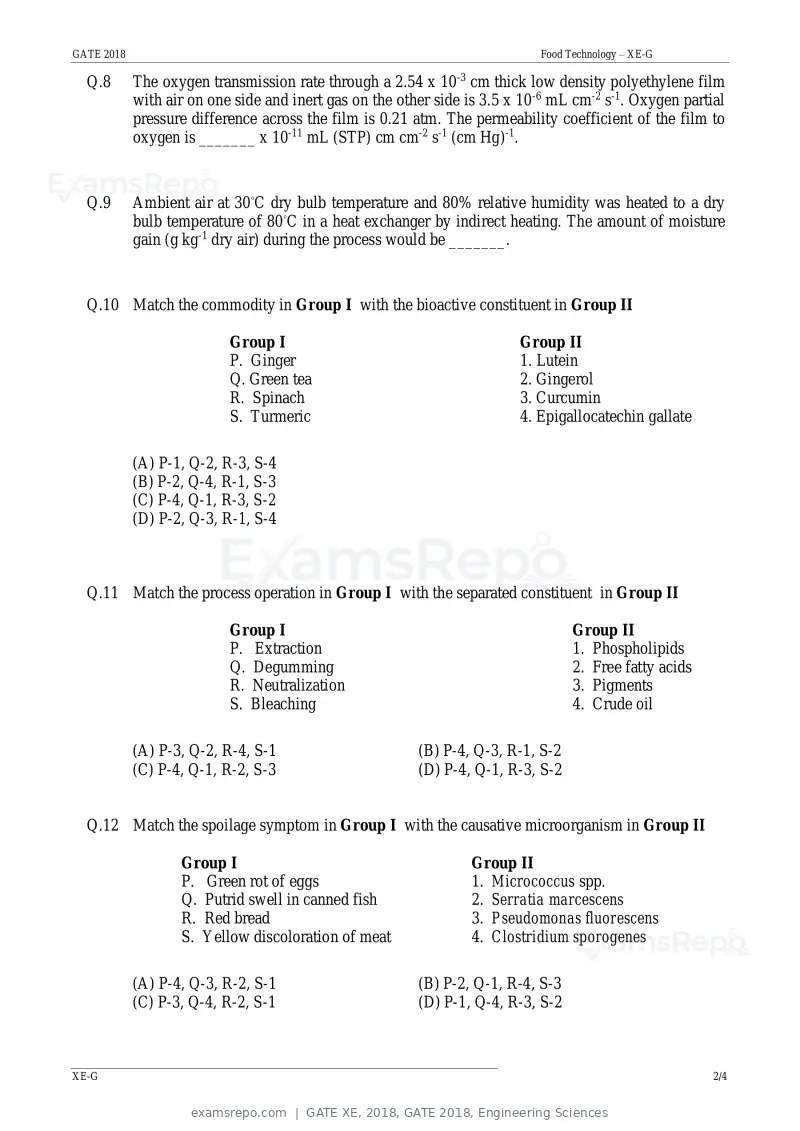
  Q.8       The oxygen transmission rate through a 2.54 x 10⁻³ cm thick low density polyethylene film
            with air on one side and inert gas on the other side is 3.5 x 10⁻⁶ mL cm-2 s-1. Oxygen partial
            pressure difference across the film is 0.21 atm. The permeability coefficient of the film to
            oxygen is _______ x 10-11 mL (STP) cm cm-2 s-1 (cm Hg)-1.


  Q.9       Ambient air at 30◦C dry bulb temperature and 80% relative humidity was heated to a dry
            bulb temperature of 80◦C in a heat exchanger by indirect heating. The amount of moisture
            gain (g kg-1 dry air) during the process would be _______.


  Q.10 Match the commodity in Group I with the bioactive constituent in Group II

                           Group I                                       Group II
                           P. Ginger                                     1. Lutein
                           Q. Green tea                                  2. Gingerol
                           R. Spinach                                    3. Curcumin
                           S. Turmeric                                   4. Epigallocatechin gallate

            (A) P-1, Q-2, R-3, S-4
            (B) P-2, Q-4, R-1, S-3
            (C) P-4, Q-1, R-3, S-2
            (D) P-2, Q-3, R-1, S-4


  Q.11 Match the process operation in Group I with the separated constituent in Group II

                           Group I                                                Group II
                           P. Extraction                                          1. Phospholipids
                           Q. Degumming                                           2. Free fatty acids
                           R. Neutralization                                      3. Pigments
                           S. Bleaching                                           4. Crude oil

            (A) P-3, Q-2, R-4, S-1                       (B) P-4, Q-3, R-1, S-2
            (C) P-4, Q-1, R-2, S-3                       (D) P-4, Q-1, R-3, S-2


  Q.12 Match the spoilage symptom in Group I with the causative microorganism in Group II

                   Group I                                       Group II
                   P. Green rot of eggs                          1. Micrococcus spp.
                   Q. Putrid swell in canned fish                2. Serratia marcescens
                   R. Red bread                                  3. Pseudomonas fluorescens
                   S. Yellow discoloration of meat               4. Clostridium sporogenes

            (A) P-4, Q-3, R-2, S-1                       (B) P-2, Q-1, R-4, S-3
            (C) P-3, Q-4, R-2, S-1                       (D) P-1, Q-4, R-3, S-2


XE-G                                                                                                    2/4
Text of page 34
GATE 2018                                                                  Food Technology – XE-G

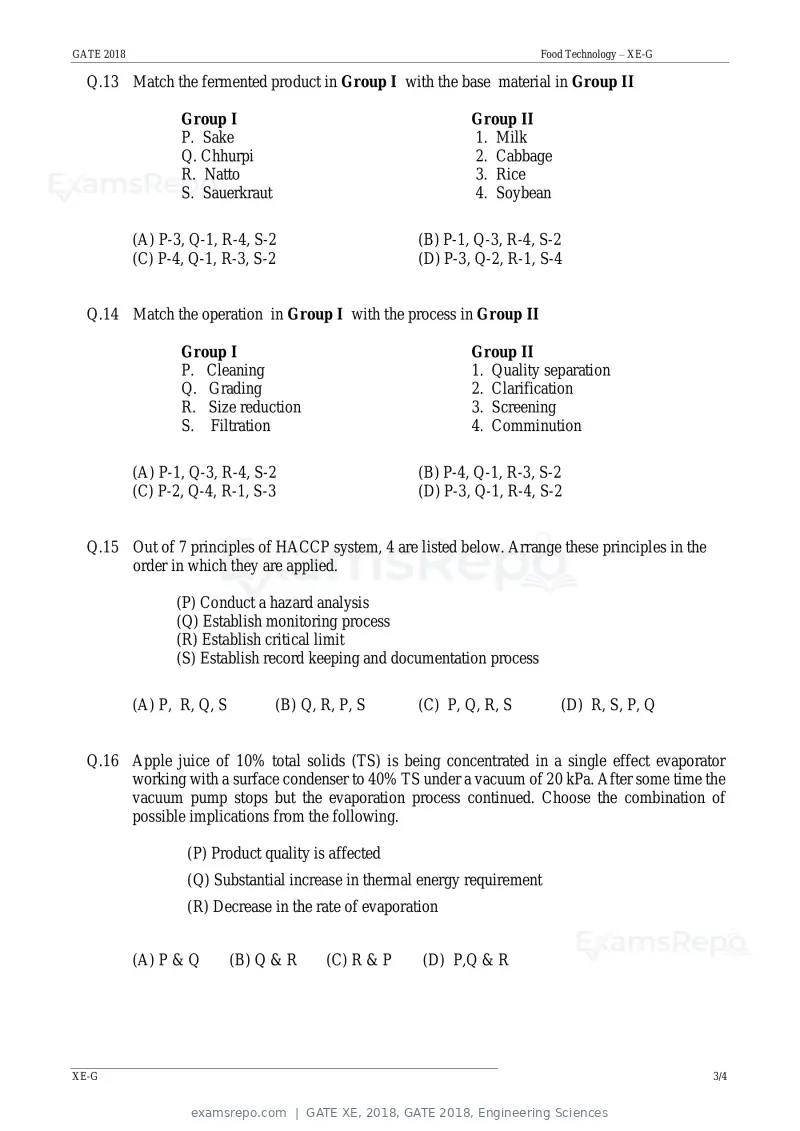
  Q.13 Match the fermented product in Group I with the base material in Group II

                   Group I                                     Group II
                   P. Sake                                     1. Milk
                   Q. Chhurpi                                  2. Cabbage
                   R. Natto                                    3. Rice
                   S. Sauerkraut                               4. Soybean

            (A) P-3, Q-1, R-4, S-2                     (B) P-1, Q-3, R-4, S-2
            (C) P-4, Q-1, R-3, S-2                     (D) P-3, Q-2, R-1, S-4


  Q.14 Match the operation in Group I with the process in Group II

                   Group I                                     Group II
                   P. Cleaning                                 1. Quality separation
                   Q. Grading                                  2. Clarification
                   R. Size reduction                           3. Screening
                   S. Filtration                               4. Comminution

            (A) P-1, Q-3, R-4, S-2                     (B) P-4, Q-1, R-3, S-2
            (C) P-2, Q-4, R-1, S-3                     (D) P-3, Q-1, R-4, S-2


  Q.15 Out of 7 principles of HACCP system, 4 are listed below. Arrange these principles in the
       order in which they are applied.

                  (P) Conduct a hazard analysis
                  (Q) Establish monitoring process
                  (R) Establish critical limit
                  (S) Establish record keeping and documentation process

            (A) P, R, Q, S         (B) Q, R, P, S      (C) P, Q, R, S         (D) R, S, P, Q


  Q.16 Apple juice of 10% total solids (TS) is being concentrated in a single effect evaporator
       working with a surface condenser to 40% TS under a vacuum of 20 kPa. After some time the
       vacuum pump stops but the evaporation process continued. Choose the combination of
       possible implications from the following.

                    (P) Product quality is affected
                    (Q) Substantial increase in thermal energy requirement
                    (R) Decrease in the rate of evaporation


            (A) P & Q        (B) Q & R    (C) R & P     (D) P,Q & R


XE-G                                                                                                3/4
Text of page 35
GATE 2018                                                                Food Technology – XE-G

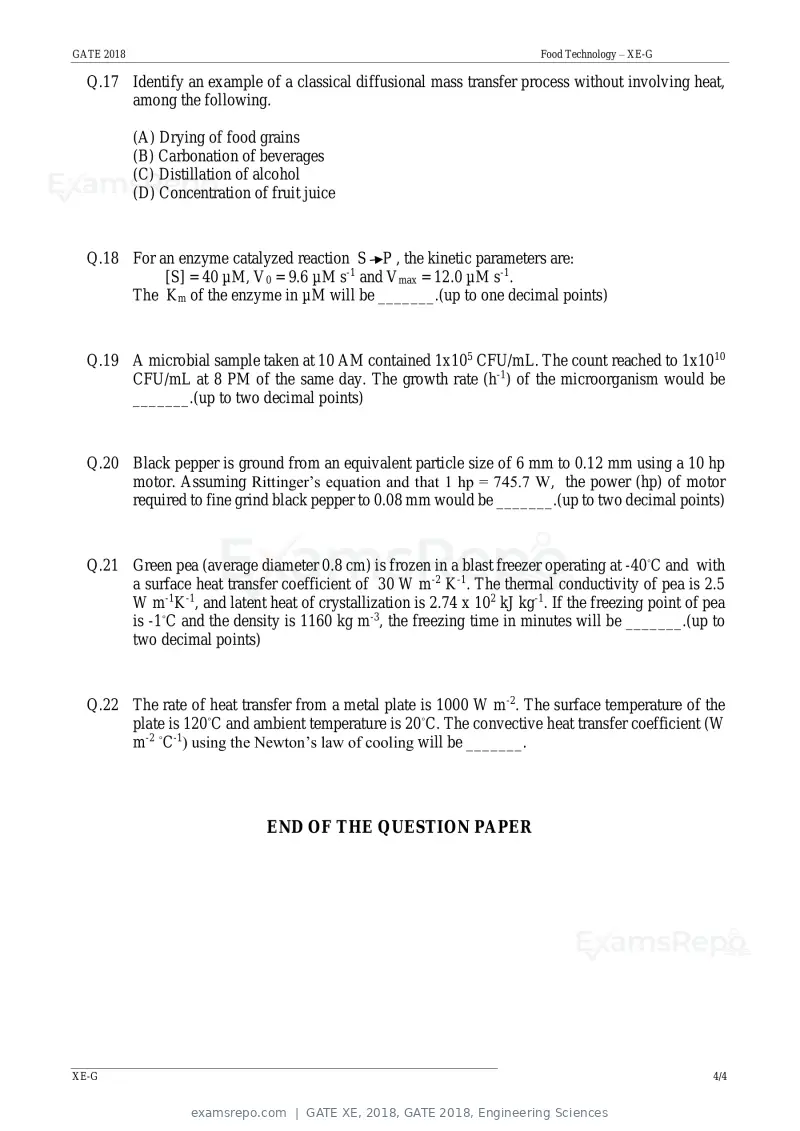
  Q.17 Identify an example of a classical diffusional mass transfer process without involving heat,
       among the following.

            (A) Drying of food grains
            (B) Carbonation of beverages
            (C) Distillation of alcohol
            (D) Concentration of fruit juice


  Q.18 For an enzyme catalyzed reaction S P , the kinetic parameters are:
            [S] = 40 µM, V0 = 9.6 µM s-1 and Vmax = 12.0 µM s-1.
       The Km of the enzyme in µM will be _______.(up to one decimal points)


  Q.19 A microbial sample taken at 10 AM contained 1x10⁵ CFU/mL. The count reached to 1x10¹⁰
       CFU/mL at 8 PM of the same day. The growth rate (h-1) of the microorganism would be
       _______.(up to two decimal points)


  Q.20 Black pepper is ground from an equivalent particle size of 6 mm to 0.12 mm using a 10 hp
       motor. Assuming Rittinger’s equation and that 1 hp = 745.7 W, the power (hp) of motor
       required to fine grind black pepper to 0.08 mm would be _______.(up to two decimal points)


  Q.21 Green pea (average diameter 0.8 cm) is frozen in a blast freezer operating at -40◦C and with
       a surface heat transfer coefficient of 30 W m-2 K-1. The thermal conductivity of pea is 2.5
       W m-1K-1, and latent heat of crystallization is 2.74 x 10² kJ kg-1. If the freezing point of pea
       is -1◦C and the density is 1160 kg m-3, the freezing time in minutes will be _______.(up to
       two decimal points)


  Q.22 The rate of heat transfer from a metal plate is 1000 W m-2. The surface temperature of the
       plate is 120◦C and ambient temperature is 20◦C. The convective heat transfer coefficient (W
       m-2 ◦C-1) using the Newton’s law of cooling will be _______.


                                 END OF THE QUESTION PAPER


XE-G                                                                                                 4/4
Text of page 36
GATE 2018                                                                   Atmospheric and Oceanic Sciences (XE-H)

Q. 1 – Q. 9 carry one mark each & Q. 10 – Q. 22 carry two marks each.

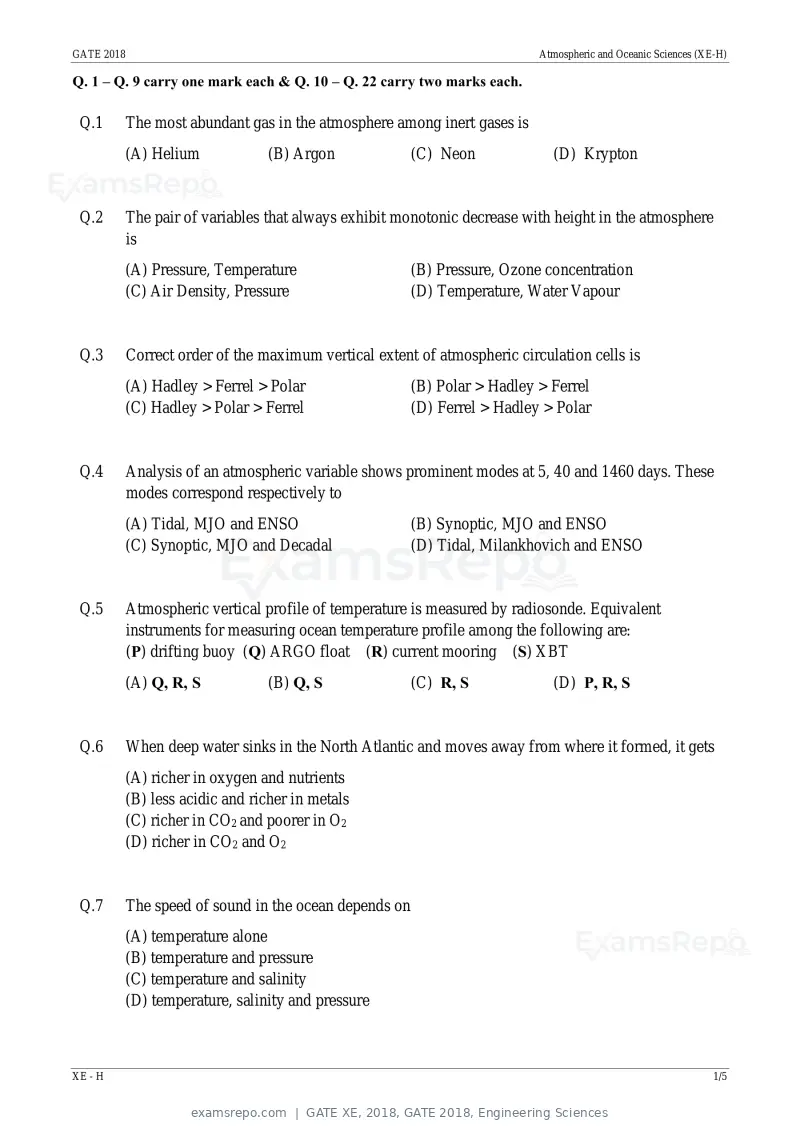
 Q.1        The most abundant gas in the atmosphere among inert gases is
         (A) Helium               (B) Argon              (C) Neon             (D) Krypton


 Q.2        The pair of variables that always exhibit monotonic decrease with height in the atmosphere
            is
         (A) Pressure, Temperature                       (B) Pressure, Ozone concentration
         (C) Air Density, Pressure                       (D) Temperature, Water Vapour


 Q.3        Correct order of the maximum vertical extent of atmospheric circulation cells is
         (A) Hadley > Ferrel > Polar                     (B) Polar > Hadley > Ferrel
         (C) Hadley > Polar > Ferrel                     (D) Ferrel > Hadley > Polar


 Q.4        Analysis of an atmospheric variable shows prominent modes at 5, 40 and 1460 days. These
            modes correspond respectively to
         (A) Tidal, MJO and ENSO                         (B) Synoptic, MJO and ENSO
         (C) Synoptic, MJO and Decadal                   (D) Tidal, Milankhovich and ENSO


 Q.5        Atmospheric vertical profile of temperature is measured by radiosonde. Equivalent
            instruments for measuring ocean temperature profile among the following are:
            (P) drifting buoy (Q) ARGO float (R) current mooring (S) XBT
         (A) Q, R, S              (B) Q, S               (C) R, S             (D) P, R, S


 Q.6        When deep water sinks in the North Atlantic and moves away from where it formed, it gets
         (A) richer in oxygen and nutrients
         (B) less acidic and richer in metals
         (C) richer in CO2 and poorer in O2
         (D) richer in CO2 and O2


 Q.7        The speed of sound in the ocean depends on
         (A) temperature alone
         (B) temperature and pressure
         (C) temperature and salinity
         (D) temperature, salinity and pressure


XE - H                                                                                                          1/5
Text of page 37
GATE 2018                                                                  Atmospheric and Oceanic Sciences (XE-H)


 Q.8        In a numerical weather prediction model with a horizontal grid resolution of 50 km,
            convective cloud processes are parameterized, because
         (A) Cloud physics is not known for modelling
         (B) Models cannot handle phase change
         (C) Cloud size is larger than the grid size
         (D) Cloud size is much smaller than the grid size


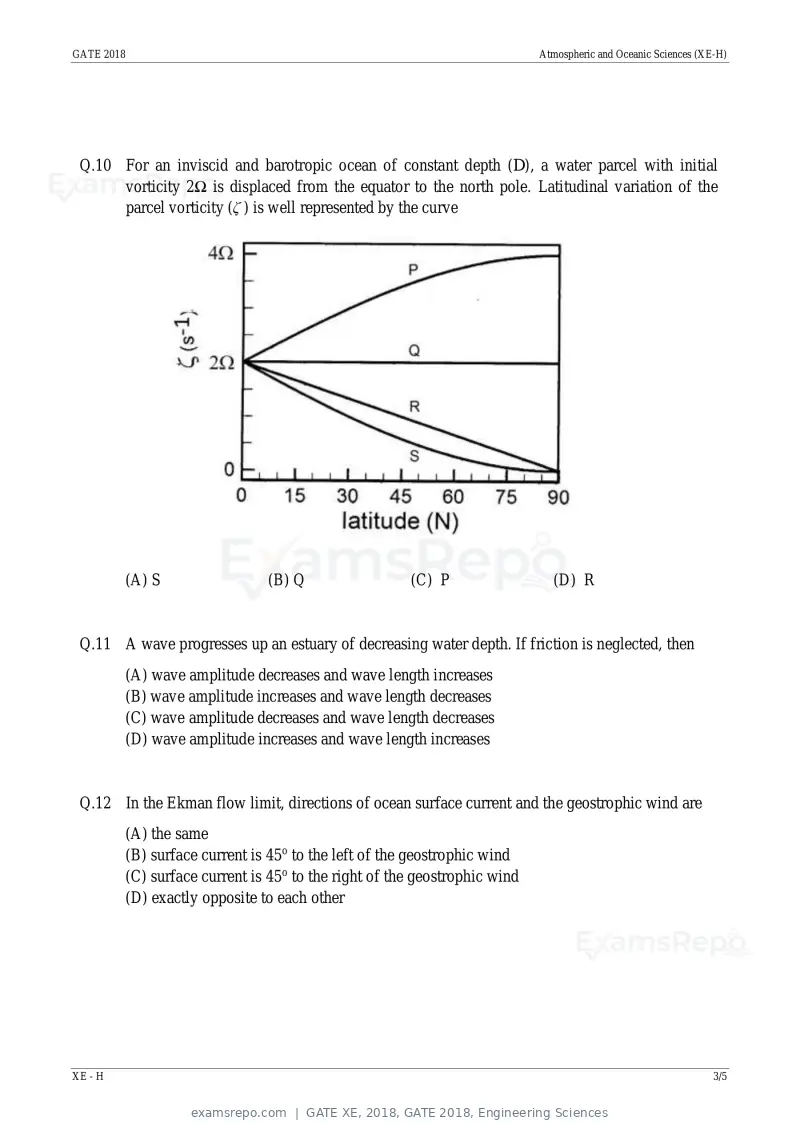
 Q.9        Figure below shows SST anomaly (in °C). It is associated with the phenomenon known as


         (A) El Nino                                   (B) Indian Ocean dipole
         (C) La Nina                                   (D) MJO


XE - H                                                                                                         2/5
Text of page 38
GATE 2018                                                                  Atmospheric and Oceanic Sciences (XE-H)


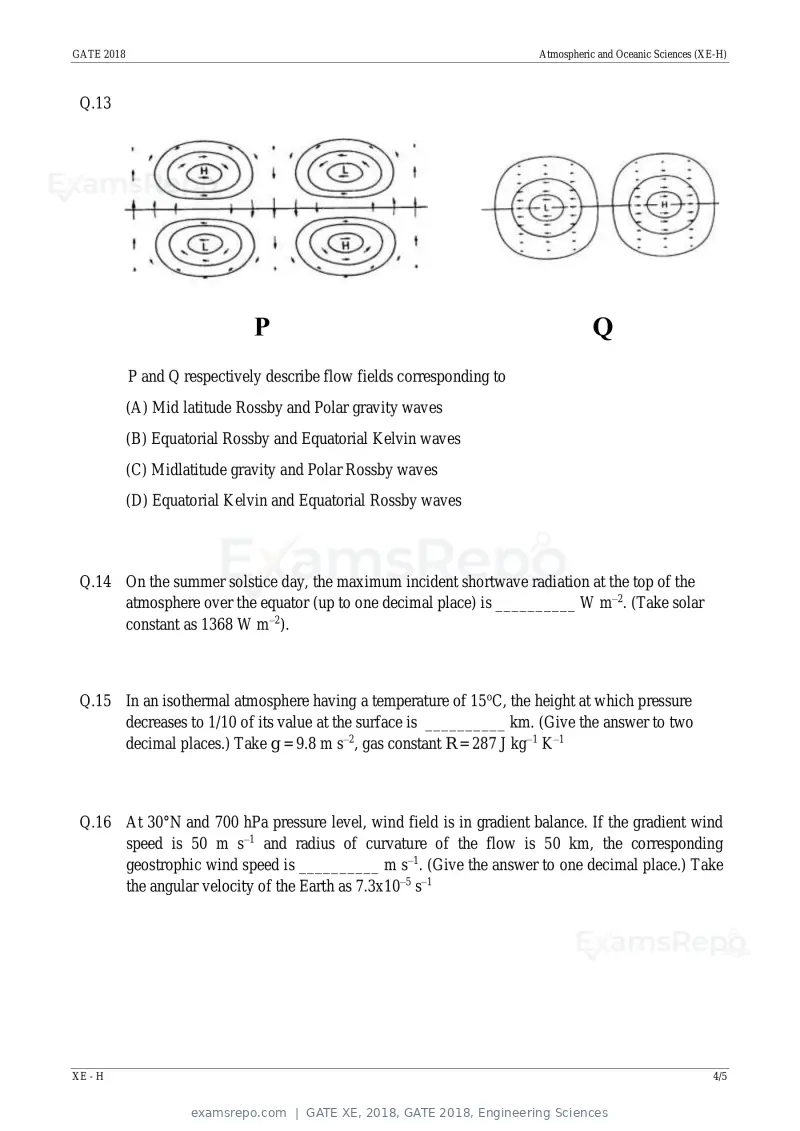
 Q.10 For an inviscid and barotropic ocean of constant depth (D), a water parcel with initial
      vorticity 2Ω is displaced from the equator to the north pole. Latitudinal variation of the
      parcel vorticity (ζ ) is well represented by the curve


         (A) S                 (B) Q                  (C) P                  (D) R


 Q.11 A wave progresses up an estuary of decreasing water depth. If friction is neglected, then
         (A) wave amplitude decreases and wave length increases
         (B) wave amplitude increases and wave length decreases
         (C) wave amplitude decreases and wave length decreases
         (D) wave amplitude increases and wave length increases


 Q.12 In the Ekman flow limit, directions of ocean surface current and the geostrophic wind are
         (A) the same
         (B) surface current is 45o to the left of the geostrophic wind
         (C) surface current is 45o to the right of the geostrophic wind
         (D) exactly opposite to each other


XE - H                                                                                                         3/5
Text of page 39
GATE 2018                                                                Atmospheric and Oceanic Sciences (XE-H)


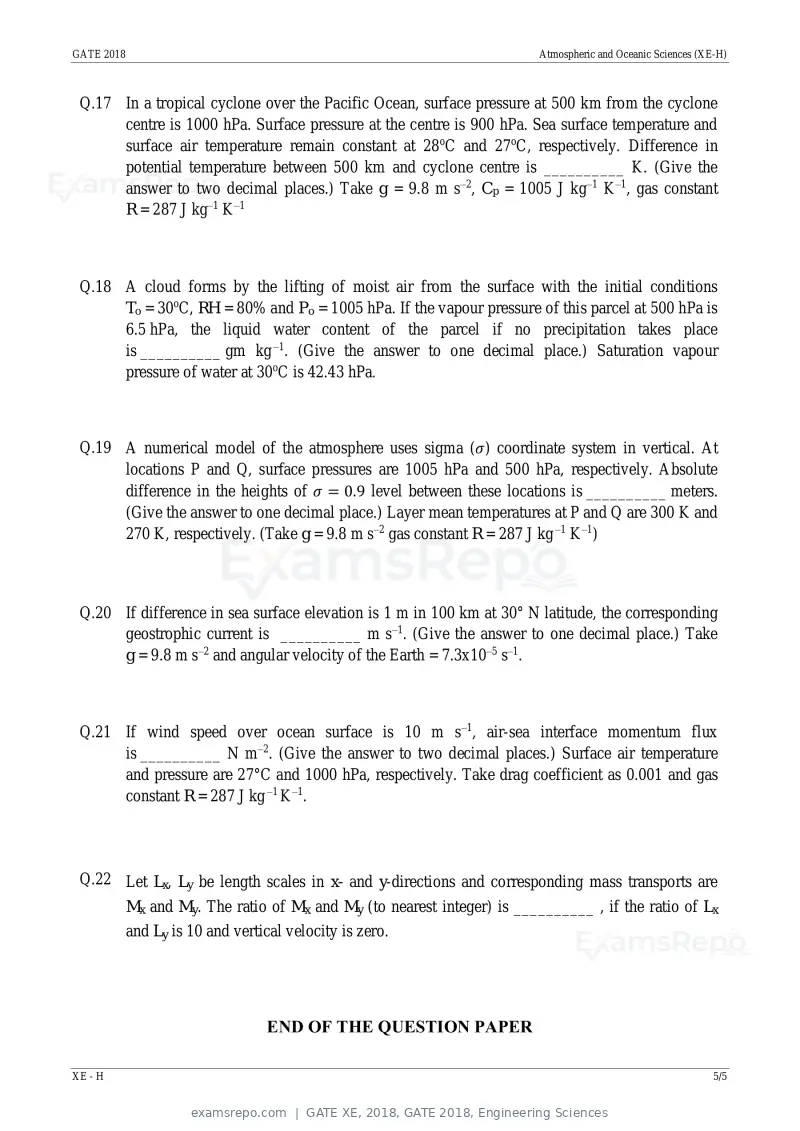
 Q.13


                               P                                                    Q
            P and Q respectively describe flow fields corresponding to
            (A) Mid latitude Rossby and Polar gravity waves
            (B) Equatorial Rossby and Equatorial Kelvin waves
            (C) Midlatitude gravity and Polar Rossby waves
            (D) Equatorial Kelvin and Equatorial Rossby waves


 Q.14 On the summer solstice day, the maximum incident shortwave radiation at the top of the
      atmosphere over the equator (up to one decimal place) is __________ W m–2. (Take solar
      constant as 1368 W m–2).


 Q.15 In an isothermal atmosphere having a temperature of 15oC, the height at which pressure
      decreases to 1/10 of its value at the surface is __________ km. (Give the answer to two
      decimal places.) Take g = 9.8 m s–2, gas constant R = 287 J kg–1 K–1


 Q.16 At 30°N and 700 hPa pressure level, wind field is in gradient balance. If the gradient wind
      speed is 50 m s–1 and radius of curvature of the flow is 50 km, the corresponding
      geostrophic wind speed is __________ m s–1. (Give the answer to one decimal place.) Take
      the angular velocity of the Earth as 7.3x10⁻⁵ s–1


XE - H                                                                                                       4/5
Text of page 40
GATE 2018                                                                 Atmospheric and Oceanic Sciences (XE-H)


 Q.17 In a tropical cyclone over the Pacific Ocean, surface pressure at 500 km from the cyclone
      centre is 1000 hPa. Surface pressure at the centre is 900 hPa. Sea surface temperature and
      surface air temperature remain constant at 28oC and 27oC, respectively. Difference in
      potential temperature between 500 km and cyclone centre is __________ K. (Give the
      answer to two decimal places.) Take g = 9.8 m s–2, Cp = 1005 J kg–1 K–1, gas constant
      R = 287 J kg–1 K–1


 Q.18 A cloud forms by the lifting of moist air from the surface with the initial conditions
      To = 30oC, RH = 80% and Po = 1005 hPa. If the vapour pressure of this parcel at 500 hPa is
      6.5 hPa, the liquid water content of the parcel if no precipitation takes place
      is __________ gm kg –1. (Give the answer to one decimal place.) Saturation vapour
      pressure of water at 30oC is 42.43 hPa.


 Q.19 A numerical model of the atmosphere uses sigma (σ) coordinate system in vertical. At
      locations P and Q, surface pressures are 1005 hPa and 500 hPa, respectively. Absolute
      difference in the heights of σ = 0.9 level between these locations is __________ meters.
      (Give the answer to one decimal place.) Layer mean temperatures at P and Q are 300 K and
      270 K, respectively. (Take g = 9.8 m s–2 gas constant R = 287 J kg –1 K–1)


 Q.20 If difference in sea surface elevation is 1 m in 100 km at 30° N latitude, the corresponding
      geostrophic current is __________ m s–1. (Give the answer to one decimal place.) Take
      g = 9.8 m s–2 and angular velocity of the Earth = 7.3x10⁻⁵ s–1.


 Q.21 If wind speed over ocean surface is 10 m s–1, air-sea interface momentum flux
      is __________ N m–2. (Give the answer to two decimal places.) Surface air temperature
      and pressure are 27°C and 1000 hPa, respectively. Take drag coefficient as 0.001 and gas
      constant R = 287 J kg –1 K–1.


 Q.22 Let Lx, Ly be length scales in x- and y-directions and corresponding mass transports are
            Mx and My. The ratio of Mx and My (to nearest integer) is __________ , if the ratio of Lx
            and Ly is 10 and vertical velocity is zero.


                                   END OF THE QUESTION PAPER

XE - H                                                                                                        5/5
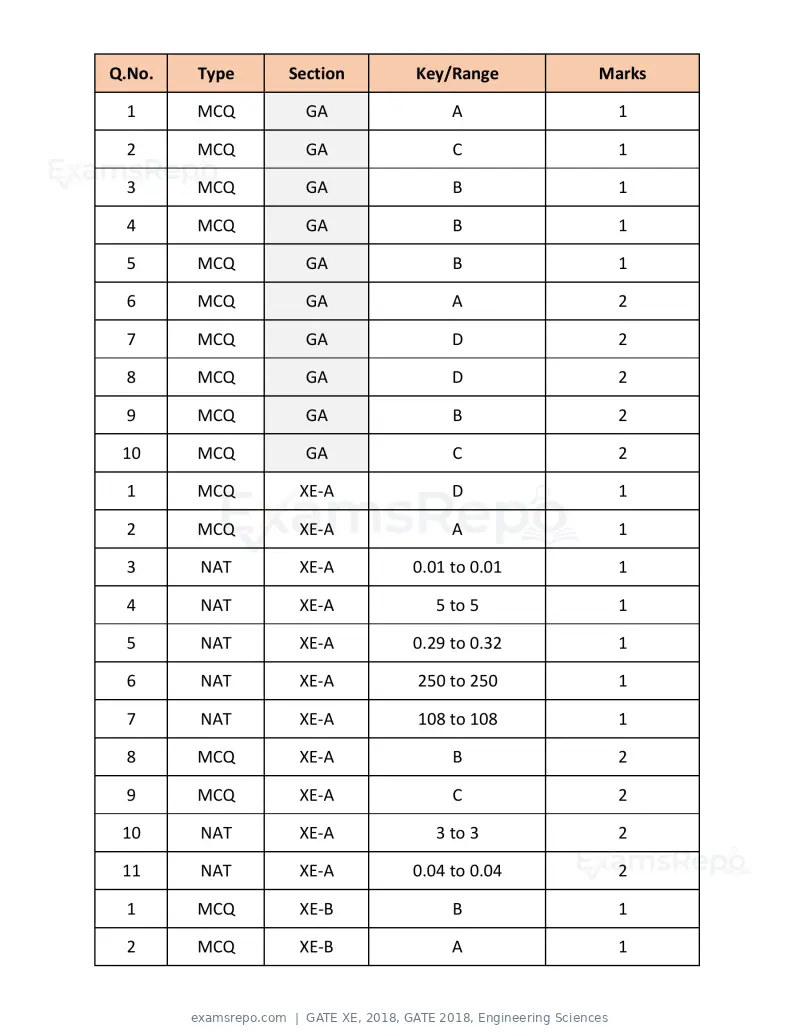
Text of page 41
Q.No.   Type   Section   Key/Range      Marks

 1      MCQ      GA           A           1

 2      MCQ      GA           C           1

 3      MCQ      GA           B           1

 4      MCQ      GA           B           1

 5      MCQ      GA           B           1

 6      MCQ      GA           A           2

 7      MCQ      GA           D           2

 8      MCQ      GA           D           2

 9      MCQ      GA           B           2

 10     MCQ      GA           C           2

 1      MCQ     XE‐A          D           1

 2      MCQ     XE‐A          A           1

 3      NAT     XE‐A     0.01 to 0.01     1

 4      NAT     XE‐A        5 to 5        1

 5      NAT     XE‐A     0.29 to 0.32     1

 6      NAT     XE‐A     250 to 250       1

 7      NAT     XE‐A     108 to 108       1

 8      MCQ     XE‐A          B           2

 9      MCQ     XE‐A          C           2

 10     NAT     XE‐A        3 to 3        2

 11     NAT     XE‐A     0.04 to 0.04     2

 1      MCQ     XE‐B          B           1

 2      MCQ     XE‐B          A           1
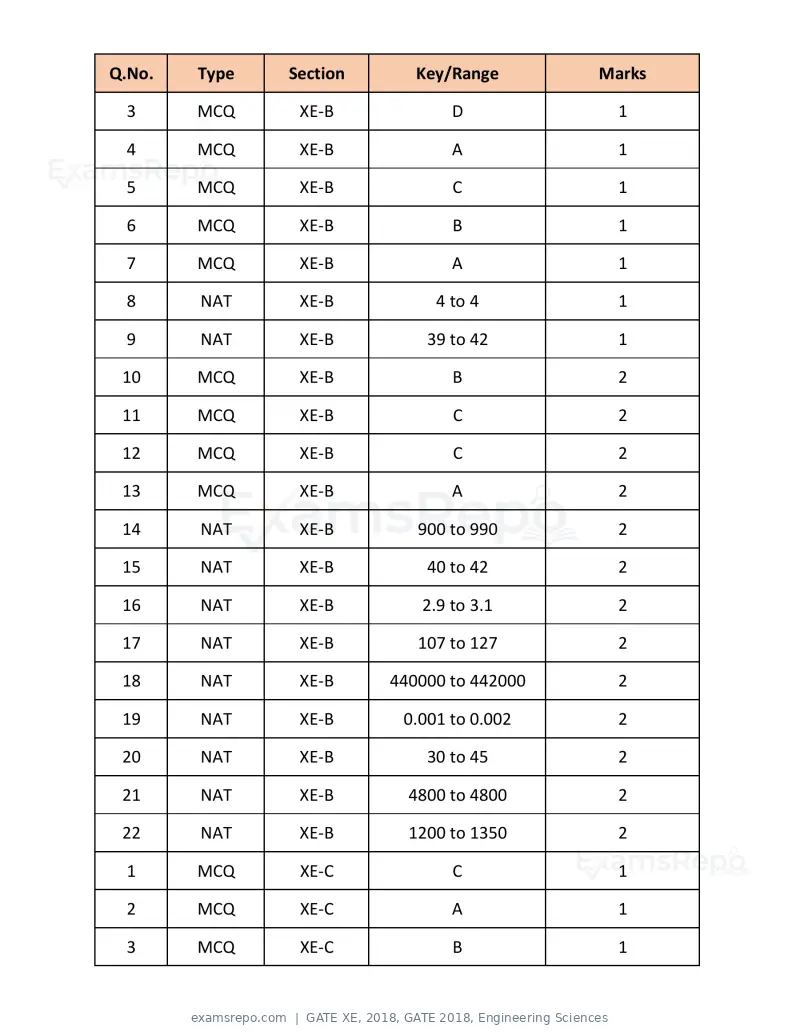
Text of page 42
Q.No.   Type   Section      Key/Range       Marks

 3      MCQ     XE‐B            D             1

 4      MCQ     XE‐B            A             1

 5      MCQ     XE‐B            C             1

 6      MCQ     XE‐B            B             1

 7      MCQ     XE‐B            A             1

 8      NAT     XE‐B          4 to 4          1

 9      NAT     XE‐B         39 to 42         1

 10     MCQ     XE‐B            B             2

 11     MCQ     XE‐B            C             2

 12     MCQ     XE‐B            C             2

 13     MCQ     XE‐B            A             2

 14     NAT     XE‐B        900 to 990        2

 15     NAT     XE‐B         40 to 42         2

 16     NAT     XE‐B        2.9 to 3.1        2

 17     NAT     XE‐B        107 to 127        2

 18     NAT     XE‐B     440000 to 442000     2

 19     NAT     XE‐B      0.001 to 0.002      2

 20     NAT     XE‐B         30 to 45         2

 21     NAT     XE‐B       4800 to 4800       2

 22     NAT     XE‐B       1200 to 1350       2

 1      MCQ     XE‐C            C             1

 2      MCQ     XE‐C            A             1

 3      MCQ     XE‐C            B             1
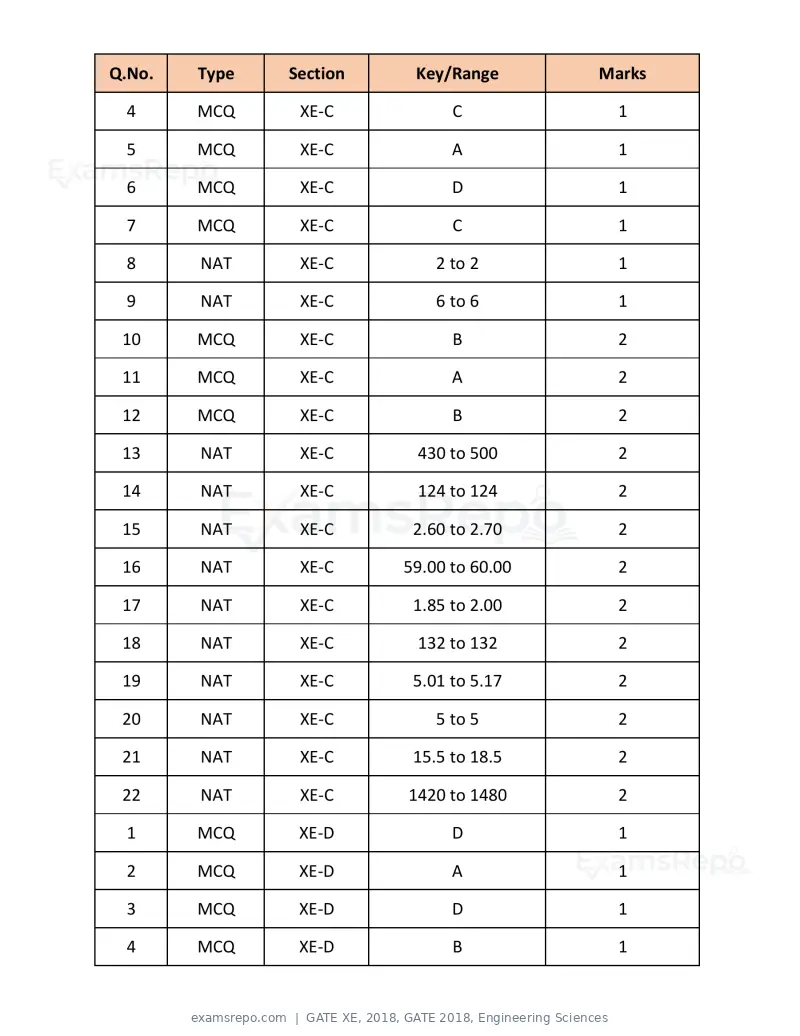
Text of page 43
Q.No.   Type   Section    Key/Range       Marks

 4      MCQ     XE‐C           C            1

 5      MCQ     XE‐C           A            1

 6      MCQ     XE‐C           D            1

 7      MCQ     XE‐C           C            1

 8      NAT     XE‐C         2 to 2         1

 9      NAT     XE‐C         6 to 6         1

 10     MCQ     XE‐C           B            2

 11     MCQ     XE‐C           A            2

 12     MCQ     XE‐C           B            2

 13     NAT     XE‐C      430 to 500        2

 14     NAT     XE‐C      124 to 124        2

 15     NAT     XE‐C      2.60 to 2.70      2

 16     NAT     XE‐C     59.00 to 60.00     2

 17     NAT     XE‐C      1.85 to 2.00      2

 18     NAT     XE‐C      132 to 132        2

 19     NAT     XE‐C      5.01 to 5.17      2

 20     NAT     XE‐C         5 to 5         2

 21     NAT     XE‐C      15.5 to 18.5      2

 22     NAT     XE‐C     1420 to 1480       2

 1      MCQ     XE‐D           D            1

 2      MCQ     XE‐D           A            1

 3      MCQ     XE‐D           D            1

 4      MCQ     XE‐D           B            1
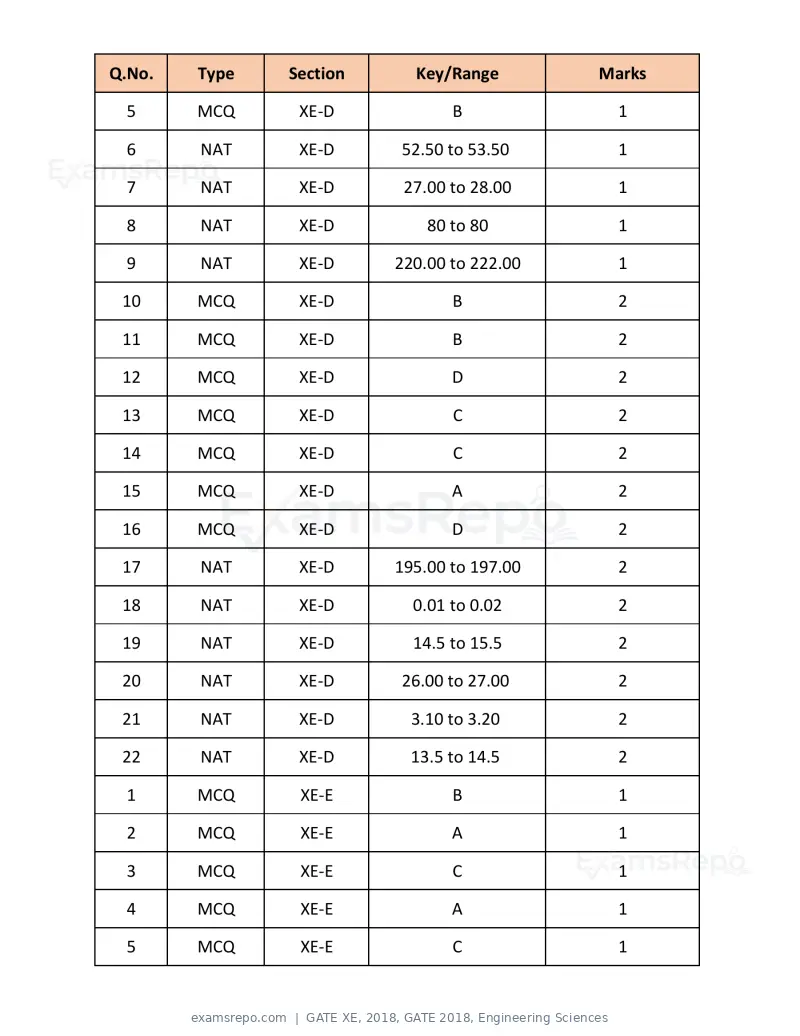
Text of page 44
Q.No.   Type   Section     Key/Range        Marks

 5      MCQ     XE‐D            B             1

 6      NAT     XE‐D     52.50 to 53.50       1

 7      NAT     XE‐D      27.00 to 28.00      1

 8      NAT     XE‐D         80 to 80         1

 9      NAT     XE‐D     220.00 to 222.00     1

 10     MCQ     XE‐D            B             2

 11     MCQ     XE‐D            B             2

 12     MCQ     XE‐D            D             2

 13     MCQ     XE‐D            C             2

 14     MCQ     XE‐D            C             2

 15     MCQ     XE‐D            A             2

 16     MCQ     XE‐D            D             2

 17     NAT     XE‐D     195.00 to 197.00     2

 18     NAT     XE‐D       0.01 to 0.02       2

 19     NAT     XE‐D       14.5 to 15.5       2

 20     NAT     XE‐D     26.00 to 27.00       2

 21     NAT     XE‐D       3.10 to 3.20       2

 22     NAT     XE‐D       13.5 to 14.5       2

 1      MCQ     XE‐E            B             1

 2      MCQ     XE‐E            A             1

 3      MCQ     XE‐E            C             1

 4      MCQ     XE‐E            A             1

 5      MCQ     XE‐E            C             1
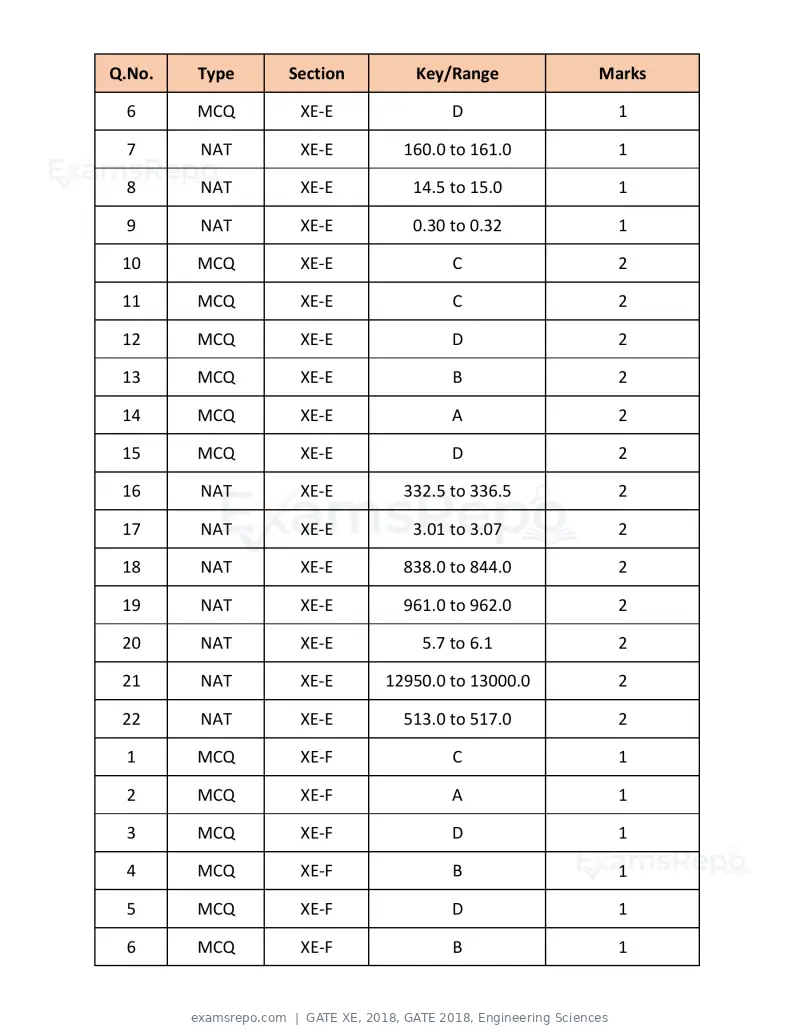
Text of page 45
Q.No.   Type   Section      Key/Range         Marks

 6      MCQ     XE‐E             D              1

 7      NAT     XE‐E       160.0 to 161.0       1

 8      NAT     XE‐E        14.5 to 15.0        1

 9      NAT     XE‐E        0.30 to 0.32        1

 10     MCQ     XE‐E             C              2

 11     MCQ     XE‐E             C              2

 12     MCQ     XE‐E             D              2

 13     MCQ     XE‐E             B              2

 14     MCQ     XE‐E             A              2

 15     MCQ     XE‐E             D              2

 16     NAT     XE‐E       332.5 to 336.5       2

 17     NAT     XE‐E        3.01 to 3.07        2

 18     NAT     XE‐E       838.0 to 844.0       2

 19     NAT     XE‐E       961.0 to 962.0       2

 20     NAT     XE‐E         5.7 to 6.1         2

 21     NAT     XE‐E     12950.0 to 13000.0     2

 22     NAT     XE‐E       513.0 to 517.0       2

 1      MCQ     XE‐F             C              1

 2      MCQ     XE‐F             A              1

 3      MCQ     XE‐F             D              1

 4      MCQ     XE‐F             B              1

 5      MCQ     XE‐F             D              1

 6      MCQ     XE‐F             B              1
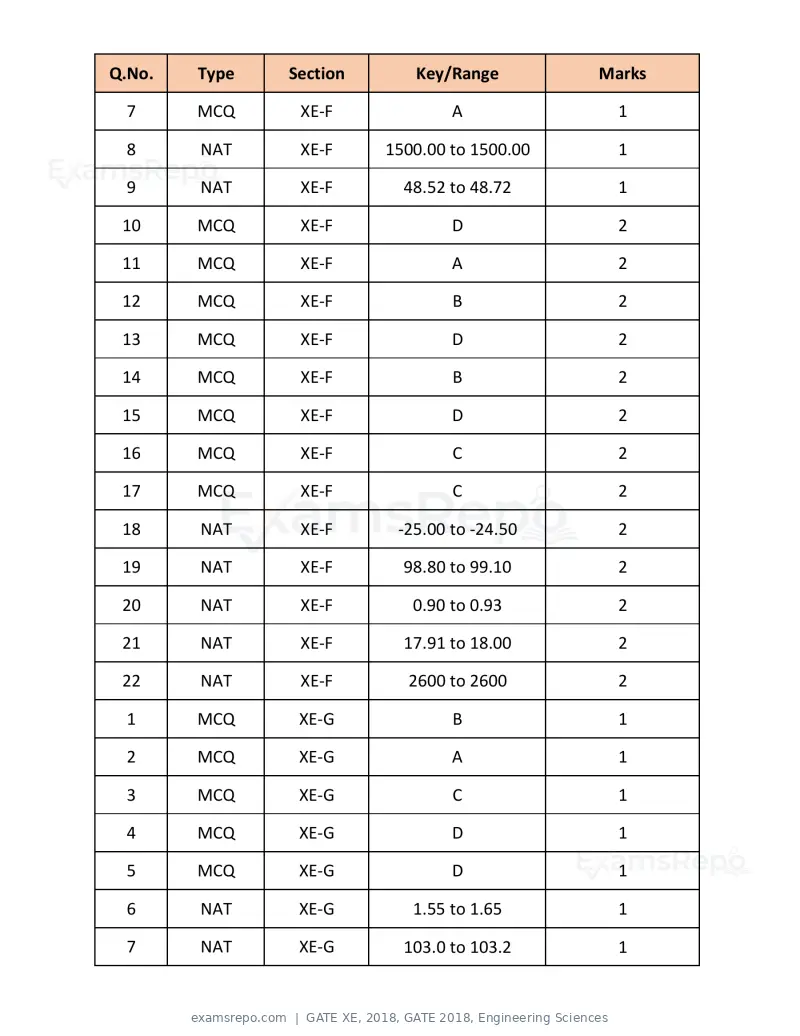
Text of page 46
Q.No.   Type   Section      Key/Range         Marks

 7      MCQ     XE‐F             A              1

 8      NAT     XE‐F     1500.00 to 1500.00     1

 9      NAT     XE‐F       48.52 to 48.72       1

 10     MCQ     XE‐F             D              2

 11     MCQ     XE‐F             A              2

 12     MCQ     XE‐F             B              2

 13     MCQ     XE‐F             D              2

 14     MCQ     XE‐F             B              2

 15     MCQ     XE‐F             D              2

 16     MCQ     XE‐F             C              2

 17     MCQ     XE‐F             C              2

 18     NAT     XE‐F      ‐25.00 to ‐24.50      2

 19     NAT     XE‐F       98.80 to 99.10       2

 20     NAT     XE‐F        0.90 to 0.93        2

 21     NAT     XE‐F       17.91 to 18.00       2

 22     NAT     XE‐F       2600 to 2600         2

 1      MCQ     XE‐G             B              1

 2      MCQ     XE‐G             A              1

 3      MCQ     XE‐G             C              1

 4      MCQ     XE‐G             D              1

 5      MCQ     XE‐G             D              1

 6      NAT     XE‐G        1.55 to 1.65        1

 7      NAT     XE‐G       103.0 to 103.2       1
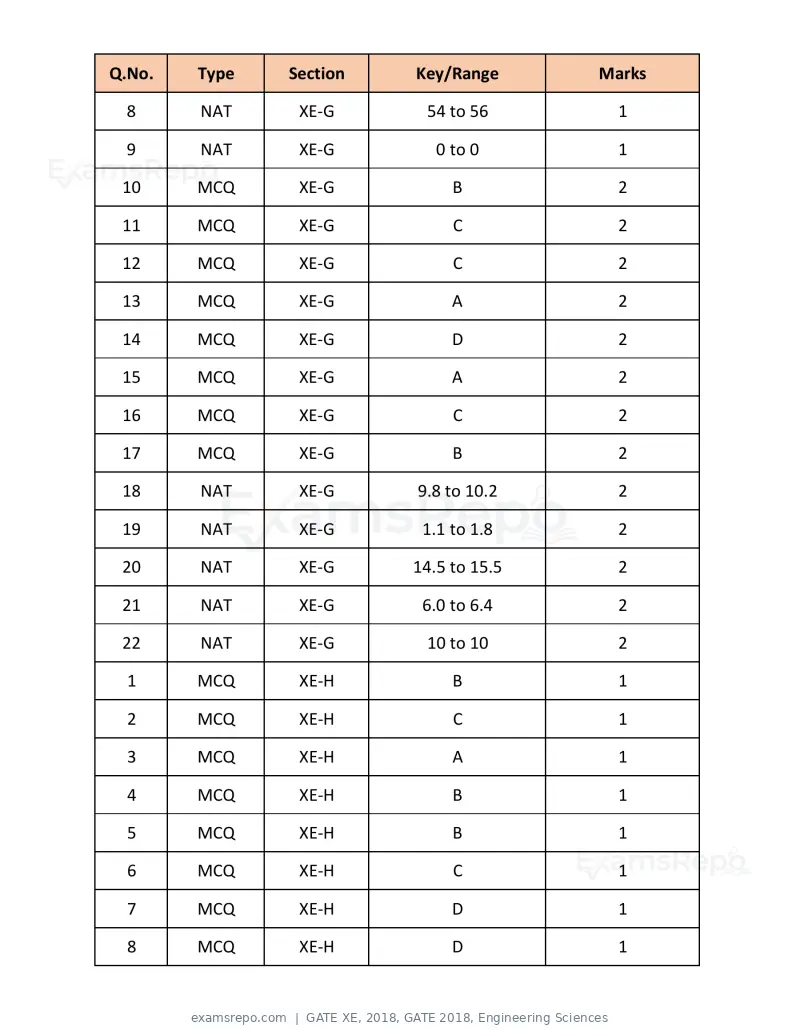
Text of page 47
Q.No.   Type   Section   Key/Range      Marks

 8      NAT     XE‐G      54 to 56        1

 9      NAT     XE‐G        0 to 0        1

 10     MCQ     XE‐G          B           2

 11     MCQ     XE‐G          C           2

 12     MCQ     XE‐G          C           2

 13     MCQ     XE‐G          A           2

 14     MCQ     XE‐G          D           2

 15     MCQ     XE‐G          A           2

 16     MCQ     XE‐G          C           2

 17     MCQ     XE‐G          B           2

 18     NAT     XE‐G     9.8 to 10.2      2

 19     NAT     XE‐G      1.1 to 1.8      2

 20     NAT     XE‐G     14.5 to 15.5     2

 21     NAT     XE‐G      6.0 to 6.4      2

 22     NAT     XE‐G      10 to 10        2

 1      MCQ     XE‐H          B           1

 2      MCQ     XE‐H          C           1

 3      MCQ     XE‐H          A           1

 4      MCQ     XE‐H          B           1

 5      MCQ     XE‐H          B           1

 6      MCQ     XE‐H          C           1

 7      MCQ     XE‐H          D           1

 8      MCQ     XE‐H          D           1
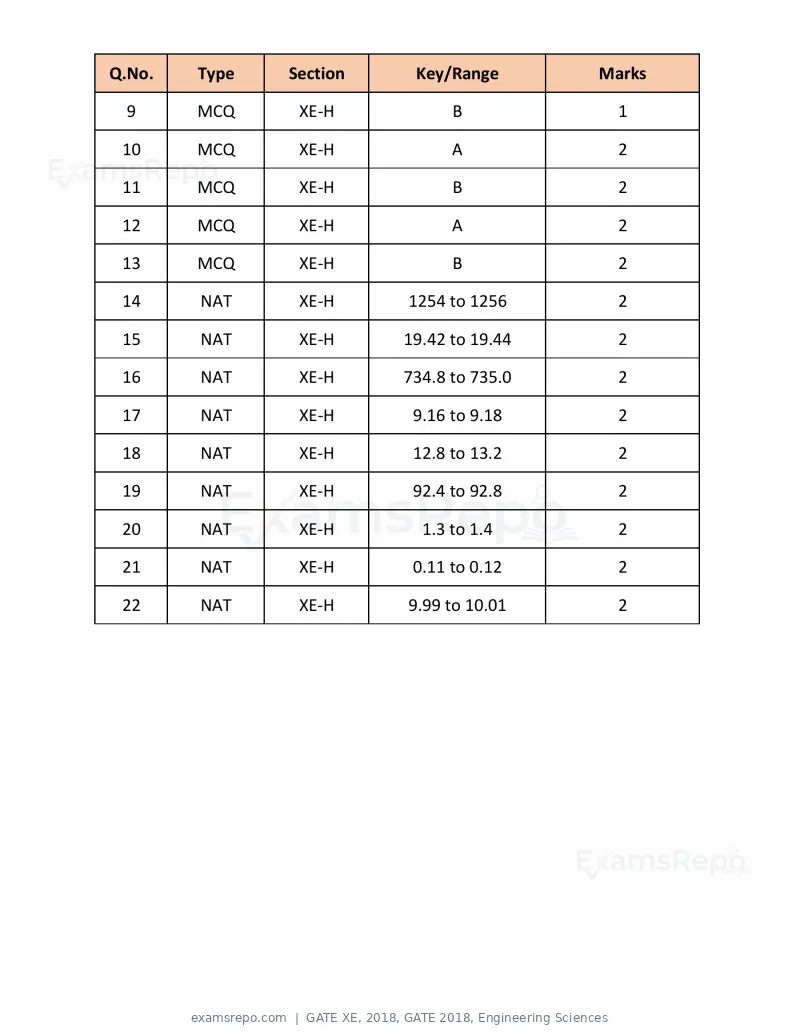
Text of page 48
Q.No.   Type   Section    Key/Range       Marks

 9      MCQ     XE‐H           B            1

 10     MCQ     XE‐H           A            2

 11     MCQ     XE‐H           B            2

 12     MCQ     XE‐H           A            2

 13     MCQ     XE‐H           B            2

 14     NAT     XE‐H     1254 to 1256       2

 15     NAT     XE‐H     19.42 to 19.44     2

 16     NAT     XE‐H     734.8 to 735.0     2

 17     NAT     XE‐H      9.16 to 9.18      2

 18     NAT     XE‐H      12.8 to 13.2      2

 19     NAT     XE‐H      92.4 to 92.8      2

 20     NAT     XE‐H       1.3 to 1.4       2

 21     NAT     XE‐H      0.11 to 0.12      2

 22     NAT     XE‐H     9.99 to 10.01      2
Official key not published for this paper.
Page 1 of 48
Source: GATE. Question paper published by GATE.