
GATE XE 2026: Engineering Sciences
Text of page 1
Engineering Sciences (XE)


General Aptitude (GA)
Q.1 – Q.5 Carry ONE mark Each

 Q.1         Suresh said, “I did it yesterday.”

             Which one of the following options is the correct form of this sentence in indirect
             speech?


 (A)         Suresh said that I did it yesterday.


 (B)         Suresh says I did it yesterday.


 (C)         Suresh says that he did it the day before.


 (D)         Suresh said that he had done it the day before.


Organizing Institute: IIT Guwahati             Page 1 of 124
Text of page 2
Engineering Sciences (XE)


 Q.2         To continue the sequence of tiles shown, the tile indicated by the question mark
             should be


 (A)


 (B)


 (C)


 (D)


Organizing Institute: IIT Guwahati          Page 2 of 124
Text of page 3
Engineering Sciences (XE)


 Q.3         Consider an art gallery whose walkways are shown as lines in the diagram. A
             black dot represents a junction of two walkways. A guard may be placed at a
             junction to watch over the walkways that join at that junction. The minimum
             number of guards needed to watch all the walkways is ________.


 (A)         2


 (B)         3


 (C)         4


 (D)         5


Organizing Institute: IIT Guwahati         Page 3 of 124

Text of page 4
Engineering Sciences (XE)


 Q.4         The 2nd of June is a Thursday in a certain year. Which day of the week is the
             3rd of July in that year?


 (A)         Thursday


 (B)         Friday


 (C)         Saturday


 (D)         Sunday


Organizing Institute: IIT Guwahati           Page 4 of 124
Text of page 5
Engineering Sciences (XE)


 Q.5         A coin with heads facing up is shown as       and a coin with tails facing up is
             shown as         .

             Six coins are placed in the Starting Arrangement, as shown in the figure below.
             A “step” is defined as interchanging a pair of adjacent coins without flipping
             them. The minimum number of steps needed to go from the Starting Arrangement
             to the Final Arrangement, as shown in the figure, is ________.


 (A)         3


 (B)         6


 (C)         9


 (D)         12


Organizing Institute: IIT Guwahati         Page 5 of 124
Text of page 6
Engineering Sciences (XE)


Q.6 – Q.10 Carry TWO marks Each

 Q.6         Exacerbate : Mitigate :: ___________

             Choose the option with the correct pair of words to fill the blank.


 (A)         Aggravate : Alleviate


 (B)         Alleviate : Precipitate


 (C)         Aggravate : Precipitate


 (D)         Emancipate : Exonerate


Organizing Institute: IIT Guwahati           Page 6 of 124
Text of page 7
Engineering Sciences (XE)


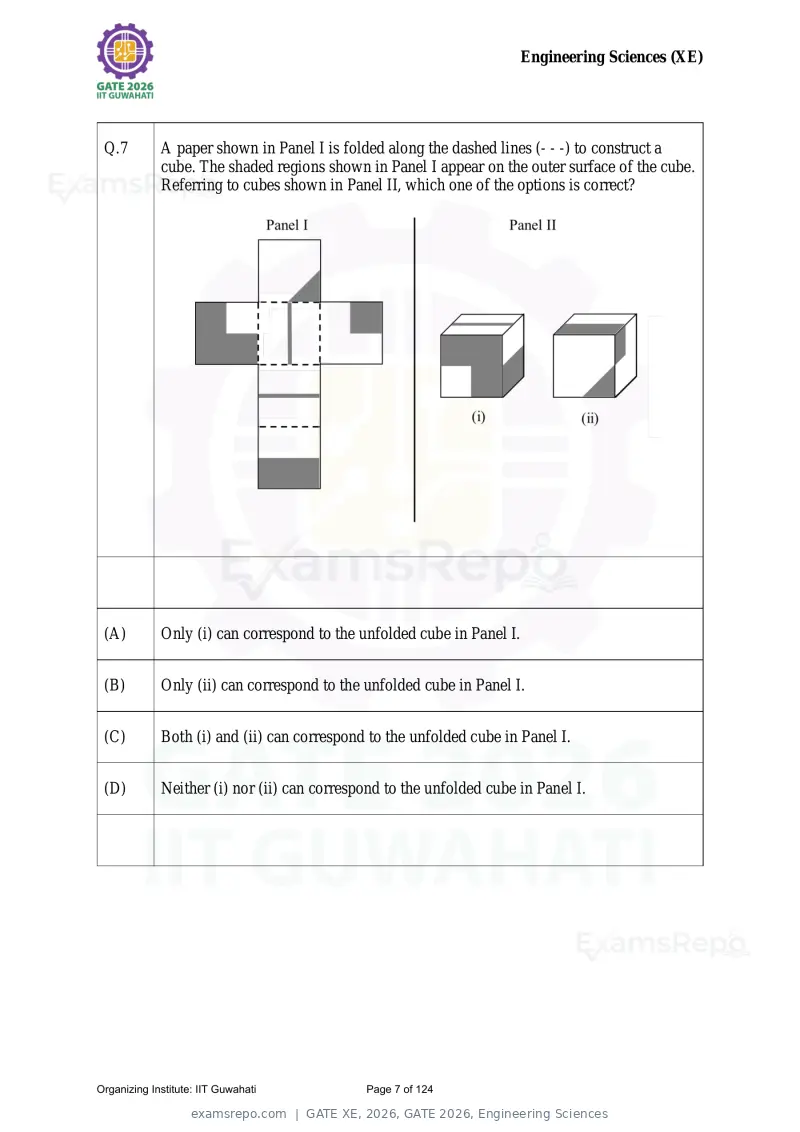
 Q.7         A paper shown in Panel I is folded along the dashed lines (- - -) to construct a
             cube. The shaded regions shown in Panel I appear on the outer surface of the cube.
             Referring to cubes shown in Panel II, which one of the options is correct?


 (A)         Only (i) can correspond to the unfolded cube in Panel I.


 (B)         Only (ii) can correspond to the unfolded cube in Panel I.


 (C)         Both (i) and (ii) can correspond to the unfolded cube in Panel I.


 (D)         Neither (i) nor (ii) can correspond to the unfolded cube in Panel I.


Organizing Institute: IIT Guwahati           Page 7 of 124
Text of page 8
Engineering Sciences (XE)


 Q.8         In a population, patients who have high cholesterol also have high blood-pressure
             (BP). Some patients with high BP also have diabetes. There are no patients who
             have both high cholesterol and diabetes. Furthermore,

                  1.    the total number of patients with at least one of these conditions is 75,
                  2.    the number of patients with high cholesterol is 10,
                  3.    the number of patients with high BP is 45, and
                  4.    the number of patients with only high BP and no other conditions is 20.

             Then the number of patients who have both diabetes and high BP is _______


 (A)         0


 (B)         15


 (C)         20


 (D)         10


Organizing Institute: IIT Guwahati              Page 8 of 124
Text of page 9
Engineering Sciences (XE)


 Q.9         Four people P, Q, R, and S, of different ages, make the following observations.

             P – I am younger than S.

             Q – I am neither the youngest nor the oldest.

             R – P is older than me.

             Based on these observations, the youngest person is ______.


 (A)         P


 (B)         Q


 (C)         R


 (D)         S


Organizing Institute: IIT Guwahati           Page 9 of 124
Text of page 10
Engineering Sciences (XE)


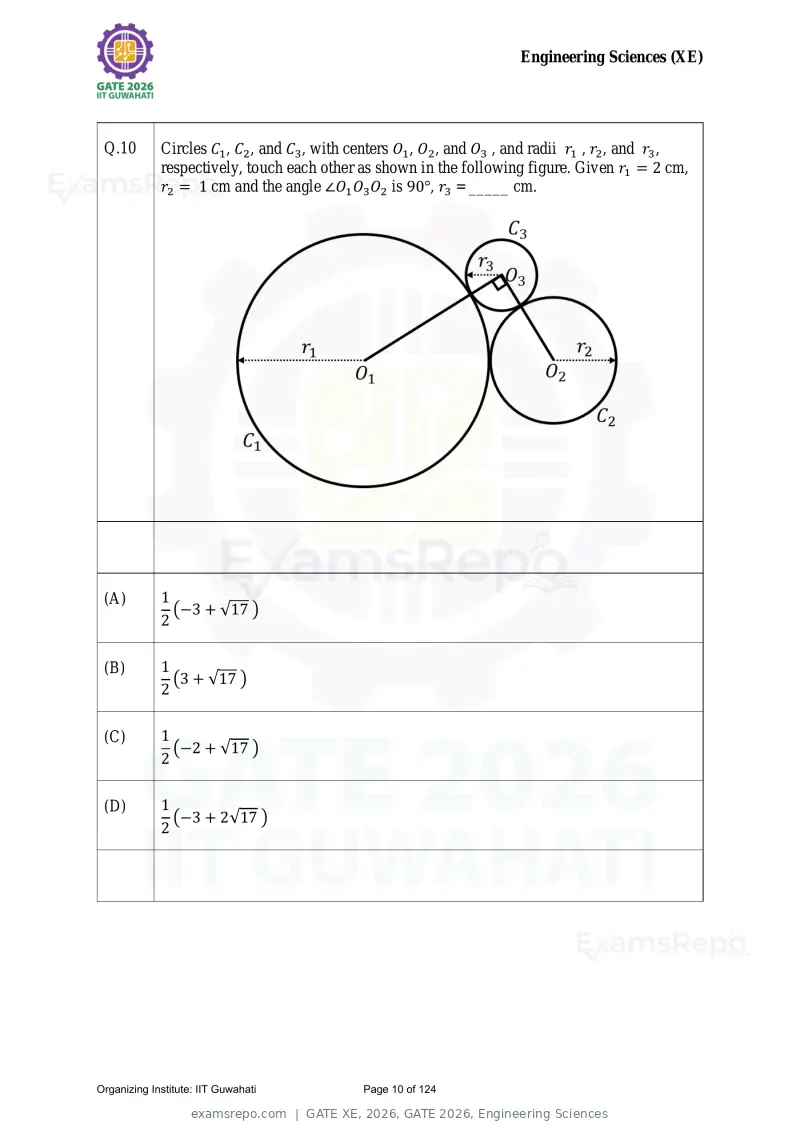
 Q.10        Circles C1 , C2 , and C3 , with centers O1, O2, and O3 , and radii r1 , r2 , and r3 ,
             respectively, touch each other as shown in the following figure. Given r1 = 2 cm,
             r2 = 1 cm and the angle ∠O1 O3 O2 is 90°, r3 = _____ cm.


 (A)         1
               (−3 + √17 )
             2

 (B)         1
               (3 + √17 )
             2

 (C)         1
               (−2 + √17 )
             2

 (D)         1
               (−3 + 2√17 )
             2


Organizing Institute: IIT Guwahati           Page 10 of 124
Text of page 11
Engineering Mathematics (XE-A)


Q.11 – Q.17 Carry ONE mark Each

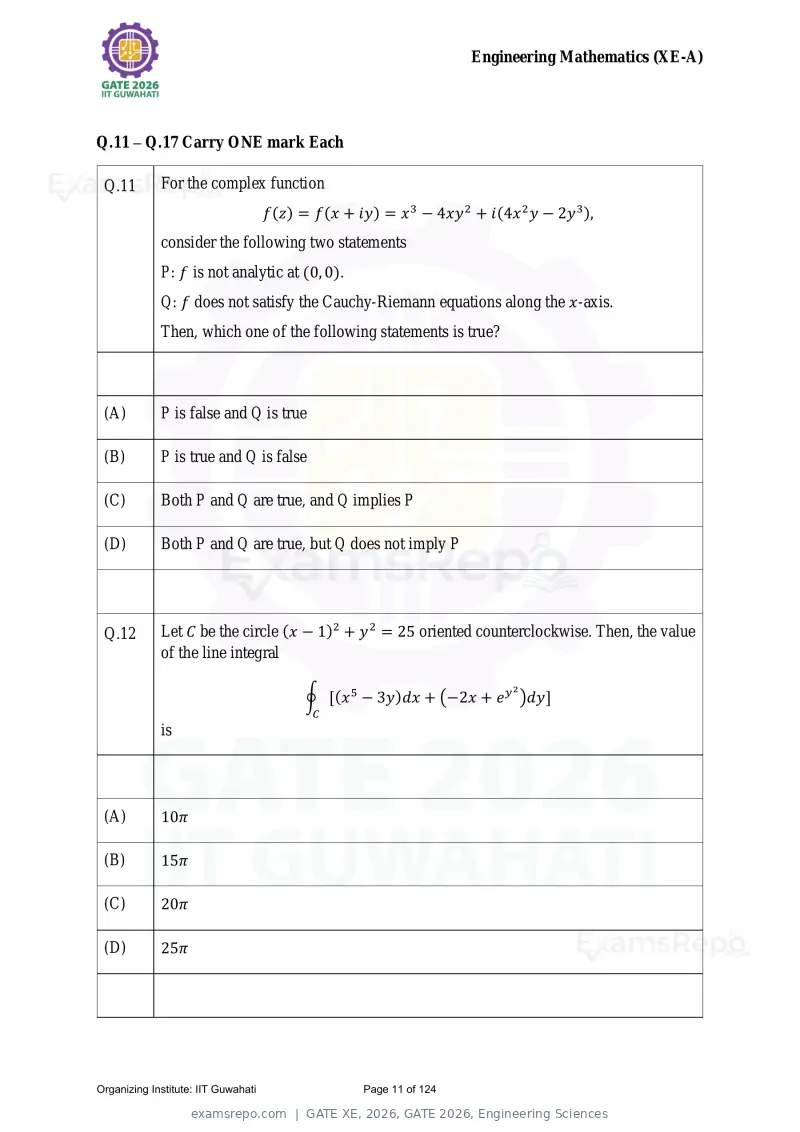
 Q.11        For the complex function
                                     f(z) = f(x + iy) = x 3 − 4xy 2 + i(4x 2 y − 2y 3 ),
             consider the following two statements
             P: f is not analytic at (0, 0).
             Q: f does not satisfy the Cauchy-Riemann equations along the x-axis.
             Then, which one of the following statements is true?


 (A)         P is false and Q is true

 (B)         P is true and Q is false

 (C)         Both P and Q are true, and Q implies P

 (D)         Both P and Q are true, but Q does not imply P


 Q.12        Let C be the circle (x − 1)2 + y 2 = 25 oriented counterclockwise. Then, the value
             of the line integral

                                                                           2
                                           ∮ [(x 5 − 3y)dx + (−2x + e y )dy]
                                            C
             is


 (A)         10π

 (B)         15π

 (C)         20π

 (D)         25π


Organizing Institute: IIT Guwahati                  Page 11 of 124
Text of page 12
Engineering Mathematics (XE-A)


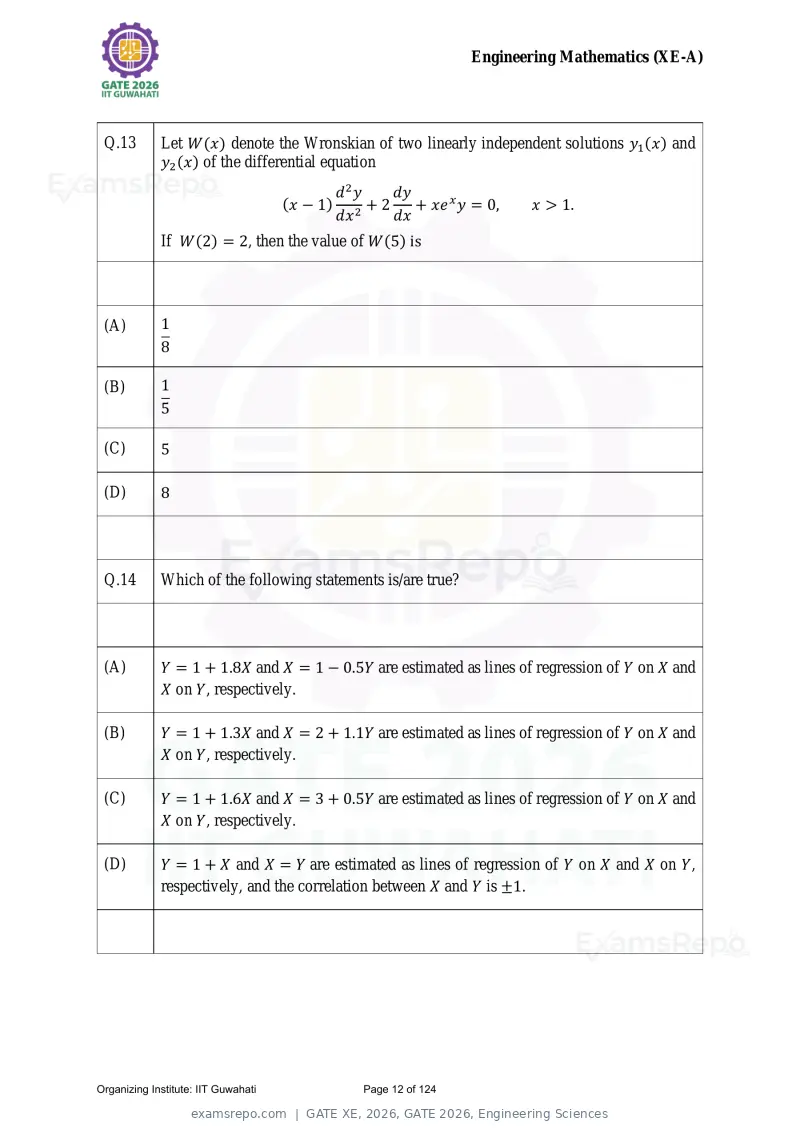
 Q.13        Let W(x) denote the Wronskian of two linearly independent solutions y1 (x) and
             y2 (x) of the differential equation
                                               d2 y     dy
                                     (x − 1)      2
                                                    + 2    + xe x y = 0,   x > 1.
                                               dx       dx
             If W(2) = 2, then the value of W(5) is


 (A)         1
             8

 (B)         1
             5

 (C)         5

 (D)         8


 Q.14        Which of the following statements is/are true?


 (A)         Y = 1 + 1.8X and X = 1 − 0.5Y are estimated as lines of regression of Y on X and
             X on Y, respectively.

 (B)         Y = 1 + 1.3X and X = 2 + 1.1Y are estimated as lines of regression of Y on X and
             X on Y, respectively.

 (C)         Y = 1 + 1.6X and X = 3 + 0.5Y are estimated as lines of regression of Y on X and
             X on Y, respectively.

 (D)         Y = 1 + X and X = Y are estimated as lines of regression of Y on X and X on Y,
             respectively, and the correlation between X and Y is ±1.


Organizing Institute: IIT Guwahati                 Page 12 of 124
Text of page 13
Engineering Mathematics (XE-A)


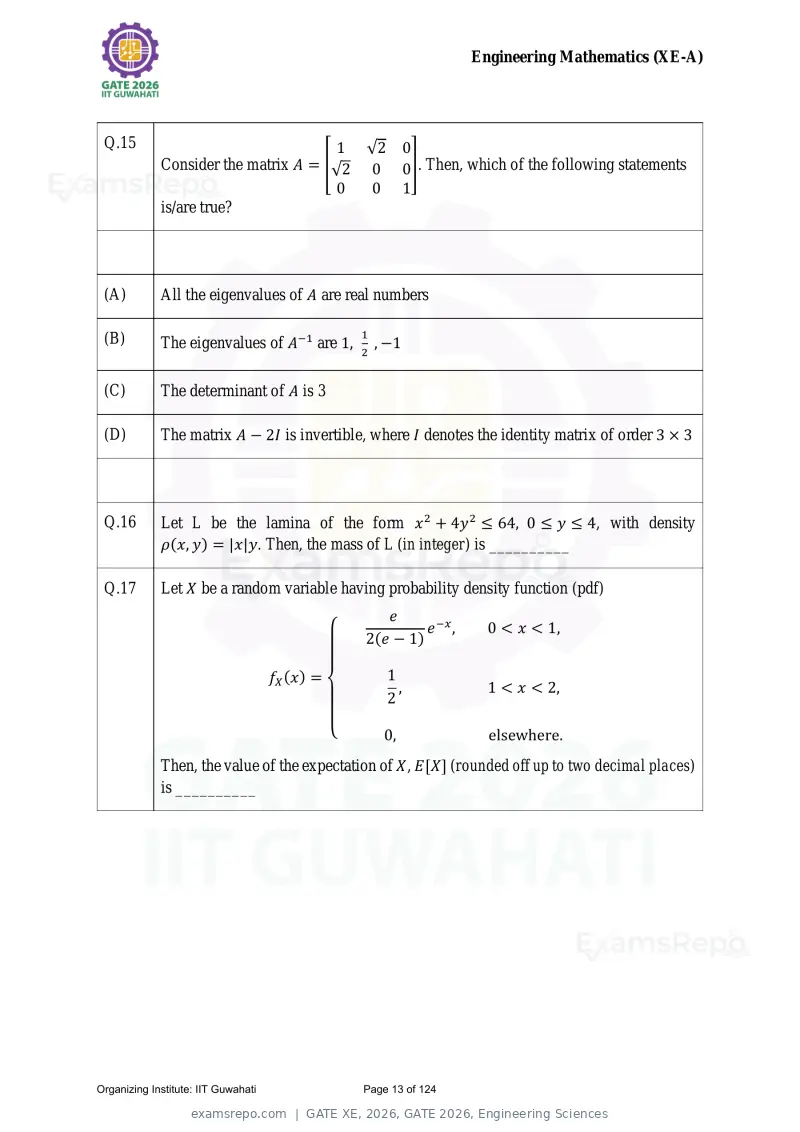
 Q.15                                  1 √2 0
             Consider the matrix A = [√2 0 0]. Then, which of the following statements
                                       0  0 1
             is/are true?


 (A)         All the eigenvalues of A are real numbers

 (B)                                                1
             The eigenvalues of A−1 are 1, 2 , −1

 (C)         The determinant of A is 3

 (D)         The matrix A − 2I is invertible, where I denotes the identity matrix of order 3 × 3


 Q.16        Let L be the lamina of the form x 2 + 4y 2 ≤ 64, 0 ≤ y ≤ 4, with density
             ρ(x, y) = |x|y. Then, the mass of L (in integer) is __________

 Q.17        Let X be a random variable having probability density function (pdf)
                                                       e
                                                             e −x ,     0 < x < 1,
                                                    2(e − 1)

                                     fX (x) =           1
                                                          ,             1 < x < 2,
                                                        2

                                                {       0,              elsewhere.
             Then, the value of the expectation of X, E[X] (rounded off up to two decimal places)
             is __________


Organizing Institute: IIT Guwahati                  Page 13 of 124
Text of page 14
Engineering Mathematics (XE-A)


Q.18 – Q.21 Carry TWO marks Each

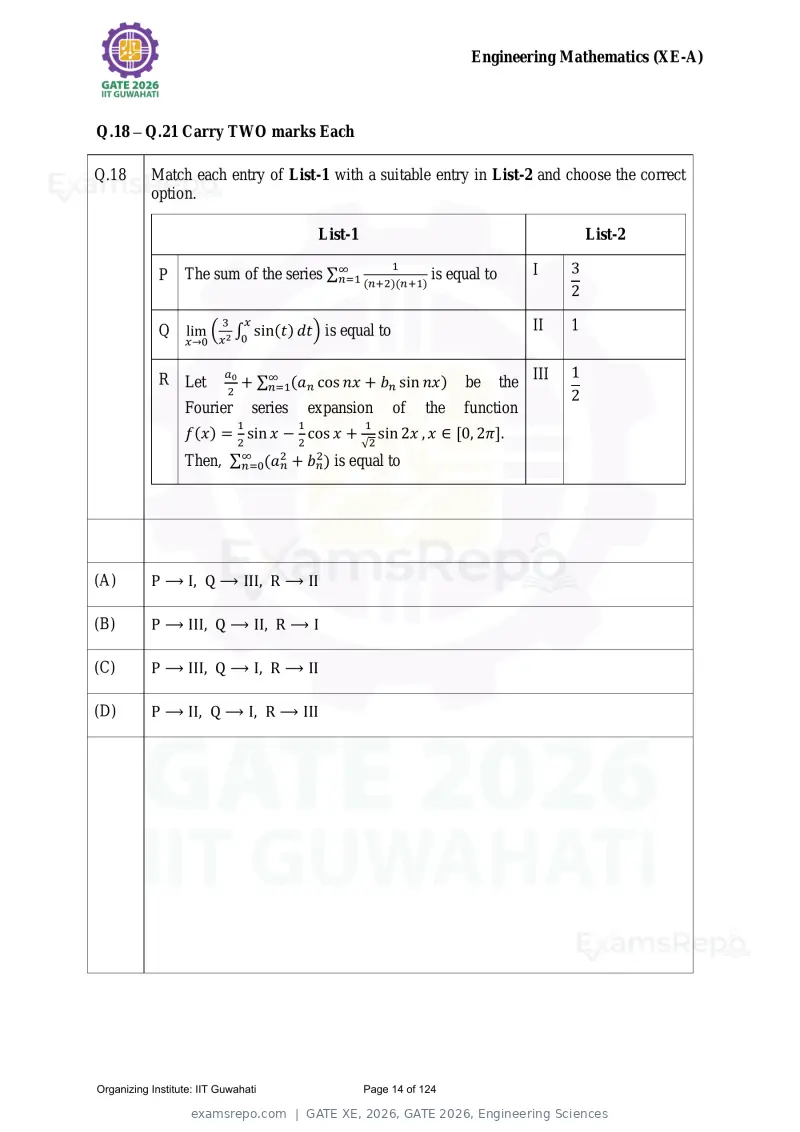
Q.18       Match each entry of List-1 with a suitable entry in List-2 and choose the correct
           option.

                                                      List-1                                         List-2

                  The sum of the series ∑∞
                                                                     1                      I    3
             P                           n=1 (n+2)(n+1) is equal to
                                                                                                 2
                          3         x                                                       II   1
             Q lim ( 2 ∫0 sin(t) dt) is equal to
                    x
                  x→0

                                                                                                 1
                                                                                       the III
                           a0
             R Let              + ∑∞
                                   n=1(an cos nx + bn sin nx)                    be
                           2                                                                     2
                  Fourier               series       expansion       of   the    function
                                1                1             1
                  f(x) = sin x − cos x +                           sin 2x , x ∈ [0, 2π].
                               2         2            √2
                  Then,       ∑∞   (a
                                n=0 n
                                      2
                                        +  bn
                                             2
                                               ) is equal to


(A)        P ⟶ I, Q ⟶ III, R ⟶ II

(B)        P ⟶ III, Q ⟶ II, R ⟶ I

(C)        P ⟶ III, Q ⟶ I, R ⟶ II

(D)        P ⟶ II, Q ⟶ I, R ⟶ III


Organizing Institute: IIT Guwahati                             Page 14 of 124
Text of page 15
Engineering Mathematics (XE-A)


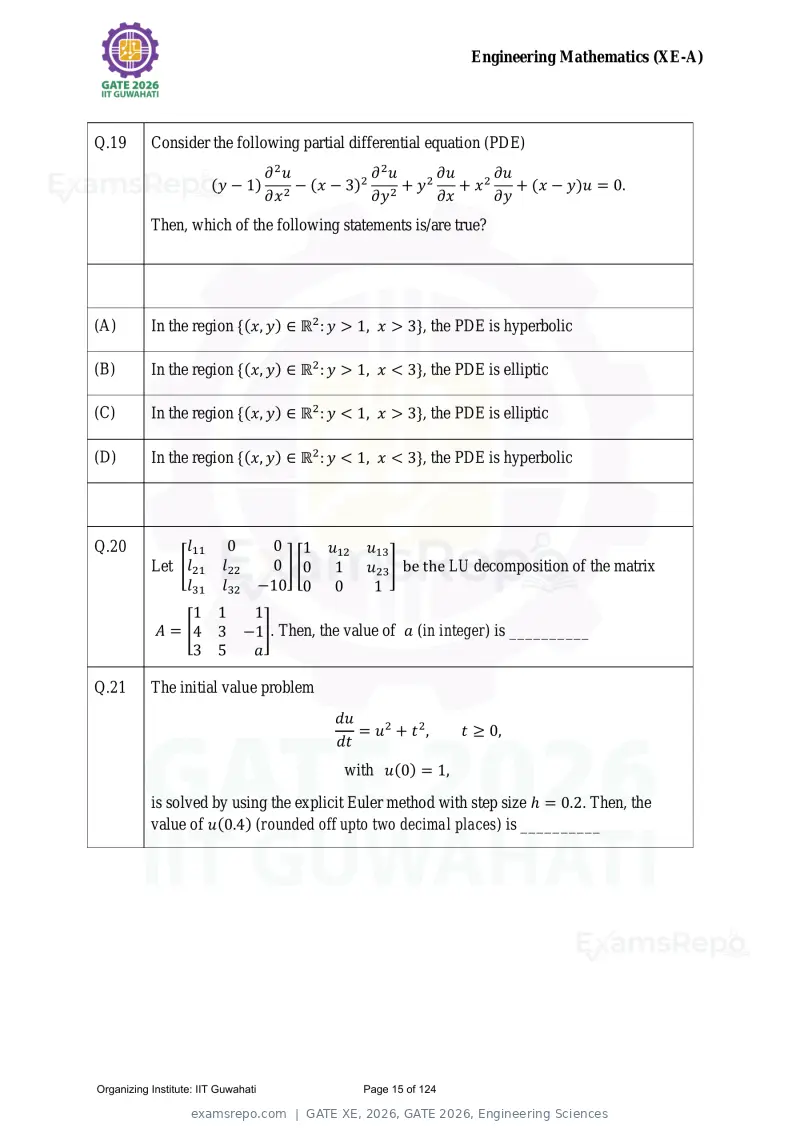
Q.19       Consider the following partial differential equation (PDE)
                                     ∂ 2u           2
                                                      ∂ 2u      ∂u      ∂u
                        (y − 1)         2
                                          − (x − 3)      2
                                                           + y2    + x2    + (x − y)u = 0.
                                     ∂x               ∂y        ∂x      ∂y
           Then, which of the following statements is/are true?


(A)        In the region {(x, y) ∈ ℝ2 : y > 1, x > 3}, the PDE is hyperbolic

(B)        In the region {(x, y) ∈ ℝ2 : y > 1, x < 3}, the PDE is elliptic

(C)        In the region {(x, y) ∈ ℝ2 : y < 1, x > 3}, the PDE is elliptic

(D)        In the region {(x, y) ∈ ℝ2 : y < 1, x < 3}, the PDE is hyperbolic


Q.20            l11        0          0 1      u12   u13
           Let [l21       l22         0 ] [0    1    u23 ] be the LU decomposition of the matrix
                l31       l32        −10 0      0     1
                 1       1  1
            A = [4       3 −1]. Then, the value of a (in integer) is __________
                 3       5  a

Q.21       The initial value problem
                                               du
                                                  = u2 + t 2 ,        t ≥ 0,
                                               dt
                                                 with u(0) = 1,

           is solved by using the explicit Euler method with step size ℎ = 0.2. Then, the
           value of u(0.4) (rounded off upto two decimal places) is __________


Organizing Institute: IIT Guwahati                   Page 15 of 124
Text of page 16
Fluid Mechanics (XE-B)


Q.22 – Q.30 Carry ONE mark Each

 Q.22 For a laminar, incompressible, and fully-developed flow through a circular pipe, the
      ratio of the maximum velocity to the average velocity of the flow is


 (A)       1.5


 (B)       2


 (C)       3


 (D)       4


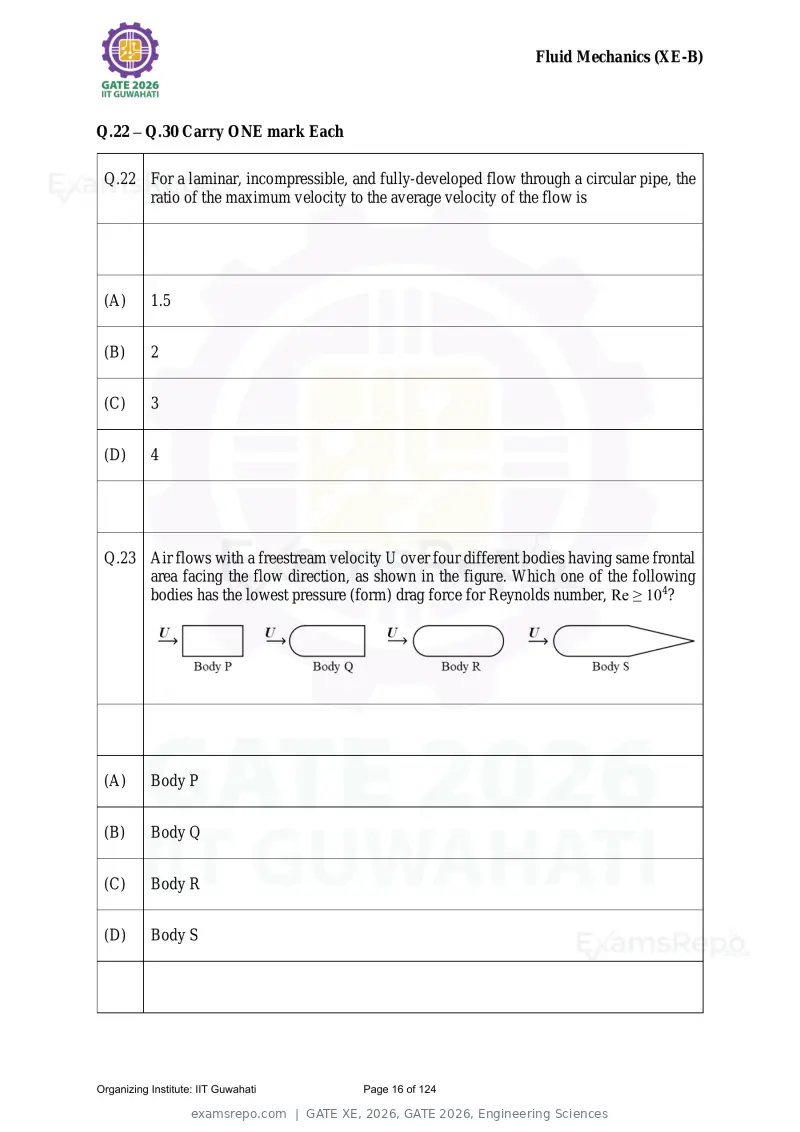
 Q.23 Air flows with a freestream velocity U over four different bodies having same frontal
      area facing the flow direction, as shown in the figure. Which one of the following
      bodies has the lowest pressure (form) drag force for Reynolds number, Re ≥ 104?


 (A)       Body P


 (B)       Body Q


 (C)       Body R


 (D)       Body S


Organizing Institute: IIT Guwahati      Page 16 of 124
Text of page 17
Fluid Mechanics (XE-B)


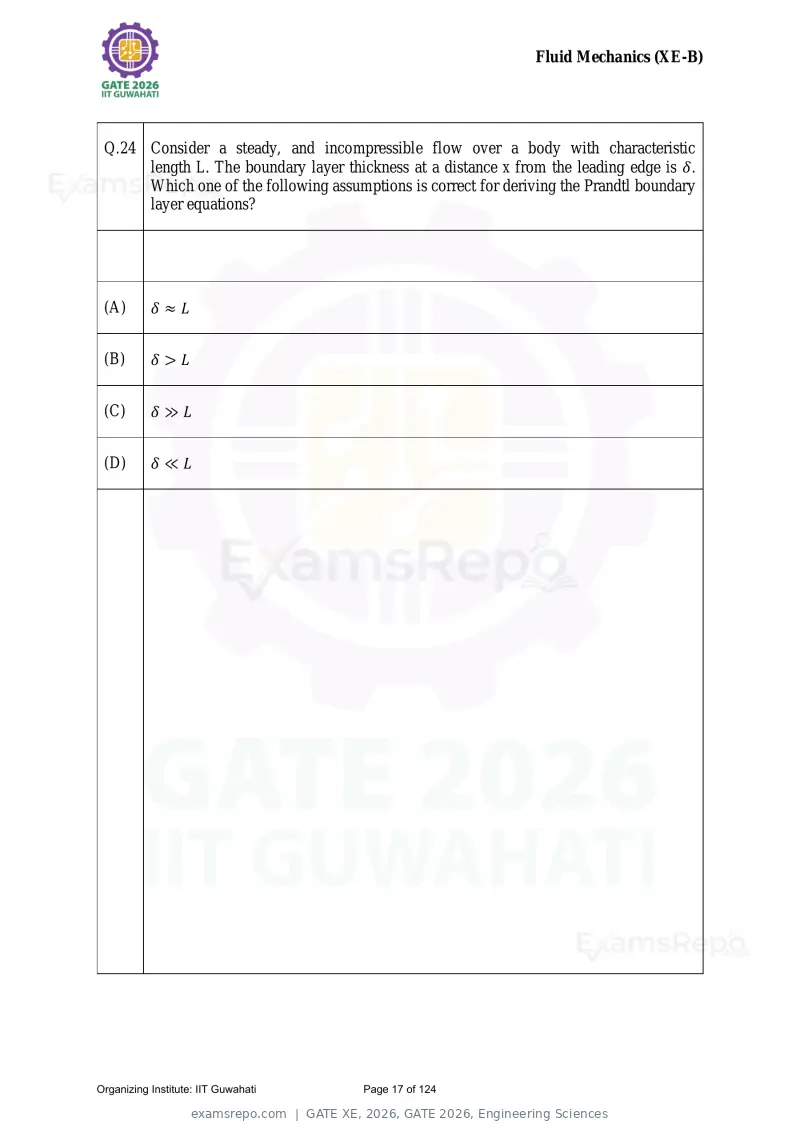
 Q.24 Consider a steady, and incompressible flow over a body with characteristic
      length L. The boundary layer thickness at a distance x from the leading edge is δ.
      Which one of the following assumptions is correct for deriving the Prandtl boundary
      layer equations?


 (A)       δ≈L


 (B)       δ>L


 (C)       δ≫L


 (D)       δ≪L


Organizing Institute: IIT Guwahati     Page 17 of 124
Text of page 18
Fluid Mechanics (XE-B)


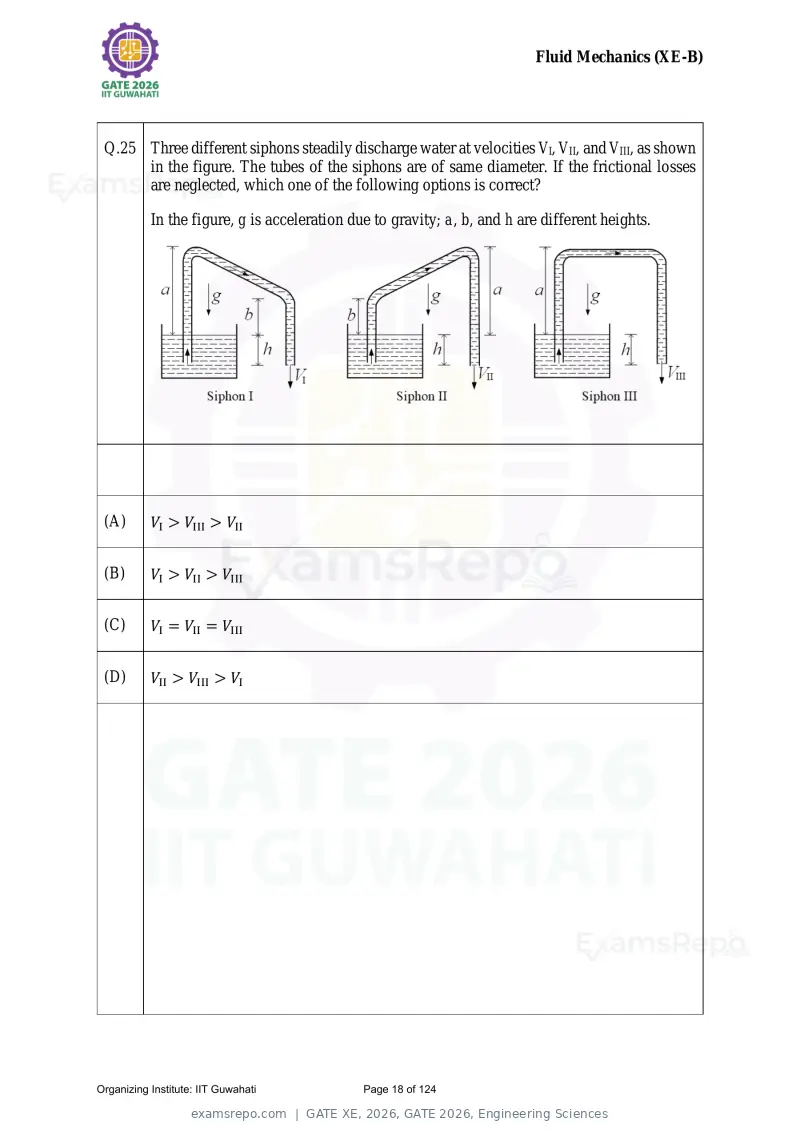
 Q.25 Three different siphons steadily discharge water at velocities VI, VII, and VIII, as shown
      in the figure. The tubes of the siphons are of same diameter. If the frictional losses
      are neglected, which one of the following options is correct?

           In the figure, g is acceleration due to gravity; a, b, and h are different heights.


 (A)       VI > VIII > VII


 (B)       VI > VII > VIII


 (C)       VI = VII = VIII


 (D)       VII > VIII > VI


Organizing Institute: IIT Guwahati            Page 18 of 124
Text of page 19
Fluid Mechanics (XE-B)


 Q.26 Consider the following statements:

           Assertion (a)

           Surface tension acts along the interface of two fluids.

           Reason (r)

           The pressure of the fluid inside a bubble is higher than that of the fluid outside the
           bubble.

           Which one of the following options is correct?


 (A)       Both (a) and (r) are true, and (r) is the correct explanation of (a).


 (B)       Both (a) and (r) are true, however (r) is not the correct explanation of (a).


 (C)       (a) is true, but (r) is false.


 (D)       (a) is false, but (r) is true.


Organizing Institute: IIT Guwahati           Page 19 of 124
Text of page 20
Fluid Mechanics (XE-B)


 Q.27 The basic dimensions, i.e., mass, length, and time are represented by M, L, and T,
      respectively. The correct dimension of dynamic viscosity is


 (A)       MLT −2


 (B)       M0 L2 T −1


 (C)       ML−1 T −1


 (D)       M0 L−2 T 2


 Q.28 The velocity components in x- and y-directions of a two-dimensional, incompressible
      flow field are u(x, y) = 2x 2 + y 3 and v(x, y) = x 3 − 2xy + f(x, y), respectively.
      Here, f(x, y) is a polynomial function and g(x) is a polynomial function of x only.
      Which one of the following options for f(x, y) is correct?


 (A)       f(x, y) = −xy 2 + g(x)


 (B)       f(x, y) = −2x + g(x)


 (C)       f(x, y) = −2xy + g(x)


 (D)       f(x, y) = −2x 2 y + g(x)


Organizing Institute: IIT Guwahati      Page 20 of 124
Text of page 21
Fluid Mechanics (XE-B)


 Q.29 Which of the following statements about streamlines, pathlines, and streaklines is/are
      correct?


 (A)       A streamline is a curve that is everywhere tangent to the instantaneous local velocity
           vector.


 (B)       Two streamlines can intersect at a point in a flow.


 (C)       A pathline is the locus of fluid particles passing sequentially through a particular
           point.


 (D)       For steady flow, streamlines, pathlines, and streaklines are the same.


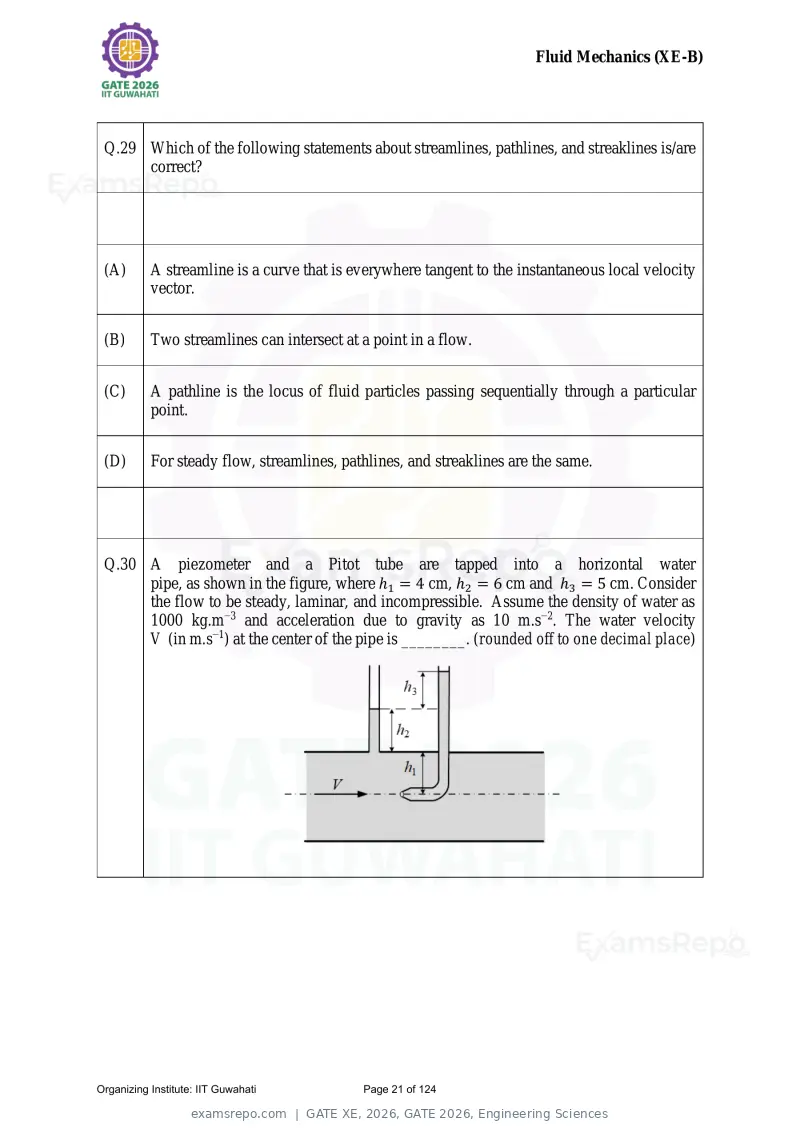
 Q.30 A piezometer and a Pitot tube are tapped into a horizontal water
      pipe, as shown in the figure, where ℎ1 = 4 cm, ℎ2 = 6 cm and ℎ3 = 5 cm. Consider
      the flow to be steady, laminar, and incompressible. Assume the density of water as
      1000 kg.m−3 and acceleration due to gravity as 10 m.s−2. The water velocity
      V (in m.s−1) at the center of the pipe is ________. (rounded off to one decimal place)


Organizing Institute: IIT Guwahati          Page 21 of 124
Text of page 22
Fluid Mechanics (XE-B)


Q.31 – Q.43 Carry TWO marks Each

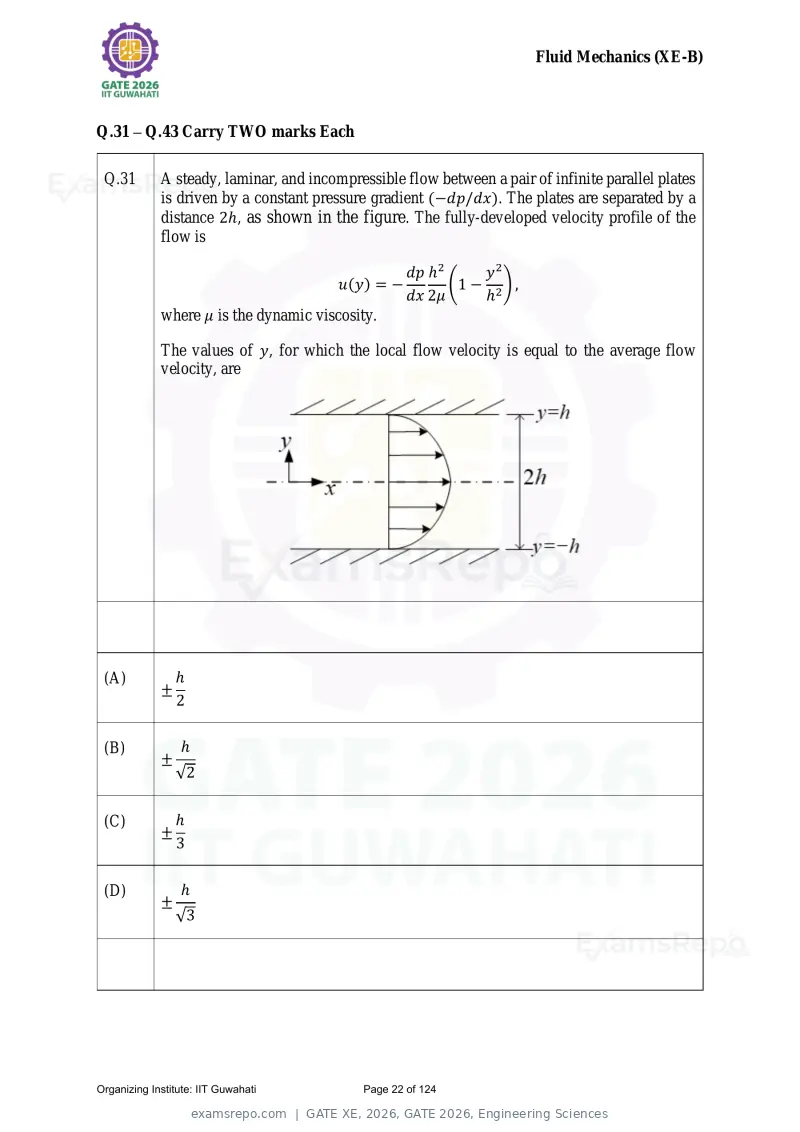
 Q.31        A steady, laminar, and incompressible flow between a pair of infinite parallel plates
             is driven by a constant pressure gradient (−dp/dx). The plates are separated by a
             distance 2ℎ, as shown in the figure. The fully-developed velocity profile of the
             flow is

                                                     dp ℎ2     y2
                                         u(y) = −          (1 − 2 ) ,
                                                     dx 2μ     ℎ
             where μ is the dynamic viscosity.

             The values of y, for which the local flow velocity is equal to the average flow
             velocity, are


 (A)             ℎ
             ±
                 2

 (B)             ℎ
             ±
                 √2

 (C)             ℎ
             ±
                 3

 (D)             ℎ
             ±
                 √3


Organizing Institute: IIT Guwahati           Page 22 of 124
Text of page 23
Fluid Mechanics (XE-B)


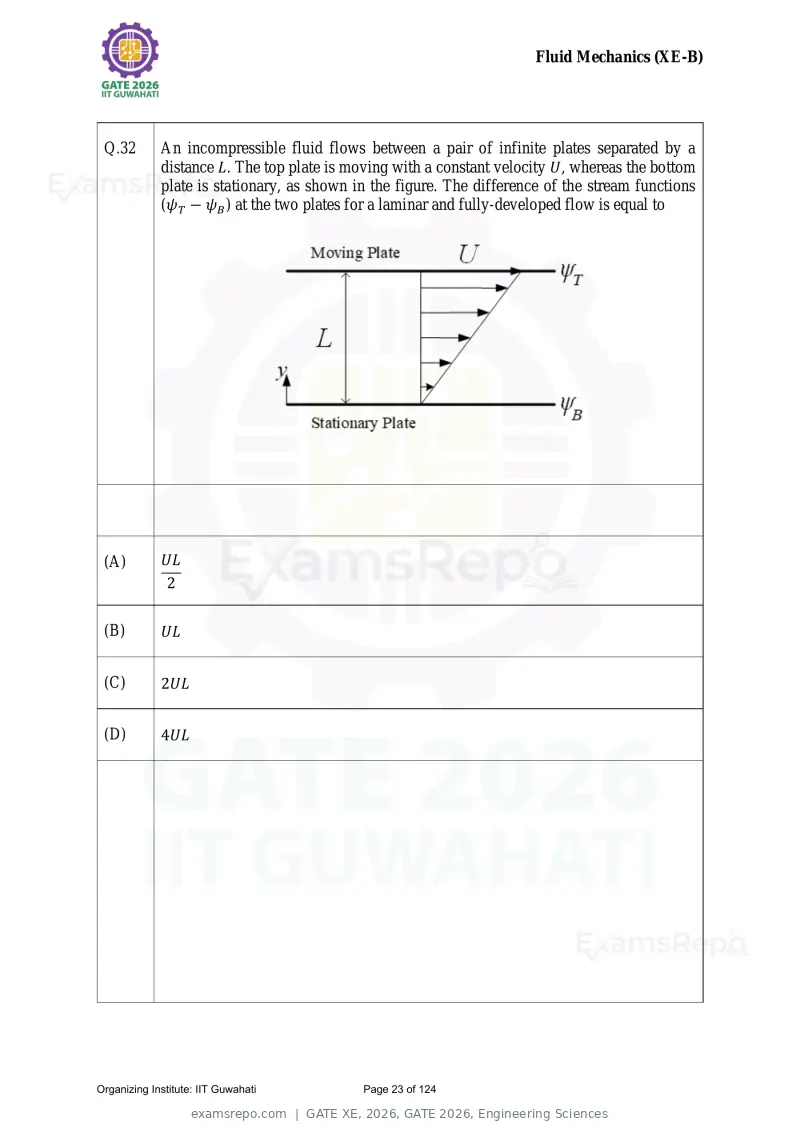
 Q.32        An incompressible fluid flows between a pair of infinite plates separated by a
             distance L. The top plate is moving with a constant velocity U, whereas the bottom
             plate is stationary, as shown in the figure. The difference of the stream functions
             (ψT − ψB ) at the two plates for a laminar and fully-developed flow is equal to


 (A)         UL
             2

 (B)         UL


 (C)         2UL


 (D)         4UL


Organizing Institute: IIT Guwahati          Page 23 of 124
Text of page 24
Fluid Mechanics (XE-B)


 Q.33        Consider two different cases of water flowing through a smooth pipe of 50 cm
             diameter. The mass flow rates for the two cases are (i) 0.25 kg.s−1, and (ii) 0.8 kg.s−1.
             Assume the density and dynamic viscosity of water as 1000 kg.m−3 and 10−3 Pa.s,
             respectively. Which one of the following options is correct?


 (A)         The flow is laminar for both (i), and (ii).


 (B)         The flow is laminar for (i), and turbulent for (ii).


 (C)         The flow is turbulent for (i), and laminar for (ii).


 (D)         The flow is turbulent for both (i), and (ii).


Organizing Institute: IIT Guwahati            Page 24 of 124
Text of page 25
Fluid Mechanics (XE-B)


                                                                                    y
 Q.34        A two-dimensional source flow (with stream function, ψ1 = m tan−1 x ) is placed
             at the origin in a uniform flow (with stream function, ψ2 = Uy). Here, the strength
             of the source is m and the freestream velocity is U. The velocity components u and
             v of the combined flow in x- and y-directions, respectively, are


 (A)                             mx             my
             u=U+ 2                     ; v=
                             x   +y 2          x 2 +y 2


 (B)                   mx                       my
             u=                  ; v=U+
                     x 2 +y 2                  x 2 +y 2


 (C)                             mx                  my
             u=U+ 2                     ; v=−
                             x +y 2                x 2 +y 2


 (D)                   mx                       my
             u=                  ; v=U−
                     x 2 +y 2                  x 2 +y 2


Organizing Institute: IIT Guwahati                  Page 25 of 124
Text of page 26
Fluid Mechanics (XE-B)
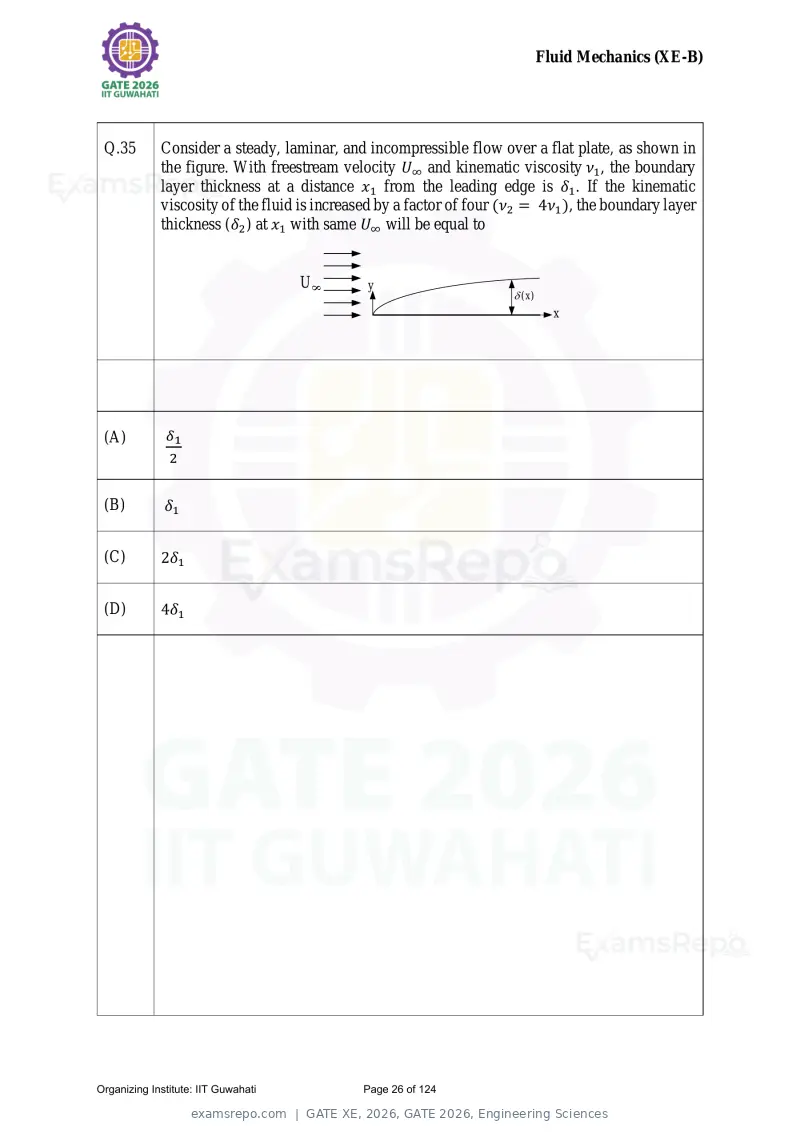
Q.35 Consider a steady, laminar, and incompressible flow over a flat plate, as shown in
the figure. With freestream velocity U∞ and kinematic viscosity ν1 , the boundary
layer thickness at a distance x1 from the leading edge is δ1 . If the kinematic
viscosity of the fluid is increased by a factor of four (ν2 = 4ν1 ), the boundary layer
thickness (δ2 ) at x1 with same U∞ will be equal to
U y
( x)
x
(A) δ1
2
(B) δ1
(C) 2δ1
(D) 4δ1
Organizing Institute: IIT Guwahati Page 26 of 124
Text of page 27
Fluid Mechanics (XE-B)


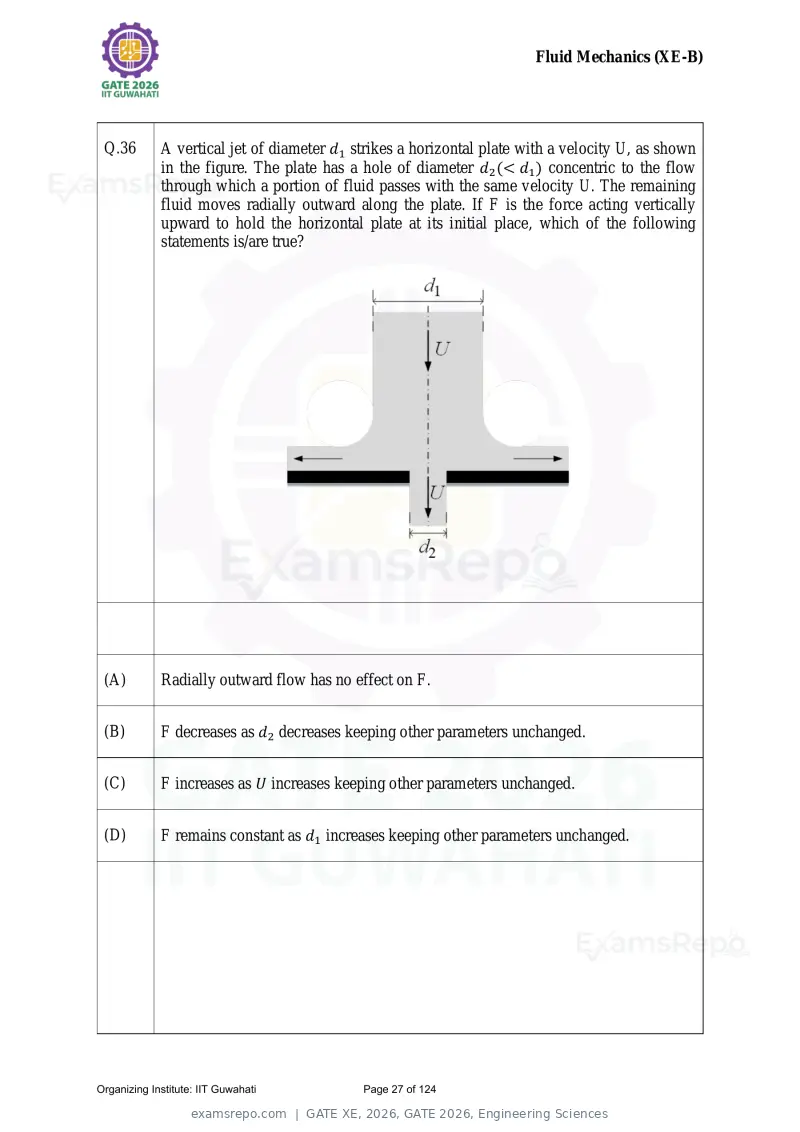
 Q.36        A vertical jet of diameter d1 strikes a horizontal plate with a velocity U, as shown
             in the figure. The plate has a hole of diameter d2 (< d1 ) concentric to the flow
             through which a portion of fluid passes with the same velocity U. The remaining
             fluid moves radially outward along the plate. If F is the force acting vertically
             upward to hold the horizontal plate at its initial place, which of the following
             statements is/are true?


 (A)         Radially outward flow has no effect on F.


 (B)         F decreases as d2 decreases keeping other parameters unchanged.


 (C)         F increases as U increases keeping other parameters unchanged.


 (D)         F remains constant as d1 increases keeping other parameters unchanged.


Organizing Institute: IIT Guwahati          Page 27 of 124
Text of page 28
Fluid Mechanics (XE-B)


 Q.37        The velocity of a fluid particle in a flow is given as:

                  ⃗ = (a − x)î + (b + y)ĵ + (c + z)k̂
                  V

             where a, b, c are constants, and î, ĵ, k̂ are unit vectors in x-, y-, z-directions,
             respectively.

             Which of the following statements is/are correct?


 (A)         The flow is steady for any value of a, b, and c.


 (B)         At a point (2, 3, 6), the velocity component in x-direction is higher than the velocity
             components in y- and z-directions for a = 2, b = 6, and c = 2.


 (C)         The point (2, 3, 6) is a stagnation point for a = 2, b = −3, and c = −6.


 (D)         The acceleration of the flow along the x-direction is not constant for any value of
             a, b, and c.


Organizing Institute: IIT Guwahati            Page 28 of 124
Text of page 29
Fluid Mechanics (XE-B)


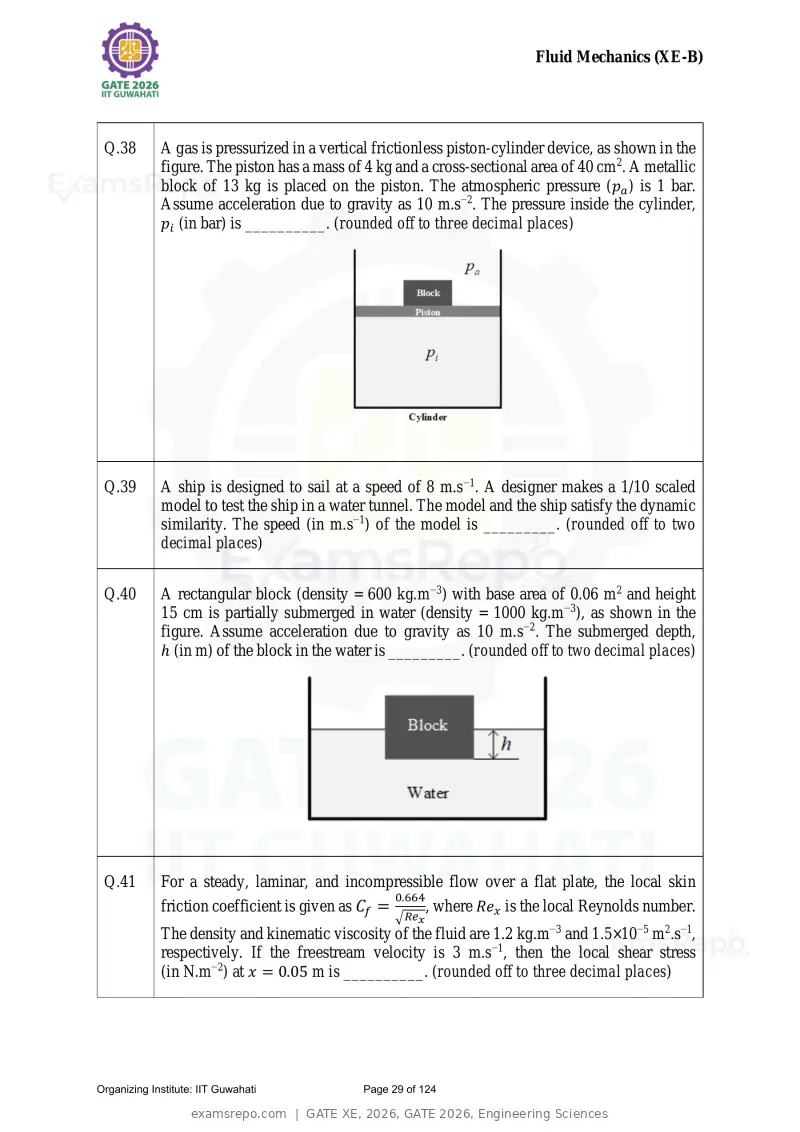
 Q.38        A gas is pressurized in a vertical frictionless piston-cylinder device, as shown in the
             figure. The piston has a mass of 4 kg and a cross-sectional area of 40 cm2. A metallic
             block of 13 kg is placed on the piston. The atmospheric pressure (pa ) is 1 bar.
             Assume acceleration due to gravity as 10 m.s−2. The pressure inside the cylinder,
             pi (in bar) is __________. (rounded off to three decimal places)


 Q.39        A ship is designed to sail at a speed of 8 m.s−1. A designer makes a 1/10 scaled
             model to test the ship in a water tunnel. The model and the ship satisfy the dynamic
             similarity. The speed (in m.s−1) of the model is _________. (rounded off to two
             decimal places)


 Q.40        A rectangular block (density = 600 kg.m−3) with base area of 0.06 m2 and height
             15 cm is partially submerged in water (density = 1000 kg.m−3), as shown in the
             figure. Assume acceleration due to gravity as 10 m.s−2. The submerged depth,
             ℎ (in m) of the block in the water is _________. (rounded off to two decimal places)


 Q.41        For a steady, laminar, and incompressible flow over a flat plate, the local skin
                                                     0.664
             friction coefficient is given as Cf =           , where Rex is the local Reynolds number.
                                                     √Rex
             The density and kinematic viscosity of the fluid are 1.2 kg.m−3 and 1.5×10⁻⁵ m2.s−1,
             respectively. If the freestream velocity is 3 m.s−1, then the local shear stress
             (in N.m−2) at x = 0.05 m is __________. (rounded off to three decimal places)


Organizing Institute: IIT Guwahati           Page 29 of 124
Text of page 30
Fluid Mechanics (XE-B)


 Q.42        The axial velocity profile of a laminar, incompressible, and fully-developed flow in
                                                                   1 dp
             a circular pipe of radius R is given as vz =                  (r 2 − R2 ), where µ, p, z, and r
                                                                   4μ dz
             are dynamic viscosity, pressure, axial coordinate, and radial coordinate,
             respectively. If the magnitude of shear stress at the pipe wall is given as
                          R dp
             |τw | =             , then the value of K is __________. (answer in integer)
                         K dz


 Q.43        Air flows through a pipe of diameter D with an average velocity of 3 m.s−1.
             The Darcy friction factor of the pipe is 0.02. Assume acceleration due to gravity as
             10 m.s−2. If the head loss per meter is 0.05, the diameter (in m) of the
             pipe is __________. (rounded off to two decimal places)


Organizing Institute: IIT Guwahati                Page 30 of 124
Text of page 31
Materials Science (XE-C)


Q.44 – Q.52 Carry ONE mark Each

 Q.44        The band gap of a material is Eg and the energy of an incident photon is Ep. Optical
             absorption will occur in this material if,


 (A)         Eg < Ep


 (B)         Eg > Ep


 (C)         Electron-electron recombination occurs


 (D)         Electron-hole recombination occurs


 Q.45        Discoloration and loss of mechanical strength of plastic chairs exposed to sunlight
             for several days is due to


 (A)         Hydrophilic degradation


 (B)         Oxidative degradation


 (C)         Photo-degradation


 (D)         Thermal degradation


Organizing Institute: IIT Guwahati          Page 31 of 124

Text of page 32
Materials Science (XE-C)


 Q.46        Which one of the following polymer processing techniques involves shaping a
             heated sheet?


 (A)         Thermoforming


 (B)         Injection molding


 (C)         Blow molding


 (D)         Extrusion


Organizing Institute: IIT Guwahati       Page 32 of 124

Text of page 33
Materials Science (XE-C)


 Q.47        The plot shows three different paths (1, 2, and 3) connecting the initial equilibrium
             state X to the final equilibrium state Y in a thermodynamic process. Which of the
             following statements is/are correct?


 (A)         The change in internal energy is the same for all three paths.


 (B)         The work done is the same for all three paths.


 (C)         The heat exchange will differ depending on the path taken.


 (D)         The first law of Thermodynamics is violated if work differs along the paths.


Organizing Institute: IIT Guwahati           Page 33 of 124
Text of page 34
Materials Science (XE-C)


 Q.48        Which of the following is/are polarization mechanisms in dielectric solids?


 (A)         Mechanical polarization


 (B)         Ionic polarization


 (C)         Electronic polarization


 (D)         Thermal polarization


 Q.49        Which of these methods is/are used for the synthesis of ceramic powders?


 (A)         Sol-gel


 (B)         Hydromechanical


 (C)         Thermomechanical


 (D)         Hydrothermal


 Q.50        The degrees of freedom of a system with 2 components and 2 phases in equilibrium
             is _________ (answer in integer).


 Q.51        The interplanar spacing of (ℎ k l) planes is 4.5 nm in a given crystal. For the
             (3ℎ 3k 3l) planes, the interplanar spacing, in nm, is _________ (rounded off to one
             decimal place).


Organizing Institute: IIT Guwahati          Page 34 of 124

Text of page 35
Materials Science (XE-C)
Q.52 The equilibrium vacancy concentration in aluminum at 900 K is 1.1 × 10 4. The
enthalpy of formation of vacancies, in kJ.mol1 , is _________ (rounded off to one
decimal place).
Given: Universal gas constant = 8.314 J.K1.mol1
Organizing Institute: IIT Guwahati Page 35 of 124
Text of page 36
Materials Science (XE-C)


Q.53 – Q.65 Carry TWO marks Each

 Q.53        Three phases, α, β and L are shown in the binary phase diagram below. Identify the
             correct G – X (Gibbs free energy vs Composition) plot corresponding to
             temperature T0.


 (A)


 (B)


 (C)


 (D)


Organizing Institute: IIT Guwahati          Page 36 of 124
Text of page 37
Materials Science (XE-C)


                                                                                      a
 Q.54        In a cubic crystal, the Burgers vector for a mixed dislocation line is 2 [110]. The
             dislocation line lies along the [011] direction. The slip plane of the dislocation is


 (A)         (11̅1)


 (B)         (111)


 (C)         (01̅1)


 (D)         (11̅0)


Organizing Institute: IIT Guwahati           Page 37 of 124
Text of page 38
Materials Science (XE-C)
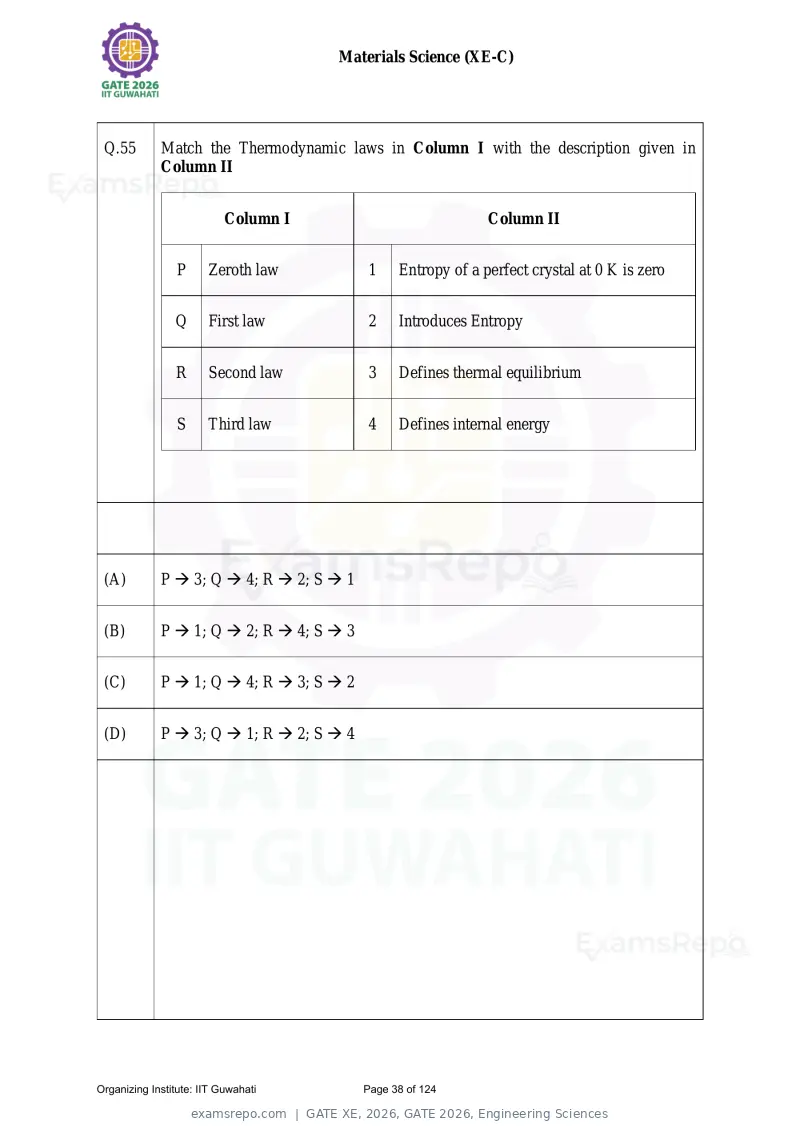
Q.55 Match the Thermodynamic laws in Column I with the description given in
Column II
Column I Column II
P Zeroth law 1 Entropy of a perfect crystal at 0 K is zero
Q First law 2 Introduces Entropy
R Second law 3 Defines thermal equilibrium
S Third law 4 Defines internal energy
(A) P 3; Q 4; R 2; S 1
(B) P 1; Q 2; R 4; S 3
(C) P 1; Q 4; R 3; S 2
(D) P 3; Q 1; R 2; S 4
Organizing Institute: IIT Guwahati Page 38 of 124
Text of page 39
Materials Science (XE-C)
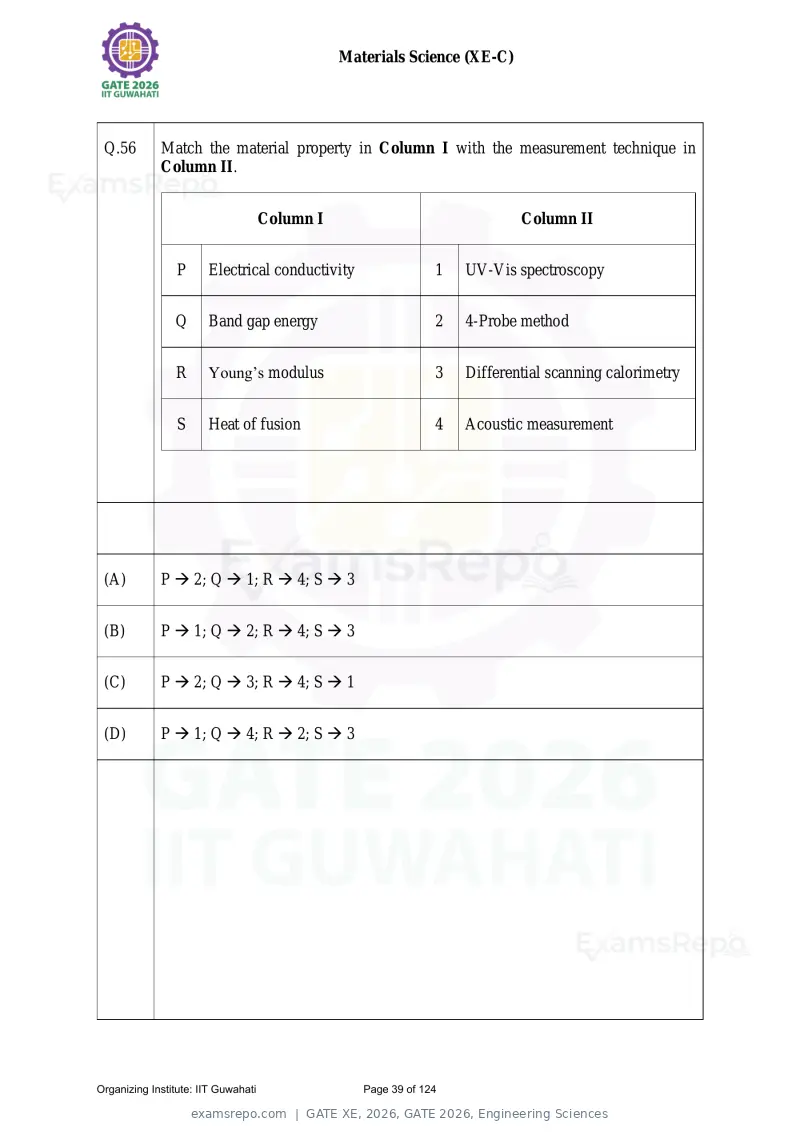
Q.56 Match the material property in Column I with the measurement technique in
Column II.
Column I Column II
P Electrical conductivity 1 UV-Vis spectroscopy
Q Band gap energy 2 4-Probe method
R Young’s modulus 3 Differential scanning calorimetry
S Heat of fusion 4 Acoustic measurement
(A) P 2; Q 1; R 4; S 3
(B) P 1; Q 2; R 4; S 3
(C) P 2; Q 3; R 4; S 1
(D) P 1; Q 4; R 2; S 3
Organizing Institute: IIT Guwahati Page 39 of 124
Text of page 40
Materials Science (XE-C)


 Q.57        Which one of the following statements regarding point defects in ionic solids is
             correct?


 (A)         Frenkel defects are dominant in those ionic solids where there is a considerable size
             difference between the cation and anion.


 (B)         Schottky defects are dominant in those ionic solids where there is a considerable
             size difference between the cation and anion.


 (C)         Schottky defects are the dominant defects in all ionic solids.


 (D)         Similar density of both Frenkel and Schottky defects is present in all ionic solids.


Organizing Institute: IIT Guwahati           Page 40 of 124
Text of page 41
Materials Science (XE-C)
Q.58 Consider 3 crystals (all having FCC lattice) labelled as P, Q and R as described
below:
Crystal P: Cu crystal with 4 Cu atoms per unit cell
Crystal Q: NaCl crystal with 4 Na+ ions and 4 Cl ions per unit cell
Crystal R: Diamond crystal with 8 C atoms per unit cell
Which of the following options is/are correct?
(A) Only crystal P is a close packed structure.
(B) Only crystal Q is a close packed structure.
(C) Crystal R has the smallest packing factor.
(D) All the crystals P, Q and R are close packed structures.
Q.59 Which of the following statements is/are applicable to Fick’s second law:
(A) Concentration changes with time
(B) Steady state condition prevails
(C) Diffusion is time dependent
(D) Concentration profile is linear
Organizing Institute: IIT Guwahati Page 41 of 124
Text of page 42
Materials Science (XE-C)
Q.60 According to quantum free electron theory, which of the following statements is/are
correct regarding the behavior of valence electrons in a metal?
(A) Valence electrons are localized to individual atoms.
(B) Valence electrons are delocalized within the crystal.
(C) Energy distribution of valence electrons follows Fermi-Dirac statistics.
(D) Energy distribution of valence electrons follows Maxwell-Boltzmann statistics.
Q.61 Fe has a density of 7.87 g.cm3, atomic mass of 55.84 g.mol1 and net magnetic
moment per atom of 2.22 Bohr magnetons (µB). The saturation magnetization of Fe,
in A.m1, is _________ ×105 (rounded off to one decimal place).
Given: µB = 9.27×1024 A.m2, Avogadro number = 6.023×10²³ mol1
Q.62 At the peak (also denoted as UTS) of an engineering stress vs. engineering strain
curve for ductile metal, the engineering strain is 0.2. The corresponding
true stress (σ) vs. true strain (ε) relationship follows the equation: σ = Kε n , where
K and n are constants.
The engineering stress at the peak, in MPa, is _________ (rounded off to one
decimal place).
Given: K = 200 MPa
Organizing Institute: IIT Guwahati Page 42 of 124
Text of page 43
Materials Science (XE-C)
Q.63 A 1 cm3 Si cube is doped with As with a concentration of 1 atom per 109 Si atoms.
The resistance of the doped Si cube, in Ohms, is _________ (rounded off to one
decimal place).
Given:
Atomic concentration of Si = 5×1022 cm3
Intrinsic concentration of electrons in Si = 1×1010 cm3
Electron mobility in Si = 1350 cm2.V1.s1
Hole mobility in Si = 450 cm2.V1.s1
Electronic charge = 1.6×10¹⁹ C
Q.64 A circular disk-shaped ceramic green body has a relative density of 50%. On
sintering, both the height and the diameter of the disk shrink by 20%. The sintered
disk’s relative density, in %, is _________ (rounded off to one decimal place).
Q.65 The standard electrode potential of Cu2+ | Cu is +0.34 V and Zn2+ | Zn is −0.76 V.
For the Zn | Zn2+ || Cu2+ | Cu cell, the EMF, in Volts, is _________ (rounded off to
two decimal places).
Organizing Institute: IIT Guwahati Page 43 of 124
Text of page 44
Solid Mechanics (XE-D)
Q.66 – Q.74 Carry ONE mark Each
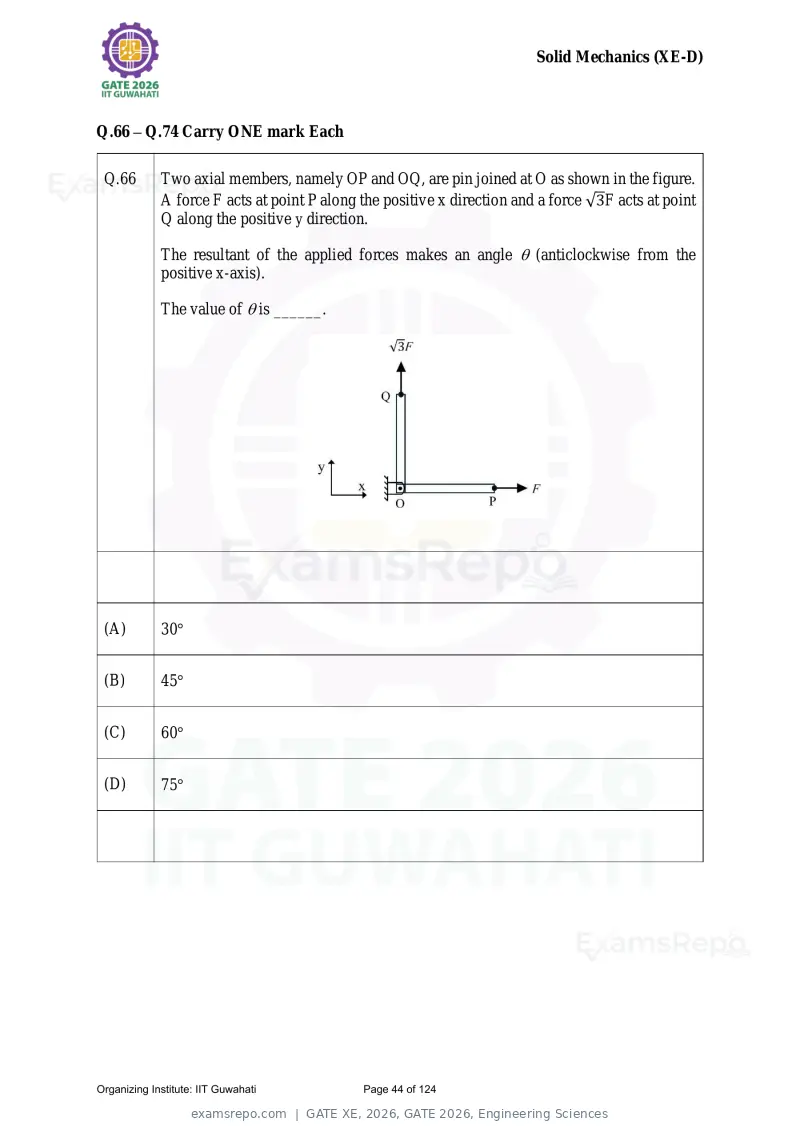
Q.66 Two axial members, namely OP and OQ, are pin joined at O as shown in the figure.
A force F acts at point P along the positive x direction and a force √3F acts at point
Q along the positive y direction.
The resultant of the applied forces makes an angle (anticlockwise from the
positive x-axis).
The value of is ______.
(A) 30°
(B) 45°
(C) 60°
(D) 75°
Organizing Institute: IIT Guwahati Page 44 of 124
Text of page 45
Solid Mechanics (XE-D)


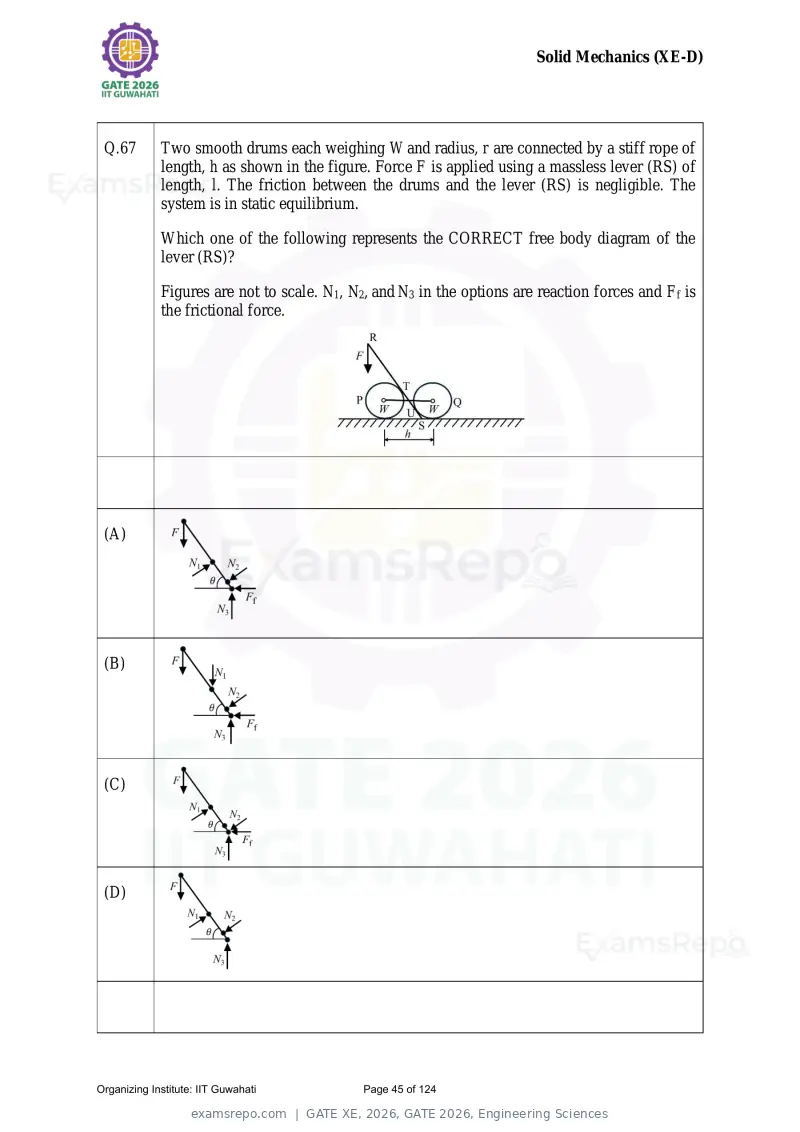
 Q.67        Two smooth drums each weighing W and radius, r are connected by a stiff rope of
             length, h as shown in the figure. Force F is applied using a massless lever (RS) of
             length, l. The friction between the drums and the lever (RS) is negligible. The
             system is in static equilibrium.

             Which one of the following represents the CORRECT free body diagram of the
             lever (RS)?

             Figures are not to scale. N1, N2, and N3 in the options are reaction forces and Ff is
             the frictional force.


 (A)


 (B)


 (C)


 (D)


Organizing Institute: IIT Guwahati           Page 45 of 124
Text of page 46
Solid Mechanics (XE-D)


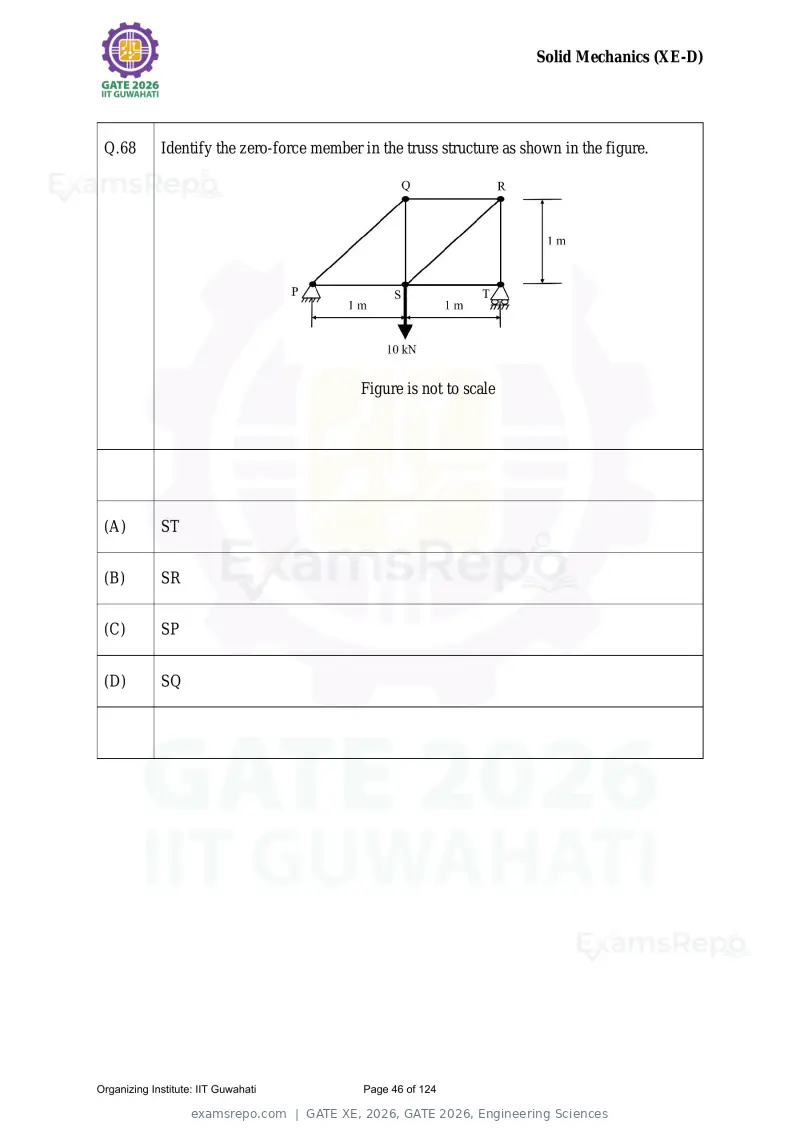
 Q.68        Identify the zero-force member in the truss structure as shown in the figure.


                                            Figure is not to scale


 (A)         ST


 (B)         SR


 (C)         SP


 (D)         SQ


Organizing Institute: IIT Guwahati          Page 46 of 124
Text of page 47
Solid Mechanics (XE-D)


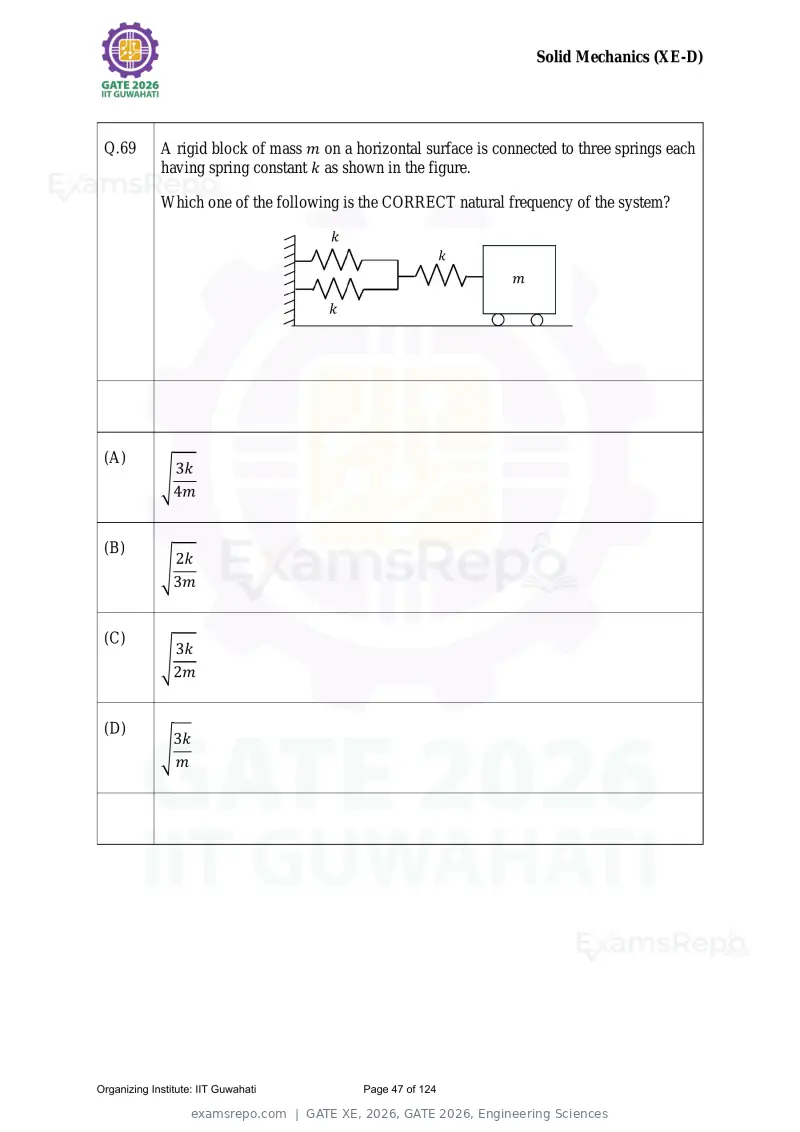
 Q.69        A rigid block of mass m on a horizontal surface is connected to three springs each
             having spring constant k as shown in the figure.

             Which one of the following is the CORRECT natural frequency of the system?


 (A)
               3k
             √
              4m


 (B)
               2k
             √
              3m


 (C)
               3k
             √
              2m


 (D)
              3k
             √
               m


Organizing Institute: IIT Guwahati          Page 47 of 124

Text of page 48
Solid Mechanics (XE-D)


 Q.70        Which among the following options is/are CORRECT unit(s) of stress?


 (A)         Nm2


 (B)         Pa


 (C)         Nm


 (D)         N/m2


Organizing Institute: IIT Guwahati        Page 48 of 124
Text of page 49
Solid Mechanics (XE-D)


 Q.71        A car is moving on a horizontal surface in a straight line with a constant velocity of
             3 m/s. A ball is thrown vertically upwards at time t = 0 from the top of the moving
             car with a velocity of 20 m/s. The acceleration due to gravity is 10 m/s2.

             At what value(s) of time t in second(s), the ball is at a height of 15 m from the top
             of the moving car?


 (A)         1


 (B)         2


 (C)         3


 (D)         4


Organizing Institute: IIT Guwahati           Page 49 of 124

Text of page 50
Solid Mechanics (XE-D)


 Q.72        A cart of weight (W) 5 kN, stands on an inclined smooth surface at an angle (θ) of
             45° as shown in the figure. The cart is maintained in equilibrium by a horizontal
             force F acting at point S.

             The value of F is ______ kN (in integer).


                                           Figure is not to scale


Organizing Institute: IIT Guwahati          Page 50 of 124
Text of page 51
Solid Mechanics (XE-D)


 Q.73        A 2D state of stress at a point in a body is given by σxx = −40 MPa,
             σyy = 100 MPa and τxy = 50 MPa.

             The radius of the Mohr’s circle for the given state of stress is ______MPa
             (rounded off to two decimal places).


 Q.74                                                               11 4
             Sum of the principal stresses of a 2D stress state [        ] is ______ (in integer).
                                                                    4 5


Organizing Institute: IIT Guwahati           Page 51 of 124
Text of page 52
Solid Mechanics (XE-D)


Q.75 – Q.87 Carry TWO marks Each


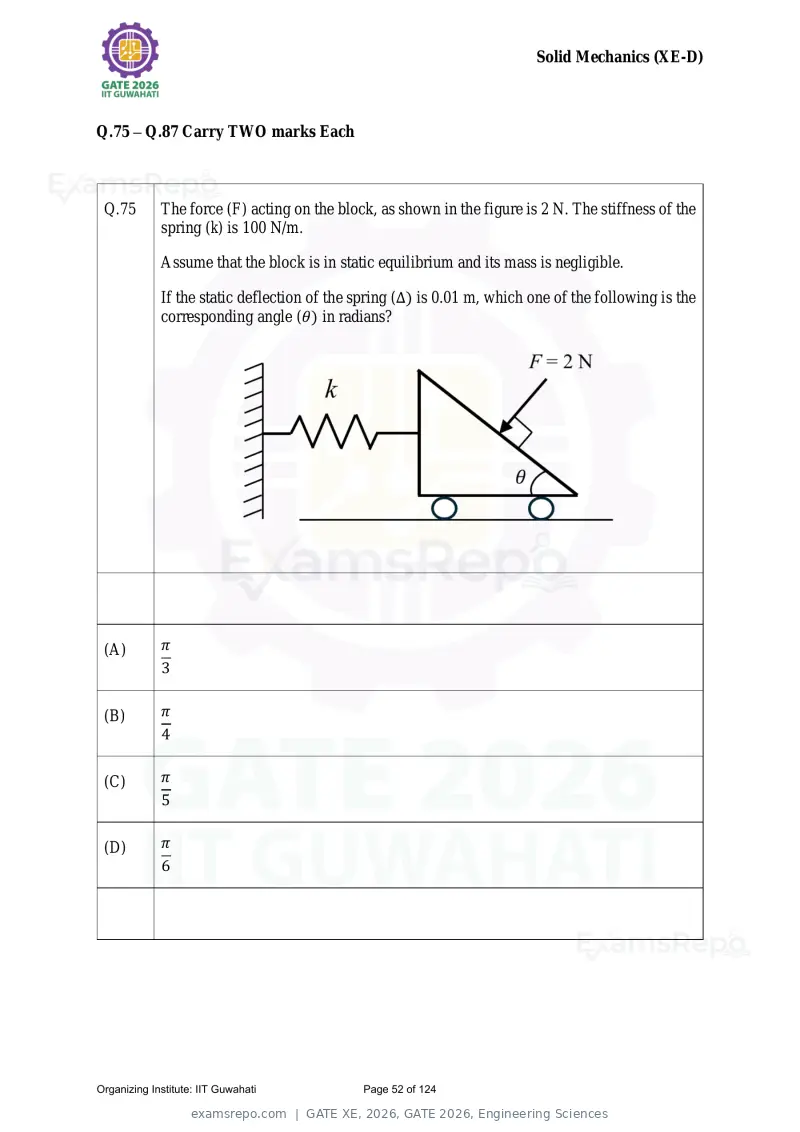
 Q.75        The force (F) acting on the block, as shown in the figure is 2 N. The stiffness of the
             spring (k) is 100 N/m.

             Assume that the block is in static equilibrium and its mass is negligible.

             If the static deflection of the spring (∆) is 0.01 m, which one of the following is the
             corresponding angle (θ) in radians?


 (A)         π
             3

 (B)         π
             4

 (C)         π
             5

 (D)         π
             6


Organizing Institute: IIT Guwahati           Page 52 of 124
Text of page 53
Solid Mechanics (XE-D)


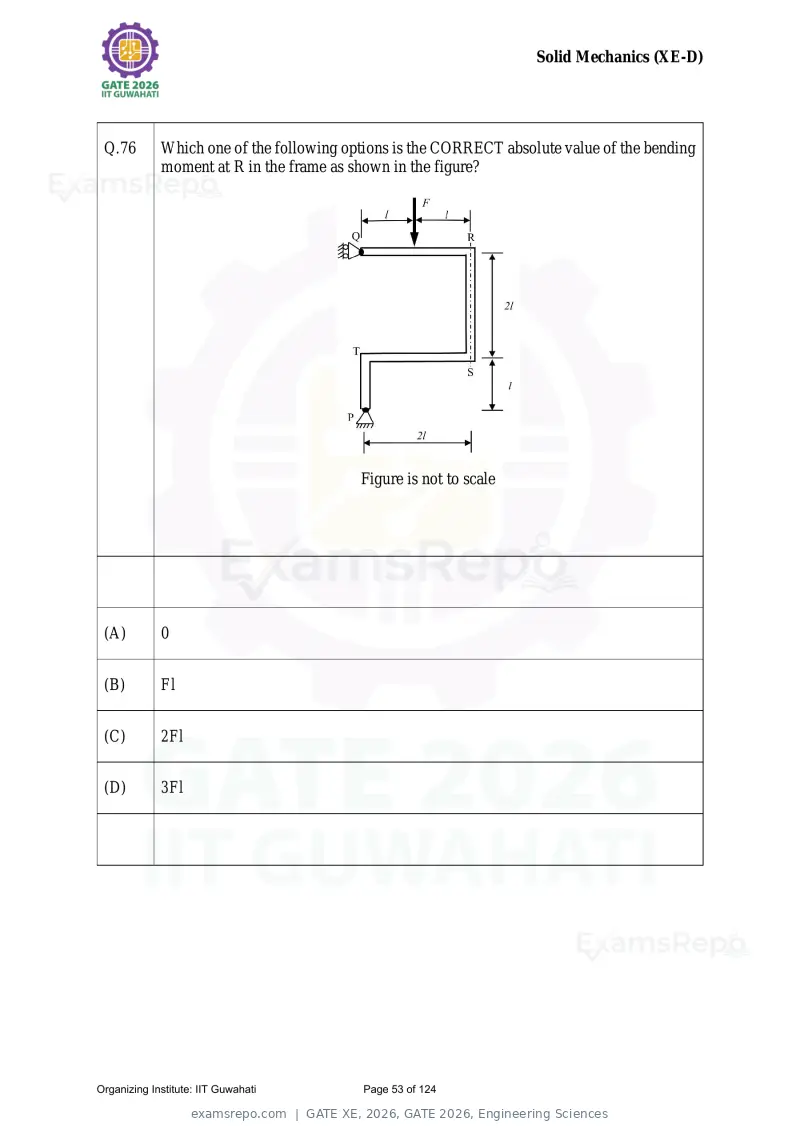
 Q.76        Which one of the following options is the CORRECT absolute value of the bending
             moment at R in the frame as shown in the figure?


                                          Figure is not to scale


 (A)         0


 (B)         Fl


 (C)         2Fl


 (D)         3Fl


Organizing Institute: IIT Guwahati        Page 53 of 124
Text of page 54
Solid Mechanics (XE-D)


 Q.77        One column with square cross section of side r and another column with rectangular
             cross section of breadth p and width q (< p) are made from the same material. Both
             the columns have one end fixed, and the other end is free. They are subjected to
             axial loads along the centroidal axis.

             Consider the area of cross sections of both the columns to be the same. The
             minimum critical Euler buckling loads of the columns with rectangular and square
             cross-sections are Frect and Fsq , respectively.
                      Frect
             Then             is ______.
                       Fsq


 (A)         p
             q


 (B)         q
             p


 (C)         r
             q


 (D)         r2
             pq


Organizing Institute: IIT Guwahati          Page 54 of 124
Text of page 55
Solid Mechanics (XE-D)


 Q.78        Two prismatic rods of identical lengths are designed for the same strain energy
             density when subjected to the same axial load. One of the rods is made of steel
             (Young’s modulus = 210 GPa) and another is made of aluminum (Young’s modulus
             = 70 GPa).

             If the diameter of the aluminum rod is 70 mm, then which one of the following
             options corresponds to the diameter of the steel rod in mm?


 (A)         53.19


 (B)         70


 (C)         210


 (D)         29.13


Organizing Institute: IIT Guwahati        Page 55 of 124
Text of page 56
Solid Mechanics (XE-D)


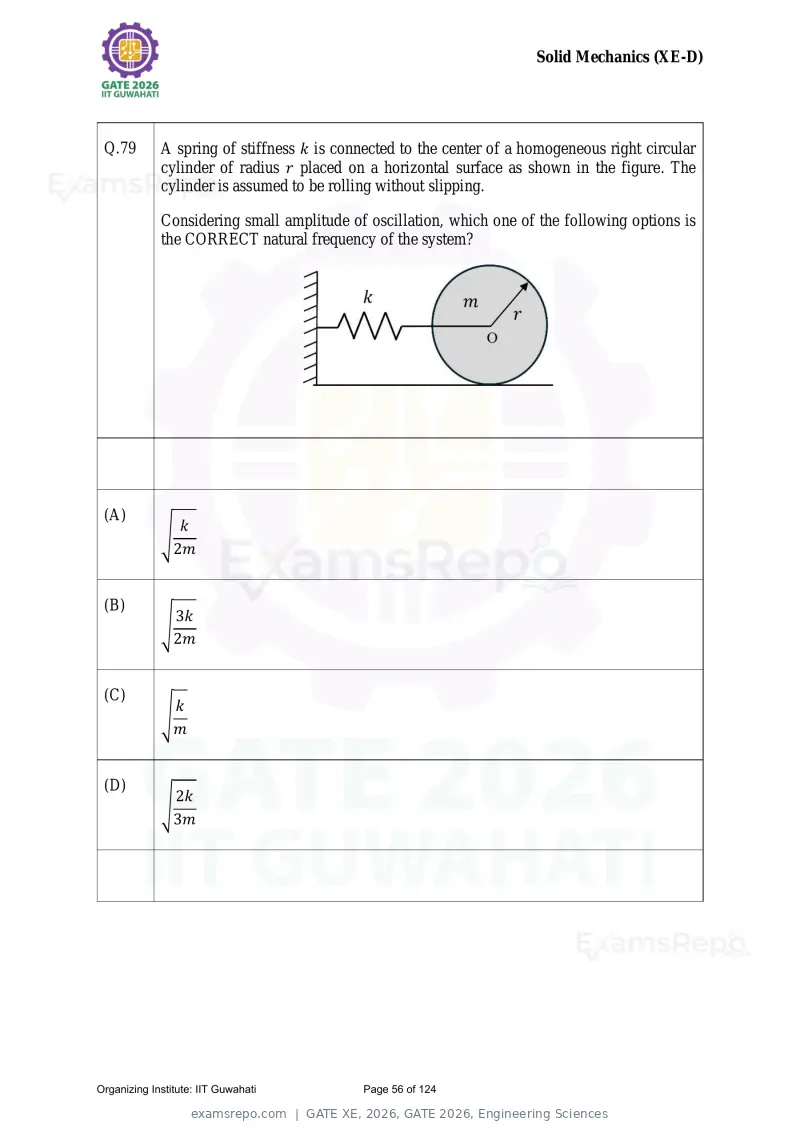
 Q.79        A spring of stiffness k is connected to the center of a homogeneous right circular
             cylinder of radius r placed on a horizontal surface as shown in the figure. The
             cylinder is assumed to be rolling without slipping.

             Considering small amplitude of oscillation, which one of the following options is
             the CORRECT natural frequency of the system?


 (A)
               k
             √
              2m


 (B)
               3k
             √
              2m


 (C)
               k
             √
              m


 (D)
               2k
             √
              3m


Organizing Institute: IIT Guwahati          Page 56 of 124
Text of page 57
Solid Mechanics (XE-D)


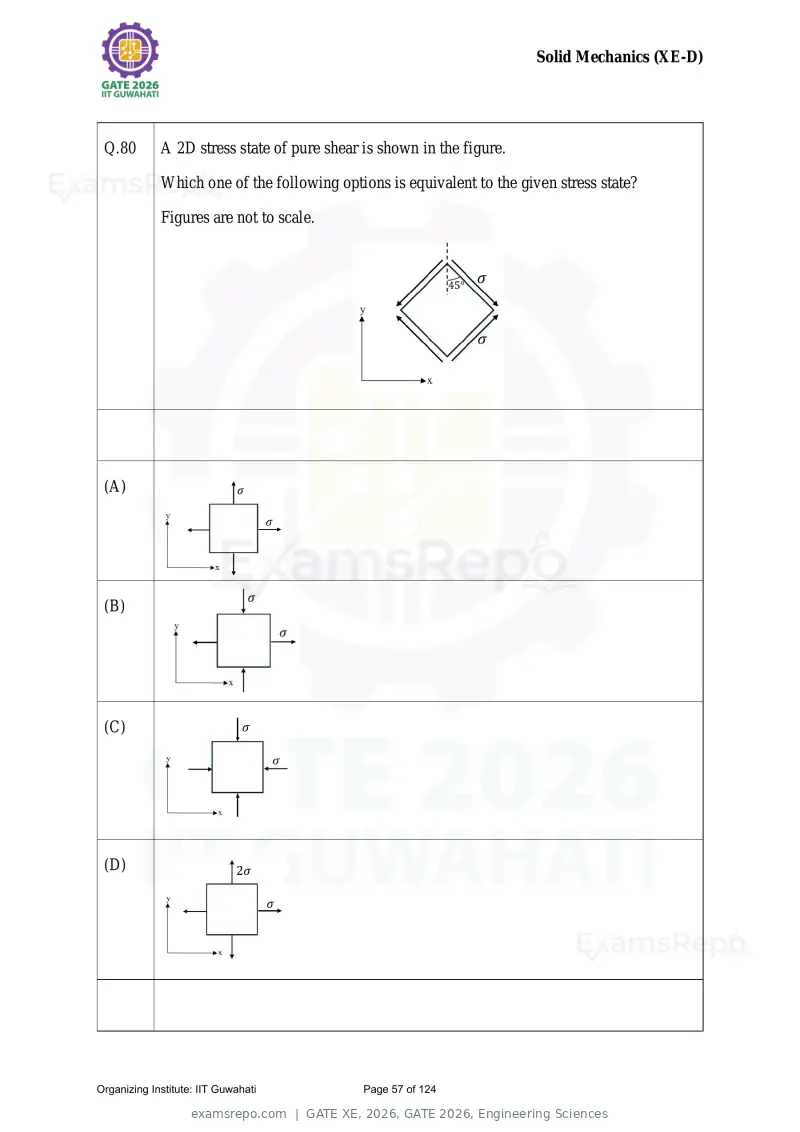
 Q.80        A 2D stress state of pure shear is shown in the figure.

             Which one of the following options is equivalent to the given stress state?

             Figures are not to scale.


 (A)


 (B)


 (C)


 (D)


Organizing Institute: IIT Guwahati           Page 57 of 124
Text of page 58
Solid Mechanics (XE-D)


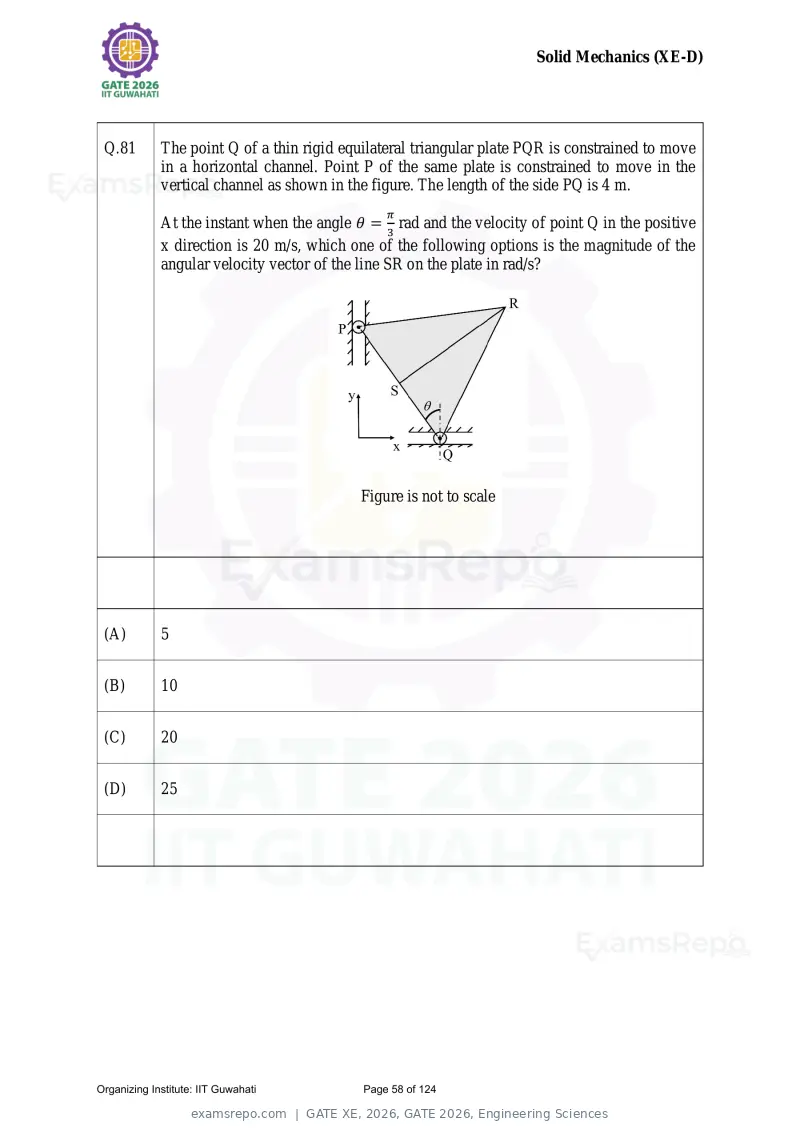
 Q.81        The point Q of a thin rigid equilateral triangular plate PQR is constrained to move
             in a horizontal channel. Point P of the same plate is constrained to move in the
             vertical channel as shown in the figure. The length of the side PQ is 4 m.
                                                π
             At the instant when the angle θ = 3 rad and the velocity of point Q in the positive
             x direction is 20 m/s, which one of the following options is the magnitude of the
             angular velocity vector of the line SR on the plate in rad/s?


                                            Figure is not to scale


 (A)         5


 (B)         10


 (C)         20


 (D)         25


Organizing Institute: IIT Guwahati          Page 58 of 124
Text of page 59
Solid Mechanics (XE-D)


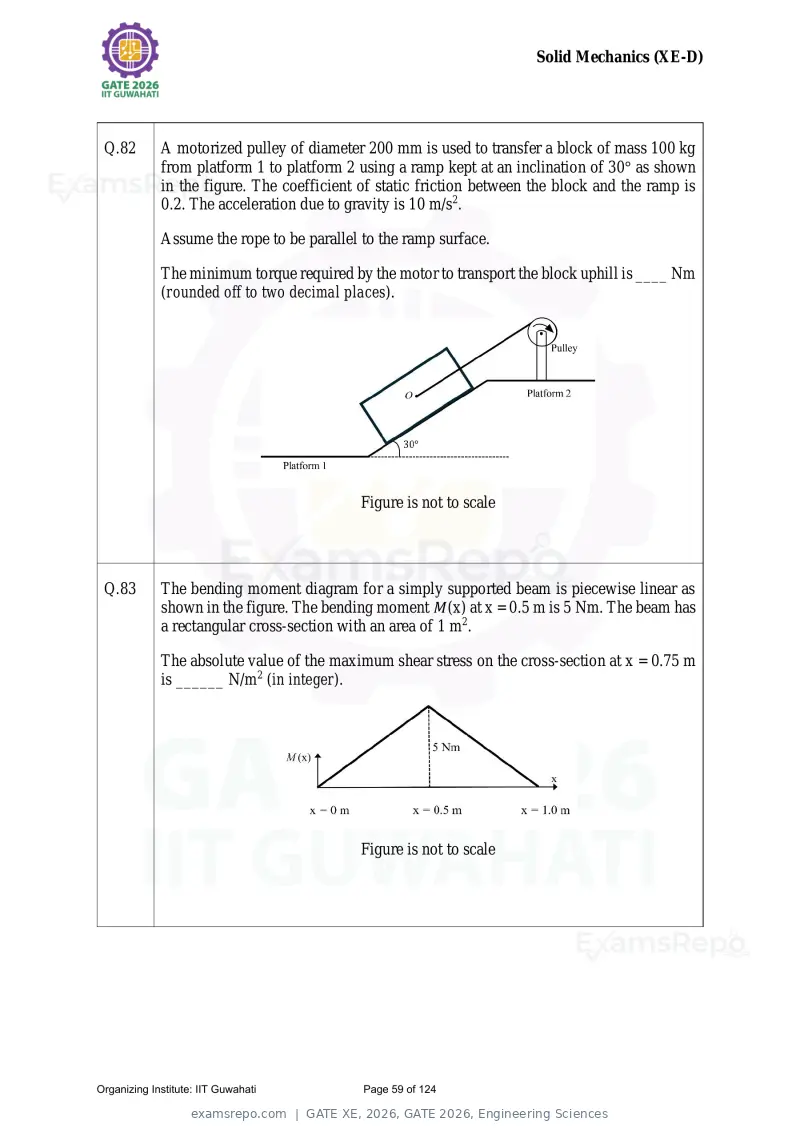
 Q.82        A motorized pulley of diameter 200 mm is used to transfer a block of mass 100 kg
             from platform 1 to platform 2 using a ramp kept at an inclination of 30° as shown
             in the figure. The coefficient of static friction between the block and the ramp is
             0.2. The acceleration due to gravity is 10 m/s2.

             Assume the rope to be parallel to the ramp surface.

             The minimum torque required by the motor to transport the block uphill is ____ Nm
             (rounded off to two decimal places).


                                            Figure is not to scale


 Q.83        The bending moment diagram for a simply supported beam is piecewise linear as
             shown in the figure. The bending moment M(x) at x = 0.5 m is 5 Nm. The beam has
             a rectangular cross-section with an area of 1 m2.

             The absolute value of the maximum shear stress on the cross-section at x = 0.75 m
             is ______ N/m2 (in integer).


                                            Figure is not to scale


Organizing Institute: IIT Guwahati          Page 59 of 124
Text of page 60
Solid Mechanics (XE-D)


 Q.84        A thin walled cylindrical container of diameter 2 m and wall thickness of 2.5 cm is
             made of steel whose Young’s modulus is 200 GPa and yield stress is 450 MPa.

             Using von Mises criteria, the maximum permissible pressure is ______MPa
             (rounded off to the nearest integer).


 Q.85        A solid axial bar made of steel with Young’s modulus, 200 GPa and Poisson’s ratio,
             0.3, is subjected to uniaxial stress of 50 MPa.

             The absolute value of the maximum shear strain on the outer surface of the bar is
             ______× 10−4 (rounded off to two decimal places).


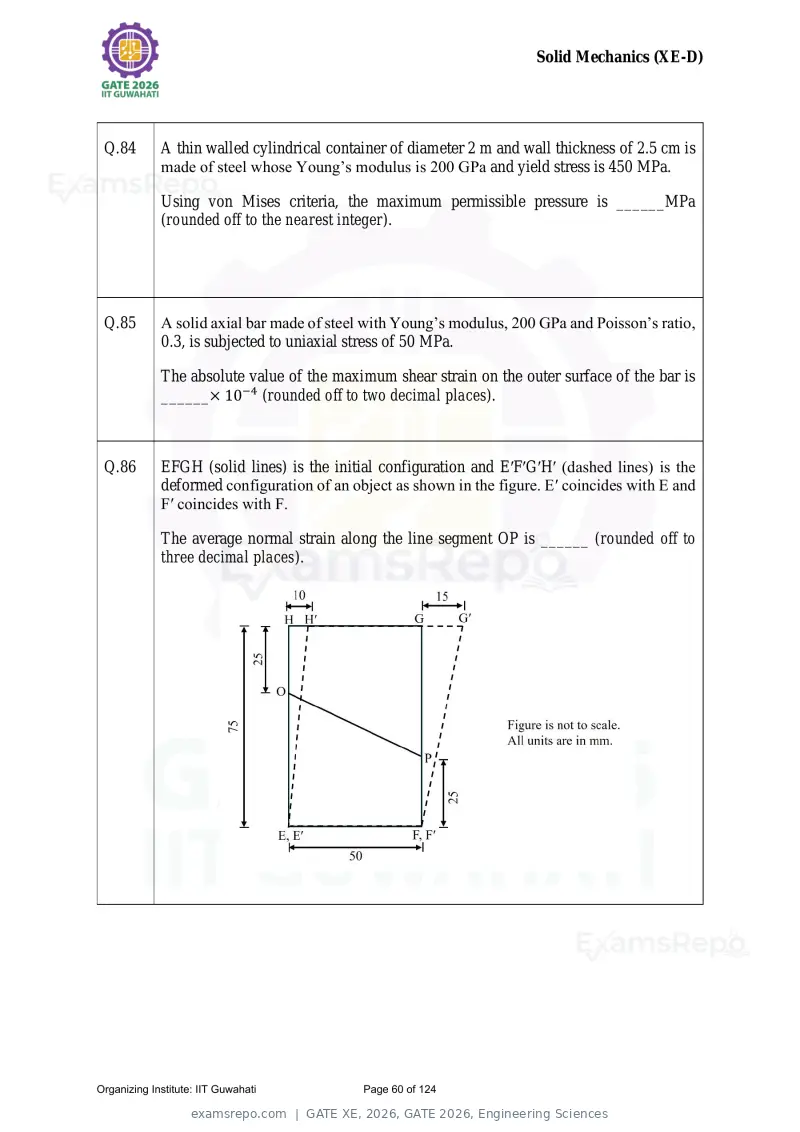
 Q.86        EFGH (solid lines) is the initial configuration and E′F′G′H′ (dashed lines) is the
             deformed configuration of an object as shown in the figure. E′ coincides with E and
             F′ coincides with F.

             The average normal strain along the line segment OP is ______ (rounded off to
             three decimal places).


Organizing Institute: IIT Guwahati          Page 60 of 124
Text of page 61
Solid Mechanics (XE-D)


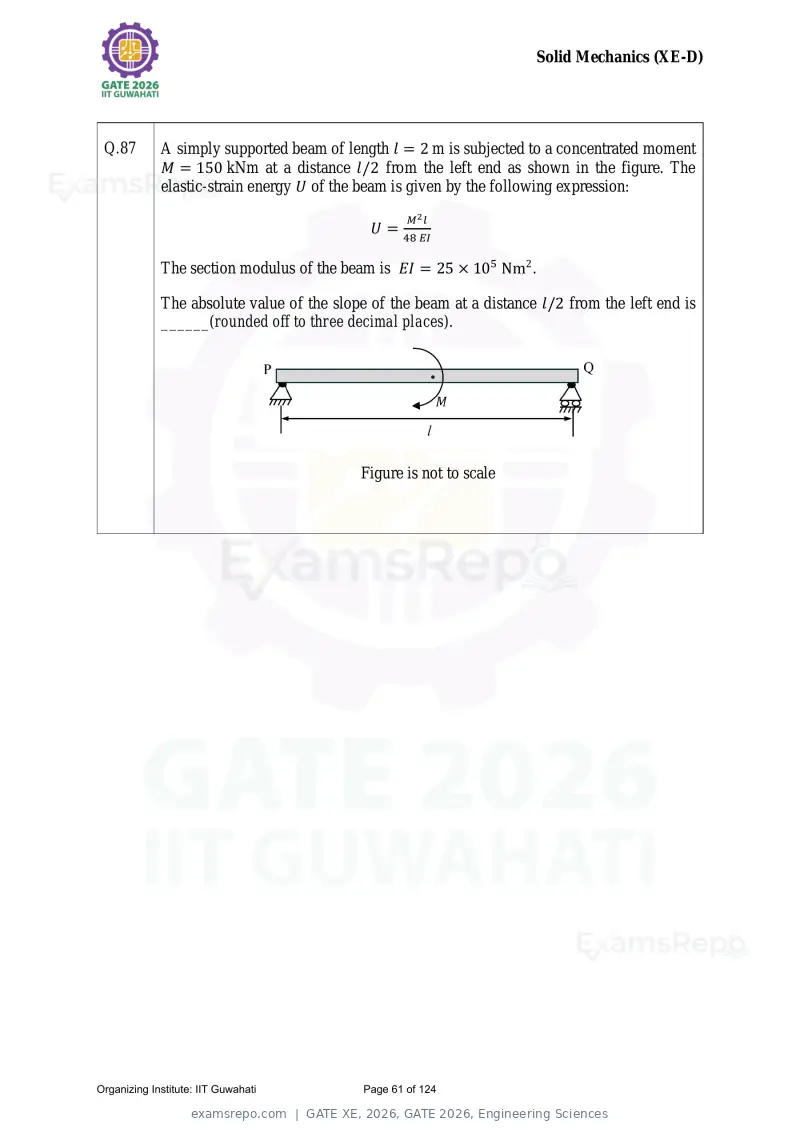
 Q.87        A simply supported beam of length l = 2 m is subjected to a concentrated moment
             M = 150 kNm at a distance l/2 from the left end as shown in the figure. The
             elastic-strain energy U of the beam is given by the following expression:
                                                    M2 l
                                             U = 48 EI

             The section modulus of the beam is EI = 25 × 105 Nm2 .

             The absolute value of the slope of the beam at a distance l/2 from the left end is
             ______(rounded off to three decimal places).


                                           Figure is not to scale


Organizing Institute: IIT Guwahati          Page 61 of 124
Text of page 62
Thermodynamics (XE-E)
Q.88 – Q.96 Carry ONE mark Each
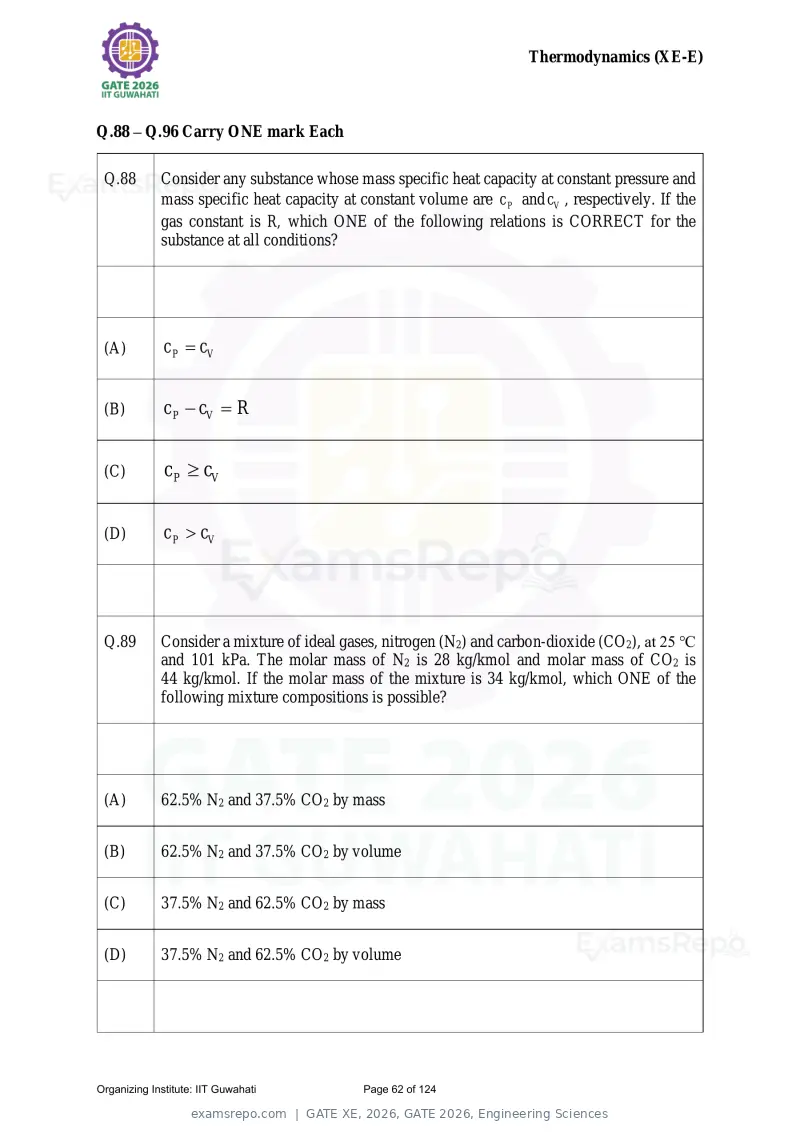
Q.88 Consider any substance whose mass specific heat capacity at constant pressure and
mass specific heat capacity at constant volume are cP and cV , respectively. If the
gas constant is R, which ONE of the following relations is CORRECT for the
substance at all conditions?
(A) cP cV
(B) cP cV R
(C) cP cV
(D) cP cV
Q.89 Consider a mixture of ideal gases, nitrogen (N2) and carbon-dioxide (CO2), at 25 ℃
and 101 kPa. The molar mass of N2 is 28 kg/kmol and molar mass of CO2 is
44 kg/kmol. If the molar mass of the mixture is 34 kg/kmol, which ONE of the
following mixture compositions is possible?
(A) 62.5% N2 and 37.5% CO2 by mass
(B) 62.5% N2 and 37.5% CO2 by volume
(C) 37.5% N2 and 62.5% CO2 by mass
(D) 37.5% N2 and 62.5% CO2 by volume
Organizing Institute: IIT Guwahati Page 62 of 124
Text of page 63
Thermodynamics (XE-E)


 Q.90        In a mixing chamber hot water enters at a temperature of 80 ℃ with a flowrate of
             0.5 kg/s. From another entry, cold water enters the chamber at 20 ℃. The desired
             temperature after mixing at the exit of the chamber is 40 ℃. There is no water
             leakage and the mixing happens at adiabatic conditions. Assume the specific heat
             capacity of water is 4.2 kJ/kg-K. For a steady state operation, the mass flow rate (in
             kg/s) of the cold-water stream is


 (A)         2.0


 (B)         1.5


 (C)         1.0


 (D)         0.5


 Q.91        Which ONE of the following statements is CORRECT?


             For an ideal gas, specific enthalpy ( h ) is a function of both temperature and
 (A)
             pressure.


 (B)         Internal energy ( U ), entropy ( S ), and enthalpy ( H ) are path functions.


 (C)         Heat transferred ( Q ) and work done ( W ) are state (point) functions.


 (D)         Temperature ( T ), pressure ( P ), and specific volume ( v ) are intensive properties.


Organizing Institute: IIT Guwahati            Page 63 of 124
Text of page 64
Thermodynamics (XE-E)


 Q.92        A mixture of carbon-dioxide (CO2), nitrogen (N2) and oxygen (O2) are introduced
             in a rigid and impermeable tank containing only liquid water (H2O). Assume that
             the components are non-reacting and un-dissociated. The system is kept isolated till
             an equilibrium is achieved, where only two phases are present. The degrees-of-
             freedom of the equilibrium mixture, as obtained from the phase rule, is


 (A)         1


 (B)         2


 (C)         3


 (D)         4


 Q.93        A stream of moist air at 101 kPa and 25 ℃ undergoes a constant pressure process
             such that its dry bulb temperature increases and specific humidity decreases. For
             this process, which of the following statements is/are always CORRECT?


 (A)         Wet bulb temperature increases.


 (B)         Dew point temperature decreases.


 (C)         Relative humidity decreases.


 (D)         Adiabatic saturation temperature increases.


Organizing Institute: IIT Guwahati          Page 64 of 124
Text of page 65
Thermodynamics (XE-E)
Q.94 Which of the following is/are example(s) of a pure substance at 25 ℃ and 101 kPa?
(A) Gaseous oxygen
(B) Mixture of liquid water and water vapor
(C) Mixture of liquid water and gaseous oxygen
(D) Homogenous mixture of gaseous oxygen and water vapor
Q.95 A house looses heat at a rate of 150 MJ per hour. The temperature outside the house
is 3 ℃. The minimum power (in kW) required to maintain the temperature inside
the house at 25 ℃ using a heat pump is ________________ (rounded off to two
decimal places).
Q.96 Consider an ideal Otto-cycle with cold-air-standard assumptions to be applicable.
The temperature of the working fluid at the start and the end of the compression
process is 300 K and 750 K, respectively. For the working fluid take the ratio of the
specific heat capacities as 1.4. The thermal efficiency (in %) of the cycle is
________________ (rounded off to two decimal places).
Organizing Institute: IIT Guwahati Page 65 of 124
Text of page 66
Thermodynamics (XE-E)
Q.97 – Q.109 Carry TWO marks Each
Q.97 Consider a real gas, which obeys the following equation-of-state:
RT C
v C1 2 ,
P Pv
where v is the mass specific volume, P is the pressure, T is the temperature and
R is the gas constant. C1 and C2 are constants. If s is the mass specific entropy,
s
the quantity for the gas is given by
v T
R
(A)
v
R 2T
(B)
Pv 2
R
(C)
v C1
C1C2
(D)
Tv
Organizing Institute: IIT Guwahati Page 66 of 124
Text of page 67
Thermodynamics (XE-E)
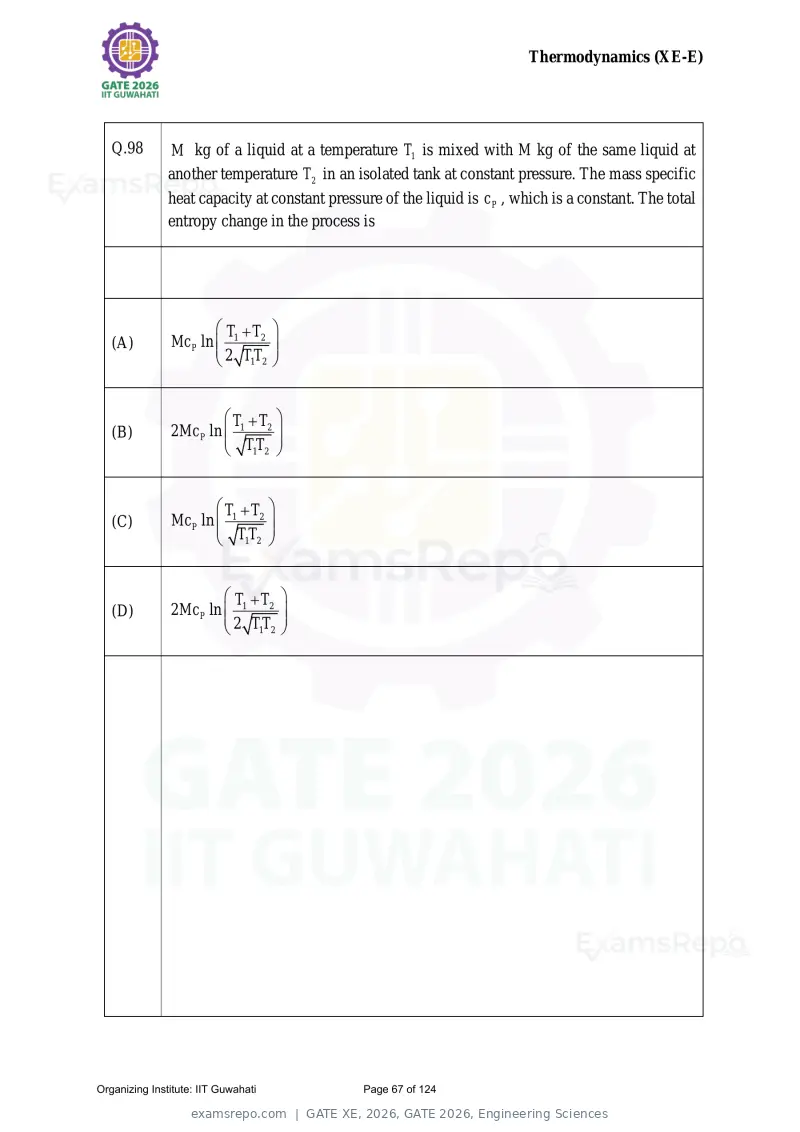
Q.98 M kg of a liquid at a temperature T1 is mixed with M kg of the same liquid at
another temperature T2 in an isolated tank at constant pressure. The mass specific
heat capacity at constant pressure of the liquid is cP , which is a constant. The total
entropy change in the process is
T T
(A) McP ln 1 2
2 TT
1 2
T T
(B) 2McP ln 1 2
TT
1 2
T T
(C) McP ln 1 2
TT
1 2
T T
(D) 2McP ln 1 2
2 TT
1 2
Organizing Institute: IIT Guwahati Page 67 of 124
Text of page 68
Thermodynamics (XE-E)
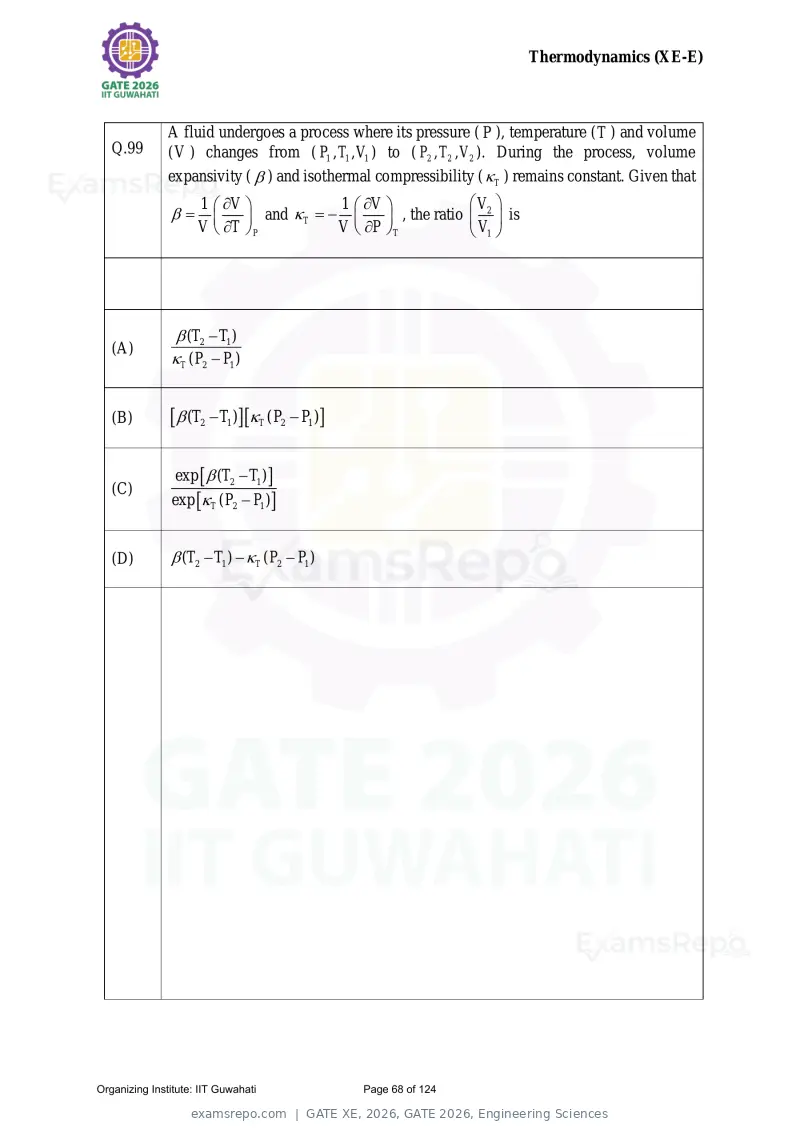
A fluid undergoes a process where its pressure ( P ), temperature ( T ) and volume
Q.99 ( V ) changes from ( P1 , T1 , V1 ) to ( P2 , T2 , V2 ). During the process, volume
expansivity ( ) and isothermal compressibility ( T ) remains constant. Given that
1 V 1 V V2
and T , the ratio is
V T P V P T V1
(T2 T1 )
(A)
T ( P2 P1 )
(B) (T2 T1 )T (P2 P1 )
exp (T2 T1 )
(C)
exp T ( P2 P1 )
(D) (T2 T1 ) T ( P2 P1 )
Organizing Institute: IIT Guwahati Page 68 of 124
Text of page 69
Thermodynamics (XE-E)
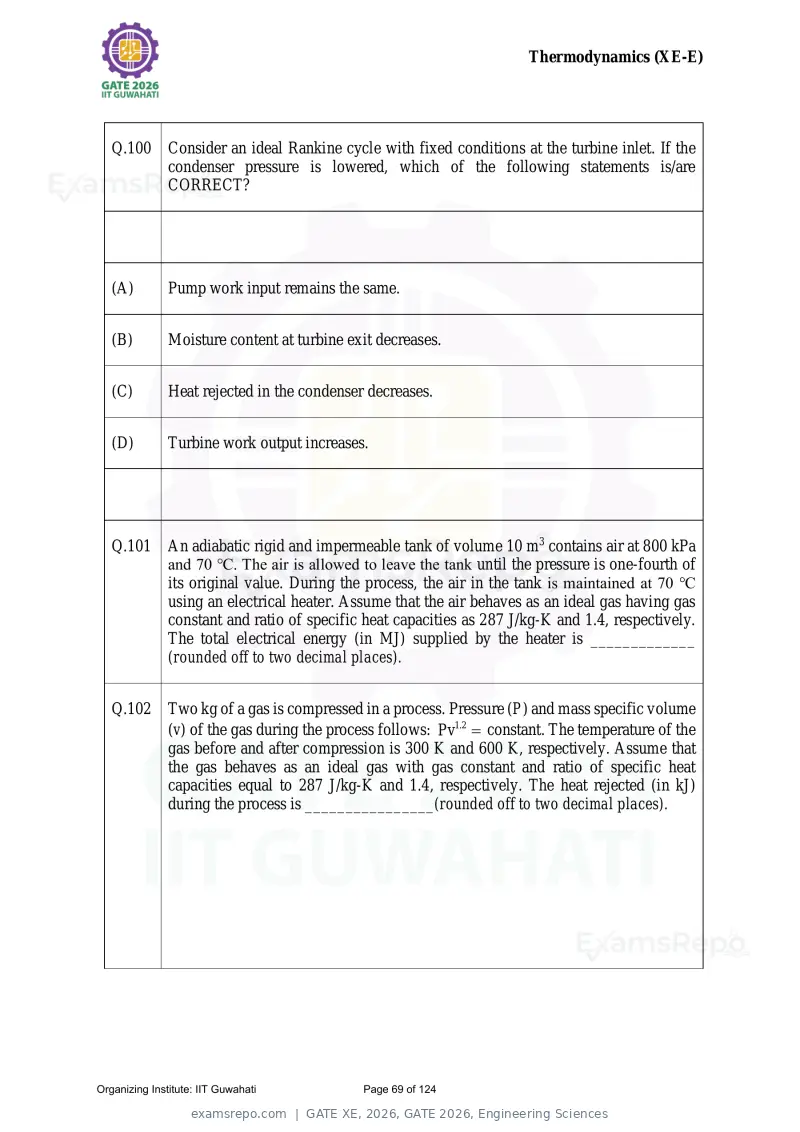
Q.100 Consider an ideal Rankine cycle with fixed conditions at the turbine inlet. If the
condenser pressure is lowered, which of the following statements is/are
CORRECT?
(A) Pump work input remains the same.
(B) Moisture content at turbine exit decreases.
(C) Heat rejected in the condenser decreases.
(D) Turbine work output increases.
Q.101 An adiabatic rigid and impermeable tank of volume 10 m3 contains air at 800 kPa
and 70 ℃. The air is allowed to leave the tank until the pressure is one-fourth of
its original value. During the process, the air in the tank is maintained at 70 ℃
using an electrical heater. Assume that the air behaves as an ideal gas having gas
constant and ratio of specific heat capacities as 287 J/kg-K and 1.4, respectively.
The total electrical energy (in MJ) supplied by the heater is _____________
(rounded off to two decimal places).
Q.102 Two kg of a gas is compressed in a process. Pressure (P) and mass specific volume
(v) of the gas during the process follows: Pv1.2 constant. The temperature of the
gas before and after compression is 300 K and 600 K, respectively. Assume that
the gas behaves as an ideal gas with gas constant and ratio of specific heat
capacities equal to 287 J/kg-K and 1.4, respectively. The heat rejected (in kJ)
during the process is ________________(rounded off to two decimal places).
Organizing Institute: IIT Guwahati Page 69 of 124
Text of page 70
Thermodynamics (XE-E)
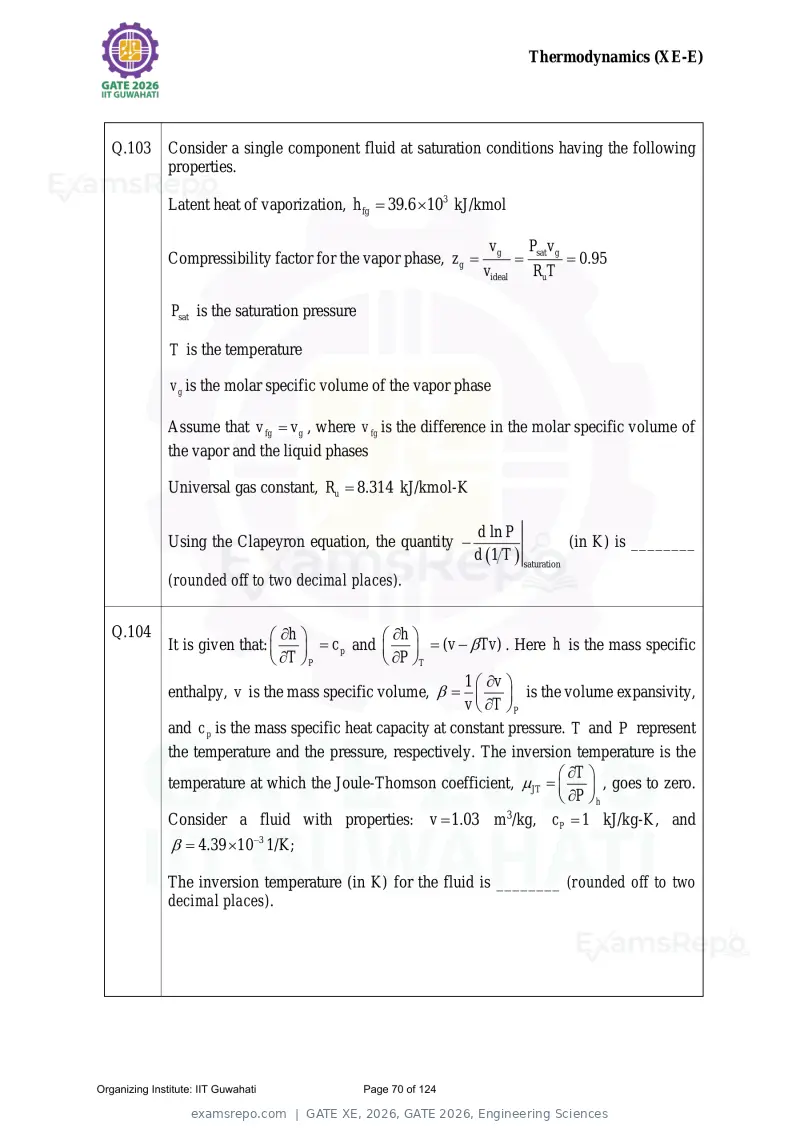
Q.103 Consider a single component fluid at saturation conditions having the following
properties.
Latent heat of vaporization, h fg 39.6 103 kJ/kmol
vg Psat vg
Compressibility factor for the vapor phase, z g 0.95
videal RuT
Psat is the saturation pressure
T is the temperature
v g is the molar specific volume of the vapor phase
Assume that v fg vg , where v fg is the difference in the molar specific volume of
the vapor and the liquid phases
Universal gas constant, Ru 8.314 kJ/kmol-K
d ln P
Using the Clapeyron equation, the quantity (in K) is ________
d 1 T saturation
(rounded off to two decimal places).
Q.104 h h
It is given that: c p and (v Tv) . Here h is the mass specific
T P P T
1 v
enthalpy, v is the mass specific volume, is the volume expansivity,
v T P
and c p is the mass specific heat capacity at constant pressure. T and P represent
the temperature and the pressure, respectively. The inversion temperature is the
T
temperature at which the Joule-Thomson coefficient, JT , goes to zero.
P h
Consider a fluid with properties: v 1.03 m3/kg, cP 1 kJ/kg-K, and
4.39 103 1/K;
The inversion temperature (in K) for the fluid is ________ (rounded off to two
decimal places).
Organizing Institute: IIT Guwahati Page 70 of 124
Text of page 71
Thermodynamics (XE-E)


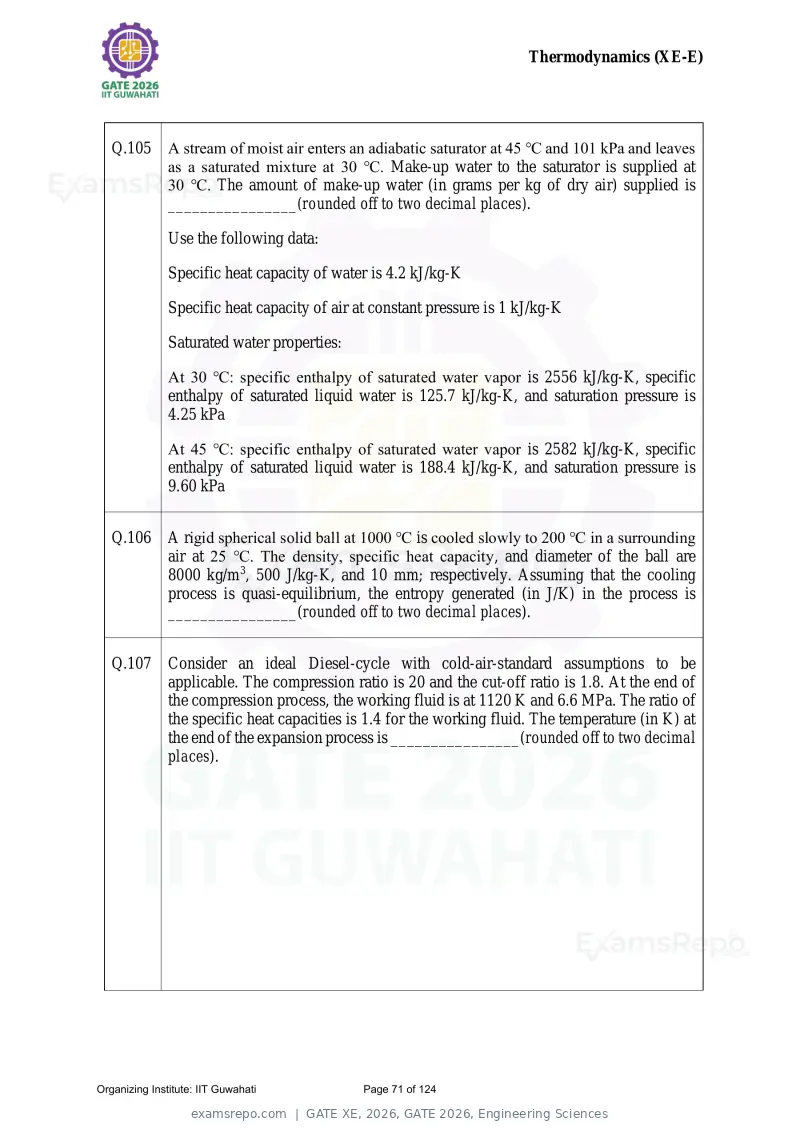
   Q.105       A stream of moist air enters an adiabatic saturator at 45 ℃ and 101 kPa and leaves
               as a saturated mixture at 30 ℃. Make-up water to the saturator is supplied at
               30 ℃. The amount of make-up water (in grams per kg of dry air) supplied is
               ________________(rounded off to two decimal places).

               Use the following data:

               Specific heat capacity of water is 4.2 kJ/kg-K

               Specific heat capacity of air at constant pressure is 1 kJ/kg-K

               Saturated water properties:

               At 30 ℃: specific enthalpy of saturated water vapor is 2556 kJ/kg-K, specific
               enthalpy of saturated liquid water is 125.7 kJ/kg-K, and saturation pressure is
               4.25 kPa

               At 45 ℃: specific enthalpy of saturated water vapor is 2582 kJ/kg-K, specific
               enthalpy of saturated liquid water is 188.4 kJ/kg-K, and saturation pressure is
               9.60 kPa


   Q.106       A rigid spherical solid ball at 1000 ℃ is cooled slowly to 200 ℃ in a surrounding
               air at 25 ℃. The density, specific heat capacity, and diameter of the ball are
               8000 kg/m3, 500 J/kg-K, and 10 mm; respectively. Assuming that the cooling
               process is quasi-equilibrium, the entropy generated (in J/K) in the process is
               ________________(rounded off to two decimal places).


   Q.107       Consider an ideal Diesel-cycle with cold-air-standard assumptions to be
               applicable. The compression ratio is 20 and the cut-off ratio is 1.8. At the end of
               the compression process, the working fluid is at 1120 K and 6.6 MPa. The ratio of
               the specific heat capacities is 1.4 for the working fluid. The temperature (in K) at
               the end of the expansion process is ________________(rounded off to two decimal
               places).


Organizing Institute: IIT Guwahati            Page 71 of 124
Text of page 72
Thermodynamics (XE-E)


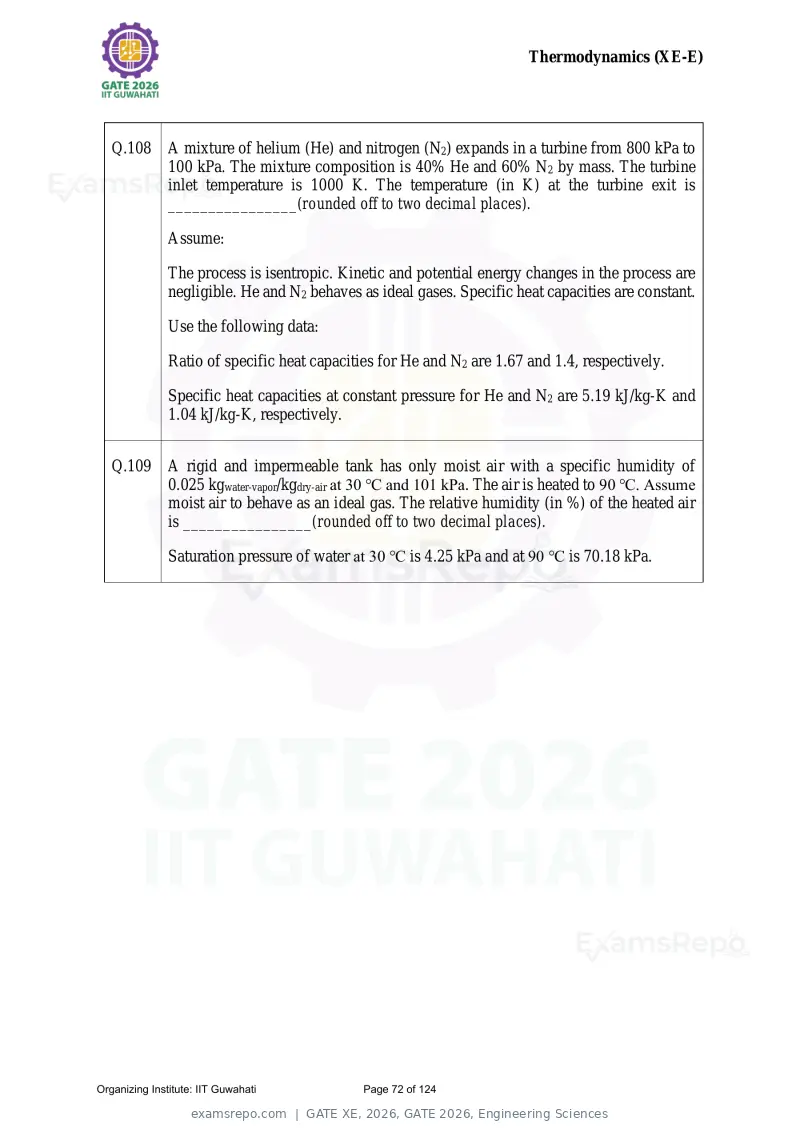
   Q.108       A mixture of helium (He) and nitrogen (N2) expands in a turbine from 800 kPa to
               100 kPa. The mixture composition is 40% He and 60% N2 by mass. The turbine
               inlet temperature is 1000 K. The temperature (in K) at the turbine exit is
               ________________(rounded off to two decimal places).

               Assume:

               The process is isentropic. Kinetic and potential energy changes in the process are
               negligible. He and N2 behaves as ideal gases. Specific heat capacities are constant.

               Use the following data:

               Ratio of specific heat capacities for He and N2 are 1.67 and 1.4, respectively.

               Specific heat capacities at constant pressure for He and N2 are 5.19 kJ/kg-K and
               1.04 kJ/kg-K, respectively.


   Q.109       A rigid and impermeable tank has only moist air with a specific humidity of
               0.025 kgwater-vapor/kgdry-air at 30 ℃ and 101 kPa. The air is heated to 90 ℃. Assume
               moist air to behave as an ideal gas. The relative humidity (in %) of the heated air
               is ________________(rounded off to two decimal places).

               Saturation pressure of water at 30 ℃ is 4.25 kPa and at 90 ℃ is 70.18 kPa.


Organizing Institute: IIT Guwahati            Page 72 of 124
Text of page 73
Polymer Science and Engineering (XE-F)


Q.110 – Q.118 Carry ONE mark Each

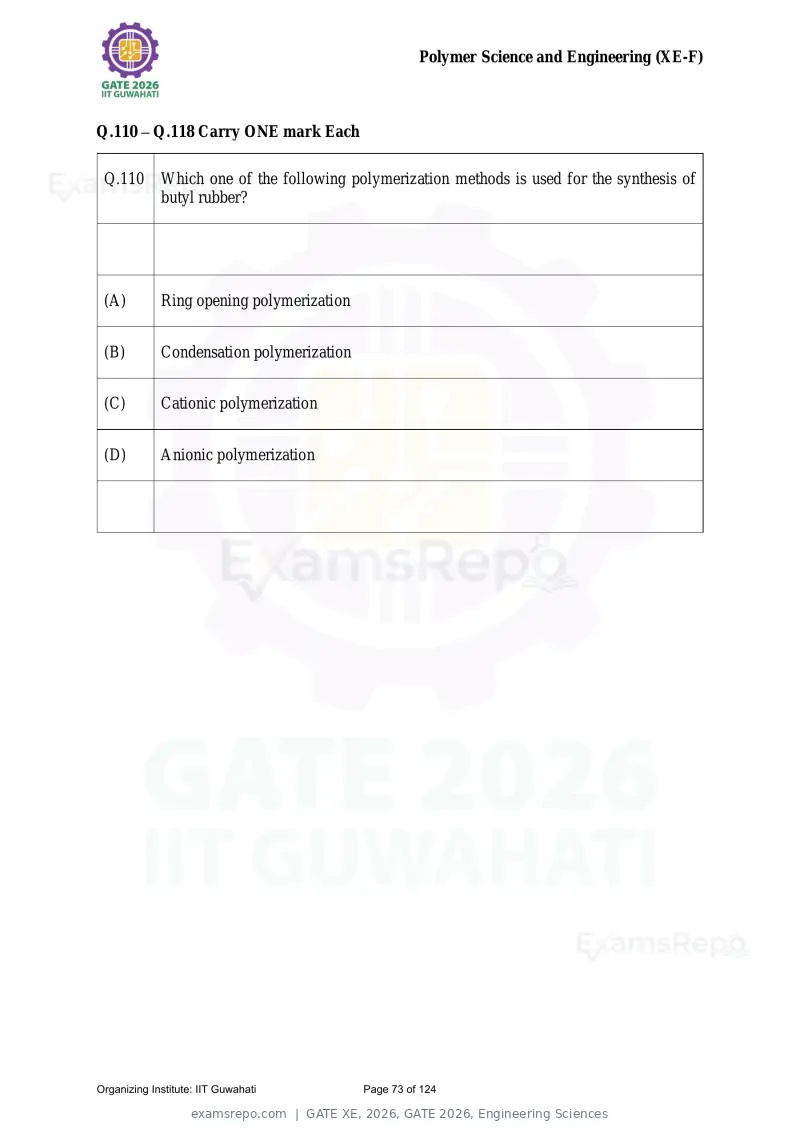
 Q.110       Which one of the following polymerization methods is used for the synthesis of
             butyl rubber?


 (A)         Ring opening polymerization


 (B)         Condensation polymerization


 (C)         Cationic polymerization


 (D)         Anionic polymerization


Organizing Institute: IIT Guwahati         Page 73 of 124
Text of page 74
Polymer Science and Engineering (XE-F)


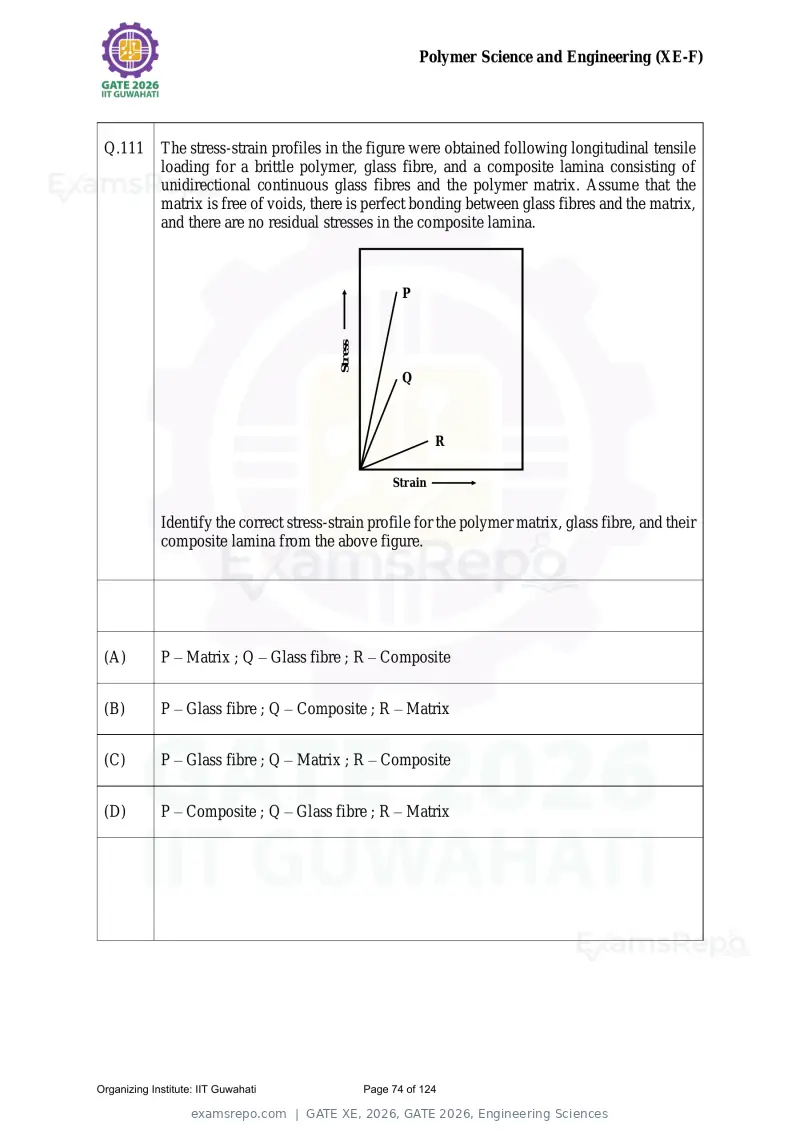
 Q.111       The stress-strain profiles in the figure were obtained following longitudinal tensile
             loading for a brittle polymer, glass fibre, and a composite lamina consisting of
             unidirectional continuous glass fibres and the polymer matrix. Assume that the
             matrix is free of voids, there is perfect bonding between glass fibres and the matrix,
             and there are no residual stresses in the composite lamina.


                                                          P


                                          Stress

                                                          Q


                                                                 R

                                                        Strain


             Identify the correct stress-strain profile for the polymer matrix, glass fibre, and their
             composite lamina from the above figure.


 (A)         P – Matrix ; Q – Glass fibre ; R – Composite


 (B)         P – Glass fibre ; Q – Composite ; R – Matrix


 (C)         P – Glass fibre ; Q – Matrix ; R – Composite


 (D)         P – Composite ; Q – Glass fibre ; R – Matrix


Organizing Institute: IIT Guwahati                 Page 74 of 124
Text of page 75
Polymer Science and Engineering (XE-F)


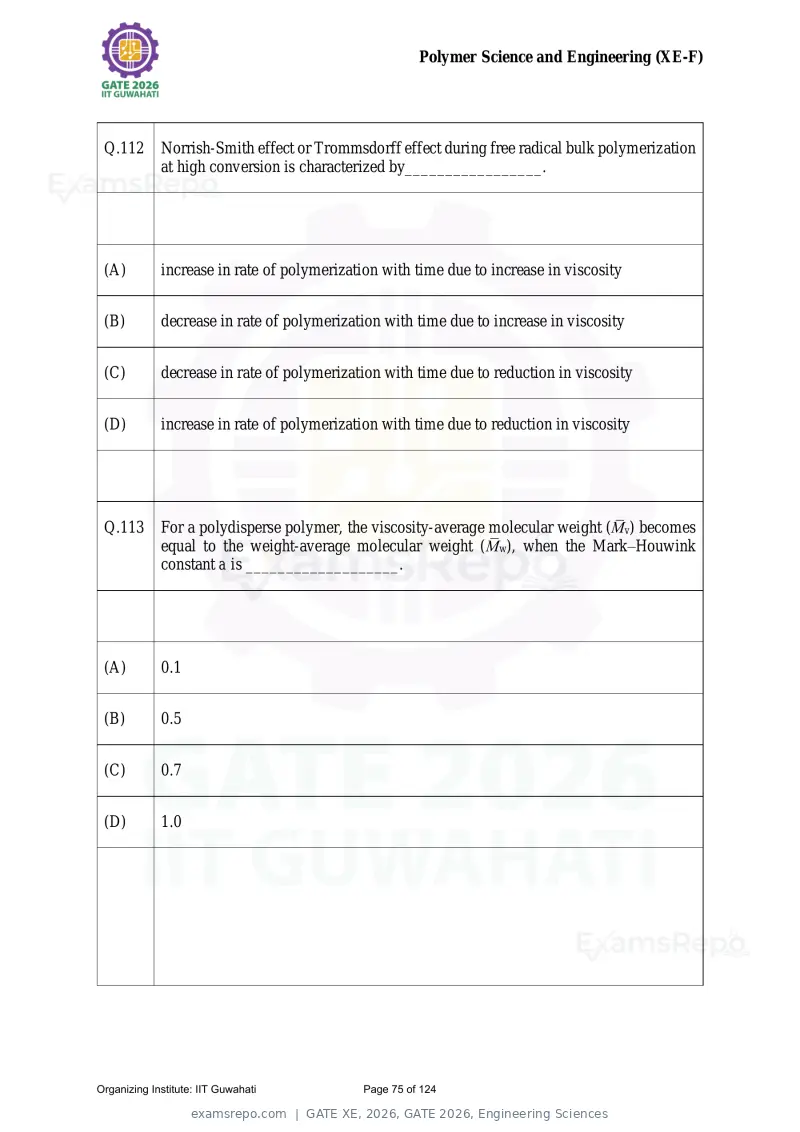
 Q.112       Norrish-Smith effect or Trommsdorff effect during free radical bulk polymerization
             at high conversion is characterized by_________________.


 (A)         increase in rate of polymerization with time due to increase in viscosity


 (B)         decrease in rate of polymerization with time due to increase in viscosity


 (C)         decrease in rate of polymerization with time due to reduction in viscosity


 (D)         increase in rate of polymerization with time due to reduction in viscosity


 Q.113       For a polydisperse polymer, the viscosity-average molecular weight (M̅v) becomes
             equal to the weight-average molecular weight (M̅w), when the Mark–Houwink
             constant a is ___________________.


 (A)         0.1


 (B)         0.5


 (C)         0.7


 (D)         1.0


Organizing Institute: IIT Guwahati           Page 75 of 124

Text of page 76
Polymer Science and Engineering (XE-F)


 Q.114       Which one of the following is NOT a rotational rheometer?


 (A)         Cone and plate rheometer


 (B)         Parallel plate rheometer


 (C)         Capillary rheometer


 (D)         Cylindrical Couette rheometer


Organizing Institute: IIT Guwahati           Page 76 of 124
Text of page 77
Polymer Science and Engineering (XE-F)


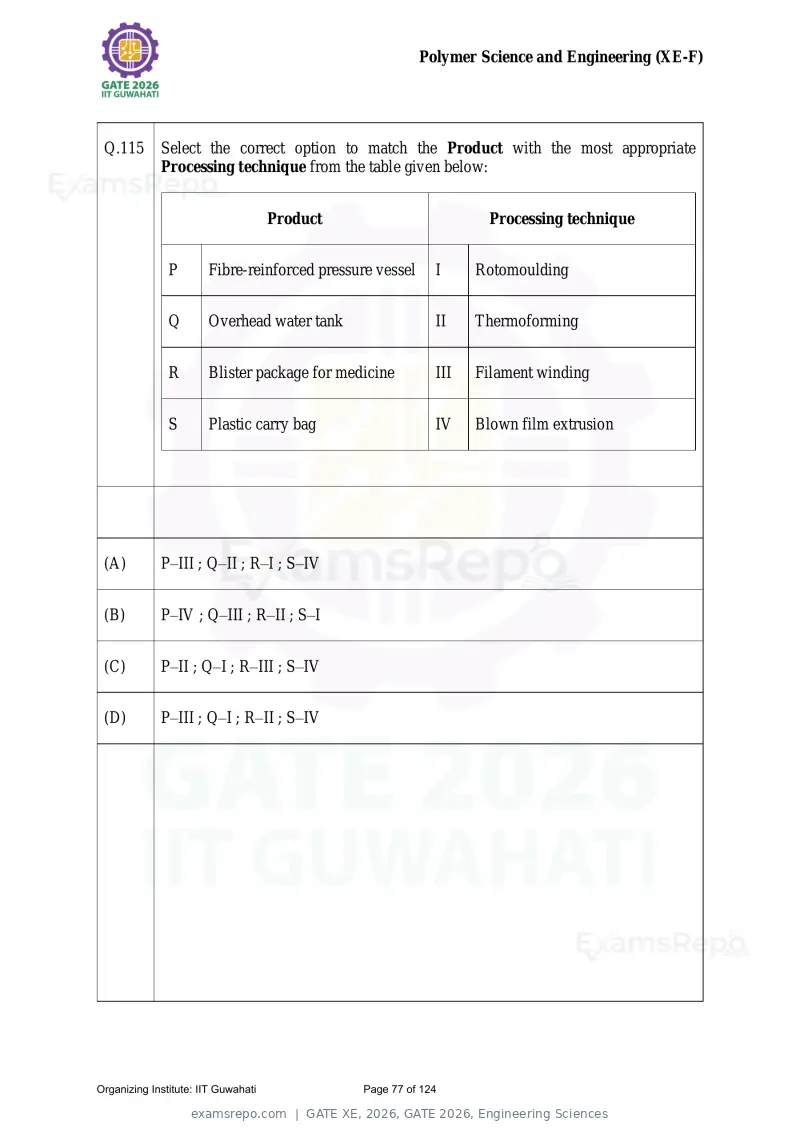
 Q.115       Select the correct option to match the Product with the most appropriate
             Processing technique from the table given below:


                                     Product                        Processing technique


               P       Fibre-reinforced pressure vessel     I     Rotomoulding


               Q       Overhead water tank                  II    Thermoforming


               R       Blister package for medicine         III   Filament winding


               S       Plastic carry bag                    IV    Blown film extrusion


 (A)         P–III ; Q–II ; R–I ; S–IV


 (B)         P–IV ; Q–III ; R–II ; S–I


 (C)         P–II ; Q–I ; R–III ; S–IV


 (D)         P–III ; Q–I ; R–II ; S–IV


Organizing Institute: IIT Guwahati             Page 77 of 124
Text of page 78
Polymer Science and Engineering (XE-F)


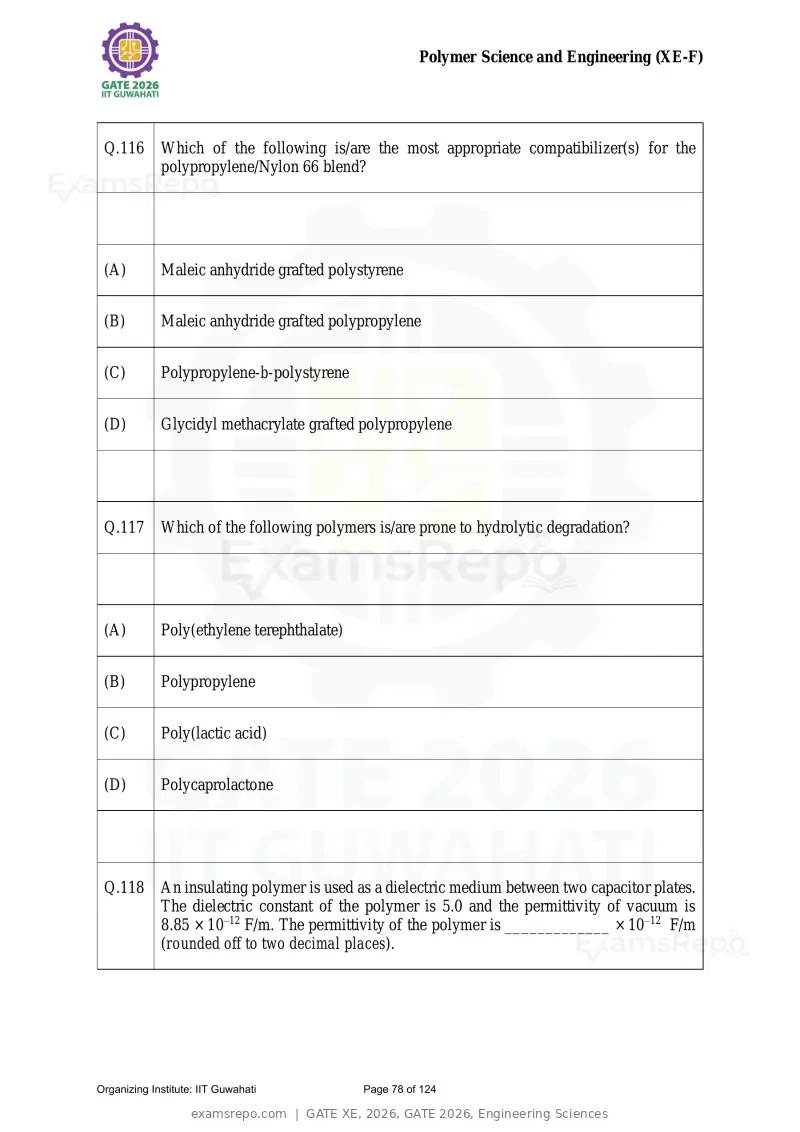
 Q.116       Which of the following is/are the most appropriate compatibilizer(s) for the
             polypropylene/Nylon 66 blend?


 (A)         Maleic anhydride grafted polystyrene


 (B)         Maleic anhydride grafted polypropylene


 (C)         Polypropylene-b-polystyrene


 (D)         Glycidyl methacrylate grafted polypropylene


 Q.117       Which of the following polymers is/are prone to hydrolytic degradation?


 (A)         Poly(ethylene terephthalate)


 (B)         Polypropylene


 (C)         Poly(lactic acid)


 (D)         Polycaprolactone


 Q.118       An insulating polymer is used as a dielectric medium between two capacitor plates.
             The dielectric constant of the polymer is 5.0 and the permittivity of vacuum is
             8.85 × 10⁻¹² F/m. The permittivity of the polymer is _____________ × 10–12 F/m
             (rounded off to two decimal places).


Organizing Institute: IIT Guwahati          Page 78 of 124
Text of page 79
Polymer Science and Engineering (XE-F)


Q.119 – Q.131 Carry TWO marks Each

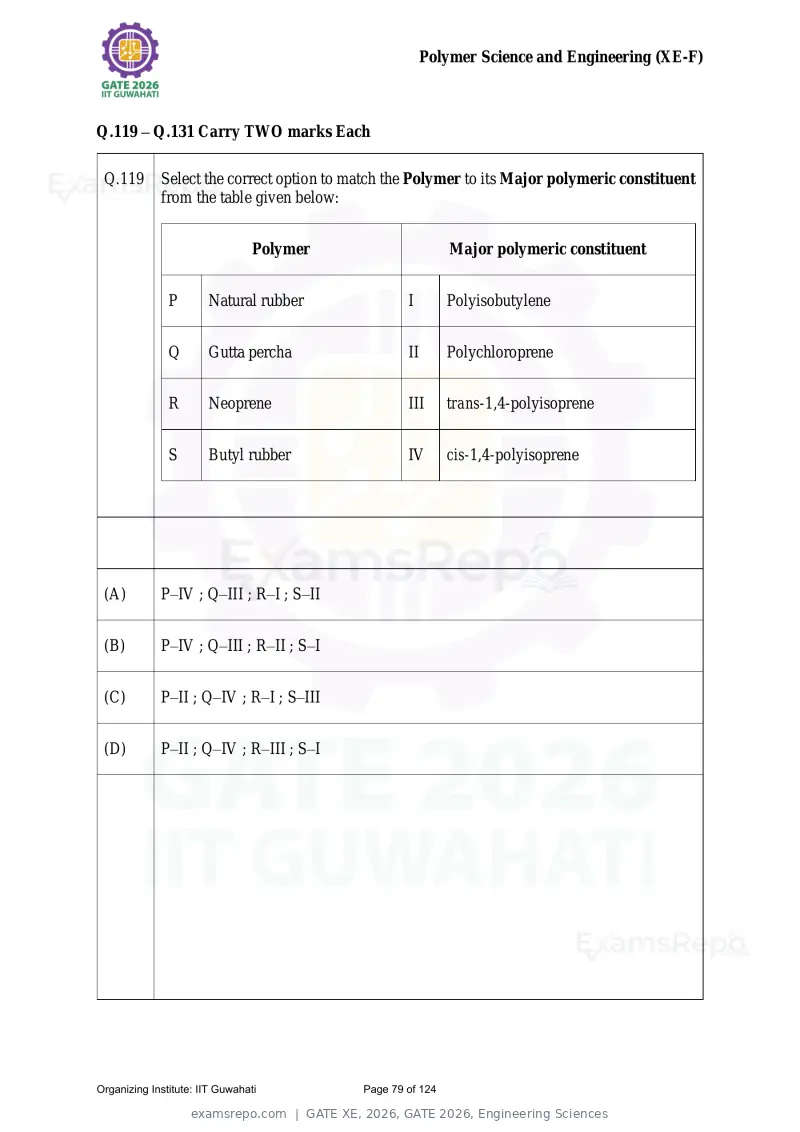
 Q.119       Select the correct option to match the Polymer to its Major polymeric constituent
             from the table given below:


                                 Polymer                    Major polymeric constituent


               P       Natural rubber              I        Polyisobutylene


               Q       Gutta percha                II       Polychloroprene


               R       Neoprene                    III      trans-1,4-polyisoprene


               S       Butyl rubber                IV       cis-1,4-polyisoprene


 (A)         P–IV ; Q–III ; R–I ; S–II


 (B)         P–IV ; Q–III ; R–II ; S–I


 (C)         P–II ; Q–IV ; R–I ; S–III


 (D)         P–II ; Q–IV ; R–III ; S–I


Organizing Institute: IIT Guwahati         Page 79 of 124
Text of page 80
Polymer Science and Engineering (XE-F)


 Q.120       Resol is produced by reaction of ___________________.


 (A)         phenol with an excess of formaldehyde in presence of a base catalyst


 (B)         formaldehyde with an excess of phenol in presence of a base catalyst


 (C)         phenol with an excess of formaldehyde in presence of an acid catalyst


 (D)         an equimolar mixture of phenol and formaldehyde at neutral pH


Organizing Institute: IIT Guwahati         Page 80 of 124
Text of page 81
Polymer Science and Engineering (XE-F)


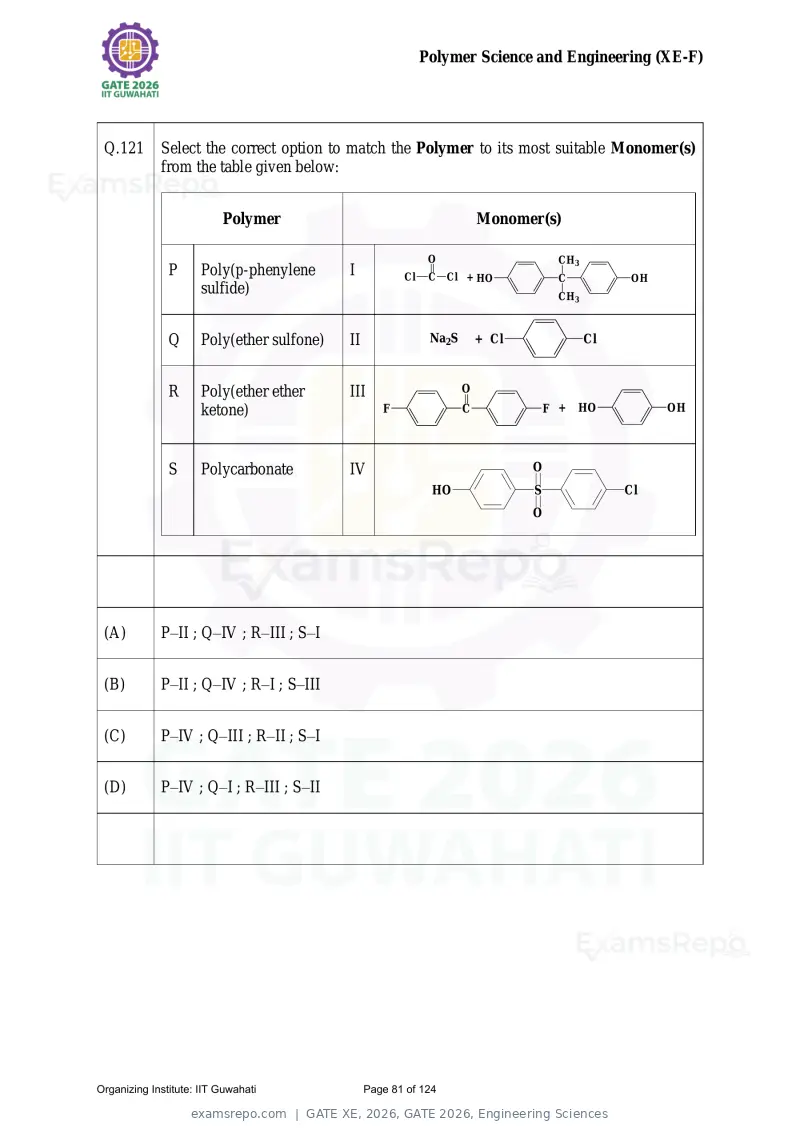
 Q.121       Select the correct option to match the Polymer to its most suitable Monomer(s)
             from the table given below:


                          Polymer                                        Monomer(s)

                                                              O                       CH3
               P      Poly(p-phenylene      I           Cl    C Cl + HO               C           OH
                      sulfide)                                                        CH3


               Q      Poly(ether sulfone)   II                Na2S       + Cl               Cl


               R      Poly(ether ether      III                      O
                      ketone)                       F                C              F +   HO           OH


               S      Polycarbonate         IV                                  O
                                                              HO                S                Cl
                                                                                O


 (A)         P–II ; Q–IV ; R–III ; S–I


 (B)         P–II ; Q–IV ; R–I ; S–III


 (C)         P–IV ; Q–III ; R–II ; S–I


 (D)         P–IV ; Q–I ; R–III ; S–II


Organizing Institute: IIT Guwahati               Page 81 of 124
Text of page 82
Polymer Science and Engineering (XE-F)


 Q.122       Select the correct option to match the Compound/Additive to its most suitable
             Function from the table given below:


                             Compound/Additive                           Function


               P     Azocarbonamide                          I    Flame retardant


               Q     2-(2-hydroxyphenyl)-benzotriazole       II   Coupling agent


               R     (3-Aminopropyl)triethoxysilane          III Blowing agent


               S     Ammonium polyphosphate                  IV UV-absorber


 (A)         P–IV ; Q–III ; R–II ; S–I


 (B)         P–III ; Q–IV ; R–II ; S–I


 (C)         P–I ; Q–III ; R–II ; S–IV


 (D)         P–III ; Q–IV ; R–I ; S–II


Organizing Institute: IIT Guwahati          Page 82 of 124
Text of page 83
Polymer Science and Engineering (XE-F)


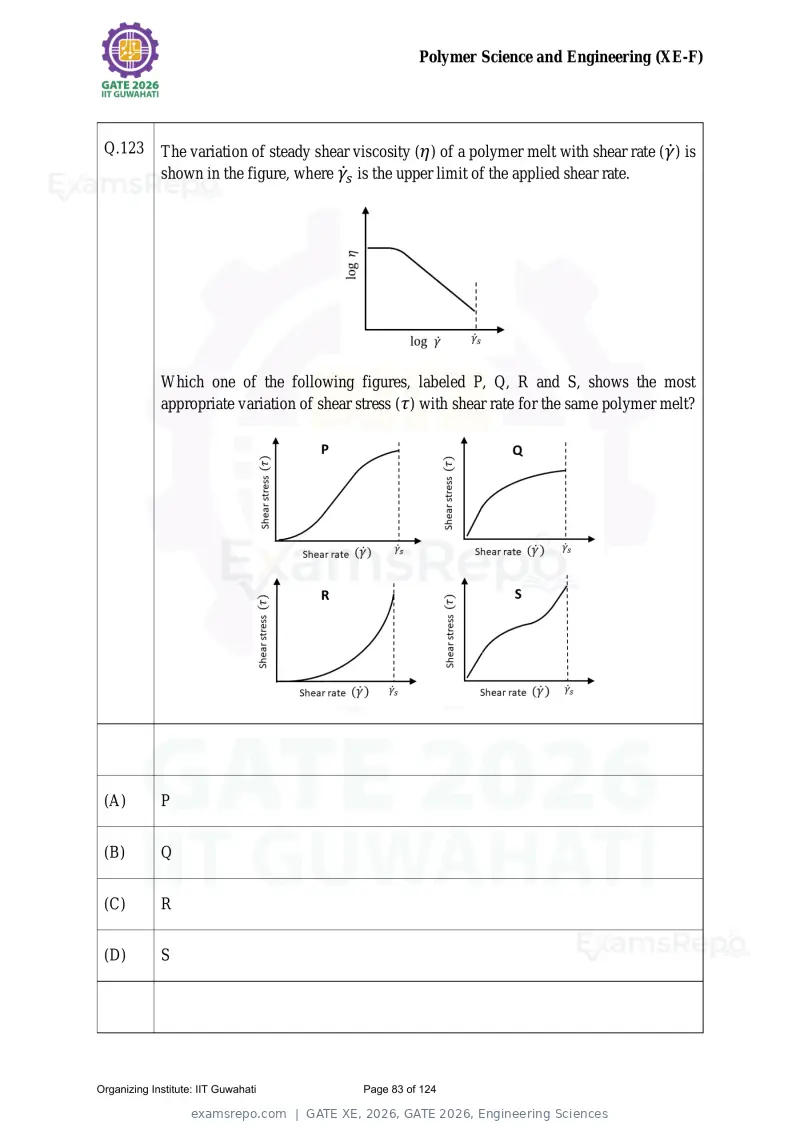
 Q.123       The variation of steady shear viscosity (η ) of a polymer melt with shear rate (γ̇ ) is
             shown in the figure, where γ̇s is the upper limit of the applied shear rate.


             Which one of the following figures, labeled P, Q, R and S, shows the most
             appropriate variation of shear stress (τ) with shear rate for the same polymer melt?


 (A)         P


 (B)         Q


 (C)         R


 (D)         S


Organizing Institute: IIT Guwahati           Page 83 of 124
Text of page 84
Polymer Science and Engineering (XE-F)


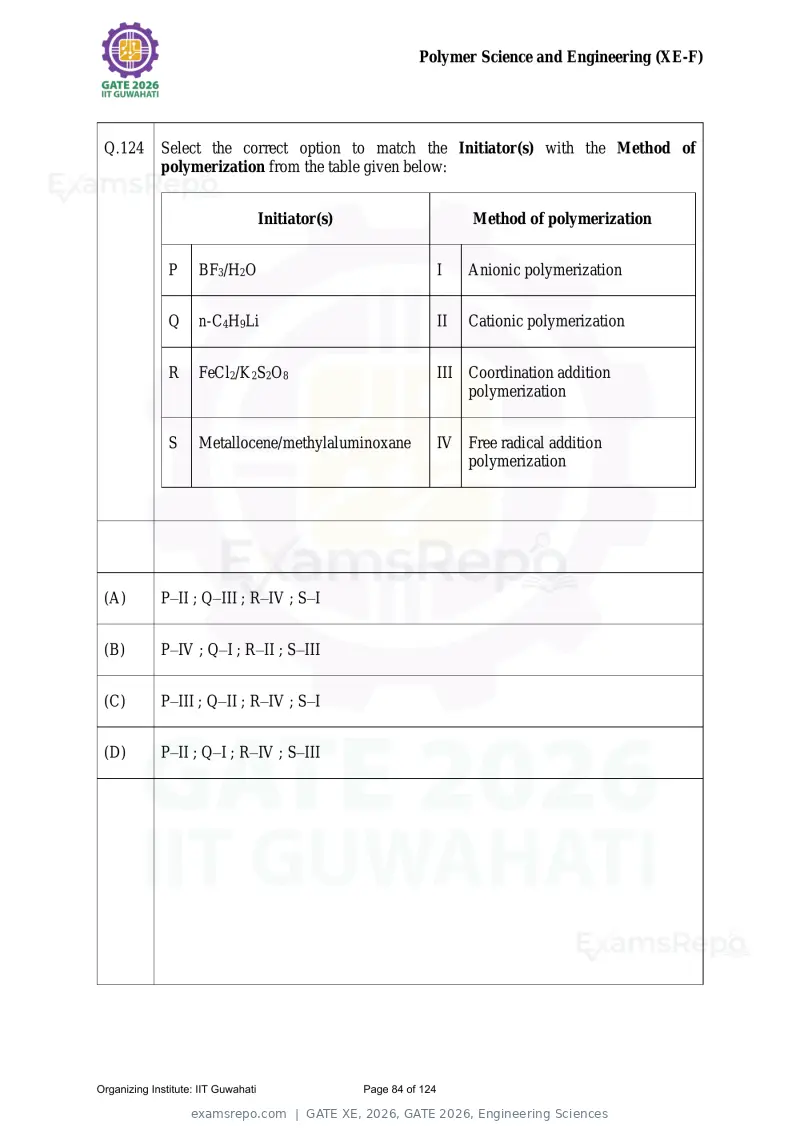
 Q.124       Select the correct option to match the Initiator(s) with the Method of
             polymerization from the table given below:


                                     Initiator(s)                         Method of polymerization


               P     BF3/H2O                                         I    Anionic polymerization


               Q     n-C4H9Li                                        II   Cationic polymerization


               R     FeCl2/K2S2O8                                    III Coordination addition
                                                                         polymerization


               S     Metallocene/methylaluminoxane                   IV Free radical addition
                                                                        polymerization


 (A)         P–II ; Q–III ; R–IV ; S–I


 (B)         P–IV ; Q–I ; R–II ; S–III


 (C)         P–III ; Q–II ; R–IV ; S–I


 (D)         P–II ; Q–I ; R–IV ; S–III


Organizing Institute: IIT Guwahati                  Page 84 of 124
Text of page 85
Polymer Science and Engineering (XE-F)


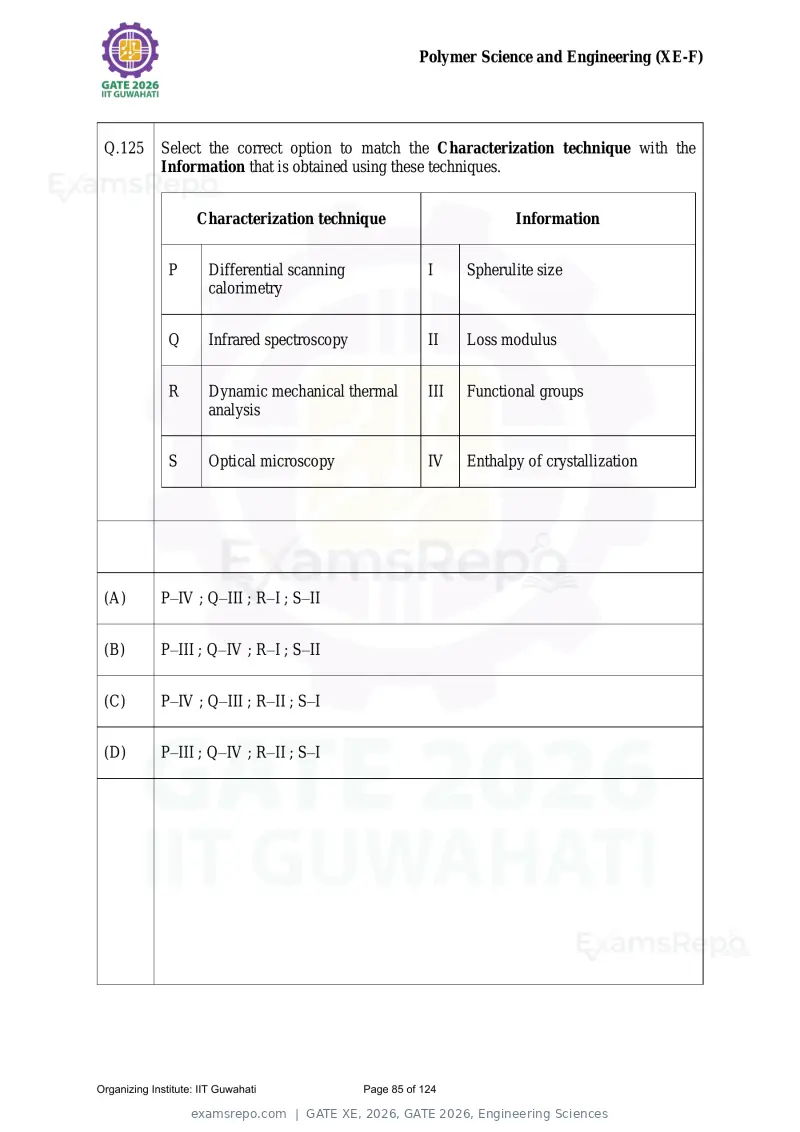
 Q.125       Select the correct option to match the Characterization technique with the
             Information that is obtained using these techniques.


                     Characterization technique                         Information


               P       Differential scanning               I     Spherulite size
                       calorimetry


               Q       Infrared spectroscopy               II    Loss modulus


               R       Dynamic mechanical thermal          III   Functional groups
                       analysis


               S       Optical microscopy                  IV    Enthalpy of crystallization


 (A)         P–IV ; Q–III ; R–I ; S–II


 (B)         P–III ; Q–IV ; R–I ; S–II


 (C)         P–IV ; Q–III ; R–II ; S–I


 (D)         P–III ; Q–IV ; R–II ; S–I


Organizing Institute: IIT Guwahati             Page 85 of 124
Text of page 86
Polymer Science and Engineering (XE-F)


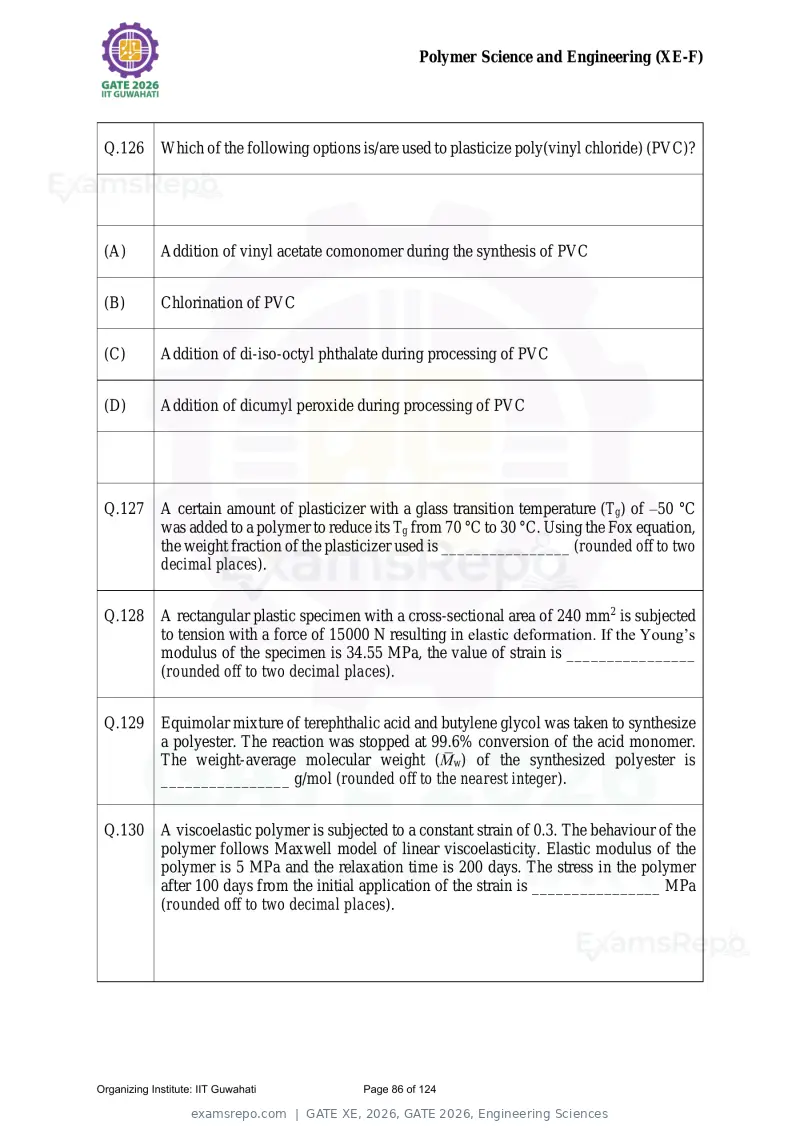
 Q.126       Which of the following options is/are used to plasticize poly(vinyl chloride) (PVC)?


 (A)         Addition of vinyl acetate comonomer during the synthesis of PVC


 (B)         Chlorination of PVC


 (C)         Addition of di-iso-octyl phthalate during processing of PVC


 (D)         Addition of dicumyl peroxide during processing of PVC


 Q.127       A certain amount of plasticizer with a glass transition temperature (Tg) of –50 °C
             was added to a polymer to reduce its Tg from 70 °C to 30 °C. Using the Fox equation,
             the weight fraction of the plasticizer used is ________________ (rounded off to two
             decimal places).


 Q.128       A rectangular plastic specimen with a cross-sectional area of 240 mm2 is subjected
             to tension with a force of 15000 N resulting in elastic deformation. If the Young’s
             modulus of the specimen is 34.55 MPa, the value of strain is ________________
             (rounded off to two decimal places).


 Q.129       Equimolar mixture of terephthalic acid and butylene glycol was taken to synthesize
             a polyester. The reaction was stopped at 99.6% conversion of the acid monomer.
             The weight-average molecular weight (M̅w) of the synthesized polyester is
             ________________ g/mol (rounded off to the nearest integer).


 Q.130       A viscoelastic polymer is subjected to a constant strain of 0.3. The behaviour of the
             polymer follows Maxwell model of linear viscoelasticity. Elastic modulus of the
             polymer is 5 MPa and the relaxation time is 200 days. The stress in the polymer
             after 100 days from the initial application of the strain is ________________ MPa
             (rounded off to two decimal places).


Organizing Institute: IIT Guwahati           Page 86 of 124
Text of page 87
Polymer Science and Engineering (XE-F)


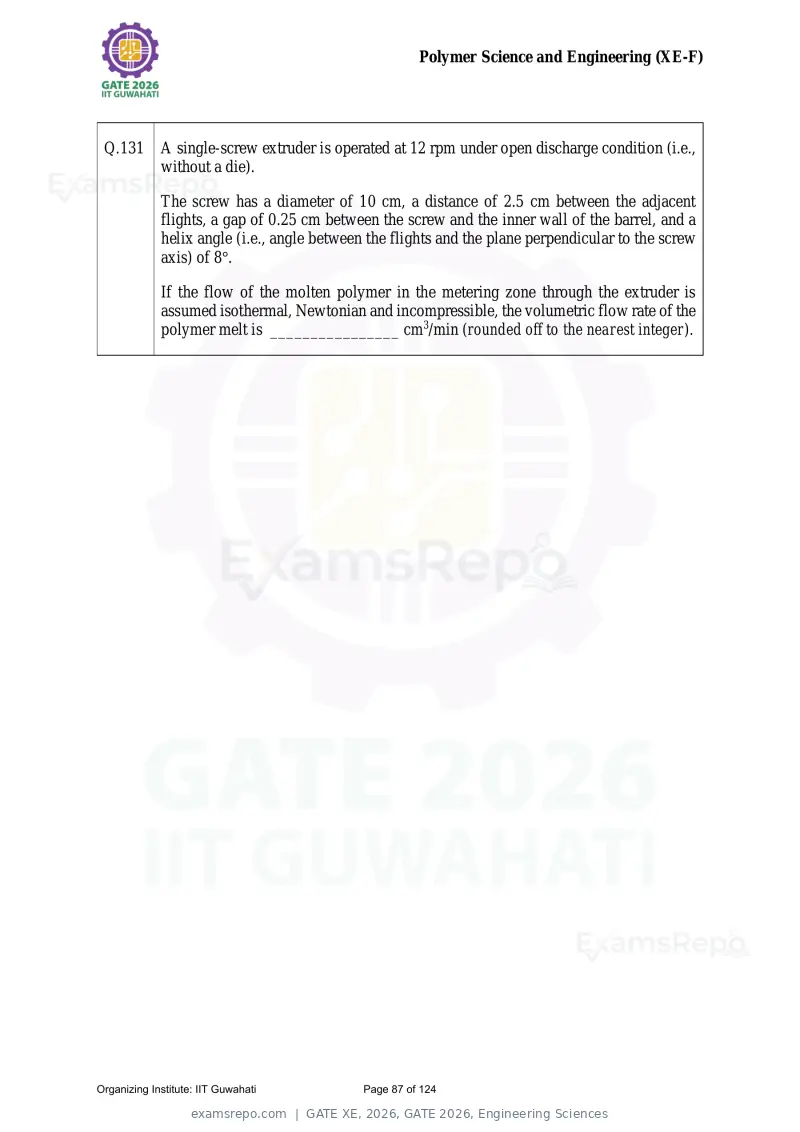
 Q.131       A single-screw extruder is operated at 12 rpm under open discharge condition (i.e.,
             without a die).

             The screw has a diameter of 10 cm, a distance of 2.5 cm between the adjacent
             flights, a gap of 0.25 cm between the screw and the inner wall of the barrel, and a
             helix angle (i.e., angle between the flights and the plane perpendicular to the screw
             axis) of 8°.

             If the flow of the molten polymer in the metering zone through the extruder is
             assumed isothermal, Newtonian and incompressible, the volumetric flow rate of the
             polymer melt is ________________ cm3/min (rounded off to the nearest integer).


Organizing Institute: IIT Guwahati           Page 87 of 124

Text of page 88
Food Technology (XE-G)


Q.132 – Q.140 Carry ONE mark Each

 Q.132       Ergotism is caused by ingestion of grains infected with


 (A)         Clostridium perfringens


 (B)         Rhizopus stolonifer


 (C)         Lactococcus lactis


 (D)         Claviceps purpurea


Organizing Institute: IIT Guwahati          Page 88 of 124
Text of page 89
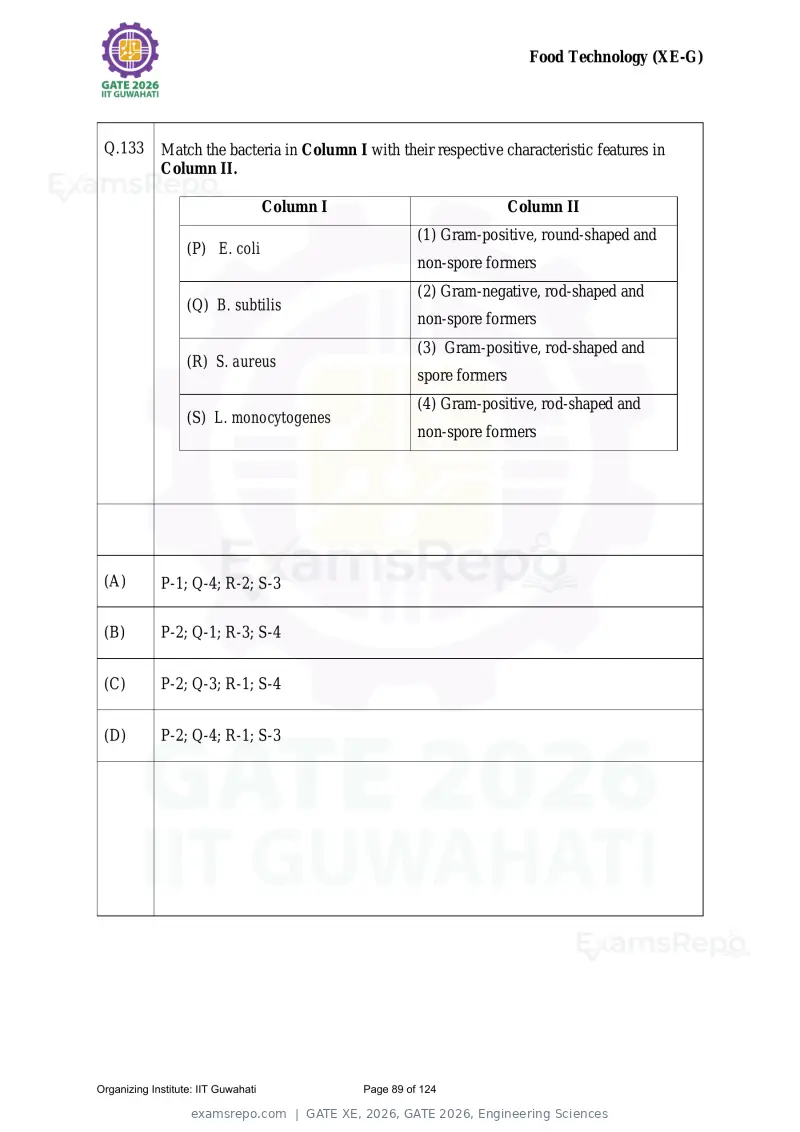
Food Technology (XE-G)


 Q.133       Match the bacteria in Column I with their respective characteristic features in
             Column II.

                                     Column I                             Column II
                                                          (1) Gram-positive, round-shaped and
                   (P) E. coli
                                                          non-spore formers
                                                          (2) Gram-negative, rod-shaped and
                   (Q) B. subtilis
                                                          non-spore formers
                                                          (3) Gram-positive, rod-shaped and
                   (R) S. aureus
                                                          spore formers
                                                          (4) Gram-positive, rod-shaped and
                   (S) L. monocytogenes
                                                          non-spore formers


 (A)         P-1; Q-4; R-2; S-3


 (B)         P-2; Q-1; R-3; S-4


 (C)         P-2; Q-3; R-1; S-4


 (D)         P-2; Q-4; R-1; S-3


Organizing Institute: IIT Guwahati              Page 89 of 124
Text of page 90
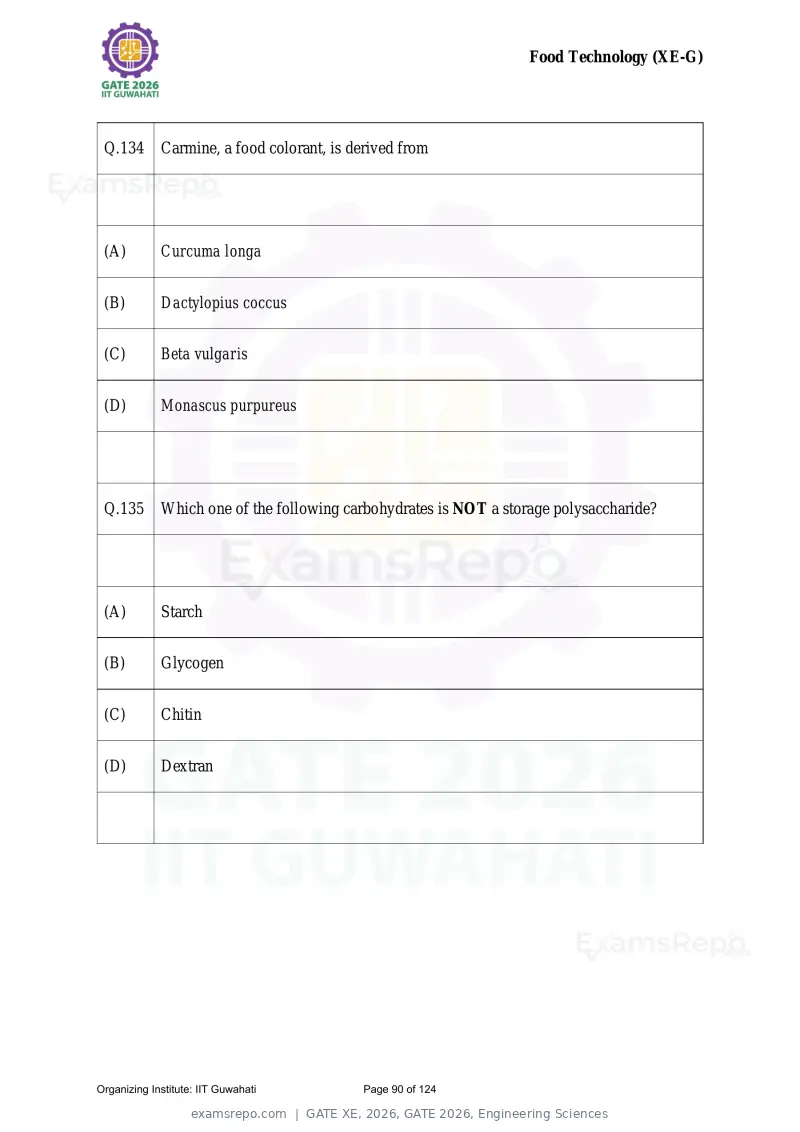
Food Technology (XE-G)


 Q.134       Carmine, a food colorant, is derived from


 (A)         Curcuma longa


 (B)         Dactylopius coccus


 (C)         Beta vulgaris


 (D)         Monascus purpureus


 Q.135       Which one of the following carbohydrates is NOT a storage polysaccharide?


 (A)         Starch


 (B)         Glycogen


 (C)         Chitin


 (D)         Dextran


Organizing Institute: IIT Guwahati         Page 90 of 124
Text of page 91
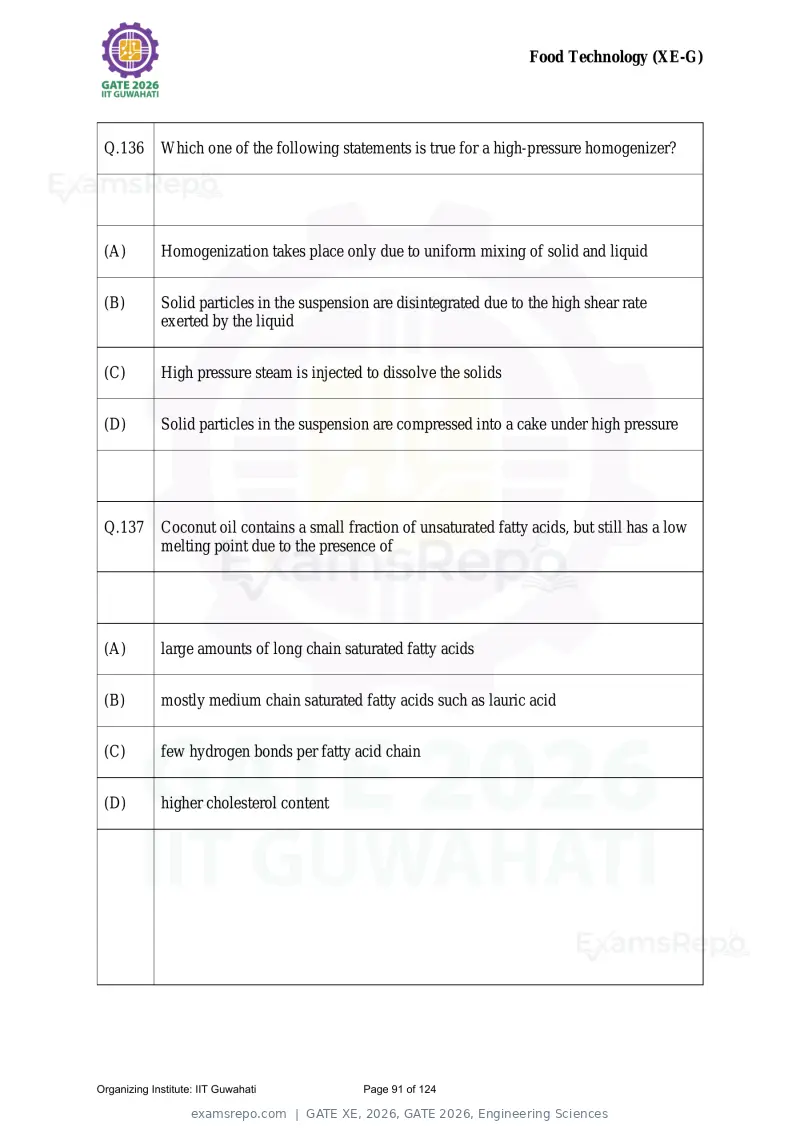
Food Technology (XE-G)


 Q.136       Which one of the following statements is true for a high-pressure homogenizer?


 (A)         Homogenization takes place only due to uniform mixing of solid and liquid


 (B)         Solid particles in the suspension are disintegrated due to the high shear rate
             exerted by the liquid


 (C)         High pressure steam is injected to dissolve the solids


 (D)         Solid particles in the suspension are compressed into a cake under high pressure


 Q.137       Coconut oil contains a small fraction of unsaturated fatty acids, but still has a low
             melting point due to the presence of


 (A)         large amounts of long chain saturated fatty acids


 (B)         mostly medium chain saturated fatty acids such as lauric acid


 (C)         few hydrogen bonds per fatty acid chain


 (D)         higher cholesterol content


Organizing Institute: IIT Guwahati           Page 91 of 124
Text of page 92
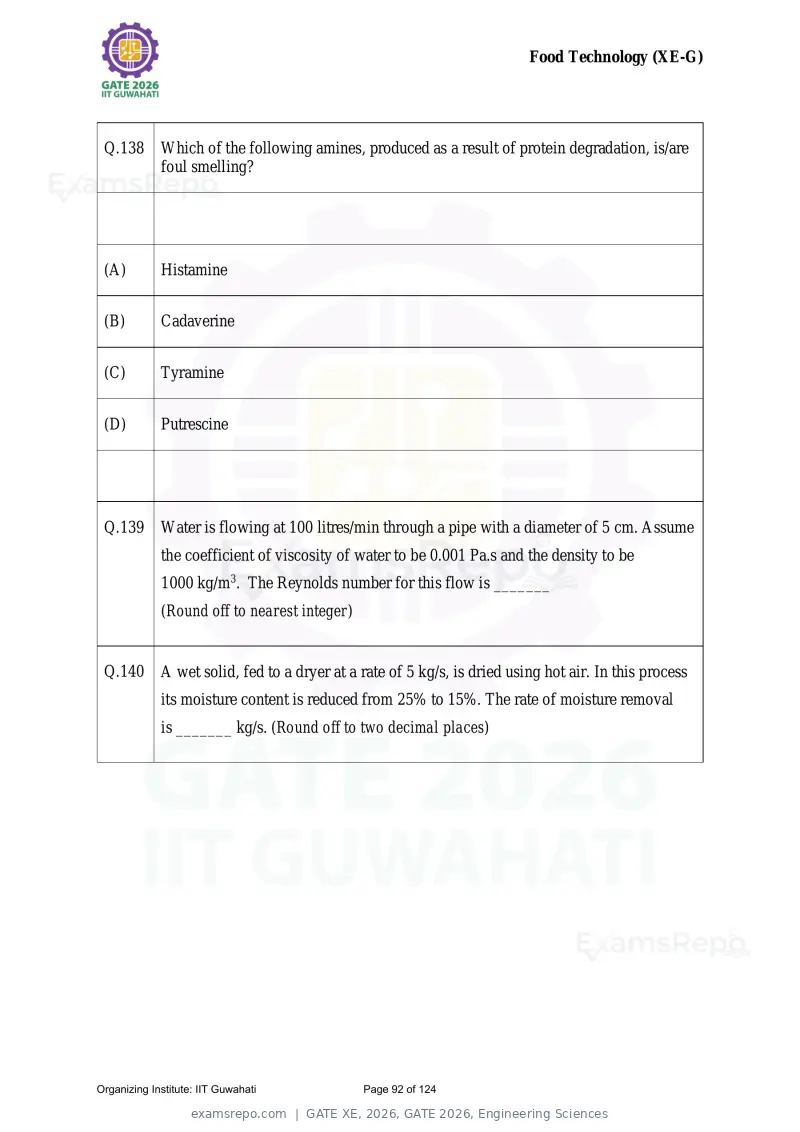
Food Technology (XE-G)


 Q.138       Which of the following amines, produced as a result of protein degradation, is/are
             foul smelling?


 (A)         Histamine


 (B)         Cadaverine


 (C)         Tyramine


 (D)         Putrescine


 Q.139       Water is flowing at 100 litres/min through a pipe with a diameter of 5 cm. Assume
             the coefficient of viscosity of water to be 0.001 Pa.s and the density to be
             1000 kg/m3. The Reynolds number for this flow is _______
             (Round off to nearest integer)


 Q.140       A wet solid, fed to a dryer at a rate of 5 kg/s, is dried using hot air. In this process
             its moisture content is reduced from 25% to 15%. The rate of moisture removal
             is _______ kg/s. (Round off to two decimal places)


Organizing Institute: IIT Guwahati            Page 92 of 124
Text of page 93
Food Technology (XE-G)


Q.141 – Q.153 Carry TWO marks Each

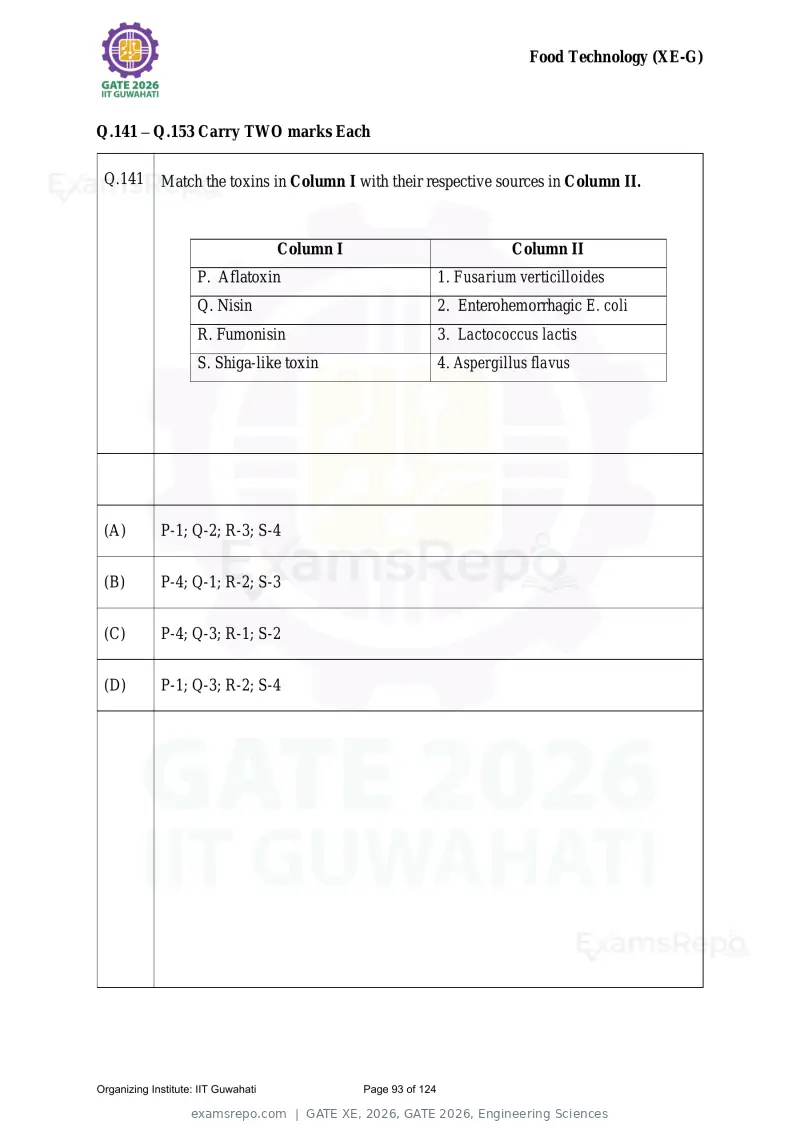
 Q.141       Match the toxins in Column I with their respective sources in Column II.


                                     Column I                               Column II
                     P. Aflatoxin                                1. Fusarium verticilloides
                     Q. Nisin                                    2. Enterohemorrhagic E. coli
                     R. Fumonisin                                3. Lactococcus lactis
                     S. Shiga-like toxin                         4. Aspergillus flavus


 (A)         P-1; Q-2; R-3; S-4


 (B)         P-4; Q-1; R-2; S-3


 (C)         P-4; Q-3; R-1; S-2


 (D)         P-1; Q-3; R-2; S-4


Organizing Institute: IIT Guwahati              Page 93 of 124
Text of page 94
Food Technology (XE-G)


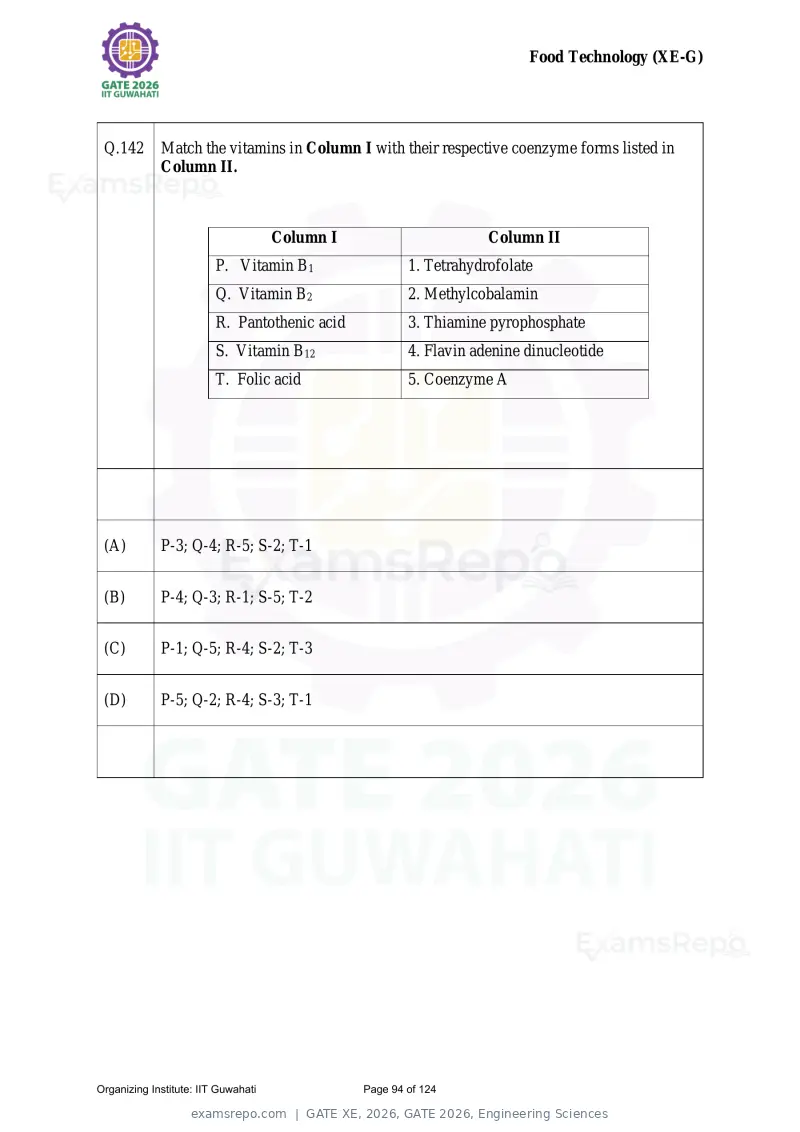
 Q.142       Match the vitamins in Column I with their respective coenzyme forms listed in
             Column II.


                                     Column I                       Column II
                         P. Vitamin B1                  1. Tetrahydrofolate
                         Q. Vitamin B2                  2. Methylcobalamin
                         R. Pantothenic acid            3. Thiamine pyrophosphate
                         S. Vitamin B12                 4. Flavin adenine dinucleotide
                         T. Folic acid                  5. Coenzyme A


 (A)         P-3; Q-4; R-5; S-2; T-1


 (B)         P-4; Q-3; R-1; S-5; T-2


 (C)         P-1; Q-5; R-4; S-2; T-3


 (D)         P-5; Q-2; R-4; S-3; T-1


Organizing Institute: IIT Guwahati              Page 94 of 124

Text of page 95
Food Technology (XE-G)


 Q.143       Which one of the following proteins brings about the coagulation of milk in the
             stomach of calves?


 (A)         Rennin


 (B)         Alpha-lactalbumin


 (C)         Beta-lactoglobulin


 (D)         Lactoferrin


Organizing Institute: IIT Guwahati          Page 95 of 124
Text of page 96
Food Technology (XE-G)


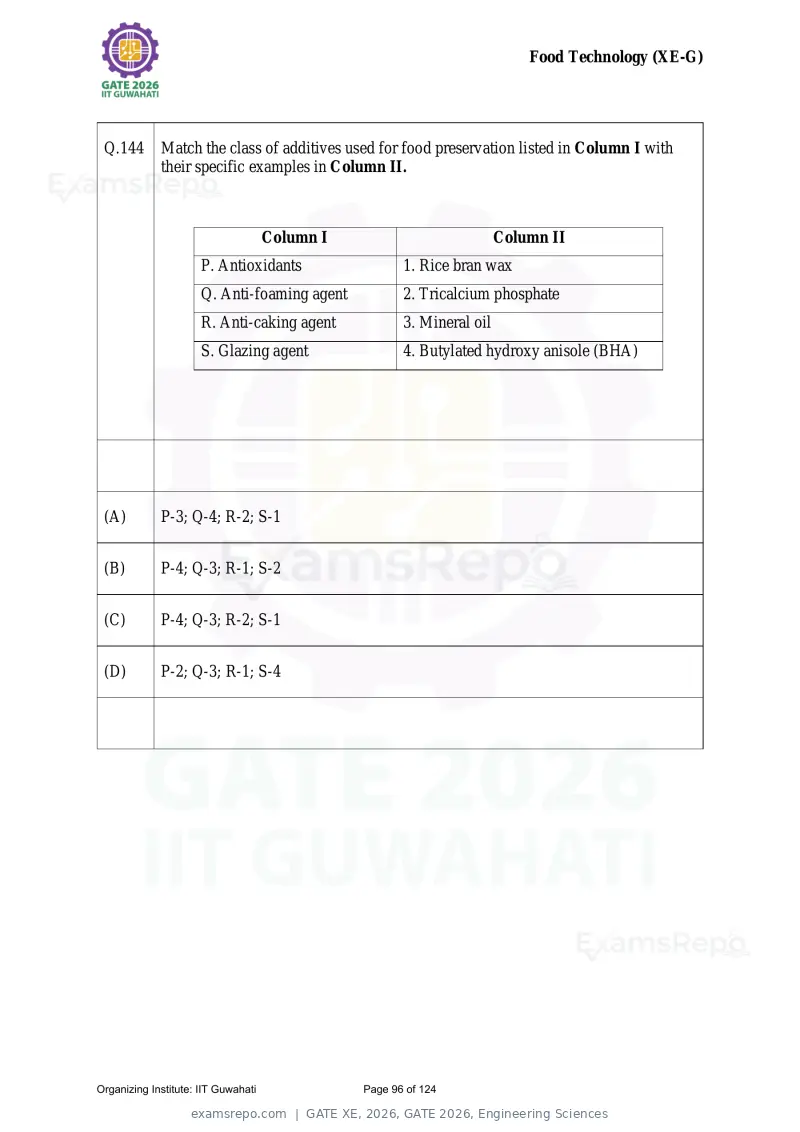
 Q.144       Match the class of additives used for food preservation listed in Column I with
             their specific examples in Column II.


                                     Column I                           Column II
                      P. Antioxidants                  1. Rice bran wax
                      Q. Anti-foaming agent            2. Tricalcium phosphate
                      R. Anti-caking agent             3. Mineral oil
                      S. Glazing agent                 4. Butylated hydroxy anisole (BHA)


 (A)         P-3; Q-4; R-2; S-1


 (B)         P-4; Q-3; R-1; S-2


 (C)         P-4; Q-3; R-2; S-1


 (D)         P-2; Q-3; R-1; S-4


Organizing Institute: IIT Guwahati              Page 96 of 124
Text of page 97
Food Technology (XE-G)


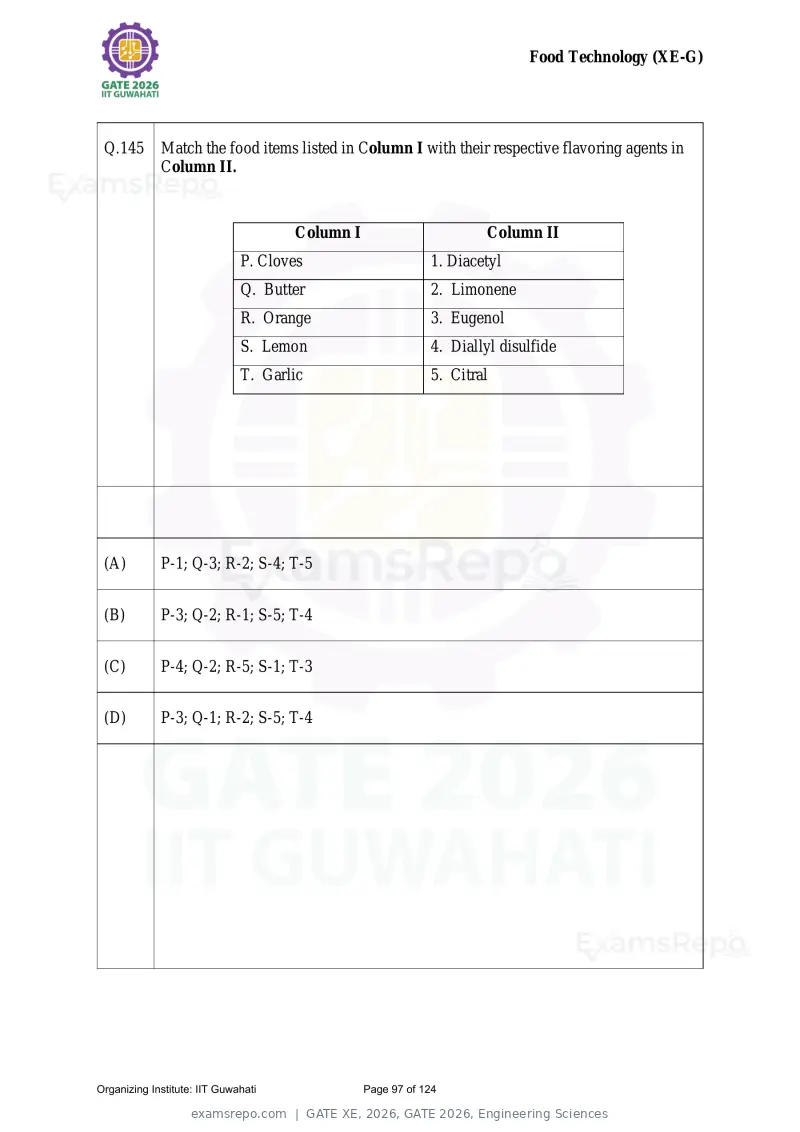
 Q.145       Match the food items listed in Column I with their respective flavoring agents in
             Column II.


                                     Column I                        Column II
                              P. Cloves                     1. Diacetyl
                              Q. Butter                     2. Limonene
                              R. Orange                     3. Eugenol
                              S. Lemon                      4. Diallyl disulfide
                              T. Garlic                     5. Citral


 (A)         P-1; Q-3; R-2; S-4; T-5


 (B)         P-3; Q-2; R-1; S-5; T-4


 (C)         P-4; Q-2; R-5; S-1; T-3


 (D)         P-3; Q-1; R-2; S-5; T-4


Organizing Institute: IIT Guwahati              Page 97 of 124
Text of page 98
Food Technology (XE-G)


 Q.146       Vegetable oils resist oxidation and maintain their quality for a long period due to
             the presence of


 (A)         tocopherols


 (B)         hydrolytic enzyme such as lipases


 (C)         microorganisms such as molds and yeast


 (D)         carbohydrates


 Q.147       For a given temperature difference between the top and bottom surfaces of a flat
             metal plate, Fourier’s law of heat conduction implies that


 (A)         temperature gradient increases with increase in heat transfer area


 (B)         heat flux is proportional to the thermal conductivity of the metal


 (C)         heat flux increases with increase in thickness of the metal plate


 (D)         temperature gradient decreases with increase in thickness of the metal plate


Organizing Institute: IIT Guwahati           Page 98 of 124
Text of page 99
Food Technology (XE-G)


 Q.148       Xylooligosaccharides can be produced by


 (A)         hydrolytic degradation of xylan by hydrochloric acid


 (B)         hydrolysis of starch


 (C)         enzymatic hydrolysis of lactose


 (D)         enzymatic hydrolysis of xylan containing lignocellulosic material


 Q.149       In a α-helix, the R-groups on the amino acid residues


 (A)         are found on the outside of the helix


 (B)         participate in the backbone H-bonding that stabilize the helix


 (C)         allow formation of right-handed helices


 (D)         allow formation of left-handed helices


Organizing Institute: IIT Guwahati           Page 99 of 124
Text of page 100
Food Technology (XE-G)


 Q.150       During constant pressure cake filtration, for an incompressible cake deposited
             uniformly over a constant filter surface area,


 (A)         the cake resistance remains constant


 (B)         the cake resistance increases in proportion to the cake thickness


 (C)         the filtration rate remains constant


 (D)         the filtration rate decreases with time


 Q.151       Hot oil is being cooled in a countercurrent, double-pipe heat exchanger from
             410 K to 340 K by chilled water entering at 290 K and exiting the exchanger at
             330 K. The Log Mean Temperature Difference (LMTD) for this heat transfer
             is ________K. (Round off to one decimal place)


 Q.152       A cold-storage room has a double-layered wall. The inner layer is 10 cm thick,
             made of fiber insulation board (k = 0.048 W m-1 K-1), and the outer layer is 15 cm
             thick, made of concrete (k = 0.762 W m-1 K-1). The surface temperature of the
             wall inside the cold room is 260 K and the ambient temperature outside is 300 K.
             The steady state heat flux into the cold room is ____________ W/m2.
             (Round off to two decimal places)


Organizing Institute: IIT Guwahati           Page 100 of 124

Text of page 101
Food Technology (XE-G)


 Q.153       A tubular centrifuge separates 5 micron particles of density 1500 kg/m3 from a
             slurry. The slurry is fed at a volumetric flow rate of 0.5 m3/s. The equivalent
             clarification area of the centrifuge is _______m2. (Answer in integer)

             Assume g = 10 m/s2 and for water, density = 1000 kg/m3,
             coefficient of viscosity (µ) = 10-3 Pa-s


Organizing Institute: IIT Guwahati           Page 101 of 124
Text of page 102
Atmospheric and Oceanic Sciences (XE-H)


Q.154 – Q.162 Carry ONE mark Each

 Q.154       Which of the following is TRUE for the ‘summer solstice’ in the Northern

             Hemisphere?


 (A)         Longest night of the year


 (B)         Equal duration of daylight and night


 (C)         Longest duration of daylight of the year


 (D)         Shortest duration of daylight of the year


 Q.155       Which of the following options are parts of the atmospheric boundary layer?


 (A)         Benthic boundary layer, Internal boundary layer


 (B)         Mixed layer, Entrainment layer


 (C)         Mixed layer, Internal boundary layer


 (D)         Mixed layer, Benthic boundary layer


Organizing Institute: IIT Guwahati          Page 102 of 124
Text of page 103
Atmospheric and Oceanic Sciences (XE-H)


             What is the approximate value of annual-mean pH of seawater at the surface in the
 Q.156
             northern Indian Ocean?


 (A)         4.5


 (B)         5.0


 (C)         8.0


 (D)         11.0


 Q.157       Which of the following weather systems has the shortest duration of lifecycle?


             Tropical Cyclones
 (A)

             Thunderstorms
 (B)

             Western Disturbance
 (C)

             Winter Monsoon
 (D)


Organizing Institute: IIT Guwahati         Page 103 of 124
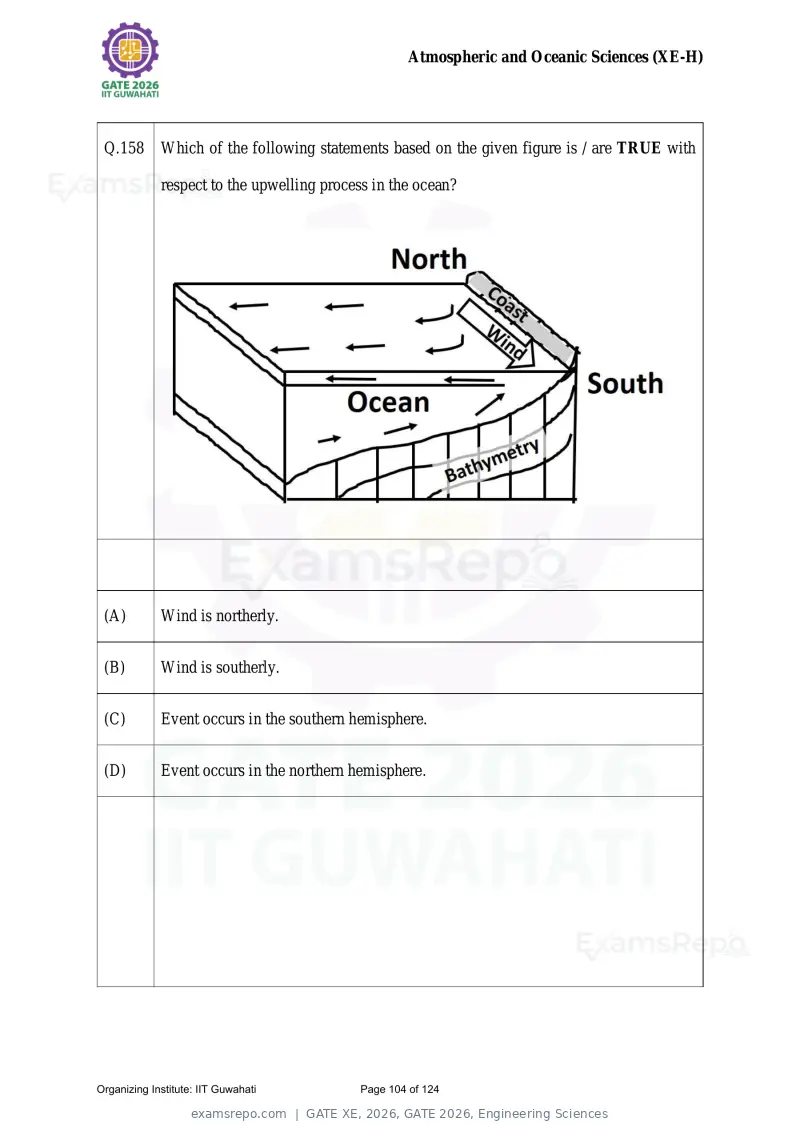
Text of page 104
Atmospheric and Oceanic Sciences (XE-H)


 Q.158       Which of the following statements based on the given figure is / are TRUE with

             respect to the upwelling process in the ocean?


 (A)         Wind is northerly.


 (B)         Wind is southerly.


 (C)         Event occurs in the southern hemisphere.


 (D)         Event occurs in the northern hemisphere.


Organizing Institute: IIT Guwahati         Page 104 of 124
Text of page 105
Atmospheric and Oceanic Sciences (XE-H)


 Q.159       In a stable atmosphere, the change in pressure (in kilo Pascal) at a height of 100 m

             from the mean sea level is _____. (rounded off to three decimal places)


             [Density of air is 1.029 kg m−3 and acceleration due to gravity is 9.81 m s −2 ]


 Q.160       If 20 wave crests pass a fixed point in an interval of 5 minutes, then the frequency

             of the wave (in Hertz) is _______. (rounded off to three decimal places)


 Q.161       The required magnitude of heat transfer to reduce the temperature of

             10 kg of dry air by 5 ℃ is ____________ kilo Joules. (rounded off to one decimal

             place)


             [Specific heat capacity of dry air is 1004 J kg−1 K −1]


 Q.162       The mass (in kg) of dry air in a room, measuring 10 m × 7 m × 3 m, is ______.

             (rounded off to two decimal places)


             [Density of dry air is 1.029× 10⁻³ g cm−3]


Organizing Institute: IIT Guwahati          Page 105 of 124
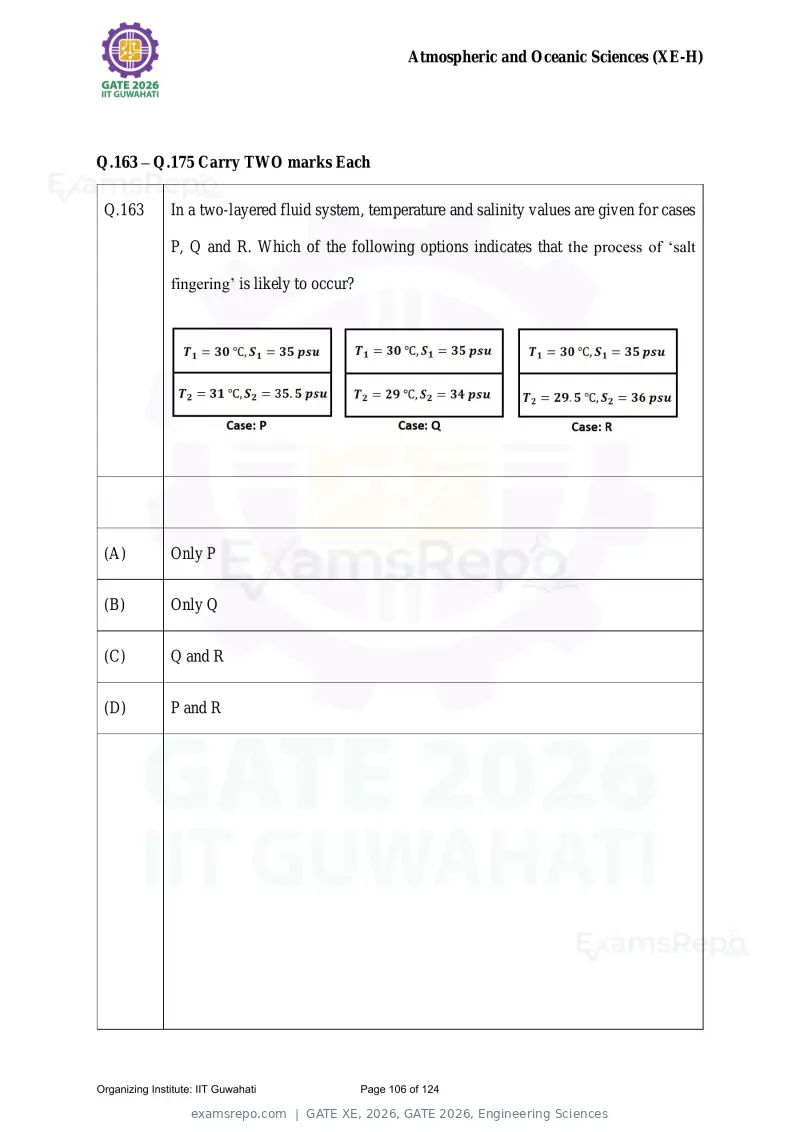
Text of page 106
Atmospheric and Oceanic Sciences (XE-H)


Q.163 – Q.175 Carry TWO marks Each

 Q.163         In a two-layered fluid system, temperature and salinity values are given for cases

               P, Q and R. Which of the following options indicates that the process of ‘salt

               fingering’ is likely to occur?


 (A)           Only P


 (B)           Only Q


 (C)           Q and R


 (D)           P and R


Organizing Institute: IIT Guwahati              Page 106 of 124
Text of page 107
Atmospheric and Oceanic Sciences (XE-H)


 Q.164         A body radiates heat at a rate of 5 cal m−2 s −1, when its temperature is 227 ℃.

               Which of the following is the correct value of the heat (in cal m−2 s −1) radiated

               by the same body at a temperature of 727 ℃?


 (A)           25


 (B)           80


 (C)           150


 (D)           625


Organizing Institute: IIT Guwahati          Page 107 of 124
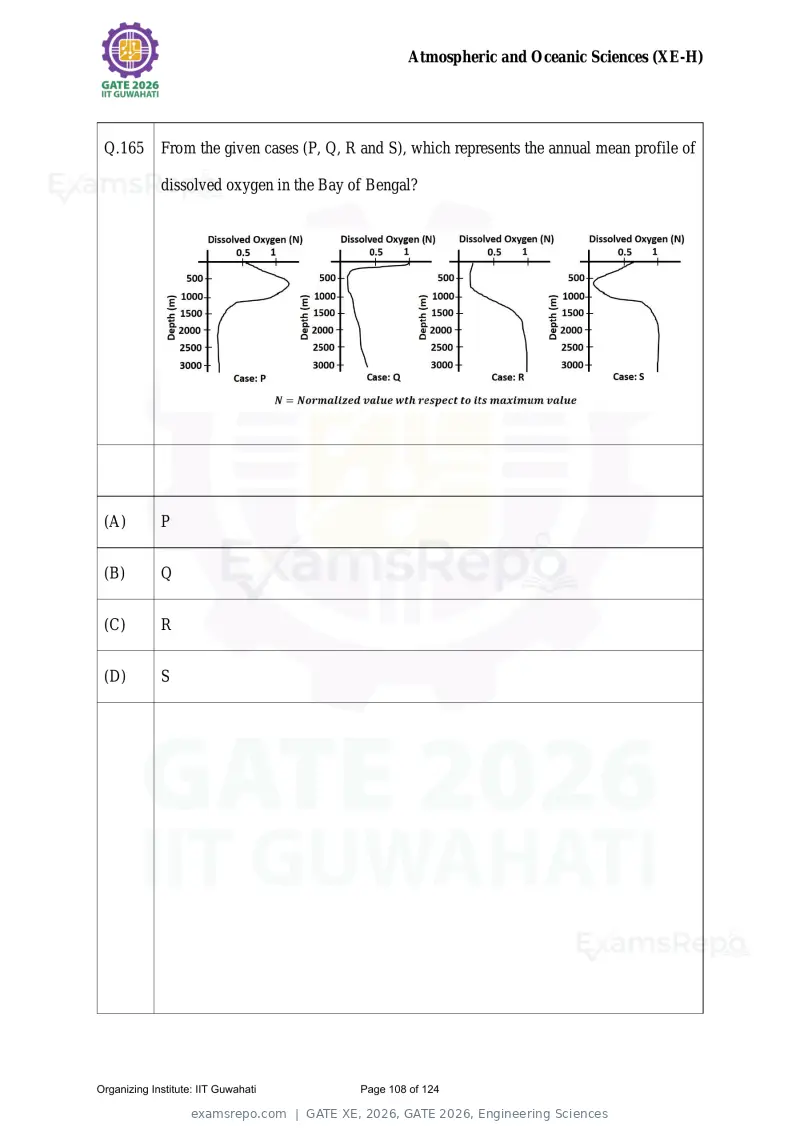
Text of page 108
Atmospheric and Oceanic Sciences (XE-H)


 Q.165       From the given cases (P, Q, R and S), which represents the annual mean profile of

             dissolved oxygen in the Bay of Bengal?


 (A)         P


 (B)         Q


 (C)         R


 (D)         S


Organizing Institute: IIT Guwahati         Page 108 of 124
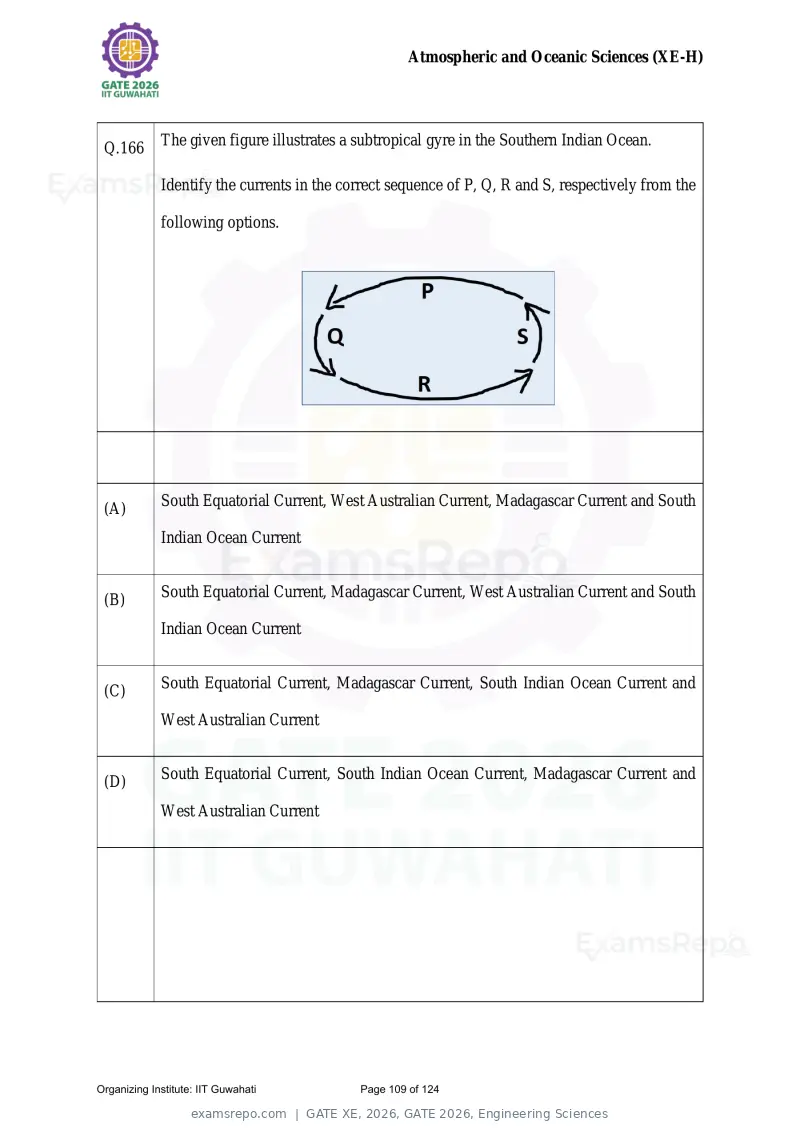
Text of page 109
Atmospheric and Oceanic Sciences (XE-H)


             The given figure illustrates a subtropical gyre in the Southern Indian Ocean.
 Q.166

             Identify the currents in the correct sequence of P, Q, R and S, respectively from the

             following options.


             South Equatorial Current, West Australian Current, Madagascar Current and South
 (A)
             Indian Ocean Current


             South Equatorial Current, Madagascar Current, West Australian Current and South
 (B)
             Indian Ocean Current


             South Equatorial Current, Madagascar Current, South Indian Ocean Current and
 (C)
             West Australian Current


             South Equatorial Current, South Indian Ocean Current, Madagascar Current and
 (D)
             West Australian Current


Organizing Institute: IIT Guwahati          Page 109 of 124
Text of page 110
Atmospheric and Oceanic Sciences (XE-H)


 Q.167       Which of the following is/are generally associated within a cyclonic eddy in the

             northern Indian Ocean?


 (A)         Upwelling


 (B)         Positive sea level anomaly


 (C)         Negative sea level anomaly


 (D)         Downwelling


             Which of the following combinations of forces is/are balanced in a cyclostrophic
 Q.168
             motion?


             Pressure Gradient, Coriolis, and Centrifugal
 (A)

             Pressure Gradient and Centrifugal
 (B)

             Centrifugal and Coriolis
 (C)

             Pressure Gradient and Coriolis
 (D)


Organizing Institute: IIT Guwahati            Page 110 of 124
Text of page 111
Atmospheric and Oceanic Sciences (XE-H)


             Which of the following statements is/are correct for the Equatorial Indian Ocean
 Q.169
             during a positive Indian Ocean Dipole event?


 (A)         Strong surface westerly winds


 (B)         Weak surface westerly winds


 (C)         Positive Sea Surface Temperature anomaly in the western region


 (D)         Negative Sea Surface Temperature anomaly in the western region


Organizing Institute: IIT Guwahati           Page 111 of 124
Text of page 112
Atmospheric and Oceanic Sciences (XE-H)


 Q.170       The temperature of a dry air parcel is 20 ℃ at a height of 150 m with atmospheric

             pressure of 1000 hPa. If the air parcel rises adiabatically to a height of 2 km where

             atmospheric pressure is 800 hPa, then the temperature (in ℃) of the air parcel at

             that height will be __________. (rounded off to three decimal places)


             [Gas constant and specific heat capacity for the dry air are 287 J kg−1 K −1 and

             1004 J kg−1 K −1 , respectively.]


 Q.171       For an incompressible fluid, the velocity components (u, v, and w) are given as:

             u(x, y, z) = 2x + y + 2z

             v(x, y, z) = ax + by + cz

             w(x, y, z) = −6z

             The value of b is ______________. (Answer in integer)


 Q.172       A steady westerly wind is blowing over the ocean surface at a latitude of 30°N and

             exerting a wind stress of 0.8 N m−2 .


             The magnitude of net volume transport (in m2 s −1) per unit width is ______.

             (rounded off to three decimal places)


             [Density of seawater is 1025 kg m−3, angular velocity of the Earth is

             7.29 × 10⁻⁵ s −1 .]


Organizing Institute: IIT Guwahati          Page 112 of 124
Text of page 113
Atmospheric and Oceanic Sciences (XE-H)


 Q.173       In a free atmosphere without friction, if the pressure increases by

             one kilo Pascal eastward across a distance of 200 km, the magnitude of geostrophic

             flow (in m s −1) is _____. (rounded off to two decimal places)


             [Density of air is 1.029 kg m−3and the Coriolis parameter is 10−4 s −1.]


 Q.174       Using the dispersion relation for deep water small amplitude wave, the wavelength

             (in m) for a 20 second gravity wave is ______. (Answer in integer)


             [Take acceleration due to gravity as 9.81 m s −2 ]


 Q.175       A two-layered fluid system in an estuarine environment has a total water depth of

             10 m. The difference in densities between the two layers is 15 kg m−3 and thickness

             of the less dense upper layer is 3 m.


             If complete mixing occurs in 3 hours, then intensity (in W m−2) of mixing process

             is _________. (rounded off to three decimal places)


             [Acceleration due to gravity is 9.81 m s −2]


Organizing Institute: IIT Guwahati           Page 113 of 124
Text of page 114
Energy Science (XE-I)


Q.176 – Q.184 Carry ONE mark Each

 Q.176       The luminous efficacy of an electric light bulb is measured in which one of the
             following units?


 (A)         lumen W–1


 (B)         lumen W–1 h–1


 (C)         lumen m–2


 (D)         candela W–1


 Q.177       Which one of the following biomass treatment processes occurs in an oxygen
             limited condition approximately between 450 ℃ and 600 ℃, and produces biochar
             and bio-oil as primary products?


 (A)         Gasification


 (B)         Pyrolysis


 (C)         Anaerobic Digestion


 (D)         Steam Reforming


Organizing Institute: IIT Guwahati        Page 114 of 124
Text of page 115
Energy Science (XE-I)


 Q.178       For a fixed thermal output, which one of the following is the major advantage
             offered by a concentrated collector over a flat plate collector?


 (A)         Utilization of diffuse solar radiation


 (B)         Reduction of capital cost of the system


 (C)         Operation at higher temperature


 (D)         Reduction in aperture area of the collector


 Q.179       A part of the blowdown energy losses in a boiler can be recovered by which one of
             the following ways?


 (A)         Completely avoiding the blowdown


 (B)         Recycling the blowdown to the steam drum


 (C)         Flashing the blowdown to generate low-pressure steam


 (D)         Mixing the blowdown with the boiler feedwater


Organizing Institute: IIT Guwahati           Page 115 of 124
Text of page 116
Energy Science (XE-I)


 Q.180       Which of the following is/are greenhouse gas(es), as identified by the
             Intergovernmental Panel on Climate Change (IPCC)?


 (A)         Nitrogen dioxide (NO2)


 (B)         Nitrous oxide (N2O)


 (C)         Sulphur hexafluoride (SF6)


 (D)         Carbon monoxide (CO)


 Q.181       Which of the following is/are step(s) followed in energy audit?


 (A)         Walkthrough


 (B)         Collection of past energy consumption data


 (C)         Evaluation of energy conservation measures


 (D)         Preparation of historic profit and loss statement


Organizing Institute: IIT Guwahati          Page 116 of 124
Text of page 117
Energy Science (XE-I)


 Q.182       An energy conservation project requires an initial investment of ₹ 50,000 with an
             expected annual operation and maintenance cost of ₹ 5,000. This project is expected
             to reduce the monthly energy cost by ₹ 1,250. The simple payback period (in years)
             is_________________. (Answer in integer)


 Q.183       The open circuit voltage, short circuit current, and the fill factor of a solar
             photovoltaic module are 45 V, 9 A, and 0.8, respectively. The maximum output
             power (in Watt) of the solar photovoltaic module is_______________________.
             (Answer in integer)


 Q.184       Energy is extracted from a fully charged supercapacitor bank and the voltage of this
             system drops to 25 % of its initial value. The energy extracted with respect to initial
             energy (in %, rounded off to two decimal places) is_______________.


Organizing Institute: IIT Guwahati           Page 117 of 124
Text of page 118
Energy Science (XE-I)


Q.185 – Q.197 Carry TWO marks Each

 Q.185       A grid-connected induction generator is used to generate electricity from a wind
             turbine. Which one of the following statements is true while the generator is feeding
             power to the grid?


 (A)         The slip of the induction generator is zero


 (B)         The slip of the induction generator is one


 (C)         The slip of the induction generator is less than zero


 (D)         The slip of the induction generator is greater than one


 Q.186       A hydro turbine works under a head of 20 m and has a maximum volume flow rate
             of 4 m3 s–1 and a speed of 750 rpm. Determine the speed (in rpm) in order to operate
             the same turbine at approximately the same efficiency under a head of 5 m.


 (A)         375.0


 (B)         187.5


 (C)         750.0


 (D)         524.5


Organizing Institute: IIT Guwahati          Page 118 of 124
Text of page 119
Energy Science (XE-I)


 Q.187       Which one of the following defines the angle made by the line joining the centers
             of the sun and the earth with its projection on the equatorial plane?


 (A)         Declination


 (B)         Latitude


 (C)         Azimuth angle


 (D)         Zenith angle


 Q.188       Which one of the following is the major environmental problem associated with the
             production of coal-bed methane?


 (A)         Contamination of water


 (B)         Emission of Carbon dioxide


 (C)         Generation of Nitrogen oxides


 (D)         Generation of Sulphur oxides


Organizing Institute: IIT Guwahati           Page 119 of 124
Text of page 120
Energy Science (XE-I)


 Q.189       A radioactive isotope sample has a decay constant λ = 2.31 × 10⁻⁴ year–1. Initially
             the sample contains 8000 × 1015 atoms. The sample decays to 25% of its initial
             value. The number of years it takes to decay to this stage is closest to
             ______________


 (A)         3000


 (B)         6000


 (C)         900


 (D)         2600


Organizing Institute: IIT Guwahati         Page 120 of 124
Text of page 121
Energy Science (XE-I)


 Q.190       A fuel with composition by mass is given as 78 % carbon (C), 16 % hydrogen (H2),
             3.2 % sulphur (S), 1.6 % oxygen (O2), and ash. The fuel is fired in a boiler with
             excess air for the complete combustion and no carbon monoxide (CO) is detected
             in the flue gases. The dry flue gas contains 0.2 % sulphur dioxide (SO2) by volume.
             Which one of the following options is closest to the amount of excess air provided
             (in % by mass)?

             Assume molar masses (g mol–1) of C, H2, S, and O2 are 12, 2, 32, and 32,
             respectively, and the volumetric ratio of nitrogen (N2) and oxygen (O2) in the air as
             3.76:1.


 (A)         14.8


 (B)         7.4


 (C)         22.2


 (D)         3.1


Organizing Institute: IIT Guwahati          Page 121 of 124
Text of page 122
Energy Science (XE-I)


 Q.191       Which of the following statements is/are FALSE concerning a wind turbine
             generation system?


 (A)         The rotor power coefficient, Cp , of a multi-blade turbine is a monotonically
             increasing function of tip-speed ratio


 (B)         Maximum power point tracking algorithms are typically employed in wind turbine
             generators for enhancing energy yield


 (C)         The theoretical maximum value of rotor power coefficient, Cp , is 0.65


 (D)         Speed control of wind turbine generator is carried out to ensure rotor speed varies
             in response to wind speed


 Q.192       Which of the following options is/are true regarding the behaviour of a typical solar
             photovoltaic cell?


 (A)         Ideal current source


 (B)         Current limited voltage source


 (C)         Voltage limited current source


 (D)         Ideal power source


Organizing Institute: IIT Guwahati            Page 122 of 124
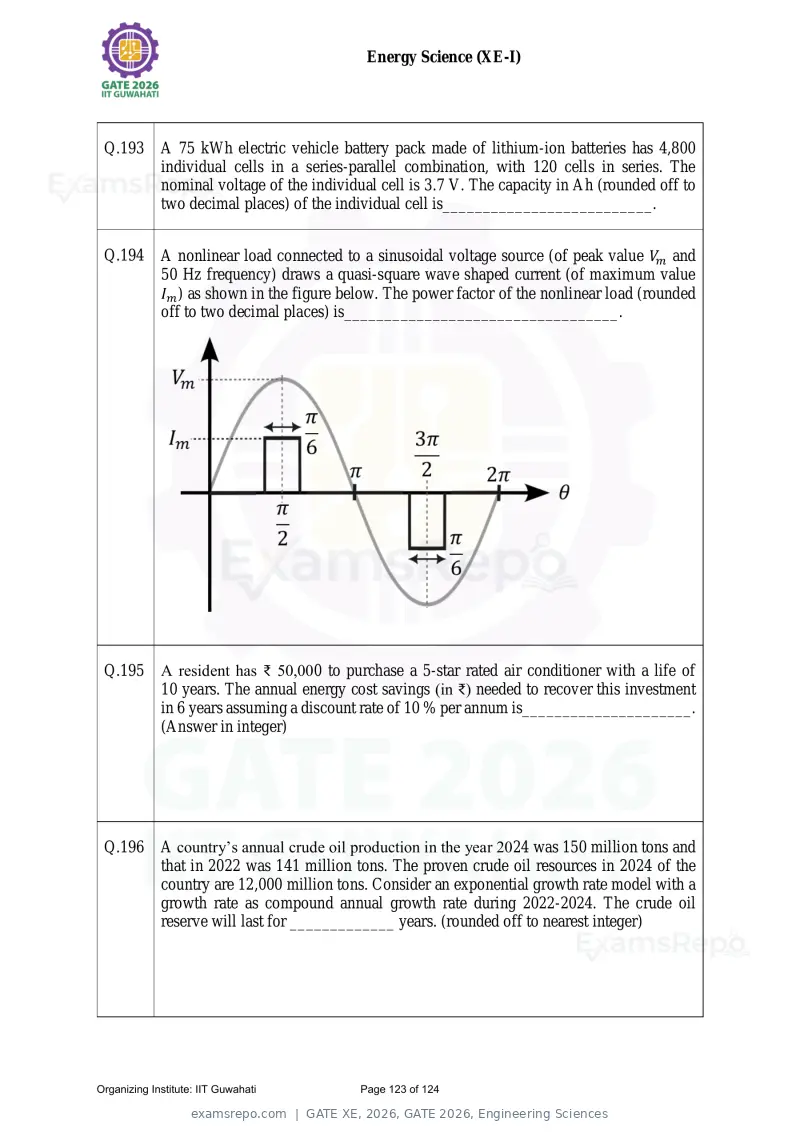
Text of page 123
Energy Science (XE-I)


 Q.193       A 75 kWh electric vehicle battery pack made of lithium-ion batteries has 4,800
             individual cells in a series-parallel combination, with 120 cells in series. The
             nominal voltage of the individual cell is 3.7 V. The capacity in Ah (rounded off to
             two decimal places) of the individual cell is__________________________.


 Q.194       A nonlinear load connected to a sinusoidal voltage source (of peak value Vm and
             50 Hz frequency) draws a quasi-square wave shaped current (of maximum value
             Im ) as shown in the figure below. The power factor of the nonlinear load (rounded
             off to two decimal places) is__________________________________.


 Q.195       A resident has ₹ 50,000 to purchase a 5-star rated air conditioner with a life of
             10 years. The annual energy cost savings (in ₹) needed to recover this investment
             in 6 years assuming a discount rate of 10 % per annum is_____________________.
             (Answer in integer)


 Q.196       A country’s annual crude oil production in the year 2024 was 150 million tons and
             that in 2022 was 141 million tons. The proven crude oil resources in 2024 of the
             country are 12,000 million tons. Consider an exponential growth rate model with a
             growth rate as compound annual growth rate during 2022-2024. The crude oil
             reserve will last for _____________ years. (rounded off to nearest integer)


Organizing Institute: IIT Guwahati         Page 123 of 124
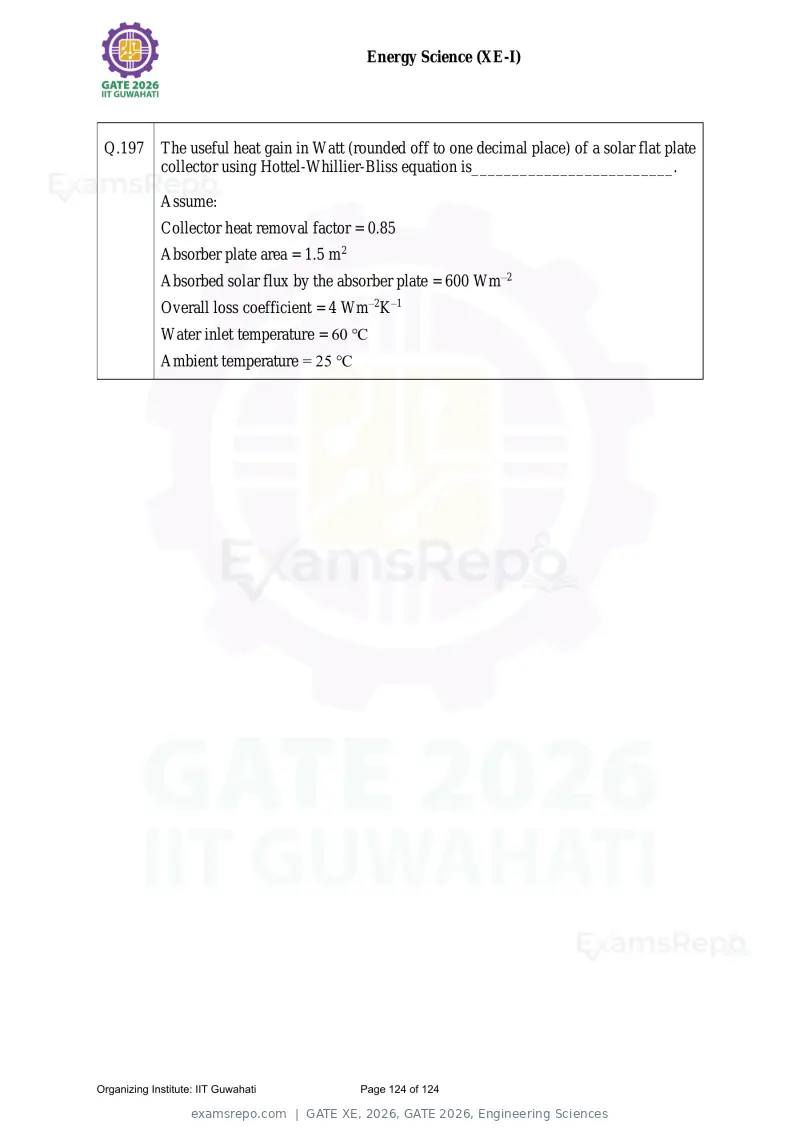
Text of page 124
Energy Science (XE-I)


 Q.197       The useful heat gain in Watt (rounded off to one decimal place) of a solar flat plate
             collector using Hottel-Whillier-Bliss equation is_________________________.

             Assume:
             Collector heat removal factor = 0.85
             Absorber plate area = 1.5 m2
             Absorbed solar flux by the absorber plate = 600 Wm–2
             Overall loss coefficient = 4 Wm–2K–1
             Water inlet temperature = 60 ℃
             Ambient temperature = 25 ℃


Organizing Institute: IIT Guwahati          Page 124 of 124
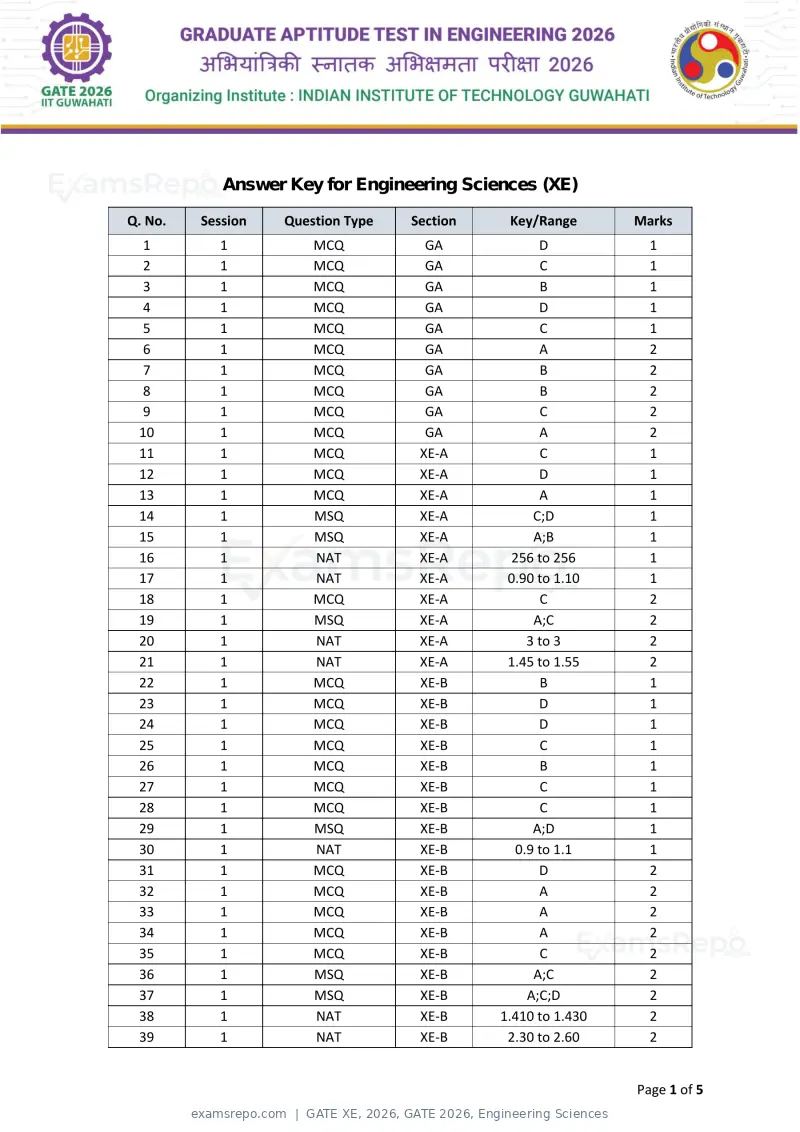
Text of page 1
Answer Key for Engineering Sciences (XE)

Q. No.   Session   Question Type   Section    Key/Range       Marks
  1        1           MCQ           GA            D            1
  2        1           MCQ           GA            C            1
  3        1           MCQ           GA            B            1
  4        1           MCQ           GA            D            1
  5        1           MCQ           GA            C            1
  6        1           MCQ           GA            A            2
  7        1           MCQ           GA            B            2
  8        1           MCQ           GA            B            2
  9        1           MCQ           GA            C            2
 10        1           MCQ           GA            A            2
 11        1           MCQ          XE-A           C            1
 12        1           MCQ          XE-A           D            1
 13        1           MCQ          XE-A           A            1
 14        1           MSQ          XE-A          C;D           1
 15        1           MSQ          XE-A          A;B           1
 16        1           NAT          XE-A       256 to 256       1
 17        1           NAT          XE-A      0.90 to 1.10      1
 18        1           MCQ          XE-A           C            2
 19        1           MSQ          XE-A          A;C           2
 20        1           NAT          XE-A         3 to 3         2
 21        1           NAT          XE-A      1.45 to 1.55      2
 22        1           MCQ          XE-B           B            1
 23        1           MCQ          XE-B           D            1
 24        1           MCQ          XE-B           D            1
 25        1           MCQ          XE-B           C            1
 26        1           MCQ          XE-B           B            1
 27        1           MCQ          XE-B           C            1
 28        1           MCQ          XE-B           C            1
 29        1           MSQ          XE-B          A;D           1
 30        1           NAT          XE-B       0.9 to 1.1       1
 31        1           MCQ          XE-B           D            2
 32        1           MCQ          XE-B           A            2
 33        1           MCQ          XE-B           A            2
 34        1           MCQ          XE-B           A            2
 35        1           MCQ          XE-B           C            2
 36        1           MSQ          XE-B          A;C           2
 37        1           MSQ          XE-B         A;C;D          2
 38        1           NAT          XE-B     1.410 to 1.430     2
 39        1           NAT          XE-B      2.30 to 2.60      2


                                                              Page 1 of 5
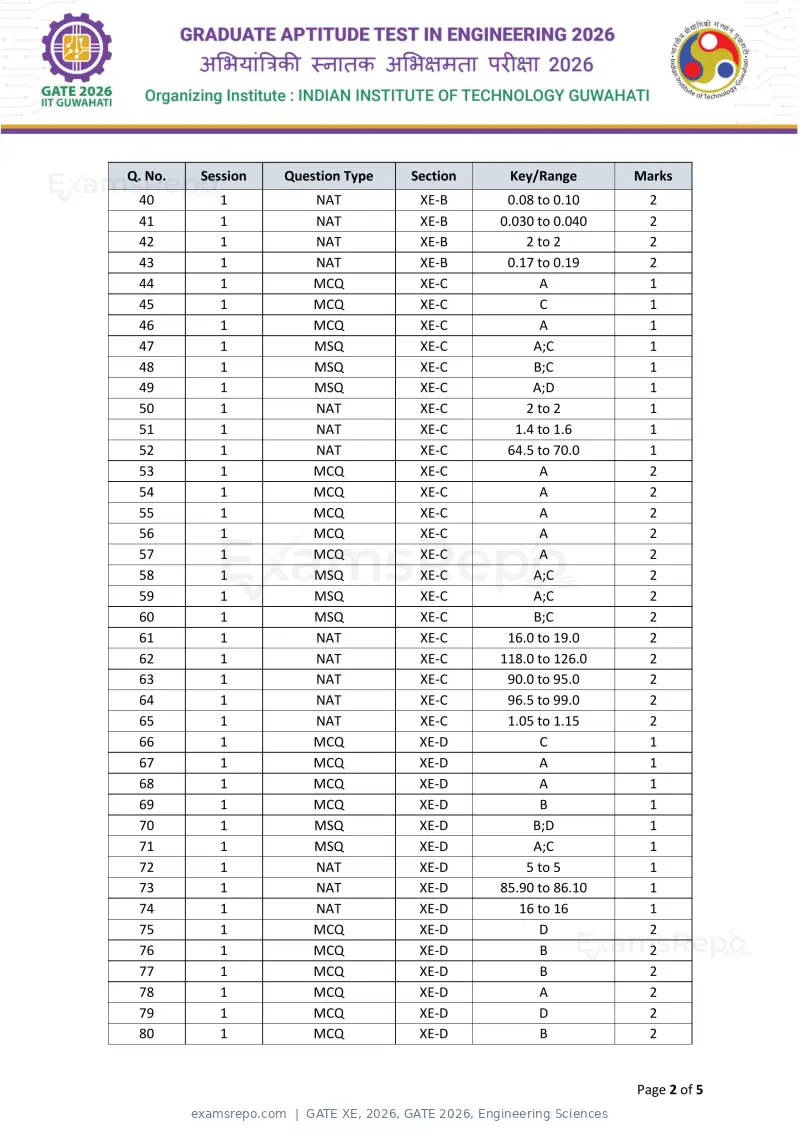
Text of page 2
Q. No.   Session   Question Type   Section    Key/Range       Marks
 40        1           NAT          XE-B      0.08 to 0.10      2
 41        1           NAT          XE-B     0.030 to 0.040     2
 42        1           NAT          XE-B         2 to 2         2
 43        1           NAT          XE-B      0.17 to 0.19      2
 44        1           MCQ          XE-C           A            1
 45        1           MCQ          XE-C           C            1
 46        1           MCQ          XE-C           A            1
 47        1           MSQ          XE-C          A;C           1
 48        1           MSQ          XE-C          B;C           1
 49        1           MSQ          XE-C          A;D           1
 50        1           NAT          XE-C         2 to 2         1
 51        1           NAT          XE-C       1.4 to 1.6       1
 52        1           NAT          XE-C      64.5 to 70.0      1
 53        1           MCQ          XE-C           A            2
 54        1           MCQ          XE-C           A            2
 55        1           MCQ          XE-C           A            2
 56        1           MCQ          XE-C           A            2
 57        1           MCQ          XE-C           A            2
 58        1           MSQ          XE-C          A;C           2
 59        1           MSQ          XE-C          A;C           2
 60        1           MSQ          XE-C          B;C           2
 61        1           NAT          XE-C      16.0 to 19.0      2
 62        1           NAT          XE-C     118.0 to 126.0     2
 63        1           NAT          XE-C      90.0 to 95.0      2
 64        1           NAT          XE-C      96.5 to 99.0      2
 65        1           NAT          XE-C      1.05 to 1.15      2
 66        1           MCQ          XE-D           C            1
 67        1           MCQ          XE-D           A            1
 68        1           MCQ          XE-D           A            1
 69        1           MCQ          XE-D           B            1
 70        1           MSQ          XE-D          B;D           1
 71        1           MSQ          XE-D          A;C           1
 72        1           NAT          XE-D         5 to 5         1
 73        1           NAT          XE-D     85.90 to 86.10     1
 74        1           NAT          XE-D        16 to 16        1
 75        1           MCQ          XE-D           D            2
 76        1           MCQ          XE-D           B            2
 77        1           MCQ          XE-D           B            2
 78        1           MCQ          XE-D           A            2
 79        1           MCQ          XE-D           D            2
 80        1           MCQ          XE-D           B            2


                                                              Page 2 of 5
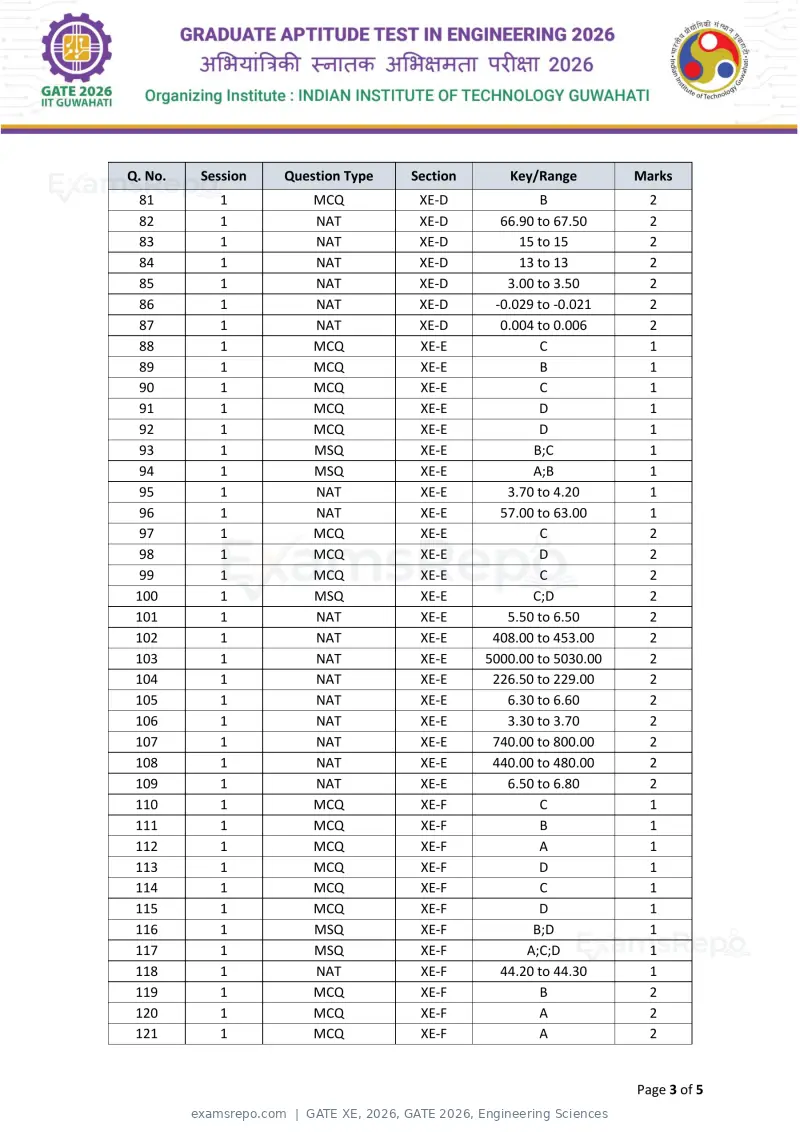
Text of page 3
Q. No.   Session   Question Type   Section      Key/Range         Marks
 81        1           MCQ          XE-D             B              2
 82        1           NAT          XE-D       66.90 to 67.50       2
 83        1           NAT          XE-D          15 to 15          2
 84        1           NAT          XE-D          13 to 13          2
 85        1           NAT          XE-D        3.00 to 3.50        2
 86        1           NAT          XE-D      -0.029 to -0.021      2
 87        1           NAT          XE-D       0.004 to 0.006       2
 88        1           MCQ          XE-E             C              1
 89        1           MCQ          XE-E             B              1
 90        1           MCQ          XE-E             C              1
 91        1           MCQ          XE-E             D              1
 92        1           MCQ          XE-E             D              1
 93        1           MSQ          XE-E            B;C             1
 94        1           MSQ          XE-E            A;B             1
 95        1           NAT          XE-E        3.70 to 4.20        1
 96        1           NAT          XE-E       57.00 to 63.00       1
 97        1           MCQ          XE-E             C              2
 98        1           MCQ          XE-E             D              2
 99        1           MCQ          XE-E             C              2
 100       1           MSQ          XE-E            C;D             2
 101       1           NAT          XE-E        5.50 to 6.50        2
 102       1           NAT          XE-E      408.00 to 453.00      2
 103       1           NAT          XE-E     5000.00 to 5030.00     2
 104       1           NAT          XE-E      226.50 to 229.00      2
 105       1           NAT          XE-E        6.30 to 6.60        2
 106       1           NAT          XE-E        3.30 to 3.70        2
 107       1           NAT          XE-E      740.00 to 800.00      2
 108       1           NAT          XE-E      440.00 to 480.00      2
 109       1           NAT          XE-E        6.50 to 6.80        2
 110       1           MCQ          XE-F             C              1
 111       1           MCQ          XE-F             B              1
 112       1           MCQ          XE-F             A              1
 113       1           MCQ          XE-F             D              1
 114       1           MCQ          XE-F             C              1
 115       1           MCQ          XE-F             D              1
 116       1           MSQ          XE-F            B;D             1
 117       1           MSQ          XE-F           A;C;D            1
 118       1           NAT          XE-F       44.20 to 44.30       1
 119       1           MCQ          XE-F             B              2
 120       1           MCQ          XE-F             A              2
 121       1           MCQ          XE-F             A              2


                                                                  Page 3 of 5
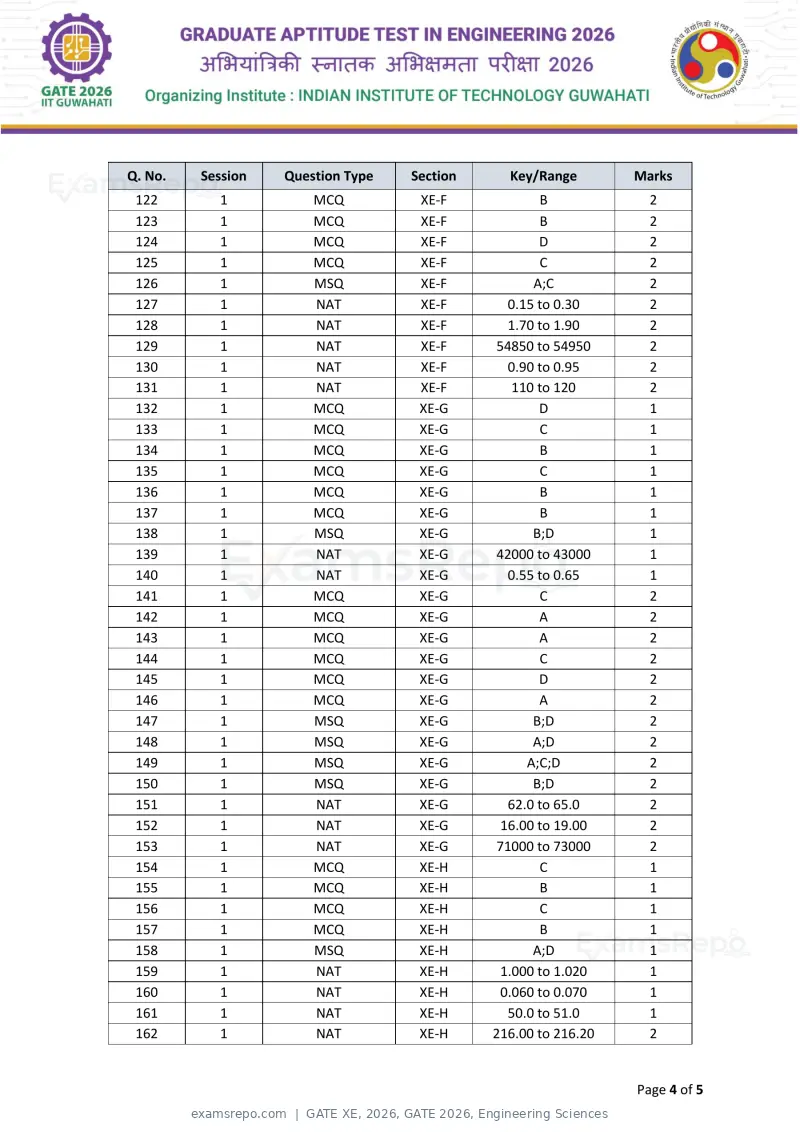
Text of page 4
Q. No.   Session   Question Type   Section     Key/Range        Marks
 122       1           MCQ          XE-F            B             2
 123       1           MCQ          XE-F            B             2
 124       1           MCQ          XE-F            D             2
 125       1           MCQ          XE-F            C             2
 126       1           MSQ          XE-F           A;C            2
 127       1           NAT          XE-F       0.15 to 0.30       2
 128       1           NAT          XE-F       1.70 to 1.90       2
 129       1           NAT          XE-F     54850 to 54950       2
 130       1           NAT          XE-F       0.90 to 0.95       2
 131       1           NAT          XE-F        110 to 120        2
 132       1           MCQ          XE-G            D             1
 133       1           MCQ          XE-G            C             1
 134       1           MCQ          XE-G            B             1
 135       1           MCQ          XE-G            C             1
 136       1           MCQ          XE-G            B             1
 137       1           MCQ          XE-G            B             1
 138       1           MSQ          XE-G           B;D            1
 139       1           NAT          XE-G     42000 to 43000       1
 140       1           NAT          XE-G       0.55 to 0.65       1
 141       1           MCQ          XE-G            C             2
 142       1           MCQ          XE-G            A             2
 143       1           MCQ          XE-G            A             2
 144       1           MCQ          XE-G            C             2
 145       1           MCQ          XE-G            D             2
 146       1           MCQ          XE-G            A             2
 147       1           MSQ          XE-G           B;D            2
 148       1           MSQ          XE-G           A;D            2
 149       1           MSQ          XE-G          A;C;D           2
 150       1           MSQ          XE-G           B;D            2
 151       1           NAT          XE-G       62.0 to 65.0       2
 152       1           NAT          XE-G      16.00 to 19.00      2
 153       1           NAT          XE-G     71000 to 73000       2
 154       1           MCQ          XE-H            C             1
 155       1           MCQ          XE-H            B             1
 156       1           MCQ          XE-H            C             1
 157       1           MCQ          XE-H            B             1
 158       1           MSQ          XE-H           A;D            1
 159       1           NAT          XE-H      1.000 to 1.020      1
 160       1           NAT          XE-H      0.060 to 0.070      1
 161       1           NAT          XE-H       50.0 to 51.0       1
 162       1           NAT          XE-H     216.00 to 216.20     2


                                                                Page 4 of 5
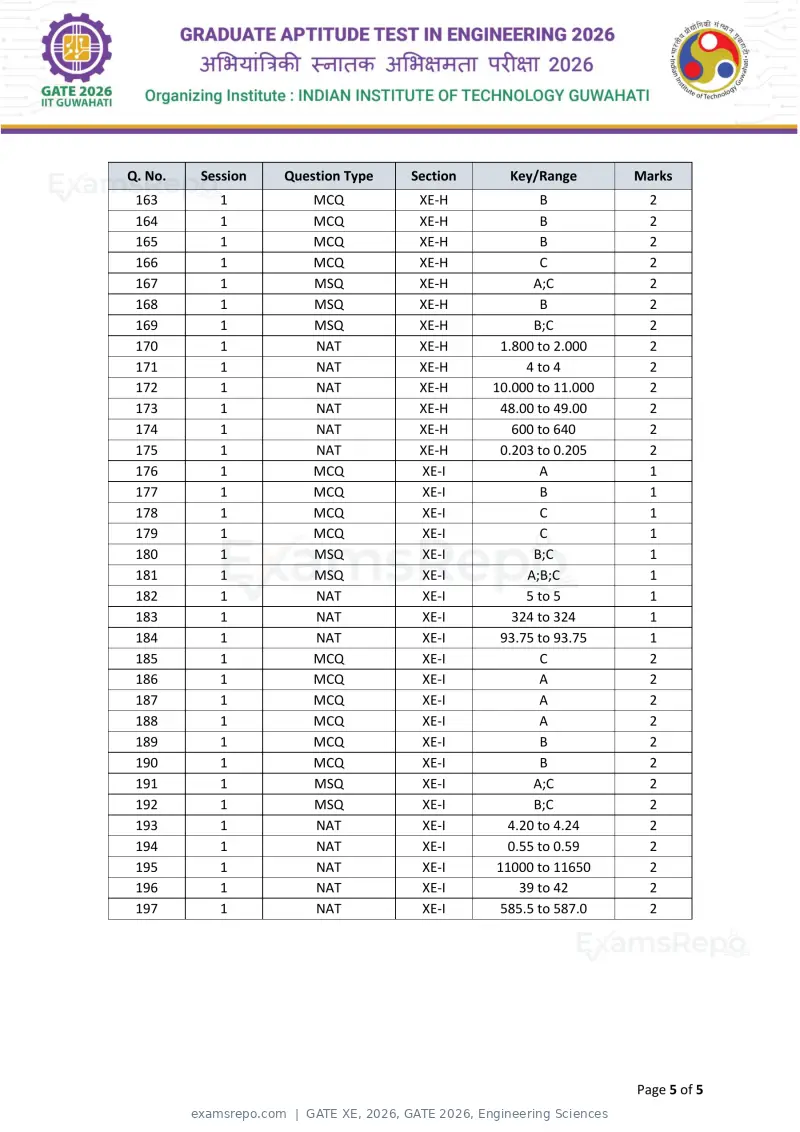
Text of page 5
Q. No.   Session   Question Type   Section     Key/Range        Marks
 163       1           MCQ          XE-H            B             2
 164       1           MCQ          XE-H            B             2
 165       1           MCQ          XE-H            B             2
 166       1           MCQ          XE-H            C             2
 167       1           MSQ          XE-H           A;C            2
 168       1           MSQ          XE-H            B             2
 169       1           MSQ          XE-H           B;C            2
 170       1           NAT          XE-H      1.800 to 2.000      2
 171       1           NAT          XE-H          4 to 4          2
 172       1           NAT          XE-H     10.000 to 11.000     2
 173       1           NAT          XE-H      48.00 to 49.00      2
 174       1           NAT          XE-H        600 to 640        2
 175       1           NAT          XE-H      0.203 to 0.205      2
 176       1           MCQ          XE-I            A             1
 177       1           MCQ          XE-I            B             1
 178       1           MCQ          XE-I            C             1
 179       1           MCQ          XE-I            C             1
 180       1           MSQ          XE-I           B;C            1
 181       1           MSQ          XE-I          A;B;C           1
 182       1           NAT          XE-I          5 to 5          1
 183       1           NAT          XE-I        324 to 324        1
 184       1           NAT          XE-I      93.75 to 93.75      1
 185       1           MCQ          XE-I            C             2
 186       1           MCQ          XE-I            A             2
 187       1           MCQ          XE-I            A             2
 188       1           MCQ          XE-I            A             2
 189       1           MCQ          XE-I            B             2
 190       1           MCQ          XE-I            B             2
 191       1           MSQ          XE-I           A;C            2
 192       1           MSQ          XE-I           B;C            2
 193       1           NAT          XE-I       4.20 to 4.24       2
 194       1           NAT          XE-I       0.55 to 0.59       2
 195       1           NAT          XE-I     11000 to 11650       2
 196       1           NAT          XE-I         39 to 42         2
 197       1           NAT          XE-I      585.5 to 587.0      2


                                                                Page 5 of 5
Page 1 of 124
Source: GATE. Question paper published by GATE.