
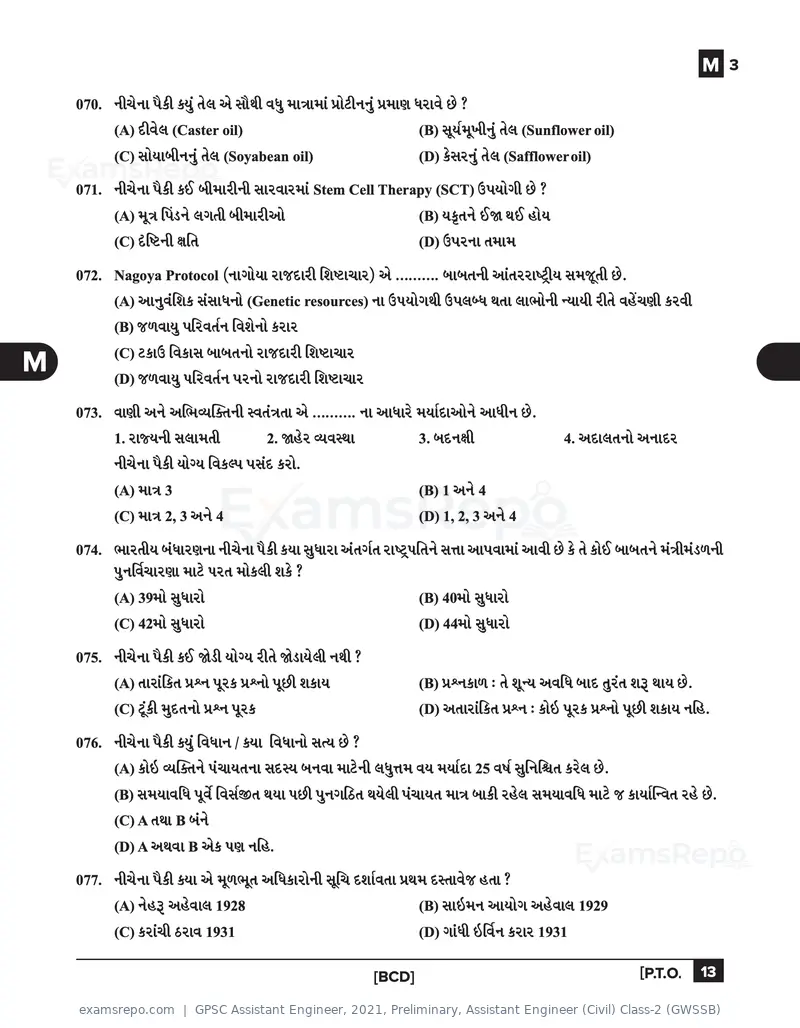
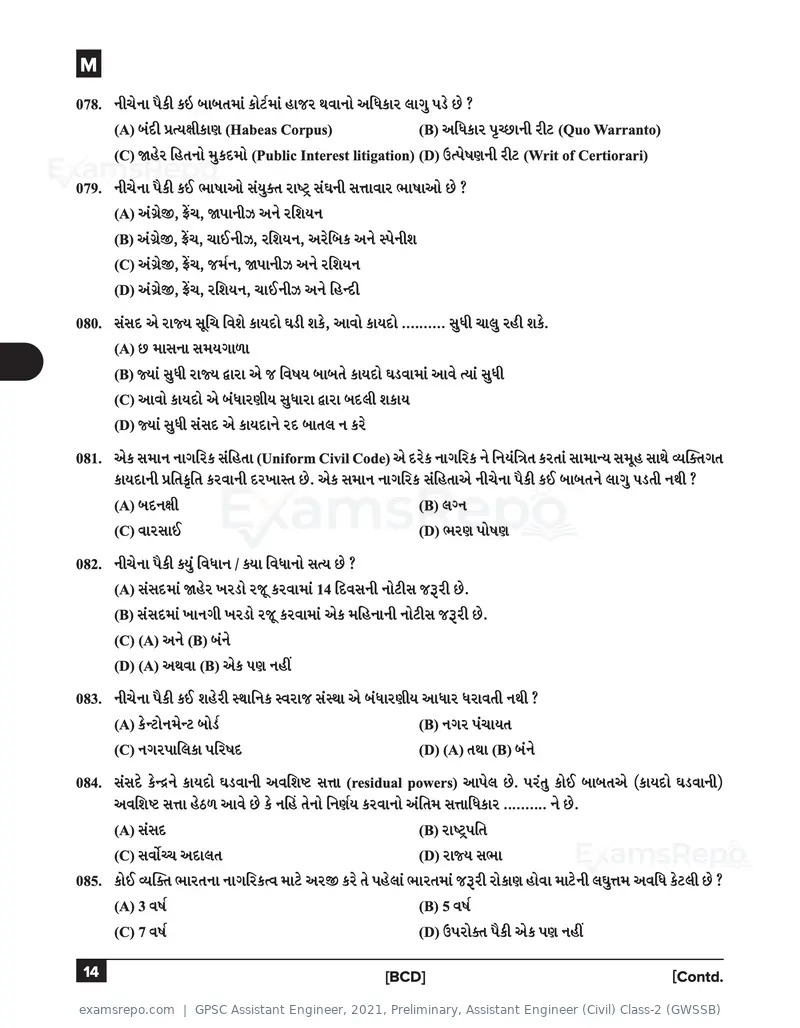
GPSC Assistant Engineer 2021: Preliminary, Assistant Engineer (Civil) Class-2 (GWSSB)
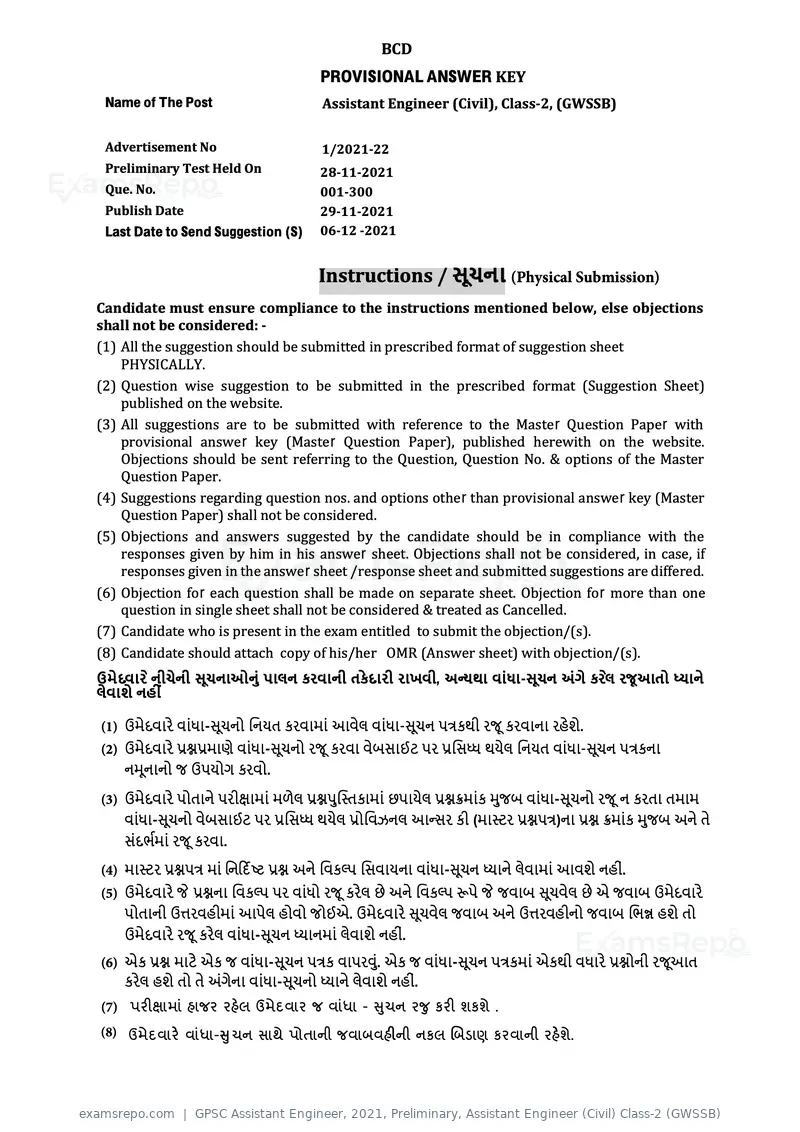
Text of page 1
BCD
                                      PROVISIONAL ANSWER KEY
 Name of The Post                     Assistant Engineer (Civil), Class-2, (GWSSB)

 Advertisement No                     1/2021-22
 Preliminary Test Held On             28-11-2021
 Que. No.                             001-300
 Publish Date                         29-11-2021
 Last Date to Send Suggestion (S)     06-12 -2021


                                      Instructions / સૂચના (Physical Submission)
Candidate must ensure compliance to the instructions mentioned below, else objections
shall not be considered: -
(1) All the suggestion should be submitted in prescribed format of suggestion sheet
    PHYSICALLY.
(2) Question wise suggestion to be submitted in the prescribed format (Suggestion Sheet)
    published on the website.
(3) All suggestions are to be submitted with reference to the Master Question Paper with
    provisional answer key (Master Question Paper), published herewith on the website.
    Objections should be sent referring to the Question, Question No. & options of the Master
    Question Paper.
(4) Suggestions regarding question nos. and options other than provisional answer key (Master
    Question Paper) shall not be considered.
(5) Objections and answers suggested by the candidate should be in compliance with the
    responses given by him in his answer sheet. Objections shall not be considered, in case, if
    responses given in the answer sheet /response sheet and submitted suggestions are differed.
(6) Objection for each question shall be made on separate sheet. Objection for more than one
    question in single sheet shall not be considered & treated as Cancelled.
(7) Candidate who is present in the exam entitled to submit the objection/(s).
(8) Candidate should attach copy of his/her OMR (Answer sheet) with objection/(s).
ઉમેદવાર ે નીચેની સૂચનાઓનું પાલન કરવાની તકે દારી રાખવી, અ યથા વાંધા-સૂચન અંગે કર ેલ રજૂ આતો યાને
લેવાશે નહી ં

(1) ઉમેદવારે વાંધા-સૂચનો િનયત કરવામાં આવેલ વાંધા-સૂચન પ કથી રજૂ કરવાના રહેશે.
(2) ઉમેદવારે        માણે વાંધા-સૂચનો રજૂ કરવા વેબસાઈટ પર િસ ધ થયેલ િનયત વાંધા-સૂચન પ કના
    નમૂનાનો જ ઉપયોગ કરવો.

(3) ઉમેદવારે પોતાને પરી ામાં મળેલ પુિ તકામાં છપાયેલ માંક મુજબ વાંધા-સૂચનો રજૂ ન કરતા તમામ
    વાંધા-સૂચનો વેબસાઈટ પર િસ ધ થયેલ ોિવઝનલ આ સર કી (મા ટર     પ )ના        માંક મુજબ અને તે
    સંદભમાં રજૂ કરવા.

(4) મા ટર       પ માં િન�દ� ષ્ટ   અને િવક પ િસવાયના વાંધા-સૂચન યાને લેવામાં આવશે નહીં.
(5) ઉમેદવારે જે    ના િવક પ પર વાંધો રજૂ કરેલ છે અને િવક પ પે જે જવાબ સૂચવેલ છે એ જવાબ ઉમેદવારે
    પોતાની ઉ રવહીમાં આપેલ હોવો જોઈએ. ઉમેદવારે સૂચવેલ જવાબ અને ઉ રવહીનો જવાબ િભ હશે તો
    ઉમેદવારે રજૂ કરેલ વાંધા-સૂચન યાનમાં લેવાશે નહીં.
(6) એક      માટે એક જ વાંધા-સૂચન પ ક વાપરવું. એક જ વાંધા-સૂચન પ કમાં એકથી વધારે          ોની રજૂઆત
    કરેલ હશે તો તે અંગેના વાંધા-સૂચનો યાને લેવાશે નહીં.
(7) પર�ક્ષામાં હાજર રહ�લ ઉમેદવાર જ વાંધા - �ુચન ર�ુ કર� શકશે .
(8) ઉમેદવાર� વાંધા-�ુ ચન સાથે પોતાની જવાબવહ�ની નકલ �બડાણ કરવાની રહ�શે.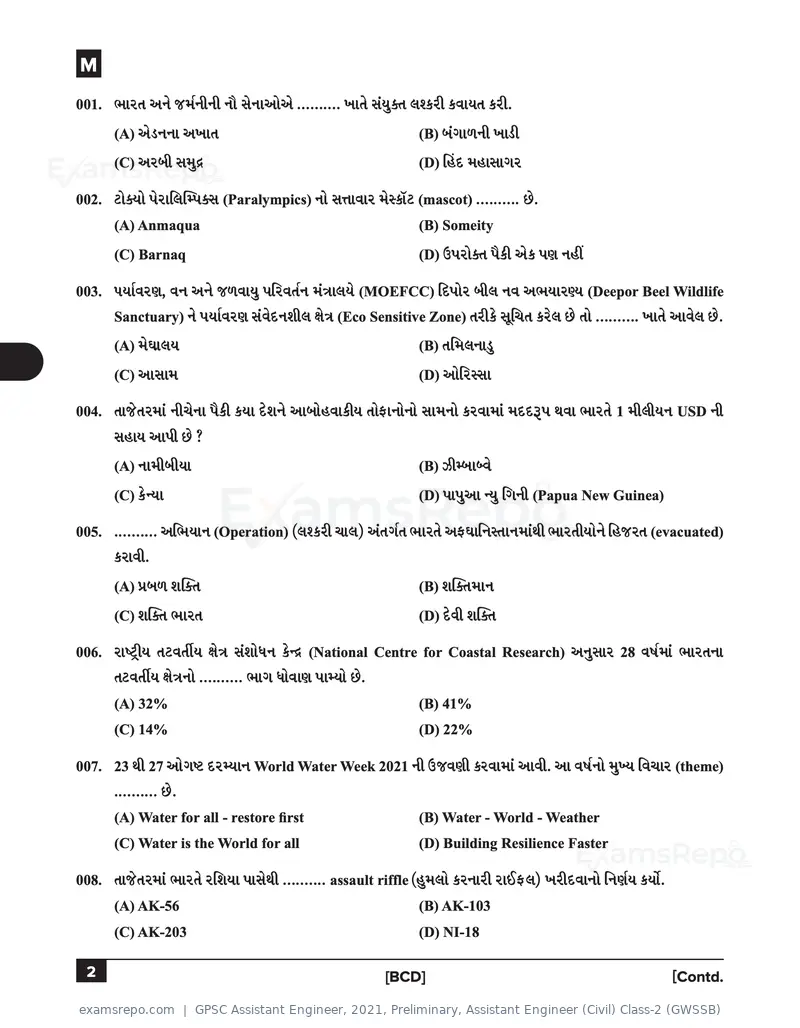
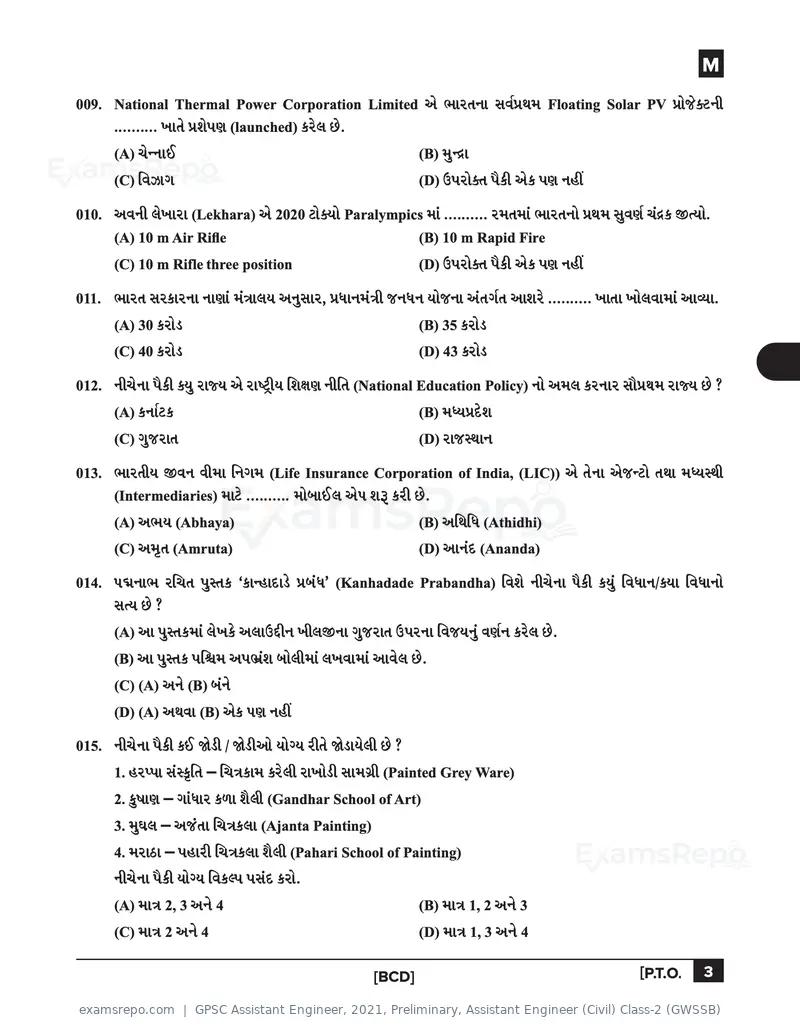
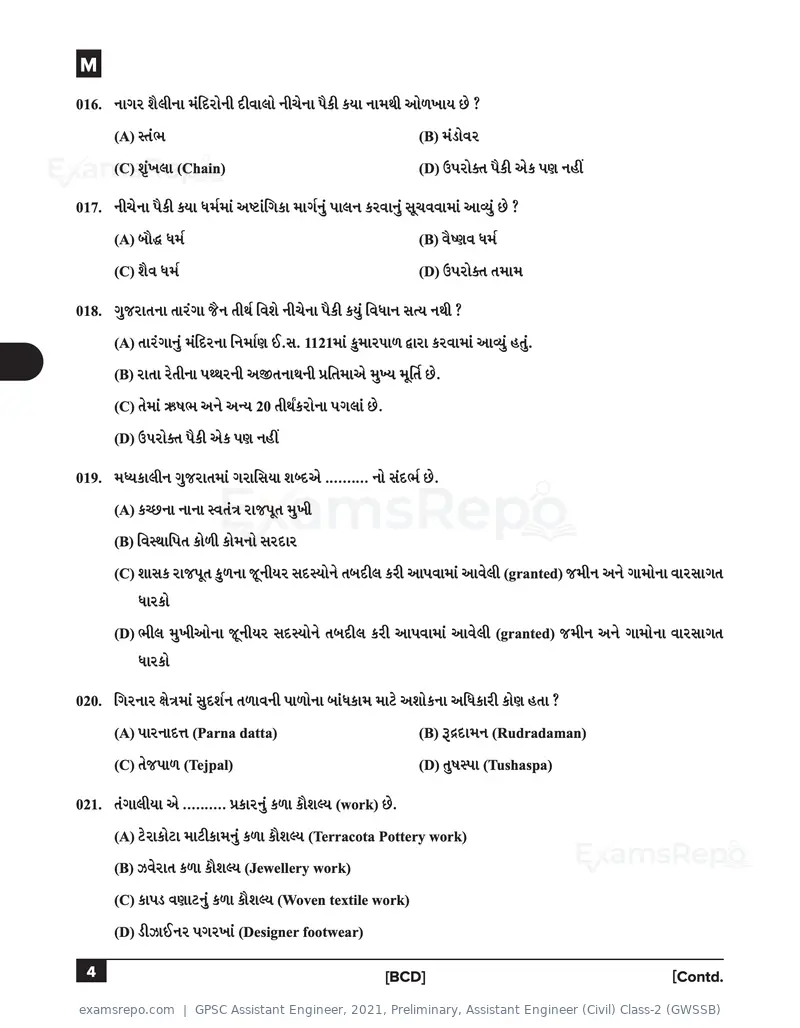
Text of page 15
M
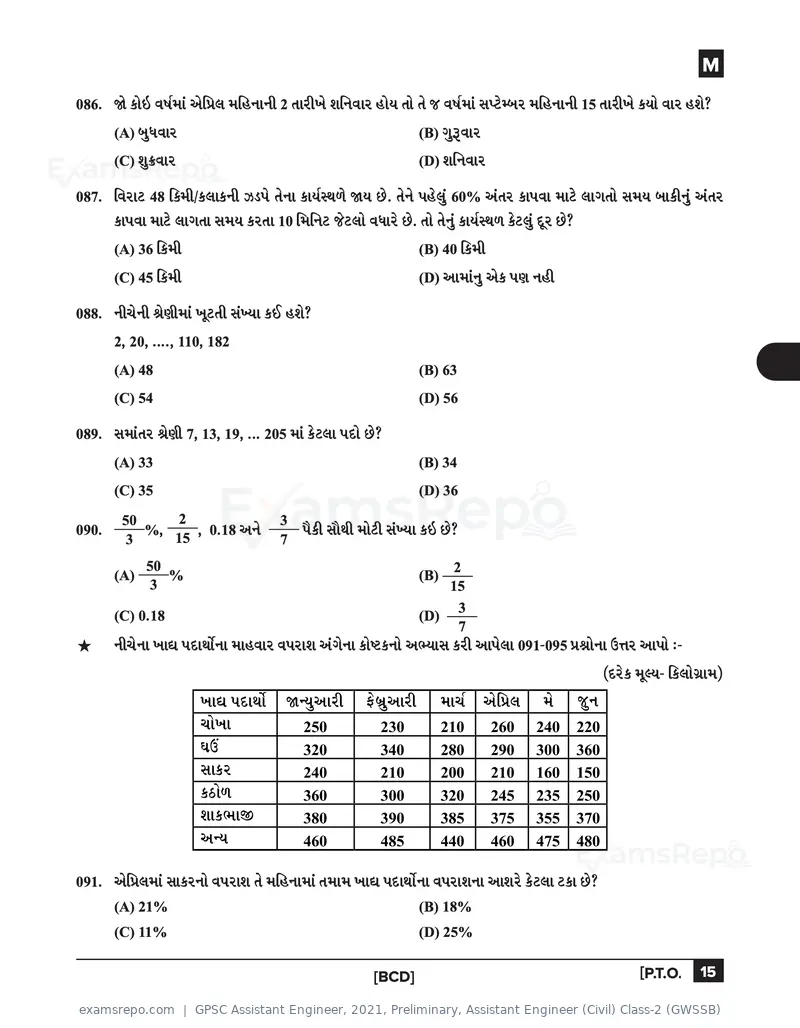
086. òu fkuR ð»ko{kt yur«÷ {rn™k™e 2 Œkhe¾u þr™ðkh nkuÞ Œku Œu s ð»ko{kt ‚ÃxuBƒh {rn™k™e 15 Œkhe¾u fÞku ðkh nþu?
(A) ƒwÄðkh (B) „wYðkh
(C) þw¢ðkh (D) þr™ðkh
087. rðhkx 48 rf{e/f÷kf™e Íz…u Œu™k fkÞoMÚk¤u òÞ Au. Œu™u …nu÷wt 60% ytŒh fk…ðk {kxu ÷k„Œku ‚{Þ ƒkfe™wt ytŒh
fk…ðk {kxu ÷k„Œk ‚{Þ fhŒk 10 r{r™x sux÷ku ðÄkhu Au. Œku Œu™wt fkÞoMÚk¤ fux÷wt Ëqh Au?
(A) 36 rf{e (B) 40 rf{e
(C) 45 rf{e (D) yk{kt™w yuf …ý ™ne
088. ™e[u™e ©uýe{kt ¾qxŒe ‚tÏÞk fE nþu?
2, 20, ...., 110, 182
(A) 48 (B) 63
(C) 54 (D) 56
089. ‚{ktŒh ©uýe 7, 13, 19, ... 205 {kt fux÷k …Ëku Au?
(A) 33 (B) 34
(C) 35 (D) 36
50 2 3
090. %, , 0.18 y™u …ife ‚kiÚke {kuxe ‚tÏÞk fR Au?
3 15 7
50 2
(A) % (B)
3 15
3
(C) 0.18 (D)
7
™e[u™k ¾kã …ËkÚkkuo™k {knðkh ð…hkþ yt„u™k fkuüf™ku yÇÞk‚ fhe yk…u÷k 091-095 «§ku™k W¥kh yk…ku :-
(Ëhuf {qÕÞ- rf÷ku„úk{)
091. yur«÷{kt ‚kfh™ku ð…hkþ Œu {rn™k{kt Œ{k{ ¾kã …ËkÚkkuo™k ð…hkþ™k ykþhu fux÷k xfk Au?
(A) 21% (B) 18%
(C) 11% (D) 25%
[BCD] [P.T.O. 15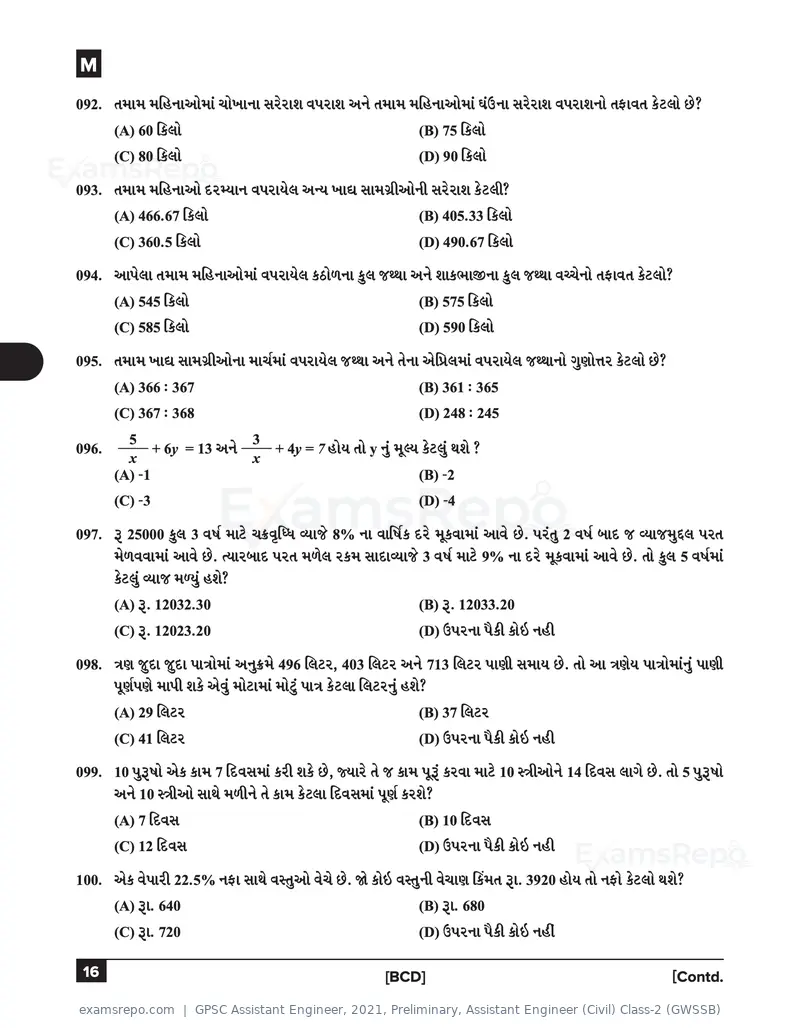
Text of page 16
M
092. Œ{k{ {rn™kyku{kt [ku¾k™k ‚huhkþ ð…hkþ y™u Œ{k{ {rn™kyku{kt ½tW™k ‚huhkþ ð…hkþ™ku ŒVkðŒ fux÷ku Au?
       (A) 60 rf÷ku                                               (B) 75 rf÷ku
       (C) 80 rf÷ku                                               (D) 90 rf÷ku

093. Œ{k{ {rn™kyku ËhBÞk™ ð…hkÞu÷ yLÞ ¾kã ‚k{„úeyku™e ‚huhkþ fux÷e?
       (A) 466.67 rf÷ku                                           (B) 405.33 rf÷ku
       (C) 360.5 rf÷ku                                            (D) 490.67 rf÷ku

094. yk…u÷k Œ{k{ {rn™kyku{kt ð…hkÞu÷ fXku¤™k fw÷ sÚÚkk y™u þkf¼kS™k fw÷ sÚÚkk ðå[u™ku ŒVkðŒ fux÷ku?
       (A) 545 rf÷ku                                              (B) 575 rf÷ku
       (C) 585 rf÷ku                                              (D) 590 rf÷ku

095. Œ{k{ ¾kã ‚k{„úeyku™k {k[o{kt ð…hkÞu÷ sÚÚkk y™u Œu™k yur«÷{kt ð…hkÞu÷ sÚÚkk™ku „wýku¥kh fux÷ku Au?
       (A) 366 : 367                                              (B) 361 : 365
       (C) 367 : 368                                              (D) 248 : 245
         5                       3
096.          + 6y = 13 y™u          + 4y = 7 nkuÞ Œku y ™wt {qÕÞ fux÷wt Úkþu ?
         x                       x
       (A) -1                                                     (B) -2
       (C) -3                                                     (D) -4

097. Y 25000 fw÷ 3 ð»ko {kxu [¢ð]ræÄ ÔÞksu 8% ™k ðkr»kof Ëhu {qfðk{kt ykðu Au. …htŒw 2 ð»ko ƒkË s ÔÞks{wÆ÷ …hŒ
       {u¤ððk{kt ykðu Au. íÞkhƒkË …hŒ {¤u÷ hf{ ‚kËkÔÞksu 3 ð»ko {kxu 9% ™k Ëhu {qfðk{kt ykðu Au. Œku fw÷ 5 ð»ko{kt
       fux÷wt ÔÞks {éÞwt nþu?
       (A) Y. 12032.30                                  (B) Y. 12033.20
       (C) Y. 12023.20                                  (D) W…h™k …ife fkuR ™ne

098. ºký swËk swËk …kºkku{kt y™w¢{u 496 r÷xh, 403 r÷xh y™u 713 r÷xh …kýe ‚{kÞ Au. Œku yk ºkýuÞ …kºkku{kt™wt …kýe
       …qýo…ýu {k…e þfu yuðwt {kuxk{kt {kuxwt …kºk fux÷k r÷xh™wt nþu?
       (A) 29 r÷xh                                                 (B) 37 r÷xh
       (C) 41 r÷xh                                                 (D) W…h™k …ife fkuR ™ne

099. 10 …wY»kku yuf fk{ 7 rËð‚{kt fhe þfu Au, ßÞkhu Œu s fk{ …qYt fhðk {kxu 10 Mºkeyku™u 14 rËð‚ ÷k„u Au. Œku 5 …wY»kku
       y™u 10 Mºkeyku ‚kÚku {¤e™u Œu fk{ fux÷k rËð‚{kt …qýo fhþu?
       (A) 7 rËð‚                                             (B) 10 rËð‚
       (C) 12 rËð‚                                            (D) W…h™k …ife fkuR ™ne

100. yuf ðu…khe 22.5% ™Vk ‚kÚku ðMŒwyku ðu[u Au. òu fkuR ðMŒw™e ðu[ký ®f{Œ Yk. 3920 nkuÞ Œku ™Vku fux÷ku Úkþu?
       (A) Yk. 640                                                (B) Yk. 680
       (C) Yk. 720                                                (D) W…h™k …ife fkuR ™net

 16                                                        [BCD]                                              [Contd.
Text of page 17
M
101. Which of the following statements is correct for the selection of sand for masonry mortars?
      i.   In natural sand, clay, fine silt and fine dust should be not more than 5% by mass
      ii.  In crushed stone sand, clay, fine silt and fine dust should be not more than 5% by mass
      iii. Various sizes of particles of sand should be uniformly distributed throughout the mass
      (A) Only (i)                                       (B) (i) and (ii)
      (C) (ii) and (iii)                                 (D) (i), (ii) and (iii)

102. Which of the following statements is incorrect for compressive strength of cement mortars?
      (A) Ordinary Portland Cement: Required Strength at 72 hours is not less than 16 MPa
      (B) Portland Slag Cement: Required Strength at 72 hours is not less than 16 MPa
      (C) Portland Pozzolana cement (Fly ash based): Required Strength at 72 hours is not less
           than 16 MPa
      (D) Rapid hardening Portland cement: Required Strength at 72 hours is not less than 16 MPa

103. Which of the following statements is correct for Ferrocement water tanks?
      i. In India, Ferrocement water tanks are permitted for a capacity upto 10,000 litres only
      ii. The recommended mix design is one-part cement and 1.5 to 2.5 part of sand by mass with w/c
          ratio of 0.35-0.45
      iii. Minimum percentage reinforcement in two principal directions is not less than 1 percent with
            minimum clear cover is 4 mm
      (A) Only (i)                                       (B) (i) and (ii)
      (C) (ii) and (iii)                                 (D) (i), (ii) and (iii)

104. Which of the following statements is / are correct for limes used in construction?
      i. Hydraulic lime is used for structural purpose
      ii. Fat lime is used for white washing and plastering and composite mortars (with pozzolanic
          material)
      iii. Siliceous dolomitic lime is used for under coat and finishing coats of plasters
      (A) Only (i)                                       (B) (i) and (ii)
      (C) (ii) and (iii)                                 (D) (i), (ii) and (iii)

105. Which of the following statements is incorrect for stone lintels in reference to support bearing?
      (A) The stone lintels shall be well bonded into masonry on either side
      (B) The bearing length can be reduced by increasing the thickness of the stone lintels
      (C) The bearing length on either side shall not be less than depth of the lintel
      (D) The bearing length on either side shall not be less than half the width of supporting masonry


                                                 [BCD]                                         [P.T.O.   17
Text of page 18
M
106. What is a correct sequence for average bending strength of different ply boards mentioned under?
      (A) Veneered Particle Board > Block boards > Fiber hard boards > Wood Particle boards
      (B) Fiber hard boards > Block boards > Veneered Particle Board > Wood Particle boards
      (C) Block boards > Veneered Particle Board > Fiber hard boards > Wood Particle boards
      (D) Block boards > Wood Particle boards > Veneered Particle Board > Fiber hard boards

107. What is the correct sequence of strength of reinforcement used in RCC?
      (A) GFRP bars > HYSD Bars > TMT Bars > Mild Steel Bars
      (B) GFRP bars > TMT Bars > HYSD Bars > Mild Steel Bars
      (C) TMT Bars > HYSD Bars > GFRP bars > Mild Steel Bars
      (D) TMT Bars > HYSD Bars > Mild Steel Bars > GFRP Bars

108. Which of the following RCC beams will have brittle failure during bending test?
      (A) RCC beam with equal reinforcement in tension and compression zone with stirrups
      (B) RCC beam with equal reinforcement in tension and compression zone without stirrups
      (C) RCC beam with more reinforcement in tension zone and less reinforcement in compression
           zone with stirrups
      (D) RCC beam with less reinforcement in tension zone and more reinforcement in compression
           zone with stirrups

109. Which type of steel bar is used in pre-stressed concrete structural elements?
      (A) Glass fiber reinforced plastic bars
      (B) Thermo mechanically treated bars
      (C) High tensile steel bars
      (D) High yield strength deformed bars

110.	Which of the following is a correct combination for admixture and its purpose as mentioned
      below?
        Type of Admixture                             Purpose
      a. Plasticizer                                  1. Rapid setting concrete
      b. Air Entertainer                              2. High strength concrete
      c. Viscosity Modifier                           3. Light weight concrete
      d. Accelerator                                  4. Self-compacting concrete
      (A) a - 2, b - 3, c - 4, d - 1                  (B) a - 4, b - 3, c - 2, d - 1
      (C) a - 2, b - 1, c - 4, d - 3                  (D) a - 2, b - 3, c - 4, d - 1

 18                                              [BCD]                                       [Contd.
Text of page 19
M
111.	Which of the following is a correct combination for the concrete mix vs mix design mentioned in
      column A and B respectively?
      COLUMN A                                         COLUMN B
      a. M10                                           1. 1:1:2
      b. M20                                           2. 1:2:4
      c. M15                                           3. 1:1.5:3
      d. M25                                           4. 1:3:6
      (A) a - 4, b - 2, c - 1, d - 3                   (B) a - 4, b - 1, c - 2, d - 3
      (C) a - 4, b - 3, c - 2, d - 1                   (D) a - 2, b - 3, c - 4, d - 1

112.	Which of the following is a correct combination for the concrete tests vs mechanical properties to
      be determined as mentioned below?
      Concrete Test                                    Mechanical Property
      a. Cube Test                                     1. Modulus of elasticity
      b. Cylinder test                                 2. Compressive strength
      c. Split cylinder test                           3. Shear strength
      d. Beam test                                     4. Tensile strength
      (A) a-4, b-2, c-1, d-3                           (B) a-2, b-1, c-4, d-3
      (C) a-4, b-3, c-2, d-1                           (D) a-2, b-3, c-4, d-1

113. Which of the following are the ideal applications of aluminum in construction industry?
      (A) Facades, formworks and scaffolding
      (B) Reinforcement, columns and beams
      (C) Facades, reinforcement and beams
      (D) Formworks, scaffolding and columns

114.	In order to prevent Alkali-aggregate reaction, low alkali cement can be used, in such a case what
      is the maximum permissible percentage of fly ash allowed in concrete mix design?
      (A) 10%                                          (B) 20%
      (C) 30%                                          (D) 40%

115.	Hydration of which of the following compound(s) will result in the increase of strength of the
      concrete after 28 days?
      i. Di-calcium Silicate
      ii. Tri-calcium Silicate
      iii. Tri-calcium Aluminate
      iv. Tetra-calcium Aluminoferrite
      (A) Only (i)                                     (B) (i) and (ii)
      (C) (i) and (iii)                                (D) (iii) and (iv)


                                               [BCD]                                      [P.T.O.   19
Text of page 20
M
116. If the radius of a wire stretched by a load is doubled, then its Young’s Modulus will
      (A) be doubled                                       (B) be halved
      (C) become one fourth                                (D) None of the above

117. Which of the following material parameter have no units?
      (A) Modulus of Elasticity                            (B) Modulus of Rigidity
      (C) Strain                                           (D) Stress

118. The buckling load for a material depends on
      (A) Slenderness ratio and Poisson’s ratio
      (B) Slenderness ratio and area of cross section
      (C) Modulus of elasticity and area of cross section
      (D) Modulus of elasticity, area of cross section and slenderness ratio

119. If a material expands freely due to heating, what type of stress is developed?
      (A) Thermal stress                                   (B) Tensile stress
      (C) Compressive stress                               (D) No stress

120. The limiting force of friction is the
      (A) ratio of limiting friction and normal reaction
      (B) friction force acting when the body is just about to move
      (C) friction force acting when the body is in motion
      (D) Minimum force of friction

121. The Centre of Gravity of a plane lamina will not be at its geometrical center in case of a
      (A) Equilateral triangle                             (B) Right angled triangle
      (C) Square                                           (D) Circle

122. The assumption of ‘Plane section remains plane’ in Bending Theory means
      (A) Stress profile is linear
      (B) Strain profile is linear
      (C) Both stress and strain profile are linear
      (D) Shear deformation is neglected

123.	A cantilever beam of length ‘L’ is subjected to a downward load of 1600 kN uniformly distributed
      over its length and concentrated upward load P at its free end. For vertical displacement to be zero
      at the free end, the value of P is:
      (A) 300 kN                                           (B) 600 kN
      (C) 800 kN                                           (D) 1600 kN

20                                                    [BCD]                                       [Contd.
Text of page 21
M 4
    124. On the principles of Strain Energy, in a rod AB of length L placed vertically with end A fixed at
         top and end B with a flange, a load W is released from a height h (< L) and hits on to the flange. In
         order to reduce the axial stress in the rod, which of the following should be done?
          i. Reduce the modulus of elasticity of the material
          ii. Increase the modulus of elasticity of the material
          iii. Increase the length of the rod
          iv. decrease the length of the rod
          (A) (i) and (iii)                                  (B) (i) and (iv)
          (C) (ii) and (iii)                                 (D) (ii) and (iv)

    125.	Which of the following cross sections will have least shear stress along horizontal axis as shown

M         below:


          (A)                                                (B)


          (C)                                                (D)


    126. Given are four bamboo column with identical material and geometric properties but different end
         conditions. Arrange them in the increasing order of their first buckling loads


          (A) A, B, C, D                                     (B) A, C, D, B
          (C) A, C, B, D                                     (D) A, D, C, B
    127. An angle q in the physical element is represented in a Mohr’s Circle as
          (A) 0.5 q                                          (B) q
          (C) 1.5 q                                          (D) 2 q


                                                     [BCD]                                      [P.T.O.   21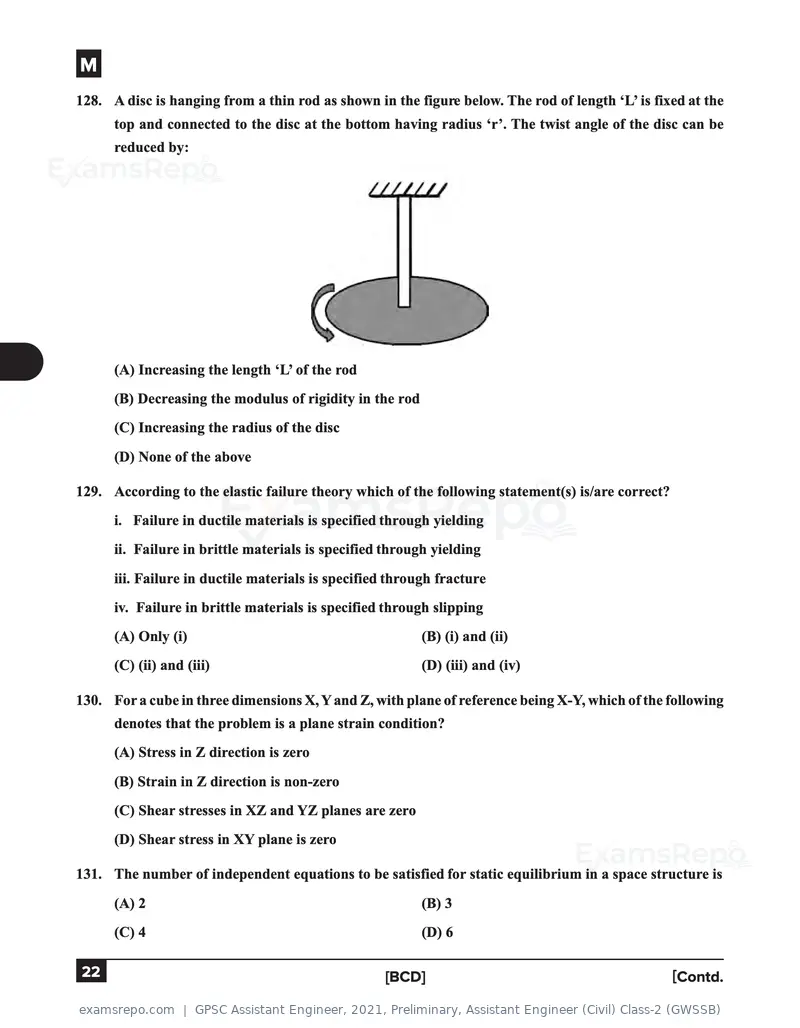
Text of page 22
M
128. A disc is hanging from a thin rod as shown in the figure below. The rod of length ‘L’ is fixed at the
      top and connected to the disc at the bottom having radius ‘r’. The twist angle of the disc can be
      reduced by:


      (A) Increasing the length ‘L’ of the rod
      (B) Decreasing the modulus of rigidity in the rod
      (C) Increasing the radius of the disc
      (D) None of the above

129. According to the elastic failure theory which of the following statement(s) is/are correct?
      i.   Failure in ductile materials is specified through yielding
      ii.  Failure in brittle materials is specified through yielding
      iii. Failure in ductile materials is specified through fracture
      iv.  Failure in brittle materials is specified through slipping
      (A) Only (i)                                        (B) (i) and (ii)
      (C) (ii) and (iii)                                  (D) (iii) and (iv)

130.	For a cube in three dimensions X, Y and Z, with plane of reference being X-Y, which of the following
      denotes that the problem is a plane strain condition?
      (A) Stress in Z direction is zero
      (B) Strain in Z direction is non-zero
      (C) Shear stresses in XZ and YZ planes are zero
      (D) Shear stress in XY plane is zero

131. The number of independent equations to be satisfied for static equilibrium in a space structure is
      (A) 2                                               (B) 3
      (C) 4                                               (D) 6

22                                                  [BCD]                                          [Contd.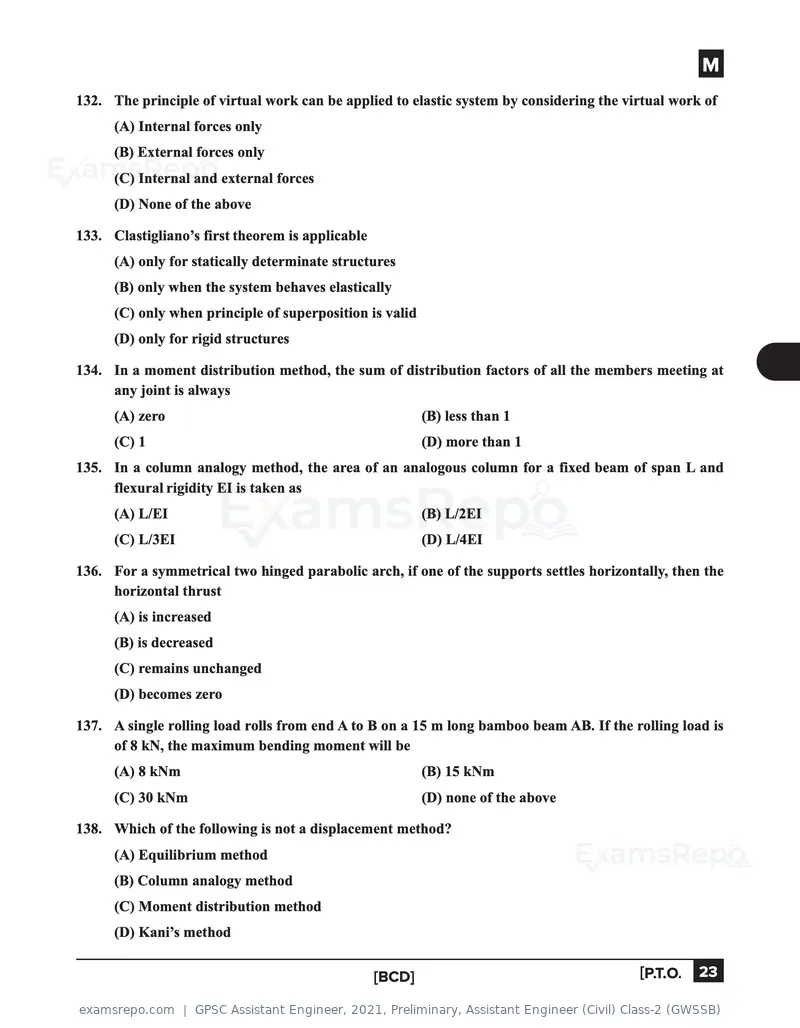
Text of page 23
M
132. The principle of virtual work can be applied to elastic system by considering the virtual work of
      (A) Internal forces only
      (B) External forces only
      (C) Internal and external forces
      (D) None of the above

133. Clastigliano’s first theorem is applicable
      (A) only for statically determinate structures
      (B) only when the system behaves elastically
      (C) only when principle of superposition is valid
      (D) only for rigid structures

134.	In a moment distribution method, the sum of distribution factors of all the members meeting at
      any joint is always
      (A) zero                                            (B) less than 1
      (C) 1                                               (D) more than 1
135. In a column analogy method, the area of an analogous column for a fixed beam of span L and
     flexural rigidity EI is taken as
      (A) L/EI                                            (B) L/2EI
      (C) L/3EI                                           (D) L/4EI

136.	For a symmetrical two hinged parabolic arch, if one of the supports settles horizontally, then the
      horizontal thrust
      (A) is increased
      (B) is decreased
      (C) remains unchanged
      (D) becomes zero

137.	A single rolling load rolls from end A to B on a 15 m long bamboo beam AB. If the rolling load is
      of 8 kN, the maximum bending moment will be
      (A) 8 kNm                                           (B) 15 kNm
      (C) 30 kNm                                          (D) none of the above

138. Which of the following is not a displacement method?
      (A) Equilibrium method
      (B) Column analogy method
      (C) Moment distribution method
      (D) Kani’s method


                                                  [BCD]                                   [P.T.O.   23
Text of page 24
M
139. Which of the following statements are correct?
     i. The displacement method is more useful when degree of kinematic indeterminacy is less than
          the degree of static indeterminacy
     ii. The displacement method is more useful when degree of kinematic indeterminacy is greater
          than the degree of static indeterminacy
     iii. The force method is more useful when degree of static indeterminacy is greater than the degree
           of kinematic indeterminacy
     iv. The force method is more useful when degree of static indeterminacy is less than the degree of
           kinematic indeterminacy
     (A) (i) and (iv)                                  (B) (i) and (iii)
     (C) (ii) and (iv)                                 (D) (ii) and (iii)
140. The deformation of a spring produced by a unit load is called
     (A) Stiffness                                   (B) Flexibility
     (C) Influence coefficient                       (D) Unit Strain
141. In a ring beam subjected to uniformly distributed load
     i. Shear force at mid span is zero
     ii. Shear force at mid span is maximum
     iii. Torsion at mid span is zero
     iv. Torsion at mid span is maximum
     The correct answer is:
     (A) (i) and (iii)                               (B) (i) and (iv)
     (C) (ii) and (iii)                              (D) (ii) and (iv)
142. Consider the two bamboo beams, with similar flexural stiffness EI, as shown in the figure 1 and
     figure 2 below; consider that the maximum deflection and rotation in case of Beam 1 is dmax1 and
     qmax1, whereas for Beam 2 is dmax2 and qmax2. On the principles of slope and deflection theory,
     which of the following describes a correct relationship between the two beams?


      (A) dmax1 = dmax2 and qmax1 ≠ qmax2              (B) dmax1 ≠ dmax2 and qmax1 = qmax2
      (C) dmax1 = dmax2 and qmax1 = qmax2              (D) dmax1 ≠ dmax2 and qmax1 ≠ qmax2


24                                                [BCD]                                         [Contd.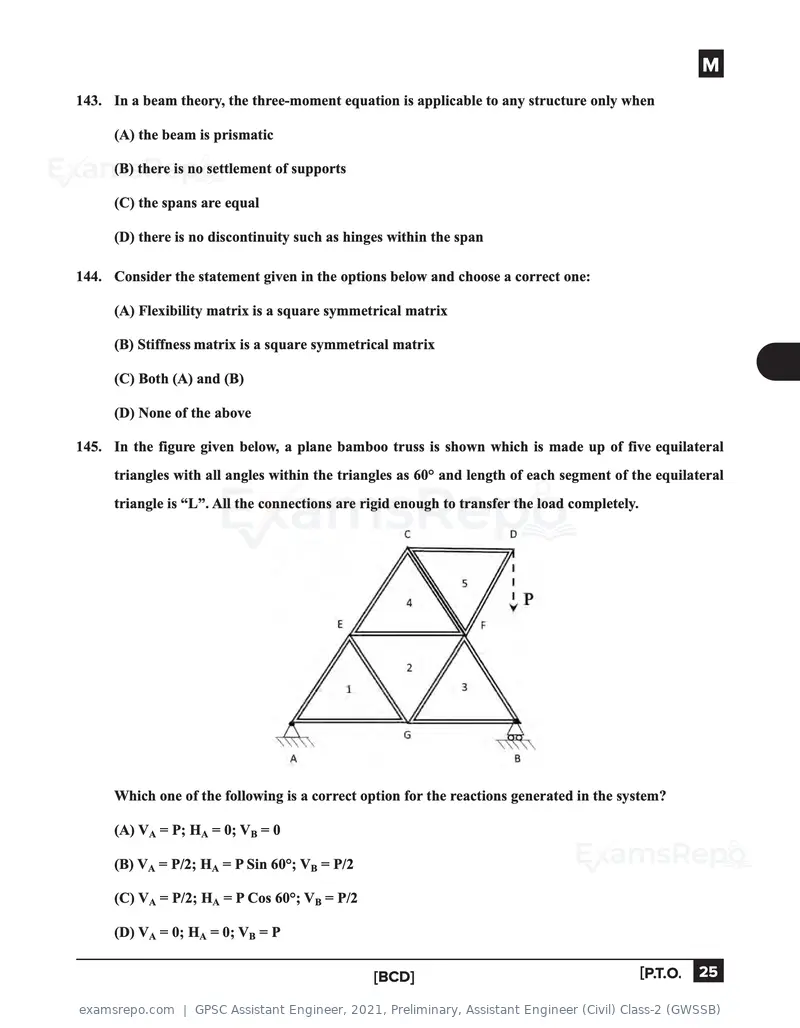
Text of page 25
M
143. In a beam theory, the three-moment equation is applicable to any structure only when

     (A) the beam is prismatic

     (B) there is no settlement of supports

     (C) the spans are equal

     (D) there is no discontinuity such as hinges within the span

144. Consider the statement given in the options below and choose a correct one:

     (A) Flexibility matrix is a square symmetrical matrix

     (B) Stiffness matrix is a square symmetrical matrix

     (C) Both (A) and (B)

     (D) None of the above

145. In the figure given below, a plane bamboo truss is shown which is made up of five equilateral
     triangles with all angles within the triangles as 60° and length of each segment of the equilateral
     triangle is “L”. All the connections are rigid enough to transfer the load completely.


     Which one of the following is a correct option for the reactions generated in the system?

     (A) VA = P; HA = 0; VB = 0

     (B) VA = P/2; HA = P Sin 60°; VB = P/2

     (C) VA = P/2; HA = P Cos 60°; VB = P/2

     (D) VA = 0; HA = 0; VB = P


                                               [BCD]                                          [P.T.O.   25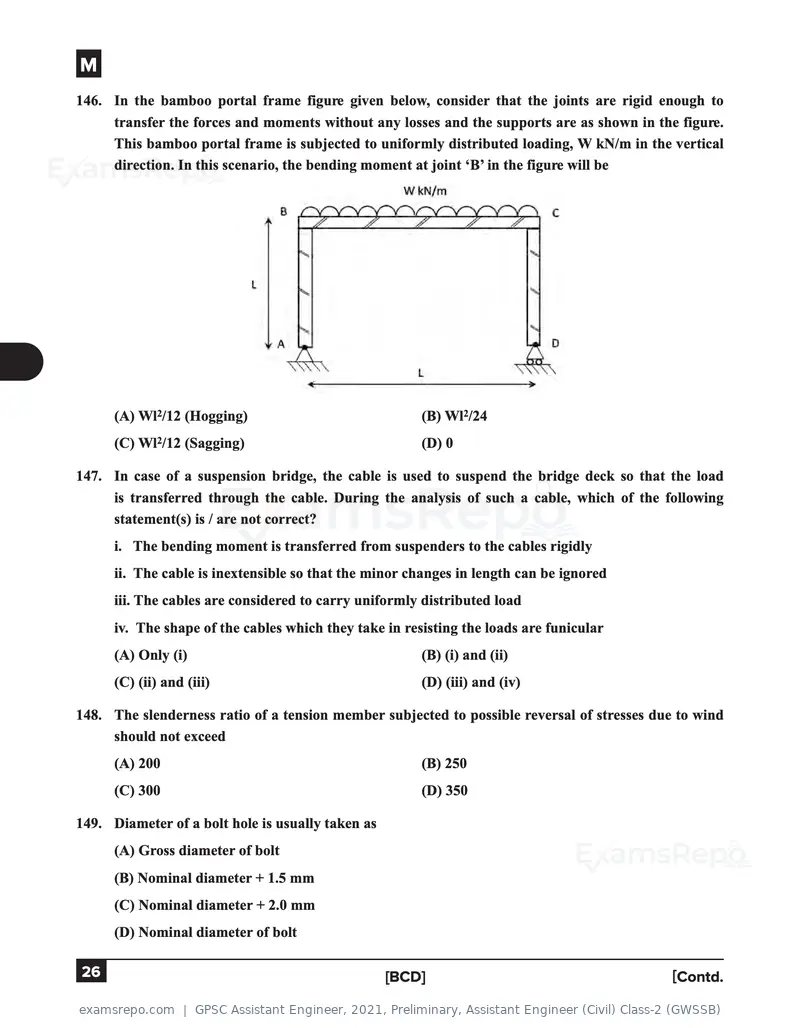
Text of page 26
M
146. In the bamboo portal frame figure given below, consider that the joints are rigid enough to
     transfer the forces and moments without any losses and the supports are as shown in the figure.
     This bamboo portal frame is subjected to uniformly distributed loading, W kN/m in the vertical
     direction. In this scenario, the bending moment at joint ‘B’ in the figure will be


      (A) Wl2/12 (Hogging)                              (B) Wl2/24
      (C) Wl2/12 (Sagging)                              (D) 0

147.	In case of a suspension bridge, the cable is used to suspend the bridge deck so that the load
      is transferred through the cable. During the analysis of such a cable, which of the following
      statement(s) is / are not correct?
      i. The bending moment is transferred from suspenders to the cables rigidly
      ii. The cable is inextensible so that the minor changes in length can be ignored
      iii. The cables are considered to carry uniformly distributed load
      iv. The shape of the cables which they take in resisting the loads are funicular
      (A) Only (i)                                      (B) (i) and (ii)
      (C) (ii) and (iii)                                (D) (iii) and (iv)

148.	The slenderness ratio of a tension member subjected to possible reversal of stresses due to wind
      should not exceed
      (A) 200                                           (B) 250
      (C) 300                                           (D) 350

149. Diameter of a bolt hole is usually taken as
      (A) Gross diameter of bolt
      (B) Nominal diameter + 1.5 mm
      (C) Nominal diameter + 2.0 mm
      (D) Nominal diameter of bolt

26                                                 [BCD]                                     [Contd.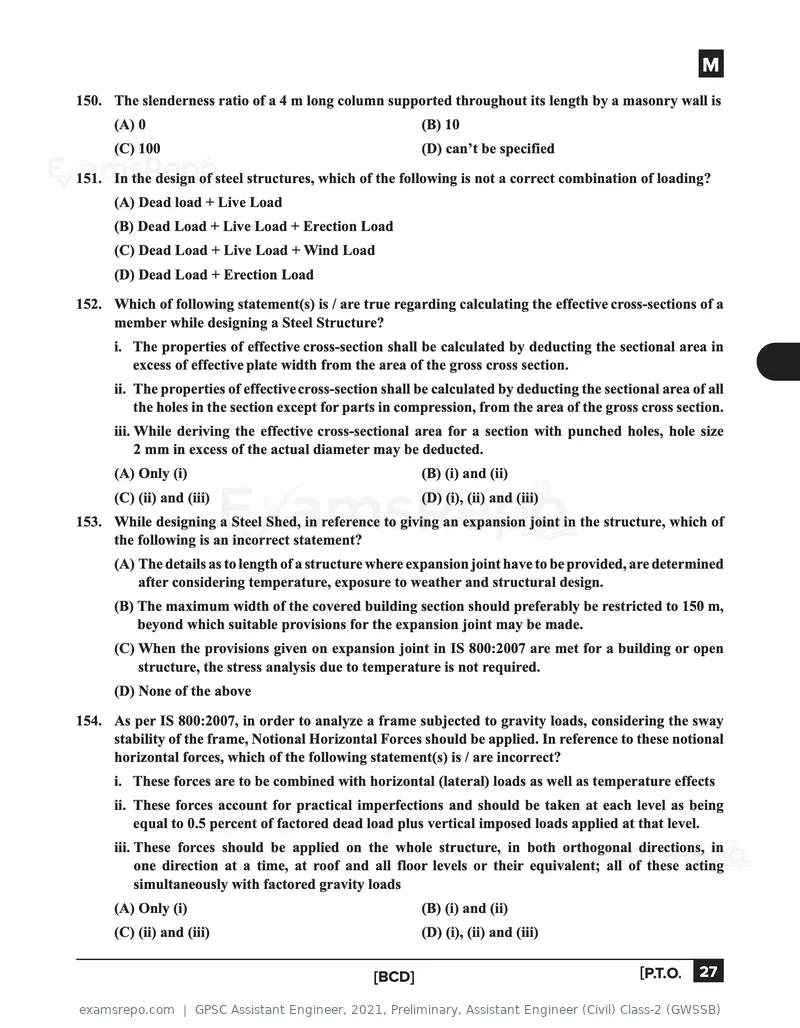
Text of page 27
M
150. The slenderness ratio of a 4 m long column supported throughout its length by a masonry wall is
      (A) 0                                                (B) 10
      (C) 100                                              (D) can’t be specified

151. In the design of steel structures, which of the following is not a correct combination of loading?
      (A) Dead load + Live Load
      (B) Dead Load + Live Load + Erection Load
      (C) Dead Load + Live Load + Wind Load
      (D) Dead Load + Erection Load

152. Which of following statement(s) is / are true regarding calculating the effective cross-sections of a
     member while designing a Steel Structure?
      i.   The properties of effective cross-section shall be calculated by deducting the sectional area in
           excess of effective plate width from the area of the gross cross section.
      ii.  The properties of effective cross-section shall be calculated by deducting the sectional area of all
           the holes in the section except for parts in compression, from the area of the gross cross section.
      iii. While deriving the effective cross-sectional area for a section with punched holes, hole size
           2 mm in excess of the actual diameter may be deducted.
      (A) Only (i)                                         (B) (i) and (ii)
      (C) (ii) and (iii)                                   (D) (i), (ii) and (iii)
153.	While designing a Steel Shed, in reference to giving an expansion joint in the structure, which of
      the following is an incorrect statement?
      (A) The details as to length of a structure where expansion joint have to be provided, are determined
           after considering temperature, exposure to weather and structural design.
      (B) The maximum width of the covered building section should preferably be restricted to 150 m,
          beyond which suitable provisions for the expansion joint may be made.
      (C) When the provisions given on expansion joint in IS 800:2007 are met for a building or open
           structure, the stress analysis due to temperature is not required.
      (D) None of the above

154.	As per IS 800:2007, in order to analyze a frame subjected to gravity loads, considering the sway
      stability of the frame, Notional Horizontal Forces should be applied. In reference to these notional
      horizontal forces, which of the following statement(s) is / are incorrect?
      i.   These forces are to be combined with horizontal (lateral) loads as well as temperature effects
      ii. These forces account for practical imperfections and should be taken at each level as being
          equal to 0.5 percent of factored dead load plus vertical imposed loads applied at that level.
      iii. These forces should be applied on the whole structure, in both orthogonal directions, in
            one direction at a time, at roof and all floor levels or their equivalent; all of these acting
            simultaneously with factored gravity loads
      (A) Only (i)                                         (B) (i) and (ii)
      (C) (ii) and (iii)                                   (D) (i), (ii) and (iii)


                                                   [BCD]                                         [P.T.O.   27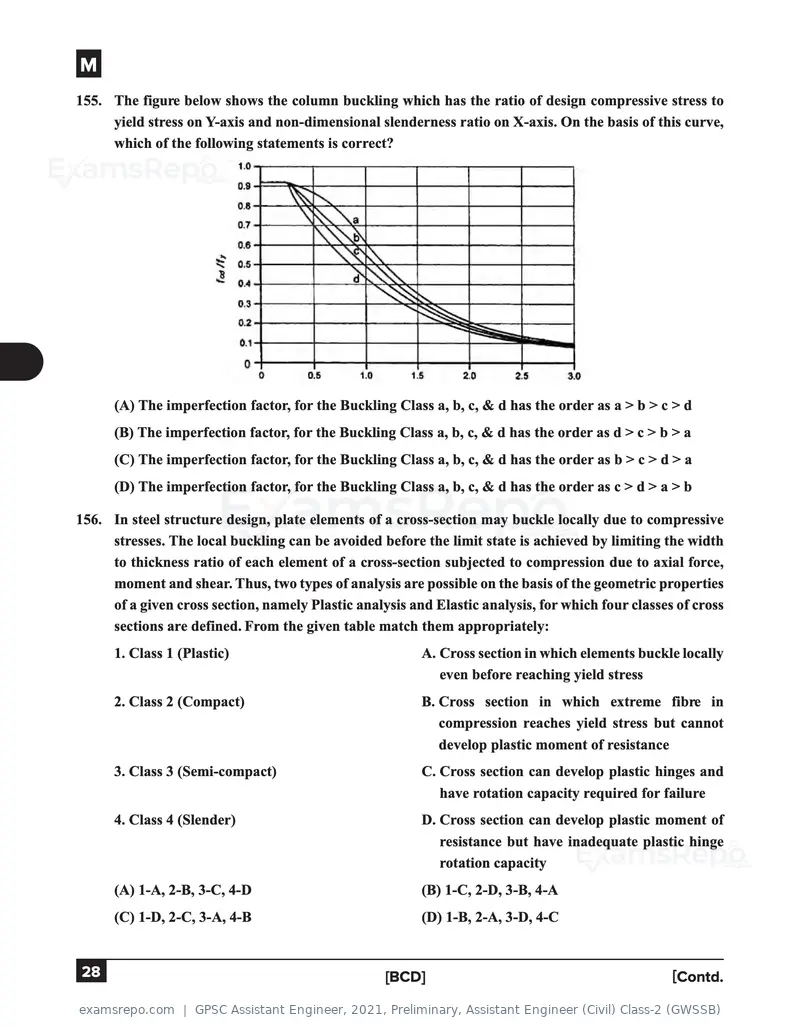
Text of page 28
M
155. The figure below shows the column buckling which has the ratio of design compressive stress to
     yield stress on Y-axis and non-dimensional slenderness ratio on X-axis. On the basis of this curve,
     which of the following statements is correct?


      (A) The imperfection factor, for the Buckling Class a, b, c, & d has the order as a > b > c > d
      (B) The imperfection factor, for the Buckling Class a, b, c, & d has the order as d > c > b > a
      (C) The imperfection factor, for the Buckling Class a, b, c, & d has the order as b > c > d > a
      (D) The imperfection factor, for the Buckling Class a, b, c, & d has the order as c > d > a > b

156.	In steel structure design, plate elements of a cross-section may buckle locally due to compressive
      stresses. The local buckling can be avoided before the limit state is achieved by limiting the width
      to thickness ratio of each element of a cross-section subjected to compression due to axial force,
      moment and shear. Thus, two types of analysis are possible on the basis of the geometric properties
      of a given cross section, namely Plastic analysis and Elastic analysis, for which four classes of cross
      sections are defined. From the given table match them appropriately:
      1. Class 1 (Plastic)                                A. Cross section in which elements buckle locally
                                                             even before reaching yield stress
      2. Class 2 (Compact)                                B. Cross section in which extreme fibre in
                                                             compression reaches yield stress but cannot
                                                             develop plastic moment of resistance
      3. Class 3 (Semi-compact)                           C. Cross section can develop plastic hinges and
                                                             have rotation capacity required for failure
      4. Class 4 (Slender)                                D. Cross section can develop plastic moment of
                                                             resistance but have inadequate plastic hinge
                                                             rotation capacity
      (A) 1-A, 2-B, 3-C, 4-D                              (B) 1-C, 2-D, 3-B, 4-A
      (C) 1-D, 2-C, 3-A, 4-B                              (D) 1-B, 2-A, 3-D, 4-C


28                                                  [BCD]                                           [Contd.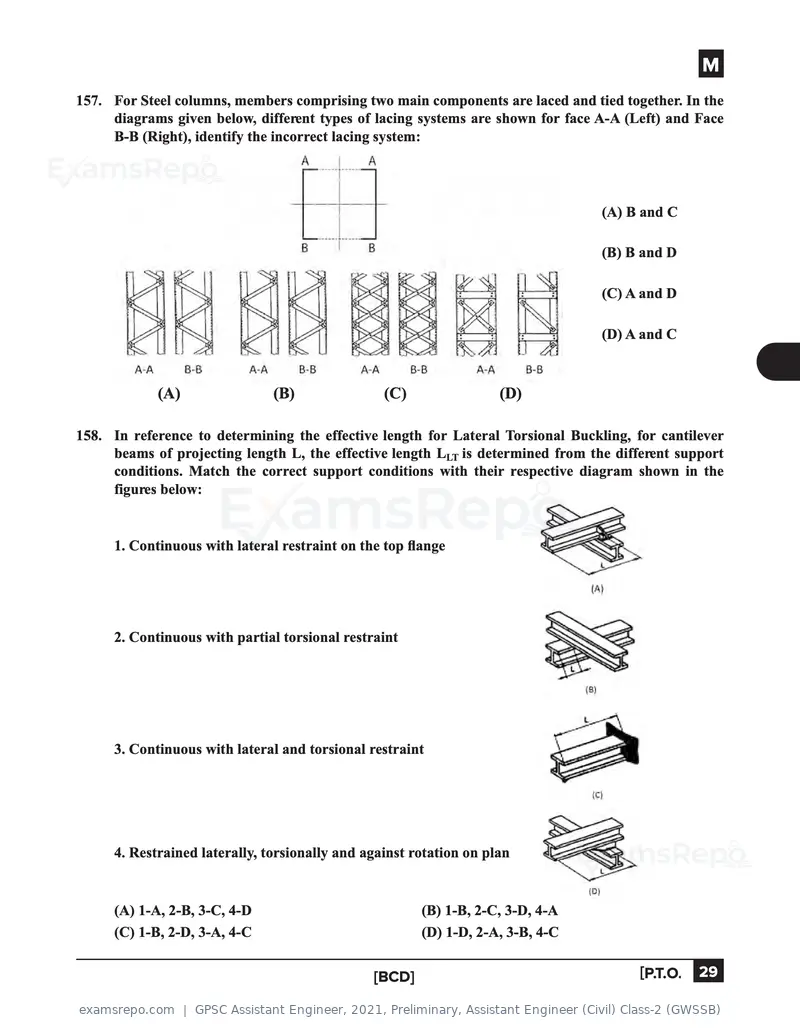
Text of page 29
M
157.	For Steel columns, members comprising two main components are laced and tied together. In the
      diagrams given below, different types of lacing systems are shown for face A-A (Left) and Face
      B-B (Right), identify the incorrect lacing system:


                                                                                 (A) B and C

                                                                                 (B) B and D

                                                                                 (C) A and D

                                                                                 (D) A and C


            (A)                (B)               (C)                (D)

158. In reference to determining the effective length for Lateral Torsional Buckling, for cantilever
     beams of projecting length L, the effective length LLT is determined from the different support
     conditions. Match the correct support conditions with their respective diagram shown in the
     figures below:


     1. Continuous with lateral restraint on the top flange


     2. Continuous with partial torsional restraint


     3. Continuous with lateral and torsional restraint


     4. Restrained laterally, torsionally and against rotation on plan


     (A) 1-A, 2-B, 3-C, 4-D                            (B) 1-B, 2-C, 3-D, 4-A
     (C) 1-B, 2-D, 3-A, 4-C                            (D) 1-D, 2-A, 3-B, 4-C


                                               [BCD]                                   [P.T.O.   29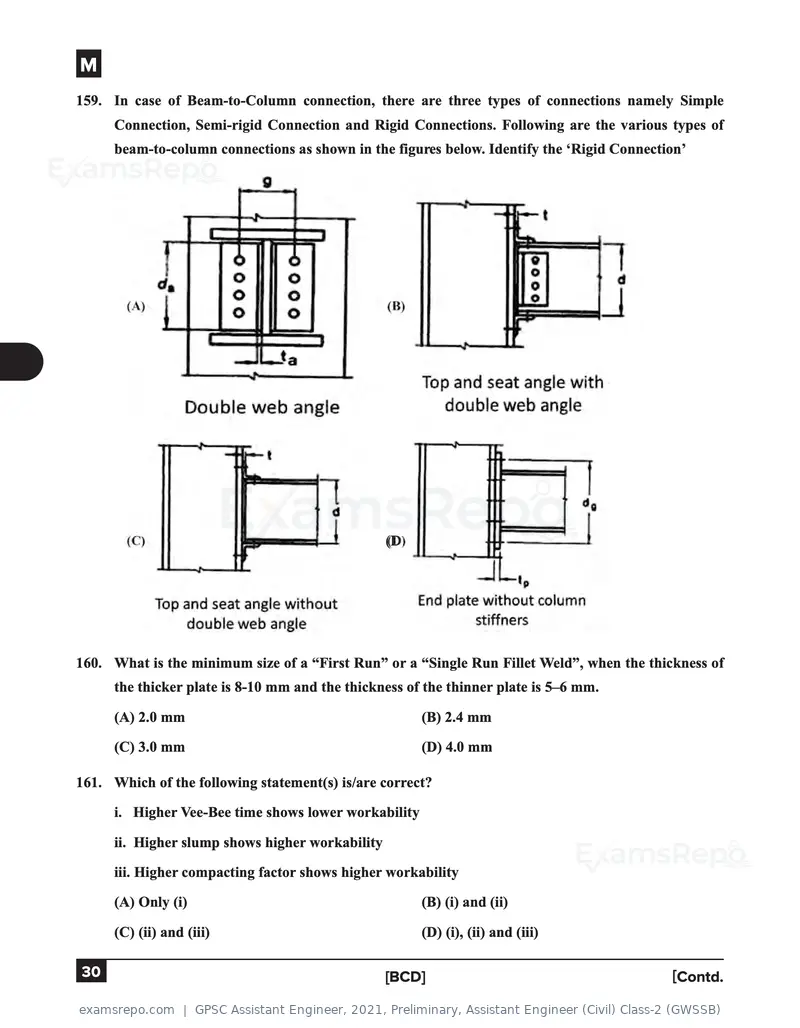
Text of page 30
M
159. 	In case of Beam-to-Column connection, there are three types of connections namely Simple
     Connection, Semi-rigid Connection and Rigid Connections. Following are the various types of
     beam-to-column connections as shown in the figures below. Identify the ‘Rigid Connection’


                                                 (D


160. What is the minimum size of a “First Run” or a “Single Run Fillet Weld”, when the thickness of
     the thicker plate is 8-10 mm and the thickness of the thinner plate is 5–6 mm.

     (A) 2.0 mm                                       (B) 2.4 mm

     (C) 3.0 mm                                       (D) 4.0 mm

161. Which of the following statement(s) is/are correct?

     i. Higher Vee-Bee time shows lower workability

     ii. Higher slump shows higher workability

     iii. Higher compacting factor shows higher workability

     (A) Only (i)                                     (B) (i) and (ii)

     (C) (ii) and (iii)                               (D) (i), (ii) and (iii)

30                                               [BCD]                                     [Contd.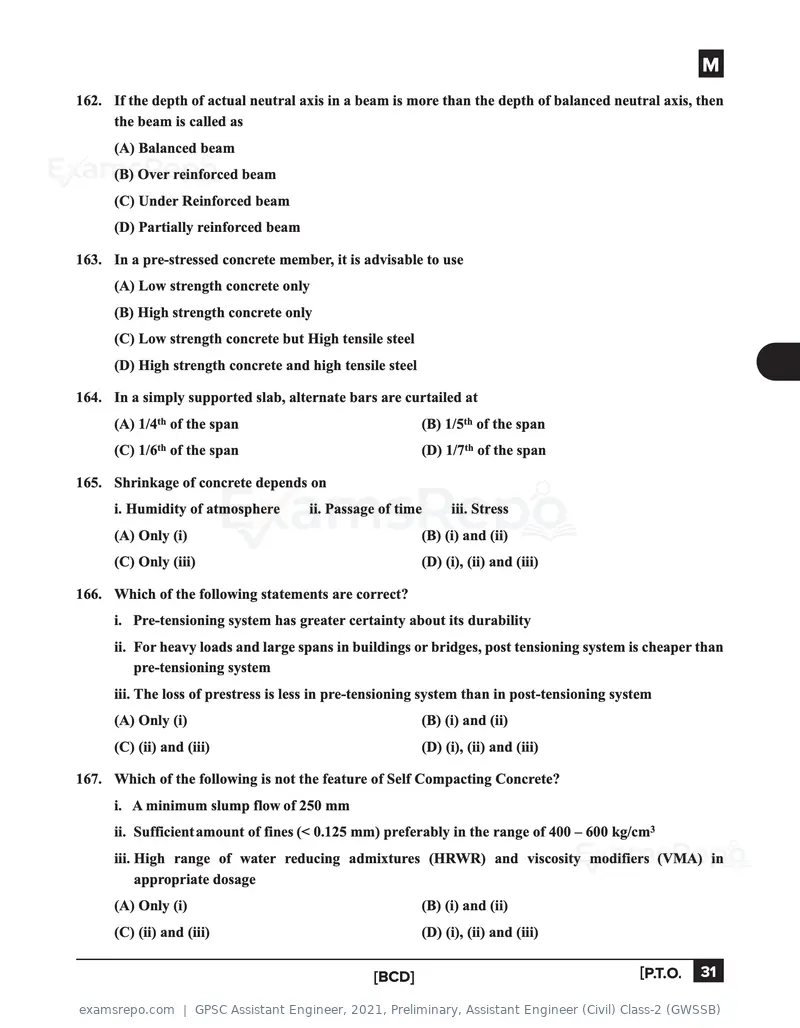
Text of page 31
M
162. If the depth of actual neutral axis in a beam is more than the depth of balanced neutral axis, then
     the beam is called as
      (A) Balanced beam
      (B) Over reinforced beam
      (C) Under Reinforced beam
      (D) Partially reinforced beam

163. In a pre-stressed concrete member, it is advisable to use
      (A) Low strength concrete only
      (B) High strength concrete only
      (C) Low strength concrete but High tensile steel
      (D) High strength concrete and high tensile steel

164. In a simply supported slab, alternate bars are curtailed at
      (A) 1/4th of the span                               (B) 1/5th of the span
      (C) 1/6th of the span                               (D) 1/7th of the span

165. Shrinkage of concrete depends on
      i. Humidity of atmosphere       ii. Passage of time      iii. Stress
      (A) Only (i)                                        (B) (i) and (ii)
      (C) Only (iii)                                      (D) (i), (ii) and (iii)

166.	Which of the following statements are correct?
      i. Pre-tensioning system has greater certainty about its durability
      ii. For heavy loads and large spans in buildings or bridges, post tensioning system is cheaper than
          pre-tensioning system
      iii. The loss of prestress is less in pre-tensioning system than in post-tensioning system
      (A) Only (i)                                        (B) (i) and (ii)
      (C) (ii) and (iii)                                  (D) (i), (ii) and (iii)

167. Which of the following is not the feature of Self Compacting Concrete?
      i.   A minimum slump flow of 250 mm
      ii.  Sufficient amount of fines (< 0.125 mm) preferably in the range of 400 – 600 kg/cm3
      iii. High range of water reducing admixtures (HRWR) and viscosity modifiers (VMA) in
           appropriate dosage
      (A) Only (i)                                        (B) (i) and (ii)
      (C) (ii) and (iii)                                  (D) (i), (ii) and (iii)


                                                 [BCD]                                        [P.T.O.   31
Text of page 32
M
168.	The nominal concrete cover requirement to meet the durability requirement are mentioned below,
      which of them is not a correct statement?
      (A) Nominal cover for mild exposure is 20 mm
      (B) Nominal cover for moderate exposure is 30 mm
      (C) Nominal cover for severe exposure is 45 mm
      (D) Nominal cover for extreme exposure is 55 mm

169.	For a slab continuous over support and designed as simply supported slab, which of the following
      statement(s) is/are correct?
      i. Reinforcement shall be provided over the support to control cracking
      ii. Reinforcement shall have a cross sectional area of not less than one quarter that required in the
          middle of the adjoining spans
      iii. Reinforcement shall extend at least one-tenth of the clear span into adjoining spans
      (A) Only (i)                                       (B) (i) and (ii)
      (C) (ii) and (iii)                                 (D) (i), (ii) and (iii)

170. In designing a reinforced concrete pile, the end support condition considered for designing is
      (A) Both ends fixed                                (B) One end fixed and another end hinged
      (C) One end fixed and another end free             (D) Both ends hinged

171. The lap length, for a reinforcement with diameter ‘d’, in direct tension should be,
      (A) Ld or 30d whichever is greater                 (B) 2Ld or 30d whichever is greater
      (C) 30d                                            (D) 24d

172. If the RCC slab is of 100 mm thickness than the maximum size of reinforcement bar that can be
     provided is
      (A) 8 mm                                           (B) 10 mm
      (C) 12 mm                                          (D) 16 mm

173. The permissible tensile stress in HYSD reinforcement used for water tanks is
      (A) 110 MPa                                        (B) 130 MPa
      (C) 150 MPa                                        (D) 190 MPa

174. In a T-shaped Retaining wall, the main reinforcement on the toe is provided at
      (A) Top face parallel to the wall
      (B) Top face perpendicular to the wall
      (C) Bottom face parallel to the wall
      (D) Bottom face perpendicular to the wall

32                                                 [BCD]                                           [Contd.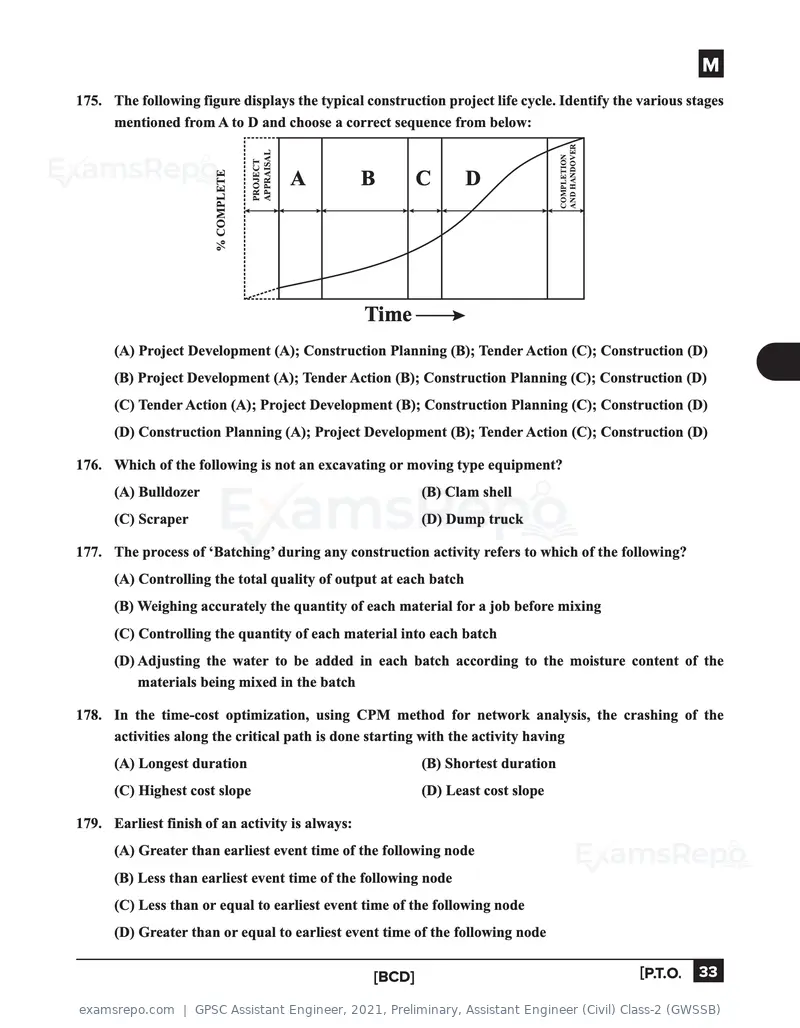
Text of page 33
M
175. The following figure displays the typical construction project life cycle. Identify the various stages
     mentioned from A to D and choose a correct sequence from below:

                                   PROJECT                                         COMPLETION
                                               A   B       C      D

                      % COMPLETE
                                   APPRAISAL
                                                                                   AND HANDOVER


                                                   Time
      (A) Project Development (A); Construction Planning (B); Tender Action (C); Construction (D)
      (B) Project Development (A); Tender Action (B); Construction Planning (C); Construction (D)
      (C) Tender Action (A); Project Development (B); Construction Planning (C); Construction (D)
      (D) Construction Planning (A); Project Development (B); Tender Action (C); Construction (D)

176. Which of the following is not an excavating or moving type equipment?
      (A) Bulldozer                                        (B) Clam shell
      (C) Scraper                                          (D) Dump truck

177. The process of ‘Batching’ during any construction activity refers to which of the following?
      (A) Controlling the total quality of output at each batch
      (B) Weighing accurately the quantity of each material for a job before mixing
      (C) Controlling the quantity of each material into each batch
      (D) Adjusting the water to be added in each batch according to the moisture content of the
          materials being mixed in the batch

178.	In the time-cost optimization, using CPM method for network analysis, the crashing of the
      activities along the critical path is done starting with the activity having
      (A) Longest duration                                 (B) Shortest duration
      (C) Highest cost slope                               (D) Least cost slope

179. Earliest finish of an activity is always:
      (A) Greater than earliest event time of the following node
      (B) Less than earliest event time of the following node
      (C) Less than or equal to earliest event time of the following node
      (D) Greater than or equal to earliest event time of the following node


                                                   [BCD]                                          [P.T.O.   33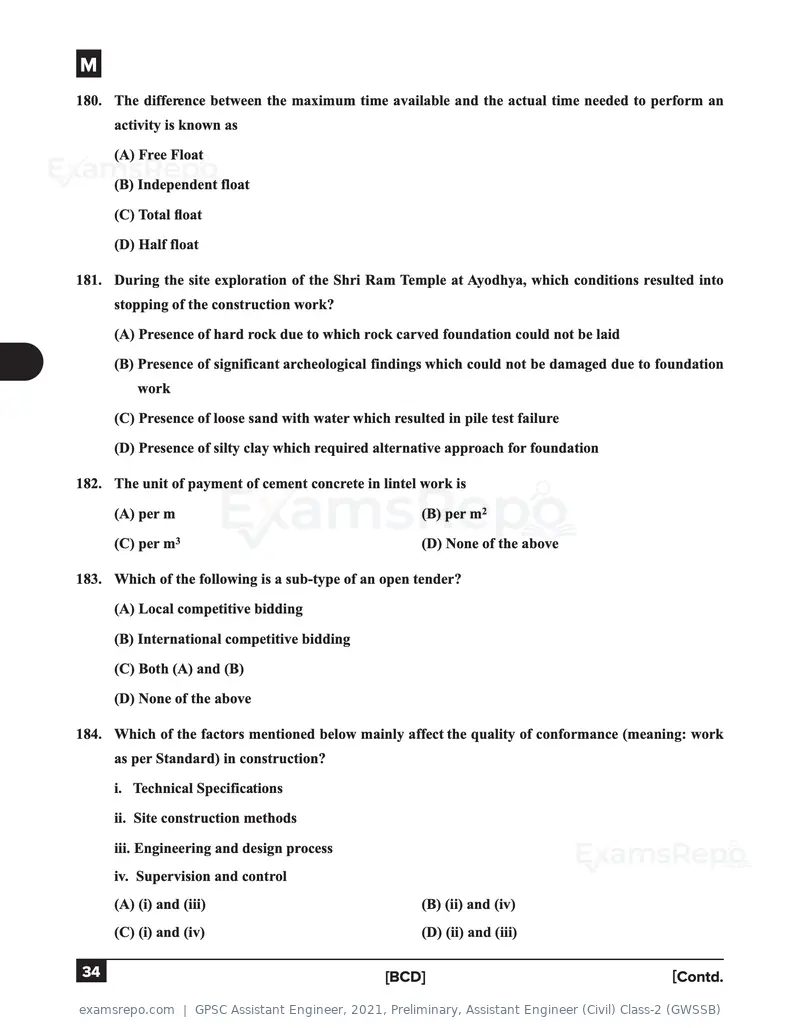
Text of page 34
M
180. The difference between the maximum time available and the actual time needed to perform an
     activity is known as

     (A) Free Float

     (B) Independent float

     (C) Total float

     (D) Half float

181.	During the site exploration of the Shri Ram Temple at Ayodhya, which conditions resulted into
     stopping of the construction work?

     (A) Presence of hard rock due to which rock carved foundation could not be laid

     (B) Presence of significant archeological findings which could not be damaged due to foundation
         work

     (C) Presence of loose sand with water which resulted in pile test failure

     (D) Presence of silty clay which required alternative approach for foundation

182. The unit of payment of cement concrete in lintel work is

     (A) per m                                         (B) per m2

     (C) per m3                                        (D) None of the above

183. Which of the following is a sub-type of an open tender?

     (A) Local competitive bidding

     (B) International competitive bidding

     (C) Both (A) and (B)

     (D) None of the above

184. Which of the factors mentioned below mainly affect the quality of conformance (meaning: work
     as per Standard) in construction?

     i.   Technical Specifications

     ii. Site construction methods

     iii. Engineering and design process
     iv. Supervision and control
     (A) (i) and (iii)                                 (B) (ii) and (iv)
     (C) (i) and (iv)                                  (D) (ii) and (iii)

34                                               [BCD]                                      [Contd.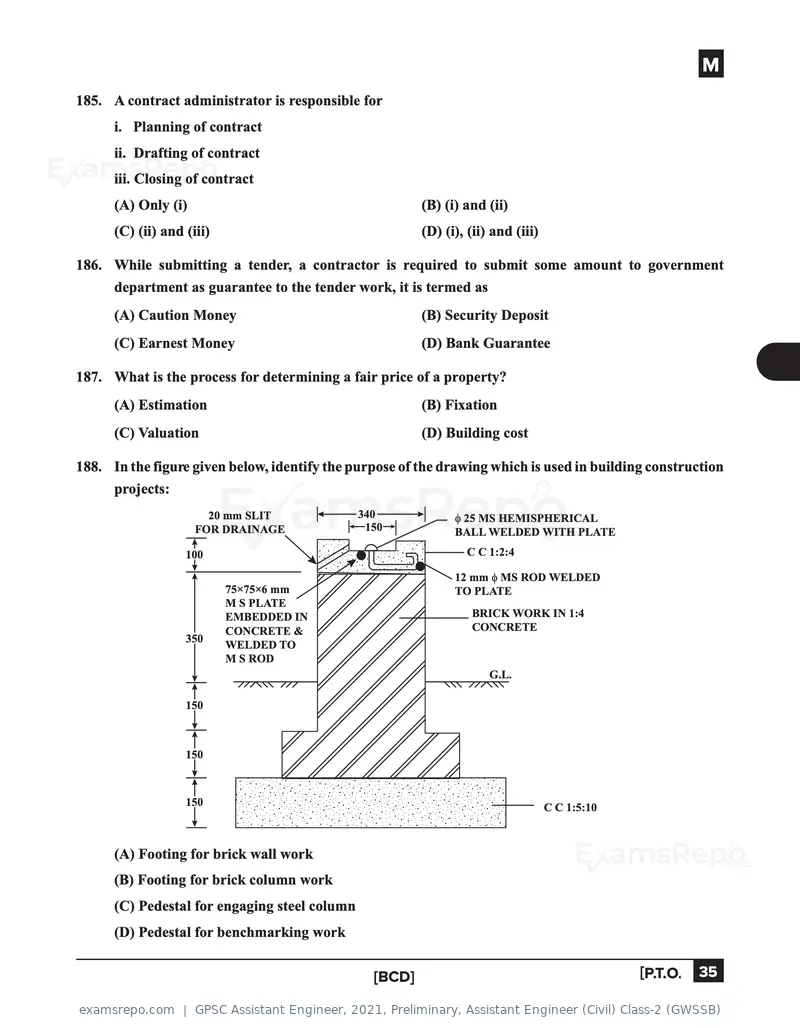
Text of page 35
M
185. A contract administrator is responsible for
      i. Planning of contract
      ii. Drafting of contract
      iii. Closing of contract
      (A) Only (i)                                       (B) (i) and (ii)
      (C) (ii) and (iii)                                 (D) (i), (ii) and (iii)

186.	While submitting a tender, a contractor is required to submit some amount to government
      department as guarantee to the tender work, it is termed as
      (A) Caution Money                                  (B) Security Deposit
      (C) Earnest Money                                  (D) Bank Guarantee

187. What is the process for determining a fair price of a property?
      (A) Estimation                                     (B) Fixation
      (C) Valuation                                      (D) Building cost

188. In the figure given below, identify the purpose of the drawing which is used in building construction
      projects:
                       20 mm SLIT              340              25 MS HEMISPHERICAL
                     FOR DRAINAGE               150            BALL WELDED WITH PLATE
                   100                                           C C 1:2:4

                                                               12 mm  MS ROD WELDED
                           75×75×6 mm                          TO PLATE
                           M S PLATE
                           EMBEDDED IN                            BRICK WORK IN 1:4
                           CONCRETE &                             CONCRETE
                   350
                           WELDED TO
                           M S ROD
                                                                      G.L.

                   150


                   150


                   150                                                             C C 1:5:10


      (A) Footing for brick wall work
      (B) Footing for brick column work
      (C) Pedestal for engaging steel column
      (D) Pedestal for benchmarking work


                                                 [BCD]                                          [P.T.O.   35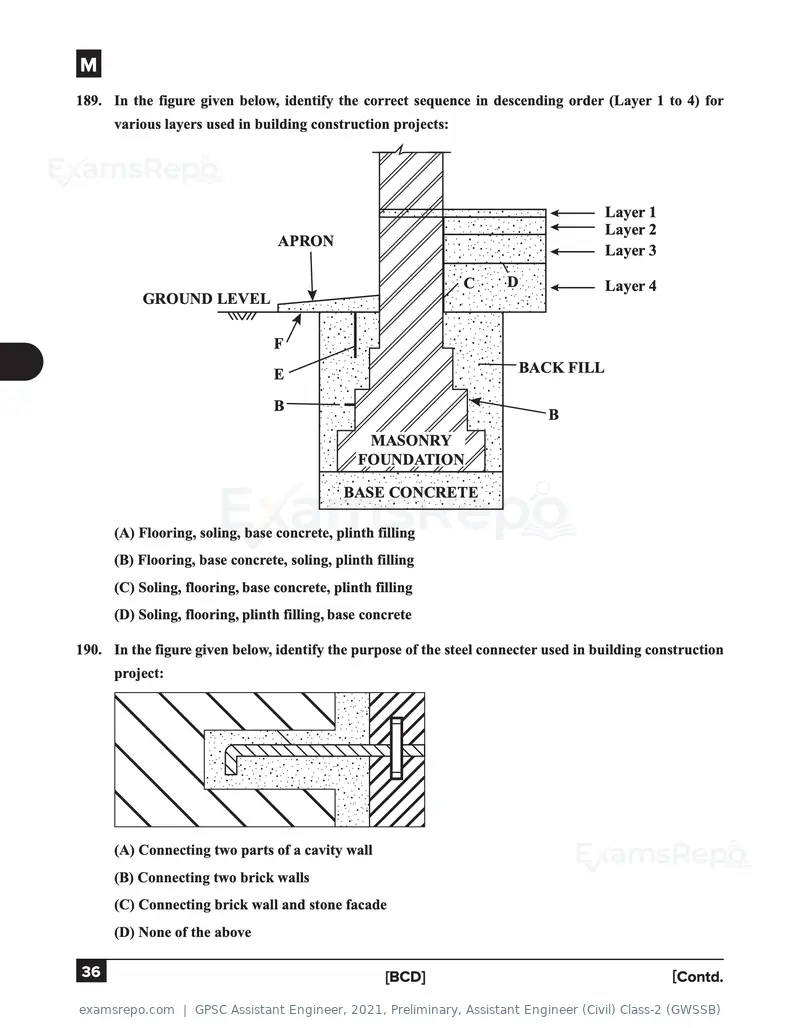
Text of page 36
M
189. In the figure given below, identify the correct sequence in descending order (Layer 1 to 4) for
      various layers used in building construction projects:


                                                                                      Layer 1
                                                                                      Layer 2
                                  APRON
                                                                                      Layer 3

                                                               C      D               Layer 4
          GROUND LEVEL

                                 F
                                 E                                      BACK FILL

                                 B
                                                                             B
                                                MASONRY
                                               FOUNDATION

                                             BASE CONCRETE

      (A) Flooring, soling, base concrete, plinth filling
      (B) Flooring, base concrete, soling, plinth filling
      (C) Soling, flooring, base concrete, plinth filling
      (D) Soling, flooring, plinth filling, base concrete

190. In the figure given below, identify the purpose of the steel connecter used in building construction
      project:


      (A) Connecting two parts of a cavity wall
      (B) Connecting two brick walls
      (C) Connecting brick wall and stone facade
      (D) None of the above

36                                                  [BCD]                                        [Contd.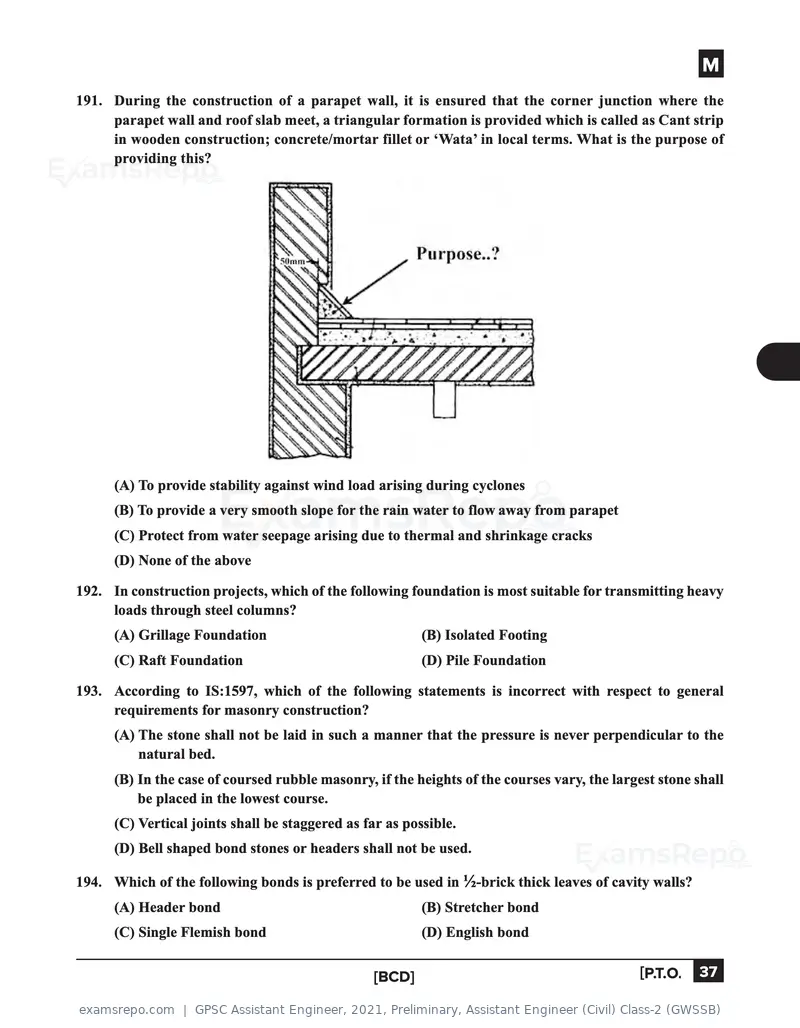
Text of page 37
M
191.	During the construction of a parapet wall, it is ensured that the corner junction where the
      parapet wall and roof slab meet, a triangular formation is provided which is called as Cant strip
      in wooden construction; concrete/mortar fillet or ‘Wata’ in local terms. What is the purpose of
      providing this?


      (A) To provide stability against wind load arising during cyclones
      (B) To provide a very smooth slope for the rain water to flow away from parapet
      (C) Protect from water seepage arising due to thermal and shrinkage cracks
      (D) None of the above

192.	In construction projects, which of the following foundation is most suitable for transmitting heavy
      loads through steel columns?
      (A) Grillage Foundation                             (B) Isolated Footing
      (C) Raft Foundation                                 (D) Pile Foundation

193.	According to IS:1597, which of the following statements is incorrect with respect to general
      requirements for masonry construction?
      (A) The stone shall not be laid in such a manner that the pressure is never perpendicular to the
           natural bed.
      (B) In the case of coursed rubble masonry, if the heights of the courses vary, the largest stone shall
          be placed in the lowest course.
      (C) Vertical joints shall be staggered as far as possible.
      (D) Bell shaped bond stones or headers shall not be used.

194. Which of the following bonds is preferred to be used in ½-brick thick leaves of cavity walls?
      (A) Header bond                                     (B) Stretcher bond
      (C) Single Flemish bond                             (D) English bond


                                                  [BCD]                                       [P.T.O.   37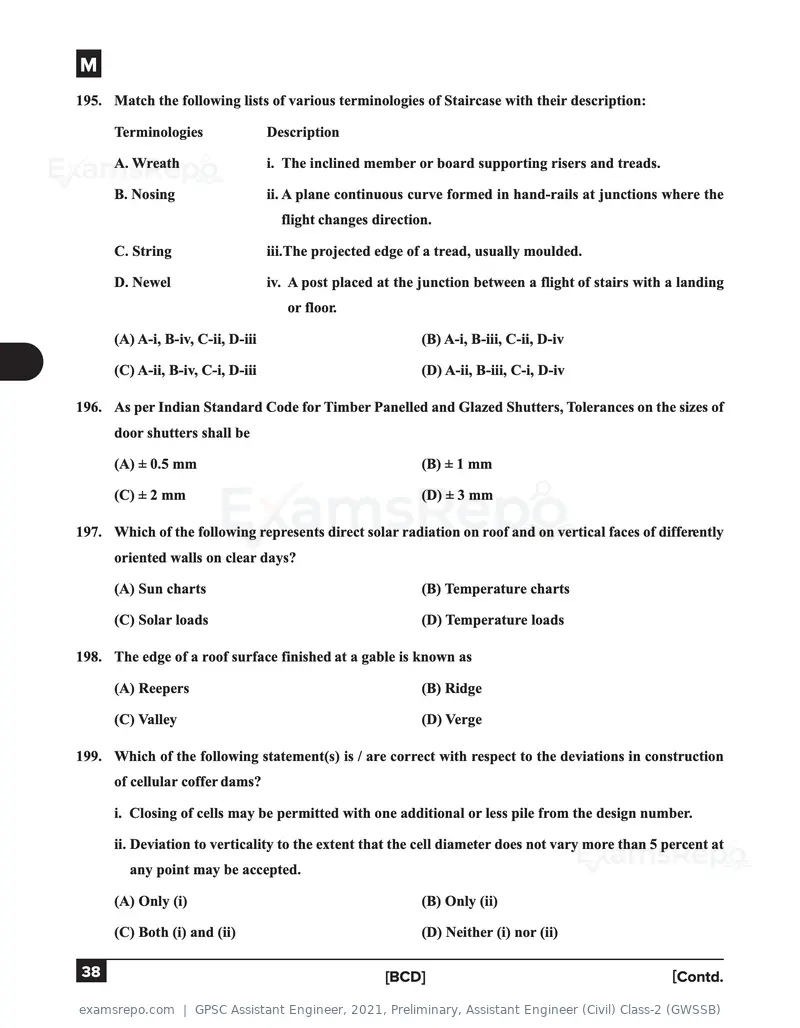
Text of page 38
M
195. Match the following lists of various terminologies of Staircase with their description:

      Terminologies                Description

      A. Wreath                    i. The inclined member or board supporting risers and treads.

      B. Nosing                    ii. A plane continuous curve formed in hand-rails at junctions where the
                                     flight changes direction.

      C. String                    iii.The projected edge of a tread, usually moulded.

      D. Newel                     iv.  A post placed at the junction between a flight of stairs with a landing
                                      or floor.

      (A) A-i, B-iv, C-ii, D-iii                             (B) A-i, B-iii, C-ii, D-iv

      (C) A-ii, B-iv, C-i, D-iii                             (D) A-ii, B-iii, C-i, D-iv

196.	As per Indian Standard Code for Timber Panelled and Glazed Shutters, Tolerances on the sizes of
      door shutters shall be

      (A) ± 0.5 mm                                           (B) ± 1 mm

      (C) ± 2 mm                                             (D) ± 3 mm

197. Which of the following represents direct solar radiation on roof and on vertical faces of differently
      oriented walls on clear days?

      (A) Sun charts                                         (B) Temperature charts

      (C) Solar loads                                        (D) Temperature loads

198. The edge of a roof surface finished at a gable is known as

      (A) Reepers                                            (B) Ridge

      (C) Valley                                             (D) Verge

199.	Which of the following statement(s) is / are correct with respect to the deviations in construction
      of cellular coffer dams?

      i. Closing of cells may be permitted with one additional or less pile from the design number.

      ii. Deviation to verticality to the extent that the cell diameter does not vary more than 5 percent at
        any point may be accepted.

      (A) Only (i)                                           (B) Only (ii)

      (C) Both (i) and (ii)                                  (D) Neither (i) nor (ii)

38                                                    [BCD]                                            [Contd.
Text of page 39
M
200.	As per the Indian Standard code for Requirements of Low Income Housing in Urban Areas, the
      width of individual balcony shall not be more than

      (A) 1.0 m                                             (B) 1.2 m

      (C) 1.5 m                                             (D) 2.0 m

201. Minimum cover for 16 mm diameter bar placed as a main reinforcement in the rib for precast
      reinforced concrete ribbed slab unit shall be
      (A) 16 mm                                             (B) 20 mm
      (C) 24 mm                                             (D) 32 mm

202. Which of the following is the least incompressible fluid?
      (A) Gasoline                                          (B) Kerosene oil
      (C) Helium                                            (D) Water

203. Find the ratio of celerity when surge moving upstream to when surge moving downstream, if ratio
      of initial velocity of stream to velocity of surge is 0.8.
      (A) 1.25                                              (B) 1.10
      (C) 0.90                                              (D) 0.80

204. Uniform flow is possible in which of the following cases?
      (A) frictionless sloping channel
      (B) flow at a channel entrance
      (C) flow in the middle of a long prismatic channel
      (D) horizontal channel

205. If the width of a rectangular channel is twice its depth of flow, then the depth of the flow ‘y’ varies
      with discharge ‘q’ as (consider all parameters constant in Manning’s equation)
      (A) q0.125                                            (B) q0.375

      (C) q0.475                                            (D) none of these

206.	The head loss in a sudden expansion from 6 cm diameter pipe to 12 cm diameter pipe, in terms of
      velocity v1 in the 6 cm diameter pipe is
                                                                   2
          15 v12                                                3 v1
      (A)                                                   (B)
          16 2g                                                 4 2g
             2                                                      2
          1 v1                                                   9 v1
      (C)                                                   (D)
          4 2g                                                  16 2g


                                                   [BCD]                                      [P.T.O.   39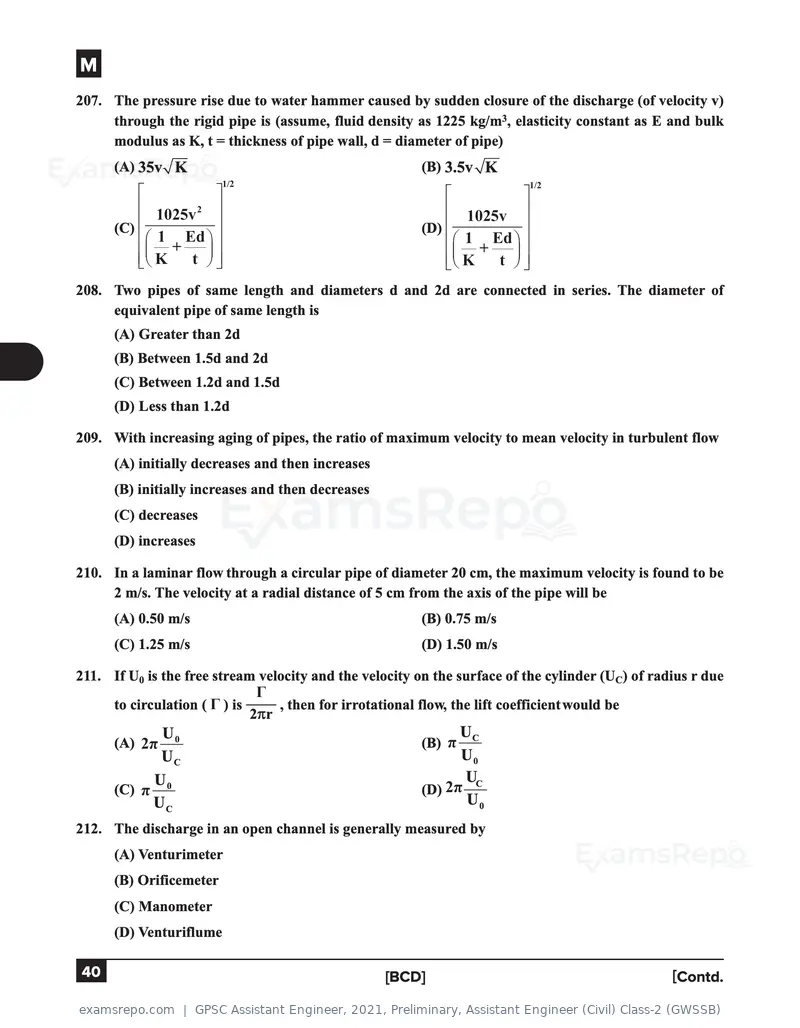
Text of page 40
M
207.	The pressure rise due to water hammer caused by sudden closure of the discharge (of velocity v)
      through the rigid pipe is (assume, fluid density as 1225 kg/m3, elasticity constant as E and bulk
      modulus as K, t = thickness of pipe wall, d = diameter of pipe)
      (A) 35v K                                               (B) 3.5v K


      (C)                                                     (D)


208.	Two pipes of same length and diameters d and 2d are connected in series. The diameter of
      equivalent pipe of same length is
      (A) Greater than 2d
      (B) Between 1.5d and 2d
      (C) Between 1.2d and 1.5d
      (D) Less than 1.2d

209. With increasing aging of pipes, the ratio of maximum velocity to mean velocity in turbulent flow
      (A) initially decreases and then increases
      (B) initially increases and then decreases
      (C) decreases
      (D) increases

210. In a laminar flow through a circular pipe of diameter 20 cm, the maximum velocity is found to be
     2 m/s. The velocity at a radial distance of 5 cm from the axis of the pipe will be
      (A) 0.50 m/s                                            (B) 0.75 m/s
      (C) 1.25 m/s                                            (D) 1.50 m/s

211.	If U0 is the free stream velocity and the velocity on the surface of the cylinder (UC) of radius r due
      to circulation (   ) is         , then for irrotational flow, the lift coefficient would be
                                2πr
             U0                                                      UC
      (A)                                                     (B)
             UC                                                      U0
            U0                                                       UC
      (C)                                                     (D)
            UC                                                        U0
212.	The discharge in an open channel is generally measured by
      (A) Venturimeter
      (B) Orificemeter
      (C) Manometer
      (D) Venturiflume

40                                                      [BCD]                                       [Contd.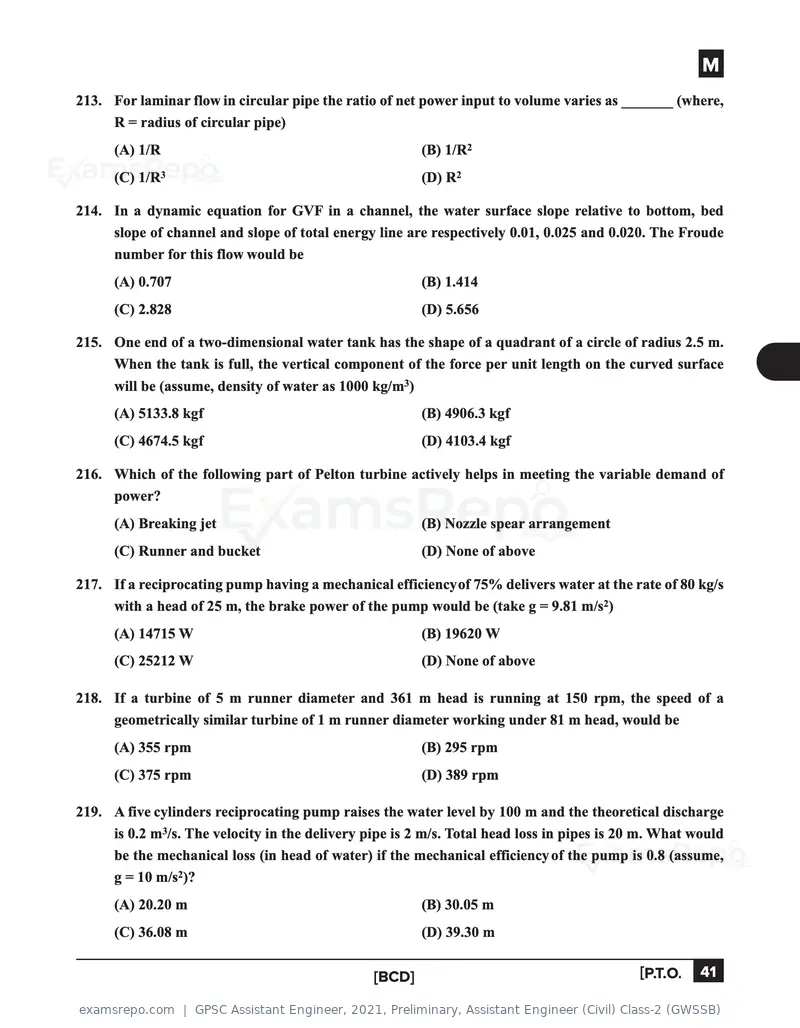
Text of page 41
M
213. For laminar flow in circular pipe the ratio of net power input to volume varies as _______ (where,
     R = radius of circular pipe)
      (A) 1/R                                           (B) 1/R2
      (C) 1/R3                                          (D) R2

214.	In a dynamic equation for GVF in a channel, the water surface slope relative to bottom, bed
      slope of channel and slope of total energy line are respectively 0.01, 0.025 and 0.020. The Froude
      number for this flow would be
      (A) 0.707                                         (B) 1.414
      (C) 2.828                                         (D) 5.656

215.	One end of a two-dimensional water tank has the shape of a quadrant of a circle of radius 2.5 m.
      When the tank is full, the vertical component of the force per unit length on the curved surface
      will be (assume, density of water as 1000 kg/m3)
      (A) 5133.8 kgf                                    (B) 4906.3 kgf
      (C) 4674.5 kgf                                    (D) 4103.4 kgf

216.	Which of the following part of Pelton turbine actively helps in meeting the variable demand of
      power?
      (A) Breaking jet                                  (B) Nozzle spear arrangement
      (C) Runner and bucket                             (D) None of above

217. If a reciprocating pump having a mechanical efficiency of 75% delivers water at the rate of 80 kg/s
     with a head of 25 m, the brake power of the pump would be (take g = 9.81 m/s2)
      (A) 14715 W                                       (B) 19620 W
      (C) 25212 W                                       (D) None of above

218.	If a turbine of 5 m runner diameter and 361 m head is running at 150 rpm, the speed of a
      geometrically similar turbine of 1 m runner diameter working under 81 m head, would be
      (A) 355 rpm                                       (B) 295 rpm
      (C) 375 rpm                                       (D) 389 rpm

219. A five cylinders reciprocating pump raises the water level by 100 m and the theoretical discharge
     is 0.2 m3/s. The velocity in the delivery pipe is 2 m/s. Total head loss in pipes is 20 m. What would
     be the mechanical loss (in head of water) if the mechanical efficiency of the pump is 0.8 (assume,
      g = 10 m/s2)?
      (A) 20.20 m                                       (B) 30.05 m
      (C) 36.08 m                                       (D) 39.30 m


                                                [BCD]                                       [P.T.O.   41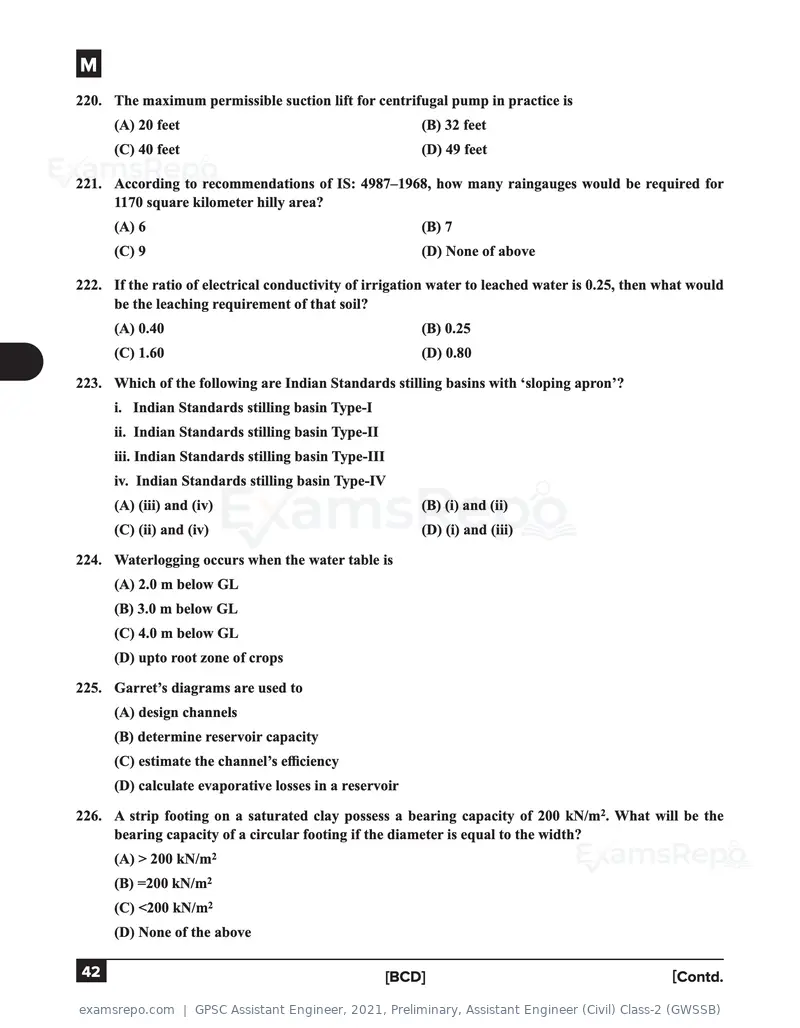
Text of page 42
M
220. The maximum permissible suction lift for centrifugal pump in practice is
      (A) 20 feet                                         (B) 32 feet
      (C) 40 feet                                         (D) 49 feet

221.	According to recommendations of IS: 4987–1968, how many raingauges would be required for
      1170 square kilometer hilly area?
      (A) 6                                               (B) 7
      (C) 9                                               (D) None of above

222.	If the ratio of electrical conductivity of irrigation water to leached water is 0.25, then what would
      be the leaching requirement of that soil?
      (A) 0.40                                            (B) 0.25
      (C) 1.60                                            (D) 0.80

223. Which of the following are Indian Standards stilling basins with ‘sloping apron’?
      i. Indian Standards stilling basin Type-I
      ii. Indian Standards stilling basin Type-II
      iii. Indian Standards stilling basin Type-III
      iv. Indian Standards stilling basin Type-IV
      (A) (iii) and (iv)                                  (B) (i) and (ii)
      (C) (ii) and (iv)                                   (D) (i) and (iii)

224. Waterlogging occurs when the water table is
      (A) 2.0 m below GL
      (B) 3.0 m below GL
      (C) 4.0 m below GL
      (D) upto root zone of crops

225. Garret’s diagrams are used to
      (A) design channels
      (B) determine reservoir capacity
      (C) estimate the channel’s efficiency
      (D) calculate evaporative losses in a reservoir

226.	A strip footing on a saturated clay possess a bearing capacity of 200 kN/m2. What will be the
      bearing capacity of a circular footing if the diameter is equal to the width?
      (A) > 200 kN/m2
      (B) =200 kN/m2
      (C) <200 kN/m2
      (D) None of the above

42                                                    [BCD]                                       [Contd.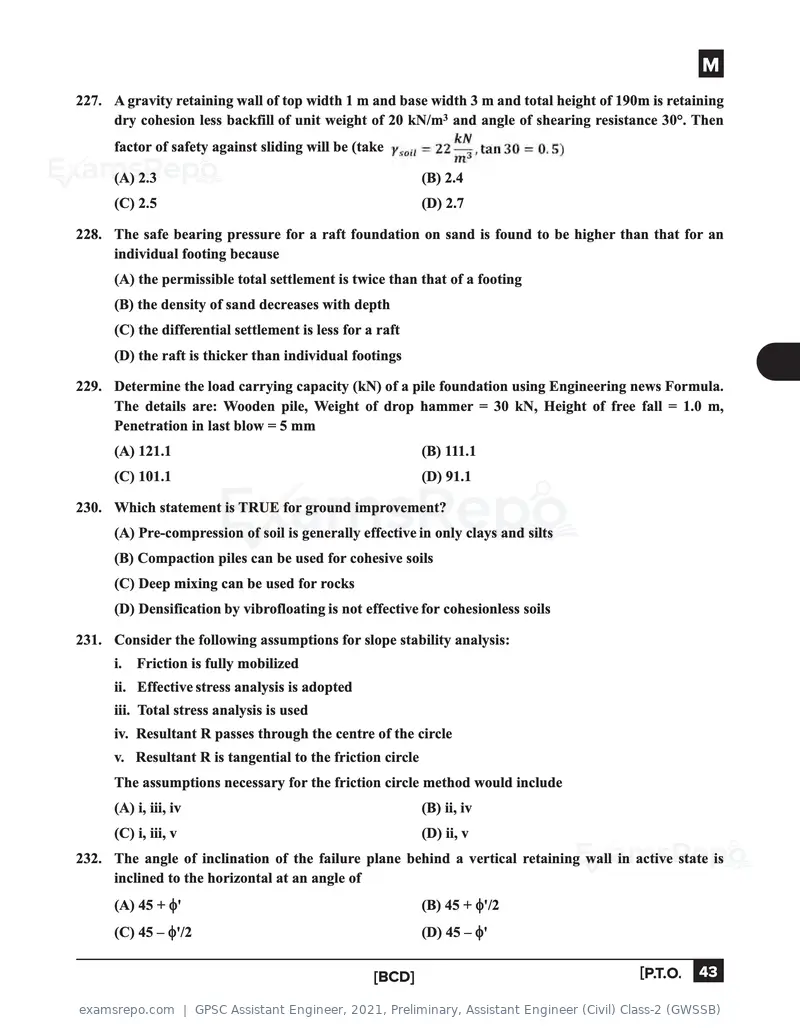
Text of page 43
M
227.	A gravity retaining wall of top width 1 m and base width 3 m and total height of 190m is retaining
      dry cohesion less backfill of unit weight of 20 kN/m3 and angle of shearing resistance 30°. Then
      factor of safety against sliding will be (take

      (A) 2.3                                               (B) 2.4
      (C) 2.5                                               (D) 2.7

228.	The safe bearing pressure for a raft foundation on sand is found to be higher than that for an
      individual footing because
      (A) the permissible total settlement is twice than that of a footing
      (B) the density of sand decreases with depth
      (C) the differential settlement is less for a raft
      (D) the raft is thicker than individual footings

229.	Determine the load carrying capacity (kN) of a pile foundation using Engineering news Formula.
      The details are: Wooden pile, Weight of drop hammer = 30 kN, Height of free fall = 1.0 m,
      Penetration in last blow = 5 mm
      (A) 121.1                                             (B) 111.1
      (C) 101.1                                             (D) 91.1

230. Which statement is TRUE for ground improvement?
      (A) Pre-compression of soil is generally effective in only clays and silts
      (B) Compaction piles can be used for cohesive soils
      (C) Deep mixing can be used for rocks
      (D) Densification by vibrofloating is not effective for cohesionless soils

231. Consider the following assumptions for slope stability analysis:
      i.   Friction is fully mobilized
      ii.   Effective stress analysis is adopted
      iii. Total stress analysis is used
      iv. Resultant R passes through the centre of the circle
      v. Resultant R is tangential to the friction circle
      The assumptions necessary for the friction circle method would include
      (A) i, iii, iv                                        (B) ii, iv
      (C) i, iii, v                                         (D) ii, v
232.	The angle of inclination of the failure plane behind a vertical retaining wall in active state is
      inclined to the horizontal at an angle of
      (A) 45 + f'                                           (B) 45 + f'/2
      (C) 45 – f'/2                                         (D) 45 – f'


                                                   [BCD]                                  [P.T.O.   43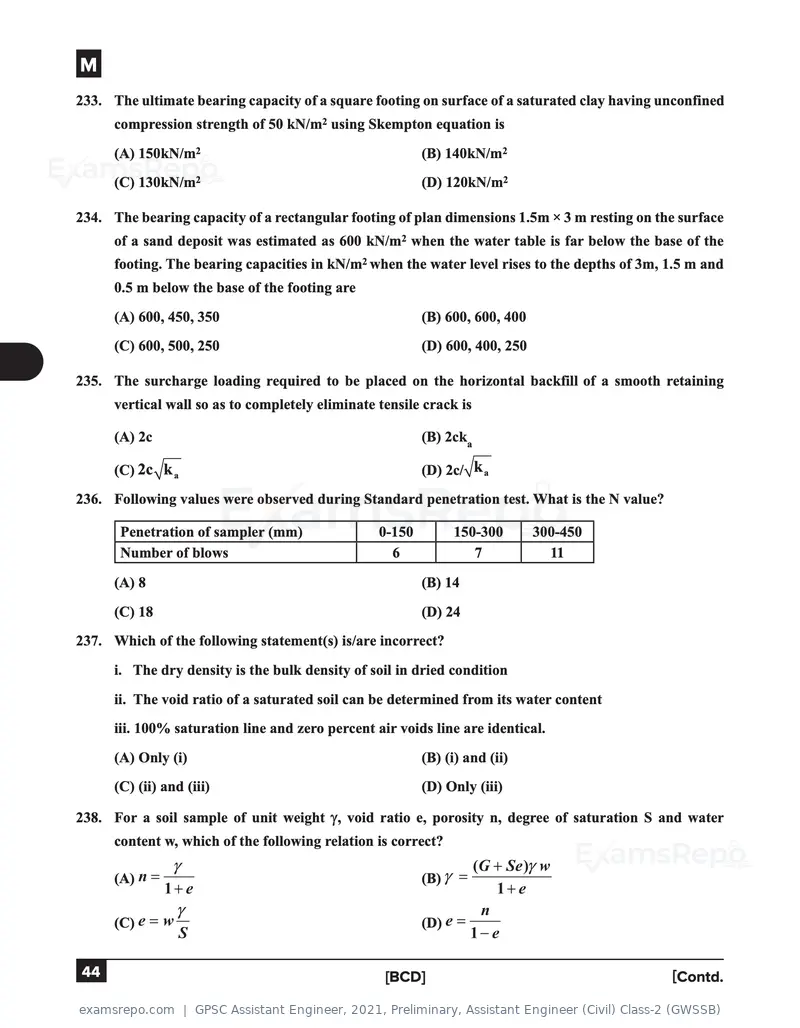
Text of page 44
M
233. The ultimate bearing capacity of a square footing on surface of a saturated clay having unconfined
      compression strength of 50 kN/m2 using Skempton equation is
      (A) 150kN/m2                                        (B) 140kN/m2
      (C) 130kN/m2                                        (D) 120kN/m2

234.	The bearing capacity of a rectangular footing of plan dimensions 1.5m × 3 m resting on the surface
      of a sand deposit was estimated as 600 kN/m2 when the water table is far below the base of the
      footing. The bearing capacities in kN/m2 when the water level rises to the depths of 3m, 1.5 m and
      0.5 m below the base of the footing are
      (A) 600, 450, 350                                   (B) 600, 600, 400
      (C) 600, 500, 250                                   (D) 600, 400, 250

235. The surcharge loading required to be placed on the horizontal backfill of a smooth retaining
      vertical wall so as to completely eliminate tensile crack is

      (A) 2c                                              (B) 2cka

      (C) 2c k a                                          (D) 2c/ k a
236. Following values were observed during Standard penetration test. What is the N value?

       Penetration of sampler (mm)                0-150         150-300       300-450
       Number of blows                              6              7            11

      (A) 8                                               (B) 14
      (C) 18                                              (D) 24
237. Which of the following statement(s) is/are incorrect?
      i. The dry density is the bulk density of soil in dried condition
      ii. The void ratio of a saturated soil can be determined from its water content
      iii. 100% saturation line and zero percent air voids line are identical.
      (A) Only (i)                                        (B) (i) and (ii)
      (C) (ii) and (iii)                                  (D) Only (iii)

238. For a soil sample of unit weight g, void ratio e, porosity n, degree of saturation S and water
      content w, which of the following relation is correct?

      (A)                                                 (B)


      (C)                                                 (D)


44                                                 [BCD]                                       [Contd.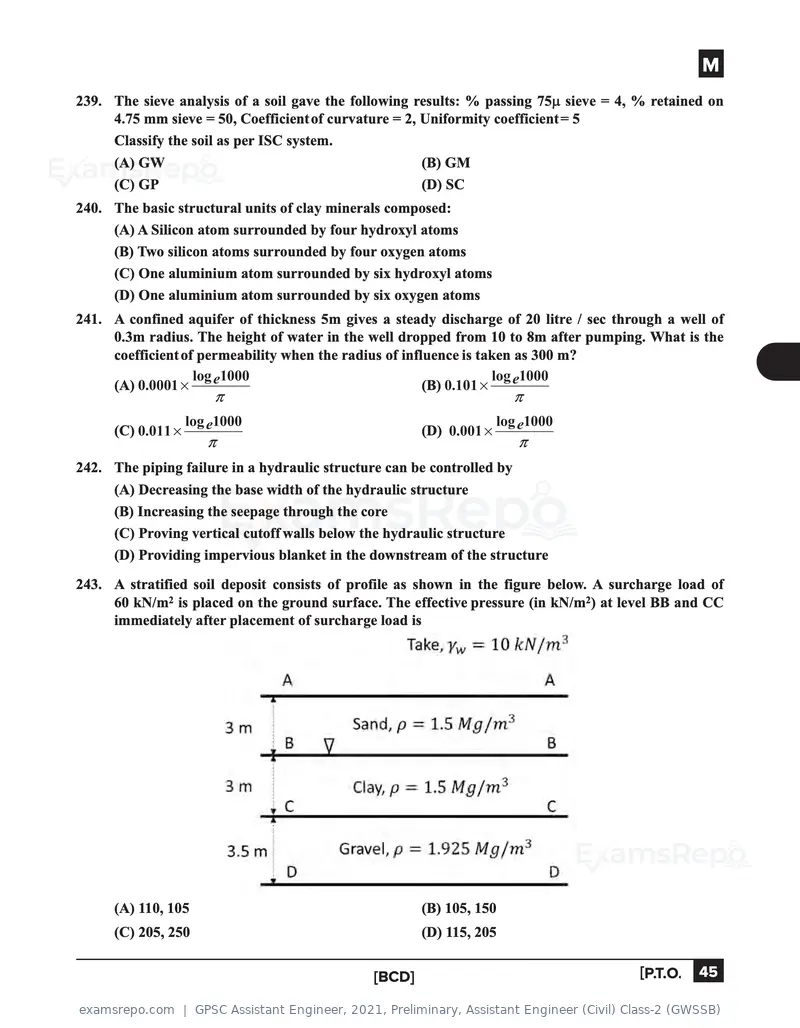
Text of page 45
M
239.	The sieve analysis of a soil gave the following results: % passing 75m sieve = 4, % retained on
      4.75 mm sieve = 50, Coefficient of curvature = 2, Uniformity coefficient = 5
      Classify the soil as per ISC system.
      (A) GW                                            (B) GM
      (C) GP                                            (D) SC
240.	The basic structural units of clay minerals composed:
      (A) A Silicon atom surrounded by four hydroxyl atoms
      (B) Two silicon atoms surrounded by four oxygen atoms
      (C) One aluminium atom surrounded by six hydroxyl atoms
      (D) One aluminium atom surrounded by six oxygen atoms
241. A confined aquifer of thickness 5m gives a steady discharge of 20 litre / sec through a well of
      0.3m radius. The height of water in the well dropped from 10 to 8m after pumping. What is the
     coefficient of permeability when the radius of influence is taken as 300 m?

     (A)                                              (B)


     (C)                                              (D)

242. The piping failure in a hydraulic structure can be controlled by
     (A) Decreasing the base width of the hydraulic structure
     (B) Increasing the seepage through the core
     (C) Proving vertical cutoff walls below the hydraulic structure
     (D) Providing impervious blanket in the downstream of the structure
243. A stratified soil deposit consists of profile as shown in the figure below. A surcharge load of
      60 kN/m2 is placed on the ground surface. The effective pressure (in kN/m2) at level BB and CC
     immediately after placement of surcharge load is


     (A) 110, 105                                     (B) 105, 150
     (C) 205, 250                                     (D) 115, 205


                                              [BCD]                                    [P.T.O.   45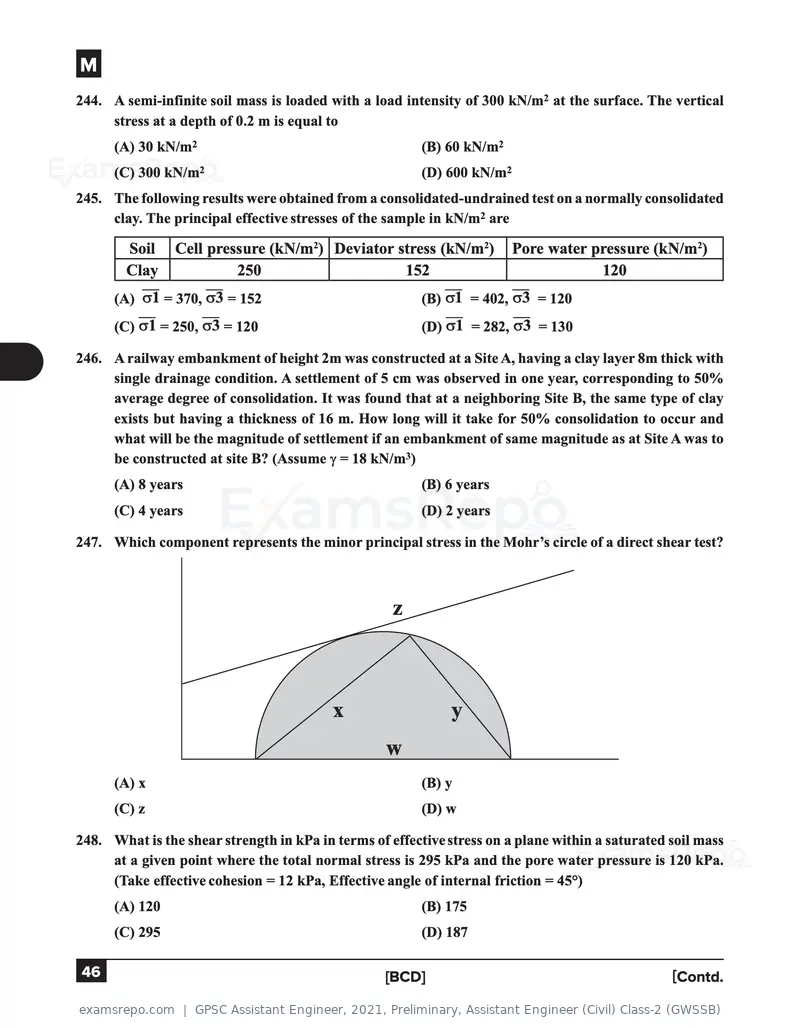
Text of page 46
M
244. A semi-infinite soil mass is loaded with a load intensity of 300 kN/m2 at the surface. The vertical
     stress at a depth of 0.2 m is equal to
      (A) 30 kN/m2                                       (B) 60 kN/m2
      (C) 300 kN/m2                                      (D) 600 kN/m2
245. The following results were obtained from a consolidated-undrained test on a normally consolidated
     clay. The principal effective stresses of the sample in kN/m2 are

        Soil    Cell pressure (kN/m2) Deviator stress (kN/m2)            Pore water pressure (kN/m2)
        Clay             250                    152                                  120
      (A) σ1 = 370, σ3 = 152                             (B) σ1 = 402, σ3 = 120
      (C) σ1 = 250, σ3 = 120                             (D) σ1 = 282, σ3 = 130

246.	A railway embankment of height 2m was constructed at a Site A, having a clay layer 8m thick with
      single drainage condition. A settlement of 5 cm was observed in one year, corresponding to 50%
      average degree of consolidation. It was found that at a neighboring Site B, the same type of clay
      exists but having a thickness of 16 m. How long will it take for 50% consolidation to occur and
      what will be the magnitude of settlement if an embankment of same magnitude as at Site A was to
      be constructed at site B? (Assume g = 18 kN/m3)
      (A) 8 years                                        (B) 6 years
      (C) 4 years                                        (D) 2 years

247. Which component represents the minor principal stress in the Mohr’s circle of a direct shear test?


                                                    z


                                          x                   y
                                                   w
      (A) x                                              (B) y
      (C) z                                              (D) w

248. What is the shear strength in kPa in terms of effective stress on a plane within a saturated soil mass
     at a given point where the total normal stress is 295 kPa and the pore water pressure is 120 kPa.
     (Take effective cohesion = 12 kPa, Effective angle of internal friction = 45°)
      (A) 120                                            (B) 175
      (C) 295                                            (D) 187

46                                                 [BCD]                                           [Contd.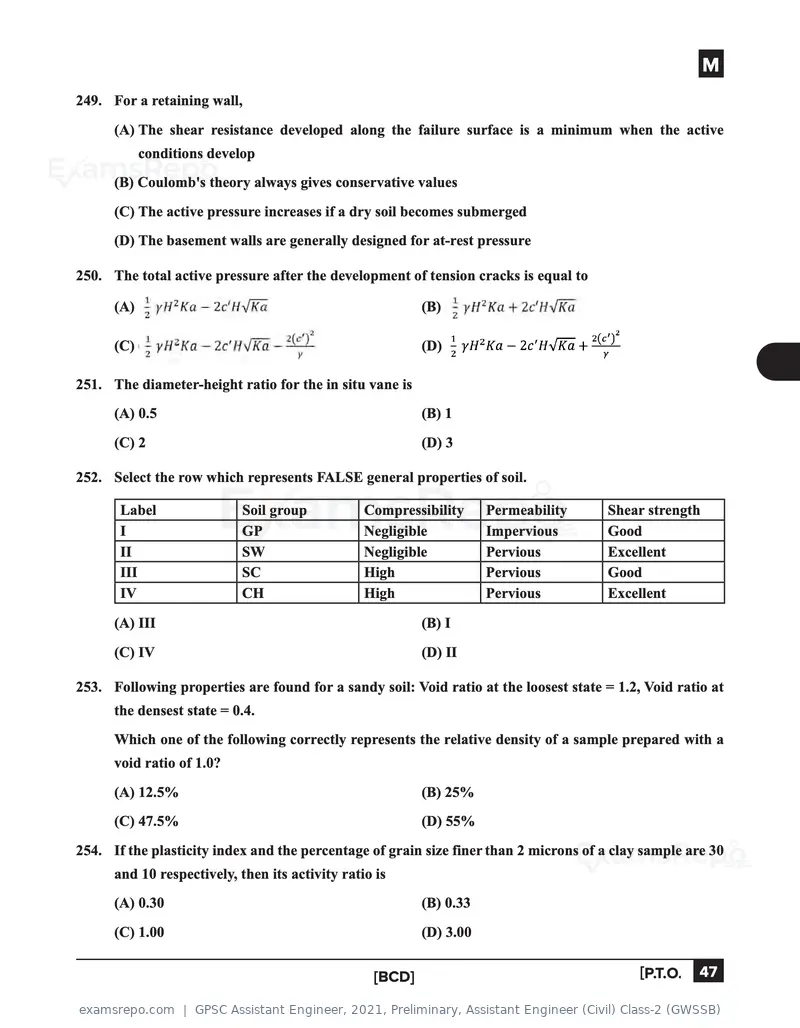
Text of page 47
M
249. For a retaining wall,
      (A) The shear resistance developed along the failure surface is a minimum when the active
            conditions develop
      (B) Coulomb's theory always gives conservative values
      (C) The active pressure increases if a dry soil becomes submerged
      (D) The basement walls are generally designed for at-rest pressure

250. The total active pressure after the development of tension cracks is equal to

      (A)                                                 (B)

      (C)                                                 (D)

251. The diameter-height ratio for the in situ vane is
      (A) 0.5                                             (B) 1
      (C) 2                                               (D) 3

252. Select the row which represents FALSE general properties of soil.

       Label                Soil group           Compressibility     Permeability      Shear strength
       I                    GP                   Negligible          Impervious        Good
       II                   SW                   Negligible          Pervious          Excellent
       III                  SC                   High                Pervious          Good
       IV                   CH                   High                Pervious          Excellent

      (A) III                                             (B) I
      (C) IV                                              (D) II

253.	Following properties are found for a sandy soil: Void ratio at the loosest state = 1.2, Void ratio at
      the densest state = 0.4.
      Which one of the following correctly represents the relative density of a sample prepared with a
      void ratio of 1.0?
      (A) 12.5%                                           (B) 25%
      (C) 47.5%                                           (D) 55%
254. If the plasticity index and the percentage of grain size finer than 2 microns of a clay sample are 30
      and 10 respectively, then its activity ratio is
      (A) 0.30                                            (B) 0.33
      (C) 1.00                                            (D) 3.00


                                                  [BCD]                                      [P.T.O.   47
Text of page 48
M
255. Consistency of cohesive soils is related to its
      (A) shear strength                                  (B) density
      (C) permeability                                    (D) moisture content

256. Before starting the centrifugal pumps, usually they require priming. Priming is the process of
      (A) removing the trapped air from the pump
      (B) removing the trapped air from the pump and filling it completely with water
      (C) lubricating the motor of the pump with oil
      (D) adjusting the electric current flow for getting the desired rotational speed of the pump

257. In a water treatment plant, ‘Plain sedimentation’ process is used for removing
      (A) floating matters such as leaves, dead animals
      (B) silt, sand and clay
      (C) fine suspended solids
      (D) dissolved solids

258. The flow velocity of water in a sedimentation tank is generally kept as
      (A) 0.3 cm / min                                    (B) 3 cm / min
      (C) 30 cm / min                                     (D) 300 cm / min

259. Which of the following statement(s) is / are true for a Slow Sand Filter?
      i.   Water entering the slow sand filter should not have been treated by coagulants
      ii.  Coarsest gravel is used in the bottom most layer and the finest gravel is used in the topmost
           layer
      iii. Coarser the sand, purer will be obtained water as more impurities and bacterial will be removed
      (A) Only (i)                                        (B) (i) and (ii)
      (C) (ii) and (iii)                                  (D) (i), (ii) and (iii)

260.	If a water treatment plant has to treat 100 million litres of water per day, then the number of
      Rapid Gravity Filters required would be approximately
      (A) 3                                               (B) 13
      (C) 23                                              (D) 33

261. Which of the statements are true for a Rapid Gravity Filter?
      i.   The amount of water required for washing a rapid gravity filter is around 2-5 per cent of the
           total amount of water filtered
      ii.  The rapid gravity filters are washed once in 3 months
      (A) Only (i)                                        (B) Only (ii)
      (C) Both (i) and (ii)                               (D) Neither (i) nor (ii)

48                                                 [BCD]                                         [Contd.
Text of page 49
M
262. The Air binding problem in a rapid gravity filter is because of the
     i. negative head
     ii.  increase of water temperature as it passes through the filter bed
     iii. release of oxygen by algae
      (A) Only (i)                                       (B) (i) and (ii)
      (C) (ii) and (iii)                                 (D) (i), (ii) and (iii)
263. As per BIS 10500-2012, Total hardness (as CaCO3) in drinking water should not exceed
      (A) 200 mg / lit                                   (B) 300 mg / lit
      (C) 500 mg / lit                                   (D) 600 mg / lit
264.	As per BIS 10500-2012, for which of the parameters the ‘Acceptable Limit’ and ‘Permissible limit
      in the absence of alternate sources’ is the same?
      i. Iron
      ii. Total Dissolved Solids
      iii. Total Hardness
      (A) Only (i)                                       (B) (i) and (ii)
      (C) (ii) and (iii)                                 (D) (i), (ii) and (iii)
265.	In water intended for drinking, E.Coli or thermotolerant coliform bacteria should not be detected
      in a water sample of _____
      (A) 10 ml                                          (B) 100 ml
      (C) 500 ml                                         (D) 1000 ml
266. In context with the effectiveness of chlorine as a water disinfectant, choose the correct sequence in
     the descending order (i.e. ‘from the most effective to the least effective’)
      (A) Bacteria, Viruses, Protozoa
      (B) Bacteria, Protozoa, Viruses
      (C) Protozoa, Viruses, Bacteria
      (D) Viruses, Bacteria, Protozoa.
267.	The colour of the chlorine gas which is used as a water disinfectant is
      (A) Dark purple                                    (B) Intense yellow
      (C) Greenish yellow                                (D) Deep blue
268.	Which of the following measure(s) should be adopted when transporting the samples from the
      place of sampling to the laboratory?
      i. The samples should be collected in leakproof glass or plastic container
      ii. Samples should be transported in an ice box keeping the temperature around 4°C
      iii. Undue jerking of the samples should be avoided
      (A) Only (i)                                       (B) (i) and (ii)
      (C) (i) and (iii)                                  (D) (i), (ii) and (iii)


                                                 [BCD]                                       [P.T.O.   49
Text of page 50
M
269. Which of the following is not a reagent needed for estimating Oil and Grease present in wastewater?
      (A) Hydrochloric Acid
      (B) Trichlorotrifluoroethane
      (C) Sodium Sulphate
      (D) Methyl Orange

270. Which of the following is not a method of disinfecting the water?
      i. electro-katadyn process
      ii. by the use of iodine and bromine
      iii. by the use of excess lime
      (A) Only (i)                                      (B) (i) and (ii)
      (C) (i), (ii) and (iii)                           (D) None

271. In which zone of pollution in a river stream the Dissolved Oxygen level is minimum?
      (A) Zone of degradation
      (B) Zone of active decomposition
      (C) Zone of recovery
      (D) Zone of cleaner water

272.	Which one of the following is not correct with respect to the provision of freeboard in sewers?
      The freeboard will act as factor of safety against the
      (A) Error in estimating the average, maximum sewage flow
      (B) Large scale infiltration of storm water
      (C) Unforeseen increase in population or water consumption
      (D) minimum flow velocity necessary for self-cleansing of the sewers

273. Sludge recirculation is done in Activated Sludge Process to
      (A) maintain the flow rate
      (B) increase the bacterial count
      (C) increase the flow velocity
      (D) decrease the retention time

274. Grit chambers are provided
      (A) before the screens
      (B) after the equalization tank
      (C) before the primary sedimentation tank
      (D) before the sludge digestion tank

50                                                  [BCD]                                      [Contd.
Text of page 51
M
275. The incorrect statement about inverted siphon is :
      (A) It is constructed higher than adjacent sewer section
      (B) It runs under gravity
      (C) The pressure inside is greater than atmosphere
      (D) Sewer pipe is dropped below the hydraulic gradient line

276. The quantity of sludge with 95% moisture will be _______ that of 90% moisture for same volume
     of solids
      (A) Half                                          (B) Twice
      (C) Five times                                    (D) One fifth

277. The extended aeration process has
      (A) higher F/M ratio
      (B) high MLSS concentration
      (C) lower aeration time
      (D) low requirement of Air or Oxygen

278. Benching in a manhole is the
      (A) manhole cover above ground level
      (B) manhole cover below ground level
      (C) offset between the working chamber and access shaft
      (D) bottom portion of the manhole

279. Maximum discharge in sewer is obtained when the depth of flow is ____ times the full depth
      (A) 0.99                                          (B) 0.95
      (C) 0.90                                          (D) 0.85

280. Which of the following materials will have the highest non-scouring velocity in the sewer?
      (A) Vitrified tiles                               (B) cast iron
      (C) Cement concrete                               (D) Earthen material

281. With reference to the Plume behavior, which of the following statements is correct for Fanning?
      (A) It is a type of plume which has a wavy character
      (B) It is a type of plume which is shaped like a cone
      (C) It is type of plume emitted under extreme inversion conditions
      (D) It is a condition where the plume is caught between inversions.


                                                [BCD]                                    [P.T.O.   51
Text of page 52
M
282.	For the determination of Particulate Matter in air using a High Volume Air Sampler, which of the
      following corrections have to be done for the estimation of volume of air sampled?
      i. Correction for Temperature
      ii. Correction for Pressure
      iii. Correction for Wind Velocity
      iv. Correction for Humidity
      (A) Only (i)                                        (B) (i) and (ii)
      (C) (iii) and (iv)                                  (D) (i), (ii), (iii) and (iv)

283. In a bridge, Curtain Wall is used
      (A) as a protection against the scouring action of a stream
      (B) as a protection against the solar radiation
      (C) for diverting the flood water
      (D) for connecting the intermediate supports

284. Which of the following is / are the Ideal Bridge Site Characteristic(s)?
      i.   The flow of water in the stream at the bridge site should be in steady regime condition
      ii.  The stream should be well defined and as narrow as possible
      iii. There should be confluence of large tributaries in the vicinity of bridge site
      (A) Only (i)                                        (B) (i) and (ii)
      (C) (ii) and (iii)                                  (D) (i), (ii) and (iii)

285. Free board in a bridge is the vertical distance between the
      (A) the designed High Flood Level and the level of the crown of the bridge at its lowest point
      (B) the designed High Flood Level and the level of the crown of the bridge at its highest point
      (C) the designed Low Flood Level and the level of the crown of the bridge at its lowest point
      (D) the designed Low Flood Level and the level of the crown of the bridge at its highest point

286. Which of the following are the examples of Abutments without Wing Walls?
      i. Box Abutment
      ii. Tee Abutment
      iii. Arch Abutment
      (A) Only (i)                                        (B) (i) and (ii)
      (C) (ii) and (iii)                                  (D) (i), (ii) and (iii)

52                                                 [BCD]                                             [Contd.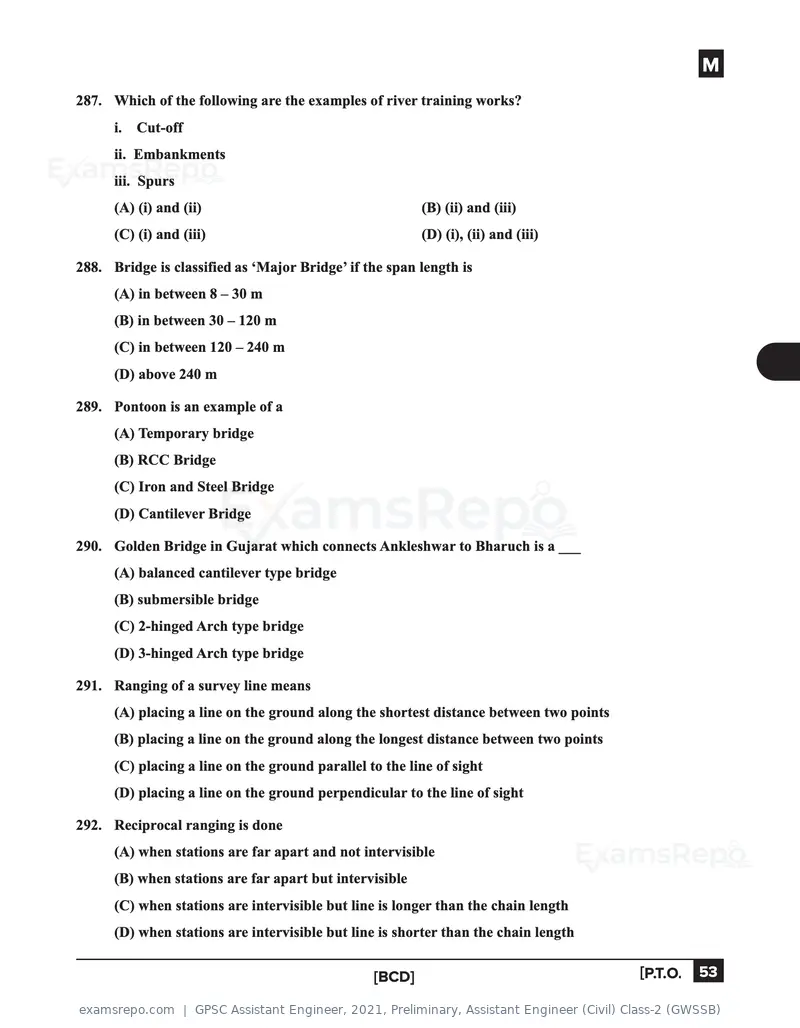
Text of page 53
M
287. Which of the following are the examples of river training works?
      i.    Cut-off
      ii. Embankments
      iii. Spurs
      (A) (i) and (ii)                                   (B) (ii) and (iii)
      (C) (i) and (iii)                                  (D) (i), (ii) and (iii)

288. Bridge is classified as ‘Major Bridge’ if the span length is
      (A) in between 8 – 30 m
      (B) in between 30 – 120 m
      (C) in between 120 – 240 m
      (D) above 240 m

289. Pontoon is an example of a
      (A) Temporary bridge
      (B) RCC Bridge
      (C) Iron and Steel Bridge
      (D) Cantilever Bridge

290. Golden Bridge in Gujarat which connects Ankleshwar to Bharuch is a ___
      (A) balanced cantilever type bridge
      (B) submersible bridge
      (C) 2-hinged Arch type bridge
      (D) 3-hinged Arch type bridge

291. Ranging of a survey line means
      (A) placing a line on the ground along the shortest distance between two points
      (B) placing a line on the ground along the longest distance between two points
      (C) placing a line on the ground parallel to the line of sight
      (D) placing a line on the ground perpendicular to the line of sight

292. Reciprocal ranging is done
      (A) when stations are far apart and not intervisible
      (B) when stations are far apart but intervisible
      (C) when stations are intervisible but line is longer than the chain length
      (D) when stations are intervisible but line is shorter than the chain length


                                                 [BCD]                                  [P.T.O.   53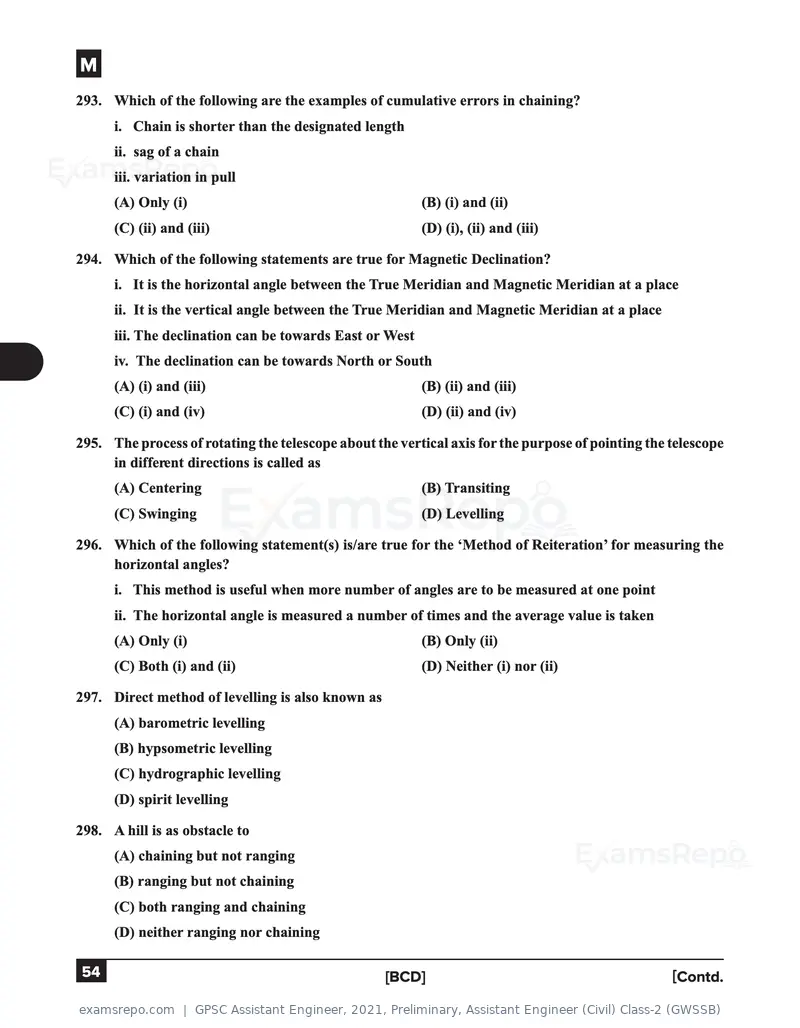
Text of page 54
M
293. Which of the following are the examples of cumulative errors in chaining?
      i. Chain is shorter than the designated length
      ii. sag of a chain
      iii. variation in pull
      (A) Only (i)                                        (B) (i) and (ii)
      (C) (ii) and (iii)                                  (D) (i), (ii) and (iii)

294. Which of the following statements are true for Magnetic Declination?
      i. It is the horizontal angle between the True Meridian and Magnetic Meridian at a place
      ii. It is the vertical angle between the True Meridian and Magnetic Meridian at a place
      iii. The declination can be towards East or West
      iv. The declination can be towards North or South
      (A) (i) and (iii)                                   (B) (ii) and (iii)
      (C) (i) and (iv)                                    (D) (ii) and (iv)

295.	The process of rotating the telescope about the vertical axis for the purpose of pointing the telescope
      in different directions is called as
      (A) Centering                                       (B) Transiting
      (C) Swinging                                        (D) Levelling

296.	Which of the following statement(s) is/are true for the ‘Method of Reiteration’ for measuring the
      horizontal angles?
      i. This method is useful when more number of angles are to be measured at one point
      ii. The horizontal angle is measured a number of times and the average value is taken
      (A) Only (i)                                        (B) Only (ii)
      (C) Both (i) and (ii)                               (D) Neither (i) nor (ii)

297. Direct method of levelling is also known as
      (A) barometric levelling
      (B) hypsometric levelling
      (C) hydrographic levelling
      (D) spirit levelling

298. A hill is as obstacle to
      (A) chaining but not ranging
      (B) ranging but not chaining
      (C) both ranging and chaining
      (D) neither ranging nor chaining

54                                                  [BCD]                                           [Contd.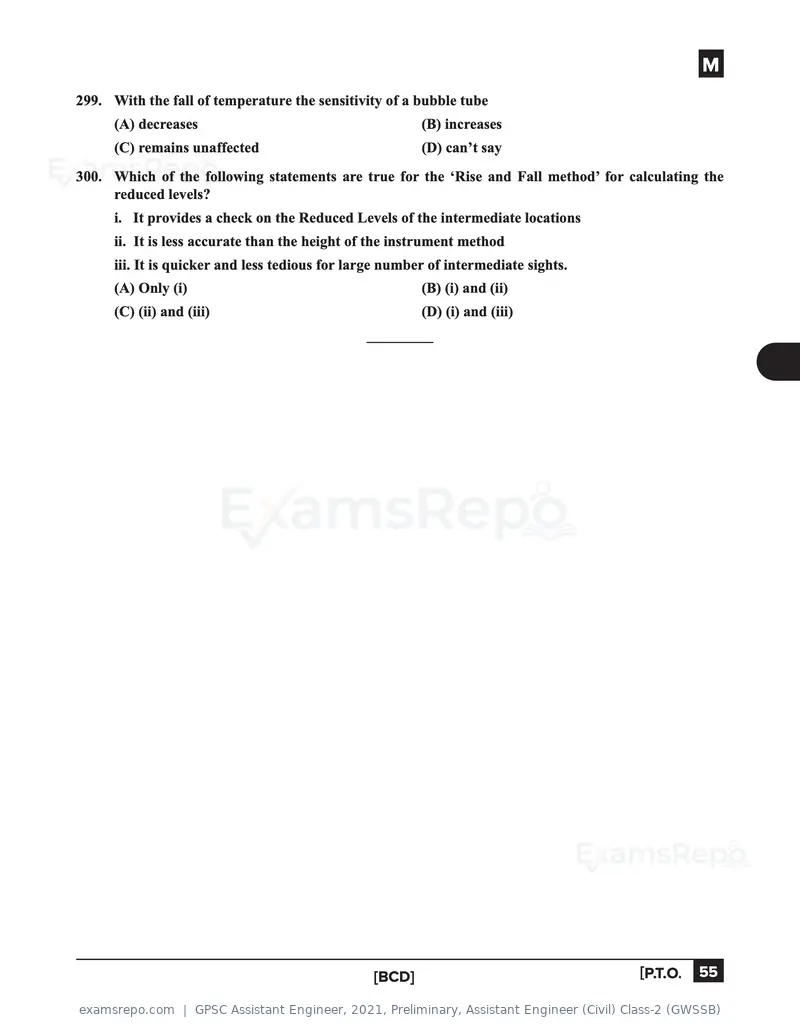
Text of page 55
M
299. 	With the fall of temperature the sensitivity of a bubble tube
      (A) decreases                                      (B) increases
      (C) remains unaffected                             (D) can’t say
300. 	Which of the following statements are true for the ‘Rise and Fall method’ for calculating the
     reduced levels?
      i. It provides a check on the Reduced Levels of the intermediate locations
      ii. It is less accurate than the height of the instrument method
      iii. It is quicker and less tedious for large number of intermediate sights.
      (A) Only (i)                                       (B) (i) and (ii)
      (C) (ii) and (iii)                                 (D) (i) and (iii)
                                                _________


                                                 [BCD]                                 [P.T.O.   55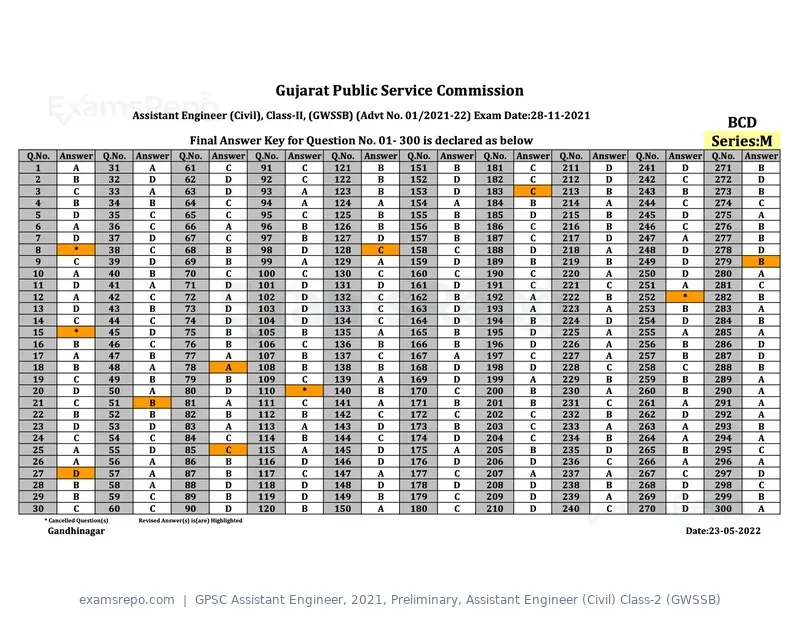
Text of page 1
Gujarat Public Service Commission
                                Assistant Engineer (Civil), Class-II, (GWSSB) (Advt No. 01/2021-22) Exam Date:28-11-2021
                                                                                                                                                                                 BCD
                                                   Final Answer Key for Question No. 01- 300 is declared as below                                                              Series:M
Q.No.   Answer          Q.No.   Answer         Q.No.       Answer        Q.No.   Answer   Q.No.   Answer   Q.No.   Answer   Q.No.   Answer   Q.No.   Answer   Q.No.   Answer   Q.No.   Answer
  1       A              31       A             61           C            91       C      121       B      151       B      181       C      211       D      241       D      271       B
  2       B              32       D             62           D            92       C      122       B      152       D      182       C      212       D      242       C      272       D
  3       C              33       A             63           D            93       A      123       B      153       D      183       C      213       B      243       B      273       B
  4       B              34       B             64           C            94       A      124       A      154       A      184       B      214       A      244       C      274       C
  5       D              35       C             65           C            95       C      125       B      155       B      185       D      215       B      245       D      275       A
  6       A              36       C             66           A            96       B      126       B      156       B      186       C      216       B      246       C      276       B
  7       D              37       D             67           C            97       B      127       D      157       B      187       C      217       D      247       A      277       B
  8        *             38       C             68           B            98       D      128       C      158       C      188       D      218       A      248       D      278       D
  9       C              39       D             69           B            99       A      129       A      159       D      189       B      219       B      249       D      279       B
 10       A              40       B             70           C           100       C      130       C      160       C      190       C      220       A      250       D      280       A
 11       D              41       A             71           D           101       D      131       D      161       D      191       C      221       C      251       A      281       C
 12       A              42       C             72           A           102       D      132       C      162       B      192       A      222       B      252        *     282       B
 13       D              43       B             73           D           103       D      133       C      163       D      193       A      223       A      253       B      283       A
 14       C              44       C             74           D           104       D      134       C      164       D      194       B      224       D      254       D      284       B
 15        *             45       D             75           B           105       B      135       A      165       B      195       D      225       A      255       A      285       A
 16       B              46       C             76           B           106       C      136       B      166       B      196       D      226       A      256       B      286       D
 17       A              47       B             77           A           107       B      137       C      167       A      197       C      227       A      257       B      287       D
 18       B              48       A             78           A           108       B      138       B      168       D      198       D      228       C      258       C      288       B
 19       C              49       B             79           B           109       C      139       A      169       D      199       A      229       B      259       B      289       A
 20       D              50       A             80           D           110        *     140       B      170       C      200       B      230       A      260       B      290       A
 21       C              51       B             81           A           111       C      141       A      171       B      201       B      231       C      261       A      291       A
 22       B              52       B             82           B           112       B      142       C      172       C      202       C      232       B      262       D      292       A
 23       D              53       D             83           A           113       A      143       D      173       B      203       C      233       A      263       A      293       B
 24       C              54       C             84           C           114       B      144       C      174       D      204       C      234       B      264       A      294       A
 25       A              55       D             85           C           115       A      145       D      175       A      205       B      235       D      265       B      295       C
 26       A              56       A             86           B           116       D      146       D      176       D      206       D      236       C      266       A      296       A
 27       D              57       A             87           B           117       C      147       A      177       C      207       A      237       A      267       C      297       D
 28       B              58       A             88           D           118       D      148       D      178       D      208       D      238       B      268       D      298       C
 29       B              59       C             89           B           119       D      149       B      179       C      209       D      239       A      269       D      299       B
 30       C              60       C             90           D           120       B      150       A      180       C      210       D      240       C      270       D      300       A
   * Cancelled Question(s)       Revised Answer(s) is(are) Highlighted
    Gandhinagar                                                                                                                                                          Date:23-05-2022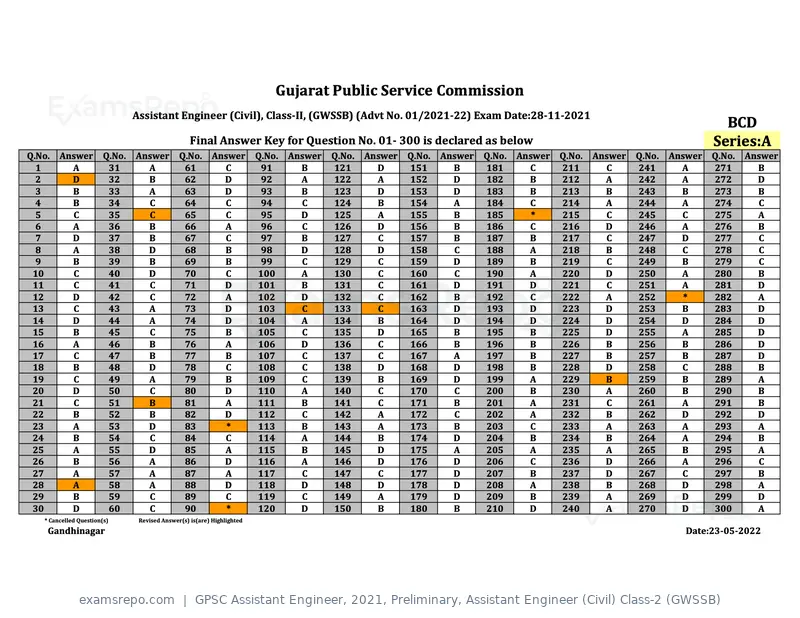
Text of page 2
Gujarat Public Service Commission
                                Assistant Engineer (Civil), Class-II, (GWSSB) (Advt No. 01/2021-22) Exam Date:28-11-2021
                                                                                                                                                                                 BCD
                                                   Final Answer Key for Question No. 01- 300 is declared as below                                                              Series:A
Q.No.   Answer          Q.No.   Answer         Q.No.       Answer        Q.No.   Answer   Q.No.   Answer   Q.No.   Answer   Q.No.   Answer   Q.No.   Answer   Q.No.   Answer   Q.No.   Answer
  1       A              31       A             61           C            91       B      121       D      151       B      181       C      211       C      241       A      271       B
  2       D              32       B             62           D            92       A      122       A      152       D      182       B      212       A      242       A      272       D
  3       B              33       A             63           D            93       B      123       D      153       D      183       B      213       B      243       B      273       B
  4       B              34       C             64           C            94       C      124       B      154       A      184       C      214       A      244       A      274       C
  5       C              35       C             65           C            95       D      125       A      155       B      185        *     215       C      245       C      275       A
  6       A              36       B             66           A            96       C      126       D      156       B      186       C      216       D      246       A      276       B
  7       D              37       B             67           C            97       B      127       C      157       B      187       B      217       C      247       D      277       C
  8       A              38       D             68           B            98       D      128       D      158       C      188       A      218       B      248       C      278       C
  9       B              39       B             69           B            99       C      129       C      159       D      189       B      219       C      249       B      279       C
 10       C              40       D             70           C           100       A      130       C      160       C      190       A      220       D      250       A      280       B
 11       C              41       C             71           D           101       B      131       C      161       D      191       D      221       C      251       A      281       D
 12       D              42       C             72           A           102       D      132       C      162       B      192       C      222       A      252        *     282       A
 13       C              43       A             73           D           103       C      133       C      163       D      193       D      223       D      253       B      283       D
 14       D              44       A             74           D           104       A      134       B      164       D      194       D      224       D      254       D      284       D
 15       B              45       C             75           B           105       C      135       D      165       B      195       B      225       D      255       A      285       D
 16       A              46       B             76           A           106       D      136       C      166       B      196       B      226       B      256       B      286       D
 17       C              47       B             77           B           107       C      137       C      167       A      197       B      227       B      257       B      287       D
 18       B              48       D             78           C           108       C      138       D      168       D      198       B      228       D      258       C      288       B
 19       C              49       A             79           B           109       C      139       B      169       D      199       A      229       B      259       B      289       A
 20       D              50       C             80           D           110       A      140       C      170       C      200       B      230       A      260       B      290       B
 21       C              51       B             81           A           111       B      141       C      171       B      201       A      231       C      261       A      291       B
 22       B              52       B             82           D           112       C      142       A      172       C      202       A      232       B      262       D      292       D
 23       A              53       D             83            *          113       B      143       A      173       B      203       C      233       A      263       A      293       A
 24       B              54       C             84           C           114       A      144       B      174       D      204       B      234       B      264       A      294       B
 25       A              55       D             85           A           115       B      145       D      175       A      205       A      235       A      265       B      295       A
 26       B              56       A             86           D           116       A      146       D      176       D      206       C      236       D      266       A      296       C
 27       A              57       A             87           A           117       C      147       C      177       D      207       B      237       D      267       C      297       B
 28       A              58       A             88           D           118       D      148       D      178       D      208       A      238       B      268       D      298       A
 29       B              59       C             89           C           119       C      149       A      179       D      209       B      239       A      269       D      299       D
 30       D              60       C             90            *          120       D      150       B      180       B      210       D      240       A      270       D      300       A
   * Cancelled Question(s)       Revised Answer(s) is(are) Highlighted
    Gandhinagar                                                                                                                                                          Date:23-05-2022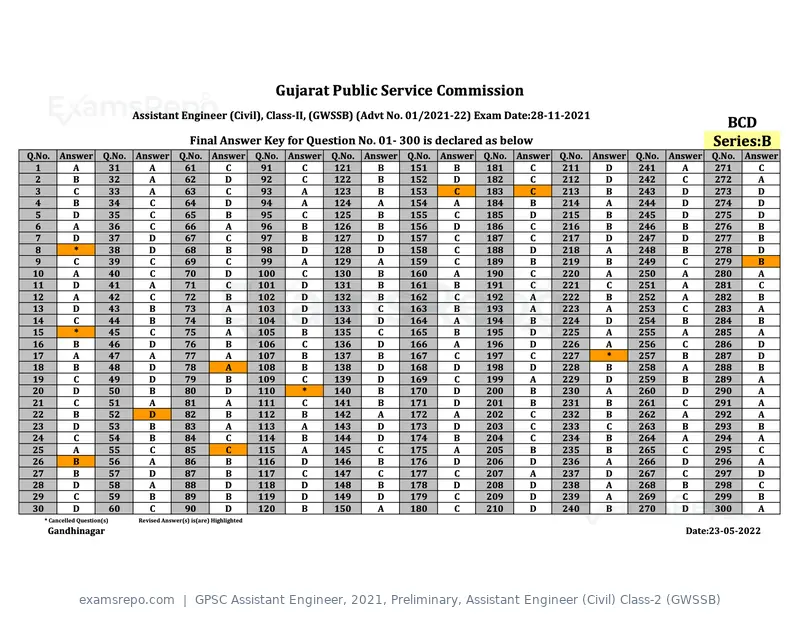
Text of page 3
Gujarat Public Service Commission
                                Assistant Engineer (Civil), Class-II, (GWSSB) (Advt No. 01/2021-22) Exam Date:28-11-2021
                                                                                                                                                                                 BCD
                                                   Final Answer Key for Question No. 01- 300 is declared as below                                                              Series:B
Q.No.   Answer          Q.No.   Answer         Q.No.       Answer        Q.No.   Answer   Q.No.   Answer   Q.No.   Answer   Q.No.   Answer   Q.No.   Answer   Q.No.   Answer   Q.No.   Answer
  1       A              31       A             61           C            91       C      121       B      151       B      181       C      211       D      241       A      271       C
  2       B              32       A             62           D            92       C      122       B      152       D      182       C      212       D      242       C      272       A
  3       C              33       A             63           C            93       A      123       B      153       C      183       C      213       B      243       D      273       D
  4       B              34       C             64           D            94       A      124       A      154       A      184       B      214       A      244       D      274       D
  5       D              35       C             65           B            95       C      125       B      155       C      185       D      215       B      245       D      275       D
  6       A              36       C             66           A            96       B      126       B      156       D      186       C      216       B      246       B      276       B
  7       D              37       D             67           C            97       B      127       D      157       C      187       C      217       D      247       D      277       B
  8        *             38       D             68           B            98       D      128       D      158       C      188       D      218       A      248       B      278       D
  9       C              39       C             69           C            99       A      129       A      159       C      189       B      219       B      249       C      279       B
 10       A              40       C             70           D           100       C      130       B      160       A      190       C      220       A      250       A      280       A
 11       D              41       A             71           C           101       D      131       B      161       B      191       C      221       C      251       A      281       C
 12       A              42       C             72           B           102       D      132       B      162       C      192       A      222       B      252       A      282       B
 13       D              43       B             73           A           103       D      133       C      163       B      193       A      223       A      253       C      283       A
 14       C              44       B             74           B           104       D      134       D      164       A      194       B      224       D      254       B      284       B
 15        *             45       C             75           A           105       B      135       C      165       B      195       D      225       A      255       A      285       A
 16       B              46       D             76           B           106       C      136       D      166       A      196       D      226       A      256       C      286       D
 17       A              47       A             77           A           107       B      137       B      167       C      197       C      227        *     257       B      287       D
 18       B              48       D             78           A           108       B      138       D      168       D      198       D      228       B      258       A      288       B
 19       C              49       D             79           B           109       C      139       D      169       C      199       A      229       D      259       B      289       A
 20       D              50       B             80           D           110        *     140       B      170       D      200       B      230       A      260       D      290       A
 21       C              51       A             81           A           111       C      141       B      171       D      201       B      231       B      261       C      291       A
 22       B              52       D             82           B           112       B      142       A      172       A      202       C      232       B      262       A      292       A
 23       D              53       B             83           A           113       A      143       D      173       D      203       C      233       C      263       B      293       B
 24       C              54       B             84           C           114       B      144       D      174       B      204       C      234       B      264       A      294       A
 25       A              55       C             85           C           115       A      145       C      175       A      205       B      235       B      265       C      295       C
 26       B              56       A             86           B           116       D      146       B      176       D      206       D      236       A      266       D      296       A
 27       B              57       D             87           B           117       C      147       C      177       C      207       A      237       D      267       C      297       D
 28       D              58       A             88           D           118       D      148       B      178       D      208       D      238       A      268       B      298       C
 29       C              59       B             89           B           119       D      149       D      179       C      209       D      239       A      269       C      299       B
 30       D              60       C             90           D           120       B      150       A      180       C      210       D      240       B      270       D      300       A
   * Cancelled Question(s)       Revised Answer(s) is(are) Highlighted
    Gandhinagar                                                                                                                                                          Date:23-05-2022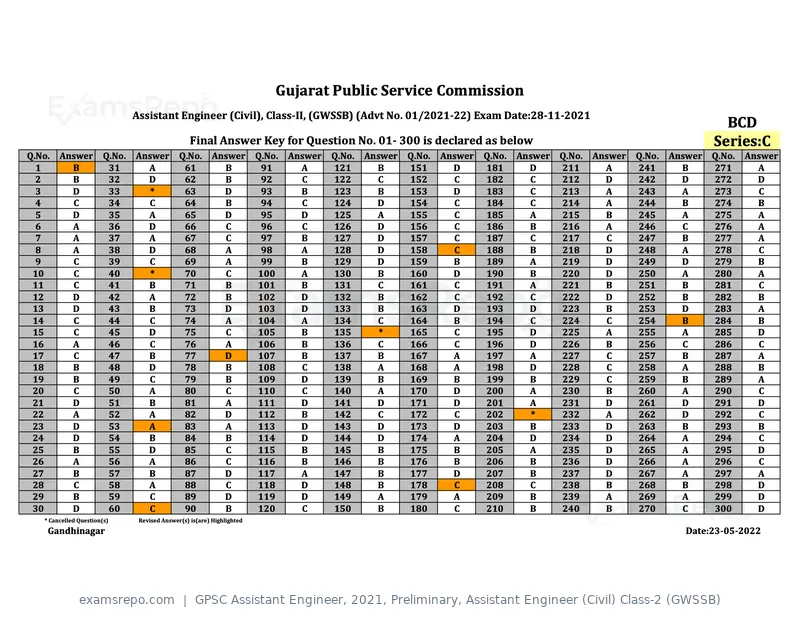
Text of page 4
Gujarat Public Service Commission
                                Assistant Engineer (Civil), Class-II, (GWSSB) (Advt No. 01/2021-22) Exam Date:28-11-2021
                                                                                                                                                                                 BCD
                                                   Final Answer Key for Question No. 01- 300 is declared as below                                                              Series:C
Q.No.   Answer          Q.No.   Answer         Q.No.       Answer        Q.No.   Answer   Q.No.   Answer   Q.No.   Answer   Q.No.   Answer   Q.No.   Answer   Q.No.   Answer   Q.No.   Answer
  1       B              31       A             61           B            91       A      121       B      151       D      181       D      211       A      241       B      271       A
  2       B              32       D             62           B            92       C      122       C      152       C      182       C      212       D      242       D      272       D
  3       D              33        *            63           D            93       B      123       B      153       D      183       C      213       A      243       A      273       C
  4       C              34       C             64           B            94       C      124       D      154       C      184       C      214       A      244       B      274       B
  5       D              35       A             65           D            95       D      125       A      155       C      185       A      215       B      245       A      275       A
  6       A              36       D             66           C            96       C      126       D      156       C      186       B      216       A      246       C      276       A
  7       A              37       A             67           C            97       B      127       D      157       C      187       C      217       C      247       B      277       A
  8       A              38       D             68           A            98       A      128       D      158       C      188       B      218       D      248       A      278       C
  9       C              39       C             69           A            99       B      129       D      159       B      189       A      219       D      249       D      279       B
 10       C              40        *            70           C           100       A      130       B      160       D      190       B      220       D      250       A      280       A
 11       C              41       B             71           B           101       B      131       C      161       C      191       A      221       B      251       B      281       C
 12       D              42       A             72           B           102       D      132       B      162       C      192       C      222       D      252       B      282       B
 13       D              43       B             73           D           103       D      133       B      163       D      193       D      223       B      253       D      283       A
 14       C              44       C             74           A           104       A      134       C      164       B      194       C      224       C      254       B      284       B
 15       C              45       D             75           C           105       B      135        *     165       C      195       D      225       A      255       A      285       D
 16       A              46       C             76           A           106       B      136       C      166       C      196       D      226       B      256       C      286       C
 17       C              47       B             77           D           107       B      137       B      167       A      197       A      227       C      257       B      287       A
 18       B              48       D             78           B           108       C      138       A      168       A      198       D      228       C      258       A      288       B
 19       B              49       C             79           B           109       D      139       B      169       B      199       B      229       C      259       B      289       A
 20       C              50       A             80           C           110       C      140       A      170       D      200       A      230       B      260       A      290       C
 21       D              51       B             81           A           111       D      141       D      171       D      201       A      231       D      261       D      291       D
 22       A              52       A             82           D           112       B      142       C      172       C      202        *     232       A      262       D      292       C
 23       D              53       A             83           A           113       D      143       D      173       D      203       B      233       D      263       B      293       B
 24       D              54       B             84           B           114       D      144       D      174       A      204       D      234       D      264       A      294       C
 25       B              55       D             85           C           115       B      145       B      175       B      205       A      235       D      265       A      295       D
 26       A              56       A             86           C           116       B      146       B      176       B      206       B      236       D      266       A      296       C
 27       B              57       B             87           D           117       A      147       B      177       D      207       B      237       D      267       A      297       A
 28       C              58       A             88           C           118       D      148       B      178       C      208       C      238       B      268       B      298       D
 29       B              59       C             89           D           119       D      149       A      179       A      209       B      239       A      269       A      299       D
 30       D              60       C             90           B           120       C      150       B      180       C      210       B      240       B      270       C      300       D
   * Cancelled Question(s)       Revised Answer(s) is(are) Highlighted
    Gandhinagar                                                                                                                                                          Date:23-05-2022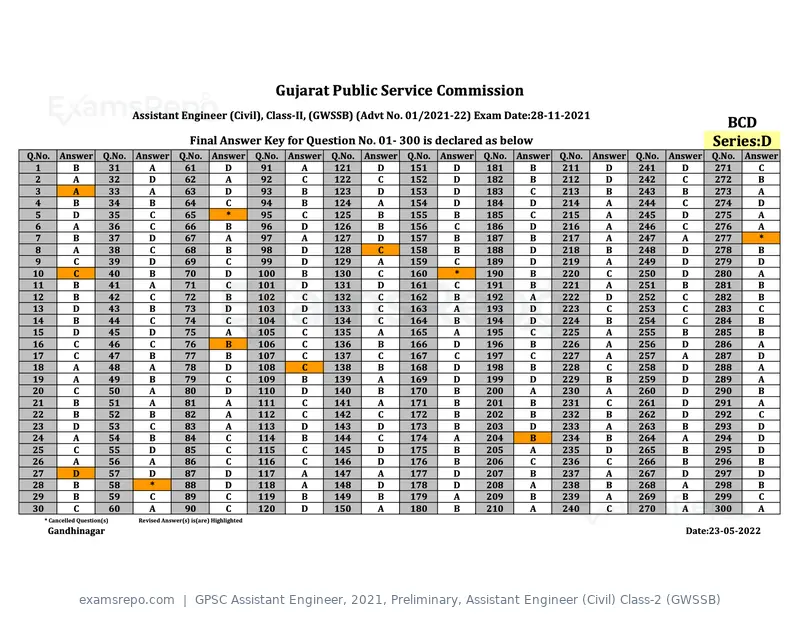
Text of page 5
Gujarat Public Service Commission
                                Assistant Engineer (Civil), Class-II, (GWSSB) (Advt No. 01/2021-22) Exam Date:28-11-2021
                                                                                                                                                                                 BCD
                                                   Final Answer Key for Question No. 01- 300 is declared as below                                                              Series:D
Q.No.   Answer          Q.No.   Answer         Q.No.       Answer        Q.No.   Answer   Q.No.   Answer   Q.No.   Answer   Q.No.   Answer   Q.No.   Answer   Q.No.   Answer   Q.No.   Answer
  1       B              31       A             61           D            91       A      121       D      151       D      181       B      211       D      241       D      271       C
  2       A              32       D             62           A            92       C      122       C      152       D      182       B      212       D      242       C      272       B
  3       A              33       A             63           D            93       B      123       D      153       D      183       C      213       B      243       B      273       A
  4       B              34       B             64           C            94       B      124       A      154       D      184       D      214       A      244       C      274       D
  5       D              35       C             65            *           95       C      125       B      155       B      185       C      215       A      245       D      275       A
  6       A              36       C             66           B            96       D      126       B      156       C      186       D      216       A      246       C      276       A
  7       B              37       D             67           A            97       A      127       D      157       B      187       B      217       A      247       A      277        *
  8       A              38       C             68           B            98       D      128       C      158       B      188       D      218       B      248       D      278       B
  9       C              39       D             69           C            99       D      129       A      159       C      189       D      219       A      249       D      279       D
 10       C              40       B             70           D           100       B      130       C      160        *     190       B      220       C      250       D      280       A
 11       B              41       A             71           C           101       D      131       D      161       C      191       B      221       A      251       B      281       B
 12       B              42       C             72           B           102       C      132       C      162       B      192       A      222       D      252       C      282       B
 13       D              43       B             73           D           103       D      133       C      163       A      193       D      223       C      253       C      283       C
 14       B              44       C             74           C           104       C      134       C      164       B      194       D      224       B      254       C      284       B
 15       D              45       D             75           A           105       C      135       A      165       A      195       C      225       A      255       B      285       B
 16       C              46       C             76           B           106       C      136       B      166       D      196       B      226       A      256       D      286       A
 17       C              47       B             77           B           107       C      137       C      167       C      197       C      227       A      257       A      287       D
 18       A              48       A             78           D           108       C      138       B      168       D      198       B      228       C      258       D      288       A
 19       A              49       B             79           C           109       B      139       A      169       D      199       D      229       B      259       D      289       A
 20       C              50       A             80           D           110       D      140       B      170       B      200       A      230       A      260       D      290       B
 21       B              51       A             81           A           111       C      141       A      171       B      201       B      231       C      261       D      291       A
 22       B              52       B             82           A           112       C      142       C      172       B      202       B      232       B      262       D      292       C
 23       D              53       C             83           A           113       D      143       D      173       B      203       D      233       A      263       B      293       D
 24       A              54       B             84           C           114       B      144       C      174       A      204       B      234       B      264       A      294       D
 25       C              55       D             85           C           115       C      145       D      175       B      205       A      235       D      265       B      295       D
 26       A              56       A             86           C           116       C      146       D      176       B      206       C      236       C      266       B      296       B
 27       D              57       D             87           D           117       A      147       A      177       D      207       B      237       A      267       D      297       D
 28       B              58        *            88           D           118       A      148       D      178       D      208       A      238       B      268       A      298       B
 29       B              59       C             89           C           119       B      149       B      179       A      209       B      239       A      269       B      299       C
 30       C              60       A             90           C           120       D      150       A      180       B      210       A      240       C      270       A      300       A
   * Cancelled Question(s)       Revised Answer(s) is(are) Highlighted
    Gandhinagar                                                                                                                                                          Date:23-05-2022
Page 1 of 55
Source: Gujarat Public Service Commission. Question paper published by Gujarat Public Service Commission.