
GPSC Engineering Services 2026: Gujarat Engineering Service (Civil) Class-1 and Class-2, Preliminary, Engineering Aptitude

Text of page 1
60           60


     M
              100             100
             100               100


                    24


    BTF-1

M
Text of page 2
M

1.	Ram distributed a portion of a standard 52-card deck to himself and Shyam, setting
     aside the remaining cards. He then proposed two scenarios to Shyam (a) If Shyam gives
     Ram a specific number of cards, Ram would hold four times the number of cards Shyam
     has. (b) If Ram instead gives Shyam the same number of cards, Ram would retain three
     times the number of cards Shyam has. How many cards did Ram initially possess?
     (A) 11		                                     (B) 21
     (C) 25		                                     (D) 31

2.	A tree grows only 3/5 as fast as the one beside it. In 4 years, the combined growth of
     the trees is 8 feet. How much does the shorter tree grow in the first 2 years?
     (A) 1.5 feet		                               (B) 2.0 feet
     (C) 2.5 feet		                               (D) 3.0 feet

3.	Neha and Jaya’s current ages are in the ratio 7:3. Six years later, their age ratio becomes
     5:3. What is the age difference between them?
     (A) 6 years		                                (B) 8 years
     (C) 10 years		                               (D) 12 years

4.	An office needs to purchase a minimum of 15 chairs within a budget of Rs. 2000.
     Chairs with arms cost Rs. 160 each, while armless chairs cost Rs. 100 each.
     What is the greatest number of chairs with arms the office can purchase without
     exceeding the budget?
     (A) 6		                                      (B) 7
     (C) 8		                                      (D) 9

5.	The average of 6 numbers is 7. The average of 3 numbers of them is 5. What will be the
     average of the remaining numbers?
     (A) 8		                                      (B) 9
     (C) 10		                                     (D) 11

6.   If log10(x2 – 6x + 45) = 2, then x = ________
     (A) – 11 		                                  (B) 5
     (C) 11		                                     (D) 12


2 | [BTF-1]                                                                            [Contd.
Text of page 3
M

7.   [Log10(5log10 100)]2 is equal to _______
     (A) 1		                                       (B) 2
     (C) 10		                                      (D) 100

8.	In an examination, 80% of the students passed in English, 85% in Mathematics and
    75% in both English and Mathematics. If 40 students failed in both the subjects,
    the total number of students in the class would be _______
     (A) 300		                                     (B) 350
     (C) 400		                                     (D) 450
                                                dy
9.   Solution of the differential equation 3y      + 2x = 0 represents a family of
                                                dx
     (A) Ellipses
     (B) Circles
     (C) Parabolas
     (D) Hyperbolas

10.	A trader mixes three varieties of rice costing Rs. 50, Rs. 20 and Rs. 30 in the ratio
     of 2:4:3 in terms of weight and sells the mixture at Rs. 33 per kg. What is his profit
     percentage?
     (A) 8%
     (B) 10%
     (C) 12%
     (D) None of the above

11.	Neha buys an article at a discount of 25%. At what % above the cost price should she
     sell it to make a profit of 25% over the original cost price?
     (A) 33.33%
     (B) 25.00%
     (C) 55.67%
     (D) 66.67%

12.
    The dimensions of a rectangular room when increased by 4 m are in the ratio of
    4:3 and when decreased by 4 m, are in the ratio of 2:1. What are the dimensions of
    the room?
     (A) Length = 14 m, Breadth = 10 m
     (B) Length = 12 m, Breadth = 8 m
     (C) Length = 12 m, Breadth = 6 m
     (D) Length = 10 m, Breadth = 8 m


[BTF-1]                                                                      P.T.O.] | 3
Text of page 4
M

13.	Salary of Vipin and Jay are in the ratio of 7:8. Both get a salary hike of 5%. After the
     increase, the salary of Jay is Rs. 42,000. What was the old salary of Vipin?
     (A) Rs 5,000
     (B) Rs 35,000
     (C) Rs 40,000
     (D) Rs 45,000

14.	Four milkmen rented a pasture. A grazed 15 cows for 4 months, B grazed 12 cows for
     2 months, C grazed 18 cows for 6 months and D grazed 16 cows for 5 months. If A’s
     share of rent is Rs 1,020, what is C’s share of rent?
     (A) Rs 820
     (B) Rs 1460
     (C) Rs 1836
     (D) Cannot be determined

15.	Two boys A and B start at the same time to ride from Delhi to Meerut, 60 km away.
     A travels 4 km an hour slower than B. B reaches Meerut and at once turns back
     meeting A 12 km from Meerut. What is A’s speed in km/hr?
     (A) 6		                                     (B) 8
     (C) 9		                                     (D) 10

16.	With a uniform speed, a car covers a distance in 8 hours. Had the speed been increased
     by 4 km/hr, the distance could have been covered in 7 hours and 30 minutes. What is
     the distance covered?
     (A) 400 km
     (B) 450 km
     (C) 480 km
     (D) 520 km

17.	Speed of a boat along the current and against the current is 14 km/hr and 7 km/hr
     respectively. What is the speed of the current?
     (A) 7 km/hr
     (B) 3.5 km/hr
     (C) 2.5 km/hr
     (D) 1.5 km/hr


4 | [BTF-1]                                                                          [Contd.
Text of page 5
M

18.	A train travelling at a speed of 72 km/hr crosses a post in 20 seconds. If it crosses
     another train travelling at a speed of 54 km/hr in the same direction in 1 minute and
     45 seconds, then the difference in length between the two trains is ________
      (A) 400 m
      (B) 275 m
      (C) 175 m
      (D) 125 m

19.	The respective ratio of milk and water in a mixture is 4:3. If 6 liters of water is added
     to this mixture, the respective ratio of milk and water becomes 8:7. What is the quantity
     of milk in the original mixture?
      (A) 48 lit		                                 (B) 36 lit
      (C) 24 lit		                                 (D) 12 lit

20.   The area of the largest triangle that can be inscribed in a semi-circle of radius r is
      (A) r2/2		                                   (B) r2
      (C) 2r2		                                    (D) 4r2

21.
    Three spheres of radii 3 cm, 4 cm and 5 cm are melted to form a new sphere.
    What is the radius of the new sphere?
      (A) 6 cm		                                   (B) 7 cm
      (C) 8 cm		                                   (D) 9 cm

22.   The calendar for the year 2009 will be the same as that of the year
      (A) 2013		                                   (B) 2014
      (C) 2015		                                   (D) 2016

23.	For a certain month, the dates of three of the Sundays are even numbers. Then the 15th
     of that month falls on
      (A) Thursday		                               (B) Friday
      (C) Saturday		                               (D) Sunday

24.	A bag contains 4 red, 5 yellow and 6 pink balls. Two balls are drawn at random.
     What is the probability that none of the balls drawn are yellow?
      (A) 1/7		                                    (B) 2/7
      (C) 3/7		                                    (D) 4/7


[BTF-1]                                                                        P.T.O.] | 5
Text of page 6
M

25.	If a 30 m ladder is placed against a 15 m wall such that it just reaches the top of the
      wall, what is the distance between the wall and the ladder base?
      (A) 13 m
      (B) 15 m
      (C) 20 m
      (D) 26 m

26.	Trapezoidal rule for evaluation of      f(x) dx requires the interval (a, b) to be divided into

      (A) 2n subintervals of equal width
      (B) 2n + 1 subintervals of equal width
      (C) 3n subintervals of equal width
      (D) any number of subintervals of equal width

27.	Simpson’s one-third rule for evaluation of        f(x) dx requires the interval [a, b] to be
      divided into
      (A) An even number of subintervals of equal width
      (B) An odd number of subintervals of equal width
      (C) Any number of subintervals of equal width
      (D) None of the above

28.
    The necessary and sufficient condition for the convergence of the iterative method
      x(k+1) = Hx(k) + c is that the eigenvalues of the iteration method satisfy
      (A) |λi[H]| < 1
      (B) |λi[H]| > 1
      (C) |λi[H]| = 1
      (D) None of the above

29.           x(x + 2) (x + 4) is equal to

      (A) n(n + 4) (n + 1)                          (B) n(n + 4) (n + 5) (n + 1)
                 3                                                  4

      (C) n(n + 4) (n – 1)                          (D) n(n + 3) (n + 2) (n + 1)
                 4                                                  4


6 | [BTF-1]                                                                                 [Contd.
Text of page 7
M

30.   The function f(x) = |x| at x = 0 is
      (A) continuous and differentiable
      (B) continuous but not differentiable
      (C) not continuous but differentiable
      (D) neither continuous nor differentiable
                 1
31.   If λ and     are both eigenvalues of a square matrix A, then A is a(n) ______ matrix
                 λ
      (A) Unit
      (B) Orthogonal
      (C) Diagonal
      (D) Singular

32.	Order and degree of the differential equation ey''' – xy" + y = 0 are _____ , _____
     respectively
      (A) 3, 1
      (B) 3, not defined
      (C) not defined, 1
      (D) both order and degree are not defined
                                       2
33.   For the function f(z) = z. e1/z , z = 0 is a
      (A) Pole
      (B) Removable singularity
      (C) Essential singularity
      (D) None of these

34.   Let i =        , the value of ii is

      (A)   		                                       (B) –1

      (C) π 		                                       (D)
          2


35.	If                   , then eigenvalues of the matrix I + A + A2 , where I is the identity


      matrix, will be

      (A) 3, 7, 11		                                 (B) 3, 7, 13
      (C) 3, 7, 12		                                 (D) 3, 9, 16


[BTF-1]                                                                       P.T.O.] | 7
Text of page 8
M


36.	For a matrix                        , the transpose of the matrix is equal to the inverse of the

      matrix, i.e. MT = M–1. The value of x is given by
      (A) – 4/5		                                      (B) – 3/5
      (C) 3/5		                                        (D) 4/5

37.   The nth derivative of log(x + 1) is

            (–1)n – 1 (n – 1)!                                (–1)n – 2 (n – 2)!
      (A)                        		                    (B)
                (x + 1)n                                           (x + 1)n

            (–1)n – 1 (n)!                                    (–1)n – 1 (n – 1)!
      (C)                    		                        (D)
            (x + 1)n + 1                                        (x + 1)–n+1

38.   The Taylor series expansion of 3sin(x) + 2cos(x) is
                                 3                                                 3
      (A) 2 + 3x – x2 – x + ...                        (B) 2 – 3x + x2 – x + ...
                        2                                                2
                                     3                                             3
      (C) 2 + 3x + x2 + x + ...                        (D) 2 – 3x – x2 + x + ...
                        2                                                2

39.   For real values of x, the minimum value of the function f(x) = exp(x) + exp(–x) is
      (A) 0		                                          (B) 0.5
      (C) 1		                                          (D) 2

40.   Let f(x) = xe–x. The maximum value of the function in the interval (0, ∞) is
      (A) e–1		                                        (B) e
      (C) 1 – e–1		                                    (D) 1 + e–1

41.   The value of the integral                          is

      (A)      		                                      (B)     π

      (C) π		                                          (D) π
                                                           4
42.   The magnitude in the gradient of the function f(x, y, z) = xyz3 at (1.0,2) is
      (A) 0		                                          (B) 3
      (C) 8		                                          (D) ∞


8 | [BTF-1]                                                                                  [Contd.
Text of page 9
M

43.   The divergence of a position vector in a 3D space is
      (A) 0		                                     (B) 1
      (C) 2		                                     (D) 3

44.   The series          converges to

      (A) 2 log 2		                               (B) 2

      (C)     2 		                                (D) e

45.   The sum of the alternating harmonic series 1 – 1 + 1 – 1 +... is
                                                     2   3   4
      (A) 0
      (B) Infinite
      (C) 2
      (D) log 2

46.	According to the Noise Pollution (Regulation and Control) Rules, 2000, what is the
     maximum duration allowed for the cultural or religious festive occasion in a calendar
     year during which the use of loud speakers may be permitted?
      (A) 10 days
      (B) 15 days
      (C) 20 days
      (D) 30 days

47.
    Under what condition may a person file a complaint to the authority regarding
    noise levels?
      (A) When a loud speaker or a public address system is used during the night hours
      (B) When the noise level exceeds 75 dB(A)
      (C) When the noise level exceeds the ambient noise standards by 5 dB(A) or more
      (D) When the noise level exceeds the ambient noise standards by 10 dB(A) or 75 dB(A)
           whichever is lower

48.   What does the L10 noise metric represent?
      (A) The average noise level of the top 10 values
      (B) The average noise level of the bottom 10 values
      (C) The noise level exceeded 10% of the time
      (D) The noise level exceeded 90% of the time


[BTF-1]                                                                    P.T.O.] | 9
Text of page 10
M

49.   Which of the following statement(s) is/are true?
      (i) Non-attainment cities, identified by the Central Pollution Control Board (CPCB), are
         those that consistently exceed the National Ambient Air Quality Standards (NAAQS)
         for a period of five years or more
      (ii)
           National Clean Air Programme (NCAP) has the objective of improving air
          quality in 131 non-attainment and million plus cities/urban agglomerations across
          24 States/UTs, by engaging all relevant stakeholders.
      (iii) NCAP aims for a reduction of 40% in PM10 concentrations compared to the baseline
           year of 2017-18 or to meet national standards (60 µg/m³) by 2025-26
      (A) Only (i)
      (B) (i) and (ii)
      (C) (ii) and (iii)
      (D) (i), (ii) and (iii)

50.   Which of the following statement(s) is/are true?
      (i) Aerosol Optical Depth (AOD) is a dimensionless measure of how much sunlight is
         blocked by aerosols, tiny solid and liquid particles in the atmosphere, as it passes
         through a vertical column.
      (ii) Higher the concentration of aerosols, greater the AOD.
      (A) Only (i)
      (B) Only (ii)
      (C) Both (i) and (ii)
      (D) Neither (i) nor (ii)

51.   Which of the following is/are the typical emissions associated with coal mining?
      (i) Methane
      (ii) Carbon dioxide
      (iii) Carbon monoxide
      (A) Only (i)
      (B) (i) and (ii)
      (C) (ii) and (iii)
      (D) (i), (ii) and (iii)


10 | [BTF-1]                                                                             [Contd.
Text of page 11
M

52.	The process of removing accumulated particles from collection plates in an electrostatic
     precipitator is known as
      (A) Scrapping
      (B) Rapping
      (C) Stripping
      (D) Blowing

53.   Which of the following is/are not a colourless gas(es)?
      (i) NO2
      (ii) NH3
      (iii) SO2
      (iv) H2S

      (A) Only (i)
      (B) (ii) and (iii)
      (C) (iii) and (iv)
      (D) (i), (ii), (iii) and (iv)

54.	In the Terms of Reference (TOR) for Environmental Impact Assessment of Building
     Construction and Township and Area Development Projects, which of the following
     is/are the Essential Toposheet/Map that need(s) to be provided?
      (i) A map of the study area 5 km from the boundary of the project area, delineating the
           major topographical features such as land use, drainage, locations of the habitats,
           major constructions including roads, railways, pipelines, industries.
      (ii) A map covering aerial distance of 15 kms from the boundary of the proposed project
            area delineating environmental sensitive areas
      (A) Only (i)
      (B) Only (ii)
      (C) Both (i) and (ii)
      (D) Neither (i) nor (ii)

55.	Which scale is typically recommended for preparing Land Use/Land Cover (LULC) maps
     for building construction and township projects in Environmental Impact Assessment
     (EIA) studies?
      (A) 1:5,000		                               (B) 1:10,000
      (C) 1:50,000		                              (D) 1:100,000


[BTF-1]                                                                      P.T.O.] | 11
Text of page 12
M

56.	According to the Solid Waste Management Rules, 2026, waste segregation at source is
     mandatory into how many distinct streams?
     (A) Two (wet and dry)
     (B) Three (biodegradable, non-biodegradable and domestic hazardous)
     (C) Four (wet waste, dry waste, sanitary waste and special care waste)
     (D) Five (plastic, paper, metal, glass and food waste)

57.	As per Solid Waste Management Rules 2026, bulk waste generators include entities with
     (i) floor area of 20,000 square metres or more.
     (ii) water consumption of 40,000 litres per day or more.
     (iii) solid waste generation of 1,000 kg per day or more.
     (A) Only (i)
     (B) (i) and (ii)
     (C) (ii) and (iii)
     (D) (i), (ii) and (iii)

58.
    Which of the following is/are valid measure(s) to be implemented for closing and
    rehabilitating the old landfill sites?
     (i) Biomining and residue placement in new landfills
     (ii) Capping with geomembrane for gas management
     (iii) Constructing cut-off walls and extraction wells
     (A) Only (i)
     (B) (i) and (ii)
     (C) (ii) and (iii)
     (D) (i), (ii) and (iii)

59.
    The weightage of Biological Oxygen Demand (BOD) and Fecal Coliform (FC) for
    estimating the Total severity score (Z) for categorizing the river stretch (Category I–V)
    based on the intensity of pollution is
     (A) BOD : 70%, FC : 30%
     (B) BOD : 60%, FC : 40%
     (C) BOD : 50%, FC : 50%
     (D) BOD : 30%, FC : 70%


12 | [BTF-1]                                                                          [Contd.
Text of page 13
M

60.	If the total severity Score (Z) of the water in a river stretch estimated by considering the
      BOD and Fecal Coliform is 45, then it will be classified as
      (A) critically polluted
      (B) severely polluted
      (C) moderately polluted
      (D) less polluted

61.	Which of the following is an example of an Extended Producer Responsibility (EPR)
      initiative?
      (A) Banning single-use plastics
      (B) Producers funding battery collection centers
      (C) Tax incentives for green energy
      (D) Public awareness campaigns on littering

62.   Which of the following statement(s) is/are true?
      (i) The current global average concentration of CO2 and CH4, the two most important
          greenhouse gases, is around 420 ppm and 1940 ppb
      (ii) The Global Warming Potential for methane is between 84-87 when considering its
          impact over a 20-year timeframe and between 28-36 when considering its impact
          over a 100-year timeframe
      (A) Only (i)
      (B) Only (ii)
      (C) Both (i) and (ii)
      (D) Neither (i) nor (ii)

63.	Which international agreement is directly linked to India Cooling Action Plan’s focus
      on phasing down HFCs?
      (A) Paris Agreement
      (B) Kyoto Protocol
      (C) Kigali Amendment to the Montreal Protocol
      (D) Basel Convention


[BTF-1]                                                                         P.T.O.] | 13
Text of page 14
M

                                                  ∂f   ∂2f
64.   The type of partial differential equation      =     is
                                                  ∂t   ∂x2
      (A) Parabolic

      (B) Elliptic

      (C) Hyperbolic

      (D) None of these

65.	In the context of an Environmental Impact Assessment (EIA), the primary purpose of
      conducting baseline studies is to

      (A) evaluate the financial viability and return-on-investment of the project

      (B) establish existing environmental and socio-economic conditions before project
          implementation

      (C) determine the social acceptability of the project through public hearings

      (D) forecast the long-term market demand for the project's outputs

66.	Which Information and Communication Technology (ICT) tool is most likely to be used
      for structural analysis in civil engineering?

      (A) Solidworks

      (B) SAP2000

      (C) SketchUp

      (D) AutoCAD

67.   Which of the following best describes the concept of ‘smart infrastructure’?

      (A) Infrastructure built with recycled materials only

      (B) Infrastructure enhanced by ICT for better efficiency, monitoring and maintenance

      (C) Infrastructure designed for low-cost construction

      (D) Optimally designed infrastructure resulting in minimal operational cost


14 | [BTF-1]                                                                          [Contd.
Text of page 15
M

68.	Which of the following is an example of ICT improving environmental sustainability
      in construction?
      (A) Use of drones to monitor air quality
      (B) Optimizing construction processes through cloud software to reduce waste
      (C) Reducing energy consumption by limiting lighting
      (D) Maximum utilization of renewable resources

69.   Which of the following features best describes 3D printing in Civil Engineering?
      (A) Increased design accuracy but higher labour costs
      (B) Faster construction with optimized material usage
      (C) Better structural strength but increased material waste
      (D) Improves construction speed but requires extensive formwork

70.   In the context of technology-based education, what is a “MOOC”?
      (A) Moderated Online Open Course
      (B) Massive Online Opportunity Course
      (C) Massive Open Online Course
      (D) Modular Open Online Certification

71.   Which of the following is a major benefit of technology-based education in engineering?
      (A) In-person interaction with professors
      (B) Interactive simulations for complex design problems
      (C) Reduced use of textbooks
      (D) Increased traditional classroom attendance

72.   In ICT, what does IoT stand for in relation to smart cities and infrastructure?
      (A) Internal Operating Technology
      (B) Internet of Things
      (C) Integrated Online Transport
      (D) Intelligent Optimization Technology


[BTF-1]                                                                      P.T.O.] | 15
Text of page 16
M

73.   The Young’s modulus of a material is a measure of its
      (A) Ductility
      (B) Elasticity
      (C) Hardness
      (D) Tensile strength

74.   The process of ‘tempering’ is used to
      (A) Increase the hardness of a metal
      (B) Improve the toughness of a metal
      (C) Improve the corrosion resistance of a metal
      (D) Increase the strength of a material under tension

75.   Which system directly cools air using refrigerant without a chilled water loop?
      (A) Chiller system
      (B) Variable Refrigerant Flow system
      (C) Packaged Direct Expansion system
      (D) Central Air Condition system

76.	Which type of network is commonly used for communication in large-scale construction
      projects?
      (A) LAN (Local Area Network)
      (B) WAN (Wide Area Network)
      (C) PAN (Personal Area Network)
      (D) VPN (Virtual Private Network)

77.   Shape memory alloys regain shape when
      (A) Heated
      (B) Cooled
      (C) Stretched
      (D) Immersed in water


16 | [BTF-1]                                                                            [Contd.
Text of page 17
M

78.   The Vickers test measures
      (A) Hardness
      (B) Toughness
      (C) Conductivity
      (D) Density

79.   Which of the following is the main characteristic of a crystalline material?
      (A) Random atomic arrangement
      (B) Long-range order in atomic arrangement
      (C) Lack of a well-defined melting point
      (D) High ductility

80.   In polymers, the term “cross-linking” refers to
      (A) The process of aligning polymer chains to increase the crystallinity
      (B) The formation of covalent bonds between polymer chains, improving strength and
          rigidity
      (C) The breaking of polymer chains into smaller fragments under stress
      (D) The addition of plasticizers to enhance flexibility

81.   Which of the following is a property of ceramics?
      (A) High strength and high ductility
      (B) High strength and low toughness
      (C) Low strength and high ductility
      (D) High strength and high toughness

82.	Which of the following metals is primarily used in the construction of bridges due to its
      high strength-to-weight ratio?
      (A) Copper
      (B) Aluminum
      (C) Steel
      (D) Lead


[BTF-1]                                                                          P.T.O.] | 17
Text of page 18
M

83.   Galvanization is a method to prevent
      (A) Fatigue
      (B) Corrosion
      (C) Phase transformation
      (D) Creep

84.   The Charpy test measures
      (A) Tensile strength
      (B) Impact resistance
      (C) Hardness
      (D) Creep

85.   The Liquidity Index (LI) of soil is determined for estimating its
      (A) Compressibility
      (B) Consistency
      (C) Permeability
      (D) Capillarity

86.   Which material is commonly used as a neutron moderator in nuclear reactors?
      (A) Boron carbide
      (B) Graphite
      (C) Lead
      (D) Zirconium alloy

87.
    In a construction project, the Critical Path Method (CPM) is used for scheduling.
    Which of the following statement(s) is/are TRUE regarding the critical path?
      (i) The critical path is the longest path through the network diagram and determines
           the minimum project duration.
      (ii) A project can have at most one critical path, and it remains fixed throughout the
            project execution.
      (iii) Crashing a non-critical activity always reduces the project duration if it is done on
             the most expensive activity first.
      (A) Only (i)
      (B) (i) and (ii)
      (C) (ii) and (iii)
      (D) (i), (ii) and (iii)


18 | [BTF-1]                                                                              [Contd.
Text of page 19
M

88.	In a construction contract, which of the following is a characteristic of a Lump Sum
     contract?
      (A) The owner bears the highest risk of cost overruns due to unforeseen site conditions.
      (B) The contractor has the strongest incentive to control costs and complete efficiently.
      (C) It is most suitable when the scope of work is poorly defined or likely to change
           frequently.
      (D) Payments are made based on actual quantities of work measured at site.

89.	During a construction project, a delay occurs due to an exceptionally heavy monsoon
     that is twice the 50-year return period rainfall. The contract has a force majeure clause.
     Which of the following is the most appropriate management action?
      (A) The contractor must bear the cost of delay and accelerate the project at his own
           expense.
      (B) The owner can claim liquidated damages because the delay was foreseeable.
      (C) The contractor is entitled to a time extension but not additional payment for idle
           resources, unless specified.
      (D) Both time and cost are automatically compensated under standard FIDIC conditions
           without proof.

90.   In the context of Lean Construction, the term ‘Last Planner System’ primarily aims to
      (A) Optimize resource levelling by shifting non-critical activities to late start dates.
      (B) Improve workflow reliability by involving the crew that will perform the work in
           weekly and daily planning.
      (C) Calculate the critical path using probabilistic durations (PERT).
      (D) Automate the generation of bar charts from a work breakdown structure.

91.	In the context of a large-scale infrastructure project, which of the following scenarios is
     an example of Quality Assurance (QA) rather than Quality Control (QC)?
      (A) Conducting slump cone tests on fresh concrete arriving at the site to check workability.
      (B) Performing Ultrasonic Pulse Velocity (UPV) testing on a finished bridge pier to
           detect internal voids.
      (C)
          Auditing the calibration records of the batching plant equipment before the
          commencement of daily pouring.
      (D) Rejecting a batch of steel reinforcement bars that failed the ultimate tensile strength
           test in the laboratory.


[BTF-1]                                                                          P.T.O.] | 19
Text of page 20
M

92.	The IS 456 defines the "Characteristic Compressive Strength" of concrete. What does
     this statistical parameter specifically signify?

     (A)
         The absolute minimum strength obtained from any single test specimen in a
         given batch.

     (B) The strength below which not more than 5% of the test results are expected to fall.

     (C) The average (mean) strength of all concrete samples tested during the entire duration
         of the project.

     (D) The target mean strength aimed for by the mix designer at the batching plant to
         account for maximum site variability.

93.	When a major construction firm adopts Total Quality Management (TQM) principles
     to reduce rework and improve site efficiency, they implement the concept of ‘Kaizen’.
     In a construction setting, Kaizen is best demonstrated by

     (A) Firing the lowest-performing 10% of subcontractors at the end of every financial
         quarter to maintain high standards.

     (B) Relying entirely on end-of-project inspections by third-party auditors to identify and
         document non-conformities.

     (C) Reengineering the entire construction sequence from scratch to bypass standard
         operating procedures and accelerate the project schedule.

     (D) Empowering all levels of staff, from project managers to manual laborers, to suggest
         and implement continuous, incremental improvements in daily processes.

94.	In the maintenance of civil engineering infrastructure like bridges, highways, water
     treatment plants, etc., which of the following is considered a key performance indicator
     for asset reliability and service quality?

     (A) Cost Variance

     (B) Mean Time Between Failures

     (C) Earned Value

     (D) Return on Assets


20 | [BTF-1]                                                                            [Contd.
Text of page 21
M

95.   Which of the following statement(s) is/are true?

      (i) The acceptable limit for the safety and serviceability requirements before failure

          occurs is called a 'limit state'.

      (ii) The aim of design is to achieve acceptable probabilities that the structure will reach

          the ‘limit state’.

      (A) Only (i)

      (B) Only (ii)

      (C) Both (i) and (ii)

      (D) Neither (i) nor (ii)


96.	The following item consists of two statements, one labelled as 'Assertion (A)' and the

      other as 'Reason (R)'. Examine these two statements carefully and select the correct

      answer using the options given below.

      Assertion (A): A Town Planner or Civil Engineer is ethically justified in recommending

                        a highly cost-effective urban layout that fulfills all current environmental

                        regulations, even if they are aware it will significantly exacerbate

                        long-term urban heat island effects.

      Reason (R): An engineer’s primary fiduciary duty is to optimize project costs for the

                      client while ensuring strict compliance with existing baseline environmental

                      laws.

      (A) Both (A) and (R) are true and (R) is the correct explanation of (A).

      (B) Both (A) and (R) are true, but (R) is not the correct explanation of (A).

      (C) (A) is true, but (R) is false.

      (D) Both (A) and (R) are false.


[BTF-1]                                                                            P.T.O.] | 21
Text of page 22
M

97.
    External whistleblowing (reporting an issue outside the organization to regulatory
     bodies or the public) is a severe step that breaks the standard confidentiality agreement
     between an engineer and their employer. Consider the following conditions under which
     an engineer is evaluating whether to blow the whistle on a contractor using substandard
     materials on a bridge project:
     (i)
         The use of the substandard material poses a serious and considerable risk to
        public safety.
     (ii) The engineer has reported the issue to their immediate supervisor, but no corrective
         action was taken.
     (iii) The engineer has exhausted all internal escalation channels, including notifying the
          Board of Directors.
     (iv) The engineer has documented verifiable evidence that would convince a reasonable,
         impartial observer that a hazard exists.
	According to standard engineering ethics frameworks, which of the above conditions are
     necessary to make external whistleblowing ethically justified?
     (A) (i) and (ii)
     (B) (ii) and (iii)
     (C) (i), (ii) and (iv)
     (D) (i), (ii), (iii) and (iv)

98.
    Which of the following statement(s) is/are true regarding the design principle
     ‘Form follows function’?
     (i) It states that the shape, appearance and structure of a building or object should be
        primarily based on its intended purpose or function.
     (ii) It dictates that design should prioritize aesthetics over utility
     (A) Only (i)
     (B) Only (ii)
     (C) Both (i) and (ii)
     (D) Neither (i) nor (ii)


22 | [BTF-1]                                                                            [Contd.
Text of page 23
M

99.   In an engineering drawing, a section view is used to
      (i) show internal features that are otherwise hidden by opaque surfaces
      (ii) reduce the number of orthographic views required
      (iii) eliminate the need for dimensioning
      (A) Only (i)
      (B) (i) and (ii)
      (C) (ii) and (iii)
      (D) (i), (ii) and (iii)

100.	Which of the following statements best describes the design principle of ‘robustness’ in
      civil engineering structures?
      (A) The structure must remain stable under accidental events like fire, explosion or
           impact without disproportionate collapse
      (B) The structure should have the minimum possible deadweight to reduce foundation
           cost
      (C) The structure must be aesthetically pleasing while meeting functional requirements
      (D) The structure should be designed using only one material to ensure homogeneity

                                      _______________


[BTF-1]                                                                      P.T.O.] | 23
Text of page 1
GUJARAT PUBLIC SERVICE COMMISSION
   Gujarat Engineering Service (Civil), Class-1 and Class-2, Narmada and Water
Resources, Water Supply and Kalpsar Department and Road & Building Department
                                                                                             BTF-1
                               Class-1 and Class-2
               (Advt.No: 01/2026-27) (Exam Date: 10-05-2026)

 FINAL ANSWERKEY FOR QUESTION NUMBER 1-100 IS DECLARED AS
                          BELOW                                                 Series: M
  Q.No.    Answer     Q.No.    Answer    Q.No.     Answer                   Q.No.      Answer
    1        D         26        D        51         D                       76           B
    2        A         27        A        52         B                       77           A
    3        B         28        A        53         A                       78           A
    4        C         29        B        54         C                       79           B
    5        B         30        B        55         B                       80           B
    6        C         31        B        56         C                       81           B
    7        A         32        B        57         B                       82           C
    8        C         33        C        58         D                       83           B
    9        A         34        D        59         A                       84           B
   10        B         35        B        60         C                       85           B
   11        D         36        A        61         B                       86           B
   12        B         37        A        62         C                       87           A
   13        B         38        A        63         C                       88           B
   14        C         39        D        64         A                       89           C
   15        B         40        A        65         B                       90           B
   16        C         41        D        66         B                       91           C
   17        B         42        C        67         B                       92           B
   18        B         43        D        68         B                       93           D
   19        A         44        D        69         B                       94           B
   20        B         45        D        70         C                       95           A
   21        A         46        B        71         B                       96           D
   22        C         47        D        72         B                       97           D
   23        C         48        C        73         B                       98           A
   24        C         49        D        74         B                       99           A
   25        D         50        C        75         C                      100           A
        * Cancelled Question(s)                      Revised Answer(s) is(are) Highlighted
     Gandhinagar                                                                   Date:04-06-2026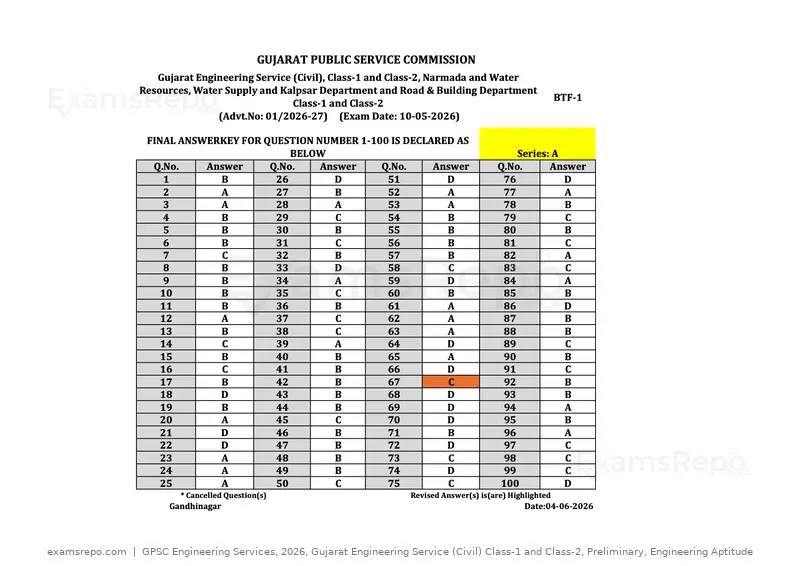
Text of page 2
GUJARAT PUBLIC SERVICE COMMISSION
   Gujarat Engineering Service (Civil), Class-1 and Class-2, Narmada and Water
Resources, Water Supply and Kalpsar Department and Road & Building Department
                                                                                             BTF-1
                               Class-1 and Class-2
               (Advt.No: 01/2026-27) (Exam Date: 10-05-2026)

 FINAL ANSWERKEY FOR QUESTION NUMBER 1-100 IS DECLARED AS
                          BELOW                                                Series: A
  Q.No.    Answer     Q.No.    Answer    Q.No.     Answer                  Q.No.      Answer
     1       B         26        D        51         D                      76           D
     2       A         27        B        52         A                      77           A
     3       A         28        A        53         A                      78           B
     4       B         29        C        54         B                      79           C
     5       B         30        B        55         B                      80           B
     6       B         31        C        56         B                      81           C
     7       C         32        B        57         B                      82           A
     8       B         33        D        58         C                      83           C
     9       B         34        A        59         D                      84           A
    10       B         35        C        60         B                      85           B
    11       B         36        B        61         A                      86           D
    12       A         37        C        62         A                      87           B
    13       B         38        C        63         A                      88           B
    14       C         39        A        64         D                      89           C
    15       B         40        B        65         A                      90           B
    16       C         41        B        66         D                      91           C
    17       B         42        B        67         C                      92           B
    18       D         43        B        68         D                      93           B
    19       B         44        B        69         D                      94           A
    20       A         45        C        70         D                      95           B
    21       D         46        B        71         B                      96           A
    22       D         47        B        72         D                      97           C
    23       A         48        B        73         C                      98           C
    24       A         49        B        74         D                      99           C
    25       A         50        C        75         C                     100           D
        * Cancelled Question(s)                      Revised Answer(s) is(are) Highlighted
     Gandhinagar                                                                   Date:04-06-2026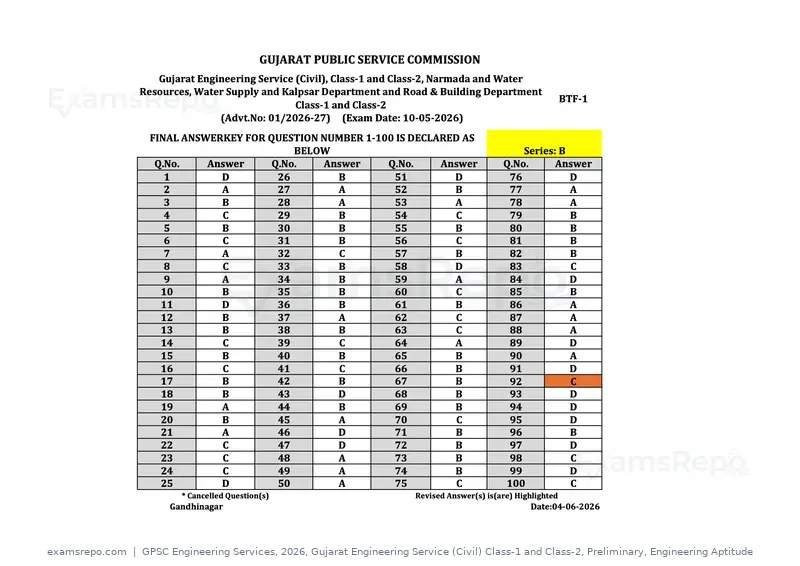
Text of page 3
GUJARAT PUBLIC SERVICE COMMISSION
   Gujarat Engineering Service (Civil), Class-1 and Class-2, Narmada and Water
Resources, Water Supply and Kalpsar Department and Road & Building Department
                                                                                             BTF-1
                               Class-1 and Class-2
               (Advt.No: 01/2026-27) (Exam Date: 10-05-2026)
 FINAL ANSWERKEY FOR QUESTION NUMBER 1-100 IS DECLARED AS
                          BELOW                                                Series: B
  Q.No.    Answer     Q.No.   Answer     Q.No.     Answer                  Q.No.      Answer
    1        D         26       B         51         D                      76           D
    2        A         27       A         52         B                      77           A
    3        B         28       A         53         A                      78           A
    4        C         29       B         54         C                      79           B
    5        B         30       B         55         B                      80           B
    6        C         31       B         56         C                      81           B
    7        A         32       C         57         B                      82           B
    8        C         33       B         58         D                      83           C
    9        A         34       B         59         A                      84           D
   10        B         35       B         60         C                      85           B
   11        D         36       B         61         B                      86           A
   12        B         37       A         62         C                      87           A
   13        B         38       B         63         C                      88           A
   14        C         39       C         64         A                      89           D
   15        B         40       B         65         B                      90           A
   16        C         41       C         66         B                      91           D
   17        B         42       B         67         B                      92           C
   18        B         43       D         68         B                      93           D
   19        A         44       B         69         B                      94           D
   20        B         45       A         70         C                      95           D
   21        A         46       D         71         B                      96           B
   22        C         47       D         72         B                      97           D
   23        C         48       A         73         B                      98           C
   24        C         49       A         74         B                      99           D
   25        D         50       A         75         C                     100           C
        * Cancelled Question(s)                      Revised Answer(s) is(are) Highlighted
     Gandhinagar                                                                  Date:04-06-2026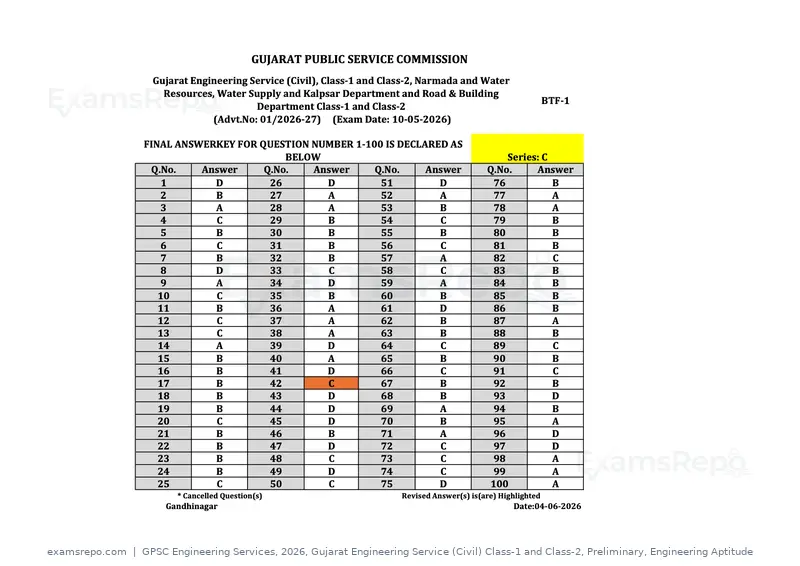
Text of page 4
GUJARAT PUBLIC SERVICE COMMISSION
 Gujarat Engineering Service (Civil), Class-1 and Class-2, Narmada and Water
   Resources, Water Supply and Kalpsar Department and Road & Building
                                                                                             BTF-1
                      Department Class-1 and Class-2
             (Advt.No: 01/2026-27) (Exam Date: 10-05-2026)

FINAL ANSWERKEY FOR QUESTION NUMBER 1-100 IS DECLARED AS
                         BELOW                                                 Series: C
 Q.No.    Answer     Q.No.   Answer     Q.No.     Answer                   Q.No.     Answer
    1       D         26       D         51         D                       76           B
    2       B         27       A         52         A                       77           A
    3       A         28       A         53         B                       78           A
   4        C         29       B         54         C                       79           B
   5        B         30       B         55         B                       80           B
   6        C         31       B         56         C                       81           B
   7        B         32       B         57         A                       82           C
   8        D         33       C         58         C                       83           B
   9        A         34       D         59         A                       84           B
   10       C         35       B         60         B                       85           B
   11       B         36       A         61         D                       86           B
   12       C         37       A         62         B                       87           A
   13       C         38       A         63         B                       88           B
   14       A         39       D         64         C                       89           C
   15       B         40       A         65         B                       90           B
   16       B         41       D         66         C                       91           C
   17       B         42       C         67         B                       92           B
   18       B         43       D         68         B                       93           D
   19       B         44       D         69         A                       94           B
   20       C         45       D         70         B                       95           A
   21       B         46       B         71         A                       96           D
   22       B         47       D         72         C                       97           D
   23       B         48       C         73         C                       98           A
   24       B         49       D         74         C                       99           A
   25       C         50       C         75         D                      100           A
      * Cancelled Question(s)                        Revised Answer(s) is(are) Highlighted
   Gandhinagar                                                                    Date:04-06-2026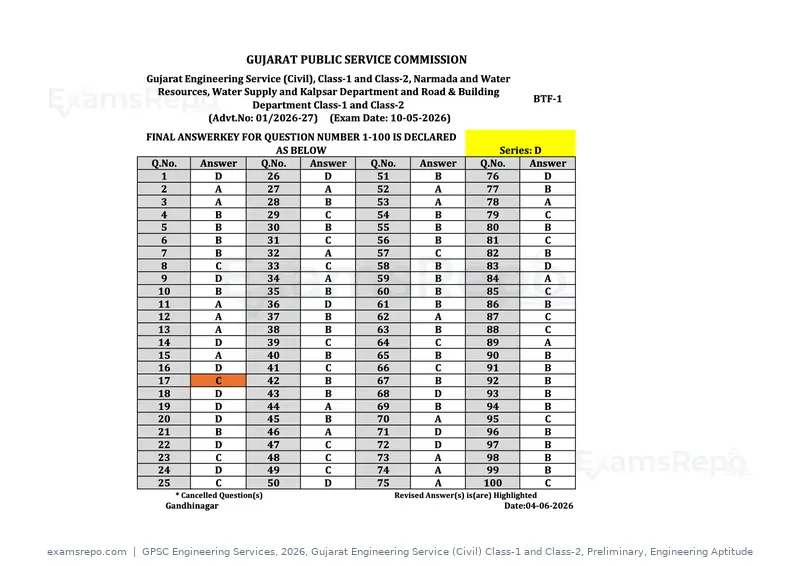
Text of page 5
GUJARAT PUBLIC SERVICE COMMISSION
Gujarat Engineering Service (Civil), Class-1 and Class-2, Narmada and Water
  Resources, Water Supply and Kalpsar Department and Road & Building
                                                                                       BTF-1
                     Department Class-1 and Class-2
            (Advt.No: 01/2026-27) (Exam Date: 10-05-2026)
FINAL ANSWERKEY FOR QUESTION NUMBER 1-100 IS DECLARED
                      AS BELOW                                               Series: D
 Q.No.   Answer    Q.No.    Answer    Q.No.    Answer                    Q.No.     Answer
   1       D        26        D        51         B                       76           D
   2       A        27        A        52         A                       77           B
   3       A        28        B        53         A                       78           A
   4       B        29        C        54         B                       79           C
   5       B        30        B        55         B                       80           B
   6       B        31        C        56         B                       81           C
   7       B        32        A        57         C                       82           B
   8       C        33        C        58         B                       83           D
   9       D        34        A        59         B                       84           A
  10       B        35        B        60         B                       85           C
  11       A        36        D        61         B                       86           B
  12       A        37        B        62         A                       87           C
  13       A        38        B        63         B                       88           C
  14       D        39        C        64         C                       89           A
  15       A        40        B        65         B                       90           B
  16       D        41        C        66         C                       91           B
  17       C        42        B        67         B                       92           B
  18       D        43        B        68         D                       93           B
  19       D        44        A        69         B                       94           B
  20       D        45        B        70         A                       95           C
  21       B        46        A        71         D                       96           B
  22       D        47        C        72         D                       97           B
  23       C        48        C        73         A                       98           B
  24       D        49        C        74         A                       99           B
  25       C        50        D        75         A                      100           C
      * Cancelled Question(s)                      Revised Answer(s) is(are) Highlighted
   Gandhinagar                                                                 Date:04-06-2026
Page 1 of 23
Source: Gujarat Public Service Commission. Question paper published by Gujarat Public Service Commission.