
IIT JAM 2026: Geology

Text of page 1
JAM 2026                               Confidential                                      Geology (GG)


 Section A: Q.1 – Q.10 Carry ONE mark each.


 Q.1        Which one of the following primary structures can be used for paleocurrent
            measurement?


       (A) Oscillation ripple


       (B) Hummocky cross-strata


       (C) Flute cast


       (D) Load and flame structures


GG                                                                                           Page 3 of 44
Text of page 2
JAM 2026                              Confidential                                        Geology (GG)


 Q.2        Which one of the following minerals does NOT show changes in optical
            properties upon exposure to UV light?


       (A) Apatite


       (B) Calcite


       (C) Fluorite


       (D) Scheelite


 Q.3        Choose the material on which 14C dating technique can be correctly applied.


       (A) Charred food grains from the Indus Valley civilization


       (B) Organic matter in carbonaceous chondrites


       (C) Diamonds from the Earth’s interior


       (D) Graphite from Proterozoic sedimentary basins


GG                                                                                            Page 4 of 44
Text of page 3
JAM 2026                                Confidential                                         Geology (GG)


 Q.4        Which one of the following rock combinations is characteristic of volcanic arcs?


       (A) Basalt-andesite-dacite


       (B) Basalt-trachyte-rhyolite


       (C) Andesite-syenite-dacite


       (D) Trachybasalt-basaltic andesite-andesite


 Q.5        The rake (pitch) of slickenlines exposed on a moderately dipping fault plane
            is the angle between


       (A) the magnetic north and strike of the fault plane measured on a horizontal surface


       (B) the strike of the fault plane and the slickenlines measured on the fault plane


       (C) the strike of the fault plane and the slickenlines measured on a vertical plane


       (D) the trend and the plunge directions of slickenlines measured on the fault plane


GG                                                                                               Page 5 of 44
Text of page 4
JAM 2026                                Confidential                                  Geology (GG)


 Q.6        Match the geographic locations listed in Column 1 to the geodynamic features
            listed in Column 2.


                               Column 1                        Column 2

                           P. Iceland                  i.   Triple junction

                           Q. Afar                     ii. Plume-ridge interaction

                           R. Hawaii                   iii. Subduction zone

                           S. Aleutian Islands         iv. Plume


       (A) P-i; Q-ii; R-iv; S-iii


       (B) P-ii; Q-i; R-iv; S-iii


       (C) P-ii; Q-i; R-iii; S-iv


       (D) P-ii; Q-iv; R-i; S-iii


GG                                                                                         Page 6 of 44
Text of page 5
JAM 2026                               Confidential                                      Geology (GG)


 Q.7        Which one of the following observations is consistent with the solid nature of the
            Earth’s mantle?


       (A) S waves propagate through the mantle


       (B) S waves do not propagate through the mantle


       (C) P waves opag
                  propagate through the mantle


       (D) P waves are refracted in the mantle


 Q.8        Which one of the following is a nektic bivalve?


       (A) Gryphaea


       (B) Trigonia


       (C) Mytilus


       (D) Solen


GG                                                                                           Page 7 of 44
Text of page 6
JAM 2026                                Confidential                                   Geology (GG)


 Q.9         Which one of the following is characteristic of a point bar succession?


        (A) Thick homogenous sandstone


        (B) Upward gradation from sandstone to shale


        (C) Upward gradation from shale to sandstone


        (D) Thick laminated shale


 Q.10        Tsunamis are frequently caused by earthquakes at


        (A) slow-spreading ridges


        (B) fast-spreading ridges


        (C) subduction zones


        (D) transform faults


GG                                                                                         Page 8 of 44
Text of page 7
JAM 2026                                    Confidential                                      Geology (GG)


 Section A: Q.11 – Q.30 Carry TWO marks each.


 Q.11         In the 87Rb -87Sr isotopic systematics applied to terrestrial rocks, the slope of

              the isochron ! "# $ 1% can be approximated as lt, where l is the decay constant

              and t is time. Choose the correct option that justifies this approximation.


              87
        (A)        Rb decays to 87Sr following a linear law


        (B) The Rb/Sr ratio is susceptible to alteration in terrestrial rocks


        (C)   l is very small for 87Rb


        (D) Age of the Earth > half-life of 87Rb


GG                                                                                                Page 9 of 44
Text of page 8
JAM 2026                                    Confidential                                 Geology (GG)


 Q.12        A halide with octahedral cleavage can scratch calcite and can be scratched by
             quartz. Identify the halide.


        (A) Sylvite


        (B) Fluorite


        (C) Apatite


        (D) Halite


 Q.13        Choose the correct statement about Moho.


        (A) Seismic and petrologic Moho coincide


        (B) Seismic Moho lies at shallower depths relative to the petrologic Moho


        (C) Petrologic Moho lies at shallower depths relative to the seismic Moho


        (D) Petrologic Moho lies above the layered gabbro in ophiolites


GG                                                                                           Page 10 of 44
Text of page 9
JAM 2026                               Confidential                                     Geology (GG)


 Q.14       Stratigraphic sections S1 and S2, separated by tens of kilometers, are shown in
            the schematic. The line segments in this schematic represent biostratigraphic
            correlation between S1 and S2. Which one of the segments (P, Q, R, S) of this
            correlation line represents an unconformity?


        (A) P


        (B) Q


        (C) R


        (D) S


GG                                                                                            Page 11 of 44
Text of page 10
JAM 2026                               Confidential                                     Geology (GG)


 Q.15        The S wave velocity &' is given by &' = ()+*, where ) is shear modulus and *

             is density of the medium. &' is lower in mantle plumes than in the ambient mantle
             because of


        (A) lower temperature of mantle plumes


        (B) lower density of mantle plumes


        (C) higher density of mantle plumes


        (D) lower shear modulus of mantle plumes


 Q.16
             Which one of the following environments best characterizes the natural habitat
             of boring valv
                      bivalves, green algae, and herbivorous snails?


        (A) Deep marine


        (B) Rocky intertidal coast


        (C) Outer shelf


        (D) Estuary


GG                                                                                            Page 12 of 44
Text of page 11
JAM 2026                                  Confidential                                      Geology (GG)


 Q.17        Match the minerals in Column 1 to their characteristic optical properties in
             Column 2.


                               Column 1                    Column 2

                       P. Zircon                          i. Pink to green pleochroism
                       Q. Orthopyroxene                   ii. Very high positive relief
                       R. Muscovite                       iii. Cyclic twinning
                       S. Cordierite                      iv. Third order birefringence


        (A) P-ii; Q-i; R-iii; S-iv


        (B) P-i; Q-ii; R-iv; S-iii


        (C) P-ii; Q-i; R-iv; S-iii


        (D) P-ii; Q-iv; R-i; S-iii


GG                                                                                             Page 13 of 44
Text of page 12
JAM 2026                                Confidential                                  Geology (GG)


 Q.18        Match the magma series in Column 1 to the geological settings in Column 2.


                                 Column 1                          Column 2

                          P. Alkaline Series           i. Divergent oceanic margin

                          Q. Shoshonite Series         ii. Oceanic intraplate

                          R. Calc-alkaline Series      iii. Convergent plate margin

                                                       iv. Convergent plate margin
                          S. Tholeiitic Series
                                                       close to back arc


        (A) P-i; Q-iv; R-iii; S-ii


        (B) P-ii; Q-iv; R-iii; S-i


        (C) P-ii; Q-i; R-iii; S-iv


        (D) P-iv; R-ii; Q-i; S-iii


GG                                                                                        Page 14 of 44
Text of page 13
JAM 2026                                   Confidential                                    Geology (GG)


 Q.19        Match the plant fossils in Column 1 to the corresponding geological ages in
             Column 2.


                                 Column 1                           Column 2

                         P. Glossopteris                    i.   Triassic

                         Q. Ptilophyllum                    ii. Devonian

                         R. Dicrodium-Thinnfeldic           iii. Triassic to Lower
                                                                 Cretaceous

                         S. Psilophyton                     iv. Permian


        (A) P-iv; Q-iii; R-i; S-ii


        (B) P-iii; Q-iv; R-i; S-ii


        (C) P-iv; Q-iii; R-ii; S-i


        (D) P-iv; Q-i; R-iii; S-ii


GG                                                                                            Page 15 of 44
Text of page 14
JAM 2026                                Confidential                                      Geology (GG)


 Q.20        Which one of the following reasons best explains the occurrence of large number
             of earthquakes at the active plate boundaries compared to the plate interiors?


        (A) Strain energy accumulation is higher at the plate boundaries


        (B) Stiffness is higher at the plate boundaries


        (C) Heat flow is lower at the plate boundaries


        (D) Crust is thinner at the plate boundaries


 Q.21
             If P, Q, R, and S refer to Rainfall induced landslide, Bolide impact, Milankovitch
             cycle, and Supercontinent cycle, respectively, then which one of the following
             correctly pres
                      represents the decreasing order of their duration?


        (A) S, R, P, Q


        (B) Q, P, R, S


        (C) S, Q, P, R


        (D) S, P, Q, R


GG                                                                                            Page 16 of 44
Text of page 15
JAM 2026                                Confidential                                         Geology (GG)


 Q.22
            The schematic shows a geological cross-section of a faulted region of
            sedimentary rocks (beds P to U). Assuming continuous sedimentation, select
            the beds that record the earliest activation and the latest reactivation of the fault.


        (A) Q, T


        (B) P, T


        (C) Q, R


        (D) Q, U


GG                                                                                              Page 17 of 44
Text of page 16
JAM 2026                                 Confidential                                        Geology (GG)


 Q.23        In a single layer of an anticline, the dip isogons converge towards the inner
             surface (core). Which one of the following statements is correct for the
             curvature of the inner surface of this folded layer?


        (A) Curvature of the inner surface > Curvature of the outer surface


        (B) Curvature of the inner surface < Curvature of the outer surface


        (C) Curvature of the inner surface = Curvature of the outer surface


        (D) Curvature of the inner surface = Curvature of the median surface


GG                                                                                              Page 18 of 44
Text of page 17
JAM 2026                                Confidential                                      Geology (GG)


 Q.24
             In an arid environment, winds of similar intensity blow in nearly opposite
             directions in alternate seasons. Which dune type is most likely to form in
             such an environment?


        (A) Barkhan


        (B) Transverse dunes


        (C) Seif


        (D) Lunate


 Q.25        Which one of the following features is used to define the K-Pg boundary
             globally?


        (A) Absence of dinosaur fossils


        (B) Presence of iridium anomaly in sediments


        (C) Presence of high mercury content in sediments


        (D) End of Deccan volcanism


GG                                                                                           Page 19 of 44
Text of page 18
JAM 2026                              Confidential                                     Geology (GG)


 Q.26       The figure shows chemogenic mineral projections for Facies P and Facies Q.
            Which one of the following reactions best represents change from Facies P to
            Facies Q?


        (A) Wo + An = Sil + Qtz


        (B) An + Sil = Wo


        (C) Wo + Crn = Grs


        (D) Grs + Qtz = Wo + An


GG                                                                                         Page 20 of 44
Text of page 19
JAM 2026                                Confidential                                        Geology (GG)


 Q.27        The figure depicts stability fields of minerals P and Q. Which one of the following
             statements is INCORRECT?


        (A) P and Q can coexist at different temperatures only if pressures are different


        (B) P and Q can coexist with liquid only at one pressure and temperature


        (C) Q has a higher melting temperature at higher pressures than at lower pressures


        (D) A reaction forming Q from P at constant pressure will require an input of heat


GG                                                                                             Page 21 of 44
Text of page 20
JAM 2026                                  Confidential                                          Geology (GG)


 Q.28        Match the metal associations in Column 1 to corresponding hosts in Column 2.


                             Column 1                                Column 2

                          P. Cu, Co, Zn                  i. Tectonized dunite and harzburgite
                          Q. Mn, Co, Ni                  ii. MORB
                          R. Cr                          iii. I-Type granite in volcanic arc
                          S. Cu, Mo, Pb                  iv. Pelagic sediment


        (A) P-ii; Q-iv; R-i; S-iii


        (B) P-iv; Q-ii; R-i; S-iii


        (C) P-ii; Q-iv; R-iii; S-i


        (D) P-ii; Q-i; -i
                      R-iv; S-iii


GG                                                                                                 Page 22 of 44
Text of page 21
JAM 2026                                Confidential                                        Geology (GG)


 Q.29
             Which one of the following mineral associations is diagnostic of the highly-
             oxidized zone of a weathered primary base metal vein?


        (A) Smithsonite, Malachite, Anglesite


        (B) Calcite, Fluorite, Pyrite


        (C) Limonite, Realgar, Chalcocite


        (D) Goethite, Orpiment, Boehmite


GG                                                                                             Page 23 of 44
Text of page 22
JAM 2026                                Confidential                                     Geology (GG)


 Q.30        Match the features in Column 1 to the most appropriate description in Column 2.


                          Column 1                             Column 2

                    P. Ash layer            i. Part of a turbidite sequence

                    Q. Graded bedding       ii. Subaerial episode in the sedimentary record

                    R. Hiatus               iii. Dating of sedimentary rocks

                    S. Soil profile         iv. Missing faunal zone


        (A) P-iii; Q-i; R-iv; S-ii


        (B) P-i; Q-iii; R-iv; S-ii


        (C) P-iii; Q-i; R-ii; S-iv


        (D) P-iii; Q-iv; R-i; S-ii


GG                                                                                            Page 24 of 44
Text of page 23
JAM 2026                                Confidential                                      Geology (GG)


 Section B: Q.31 – Q.40 Carry TWO marks each.


 Q.31        Choose the correct statement(s) related to different aspects of volcanism.


        (A) Andesites are the most common rock type associated with stratovolcanoes


        (B) Explosiveness of volcanism depends on viscosity and fluid content of the magma


        (C) Shield volcanoes represent one of the largest magmatic vent landforms


        (D) Pillow lavas reflect sub-aerial volcanic eruptions


GG                                                                                           Page 25 of 44
Text of page 24
JAM 2026                                Confidential                                       Geology (GG)


 Q.32        Which of the following processes is/are responsible for the alternate bands of
             magnetic polarity observed in seafloor basalts?


        (A) Convection in the mantle


        (B) Convection in the outer core


        (C) Convection in the inner core


        (D) Seismicity at mid-oceanic ridges


 Q.33        The Earth’s gravitational acceleration is higher at the poles compared to that at the
             equator due to


        (A) higher density rocks at the poles


        (B) shorter polar radius


        (C) lower centrifugal acceleration at the poles


        (D) higher topography at the poles


GG                                                                                             Page 26 of 44
Text of page 25
JAM 2026                                 Confidential                                     Geology (GG)


 Q.34        During glacier retreat following the last Ice Age, Scandinavia experienced
             isostatic rebound. Which of the following resulted due to this rebound?


        (A) Fall in water level in glacial lakes


        (B) Rise in water level in glacial lakes


        (C) Raised beaches


        (D) Deep earthquakes


 Q.35        Natural cumu
                    accumulation of hydrocarbons are expected to occur


        (A) in an anticline


        (B) in stratigraphic traps


        (C) along synclinal axial troughs


        (D) in ancient delta-mouth bars


GG                                                                                           Page 27 of 44
Text of page 26
JAM 2026                                 Confidential                                       Geology (GG)


 Q.36        Which of the following factors affect(s) the intrinsic spatial resolution of remote
             sensing imagery?


        (A) Sensor pixel size


        (B) Altitude of the satellite


        (C) Wavelength of the captured electromagnetic radiation


        (D) Satellite mmun
                     communication bandwidth


 Q.37        Two sandstone reservoir rocks R1 and R2 have 25% porosity each but the
             permeability of R1 is higher than that of R2. Which of the following can explain
             this difference in permeability?


        (A) Clay content in R1 is more than that in R2


        (B) Microfracture density in R1 is higher than that in R2


        (C) Sorting in R1 is better than that in R2


        (D) R1 has more angular grains than R2


GG                                                                                             Page 28 of 44
Text of page 27
JAM 2026                                Confidential                                      Geology (GG)


 Q.38        In the following illustration, PQRS is an exposed axial planar cleavage,
             striking north-south and dipping 40° east. B1 and B2 are the traces of two
             folded bedding planes on this axial planar cleavage. The fold can be classified as


        (A) horizontal fold


        (B) inclined fold


        (C) plunging fold


        (D) upright fold


GG                                                                                            Page 29 of 44
Text of page 28
JAM 2026                                Confidential                                       Geology (GG)


 Q.39        Intrusion of a 10-meter thick dolerite dyke into a boron-rich quartz-garnet-biotite-
             muscovite-chlorite schist developed a visible symmetric baked zone. Which of the
             following minerals can develop in this baked zone, 2 meters away from the margin
             of the dyke?


        (A) Orthopyroxene


        (B) Clinopyroxene


        (C) Amphibole


        (D) Tourmaline


 Q.40        Which of the following ore types form(s) by magmatic differentiation?


        (A) Gold in quartz vein


        (B) Titaniferous magnetite in anorthosite


        (C) Columbite-Tantalite in pegmatite


        (D) Chromite-Pentlandite in pyroxenite


GG                                                                                             Page 30 of 44
Text of page 29
JAM 2026                              Confidential                                       Geology (GG)


 Section C: Q.41 – Q.50 Carry ONE mark each.


 Q.41      One mole of a parent nuclide is undergoing radioactive decay. The fraction of
           atoms of this nuclide that has decayed after three half-lives is ____________.
           (Round off to three decimal places)


 Q.42      The lithostatic pressure at the base of a 35 km thick continental crust of average
                                     ____________ × 108 Pa. (Round off to one decimal place)
           density of 2.8 g/cc is _____

           (Consider the value of acceleration due to gravity as 9.8 m/s2)


 Q.43      A hypothetical mineral has the formula X7Si8O22(OH)2, where X is a cation.

           The valence state of X is _________. (In integer)


GG                                                                                              Page 31 of 44
Text of page 30
JAM 2026                              Confidential                                       Geology (GG)


 Q.44      The surface subsidence at a horizontal distance , from the centerline of a
                                                         34 5
           cylindrical tunnel is given by -./0 × exp 2            :;<where -./0 is the
                                                         6789 5
           maximum subsidence above the tunnel and > = ?@ m is the depth of the tunnel
           centerline. The ratio of surface subsidence at , = 1@ m to that at , = A@ m
           is __________. (Round off to one decimal place)


 Q.45      An aquifer with a hydraulic conductivity of 60 m/day experiences a head loss
           of 20 m over a length of 1000 m. The flow of water per unit area, in millimeter
           per minute, is ____________ . (Round off to two decimal places)


GG                                                                                           Page 32 of 44
Text of page 31
JAM 2026                              Confidential                                      Geology (GG)


 Q.46      Sphalerite shows limited isomorphism. Consider a colourless sphalerite having
           33% S and 67% Zn. Then, in a black-coloured sphalerite, with a 15% Fe
           substitution, the ratio of atomic proportions of Zn to that of Fe is ____________
           (Round off to one decimal place)

           (Given: atomic weight of Zn = 65.37, Fe = 55.85, and S = 32.06)


 Q.47      The true dip of a normal limb associated with asymmetric folding is 20° and the

           angle that this limb makes with the axial planar cleavage is 35°. The true dip of
           the axial planar cleavage, in degree, is ______________ . (In integer)


 Q.48      A metallic mineral weighs 44 g and displaces 11 mL of water when fully
           immersed. The density of the mineral is ____________ g/cc. (In integer)


GG                                                                                             Page 33 of 44
Text of page 32
JAM 2026                             Confidential                                        Geology (GG)


 Q.49      A clinopyroxene crystal in a basalt, measured to have a composition of
           Mg1.2Fe0.4Ca0.4Si2O6, will have Mg-number (Mg#) of ____________ %.
           (In integer)


 Q.50      The figure shows a coral reef deposit at the continental margin since 120 Ma.
           Assuming that there was no sea-level change, the average subsidence rate of
           this continental margin is ______________ mm/year. (Round off to three decimal
           places)


GG                                                                                          Page 34 of 44
Text of page 33
JAM 2026                              Confidential                                      Geology (GG)


 Section C: Q.51 – Q.60 Carry TWO marks each.


 Q.51      eNd is the deviation of 143Nd/144Nd of a sample relative to CHUR in
           parts per 104. For a pyroxenite with measured 143Nd/144Nd = 0.512838 and
           147
             Sm/144Nd = 0.21, the initial eNd at 1 Ga is ______________ . (Round off only

           the final answer to one decimal place)

           (Given: for CHUR, 143Nd/144Nd = 0.512638 and 147Sm/144Nd = 0.1967. The decay

           constant for 147Sm is 6.54 ×10⁻¹² yr−1)


 Q.52      A sandstone sample with 100% quartz has a porosity of 30%. The sample is dry
           and the density of quartz is 2.65 g/cc. The bulk density of the sandstone sample
           is _________ g/cc (Round off to one decimal place)


GG                                                                                            Page 35 of 44
Text of page 34
JAM 2026                              Confidential                                       Geology (GG)


 Q.53
           A mountain of height 5 km is in static equilibrium with a crustal block of zero
           elevation. If the density of the crust and the mantle are 2700 and 3300 kg/m3,
           respectively, the thickness of the mountain root (h) is ________ km (Round off
           to one decimal place)


 Q.54      In a mineralized staurolite-garnet-biotite schist, the estimated metasomatic sulfide
           mineralization is 4%, with ore mineral proportions as 30% chalcopyrite, 20%
           pyrite and the rest being magnetite. The maximum grade of Cu will be
           __________ /t
                     g/ton (Round off to the nearest integer)

           (Given: 1 ton = 1000 kg; atomic weight of Cu = 63.55, Fe = 55.85, O = 16.00
           and S = 32.06)


GG                                                                                           Page 36 of 44
Text of page 35
JAM 2026                              Confidential                                       Geology (GG)


 Q.55
           Four vertical boreholes are drilled on a flat topography at 50 m intervals along
           the east-west direction. The boreholes intersect a coal seam at depths of 100 m,
           130 m, 160 m and 190 m. The true dip of the coal seam, in degree, is _______.
           (Round off to two decimal places)


 Q.56      Consider a perfect Geocentric Axial Dipole model for the geomagnetic field. At a
           latitude of 30°N, the inclination of a freely suspended magnetic needle, in degree,
           is __________ . (Round off to the nearest integer)


GG                                                                                            Page 37 of 44
Text of page 36
JAM 2026                              Confidential                                        Geology (GG)


 Q.57
           The figure shows the 14C activity with depth in a sediment core from a lake,

           where the sedimentation rate was uniform. The maximum 14C activity, marking
           the signature of bomb carbon, was measured at a depth of 45 cm. The rate of
           sedimentation is __________ mm/year (In integer)
           (Given: the core top reflects the year of coring and bomb carbon reached its
           global maximum in 1965)


GG                                                                                           Page 38 of 44
Text of page 37
JAM 2026                              Confidential                                       Geology (GG)


 Q.58      Based on the figure, the anorthite content of first formed plagioclase crystals from
           a liquid composition having 50 mole % anorthite is _________ mole % (In integer)


GG                                                                                          Page 39 of 44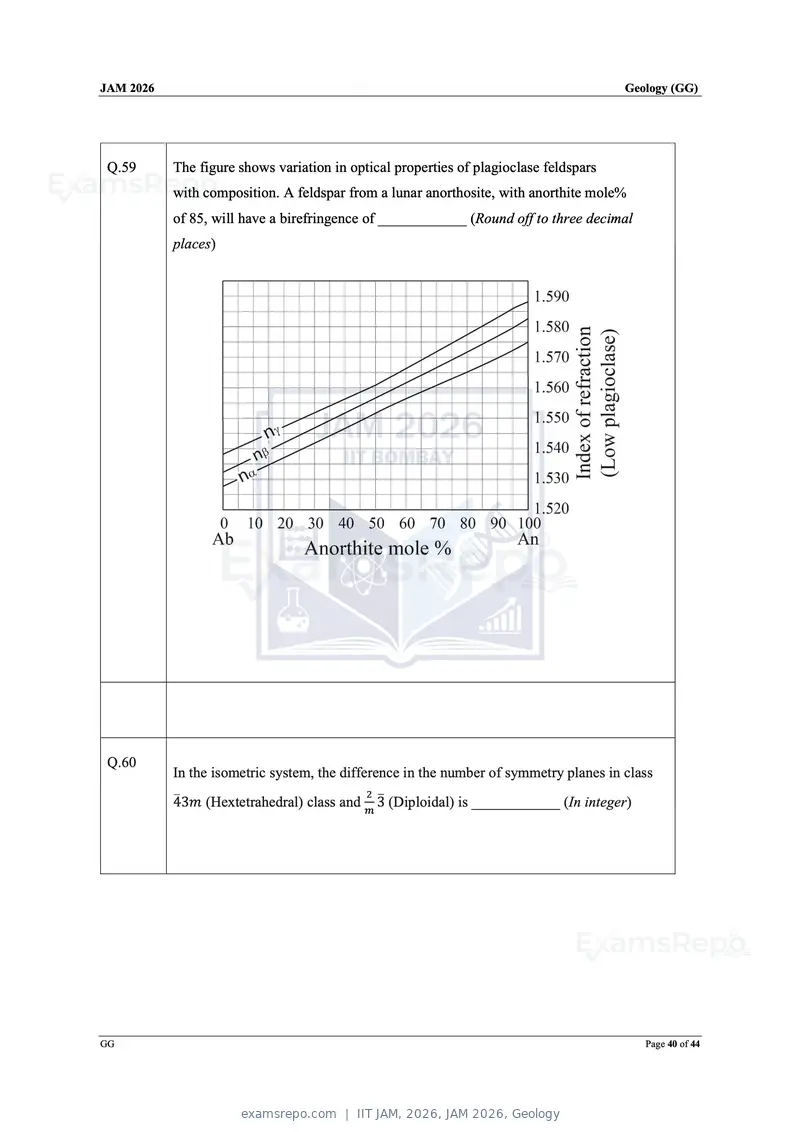
Text of page 38
JAM 2026                              Confidential                                     Geology (GG)


 Q.59      The figure shows variation in optical properties of plagioclase feldspars
           with composition. A feldspar from a lunar anorthosite, with anorthite mole%
           of 85, will have a birefringence of ____________ (Round off to three decimal
           places)


 Q.60
           In the isometric system, the difference in the number of symmetry planes in class
           CBDE (Hextetrahedral) class and F DC (Diploidal) is ____________ (In integer)
                                           .


GG                                                                                         Page 40 of 44
Text of page 1
JAM 2026: Geology (GG)
                        Master Answer Key
Question
           Subject   Question Type   Answer Key/Range   Mark(s)
  No.
   1         GG          MCQ                C              1

   2         GG          MCQ                A              1

   3         GG          MCQ                A              1

   4         GG          MCQ                A              1

   5         GG          MCQ                B              1

   6         GG          MCQ                B              1

   7         GG          MCQ                A              1

   8         GG          MCQ               MTA             1

   9         GG          MCQ                B              1

  10         GG          MCQ                C              1

  11         GG          MCQ                C              2

  12         GG          MCQ                B              2

  13         GG          MCQ                B              2

  14         GG          MCQ                B              2

  15         GG          MCQ                D              2

  16         GG          MCQ                B              2

  17         GG          MCQ                C              2

  18         GG          MCQ                B              2

  19         GG          MCQ                A              2

  20         GG          MCQ                A              2

  21         GG          MCQ                A              2

  22         GG          MCQ                A              2

  23         GG          MCQ                A              2

  24         GG          MCQ                C              2

  25         GG          MCQ                B              2

  26         GG          MCQ                D              2

  27         GG          MCQ                D              2

  28         GG          MCQ                A              2

  29         GG          MCQ                A              2

  30         GG          MCQ                A              2
Text of page 2
Question
           Subject   Question Type   Answer Key/Range   Mark(s)
  No.
  31         GG          MSQ               A;B;C           2

  32         GG          MSQ                A;B            2

  33         GG          MSQ                B;C            2

  34         GG          MSQ                A;C            2

  35         GG          MSQ               A;B;D           2

  36         GG          MSQ               A;B;C           2

  37         GG          MSQ                B;C            2

  38         GG          MSQ                B;C            2

  39         GG          MSQ                C;D            2

  40         GG          MSQ                B;D            2

  41         GG          NAT           0.875 to 0.875      1

  42         GG          NAT             9.5 to 9.7        1

  43         GG          NAT               2 to 2          1

  44         GG          NAT             1.2 to 1.4        1

  45         GG          NAT            0.80 to 0.85       1

  46         GG          NAT             2.9 to 3.1        1

  47         GG          NAT              55 to 55         1

  48         GG          NAT               4 to 4          1

  49         GG          NAT              75 to 75         1

  50         GG          NAT           0.025 to 0.025      1

  51         GG          NAT             2.1 to 2.3        2

  52         GG          NAT             1.8 to 2.0        2

  53         GG          NAT            22.4 to 22.6       2

  54         GG          NAT           4100 to 4200        2

  55         GG          NAT           30.00 to 32.00      2

  56         GG          NAT              48 to 50         2

  57         GG          NAT              10 to 10         2

  58         GG          NAT              85 to 90         2

  59         GG          NAT           0.010 to 0.015      2

  60         GG          NAT               3 to 3          2
Page 1 of 38
Source: Indian Institutes of Technology. Question paper published by Indian Institutes of Technology.