
JPSC Assistant Engineer 2021: Assistant Engineer Written Exam, Advt. No. 08/2018 and 08/2019, MECHANICAL ENGINEERING PAPER-I SUBJECT-CODE-10

Text of page 1
lllllllllullll[llllllllm


Total No. of P.rinted Pages - 7

                                                   AEUD
                               MECHANICAL ENGINEERING
                                                PAPER-I
                                        SUBJECT CODE : 10

Full Marks : 200                                                                        Time : 3 Hours

Iustruetions For Candidates :

         Please read each Of the following iustructioris carefully before a[templing questions.
          (1)      Ariswers must be written in ENGLISH only.
          (2)      The question paper contains a total Of 8 question in TWO Sections : Section-A
                   and Section-B. qTOUR questions in each section)
          (3)       Question No.1 Of section `A' and Question No. 5 of section `B' are compulsory.
          (4)       Candidates have to attempt another TIIPEE qu.estiorT from remaining SEA
                   questions choosing atleast ONE question from each section.
          (5)      Assume suitable data if f round necessary.
          (6)      Wherever any assumption be made for answering a question, they must be
                   clearly indicated.
          q)       Marks carried by a question / section is indicated agalusl it.
          (8)      Unless struck of f attempt of question shall be counted even if attempted partly.
          (9)       Any page -or portion of the page lef i blankin the A:nswer Boohiet must be clearly
                   struck off


                                               SECTION-A
                                                                                                       Marks

  1.       (i)      2 kg of an ideal gas is compressed adiabatically from pressure 100 kpa and
                   temperature 220 k to a final pressure of 400 kpa. Calculate (a) initial volume
                    a) final volume and temperature (c) work performed and (d) change in internal
                    energy.TakeCp=1.0kJkgKandCN=0.707kJkgK.

           (ii)     h a gas turbine, the gases flow at a rate of 5 kg/s. The gases enter the turbine at
                    a pressure of 7 bar with a velocity of 120 in/s and leaves at a pressure of 2 bar
                    with a velocity of 250 in/s. The turbine is insulated. If the enthalpy of the gas at
                    inlet is 900 kJthg and at the outlet is 600 kJkg, determine the capacity of the
                    turbine.
   apuD (10)                                                                                        Paper-I
Text of page 2
llllllllRAllullllulllVA


                                                                                                 Marlrs
                                                                                                         8
   (.lil)   Establish the Inequality of clausius.

   (iv)     Two firs of 0.01 in diameter and 0.1 in length are used to dissipate heat from a
            surface at 230 °C. The surroundings is at 30 °C. The thermal conductivity of the
            material is 20 W/ink. The convective coefficient is 30 W/m2k. To check
            alternate arrangement; it is proposed to replace the fins by a single fin of the
            total area of the two fins with length and other conditions being the same as
            before. Compare the heat transferred and the tip temperatures.

   (v)      An air conditioning unit receives an air water vapor mixture at 101 kpA, 35 °C
            and 80°/o relative humidity. Determine the following :

            (a)     thedewpoint

            a)     the humidityratio
            (c)     the partial pressure of air

            (d)     the mass fi.action of water vapour


    (i)      (a)     h a steam power station steam flows steadily throuch a o.2 in diangter
                    pipe line from the boiler to the turbine. At the boiler end, the slcan
                    conditions are found to be p = 4 Mpa, t = 400 °C, h = 3213.6 kJ/kg and
                    V = 0.073 m3ckg. At the turbine end, the conditions are found to be P = 35
                   . Mpa, t = 392 °C, h = 3202.6 kJAIg and ~ = 0.084 m3Acg. There is a hal
                    loss of 8.5 kJn{g from the pipe line. Calculate the steam flow rate.

             a)     A reversible heat engine operates between two reservoirs at temperafllle of
                    600 °C and 40 °C. The engine draws a reversible reffigerator Which
                    operates between reservoirs at temperatures of 40 °C and -20 °C. The hal
                    transfer to the heat engine is 2000 kJ and the net work output of the
                     combined engine - refrigerator plant is 360 kJ.                                      12


                     a   Evaluate the heat transfer to the reffigerant and the net heat rmsfer
                           to the reservoir at 40 °C.

                     ®    Reconsider (a) given that the efficiency of the beat endne and the
                           COP of the refrigerator are each 40% of their maximum possible
                           values.


AEUD (10)                                                                                         Paper-I
Text of page 3
lllllm[NIllllllllllllIRI

                                                                                                    Marks
         (ii)     A spark igm.tion engive working on ideal Otto cycle has the compression ratio 6.
                  The initial pressure and temperature in the cycle are 1 bar and 37 °C respectively.
                  The maxinun pressure in the cycle is 30 bar. For unit mass flow, calculate               10

                  (a)      p, v and T atvarious salientpoints of the cycleand
                  (b)      the ratio of heat supplied to the heat rejected.
                  Assume y = 1.4 and R = 8.314 kJ/K mol K.
                                                                                                           10
         (iii)    With the help of neat sketches explain the stages of combustion in CI engines.


3.        (i)      For an engine working on the ideal dual cycle, the compression ratio is 10 and
                  the maximum pressure is limited to 70 bar. If the heat supplied is 1680 kJftg,
                  find the pressures and temperatures at the various salient points of the cycle and
                  cycle efficiency. The pressure and temperature of air at the commencement of
                  compression ratio are 1 bar and 100 °C respectively.                                     12

                  Assume Cp = 1.004 kJthg K and

                              Cv = 0.717 kJckg K for air.

         (ii)      A heat flue of 1500 W/m2 is incident on the surface ofa slab of 10 cm thick with
                   thermal conductivity of 7.5 W/inK The hot side is found to be at 120 °C. On the
                   other side, the heat is passed on to the surroundings at 30 °C by convection and
                   radiation. If radiation is ideal, detemine the convective coefficient and also the
                   share of heat flow between the two processes.

          (iii)     (a)     Ametal plate ofl0 mmthick at30 °C is suddenly exposed on one face to a
                           heat flux of 3000 W/m2 and the other side is expose to convection to a
                           fluid at 30 °C with a convective heat transfer coefficient of 50 W/inK.
                           Determine the heat transfer coefficient of 50 W/m2 K.                           12

                           Determine the temperature variation with time and also steady state
                           temperatures and the time to reach 1 °C less than the steady state
                           temperature on the hot face.

                   (b)     Air at 200 °C flows over a plane at 120 °C. The air pressure is at 1.8 atm.
                           The free strealn velocity is 15 in/s. The plate measures 0.2 in & 0.4 in. The
                           air flow was designed to be in the direction of 0.4 in side. Due to some
                           misunderstanding the equipment was fabricated with flow in the 0.2 in
                           direction. Determine the change in performance.

 AEUD (10)                                                                                          Paper-I
Text of page 4
lllllllmllulllll"lm

                                                                                                     Marks
4.     (i)      A steam condenser condensing at 70 °C has to have a capacity of 100 kw. Water
                at 20 °C is used and the outlet temperature is limited to 45 °C. If the overall heat

                transfer co-efficient has a value of 3100 W/m2 K, determine the area required. If
                the inlet water temperature is increased to 30° C detemine the increased flow
                rate of water for maintaining the same water outlet temperature. Also determine
                                                                                                             10
                the flow rate for the same amount of heat transfer.

        (ii)    (a)      The atmospheric air at a pressure of 1 bar and temperature -5 °C is drawn in
                         thecylinderofacompressoroftheBeuColemanrefrigeraringmachine.Itis
                         compressed isentropically to a pressure of 5 bar. In this cooler, the
                         compressed air is cooled to a 15 °C, pressure remaining the same. It is then
                         expanded to a pressure of 1 bar in an expansion cylinder, from where it is

                         passed to the wed chamber.
                         Find 0 The work done per kg of air and ¢1) The COP of the plant Assume
                         lawofexpansionforairispV`.2=coustanclawforcompressionispV'4=
                                                                                                             12
                          constant. The specific heat of air is 1 kMcg K

                 a)      Derive an expression for the coefficient of performance of a vapour
                          compression refrigeration system with sub-cooling. Indicate the process in
                          P-h and T-S diagrams.

         (in)    A vapour compression refrigerator works between the pressure linits of 60 bar
                 and 25 bar. The working fluid is dry and the end of compression there is no
                 under cooling of the liquid before the expansion valve.

                 Detemine (a) COP of the cycle and a>) Capacity of the refrgerator if the fluid
                                                                                                                  10
                 flow is at the rate of 5 kg/in.
                                      Saturation       Specificenthalpy,         Specific entropy,
                      PressureOar)
                                     temperature,K          kJng K                    kJng K
                                                      Liquid       Vapour       Liquid        Vapour

                                         295            61.9         208.1       0.197          0.7030.896
                          60

                          35             261           -18.4         234.5      ro.075


                                                                                                       Paper-I
     AEUD (10)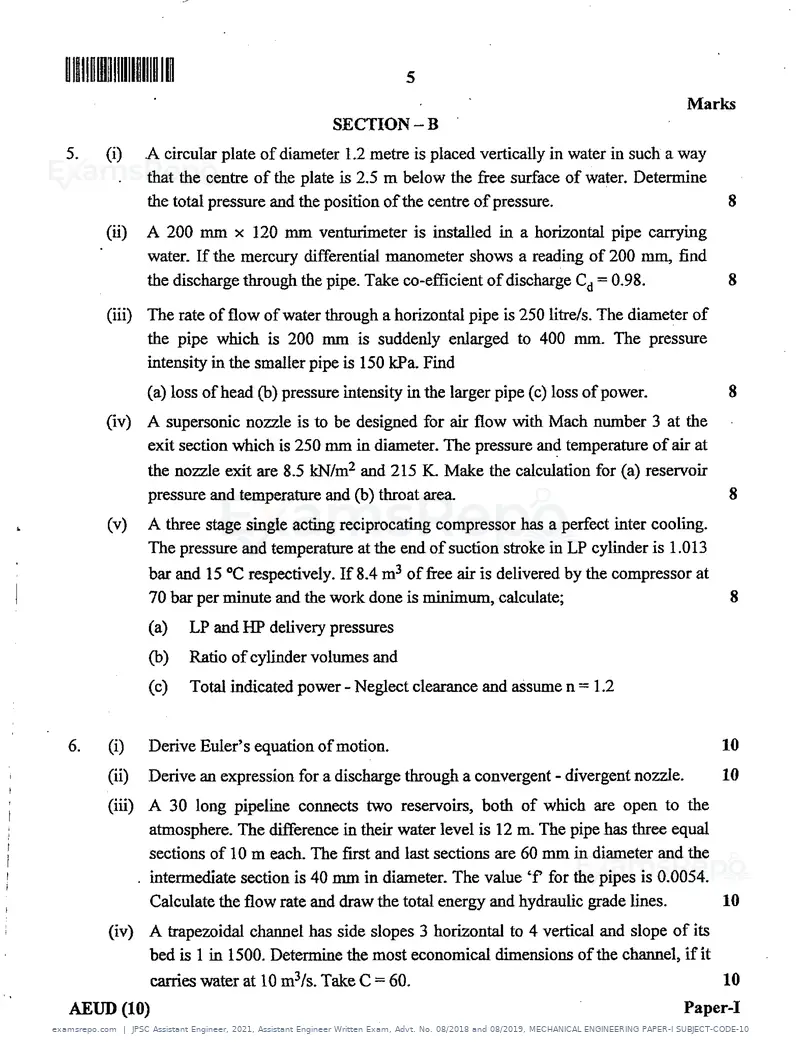
Text of page 5
llllllmmllllllllmlm

                                                                                                Marks
                                            SECTION -8
5.     (i)       A circularplate of diameter 1.2 metre is placed vertically in water in such away
                that the centre of the plate is 2.5 in below the free surface of water. Determine
                the total pressure and the position of the centre of pressure.

       (ii)     A 200 mm x 120 mm venturimeter is installed in a horizontal pipe carrying
                water. If the mercury differential manometer shows a reading of 200 mm, find
                the discharge through the pipe. Take co-efficient of discharge Cd = 0.98.

       (iii)     The rate of flow of water through a horizontal pipe is 250 litre/s. The diameter of
                the pipe which is 200 mm is suddenly enlarged to 400 mm. The pressure
                intensity in the smaller pipe is 150 kpa. Find

                (a) loss of head a]) pressure intensity in the larger pipe (c) loss of power.
       (iv)     A supersonic nozzle is to be designed for air flow with Mach number 3 at the
                exit section which is 250 mm in diameter. The pressure and temperature of air at
                the nozzle exit are 8.5 kN/m2 and 215 K Make the calculation for (a) reservoir
                pressure and temperature and a) throat area.
       (v)      A three stage single acting reciprocating compressor has a perfect inter cooling.
                The pressure and temperature at the end of suction stroke in LP cylinder is 1.013
                bar and 15 °C respectively. If 8.4 m3 of free air is delivered by the compressor at
                70 bar per minute and the work done is minimum, calculate;

                (a)   Lp and IIf delivery pressures
                a)    Ratio of cylinder volumes and
                (c)   Total indicated power -Neglect clearance and assume n = 1.2


6.      (i)      DeriveEuler'sequationofmotion.

       (ii)     Derive an expression for a discharge through a convergent -divergent nozzle.
       (iii)    A 30 long pipeline connects two reservoirs, both of which are open to the
                atmosphere. The difference in their water level is 12 in. The pipe has three equal
                sections of 10 in each. The first and last sections are 60 mm in diameter and the
               . intemediate section is 40 mm in diameter. The value `f' for the pipes is 0.0054.
                Calculate the flow rate and draw the total energy and hydraulic grade lines.           10

       (iv)     A trapezoidsl channel has side slopes 3 horizontal to 4 vertical and slope of its
                bed is 1 in 1500. Determine the most economical dimeusious of the channel, if it
                carries water at 10 m3/s. Take C = 60.                                                 10

AEUD (10)                                                                                       Paper-I
Text of page 6
ll!lllllu!lllllllllllllm

                                                                                                    Marks
7.     (i)        Air flows through a convergent divergent nozzle. At some section in the nozzle
                  pressure is 2 bar, Veto;ity 170 in/s and temperature 200 °C, and the cross
                  sectional area is 1000 m2. Assuming the isentropic conditions determine

                  (a) Stagnation temperature and stagnation pressure a) Sonic velocity and Mach
                  number at this section (c) velocity, Mach number and flow rate at outlet Section
                  when pressure is 1.1 bar (d) pressure, temperature, velocity and flow area of
                                                                                                            15
                  throat of the nozzle.

                  Take R = 287 JAcg K, Cp = 1000 Jckg K and y = 1.4
                                                                                                             10
        HillH     Defroe Famo line and Raleigh line with required equntious and plots.

        (iii)      In a carfage of Impulse turbine, the nozzle angle is 20° with the plane of the
                  wheel. The mean diameter of the blade ring is 2.8 metres. It develops 55 kw at
                  2400 Ipm. Four nozzles each of 100 mm diameter expand isentropically from 15
                  bar and 250 °C to 0.5 bar. The axial thust is 3.5 N. Calculate; (a) Blade angle at
                  entrance and exit and, (ii) The power lost in blade friction.


 8.      (i)       A closed vessel of 0.2 m3 contains steam at a pressure of 10 bar and a
                   temperature of 250 °C. The vessel is cooled till the pressure of steam in the
                   vessel fuls to 3.5 bar. Find the final temperature, final dryness fraction, change
                   in internal energy, heat transferred and change in entropy.

         (ii)      In a gas turbine the air is compressed in .a single stage compressor from 300 K.
                   The same air is then heated to a temperature of 800 K and then expanded in the
                   turbine. The air is then reheated to a temperature of 800 K and then expanded in
                   the second turbine. Find the maximum power that can be obtained from the
                   installation,ifthemassofairiscirculatedpersecond.

          (iii)    Define degree of reaction of axial flow compressor. Derive an expression for it.           10


                                                                                                      Paper-I
     AEUD (10)
Official key not published for this paper.
Page 1 of 7
Source: Jharkhand Public Service Commission. Question paper published by Jharkhand Public Service Commission.