
MP SET 2022: State Eligibility Test, Chemical Sciences
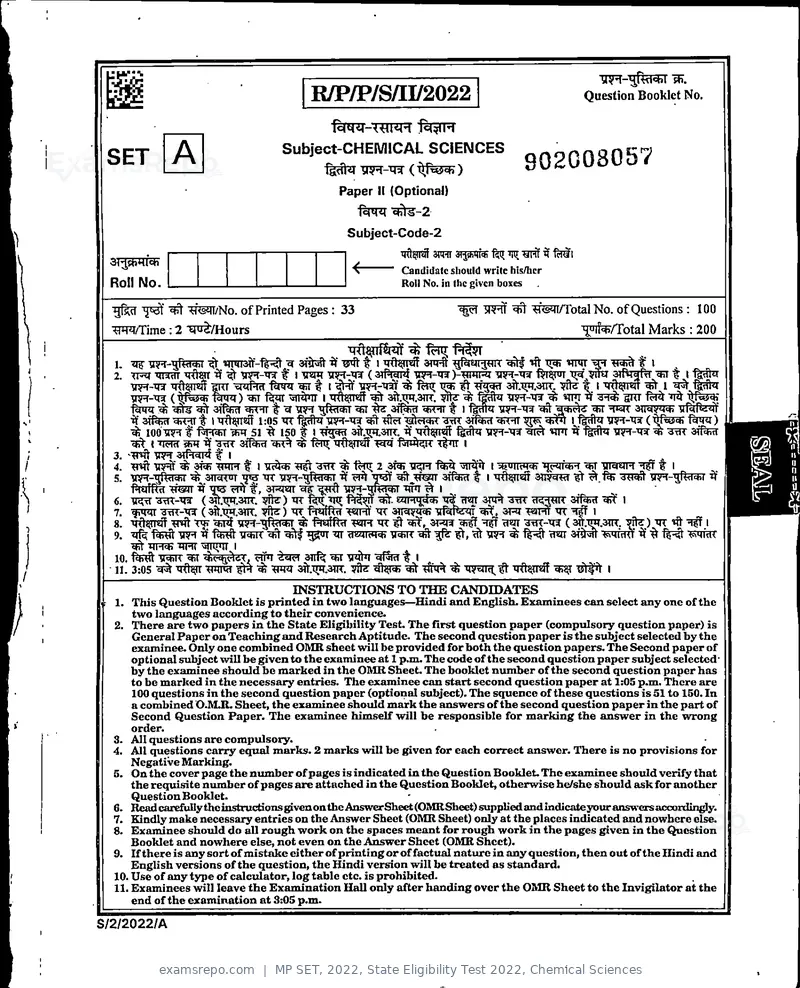
Text of page 1
R/P/P/S/II/2022                                                           Question Booklet No.


                                             Subject-CHEMICAL SCIENCES
 SET
                                                  ^^<1           )
                                                                                                                902008057
                                                                 Paper 11 (Optional)


                                                                  Subject-Code-2
                                                                               'jOywi 31M                     ^
                                                                   ^            Candidate should write his/her
 Roll No.                                                                      Roil No. in the given boxes

  ■gfeci           ^ TT^^/No. of Printed Pages : 33                                                        ^ TI^s^n/Total No. of Questions : 100
  TFPT/Time: 2 Tpj^/Hours                                                                                              'i"iI«t>/Total Marks : 200

                                  *rrai3if-'^^ 3f^ "^f T5*ft t I            ariTit                                                               t' \         ,
                'm^tTT M<1»I if               fI              ( 3ifit«tl4 "BTT-'TW )-Wi*iW TX^T-W                        Tj;5* WEX                            %J


       if arfett "^Hi ^ \ "Mtiiyisff i:05 'tt 1^41 ■nvr-'ta' ^                                         <*1^11             1           vyr-'tix (i^lW«h              )
           100 "n?T f                        150 f                 3it.^.3TR.^ii5^9i^               "II?^-"'XT       'XFT if             TX?T-TX? 4i ■^tIT 3ff^
            t         35*? if Tttt aff^iti      ■%           Txttyraf                        i
                tiTT aiPtcti4 f I                    ^
       ^nxt Uv*tl ^ 3T^ tiHll ^ I Uc4ct)                 <Jt1<           2 3T9r u<^i*i               I 5tt«lUH<»i                    ui«is<i*t              o ' ^
       xi?T-^R?r9ir^ 3xrar^T?^'TT                                  v<i| ^'oi             axftirt^ 1 ^xftyrar 3x199^^                 "fe <j«<»>I ix^r-'^f^xrajrif
       "fkoffttl tfoMi if          "i"', 3T^y5TT <^6             txyr-^fej^ lil'l I                                            ^                        ■
                        ( W.TJ^.aXIT.        ) 1XT                     ■^. IUXH1^4ch               31^ ^t!T              3x1^ eR I
                 ■artT-'aT (ait.T^.aiTT.       txT                     ff ■'IT 3ira?^ra? Txfoitettr "a^, ai^ _"xoTm it           i
      uOttii^T ttA            chi4             % "faytfttf tqtt 'rt yr^,^3i^iw                      i^T    anT-^ia ( w.t^.sxit,        )^''it 'ft igi
      ■'ife ■foFTft ii?T "if "ftFrft TxaiiT          ^             U4ii< "^fr                    lit    4>     irai arft^ft tf>mnO "ft' "ft       TsqmT
     ^ jina; iHx                           ^ ^    ^         ^ ^ *
  10. fadt            ^ 4ict*^Ao<^ ?rrn ^«ni airf^ "air v<<4*i       q * >. ..                                  ^
  11. 3:05          mO«ji           "^tn         3ft.T^.3IIT. ?ft7 41<i4) 'aft "wtft "at                   TTtyrdf            TJt^ft I
                                                INSTRUCTIONS TO THE CANDIDATES
  1. This Question Booklet is printed in two languages—Hindi and English.Eiuuninees can select any one of the
     two languages according to their convenience.
  2. There are two papers in the State Eligibility Test. The first question paper (compulsory question paper) is
     General Paper on Teaching and Research Aptitude. The second question paper is the subject selected by the
     examinee. Only one combined OMR sheet will be provided for both the question papers. The Second paper of
     optional subject will be given to the examinee at 1p.ni. The code of the second question paper subject selected'
     by the examinee should be marked in the OftlR Sheet. The booklet number of the second question paper has
     to be marked in the necessary entries. The examinee can start second question paper at 1:05 p.m. There are
     100 questions in the second question paper (optional subject). The squence of these questions is 51 to 150.In
       a combined 'O.MJI. Sheet, the examinee should mark the answers of the second question paper in the part of
       Second Question Paper. The examinee himself will be responsible for marking the answer in the wrong
       order.
       All questions are compulsory.
       All questions carry equal marks. 2 marks will be given for each correct answer. There is no provisions for
       Negative Marking.
       On the cover page the niunber ofpages is indicated in the Question Booklet. The examinee should verify that
       the req[uisite number of pages are attached in the QuestionBooklet, otherwise he/she should ask for another
       QuestionBooklet.
       Read carefully theinstructions givenon the AnswerSheet (OMRSheet) suppliedandindicateyour answersaccordin^y.
       Kindly make necessary entries on the Answer Sheet (OMR Sheet) only at the places indicated and nowhere else.
       Examinee should do all rough work on the spaces meant for rough work in the pages given in the Question
       Booklet and nowhere else, not even on the Answer Sheet (OMR Sheet).
       If there is any sort of mistake either of printing or of factual nature in any question, then out of the Hindi and
      English versions of the question, the Hindi version will be treated as standard.
  10. Use of any type of calculator, log table etc. is prohibited.
  11. Examinees will leave the Examination Hall only after handing over the OMR Sheet to the Invigilator at the
       end of the examination at 3:05 p.m.

S/2/2022/A
Text of page 2
chi4    WTF
             (SPACE FOR ROUGH WORK)


S/2/2022/A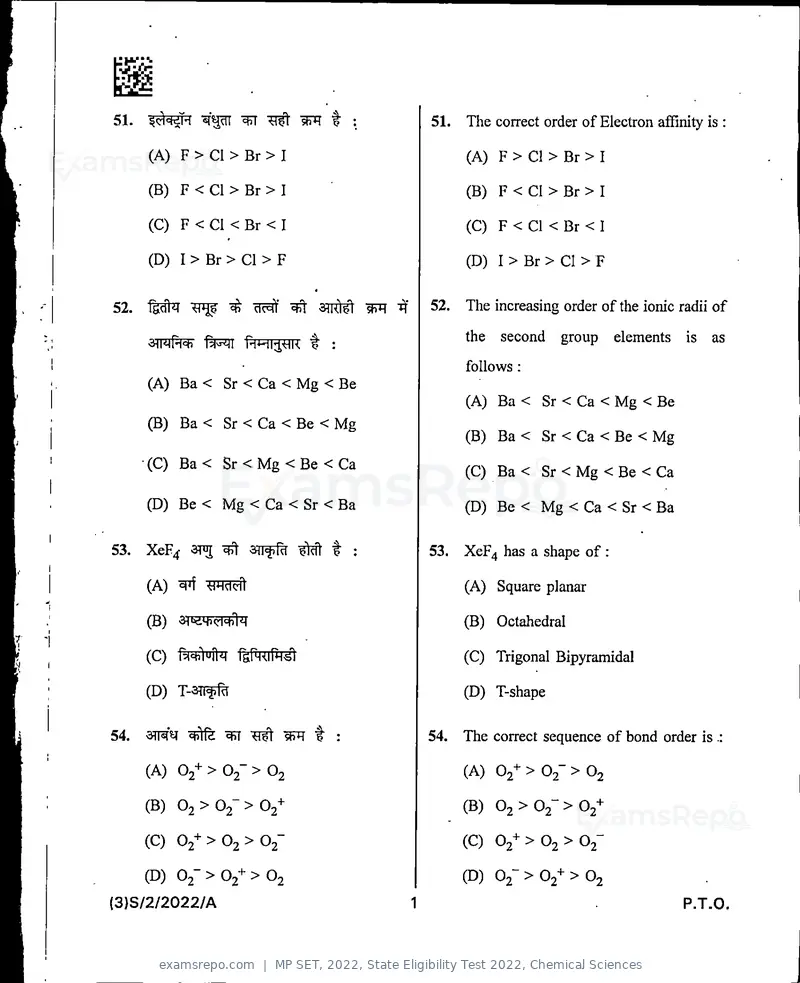
Text of page 3
■^5
51.                           WR ^ :           51. Tlie correct order of Electron affinity is :

      (A) F > C1 > Br >I                            (A) F > C1 > Br > I

      (B) F < C1 > Br > I                           (B) F<CI>Br>I

      (C) F < Cl< Br < I                            (C) F < Cl< Br < I

      (D) I > Br > C1 > F                           (D) I > Br > C1 > F


52.                ^         ^ 3TRt^ ^TTT if   52. The increasing order of the ionic radii of

      3FTto                    t :                  the second group elements is as
                                                    follows :
      (A) Ba < Sr < Ca < Mg < Be
                                                    (A) Ba < Sr < Ca < Mg < Be
      (B) Ba < Sr < Ca < Be < Mg
                                                    (B) Ba < Sr < Ca < Be < Mg
      (C) Ba < Sr < Mg < Be < Ca                    (C) Ba < Sr < Mg < Be < Ca

      (D) Be < Mg < Ca < Sr < Ba                    (D) Be < Mg < Ca < Sr < Ba

53. XeF^ 3F5 ^               ^ t :             53. XeF4 has a shape of :

      (A) ^ ^FRTeTt                                 (A) Square planar

      (B)                                           (B) Octahedral

      (C) IWWihT WWrit                              (C) Trigonal Bipyramidal

      (D) T-3it<j)Ri                                (D) T-shape


54.         ^ ^ Wt W t :                       54. The correct sequence of bond order is

      (A) O2+ > O2" > O2                            (A) 02"^ > O2" > O2
      (B) O2 > 02~ > 02"^                           (B) O2 > O2" > O2+

      (C) 02"^ > O2 > 02~                           (C) 02"^ > O2 > O2"
      (D) O2" > 02'*' > O2                          (D) O2" > 02"^ > O2
(3)S/2/2022/A                                                                          P.T.O.
Text of page 5
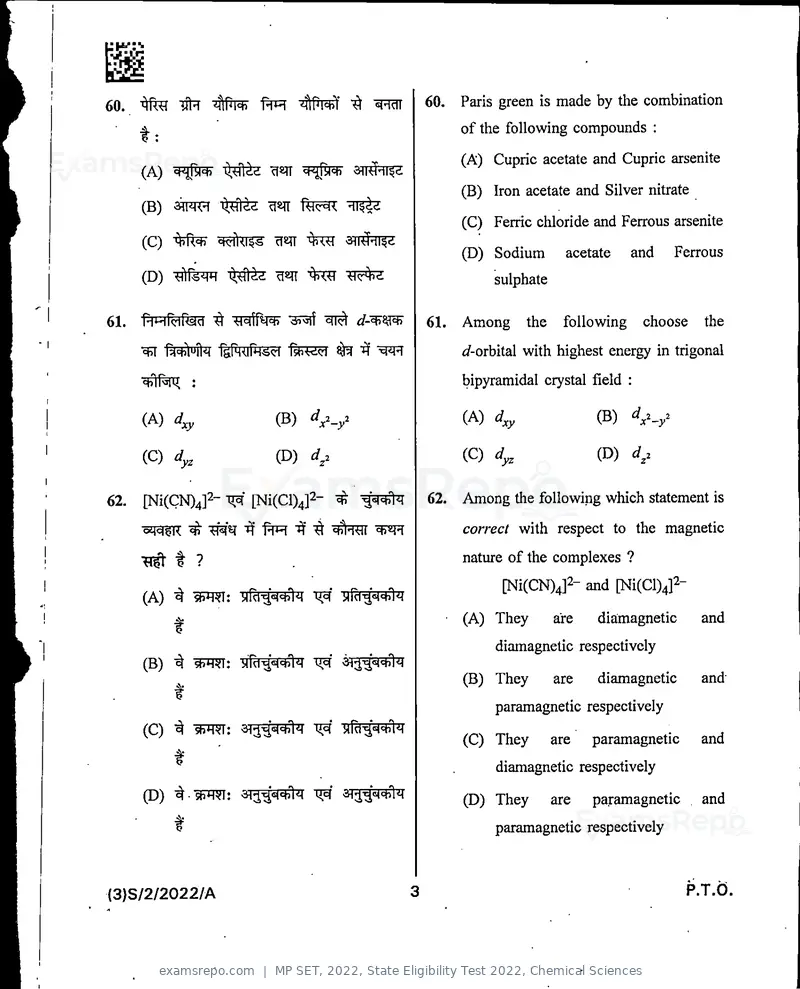
60.         #T "#1^ ^ 4lPl=+iT ^                     60. Paris green is made by the combination
                                                                of the following compounds :
            t:
                                                               (A) Cupric acetate and Cupric arsenite
            (A)                  ^2TT          3TT#TT?3
                                                                (B) Iron acetate and Silver nitrate
            (B) 3IPK=T                        "^Tl^
                                                                (C) Ferric chloride and Ferrous arsenite
            (C) %fW
                                                                (D) Sodium         acetate   and   Ferrous
            (D) ^\kMH             TI8TT       17^                     sulphate

      61. rHHPein^d ^              ^^                      61. Among the          following choose      the
• I
            ^            ferMdi^^d PshWd ^ ^                    ^/-orbital with highest energy in trigonal
                                                                bipyramidal crystal field :

            (A)                  (B)                            (A)                    (B) d^_^.

            (C) dyz              (D) d.                         (C) d^,                (D) rf .

      62. [Ni(CN)4]2-          [Ni(Cl)4]2- ^               62. Among the following which statement is

            o4cieK ^            PiM       ^       =ti'Hi        correct with respect to the magnetic

                  t ?                                           nature of the complexes ?
                                                                       [Ni(CN)4]2- and [Ni(Cl)4]2-
            (A) ^ sPRT:                   T?2f -afcTg^^
                                                                (A) They         are   diamagnetic      and
                  t
                                                                      diamagnetic respectively
            (B) ^                         ■Q3 3151^^
                                                                (B) They         are   diamagnetic      and
                  t
                                                                      paramagnetic respectively

                                                                (C) They         are   paramagnetic     and
                  t                                                   diamagnetic respectively
            (D)       shH^i:                  3TJ5«Rft^         (D) They         are   paramagnetic     and
                                                                      paramagnetic respectively


      (3)S/2/2022/A                                                                                   p.T.b.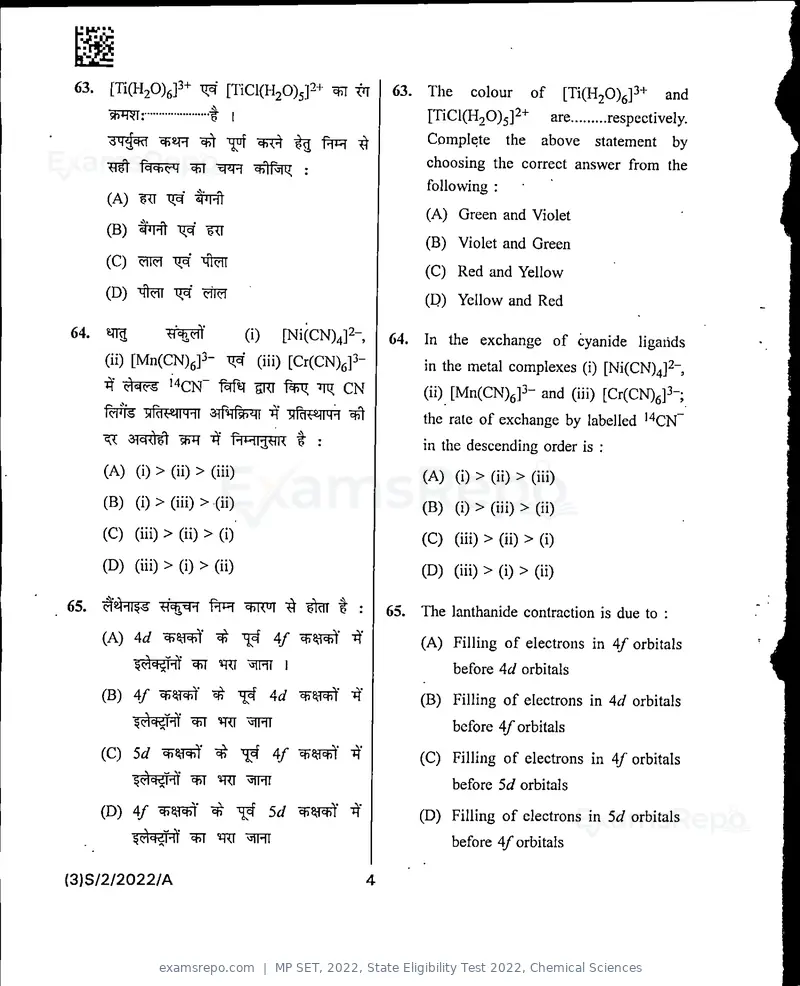
Text of page 6
63. [Ti(H20)6]3+           [TiCl(H20)5]2+ ^ ^      63.    The colour of [Ti(H20)6]3+ and
                        't I                               ITiCI(H20)5]2"'" are respectively.
                            lyf ^              ^           Complete the above statement by
                                                           choosing the correct answer from the
                                                           following :
      (A) ^ TT^' tiRt
                                                          (A) Green and Violet
      (B)
                                                          (B) Violet and Green
      (C) rfTR T3^ ""fer
                                                          (C) Red and Yellow
      (D) mIqii         RIR                               (D) Yellow and Red

64. ^                          (i) [Ni(CN)4]2-      64.   In the exchange of cyanide ligaiids
      (ii) [Mn(CN)6]3-          (iii) [CrCCN)^]^-         in the metal complexes (i) [Ni(CN)4]2~
                  ■'^CN"        ^        7tt^ CN          (ii) [Mn(CN)5]3- and (iii) [Cr(CN)6]3-;
             "sftTWRT sTf^rferr •£[ "rIIrsto ^            the rate of exchange by labelled '"^CN"
      ^             shM '^* PlMI^^K "i" :                 in the descending order is :
      (A) (i) > (ii) > (iii)                              (A) (i) > (ii) > (iii)
      (B) (i) > (iii) > (ii)                              (B) (i) > (iii) > (ii)
      (C) (iii) > (ii) > (i)                              (C) (iii) > (ii) > (i)
      (D) (iii) > (i) > (ii)                              (D) (iii) > (i) > (ii)

65.                            ^HRT ^ ^ t :         65.   The lanthanide contraction is due to :

      (A) 4d               ^      4/          "4*         (A) Filling of electrons in 4/ orbitals
          §<^'=t^l'll      ^ "^TRT I                           before 4d orbitals

      (B) 4/                      4d          T^*         (B) Filling of electrons in 4d orbitals
            ^el^^hT ^ ^ ^                                      before 4/ orbitals
      (C) 5i/              ^      4/          1^*         (C) Filling of electrons in 4/ orbitals
                                                              before 5d orbitals

      (D) 4/            ^         5i/         ■^*         (D) Filling of electrons in 5d orbitals
            ^c^4iHT ^ mr ^                                    before 4/ orbitals

(3)S/2/2022/A
Text of page 8
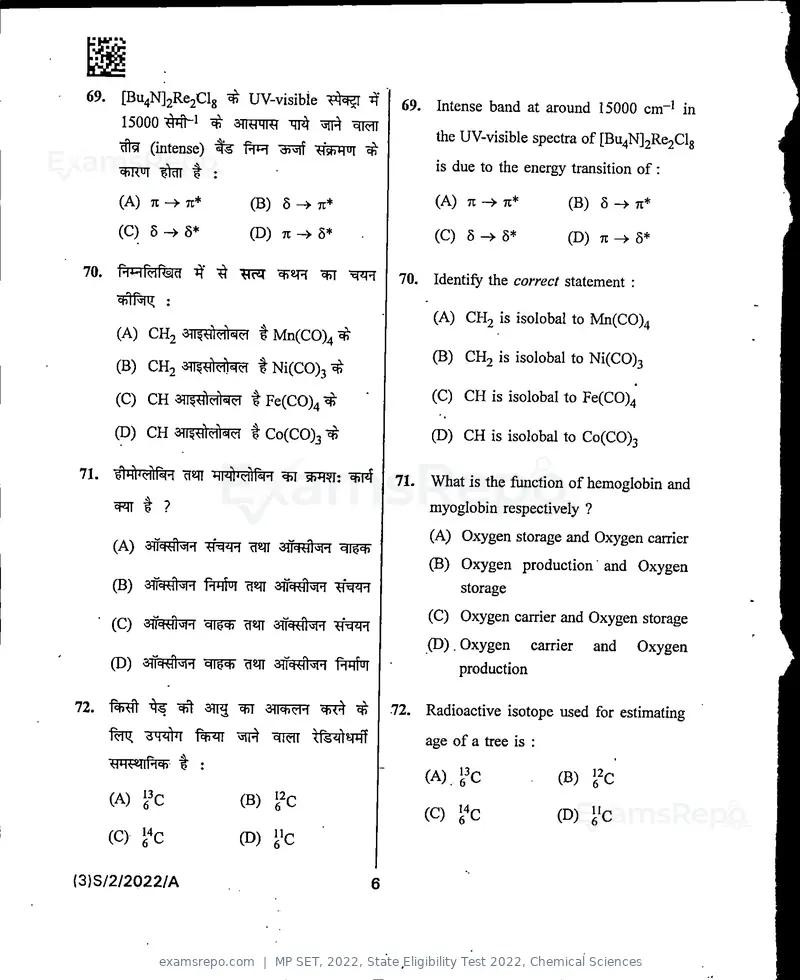
69. [Bu4N]2Re2Cl8 ^ UV-visible                         69. Intense band at around 15000 cm"' in
       15000           ^ STRTTRT "^1^ ^
                                                             the UV-visible spectra of[Bu4N]2Re2Cl8
      ^ (intense)                     "Srsrf
       «t)K"i ^hrr        :                                  is due to the energy transition of:

      (A) 7C -> 7t*            (B) 6 ^ TT*                  (A) 71      7C*        (B) 5 -> 7U*
      (C) 5-^8*                (D) 71 ^ 5*                  (C) 5 -> 5*            (D) 7u -> 5*

 70. PhH RriRslcl         ^                    ^        70. Identify the correct statement :
      Chilly, :
                                                            (A) CH2 is isolobal to Mn(C0)4
      (A) CH2                   i Mn(C0)4^
                                                            (B) CH2 is isolobal to Ni(C0)3
      (B) CH2                   t Ni(C0)3^
      (C) CH3TT|^M^ tFe(C0)4'^                              (C) CH is isolobal to Fe(C0)4
     (D) CH srn^M^ t Co(CO)3^                               (D) CH is isolobal to Co(CO)3

 71. gIhmqiiRii ^8^1                  ^                71. What is the function of hemoglobin and
     ^t ?                                                   myoglobin respectively ?
                                                            (A) Oxygen storage and Oxygen carrier
     (A) 3=ti^#5pt             "OT Simil-ai-i cji^ch
                                                            (B) Oxygen production" and Oxygen
     (B) sroter f^pqlq TjejT                   wb                storage

     (C) 3TB#jB               c[£TT arM^                   (C) Oxygen carrier and Oxygen storage
                                                           (D). Oxygen        carrier   and   Oxygen
     (D) aTB#5H               cI«TT            "PrqW             production

72. Ptitfl                                             72. Radioactive isotope used for estimating
                                                            age of a tree is :
                  "i" :                                    (A), ^3(.             (B) fc
     (A) "C                   (B) ^C
                                                           (C)                   (D) I'c
    (C) 14,                   (D)

(3)S/2/2022/A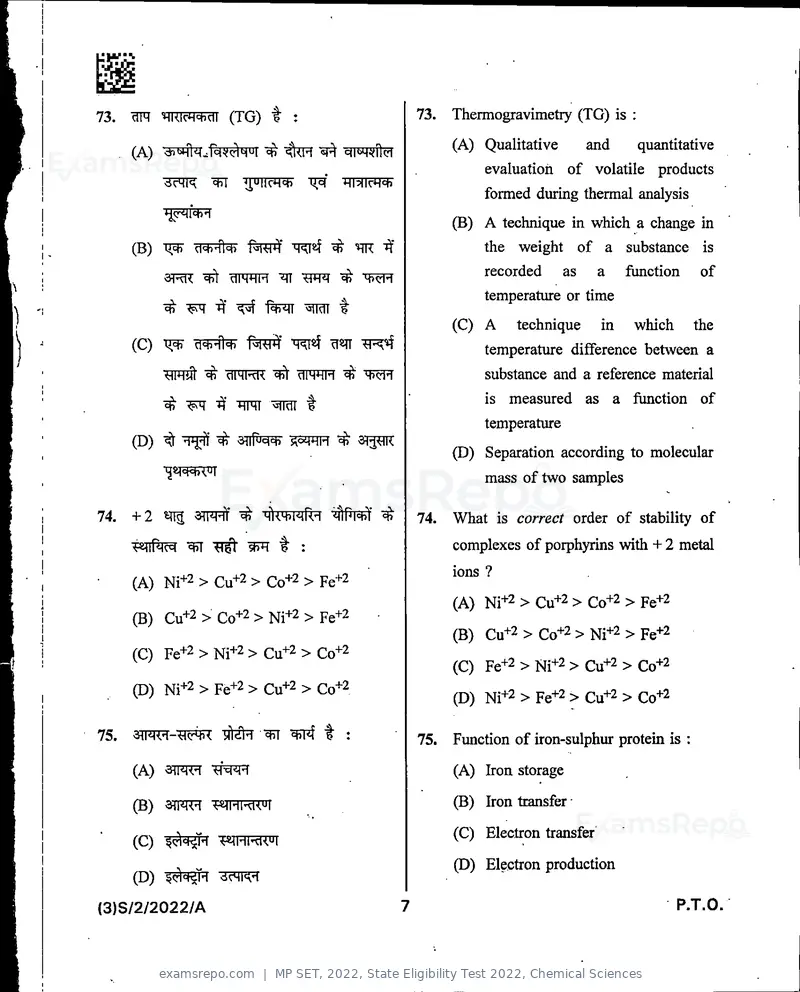
Text of page 9
73. -m               (TG) t :                     73. Thermogravimetry (TO) is :

                                                              (A) Qualitative        and        quantitative
        . (A)                       ^      ^
                                                                  evaluation of volatile products
                  ^5rqK ^ liuiicMch T^* HNIrHcb
                                                                  formed during thermal analysis
                                                              (B) A technique in which a change in
            (B) "Q^ d^41<^ f^PFrif            ^ ^ "^f             the weight of a substance is
I •

                                                                  recorded      as    a        function     of
                  3RR ^ dlMHH "qj WT ^
                                                                  temperature or time
                  ^^        ^                  t
                                                              (C) A     technique         in    which      the
            (C)       cl=hHl=h %FT^*                              temperature difference between a
                  ■?rat ^ WTRR          WWFT ^ "qj^               substance and a reference material

                                                                  is   measured      as    a    function    of
                  ^ ^        ttm          t
                                                                  temperature
            (D) ^        ^ 3#^ s^oMMH ^ 31^
                                                              (D) Separation according to molecular
                                                                  mass of two samples

      74. +2 ^ 3Tmf ^ "qkw^T 4ini=bT ^                  74.   What is correct order of stability of
                                                              complexes of porphyrins with + 2 metal
                                                              ions ?
            (A) Ni+2 > Cu+2 > Co+2 > Fe+2
                                                              (A) Ni-^2 > cu+2 > Co+2 > Fe+2
            (B) Cu+2 > Co+2 > Ni+2 > Fe+2
                                                              (B) Cu+2 > Co-^2 > Ni+2 > Fe+2
            (C) Fe+2 > Ni+2 > Cu+2 > Co+2
                                                              (C) Fe+2 > Ni+2 > Cu+2 > Co+2
            (D) Ni"*"^ > Fe"*"^ > Cu"*"^ > Co"^^              (D) Ni+2 > Fe+2 > Cu-^2 > qq+2

      75.                  ylil'i       ^bi*! "t :      75. Function of iron-sulphur protein is :

            (A) 3TFF7T                                        (A) Iron storage

            (B) 3rpqn T«TFTROT                                (B) Iron transfer

                                                              (C) Electron transfer
            (C)
                                                              (D) Electron production
            (D)

      (3)S/2/2022/A                                                                                     P.T.O.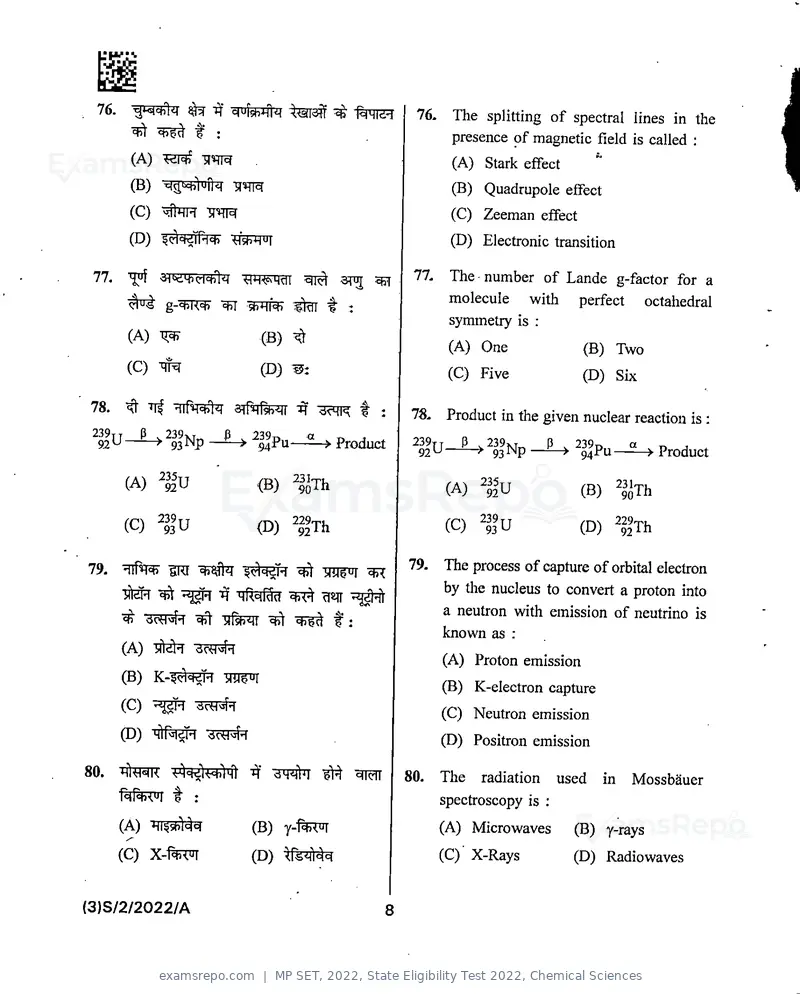
Text of page 10
76. The splitting of spectral lines in the
                                                                 presence of magnetic field is called ;
        (A)          "3^                                         (A) Stark effect
        (B) "^^tcblufl^                                          (B) Quadrupole effect
        (C)              "3^                                     (C) Zeeman effect
        (D)                                                      (D) Electronic transition

 77.                        "RWW ^ 3T15                  77. The number of Lande g-factor for a
                                 shHl'ch ^klT ^ :                molecule    with     perfect    octahedral
                                                                 symmetry is :
       (A) ^                      (B) ^                          (A) One               (B) Two
       (C) "qf^                   (D3                            (C) Five              (D) Six

                                          "3^^^ f ;     78. Product in the given nuclear reaction is :
        —^^93^P ^ > "^94?^—                   Product     gjU P .239^t„_P
                                                         239i
                                                                  93 Np
                                                                          . 239
                                                                             94Pu                ■> Product

       (A)                        <B) 23ixh                     (A) ^MU               (B) 23iTh
       (C) 239u                  (D) ^ixh                       (C) 239 u             (D) 229xh

79. "^nfro "gRT                                     ^   79. The process of capture of orbital electron
    ite ^                              ^ cj?tr                  by the nucleus to convert a proton into
                                                                a neutron with emission of neutrino is
    ^                      yf^^l           t:
                                                                known as :
       (A) "31^
                                                                (A) Proton emission
       (B)                 WXJT
                                                                (B) K-electron capture
       (C) ^1*1 "3?^?^                                          (C) Neutron emission
       (D)               3rd4H                                  (D) Positron emission

80. hI-h^ik P^c^Ip+IhI ■^* "53^ ^                       80.     The radiation       used in Mossbauer
       PciRbiui t :                                             spectroscopy is :
       (A)        (Jci           (B) y-f^T^                     (A) Microwaves        (B) y-rays
       (C) X-%^                  (D)                            (C) X-Rays            (D) Radiowaves


(3)S/2/2022/A                                       8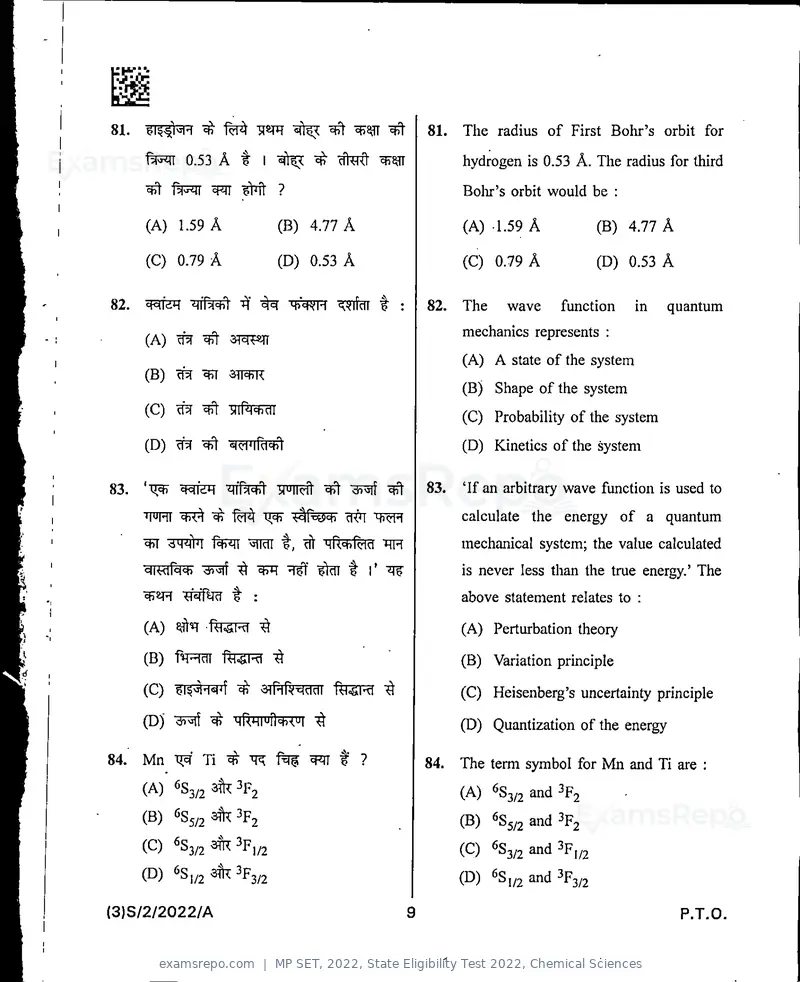
Text of page 11
81.           ^          Tjam ^^           ^         81.   The radius of First Bohr's orbit for

      fen 0.53 A t I ^ ^ cfWt W                            hydrogen is 0.53 A. The radius for third
      ^        ^ #Tt ?                                     Bolir's orbit would be :


      (A) 1.59 A             (B) 4.77 A                    (A) -1.59 A           (B) 4.77 A

      (C) 0.79 A             (D) 0.53 A                    (C) 0.79 A            (D) 0.53 A

82.          4iT^4i1     ^                t ;        82. The      wave    function    in   quantum
                                                           mechanics represents :
      (A) m ^
                                                           (A) A state of the system
      (B)     ^ 3TT^
                                                           (B) Shape of the system
      (C) ^ ^ yiPl^jdl                                     (C) Probability of the system
      (D)     ^ ^oTTlfeTt                                  (D) Kinetics of the system

83.                •zTTM          ^^ ^               83.   'If an arbitrary wave function is used to

      "WIT         1^                "OT "^1)^             calculate the energy of a quantum
                        ^ t, ^ MRdiPeld flH                mechanical system; the value calculated
      cHWPddi ^^ ^               ^ t l' ■'TF               is never less than the true energy.' The
      ^8H              t :                                 above statement relates to :

      (A)                ^                                 (A) Perturbation theory
      (B)                                                  (B) Variation principle
      (C) Fi|#T^ ^ ^PdPi^T^ddl fePF ^                      (C) Heisenberg's uncertainty principle
      (D) ^ ^ MPiMluDdiiui                                 (D) Quantization of the energy

84. Mn TT^* Ti ^ -qF             ^ t ?               84.   The term symbol for Mn and Ti are :
      (A) %,2 sik %                                        (A) 683^2 and %
      (B) %2®^'F2                                          (B) ^85^2 and 3F2
      (C)                                                  (C) ^83/2 and ^F[^2
      (D) <581/2 ^ 'F3/2                                   (D) ^Si/2 and ^F3/2
(3)S/2/2022/A                                    I                                            P.T.O.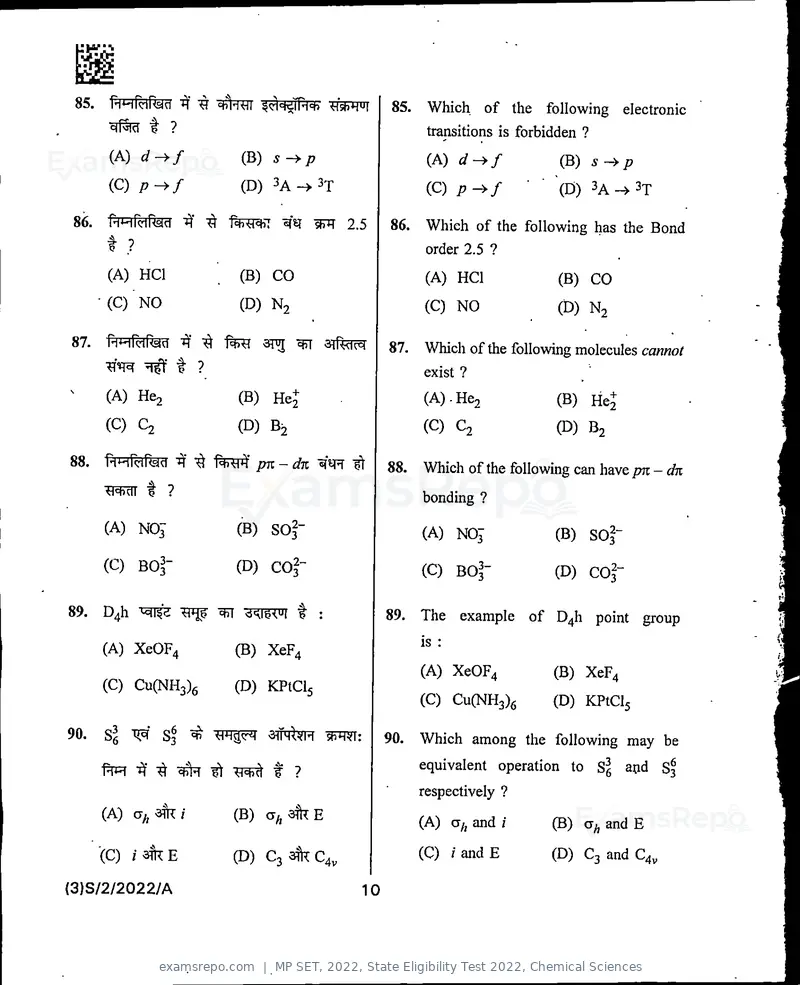
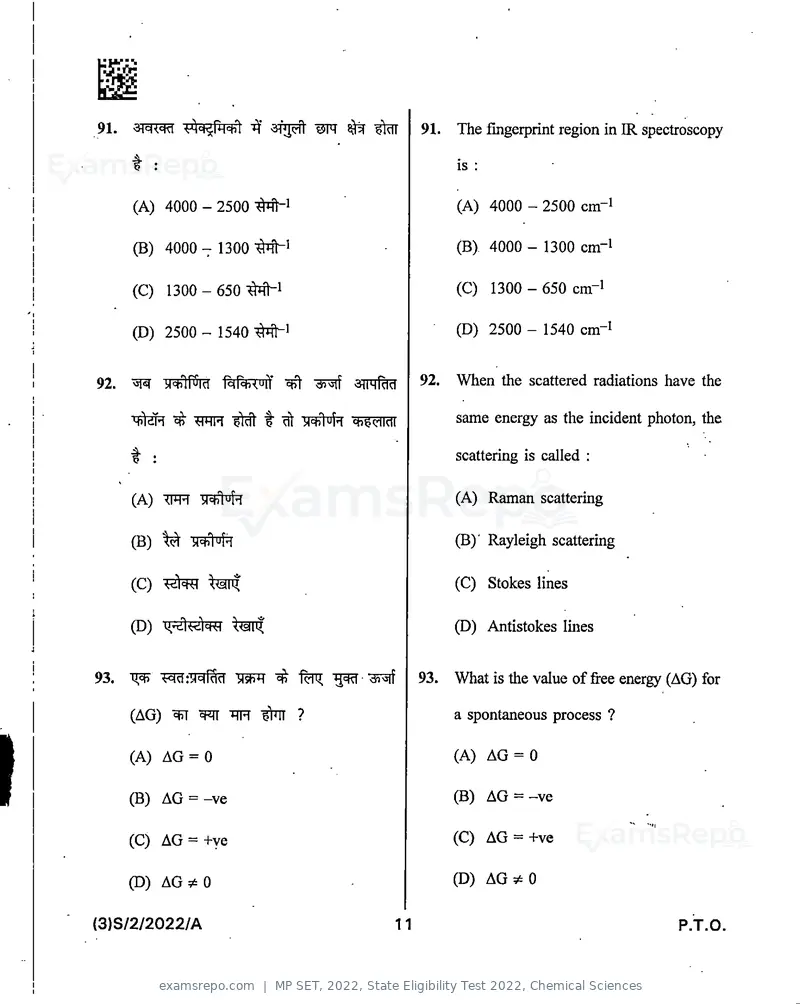
Text of page 13
91. -37^^                          WT ^^             91. The fingerprint region in JR spectroscopy

          f:                                                   IS :


          (A) 4000 - 2500 ^1                                   (A) 4000 - 2500 cm-l

          (B) 4000 - 1300-^1                                   (B) 4000 - 1300 cm-l

          (C) 1300 - 650 M-l                                   (C) 1300 - 650 cm-l

          (D) 2500 - 1540 ^1                                   (D) 2500 - 1540 cm-l


    92.         y-^lfiSid pclRbiuiT ^ ^ aTNfe            92.   When the scattered radiations have the


          HildT-l ^ ^T'TH     t" ^          tfteciiai          same energy as the incident photon, the

          t:                                                   scattering is called :

          (A) WT TOt4T                                         (A) Raman scattering

          (B) ^                                                (B)' Rayleigh scattering

          (C) Tim                                              (C) Stokes lines

          (D)               ^3^                                (D) Antistokes lines


    93.                     WT       %T3;                93. What is the value of free energy(AG)for

          (AG) ^ ^ 1TF #n ?                                    a spontaneous process ?

          (A) AG = 0                                           (A) AG = 0


I         (B) AG = -ve                                         (B) AG = -ve


          (C) AG = +ye                                         (C) AG = +ve


          (D) AG 9^0                                           (D) AG 9^0

    (3)S/2/2022/A                                   11                                         P.T.O.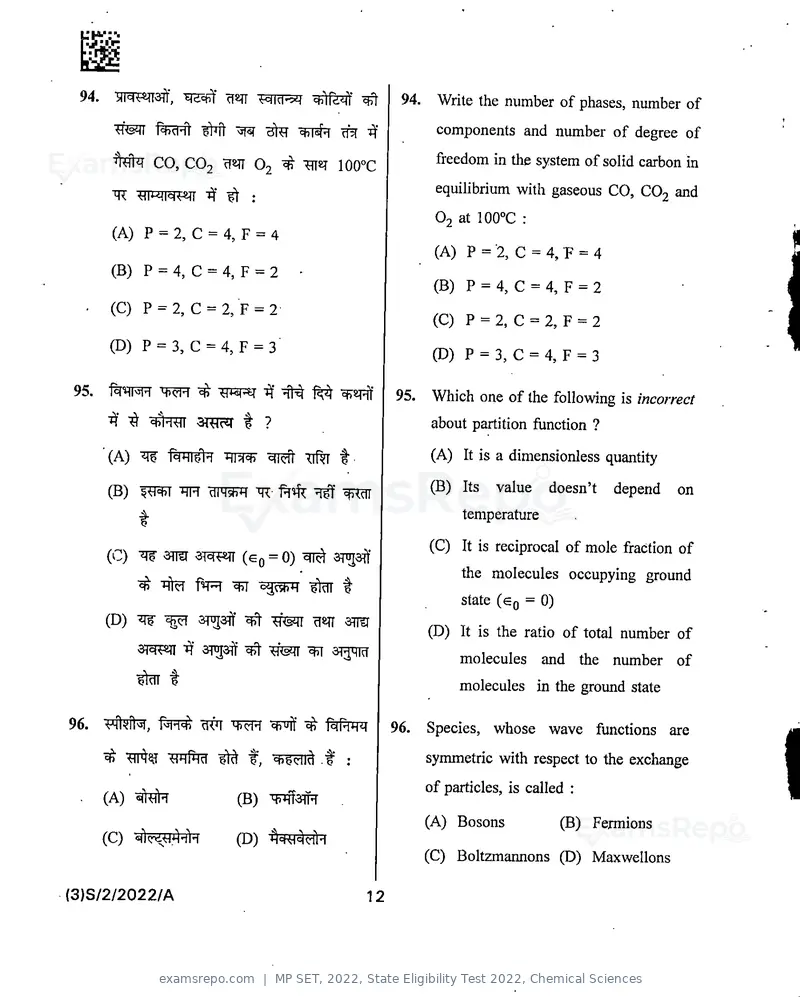
Text of page 14
94.                                               ^       94. Write the number of phases, number of
        ^T^S^TT Rbcul iWt                chlefn ?f^ ■^*        components and number of degree of
                 CO, CO2         O2 ^ H8T 100°C                freedom in the system of solid carbon in
                                                               equilibrium with gaseous CO, CO2 and
                                                               O2 at 100°C :
        (A) P = 2, C = 4, F = 4
                                                               (A) P = 2, C = 4, F = 4
        (B) P = 4, C - 4, F = 2          -
                                                               (B) P = 4, C = 4, F = 2
  -     (C) P = 2, C = 2, F = 2
                                                               (C) P = 2, C = 2, F - 2
        (D) P = 3, C = 4, F = 3
                                                               (D) P = 3, C = 4, F = 3

 95.             WT ^              -^f                    95. Which one of the following is incorrect
             ^          3?^ t ?                                about partition function ?

       (A)        %TT#r "FTW                    f.            (A) It is a dimensionless quantity

       (B)            "FF dlMshH FT-                          (B) Its value doesn't depend on
                                                                    temperature
             t
                                                              (C) It is reciprocal of mole fraction of
       (C) FF           3TFT«F (Go = 0) ^ apjsff
                                                                   the molecules occupying ground
             ^ nlel fFF FF c^cstiH F^TT "t"
                                                                   state (6q = 0)
       (D) FF ^ spjarf ^ TFsqr fft ^nir
                                                              (D) It is the ratio of total number of
             3IFTFI      37^3ff F>t -yVs^l FF
                                                                   molecules      and the number   of
             ^ t                                                   molecules in the ground state

96. vMt^,               F^ FFF FFTf ^ [^Rh4               96. Species, whose wave functions are
       ^ TTT^^ TFTfFF ^ f, FiFFI^ -t ;                        symmetric with respect to the exchange
                                                              of particles, is called :
       (A) FmR                (B) Fi^arfF
                                                              (A) Bosons            (B) Fermions
       (C)                    (D) "^FTT^eftF
                                                              (C) Boltzmannons (D) Maxwellons

(3)S/2/2022/A                                        12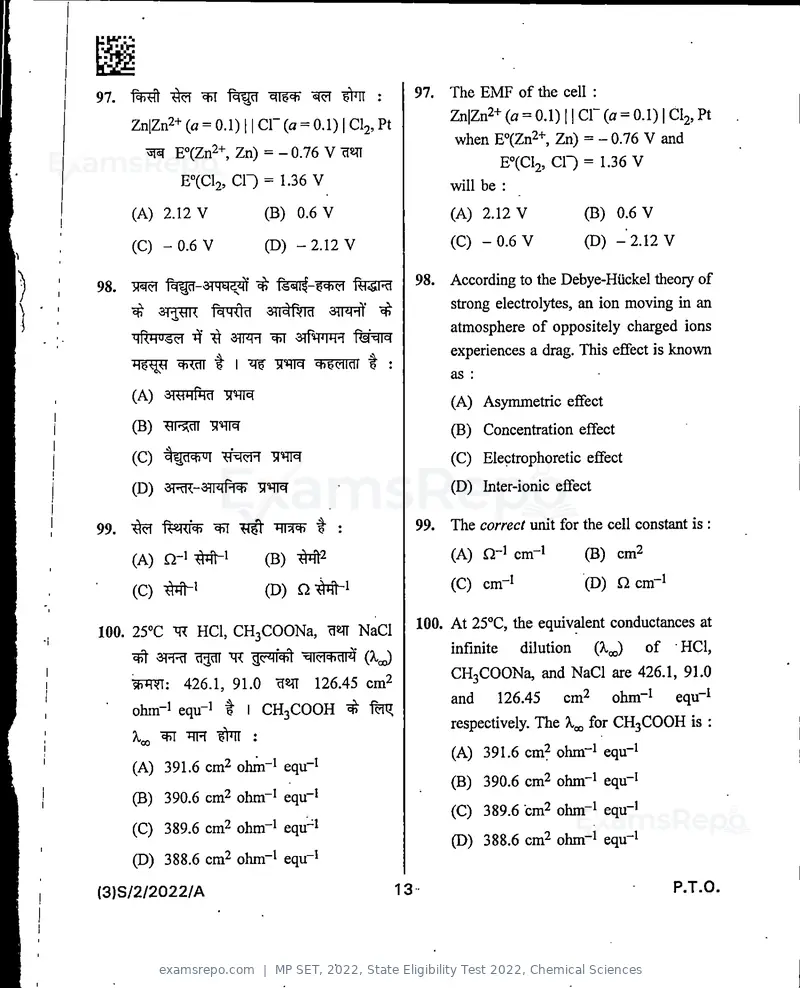
Text of page 15
97.             ^                          :           97.   The EMF of the cell :
                                                             Zn|Zn2+ (a = 0.1) 1 1 CP (a = 0.1) | CI2, Ft
      ZnlZn2+ {a = 0.1) 1 1 CP {a = 0.1)
                                       |CI2, Pt
                                                              when E°(Zn^'^, Zn) = - 0.76 V and
        ■m E°(Zn2+, Zn) = -0.76 V
                                                                     E''(Cl2, Cl") = 1.36 V
             E°(Cl2, Cn = 1.36 V                             will be :

      (A) 2.12 V           (B) 0.6 V                         (A) 2.12 V            (B) 0.6 V

      (C) -0.6 V           (D) -2.12 V                       (C) -0.6 V            (D) -2.12 V


98.                      ^              HHciM          98. According to the Debye-Huckel theory of
                                                           strong electrolytes, an ion moving in an
      ^                    an^fro arppft' ^
                                                           atmosphere of oppositely charged ions
                     ffim ^ sTfqwr
                                                           experiences a drag. This effect is known
                   t I 'm 31^ ^^dldl t :
                                                             as :

      (A) ai^HpHd 3T^                                        (A) Asymmetric effect
      (B) "^TF^ 31^                                          (B) Concentration effect
      (C) %cl^ ^H*-ddH 3T^                                   (C) Electrophoretic effect
      (D) aF^-aTFfe 3T^                                      (D) Inter-ionic effect

99. ^              ^ ^ TTT^ t :                        99.   The correct unit for the cell constant is :

      (A) n-^              (B) M2                            (A) C!~l cm"'         (B) cm^

      (C) ^1               (D) Q^l                           (C) cm"l              (D) Q cm~l

                                                       100. At 25°C, the equivalent conductances at
100. 25''C ^ HCl, CHaCOONa, fl^TT NaCl
                                                            infinite dilution (Xo^) of " HCl,
     ^ ^FRT ^            -dld+dl^l* (XJ
                                                             CHgCOONa, and NaCl are 426.1, 91.0
            426.1, 91.0 W 126.45 cm^
                                                             and 126.45 cm^ ohm"' equ"'
      ohm-1 equ-l t I CH3COOH ^
                                                             respectively. The for CH3COOH is :
      X,(jQ ^ Hid "EWt :
                                                             (A) 391.6 cm^ ohm"' equ"'
      (A) 391.6 cm^ ohm~^ equ~l
                                                             (B) 390.6 cm^ ohm"' equ~'
      (B) 390.6 cm^ ohm~^ equ~l
                                                             (C) 389.6 cm^ ohm"' equ"'
      (C) 389.6 cm^ ohm"^ equ"l
                                                             (D) 388.6 cm^ ohm"' equ"'
      (D) 388.6 cm^ ohm"l equ~^
(3)S/2/2022/A                                     13                                              P.T.O.
Text of page 17
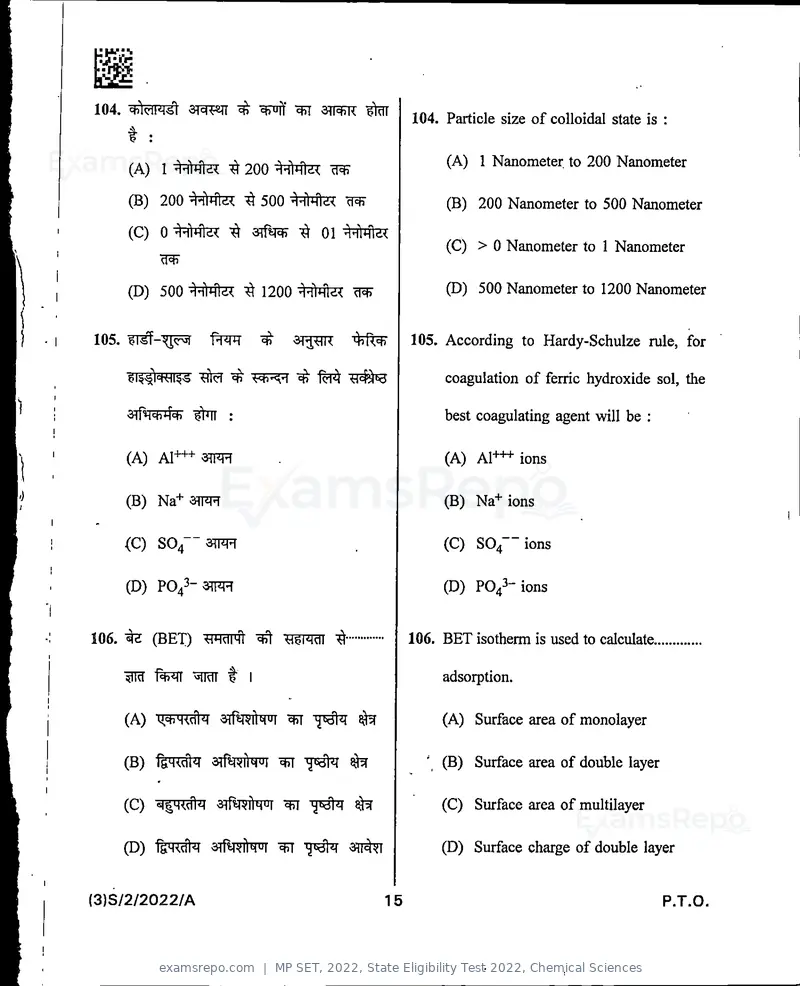
104.                   ^       ^ 3TTTO ^
                                                     104. Particle size of colloidal state is :
       t:
                                                           (A) 1 Nanometer to 200 Nanometer
       (A) 1          ^ 200 ^h1h1c1< cI^
       (B) 200             500 ^nlnldi                     (B) 200 Nanometer to 500 Nanometer

       (C) 0 "Wfe: ^ a#T^ ^ 01 Anlnlii
                                                          (C) > 0 Nanometer to 1 Nanometer


       (D) 500          ^ 1200             W              (D) 500 Nanometer to 1200 Nanometer


105.                       ^                         105. According to Hardy-Schulze rule, for

                                                          coagulation of ferric hydroxide sol, the

       srTwf^ #n :                                        best coagulating agent will be :

       (A) AI+++ 3Tm                                      (A) Al"^ ions

    (B) Na+ STFPT                                         (B) Na"^ ions

   (C) SO4"" arm                                          (C) SO4       ions

    (D) PO43-3TO                                          (D) P04^" ions

106. ■#^ (BET) ^HdlHl ^ WPim ^•                      106. BET isotherm is used to calculate


       WT f^'Hi ^idi ^ I                                  adsorption.

       (A)                     ^           ^              (A) Surface area of monolayer

       (B) ffcroh 3lfeiW^ ^              ^                (B) Surface area of double layer

       (C) «l4M<d1^            ^           E^             (C) Surface area of multilayer

       (D) feMidl-M            ^         arf^             (D) Surface charge of double layer


(3)S/2/2022/A                                   15                                            P.T.O.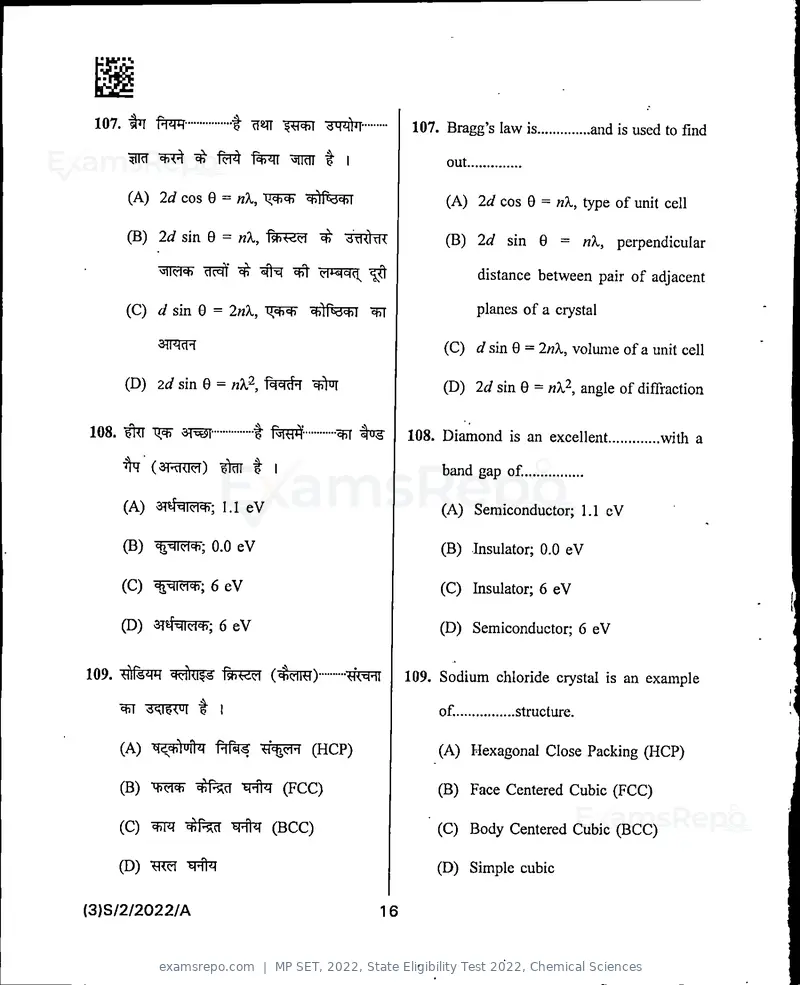
Text of page 19
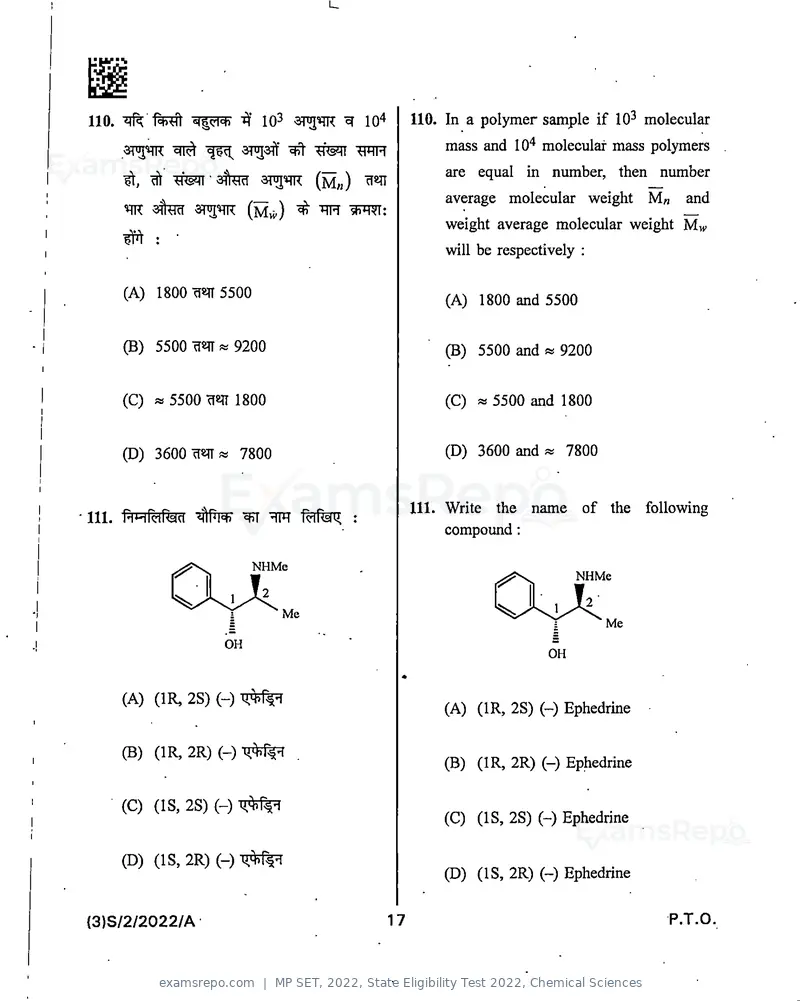
110.                       10^        ^ io4     110. In a polymer sample if 10^ molecular
                                                    mass and 10^ molecular mass polymers
                                                    are equal in number, then number
           ^ ti<2^l 'sft^tT 37^^1R (M/j)
                                                    average molecular weight Mm       and
       m 3ihm            (Mw) ^
                                                    weight average molecular weight
       #r : ■
                                                    will be respectively :

       (A) 1800 W 5500                              (A) 1800 and 5500


       (B) 5500 TTSIT « 9200                        (B) 5500 and « 9200


       (C) « 5500 ^8111800                          (C) « 5500 and 1800


       (D) 3600 ^81T?« 7800                         (D) 3600 and « 7800


                                                111. Write the name of the following
111, PHHr^Rdci "Jter ^                 :
                                                     compound:

                          NHMe
                                                                        NHMe


                     OH
                                                                   OH


       (A) (IR, 2S)(-)
                                                    (A) (IR, 2S)(-) Ephedrine

       (B) (IR, 2R)(-)
                                                    (B) (IR, 2R)(-) Ephedrine

       (C) (IS, 2S)(-)tt^
                                                    (C) (IS, 2S)(-) Ephedrine

       (D) (1S,2R)(-)T^^
                                                    (D) (IS, 2R)(~) Ephedrine


{3)S/2/2022/A                              17                                      P.T.O.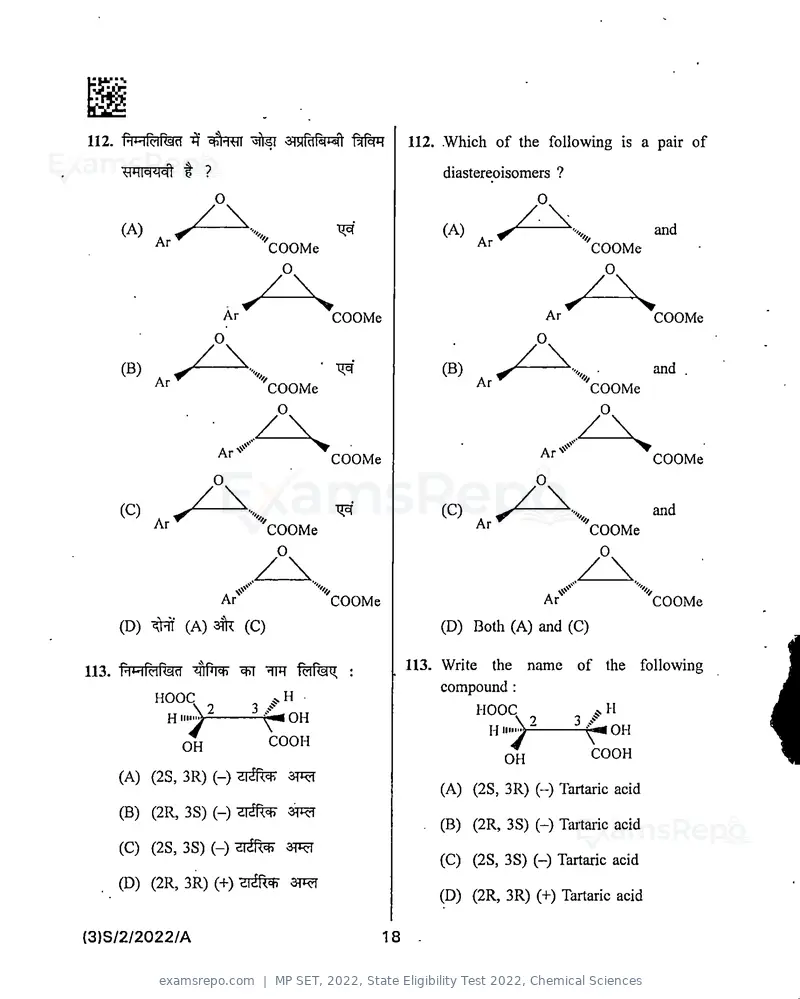
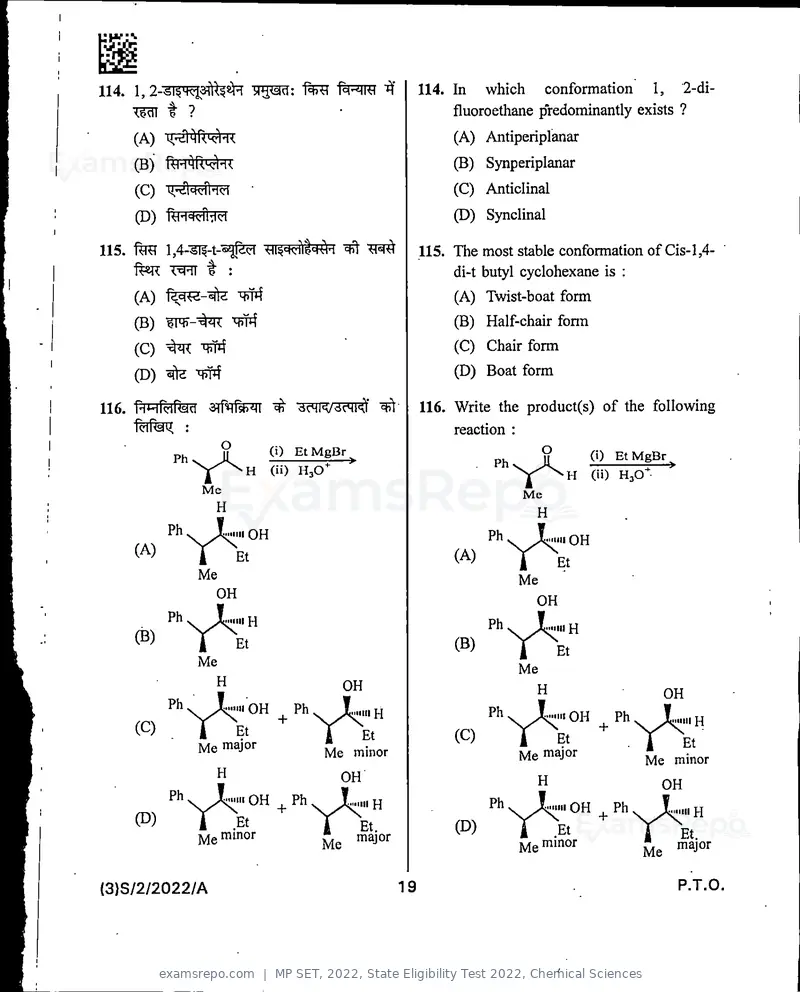
Text of page 21
114.                                                     114. In       which        conformation     1,    2-di-
       ^.^di "i" ?                                                fluoroethane predominantly exists ?
       (A) T3?et^ft^                                             (A) Antiperiplanar
       (B)                                                       (B) Synperiplanar
       (C) L^-ril^dldQi                                          (C) Anticlinal
       (D) Rn^Kildci                                             (D) Synclinal

115. f^ l,4-'^-t-'s^fe                         ^             115. The most stable conformation of Cis-1,4-
                     i:                                           di-t butyl cyclohexane is :
       (A)                    4iT4                               (A) Twist-boat form
       (B)                   MiT4                                (B) Half-chair fonn
       (C) ^                                                     (C) Chair form
       (D) ^                                                     (D) Boat form

116. fF#lfecr                        ^ ^5cW3cqT^* ^          116. Write the product(s) of the following
       %feTT :                                                    reaction :

             Ph    n* (>) EtMgBr                                                    g        (i) EtMgBr^
                  V^H ^               ) H,0^
                                                                        Ph
                                                                                             (ii) H3O"
                     Me                                                        Me
                         H
                                                                                 H
             Ph                OH                                      Phv       X.miOH
       (A)        Y^:""Et
                     Me
                                                                 (A)         I^Bt
                                                                               Me
                         OH
                                                                                 OH
                                                                                 un

             Ph. L..II H                                               Ph   Sv-t;;"'" H
       (B) Y^Bt                                                  (B)
                                                                             T Et
                     Me
                                                                               Me
                         H                     OH                                H
                                                                                 B                        OH
             Ph^^ l^iiiOH Ph                                           Ph.       I. I OH        Ph
       (C)           1       Et
                     Me nisjor
                                          T Bt                   (C)         I          Et
                                           Me minor                            Me major              Me minor
                         H
                                                                                 H                       OH
             Ph              "1 OH ^ Ph                                Ph^^L.""I OH ^ Ph NvA"'H
       (D)        Y^:Me minor
                             Et
                                                major
                                                                 (D)         X Bt
                                                                               Me
                                                                                                     i     Et.
                                                                                                     Me


(3)S/2/2022/A                                           19                                                 P.T.O.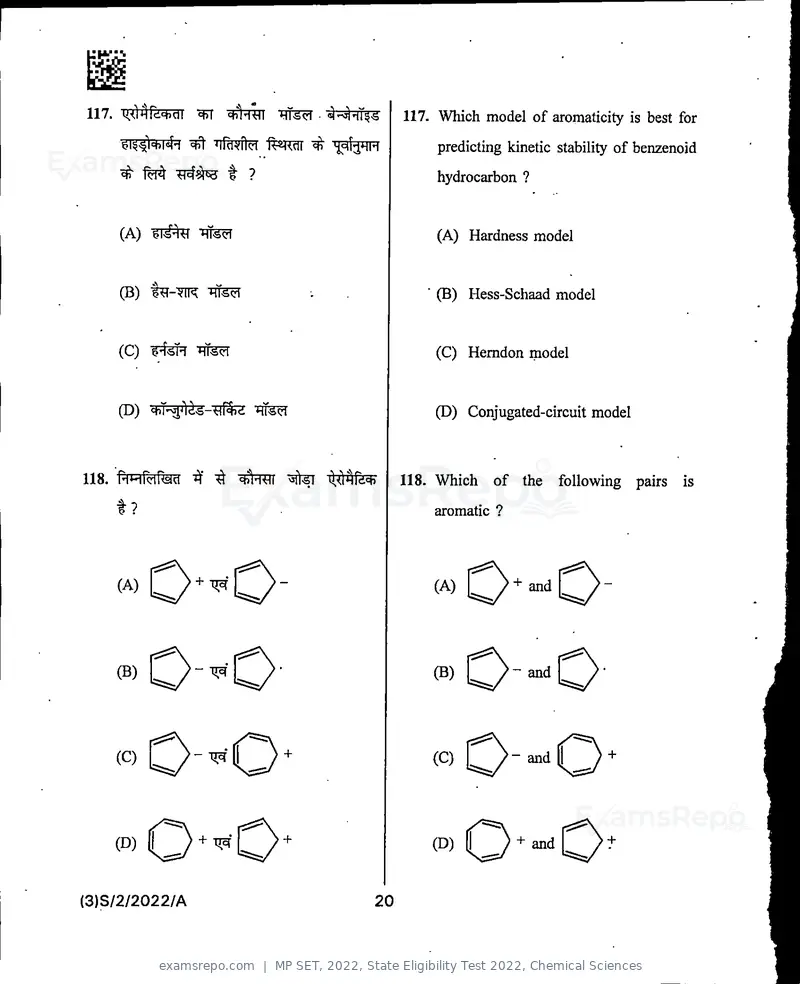
Text of page 22
117.             ^                           117. Which model of aromaticity is best for
                 ^ ^iRl^ilci i^SKcTI ^             predicting kinetic stability of benzenoid
        ^               t ?                        hydrocarbon ?


        (A)       "Hfe^                           (A) Hardness model


        (B)           TTfe^                     '(B) Hess-Schaad model


    (C)                                           (C) Hemdon model


    (D)                       Tffg^               (D) Conjugated-circuit model


118. RHRrlRsid        ^                       118. Which of the following pairs is
        t?                                        aromatic ?


                  +                                            +
    (A)                                           (A)              and


    (B)                                          (B)           ~ and


    (C)                           +
                                                 (C)           ~ and [l    / "•"


    (D)           + T^*          +
                                                 (D)               and       +


(3)S/2/2022/A                            20
Text of page 24
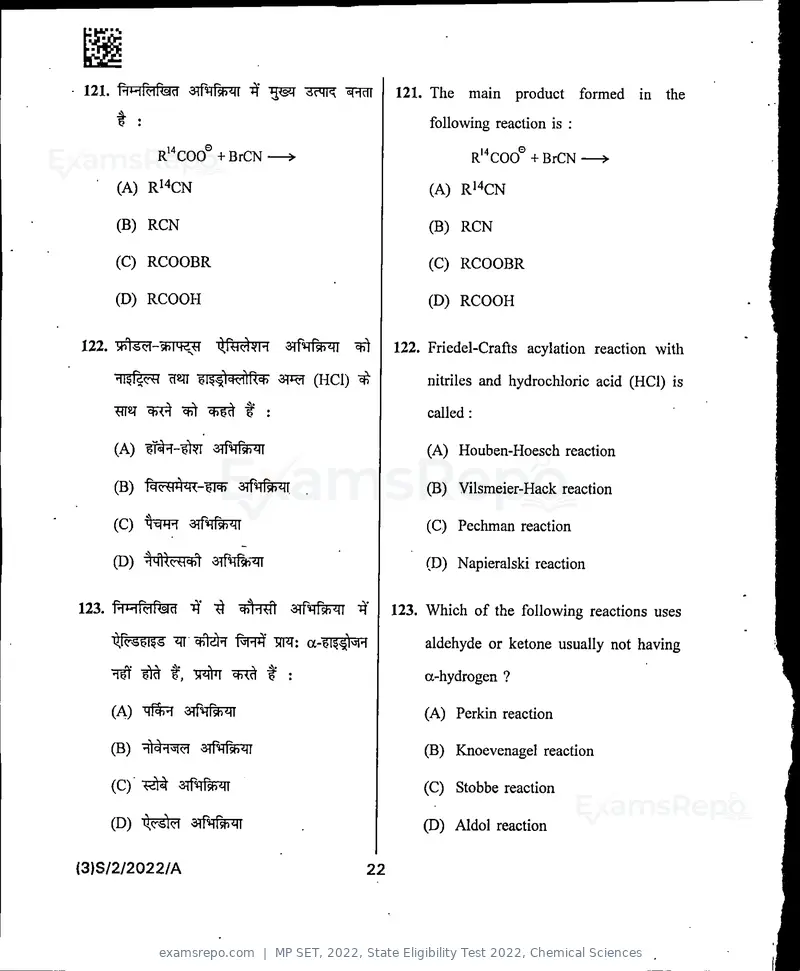
121. [HHfdRsId                                       121. The main product formed in the
       t:                                                 following reaction is ;

              R^'^COO®+BrCN                                     r'^'cOO® + BrCN
       (A) Rl'^CN                                         (A) R^^cn

       (B) RCN                                            (B) RCN

       (C) RCOOBR                                         (C) RCOOBR

       (D) RCOOH                                          (D) RCOOH


122.                                   3Tf«#n7T ^    122. Friedel-Crafls acylation reaction with

                                   ^(HCI) ^               nitriles and hydrochloric acid (HCI) is

                                                          called:


       (A)                                                (A) Houben-Hoesch reaction

       (B)                    37f?7f^                     (B) Vilsmeier-Hack reaction

    (C)          3Tf«Tf^                                  (C) Pechman reaction

    (D)                                                   (D) Napieralski reaction


123. PHHrdRsId                dild^l           A'    123. Which of the following reactions uses
                    chlil'i        3M: a-ei^^l^d          aldehyde or ketone usually not having
               ■?, "3^            t"' :                   a-hydrogen ?

       (A) -qfe 3##7^                                    (A) Perkin reaction

       (B) dl^d>5ld 3TMIb^                               (B) Knoevenagel reaction

       (C)'      3{M^                                    (C) Stobbe reaction

       (D)                                               (D) Aldol reaction

(3)S/2/2022/A                                   22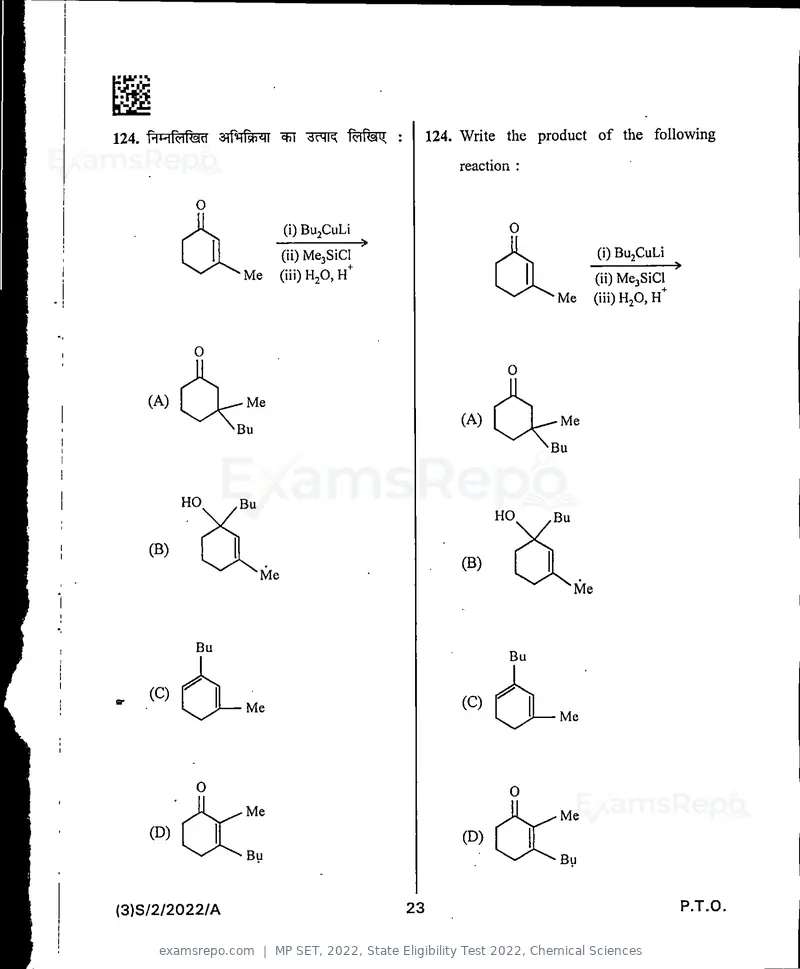
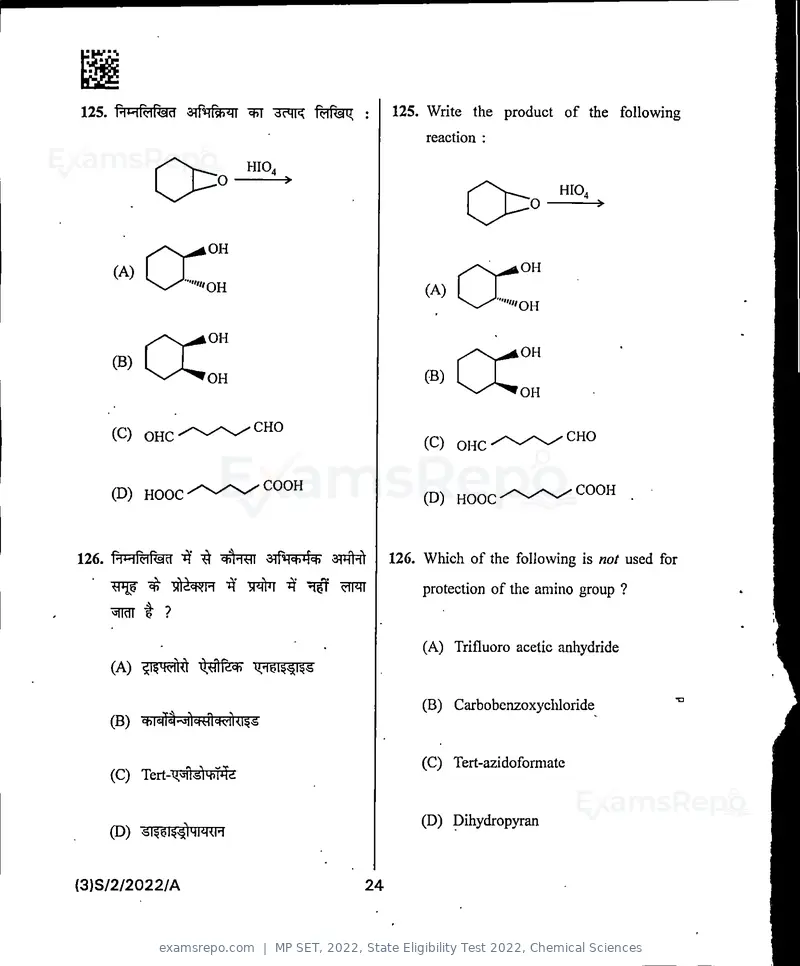
Text of page 26
125. rHMPdf^d               ^                 125. Write the product of the following
                                                    reaction :

                             HIO.
                     o
                                                                           HIO.
                                                                      0


                    OH

    (A)
          CT     """"OH                            (A)    CT
                                                                    OH


                                                                 ■'"""OH

                    OH
                                                                    OH
    (B)
          a         OH                              (B)
                                                          a         OH


                             CHO
    (C) OHC                                                                  CHO
                                                    (C) OHC

                               COOH                                          COOH
    (D) HOOC                                        (D) HOOC


126. "MefefT                          ^PPM     126. Which of the following is not used for
          ^ yl^ct^lH i{               ^TFIT         protection of the amino group ?
     ^TRIT ^ ?

                                                    (A) Trifluoro acetic anhydride
    (A) s;i5wl<l 0,^1 Pich

                                                    (B) Carbobenzoxychloride
    (B)

                                                    (C) Tert-azidoforniatc
    (C) Tert-g.^dl-^l4iWd

                                                   (D) Dihydropyran
    (D)


(3)S/2/2022/A                             24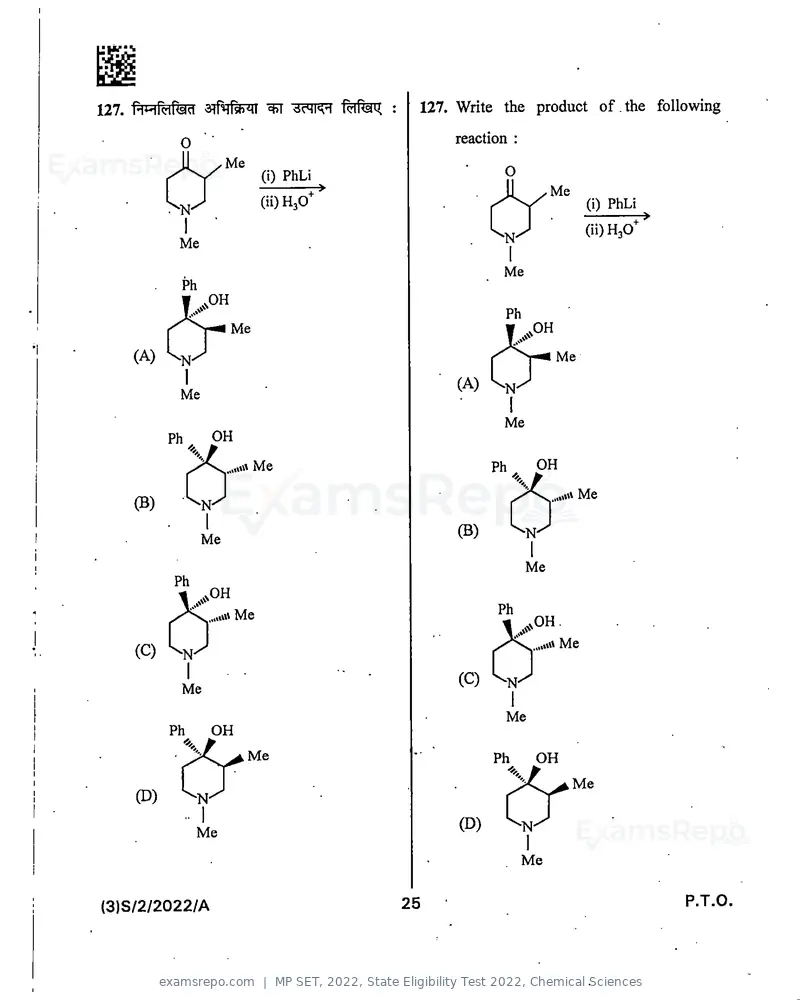
Text of page 27
127. rHHPdRsid                 ^ "Scqi^ Mm    127. Write the product of.the following

            o                                     reaction :
                     ,Me
                               (i) PhLi                  O

                               (ii)H30

                                                        dr-  I
                                                                               (i) PhLi
                                                                               (ii)H30'

                                                         Me


    (A)
                                                  (A)


           Ph        OH
            \
                           Me                           Ph           OH

                                                                           Me
    (B)          N'
                 1                                (B)        ^N-
                 Me
                                                                 1
                                                                 Me
           Ph
                     OH

                          Me                            Ph

                                                                 ....rtrt Me
    (C) ^N-
          I                                       (C)
            Me
                                                             1
                                                         Me
           Ph        OH

                           Me                           Ph           OH


     (D)
                                                   D


(3)S/2/2022/A                                25                                           P.T.O.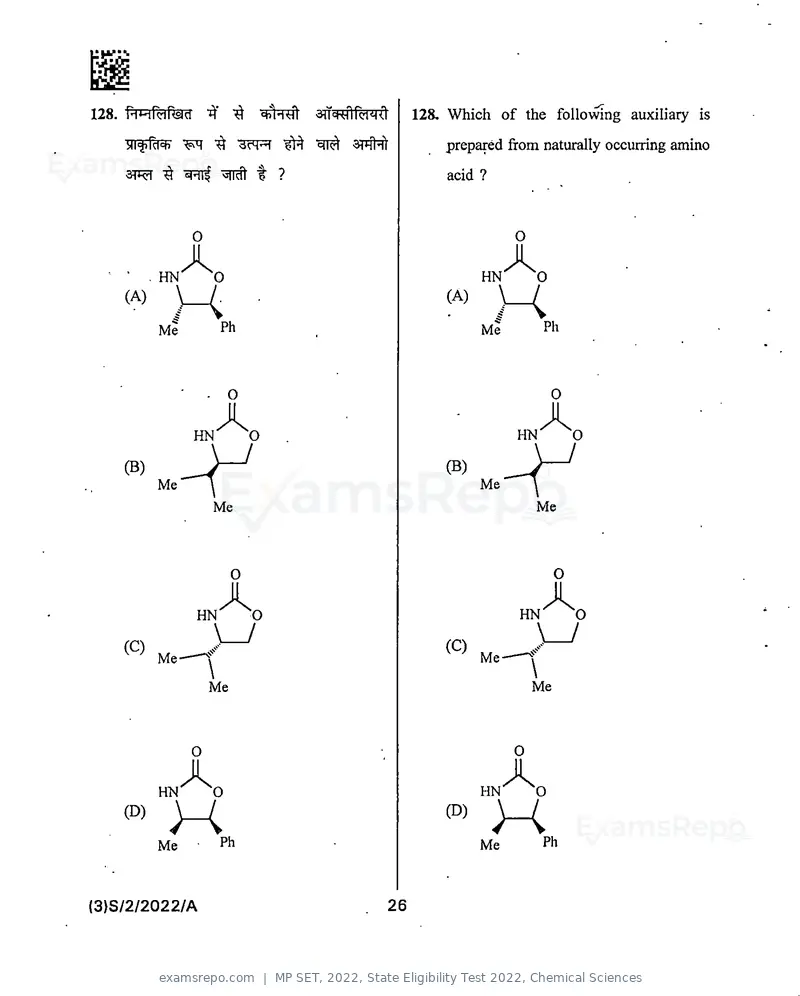
Text of page 28
128. rHMPdr^d             ^             air+HlPel^d    128, Which of the following auxiliary is

    HI<})Rlch ^                              STTlHt        prepared ftom naturally occurring amino

                         "^sTRTt "t ?                      acid ?


                0                                                      O
                                                                       u
       . HN
               A     0                                           HN^^O
    (A)                                                    (A)      V
           H             Ph                                      Me
                                                                    K           Ph


                          O                                                     0
                                                                                 if
                HN
                     A        O
                                                                                      /
    (B)                                                    (B)
          Me                                                     Me

                     Me                                                     Me


                          O                                                      O
                         jl                                                      if
                     w                                                      w
    (C)              /                                     (C)
          Me'                                                    Me'
                     \                                                      \
                     Me                                                     Me


                O                                                      0
                if                                                     if
                                                                 HN         O

                                                           (D,
          )~C
          Me■ Ph                                                 Me             Ph


(3)S/2/2022/A                                     26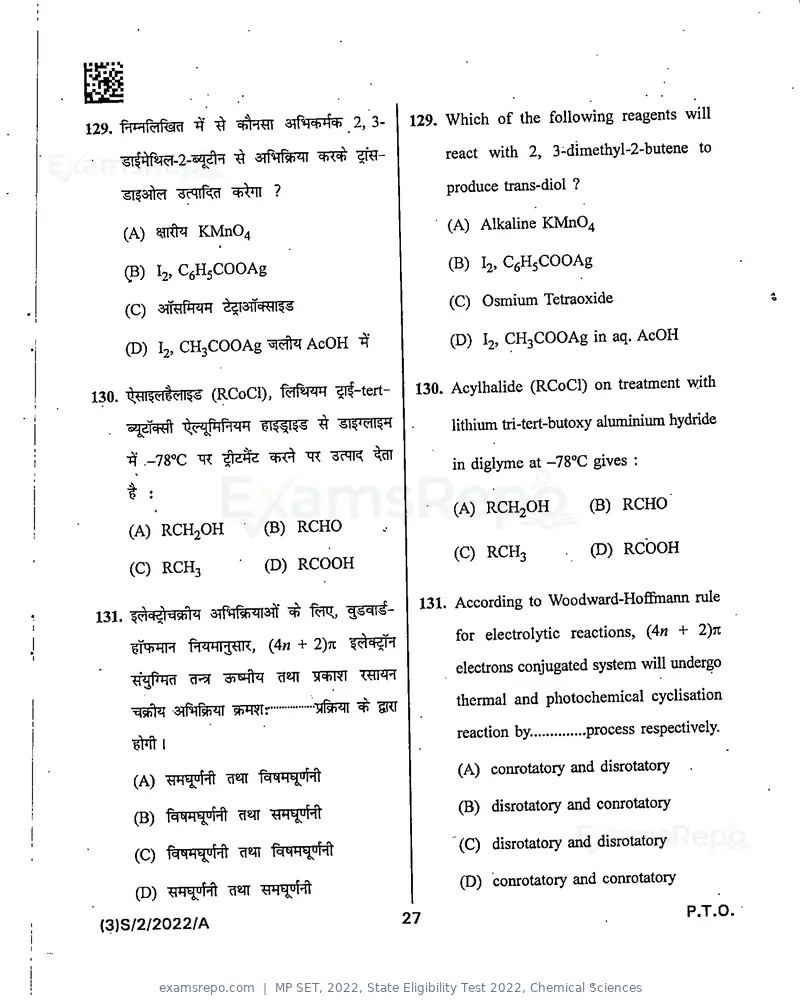
Text of page 29
129.                         cfftor                2, 3-   129. Which of the following reagents will
■                            ^              ^ W-                      react with 2, 3-diniethyl-2-butene to

                  <icMir<d          ?                                 produce trans-diol ?

       (A)             KMn04                                          (A) Alkaline KMn04

       (B) I2, CgHsCOOAg                                              (B) I2, CgHsCOOAg

       (C) sMWT                                                       (C) Osmium Tetraoxide

       (D) I2, CHgCOOAg                     AcOH                      (D) I2, CHgCOOAg in aq. AcOH

130.                   (RCoCi),               ^-tert-          130.   Acylhalide (RCoCl) on treatment with
                                                                      lithium tri-tert-butoxy aluminium hydride

           ■4 .-78°C                          3CHK %n                 in diglyme at -78°C gives ;
           t :
                                                                       (A) RCH2OH            (B) RCHO
           (A) RCH2OH               (B) RCHO
                                                                       (C) RCH3              (D) RC'OOH
           (C) RCH3                 (D) RCOOH
                                                                       According to Woodward-Hof&nann rule
    131.                                ^                  I
                                    (4« + 2);c
                                                                       for electrolytic reactions, (4« + 2);:
                                                                       electrons conjugated system will undergo
                                                                       thermal and photochemical cyclisation
                  aif^rtor                  •'sfOT ^ OT
                                                                       reaction by.          process respectively.
           ^I
                                                                       (A) conrotatory and disrotatory       .
            (A)                  1Wl^yt4t
                                                                       (B) disrotatory and conrotatory
            (B)              ^«^T
                                                                       (C) disrotatory and disrotatory
            (C)
                                                                       (D) conrotatory and conrotatory
            (D)
                                                                                                            P.T.O,
    (3)S/2/2022/A                                          27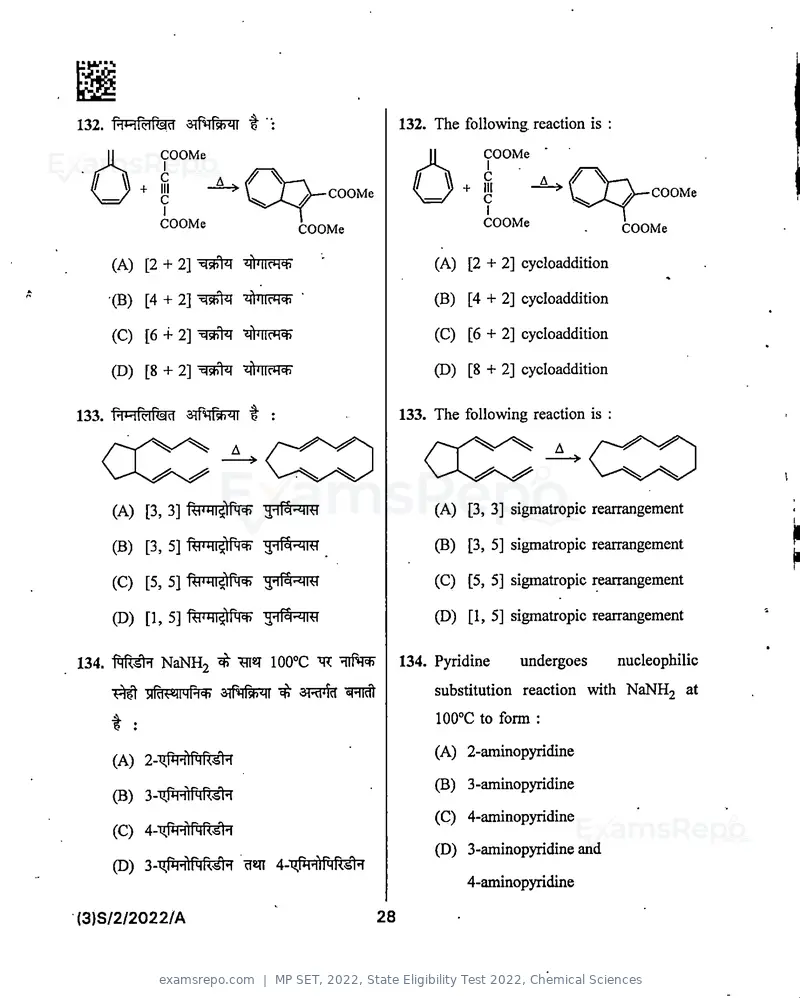
Text of page 31
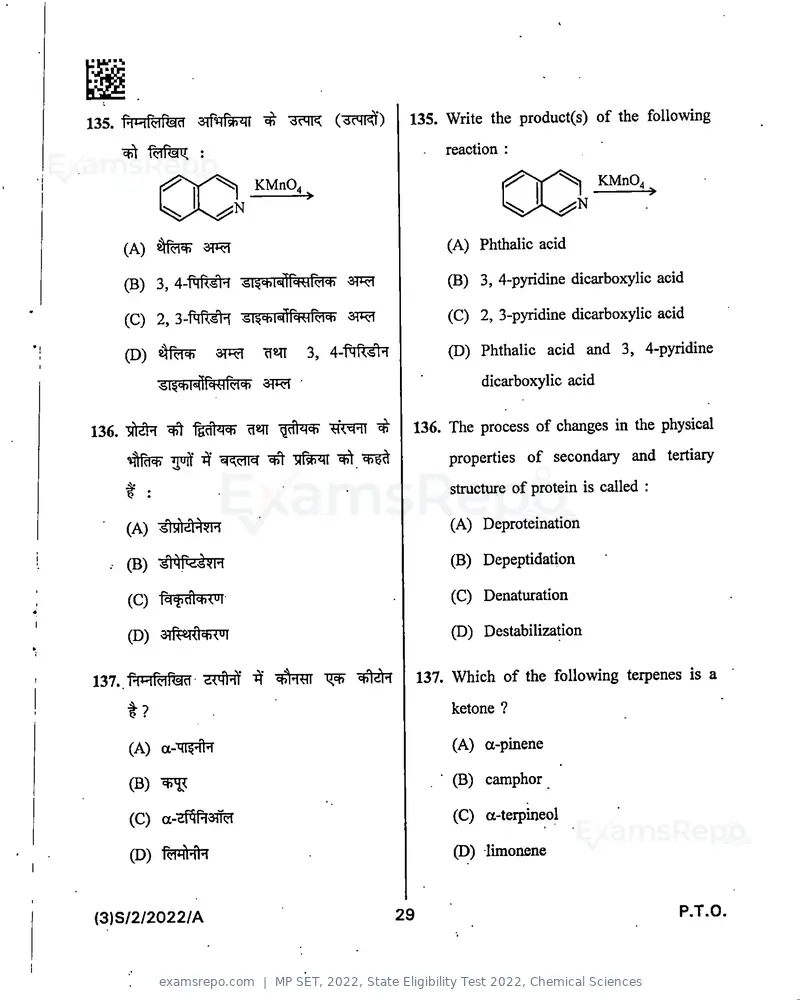
135. PtMPdndd                ^ "3^^ (-3^^*)    135. Write the product(s) of the following
    ^           :                                   reaction :

                         KMnO^ ^                                             KMnO^

                               '


    (A)                                            (A) Phthalic acid

    (B) 3, 4-lHMh -si^ctiioillwRicn                (B) 3, 4-pyridine dicarboxylic acid

    (C) 2, B-PMR^li -si^chi^ilpHHRi^               (C) 2, 3-pyridine dicarboxylic acid

    (D)                           3, 4-'M^         (D) Phthalic acid and 3, 4-pyridine
                                                         dicarboxylic acid


136. "Sft^ ^ Pgdl^cti W                  ^     136. The process of changes in the physical
           "5^'      44dl4                          properties of secondary and tertiary
     t:                                             structure of protein is called :

    (A)                                             (A) Deproteination

   .- (B) il#3i?H                                   (B) Depeptidation

     (C)                                            (C) Denaturation

    (D)                                             (D) Destabilization

137.."^^^               "^f        "0^         137. Which of the following terpenes is a

     t?                                             ketone ?


     (A) a-Mi^'ili                                  (A) a-pinene

     (B) ^                                         ■ (B) camphor

     (C) a-^RRI3;Tf^                                (C) a-terpineol

     (D) RtihIiIi                                   (D) limonene


(3)S/2/2022/A                                 29                                       P.T.O.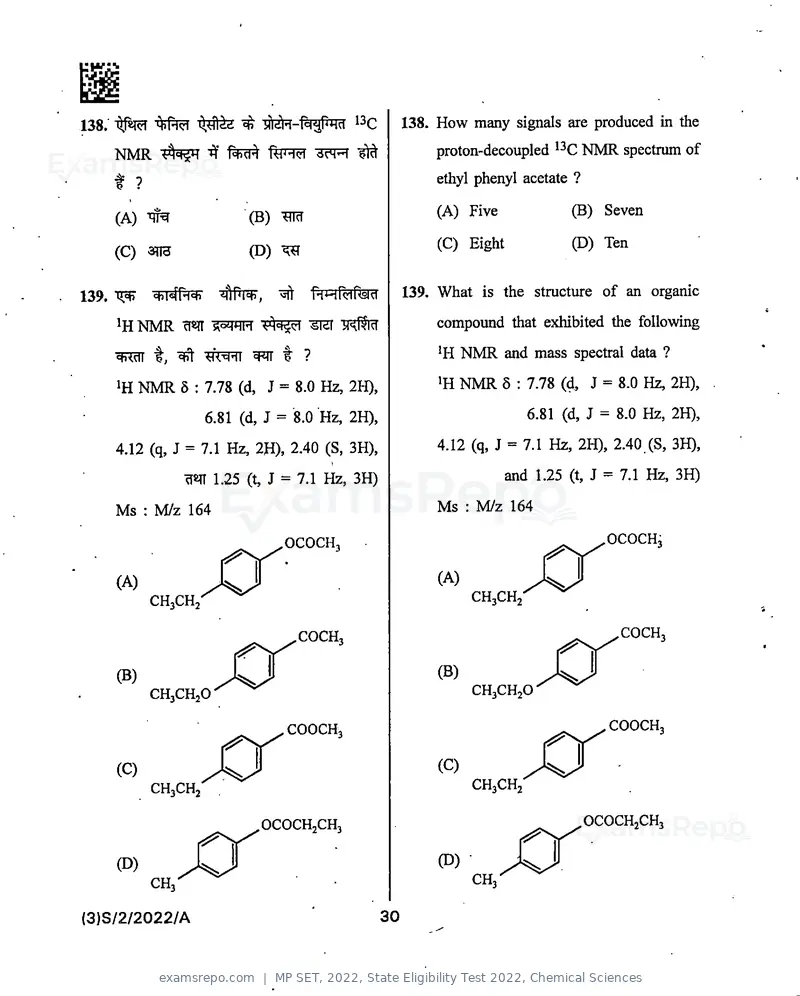
Text of page 32
138;                       ^                 13c    138. How many signals are produced in the
       NMR                                   ^          proton-decoupled l^c NMR spectrum of
       t ?                                              ethyl phenyl acetate ?

       (A) ^                (B) W                       (A) Five            (B) Seven

                            (D) ^                       (C) Eight           (D) Ten
       (C) 3^B

139.         ctiicfpicti 4lPl=h, ^ Pl^-lRinsia      139. What is the structure of an organic

       IR NMR cT«II ^flPT                               compound that exhibited the following

             t, "SFt         ^t ?                        iR NMR and mass spectral data ?

       iR NMR 6 : 7.78 (d, J = 8.0 Hz, 2H),              iR NMR S ; 7.78 (d, J = 8.0 Hz, 2H),

                       6.81 (d, J = 8.0 Rz, 2H),                       6.81 (d, J = 8.0 Hz, 2H),

       4.12 (q, J = 7.1 Rz, 2H), 2.40 (S, 3H),          4.12 (q, J = 7.1 Hz, 2H), 2.40.(8, 3R),
                                         >


                   tI«TT 1.25 (t, J = 7.1 Hz, 3H)                  and 1.25 (t, J = 7.1 Rz, 3H)

       Ms : M/z 164                                      Ms : M/z 164

                                  OCOCH3                                           OCOCH,


       (A)                                              (A)
             CH3CH2                                           CH3CH2

                                    COCH,                                            COCH,


       (B)                                              (B)
             CR3CH2O                                          CH3CH2O

                                  COOCH3                                           COOCH,


       (C)                                              (C)
             CH3CH2                                           CH3CH2

                               OCOCR2CH3                                         OCOCH2CH3


       (D)                                              (D)
             CH3

(3)S/2/2022/A                                      30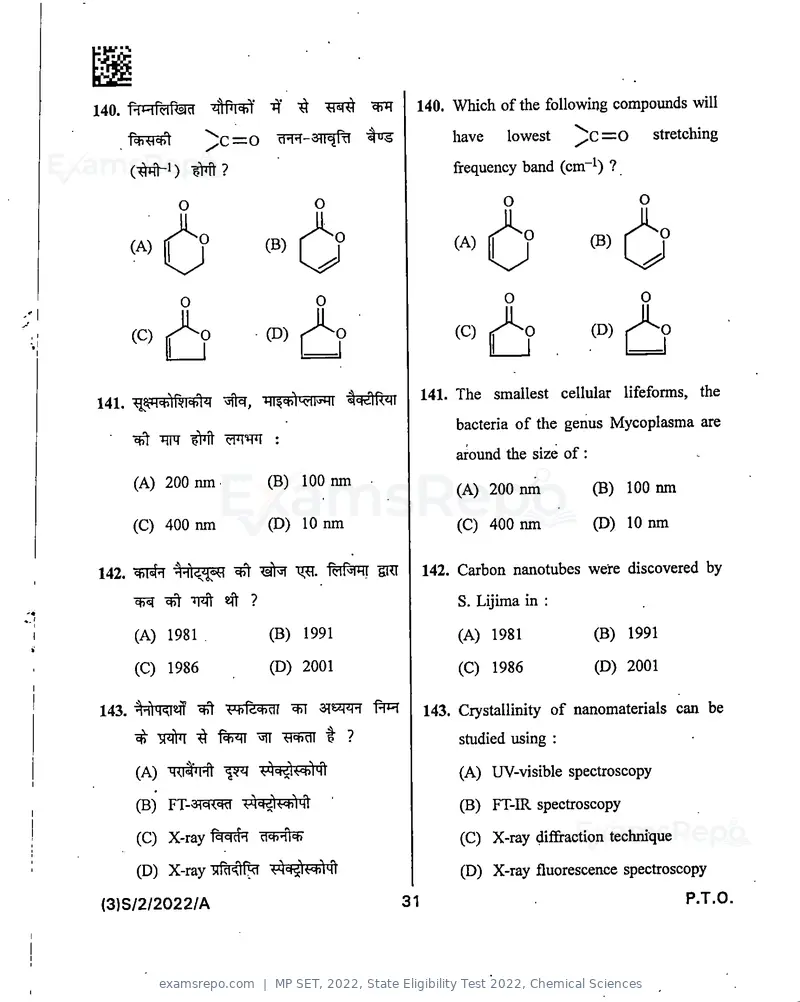
Text of page 33
140. RMHriRsid 4ini=bT          ^           ^ 140. Which of the following compounds Avill
                  ^C=0                                       have lowest ^C=0 stretching
       cM-')        7                                        frequency band (cm~^)?
                                                                       O               O


                                                            (A)
                                                                           0    ™ Ac
                                                                                (B)


                                                                       O               0


                                                             (C) rf^       0    (D)        O


                                                     141. The smallest cellular lifeforms, the
141.                '^,                 ^4dlR^I
                                                             bacteria of the genus Mycoplasma are
          "m ^              :
                                                             aroimd the size of:

       (A) 200 nm           (B) 100 nm                                          (B) 100 nm
                                                             (A) 200 nm

       (C) 400 nm           (D) 10 nm                        (C) 400 nm         (D) 10 nm


142.                ^           "^*         ^            142. Carbon nanotubes we're discovered by

          ^         8ft ?                                    S. Lijima in :

       (A) 1981 .           (B) 1991                         (A) 1981           (B) 1991
       (C) 1986             (D) 2001                         (C) 1986           (D) 2001

143.           ^                ^            Pi*^        143. Crystallinity of nanomaterials can be
       ^ "SRVt ^ Pfi^i                  ?                     studied using :

       (A)          ^                                        (A) UV-visible spectroscopy
       (B) FT-3T^W "^ft^sR^fnft                              (B) FT-IR spectroscopy

       (C) X-ray fqqai                                       (C) X-ray diffraction technique
       (D) X-ray 3rMf^                                       (D) X-ray fluorescence spectroscopy
(3)S/2/2022/A                                       31                                         P.T.O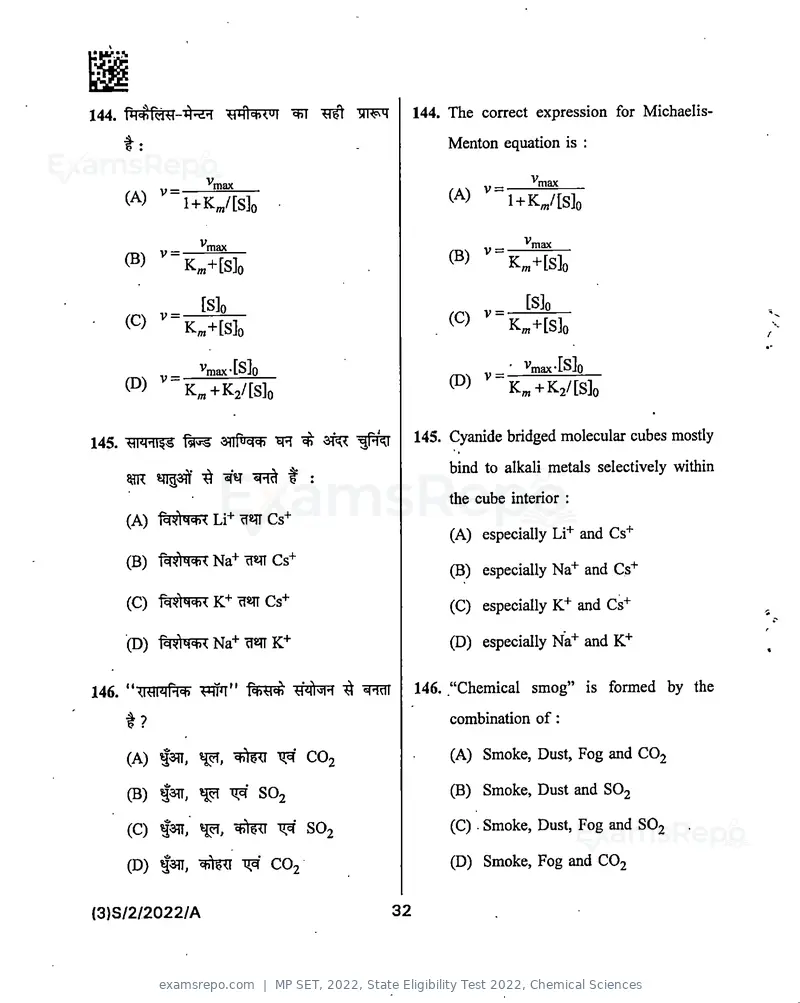
Text of page 34
■IV'S


144.                                        ^ ^         144, The correct expression for Michaelis-

       "I:                                                   Menton equation is :

                         V,max                                               '^max

       (A) " l+K„/[s]o                                        (A)         l+K„/[s]o

                         max                                                ^max

             " K„+[S]o
             „          [Slo                                                [S]o
                                                                    V =
                                                              (C)
                                                                          K„+[S]o

                 _      ^max' [S]o                                          ^max*[S]o
       (D) '■k„+K2/[s]o                                       (D)         K„+K2/[S]o

145.                 l9(>»s                 ^            145. Cyanide bridged molecular cubes mostly
                                                              bind to alkali metals selectively within
       w «^i3aiif ^                ^t :
                                                              the cube interior :
       (A) M^Li+WCs+
                                                              (A) especially Li"^ and Cs"^
       (B) RiilM+i Na+ tWr Cs+                                (B) especially Na"^ and Cs"^
       (C)                    K+ft«ll Cs+                     (C) especially K"^ and Cs"*"

       (D) M^Na+lI8irK+                                       (D) especially Na+ and K"*"

146. "-roraft^                                    TOi    146. "Chemical smog" is formed by the

       t?                                                     combination of:


       (A) pn, 'P,                          CO2               (A) Smoke, Dust, Fog and CO2

       (B)              ^            SO2                      (B) Smoke, Dust and SO2

       (C) H®n, «p,                         SO2               (C) . Smoke, Dust, Fog and SO2

       (D) #n.                    ■^' CO2                     (D) Smoke, Fog and CO2


{3)S/2/2022/A                                       32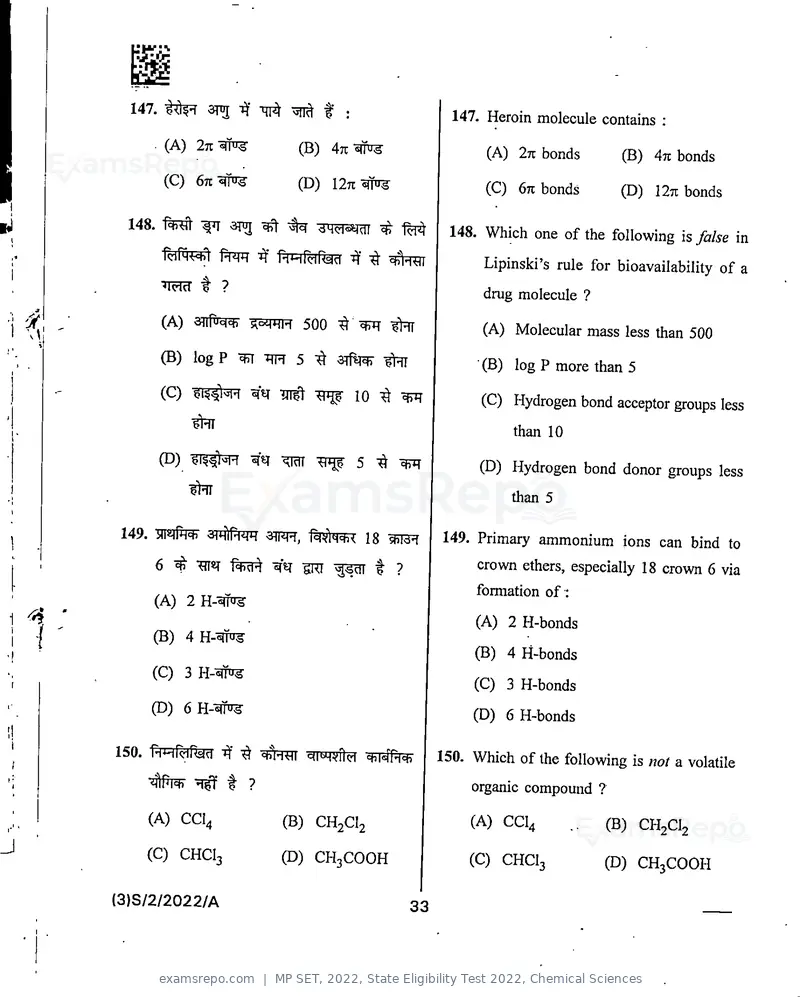
Text of page 35
147.            3713       -qi^       f.                    147. Heroin molecule contains ;
                (A) l-K qffe                (B) 4n                        (A) 2?: bonds        (B) 47t bonds
                (C) 67c                     (D) 1271                      (C) 671 bonds        (D) 1271 bonds

         148. Rt)^1           37^ ^^                    ^           148. Which one of the following is false in
                             i^PR ■^* PlHfdRsId ■^'                       Lipinski's rule for bioavailability of a
                       t ?                                                drug molecule ?
                (A) aTTfn^                   500 ^          #71           (A) Molecular mass less than 500
1 \\
                (B) log P ^ TTPT 5 ^ 37fTO -#71                          ■ (B) log P more than 5
                (C)                    TJT^ -^TTJ^ 10        ^           (C) Hydrogen bond acceptor groups less
                                                                              than 10

              (D)                ^'?7 ^                5 ^ ^             (D) Hydrogen bond donor groups less
                      $ldl
                                                                              than 5

       149. Wfer 3Ti#7^                                18          149. Primary ammonium ions can bind to
             6 ^ *^1727               ^*¥7 ^            f 7              crown ethers, especially 18 crown 6 via
                                                                         formation of:
             (A) 2 H-"^
 /A
                                                                         (A) 2 H-bonds
             (B) 4
                                                                        (B) 4 H-bonds
             (C) 3 H-^
                                                                        (C) 3 H-bonds
            (D) 6                                                       (D) 6 H-bonds

       150. Pi*-iRiRsia         ^ qiH^i ^T^q^fhr diicfPidi         150. Which of the following is /70/ a volatile
                              t ?                                       organic compound ?

            (A) CCI4                       (B) CH2CI2                   (A) CCI4        ..   (B) CH2CI2
            (C) CHCI3                  (D) CH3COOH                      (C) CHCI3            (D) CH3COOH

       (3)S/2/2022/A                                          33
Text of page 36
TV chl4 ^
                (SPACE FOR ROUGH WORK)


                                         I


{3)S/2/2022/A
Text of page 37
(SPACE FOR ROUGH WORK)


     S/2/2022/A

L\
Text of page 38
iTjr   '%
             (SPACE FOR ROUGH WORK)


S/2/2022/A
Text of page 2
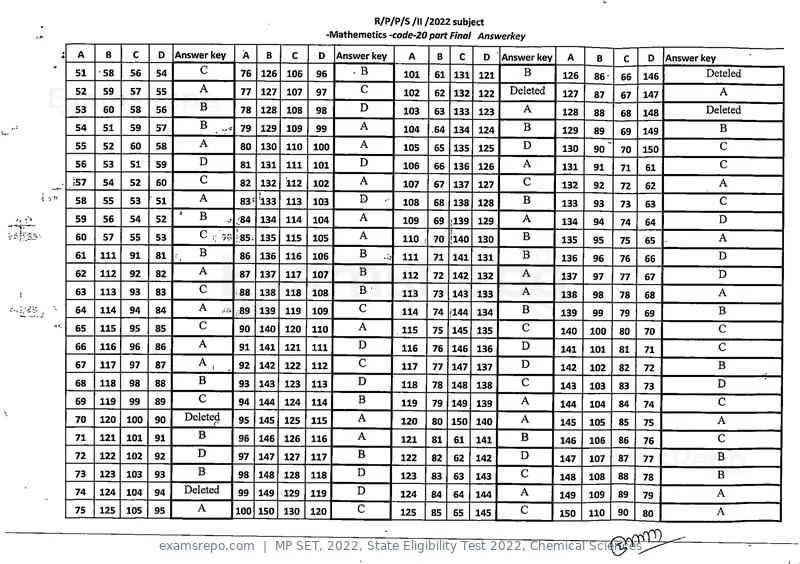
R/P/P/S/ll/2022 subject
-Mathematics -code-20 part Final Answerkey
A B C D Answer key A B C D Answer key A B C D Answer key A B C D Answer key
51 58 56 54 C 76 126 106 96 .B B Deteled
101 61 131 121 126 86 66 146
52 59 57 55 A 77 127 107 97 C Deleted A
102 62 132 122 127 87 67 147
53 60 58 56 B 78 128 108 98 D A Deleted
103 63 133 123 128 88 68 148
54 51 59 57 B 79 129 109 99 A 104 .64 134 124 B B
129 89 69 149
55 52 60 58 A 80 130 110 A D C
100 105 65 135 125 130 90^ 70 150
56 53 51 59 D 81 131 111 101 D A C
106 66 136 126 131 91 71 61
157 54 52 60 C 82 132 112 102 A C A
107 67 137 127 132 92 72 62
58 55 53 51 A 83^ ^3 113 103 D B C
108 68 138 128 133 93 73 63
59 56 54 52 ' B ,;84 134 114 104 A 109 69 1139 129 A D
134 94 74 64
(
60 57 55 53 c .V,., i:85i 135 115 105 A 110 f 70 il40 130 B A
135 95 75 65
61 111 91 81 \ B 86 136 116 106 B 111 71 141 131 B 136 96 76 66 D
62 112 92 82 A 87 137 117 107 B A D
112 72 142 132 137 97 77 67
63 113 93 83 C 88 138 118 108 B ■ 113 73 143 133 A A
138 98 78 68
64 114 94 84 A ,89 139 119 109 C 114 74 !l44 B B
134 139 99 79 69
65 115 95 85 C 90 140 120 110 A C C
. 115 75 145 135 140 100 80 70
66 116 96 86 A 91 141 121 111 D D C
116 76 146 136 141 101 81 71
67 117 97 87 A, . 92 142 122 112 C 117 77 147 137 D 142 102 82 72 B
68 118 98 88 B 93 143 123 113 D C D
118 78 148 138 143 103 83 73
69 119 99 89 C 94 144 124 114 B A C
119 79 149 139 144 104 84 74
70 120 100 90 Deleted 95 145 125 115 A A A
r 120 80 150 140 145 105 85 75
71 121 101 91 B 96 146 126 116 A B C
121 81 61 141 146 106 86 76
72 122 102 92 D 97 147 127 117 B D B
122 82 62 142 147 107 87 77
73 123 103 93 B 98 148 128 118 D C B
123 83 63 143 148 108 88 78
74 124 104 94 Deleted 99 149 129 119 D A A
124 84 64 144 149 109 89 79
75 125 105 95 A 100 150 130 120 C C A
125 85 65 145 150 110 90 80
Text of page 3
R/P/P/S/ll/2022 subject
-Mathemetics -code-20 part Final Answerkey
A B C D Answer key A B C D Answer key A B C D Answer ke^ A B C D Answer key
61 141 111 101 D 86 76 136 126 A B
111 101 71 61 136 126 96 86 D.
62 142 112 102 B 87 77 137 D D
127 112 102 72 62 137 127 97 87 C
63 143 113 103 C 88 78 138 D B
00 128 113 103 73 63 138 128 98 88 A
^64 144 114 104 C 89 79 ^ 139 129 B 114 C D
104 74 - 64 139 129 99 89.
65 145 115 105 D B C
90 80 140 130 115 105 75 65 140 130 100 90 Deleted
66 146 116 106 D A B
91 81 141 131 116 106 76 66 141 131 101 91 Deleted
132 ■
67 147.-iii7 107 D B A
92 82 142 117 107 77 67 142 132 102 92 A.<,-
68 118 108 A 93 83' 143 '133 A : D p.D "
118 108 78 68 143 133 103 93
C C
69- 149 119 109 94 84 144 134 119 169 79 69 c 144 134 104 94 ... c
70^ MSG 120 110 A 95 85 f 145 C c
135 120 110 .70 145 135 105 95 r: A
- h 71 61 121 111 • A ^ 96 86 146 136 D 121 ill 81 71 D 146 136 106 96 B
72 62 122 112 C 97 87 147 D B
137 122 112 82 72 147 137 107 97 D
73 63 123 113 A i 98 148 138 A 123 C A
113 83 73 148 138 108 98
^ 74:= ~ 64 124 C D C
114 99 89 149 139 124 114 0
84
00
■74 149 139 109 99 , r.; B
75 65 125 115 D 100 90 B ... C
150 140 125 115 85 75 150 140 110 100 A-.
76 66 126 116 B 101 91 61 141 A B
126 116 86 76
77 67 127 117 B 102 92 62 142 . Deleted 127 117 87 77 B.
78 68 128 118 C 103 93 63 143 B C
128 118 88 78
79 69 129 119 B 104 94 64 144 A B
129 119 89 79
80 70 130 120 D 105 95 65 145 C A
—
130 120 90 80
81 71 131 121 A 106 96 66 C C
146 131 121 91 81
82 72 132 122 D 107 97 67 147 A B
132 122 92 82
83 73 133 123 B 108 98 68 D C
148 133 123 93 83
84 74 134 124 B 109 99 69 149 A A
134 124 94 84
85 75 135 125 C 110 100 70 150 B C
135 125 95 85
OC
OC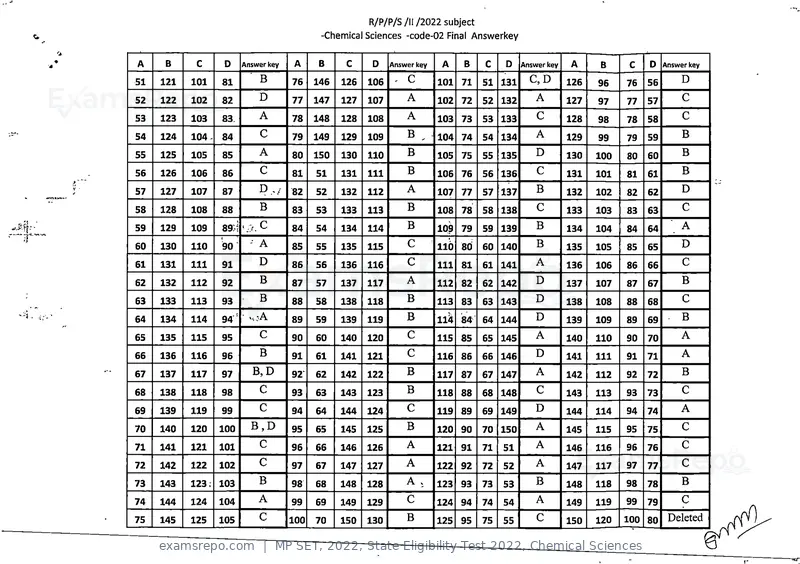
Text of page 4
R/P/P/S/II/2022 subject
                                             -Chemical Sciences -code-02 Final Answerkey

A     B     C      D     Answer key    A    B      C     D    Answer key    A    B    C    D     Answer key   A      B     C    D Answer key

51   121   101    81         B        76    146   126   106 . c            101   71   51 131       C,D        126   96    76    56       D

52   122   102    82         D        77    147   127   107       A        102 72     52 132         A        127         77    57       C
                                                                                                                    97

53   123   103    83         A        78    148   128   108       A        103 73     53 133         C        128   98    78    58       C

54   124   104-   84         C        79    149   129   109       B.       104 74     54 134         A        129   99    79    59       B

55   125   105    85         A        80    150   130   110       B        105 75     55 135        D         130   100   SO    60       B

56   126   106    86         C        81    51    131   111       B        106   76   56 136         C        131   101   81    61       B

57   127   107    87         D,,/     82    52    132   112       A        107 77     57 137         B        132   102   82    62       D

58   128   108    88         B        83    53    133   113       B        108 78     58 138         C        133   103   83    63       C

59   129   109                        84    54    134   114       B        109 79     59 139         B        134   104   84    64       A

60   130   110    90       '■ A       85    55    135   115       C        lib 8b     60 140         B        135   105   85    65       D

61   131   111    91         D        86    56    136   116       C        111 81     61 141         A        136   106   86    66       C

62   132   112    92         B        87    57    137   117       A        112   82   62 142        D         137   107   87    67       B

63   133   113    93         B        88    58    138   118       B        113   83   63 143        D         138   108   88    68       C

64   134   114    94 '     s;A        89    59    139   119       B        ll4   84   64 144        D         139   109   89    69   .   B

65   135   115    95         C        90    60    140   120       C        115   85   65 145         A        140   110   90    70       A

66   136   116    96         B        91    61    141   121       C        116   86   66   146      D         141   111   91    71       A

67   137   117    97       B,D        92    62    142   122       B        117   87   67 147         A        142   112   92    72       B

68   138   118    98         C        93    63    143   123       B        118   88   68 148         C        143   113   93    73       C

69   139   119    99         C        94    64    144   124       C        119   89   69   149      D         144   114   94    74       A

70   140   120    100      B,D        95    65    145   125       B        120   90   70   150       A        145   115   95    75       C

71   141   121    101        C        96    66    146   126       A        121 91     71   51        A        146   116   96    76       C

72   142   122    102        C        97    67    147   127       A        122   92   72   52        A        147   117   97    77       C

73   143   123: 103          B        98    68    148   128       A ,      123   93   73   53       B         148   118   98    78       B

74   144   124    104        A        99    69    149   129       C        124   94   74   54        A        149   119   99    79       C

75   145   125    105        C        100   70    150   130       B        125   95   75   55        C        150   120   100   80   Deleted
Page 1 of 38
Source: Madhya Pradesh Public Service Commission. Question paper published by Madhya Pradesh Public Service Commission.