
MP SET 2022: State Eligibility Test, Mathematical Science
Text of page 2
, , I ,(SPACE FOR ROUGH WORK)


S/20/2022/A
Text of page 7
^II (Part II)
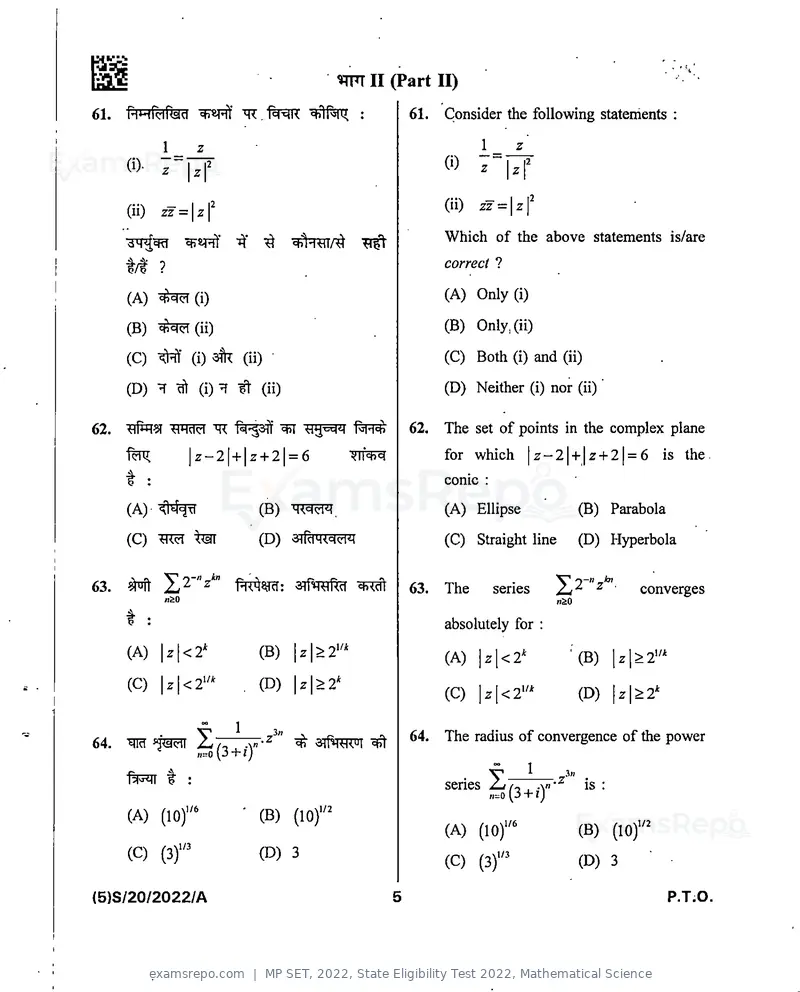
61. Rwrdfed                                       :        61. Consider the following statements :

                                                                     1

      ®- 2                                                     (i)


      (ii) zz = I z p                                          (ii) zz = I z I
                                                                Which of the above statements is/are

                                                                correct ?


      (A) e^qcn (i)                                            (A) Only(i)

      (B)           (ii)                                       (B) Only,(ii)

      (C)           (i) 3fk (ii) "                             (C) Both (i) and (ii)

      (D) "^T ci) (i)-^ ^ (ii)                                 (D) Neither (i) nor (ii)

                                                           62. The set of points in the complex plane
      fcny.         I z —2 l + l z+21=6           ^n*=hq        for which |z-2|+|z+ 21 = 6 is the
      t:                                                        conic :

      (A)                       (B) WOT,                       (A) Ellipse                 (B) Parabola

      (C) WT ^                  (D) aqf^TWOT                   (C) Straight line           (D) Hyperbola


63. ^
              n^O
                                                           63. The series            5^^
                                                                                     n^O
                                                                                                       converges
      t:                                                        absolutely for :
      (A) |z|<2*                (B) |z|>2"''                   (A) |2l<2'              '(B) lzl>2'''
      (C) |z|<2"'              , (D) |z|>2*
                                                               (C) |z|<2"*                 (D) |z|>2'
                           1      .3rt
64.                    .\n'^
            ^5^ Zw7, . A                 ^ 37f^TOT0T ^     64. The radius of convergence of the power
                     f,^o(3+i)
                                                                                 1    3«
              t:                                                series S—..z
                                                                         . .y               is :
                                                                         „=o(3+1)
      (A) (10)'^'          ' (B) (10)       1/2

                                                                          .1/6             /r»N    t.r.\\n
                                                               (A) (10)'                   (B) (10)'
      (C) (3)'''                (D) 3                          (C) (3)"'                   (D) 3

{5)S/20/2022/A                                                                                               P.T.O.
Text of page 9
-• * "J K.Ji


                                                                                                                                        S'^1

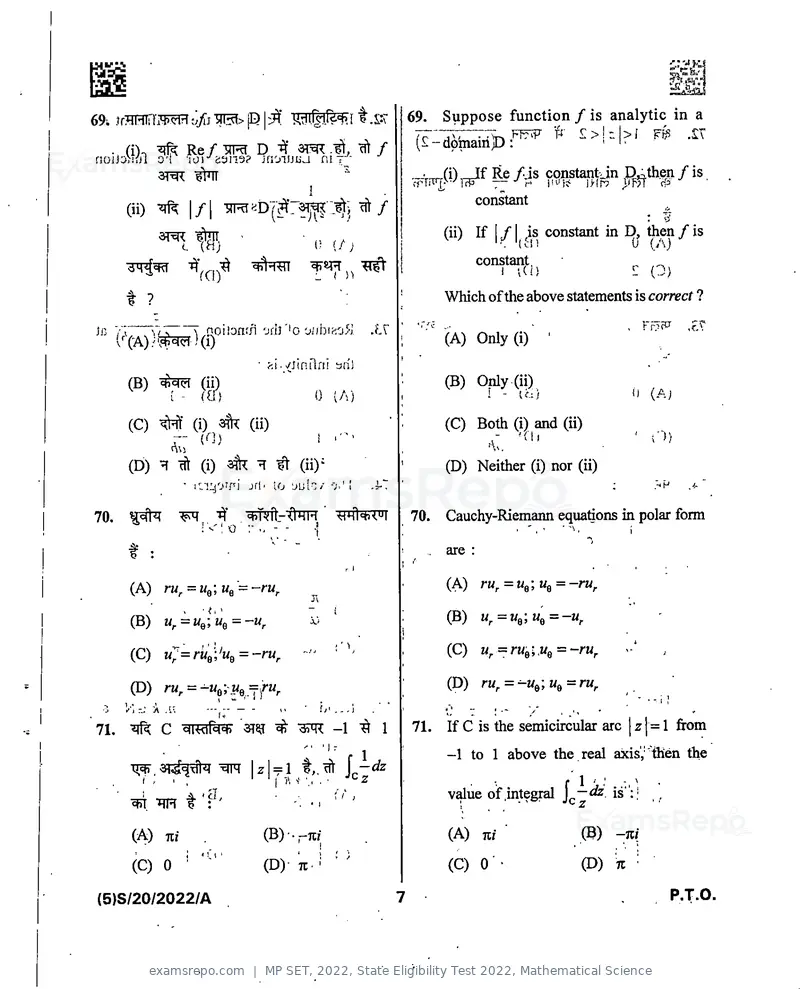
69; .trHHI:fiWB vfa 3II^>(D|                                          t.^^•     69. Suppose function / is analytic in a

  ■. (Ot 0'{ Rc/
noiia>!fil         TIRT DJfi-jiuiia
             -loratjiis?    "^*     hit;;- c!^ f
                 37^
                                                        I
                                                                                W^nrP           /y                                        ^ ■
                                                                                          constant
       (ii) ^1/1                                                       ^/
                 37^ "iM                                                             (ii) If l/lj^s constant in D, then/is
                       c (hj
                                                                                          constant                                 ^
                                                                                               1 'AM                         :: p)

      i?                                                                             Which ofthe above statements is correct ?

 Jn y;       ^/^ '         N ooiioaf/i 'jfir'o'jifbrj^o5-j.               ,L\                                            .       fyy?^       ,cT
      ('(A)f^^){i)                                                                   (A) Only (i)
                                            ■ ^! -_>/Jinnn! tJii)
       (B)                  (ii)                                                     (B) Only (ii)
                  { - hi )                                0 (A)                              I - lA;                         b (A;

         (C) #ft" (i)                  (ii)                                          (C) Both (i) and (ii)
                     r- (H)                                 1                                                                '    i'V;

         (b) ^ cit (i) 3i[k                    ^ (ii)'                               (D) Neither (i) nor (ii)
                       •               jrl- to 'jLit^/ •';. ' !                                                                   .-"H        .A


70.                    ^                                                        70. Cauchy-Riemann equations in polar form
                            i ■-'! O   ■■      - -          '                                    • ', '   ■    .         i

         f :                                                                         are :


         (A) rw, = WeiWe = "^"r                                                      (A) ru,=u^\u^ = -ru^
                       .    ■(. '                       ~         i
         (B) M, = Me;«e=-"r                              ^''                         (B) u^=v^-,u^=-u,

         (C) u;= ruj;\ = -ru^                          "■ ' ''                       (C) «, = rMe;.Me = -/■«,                       .

         (D) ra,= ^Uo;.^9=jiru^                                                      (D) ra, =-We;Me=rM,
 •j    Vj -.' 'A .L\         -.. ... — -
                               I♦


71.              C                     37^ ^ "OTC -1                        1   71. If C is the semicircular arc | ^ ] = 1 from
                                                                                     -1 to 1 above the real axis/frien the
         T33^,37^§^ ^ \z\ =l                                          \-dz
           ' '       ' .                       i     i' ',' • '       ^                                       f 1^      :y
                                                                                     value of integral ]~^ is :;
              17B t 'V'
         (A) 7CI                             (B)-.p7CJ                               (A) TCI                       (B) -ni

         (C) 0 ' '' ' '                     (D)- U' ' ' '                            (C) 0 ■                       (D) t: ■

 (5)S/20/2022/A                                                                                                                         P.T.O.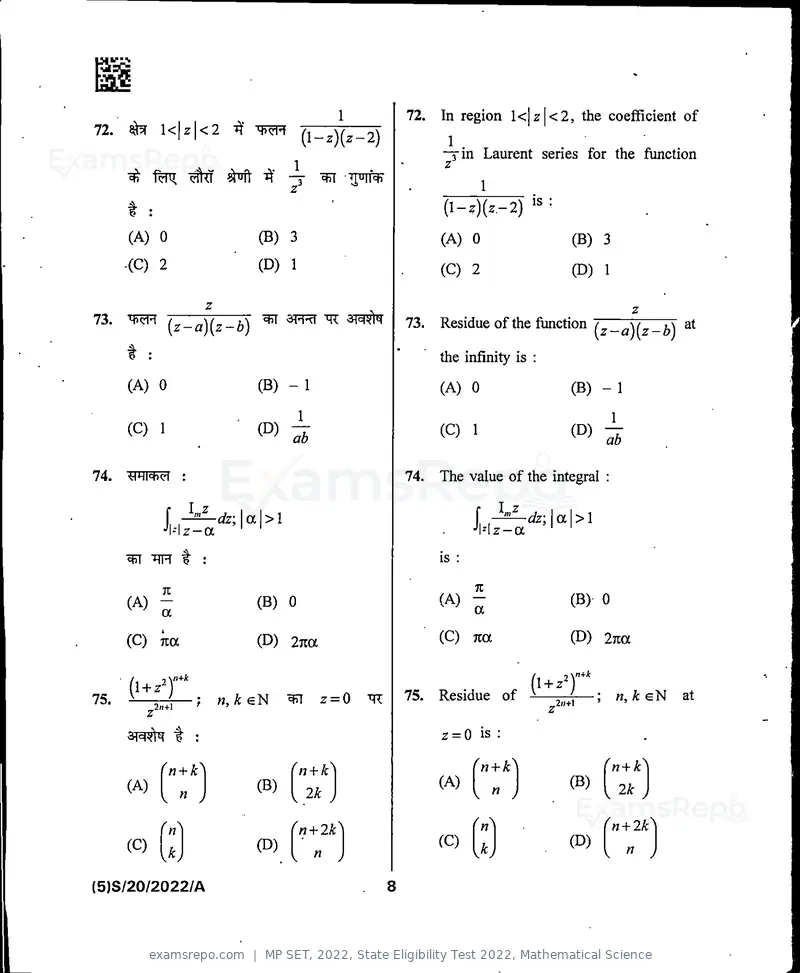
Text of page 10
72. In region l<|z|<2, the coefficient of
72. ^ l<|z|<2                         (l-z)(z-2)              1.
                                                             ~in Laurent series for the function
                                    1                        z
            Rny. mI<i          'A' —f                                1
                                    z


      t:                                                     (l-z)(z-2)            ^
      (A) 0                   (B) 3                          (A) 0                     (B) 3
      •(C) 2                ■ (D) 1                          (C) 2                     (D) 1

                       z

              {z-a)[z-b) ^                             73.   Residue of the function
                                                                                            {z-a){z-b) at
      t:                                                     the infinity is :

      (A) 0                   (B) - 1                        (A) 0                     (B) - 1
                                      1
      (C) 1                   (D)
                                    ab
                                                             (C) 1
                                                                                             i
74.                :                                   74. The value of the integral :

                                                                          I„.z
               f -^dz;\a\>l
              •"l-lz-a
                                                                    [ ——dz;I a I > 1
                                                                    j\Az-a

      ^            %:                                        IS :


              71                                                    7C

      (A)                     (B) 0                          (A) -                     (B) 0
              a                                                     a


      (C)                     (D) 2jia                       (C) jta                   (D) 27ca


      (l+z^P                                           75.   Residue of          (i+z^r.; «, k eN at
75.
            2h+1
                           «, A eN ^ ^=0 "qr                                       .2/1+1
          Z


                   t                                         z =0 is :

                                    ^n + k^                         ^77+^^                       n-^k^
      (A)                     (B)                            (A)                       (B)
              V "/                        2k                        V " y                    . 2it
                                                                    / \
                                      n-\-2k^                        n                       ^77+2P
                              (D)                            CC)                       (D)
              u,                    V " /                                                    V    ^   /

(5)S/20/2022/A                                     8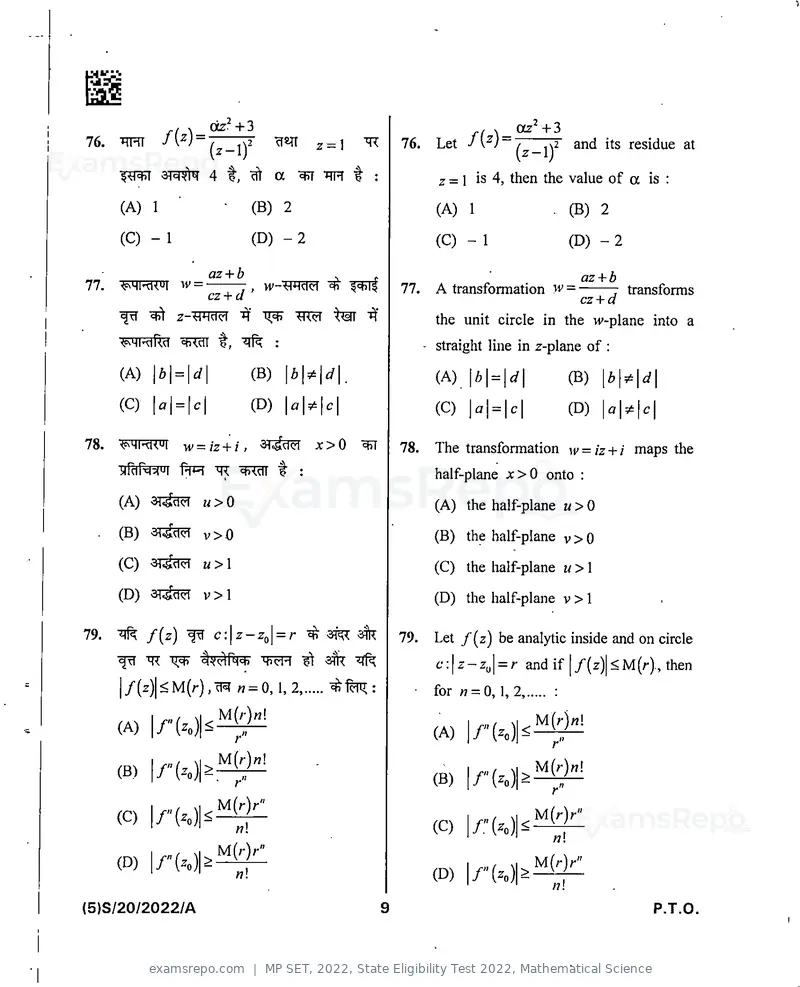
Text of page 11
or +3                                                        (xz +3
76.   TTHT     /W =                                           76.     Let   /W=(z-l)'
                                                                                    v2 and its residue at

                        4 t, eft a ^ TTH t :                          2= 1 is 4, then the value of a is :

      (A) 1                       (B) 2                              (A) 1                . (B) 2
      (C) -1                      (D) -2                             (C) - 1                  (D) - 2

                        az+ b                                                                   az-\-b
77. ^MW<ui w =                    ,          ^                77.     A transformation w =               transforms
                        CZ + Ci                                                                 cz+ a
      ^ ^ 2-^Haci "4                                '^*              the unit circle in the w-plane into a
      VTRTfer   %, ^ :                                              - straight line in z-plane of :
      (A) |6|=|^|                 (B) |A|^|^|.                       (A) |A|=|rf|             (B) 16|^|J|
      (C) |a|=|c|                 (D) |i/|?t|c|                      (C) I fl I = I c I       (D) I a I I £71
78.                 w ~ iz + i,              jc>0 ^           78. The transformation            = iz+/ maps the
      3TfM%^ ^ ^                       t:                            half-plane ;c>0 onto :
      (A) ^shield w > 0                                              (A) the half-plane w > 0
  . (B)                 v>0                                          (B) the half-plane v > 0
      (C)               u>1                                          (C) the half-plane u > 1
      (D)               V>1                                          (D) the half-plane v > 1

79.          f{z)        c\\z-z^\ = r         37^ afR         79. Let /(z) be analytic inside and on circle
             M< iJ.41                 4idH   4< 4R                   6*:|z-Zy|= r and if |/(z)|<M(/*)., then
      |y (z)|<.M(/*),         « = U, 1, ^         Idk,:         ■    for /7 = 0, 1, 2,    :

      (A)                                                           (A)

      (B)
                                                                     (B) |/'h)]£
      <C)
                                                                     <c)

      (B)
                                                                    (D) I/I-)!'"':,''"
(5)S/20/2022/A                                            9                                                 P.T.O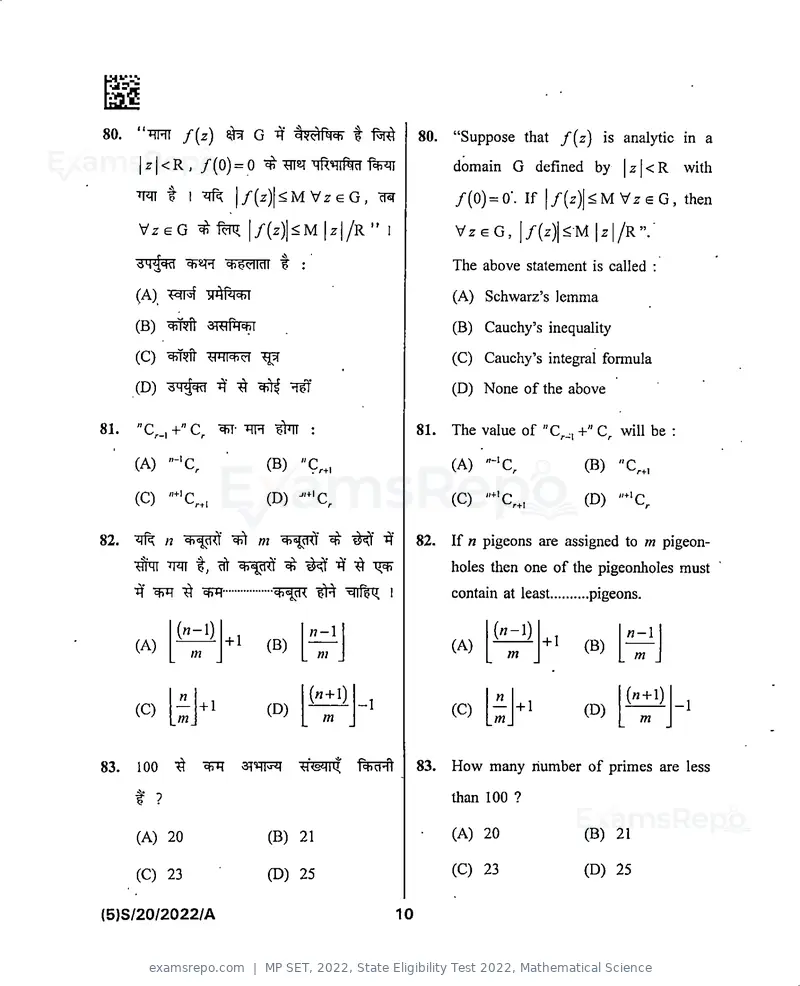
Text of page 12
80. "HMi /(z)                   G                                80. "Suppose that /(z) is analytic in a
      |z|<R, /(0)=0 •^^ST^*TfeTT                                       domain G defined by |2|<R with
      W t I ^ |/(z)|<M VzeG,                                           f(0) = 0'. If |/(z)|<M VzsG, then
      VzgG     |/(z)|<M |z|/R" I                                       VzeG, |/(r)|<M |r|/R".'
      "3^1^             cb^dldl t :'                                   The above statement is called :

      (A)             yARlc^l                                          (A) Schwarz's lemma

      (B)             3RTfW                                            (B) Cauchy's inequality
      (C)                                                              (C) Cauchy's integral formula
      (D)                    ^^                                        (D) None of the above

81. "C,.,+"0,                1TH ^ ;                             81.   The value of            +"    will be :

      (A) "-'C                  (B) "C„,                               (A) "-'C                (B) "C„,
      (C) "-^'cr+l              (D) "*'C                               (C) "-^'c   r+t
                                                                                               (D) "*'C,

82.         n =b<^a<l           m            ^         "4*       82. If n pigeons are assigned to m pigeon
            "W         eft            ^          ^                     holes then one of the pigeonholes must
                  ■^*                            -qifb^ 1                                      .pigeons.


             ("-1) +1                     /7-1                               (n-l)                   n-1
                                                                                         -hi
      (A)         m
                                    (B)      m
                                                                       (A)       m
                                                                                               (B)      m


              n                           («+i) -1                           n                       („+i)
      (C)         +1                (D)                                            -hi                       -1
             m                               m
                                                                       (C)   m
                                                                                               (D)      m


83.   100    ^    ^                               feFTt          83. How many number of primes are less

      f ?                                                              than 100 ?


      (A) 20                        (B) 21                             (A) 20                  (B) 21

      (C) 23                        (D) 25                             (C) 23                  (D) 25


(5)S/20/2022/A                                              10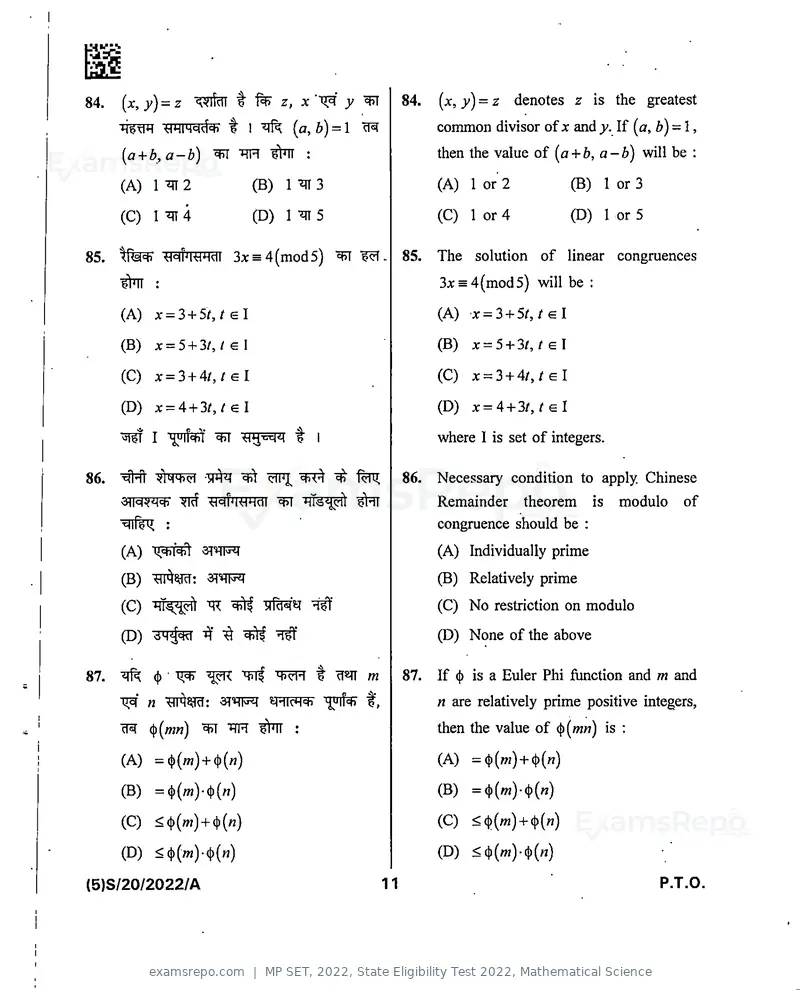
Text of page 13
84. {x,y)= z                t       2, X         ^ 84. (x, y) = z denotes z is the greatest
      tT^           t I ^ {a,b)= l ^                           common divisor of x and y. If (a, ^) = 1,
      [a + b, a-b) ^    eVii :                                 then the value of (a + b, a-b) will be :
      (A) 1 -^TT 2              (B) 1 -EfT 3                   (A) 1 or 2              (B) I or 3

      (C) 1 -qr 4               (D) 1        5                 (C) 1 or 4              (D) 1 or 5

85. t[<si=t)               3x = 4(mod5) ^                 85. The solution of linear congruences
            :                                                  3x^4(mod 5) will be :
      (A) x = 3+ 5^ / el                                       (A) X = 3 + 5r, / €I

      (B) X = 5+ 3/, / e I                                     (B) X = 5 + 3/, r G I

      (C) x = 3+ 4/, / G I                                     (C) X = 3 + 4/, / GI

      (D) x = 4+3/,/gI                                         (D) x = 4 + 3/, rel

            I           ^               f I                    where 1 is set of integers.

86.                       ^^^^                            86. Necessary condition to apply. Chinese
                    ^ "H^RFTm ^ Mk^cril #TT                    Remainder     theorem     is   modulo   of
                :                                              congruence should be :
      (A)                                                      (A) Individually prime
      (B)               31^1^                                  (B) Relatively prime
      (C) TTf^3J^          ^ 3Tfe*!^ ■^*                       (C) No restriction on modulo

      (D)                  ^ ^                                 (D) None of the above

87.         (j) ■ "q^               4>cii ^      m        87. If ([) is a Euler Phi fiinction and m and
            n                      ^4icH4i       t,            n are relatively prime positive integers,
            (t)(/7;?7) ^         ^I'li :                       then the value of (j)(ww) is :
      (A) =(j)(w) + (|)(«)                                     (A) =<^{m) + (^(n)
      (B) =(})(/«)■ ({)(«)                                     (B) =(l)(w) •(!)(«)
      (C) < 4) (m)+ (})(«)                                     (C) <(!)(/«) + ({)(«)
      (D) <(j)(w)-(|)(M)                                       (D) <(l)(m) •(!)(«)
(5)S/20/2022/A                                       11                                             P.T.O.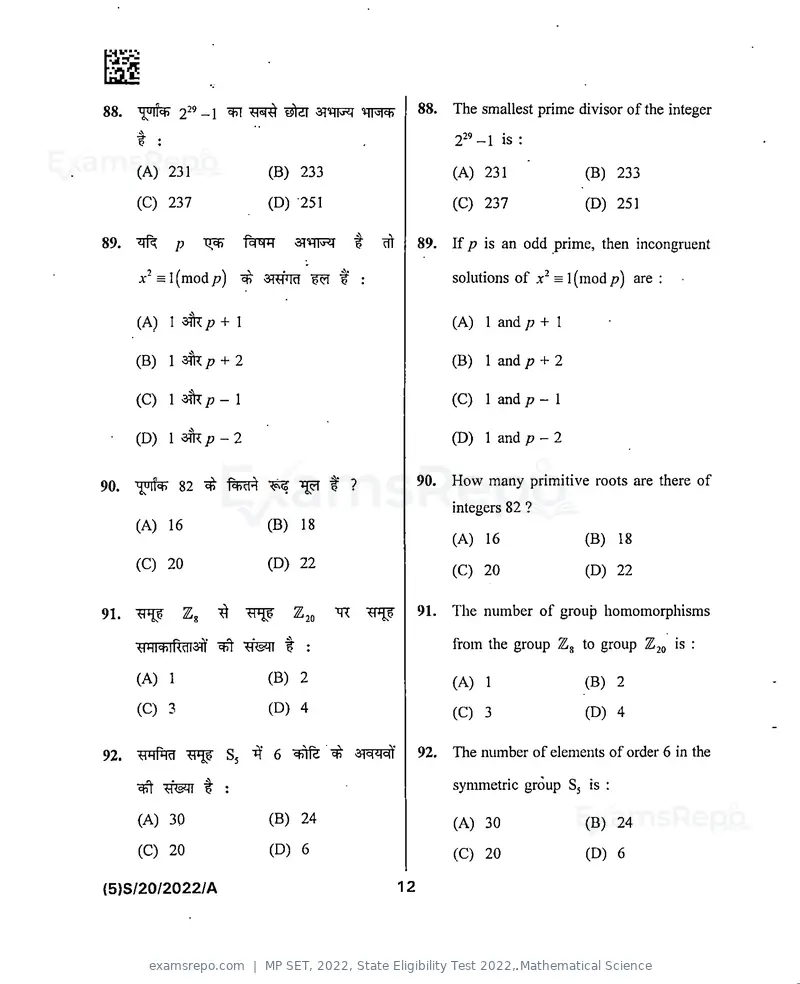
Text of page 14
88.           2^^ -1 ^    ^                      88. The smallest prime divisor of the integer

      ? :                                              2^'-l is :

      (A) 231            (B) 233                       (A) 231             (B) 233

      (C) 237            (D) "251                      (C) 237             (D) 251

S9,           p                     t            89. If p is an odd prime, then incongruent

      x^ = l(mod;7) ^         ^t :                     solutions of x~ = l(mod p) are :

      (A) 1 sfk p + 1                                  (A) 1 and p + 1

      (B) 1 sk p + 2                                   (B) 1 and p + 2

      (C) 1 3k p - 1                                   (C) 1 and p - 1

      (D) 1 sk p - 2                                   (D) 1 and p - 2


90.           82 ^       ^ "ip f ?               90. How many primitive roots are there of
                                                       integers 82 ?
      (A) 16             (B) 18
                                                       (A) 16              (B) 18
      (C) 20             (D) 22                        (C) 20              (D) 22


91. ^ Zg ^                  Z20 -qr ^            91. The number of group homomorphisms

      w^nfcna^' ^          t:                          from the group Zg to group Z20 is :

      (A) 1              (B) 2                         (A) 1               (B) 2
      (C) 3              (D) 4                         (C) 3               (D) 4


92.                  Sj ■^' 6 ^     3OT^*        92.   The number of elements of order 6 in the

      ^           t :                                  symmetric group S5 is :

      (A) 30             (B) 24                        (A) 30              (B) 24
      (C) 20             (D) 6                         (C) 20              (D) 6

(5)S/20/2022/A                              12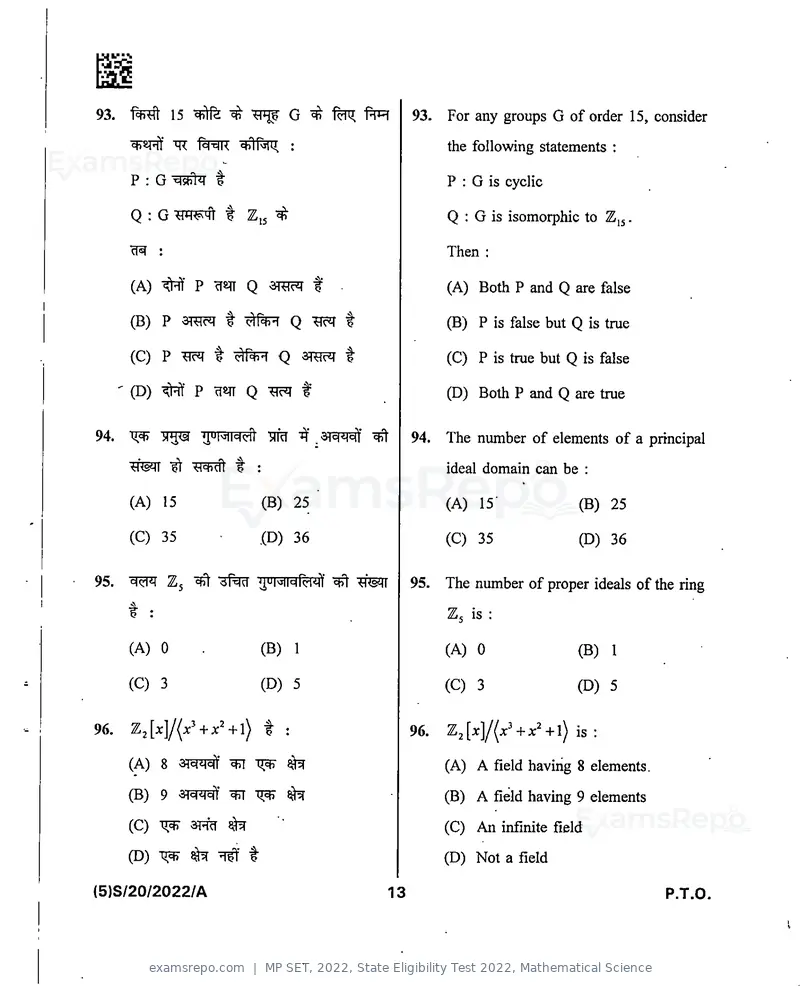
Text of page 15
93.           15 ^^              G ^                  93. For any groups G of order 15, consider
              "qr feR            :                         the following statements :

      P:            t                                      P : G is cyclic

      Q:G           t Zi5 ^                                Q : G is isomorphic to       .

      cl^ :                                                Then :

      (A)       P         Q            f -                 (A) Both P and Q are false

      (B) P 3Rlcq t              Q WT t                    (B) P is false but Q is true

      (C) P WT t                 Q           t             (C) P is true but Q is false

 '(D)           P ^an Q WT t                               (D) Both P and Q are true

94. TT^ 3T^ TpRT^ -am ■4* ,3T^^* ^                    94. The number of elements of a principal
                                                           ideal domain can be :

      (A) 15                  (B) 25                       (A) 15              (B) 25

      (C) 35                  (D) 36                       (C) 35              (D) 36

95. WT Z5 ^                iiU|uj|c|M ^ -^Psqi        95. The number of proper ideals of the ring
      t :                                                  Z5 is :

      (A) 0                   (B) 1                        (A) 0               (B) 1

      (C) 3                   (D) 5                        (C) 3              (D) 5

96. ^2W/(^' + ^'+l) t :                               96. Z2[x]/^x^+x^+l^ is :
      (A) 8 3^^^* ^ "0^ ^                                 (A) A field having 8 elements.
      (B) 9             ^ 13;^                            (B) A field having 9 elements
      (C) ^ 3HcT ^                                        (C) An infinite field
      (D) -q;^ ^          t                               (D) Not a field

{5)S/20/2022/A                                   13                                         P.T.O.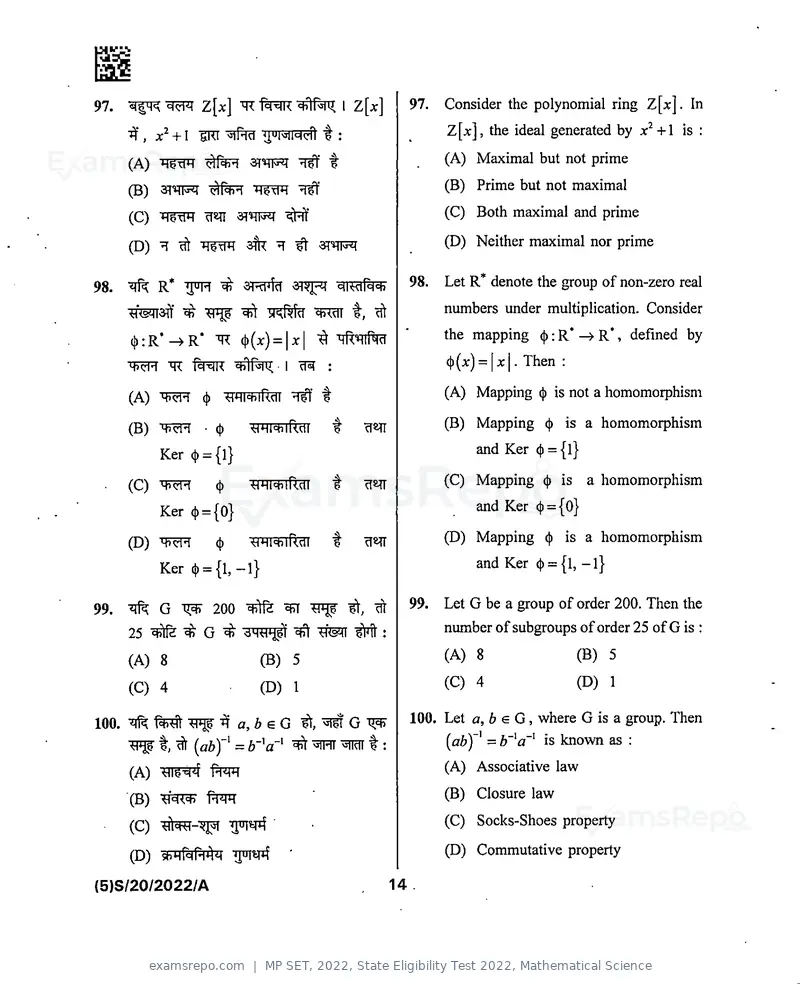
Text of page 16
97.               Z[x]                      I Z[x]          97. Consider the polynomial ring Z[x]. In
        , x^ + l 'm          ipJM^ t:                           Z[x], the ideal generated by x^+1 is :
      (A) 1WT                      t                            (A) Maximal but not prime

      (B) 3TWI             ITWT "=7^                            (B) Prime but not maximal

      (C)                                                       (C) Both maximal and prime

      (D)     ^           sfk ^ ^ 3T^71^                        (D) Neither maximal nor prime


98.         R* TppT ^ sRpfe >31^ ^mrf^                      98. Let R* denote the group of non-zero real
               ^     ^             t, ^                          numbers under multiplication. Consider

      (j):R*—>R*          (|)(x)=|x| "d "RR^irfe                 the mapping ((>: R* —> R*, defined by
                                I   cT^ :                        (j)(a:)= IXI. Then :
      (A) "^RPT (]) ^HI=hlRcjl ^ t                              (A) Mapping ([) is not a homomorphism

      (B)           ■ (j) ^Hl^lRdl      t                       (B) Mapping <j) is a homomorphism

            Ker (t> ={l}                                              and Ker <j) ={l}

      (C)           (f)    ^Hl=+ilRdl   t      cTSTT            (C) Mapping (j) is a homomorphism

            Ker (t)={0}                                               and Ker (f ={0}
      (D)           ({) ^^HldilRdl      t                       (D) Mapping (j) is a homomorphism

            Ker (i)={l,-l}                                            and Ker <!)= {l, -1}

99. -^0 13^ 200 ^^^                             ^           99. Let G be a group of order 200. Then the
      25 ^^ G ^                     ^       ^:                   number ofsubgroups of order 25 of G is :

      (A) 8                 (B) 5                               (A) 8                   (B) 5

      (C) 4                 (D) 1                               (C) 4                   (D) 1

100. ^felt^Tfa,^>gG                     ^GR^                100. Let a,6 G G, where G is a group. Then

      ^t.^ {aby^ = 6"'a"' ^^"STRIT t:                            (ab)'^ = b'^a'^ is known as :
      (A)          f^                                           (A) Associative law

      (B)                                                       (B) Closure law

      (C)                                                       (C) Socks-Shoes property

      (D) sft^Rt^                                               (D) Commutative property

(5)S/20/2022/A                                         14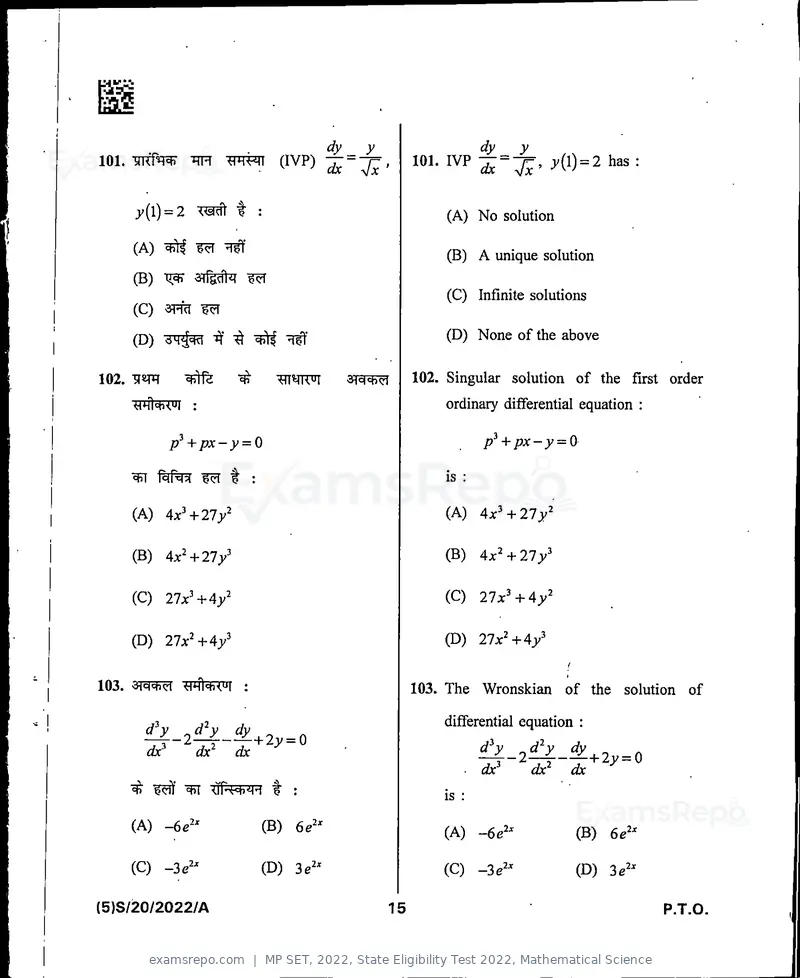
Text of page 17
dy   y
101.              fTH            (IVP)
                                                            IVP f=i'J'(I)=2 has
        y{l)= 2           t:                                (A) No solution

       (A)        ^
                                                            (B) A unique solution
       (B) TJ^             ^
                                                            (C) Infinite solutions
       (C) 3TO ^

       (D)              "^f ^ ^                             (D) None of the above


102.                      ^                             102. Singular solution of the first order
       ^41=h<>J| :                                          ordinary differential equation :

                p^ +px-y =0                                        p^ + px-y = ^

       ^ Mm ^ t :                                           is :


       (A) 4x'+27y^                                         (A) 4x^ + 27/

       (B) 4x^ +27/                                         (B) 4x'+ 27/

       (C) 27x^+4/                                          (C) 27x^ +4/

       (D) 27x^+4/                                          (D) 27x^+4/
                                                                               t


103.             ^4l4)<u| :                             103. The   Wronskian   of the solution    of

                                                            differential equation :
        |Z_2%^+23^=0
           dx      dx     dx                                       d^y _ d^y dy ^ ^
                                                                   ~-2—^—=^+2v=0
                                                                   dx    dx     dx
       ^         ^ <TrH4)^H t :                             is :


       (A) -6e-^               (B)                          (A) -6e'"              (B) Se"'

       (C) -3^2x               (D) 3e2x                     (C)                    (D) 3^2-

(5)S/20/2022/A                                     15                                          P.T.O.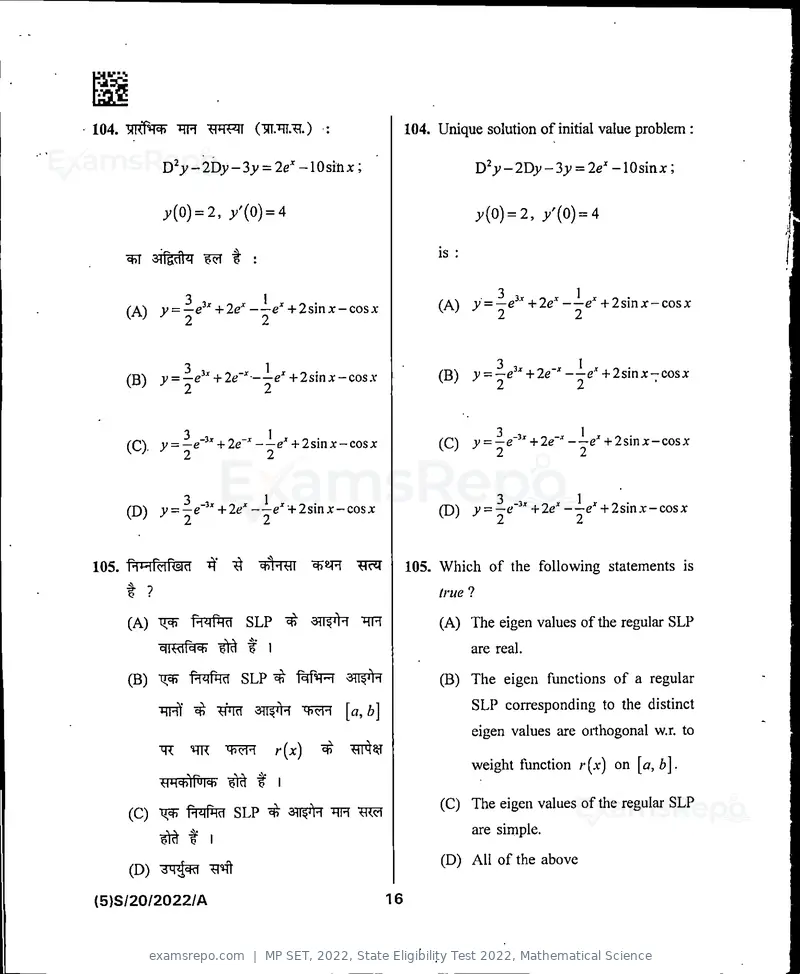
Text of page 18
104.                        (mmu) :                   104. Unique solution of initial value problem

             D^y-2Dy — 3y = 2e'-10siti x;                            D^j'-2Dy-3^ = 2e^ -lOsinx;

             y{0)= 2, /(0)= 4                                        y{0)^2, /(0) = 4

                                                              is :
       ^              ^t :

                                                                         3             1
                  3
       (A) y = —e^'
                               1
                   +2e'—e'+2sinx-cosx                         (A) y=—e^'' + 2e''——e'' + 2sinx-cosx
               2        2


       (Q)             + 2£;"^——e""+2sin X -cos X             (B) y = —e +2e''—e""+ 2sinx-cosx
                                                                         2             2


               3
       (Q) y = —e'^"+ 2e~'' —I +2sin X-cos X                  (■Q _y = —e        +2^"""-—e' + 2sinx-cosx


                                                              (D) y = 32^'^"
                  3.                                                                   1
       (D) y =-e
              2
                 +2e'—e''
                      2
                         + 2sinx- cosx                                                     + 2 sin x - cos x

105. rHMPeinsId       A'                                  105. Which of the following statements is
       % ?                                                    true ?

       (A)                  SLP               -m              (A) The eigen values of the regular SLP
                                                                     are real.

       (B) TT^ Pd^PHd SLP ^                                   (B) The eigen functions of a regular

             ■Rpff ^ W 37T^                 [a, 6]                   SLP corresponding to the distinct
                                                                     eigen values are orthogonal w.r. to
             ■qr '^K               /-(x) ^ ^TT^si
                                                                     weight function r(x) on [g, 6].

                                                               (C) The eigen values of the regular SLP
       (C) "q;^            SLP ^ 311^ w\ ^
                                                                     are simple.
             ^ t I
                                                               (D) All of the above
       (D) dM^dd
(5)S/20/2022/A                                       16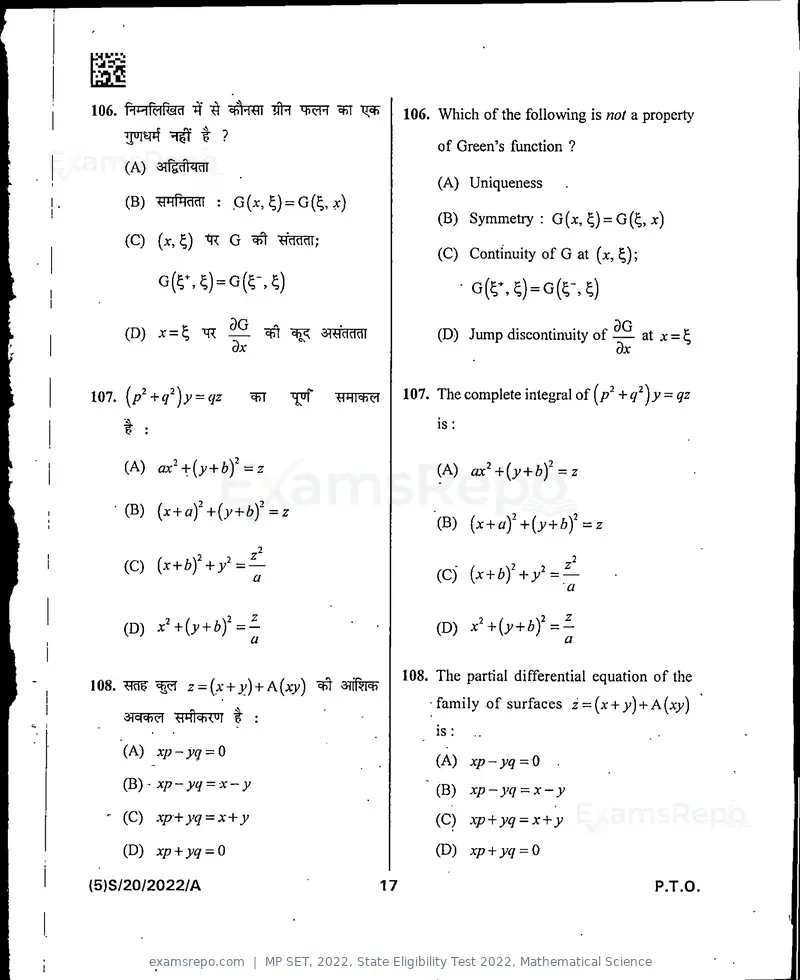
Text of page 19
106. rHHPdRsid       ^         #T      ^^          106. Which of the following is not a property
                 t ?
                                                        of Green's function ?
       (A) arfeta
                                                       (A) Uniqueness
       (B) W#ra : G(x, ^)= G(^, x)
                                                        (B) Symmetry: G(x, ^)= G(^, x)
       (C) (x,5) ^ G ^
                                                        (C) Continuity of G at (x, ;
             G(r,^)= G(^-,^)                                   • g(^\^)=G(^-,^)
                         *\^
                                                                                  3G
       (D) x =^ w: —                  awOTT             (D) Jump discontinuity of —  at x =^
                                                                                     dx


107.      +      =         ^    lyf                107. The complete integral of {^p^ + q^^y ~ qz
       I :                                              is :


       (A) ax'+[y+by=z                                 (A) ax^+(^y+ by = z
       (B) (x + c/)^+(y+&)" =z
                                                       (B) (x-{-ay +[y+by =■ z

       (C) (x+bf +/=^                                   (C) {x + bf + y'^^
       (D) x'+{y+ bf=^                                  (D) x'+{y+bf=-      a


                                                   108. The partial differential equation of the
108. w ^ z =(A-+;;)+ A(xy) ^ arrf^
                                                       • family of surfaces z = (x + j') + A(x;^)
       31^^              t ;
                                                        is:
       (A) xp~yq = 0
                                                        (A) xp~yq~0
       (B)' xp~yq = x-y                                 (B) xp~yq = x-y
  ^ (C) xp+yq = x+y                                     (C) xp + yq = x^y

       (D) xp + yq =0                                   (D) xp + yq = Q

(5)S/20/2022/A                                17                                           P.T.O,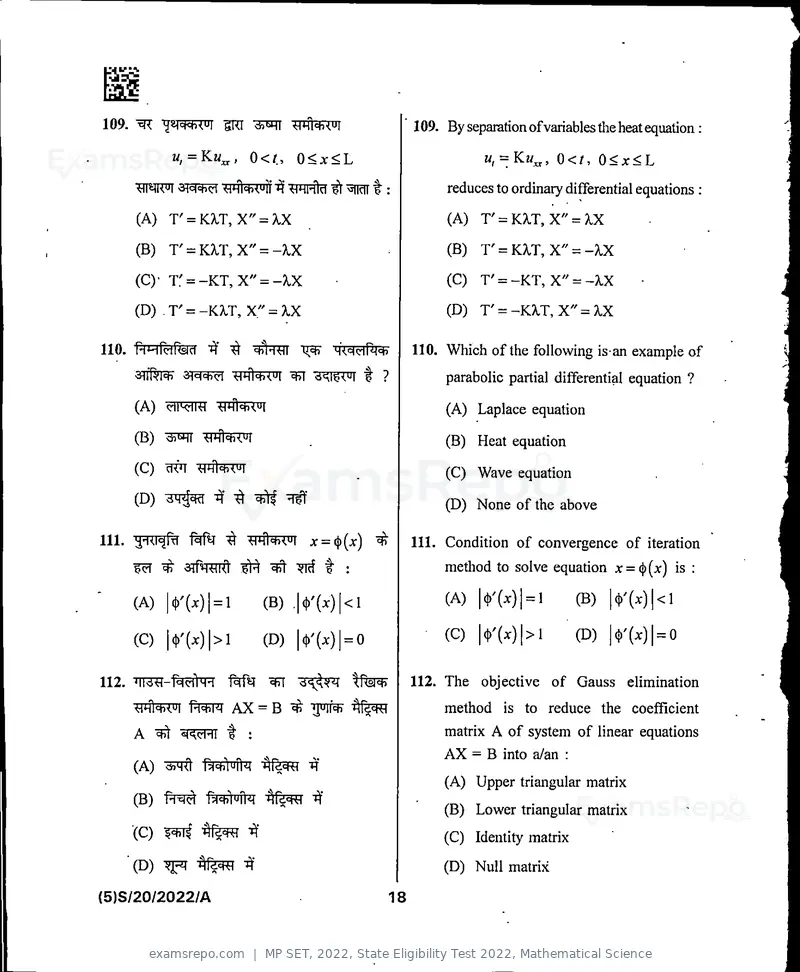
Text of page 20
109.          Y^ctcti<u| ^                            109. By separation of variables the heat equation;
                w, = Km^, 0</, 0<x<L                              u, = Ku^, 0</, 0<x<L
       '(HI'MK'JI                 '^Hn1d   ^TRTT :         reduces to ordinary differential equations ;
       (A) r = KXT,X''= XX                                 (A) T' = KA,T,X" = ?.X

       (B) V = KXr,X"= -XX                                 (B) r = KXT,X" = -^X

       (cy T'= -KT, X"= -^X                                (C) T' = -KT, X" = -A,X

       (D).T = -KXr, X"= A,X                               (D) r = -KXT, X" = XX

110. RnfdRsid                ^"Ih^hi "ct^ "rofcife    110. Which of the following is an example of
       aiff^ 31^^ JHHlch^ui ^ <i<|^{U| t 7                 parabolic partial differential equation ?
       (A)           ^h1^<ui                               (A) Laplace equation
       (B) "^rraTT ^Hl=h<u|                                (B) Heat equation
       (C) OT                                              (C) Wave equation
       (D)           "4*     ^                             (D) None of the above

111.                                 ;c =(f)(x) ^     111. Condition of convergence of iteration
       ^ ^ 37feTT^ ^ ^ ?lcJ t" :                           method to solve equation x = (i)(x) is :
       (A) |f(x)|= l          (B) .|f(x)|<I                (A) \^'{x)\ = \        (B) l(t.'(x)|<l
       (C) |fW|>l             (D) |(t)'(x)|=0              (C) |f(x)|>l           (D) IfW 1 = 0

112.                          ^                       112. The objective of Gauss elimination
       WTto^T feFT AX = B ^ ^]yrf^                         method is to reduce the coefficient
                                                           matrix A of system of linear equations
                                                           AX = B into a/an :
       (A)                           n
                                                           (A) Upper triangular matrix
       (B)          fWWrhr AfdcHH ■^*
                                                           (B) Lower triangular matrix
       ■(C)                                                (C) Identity matrix
       (D) ^                                               (D) Null matrix

(5)S/20/2022/A                                   18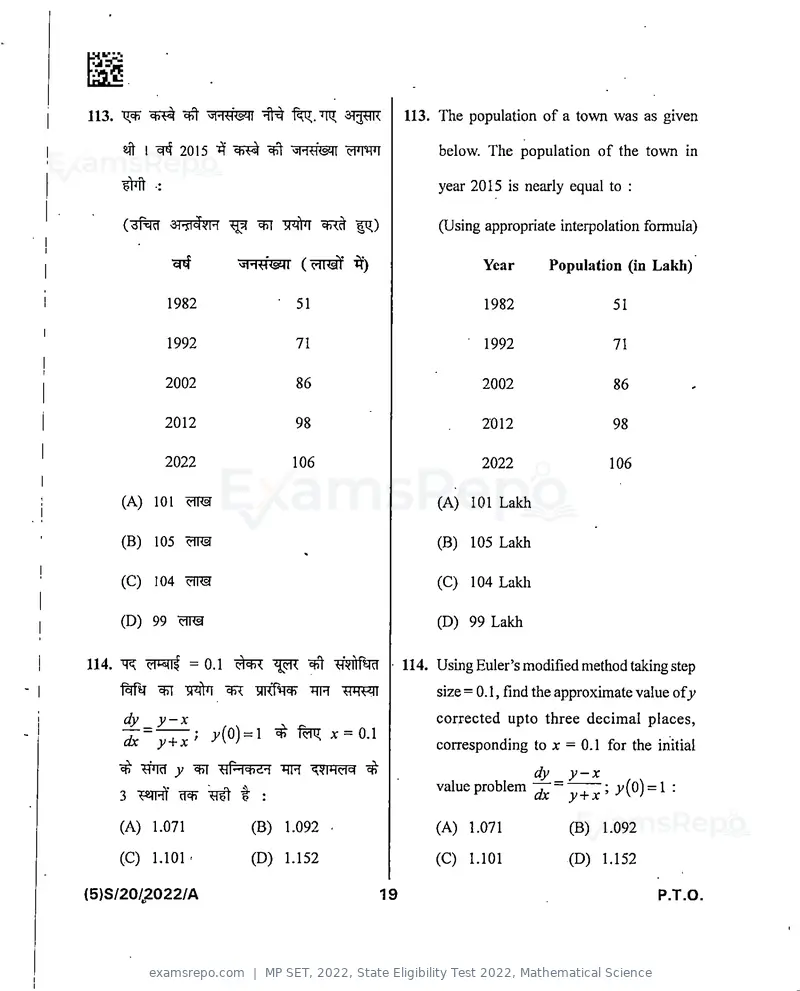
Text of page 21
113.       ^^                                         113. The population of a town was as given

               Mt I        2015 ^       ^              wm          below. The population of the town in

               #Tt ■:                                              year 2015 is nearly equal to :

               (^5f^ 3T?T#?H           ^             ^ ^)          (Using appropriate interpolation formula)

                          ■ar^       ^jR^fw (RH^f ^f)                     Year       Population (in Lakh)

                        1982               ■   51                         1982                  51


                        1992                   71                         1992                  71


                        2002                   86                         2002                  86


                        2012                   98                         2012                  98


                        2022                   106                        2022                  106


               (A) 101 cTT^                                        (A) 101 Lakh

               (B) 105 cTM                                         (B) 105 Lakh

               (C) 104 eim                                         (C) 104 Lakh

               (D) 99 elT^                                         (D) 99 Lakh

        114. -q^             = 0.1              ^             114. Using Euler's modified method taking step
               Mtr ^             ^               tth               size = 0.1, find the approximate value of_y
                      ^    ^                                       corrected upto three decimal places,
^   I
               ^=777; ;'{0) = 1 ^ ^ ^ = 0.1                        corresponding to x = 0.1 for the initial
               ^          y ^              1TR <^^lMeici ^                         dy _ y — x
                                                                   value problem                t(0) = 1 :
               3           TT^       f :
               (A) 1.071              (B) 1.092 .                  (A) 1.071            (B) 1.092

               (C) 1,101 '            (D) 1.152                    (C) 1.101            (D) 1.152

        {5)S/20/2022/A                                   19                                            P.T.O.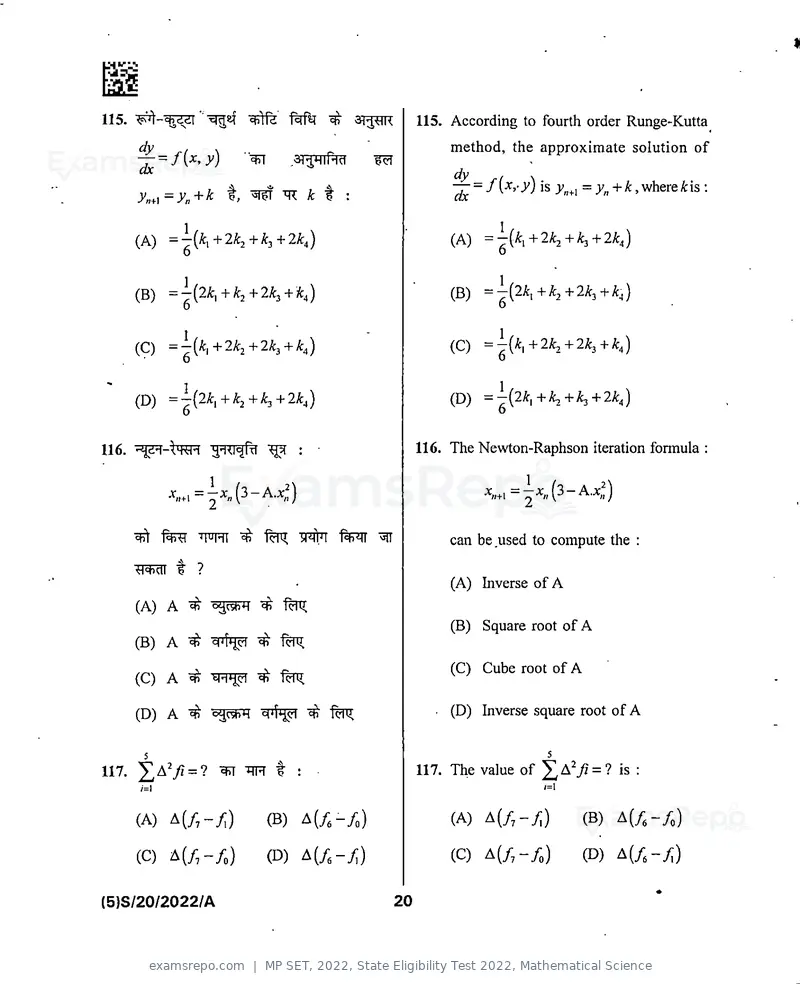
Text of page 22
115.                                               115. According to fourth order Runge-Kutta
                                                        method, the approximate solution of


       3'„+i=3'„+^ t, ^ TIT A t :
                                                       ^=            is      =>'„+A:,whereAis ;
       (A) = —(^1 + 2^2 +^3 + 2^4)                     (A) =—(Atj+2^2+A3+2/:4)
               6


       (B) =7(2^,+^2+2A3+?t4)                          (B) =         +^2 ^^3 +^4)
               D                                               6


       (C) =-(/:|+2^2+2^3+^4)                          (C) =7(^1 + 2^,+ 2^:3 + ^4)
                                                               0


       (D) =-^(2/:,+ ^2+^3+ 2^4)
               6
                                                       (D) = 7(2^1
                                                               6
                                                                           +^3 +2^:4)

116.               JiHilc^Pd TJ^ : ■               116. The Newton-Raphson iteration formula :


              -Vi=^^«(3-A.x,^)                               ^//+i ~ ^tt ~ A.x„j
       ^ f^iTT *m\ ^ 1^ "SRtI^            w             can be.used to compute the :
       TT^ t ?
                                                       (A) Inverse of A
       (A) A ^            ^
                                                       (B) Square root of A
       (B) A ^           ^ f^
                                                       (C) Cube root of A
       (C) A ^           ^
       (D) A ^                                       • (D) Inverse square root of A

        5                                                             5

117. ^A^y/ =? ^ TTFT t :                           117. The value of ^A^Ji = ? is :
        /=i                                                          i=i


       (A) A(/,-/)         (B) A(/,-/„)                (A) A(/,-y;)          (B) A(/,-/„)
       (C) A(/,-/„)        (D) A{A-f,)                 (C) A(/,-/„)          (D) A{f,-f,)

(5)S/20/2022/A                                20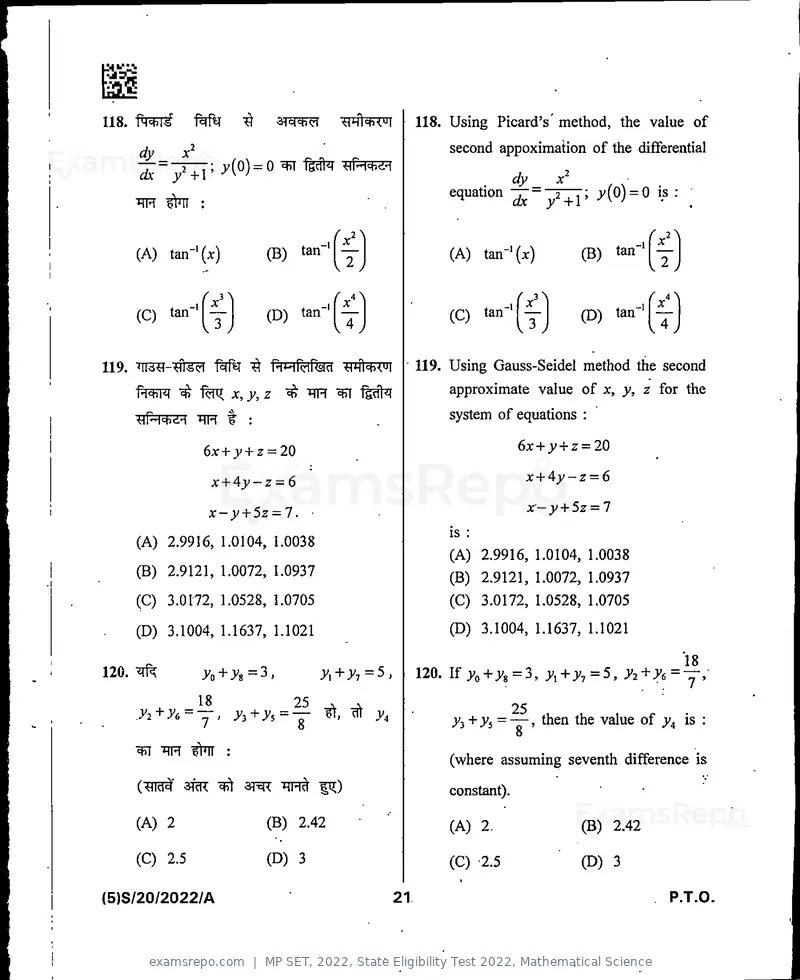
Text of page 23
118.                                                        118. Using Picard's' method, the value of
                                                                 second appoximation of the differential
       ^=               y(0)=:0 ^                                           dy _            f.
                                                                 equation                       =^      '
       HM 6*1'II ;
                                                                                                      r.2^
                                         -1
       (A) tan"'{;c)          (B)      tan
                                              v2.
                                                                (A) tan-'(x)            (B) tan"'
                                                                                                      v2y

                                              r .A \
                 -I                      -I                                                      -1
       (C)   tan
                              (D)      tan                      (C) tan -               (D) tan
                       3                      v4.                                                  .4,

119.                            rHHRrlHsId 4HHldi<"J| ■ 119. Using Gauss-Seidel method the second
       feFt        ^ x,y,z ^ "RR ^ ferk                          approximate value of x, y, z for the

                   tipt t :                                      system of equations :

                      6x + y +z= 20                                           6x + y+ 2= 20

                       x +4y — z = 6                                              x-i-4y~z =6

                      X-y +5z= 2. ■                                               x'~y+5z = 7
                                                                 is :
       (A) 2.9916, 1.0104, 1.0038
                                                                (A) 2.9916, 1.0104, 1.0038
       (B) 2.9121, 1.0072, 1.0937                               (B) 2.9121, 1.0072, 1.0937
       (C) 3.0172, 1.0528, 1.0705                               (C) 3.0172, 1.0528, 1.0705

       (D) 3.1004, 1.1637, 1.1021                               (D) 3.1004, 1.1637, 1.1021

                                                                                                             18
120.^                 ^0 +^8=3,          y^+y7=^>           120. If                       =5, ^2+^6-^,-
       .y2+y6 = — > y3+y5 = Y                    ^                          25
                                                                 y^+y^ = —,then the value of y^ is :
                                                                              8
       "^fiT HH eVil :
                                                                (where assuming seventh difference is
       (Tfm^' 3mT ^                      1^3;)                   constant).

       (A) 2                  (B) 2.42                          (A) 2.                  (B) 2.42

       (C) 2.5                (D) 3                             (C) -2.5             ' (D) 3
(5)S/20/2022/A                                         21                                               P.T.O.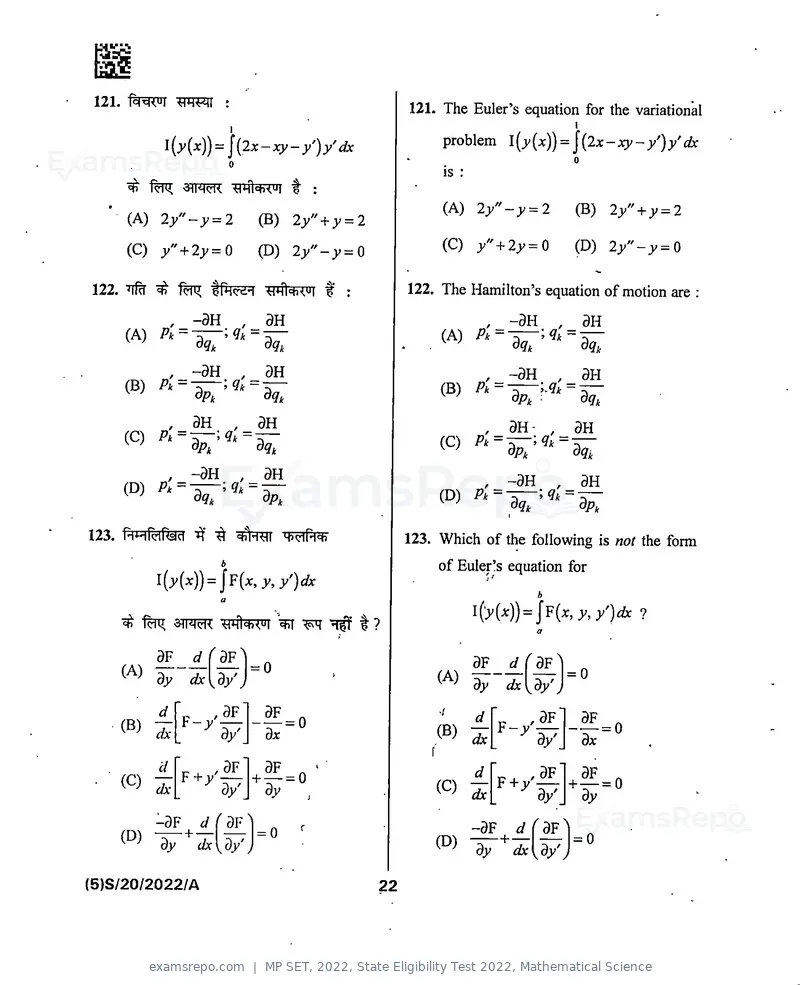
Text of page 24
121.                          :
                                                                121. The Euler's equation for the variational
                                                                                                1


             ^{y(^))=J(2^-^                      7'^                 problem l{y{x)) = j(2x-xy~y')y'dx
                                   0
                                                                     IS :

        ^         3iihq1<. ■HHl=t)<i'l ■§■ :
                                                                     (A) 2/'-;;= 2              (B) 2/' +;;= 2
   ■ (A) 2y"~y = 2                       (B) 2y" + y = 2
        (C) y" + 2y = 0                  (D) 2y"-y = 0               (C) y" + 2y=0              (D) 2/'~y=0

122. ■*# ^             'IfWCT                      f' :         122. The Hamilton's equation of motion are :
                     -9H                  3H                                         -an       an
        (A) A                  » ^Ar                                 (A) A              •;^A =
                     3a '
                                          an                              , -an , an
        (B) A                  •;^A =                                (B) A =3—= ^
                                                                     ^ ^             ^Pk ■          ^Qk
                                         aH                                  ,       an- ,      an
        (C) A
                     dp.   •;^A =
                                         a^,                         (C) a=^;a=^
                                                                           9a
                     -an                  an
                                                                                     -3H            9H
        (D) A                  •;?A =
                     a^^ '               dPi                         (D) A                 ■; A =
                                                                                     9?i            9a
123. rHHPdR^d                          -^\=m Wf^                123. Which of the following is not the form
                               A
                                                                     of Euler's equation for
            ^(^W) = jf(^' A /)^fe
                               a
                                                                                           b


    ^ feis: SIFrar                             ^          t?                i(yW)=jF(*, A/)«& ?

                                        =0                                  ap       d ( dY
    (A)                                                             (A)                        =0
            dy     cbc 19/.                                                 dy
            d
                                                                            d
    (B)     dx
                 p         /

                                        -f-"                                     p

                                                                                 . ^           -f=»
    (C)          F +_y'9|L                                                       P. / ap
                       9y'              v-»                         (C)
                                                                                               v-»
                                                                                                dy
            -ap       d                                                     -ap      d (dv'
                                         =0
                           \^y';                                            dy '^dx[dy\ = 0
(5)S/20/2022/A                                             22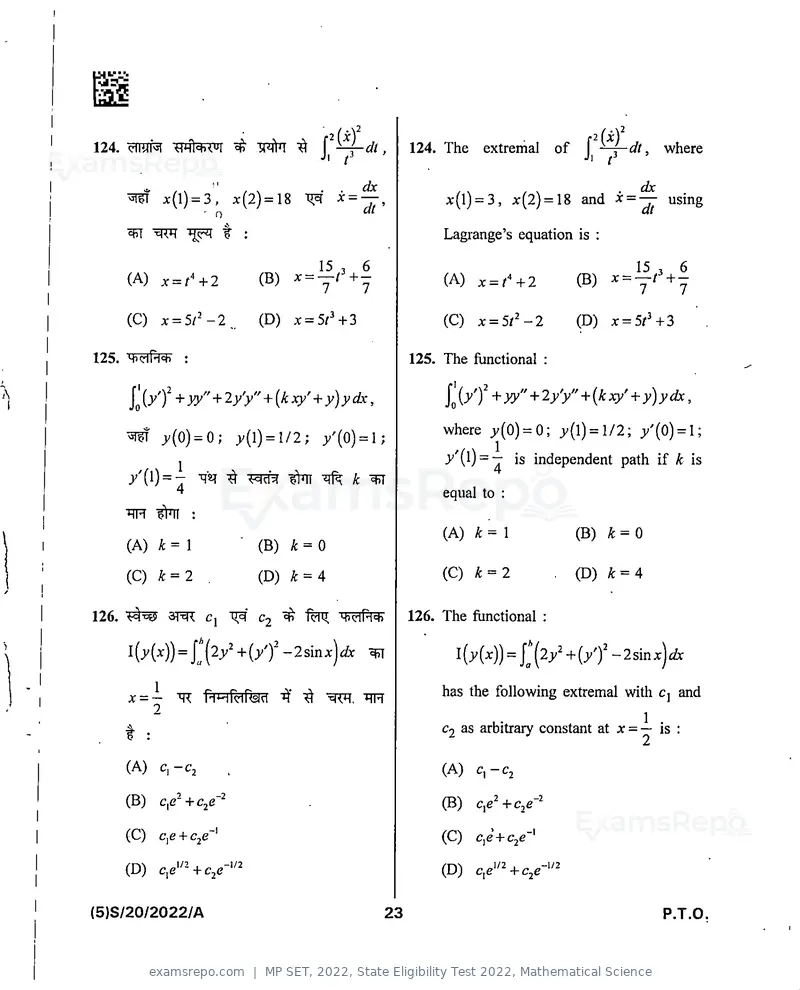
Text of page 25
2 fi)
124.                      ^         ^ Ji /3          ,     124. The extremal of Jif ~—dt,
                                                                                     ^3
                                                                                          where
                                                dx                                                dx
       ^ i(l)= 3, ;c(2)= 18                 i= —,               a:(1) = 3, x(2) = 18 and                 using
                    ' O

       m^                t :                                    Lagrange's equation is :

                                        15 3   6                                                  15 3    6
       (A) x =                 (B) ^=          +7               (A) x = t'+2            (B) ^ =          +7
       (C) ;c = 5/'-2„ (D) x = 5t'+3                            (C) x = 5/'-2           (D) x = 5?^+3

125. H^dPich :                                             125. The functional :


       ll{/f + yy"+'^yV +{kxy'+ y)ydx,                          J„ {y'f + yy"+^/y"+{k^'+y)ydx,
                                                                where ;'(0) = 0; 3^(1) = 1/2; ;''(0) = 1;
       ^ ;'(0)=0; ;'(l)= l/2; /(0)= 1;
                                                                /«= 7 is independent path if k is
       /(l)=;^            ^        ^           A: ^             equal to :
       HM $Vii :
                                                                (A) A = 1               (B) A = 0
       (A) jt = 1             ■ (B) A = 0
       (C) A = 2 .             (D) A = 4                        (C) A = 2               (D) A=4


126.          3r^ C|            C2 ^        HidPi=h        126. The functional :


       I (x))=£(2y +{y'f -2sin a:) ^                              Ky{^))=              +{y'f -^sinxjdx
       ;c =i "qr PlHrdRsJd "4* ^ ■^. iTFT                       has the following extremal with Cj and
           2
                                                                C2 as arbitrary constant at a: = - is :

       (A) c,-C2                                                (A) c,-C2
       (B) c.e'+c^e-2                                           (B) CjC^+Cje"^
       (C) c,e + c,e-1                                          (C) CjC + Cje"'
                                                                             '2


       (D) c.e'^" + C2C~'^^                                     (D) c^e^'^ + c^e-1/2
                                                                       1/2 .


(5)S/20/2022/A                                        23                                               P.T.O,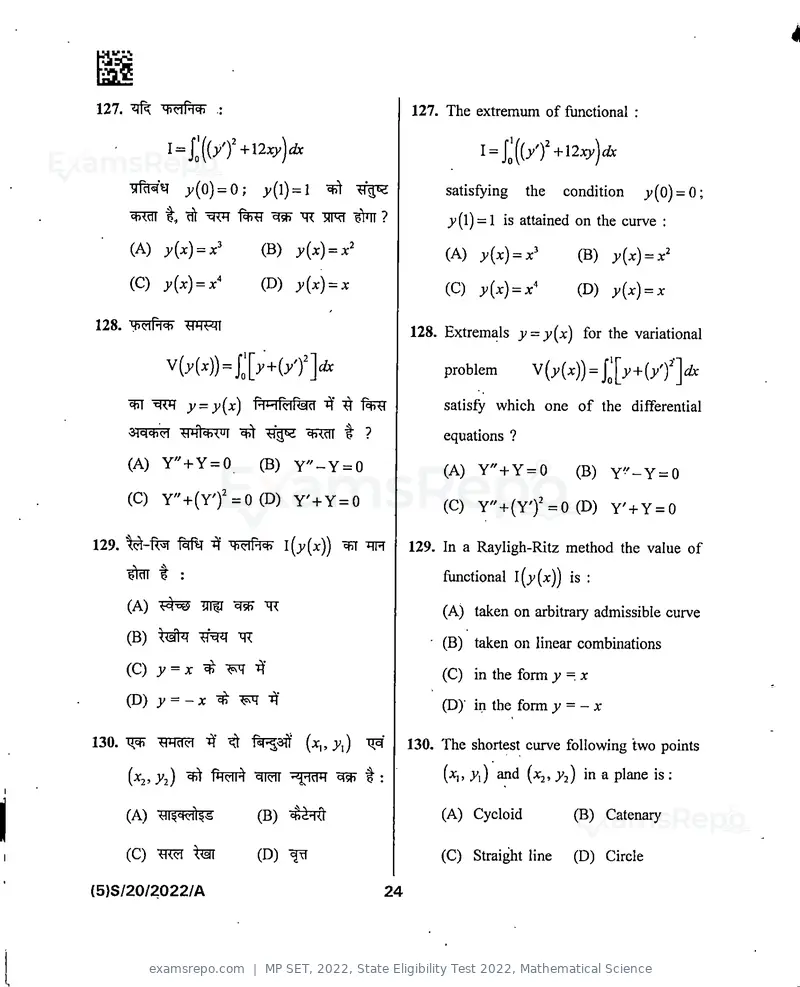
Text of page 26
127. "^Tf^ Wfe                                         127. The extremum of functional :

              l=ll{{y'f+nxy)dx
                 ;'(0)=0; ;'(l)= l ^                        satisfying the condition           >'(0) = 0;
              t, eft WT        ^"qr "HM ^?                   >^(1) =! is attained on the curve :
       (A) :^(:>:)= ;c^       (B) y(x)= x^                  (A) y(x) = x^            (B) y{x) = x^
       (C) ;;(x)= x''         (D) ;'(x)= :s:                (C) >'(x) = x''          (D) >'(x) = x
128.
                                                       128. Extremals >' = jy(x) for the variational

                                                            problem       V (;;(x)) = £ +(y'f ]dx
       ^         ^=          Pi*-ifenRaa   ^ f^RT           satisfy which one of the differential
       37^^                ^                f ?             equations ?
       (A) Y"+Y =0           (B) Y"-Y =0                    (A) Y"+Y = 0             (B) Y<'-Y = 0
       (C) Y"+(Y')'=0 (D) Y'+Y =0                           (C) Y" +(Y')'=0 (D) Y' + Y=0
129.                      Wfe l(7(^)) ^                129. In a Rayligh-Ritz method the value of
       ^t :                                                 functional l(>'(x)] is :
       (A)            Tir^ ^                                (A) taken on arbitrary admissible curve
       (B) Mr Mr rt                                       ■ (B) taken on linear combinations
       (C) 3; = JC ^ ^                                      (C) in the form y = x
       (D) j' = - X ^ ^                                     (D)" in the form ^ = - x

130.         tinaei       ^ f^3^f (x,, _yj) RR         130. The shortest curve following two points

       (^2' ^2) ^ fMrft RT^                RRi ■§ :         (x,, ^i) and (xj, ^^2)      ^ plane is :

       (A)                   (B)                            (A) Cycloid          (B) Catenary

       (C)        M          (D) RR                         (C) Straight line    (D) Circle

(5)S/20/2022/A                                    24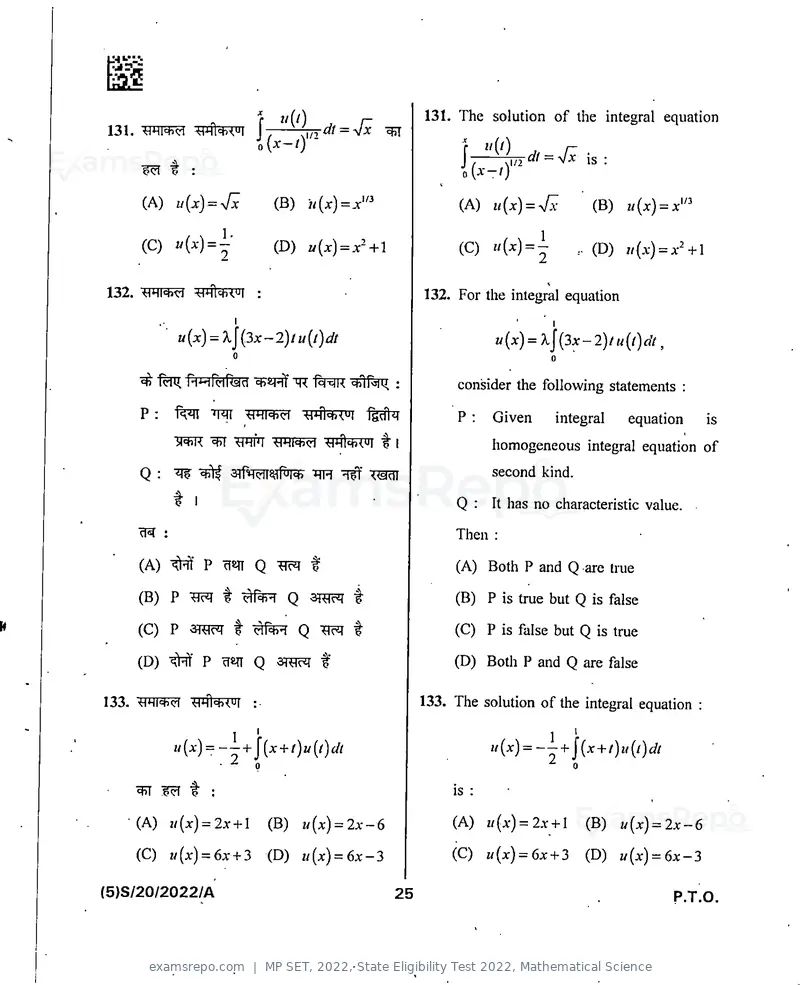
Text of page 27
m
                             f                  f-
                                                            131. The solution of the integral equation
                             i{x-t) -                                   "(')
                                                                  I(--0' di — yfx is :
        (A) u[jc)= Jx            (B) «(x)=ji:''^                 (A) ii[x)=4x           (B) z/(x)= x"^
        (C) u{x)=^               (D) u(x)=x~+l                   (C) it{x)=~            (D) 7/(.v)= a:'+1

 132.                        :                              132. For the integral equation
                         I                                                       I

             u{x)= Xj{3x~2)lu{t)dt                                       w(x)= ^|(3jc-2)/M(^)flV,
                         0                                                       0


          f^M."f^TR^fecI "^Kpri        f^-cJK          ;         consider the following statements :
        P: T^m\ "To                             "fefhr           P : Given        integral   equation       is
                                                     t" I                homogeneous integral equation of
        Q;                             "HH          vm                   second kind.

             t I                                                 Q : It has no characteristic value.

     ^:                                                          Then :

     (A)           P cTS^T Q ^ t                                 (A) Both P and Q are true
     (B) P ^ t                     Q            t                (B) P is true but Q is false

     (C) P               t           Q ^%                       (C) P is false but Q is true
     (D)           P cr£TT Q            t                       (D) Both P and Q are false

133. ^H|ch<ri                :                              133. The solution of the integral equation :
                         j   '                                                   j '
             "{^)=-^+j{x+ t)"{<)'^'
                     ■       0
                                                                        "W=-T+J(^+')"(')'"
          ^ t" :                                                 IS :


    (A) z/(x)= 2x4-I (B) u{x)= 2x~6                             (A) 7/(x-)= 2.y + I (B) w(a:)= 2a:-6
    (C) m(x)= 6a:+3 (D) w(x)= 6;c-3                             (C) u{x)= 6x +3 (D) m(x)= 6x-3

(5)S/20/2022/A                                         25                                           P.T.O.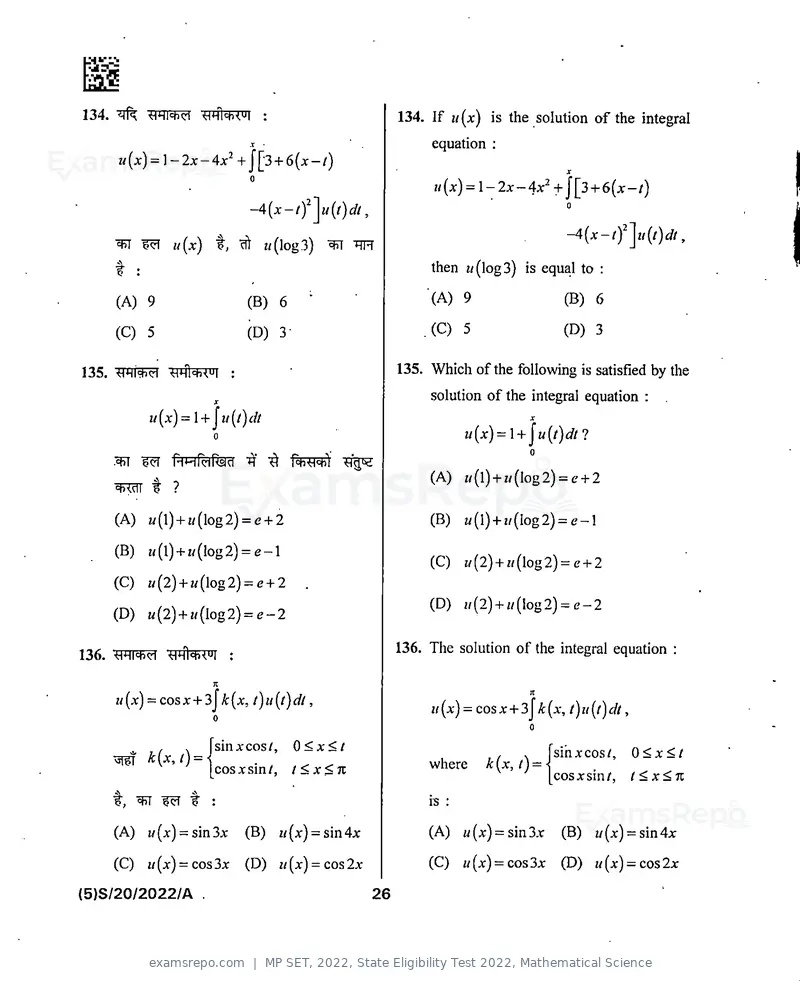
Text of page 28
134. ^                             :                 134. If 2/(a:) is the solution of the integral
                                                          equation :
        u[x)=\~2x-Ax^ +|[3+6(:c-/)                                              X
                               0
                                                           2/(a:)= 1-2x-4a:^ +j[3+6(a:-/)
                               -A[x-tf'^u{t)dt,                                 0


             ^ m(a:) t", ^ z/(log3) ^                                           -4{x-l)^'^ii{t)dt,
        vV

       ? :                                                then 2/(log 3) is equal to :
       (A) 9                   (B) 6    ^   ■             (A) 9                (B) 6

       (C) 5                   (D) 3-                    .(C) 5                (D) 3

135. ^Hl=hd ^Hl=b<u| :                               135. Which of the following is satisfied by the
                       X
                                                          solution of the integral equation :
              u[x)= \+jii{t)dt                                            X


                       0                                         ii[x)-\-\-^u[t)dt 2
                                                                          0
                 PihRiRsiu "4*
                                                         (A) 22(1)+ 2/(log 2)= 6'+ 2
              t ?
       (A) u(l)+ II(log 2)= e + 2                        (B) 22(l)+ 2/(log2)= t'-l
       (B) It(l)+ u(log 2)= e -1
                                                         (C) n(2)+ 2/(log 2)= e+ 2
       (C) «(2)+ w(log2)= e + 2
                                                         (D) 22(2)+ 2/(log2)= e-2
       (D) u(2)+ u(log2)= e-2

136.                       :
                                                     136. The solution of the integral equation :

                       n


       w(x)= cosx+3JA:(x, t)u[t)di,                       2/(a;)= cosA:+3jA(x, t)ii[{)dt,
                       sinxcos/, 0<x</                                        sinACOs/, 0<A</
                       cos;c sin/, l<x<K                  where k(x,t)-
                                                                              cos A sin/, /<A<7C
       t", ^        t" :                                  IS :


       (A) w(A:)= sin3;c (B) 2/(a:)= sin 4a:             (A) 22(a)= sin 3a (B) 2/(a)= sin 4a
       (C) 2/(a:)= cos3x (D) 2/(a:)= cos 2,v             (C) 2/(a)= cos3a (D) 22(a)= cos2a
(5)S/20/2022/A .                                26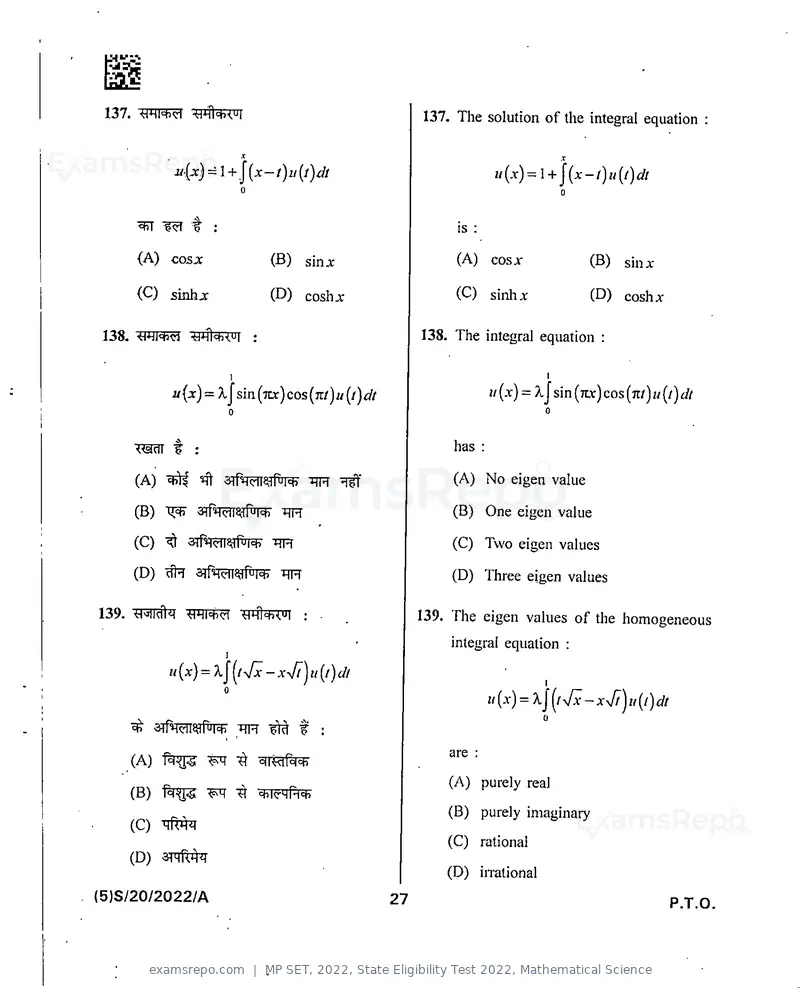
Text of page 29
137.          4j4]c^.<ui                           137. The solution of the integral equation

                              X
                                                                              X


                    -1+J(x-/)i/{i)di                             u{x)= l +j{x-l)u(()dt

                                                         IS :


        (A) cosx                  (B) sin A'            (A) COSA-                 (B) sinA

        (C) sinhj;                (D) cosh A            (C) sinhA                 (B) cosh A

 138.          4-141ch<u| :                         138. The integral equation :

                          1                                               I


             «{a)= Xjsin(tcx)cos(JT/)w(/)i//                     II(a)= A.J sin(tia)COS(ir/)u{l)clt
                      0                                                   0


        «siai % :                                        has :


    (A) ^             3Tf^a#T^ TTPT                     (A) No eigen value

    (B)         atfro^rirrr^ TTH                        (B) One eigen value

    (C) ^ a#I^^Tfq^ tth                                 (C) Two eigen values
    (D) #T                          ttft                (D) Three eigen values

139. "^mfN                    -IH41414^1 ; .        139. The eigen values of the homogeneous
                                                        integral equation :
                      1

            U(a)= J(/^/A -Xy/t^ II[/)clf                                  1
                      0
                                                                 U(a)=        Va -A>//)II(i)dl
                                                                         0

    ^                         ttpt ^ f .
                                                        are :
    (A)          ^ "4 ^R<ri4^
                                                       (A) purely real
    (B) 14       ^ "4 ctiKrHpich
                                                       (B) purely imaginary
    (C)
                                                       (C) rational
    (D) 37T4t4^
                                                       (D) irrational
(5)S/20/2022/A                                 27                                                p.T.O.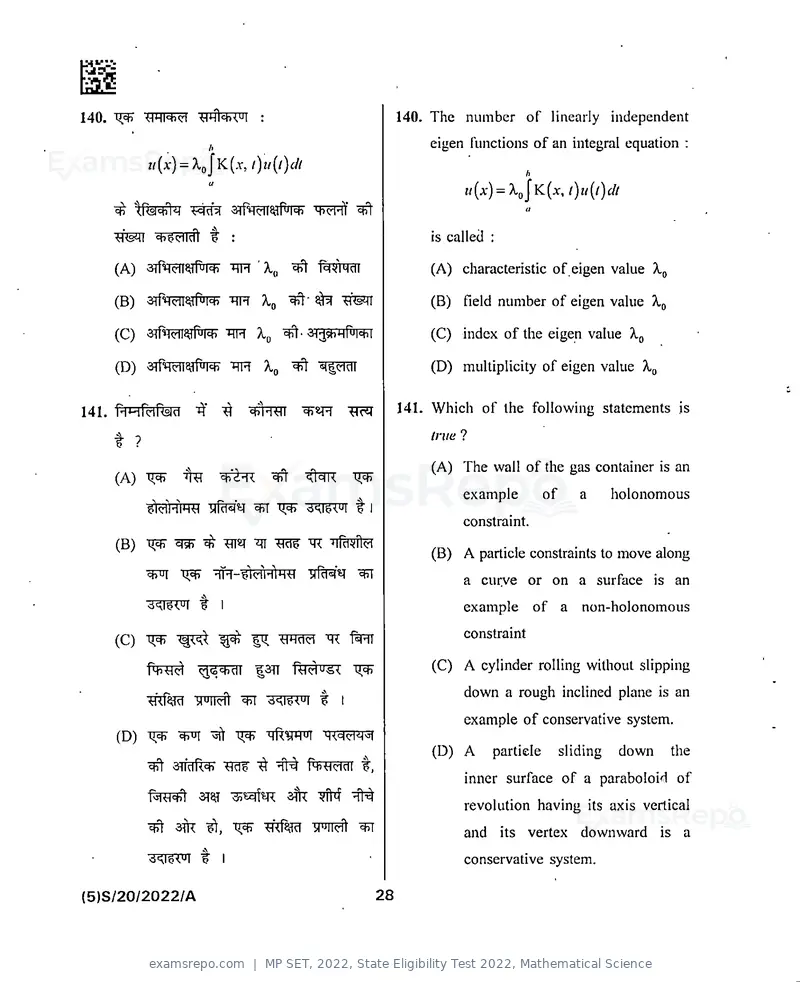
Text of page 30
140.                                     :                              140. The number of linearly independent

                         /.                                                 eigen functions of an integral equation :
             w(A-)= A.ojK(.v,                                                                   h
                         a
                                                                                 w(a') = A,oJiC(a-, l)u[()clt
          tHsichl^                                  wRf ^                                       a


       ^H*<s4i ch^cniol f :                                                 is called :

       (A) a#T^^rfTO "RPT ' X(, ^ Mm                                        (A) characteristic of,eigen value Xq

       (B)                        "rr ;\-(j         ^                       (B) field number of eigen value Xq

       (C)                    "RPT A,p           ^;1,9bHf"l=til             (C) index of the eigen value Xq

       (D)                        *RH         ^ "RfM                        (D) multiplicity of eigen value


141. PHHrcrlRsId              ^                                         141. Which of the following statements is
                                                                            inte ?
       t ?
                                                                            (A) The wall of the gas container is an
       (A) ttr M                             ^
                                                                                 example            of      a      holonomous
             ^I#TFRT                  ^                    t1
                                                                                 constraint.

       (B) "Q;^ M ^ RST "RT                      RT RfMR                    (B) A particle constraints to move along
             ^ "q;^ rr-wrM -jrfcRR ^                                             a curve or on a surface is an

                       t I                                                       example of a non-holonomous
                                                                                 constraint
       (C)                   ^ ^q;                  RT Mr
                       ^dcbdl l^TT fw^ TT^                                  (C) A cylinder rolling without slipping
                                                                                 down a rough inclined plane is an
             ■^rT^ OT# ^                            t I
                                                                                 example of conservative system.
       (D)                         "q;^ Rft^TR^ RK^FRR
                                                                            (D) A      particle          sliding    down   the
             ^ strM                              Mwt t.
                                                                                 inner surface of a paraboloid of
             f^RRit 378J                      3TR         '(1-c)
                                                                                 revolution having its axis vertical
             ^ 3ik                "q;^                     ^                     and      its   vertex      downward is     a

             •i "^16^.^1 ^    I                                                  conservative system.

(5)S/20/2022/A                                                     28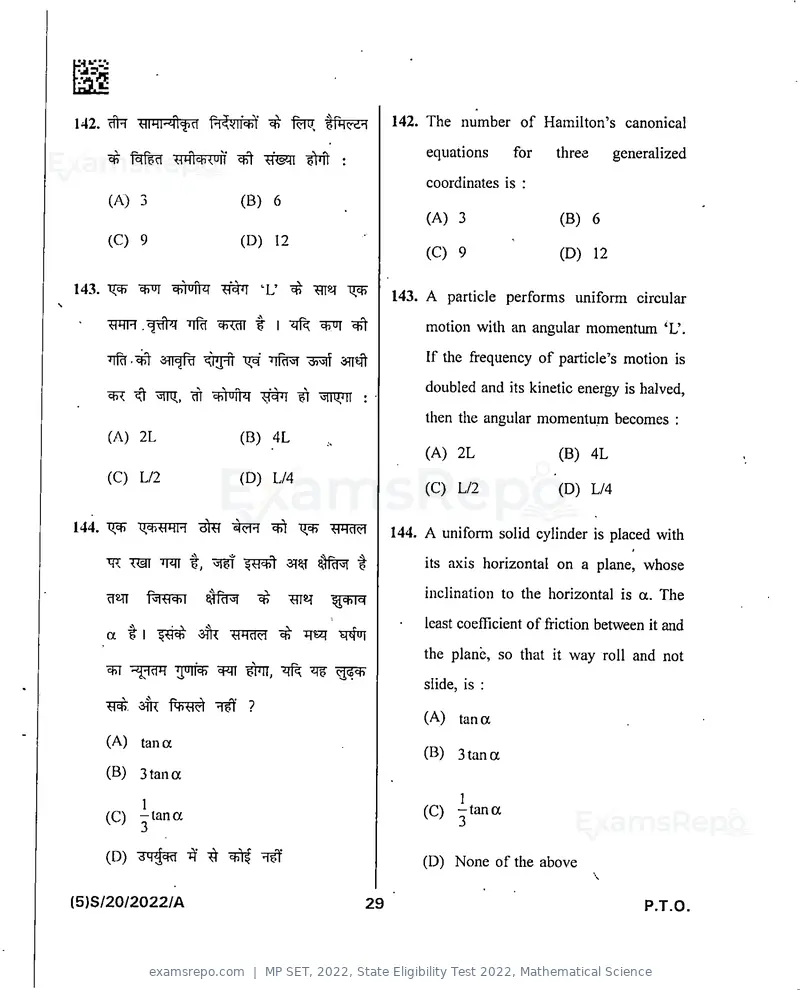
Text of page 31
142. #T                              ^ %IT                 142. The number of Hamilton's canonical

       ^ 1^%cf ^HHlcb<u|T ^               ^:                    equations     for     three    generalized
                                                                coordinates is :
       (A) 3                   (B) 6
                                                                (A) 3                 (B) 6
       (C) 9                   (D) 12
                                                                (C) 9                 (D) 12

143. 13^ W ^Tmk                     'U ^ W4                143. A particle performs uniform circular
       "HTIH.f^ ^                  t I ^^^                      motion with an angular momentum ^U.

       ■^'■^ 37T^f%            "Q;^ mRi'SI "31^ STT?^           If the frequency of particle's motion is
                                                                doubled and its kinetic energy is halved,
       ^ ^ ^ly,, "dt ^dWrt^               ■?! ^TnjjfT :
                                                                then the angular momentum becomes :
       (A) 2L                  (B) 4L
                                                                (A) 2L                (B) 4L
       (C) L/2                 (D) L/4
                                                                (C) L/2               (D) L/4

144,                           4qh        M,cti ^Hd^ri     144. A uniform solid cylinder is placed with
       ■qK       7T?n t, W             37^          t           its axis horizontal on a plane, whose

       ?TaTT   Pd-Hchl                 ^a{      ^chM            inclination to the horizontal is a. The

                                                                least coefficient of friction between it and
       a 11              afk          ^          -ET^
                                                                the plane, so that it way roll and not
       ^                   ^ #TT, -ztR ^
                                                                slide, is :
       ■?T^, ^ fT>^             ?
                                                                (A) tan a
       (A) tan a
                                                                (B) 3 tan a
       (B) 3 tan a


       (C) -lana                                               (C) ^tana
       (D)                     ^                               (D) None of the above

(5)S/20/2022/A                                        29                                             P.T.O,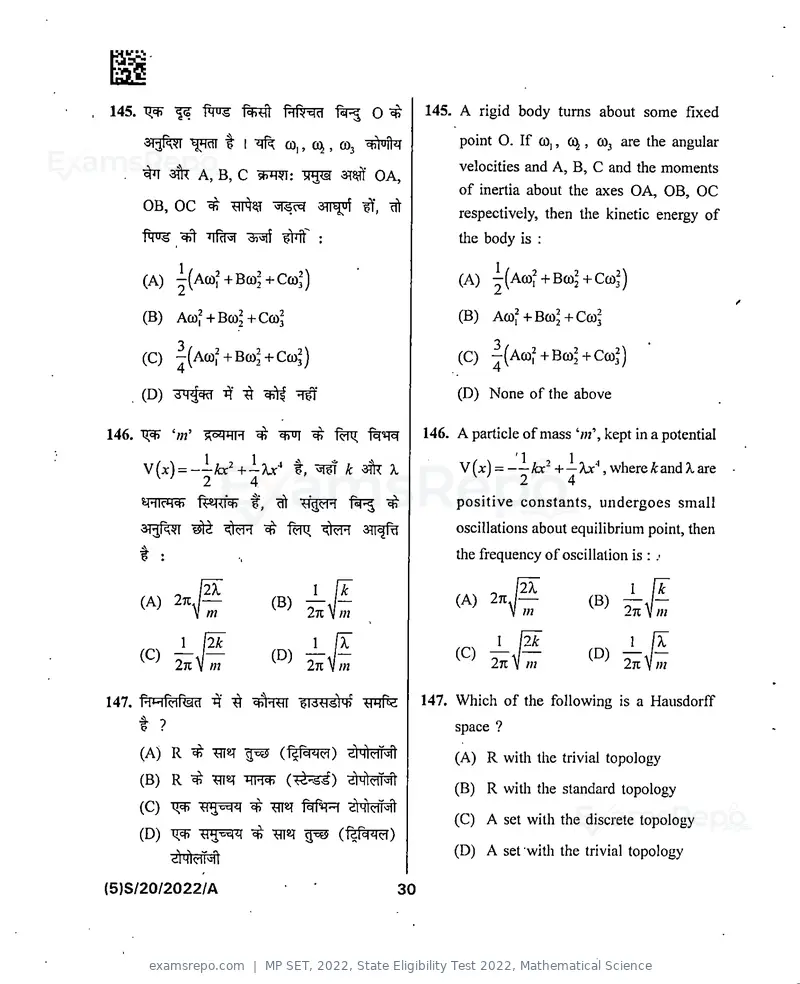
Text of page 32
145.         ^                              1^ O ^                 145. A rigid body turns about some fixed

                       \         CO,, 0^ , 0)3                            point O. If CO,, 0^ , CO3 are the angular
                                                                          velocities and A, B, C and the moments
  . ^ sfk A, B, C                     TI^ 37^* OA,
                                                                          of inertia about the axes OA, OB, OC
       OB, OC ^                "51^ 371^ ■^*, Tit                         respectively, then the kinetic energy of
               ^ "^TfcR ^ #Tf :                                           the body is :

       (A) ^(Acof+Bco^+Ccoa)                                              (A) ^(Acof+BCO2+CCO3)
       (B) Aco^ + Bo)2+Cco3                                               (B) Acof+BCO2+C(03

       (C) -(Aw^+Bco^ + CcOj)                                             (C) —(Acof+ BCO2+CCO3)
       (D) 3M^cK1              ^ -^T^*                                    (D) None of the above

146.         'm' ^ozmn ^ ^                                         146. A particle of mass 'm\ kept in a potential
                                                                                    '1      1
       V(jc) = —^-kx^ +~7^^ %,                 A: 3?^ X                   V(a:) = —Ax" H—Xx"^, where A: and A, are
                                                                            ^ ^    2     4
         ^ ^     2         4
                           t, "dt                      ^                  positive constants, undergoes small
       3T5f^                 ^             ({l^rli 3TTo[|%                oscillations about equilibrium point, then
       t :                                                                the frequency of oscillation is :

                                       I      /t                              ^ —
                                                                          (A) 2k 2X
       (A) 27cJ—
                V m                                                                 V 7«

               1 &                    _1_ X                                     I f2A
                                (D)
                                      2n V /«

147. PlHlelRsid "4'                                  ^^Trrffe^     147.   Which of the following is a Hausdorff
       t ?                                                                space ?
       (A) R ^ TTT^                             ^IhIcimI                  (A) R with the trivial topology
       (B) R ^ "^ns^ ■tnTO                     zhqt^fNt                   (B) R with the standard topology
       (C)                 ^                       eiHieiMl
                                                                          (C) A set with the discrete topology
       (D)                 ^          ^ (rdPddd)
                                                                          (D) A set "with the trivial topology
             il4ldNl

(5)S/20/2022/A                                                30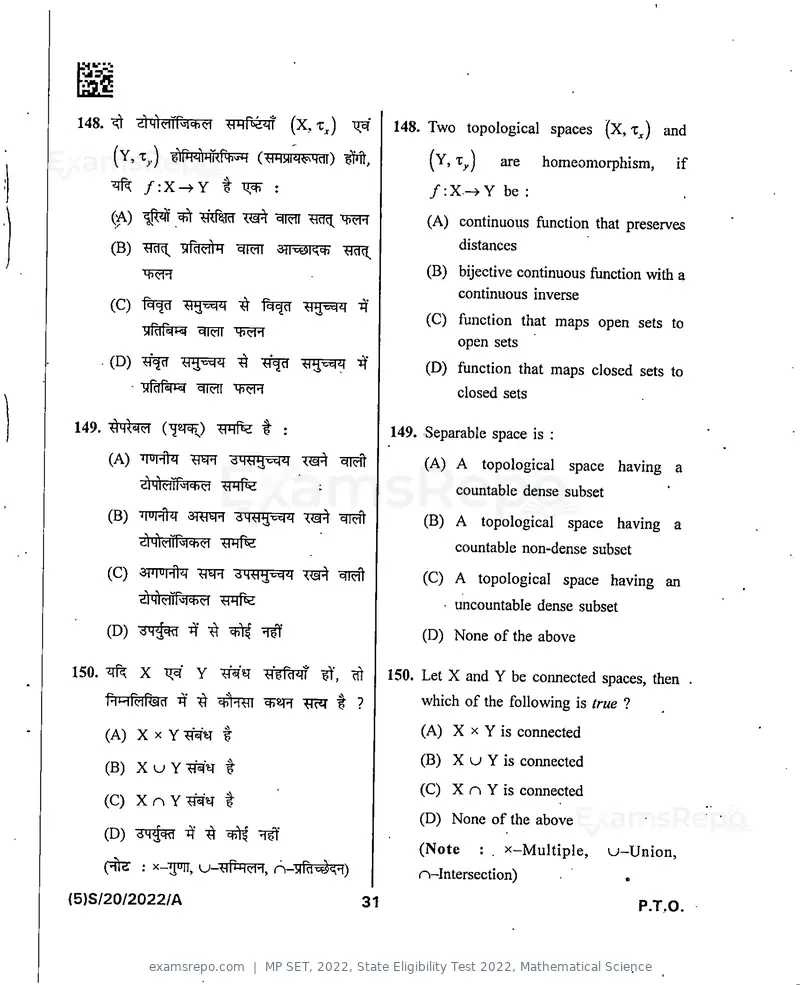
Text of page 34
WT III (Part III)
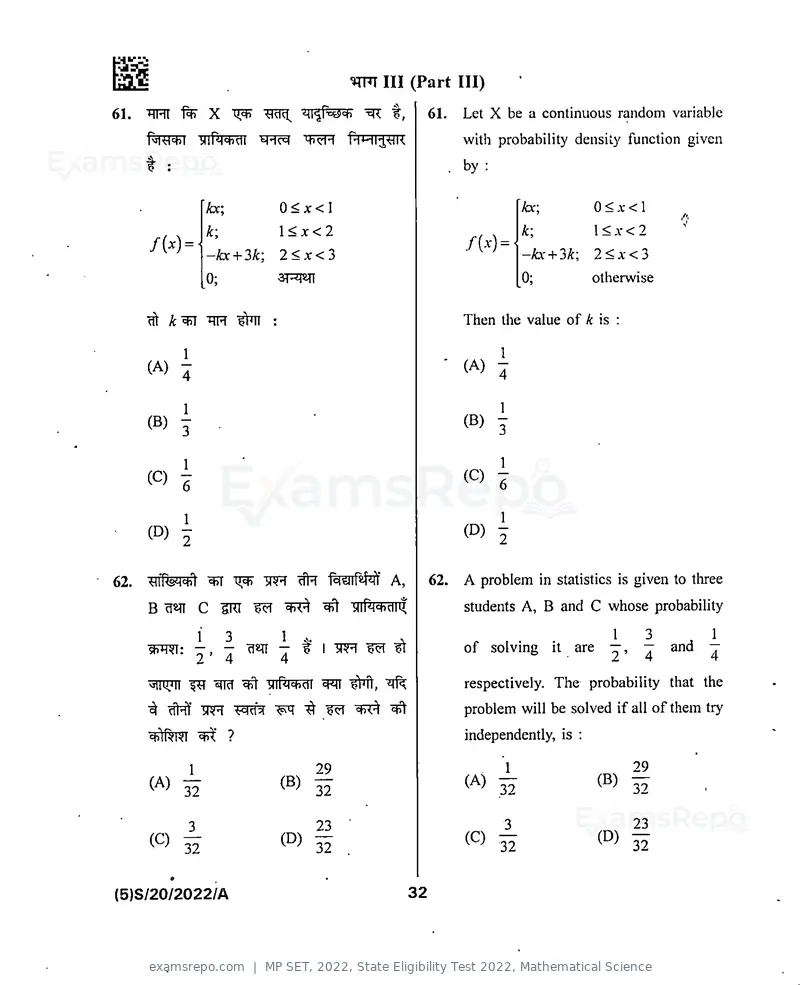
61. "^THT             X                                  %,    61.       Let X be a continuous random variable

                   yiP^chdl                 "^Ti^ PHHIj.'HK              with probability density function given
      t:                                                             . by:

                      Ax;            0< X < 1                                       Ax;        0 < X <1
                      A;             l<x<2                                          A;         l<x<2
      /W= -Ax +3A; 2<x<3                                                 /(•v)= -Ax+ 3 A;      2<x<3
                      0;             srw                                            0;         otherwise


      ^ A ^ T7FT                    :                                    Then the value of A is

              1                                                                1
      (A) 7                                                              (A)


      (B) ^                                                              (B)


                                                                         (C)
             6


      (D)                                                                (D)


62.                                yiifi       "f^^JTfsto A,       62.   A problem in statistics is given to tliree
      B cT^TT C                               ^ Hii^ctidik.              students A, B and C whose probability
                  1        3            1 ^               ^                                       1    3        1
                  7. 7               7 ^ I          ^^                   of solving it are        —, —     and —
                  2  4               4

      WT^nr                     ■sFt yiP^chdi ^                          respectively. The probability that the
                                                                         problem will be solved if all of them try
      chlP^lJ^I             ?                                            independently, is :

                                                                                                      29
              J_                      (B)
      (A)     32                              32


                                             HI                          (C)                   (D)
                                                                                                      HI
      (C)                             (D)     32                               32                     32
              32


(5)S/20/2022/A                                                32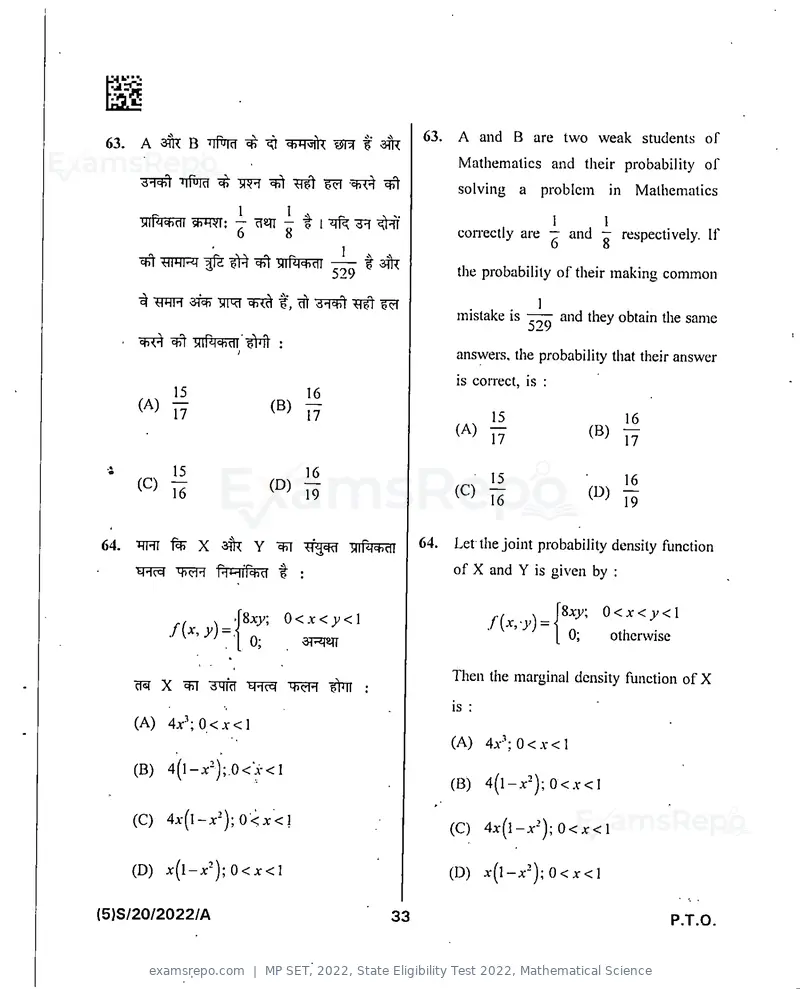
Text of page 35
63. A and B are two weak students of
 63. A 3?k B Tjfm ^ ^                       m # 3TR
                                                                 Mathematics and their probability of
     "3^            ^ "R^ ^                ^          ^          solving a problem in Mathematics

     urfemr ^^rm: 7-                  t i -qf^^                                    1         I
                       6          8                              eoirecliy are — and - respectively. If
        '<HIHI"H ^Id            RlRlchclI         ^
                                                                 the probability of their making common
       ^HM 3T^ "RP^ qfPC^ %'j          'dlcbl                                 1
                                                                 mistake is            and they obtain the same
     ch<*^ ^ Mlf^chdl           :
                                                                answers, the probability tiiat their answer
                                                                is correct, is :
              15                      16
    (A) -                      (B) -
                                                                       15                          16
                                                                (A) -                     (B) -

          \5                          16
                                                                       15                          16
    (C)
          16                          T?                                                  (1^)


64. HHT            X 3fk Y                      Rlf^chdl   64. Let the joint probability density function
              ^dd PiHiT^d "i" :                                 of X and Y is given by :

                           Sxy\ 0 < a: < ;^ < 1                         ,     , \Sxy; 0<;c<j<l
          /(..)=f;                                                                               otherwise


                                                                Then the marginal density function of X
          X         3Hid            4)dd
                                                                is :
    (A) 4r\0<x<l
                                                               (A) 4a-';0<.v<1
    (B) 4(1-;c');.0<a-<1
                                                               (B) 4(1-a:-);0<.v<I
    (C) 4A:(l-A:'j; 0<:a:<1                                    (C) 4x(l-x-]; 0<x<l
    (D) x(l-;c"); 0<jc<l                                       (D) a:(1-x"]; 0<a:<1
(5)S/20/2022/A                                        33                                                 P.T.O.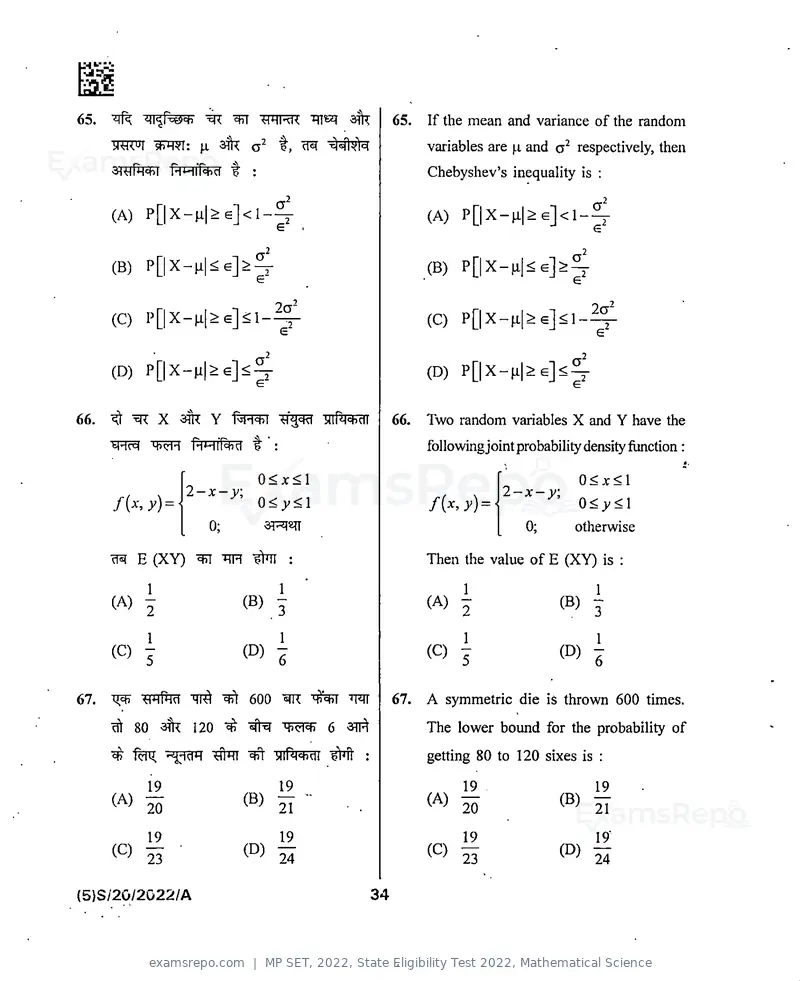
Text of page 36
65. ^                   ^ ^ TF7RR                 37^         65.   If the mean and variance of the random

      TROT sFWT: ^ 3ifk o' t, ^ ^«41vl^                             variables are |.i and    respectively, then
      smfer rHHlP^d t :                                             Chebyshev's inequality is ;

      (A) P[|X-n|>e]<l-J^                                           (A) p[|X-n|>e]<l-|^
      (B) P[|X-n|<e]>|^                                             (B) P[|X-^ll<e]>|■
      (C) P[|X-n|>e]<l-^                                            (C) P[|X-ti|>€]<l-
                                                                                                2(j'


      (D) P[|X-n|>e]<J                                              (D) P[|X-n|>6]<J
66.       ^ X 3^ Y                             TntecTT        66.   Two random variables X and Y have the

      ■SRc^ -q^ rnHlP+id t ' :                                      followingjoint probability density function :

                                 0<x<l                                                        0<x<l
                     2-x-y;                                           /       N   2-x-y;
      /(^% p)=                                                      f{x,y) = \                0<y<\
                         Oi       3E^2TT                                             0;      otherwise

      ^ E (XY) ^ "RPT #TT :                                         Then the value of E (XY) is :

      (A)
            1
                              (B) i                                 (A)
                                                                          1
                                                                                            (B) ^
      (C) -                   (D)                                   (C) 3                   (D) -


67.         WrfEtT "RT^ ^ 600 "STR                W           67.   A symmetric die is thrown 600 times.
      ^ 80            120 ^ ^                  6 ^                  The lower bound for the probability of
      ^           '^'lan "^frRT "qft 3#T^hIT         :              getting 80 to 120 sixes is :

                                    19                                    19                     19
      (A)
            12.
            20                0^) ii ■"
            19                      19                                    19                     19"
                              (D) ^

(5)S/20/2022/A                                           34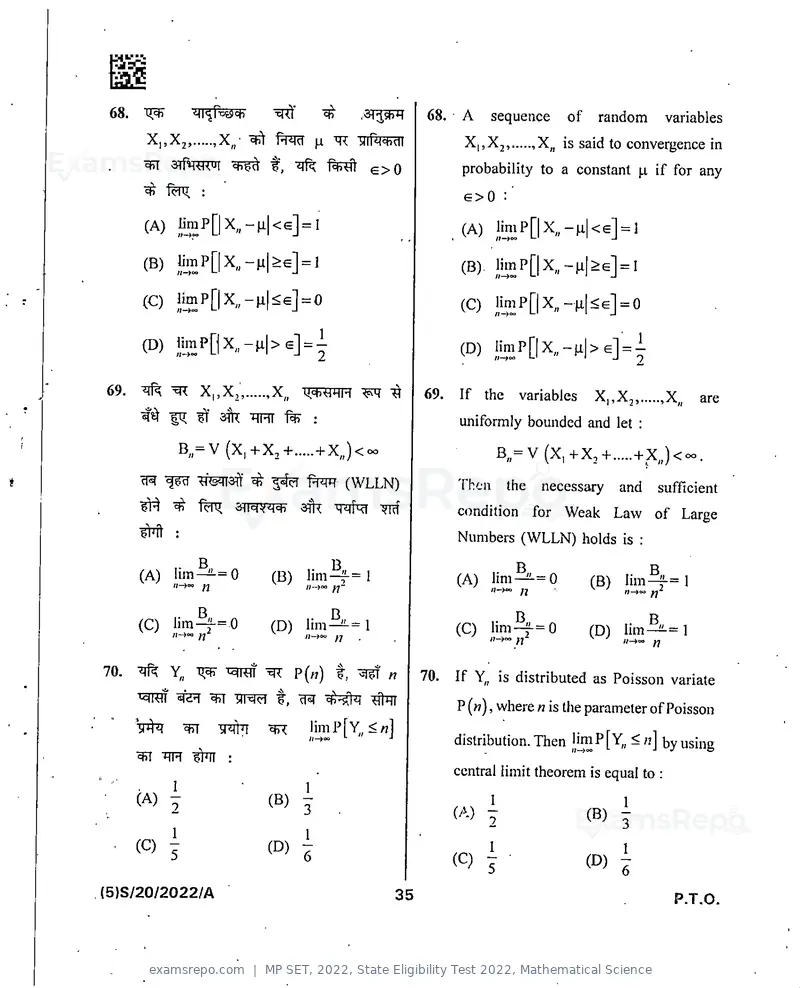
Text of page 37
68.             "Hl^pT^ch                                        68.    A    sequence       of    random      variables
        XpXj, ,X„'                      1^          yiR^^dl              XpXj,      ,X„ is said to convergence in
             37feOT                  "^rf^ PtJ^I e>o                     probability to a constant \x if for any
             "f^ :                                                       G>0 : '

       (A) J™J'[l^.-ti|<e]= I                                           , (A) i™P[l>^.-H<e] = l
       (B) l.mP[|X„-n|>e]= l                                              (B). i™p[|x„-h|>6]=i
       (C) !™p[I>^»-h|^s]=o                                              (C) i"2PD^»-|J-N6] = o
       (D) iimPOx„-n|>e]=l                                               (D) ,'™p[I^"-H>6] =|
69. ^ ^ X|,X,, ,X^,                                              69. If the variables XpX^,                   ,X„ are
                        A TTHT % ;                                      uniformly bounded and let :
                        (X,+X2+ + X„)<oo                                            ^ (X] +X2 +           + X,,) < 00.
       cR <36d ^V3dl3=if ^            PiMH (WLLN)                       Then the necessary and sufficient
       ^^                 3^1c^V■^d, 3TR Tq^rfRT TO                     condition for Weak Law of Large
       ^ :                                                              Numbers (WLLN) holds is :
                  B                             B
       (A) H-^w
           iim-ii-=0
                11
                               (B) H-»oo
                                   ]im-f=l
                                         ^-
                                                                        (A) lim^=0                (B) Iim^=l
       (C) iim-5^=.0
             H->oo ^
                               (D) lim-^=l                              (C) lim^=0                (D) lim^=l
                                                                               n'                     "-»« fj

70.          Y„ TO            ^ P(«) t, TOT rt                   70. If Y„ is distributed as Poisson variate
                       ^ "RTTOi f,                                      P (m), where n is the parameter of Poisson
               TO "STTO TO             limpfx, </7]
                                       /|-»0O           J
                                                                        distribution. Then                    by using
       TO TOT ^Wt :
                                                                        central limit theorem is equal to :
       (A) -                  (B) 3
                                                                        (A) I                     (B) r

       (C)                    (D) -
                                                                        (C) 7                     (D) -

(5)S/20/2022/A                                              35                                                  P.T.O,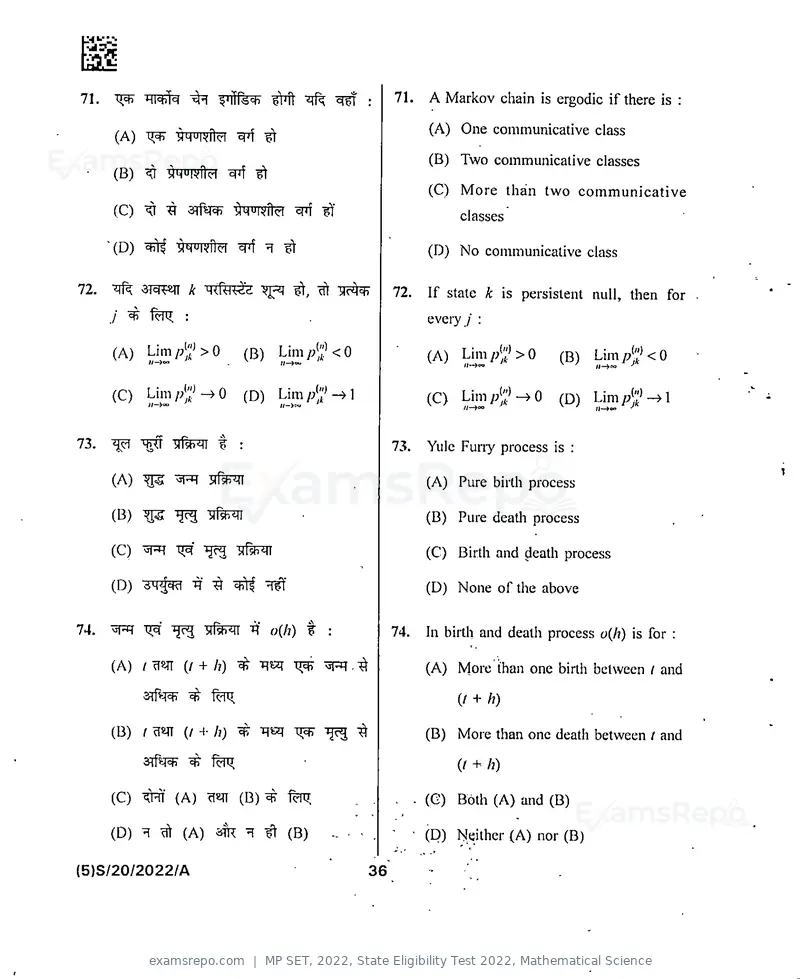
Text of page 38
71.                   ^ ^'iTfech ^                 ^:           71. A Markov chain is ergodic if there is :
                                                                       (A) One communicative class
      (A) "q^                   ^ i\
                                                                       (B) Two communicative classes
      (B) i\ yquivRef ^
                                                                       (C) More than two communicative
      (C) ^ ^                             ^                                  classes

      "(D) ^ y^uiyild ^ ^ ^                                            (D) No communicative class

72. ^                  k                       -dt rndq?        72. If state k is persistent null, then for
      / ^ fdrq; :                                                       every / :

      (A) Lim              >0   (B) Lim            <0                  (A) Lim/;';'>0 (B) Limp'"'<0
                                                                             /»—»oo        ^' M—^ns       ■'


      (C) Lim p'"J
             </-»«>
                             0 (D) Lim H->f»   '
                                                   -4 1                 (C) Limp';'-^0 (D) Lim//;'-^l
                                                                             H—»"                 11—*^


73.         "cgd "qfdTqT t :                                    73.     Yule Funy process is :

      (A) ^^ qfen                                                      (A) Pure birth process

      (B) ^ iJfH                                                       (B) Pure death process

      (C) ^ tt^*                                                       (C) Birth and death process

      (D)              "q       qqf qdf                                (D) None of the above


74. ^ T3:d                  qtar -q* o{h) t :                   74. In birth and death process o{h) is for :

      (A) /^2TT {I + h) ^                                              (A) More than one birth between I and
                      ^ tdrq                                                (/ + /;)

      (B) (           (/ -f- /?) ^ q^ "qqr                             (B) More than one death between / and

                      ^ fdrq                                                (/ +- h)

      (C) dtdt' (A) qqr (B)^ fdnr.                              . - (G) Both (A) and (B)

      (D) q ^ (A) STR q ft (B)                     - ■ ■              ■ (P) Neither (A) nor (B)

(5)S/20/2022/A                                             36
Text of page 40
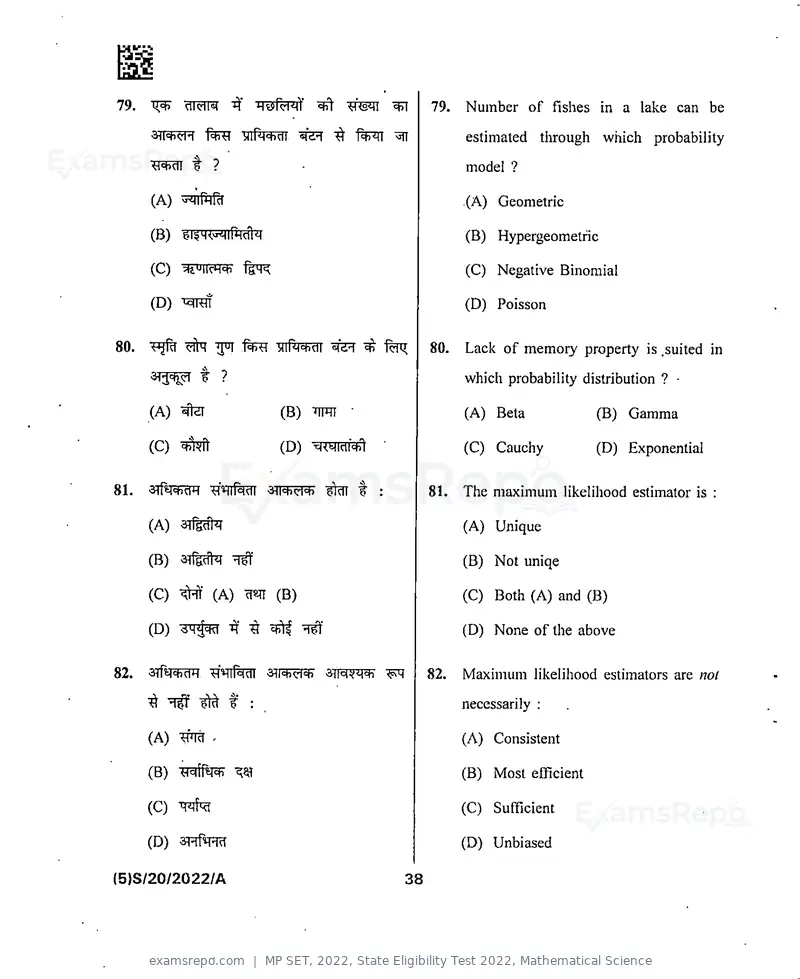
79.         cTT^ -4' H^Rh-mT ^          ^    79.    Number of fishes in a lake can be

               1^         ^        fer ^            estimated through which probability
            t ?                                     model ?


      (A) WiMt                                     (A) Geometric

      (B)                                          (B) Hypergeometfic

      (C) "^TWT^ f|q^                              (C) Negative Binomial

      (D)                                          (D) Poisson


80. TijRf ^^ fer yiRjchdi ^^ %TT             80. Lack of memory property is .suited in
      ar^^ t ?                                      which probability distribution ? •

      (A) ^              (B) TO   ■                (A) Beta             (B) Gamma

      (C)^              (D) ^<yidl=h1              (C) Cauchy           (D) Exponential

81. arfe^ ^'qrf^ awro im f :                 81.   The maximum likelihood estimator is :

      (A) anlsdl^                                  (A) Unique

      (B) arfeih ^                                 (B) Not uniqe

      (C)      (A) cTSTT (B)                       (C) Both (A) and (B)

      (D) aq^Jdd    ^^                             (D) None of the above


82. 3Tr?TOT7            arrro^ an^?^ ^       82.   Maximum likelihood estimators are nol

                    :                              necessarily ;

      (A) TO'                                      (A) Consistent

      (B)                                          (B) Most efficient

      (C)                                          (C) Sufficient

      (D) anfTO                                    (D) Unbiased

(5)S/20/2022/A                          38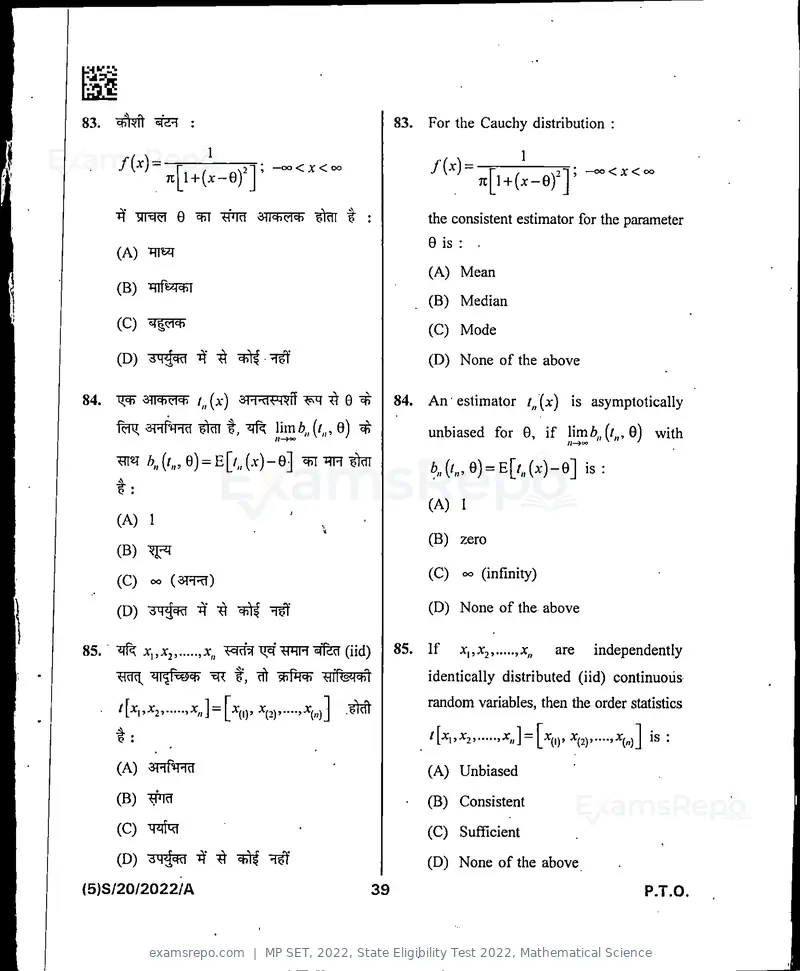
Text of page 41
83.           ^:                                                  83. For the Cauchy distribution :

                                                                                         1
      /W=                                                               /w=
                7i[i+{i-e)']     .21 » —< X <00                                              21 ; —00 < X < CO
                                                                                  7c[l +(Ar-e)']
      ■^*          e ^                           ^ t :                  the consistent estimator for the parameter
                                                                        0 is :    .
      (A) "RT^^T
                                                                        (A) Mean
      (B)
                                                                        (B) Median
      (C)                                                               (C) Mode

      (D)            ■^'         ^                                      (D) None of the above

84.                        (a:)             ^^0^                  84.   An' estimator /„ (x) is asymptotically
                              "t,       limZ? (/ , 0) ^
                                        ll-*oo       '
                                                                        unbiased for 0, if limZ)^, (/,,, 0) with
              *„(',,.e) = E[/„(.v)-e]                                            6) = E['„ W-e] is :
      t:
                                                                        (A) I
      (A) 1                                 ■    ,       ■
                                                                        (B) zero
      (B) ^
                                                                        (C) 00 (infinity)
      (C) CO (SUtl)
      (D)                    ^                                          (D) None of the above


85.                   '-^H                            (iid)       85.   If   ^1,-^2,           are    independently
      ■R?f^                      "f, eft sti^ctJ ■^I'Rsnqil             identically distributed (iid) continuous

      /[X|,A:2, '^/(]~ [^-^(l)* ^(2)'"">^(n)J                           random variables, then the order statistics

      t:                                                                                 ~ [^(i)» ^{2)'—*'^(rt)] is •
      (A) 3nfw                                                          (A) Unbiased
      (B) ^                                                             (B) Consistent
      (C)                                                               (C) Sufficient
      (D) aM^cKi            ^ ^                                         (D) None of the above
{5)S/20/2022M                                                39                                                 P.T.O.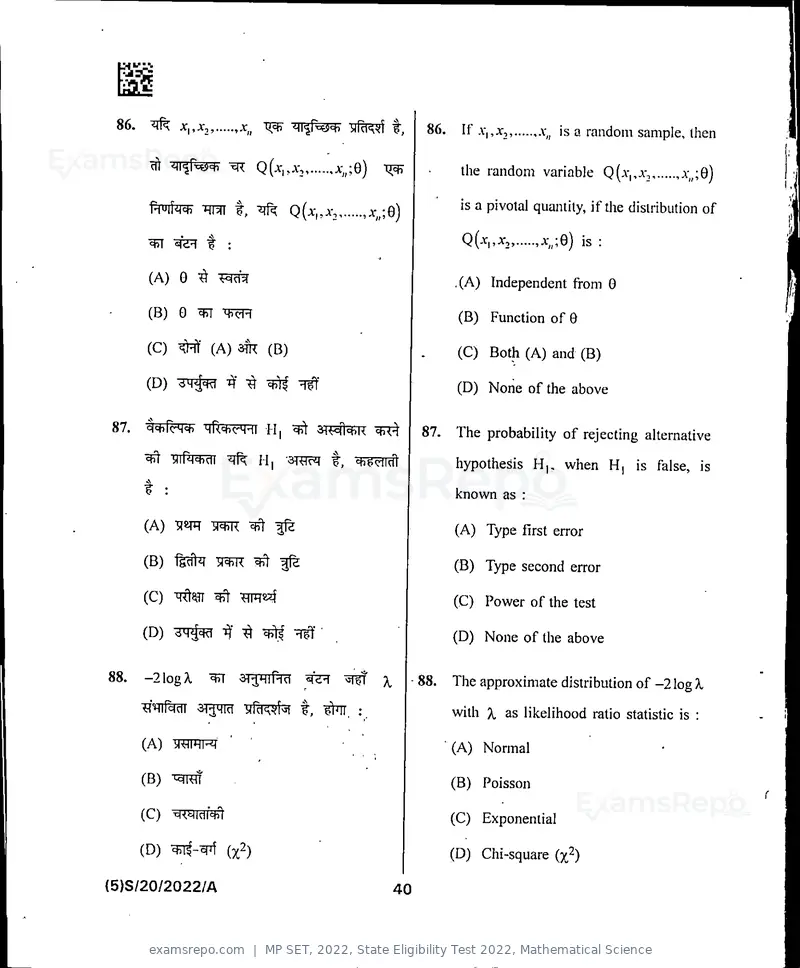
Text of page 42
86. ^ x^,X2,           .v„ TT^                    t, 86. If ApA,, ,A'„ is a random sample, Ihen

                    ^ Q(x,,.v%             A;;e) -q^            the random variable Q(a-,,a-t        ,a-„;0)
             ^ t, ^ Q(ava-3                    ,v,,;0)          is a pivotal quantity, if the distribution of

     ^^ t :                                                     Q(a,,A2, ,a;,;0) is :
     (A) 0 ^ tcjci'pi                                          .(A) Independent from 0

     (B) 0 ^ -qi^                                              (B) Function of 0

     (C) #Tf (A) m (B)                                         (C) Both (A) and (B)
     (D)                     ^                                 (D) None of the above

 87. q^fc^=t) qRc+irmi H| ^                               87. The probability of rejecting alternative
           yiPqqiai ^ H, '3?^ f,                               hypothesis H,, when H, is false, is
     v\

     f :                                                       known as :

    (A)          WK          "jfe                              (A) Type first error

    (B) fefRl            ^^                                    (B) Type second error

    (C)          ^ -^221                                       (C) Power of the test

    (D)           "4*        ^         ■                      (D) None of the above

88. -21ogX ^ appnto                                      - 88. The approximate distribution of -2log X
    ^*^TTf%?TT ST^qm                f, #TT, :,                 with X as likelihood ratio statistic is :

    (A) WRRT ■           ■                                    (A) Normal

    (B) "'^TPI                                                (B) Poisson

    (C) q^qiaiqil                                             (C) Exponential

    (D)           (^2)                                        (D) Chi-square (x^)

{5)S/20/2022/A                                     40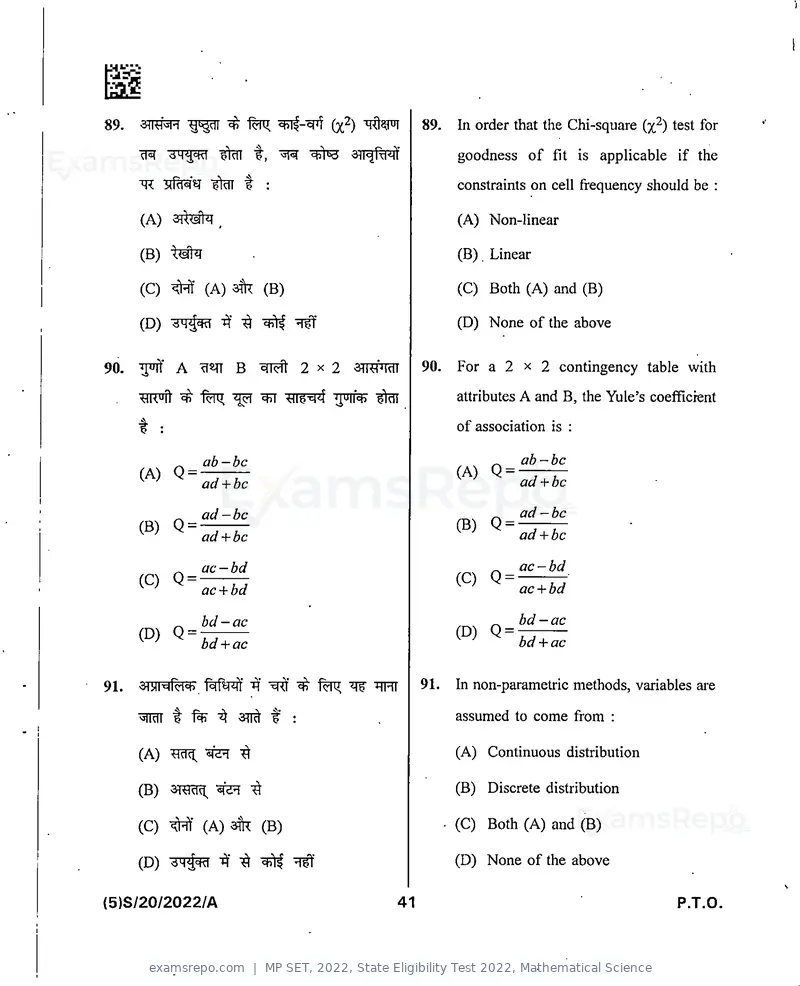
Text of page 43
89.                   ^                (x^)        89. In order that the Chi-square (x^) test for
                                                        goodness of fit is applicable if the
                          t :                           constraints on cell frequency should be :

      (A)         ,                                     (A) Non-linear

      (B)                                               (B), Linear

      (C) ^ (A) 3fk (B)                                 (C) Both (A) and (B)

      (D)                                               (D) None of the above


90. llWf A              B        2x2 arraw         90. For a 2 X 2 contingency table with

               -f^-^             m^A          ^         attributes A and B, the Yule's coefficient

      f:                                                of association is :


                ab — bc                                           ab — bc
      (A) Q =                                          (A) Q =
                ad + bc                                           ad + bc

                ad-be                                             ad -be
      (B) Q =                                          (B) Q =
                ad + bc                                           ad + bc

                ac-bd                                             ac-bd
      (C) Q =                                          (C) Q =
                ac + bd                                           ac+ bd

                bd-ac                                             bd — ac
      (D) Q =                                          (D) Q =
                bd + ac                                           bd + ac


91. aiymRi'^                ff   ^       ^ ttht    91. In non-parametric methods, variables are

      wm t              arr^ f :                        assumed to come from :


      (A)       ^^                                     (A) Continuous distribution

      (B)        ^^                                    (B) Discrete distribution

      (C)       (A) a[k (B)                           ■ (C) Both (A) and (B)

      (D)         -^f       ^                          (D) None of the above

(5)S/20/2022/A                                41                                           P.T.O.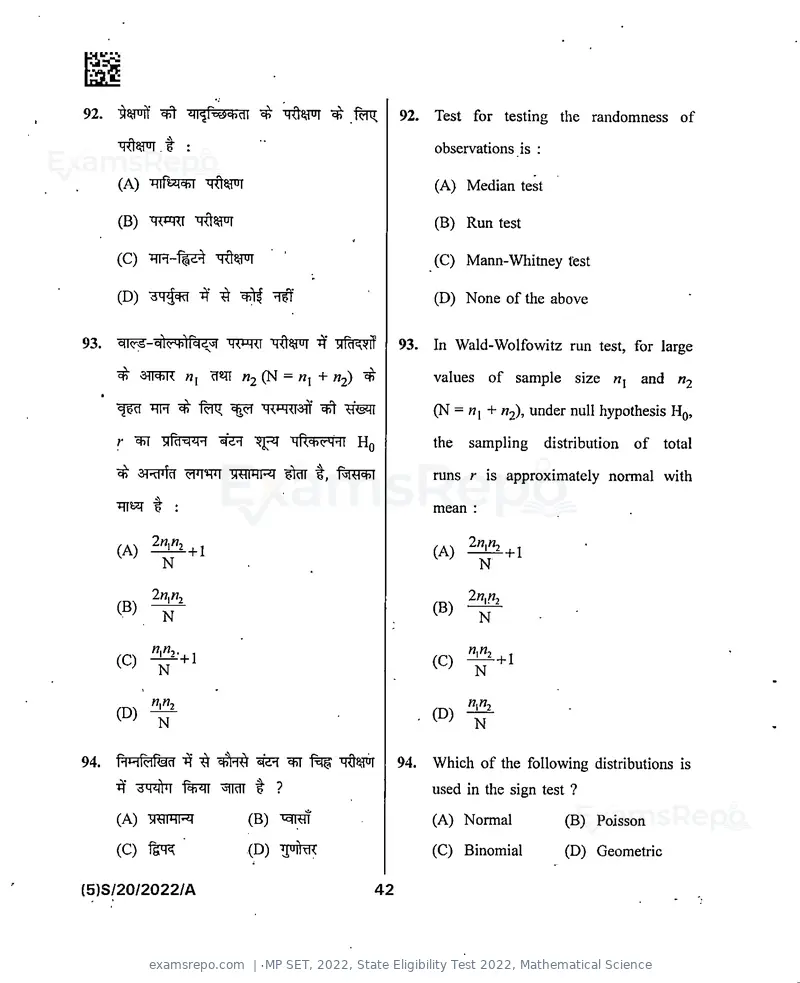
Text of page 44
92.         ^                 ^            ^ .fer    92. Test for testing the randomness of

                                                          observations is ;


      (A)             "q^^                                (A) Median test

      (B) WRT                                             (B) Run test

      (C) "qH-lf^ q^w                                     (C) Mann-Whitney test

      (D) ^q^            ^                                (D) None of the above


93. ^T^-cjlrqiirc4<^ "qwT "qftw "^* qftmif           93. In Wald-Wolfowitz run test, for large
      ^ 3TOR ?7[          «2(N = Kj + «2) ^               values of sample size «j and W2
      ^ tth ^           ^ q^™T3fl ^                       (N =     + ^2), under null hypothesis Hq,
      r ^ yPd-^-m ^^ MRdnrmi Hq                           the    sampling     distribution of total

      ^             WT^ "qHRFq ^ t, I^ITOT                runs r is approximately normal with

      ■qr^^ t :                                           mean :


      (A) ^+1                                             (A) ^+1
             N                                                    N

            2«,W2                                                2W|W2
      (B)                                                 (B)
             N                                                    N


      (C)                                                 (C)
            N                                                    N


            5^
      (D)                                                 (D)
            N                                                    N


94. fqiqfefeT T? ^            ^ ^ 1^ q^^             94. Which of the following distributions is
      ■^* "^q^ %qT ^ t ?                                  used in the sign test ?
      (A) wqpq               (B) "^STRff                  (A) Normal            (B) Poisson

      (C) ttqq               (D)                          (C) Binomial          (D) Geometric

(5)S/20/2022/A                                  42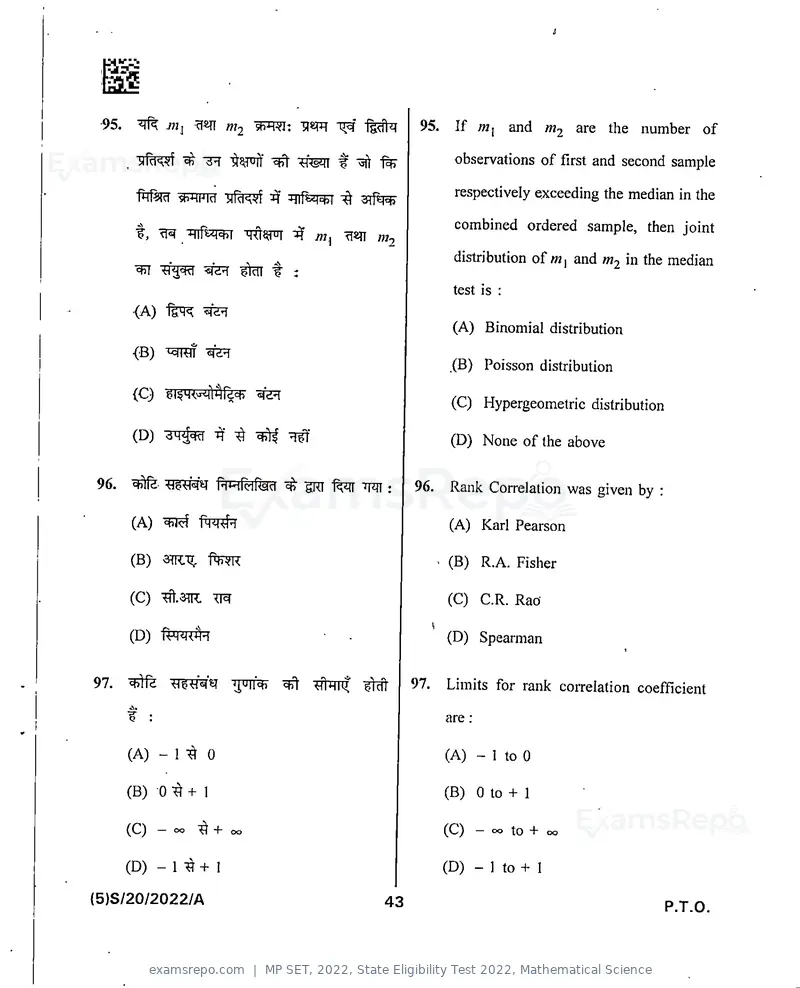
Text of page 45
iff

 -95.         ./Hj        ^2            '^*             95. If /W[ and m2 are the number of

        , Tff%^ -5^ ^            ^ wn f ^ -f^                   observations of first and second sample

         "f^rfm ?h-MHId "Sf^ ^           ^ srf^                 respectively exceeding the median in the

                                                                combined ordered sample, then joint
         %,          ^nfeiRiT ""TTI^      "^TS?! ni2
                                                                distribution of   and W2 tn the median
        ^             ^^f :
                                                                test is :
        (A) ifiH<\ «l'<i'1
                                                                (A) Binomial distribution
         {■B) "wff
                                                               .(B) Poisson distribution

         {Q WT?wiAf^ ^                                         (C) Hypergeometric distribution

        (D) <m£cw            ^ ^                               (D) None of the above


96. ■^-                  PlHlciRdd ^ OT 1^ "n^n :      96. Rank Correlation was given by :
        (A) ^ fr^                                              (A) Karl Pearson

        (B)             f^RR                                  ' (B) R.A. Fisher

        (C) #.31R. ^                                           (C) C.R. Rao
                                                          %
        (D)                                                    (D) Spearman


97.                          "5^ ^ #iTFf               97. Limits for rank correlation coefficient
        vN.

        ^ :                                                    are:


        (A) - 1 ^ 0                                            (A) - 1 to 0

        (B) 0^+1                                               (B) 0 to + 1

        (C) — OO "^+00                                        (C) — oo to + oo

        (D) - 1 ^ + I                                         (D) - 1 to + 1

(5)S/20/2022/A                                   43
                                                                                                P.T.O.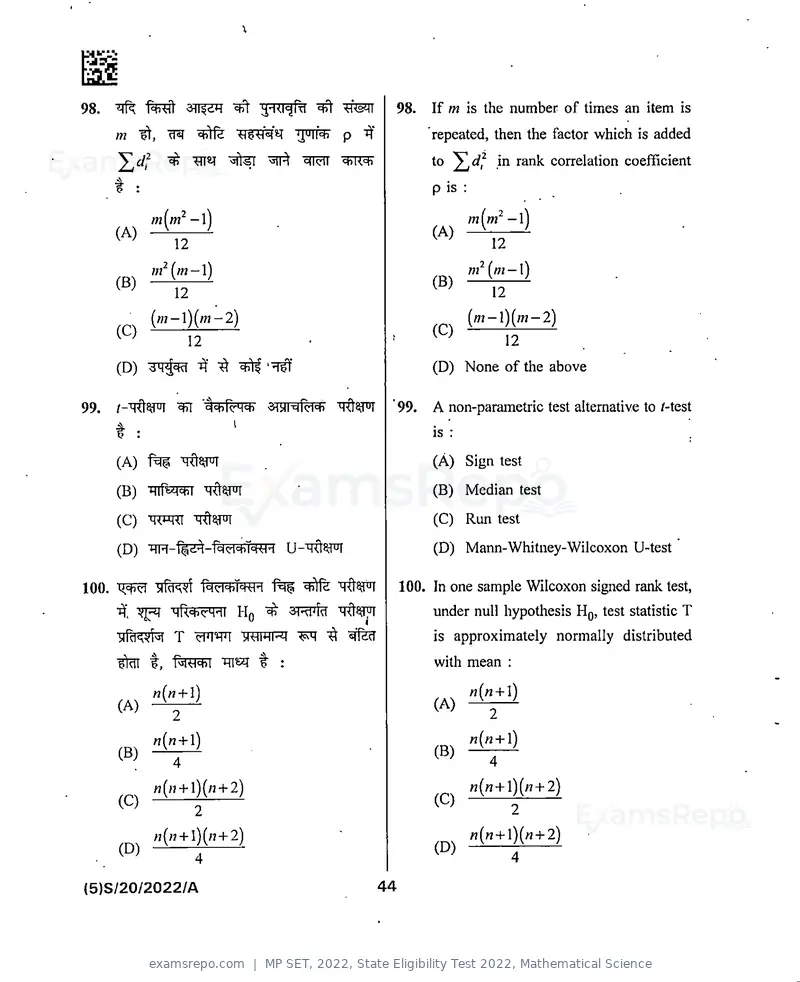
Text of page 46
98. ^                                    ^            98.     If m is the number of times an item is

      m                                iprf^ p ■^*             repeated, then the factor which is added
      ^                    "^5(1^       ^MT chK^ti             to ^df in rank correlation coefficient
      t :                                                      p is :

            m
             K-i)                                                       777   (m^-i)
      (A)                                                      (A)
                 12                                                            12

            m^(..-1)                                                    777   ^777 - 1)
      (B)                                                      (B)
                 12                                                            12

            [m-\)[m-2)                                                (777-l) (777-2)
      (C)                                                      (C)
                     12                                                            12

      (D)                 ^ ^ '■^"                             (D) None of the above

99.              ^ '5=1)                    "qrtw     99.      A non-parametric test alternative to /-test
      t                     ^                                  is :

      (A) 1%lt                                                 (A) Sign test
      (B)                                                      (B) Median test

      (C) "qwci                                                (C) Run test

      (D) ■qH-[^<ii-fcj'n=t)TcKH'1 U-"q^OT                     (D) Mann-Whitney-Wilcoxon U-test

100. "0^1^ yRm^I [ciQi=tjT'Wi                             100. In one sample Wilcoxon signed rank test,

      •^* ^ MR-^ticrmi Hq                                      under null hypothesis Hq, test statistic T
      ypd^vl^ T                            ^                   is approximately normally distributed
      "ekr t,             *fn«2T t :                           with mean :

            /?(/7 + l)                                                  77(77 +1)
      (A)                                                      (A)
                 2                                                             2

            /7(« + l)                                                   77(77 + 1)
      (B)                                                      (B)             4
                 4

            «(» + l)(/i + 2)                                            77 (77 + 1) (77+ 2)
      (C)                                                      (C)
                      2                                                             2

            /7(/7 + 1)(/7 + 2)                                          77(77 + 1)(77 + 2)
      (D)                                                      (D)

(5)S/20/2022/A                                       44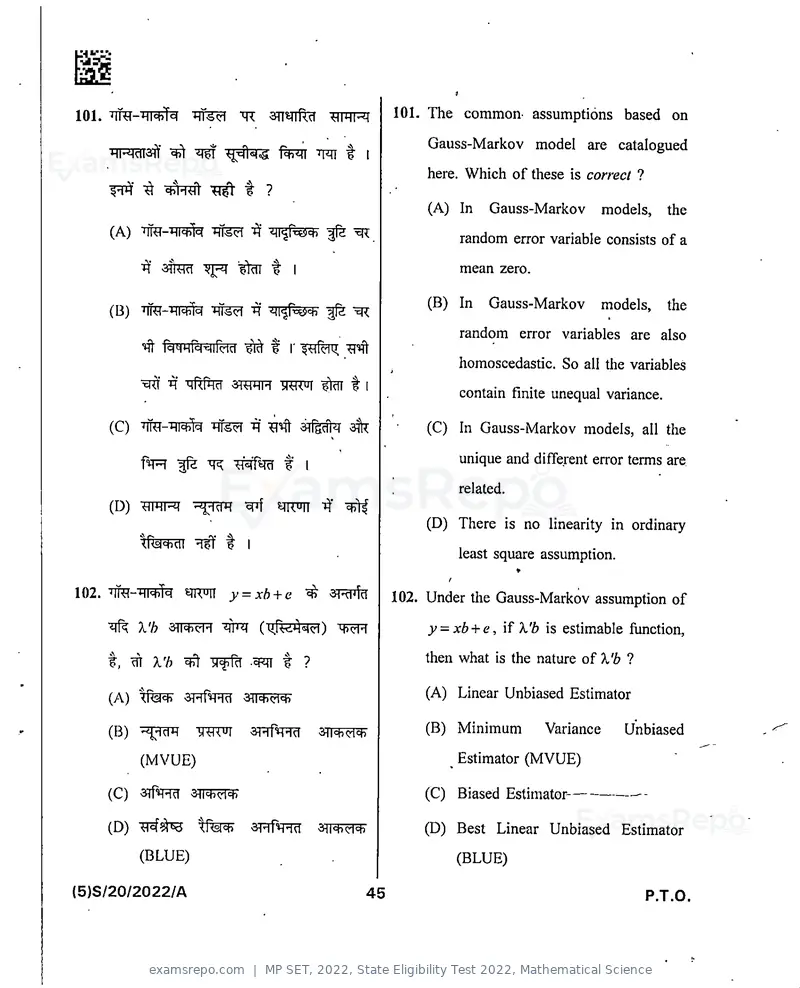
Text of page 47
101.                           -qr sn^TTfcT             101. The common- assumptions based on

                  ^ -q^ ^-41                Tp^j f I         Gauss-Markov model are catalogued
                                                             here. Which of these is correct ?
             ^                  t ?
                                                             (A) In Gauss-Markov models, the
       (A)                       ^            ^^                    random error variable consists of a

             H sfmcT -9]^ ^ t I                                     mean zero.


       (B) TO-'qiq^ tTfe^ "pf                 ^^             (B) In Gauss-Markov models, the
                                                                    random error variables are also
             qt                 ■# t r t^#ttt
                                                                    homoscedastic. So all the variables
                  n MRpMd aroqR               ^ fi
                                                                    contain finite unequal variance.

       (C) "TO-TTRfe -qfe^ Tf                   3^k          (C) In Gauss-Markov models, all the

             fqR ^ ^ -^m f I                                        unique and different error terms are

                                                                    related.
       (D) ^mM -^HdM ^ mw "4* ^
                                                            (D) There is no linearity in ordinary
             <Rs|ctici|      f I
                                                                    least square assumption.
                                                                               ¥

                                                                f


102. 'iT^-HiqiTci ^U^Jil y = xh + e ^ '^'d4d            102. Under the Gauss-Markov assumption of
       ^ X'h                 "qpr^ (U.PwA'^d)                y = xb + e^ if X'b is estimable function,

       f. 41 X7j qrt qfrfn            t ?                   then what is the nature of X'b ?


       (A)            3Tqfqq^ ^ichei<=b                     (A) Linear Unbiased Estimator

       (B) '^'iciH                                          (B) Minimum            Variance    Unbiased

             (MVUE)                                             ^ Estimator (MVUE)

       (C) 3#ft^                                            (C) Biased Estimator-

       (D)                tfeq? 37qf*pTn                    (D) Best Linear Unbiased Estimator
             (BLUE)                                                 (BLUE)

(5)S/20/2022/A                                     45                                            P.T.O.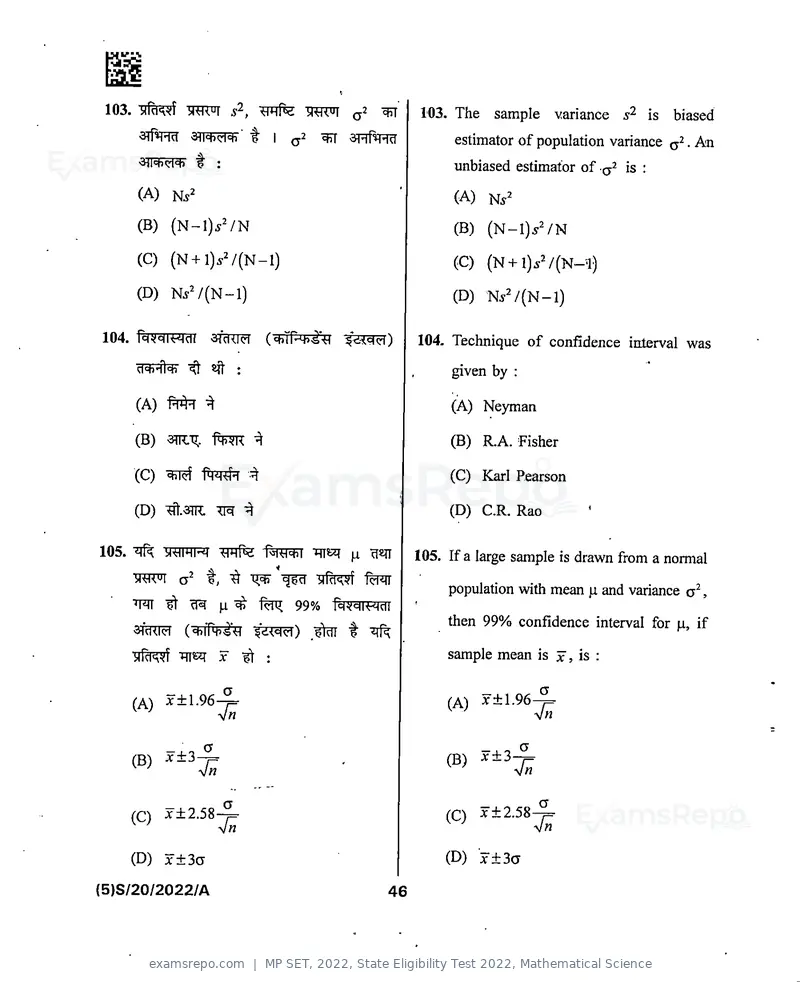
Text of page 48
103.              TROT s^,            TROT (j2 ^       103. The sample variance           jg biased
                   3l|cticrich "I I (y2 ^ SRf^RTcT            estimator of population variance (j2 ^^
                                                              unbiased estimator of     is :

        (A) N^2                                              (A)
     (B) (N-I)jVN                                            (B) (N-l)//N
     (C) (N+1)//(N-1)                                        (C) (N + l)//(N-'l)
     (D) N//(N-1)                                            (D) N^'/(N-1)

 104. Pq^qi^cii armM (                                  104. Technique of confidence interval was
        d=t)i1qi           :                                 given by :

     (A)             ^                                       (A) Neyman

    (B)               -pTim ^                                (B) R.A. Fisher

    (C) ^                      ^                            (C) Karl Pearson

    (D) ^.37R TI^ ^                                         (D) C.R. Rao

105. "271^ TRTTRPT                     "RT«^q ^ ^STT    105. If a large sample is drawn from a normal
     ^ROT        t,
                                                             population with mean p and variance 0^,
     OT                    ^ %TT 990/0
                                                             then 99% confidence interval for p, if
     3OT^ (qiir4ii*7H ^dWd)                 t^
     Tffif^ RTSJT 3c               :                         sample mean is x, is :

                                                                           a
    (A)      x +1.96-^                                      (A) 3C +1.96
                         v«


    (B) J±3                                                 (B) x±3~
                                                                  -Jn


    (C)      3c +2.58-^                                     (C)   jc±2.58-^
                         yjn                                               yjn

    (D) :c±3g                                               (D) J±3a

(5)S/20/2022/A                                     46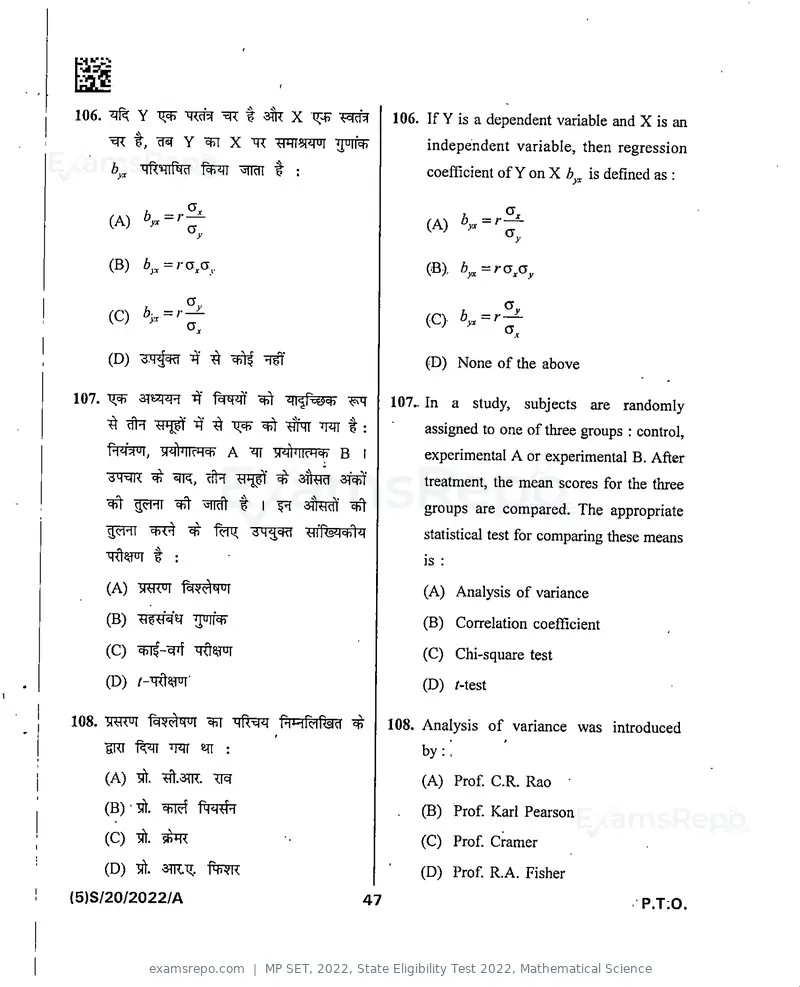
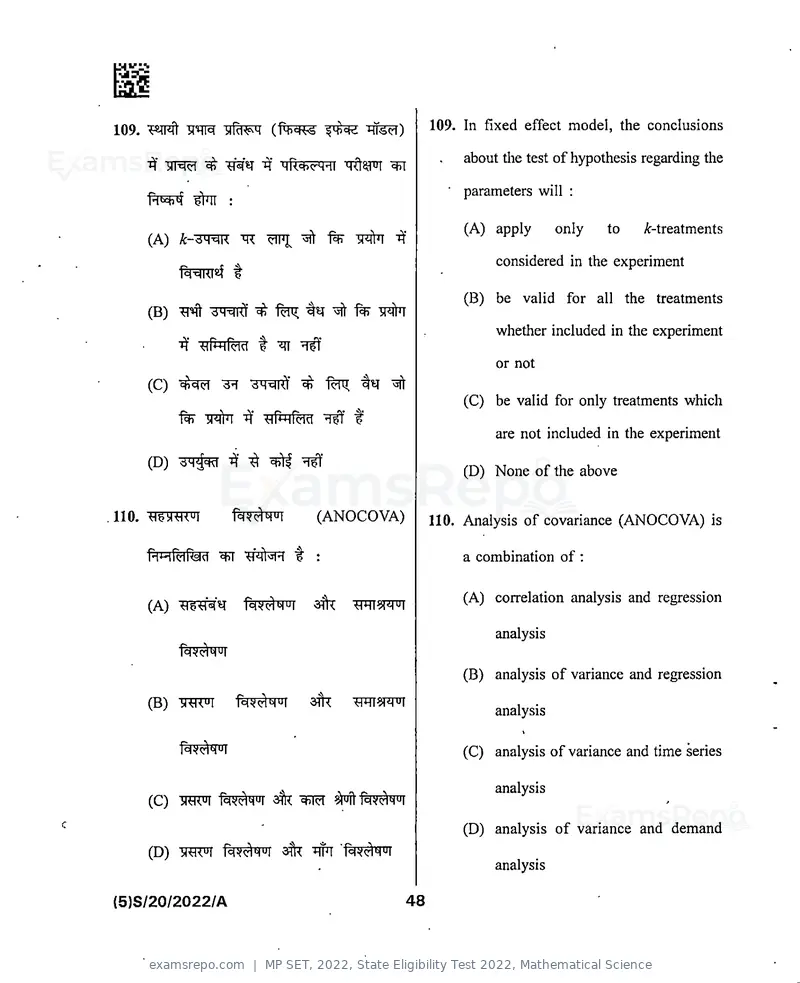
Text of page 50
109.                                          Tfer)    109. In fixed effect model, the conclusions

                                                            about the test of hypothesis regarding the
       ■4* "3r^ ^         '^' nRc^crMil         ^
                                                         ■ parameters will :
               i[m :
                                                            (A) apply       only   to    /:-treatments
       (A)                ^ # % 31^ ■^*
                                                                 considered in the experiment
             t%^«^ t
                                                            (B) be valid for all the treatments
       (B) ^ <1M^k1* ^ %T
                                                                 whether included in the experiment
             ■^* ^R^Rrld t -^TT
                                                                 or not

       (C) chct(vi                ^ "f^          ^
                                                            (C) be valid for only treatments which
             % 3Fk ■^* ^HRHPeld           t
                                                                 are not included in the experiment
       (D) <iM^dd "4'      ^
                                                            (D) None of the above


110. 'HW3rWT                       (ANOCOVA)           110. Analysis of covariance (ANOCOVA) is

       PdHPdPteld ^ Wto t :                                 a combination of :


                                                           (A) correlation analysis and regression
       (A)                         sfR ^WT
                                                                 analysis

                                                           (B) analysis of variance and regression
       (B) 3im^                   3fk     "^OTn                  analysis

                                                            (C) analysis of variance and time series

                                                                 analysis
       (C) 'm^ Pc^yelNui 3fR w
                                                            (D) analysis of variance and demand
       (D)                   33k kFi
                                                                 analysis

(5)S/20/2022/A                                    48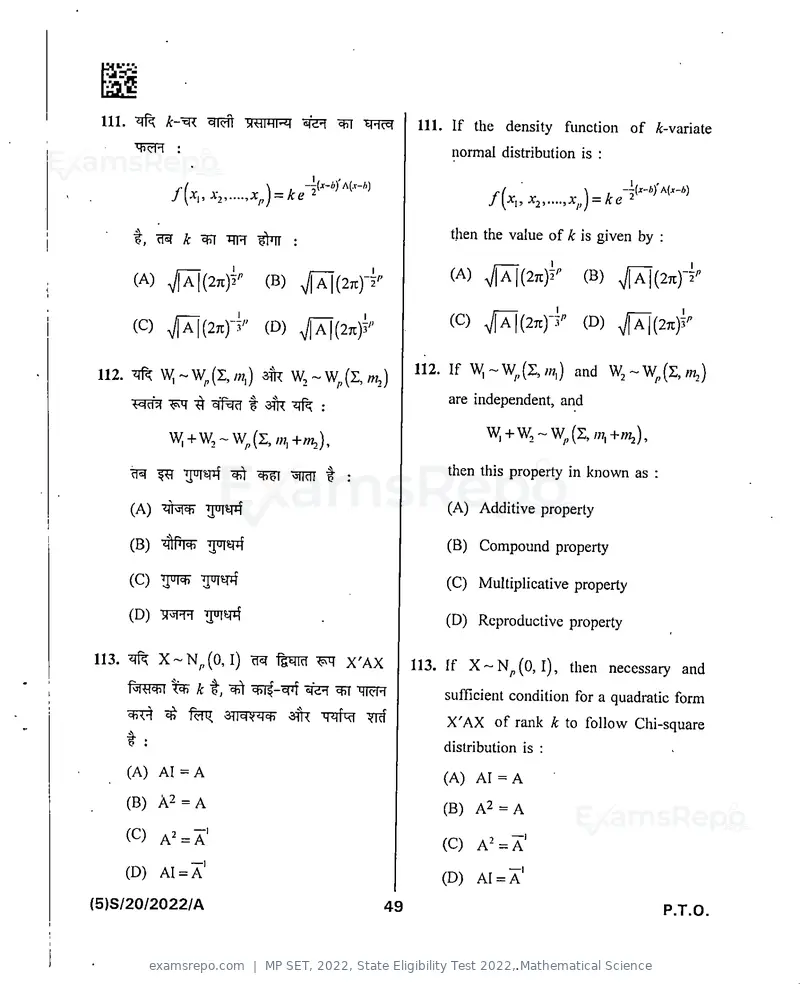
Text of page 51
111.       k-^          TraWRT ^ ^                    111. If the density function of /t-variate
            :
                                                            normal distribution is :


            j[^Xj,          j~ ke

        "f, ^ ^ ^ TIPT           :                          then the value of k is given by :

        (A) ^\{2ny (B) 4A|(27r)4''                         (A) 4a|(27iP (B) 71^(271)4'
        (C) 7H(27cp" (D) ^\{2nj             T/'            (C) 7^(2")"^' (D) 7^(27:)5           I
                                                                                                HP


 112. ^                    3TR                         112. If W,~ W^,(Z, m,) and Wj- W^(Z,
                         f STK -^rf^ ;                     are independent, and

            w;+w,~        (z, /», +//^),                          Wj+W,-W^(S,/77,+/?^),

    ^W                 ^ cb6l ^ncTT "I" :                  then this property in known as :

    (A)                                                    (A) Additive property

    (B) "#1^ ^%TTf                                         (B) Compound property

    (C)                                                    (C) Multiplicative property
    (D) "Shsm                                              (D) Reproductive property

113. ^ X~N^(0, I) ^ tiro ^ X'AX                        113. If X^N^(0,I), then necessary and
            ^ ^ "i",                     ^ HioiH           sufficient condition for a quadratic form
           ^                     3^ qqfkl TTcf             X'AX of rank k to follow Chi-square
    t:                                                     distribution is :
    (A) AI = A                                            (A) AI = A
    (B) A2 = A                                            (B) a2=A
    (C) a^ = a'                                           (C) a^=a'
    (D) AI = a'                                           (D) AI = a'
(5)S/20/2022/A                                    49                                          P.T.O.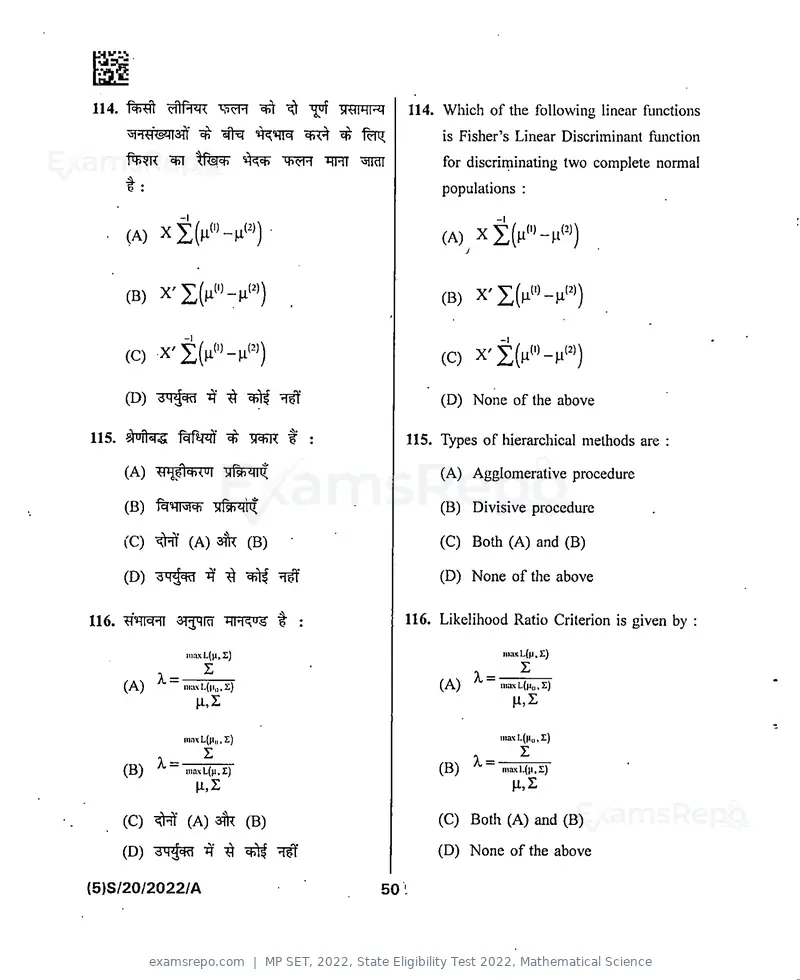
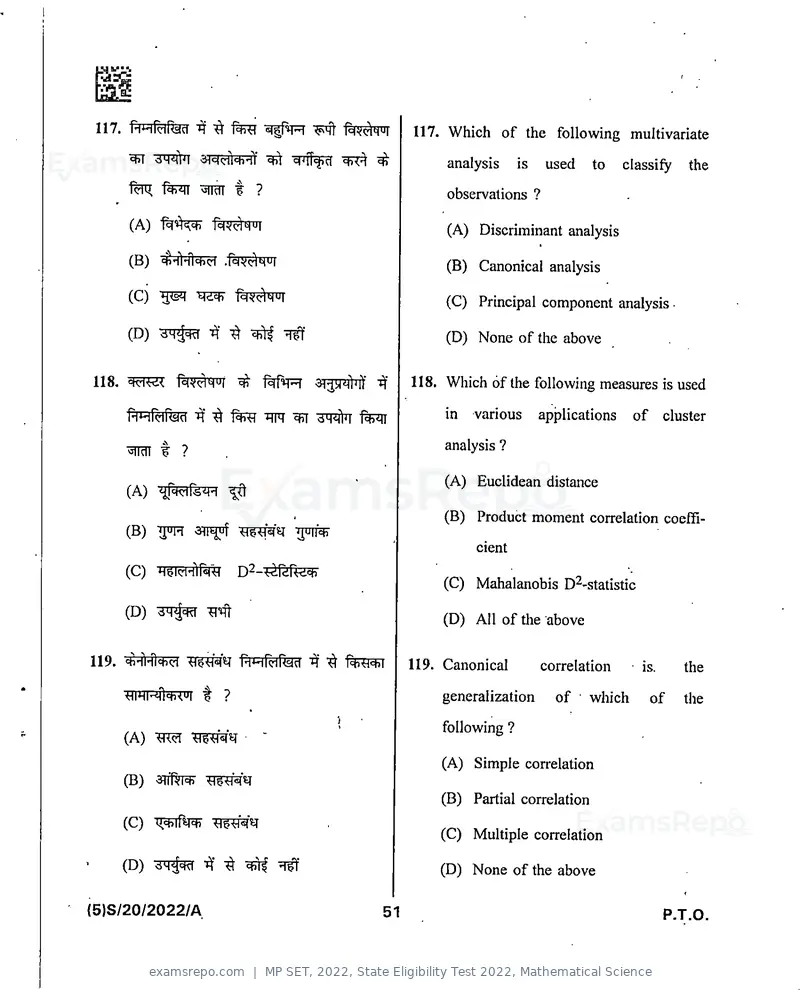
Text of page 53
117. Pi*^RriRaci      ^                                117. Which of the following multivariate
       ^ WtW                   ^                 ^          analysis     is   used to       classify       the
                              ?                             observations ?

       (A)                                                  (A) Discriminant analysis
       (B) cftililctici .fq;fci^ui                          (B) Canonical analysis
       (C)         "ER^ RiVc^Mui                            (C) Principal component analysis ■
       (D) an^cKi 1^        ^ -^T^'                         (D) None of the above


118.                      ^            3T55pM" ■^*     118. Which of the following measures is used

       PiMl^RsJd      ^ 1^ -m ^                 fen         in various applications of cluster

             % 7                                            analysis ?

                                                            (A) Euclidean distance
       (A) "^ferfepT
                                                            (B) Product moment correlation coeffi
       (B) "ijuR an^                 TpT%
                                                                 cient

       (C) "^Twrfetfer
                                                           (C) Mahalanobis D^-statistic
       (D)                                                 (D) All of the above

119.                       Rnl^Rsid     ^ fei^         119. Canonical         correlation    ■ is.     the

       wiFqfe^ t ?                                         generalization       of ■ which      of     the
                                            )
                                                           following ?
       (A)
                                                           (A) Simple correlation
       (B) anf^
                                                           (B) Partial correlation
       (C) T3^!q^
                                                           (C) Multiple correlation

       (D) aq^dd         ^ ^                               (D) None of the above
                                                                                                       f


{5)S/20/2022/A                                    51                                                 P.T.O.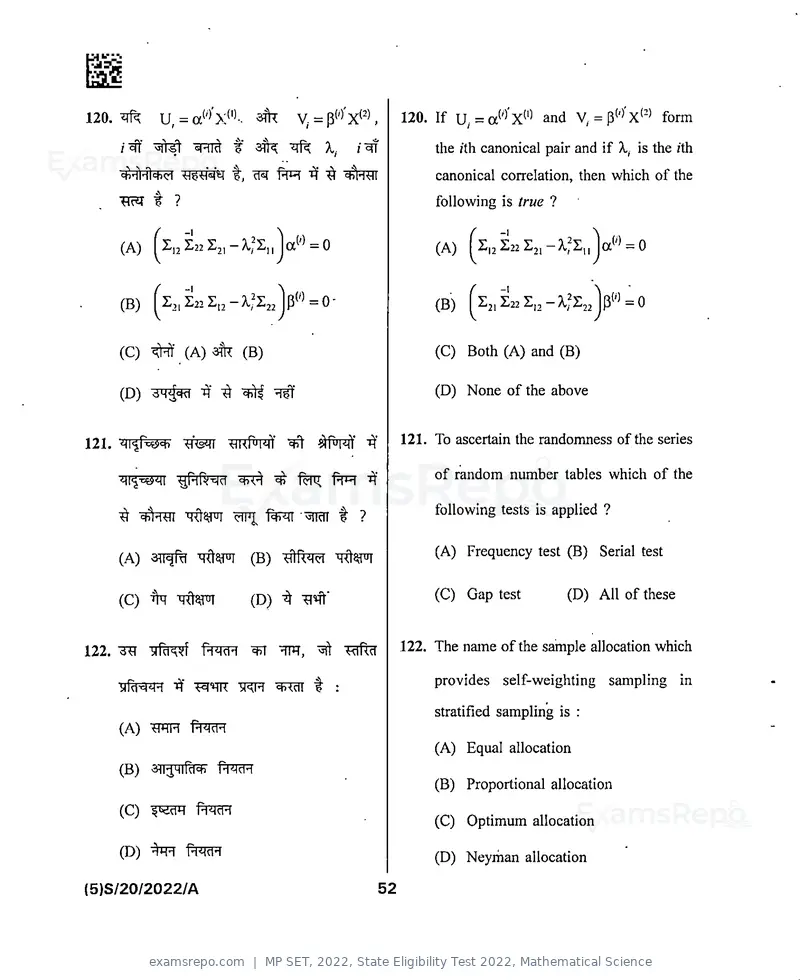
Text of page 54
120.^ U,=                              V.=                 120. If U^=a('''x^'^ and V,. =            form
                                                                the ith canonical pair and if X^ is the rth
                                                                canonical correlation, then which of the
              t ?                                               following is true ?

                    -I

       (A) |X„I22S„-^JL„ |aW =0                                 (A) (^X„i;22E„-XfZ„ja<" = 0
                                                                (B) fs„E22E„-;^xlp« = 0
                    -I

       (B) [^Z,,Z22E„-X,^Z,,JP<" =0
       (C)         (A)3fk (B)                                   (C) Both (A) and (B)

       (D)                      ^                               (D) None of the above


121. <4l<|r^ch               ^Kpui^T ^            ■^*      121. To ascertain the randomness of the series


                                                                of random number tables which of the
                   ^PiP^^d ^ ^ %T3;

             chM^l "^SiFT         PtrMl "^sncfT ^ ?             following tests is applied ?


       (A)               -q^m (B)                               (A) Frequency test (B) Serial test


       (C) tW                   (D)                             (C) Gap test          (D) All of these


122.          -qf^              ^                          122. The name of the sample allocation which

       yfd-cli^d         ^qR IjqR qRcTT t :                     provides self-weighting sampling in

                                                                stratified sampling is :
       (A) ^ETRH
                                                                (A) Equal allocation
       (B) sn^qito fwH
                                                                (B) Proportional allocation
       (C)               froq
                                                                (C) Optimum allocation

       (D) ^ tWH                                                (D) Neyrhan allocation
(5)S/20/2022/A                                        52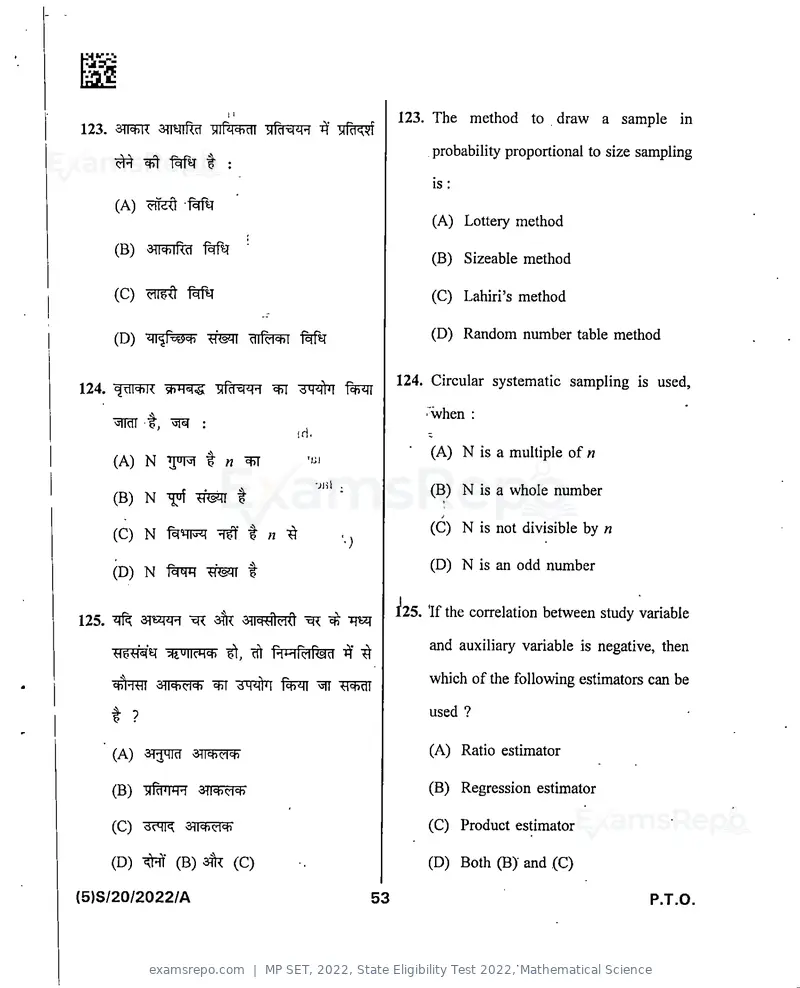
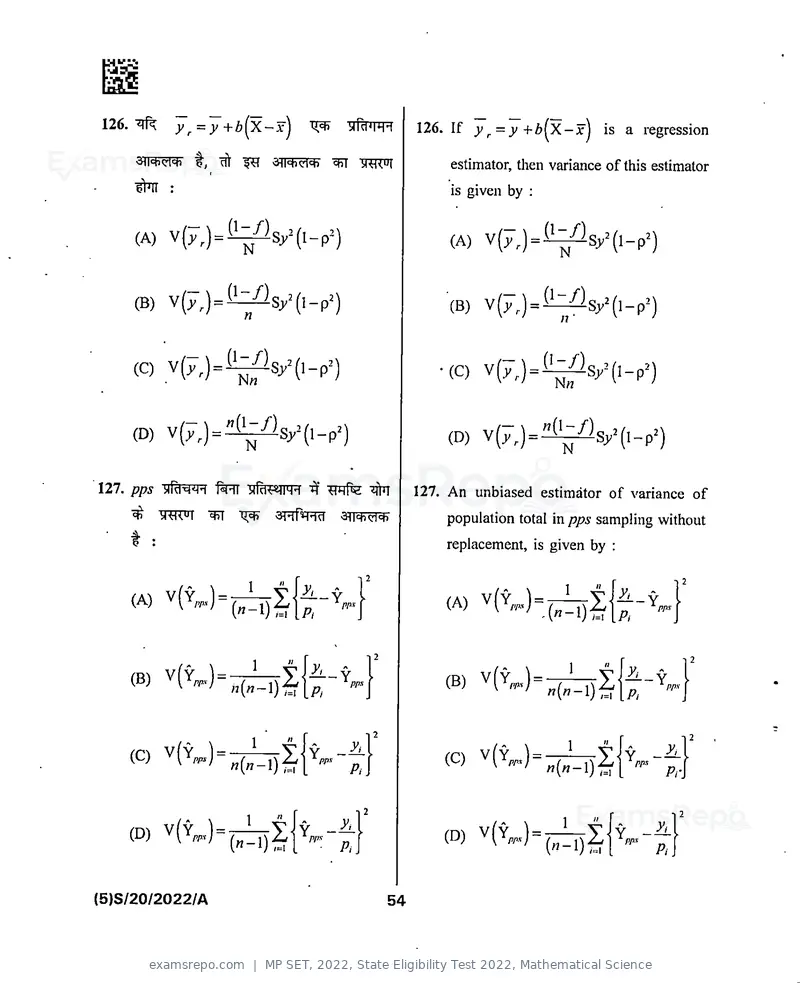
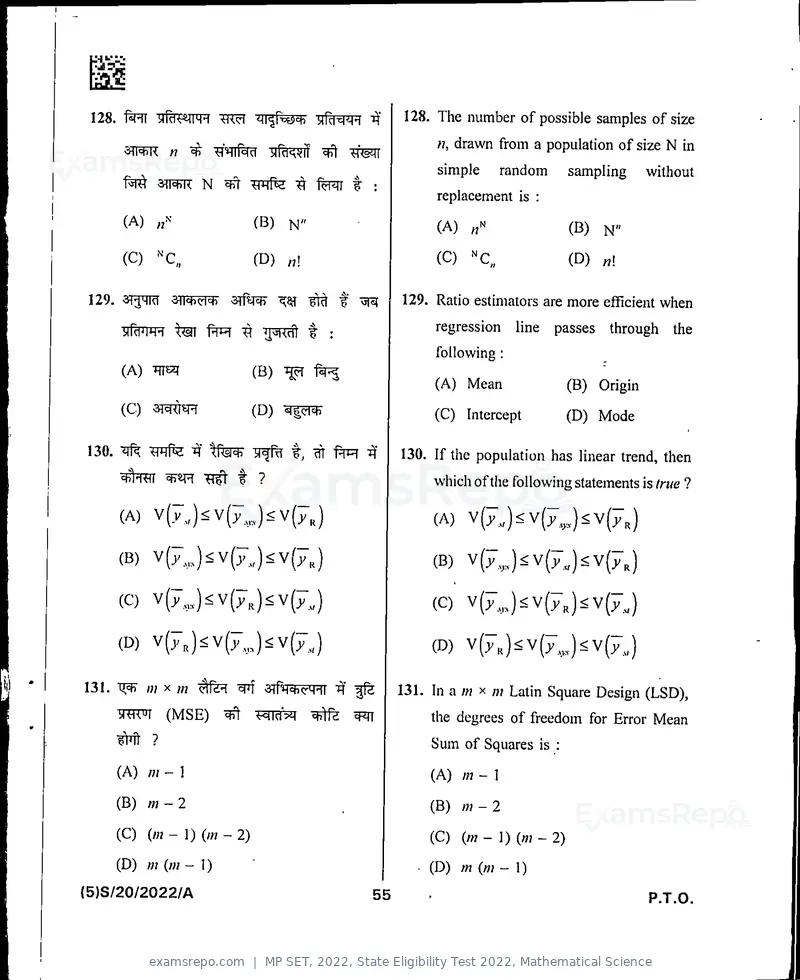
Text of page 57
128. "f^               Wr                          128. The number of possible samples of size
                                                        /7, drawn from a population of size N in
                                                         simple    random     sampling     without
              37T^ N ^                felT t :
                                                        replacement is :
        (A)                  (B) N"                     (A)                   (B) N"
        (C) ^C„              (D) n\                     (C)                   (D) „!

 129.                   arfe          ^f^          129. Ratio estimators are more efficient when

                3.0II fiH ^ "JpRcft % :                 regression line passes through the
                                                        following :
        (A) TiTsq            (B)      1%;^
                                                        (A) Mean              (B) Origin
        (C)                  (D)                        (C) Intercept       (D) Mode

 130. '^fK                   -3^ %, cfr fFT        130. If the population has linear trend, then
                         t ?                            which ofthe following statements is true ?

     (A) v(7„)<v(7,„,)<v(7,)                           (A) v(7„)<v(7.^„)<v(7,)
     (B) v(7,.,)<v(7„)<v(7„)                           (B) v(7,,)<v(7.„)<v(7,)
     (C) v(7.„)<v(7,)<v(7,,)                           (C) v(7,J<v(7,)<v(7.,)
     (D) v(7„)<v(7,„)<v(7„)                            (D) v(7k)<v(7,„,)<v(7,,)
131. "0^ ni X iij        ^ arfec^                  131. In a   X in Latin Square Design (LSD),
              (MSE)          ^id>H cfiirk               the degrees of freedom for Error Mean
      mt ?                                              Sum of Squares is :
     (A) /» - 1                                        (A) m ~ 1
     (B) m - 2                                         (B) m - 2
     (C) (/« - 1) (in - 2)                             (C) (m - 1) (;;; - 2)
     (D) /?/ («/ - I)                                 ■ (D) m (m — 1)
(5)S/20/2022/A                                55                                           P.T.O.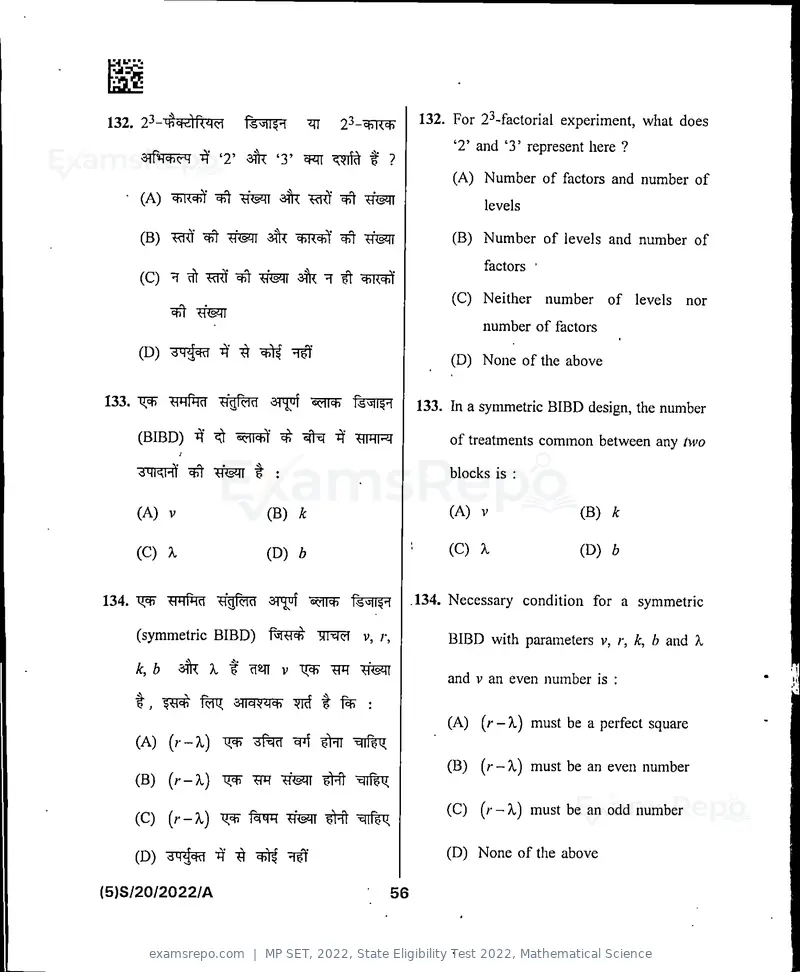
Text of page 58
132.                                  "^IT                      132. For 2^-factorial experiment, what does
                                                                     '2' and '3' represent here ?
        3TfTO?q       '2' 3Sk '3' ™ ^ t ?
                                                                     (A) Number of factors and number of
       (A) =t)l<chl
                                                                         levels

       (B) 'klil               3Tk cfjR^          "?R^               (B) Number of levels and number of

                                                                         factors '
       (C) ^ ^               WTT 3fk
                                                                    (C) Neither number       of levels nor
                                                                         number of factors

       (D)               ^^                                         (D) None of the above

133.          RRfRcf "R^foRT ■SRjyf «crll=t)                   133. In a symmetric BIBD design, the number
       (BIBD) '^" ^ ^TT^* ^ ^ ■4' WfFT                              of treatments common between any two
               ;


       "iwimil ^ -hVshi "t :                                        blocks is :


       (A) V                   (B) k                                (A) V                (B) ^

       (C) X                   (D) b                                (C) A,               (D) 6


134.                  ^'^Pcrld 31^                             .134. Necessary condition for a symmetric

       (symmetric BIBD) t^RT^                     v, /•,            BIBD with parameters v, r, k, b and A
       k, b ^ X t                V           "RR "RW                and V an even number is :

       I" ,        Rit. 3l|q^qct>            t     :
                                                                    (A) (r - A) must be a perfect square
       (A) (/--A,)          ^Fqa                 -qiRy.
                                                                    (B) (r-A) must be an even number
       (B) (r-^)            -m Rtwtl #fl ^dlflTT

       (C) [r-X)                    TRsRI ^                         (C) (r - A) must be an odd number

       (D)                                                          (D) None of the above

(5)S/20/2022/A                                            56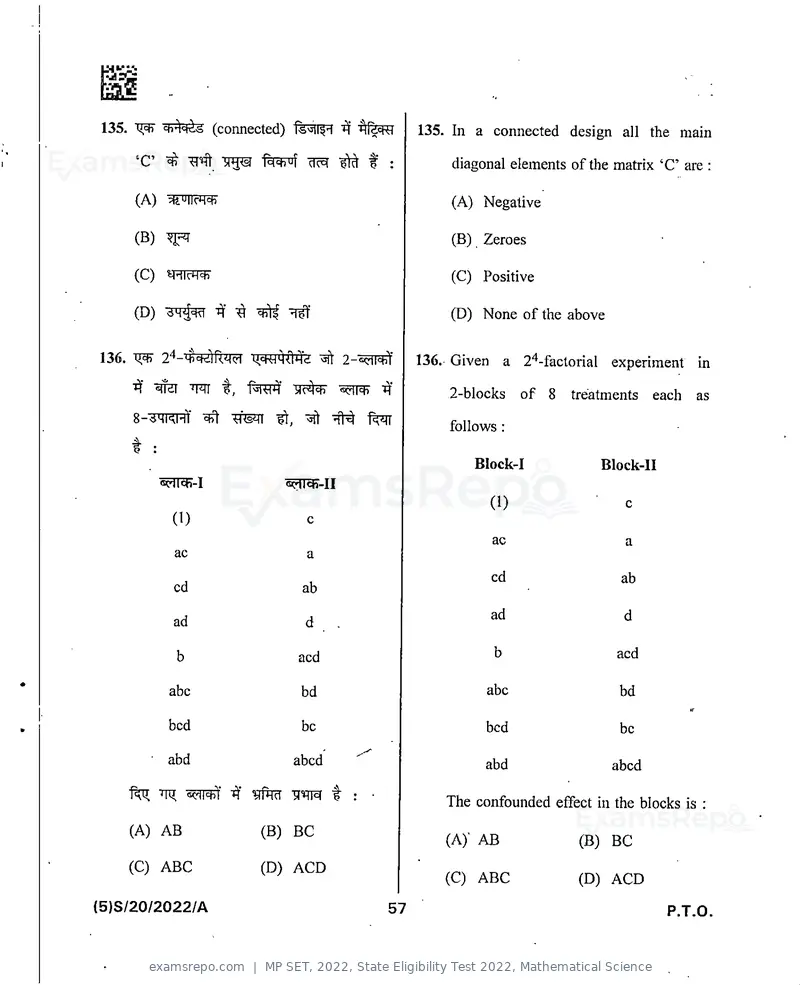
Text of page 59
135.                    (connected)             AficRj   135. In a connected design all the main
       'C                               cRSf ^ t ;           diagonal elements of the matrix 'C are :

       (A)                                                   (A) Negative

       (B) ^                                                 (B) Zeroes

       (C)                                                   (C) Positive

       (D) <iM^4d          ^^                                (D) None of the above


136.         24-4=+elR^d                   # 2-'^tT^*    136. Given a 2'^-factorial experiment in
          «iTdi "TFIT ■§,             yc^qi                  2-blocks    of   8   treatments   each   as
       8-<iMKMT ^ wm\                  ^
                                                             follows :
       t :
                                                                 BIock-1              Block-II
             scllch-I             o^|ch-II
                                                                   0)
               (1)                     c

                                                                    ac
               ac                      a


                                                                   cd                    ab
               cd                      ab

                                                                   ad                    d
               ad                      d


               b                      acd                           b                   acd


              abc                     bd                           abc                   bd

              bed                     be                           bed                   be

              abd                     abed                         abd                  abed


                                                             The confounded effect in the blocks is ;

       (A) AB                  (B) BC
                                                             (A)' AB               (B) BC
       (C) ABC                 (D) ACD
                                                             (C) ABC               (D) ACD
{5)S/20/2022/A                                      57                                           P.T.O.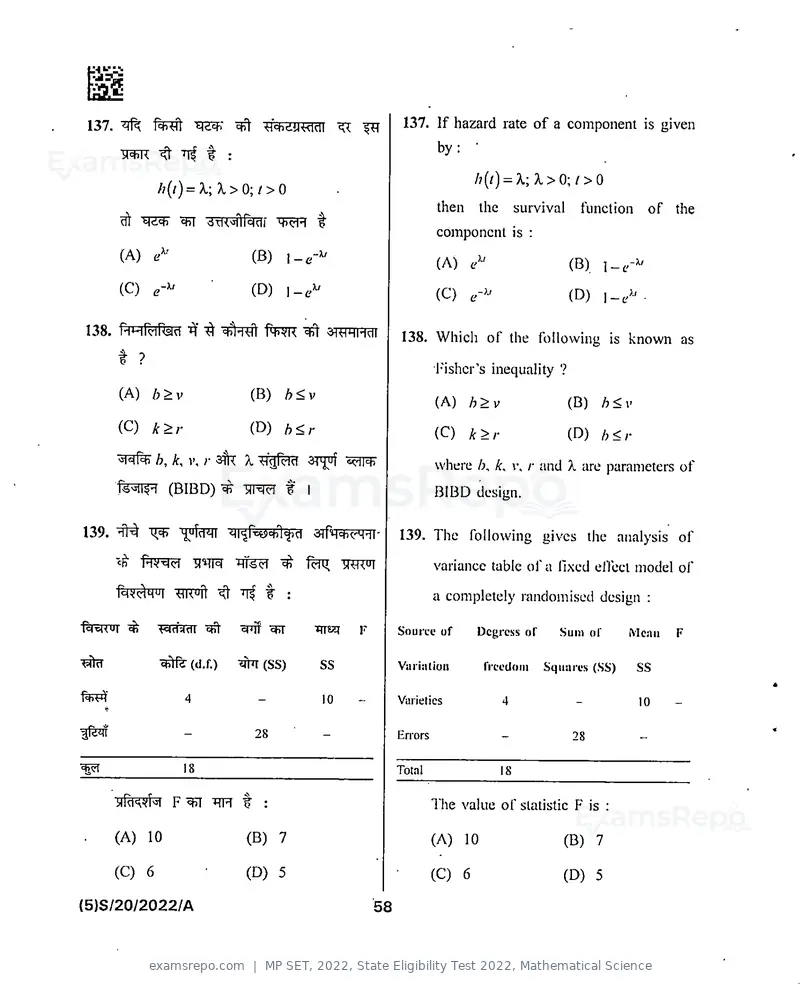
Text of page 60
137.                             ^ ^'chdil-Wdl ^                137. If hazard rate of a component is given
                                                                        by:     ■
        "51^ ^ "nf t :
                                                                                h[t) = A.; X > 0; / > 0
                /;(/)= A,; X>0;/>0
                                                                        then        the        survival    function    of the
         eft fcldcti ^                       ^
                                                                        component is :
        (A) cA'                     (B)                                 (A) e'-"                          (B) 1-,,-^
        (C)                        (D)                                  (C) e-'-'                         (D) I

 138. rHHPdRsld                      feR ^ SRRTRdT              138. Which of the following is known as
        t ?
                                                                        Inshcr's inequality ?
        (A) b>v                    (B) b<v
                                                                        (A) b>v                           (B) b<v
        (C) k>r                    (D) b<r                              (C) k>r                           (D) h<r
        ^dP+i b, k, V, r sfK A. vn'^Ria 3T^                             where /?, k, \\ r and X are parameters of
                 (BIBD)^ Tn^ f I                                        BIBD design.

139. 'll'^         "'jyfcRTT qi-jFcyctiltjja ^rf^che'M'il' 139. The following gives the analysis of
        ■^ft             "3^                         TRRq               variance table of a fixed effect model of

                              ^       t :                               a completely randomised design :
"^RRUT ^        WsRTT ^           ^^        TrrSSI     F        Source of       Degress of            Sum of      Menu     F

                ^ftfe (d.f.)         (ss)    ss                 Variation           freedom        Squares (SS)       SS

                     4               -       10       -         Varieties                 4               -           lo   -

iferf               -               28       -                  Enors                     -               28          -


^                   18                                          Total                     18


        yPd^^I^ F ^ RH t :                                              The value of statistic F is :

        (A) 10                     (B) 7                                (A) 10                        (B) 7

        (C) 6             ■        (D) 5                                (C) 6                         (D) 5

(5)S/20/2022/A                                             58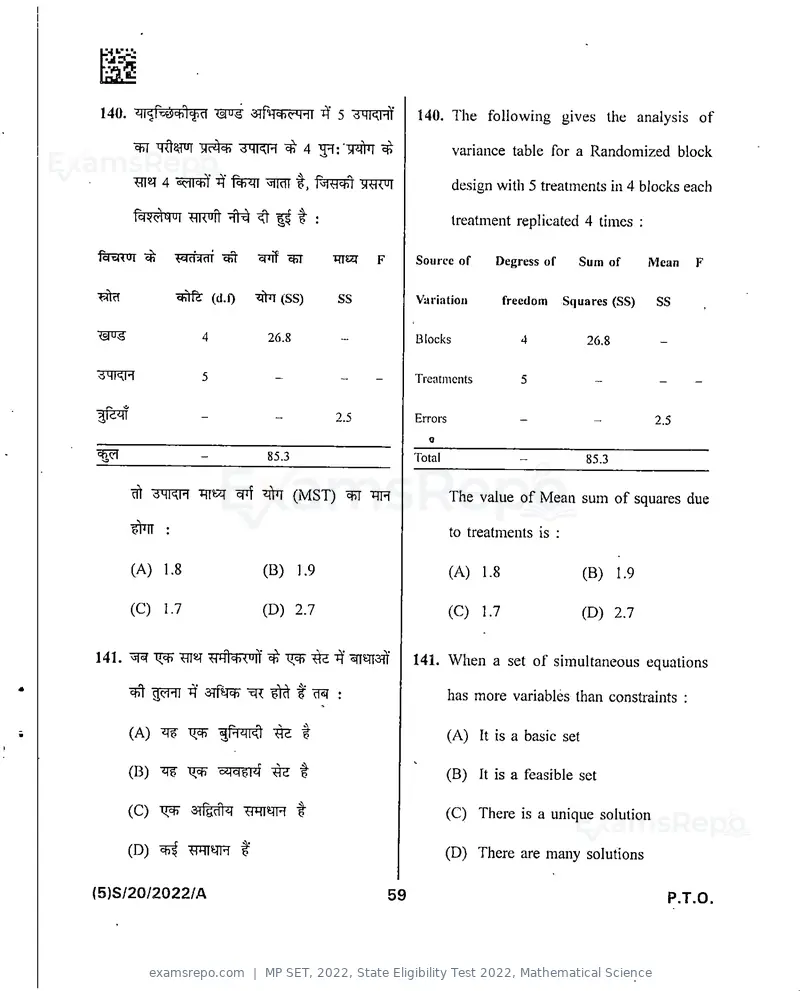
Text of page 61
ii
140.                                                -4' 5              140. The following gives the analysis of
                      "3?^ ^MKH ^ 4                    '"3^ ^                   variance table for a Randomized block

       ■^TT^l 4                        WT t, "fer^ "SWT                         design with 5 treatments in 4 blocks each

                     ^m^jt            ^^t :                                     treatment replicated 4 times :

         ^         Wrl^idl "^it       ^Tjf ^          tnszr   F        Source of       Degress of      Sum of       Mean   F

                   ^rrft (d.O            (SS)          SS              Variation          freedom    Squares (SS)    SS

                                       26.8                            Blocks                            26.8


^4KH                                                                   Treatments


                                                       2.5             Errors                                       2.5
                                                                         e

=F[^                                   85.3                            Total                            85.3


             ^WT              ^ ^ (MST) ^ "EIH                                  The value of Mean sum of squares due
               :                                                                to treatments is :


       (A) 1.8                        (B) 1.9                                   (A) 1.8                 (B) 1.9

       (C) 1.7                        (D) 2.7                                   (C) 1.7                 (D) 2.7


141.         "Q;^ "^TT^ ■HH147<"J|T ^ trq^ ^                           141. When a set of simultaneous equations
       ^ ^eidi                    ^           If       :                        has more variables than constraints :

       (A)                                     "I                              (A) It is a basic set

       (B) "^TF            ^T^FPf ^ t                                          (B) It is a feasible set

       (C)           ^Tferk                   t                                (C) There is a unique solution

       (D) ^                      f                                            (D) There are many solutions

(5)S/20/2022/A                                                    59                                                  P.T.O,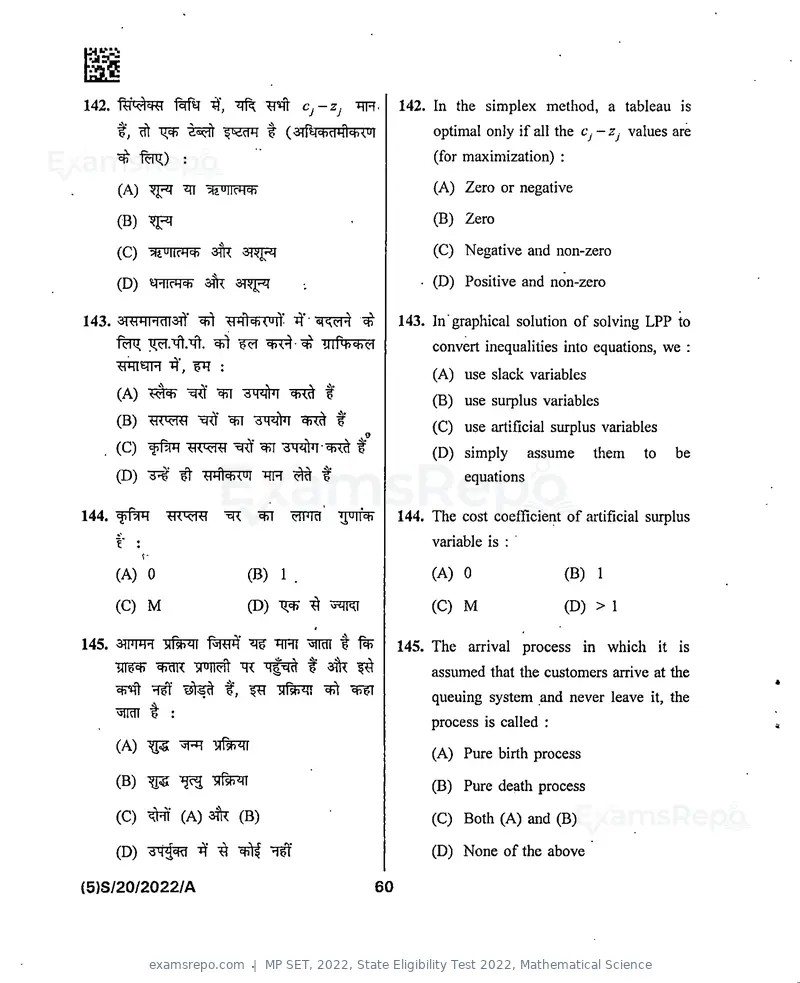
Text of page 62
142.                                                               142. In   the simplex method, a tableau is
       f,                                  t (-STteKFTt^niTT            optimal only if all the Cj-Zj values are
       ^ %T) :                                                          (for maximization):

       (A)            "^TT                                              (A) Zero or negative

       (B) ^                                                            (B) Zero

       (C) Tiiwr^ 3fR                                                   (C) Negative and non-zero

       (D) ^HlrHcf) 3fR 3T^                                             (D) Positive and non-zero

143. 3RmFRTT3^' ^ BTftonl- T^*-wr^ ^                               143. In graphical solution of solving LPP to
     fcTTi T3;^.'cft.tf|. ^^   uipHichei                                convert inequalities into equations, we :
                  1^', ^ :                                              (A) use slack variables
       (A)                        ^ wiRr ^ t                            (B) use surplus variables
       (B) "HTW                   ^ WTRt ^ f                            (C) use artificial surplus variables
                                                          o

       (C)                            ^                 f               (D) simply        assume   them   to   be
       (D) ^                 ^414)<U| TTPT ^ t                                equations

144.                              ^ ^ eTPTcr'                      144. The cost coefficient of artificial surplus

       1" :                                                             variable is :
             r-


       (A) 0                        (B) 1 .                            (A) 0                  (B) 1

       (C) M                        (D) "Q;^                           (C) M                  (D) > 1

145. 3MTBr Tlf^ I^RT^' ^ -BHT "Sfmi f                              145. The arrival process in which it is
       OT# "tR -qf^ t 35k ^                                             assumed that the customers arrive at the
   ^^ ^55^ t,   irfOT ^ ^                                               queuing system and never leave it, the
       ^jITcTT "I :
                                                                        process is called :
       (A)
                                                                       (A) Pure birth process
       (B) ^^                                                          (B) Pure death process

       (C)         (A) sSk (B)                                         (C) Both (A) and (B)

       (D)                   k'    "^551                               (D) None of the above

(5)S/20/2022/A                                                60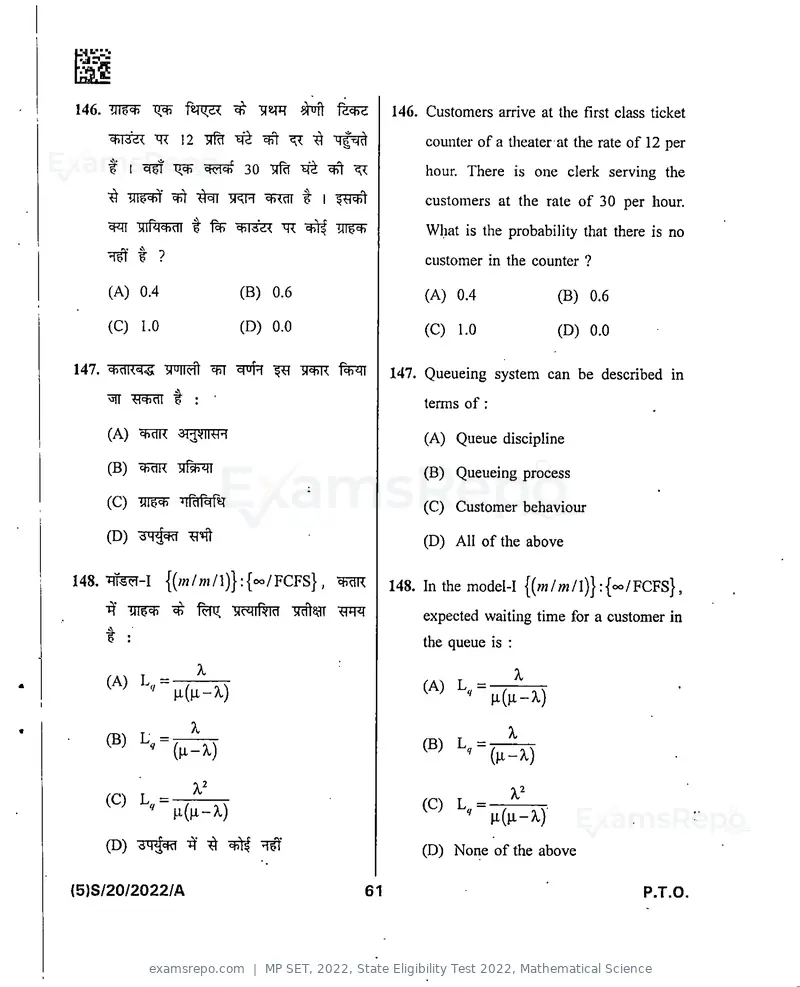
Text of page 63
146.                          ^         W          146. Customers arrive at the first class ticket

                "'TT 12 3Tf^ ^                          counter of a theater at the rate of 12 per
       ^ I cfWT i<=ti         30 Mfd                    hour. There is one clerk serving the
             Wi6<+'1 ^ ^'=i\ H^M '=h<ai % I             customers at the rate of 30 per hour.
       ^ "mtom i ^                  -qr ^ tit^          What is the probability that there is no
       ■qFf t ?                                         customer in the counter ?

       (A) 0.4                (B) 0.6                   (A) 0.4                (B) 0.6

       (C) 1.0                (D) 0.0                   (C) 1.0                (D) 0.0

147.              "STwit ^              TJ^ fen    147. Queueing system can be described in
       ^           t : ■                                terms of:

       (A)          375?7RH                             (A) Queue discipline
       (B) q=KM "Rfen                                   (B) Queueing process
       (C) TIT^ "qfclfel                                (C) Customer behaviour

       (D)                                              (D) All of the above

148. hT^cti-I {(7M/m/l)}:{oo/FCFS},                148. In the model-I {(7m/w/I)}:{oo/FCFS},
       ■^*         ^ ffe wnfer Ticfl^                   expected waiting time for a customer in
       t :                                              the queue is :

                                                                         X
       (A) L,=                                          (A) L^ =
                                                                    |x(n-X)
                      X                                               X
       (B) L',=                                         (B) L^ =
                   {p.-X)                                           ili-X)
                        X'                                             x"-
       (C) L =                                         (C) L =
                   ii{li-x)                                         iL{\l-X)
       (D) "3^1^          ^ ^                          (D) None of the above

{5)S/20/2022/A                                61                                           P.T.O.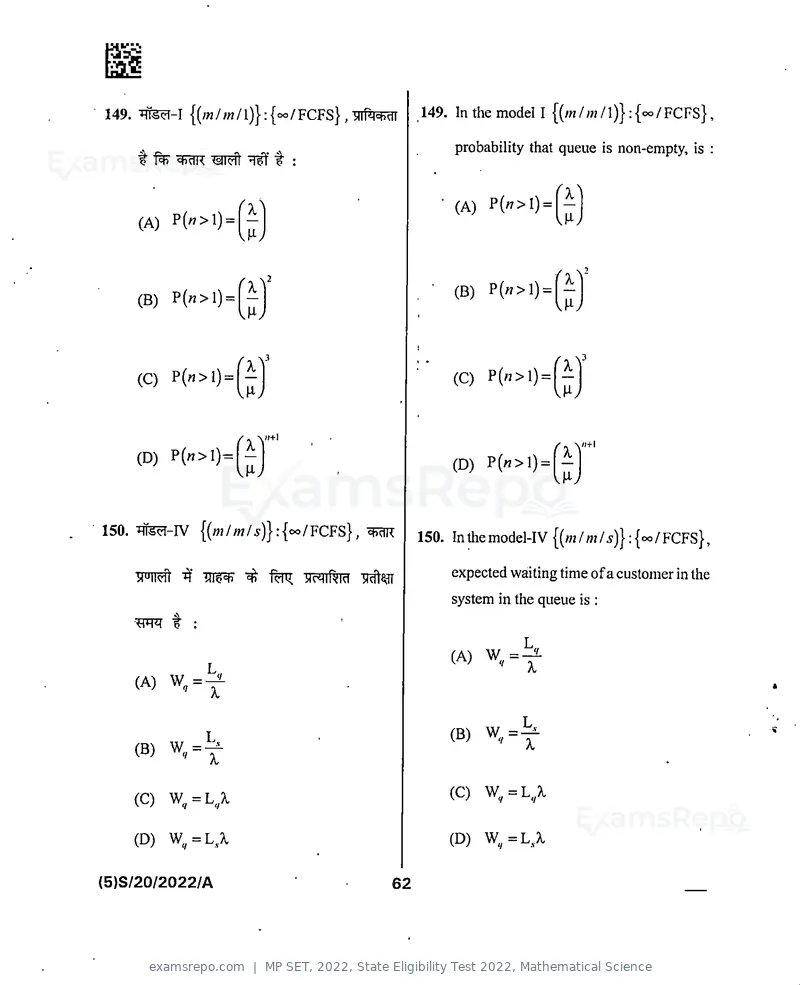
Text of page 65
Tq7 ■gTTjJ

                         (SPACE FOR ROUGH WORK)


    X


1


        (5)S/20/2022/A
Text of page 66
"TO


                 (SPACE FOR ROUGH WORK)


(5)S/20/2022/A
Text of page 67
T'?' ct)i4 ^ fwy,
              (SPACE FOR ROUGH WORK)


S/20/2022/A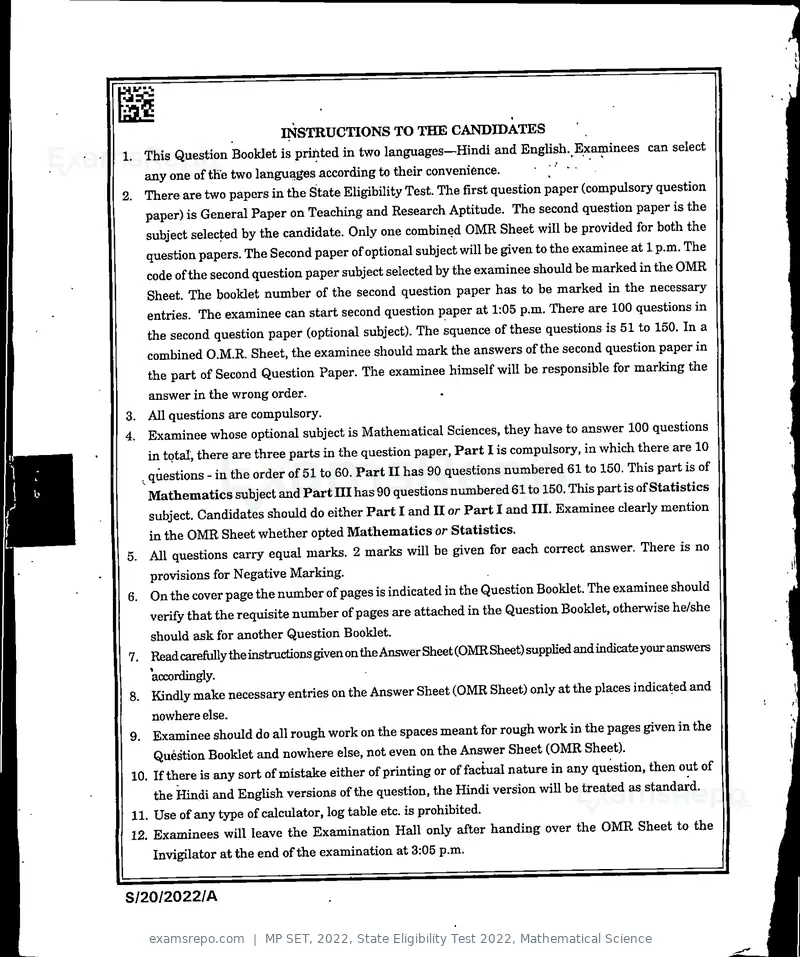
Text of page 68
INSTRUCTIONS TO THE CANDIDATES
1. This Question Booklet is printed in two languages—Hindi and English. Examinees can select
      any one of the two languages according to their convenience.        ' /"
2. There are two papers in the State EUgibility Test. The first question paper(compulsory question
      paper)is General Paper on Teaching and Research Aptitude. The second question paper is the
      subject selected by the candidate. Only one combined OMR Sheet will be provided for both the
      question papers.The Second paper ofoptional subject will be given to the examinee at 1 p.m.The
      code ofthe second question paper subject selected by the examinee should be marked in the OMR
      Sheet. The booklet number of the second question paper has to be marked in the necessary
      entries. The examinee can start second question paper at 1:05 p.m. There are 100 questions in
      the second question paper (optional subject). The squence of these questions is 51 to 150. In a
      combined O.M.R. Sheet,the examinee should mark the answers of the second question paper m
      the part of Second Question Paper. The examinee himself will be responsible for marking the
      answer in the wrong order.
3. All questions are compulsory.
4. Examinee whose optional subject is Mathematical Sciences, they have to answer 100 questions
   in total, there are three parts in the question paper,Part I is compulsory, m which there are 10
      questions - in the order of51 to 60.Part H has 90 questions numbered 61 to 150. This part is of
      Mathematics subject and PartHIhas 90 questions numbered 61 to 150.This partis ofStatistics
      subject. Candidates should do either Part I and H or PartI and HI. Examinee clearly mention
      in the OMR Sheet whether opted Mathematics or Statistics.
5.    All questions carry equal marks. 2 marks will be given for each correct answer. There is no
       provisions for Negative Marking.
6.     On the cover page the number ofpages is indicated in the Question Booklet. The examinee should
       verify that the requisite number of pages are attached in the Question Booklet,otherwise he/she
      should ask for another Question Booklet.
 7.    Read carefully theinstructions given on the Answer Sheet(OMRSheet)supplied and mdicate your answers
       ac(X)rdin^y.
       Kindly make necessary entries on the Answer Sheet(OMR Sheet)only at the places mdica^d and
       nowhere else.
 9.  Examinee should do all rough work on the spaces meantfor rough work in the pages given in the
     Question Booklet and nowhere else, not even on the Answer Sheet(OMR Sheet).
 10. If there is any sort of mistake either of printing or offactual nature in any question,then out of
     the Hindi and English versions of the question, the Hindi version will be treated as standard.
 11. Use of any type of calculator, log table etc. is prohibited.
 12. Examinees will leave the Examination Hall only after handing over the OMR Sheet to the
       Invigilator at the end ofthe examination at 3:05 p.m.

S/20/2022/A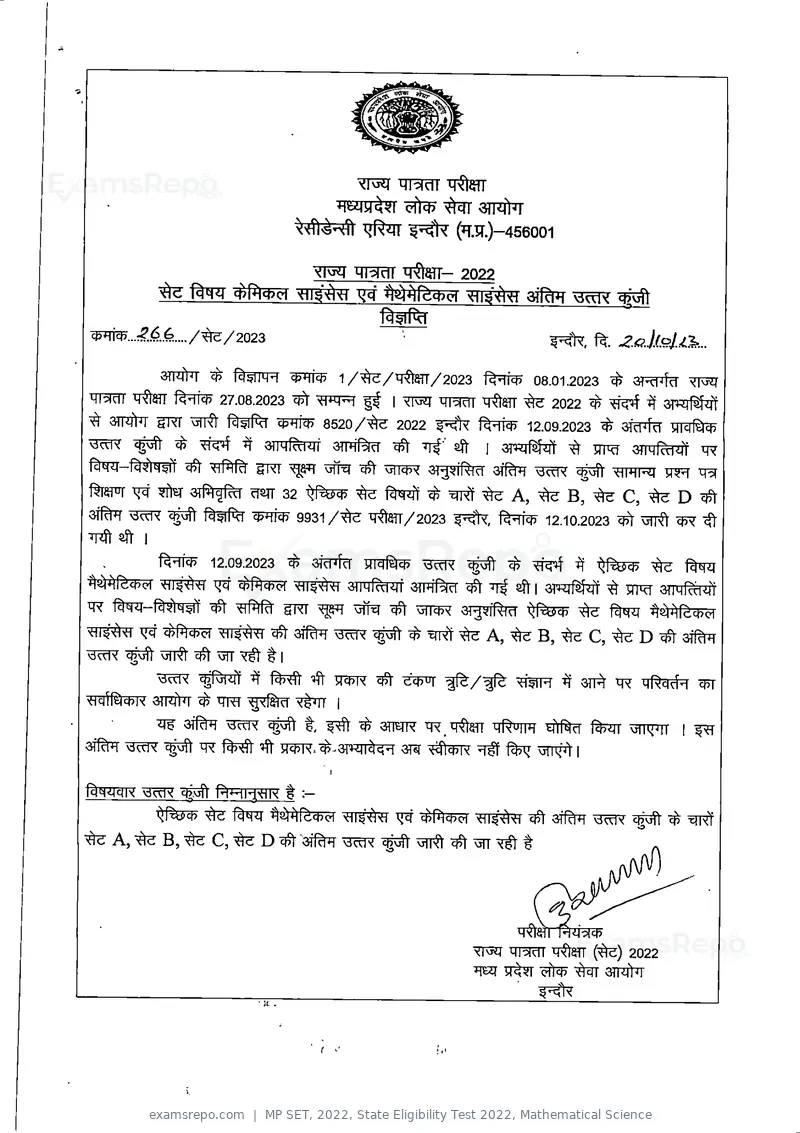
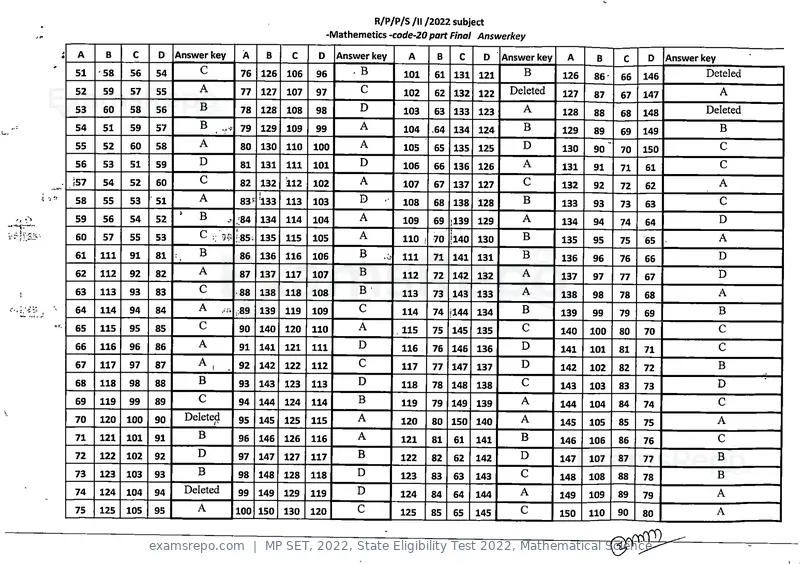
Text of page 2
R/P/P/S/ll/2022 subject
-Mathematics -code-20 part Final Answerkey
A B C D Answer key A B C D Answer key A B C D Answer key A B C D Answer key
51 58 56 54 C 76 126 106 96 .B B Deteled
101 61 131 121 126 86 66 146
52 59 57 55 A 77 127 107 97 C Deleted A
102 62 132 122 127 87 67 147
53 60 58 56 B 78 128 108 98 D A Deleted
103 63 133 123 128 88 68 148
54 51 59 57 B 79 129 109 99 A 104 .64 134 124 B B
129 89 69 149
55 52 60 58 A 80 130 110 A D C
100 105 65 135 125 130 90^ 70 150
56 53 51 59 D 81 131 111 101 D A C
106 66 136 126 131 91 71 61
157 54 52 60 C 82 132 112 102 A C A
107 67 137 127 132 92 72 62
58 55 53 51 A 83^ ^3 113 103 D B C
108 68 138 128 133 93 73 63
59 56 54 52 ' B ,;84 134 114 104 A 109 69 1139 129 A D
134 94 74 64
(
60 57 55 53 c .V,., i:85i 135 115 105 A 110 f 70 il40 130 B A
135 95 75 65
61 111 91 81 \ B 86 136 116 106 B 111 71 141 131 B 136 96 76 66 D
62 112 92 82 A 87 137 117 107 B A D
112 72 142 132 137 97 77 67
63 113 93 83 C 88 138 118 108 B ■ 113 73 143 133 A A
138 98 78 68
64 114 94 84 A ,89 139 119 109 C 114 74 !l44 B B
134 139 99 79 69
65 115 95 85 C 90 140 120 110 A C C
. 115 75 145 135 140 100 80 70
66 116 96 86 A 91 141 121 111 D D C
116 76 146 136 141 101 81 71
67 117 97 87 A, . 92 142 122 112 C 117 77 147 137 D 142 102 82 72 B
68 118 98 88 B 93 143 123 113 D C D
118 78 148 138 143 103 83 73
69 119 99 89 C 94 144 124 114 B A C
119 79 149 139 144 104 84 74
70 120 100 90 Deleted 95 145 125 115 A A A
r 120 80 150 140 145 105 85 75
71 121 101 91 B 96 146 126 116 A B C
121 81 61 141 146 106 86 76
72 122 102 92 D 97 147 127 117 B D B
122 82 62 142 147 107 87 77
73 123 103 93 B 98 148 128 118 D C B
123 83 63 143 148 108 88 78
74 124 104 94 Deleted 99 149 129 119 D A A
124 84 64 144 149 109 89 79
75 125 105 95 A 100 150 130 120 C C A
125 85 65 145 150 110 90 80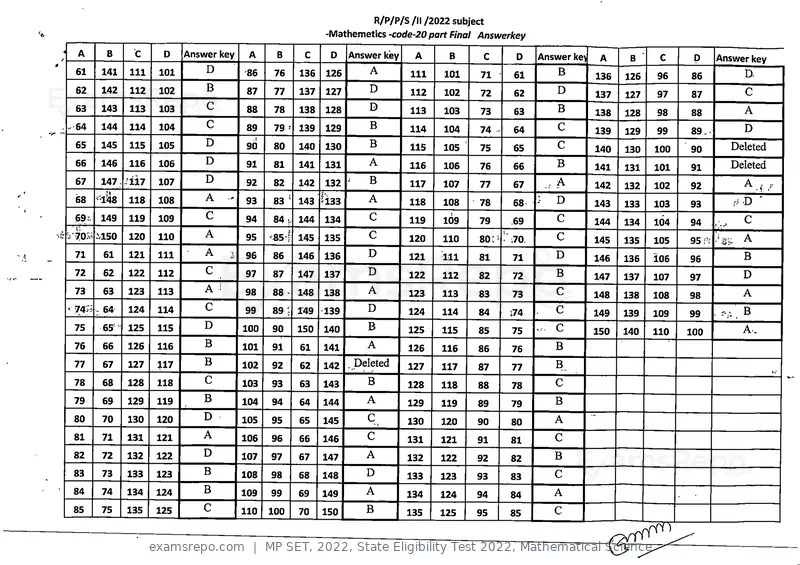
Text of page 3
R/P/P/S/ll/2022 subject
-Mathemetics -code-20 part Final Answerkey
A B C D Answer key A B C D Answer key A B C D Answer ke^ A B C D Answer key
61 141 111 101 D 86 76 136 126 A B
111 101 71 61 136 126 96 86 D.
62 142 112 102 B 87 77 137 D D
127 112 102 72 62 137 127 97 87 C
63 143 113 103 C 88 78 138 D B
00 128 113 103 73 63 138 128 98 88 A
^64 144 114 104 C 89 79 ^ 139 129 B 114 C D
104 74 - 64 139 129 99 89.
65 145 115 105 D B C
90 80 140 130 115 105 75 65 140 130 100 90 Deleted
66 146 116 106 D A B
91 81 141 131 116 106 76 66 141 131 101 91 Deleted
132 ■
67 147.-iii7 107 D B A
92 82 142 117 107 77 67 142 132 102 92 A.<,-
68 118 108 A 93 83' 143 '133 A : D p.D "
118 108 78 68 143 133 103 93
C C
69- 149 119 109 94 84 144 134 119 169 79 69 c 144 134 104 94 ... c
70^ MSG 120 110 A 95 85 f 145 C c
135 120 110 .70 145 135 105 95 r: A
- h 71 61 121 111 • A ^ 96 86 146 136 D 121 ill 81 71 D 146 136 106 96 B
72 62 122 112 C 97 87 147 D B
137 122 112 82 72 147 137 107 97 D
73 63 123 113 A i 98 148 138 A 123 C A
113 83 73 148 138 108 98
^ 74:= ~ 64 124 C D C
114 99 89 149 139 124 114 0
84
00
■74 149 139 109 99 , r.; B
75 65 125 115 D 100 90 B ... C
150 140 125 115 85 75 150 140 110 100 A-.
76 66 126 116 B 101 91 61 141 A B
126 116 86 76
77 67 127 117 B 102 92 62 142 . Deleted 127 117 87 77 B.
78 68 128 118 C 103 93 63 143 B C
128 118 88 78
79 69 129 119 B 104 94 64 144 A B
129 119 89 79
80 70 130 120 D 105 95 65 145 C A
—
130 120 90 80
81 71 131 121 A 106 96 66 C C
146 131 121 91 81
82 72 132 122 D 107 97 67 147 A B
132 122 92 82
83 73 133 123 B 108 98 68 D C
148 133 123 93 83
84 74 134 124 B 109 99 69 149 A A
134 124 94 84
85 75 135 125 C 110 100 70 150 B C
135 125 95 85
OC
OC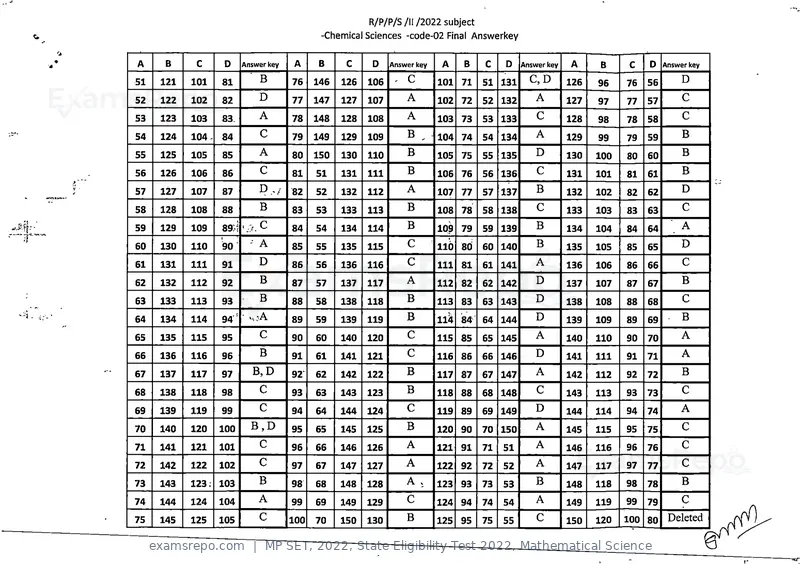
Text of page 4
R/P/P/S/II/2022 subject
                                             -Chemical Sciences -code-02 Final Answerkey

A     B     C      D     Answer key    A    B      C     D    Answer key    A    B    C    D     Answer key   A      B     C    D Answer key

51   121   101    81         B        76    146   126   106 . c            101   71   51 131       C,D        126   96    76    56       D

52   122   102    82         D        77    147   127   107       A        102 72     52 132         A        127         77    57       C
                                                                                                                    97

53   123   103    83         A        78    148   128   108       A        103 73     53 133         C        128   98    78    58       C

54   124   104-   84         C        79    149   129   109       B.       104 74     54 134         A        129   99    79    59       B

55   125   105    85         A        80    150   130   110       B        105 75     55 135        D         130   100   SO    60       B

56   126   106    86         C        81    51    131   111       B        106   76   56 136         C        131   101   81    61       B

57   127   107    87         D,,/     82    52    132   112       A        107 77     57 137         B        132   102   82    62       D

58   128   108    88         B        83    53    133   113       B        108 78     58 138         C        133   103   83    63       C

59   129   109                        84    54    134   114       B        109 79     59 139         B        134   104   84    64       A

60   130   110    90       '■ A       85    55    135   115       C        lib 8b     60 140         B        135   105   85    65       D

61   131   111    91         D        86    56    136   116       C        111 81     61 141         A        136   106   86    66       C

62   132   112    92         B        87    57    137   117       A        112   82   62 142        D         137   107   87    67       B

63   133   113    93         B        88    58    138   118       B        113   83   63 143        D         138   108   88    68       C

64   134   114    94 '     s;A        89    59    139   119       B        ll4   84   64 144        D         139   109   89    69   .   B

65   135   115    95         C        90    60    140   120       C        115   85   65 145         A        140   110   90    70       A

66   136   116    96         B        91    61    141   121       C        116   86   66   146      D         141   111   91    71       A

67   137   117    97       B,D        92    62    142   122       B        117   87   67 147         A        142   112   92    72       B

68   138   118    98         C        93    63    143   123       B        118   88   68 148         C        143   113   93    73       C

69   139   119    99         C        94    64    144   124       C        119   89   69   149      D         144   114   94    74       A

70   140   120    100      B,D        95    65    145   125       B        120   90   70   150       A        145   115   95    75       C

71   141   121    101        C        96    66    146   126       A        121 91     71   51        A        146   116   96    76       C

72   142   122    102        C        97    67    147   127       A        122   92   72   52        A        147   117   97    77       C

73   143   123: 103          B        98    68    148   128       A ,      123   93   73   53       B         148   118   98    78       B

74   144   124    104        A        99    69    149   129       C        124   94   74   54        A        149   119   99    79       C

75   145   125    105        C        100   70    150   130       B        125   95   75   55        C        150   120   100   80   Deleted
Page 1 of 68
Source: Madhya Pradesh Public Service Commission. Question paper published by Madhya Pradesh Public Service Commission.