
MP SET 2024: State Eligibility Test, General Paper on Teaching & Research Aptitude
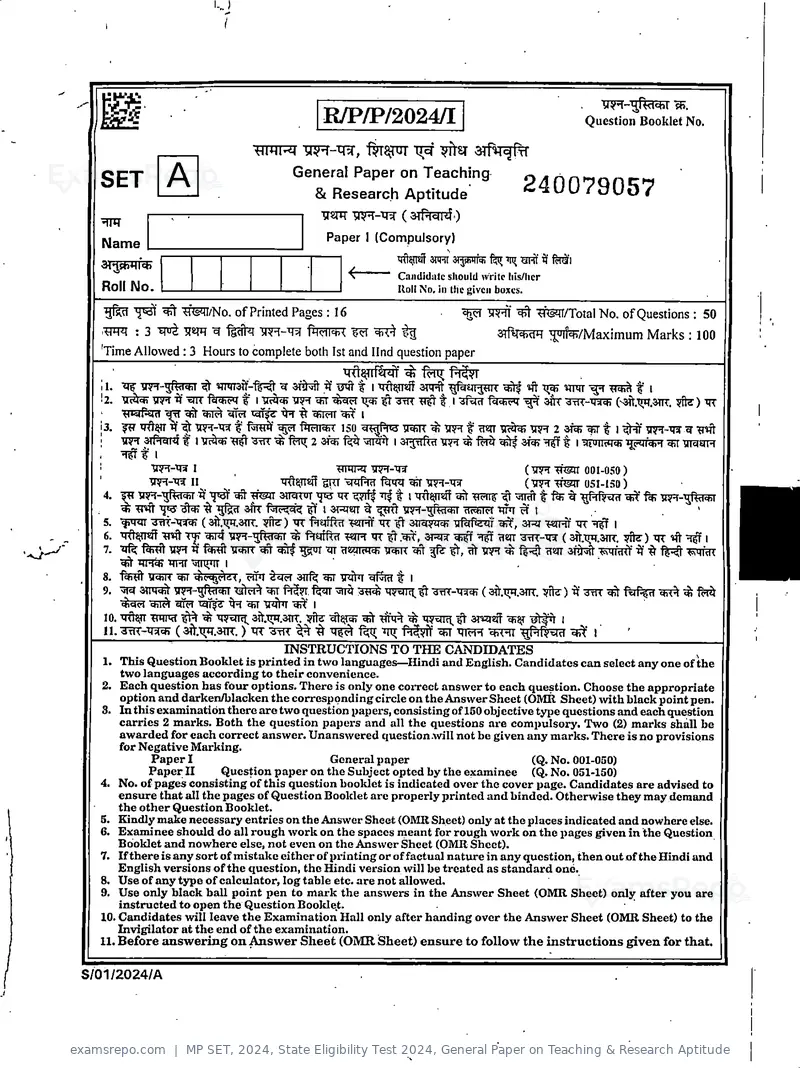
Text of page 1
I-.)


                                                             RyP/P/2024/I                                                  Question Booklet No.

                                        WTF^T                                     1T^ #£I 3Tf^T^
                                                      General Paper on Teaching
  SET              A                                     & Research Aptitude                                240079057
                                                         ■gsm       (37ter?f ')
  Name
                                                             Paper I (Compulsory)
                                                                                       3tTn                 T3nt
  3T^RITf^
                                                                  ^           Candidate should write his/her
  Roll No.                                                                    Roll No. in the given boxes.

                   ^ yt£Mi/No. of Printed Pages : 16                                          «t)(n 3RT1       TP^/Total No. of Questions : 50
  iWI : 3 wt ucm ^ Hcfhl                                           ^          ^                                     ^jyife/Maximum Marks ; 100
  'Time Allowed : 3 Hours to complete both 1st and llnd question paper
                                                               xrft^rrfW ^
                         ^                       '5                 i trfiyraf atiT'it                             tr^ ^tntr               ti
        tn5t^ tlTT "fif W (qcheM f I                     gir "^SIH ^ "^tTT t I                                     sftt TrlT-ira^                 ^) TIT
                      ^           ojfvl »<iT§6           cnicll ^ I
  13.   ??T                                      c^eT [Hciicti< 150            Hortt     wr t xmt xr^ xiv^ 2 af?;                11         xit^-'TT ^
        u?^ ^fncti<I 11XR^              ^tIT "%         2 sraj               i st^rTftti xiTT xi>      ^tf 3fa>        t 1 5i?RR*ra»             ^ xtictuH
        ibT ^ I
               xiTT-^ I                                         trmPT xr7=i-tTW                              (xr^^trtattr ooi-oso)
               xrn-^ 11                          trttyrsif ^                          m-Ttr                  (xt^rxTtsir osi-iso)
        ^                    "5^ "31^ XTt3tT atreWT             ^T "^Tl^ "Rf t I TXt^raf ^ TFTT? ^511^ "I"                                      Xl?^-^fw<ST
        ^ ^ ^^                        SIR Rdc<et<            I 3R?t«ir t       XIH-y,rW<*il tTcSRTef TtFT      I
        "^iW                ( 3lt.T^.3TTT.        ) iTT ■pr^fftfT '^SJTTf tlT ^ 3tra?XT^ uf^fe^T            3PJ fSTRfr' TJT "^iff I
        mOi^iuJT       vf gRT4 "gy^-iirwchi^^                    wrt ^                        ^^                      (ait.Tnr.STR. ?ite) tjt ^          i
              fW xi?T if           xi^ ^ giif ^uT -m HWtgi xi^ ^ ^                             at xnpr ^           ttstr arSiTt ^m^O' if ^          i^qfax
        ^ Miieji xTpjr xjn^nr i                      "
        n»itO Xranr "^Jt qic^<riat, HPT ^<aci 3TTf^ ^ Xratt qfjirt                I
                                             ^ ■pr^H. "f^XTT                                        ( 3it.T^.3TIT. ?fte) TrlT ^ f^fP^rf "^iT^ ^
        tjicjci "3jl^ ^TH         ^          XRTPT "95^" I
        "^rfh^ TwiRT 6*)^ ^             3tt.T^,3HT.           '^^rai ^ ttpi% %                               "dt^ i
        THT-XJ^^ ( 3Tt.X^.3TR. ) ifT '-STi^              ^                 "Rir Pl^^ "gjT qirti 'ch<n ^f^IVwd                I         '
                                                  INSTRUCTIONS TO THE CANDIDATES
        This Question Booklet is printed in two lan^ages—Hindi and English. Candidates can select anyone of the
        two languages according to their convenience.
        Each question has four options. There is only one coiTcct answer to each question. Choose the appropriate
        option and darken/blacken the corresponding circle on the Answer Sheet (OMR Sheet) xvith black point pen.
        In this examination there are two question papers, consisting of 150 objective type questions and each question
        carries 2 marks. Both the question papers and all the questions are compulsory. Two (2) marks shall be
        awarded for each correct answer. Unanswered question xvill not be given any marks. There is no provisions
        for Negative Marking.
           PaperI                           General paper                        (Q. No. 001-050)
          Paper II     Question paper on the Subject opted by the examinee (Q. No. 051-150)
  4. No. of pages consisting of this question booklet is indicated over the cover page. Candidates are advised to
        ensure that all the pages of Question Booklet are properly printed and bindcd. Otherwise they may demand
        the other Question Booklet.
  5.    Kindly make necessary entries on the Answer Sheet (OMR Sheet) only at the places indicated and nowhere else.
  6.    Examinee should do all rough work on the spaces meant for rough work on the pages givenin the Question
        Booklet and nowhere else, not even on the Answer Sheet (OMR Sheet).
  7.    If there is any sort of mistake cither of printing or of factual nature in any question, then out of theHindi and
        English versions of the question, the Hindi version will be treated as standard one.
  8.    Use of any typo of calculator, log table etc. are not allowed.
  9.    Use only black ball point pen to mark the answers in the Answer Sheet (OMR Sheet) only after you are
        instructed to open the Question Bookle.t.
  10 Candidates will leave the Examination Hall only after handing over the Answer Sheet (OMR Sheet) to the
        Invigilator at the end of the examination.
  II. Before answering on ^swer Sheet (OMR Sheet) ensure to follow the instructions given for that.


S/01/2024/A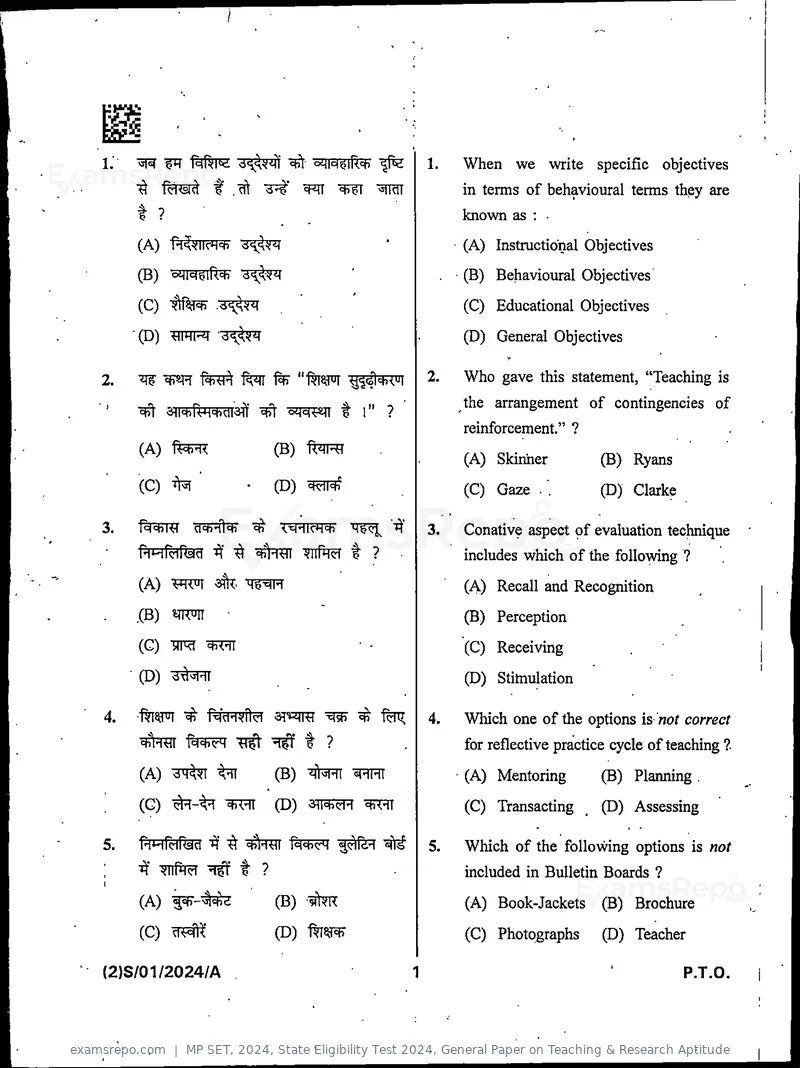
Text of page 2
1.                                 ^ ^|cj^lR=b ^         When we write specific objectives
            fVuslcl                     ^                in terms of behavioural terms they are
                                                         known as : •

     (A)                                                 (A) Instructional Objectives

     (B) ^m^WTfW ^5^^                                    (B) Behavioural Objectives
     (C)              -"3^^                              (C) Educational Objectives
     ■(D) WTHT "5^^                                      (D) General Objectives
                                                               T


2.                                                       Who gave this statement, "Teaching is
                                                         the arrangement of contingencies of
     ^ SllchR^chdiafi ^                         t l" ?
                                                         reinforcement." ?
     (A)                          (B) I^^TRT
                                                         (A) Skinner           (B) Ryans
     (C) M                        (D) =K1l=ti            (C) Gaze ■            (D) Clarke

3.                d=bi|ch    c^                      ^   Conative aspect pf evaluation teclmique
     rHMPdR^d           ^ #R7T ?TTf^ t ?                 includes which of the following ?
     (A)              3|k, -w^                           (A) Recall and Recognition
     .(B)                                                (B) Perception
     (C) "SRI                                            (C) Receiving
     (D)                                                 (D) Stimulation

4.   ■'fk\m                 3T^3TRT ^ ^ %3:              Which one of the options is no^ correct
     '^m[               TT^ ^ t ?                        for reflective practice cycle of teaching ?.
     (A) 3^ ^                     (B) "qk^T              (A) Mentoring         (B) Planning .
     (G)                          (D)             ^TRT   (C) Transacting _ (D) Assessing

5.   PdHrdr^d "^f ^                                 ^    Which of the following options is not
;                           t ?                          included in Bulletin Boards ?
I


     (A)                          (B) -^fWR              (A) Book-Jackets (B) Brochure
     (C) 3^'                      (D)                    (C) Photographs       (D) Teacher

(2)S/01/2024/A                                                                              P.T.O.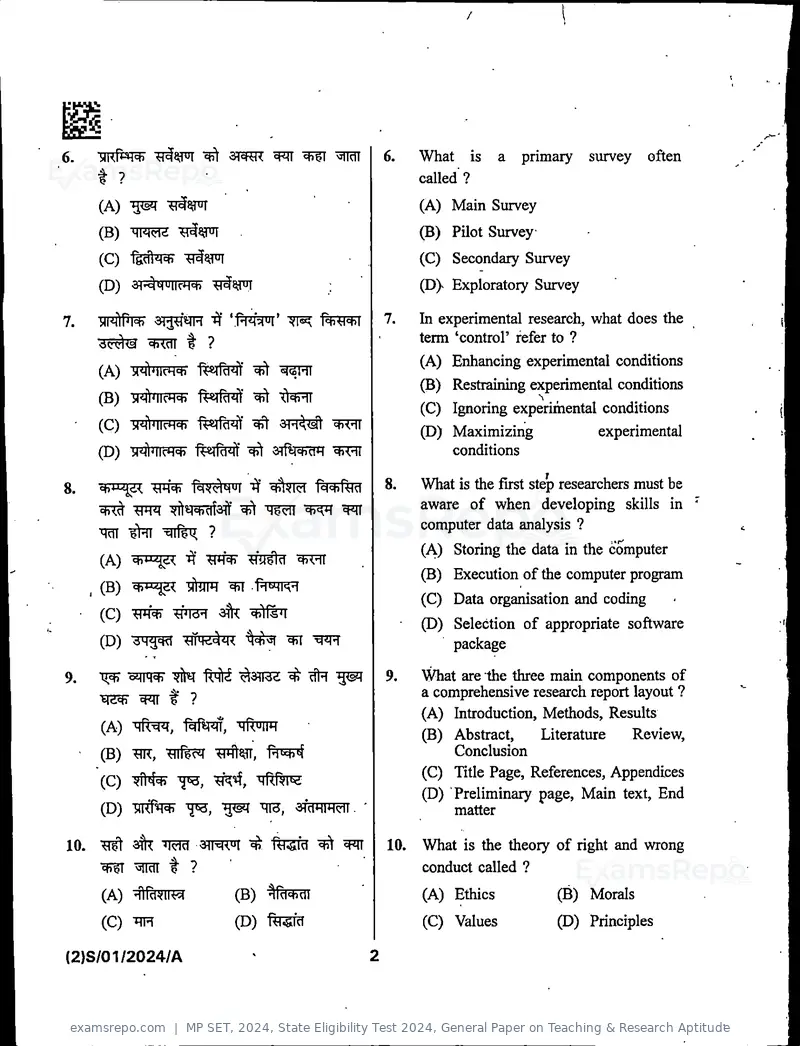
Text of page 3
6.       yK^H=t)                                   "^jTRTT   6.   What     is   a primary     survey   often
         t ?                                                      called ?

         (A)                                                      (A) Main Survey
         (B)                                                      (B) Pilot Survey
         (C) fed1^=ti                                             (C) Secondary Survey
         (D) 3T4w^                                                (D)^ Exploratory Survey

7.       yi^lPl^ 373^*%TH -^f *p[^*                          7.   In experimental research, what does the
         <iCT7^<a ct)<ai ^ ?                                      term 'control' refer to ?
                                                                  (A) Enhancing experimental conditions
         (A) MMVllCH=t)                cltolll
                                                                  (B) Restraining experimental conditions
         (B) y-Ml'IkHcb          ^
                                                                  (C) Ignoring experimental conditions
         (C) "5PftWT^            ^                                (D) Maximizing           experimental
         (D) y^lJiirHch          ^ arftj^Tcm                           conditions


8.                        P^J^cAmuI              Pi+r^d      8.   What is the first step researchers must be
                                  ^ H6(;ni          ^             aware of when developing skills in
                                                                  computer data analysis ?
         •yen #11 ^enf# ?
                                                                  (A) Storing the data in the computer
         (A)                      #1#T ^n^n
                                                                  (B) Execution of the computer program
      , (B)         #IFI ^ Thi^KH
                                                                  (C) Data organisation and coding
     ■ (C)         #1^ ^Sk
                                                                  (D) Selection of appropriate software
        (D) <jy^i=w        ^#5t ^                                     package

9.             ^nrw #1 k#               ^ #T -g^sq           9.   >^at are the three main components of
         ■siHqr     t ?                                           a comprehensive research report layout ?
                                                                  (A) Introduction, Methods, Results
         (A) "yft^, "f^^, "ykw                                    (B) Abstract,     Literature    Review,
     ■   (B) w, "^nf#!                                                   Conclusion
                                                                  (C) Title Page, References, Appendices
         (C)
                                                                  (D) Preliminary page. Main text. End
         (D) "RRfei "g^, •g'sq "yrs, ^iriHHeii .                       matter


10.                         3Trq^ ^              ^ w         10. What is the theory of right and wrong
         ■qiBT ^jJTcn f ?                                         conduct called ?

          (A) #eIW^             (B) ^fefquIT                      (A) Ethics           (B) Morals
          (C) TTH               (D) fejeT                         (C) Values           (D) Principles

(2)S/01/2024/A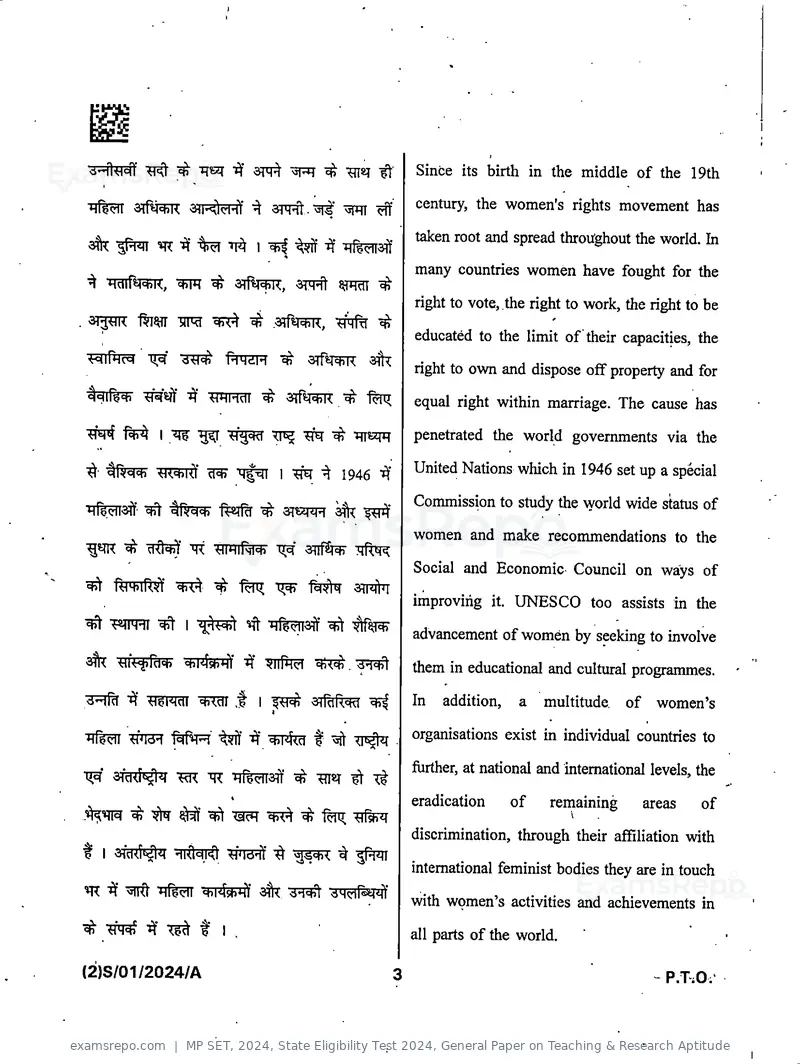
Text of page 4
^                                            it'   Since its birth in the middle of the 19th

 ■jfefT aif?^                      ^ 37TT^ .^-* TirqT #'      century, the women's rights movement has

                                                              taken root and spread throughout the world. In
 ^ it™ ^ ^                    7t^ I ^ ^ -^f trf^sif
                                                              many countries women have fought for the
                         ^ srfeR, ST^T^ a?TM ^
                                                              right to vote, the right to work, the right to be
. 3?i^ir            "HM ^ ^                     ^nf% ^
                                                              educated to the limit of their capacities, the
 wiPho:* tj;^*                pHMdH ^ sTf^T^ sftr
                                                              right to own and dispose off property and for
 %lf|^                   ■HTFTtTT ^ 3#TTO            1^       equal right within marriage. The cause has
 tW             I                               '% 1TTKZR     penetrated the world governments via the

 ■^' ^Ricjcti            cl^ "qf^ I              1946         United Nations which in 1946 set up a special

 TTf|^3if- ^                         •% arcEm ^               Commission to study the world wide status of
                                                              women and make recommendations to the
        ^ "^T^* "q^ wnf^ "q^* aiifer -qftq^
                                                              Social and Economic- Council on ways of
 ^ Rnq^iRiA «ti<A                 Rriq, "t^         s^nIm
                                                              improving it. UNESCO too assists in the
^ wrn "q^ I                       ^            ^
                                                              advancement of women by seeking to involve
 afk -Hl^Pdcb ^l4stiHT ■^' ^TTfe                              them in educational and cultural programmes.
™RT '^' WFTm ^r?^ ,t I                        3Tt%fw ^        In   addition,    a   multitude,   of     women's

iTfl^ ^TO=T               ■^' "4* cbl4<d t # "U^              organisations exist in individual countries to

                                                              further, at national and international levels, the
1^*                 ^ "tR Rfl^STf ^ RT8T ^ T#
                              \
                                                              eradication      of   remaining         areas   of
M'm ^ ^                  ^            ^ -% %T3; ^Rflrq
                                                              discrimination, through their affiliation with
tI                  HKi^.Kl                     ^
                                                              international feminist bodies they are in touch
^ "^f 'Jii^l            «tii4sti*H7 3^R <iichi dMriP^qf
                                                              with women's activities and achievements in
^ "Rq^                 t I .                                  all parts of the world.

(2)S/01/2024/A                                                                                         " P.T;0.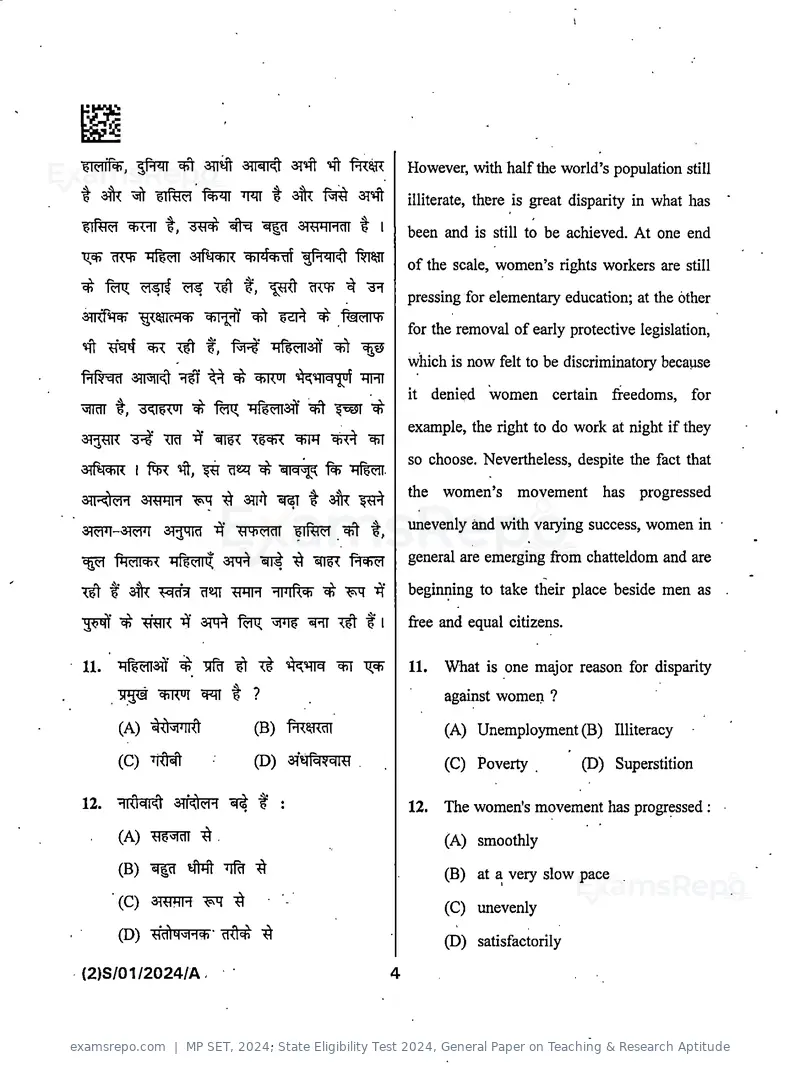
Text of page 6
fm

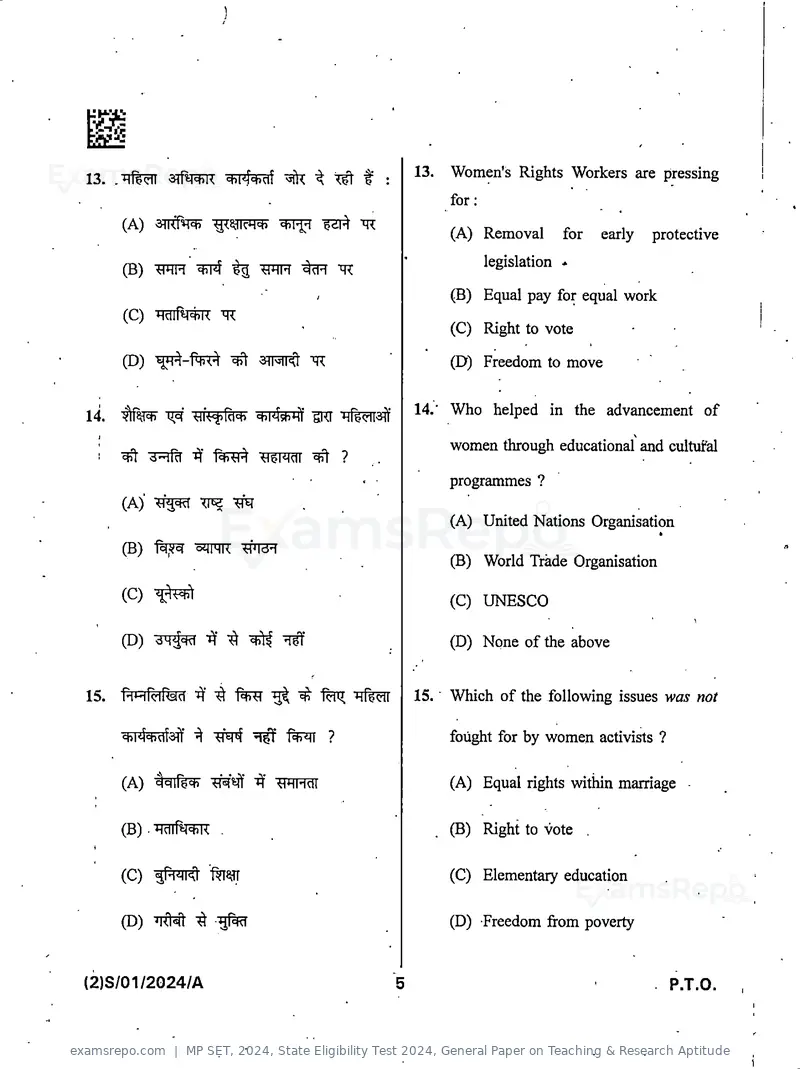
13.                               ^^ ^f :                 13. Women's Rights Workers are pressing
                                                               for;
         (A) STRfe "^ajT^TO                         "q^
                                                              (A) Removal for          early   protective
                                                                      legislation ■»
         (B) ^Hii        ^ "^RFT              "q^
                                        /                      (B) Equal pay for equal work
         (C) T7^?q^ TK
                                                               (C) Right to vote

         (D)             ^ 3M^ TR                              (D) Freedom to move


14.            q;^             4ii4sbMl' OT               14.' Who helped in the advancement of
     I

                                                               women through educational and cultufal
         ^ "^RfcT "^" i^=RT^ mm\ ^ ?
                                                               programmes ?
         (A)
                                                               (A) United Nations Organisation
                                                                                                *


         (B) 1^ "sqjqR Rfqnq
                                                               (B) World Trade Organisation

         (C)^                                                  (C) UNESCO

         (D) "sqjq^               "q^                          (D) None of the above


15. "MMw                ^ fer "51 ^ 1^ "qfl^              15. ■ Which of the following issues was not

         q^Bhfqfsff ^      ^ fen ?                             fought for by women activists ?

         (A) ^^rfer            -^f ^HHdi                       (A) Equal rights within marriage •

         (B)."qmfeR .                                          (B) Right to vote ,
 ♦


         (C) ^Pi^Kl                                            (C) Elementary education

         (D) "tM        ^5fe                                   (D) Freedom firom poverty


(2)S/01/2024/A                                                                                      P.T.O.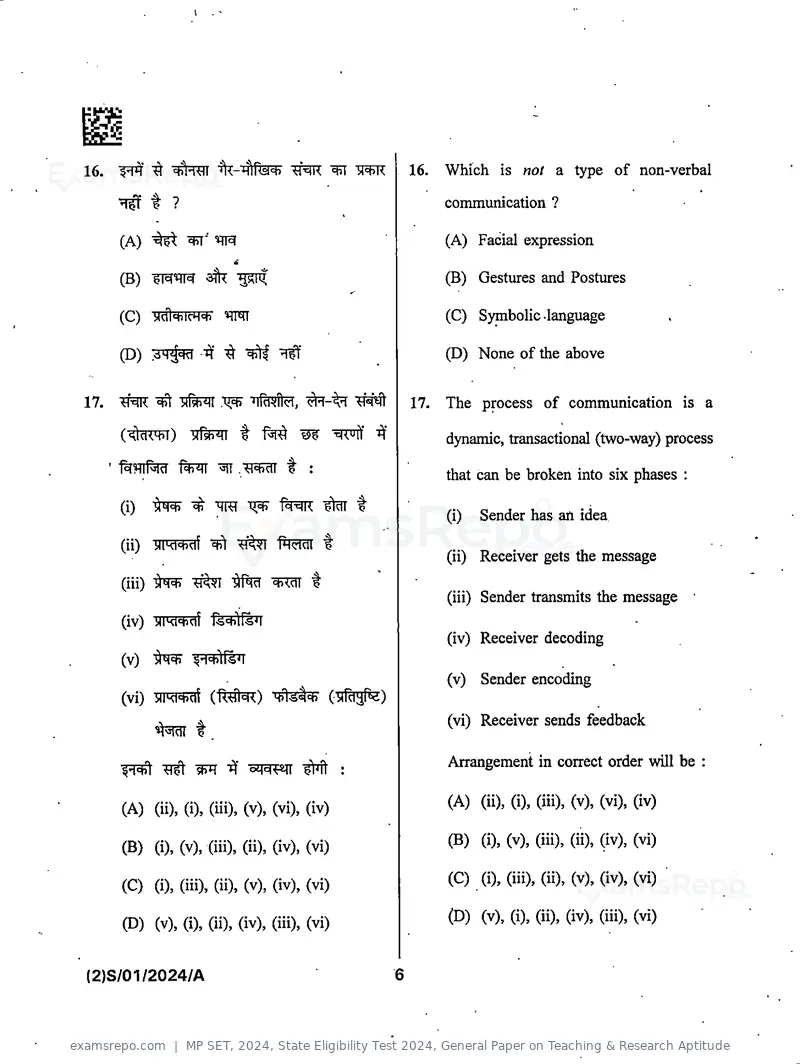
Text of page 7
16.   Which is not a type of non-verbal

          ■qfWf t ?                                                 communication ?


          (A)              ^                                        (A) Facial expression
                               A


          (B)            ^ "5^                                      (B) Gestures and Postures

          (C)               HNT                                     (C) Symbolic -language

          (D)            ■4* ^ ^                                    (D) None of the above


17.               ^ "Hfen ."Q^^ 'iPdJ^ild, #T-%               17. The process of communication is a
          (%WT)                    t          ^                     dynamic, transactional (two-way) process
      '                    ^             t :                        that can be broken into six phases :

          (i)          ^ "qra "q^ f^                      t         (i)   Sender has an idea
          (ii) yikididi ^                         t
                                                                    (ii) Receiver gets the message
          (iii)                               t
                                                                    (iii) Sender transmits the message
          (iv) yiKi<t)aI i^ctilils^i
                                                                    (iv) Receiver decoding
          (v)
                                                                    (v) Sender encoding
          (vi) yikldidl (M^) 4>1-i^=b (yPdJirt^)
                                                                    (vi) Receiver sends feedback

          ^ichl                    oH^KJiTT           :             Arrangement in correct order will be :

          (A) (ii), (i), (iii), (v), (vi), (iv)                     (A) (ii), (i), (iii), (v), (vi), (iv)

          (B) (i), (v), (iii), (ii), (iv). (vi)                     (B) (i), (v), (iii), (ii), (iv), (vi)

          (C) (i), (iii), (ii), (v), (iv), (vi)                     (C) (i), (iii), (ii), (v), (iv), (vi)

          (D) (v), (i), (ii), (iv), (iii), (vi)                     (D) (v), (i), (ii), (iv), (iii), (vi)


(2)S/01/2024/A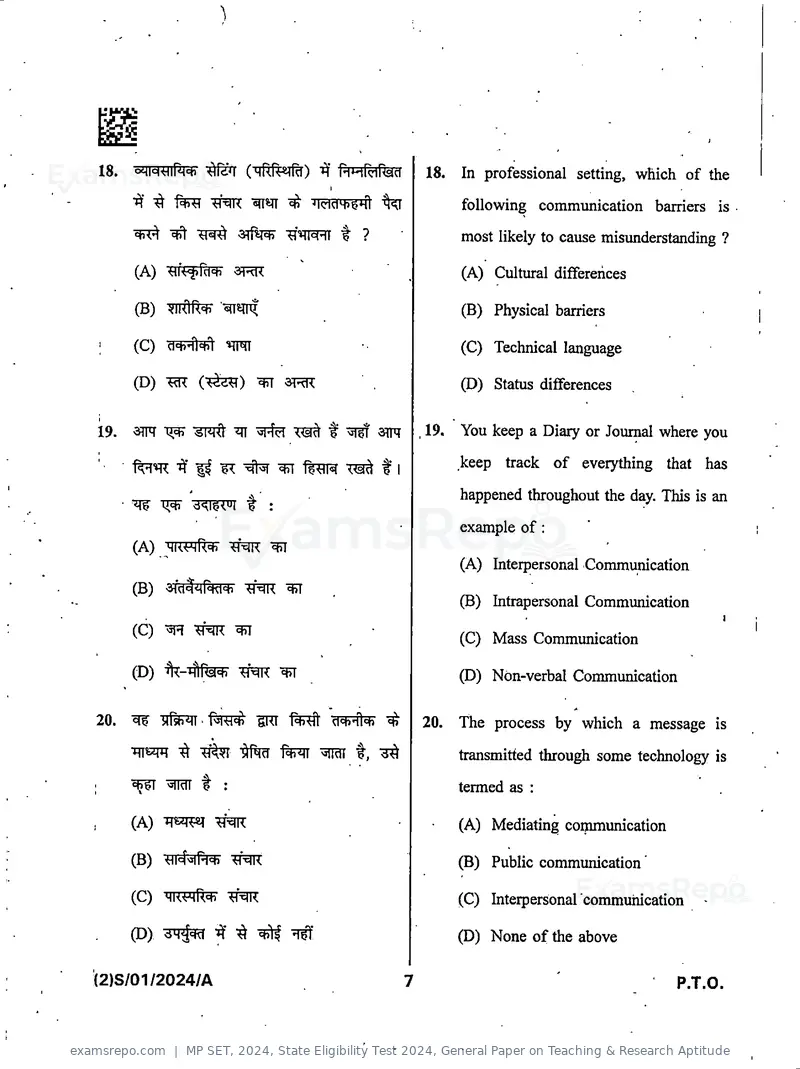
Text of page 8
18.                                            rHHRrir^d     18. In professional setting, which of the
                                               I


                 ^          "?fsiR       ^ <i(naH>6Hl ^              following communication barriers is
                                  3#!^             "t ?              most likely to cause misunderstanding ?

              (A)               3RR                                  (A) Cultural differences

              (B) TIRtfW                                             (B) Physical barriers

    !         (C)             'm\                                    (C) Technical language

              (D)                        3RR                         (D) Status differences


19. 3nq                 ^RRt ^                 t "31^ 3Tm ,19, You keep a Diary or Journal where you

                      "^f ^ "?T       ^ tf^TR             f' I       keep track of everything that has
                                                                     happened throughout the day. This is an
          ■         TT^ <l<l0iui f :
                                                                     example of :
              (A) "qRP^fW             ^
                                                                     (A) Interpersonal Communication
              (B) aMqtof -^hR ^
                                                                     (B) Intrapersonal Communication
                                                                                                            I

              (C) ^             ^
                                                                     (C) Mass Commimication

              (D)                     ^                              (D) Non-verbal Communication


20.                 3Tto'                1^ Wte ^                20. The process by which a message is
                      ^                  i^RT RRI "t, "3^            transmitted through some technology is
;             ^ ^sncTT f :                                           termed as :

              (A) 1TS2R®?                                           (A) Mediating corpmunication

              (B)                                                   (B) Public communication

              (C) MKWRch                                            (C) Interpersonarcommuhication      •

              (D)               ^^                                  (D) None of the above

{2)S/01/2024/A                                                                                      P.T.O.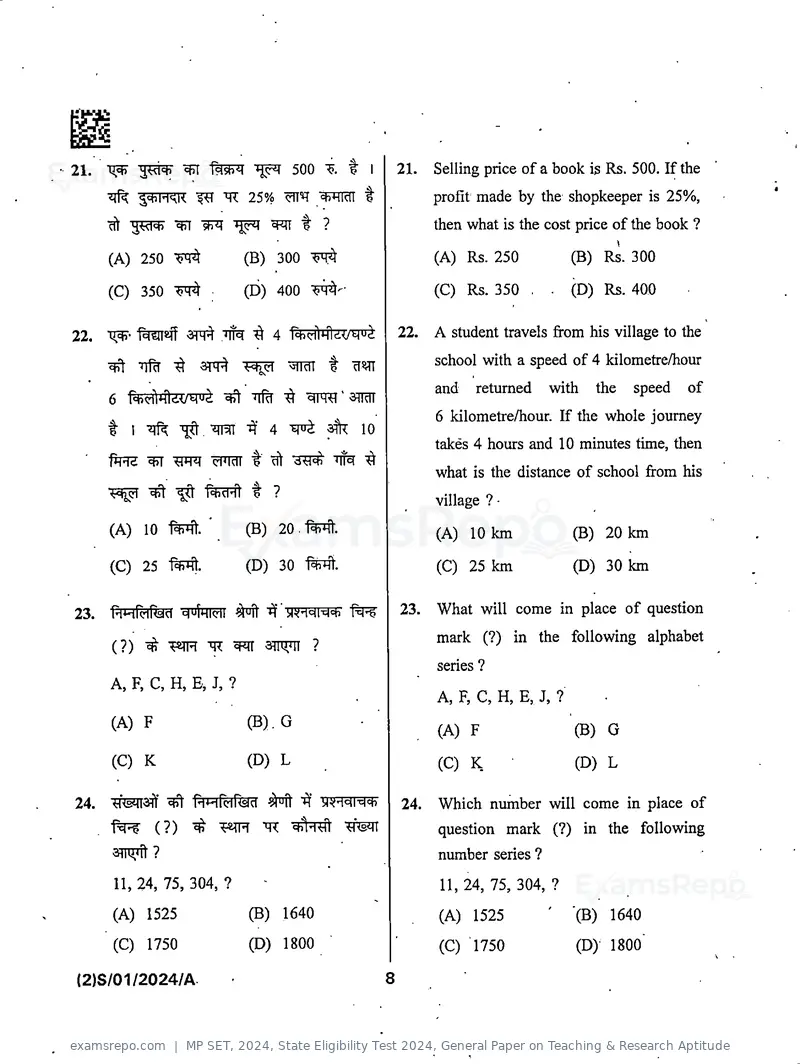
Text of page 9
21.        "5^ ^                     500     t I        21. Selling price of a book is Rs. 500. If the
      ^                ^      25%              t              profit made by the shopkeeper is 25%,
          "3^^ "^FTT        "3^        ^?                     then what is the cost price of the book ?

      (A) 250                (B) 300                          (A) Rs. 250           (B) Rs. 300

      (C) 350                (b) 400                          (C) Rs. 350 .     .   (D) Rs. 400


22.                        .ife ^ 4 PchdlnlciVWu^       22.   A student travels from his village to the

      ^ "Of^                        CTRTT t cT^               school with a speed of 4 kilometre/hour
                                                              and   returned    with   the   speed   of
      6                                qiM^'STRTT
                                                              6 kilometre/hour. If the whole journey
      t                                       10
                                                              takes 4 hours and 10 minutes time, then
      ■frre ^ WT ?FTcTT t ^                 ^ ^
                                                              what is the distance of school from his
             ^ ^ "fepft ^ ?                                   village ? •
      (A) 10           '      (B) 20 .1^.                     (A) 10 km             (B) 20 km

      (C) 25 t^.              (D) 30                          (C) 25 km             (D) 30 km

23. PmPdRsid 4ufm<ril M                                 23. What will come in place of question
                                                              mark (?) in the following alphabet
      (?) ^ wi              ^ 37n3?n ?
                                                              series ?
      A, F. C, H, E, J, ?
                                                              A, F, C, H, E, J, ?
      (A) F                   (B) .G                          (A) F                 (B) G
      (C) K                   (D) L                           (C) K         ■       (D) L

24.       ^ PiHPelPsId ^ ■^'                            24.   Which number will come in place of
      1^ (?) ^ "^STFT "qr                                     question mark (?) in the following
      3TB^ ?                                                  number series ?

      11,24,75,304,?                                          11, 24, 75, 304, ?
      (A) 1525                 (B) 1640                       (A) 1525          '   '(B) 1640
      (C) 1750                 (D) 1800                       (C) 1750              (D)- 1800'
(2)S/01/2024/A.                                     8
Text of page 10
25.                               ^               25. In     a      certain       code      language

      "PRAGYESH" ^ "ARPGYHSE"                           "PRAGYESH"         , is      written          as
                                                        "ARPGYHSE".           Then       how         will
            t ^ ^^                 "DHARMESH"
                                                        "DHARMESH" be             written       in   that
          "f^^T "H^tR Rnoi WRIT ?
                                                        language?
      (A) AHDMRHSE (B) AHDRMHSE
                                                        (A) AHDMRHSE (B) AHDRMHSE
      (C) AHDRMSHE (D) HSEMRAHD
                                                        (C) AHDRMSHE (D) HSEMRAHD

26.                         t I                   26.   All Greeks are men.

                                  t I                   All Athenians are Greeks.
 I


 '' .*.                             f I ' .             /. All Athenians are men.
 I


      viM^cW '^l^cllcW ^                 t?             What is the figure of the above
                                                        syllogism ?
      (A) "38RT
                                                        (A) First Figure
      (B) %c%T 3n^
                                                        (B) Second Figure
      (C)         3ii<5)%                               (C) Third Figure
      (D)         3111?%                                (D) Fourth Figure                   /
                                                                                            I


27. %R%ifei ^ snfe TR                         :   27. Consider the following Venn Diagram :


                        •51%rf¥qc^ ^?M t
                                                        The above diagram represents :
      (A) An-4               (B) OIE-i
                                                        (A) An-4              (B). OIE-1
      (C) ElO-4              (D) nA-2
                                                        (C) EIO-4             (D) IIA-2

(2)S/01/2024/A                                                                                   P.T.O.
Text of page 11
28. WWIci              ^^              PiHRriR^cl.   28. Which one of the following is an
         ^ "^iNh 3i^fq4<la             qFTT                example of sub-contraries according to
       t ?                                                 the traditional square of opposition ?

       (A) A #[ E ^ ^                                     (A) A and E

       (B) I sfe O ^ ^                                    (B) I and 0,
                                                                                                     I


       (C) E sfk 0 ^ ^                                    (G) E and O

       (D) A          ^^                                  (D).A and I


 29.         ^ ^ 375m 'WTPT                   ^       29. According       to    the     Buddhists,
                                   I


                 "I :                                     'S^ahyalaksana'is known by :

       (A)AI?q^                                           (A) Perception

       (B) 3T^ -m                                         (B) Inference

       (C)       OT                                       (C) Sabda

       (D) "3^^ ^ ST51TH           ^ OT                   (D) Both perception and inference


"30. rHHRrlRdd     ^          "Jm )TOR Tftro          30. Which of the following valid means of

       ^                t ?                               ■ knowledge (Praih^a) is not admitted by
                                                          the Prabhakar school of Mimamsa ?
       (A) 1\^ VEFI

                                                          (A) Sabda Pramana
       (B) 3T2?W% wm
                                                          (B) Arthapatti Pramana
       (C)            'wm
                                                          (C) 'Anupalabdhi Pram^a '
       (D) WTFT wm       ■
                                                          (D) Upamana Praniana

(2)S/01/2024/A                                   10
Text of page 12
31.-                    ^t ?                      31.     What is Pilot Survey ?

       (A)-'?T^OT        twT             m                (A) A survey conducted aerially with
                                                               the help of Pilot
             ^STRU ^
                                                          (B) A survey to test questions with a
       (B) Mijiiqcnl "^* ■^^^R       ^ 1^                     small group of respondents to refine
             "TO                                              the questions
                                                          (C) A survey conducted with all the
1      (C) ^STTOt^ ^              1^     '^m
                                                              population
'      (D) <iM^^        ^ ^ "q^*                          (D) None of the above

32.                                ^ :            32. The first step of research is :
i


       (A)                                                (A) Data Collection

       (B) wfq? 15R^ -                                    (B) Data Analysis

       (C) "OTRT ^ "q?^                                   (C) Identifying a problem

       (D)             '^m                                (D) Pilot Survey


33. tA'T "^jpf "qiT <ai^i                    ;    33. A Blueprint of research work is called :

       (A)                                                (A) Research design
                                                                                        /


       (B) W2?T ^                                         (B) Statement of the problem

       ■ (C) ^iRPrM^b                                     (C) Literature Survey

       (D)                                                (D) Data Collection

34.           m             ^ ^'^iPdd %TI titi        34. Sources of data collected and compiled
              ^         =ti5*nifl "t :                    by others is called :

       (A)                    ^                           (A) Primary data ,

       (B) feftq^                                          (B) Secondary data

                                                           (C) Primary data and Secondary data
        (C) -Hisfe ■^* Psdlqch
                                                           (D) None of the above
       ' (D) ^q^ -^f         ^

(2)S/01/2024/A                                   11                                         P.T.O.

Text of page 14
37.               (e-Rakam)                                   37.       e-Rakam Portal is related to the welfare
         ^             t ?                                              of:

         (A)                                                        (A) Mining Industry
         (B)                                                         (B) Fanners

         (C) W                                                      (C) Students.
     I   (D)                                                        (D) e-Business Industry

38.              ^              ^ ctiUJ^ci< ^ T3^             38. Each host computer on the Internet has
         srfgcft^ -tiVsHi       "^jTRT ^HcIT "I" :                      a unique number called :
 1       (A) ^.•^. T3r|^ (^)                                        (A) I.P. Address
 I       (B)                    (W)                                 (B) Terminal Address
         (C)          ^ (-qcTT)                                     (C) System Address
         (D)        13^ (-qm)                                       (D) Node Address

39. "Meffer                 ^           "^OTH ^               39. .Which' of the following institutions
         71^ ^R^TRt             ylsilPlchl           "^tT^           provides technology driven solutions to
                      3iqrT =t)<ai ^ ?                                  Central and State governments ?
 I       (A)                                                        ■ (A) NASSCbM
         (B) Rq.3TT^.^.                                             (B) NIC
         (C) «TK#q              "fe                                 (C) State Bank of India
         (D)                                                        (D) All of the above

40. \m.w, ^ w 3T8f t ?                                        40.    URL stands for :

         (A)                    eit^.                               (A) Unique Resource Locator
                                                                    '                 \

' (B)                                                               (B) UniversaT Resource Locator
         (C) ^PiqiW               eife ■                            (C) Uniform Resource Locator
         (D)                                                        (D) United Resource Locator


(2)S/01/2024/A                                           13                                             P.T.O.
Text of page 15
41. "nf^ OTi               ^               ^           41.   Gandhi Sagar Reservoir is constructed on

      •qi 1^ "w t ? •                                        which river ?


      (A)                   (B)                              (A) Betwa           (B) Chambal

      (C) ^FTte             (D)                              (C) Damodar         (D) Mahanadi


42. 3Tqfw "q^sfl ^                ■^*      fen         42. Where is Ghazipur landfill site situated

      ^          i\\^^i             ^ fei w]^                for waste dumping ?
       fen t ?
                                                             (A) Madhya Pradesh
       (A) 'R^ "Sfe
                                                             (B) Uttar Pradesh
       (B) "sni Tife
       (C) fenit                                             (C) Delhi

       (D) "^fwm                                             (D) Haryana


43.          13^                  n^^fefet (EC)        43. Classification of saline soils depends on
                                                             Electrical Conductivity (EC) and Sodium
       sfk ^HfeFT STfeffeT ^T^qm (SAR) ^
                                                             Adsorption Ratio (SAR) criteria :
       3T3?TR fenn fen "W t :
                                                             (A) EC = Less than 4; SAR = Less

       (A) EC = 4         nF7; SAR = 13                           than 13

                                                             (B) EC = More than 4; SAR = Less
       (B) EC = 4      3qfe; SAR = 13 ^ ^
                                                                  than 13

      . (C) EC = 4 ^ nR; SAR = 13 ^ a^fe                     (C) EC = Less than 4; SAR = More
                                                                  than 13
  '    (D) EC = 4          arfe; SAR = 13
                                                             (D) EC = More than 4; SAR = More
            Rfe
                                                                  than 13


(2)S/01/2024/A                                    14
Text of page 16
44.    HTOT   BioE3                               44; BioE3 policy        by   GOI under the
       TO          (GOI) OT       "nf t,              Department of Biotechnology means :
       3TS^ t ;
                                                      (A) Biology for Economy, Energy,
       (A) 3T«f5q^W,                  ^
                                                        , Environment'

                                                      (B) Biotechnolgoy         for    Ecology,
       (B)            ^chir^Un, ^mU<^{ ^
                                                            Ecosystem, Environment

   , (C) "3^^,                        ^ '1^           (C) Biotechnolgoy for Energy, Self-
                                                        . Employment, Environment

       (D)                       TfTOC ^              (D) Biotechnology        for    Economy,
                                                            Environment, Employment

45.           #T          fePT                    45. National    Green    Hydrogen Mission
       ^ ^ 5 firf^                   (MMT)            belongs to at least 5 Million Metric
                                                      Tonne (MMT) of production of Green
                                                      Hydrogen per annum by-:
       (A) 2045 TO        (B) 2047 TO                 (A) 2045             (B) 2047
       (C) 2030 TO        (D) 2070 TO                 (C) 2030             (D) 2070

46.                     ^         ^        ^ 46. In which year were the ruins of Nalanda
                                           fro        University declared a UNESCO World
       TO ?                                           Heritage Site ?

       (A) 2014           (B) 2016                    (A) 2014"            (B) 2016
      . (C) 2015          (D) 2017                    (C) 2015             (D) 2017

47. TO^R ?RT                 3^3^ 3TFftTT ^       47. The    Government        established   the
       TOTO                  ^ OT 1^ ^                University Grants Commission by an Act
         ^ TT^it 8^ ?                                 of Parliament in the year :
      (A) 1948            (B) 1950                   (A) 1948              (B) 1950
      (C) 1956            (D) 1980                   (C) 1956              (D) 1980

(2)S/01/2024/A                               15                                         P.T.O.
Text of page 17
48.                                                OT "9^        48. The acronym "SANKALP" introduced
                                        (SANKALP) ^
                                                                     by the Ministry of Skill Development
                                                                     and.Entrepreneurship, stands for :
      3T«i t :
                                                                     (A) Skill Awareness and Knowledge
      (A) 3i|v3ilfqch|                  ^ 1^t4 ^1i(lel                    Assessment            for           Livelihood
              ^Mi<?^'^ai sftr            ♦i5^iVji                         Promotion

      (B) STTsfttor                                                  (B) Skill Addition and Knowledge
                                                                          Assessment            for           Livelihood
              3|tK ^ +itr^iVi
                                                                          Promotion
      (C) SlMlfqqil                             Rl^- =h1=;iCl        (C) Skill Acquisition and Knowledge
              STftjy^Ul a;f^ iflH
                                                                           Awareness for Livelihood Promotion
       (D) <iM^=Ki                      "=7^                         (D) None of the above

49. rHHRrir^d               ^ ^ -qRW                      ^      49. Who among the following was a strong
       •im "4'              ^             ^ ?                         critic of western education in India ?

       (A) 8T™                                                        (A) Thomas Babington Macaulay
       (B) 3TR. ^FK          .                                       (B) R. Dyer

       (C)          ^ .                                               (C) Annie Besant

       (D) ^ ^97^                                                     (D) James Fergusson

50. rHHRrlRsld ^                                  :              50. Match the following :

      , (a)                               (i).                        (a) Nalanda University             (i)     Bihar

       (b)        f^?^ferOT(ii) 37tfeTT                               (b) Takshashila University (ii) Odisha •

       (c) l^gFTfWT        (iii) " MlPbWH                             (c) Vikramshila University (iii) Pakistan
                                                                      (d) Pushpagiri University          (iv) Uttar
                                                                                                                 Pradesh
       (d) ' ii^qPlR                      (iv) ^ "R^.
              (a)   (b)          (c)     (d)                               (a)   (b)     (c)          (d)

       (A) (i)      (iii)        (i)     (ii)                         (A) (i)    (iii)   (i)          (ii)

       (B) (i)      (iv)        (ii)     (iii)                        (B) (i)    (iv)    (ii)         (iii) .

       (C) (iv) (ii)            (iii)    (i) .                        (C) (iv) (ii)      (iii)        (i)

       (D) (i)      (ii)         (i)     (iii)        .               (D) (i)    (ii)    (i)          (iii)

{2)S/01/2024/A                                                  16
Text of page 18
(SPACE FOR ROUGH WORK)


{2)S/01/2024/A
Text of page 19
(SPACE FOR ROUGH WORK)
                     TV ehl4   *^FT^


(2)S/01/2024/A
Text of page 20
(SPACE FOR ROUGH WORK)
         1 ■'   ' j


                                               V   >.


(2)S/01/2024/A
Page 1 of 20
Source: Madhya Pradesh Public Service Commission. Question paper published by Madhya Pradesh Public Service Commission.