
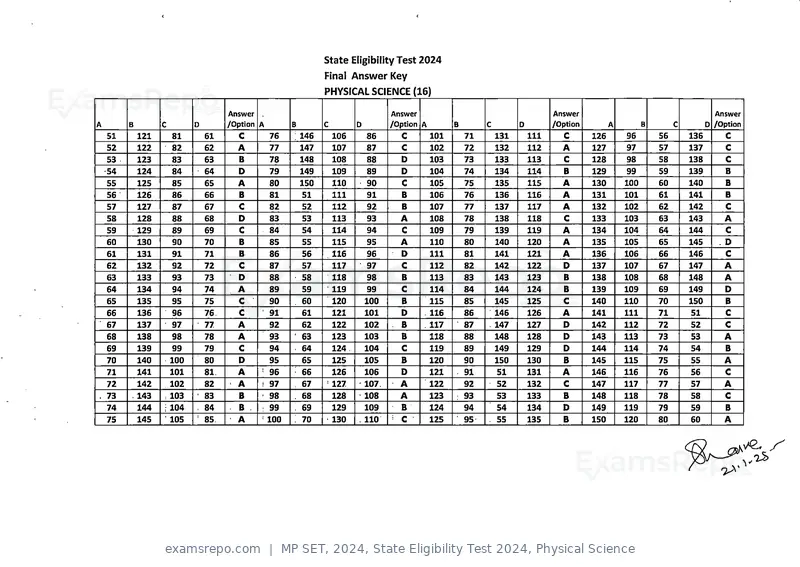
MP SET 2024: State Eligibility Test, Physical Science
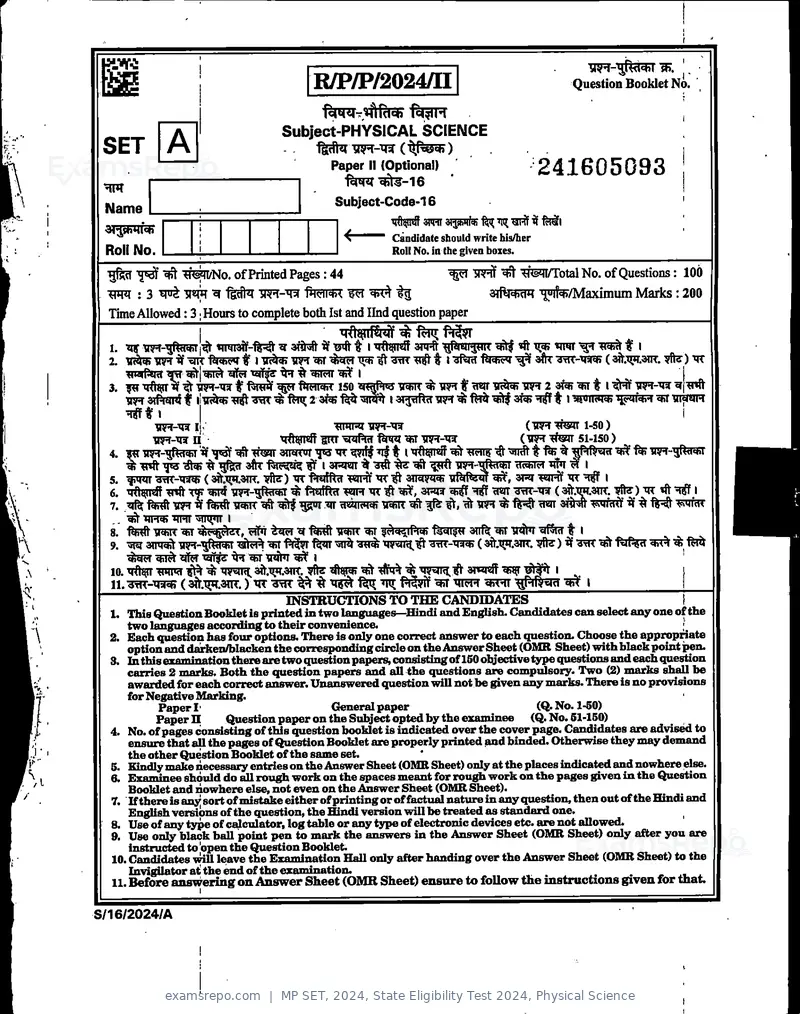
Text of page 1
"SR. '.
                                                     R/P/P/2024/II                                         Question Booklet No.

                                                                        [qqill
                                              Subject-PHYSICAL SCIENCE
 SET             A                                                                )
                                                          Paper II (Optional)                        241605093
                                                          Subject-Code-16
 Name
                                                                          si'nr        ^
                                                             I      Candidate should write his/her
 Roll No.                                                           Roil No.ia the given boxes.

                       TR^No.ofPrinted Pages:44                                       3R^ yft Wll/Total No. of Questions: 100
 TRRI:3                Wt^ IStfty              ^                                                 ■'Jpif^/Maximum Marks: 200
  Time Allowed: 3; Hours to complete both 1st and Ilnd question paper

        yf                snm3if-1k^ y aM if y* 11       3"* ^Rnmpir W *                  11
                   if w Rt<t><yM f I   TiTT ^      ^ yriT 11      OtdicM ^ ^ y^-yaiw (ait.y^.atiT.                               yt
        R;afad ^ ^[yir^ yfet mT^a ^ ^ yngir i                      ^     ^
        fR yft^ir y ^ wr-yy t*   ^ ^mrar iso          yyjir ^ y?y t* yw y«^ y^ 2    11^fyf y?y-yyy y^
        wrstAsnif                     2 3fy»1^yiyit i ^i^dRd yyy % ^ afyj y^f 11 Jouiidi*     ysr ui^enn
        yif 11           I                                                                                                   I
              y?y-y^ i|.                                  yiymni^y-yw                             (y?y ygn i-so)
              y?!i-yi n                       yAynff ym yytor Ihyy ysT wi-yy                      (y?y      smso)
  4.    TO y?y-^ftdchi if          ^ ytsir atrary ^ yr           yf 11yftg^yit yen? "^t              t   ^ yMNtr ys^   y^y-^feratr
     ^ Tnit ^                aftr 1<rs^ i aprai ^ yth ^ ^                   d^biH ^ W i
  5. ^nmr yyt-yTO> (3h.^.ayT.         yr PiutRd wiyf yr ^ any^yy? yfhte^    aw TOiyf yr y^ i
  6. yft^iidf ytft TO ynd y?y-^PRra»r ^ ftyffty TOH yr ^ yi^, aroy ^ y^ yar yyr-y? (afr.t^.am'. ^) yr «fty^h
  7. yfe     y^y y 1^ yynr ^ ^        -qr yamyyt yynr ^ ^ ^ y^y ^           tot afhw ^ynnf if it i^ yyfar
     ^ yiyyt yryr    i      ^                     ^     ^        «.      v •» *
  8. Ohd) ydiK yy       nfy %ycT y ftsdt utnn yy        feyi^y anf^ yy u4ly glSiq y i    ^              ^
  9.    TO aiiM<b1 y?y-^rMd>i yft^ yy                ^yr yi^ to% yroiy.^ TOT-yyy? (ait.15y.am". ^) if ym ^             y^y % fro
        c^cici <t)iA         viTija ^y <t)i yyPT «eiV i                                            ^^^
  10.yi)^yyiyT^^yTOni.ait.T5y.am. ^dH^yitifa^j%y?yy^:^aTiBnffyBygffl I ^                                                     j
  11.yyT-yror (^.i5y.anT.) yy   ^ ^ ygn 1^ yi5     yy yr?R y^         yiT >                                                  j
                                               INSTRUCTIONS TO THE CANDIDATES                                                I
  1. This QuestionBooklet is printedin two languages—^Hindi andEnglish. Candidates can select any one of the
     two languages accor^ng to their convenience.
  2. Each question ha*^ four options. There is only one correct answer to each question. Choose the appropriate
     option and da'ricaTi/blBcken the corresponding circle on the Answer Sheet (OMR Sheet) withhlack point pen.
  3. Inthis agaiwiwa^Tftw there are two questionpapers, consistingof 160 objective type questions and each question
        carries 2 marks. Both the question papers and ell the questions are compulsory. Two (2) marks shaU be
        awarded for each correct answer.Unanswered question will not be given any marks. There is no provisions
        for Negative MarUng.
              Paper I'                              General paper                                   (Q. No. 1-50)
              Paper n            Question paper on the Subject opted by the examinee               (Q. No. 51-150)
  4.    No. of pages consisting of this question booklet is indicated over the cover page. Candidates are advised to
        ensure that aU the pages of Question Booklet are properly printed and binded. Otherwise they may demand
        the other Question Booklet of the same set.
  5.    Kindly "lakft necessary entries on the Answer Sheet (OMR Sheet) only at the places indicated andnowhere else.
  6.    Examinee 8h<mld do all rough work on the spaces meant for rough work on the pages givenin the Question
        Booklet and nowhere else, not even on the Answer Sheet (OMR Sheet).
  7. If thereis any sort ofmistake either ofprinting or offactual nature inany question, then out oftheHindi and
     liiTigllah versions of the question, the Hindi version willbe treated as standard one.
  8. Use of any type of calculator, log table or any type of electronic devices etc. are not allowed.
  9. Use only black ball point pen to mark the answers in the Answer Sheet (OMR Sheet) only after you are
        instructed to 'open the Question Booklet.
  10 Candidates vnll teave the Examination Hall only after handing over the Answer Sheet (OMR Sheet) to the
        Invigilator aii the end of the examination.
  11    Before answering on Answer Sheet (OMR Sheet) ensure to follow the instructions given for that.

S/16/2024/A
Text of page 2
Vfi

     sS;U6i 1 a 11>         «""®>


                                    A


                                    .r


S/16/2024/A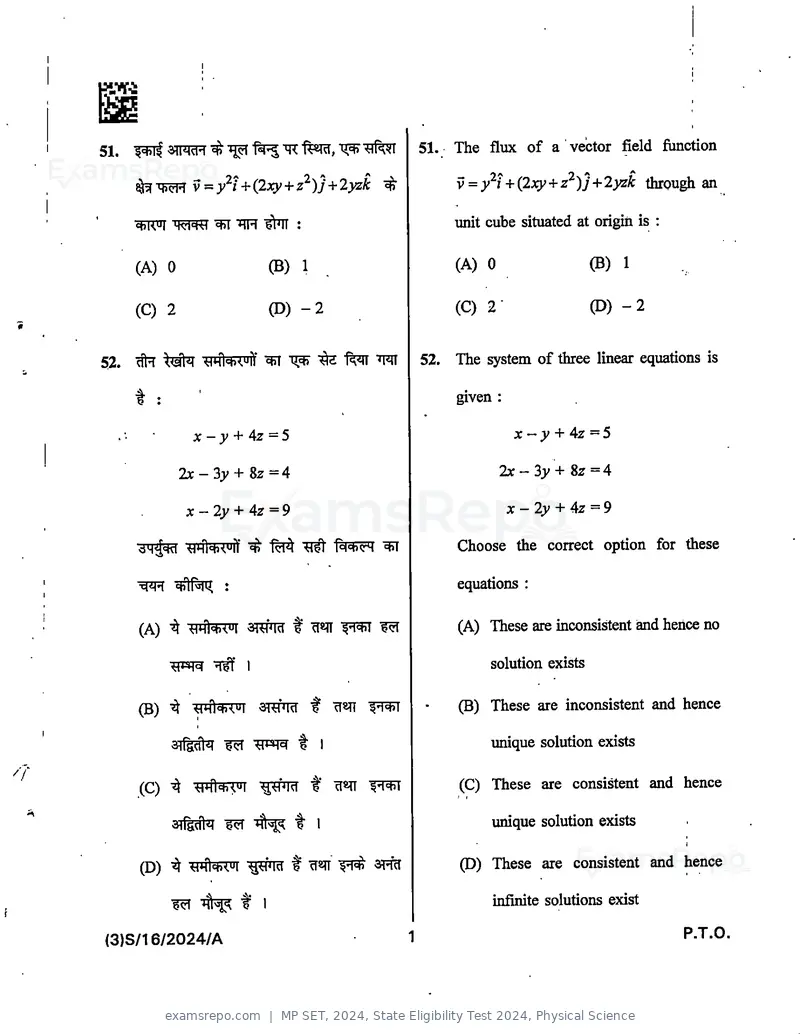
Text of page 3
51.                                                  51. The flux of a vector field function

               V = y^i +(2xv +z^)j+2yzk ^                 V = yV + (2xy + z^)j+ 2yzk through an
                                                         unit cube situated at origin is :

      (A) 0                    (B) 1                      (A) 0                  (B) 1

      (C) 2                    (D) -2                     (C) 2-                 (P) -2


52. #T                         ^       ^f^ "n^       52. The system of three linear equations is

      f:                                                  given :

               X - y + ^z -5                                         x-y + 4z =5

              2x-3y + Sz=4                                        2x-3y+ 8r=4

              X - 2y + 4z =9                                        X - 2^ + 42 = 9

                                                          Choose the correct option for these

      ^               :                                   equations :

      (A) ^               37^ t ^qr "5^ ^                 (A) These are inconsi^ent md hence no

                           I                                   solution exists


      (B)                      37^ f ^«TT                 (B) These are inconsistent and hence

                                   t I                         unique solution exists

      (C)      4^4]=h<^l              f cTSTT             (C) These are consistent and hence

            PTfeft^                "I 1                        unique solution exists
                                                                                             I


      (D) ^               ■^^FTtT f       1=1^ 3TO        (D) These are consistent and hence

                4^ t I                                         infinite solutions exist

{3)S/16/2024/A                                                                               P.T.O.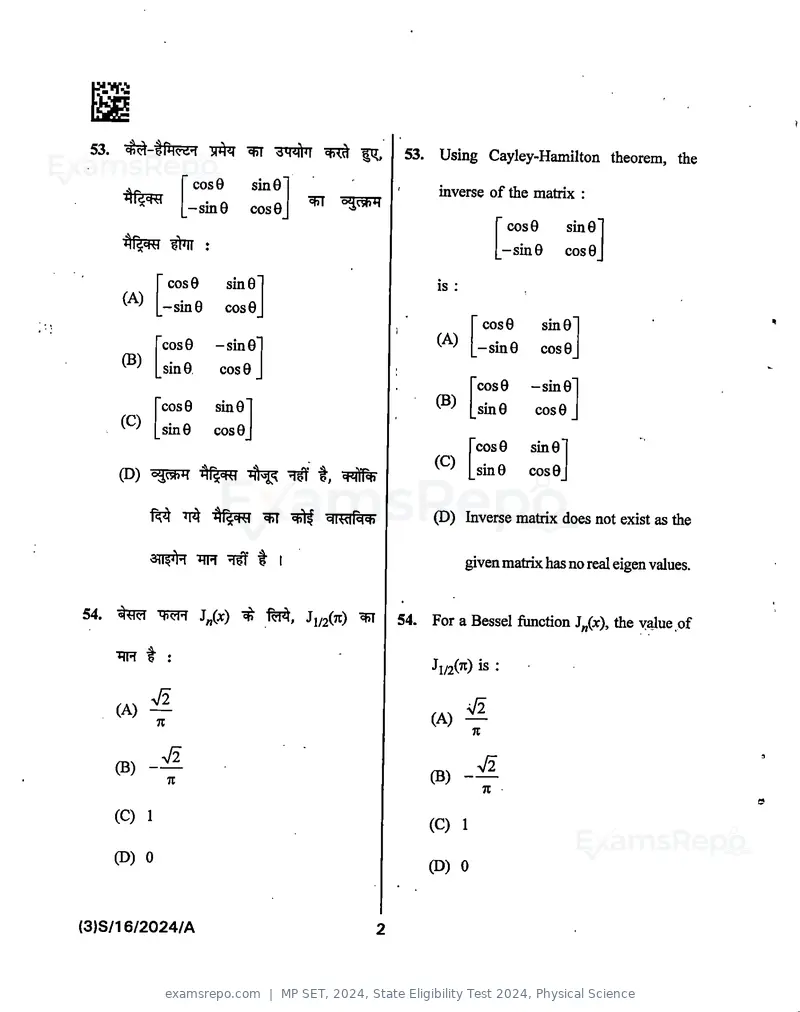
Text of page 4
53.                       "Sf^                        53.    Using Cayley-Hamilton theorem, the
                         cos0      sin0
                                                              inverse of the matrix :
                         -sin0     COS0
                                                                              COS0       sin0
                                                                             -sin0       COS0

                    COS0        sin0                          is :
       (A)
                -sin0           COS0
                                                                           COS0      sin0
                COS0        -sin0                            (A)
                                                                       -sin0         cosG
       (B)      sin0            COS0
                                                                      COS0        -sin0
                COS0        sin0                             (B)       sin0       COS0
       (C)      sin0        COS0
                                                                      COS0        sin0
                                                             (C)
       (D) ^3^ %RT                           t,                       sin0        COS0


                            AIjw ^            qiwiq*         (D) Inverse matrix does not exist as the

                          -RR          f I                           givenmatrix has no real eigen values.


54.            RRR J„(x) ^ M, Ji/2(;t) ^ 54. For a Bessel function J„(x), the y^ue of

       ■RH t :
                                                             J1/2W is :

       (A) —
               71                                            (A) ^    71


       (B) -—                                                         •Ji
                    71                                       (B) -—
                                                                       71


       (C) 1
                                                             (C) 1

       (D) 0
                                                             (D) 0


(3)S/16/2024/A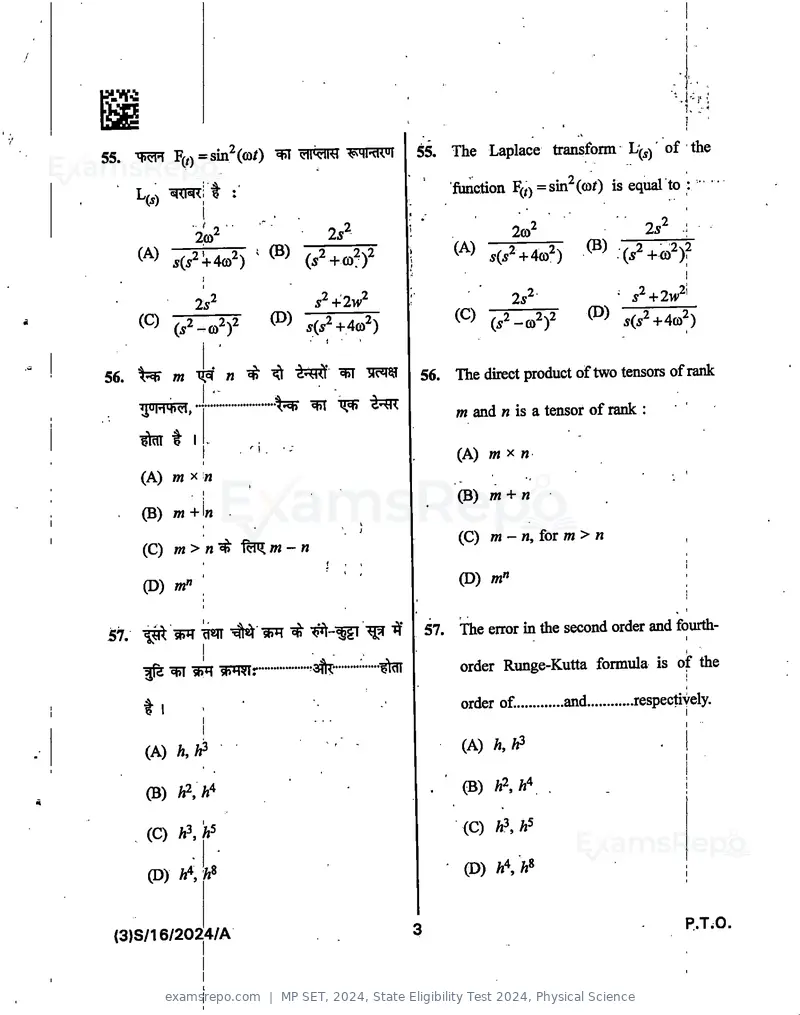
Text of page 5
55. WT F(,)=sin^((DO ^                        WWi 55. The Laplace transform                              of the
      L(5)             ^•                                            function F(,) =sin^(a)0 is equal to :
                                         Is'                                  2©^                     2s'
                 2©^
      (A) S{S^U<S?) ^ (B)                         .2n2               (A) 5(j^+4© ) (B) (s^ +<o^)?


                 2^'                                                          2s
                                                                                  .2.
                                                                                                  ^ s^ +2iy^'
                                                                     (C)                    (D)
      (C)              2n2       (D)      +4©^)
                                                                                    2\2
                                                                                                  s(s^+4©^)

56.          m             n ^                      TR^          56. The direct product oftwo tensors ofrank
                   I ...

                                       ^^                             m and n is a tensor of rank :
      ^t5iT "I I
                                                                     (A) w X «
      (A) w X «
                   I
                                                                     (B) m + n
      (B) m + in
                                                                      (C) M - n, for /n > n
      (C) OT > n ^ Rm m — n
      (D) w"
                                                                      (D) m"                                  ;
                   '                          •              r                                              ^ !

57.          ^ W^                  ^                     -^f 57. Tlie enor in the second order and fourth-
                   I


      ife ^^ slvR^r                    *2^*          'sloi            order Runge-Kutta formula is of the
                                                                                                              i


       t1                                                             order of.           and      .respectively.
                   j                                                                                          I


      (A) h,}?                                                        (A) h,f?                                I
                                                                                                              j
                                                                                                              1

      (B)                                                             (B) Ifi.h* .

       (C) }?,                                                        (C) H^,h^

       (D) h*, ffi                                                    (D) h\h'^

                                                                                                              P.T.O,
 (3)3/16/2024/A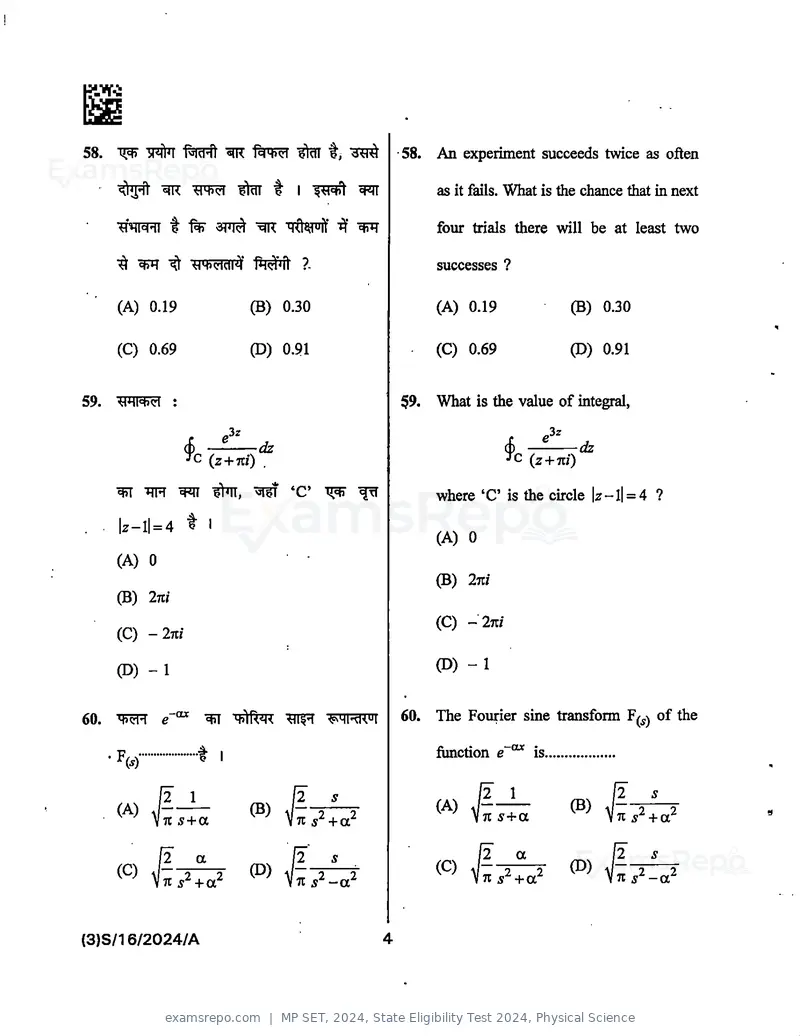
Text of page 6
58.             TPiW        ^ 1^rw                %, "3??^      58. An experiment succeeds twice as oiten

                 ^              ^i I                      TO         as it fails. What is the chance that in next

       "H'Hiqii ^ "%                       "R^tePnt       TOT        four trials there will be at least two

       ^ TOT ^ WOT4' 1%^ ?-                                          successes ?


       (A) 0.19                      (B) 0.30                       (A) 0.19                  (B) 0.30

       (C) 0.69                      (D) 0.91                       (C) 0.69                  (D) 0.91


59.    TOTTTOT :                                                59. What is the value of integral,
                               .3r                                                      -3r

                       iC (z+7C/)                                              ic (z+TTj) dz
       TO "RH TO ^Wl,                      'C* TJ^ ^                 where'C is the circle |z"l|=4 ?
  , |z-l|=4 t I
                                                                    (A) 0
       (A) 0
                                                                    (B) 2?:/
       (B) 2ni
                                                                    (C) -271/
       (C) -2ni

       (D) -1                                                       (D) -1


60. TOFT                  TO               TOfR TOTITOtT        60. The Fourier sine transform               of the


                        •t I                                         function e        is
      * ^(-y)
                                           (2_£_
       (A)                           (B)                            (A)                       (B)        2    2
                  7t 5+a                     71 5^ +                       yn s+a                   n s^ + a^


                 [2 g                       /2        5
                                                                    (C)
                                                                                   a
                                                                                              (D)
       (C)                           (D)                                    n s^+a}                 n s^-o?
                  7t


(3)S/16/2024/A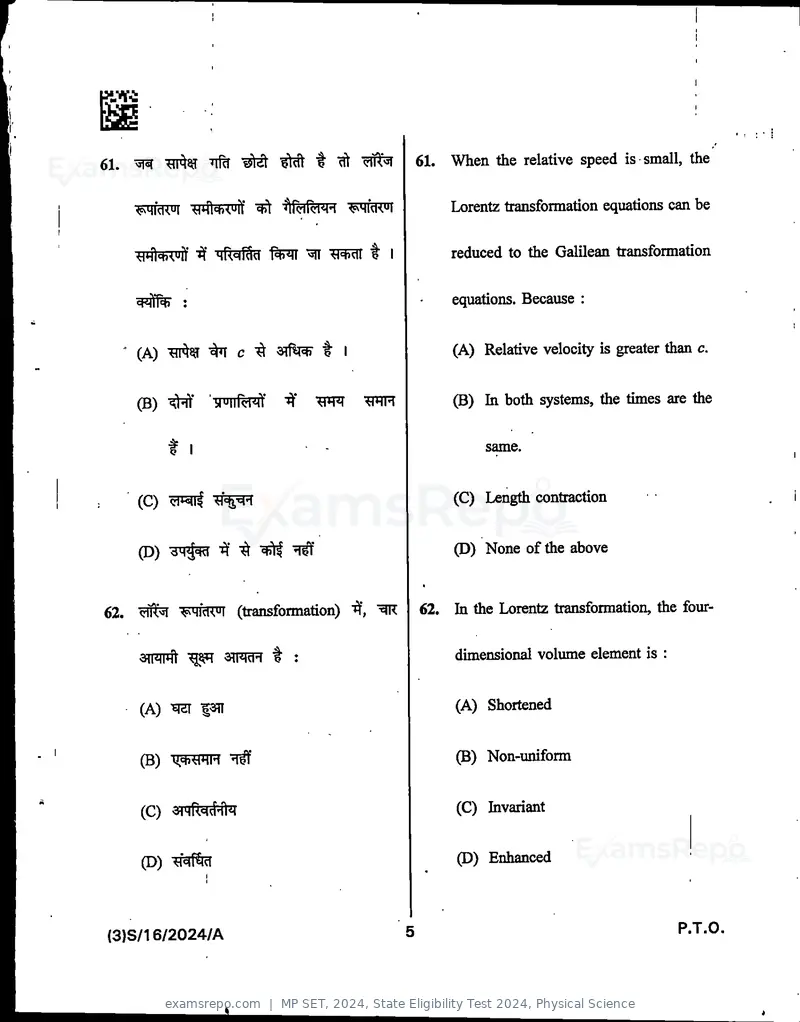
Text of page 7
61. ^             ^               ^t ^             61. When the relative speed is small, the

      ^:qfOT                ^                WOT           Lorentz transformation equations can be


      ^Hlchiuil' '^* "qft^fer 1ot ^ w?ii t i               reduced to the Galilean transformation


      cwTPn :                                              equations. Because :


      (A)         ^c              site t I                 (A) Relative velocity is greater than c.


      (B)             yuiiRri^T       WT W(R               (B) In both systems, the times are the

            i I                                                 same.


      (C)                                                   (C) Length contraction


      (D) <iM^=kl        ^^                                 (D) None of the above


62.          "WOT (transformation)                     62. In the Lorentz transformation, the four-


               ^ 31TO^T t :                                 dimensional volume element is :


      (A) ^ l^flT                                           (A) Shortened


      (B) ■^OT'TH                                           (B) Non-uniform


                                                            (C) Invariant


      (D)                                                   (D) Enhanced
                  I
                  (


(3)S/16/2024/A                                     ;                                          P.T.O.
Text of page 9
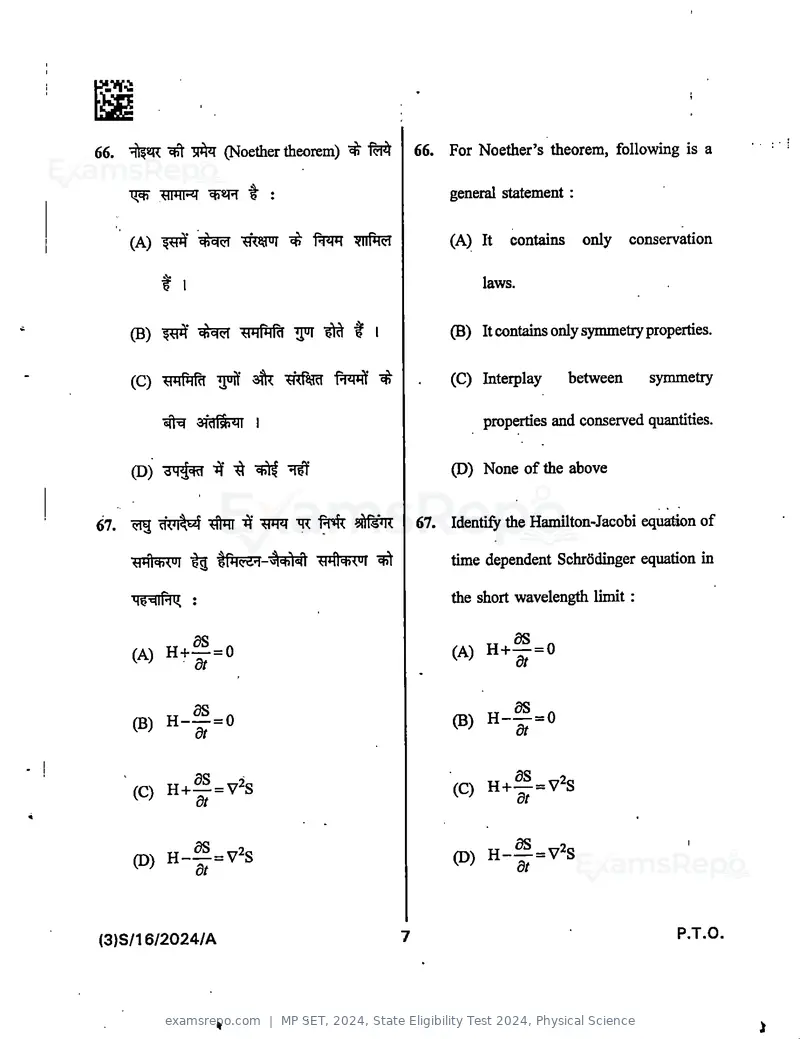
66,            31^ (Noether theorem) ^                66. For Noether's theorem, following is a

            WTT^            t:                             general statement:


      (A)                        ^ 1^                     (A) It contains only conservation

                                                               laws.


      (B)       ciiqcn            "^''T     ^ 1           (B) It contains only symmetry properties.

      (C)           "^pnt        "^^R^iRT "ppwt "^'       (C) Interplay     between      symmetry

            ^ arofSRR !                                        properties and conserved quantities.

      (D) "3^^              ^^                            (D) None of the above


67.                tilni "^* WRT "^R        yH^R      67. Identify the Hamilton-Jacobi equation of

                                                           time dependent Schrfidinger equation in

               :                                           the short wavelength limit:


      (A) H+|=0                                           (A) H+f-0
      (B) H-f=0                                           (B) H-f-0
      (C) H+f= V2S                                        (Q H+f-V'S

      (D)                                                 (D) H-f.V=S

                                                                                             P.T.O.
(3)S/16/2024/A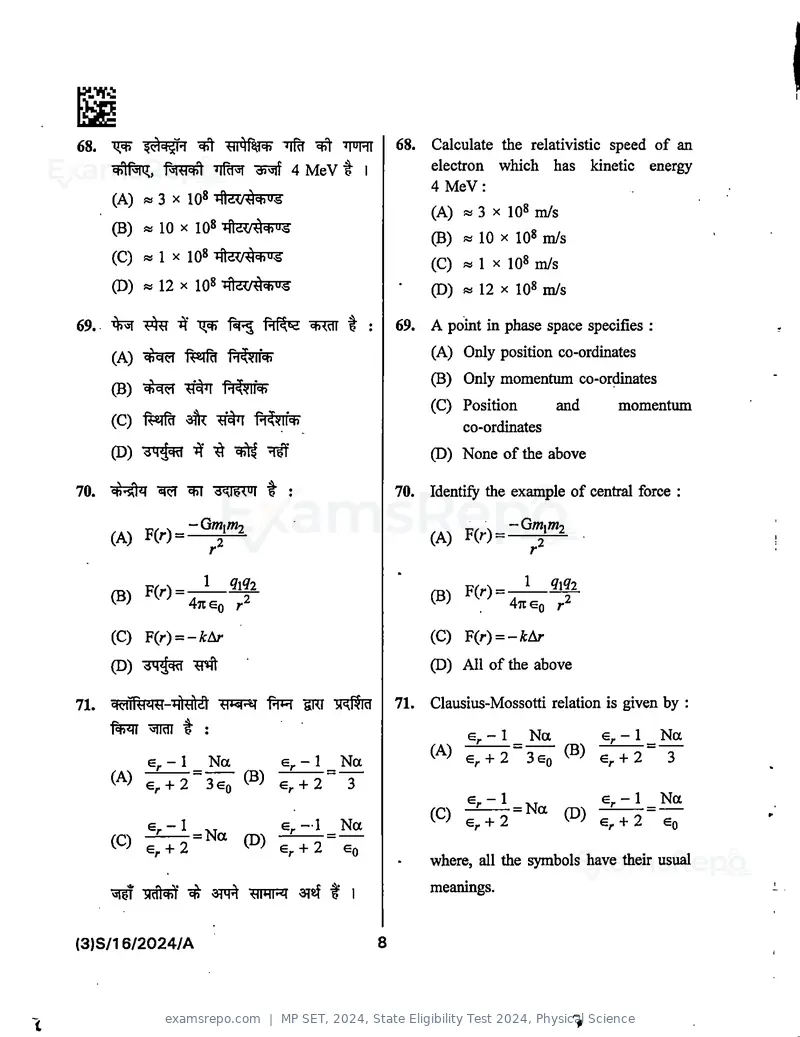
Text of page 10
68.                   ^             ^ ^ WTT              68. Calculate the relativistic speed of an
       ^>11^,                  ■SfTSif 4 MeV t I             electron which has kinetic energy
                                                               4 MeV:
       (A) « 3 X 10^
                                                               (A) » 3 X IQS m/s
       (B) « 10 X IQS
                                                               (B) « 10 X 108 ni/s
       (C) « 1 X 10⁸                                           (C) « 1 X 10⁸ m/s
       (D) « 12 X 108 41(i</^4)U^                              (D) « 12 X 108 m/s

69..         ^        "Q^          f^rf^       f :       69. A point in phase space specifies :

       (A)           1^ Wk\\db                                 (A) Only position co-ordinates
                                                               (B) Only momentum co-ordinates
       (B)           ^
                                                               (C) Position        and     momentum
       (C)           sk ^ IWf^                                      co-ordinates

       (D) ctn^           ^^                                   (D) None of the above

70.           ^ ^                  t :                   70. Identify the example of central force :

       (A) FW.=^                                               (A) FW==^
             T7/-\     1    ^1^2
       (B)

       (C) F(r) = -/tAr                                        (C) F(r) = -ifcAr
       (D) "3^^ ^                                              (D) All of the above

71.                                1to ?Rr -51^          71.   Clausius-Mossotti relation is given by :
             >3131 "I :                                                       Na                  Na
                                                                                       €r-l
                                                               (A) Gf. + 2    3 G( (B) G^ + 2
             G^ - 1 _ Na             6^ - 1 _
             e^ + 2 3go              €, + 2 " 3
                                                                                         G^ - 1 _ Na
                                                               (C) G^ + 2—Na       (D) G^ + 2     Gq
             G.-l                    e^-1 Na
       (C) i;T2=''"                 i;TI=^
                                                               where, all the symbols have their usual

       ^ ^acW ^ 31^                      3?sf t 1              meanings.


(3)S/16/2024/A                                       8
Text of page 12
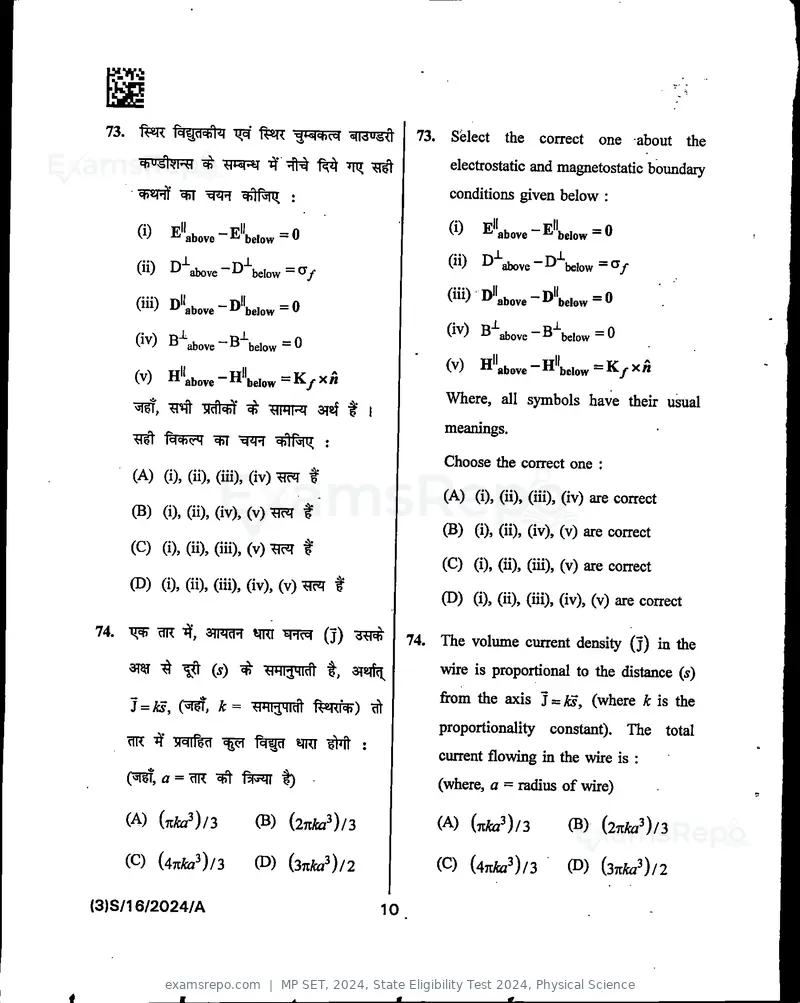
73. Select the correct one about the
       ^TikRi ■% -w^                        ^^          electrostatic and magnetostatic boundary
               ^        chlf^li, :                      conditions given below :

       ® ^"above " ®"beIow = ®                          ® ®"above ~ ^'"below = ®
       (^0 ^ above ~ ^ below ~                          00       above      below

       (i") I>"above-D"below=0                         (i") D"3b„ve-Dllbel.w=0
                                                       (iv)

                                                       (v) H",|,„ve ~h"|,5|„„ =Ky X n
       (y) ^Kboye -H'below =Ky X«
                                                       Where, all symbols have their usual
      ■=51^, ^ 3IcW -% ^JF?FI 3T8f t 1
                                                       meanings.

                                                       Choose the correct one :
      (A) (i), (ii), (iii), (iv) ^ t
                                                       (A) (i)» 00* 0iO* 0v) are correct
      (B) (i), (ii), (iv), (v) ^ f
                                                       (B) (i), (ii), (iv), (v) are correct
      (C) (i), (ii), (iii), (v) ^ t
                                                       (Q (0* (ii)* (iii), (v) are correct
      (P) (i), (ii), (iii), (iv), (v) ^ t
                                                      (D) (1), (ii), (iii), (iv), (v) are correct
74.       w.       a^RcR mi wm (j)                74. The volume current density (j) in the
      3T^ ^        (j) ^ W^RRt i,                     wire is proportional to the distance (s)

      J=^, C^, k = "^Ri^qidt i^sRRj)                  from the axis J = As, (where k is the
                                                      proportionality constant). The total
      w: ■^* MflcT ^             mj #it :
                                                      current flowing in the wire is :
      (^TBT, a = m ^           %)                     (where, a = radius of wire)

      (A) {nka^)/3        (B) {2nka^)/3               (A) (7rAw^)/3         (B) (27rAa^)/3
      (P) Unka^)l3        (D) {3nka^)l2               (C) (47rA3fl^)/3      (D) (37rfc7^)/2
(3)S/16/2024/A                               10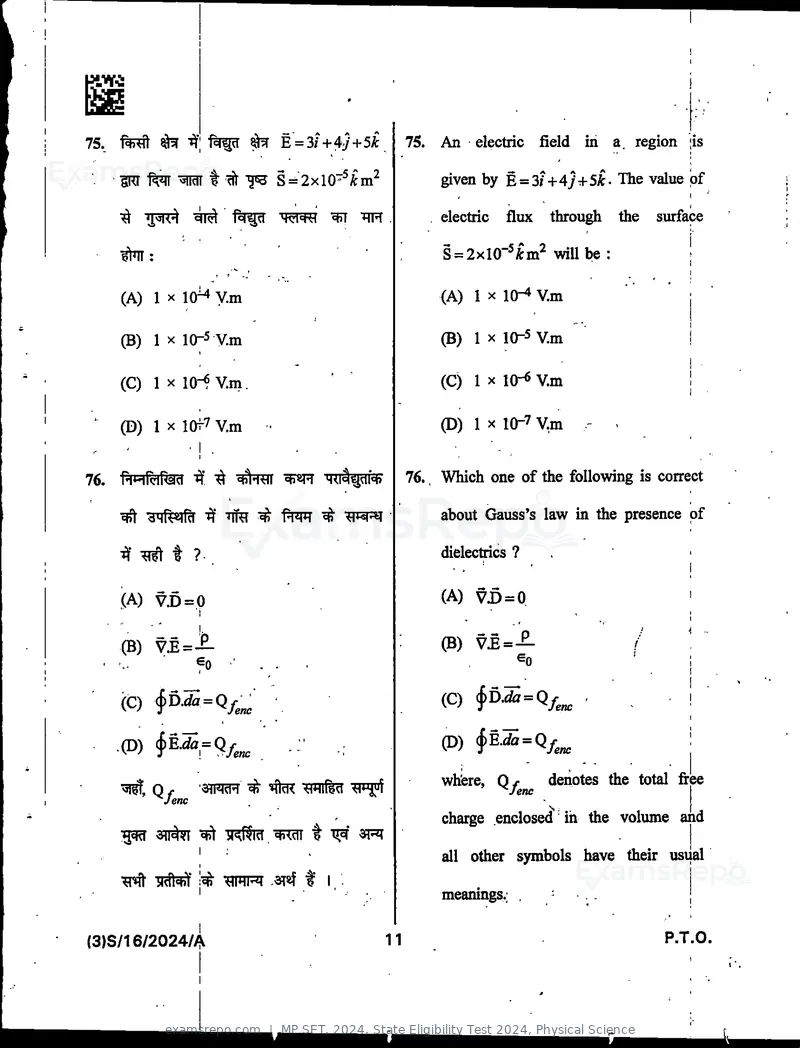
Text of page 13
75,              ^                          ^ E =3i+4j+5k                 75. An electric field in a. region |is

      ■gRT 1^                  t^                   S = 2xl0"^fcm^            given by E = 3/*+4j+5it. The value of
                                                                                 V                                I
                                                                                                                  I


      ^ IpR^                                                ^                 electric   flux   through the   surface

             :
                                     . k.   ,
                                                                               S = 2xl0"^^m^ will be :            i
                                                                                                                  I
                                                                                                                  I


      (A) 1 X 10^ y.m                                                         (A) 1 X 10⁻⁴ v.m                 ■ ,
                                                                                                                  i
                                                                                                                  1


      (B) 1 X 10⁻⁵ V.m                                                        (B) 1 X 10⁻⁵ Ym                     !
                                                                                                                  I .

      (C) lxl0-6v.m.                                                          (C) 1 X lO-« V.m                    I
 '    (D) 1 X 10f7 v.m                          •                             (D) 1 X 10⁻⁷ v,m ,
                          I    '


76. li*-iRnRaa                     ^ =hli'«i                              76. Which one of the following is correct

      ^                        -^f -TO ^                                      about Gauss's law in the presence of

                    t ?                                                       dielectrics ?     .


      (A) v5=.0                                                               (A) vS = 0                          i
       •     ' *          !•
      (B) y£=-B-                                                              (B) Vj=-t-
                          ^0
                          i
                                      '

      (C) pJa = Qj-^^ ■                                                       (C) |D.t&t = Qy-  fenc


      .(D)                =                                                   (D) |E.^ = Qy-    fenc


             Q^            aro^T ^                                             whiere, 0/
                                                                                        Jenc denotes the total free
                                                                                                                 j
                   Jenc
                                                                               charge enclosed' in the volume and
      •ggn au^ ^ trRri                                  t       aipi
                          I
                          I
                                                                              all other symbols have their usual
      ^                                         .318? t I
                                                                              meamngs, ,


|3)S/16/2024/A                                                       11                                        P.T.O.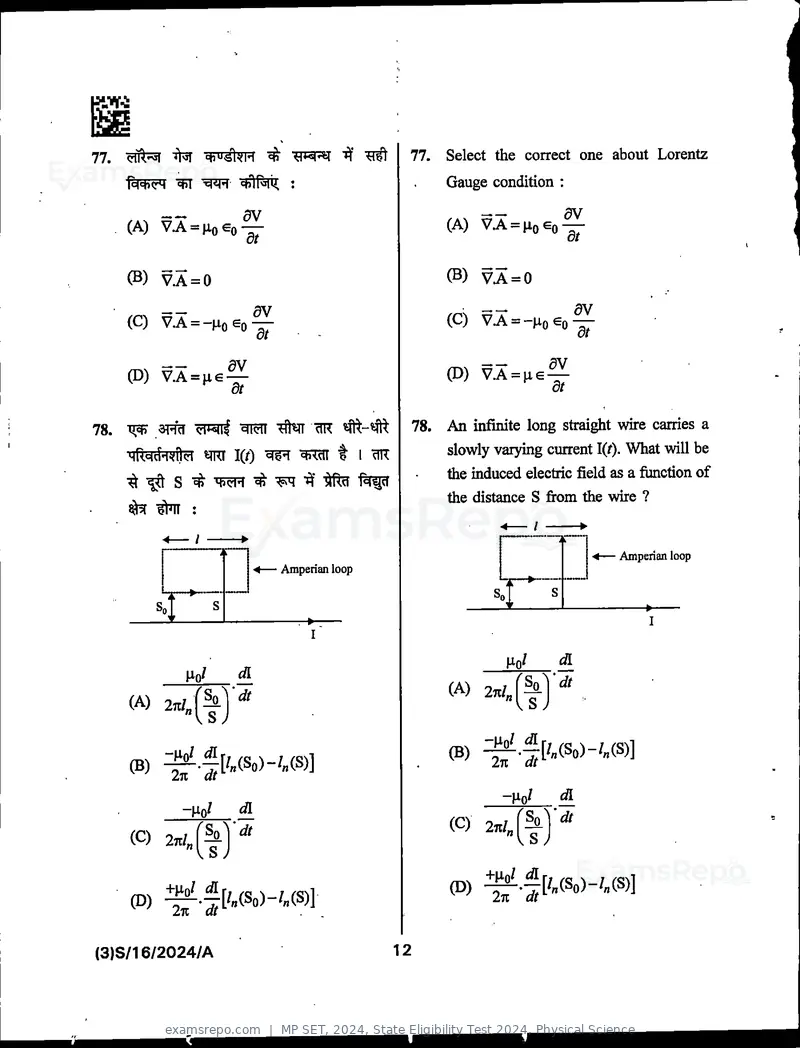
Text of page 14
77.                       ^                   ^        77.   Select the correct one about Lorentz
                                                             Gauge condition :

      ... —«         dv                                            —            av
      (A) VA = Hoeo-S-                                       (A) VA = Hoeo —
                     OT


      (B) V.A =0                                             (B) VA = 0

      (C) VA =-Hoeo —                                        (C) VA = -Hq€q —
                         01                                                        ot


                    sv
      (D) VA = hg —                                          (D) VA = p,e
                                                                              dt


78.                                                    78. An infinite long straight wire carries a
      HRcicJdiind ^ 1(0                 t I^               slowly varying current 1(0- What will be
                                                             the induced electric field as a function of
        ^ S ^ WI ^^                           f^[tT
                                                             the distance S firom the wire ?
      ^^ :

                                                                                         Amperian loop
                              Amperian loop
            T—►•


              Hp/   ^                                                    ^\dt
                                                             (A) 2%L
      (A)                                                               kS


      (B) ^.|[/„(So)-/„(S)]                                  (B) -g^.|[/„(So)-/„(S)]
             -Ho^    £
      (C) 2< (!]■'''                                         (C)
                                                                      "Is

                                                             (D)             [/„(So)-/„(S)]
      (D) ^.f ['„(So)-'„(S)]
(3)S/16/2024/A                                        12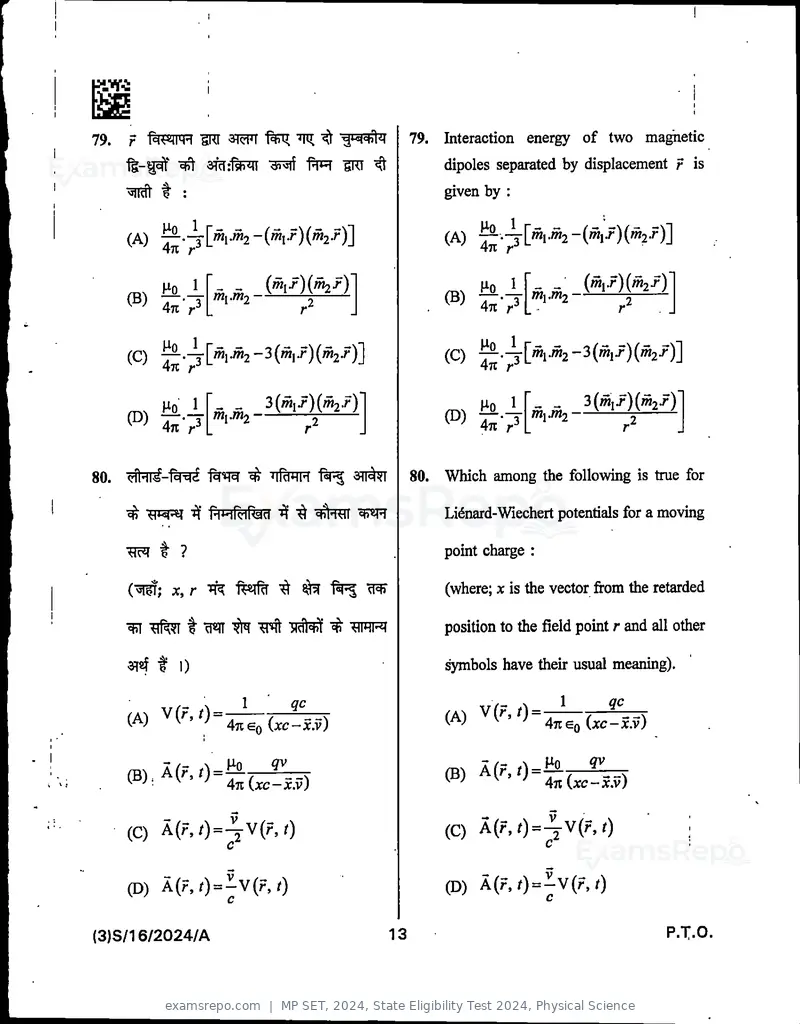
Text of page 15
79. r             OT 31^          inr ^             79. Interaction energy of two magnetic
                                    Pt*-1 "SKI ^        dipoles separated by displacement p is
      ^t :                                              given by :


      (A) ^•^[wi.m2-(OT,.r)(m2.r)]                      (A) ^••jj[wi.OT2-(w,.r)(OT2i=)]
           Ho 1                {ihir){m2?)                    fio 1 'r, ,r,
                                                                     mym^      {^ir){'f>2^)
                                                                                      2
                   m^-mi
                                                                                    r      .


      (C) ^■\\m^.m2-^{ifl^?){ihJ,.r)']                  (C) ^•4-[mi.OT2-3(m,/)(m2/)]
                                                            An r


           ^0 1                3(wiJ^)(w2/)                   M-o i   ,r, ,r, 3(^i-^)(™2-^)
                                                                      W1.W2          2
                           -


                                                              Sv                     r


80.                       ^ 'rt^m ^ 3TT^            80. Which among the following is true for

      ^            pHHrdRdd "^f ^                       Lidnard-^echert potentials for a moving

      WI t ?                                            point charge :

      (■^; X, r                       1^ ^              (where; x is the vector from the retarded

      ^       t Trar ^           "sM ^ "w?              position to the field point r and all other

      ai«f t I)                                         symbols have their usual meaning).


      (A) ^("'') = 4„e^(;cc%.v)                         (A) ^(^'0 47te (;fc-x.v)
                     ^0
                                                        (B)           =


      (0 a(?,o=4'v(^'')                                 (C) A(r,0 = 4^(^'0

      (D) A(?, f) = -V(?,/)                             (D) A(r,0 = 7V(r,0

(3)S/16/2024/A                                 13                                              P.T.O.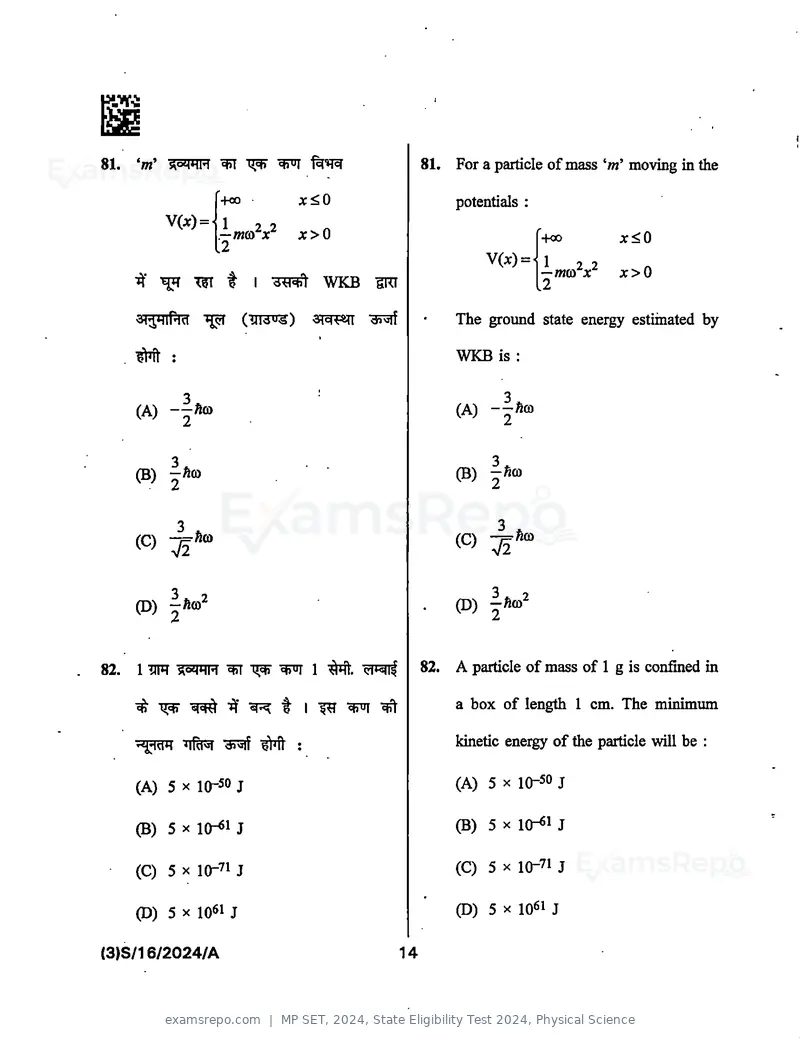
Text of page 16
81. 'm'          ^      ^ 1^                81. For a particle of mass *ot' moving in the

                 +00         ;c^0                potentials :
          VW =
                 —mai^x^     *> 0                               +00       X^O
                 12
                                                      V(Ar)=
                                                                — OTCoV   X>0
            T?T t I               WKB ira                       2


    3(g,HiPia •ijn (yi3"s) aiq+^lT <«oiI         The ground state energy estimated by

   ^:                                            WKB is :


   (A) --to                                     (A) -2®"

   (B) -ftto                                    (B) -to


   (C)      ha                                  (C) ^to
       3* 2                                         3* 2
   (D) -fta)2                                   (D) -to^


82. 1 -m         ^      ^ 1 M.              82. A particle of mass of 1 g is confined in

                           "I I                  a box of length 1 cm. The minimum

                       ^Wt :                     kinetic energy of the particle will be :


   (A) 5 X 10-50 j                              (A) 5 X 10-50 J

   (B) 5 X 10-61 j                              (B) 5 X 10-61 J

   (C) 5 X 10-71 J                              (C) 5 X 10-71 J

   (D) 5 X 1061 J                               (D) 5 X 1061 J

(3)S/16/2024/A                          14
Text of page 17
83^ 1^-3TWTt (3D)                                83. The time independent Schrodinger

                t:                                   equation in three dimensions is :


      (A) -^V^M(r)+ V(r)M(r)= EM(r)                  (A) —^V^M(r)
                                                          2m
                                                                 + V(r)M(r)= EM(r)
           2m

            2                                              f.2
      (B) —V'^u(r)+V(r)uir)= Eu(r)                   (B) —V M(r)+V(r)M(r)= Bu{r)
          2m                                               2m


      (C) -^vV'')-V(r)«(r)=
           2m
                            E«(r)                    (C)
                                                            2m
                                                                 V^K(r)-V(r)«(r)= EM(r)
            2                                              fp.
      (D) — V^w(r)-V(r)M(r)= Bu(r)                   (D) —V\{r)-y{r)u{r)= EM(r)
          2m                                               2/^


84. 0 < r < Oq ^ ^                      ^        84. The probability of 3rf electron for

                 ^ "snfe^n (yT<^[^M) t:              hydrogen atom in 0 < r < dg range is ^

      (A) 1.6 X 10⁻⁵                                 (A) 1.6 X 10⁻⁵

      (B) 1.9 X 1(H                                  (B) 1.9 X 10-^

      (C) 1.7 X 10⁻³                                 (C) 1.7 X 10⁻³

      (D) 1.8 X 10⁻³                                 (D) 1.8 X 10⁻³

85.             WITJ                             85. The value of fine structure constant 'a'

      (fine structure constant) *a' ^       ^:        of a hydrogen atom is :


      (A) ^              (B) 139                     (A) ^               (B) 139

                               239                                              239
           140


                                             15                                          P.T.O,
(3)S/16/2024/A
Text of page 18
86. 2p              ^      ^ 'g'         t:    86.       Lande 'g' factor for          state is


      (A) f               (B)                        (A) 4                 (B) f
                                    ■
      (C) 4               (D) 3
                                2
                                                     (C) 4                 (D) f
87.           X 3lk ^           ^              87. The correct value of Poisson bracket

                                                     {x, p}      between    position    x   and
               {x, p)               ^:
                                                     momentum p variables is :

      (A) 2               (B) 4
                                                     (A) 2                 (B) 4

      (C) 1               (D) 0                      (C) 1                 (D) 0


88. rHHrdPsid "4* ^                            88. Which of the following transitions are

               3?3qw (allowed) "I" ?                 electric dipole allowed ?

      (A) 1j -> 25-      (B) \s -> 2/7               (A) 1j -> 2y          (B) Ij -> 2/7

      (C) 3j      5rf    (D) ^                       (C) 'is^Sd            (D) All of these


89.               t:                           89. The correct relation is :


      (A) [L^,L^]=/^L,                               (A) [Lj;,                                    /■j


      (B) [L^, L2]=/^L^                              (B) [L^,L^]= mL,
      (C)       (A) sk (B) ^                         (C) Both (A) and (B)

      (D)               ^^                           (D) None of the above


(3)S/16/2024/A                            16
Text of page 20
92. The probability density in case of Grand

                    ^         i ?                   Canonical Ensemble depends on :

    (A) p-q^ V                                      (A) PandV

    (B) ET^^'T                                      (B) E and T

    (C) cftqci E,                                   (C) Only E

    (D)             -3^ ^ -=1^*                     (D) None of the above


93. "SirqiiTfWN I^RiPT ^ aiRilW         ^      93. Change of Internal Energy of the

    ■qft^ Ito "qr                 t ;               thermodynamic system depends upon :

    (A) w\                                          (A) Path function

    (B)      Huni                                  (B) Point function

    (C) (A) sSk (B) #if                            (C) Both (A) and (B)

    (D)             ^      ^                       (D) None of the above


94. ^ ^ ^ ■^* -qR* ^ ^                  3T^    94. When steam is converted into ice, the

                                                   entropy of the molecules :

    (A) 1^          f                              (A) Remains constant

    (B)      t                                     (B) Increases

    (C) ^ t                                        (C) Decreases

    (D) "^q^        ^ ^ Rff -                      (D) None of the above


|3)S/16/2024/A                            18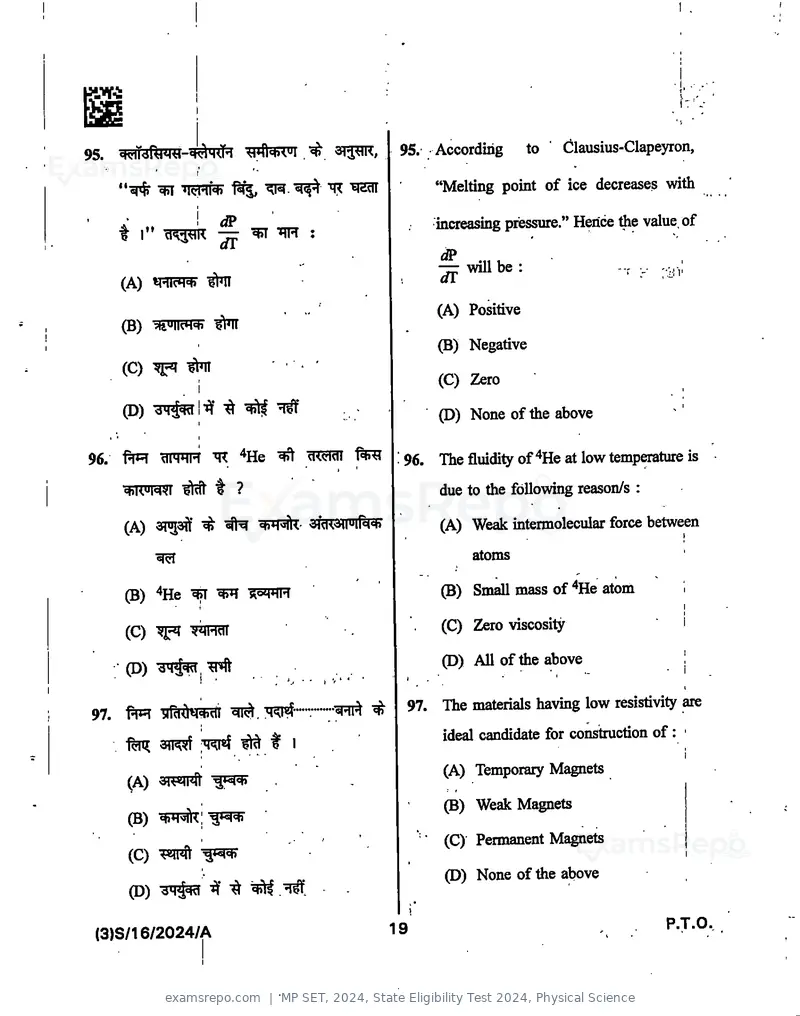
Text of page 21
95.                                                315^,       95. According            to ' Clausius-Clapeyron,
                  i'
                                                                       "Melting point of ice decreases with

               !           <iP       '                                 increasing pressure." Hence Ae value, of
      t l" cRS^IR ^ ^^ •
                                                                           dP
                                                                       — will be :                    - -, y y; ,:
      (A) «HRq^ #n
                                                                       (A) Positive
      (B)              ^
                                                                       (B) Negative
      (C)^ #n                        -    .'
                                                                       (C) Zero
                  I
      (D)         I
                           ^^                                          (D) None of the above

96. "PfT dIMHH ^ ^He ^                                         96. The flui(hty of '♦He at low temperature is
      •EPTFra^T ^ t ?                                                      due to the following reason/s :

      (A) 31^#'            ^ d»H«il<- srawif^                          (A) Weak intermolecular force between
                                                                                atoms


      (B) '♦He ^ ^                                                         (B) Small mass of ^He atom            i
                                                                                                                 I
                                                                                                                 I


       (C) ^ !(^Hdl                                                        (C) Zero viscosity                    i

      ■ (D)
                                                                           (D) All of the above
                   i   •         ■   ,' '^ ■ *   I V' '   •    *   .   '            *       '


 97. fFT UPd^Mdidi ^.:q^—^ 97. The materials having low resistivity are
                               ideal candidate for consfruction of: '
     ^ 3n^ ;Wf ^ t I                                                i
                                                                           (A) Temporary Magnets
       (A)
                                                                           (B) Weak Magnets
       (B)
                                                                           (C) Permanent Magnets
       (C)                                                                                                           I


                                                                           (D) None of die above
       (D) "3*1^                 ^ .'3^.
                                                              19                                              P.T.O.
 (3)S/16/2024/A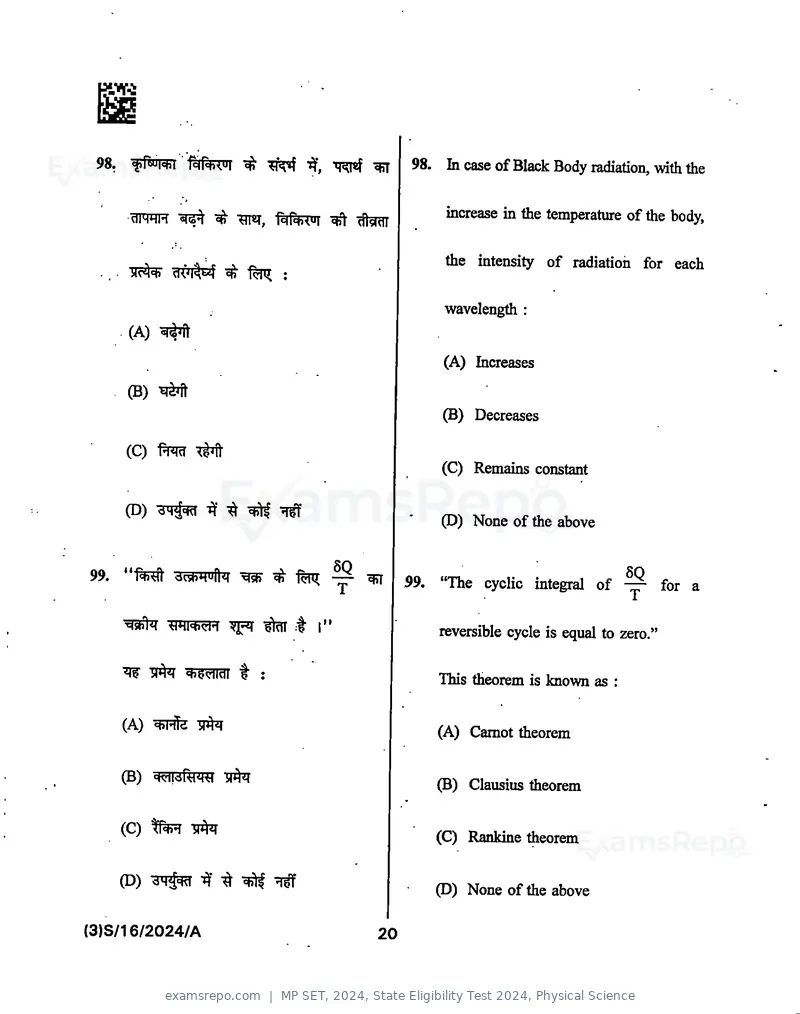
Text of page 22
98. In case of Black Body radiation, with the


     ^'HHll      ^         1M^iT"T ^ cikRir        increase in the temperature of the body,

                                                   the intensity of radiation for each
     "Slr^ dOl^wf ^        .

                                                   wavelength :
     (A)
                                                  (A) Increases
     (B)^
                                                  (B) Decreases

    (C) 1^^
                                                  (C) Remains constant

    (D)             ^ ^^                          (D) None of the above


                                   6Q
99. "1^              ^^                 ^ 99. "The cyclic integral of 8Q
                                                                      — for a

                    ^^:i I"                       reversible cycle is equal to zero."

    ^         +Sdldl t ;                          This theorem is known as :


    (A) ^pfe 31^                                 (A) Camot theorem

    (B)             "R^                          (B) Clausius theorem

    (C)       -R^                                (C) Rankine theorem


    (D)              ^                           (D) None of the above

(3)S/16/2024/A                           20
Text of page 24
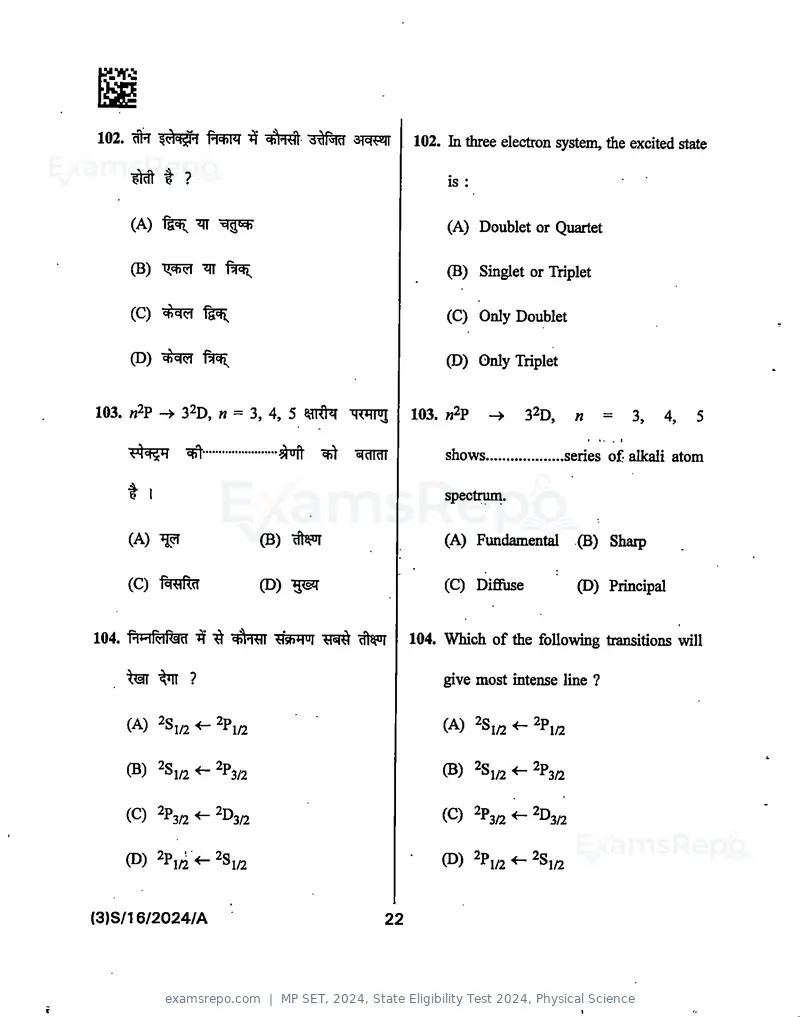
102. A               ^          3iq<^|   102. In three electron system, the excited state

           t ?                                 IS :


    (A)           "^3^                         (A) Doublet or Quartet

    (B) i<ct)in                                (B) Singlet or Triplet

    (C) «iiqei 1^                              (C) Only Doublet

    (D) chq(^                                  (D) Only Triplet


103. n2p     32£)^ « = 3, 4, 5   •WTPH    103. M^p          32d^    « = 3, 4, 5

                           ^ ^                 shows               series of- alkali atom

    t I                                        spectrum.


    (A) ^                 (B)                 (A) Fundamental (B) Sharp

    (C)                   (D)                 (C) Difiuse           (D) Principal


104. rHMPelRdd ^ ^         mim    #FI     104. Which of the following transitions will

              ?                                give most intense line ?


    W ^^1/2 <- 1/2                            (A) ^Si/2 <r~ ^Pi/2

    (B) 2S,^ 4- 2P3/2                         (®) ^^1/2 <- 2P3/2

    (*^) ^^3/2    ^^3/2                       (C) 2P3/2 ^

   (D) 2Pi/2 <- 2Si/2                     •   (D) ^Pl/2 ^

(3)S/16/2024/A                       22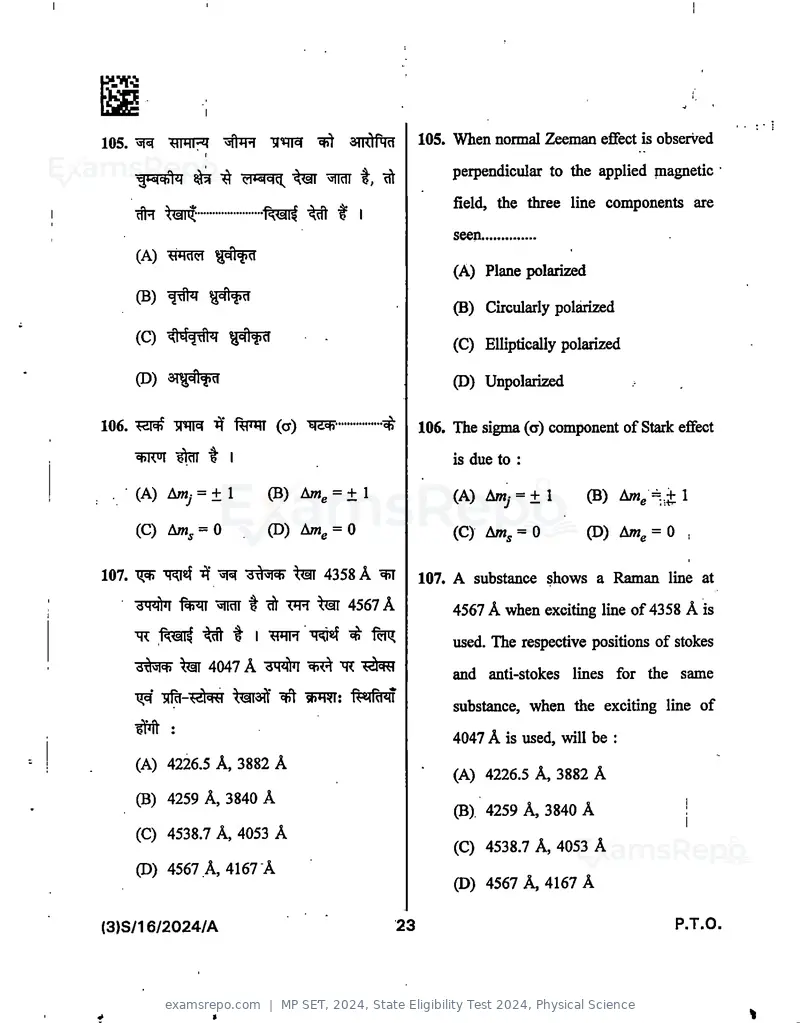
Text of page 25
105. -sra                            ^ siRtPra           105. When normal Zeeman effect is observed
                   t


                 ^ ■;^ ei*«iqq^        ^^nciT   ^             perpendicular to the applied magnetic
                                                              field, the three line components are
                                     M t I
                                                              seen

       (A) mm
                                                              (A) Plane polarized
       (B)
                                                              (B) Circularly polarized
       (C) ^hf^:#T                                            (C) EUiptically polarized

       (D) 311^                                               (D) Unpolarized

106.          irtTi^ T?        (a)                       106. The sigma (a) component of Stark effect
               ^t I                                           is due to :

       (A) Antj = ± 1         (B) AWg = + 1                   (A) /!jnj-±\        (B)
       (C) Affjj = 0          (D) Arrig = 0                   (C) Am,= 0          (D) Am, = 0 ,

107.                              ^ 4358 A ^             107. A substance shows a Raman line at

       wftn 1^ ^ t ^ WT ^ 4567 A                              4567 A when exciting line of 4358 A is
             R<ai^ %li" ■§■ I "?RR          ^                 used. The respective positions of stokes
       ^tPsrt ^ 4047 A               ^ "q? '^im               and anti-stokes lines for the same
       TJ^                ^3if ^ ^TOT: 1^«#qT                 substance, when the exciting line of
       #it ;
                                                              4047 A is used, will be :
       (A) 4226.5 A, 3882 A
                                                              (A) 4226.5 A, 3882 A
       (B) 4259 A, 3840 A
                                                              (B) 4259 A, 3840 A                 j
       (C) 4538.7 A, 4053 A
                                                              (C) 4538.7 A, 4053 A
       (D) 4567 A, 4167 A
                                                              (D) 4567 A, 4167 A

(3}S/16/2024/A                                      23                                         P.T.O.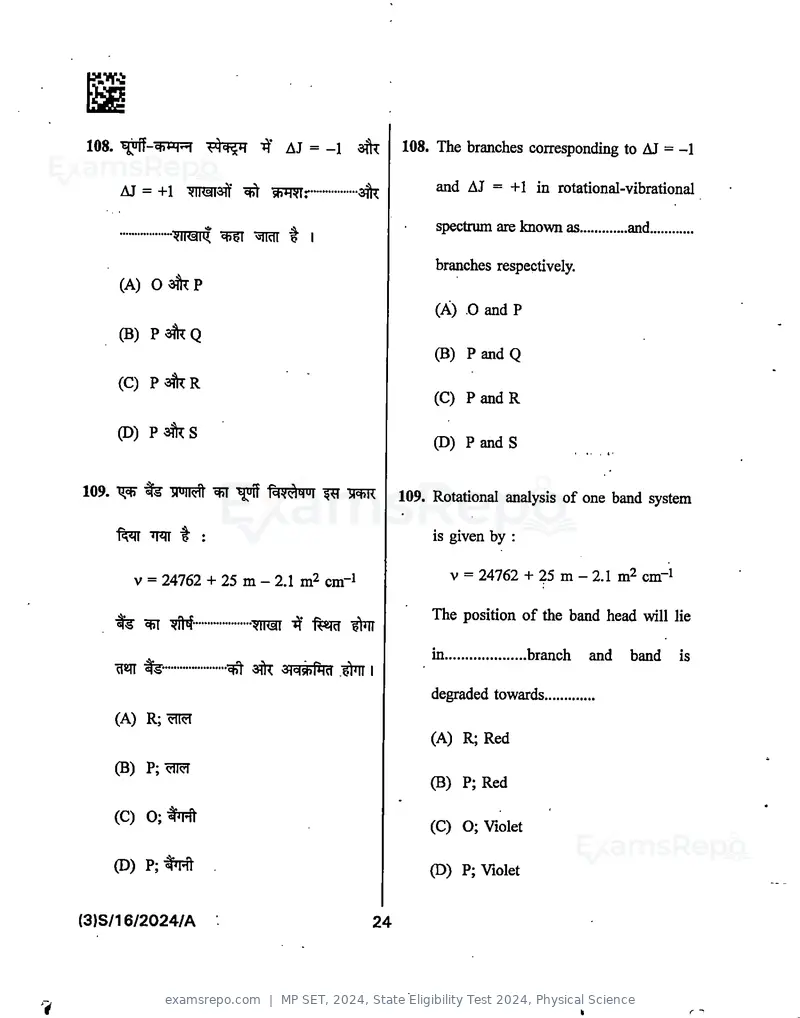
Text of page 26
108.                      T? AJ = -1 sfk       108. The branches corresponding to AJ = -1

       Aj = +1 ^rasff ^ gjrmr          •3k          and AJ = +1 in rotational-vibrational

                                                    spectrum are known as          and
                  ■?TT^ ^ ^ t I
                                                    branches respectively.
       (A) 0 3kP
                                                    (A) .0 and P
       (B) p akq
                                                    (B) P and Q
       (C) P3kR
                                                    (C) PandR

       (D) P3ks                                     (D) P and S


109.         ^ W# ^                ^ TJW       109. Rotational analysis of one band system

       ■fkir "W     :                               is given by :

         V = 24762 + 25 m — 2.1    cm~^                 V = 24762 + 25 m - 2.1 m^ cm~^

                                                    The position of the band head will lie
       ^^                -^mai    "ftsicr ^
                                                   in               branch   and   band   is
       ^«TT fe*          3k 3?^3km        I
                                                   degraded towards
       (A) R;^
                                                   (A) R;Red
       (B) P;^
                                                   (B) P; Red

       (C)
                                                   (C) O; Violet

       (D) P;^Mt                                   (D) P; Violet


(3)S/16/2024/A                            24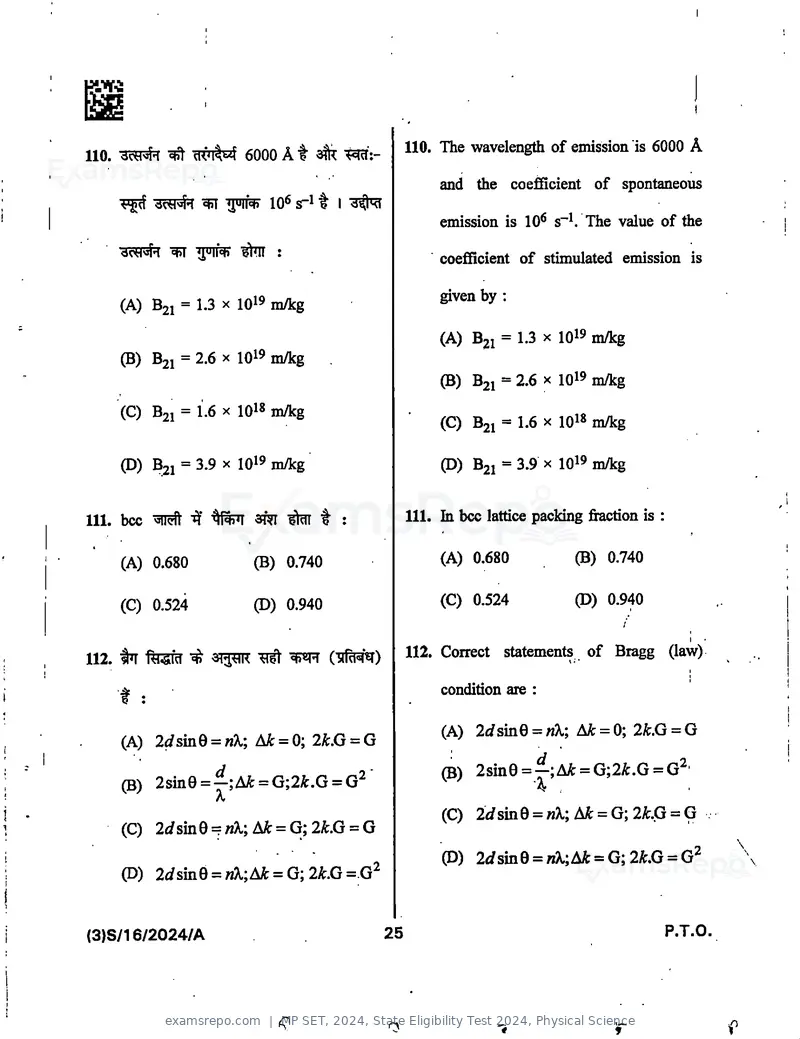
Text of page 27
110. The wavelength of emission is 6000 A
110.         ^ Wllaf 6000 A i          W;-
                                                       and the coefficient of spontaneous
   ^               ^        10^ S-11 I "3^
                                                       emission is 10^ s~i. The value of the
             ^ -3^^) ^ :                               coefficient of stimulated emission is

                                                       given by :
       (A) B21 = 1.3 X 10¹⁹ ni/kg
                                                      (A) B21 = 1.3 X 10¹⁹ m/kg
       (B) B21 = 2.6 X 10¹⁹ m/kg
                                                      (B) B21 = 2.6 X 10¹⁹ m/kg
       (C) B21 = 1.6 X 10I8 m/kg
                                                      (C) B21 = 1.6 X 10I8 m/kg

       (D) B21 = 3.9 X 10¹⁹ m/kg                      (D) B21 = 3.9 X 10¹⁹ m/kg

111. bcc                            "I" :         111. In bcc lattice packing fraction is :

       (A) 0.680         (B) 0.740                    (A) 0.680            (B) 0.740


       (C) 0.524         (D) 0.940                    (C) 0.524            (D) 0.940


112. In feSRT            ^                        112. Correct statements of Bragg (law)

                                                       condition are :
       t:
                                                       (A) 2dsin0 = nk',        = 0; 2k.G = G
       (A) 2f/sin0 = nX; Ai = 0; 2A:.G = G

       (B) 2sm0= —; = G',2k.G = G^                     (B) 2sin0=-^;A^ = G;2^.G = G^
                 A.
                                                       (C) 2f/sin0= nk\ A^ = G; 2^..G = G
       (C) 2t/sin0= wX; AA:= G;2A.G = G
                                                       (D) 2i3fsin0 = nA;AA = G;2A:.G = G^
       (D) 2£/sin0 = «A,;AA = G; 2k.G = G^

(3)8/16/2024/A                               25                                           P.T.O.


                                             r>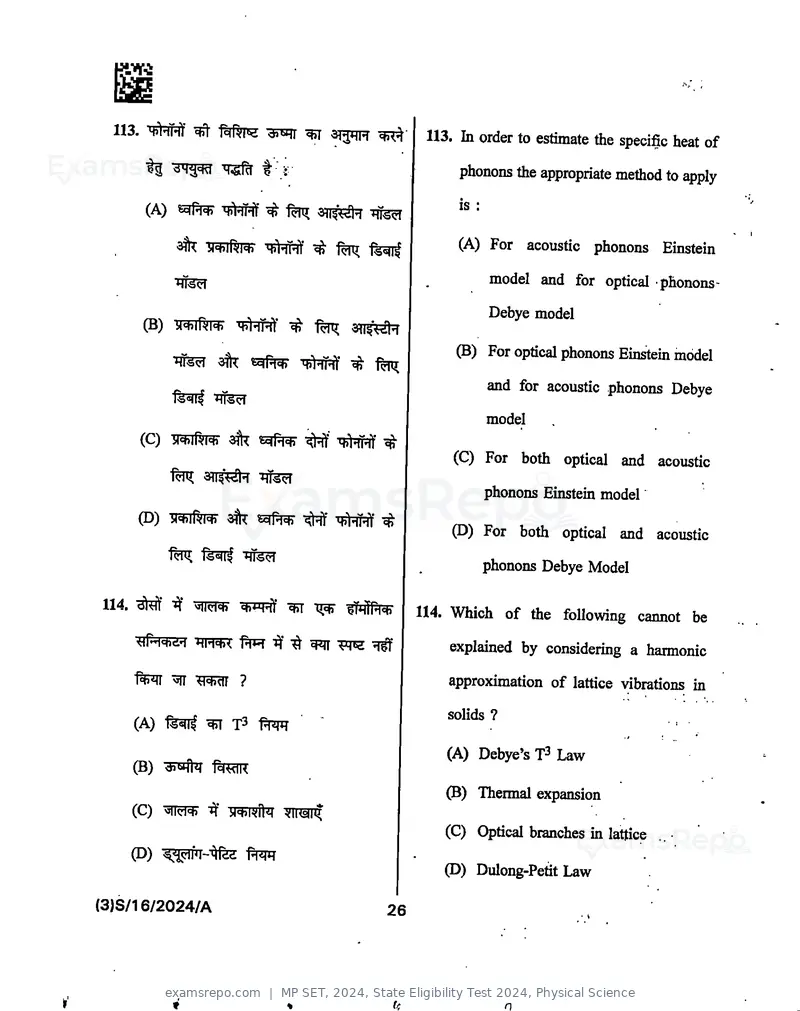
Text of page 29
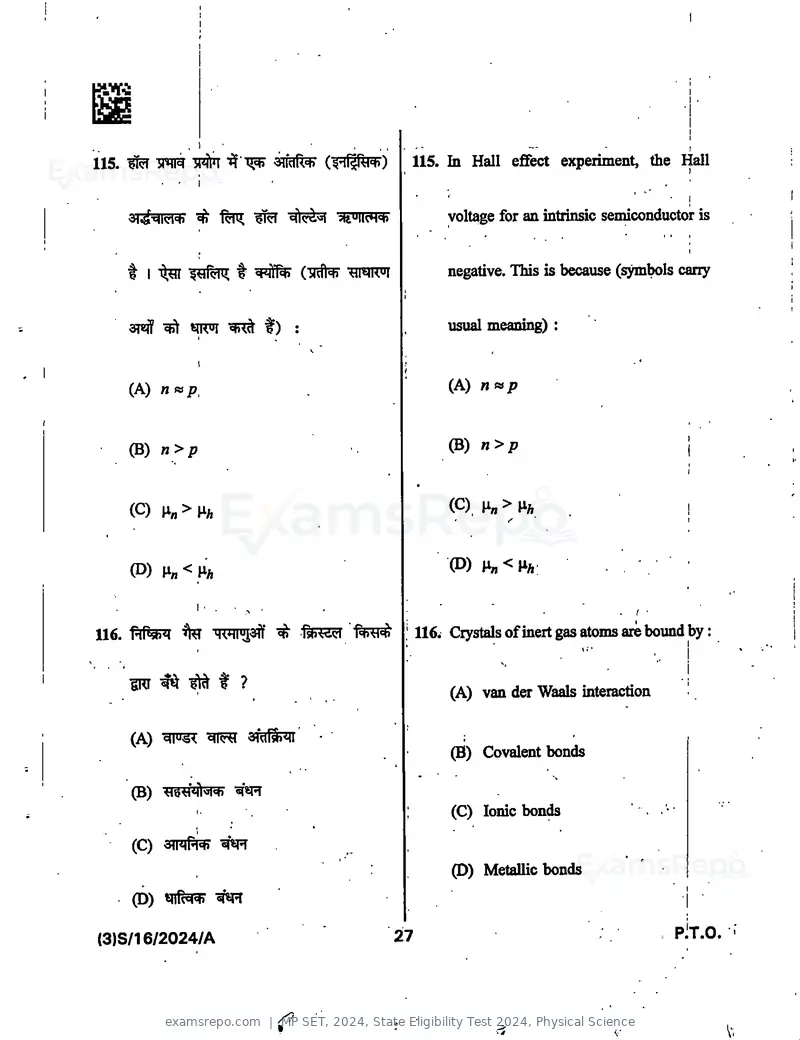
115. w ■jwra ipJpi            siiafer                 115. In Hall efifect experiment, the Hall
           •   •    i

                                                                                           ' '     •    j
                   ^                    3kuiichc4>          voltage for an intrinsic semiconductor is
                                                                                                        I


    t I            faf^ t         (3I?ft^ WOT               negative. This is because (symlrals cany


     3T«if ^ «OT             f) :                           usual meaning) ;

                   I


     (A) n « p,                                             (A) w « /?


     (B) n>p                                                (B) n>/7                                    j
                                                                                                        I


     (C) H«>Ma                                              (C),               ,                        !
                                                                                                        I


     (D)                                                    (D) 11;, < Ma;

                                                                                       .   !   ■


116. Wm ^                      ^ PshW-d               \ 116. Crystals of inert gas atoms are bound by:
                                                                                   %i'             j

     IRT ^ ^ t ?                                            (A) van der Waals interaction

     (A)                    3fef^'
                                                            (B) Covalent bonds

     (B) WWNrt
                                                            (C) Ionic bon^
     (C) STPte ^
                                                             (D) Metallic bonds
     (D) mfc^

(3)S/16/2024/A                                       27                                                PiT.O.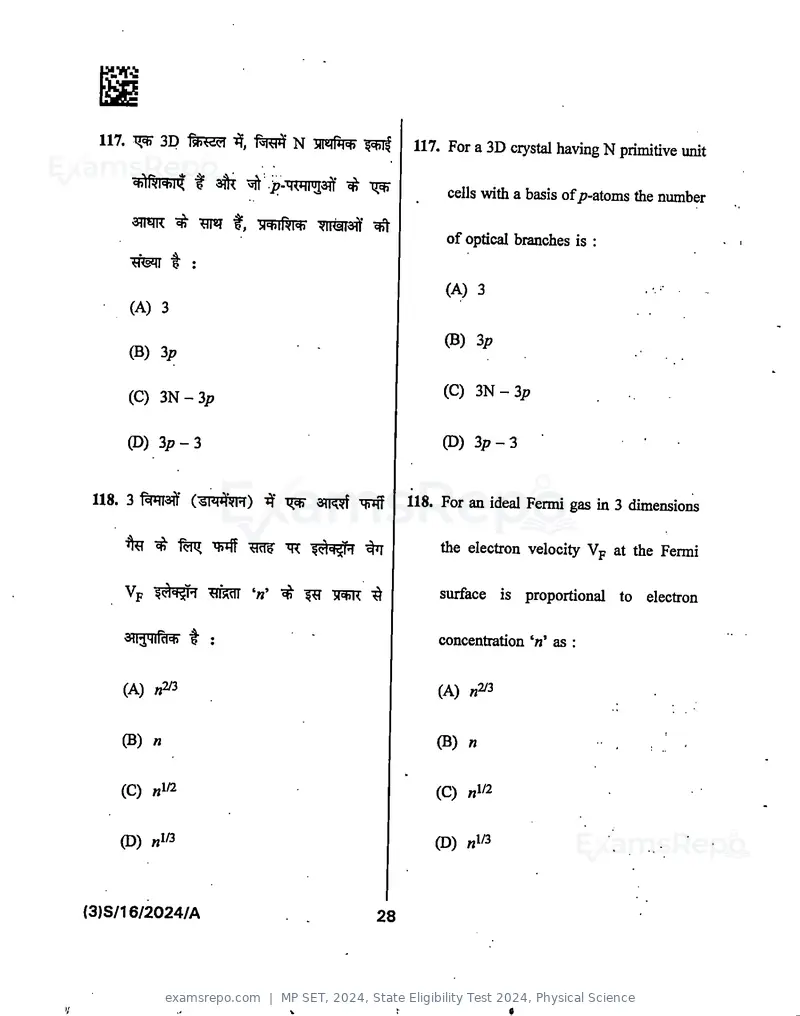
Text of page 30
117.      3p                N                117. For a 3D crystal having N primitive unit

                 t ^ #'jp-WTrnaTf -% V^             cells with a basis of/7-atoms the number
         5RmR ^ Br«T f, y4)iRfi«Ji' ^n^aif ^
                                                    of optical branches is :
             f:
                                                    (A) 3
     (A) 3

                                                    (B) 3/7
     (B) 3p

     (C) 3N-3p                                     (C) 3N-3/7


     (D) 3/7-3                                     (D)3p-3         ■


 118. 3                      xr^ 371^ Tpifl    118. For an ideal Fermi gas in 3 dimensions

     ^ ^ 1^ ^                TR        ^           the electron velocity Vp at the Fermi

     Vp                 'w' ^ ^         ^          surface is proportional to electron

                                                   concentration 'n' as :


    (A) rP^                                        (A) «2/3

    (B) «                                         (B) n


    (C) /jl/2                                     (C) /7I/2

    (D)                                           (D) nl/3


(3)S/16/2024/A                           28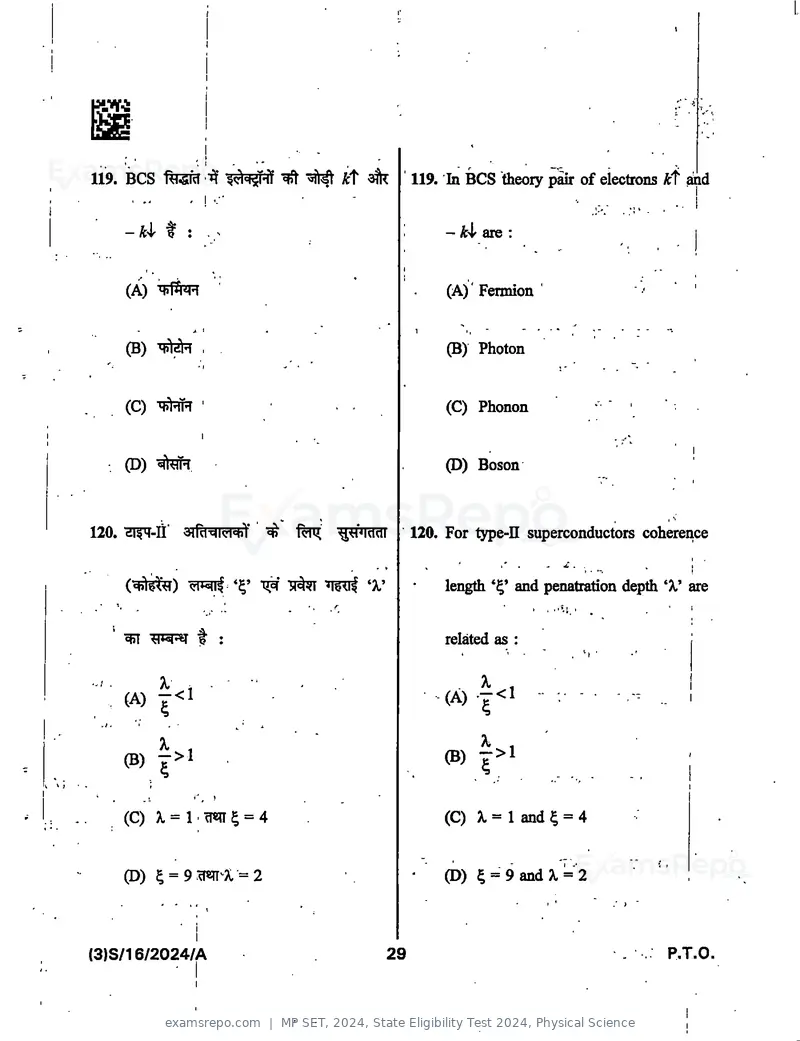
Text of page 31
119. BCS fera 4                ^^ itt ak             119. In BCS theory p^ of eiectrons                             ^d
                                                                                                                                 I

                                                                                                        '   •' V        » '• '


                  - fc-l- f : . ^                         i                are:                                                  j
                                                          I


              (A) TpfWl                                               (A)' Fennion '                               •'        '

                            A   I


              (B)               ,                                     (B) Photon


              (C)               '                                     (C) Phonon                    ^       .
                                I

                                                                                                                         '   I
              (D)                                                     (D) Boson


                                                                                                                        ,s


         120. ^-li" SiPd^M^hT ^                ^^*J|ddl       120. For type-U superconductors coherence
                                                                  ^                    -   -<r. .                   ,        I

                           wM *5'                  'V                 length       and penetration depth 'X,' are
         '   ^4                     '     '^   f


              ^              "t :                                     related as :
                                                                               ■     • '     , s •


              (A) J<1                                                 (A) ■|<1 -                            - ..

              (B) ^>1                                                 (B) J>1
S   *)


              (C) X = 1 •^§ = 4                                       (C) X = 1 and 4 = 4


              (D) 5 = 9^T«Tr^X = 2                            ■       (D) 5 = 9 and X = 2


         (3)S/16/2024/A                                 29                                                              P.T.O.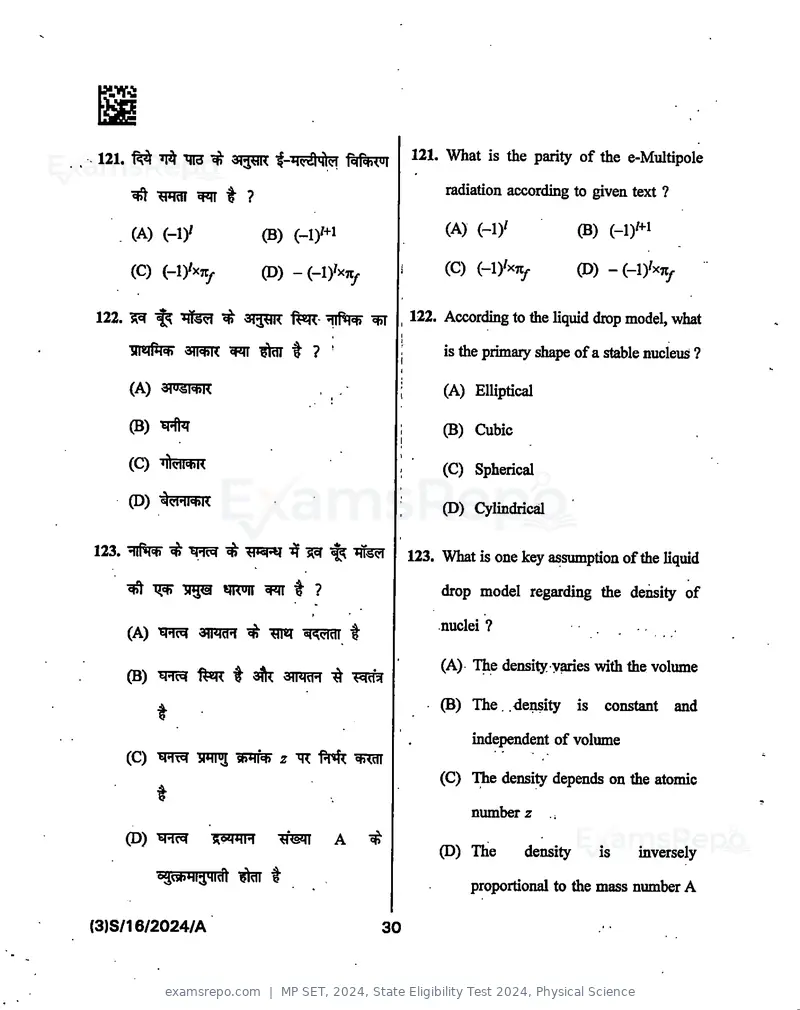
Text of page 32
121.           Tira "i" 5R59R f-iivdtter                       121. What is the parity of the e-Multipole

       ^         ^ t" ?                                             radiation according to given text ?

    . (A) (-1)'                 (B) (-iy+>                          (A) ("ly               (B) (-1)'+!

     (C) (-lyXTU^               (D) -(-lyXTy                        (C) (-lyxjy            (D) - (-iyx;c^

122. ^         'Tfe^ ^ 3I59R "ftsR- Hlf^ch ^ 122. According to the liquid drop model, what
       3irafiR7 3TRJR ^^ t ? '                                      is the primary shape of a stable nucleus ?

     (A) 3pJ5RiK                                                    (A) Elliptical

     (B)^                                                           (B) Cubic

     (C) Ji)cil4)K                                                  (C) Spherical

     (D) %RR>K                                                      (D) CylindricEil

123. "itRi"*) "% *Nicq        *!♦<(•*? "^f "53       tjTsei    123. What is one key assumption of the liquid
     ^         "Sig® SIOT ^ f ?                                     drop model regarding the density of

                                                                    nuclei ?
     (A)          aTOR ^                 qsQifii ^
                                                                    (A) The density varies with the volume
     (B)                 t"          a^PRH
                                                                    (B) The. .density is       constant   and
           t
                                                                        independent of volume
     (C)                 sf»*ff^ z "^R 1^
                                                                    (C) The density depends on the atomic
           t
                                                                        numbers

     (D) -ERc^       ^?5zmR         -^nsin       A     ^
                                                                   (D) The       density      is   inversely

                                                                        proportional to the mass number A

(3)S/16/2024/A                                            30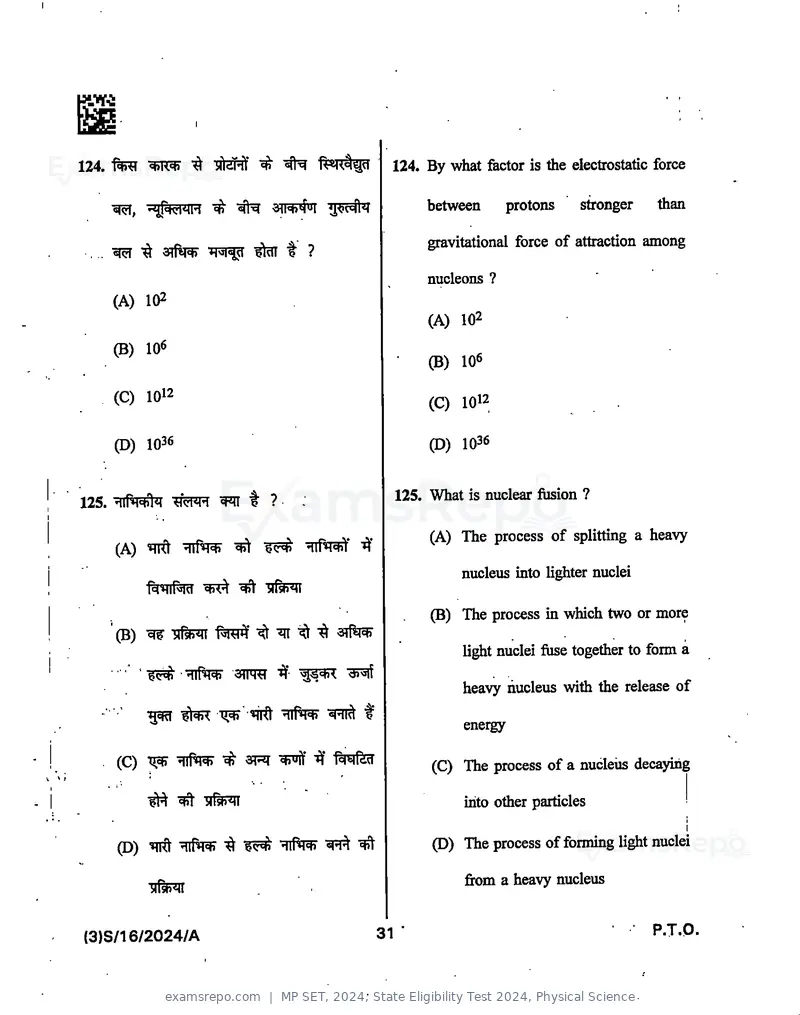
Text of page 33
124.^               ^           ^^                         124. By what factor is the electrostatic force

                        ^ ^ 3TR?^                               between      protons     stronger    than

                                                                gravitational force of attraction among
 . . -^ ^ 3rf«R>               ^t ?
                                                                nucleons ?
    (A) 102
                                                                (A) 102
    (B) 10®
                                                                (B) 10®

    (C) 1012                                                    (C) 1012

    (D) 103®                                                    (D) 103®

                                                           125. What is nuclear fusion ?
125. "^nfefN             TO t ?
                                                                (A) The process of splitting a heavy
    (A)                     ^                      ■^*
                                                                     nucleus into lighter nuclei
            lTOf^ ^ ^ "Slf^
                                                                (B) The process in which two or more
    "(B) ^ ifer                 ^^              3Tf^
                                                                      light nuclei fiise together to form a
           ' ee*ii ' *11^5(1 SEIFRi '^*          "51^
                                                                      heavy nucleus with the release of
            ^            Ts^                       t                  energy


   . (C)                  ^^              "^f                    (C) The process of a nucleus decayiiig
                 ^ Tif^                                               into other particles
                                                                                                            1
     (D) 'irJl ^#1^ ^                "^nte ^ ^                   (D) The process of forming light nuclei

            Tlf^
                                                                      from a heavy nucleus


(3)S/16/2024/A                                           31 •                                       P.T.O.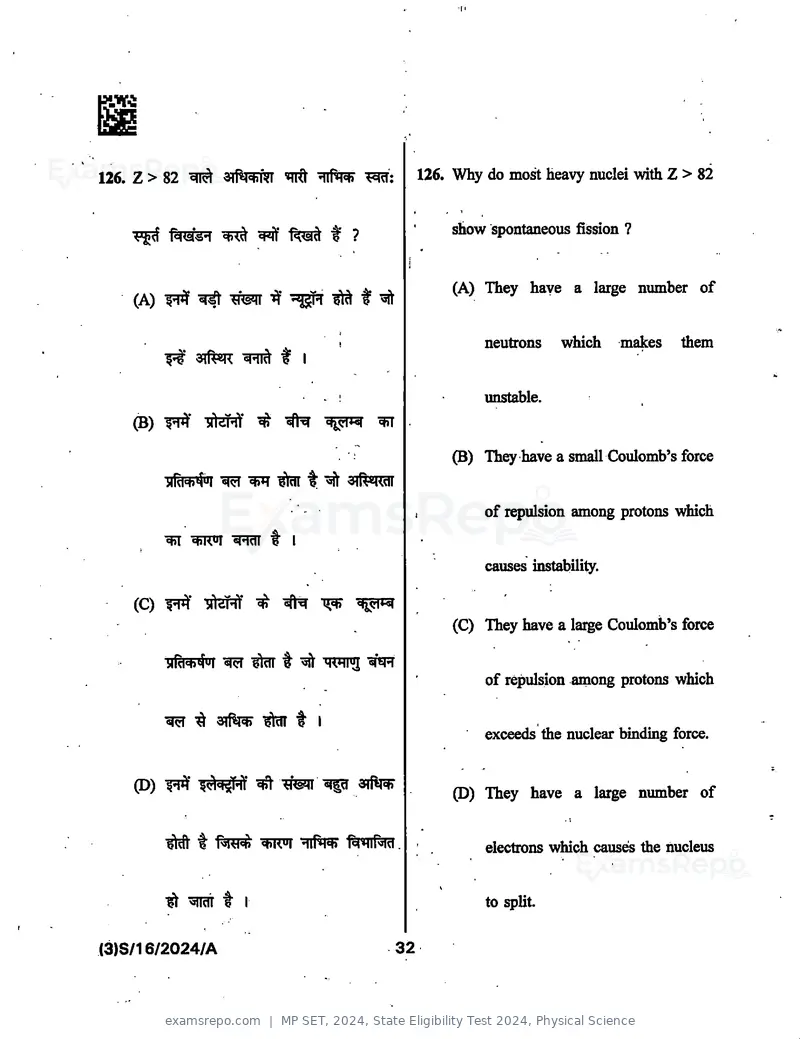
Text of page 34
126. Z > 82 ^                                     126. Why do most heavy nuclei with Z > 82


          [q<a«i            Rocl        ?             show spontaneous fission ?


                                                      (A) They have a large number of
   (A) "5^                  -<45^1       i^

                                                           neutrons    which     makes   them
              aflftsR      t I

                                                           unstable.

   0)          silcTil ^             ®ty!i«i ^
                                                      (B) They have a small Coulomb's force
          irfiR?*!^^^t ^ ^IViKdl
                                                           of repulsion among protons which


                                                           causes instability.

   (C) FT^* nl<iTiT ■^'
                                                      (C) They have a large Coulomb's force


                                                           of repulsion among protons which


                                                           exceeds the nuclear binding force.


    (D)                 ^ WU            3(lP?^         (D) They have a large number of


          ^t            ^»Rnr •=#1^ f^<^iPHd.              electrons which causes the nucleus


          ^ ^i?ii ^ I                                      to split.


(3)8/16/2024/A                               32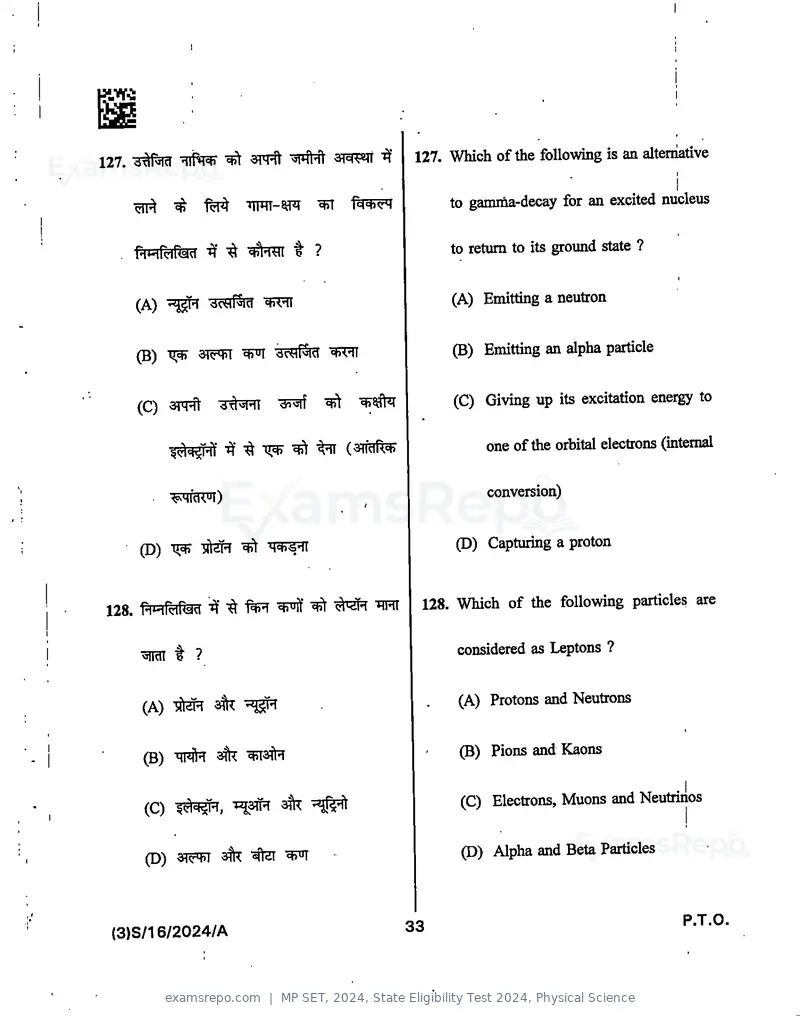
Text of page 35
127.                 ^       "SIiM    127. Which of the following is an alternative
                                                                                I


   ^ ^ f^ TTTTTT-^ ^ 1^^^^                 to gamina-decay for an excited nucleus

  , PiMfdRsld ■^' ^           t ?          to return to its ground state ?


       (A)          "3?^^                  (A) Emitting a neutron


       (B) "Q;^ 31^         dc^pSld        (B) Emitting an alpha particle


       (C)           "3^^ "3i^              (C) Giving up its excitation energy to

                                                 one of the orbital electrons (internal

                                                 conversion)


       (D) TT^ "Sft^T ^ MdidHl              (D) Capturing a proton


128. rHMRrindd       ^ 1^        ^     128. Which of the following particles are


       wirar "t ?                           considered as Leptons ?


       (A) -jft^T ^                         (A) Protons and Neutrons


        (B) "*11^ sSk                       (B) Pions and Kaons


        (C)                 ^                (C) Electrons, Muons and Neutrirlos
        (D) 3CTT alk         ^               (D) Alpha and Beta Particles


                                                                                    P.T.O.
 (3)S/16/2024/A                       33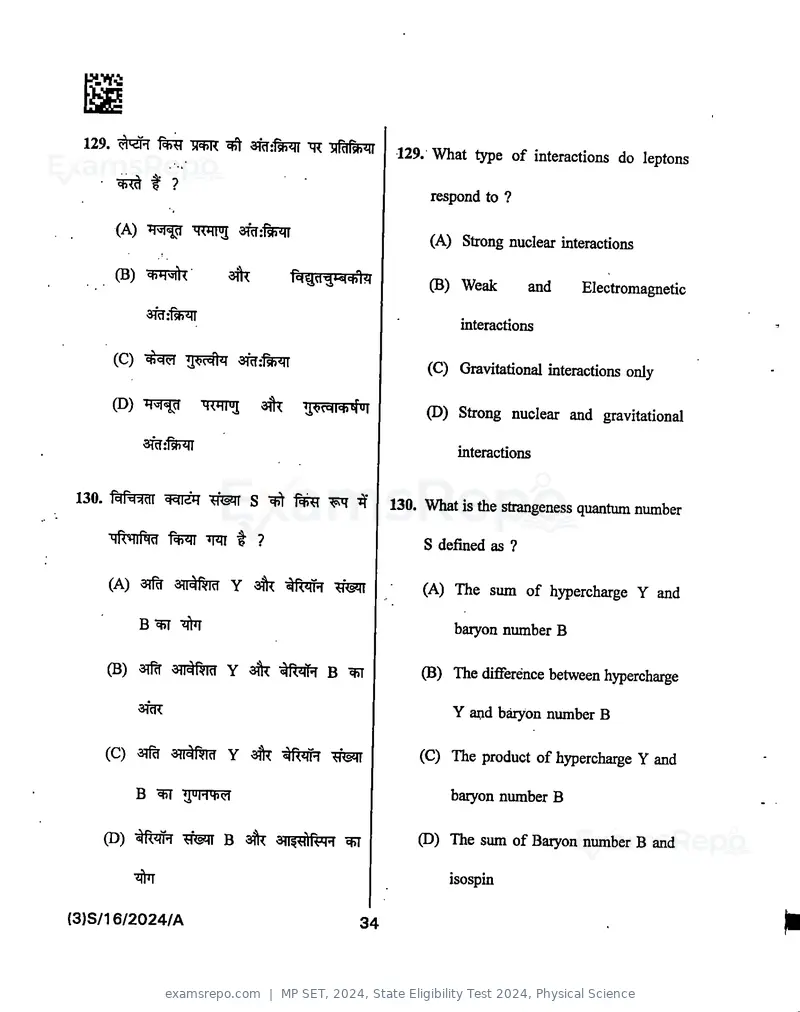
Text of page 36
129.             -PRJR ^ a7cT:feir        ^Pdfsh^l
                                                         129. What type of interactions do leptons
     ■ ^f ?
                                                             respond to ?

      (A) ^^51^             3Tcr:%^ff
                                                             (A) Strong nuclear interactions

      (B)                  3?^^     fc|^d^Hd)1^              (B) Weak         and   Electromagnetic

                                                                  interactions

      (C)                   3fff:t^
                                                             (C) Gravitational interactions only
      (D) ^^31^ -q^qpij                 ii^r^l<+»Efu|       (D) Strong nuclear and gravitational
            a^;t^
                                                                  interactions


 130. IqFq^cii                S^           ^ i{         130. What is the strangeness quantum number
      *Tlfe              TRI t ?                             S defined as ?

     (A) ^ arf^fw Y sqk «5RiiH vmi                          (A) The sum of hypercharge Y and
            B     <hVi                                           baryon number B

     (B) ^ 3lT^ Y 3k                        B^              (B) The difference between hypercharge
           3Td^                                                  Y and b^on number B

     (C) 3if% 3n^iTO Y 3k                                  (C) The product of hypercharge Y and

          B ^ iiUH4,^                                            baryon number B

    (D)           #sqr B sk                    ^           (D) The sum of Baiyon number B and

                                                                isospin

(3)S/16/2024/A                                    34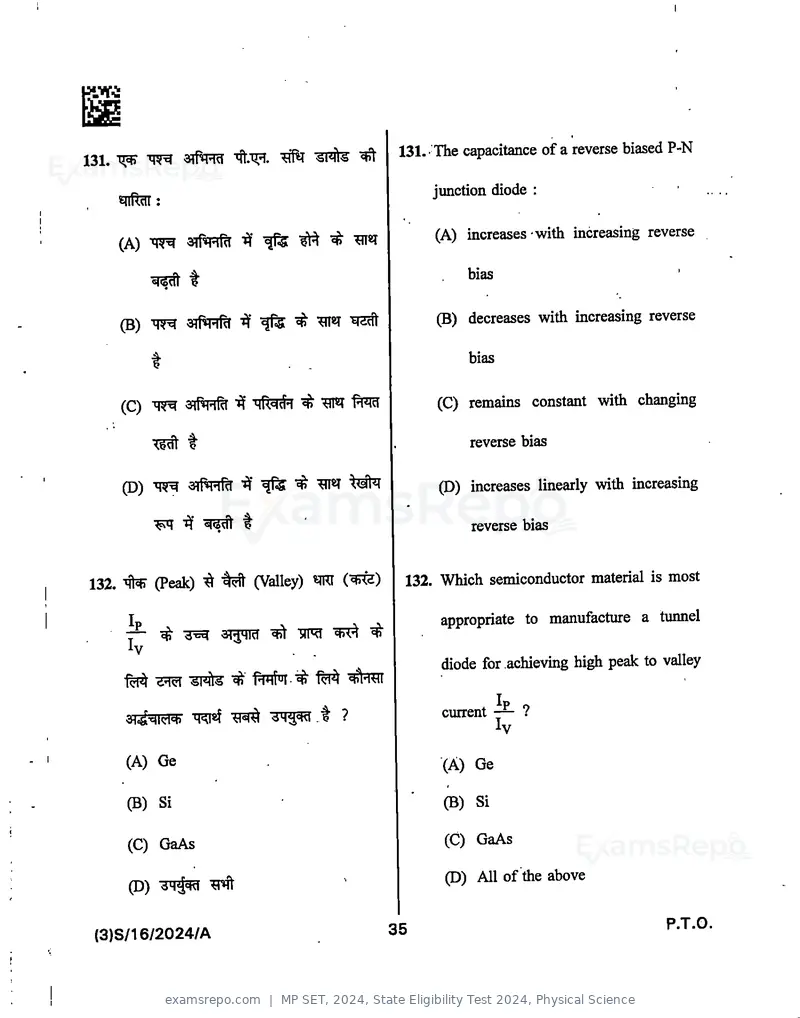
Text of page 37
131. The capacitance of a reverse biased P-N
131.                               ^          ^
                                                        junction diode :
       tiiRai:

                                                       (A) increases with increasing reverse
       (A)         3#RftT          ^^ ^
                                                             bias
             qcnl "t

       (B)         3#Rf^       ^^ ^«T ^TSdt             (B) decreases with increasing reverse

             t                                               bias


       (C)         aiM^ ^ "mRci^t ^^fra                 (C) remains constant with changing

                   t                                         reverse bias


       (D)                         ^^^                  (D) increases linearly with increasing
             "^q       ®i'3^fl ^                             reverse bias


132.         (Peak) ^^(Valley) «lRr (W)            132. Which semiconductor material is most

                                                         appropriate to manufacture a tunnel
             ^           sT^qra ^ "qr?!       ^
                                                         diode for achieving high peak to valley


                   "q^             "^q^.t ?              current ^ ?
       (A) Ge                                            (A) Ge

       (B) Si                                            (B) Si

       (C) GaAs                                          (C) GaAs

                                                         (D) All of the above
       (D) "sq^ ^

                                                  35                                      P.T.O,
 (3)S/16/2024/A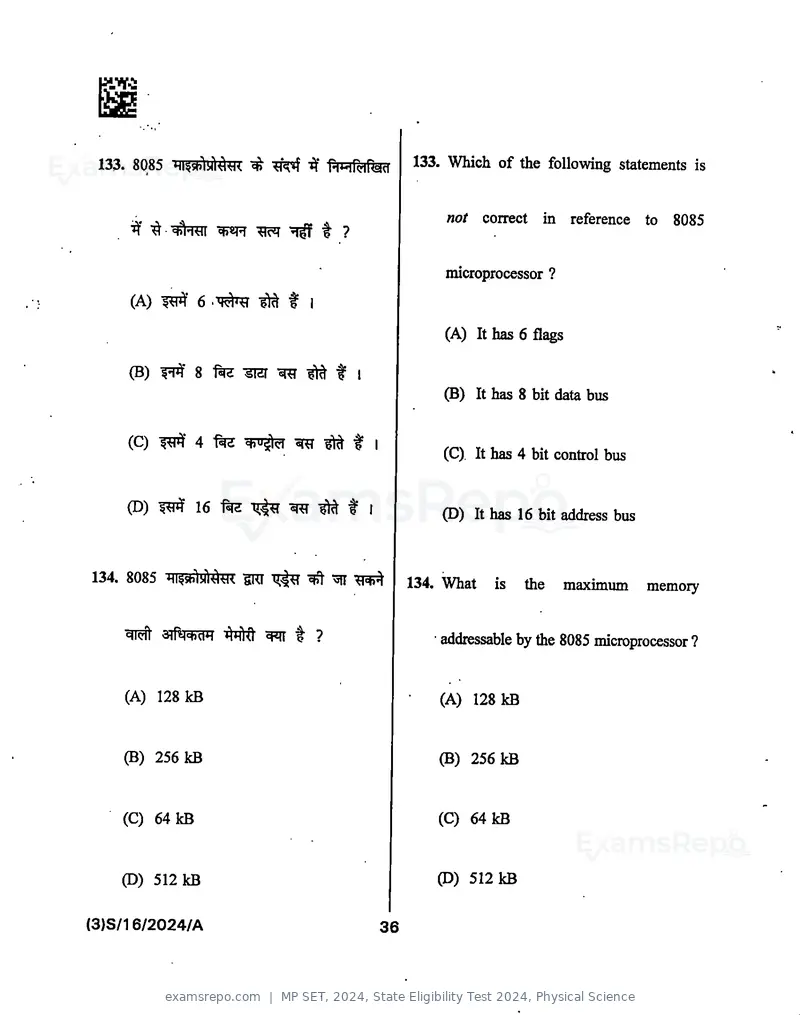
Text of page 38
133. 8085                                133, Which of the following statements is


                                              not correct in      reference to    8085
     ^^                   ^^ t ?

                                              microprocessor ?
     (A)        6 ."*1^     t I
                                             (A) It has 6 flags

    (B)         8 fe ^       ^t I
                                             (B) It has 8 bit data bus


    (C)         4 fe ^JTT^ ^ ^ t I
                                             (C) It has 4 bit control bus


    (D)^ 16 fe -ql^ ^^ f I                   (D) It has 16 bit address bus


134. 8085                    ^^           134. What is the       maximum      memory

            aifv^KR       ^f ?               ■ addressable by the 8085 microprocessor ?


    (A) 128 kB                               (A) 128 kB


    (B) 256 kB                               (B) 256 kB


    (C) 64 kB                                (C) 64 kB


    (D) 512 kB                               (D) 512 kB


(3)S/16/2024/A                       36
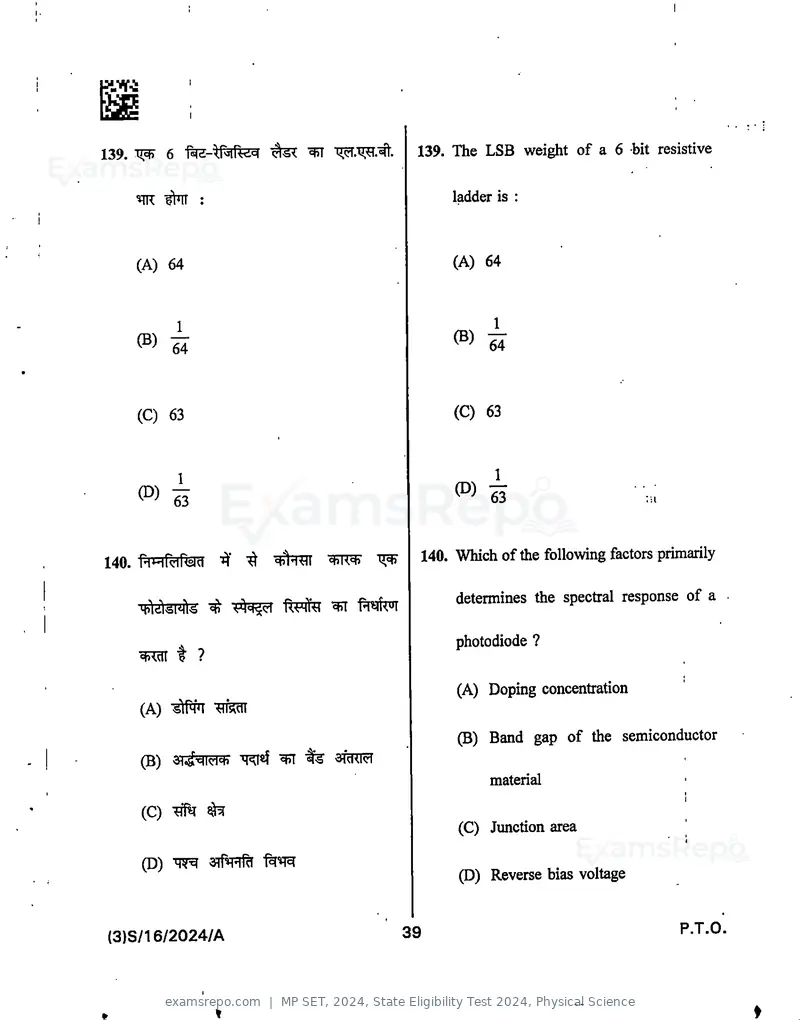
Text of page 41
139.         6                    ^               139. The LSB weight of a 6 bit resistive

       w:^ :                                          ladder is :


       (A) 64                                         (A) 64


                                                      («) ^


       (C) 63                                         (C) 63


       (D)                                                                         :u
             63


140. PiHRrinsId                                   140. Which of the following factors primarily

                                                       determines the spectral response of a
       thldkNk ^                      ^ f^rak^
                                                       photodiode ?
                 t ?
                                                      (A) Doping concentration
       (A)
                                                       (B) Band gap of the semiconductor
       (B)                "'KI®! ^ fe 3T^RI^
                                                            material

       (C) ^ ^
                                                       (C) Junction area

       (D)             a#Hfcl
                                                       (D) Reverse bias voltage


                                                 39                                      P.T.O.
(3)S/16/2024/A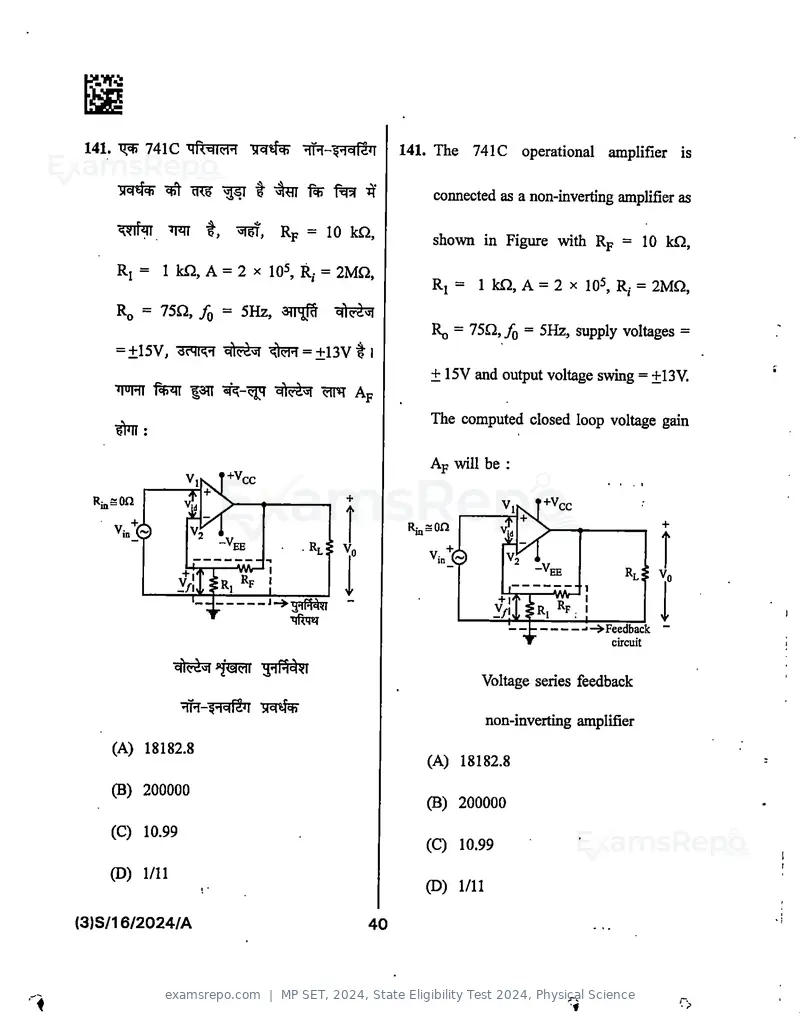
Text of page 42
141. -q^ 741C mR^M4                                      141. The 74IC operational amplifier is

                                                              connected as a non-inverting amplifier as

             "W t,                   Rp = 10 kn,              shown in Figure with Rp = 10 kn,
     Rl = 1 kn, A = 2 X 10⁵, R. = 2MQ,
                                                              Rj = 1 kn, A = 2 X 10⁵, R. = 2Mn,
     Ro = 75n, /q = 5Hz, airjfS
                                                              Rq = 75n,/q = 5Hz, supply voltages =
     =±15V,                      #R =±13V 11
                                                              ± 15V and output voltage swing = +13V.
     M"ni f«t)<<( ^sn                qlcri'ai    Ap
                                                              The computed closed loop voltage gain
    ^;

                                                              Ap will be :
                         +v,cc

  RinSOfi                                                                       +V,CC


     Vin"©              -V,EE                    I         Ri„son
                                                                         i
                           Wr-* I
                                 I
                                          . R,

                                                                               -vEE           R,
                                                                                                     I
                          1 ' I                                                  -VV\r-
                                                                         +\"
                                                                                   Rt
                                        Mr<4^                              —              Feedback   ~
                                                                                           circuit


                                                                     Voltage series feedback

                                                                        non-inverting amplifier
    (A) 18182.8
                                                             (A) 18182.8
    (B) 200000
                                                             (B) 200000
    (C) 10.99
                                                             (C) 10.99
    (D) 1/11
                                                             (D) 1/11

(3)S/16/2024/A                                       40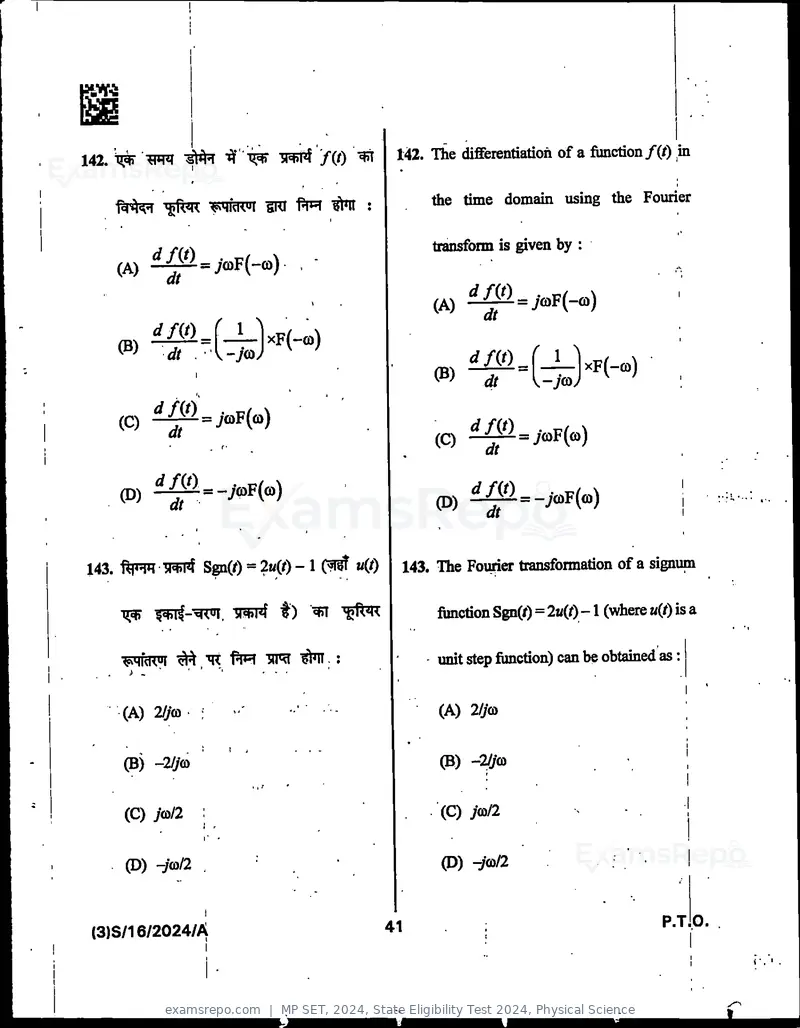
Text of page 43
142.                           "5*^ fit) ^    142. The dififerentiatioh of a function/(/) in


                             OT 1^ ^ !             the time domain using the Fourier

                                                   transform is given by :


       CB) ^--[-^h-^^
                                                   (B)     dt      K-J<o) ^ '
              dm_,
                 j<o¥{a)
       (C)
               <//
                                                   (C) im.-.
                                                       -^=;<dF(«))
       (D) ^^=-;©F(ffl)                            (D) ^^=-;coF(<d)
143. ftpIH           S^(0 = 2«(0- 1(^ «(0     143. The Fourier transformation of a signum

                          "Srajpf t) ^              function Sgn(0=2u{f)-1(where «(0 is a

       ^qRROi ^ -qt          ITO     :              unit step function) can be obtained as:
        ) _


       (A) 2/yffl ' :                               (A) 2//®


       (B) -2//®                                    (B) -2/7®


       (C) y®/2      ;                             . (C) 7®/2
                     I*


       (D) -jm/2 .                                  (D) -7ffl/2

                     j

                                             41                                        P.T 0.
 (3)S/16/2024/A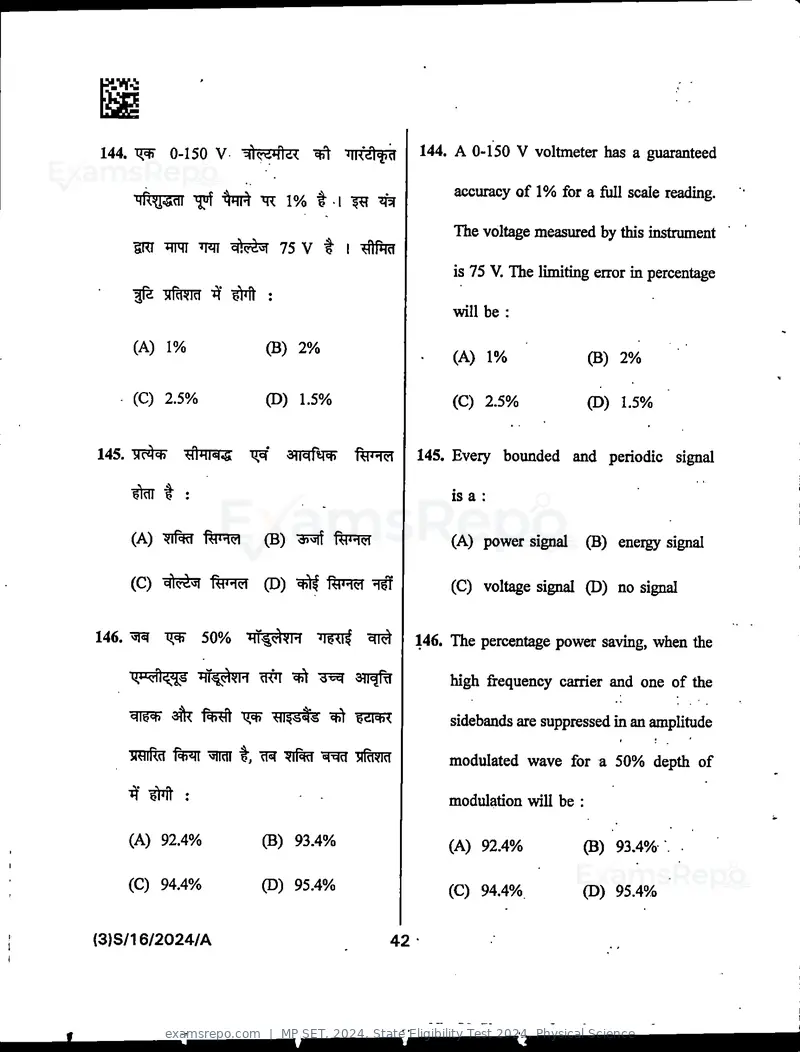
Text of page 44
144.          0-150 V                ^                 144. A 0-150 V voltmeter has a guaranteed

                                                            accuracy of 1% for a fiill scale reading.
                  l?f ^^ 1% t - l ^ ^
                                                            The voltage measured by this instrument
       ^^                         75 V t I
                                                            is 75 V. The limiting error in percentage
       ^ "Slfelcf       ^:
                                                            will be :

       (A) 1%                   (B) 2%
                                                            (A) 1%                (B) 2%

       (C) 2.5%                 (D) 1.5%                    (C) 2.5%              (D) 1.5%


145.                                                   145. Every bounded and periodic signal

             f:                                             is a :


       (A)                      (B) ^ ftFT^                 (A) power signal (B) energy signal

       (C)                      (D) ^ 1^FTH ^               (C) voltage signal (D) no signal


146.               50%                        ^        146. The percentage power saving, when the

                                                           high frequency carrier and one of the

                                                            sidebands are suppressed in an amplitude

       IRlfe Pti^i ^ITcff "^1                ifelcT        modulated wave for a 50% depth of

       ■^f ^ :                                             modulation will be :

       (A) 92.4%                (B) 93.4%                  (A) 92.4%            (B) 93.4%

       (C) 94.4%                (D) 95.4%                  (C) 94.4%,           (D) 95.4%


(3)S/16/2024/A                                    42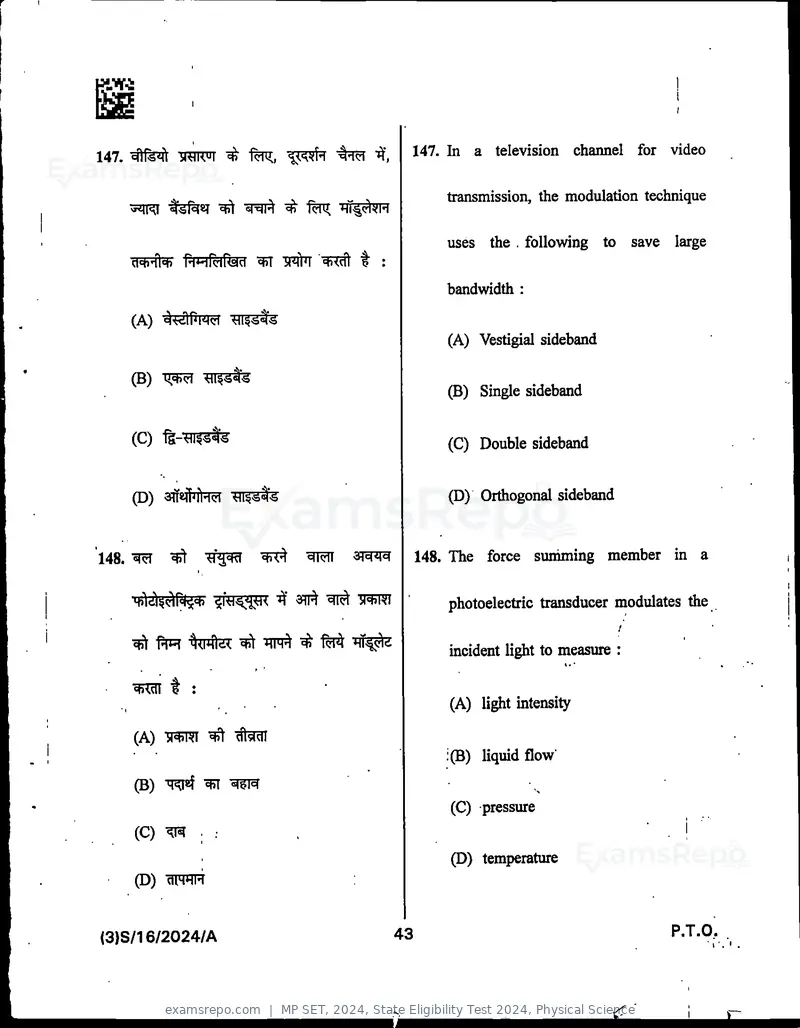
Text of page 45
147.          "SRTR^ ^ 1^,                   147. In a television      channel for video


                                                 transmission, the modulation technique
             ^f5f^8T ^       ^ %TT

                                                 uses the . following to save large
       rR* PHHrdRsid ^ TPk           t:
                                                 bandwidth :

       (A) "^wlPl^d "^TT?^
                                                 (A) Vestigial sideband

       (B)
                                                 (B) Single sideband

       (C) tS-'BH^                               (C) Double sideband


       (D) 3ff«if#T^                             (D) Orthogonal sideband


148.         ^           ^                   148. The force suniming member in a

                                     U^RT        photoelectric transducer modulates the
                                                                            /


                                                 incident light to measure :
                                                                     %. •


             "I :
                                                 (A) light intensity
       (A) 'SRJRT ^
                                                 ;(B) liquid flow'
       (B) -q^af ^
                                                 (C) pressure
       (C) ^ ; ;
                                                 (D) temperature
       (D) WWR


|3)S/16/2024/A                              43                                     P.T.O.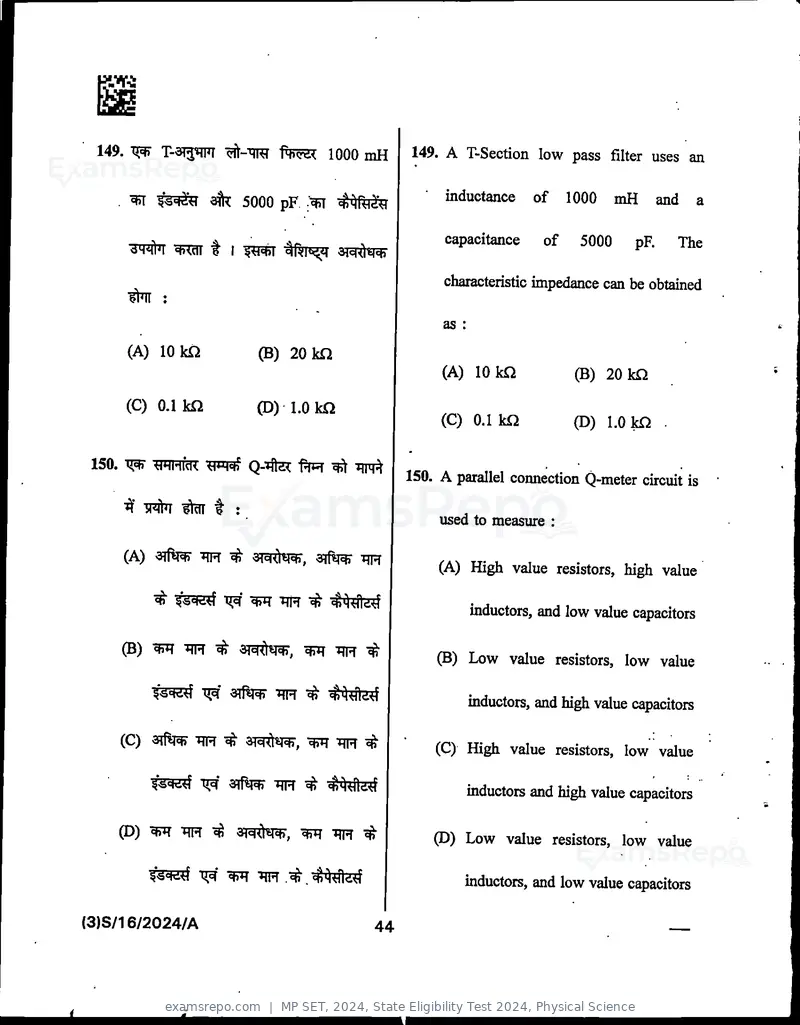
Text of page 47
(SPACE FOR ROUGH WORK)


^   I


        (3)S/16/2024/A/P-45
Text of page 48
(SPACE FOR ROUGH WORIQ
                          Up   ^


<3)S/16/2024/A/P-46
Text of page 49
(SPACE FOR ROUGH WORK)
                                    WT5'


{3)S/16/2024/A/P-47
Text of page 50
(SPACE FOR ROUGH WORK)


<3)S/16/2024/A/P-48
Text of page 51
(SPACE FOR ROUGH WORK)


S/16/2024/A
Text of page 52
«»ii4   (cm
              (SPACE FOR ROUGH WORK)


S/16/2024/A
Page 1 of 52
Source: Madhya Pradesh Public Service Commission. Question paper published by Madhya Pradesh Public Service Commission.