
MP SET 2025: State Eligibility Test, Physical Science
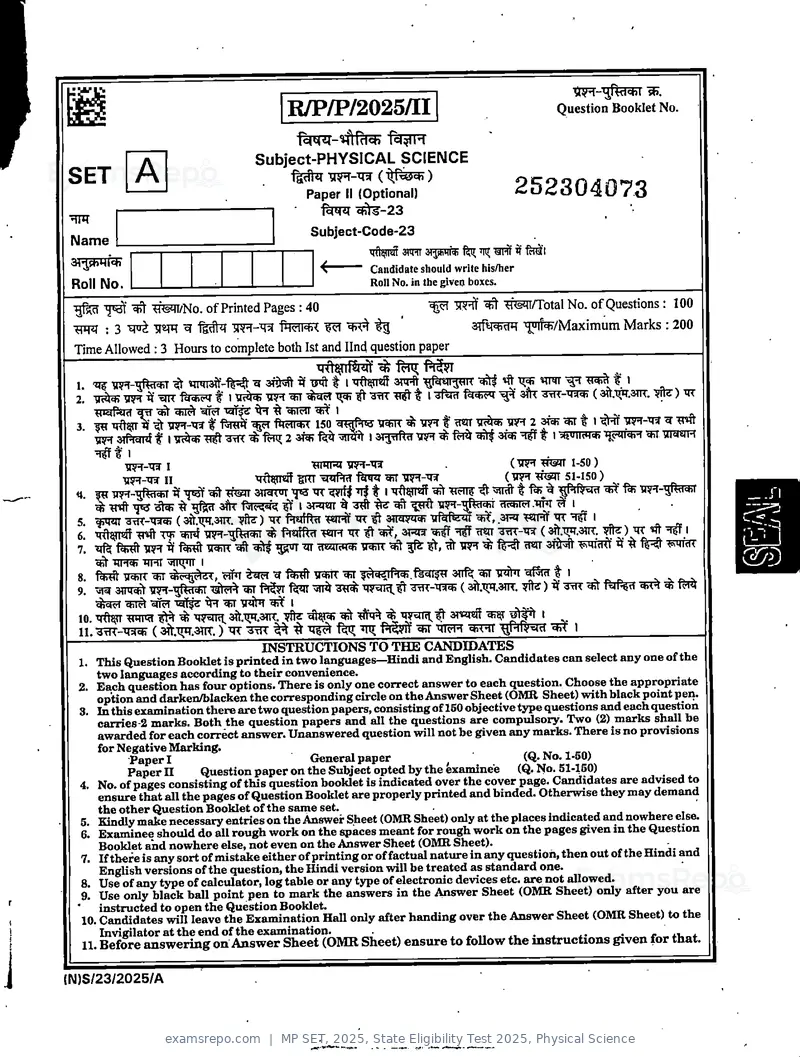
Text of page 1
Kt.

                                             R/P/P/2025/II                                                    Question Booklet No.


                                       Subject-PHYSICAL SCIENCE
SET           A
                                                 Paper II (Optional)                              252304073
                                                         ^-23
•5TR
                                                  Subject-Cod8-23
 Name
                                                                      SPTTT              ^^
                                                     ,         Candidate should write his/her
 Roll No.                                                      Roll No. in the given boxes.

 ■gf^            ^ffeMl/No. of Printed Pages : 40                                             yoMi/Total No. of Questions : 100
 Tm : 3                 ^                                 ^                                        gjnf^/Maximutn Marks : 200
 Time Allowed : 3 Hours to complete both 1st and Ilnd question paper

 1.                   ^ «?TO3Tf-^ ^           if Tpft t I        atrrft gf^iiT^ grtf                       ^           ft
 2.                  W teeT f 1              ^            H «IflT t I                             3iR TftT-Tragt ( 3tt.l(ir.3TTT. W ) ^
              ^              ^        ^ ^ "^STHr ^ 1                   ,         ^        ^               .         a.                           &
 3.    ^         ^            f ftraR ^ fhdi«*>t 150 anPre xrarr ^               t xtm        tivt 2 ^a»rt                             ?w
       XITTSTPraTtft l?^^-3m^^2 3Ta»f^^3II^ I                            XTV^ %          ^ 3T9>       t 1 :iiV\W*                  ^
       ^f 1
             ^.Tj^ I                                Timpa Ti?T-Tra                             (xr?^ fw i-so )
                   11                  xrit^traf ?TTT "^raPnr      an xi?^-TiT                (xT?n xftar SMSO) ^                        ^
 a.    fwn-gfetan if
               ate ^
                                 tpsitf^<<«4<
                                         anar^i^' i araar
                                                     at ayrfi■% a#
                                                                ^11          TtrnF^ ^snat1
                                                                   ft? ■^EtfVT^-^nan tmum .am ^ i
                                                                                                  ait ^ "H^n-gRaan
 5 ^Bw aar-aia; (3it.ga.3tiT. Tft?) ar frafffa wiaf at ft snayaat af^rtear a;^*, .apa wat ar i
 6. aft^^wan^aTa-gf^^Mfta^ar^aif, 3paaa5^a^aaiaaT-aa(^^.OTTjn?)a^a£i
 7.       ava if f^rat aanr ^ '^'a at tT®tTta^ aaiTT ^               at a^a ^         aar afu^ "^iafrRi H "R 16^ ^aTttr
       ^ Hn<»> Hill mgat I                                                                    ^     ^ .
  8. ^ aanr an                   eifa tact a ftpft aanr ^ ^^ra?r^,f^a^                   an aataaf^ t i                                          .
 9. ata snaaRt a?a-gfw xatct^ an                   -ar^ aa% ayani^^ aar-ana; (sn.ga.anT. rit?) a aar an taPga atta at
       iaH      ^ "sii^ ^ w aata aif i
  10. aftijn aaiat          ayaig 3tt.T^.3nT. "yfta at^ ^ afn^                ft artaar at^           t
  11.aaT-aaai (^.T^.anr.) ar Tar ^ ^ a#                      ag          an ar^H atrar ^Hryrin                  \
                                        INSTRUCTIONS TO THE CANDIDATES
  1. This Question Booklet is printed in two languages—Hindi and English. Candidates can select any one of the
       two languages according to their convenience.                                                  .        ^,        ..
  2. Each question has four options. There is only one correct answer to each question. Choose the appropriate
       option and darken/blacken the corresponding circle on the Answer Sheet (OMR Sheet) with black point pen.
  8. In this examination there are two question papers, consisting of 150 objective tjqie questions and each question
     carrie8-2 marks. Both the question papers and all the questions are compulsory. Two (2) marks shall be
     awarded for each correct answer. Unanswered question will not be given any marks. There is no provisions
     for Negative Marking.                                                                xi ^ rn\
           PaperI                          General paper              ^               (Q. No. 1-50)
             Paper II        Question paper on the Subject opted by the examinee                  (Q. No. 51-160)
  4. No. of pages consisting of this question booklet is indicated over the cover page. Candidates are ad^sed to
       ensure that all the pages of Question Booklet are properly printed and binded. Otherwise they may demand
       the other Question Booklet of the same set.                                                                                 ^         ,
  5. Kindly make necessary entries on the Answer Sheet (OMR Sheet) only at the places indicated and nowhere else.
  6. Examinee should do all rough work on the spaces meant for rough work on the pages given in the Question
     Booklet and nowhere else, not even on the Answer Sheet (OMR Sheet).                               - i. tt- j- j
  7. If there is any sort of mistake either of printing or offactual nature in any question, then out of the Hindi and
     English versions of the question, the Hindi version will be treated as standard one.
  8. Use of any type of calculator, log table or any type of electronic devices etc. are not allowed.
  9. Use only black ball point pen to mark the answers in the Answer Sheet (OMR Sheet) only after you are
       instructed to open the Question Booklet.                                                                     x//-»,.«, ou         * ♦u
  10. Candidates will leave the Examination Hall only after handing over the Answer Sheet (OMR Sheet) to the
  U.Brfwe MswSbig                                            Sheet) ensure to foUow the instructions given for that.
(N)S/23/2025/A
Text of page 2
(SPACE FOR ROUGH WORK)


(N)S/23/2025/A
Text of page 3
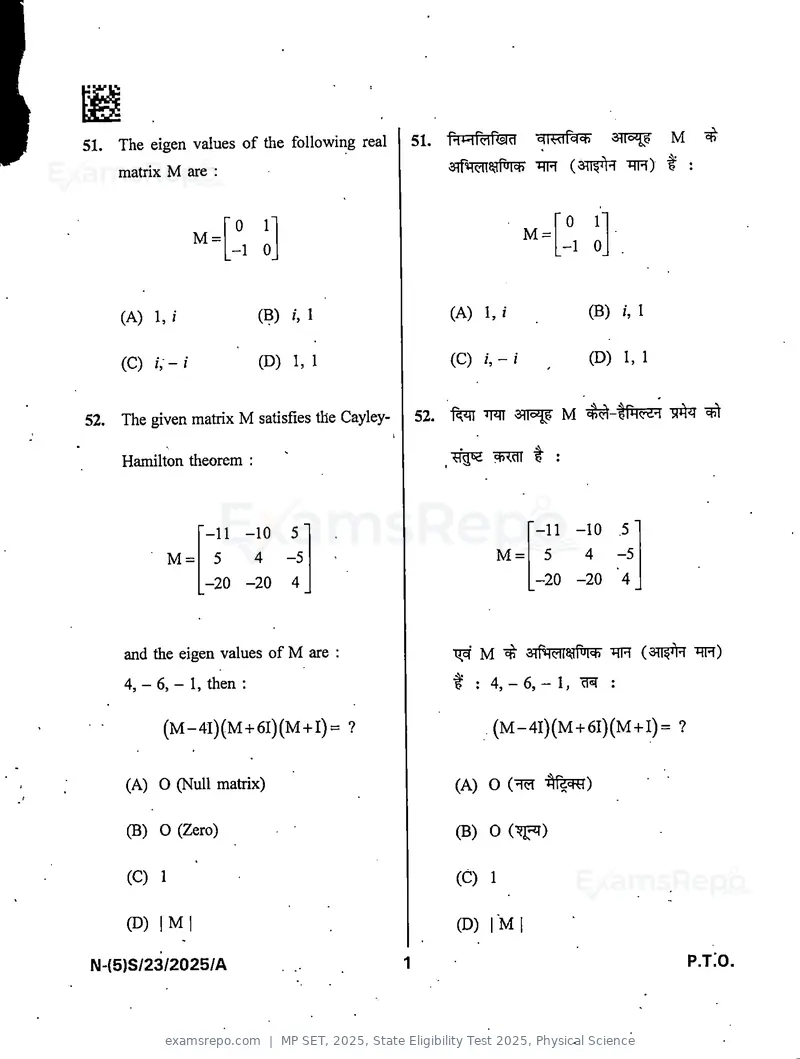
51. The eigen values of the following real     51. PlMPeinsld    dlWPddi              M ^
     matrix M are :
                                                                       (311^ 1TH) t :


                        0    1                                         0    1
               M=                                                M=
                      -1    0                                         -1   0


    (A) 1, /                (B) /, 1                 (A) 1, ^-             (B) /, 1


    (C) i,-i                (D) 1, 1                 (C) /,-/              (D) 1, 1


52. The given matrix M satisfies the Cayley-   52.        W 3R1^ M                        ^

     Hamilton theorem :


                  -11   -10      5                               -11   -10       ,5

             M=   5         4    -5                         M=    5        4    -5

                  -20 -20        4                               -20 -20         4


     and the eigen values of M are :                      M^                    flH (3Tl^ W])
     4,- 6,- 1, then ;                               f : 4,-6,- 1, TR :

          (M-4I)(M +6I)(M +I)= ?                           (M-4I)(M +6I)(M +I)= ?

     (A) O (Null matrix)                             (A) O(^ -^f^)

     (B) O (Zero)                                    (B) 0(^)

     (C) 1                                           (C) 1


     (D) |M|                                         (D) I'M I

 N-(5)S/23/2025/A                                                                       P.T.'O.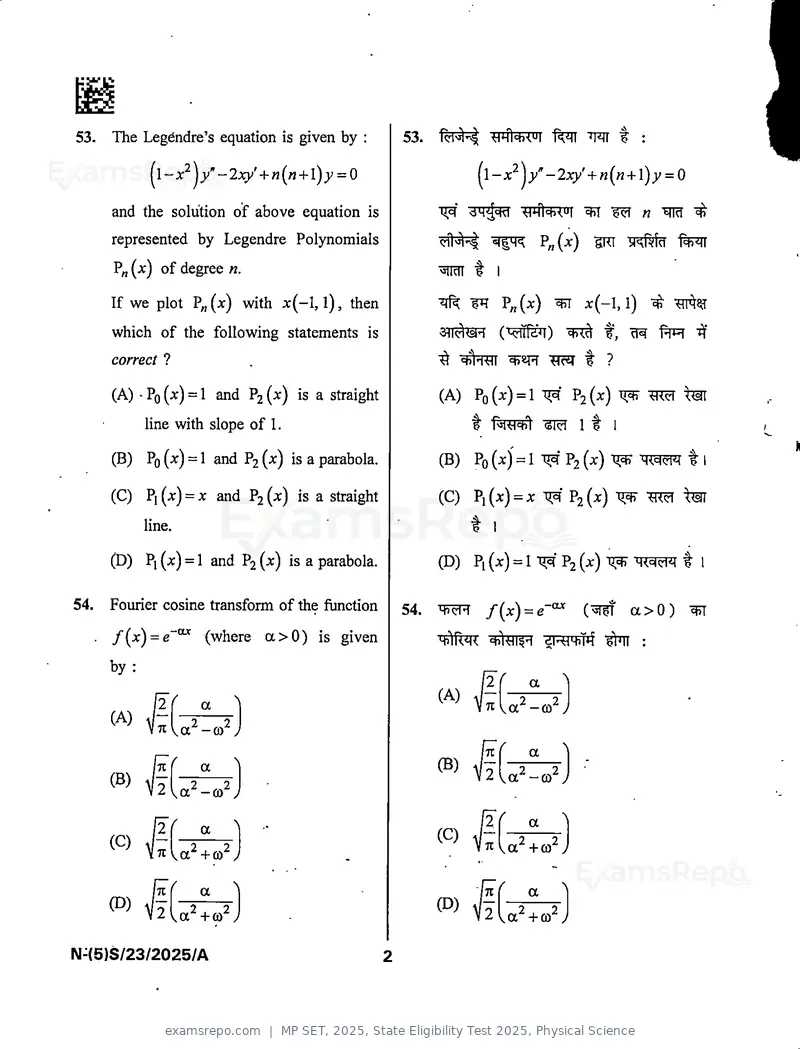
Text of page 4
53. The Leg^ndre's equation is given by :        53.            ^H41=b<u|           W t:

             (^l-x^^y"-2xy'+n(n +l)y =0                       ^1- jy"-2xy'+?i(M +l)y =0
      and the solution of above equation is                          ^H41=h<u| ^              ^
      represented by Legendre Polynomials                                           ^         ^
      P„(x) of degree n.                               mw % I
      If we plot P„(x) with          l), then                      P„(;c) ^ x(-1,1)
      which of the following statements is                                       ^ f, ^
      correct ?                                        ^                           t ?

      (A) - Pq(^)= 1 and P2(:*:) is a straight         (A) Po(:*:)= l             P2W ^       ^
             line with slope of 1.                           t pJKHctil "51^ 1 "I 1
      (B) Pq (jc)= 1 and P2(^) is a parabola.          (B) PoW^l W P2 W ^                     11
      (C) Pi(x)= X and P2(:c) is a straight            (C) ?i{x)= x               ?2{^)       ^
             line.                                           t 1
      (D) Pi{;c)=l and P2(:c) is a parabola.           (D) Pi{x)= ITT^* P2(x)                 t1
54.   Fourier cosine transform of the function   54. WT /(;c)= e"°^                       a>0) m
  . f[x)= e~^ (where a>0) is given                                           dHi4)T4      :
      by :
                                                                         a

                         a
                                                                     2        2
                                                                   Ka -co ;
      (A)            ?       2
                     a   -w

                                                                         a


      (B)            ?
                         a

                             2
                                                       (B) Jf        2
                                                                   Va -CD y
                                                                             2

                     a   -0)


                                                                         a
                         a
                                                       (C)           2       2
                         , 2                                       Va +C0 y/
                     a   4-W


      (D) jf     Va +©
                         a
                                                       (D)           2
                                                                         a

                                                                             2
                                                                         +C0 y


N-(5)S/23/2025/A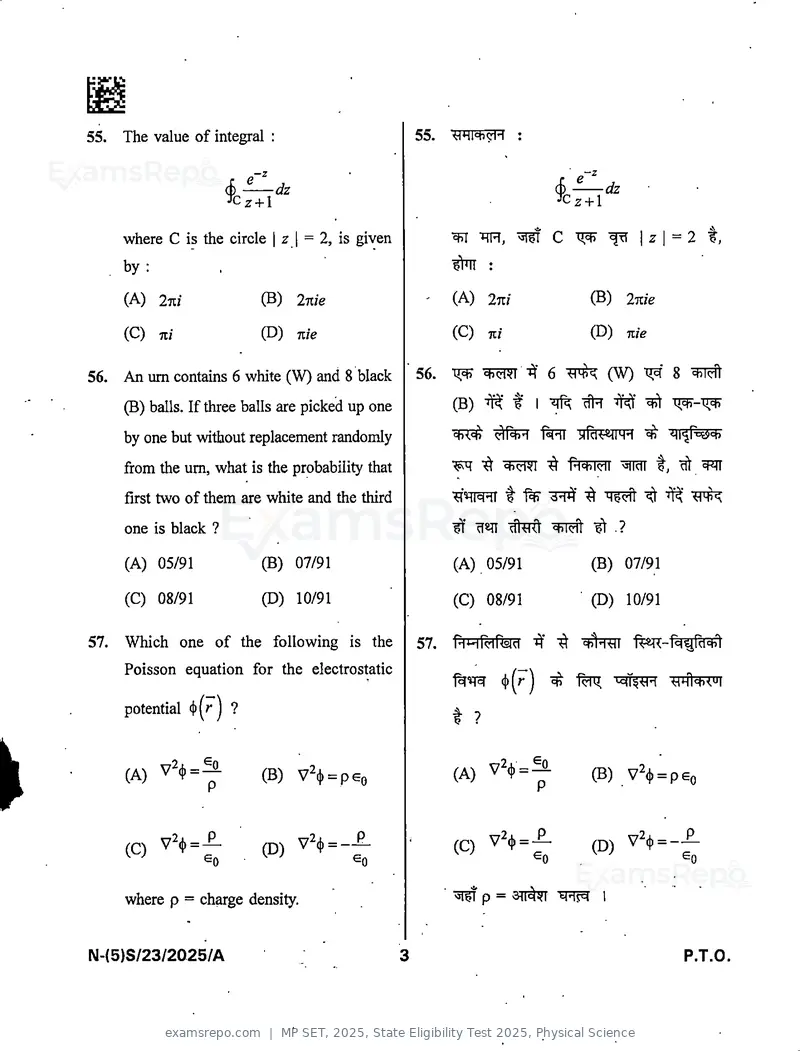
Text of page 5
55. The value of integral :                         55.


                           i
                           ^C z + \
                                   ■dz
                                                                                   I.t z +l■dz
          where C is the circle | r [ = 2, is given                 "qpT,          C        ^ \ z \ =2
          by:                                                 5V11 t

          (A) 271/               (B) 27t/e                    (A) 271/                    (B) 27r/e

          (C) 71/                (D) nie                      (C) 7:/                     (D) nie


    56. An urn contains 6 white (W) and 8 black         56.                        6        (W)           8

          (B) balls. If three balls are picked up one         (B)             I                    ^
          by one but without replacement randomly                                 "fer

          from the urn, what is the probability that          ^^                   ^            "sncTT t, ^ ^
          first two of them are white and the third                      t 1^ ^                   ^
          one is black ?                                            ■d8^T "dtofr cuieil      .?

          (A) 05/91              (B) 07/91                    (A) 05/91                   (B) 07/91

          (C) 08/91              (D) 10/91                    (C) 08/91                  ■ (D) 10/91

    57.   Which one of the following is the             57.   PHHrdRsld
          Poisson equation for the electrostatic

          potential         ?
                                                              i?


          (A) V2<|, = ^          (B)
i                                                             (A)                         (B) V^ = pso


          (C) ^ '1' = —          (D) ^ ^ =                    (C)           =^            (D)         =
                      ^0                      ^0                              ^0                              ^0


          where p = charge density.                                  p = 3TT^


    N-(5)S/23/2025/A                                                                                          P.T.O,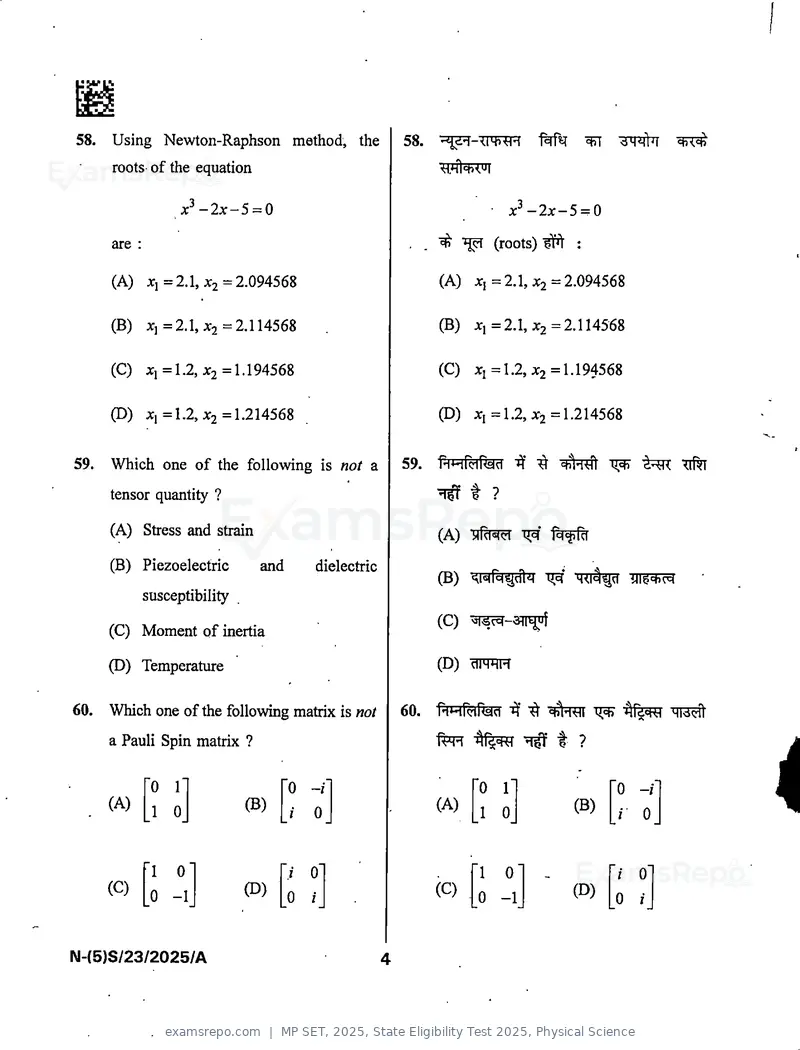
Text of page 6
58. Using Newton-Raphson method, the                58.                       ^

     roots of the equation

                  ;c^-2x-5=0                                      ■   x'-2x-5 = 0

     are :                                                        (roots)^ :

     (A) xi =2.1, ^2 =2.094568                            (A) JCj =2.1,^2=2.094568

     (B) X] =2.1, X2 =2.114568                            (B) xi =2.1,^2 =2.114568

     (C)        =1.2, JC2 =1.194568                       (C) xi =1.2,^2 =1.194568

     (D) a:i =1.2,^2 =1.214568                            (D) xj =1.2, X2 =1.214568

59. Which one of the following is not a             59. Pi*^fciRaa      ^

     tensor quantity ?                                          t ?

    (A) Stress and strain                                 (A)
    (B) Piezoelectric        and       dielectric

           susceptibility
                                                          (C)
    (C) Moment of inertia

    (D) Temperature                                       (D) cTFRH


60. Which one of the following matrix is not
     a Pauli Spin matrix ?                                             ^i ?

             ~o r                 "0 -f                       '0 r                  "0
    (A)                     (B)                           (A) _1 0_          (B)
             _1 0_                 i   0                                             i    0_


           "1    0"                    0"                     "1 0"                 "/■   0"
    (C)                     (D)                           (C) _0 -1_         (D)
             _0 -1_               _0 i                                               0    /


N-(5)S/23/2025/A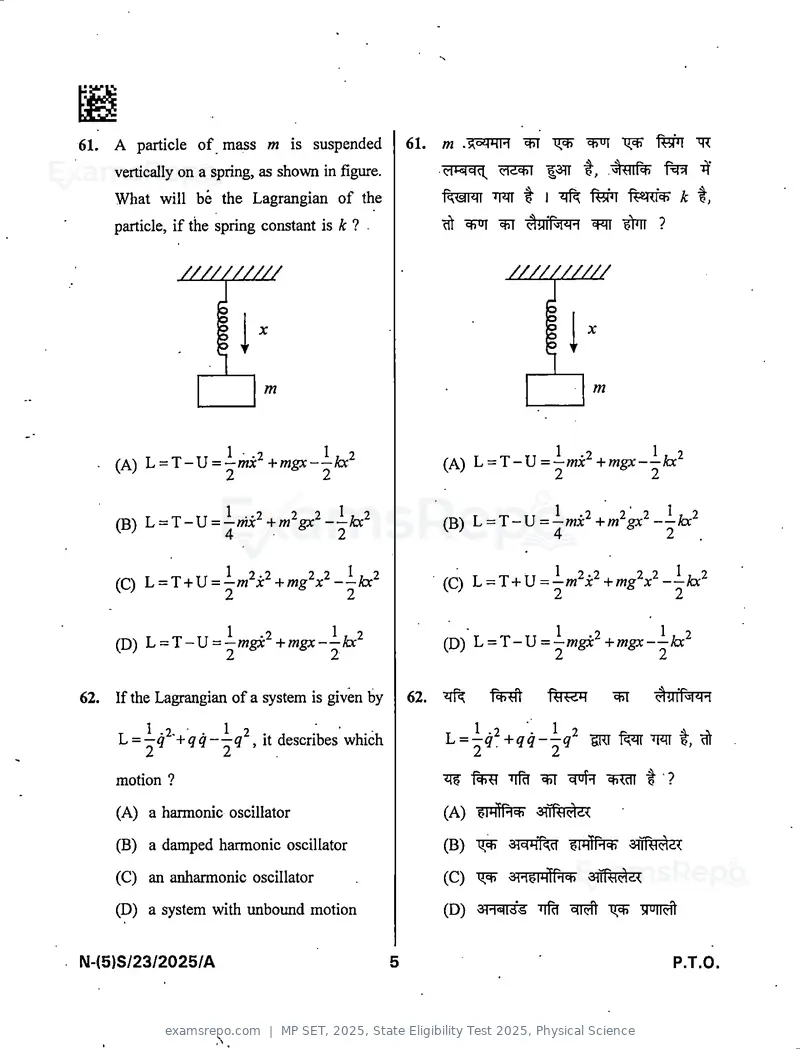
Text of page 9
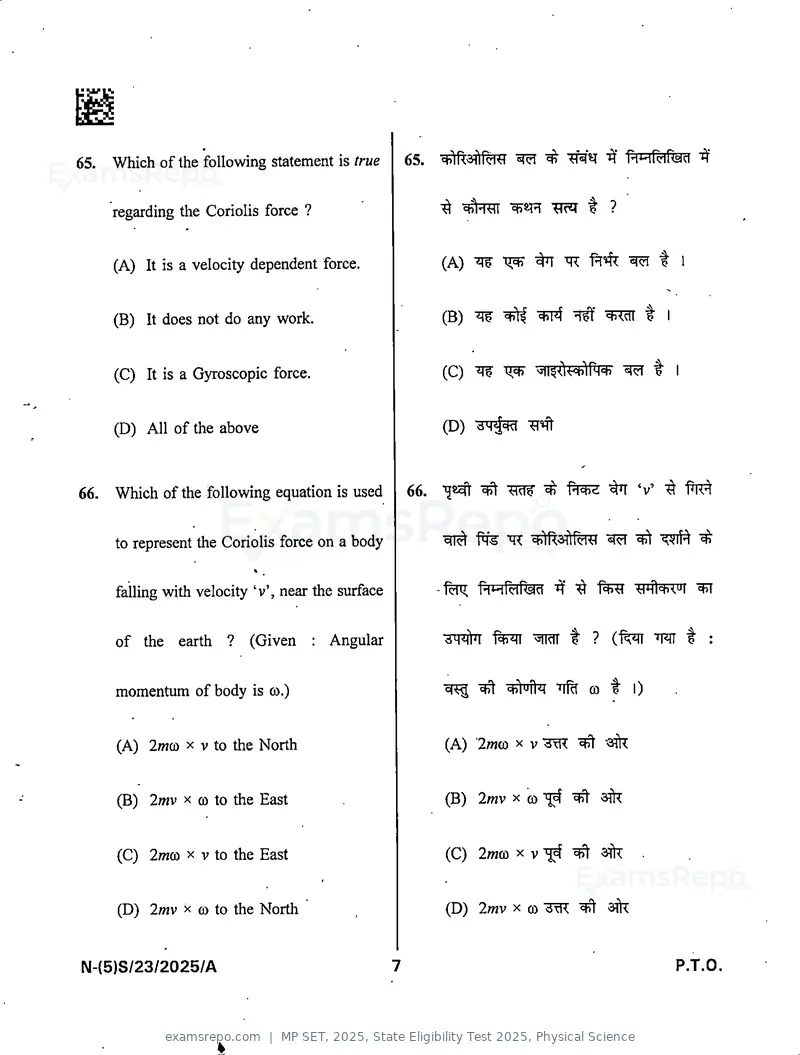
65. Which of the following statement is true       65.              ^^                   fFTfvfel


     regarding the Coriolis force ?                      ^                      t ?


    (A) It is a velocity dependent force.                (A)      'y.=h'                    "§

    (B) It does not do any work.                         (B) ^ ^^                   WT t I

    (C) It is a Gyroscopic force.                        (C)                          ^t I

    (D) All of the above                                 (D)


66. Which of the following equation is used        66. "^2^ ^              ^        ^ 'v'        fl^

     to represent the Coriolis force on a body

     failing with velocity 'v', near the surface         -1^ rdHPeinsld         ^                   ^

     of the earth ? (Given : Angular                      witn fen ^ t ? (fel "W i :

     momentum of body is co.)                            ^^                "nfd 0) t I)

     (A) 2ma) x v to the North                           (A) '2/77(0 X V "3^ ^


     (B) 2mv X CO to the East                            (B) 2/77V X CO "i:j4       fe

     (C) 2/770) X V to the East                          (C) 2/77(0 X V         ^


     (D) 2mv X ft) to the North                          (D) 2mv X CO 33^ ^ ark


[\l-(5)S/23/2025/A                                                                               P.T.O,
Text of page 13
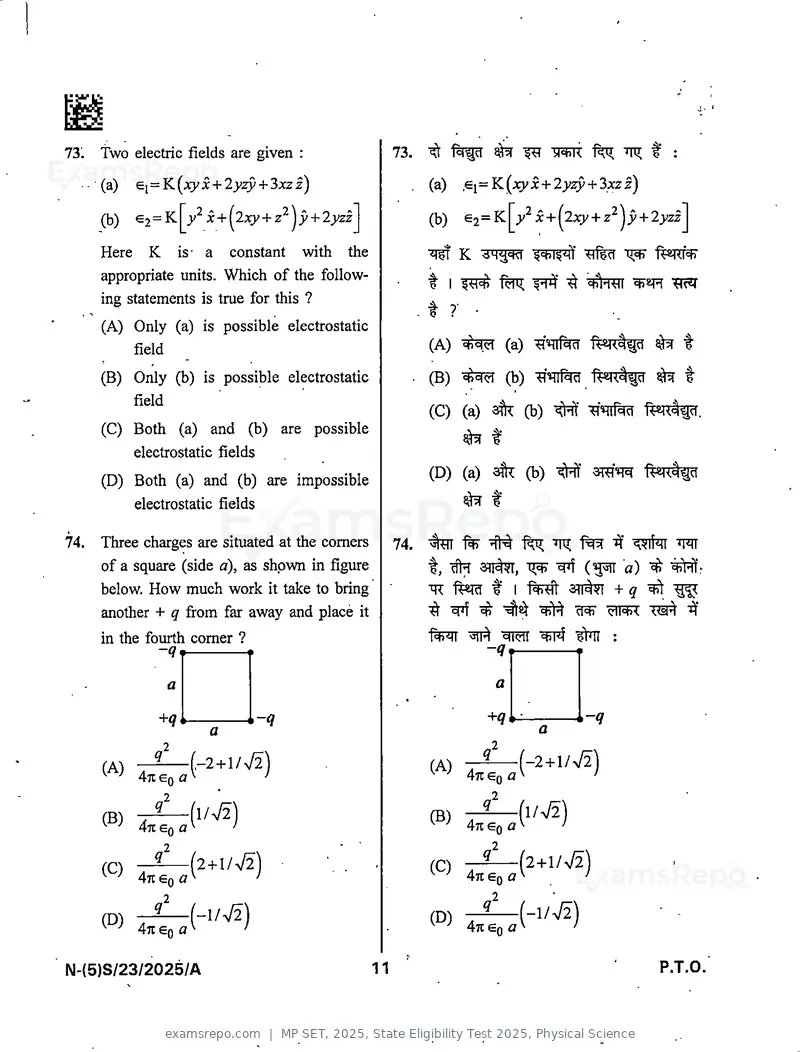
731 Two electric fields are given :                          73.               ^                     "HTT f :
   • (a) ei==K(xyx +2y2y +3xzz)                                    (a) ^i=l^[pcyx-\-2yzy-\-3xzz)
      (b)                  x+i^2xy+z^^y+2yzf^                      (b) e2=K.^y^ x+^2xy+z^^y +2yzz'^
      Here     K       is ■ a   constant   with   the              'm K
      appropriate units. Which of the follow
      ing statements is true for this ?
                                                                   ■ t ? •
      (A) Only (a) is possible electrostatic
             field                                                 (A)             (a)                   ^t
      (B) Only (b) is possible electrostatic                   ■ (B) ^5^ (b)                    fw%r ^ t
            field
                                                                   (C) (a)              (b)
      (C) Both (a) and (b) are possible
                                                                          ^t
             electrostatic fields

      (D) Both (a) and (b) are impossible                          (D) (a) 3lk (b)
             electrostatic fields                                         ^t

74.   Three charges are situated at the comers               74. ^                                            qqr
      of a square (side a), as shown in figure                      "t, "dki                           a) ^
      below. How much work it take to bring                         qr              I         37T^ + ^
      another + q from far away and place it                       ^^^                        ciqr              '4*
      in the fourth comer ?                                         %qT                       "^kn :


      (A)                                                          (A)             -(-2+1/V5)
             4iieo a                                                       47: Go a
                   2                                                           2

      (B)                                                          (B)
             4iieo a                                                       47t Go a
                   2                                                           2

      (C) 47t €o a     -(2+1/^)                                    (C)
                                                                           47: Go a
                   2                                                           2

      (D) An €() a                                                 (D)
                                                                           A% Go a
                                                                                    (-1/VI)

N-(5)S/23/2025/A                                        11                                                P.T.O.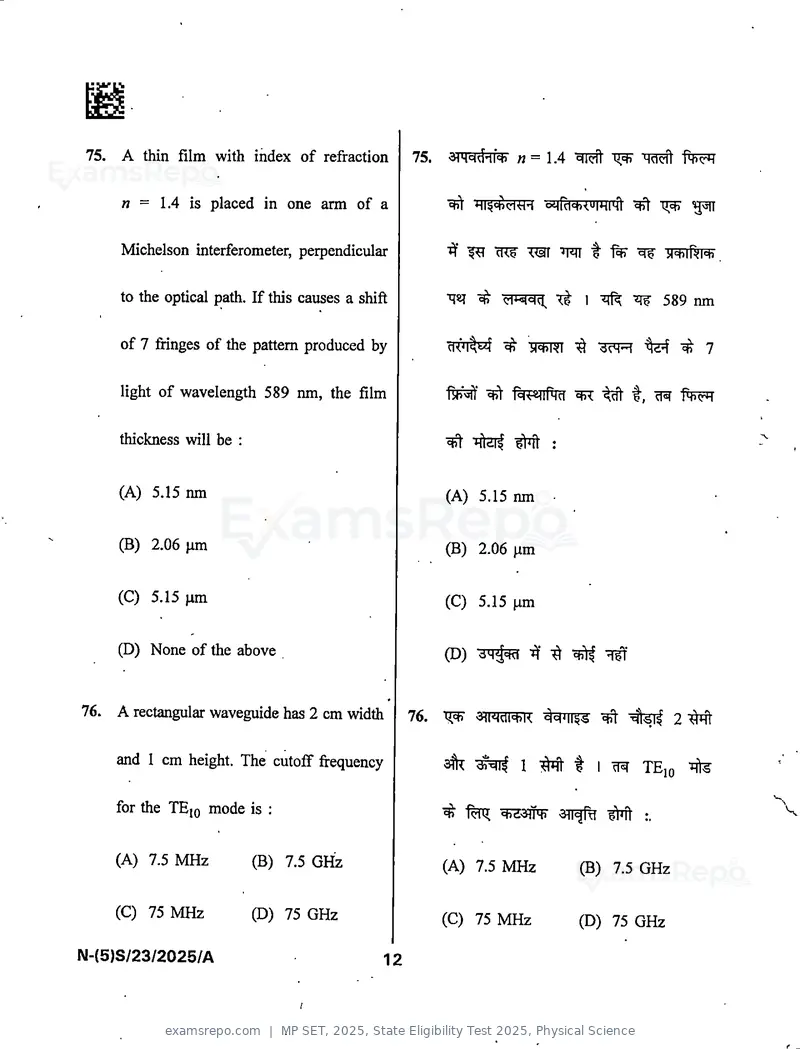
Text of page 15
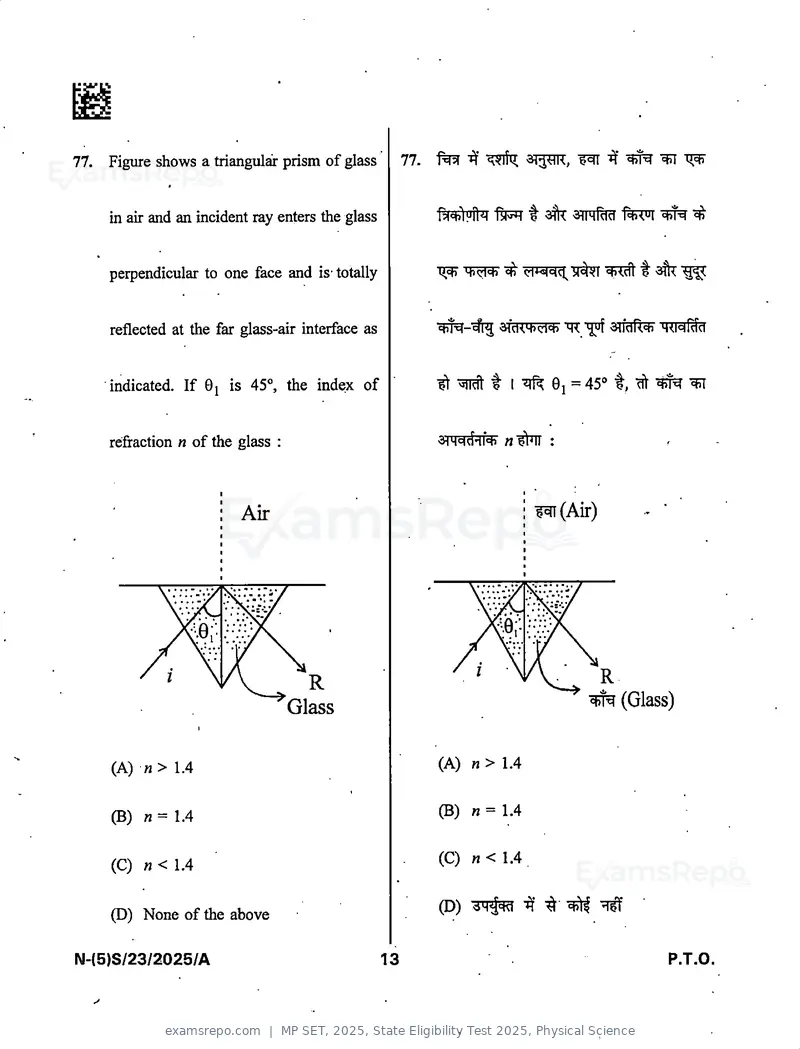
77. Figure shows a triangular prism of glass


     in air and an incident ray enters the glass        IWMh to t             STNto       ^^


     perpendicular to one face and is- totally


     reflected at the far glass-air interface as                          "qr "'jyl ^loRcti 4uq[^o


     indicated. If       is 45°, the index of             ^t I          01 = 45° t, ^^^

     refraction n of the glass :


                          Air                                         ^(Air)


                       • - a:is-ly                                    •.^;y
            Jm-                                               M-
         /i          \                                   /i \
                                       R                                         R
                                     Glass                                            (Glass)


     (A) n > 1.4                                        (A) n > 1.4


     (B) K = 1.4                                        (B) n = 1.4


     (C) n < 1.4                                        (C) n < 1.4


    (D) None of the above
                                                        (D)


N-(5)S/23/2025/A                                   13                                      P.T.O.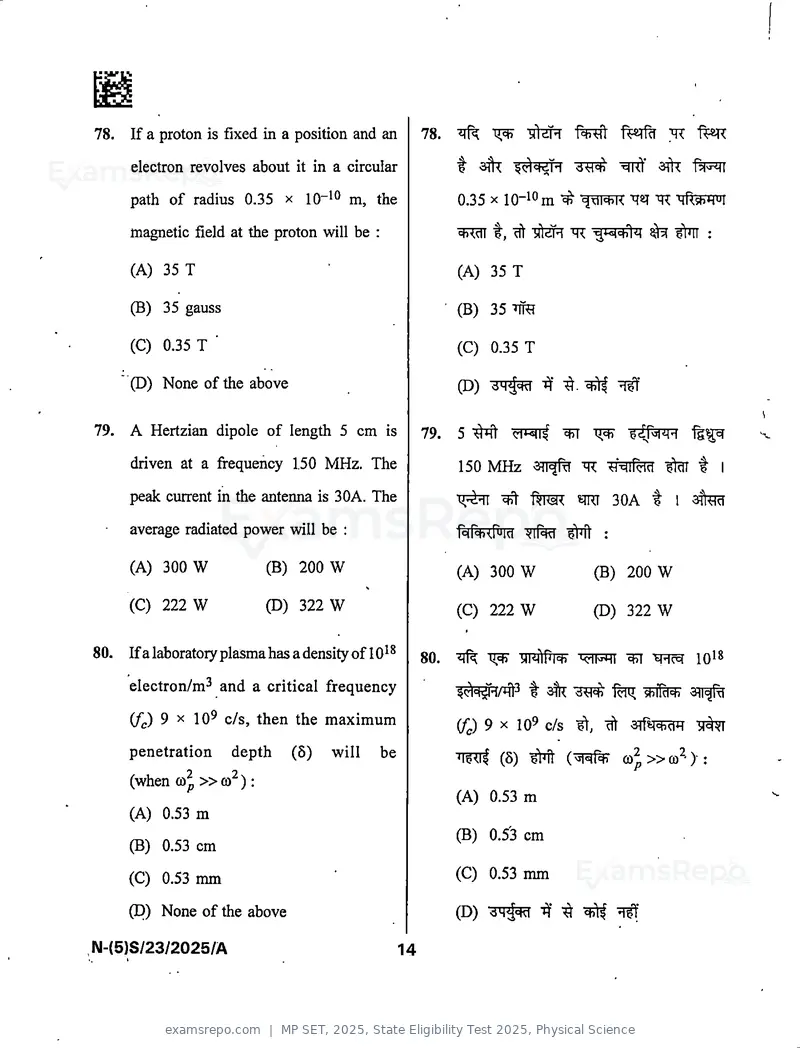
Text of page 16
78. If a proton is fixed in a position and an      78.                        feft iWd TK

     electron revolves about it in a circular

     path of radius 0.35 x IQ-IO m, the                  0.35 X 10⁻¹⁰ m ^                "qa? ^ mRsHHuI

     magnetic field at the proton will be :                    t,             ^            ^^:

     (A) 35 T                                            (A) 35 T

     (B) 35 gauss                                        (B) 35-TO

     (C) 0.35 T ■                                        (C) 0.35 T

     (D) None of the above                               (D)
                                                                                                             \

79. A Hertzian dipole of length 5 cm is            79. 5^                ^
     driven at a frequency 1.50 MHz. The                 150 MHz 3TT^ -tR ^'xiiRrld                 t I
     peak current in the antenna is 30A. The                   ^                    30A t 1 sfto
     average radiated power will be :

     (A) 300 W           (B) 200 W                       (A) 300 W                (B) 200 W

     (C) 222 W           (D) 322 W                       (C) 222 W                (D) 322 W

80. Ifa laboratory plasma has a density of10^^     80.              ywlPlch              ^          IQlS
     electron/m^ and a critical frequency                           ^         ■d/H<=h Rriq StilRlch 31T^f%
     (/^) 9 X 10^ c/s, then the maximum                  (Q 9 X io9 c/s            cit
     penetration     depth (5) will        be                  (5) ^ (^3Rf^ 0)^»a)^')" :
     (when (iPp »(0^):
                                                         (A) 0.53 m
     (A) 0.53 m
                                                         (B) 0.5'3 cm
     (B) 0.53 cm

    (C) 0.53 mm                                          (C) 0.53 mm

    (p) None of the above                                (D)              ^ ^

N-(5)S/23/2025/A                              14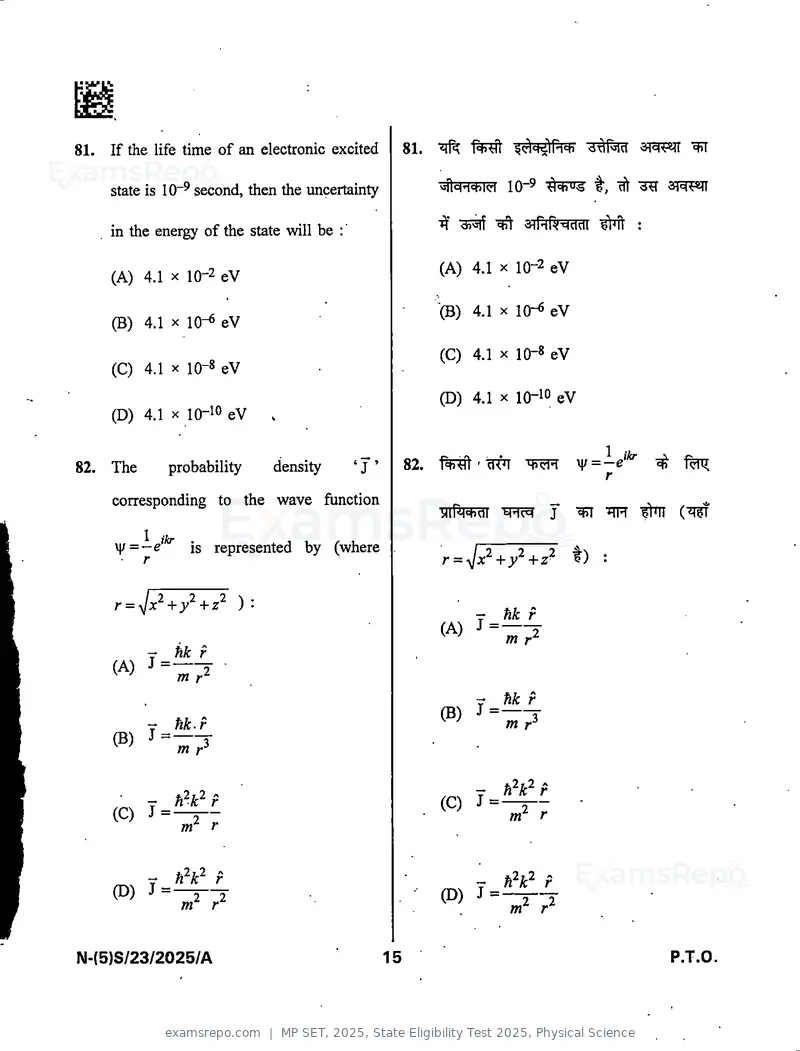
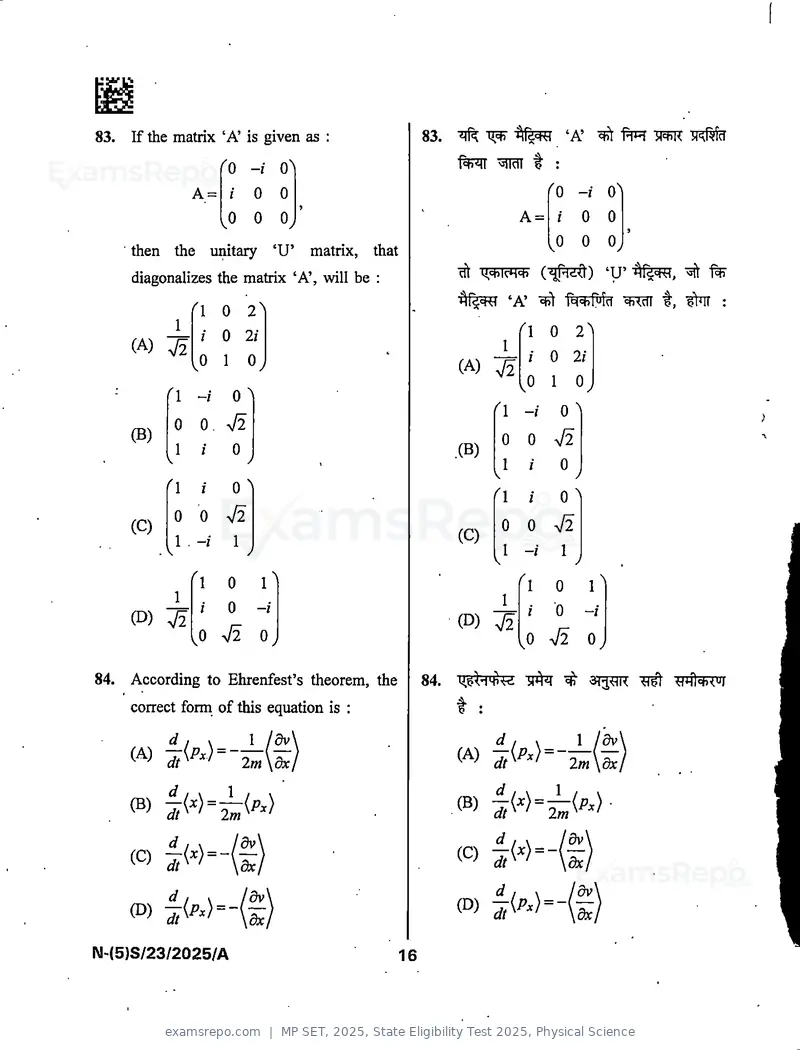
Text of page 18
83. If the matrix 'A' is given as :                  83.                           'A' qit

                       ^0 -I 0^                            Iqjqr          f :
                  A= i          0       0                                  '0 -i 0^
                       0        0       0                              A= i             0    0

                                                                               0        0    0✓
      'then the unitary 'U' matrix, that                                   \


       diagonalizes the matrix 'A', will be :              fit qchi^ch c^frol) 'U'                      %
                                                                    'A'                           WT t, ^ :
                  f\ 0 2^
              1
                  i    0       2/                                          0        2'
      (A) ^                                                    j_
                  0    1       0                                           0        2i
                                                           (A) ^
                                                                           1        o>
              1            0^
                                                                               0^
             0 0 , ^/2
      (B)                                                                   V2
              1   /        0                               .(B)
                                                                   1   /       0
                                                                                    J
             f\   i        0^
                                                                   1   /       0^
             0 0 yfl
      (C)
              \ .-i        1                               (C)
                                                                               1
                                                                                    J

                  1    0            1                                       0            1
                  /■   0         -/
                                                               J_
                                                                            0           -/
      (D) V2                                               (D) ^
                  0 ^/2             0                                                   0


84.    According to Ehrenfest's theorem, the         84.

       correct form of this equation is :                  t:
             d! \              1 ldv\                              d/ \             1 /dv\
       (A)                                                 (A)


             d/ V          /5v\                                    d/ V        /5v\
                                                                   5-w-y
             d, I              /5v\                                ^/ \            /^\


N-(5)S/23/2025/A                                16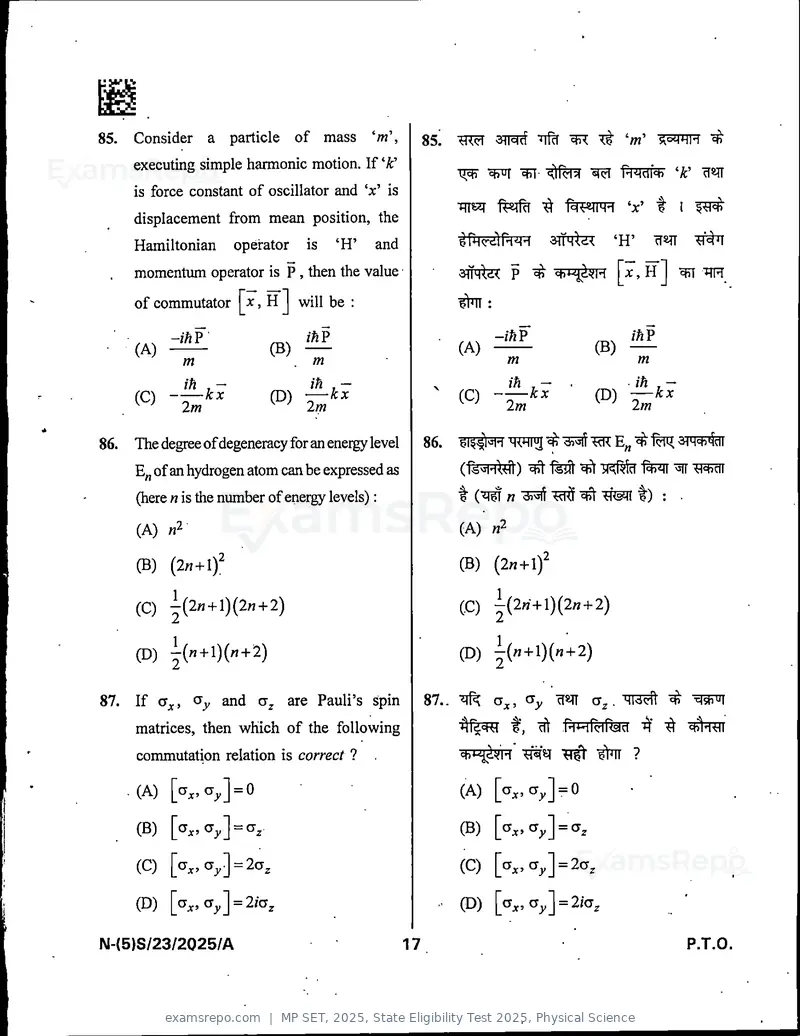
Text of page 19
85. Consider a particle of mass 'm',               85.

     executing simple harmonic motion. If 'A:'
                                                                 ^^                   ^               'A'
     is force constant of oscillator and 'x' is
                                                                             ^              'x' t I
     displacement from mean position, the
     Hamiltonian      operator   is 'H' and                                   sMst 'H'            w

     momentum operator is P,then the value                    sffqte P ^                     » H]^ tTFT_
     of commutator , H J will be :                               :


           ~ih?                  ih?                                -ih?                    ih?
     (A)                  (B)                                 (A)                     (B)
             m                   m                                      m                    m


             ih . —              ih    —                                ih   —    .          ih

     (c> -5;"                                                       -n;"'             ™ J."'
86. The degree ofdegeneracy for an eneigy level    86.

         ofan hydrogen atom can be expressed as               (ferM)^                 ^      fen w
     (here n is the number ofenergy levels):                         « "3)^                       :

     (A)                                                      (A) rP-

     (B) (2«+l)'                                              (B) {2n+\f
     (C) |(2«+l)(2« +2)                                       (C) i(2«+l)(2« +2)
     (D) i(n+!)(« +2)                                         (D) ^("+!)("+2)
87. If             and       are Pauli's spin          87..   •qf^ CT^, CT_J, CT^T CT^- ^
     matrices, then which of the following                            t, ^ ferfefe ^ ^ qfen
     commutation relation is correct ?                                           ^ #TT ?

    .(A)         a^]=0                                        (A) [a^, cy^]=0
     (B) [o;„CTj,]= CT^                                       (B) [a^,cT^]=(T^
     (C) [a^, CTj,]= 2a^                                      (C) [a^,ay']= 2a,
     (D) \p^,Oy'\ = 2ia^                                      (D) [cT^,a^]= 2/CT^
IM-(5)S/23/2025/A                                 17                                                   P.T.O,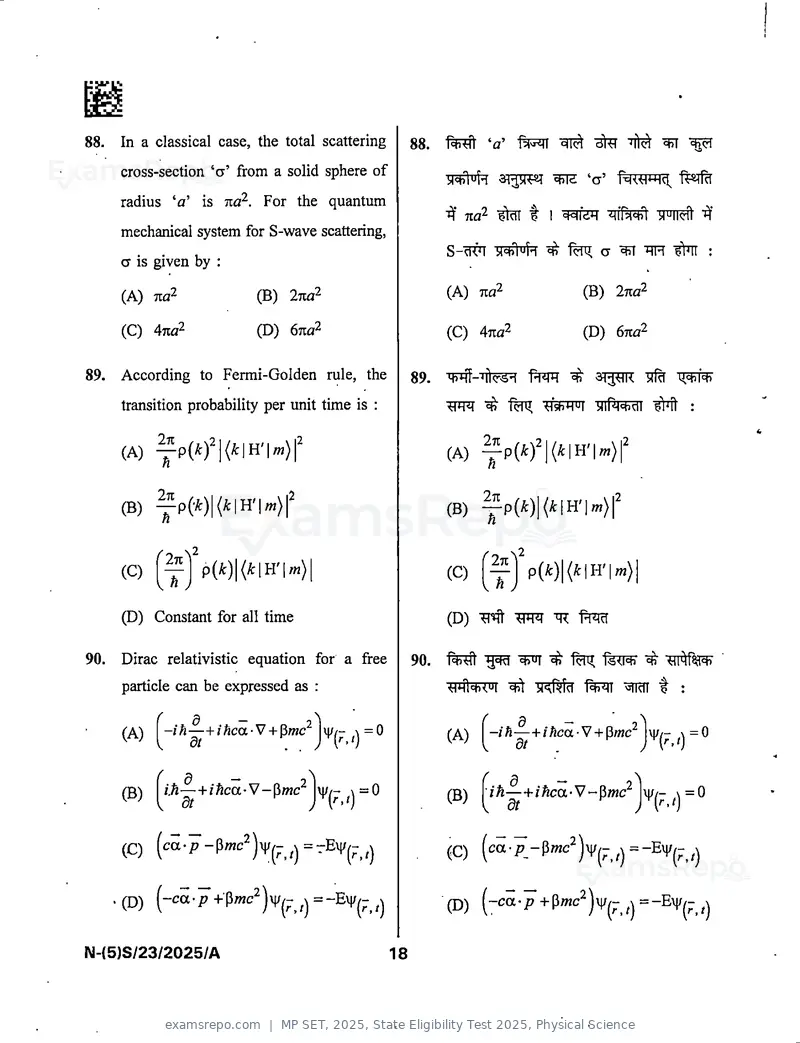
Text of page 20
88. In a classical case, the total scattering     88.             'cr'             "bIh        ^
     cross-section 'ct' from a solid sphere of
                                                                    3;135I^ To 'ct'            1^2#
     radius 'a' is na^. For the quantum
                                                              71^2 ^ t I wsi?
     mechanical system for S-wave scattering,
                                                            S-cl^           ^ %tT a ^          "fWt :
     a is given by :

    (A) na^                 (B) 2na^                        (A) na^               (B) 27tcf2

    (C) 4na^                (D) 6na^                        (C) 471^2             (D) Sna^

89. According to Fermi-Golden rule, the               89.                      ^
     transition probability per unit time is :              W1 ^            WTUT yiRlcbdl #Tt :

    (A) yp(q^|(t|H'|/«)p                                    (A) yp(Af|(A|H»|^
    (B) fp(-q|(i|HV)|'                                      (B) yp(q|(i|H»f
    (C) [yJpW|{ilH»l                                        (C) [yJp(q|(i|H»|
    (D) Constant for all time                               (D)          WT -tR

90. Dirac relativistic equation for a free            90.         "3^ ^^                   ^
     particle can be expressed as :


     (A) ''     d       —
                    +iSca-V       ^
                            +Pmc^jH;|-                      (A)           +/^ca-V +Pmc Jm/j-
         ( d            -        2^
     (B)         +/Sca-V-p»ic           ^j=0                (B) (1^/^—+/^ca.V-p/«c
                                                                    d     ~       2^
                                                                                   J\Kj-^j=0
     (C)                                                    (C) (ca-:?-pmc2)H;(-,)=-BV(-^
   •(D)             +

N-(5)S/23/2025/A                                 18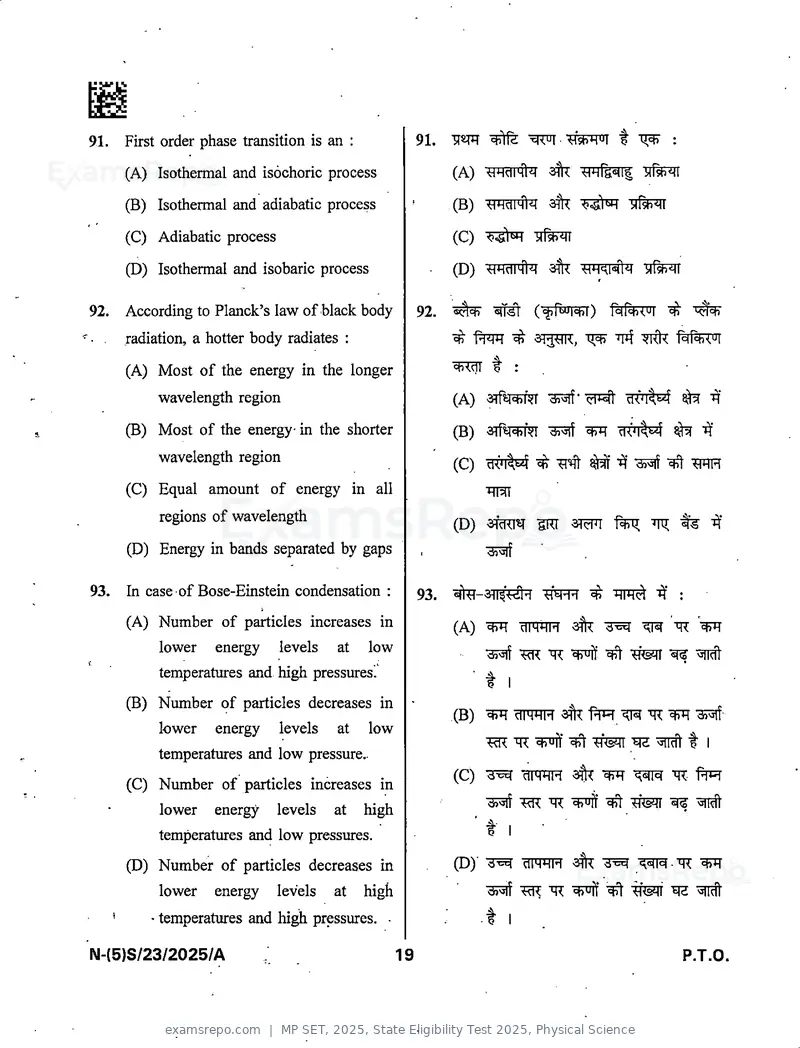
Text of page 21
91. First order phase transition is an :                 91.                            -H'sbM"! t        :
       (A) Isothermal and isochoric process                    (A) iromhr sffr
       (B) Isothermal and adiabatic process                    (B) wmmN
       (C) Adiabatic process                                   (C)

       (D) Isothermal and isobaric process                   ■ (D)                sfrr

92. According to Planck's law of black body              92.         ^                                   ^
       radiation, a hotter body radiates :

       (A) Most of the energy in the longer
            wavelength region                                  (A)                                         ^
       (B) Most of the energy- in the shorter                  (B) 37f%ict)iVi "3)^                       ^
            wavelength region
                                                               (C)              ^         ^ ^                   WT
       (C) Equal amount of energy in all
            regions of wavelength
                                                               (D) 37^77?!              37^            TTtr ^ "4'
       (D) Energy in bands separated by gaps             I


93.    In case of Bose-Einstein condensation :           93.                               ^               :
       (A) Number of particles increases in                    (A) ^ diMHM 3fk                       ^ "qr
            lower   energy     levels   at   low                     "33^ ^                          ■yVsMi ^
            temperatures and high pressures^
                                                                     t I
       (B) Number of particles decreases in
                                                               ,(B) ^ WTF sfR                          "qr ^
            lower   energy     levels   at   low
                                                                     ^ "q^                 ^Fsqi                t" I
            temperatures and low pressure.-
       (C) Number of particles increases in
                                                               (C) "3^ WTH ^ ^                            "qr
            lower   energy    levels    at   high                             iTR "qr         ^ iFsqi ^
            temperatures and low pressures.                          t I

       (D) Number of particles decreases in                    (D)' ^ dlMHH 3ff7                     ■qTO 'qT ^
            lower   energy    levels    at   high                    "STilf       "q^         ^ "TFFTi           ^sTTdt
   '     'temperatures and hi^ pressures. •                          -t I

N-(5)S/23/2025/A                                    19                                                        P.T.O.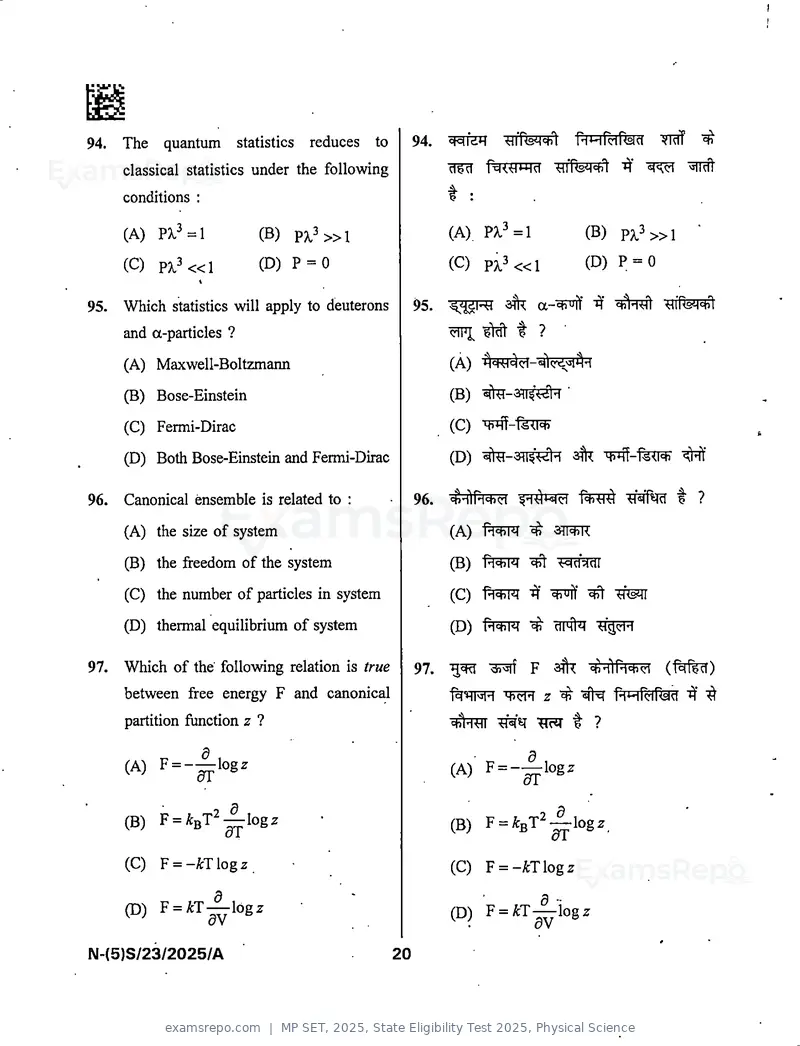
Text of page 22
94. The quantum statistics reduces to             94.                               Pi^-iRrtRsia   ^ficiT
      classical statistics under the following              ^ f^X^TTiTcT                   "4*         ^
      conditions :


      (A) PX,^=1          (B)                               (A). ?X^=\               (B)                    •
      (C) P).3«i          (D) P = 0                         (C) ?X'«1                (D) P = 0

95. Which statistics will apply to deuterons      95.                  aik a-^rqf fr*
      and a-particles ?

      (A) Maxwell-Boltzmann                                 (A)

      (B) Bose-Einstein                                     (B)                 ■

      (C) Fermi-Dirac                                       (C)

      (D) Both Bose-Einstein and Fermi-Dirac                (D)                     3fk

96.   Canonical ensemble is related to :              96.   oh'iifMcticn                              5 ?

      (A) the size of system                                (A) fem ^ 3TOK
      (B) the freedom of the system                         (B) teFT ^
      (C) the number of particles in system                 (C)                      ^
      (D) thermal equilibrium of system                     (D) feFT ^ cTNkr

97. Which of the following relation is true           97.

      between free energy F and canonical                                           ^ PinrdRsId                 ^
      partition function z ?                                               ^t ?

      (A) F =-—logz                                         (A) F =-—logz


      (B) F= iBT^^logz                                      (B) F = A:BT2^1ogz_
      (C) F = -iTlogz                                       (C) F = -kT\ogz

      (D) F = CT-^logz
                     0\
                                                            (D) F = ^T-^iogz
                                                                           o\


N-{5)S/23/2025/A                                 20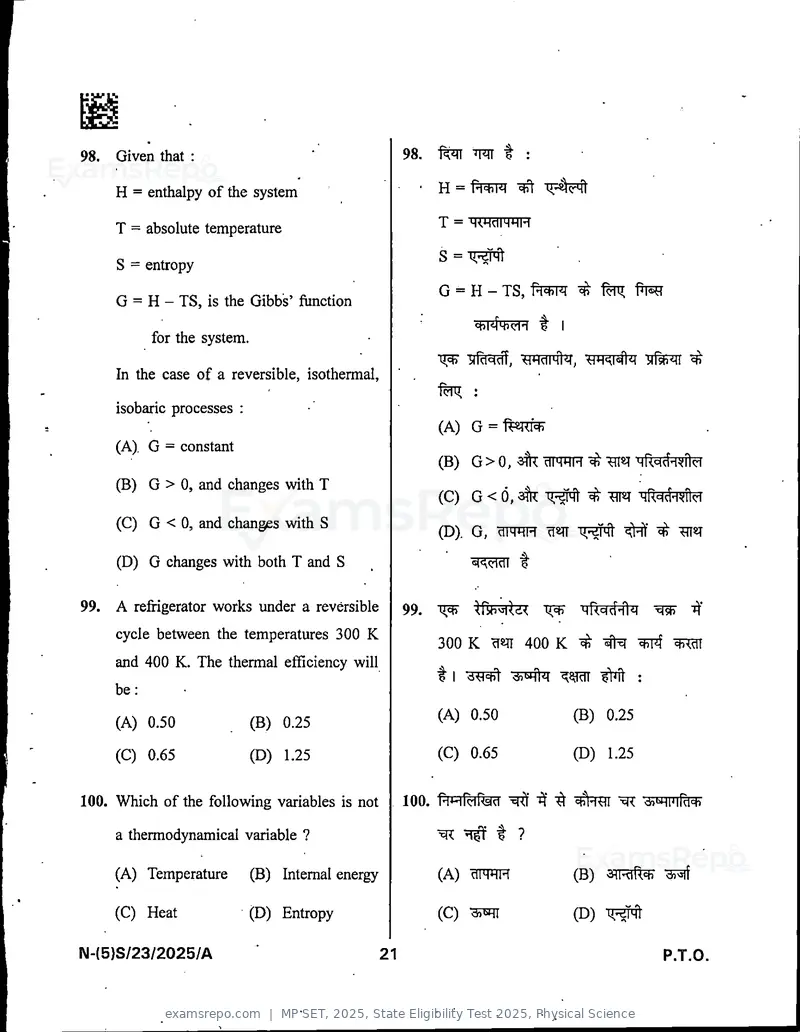
Text of page 23
98.   Given that :                                   98.         "W t :

      H = enthalpy of the system                       ■   H=          ^

                                                           T = MtHdNHH
      T = absolute temperature

      S = entropy
                                                           s = -q7^
                                                           G = H - TS,fePT ^ ^ fw
      0 = H - TS, is the Gibbs' function
                                                                           t I
            for the system.

      In the case of a reversible, isothermal,
                                                                 :

      isobaric processes :
                                                           (A) G =
      (A). G = constant
                                                           (B) G>0,sik dlMHIH               HPwMd
      (B) G > 0, and changes with T
                                                           (C) G<6,3fh:           ^ HST "qR#*!
      (C) G < 0, and chants with S
                                                           (D). G, dlMMM TI8IT                  ^
      (D) G changes with both T and S                                  t

99. A refrigerator works under a reversible          99.                                        ^ ■4"
      cycle between the temperatures 300 K
                                                           300 K       400 K ^ ^ ^
      and 400 K. The thermal efficiency will
                                                           t I ^5^                          :
      be:

                                                           (A) 0.50              (B) 0.25
      (A) 0.50            (B) 0.25

      (C) 0.65            (D) 1.25                         (C) 0.65              (D) 1.25


100. Which of the following variables is not         100. rdHPvlRsId        ^          ^ ^tHl'irddi

      a thermodynamical variable ?                         ^^ t ?

      (A) Temperature     (B) Internal energy              (A) diHMH             (B) ^I-dRdi" "3)^

      (C) Heat            (D) Entropy                      (C)                   (D)

ISI-(5)S/23/2025/A                              21                                               P.T.O.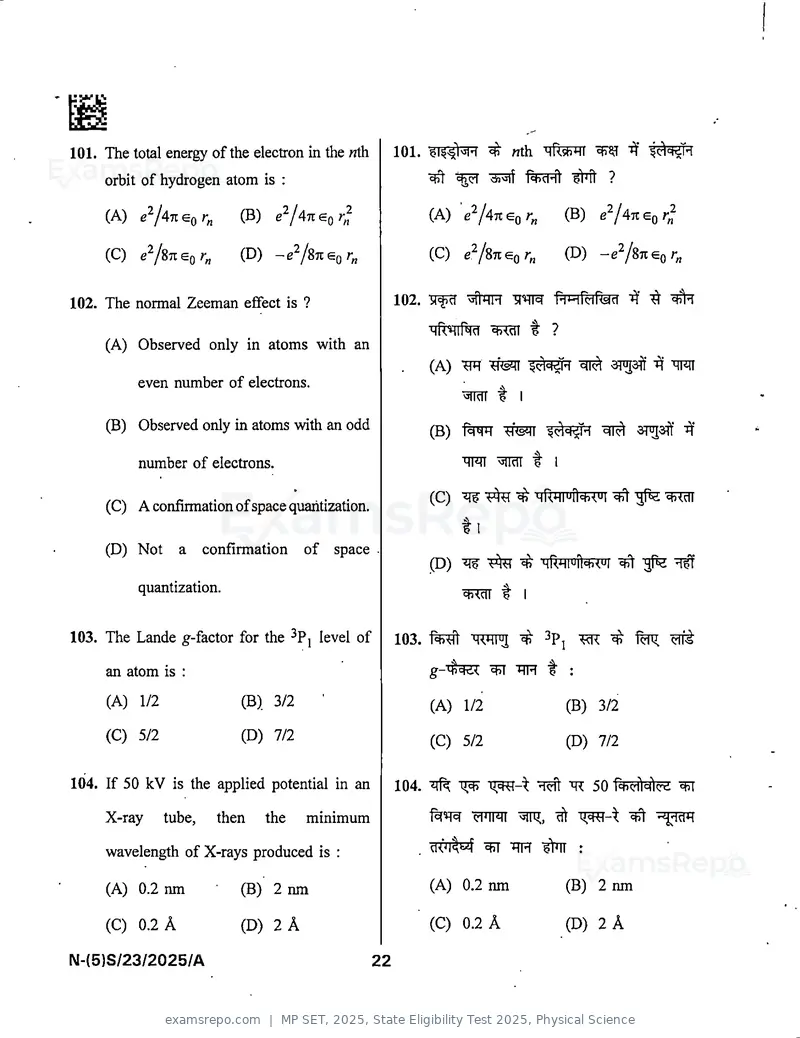
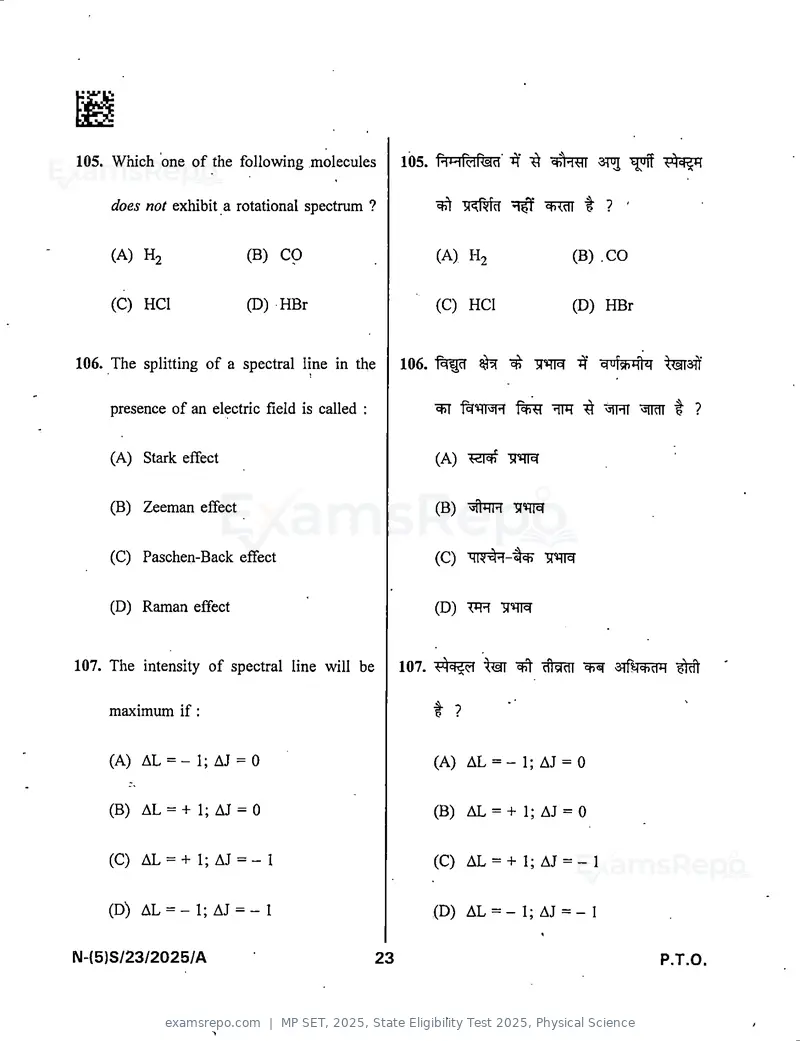
Text of page 25
105. Which one of the following molecules             105. PiHPdRsld'                  ^^

     does not exhibit a rotational spectrum ?


    (A) H,               (B) CO                              (A) H,               (B).CO


    (C) HCl              (D) HBr                             (C) HCl             (D) HBr


106. The splitting of a spectral line in the          106.         ^^                           ^3^

     presence of an electric field is called :               ^           fWn'm         ^ "^ncTT t ?

    (A) Stark effect                                         (A)        TITO


    (B) Zeeman effect                                        (B)         TITO


    (0) Paschen-Back effect                                  (C)               TITO


    (D) Raman effect                                         (D) "TO TITO


107. The intensity of spectral line will be           107.         tel                TO STfecPT #cft

     maximum if :                                            t ?        •■

    (A) AL = - 1; AJ = 0                                     (A) AL = - 1; AJ = 0


    (B) AL = + 1; AJ = 0                                     (B) AL = + 1; AJ = 0


    (C) AL = + 1; AJ = - I                                   (C) AL = + 1; AJ = - 1


    (D) AL = -1;AJ = -1                                      (D) AL- - 1; AJ- - 1


N-(5)S/23/2025/A                                 23                                            P.T.O.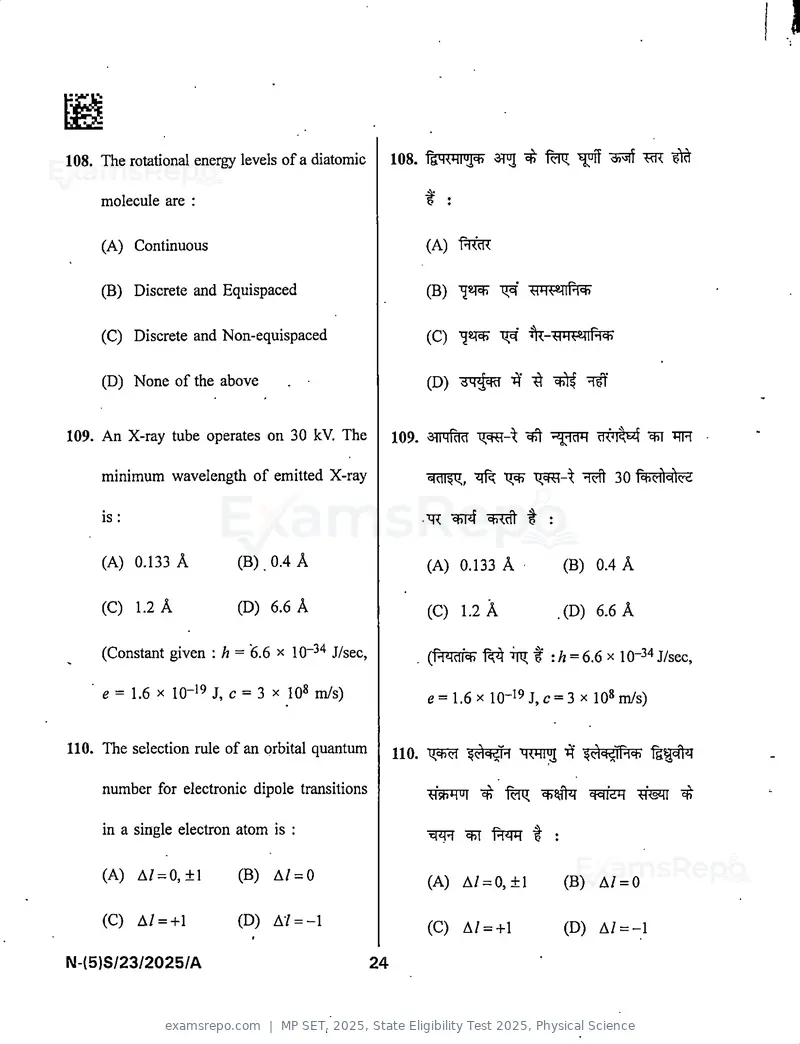
Text of page 26
108. The rotational energy levels of a diatomic    108.                  ^

     molecule are :                                        f:

    (A) Continuous                                        (A) Mr

     (B) Discrete and Equispaced                           (B)


     (C) Discrete and Non-equispaced                       (C) "^81^ 7?^'

     (D) None of the above                                 (D)                  ^

109. An X-ray tube operates on 30 kV. The              109. 37rMT           ^                ^

     minimum wavelength of emitted X-ray                   ^RTT^tT, ^               M 30

     is :                                                  ■ TR             ^:

     (A) 0.133 A          (B).0.4 A                        (A) 0.133 A           (B) 0.4 A

     (C) 1.2 A            (D) 6.6 A                        (C) 1.2 A            .(D) 6.6 A

     (Constant given : h = 6.6 x 10      J/sec,          . (Rqcll4) M       t th = 6.6 X 10⁻³⁴ J/sec,
    ■ e = 1.6 X 10⁻¹⁹ j, c = 3 X IQS m/s)                  e = 1.6x 10⁻¹⁹ J,c = 3 X lO^m/s)

110. The selection rule of an orbital quantum          110. 7t^                                Hi#!
     number for electronic dipole transitions              wm ^                     WSR           ^

     in a single electron atom is :                        w ^ Mr t :

     (A) A/=0,+l          (B) A/ =0                        (A) A/= 0,±1          (B) A/ =0

     (C) A/= -hl          (D) A7 = -l                      (C) A/ = +l           (D) A/ = -l

N-(5)S/23/2025/A                                  24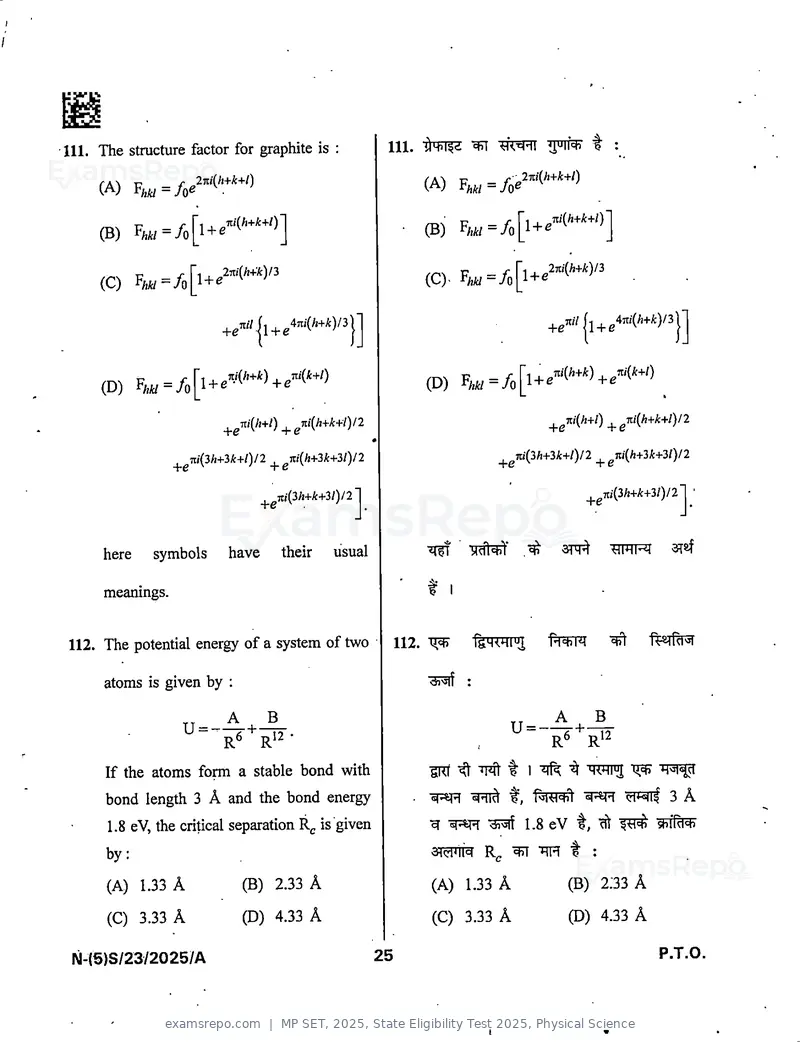
Text of page 27
111. The structure factor for graphite is :                     111.           ^            lynfe t :

    (A)                                                                 (A)


     (B)               +                                            ■   (B)             +


     (C)               +                                                (C).


                                              m(i+/)
                                                                        (D) ^hkl =/o

                             7rj(/j+/)         jti(A+^+/)/2                                      ni{h+l)          ni{h+k+l)/2
                           +e                                                               +e             T* w


                   7r/(3/»+3it+/)/2           m(/j+3A+3/)/2                        _^^m(3h+3k+l)/2 ^ni{h+3k+3l)/2
                  +e                  I   ^


                                 ^g7wt3A+A+3/)/2j                                                   ^g7tj(3/i+A+3/)/2j ■
      here   symbols       have           their        usual

      meanings.                                                         t I


112. The potential energy of a system of two                    112.


      atoms is given by :                                               <si^l :

                   u=-A, B                                                          u=-4. ®
                           R®    r'^ ■
      If the atoms form a stable bond with                              ^^ TFTt t I ^ ^ Wir3
      bond length 3 A and the bond energy
      1.8 eV, the critical separation              is given             ^         ^ 1.8 eV t, ^                        shlfdcti
      by:                                                                aiePM R^ ^ RH t :
      (A) 1.33 A             (B) 2.33 A                                 (A) 1.33 A            (B) 2;33 A
      (C) 3.33 A             (D) 4.33 A                                 (C) 3.33 A            (D) 4.33 A

 M-(5)S/23/2025/A                                              25                                                      P.T.O,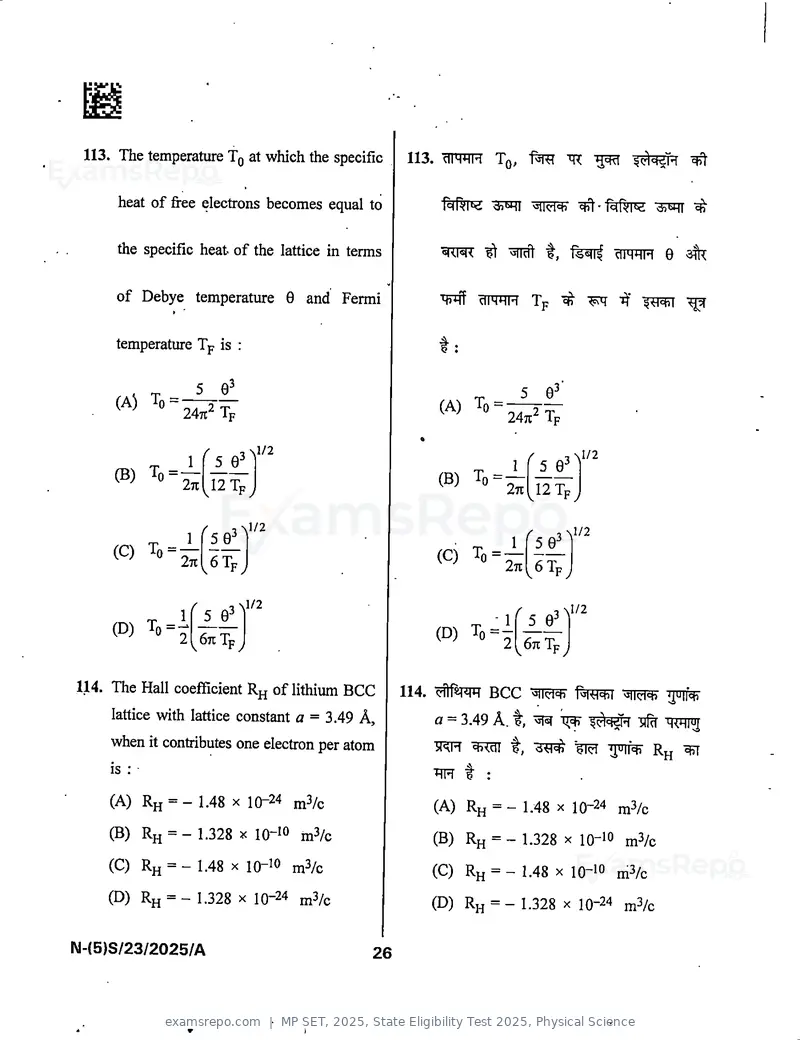
Text of page 28
113. The temperature Tq at which the specific      113. cimR Tq, -fm                                  ^

      heat of free electrons becomes equal to               PqRit^                                     ^

      the specific heat of the lattice in terms                  ^           t,              dlHHH 0

      of Debye temperature 0 and Fermi                      W dlMHH Tp ^ ^

      temperature Tp is :                                  t:

                  5 9^
     (A) To
         T„ =                                              .. ^0
                                                           (A) T ^^5 2 9^'
                2471^ Tp                                         247c^ Tp
                             1/2                                                       1/2
                1 f5
                   c_^
                     q3 ^                                                         3>

                    12 Tp                                  (B) To=^        Ai.
                                                                           12 T.


            5^
     (C) =^v^Tp,                                                          v^Tp,
                            1/2
                   5_^3 >                                               / - -3nI/2
    (D) To=.
                  671 Tp                                   (D) To=l AA
                                                                    671 Tt=


114. The Hall coefficient         of lithium BCC    114.             BCC -^llelch f^fWT
     lattice with lattice constant a = 3.49 A,             a ~ 3.49 A.■!, ^             ^criq^d "5#
     when it contributes one electron per atom                  ^<dl t", "3^1^ "^TFI "5%^ Rpj ^
     is : •                                                RH t" :
    (A) Rh = - 1.48 X 10⁻²⁴ n^3/c                          (A) Rh = - 1.48 X 10⁻²⁴ ^3/c
    (B) %= - 1.328 X lO-lo m3/c                            (B) Rh = - 1.328 X 10⁻¹⁰ jn3/c
    (C) Rh ^           X IQ-IO j^3/g                       (Q Rj^ — — 1.48 X 10⁻¹⁰ m^/c
    (D) Rh = - 1.328 X 10⁻²⁴ jj^3/c                        (D) Rh = - 1.328 X 10⁻²⁴ rnVc

N-{5)S/23/2025/A                               26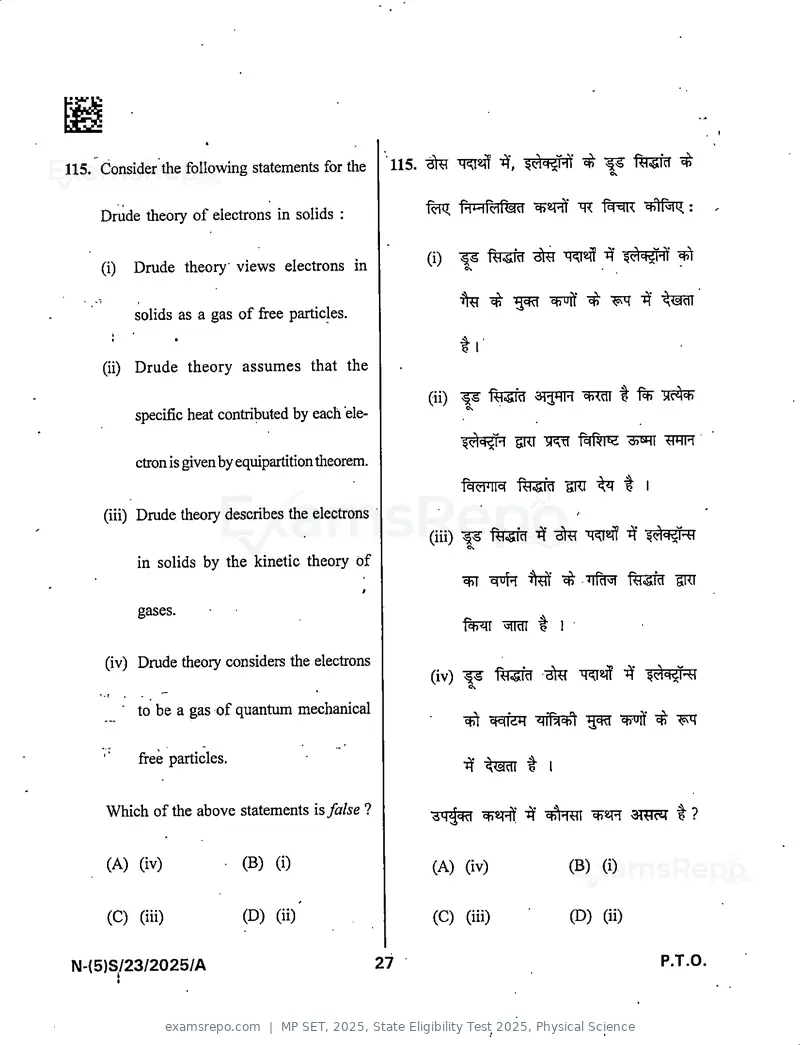
Text of page 29
115. Consider the fonowing statements for the         115.                                ^^          ^

     Drude theory of electrons in solids :

                                                             (i) ^                                   ^
     (i) Drude theory" views electrons in                            C\


          solids as a gas of free particles.
                                                                     tr
     (ii) Drude theory assumes that the

          specific heat contributed by each 'ele

          ctron is given by equipartition theorem.
                                                                     IqeiMiq nH<aia OT ^ "I I
     (iii) Drude theory describes the electrons                                           /


                                                             (iii)   Cv


          in solids by the kinetic theory of
                                                i


          gases.
                                                                     f^r^TT ^TTcIT ^ I

     (iv) Drude theory considers the electrons
                                                             (iv) ^
                                                                      <N


        ■ to be a gas of quantum mechanical

          free particles.                                                      t I

      Which of the above statements isfalse ?                                                        ^?

     (A) (iv)            ■ (B) (i)                           (A) (iv)                    (B) (i)


     (C) (iii)              (D) (ii)                         (C) (iii)                   (D) (ii)


 N-(5)S/23/2025/A                                    27                                             P.T.O.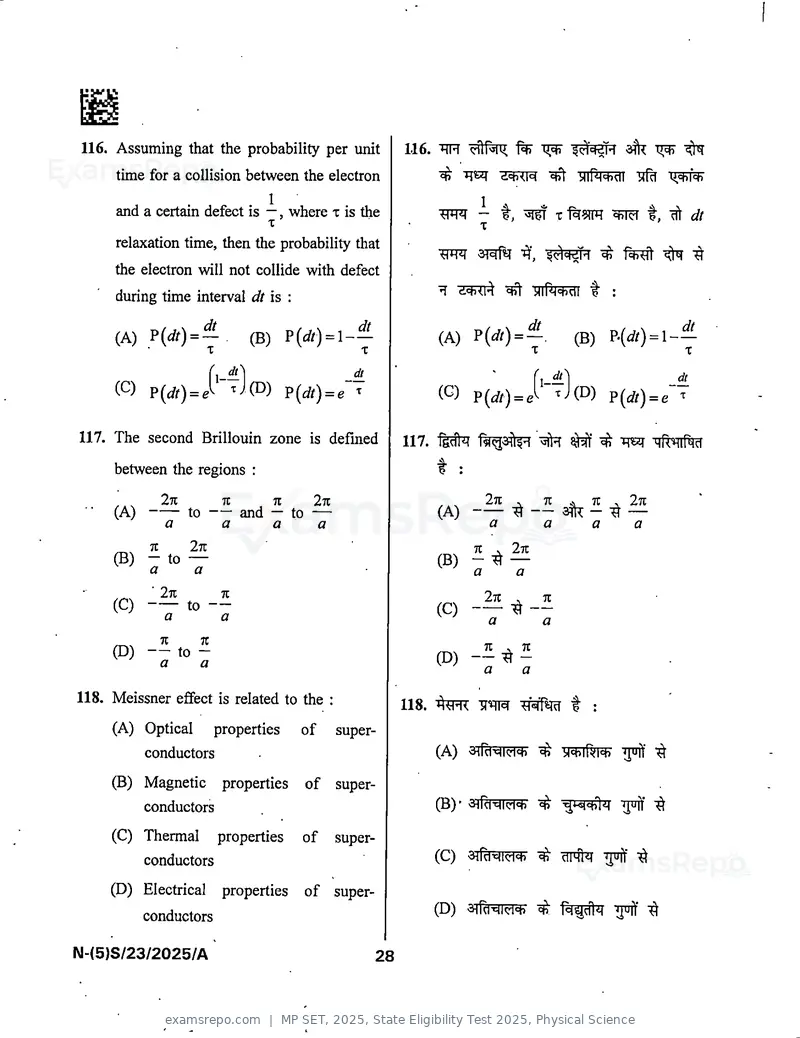
Text of page 30
116. Assuming that the probability per unit            116.                                       sSk
      time for a collision between the electron

      and a certain defect is —, where x is the                                         T                %, "dl dt
                                  T                                 T

      relaxation time, then the probability that
     the electron will not collide with defect

      during time interval dt is :                            ^              ^ yiRjchdl t :

     (A) P(rfO =f (B) P(rf/)=1-^                              (A) P(^0=7 (B)                             =
     (Q p(t/r)= elfl-^1
                     ^J(D) ?{dt)=e           T
                                                                    ^{dt)= e^
                                                                                  (I-—1
                                                                                                P{dt)=e ^
117. The second Brillouin zone is defined              117.                                 ^            -qffviTfM
     between the regions :                                    t:
     ,.^       27c       7t   n    2k
     (A)             to — and — to                            (A)            ^          3lk - ^ —
               a           a      a     a                               a           a       a      a

           K         2k                                             K . 2k
     (B) - to —
           a         a                                              a         a

           ' 2k            k                                            2k    ^    K
      C)             to —                                     (c             ^—
               a          a
                                                                        a          a


                                                              ^         71 . 7t
    (D)        a
                   to -
                      a
                                                              (D
                                                                        a      a


118. Meissner effect is related to the :
                                                       118.         31^ TidTm t :
    (A) Optical           properties   of super
           conductors                                         (A) ^fd^Mdi ^                               i{
    (B) Magnetic properties of super
           conductors                                         (B)' ^Ri-qiQi=h ^                  "jpif
    (C) Thermal           properties   of super
           conductors                                         (C) ^fd^ldd) ^ cINt^                 ^
    (D) Electrical properties of super
           conductors
                                                              (D)                  ^ Id^dl^

N-(5)S/23/2025/A                                  28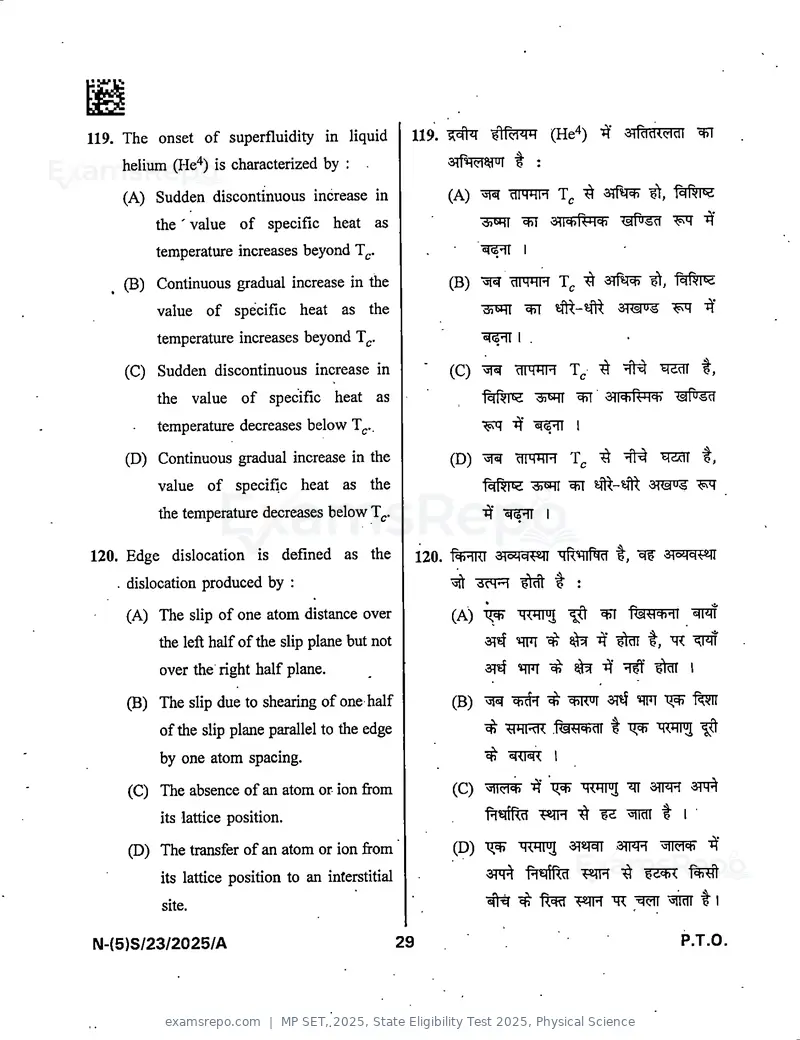
Text of page 31
119. The onset of superfluidity in liquid            119.                     (He"^)               ^rddiddi ^
    helium (He'^) is characterized by : •                             t:

    (A) Sudden discontinuous increase in                    (A) m WIPT T^
         the' value of specific heat as
         temperature increases beyond T^.                               I


    (B) Continuous gradual increase in the                  (B) ^ -mwr T^ ^
         value of specific heat as the
         temperature increases beyond T^.                              I .


    (C) Sudden discontinuous increase in                    (C)        diMHN T^                    dW "Miai
         the value of specific heat as
         temperature decreases below T^.,                                   6i<Sdi      I


    (D) Continuous gradual increase in the                  (D)        aiMHN                       dl"^
         value of specific heat as the
         the temperature decreases below T^.                                  I


120. Edge dislocation is defined as the              120.                             qR-HlPld t,^
   . dislocation produced by :                                         6^dl "i" t
    (A) The slip of one atom distance over                  (A)        M-Wiuj, ^ r^sl4Hd)dl
         the left half of the slip plane but not                       WT ^ ^ "^f ^ f, ^
          over the right half plane.                              aqsf qm ^ ^                             ^ 1

    (B) The slip due to shearing of one half                (B) ^             ^         sp} w
          of the slip plane parallel to the edge                ^             .Rsl^-^dl f    WTT^ ^
          by one atom spacing.                                    ^               1

     (C) The absence of an atom or ion from                 (C)                             WTr3          srm ^
          its lattice position.                                              T«TPT "5^             ^t I ■

     (D) The transfer of an atom or ion from                (D)                        ai2M aiFH
          its lattice position to an interstitial                 mk                        TSlH ^

          site.                                                        ^               vm -qr ■=^ ^ 11

N-(5)S/23/2025/A                                    29                                                      P.T.O,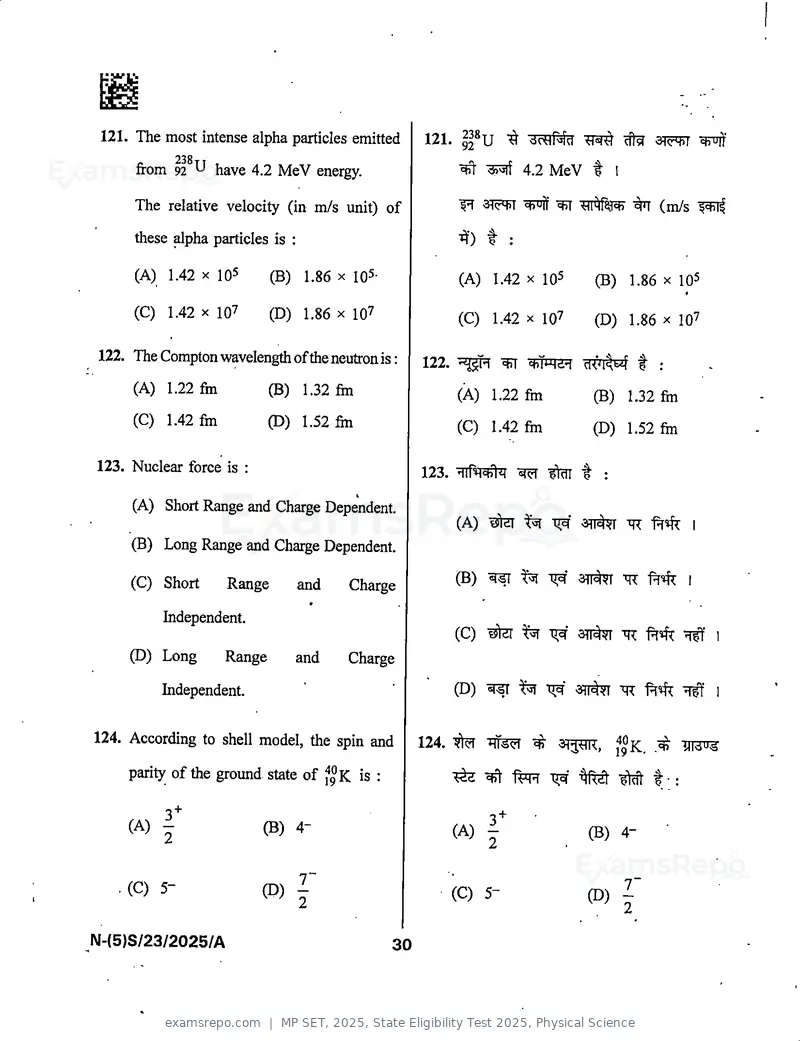
Text of page 32
121. The most intense alpha particles emitted       121. 738^ ^                     ^
            238
      from 92 U have 4.2 MeV energy.                        ^^ 4.2 MeV t I

      The relative velocity (in m/s unit) of
      these dpha particles is :                             ^*) t ;
     (A) 1.42 X 10⁵       (3) 1 gg X 105-                   (A) 1.42 X 10⁵       (3) I gg X iqS
     (C) 1.42 X 10⁷       (D) i_g6 X 107                    (C) 1.42 X 10⁷       (D) 1.86 X 10⁷

122. The Compton wavelength ofthe neutron is:        122.        ^                        ^ ;
     (A) 1.22 fm          (B) 1.32 fin                      (A) 1.22 fin        (B) 1.32 fin
     (C) 1.42 fm          (D) 1.52 fin                      (C) 1.42 fin        (D) 1.52 fin

123. Nuclear force is :                              123.          ^^ t :
                                         \


     (A) Short Range and Charge Dependent.
                                                            (A) ^                                    I
     (B) Long Range and Charge Dependent.

     (C) Short      Range     and     Charge                (B) ^              3TT^ tn:          \

          Independent.
                                                            (C) ^          TT^" 3TT^ -qi                 ]
    (D) Long       Range      and     Charge
          Independent.                                      (D) ^^            3Tlt^ -qr                  ]

124. According to shell model, the spin and          124.       TTTS^ ^

     parity of the ground state of       is :           ^^                     to          %■:

        3"^
    (A) -                 (B) 4-
                                                            <A,f                (B) 4-


   • (C) 5-               (D)[                          (C) 5-                  (D)[
N-(5)S/23/2025/A                                30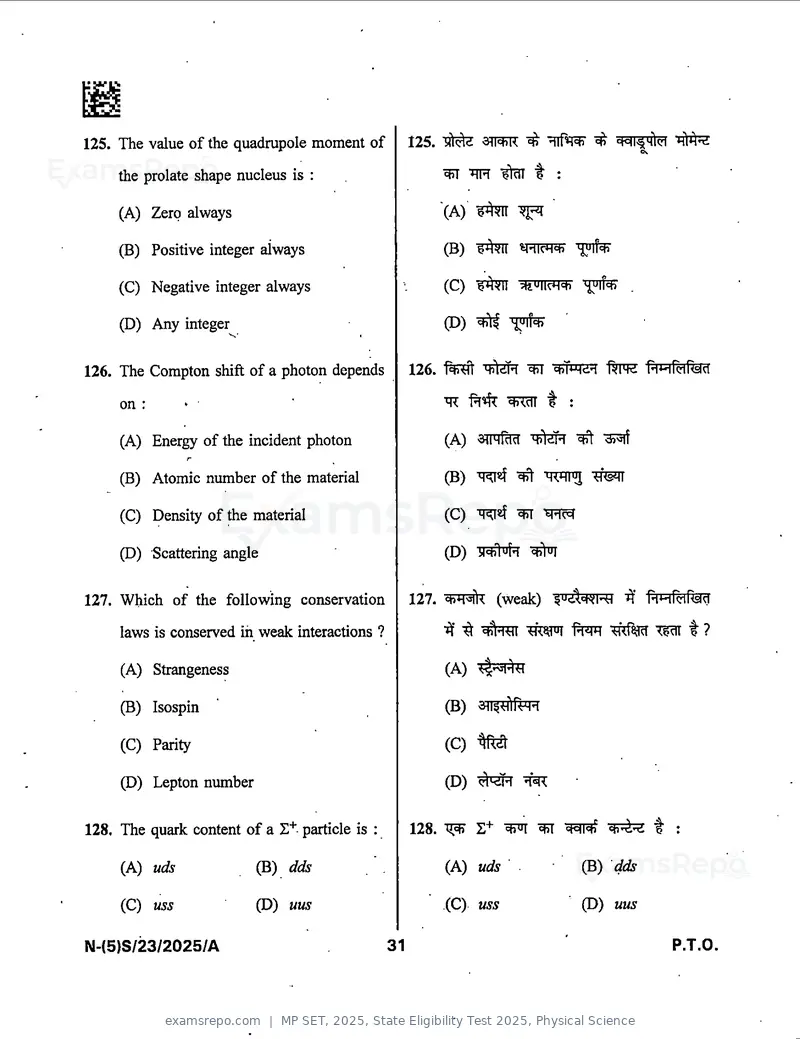
Text of page 33
125. The value of the quadrupole moment of             125. "3^         ^          ^        e\


     the prolate shape nucleus is :                           ^     "^klT ^ :

    (A) Zero always                                           (A)

    (B) Positive integer always                               (B)

    (C) Negative integer always                               (C)

    (D) Any integer                                           (D) ^

126. The Compton shift of a photon depends             126.             ^

     on :                                                     ^              t:

    (A) Energy of the incident photon                         (A)                    "35#

     (B) Atomic number of the material                        (B)       ^          WTT

     (C) Density of the material                              (C)       ^

    (D) Scattering angle                                      (D)       ^

127. Which of the following conservation               127.         (weak)                   Pt^RnRaq
     laws is conserved in weak interactions ?                                   "pRFT ^RfsjcT "Tcdl ^ ?

     (A) Strangeness                                          (A)

     (B) Isospin

     (C) Parity                                               (C)

     (D) Lepton number                                        (D)       ^

128. The quark content of a Z"*"- particle is :        128. 13^ Z+ ^ ^                           t:

     (A) uds              (B) dds                             (A)                 (B) dds

     (C) uss              (D) uus                             (C) uss            (D) uus

N-(5)S/23/2025/A                                  31                                              P.T.O.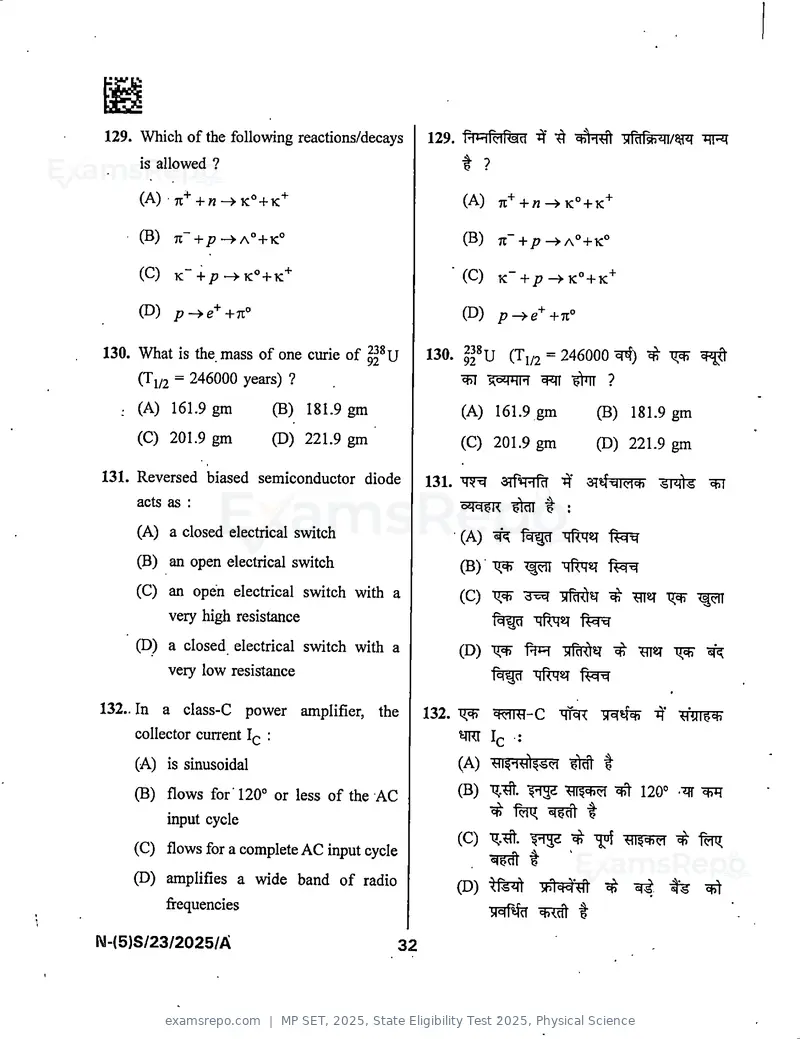
Text of page 34
129. Which of the following reactions/decays    129. rHHPdR^d          ^         yrdPstrMim ^11^
      is allowed ?                                      t ?
     (A) Tc"*" + «      k^+ k"^                         (A) 7U++/I      k°+ K'^

     (B) 7l~            A°+K°                           (B) ;r"+^_>A°+K°

     (C) k"             k^+ k"^                         (C) k"+/J->• k°+ k"^
     (D) p~^e^+n°                                       (D) ^->.£++7^0

130. What is the mass of one curie of ^\] 130. 238 u (Ty2 = 246000                   ^ ^^
     (Tjy2 = 246000 years) ?
   ; (A) 161.9 gm           (B) 181.9 gm                (A) 161.9 gm         (B) 181.9 gm
     (C) 201.9 gm          (D) 221.9 gm                 (C) 201.9 gm         (D) 221.9 gm

131. Reversed biased semiconductor diode         131. Hij'd srf^PTfcT       3T%I-qieidi •simIs
     acts as :

     (A) a closed electrical switch                     ■ (A) ^
     (B) an open electrical switch                      (B)
     (C) an open electrical switch with a               (C)       ^            ^         T33T
          very high resistance
     (D) a closed electrical switch with a              (D)       fp=T "StcRlil ^           TT^ ^
          very low resistance

132.. In a class-C power amplifier, the          132.                                 "4'
      collector current Iq :                            m Ic ■:
    (A) is sinusoidal                                   (A)             ^t
    (B) flows for'120° or less of the AC                (B) TiA ^=133     ^ 120°                 TO
          input cycle                                       ^      TOlt t
                                                        (C)           ^   "^TT^TOT
    (C) flows for a complete AC input cycle
                                                              TOit t"
    (D) amplifies a wide band of radio
                                                        (D)         TfW# ^                  ■fs' ^
          frequencies                                               TOlt t
N-(5)S/23/2025/A                            32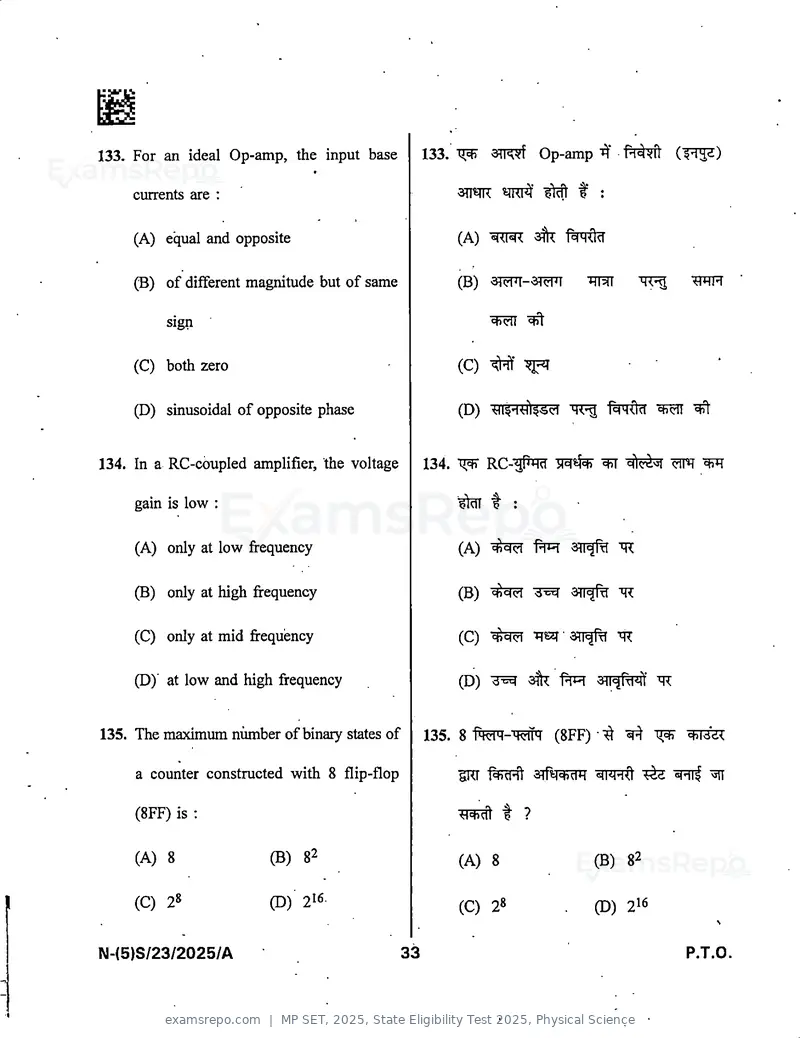
Text of page 35
133. For an ideal Op-amp, the input base       133.                    Op-amp

    currents are :                                     sntiTR                       :


    (A) equal and opposite                             (A)            aik

    (B) of different magnitude but of same             (B)

         sign


    (C) both zero                                      (C)        ^

    (D) sinusoidal of opposite phase                   (D)                                       ^

134. In a RC-coupled amplifier, the voltage    134.          RC-'3ffrl?r            ^        WR ^

     gain is low :                                    ^t :

    (A) only at low frequency                          (A)                       3n^j% "q^

    (B) only at high frequency                         (B)                       3TT^ w:

    (C) only at mid frequency                          (C)            -FTezi ■          ^

    (D)' at low and high frequency                     (D)          3fk                      ^

135. The maximum number of binary states of        135. 8                  (8FF) - ^ ^

     a counter constructed with 8 flip-flop            ?RT Rjddl                    ^FFlfr          w

    (8FF) is ;                                                  t ?

    (A) 8               (B) 82                         (A) 8                       (B) 82

    (C) 2^             (D) 216-                        (C) 28                      (D) 2^6

N-(5)S/23/2025/A                              33                                                 P.T.O.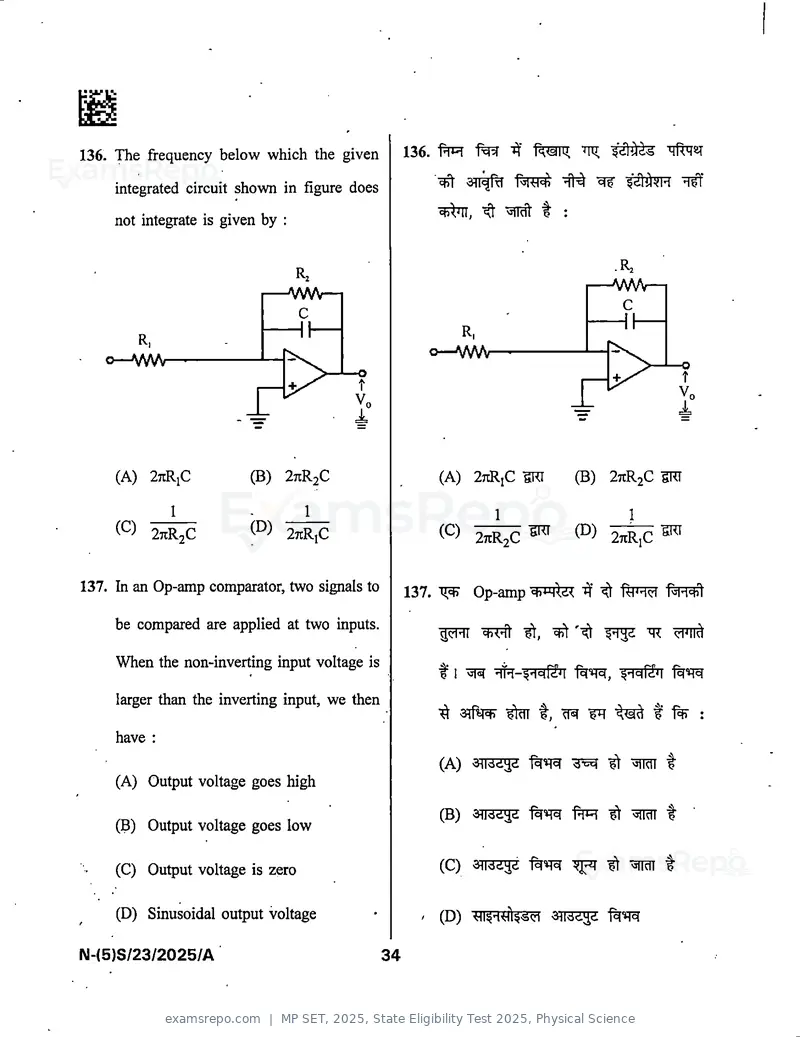
Text of page 36
136. The frequency below which the given         136.                                          ■qftqsT

     integrated circuit shown in figure does
                                                                          ^ t :
     not integrate is given by :


                                   R.
                            —VWV—
                                   C

      R.
                                                        o-^W\A
   o—VWr
                                         t
                          r              Vo
                                         Ju


    (A) 27:RiC           (B) 27rR2C                         (A) 2;iRiC m          (B) 27rR2C OT

                                    1                                 1                  1
                         (D) 27tRiC
          271R2C                                                  27rR2C ^            27cRiC

137. In an Op-amp comparator, two signals to         137.         Op-amp             ^
     be compared are applied at two inputs.

     When the non-inverting input voltage is
                                                            t I "SR
     larger than the inverting input, we then
                                                            ^             ^ t, ^ ^           t% :
     have :

                                                            (A) 3TRS32                ^ •snm t
    (A) Output voltage goes high

                                                            (B)                   fro ^ RRTT t
    (B) Output voltage goes low

    (C) Output voltage is zero                              (C)                   ^^^t

    (D) Sinusoidal output voltage                      ' (D)                         1^«R

N-(5)S/23/2025/A                                34
Text of page 37
138. For GaAsi_^^ LED. having phosphorous           138. RqFT GaAsi_^P^                              ^

     concentration above 44%, a doping with               ■         44%                 t I^

     nitrogen produces the following :                        ^ ^^ -qr rHHPelRslcl               ^:


    (A) Red-pink light                                        (A) ^-"3^ 3TOTT

    (B) Yellow-green light                                    (B)              TITOT"

    (C) White light                                       ■ (C)          "5^


    (D) Blue-violet light .                                   (D)               WRT


139. For depletion layer photodiode :               139.                                    ■:


    (A) the depletion region must be wide                     (A)         "q^

          so that most photons are absorbed                                    -q^ %q)           ^

          in this region only.                                      smto          I


    (B) the carrier drift should occur in a           ■       (B)         ^             ^

          very long time.                                           wm            I


    (C) the doping at one side of junction                    (C)         ■%          M

          should be high.


    (D) wide depletion region must result in                  (D) ^               "qcf ^

         a large Jimction capacitance.

N-(5)S/23/2025/A                               35                                                P.T.O.
Text of page 38
140. A gate current of 0.001 |xA flows when      140. JFET         ^                   15 V ^


     a JFET is reversed biased with 15 V. The            ■qr ^ TO 0.001                     wfer


     gate source resistance is :


    (A) 10000 MQ         (B) 15000 MQ                    (A) 10000 MO        (B) 15000 MQ


    (C) 30000 MQ         (D) 6000 MO                     (C) 30000 MQ        (D) 6000 MO


141. If the gauge factor of the material of a    141. "qfq             "TOW ^          ^


     strain gauge is such that the resistance            ^Jiict) ^      t"    TT^ 0.002

     changes from 1000 ohms to 1009 ohms                 ^      31#T          1000'            ^


     when subjected to a strain of 0.002. The            1009                         t I


     value of gauge factor will be :                     ■ipw ^ "TO ^ :


    (A) 1.75                                             (A) 1.75


     (B) 4.5                                             (B) 4.5


     (C) 9.0                                         ■   (C) 9.0


    (D) 45                                               (D) 45

N-(5)S/23/2025/A                                36
Text of page 39
142. For detection of neutrons, the ionizatibn    142.         ^       ^                 ^


     chamber is filled with :                            PiHrdPsId         ^^ t ?


    (A) Phosphorus                                       (A) wpkn'


     (B) Benzene                                         (B) M'l


     (C) Sodium chloride                                 (C)


     (D) Boron trifluoride                               (D)


143. The gain of a negative feedback              143.                              ^


     amplifier with an internal gain, A = 100                                  A = 100      W


     and feedback factor p = 1/10, is :                          Tpro p = 1/10 t,       :


     (A) 9.09                                            (A) 9.09


     (B) 20.56                                           (B) 20.56


     (C) 28.96                                           (C) 28.96


     (D) 70.61                                           (D) 70.61


N-(5)S/23/2025/A                                 37                                     P.T.O,
Text of page 40
144. Instrumentation ' amplifiers are used       144.


     primarily in :                                         t:


    (A) High noise environments                             (A)     ^ ciidN<u| -^f


    (B) Medical equipments                            ■ (B) Ar^=hel dMc+iluil* Af


    (C) Test instruments                                    (C)                  "A*


    (D) Filter circuits                               ■ (D)             -qftqAf.A"


145. A 16    speaker load is to be matched to        145.         16 n ^ ^             ^


     an amplifier so that the effective load                ^               wn t;               ^

     resistance is 10 kQ. What will be the                         10 kn ^ 1 iimlAi ^

     primary to secondary turns ratio of the
                                                            ^           ^      ^           #1T ■:

     transformer ?
                                                            (A) 9 : 1

    (A) 9 : 1
                                                       ' (B) 1 : 9
    (B) 1 : 9

                                                            (C) 25 : 1
    (C) 25 : 1

                                                            (D) 1 : 25
    (D) 1 : 25

IM-{5)S/23/2025/A                               38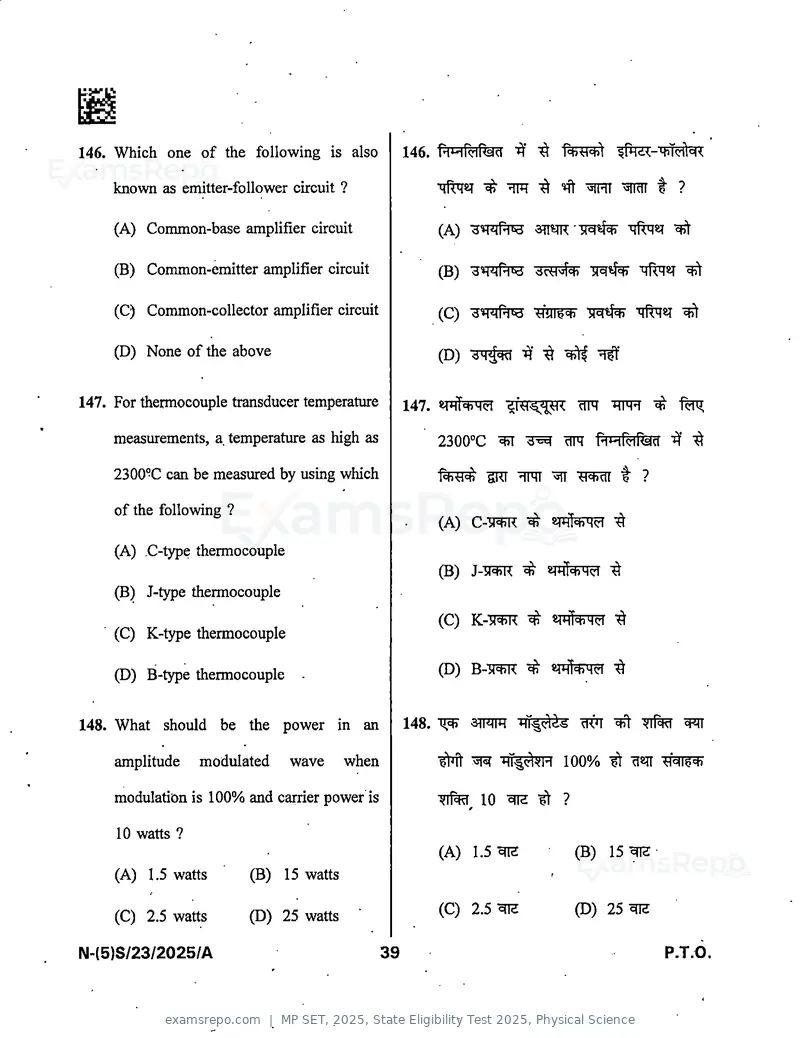
Text of page 41
146. Which one of the following is also           146. PiHRrlRsIci         ^

     known as emitter-follower circuit ?                             "TO       ^       "^IRTT "t ?

    (A) Common-base amplifier circuit                    (A)                                   ^

    (B) Common-emitter amplifier circuit                 (B)                              "qftqsq ^

    (C) Common-collector amplifier circuit               (C)                              TTftqar ^
    (D) None of the above                                (D)


147. For thermocouple transducer temperature      147.

     measurements, a temperature as high as              2300°C ^              ^ rHMRrindd

     2300®C can be measured by using which                     OT "^NT                 t" ?
     of the following ?
                                                         (A) C-"S™ ^                  ^
    (A) -C-type thermocouple
                                                         (B) J-ITTO ^ aiHldiMd
    (B) J-type thermocouple
                                                         (C) K-TOR ^                  ^
    (C) K-type thermocouple

    (D) B-type thermocouple                              (D) B-'STO ^                ^


148. What should be the power in an               148. 13:^7 31FTTH                ^^           ^

     amplitude    modulated    wave      when            #lt ^                 100% il Tiair

     modulation is 100% and carrier power is                   10 ^            ?

     10 watts ?
                                                         (A) 1.5^               (B) 15^'
    (A) 1.5 watts         (B) 15 watts

    (C) 2.5 watts         (D) 25 watts                   (C) 2.5^               (D) 25^

N-(5)S/23/2025/A                             39                                                P.T.O.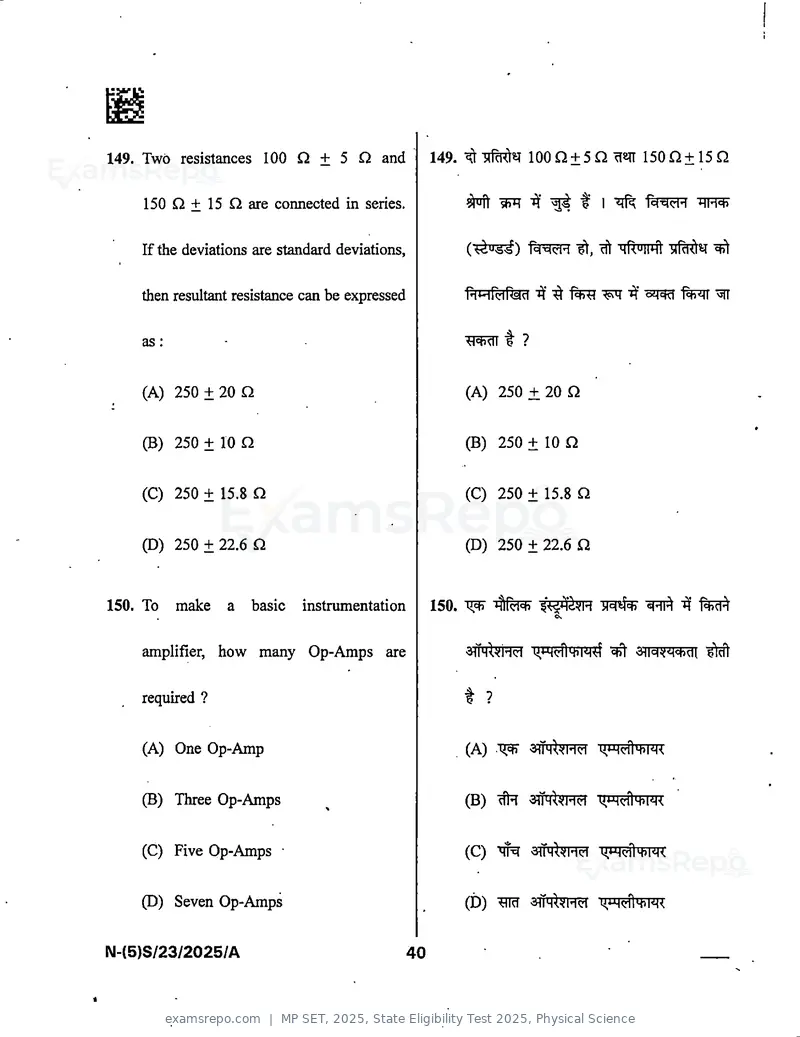
Text of page 42
149. Two resistances 100 Q + 5 Q and              149.            100Q +50 ^211 150O±15n


    150 O + 15       are connected in series.            M                t 1^

    If the deviations are standard deviations,                              ^ mRuhhI    ^


    then resultant resistance can be expressed           RHPdRsid "4* ^     ^ '5^ fen ^

    as:                                                        t?


    (A) 250 ±20 0.                                       (A) 250 + 20 O


    (B) 250 ± 10 O                                       (B) 250 ± 10 O


    (C) 250 ± 15.8 O                                     (C) 250 ± 15.8 O


    (D) 250 ± 22.6 O                                     (D) 250 ± 22.6 O


150. To   make   a   basic   instrumentation      150.                           ^     fer^

    amplifier, how many Op-Amps are

    required ?                                           t ?

    (A) One Op-Amp                                       (A)


    (B) Three Op-Amps                                    (B) #I

    (C) Five Op-Amps                                     (C)


    (D) Seven Op-Amps                                    (D) w


N-(5)S/23/2025/A                             40
Text of page 43
'

                           cBpf       '

                     (SPACE FOR ROUGH WORK)


    (N)S/23/2025/A
Text of page 44
(SPACE FOR ROUGH WORK)


(N)S/23/2025/A









Page 1 of 44
Source: Madhya Pradesh Public Service Commission. Question paper published by Madhya Pradesh Public Service Commission.