
MPPSC AE 2017: State Engineering Service Examination, Electrical Engineering Paper-II
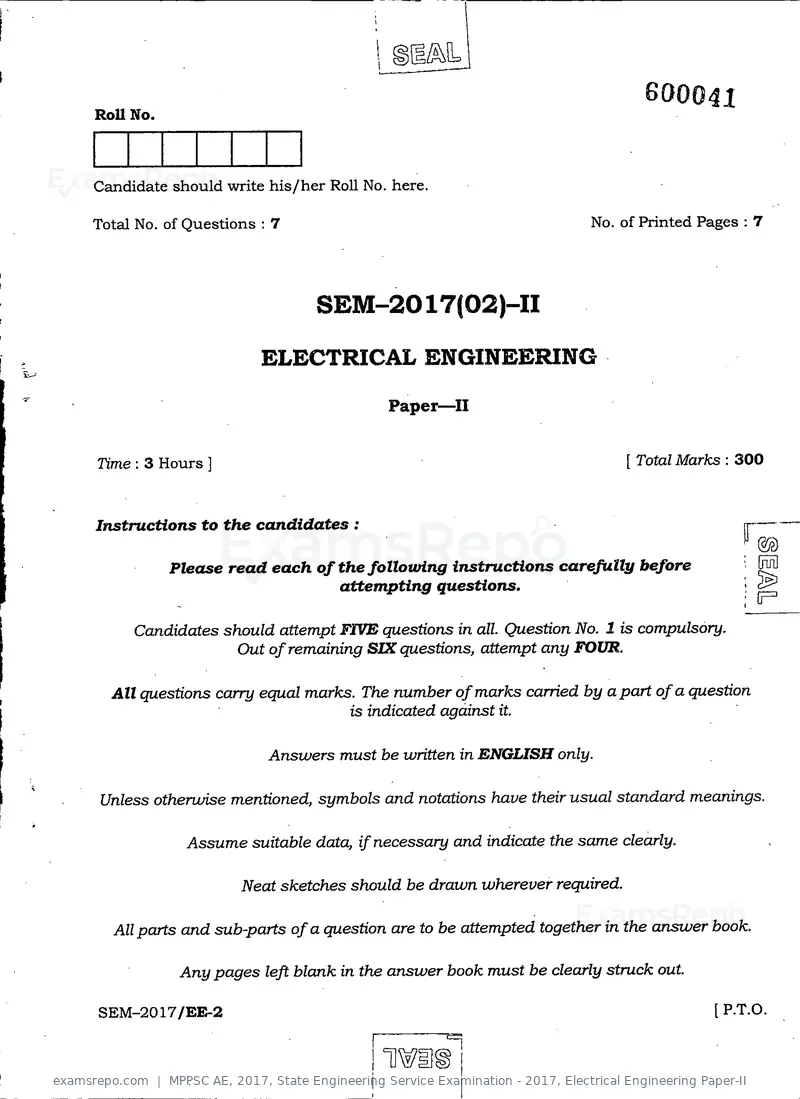
Text of page 1
600041
RoU No.


Candidate should write his/her Roll No. here.

Total No. of Questions : 7                                       No. of Printed Pages : 7


                             SE]V[-2017(02)-II

                      ELECTRICAL ENGINEERING

                                       Paper—^11


Time : 3 Hours ]                                                     [ Total Marks : 300


Instructions to the candidates:
                                                                                          m
          Please read each of thefollowing instructions carefully before                  [m]
                                attempting questions.
                                                                                          0^

     Candidates should attempt FIVE questions in all. Question No. 1 is compulsory.
                  Out ofremaining SIX questions, attempt any FOUR.

  All questions carry equal marks. The number of marks carried by a part ofa question
                                  is indicated against it.

                        Answers must be written in ENGLISH only.


 Unless otherwise mentioned, symbols and notations have their usual standard meanings.

            Assume suitable data, if necessary and indicate the same clearly.

                    Neat sketches should be drawn wherever required.

  All parts and sub-parts ofa question are to be attempted together in the answer book.

           Any pages left blank in the answer book must be clearly struck out.

SEM-2017/EE-2                                                                    [ P-T.O.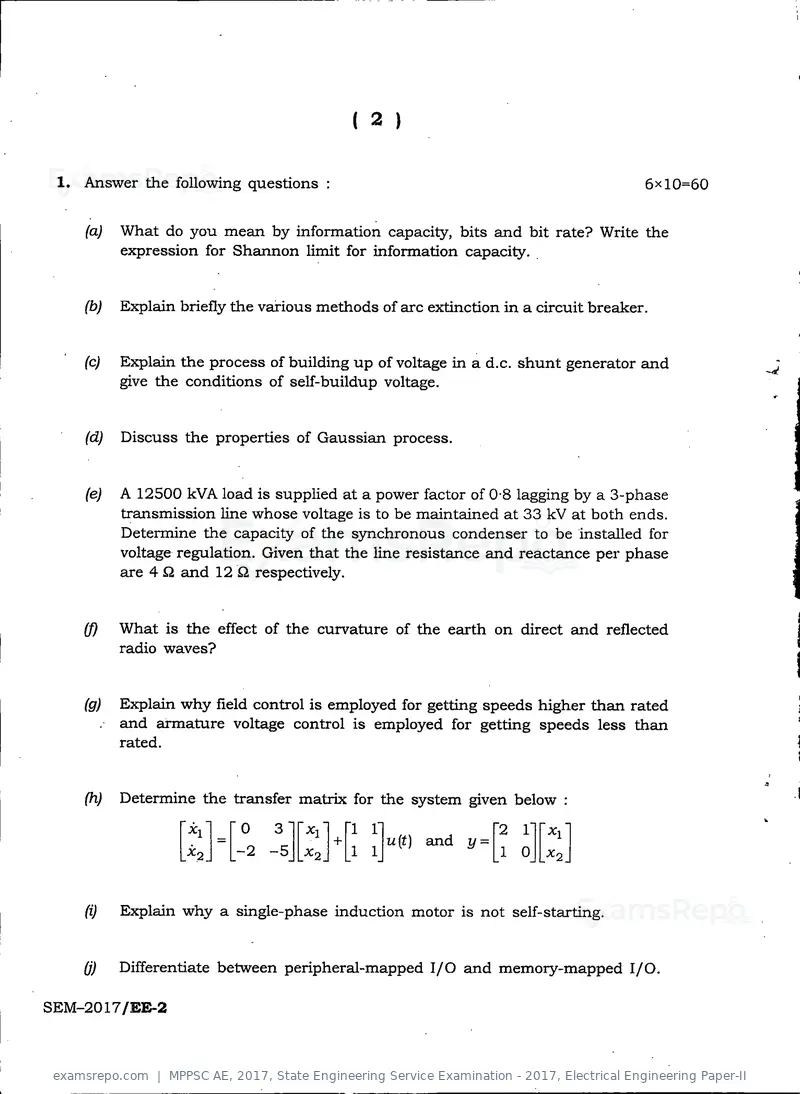
Text of page 2
( 2)


 1. Answer the following questions                                                       6x10=60


    {a) What do you mean by information capacity, bits and bit rate? Write the
        expression for Shannon limit for information capacity.


    (b) Explain briefly the various methods of arc extinction in a circuit breaker.


    (c)   Explain the process of building up of voltage in a d.c. shunt generator and
                                                                                                   -V
          give the conditions of self-buildup voltage.


    (d) Discuss the properties of Gaussian process.


    (e) A 12500 kVA load is supplied at a power factor of 0-8 lagging by a 3-phase
                              1— voltage is to be maintained at 33 kV at both ends.
        transmission line whose OL
          Determine the capacity of the sjmchronous condenser to be installed for
                                1


          voltage regulation. Given that the line resistance and reactance per phase
                            1


          are 4 £2 and 12 £2 respectively.


    (f)   What is the effect of the curvature of the earth on direct and reflected
          radio waves?


    (g) Explain why field control is employed for getting speeds higher than rated
        and armature voltage control is employed for getting speeds less than
          rated.


    (h) Determine the transfer matrix for the system given below :
                         '0     3"              '1   r                   "2   1' "Xi"
                        =                   +            u[t) and   y-
                   X2                _X2_       1    1                   1    0   _X2_


    (i)   Explain why a single-phase induction motor is not self-starting.


    (j)   Differentiate between peripheral-mapped I/O and memory-mapped I/O.

SEM-2017/EE-2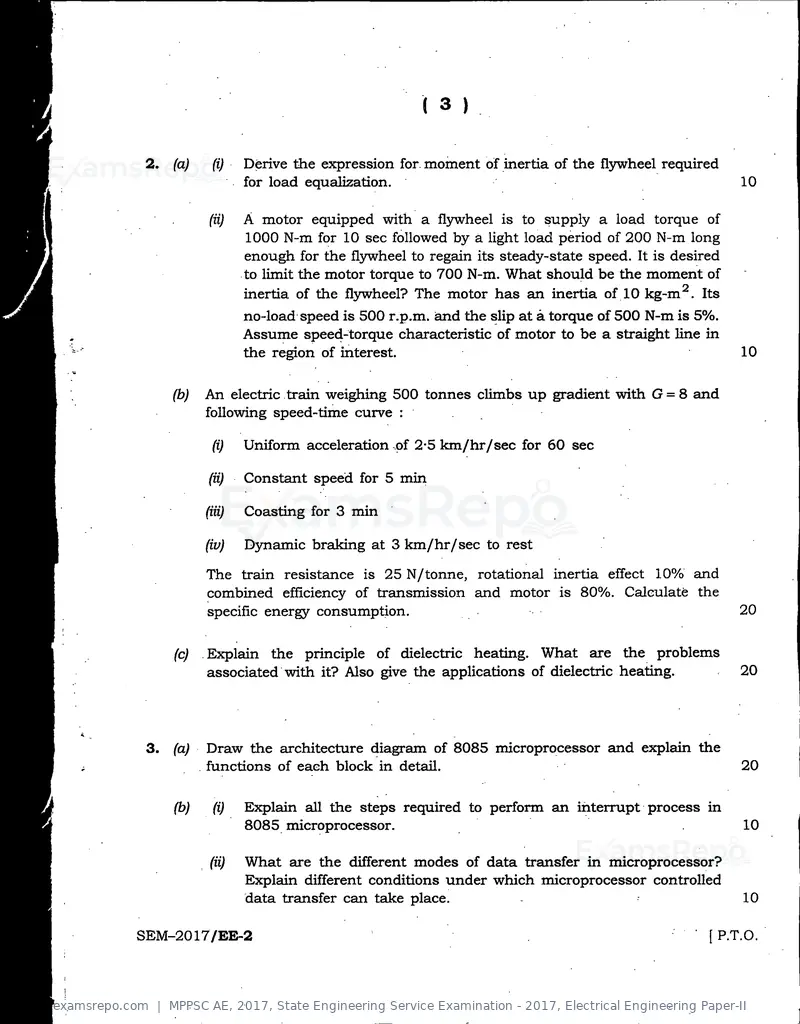
Text of page 3
( 3)


2. (a)     (i)   Derive the expression for moment of inertia of the fljrwheel required
                 for load equalization.                                                    10

          (ii)   A motor equipped with a flywheel is to supply a load torque of
                 1000 N-m for 10 sec followed by a light load period of 200 N-m long
                 enough for the flywheel to regain its steady-state speed. It is desired
                 to limit the motor torque to 700 N-m. What should be the moment of
                 inertia of the flywheel? The motor has an inertia of 10 kg-m . Its
                 no-load speed is 500 r.p.m. and the slip at a torque of 500 N-m is 5%.
                 Assume speed-torque characteristic of motor to be a straight line in
                 the region of interest.                                                   10

    (b) An electric train weighing 500 tonnes climbs up gradient with G = 8 and
          following speed-time curve :

           (i)   Uniform acceleration of 2-5km/hr/sec for 60 sec

          (ii)   Constant speed for 5 min

          (Hi)   Coasting for 3 min

          (iv)   Dynamic braking at 3 km/hr/sec to rest

          The train resistance is 25 N/tonne, rotational inertia effect 10% and
          combined efficiency of transmission and motor is 80%. Calculate the
          specific energy consumption.                                                     20


    (c) Explain the principle of dielectric heating. What are the problems
          associated with it? Also give the applications of dielectric heating.            20


 3. (a) Draw the architecture diagram of 8085 microprocessor and explain the
          functions of each block in detail.                                               20


    (b)    (i)   Explain all the steps required to perform an interrupt process in
                 8085 microprocessor.                                       .              10

          (ii)   What are the different modes of data transfer in microprocessor?
                 Explain different conditions under which microprocessor controlled
                 data transfer can take place.                                             10

SEM-2017/EE-2                                                                          P.T.O.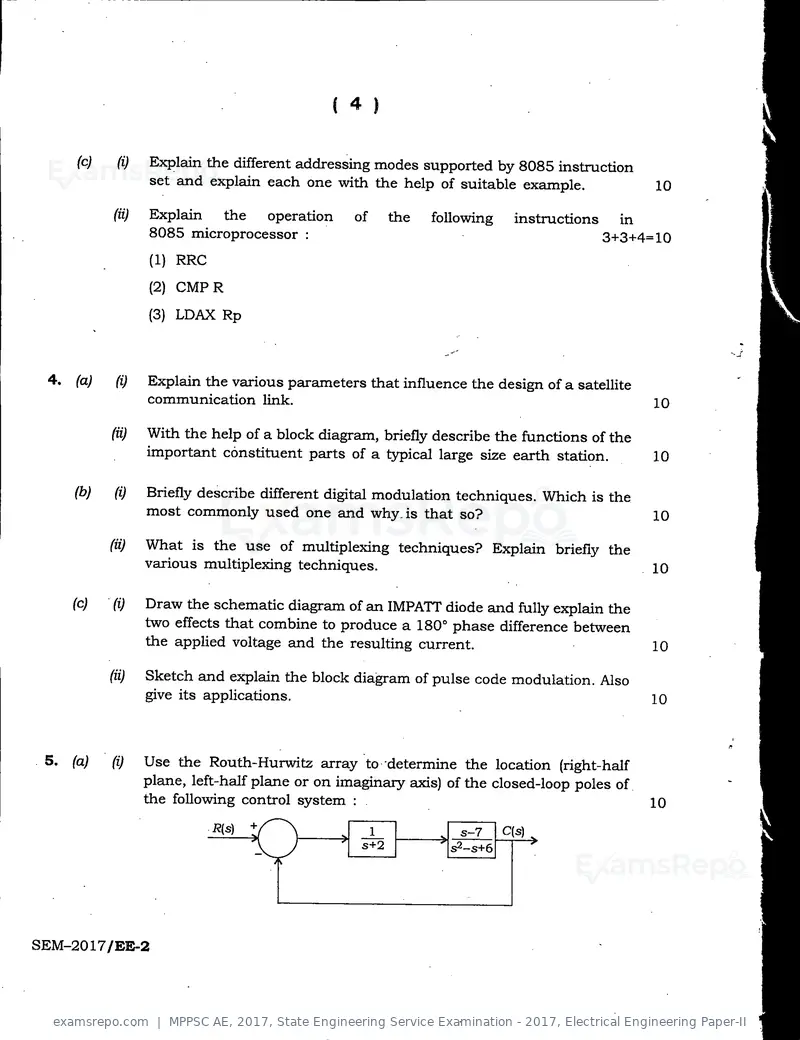
Text of page 4
(4)


    (C)    (i)   Explain the different addressing modes supported by 8085 instruction
                 set and explain each one with the help of suitable example.                   10

          (n)    Explain    the    operation   of       the   following   instructions    in
                 8085 microprocessor :                                                   3+3+4=10
                 (1) RRC
                 (2) CMPR

                 (3) LDAX Rp


 4. (a)    (i)   Explain the various parameters that influence the design of a satellite
                 communication link.                                                           10


          (ii)   With the help of a block diagram, briefly describe the functions of the
                 important constituent parts of a typical large size earth station.            10


    (b)   (ii    Briefly describe different digital modulation techniques. Which is the
                 most commonly used one and why.is that so?                                    10

          (ii)   What is the use of multiplexing techniques? Explain briefly the
                 various multiplexing techniques.                                              10


    (cj   (i)    Draw the schematic diagram of an IMPATT diode and fully explain the
                 two effects that combine to produce a 180° phase difference between
                 the applied voltage and the resulting current.                                10

                 Sketch and explain the block dia^am of pulse code modulation. Also
                 give its applications.                                                        10


 5. (a)   (i) Use the Routh-Hurwitz array to determine the location (right-half
              plane, left-half plane or on imaginary axis) of the closed-loop poles of
                 the following control system :                                                10

                                                                  s-7
                                                  s+2


SEM-2017/EE-2
Text of page 5
(5)


          (ii)   The step response of a second-order system is shown in the figure
                 below for an input of 2u(t). Determine the open-loop and closed-loop
                 transfer functions. Assume unity feedback ;                            10


    (b) The overall transfer function of a control system is given by
                                    C(s) _        16
                                    R{s)      +1-63+16

          It is desired that the damping ratio be 0-8. Determine the derivative rate
          feedback constant        and compare rise time, peak time, maximum
          overshoot and steady-state error for unit ramp input without and with
          derivative feedback control.                                                  20


    (c)   (i)    Explain the stepwise procedure for plotting root locus.                10


          (ii)   Determine the overall transfer function relating C and R for the
                 system whose block diagram is shown below :                            10

                                                       G3
                                                              +x
                      R   +.                                       c
                                                                    >
                          ^6^                "A


                                                       H2 ^

                                     Hi ^


SEM-2017/EE-2                                                                     [ P.T.O.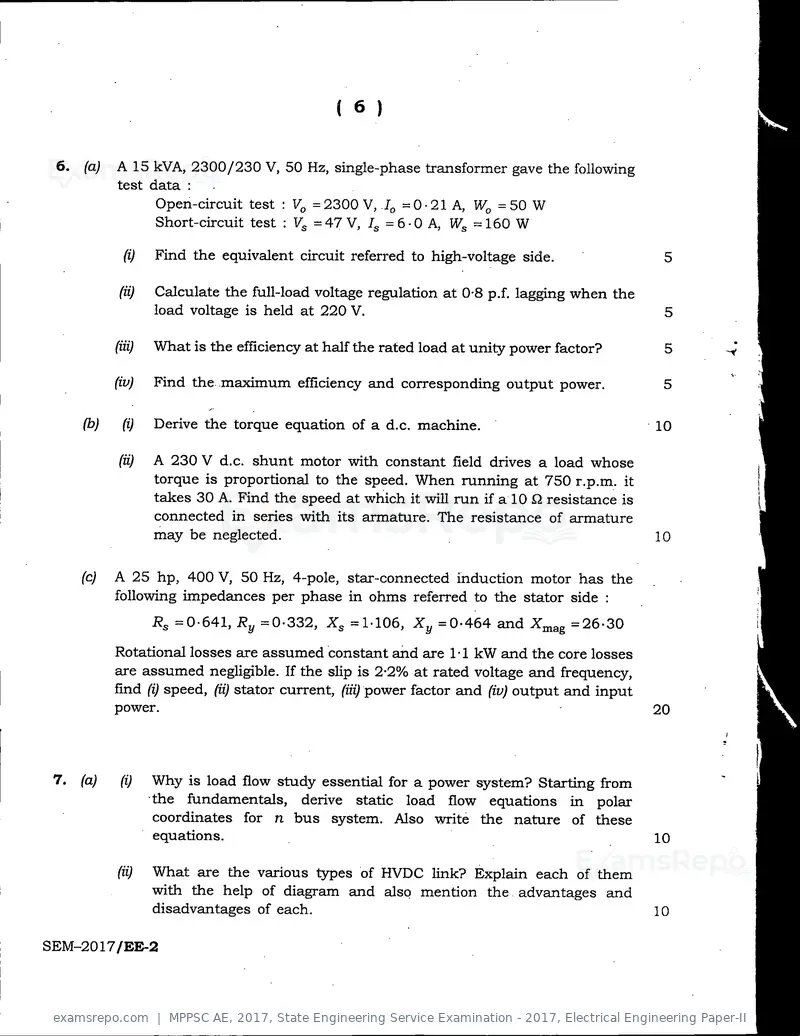
Text of page 6
(6)


 6. (a) A 15 kVA, 2300/230 V, 50 Hz, single-phase transformer gave the following
          test data :
                 Open-circuit test :    =2300V,.I^ = 0-21 A,        =50 W
                 Short-circuit test : Vg = 47 V, /^ = 6 •0 A, Wg =160 W

           (i)   Find the equivalent circuit referred to high-voltage side.                   5

          (ii)   Calculate the full-load voltage regulation at 0-8 p.f. lagging when the
                 load voltage is held at 220 V.                                               5

          (Hi)   What is the efficiency at half the rated load at unity power factor?         5

          (iv)   Find the maximum efficiency and corresponding output power.                  5

    (b)    (i)   Derive the torque equation of a d.c. machine.                               10

          (ii)   A 230 V d.c. shunt motor with constant field drives a load whose
                 torque is proportional to the speed. When running at 750 r.p.m. it
                 takes 30 A. Find the speed at which it will run if a 10 £2 resistance is
                 connected in series with its armature. The resistance of armature
                 may be neglected.                                                           10


    (c)   A 25 hp, 400 V, 50 Hz, 4-pole, star-connected induction motor has the
          following impedances per phase in ohms referred to the stator side :
                 i?g =0-641, Ry =0-332,       =1-106, Xy =0-464 and X„^^ =26-30
          Rotational losses are assumed constant and are 1 -1 kW and the core losses
          are assumed negligible. If the slip is 2-2% at rated voltage and frequency,
          find (i) speed, (ii) stator current, (in) power factor and (iv) output and input
          power.                                                                             20


 7. (a)    (i)   Why is load flow study essential for a power system? Starting from
                 the fundamentals, derive static load flow equations in polar
                 coordinates for n bus system. Also write the nature of these
                 equations.                                                                  10

          (ii)   What are the various tiqjes of HVDC link? Explain each of them
                 with the help of diagram and also mention the advantages and
                 disadvantages of each.                                                      10

SEM-2017/EE-2
Text of page 7
(7)


    (b)   (i)    Discuss the advantages of digital relays. Describe the basic functional
                 blocks of a digital relay.                                                10

          (ii)   Explain the principle of -working of distance relays.                     10


    (c)   (i)    Explain the construction, principle and working of an oil circuit
                 breaker with a neat sketch.                                               10

          (ii)   Describe the trip circuit diagram of 3-zone distance relay used for the
                 protection of a transmission line. Why are 3 zones necessary? How
                 their reach setting and time setting is done?                             10


                                            ★★★


SEM-2017/EE-2                                                                     MM8—272
Page 1 of 7
Source: Madhya Pradesh Public Service Commission. Question paper published by Madhya Pradesh Public Service Commission.