
REET 2025: REET 2024 Level 1 (Paper code PL-1), Shift 1
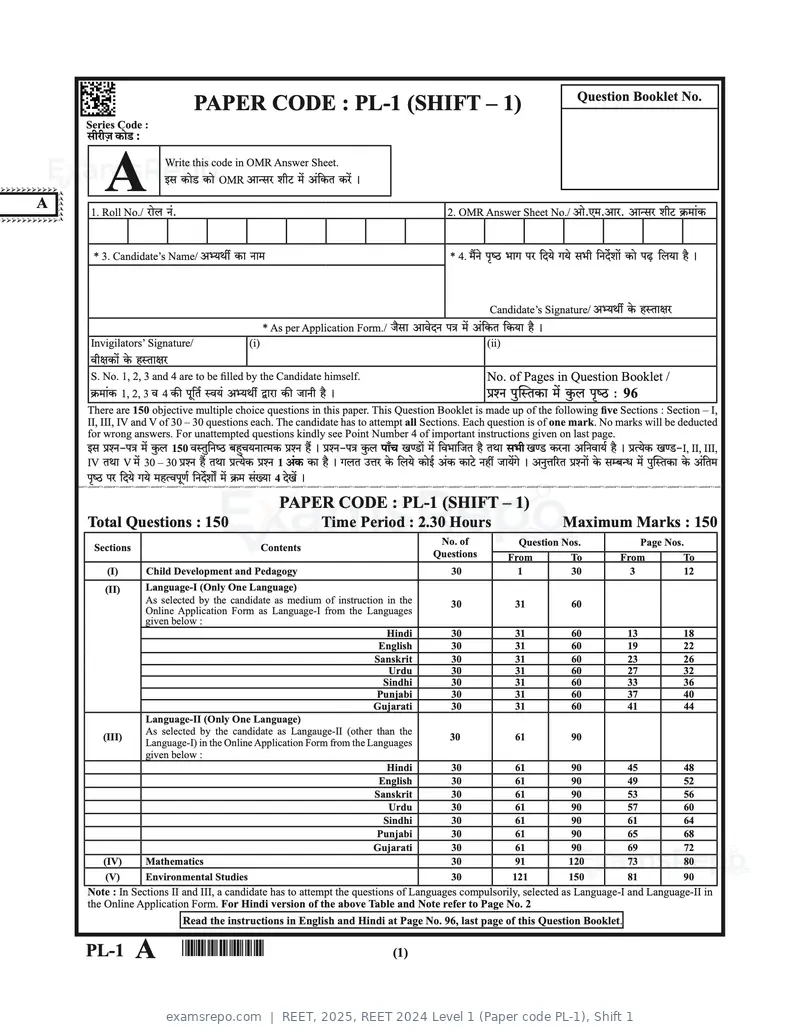
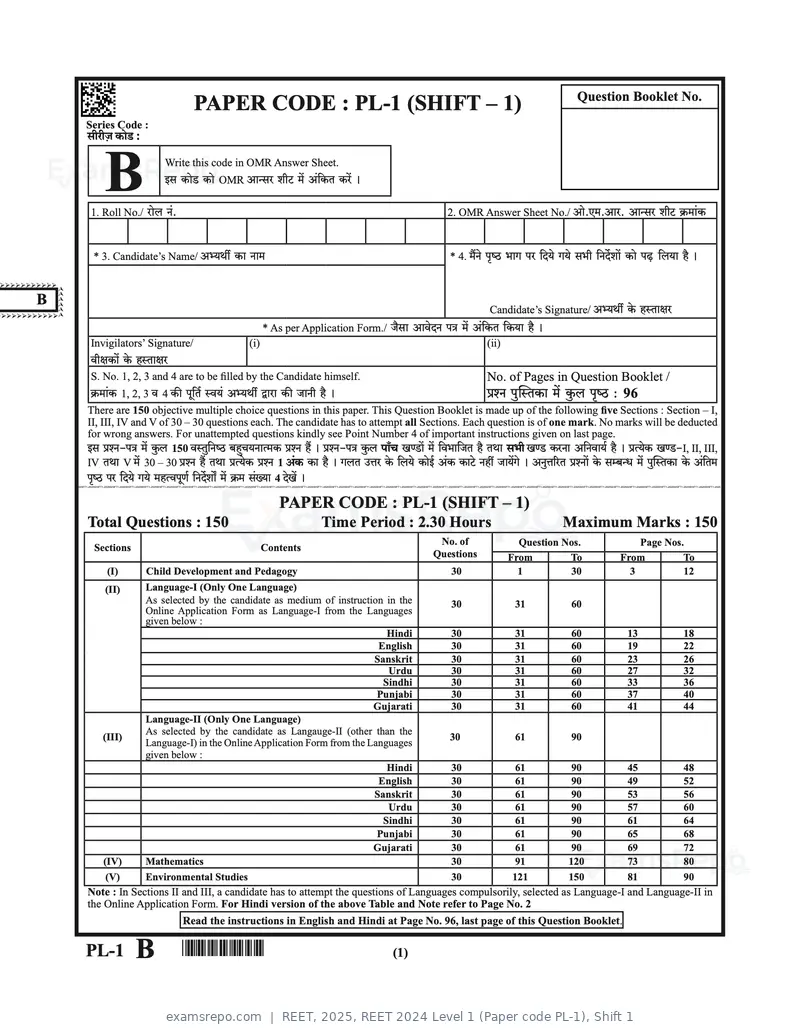
Text of page 1
Question Booklet No.
PAPER CODE : PL-1 (SHIFT – 1)
Series Code :
A
grarµO H$moS> :
Write this code in OMR Answer Sheet.
Bg H$moS> H$mo OMR AmÝga erQ> _| A§{H$V H$a| &
A
1. Roll No./ amob Z§. 2. OMR Answer Sheet No./ Amo.E_.Ama. AmÝga erQ> H«$_m§H$
* 3. Candidate’s Name/ Aä`Wu H$m Zm_ * 4. _¢Zo n¥îR> ^mJ na {X`o J`o g^r {ZX}em| H$mo n‹T> {b`m h¡ &
Candidate’s Signature/ Aä`Wu Ho$ hñVmja
* As per Application Form./ O¡gm AmdoXZ nÌ _| A§{H$V {H$`m h¡ &
Invigilators’ Signature/ (i) (ii)
drjH$m| Ho$ hñVmja
S. No. 1, 2, 3 and 4 are to be filled by the Candidate himself. No. of Pages in Question Booklet /
H«$_m§H$ 1, 2, 3 d 4 H$s ny{V© ñd`§ Aä`Wu Ûmam H$s OmZr h¡ & àíZ nwpñVH$m _| Hw$b n¥îR> : 96
There are 150 objective multiple choice questions in this paper. This Question Booklet is made up of the following five Sections : Section – I,
II, III, IV and V of 30 – 30 questions each. The candidate has to attempt all sections. Each question is of one mark. No marks will be deducted
for wrong answers. for unattempted questions kindly see point number 4 of important instructions given on last page.
Bg àíZ-nÌ _| Hw$b 150 dñVw{ZîR> ~hþM`ZmË_H$ àíZ h¢ & àíZ-nÌ Hw$b nm±M IÊS>m| _| {d^m{OV h¡ VWm g^r IÊS> H$aZm A{Zdm`© h¡ & àË`oH$ IÊS>-I, II, III,
IV VWm V _| 30 – 30 àíZ h¢ VWm àË`oH$ àíZ 1 A§H$ H$m h¡ & JbV CÎma Ho$ {b`o H$moB© A§H$ H$mQ>o Zht Om`|Jo & AZwÎm[aV àíZm| Ho$ gå~ÝY _| nwpñVH$m Ho$ A§{V_
n¥îR> na {X`o J`o _hËdnyU© {ZX}em] _| H«$_ g§»`m 4 XoI| &
SHIFT1-2025SHIFT1-2025SHIFT1-2025SHIFT1-2025SHIFT1-2025SHIFT1-2025SHIFT1-2025SHIFT1-2025SHIFT1-2025SHIFT1-2025SHIFT1-2025SHIFT1-2025SHIFT1-2025SHIFT1-2025SHIFT1-2025SHIFT1-2025SHIFT1-2025SHIFT1-2025SHIFT1-2025SHIFT1-2025SHIFT1-2025SHIFT1-2025SHIFT1-2025SHIFT1-2025SHIFT1-2025SHIFT1-2025SHIFT1-2025SHIFT1-2025SHIFT1-2025SHIFT1-2025SHIFT1-2025SHIFT1-2025SHIFT1-2025SHIFT1-2025SHIFT1-2025SHIFT1-2025SHIFT1-2025SHIFT1-2025SHIFT1-2025SHIFT1-2025SHIFT1-2025
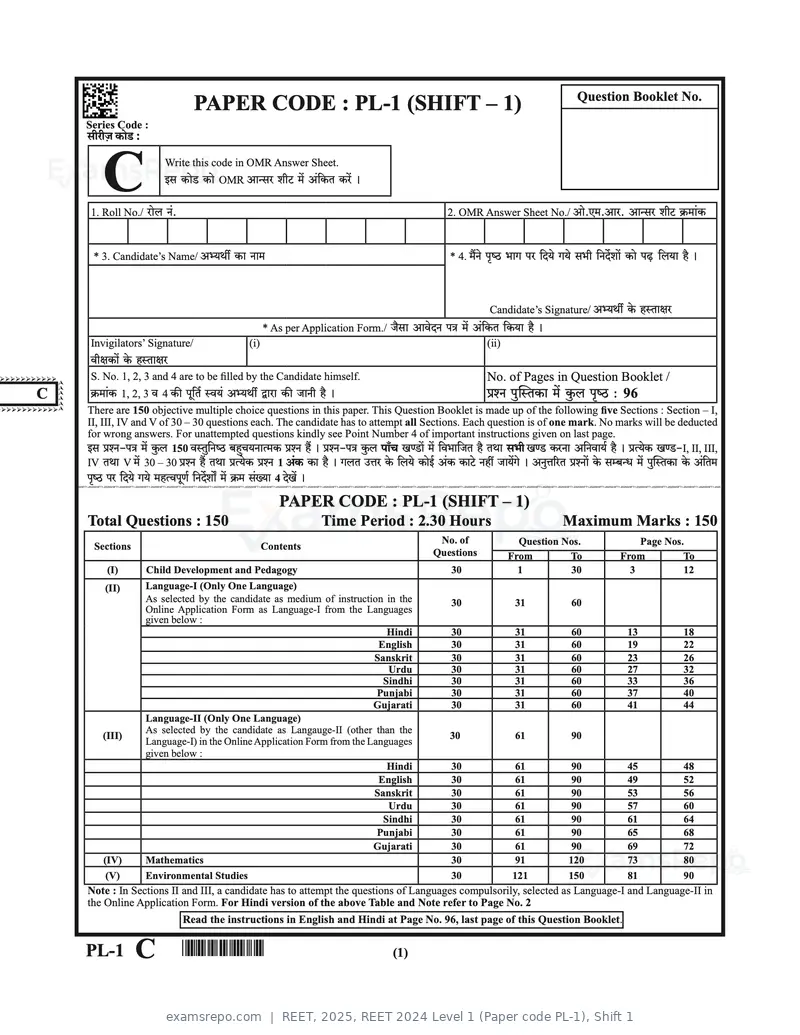
PAPER CODE : PL-1 (SHIFT – 1)
Total Questions : 150 Time period : 2.30 Hours Maximum Marks : 150
No. of Question Nos. Page Nos.
Sections Contents
Questions From To From To
(I) Child Development and Pedagogy 30 1 30 3 12
(II) Language-I (Only One Language)
As selected by the candidate as medium of instruction in the 30 31 60
Online Application Form as language-I from the languages
given below :
Hindi 30 31 60 13 18
English 30 31 60 19 22
Sanskrit 30 31 60 23 26
Urdu 30 31 60 27 32
Sindhi 30 31 60 33 36
Punjabi 30 31 60 37 40
Gujarati 30 31 60 41 44
Language-II (Only One Language)
As selected by the candidate as Langauge-II (other than the
(III) 30 61 90
Language-I) in the Online Application Form from the Languages
given below :
Hindi 30 61 90 45 48
English 30 61 90 49 52
Sanskrit 30 61 90 53 56
Urdu 30 61 90 57 60
Sindhi 30 61 90 61 64
Punjabi 30 61 90 65 68
Gujarati 30 61 90 69 72
(IV) Mathematics 30 91 120 73 80
(V) Environmental Studies 30 121 150 81 90
Note : In Sections II and III, a candidate has to attempt the questions of Languages compulsorily, selected as Language-I and Language-II in
the Online Application Form. For Hindi version of the above Table and Note refer to Page No. 2
Read the instructions in English and Hindi at Page No. 96, last page of this Question Booklet.
PL-1 A *PL1A* (1)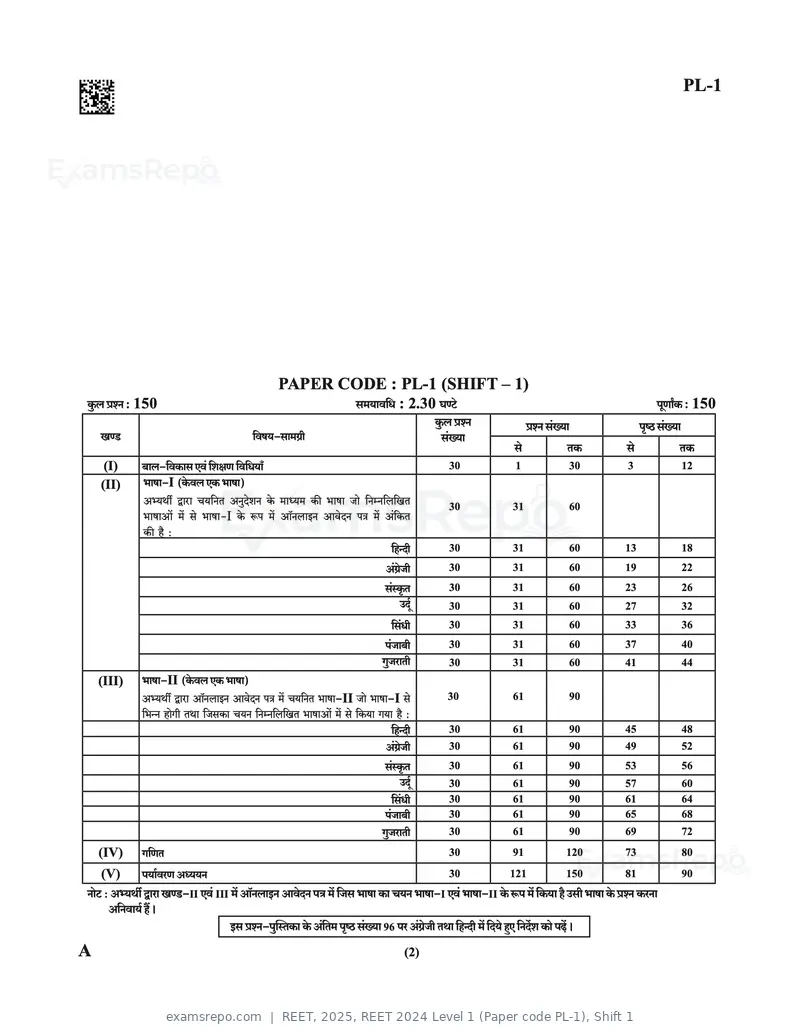
Text of page 19
PL-1

                                       SECTION – II
                                      LANGUAGE – I
                                        ENGLISH
                          There are 30 questions in all in this Section.
                                 All questions are compulsory.

  31. The correct passive voice of ‘He draws a sketch everyday.’ is
      (A) A sketch is drawn everyday.
      (B) A sketch was drawn everyday.
      (C) A sketch is being drawn everyday.
      (D) A sketch was being drawn by him everyday.

  32. The phonetic transcription of the word ‘description’ is
      (A) /deskripsΛn/			                     (B) /discr∂p∫en/
      (C) /dɪ'skrɪpθn/			                     (D) /diskrip∫n/

  33. _________ is a drawback in the implementation of the direct method in teaching of
      English.
      (A) Use of mother tongue            (B) Familiar texts
      (C) Lack of facilities			           (D) Charts

Passage (For Q. Nos. 34 to 40) :
The old man sighed and picked up the chisel and the hammer. He loved his work and did not want
to change it for any other work in the world. For days together, the man worked continuously
without taking rest. His one desire was to finish the sculpture which would be his last. He worked
till his hands began to tremble and his shoulders started to ache. His arms grew heavy and his
eyes grew tired. And then he couldn’t see anymore.


  34. ___________ is a noun.
      (A) Picked			                               (B) Desired
      (C) Chisel			                               (D) Tremble

  35. In the phrase ‘... any other work in the world’, the word ‘other’ is
      (A) noun             (B) subject          (C) object          (D) determiner

  36. ‘Continuously’ is
      (A) adverb			                               (B) noun
       (C) adjective			                           (D) conjunction
                                               (19)                                             A
Text of page 20
PL-1

    37. The sentence that is incorrect due to the use of wrong determiner is
        (A) He worked till their hands began to tremble.
        (B) He loved his work.
        (C) His arms grew heavy.
        (D) The old man sighed and picked up the chisel and the hammer.


    38. ____________ is that incorrect sentence.
        (A) He loved his work.
        (B) It would be his last work.
        (C) His arms grown heavy.
        (D) He worked till hands began to tremble.

    39. Cotton is ___________ than wood. Choose the correct adjective.
        (A) heavier       (B) lighter       (C) heavy            (D) light

    40. The comparative degree of ‘heavy’ is
        (A) more heavy			                         (B) most heavy
        (C) heavier			                            (D) heaviest

    41. The correct word with this symbol (ð) sound is
        (A) brother			                         (B) laughter
        (C) great			                           (D) higher

    42. ‘Unit of teaching is a word’ is a feature of
        (A) direct method
         (B) indirect method
         (C) grammar cum translation method
        (D) communicative approach

    43. ‘Reading is a process of sight, sound and scene.’ is quoted by
        (A) P.B. Ballard			                      (B) Dr. West
         (C) W.S. Gray			                        (D) Jesperson

    44. ‘They will not help their needy neighbour.’ The correct question for the sentence is
        (A) What did he do ?			                 (B) Why will the neighbour not help ?
         (C) Who will they not help ?           (D) What did the neighbour do ?

    45. In learning English as L2, the following skill is acquired independently
        (A) vocabulary			                        (B) listening
         (C) none			                             (D) all
A                                                (20)
Text of page 21
PL-1

  46. In CCE, the focus remains on
      (A) progress, process and product
       (B) course, test, performance
       (C) time, process, assessment
      (D) formats, product, record

  47. ‘When we learn a second language, we tend to filter the universe through the
      language already known.’ is a principle of
       (A) Using mother tongue                 (B) Exposure
       (C) Habit formation			                 (D) Motivation

  48. The communicative Approach develops
      (A) the speech and expression ability (B) grammar skills
      (C) knowledge			                      (D) vision of learning

  49. The use of multimedia aids such as T.V., radio, computer etc. in teaching is also
      known as _________ approach.
      (A) visual			                           (B) software
      (C) audio			                            (D) hardware

  50. ‘The doctor has given her a good treatment.’ The passive voice of this sentence is
      (A) She was given a good treatment.
       (B) She gave the doctor a good treatment.
       (C) A good treatment was given to her by the doctor.
      (D) A good treatment has been given to her by the doctor.


Passage (For Q. Nos. 51 to 57) :

He began to believe that most of the diseases were caused by bacteria. Many other scientists
also treated bacteria as the enemy of man. They could not be seen but are present everywhere to
cause mischief. Dr. Jenner in England had already discovered vaccination for small-pox. Here
Pasteur was trying to discover a cure for a terrible disease called anthrax. It killed lots of cows
and sheeps in France. He tried to give the cows and sheeps some weak germs of the same disease
to make them safe against disease for the future. It must have seemed a very dangerous idea in
those days. Many scientists were angry about it.

  51. ‘...... but are present everywhere......’ According to the passage, the underlined word
      means
      (A) sold              (B) lost             (C) found           (D) forgot
                                               (21)                                              A
Text of page 22
PL-1

    52. The correct spelling is
        (A) Mischievus			                         (B) Mischievous
        (C) Mischeivous			                        (D) Mischieous

    53. The noun form of the word ‘discover’ is
        (A) invention			                        (B) discovery
        (C) discovered			                       (D) invented

    54. The word opposite in meaning of ‘present’ is
        (A) everywhere			                     (B) absent
        (C) attendance			                     (D) gift

    55. ‘danger-dangerous’ is a pair of
        (A) noun-adjective			                     (B) noun-pronoun
         (C) noun-adverb			                       (D) adjective-noun

    56. ‘To act or behave in a certain way towards somebody’ is
        (A) treat			                            (B) inject
         (C) cure			                            (D) vaccinate

    57. One word for ‘illness of body or mind’ is
        (A) disease			                          (B) healthy
        (C) bacteria			                         (D) vaccination

    58. There are tests in education system
        (A) to fail the learners
        (B) to pass the learners
        (C) to grade and rank the learners
        (D) to detain the learners

    59. ‘I am sick.’ The correct question tag for this sentence is
        (A) Aren’t I ?			                         (B) Are you ?
         (C) Am I ?			                            (D) Am you ?


    60. One of the features of the portfolio in CCE is
        (A) Objective tests
        (B) It promotes diversity in the assessment method
        (C) Partiality
        (D) Record maintenance

A                                                (22)
Text of page 27
PL-1

       II –
       I–
              (CXÿ© )


                                    .31


(D)   (C)               (B)   (A)


                                    .32

(D)   (C)               (B)   (A)


                                    .33
(D)   (C)               (B)   (A)

            (27)                          A
Text of page 28
PL-1


                                    .34


     (D)   (C)          (B)   (A)


                                    .35

     (D)   (C)          (B)   (A)


                                    .36

							                       (A)

							                       (B)

							                       (C)

							                       (D)


                                    .37

     (D)   (C)          (B)   (A)


                                    .38

    		     (B)			             (A)

			        (D)			             (C)


                                    .39

     (D)   (C)          (B)   (A)

A                (28)
Text of page 29
PL-1


                                 .40
			     (B)			             (A)
			     (D)			             (C)


                                 .41

  (D)   (C)          (B)   (A)


                                 .42

  (D)   (C)          (B)   (A)


                                 .43

  (D)   (C)          (B)   (A)

                                 .44

			     (B)			             (A)

			     (D)			             (C)

                                 .45

  (D)   (C)          (B)   (A)

              (29)                     A
Text of page 30
PL-1


                                      .46

                               (A)


                               (B)


                               (C)

                               (D)


                                      .47

    (D)   (C)          (B)     (A)

                                      .48

			       (B)			               (A)

			       (D)			               (C)


                                      .49

			                          		 (A)

			                          		 (B)

			                          		 (C)

			                          		 (D)

                                      .50

			       (B)			               (A)

			       (D)			               (C)
A               (30)
Text of page 31
PL-1


                                  .51

			      (B)			             (A)

			 (D)			 (C)


                                  .52

   (D)   (C)          (B)   (A)


                                  .53

			      (B)			             (A)

			      (D)			             (C)


                                  .54

			      (B)			             (A)

			      (D)			             (C)


                                  .55

							                     (A)

							                     (B)

							                     (C)

							                     (D)

                                  .56

   (D)   (C)          (B)   (A)
               (31)                     A
Text of page 32
PL-1

                     .57

			   (B)			   (A)

			   (D)			   (C)


                     .58


			   (B)			   (A)

			   (D)			   (C)


                     .59

               (A)

               (B)

               (C)

               (D)


           .60

					  (A)

			    (B)

			   (C)

			   (D)

A      (32)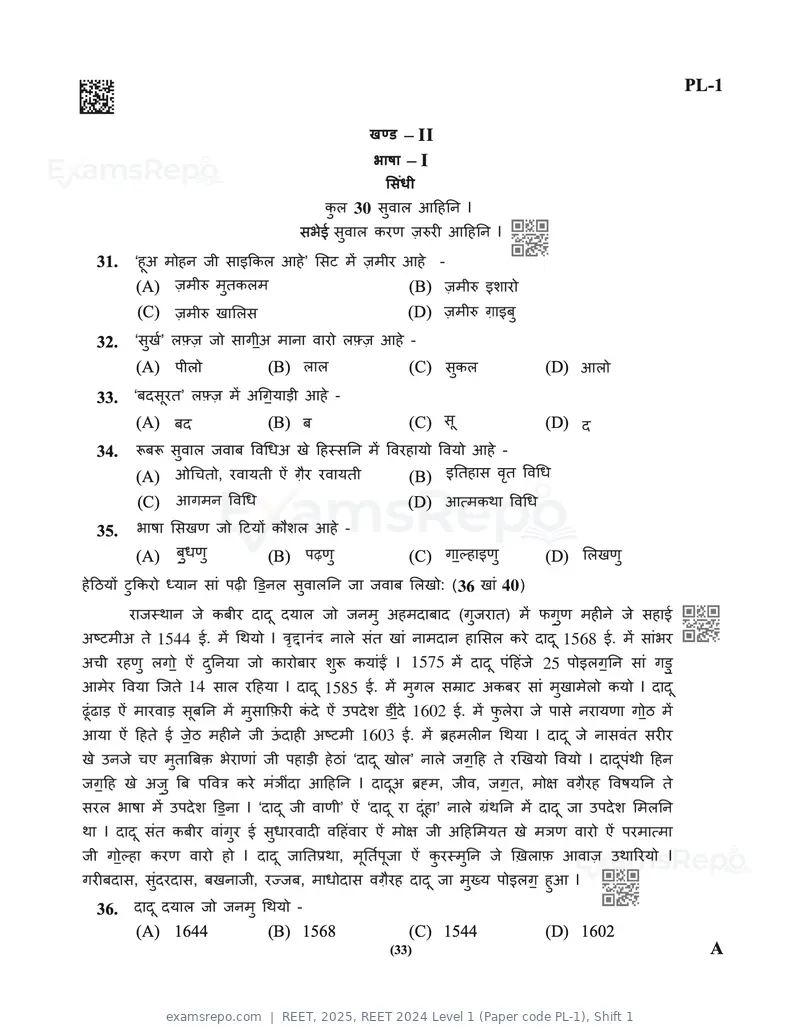
Text of page 33
PL-1

                             > – ii
                               –i


31.
      (A)         			          (B)
      (C)        			           (D)
32.
      (A)        (B)           (C)        (D)
33.
      (A)        (B)           (C)        (D)
34.
      (A)                      (B)
      (C)        			           (D)
35.
      (A)        (B)           (C)        (D)


36.
      (A) 1644   (B) 1568      (C) 1544   (D) 1602
                            (33)                       A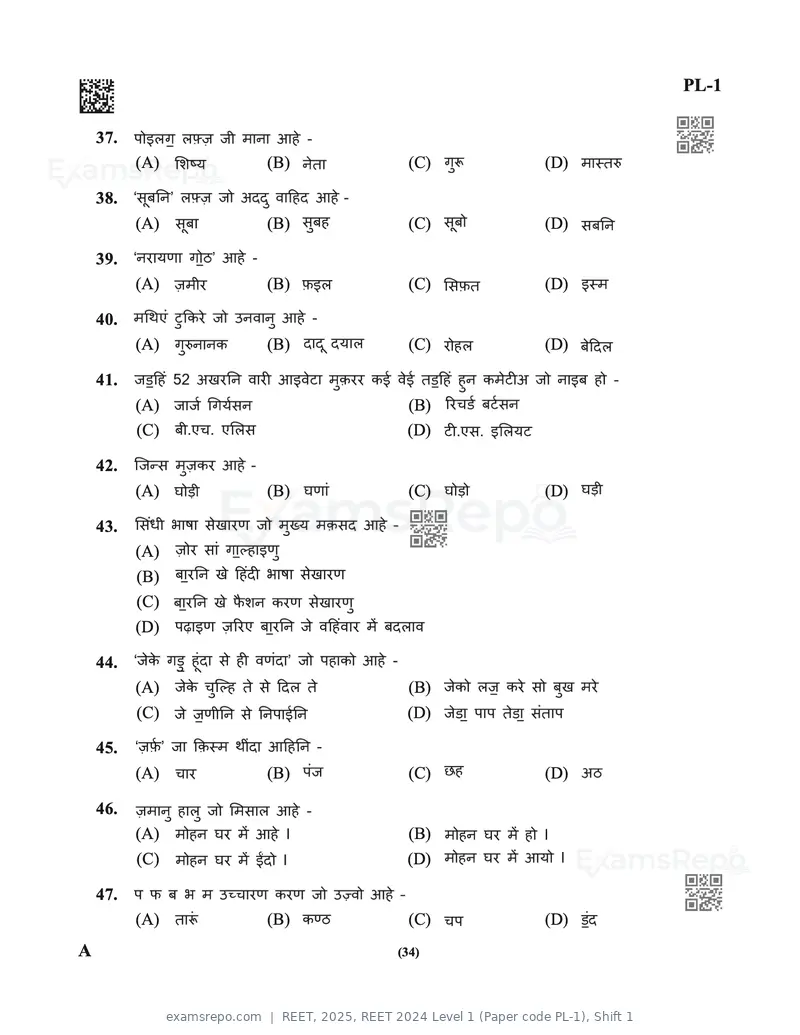
Text of page 34
PL-1

    37.
          (A)   (B)       (C)   (D)

    38.
          (A)   (B)       (C)   (D)

    39.
          (A)   (B)       (C)   (D)

    40.
          (A)   (B)       (C)   (D)

    41.
          (A)   			      (B)
          (C)   			      (D)

    42.
          (A)   (B)       (C)   (D)

    43.
          (A)
          (B)
          (C)
          (D)

    44.
          (A)            (B)
          (C)            (D)

    45.
          (A)   (B)       (C)   (D)

    46.
          (A)      		    (B)
          (C)     			    (D)

    47.
          (A)   (B)       (C)   (D)
A                       (34)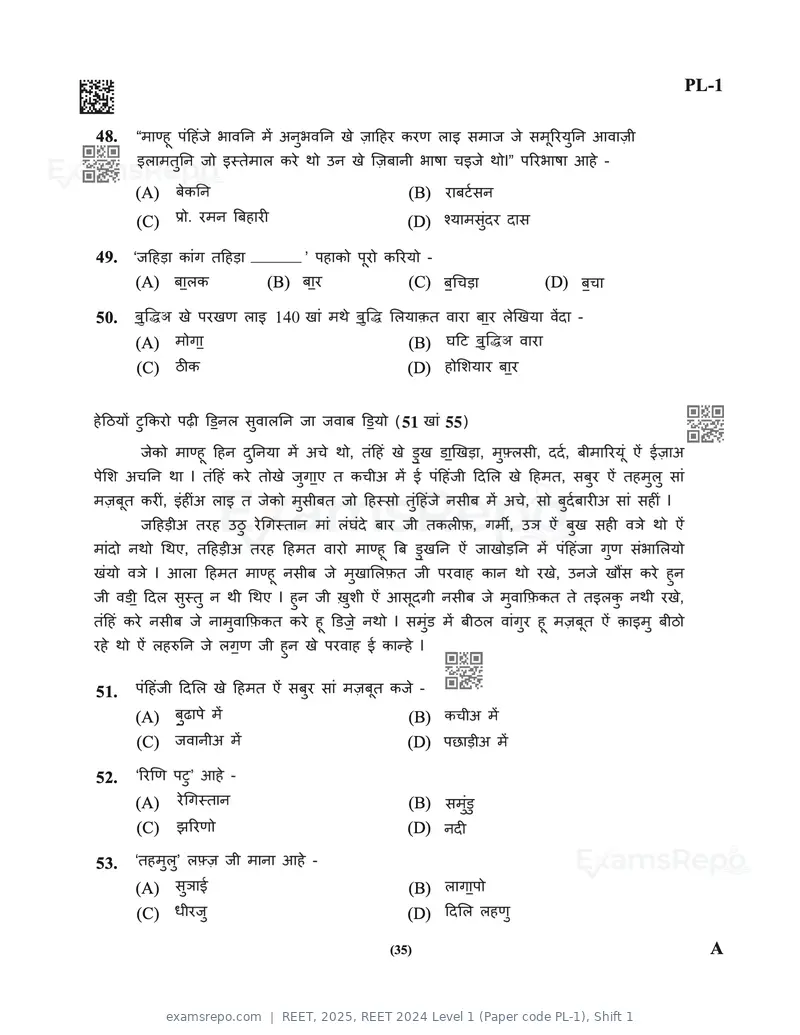
Text of page 35
PL-1

48.


      (A)   			        (B)
      (C)     			      (D)

49.
      (A)     (B)      (C)   (D)

50.
      (A)   			        (B)
      (C)   			        (D)


51.
      (A)   			        (B)
      (C)    			       (D)

52.
      (A)   			        (B)
      (C)   			        (D)

53.
      (A)   			        (B)
      (C)   			        (D)

                    (35)             A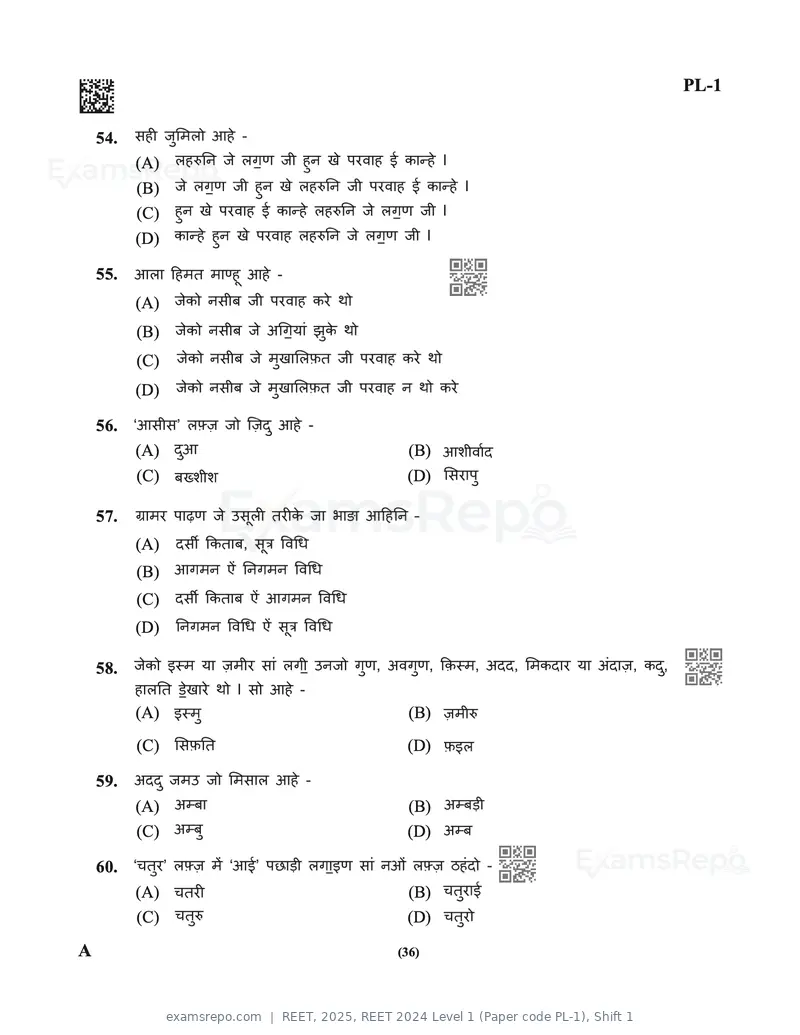
Text of page 36
PL-1

    54.
          (A)
          (B)
          (C)
          (D)

    55.
          (A)
          (B)
          (C)
          (D)

    56.
          (A)   			     (B)
          (C)    			    (D)

    57.
          (A)
          (B)
          (C)
          (D)

    58.

          (A)   			      (B)
          (C)   			     (D)

    59.
          (A)   			     (B)
          (C)   			     (D)

    60.
          (A)   			     (B)
          (C)   			     (D)
A                      (36)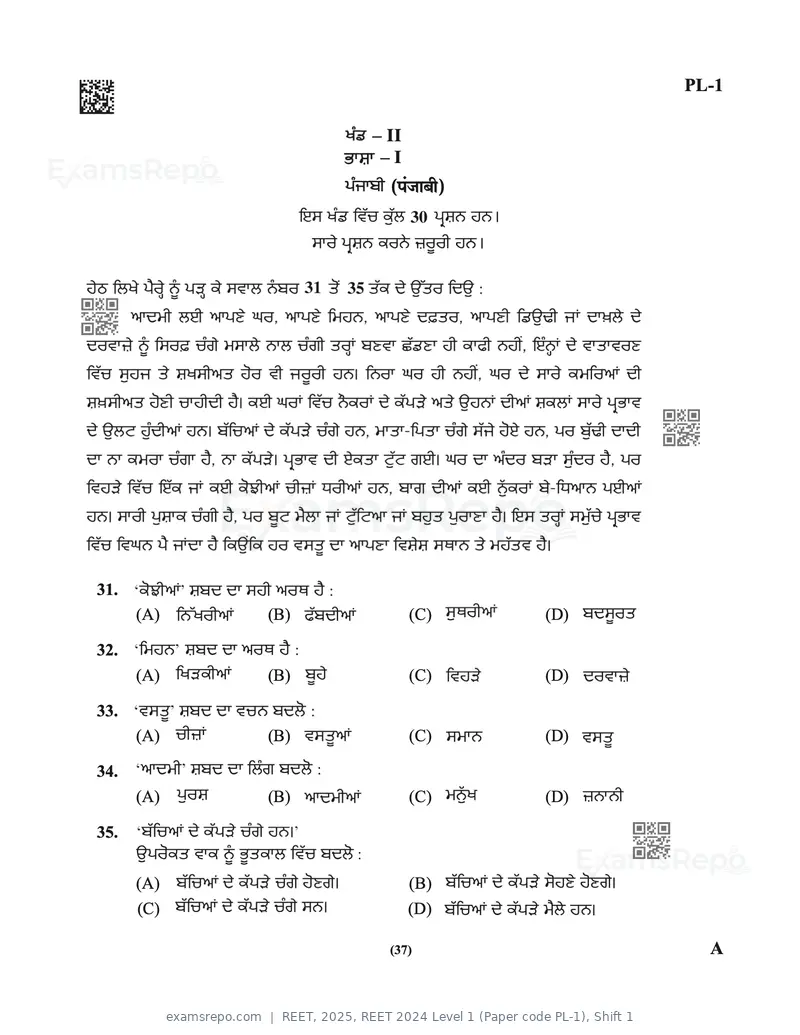
Text of page 37
PL-1

                  – ii
                   –i
                    (n§Om~r)


31.
      (A)   (B)          (C)   (D)

32.
      (A)   (B)          (C)   (D)

33.
      (A)   (B)          (C)   (D)

34.
      (A)   (B)          (C)   (D)

35.


      (A)                (B)
      (C)                (D)

                    (37)               A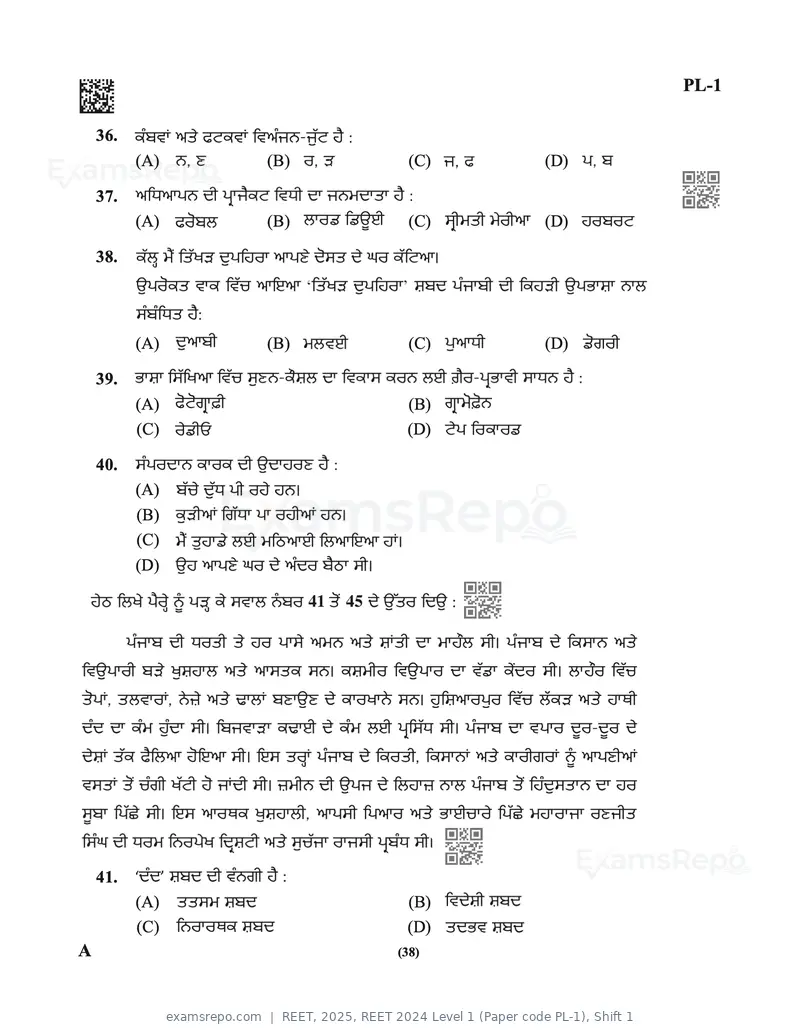
Text of page 38
PL-1

    36.
          (A)    (B)      (C)   (D)

    37.
          (A)    (B)      (C)   (D)

    38.


          (A)    (B)      (C)   (D)

    39.
          (A)   			      (B)
          (C)   			      (D)

    40.
          (A)
          (B)
          (C)
          (D)


    41.
          (A)    			     (B)
          (C)     			    (D)
A                       (38)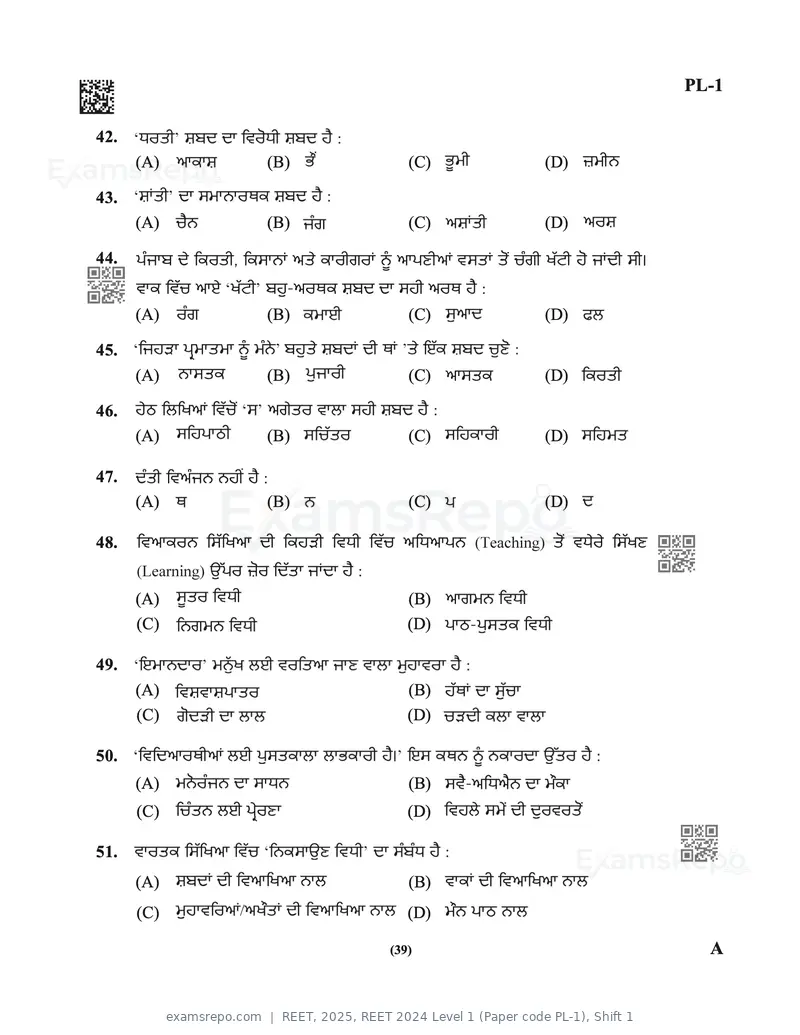
Text of page 39
PL-1

42.
      (A)    (B)        (C)   (D)

43.
      (A)    (B)        (C)   (D)

44.


      (A)    (B)        (C)   (D)

45.
      (A)    (B)        (C)   (D)

46.
      (A)    (B)        (C)   (D)

47.
      (A)    (B)        (C)   (D)

48.


      (A)   			         (B)
      (C)    			        (D)

49.
      (A)   			         (B)
      (C)   			         (D)

50.
      (A)       		      (B)
      (C)      			      (D)

51.
      (A)               (B)
      (C)               (D)

                     (39)             A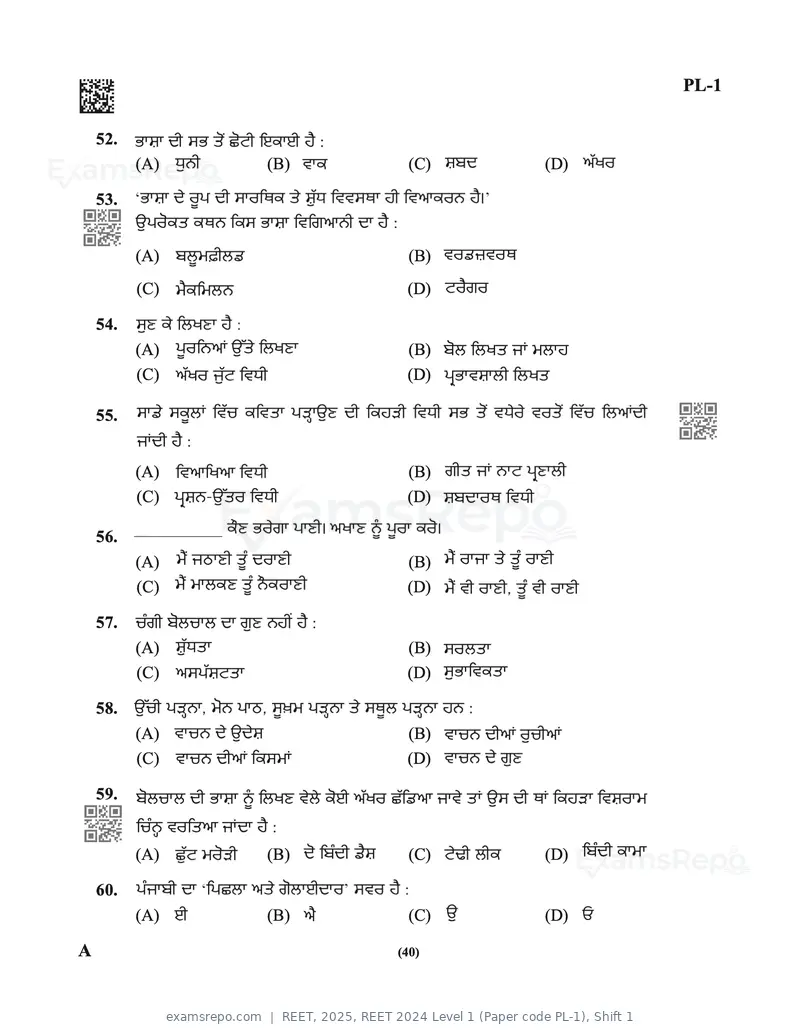
Text of page 40
PL-1

    52.
          (A)     (B)          (C)   (D)

    53.


          (A)    			           (B)
          (C)   			           (D)

    54.
          (A)                 (B)
          (C)     			         (D)

    55.


          (A)     			         (B)
          (C)      			        (D)

    56.
          (A)           		    (B)
          (C)                 (D)

    57.
          (A)   			           (B)
          (C)    			          (D)

    58.
          (A)     			         (B)
          (C)       		        (D)

    59.


          (A)     (B)          (C)   (D)

    60.
          (A)     (B)          (C)   (D)

A                            (40)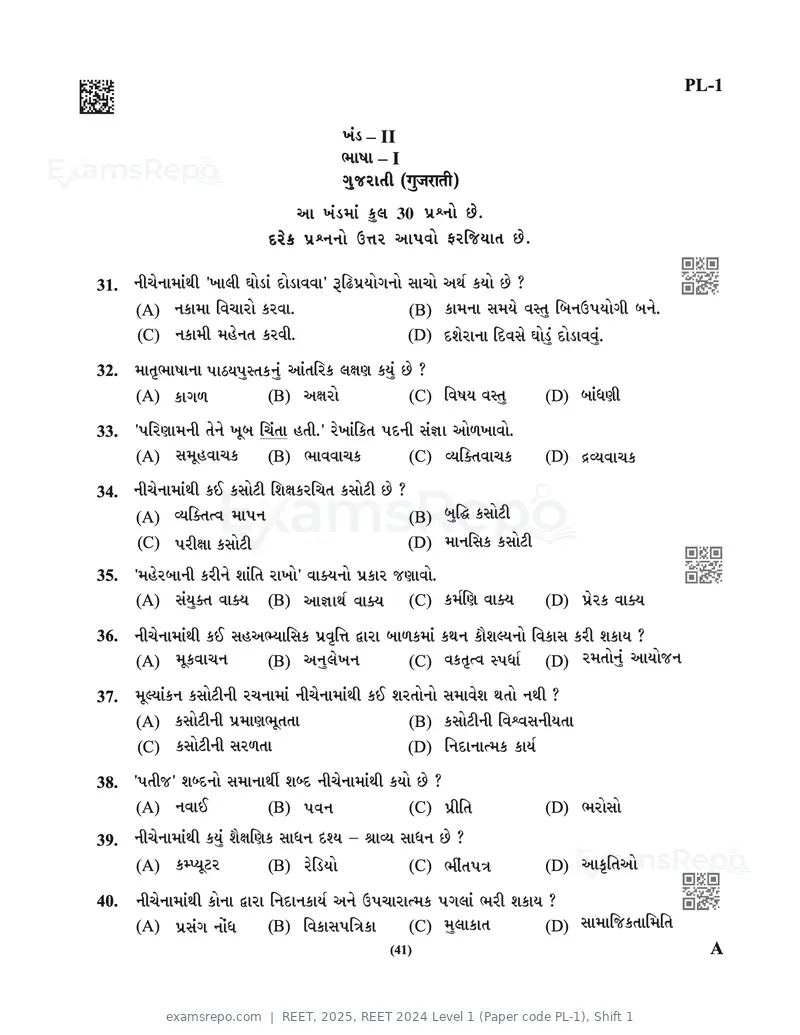
Text of page 41
PL-1

                       – iI
                        –i
                              (JwOamVr)


31.
      (A)         		           (B)
      (C)         		           (D)

32.
      (A)   (B)                (C)        (D)

33.
      (A)   (B)                (C)        (D)

34.
      (A)    			               (B)
      (C)   			                (D)
35.
      (A)   (B)                (C)        (D)

36.
      (A)   (B)                (C)        (D)

37.
      (A)      		              (B)
      (C)    			               (D)

38.
      (A)   (B)                (C)        (D)
39.
      (A)   (B)                (C)        (D)

40.
      (A)   (B)                (C)        (D)
                         (41)                     A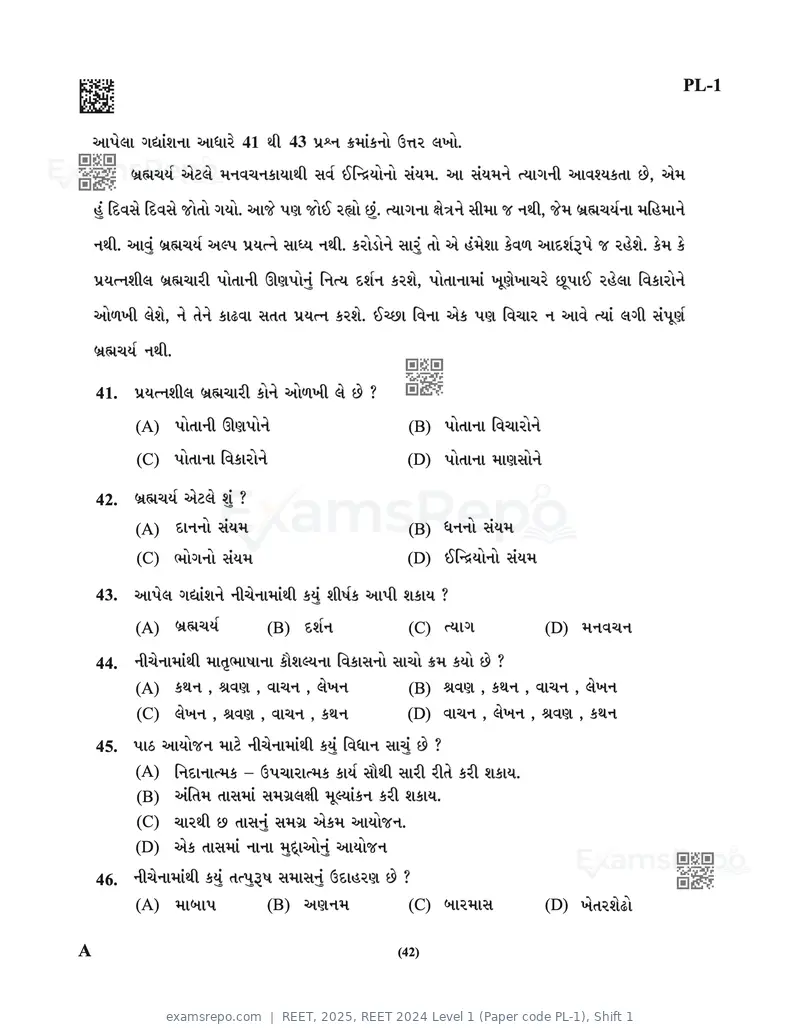
Text of page 42
PL-1


    41.
          (A)    			     (B)
          (C)   			     (D)

    42.
          (A)   			      (B)
          (C)   			     (D)

    43.
          (A)   (B)      (C)   (D)

    44.
          (A)           (B)
          (C)           (D)
    45.
          (A)
          (B)
          (C)
          (D)
    46.
          (A)   (B)      (C)   (D)

A                      (42)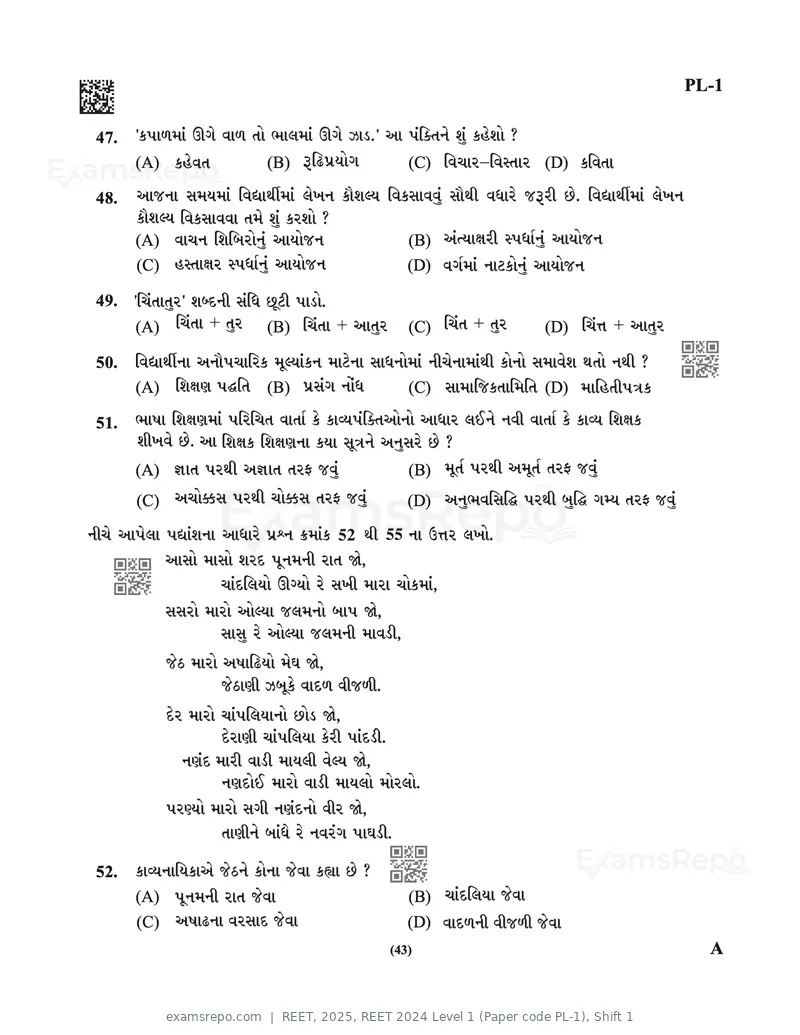
Text of page 43
PL-1

47.
      (A)   (B)        (C)   (D)

48.

      (A)              (B)
      (C)              (D)

49.
      (A)   (B)        (C)   (D)

50.
      (A)   (B)        (C)   (D)

51.

      (A)              (B)
      (C)              (D)


52.
      (A)    			       (B)
      (C)      		      (D)
                    (43)             A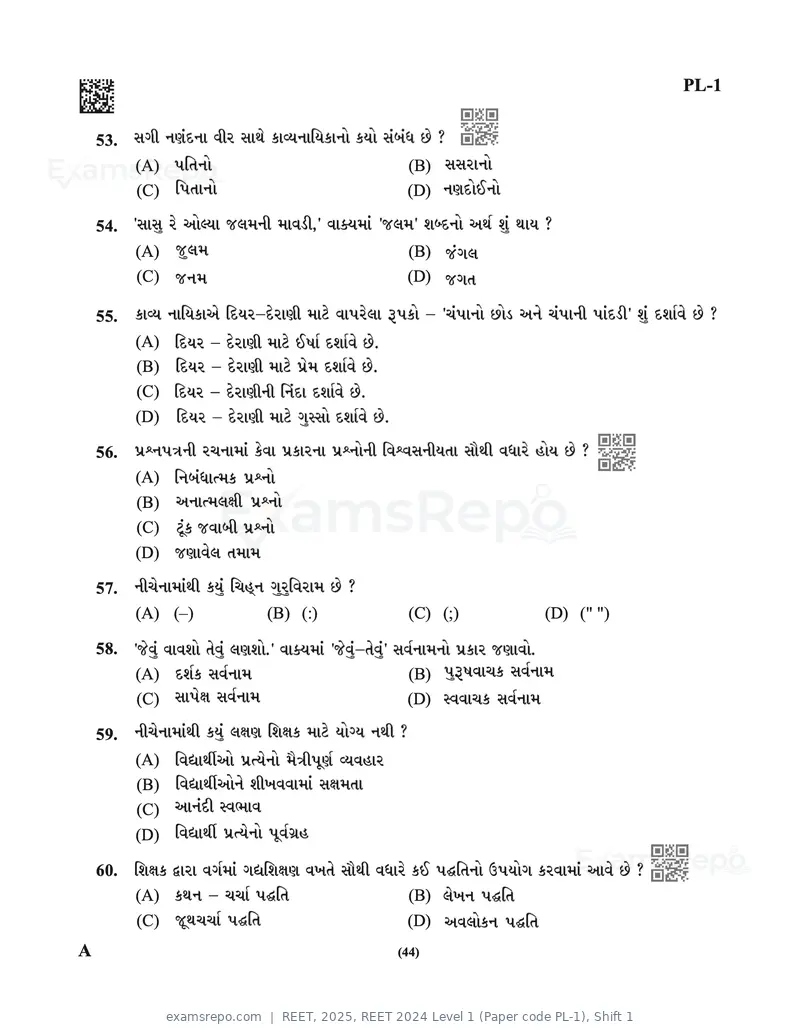
Text of page 44
PL-1

    53.
          (A)       			         (B)
          (C)       			         (D)

    54.
          (A)       			         (B)
          (C)       			         (D)

    55.
          (A)
          (B)
          (C)
          (D)

    56.
          (A)
          (B)
          (C)
          (D)

    57.
          (A) (–)    (B) (:)     (C) (;)   (D) (" ")

    58.
          (A)        			        (B)
          (C)        			        (D)

    59.
          (A)
          (B)
          (C)
          (D)

    60.
          (A)          		       (B)
          (C)        			        (D)
A                              (44)
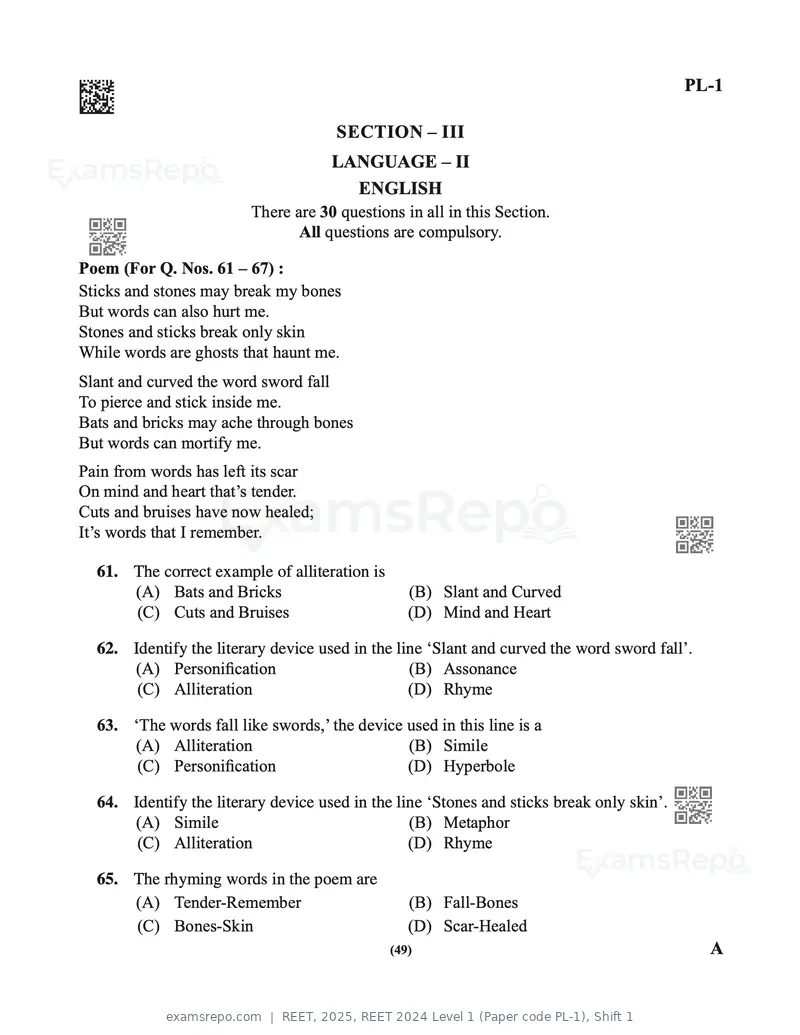
Text of page 49
PL-1

                                      SECTION – III
                                     LANGUAGE – II
                                       ENGLISH
                         There are 30 questions in all in this Section.
                                All questions are compulsory.

Poem (For Q. Nos. 61 – 67) :
Sticks and stones may break my bones
But words can also hurt me.
Stones and sticks break only skin
While words are ghosts that haunt me.
Slant and curved the word sword fall
To pierce and stick inside me.
Bats and bricks may ache through bones
But words can mortify me.
Pain from words has left its scar
On mind and heart that’s tender.
Cuts and bruises have now healed;
It’s words that I remember.

  61. The correct example of alliteration is
      (A) Bats and Bricks			                      (B) Slant and Curved
      (C) Cuts and Bruises			                     (D) Mind and Heart

  62. Identify the literary device used in the line ‘Slant and curved the word sword fall’.
      (A) Personification			                     (B) Assonance
       (C) Alliteration			                       (D) Rhyme

  63. ‘The words fall like swords,’ the device used in this line is a
      (A) Alliteration			                      (B) Simile
       (C) Personification			                  (D) Hyperbole

  64. Identify the literary device used in the line ‘Stones and sticks break only skin’.
      (A) Simile			                              (B) Metaphor
       (C) Alliteration			                       (D) Rhyme

  65. The rhyming words in the poem are
      (A) Tender-Remember                         (B) Fall-Bones
      (C) Bones-Skin			                           (D) Scar-Healed
                                               (49)                                           A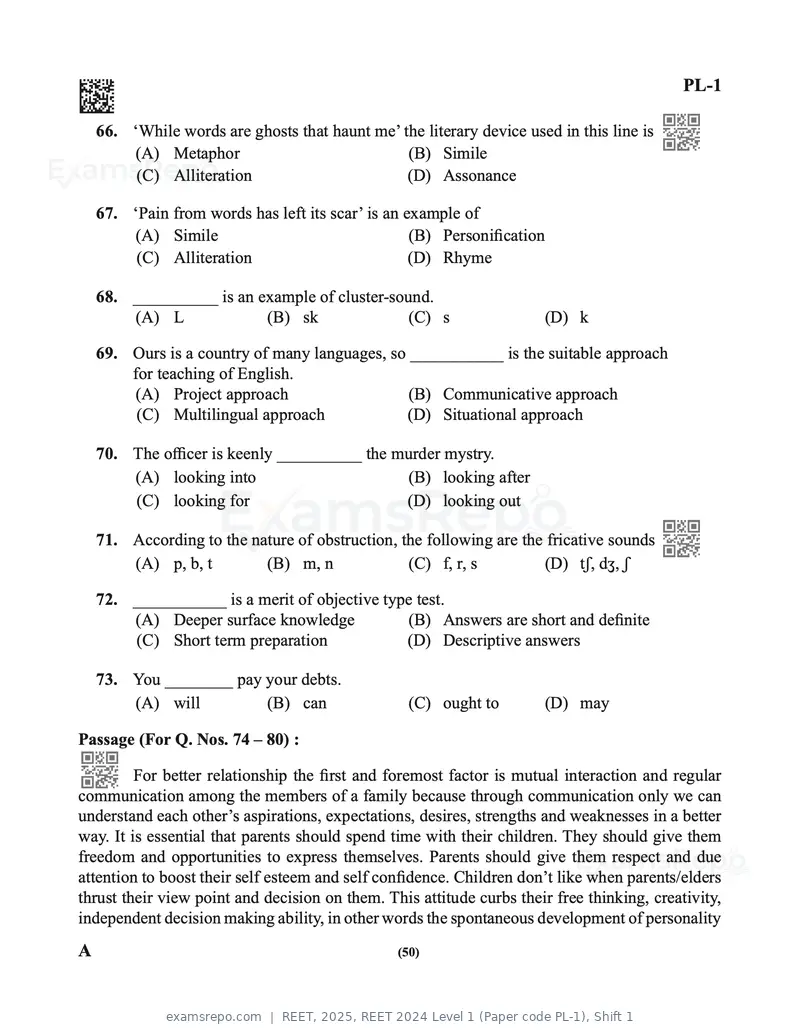
Text of page 50
PL-1

    66. ‘While words are ghosts that haunt me’ the literary device used in this line is
        (A) Metaphor			                         (B) Simile
         (C) Alliteration			                    (D) Assonance

    67. ‘Pain from words has left its scar’ is an example of
        (A) Simile			                              (B) Personification
         (C) Alliteration			                       (D) Rhyme

    68. __________ is an example of cluster-sound.
        (A) L             (B) sk               (C) s                   (D) k

    69. Ours is a country of many languages, so ___________ is the suitable approach
        for teaching of English.
        (A) Project approach			                 (B) Communicative approach
         (C) Multilingual approach             (D) Situational approach

    70. The officer is keenly __________ the murder mystry.
        (A) looking into			                   (B) looking after
        (C) looking for			                    (D) looking out

    71. According to the nature of obstruction, the following are the fricative sounds
        (A) p, b, t        (B) m, n              (C) f, r, s         (D) tʃ, dʒ, ʃ

    72. ___________ is a merit of objective type test.
        (A) Deeper surface knowledge           (B) Answers are short and definite
        (C) Short term preparation             (D) Descriptive answers

    73. You ________ pay your debts.
        (A) will         (B) can                  (C) ought to         (D) may

Passage (For Q. Nos. 74 – 80) :

		 For better relationship the first and foremost factor is mutual interaction and regular
communication among the members of a family because through communication only we can
understand each other’s aspirations, expectations, desires, strengths and weaknesses in a better
way. It is essential that parents should spend time with their children. They should give them
freedom and opportunities to express themselves. Parents should give them respect and due
attention to boost their self esteem and self confidence. Children don’t like when parents/elders
thrust their view point and decision on them. This attitude curbs their free thinking, creativity,
independent decision making ability, in other words the spontaneous development of personality
A                                               (50)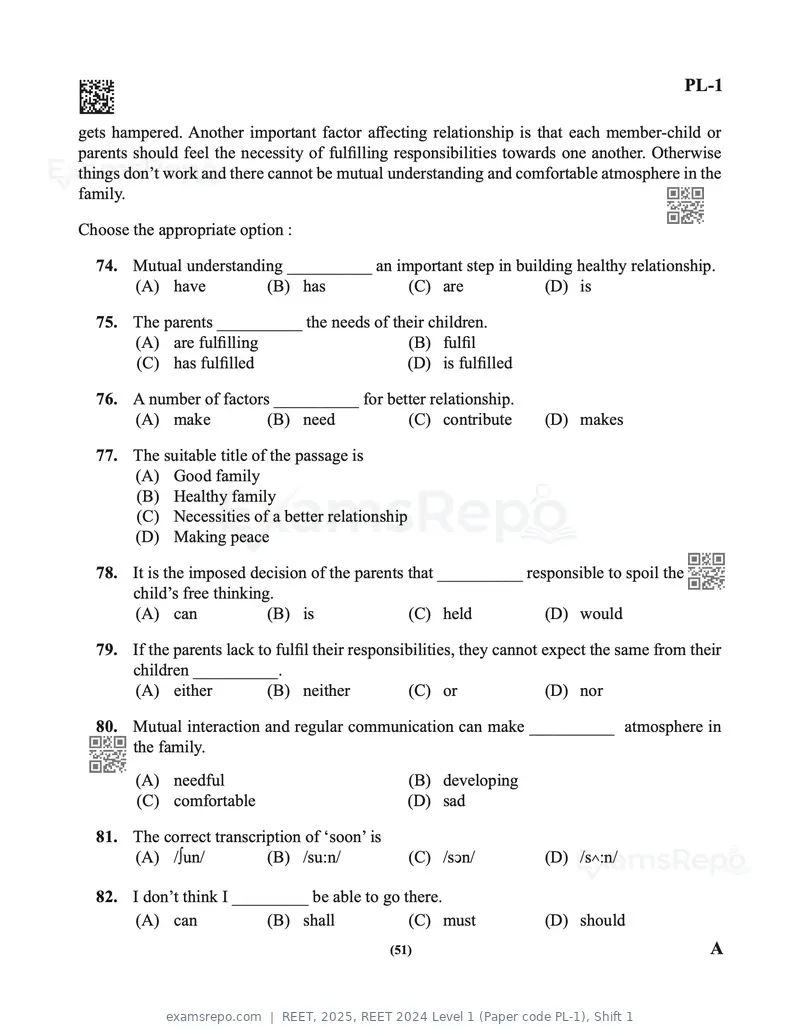
Text of page 51
PL-1

gets hampered. Another important factor affecting relationship is that each member-child or
parents should feel the necessity of fulfilling responsibilities towards one another. Otherwise
things don’t work and there cannot be mutual understanding and comfortable atmosphere in the
family.

Choose the appropriate option :

  74. Mutual understanding __________ an important step in building healthy relationship.
      (A) have          (B) has            (C) are             (D) is

  75. The parents __________ the needs of their children.
      (A) are fulfilling			                 (B) fulfil
      (C) has fulfilled			                  (D) is fulfilled

  76. A number of factors __________ for better relationship.
      (A) make           (B) need           (C) contribute            (D) makes

  77. The suitable title of the passage is
      (A) Good family
      (B) Healthy family
      (C) Necessities of a better relationship
      (D) Making peace

  78. It is the imposed decision of the parents that __________ responsible to spoil the
      child’s free thinking.
      (A) can              (B) is               (C) held           (D) would

  79. If the parents lack to fulfil their responsibilities, they cannot expect the same from their
      children __________.
      (A) either           (B) neither            (C) or                (D) nor

  80. Mutual interaction and regular communication can make __________ atmosphere in
      the family.
        (A) needful			                            (B) developing
        (C) comfortable			                        (D) sad

  81. The correct transcription of ‘soon’ is
      (A) /∫un/           (B) /su:n/              (C) /sͻn/           (D) /s^:n/

  82. I don’t think I _________ be able to go there.
      (A) can             (B) shall            (C) must               (D) should
                                               (51)                                             A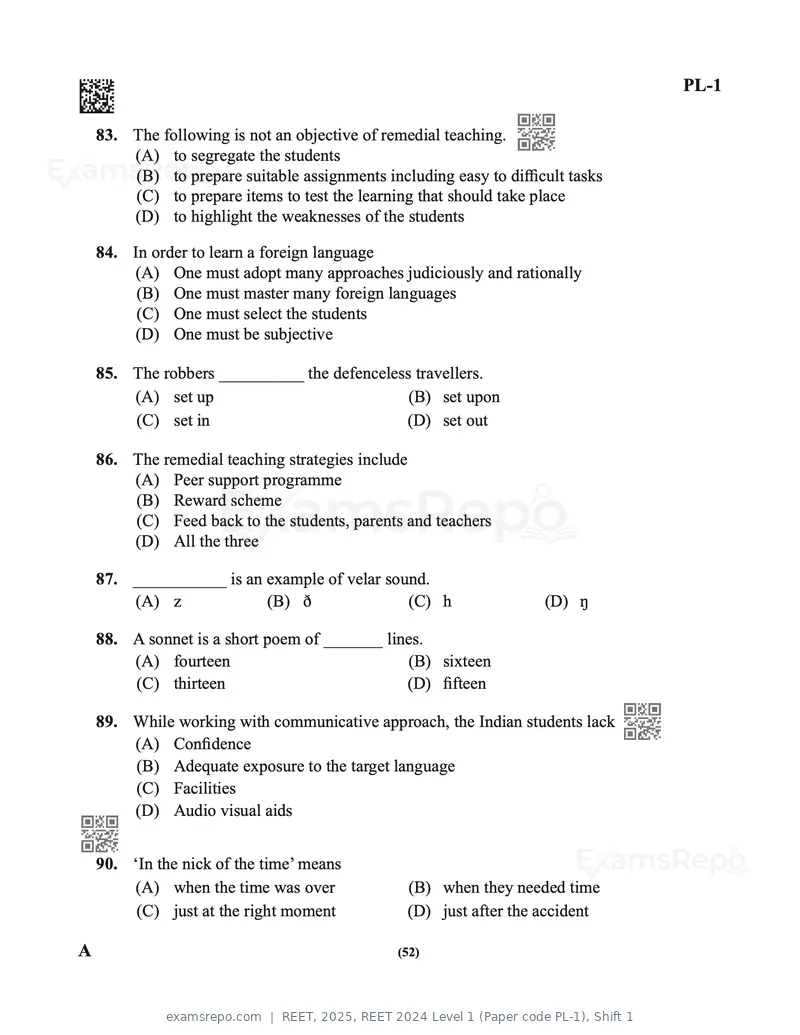
Text of page 52
PL-1

    83. The following is not an objective of remedial teaching.
        (A) to segregate the students
        (B) to prepare suitable assignments including easy to difficult tasks
        (C) to prepare items to test the learning that should take place
        (D) to highlight the weaknesses of the students

    84. In order to learn a foreign language
        (A) One must adopt many approaches judiciously and rationally
         (B) One must master many foreign languages
         (C) One must select the students
        (D) One must be subjective

    85. The robbers __________ the defenceless travellers.
        (A) set up			                         (B) set upon
        (C) set in			                        (D) set out

    86. The remedial teaching strategies include
        (A) Peer support programme
        (B) Reward scheme
        (C) Feed back to the students, parents and teachers
        (D) All the three

    87. ___________ is an example of velar sound.
        (A) z             (B) ð               (C) h                 (D) ŋ

    88. A sonnet is a short poem of _______ lines.
        (A) fourteen			                        (B) sixteen
        (C) thirteen			                        (D) fifteen

    89. While working with communicative approach, the Indian students lack
        (A) Confidence
        (B) Adequate exposure to the target language
        (C) Facilities
        (D) Audio visual aids


    90. ‘In the nick of the time’ means
        (A) when the time was over              (B) when they needed time
         (C) just at the right moment           (D) just after the accident

A                                              (52)
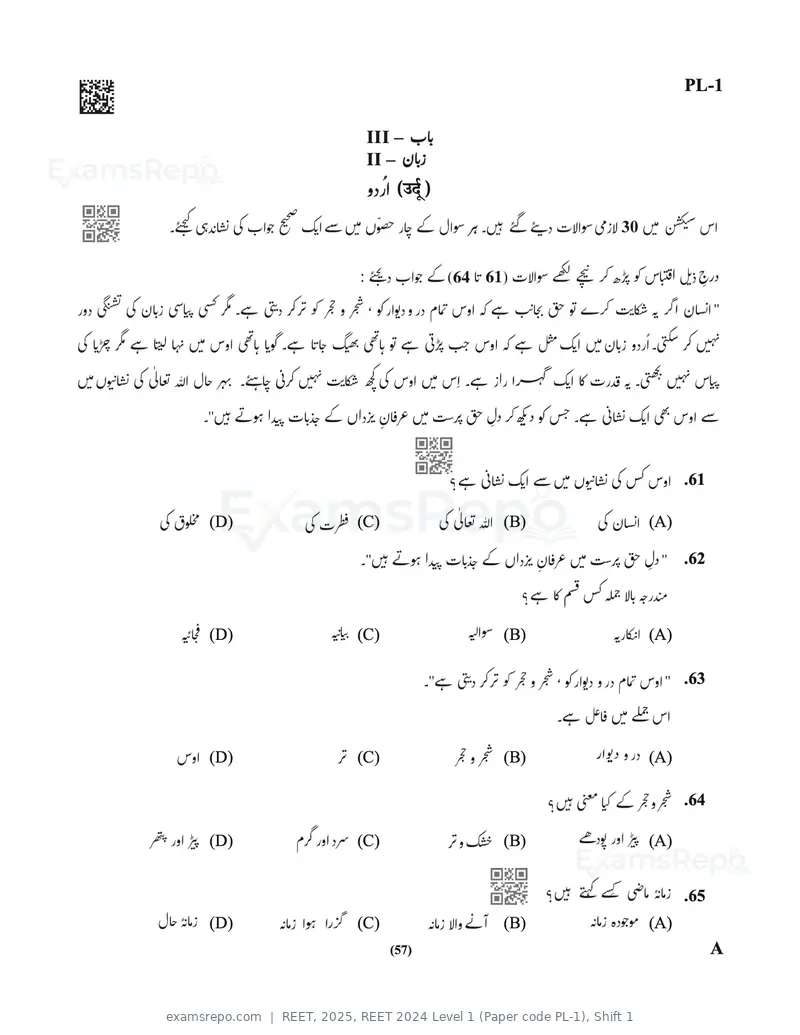
Text of page 57
PL-1

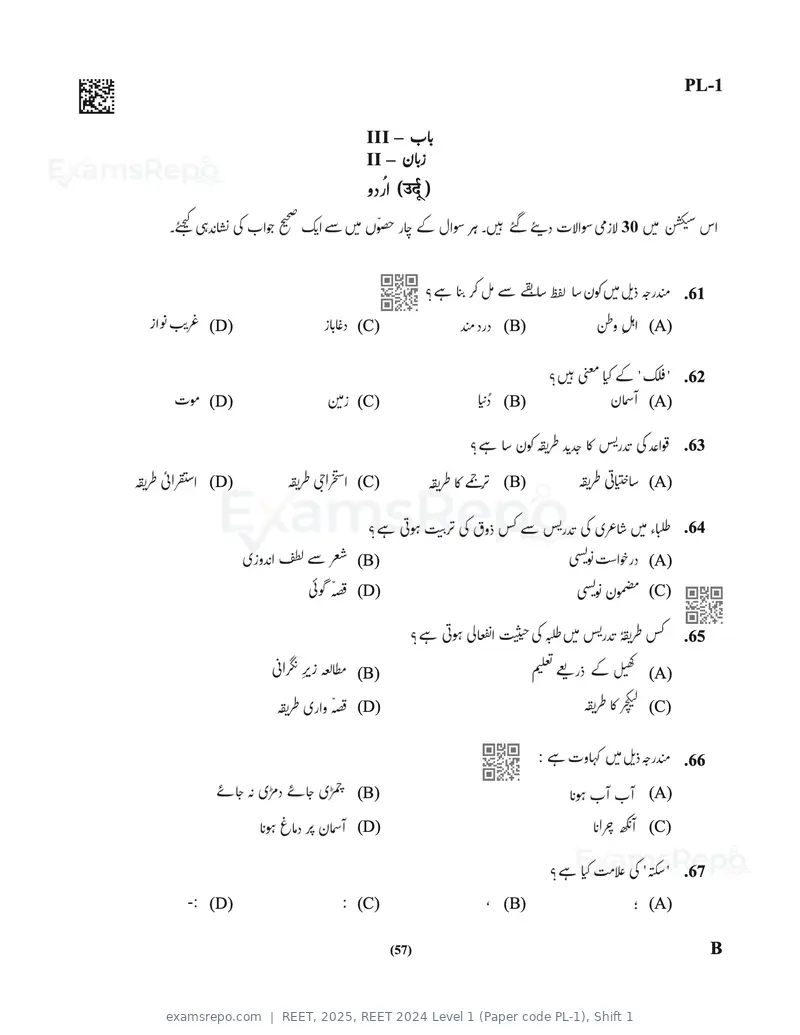
       III –
       II –
             (CXÿ© )


                                   .61

(D)   (C)              (B)   (A)

                                   .62


(D)   (C)              (B)   (A)

                                   .63


(D)   (C)              (B)   (A)

                                   .64

(D)   (C)              (B)   (A)


                                   .65
(D)   (C)              (B)   (A)
            (57)                         A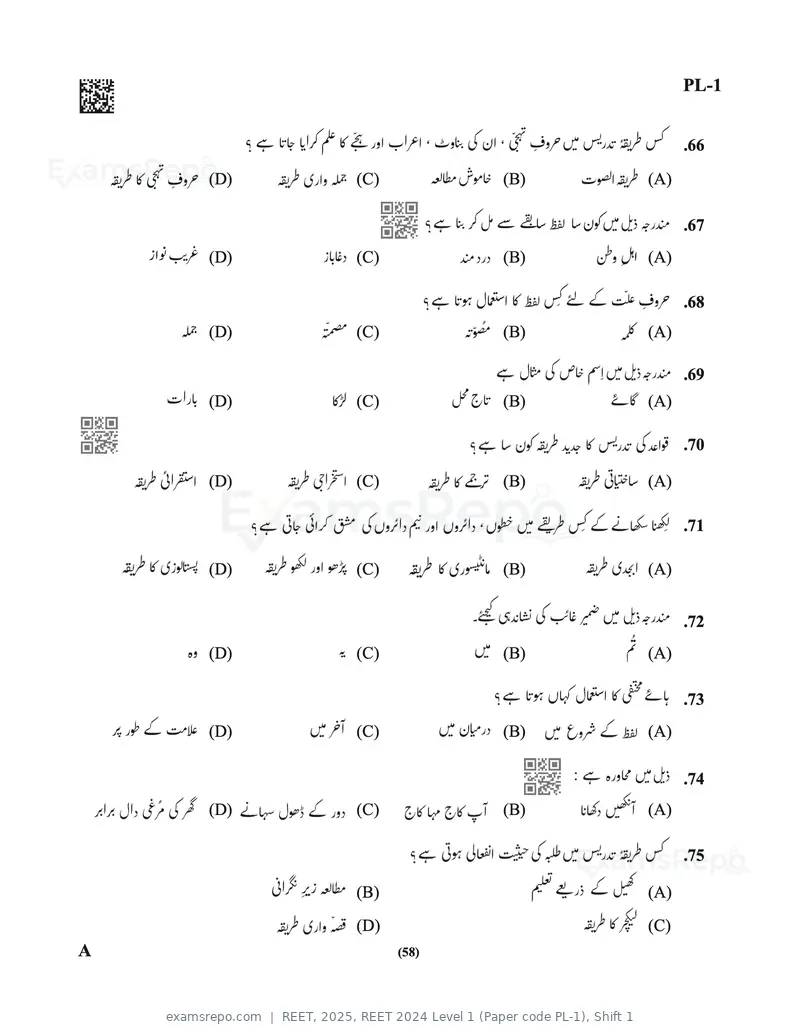
Text of page 58
PL-1


                                   .66
    (D)   (C)          (B)   (A)

                                   .67
    (D)   (C)          (B)   (A)

                                   .68
    (D)   (C)          (B)   (A)

                                   .69
    (D)   (C)          (B)   (A)

                                   .70

    (D)   (C)          (B)   (A)

                                   .71

    (D)   (C)          (B)   (A)


                                   .72
    (D)   (C)          (B)   (A)

                                   .73
    (D)   (C)          (B)   (A)

                                   .74
    (D)   (C)          (B)   (A)

                                   .75

			       (B)			             (A)
			       (D)			             (C)
A               (58)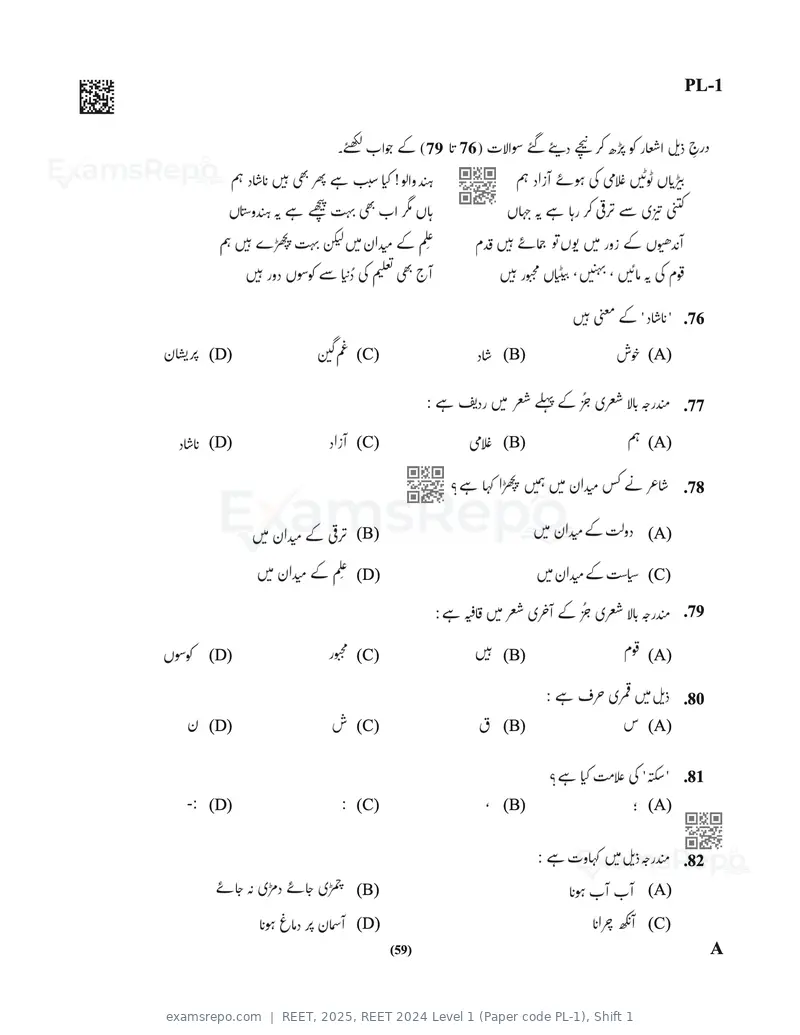
Text of page 59
PL-1


                                 .76

  (D)   (C)          (B)   (A)


                                 .77

  (D)   (C)          (B)   (A)

                                 .78

			     (B)			             (A)

			     (D)			             (C)

                                 .79

  (D)   (C)          (B)   (A)

                                 .80
  (D)   (C)          (B)   (A)


                                 .81
  (D)   (C)          (B)   (A)


                                 .82
			     (B)			             (A)
			     (D)			             (C)
              (59)                     A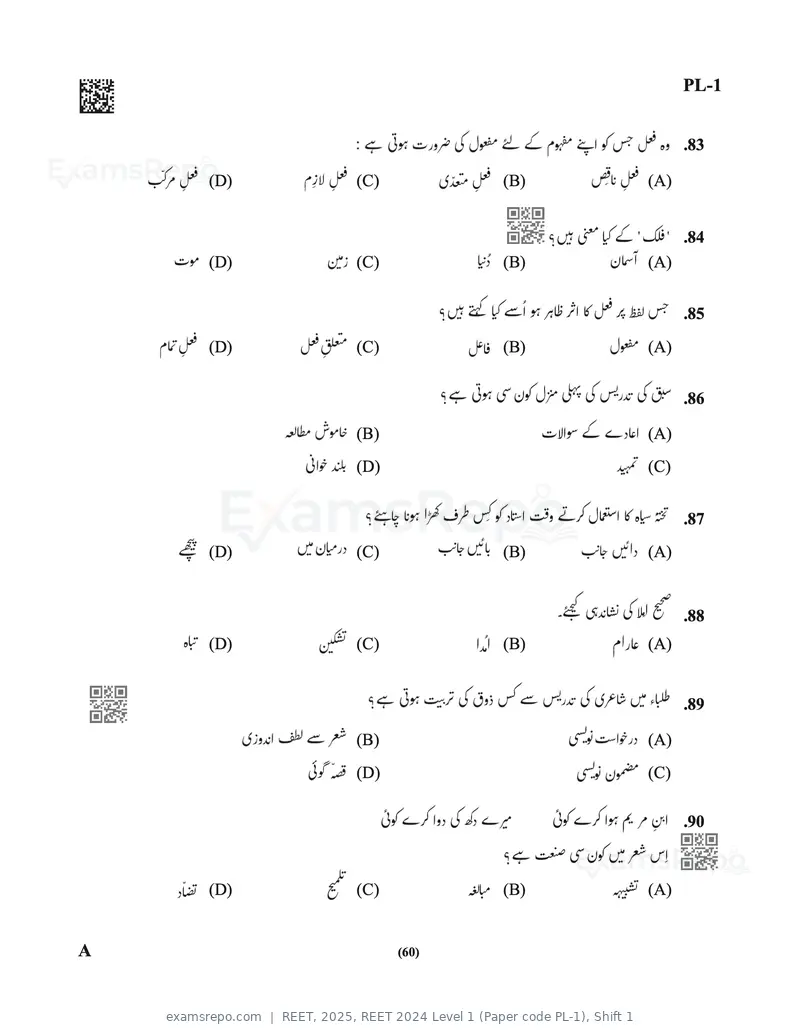
Text of page 60
PL-1


                                   .83

    (D)   (C)          (B)   (A)


                                   .84
    (D)   (C)          (B)   (A)


                                   .85
    (D)   (C)          (B)   (A)


                                   .86

			       (B)			             (A)
			       (D)			             (C)


                                   .87
    (D)   (C)          (B)   (A)


                                   .88
    (D)   (C)          (B)   (A)


                                   .89

			       (B)			             (A)
			       (D)			             (C)

                                   .90


    (D)   (C)          (B)   (A)


A               (60)
Text of page 61
PL-1

                      – iiI
                     > – II


61.
      (A)     			      (B)
      (C)              (D)

62.
      (A)   			        (B)
      (C)   			        (D)

63.
      (A)   			        (B)
      (C)   			        (D)

64.
      (A)    			       (B)
      (C)    			       (D)

                    (61)        A
Text of page 62
PL-1


    65.
          (A)
          (B)
          (C)
          (D)

    66.
          (A)   			       (B)
          (C)   			       (D)

    67.
          (A)      (B)     (C)   (D)
    68.
          (A)
          (B)
          (C)
          (D)

    69.
          (A)      			    (B)
          (C)    			      (D)

    70.
          (A)    			       (B)
          (C)    			      (D)

    71.
          (A)       		    (B)
          (C)     			     (D)

    72.
          (A)      (B)     (C)   (D)

    73.
          (A)   			       (B)
          (C)   			       (D)
A                        (62)
Text of page 63
PL-1


74.
      (A) 1853    (B) 1947      (C) 1967   (D) 1950

75.
      (A)        			            (B)
      (C)        			            (D)

76.
      (A)        			            (B)
      (C)        			            (D)

77.
      (A)         			           (B)
      (C)           		          (D)

78.
      (A)         (B)           (C)        (D)

79.
      (A)        			            (B)
      (C)        			            (D)

80.
      (A)         (B)           (C)        (D)

81.
      (A)        			            (B)
      (C)         			           (D)

82.
      (A)                       (B)
      (C)                       (D)

83.
      (A)   			                 (B)
      (C)   			                 (D)
                             (63)                       A
Text of page 64
PL-1

    84.
          (A)    			     (B)
          (C)    			     (D)
    85.
          (A)    			     (B)
          (C)    			     (D)


    86.
          (A)            (B)
          (C)            (D)
    87.
          (A)    			     (B)
          (C)   			      (D)

    88.
          (A)    			     (B)
          (C)    			     (D)
    89.
          (A)     (B)     (C)   (D)

    90.
          (A)     (B)     (C)   (D)
A                       (64)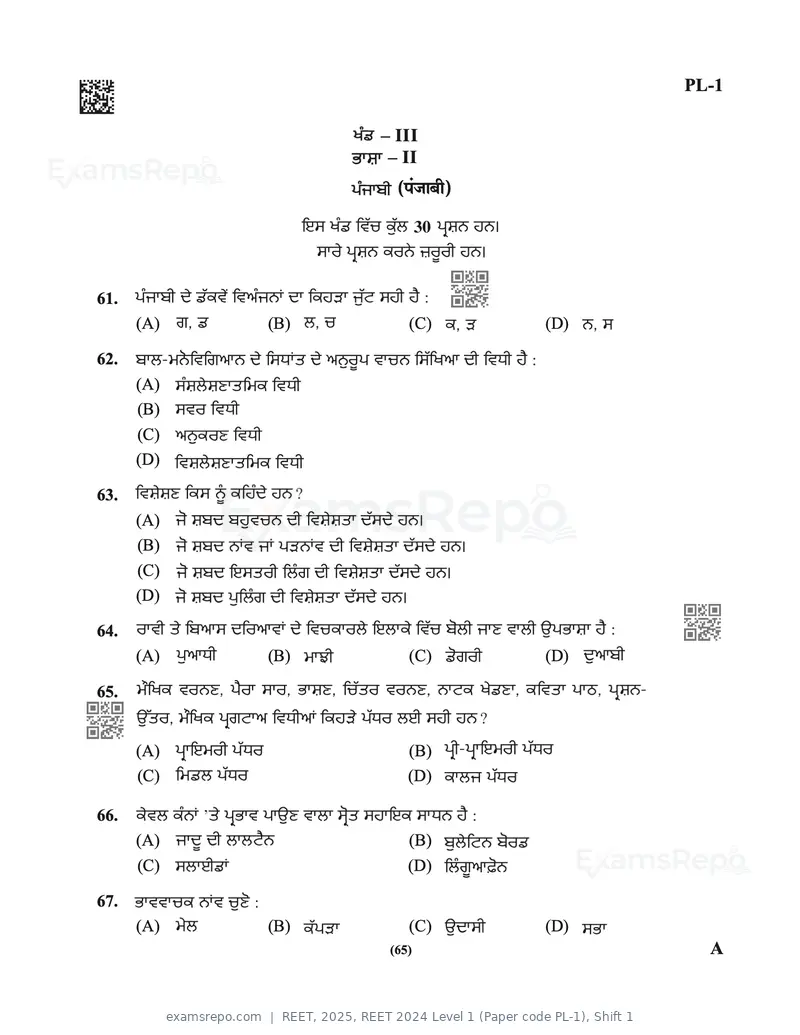
Text of page 65
PL-1

                    > – iiI
                      – II
                       (n§Om~r)


61.
      (A)     (B)        (C)      (D)

62.
      (A)
      (B)
      (C)
      (D)

63.
      (A)
      (B)
      (C)
      (D)

64.
      (A)     (B)        (C)      (D)

65.


      (A)     			        (B)
      (C)    			         (D)

66.
      (A)     			        (B)
      (C)   			          (D)

67.
      (A)     (B)        (C)      (D)
                      (65)                A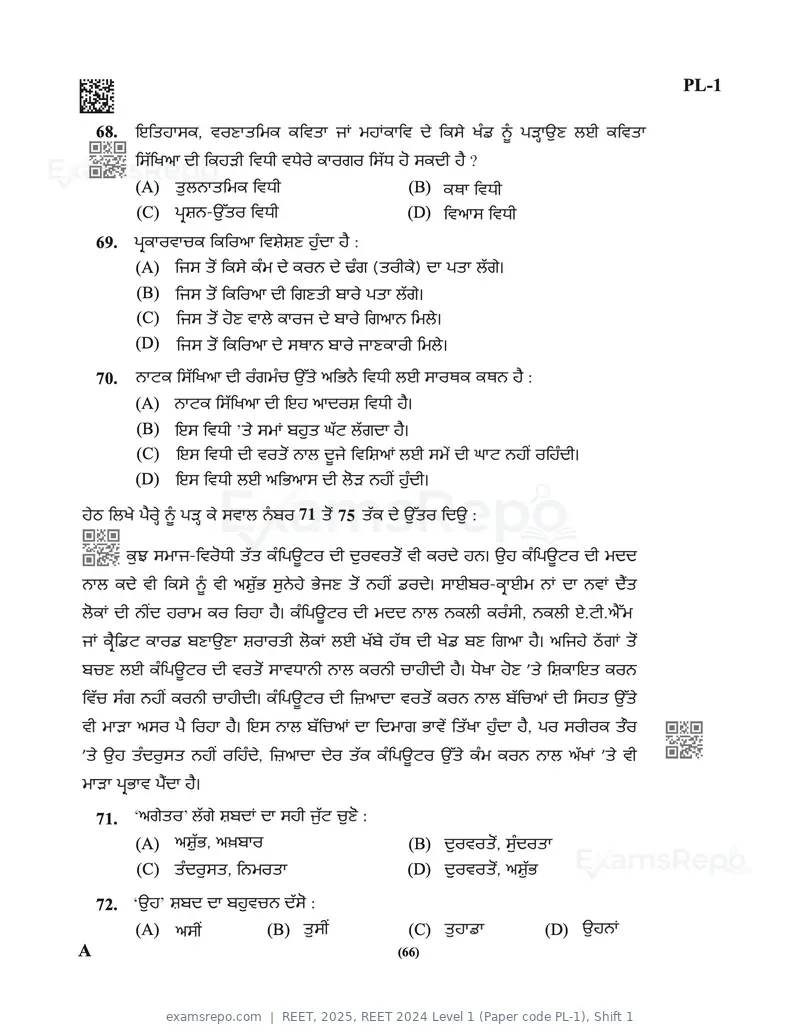
Text of page 66
PL-1

    68.


          (A)    			     (B)
          (C)    			     (D)
    69.
          (A)
          (B)
          (C)
          (D)

    70.
          (A)
          (B)
          (C)
          (D)


    71.
          (A)   			      (B)
          (C)     			    (D)

    72.
          (A)   (B)       (C)   (D)
A                       (66)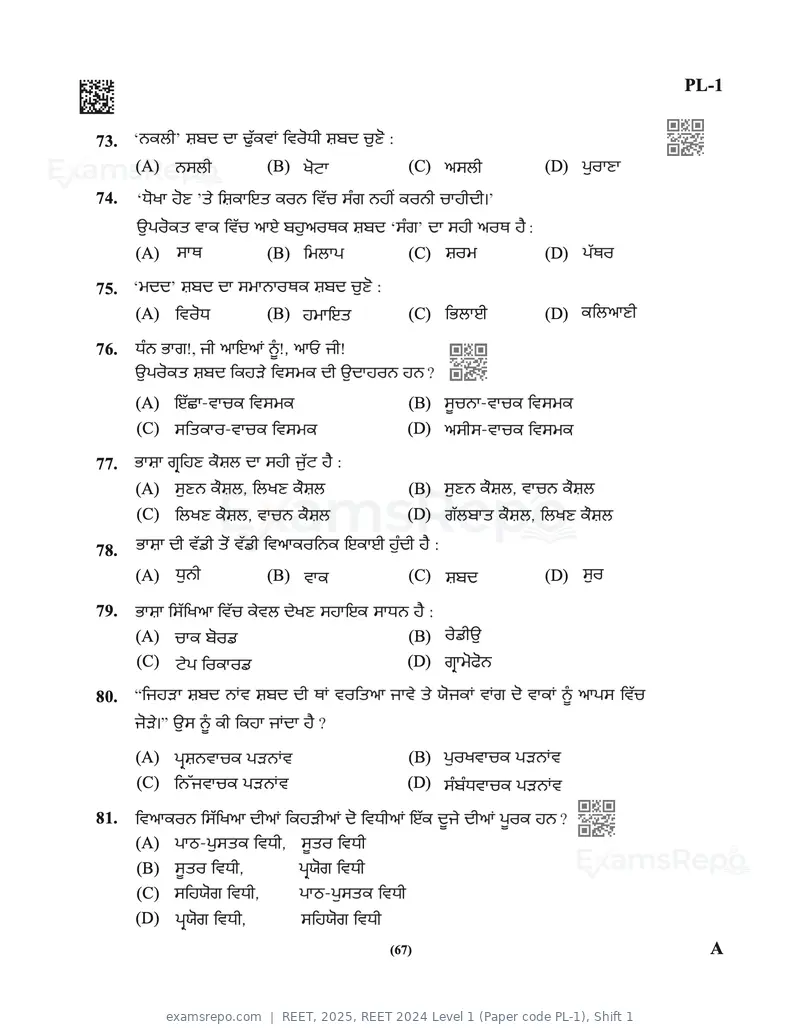
Text of page 67
PL-1


73.
      (A)    (B)           (C)   (D)
74.


      (A)    (B)           (C)   (D)

75.
      (A)    (B)           (C)   (D)

76.


      (A)          		      (B)
      (C)                  (D)

77.
      (A)                  (B)
      (C)                  (D)

78.
      (A)    (B)           (C)   (D)

79.
      (A)   			            (B)
      (C)    			           (D)

80.


      (A)       		         (B)
      (C)      			         (D)

81.
      (A)
      (B)
      (C)
      (D)
                        (67)             A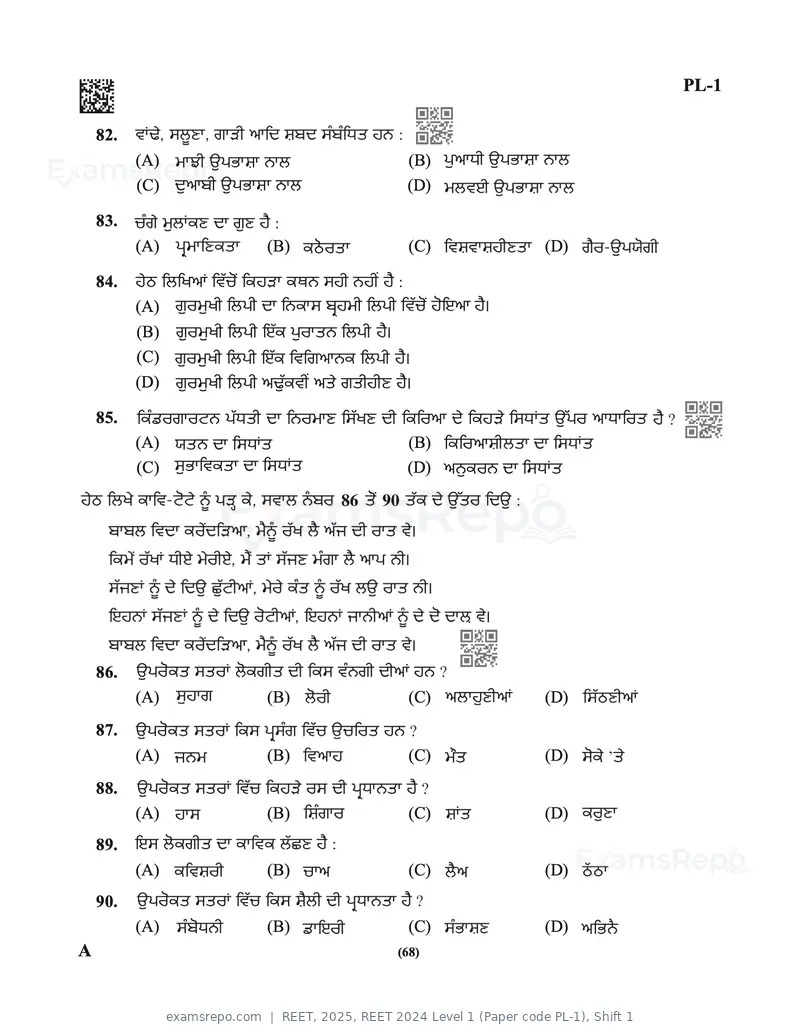
Text of page 68
PL-1

    82.
          (A)         		    (B)
          (C)               (D)

    83.
          (A)   (B)          (C)   (D)

    84.
          (A)
          (B)
          (C)
          (D)

    85.
          (A)   			         (B)
          (C)               (D)


    86.
          (A)   (B)          (C)   (D)
    87.
          (A)   (B)          (C)   (D)
    88.
          (A)   (B)          (C)   (D)
    89.
          (A)   (B)          (C)   (D)
    90.
          (A)   (B)          (C)   (D)
A                          (68)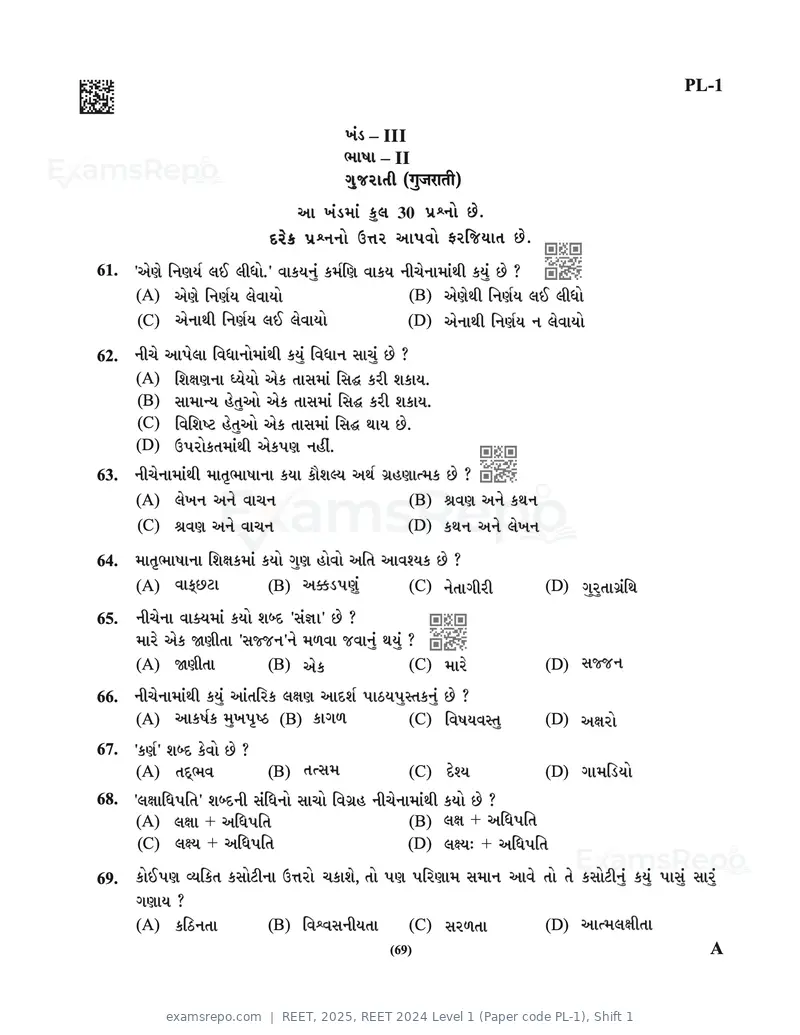
Text of page 69
PL-1

                    – iII
                     – II
                        (JwOamVr)


61.
      (A)     			        (B)
      (C)                (D)

62.
      (A)
      (B)
      (C)
      (D)
63.
      (A)   			          (B)
      (C)   			          (D)

64.
      (A)   (B)          (C)        (D)
65.

      (A)   (B)          (C)        (D)
66.
      (A)    (B)         (C)        (D)
67.
      (A)   (B)          (C)        (D)
68.
      (A)   			          (B)
      (C)   			          (D)

69.

      (A)   (B)          (C)        (D)
                      (69)                  A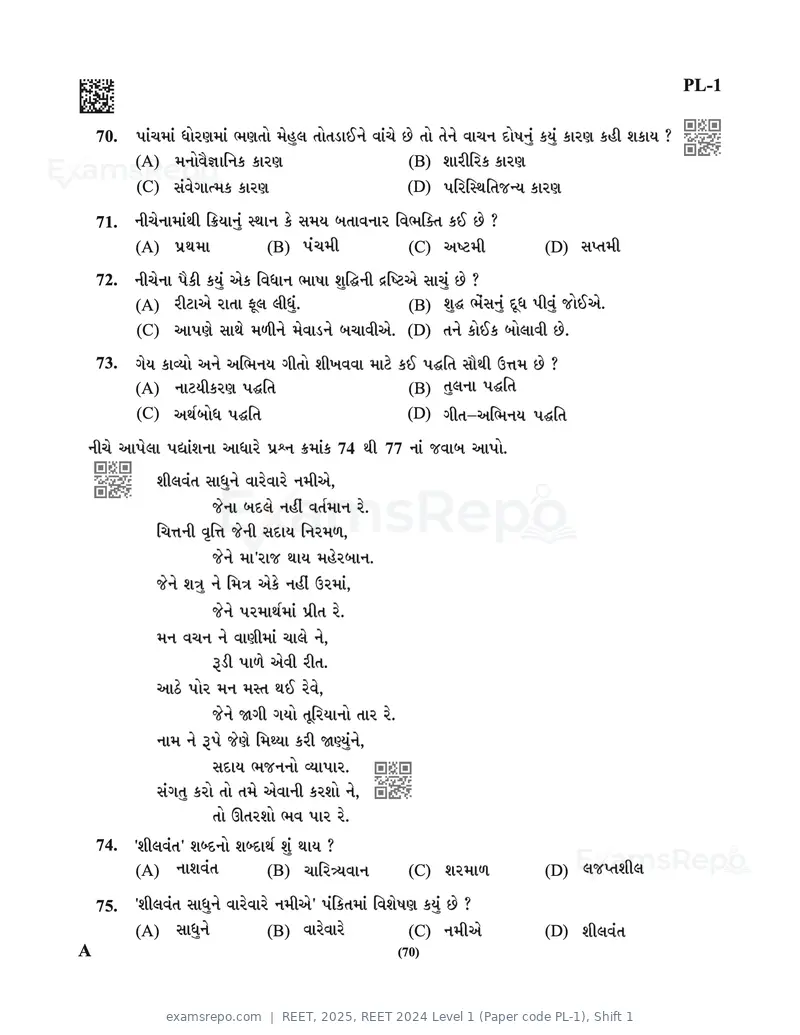
Text of page 70
PL-1

    70.
          (A)    			        (B)
          (C)   			         (D)

    71.
          (A)   (B)          (C)   (D)
    72.
          (A)         		    (B)
          (C)               (D)
    73.
          (A)    			        (B)
          (C)   			         (D)


    74.
          (A)   (B)          (C)   (D)

    75.
          (A)   (B)          (C)   (D)
A                          (70)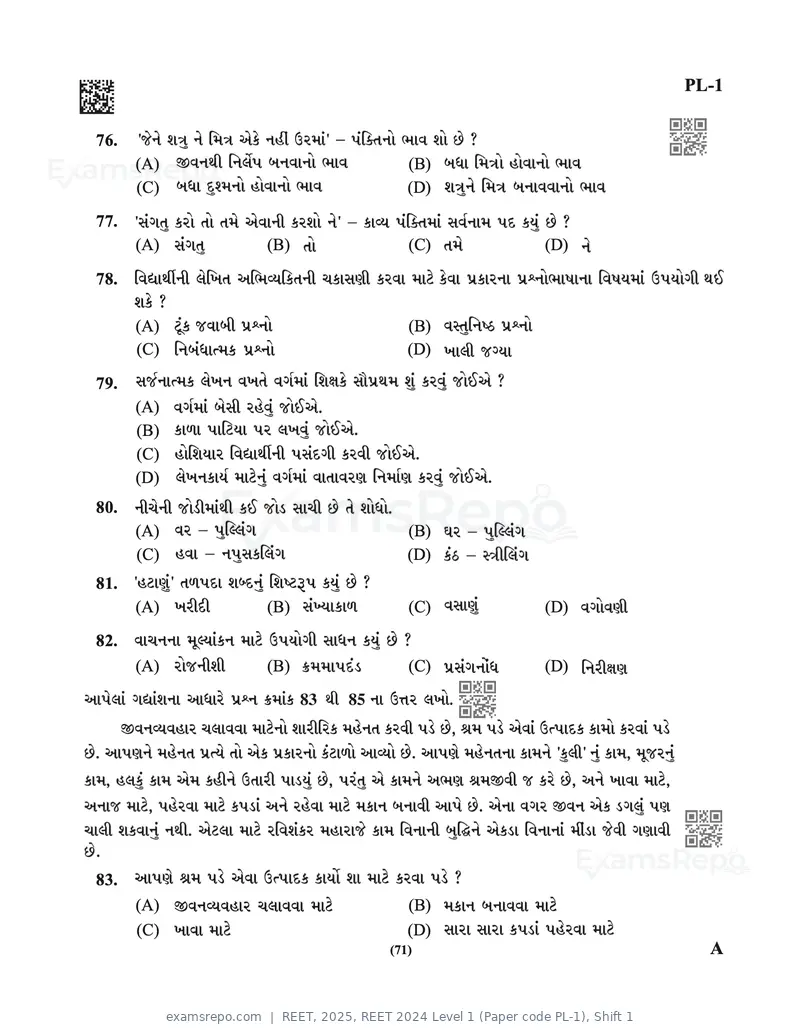
Text of page 71
PL-1

76.
      (A)               (B)
      (C)               (D)

77.
      (A)     (B)       (C)   (D)

78.

      (A)      			      (B)
      (C)      			      (D)
79.
      (A)
      (B)
      (C)
      (D)
80.
      (A)    			        (B)
      (C)      			      (D)
81.
      (A)     (B)       (C)   (D)

82.
      (A)     (B)       (C)   (D)


83.
      (A)               (B)
      (C)   			         (D)
                     (71)             A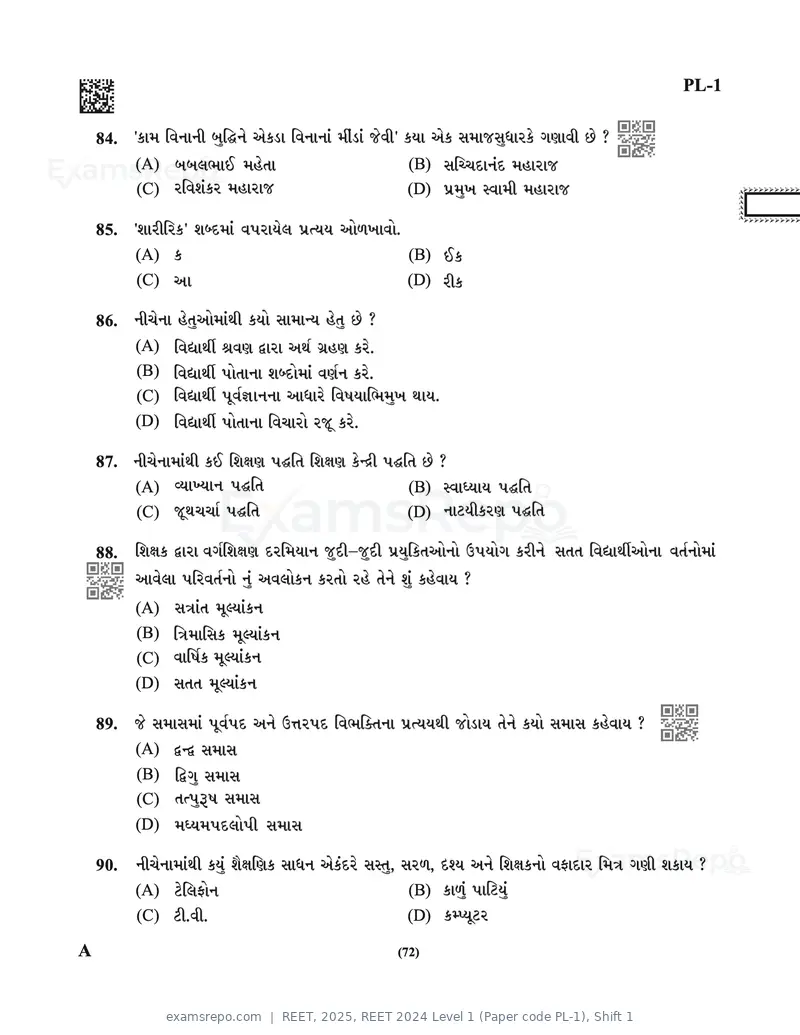
Text of page 72
PL-1
84.
(A) (B)
(C) (D)
85.
(A) (B)
(C) (D)
86.
(A)
(B)
(C)
(D)
87.
(A) (B)
(C) (D)
88.
(A)
(B)
(C)
(D)
89.
(A)
(B)
(C)
(D)
90.
(A) (B)
(C) (D)
A (72)
Text of page 75
PL-1

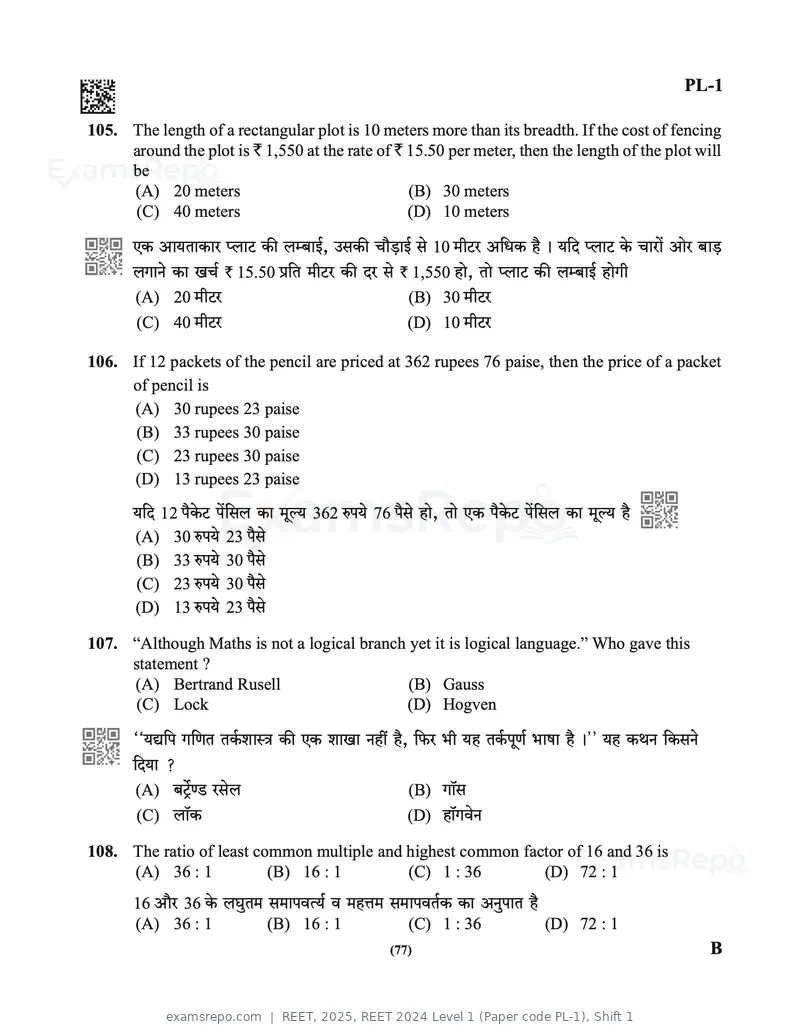
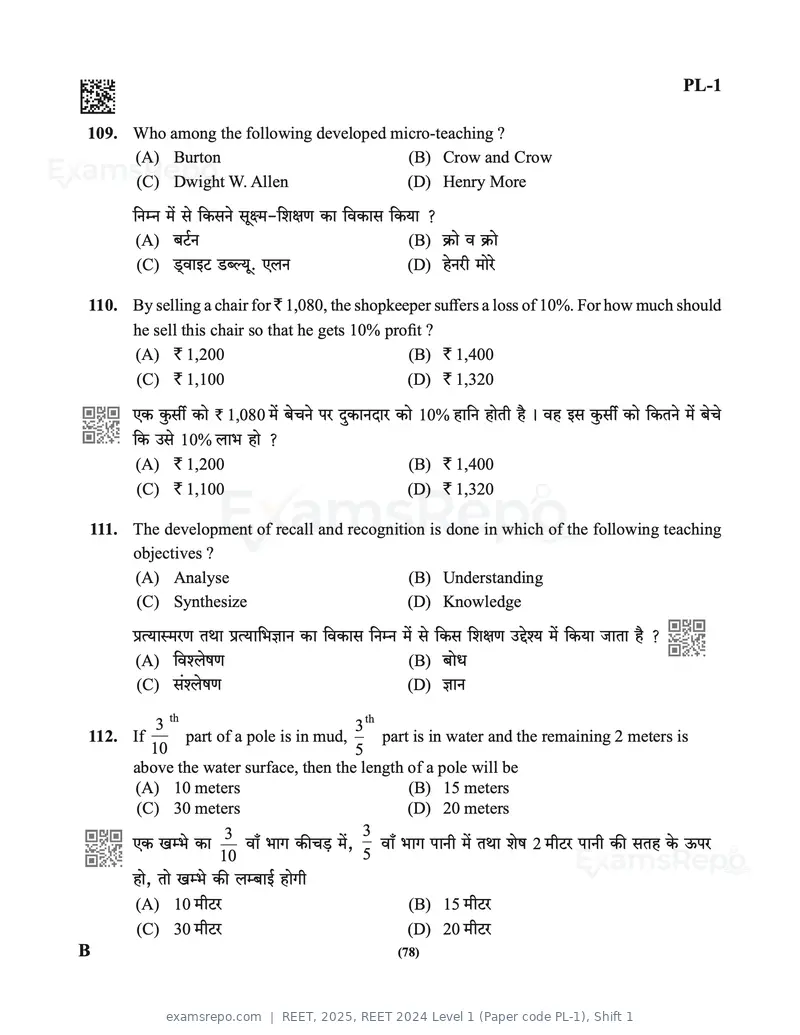
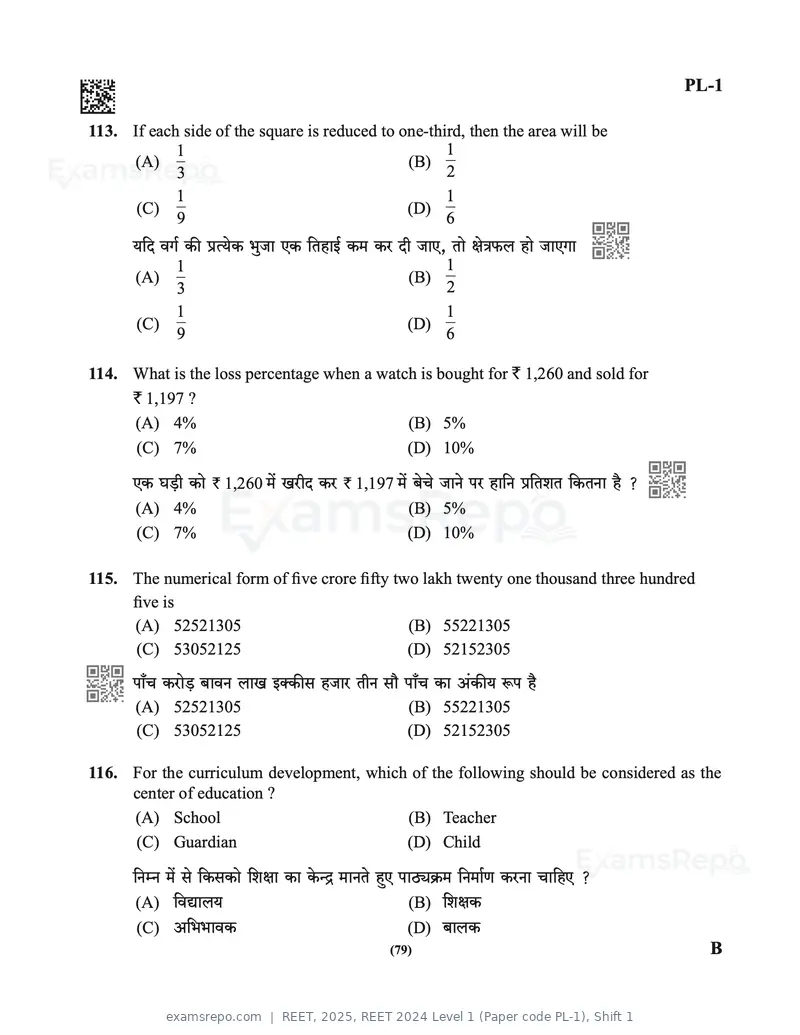
  99. The numerical form of five crore fifty two lakh twenty one thousand three hundred
      five is
       (A) 52521305			                         (B) 55221305
       (C) 53052125			                         (D) 52152305

		 nm±M H$amo‹S> ~mdZ bmI BŠH$sg hOma VrZ gm¡ nm±M H$m A§H$s` ê$n h¡
         (A) 52521305			                            (B) 55221305
         (C) 53052125			                            (D) 52152305

 100. In how many years, a sum will triple itself at the rate of 10% simple interest per
      annum ?
      (A) 20 years			                          (B) 15 years
       (C) 10 years			                         (D) 25 years

		 10% dm{f©H$ gmYmaU ã`mO H$s Xa go H$moB© YZ {H$VZo dfm] _| VrZ JwZm hmo OmEJm ?
   (A) 20 df©			                              (B) 15 df©
   (C) 10 df©			                              (D) 25 df©

 101. If the cost of four dozen pens is ` 120, then how many pens can be purchased for
      ` 35 ?
      (A) 10			                                 (B) 12
       (C) 24			                                (D) 14

		 `{X Mma XO©Z noZ H$m _yë` ` 120 h¡, Vmo ` 35 _| {H$VZo noZ IarXo Om gH$Vo h¢ ?
         (A) 10			                                  (B) 12
         (C) 24			                                  (D) 14

 102. If 12 packets of the pencil are priced at 362 rupees 76 paise, then the price of
      a packet of pencil is
      (A) 30 rupees 23 paise
       (B) 33 rupees 30 paise
       (C) 23 rupees 30 paise
      (D) 13 rupees 23 paise

		 `{X 12 n¡Ho$Q> n|{gb H$m _yë` 362 én`o 76 n¡go hmo, Vmo EH$ n¡Ho$Q> n|{gb H$m _yë` h¡
   (A) 30 én`o 23 n¡go
   (B) 33 én`o 30 n¡go
   (C) 23 én`o 30 n¡go
   (D) 13 én`o 23 n¡go
                                                 (75)                                        A
Text of page 78
PL-1

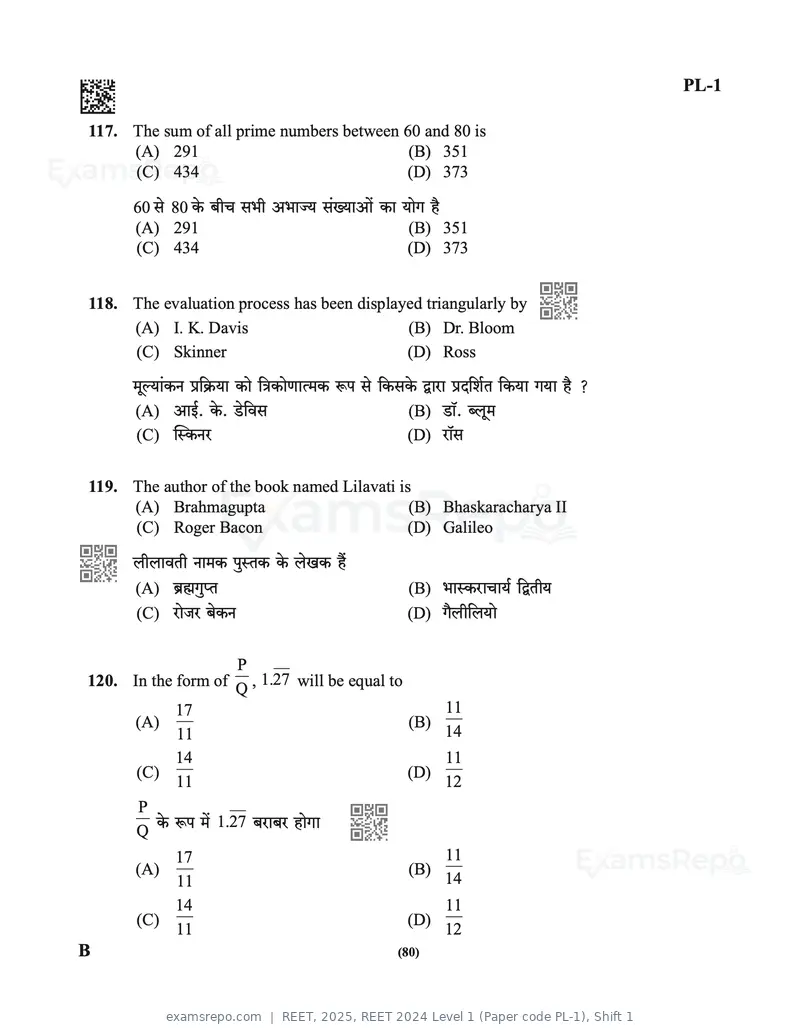
 111. The evaluation process has been displayed triangularly by
      (A) I. K. Davis			                     (B) Dr. Bloom
      (C) Skinner			                         (D) Ross
		 _yë`m§H$Z à{H«$`m H$mo {ÌH$moUmË_H$ ê$n go {H$gHo$ Ûmam àX{e©V {H$`m J`m h¡ ?
   (A) AmB©. Ho$. S>o{dg			                       (B) S>m°. ãby_
   (C) pñH$Za			                                  (D) am°g

 112. In the given figure, the value of ∠AOD is
                                        A


                                                B

                                       –2
                         5x         3x
                                          2
                                      x+
        D                                           C
		                            O
         (A) 60°			                                     (B) 90°
         (C) 100°			                                    (D) 20°

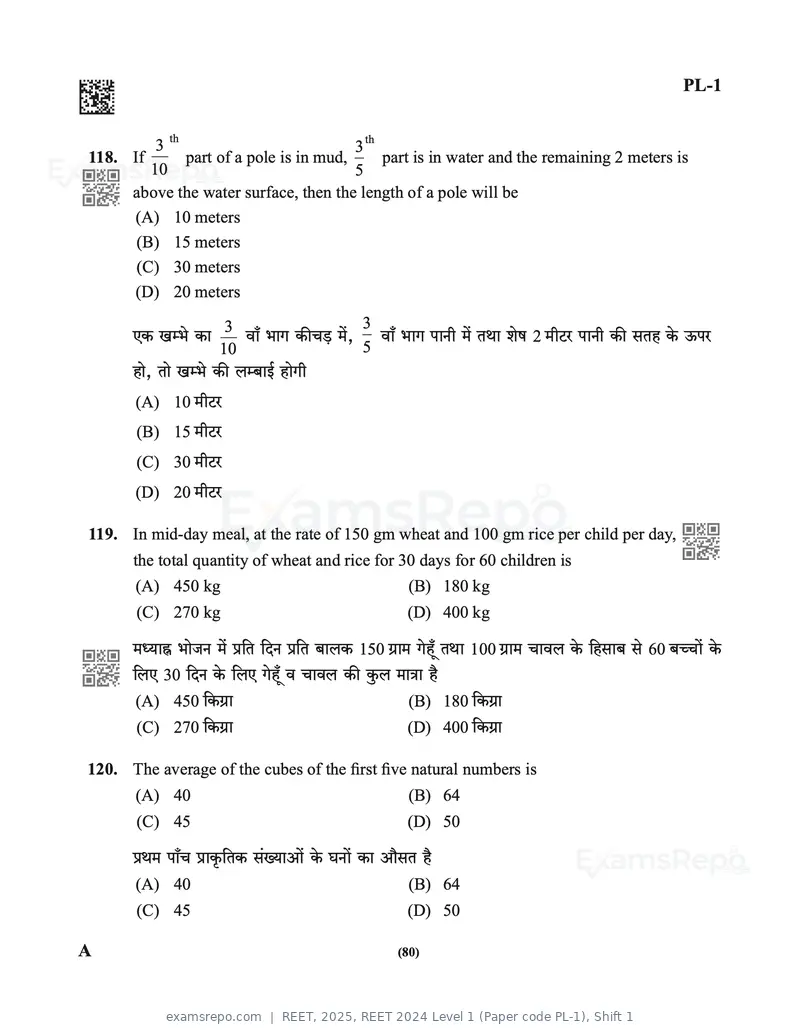
		 {X`o J`o {MÌ _| ∠AOD H$m _mZ h¡
                                        A


                                                B

                                       –2
                         5x         3x
                                          2
                                      x+
        D                                           C
		                            O
         (A) 60°			                                     (B) 90°
         (C) 100°			                                    (D) 20°

                                      13 15 17     19
 113. Which fraction among               , ,   and    is the largest fraction ?
                                      15 17 19     21
       19                               13               17                    15
         (A)                      (B)              (C)                   (D)
       21                               15               19                    17
  13 15 17 19
		 , , VWm     _| go H$m¡Z-gr {^ÝZ g~go ~‹S>r {^ÝZ h¡ ?
  15 17 19 21
       19            13                   17                                   15
  (A)         (B)                   (C)                                  (D)
       21            15                   19                                   17
A                                                   (78)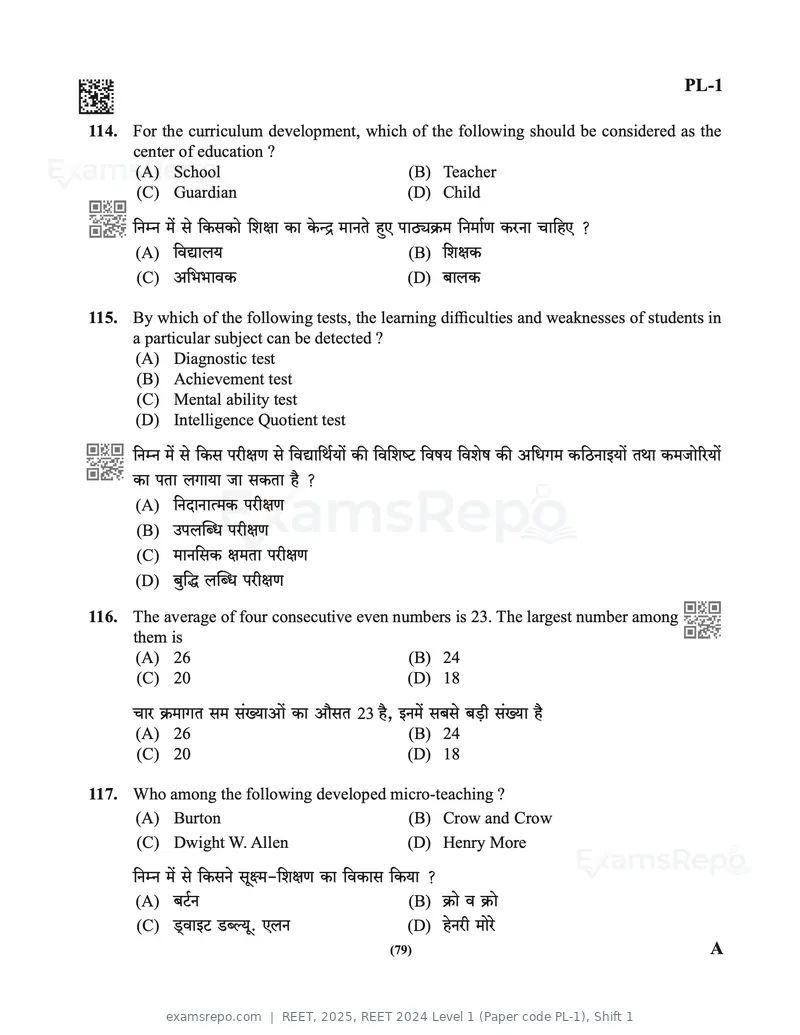
Text of page 84
PL-1

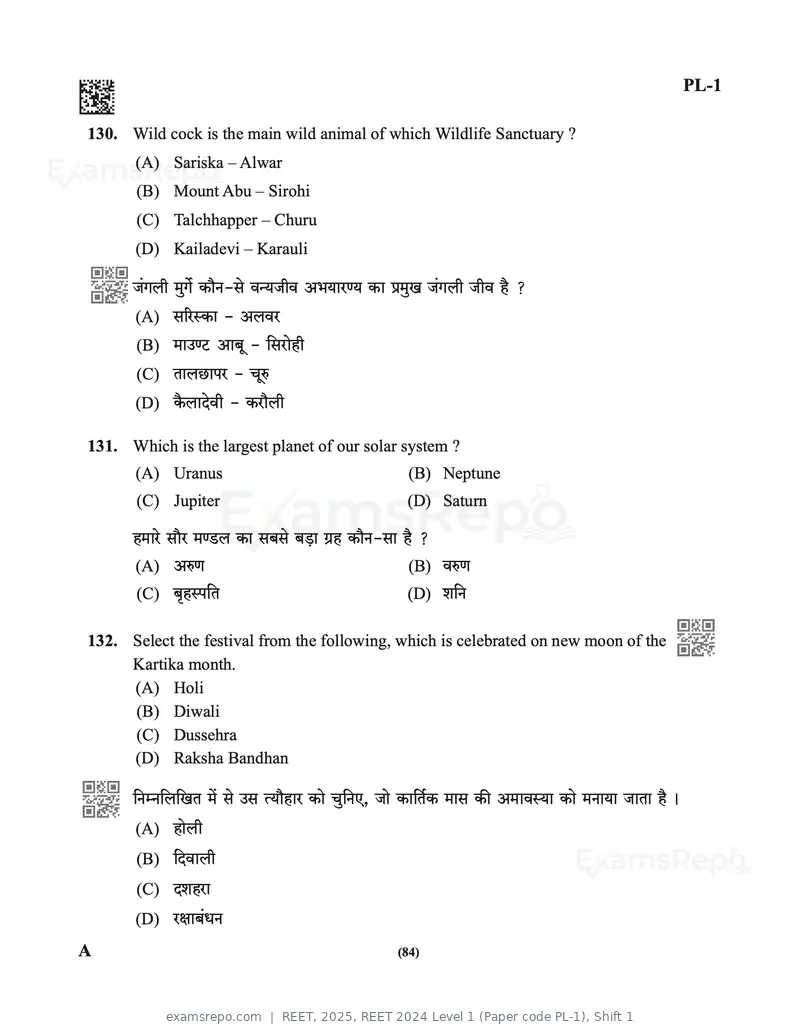
 130. Wild cock is the main wild animal of which wildlife sanctuary ?
        (A) Sariska – Alwar
        (B) Mount Abu – Sirohi
        (C) Talchhapper – Churu
        (D) Kailadevi – Karauli

		 O§Jbr _wJ} H$m¡Z-go dÝ`Ord A^`maÊ` H$m à_wI O§Jbr Ord h¡ ?
   (A) g[añH$m - Abda
   (B) _mCÊQ> Am~y - {gamohr
   (C) VmbN>mna - Myé
   (D) H¡$bmXodr - H$am¡br

 131. Which is the largest planet of our solar system ?
        (A) Uranus			                             (B) Neptune
        (C) Jupiter			                           (D) Saturn

		 h_mao gm¡a _ÊS>b H$m g~go ~‹S>m J«h H$m¡Z-gm h¡ ?
   (A) AéU			                                    (B) déU
   (C) ~¥hñn{V			                               (D) e{Z

 132. Select the festival from the following, which is celebrated on new moon of the
      Kartika month.
      (A) Holi
      (B) Diwali
      (C) Dussehra
      (D) Raksha Bandhan

		 {ZåZ{b{IV _| go Cg Ë`m¡hma H$mo Mw{ZE, Omo H$m{V©H$ _mg H$s A_mdñ`m H$mo _Zm`m OmVm h¡ &
    (A) hmobr
    (B) {Xdmbr
    (C) Xeham
    (D) ajm~§YZ
A                                               (84)
Text of page 90
PL-1

 147. Disease caused by the deficiency of Vitamin – D is
      (A) Night blindness			                  (B) Beri-Beri
      (C) Scurvy			                           (D) Rickets

		 {dQ>m{_Z – D H$s H$_r go hmoZo dmbm amoJ h¡
    (A) aVm¢Yr			                                 (B) ~oar-~oar
    (C) ñH$du			                                  (D) [aHo$Q²>g

 148. Which of the following is a component of man made environment ?
      (A) Lithosphere			                     (B) Industry
      (C) Community			                      (D) Hydrosphere

		 {ZåZ{b{IV _| go H$m¡Z-gm _mZd {Z{_©V n`m©daU H$m KQ>H$ h¡ ?
    (A) ñWb_§S>b			                           (B) CÚmoJ
    (C) g_wXm`			                             (D) Ob_§S>b

 149. Which of the following is a good breed of goat ?
      (A) Murrah			                           (B) Gir
      (C) Sahiwal			                         (D) Jamunapari

		 {ZåZ{b{IV _| go H$m¡Z-gr ~H$ar H$s AÀN>r Zñb h¡ ?
    (A) _wam©			                             (B) {Ja
    (C) gm{hdmb			                           (D) O_wZmnar

 150. Which chemist’s philosophy became famous by the name of ‘Nihilism’ ?
      (A) Neils Bore
      (B) Dmitri Mendeleev
      (C) Acharya Prafull Chand Ray
      (D) Nagarjuna

		 {H$g agm`ZemñÌr H$m Xe©Z "eyÝ`dmX' Ho$ Zm_ go à{gÕ hþAm ?
    (A) Zrëg ~moa
    (B) {X{_Ì _|S>obrd
    (C) AmMm`© à\w$ëb M§X ao
    (D) ZmJmOw©Z


A                                                (90)
Text of page 95
DO
            NO
              T
(95)              WR
                    IT
                       EH
                         ER
                            E
A                               PL-1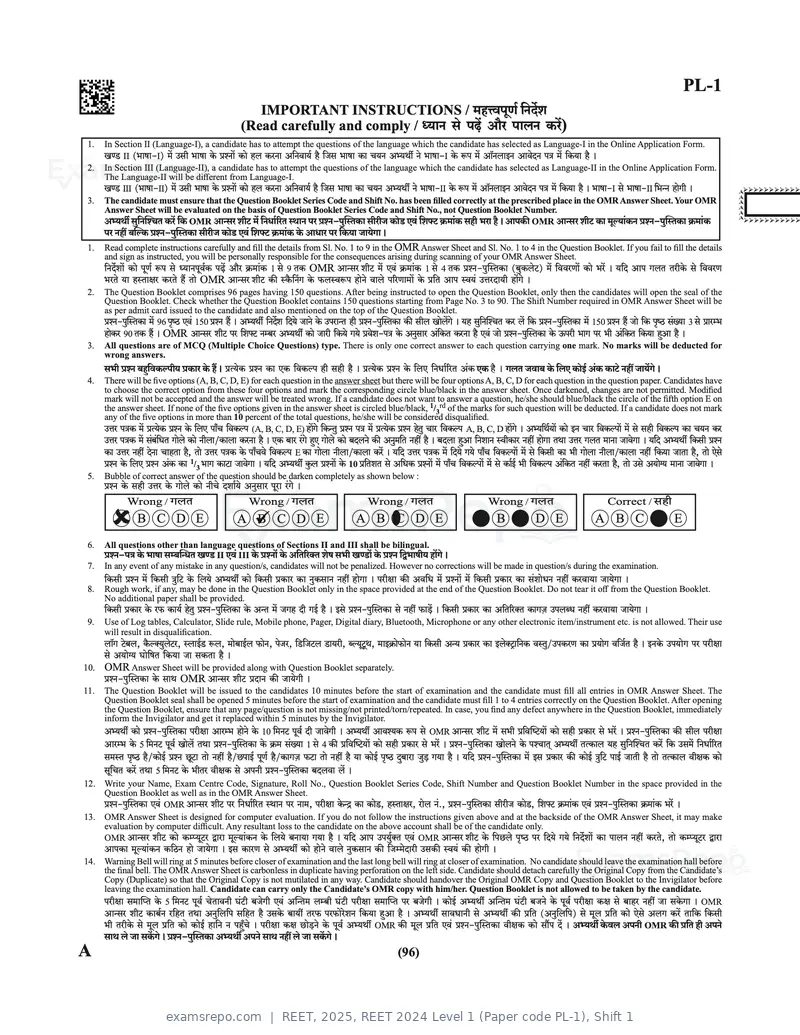
Text of page 97
Question Booklet No.
PAPER CODE : PL-1 (SHIFT – 1)
Series Code :
B
grarµO H$moS> :
Write this code in OMR Answer Sheet.
Bg H$moS> H$mo OMR AmÝga erQ> _| A§{H$V H$a| &
1. Roll No./ amob Z§. 2. OMR Answer Sheet No./ Amo.E_.Ama. AmÝga erQ> H«$_m§H$
* 3. Candidate’s Name/ Aä`Wu H$m Zm_ * 4. _¢Zo n¥îR> ^mJ na {X`o J`o g^r {ZX}em| H$mo n‹T> {b`m h¡ &
A
B
Candidate’s Signature/ Aä`Wu Ho$ hñVmja
* As per Application Form./ O¡gm AmdoXZ nÌ _| A§{H$V {H$`m h¡ &
Invigilators’ Signature/ (i) (ii)
drjH$m| Ho$ hñVmja
S. No. 1, 2, 3 and 4 are to be filled by the Candidate himself. No. of Pages in Question Booklet /
H«$_m§H$ 1, 2, 3 d 4 H$s ny{V© ñd`§ Aä`Wu Ûmam H$s OmZr h¡ & àíZ nwpñVH$m _| Hw$b n¥îR> : 96
There are 150 objective multiple choice questions in this paper. This Question Booklet is made up of the following five Sections : Section – I,
II, III, IV and V of 30 – 30 questions each. The candidate has to attempt all sections. Each question is of one mark. No marks will be deducted
for wrong answers. for unattempted questions kindly see point number 4 of important instructions given on last page.
Bg àíZ-nÌ _| Hw$b 150 dñVw{ZîR> ~hþM`ZmË_H$ àíZ h¢ & àíZ-nÌ Hw$b nm±M IÊS>m| _| {d^m{OV h¡ VWm g^r IÊS> H$aZm A{Zdm`© h¡ & àË`oH$ IÊS>-I, II, III,
IV VWm V _| 30 – 30 àíZ h¢ VWm àË`oH$ àíZ 1 A§H$ H$m h¡ & JbV CÎma Ho$ {b`o H$moB© A§H$ H$mQ>o Zht Om`|Jo & AZwÎm[aV àíZm| Ho$ gå~ÝY _| nwpñVH$m Ho$ A§{V_
n¥îR> na {X`o J`o _hËdnyU© {ZX}em] _| H«$_ g§»`m 4 XoI| &
SHIFT1-2025SHIFT1-2025SHIFT1-2025SHIFT1-2025SHIFT1-2025SHIFT1-2025SHIFT1-2025SHIFT1-2025SHIFT1-2025SHIFT1-2025SHIFT1-2025SHIFT1-2025SHIFT1-2025SHIFT1-2025SHIFT1-2025SHIFT1-2025SHIFT1-2025SHIFT1-2025SHIFT1-2025SHIFT1-2025SHIFT1-2025SHIFT1-2025SHIFT1-2025SHIFT1-2025SHIFT1-2025SHIFT1-2025SHIFT1-2025SHIFT1-2025SHIFT1-2025SHIFT1-2025SHIFT1-2025SHIFT1-2025SHIFT1-2025SHIFT1-2025SHIFT1-2025SHIFT1-2025SHIFT1-2025SHIFT1-2025SHIFT1-2025SHIFT1-2025SHIFT1-2025
PAPER CODE : PL-1 (SHIFT – 1)
Total Questions : 150 Time period : 2.30 Hours Maximum Marks : 150
No. of Question Nos. Page Nos.
Sections Contents
Questions From To From To
(I) Child Development and Pedagogy 30 1 30 3 12
(II) Language-I (Only One Language)
As selected by the candidate as medium of instruction in the 30 31 60
Online Application Form as language-I from the languages
given below :
Hindi 30 31 60 13 18
English 30 31 60 19 22
Sanskrit 30 31 60 23 26
Urdu 30 31 60 27 32
Sindhi 30 31 60 33 36
Punjabi 30 31 60 37 40
Gujarati 30 31 60 41 44
Language-II (Only One Language)
As selected by the candidate as Langauge-II (other than the
(III) 30 61 90
Language-I) in the Online Application Form from the Languages
given below :
Hindi 30 61 90 45 48
English 30 61 90 49 52
Sanskrit 30 61 90 53 56
Urdu 30 61 90 57 60
Sindhi 30 61 90 61 64
Punjabi 30 61 90 65 68
Gujarati 30 61 90 69 72
(IV) Mathematics 30 91 120 73 80
(V) Environmental Studies 30 121 150 81 90
Note : In Sections II and III, a candidate has to attempt the questions of Languages compulsorily, selected as Language-I and Language-II in
the Online Application Form. For Hindi version of the above Table and Note refer to Page No. 2
Read the instructions in English and Hindi at Page No. 96, last page of this Question Booklet.
PL-1 B *PL1B* (1)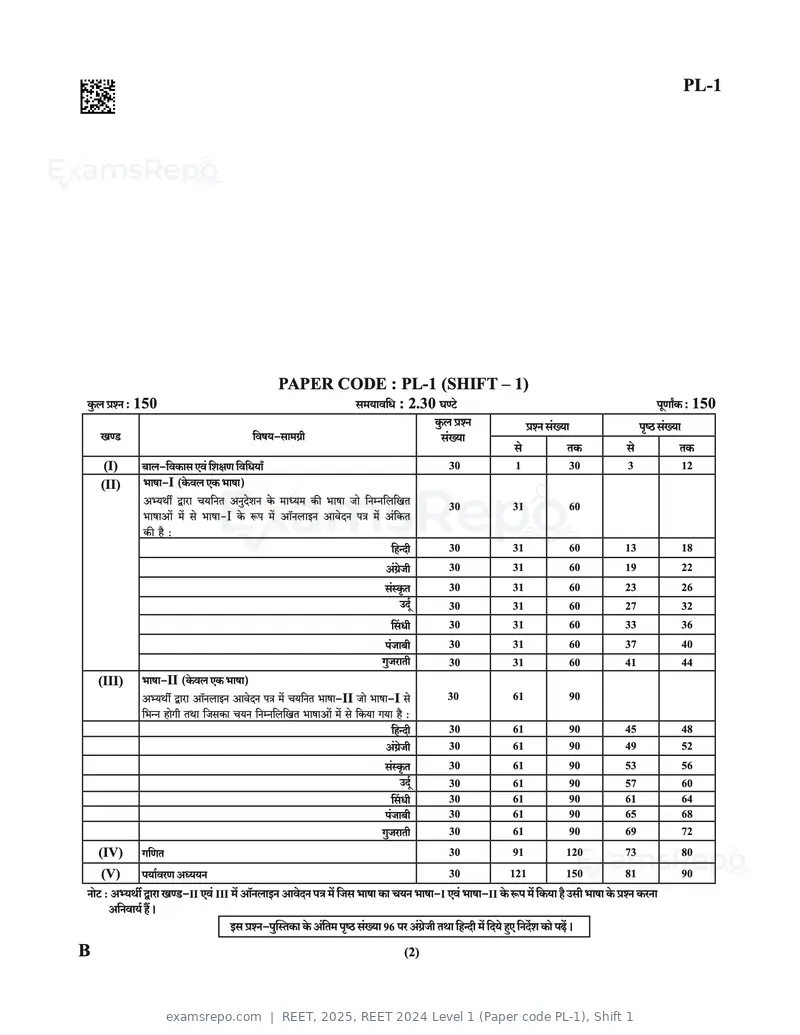
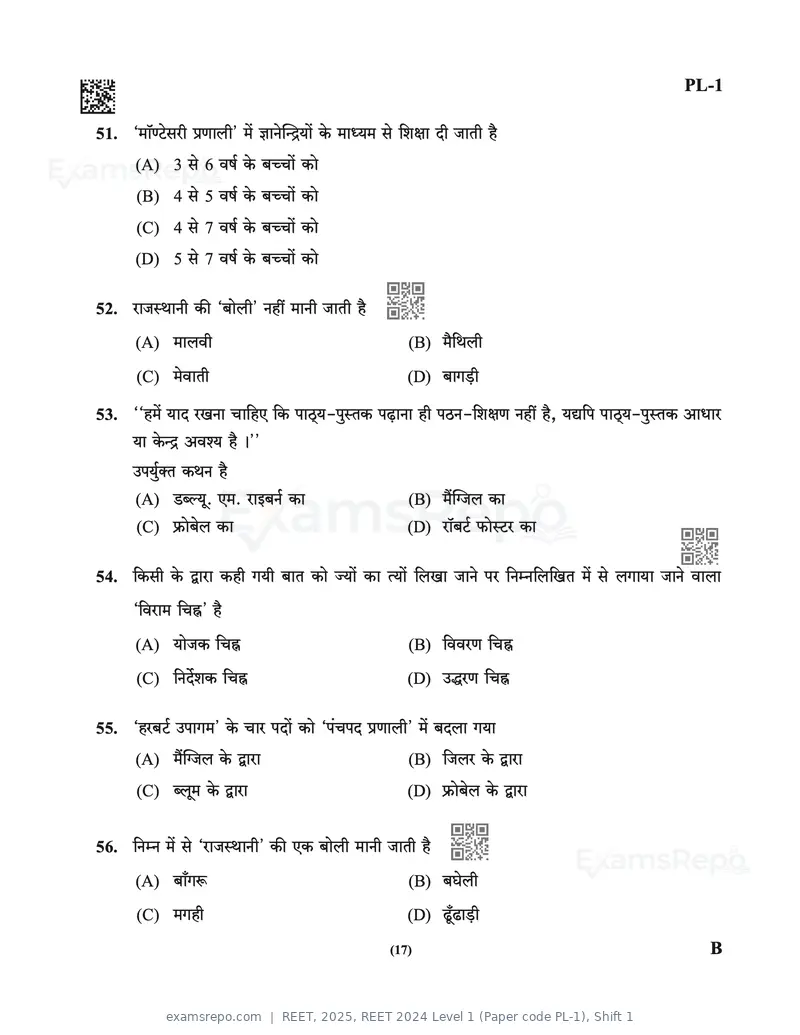
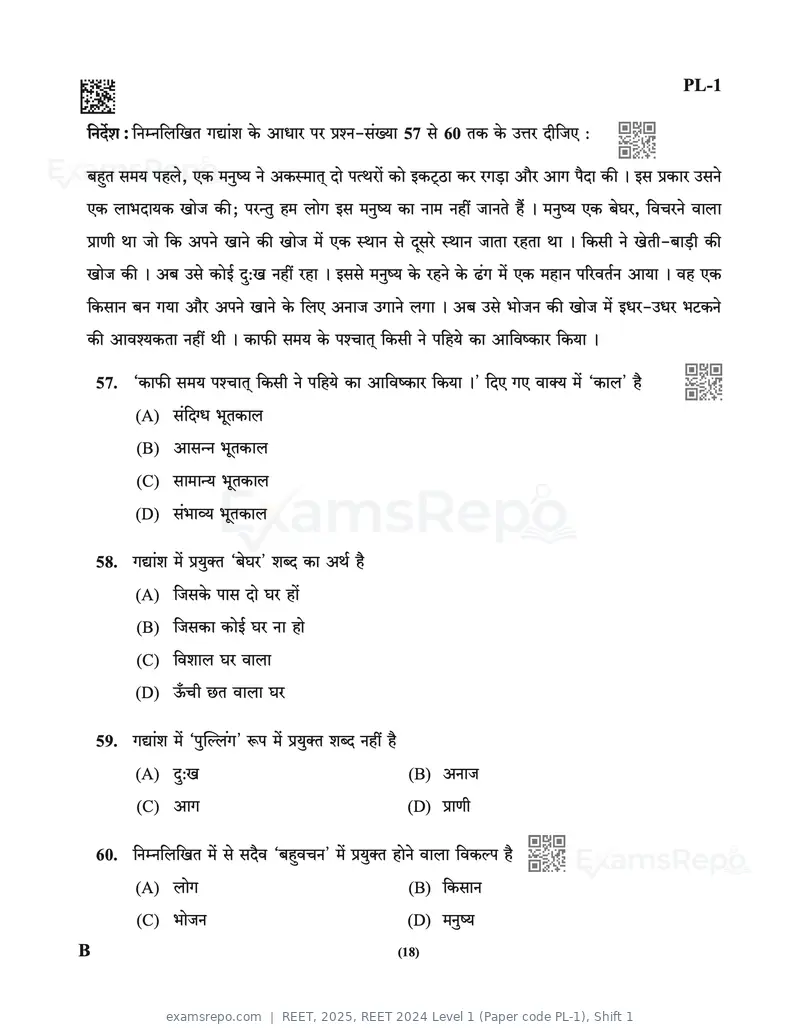
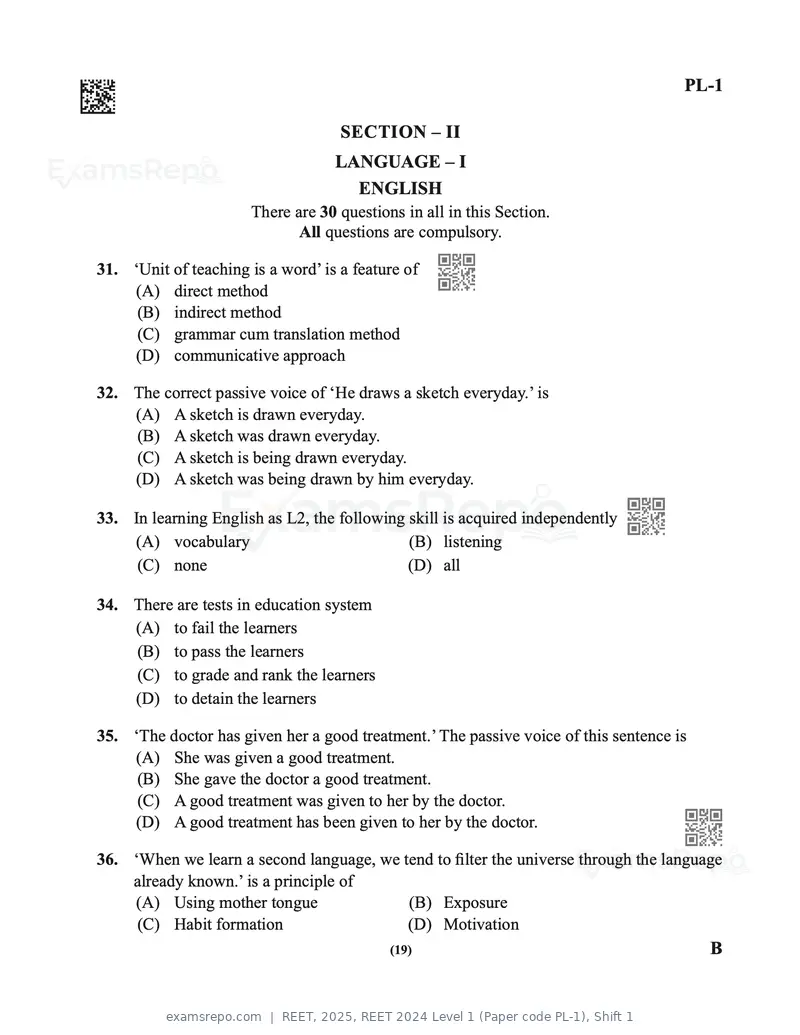
Text of page 115
PL-1

                                    SECTION – II
                                   LANGUAGE – I
                                     ENGLISH
                       There are 30 questions in all in this Section.
                              All questions are compulsory.

31. ‘Unit of teaching is a word’ is a feature of
    (A) direct method
     (B) indirect method
     (C) grammar cum translation method
    (D) communicative approach

32. The correct passive voice of ‘He draws a sketch everyday.’ is
    (A) A sketch is drawn everyday.
    (B) A sketch was drawn everyday.
    (C) A sketch is being drawn everyday.
    (D) A sketch was being drawn by him everyday.

33. In learning English as L2, the following skill is acquired independently
    (A) vocabulary			                        (B) listening
     (C) none			                             (D) all

34. There are tests in education system
    (A) to fail the learners
    (B) to pass the learners
    (C) to grade and rank the learners
    (D) to detain the learners

35. ‘The doctor has given her a good treatment.’ The passive voice of this sentence is
    (A) She was given a good treatment.
     (B) She gave the doctor a good treatment.
     (C) A good treatment was given to her by the doctor.
    (D) A good treatment has been given to her by the doctor.

36. ‘When we learn a second language, we tend to filter the universe through the language
    already known.’ is a principle of
    (A) Using mother tongue               (B) Exposure
     (C) Habit formation			               (D) Motivation
                                            (19)                                         B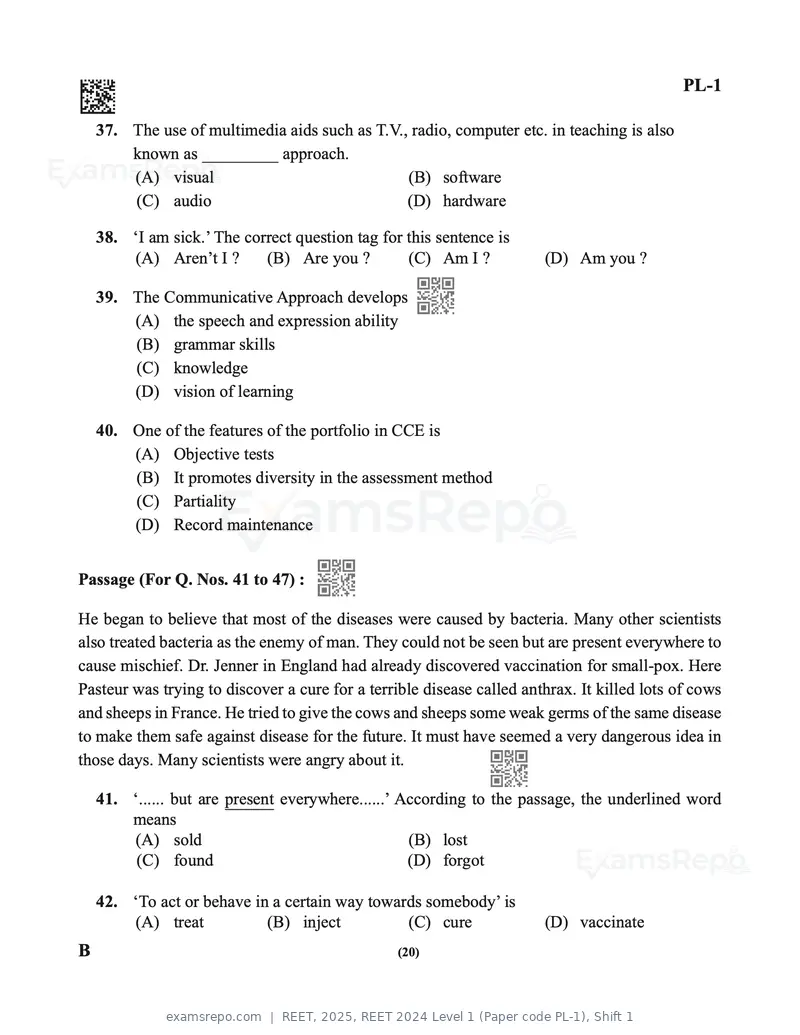
Text of page 116
PL-1

    37. The use of multimedia aids such as T.V., radio, computer etc. in teaching is also
        known as _________ approach.
        (A) visual			                           (B) software
        (C) audio			                            (D) hardware

    38. ‘I am sick.’ The correct question tag for this sentence is
        (A) Aren’t I ?      (B) Are you ?         (C) Am I ?           (D) Am you ?

    39. The communicative Approach develops
        (A) the speech and expression ability
        (B) grammar skills
        (C) knowledge
        (D) vision of learning

    40. One of the features of the portfolio in CCE is
        (A) Objective tests
        (B) It promotes diversity in the assessment method
        (C) Partiality
        (D) Record maintenance


Passage (For Q. Nos. 41 to 47) :

He began to believe that most of the diseases were caused by bacteria. Many other scientists
also treated bacteria as the enemy of man. They could not be seen but are present everywhere to
cause mischief. Dr. Jenner in England had already discovered vaccination for small-pox. Here
Pasteur was trying to discover a cure for a terrible disease called anthrax. It killed lots of cows
and sheeps in France. He tried to give the cows and sheeps some weak germs of the same disease
to make them safe against disease for the future. It must have seemed a very dangerous idea in
those days. Many scientists were angry about it.

    41. ‘...... but are present everywhere......’ According to the passage, the underlined word
        means
        (A) sold			                                (B) lost
         (C) found			                              (D) forgot

    42. ‘To act or behave in a certain way towards somebody’ is
        (A) treat           (B) inject          (C) cure               (D) vaccinate
B                                                (20)
Text of page 117
PL-1

43. The word opposite in meaning of ‘present’ is
    (A) everywhere (B) absent             (C) attendance           (D) gift

44. The correct spelling is
    (A) Mischievus			                         (B) Mischievous
    (C) Mischeivous			                        (D) Mischieous

45. One word for ‘illness of body or mind’ is
    (A) disease        (B) healthy          (C) bacteria           (D) vaccination

46. ‘danger-dangerous’ is a pair of
    (A) noun-adjective			                     (B) noun-pronoun
     (C) noun-adverb			                       (D) adjective-noun

47. The noun form of the word ‘discover’ is
    (A) invention			                        (B) discovery
    (C) discovered			                       (D) invented

48. The phonetic transcription of the word ‘description’ is
    (A) /deskripsΛn/			                     (B) /discr∂p∫en/
    (C) /dɪ'skrɪpθn/			                     (D) /diskrip∫n/

49. _________ is a drawback in the implementation of the direct method in teaching of
    English.
    (A) Use of mother tongue            (B) Familiar texts
    (C) Lack of facilities			           (D) Charts

50. ‘Reading is a process of sight, sound and scene.’ is quoted by
    (A) P.B. Ballard (B) Dr. West            (C) W.S. Gray       (D) Jesperson

51. ‘They will not help their needy neighbour.’ The correct question for the sentence is
    (A) What did he do ?			                 (B) Why will the neighbour not help ?
     (C) Who will they not help ?           (D) What did the neighbour do ?

52. In CCE, the focus remains on
    (A) progress, process and product         (B) course, test, performance
     (C) time, process, assessment            (D) formats, product, record
53. The correct word with this symbol (ð) sound is
    (A) brother			                         (B) laughter
    (C) great			                           (D) higher
                                           (21)                                            B
Text of page 118
PL-1

Passage (For Q. Nos. 54 to 60) :
The old man sighed and picked up the chisel and the hammer. He loved his work and did not want
to change it for any other work in the world. For days together, the man worked continuously
without taking rest. His one desire was to finish the sculpture which would be his last. He worked
till his hands began to tremble and his shoulders started to ache. His arms grew heavy and his
eyes grew tired. And then he couldn’t see anymore.

    54. ‘Continuously’ is
        (A) adverb			                             (B) noun
         (C) adjective			                         (D) conjunction

    55. The sentence that is incorrect due to the use of wrong determiner is
        (A) He worked till their hands began to tremble.
        (B) He loved his work.
        (C) His arms grew heavy.
        (D) The old man sighed and picked up the chisel and the hammer.

    56. The comparative degree of ‘heavy’ is
        (A) more heavy
        (B) most heavy
        (C) heavier
        (D) heaviest

    57. Cotton is ___________ than wood. Choose the correct adjective.
        (A) heavier			                      (B) lighter
        (C) heavy			                        (D) light

    58. ___________ is a noun.
        (A) Picked			                             (B) Desired
        (C) Chisel			                             (D) Tremble

    59. In the phrase ‘... any other work in the world’, the word ‘other’ is
        (A) noun			                               (B) subject
         (C) object			                            (D) determiner

    60. ____________ is that incorrect sentence.
        (A) He loved his work.
        (B) It would be his last work.
        (C) His arms grown heavy.
        (D) He worked till hands began to tremble.
B                                                (22)
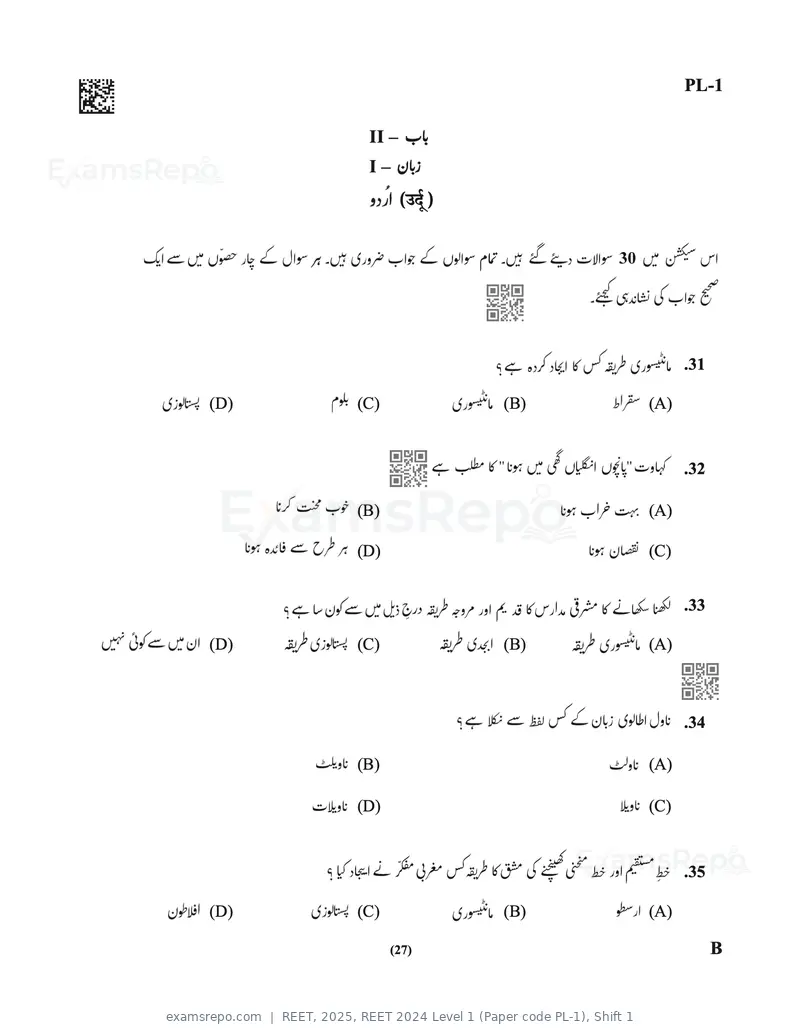
Text of page 123
PL-1

         II –
         I–
                (CXÿ© )


                                      .31

  (D)   (C)               (B)   (A)


                                      .32

			     (B)			                  (A)

			     (D)			                  (C)


                                      .33

  (D)   (C)               (B)   (A)


                                      .34

			     (B)			                  (A)

			     (D)			                  (C)


                                      .35

  (D)   (C)               (B)   (A)

              (27)                          B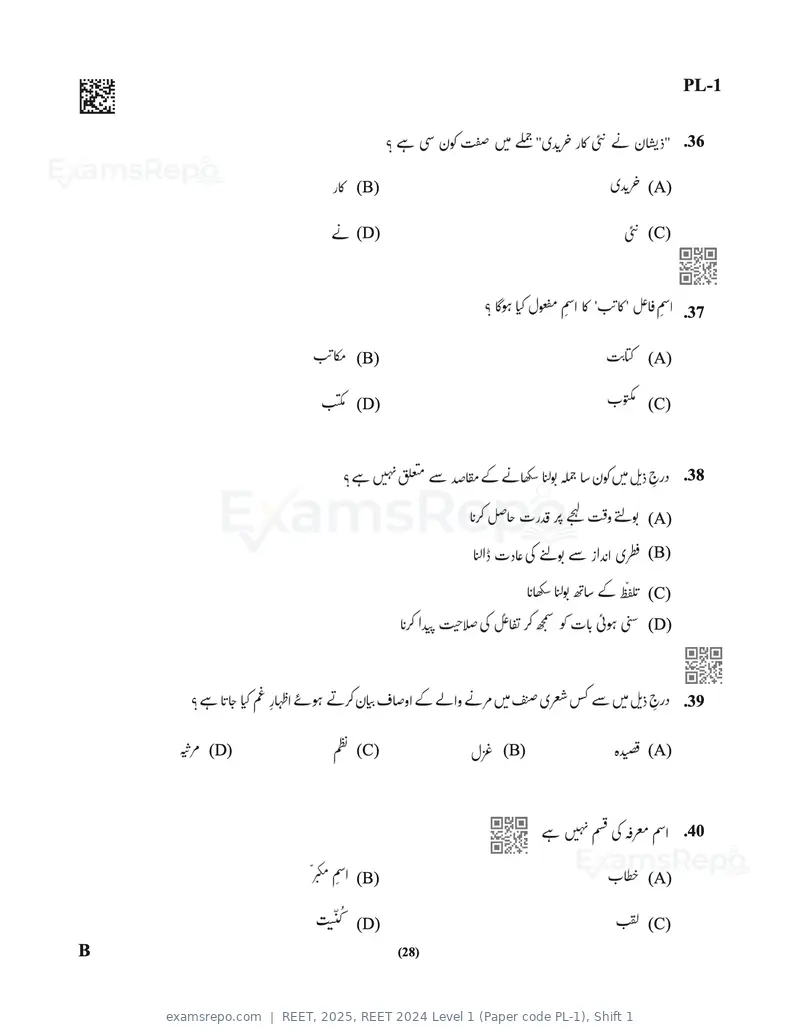
Text of page 124
PL-1


                                    .36

    		     (B)			             (A)

			        (D)			             (C)


                                    .37

			        (B)			             (A)

			        (D)			             (C)


           .38

					  (A)

			    (B)

			    (C)

			    (D)


                                    .39

     (D)   (C)          (B)   (A)


                                    .40

			        (B)			             (A)

			        (D)			             (C)
B                (28)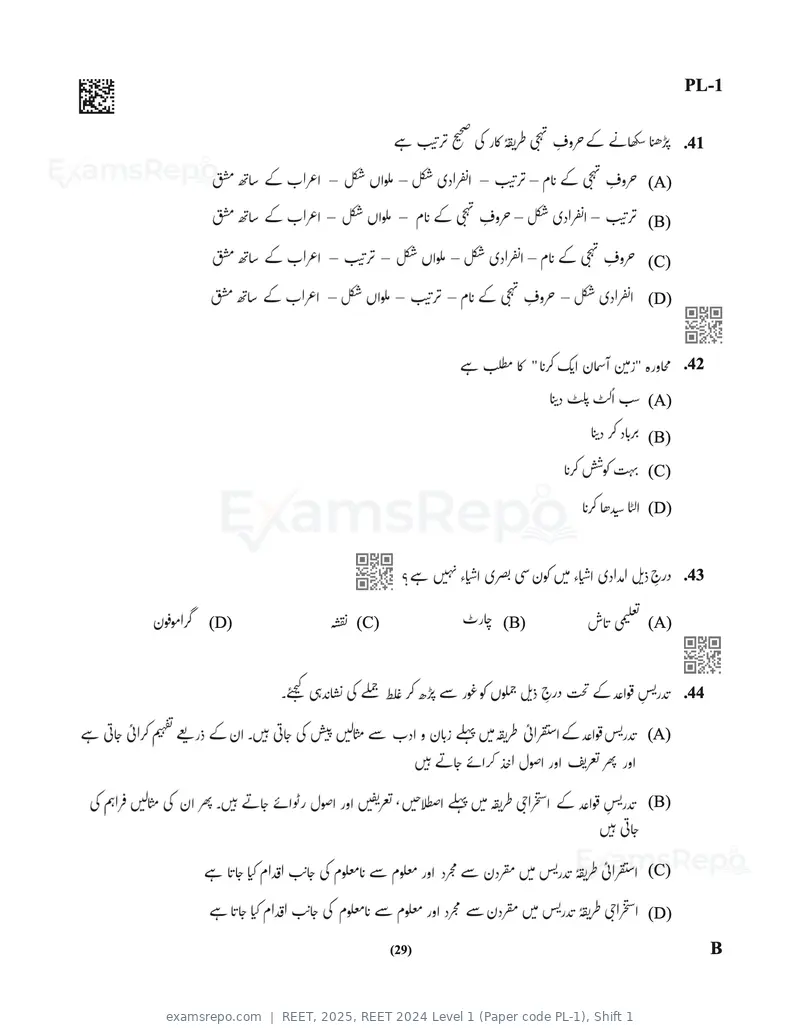
Text of page 125
PL-1


                                    .41

			                        		 (A)

			                        		 (B)

			                        		 (C)

			                        		 (D)


                                    .42

							                      (A)

							                      (B)

							                      (C)

							                      (D)


                                    .43

  (D)   (C)          (B)     (A)


                                    .44

                             (A)


                             (B)


                             (C)

                             (D)

              (29)                        B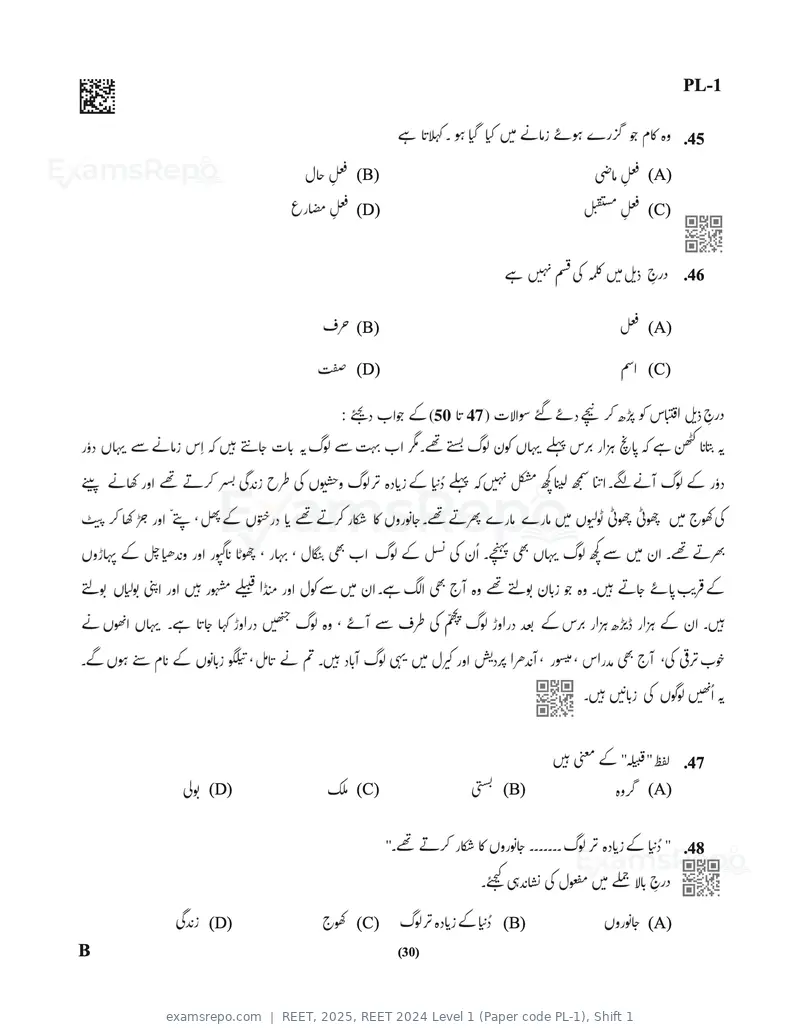
Text of page 126
PL-1

                                   .45

			       (B)			             (A)

			       (D)			             (C)


                                   .46


			       (B)			             (A)

			       (D)			             (C)


                                   .47
    (D)   (C)          (B)   (A)


                                   .48


    (D)   (C)          (B)   (A)
B               (30)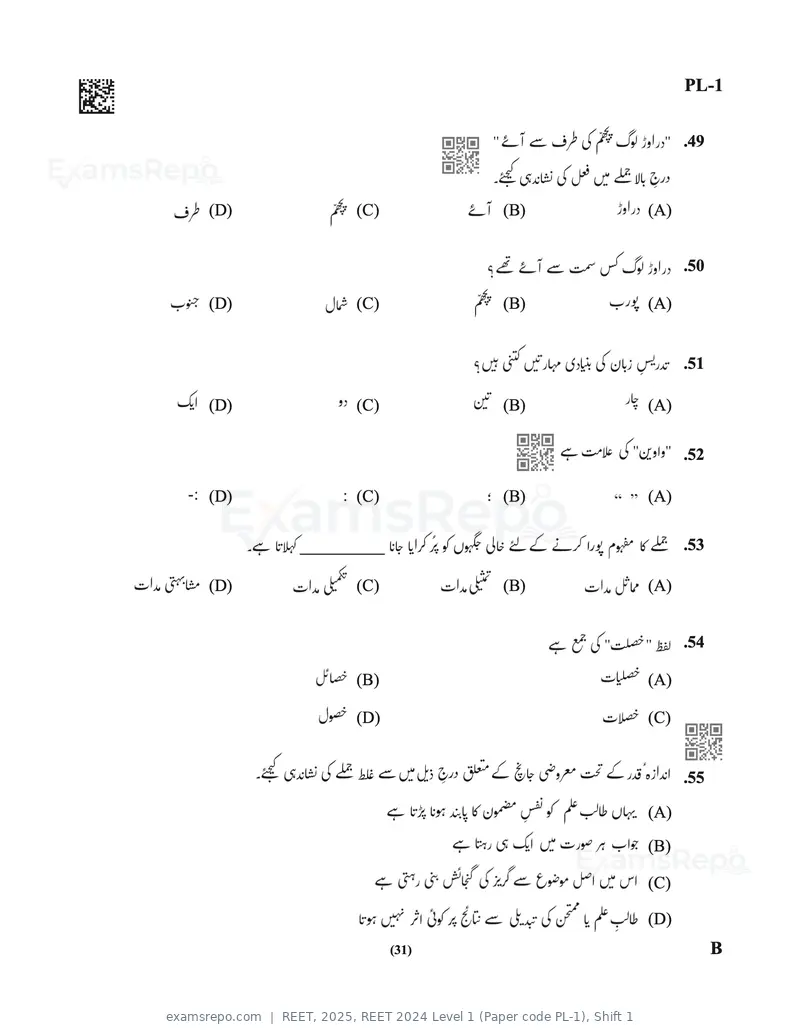
Text of page 127
PL-1


                                 .49


  (D)   (C)          (B)   (A)


                                 .50

  (D)   (C)          (B)   (A)


                                 .51

  (D)   (C)          (B)   (A)

                                 .52

  (D)   (C)          (B)   (A)

                                 .53

  (D)   (C)          (B)   (A)


                                 .54

			     (B)			             (A)

			     (D)			             (C)


                                 .55

                           (A)
                           (B)

                           (C)

                           (D)
              (31)                     B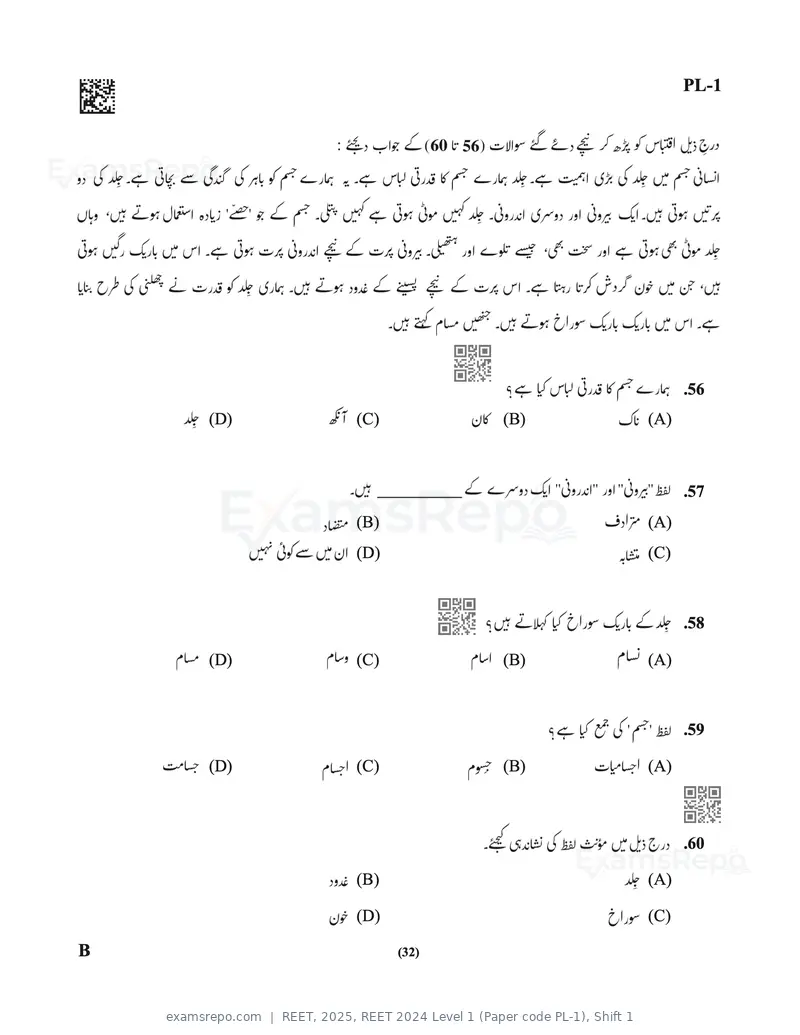
Text of page 128
PL-1


                                   .56
    (D)   (C)          (B)   (A)


                                   .57
			       (B)			             (A)
			       (D)			             (C)


                                   .58

    (D)   (C)          (B)   (A)


                                   .59

    (D)   (C)          (B)   (A)


                                   .60

			       (B)			             (A)

			       (D)			             (C)

B               (32)
Text of page 129
PL-1

                    > – ii
                      –i


31.
      (A)   			       (B)
      (C)   			       (D)

32.
      (A)   			       (B)
      (C)    			      (D)

33.
      (A)   			       (B)
      (C)   			       (D)

34.
      (A)
      (B)
      (C)
      (D)
                   (33)        B
Text of page 130
PL-1

    35.
          (A)
          (B)
          (C)
          (D)

    36.
          (A)     (B)     (C)   (D)

    37.
          (A)     (B)     (C)   (D)

    38.
          (A)     (B)     (C)   (D)

    39.
          (A)     (B)     (C)   (D)

    40.
          (A)     (B)     (C)   (D)

    41.


          (A)   			       (B)
          (C)     			    (D)

    42.
          (A)            (B)
          (C)            (D)

    43.
          (A)     			    (B)
          (C)     			    (D)

    44.
          (A)   			      (B)
          (C)    			     (D)
B                       (34)
Text of page 131
PL-1

45.
      (A)
      (B)
      (C)
      (D)


46.
      (A)        (B)           (C)        (D)

47.
      (A)        (B)           (C)        (D)

48.
      (A)        (B)           (C)        (D)

49.
      (A)        (B)           (C)        (D)

50.
      (A) 1644   (B) 1568      (C) 1544   (D) 1602
                            (35)                       B
Text of page 132
PL-1

    51.
          (A)        		    (B)
          (C)       			    (D)

    52.
          (A)   			        (B)
          (C)   			        (D)
    53.
          (A)     			      (B)
          (C)    			       (D)

    54.
          (A)
          (B)
          (C)
          (D)

    55.
          (A)     (B)       (C)   (D)

    56.
          (A)              (B)
          (C)     			      (D)

    57.
          (A)     (B)       (C)   (D)

    58.
          (A)     (B)       (C)   (D)

    59.
          (A)   			        (B)
          (C)    			       (D)

    60.

          (A)     (B)       (C)   (D)
B                         (36)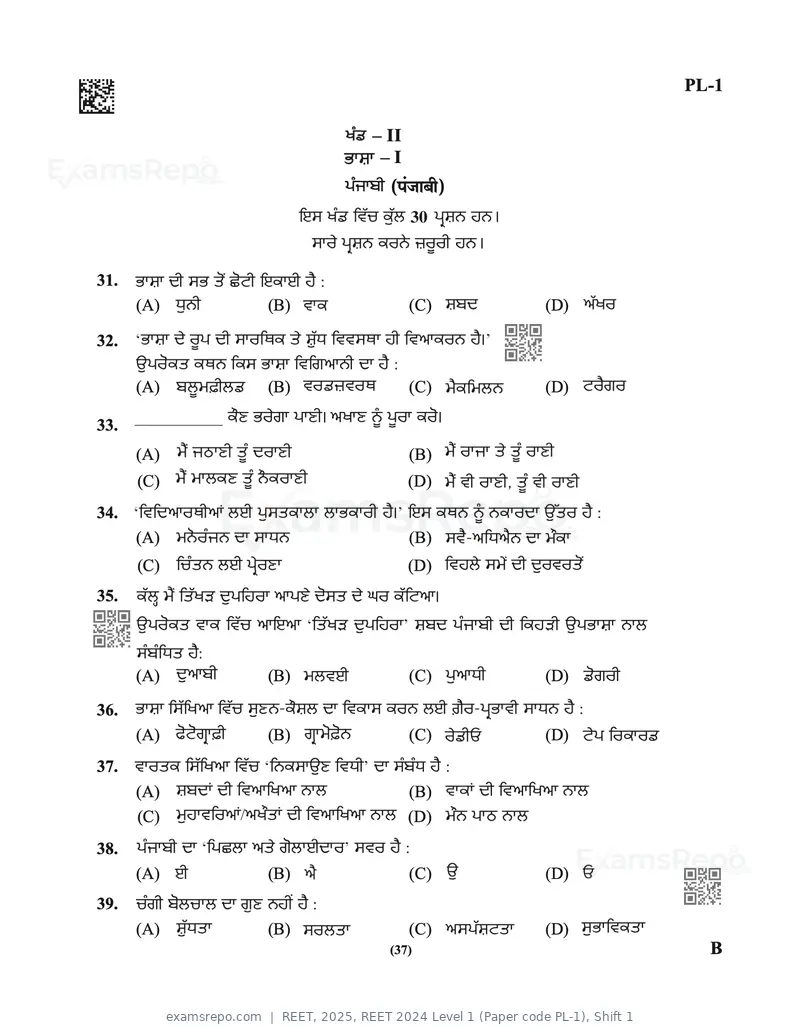
Text of page 133
PL-1

                       – ii
                        –i
                         (n§Om~r)


31.
      (A)   (B)               (C)   (D)

32.

      (A)   (B)               (C)   (D)

33.
      (A)         		          (B)
      (C)                     (D)
34.
      (A)      		             (B)
      (C)     			             (D)
35.


      (A)   (B)               (C)   (D)

36.
      (A)   (B)               (C)   (D)
37.
      (A)                     (B)
      (C)                     (D)
38.
      (A)   (B)               (C)   (D)
39.
      (A)   (B)               (C)   (D)
                         (37)               B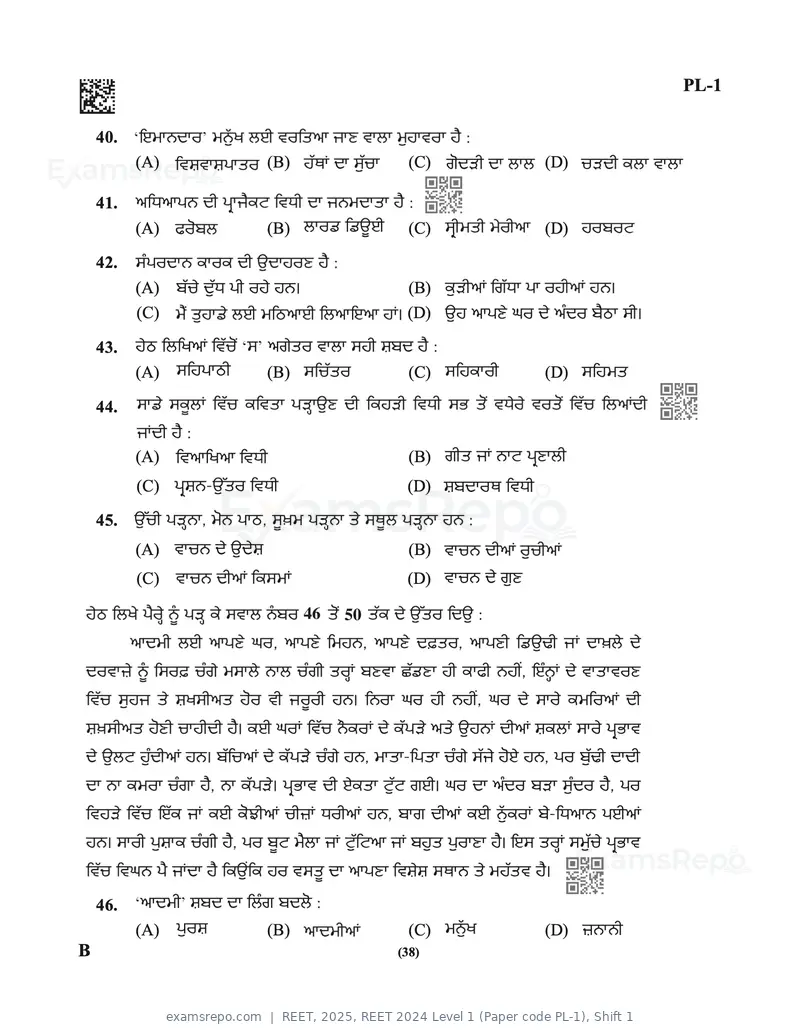
Text of page 134
PL-1

    40.
          (A)   (B)      (C)   (D)

    41.
          (A)   (B)      (C)   (D)

    42.
          (A)           (B)
          (C)           (D)

    43.
          (A)   (B)      (C)   (D)

    44.

          (A)   			      (B)
          (C)    			    (D)

    45.
          (A)   			      (B)
          (C)     		    (D)


    46.
          (A)   (B)      (C)   (D)
B                      (38)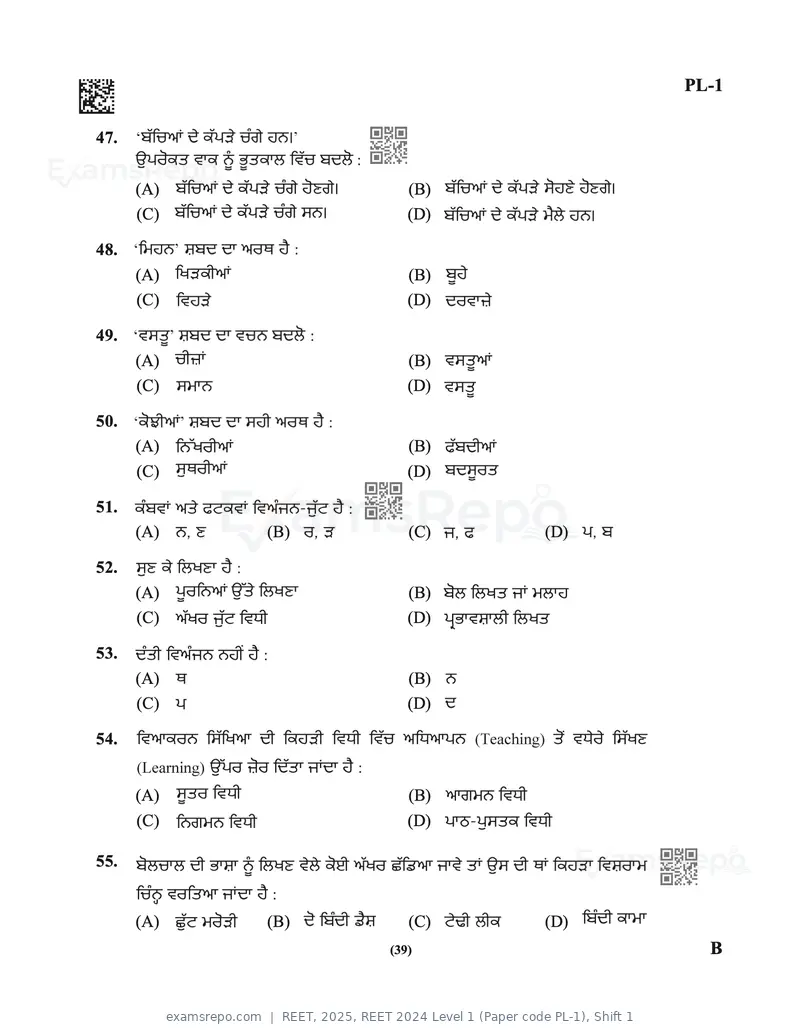
Text of page 135
PL-1

47.


      (A)              (B)
      (C)              (D)

48.
      (A)    			       (B)
      (C)   			        (D)

49.
      (A)   			        (B)
      (C)   			        (D)

50.
      (A)    			       (B)
      (C)    			       (D)

51.
      (A)     (B)      (C)   (D)

52.
      (A)              (B)
      (C)     			      (D)

53.
      (A)   			        (B)
      (C)   			        (D)

54.


      (A)    			       (B)
      (C)     			      (D)

55.


      (A)     (B)      (C)   (D)
                    (39)             B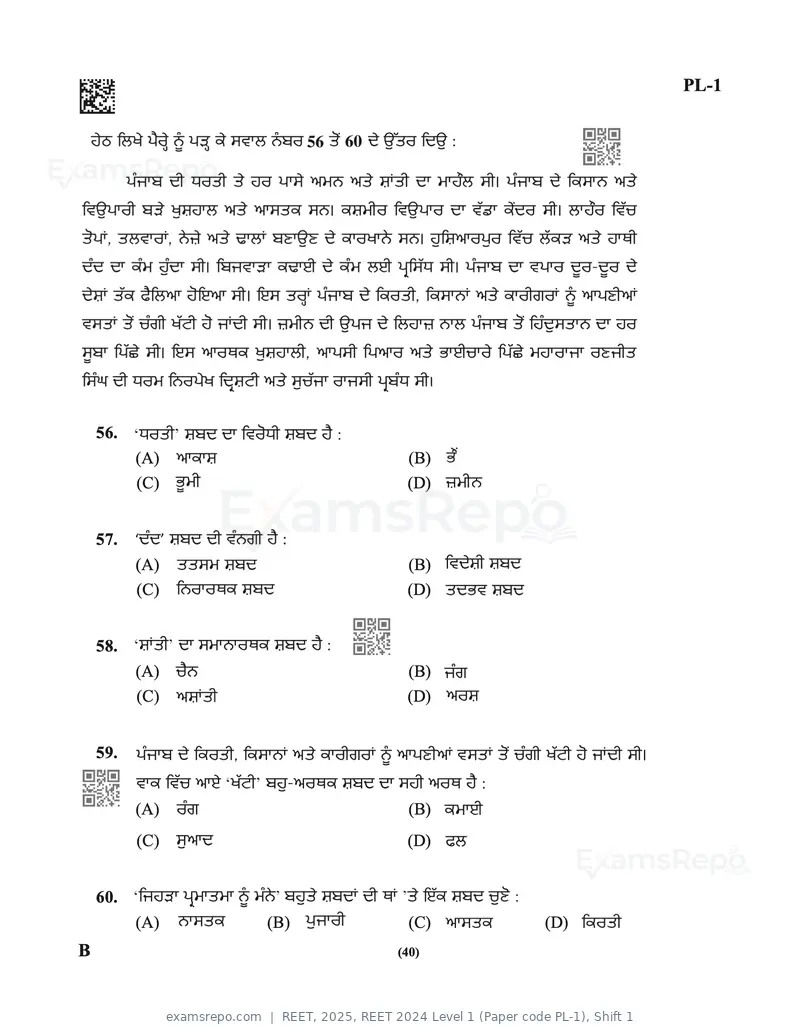
Text of page 136
PL-1


    56.
          (A)    			      (B)
          (C)   			       (D)


    57.
          (A)     			     (B)
          (C)      			    (D)


    58.
          (A)   			       (B)
          (C)    			      (D)


    59.


          (A)   			        (B)
          (C)   			       (D)


    60.
          (A)     (B)      (C)   (D)
B                        (40)
Text of page 137
PL-1

                       – iI
                        –i
                              (JwOamVr)


31.
      (A)     		               (B)
      (C)   			                (D)
32.
      (A)   			                (B)
      (C)   			                (D)
33.
      (A)     			              (B)
      (C)     			              (D)
34.
      (A)         		           (B)
      (C)         		           (D)
35.
      (A)   (B)                (C)        (D)
36.

      (A)                      (B)
      (C)                      (D)
37.
      (A)   (B)                (C)        (D)
38.
      (A)   (B)                (C)        (D)
39.
      (A)   (B)                (C)        (D)
40.
      (A)   (B)                (C)        (D)
                         (41)                     B
Text of page 138
PL-1

    41.

          (A)
          (B)
          (C)
          (D)

    42.
          (A)   (B)     (C)   (D)
    43.
          (A)   (B)     (C)   (D)
    44.
          (A)
          (B)
          (C)
          (D)


    45.
          (A)          (B)
          (C)          (D)
B                     (42)
Text of page 139
PL-1

46.
      (A)        (B)          (C)       (D)

47.
      (A)        (B)          (C)       (D)

48.
      (A)         			         (B)
      (C)           		        (D)

49.
      (A)                     (B)
      (C)        			          (D)

50.
      (A)                     (B)
      (C)                     (D)

51.
      (A)           		        (B)
      (C)         			         (D)

52.
      (A)       			           (B)
      (C)       			           (D)

53.
      (A)       			           (B)
      (C)       			           (D)

54.
      (A) (–)    (B) (:)      (C) (;)   (D) (" ")

55.
      (A)         			         (B)
      (C)        			          (D)
                           (43)                       B
Text of page 140
PL-1

    56.
          (A)     (B)      (C)    (D)

    57.
          (A)   			       (B)
          (C)    			      (D)


    58.
          (A)   			        (B)
          (C)   			       (D)

    59.
          (A)      			     (B)
          (C)     			     (D)


    60.
          (A)
          (B)
          (C)
          (D)
B                        (44)
Text of page 145
PL-1

                                   SECTION – III
                                  LANGUAGE – II
                                    ENGLISH
                      There are 30 questions in all in this Section.
                             All questions are compulsory.

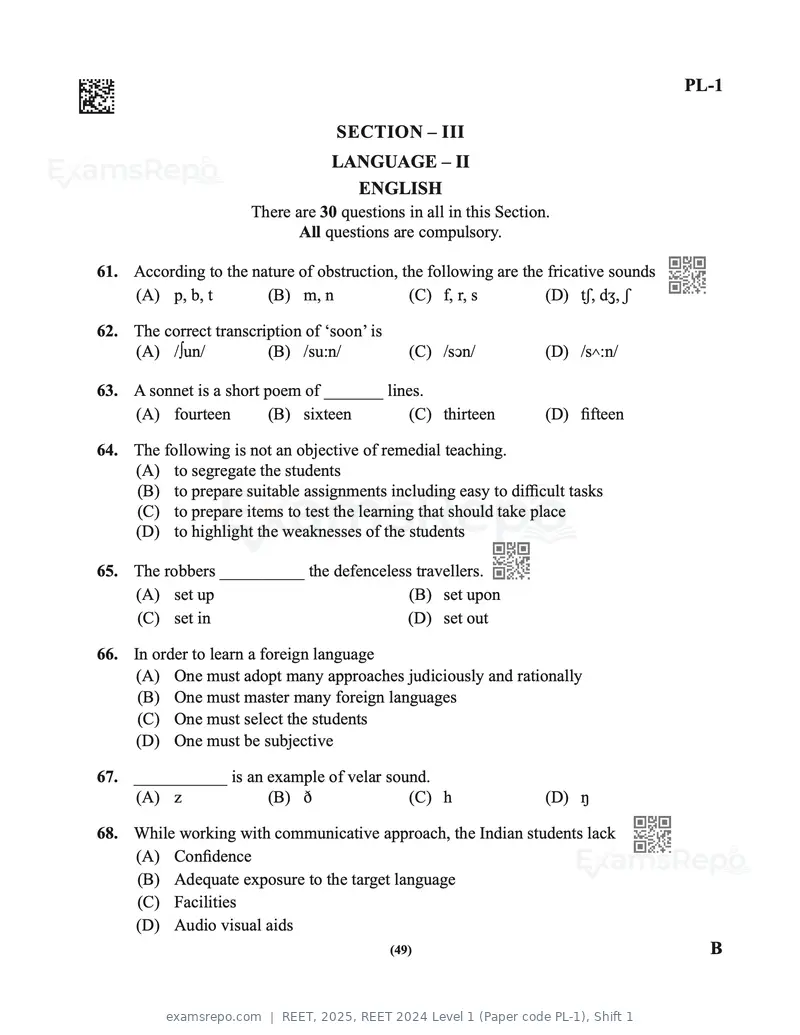
61. According to the nature of obstruction, the following are the fricative sounds
    (A) p, b, t        (B) m, n              (C) f, r, s         (D) tʃ, dʒ, ʃ

62. The correct transcription of ‘soon’ is
    (A) /∫un/           (B) /su:n/              (C) /sͻn/          (D) /s^:n/

63. A sonnet is a short poem of _______ lines.
    (A) fourteen         (B) sixteen       (C) thirteen            (D) fifteen

64. The following is not an objective of remedial teaching.
    (A) to segregate the students
    (B) to prepare suitable assignments including easy to difficult tasks
    (C) to prepare items to test the learning that should take place
    (D) to highlight the weaknesses of the students

65. The robbers __________ the defenceless travellers.
    (A) set up			                         (B) set upon
    (C) set in			                        (D) set out

66. In order to learn a foreign language
    (A) One must adopt many approaches judiciously and rationally
     (B) One must master many foreign languages
     (C) One must select the students
    (D) One must be subjective

67. ___________ is an example of velar sound.
    (A) z             (B) ð               (C) h                    (D) ŋ

68. While working with communicative approach, the Indian students lack
    (A) Confidence
    (B) Adequate exposure to the target language
    (C) Facilities
    (D) Audio visual aids
                                             (49)                                      B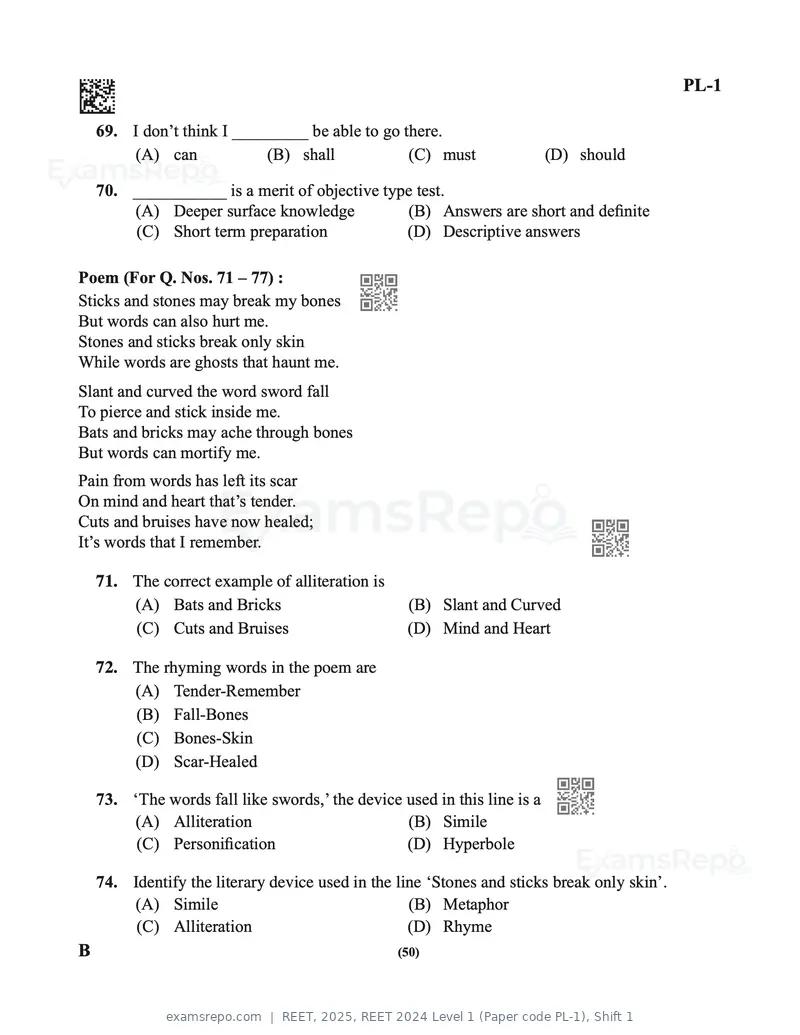
Text of page 146
PL-1

    69. I don’t think I _________ be able to go there.
        (A) can             (B) shall            (C) must                 (D) should

    70. ___________ is a merit of objective type test.
        (A) Deeper surface knowledge           (B) Answers are short and definite
        (C) Short term preparation             (D) Descriptive answers

Poem (For Q. Nos. 71 – 77) :
Sticks and stones may break my bones
But words can also hurt me.
Stones and sticks break only skin
While words are ghosts that haunt me.
Slant and curved the word sword fall
To pierce and stick inside me.
Bats and bricks may ache through bones
But words can mortify me.
Pain from words has left its scar
On mind and heart that’s tender.
Cuts and bruises have now healed;
It’s words that I remember.

    71. The correct example of alliteration is
        (A) Bats and Bricks			                    (B) Slant and Curved
        (C) Cuts and Bruises			                   (D) Mind and Heart

    72. The rhyming words in the poem are
        (A) Tender-Remember
        (B) Fall-Bones
        (C) Bones-Skin
        (D) Scar-Healed

    73. ‘The words fall like swords,’ the device used in this line is a
        (A) Alliteration			                      (B) Simile
         (C) Personification			                  (D) Hyperbole

    74. Identify the literary device used in the line ‘Stones and sticks break only skin’.
        (A) Simile			                              (B) Metaphor
         (C) Alliteration			                       (D) Rhyme
B                                                (50)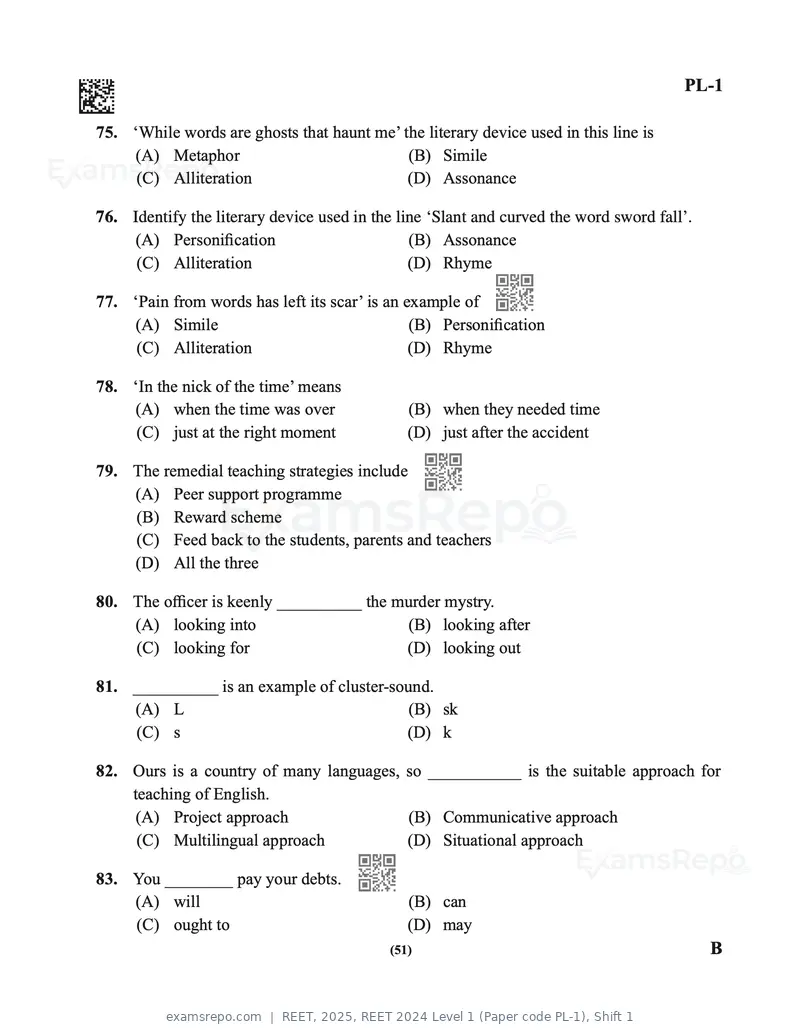
Text of page 147
PL-1

75. ‘While words are ghosts that haunt me’ the literary device used in this line is
    (A) Metaphor			                         (B) Simile
     (C) Alliteration			                    (D) Assonance

76. Identify the literary device used in the line ‘Slant and curved the word sword fall’.
    (A) Personification			                     (B) Assonance
     (C) Alliteration			                       (D) Rhyme

77. ‘Pain from words has left its scar’ is an example of
    (A) Simile			                              (B) Personification
     (C) Alliteration			                       (D) Rhyme

78. ‘In the nick of the time’ means
    (A) when the time was over                (B) when they needed time
     (C) just at the right moment             (D) just after the accident

79. The remedial teaching strategies include
    (A) Peer support programme
    (B) Reward scheme
    (C) Feed back to the students, parents and teachers
    (D) All the three

80. The officer is keenly __________ the murder mystry.
    (A) looking into			                   (B) looking after
    (C) looking for			                    (D) looking out

81. __________ is an example of cluster-sound.
    (A) L			                               (B) sk
    (C) s			                              (D) k

82. Ours is a country of many languages, so ___________ is the suitable approach for
    teaching of English.
     (A) Project approach			             (B) Communicative approach
     (C) Multilingual approach           (D) Situational approach

83. You ________ pay your debts.
    (A) will			                               (B) can
    (C) ought to			                           (D) may
                                           (51)                                             B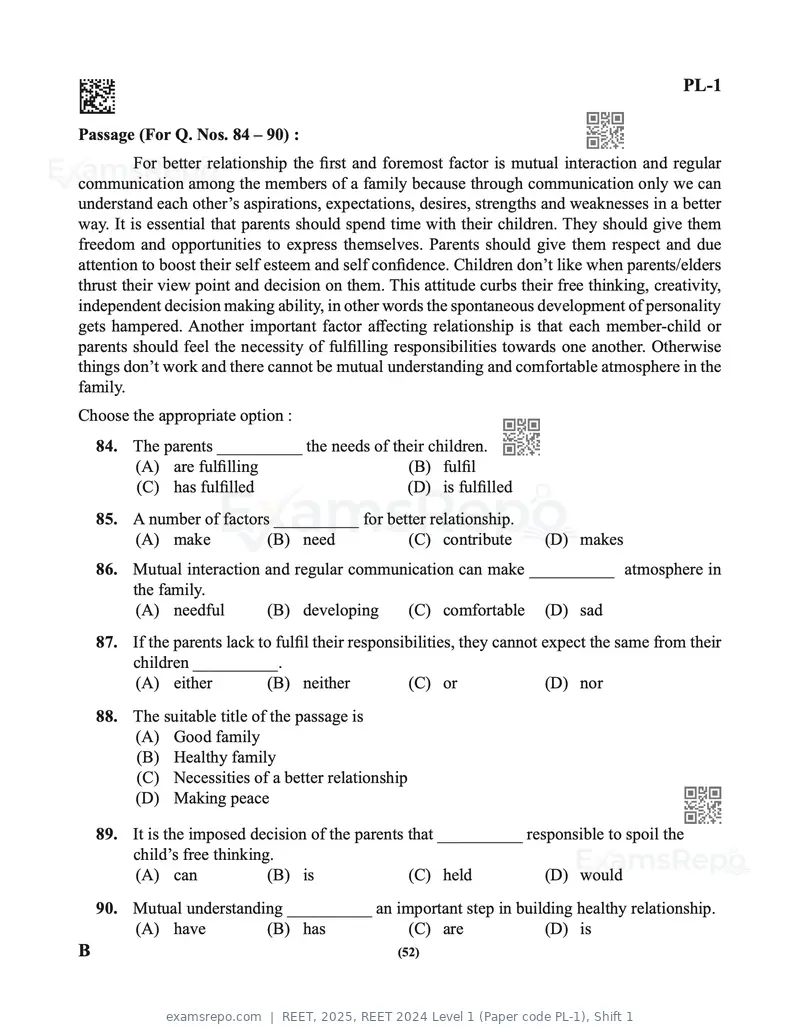
Text of page 148
PL-1

Passage (For Q. Nos. 84 – 90) :
		 For better relationship the first and foremost factor is mutual interaction and regular
communication among the members of a family because through communication only we can
understand each other’s aspirations, expectations, desires, strengths and weaknesses in a better
way. It is essential that parents should spend time with their children. They should give them
freedom and opportunities to express themselves. Parents should give them respect and due
attention to boost their self esteem and self confidence. Children don’t like when parents/elders
thrust their view point and decision on them. This attitude curbs their free thinking, creativity,
independent decision making ability, in other words the spontaneous development of personality
gets hampered. Another important factor affecting relationship is that each member-child or
parents should feel the necessity of fulfilling responsibilities towards one another. Otherwise
things don’t work and there cannot be mutual understanding and comfortable atmosphere in the
family.
Choose the appropriate option :
    84. The parents __________ the needs of their children.
        (A) are fulfilling			                 (B) fulfil
        (C) has fulfilled			                  (D) is fulfilled
    85. A number of factors __________ for better relationship.
        (A) make           (B) need           (C) contribute            (D) makes
    86. Mutual interaction and regular communication can make __________ atmosphere in
        the family.
         (A) needful       (B) developing    (C) comfortable (D) sad
    87. If the parents lack to fulfil their responsibilities, they cannot expect the same from their
        children __________.
        (A) either           (B) neither            (C) or                (D) nor
    88. The suitable title of the passage is
        (A) Good family
        (B) Healthy family
        (C) Necessities of a better relationship
        (D) Making peace

    89. It is the imposed decision of the parents that __________ responsible to spoil the
        child’s free thinking.
        (A) can              (B) is               (C) held           (D) would
    90. Mutual understanding __________ an important step in building healthy relationship.
        (A) have          (B) has            (C) are             (D) is
B                                                 (52)
Text of page 153
PL-1

         III –
         II –
               (CXÿ© )


                                     .61
  (D)   (C)              (B)   (A)


                                     .62
  (D)   (C)              (B)   (A)

                                     .63

  (D)   (C)              (B)   (A)

                                     .64
			     (B)			                 (A)
			     (D)			                 (C)

                                     .65

			     (B)			                 (A)
			     (D)			                 (C)


                                     .66
			     (B)			                 (A)
			     (D)			                 (C)

                                     .67
  (D)   (C)              (B)   (A)

              (57)                         B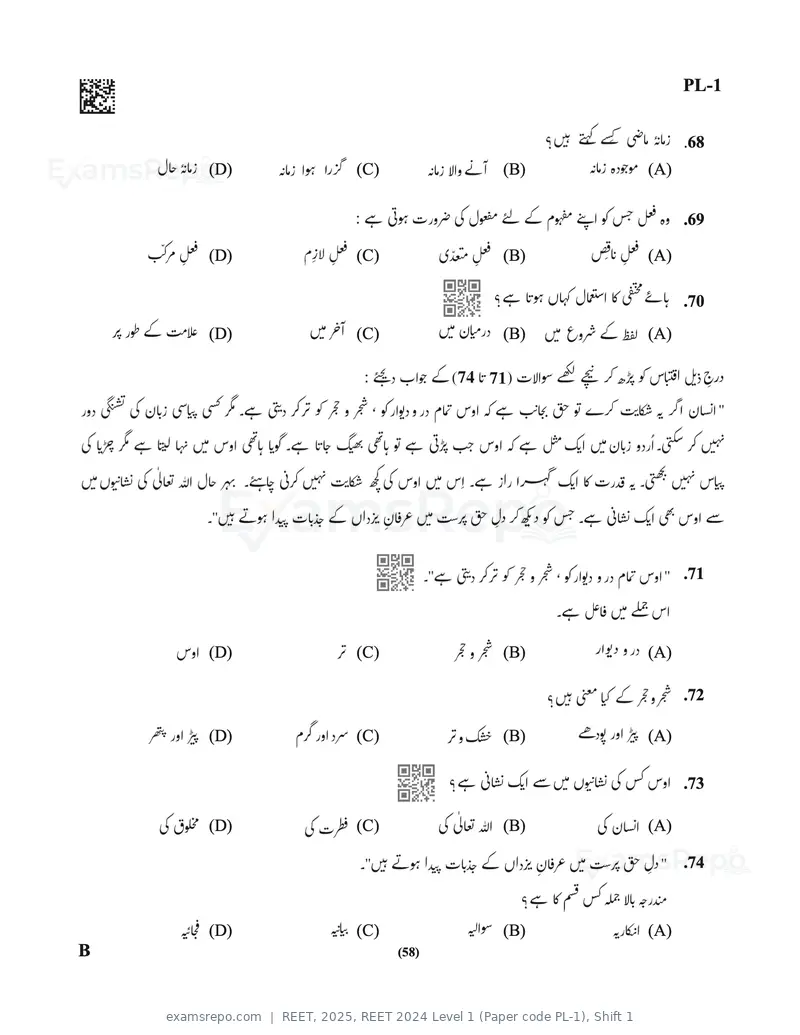
Text of page 154
PL-1


                                   .68
    (D)   (C)          (B)   (A)

                                   .69

    (D)   (C)          (B)   (A)

                                   .70
    (D)   (C)          (B)   (A)


                                   .71


    (D)   (C)          (B)   (A)

                                   .72

    (D)   (C)          (B)   (A)

                                   .73

    (D)   (C)          (B)   (A)

                                   .74


    (D)   (C)          (B)   (A)
B               (58)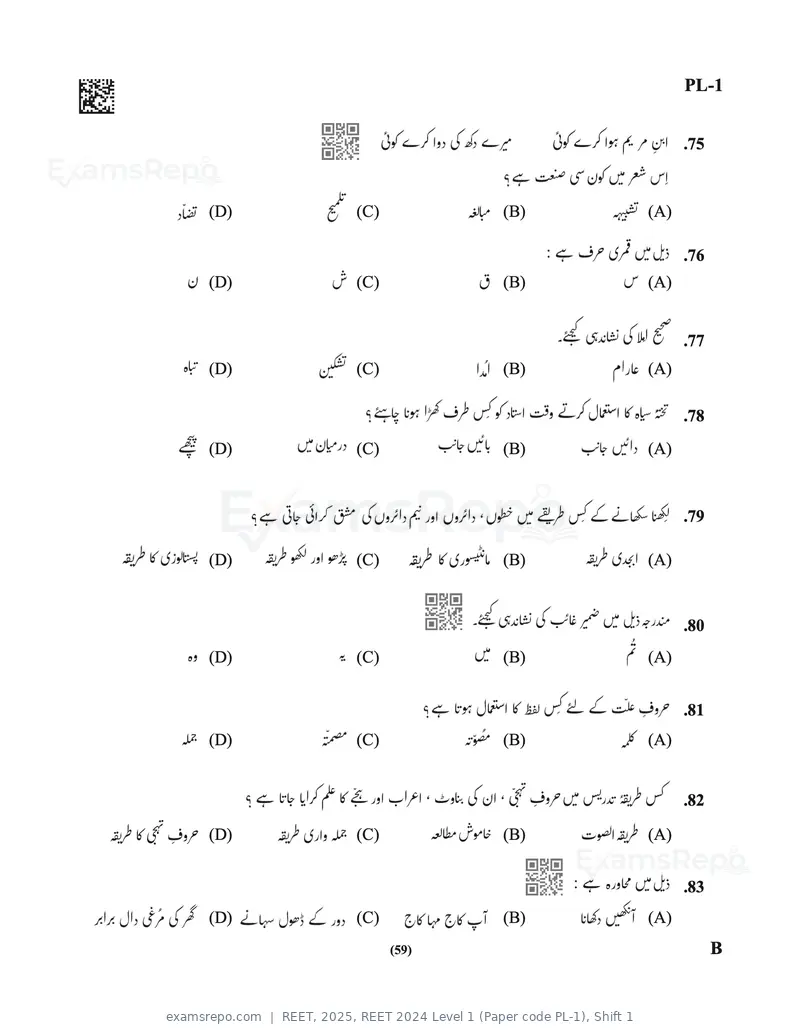
Text of page 155
PL-1


                               .75


(D)   (C)          (B)   (A)

                               .76
(D)   (C)          (B)   (A)


                               .77
(D)   (C)          (B)   (A)

                               .78
(D)   (C)          (B)   (A)


                               .79

(D)   (C)          (B)   (A)


                               .80
(D)   (C)          (B)   (A)


                               .81
(D)   (C)          (B)   (A)


                               .82
(D)   (C)          (B)   (A)


                               .83
(D)   (C)          (B)   (A)
            (59)                     B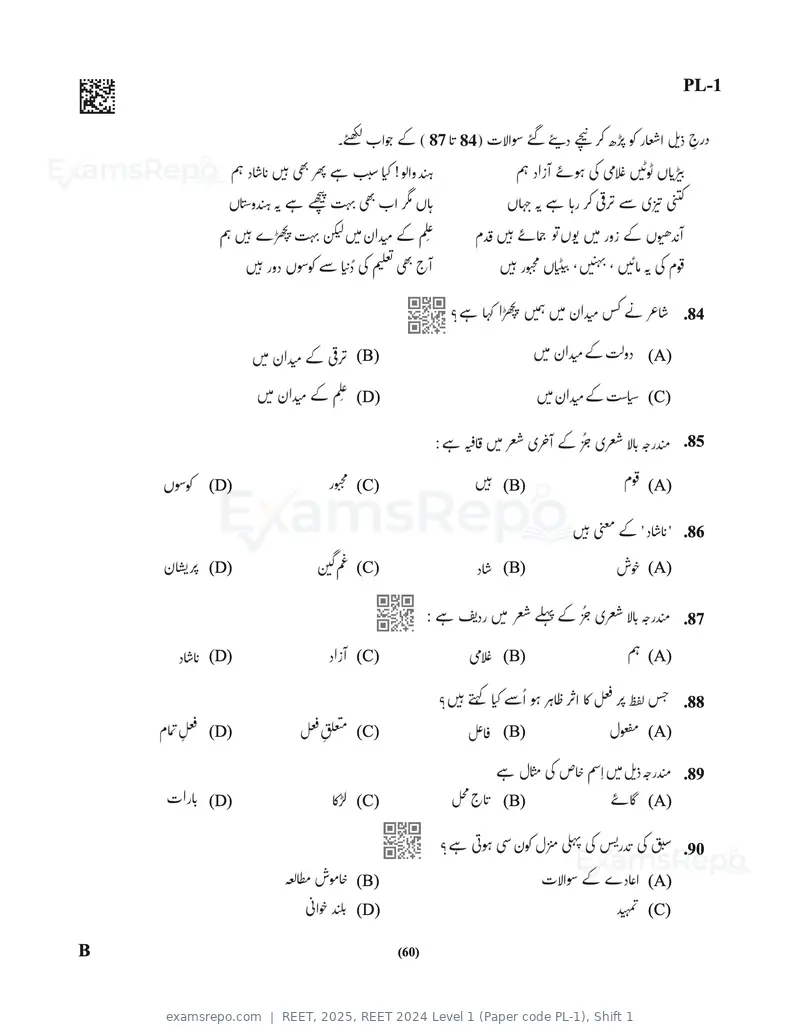
Text of page 156
PL-1


                                   .84

			       (B)			             (A)

			       (D)			             (C)

                                   .85

    (D)   (C)          (B)   (A)

                                   .86

    (D)   (C)          (B)   (A)


                                   .87

    (D)   (C)          (B)   (A)

                                   .88
    (D)   (C)          (B)   (A)

                                   .89
    (D)   (C)          (B)   (A)

                                   .90
			       (B)			             (A)
			       (D)			             (C)

B               (60)
Text of page 157
PL-1

                       – iiI
                      > – II


61.
      (A)
      (B)
      (C)
      (D)


62.
      (A)     			       (B)
      (C)       		      (D)


63.
      (A)   			         (B)
      (C)   			         (D)


64.
      (A)     			       (B)
      (C)   			         (D)


65.
      (A)   			         (B)
      (C)   			         (D)


66.
      (A)   			         (B)
      (C)   			         (D)
                     (61)        B
Text of page 158
PL-1


    67.
          (A)   			     (B)
          (C)   			     (D)

    68.
          (A)    (B)     (C)   (D)

    69.
          (A)           (B)
          (C)           (D)

    70.
          (A)    (B)     (C)   (D)

    71.
          (A)    (B)     (C)   (D)

    72.
          (A)   			      (B)
          (C)   			     (D)

    73.
          (A)    (B)     (C)   (D)
B                      (62)
Text of page 159
PL-1


74.
      (A)         (B)           (C)        (D)


75.
      (A)         (B)           (C)        (D)

76.
      (A)                       (B)
      (C)                       (D)

77.
      (A)        			            (B)
      (C)        			            (D)

78.
      (A)         			           (B)
      (C)                       (D)

79.
      (A)         (B)           (C)        (D)

80.
      (A) 1853    (B) 1947      (C) 1967   (D) 1950
                             (63)                       B
Text of page 160
PL-1

    81.
          (A)            (B)
          (C)            (D)

    82.
          (A)      		    (B)
          (C)    			     (D)

    83.
          (A)    (B)      (C)   (D)

    84.
          (A)   			      (B)
          (C)   			      (D)

    85.
          (A)   			      (B)
          (C)    			     (D)

    86.
          (A)   			      (B)
          (C)   			      (D)

    87.
          (A)   			      (B)
          (C)   			      (D)

    88.
          (A)    (B)      (C)   (D)

    89.
          (A)   			      (B)
          (C)   			      (D)

    90.
          (A)   			      (B)
          (C)   			      (D)
B                       (64)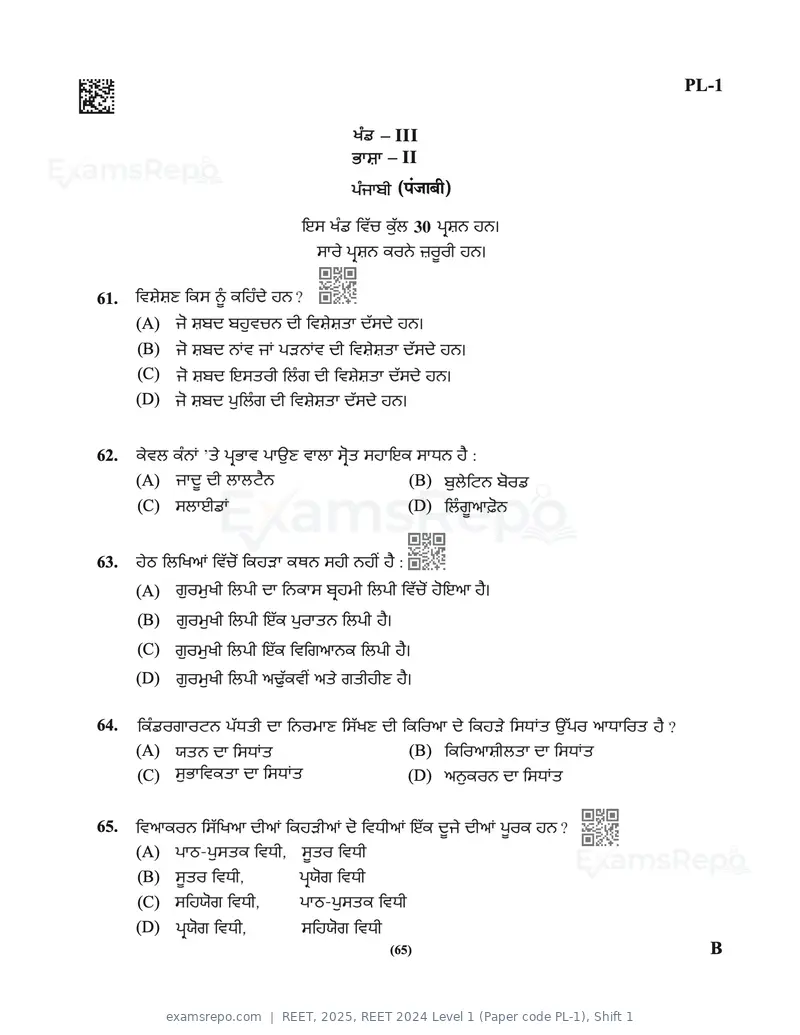
Text of page 161
PL-1

                    > – iiI
                      – II
                       (n§Om~r)


61.
      (A)
      (B)
      (C)
      (D)


62.
      (A)     			        (B)
      (C)   			          (D)


63.
      (A)
      (B)
      (C)
      (D)

64.
      (A)     			        (B)
      (C)                (D)


65.
      (A)
      (B)
      (C)
      (D)
                      (65)          B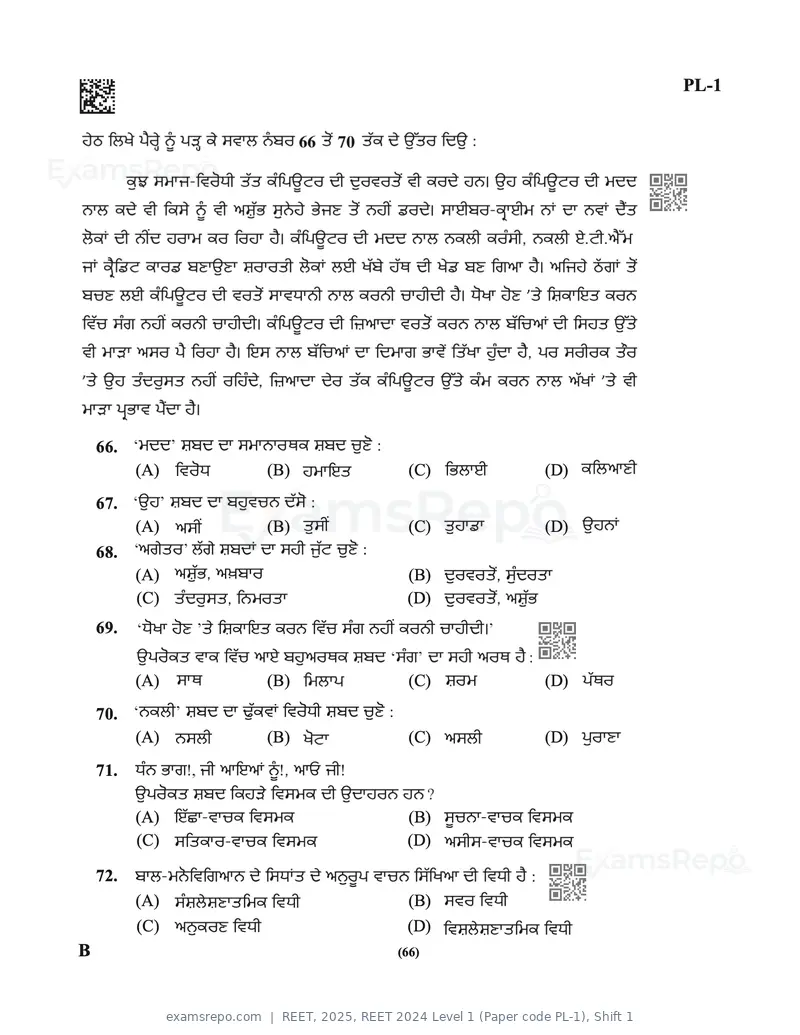
Text of page 162
PL-1


    66.
          (A)   (B)          (C)   (D)
    67.
          (A)   (B)          (C)   (D)
    68.
          (A)   			         (B)
          (C)     			       (D)
    69.


          (A)   (B)          (C)   (D)
    70.
          (A)   (B)          (C)   (D)
    71.

          (A)         		    (B)
          (C)               (D)

    72.
          (A)               (B)
          (C)   			         (D)
B                          (66)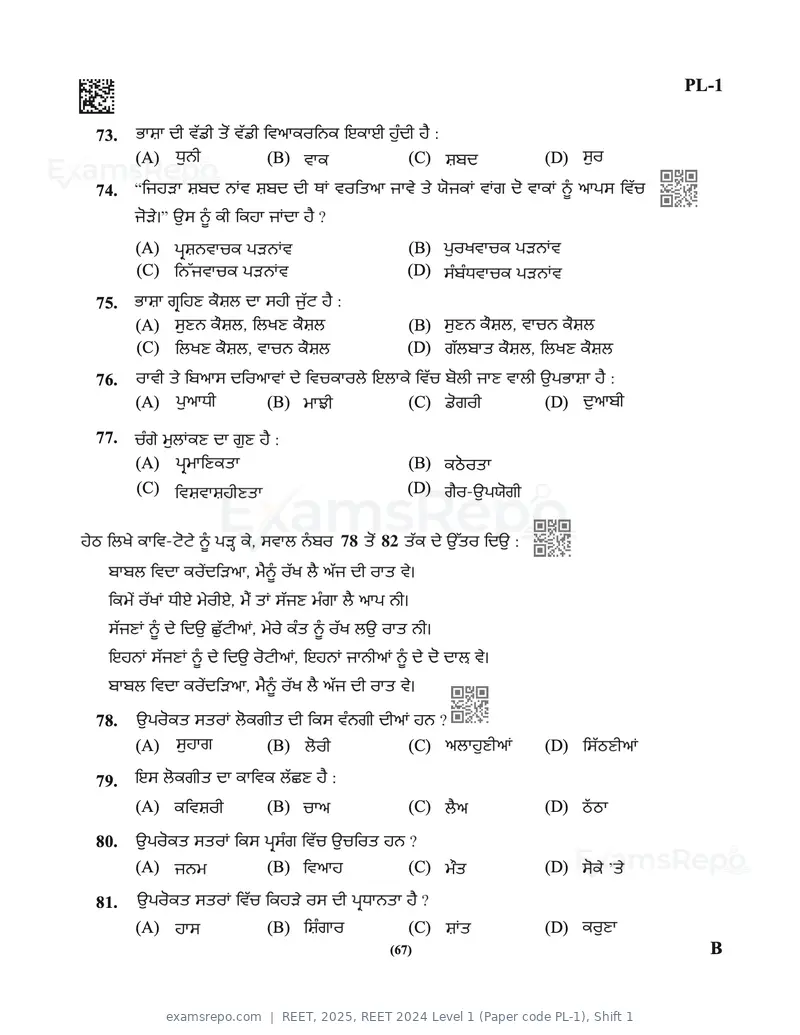
Text of page 163
PL-1

73.
      (A)    (B)        (C)   (D)
74.


      (A)       		      (B)
      (C)      			      (D)
75.
      (A)               (B)
      (C)               (D)
76.
      (A)    (B)        (C)   (D)

77.
      (A)   			         (B)
      (C)    			        (D)


78.
      (A)    (B)        (C)   (D)

79.
      (A)    (B)        (C)   (D)

80.
      (A)    (B)        (C)   (D)

81.
      (A)    (B)        (C)   (D)
                     (67)             B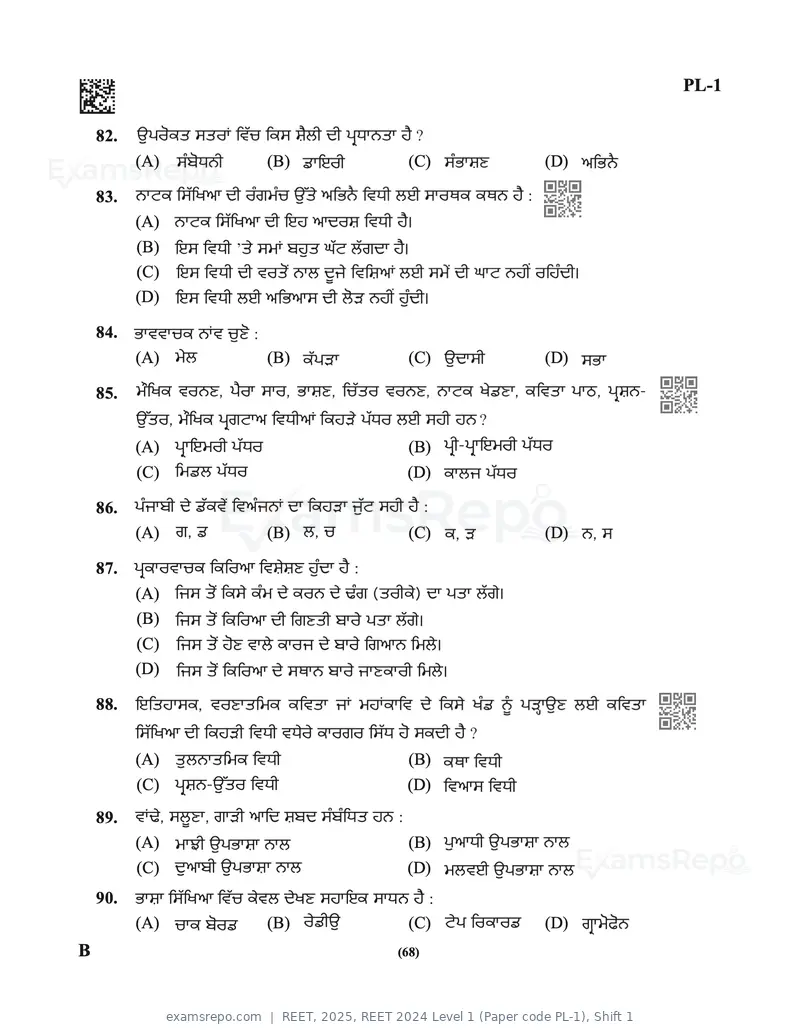
Text of page 164
PL-1

    82.
          (A)    (B)          (C)   (D)

    83.
          (A)
          (B)
          (C)
          (D)

    84.
          (A)    (B)          (C)   (D)

    85.


          (A)    			         (B)
          (C)   			          (D)

    86.
          (A)    (B)          (C)   (D)

    87.
          (A)
          (B)
          (C)
          (D)

    88.


          (A)     			        (B)
          (C)     			        (D)
    89.
          (A)          		    (B)
          (C)                (D)
    90.
          (A)    (B)          (C)   (D)
B                           (68)
Text of page 165
PL-1

                    – iII
                     – II
                        (JwOamVr)


61.
      (A)
      (B)
      (C)
      (D)
62.
      (A)     			        (B)
      (C)     			        (D)

63.
      (A)     			        (B)
      (C)    			         (D)

64.
      (A)   			          (B)
      (C)    			         (D)

65.
      (A)
      (B)
      (C)
      (D)

66.
      (A)    (B)         (C)        (D)

67.
      (A)    			         (B)
      (C)   			          (D)
                      (69)                  B
Text of page 166
PL-1

    68.
          (A)    (B)      (C)   (D)

    69.

          (A)     			    (B)
          (C)     			    (D)


    70.
          (A)    (B)      (C)   (D)
    71.
          (A)            (B)
          (C)   			      (D)

    72.
          (A)     			    (B)
          (C)     			    (D)

    73.
          (A)
          (B)
          (C)
          (D)

    74.


          (A)    			     (B)
          (C)    			     (D)
B                       (70)
Text of page 167
PL-1

75.
      (A)    			           (B)
      (C)    			           (D)

76.
      (A)    (B)           (C)   (D)

77.
      (A)    (B)           (C)   (D)

78.
      (A)    (B)           (C)   (D)

79.

      (A)    (B)           (C)   (D)
80.
      (A)   			            (B)
      (C)   			            (D)

81.
      (A)          		      (B)
      (C)                  (D)
82.
      (A)   			            (B)
      (C)     			          (D)

83.
      (A)    (B)           (C)   (D)

84.

      (A)    (B)           (C)   (D)
85.
      (A)     			          (B)
      (C)    			           (D)
                        (71)             B
Text of page 168
PL-1
86.
(A) (B)
(C) (D)
87.
(A) (B)
(C) (D)
88.
(A) (B)
(C) (D)
89.
(A) (B) (C) (D)
90.
(A) (B) (C) (D)
B (72)
Text of page 171
PL-1

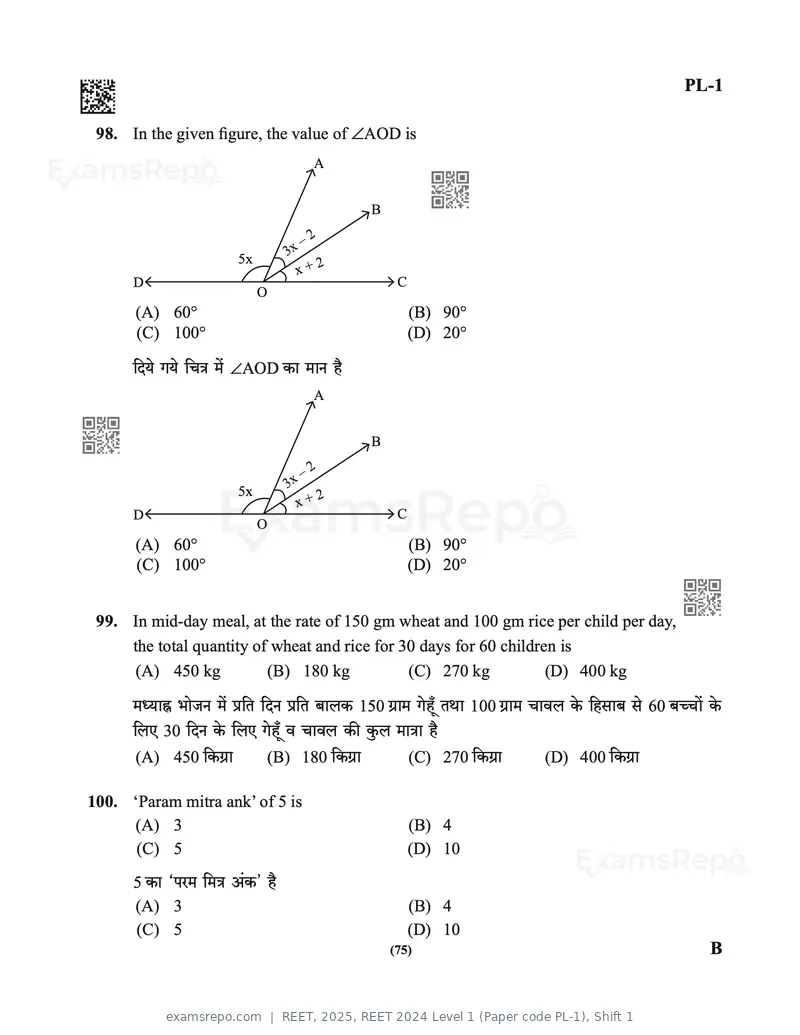
  98. In the given figure, the value of ∠AOD is
                                     A


                                           B

                                  x –2
                       5x       3
                                       2
                                   x+
        D                                       C
		                          O
        (A) 60°			                                  (B) 90°
        (C) 100°			                                 (D) 20°

		 {X`o J`o {MÌ _| ∠AOD H$m _mZ h¡
                                     A


                                           B

                                   –2
                       5x       3x
                                      2
                                  x+
        D                                       C
		                          O
        (A) 60°			                                  (B) 90°
        (C) 100°			                                 (D) 20°


  99. In mid-day meal, at the rate of 150 gm wheat and 100 gm rice per child per day,
      the total quantity of wheat and rice for 30 days for 60 children is
       (A) 450 kg          (B) 180 kg           (C) 270 kg           (D) 400 kg

		 _Ü`m• ^moOZ _| à{V {XZ à{V ~mbH$ 150 J«m_ Joh±ÿ VWm 100 J«m_ Mmdb Ho$ {hgm~ go 60 ~ÀMm| Ho$
   {bE 30 {XZ Ho$ {bE Joh±ÿ d Mmdb H$s Hw$b _mÌm h¡
    (A) 450 {H$J«m     (B) 180 {H$J«m         (C) 270 {H$J«m      (D) 400 {H$J«m

 100. ‘Param mitra ank’ of 5 is
      (A) 3			                                      (B) 4
       (C) 5			                                     (D) 10

		 5 H$m "na_ {_Ì A§H$' h¡
        (A) 3			                                    (B) 4
        (C) 5			                                    (D) 10
                                               (75)                                         B
Text of page 181
PL-1

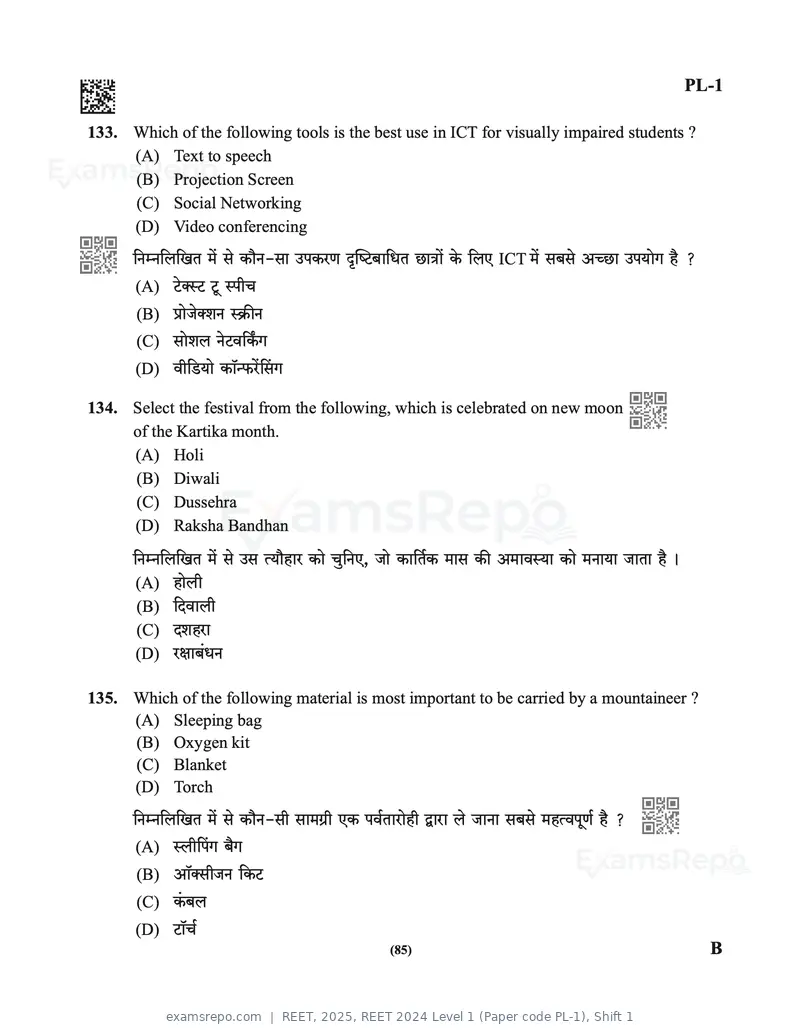
 133. Which of the following tools is the best use in ICT for visually impaired students ?
      (A) Text to speech
      (B) Projection Screen
      (C) Social Networking
      (D) Video conferencing
		 {ZåZ{b{IV _| go H$m¡Z-gm CnH$aU ÑpîQ>~m{YV N>mÌm| Ho$ {bE ICT _| g~go AÀN>m Cn`moJ h¡ ?
    (A) Q>oŠñQ> Qy> ñnrM
    (B) àmoOoŠeZ ñH«$sZ
    (C) gmoeb ZoQ>d{Hª$J
    (D) dr{S>`mo H$m°Ý\$ao§qgJ

 134. Select the festival from the following, which is celebrated on new moon
      of the Kartika month.
      (A) Holi
      (B) Diwali
      (C) Dussehra
      (D) Raksha Bandhan

		 {ZåZ{b{IV _| go Cg Ë`m¡hma H$mo Mw{ZE, Omo H$m{V©H$ _mg H$s A_mdñ`m H$mo _Zm`m OmVm h¡ &
    (A) hmobr
    (B) {Xdmbr
    (C) Xeham
    (D) ajm~§YZ

 135. Which of the following material is most important to be carried by a mountaineer ?
      (A) Sleeping bag
      (B) Oxygen kit
      (C) Blanket
      (D) Torch
		 {ZåZ{b{IV _| go H$m¡Z-gr gm_J«r EH$ nd©Vmamohr Ûmam bo OmZm g~go _hËdnyU© h¡ ?
    (A) ñbrqnJ ~¡J
    (B) Am°ŠgrOZ {H$Q>
    (C) H§$~b
    (D) Q>m°M©
                                               (85)                                             B
Text of page 191
DO
            NO
              T
(95)              WR
                    IT
                       EH
                         ER
                            E
B                               PL-1
Text of page 193
Question Booklet No.
PAPER CODE : PL-1 (SHIFT – 1)
Series Code :
C
grarµO H$moS> :
Write this code in OMR Answer Sheet.
Bg H$moS> H$mo OMR AmÝga erQ> _| A§{H$V H$a| &
1. Roll No./ amob Z§. 2. OMR Answer Sheet No./ Amo.E_.Ama. AmÝga erQ> H«$_m§H$
* 3. Candidate’s Name/ Aä`Wu H$m Zm_ * 4. _¢Zo n¥îR> ^mJ na {X`o J`o g^r {ZX}em| H$mo n‹T> {b`m h¡ &
Candidate’s Signature/ Aä`Wu Ho$ hñVmja
* As per Application Form./ O¡gm AmdoXZ nÌ _| A§{H$V {H$`m h¡ &
Invigilators’ Signature/ (i) (ii)
drjH$m| Ho$ hñVmja
S. No. 1, 2, 3 and 4 are to be filled by the Candidate himself. No. of Pages in Question Booklet /
A
C H«$_m§H$ 1, 2, 3 d 4 H$s ny{V© ñd`§ Aä`Wu Ûmam H$s OmZr h¡ & àíZ nwpñVH$m _| Hw$b n¥îR> : 96
There are 150 objective multiple choice questions in this paper. This Question Booklet is made up of the following five Sections : Section – I,
II, III, IV and V of 30 – 30 questions each. The candidate has to attempt all sections. Each question is of one mark. No marks will be deducted
for wrong answers. for unattempted questions kindly see point number 4 of important instructions given on last page.
Bg àíZ-nÌ _| Hw$b 150 dñVw{ZîR> ~hþM`ZmË_H$ àíZ h¢ & àíZ-nÌ Hw$b nm±M IÊS>m| _| {d^m{OV h¡ VWm g^r IÊS> H$aZm A{Zdm`© h¡ & àË`oH$ IÊS>-I, II, III,
IV VWm V _| 30 – 30 àíZ h¢ VWm àË`oH$ àíZ 1 A§H$ H$m h¡ & JbV CÎma Ho$ {b`o H$moB© A§H$ H$mQ>o Zht Om`|Jo & AZwÎm[aV àíZm| Ho$ gå~ÝY _| nwpñVH$m Ho$ A§{V_
n¥îR> na {X`o J`o _hËdnyU© {ZX}em] _| H«$_ g§»`m 4 XoI| &
SHIFT1-2025SHIFT1-2025SHIFT1-2025SHIFT1-2025SHIFT1-2025SHIFT1-2025SHIFT1-2025SHIFT1-2025SHIFT1-2025SHIFT1-2025SHIFT1-2025SHIFT1-2025SHIFT1-2025SHIFT1-2025SHIFT1-2025SHIFT1-2025SHIFT1-2025SHIFT1-2025SHIFT1-2025SHIFT1-2025SHIFT1-2025SHIFT1-2025SHIFT1-2025SHIFT1-2025SHIFT1-2025SHIFT1-2025SHIFT1-2025SHIFT1-2025SHIFT1-2025SHIFT1-2025SHIFT1-2025SHIFT1-2025SHIFT1-2025SHIFT1-2025SHIFT1-2025SHIFT1-2025SHIFT1-2025SHIFT1-2025SHIFT1-2025SHIFT1-2025SHIFT1-2025
PAPER CODE : PL-1 (SHIFT – 1)
Total Questions : 150 Time period : 2.30 Hours Maximum Marks : 150
No. of Question Nos. Page Nos.
Sections Contents
Questions From To From To
(I) Child Development and Pedagogy 30 1 30 3 12
(II) Language-I (Only One Language)
As selected by the candidate as medium of instruction in the 30 31 60
Online Application Form as language-I from the languages
given below :
Hindi 30 31 60 13 18
English 30 31 60 19 22
Sanskrit 30 31 60 23 26
Urdu 30 31 60 27 32
Sindhi 30 31 60 33 36
Punjabi 30 31 60 37 40
Gujarati 30 31 60 41 44
Language-II (Only One Language)
As selected by the candidate as Langauge-II (other than the
(III) 30 61 90
Language-I) in the Online Application Form from the Languages
given below :
Hindi 30 61 90 45 48
English 30 61 90 49 52
Sanskrit 30 61 90 53 56
Urdu 30 61 90 57 60
Sindhi 30 61 90 61 64
Punjabi 30 61 90 65 68
Gujarati 30 61 90 69 72
(IV) Mathematics 30 91 120 73 80
(V) Environmental Studies 30 121 150 81 90
Note : In Sections II and III, a candidate has to attempt the questions of Languages compulsorily, selected as Language-I and Language-II in
the Online Application Form. For Hindi version of the above Table and Note refer to Page No. 2
Read the instructions in English and Hindi at Page No. 96, last page of this Question Booklet.
PL-1 C *PL1C* (1)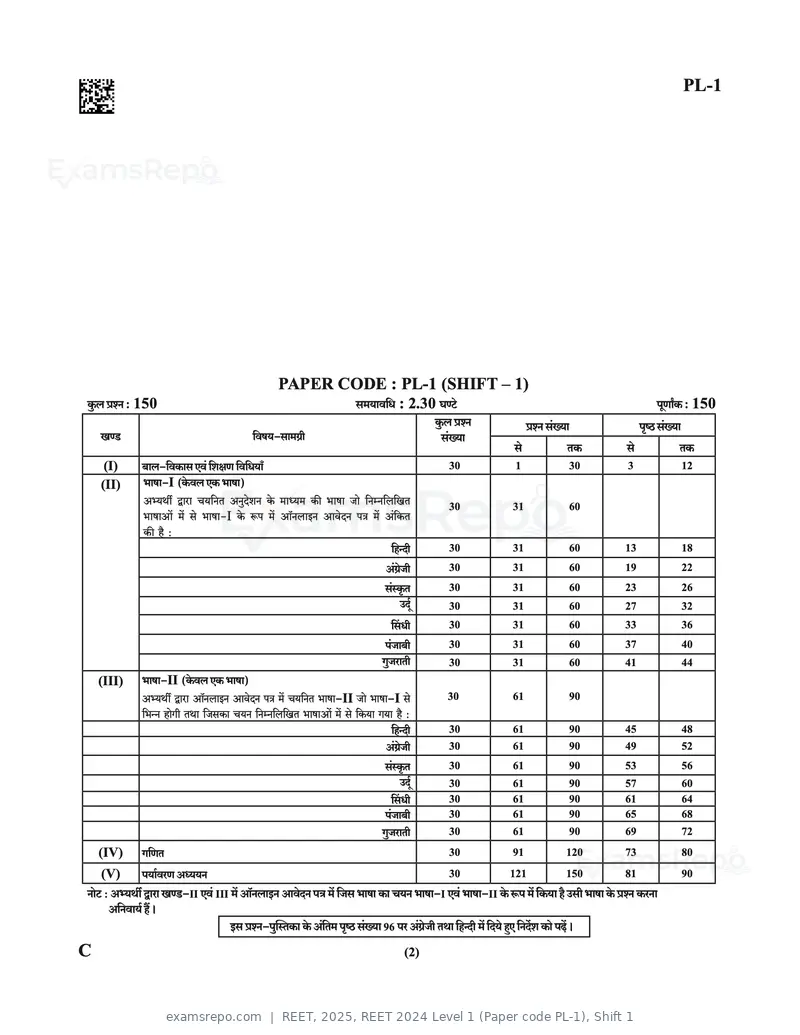
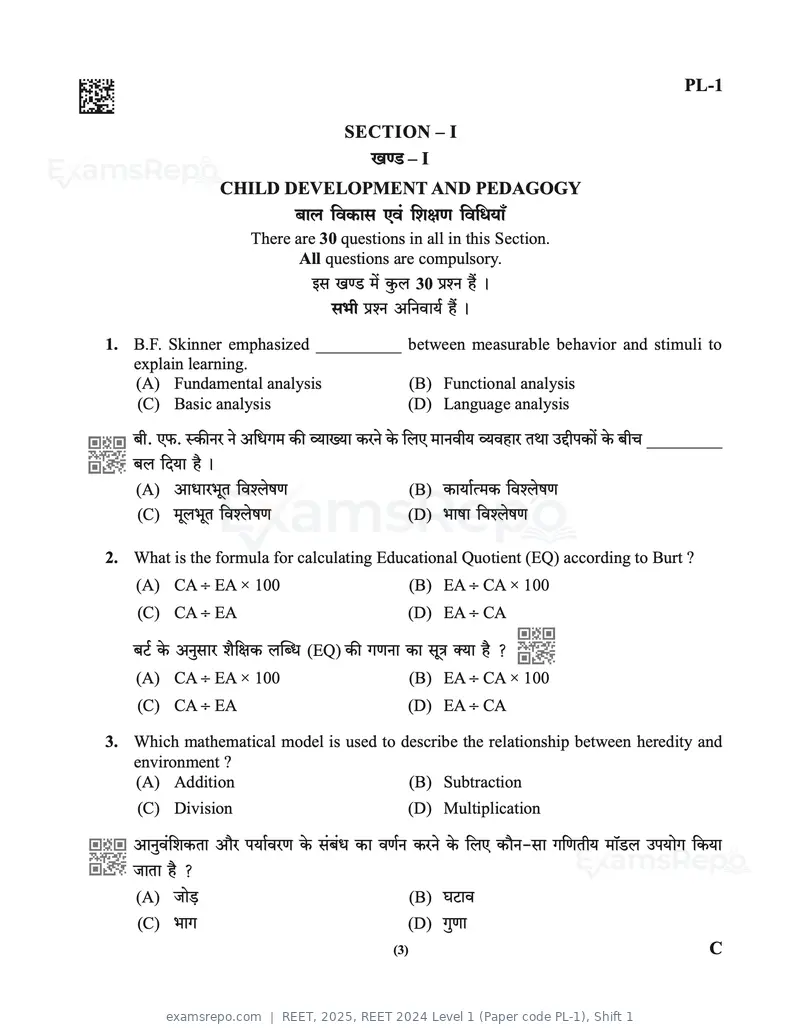
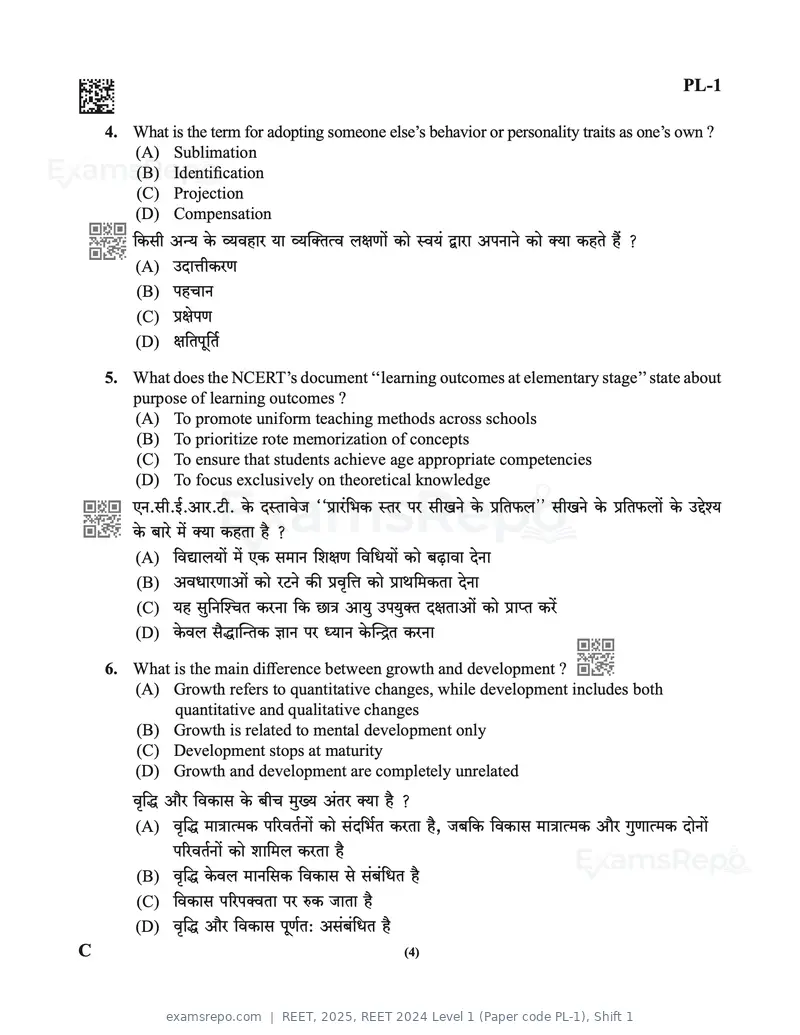
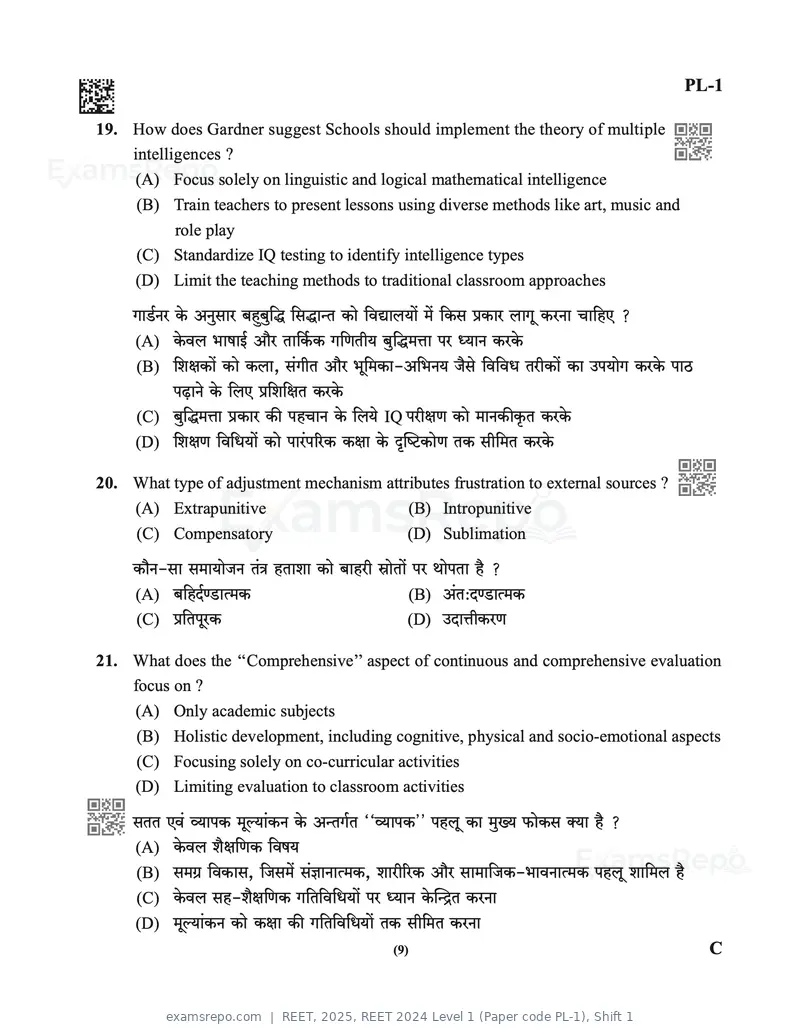
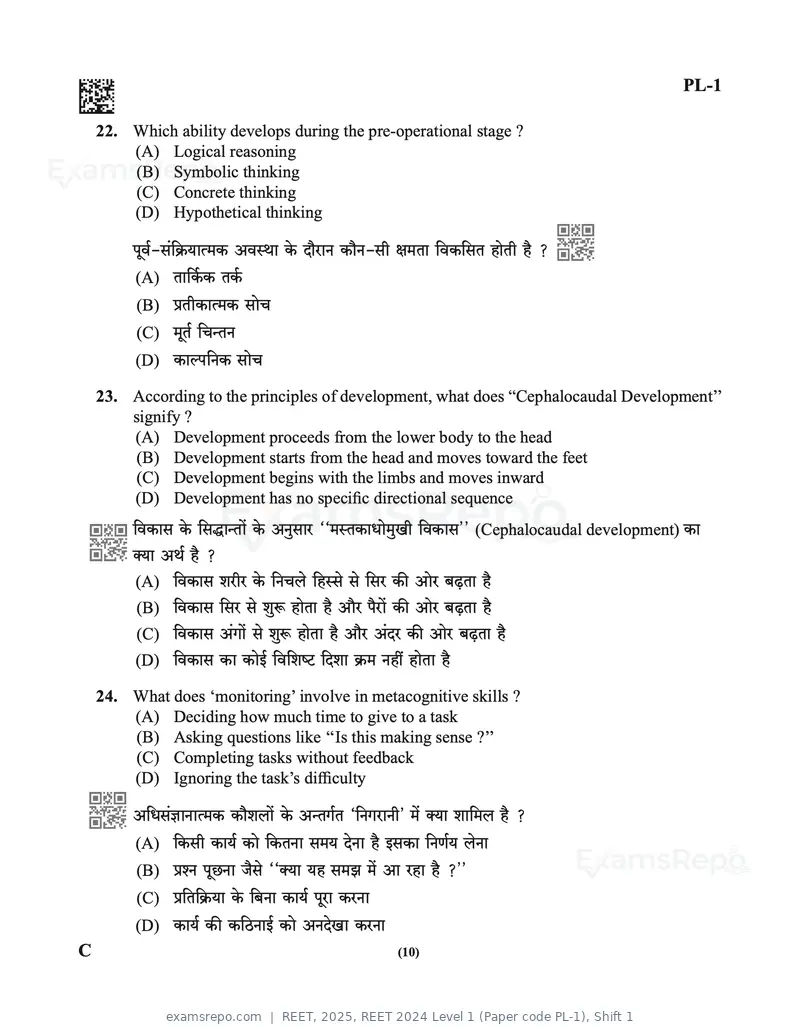
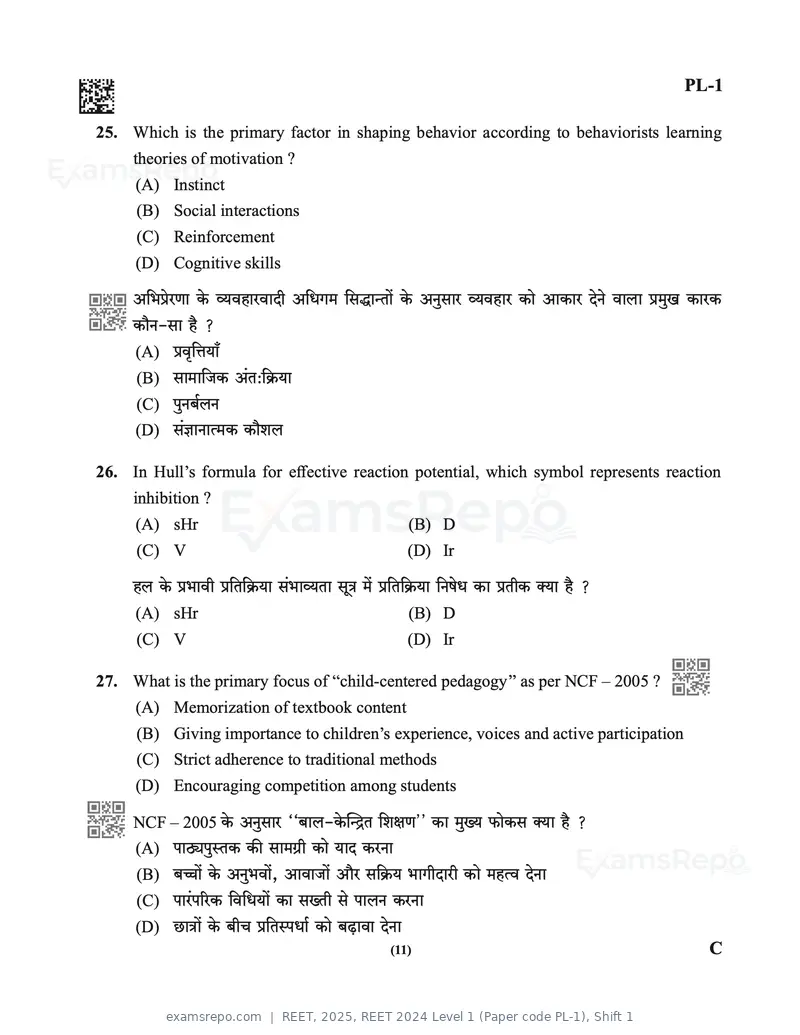
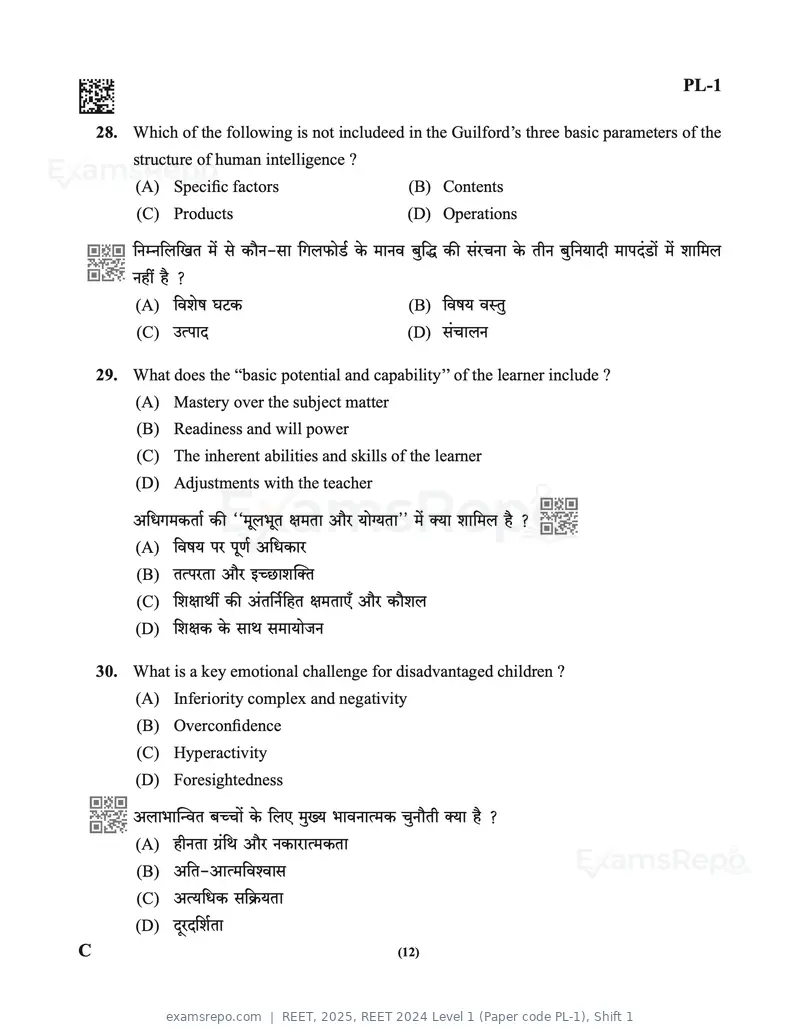
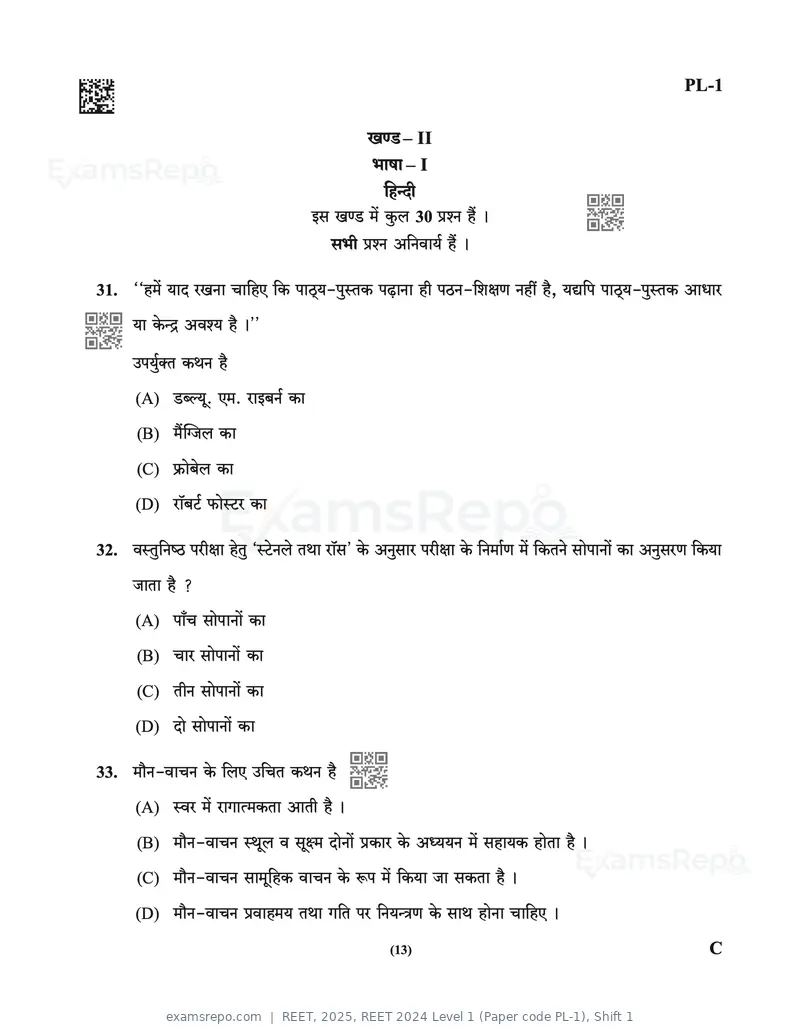
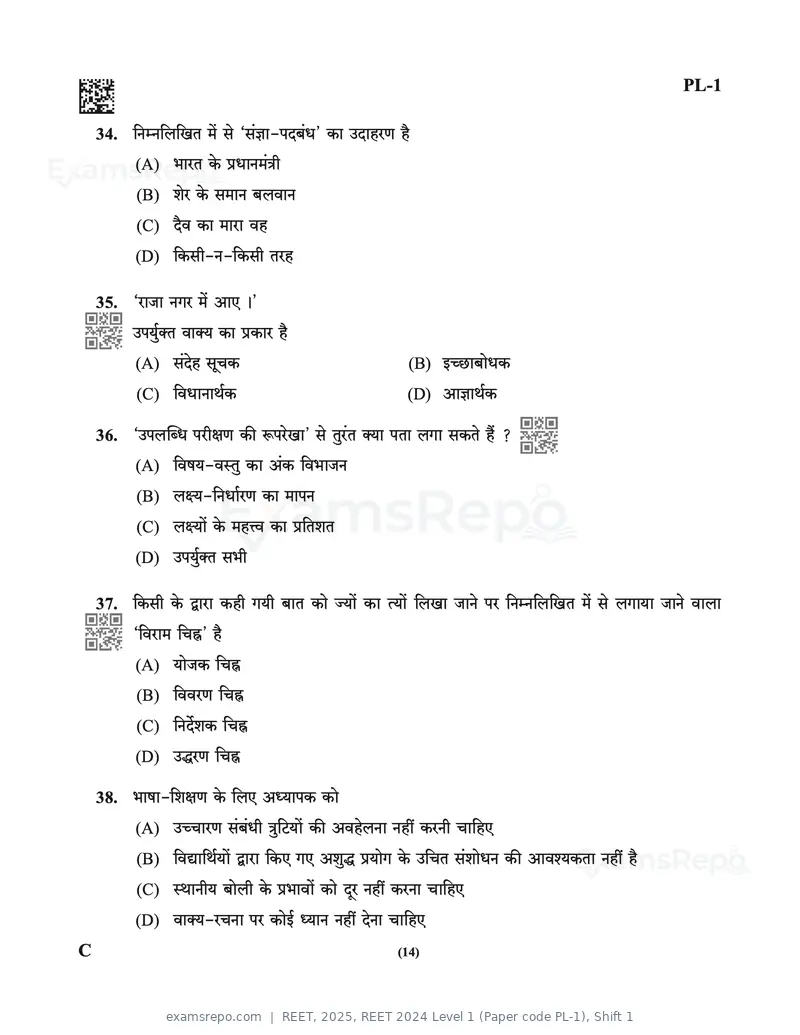
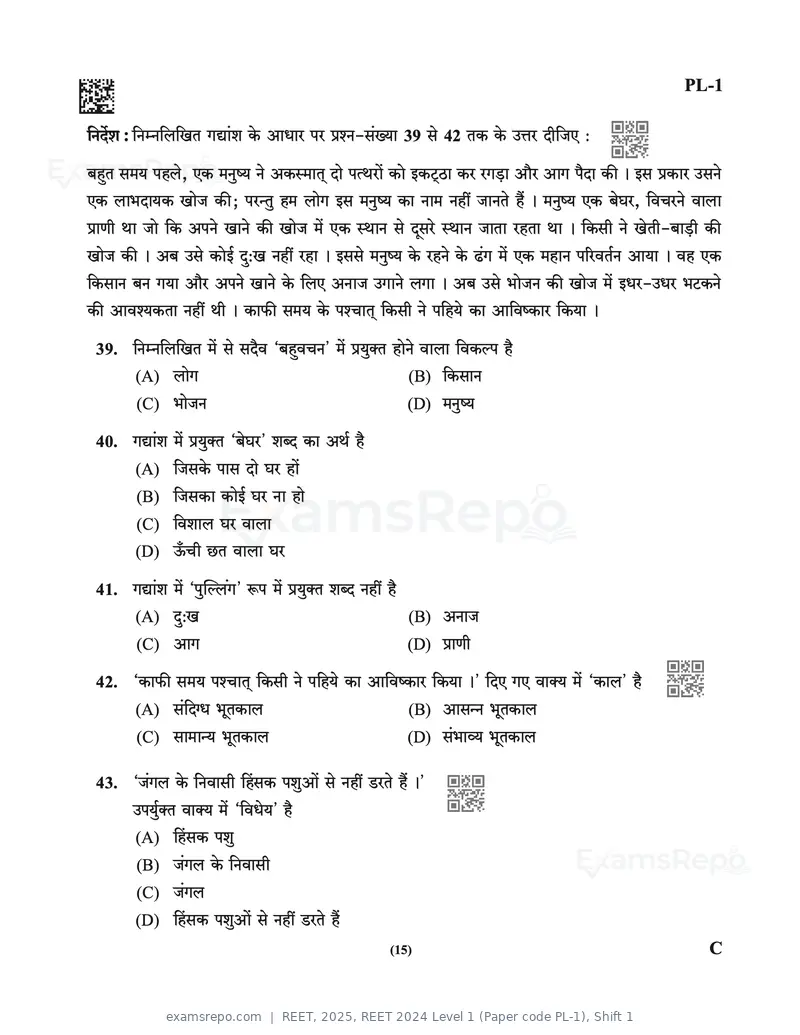
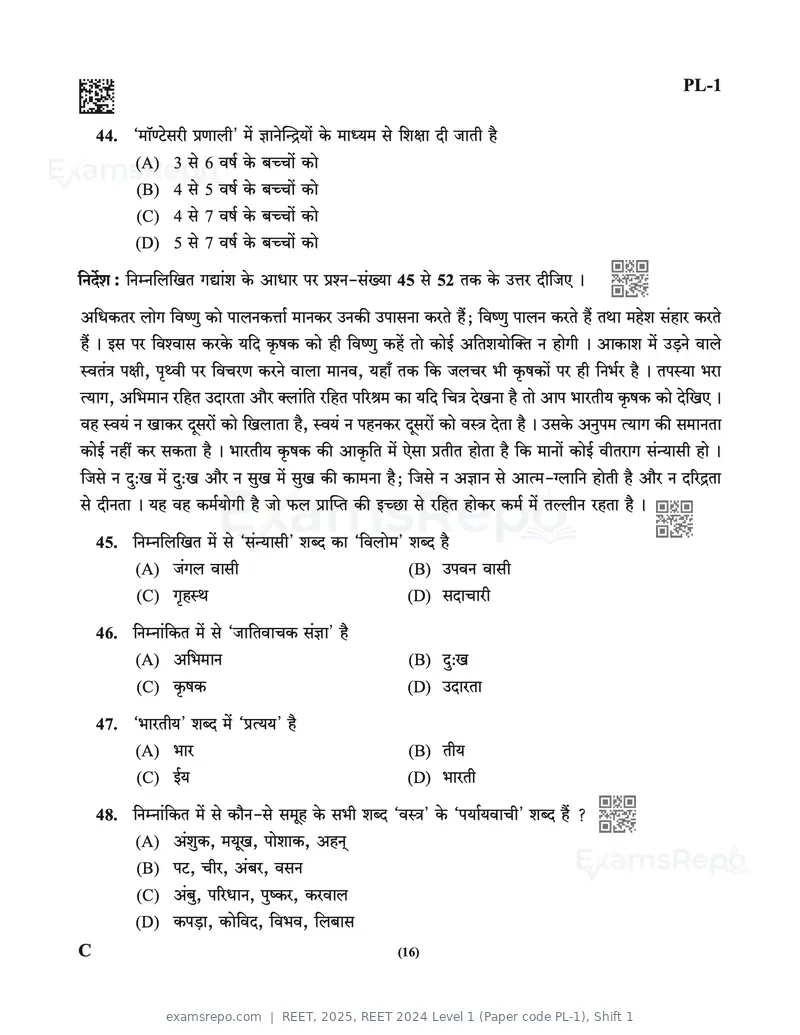
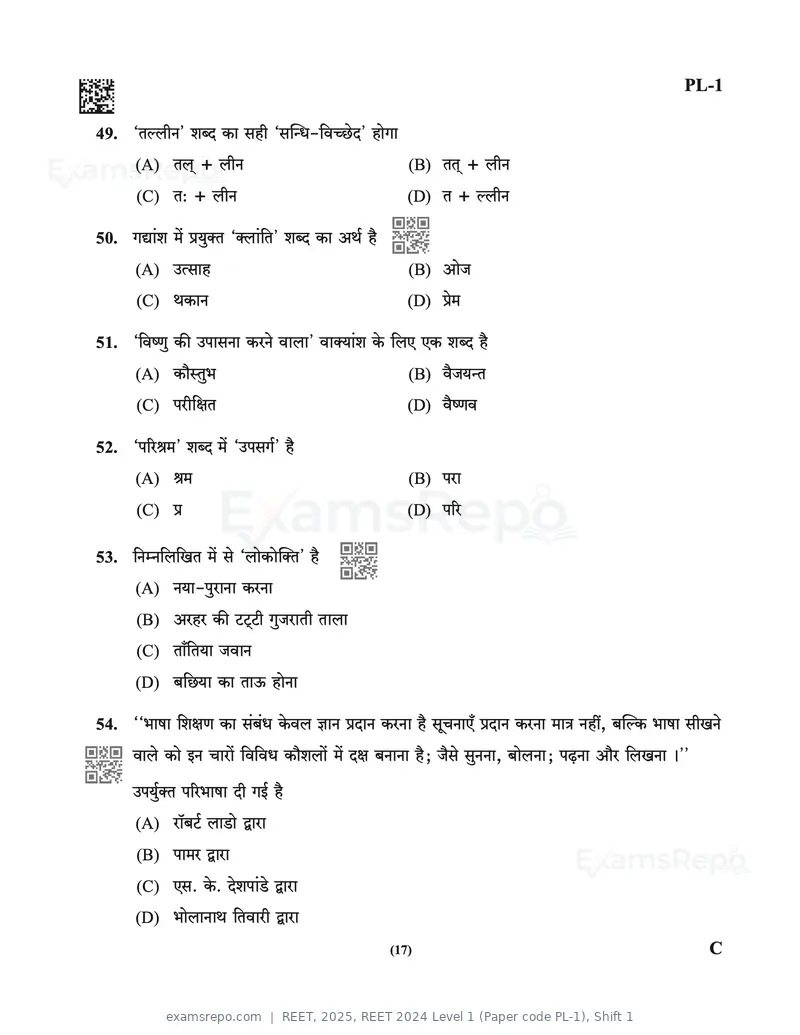
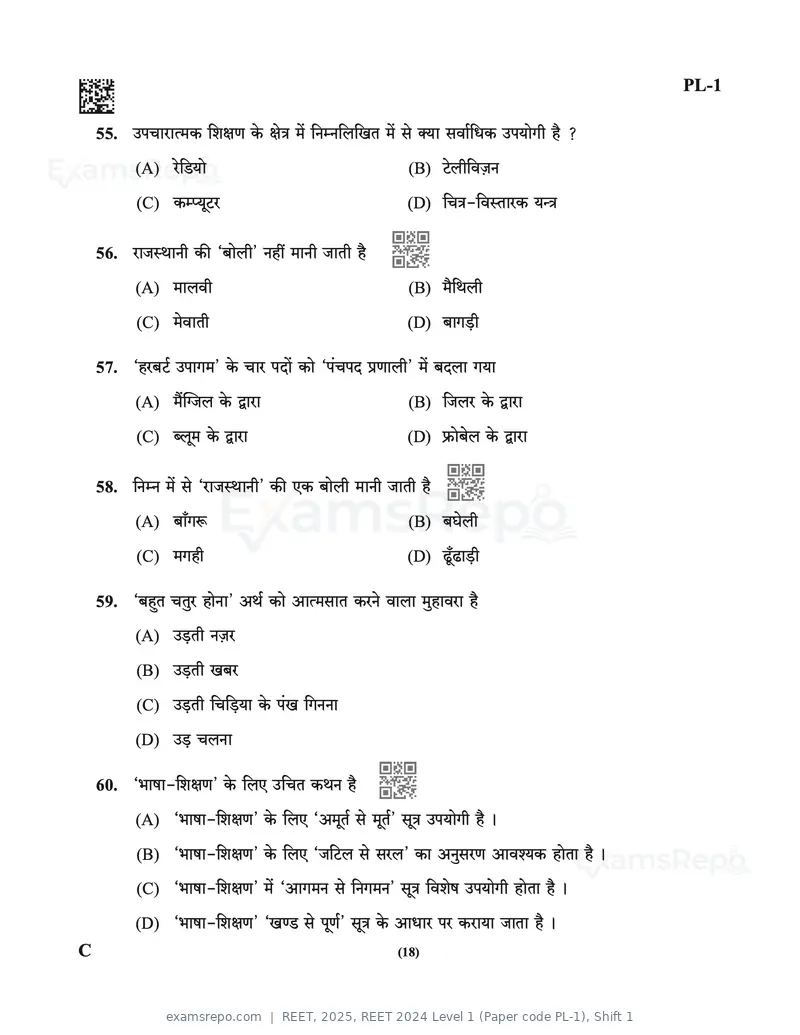
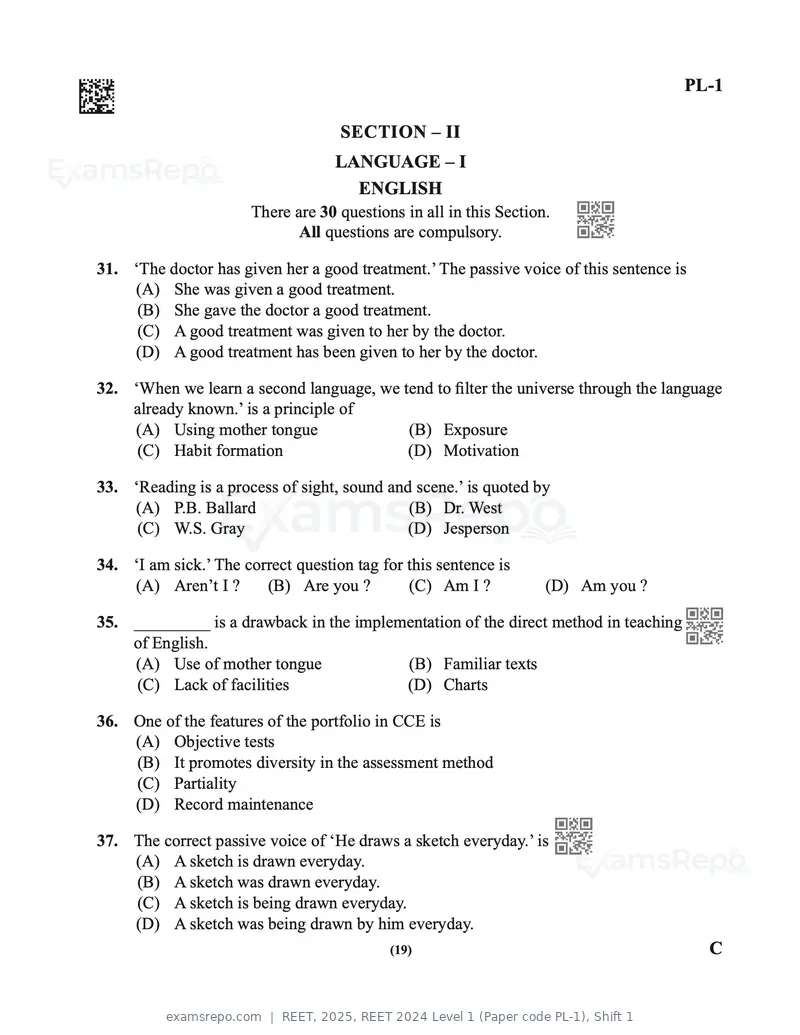
Text of page 211
PL-1

                                    SECTION – II
                                   LANGUAGE – I
                                     ENGLISH
                       There are 30 questions in all in this Section.
                              All questions are compulsory.

31. ‘The doctor has given her a good treatment.’ The passive voice of this sentence is
    (A) She was given a good treatment.
     (B) She gave the doctor a good treatment.
     (C) A good treatment was given to her by the doctor.
    (D) A good treatment has been given to her by the doctor.

32. ‘When we learn a second language, we tend to filter the universe through the language
    already known.’ is a principle of
    (A) Using mother tongue               (B) Exposure
     (C) Habit formation			               (D) Motivation

33. ‘Reading is a process of sight, sound and scene.’ is quoted by
    (A) P.B. Ballard			                      (B) Dr. West
     (C) W.S. Gray			                        (D) Jesperson

34. ‘I am sick.’ The correct question tag for this sentence is
    (A) Aren’t I ?      (B) Are you ?         (C) Am I ?            (D) Am you ?

35. _________ is a drawback in the implementation of the direct method in teaching
    of English.
    (A) Use of mother tongue             (B) Familiar texts
    (C) Lack of facilities			            (D) Charts

36. One of the features of the portfolio in CCE is
    (A) Objective tests
    (B) It promotes diversity in the assessment method
    (C) Partiality
    (D) Record maintenance

37. The correct passive voice of ‘He draws a sketch everyday.’ is
    (A) A sketch is drawn everyday.
    (B) A sketch was drawn everyday.
    (C) A sketch is being drawn everyday.
    (D) A sketch was being drawn by him everyday.
                                            (19)                                         C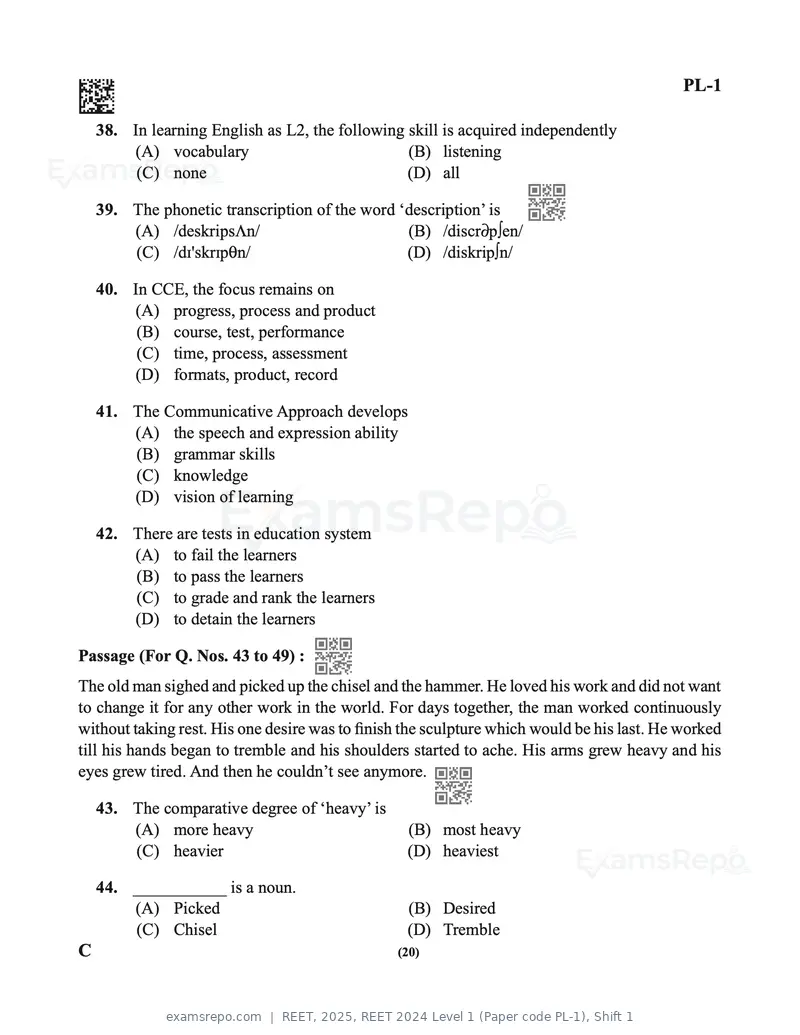
Text of page 212
PL-1

    38. In learning English as L2, the following skill is acquired independently
        (A) vocabulary			                        (B) listening
         (C) none			                             (D) all

    39. The phonetic transcription of the word ‘description’ is
        (A) /deskripsΛn/			                     (B) /discr∂p∫en/
        (C) /dɪ'skrɪpθn/			                     (D) /diskrip∫n/

    40. In CCE, the focus remains on
        (A) progress, process and product
         (B) course, test, performance
         (C) time, process, assessment
        (D) formats, product, record

    41. The communicative Approach develops
        (A) the speech and expression ability
        (B) grammar skills
        (C) knowledge
        (D) vision of learning

    42. There are tests in education system
        (A) to fail the learners
        (B) to pass the learners
        (C) to grade and rank the learners
        (D) to detain the learners

Passage (For Q. Nos. 43 to 49) :
The old man sighed and picked up the chisel and the hammer. He loved his work and did not want
to change it for any other work in the world. For days together, the man worked continuously
without taking rest. His one desire was to finish the sculpture which would be his last. He worked
till his hands began to tremble and his shoulders started to ache. His arms grew heavy and his
eyes grew tired. And then he couldn’t see anymore.

    43. The comparative degree of ‘heavy’ is
        (A) more heavy			                         (B) most heavy
        (C) heavier			                            (D) heaviest

    44. ___________ is a noun.
        (A) Picked			                             (B) Desired
        (C) Chisel			                             (D) Tremble
C                                               (20)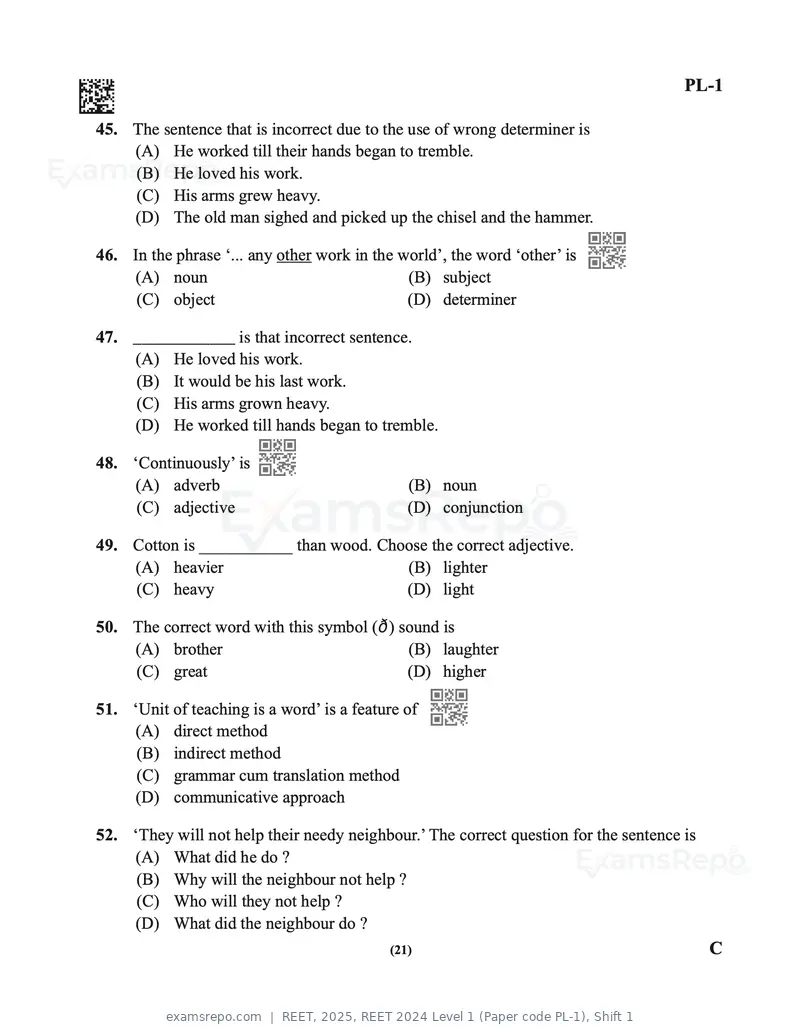
Text of page 213
PL-1

45. The sentence that is incorrect due to the use of wrong determiner is
    (A) He worked till their hands began to tremble.
    (B) He loved his work.
    (C) His arms grew heavy.
    (D) The old man sighed and picked up the chisel and the hammer.

46. In the phrase ‘... any other work in the world’, the word ‘other’ is
    (A) noun			                               (B) subject
     (C) object			                            (D) determiner

47. ____________ is that incorrect sentence.
    (A) He loved his work.
    (B) It would be his last work.
    (C) His arms grown heavy.
    (D) He worked till hands began to tremble.

48. ‘Continuously’ is
    (A) adverb			                              (B) noun
     (C) adjective			                          (D) conjunction

49. Cotton is ___________ than wood. Choose the correct adjective.
    (A) heavier			                      (B) lighter
    (C) heavy			                        (D) light

50. The correct word with this symbol (ð) sound is
    (A) brother			                         (B) laughter
    (C) great			                           (D) higher

51. ‘Unit of teaching is a word’ is a feature of
    (A) direct method
     (B) indirect method
     (C) grammar cum translation method
    (D) communicative approach

52. ‘They will not help their needy neighbour.’ The correct question for the sentence is
    (A) What did he do ?
     (B) Why will the neighbour not help ?
     (C) Who will they not help ?
    (D) What did the neighbour do ?
                                            (21)                                           C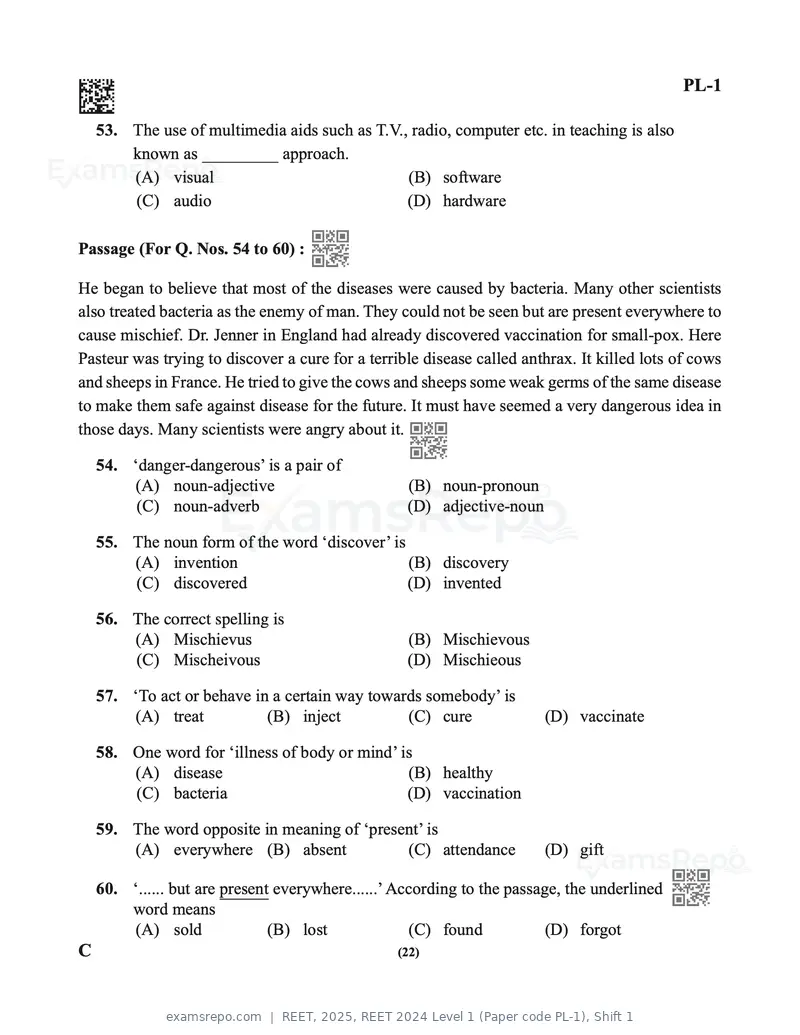
Text of page 214
PL-1

    53. The use of multimedia aids such as T.V., radio, computer etc. in teaching is also
        known as _________ approach.
        (A) visual			                           (B) software
        (C) audio			                            (D) hardware

Passage (For Q. Nos. 54 to 60) :

He began to believe that most of the diseases were caused by bacteria. Many other scientists
also treated bacteria as the enemy of man. They could not be seen but are present everywhere to
cause mischief. Dr. Jenner in England had already discovered vaccination for small-pox. Here
Pasteur was trying to discover a cure for a terrible disease called anthrax. It killed lots of cows
and sheeps in France. He tried to give the cows and sheeps some weak germs of the same disease
to make them safe against disease for the future. It must have seemed a very dangerous idea in
those days. Many scientists were angry about it.

    54. ‘danger-dangerous’ is a pair of
        (A) noun-adjective			                      (B) noun-pronoun
         (C) noun-adverb			                        (D) adjective-noun

    55. The noun form of the word ‘discover’ is
        (A) invention			                        (B) discovery
        (C) discovered			                       (D) invented

    56. The correct spelling is
        (A) Mischievus			                          (B) Mischievous
        (C) Mischeivous			                         (D) Mischieous

    57. ‘To act or behave in a certain way towards somebody’ is
        (A) treat           (B) inject          (C) cure                (D) vaccinate

    58. One word for ‘illness of body or mind’ is
        (A) disease			                          (B) healthy
        (C) bacteria			                         (D) vaccination

    59. The word opposite in meaning of ‘present’ is
        (A) everywhere (B) absent             (C) attendance            (D) gift

    60. ‘...... but are present everywhere......’ According to the passage, the underlined
        word means
        (A) sold               (B) lost             (C) found            (D) forgot
C                                                (22)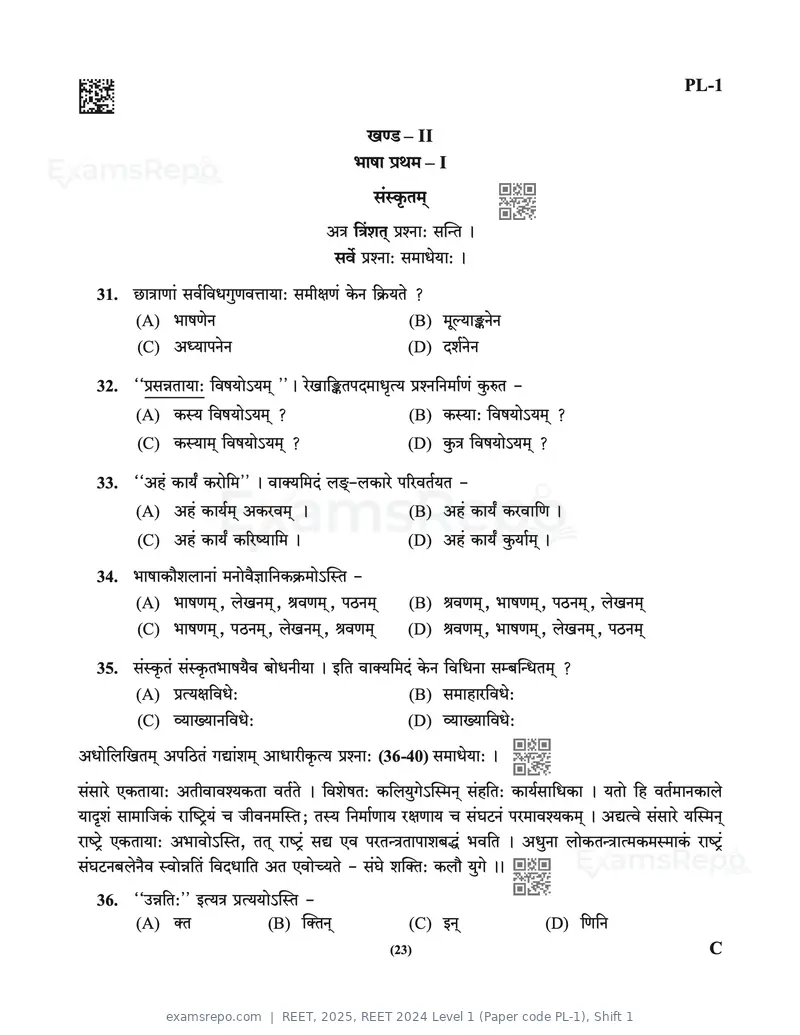
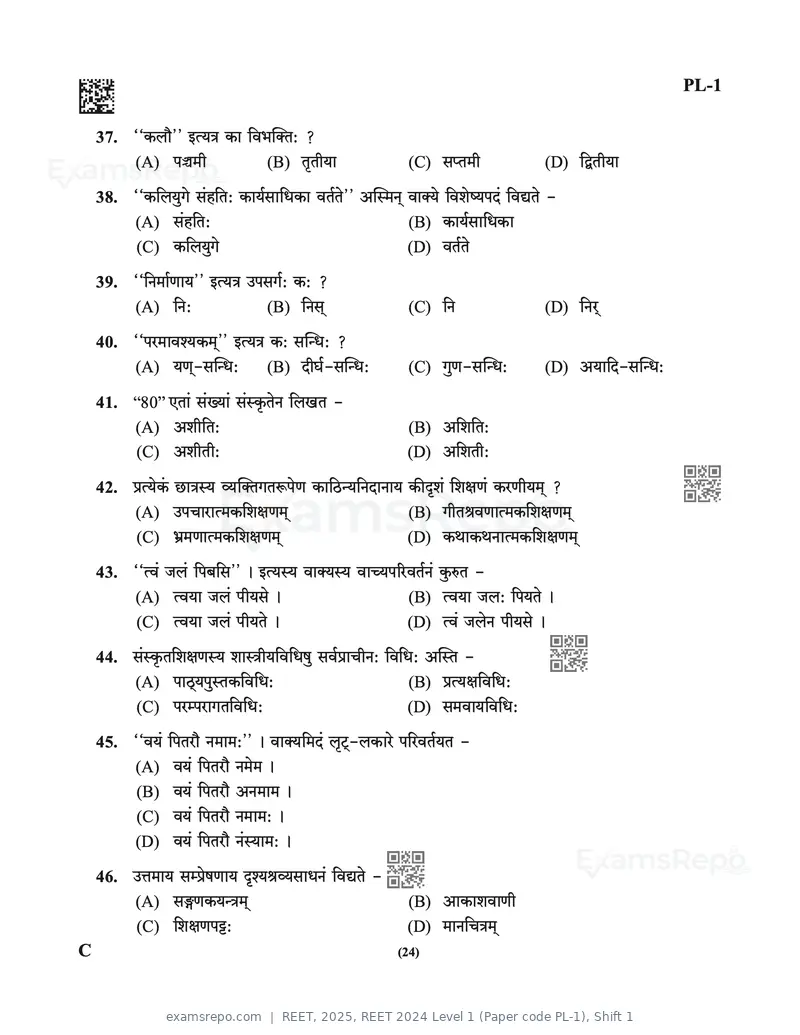
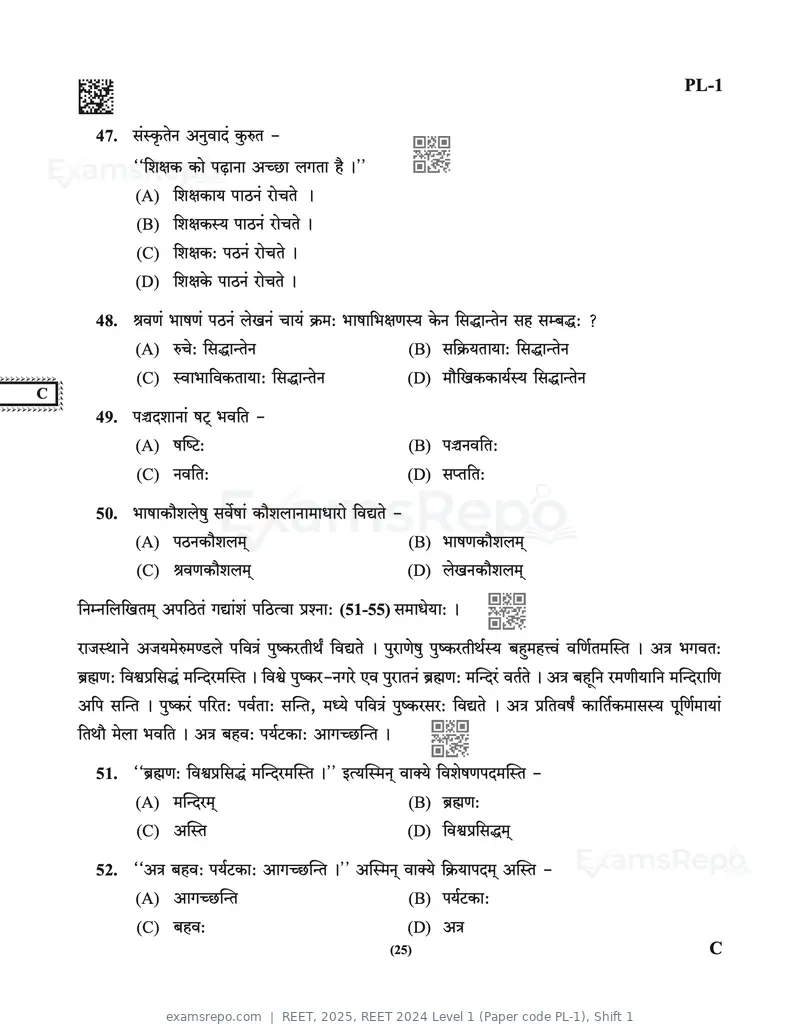
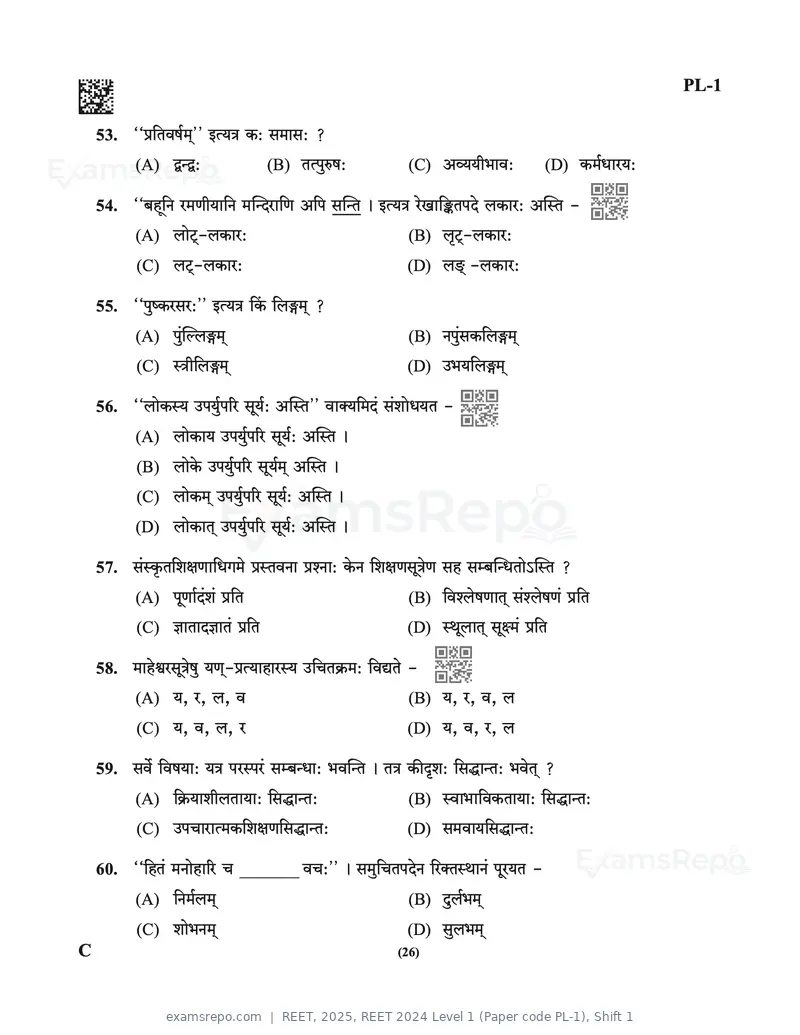
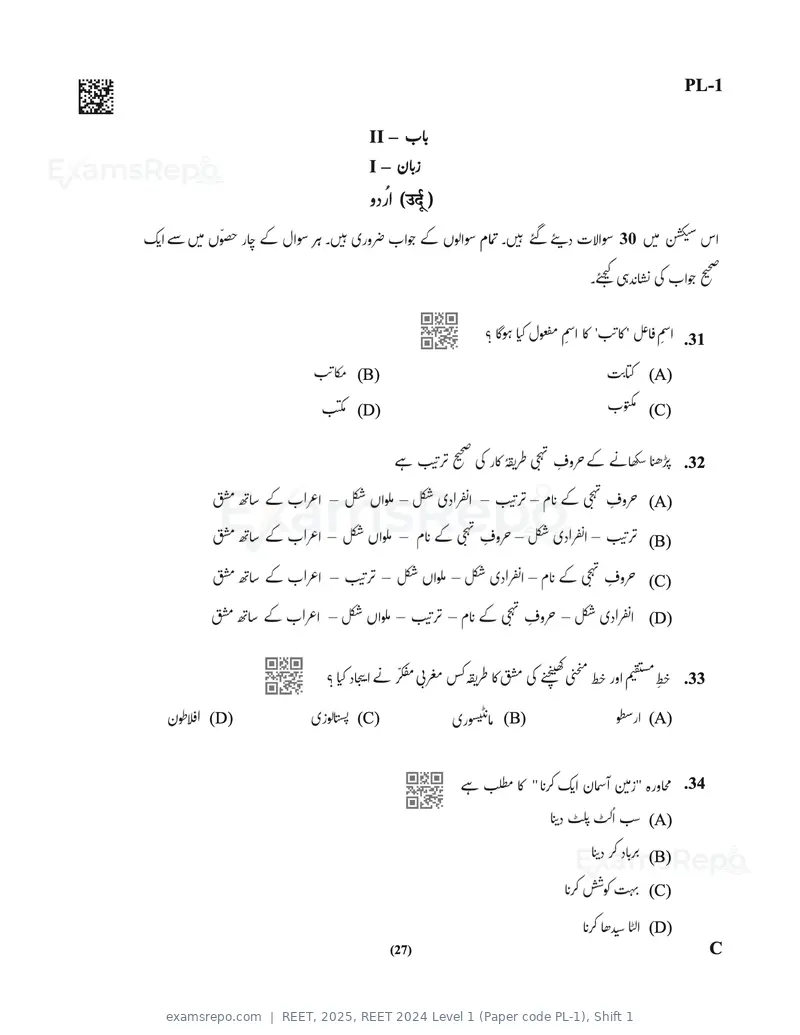
Text of page 219
PL-1

         II –
         I–
                (CXÿ© )


                                         .31

			     (B)			                    (A)

			     (D)			                    (C)


                                         .32

			                             		 (A)

			                             		 (B)

			                             		 (C)

			                             		 (D)


                                         .33

  (D)   (C)               (B)     (A)


                                         .34

							                           (A)

							                           (B)

							                           (C)

							                           (D)
              (27)                             C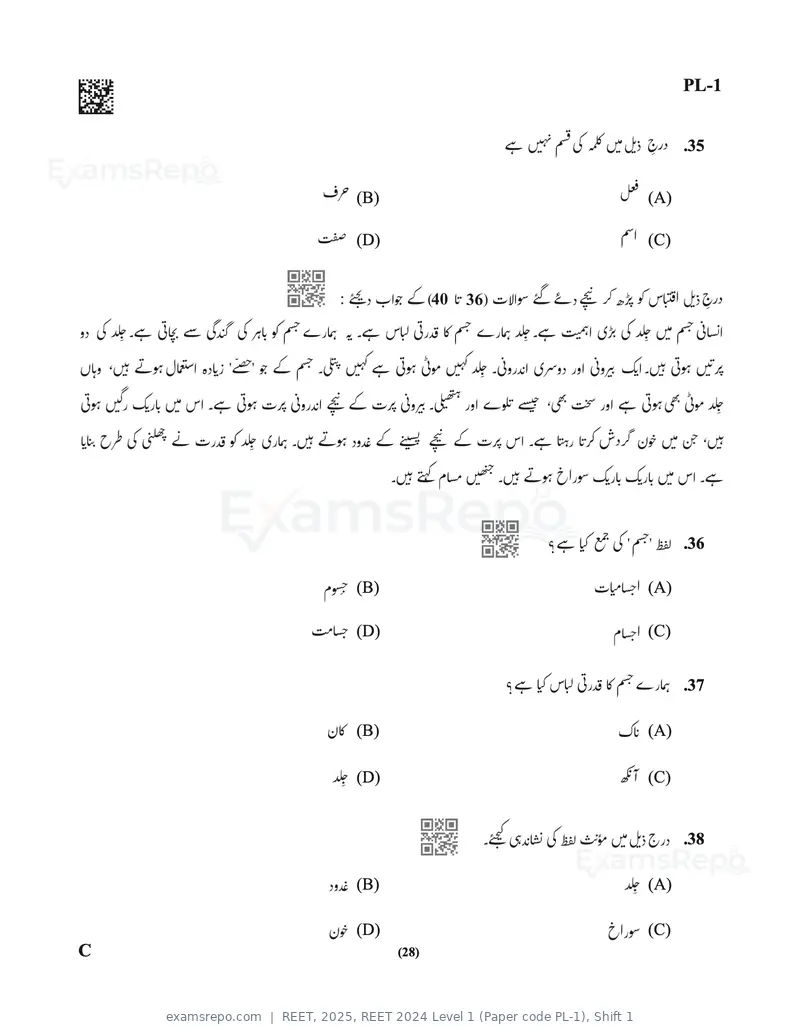
Text of page 220
PL-1


                     .35


			   (B)			   (A)

			   (D)			   (C)


                     .36

			   (B)			   (A)

			   (D)			   (C)


                     .37

			   (B)			   (A)

			   (D)			   (C)


                     .38

			   (B)			   (A)

			   (D)			   (C)
C      (28)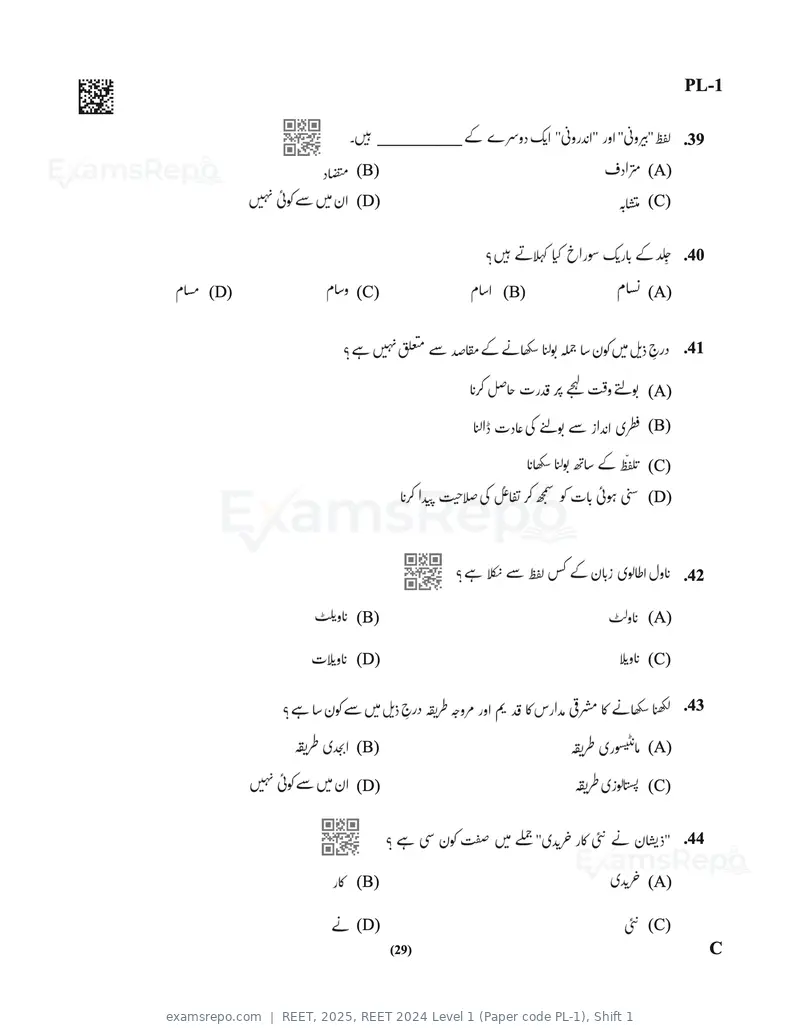
Text of page 221
PL-1

                                  .39
			      (B)			             (A)
			      (D)			             (C)


                                  .40

   (D)   (C)          (B)   (A)


           .41

					  (A)

			    (B)

			    (C)

			    (D)


                                  .42

			      (B)			             (A)

			      (D)			             (C)

                                  .43

			      (B)			             (A)

			      (D)			             (C)


                                  .44

  		     (B)			             (A)

			      (D)			             (C)
               (29)                     C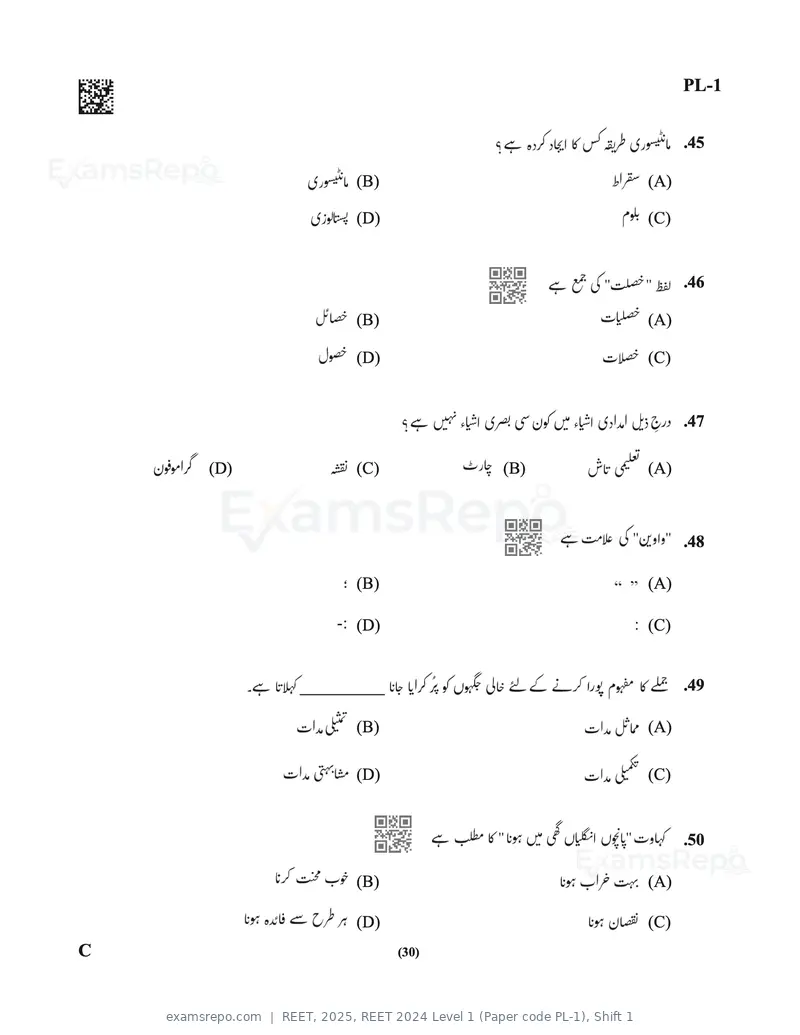
Text of page 222
PL-1


                                   .45

			       (B)			             (A)

			       (D)			             (C)


                                   .46

			       (B)			             (A)

			       (D)			             (C)


                                   .47

    (D)   (C)          (B)   (A)


                                   .48

			       (B)			             (A)

			       (D)			             (C)


                                   .49

			       (B)			             (A)

			       (D)			             (C)


                                   .50

			       (B)			             (A)

			       (D)			             (C)
C               (30)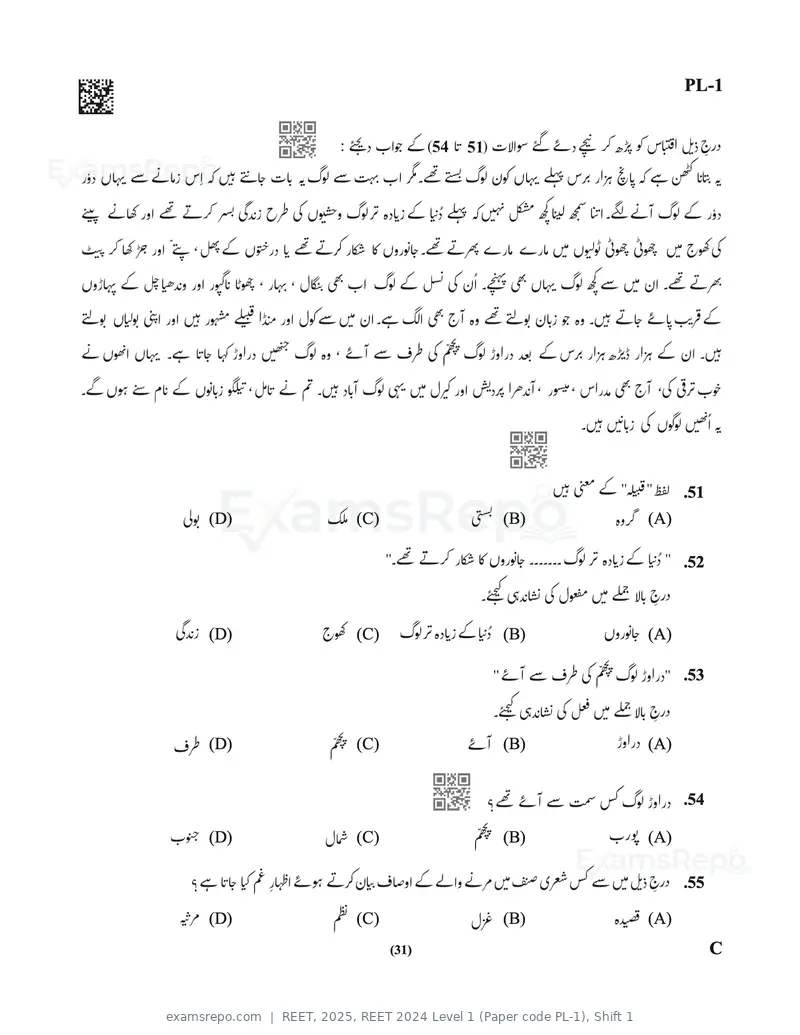
Text of page 223
PL-1


                               .51
(D)   (C)          (B)   (A)

                               .52


(D)   (C)          (B)   (A)

                               .53


(D)   (C)          (B)   (A)


                               .54

(D)   (C)          (B)   (A)

                               .55

(D)   (C)          (B)   (A)
            (31)                     C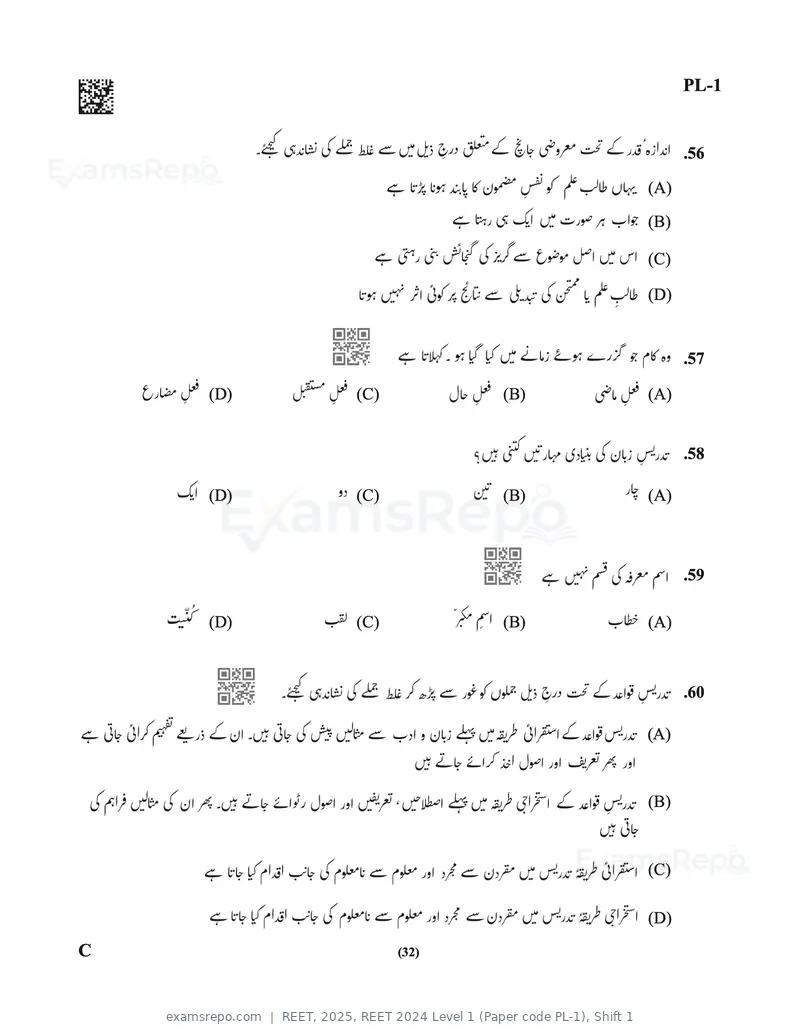
Text of page 224
PL-1


                                   .56

                             (A)
                             (B)

                             (C)

                             (D)


                                   .57

    (D)   (C)          (B)   (A)


                                   .58

    (D)   (C)          (B)   (A)


                                   .59

    (D)   (C)          (B)   (A)


                                   .60

                             (A)


                             (B)


                             (C)

                             (D)
C               (32)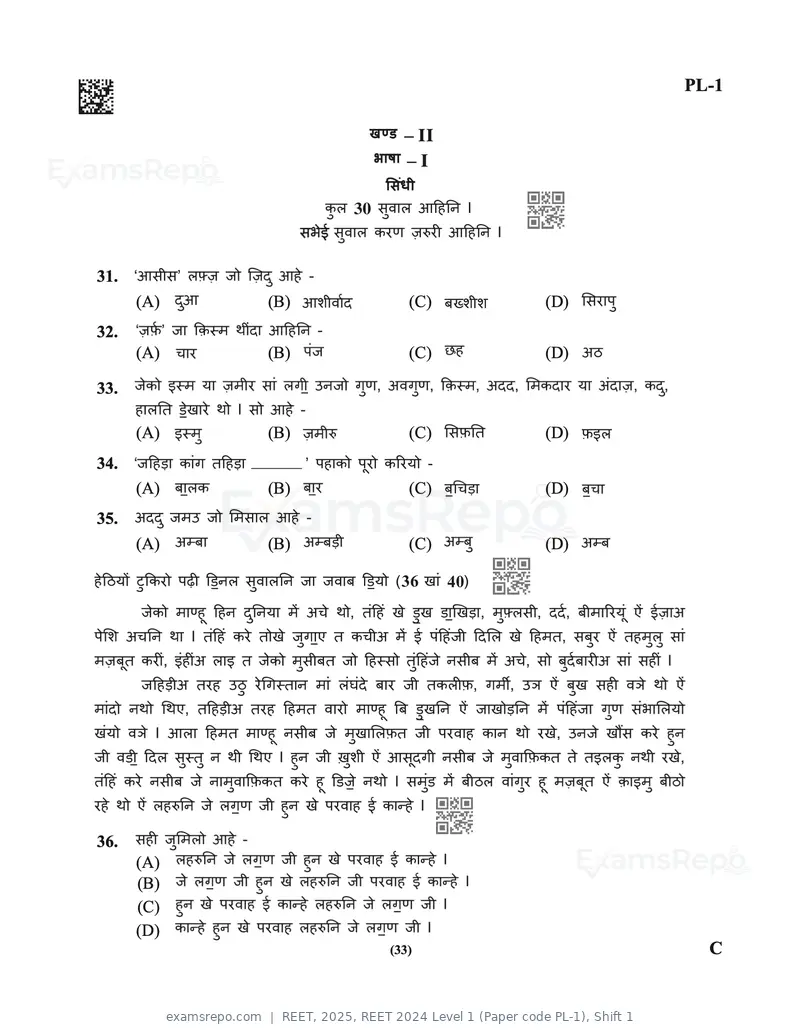
Text of page 225
PL-1

                   > – ii
                     –i


31.
      (A)   (B)      (C)    (D)
32.
      (A)   (B)      (C)    (D)

33.

      (A)   (B)      (C)    (D)
34.
      (A)   (B)      (C)    (D)
35.
      (A)   (B)      (C)    (D)


36.
      (A)
      (B)
      (C)
      (D)
                  (33)              C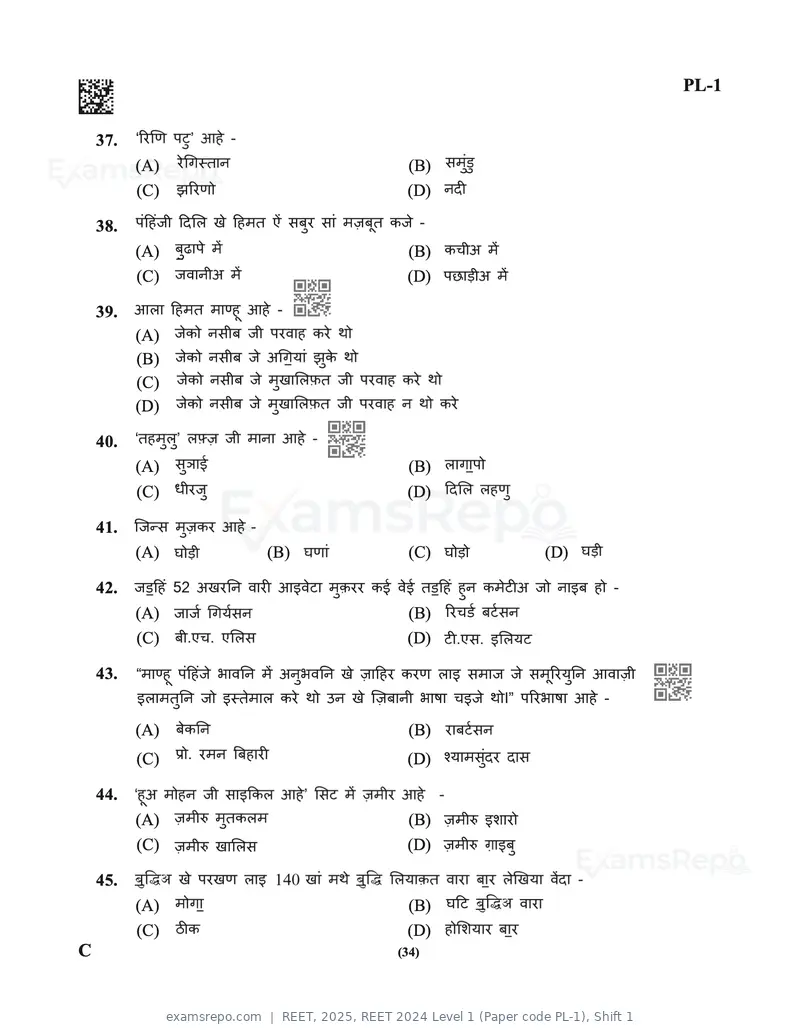
Text of page 226
PL-1

    37.
          (A)   			       (B)
          (C)   			       (D)

    38.
          (A)   			       (B)
          (C)    			      (D)

    39.
          (A)
          (B)
          (C)
          (D)

    40.
          (A)   			       (B)
          (C)   			       (D)

    41.
          (A)     (B)      (C)   (D)

    42.
          (A)     			     (B)
          (C)     			     (D)

    43.


          (A)   			        (B)
          (C)     			     (D)

    44.
          (A)      			    (B)
          (C)     			     (D)

    45.
          (A)   			       (B)
          (C)   			       (D)
C                        (34)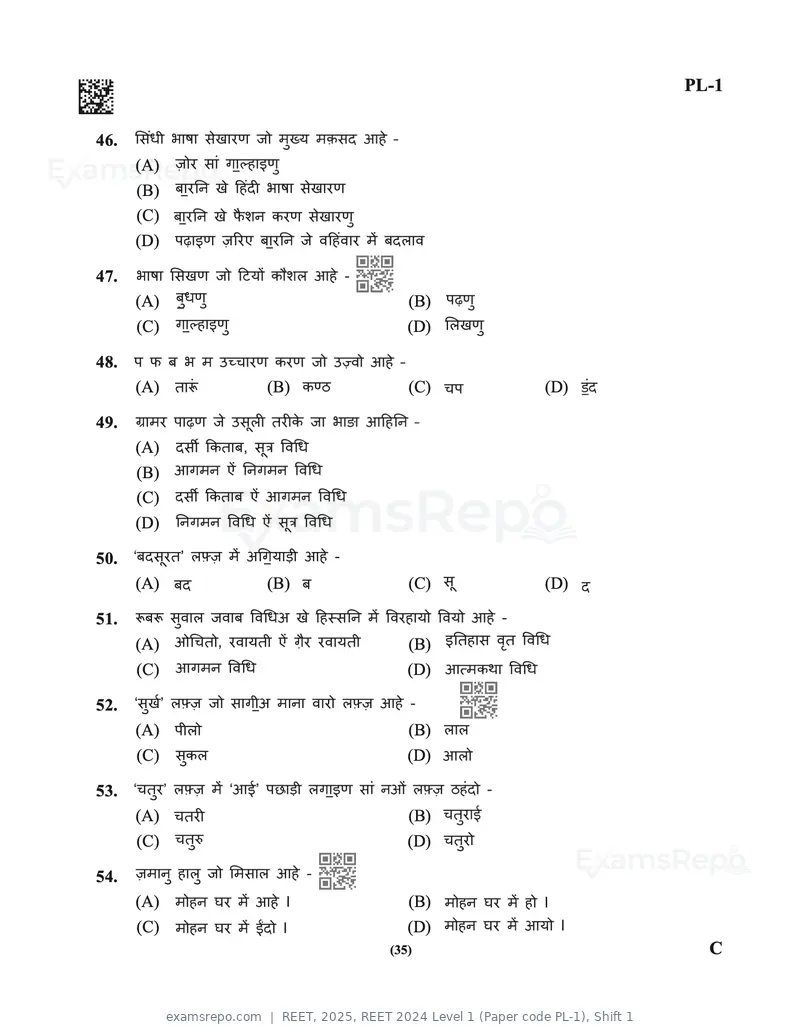
Text of page 227
PL-1

46.
      (A)
      (B)
      (C)
      (D)

47.
      (A)   			          (B)
      (C)    			         (D)

48.
      (A)     (B)        (C)   (D)

49.
      (A)
      (B)
      (C)
      (D)

50.
      (A)     (B)        (C)   (D)

51.
      (A)                (B)
      (C)     			        (D)

52.
      (A)   			          (B)
      (C)   			          (D)

53.
      (A)   			          (B)
      (C)   			          (D)

54.
      (A)        		      (B)
      (C)       			      (D)
                      (35)             C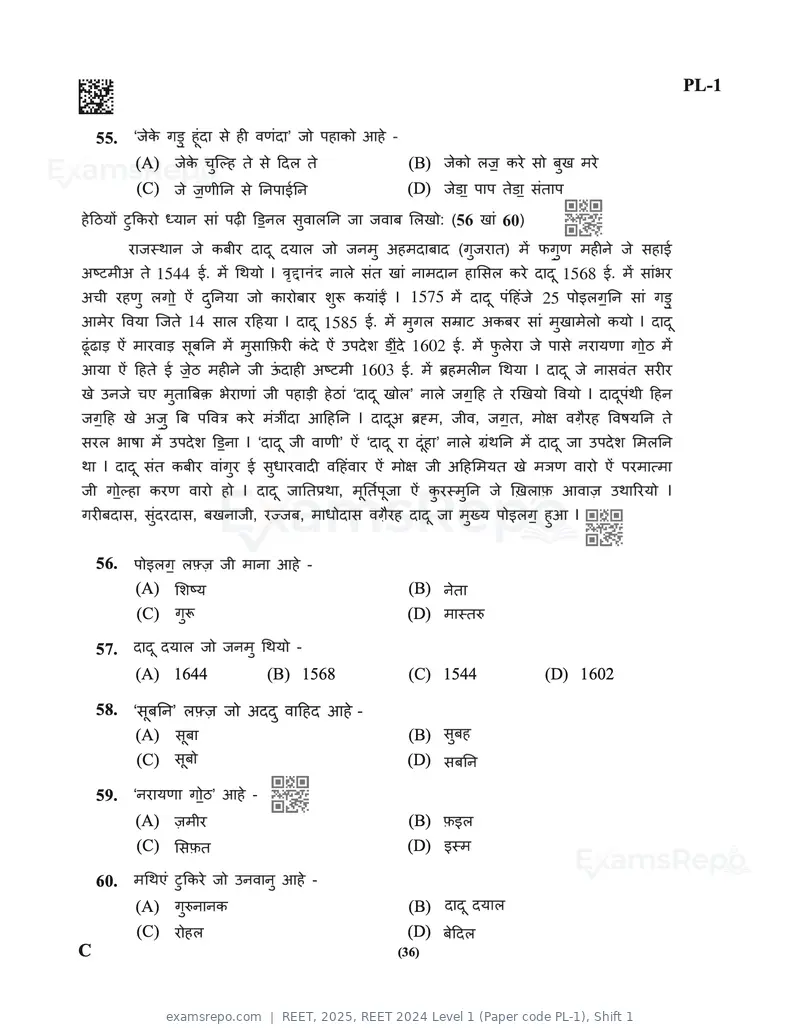
Text of page 228
PL-1

    55.
          (A)                     (B)
          (C)                     (D)


    56.
          (A)   			               (B)
          (C)   			               (D)

    57.
          (A) 1644    (B) 1568     (C) 1544   (D) 1602

    58.
          (A)   			               (B)
          (C)   			               (D)

    59.
          (A)        			          (B)
          (C)        			          (D)

    60.
          (A)     			             (B)
          (C)    			              (D)
C                                (36)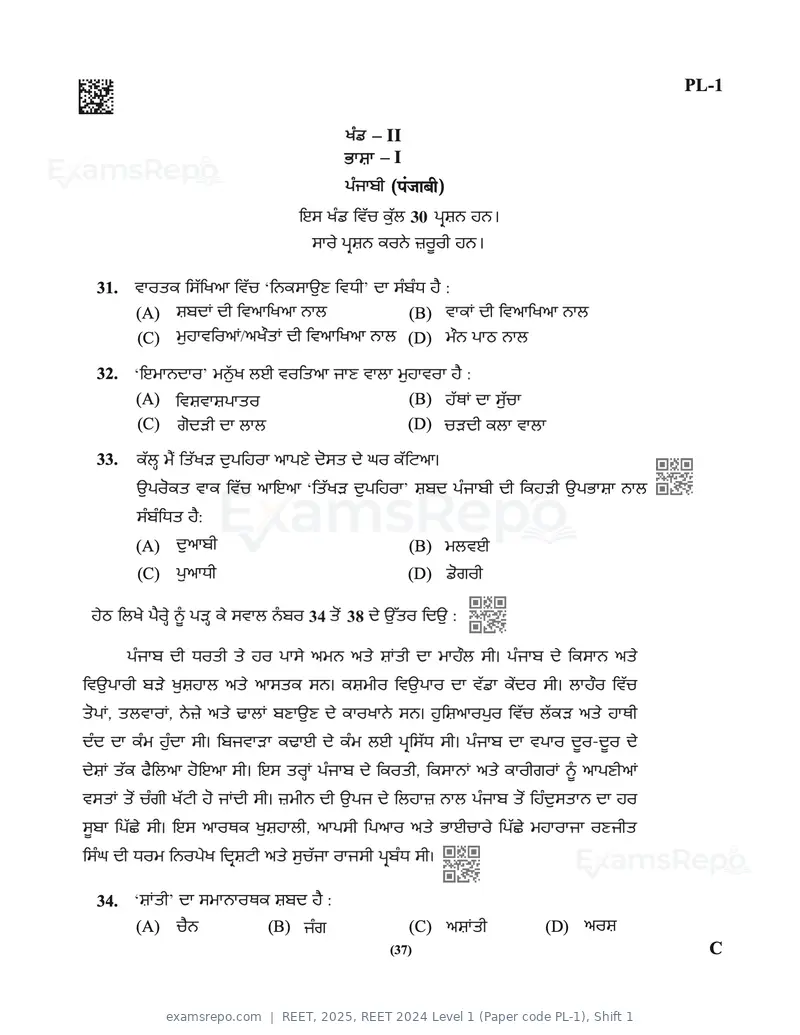
Text of page 229
PL-1

                   – ii
                    –i
                     (n§Om~r)


31.
      (A)                 (B)
      (C)                 (D)

32.
      (A)    			          (B)
      (C)    			          (D)

33.


      (A)   			           (B)
      (C)   			           (D)


34.
      (A)    (B)          (C)   (D)
                     (37)               C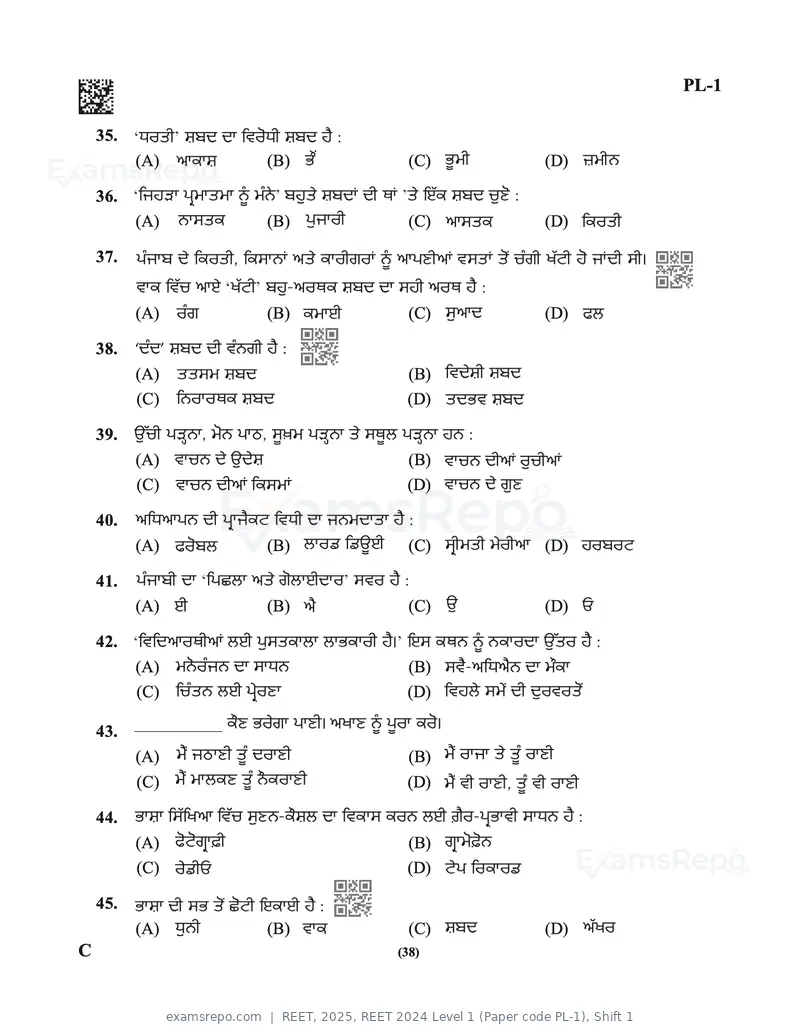
Text of page 230
PL-1

    35.
          (A)    (B)          (C)   (D)

    36.
          (A)    (B)          (C)   (D)

    37.


          (A)    (B)          (C)   (D)

    38.
          (A)    			         (B)
          (C)     			        (D)

    39.
          (A)    			         (B)
          (C)      		        (D)

    40.
          (A)    (B)          (C)   (D)

    41.
          (A)    (B)          (C)   (D)

    42.
          (A)       		       (B)
          (C)      			       (D)

    43.
          (A)          		    (B)
          (C)                (D)

    44.
          (A)   			          (B)
          (C)   			          (D)

    45.
          (A)    (B)          (C)   (D)
C                           (38)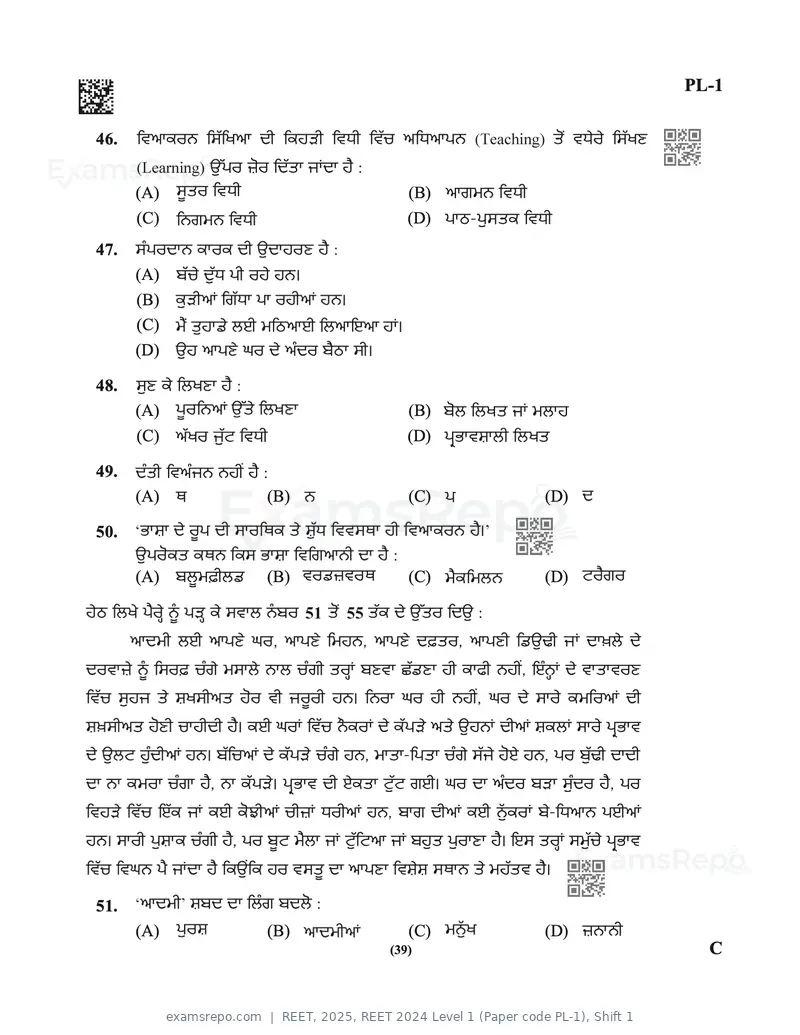
Text of page 231
PL-1

46.


      (A)   			       (B)
      (C)    			      (D)
47.
      (A)
      (B)
      (C)
      (D)

48.
      (A)             (B)
      (C)    			      (D)

49.
      (A)    (B)      (C)   (D)

50.

      (A)    (B)      (C)   (D)


51.
      (A)    (B)      (C)   (D)
                   (39)             C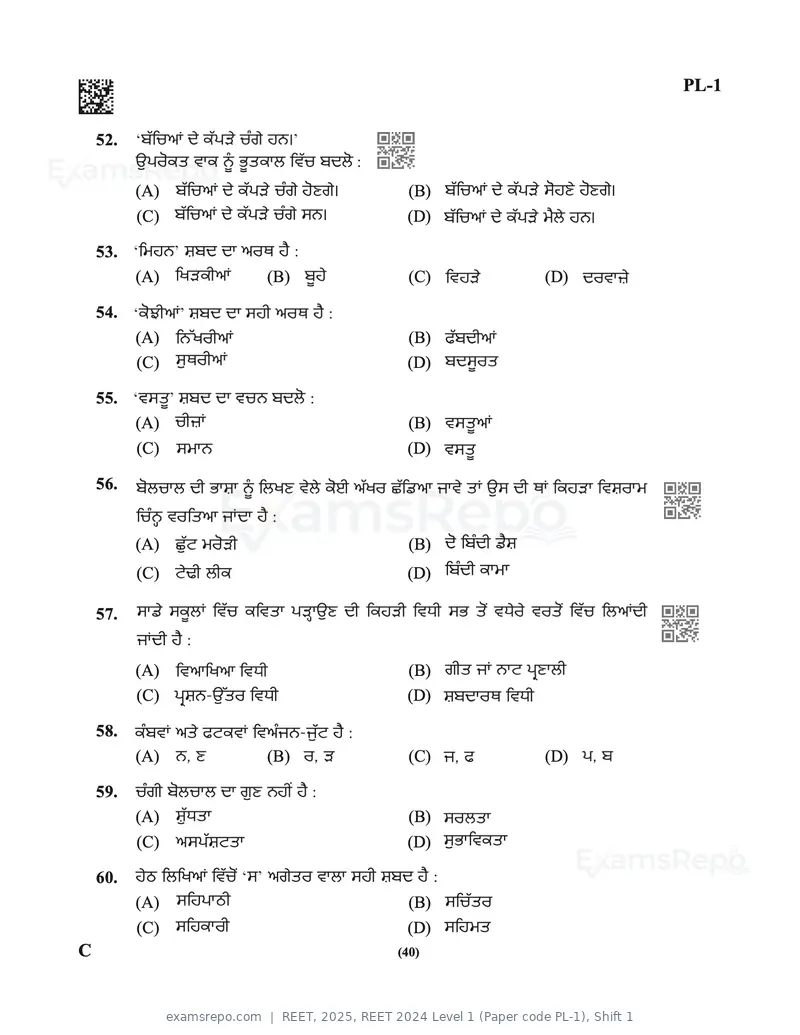
Text of page 232
PL-1

    52.


          (A)             (B)
          (C)             (D)

    53.
          (A)     (B)      (C)   (D)

    54.
          (A)   			       (B)
          (C)   			       (D)

    55.
          (A)   			       (B)
          (C)   			       (D)

    56.


          (A)   			        (B)
          (C)   			       (D)

    57.


          (A)     			     (B)
          (C)      			    (D)

    58.
          (A)     (B)      (C)   (D)

    59.
          (A)   			       (B)
          (C)    			      (D)

    60.
          (A)   			       (B)
          (C)   			       (D)
C                        (40)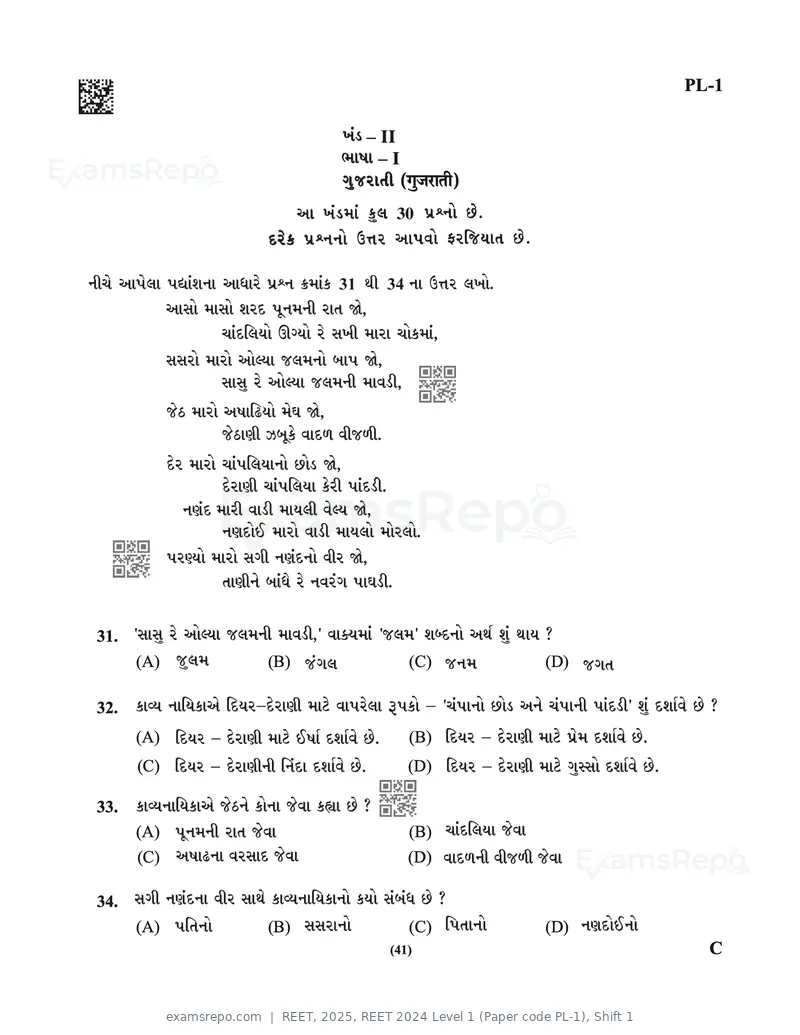
Text of page 233
PL-1

                    – iI
                     –i
                           (JwOamVr)


31.
      (A)   (B)             (C)        (D)

32.
      (A)                   (B)
      (C)                   (D)

33.
      (A)    			            (B)
      (C)      		           (D)

34.
      (A)   (B)             (C)        (D)
                      (41)                     C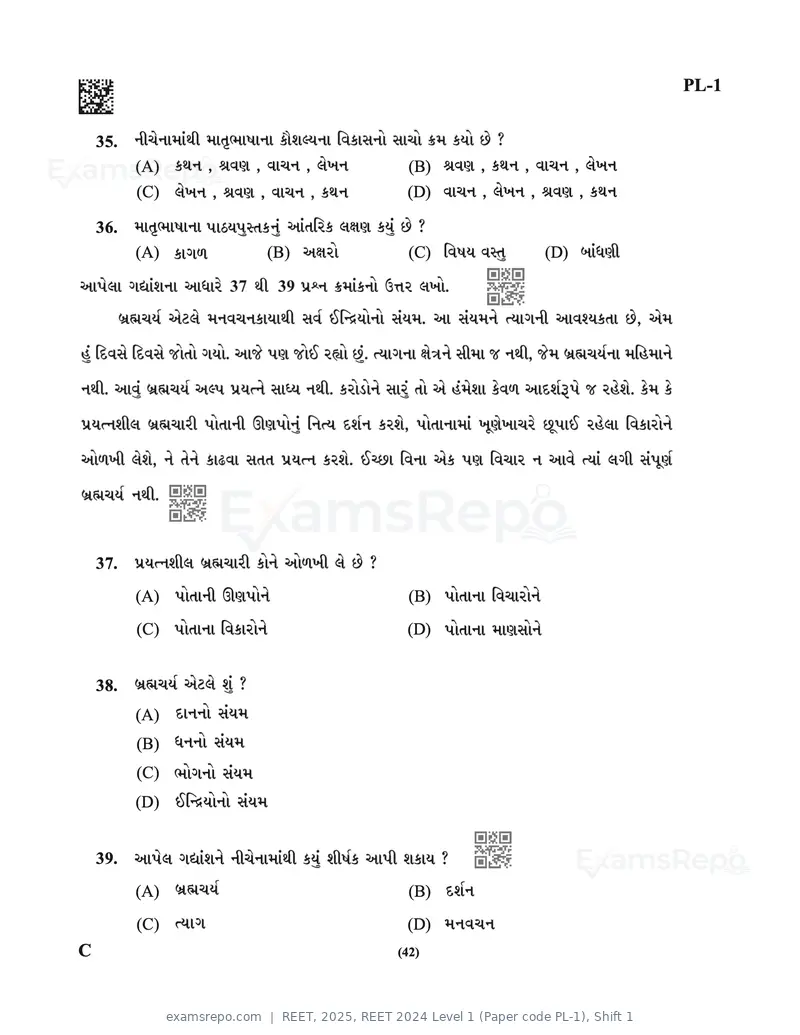
Text of page 234
PL-1


    35.
          (A)            (B)
          (C)            (D)

    36.
          (A)    (B)      (C)    (D)


    37.
          (A)     			     (B)
          (C)    			     (D)


    38.
          (A)
          (B)
          (C)
          (D)


    39.
          (A)   			       (B)
          (C)   			      (D)
C                       (42)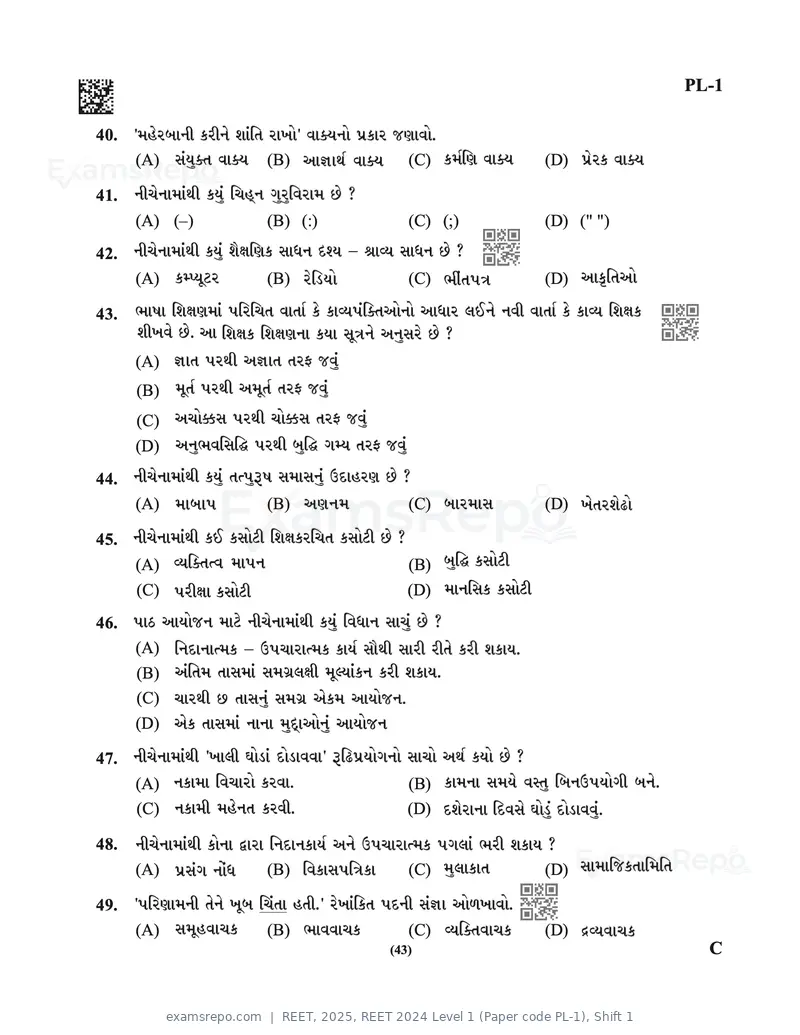
Text of page 235
PL-1

40.
      (A)       (B)           (C)       (D)

41.
      (A) (–)   (B) (:)       (C) (;)   (D) (" ")
42.
      (A)       (B)           (C)       (D)

43.

      (A)
      (B)
      (C)
      (D)
44.
      (A)       (B)           (C)       (D)

45.
      (A)        			          (B)
      (C)       			           (D)
46.
      (A)
      (B)
      (C)
      (D)

47.
      (A)             		      (B)
      (C)             		      (D)

48.
      (A)       (B)           (C)       (D)

49.
      (A)       (B)           (C)       (D)
                           (43)                       C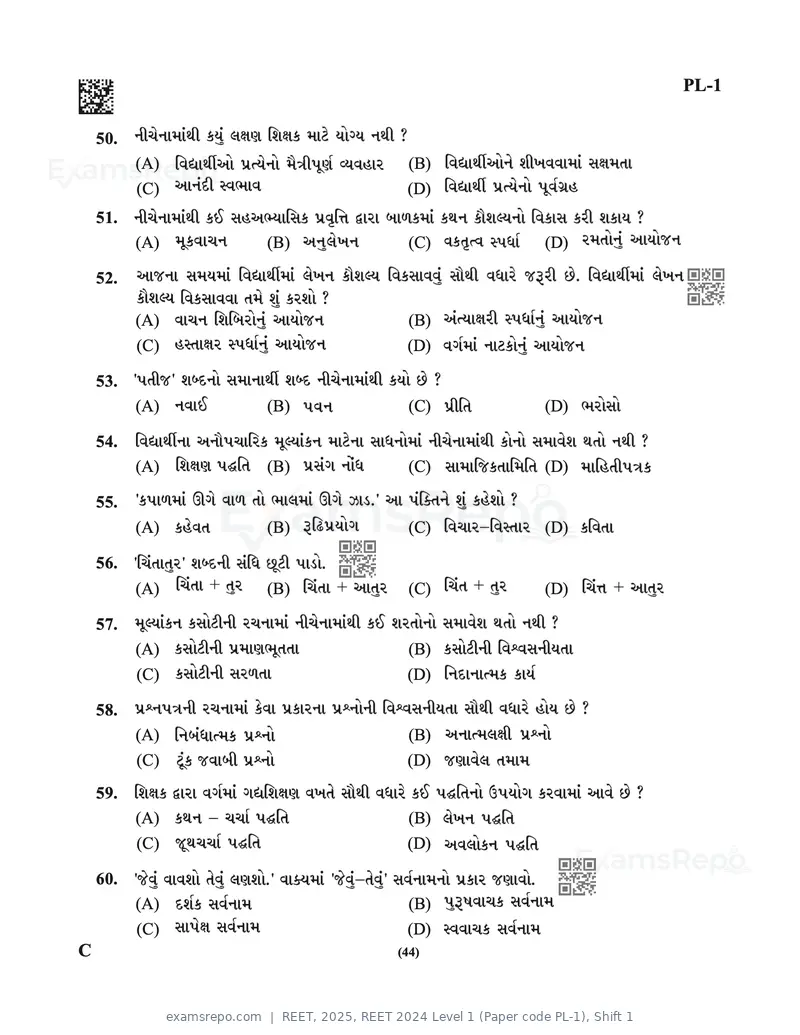
Text of page 236
PL-1

    50.
          (A)            (B)
          (C)   			      (D)
    51.
          (A)   (B)       (C)   (D)

    52.

          (A)            (B)
          (C)            (D)

    53.
          (A)   (B)       (C)   (D)

    54.
          (A)   (B)       (C)   (D)

    55.
          (A)   (B)       (C)   (D)

    56.
          (A)   (B)       (C)   (D)

    57.
          (A)      		    (B)
          (C)    			     (D)

    58.
          (A)     			    (B)
          (C)     			    (D)
    59.
          (A)     		     (B)
          (C)   			      (D)

    60.
          (A)   			      (B)
          (C)   			      (D)
C                       (44)
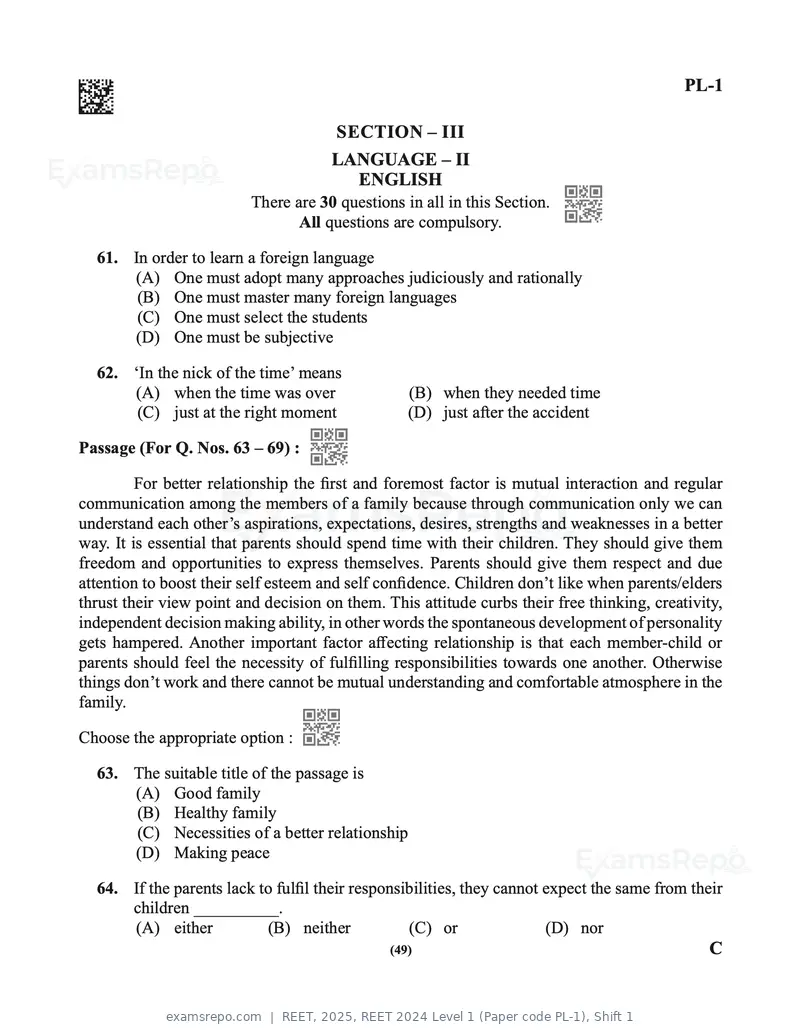
Text of page 241
PL-1

                                       SECTION – III
                                      LANGUAGE – II
                                        ENGLISH
                          There are 30 questions in all in this Section.
                                 All questions are compulsory.

  61. In order to learn a foreign language
      (A) One must adopt many approaches judiciously and rationally
       (B) One must master many foreign languages
       (C) One must select the students
      (D) One must be subjective

  62. ‘In the nick of the time’ means
      (A) when the time was over                  (B) when they needed time
       (C) just at the right moment               (D) just after the accident

Passage (For Q. Nos. 63 – 69) :

		 For better relationship the first and foremost factor is mutual interaction and regular
communication among the members of a family because through communication only we can
understand each other’s aspirations, expectations, desires, strengths and weaknesses in a better
way. It is essential that parents should spend time with their children. They should give them
freedom and opportunities to express themselves. Parents should give them respect and due
attention to boost their self esteem and self confidence. Children don’t like when parents/elders
thrust their view point and decision on them. This attitude curbs their free thinking, creativity,
independent decision making ability, in other words the spontaneous development of personality
gets hampered. Another important factor affecting relationship is that each member-child or
parents should feel the necessity of fulfilling responsibilities towards one another. Otherwise
things don’t work and there cannot be mutual understanding and comfortable atmosphere in the
family.

Choose the appropriate option :

  63. The suitable title of the passage is
      (A) Good family
      (B) Healthy family
      (C) Necessities of a better relationship
      (D) Making peace

  64. If the parents lack to fulfil their responsibilities, they cannot expect the same from their
      children __________.
      (A) either           (B) neither            (C) or                (D) nor
                                               (49)                                            C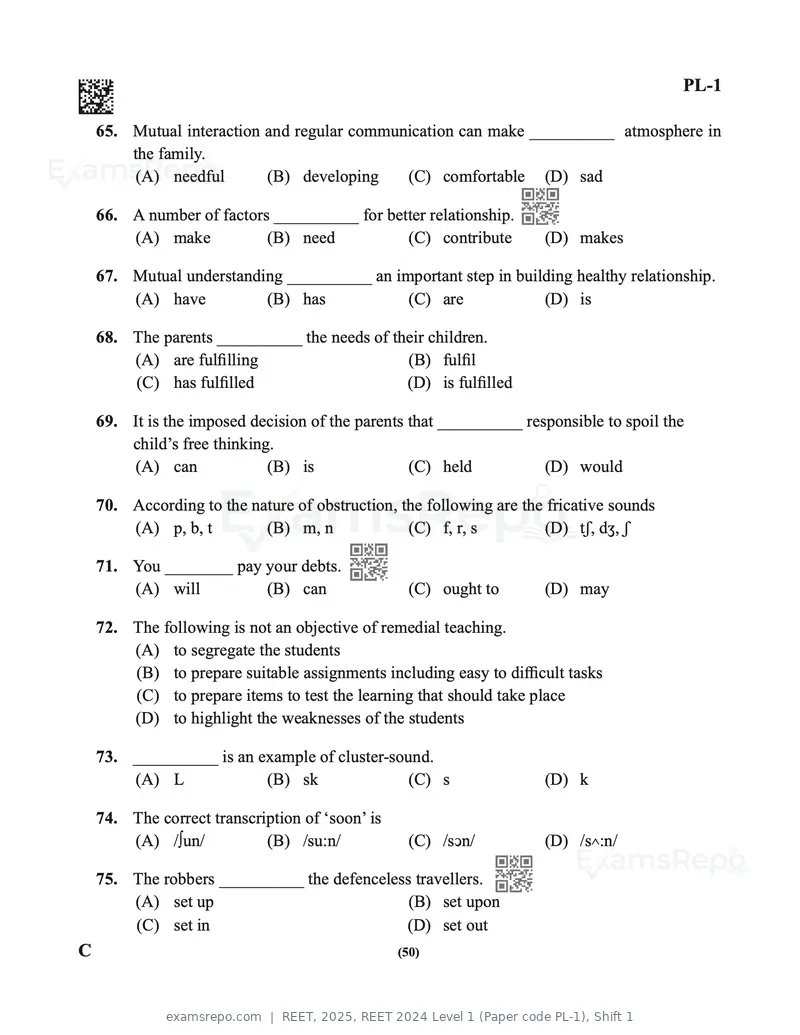
Text of page 242
PL-1

    65. Mutual interaction and regular communication can make __________ atmosphere in
        the family.
         (A) needful       (B) developing    (C) comfortable (D) sad

    66. A number of factors __________ for better relationship.
        (A) make           (B) need           (C) contribute         (D) makes

    67. Mutual understanding __________ an important step in building healthy relationship.
        (A) have          (B) has            (C) are             (D) is

    68. The parents __________ the needs of their children.
        (A) are fulfilling			                 (B) fulfil
        (C) has fulfilled			                  (D) is fulfilled

    69. It is the imposed decision of the parents that __________ responsible to spoil the
        child’s free thinking.
        (A) can              (B) is               (C) held           (D) would

    70. According to the nature of obstruction, the following are the fricative sounds
        (A) p, b, t        (B) m, n              (C) f, r, s         (D) tʃ, dʒ, ʃ

    71. You ________ pay your debts.
        (A) will         (B) can                  (C) ought to       (D) may

    72. The following is not an objective of remedial teaching.
        (A) to segregate the students
        (B) to prepare suitable assignments including easy to difficult tasks
        (C) to prepare items to test the learning that should take place
        (D) to highlight the weaknesses of the students

    73. __________ is an example of cluster-sound.
        (A) L             (B) sk               (C) s                 (D) k

    74. The correct transcription of ‘soon’ is
        (A) /∫un/           (B) /su:n/            (C) /sͻn/          (D) /s^:n/

    75. The robbers __________ the defenceless travellers.
        (A) set up			                         (B) set upon
        (C) set in			                        (D) set out
C                                                (50)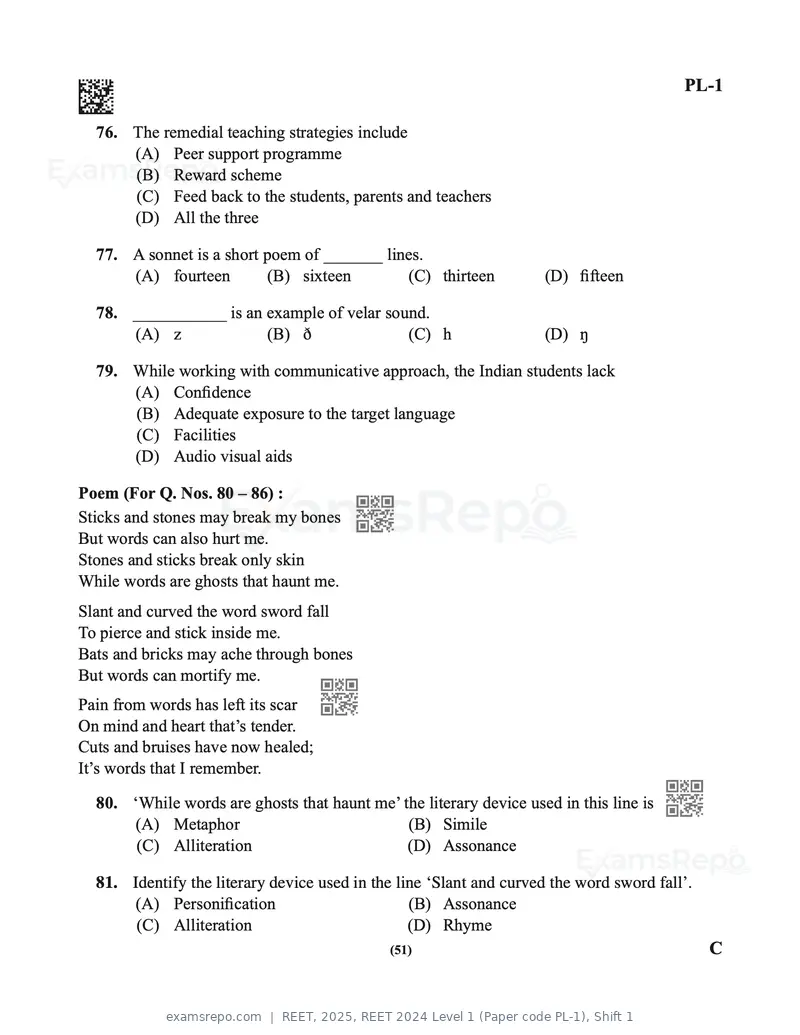
Text of page 243
PL-1

  76. The remedial teaching strategies include
      (A) Peer support programme
      (B) Reward scheme
      (C) Feed back to the students, parents and teachers
      (D) All the three

  77. A sonnet is a short poem of _______ lines.
      (A) fourteen         (B) sixteen       (C) thirteen           (D) fifteen

  78. ___________ is an example of velar sound.
      (A) z             (B) ð               (C) h                   (D) ŋ

  79. While working with communicative approach, the Indian students lack
      (A) Confidence
      (B) Adequate exposure to the target language
      (C) Facilities
      (D) Audio visual aids

Poem (For Q. Nos. 80 – 86) :
Sticks and stones may break my bones
But words can also hurt me.
Stones and sticks break only skin
While words are ghosts that haunt me.
Slant and curved the word sword fall
To pierce and stick inside me.
Bats and bricks may ache through bones
But words can mortify me.
Pain from words has left its scar
On mind and heart that’s tender.
Cuts and bruises have now healed;
It’s words that I remember.

  80. ‘While words are ghosts that haunt me’ the literary device used in this line is
      (A) Metaphor			                         (B) Simile
       (C) Alliteration			                    (D) Assonance

  81. Identify the literary device used in the line ‘Slant and curved the word sword fall’.
      (A) Personification			                     (B) Assonance
       (C) Alliteration			                       (D) Rhyme
                                             (51)                                             C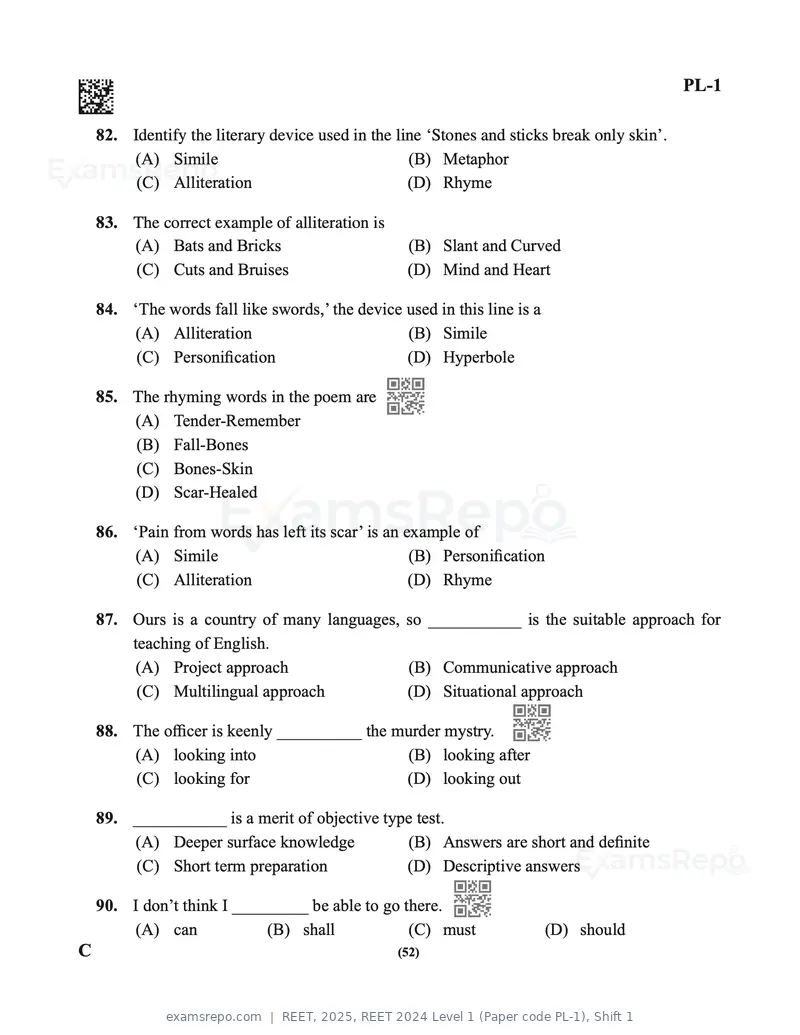
Text of page 244
PL-1

    82. Identify the literary device used in the line ‘Stones and sticks break only skin’.
        (A) Simile			                              (B) Metaphor
         (C) Alliteration			                       (D) Rhyme

    83. The correct example of alliteration is
        (A) Bats and Bricks			                    (B) Slant and Curved
        (C) Cuts and Bruises			                   (D) Mind and Heart

    84. ‘The words fall like swords,’ the device used in this line is a
        (A) Alliteration			                      (B) Simile
         (C) Personification			                  (D) Hyperbole

    85. The rhyming words in the poem are
        (A) Tender-Remember
        (B) Fall-Bones
        (C) Bones-Skin
        (D) Scar-Healed

    86. ‘Pain from words has left its scar’ is an example of
        (A) Simile			                              (B) Personification
         (C) Alliteration			                       (D) Rhyme

    87. Ours is a country of many languages, so ___________ is the suitable approach for
        teaching of English.
         (A) Project approach			             (B) Communicative approach
         (C) Multilingual approach           (D) Situational approach

    88. The officer is keenly __________ the murder mystry.
        (A) looking into			                   (B) looking after
        (C) looking for			                    (D) looking out

    89. ___________ is a merit of objective type test.
        (A) Deeper surface knowledge           (B) Answers are short and definite
        (C) Short term preparation             (D) Descriptive answers

    90. I don’t think I _________ be able to go there.
        (A) can             (B) shall            (C) must                 (D) should
C                                                (52)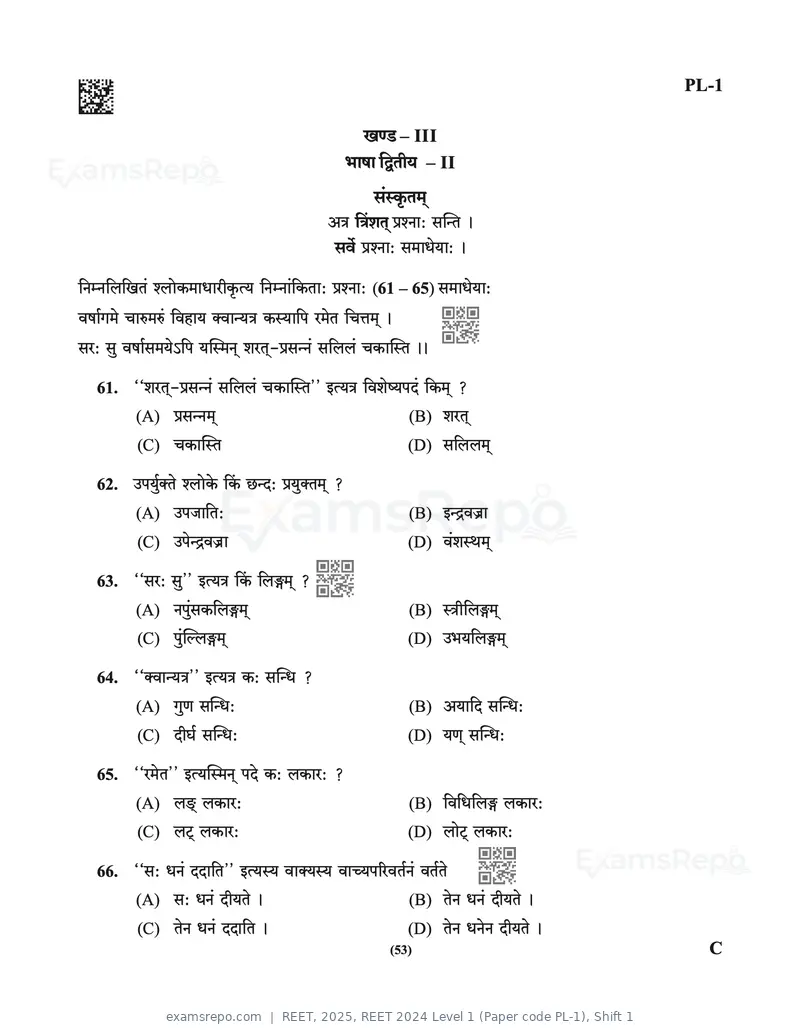
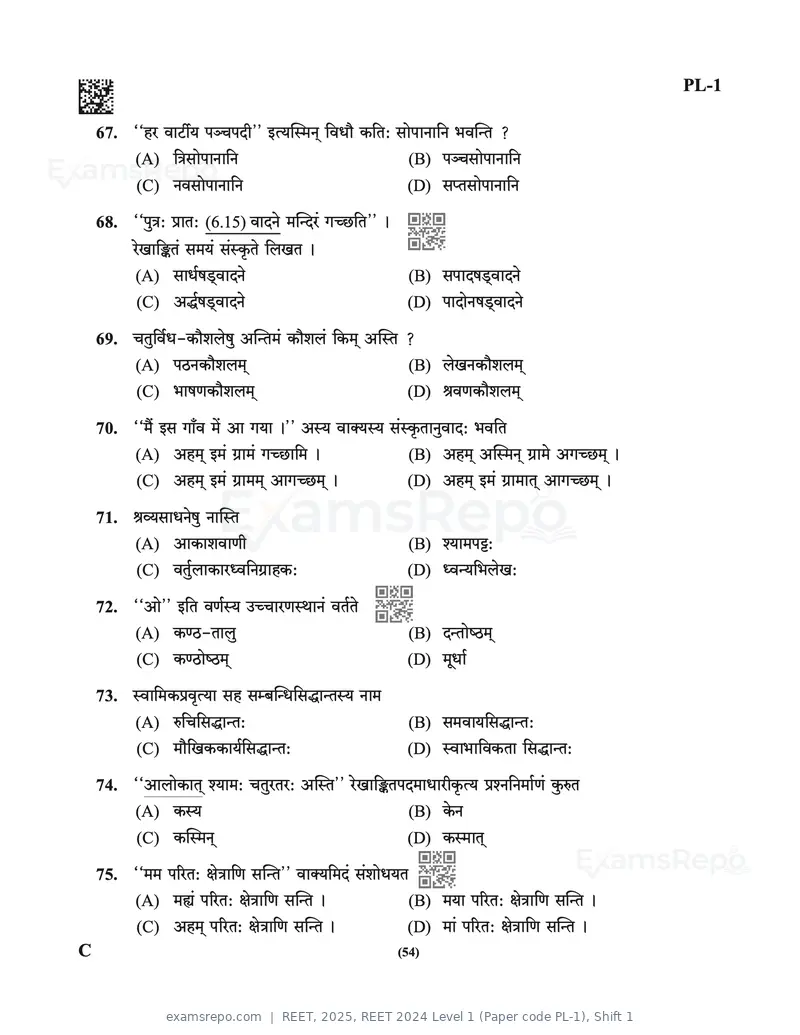
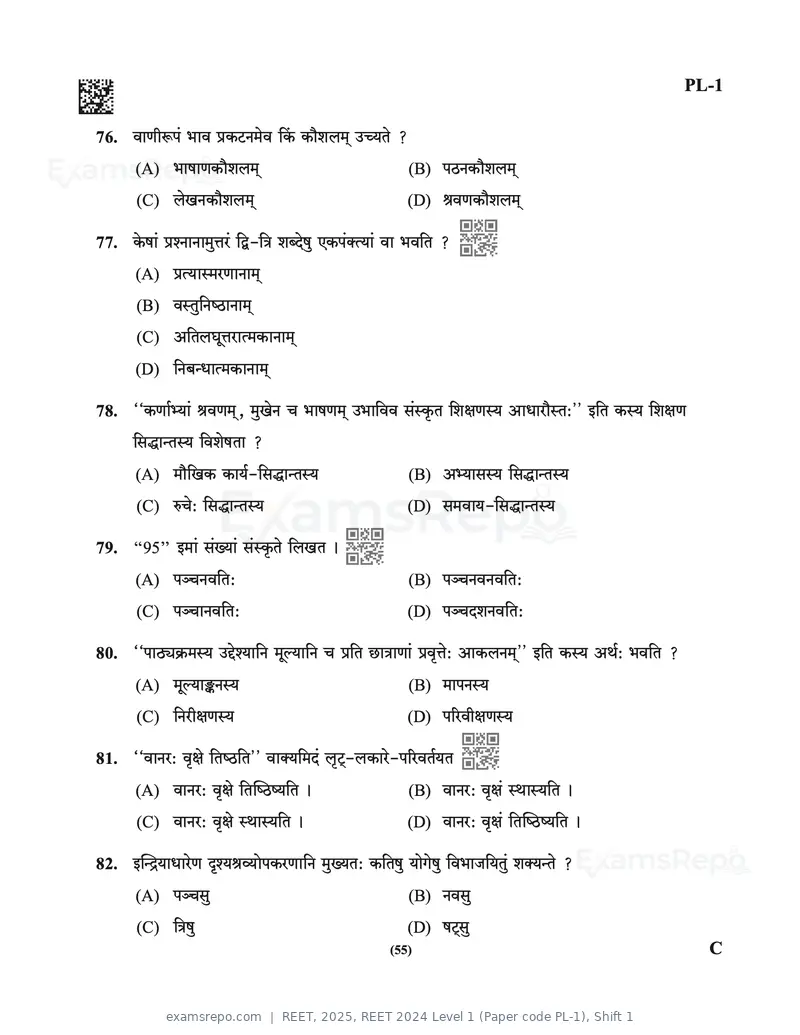
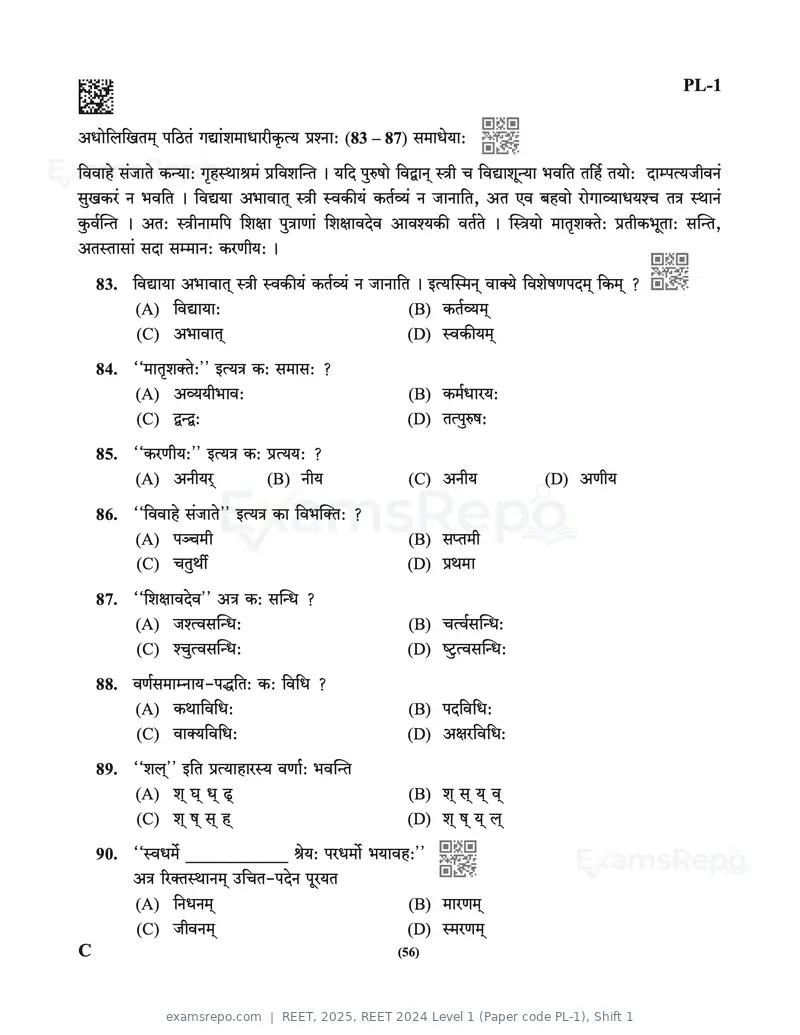
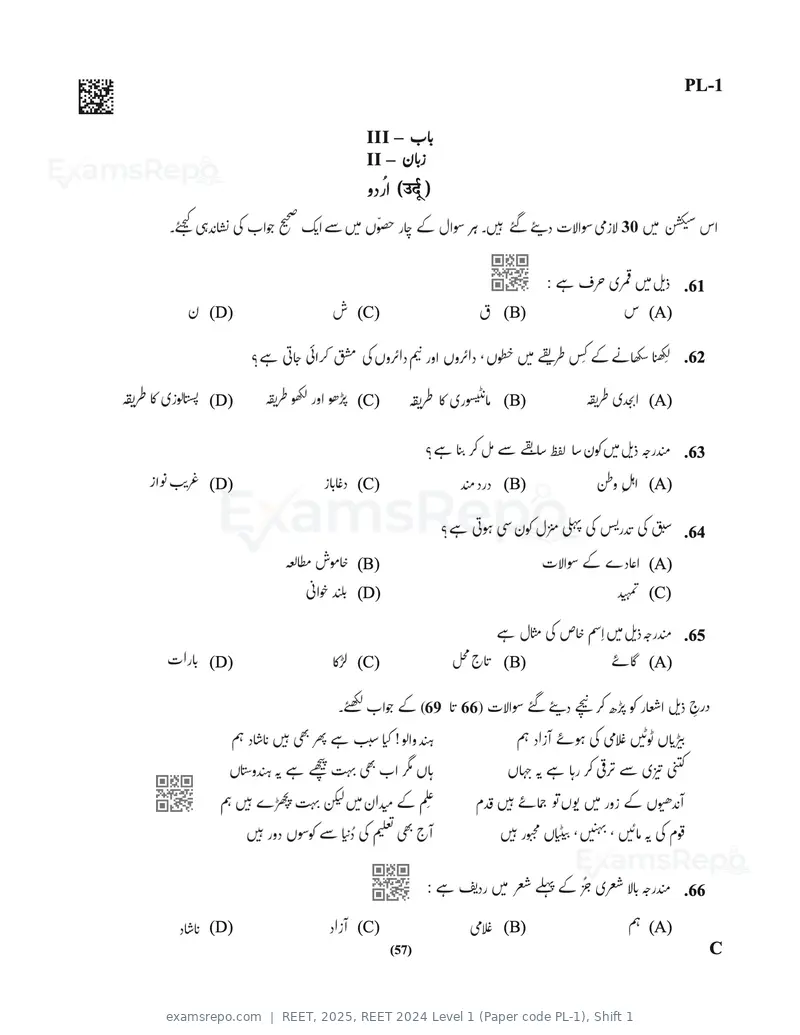
Text of page 249
PL-1

         III –
         II –
               (CXÿ© )


                                     .61
  (D)   (C)              (B)   (A)

                                     .62

  (D)   (C)              (B)   (A)


                                     .63
  (D)   (C)              (B)   (A)

                                     .64
			     (B)			                 (A)
			     (D)			                 (C)

                                     .65
  (D)   (C)              (B)   (A)


                                     .66

  (D)   (C)              (B)   (A)
              (57)                         C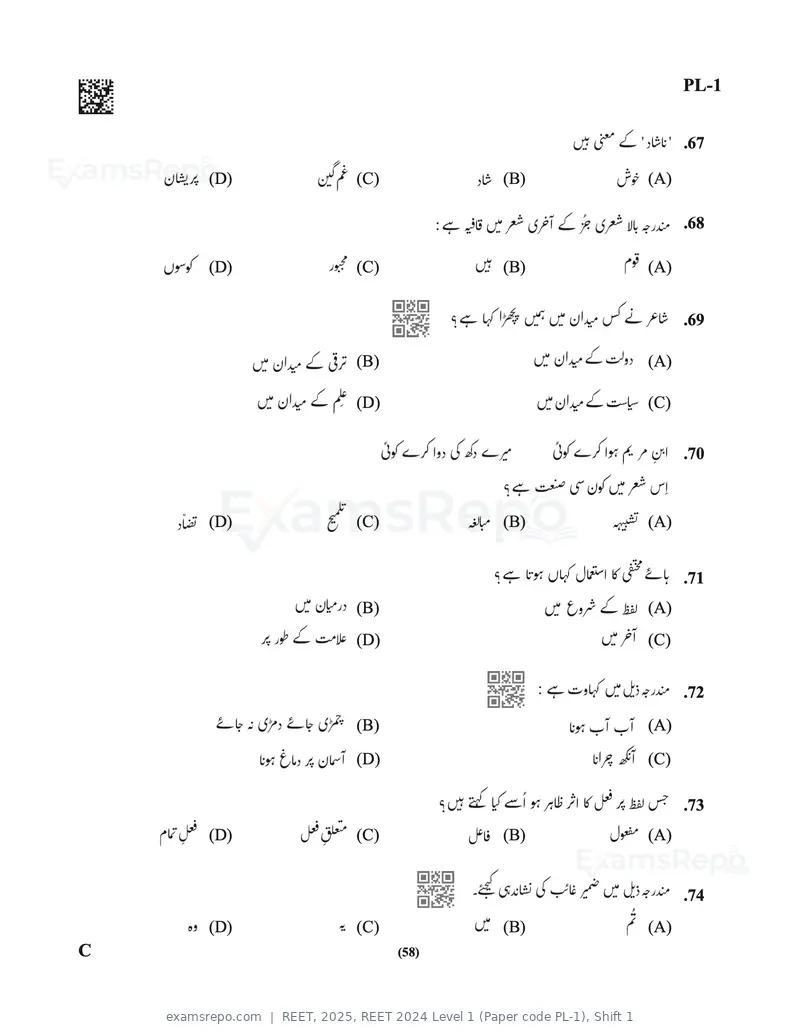
Text of page 250
PL-1


                                   .67

    (D)   (C)          (B)   (A)

                                   .68

    (D)   (C)          (B)   (A)


                                   .69

			       (B)			             (A)

			       (D)			             (C)


                                   .70


    (D)   (C)          (B)   (A)


                                   .71
			       (B)			             (A)
			       (D)			             (C)


                                   .72
			       (B)			             (A)
			       (D)			             (C)

                                   .73
    (D)   (C)          (B)   (A)


                                   .74
    (D)   (C)          (B)   (A)
C               (58)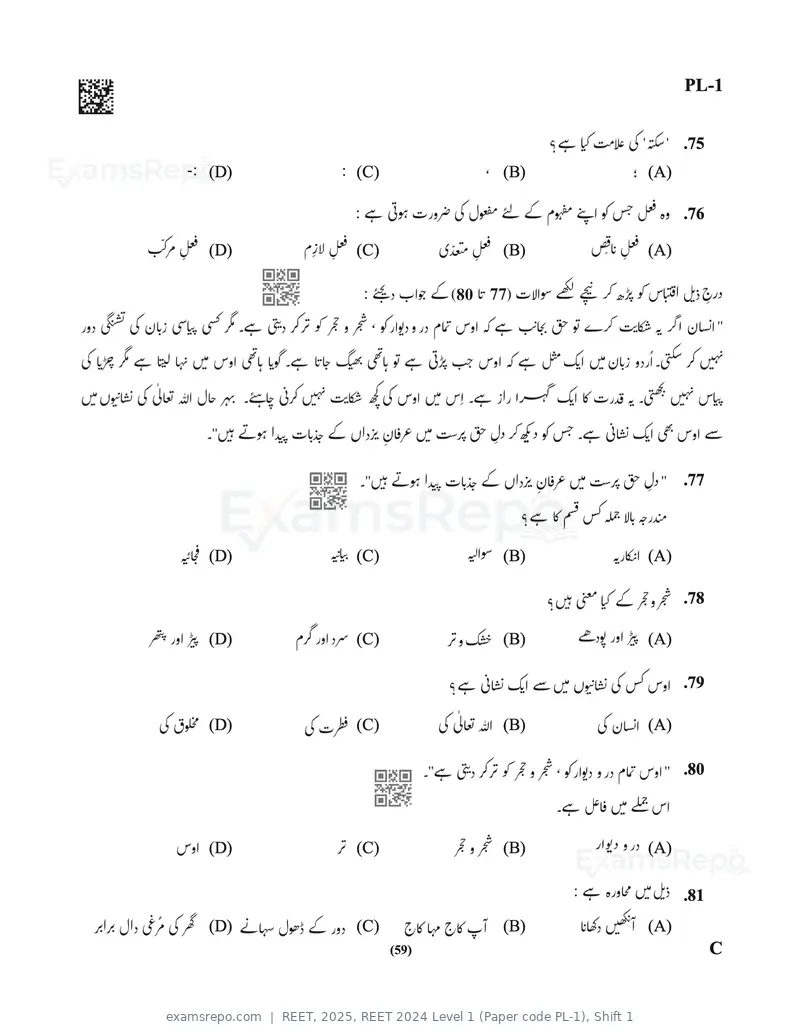
Text of page 251
PL-1


                               .75
(D)   (C)          (B)   (A)

                               .76

(D)   (C)          (B)   (A)


                               .77


(D)   (C)          (B)   (A)

                               .78

(D)   (C)          (B)   (A)

                               .79

(D)   (C)          (B)   (A)

                               .80


(D)   (C)          (B)   (A)

                               .81
(D)   (C)          (B)   (A)
            (59)                     C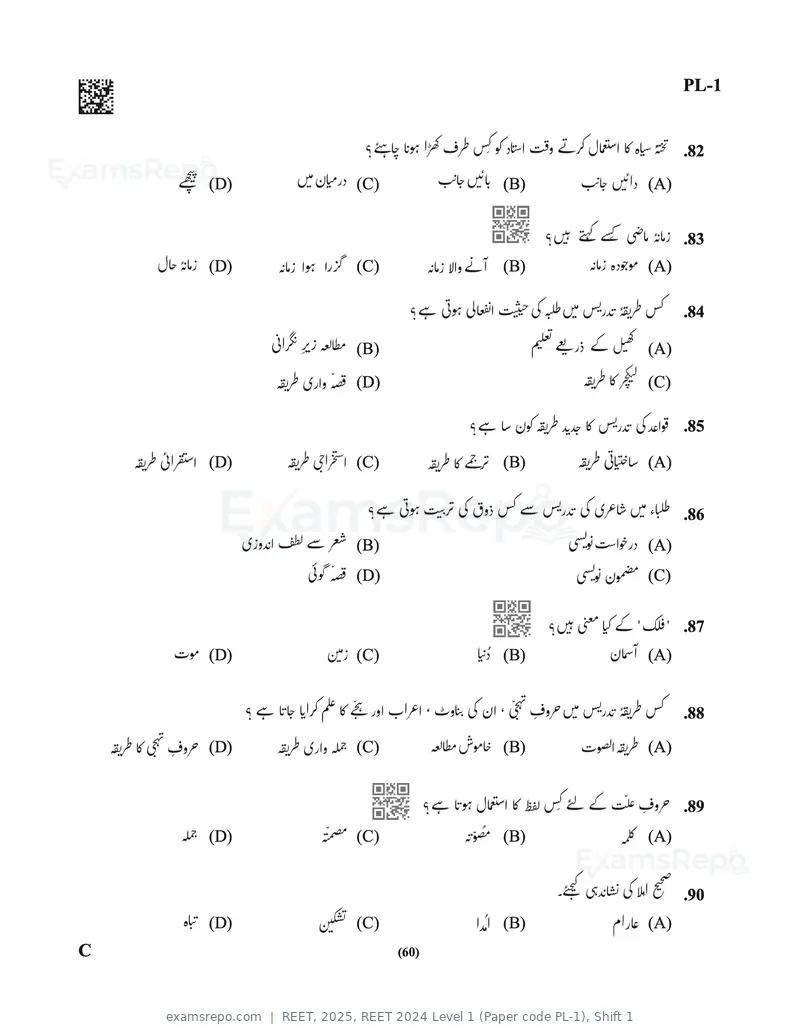
Text of page 252
PL-1


                                   .82
    (D)   (C)          (B)   (A)


                                   .83
    (D)   (C)          (B)   (A)

                                   .84

			       (B)			             (A)
			       (D)			             (C)

                                   .85

    (D)   (C)          (B)   (A)


                                   .86
			       (B)			             (A)
			       (D)			             (C)


                                   .87
    (D)   (C)          (B)   (A)


                                   .88
    (D)   (C)          (B)   (A)


                                   .89
    (D)   (C)          (B)   (A)


                                   .90
    (D)   (C)          (B)   (A)
C               (60)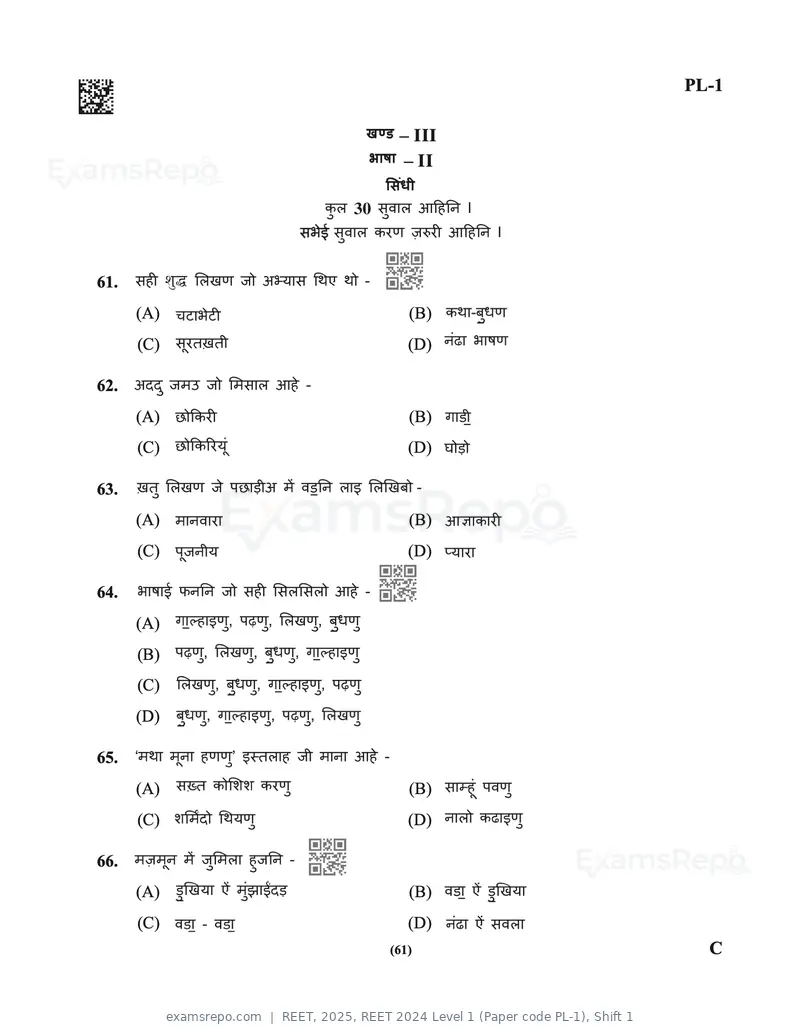
Text of page 253
PL-1

                      – iiI
                     > – II


61.
      (A)   			        (B)
      (C)   			        (D)

62.
      (A)   			        (B)
      (C)   			        (D)

63.
      (A)   			        (B)
      (C)   			        (D)

64.
      (A)
      (B)
      (C)
      (D)

65.
      (A)      		      (B)
      (C)    			       (D)

66.
      (A)     			      (B)
      (C)   			        (D)
                    (61)        C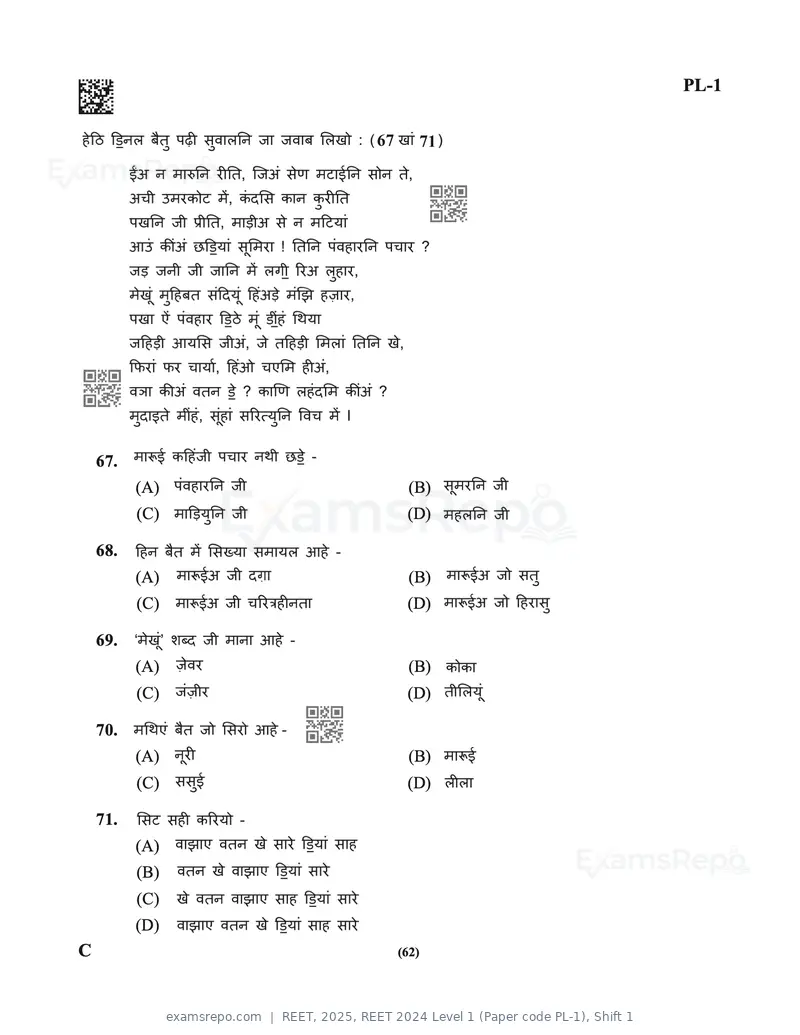
Text of page 254
PL-1


    67.
          (A)    			      (B)
          (C)    			     (D)

    68.
          (A)     			     (B)
          (C)            (D)

    69.
          (A)   			       (B)
          (C)   			      (D)

    70.
          (A)   			       (B)
          (C)   			      (D)

    71.
          (A)
          (B)
          (C)
          (D)
C                       (62)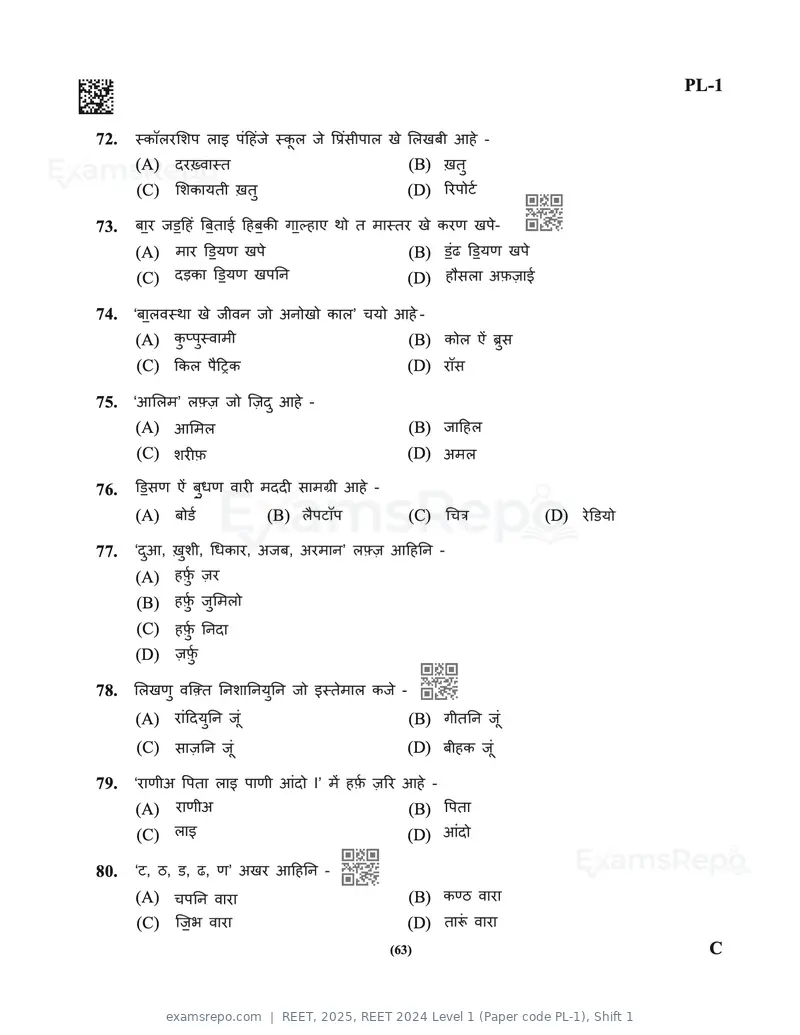
Text of page 255
PL-1

72.
      (A)   			         (B)
      (C)    			        (D)

73.
      (A)     			       (B)
      (C)       		      (D)

74.
      (A)    			        (B)
      (C)    			        (D)

75.
      (A)   			         (B)
      (C)   			         (D)

76.
      (A)     (B)       (C)   (D)

77.
      (A)
      (B)
      (C)
      (D)

78.
      (A)    			        (B)
      (C)    			        (D)

79.
      (A)   			         (B)
      (C)   			         (D)

80.
      (A)    			        (B)
      (C)    			        (D)
                     (63)             C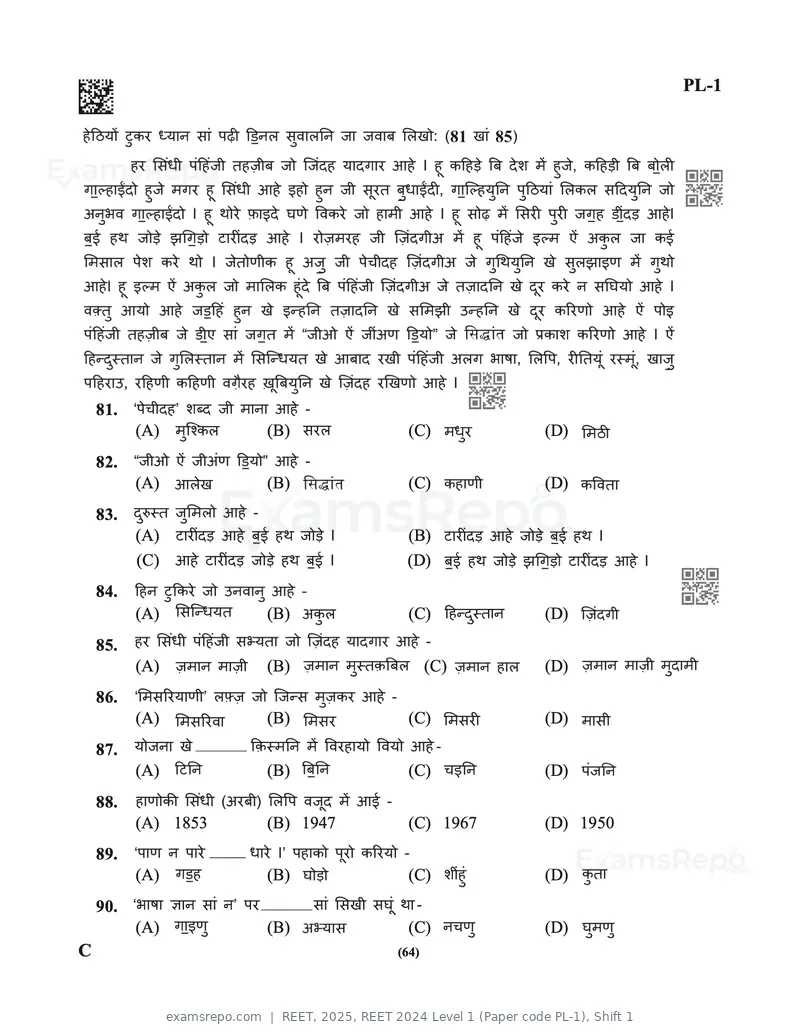
Text of page 256
PL-1


    81.
          (A)        (B)          (C)        (D)
    82.
          (A)        (B)          (C)        (D)
    83.
          (A)                    (B)
          (C)                    (D)
    84.
          (A)        (B)          (C)        (D)
    85.
          (A)        (B)               (C)   (D)
    86.
          (A)        (B)          (C)        (D)
    87.
          (A)        (B)          (C)        (D)
    88.
          (A) 1853   (B) 1947     (C) 1967   (D) 1950
    89.
          (A)        (B)          (C)        (D)
    90.
          (A)        (B)          (C)        (D)
C                               (64)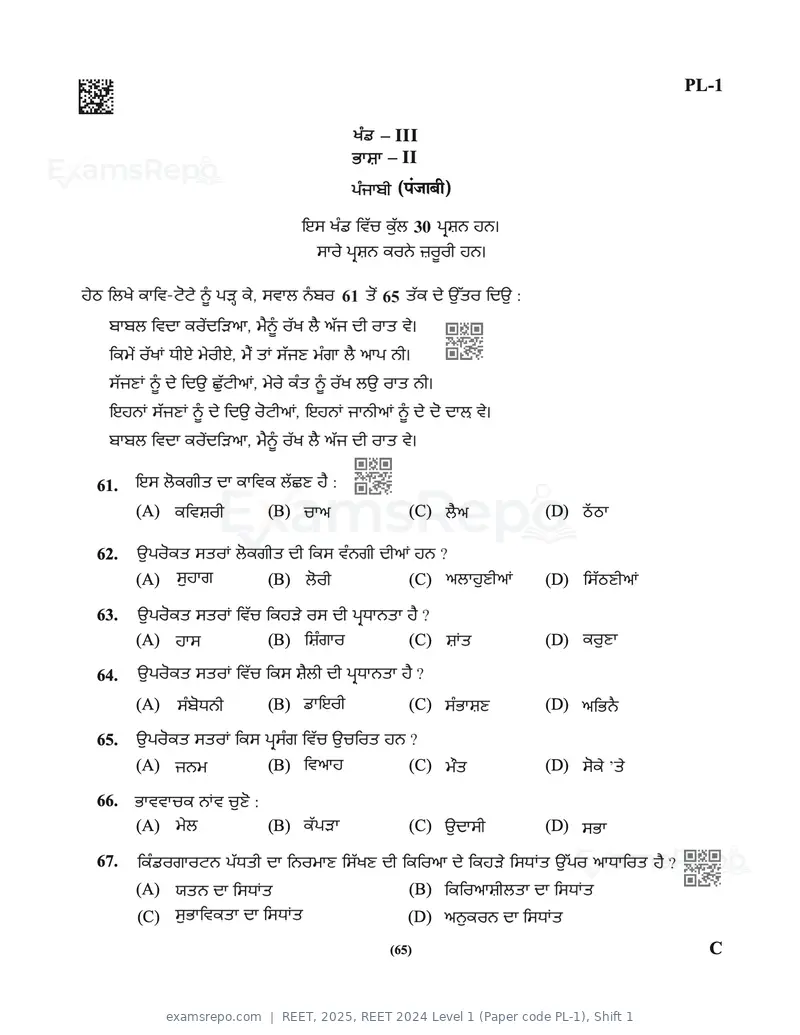
Text of page 257
PL-1

                  > – iiI
                    – II
                     (n§Om~r)


61.
      (A)   (B)        (C)      (D)

62.
      (A)   (B)        (C)      (D)

63.
      (A)   (B)        (C)      (D)

64.
      (A)   (B)        (C)      (D)

65.
      (A)   (B)        (C)      (D)

66.
      (A)   (B)        (C)      (D)

67.
      (A)   			        (B)
      (C)              (D)
                    (65)                C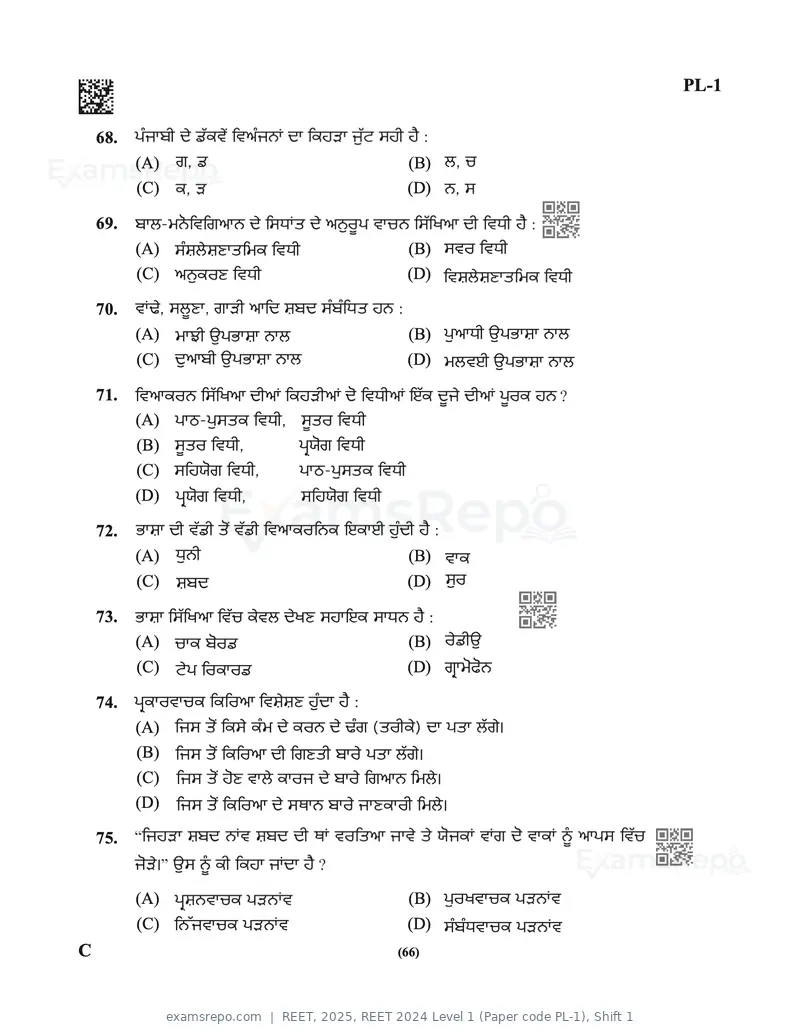
Text of page 258
PL-1

    68.
          (A)   			       (B)
          (C)   			       (D)

    69.
          (A)             (B)
          (C)     			     (D)

    70.
          (A)       		    (B)
          (C)             (D)

    71.
          (A)
          (B)
          (C)
          (D)

    72.
          (A)   			       (B)
          (C)   			       (D)

    73.
          (A)    			      (B)
          (C)     			     (D)

    74.
          (A)
          (B)
          (C)
          (D)

    75.


          (A)       		    (B)
          (C)      			    (D)
C                        (66)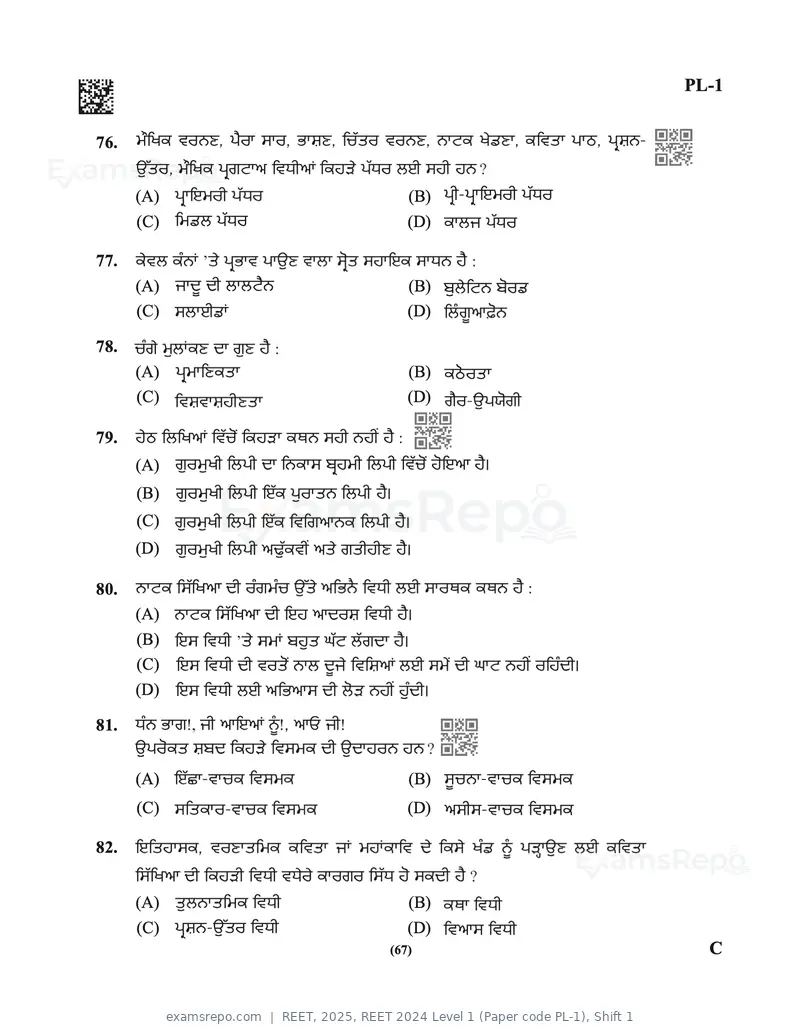
Text of page 259
PL-1


76.


      (A)     			       (B)
      (C)    			        (D)

77.
      (A)     			       (B)
      (C)   			         (D)

78.
      (A)   			         (B)
      (C)    			        (D)

79.
      (A)
      (B)
      (C)
      (D)

80.
      (A)
      (B)
      (C)
      (D)

81.


      (A)       		      (B)
      (C)               (D)

82.


      (A)      			      (B)
      (C)      			      (D)
                     (67)       C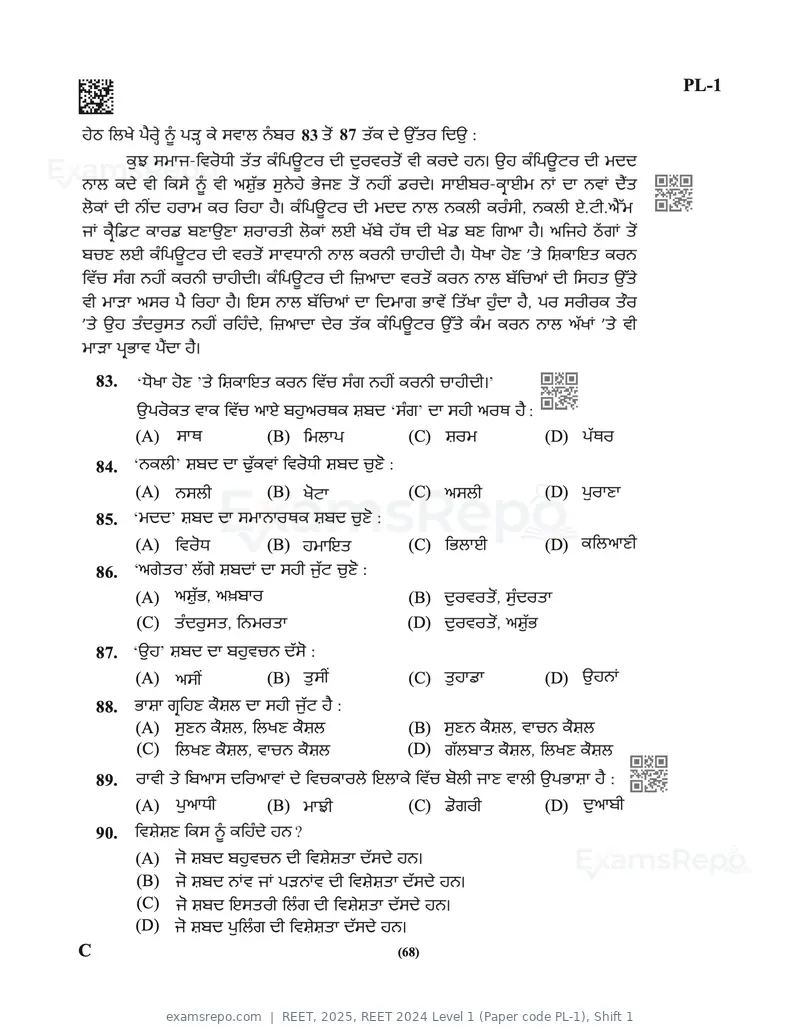
Text of page 260
PL-1


    83.


          (A)   (B)       (C)   (D)
    84.
          (A)   (B)       (C)   (D)
    85.
          (A)   (B)       (C)   (D)
    86.
          (A)   			      (B)
          (C)     			    (D)
    87.
          (A)   (B)       (C)   (D)
    88.
          (A)            (B)
          (C)            (D)
    89.
          (A)   (B)       (C)   (D)
    90.
          (A)
          (B)
          (C)
          (D)
C                       (68)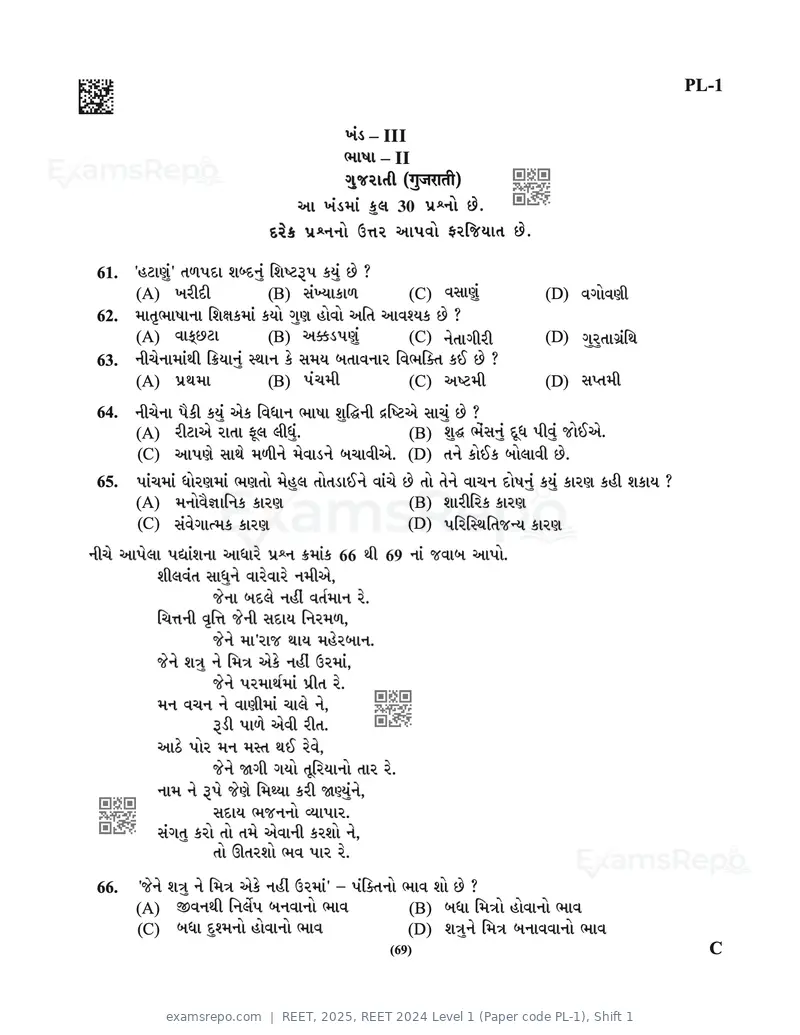
Text of page 261
PL-1

                       – iII
                        – II
                           (JwOamVr)


61.
      (A)   (B)             (C)        (D)
62.
      (A)   (B)             (C)        (D)
63.
      (A)   (B)             (C)        (D)
64.
      (A)         		        (B)
      (C)                   (D)
65.
      (A)    			            (B)
      (C)   			             (D)


66.
      (A)                   (B)
      (C)                   (D)
                         (69)                  C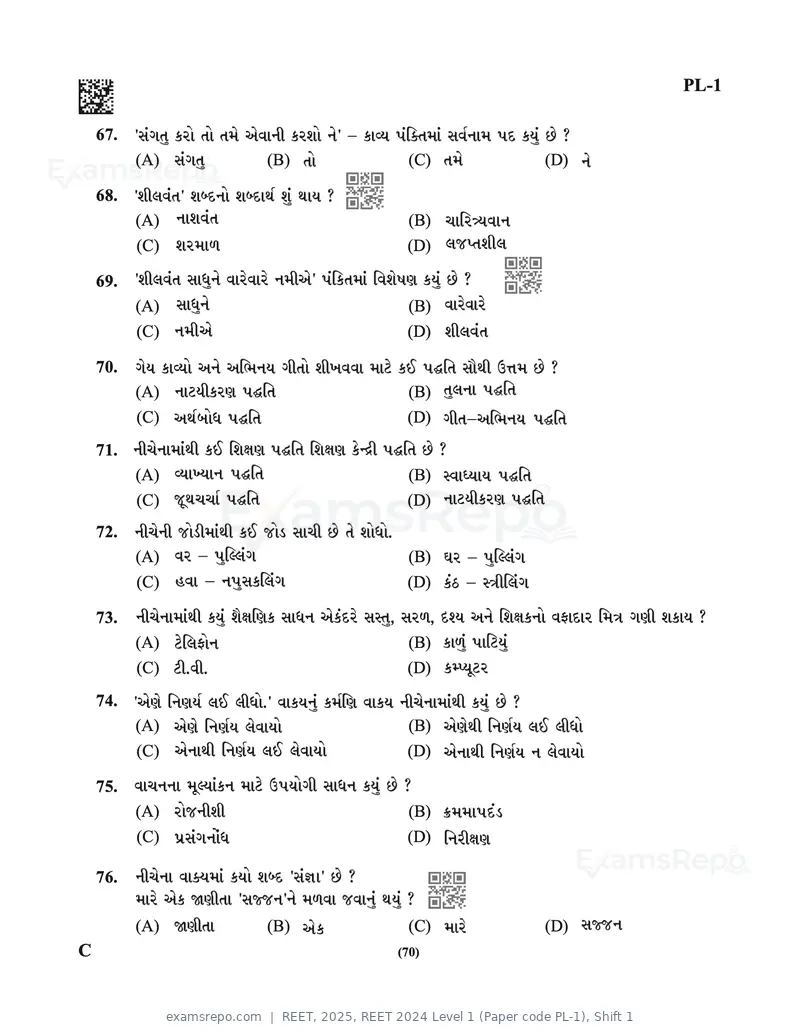
Text of page 262
PL-1

    67.
          (A)     (B)       (C)   (D)

    68.
          (A)   			        (B)
          (C)   			        (D)

    69.
          (A)   			        (B)
          (C)   			        (D)

    70.
          (A)     			      (B)
          (C)    			       (D)
    71.
          (A)    			       (B)
          (C)    			       (D)
    72.
          (A)    			       (B)
          (C)      			     (D)

    73.
          (A)   			        (B)
          (C)   			        (D)
    74.
          (A)       			    (B)
          (C)              (D)

    75.
          (A)   			        (B)
          (C)   			        (D)

    76.

          (A)     (B)       (C)   (D)
C                         (70)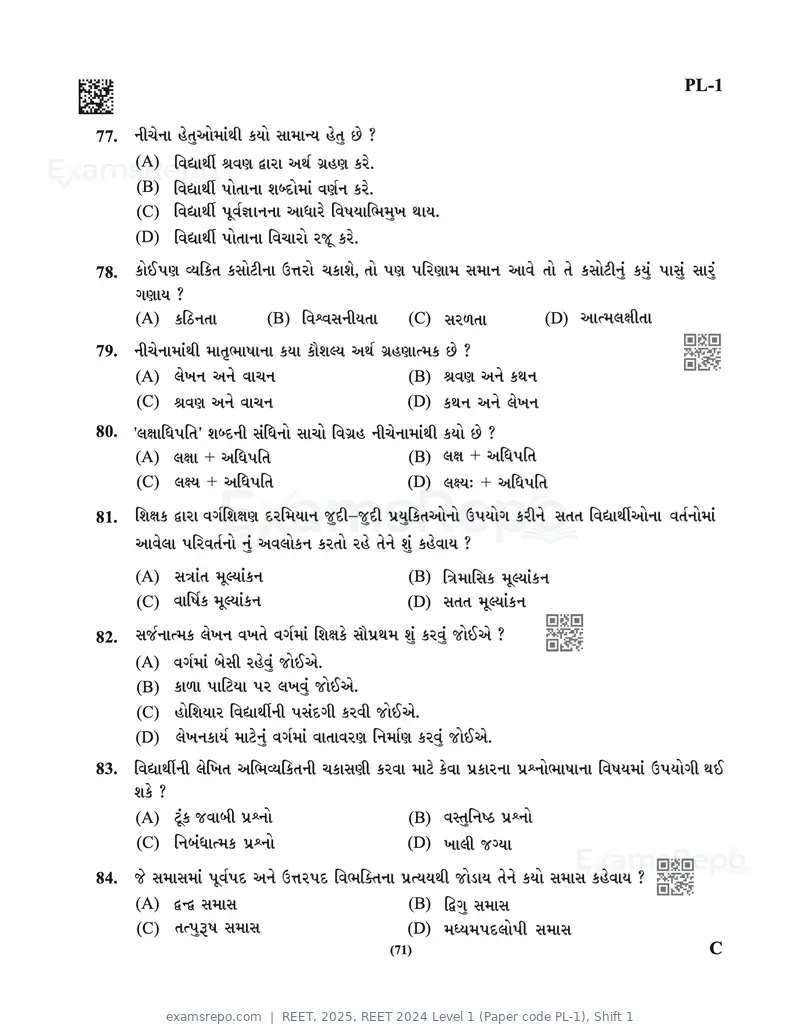
Text of page 263
PL-1

77.
      (A)
      (B)
      (C)
      (D)

78.

      (A)    (B)       (C)   (D)
79.
      (A)     			      (B)
      (C)     			      (D)
80.
      (A)    			       (B)
      (C)    			       (D)

81.


      (A)    			       (B)
      (C)    			       (D)

82.
      (A)
      (B)
      (C)
      (D)
83.

      (A)     			      (B)
      (C)     			      (D)

84.
      (A)   			        (B)
      (C)    			       (D)
                    (71)             C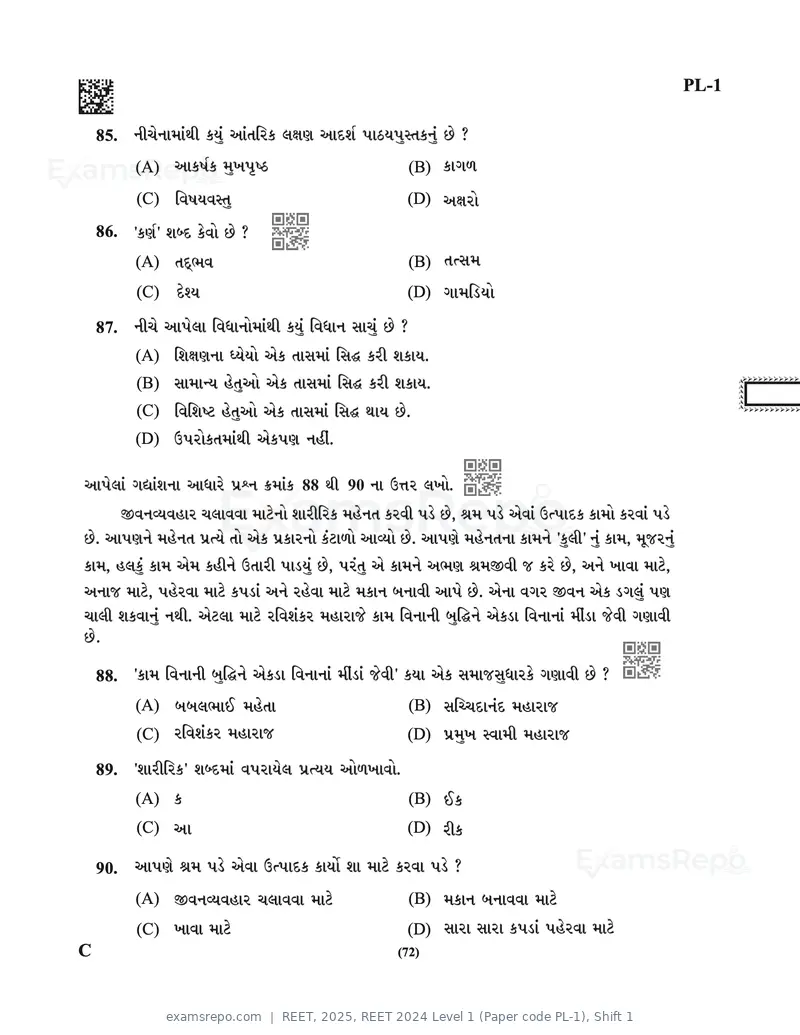
Text of page 264
PL-1
85.
(A) (B)
(C) (D)
86.
(A) (B)
(C) (D)
87.
(A)
(B)
(C)
(D)
88.
(A) (B)
(C) (D)
89.
(A) (B)
(C) (D)
90.
(A) (B)
(C) (D)
C (72)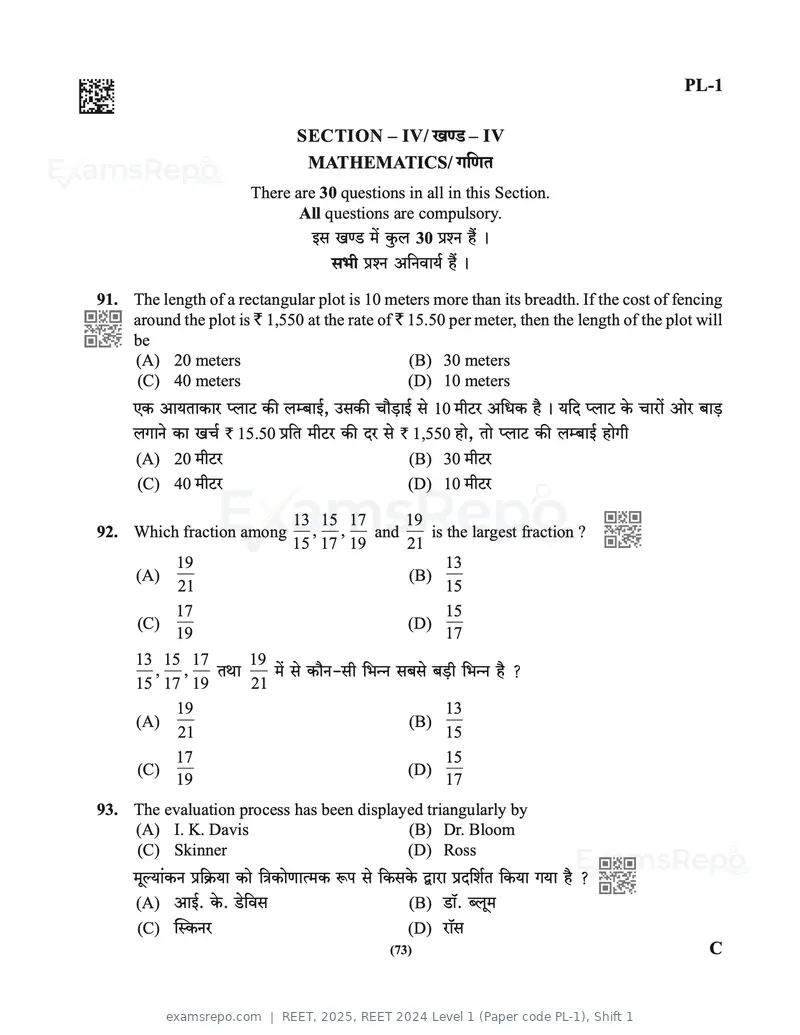
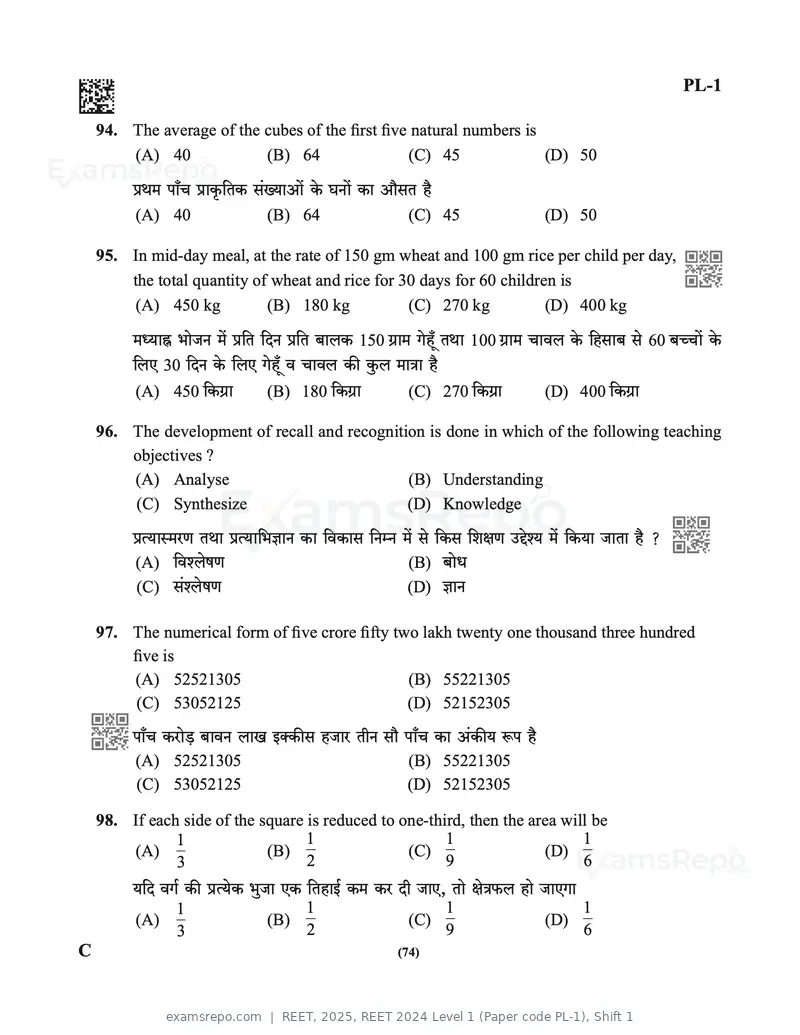
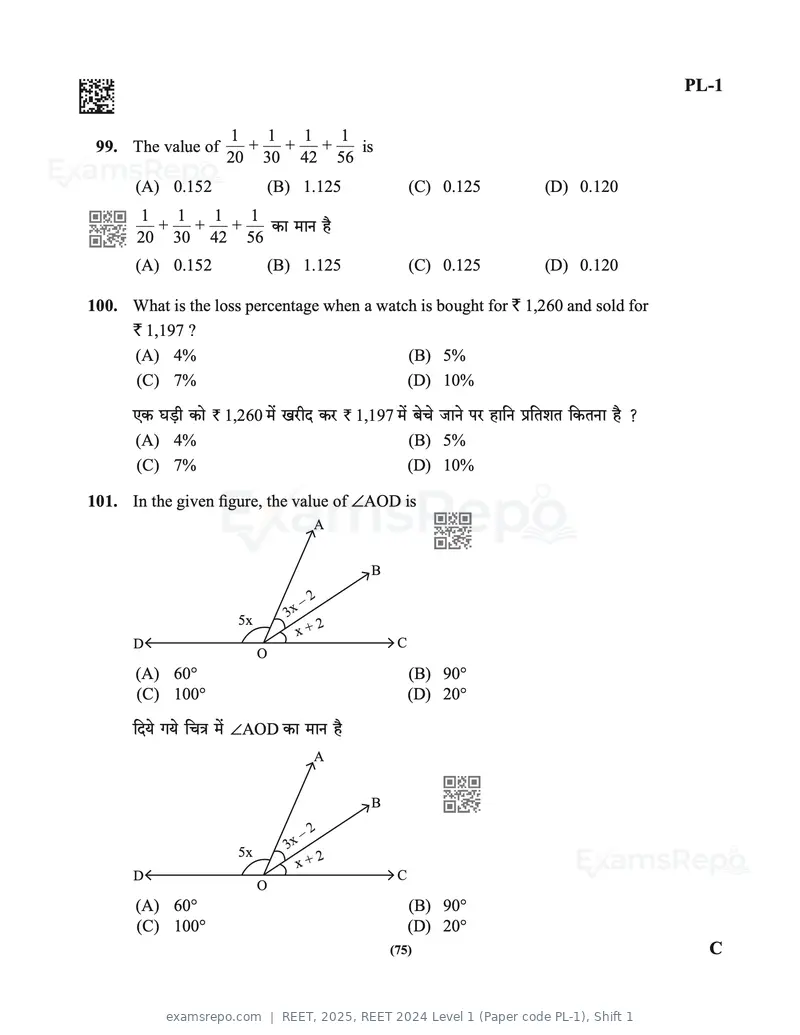
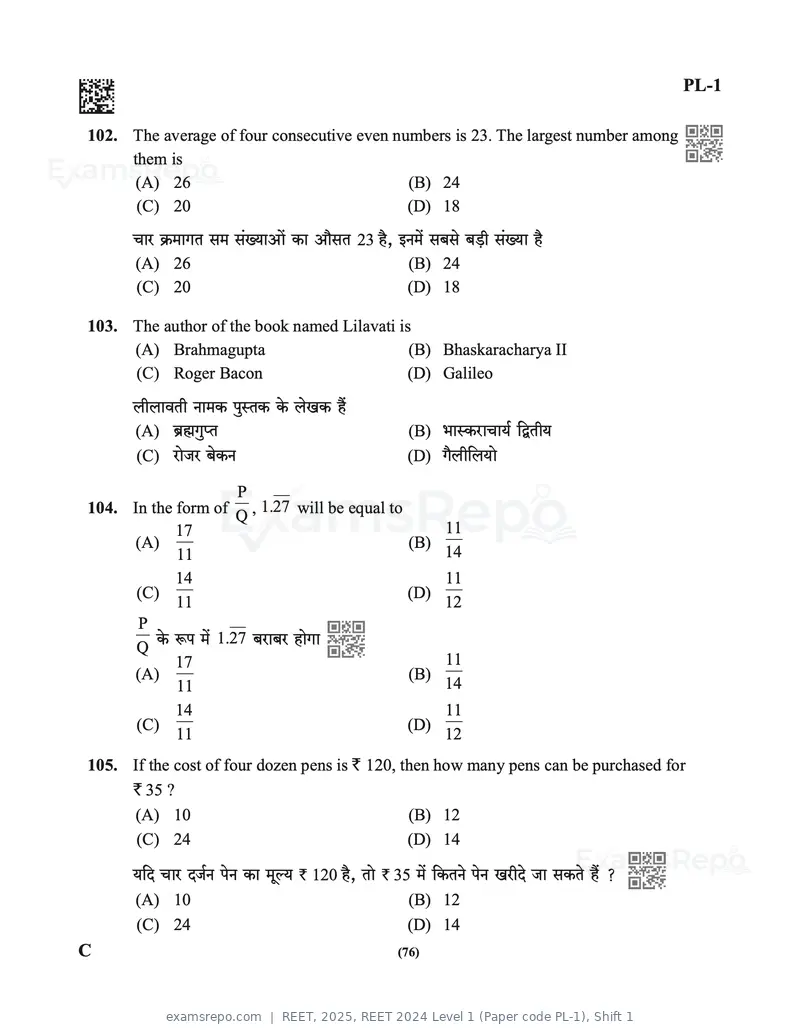
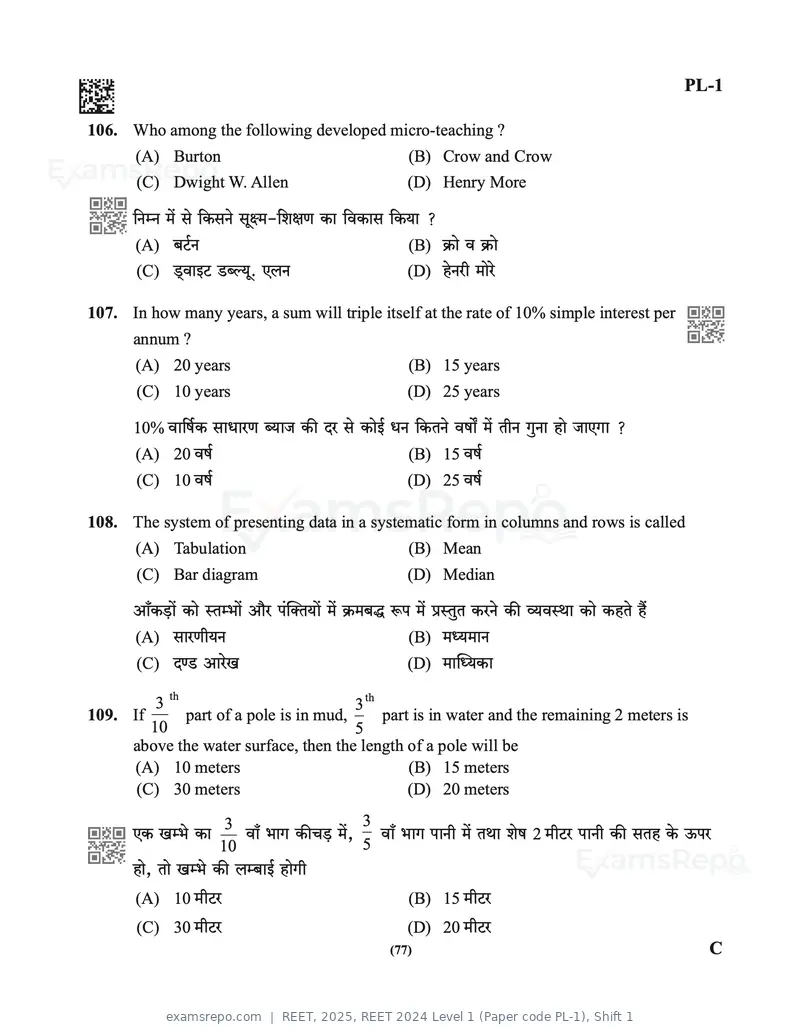
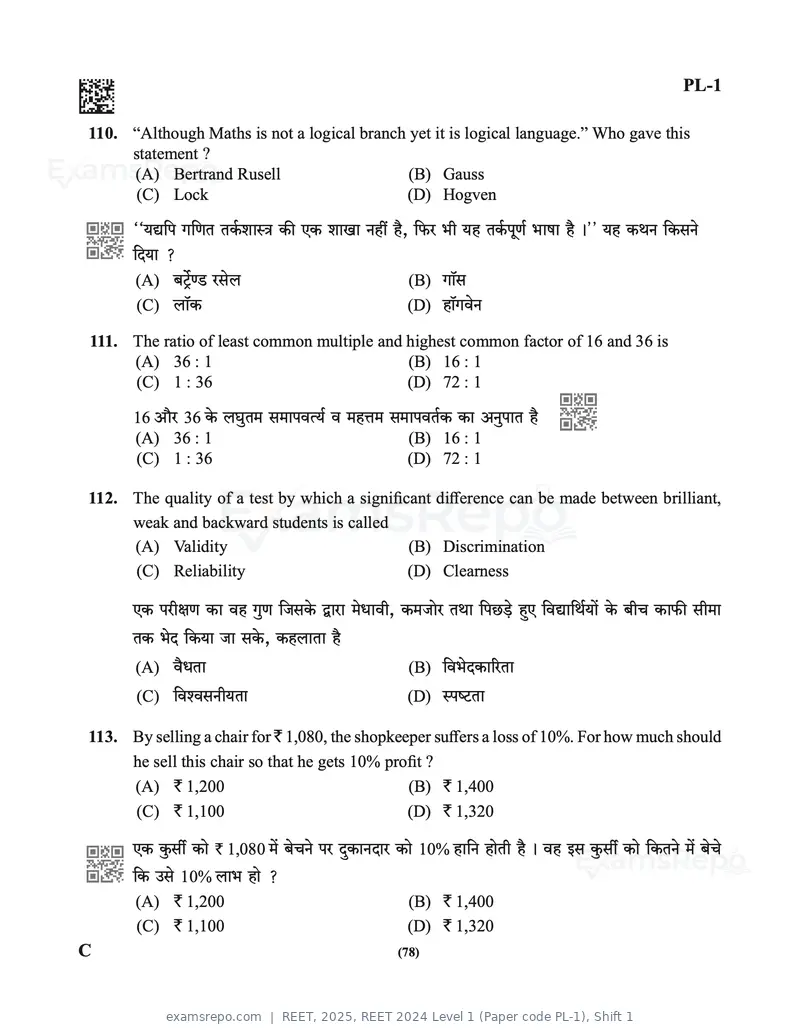
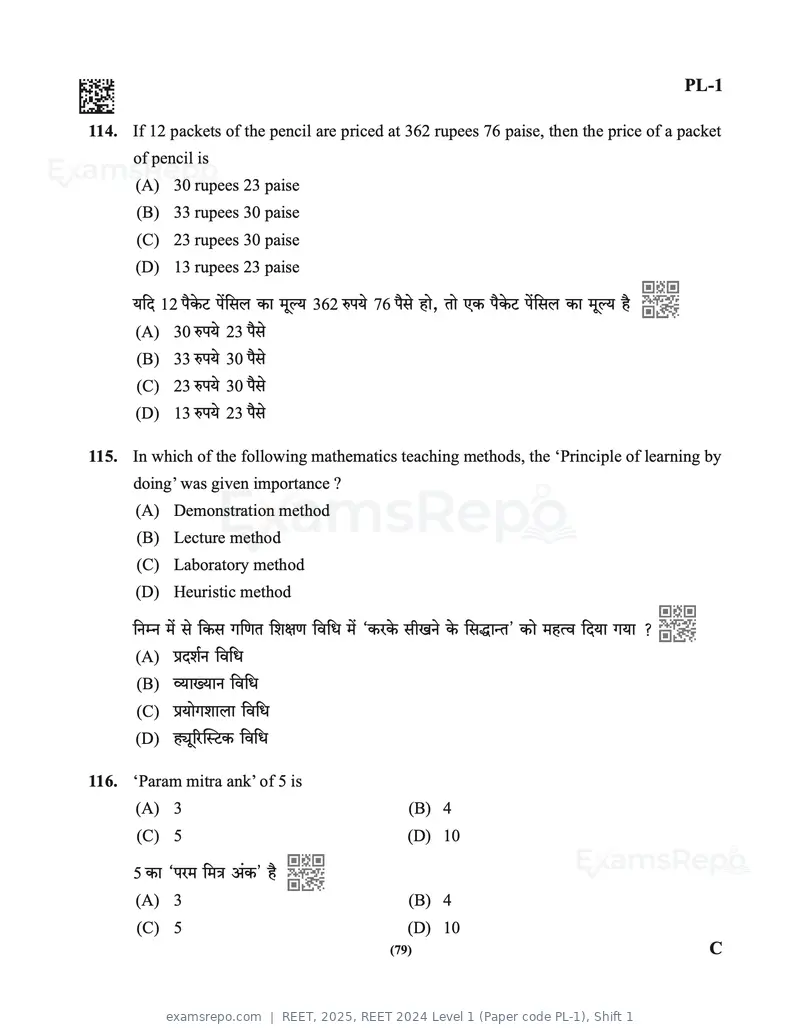
Text of page 271
PL-1

 114. If 12 packets of the pencil are priced at 362 rupees 76 paise, then the price of a packet
        of pencil is
         (A) 30 rupees 23 paise
         (B) 33 rupees 30 paise
         (C) 23 rupees 30 paise
         (D) 13 rupees 23 paise

		 `{X 12 n¡Ho$Q> n|{gb H$m _yë` 362 én`o 76 n¡go hmo, Vmo EH$ n¡Ho$Q> n|{gb H$m _yë` h¡
   (A) 30 én`o 23 n¡go
   (B) 33 én`o 30 n¡go
   (C) 23 én`o 30 n¡go
   (D) 13 én`o 23 n¡go

 115. In which of the following mathematics teaching methods, the ‘Principle of learning by
        doing’ was given importance ?
         (A) Demonstration method
         (B) Lecture method
         (C) Laboratory method
         (D) Heuristic method

		 {ZåZ _| go {H$g J{UV {ejU {d{Y _| "H$aHo$ grIZo Ho$ {gÕmÝV' H$mo _hËd {X`m J`m ?
    (A) àXe©Z {d{Y
    (B) ì`m»`mZ {d{Y
    (C) à`moJembm {d{Y
    (D) hçy[apñQ>H$ {d{Y

 116. ‘Param mitra ank’ of 5 is
         (A) 3			                                   (B) 4
         (C) 5			                                   (D) 10

		 5 H$m "na_ {_Ì A§H$' h¡
         (A) 3			                                   (B) 4
         (C) 5			                                   (D) 10
                                                 (79)                                        C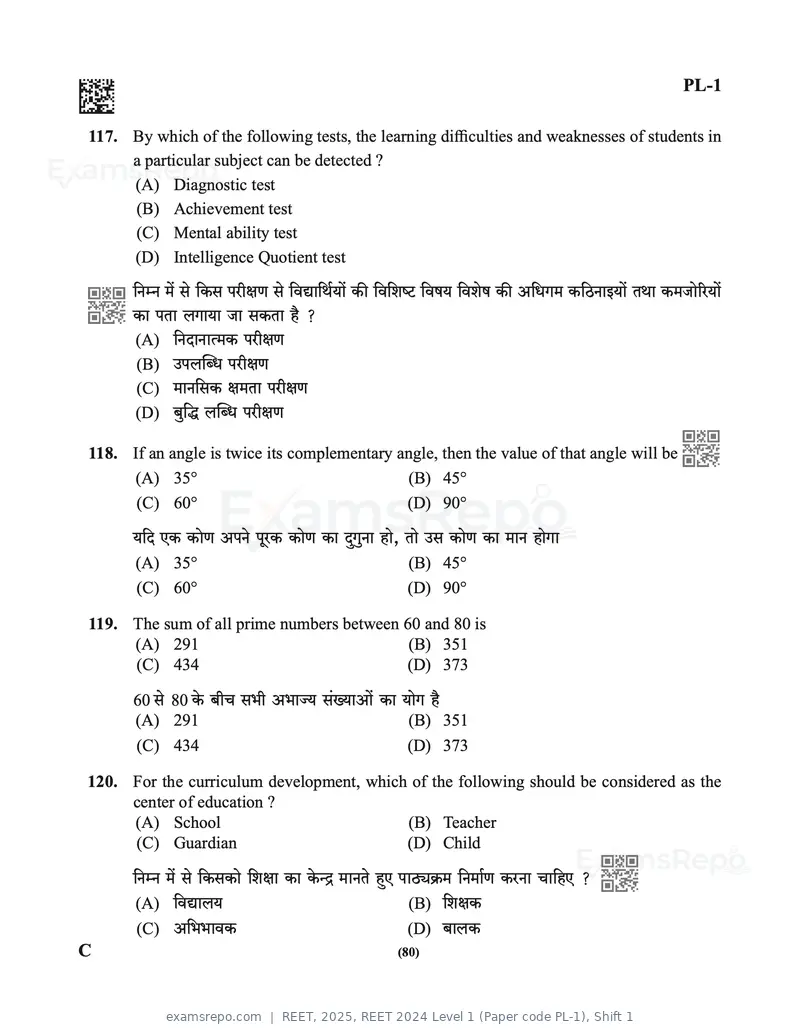
Text of page 273
PL-1

                           SECTION – V/ IÊS> – V
                    ENVIRONMENTAL STUDIES/ n`m©daU AÜ``Z
                         There are 30 questions in all in this section.
                                All questions are compulsory.
                                  Bg IÊS> _| Hw$b 30 àíZ h¢ &
                                     g^r àíZ A{Zdm`© h¢ &

 121. In how many directions faces of lion are present in National Symbol of Ashok’s pillar ?
        (A) One			                               (B) Two
        (C) Three			                             (D) Four

		 amîQ´>r` {M• AemoH$ ñVå^ _| {H$VZr {XemAm| _| qgh Ho$ _wI h¢ ?
   (A) EH$			                                  (B) Xmo
    (C) VrZ			                                 (D) Mma

 122. Wild cock is the main wild animal of which wildlife sanctuary ?
        (A) Sariska – Alwar
        (B) Mount Abu – Sirohi
        (C) Talchhapper – Churu
        (D) Kailadevi – Karauli

		 O§Jbr _wJ} H$m¡Z-go dÝ`Ord A^`maÊ` H$m à_wI O§Jbr Ord h¡ ?
   (A) g[añH$m - Abda
   (B) _mCÊQ> Am~y - {gamohr
   (C) VmbN>mna - Myé
   (D) H¡$bmXodr - H$am¡br

 123. Where is the pandupol fair held ?
        (A) Jaipur			                            (B) Ajmer
        (C) Alwar			                             (D) Pander

		 nm§Sw>nmob _obm H$hm± bJVm h¡ ?
   (A) O`nwa			                                  (B) AO_oa
   (C) Abda			                                   (D) nÊS>oa
                                              (81)                                          C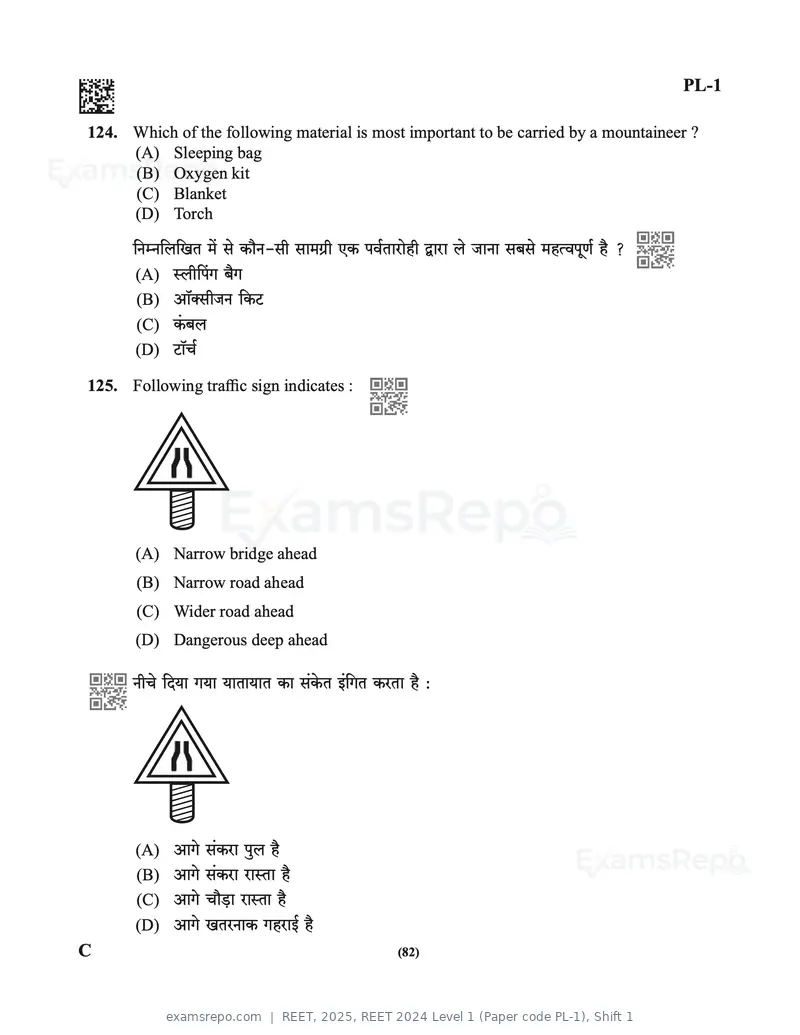
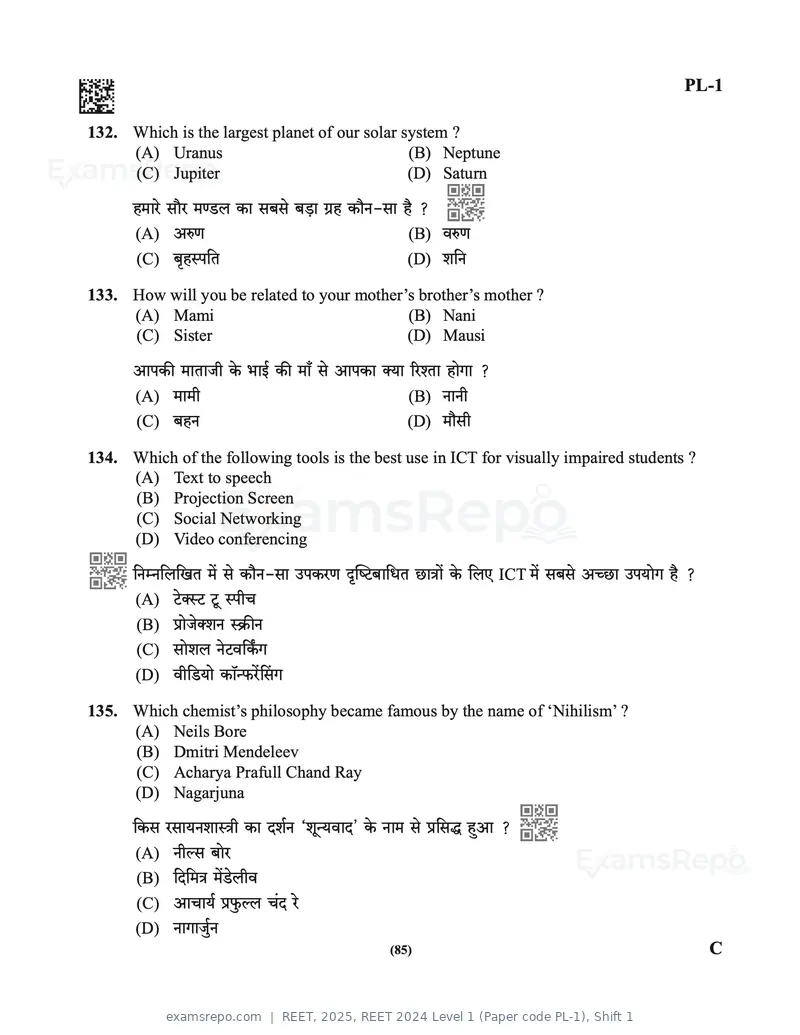
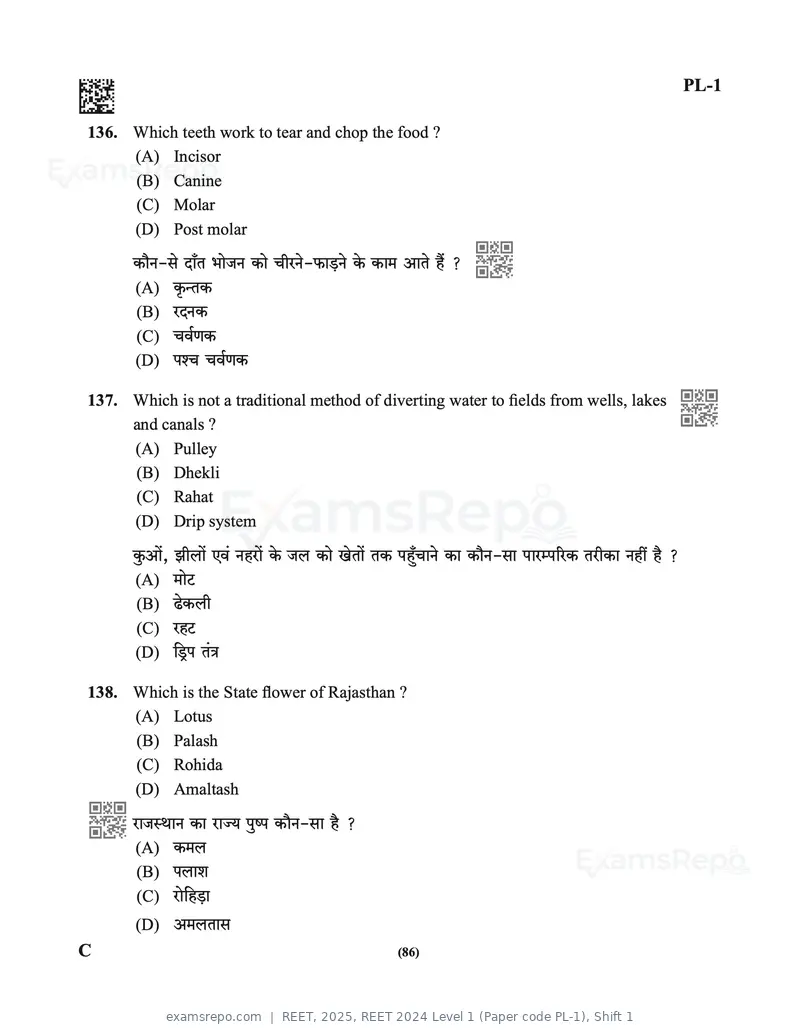
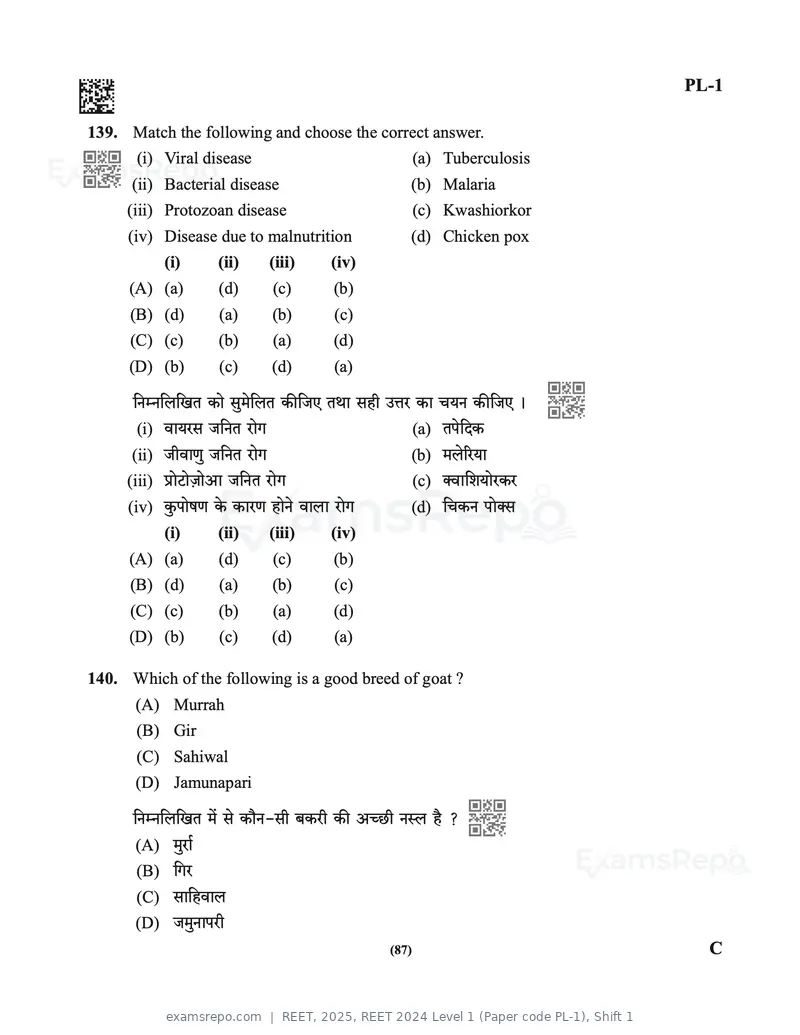
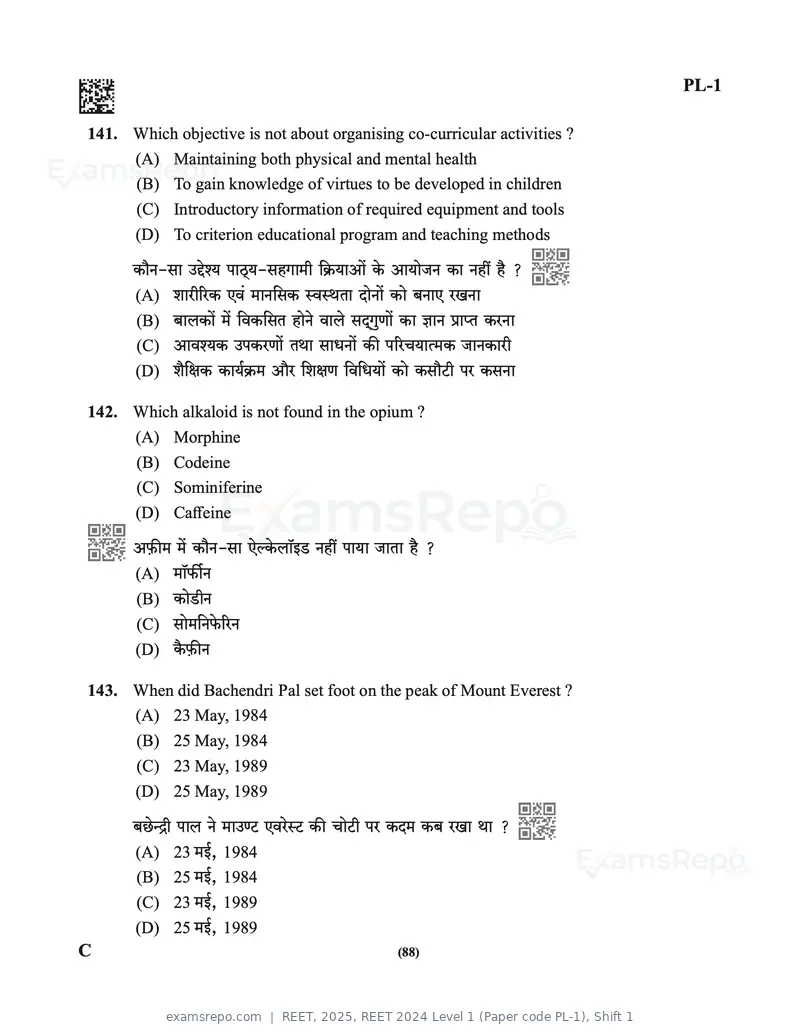
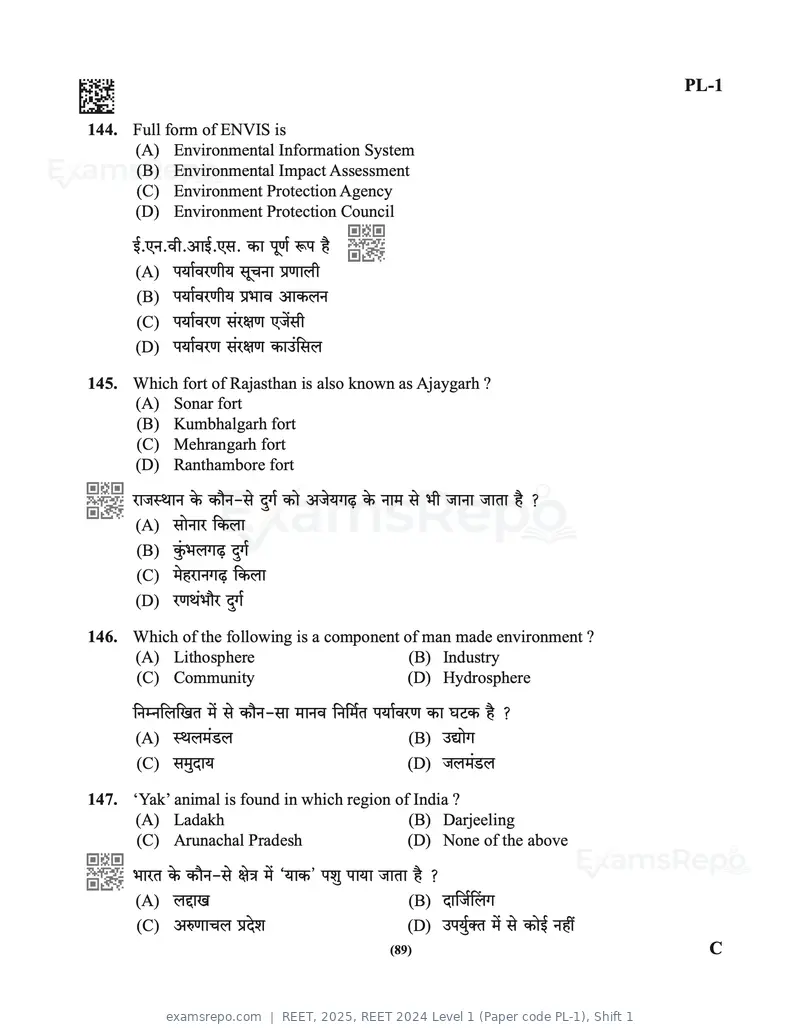
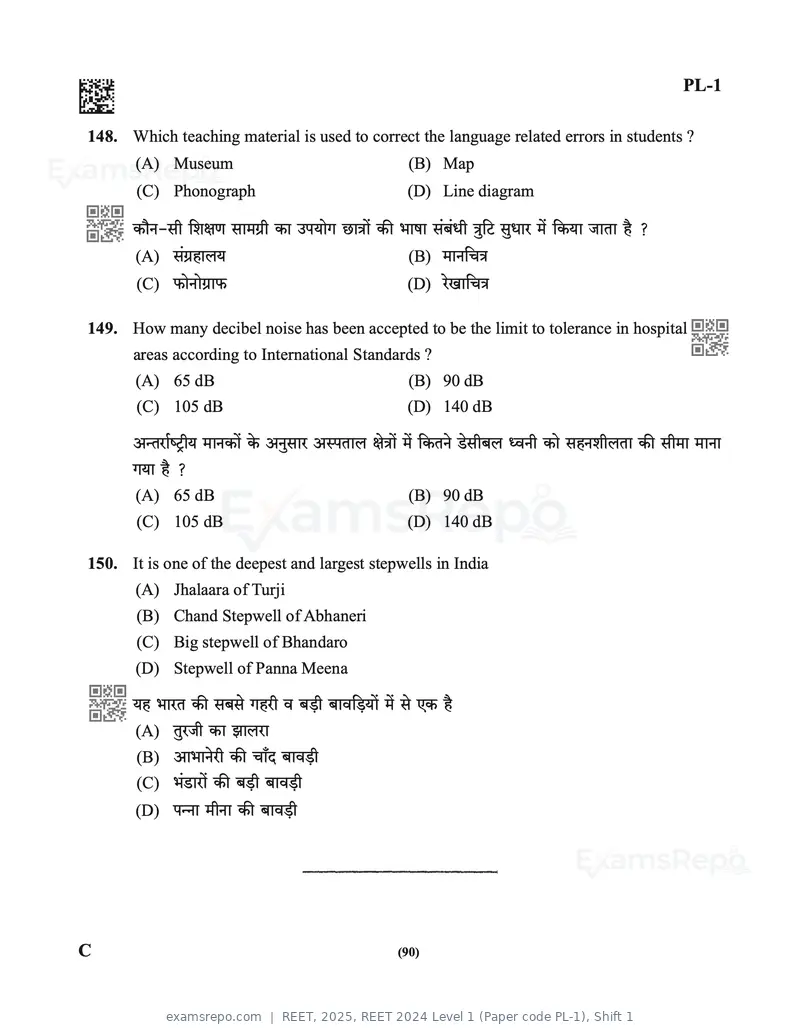
Text of page 287
DO
            NO
              T
(95)              WR
                    IT
                       EH
                         ER
                            E
C                               PL-1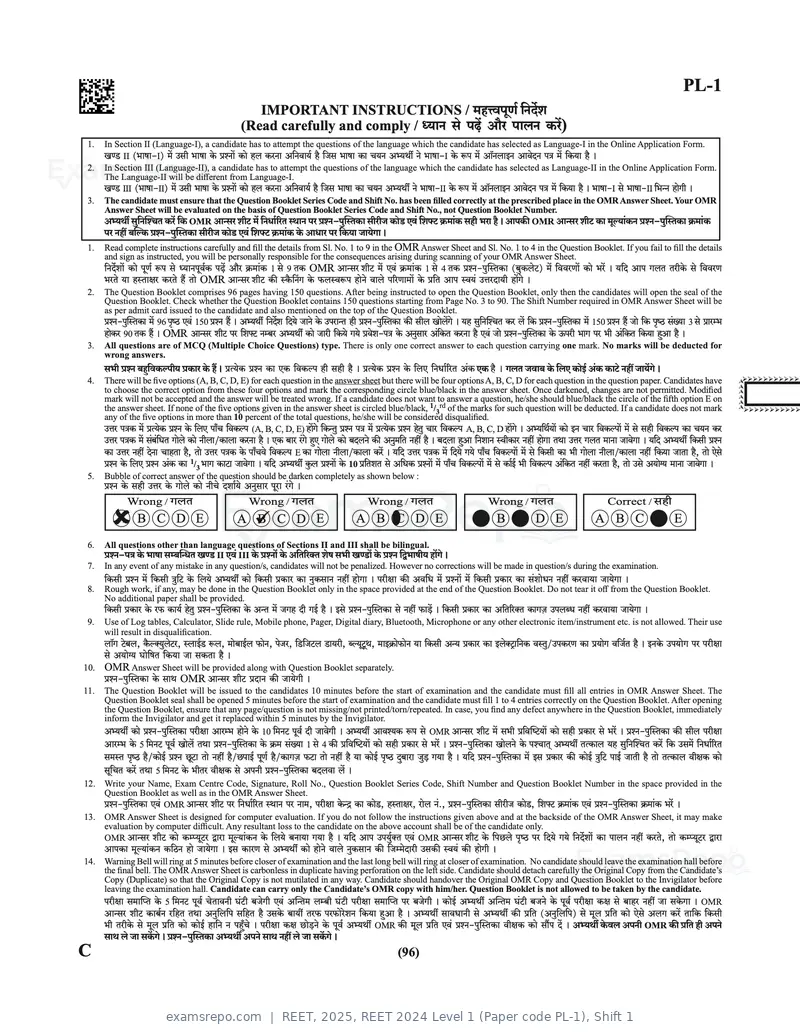
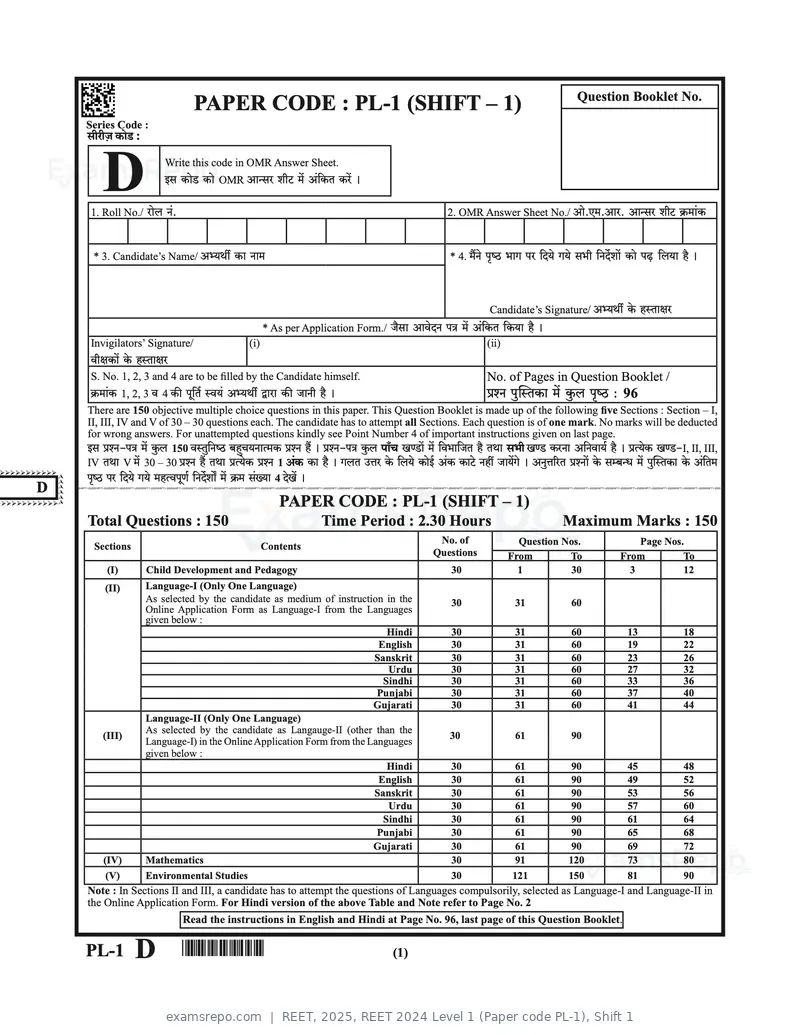
Text of page 289
Question Booklet No.
PAPER CODE : PL-1 (SHIFT – 1)
Series Code :
D
grarµO H$moS> :
Write this code in OMR Answer Sheet.
Bg H$moS> H$mo OMR AmÝga erQ> _| A§{H$V H$a| &
1. Roll No./ amob Z§. 2. OMR Answer Sheet No./ Amo.E_.Ama. AmÝga erQ> H«$_m§H$
* 3. Candidate’s Name/ Aä`Wu H$m Zm_ * 4. _¢Zo n¥îR> ^mJ na {X`o J`o g^r {ZX}em| H$mo n‹T> {b`m h¡ &
Candidate’s Signature/ Aä`Wu Ho$ hñVmja
* As per Application Form./ O¡gm AmdoXZ nÌ _| A§{H$V {H$`m h¡ &
Invigilators’ Signature/ (i) (ii)
drjH$m| Ho$ hñVmja
S. No. 1, 2, 3 and 4 are to be filled by the Candidate himself. No. of Pages in Question Booklet /
H«$_m§H$ 1, 2, 3 d 4 H$s ny{V© ñd`§ Aä`Wu Ûmam H$s OmZr h¡ & àíZ nwpñVH$m _| Hw$b n¥îR> : 96
There are 150 objective multiple choice questions in this paper. This Question Booklet is made up of the following five Sections : Section – I,
II, III, IV and V of 30 – 30 questions each. The candidate has to attempt all sections. Each question is of one mark. No marks will be deducted
for wrong answers. for unattempted questions kindly see point number 4 of important instructions given on last page.
Bg àíZ-nÌ _| Hw$b 150 dñVw{ZîR> ~hþM`ZmË_H$ àíZ h¢ & àíZ-nÌ Hw$b nm±M IÊS>m| _| {d^m{OV h¡ VWm g^r IÊS> H$aZm A{Zdm`© h¡ & àË`oH$ IÊS>-I, II, III,
IV VWm V _| 30 – 30 àíZ h¢ VWm àË`oH$ àíZ 1 A§H$ H$m h¡ & JbV CÎma Ho$ {b`o H$moB© A§H$ H$mQ>o Zht Om`|Jo & AZwÎm[aV àíZm| Ho$ gå~ÝY _| nwpñVH$m Ho$ A§{V_
n¥îR> na {X`o J`o _hËdnyU© {ZX}em] _| H«$_ g§»`m 4 XoI| &
A
D SHIFT1-2025SHIFT1-2025SHIFT1-2025SHIFT1-2025SHIFT1-2025SHIFT1-2025SHIFT1-2025SHIFT1-2025SHIFT1-2025SHIFT1-2025SHIFT1-2025SHIFT1-2025SHIFT1-2025SHIFT1-2025SHIFT1-2025SHIFT1-2025SHIFT1-2025SHIFT1-2025SHIFT1-2025SHIFT1-2025SHIFT1-2025SHIFT1-2025SHIFT1-2025SHIFT1-2025SHIFT1-2025SHIFT1-2025SHIFT1-2025SHIFT1-2025SHIFT1-2025SHIFT1-2025SHIFT1-2025SHIFT1-2025SHIFT1-2025SHIFT1-2025SHIFT1-2025SHIFT1-2025SHIFT1-2025SHIFT1-2025SHIFT1-2025SHIFT1-2025SHIFT1-2025
PAPER CODE : PL-1 (SHIFT – 1)
Total Questions : 150 Time period : 2.30 Hours Maximum Marks : 150
No. of Question Nos. Page Nos.
Sections Contents
Questions From To From To
(I) Child Development and Pedagogy 30 1 30 3 12
(II) Language-I (Only One Language)
As selected by the candidate as medium of instruction in the 30 31 60
Online Application Form as language-I from the languages
given below :
Hindi 30 31 60 13 18
English 30 31 60 19 22
Sanskrit 30 31 60 23 26
Urdu 30 31 60 27 32
Sindhi 30 31 60 33 36
Punjabi 30 31 60 37 40
Gujarati 30 31 60 41 44
Language-II (Only One Language)
As selected by the candidate as Langauge-II (other than the
(III) 30 61 90
Language-I) in the Online Application Form from the Languages
given below :
Hindi 30 61 90 45 48
English 30 61 90 49 52
Sanskrit 30 61 90 53 56
Urdu 30 61 90 57 60
Sindhi 30 61 90 61 64
Punjabi 30 61 90 65 68
Gujarati 30 61 90 69 72
(IV) Mathematics 30 91 120 73 80
(V) Environmental Studies 30 121 150 81 90
Note : In Sections II and III, a candidate has to attempt the questions of Languages compulsorily, selected as Language-I and Language-II in
the Online Application Form. For Hindi version of the above Table and Note refer to Page No. 2
Read the instructions in English and Hindi at Page No. 96, last page of this Question Booklet.
PL-1 D *PL1D* (1)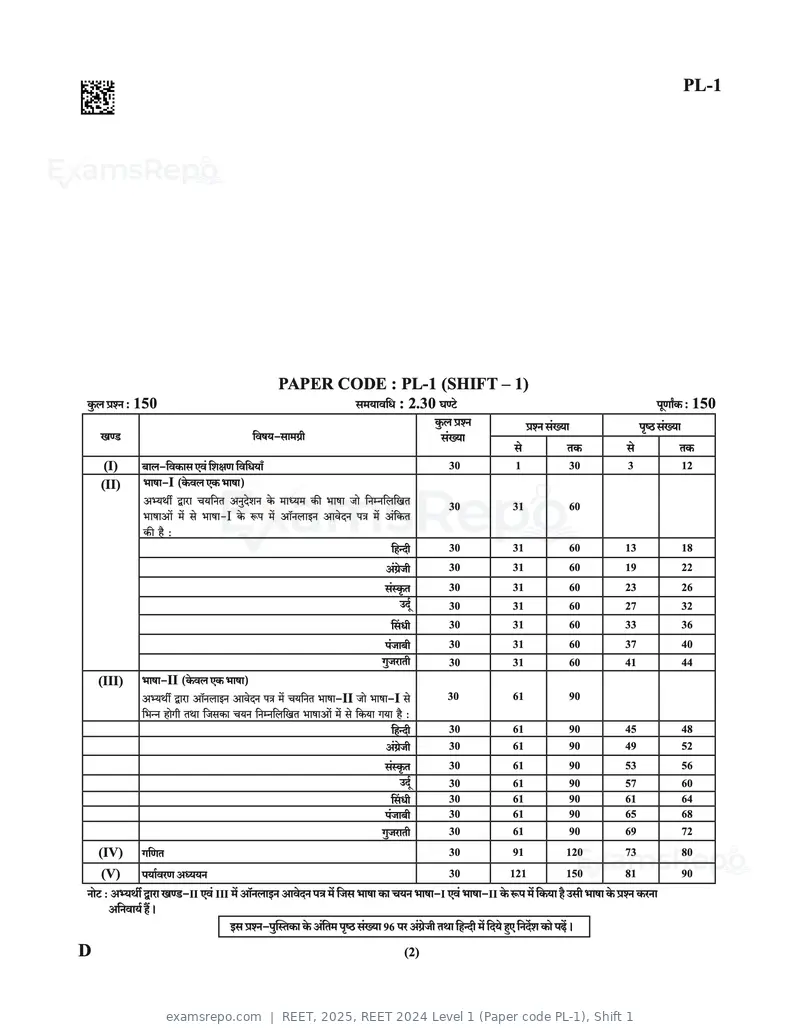
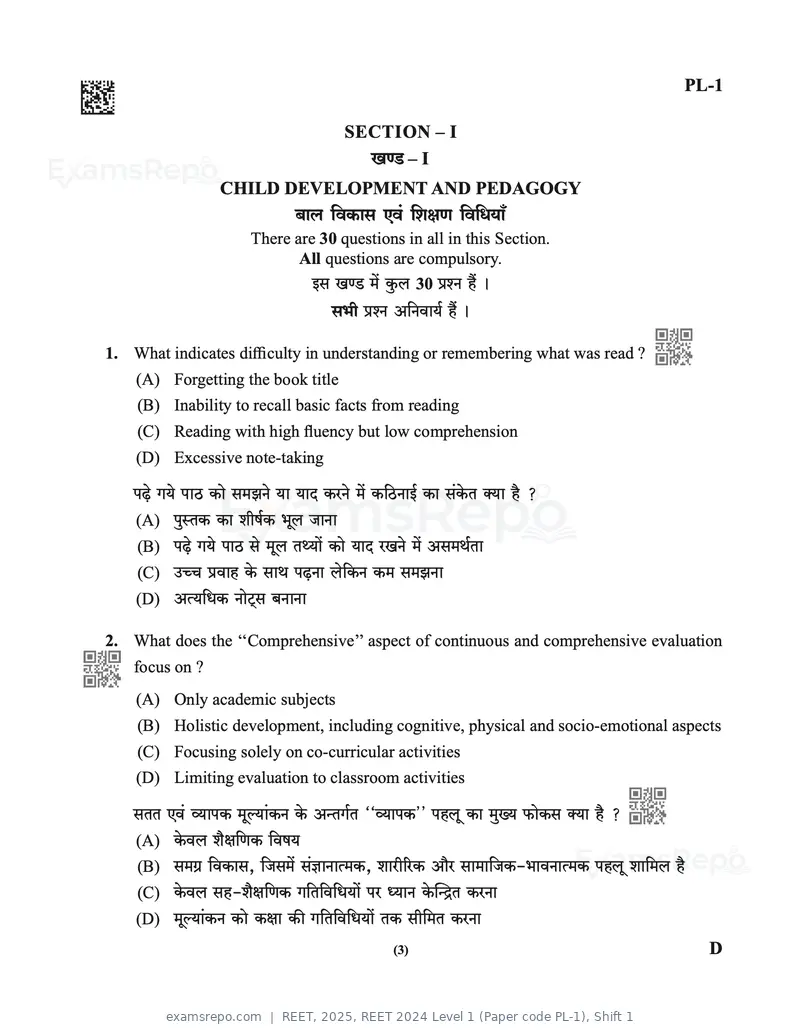
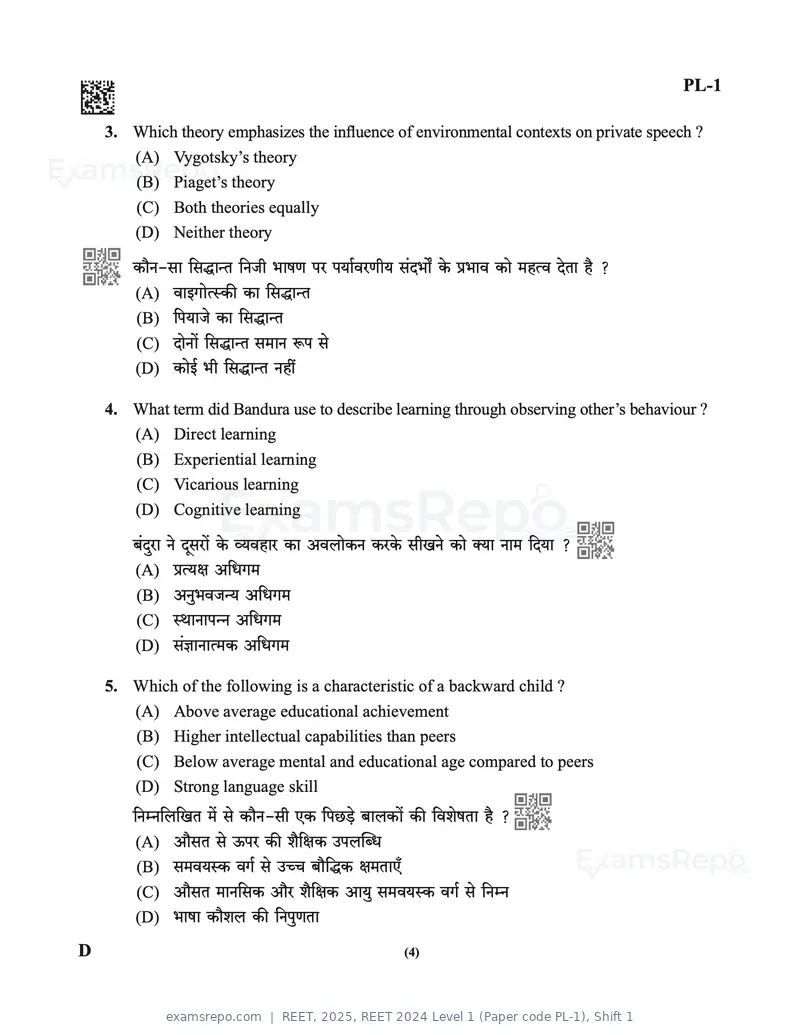
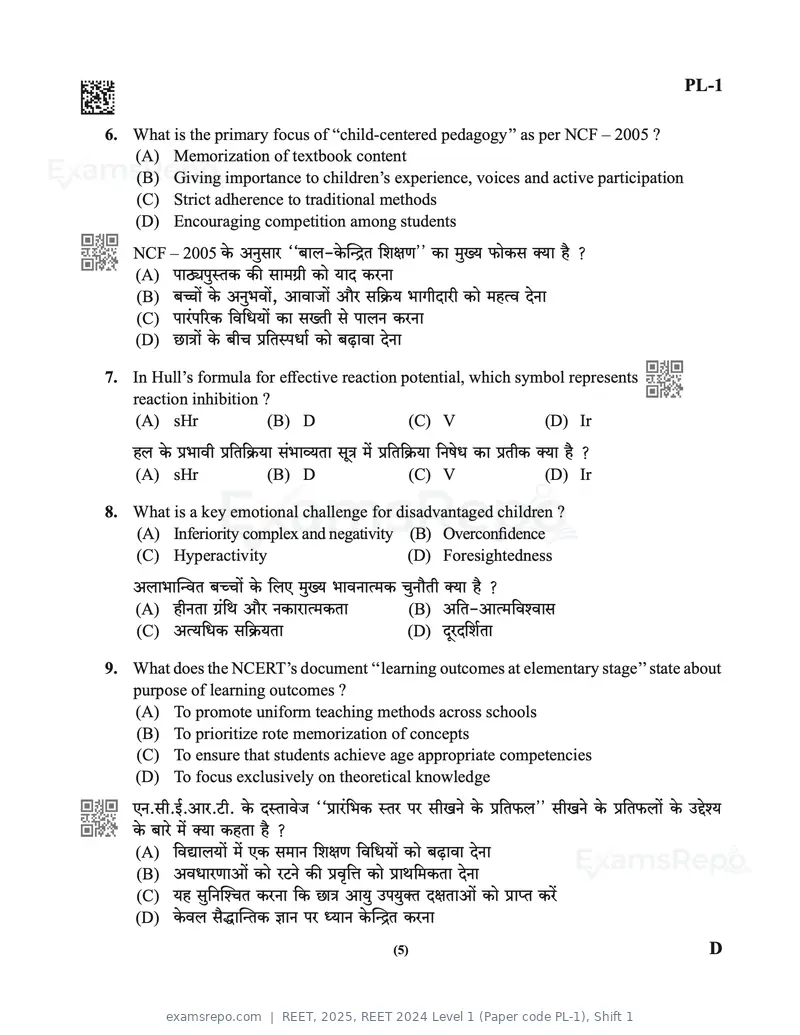
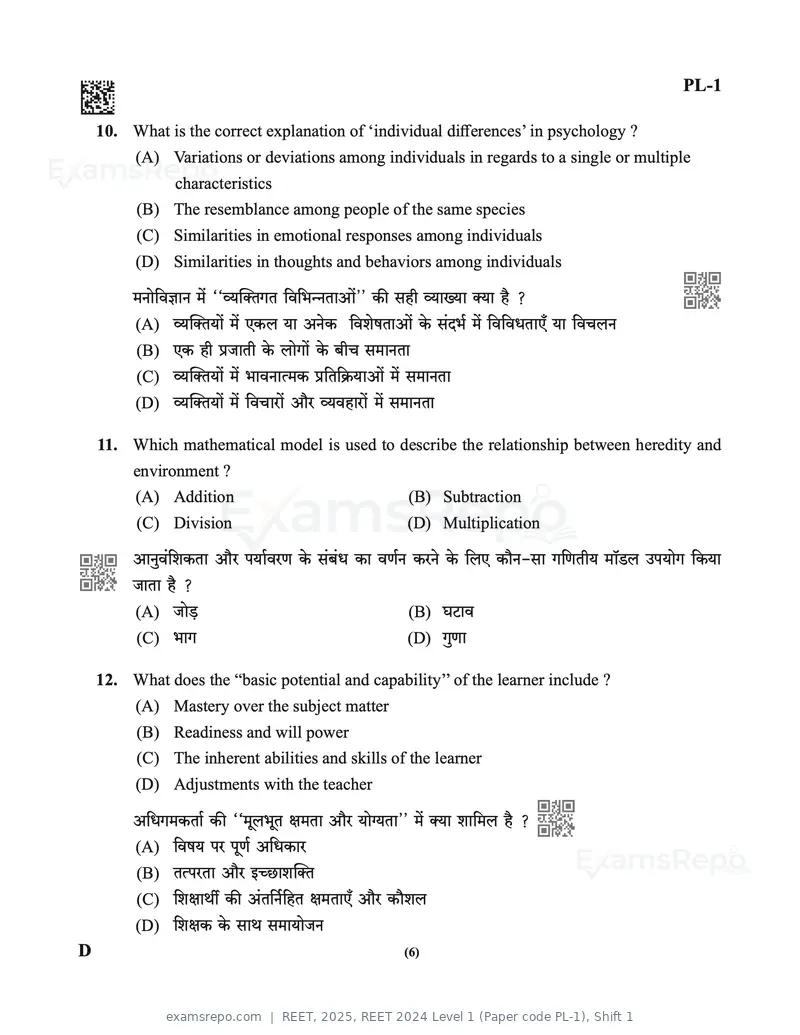
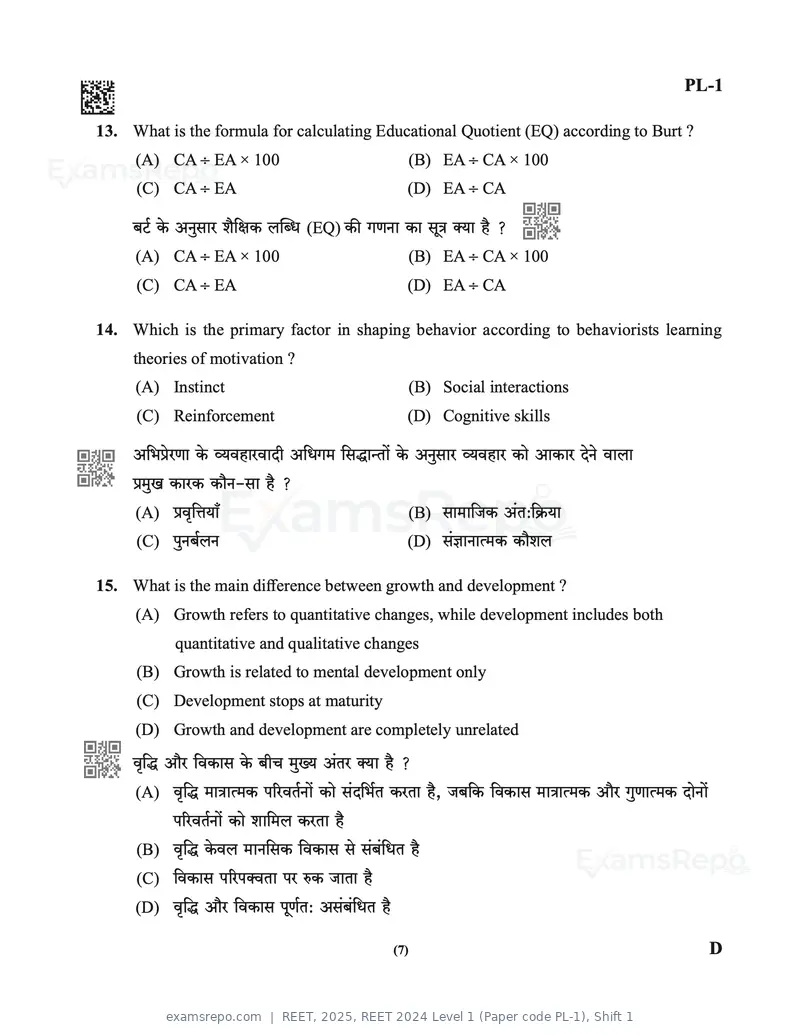
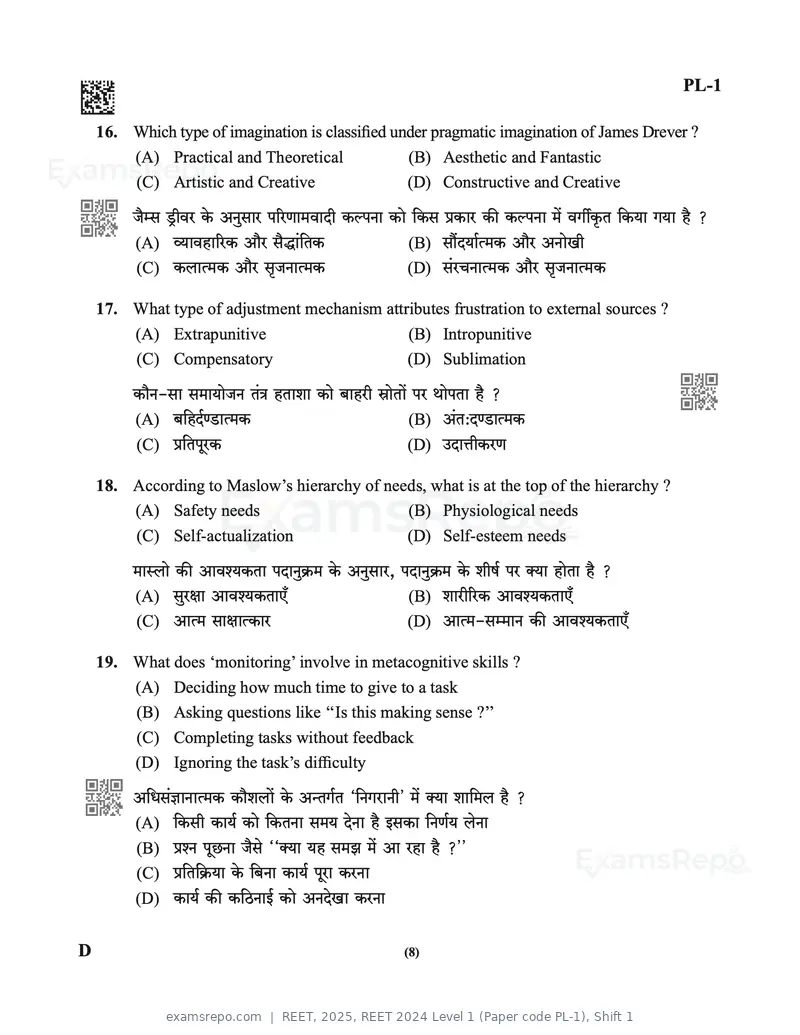
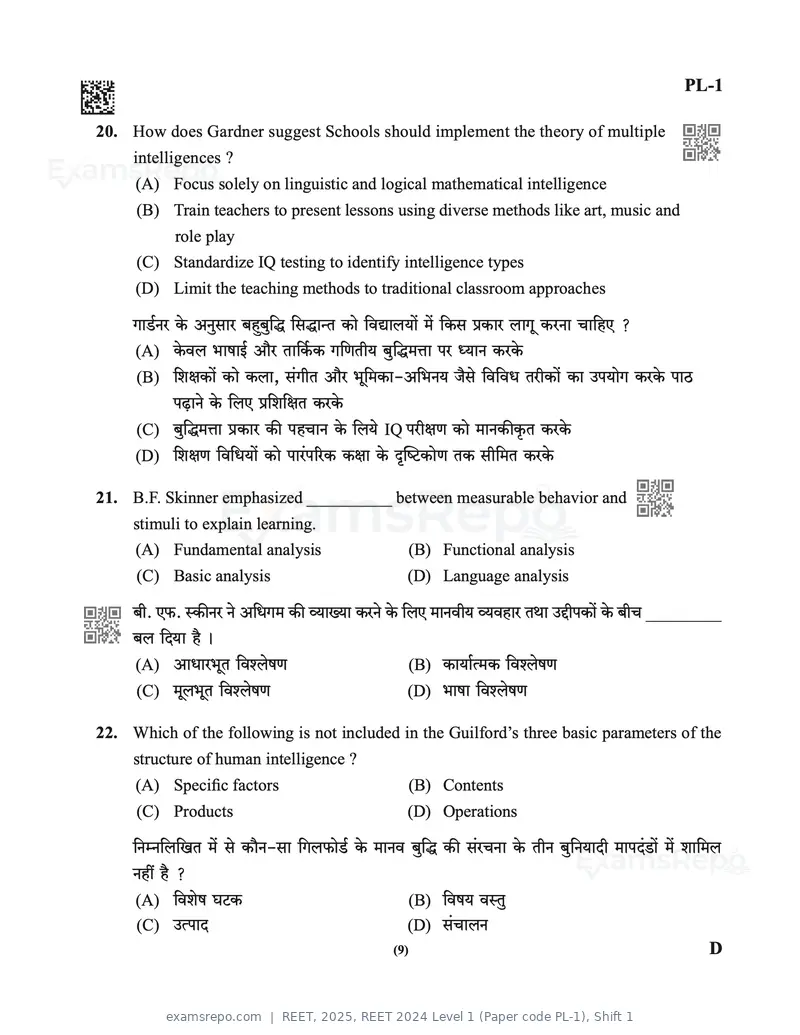
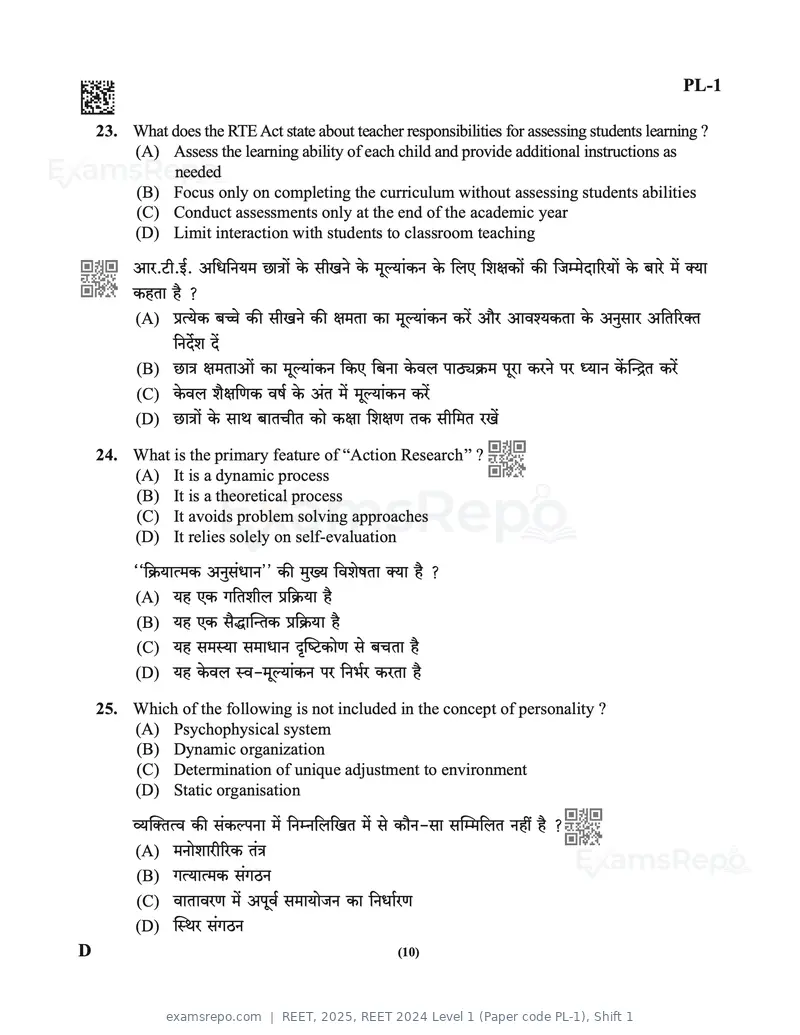
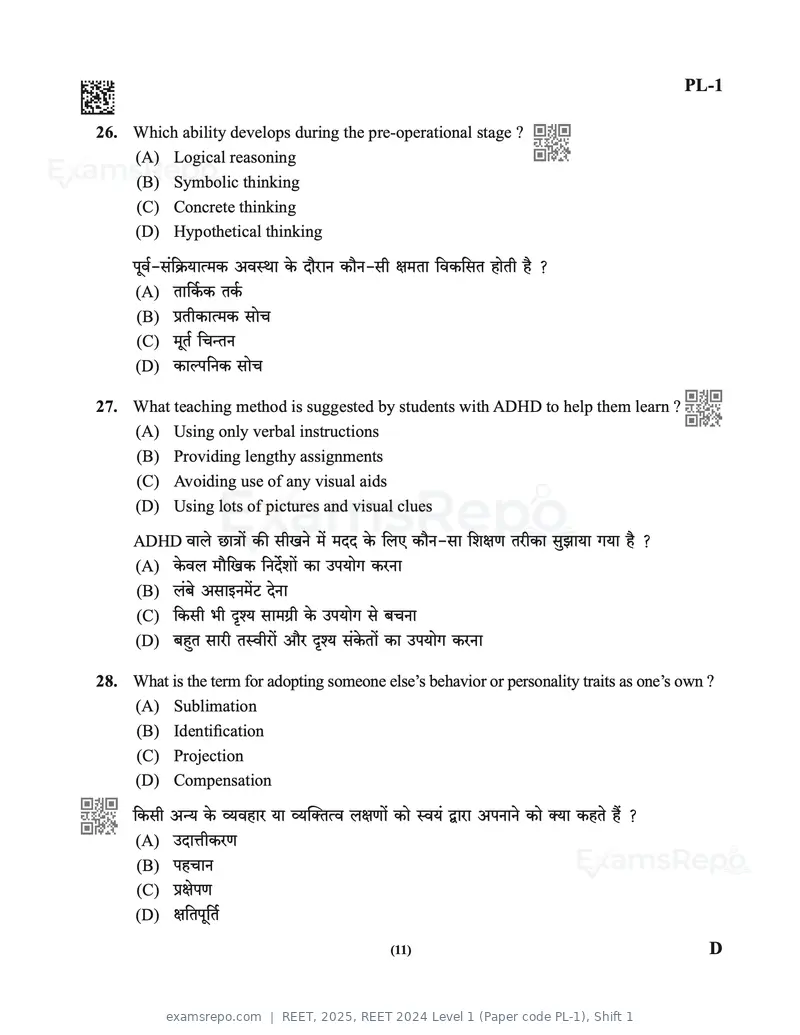
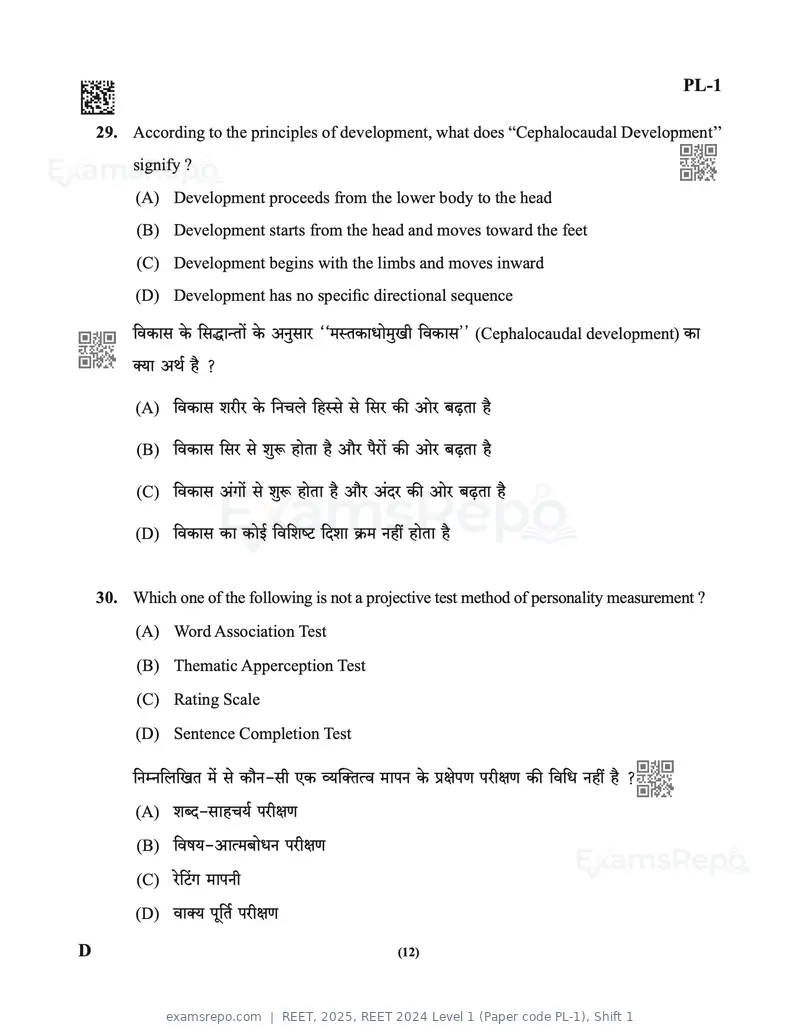
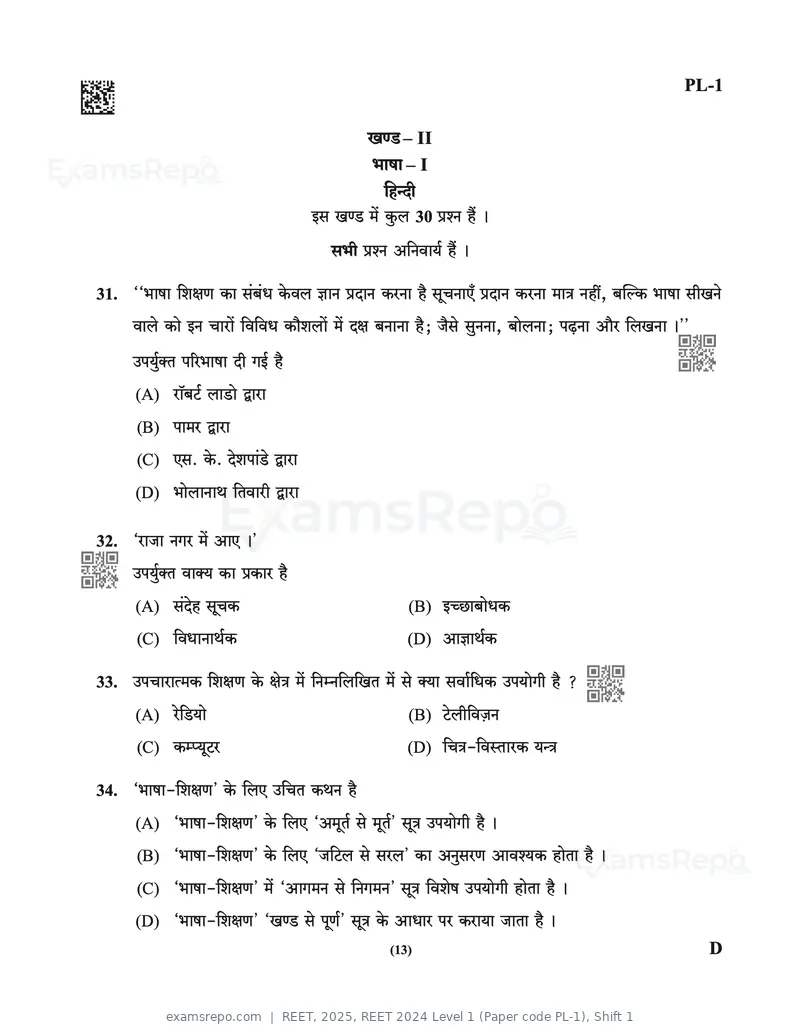
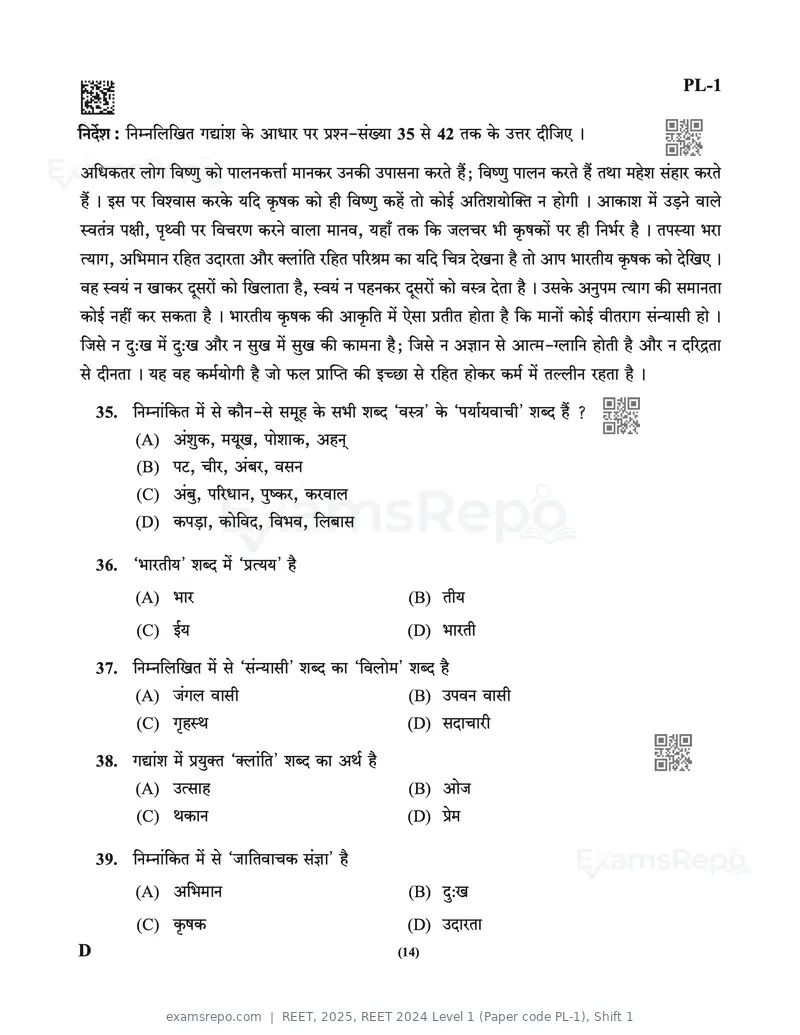
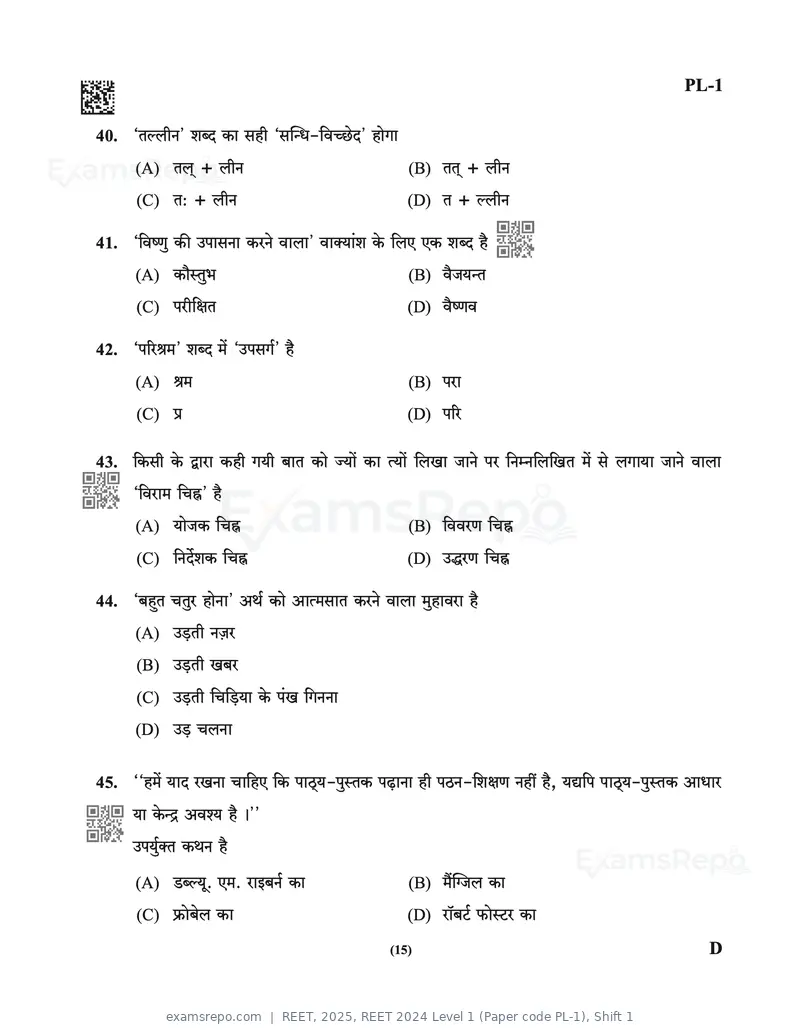
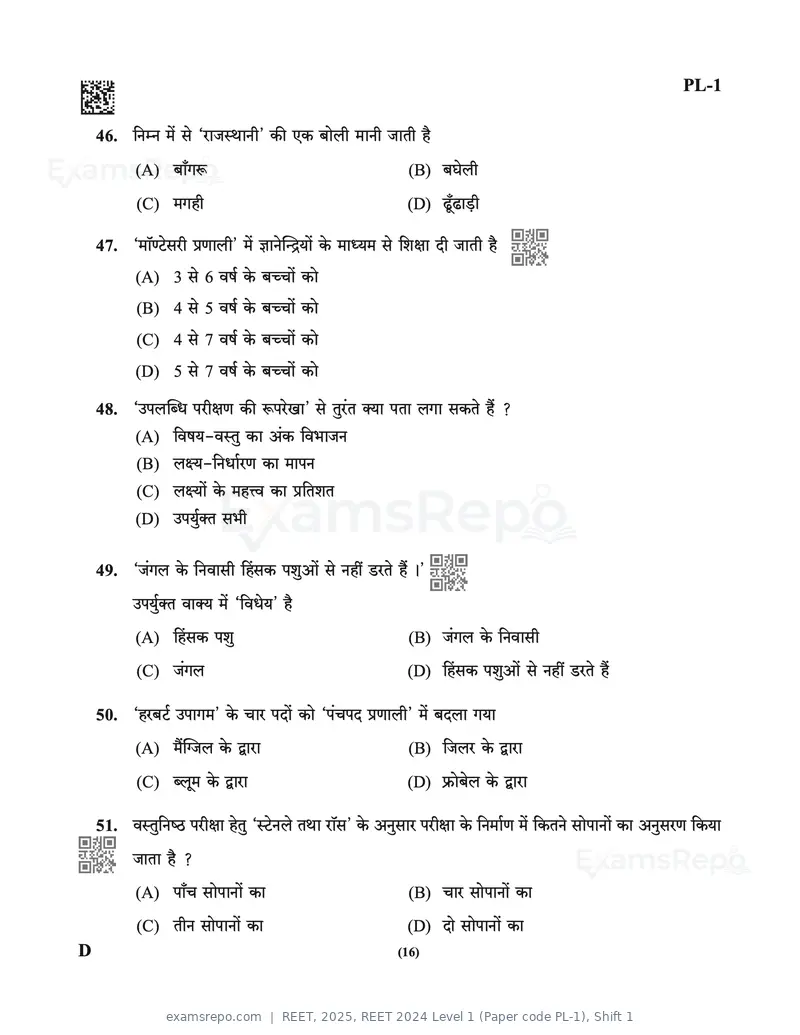
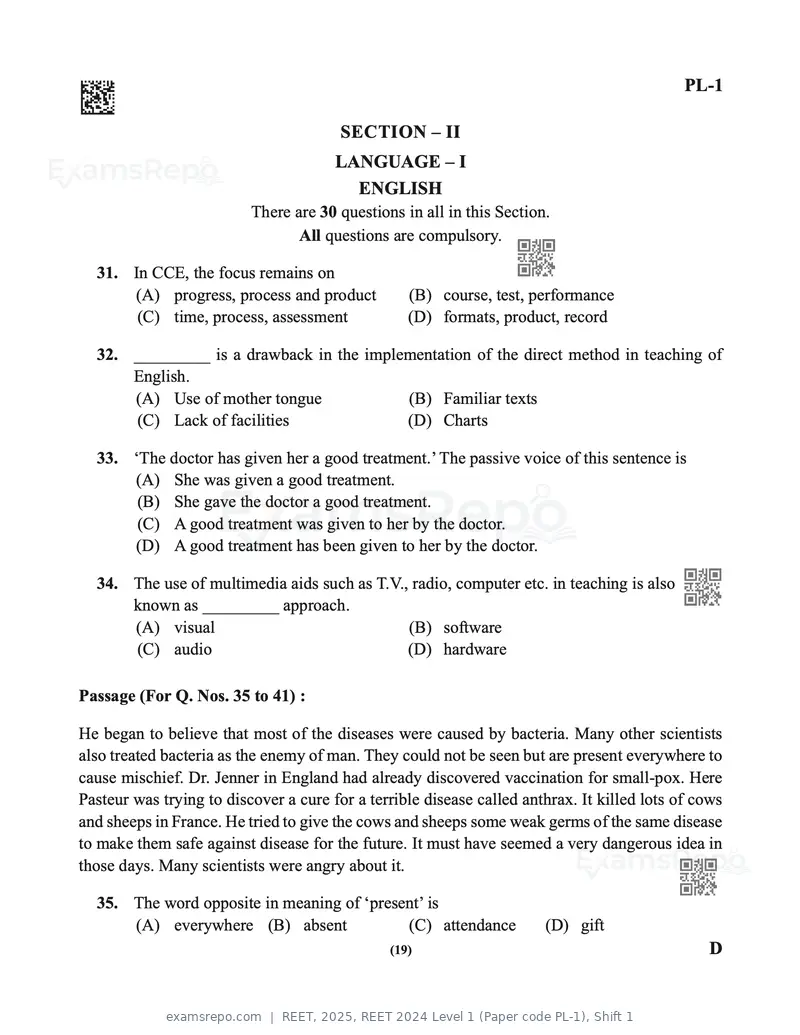
Text of page 307
PL-1

                                        SECTION – II
                                       LANGUAGE – I
                                         ENGLISH
                          There are 30 questions in all in this Section.
                                 All questions are compulsory.

  31. In CCE, the focus remains on
      (A) progress, process and product           (B) course, test, performance
       (C) time, process, assessment              (D) formats, product, record

  32. _________ is a drawback in the implementation of the direct method in teaching of
      English.
      (A) Use of mother tongue            (B) Familiar texts
      (C) Lack of facilities			           (D) Charts

  33. ‘The doctor has given her a good treatment.’ The passive voice of this sentence is
      (A) She was given a good treatment.
       (B) She gave the doctor a good treatment.
       (C) A good treatment was given to her by the doctor.
      (D) A good treatment has been given to her by the doctor.

  34. The use of multimedia aids such as T.V., radio, computer etc. in teaching is also
      known as _________ approach.
      (A) visual			                           (B) software
      (C) audio			                            (D) hardware

Passage (For Q. Nos. 35 to 41) :

He began to believe that most of the diseases were caused by bacteria. Many other scientists
also treated bacteria as the enemy of man. They could not be seen but are present everywhere to
cause mischief. Dr. Jenner in England had already discovered vaccination for small-pox. Here
Pasteur was trying to discover a cure for a terrible disease called anthrax. It killed lots of cows
and sheeps in France. He tried to give the cows and sheeps some weak germs of the same disease
to make them safe against disease for the future. It must have seemed a very dangerous idea in
those days. Many scientists were angry about it.

  35. The word opposite in meaning of ‘present’ is
      (A) everywhere (B) absent             (C) attendance             (D) gift
                                               (19)                                             D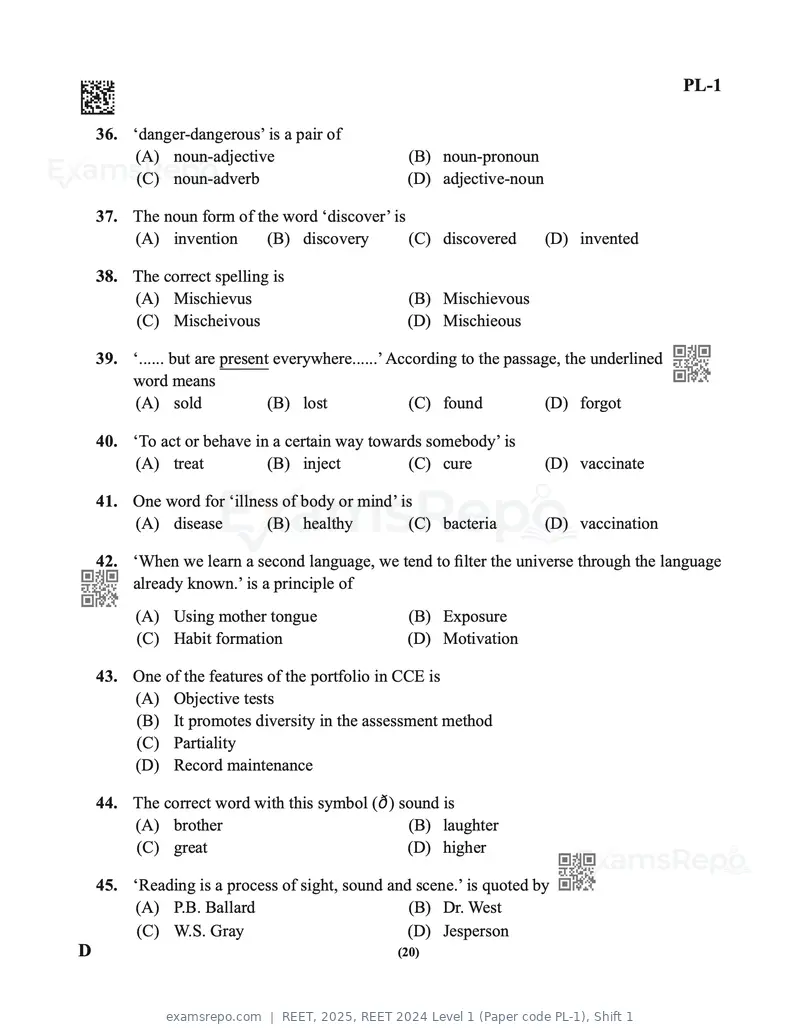
Text of page 308
PL-1

    36. ‘danger-dangerous’ is a pair of
        (A) noun-adjective			                      (B) noun-pronoun
         (C) noun-adverb			                        (D) adjective-noun

    37. The noun form of the word ‘discover’ is
        (A) invention      (B) discovery        (C) discovered          (D) invented

    38. The correct spelling is
        (A) Mischievus			                          (B) Mischievous
        (C) Mischeivous			                         (D) Mischieous

    39. ‘...... but are present everywhere......’ According to the passage, the underlined
        word means
        (A) sold               (B) lost             (C) found            (D) forgot

    40. ‘To act or behave in a certain way towards somebody’ is
        (A) treat           (B) inject          (C) cure                (D) vaccinate

    41. One word for ‘illness of body or mind’ is
        (A) disease        (B) healthy          (C) bacteria            (D) vaccination

    42. ‘When we learn a second language, we tend to filter the universe through the language
        already known.’ is a principle of
         (A) Using mother tongue                   (B) Exposure
         (C) Habit formation			                    (D) Motivation

    43. One of the features of the portfolio in CCE is
        (A) Objective tests
        (B) It promotes diversity in the assessment method
        (C) Partiality
        (D) Record maintenance

    44. The correct word with this symbol (ð) sound is
        (A) brother			                         (B) laughter
        (C) great			                           (D) higher

    45. ‘Reading is a process of sight, sound and scene.’ is quoted by
        (A) P.B. Ballard			                      (B) Dr. West
         (C) W.S. Gray         		                (D) Jesperson
D                                                (20)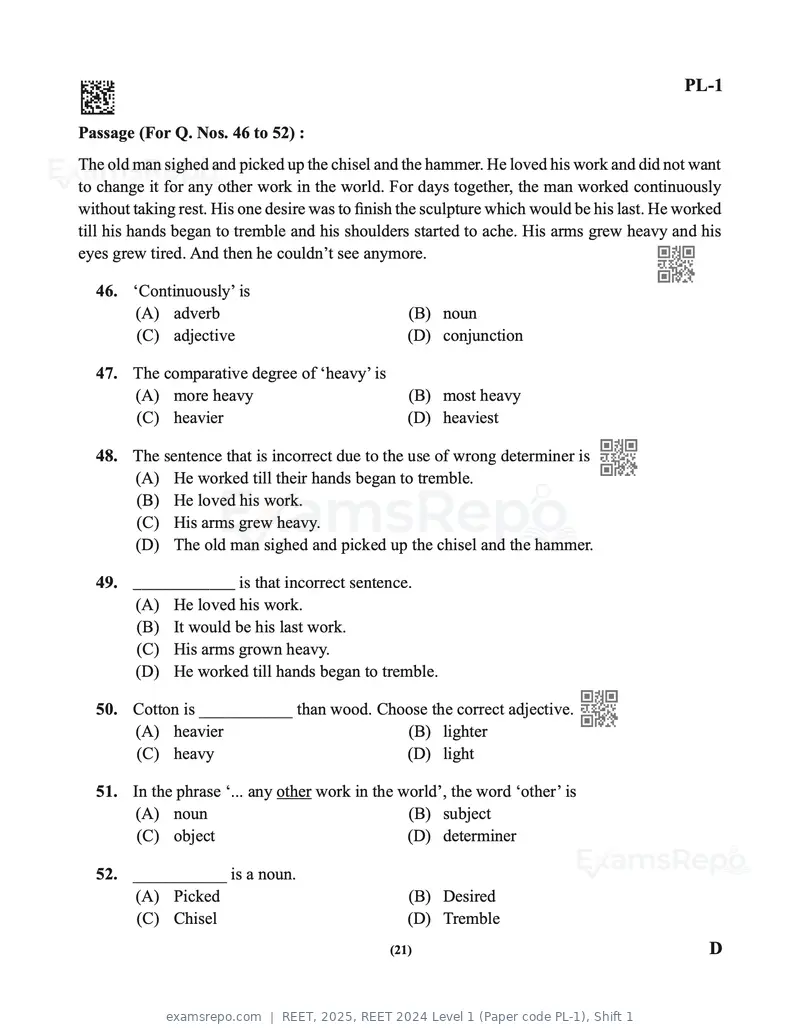
Text of page 309
PL-1

Passage (For Q. Nos. 46 to 52) :
The old man sighed and picked up the chisel and the hammer. He loved his work and did not want
to change it for any other work in the world. For days together, the man worked continuously
without taking rest. His one desire was to finish the sculpture which would be his last. He worked
till his hands began to tremble and his shoulders started to ache. His arms grew heavy and his
eyes grew tired. And then he couldn’t see anymore.

  46. ‘Continuously’ is
      (A) adverb			                               (B) noun
       (C) adjective			                           (D) conjunction

  47. The comparative degree of ‘heavy’ is
      (A) more heavy			                           (B) most heavy
      (C) heavier			                              (D) heaviest

  48. The sentence that is incorrect due to the use of wrong determiner is
      (A) He worked till their hands began to tremble.
      (B) He loved his work.
      (C) His arms grew heavy.
      (D) The old man sighed and picked up the chisel and the hammer.

  49. ____________ is that incorrect sentence.
      (A) He loved his work.
      (B) It would be his last work.
      (C) His arms grown heavy.
      (D) He worked till hands began to tremble.

  50. Cotton is ___________ than wood. Choose the correct adjective.
      (A) heavier			                      (B) lighter
      (C) heavy			                        (D) light

  51. In the phrase ‘... any other work in the world’, the word ‘other’ is
      (A) noun			                               (B) subject
       (C) object			                            (D) determiner

  52. ___________ is a noun.
      (A) Picked			                               (B) Desired
      (C) Chisel			                               (D) Tremble
                                               (21)                                             D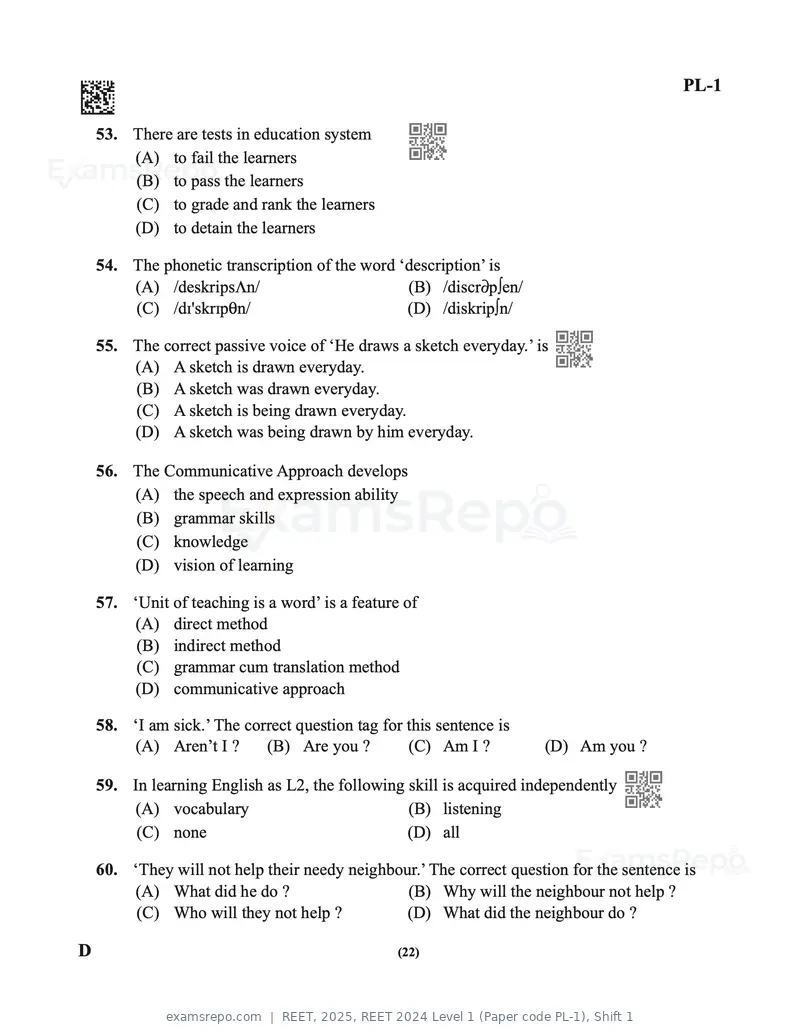
Text of page 310
PL-1

    53. There are tests in education system
        (A) to fail the learners
        (B) to pass the learners
        (C) to grade and rank the learners
        (D) to detain the learners

    54. The phonetic transcription of the word ‘description’ is
        (A) /deskripsΛn/			                     (B) /discr∂p∫en/
        (C) /dɪ'skrɪpθn/			                     (D) /diskrip∫n/

    55. The correct passive voice of ‘He draws a sketch everyday.’ is
        (A) A sketch is drawn everyday.
        (B) A sketch was drawn everyday.
        (C) A sketch is being drawn everyday.
        (D) A sketch was being drawn by him everyday.

    56. The communicative Approach develops
        (A) the speech and expression ability
        (B) grammar skills
        (C) knowledge
        (D) vision of learning

    57. ‘Unit of teaching is a word’ is a feature of
        (A) direct method
         (B) indirect method
         (C) grammar cum translation method
        (D) communicative approach

    58. ‘I am sick.’ The correct question tag for this sentence is
        (A) Aren’t I ?      (B) Are you ?         (C) Am I ?         (D) Am you ?

    59. In learning English as L2, the following skill is acquired independently
        (A) vocabulary			                        (B) listening
         (C) none			                             (D) all

    60. ‘They will not help their needy neighbour.’ The correct question for the sentence is
        (A) What did he do ?			                 (B) Why will the neighbour not help ?
         (C) Who will they not help ?           (D) What did the neighbour do ?

D                                                (22)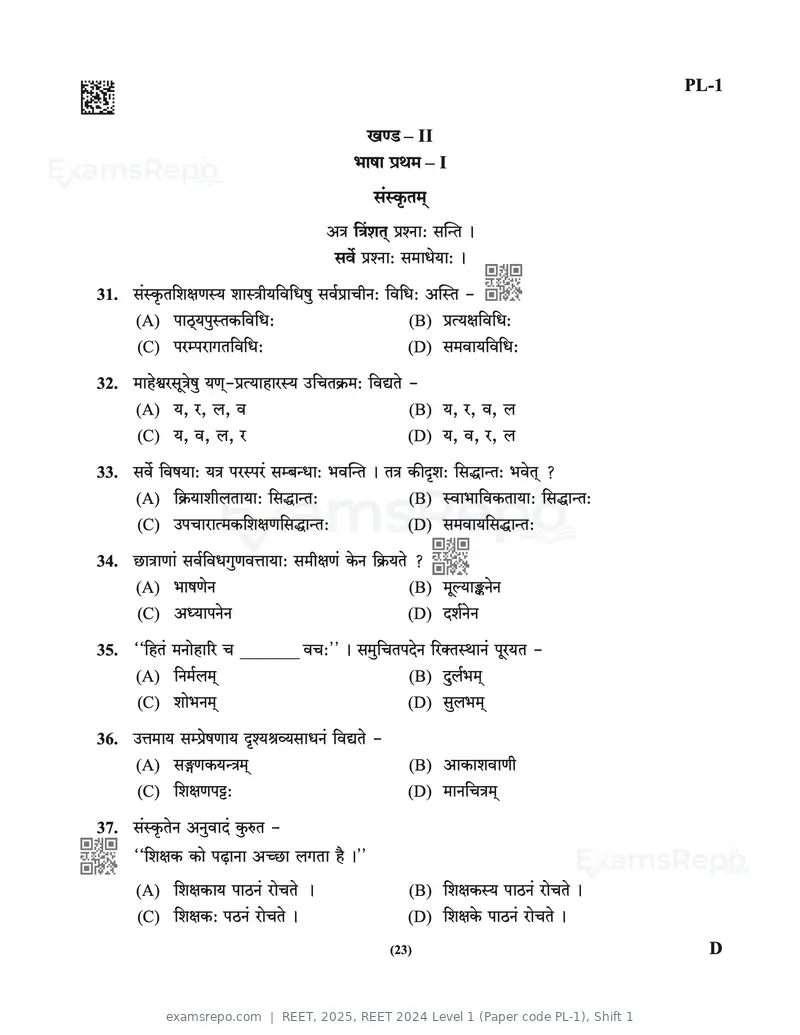
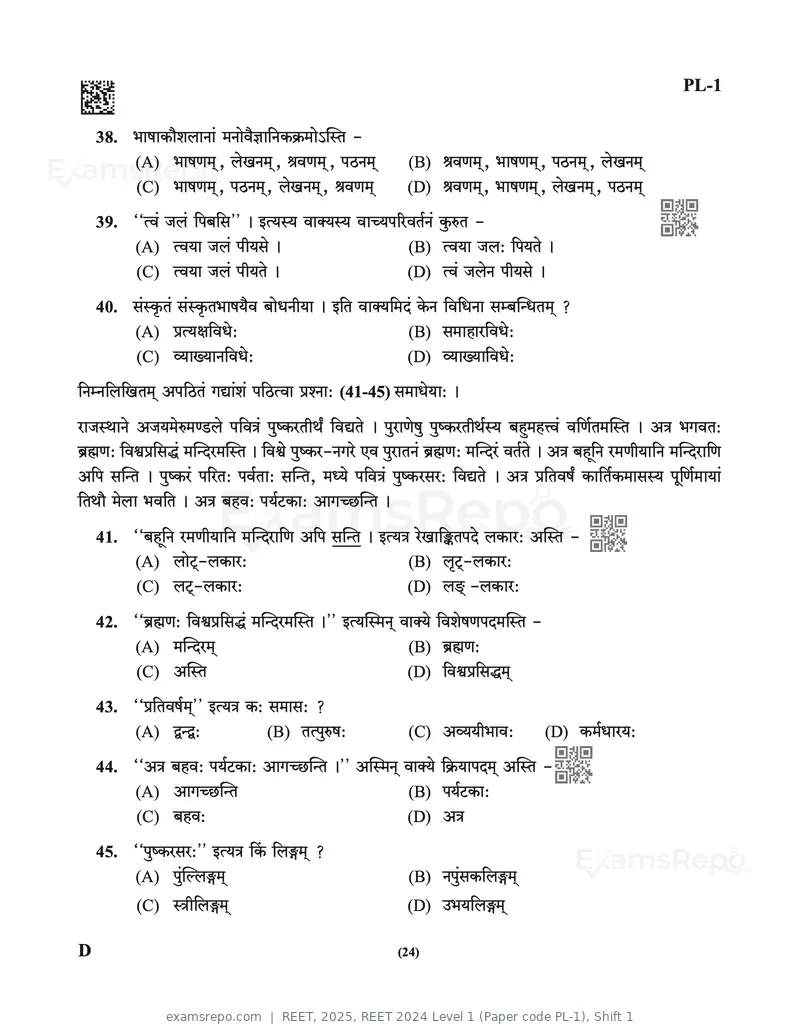
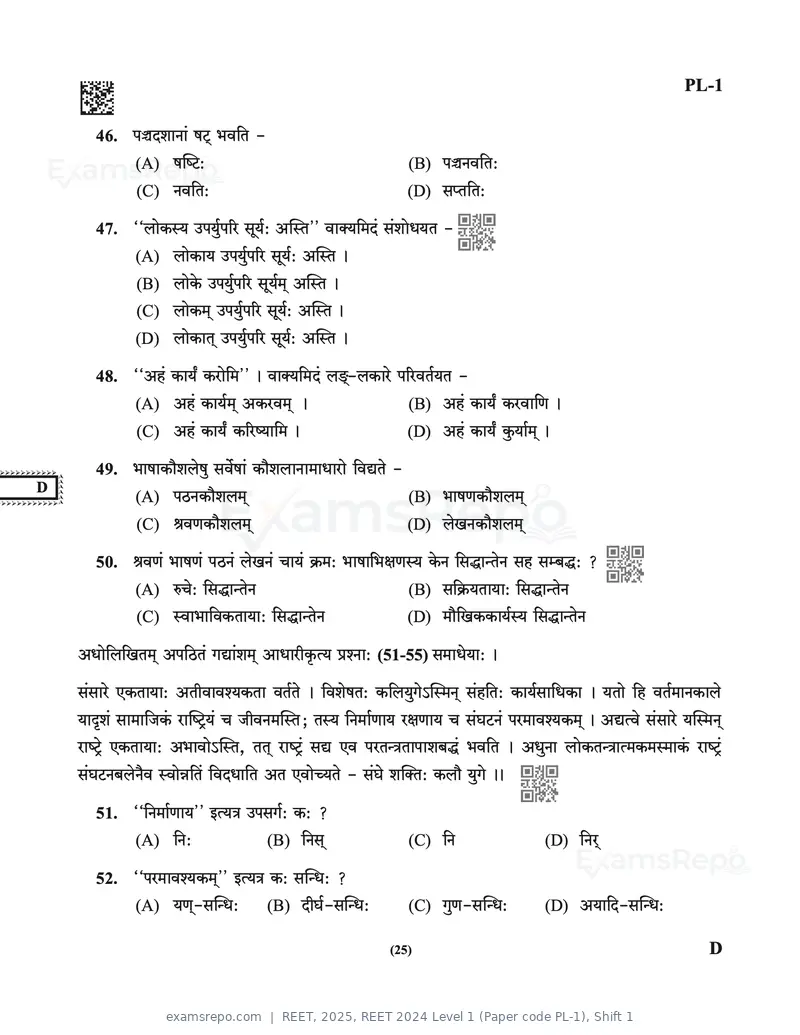
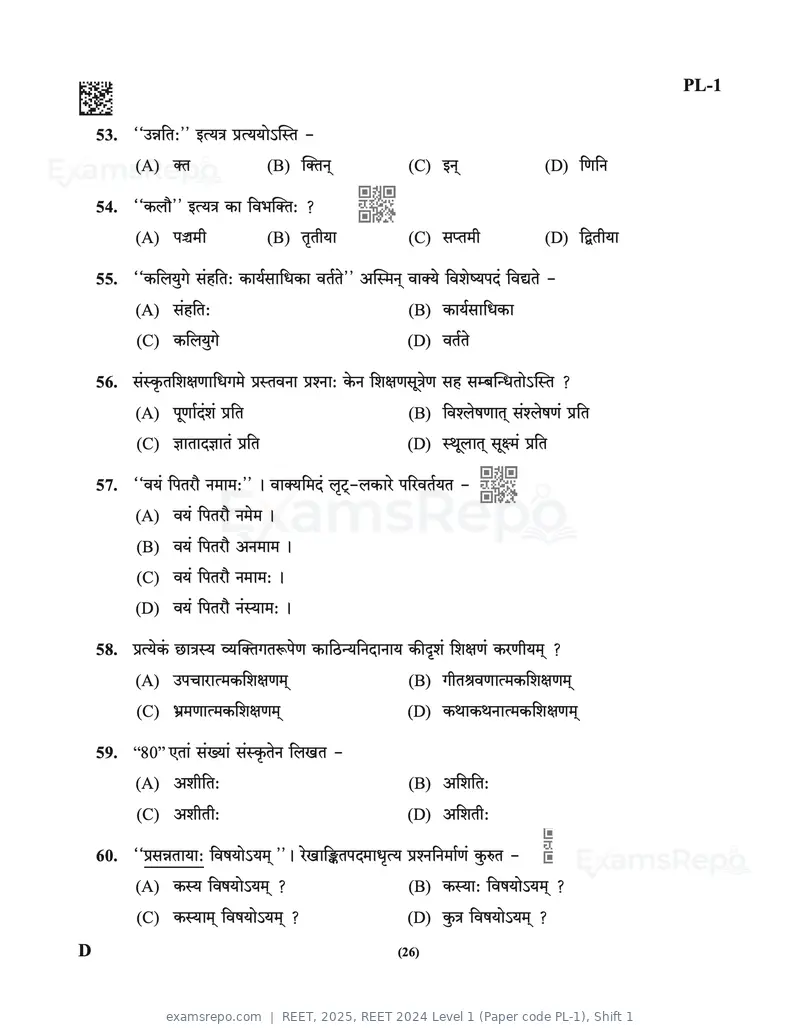
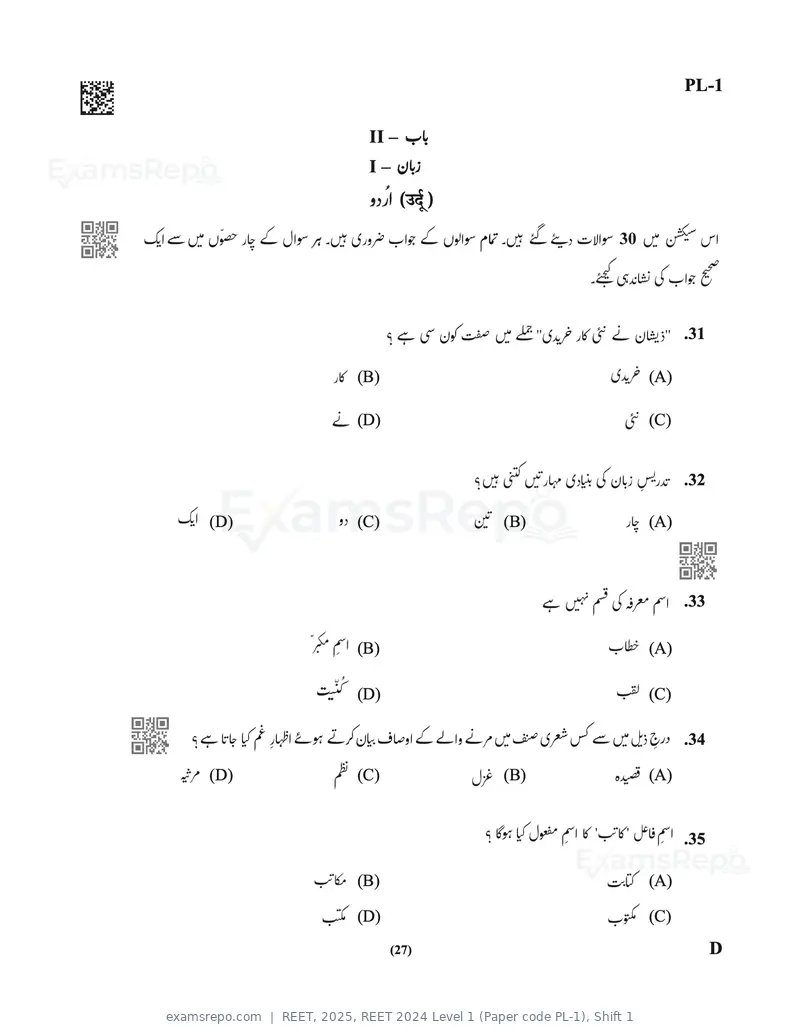
Text of page 315
PL-1

          II –
          I–
                 (CXÿ© )


                                       .31

  		     (B)			                  (A)

			      (D)			                  (C)


                                       .32

   (D)   (C)               (B)   (A)


                                       .33

			      (B)			                  (A)

			      (D)			                  (C)

                                       .34

   (D)   (C)               (B)   (A)


                                       .35

			      (B)			                  (A)

			      (D)			                  (C)
               (27)                          D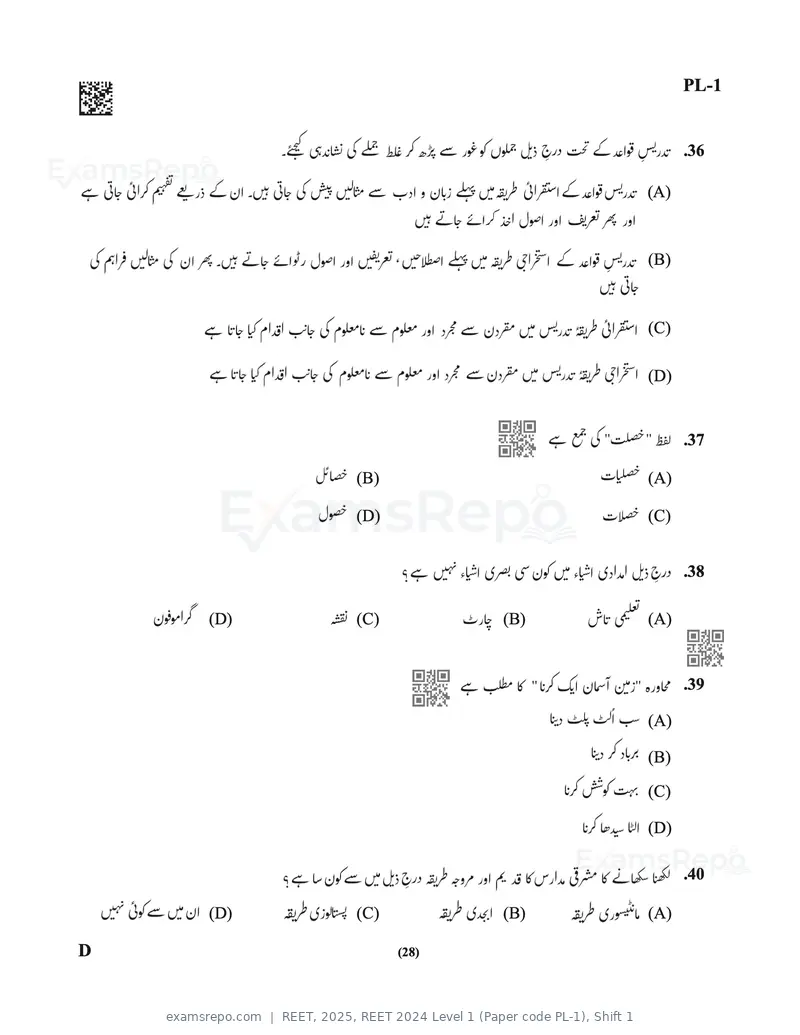
Text of page 316
PL-1


                                   .36

                             (A)


                             (B)


                             (C)

                             (D)


                                   .37

			       (B)			             (A)

			       (D)			             (C)


                                   .38

    (D)   (C)          (B)   (A)


                                   .39

							                      (A)

							                      (B)

							                      (C)

							                      (D)

                                   .40

    (D)   (C)          (B)   (A)

D               (28)
Text of page 317
PL-1

                                 .41

			     (B)			             (A)

			     (D)			             (C)


                                 .42
  (D)   (C)          (B)   (A)


                                 .43


  (D)   (C)          (B)   (A)


                                 .44


  (D)   (C)          (B)   (A)

              (29)                     D
Text of page 318
PL-1


                                   .45

    (D)   (C)          (B)   (A)


                                   .46

    (D)   (C)          (B)   (A)


                                   .47

                             (A)
                             (B)

                             (C)

                             (D)


                                   .48

    (D)   (C)          (B)   (A)


                                   .49

			       (B)			             (A)

			       (D)			             (C)


                                   .50

			       (B)			             (A)

			       (D)			             (C)

D               (30)
Text of page 319
PL-1


                                 .51

  (D)   (C)          (B)   (A)


                                 .52
			     (B)			             (A)
			     (D)			             (C)


                                 .53

  (D)   (C)          (B)   (A)


                                 .54

  (D)   (C)          (B)   (A)


                                 .55

			     (B)			             (A)

			     (D)			             (C)

              (31)                     D
Text of page 320
PL-1

                                      .56

							                        (A)

							                        (B)

							                        (C)

							                        (D)

                                      .57

    (D)   (C)          (B)     (A)


                                      .58

			       (B)			               (A)

			       (D)			               (C)

           .59

					  (A)

			    (B)

			    (C)

			    (D)


                                      .60

			                          		 (A)

			                          		 (B)

			                          		 (C)

			                          		 (D)
D               (32)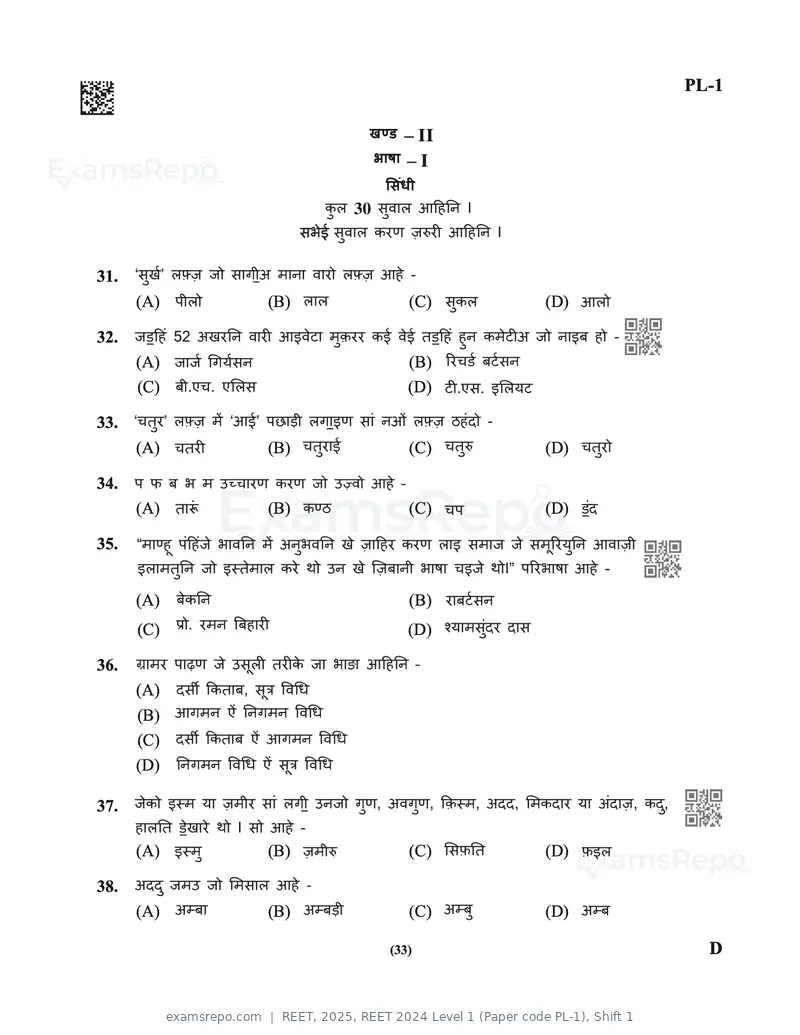
Text of page 321
PL-1

                     > – ii
                       –i


31.
      (A)     (B)      (C)    (D)

32.
      (A)     			      (B)
      (C)     			      (D)

33.
      (A)     (B)      (C)    (D)

34.
      (A)     (B)      (C)    (D)

35.


      (A)   			        (B)
      (C)     			      (D)

36.
      (A)
      (B)
      (C)
      (D)

37.

      (A)     (B)      (C)    (D)

38.
      (A)     (B)      (C)    (D)

                    (33)              D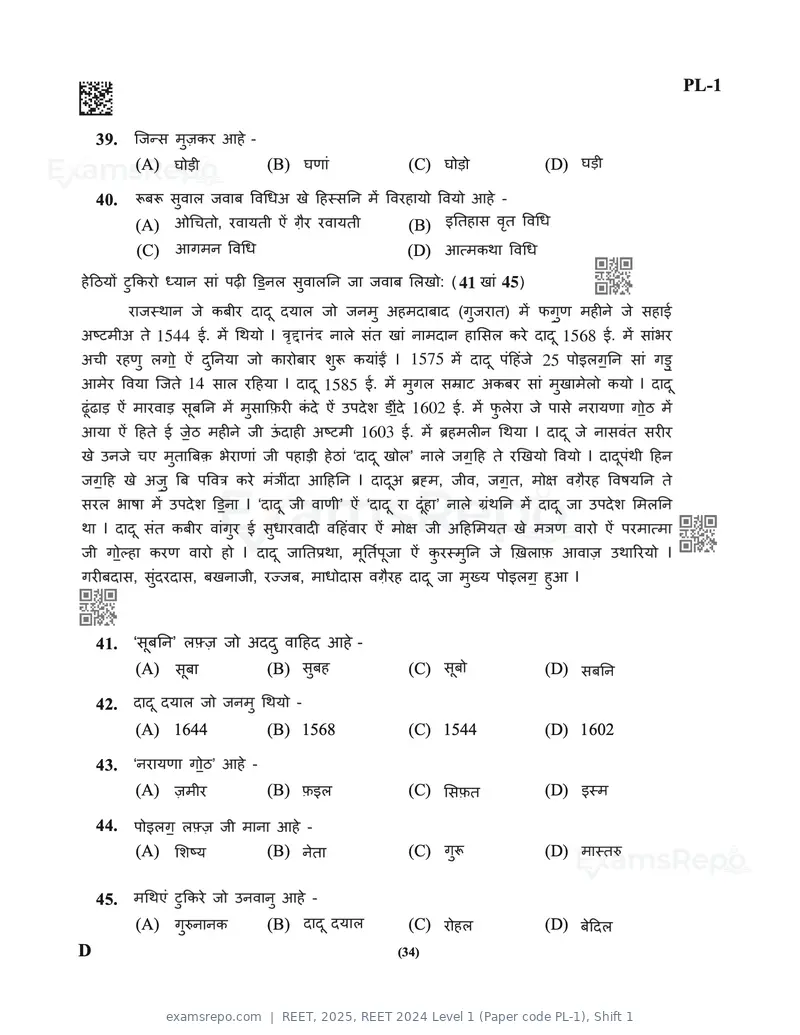
Text of page 322
PL-1

    39.
          (A)        (B)          (C)        (D)

    40.
          (A)                    (B)
          (C)        			         (D)


    41.
          (A)        (B)          (C)        (D)

    42.
          (A) 1644   (B) 1568     (C) 1544   (D) 1602

    43.
          (A)        (B)          (C)        (D)

    44.
          (A)        (B)          (C)        (D)

    45.
          (A)        (B)          (C)        (D)
D                               (34)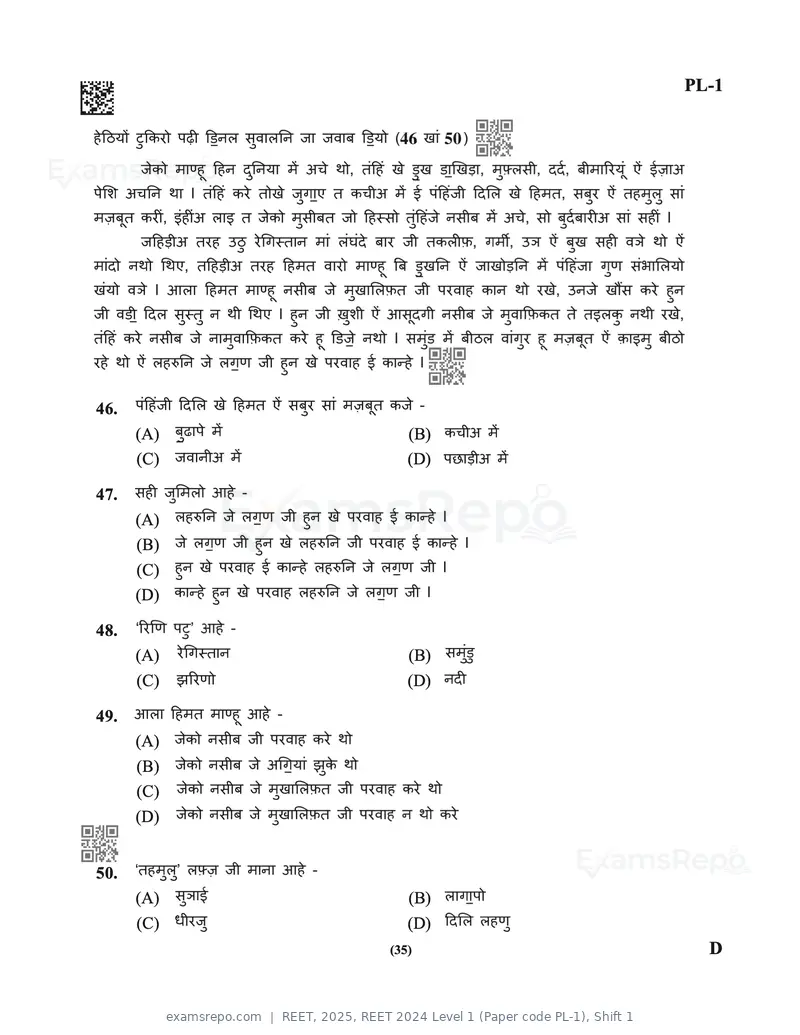
Text of page 323
PL-1


46.
      (A)   			       (B)
      (C)    			      (D)

47.
      (A)
      (B)
      (C)
      (D)

48.
      (A)   			       (B)
      (C)   			       (D)

49.
      (A)
      (B)
      (C)
      (D)


50.
      (A)   			       (B)
      (C)   			       (D)
                   (35)       D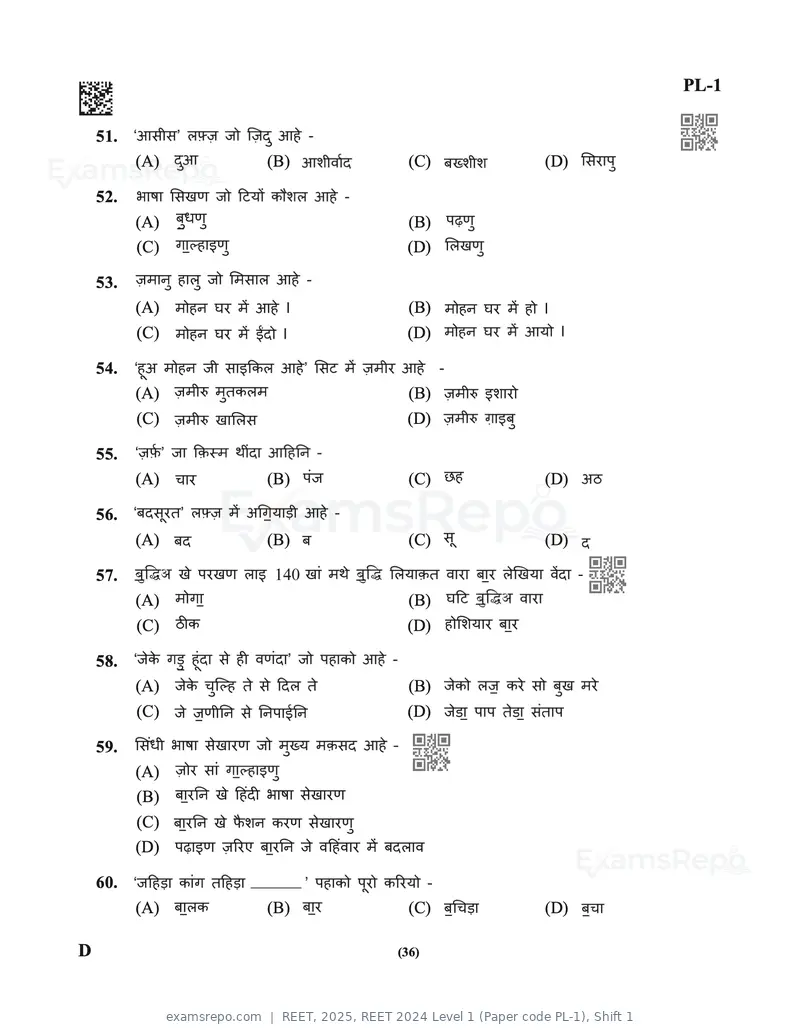
Text of page 324
PL-1

    51.
          (A)     (B)       (C)   (D)

    52.
          (A)   			        (B)
          (C)    			       (D)

    53.
          (A)        		    (B)
          (C)       			    (D)

    54.
          (A)     			      (B)
          (C)    			       (D)

    55.
          (A)     (B)       (C)   (D)

    56.
          (A)     (B)       (C)   (D)

    57.
          (A)   			        (B)
          (C)   			        (D)

    58.
          (A)              (B)
          (C)              (D)

    59.
          (A)
          (B)
          (C)
          (D)

    60.
          (A)     (B)       (C)   (D)

D                         (36)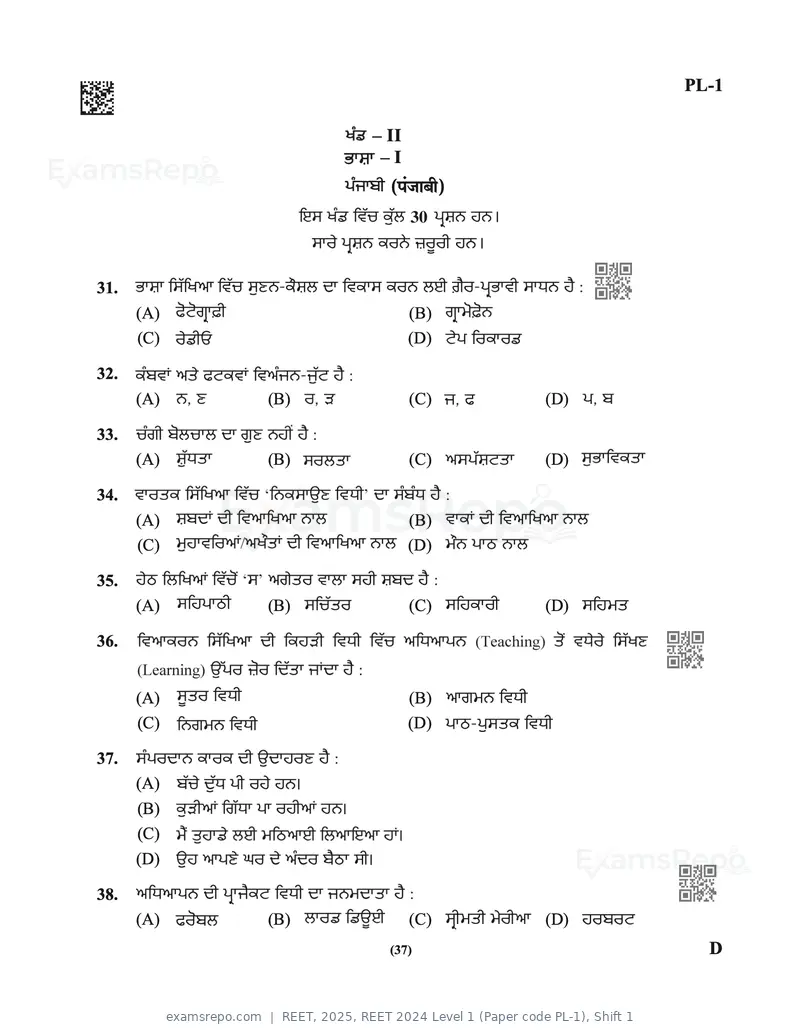
Text of page 325
PL-1

                   – ii
                    –i
                     (n§Om~r)


31.
      (A)   			           (B)
      (C)   			           (D)

32.
      (A)    (B)          (C)   (D)

33.
      (A)    (B)          (C)   (D)

34.
      (A)                 (B)
      (C)                 (D)

35.
      (A)    (B)          (C)   (D)

36.


      (A)   			           (B)
      (C)    			          (D)

37.
      (A)
      (B)
      (C)
      (D)

38.
      (A)    (B)          (C)   (D)
                     (37)               D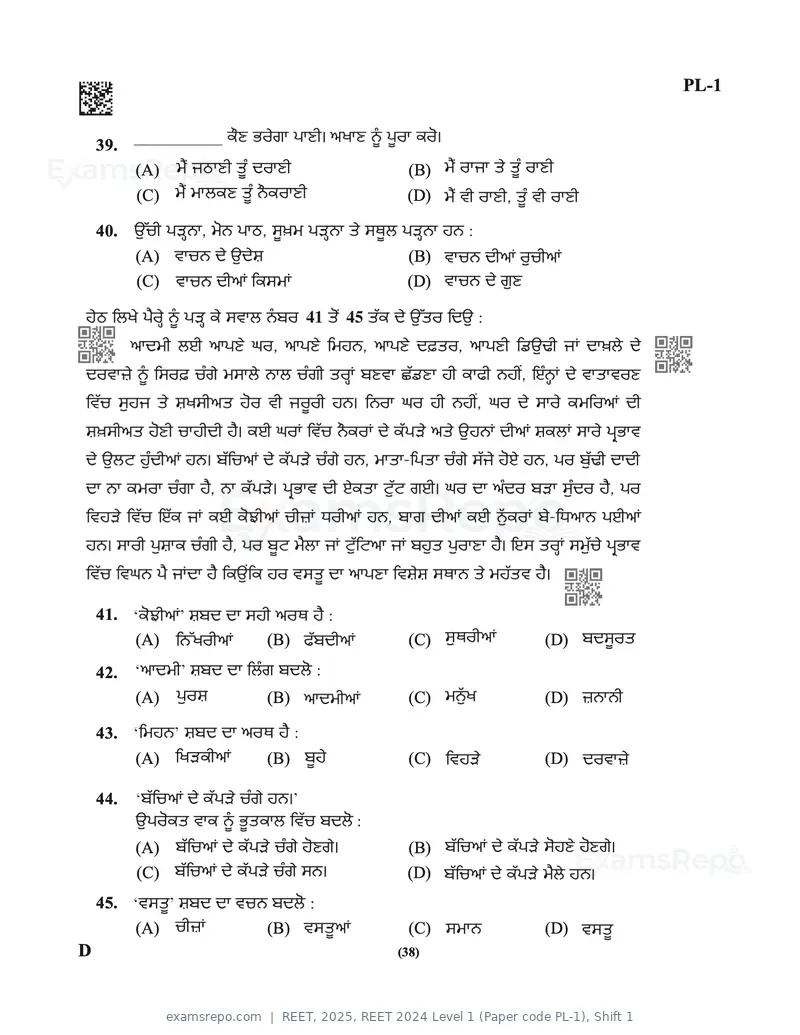
Text of page 326
PL-1


    39.
          (A)         		    (B)
          (C)               (D)

    40.
          (A)   			         (B)
          (C)     		        (D)


    41.
          (A)   (B)          (C)   (D)
    42.
          (A)   (B)          (C)   (D)

    43.
          (A)   (B)          (C)   (D)

    44.

          (A)               (B)
          (C)               (D)
    45.
          (A)   (B)          (C)   (D)
D                          (38)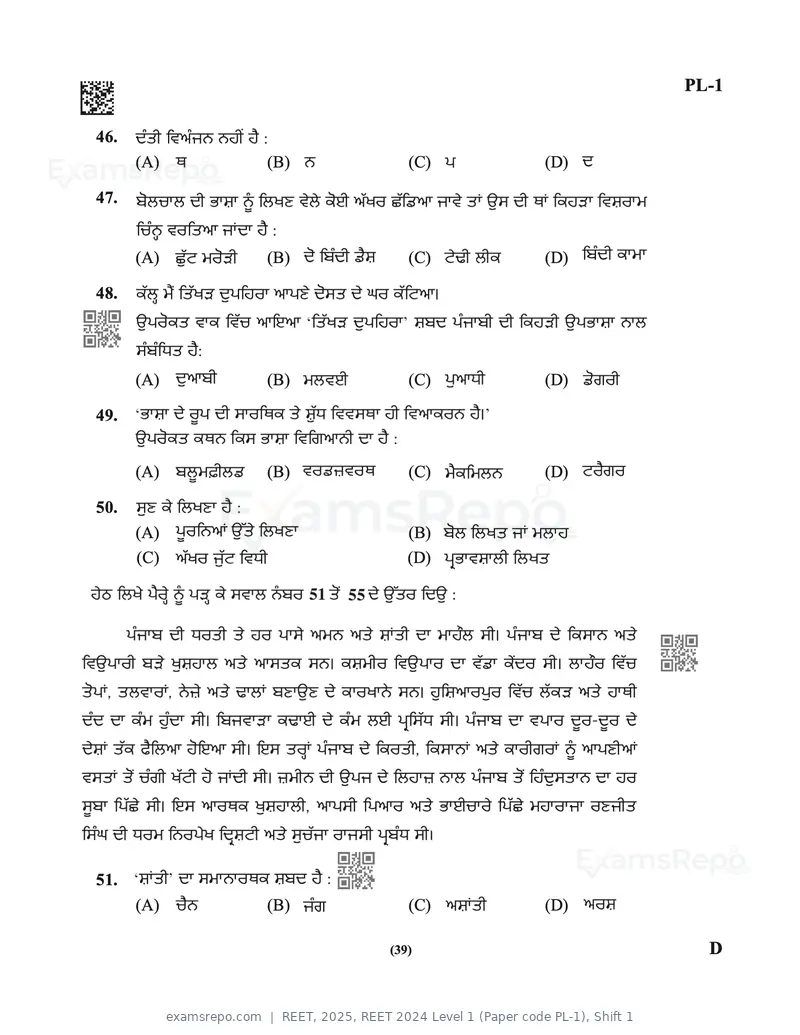
Text of page 327
PL-1

46.
      (A)   (B)      (C)   (D)

47.


      (A)   (B)      (C)   (D)

48.


      (A)   (B)      (C)   (D)

49.


      (A)   (B)      (C)   (D)

50.
      (A)            (B)
      (C)   			      (D)


51.
      (A)   (B)      (C)   (D)

                  (39)             D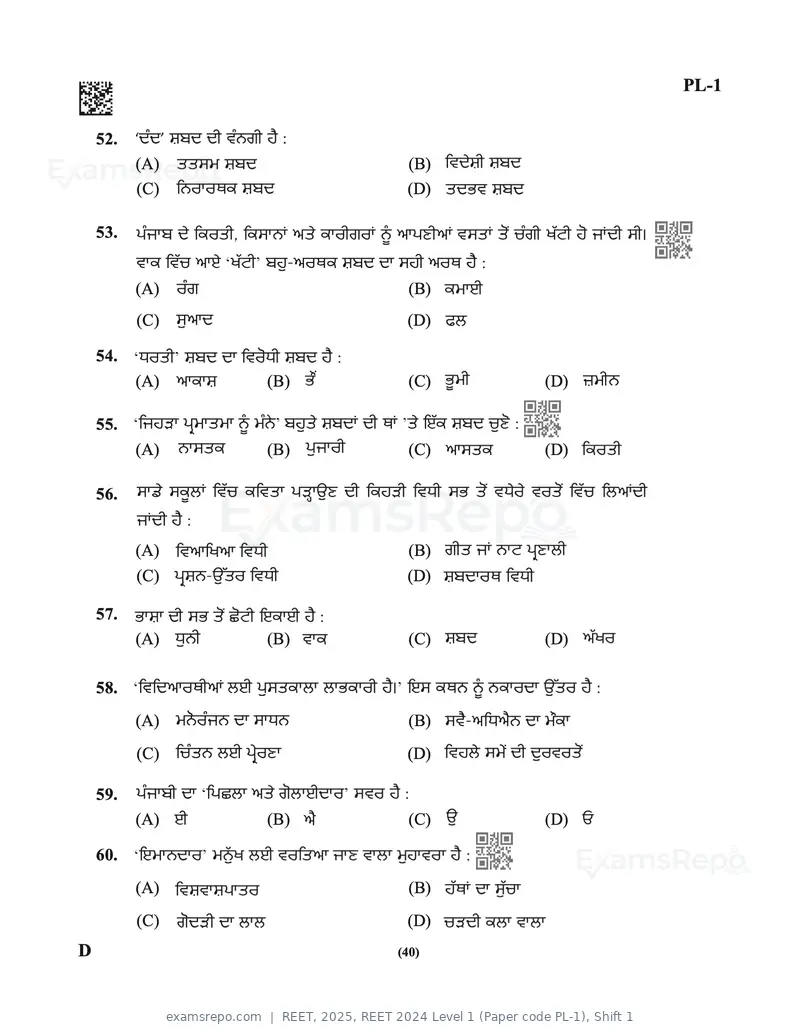
Text of page 328
PL-1

    52.
          (A)    			         (B)
          (C)     			        (D)

    53.


          (A)   			           (B)
          (C)   			          (D)

    54.
          (A)    (B)          (C)   (D)

    55.
          (A)    (B)          (C)   (D)

    56.


          (A)     			        (B)
          (C)      			       (D)

    57.
          (A)    (B)          (C)   (D)

    58.
          (A)          		     (B)
          (C)      			       (D)

    59.
          (A)    (B)          (C)   (D)

    60.
          (A)    			          (B)
          (C)    			         (D)
D                           (40)
Text of page 329
PL-1

                    – iI
                     –i
                           (JwOamVr)


31.
      (A)                   (B)
      (C)   			             (D)
32.
      (A)   (B)             (C)        (D)

33.
      (A)   (B)             (C)        (D)

34.
      (A)   (B)             (C)        (D)

35.
      (A)   (B)             (C)        (D)

36.
      (A)     			           (B)
      (C)     			           (D)
37.
      (A)   (B)             (C)        (D)

38.
      (A)                   (B)
      (C)                   (D)

39.
      (A)    			            (B)
      (C)   			             (D)


                      (41)                     D
Text of page 330
PL-1


    40.
          (A)    			     (B)
          (C)      		    (D)

    41.
          (A)   (B)       (C)   (D)

    42.
          (A)            (B)
          (C)            (D)

    43.
          (A)   (B)       (C)   (D)

    44.

          (A)
          (B)
          (C)
          (D)

D                       (42)
Text of page 331
PL-1

45.
      (A) (–)    (B) (:)      (C) (;)   (D) (" ")

46.
      (A)       			           (B)
      (C)       			           (D)

47.
      (A)       			           (B)
      (C)       			           (D)

48.
      (A)           		        (B)
      (C)           		        (D)

49.

      (A)                     (B)
      (C)                     (D)


50.
      (A)        			          (B)
      (C)        			          (D)

                           (43)                       D
Text of page 332
PL-1

    51.
          (A)   (B)       (C)   (D)

    52.
          (A)    			      (B)
          (C)   			      (D)

    53.
          (A)   (B)       (C)   (D)

    54.
          (A)     		     (B)
          (C)   			      (D)

    55.
          (A)   			      (B)
          (C)   			      (D)

    56.
          (A)   (B)       (C)   (D)

    57.
          (A)   (B)       (C)   (D)

    58.
          (A)      		    (B)
          (C)    			     (D)

    59.
          (A)   (B)       (C)   (D)
    60.
          (A)
          (B)
          (C)
          (D)

D                       (44)
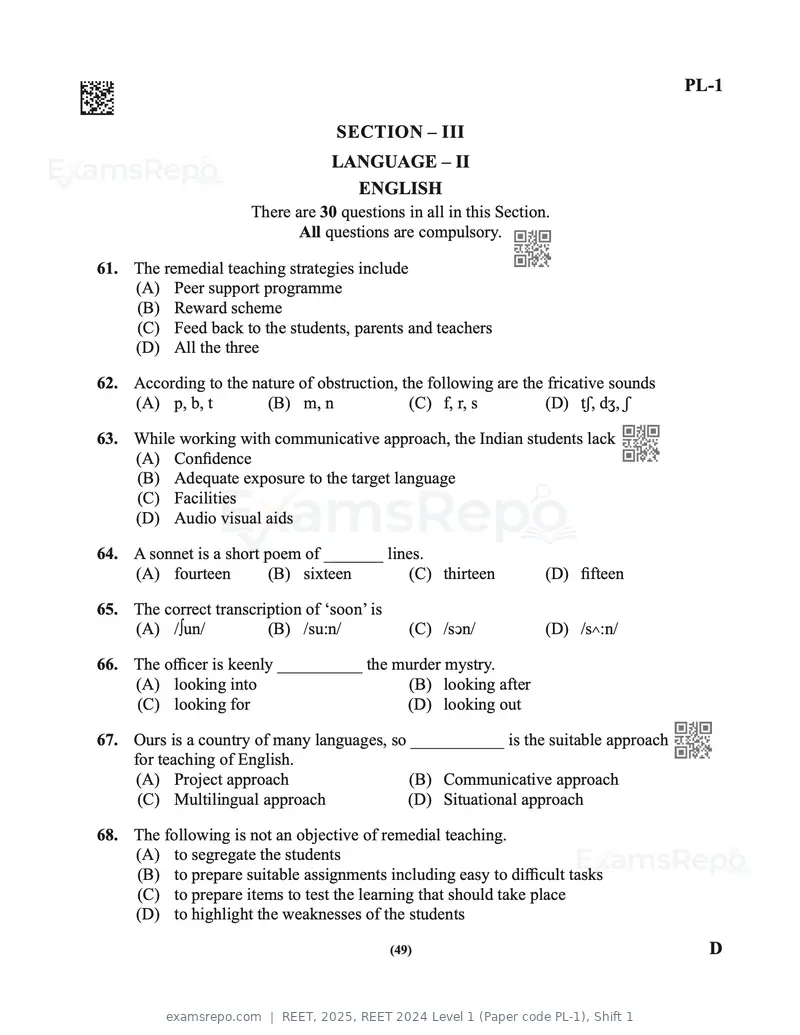
Text of page 337
PL-1

                                   SECTION – III
                                  LANGUAGE – II
                                    ENGLISH
                      There are 30 questions in all in this Section.
                             All questions are compulsory.

61. The remedial teaching strategies include
    (A) Peer support programme
    (B) Reward scheme
    (C) Feed back to the students, parents and teachers
    (D) All the three

62. According to the nature of obstruction, the following are the fricative sounds
    (A) p, b, t        (B) m, n              (C) f, r, s         (D) tʃ, dʒ, ʃ

63. While working with communicative approach, the Indian students lack
    (A) Confidence
    (B) Adequate exposure to the target language
    (C) Facilities
    (D) Audio visual aids

64. A sonnet is a short poem of _______ lines.
    (A) fourteen         (B) sixteen       (C) thirteen            (D) fifteen

65. The correct transcription of ‘soon’ is
    (A) /∫un/           (B) /su:n/              (C) /sͻn/          (D) /s^:n/

66. The officer is keenly __________ the murder mystry.
    (A) looking into			                   (B) looking after
    (C) looking for			                    (D) looking out

67. Ours is a country of many languages, so ___________ is the suitable approach
    for teaching of English.
    (A) Project approach			                 (B) Communicative approach
     (C) Multilingual approach             (D) Situational approach

68. The following is not an objective of remedial teaching.
    (A) to segregate the students
    (B) to prepare suitable assignments including easy to difficult tasks
    (C) to prepare items to test the learning that should take place
    (D) to highlight the weaknesses of the students

                                             (49)                                      D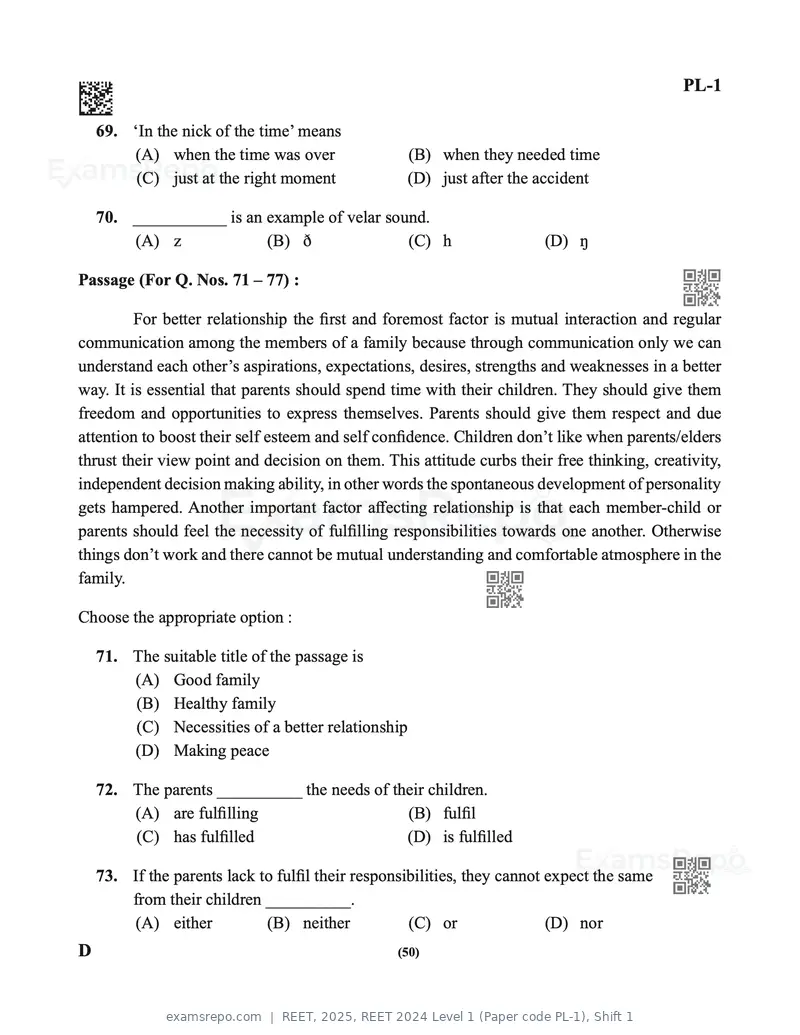
Text of page 338
PL-1

    69. ‘In the nick of the time’ means
        (A) when the time was over                 (B) when they needed time
         (C) just at the right moment              (D) just after the accident

    70. ___________ is an example of velar sound.
        (A) z             (B) ð               (C) h                     (D) ŋ

Passage (For Q. Nos. 71 – 77) :

		 For better relationship the first and foremost factor is mutual interaction and regular
communication among the members of a family because through communication only we can
understand each other’s aspirations, expectations, desires, strengths and weaknesses in a better
way. It is essential that parents should spend time with their children. They should give them
freedom and opportunities to express themselves. Parents should give them respect and due
attention to boost their self esteem and self confidence. Children don’t like when parents/elders
thrust their view point and decision on them. This attitude curbs their free thinking, creativity,
independent decision making ability, in other words the spontaneous development of personality
gets hampered. Another important factor affecting relationship is that each member-child or
parents should feel the necessity of fulfilling responsibilities towards one another. Otherwise
things don’t work and there cannot be mutual understanding and comfortable atmosphere in the
family.

Choose the appropriate option :

    71. The suitable title of the passage is
        (A) Good family
        (B) Healthy family
        (C) Necessities of a better relationship
        (D) Making peace

    72. The parents __________ the needs of their children.
        (A) are fulfilling			                 (B) fulfil
        (C) has fulfilled			                  (D) is fulfilled

    73. If the parents lack to fulfil their responsibilities, they cannot expect the same
        from their children __________.
        (A) either           (B) neither            (C) or                (D) nor
D                                                 (50)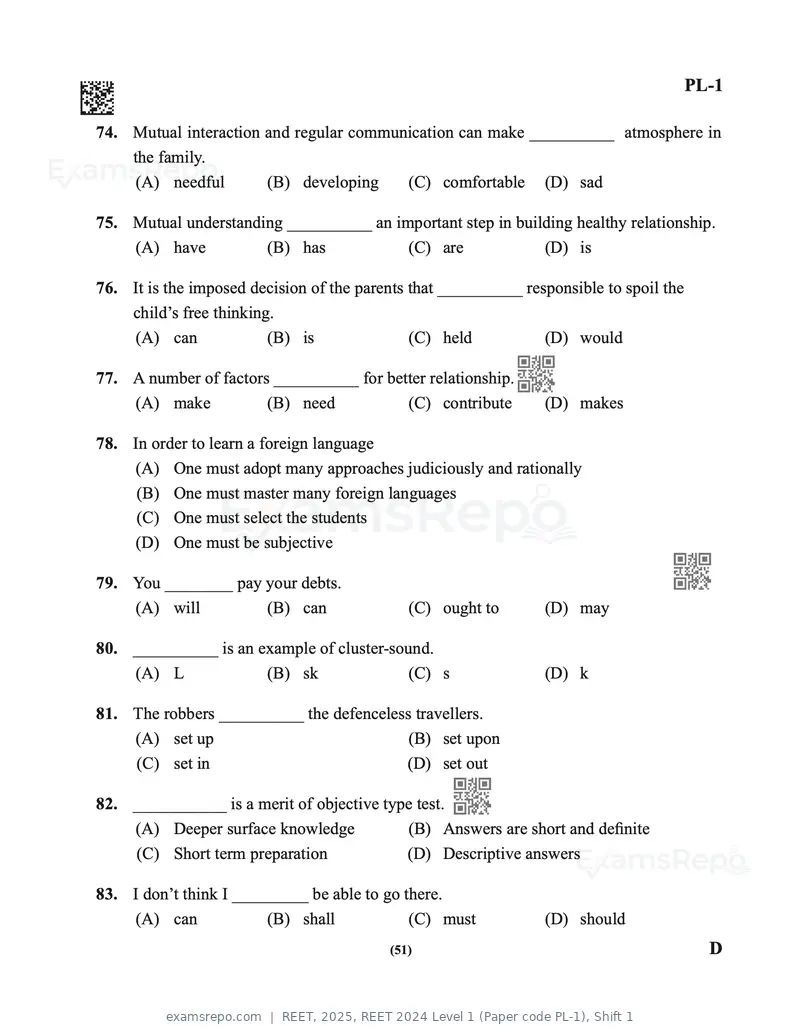
Text of page 339
PL-1

74. Mutual interaction and regular communication can make __________ atmosphere in
    the family.
     (A) needful       (B) developing    (C) comfortable (D) sad

75. Mutual understanding __________ an important step in building healthy relationship.
    (A) have          (B) has            (C) are             (D) is

76. It is the imposed decision of the parents that __________ responsible to spoil the
    child’s free thinking.
    (A) can              (B) is               (C) held           (D) would

77. A number of factors __________ for better relationship.
    (A) make           (B) need           (C) contribute         (D) makes

78. In order to learn a foreign language
    (A) One must adopt many approaches judiciously and rationally
     (B) One must master many foreign languages
     (C) One must select the students
    (D) One must be subjective

79. You ________ pay your debts.
    (A) will         (B) can                 (C) ought to        (D) may

80. __________ is an example of cluster-sound.
    (A) L             (B) sk               (C) s                 (D) k

81. The robbers __________ the defenceless travellers.
    (A) set up			                         (B) set upon
    (C) set in			                        (D) set out

82. ___________ is a merit of objective type test.
    (A) Deeper surface knowledge           (B) Answers are short and definite
    (C) Short term preparation             (D) Descriptive answers

83. I don’t think I _________ be able to go there.
    (A) can             (B) shall            (C) must            (D) should
                                          (51)                                             D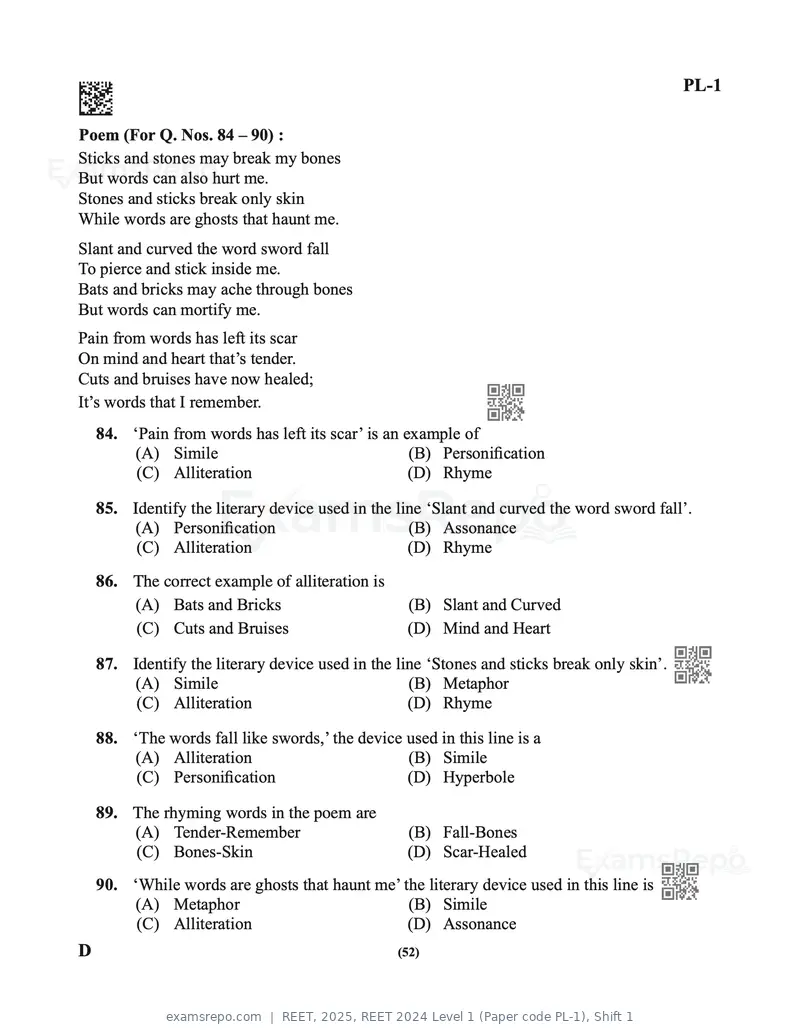
Text of page 340
PL-1

Poem (For Q. Nos. 84 – 90) :
Sticks and stones may break my bones
But words can also hurt me.
Stones and sticks break only skin
While words are ghosts that haunt me.
Slant and curved the word sword fall
To pierce and stick inside me.
Bats and bricks may ache through bones
But words can mortify me.
Pain from words has left its scar
On mind and heart that’s tender.
Cuts and bruises have now healed;
It’s words that I remember.
    84. ‘Pain from words has left its scar’ is an example of
        (A) Simile			                              (B) Personification
         (C) Alliteration			                       (D) Rhyme

    85. Identify the literary device used in the line ‘Slant and curved the word sword fall’.
        (A) Personification			                     (B) Assonance
         (C) Alliteration			                       (D) Rhyme

    86. The correct example of alliteration is
        (A) Bats and Bricks			                    (B) Slant and Curved
        (C) Cuts and Bruises			                   (D) Mind and Heart

    87. Identify the literary device used in the line ‘Stones and sticks break only skin’.
        (A) Simile			                              (B) Metaphor
         (C) Alliteration			                       (D) Rhyme

    88. ‘The words fall like swords,’ the device used in this line is a
        (A) Alliteration			                      (B) Simile
         (C) Personification			                  (D) Hyperbole

    89. The rhyming words in the poem are
        (A) Tender-Remember		                     (B) Fall-Bones
        (C) Bones-Skin			                         (D) Scar-Healed
    90. ‘While words are ghosts that haunt me’ the literary device used in this line is
        (A) Metaphor			                         (B) Simile
         (C) Alliteration			                    (D) Assonance
D                                                (52)
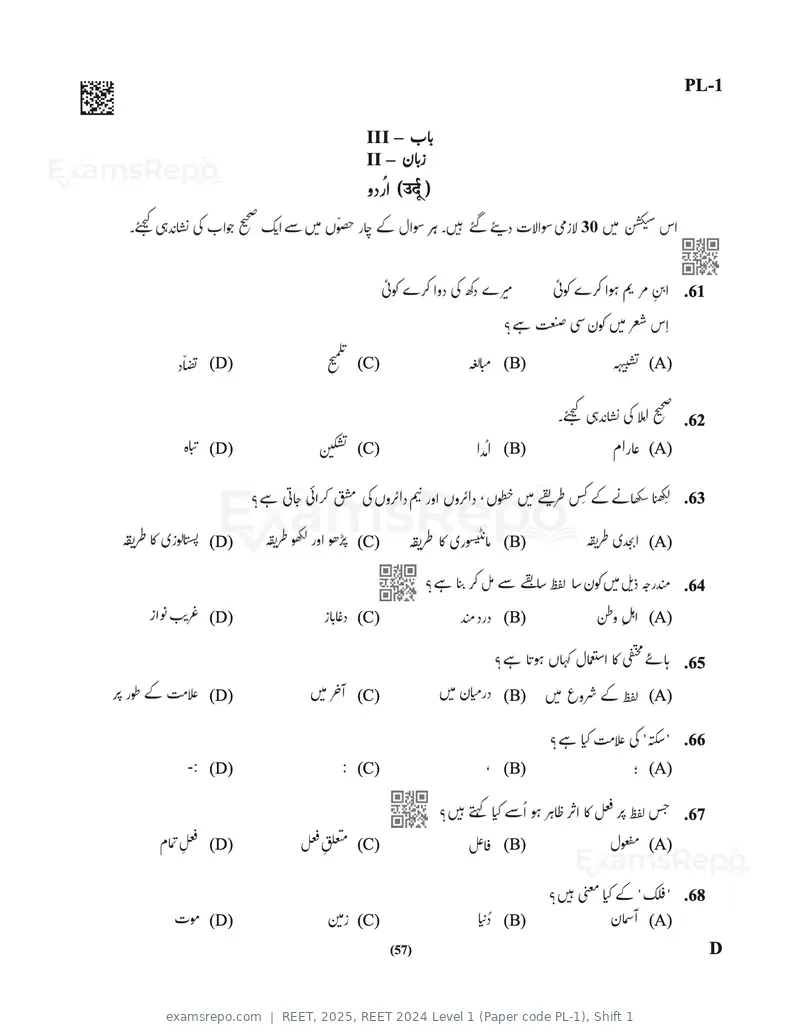
Text of page 345
PL-1

       III –
       II –
             (CXÿ© )


                                   .61


(D)   (C)              (B)   (A)


                                   .62
(D)   (C)              (B)   (A)

                                   .63

(D)   (C)              (B)   (A)

                                   .64
(D)   (C)              (B)   (A)

                                   .65
(D)   (C)              (B)   (A)

                                   .66
(D)   (C)              (B)   (A)

                                   .67
(D)   (C)              (B)   (A)


                                   .68
(D)   (C)              (B)   (A)
            (57)                         D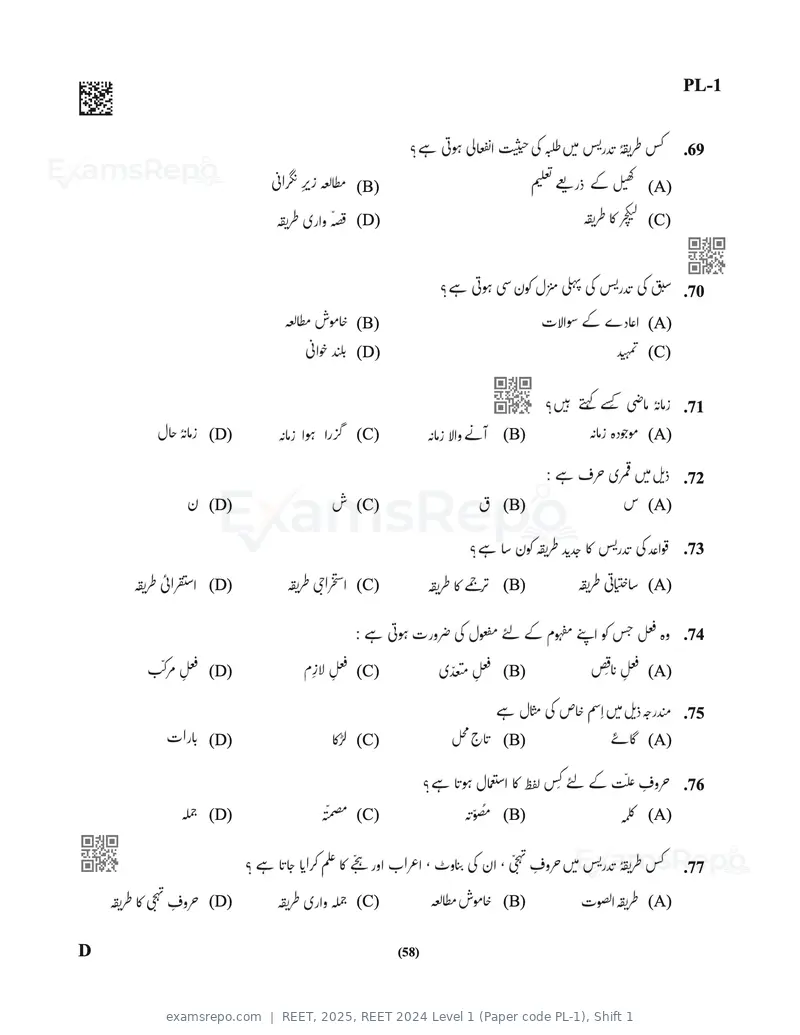
Text of page 346
PL-1


                                   .69

			       (B)			             (A)
			       (D)			             (C)


                                   .70
			       (B)			             (A)
			       (D)			             (C)


                                   .71
    (D)   (C)          (B)   (A)

                                   .72
    (D)   (C)          (B)   (A)

                                   .73

    (D)   (C)          (B)   (A)

                                   .74

    (D)   (C)          (B)   (A)

                                   .75
    (D)   (C)          (B)   (A)

                                   .76
    (D)   (C)          (B)   (A)


                                   .77
    (D)   (C)          (B)   (A)

D               (58)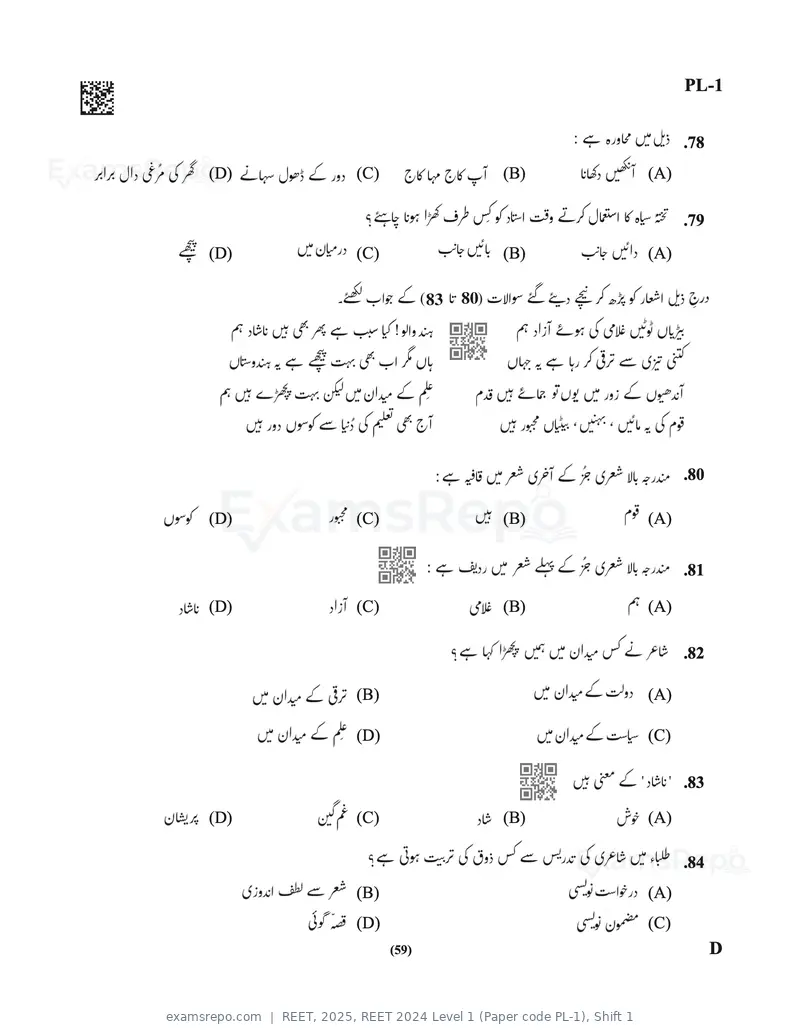
Text of page 347
PL-1


                                 .78
  (D)   (C)          (B)   (A)

                                 .79
  (D)   (C)          (B)   (A)


                                 .80

  (D)   (C)          (B)   (A)


                                 .81

  (D)   (C)          (B)   (A)

                                 .82

			     (B)			             (A)

			     (D)			             (C)

                                 .83

  (D)   (C)          (B)   (A)

                                 .84
			     (B)			             (A)
			     (D)			             (C)
              (59)                     D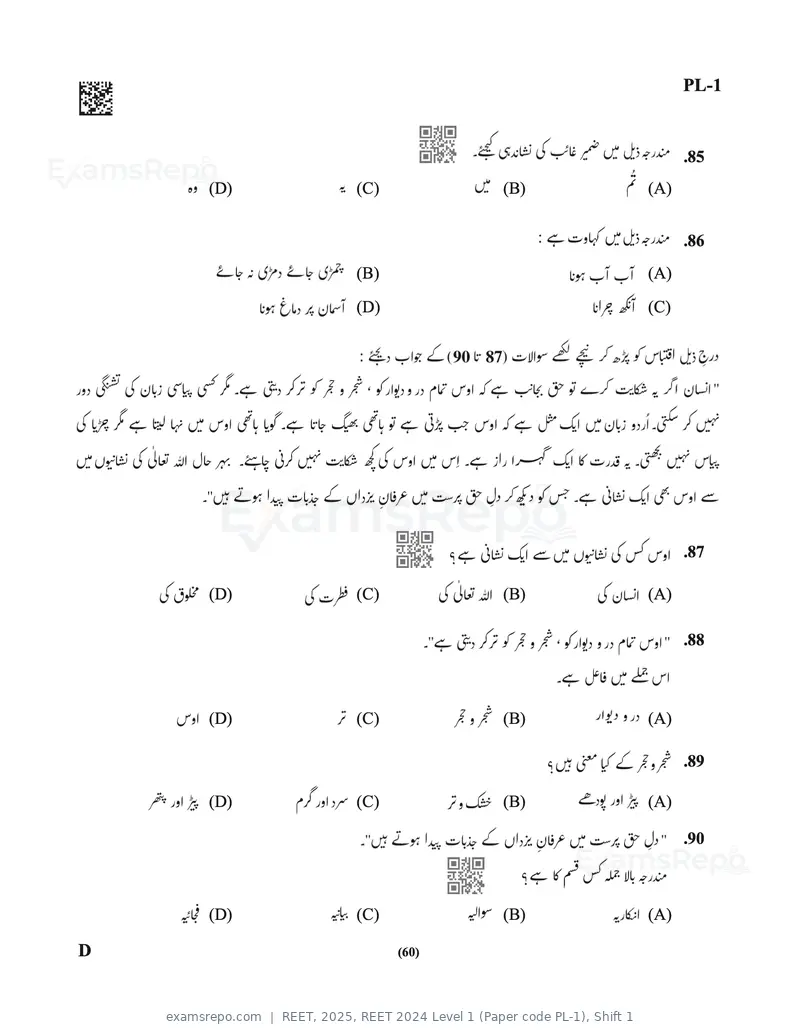
Text of page 348
PL-1


                                   .85
    (D)   (C)          (B)   (A)


                                   .86
			       (B)			             (A)
			       (D)			             (C)


                                   .87

    (D)   (C)          (B)   (A)

                                   .88


    (D)   (C)          (B)   (A)

                                   .89

    (D)   (C)          (B)   (A)

                                   .90


    (D)   (C)          (B)   (A)

D               (60)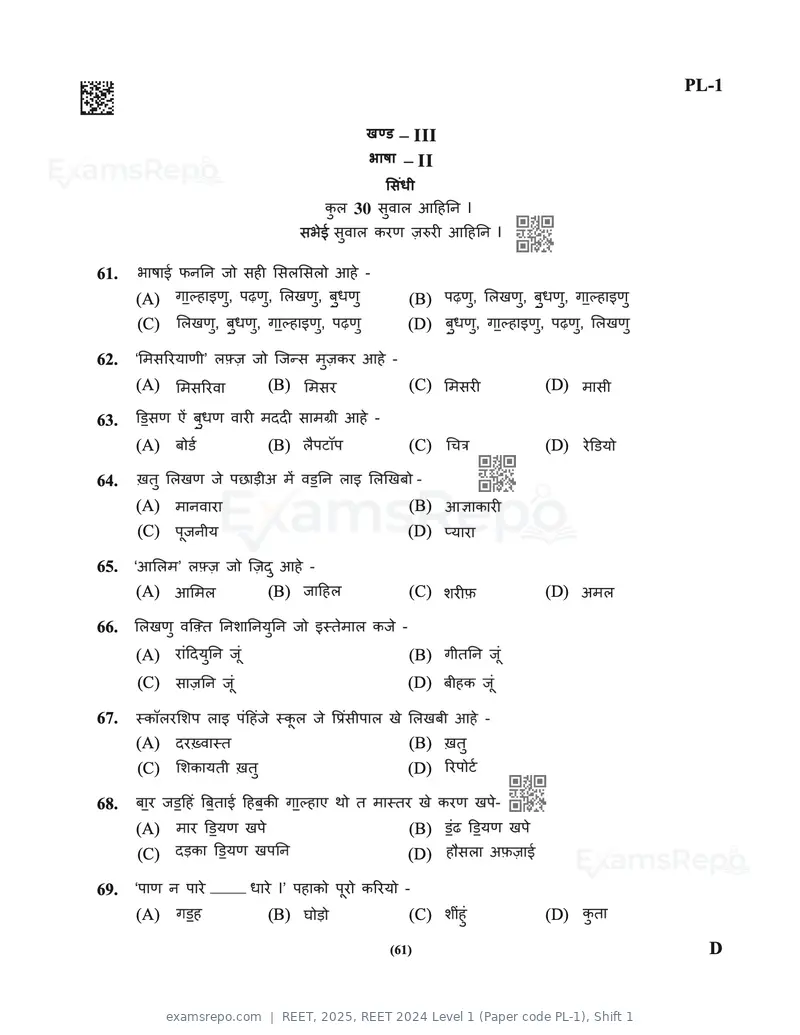
Text of page 349
PL-1

                      – iiI
                     > – II


61.
      (A)              (B)
      (C)              (D)

62.
      (A)    (B)       (C)    (D)

63.
      (A)    (B)       (C)    (D)

64.
      (A)   			        (B)
      (C)   			        (D)

65.
      (A)    (B)       (C)    (D)

66.
      (A)   			        (B)
      (C)   			        (D)

67.
      (A)   			        (B)
      (C)    			       (D)

68.
      (A)    			       (B)
      (C)      		      (D)

69.
      (A)    (B)       (C)    (D)
                    (61)              D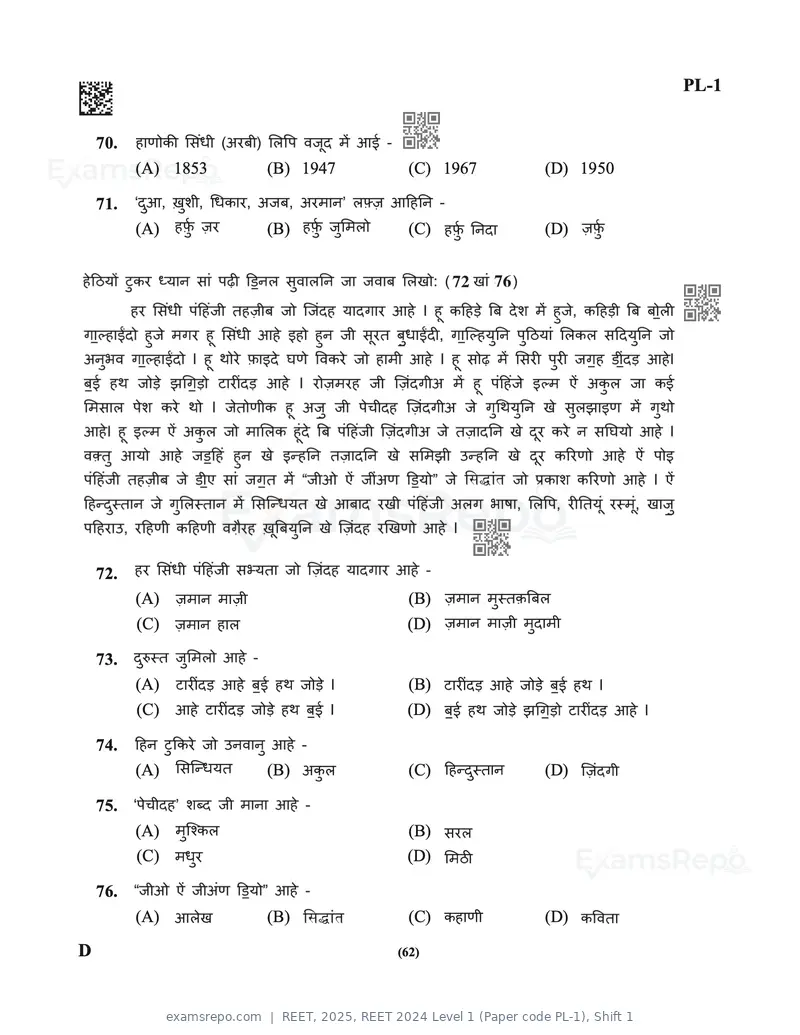
Text of page 350
PL-1


    70.
          (A) 1853    (B) 1947     (C) 1967   (D) 1950

    71.
          (A)         (B)          (C)        (D)


    72.
          (A)        			          (B)
          (C)        			          (D)

    73.
          (A)                     (B)
          (C)                     (D)

    74.
          (A)         (B)          (C)        (D)

    75.
          (A)     			             (B)
          (C)    			              (D)

    76.
          (A)         (B)          (C)        (D)

D                                (62)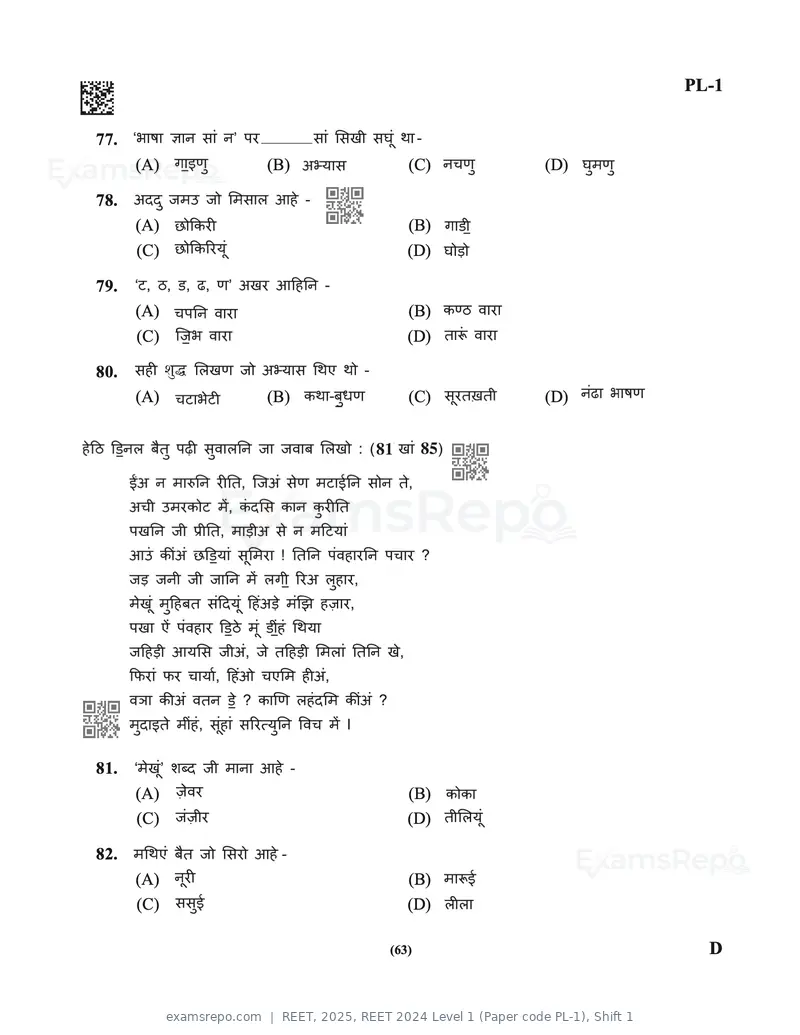
Text of page 351
PL-1

77.
      (A)     (B)      (C)   (D)

78.
      (A)   			        (B)
      (C)   			        (D)

79.
      (A)    			       (B)
      (C)    			       (D)

80.
      (A)     (B)      (C)   (D)


81.
      (A)   			        (B)
      (C)   			        (D)

82.
      (A)   			        (B)
      (C)   			        (D)

                    (63)             D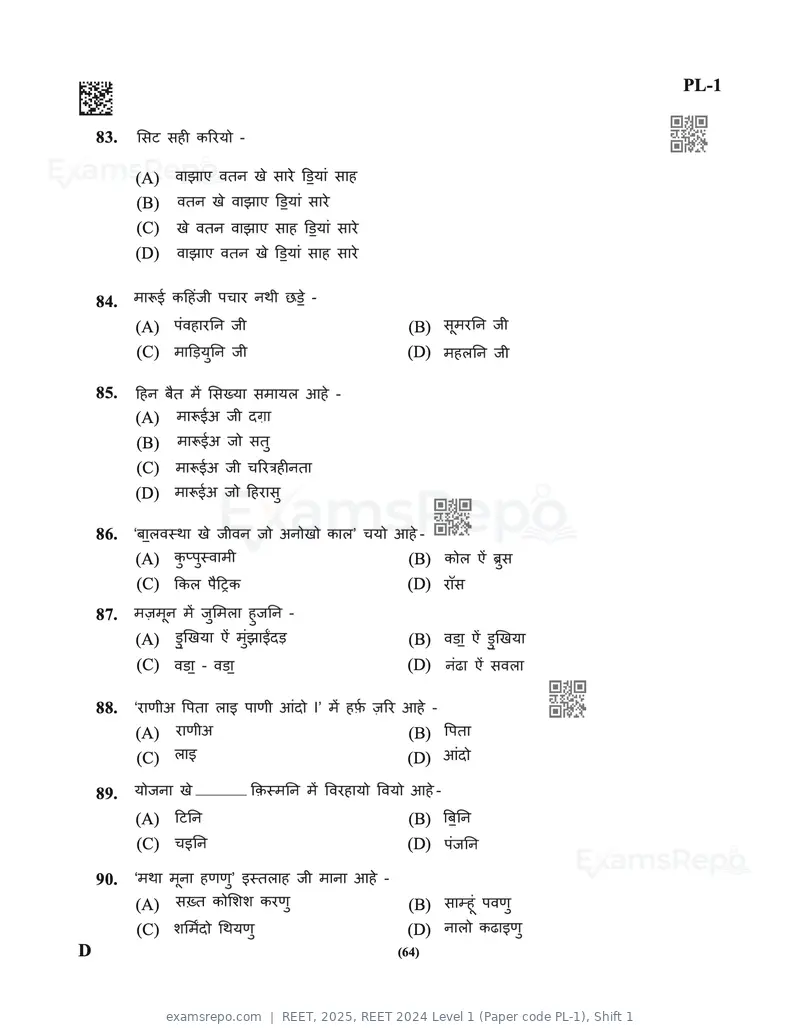
Text of page 352
PL-1

    83.

          (A)
          (B)
          (C)
          (D)

    84.
          (A)    			      (B)
          (C)    			      (D)

    85.
          (A)
          (B)
          (C)
          (D)

    86.
          (A)    			      (B)
          (C)    			      (D)
    87.
          (A)      			    (B)
          (C)    			      (D)

    88.
          (A)   			       (B)
          (C)   			       (D)

    89.
          (A)   			       (B)
          (C)   			       (D)

    90.
          (A)       		    (B)
          (C)     			     (D)
D                        (64)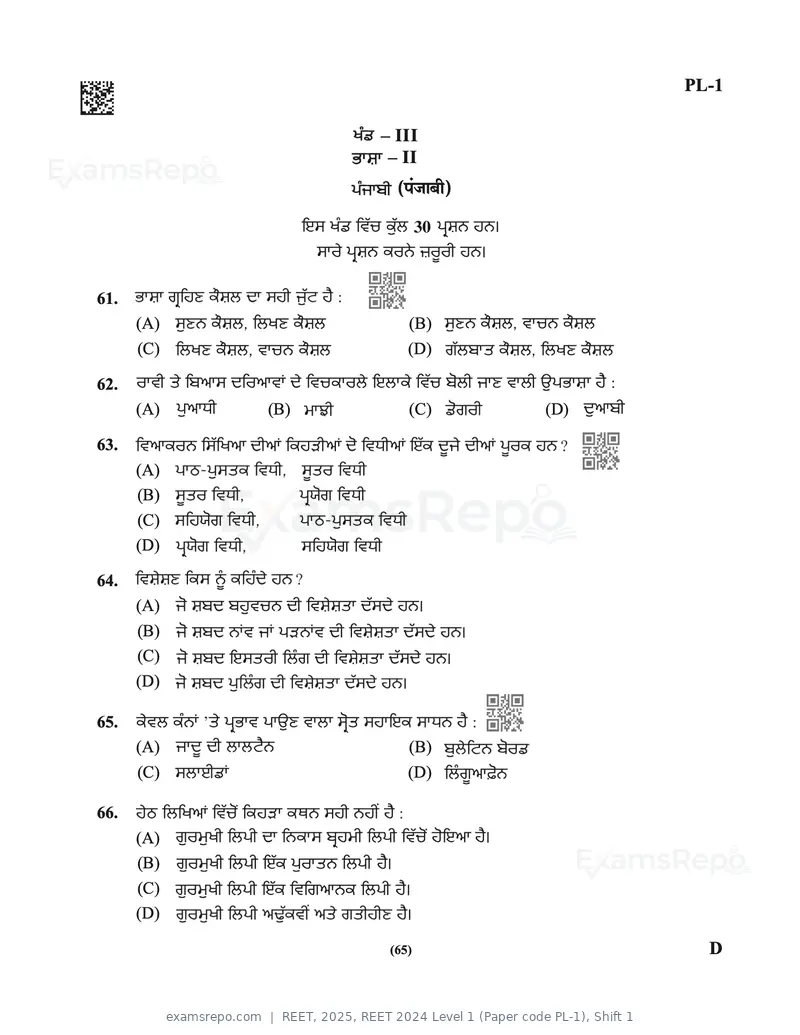
Text of page 353
PL-1

                    > – iiI
                      – II
                       (n§Om~r)


61.
      (A)                (B)
      (C)                (D)

62.
      (A)     (B)        (C)      (D)

63.
      (A)
      (B)
      (C)
      (D)

64.
      (A)
      (B)
      (C)
      (D)

65.
      (A)     			        (B)
      (C)   			          (D)

66.
      (A)
      (B)
      (C)
      (D)

                      (65)                D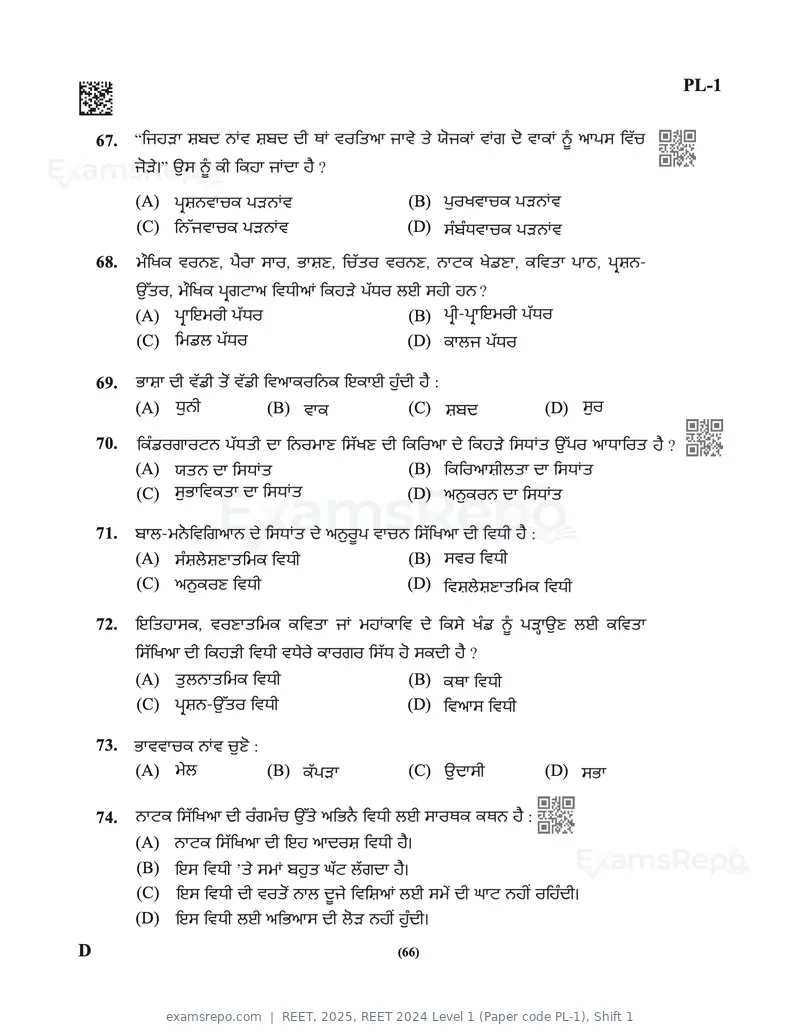
Text of page 354
PL-1


    67.


          (A)       		    (B)
          (C)      			    (D)

    68.


          (A)    			      (B)
          (C)   			       (D)

    69.
          (A)    (B)       (C)   (D)

    70.
          (A)    			      (B)
          (C)             (D)

    71.
          (A)             (B)
          (C)   			       (D)

    72.


          (A)     			     (B)
          (C)     			     (D)

    73.
          (A)    (B)       (C)   (D)

    74.
          (A)
          (B)
          (C)
          (D)
D                        (66)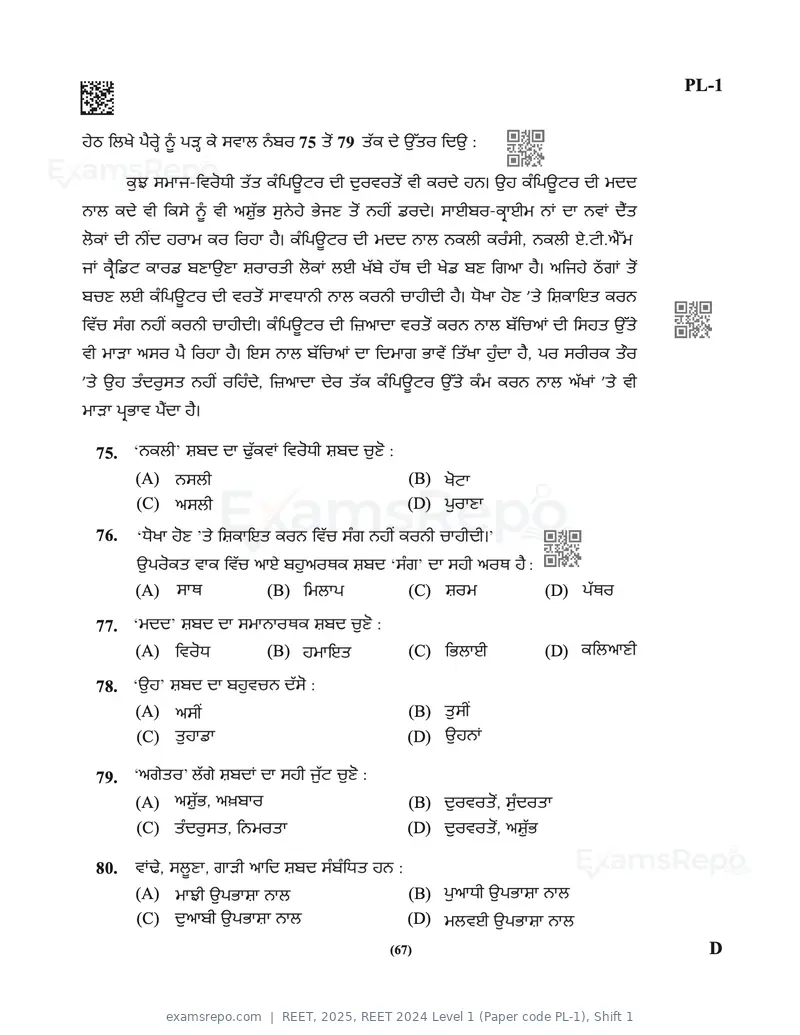
Text of page 355
PL-1


75.
      (A)   			            (B)
      (C)   			            (D)
76.


      (A)    (B)           (C)   (D)

77.
      (A)    (B)           (C)   (D)

78.
      (A)   			            (B)
      (C)   			            (D)

79.
      (A)    			           (B)
      (C)      			         (D)

80.
      (A)          		      (B)
      (C)                  (D)
                        (67)             D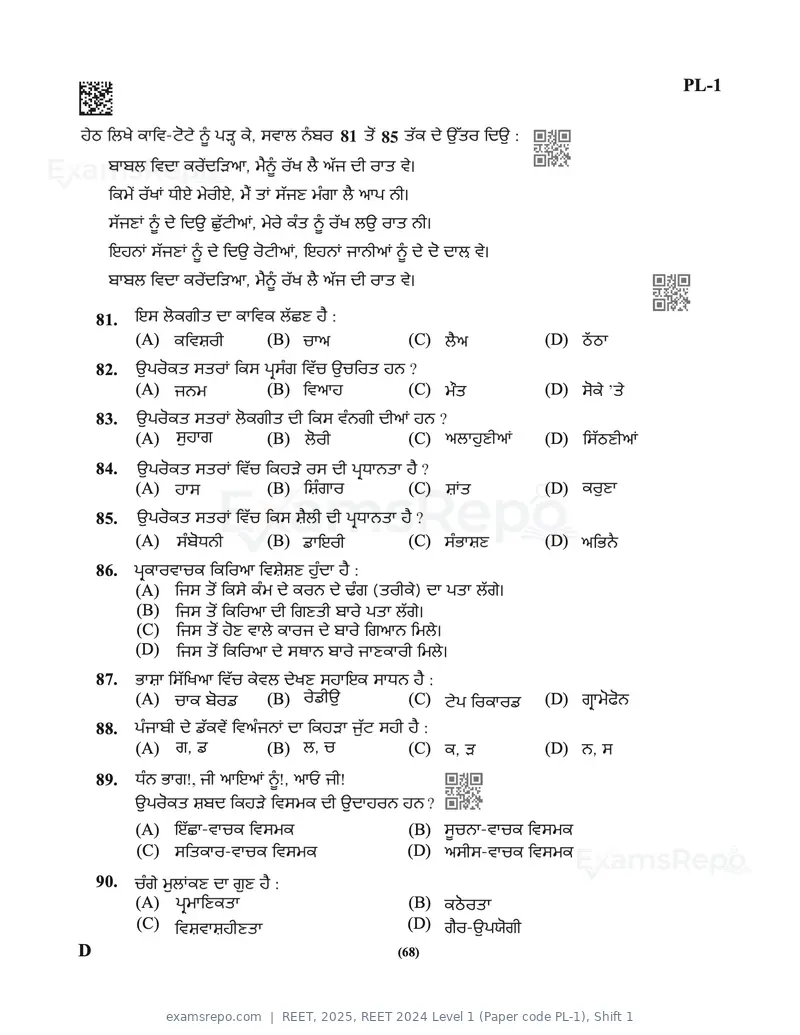
Text of page 356
PL-1


    81.
          (A)    (B)          (C)   (D)
    82.
          (A)    (B)          (C)   (D)
    83.
          (A)    (B)          (C)   (D)
    84.
          (A)    (B)          (C)   (D)
    85.
          (A)    (B)          (C)   (D)
    86.
          (A)
          (B)
          (C)
          (D)
    87.
          (A)    (B)          (C)   (D)
    88.
          (A)    (B)          (C)   (D)
    89.

          (A)          		    (B)
          (C)                (D)
    90.
          (A)   			          (B)
          (C)    			         (D)
D                           (68)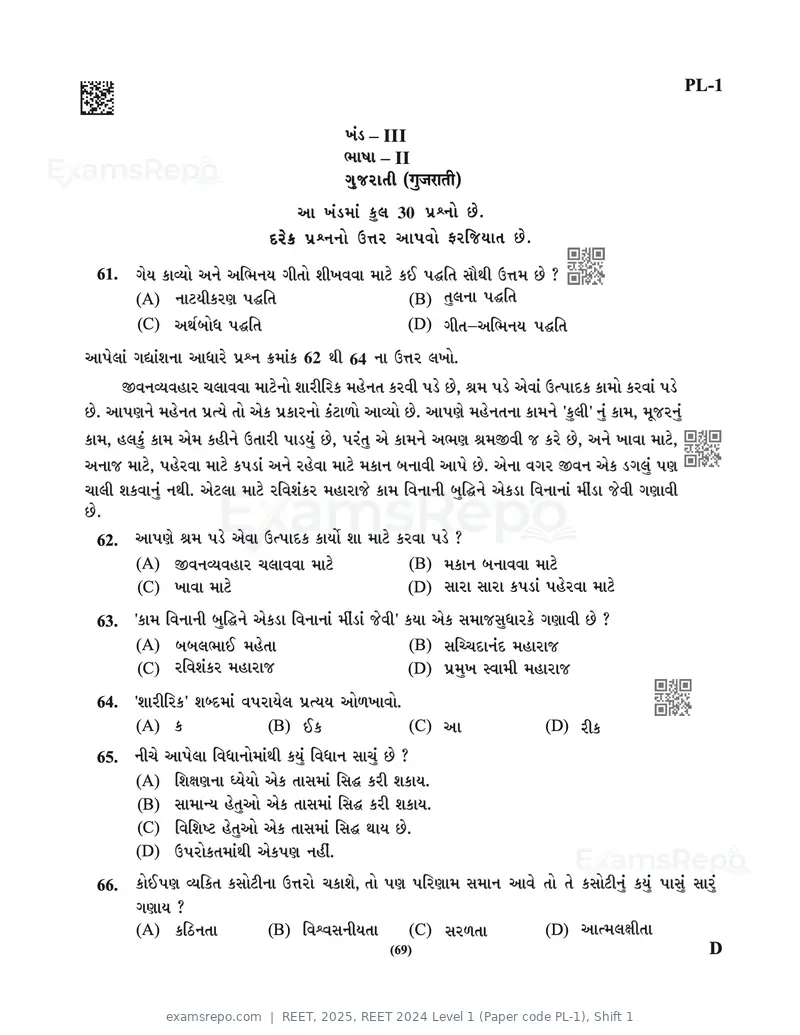
Text of page 357
PL-1

                    – iII
                     – II
                        (JwOamVr)


61.
      (A)     			        (B)
      (C)    			         (D)


62.
      (A)                (B)
      (C)   			          (D)

63.
      (A)     			        (B)
      (C)     			        (D)

64.
      (A)    (B)         (C)        (D)
65.
      (A)
      (B)
      (C)
      (D)

66.

      (A)    (B)         (C)        (D)
                      (69)                  D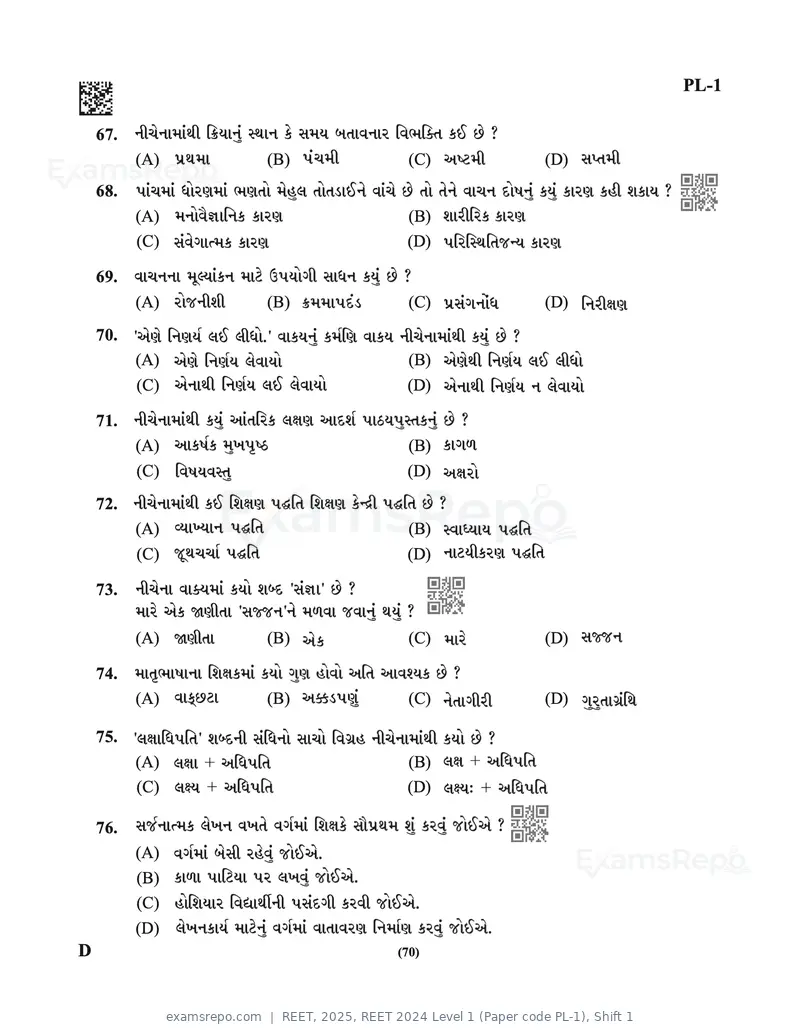
Text of page 358
PL-1

    67.
          (A)    (B)       (C)   (D)
    68.
          (A)     			     (B)
          (C)    			      (D)

    69.
          (A)    (B)       (C)   (D)
    70.
          (A)      			    (B)
          (C)             (D)

    71.
          (A)    			      (B)
          (C)   			       (D)
    72.
          (A)    			      (B)
          (C)    			      (D)

    73.

          (A)    (B)       (C)   (D)

    74.
          (A)    (B)       (C)   (D)

    75.
          (A)     			     (B)
          (C)     			     (D)

    76.
          (A)
          (B)
          (C)
          (D)
D                        (70)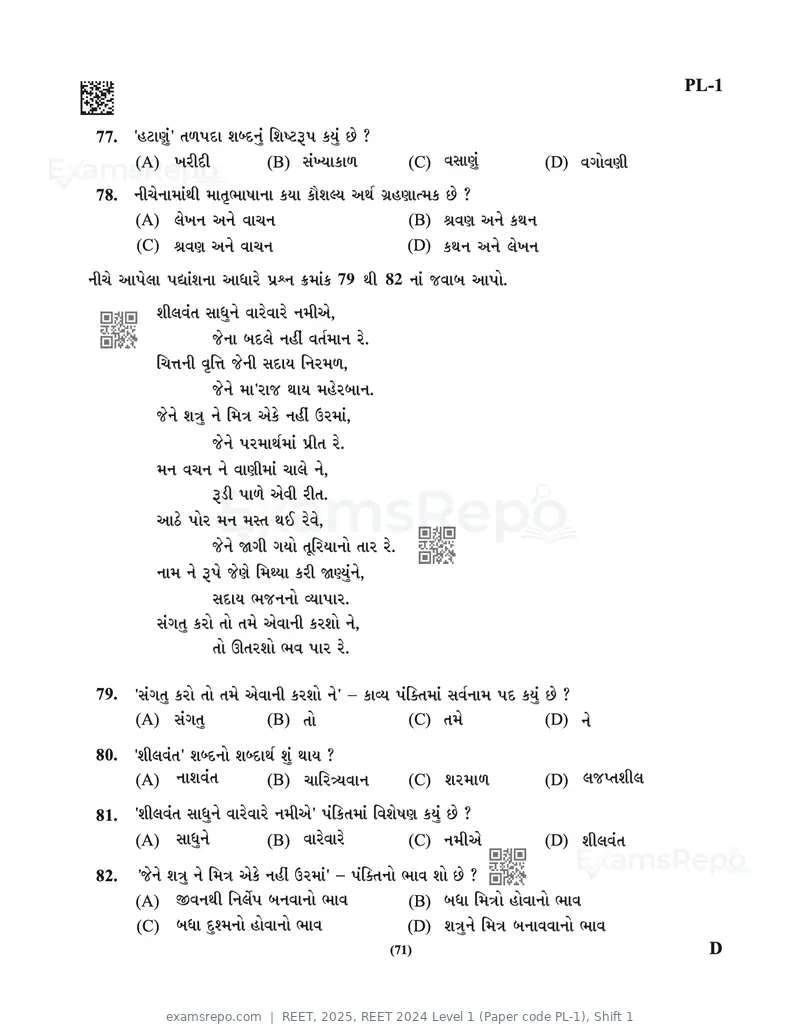
Text of page 359
PL-1

77.
      (A)   (B)      (C)   (D)
78.
      (A)   			      (B)
      (C)   			      (D)


79.
      (A)   (B)      (C)   (D)

80.
      (A)   (B)      (C)   (D)

81.
      (A)   (B)      (C)   (D)

82.
      (A)            (B)
      (C)            (D)
                  (71)             D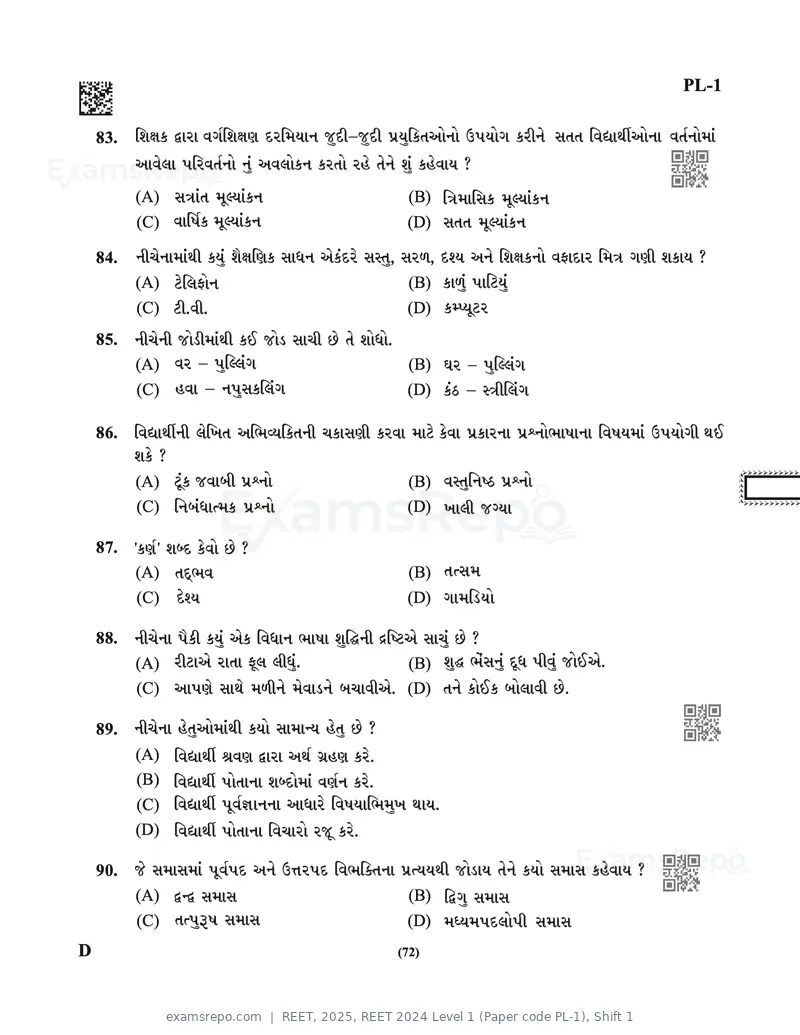
Text of page 360
PL-1
83.
(A) (B)
(C) (D)
84.
(A) (B)
(C) (D)
85.
(A) (B)
(C) (D)
86.
(A) (B)
(C) (D)
87.
(A) (B)
(C) (D)
88.
(A) (B)
(C) (D)
89.
(A)
(B)
(C)
(D)
90.
(A) (B)
(C) (D)
D (72)
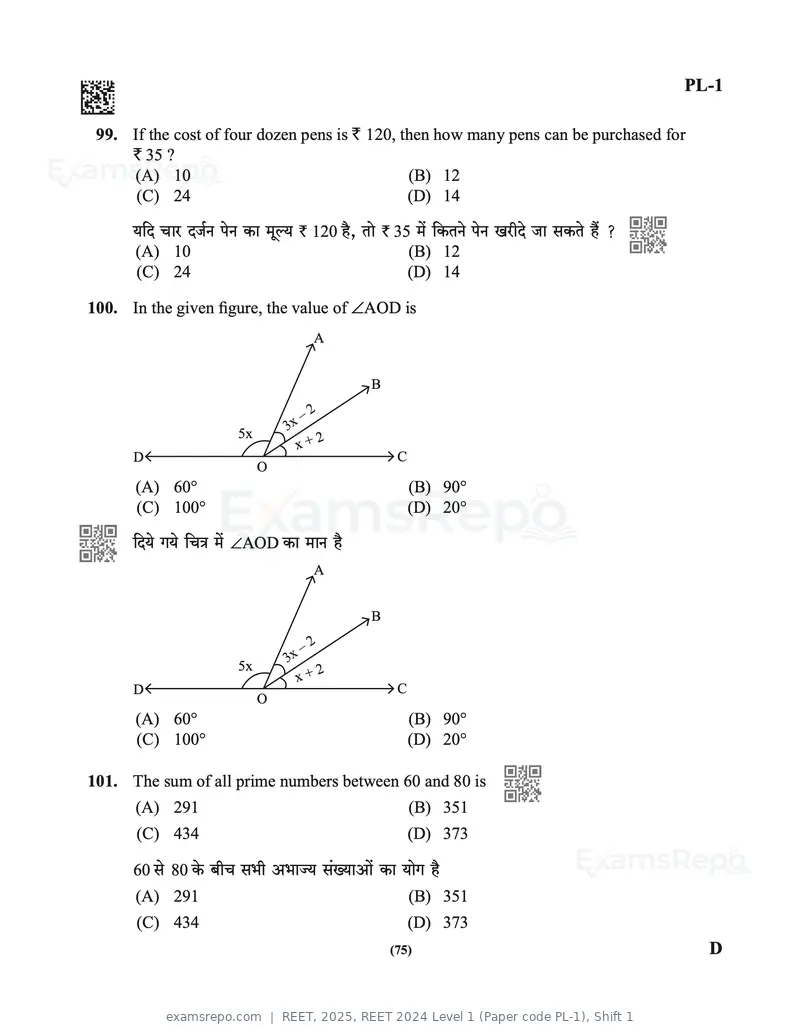
Text of page 364
PL-1

 102. If each side of the square is reduced to one-third, then the area will be
             1                                        1
      (A)      			                              (B)
             3                                        2
             1                                        1
       (C)     			                              (D)
             9                                        6
		 `{X dJ© H$s àË`oH$ ^wOm EH$ {VhmB© H$_ H$a Xr OmE, Vmo joÌ\$b hmo OmEJm
               1                                         1
         (A)     			                                 (B)
               3                                         2
               1                                         1
         (C)     			                                 (D)
               9                                         6
 103. If 12 packets of the pencil are priced at 362 rupees 76 paise, then the price of a packet
      of pencil is
      (A) 30 rupees 23 paise		                  (B) 33 rupees 30 paise
       (C) 23 rupees 30 paise		                 (D) 13 rupees 23 paise

		 `{X 12 n¡Ho$Q> n|{gb H$m _yë` 362 én`o 76 n¡go hmo, Vmo EH$ n¡Ho$Q> n|{gb H$m _yë` h¡
   (A) 30 én`o 23 n¡go			                       (B) 33 én`o 30 n¡go
   (C) 23 én`o 30 n¡go			                      (D) 13 én`o 23 n¡go

 104. The average of the cubes of the first five natural numbers is
      (A) 40			                                 (B) 64
      (C) 45			                                 (D) 50

		 àW_ nm±M àmH¥${VH$ g§»`mAm| Ho$ KZm| H$m Am¡gV h¡
         (A) 40			                                   (B) 64
         (C) 45			                                   (D) 50
 105. By selling a chair for ` 1,080, the shopkeeper suffers a loss of 10%. For how much should
      he sell this chair so that he gets 10% profit ?
      (A) ` 1,200			                             (B) ` 1,400
      (C) ` 1,100			                             (D) ` 1,320

		 EH$ Hw$gu H$mo ` 1,080 _| ~oMZo na XþH$mZXma H$mo 10% hm{Z hmoVr h¡ & dh Bg Hw$gu H$mo {H$VZo _| ~oMo
   {H$ Cgo 10% bm^ hmo ?
         (A) ` 1,200			                              (B) ` 1,400
         (C) ` 1,100			                              (D) ` 1,320


D                                                  (76)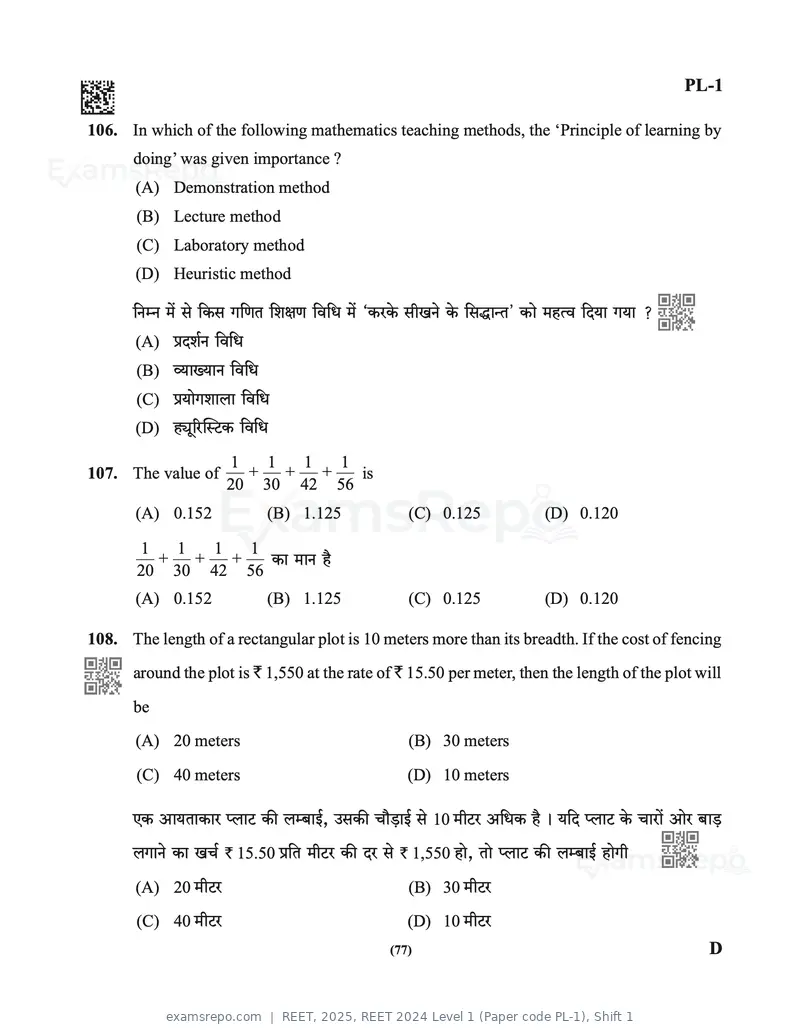
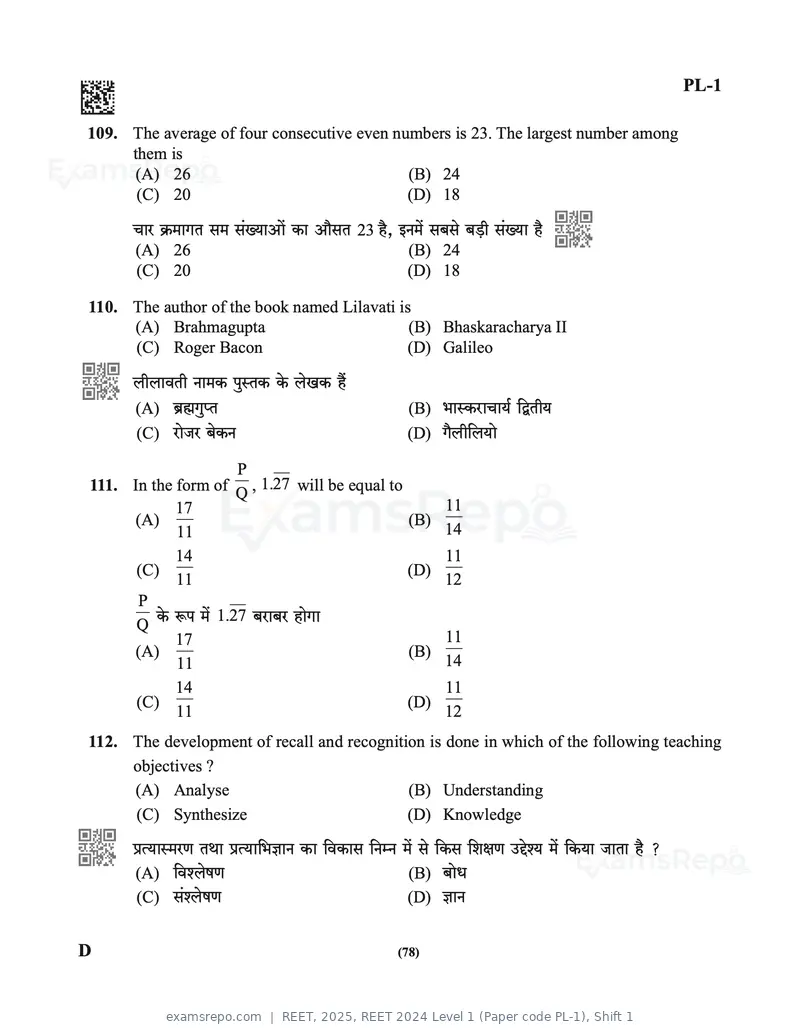
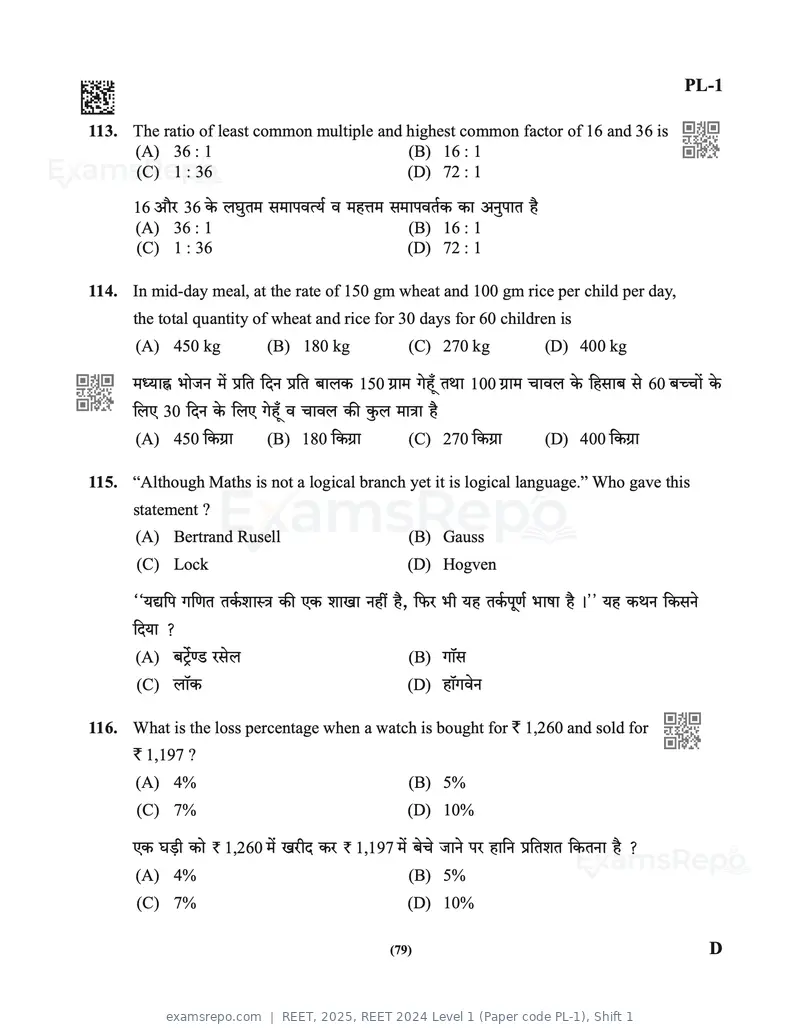
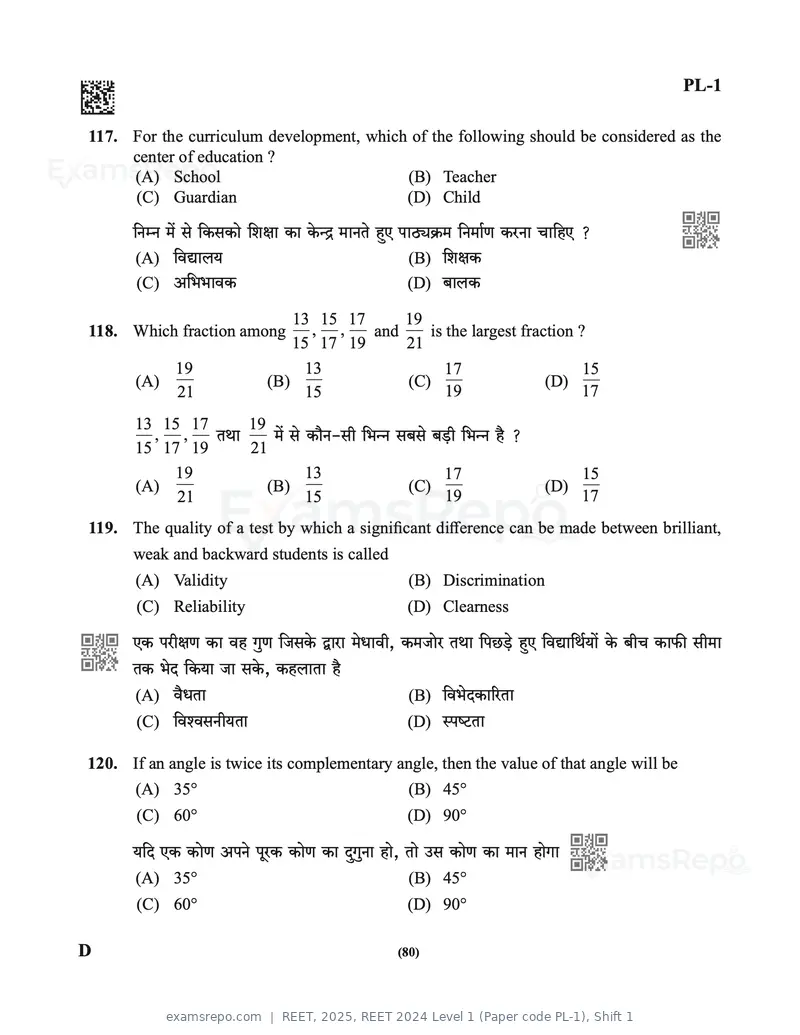
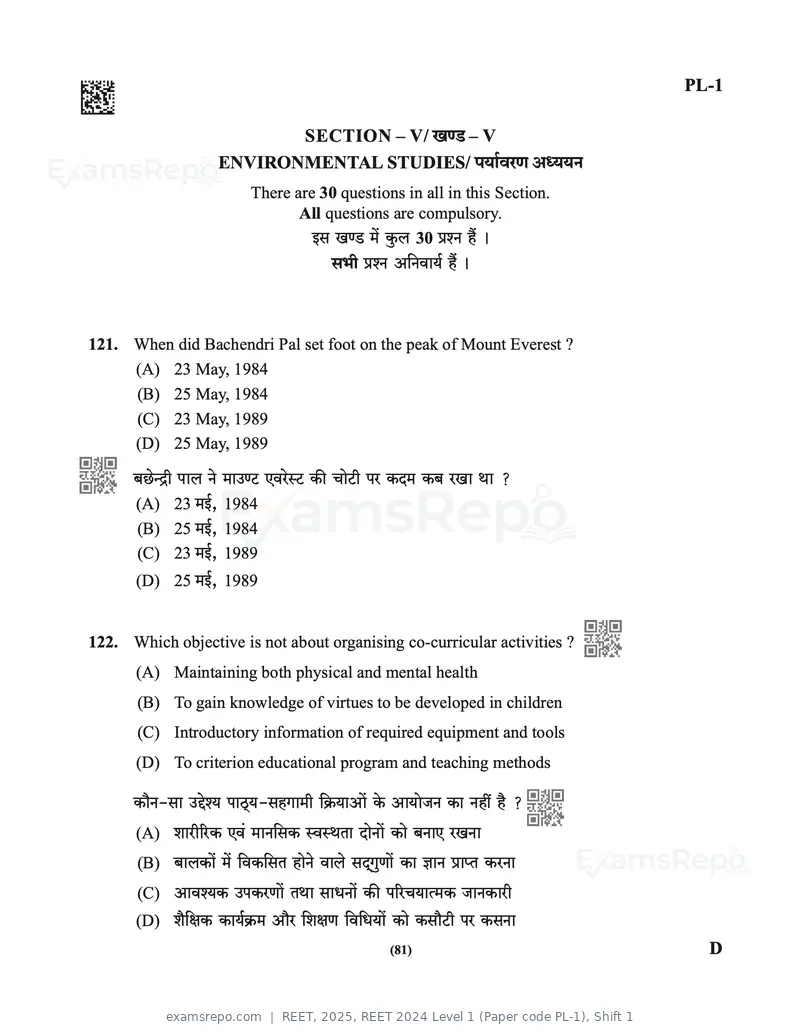
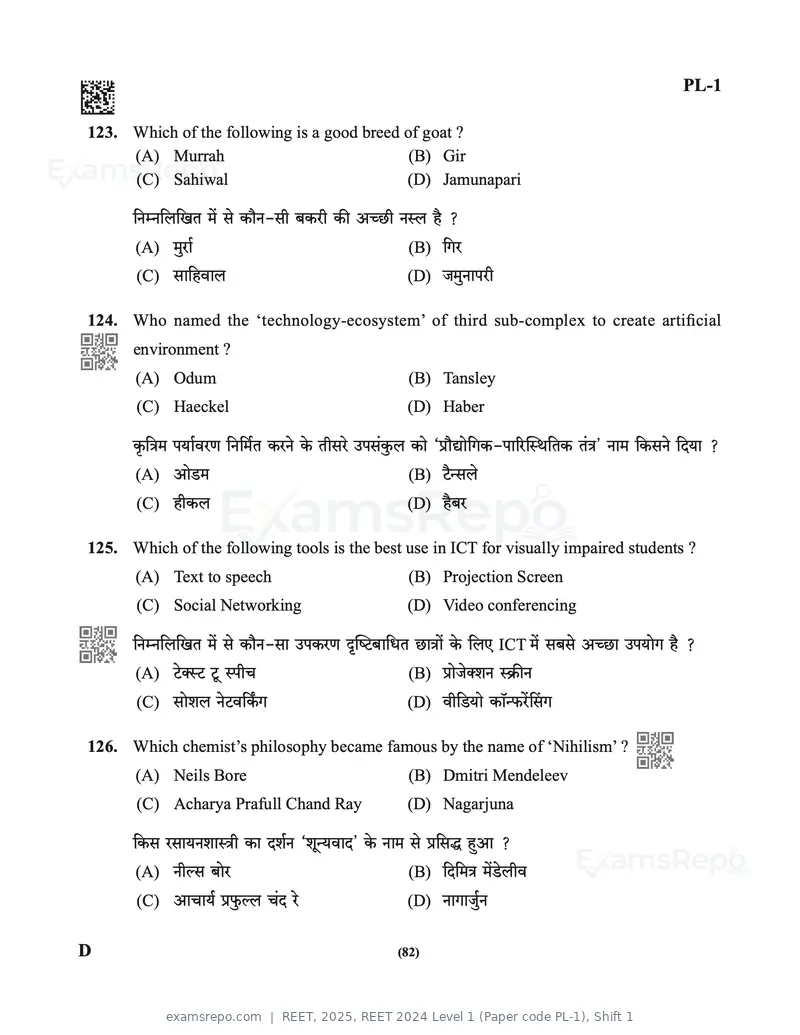
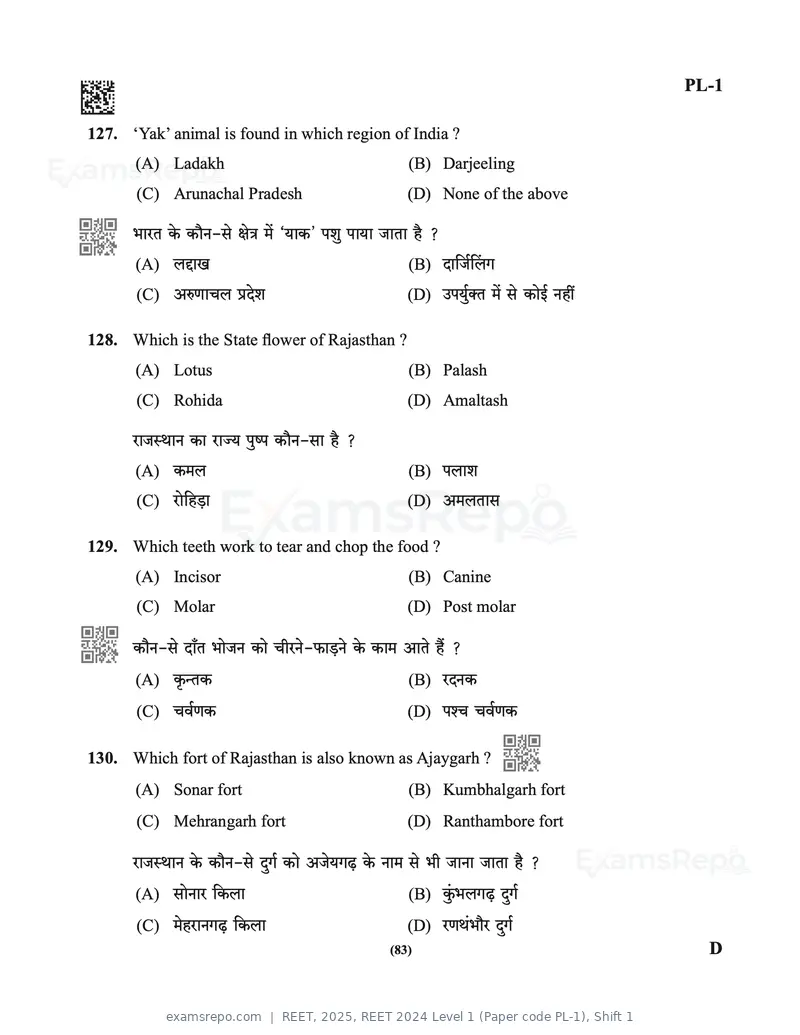
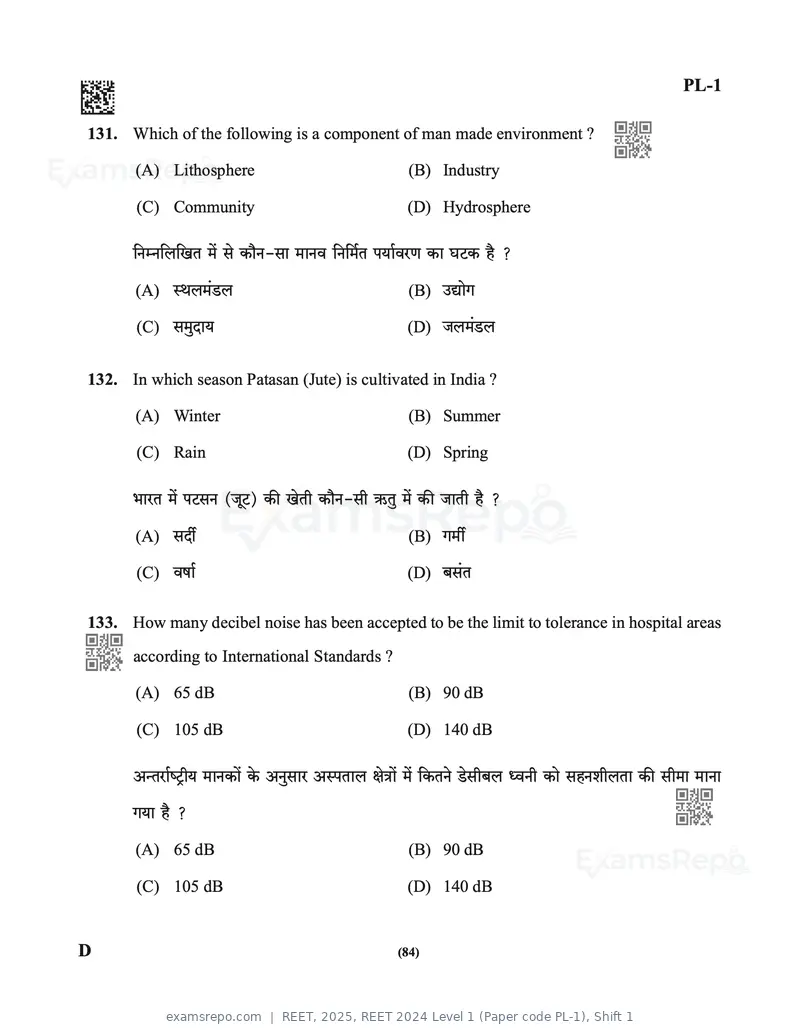
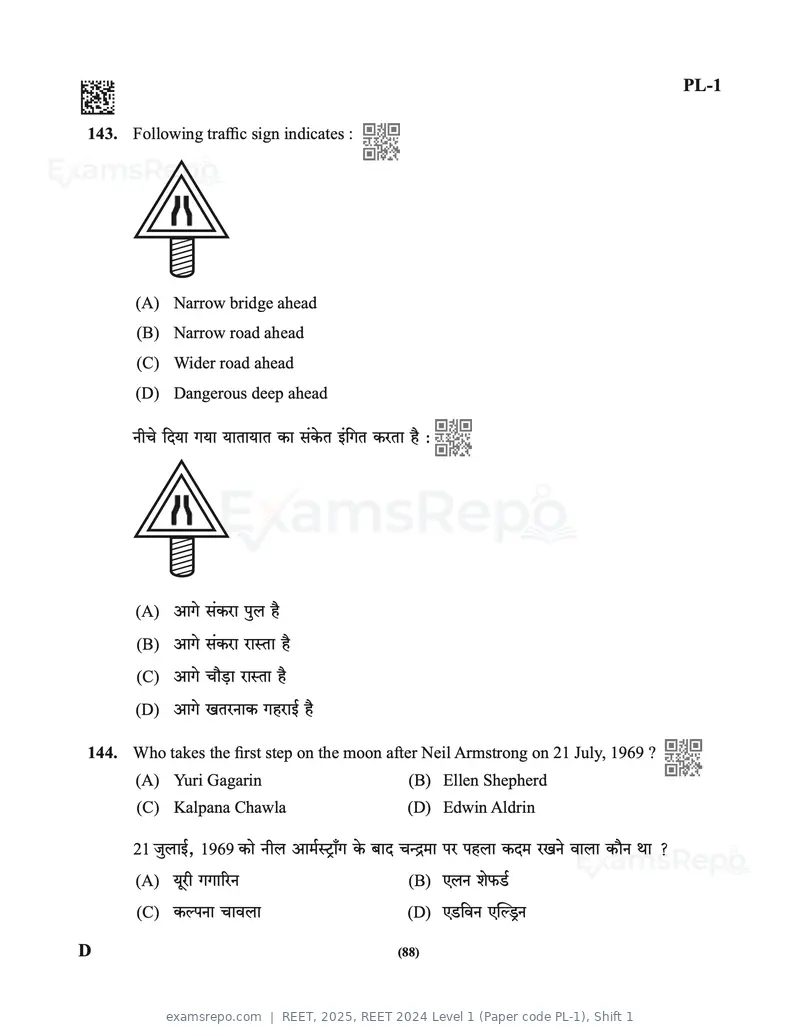
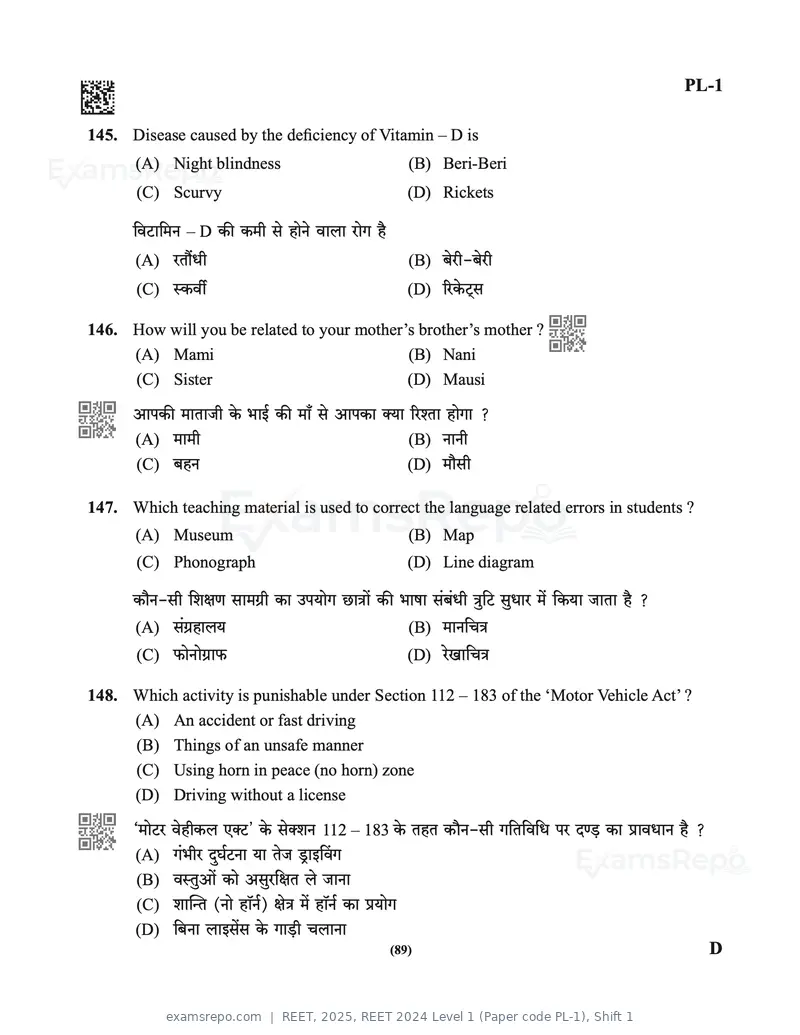
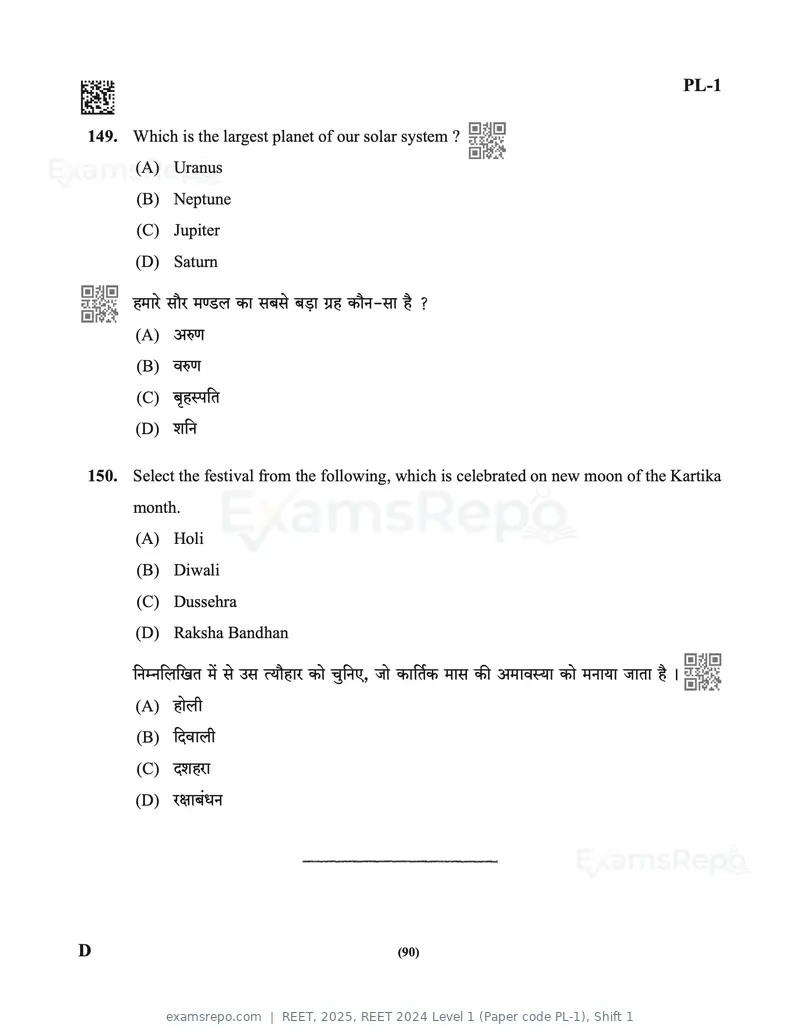
Text of page 378
PL-1

 149. Which is the largest planet of our solar system ?
        (A) Uranus
        (B) Neptune
        (C) Jupiter
        (D) Saturn

		 h_mao gm¡a _ÊS>b H$m g~go ~‹S>m J«h H$m¡Z-gm h¡ ?
   (A) AéU
        (B) déU
        (C) ~¥hñn{V
        (D) e{Z

 150. Select the festival from the following, which is celebrated on new moon of the Kartika
        month.
        (A) Holi
        (B) Diwali
        (C) Dussehra
        (D) Raksha Bandhan

		 {ZåZ{b{IV _| go Cg Ë`m¡hma H$mo Mw{ZE, Omo H$m{V©H$ _mg H$s A_mdñ`m H$mo _Zm`m OmVm h¡ &
    (A) hmobr
    (B) {Xdmbr
    (C) Xeham
    (D) ajm~§YZ


D                                               (90)
Text of page 383
DO
            NO
              T
(95)              WR
                    IT
                       EH
                         ER
                            E
D                               PL-1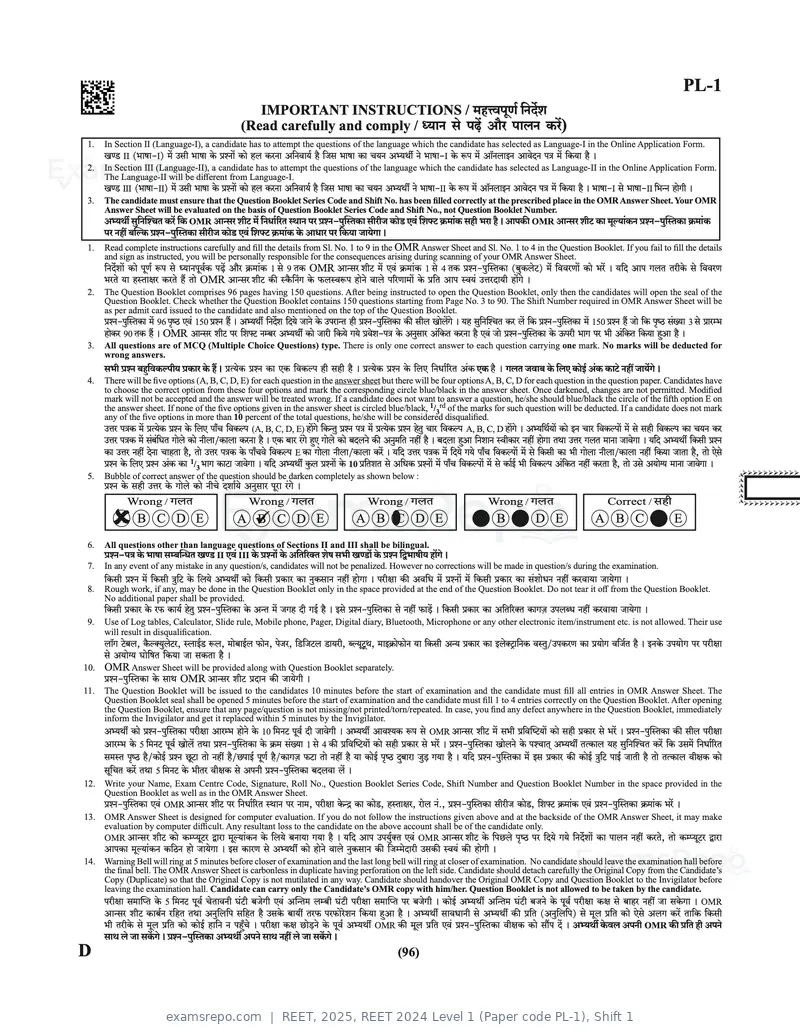
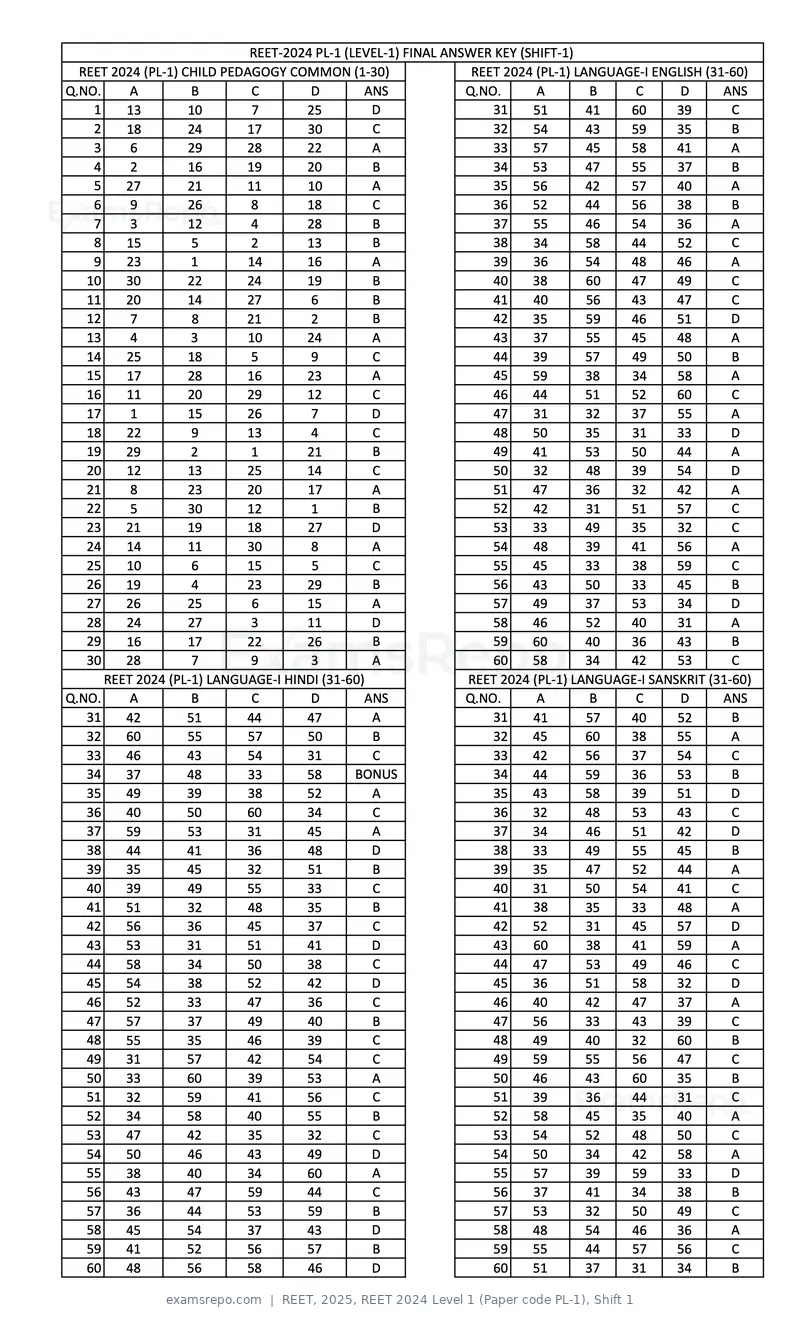
Text of page 1
REET‐2024 PL‐1 (LEVEL‐1) FINAL ANSWER KEY (SHIFT‐1)
  REET 2024 (PL‐1) CHILD PEDAGOGY COMMON (1‐30)                 REET 2024 (PL‐1) LANGUAGE‐I ENGLISH (31‐60)
Q.NO.     A          B       C        D        ANS             Q.NO.      A         B    C      D      ANS
    1    13         10        7      25         D                  31    51        41   60     39       C
    2    18         24      17       30         C                  32    54        43   59     35       B
    3     6         29      28       22         A                  33    57        45   58     41       A
    4     2         16      19       20         B                  34    53        47   55     37       B
    5    27         21      11       10         A                  35    56        42   57     40       A
    6     9         26       8       18         C                  36    52        44   56     38       B
    7     3         12       4       28         B                  37    55        46   54     36       A
    8    15          5       2       13         B                  38    34        58   44     52       C
    9    23          1       14      16         A                  39    36        54   48     46       A
   10    30         22      24       19         B                  40    38        60   47     49       C
   11    20         14      27        6         B                  41    40        56   43     47       C
   12     7          8      21        2         B                  42    35        59   46     51       D
   13     4          3       10      24         A                  43    37        55   45     48       A
   14    25         18       5        9         C                  44    39        57   49     50       B
   15    17         28      16       23         A                  45    59        38   34     58       A
   16    11         20      29       12         C                  46    44        51   52     60       C
   17     1         15      26        7         D                  47    31        32   37     55       A
   18    22          9      13        4         C                  48    50        35   31     33       D
   19    29          2       1       21         B                  49    41        53   50     44       A
   20    12         13      25       14         C                  50    32        48   39     54       D
   21     8         23      20       17         A                  51    47        36   32     42       A
   22     5         30      12        1         B                  52    42        31   51     57       C
   23    21         19      18       27         D                  53    33        49   35     32       C
   24    14         11      30        8         A                  54    48        39   41     56       A
   25    10          6      15        5         C                  55    45        33   38     59       C
   26    19          4      23       29         B                  56    43        50   33     45       B
   27    26         25        6      15         A                  57    49        37   53     34       D
   28    24         27       3       11         D                  58    46        52   40     31       A
   29    16         17      22       26         B                  59    60        40   36     43       B
   30    28          7       9        3         A                  60    58        34   42     53       C
      REET 2024 (PL‐1) LANGUAGE‐I HINDI (31‐60)                REET 2024 (PL‐1) LANGUAGE‐I SANSKRIT (31‐60)
Q.NO.     A          B       C        D        ANS             Q.NO.      A         B    C      D      ANS
   31    42         51      44       47         A                  31    41        57   40     52       B
   32    60         55       57      50         B                  32    45        60   38     55       A
   33    46         43       54      31         C                  33    42        56   37     54       C
   34    37         48       33      58       BONUS                34    44        59   36     53       B
   35    49         39       38      52         A                  35    43        58   39     51       D
   36    40         50      60       34         C                  36    32        48   53     43       C
   37    59         53      31       45         A                  37    34        46   51     42       D
   38    44         41      36       48         D                  38    33        49   55     45       B
   39    35         45      32       51         B                  39    35        47   52     44       A
   40    39         49      55       33         C                  40    31        50   54     41       C
   41    51         32       48      35         B                  41    38        35   33     48       A
   42    56         36      45       37         C                  42    52        31   45     57       D
   43    53         31      51       41         D                  43    60        38   41     59       A
   44    58         34      50       38         C                  44    47        53   49     46       C
   45    54         38      52       42         D                  45    36        51   58     32       D
   46    52         33      47       36         C                  46    40        42   47     37       A
   47    57         37       49      40         B                  47    56        33   43     39       C
   48    55         35      46       39         C                  48    49        40   32     60       B
   49    31         57      42       54         C                  49    59        55   56     47       C
   50    33         60       39      53         A                  50    46        43   60     35       B
   51    32         59      41       56         C                  51    39        36   44     31       C
   52    34         58      40       55         B                  52    58        45   35     40       A
   53    47         42       35      32         C                  53    54        52   48     50       C
   54    50         46      43       49         D                  54    50        34   42     58       A
   55    38         40      34       60         A                  55    57        39   59     33       D
   56    43         47       59      44         C                  56    37        41   34     38       B
   57    36         44      53       59         B                  57    53        32   50     49       C
   58    45         54      37       43         D                  58    48        54   46     36       A
   59    41         52      56       57         B                  59    55        44   57     56       C
   60    48         56      58       46         D                  60    51        37   31     34       B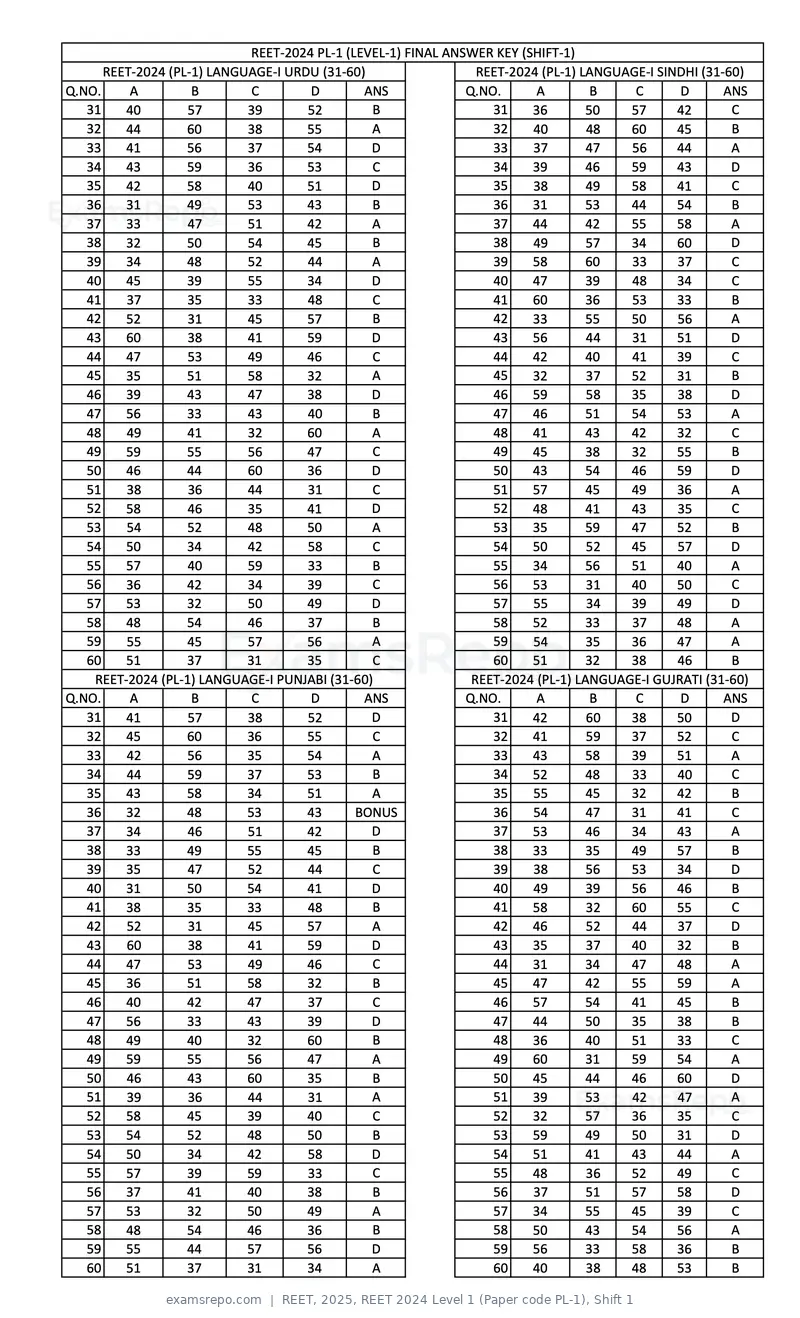
Text of page 2
REET‐2024 PL‐1 (LEVEL‐1) FINAL ANSWER KEY (SHIFT‐1)
      REET‐2024 (PL‐1) LANGUAGE‐I URDU (31‐60)                   REET‐2024 (PL‐1) LANGUAGE‐I SINDHI (31‐60)
Q.NO.     A         B        C        D        ANS             Q.NO.      A         B    C      D       ANS
   31    40        57       39       52         B                  31    36        50   57      42       C
   32    44        60       38       55         A                  32    40        48   60      45       B
   33    41        56       37       54         D                  33    37        47   56      44       A
   34    43        59       36       53         C                  34    39        46   59      43       D
   35    42        58       40       51         D                  35    38        49   58      41       C
   36    31        49       53       43         B                  36    31        53   44      54       B
   37    33        47       51       42         A                  37    44        42   55      58       A
   38    32        50       54       45         B                  38    49        57   34      60       D
   39    34        48       52       44         A                  39    58        60   33      37       C
   40    45        39       55       34         D                  40    47        39   48      34       C
   41    37        35       33       48         C                  41    60        36   53      33       B
   42    52        31       45       57         B                  42    33        55   50      56       A
   43    60        38       41       59         D                  43    56        44   31      51       D
   44    47        53       49       46         C                  44    42        40   41      39       C
   45    35        51       58       32         A                  45    32        37   52      31       B
   46    39        43       47       38         D                  46    59        58   35      38       D
   47    56        33       43       40         B                  47    46        51   54      53       A
   48    49        41       32       60         A                  48    41        43   42      32       C
   49    59        55       56       47         C                  49    45        38   32      55       B
   50    46        44       60       36         D                  50    43        54   46      59       D
   51    38        36       44       31         C                  51    57        45   49      36       A
   52    58        46       35       41         D                  52    48        41   43      35       C
   53    54        52       48       50         A                  53    35        59   47      52       B
   54    50        34       42       58         C                  54    50        52   45      57       D
   55    57        40       59       33         B                  55    34        56   51      40       A
   56    36        42       34       39         C                  56    53        31   40      50       C
   57    53        32       50       49         D                  57    55        34   39      49       D
   58    48        54       46       37         B                  58    52        33   37      48       A
   59    55        45       57       56         A                  59    54        35   36      47       A
   60    51        37       31       35         C                  60    51        32   38      46       B
    REET‐2024 (PL‐1) LANGUAGE‐I PUNJABI (31‐60)                 REET‐2024 (PL‐1) LANGUAGE‐I GUJRATI (31‐60)
Q.NO.     A         B        C        D        ANS             Q.NO.      A         B    C      D       ANS
   31    41        57       38       52         D                  31    42        60   38      50       D
   32    45        60       36       55         C                  32    41        59   37      52       C
   33    42        56       35       54         A                  33    43        58   39      51       A
   34    44        59       37       53         B                  34    52        48   33      40       C
   35    43        58       34       51         A                  35    55        45   32      42       B
   36    32        48       53       43       BONUS                36    54        47   31      41       C
   37    34        46       51       42         D                  37    53        46   34      43       A
   38    33        49       55       45         B                  38    33        35   49      57       B
   39    35        47       52       44         C                  39    38        56   53      34       D
   40    31        50       54       41         D                  40    49        39   56      46       B
   41    38        35       33       48         B                  41    58        32   60      55       C
   42    52        31       45       57         A                  42    46        52   44      37       D
   43    60        38       41       59         D                  43    35        37   40      32       B
   44    47        53       49       46         C                  44    31        34   47      48       A
   45    36        51       58       32         B                  45    47        42   55      59       A
   46    40        42       47       37         C                  46    57        54   41      45       B
   47    56        33       43       39         D                  47    44        50   35      38       B
   48    49        40       32       60         B                  48    36        40   51      33       C
   49    59        55       56       47         A                  49    60        31   59      54       A
   50    46        43       60       35         B                  50    45        44   46      60       D
   51    39        36       44       31         A                  51    39        53   42      47       A
   52    58        45       39       40         C                  52    32        57   36      35       C
   53    54        52       48       50         B                  53    59        49   50      31       D
   54    50        34       42       58         D                  54    51        41   43      44       A
   55    57        39       59       33         C                  55    48        36   52      49       C
   56    37        41       40       38         B                  56    37        51   57      58       D
   57    53        32       50       49         A                  57    34        55   45      39       C
   58    48        54       46       36         B                  58    50        43   54      56       A
   59    55        44       57       56         D                  59    56        33   58      36       B
   60    51        37       31       34         A                  60    40        38   48      53       B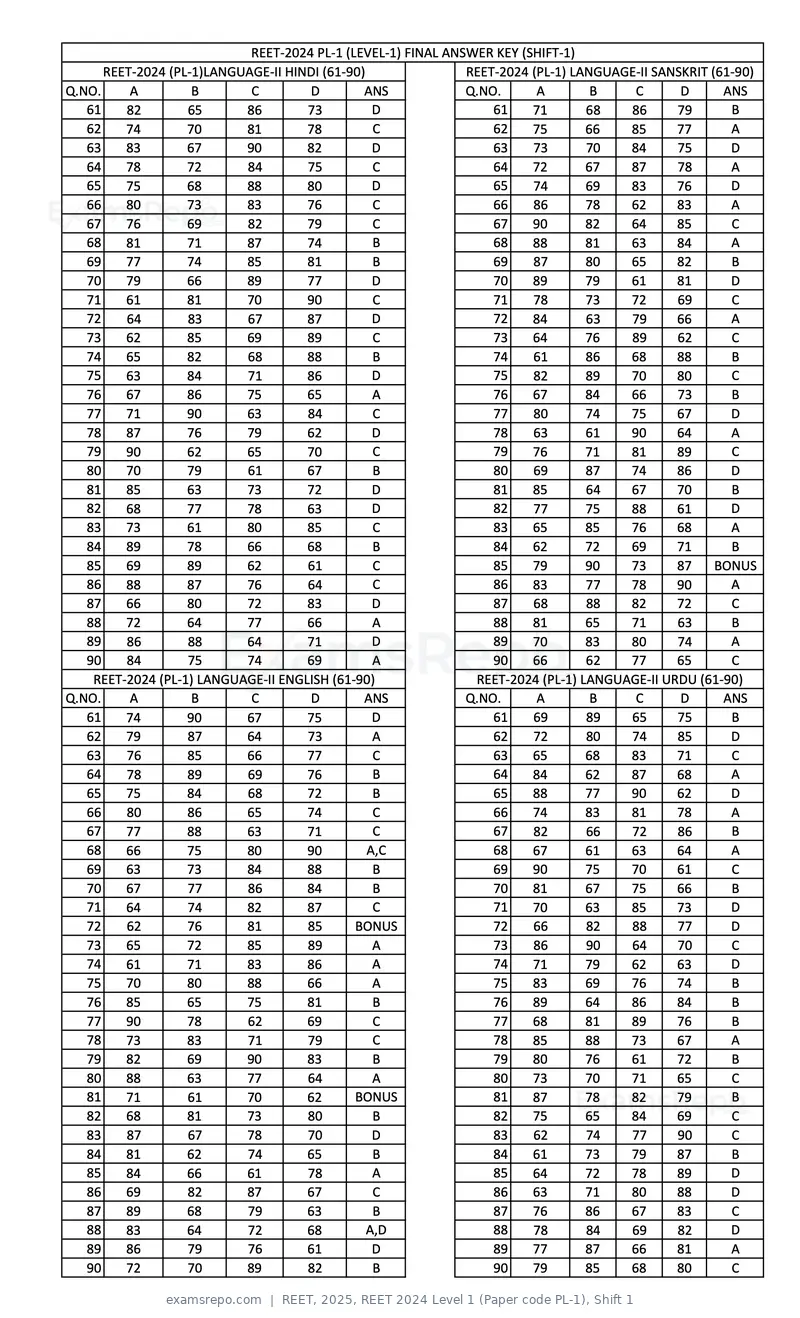
Text of page 3
REET‐2024 PL‐1 (LEVEL‐1) FINAL ANSWER KEY (SHIFT‐1)
      REET‐2024 (PL‐1)LANGUAGE‐II HINDI (61‐90)               REET‐2024 (PL‐1) LANGUAGE‐II SANSKRIT (61‐90)
Q.NO.     A         B       C        D         ANS            Q.NO.      A        B    C       D      ANS
   61    82        65      86        73          D                61    71       68   86      79       B
   62    74        70      81        78          C                62    75       66   85      77       A
   63    83        67      90        82          D                63    73       70   84      75       D
   64    78        72      84        75          C                64    72       67   87      78       A
   65    75        68      88        80          D                65    74       69   83      76       D
   66    80        73      83        76          C                66    86       78   62      83       A
   67    76        69      82        79          C                67    90       82   64      85       C
   68    81        71      87        74          B                68    88       81   63      84       A
   69    77        74      85        81          B                69    87       80   65      82       B
   70    79        66      89        77          D                70    89       79   61      81       D
   71    61        81      70        90          C                71    78       73   72      69       C
   72    64        83      67        87          D                72    84       63   79      66       A
   73    62        85      69        89          C                73    64       76   89      62       C
   74    65        82      68        88          B                74    61       86   68      88       B
   75    63        84      71        86          D                75    82       89   70      80       C
   76    67        86      75        65          A                76    67       84   66      73       B
   77    71        90      63        84          C                77    80       74   75      67       D
   78    87        76      79        62          D                78    63       61   90      64       A
   79    90        62      65        70          C                79    76       71   81      89       C
   80    70        79      61        67          B                80    69       87   74      86       D
   81    85        63      73        72          D                81    85       64   67      70       B
   82    68        77      78        63          D                82    77       75   88      61       D
   83    73        61      80        85          C                83    65       85   76      68       A
   84    89        78      66        68          B                84    62       72   69      71       B
   85    69        89      62        61          C                85    79       90   73      87     BONUS
   86    88        87      76        64          C                86    83       77   78      90       A
   87    66        80      72        83          D                87    68       88   82      72       C
   88    72        64      77        66          A                88    81       65   71      63       B
   89    86        88      64        71          D                89    70       83   80      74       A
   90    84        75      74        69          A                90    66       62   77      65       C
    REET‐2024 (PL‐1) LANGUAGE‐II ENGLISH (61‐90)               REET‐2024 (PL‐1) LANGUAGE‐II URDU (61‐90)
Q.NO.     A         B       C        D         ANS            Q.NO.      A        B    C       D      ANS
   61    74        90      67        75          D                61    69       89   65      75       B
   62    79        87      64        73          A                62    72       80   74      85       D
   63    76        85      66        77          C                63    65       68   83      71       C
   64    78        89      69        76          B                64    84       62   87      68       A
   65    75        84      68        72          B                65    88       77   90      62       D
   66    80        86      65        74          C                66    74       83   81      78       A
   67    77        88      63        71          C                67    82       66   72      86       B
   68    66        75      80        90         A,C               68    67       61   63      64       A
   69    63        73      84        88          B                69    90       75   70      61       C
   70    67        77      86        84          B                70    81       67   75      66       B
   71    64        74      82        87          C                71    70       63   85      73       D
   72    62        76      81        85      BONUS                72    66       82   88      77       D
   73    65        72      85        89          A                73    86       90   64      70       C
   74    61        71      83        86          A                74    71       79   62      63       D
   75    70        80      88        66          A                75    83       69   76      74       B
   76    85        65      75        81          B                76    89       64   86      84       B
   77    90        78      62        69          C                77    68       81   89      76       B
   78    73        83      71        79          C                78    85       88   73      67       A
   79    82        69      90        83          B                79    80       76   61      72       B
   80    88        63      77        64          A                80    73       70   71      65       C
   81    71        61      70        62      BONUS                81    87       78   82      79       B
   82    68        81      73        80          B                82    75       65   84      69       C
   83    87        67      78        70          D                83    62       74   77      90       C
   84    81        62      74        65          B                84    61       73   79      87       B
   85    84        66      61        78          A                85    64       72   78      89       D
   86    69        82      87        67          C                86    63       71   80      88       D
   87    89        68      79        63          B                87    76       86   67      83       C
   88    83        64      72        68         A,D               88    78       84   69      82       D
   89    86        79      76        61          D                89    77       87   66      81       A
   90    72        70      89        82          B                90    79       85   68      80       C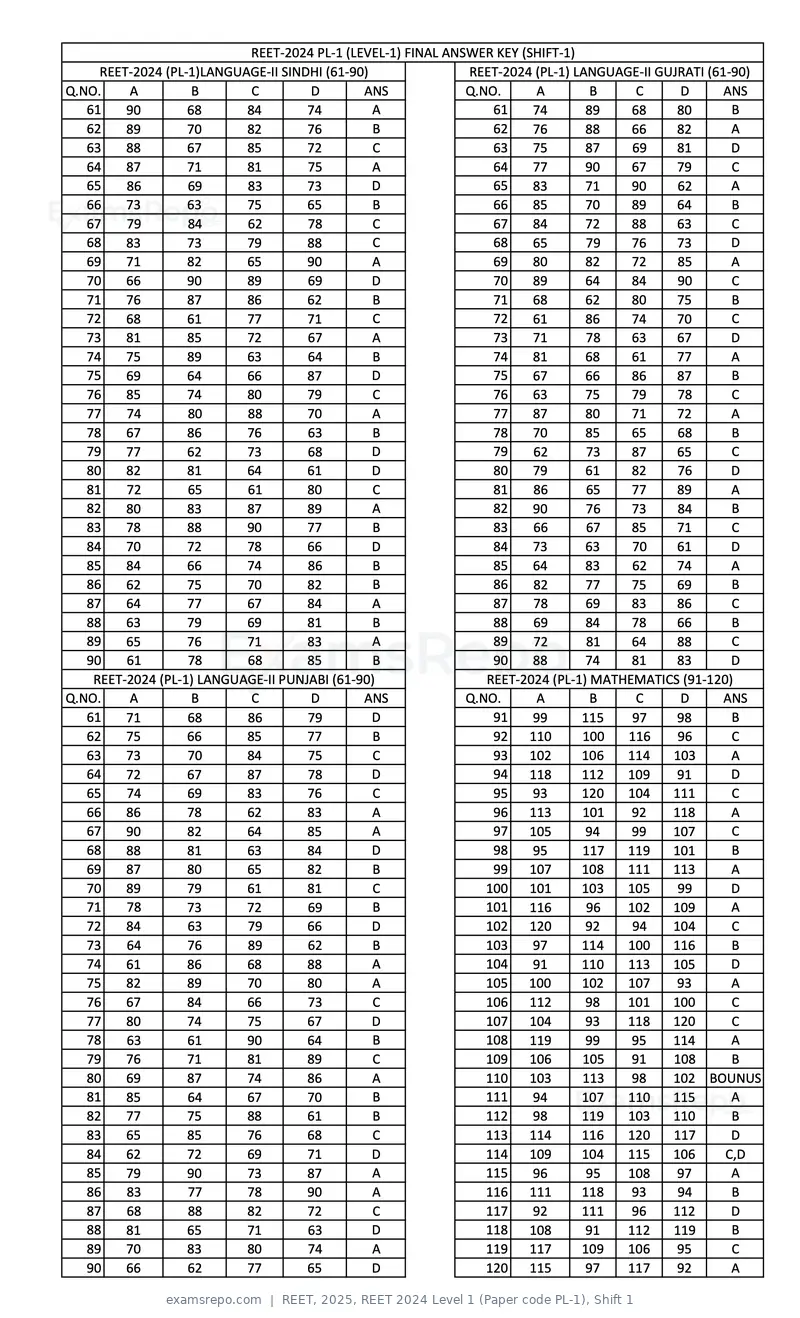
Text of page 4
REET‐2024 PL‐1 (LEVEL‐1) FINAL ANSWER KEY (SHIFT‐1)
     REET‐2024 (PL‐1)LANGUAGE‐II SINDHI (61‐90)               REET‐2024 (PL‐1) LANGUAGE‐II GUJRATI (61‐90)
Q.NO.    A          B       C        D        ANS             Q.NO.      A        B     C     D       ANS
   61    90        68      84        74         A                 61    74       89    68     80       B
   62    89        70      82        76         B                 62    76       88    66     82       A
   63    88        67      85        72         C                 63    75       87    69     81       D
   64    87        71      81        75         A                 64    77       90    67     79       C
   65    86        69      83        73         D                 65    83       71    90     62       A
   66    73        63      75        65         B                 66    85       70    89     64       B
   67    79        84      62        78         C                 67    84       72    88     63       C
   68    83        73      79        88         C                 68    65       79    76     73       D
   69    71        82      65        90         A                 69    80       82    72     85       A
   70    66        90      89        69         D                 70    89       64    84     90       C
   71    76        87      86        62         B                 71    68       62    80     75       B
   72    68        61      77        71         C                 72    61       86    74     70       C
   73    81        85      72        67         A                 73    71       78    63     67       D
   74    75        89      63        64         B                 74    81       68    61     77       A
   75    69        64      66        87         D                 75    67       66    86     87       B
   76    85        74      80        79         C                 76    63       75    79     78       C
   77    74        80      88        70         A                 77    87       80    71     72       A
   78    67        86      76        63         B                 78    70       85    65     68       B
   79    77        62      73        68         D                 79     62      73    87     65       C
   80    82        81      64        61         D                 80    79       61    82     76       D
   81    72        65      61        80         C                 81     86      65    77     89       A
   82    80        83      87        89         A                 82    90       76    73     84       B
   83    78        88      90        77         B                 83     66      67    85     71       C
   84    70        72      78        66         D                 84    73       63    70     61       D
   85    84        66      74        86         B                 85    64       83    62     74       A
   86    62        75      70        82         B                 86     82      77    75     69       B
   87    64        77      67        84         A                 87     78      69    83     86       C
   88    63        79      69        81         B                 88     69      84    78     66       B
   89    65        76      71        83         A                 89     72      81    64     88       C
   90    61        78      68        85         B                 90    88       74    81     83       D
    REET‐2024 (PL‐1) LANGUAGE‐II PUNJABI (61‐90)                 REET‐2024 (PL‐1) MATHEMATICS (91‐120)
Q.NO.    A          B       C        D        ANS             Q.NO.      A        B     C     D       ANS
   61    71        68      86        79         D                 91    99      115    97     98       B
   62    75        66      85        77         B                 92 110        100   116     96       C
   63    73        70      84        75         C                 93 102        106   114    103       A
   64    72        67      87        78         D                 94 118        112   109     91       D
   65    74        69      83        76         C                 95    93      120   104    111       C
   66    86        78      62        83         A                 96 113        101    92    118       A
   67    90        82      64        85         A                 97 105         94    99    107       C
   68    88        81      63        84         D                 98    95      117   119    101       B
   69    87        80      65        82         B                 99 107        108   111    113       A
   70    89        79      61        81         C                100    101     103   105     99       D
   71    78        73      72        69         B                101    116      96   102    109       A
   72    84        63      79        66         D                102    120      92    94    104       C
   73    64        76      89        62         B                103    97      114   100    116       B
   74    61        86      68        88         A                104    91      110   113    105       D
   75    82        89      70        80         A                105 100        102   107     93       A
   76    67        84      66        73         C                106    112      98   101    100       C
   77    80        74      75        67         D                107    104      93   118    120       C
   78    63        61      90        64         B                108    119      99    95    114       A
   79    76        71      81        89         C                109    106     105    91    108       B
   80    69        87      74        86         A                110    103     113    98    102   BOUNUS
   81    85        64      67        70         B                111    94      107   110    115       A
   82    77        75      88        61         B                112    98      119   103    110       B
   83    65        85      76        68         C                113    114     116   120    117       D
   84    62        72      69        71         D                114    109     104   115    106      C,D
   85    79        90      73        87         A                115    96       95   108     97       A
   86    83        77      78        90         A                116    111     118    93     94       B
   87    68        88      82        72         C                117    92      111    96    112       D
   88    81        65      71        63         D                118    108      91   112    119       B
   89    70        83      80        74         A                119    117     109   106     95       C
   90    66        62      77        65         D                120    115      97   117     92       A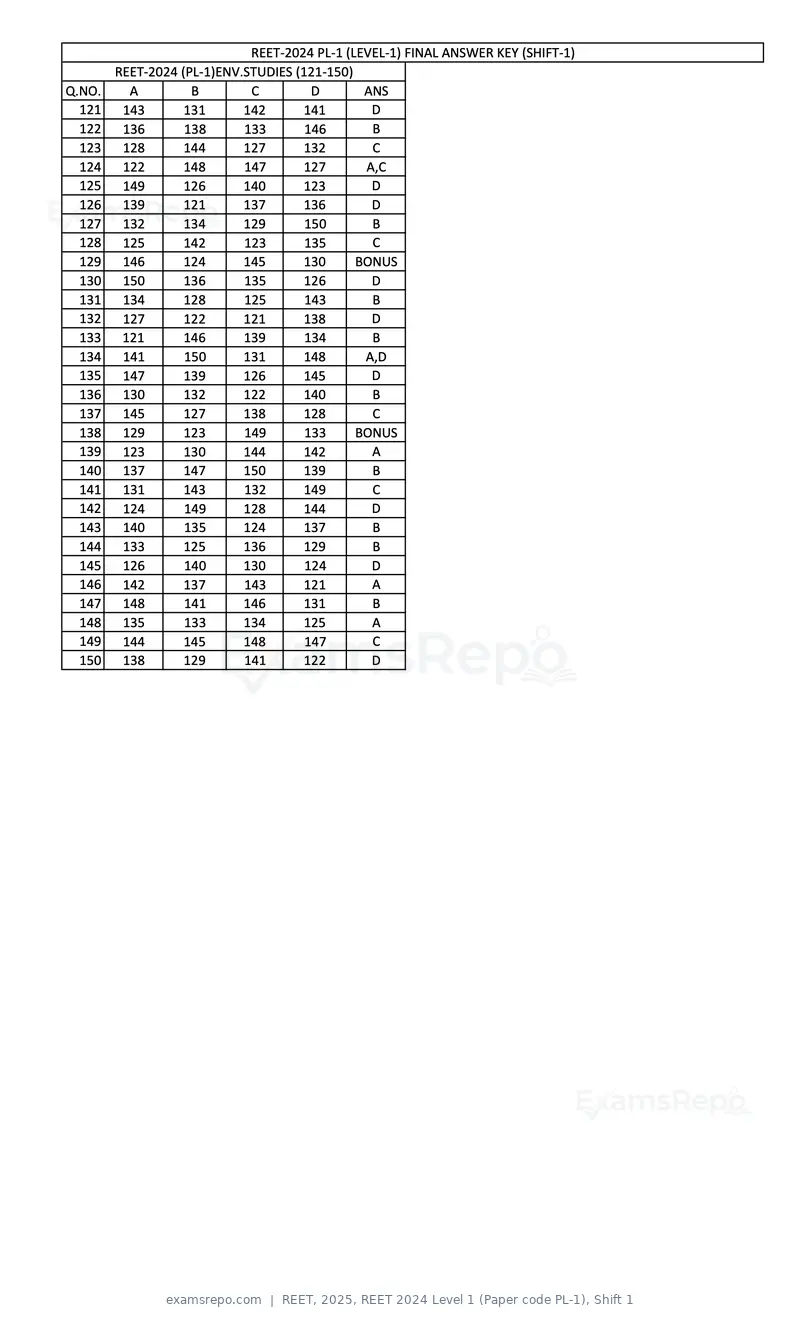
Text of page 5
REET‐2024 PL‐1 (LEVEL‐1) FINAL ANSWER KEY (SHIFT‐1)
        REET‐2024 (PL‐1)ENV.STUDIES (121‐150)
Q.NO.     A         B        C         D       ANS
  121    143       131      142      141        D
  122    136       138      133       146       B
  123    128       144      127      132        C
  124    122       148      147      127       A,C
  125    149       126      140      123        D
  126    139       121      137      136        D
  127    132       134      129       150       B
  128    125       142      123       135       C
  129    146       124      145      130      BONUS
  130    150       136      135      126        D
  131    134       128      125       143       B
  132    127       122      121      138        D
  133    121       146      139       134       B
  134    141       150      131      148       A,D
  135    147       139      126      145        D
  136    130       132      122      140        B
  137    145       127      138      128        C
  138    129       123      149       133     BONUS
  139    123       130      144      142        A
  140    137       147      150      139        B
  141    131       143      132      149        C
  142    124       149      128      144        D
  143    140       135      124      137        B
  144    133       125      136      129        B
  145    126       140      130       124       D
  146    142       137      143      121        A
  147    148       141      146      131        B
  148    135       133      134      125        A
  149    144       145      148       147       C
  150    138       129      141      122        D
Page 1 of 384
Source: Board of Secondary Education. Question paper published by Board of Secondary Education.