
REET 2025: REET 2024 Level 2 (Paper code RL-2), Shift 3
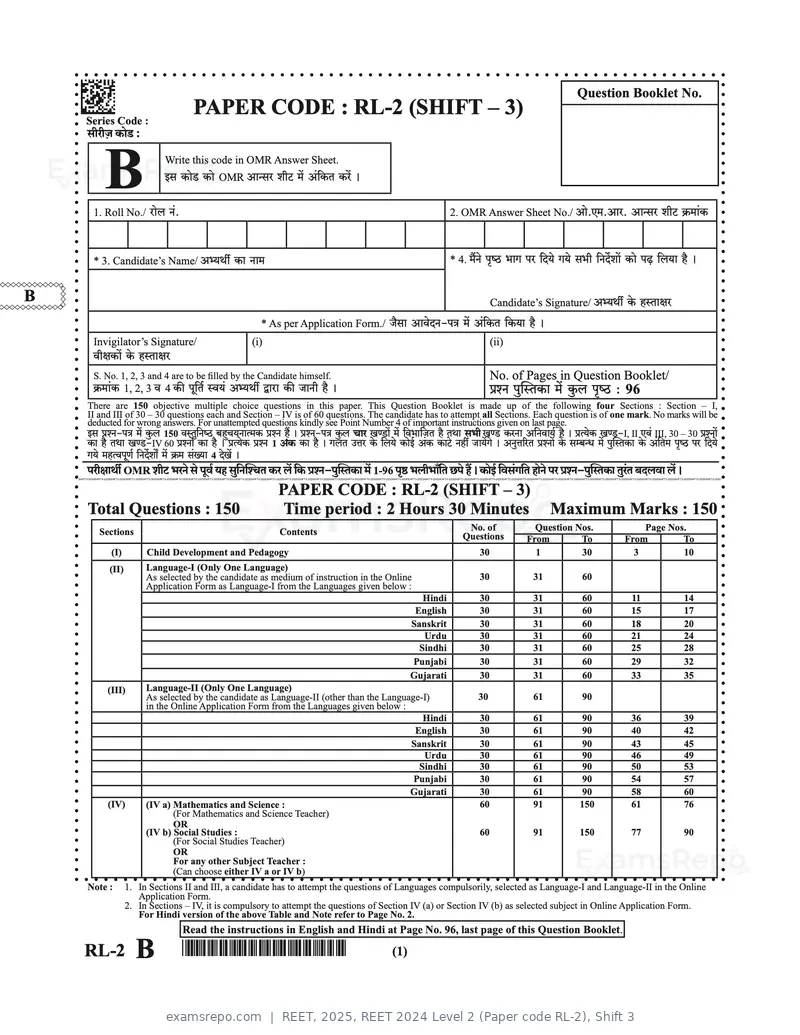
Text of page 1
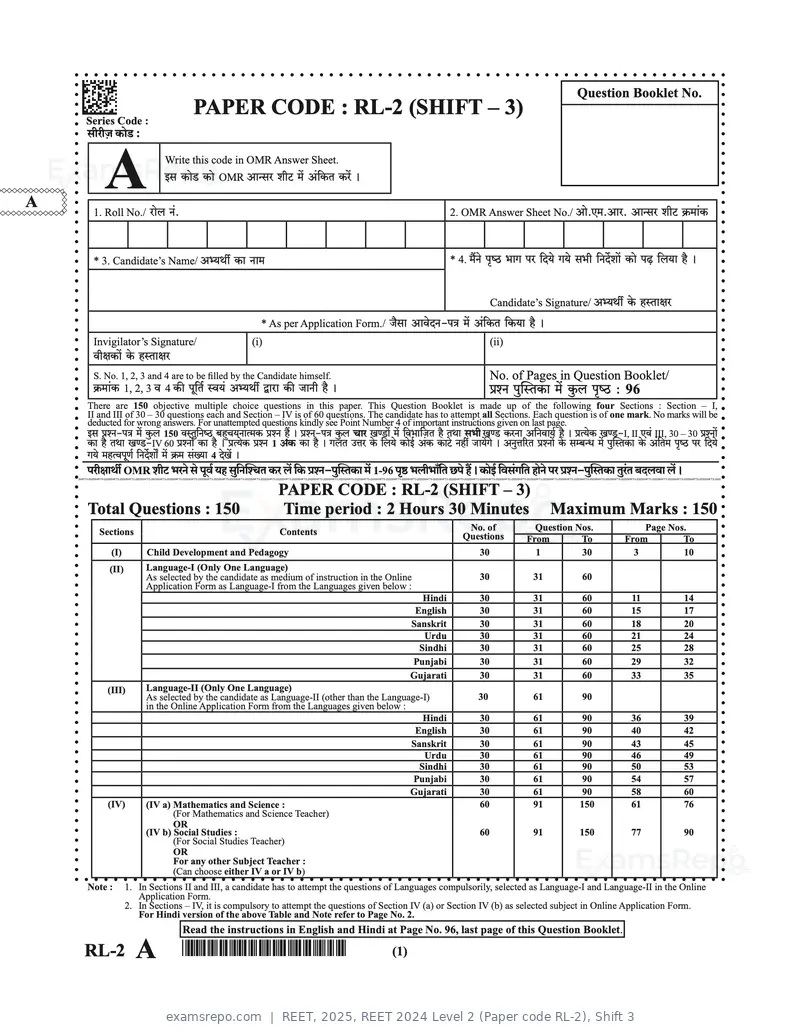
Question Booklet No.
Series Code :
PAPER CODE : RL-2 (SHIFT – 3)
A
grarµO H$moS> :
Write this code in OMR Answer Sheet.
Bg H$moS> H$mo OMR AmÝga erQ> _| A§{H$V H$a| &
A
1. Roll No./ amob Z§. 2. OMR Answer Sheet No./ Amo.E_.Ama. AmÝga erQ> H«$_m§H$
* 3. Candidate’s Name/ Aä`Wu H$m Zm_ * 4. _¢Zo n¥îR> ^mJ na {X`o J`o g^r {ZX}em| H$mo n‹T> {b`m h¡ &
Candidate’s Signature/ Aä`Wu Ho$ hñVmja
* As per Application Form./ O¡gm AmdoXZ-nÌ _| A§{H$V {H$`m h¡ &
Invigilator’s Signature/ (i) (ii)
drjH$m| Ho$ hñVmja
S. No. 1, 2, 3 and 4 are to be filled by the Candidate himself. No. of Pages in Question Booklet/
H«$_m§H$ 1, 2, 3 d 4 H$s ny{V© ñd`§ Aä`Wu Ûmam H$s OmZr h¡ & àíZ nwpñVH$m _| Hw$b n¥îR> : 96
There are 150 objective multiple choice questions in this paper. This Question Booklet is made up of the following four Sections : Section – I,
II and III of 30 – 30 questions each and Section – IV is of 60 questions. The candidate has to attempt all Sections. Each question is of one mark. No marks will be
deducted for wrong answers. for unattempted questions kindly see point number 4 of important instructions given on last page.
Bg àíZ-nÌ _| Hw$b 150 dñVw{ZîR> ~hþM`ZmË_H$ àíZ h¢ & àíZ-nÌ Hw$b Mma IÊS>m| _| {d^m{OV h¡ VWm g^r IÊS> H$aZm A{Zdm`© h¡ & àË`oH$ IÊS>-I, II Ed§ III, 30 – 30 àíZm|
H$m h¡ VWm IÊS>-IV 60 àíZm| H$m h¡ & àË`oH$ àíZ 1 A§H$ H$m h¡ & JbV CÎma Ho$ {b`o H$moB© A§H$ H$mQ>o Zht Om`|Jo & AZwÎm[aV àíZm| Ho$ gå~ÝY _| nwpñVH$m Ho$ A§{V_ n¥îR> na {X`o
J`o _hËdnyU© {ZX}em] _| H«$_ g§»`m 4 XoI| &
narjmWu OMR erQ> ^aZo go nyd© `h gw{ZpíMV H$a b| {H$ àíZ-nwpñVH$m _| 1-96 n¥ð> ^br^m±{V N>no h¢ & H$moB© {dg§J{V hmoZo na àíZ-nwpñVH$m Vwa§V ~Xbdm b| &
PAPER CODE : RL-2 (SHIFT – 3)
SHIFT3-2025SHIFT3-2025SHIFT3-2025SHIFT3-2025SHIFT3-2025SHIFT3-2025SHIFT3-2025SHIFT3-2025SHIFT3-2025SHIFT3-2025SHIFT3-2025SHIFT3-2025SHIFT3-2025SHIFT3-2025SHIFT3-2025SHIFT3-2025SHIFT3-2025SHIFT3-2025SHIFT3-2025SHIFT3-2025SHIFT3-2025SHIFT3-2025SHIFT3-2025SHIFT3-2025SHIFT3-2025SHIFT3-2025SHIFT3-2025SHIFT3-2025SHIFT3-2025SHIFT3-2025SHIFT3-2025SHIFT3-2025SHIFT3-2025SHIFT3-2025SHIFT3-2025SHIFT3-2025SHIFT3-2025SHIFT3-2025SHIFT3-2025SHIFT3-2025SHIFT3-2025
Total Questions : 150 Time period : 2 Hours 30 Minutes Maximum Marks : 150
Sections Contents No. of Question Nos. Page Nos.
Questions From To From To
(I) Child Development and Pedagogy 30 1 30 3 10
(II) Language-I (Only One Language)
As selected by the candidate as medium of instruction in the Online 30 31 60
Application Form as language-I from the languages given below :
Hindi 30 31 60 11 14
English 30 31 60 15 17
Sanskrit 30 31 60 18 20
Urdu 30 31 60 21 24
Sindhi 30 31 60 25 28
Punjabi 30 31 60 29 32
Gujarati 30 31 60 33 35
(III) Language-II (Only One Language)
As selected by the candidate as Language-II (other than the Language-I) 30 61 90
in the Online Application Form from the Languages given below :
Hindi 30 61 90 36 39
English 30 61 90 40 42
Sanskrit 30 61 90 43 45
Urdu 30 61 90 46 49
Sindhi 30 61 90 50 53
Punjabi 30 61 90 54 57
Gujarati 30 61 90 58 60
(IV) (IV a) Mathematics and Science : 60 91 150 61 76
(For Mathematics and Science Teacher)
OR
(IV b) Social Studies : 60 91 150 77 90
(For Social Studies Teacher)
OR
For any other Subject Teacher :
(Can choose either IV a or IV b)
Note : 1. In Sections II and III, a candidate has to attempt the questions of Languages compulsorily, selected as Language-I and Language-II in the Online
Application Form.
2. In Sections – IV, it is compulsory to attempt the questions of Section IV (a) or Section IV (b) as selected subject in Online Application Form.
For Hindi version of the above Table and Note refer to Page No. 2.
Read the instructions in English and Hindi at Page No. 96, last page of this Question booklet.
RL-2 A *RL2SHIFT3A* (1)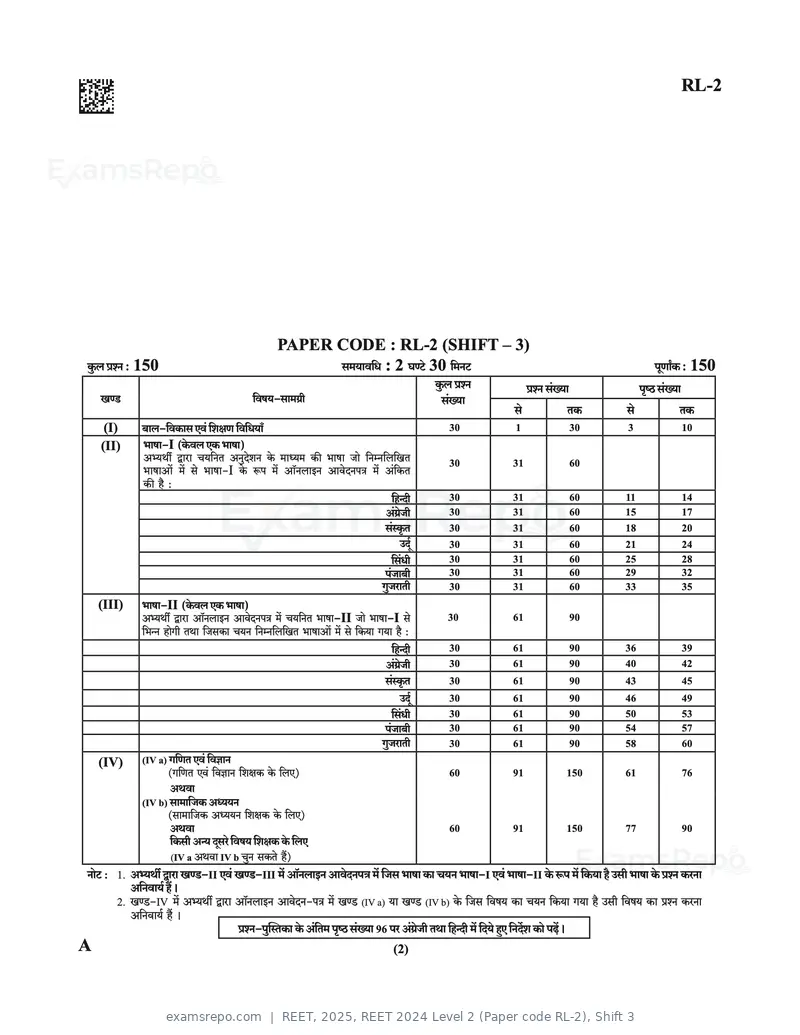
Text of page 15
RL-2

                                    SECTION – II
                                   LANGUAGE – I
                                       ENGLISH
                      There are 30 questions in all in this Section.
                              All questions are compulsory.
31. Which out of following is incorrect ?
    Principle of naturalness in teaching, learning of English consists of
    (A) Talking to students in foreign language in the class, playground etc.
    (B) Giving grades and sequence.
    (C) Arranging for group discussions.
    (D) Encouraging students to converse in target language.
32. Choose the right question for
    ‘Rani went to Delhi by bus’.
    (A) Does Rani go to Delhi by bus ?       (B) Did Rani go to Delhi by bus ?
    (C) Did Rani went to Delhi by bus ? (D) Do Rani go to Delhi by bus ?
33. Which one is not the aim of intensive reading ?
    (A) To enable students to speak English correctly.
    (B) To increase students active vocabulary.
    (C) To concentrate upon language.
    (D) To save time.
34. Phonetic symbol for “show” is
    (A) ʃəʊ            (B) soʊ               (C) ʃo            (D) sho
35. Choose the right question for
    ‘He has given a pen to Radha’.
    (A) To whom has he given a pen ?         (B) To who has he given a pen ?
    (C) To whose has he given a pen ?        (D) To what has he given a pen ?
36. The evaluation cycle has not one of these elements :
    (A) Measurement                          (B) Objectives
    (C) Learning experiences                 (D) Tools and devices of evaluation
37. The old methods used to teach English language are
    (A) Translation cum grammar method and direct method.
    (B) Translation cum grammar method and bilingual method.
    (C) Translation cum grammar method and substitutional method.
    (D) Translation cum grammar method and multilingualism.
38. Choose the correct passive voice for
    ‘Some boys were helping the wounded man’.
    (A) The wounded man were helped by some boys.
    (B) The wounded man was helped by some boys.
    (C) The wounded man was helping by some boys.
    (D) The wounded man was being helped by some boys.
                                          (15)                                       A
Text of page 16
RL-2

    39. Out of the following which is not a quality of good handwriting ?
        (A) Legibility     (B) Attractiveness (C) Uniformity (D) Writing slowly
    40. Rubrics can be used for :
        (A) Self assessment and peer assessment.
        (B) Students and teacher assessment.
        (C) Teacher assessment.
        (D) Teacher and parents assessment.
    41. Choose the correct indirect speech for
        The policeman said to us, “where are you going ?”
        (A) The policeman asked that where we are going.
        (B) The policeman enquired where we were going.
        (C) The policeman asked us where we are going.
        (D) The policeman enquired us where were are going.
    42. Which out of the following is not related to the direct method of learning English ?
        (A) Grammar is taught systematically.
        (B) It makes pupil to think in English.
        (C) It enable pupil to express his thoughts and feelings directly by means of English.
        (D) This method is interesting because it is full of activity.
 43. In close test students are asked :
     (A) To answer questions with the help of their peer who is close to them.
     (B) To answer questions with the help of a text book which is closed.
     (C) To fill the blank or delete words from the passage to complete the idea.
     (D) To point out the error from the options.
 44. The number of consonant sounds is
     (A) 21               (B) 22                (C) 23             (D) 24
 45. In language structures can be divided into ________ categories.
     (A) 2 (two)          (B) 3 (three)         (C) 4 (four)       (D) 5 (five)
Read the passage and answer the questions (Q. Nos. 46-52) that follow :
      At the circus I had no chance to study human beings. They had sat in their seats
peacefully while I cowered before captain’s whip. I got totally wrong idea of human
beings at that angle. I had thought that they were strong and fearless. But now I found
them running from me like a herd of deer, although I had no intention of attacking them.
When I paused in front of a tailor’s shop, he abandoned his machine and shut himself in
a cupboard, wailing. “Alas, I am undone, won’t someone shoot that tiger ?”
 46. The correct spelling is
     (A) Machinist        (B) Machinest         (C) Machineist     (D) Machiniest
    47. Correct adjective form of ‘intention’ is
        (A) Intentionally (B) Intentionaly       (C) Intently     (D) Intentional
    48. The synonym of ‘chance’ is
        (A) Cowered        (B) Totally           (C) Thoughtfully (D) Opportunity
A                                               (16)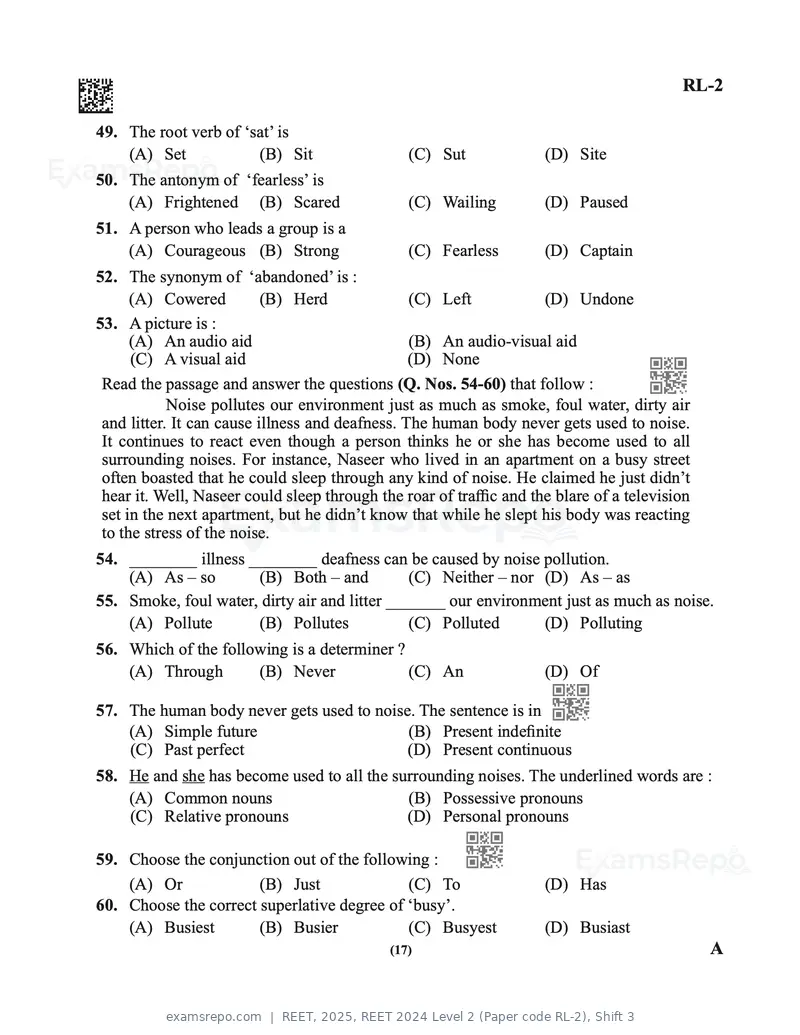
Text of page 17
RL-2

49. The root verb of ‘sat’ is
    (A) Set            (B) Sit                  (C) Sut              (D) Site
50. The antonym of ‘fearless’ is
    (A) Frightened (B) Scared                   (C) Wailing          (D) Paused
51. A person who leads a group is a
    (A) Courageous (B) Strong                   (C) Fearless         (D) Captain
52. The synonym of ‘abandoned’ is :
      (A) Cowered          (B) Herd              (C) Left            (D) Undone
53. A picture is :
      (A) An audio aid                           (B) An audio-visual aid
      (C) A visual aid                           (D) None
 Read the passage and answer the questions (Q. Nos. 54-60) that follow :
            Noise pollutes our environment just as much as smoke, foul water, dirty air
 and litter. It can cause illness and deafness. The human body never gets used to noise.
 It continues to react even though a person thinks he or she has become used to all
 surrounding noises. For instance, Naseer who lived in an apartment on a busy street
 often boasted that he could sleep through any kind of noise. He claimed he just didn’t
 hear it. Well, Naseer could sleep through the roar of traffic and the blare of a television
 set in the next apartment, but he didn’t know that while he slept his body was reacting
 to the stress of the noise.
54. ________ illness ________ deafness can be caused by noise pollution.
    (A) As – so       (B) Both – and           (C) Neither – nor (D) As – as
55. Smoke, foul water, dirty air and litter _______ our environment just as much as noise.
    (A) Pollute       (B) Pollutes             (C) Polluted      (D) Polluting
56. Which of the following is a determiner ?
    (A) Through       (B) Never              (C) An                  (D) Of

57. The human body never gets used to noise. The sentence is in
    (A) Simple future                      (B) Present indefinite
    (C) Past perfect                       (D) Present continuous
58. He and she has become used to all the surrounding noises. The underlined words are :
    (A) Common nouns                        (B) Possessive pronouns
    (C) Relative pronouns                   (D) Personal pronouns

59. Choose the conjunction out of the following :
    (A) Or             (B) Just              (C) To                  (D) Has
60. Choose the correct superlative degree of ‘busy’.
    (A) Busiest        (B) Busier            (C) Busyest             (D) Busiast
                                             (17)                                              A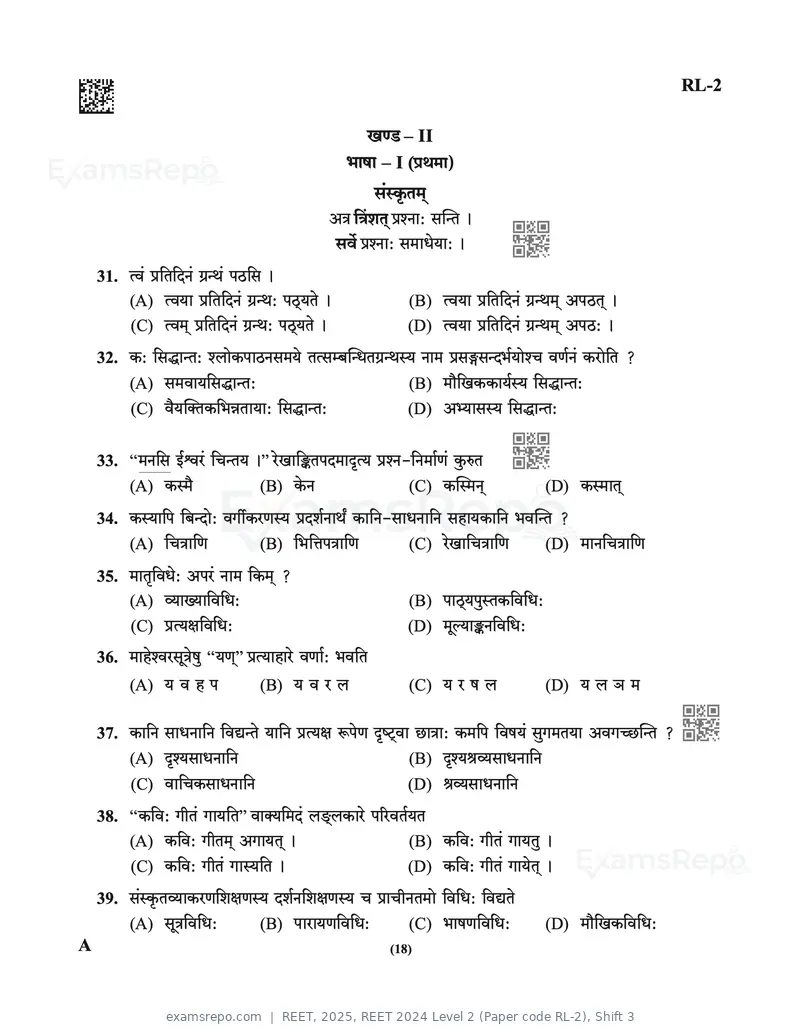
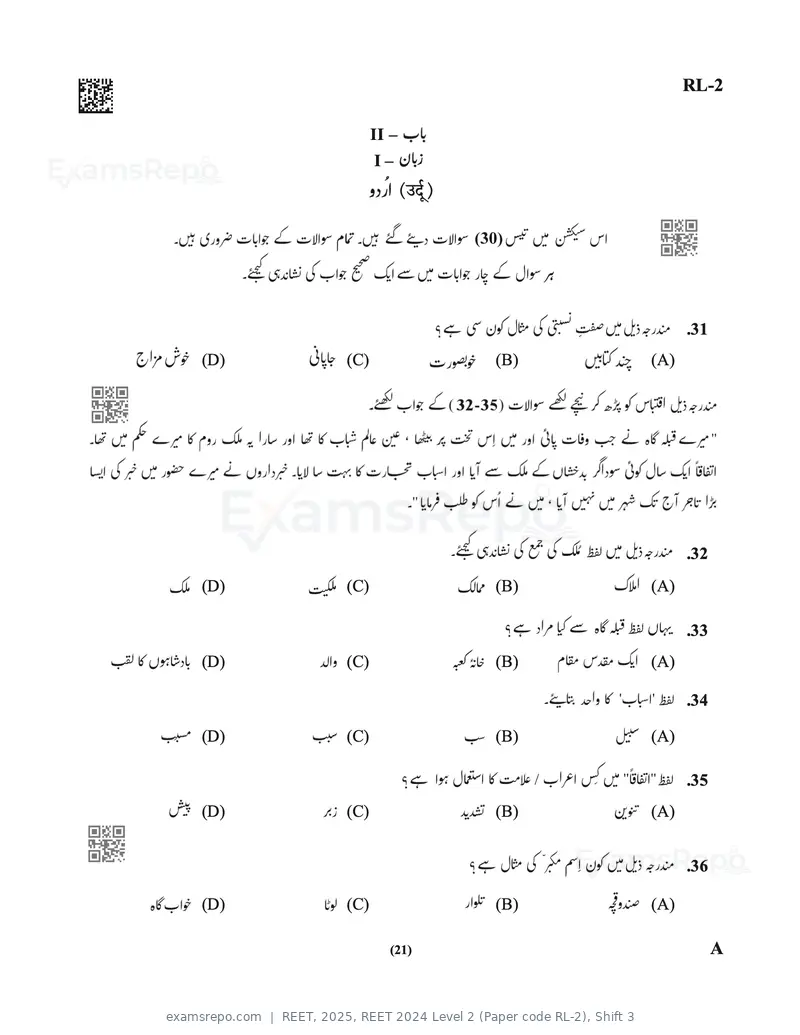
Text of page 21
RL-2

            II –
            I–
                   (CXÿ© )


                                         .31
(D)   (C)                    (B)   (A)


                                         .32
(D)   (C)                    (B)   (A)

                                         .33
(D)   (C)                    (B)   (A)

                                         .34

(D)   (C)                    (B)   (A)

                                         .35
(D)   (C)                    (B)   (A)


                                         .36

(D)   (C)                    (B)   (A)

              (21)                             A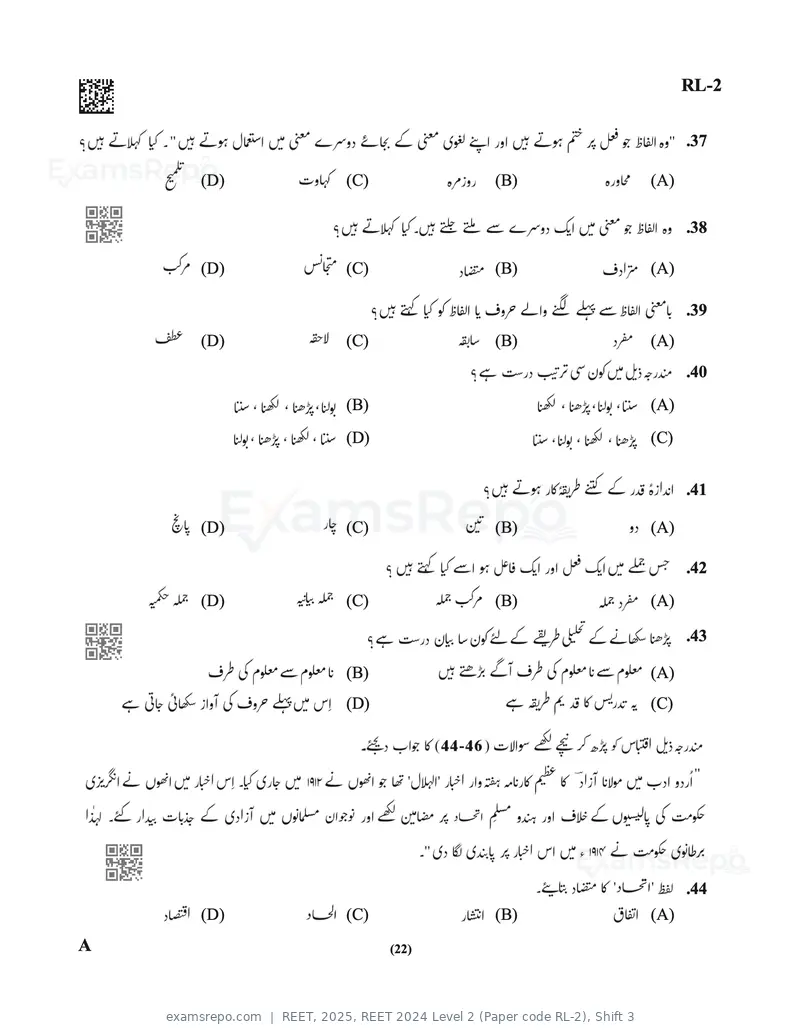
Text of page 22
RL-2

                                   .37

    (D)   (C)          (B)   (A)

                                   .38

    (D)   (C)          (B)   (A)

                                   .39
    (D)   (C)          (B)   (A)
                                   .40
          (B)                (A)
          (D)                (C)


                                   .41

    (D)   (C)          (B)   (A)

                                   .42
    (D)   (C)          (B)   (A)

                                   .43

          (B)                (A)
          (D)                (C)


                                   .44
    (D)   (C)          (B)   (A)
A               (22)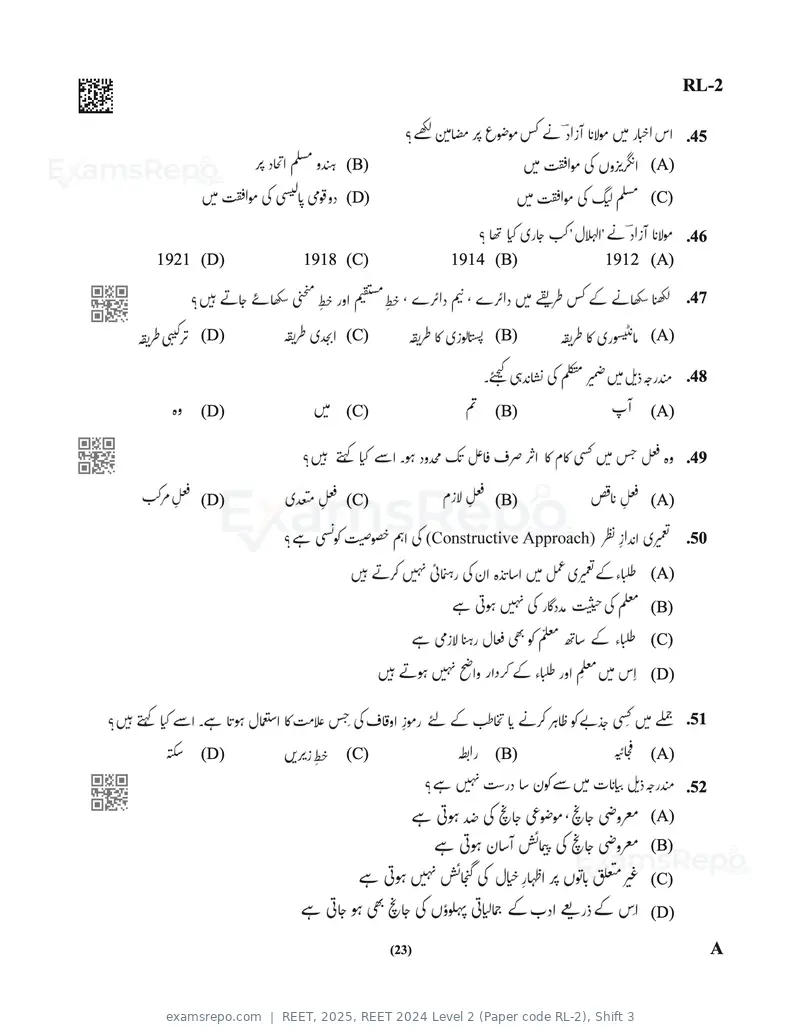
Text of page 23
RL-2

                                                   .45
                (B)                          (A)
                (D)                          (C)

                                                   .46
1921 (D)   1918 (C)          1914 (B)   1912 (A)

                                                   .47

     (D)        (C)               (B)        (A)

                                                   .48

     (D)        (C)               (B)        (A)

                                                   .49

     (D)        (C)               (B)        (A)

                                                   .50

                                             (A)
                                             (B)
                                             (C)

                                             (D)

                                                   .51

     (D)        (C)               (B)        (A)
                                                   .52
                                             (A)
                                             (B)
                                             (C)
                                             (D)

                      (23)                               A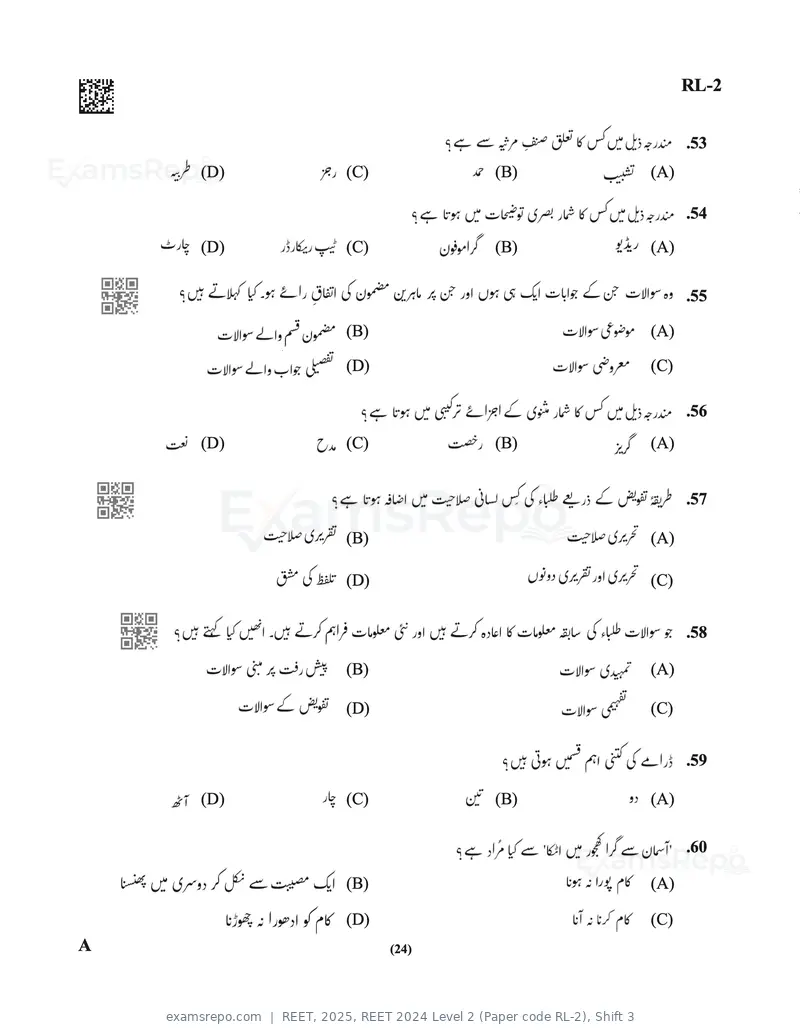
Text of page 24
RL-2


                                   .53
    (D)   (C)          (B)   (A)

                                   .54
    (D)   (C)          (B)   (A)

                                   .55

          (B)                (A)

          (D)                (C)

                                   .56
    (D)   (C)          (B)   (A)


                                   .57

          (B)                (A)

          (D)                (C)


                                   .58

          (B)                (A)

          (D)                (C)


                                   .59

    (D)   (C)          (B)   (A)

                                   .60

          (B)                (A)

          (D)                (C)
A               (24)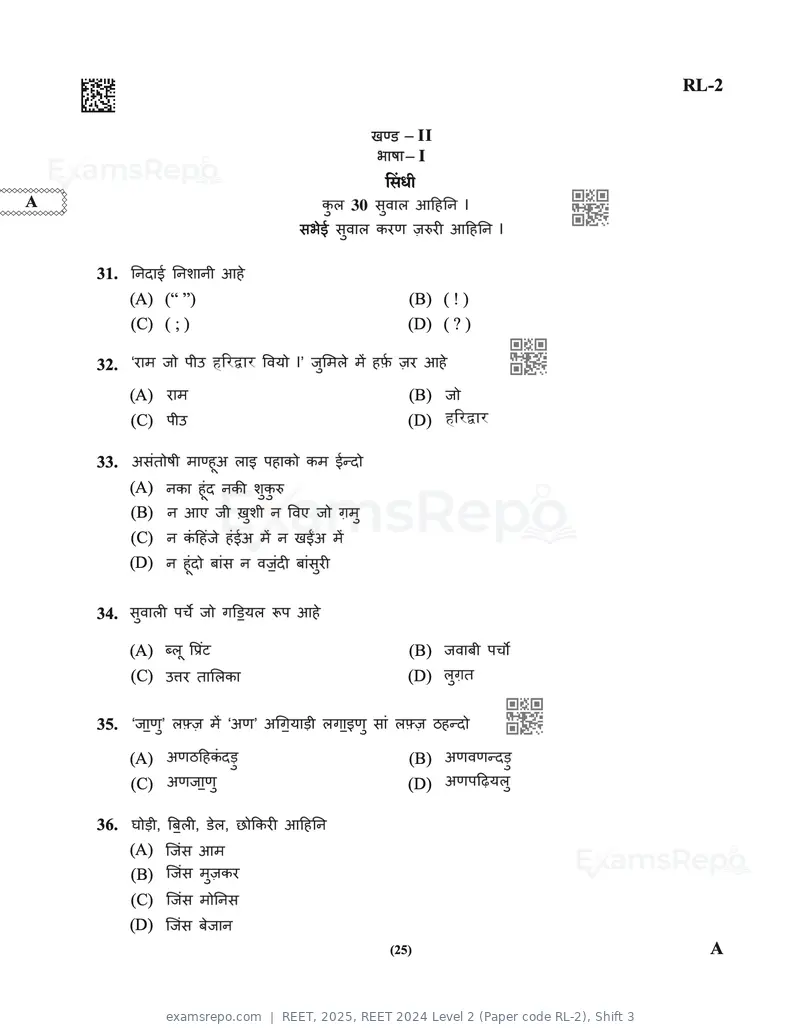
Text of page 25
RL-2

                        – II
                        –I
                      qgYr
A


    31.
          (A) (“ ”)      (B) ( ! )
          (C) ( ; )      (D) ( ? )

    32.
          (A)            (B)
          (C)            (D)

    33.
          (A)
          (B)
          (C)
          (D)


    34.

          (A)            (B)
          (C)            (D)

    35.

          (A)            (B)
          (C)            (D)

    36.
          (A)
          (B)
          (C)
          (D)
                      (25)             A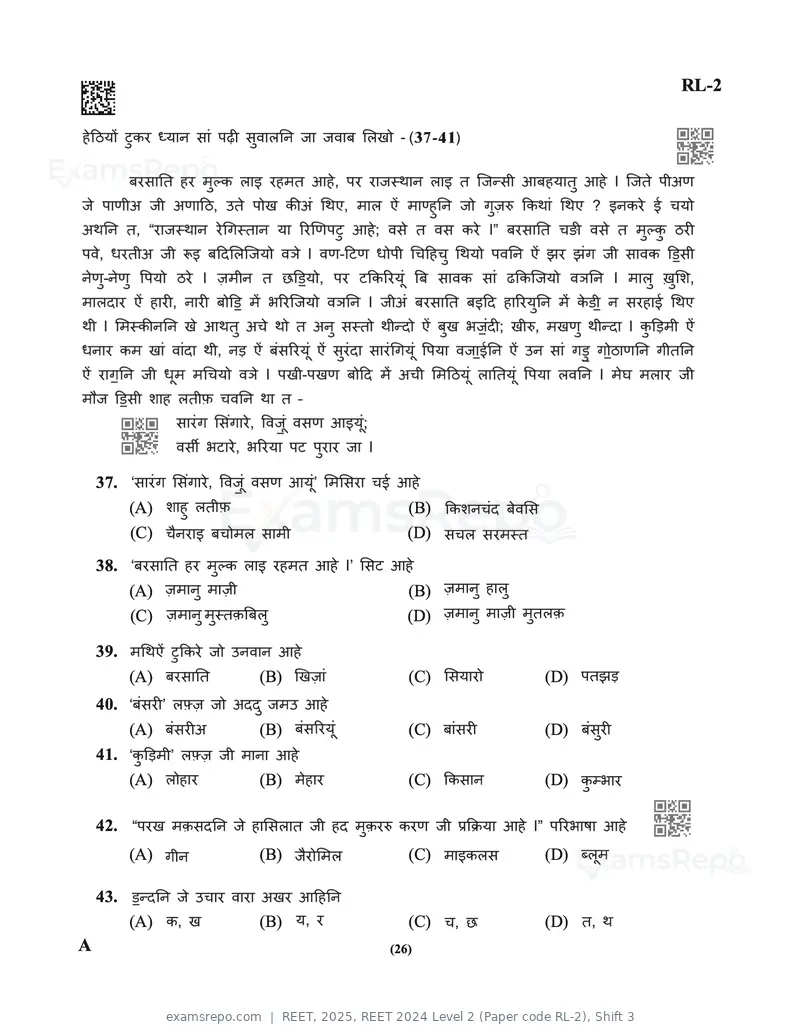
Text of page 26
RL-2


    37.
          (A)            (B)
          (C)            (D)
    38.
          (A)            (B)
          (C)            (D)

    39.
          (A)   (B)      (C)   (D)
    40.
          (A)   (B)      (C)   (D)
    41.
          (A)   (B)      (C)   (D)

    42.
          (A)   (B)      (C)   (D)

    43.
          (A)   (B)      (C)   (D)
A                     (26)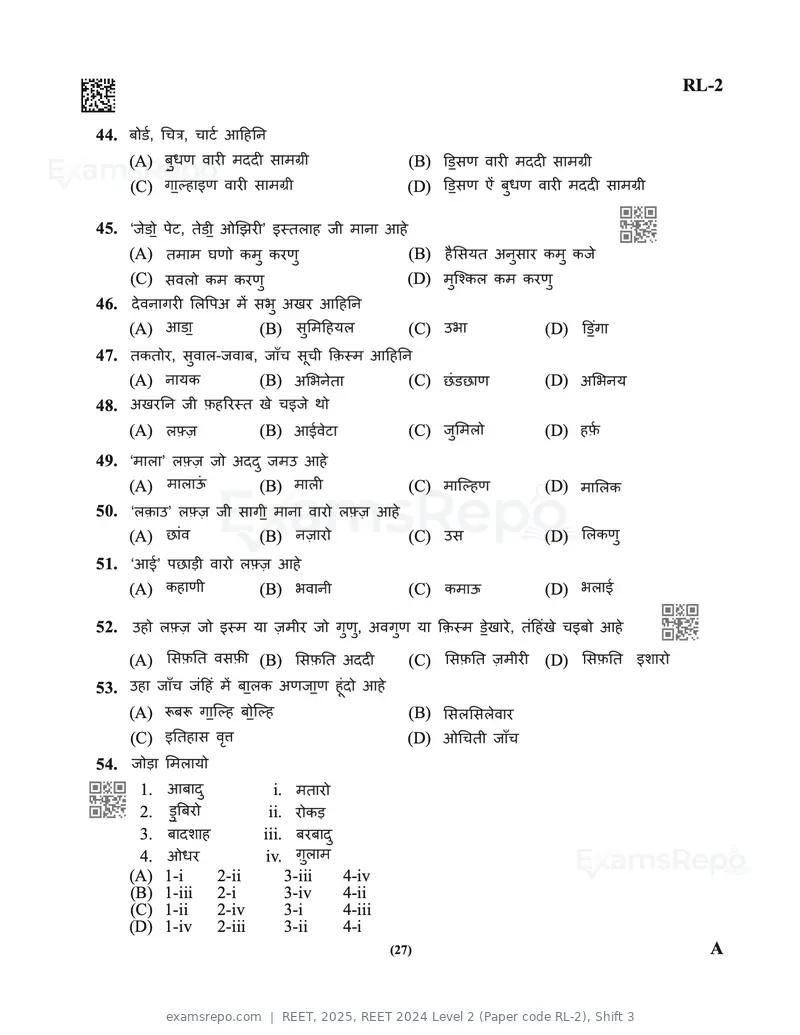
Text of page 27
RL-2

44.
      (A)                                           (B)
      (C)                                           (D)

45.
      (A)                                           (B)
      (C)                                           (D)
46.
      (A)                 (B)                       (C)   (D)
47.
      (A)                 (B)                       (C)   (D)
48.
      (A)                 (B)                       (C)   (D)
49.
      (A)                 (B)                       (C)   (D)
50.
      (A)                 (B)                       (C)   (D)
51.
      (A)                 (B)                       (C)   (D)

52.
      (A)                 (B)                       (C)   (D)
53.
      (A)                                           (B)
      (C)                                           (D)
54.
       1.                   i.
       2.                  ii.
       3.                 iii.
       4.                 iv.
      (A) 1-i     2-ii           3-iii   4-iv
      (B) 1-iii   2-i            3-iv    4-ii
      (C) 1-ii    2-iv           3-i     4-iii
      (D) 1-iv    2-iii          3-ii    4-i
                                                 (27)             A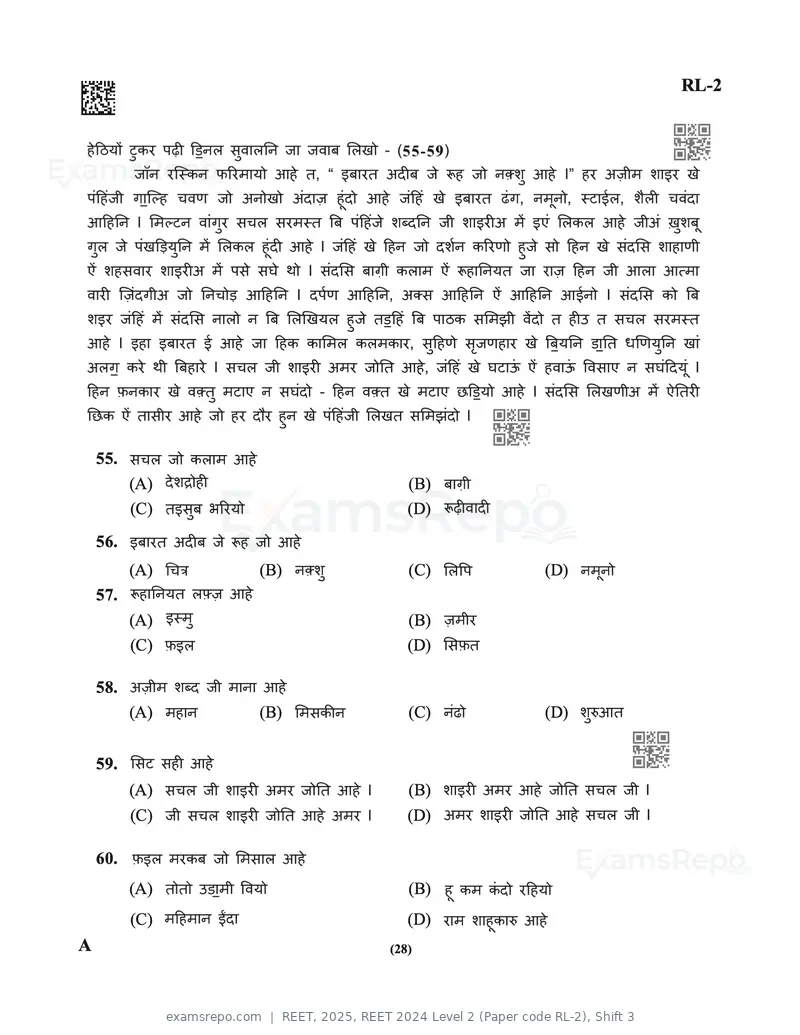
Text of page 28
RL-2


    55.
          (A)            (B)
          (C)            (D)
    56.
          (A)   (B)      (C)   (D)
    57.
          (A)            (B)
          (C)            (D)

    58.
          (A)   (B)      (C)   (D)


    59.
          (A)            (B)
          (C)            (D)

    60.
          (A)            (B)
          (C)            (D)
A                     (28)
Text of page 29
RL-2

                        – II
                         –I
                       ( n§Om~r)


31.               :
      (A)   (B)          (C)       (D)
32.                                 :
      (A)   (B)          (C)       (D)

33.
      (A)
      (B)
      (C)
      (D)
34.                                      :
      (A)                (B)
      (C)                (D)
35.


      (A)   (B)          (C)       (D)
36.

      (A)                (B)
      (C)                (D)
37.

      (A)
      (B)
      (C)
      (D)
                      (29)                     A
Text of page 30
RL-2


    38.

          (A)   (B)      (C)   (D)


    39.
          (A)   (B)      (C)   (D)
    40.


          (A)            (B)
          (C)            (D)
    41.
          (A)   (B)      (C)   (D)
    42.
          (A)   (B)      (C)   (D)
    43.
          (A)   (B)      (C)   (D)

    44.

          (A)   (B)      (C)   (D)
A                     (30)
Text of page 31
RL-2

45.
      (A)                (B)
      (C)                (D)

46.               :
      (A)                (B)
      (C)                (D)

47.
      (A)   (B)          (C)       (D)

48.


      (A)   (B)          (C)       (D)

49.


      (A)   (B)          (C)       (D)

50.                                      :

      (A)                (B)
      (C)                (D)

51.                            :

      (A)
      (B)
      (C)
      (D)

52.                      :
      (A)                (B)
      (C)                (D)

                      (31)                     A
Text of page 32
RL-2


    53.
          (A)   (B)          (C)       (D)
    54.
          (A)   (B)          (C)       (D)
    55.               :
          (A)   (B)          (C)       (D)
    56.
          (A)   (B)          (C)       (D)
    57.
          (A)
          (B)
          (C)
          (D)

    58.                            :
          (A)                (B)
          (C)                (D)
    59.


          (A)   (B)          (C)       (D)
    60.
          (A)                (B)
          (C)                (D)
A                         (32)
Text of page 33
RL-2

                   – II
                    –I
                    (JwOamVr)>

31.
      (A)   (B)      (C)         (D)
32.
      (A)            (B)
      (C)            (D)
33.
      (A)            (B)
      (C)            (D)
34.
      (A)   (B)      (C)         (D)
35.


      (A)            (B)
      (C)            (D)
36.
      (A)            (B)
      (C)            (D)
37.
      (A)   (B)      (C)         (D)
38.
      (A)   (B)      (C)         (D)
39.
      (A)   (B)      (C)         (D)
40.
      (A)            (B)
      (C)            (D)
41.
      (A)   (B)      (C)         (D)
42.
      (A)   (B)      (C)         (D)
                  (33)                   A
Text of page 34
RL-2

    43.
          (A)
          (B)
          (C)
          (D)


    44.
          (A)            (B)
          (C)            (D)
    45.
          (A)   (B)      (C)   (D)
    46.
          (A)   (B)      (C)   (D)
    47.
          (A)   (B)      (C)   (D)
    48.
          (A)            (B)
          (C)            (D)

    49.
          (A)   (B)      (C)   (D)
    50.
          (A)   (B)      (C)   (D)
    51.
          (A)   (B)      (C)   (D)

    52.
          (A)            (B)
          (C)            (D)
A                     (34)
Text of page 35
RL-2

53.
      (A)
      (B)
      (C)
      (D)


54.
      (A)   (B)      (C)   (D)
55.
      (A)            (B)
      (C)            (D)
56.
      (A)   (B)      (C)   (D)
57.
      (A)   (B)      (C)   (D)
58.
      (A)            (B)
      (C)            (D)

59.
      (A)
      (B)
      (C)
      (D)
60.
      (A)   (B)      (C)   (D)
                  (35)             A
Text of page 40
RL-2

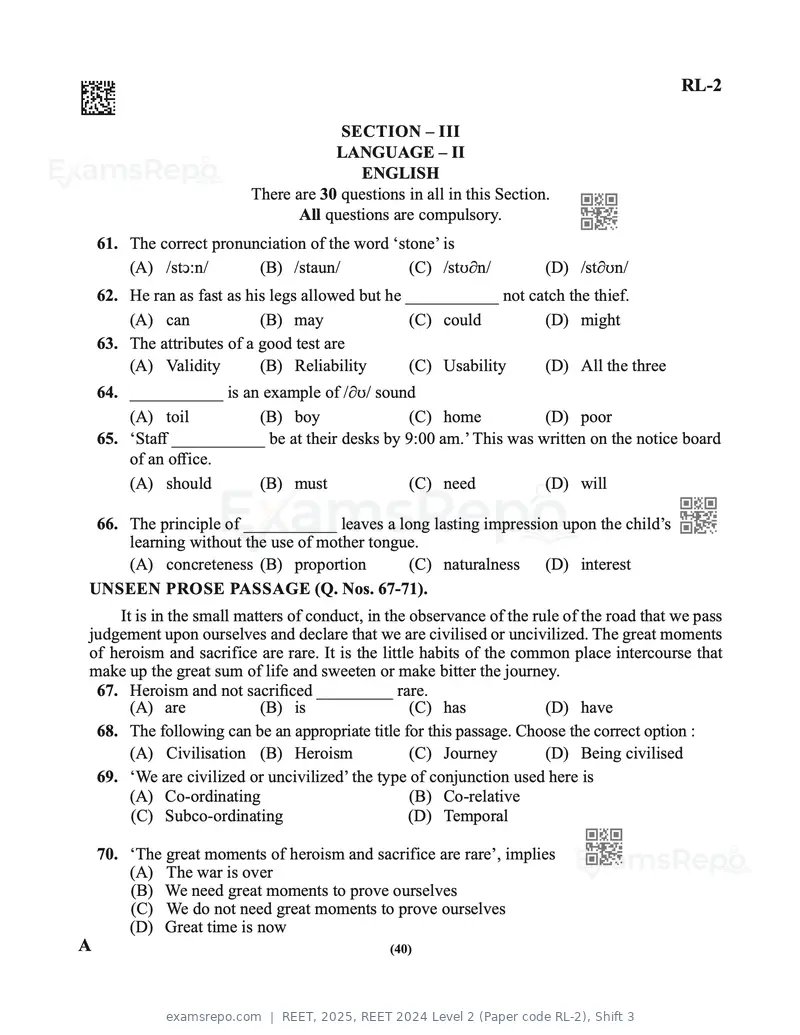
                                       SECTION – III
                                      LANGUAGE – II
                                          ENGLISH
                          There are 30 questions in all in this Section.
                                 All questions are compulsory.
    61. The correct pronunciation of the word ‘stone’ is
        (A) /stͻ:n/       (B) /staun/            (C) /stʊ∂n/           (D) /st∂ʊn/
    62. He ran as fast as his legs allowed but he ___________ not catch the thief.
        (A) can             (B) may               (C) could         (D) might
    63. The attributes of a good test are
        (A) Validity        (B) Reliability       (C) Usability     (D) All the three
    64. ___________ is an example of /∂ʊ/ sound
        (A) toil         (B) boy                (C) home            (D) poor
    65. ‘Staff ___________ be at their desks by 9:00 am.’ This was written on the notice board
        of an office.
        (A) should       (B) must               (C) need            (D) will

 66. The principle of ___________ leaves a long lasting impression upon the child’s
     learning without the use of mother tongue.
     (A) concreteness (B) proportion         (C) naturalness (D) interest
UNSEEN PROSE PASSAGE (Q. Nos. 67-71).
    It is in the small matters of conduct, in the observance of the rule of the road that we pass
judgement upon ourselves and declare that we are civilised or uncivilized. The great moments
of heroism and sacrifice are rare. It is the little habits of the common place intercourse that
make up the great sum of life and sweeten or make bitter the journey.
 67. Heroism and not sacrificed _________ rare.
      (A) are             (B) is                  (C) has             (D) have
 68. The following can be an appropriate title for this passage. Choose the correct option :
      (A) Civilisation (B) Heroism                (C) Journey         (D) Being civilised
 69. ‘We are civilized or uncivilized’ the type of conjunction used here is
      (A) Co-ordinating                           (B) Co-relative
      (C) Subco-ordinating                        (D) Temporal

    70. ‘The great moments of heroism and sacrifice are rare’, implies
        (A) The war is over
        (B) We need great moments to prove ourselves
        (C) We do not need great moments to prove ourselves
        (D) Great time is now
A                                              (40)
Text of page 41
RL-2

 71. People __________ the habit of passing the judgement in small things.
     (A) have        (B) is                  (C) had           (D) are
 72. ‘Finger pointing’ – is related to
     (A) listening       (B) reading habit      (C) speaking habit (D) writing

 73. Arousing, expectancy and incentive are the techniques of _________ principle.
      (A) gradation      (B) interest           (C) motivation       (D) concreteness

UNSEEN POEM (Q. Nos. 74-78).
Good people all, of every sort
Give ear unto my song,
And if you find Wondrous short
It cannot hold you long.
‘The wound it seem’d both sore and sad
To every Christian eye;
And while they swore the Dog was mad,
They swore the Man would die.
But soon a wonder came to light,
That show’d the rogues They lied;
The man recover’d of the bite,
The Dog was it that died.
 74. ‘To every Christian eye;’ The literary device used here is
     (A) Simile         (B) Assonance          (C) Alliteration      (D) Metaphor
 75. The line that has the use of alliteration is
     (A) The wound it seem’d both sore and sad
     (B) But soon a wonder came to light
     (C) They swore the Man would die
     (D) The Dog was it that died
 76. ‘It cannot hold you long’ the object used for personification in this line is
     (A) dog            (B) song               (C) men              (D) people
 77. The rhyme scheme in the given stanzas is
     (A) abcd        (B) aabb               (C) abab                 (D) abc abc
 78. ‘The man was good as us saint’ the literary device used in this line is
     (A) personification                      (B) simile
     (C) assonance                            (D) alliteration
                                             (41)                                         A
Text of page 42
RL-2

    79. Acquiring language is a _____________ process. Choose the correct option :
        (A) sub-conscious                     (B) concession
        (C) drill                            (D) adopted
    80. The list of semi-vowels comprise
        (A) s, z           (B) j, w           (C) h, l           (D) m, n

    81. ‘Development of generic skills’ is one of the vital strategies of
        (A) Testing         (B) Evaluation         (C) Assessment      (D) Remedial teaching
    82. The English sonnet is also known as
        (A) Shakespearen sonnet                    (B) Miltonic sonnet
        (C) Wordsworth sonnet                      (D) Coleridge sonnet
    83. “The only person equipped to choose these text-books are school teachers who really
        know the fodder, suited to their flock.” This is quoted by

        (A) V. K. Gokak (B) R. L. Mehta            (C) Guy Boas        (D) Otto Jesperson

    84. The new bold leader has been able to ______________ all opposition. Choose the
        correct idiom :
        (A) bear with     (B) bear up           (C) bear down     (D) bear out
    85. ‘Different learning styles can be evaluated’ – is a merit of
        (A) Group evaluation                       (B) Cloze test
        (C) Rubrics                               (D) Peer groups
    86. ____________ drills are the excellent means of forming correct speech habits.
        (A) pronunciation                          (B) reading
        (C) substitution                          (D) composition
    87. ‘Language is always used in a context in a real life situation, in a conversation one
        constantly has to interpret what is being said’ – is a rationale of
        (A) situational approach                   (B) communicative approach
        (C) project approach                      (D) structural approach
    88. The poem composed by Oliver Goldsmith on the death of a mad dog is
        (A) Elegy       (B) Sonnet          (C) Lyric            (D) Ode

    89. The following tests help to ascertain the skill of aloud reading of the students
        (A) Objective       (B) New type           (C) Oral            (D) Written

    90. The idiomatic phrase ‘a cock and bull story’ means
        (A) a bold story (B) a victory event (C) a real story          (D) an unreal story
A                                               (42)
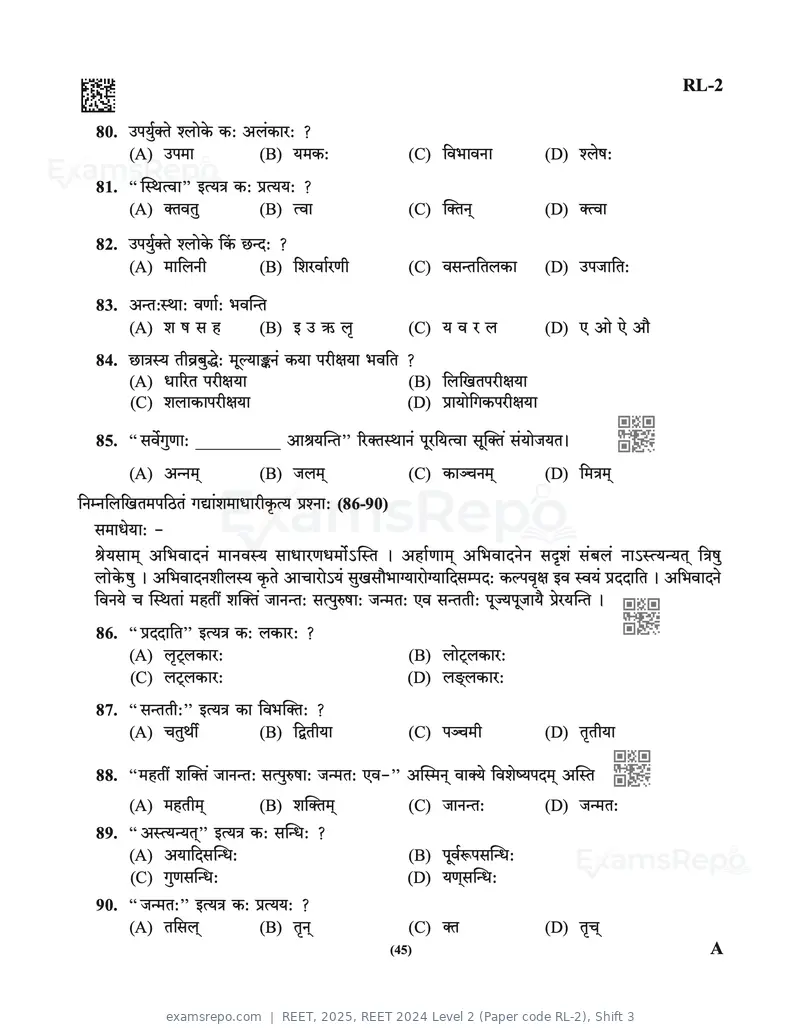
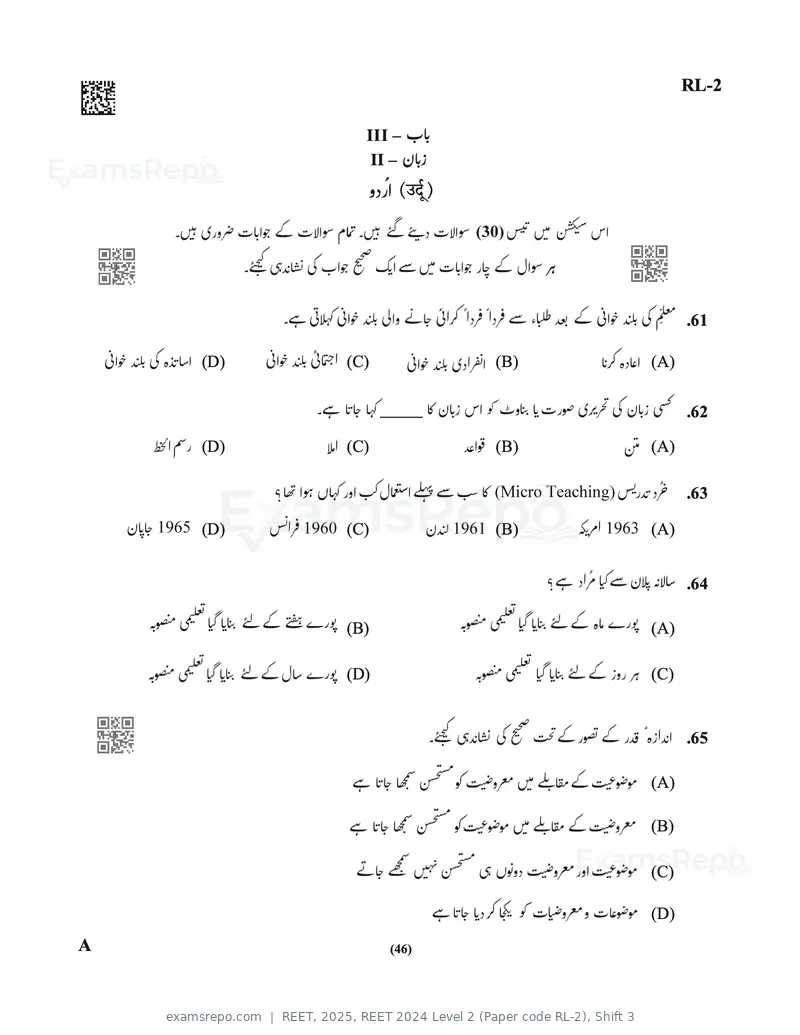
Text of page 46
RL-2

            III –
             II –
                 (CXÿ© )


                                       .61

    (D)   (C)              (B)   (A)

                                       .62

    (D)   (C)              (B)   (A)

                                       .63

    (D)   (C)              (B)   (A)


                                       .64

          (B)                    (A)

          (D)                    (C)


                                       .65

                                 (A)

                                 (B)

                                 (C)

                                 (D)
A               (46)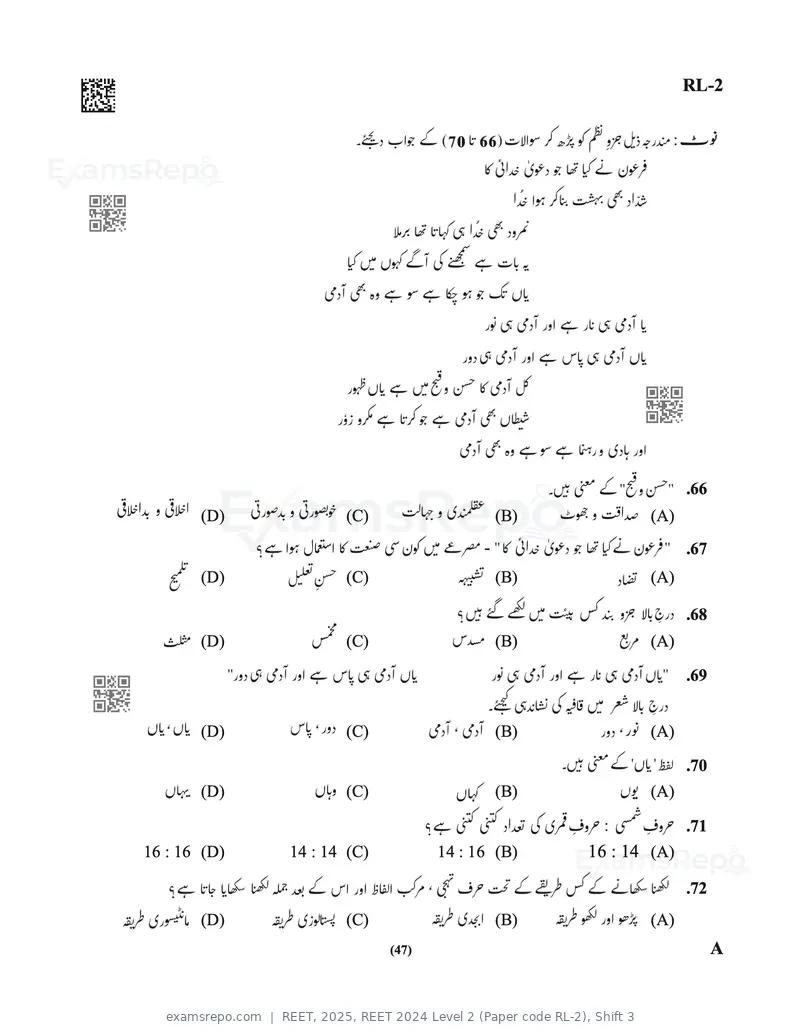
Text of page 47
RL-2


                                                               .66
       (D)           (C)                  (B)           (A)
                                                               .67
       (D)           (C)                  (B)           (A)

                                                               .68
       (D)           (C)                  (B)           (A)

                                                               .69


       (D)           (C)                  (B)           (A)

                                                               .70
       (D)           (C)                  (B)           (A)

                                                               .71
16 : 16 (D)   14 : 14 (C)          14 : 16 (B)   16 : 14 (A)

                                                               .72
       (D)           (C)                  (B)           (A)
                            (47)                                     A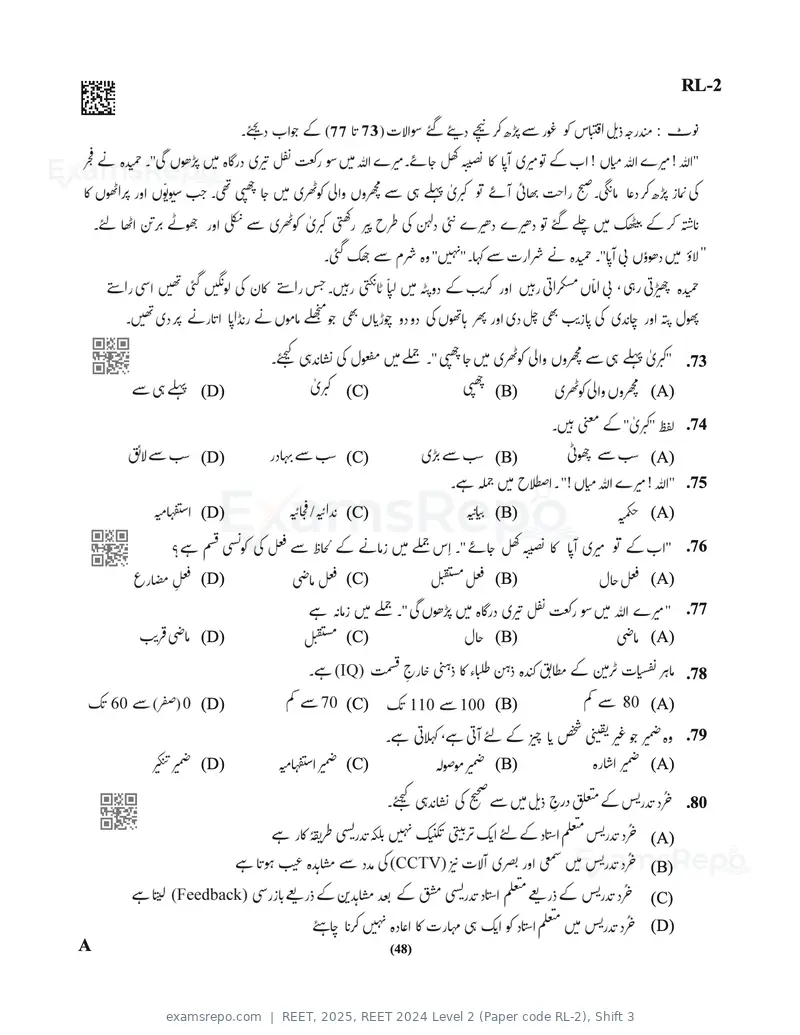
Text of page 48
RL-2


                                   .73
    (D)   (C)          (B)   (A)
                                   .74
    (D)   (C)          (B)   (A)
                                   .75
    (D)   (C)          (B)   (A)
                                   .76
    (D)   (C)          (B)   (A)
                                   .77
    (D)   (C)          (B)   (A)

                                   .78
    (D)   (C)          (B)   (A)
                                   .79
    (D)   (C)          (B)   (A)

                                   .80

                             (A)
                             (B)
                             (C)
                             (D)
A               (48)
Text of page 49
RL-2

                               .81
(D)   (C)          (B)   (A)
                               .82
(D)   (C)          (B)   (A)
                               .83
      (B)                (A)
      (D)                (C)

                               .84
(D)   (C)          (B)   (A)
                               .85
(D)   (C)          (B)   (A)
                               .86
      (B)                (A)
      (D)                (C)
                               .87
      (B)                (A)
      (D)                (C)
                               .88
      (B)                (A)
      (D)                (C)
                               .89
                         (A)
                         (B)
                         (C)
                         (D)

                               .90
      (B)                (A)
      (D)                (C)
            (49)                     A
Text of page 50
RL-2

                                       – III
                                       – II
                                     qgYr


    61.
          (A)                  (B)      (C)                  (D)
    62.
             i.
            ii.
           iii.
           iv.
          (A) iv, iii, i, ii            (B) ii, iii, iv, i
          (C) i, ii, iii, iv            (D) ii, i, iv, iii

    63.
          (A)                           (B)
          (C)                           (D)

    64.

          (A)                           (B)
          (C)                           (D)
    65.
          (A)                  (B)      (C)                  (D)
    66.
          (A)                           (B)
          (C)                           (D)

    67.
          (A)                           (B)
          (C)                           (D)

A                                    (50)
Text of page 51
RL-2


68.
      (A)   (B)      (C)   (D)
69.
      (A)   (B)      (C)   (D)


70.
      (A)            (B)
      (C)            (D)
71.
      (A)
      (B)
      (C)
      (D)

72.

      (A)            (B)

      (C)            (D)
                  (51)             A
Text of page 52
RL-2

    73.
           1.                          i.
           2.                         ii.
           3.                       iii.
           4.                        iv.
          (A) 1-iv   2-i           3-ii     4-iii
          (B) 1-i    2-ii          3-iii    4-iv
          (C) 1-iv   2-iii         3-i      4-ii
          (D) 1-iv   2-iii         3-ii     4-i
    74.
          (A)                                          (B)
          (C)                                          (D)


    75.

          (A)                (B)                       (C)   (D)
    76.
          (A)                (B)                       (C)   (D)

    77.
          (A)                (B)                       (C)   (D)
A                                                   (52)
Text of page 53
RL-2

78.
      (A)   (B)      (C)   (D)
79.
      (A)
      (B)
      (C)
      (D)
80.
      (A)   (B)      (C)   (D)
81.
      (A)   (B)      (C)   (D)
82.
      (A)   (B)      (C)   (D)
83.
      (A)   (B)      (C)   (D)

84.
      (A)            (B)
      (C)            (D)
85.
      (A)   (B)      (C)   (D)
86.
      (A)   (B)      (C)   (D)
87.
      (A)   (B)      (C)   (D)
88.
      (A)   (B)      (C)   (D)
89.
      (A)   (B)      (C)   (D)
90.
      (A)   (B)      (C)   (D)
                  (53)             A
Text of page 54
RL-2

                     – III
                       – II
                     ( n§Om~r)


    61.


          (A)          (B)
          (C)          (D)

    62.
          (A)
          (B)
          (C)
          (D)
    63.         :
          (A)
          (B)
          (C)
          (D)
    64.
          (A)          (B)
          (C)          (D)
    65.


          (A)          (B)
          (C)          (D)

    66.
          (A)          (B)
          (C)          (D)

A                   (54)
Text of page 55
RL-2

67.                            :
      (A)            (B)
      (C)            (D)
68.

      (A)   (B)      (C)           (D)
69.
      (A)   (B)      (C)           (D)
70.
      (A)            (B)
      (C)            (D)
71.


      (A)            (B)
      (C)            (D)
72.
      (A)            (B)
      (C)            (D)
73.                        :
      (A)   (B)      (C)           (D)
74.
      (A)   (B)      (C)           (D)
75.                                      :
      (A)            (B)
      (C)            (D)
76.

      (A)            (B)
      (C)            (D)
77.
      (A)            (B)
      (C)            (D)
                  (55)                         A
Text of page 56
RL-2

    78.                               :
          (A)            (B)
          (C)            (D)


    79.


          (A)            (B)
          (C)            (D)
    80.
          (A)   (B)      (C)   (D)
    81.


          (A)   (B)      (C)   (D)
    82.

          (A)            (B)
          (C)            (D)
    83.
          (A)   (B)      (C)   (D)
A                     (56)
Text of page 57
RL-2

84.

      (A)            (B)
      (C)            (D)


85.
      (A)   (B)      (C)   (D)
86.

      (A)            (B)
      (C)            (D)
87.
      (A)   (B)      (C)   (D)
88.

      (A)
      (B)
      (C)
      (D)
89.
      (A)   (B)      (C)   (D)
90.

      (A)            (B)
      (C)            (D)
                  (57)             A
Text of page 58
RL-2

                      – III
                       – II
                         (JwOamVr)>


    61.
          (A)            (B)
          (C)            (D)
    62.
          (A)   (B)      (C)          (D)
    63.
          (A)   (B)      (C)          (D)

    64.
          (A)   (B)      (C)          (D)
    65.
          (A)   (B)      (C)          (D)

    66.
          (A)            (B)
          (C)            (D)
    67.
          (A)   (B)      (C)          (D)
    68.
          (A)            (B)
          (C)            (D)
    69.
          (A)   (B)      (C)          (D)

    70.
          (A)
          (B)
          (C)
          (D)
A                     (58)
Text of page 59
RL-2


71.
      (A)   (B)      (C)   (D)
72.
      (A)            (B)
      (C)            (D)
73.
      (A)   (B)      (C)   (D)
74.
      (A)            (B)
      (C)            (D)
75.
      (A)            (B)
      (C)            (D)
76.

      (A)   (B)      (C)   (D)
77.
      (A)   (B)      (C)   (D)
78.
      (A)            (B)
      (C)            (D)
79.

      (A)   (B)      (C)   (D)
80.

      (A)   (B)      (C)   (D)
                  (59)             A
Text of page 60
RL-2

    81.

          (A)   (B)      (C)   (D)
    82.
          (A)            (B)
          (C)            (D)
    83.
          (A)            (B)
          (C)            (D)
    84.
          (A)   (B)      (C)   (D)


    85.
          (A)            (B)
          (C)            (D)
    86.
          (A)   (B)      (C)   (D)
    87.
          (A)   (B)      (C)   (D)
    88.
          (A)   (B)      (C)   (D)
    89.

          (A)   (B)      (C)   (D)
    90.
          (A)   (B)      (C)   (D)
A                     (60)
Text of page 61
RL-2

                                   SECTION – IV/ IÊS> – IV
In this Section, there are 2 sub-sections i.e. IV(a) Mathematics and Science and IV(b)
Social Studies. Both the sub-sections consist of 60 Multiple Choice Questions each.
The candidate has to choose either IV(a) Mathematics and Science OR IV(b) Social Studies
as selected in the Online Application Form and answer all the 60 questions.
Bg IÊS> _| Xmo CnIÊS> AWm©V² IV(a) J{UV Ed§ {dkmZ Ed§ IV(b) gm_m{OH$ AÜ``Z h¢ & XmoZm| CnIÊS>m| Ho$
àË`oH$ _| 60 ~hþ{dH$ënr` àíZ h¢ &
Aä`Wu H$mo IV(a) J{UV Ed§ {dkmZ AWdm IV(b) gm_m{OH$ AÜ``Z, {OZH$m M`Z Am°ZbmBZ AmdoXZ-nÌ
_| {H$`m h¡, _| go {H$gr EH$ CnIÊS> H$mo MwZZm h¡ Ed§ g^r 60 àíZm| H$m CÎma XoZm h¡ &
                               SECTION – IV(a)/ IÊS> – IV(a)
                    MATHEMATICS AND SCIENCE/ J{UV Ed§ {dkmZ
There are 60 questions in all in this section. The candidates who have selected this subject must
answer all the questions.
Bg IÊS> _| Hw$b 60 àíZ h¢ & {OZ Aä`{W©`m| Zo Bg {df` H$m M`Z {H$`m h¡ CÝh| g^r àíZ H$aZm A{Zdm`© h¡ &
 91. In how much time will a sum of money doubles at 15% annual simple interest rate ?
     (A) 13 years 4 months                 (B) 13 years 3 months
     (C) 6 years 8 months                  (D) 6 years 9 months
      {H$VZo g_` _o§ H$moB© YZ H$m Hw$b am{e `moJ 15% dm{f©H$ gmYmaU ã`mO H$s Xa go XþJwZm hmo OmEJm ?
      (A) 13 df© 4 _mh                              (B) 13 df© 3 _mh
      (C) 6 df© 8 _mh                               (D) 6 df© 9 _mh

 92. How long should the process of remedial teaching continue ?
     (A) Until the student is interested
     (B) As long as you have time in school
     (C) Until another teacher comes to class
     (D) Until the lackness of students is not removed
      CnMmamË_H$ {ejU H$s à{H«$`m H$~ VH$ MbVr ahZr Mm{hE ?
      (A) O~ VH$ N>mÌ é{M Zm b|
      (B) O~ VH$ {dÚmb` _| g_` {_bo
      (C) O~ VH$ AÝ` AÜ`mnH$ H$jm _| Zht AmE
      (D) O~ VH$ N>mÌm| H$s H$_r Xÿa Zm hmo

 93. How many lines of symmetry are there for a square ?
      (A) 2                (B) 8                     (C) 4               (D) 6
      EH$ dJ© Ho$ {bE {H$VZr g_{_{V aoImE± hmoJr ?
      (A) 2                (B) 8                     (C) 4               (D) 6
                                                (61)                                                A
Text of page 64
RL-2

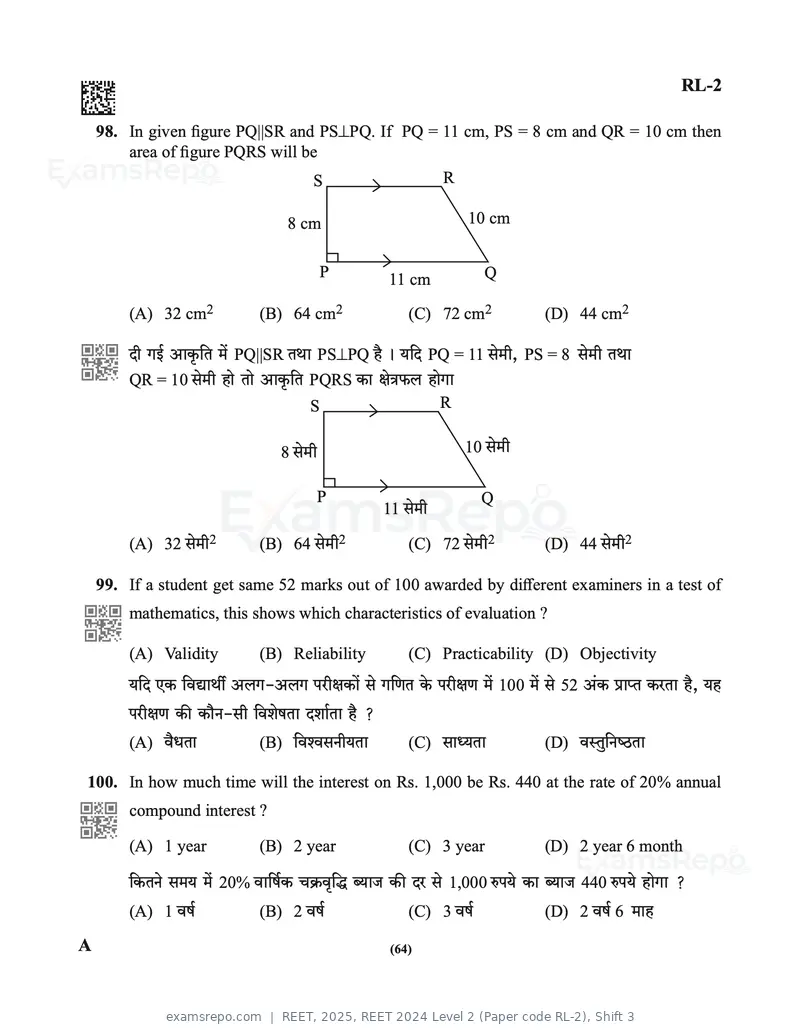
    98. In given figure PQ||SR and PS⊥PQ. If PQ = 11 cm, PS = 8 cm and QR = 10 cm then
        area of figure PQRS will be
                                    S                    R

                                8 cm                         10 cm


                                        P       11 cm           Q

        (A) 32 cm2          (B) 64 cm2             (C) 72 cm2            (D) 44 cm2

        Xr JB© AmH¥${V _| PQ||SR VWm PS⊥PQ h¡ & `{X PQ = 11 go_r, PS = 8 go_r VWm
        QR = 10 go_r hmo Vmo AmH¥${V PQRS H$m joÌ\$b hmoJm
                                    S                    R

                               8 go_r                        10 go_r

                                     P                         Q
                                               11 go_r

        (A) 32 go_r2        (B) 64 go_r2           (C) 72 go_r2          (D) 44 go_r2

    99. If a student get same 52 marks out of 100 awarded by different examiners in a test of
        mathematics, this shows which characteristics of evaluation ?

        (A) Validity        (B) Reliability        (C) Practicability (D) Objectivity
        `{X EH$ {dÚmWu AbJ-AbJ narjH$m| go J{UV Ho$ narjU _| 100 _| go 52 A§H$ àmßV H$aVm h¡, `h
        narjU H$s H$m¡Z-gr {deofVm Xem©Vm h¡ ?
        (A) d¡YVm           (B) {dídgZr`Vm     (C) gmÜ`Vm           (D) dñVw{ZîR>Vm

100. In how much time will the interest on Rs. 1,000 be Rs. 440 at the rate of 20% annual
        compound interest ?

        (A) 1 year          (B) 2 year             (C) 3 year            (D) 2 year 6 month

        {H$VZo g_` _o§ 20% dm{f©H$ MH«$d¥{Õ ã`mO H$s Xa go 1,000 én`o H$m ã`mO 440 én`o hmoJm ?
        (A) 1 df©           (B) 2 df©               (C) 3 df©             (D) 2 df© 6 _mh

A                                               (64)
Text of page 66
RL-2

                                      2        3
                             ( 64 ) (          ) (       )
                                                        0
105. What is the value of             3 + 3 64 2 + 5 32   ?
      (A) 14                (B) 194                (C) 193             (D) 13
              2        3
      ( 64 ) (        ) (           ) H$m Š`m _mZ h¡ ?
                                0
              3 + 3 64 2 + 5 32

      (A) 14                (B) 194                (C) 193             (D) 13
106. The probability of a certain event will be
                                                       1                   1
      (A) 1                 (B) 0                  (C) 2               (D) 3
      {ZpíMV KQ>Zm H$s àm{`H$Vm hmoJr
                                                       1                   1
      (A) 1                 (B) 0                  (C) 2               (D) 3
               1          1
107. 20% of      + 30% of is equal to
               2          3
                    5               1                            1                     2
      (A) 50% of        (B) 40% of                 (C) 50% of          (D) 50% of
                    6               4                            5                     5
       1             1
         H$m 20% + H$m 30% ~am~a h¡
       2             3
          5                 1                            1                      2
      (A)     H$m 50% (B)      H$m 40%             (C)     H$m 50%     (D)          H$m 50%
          6                 4                            5                      5
108. The nature of mathematics is
     (A) It is logical                             (B) It is hard
     (C) It is metaphorical                        (D) This is not for average students
      J{UV H$s àH¥${V h¡
      (A) `h Vm{H©$H$ h¡                           (B) `h H${R>Z h¡
      (C) `h Ab§H$m[aH$ h¡                         (D) `h Am¡gV {dÚm{W©`m| Ho$ {bE Zht h¡
109. x3+ y3 is equal to
     (A) (x + y) (x2 + xy + y2)                    (B) (x – y) (x2 + xy + y2)
     (C) (x + y) (x2 – xy + y2)                    (D) (x + y) (x2 + xy – y2)
      x3+ y3 Ho$ ~am~a h¡

      (A) (x + y) (x2 + xy + y2)                   (B) (x – y) (x2 + xy + y2)
      (C) (x + y) (x2 – xy + y2)                   (D) (x + y) (x2 + xy – y2)
A                                               (66)
Text of page 69
RL-2

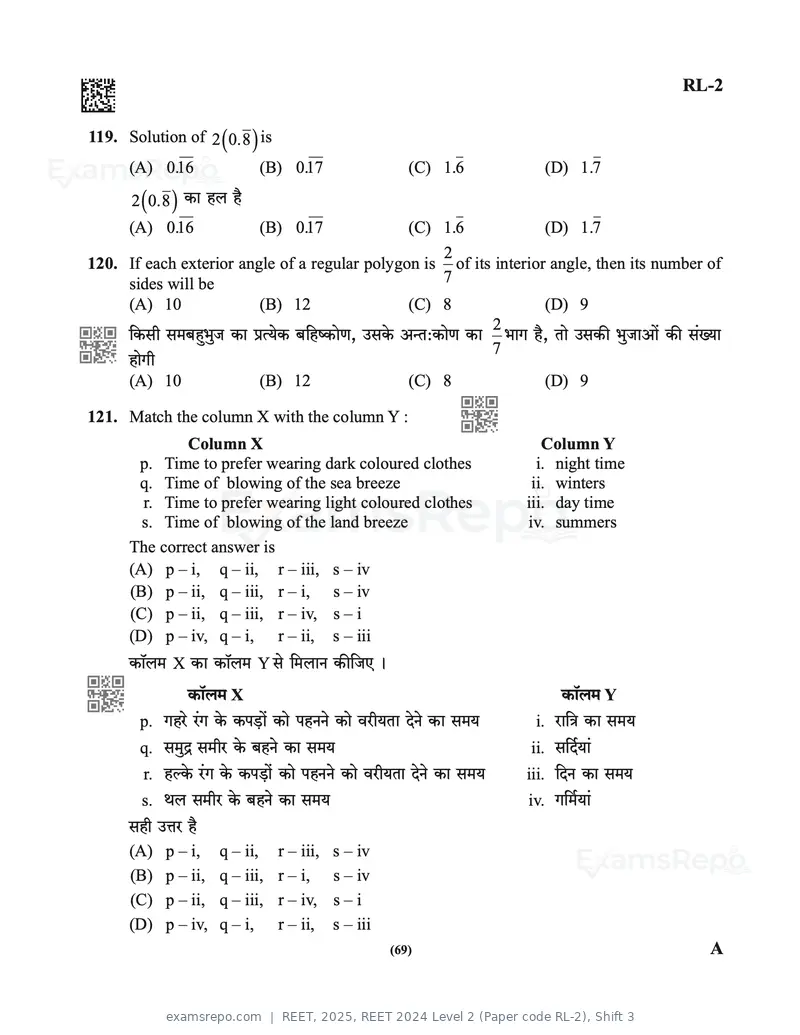
119. Solution of 2 ( 0. 8 ) is
      (A) 0.16                (B) 0.17                   (C) 1.6               (D) 1.7
       2 ( 0. 8 ) H$m hb h¡
      (A) 0.16                (B) 0.17         (C) 1.6             (D) 1.7
                                                   2
120. If each exterior angle of a regular polygon is of its interior angle, then its number of
     sides will be                                 7
      (A) 10                  (B) 12                     (C) 8                 (D) 9
                                                                         2
      {H$gr g_~hþ^wO H$m àË`oH$ ~{hîH$moU, CgHo$ AÝV:H$moU H$m ^mJ h¡, Vmo CgH$s ^wOmAm| H$s g§»`m
                                                              7
      hmoJr
      (A) 10                  (B) 12                     (C) 8                 (D) 9

121. Match the column X with the column Y :
              Column X                                                          Column Y
       p. Time to prefer wearing dark coloured clothes                         i. night time
       q. Time of blowing of the sea breeze                                   ii. winters
        r. Time to prefer wearing light coloured clothes                     iii. day time
        s. Time of blowing of the land breeze                                iv. summers
      The correct answer is
      (A) p – i, q – ii, r – iii, s – iv
      (B) p – ii, q – iii, r – i, s – iv
      (C) p – ii, q – iii, r – iv, s – i
      (D) p – iv, q – i, r – ii, s – iii
      H$m°b_ X H$m H$m°b_ Y go {_bmZ H$s{OE &
               H$m°b_ X                                                            H$m°b_ Y
       p. Jhao a§J Ho$ H$n‹S>m| H$mo nhZZo H$mo dar`Vm XoZo H$m g_`            i. am{Ì H$m g_`
       q. g_wÐ g_ra Ho$ ~hZo H$m g_`                                          ii. g{X©`m§
        r. hëHo$ a§J Ho$ H$n‹S>mo§ H$mo nhZZo H$mo dar`Vm XoZo H$m g_`       iii. {XZ H$m g_`
       s. Wb g_ra Ho$ ~hZo H$m g_`                                           iv. J{_©`m§
      ghr CÎma h¡
      (A)    p – i, q – ii,      r – iii,   s – iv
      (B)    p – ii, q – iii,    r – i,     s – iv
      (C)    p – ii, q – iii,    r – iv,    s–i
      (D)    p – iv, q – i,      r – ii,    s – iii
                                                      (69)                                         A
Text of page 71
RL-2

126. Two plane mirrors X and Y are placed perpendicular to each other. A ray of light is incident
     on mirror X at an angle of 300, as shown in figure below. Then the angle of reflected ray
     for mirror Y with the incident ray for the same mirror Y will be


      Y
                                   30°


                                                       X


      (A) 300                                      (B) 600
      (C) 900                                      (D) 1200
      Xmo g_Vb Xn©U X d Y EH$-Xÿgao Ho$ bå~dV aIo h¢ & àH$me H$s EH$ {H$aU Xn©U X na 300 Ho$ H$moU
      na Amn{VV h¡, O¡gm {H$ ZrMo {MÌ _| Xem©`m J`m h¡ & Vmo Xÿgao Xn©U Y go namd{V©V hmoZo dmbr {H$aU
      H$m Cgr Xn©U Y na Amn{VV {H$aU go H$moU hmoJm


      Y
                                   30°


                                                       X


      (A) 300                                      (B) 600
      (C) 900                                      (D) 1200
                                                (71)                                                A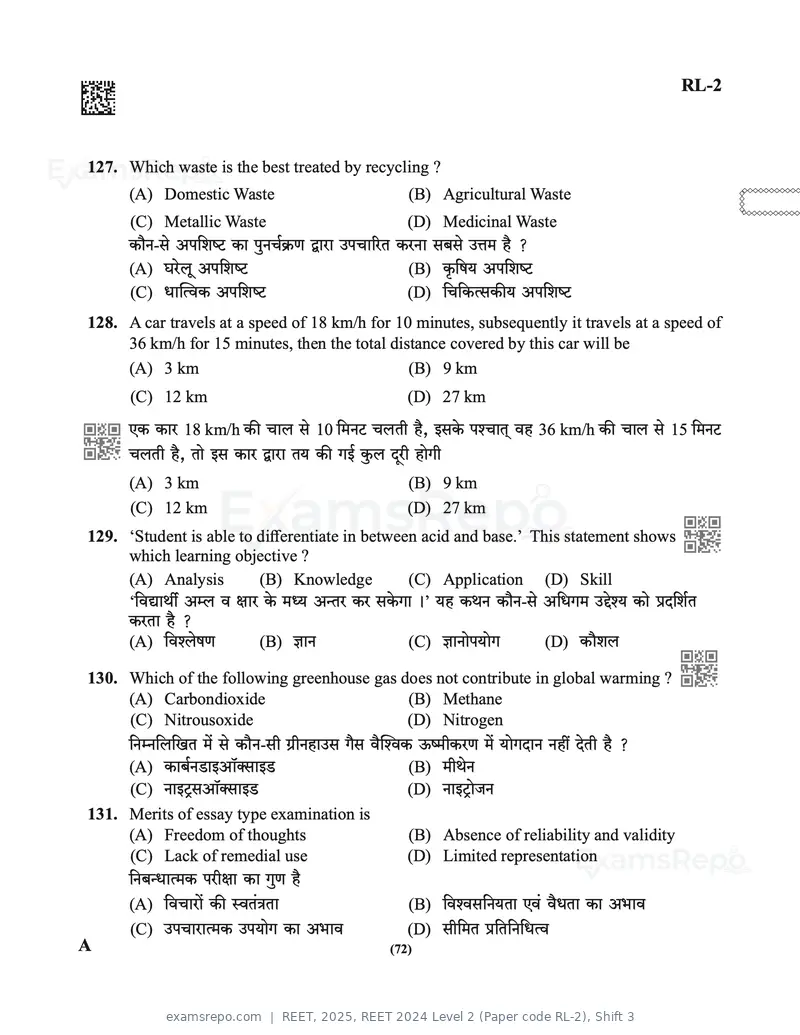
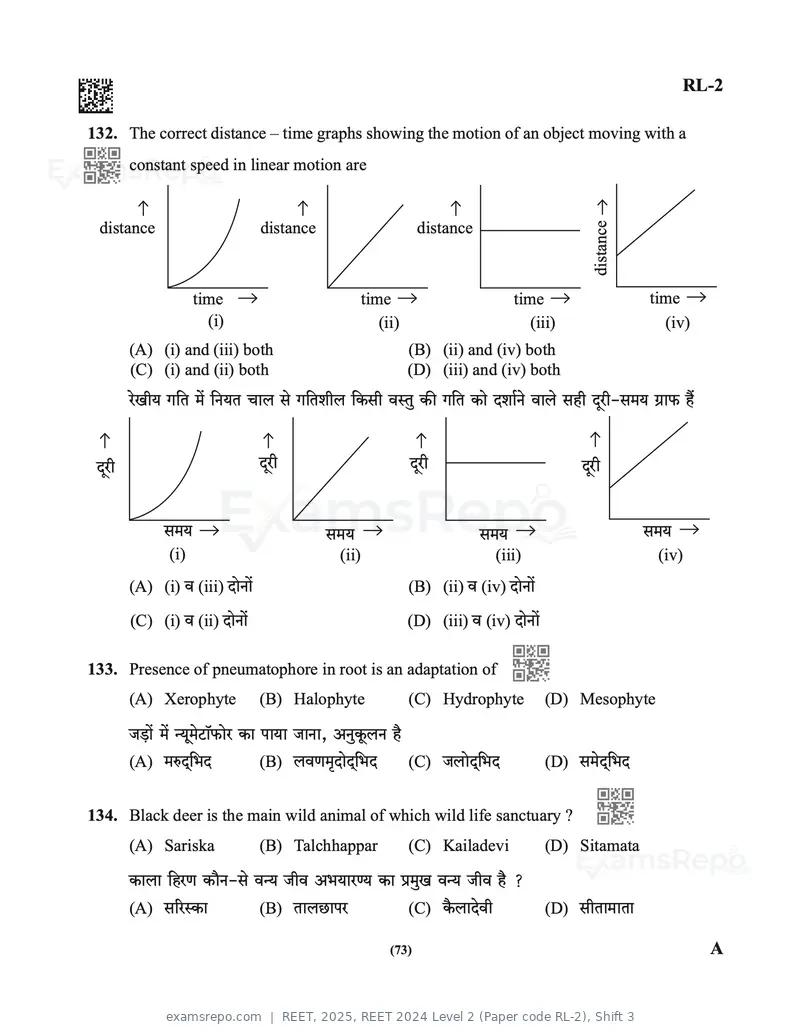
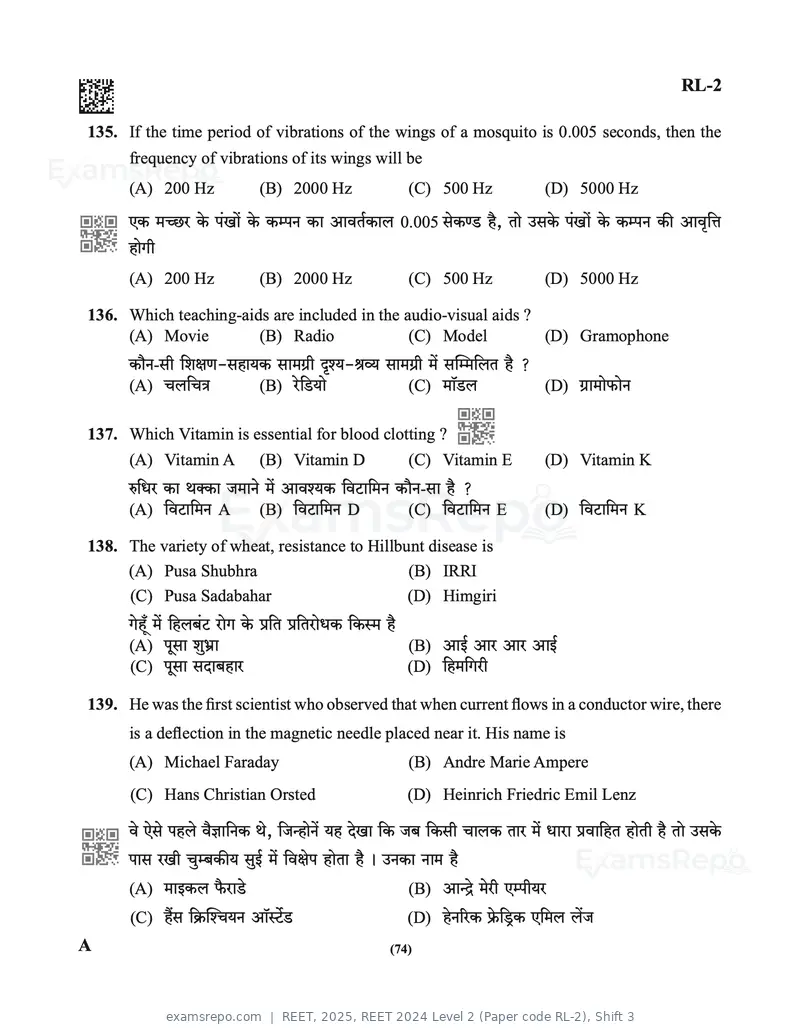
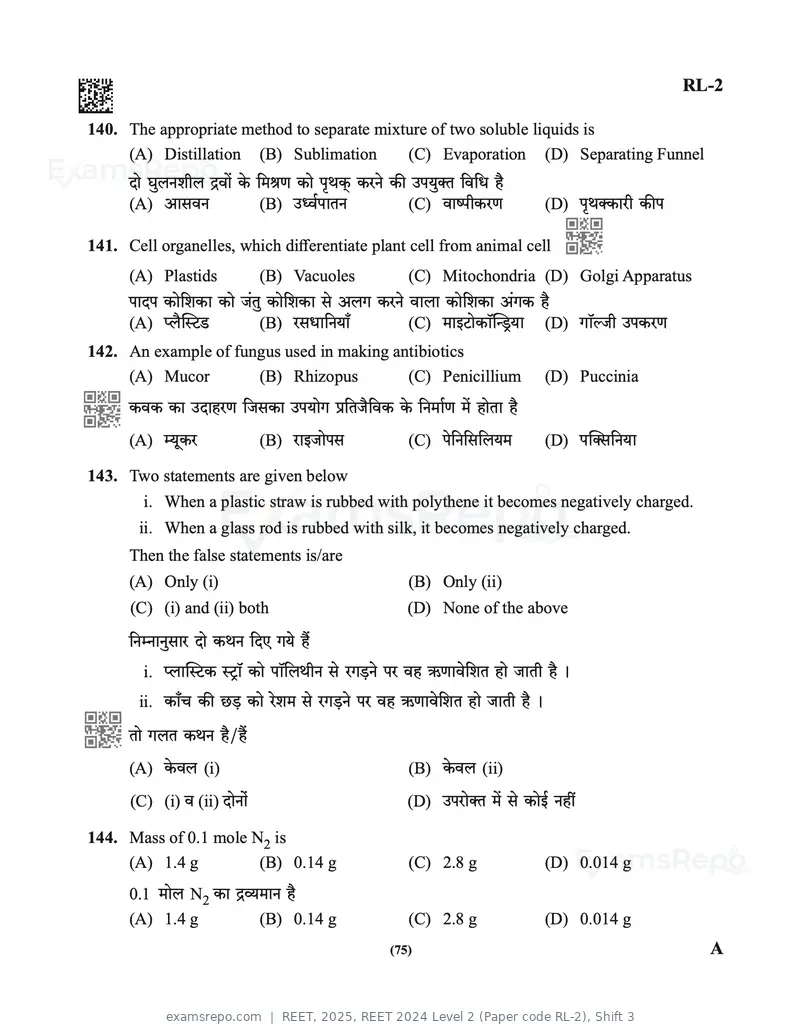
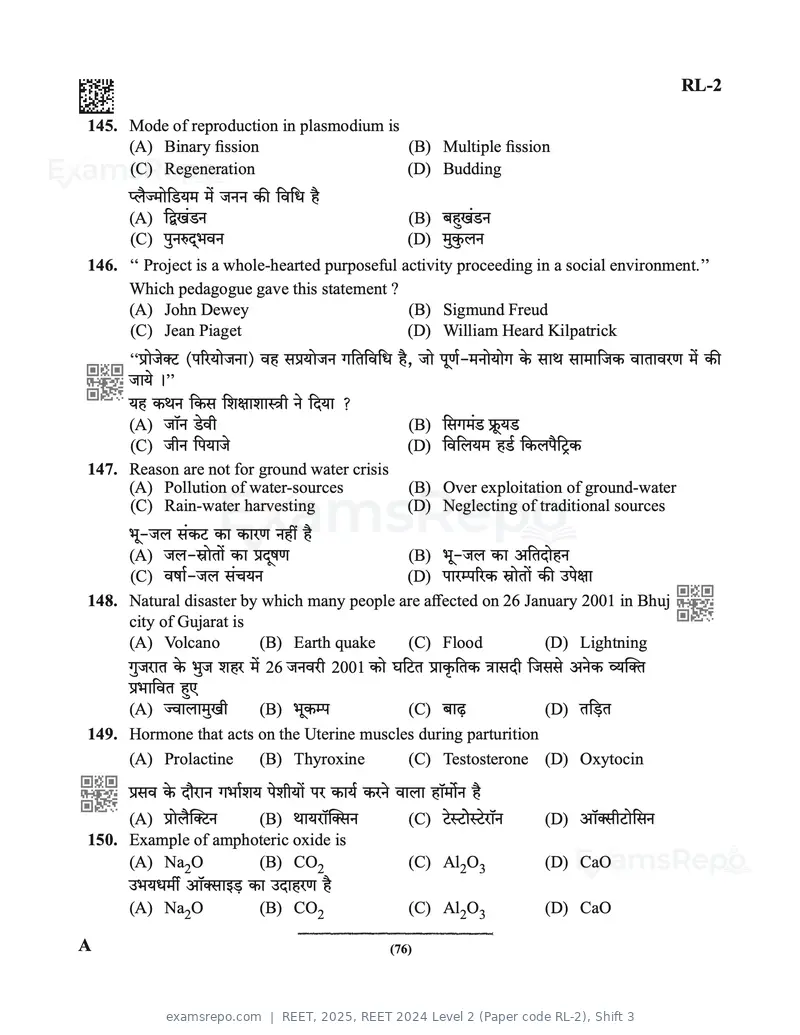
Text of page 82
RL-2

113. On the recommendation of which of the following committee was Jaipur declared the
     Capital of Rajasthan ?
     (A) P. Satyanarayan Rao Committee (B) Dr. Shankarrao Dev Committee
     (C) V. P. Menon Committee            (D) K. M. Munshi Committee
       {ZåZm§{H$V _| go {H$g g{_{V H$s {g\$m[ae na O`nwa H$mo amOñWmZ H$s amOYmZr ~Zm`m J`m ?
      (A) nr. gË`Zmam`U amd g{_{V                  (B) S>m°. e§H$aamd Xod g{_{V
      (C) dr. nr. _oZZ g{_{V                       (D) Ho$. E_. _w§er g{_{V

114. When did the Gandhi-Irwin pact take place ?
     (A) 1931         (B) 1921              (C) 1933                   (D) 1935
      Jm§Yr-Ba{dZ g_Pm¡Vm H$~ hþAm ?
      (A) 1931            (B) 1921                (C) 1933             (D) 1935
115. Hunting dance of Rajasthan is related to
     (A) Sehariya      (B) Garasiya           (C) Kalbeliya            (D) Bheel
      amOñWmZ H$m {eH$ma Z¥Ë` g§~§{YV h¡
      (A) gh[a`m          (B) Jam{g`m             (C) H$mb~o{b`m       (D) ^rb
116. Which one of the following pairs is not correctly matched ?
         Mahajanapada              Town
     (A) Ashmak            –      Kampilya
     (B) Shursen           –      Mathura
     (C) Kuru              –      Indraprastha
     (D) Chedi             –      Shuktimati
      {ZåZ{b{IV _| go H$m¡Z-gm EH$ `w½_ ghr gw_o{bV Zht h¢ ?
           _hmOZnX                     ZJa
      (A) Aí_H$             –         H$mpånë`
      (B) eyagoZ            –         _Wwam
      (C) Hw$é              –         BÝÐàñW
      (D) Mo{X              –         ewpŠV_{V
117. The area situated in the foot hills of Shivalik mountain range is called
     (A) Khadar region                          (B) Bangar region
     (C) Tarai region                           (D) Bhabar region
       {edm{bH$ nd©V ûm¥§Ibm H$s nd©VnXr` joÌ _| pñWV ^mJ H$hbmVm h¡
      (A) ImXa àXoe                                (B) ~m§Ja àXoe
      (C) VamB© àXoe                              (D) ^m~a àXoe
A                                              (82)
Text of page 95
DO
            NO
              T
(95)              WR
                    IT
                       EH
                         ER
                            E
A                               RL-2
Text of page 97
Question Booklet No.
Series Code :
PAPER CODE : RL-2 (SHIFT – 3)
B
grarµO H$moS> :
Write this code in OMR Answer Sheet.
Bg H$moS> H$mo OMR AmÝga erQ> _| A§{H$V H$a| &
1. Roll No./ amob Z§. 2. OMR Answer Sheet No./ Amo.E_.Ama. AmÝga erQ> H«$_m§H$
* 3. Candidate’s Name/ Aä`Wu H$m Zm_ * 4. _¢Zo n¥îR> ^mJ na {X`o J`o g^r {ZX}em| H$mo n‹T> {b`m h¡ &
B Candidate’s Signature/ Aä`Wu Ho$ hñVmja
* As per Application Form./ O¡gm AmdoXZ-nÌ _| A§{H$V {H$`m h¡ &
Invigilator’s Signature/ (i) (ii)
drjH$m| Ho$ hñVmja
S. No. 1, 2, 3 and 4 are to be filled by the Candidate himself. No. of Pages in Question Booklet/
H«$_m§H$ 1, 2, 3 d 4 H$s ny{V© ñd`§ Aä`Wu Ûmam H$s OmZr h¡ & àíZ nwpñVH$m _| Hw$b n¥îR> : 96
There are 150 objective multiple choice questions in this paper. This Question Booklet is made up of the following four Sections : Section – I,
II and III of 30 – 30 questions each and Section – IV is of 60 questions. The candidate has to attempt all Sections. Each question is of one mark. No marks will be
deducted for wrong answers. for unattempted questions kindly see point number 4 of important instructions given on last page.
Bg àíZ-nÌ _| Hw$b 150 dñVw{ZîR> ~hþM`ZmË_H$ àíZ h¢ & àíZ-nÌ Hw$b Mma IÊS>m| _| {d^m{OV h¡ VWm g^r IÊS> H$aZm A{Zdm`© h¡ & àË`oH$ IÊS>-I, II Ed§ III, 30 – 30 àíZm|
H$m h¡ VWm IÊS>-IV 60 àíZm| H$m h¡ & àË`oH$ àíZ 1 A§H$ H$m h¡ & JbV CÎma Ho$ {b`o H$moB© A§H$ H$mQ>o Zht Om`|Jo & AZwÎm[aV àíZm| Ho$ gå~ÝY _| nwpñVH$m Ho$ A§{V_ n¥îR> na {X`o
J`o _hËdnyU© {ZX}em] _| H«$_ g§»`m 4 XoI| &
narjmWu OMR erQ> ^aZo go nyd© `h gw{ZpíMV H$a b| {H$ àíZ-nwpñVH$m _| 1-96 n¥ð> ^br^m±{V N>no h¢ & H$moB© {dg§J{V hmoZo na àíZ-nwpñVH$m Vwa§V ~Xbdm b| &
PAPER CODE : RL-2 (SHIFT – 3)
SHIFT3-2025SHIFT3-2025SHIFT3-2025SHIFT3-2025SHIFT3-2025SHIFT3-2025SHIFT3-2025SHIFT3-2025SHIFT3-2025SHIFT3-2025SHIFT3-2025SHIFT3-2025SHIFT3-2025SHIFT3-2025SHIFT3-2025SHIFT3-2025SHIFT3-2025SHIFT3-2025SHIFT3-2025SHIFT3-2025SHIFT3-2025SHIFT3-2025SHIFT3-2025SHIFT3-2025SHIFT3-2025SHIFT3-2025SHIFT3-2025SHIFT3-2025SHIFT3-2025SHIFT3-2025SHIFT3-2025SHIFT3-2025SHIFT3-2025SHIFT3-2025SHIFT3-2025SHIFT3-2025SHIFT3-2025SHIFT3-2025SHIFT3-2025SHIFT3-2025SHIFT3-2025
Total Questions : 150 Time period : 2 Hours 30 Minutes Maximum Marks : 150
Sections Contents No. of Question Nos. Page Nos.
Questions From To From To
(I) Child Development and Pedagogy 30 1 30 3 10
(II) Language-I (Only One Language)
As selected by the candidate as medium of instruction in the Online 30 31 60
Application Form as language-I from the languages given below :
Hindi 30 31 60 11 14
English 30 31 60 15 17
Sanskrit 30 31 60 18 20
Urdu 30 31 60 21 24
Sindhi 30 31 60 25 28
Punjabi 30 31 60 29 32
Gujarati 30 31 60 33 35
(III) Language-II (Only One Language)
As selected by the candidate as Language-II (other than the Language-I) 30 61 90
in the Online Application Form from the Languages given below :
Hindi 30 61 90 36 39
English 30 61 90 40 42
Sanskrit 30 61 90 43 45
Urdu 30 61 90 46 49
Sindhi 30 61 90 50 53
Punjabi 30 61 90 54 57
Gujarati 30 61 90 58 60
(IV) (IV a) Mathematics and Science : 60 91 150 61 76
(For Mathematics and Science Teacher)
OR
(IV b) Social Studies : 60 91 150 77 90
(For Social Studies Teacher)
OR
For any other Subject Teacher :
(Can choose either IV a or IV b)
Note : 1. In Sections II and III, a candidate has to attempt the questions of Languages compulsorily, selected as Language-I and Language-II in the Online
Application Form.
2. In Sections – IV, it is compulsory to attempt the questions of Section IV (a) or Section IV (b) as selected subject in Online Application Form.
For Hindi version of the above Table and Note refer to Page No. 2.
Read the instructions in English and Hindi at Page No. 96, last page of this Question booklet.
RL-2 B *RL2SHIFT3B* (1)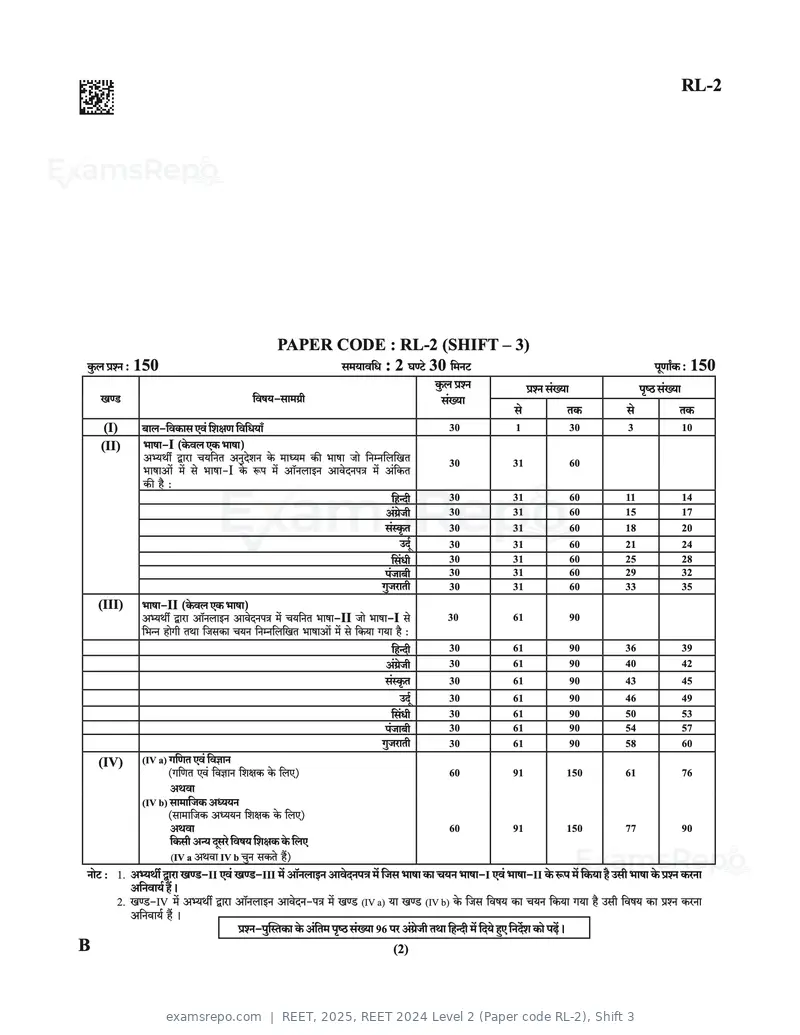
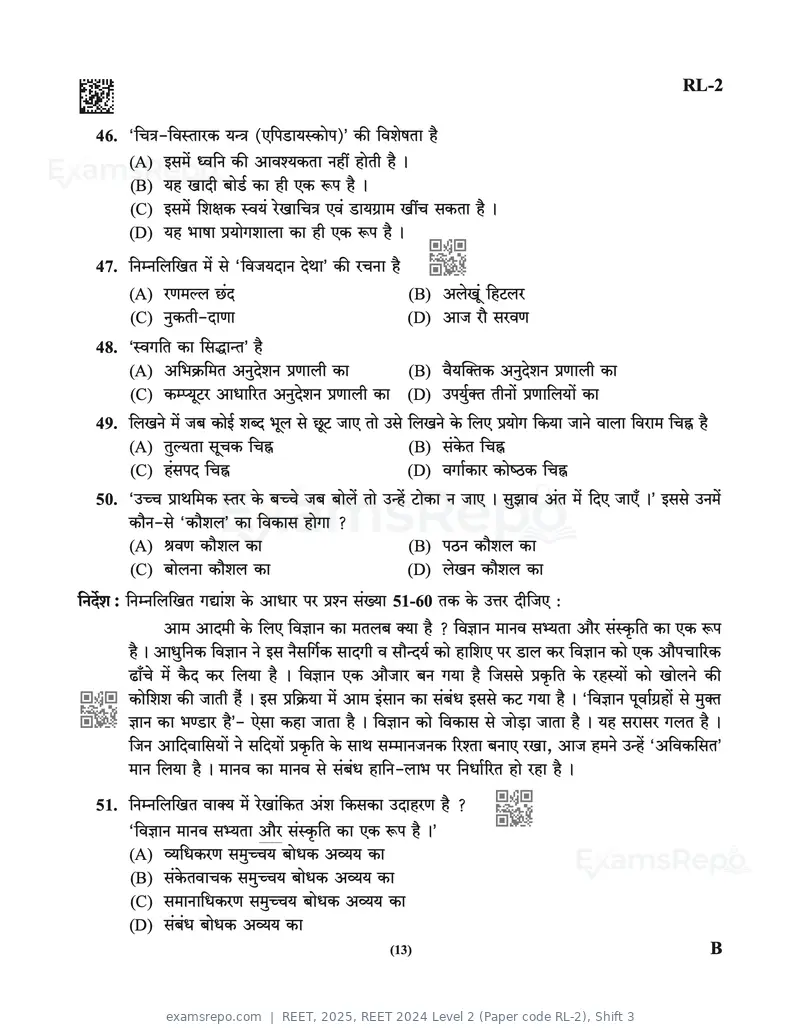
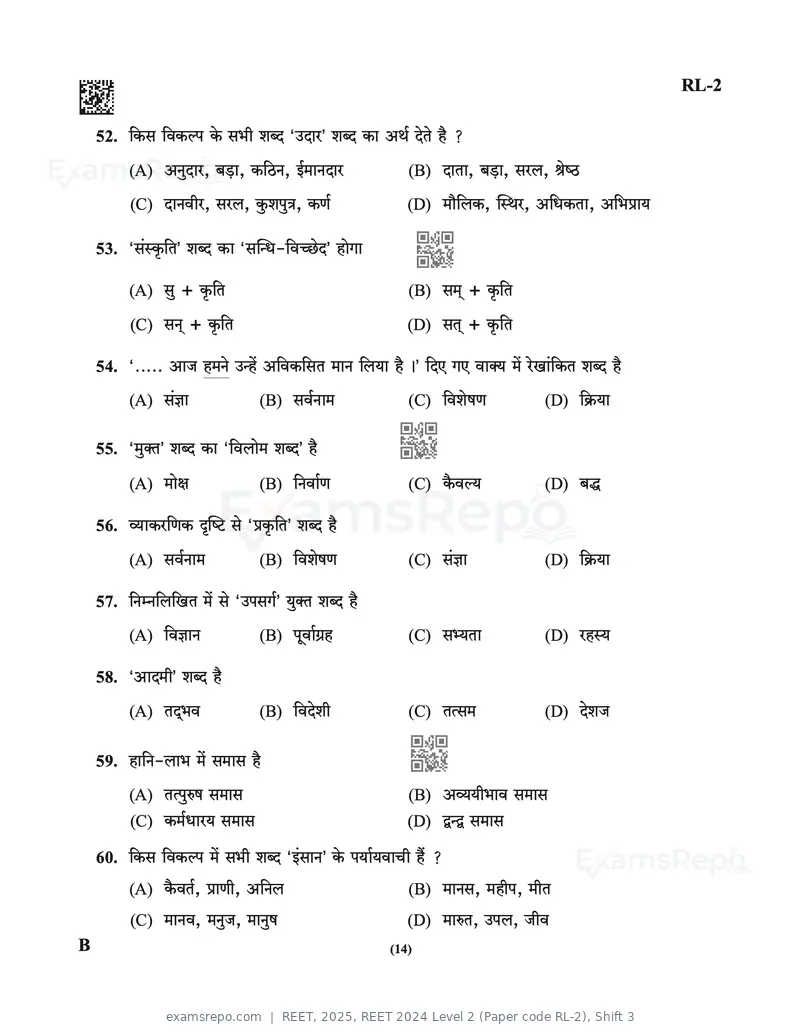
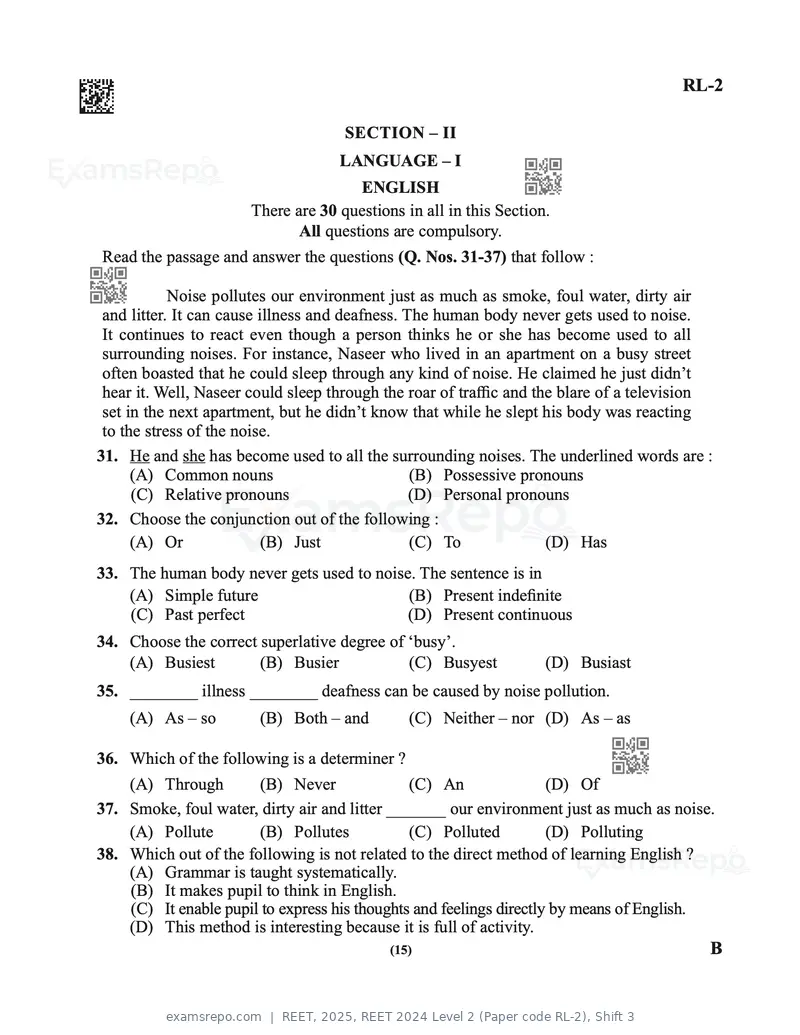
Text of page 111
RL-2

                                     SECTION – II
                                    LANGUAGE – I
                                       ENGLISH
                       There are 30 questions in all in this Section.
                              All questions are compulsory.
Read the passage and answer the questions (Q. Nos. 31-37) that follow :

            Noise pollutes our environment just as much as smoke, foul water, dirty air
 and litter. It can cause illness and deafness. The human body never gets used to noise.
 It continues to react even though a person thinks he or she has become used to all
 surrounding noises. For instance, Naseer who lived in an apartment on a busy street
 often boasted that he could sleep through any kind of noise. He claimed he just didn’t
 hear it. Well, Naseer could sleep through the roar of traffic and the blare of a television
 set in the next apartment, but he didn’t know that while he slept his body was reacting
 to the stress of the noise.
31. He and she has become used to all the surrounding noises. The underlined words are :
      (A) Common nouns                           (B) Possessive pronouns
      (C) Relative pronouns                      (D) Personal pronouns
32. Choose the conjunction out of the following :
      (A) Or               (B) Just              (C) To              (D) Has
33. The human body never gets used to noise. The sentence is in
    (A) Simple future                      (B) Present indefinite
    (C) Past perfect                       (D) Present continuous
34. Choose the correct superlative degree of ‘busy’.
    (A) Busiest        (B) Busier            (C) Busyest            (D) Busiast
35. ________ illness ________ deafness can be caused by noise pollution.
    (A) As – so         (B) Both – and         (C) Neither – nor (D) As – as

36. Which of the following is a determiner ?
    (A) Through        (B) Never               (C) An                (D) Of
37. Smoke, foul water, dirty air and litter _______ our environment just as much as noise.
    (A) Pollute        (B) Pollutes            (C) Polluted          (D) Polluting
38. Which out of the following is not related to the direct method of learning English ?
    (A) Grammar is taught systematically.
    (B) It makes pupil to think in English.
    (C) It enable pupil to express his thoughts and feelings directly by means of English.
    (D) This method is interesting because it is full of activity.
                                            (15)                                           B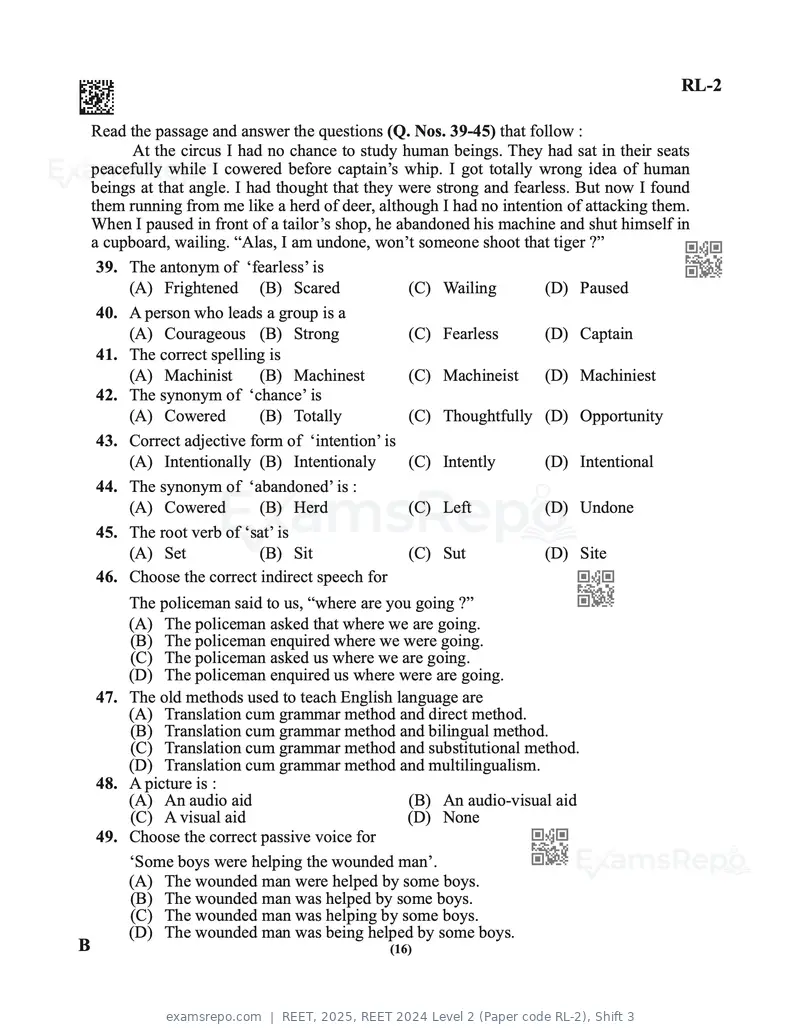
Text of page 112
RL-2

    Read the passage and answer the questions (Q. Nos. 39-45) that follow :
          At the circus I had no chance to study human beings. They had sat in their seats
    peacefully while I cowered before captain’s whip. I got totally wrong idea of human
    beings at that angle. I had thought that they were strong and fearless. But now I found
    them running from me like a herd of deer, although I had no intention of attacking them.
    When I paused in front of a tailor’s shop, he abandoned his machine and shut himself in
    a cupboard, wailing. “Alas, I am undone, won’t someone shoot that tiger ?”
     39. The antonym of ‘fearless’ is
         (A) Frightened (B) Scared                  (C) Wailing        (D) Paused
     40. A person who leads a group is a
         (A) Courageous (B) Strong                  (C) Fearless       (D) Captain
     41. The correct spelling is
         (A) Machinist        (B) Machinest         (C) Machineist     (D) Machiniest
     42. The synonym of ‘chance’ is
         (A) Cowered          (B) Totally           (C) Thoughtfully (D) Opportunity
     43. Correct adjective form of ‘intention’ is
         (A) Intentionally (B) Intentionaly         (C) Intently       (D) Intentional
     44. The synonym of ‘abandoned’ is :
         (A) Cowered          (B) Herd              (C) Left           (D) Undone
     45. The root verb of ‘sat’ is
         (A) Set              (B) Sit               (C) Sut            (D) Site
     46. Choose the correct indirect speech for
        The policeman said to us, “where are you going ?”
        (A) The policeman asked that where we are going.
        (B) The policeman enquired where we were going.
        (C) The policeman asked us where we are going.
        (D) The policeman enquired us where were are going.
    47. The old methods used to teach English language are
        (A) Translation cum grammar method and direct method.
        (B) Translation cum grammar method and bilingual method.
        (C) Translation cum grammar method and substitutional method.
        (D) Translation cum grammar method and multilingualism.
    48. A picture is :
        (A) An audio aid                        (B) An audio-visual aid
        (C) A visual aid                        (D) None
    49. Choose the correct passive voice for
        ‘Some boys were helping the wounded man’.
        (A) The wounded man were helped by some boys.
        (B) The wounded man was helped by some boys.
        (C) The wounded man was helping by some boys.
        (D) The wounded man was being helped by some boys.
B                                              (16)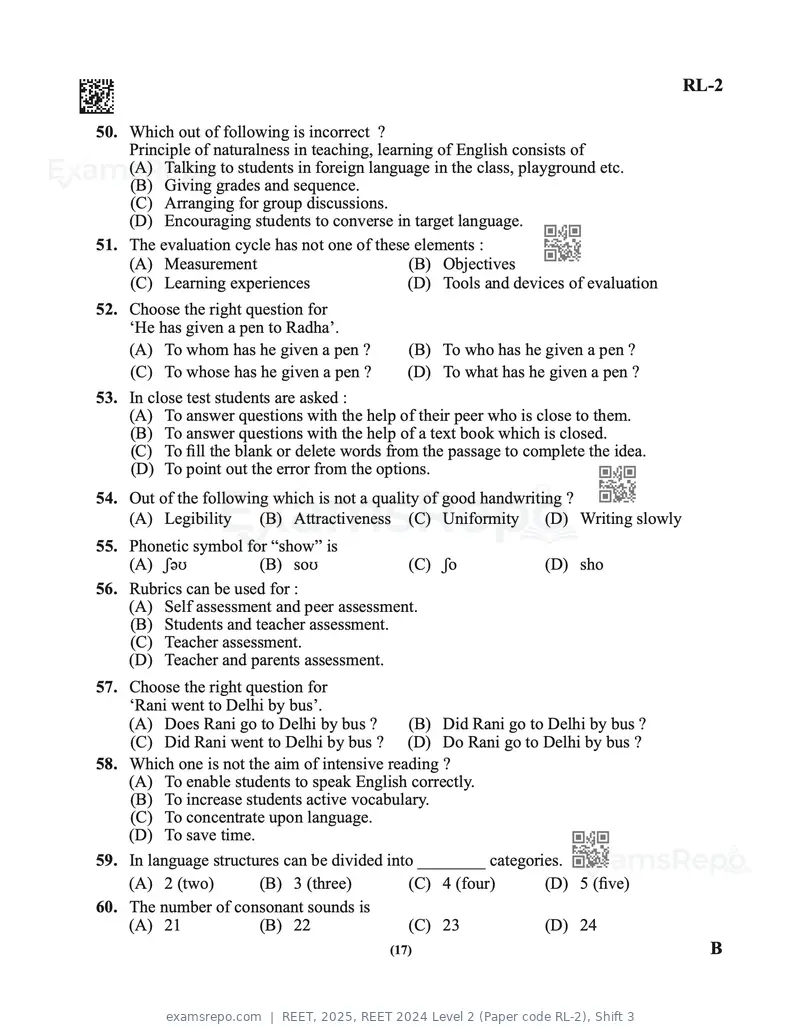
Text of page 113
RL-2

50. Which out of following is incorrect ?
    Principle of naturalness in teaching, learning of English consists of
    (A) Talking to students in foreign language in the class, playground etc.
    (B) Giving grades and sequence.
    (C) Arranging for group discussions.
    (D) Encouraging students to converse in target language.
51. The evaluation cycle has not one of these elements :
    (A) Measurement                            (B) Objectives
    (C) Learning experiences                   (D) Tools and devices of evaluation
52. Choose the right question for
    ‘He has given a pen to Radha’.
    (A) To whom has he given a pen ?         (B) To who has he given a pen ?
    (C) To whose has he given a pen ?        (D) To what has he given a pen ?
53. In close test students are asked :
    (A) To answer questions with the help of their peer who is close to them.
    (B) To answer questions with the help of a text book which is closed.
    (C) To fill the blank or delete words from the passage to complete the idea.
    (D) To point out the error from the options.
54. Out of the following which is not a quality of good handwriting ?
    (A) Legibility     (B) Attractiveness (C) Uniformity (D) Writing slowly
55. Phonetic symbol for “show” is
    (A) ʃəʊ           (B) soʊ             (C) ʃo                 (D) sho
56. Rubrics can be used for :
    (A) Self assessment and peer assessment.
    (B) Students and teacher assessment.
    (C) Teacher assessment.
    (D) Teacher and parents assessment.
57. Choose the right question for
    ‘Rani went to Delhi by bus’.
    (A) Does Rani go to Delhi by bus ?       (B) Did Rani go to Delhi by bus ?
    (C) Did Rani went to Delhi by bus ? (D) Do Rani go to Delhi by bus ?
58. Which one is not the aim of intensive reading ?
    (A) To enable students to speak English correctly.
    (B) To increase students active vocabulary.
    (C) To concentrate upon language.
    (D) To save time.
59. In language structures can be divided into ________ categories.
    (A) 2 (two)        (B) 3 (three)         (C) 4 (four)       (D) 5 (five)
60. The number of consonant sounds is
    (A) 21             (B) 22                (C) 23             (D) 24
                                          (17)                                         B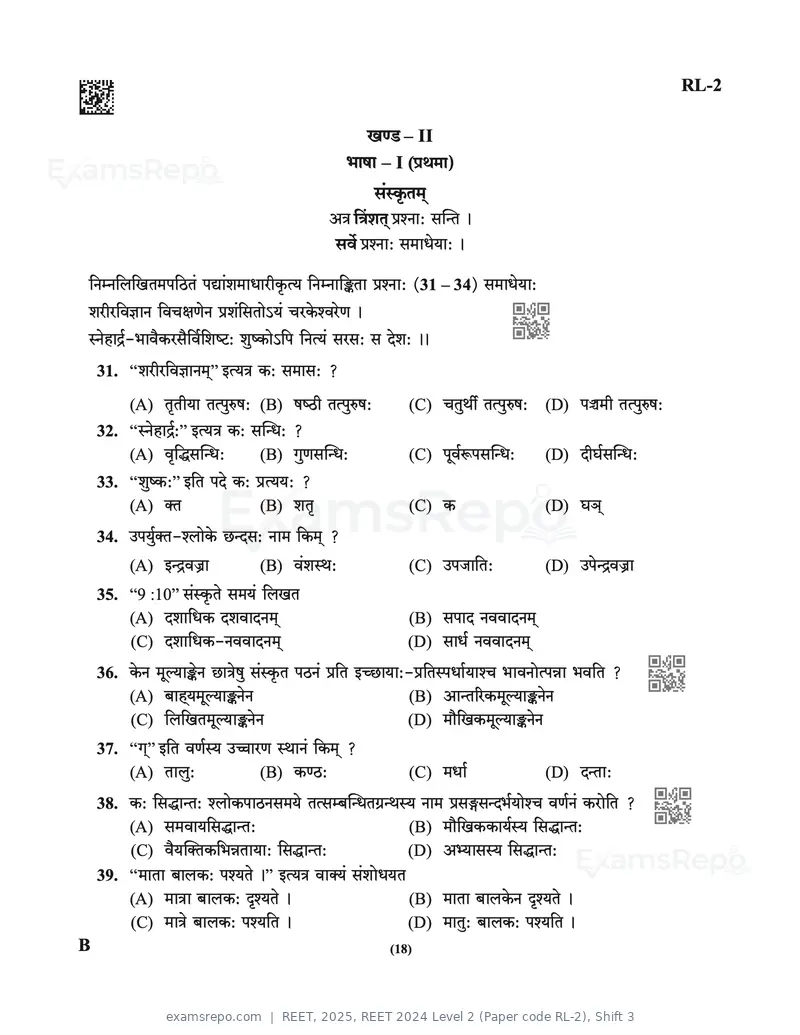
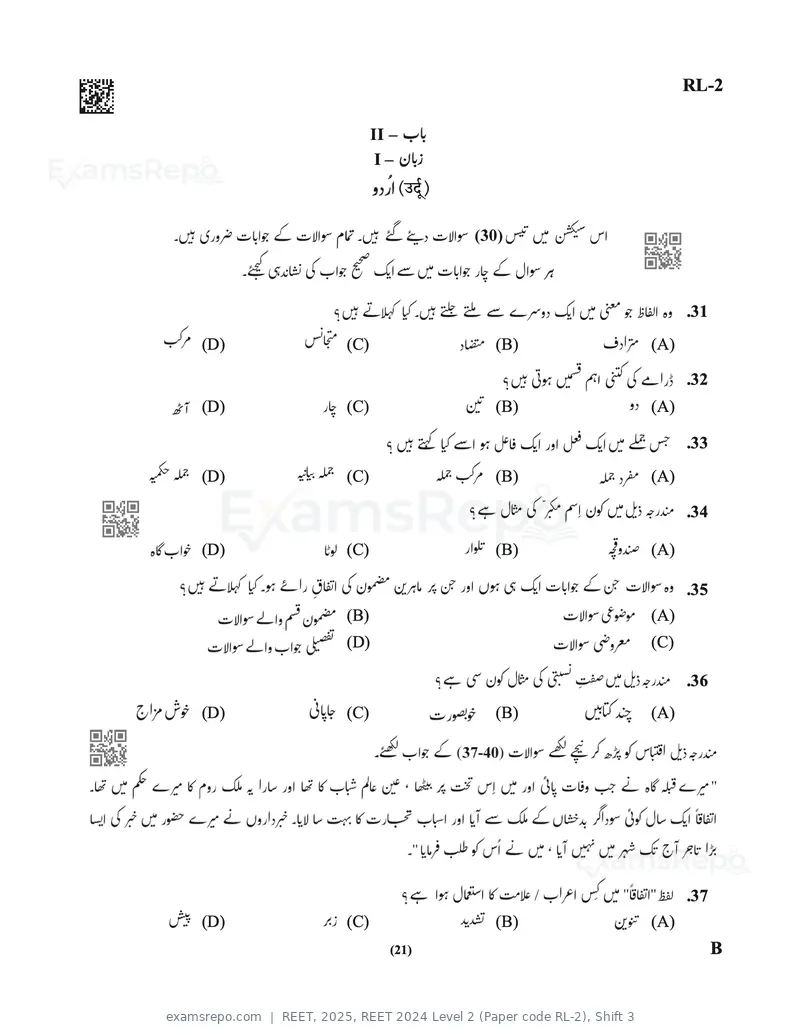
Text of page 117
RL-2

            II –
             I–
                   (CXÿ© )


                                         .31
(D)   (C)                    (B)   (A)

                                         .32
(D)   (C)                    (B)   (A)

                                         .33
(D)   (C)                    (B)   (A)

                                         .34

(D)   (C)                    (B)   (A)

                                         .35
      (B)                          (A)
      (D)                          (C)

                                         .36
(D)   (C)                    (B)   (A)


                                         .37
(D)   (C)                    (B)   (A)
              (21)                             B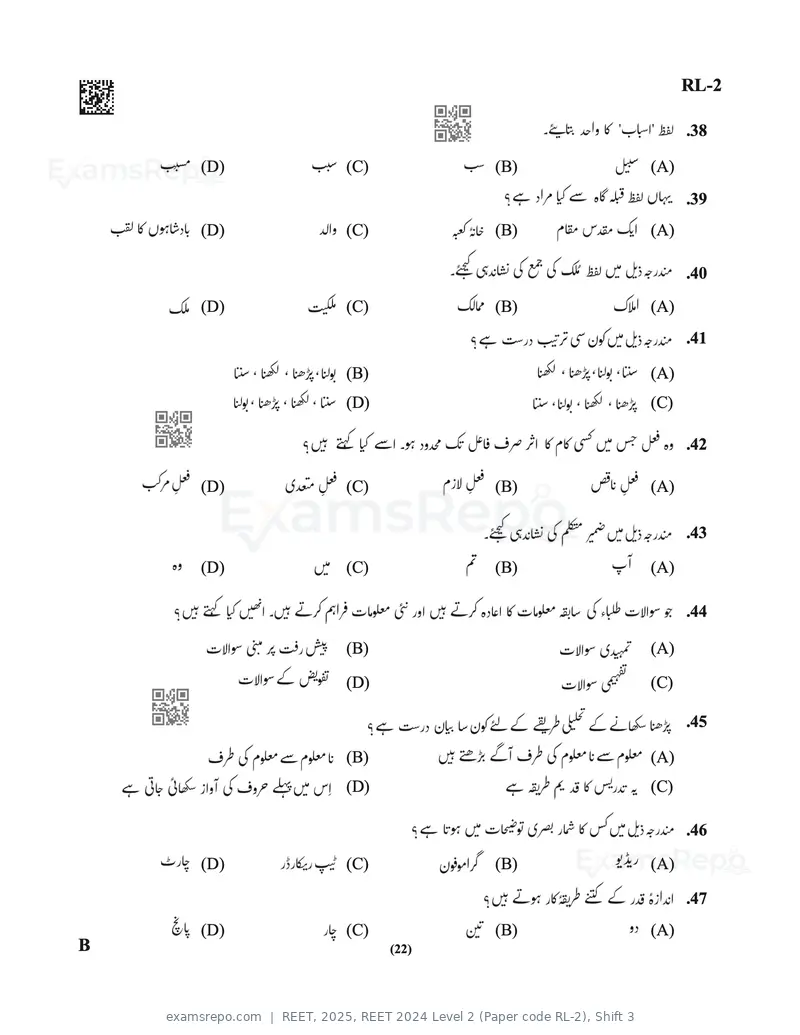
Text of page 118
RL-2

                                   .38

    (D)   (C)          (B)   (A)
                                   .39
    (D)   (C)          (B)   (A)

                                   .40
    (D)   (C)          (B)   (A)
                                   .41

          (B)                (A)
          (D)                (C)

                                   .42

    (D)   (C)          (B)   (A)

                                   .43

    (D)   (C)          (B)   (A)

                                   .44

          (B)                (A)

          (D)                (C)

                                   .45

          (B)                (A)
          (D)                (C)

                                   .46
    (D)   (C)          (B)   (A)

                                   .47
    (D)   (C)          (B)   (A)
B               (22)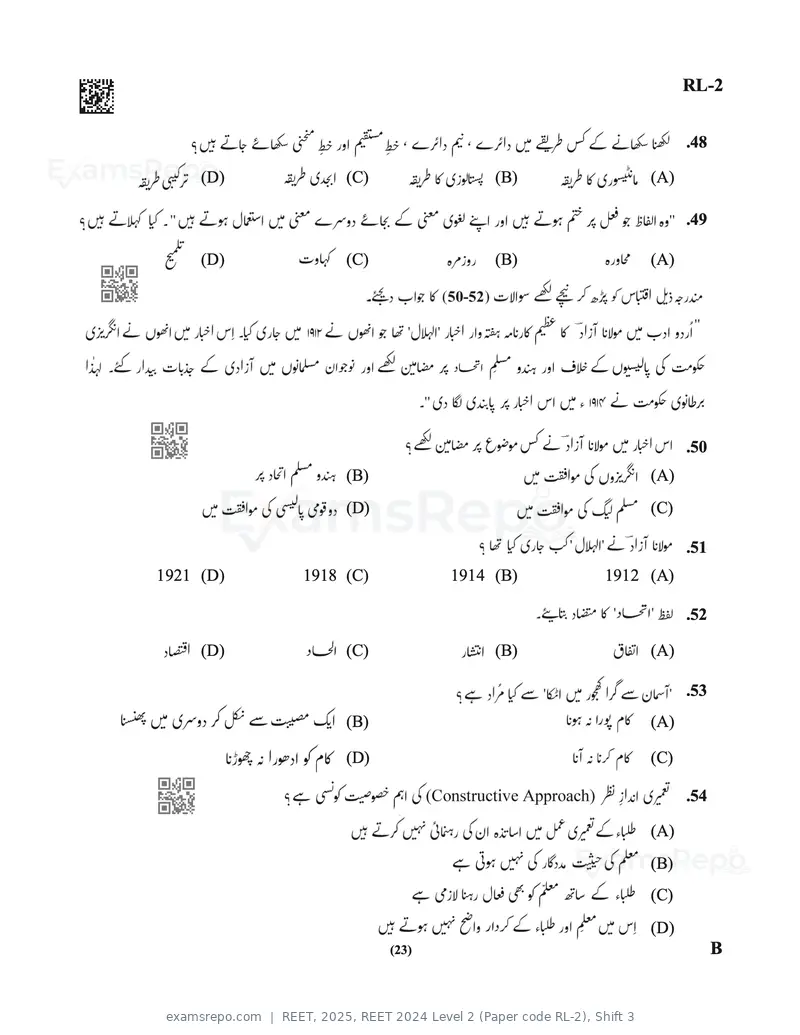
Text of page 119
RL-2


                                                   .48

     (D)        (C)               (B)        (A)

                                                   .49

     (D)        (C)               (B)        (A)


                                                   .50
                (B)                          (A)
                (D)                          (C)

                                                   .51
1921 (D)   1918 (C)          1914 (B)   1912 (A)

                                                   .52

     (D)        (C)               (B)        (A)

                                                   .53
                (B)                          (A)

                (D)                          (C)

                                                   .54

                                             (A)
                                             (B)
                                             (C)
                                             (D)
                      (23)                               B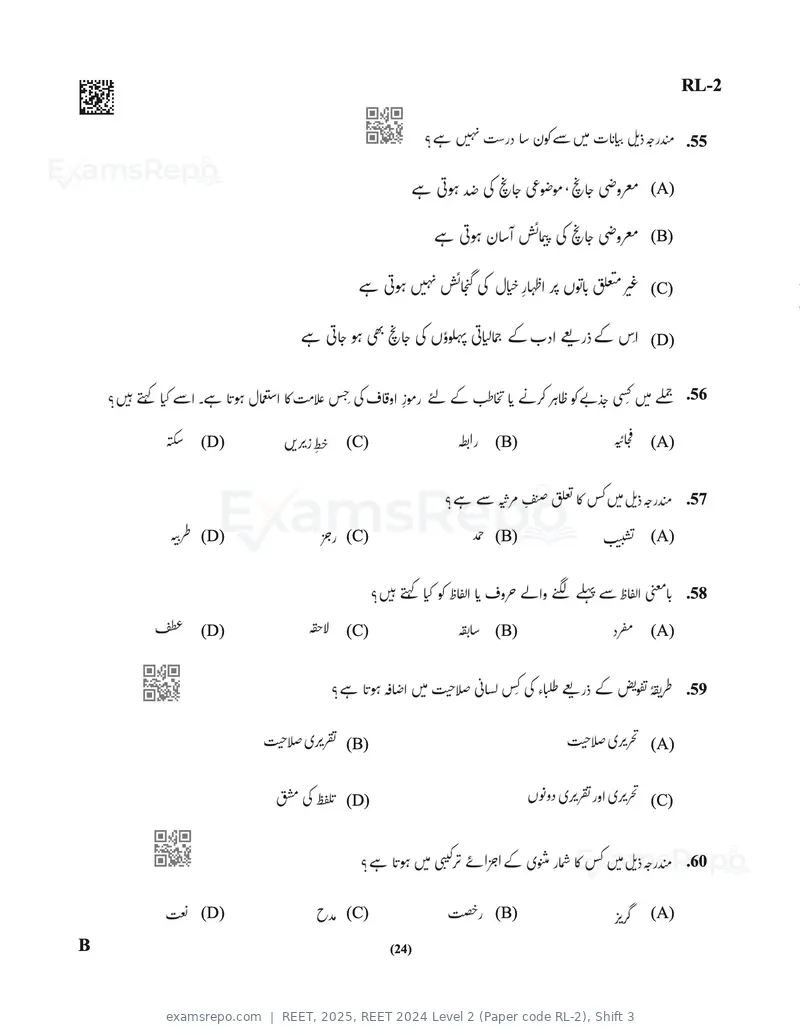
Text of page 120
RL-2


                                   .55

                             (A)

                             (B)


                             (C)


                             (D)


                                   .56

    (D)   (C)          (B)   (A)


                                   .57

    (D)   (C)          (B)   (A)


                                   .58

    (D)   (C)          (B)   (A)


                                   .59


          (B)                (A)


          (D)                (C)


                                   .60


    (D)   (C)          (B)   (A)
B               (24)
Text of page 121
RL-2

                        – II
                        –I
                      qgYr


B


    31.
          (A)   (B)      (C)   (D)


    32.

          (A)            (B)
          (C)            (D)


    33.

          (A)   (B)      (C)   (D)


    34.

          (A)   (B)      (C)   (D)

                      (25)             B
Text of page 122
RL-2

    35.
          (A)         (B)            (C)         (D)
    36.
          (A)                        (B)
          (C)                        (D)
    37.
          (A)                        (B)
          (C)                        (D)

    38.
          (A)                        (B)
          (C)                        (D)
    39.
          (A)                        (B)
          (C)                        (D)

    40.
          (A) (“ ”)   (B) ( ! )      (C) ( ; )   (D) ( ? )
    41.
          (A)                        (B)
          (C)                        (D)
    42.
          (A)                        (B)
          (C)                        (D)
    43.
          (A)                        (B)
          (C)                        (D)
    44.
          (A)                        (B)
          (C)                        (D)

    45.
          (A)         (B)            (C)         (D)
B                                 (26)
Text of page 123
RL-2

46.
      (A)      (B)
      (C)      (D)
47.
      (A)      (B)
      (C)      (D)

48.
      (A)      (B)
      (C)      (D)
49.
      (A)      (B)
      (C)      (D)


50.
      (A)      (B)
      (C)      (D)

51.
      (A)      (B)
      (C)      (D)
            (27)       B
Text of page 124
RL-2


    52.
          (A)                                           (B)
          (C)                                           (D)

    53.
          (A)                 (B)                       (C)   (D)
    54.
          (A)                 (B)                       (C)   (D)
    55.
          (A)                                           (B)
          (C)                                           (D)

    56.
          (A)                                           (B)
          (C)                                           (D)
    57.
          (A)                                           (B)
          (C)                                           (D)
    58.
           1.                   i.
           2.                  ii.
           3.                 iii.
           4.                 iv.
          (A) 1-i     2-ii           3-iii   4-iv
          (B) 1-iii   2-i            3-iv    4-ii
          (C) 1-ii    2-iv           3-i     4-iii
          (D) 1-iv    2-iii          3-ii    4-i
    59.
          (A)                 (B)                       (C)   (D)

    60.
          (A)                                           (B)
          (C)                                           (D)
B                                                    (28)
Text of page 125
RL-2

                        – II
                         –I
                       ( n§Om~r)


31.

      (A)                (B)
      (C)                (D)
32.                                      :
      (A)                (B)
      (C)                (D)
33.

                  :
      (A)   (B)          (C)       (D)
34.

      (A)   (B)          (C)       (D)
35.

      (A)
      (B)
      (C)
      (D)
36.                                 :
      (A)   (B)          (C)       (D)
37.

      (A)   (B)          (C)       (D)
38.
      (A)
      (B)
      (C)
      (D)
                      (29)                     B
Text of page 126
RL-2


    39.
          (A)            (B)
          (C)            (D)
    40.

          (A)   (B)      (C)       (D)
    41.
          (A)
          (B)
          (C)
          (D)
    42.                        :
          (A)
          (B)
          (C)
          (D)
    43.                  :
          (A)            (B)
          (C)            (D)


    44.
          (A)   (B)      (C)       (D)
B                     (30)
Text of page 127
RL-2

45.               :
      (A)   (B)                  (C)       (D)
46.
      (A)   (B)                  (C)       (D)

47.
      (A)   (B)                  (C)       (D)

48.                                              :
      (A)                        (B)
      (C)                        (D)

49.

      (A)   (B)                  (C)       (D)

50.                       :
      (A)                        (B)
      (C)                        (D)
51.                   :
      (A)   (B)                  (C)       (D)

52.


      (A)                        (B)
      (C)                        (D)
53.
      (A)   (B)                  (C)       (D)

54.                                    :

      (A)                        (B)
      (C)                        (D)

                              (31)                     B
Text of page 128
RL-2


    55.

          (A)   (B)      (C)   (D)

    56.
          (A)   (B)      (C)   (D)

    57.


          (A)            (B)
          (C)            (D)

    58.
          (A)   (B)      (C)   (D)

    59.
          (A)   (B)      (C)   (D)

    60.

          (A)            (B)
          (C)            (D)
B                     (32)
Text of page 129
RL-2

                   – II
                    –I
                  (JwOamVr)>


31.
      (A)   (B)      (C)       (D)

32.
      (A)   (B)      (C)       (D)

33.
      (A)            (B)
      (C)            (D)

34.
      (A)   (B)      (C)       (D)

35.
      (A)            (B)
      (C)            (D)

36.
      (A)            (B)
      (C)            (D)

37.
      (A)            (B)
      (C)            (D)
                  (33)                 B
Text of page 130
RL-2


    38.
          (A)   (B)      (C)   (D)
    39.
          (A)   (B)      (C)   (D)
    40.
          (A)            (B)
          (C)            (D)
    41.
          (A)   (B)      (C)   (D)
    42.
          (A)            (B)
          (C)            (D)
    43.
          (A)   (B)      (C)   (D)
    44.
          (A)            (B)
          (C)            (D)
    45.
          (A)
          (B)
          (C)
          (D)
    46.
          (A)   (B)      (C)   (D)
    47.
          (A)   (B)      (C)   (D)
B                     (34)
Text of page 131
RL-2

48.
      (A)   (B)      (C)   (D)
49.
      (A)            (B)
      (C)            (D)
50.
      (A)
      (B)
      (C)
      (D)
51.
      (A)            (B)
      (C)            (D)
52.

      (A)            (B)
      (C)            (D)
53.
      (A)   (B)      (C)   (D)
54.
      (A)   (B)      (C)   (D)
55.
      (A)   (B)      (C)   (D)
56.
      (A)            (B)
      (C)            (D)
57.
      (A)
      (B)
      (C)
      (D)
58.
      (A)   (B)      (C)   (D)
59.
      (A)   (B)      (C)   (D)
60.
      (A)   (B)      (C)   (D)
                  (35)             B
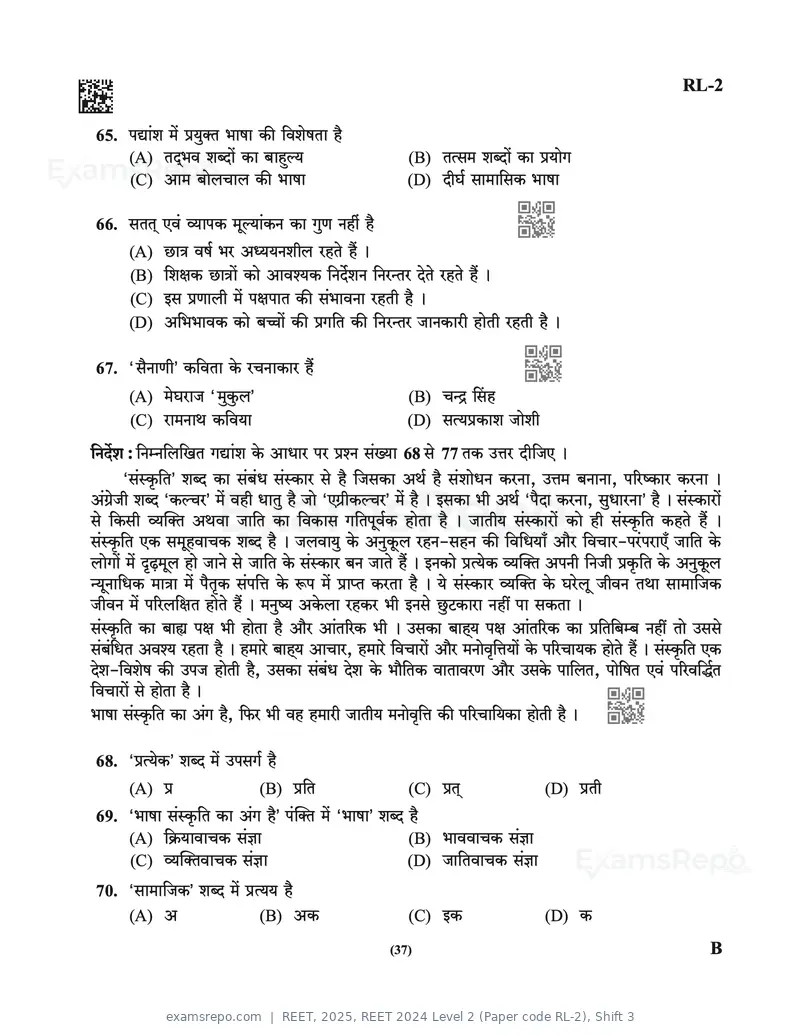
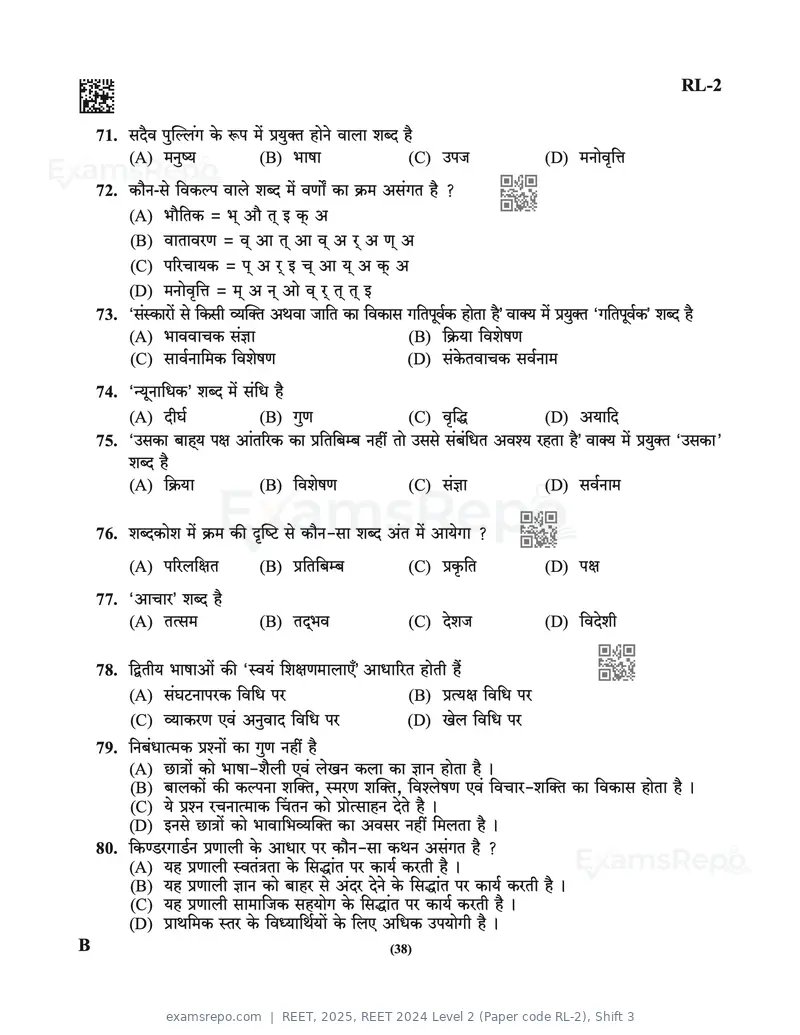
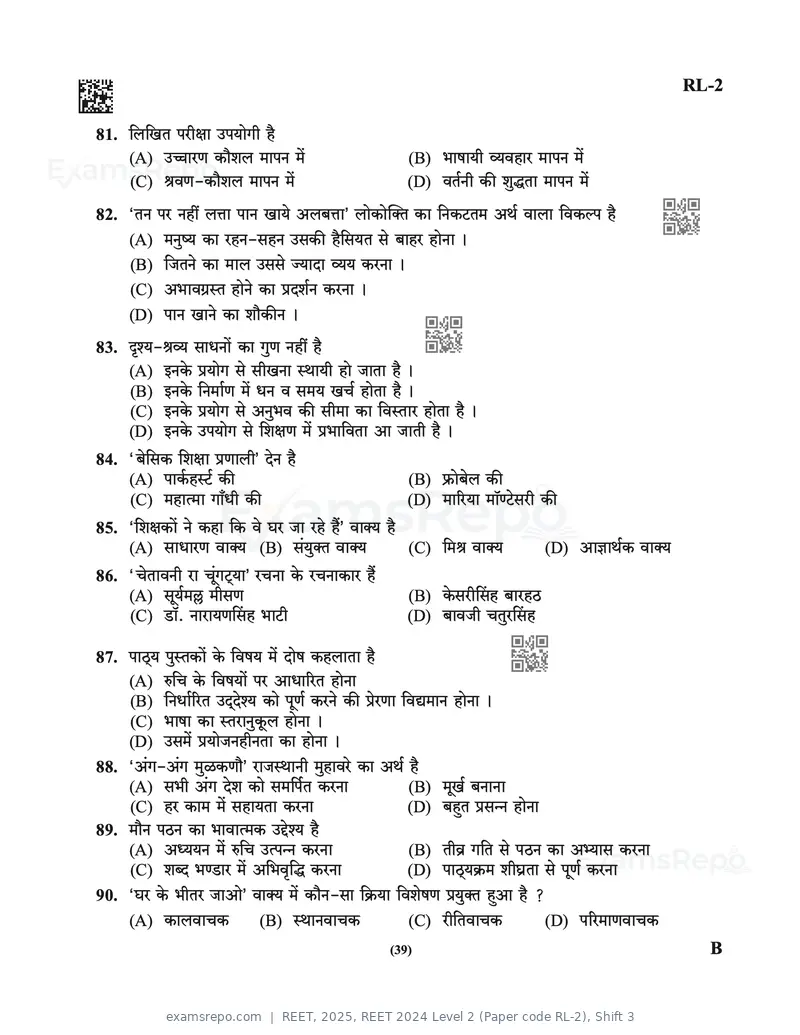
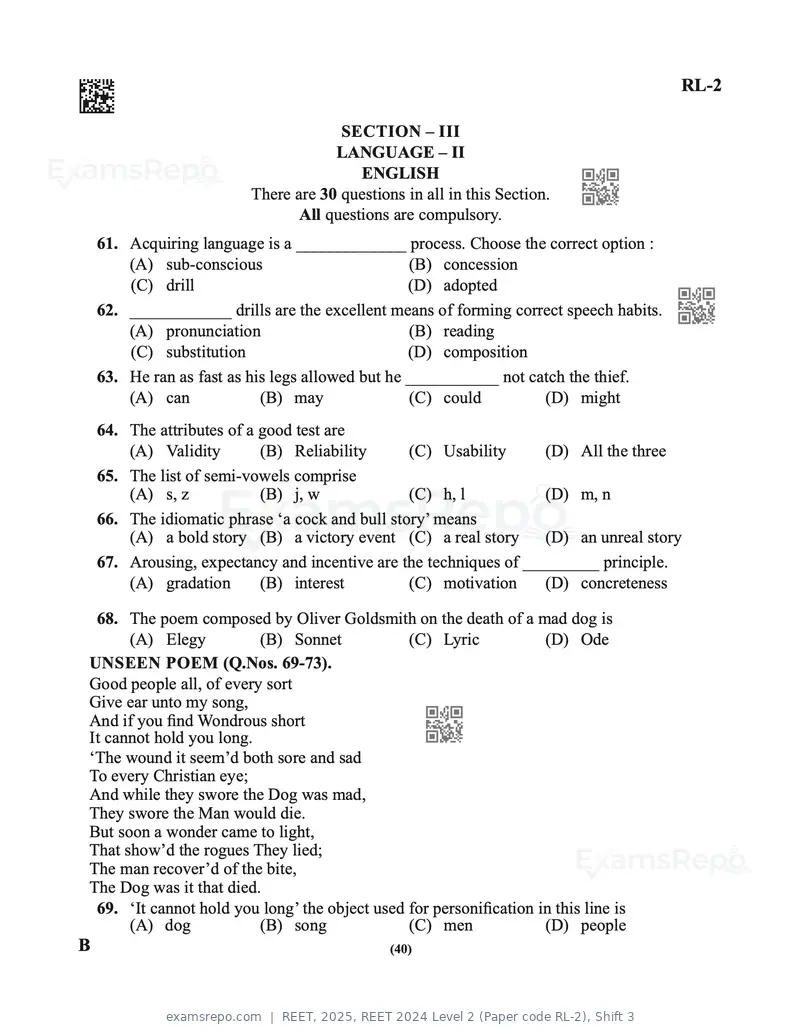
Text of page 136
RL-2

                                       SECTION – III
                                      LANGUAGE – II
                                          ENGLISH
                          There are 30 questions in all in this Section.
                                 All questions are compulsory.
    61. Acquiring language is a _____________ process. Choose the correct option :
        (A) sub-conscious                         (B) concession
        (C) drill                                 (D) adopted
    62. ____________ drills are the excellent means of forming correct speech habits.
        (A) pronunciation                         (B) reading
        (C) substitution                          (D) composition
    63. He ran as fast as his legs allowed but he ___________ not catch the thief.
        (A) can             (B) may               (C) could         (D) might
    64. The attributes of a good test are
        (A) Validity        (B) Reliability      (C) Usability      (D) All the three
    65. The list of semi-vowels comprise
        (A) s, z            (B) j, w             (C) h, l           (D) m, n
    66. The idiomatic phrase ‘a cock and bull story’ means
        (A) a bold story (B) a victory event (C) a real story       (D) an unreal story
    67. Arousing, expectancy and incentive are the techniques of _________ principle.
        (A) gradation       (B) interest         (C) motivation     (D) concreteness

 68. The poem composed by Oliver Goldsmith on the death of a mad dog is
      (A) Elegy          (B) Sonnet            (C) Lyric            (D) Ode
UNSEEN POEM (Q.Nos. 69-73).
Good people all, of every sort
Give ear unto my song,
And if you find Wondrous short
It cannot hold you long.
‘The wound it seem’d both sore and sad
To every Christian eye;
And while they swore the Dog was mad,
They swore the Man would die.
But soon a wonder came to light,
That show’d the rogues They lied;
The man recover’d of the bite,
The Dog was it that died.
 69. ‘It cannot hold you long’ the object used for personification in this line is
      (A) dog            (B) song              (C) men              (D) people
B                                              (40)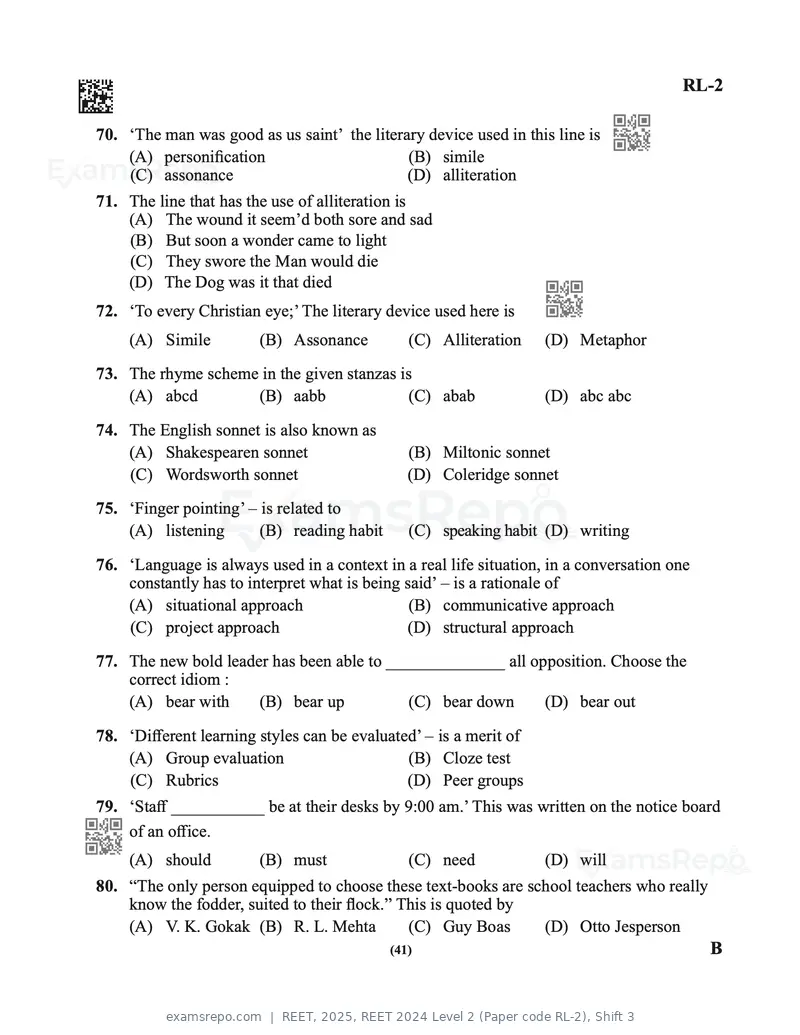
Text of page 137
RL-2

70. ‘The man was good as us saint’ the literary device used in this line is
    (A) personification                      (B) simile
    (C) assonance                            (D) alliteration
71. The line that has the use of alliteration is
    (A) The wound it seem’d both sore and sad
    (B) But soon a wonder came to light
    (C) They swore the Man would die
    (D) The Dog was it that died
72. ‘To every Christian eye;’ The literary device used here is
    (A) Simile          (B) Assonance          (C) Alliteration    (D) Metaphor

73. The rhyme scheme in the given stanzas is
    (A) abcd        (B) aabb               (C) abab                (D) abc abc

74. The English sonnet is also known as
    (A) Shakespearen sonnet                    (B) Miltonic sonnet
    (C) Wordsworth sonnet                      (D) Coleridge sonnet

75. ‘Finger pointing’ – is related to
    (A) listening       (B) reading habit      (C) speaking habit (D) writing

76. ‘Language is always used in a context in a real life situation, in a conversation one
    constantly has to interpret what is being said’ – is a rationale of
    (A) situational approach                   (B) communicative approach
    (C) project approach                      (D) structural approach

77. The new bold leader has been able to ______________ all opposition. Choose the
    correct idiom :
    (A) bear with     (B) bear up           (C) bear down     (D) bear out

78. ‘Different learning styles can be evaluated’ – is a merit of
    (A) Group evaluation                      (B) Cloze test
    (C) Rubrics                               (D) Peer groups
79. ‘Staff ___________ be at their desks by 9:00 am.’ This was written on the notice board
    of an office.
    (A) should          (B) must               (C) need            (D) will
80. “The only person equipped to choose these text-books are school teachers who really
    know the fodder, suited to their flock.” This is quoted by
    (A) V. K. Gokak (B) R. L. Mehta          (C) Guy Boas      (D) Otto Jesperson
                                            (41)                                            B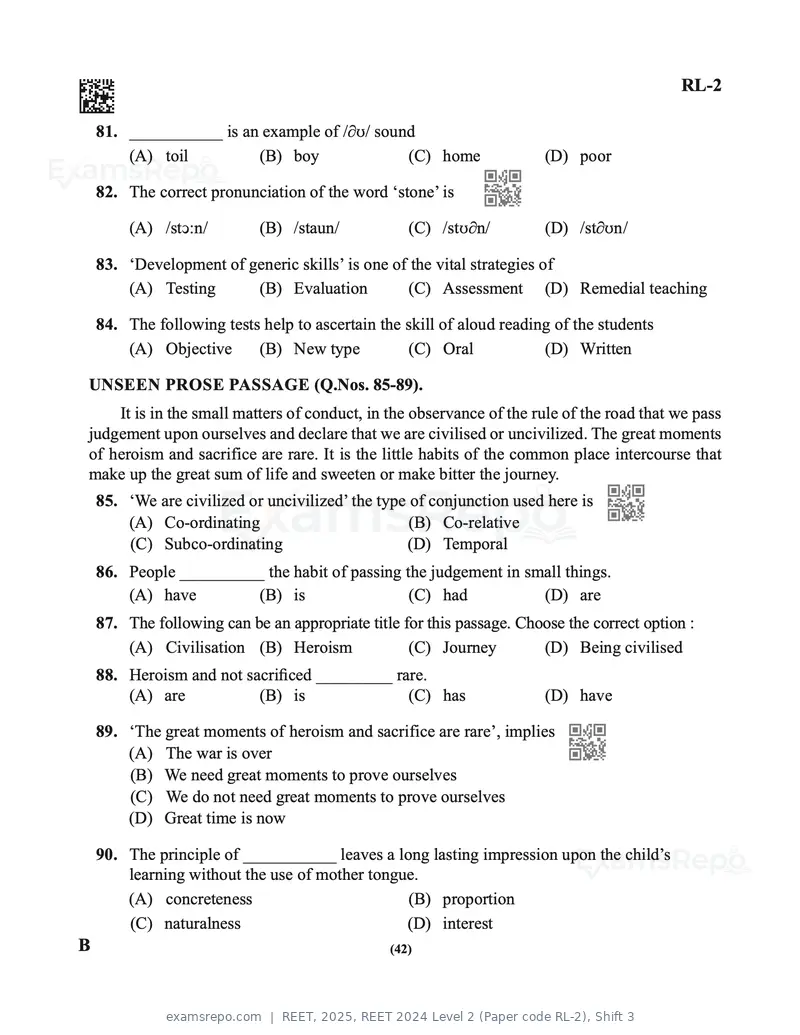
Text of page 138
RL-2

    81. ___________ is an example of /∂ʊ/ sound
        (A) toil         (B) boy              (C) home                  (D) poor

    82. The correct pronunciation of the word ‘stone’ is

         (A) /stͻ:n/        (B) /staun/            (C) /stʊ∂n/          (D) /st∂ʊn/

    83. ‘Development of generic skills’ is one of the vital strategies of
        (A) Testing      (B) Evaluation          (C) Assessment (D) Remedial teaching

    84. The following tests help to ascertain the skill of aloud reading of the students
        (A) Objective      (B) New type           (C) Oral             (D) Written

UNSEEN PROSE PASSAGE (Q.Nos. 85-89).
    It is in the small matters of conduct, in the observance of the rule of the road that we pass
judgement upon ourselves and declare that we are civilised or uncivilized. The great moments
of heroism and sacrifice are rare. It is the little habits of the common place intercourse that
make up the great sum of life and sweeten or make bitter the journey.
    85. ‘We are civilized or uncivilized’ the type of conjunction used here is
        (A) Co-ordinating                          (B) Co-relative
        (C) Subco-ordinating                      (D) Temporal
    86. People __________ the habit of passing the judgement in small things.
        (A) have        (B) is                  (C) had           (D) are
    87. The following can be an appropriate title for this passage. Choose the correct option :
        (A) Civilisation (B) Heroism               (C) Journey         (D) Being civilised
    88. Heroism and not sacrificed _________ rare.
        (A) are           (B) is               (C) has                  (D) have

    89. ‘The great moments of heroism and sacrifice are rare’, implies
        (A) The war is over
        (B) We need great moments to prove ourselves
        (C) We do not need great moments to prove ourselves
        (D) Great time is now

    90. The principle of ___________ leaves a long lasting impression upon the child’s
        learning without the use of mother tongue.
        (A) concreteness                        (B) proportion
        (C) naturalness                         (D) interest
B                                               (42)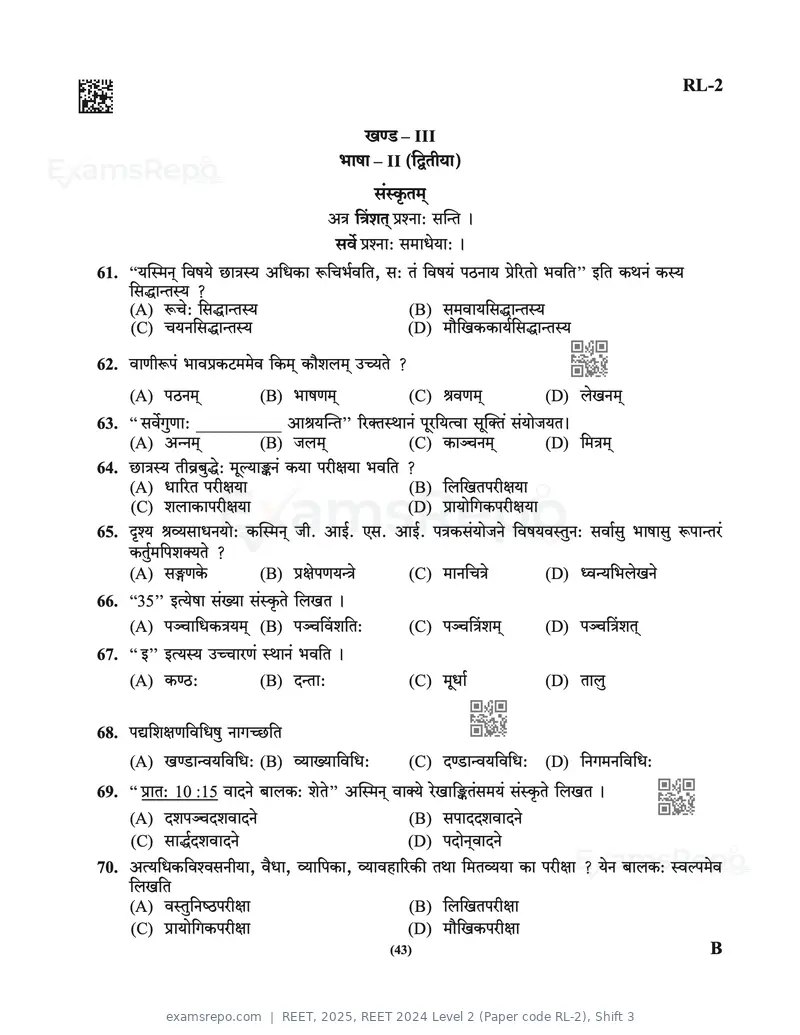
Text of page 142
RL-2

            III –
                II –
                       (CXÿ© )


                                             .61

    (D)   (C)                    (B)   (A)

                                             .62

    (D)   (C)                    (B)   (A)

                                             .63

          (B)                          (A)

          (D)                          (C)


                                             .64

    (D)   (C)                    (B)   (A)


                                             .65

          (B)                          (A)
          (D)                          (C)


                                             .66

    (D)   (C)                    (B)   (A)

B                 (46)
Text of page 143
RL-2


                               .67

(D)   (C)          (B)   (A)

                               .68
(D)   (C)          (B)   (A)

                               .69

(D)   (C)          (B)   (A)
                               .70
(D)   (C)          (B)   (A)
                               .71
(D)   (C)          (B)   (A)
                               .72
(D)   (C)          (B)   (A)
                               .73
                         (A)
                         (B)
                         (C)
                         (D)
                               .74
(D)   (C)          (B)   (A)
            (47)                     B
Text of page 144
RL-2

                                                                   .75
                                                            (A)
                                                            (B)
                                                            (C)
                                                            (D)
                                                                   .76

                         (B)                                (A)
                         (D)                                (C)
                                                                   .77
                         (B)                                (A)
                         (D)                                (C)

                                                                   .78
    16 : 16 (D)   14 : 14 (C)          14 : 16 (B)   16 : 14 (A)
                                                                   .79
           (D)           (C)                  (B)           (A)


                                                                   .80
           (D)           (C)                  (B)           (A)
B                               (48)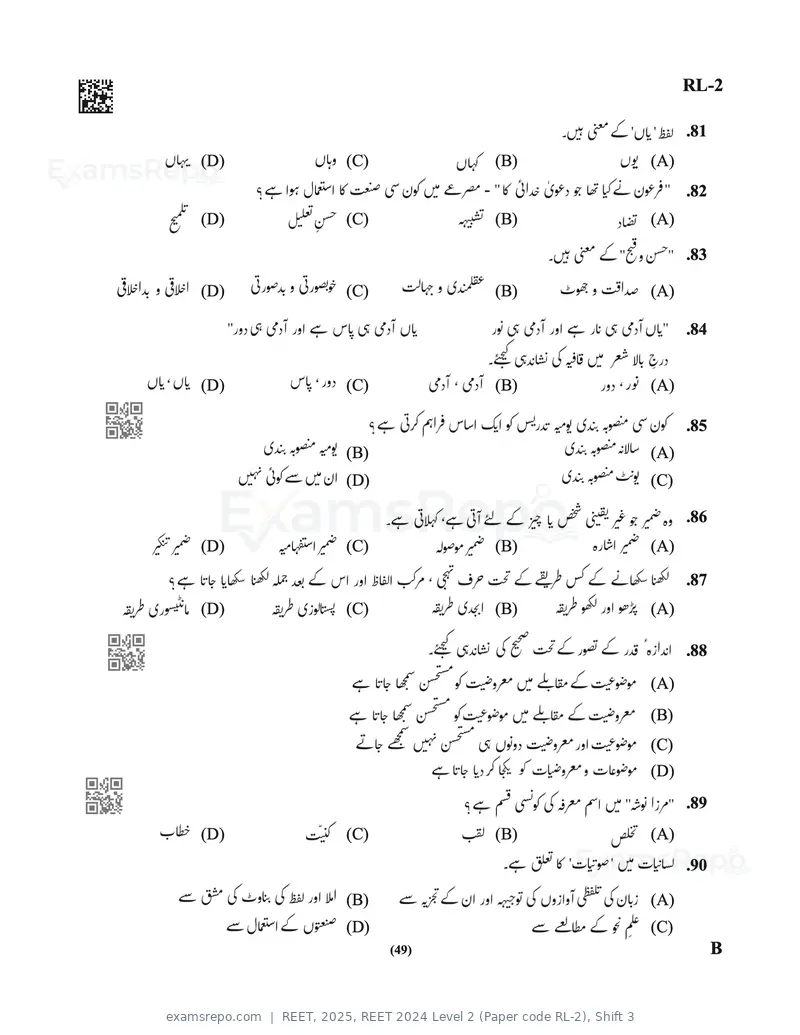
Text of page 145
RL-2

                               .81
(D)   (C)          (B)   (A)
                               .82
(D)   (C)          (B)   (A)

                               .83

(D)   (C)          (B)   (A)

                               .84


(D)   (C)          (B)   (A)

                               .85
      (B)                (A)
      (D)                (C)

                               .86
(D)   (C)          (B)   (A)

                               .87
(D)   (C)          (B)   (A)

                               .88
                         (A)
                         (B)
                         (C)
                         (D)
                               .89
(D)   (C)          (B)   (A)
                               .90

      (B)                (A)
      (D)                (C)
            (49)                     B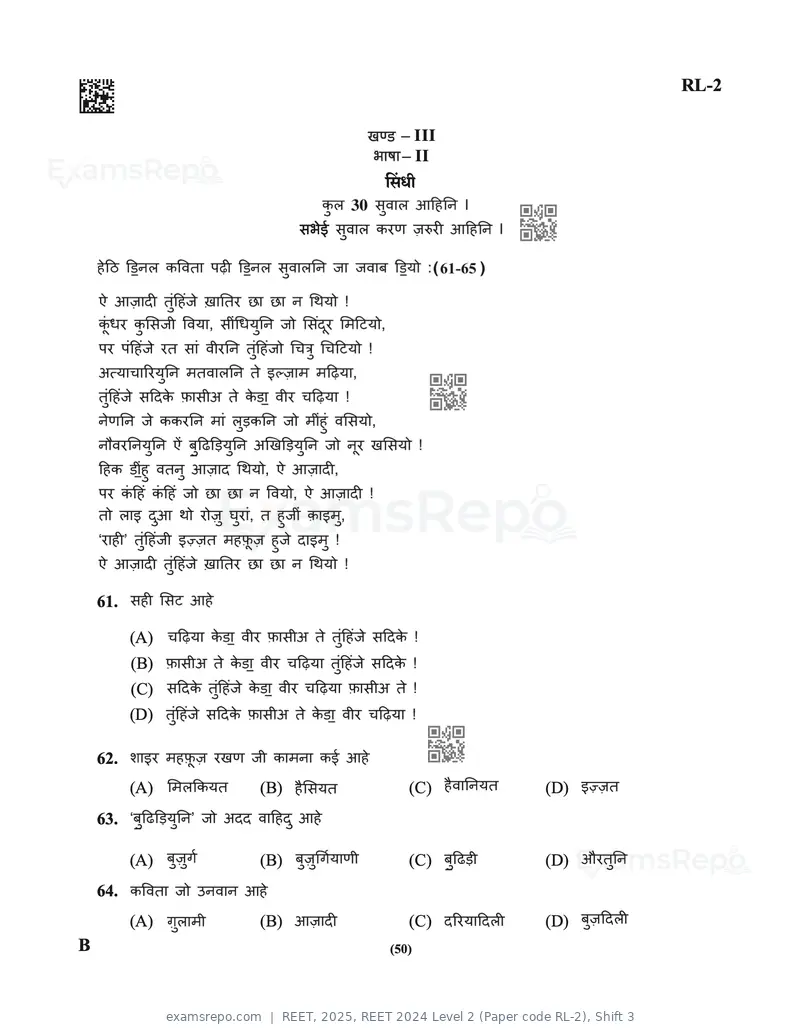
Text of page 146
RL-2

                        – III
                        – II
                      qgYr


    61.

          (A)
          (B)
          (C)
          (D)

    62.
          (A)   (B)      (C)    (D)
    63.

          (A)   (B)      (C)    (D)
    64.
          (A)   (B)      (C)    (D)
B                     (50)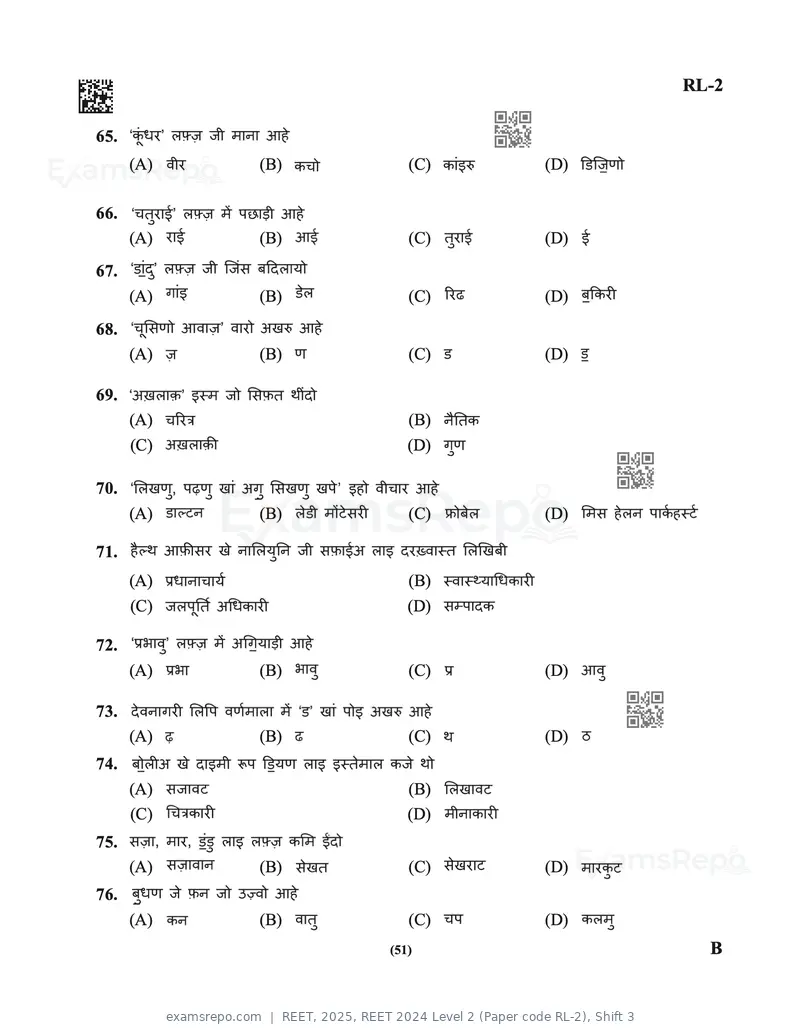
Text of page 147
RL-2

65.
      (A)   (B)      (C)   (D)

66.
      (A)   (B)      (C)   (D)
67.
      (A)   (B)      (C)   (D)
68.
      (A)   (B)      (C)   (D)

69.
      (A)            (B)
      (C)            (D)

70.
      (A)   (B)      (C)   (D)

71.
      (A)            (B)
      (C)            (D)

72.
      (A)   (B)      (C)   (D)

73.
      (A)   (B)      (C)   (D)
74.
      (A)            (B)
      (C)            (D)
75.
      (A)   (B)      (C)   (D)
76.
      (A)   (B)      (C)   (D)
                  (51)             B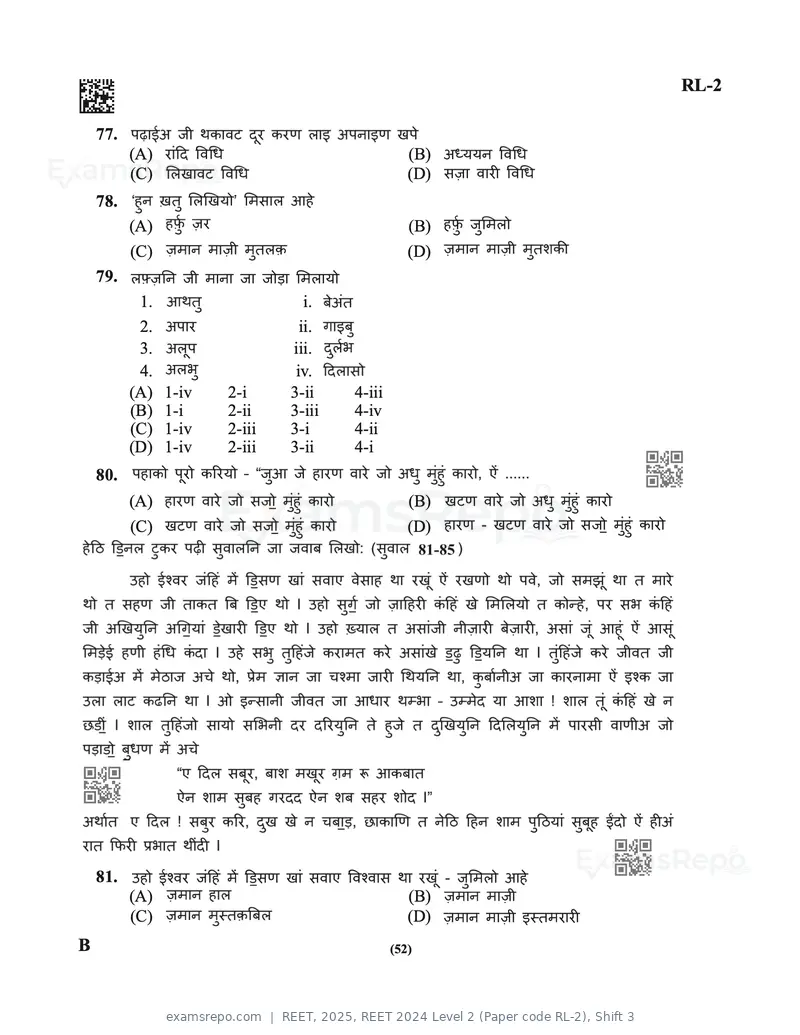
Text of page 148
RL-2

    77.
          (A)                                   (B)
          (C)                                   (D)
    78.
          (A)                                   (B)
          (C)                                   (D)
    79.
           1.                   i.
           2.                  ii.
           3.                iii.
           4.                 iv.
          (A) 1-iv   2-i     3-ii    4-iii
          (B) 1-i    2-ii    3-iii   4-iv
          (C) 1-iv   2-iii   3-i     4-ii
          (D) 1-iv   2-iii   3-ii    4-i
    80.
          (A)                                   (B)
          (C)                                   (D)


    81.
          (A)                                   (B)
          (C)                                   (D)
B                                            (52)
Text of page 149
RL-2

82.
      (A)                  (B)                     (C)                  (D)
83.
      (A)                  (B)                     (C)                  (D)
84.
      (A)                  (B)                     (C)                  (D)

85.
      (A)
      (B)
      (C)
      (D)

86.

      (A)                                          (B)
      (C)                                          (D)
87.
      (A)                  (B)                     (C)                  (D)

88.
         i.
        ii.
       iii.
       iv.
      (A) iv, iii, i, ii   (B) ii, iii, iv, i      (C) i, ii, iii, iv   (D) ii, i, iv, iii

89.
      (A)                  (B)                     (C)                  (D)

90.
      (A)                  (B)                     (C)                  (D)

                                                (53)                                           B
Text of page 150
RL-2

                       – III
                         – II
                       ( n§Om~r)


    61.

          (A)            (B)
          (C)            (D)
    62.


          (A)            (B)
          (C)            (D)
    63.

          (A)   (B)      (C)       (D)
    64.
          (A)            (B)
          (C)            (D)
    65.
          (A)   (B)      (C)       (D)
    66.
          (A)   (B)      (C)       (D)


    67.
          (A)   (B)      (C)       (D)
B                     (54)
Text of page 151
RL-2

68.
      (A)   (B)      (C)   (D)
69.

      (A)            (B)
      (C)            (D)
70.
      (A)   (B)      (C)   (D)
71.

      (A)
      (B)
      (C)
      (D)
72.

      (A)            (B)
      (C)            (D)


73.

      (A)            (B)
      (C)            (D)
                  (55)             B
Text of page 152
RL-2

    74.


          (A)            (B)
          (C)            (D)
    75.
          (A)   (B)      (C)       (D)
    76.


          (A)   (B)      (C)       (D)
    77.                                  :
          (A)            (B)
          (C)            (D)
    78.
          (A)            (B)
          (C)            (D)
    79.                        :
          (A)   (B)      (C)       (D)
    80.
          (A)            (B)
          (C)            (D)

    81.

          (A)   (B)      (C)       (D)

    82.                                       :
          (A)            (B)
          (C)            (D)

    83.

          (A)            (B)
          (C)            (D)
B                     (56)
Text of page 153
RL-2

84.         :
      (A)
      (B)
      (C)
      (D)

85.

      (A)          (B)
      (C)          (D)
86.

      (A)          (B)
      (C)          (D)

87.

      (A)          (B)
      (C)          (D)
88.
      (A)
      (B)
      (C)
      (D)

89.                      :
      (A)          (B)
      (C)          (D)

90.


      (A)          (B)
      (C)          (D)

                (57)           B
Text of page 154
RL-2

                      – III
                       – II
                        (JwOamVr)>


    61.

          (A)   (B)      (C)         (D)
    62.
          (A)            (B)
          (C)            (D)
    63.

          (A)   (B)      (C)         (D)
    64.
          (A)            (B)
          (C)            (D)
    65.
          (A)   (B)      (C)         (D)
    66.
          (A)   (B)      (C)         (D)
    67.

          (A)   (B)      (C)         (D)
    68.
          (A)   (B)      (C)         (D)
    69.
          (A)
          (B)
          (C)
          (D)
    70.

          (A)   (B)      (C)         (D)
B                     (58)
Text of page 155
RL-2

71.

      (A)   (B)      (C)   (D)

72.

      (A)   (B)      (C)   (D)
73.
      (A)   (B)      (C)   (D)
74.
      (A)            (B)
      (C)            (D)


75.
      (A)   (B)      (C)   (D)
76.
      (A)   (B)      (C)   (D)
77.
      (A)   (B)      (C)   (D)
78.
      (A)            (B)
      (C)            (D)
79.

      (A)            (B)
      (C)            (D)
                  (59)             B
Text of page 156
RL-2


    80.
          (A)            (B)
          (C)            (D)
    81.
          (A)   (B)      (C)   (D)
    82.
          (A)   (B)      (C)   (D)
    83.
          (A)   (B)      (C)   (D)
    84.
          (A)   (B)      (C)   (D)
    85.
          (A)            (B)
          (C)            (D)
    86.
          (A)            (B)
          (C)            (D)
    87.
          (A)            (B)
          (C)            (D)
    88.
          (A)   (B)      (C)   (D)
    89.
          (A)   (B)      (C)   (D)
    90.
          (A)            (B)
          (C)            (D)
B                     (60)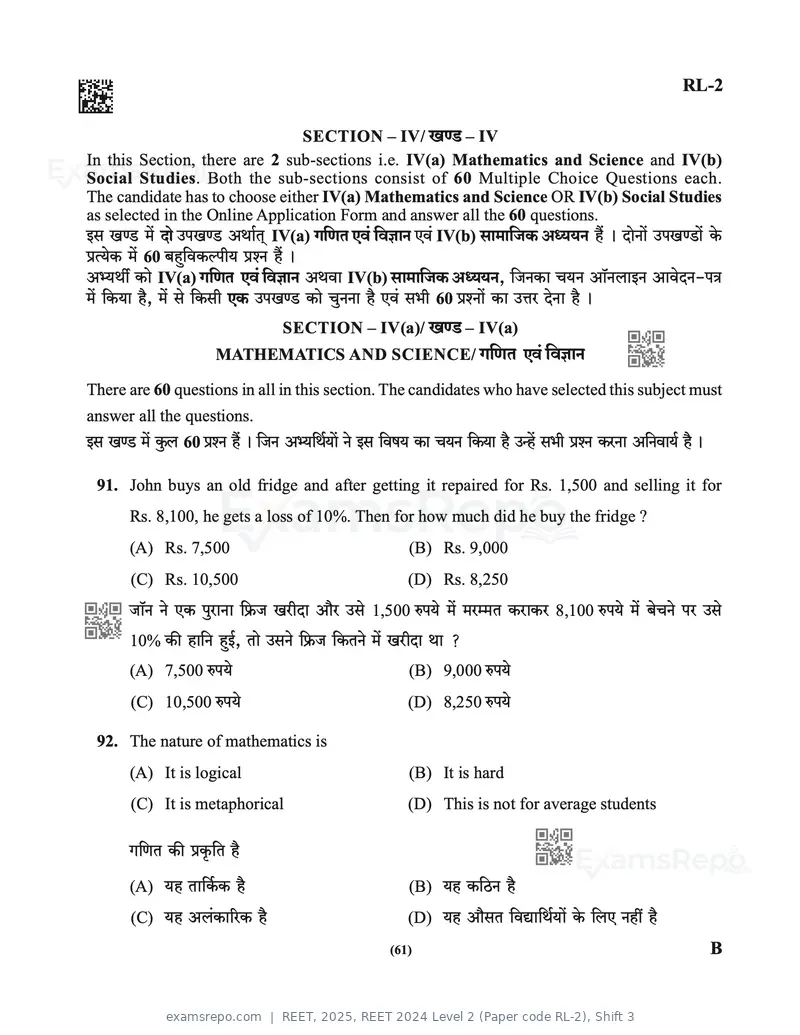
Text of page 157
RL-2

                                   SECTION – IV/ IÊS> – IV
In this Section, there are 2 sub-sections i.e. IV(a) Mathematics and Science and IV(b)
Social Studies. Both the sub-sections consist of 60 Multiple Choice Questions each.
The candidate has to choose either IV(a) Mathematics and Science OR IV(b) Social Studies
as selected in the Online Application Form and answer all the 60 questions.
Bg IÊS> _| Xmo CnIÊS> AWm©V² IV(a) J{UV Ed§ {dkmZ Ed§ IV(b) gm_m{OH$ AÜ``Z h¢ & XmoZm| CnIÊS>m| Ho$
àË`oH$ _| 60 ~hþ{dH$ënr` àíZ h¢ &
Aä`Wu H$mo IV(a) J{UV Ed§ {dkmZ AWdm IV(b) gm_m{OH$ AÜ``Z, {OZH$m M`Z Am°ZbmBZ AmdoXZ-nÌ
_| {H$`m h¡, _| go {H$gr EH$ CnIÊS> H$mo MwZZm h¡ Ed§ g^r 60 àíZm| H$m CÎma XoZm h¡ &
                                SECTION – IV(a)/ IÊS> – IV(a)
                     MATHEMATICS AND SCIENCE/ J{UV Ed§ {dkmZ

There are 60 questions in all in this section. The candidates who have selected this subject must
answer all the questions.
Bg IÊS> _| Hw$b 60 àíZ h¢ & {OZ Aä`{W©`m| Zo Bg {df` H$m M`Z {H$`m h¡ CÝh| g^r àíZ H$aZm A{Zdm`© h¡ &

 91. John buys an old fridge and after getting it repaired for Rs. 1,500 and selling it for
       Rs. 8,100, he gets a loss of 10%. Then for how much did he buy the fridge ?
       (A) Rs. 7,500                                (B) Rs. 9,000
       (C) Rs. 10,500                               (D) Rs. 8,250
       Om°Z Zo EH$ nwamZm {\«$O IarXm Am¡a Cgo 1,500 én`o _| _aå_V H$amH$a 8,100 én`o _| ~oMZo na Cgo
       10% H$s hm{Z hþB©, Vmo CgZo {\«$O {H$VZo _| IarXm Wm ?
       (A) 7,500 én`o                                 (B) 9,000 én`o
       (C) 10,500 én`o                               (D) 8,250 én`o

 92. The nature of mathematics is
       (A) It is logical                            (B) It is hard
       (C) It is metaphorical                       (D) This is not for average students

       J{UV H$s àH¥${V h¡
       (A) `h Vm{H©$H$ h¡                           (B) `h H${R>Z h¡
       (C) `h Ab§H$m[aH$ h¡                         (D) `h Am¡gV {dÚm{W©`m| Ho$ {bE Zht h¡
                                                 (61)                                                   B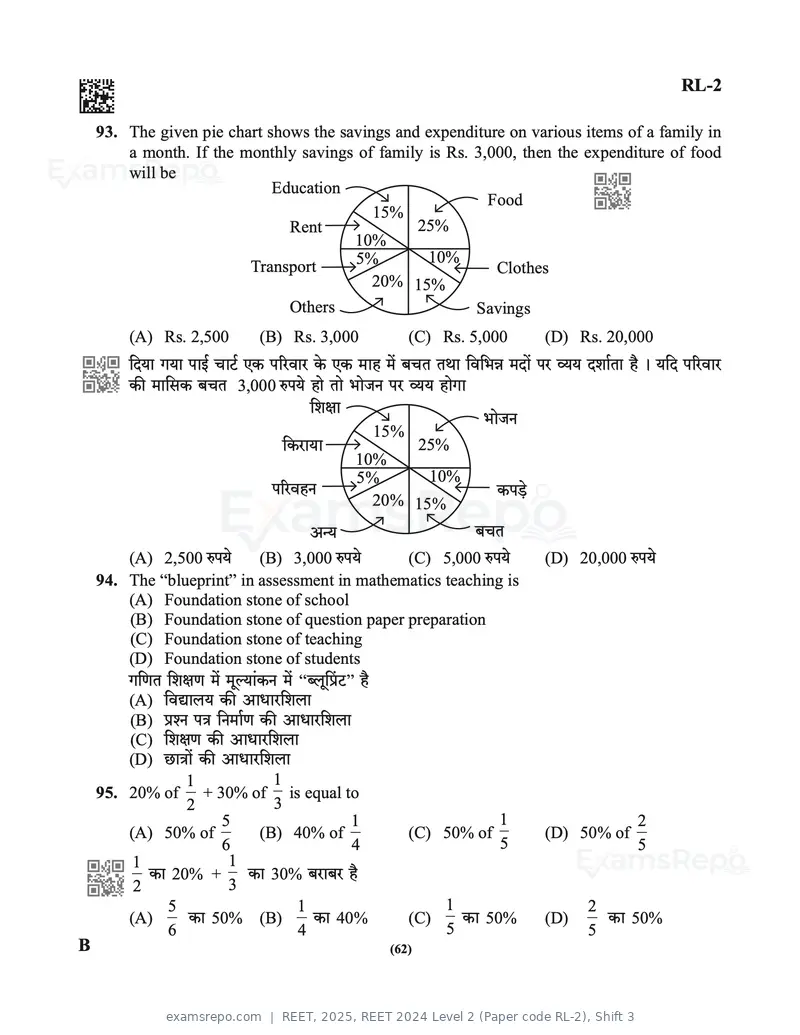
Text of page 158
RL-2

    93. The given pie chart shows the savings and expenditure on various items of a family in
        a month. If the monthly savings of family is Rs. 3,000, then the expenditure of food
        will be
                             Education
                                                           Food
                                           15%
                               Rent              25%
                                        10%
                                        5%        10%
                         Transport                          Clothes
                                           20% 15%
                                 Others                        Savings
        (A) Rs. 2,500       (B) Rs. 3,000           (C) Rs. 5,000           (D) Rs. 20,000
        {X`m J`m nmB© MmQ>© EH$ n[adma Ho$ EH$ _mh _| ~MV VWm {d{^Þ _Xm| na ì`` Xem©Vm h¡ & `{X n[adma
        H$s _m{gH$ ~MV 3,000 én`o hmo Vmo ^moOZ na ì`` hmoJm
                                       {ejm
                                                                 ^moOZ
                                                 15%
                                  {H$am`m               25%
                                           10%
                                           5%      10%
                              n[adhZ                              H$n‹S>o
                                             20% 15%
                                  AÝ`                       ~MV
        (A) 2,500 én`o      (B) 3,000 én`o          (C) 5,000 én`o          (D) 20,000 én`o
    94. The “blueprint” in assessment in mathematics teaching is
        (A) Foundation stone of school
        (B) Foundation stone of question paper preparation
        (C) Foundation stone of teaching
        (D) Foundation stone of students
        J{UV {ejU _| _yë`m§H$Z _| “ ãbyqàQ> ” h¡
        (A) {dÚmb` H$s AmYma{ebm
        (B) àíZ nÌ {Z_m©U H$s AmYma{ebm
        (C) {ejU H$s AmYma{ebm
        (D) N>mÌm| H$s AmYma{ebm
                 1            1
    95. 20% of + 30% of is equal to
                 2            3
                       5                     1                1                          2
        (A) 50% of          (B) 40% of           (C) 50% of                 (D) 50% of
                       6                     4                5                          5
         1              1
           H$m 20% + H$m 30% ~am~a h¡
         2              3
              5                   1                  1                            2
        (A)      H$m 50% (B)         H$m 40%     (C)    H$m 50%             (D)       H$m 50%
              6                   4                  5                            5
B                                                (62)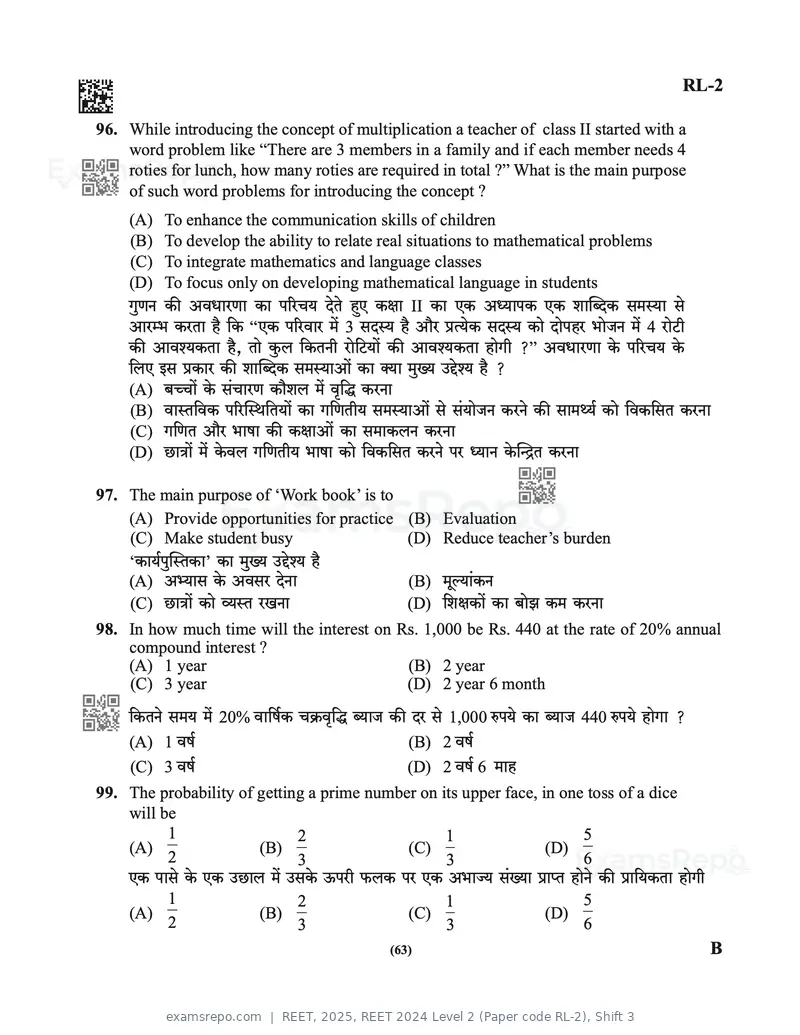
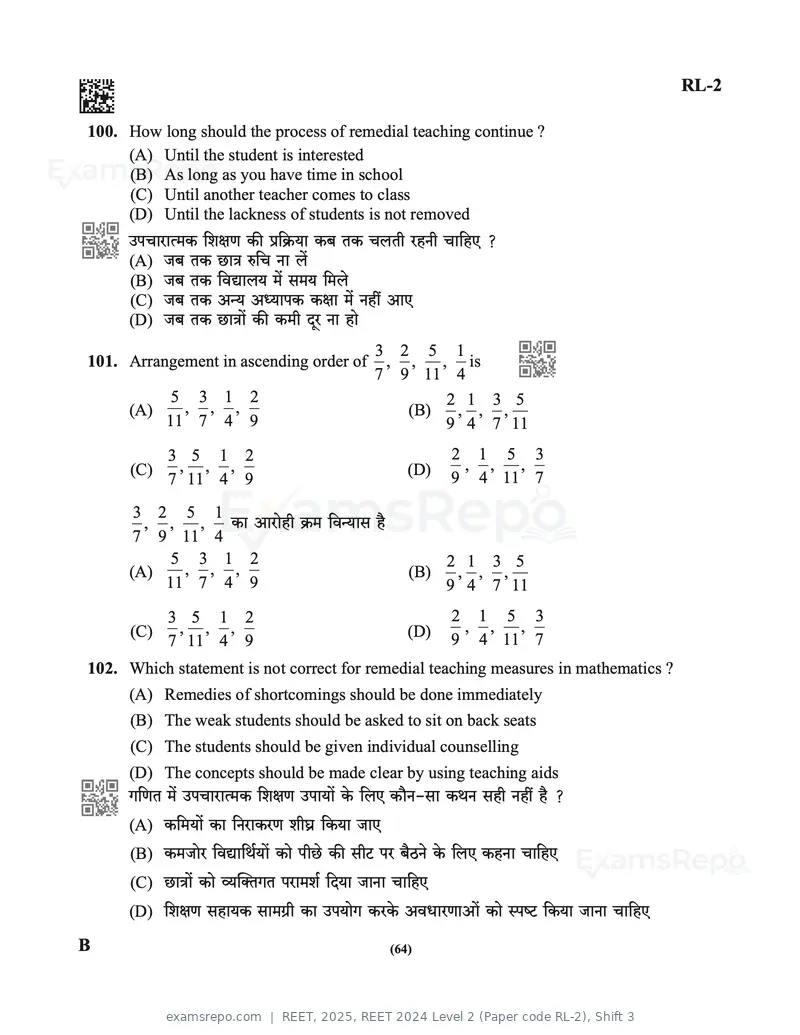
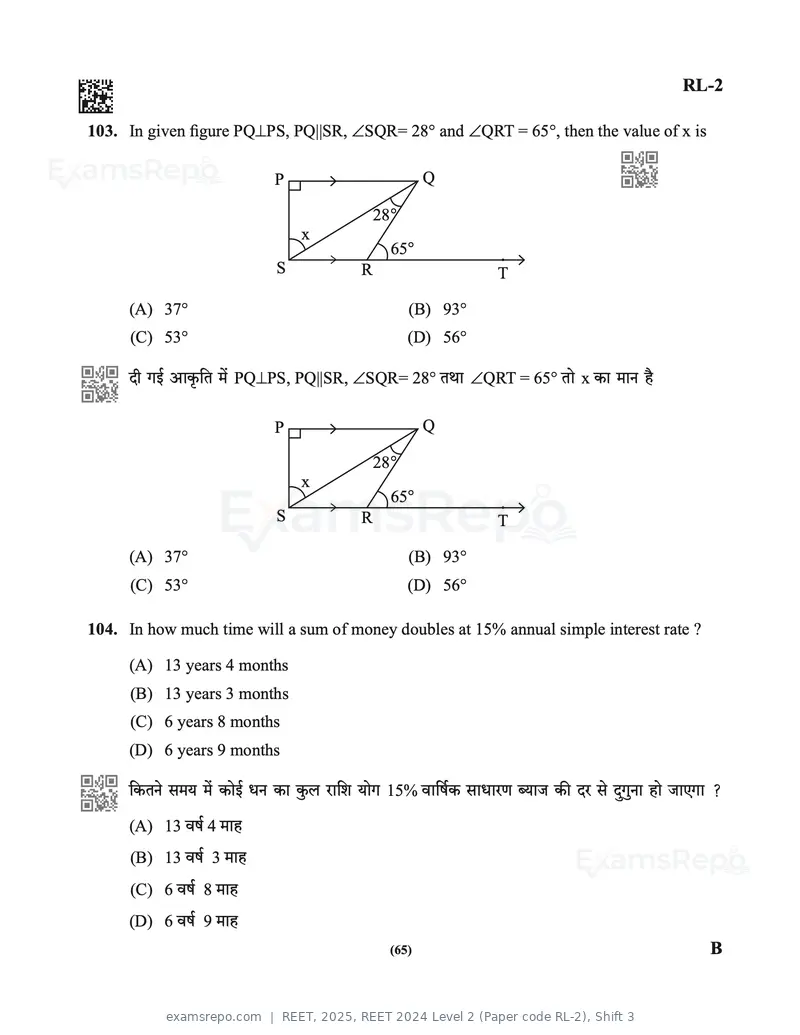
Text of page 161
RL-2

103. In given figure PQ⊥PS, PQ||SR, ∠SQR= 28° and ∠QRT = 65°, then the value of x is

                            P                          Q

                                              28°
                                x
                                                65°
                            S             R                     T

     (A) 37°                                        (B) 93°
     (C) 53°                                        (D) 56°

     Xr JB© AmH¥${V _| PQ⊥PS, PQ||SR, ∠SQR= 28° VWm ∠QRT = 65° Vmo x H$m _mZ h¡

                            P                          Q

                                              28°
                                x
                                                65°
                            S             R                     T

     (A) 37°                                        (B) 93°
     (C) 53°                                        (D) 56°

104. In how much time will a sum of money doubles at 15% annual simple interest rate ?

     (A) 13 years 4 months
     (B) 13 years 3 months
     (C) 6 years 8 months
     (D) 6 years 9 months

     {H$VZo g_` _o§ H$moB© YZ H$m Hw$b am{e `moJ 15% dm{f©H$ gmYmaU ã`mO H$s Xa go XþJwZm hmo OmEJm ?
     (A) 13 df© 4 _mh
     (B) 13 df© 3 _mh
     (C) 6 df© 8 _mh
     (D) 6 df© 9 _mh
                                                (65)                                               B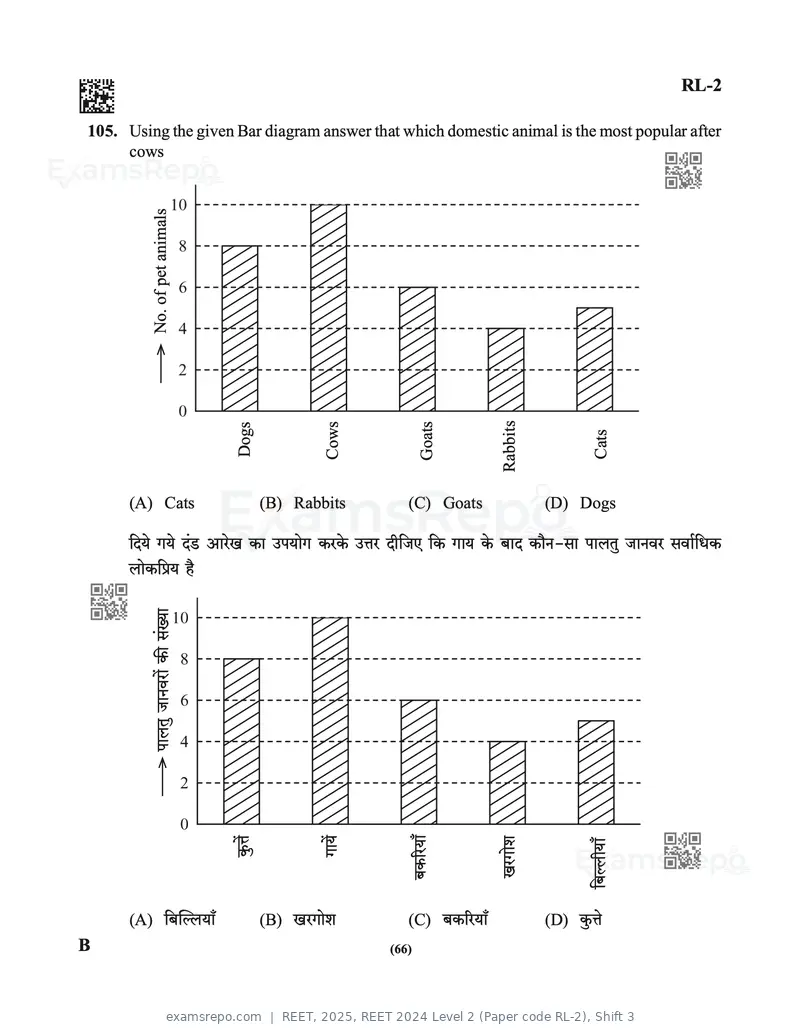
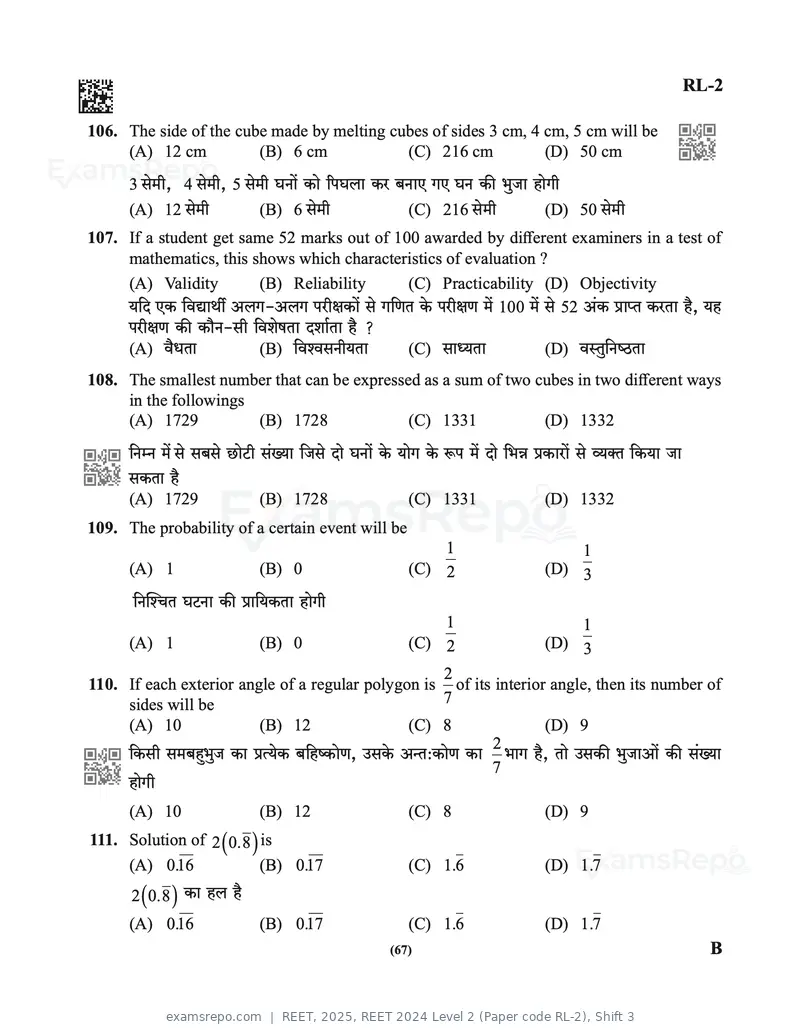
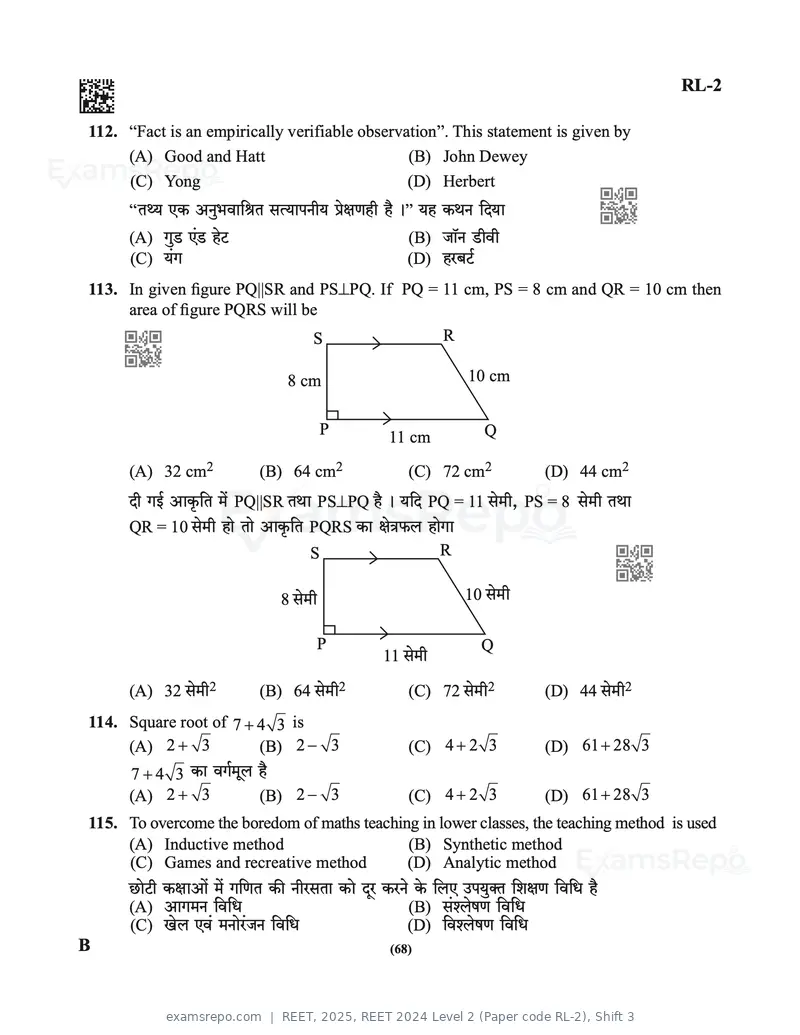
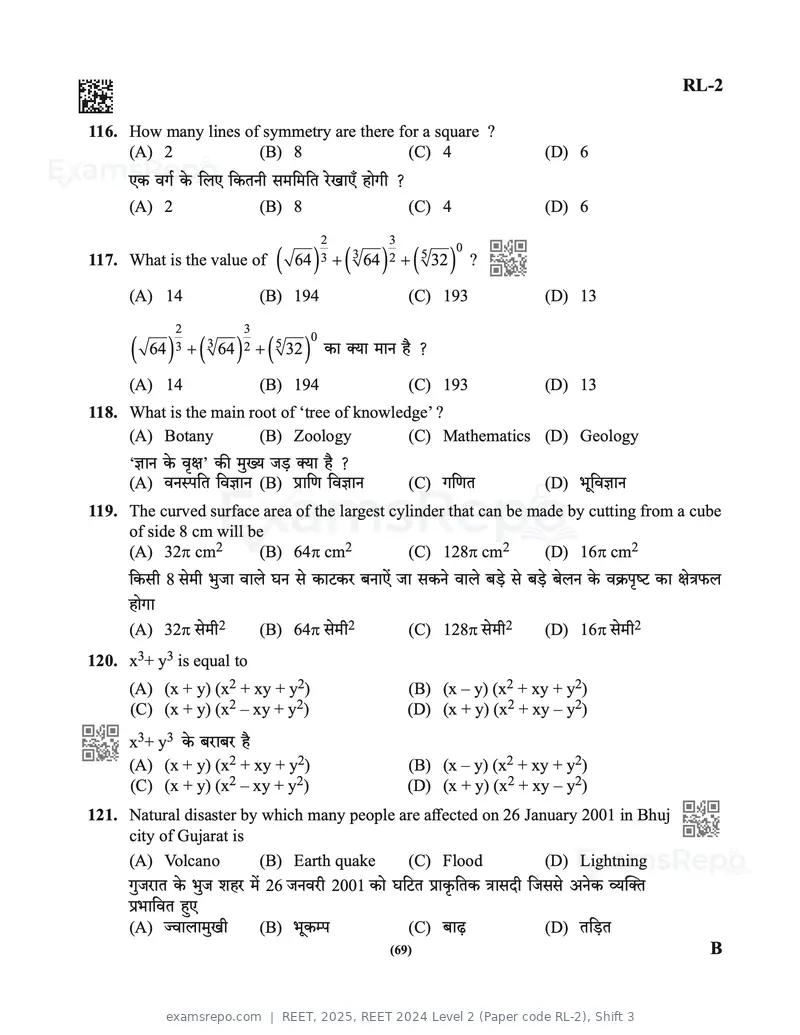
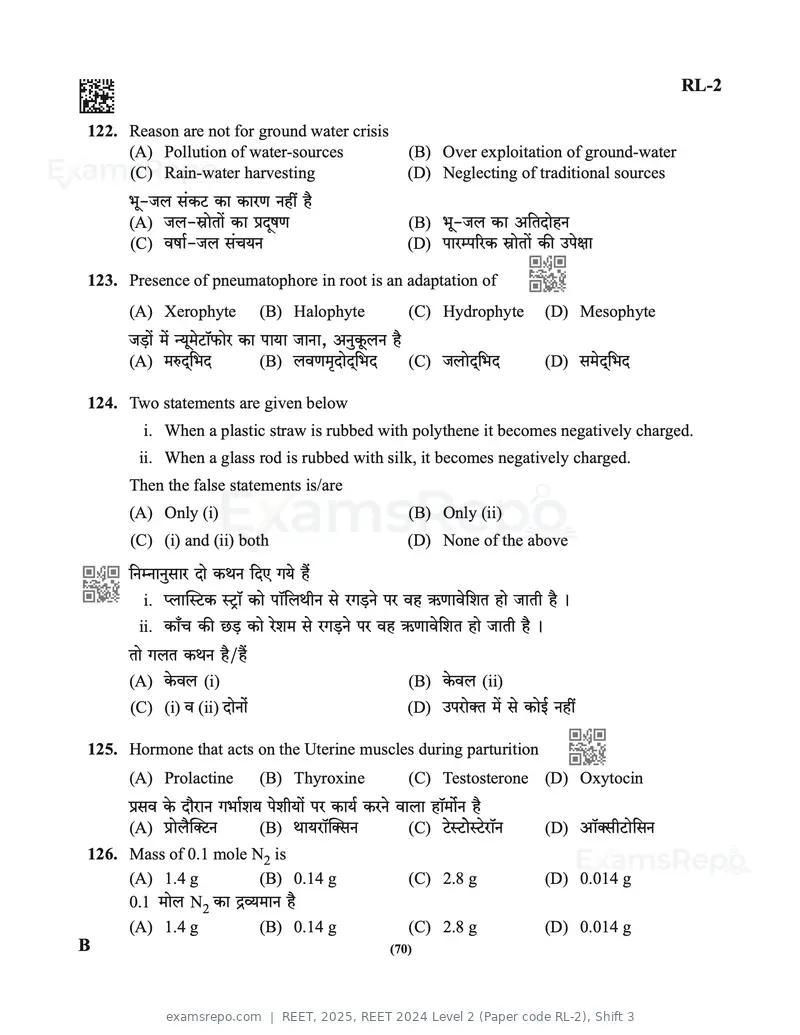
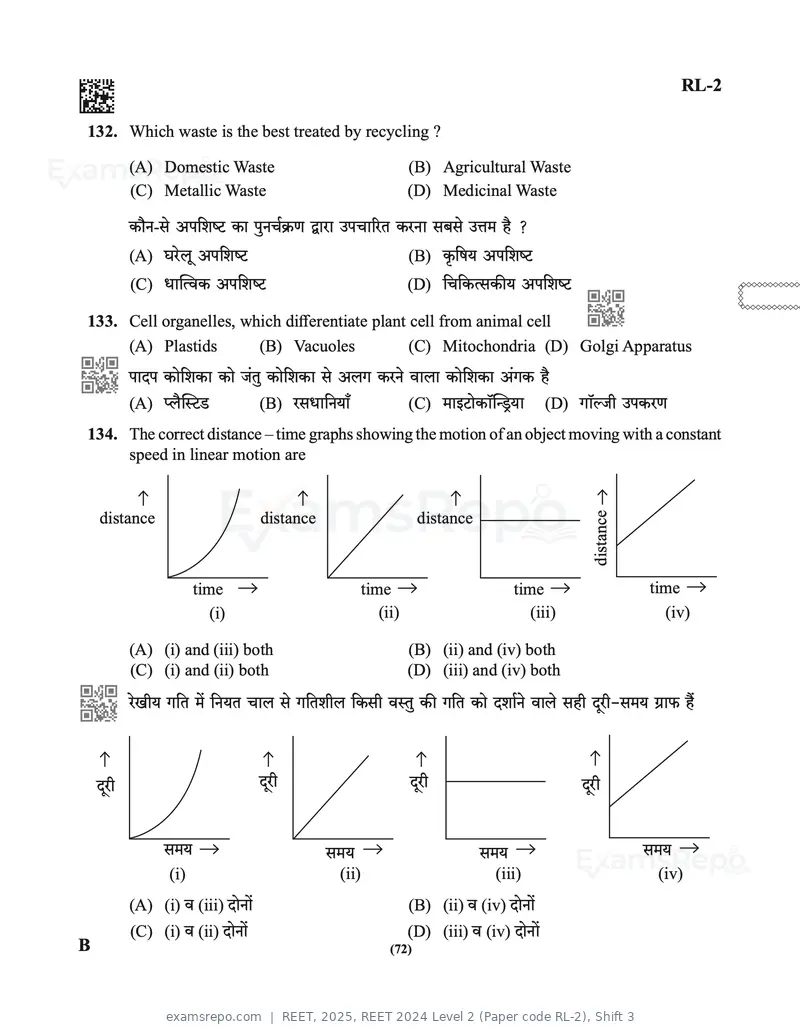
Text of page 170
RL-2

140. Match the column X with the column Y :
             Column X                                                       Column Y
       p. Time to prefer wearing dark coloured clothes                     i. night time
       q. Time of blowing of the sea breeze                               ii. winters
       r. Time to prefer wearing light coloured clothes                  iii. day time
       s. Time of blowing of the land breeze                             iv. summers
     The correct answer is
     (A) p – i, q – ii, r – iii,           s – iv
     (B) p – ii, q – iii, r – i,           s – iv
     (C) p – ii, q – iii, r – iv,          s–i
     (D) p – iv, q – i, r – ii,            s – iii
     H$m°b_ X H$m H$m°b_ Y go {_bmZ H$s{OE &
              H$m°b_ X                                                         H$m°b_ Y
       p. Jhao a§J Ho$ H$n‹S>m| H$mo nhZZo H$mo dar`Vm XoZo H$m g_`        i. am{Ì H$m g_`
       q. g_wÐ g_ra Ho$ ~hZo H$m g_`                                      ii. g{X©`m§
        r. hëHo$ a§J Ho$ H$n‹S>mo§ H$mo nhZZo H$mo dar`Vm XoZo H$m g_`   iii. {XZ H$m g_`
       s. Wb g_ra Ho$ ~hZo H$m g_`                                       iv. J{_©`m§
     ghr CÎma h¡
     (A)   p – i, q – ii,       r – iii,   s – iv
     (B)   p – ii, q – iii,     r – i,     s – iv
     (C)   p – ii, q – iii,     r – iv,    s–i
     (D)   p – iv, q – i,       r – ii,    s – iii
141. Merits of essay type examination is
     (A) Freedom of thoughts                            (B) Absence of reliability and validity
     (C) Lack of remedial use                           (D) Limited representation
     {Z~ÝYmË_H$ narjm H$m JwU h¡
     (A) {dMmamo§ H$s ñdV§ÌVm                           (B) {dídg{Z`Vm Ed§ d¡YVm H$m A^md
     (C) CnMmamË_H$ Cn`moJ H$m A^md                     (D) gr{_V à{V{Z{YËd

142. Example of amphoteric oxide is
     (A) Na2O               (B) CO2                     (C) Al2O3           (D) CaO
     C^`Y_u Am°ŠgmB‹S> H$m CXmhaU h¡
     (A) Na2O               (B) CO2                     (C) Al2O3           (D) CaO
B                                                    (74)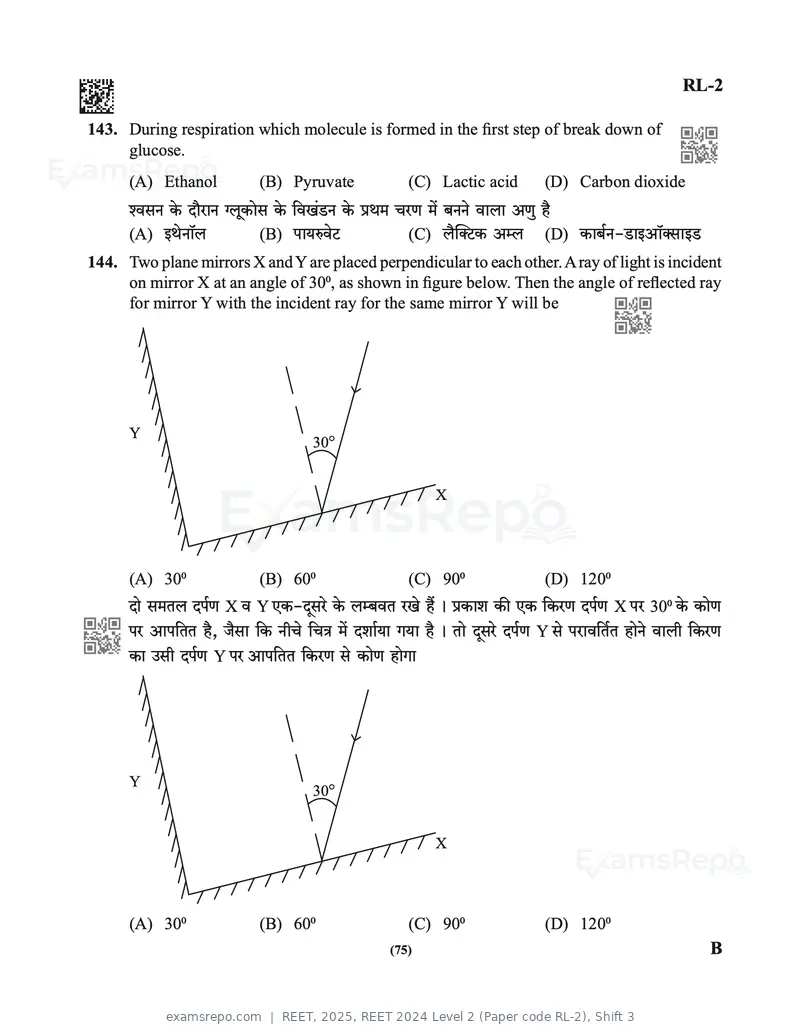
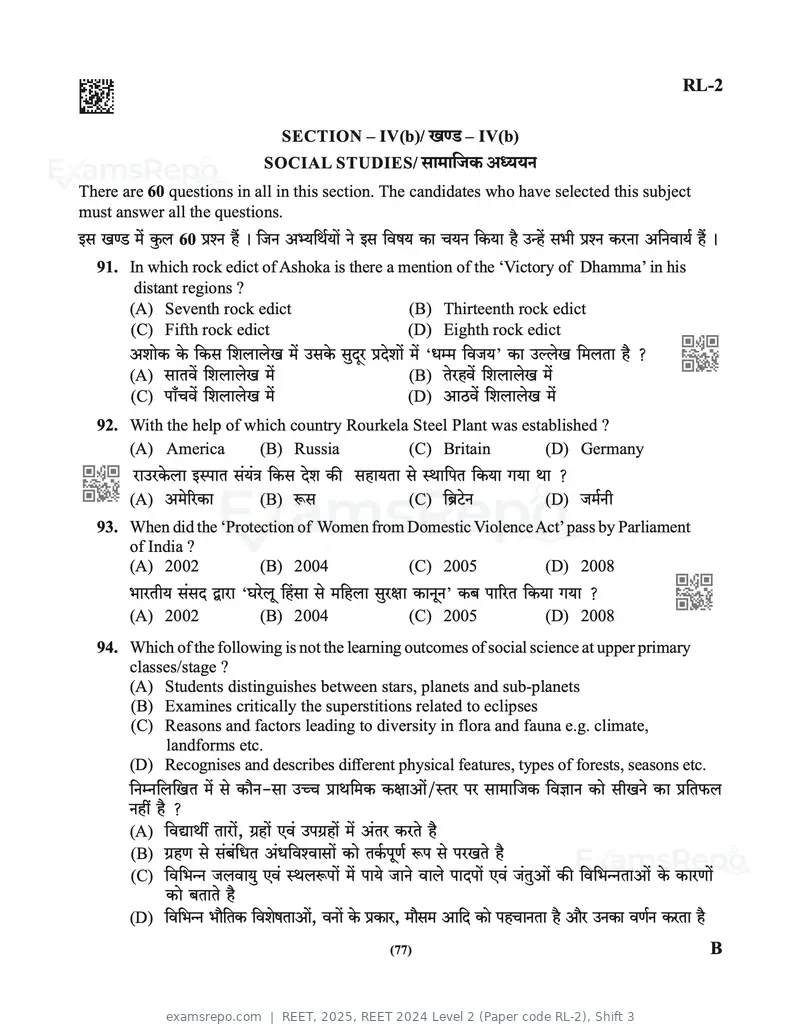
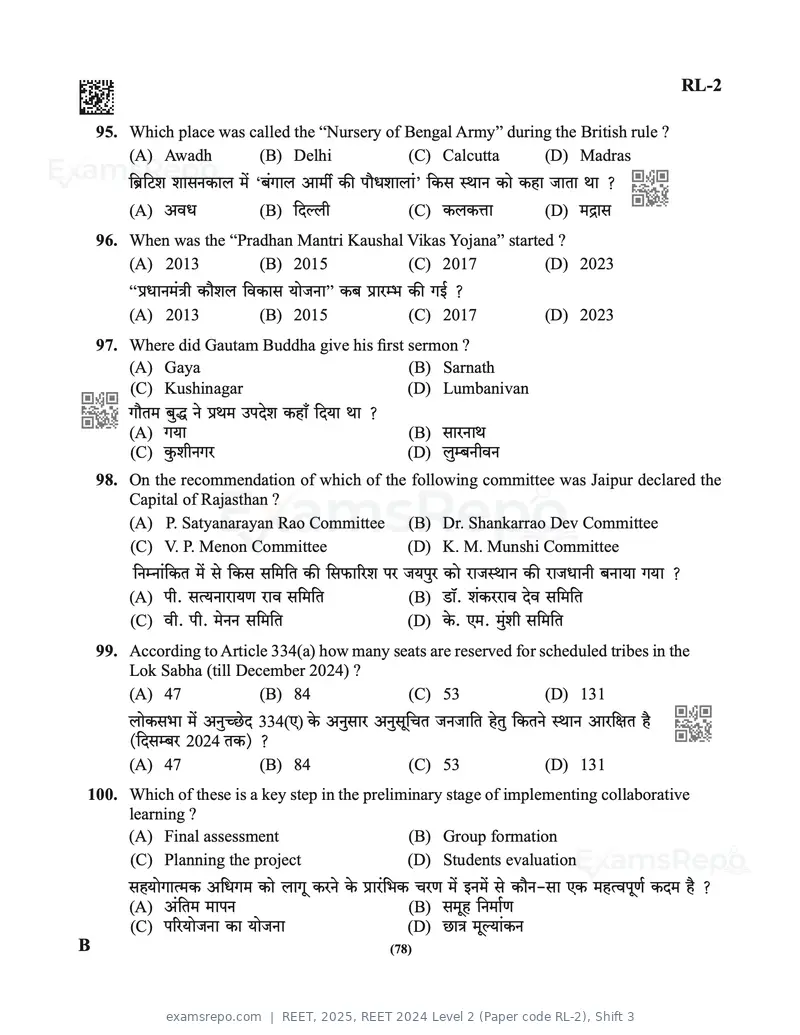
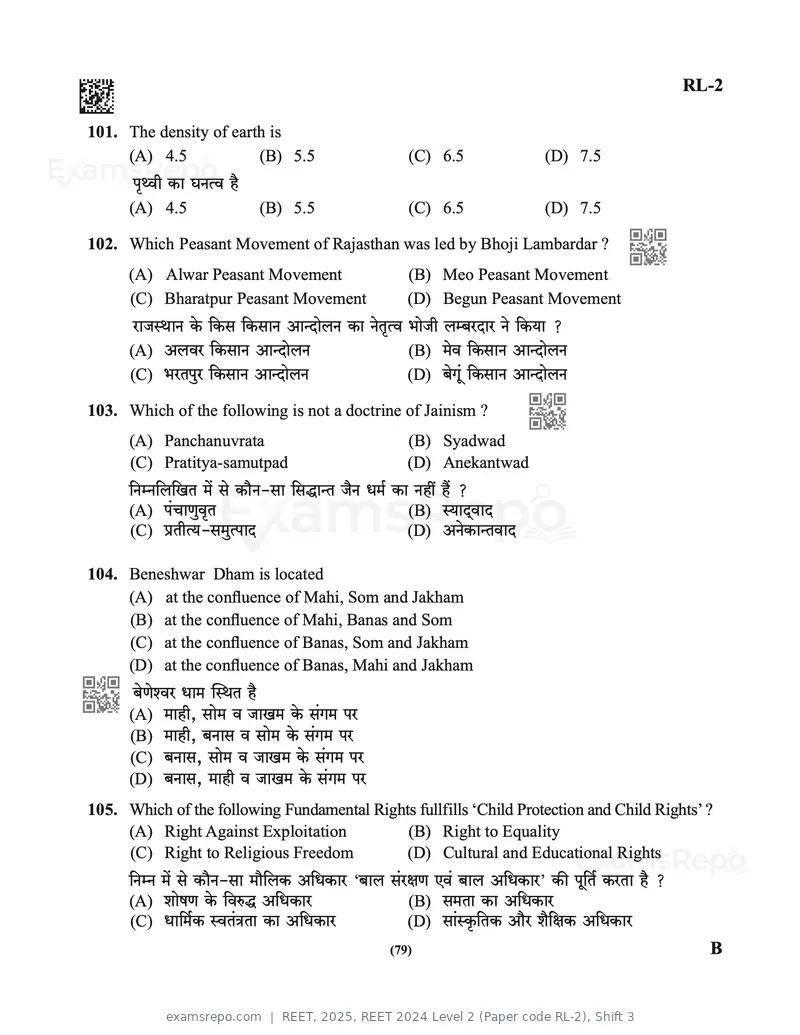
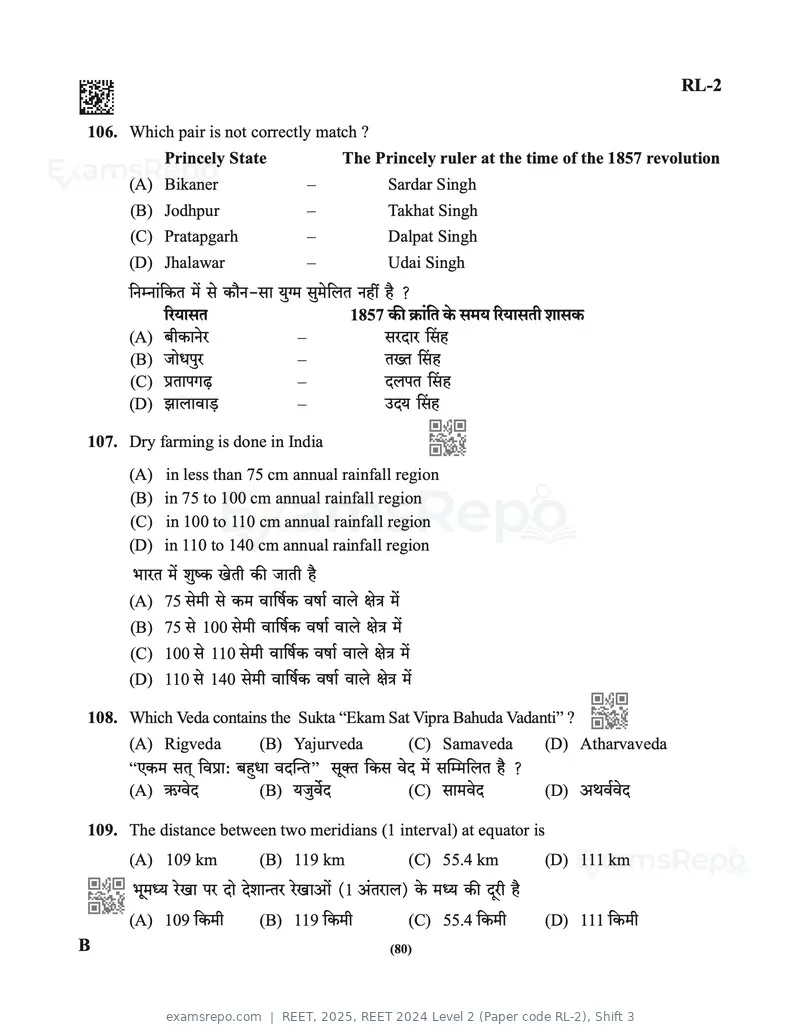
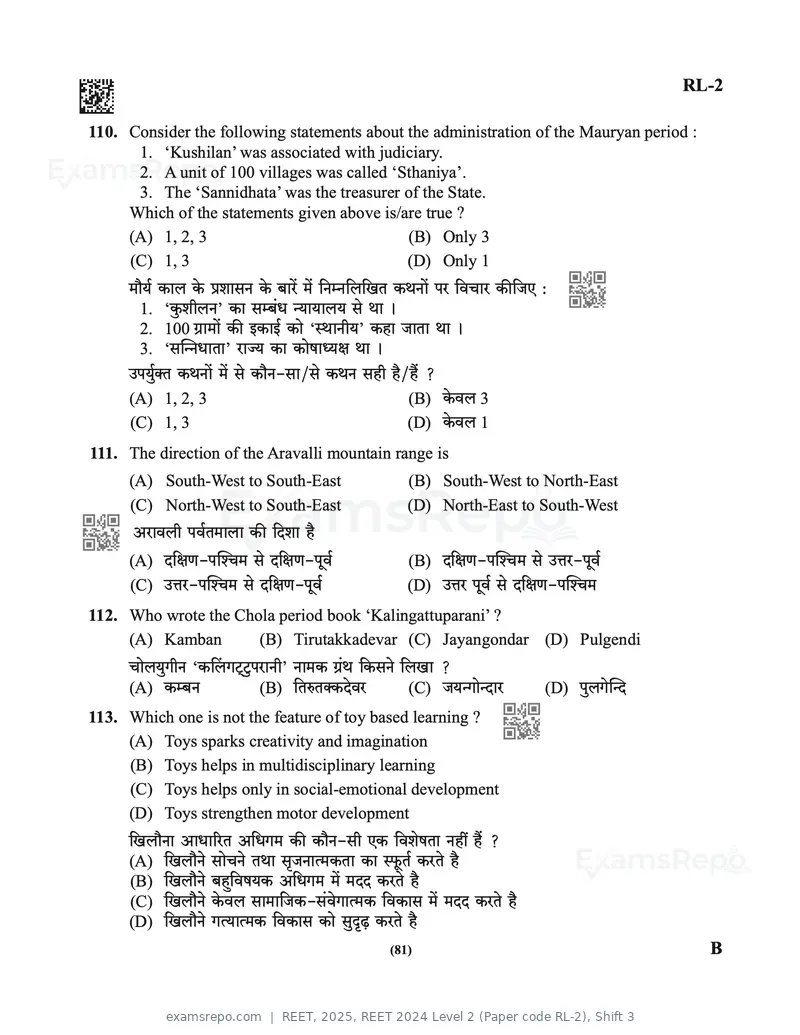
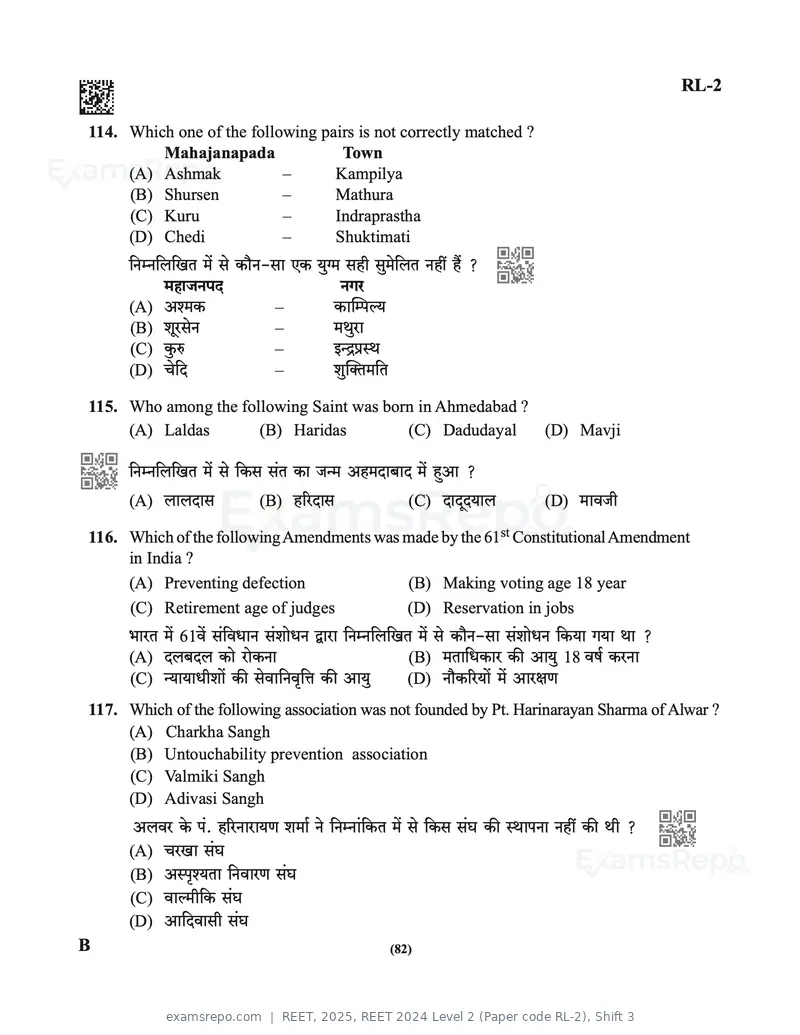
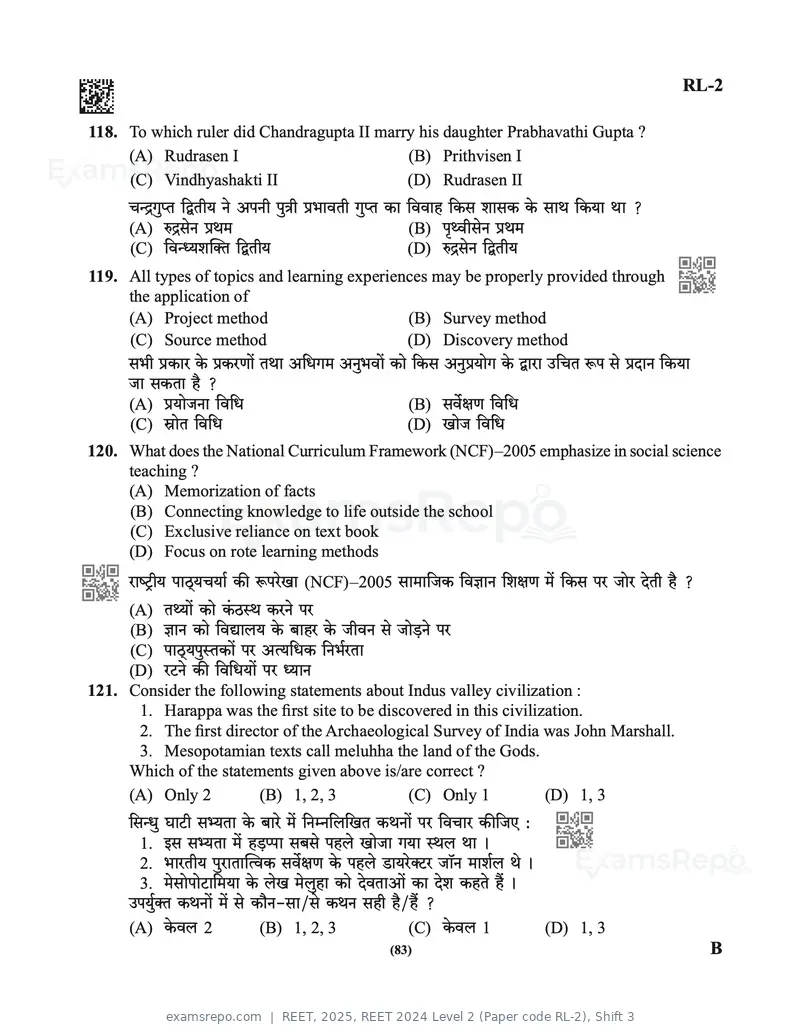
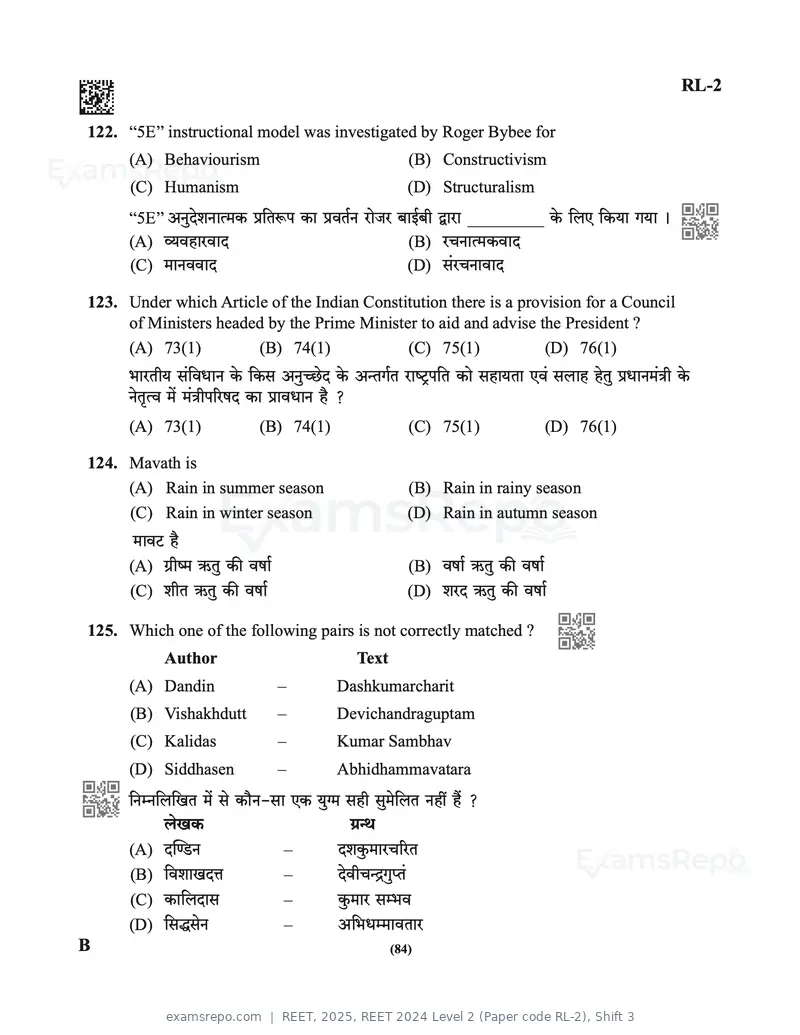
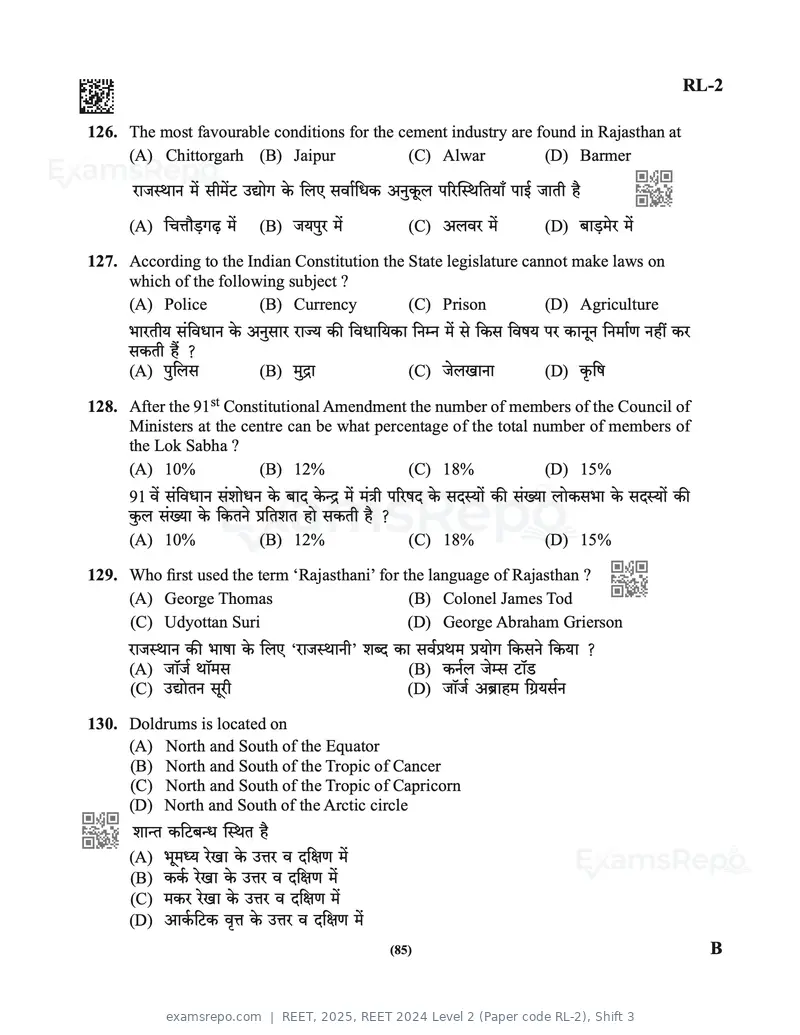
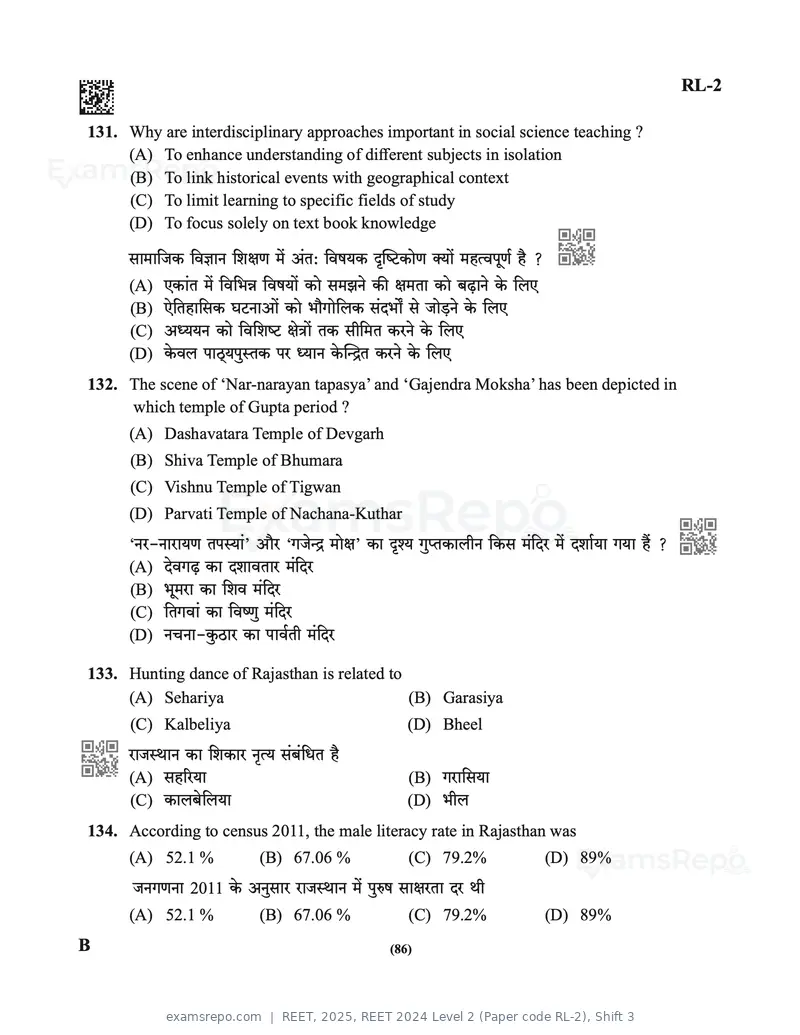
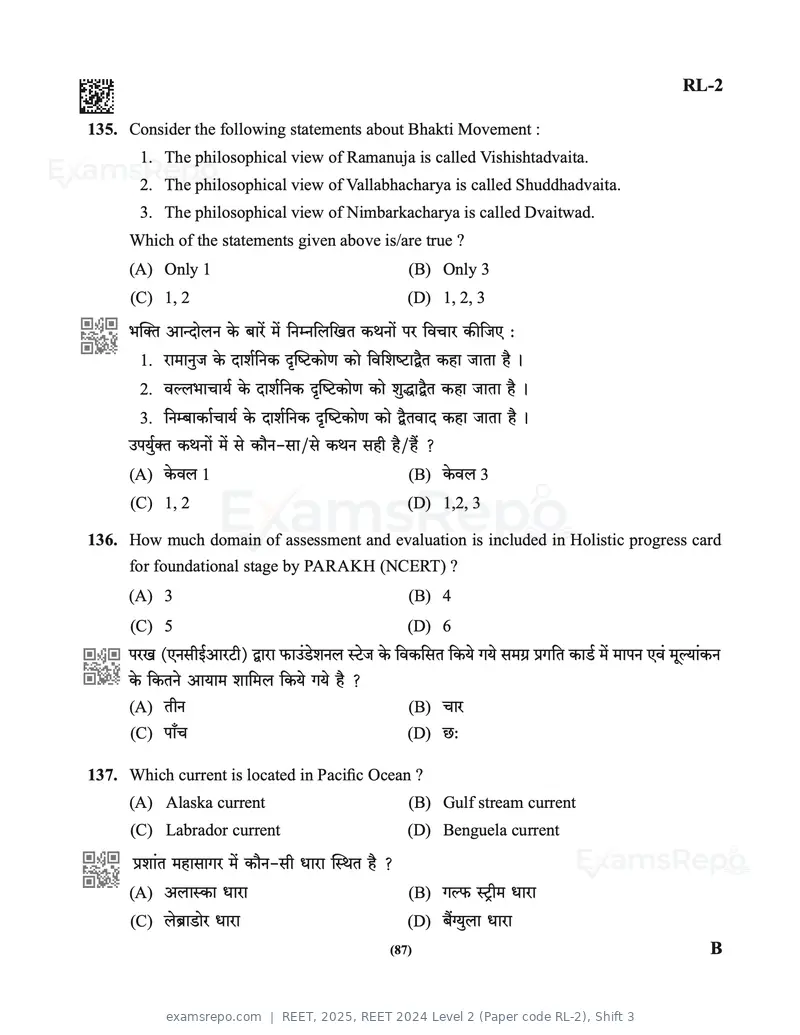
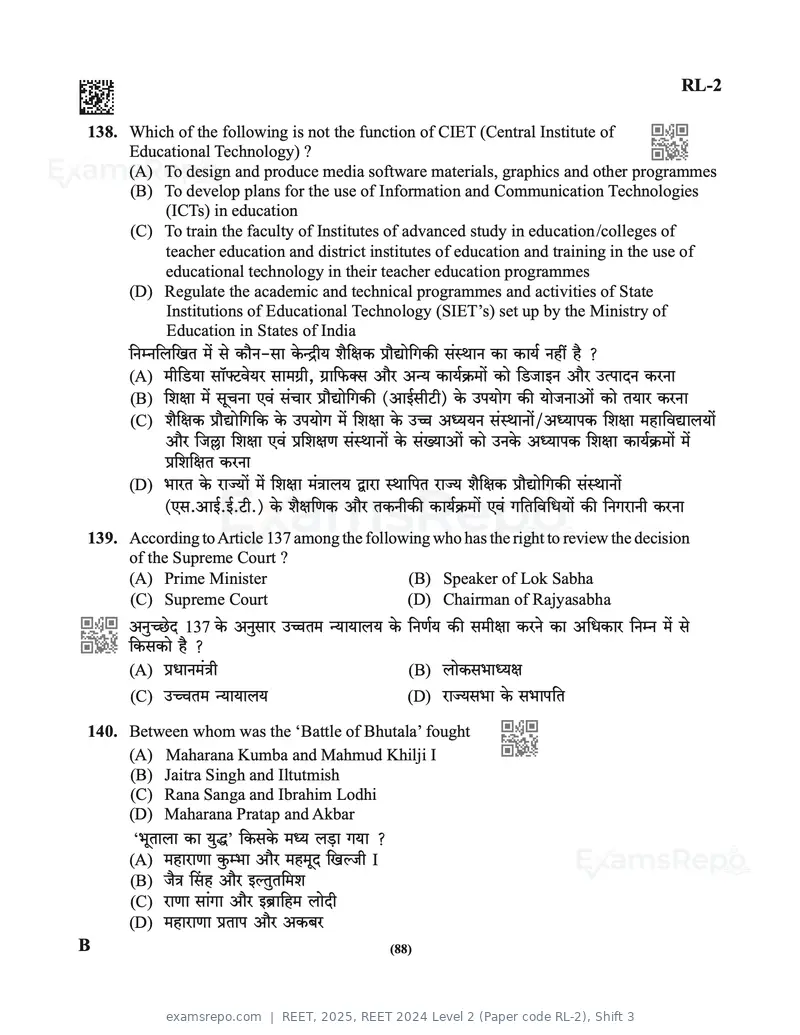
Text of page 191
DO
            NO
              T
(95)              WR
                    IT
                       EH
                         ER
                            E
B                               RL-2
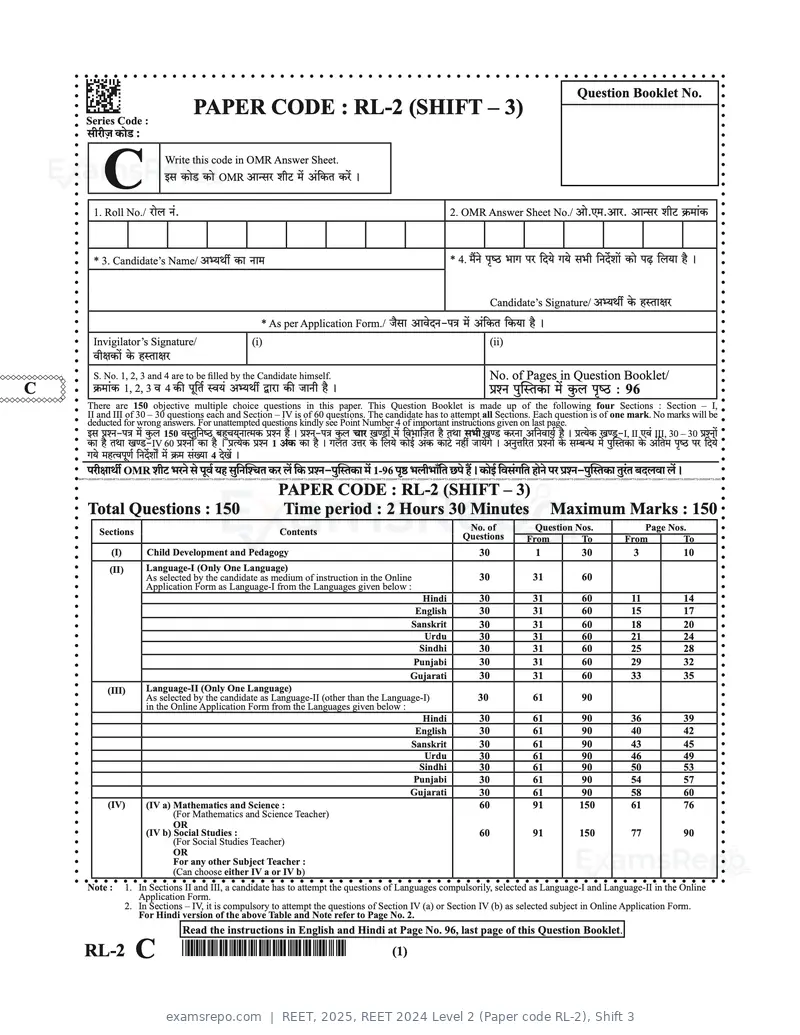
Text of page 193
Question Booklet No.
Series Code :
PAPER CODE : RL-2 (SHIFT – 3)
C
grarµO H$moS> :
Write this code in OMR Answer Sheet.
Bg H$moS> H$mo OMR AmÝga erQ> _| A§{H$V H$a| &
1. Roll No./ amob Z§. 2. OMR Answer Sheet No./ Amo.E_.Ama. AmÝga erQ> H«$_m§H$
* 3. Candidate’s Name/ Aä`Wu H$m Zm_ * 4. _¢Zo n¥îR> ^mJ na {X`o J`o g^r {ZX}em| H$mo n‹T> {b`m h¡ &
Candidate’s Signature/ Aä`Wu Ho$ hñVmja
* As per Application Form./ O¡gm AmdoXZ-nÌ _| A§{H$V {H$`m h¡ &
Invigilator’s Signature/ (i) (ii)
drjH$m| Ho$ hñVmja
S. No. 1, 2, 3 and 4 are to be filled by the Candidate himself. No. of Pages in Question Booklet/
C H«$_m§H$ 1, 2, 3 d 4 H$s ny{V© ñd`§ Aä`Wu Ûmam H$s OmZr h¡ & àíZ nwpñVH$m _| Hw$b n¥îR> : 96
There are 150 objective multiple choice questions in this paper. This Question Booklet is made up of the following four Sections : Section – I,
II and III of 30 – 30 questions each and Section – IV is of 60 questions. The candidate has to attempt all Sections. Each question is of one mark. No marks will be
deducted for wrong answers. for unattempted questions kindly see point number 4 of important instructions given on last page.
Bg àíZ-nÌ _| Hw$b 150 dñVw{ZîR> ~hþM`ZmË_H$ àíZ h¢ & àíZ-nÌ Hw$b Mma IÊS>m| _| {d^m{OV h¡ VWm g^r IÊS> H$aZm A{Zdm`© h¡ & àË`oH$ IÊS>-I, II Ed§ III, 30 – 30 àíZm|
H$m h¡ VWm IÊS>-IV 60 àíZm| H$m h¡ & àË`oH$ àíZ 1 A§H$ H$m h¡ & JbV CÎma Ho$ {b`o H$moB© A§H$ H$mQ>o Zht Om`|Jo & AZwÎm[aV àíZm| Ho$ gå~ÝY _| nwpñVH$m Ho$ A§{V_ n¥îR> na {X`o
J`o _hËdnyU© {ZX}em] _| H«$_ g§»`m 4 XoI| &
narjmWu OMR erQ> ^aZo go nyd© `h gw{ZpíMV H$a b| {H$ àíZ-nwpñVH$m _| 1-96 n¥ð> ^br^m±{V N>no h¢ & H$moB© {dg§J{V hmoZo na àíZ-nwpñVH$m Vwa§V ~Xbdm b| &
PAPER CODE : RL-2 (SHIFT – 3)
SHIFT3-2025SHIFT3-2025SHIFT3-2025SHIFT3-2025SHIFT3-2025SHIFT3-2025SHIFT3-2025SHIFT3-2025SHIFT3-2025SHIFT3-2025SHIFT3-2025SHIFT3-2025SHIFT3-2025SHIFT3-2025SHIFT3-2025SHIFT3-2025SHIFT3-2025SHIFT3-2025SHIFT3-2025SHIFT3-2025SHIFT3-2025SHIFT3-2025SHIFT3-2025SHIFT3-2025SHIFT3-2025SHIFT3-2025SHIFT3-2025SHIFT3-2025SHIFT3-2025SHIFT3-2025SHIFT3-2025SHIFT3-2025SHIFT3-2025SHIFT3-2025SHIFT3-2025SHIFT3-2025SHIFT3-2025SHIFT3-2025SHIFT3-2025SHIFT3-2025SHIFT3-2025
Total Questions : 150 Time period : 2 Hours 30 Minutes Maximum Marks : 150
Sections Contents No. of Question Nos. Page Nos.
Questions From To From To
(I) Child Development and Pedagogy 30 1 30 3 10
(II) Language-I (Only One Language)
As selected by the candidate as medium of instruction in the Online 30 31 60
Application Form as language-I from the languages given below :
Hindi 30 31 60 11 14
English 30 31 60 15 17
Sanskrit 30 31 60 18 20
Urdu 30 31 60 21 24
Sindhi 30 31 60 25 28
Punjabi 30 31 60 29 32
Gujarati 30 31 60 33 35
(III) Language-II (Only One Language)
As selected by the candidate as Language-II (other than the Language-I) 30 61 90
in the Online Application Form from the Languages given below :
Hindi 30 61 90 36 39
English 30 61 90 40 42
Sanskrit 30 61 90 43 45
Urdu 30 61 90 46 49
Sindhi 30 61 90 50 53
Punjabi 30 61 90 54 57
Gujarati 30 61 90 58 60
(IV) (IV a) Mathematics and Science : 60 91 150 61 76
(For Mathematics and Science Teacher)
OR
(IV b) Social Studies : 60 91 150 77 90
(For Social Studies Teacher)
OR
For any other Subject Teacher :
(Can choose either IV a or IV b)
Note : 1. In Sections II and III, a candidate has to attempt the questions of Languages compulsorily, selected as Language-I and Language-II in the Online
Application Form.
2. In Sections – IV, it is compulsory to attempt the questions of Section IV (a) or Section IV (b) as selected subject in Online Application Form.
For Hindi version of the above Table and Note refer to Page No. 2.
Read the instructions in English and Hindi at Page No. 96, last page of this Question booklet.
RL-2 C *RL2SHIFT3C* (1)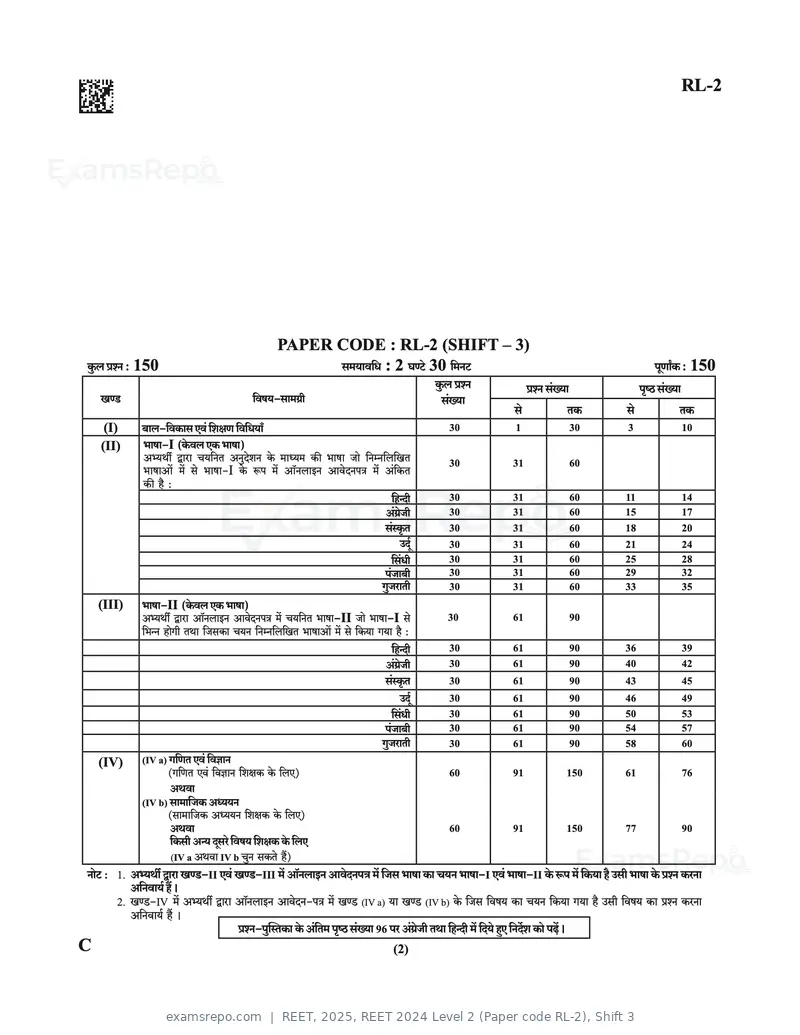
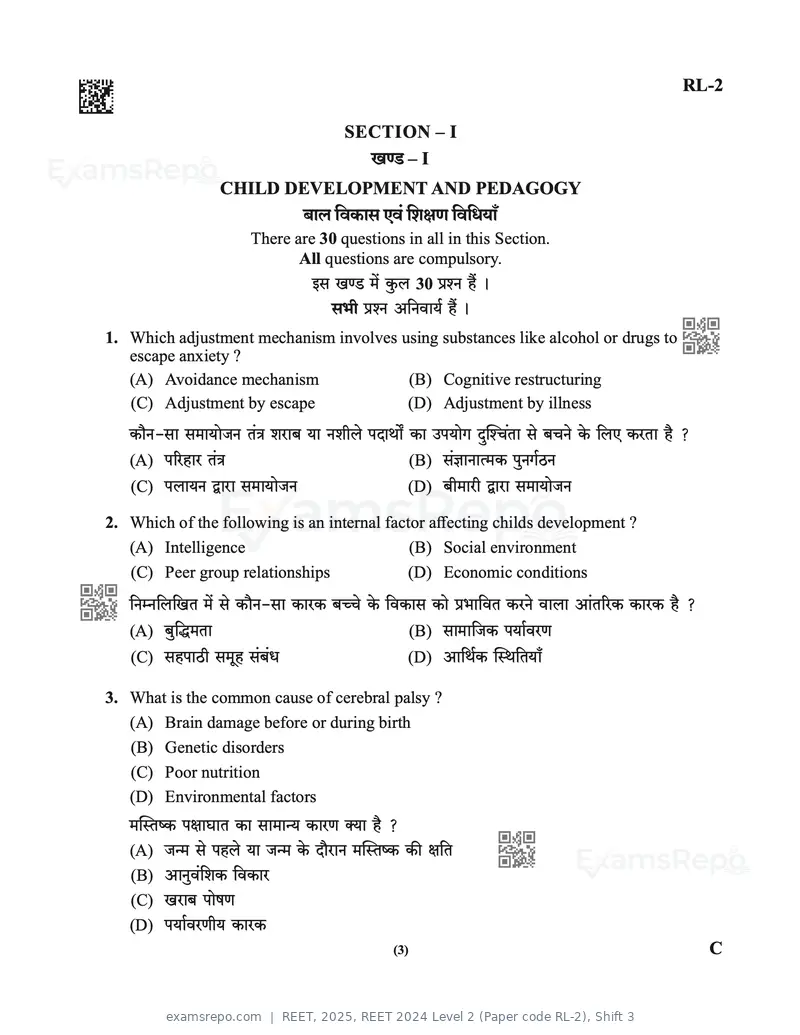
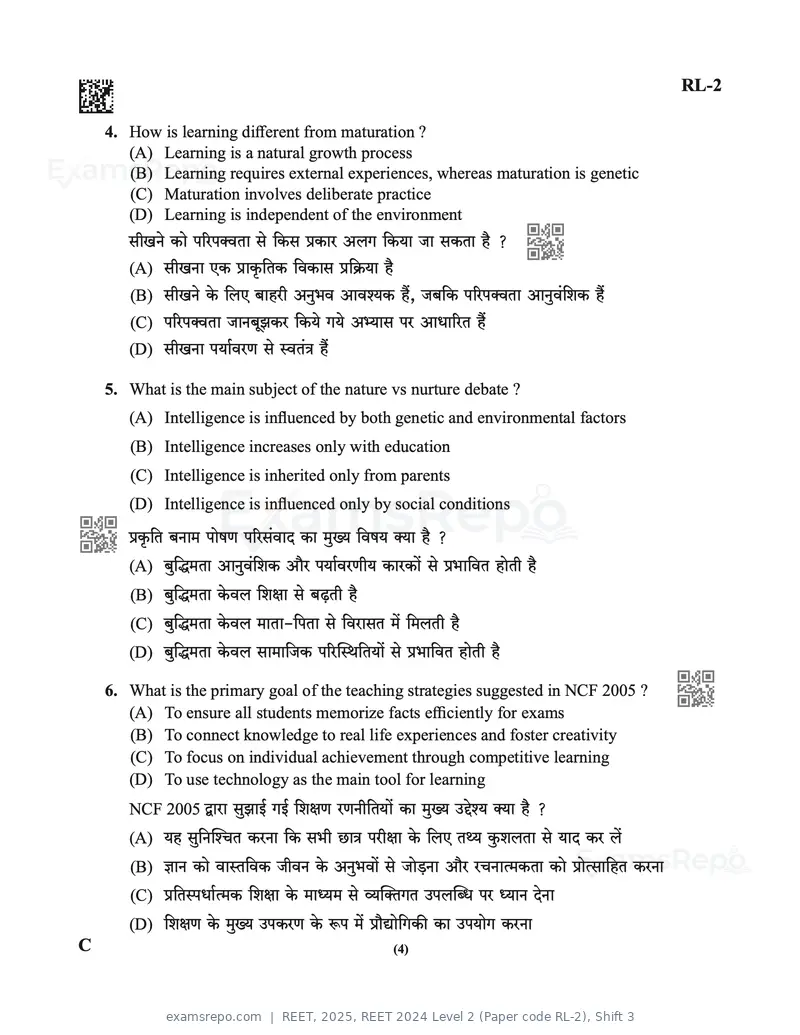
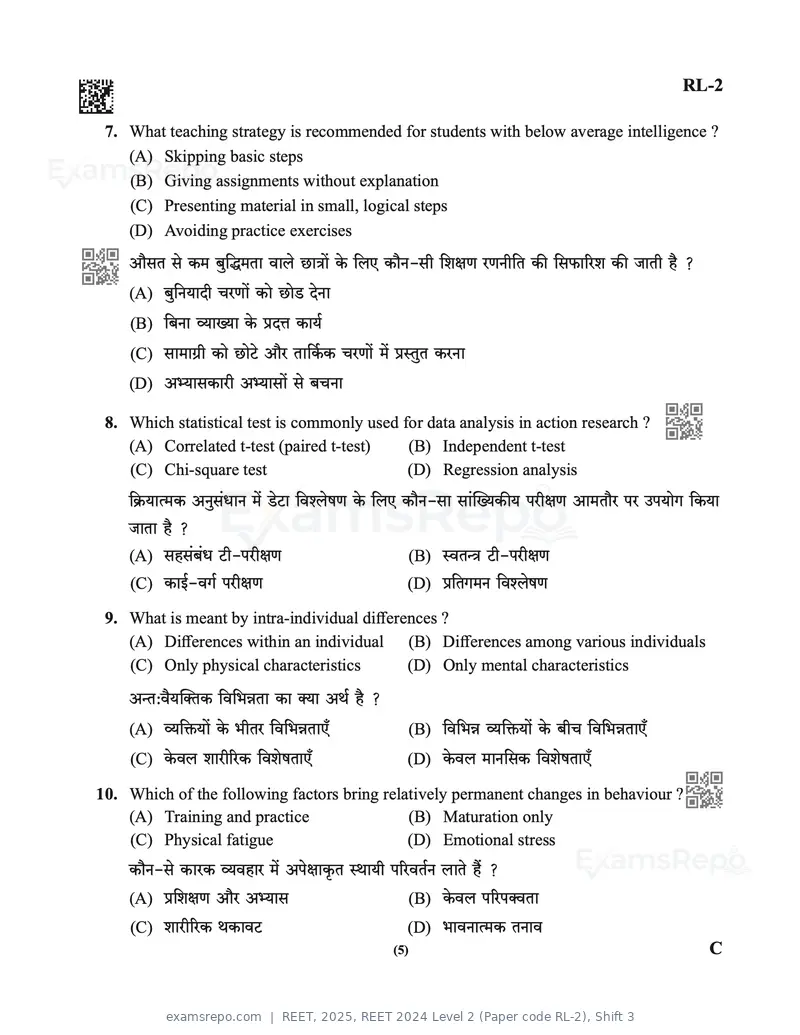
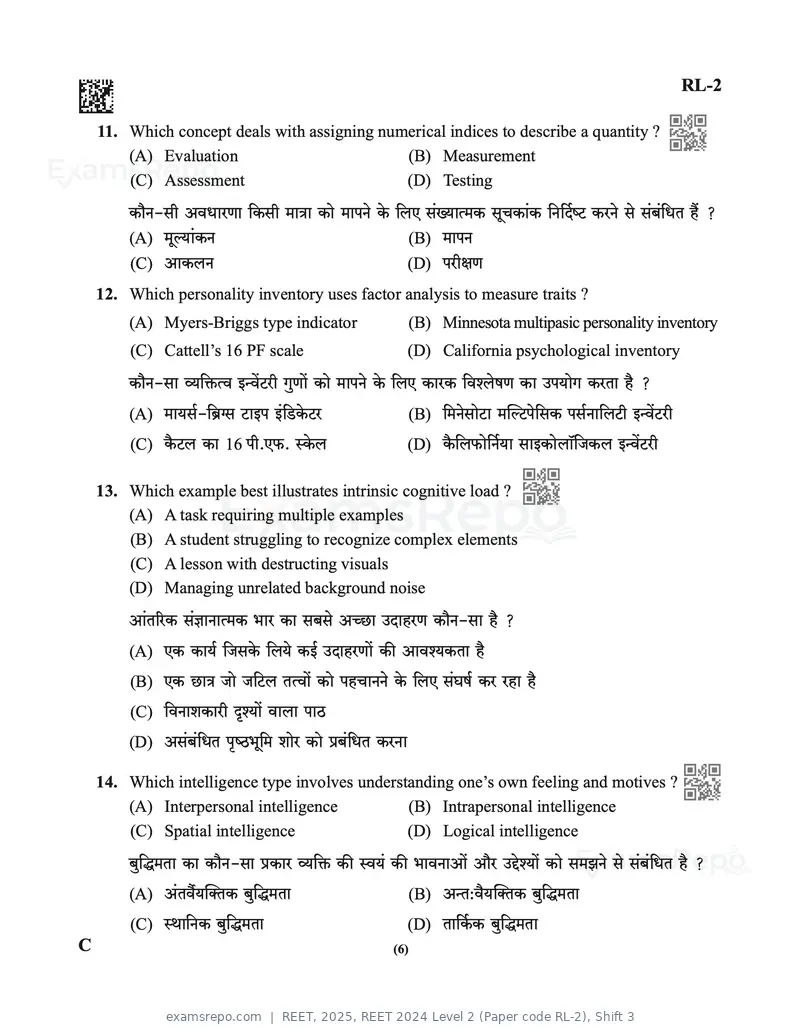
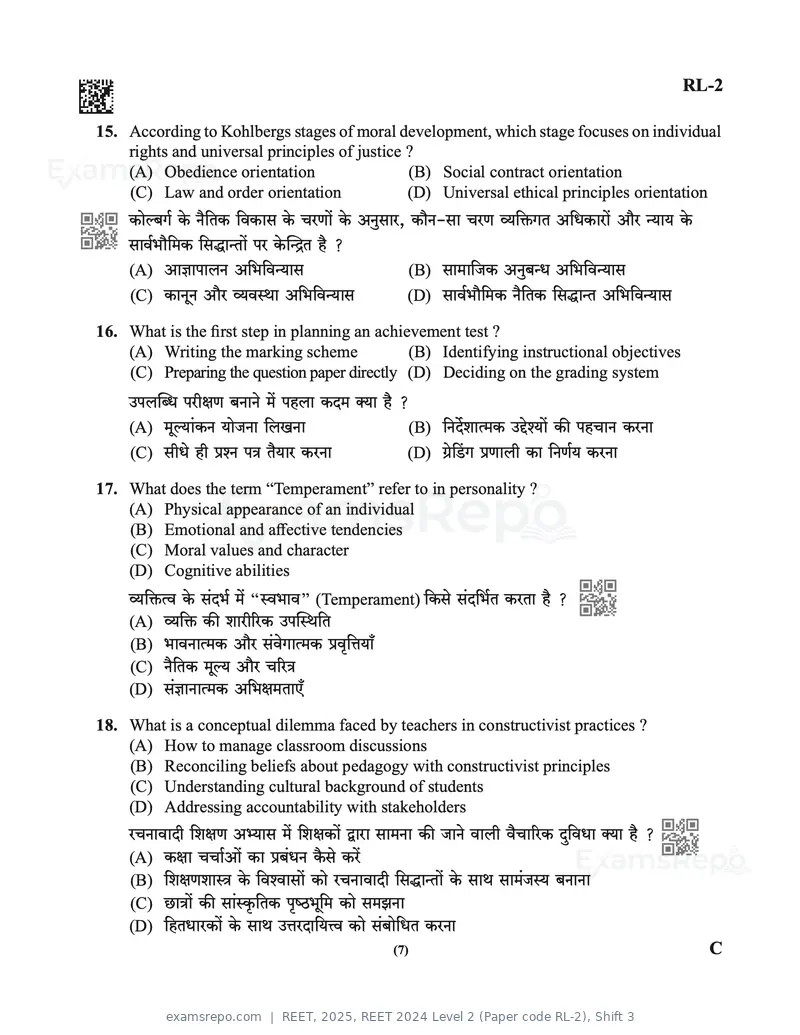
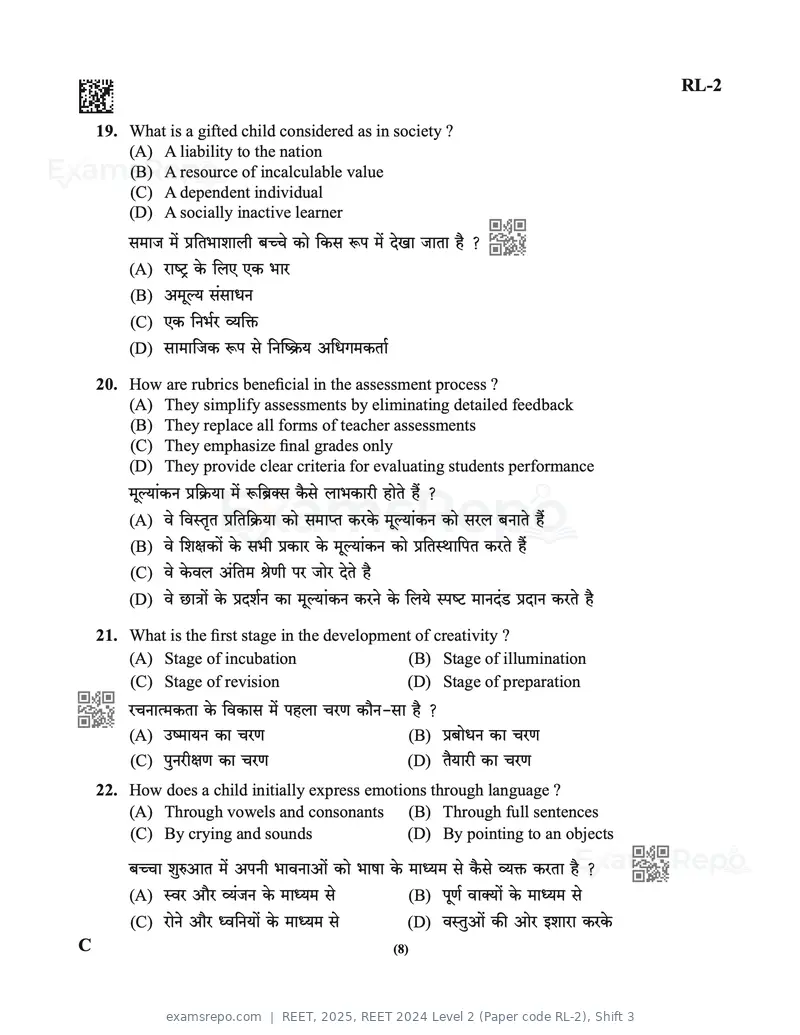
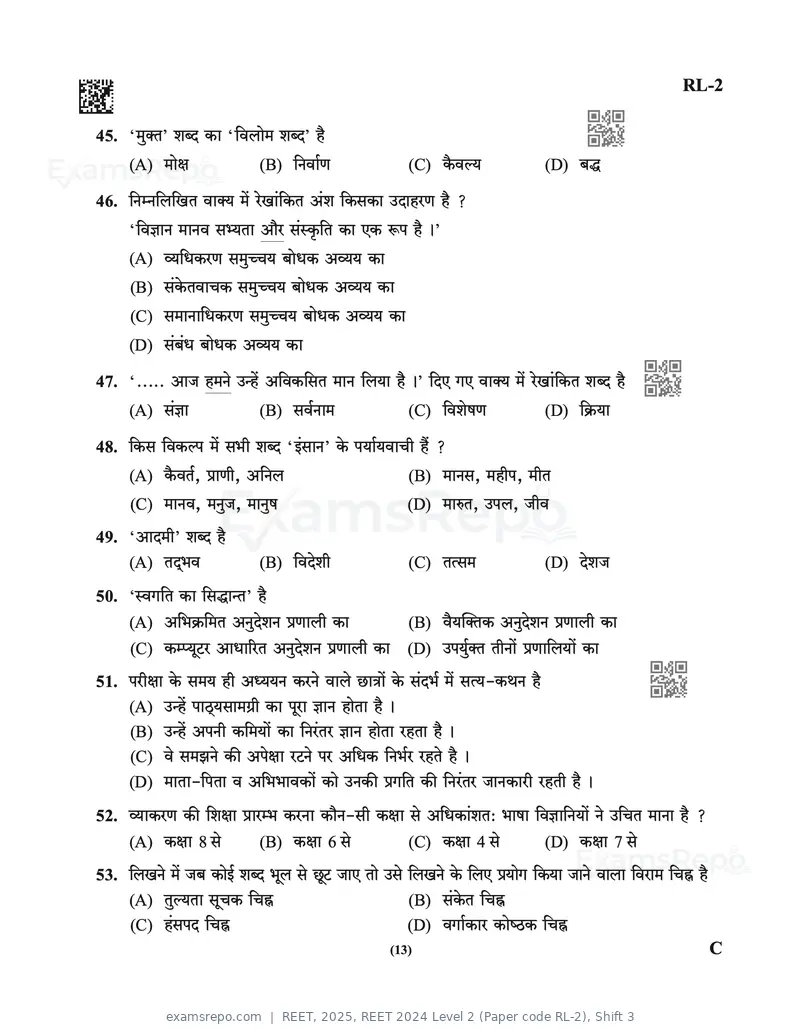
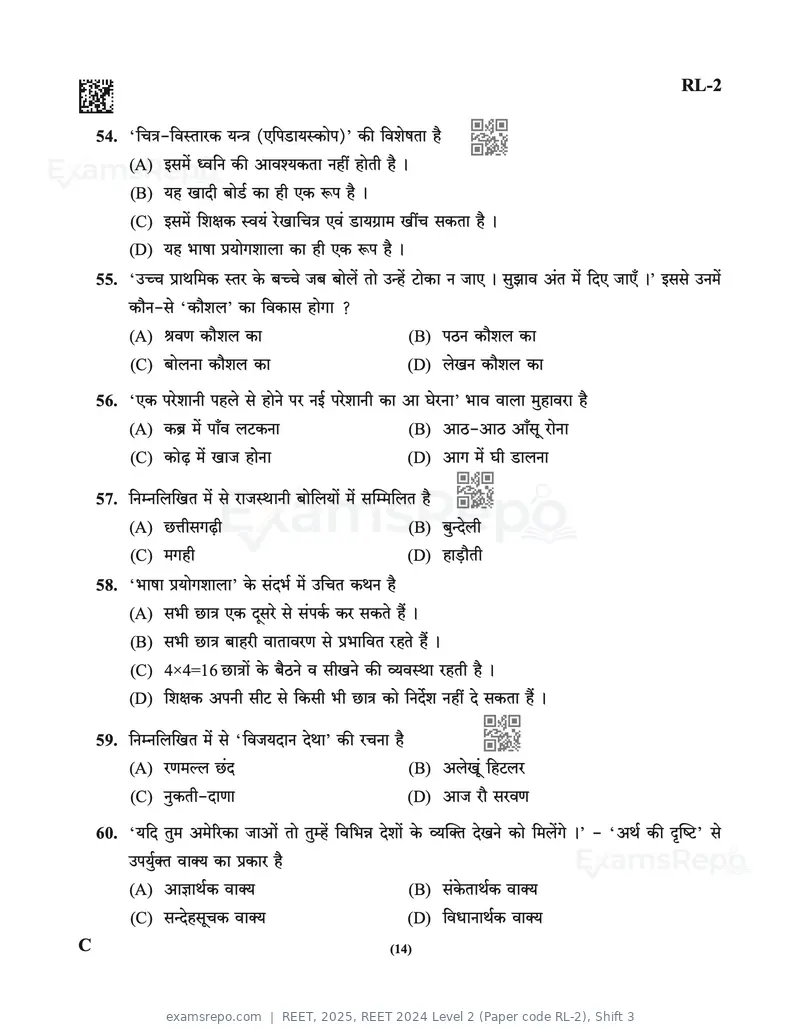
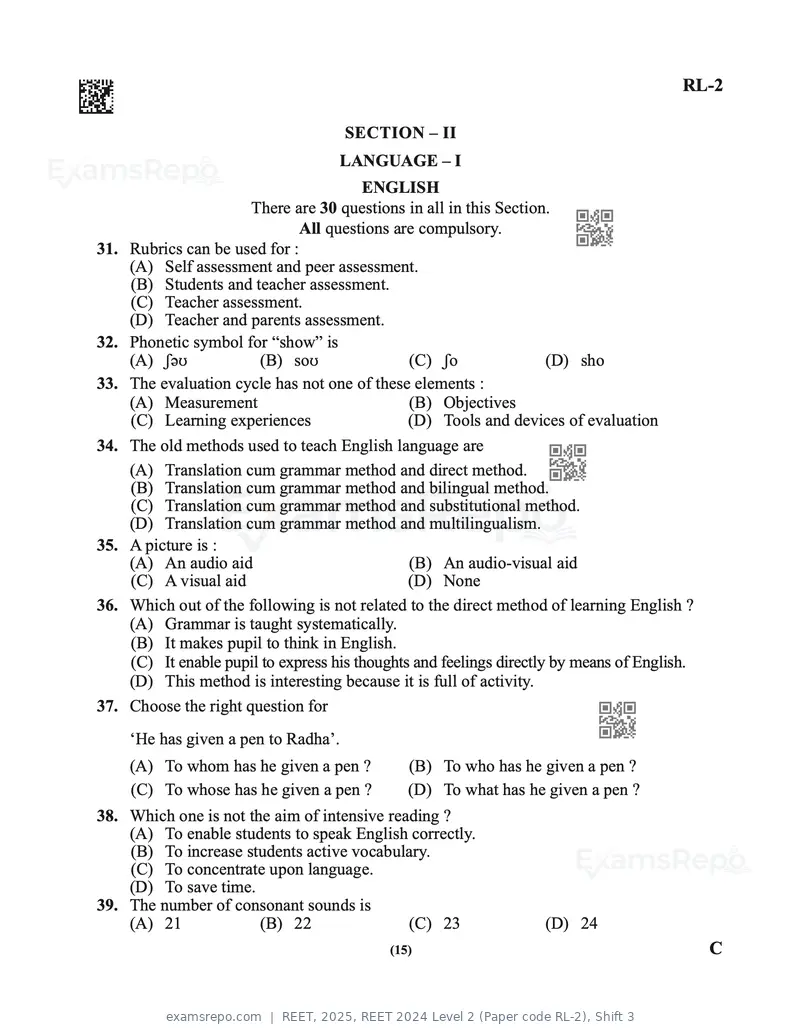
Text of page 207
RL-2

                                     SECTION – II
                                    LANGUAGE – I
                                      ENGLISH
                     There are 30 questions in all in this Section.
                             All questions are compulsory.
31. Rubrics can be used for :
    (A) Self assessment and peer assessment.
    (B) Students and teacher assessment.
    (C) Teacher assessment.
    (D) Teacher and parents assessment.
32. Phonetic symbol for “show” is
    (A) ʃəʊ           (B) soʊ                (C) ʃo               (D) sho
33. The evaluation cycle has not one of these elements :
    (A) Measurement                          (B) Objectives
    (C) Learning experiences                 (D) Tools and devices of evaluation
34. The old methods used to teach English language are
    (A) Translation cum grammar method and direct method.
    (B) Translation cum grammar method and bilingual method.
    (C) Translation cum grammar method and substitutional method.
    (D) Translation cum grammar method and multilingualism.
35. A picture is :
    (A) An audio aid                           (B) An audio-visual aid
    (C) A visual aid                           (D) None
36. Which out of the following is not related to the direct method of learning English ?
    (A) Grammar is taught systematically.
    (B) It makes pupil to think in English.
    (C) It enable pupil to express his thoughts and feelings directly by means of English.
    (D) This method is interesting because it is full of activity.
37. Choose the right question for
    ‘He has given a pen to Radha’.
    (A) To whom has he given a pen ?           (B) To who has he given a pen ?
    (C) To whose has he given a pen ?          (D) To what has he given a pen ?
38. Which one is not the aim of intensive reading ?
    (A) To enable students to speak English correctly.
    (B) To increase students active vocabulary.
    (C) To concentrate upon language.
    (D) To save time.
39. The number of consonant sounds is
    (A) 21             (B) 22                (C) 23                (D) 24
                                            (15)                                             C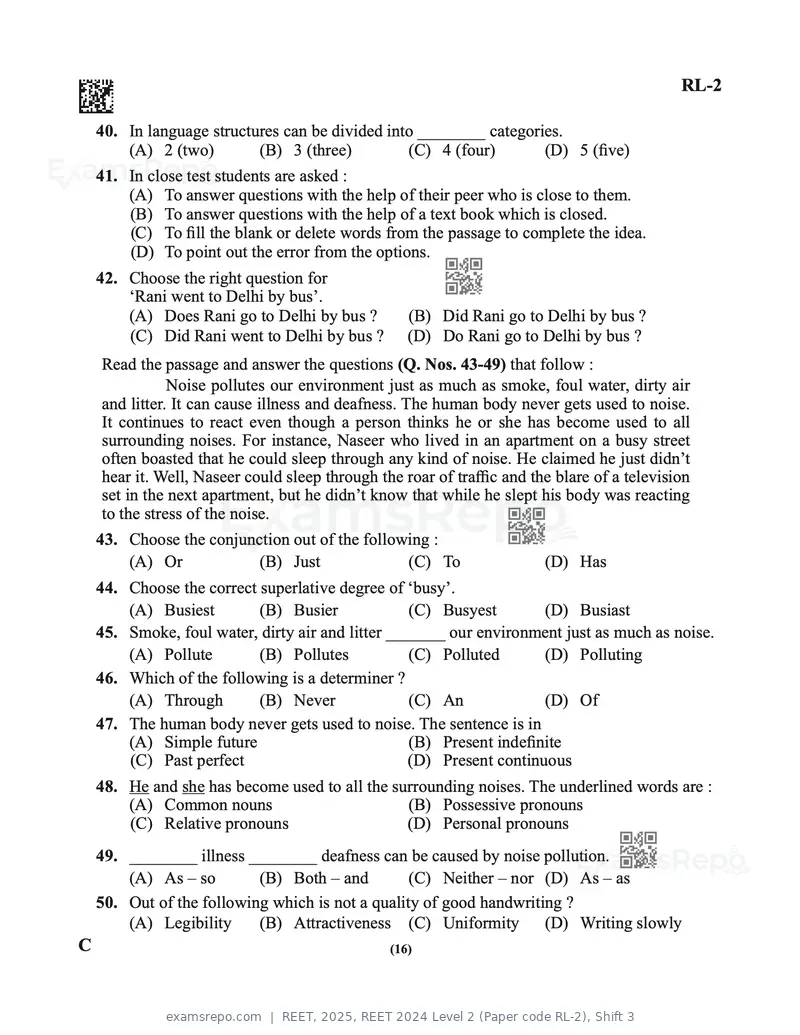
Text of page 208
RL-2

    40. In language structures can be divided into ________ categories.
        (A) 2 (two)        (B) 3 (three)         (C) 4 (four)       (D) 5 (five)
    41. In close test students are asked :
        (A) To answer questions with the help of their peer who is close to them.
        (B) To answer questions with the help of a text book which is closed.
        (C) To fill the blank or delete words from the passage to complete the idea.
        (D) To point out the error from the options.
    42. Choose the right question for
        ‘Rani went to Delhi by bus’.
        (A) Does Rani go to Delhi by bus ?         (B) Did Rani go to Delhi by bus ?
        (C) Did Rani went to Delhi by bus ?        (D) Do Rani go to Delhi by bus ?
    Read the passage and answer the questions (Q. Nos. 43-49) that follow :
               Noise pollutes our environment just as much as smoke, foul water, dirty air
    and litter. It can cause illness and deafness. The human body never gets used to noise.
    It continues to react even though a person thinks he or she has become used to all
    surrounding noises. For instance, Naseer who lived in an apartment on a busy street
    often boasted that he could sleep through any kind of noise. He claimed he just didn’t
    hear it. Well, Naseer could sleep through the roar of traffic and the blare of a television
    set in the next apartment, but he didn’t know that while he slept his body was reacting
    to the stress of the noise.
    43. Choose the conjunction out of the following :
        (A) Or            (B) Just              (C) To                  (D) Has
    44. Choose the correct superlative degree of ‘busy’.
        (A) Busiest        (B) Busier              (C) Busyest        (D) Busiast
    45. Smoke, foul water, dirty air and litter _______ our environment just as much as noise.
        (A) Pollute        (B) Pollutes            (C) Polluted       (D) Polluting
    46. Which of the following is a determiner ?
        (A) Through        (B) Never               (C) An             (D) Of
    47. The human body never gets used to noise. The sentence is in
        (A) Simple future                          (B) Present indefinite
        (C) Past perfect                           (D) Present continuous
    48. He and she has become used to all the surrounding noises. The underlined words are :
        (A) Common nouns                        (B) Possessive pronouns
        (C) Relative pronouns                   (D) Personal pronouns
    49. ________ illness ________ deafness can be caused by noise pollution.
        (A) As – so        (B) Both – and         (C) Neither – nor (D) As – as
    50. Out of the following which is not a quality of good handwriting ?
        (A) Legibility     (B) Attractiveness (C) Uniformity (D) Writing slowly
C                                               (16)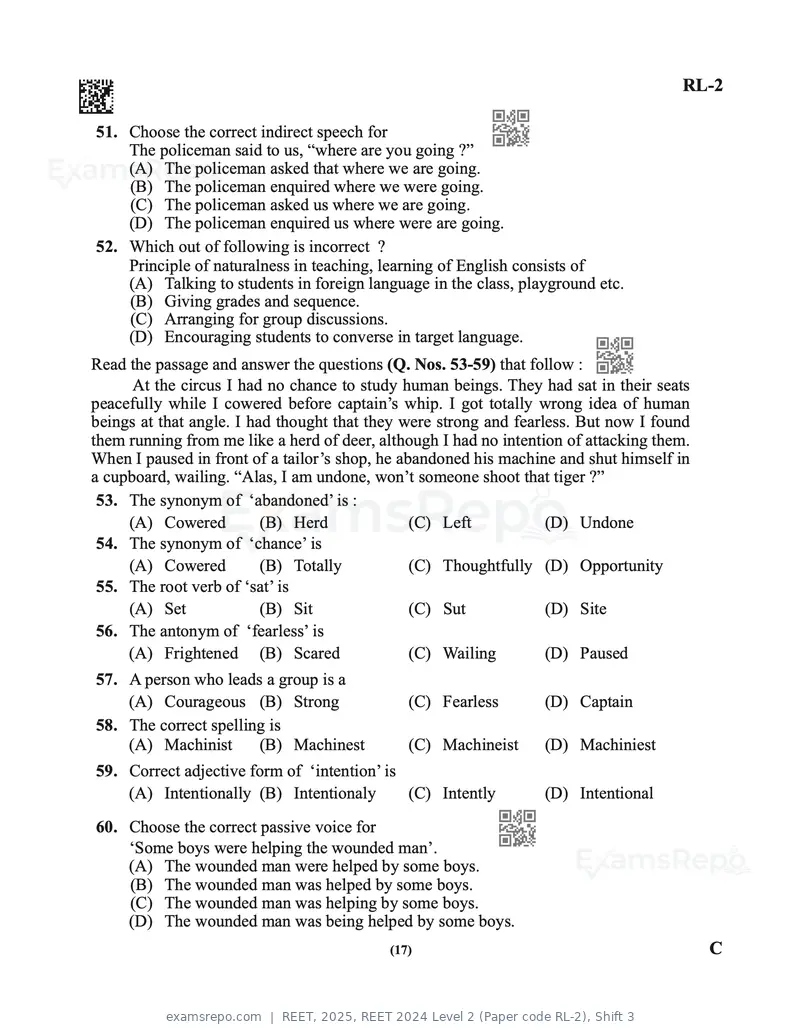
Text of page 209
RL-2

51. Choose the correct indirect speech for
    The policeman said to us, “where are you going ?”
    (A) The policeman asked that where we are going.
    (B) The policeman enquired where we were going.
    (C) The policeman asked us where we are going.
    (D) The policeman enquired us where were are going.
52. Which out of following is incorrect ?
    Principle of naturalness in teaching, learning of English consists of
    (A) Talking to students in foreign language in the class, playground etc.
    (B) Giving grades and sequence.
    (C) Arranging for group discussions.
    (D) Encouraging students to converse in target language.
Read the passage and answer the questions (Q. Nos. 53-59) that follow :
      At the circus I had no chance to study human beings. They had sat in their seats
peacefully while I cowered before captain’s whip. I got totally wrong idea of human
beings at that angle. I had thought that they were strong and fearless. But now I found
them running from me like a herd of deer, although I had no intention of attacking them.
When I paused in front of a tailor’s shop, he abandoned his machine and shut himself in
a cupboard, wailing. “Alas, I am undone, won’t someone shoot that tiger ?”
 53. The synonym of ‘abandoned’ is :
     (A) Cowered          (B) Herd              (C) Left           (D) Undone
 54. The synonym of ‘chance’ is
     (A) Cowered          (B) Totally           (C) Thoughtfully (D) Opportunity
 55. The root verb of ‘sat’ is
     (A) Set              (B) Sit               (C) Sut            (D) Site
 56. The antonym of ‘fearless’ is
     (A) Frightened (B) Scared                  (C) Wailing        (D) Paused
57. A person who leads a group is a
    (A) Courageous (B) Strong                 (C) Fearless        (D) Captain
58. The correct spelling is
    (A) Machinist      (B) Machinest          (C) Machineist      (D) Machiniest
59. Correct adjective form of ‘intention’ is
    (A) Intentionally (B) Intentionaly       (C) Intently         (D) Intentional
60. Choose the correct passive voice for
    ‘Some boys were helping the wounded man’.
    (A) The wounded man were helped by some boys.
    (B) The wounded man was helped by some boys.
    (C) The wounded man was helping by some boys.
    (D) The wounded man was being helped by some boys.
                                           (17)                                            C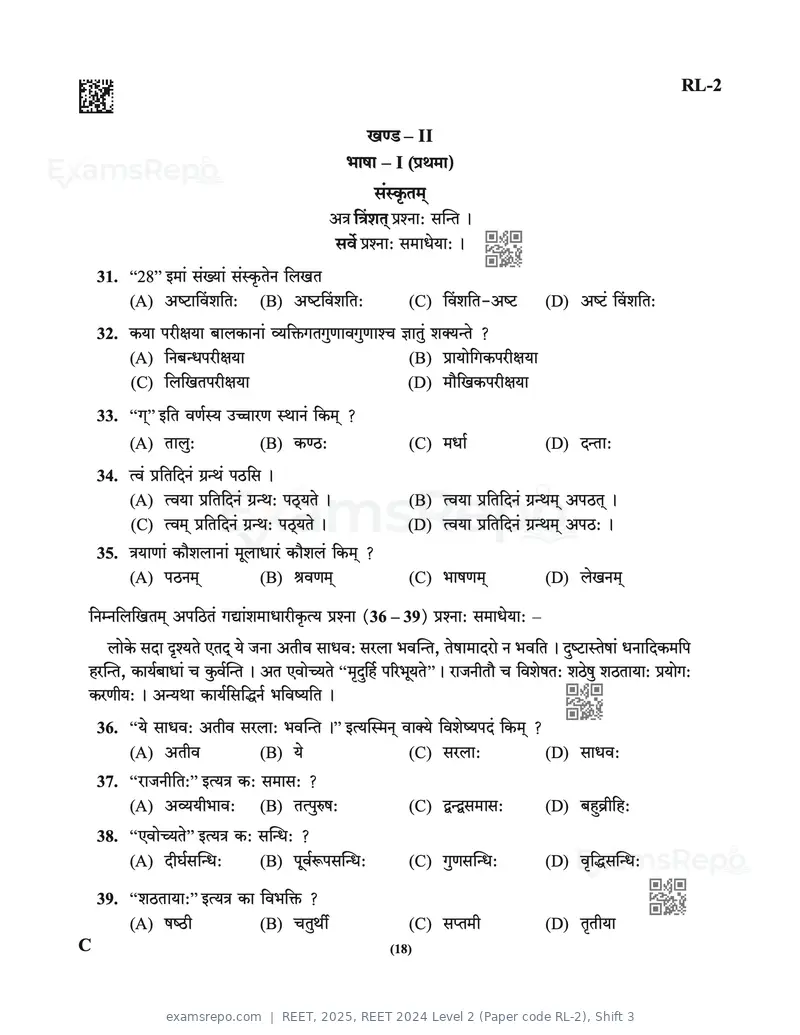
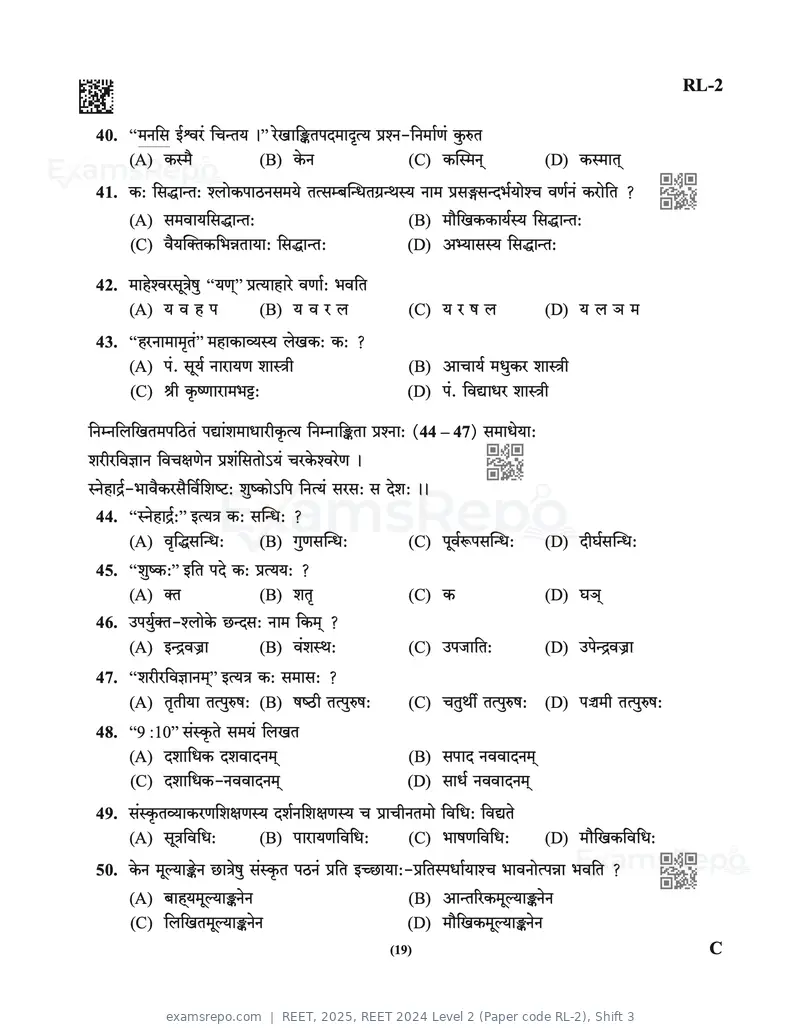
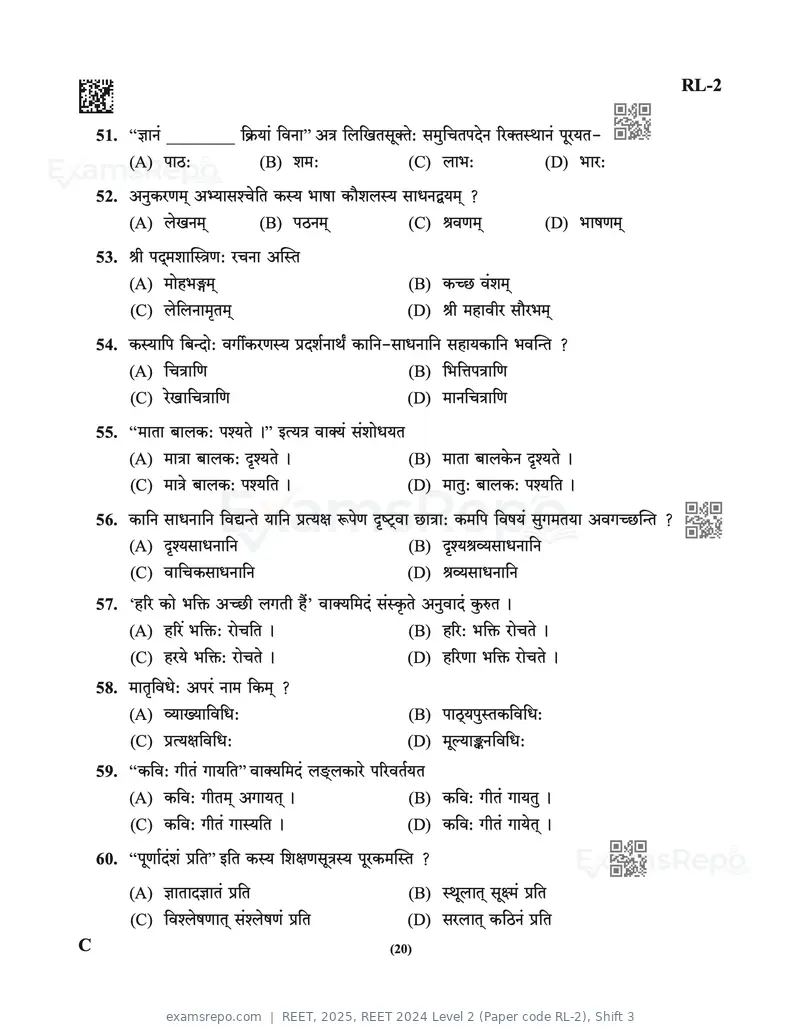
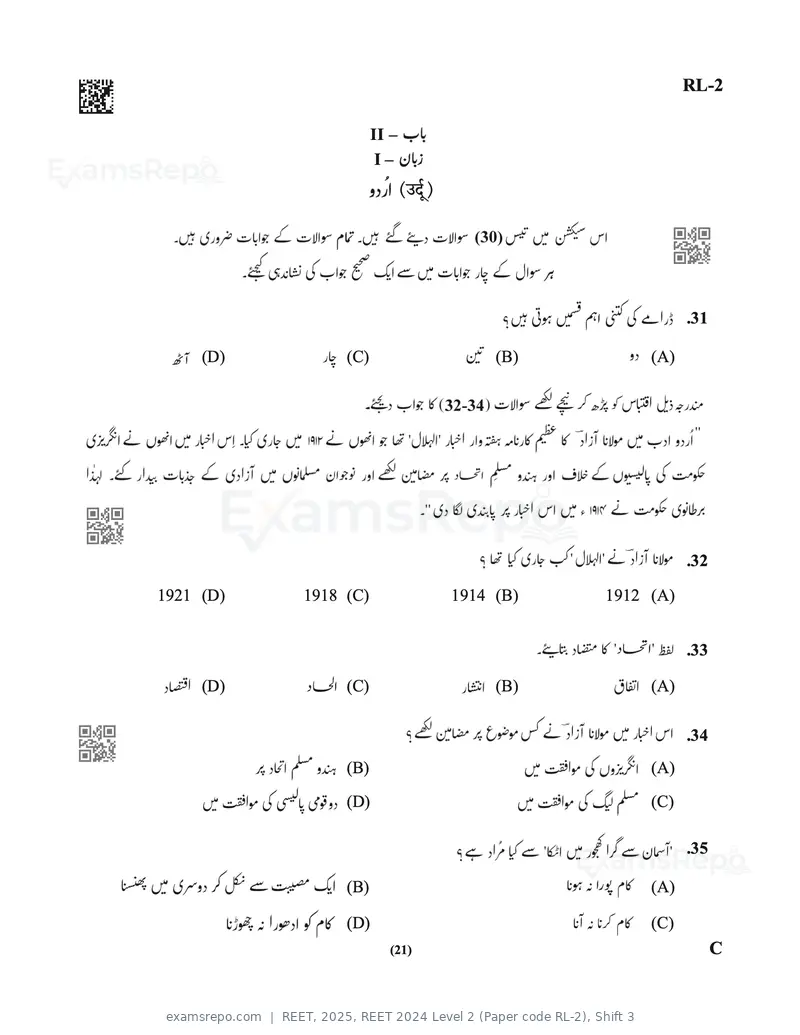
Text of page 213
RL-2

                      II –
                       I–
                             (CXÿ© )


                                                             .31

     (D)        (C)                         (B)        (A)


                                                             .32

1921 (D)   1918 (C)                    1914 (B)   1912 (A)


                                                             .33

     (D)        (C)                         (B)        (A)

                                                             .34
                (B)                                    (A)
                (D)                                    (C)

                                                             .35

                (B)                                    (A)

                (D)                                    (C)
                        (21)                                       C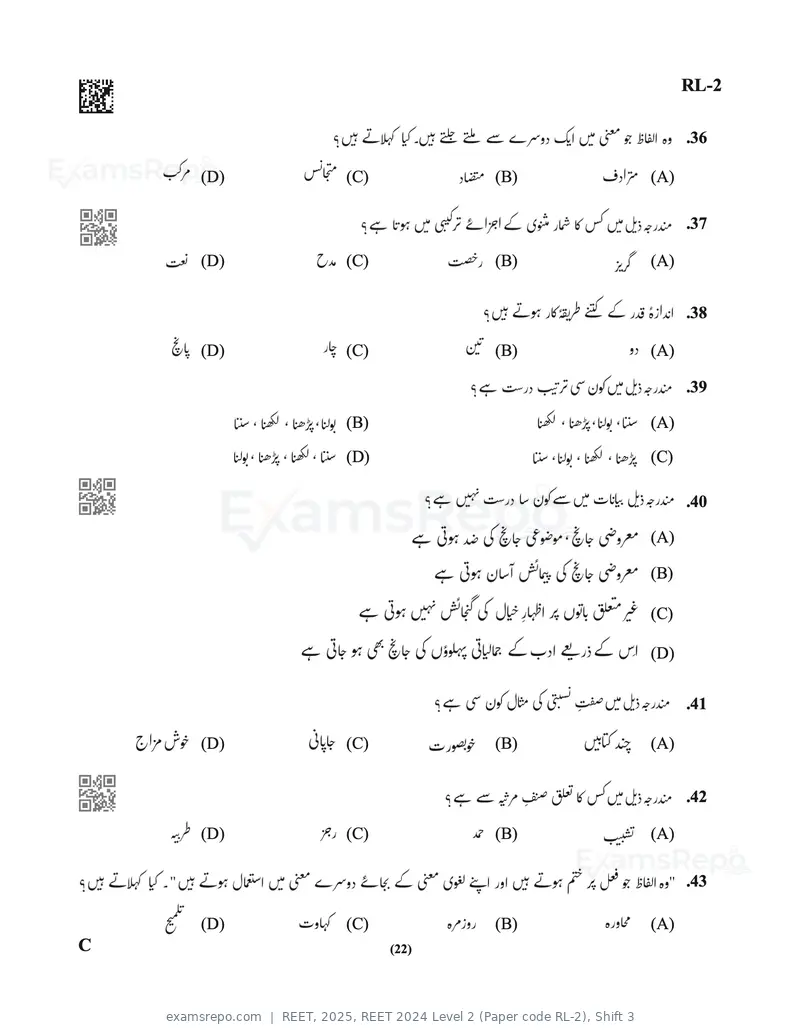
Text of page 214
RL-2

                                   .36

    (D)   (C)          (B)   (A)

                                   .37

    (D)   (C)          (B)   (A)


                                   .38

    (D)   (C)          (B)   (A)

                                   .39

          (B)                (A)

          (D)                (C)

                                   .40

                             (A)

                             (B)

                             (C)

                             (D)

                                   .41

    (D)   (C)          (B)   (A)


                                   .42

    (D)   (C)          (B)   (A)

                                   .43

    (D)   (C)          (B)   (A)
C               (22)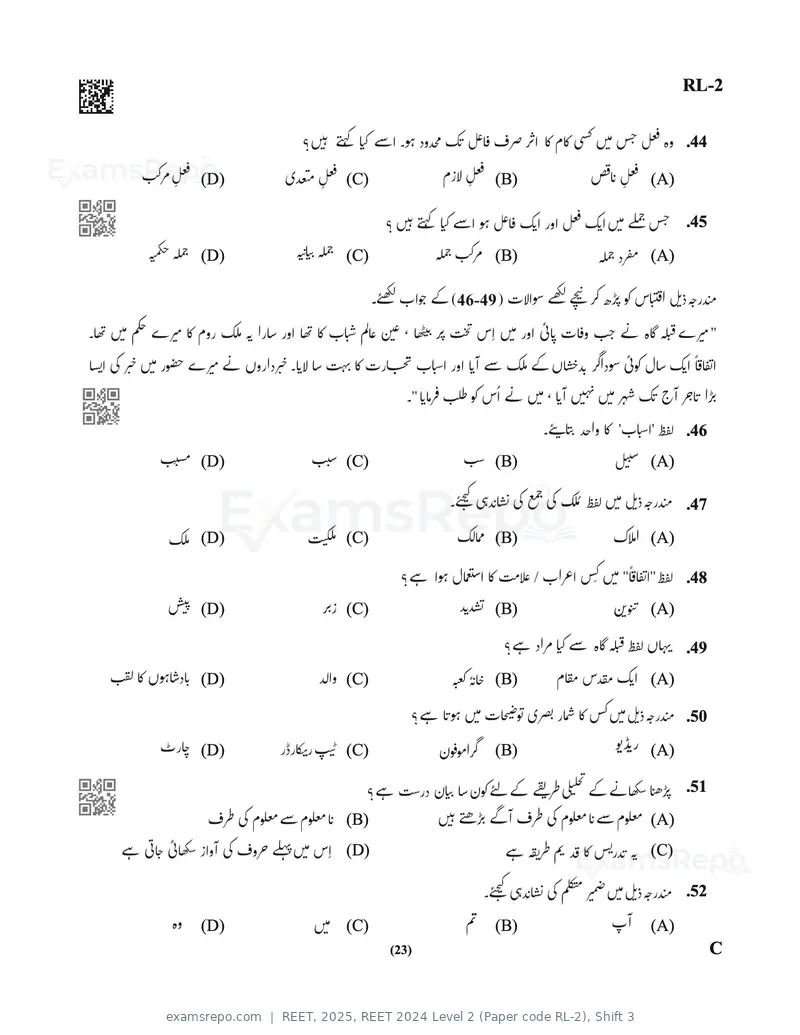
Text of page 215
RL-2


                               .44

(D)   (C)          (B)   (A)

                               .45
(D)   (C)          (B)   (A)


                               .46
(D)   (C)          (B)   (A)

                               .47
(D)   (C)          (B)   (A)

                               .48
(D)   (C)          (B)   (A)

                               .49
(D)   (C)          (B)   (A)

                               .50
(D)   (C)          (B)   (A)

                               .51
      (B)                (A)
      (D)                (C)

                               .52

(D)   (C)          (B)   (A)
            (23)                     C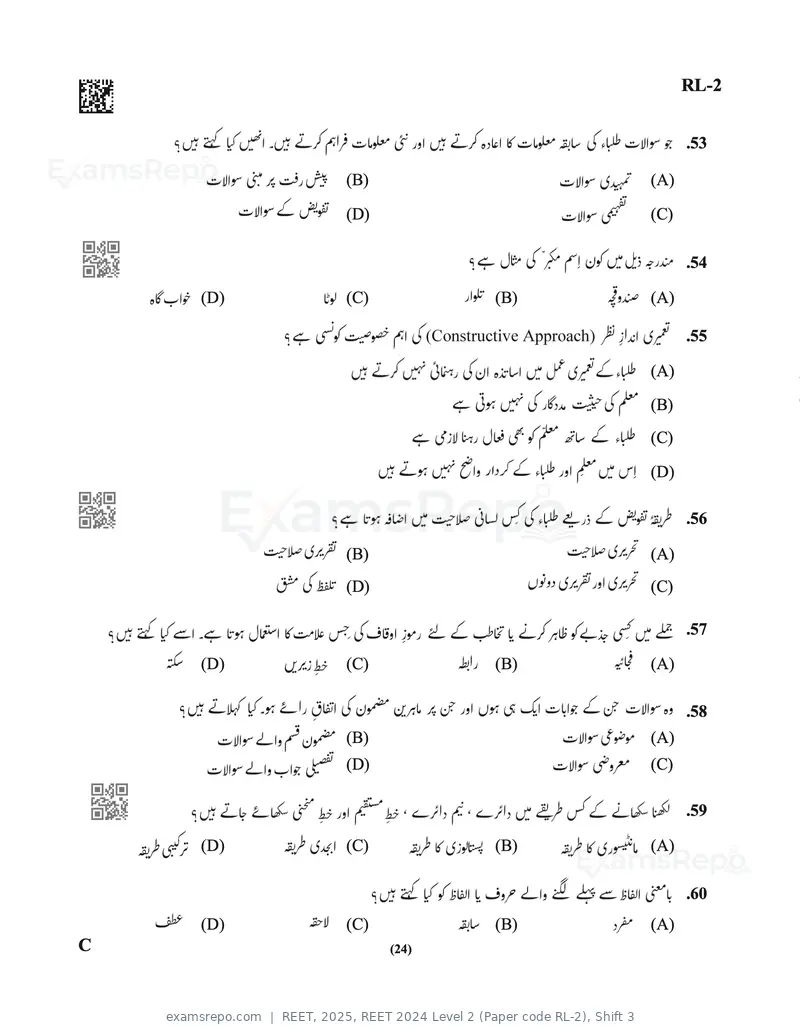
Text of page 216
RL-2


                                   .53

          (B)                (A)

          (D)                (C)

                                   .54

    (D)   (C)          (B)   (A)

                                   .55

                             (A)
                             (B)
                             (C)

                             (D)

                                   .56

          (B)                (A)
          (D)                (C)

                                   .57

    (D)   (C)          (B)   (A)

                                   .58
          (B)                (A)
          (D)                (C)

                                   .59

    (D)   (C)          (B)   (A)

                                   .60
    (D)   (C)          (B)   (A)
C               (24)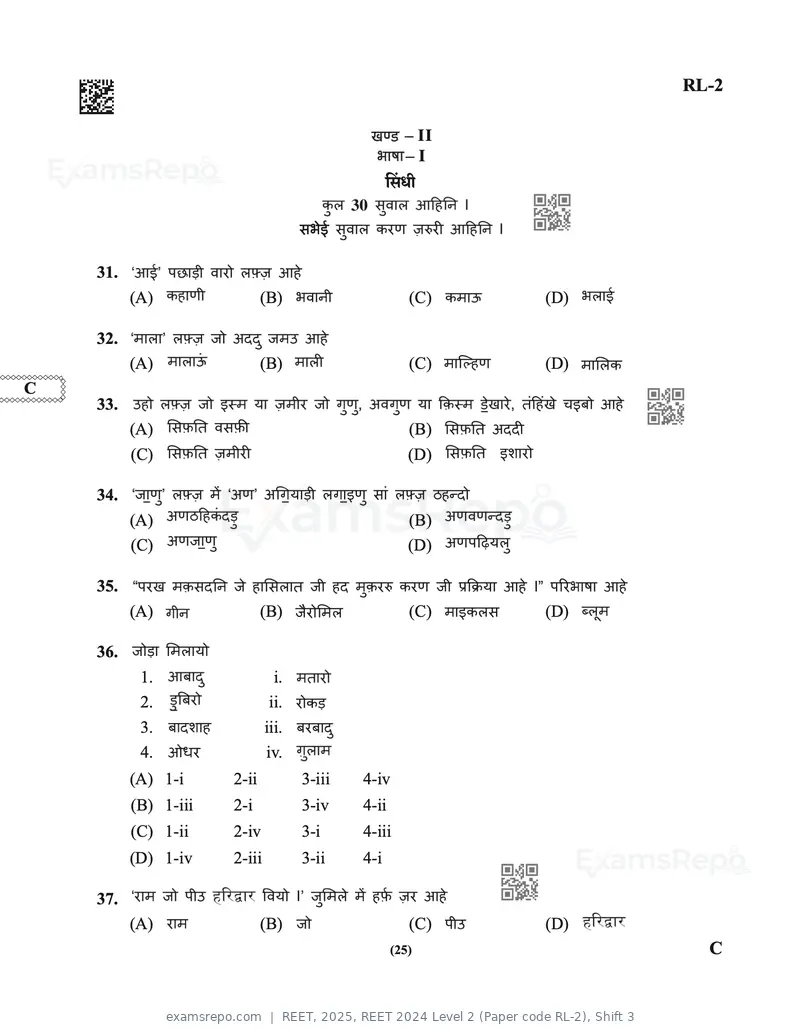
Text of page 217
RL-2

                                                      – II
                                                      –I
                                                   qgYr


    31.
          (A)                (B)                       (C)   (D)

    32.
          (A)                (B)                       (C)   (D)
C
    33.
          (A)                                          (B)
          (C)                                          (D)

    34.
          (A)                                          (B)
          (C)                                          (D)

    35.
          (A)                (B)                       (C)   (D)

    36.
           1.                   i.
           2.                  ii.
           3.                 iii.
           4.                 iv.
          (A) 1-i     2-ii           3-iii   4-iv
          (B) 1-iii   2-i            3-iv    4-ii
          (C) 1-ii    2-iv           3-i     4-iii
          (D) 1-iv    2-iii          3-ii    4-i

    37.
          (A)                (B)                       (C)   (D)
                                                    (25)             C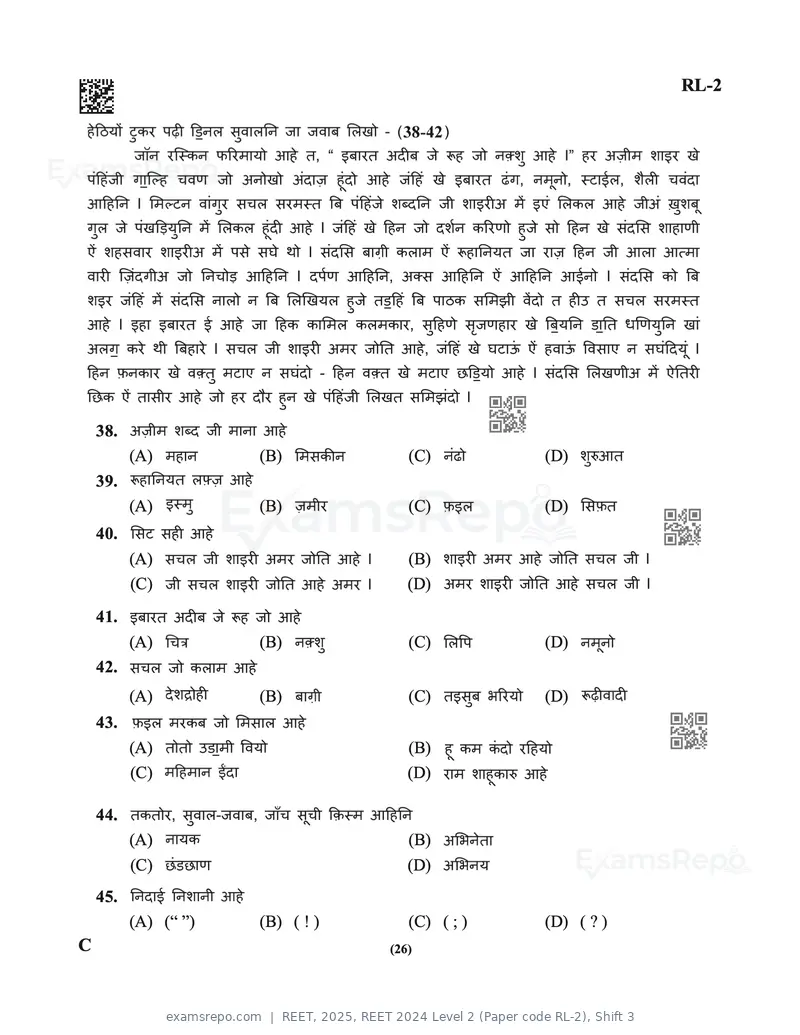
Text of page 218
RL-2


    38.
          (A)         (B)            (C)         (D)
    39.
          (A)         (B)            (C)         (D)
    40.
          (A)                        (B)
          (C)                        (D)
    41.
          (A)         (B)            (C)         (D)
    42.
          (A)         (B)            (C)         (D)
    43.
          (A)                        (B)
          (C)                        (D)

    44.
          (A)                        (B)
          (C)                        (D)
    45.
          (A) (“ ”)   (B) ( ! )      (C) ( ; )   (D) ( ? )
C                                 (26)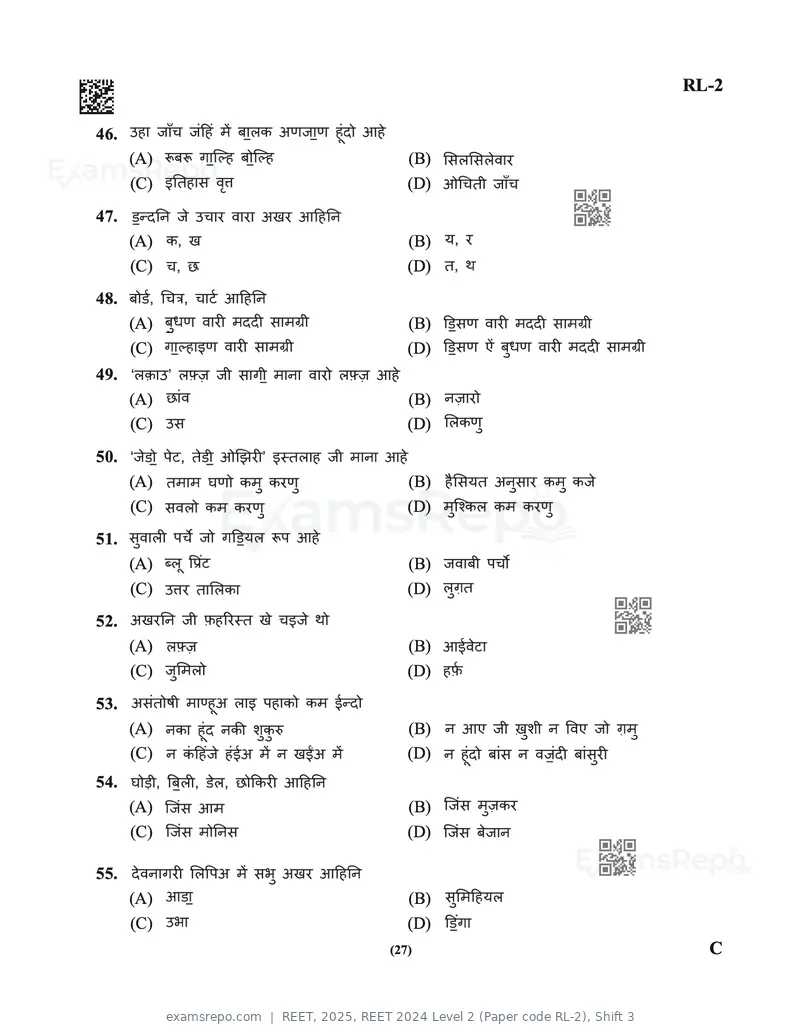
Text of page 219
RL-2

46.
      (A)      (B)
      (C)      (D)
47.
      (A)      (B)
      (C)      (D)
48.
      (A)      (B)
      (C)      (D)
49.
      (A)      (B)
      (C)      (D)
50.
      (A)      (B)
      (C)      (D)
51.
      (A)      (B)
      (C)      (D)
52.
      (A)      (B)
      (C)      (D)
53.
      (A)      (B)
      (C)      (D)
54.
      (A)      (B)
      (C)      (D)

55.
      (A)      (B)
      (C)      (D)
            (27)       C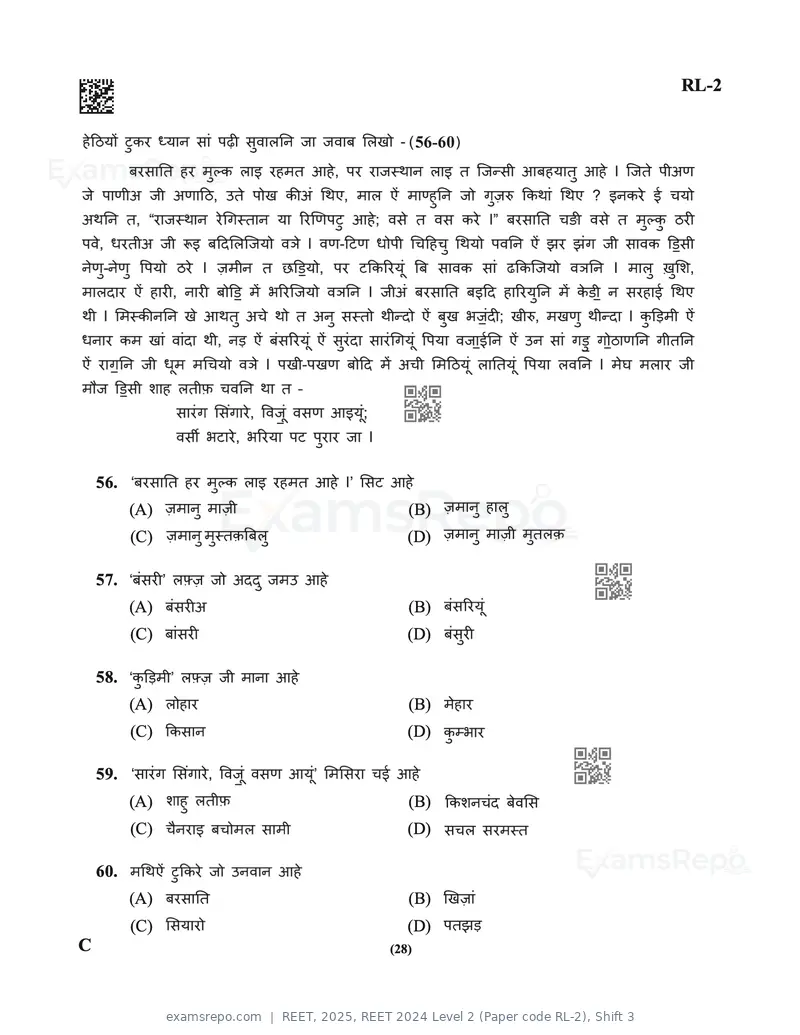
Text of page 220
RL-2


    56.
          (A)      (B)
          (C)      (D)

    57.
          (A)      (B)
          (C)      (D)

    58.
          (A)      (B)
          (C)      (D)

    59.
          (A)      (B)
          (C)      (D)

    60.
          (A)      (B)
          (C)      (D)
C               (28)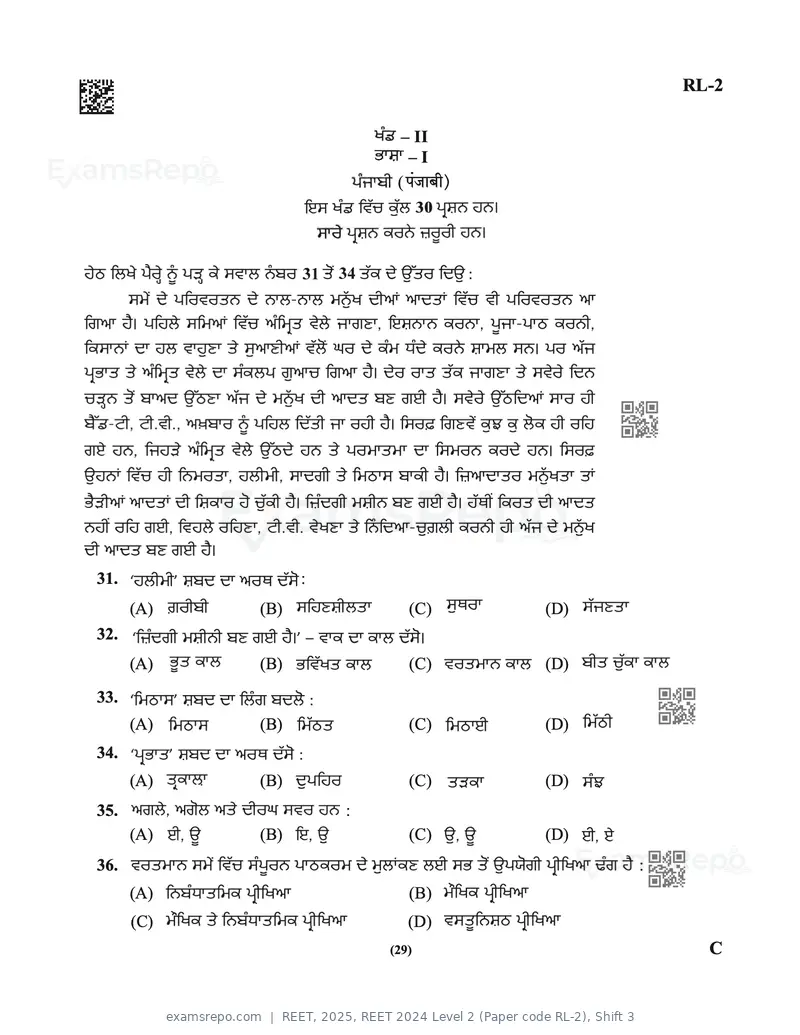
Text of page 221
RL-2

                            – II
                             –I
                           ( n§Om~r)


31.               :
      (A)   (B)              (C)       (D)
32.
      (A)   (B)              (C)       (D)
33.
      (A)   (B)              (C)       (D)
34.
      (A)   (B)              (C)       (D)
35.                   :
      (A)   (B)              (C)       (D)
36.                                          :
      (A)                    (B)
      (C)                    (D)
                          (29)                     C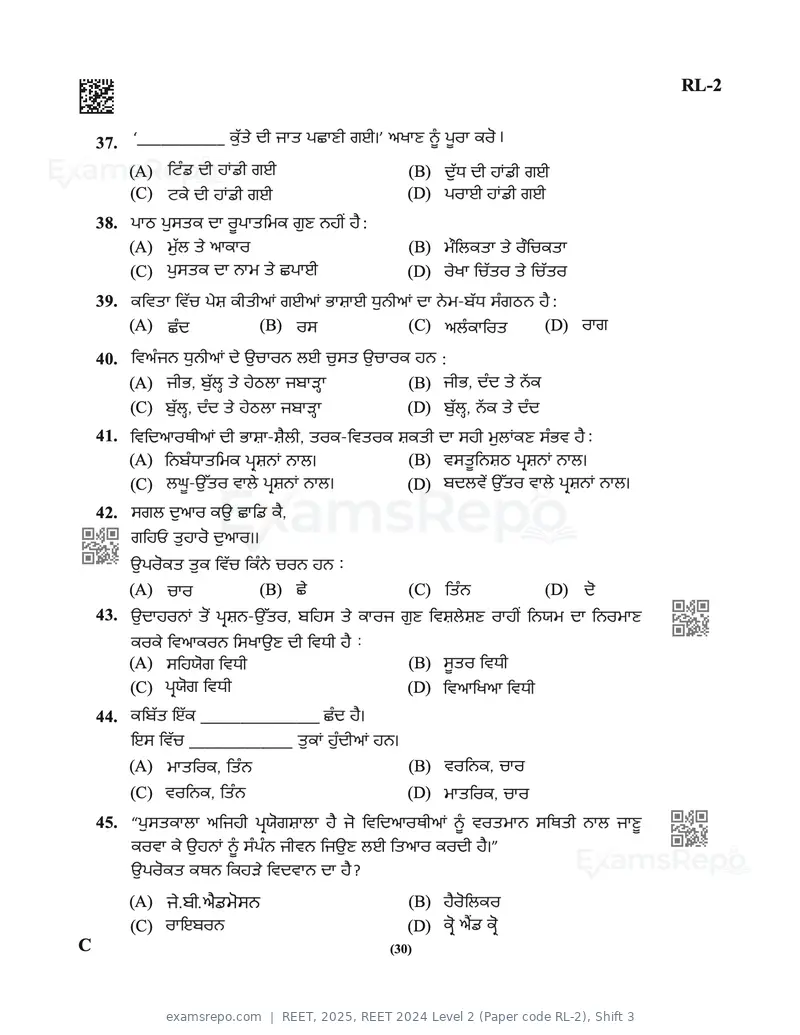
Text of page 222
RL-2


    37.
          (A)                    (B)
          (C)                    (D)
    38.                   :
          (A)                    (B)
          (C)                    (D)
    39.                                     :
          (A)   (B)              (C)       (D)
    40.                                :
          (A)                    (B)
          (C)                    (D)
    41.                                          :
          (A)                    (B)
          (C)                    (D)
    42.

                      :
          (A)   (B)              (C)       (D)
    43.

          (A)                    (B)
          (C)                    (D)
    44.

          (A)                    (B)
          (C)                    (D)
    45.


          (A)                    (B)
          (C)                    (D)
C                             (30)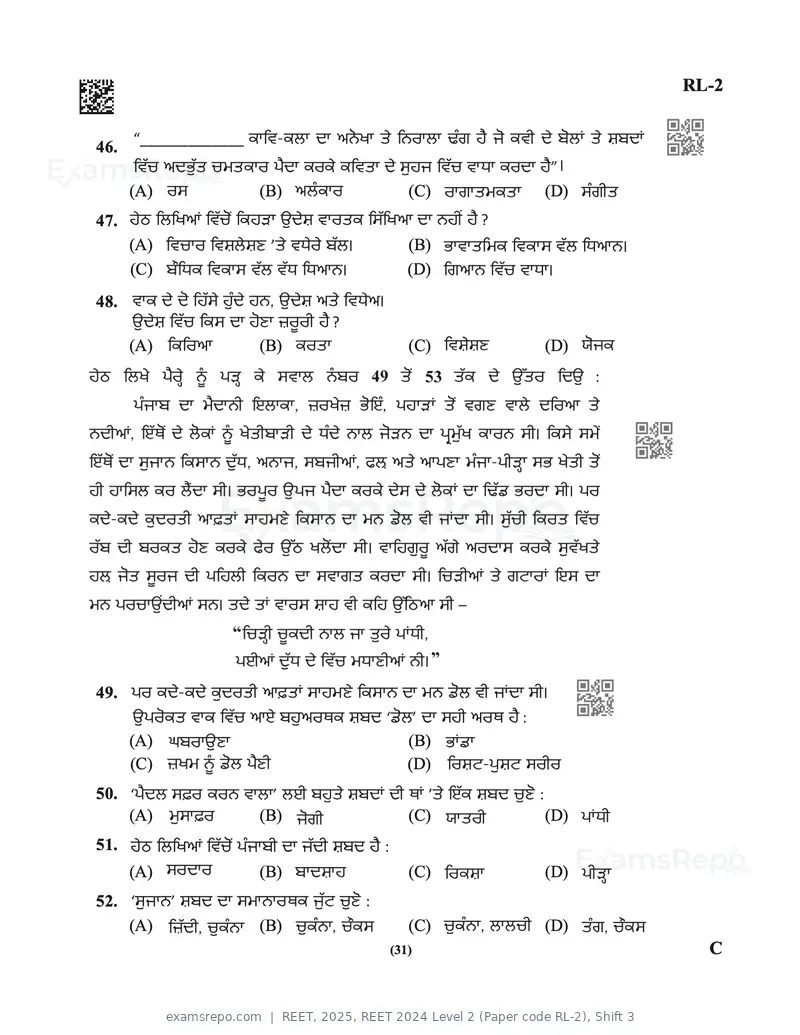
Text of page 223
RL-2


46.

      (A)   (B)      (C)   (D)
47.
      (A)            (B)
      (C)            (D)
48.

      (A)   (B)      (C)   (D)


49.

      (A)            (B)
      (C)            (D)
50.
      (A)   (B)      (C)   (D)
51.
      (A)   (B)      (C)   (D)
52.
      (A)   (B)      (C)   (D)
                  (31)             C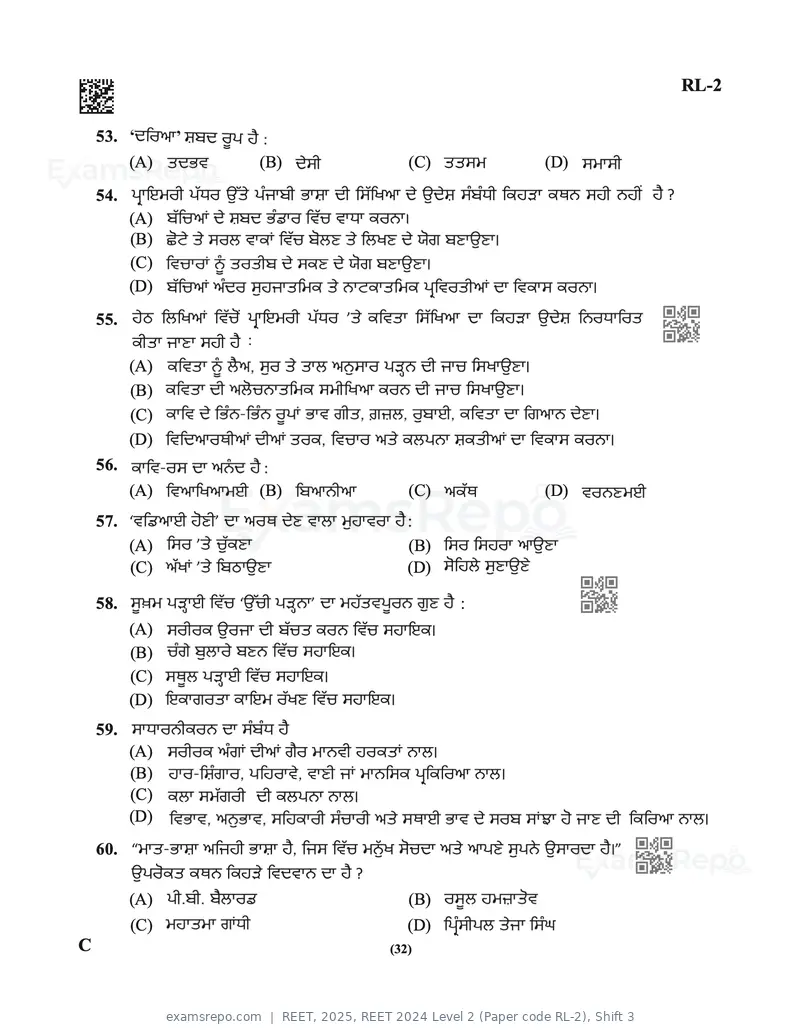
Text of page 224
RL-2

    53.
          (A)   (B)      (C)       (D)
    54.
          (A)
          (B)
          (C)
          (D)
    55.

          (A)
          (B)
          (C)
          (D)
    56.
          (A)   (B)      (C)       (D)
    57.                  :
          (A)            (B)
          (C)            (D)

    58.                        :
          (A)
          (B)
          (C)
          (D)
    59.
          (A)
          (B)
          (C)
          (D)
    60.

          (A)            (B)
          (C)            (D)
C                     (32)
Text of page 225
RL-2

                   – II
                    –I
                  (JwOamVr)>


31.
      (A)   (B)      (C)       (D)
32.
      (A)            (B)
      (C)            (D)
33.
      (A)
      (B)
      (C)
      (D)
34.
      (A)   (B)      (C)       (D)
35.
      (A)   (B)      (C)       (D)
36.
      (A)            (B)
      (C)            (D)
37.
      (A)            (B)
      (C)            (D)
38.

      (A)            (B)
      (C)            (D)
39.
      (A)
      (B)
      (C)
      (D)
                  (33)                 C
Text of page 226
RL-2

    40.
          (A)   (B)      (C)   (D)
    41.
          (A)            (B)
          (C)            (D)
    42.
          (A)   (B)      (C)   (D)
    43.
          (A)   (B)      (C)   (D)
    44.
          (A)   (B)      (C)   (D)


    45.
          (A)   (B)      (C)   (D)
    46.
          (A)   (B)      (C)   (D)
    47.
          (A)   (B)      (C)   (D)
    48.
          (A)            (B)
          (C)            (D)
    49.
          (A)   (B)      (C)   (D)
C                     (34)
Text of page 227
RL-2

50.
      (A)
      (B)
      (C)
      (D)


51.
      (A)   (B)      (C)   (D)
52.
      (A)            (B)
      (C)            (D)
53.
      (A)   (B)      (C)   (D)
54.
      (A)            (B)
      (C)            (D)
55.
      (A)   (B)      (C)   (D)
56.
      (A)            (B)
      (C)            (D)
57.
      (A)   (B)      (C)   (D)
58.
      (A)   (B)      (C)   (D)
59.
      (A)   (B)      (C)   (D)
60.
      (A)            (B)
      (C)            (D)
                  (35)             C
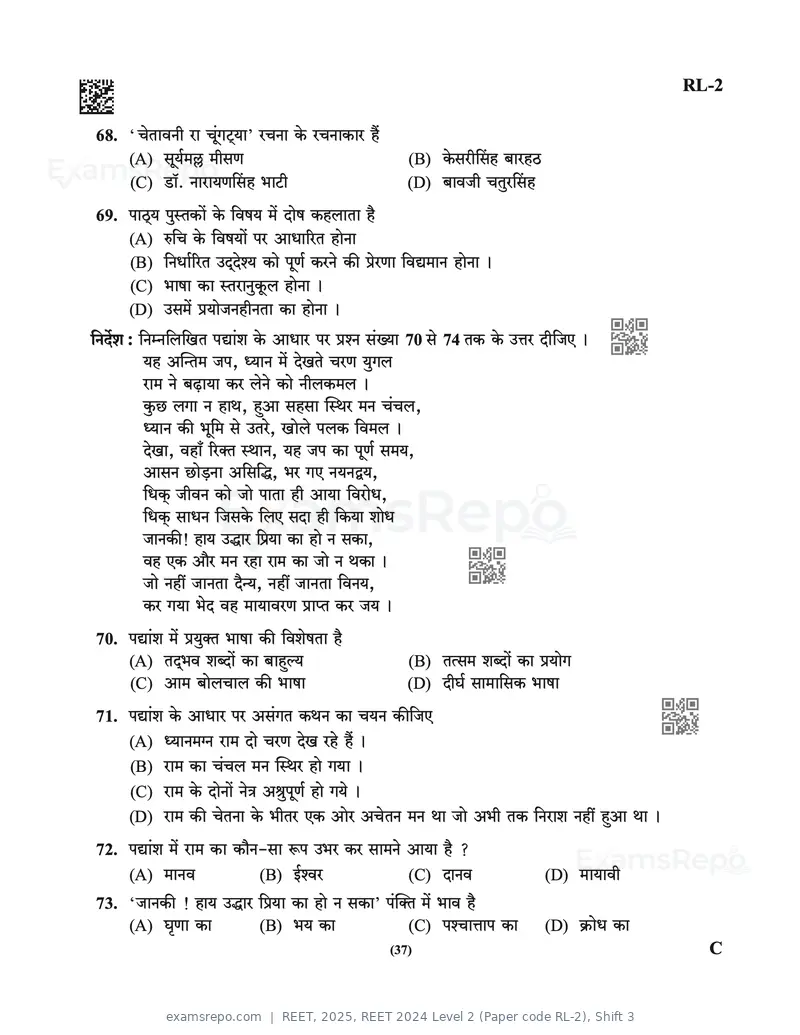
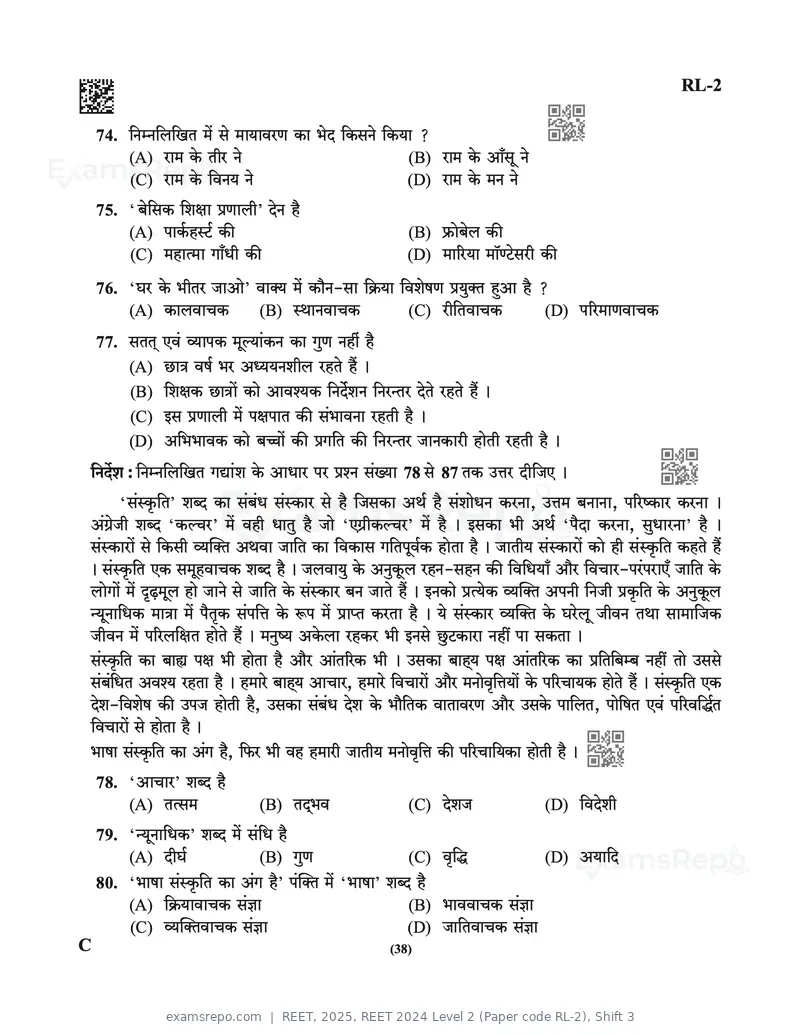
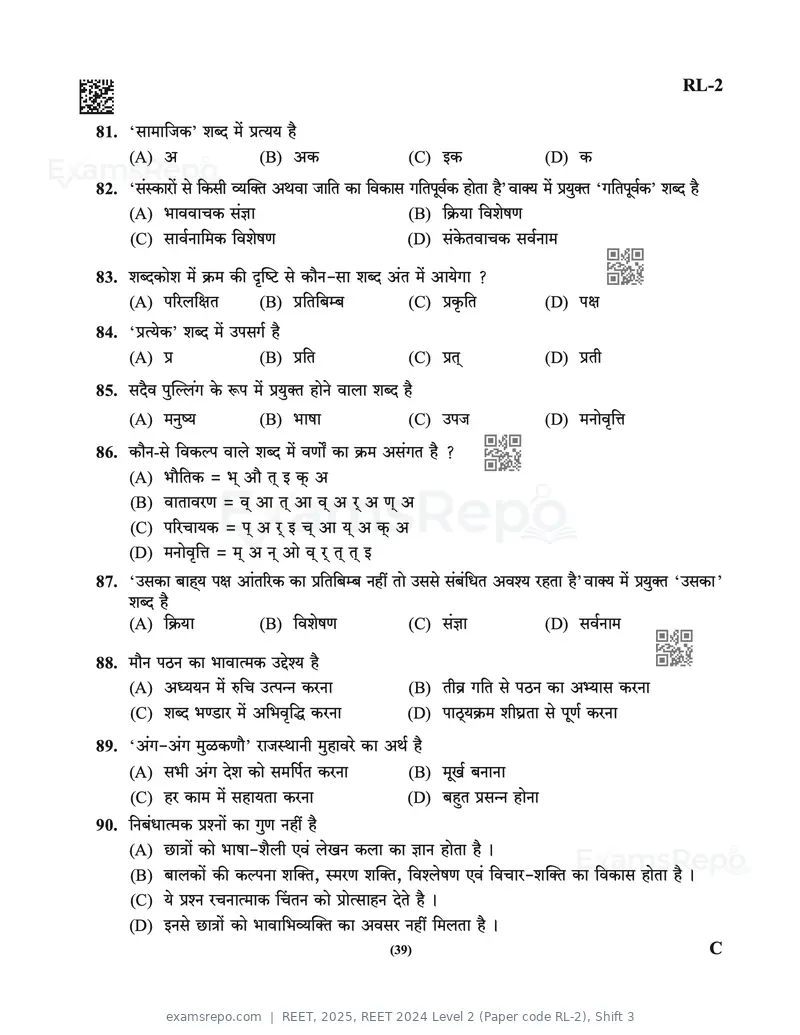
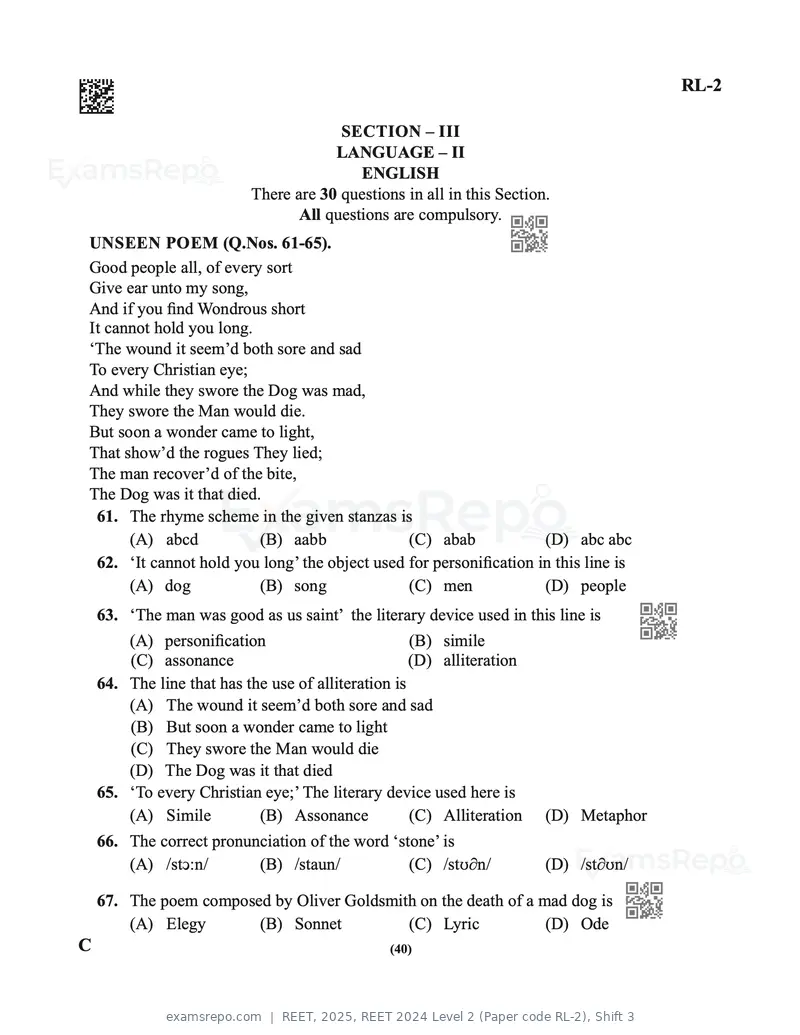
Text of page 232
RL-2

                                        SECTION – III
                                       LANGUAGE – II
                                           ENGLISH
                           There are 30 questions in all in this Section.
                                  All questions are compulsory.
UNSEEN POEM (Q.Nos. 61-65).
Good people all, of every sort
Give ear unto my song,
And if you find Wondrous short
It cannot hold you long.
‘The wound it seem’d both sore and sad
To every Christian eye;
And while they swore the Dog was mad,
They swore the Man would die.
But soon a wonder came to light,
That show’d the rogues They lied;
The man recover’d of the bite,
The Dog was it that died.
 61. The rhyme scheme in the given stanzas is
      (A) abcd           (B) aabb              (C) abab             (D) abc abc
 62. ‘It cannot hold you long’ the object used for personification in this line is
      (A) dog            (B) song              (C) men              (D) people
    63. ‘The man was good as us saint’ the literary device used in this line is
        (A) personification                          (B) simile
        (C) assonance                                (D) alliteration
    64. The line that has the use of alliteration is
        (A) The wound it seem’d both sore and sad
        (B) But soon a wonder came to light
        (C) They swore the Man would die
        (D) The Dog was it that died
    65. ‘To every Christian eye;’ The literary device used here is
        (A) Simile          (B) Assonance            (C) Alliteration   (D) Metaphor
    66. The correct pronunciation of the word ‘stone’ is
        (A) /stͻ:n/       (B) /staun/            (C) /stʊ∂n/            (D) /st∂ʊn/

    67. The poem composed by Oliver Goldsmith on the death of a mad dog is
        (A) Elegy       (B) Sonnet          (C) Lyric            (D) Ode
C                                               (40)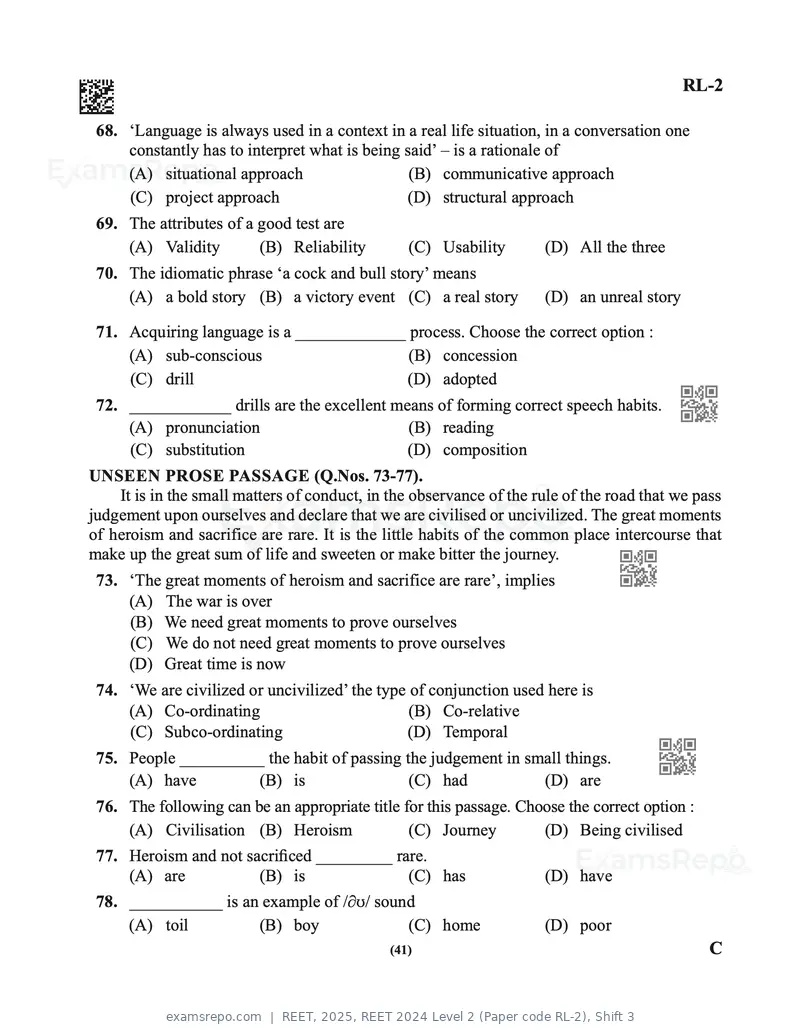
Text of page 233
RL-2

 68. ‘language is always used in a context in a real life situation, in a conversation one
     constantly has to interpret what is being said’ – is a rationale of
     (A) situational approach                   (B) communicative approach
     (C) project approach                      (D) structural approach
 69. The attributes of a good test are
     (A) Validity        (B) Reliability         (C) Usability       (D) All the three
 70. The idiomatic phrase ‘a cock and bull story’ means
     (A) a bold story (B) a victory event (C) a real story           (D) an unreal story

 71. Acquiring language is a _____________ process. Choose the correct option :
     (A) sub-conscious                     (B) concession
     (C) drill                            (D) adopted
 72. ____________ drills are the excellent means of forming correct speech habits.
     (A) pronunciation                       (B) reading
     (C) substitution                        (D) composition
UNSEEN PROSE PASSAGE (Q.Nos. 73-77).
    It is in the small matters of conduct, in the observance of the rule of the road that we pass
judgement upon ourselves and declare that we are civilised or uncivilized. The great moments
of heroism and sacrifice are rare. It is the little habits of the common place intercourse that
make up the great sum of life and sweeten or make bitter the journey.
 73. ‘The great moments of heroism and sacrifice are rare’, implies
     (A) The war is over
     (B) We need great moments to prove ourselves
     (C) We do not need great moments to prove ourselves
     (D) Great time is now
 74. ‘We are civilized or uncivilized’ the type of conjunction used here is
     (A) Co-ordinating                          (B) Co-relative
     (C) Subco-ordinating                      (D) Temporal
 75. People __________ the habit of passing the judgement in small things.
     (A) have        (B) is                  (C) had           (D) are
 76. The following can be an appropriate title for this passage. Choose the correct option :
     (A) Civilisation (B) Heroism               (C) Journey         (D) Being civilised
 77. Heroism and not sacrificed _________ rare.
     (A) are           (B) is               (C) has                  (D) have
 78. ___________ is an example of /∂ʊ/ sound
     (A) toil         (B) boy              (C) home                  (D) poor
                                              (41)                                             C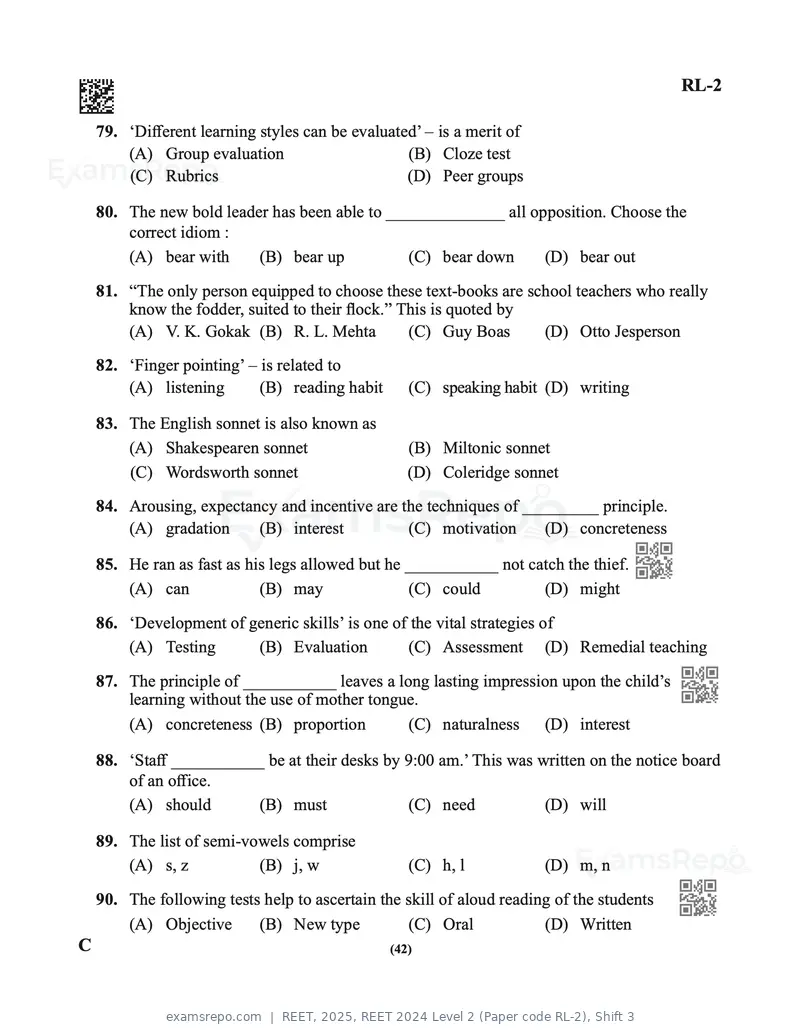
Text of page 234
RL-2

    79. ‘Different learning styles can be evaluated’ – is a merit of
        (A) Group evaluation                      (B) Cloze test
        (C) Rubrics                               (D) Peer groups

    80. The new bold leader has been able to ______________ all opposition. Choose the
        correct idiom :
        (A) bear with     (B) bear up           (C) bear down     (D) bear out

    81. “The only person equipped to choose these text-books are school teachers who really
        know the fodder, suited to their flock.” This is quoted by
        (A) V. K. Gokak (B) R. L. Mehta          (C) Guy Boas      (D) Otto Jesperson

    82. ‘Finger pointing’ – is related to
        (A) listening       (B) reading habit      (C) speaking habit (D) writing

    83. The English sonnet is also known as
        (A) Shakespearen sonnet                    (B) Miltonic sonnet
        (C) Wordsworth sonnet                      (D) Coleridge sonnet

    84. Arousing, expectancy and incentive are the techniques of _________ principle.
        (A) gradation     (B) interest          (C) motivation      (D) concreteness

    85. He ran as fast as his legs allowed but he ___________ not catch the thief.
        (A) can             (B) may               (C) could         (D) might

    86. ‘Development of generic skills’ is one of the vital strategies of
        (A) Testing      (B) Evaluation          (C) Assessment (D) Remedial teaching

    87. The principle of ___________ leaves a long lasting impression upon the child’s
        learning without the use of mother tongue.
        (A) concreteness (B) proportion         (C) naturalness (D) interest

    88. ‘Staff ___________ be at their desks by 9:00 am.’ This was written on the notice board
        of an office.
        (A) should       (B) must               (C) need            (D) will

    89. The list of semi-vowels comprise
        (A) s, z           (B) j, w                (C) h, l            (D) m, n

    90. The following tests help to ascertain the skill of aloud reading of the students
        (A) Objective      (B) New type           (C) Oral             (D) Written
C                                               (42)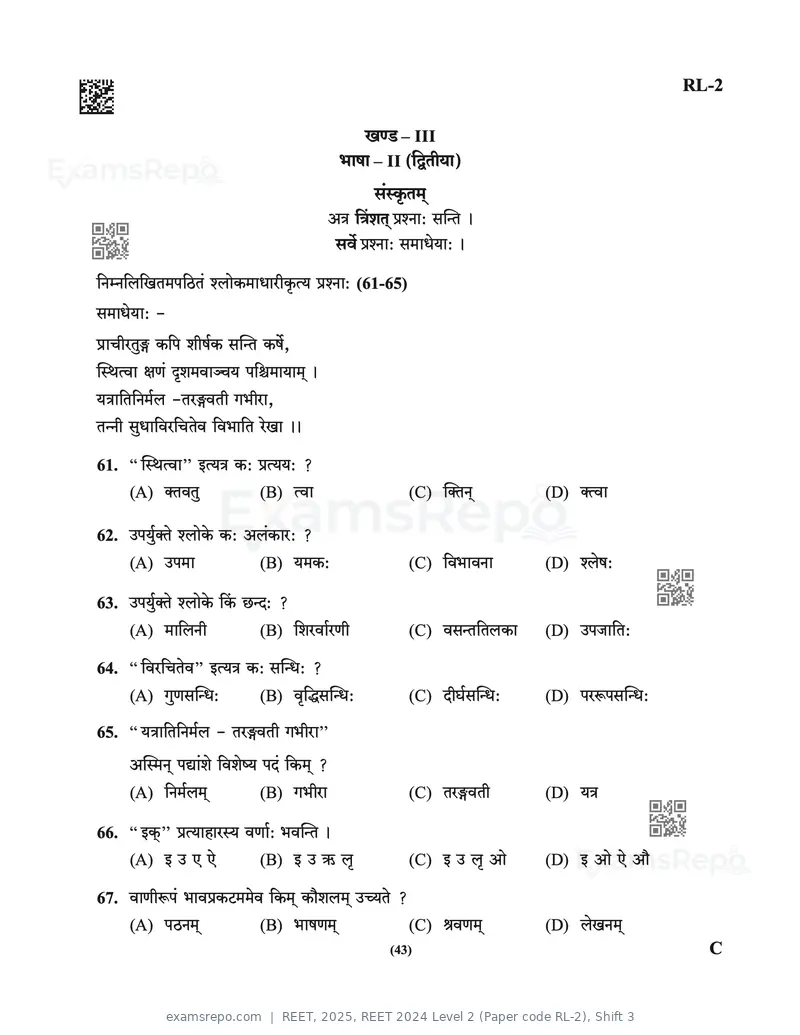
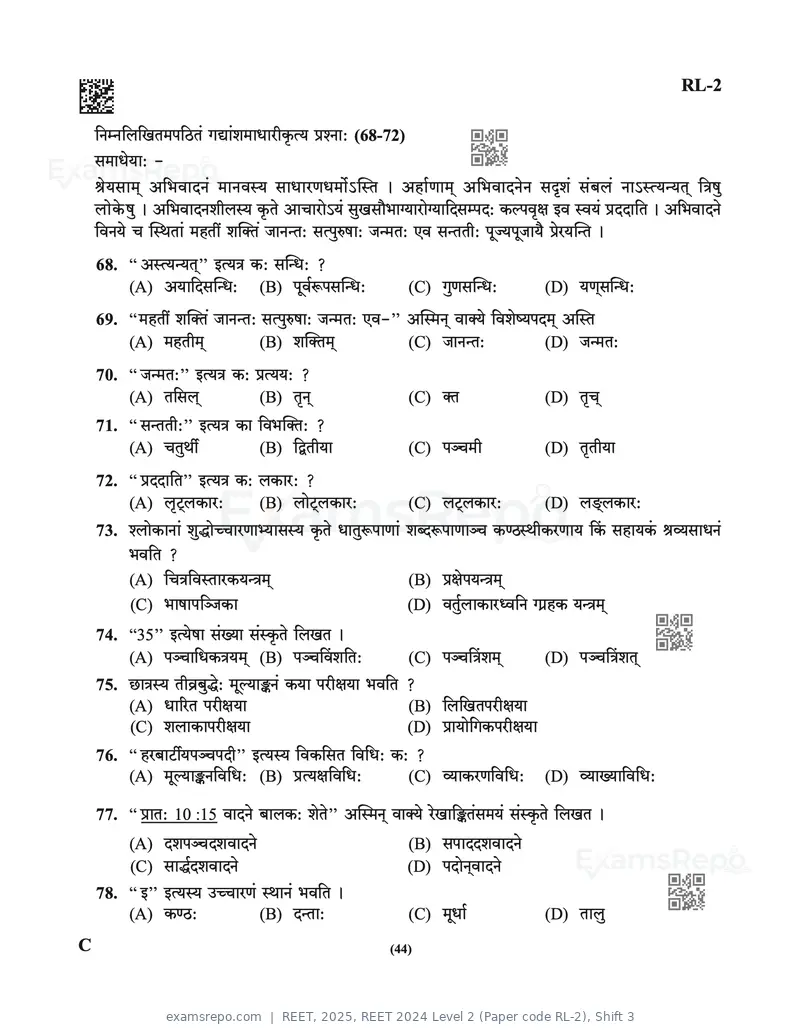
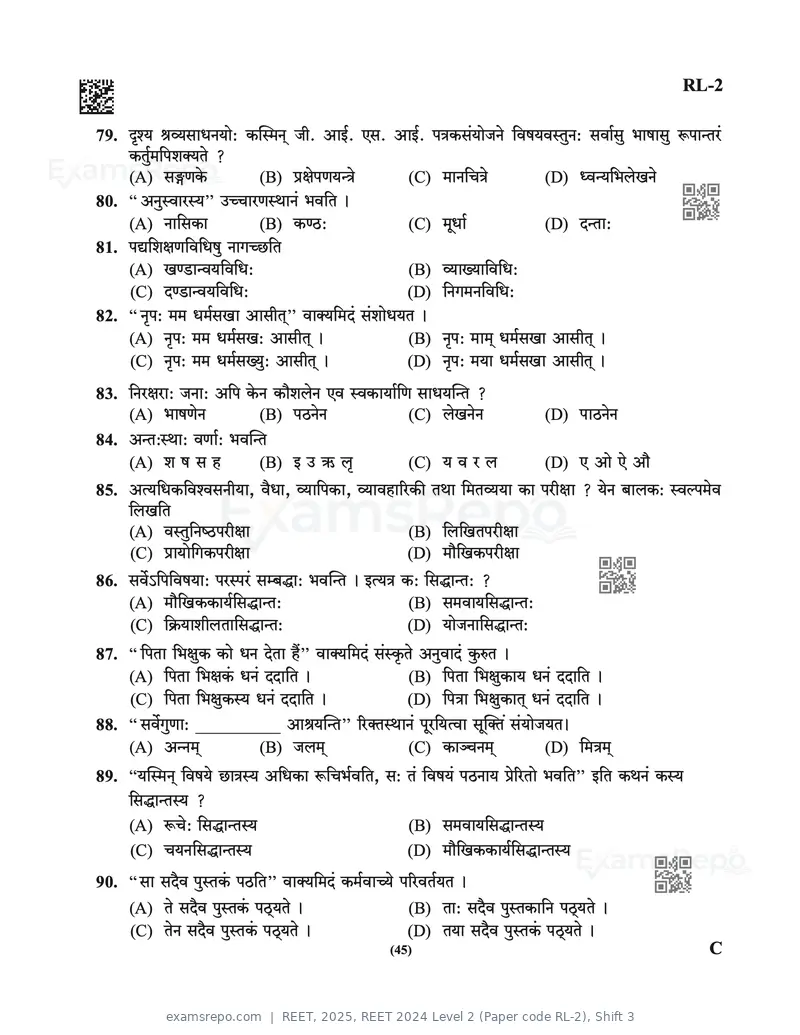
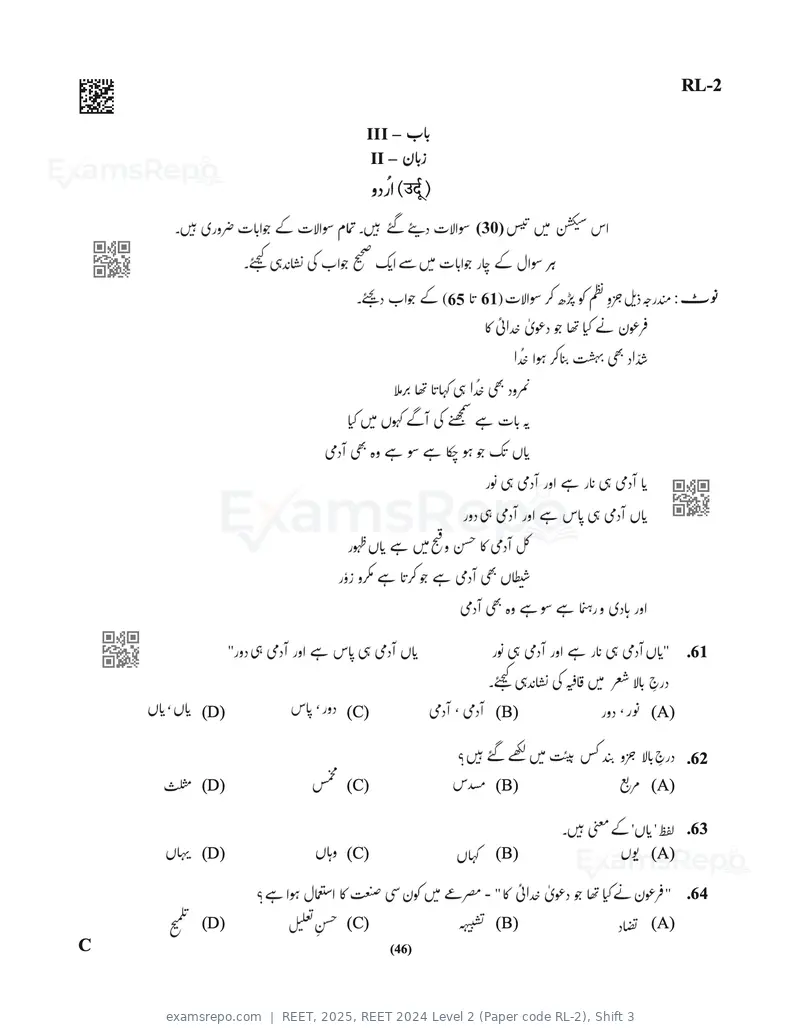
Text of page 238
RL-2

            III –
             II –
                 (CXÿ© )


                                       .61


    (D)   (C)              (B)   (A)

                                       .62
    (D)   (C)              (B)   (A)

                                       .63
    (D)   (C)              (B)   (A)

                                       .64
    (D)   (C)              (B)   (A)
C               (46)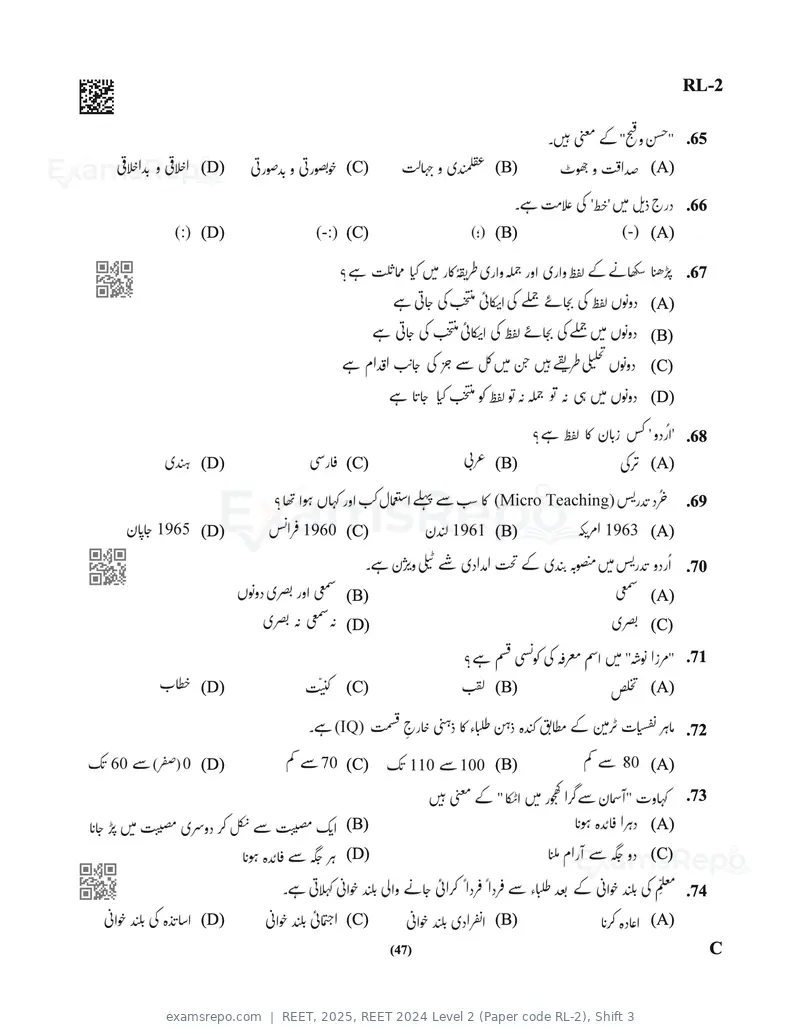
Text of page 239
RL-2

                               .65
(D)   (C)          (B)   (A)

                               .66
(D)   (C)          (B)   (A)

                               .67
                         (A)
                         (B)
                         (C)
                         (D)

                               .68
(D)   (C)          (B)   (A)

                               .69
(D)   (C)          (B)   (A)

                               .70
      (B)                (A)
      (D)                (C)
                               .71
(D)   (C)          (B)   (A)

                               .72

(D)   (C)          (B)   (A)
                               .73
      (B)                (A)
      (D)                (C)

                               .74
(D)   (C)          (B)   (A)
            (47)                     C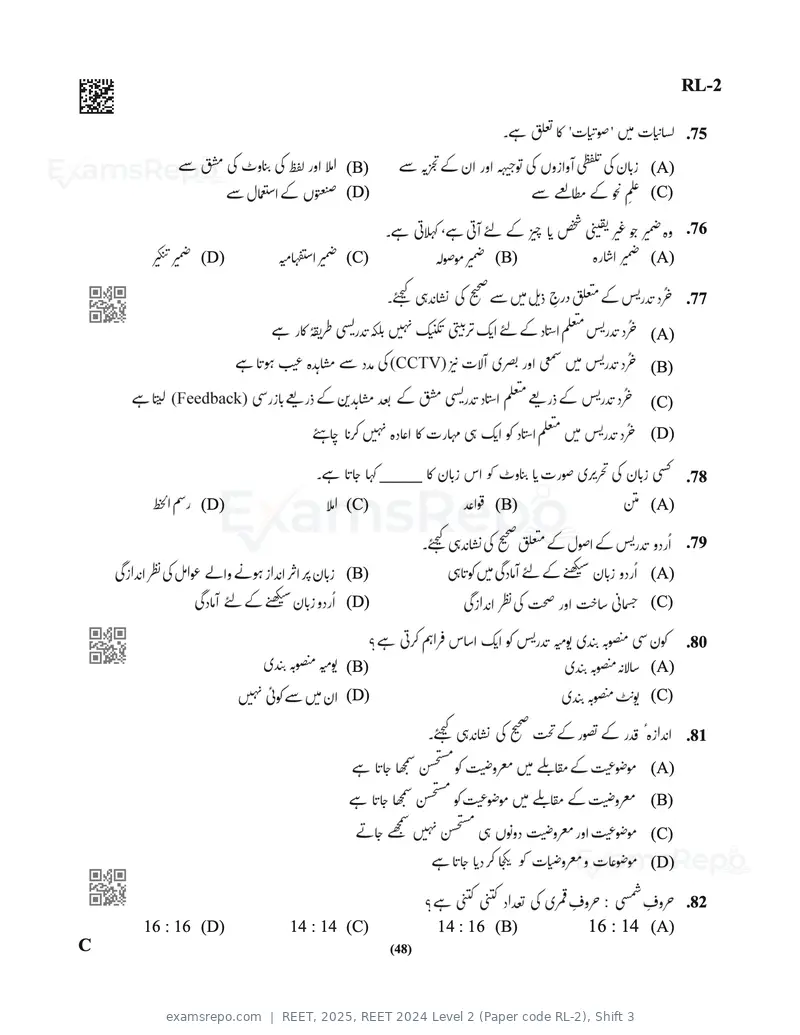
Text of page 240
RL-2

                                                                   .75
                         (B)                                (A)
                         (D)                                (C)

                                                                   .76
           (D)           (C)                  (B)           (A)

                                                                   .77

                                                            (A)
                                                            (B)

                                                            (C)
                                                            (D)

                                                                   .78
           (D)           (C)                  (B)           (A)

                                                                   .79
                         (B)                                (A)
                         (D)                                (C)

                                                                   .80
                         (B)                                (A)
                         (D)                                (C)

                                                                   .81
                                                            (A)
                                                            (B)
                                                            (C)
                                                            (D)

                                                                   .82
    16 : 16 (D)   14 : 14 (C)          14 : 16 (B)   16 : 14 (A)
C                               (48)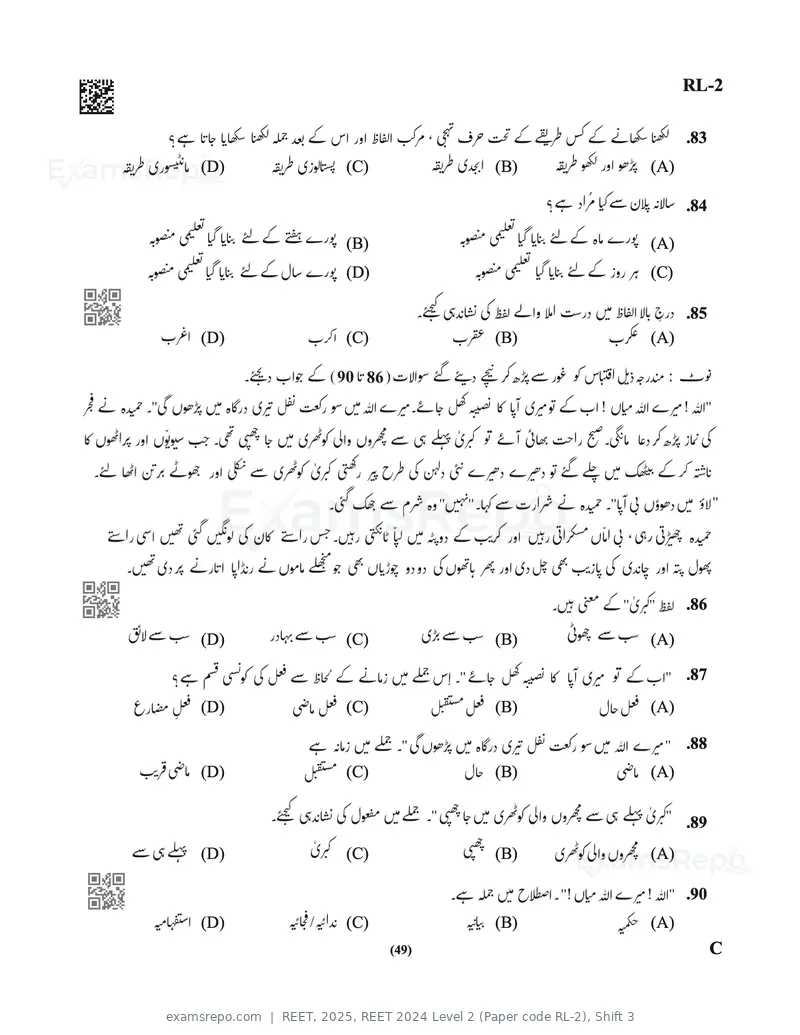
Text of page 241
RL-2

                               .83
(D)   (C)          (B)   (A)

                               .84

      (B)                (A)
      (D)                (C)

                               .85
(D)   (C)          (B)   (A)


                               .86

(D)   (C)          (B)   (A)

                               .87
(D)   (C)          (B)   (A)

                               .88
(D)   (C)          (B)   (A)

                               .89
(D)   (C)          (B)   (A)

                               .90
(D)   (C)          (B)   (A)
            (49)                     C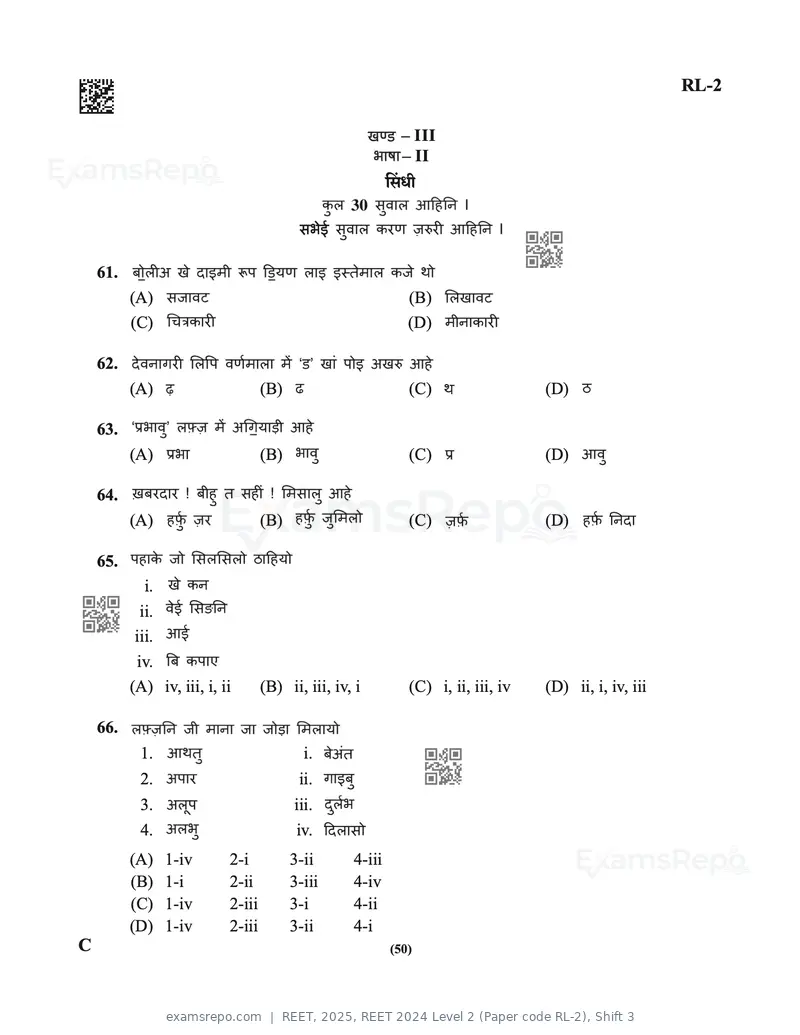
Text of page 242
RL-2

                                                             – III
                                                             – II
                                                           qgYr


    61.
          (A)                                                 (B)
          (C)                                                 (D)

    62.
          (A)                      (B)                        (C)                  (D)

    63.
          (A)                      (B)                        (C)                  (D)

    64.
          (A)                      (B)                        (C)                  (D)

    65.
             i.
            ii.
           iii.
           iv.
          (A) iv, iii, i, ii       (B) ii, iii, iv, i         (C) i, ii, iii, iv   (D) ii, i, iv, iii

    66.
           1.                              i.
           2.                             ii.
           3.                            iii.
           4.                             iv.
          (A) 1-iv         2-i           3-ii      4-iii
          (B) 1-i          2-ii          3-iii     4-iv
          (C) 1-iv         2-iii         3-i       4-ii
          (D) 1-iv         2-iii         3-ii      4-i
C                                                          (50)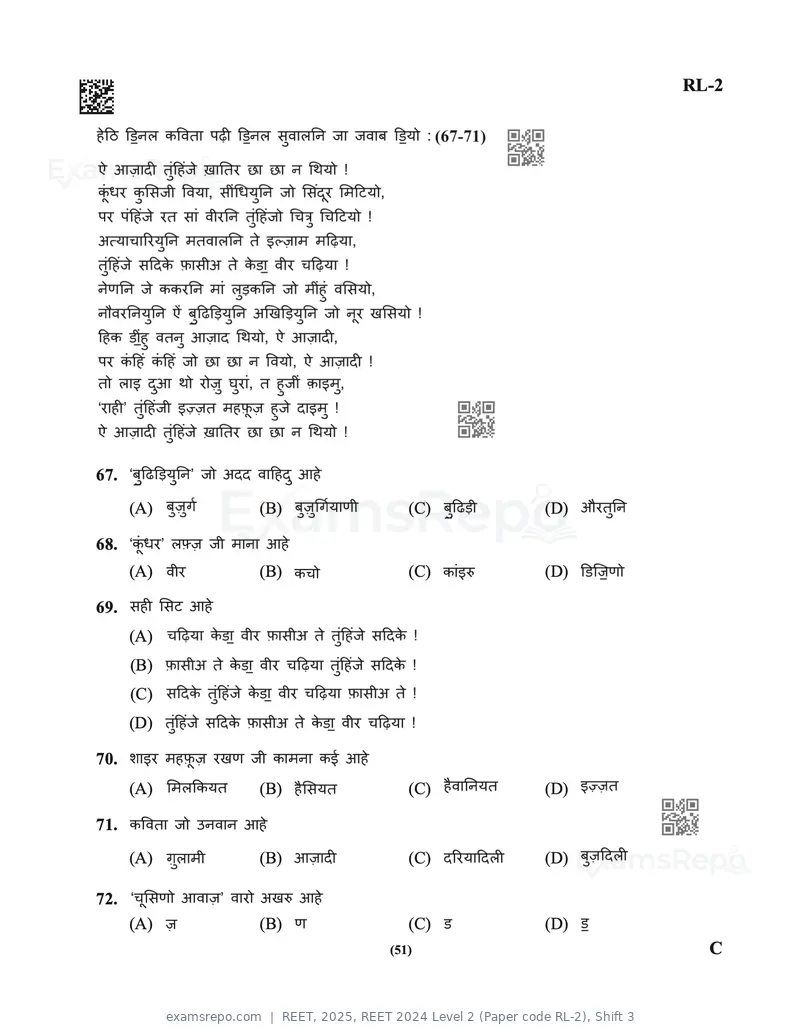
Text of page 243
RL-2


67.
      (A)   (B)      (C)   (D)

68.
      (A)   (B)      (C)   (D)

69.
      (A)
      (B)
      (C)
      (D)

70.
      (A)   (B)      (C)   (D)

71.
      (A)   (B)      (C)   (D)

72.
      (A)   (B)      (C)   (D)
                  (51)             C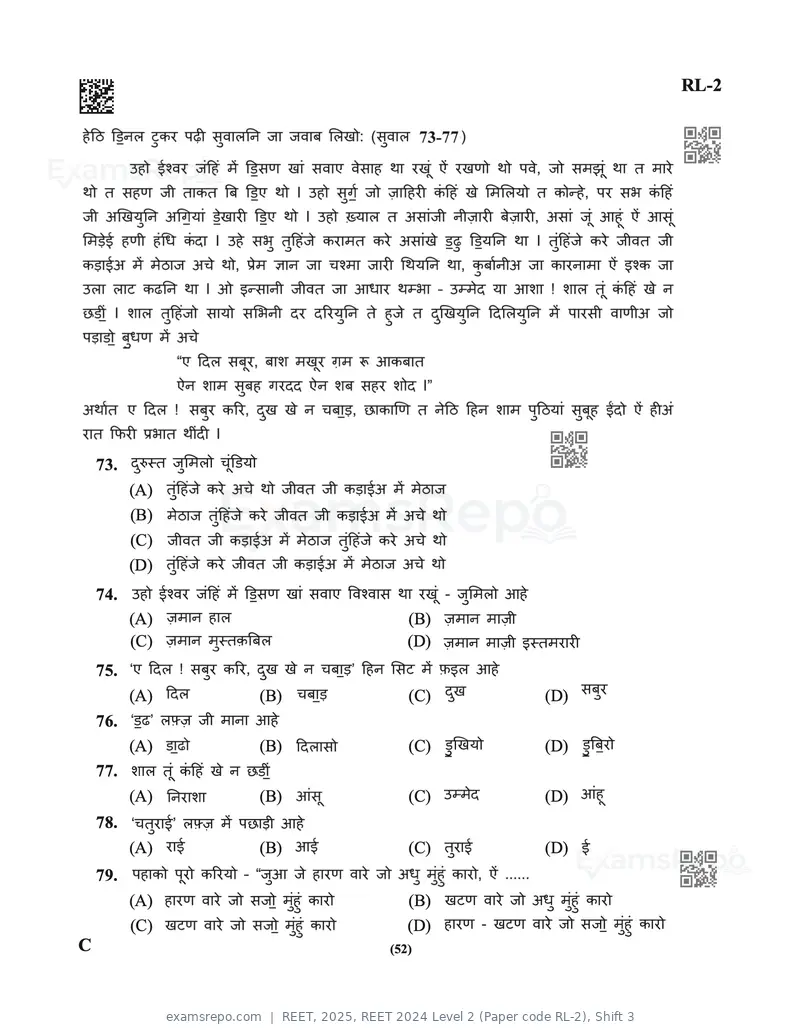
Text of page 244
RL-2


    73.
          (A)
          (B)
          (C)
          (D)
    74.
          (A)            (B)
          (C)            (D)
    75.
          (A)   (B)      (C)   (D)
    76.
          (A)   (B)      (C)   (D)
    77.
          (A)   (B)      (C)   (D)
    78.
          (A)   (B)      (C)   (D)
    79.
          (A)            (B)
          (C)            (D)
C                     (52)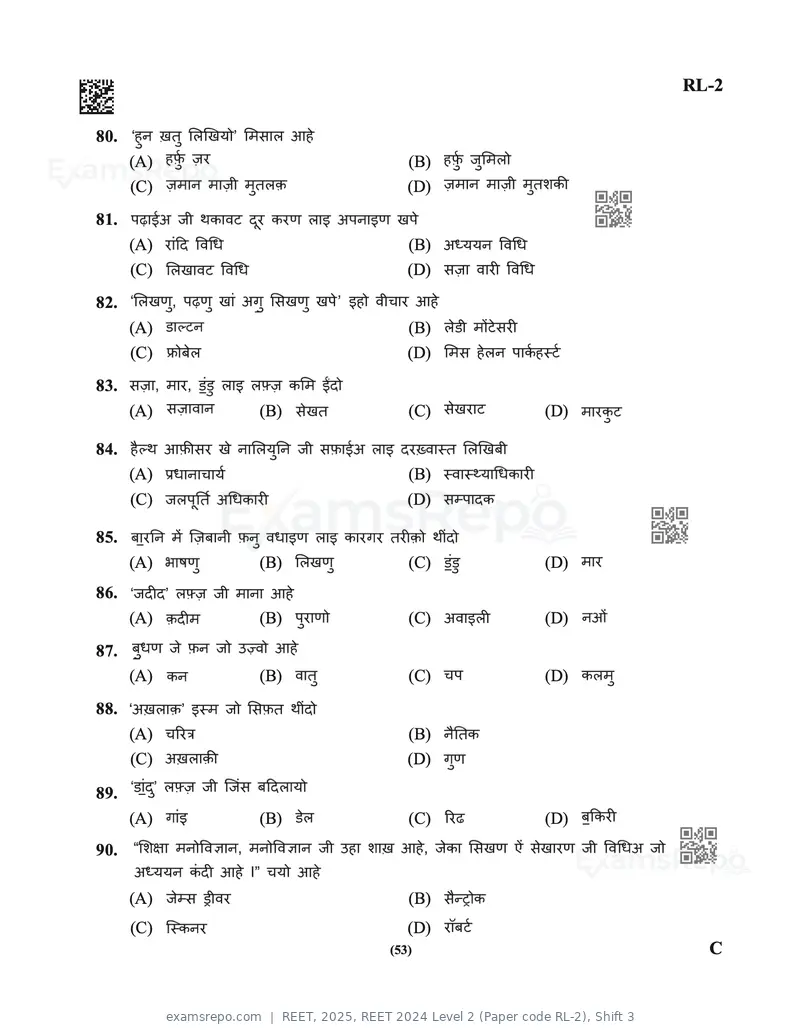
Text of page 245
RL-2

80.
      (A)            (B)
      (C)            (D)
81.
      (A)            (B)
      (C)            (D)
82.
      (A)            (B)
      (C)            (D)
83.
      (A)   (B)      (C)   (D)

84.
      (A)            (B)
      (C)            (D)

85.
      (A)   (B)      (C)   (D)
86.
      (A)   (B)      (C)   (D)
87.
      (A)   (B)      (C)   (D)
88.
      (A)            (B)
      (C)            (D)

89.
      (A)   (B)      (C)   (D)
90.

      (A)            (B)
      (C)            (D)
                  (53)             C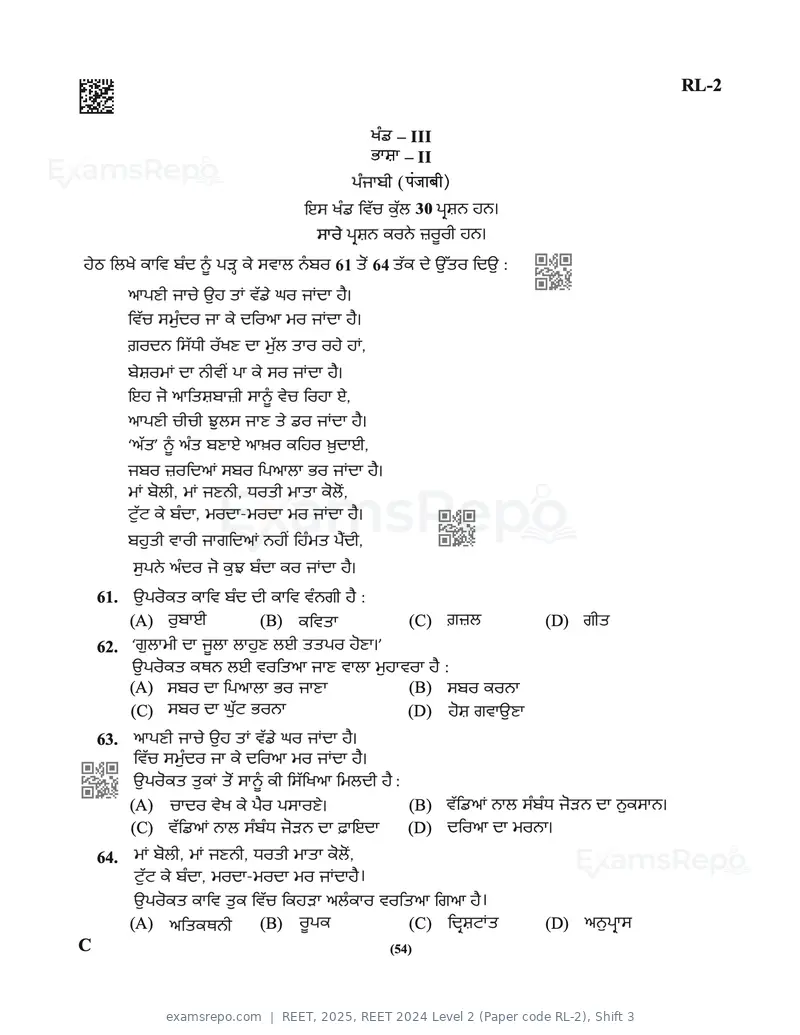
Text of page 246
RL-2

                       – III
                         – II
                       ( n§Om~r)


    61.
          (A)   (B)      (C)       (D)
    62.

          (A)            (B)
          (C)            (D)
    63.


          (A)            (B)
          (C)            (D)
    64.


          (A)   (B)      (C)       (D)
C                     (54)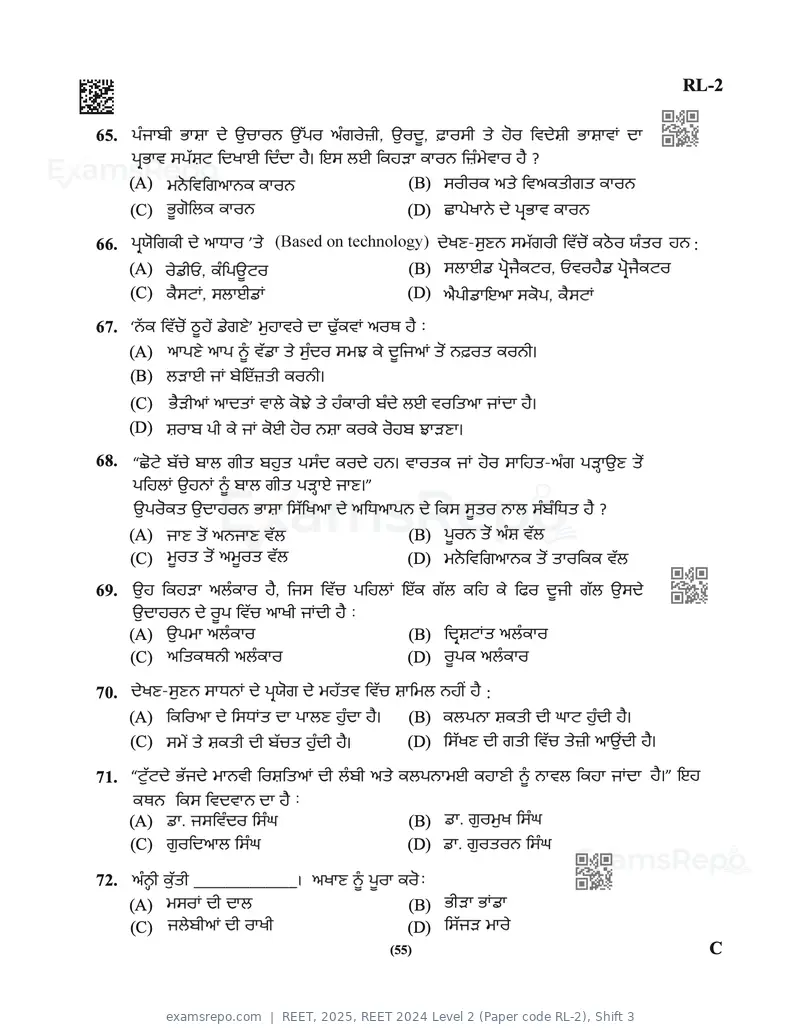
Text of page 247
RL-2

65.

      (A)      (B)
      (C)      (D)

66.                       :
      (A)      (B)
      (C)      (D)

67.
      (A)
      (B)
      (C)
      (D)
68.


      (A)      (B)
      (C)      (D)
69.

      (A)      (B)
      (C)      (D)

70.                  :
      (A)      (B)
      (C)      (D)

71.

      (A)      (B)
      (C)      (D)

72.
      (A)      (B)
      (C)      (D)
            (55)              C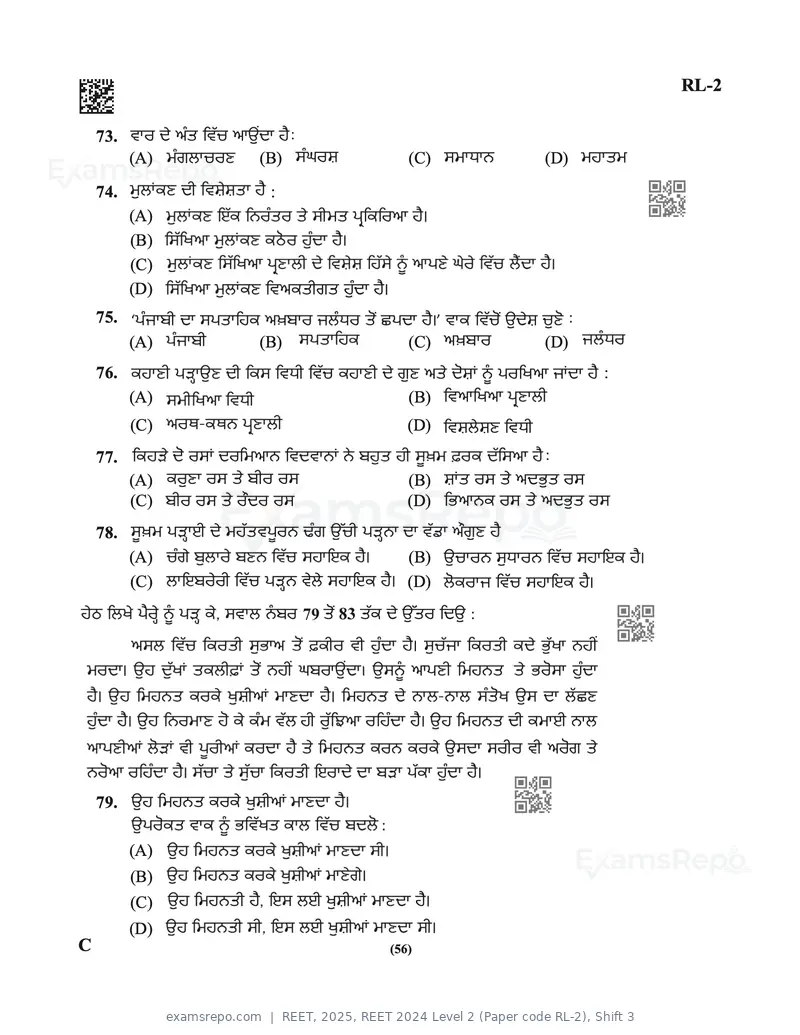
Text of page 248
RL-2

    73.
          (A)   (B)      (C)   (D)
    74.          :
          (A)
          (B)
          (C)
          (D)
    75.
          (A)   (B)      (C)   (D)
    76.                              :
          (A)            (B)
          (C)            (D)
    77.
          (A)            (B)
          (C)            (D)
    78.
          (A)            (B)
          (C)            (D)


    79.

          (A)
          (B)
          (C)
          (D)
C                     (56)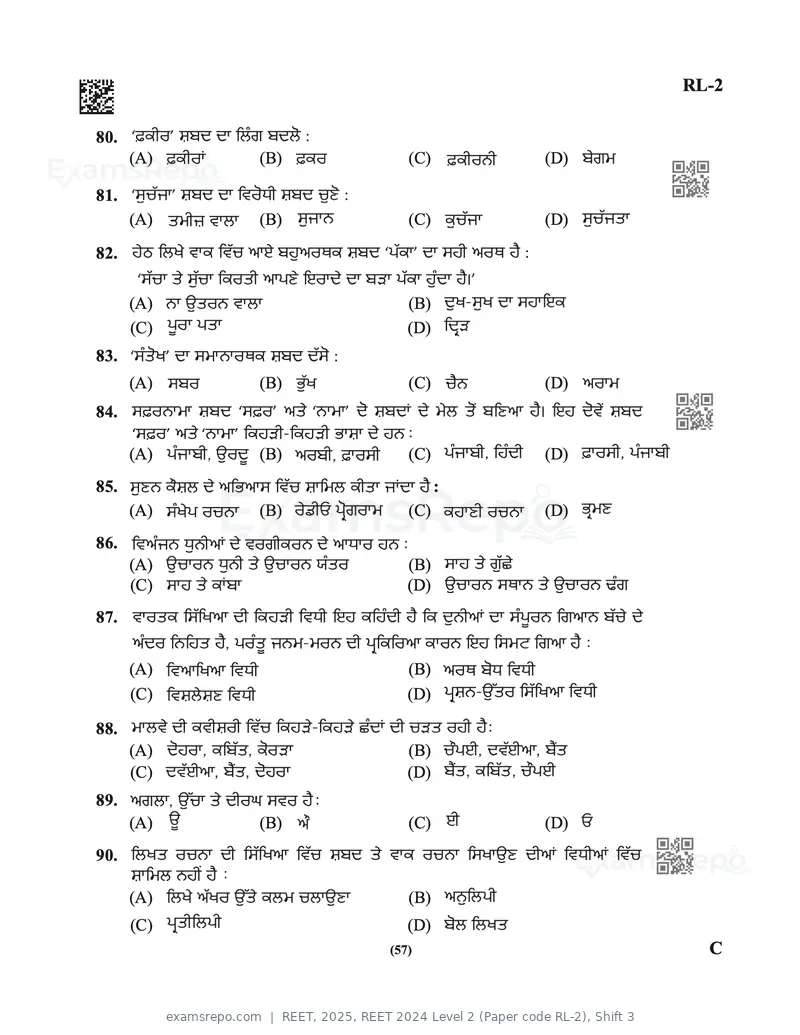
Text of page 249
RL-2

80.
      (A)   (B)      (C)       (D)

81.
      (A)   (B)      (C)       (D)
82.

      (A)            (B)
      (C)            (D)
83.
      (A)   (B)      (C)       (D)
84.

      (A)   (B)      (C)       (D)
85.                        :
      (A)   (B)      (C)       (D)
86.
      (A)            (B)
      (C)            (D)
87.


      (A)            (B)
      (C)            (D)

88.
      (A)            (B)
      (C)            (D)
89.
      (A)   (B)      (C)       (D)
90.

      (A)            (B)
      (C)            (D)
                  (57)                 C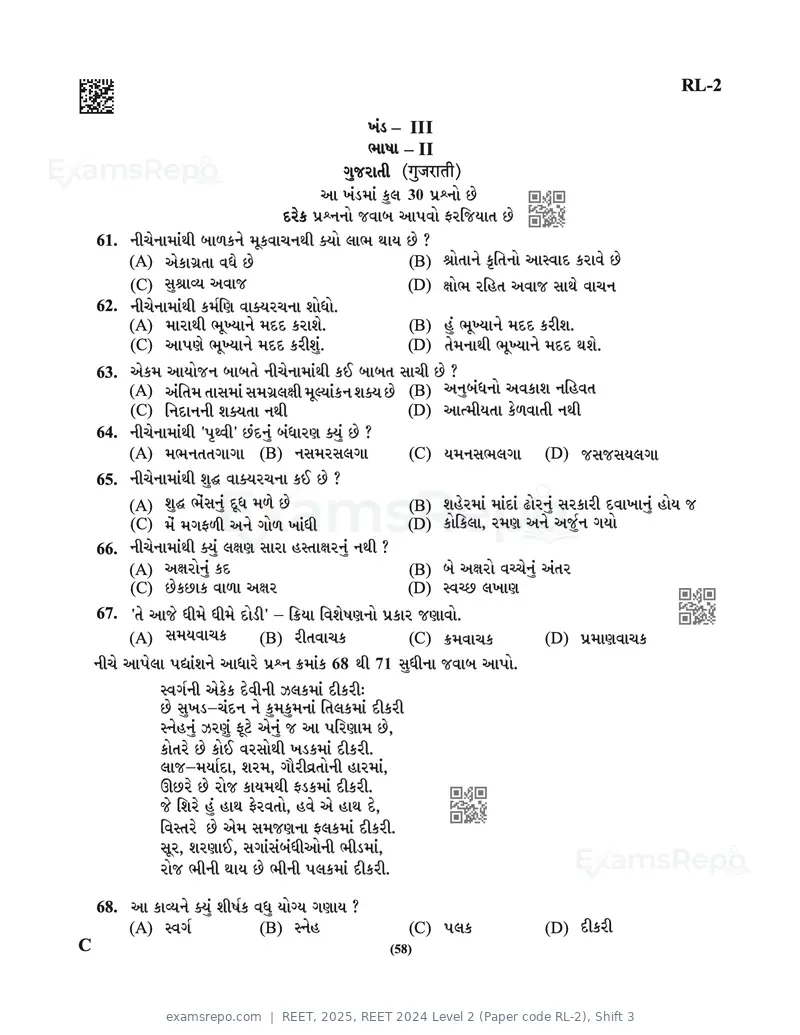
Text of page 250
RL-2

                      – III
                       – II
                        (JwOamVr)>


    61.
          (A)            (B)
          (C)            (D)
    62.
          (A)            (B)
          (C)            (D)
    63.
          (A)            (B)
          (C)            (D)
    64.
          (A)   (B)      (C)         (D)
    65.
          (A)            (B)
          (C)            (D)
    66.
          (A)            (B)
          (C)            (D)
    67.
          (A)   (B)      (C)         (D)


    68.
          (A)   (B)      (C)         (D)
C                     (58)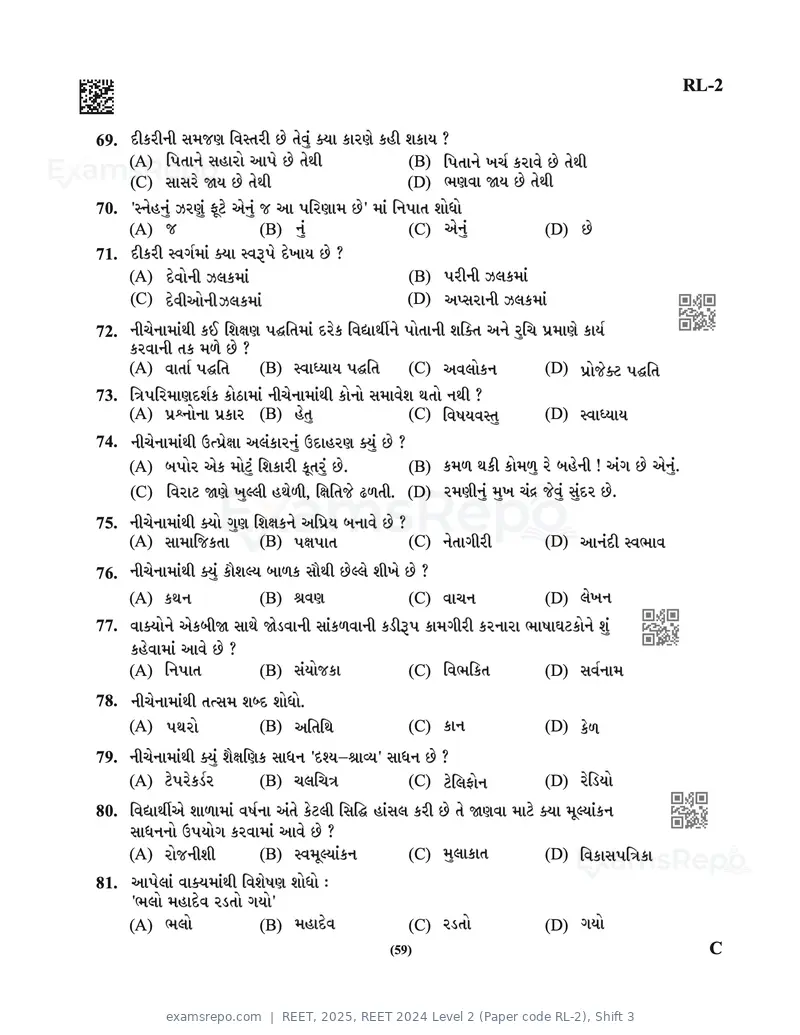
Text of page 251
RL-2

69.
      (A)            (B)
      (C)            (D)
70.
      (A)   (B)      (C)   (D)
71.
      (A)            (B)
      (C)            (D)
72.

      (A)   (B)      (C)   (D)
73.
      (A)   (B)      (C)   (D)
74.
      (A)            (B)
      (C)            (D)
75.
      (A)   (B)      (C)   (D)
76.
      (A)   (B)      (C)   (D)
77.

      (A)   (B)      (C)   (D)
78.
      (A)   (B)      (C)   (D)
79.
      (A)   (B)      (C)   (D)
80.

      (A)   (B)      (C)   (D)
81.

      (A)   (B)      (C)   (D)
                  (59)             C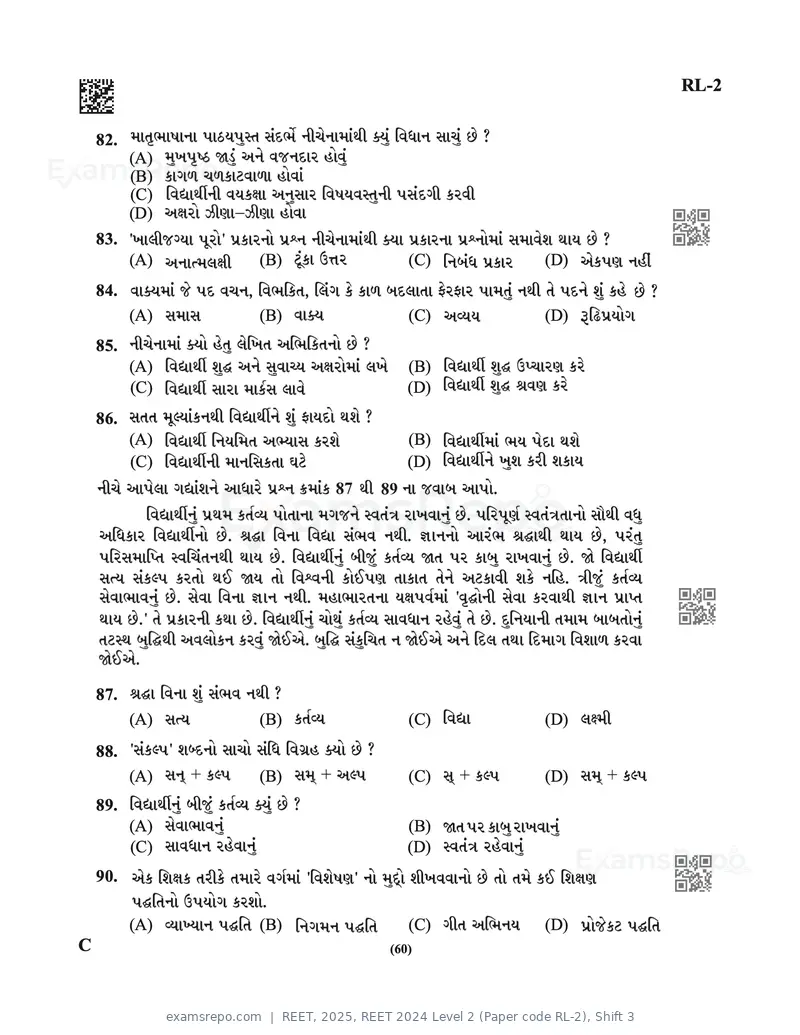
Text of page 252
RL-2

    82.
          (A)
          (B)
          (C)
          (D)
    83.
          (A)   (B)      (C)   (D)
    84.
          (A)   (B)      (C)   (D)
    85.
          (A)            (B)
          (C)            (D)
    86.
          (A)            (B)
          (C)            (D)


    87.
          (A)   (B)      (C)   (D)
    88.
          (A)   (B)      (C)   (D)
    89.
          (A)            (B)
          (C)            (D)
    90.

          (A)   (B)      (C)   (D)
C                     (60)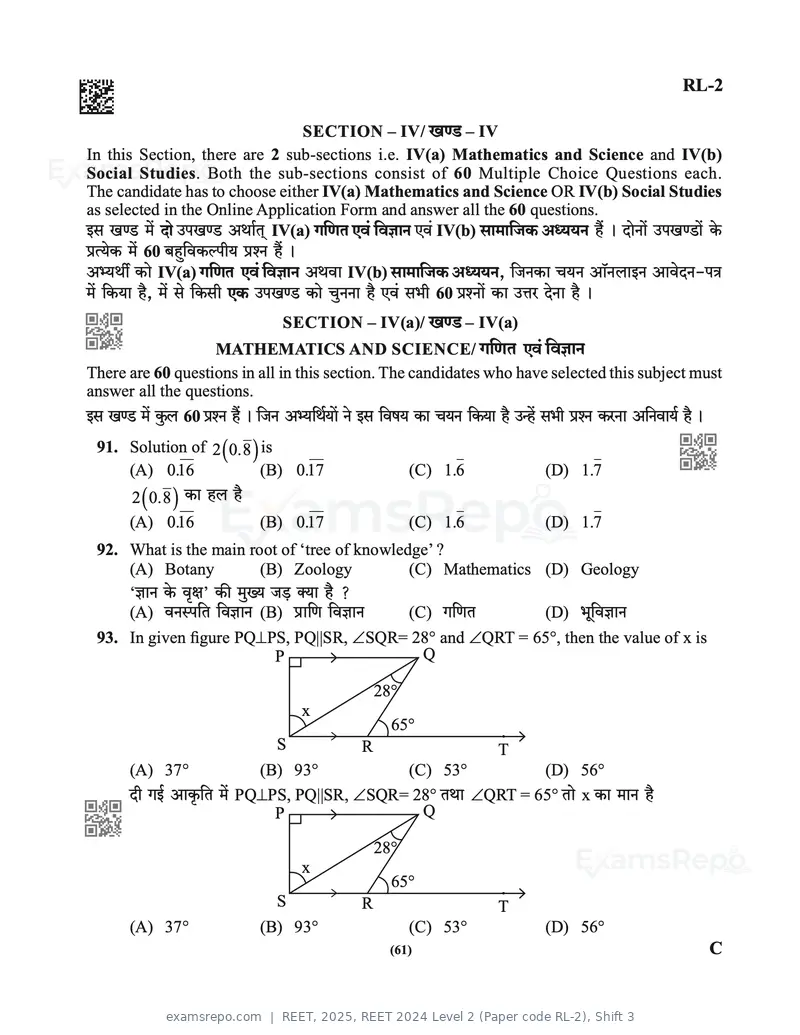
Text of page 253
RL-2

                                   SECTION – IV/ IÊS> – IV
In this Section, there are 2 sub-sections i.e. IV(a) Mathematics and Science and IV(b)
Social Studies. Both the sub-sections consist of 60 Multiple Choice Questions each.
The candidate has to choose either IV(a) Mathematics and Science OR IV(b) Social Studies
as selected in the Online Application Form and answer all the 60 questions.
Bg IÊS> _| Xmo CnIÊS> AWm©V² IV(a) J{UV Ed§ {dkmZ Ed§ IV(b) gm_m{OH$ AÜ``Z h¢ & XmoZm| CnIÊS>m| Ho$
àË`oH$ _| 60 ~hþ{dH$ënr` àíZ h¢ &
Aä`Wu H$mo IV(a) J{UV Ed§ {dkmZ AWdm IV(b) gm_m{OH$ AÜ``Z, {OZH$m M`Z Am°ZbmBZ AmdoXZ-nÌ
_| {H$`m h¡, _| go {H$gr EH$ CnIÊS> H$mo MwZZm h¡ Ed§ g^r 60 àíZm| H$m CÎma XoZm h¡ &
                               SECTION – IV(a)/ IÊS> – IV(a)
                     MATHEMATICS AND SCIENCE/ J{UV Ed§ {dkmZ
There are 60 questions in all in this section. The candidates who have selected this subject must
answer all the questions.
Bg IÊS> _| Hw$b 60 àíZ h¢ & {OZ Aä`{W©`m| Zo Bg {df` H$m M`Z {H$`m h¡ CÝh| g^r àíZ H$aZm A{Zdm`© h¡ &
 91. Solution of 2 ( 0. 8 ) is
     (A) 0.16               (B) 0.17                 (C) 1.6            (D) 1.7
      2 ( 0. 8 ) H$m hb h¡
      (A) 0.16               (B) 0.17                (C) 1.6            (D) 1.7
 92. What is the main root of ‘tree of knowledge’ ?
     (A) Botany           (B) Zoology         (C) Mathematics (D) Geology
     ‘kmZ Ho$ d¥j’ H$s _w»` O‹S> Š`m h¡ ?
     (A) dZñn{V {dkmZ (B) àm{U {dkmZ          (C) J{UV        (D) ^y{dkmZ
 93. In given figure PQ⊥PS, PQ||SR, ∠SQR= 28° and ∠QRT = 65°, then the value of x is
                         P                 Q

                                               28°
                                   x
                                                 65°
                               S           R                     T
      (A) 37°             (B) 93°           (C) 53°          (D) 56°
      Xr JB© AmH¥${V _| PQ⊥PS, PQ||SR, ∠SQR= 28° VWm ∠QRT = 65° Vmo x H$m _mZ h¡
                            P                 Q

                                               28°
                                   x
                                                 65°
                               S           R                     T
      (A) 37°                (B) 93°                 (C) 53°            (D) 56°
                                                 (61)                                             C
Text of page 254
RL-2

    94. Square root of 7 + 4 3 is
        (A) 2 + 3                                      (B) 2 − 3
        (C) 4 + 2 3                                    (D) 61 + 28 3
        7 + 4 3 H$m dJ©_yb h¡
        (A) 2 + 3                                      (B) 2 − 3
        (C) 4 + 2 3                                    (D) 61 + 28 3
    95. The probability of a certain event will be
                                                            1                      1
        (A) 1                 (B) 0                     (C) 2                  (D) 3
         {ZpíMV KQ>Zm H$s àm{`H$Vm hmoJr
                                                            1                      1
        (A) 1                 (B) 0                     (C) 2                  (D) 3

    96. John buys an old fridge and after getting it repaired for Rs. 1,500 and selling it for
        Rs. 8,100, he gets a loss of 10%. Then for how much did he buy the fridge ?
        (A) Rs. 7,500                            (B) Rs. 9,000
        (C) Rs. 10,500                           (D) Rs. 8,250
        Om°Z Zo EH$ nwamZm {\«$O IarXm Am¡a Cgo 1,500 én`o _| _aå_V H$amH$a 8,100 én`o _| ~oMZo na Cgo
        10% H$s hm{Z hþB©, Vmo CgZo {\«$O {H$VZo _| IarXm Wm ?
        (A) 7,500 én`o                                 (B) 9,000 én`o
        (C) 10,500 én`o                               (D) 8,250 én`o
    97. The curved surface area of the largest cylinder that can be made by cutting from a cube
        of side 8 cm will be
        (A) 32π cm2                               (B) 64π cm2
        (C) 128π cm2                              (D) 16π cm2
        {H$gr 8 go_r ^wOm dmbo KZ go H$mQ>H$a ~ZmE| Om gH$Zo dmbo ~‹S>o go ~‹S>o ~obZ Ho$ dH«$n¥îQ> H$m joÌ\$b
        hmoJm
        (A) 32π go_r2                                (B) 64π go_r2
        (C) 128π go_r2                               (D) 16π go_r2
    98. The nature of mathematics is
        (A) It is logical                              (B) It is hard
        (C) It is metaphorical                         (D) This is not for average students
        J{UV H$s àH¥${V h¡
        (A) `h Vm{H©$H$ h¡                             (B) `h H${R>Z h¡
        (C) `h Ab§H$m[aH$ h¡                           (D) `h Am¡gV {dÚm{W©`m| Ho$ {bE Zht h¡
C                                                   (62)
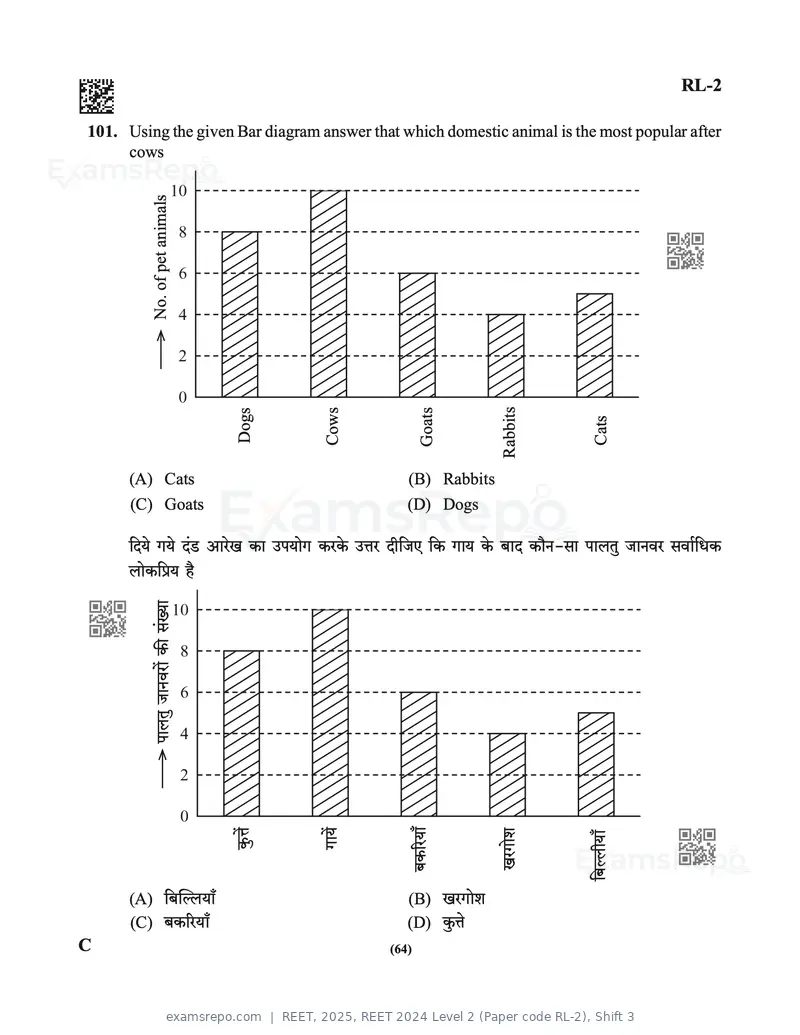
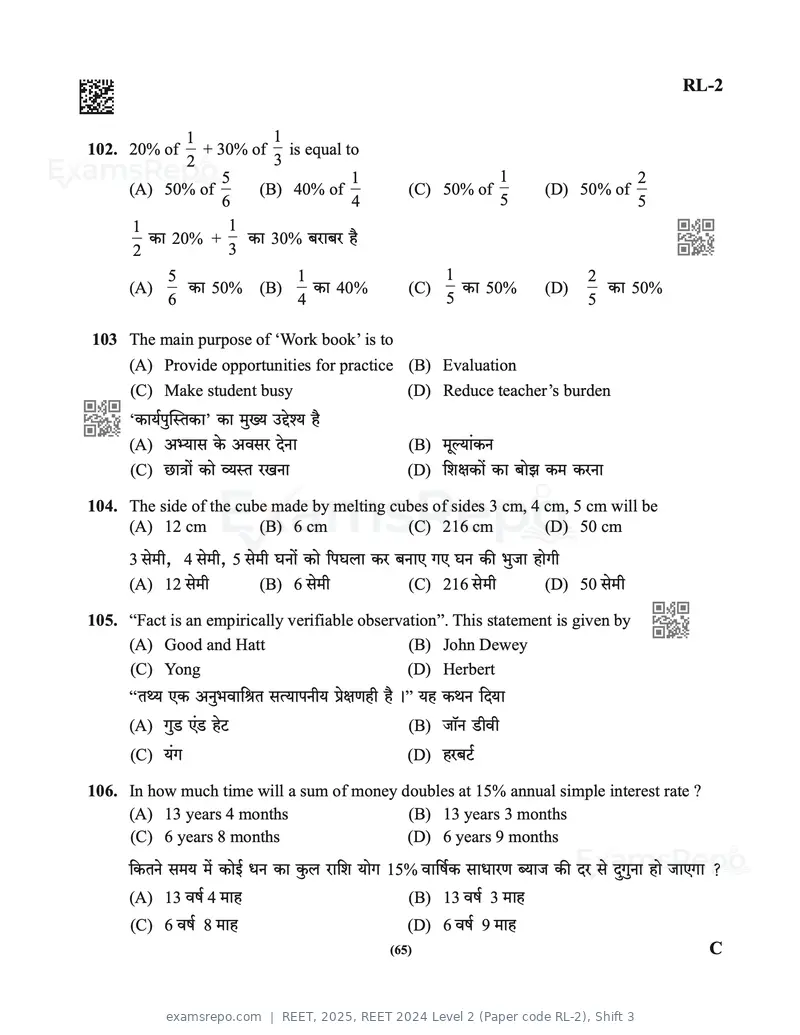
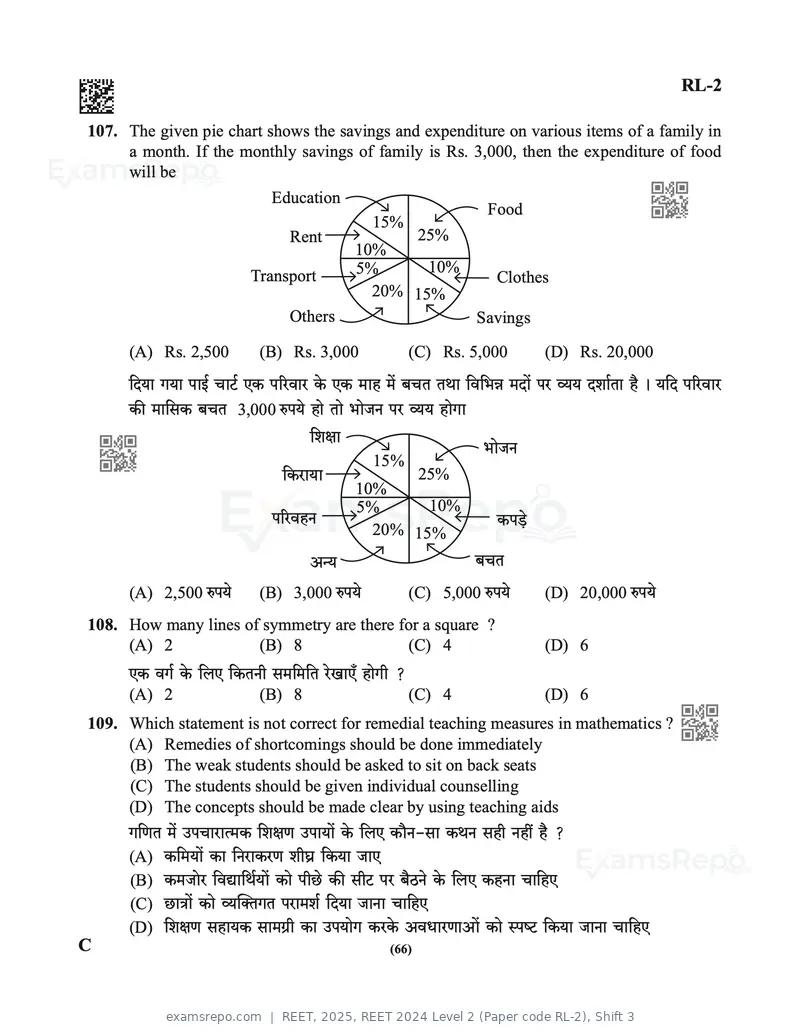
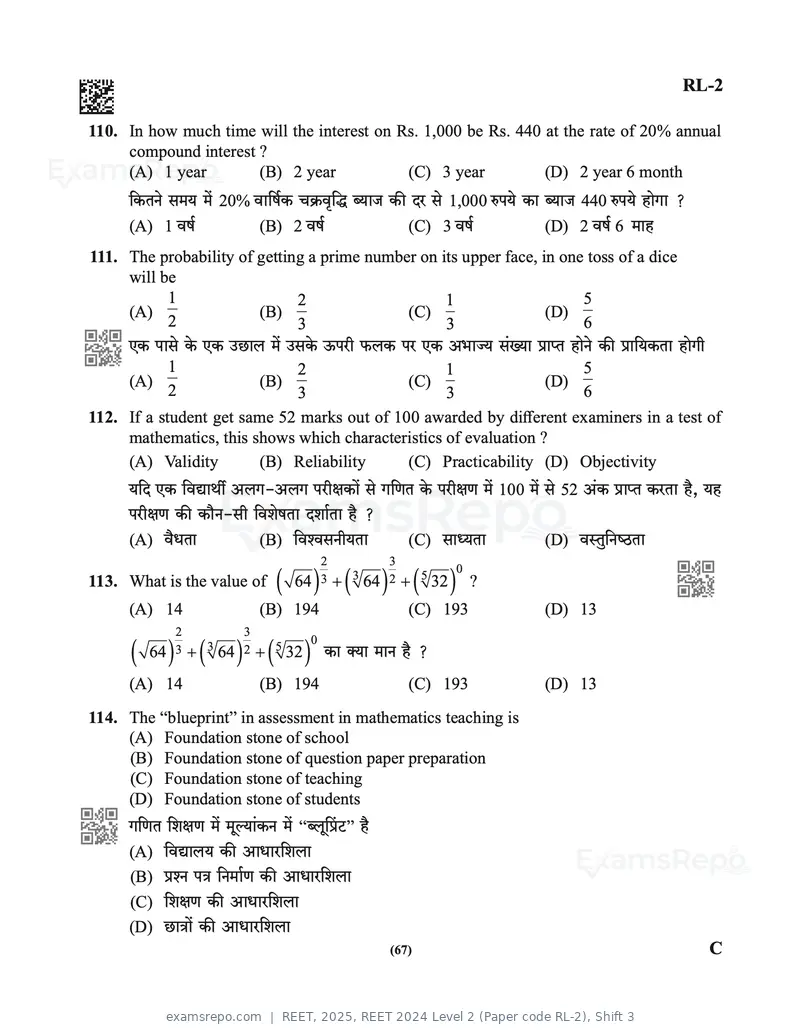
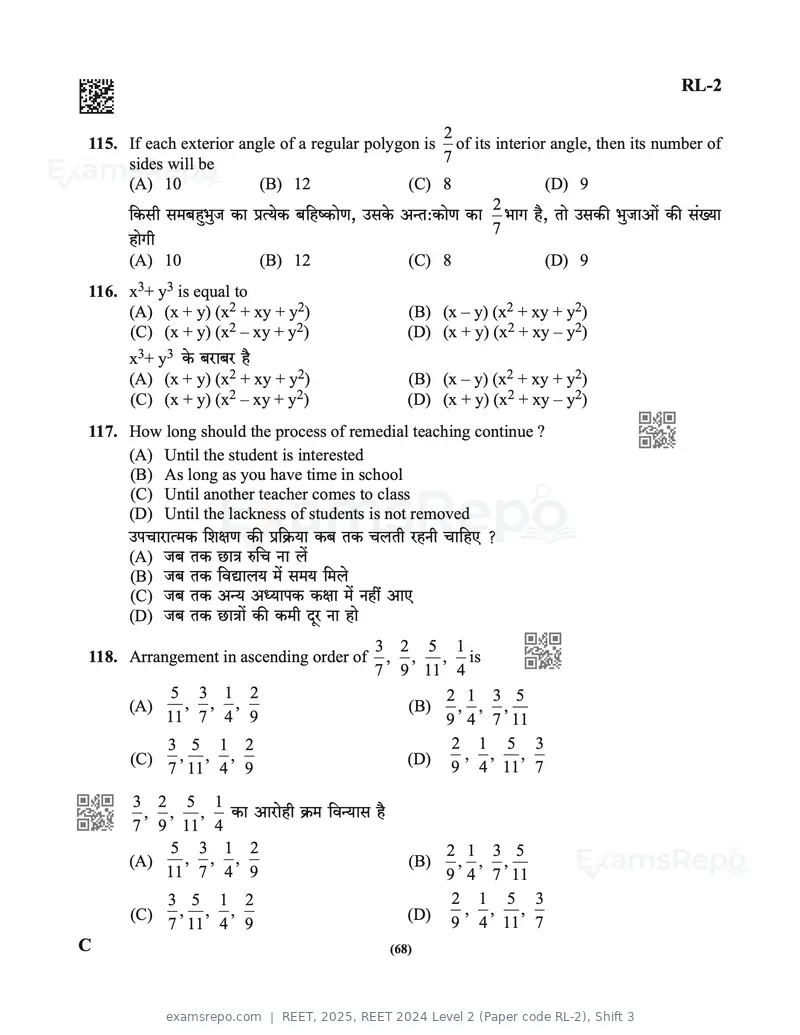
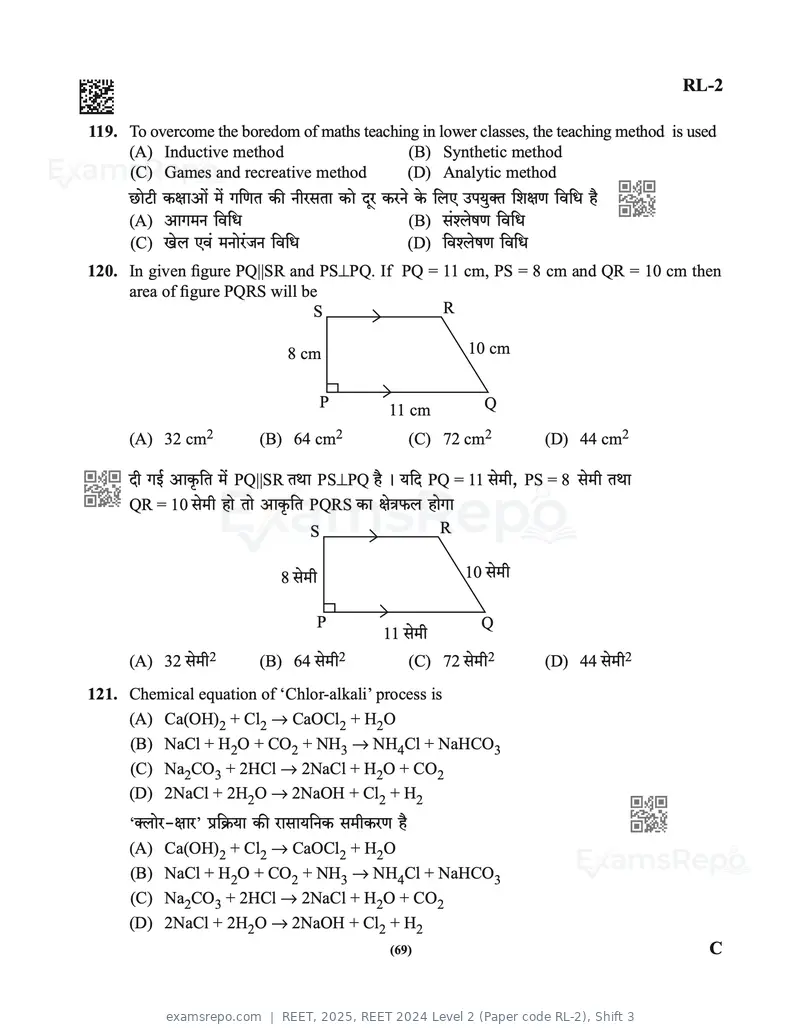
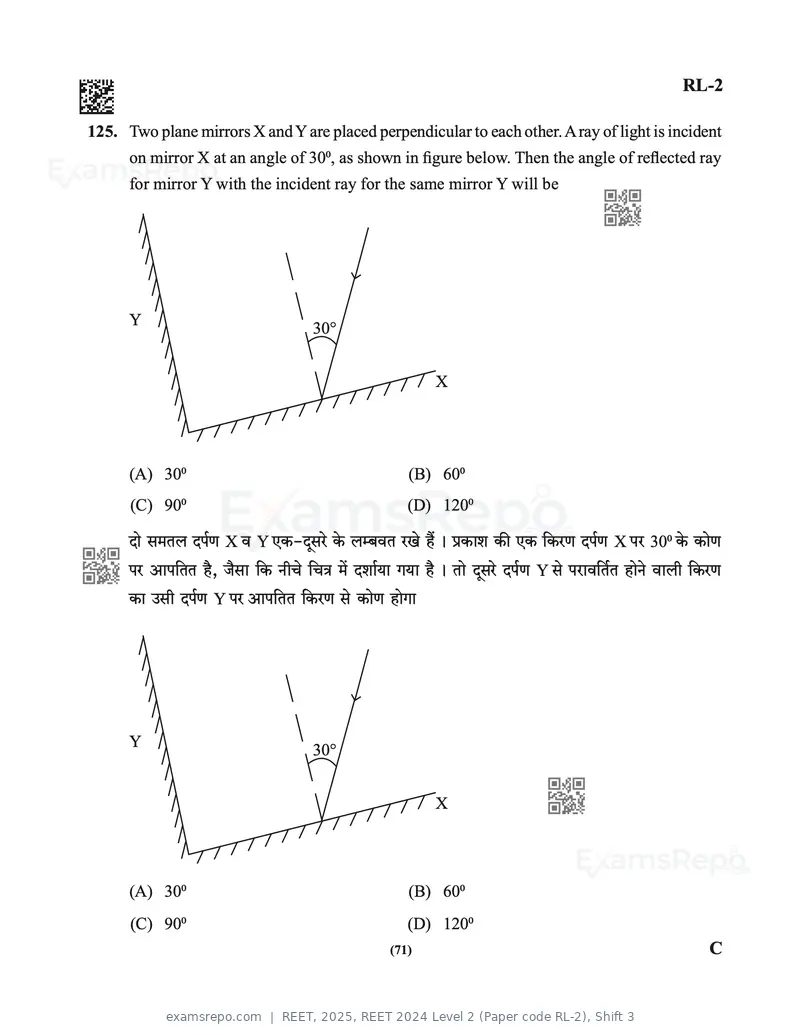
Text of page 263
RL-2

125. Two plane mirrors X and Y are placed perpendicular to each other. A ray of light is incident
      on mirror X at an angle of 300, as shown in figure below. Then the angle of reflected ray
      for mirror Y with the incident ray for the same mirror Y will be


      Y                            30°


                                                       X


      (A) 300                                      (B) 600
      (C) 900                                      (D) 1200

      Xmo g_Vb Xn©U X d Y EH$-Xÿgao Ho$ bå~dV aIo h¢ & àH$me H$s EH$ {H$aU Xn©U X na 300 Ho$ H$moU
      na Amn{VV h¡, O¡gm {H$ ZrMo {MÌ _| Xem©`m J`m h¡ & Vmo Xÿgao Xn©U Y go namd{V©V hmoZo dmbr {H$aU
      H$m Cgr Xn©U Y na Amn{VV {H$aU go H$moU hmoJm


      Y                            30°


                                                       X


      (A) 300                                      (B) 600
      (C) 900                                      (D) 1200
                                                (71)                                                C
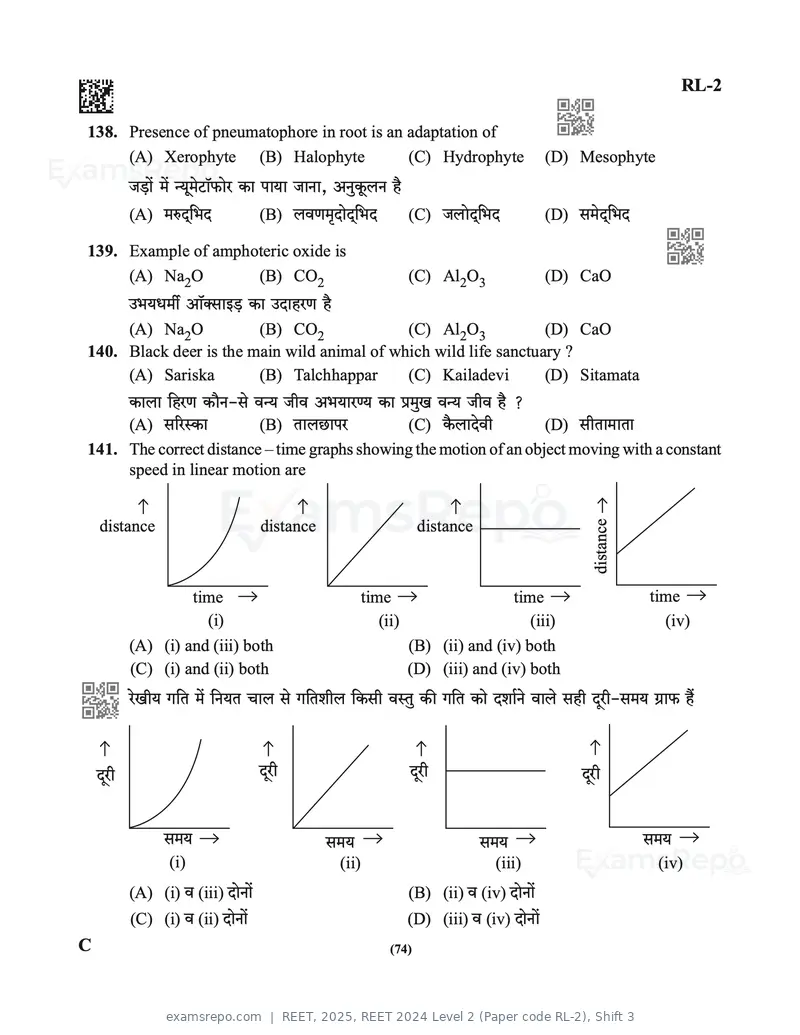
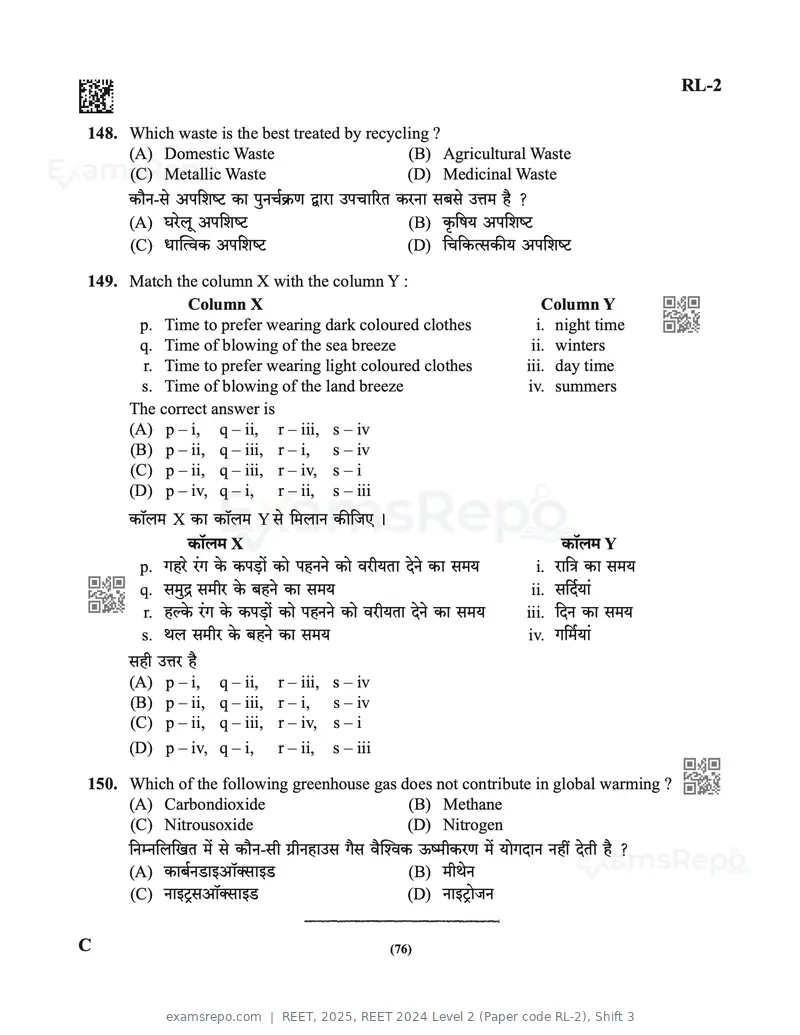
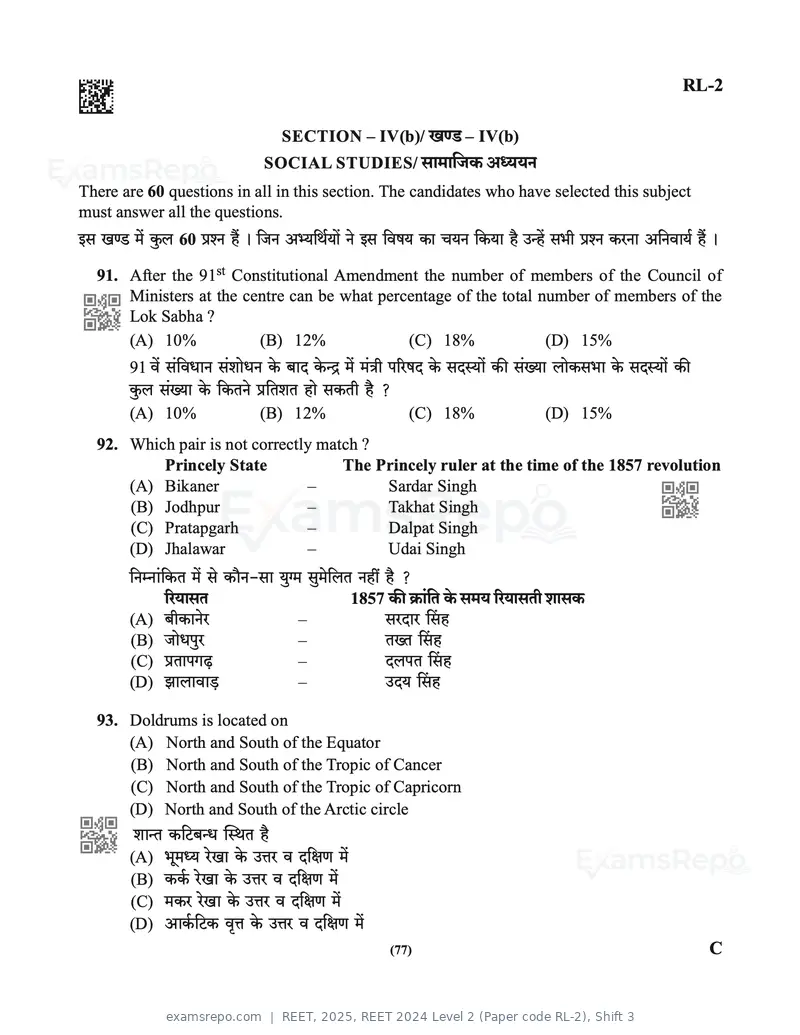
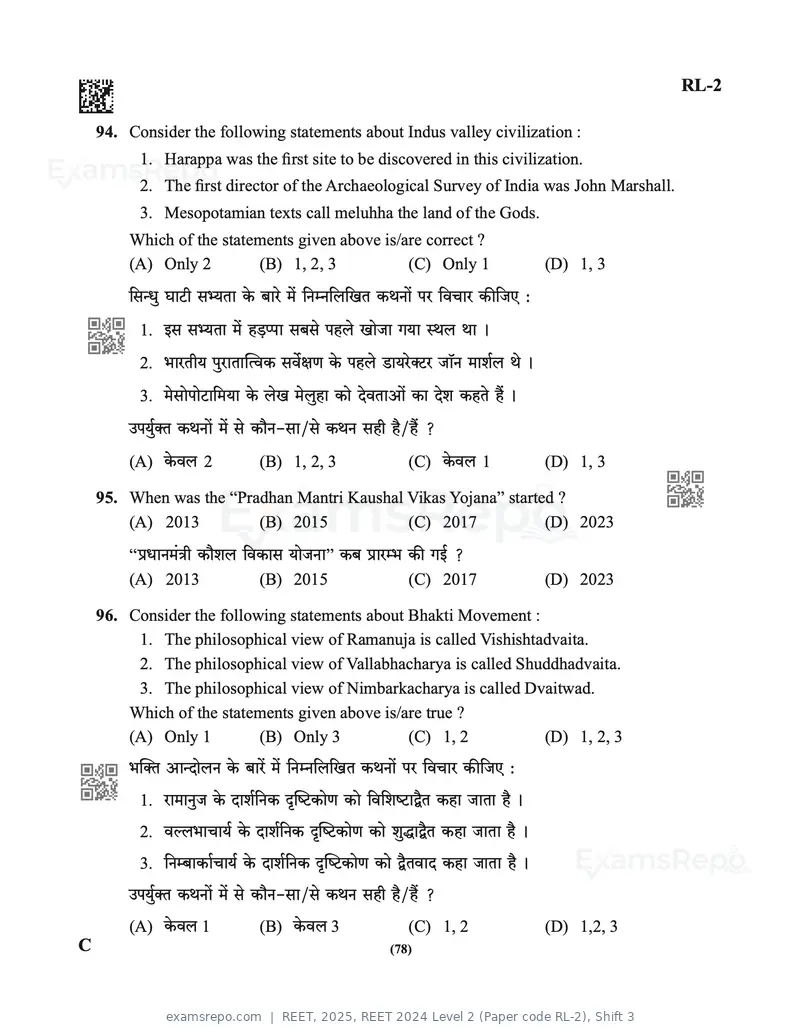
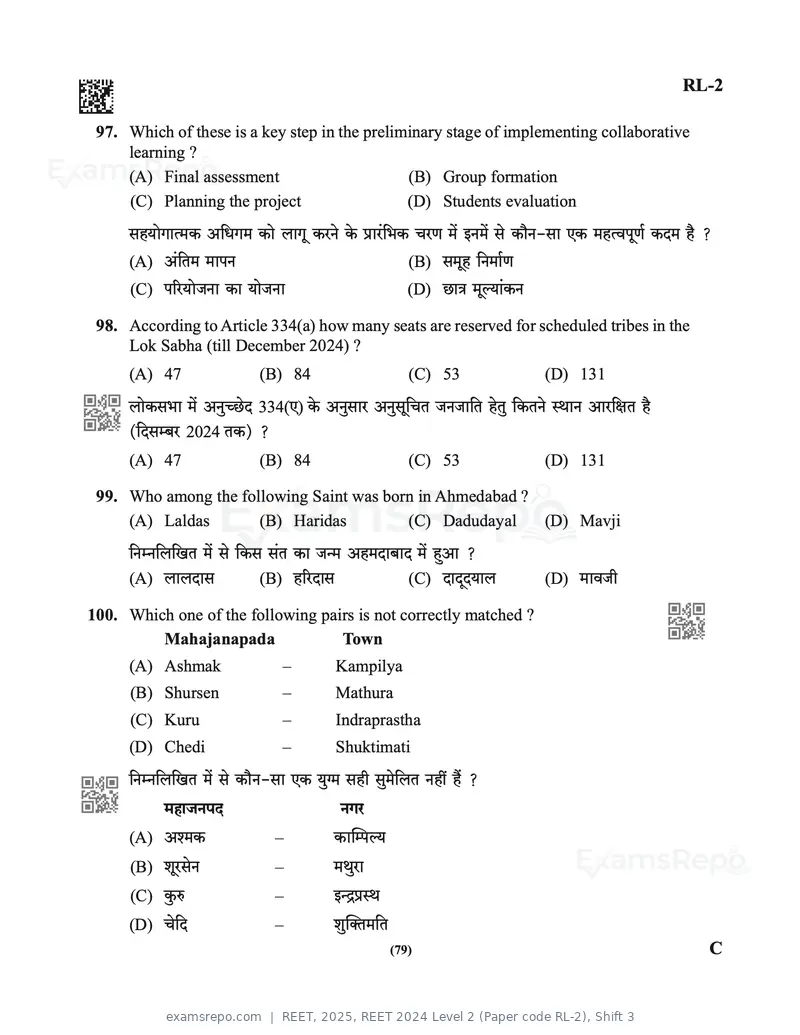
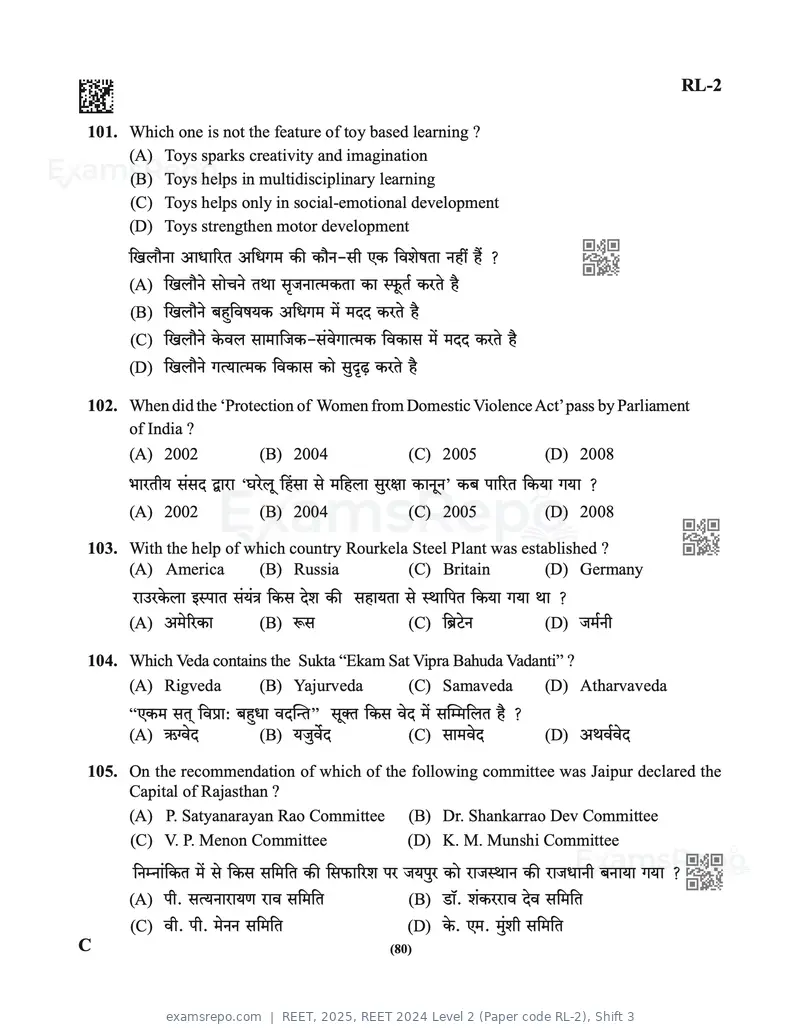
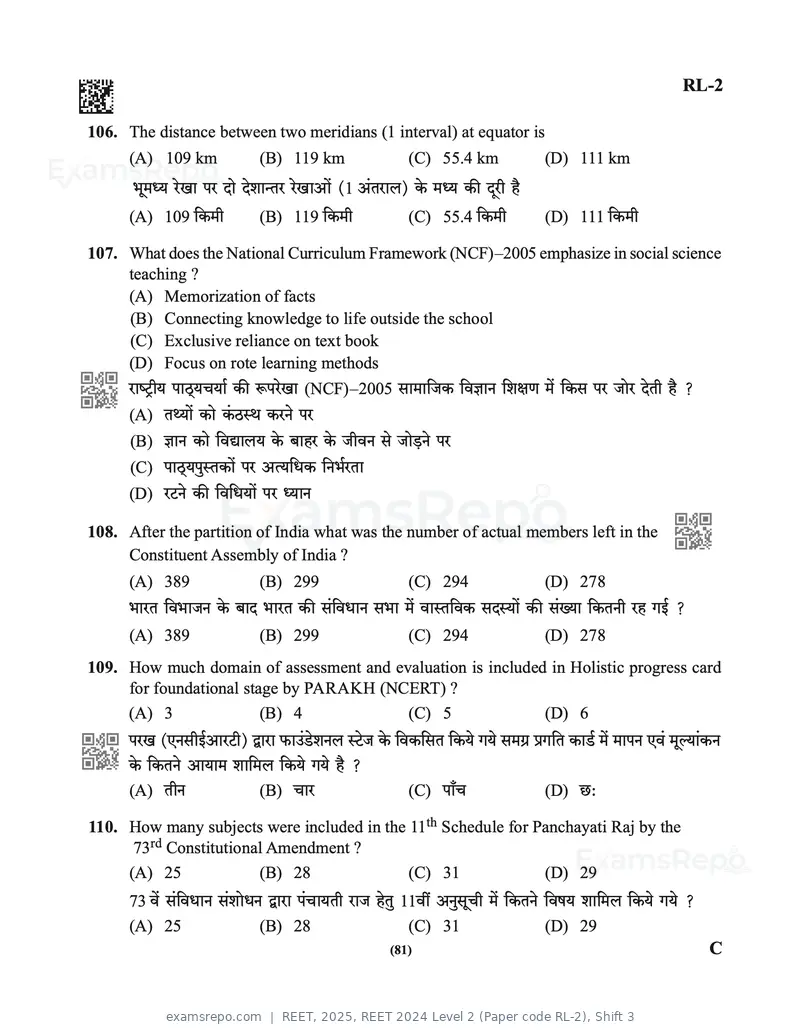
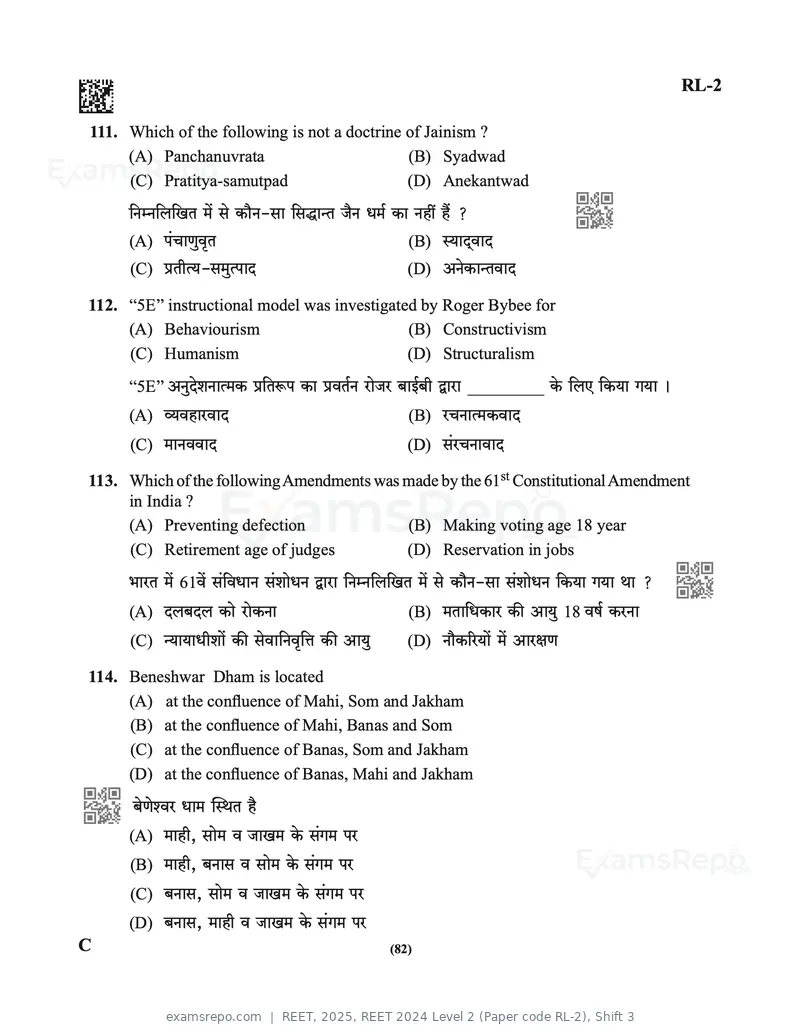
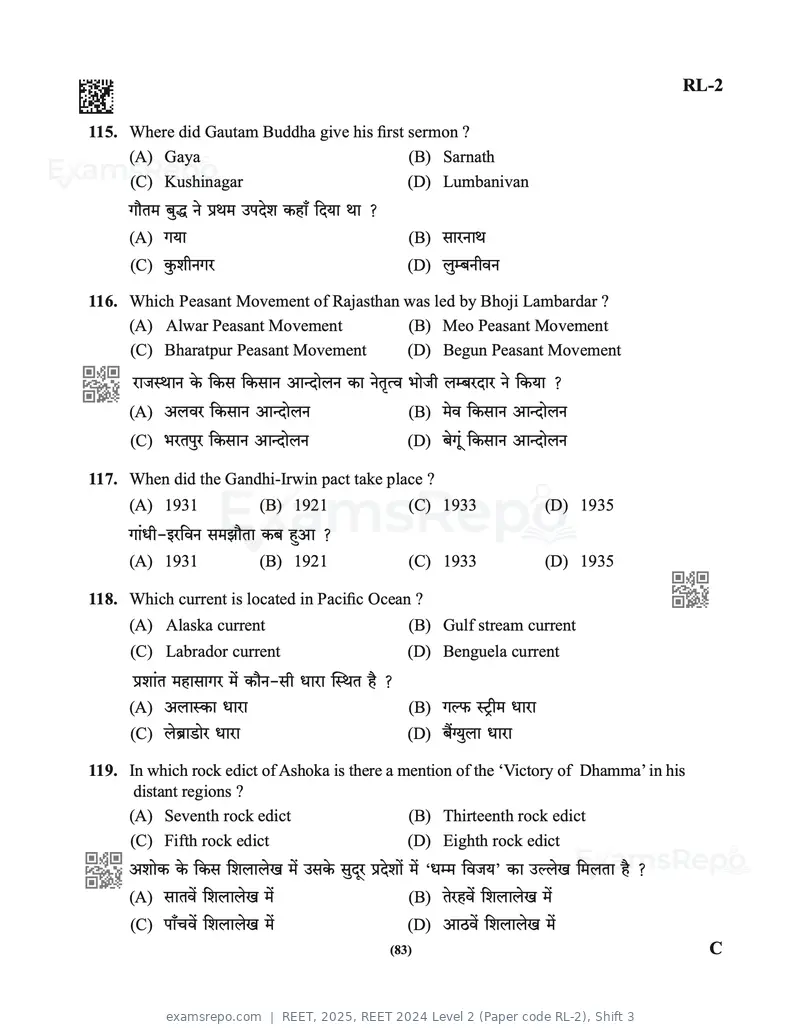
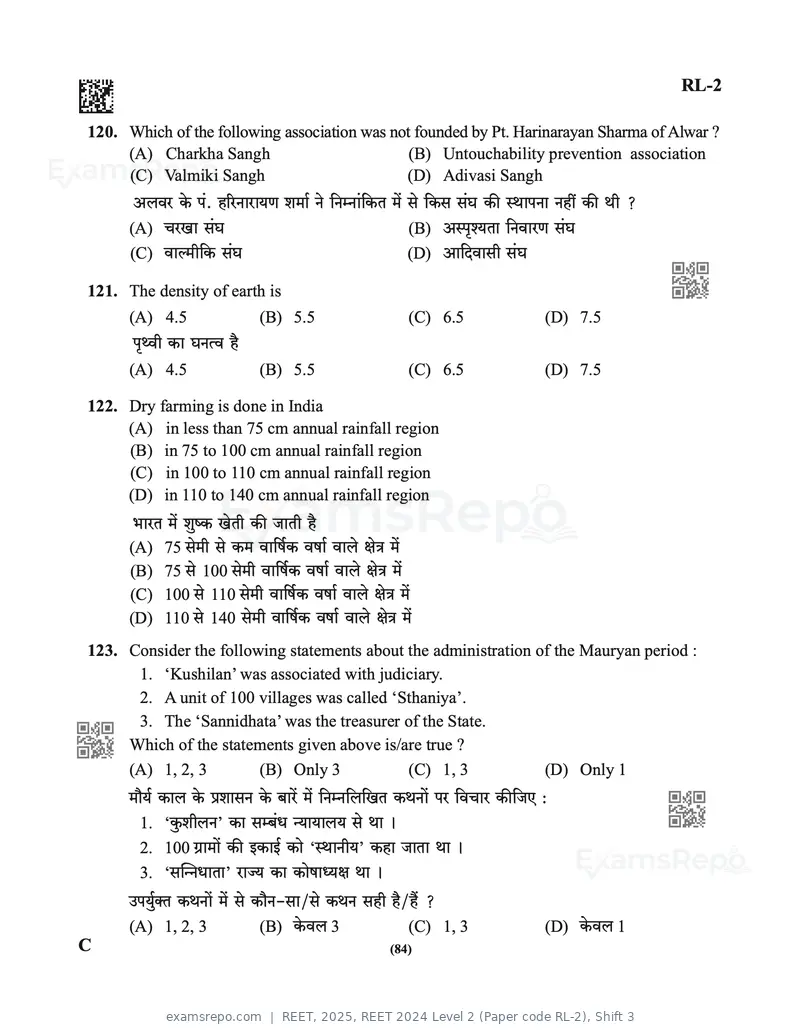
Text of page 276
RL-2

120. Which of the following association was not founded by Pt. Harinarayan Sharma of Alwar ?
     (A) Charkha Sangh                         (B) Untouchability prevention association
     (C) Valmiki Sangh                        (D) Adivasi Sangh
       Abda Ho$ n§. h[aZmam`U e_m© Zo {ZåZm§{H$V _| go {H$g g§K H$s ñWmnZm Zht H$s Wr ?
      (A) MaIm g§K                                  (B) Añn¥í`Vm {ZdmaU g§K
      (C) dmë_r{H$ g§K                              (D) Am{Xdmgr g§K

121. The density of earth is
      (A) 4.5             (B) 5.5                 (C) 6.5               (D) 7.5
      n¥Ïdr H$m KZËd h¡
      (A) 4.5             (B) 5.5                 (C) 6.5               (D) 7.5

122. Dry farming is done in India
     (A) in less than 75 cm annual rainfall region
     (B) in 75 to 100 cm annual rainfall region
     (C) in 100 to 110 cm annual rainfall region
     (D) in 110 to 140 cm annual rainfall region
       ^maV _| ewîH$ IoVr H$s OmVr h¡
      (A) 75 go_r go H$_ dm{f©H$ dfm© dmbo joÌ _|
      (B) 75 go 100 go_r dm{f©H$ dfm© dmbo joÌ _|
      (C) 100 go 110 go_r dm{f©H$ dfm© dmbo joÌ _|
      (D) 110 go 140 go_r dm{f©H$ dfm© dmbo joÌ _|
123. Consider the following statements about the administration of the Mauryan period :
      1. ‘Kushilan’ was associated with judiciary.
      2. A unit of 100 villages was called ‘Sthaniya’.
      3. The ‘Sannidhata’ was the treasurer of the State.
     Which of the statements given above is/are true ?
     (A) 1, 2, 3        (B) Only 3           (C) 1, 3            (D) Only 1
      _m¡`© H$mb Ho$ àemgZ Ho$ ~ma| _| {ZåZ{b{IV H$WZm| na {dMma H$s{OE :
       1. ‘Hw$erbZ’ H$m gå~§Y Ý`m`mb` go Wm &
       2. 100 J«m_m| H$s BH$mB© H$mo ‘ñWmZr`’ H$hm OmVm Wm &
       3. ‘gpÝZYmVm’ amÁ` H$m H$mofmÜ`j Wm &
      Cn`w©ŠV H$WZm| _| go H$m¡Z-gm/go H$WZ ghr h¡/h¢ ?
      (A) 1, 2, 3           (B) Ho$db 3             (C) 1, 3             (D) Ho$db 1
C                                              (84)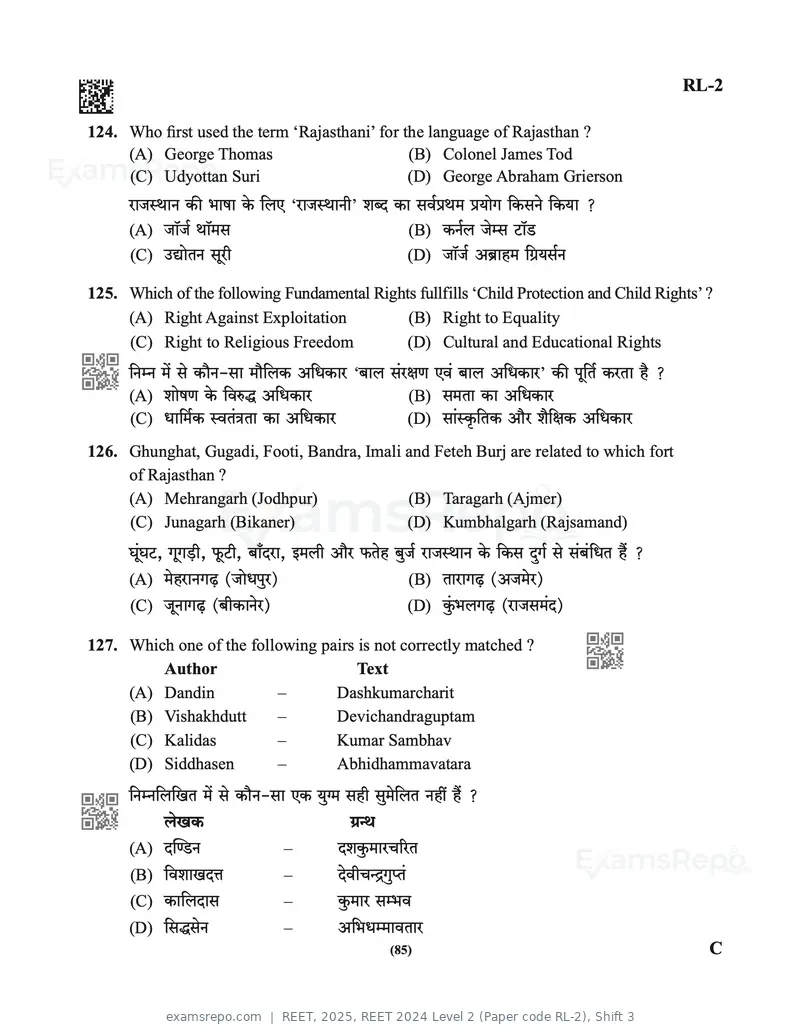
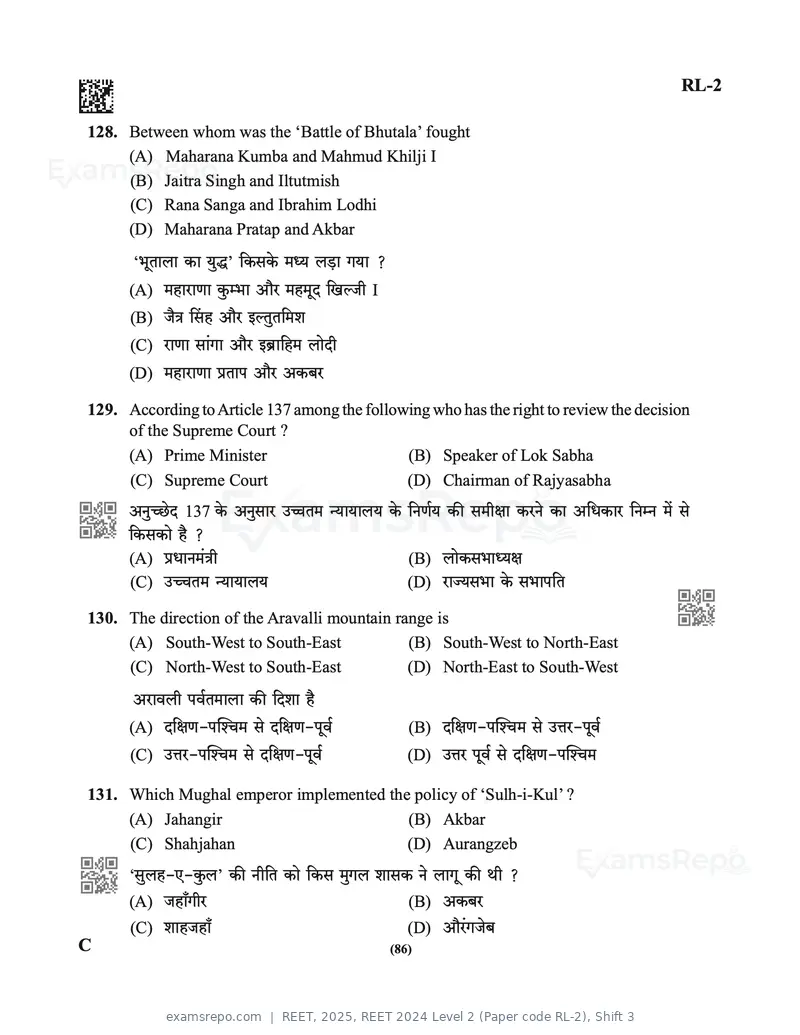
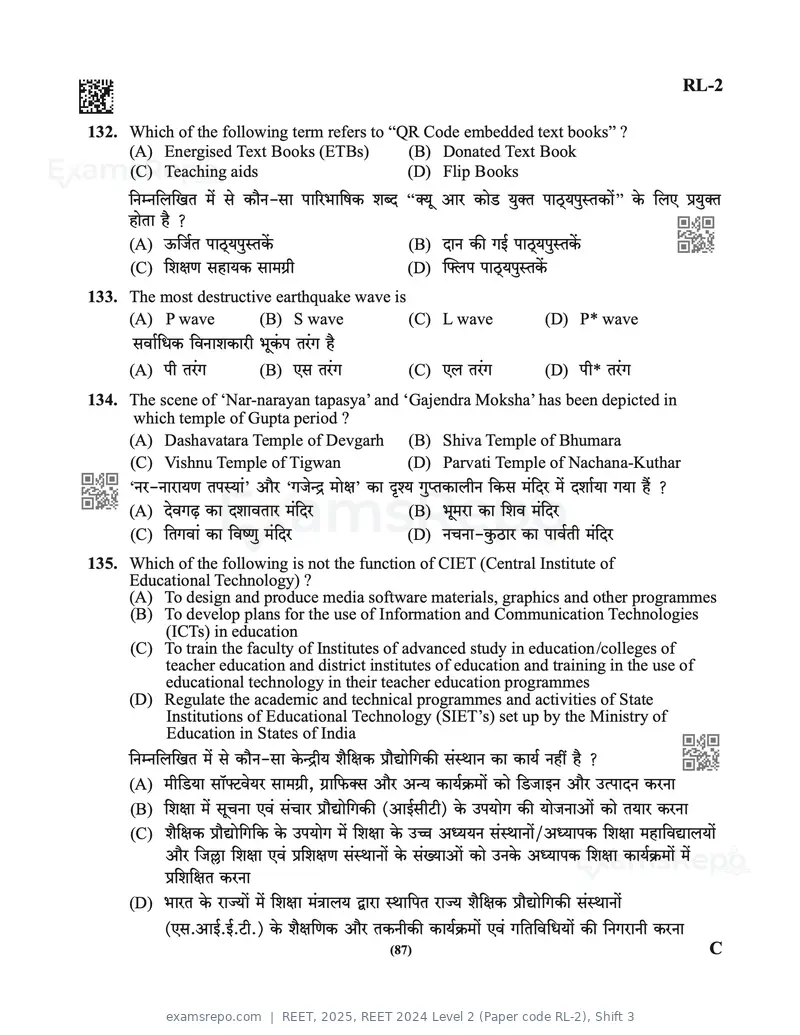
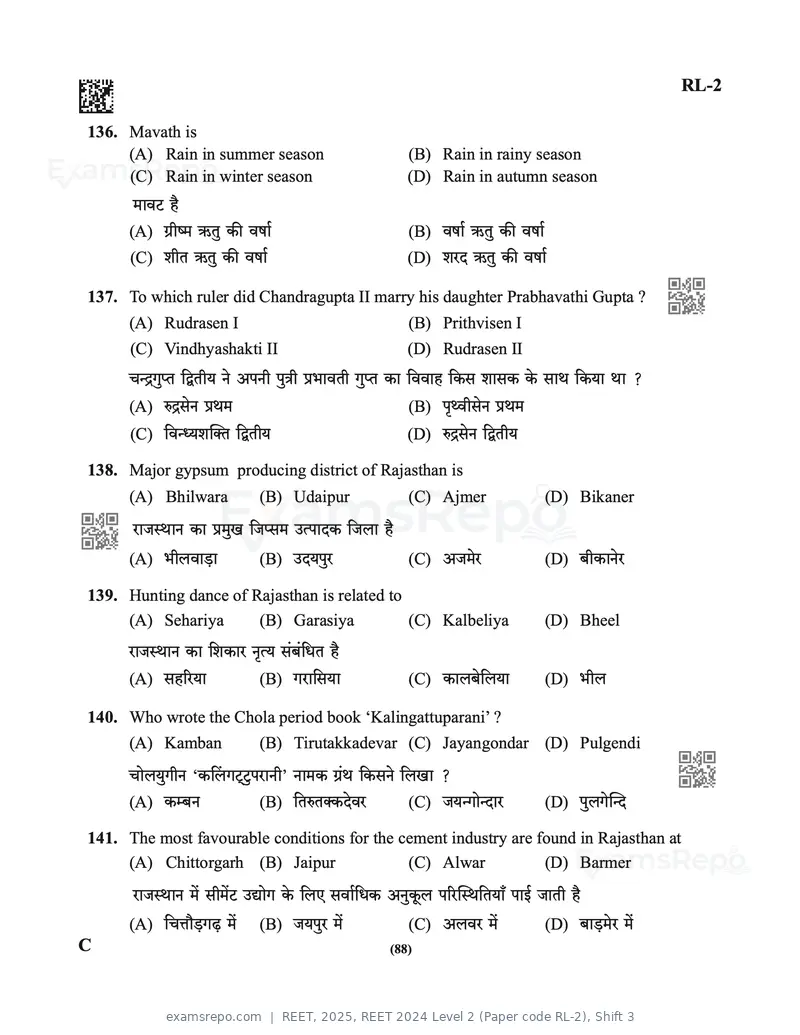
Text of page 287
DO
            NO
              T
(95)              WR
                    IT
                       EH
                         ER
                            E
C                               RL-2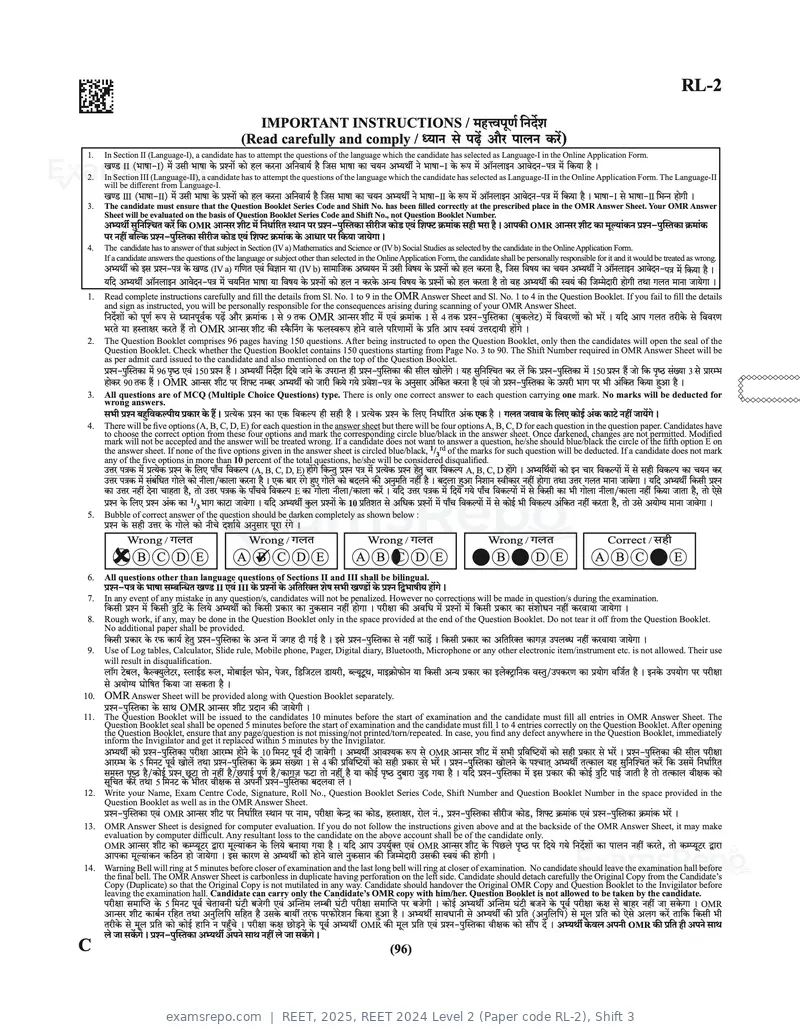
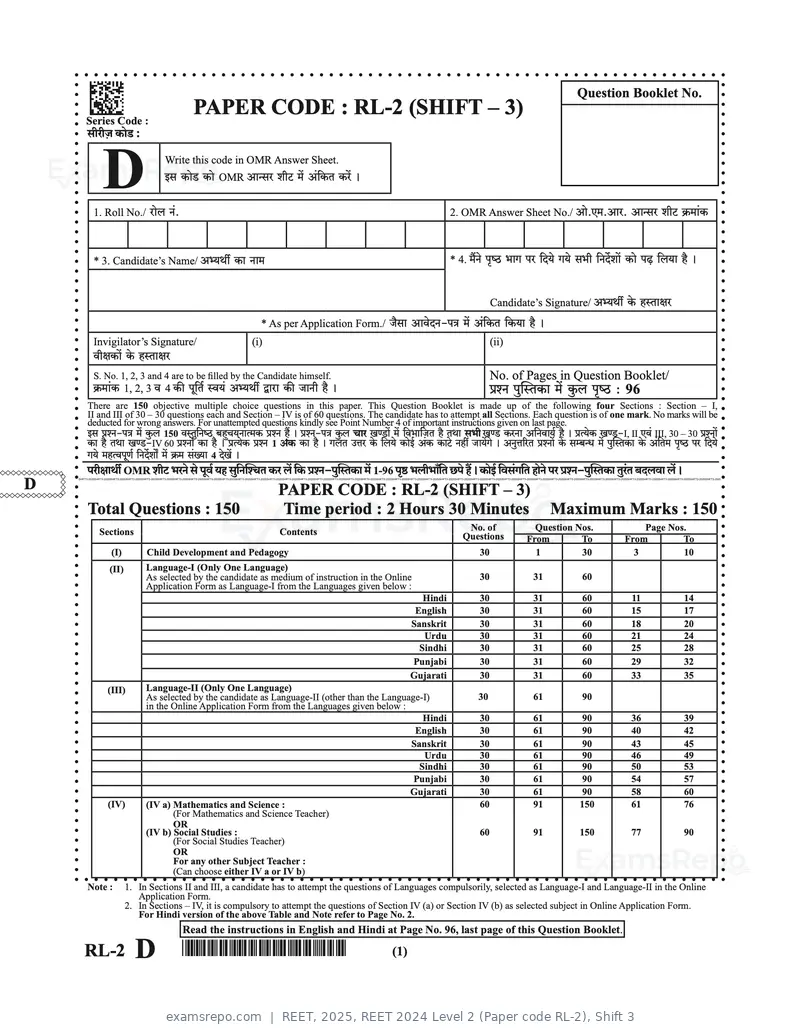
Text of page 289
Question Booklet No.
Series Code :
PAPER CODE : RL-2 (SHIFT – 3)
D
grarµO H$moS> :
Write this code in OMR Answer Sheet.
Bg H$moS> H$mo OMR AmÝga erQ> _| A§{H$V H$a| &
1. Roll No./ amob Z§. 2. OMR Answer Sheet No./ Amo.E_.Ama. AmÝga erQ> H«$_m§H$
* 3. Candidate’s Name/ Aä`Wu H$m Zm_ * 4. _¢Zo n¥îR> ^mJ na {X`o J`o g^r {ZX}em| H$mo n‹T> {b`m h¡ &
Candidate’s Signature/ Aä`Wu Ho$ hñVmja
* As per Application Form./ O¡gm AmdoXZ-nÌ _| A§{H$V {H$`m h¡ &
Invigilator’s Signature/ (i) (ii)
drjH$m| Ho$ hñVmja
S. No. 1, 2, 3 and 4 are to be filled by the Candidate himself. No. of Pages in Question Booklet/
H«$_m§H$ 1, 2, 3 d 4 H$s ny{V© ñd`§ Aä`Wu Ûmam H$s OmZr h¡ & àíZ nwpñVH$m _| Hw$b n¥îR> : 96
There are 150 objective multiple choice questions in this paper. This Question Booklet is made up of the following four Sections : Section – I,
II and III of 30 – 30 questions each and Section – IV is of 60 questions. The candidate has to attempt all Sections. Each question is of one mark. No marks will be
deducted for wrong answers. for unattempted questions kindly see point number 4 of important instructions given on last page.
Bg àíZ-nÌ _| Hw$b 150 dñVw{ZîR> ~hþM`ZmË_H$ àíZ h¢ & àíZ-nÌ Hw$b Mma IÊS>m| _| {d^m{OV h¡ VWm g^r IÊS> H$aZm A{Zdm`© h¡ & àË`oH$ IÊS>-I, II Ed§ III, 30 – 30 àíZm|
H$m h¡ VWm IÊS>-IV 60 àíZm| H$m h¡ & àË`oH$ àíZ 1 A§H$ H$m h¡ & JbV CÎma Ho$ {b`o H$moB© A§H$ H$mQ>o Zht Om`|Jo & AZwÎm[aV àíZm| Ho$ gå~ÝY _| nwpñVH$m Ho$ A§{V_ n¥îR> na {X`o
J`o _hËdnyU© {ZX}em] _| H«$_ g§»`m 4 XoI| &
narjmWu OMR erQ> ^aZo go nyd© `h gw{ZpíMV H$a b| {H$ àíZ-nwpñVH$m _| 1-96 n¥ð> ^br^m±{V N>no h¢ & H$moB© {dg§J{V hmoZo na àíZ-nwpñVH$m Vwa§V ~Xbdm b| &
D PAPER CODE : RL-2 (SHIFT – 3)
SHIFT3-2025SHIFT3-2025SHIFT3-2025SHIFT3-2025SHIFT3-2025SHIFT3-2025SHIFT3-2025SHIFT3-2025SHIFT3-2025SHIFT3-2025SHIFT3-2025SHIFT3-2025SHIFT3-2025SHIFT3-2025SHIFT3-2025SHIFT3-2025SHIFT3-2025SHIFT3-2025SHIFT3-2025SHIFT3-2025SHIFT3-2025SHIFT3-2025SHIFT3-2025SHIFT3-2025SHIFT3-2025SHIFT3-2025SHIFT3-2025SHIFT3-2025SHIFT3-2025SHIFT3-2025SHIFT3-2025SHIFT3-2025SHIFT3-2025SHIFT3-2025SHIFT3-2025SHIFT3-2025SHIFT3-2025SHIFT3-2025SHIFT3-2025SHIFT3-2025SHIFT3-2025
Total Questions : 150 Time period : 2 Hours 30 Minutes Maximum Marks : 150
Sections Contents No. of Question Nos. Page Nos.
Questions From To From To
(I) Child Development and Pedagogy 30 1 30 3 10
(II) Language-I (Only One Language)
As selected by the candidate as medium of instruction in the Online 30 31 60
Application Form as language-I from the languages given below :
Hindi 30 31 60 11 14
English 30 31 60 15 17
Sanskrit 30 31 60 18 20
Urdu 30 31 60 21 24
Sindhi 30 31 60 25 28
Punjabi 30 31 60 29 32
Gujarati 30 31 60 33 35
(III) Language-II (Only One Language)
As selected by the candidate as Language-II (other than the Language-I) 30 61 90
in the Online Application Form from the Languages given below :
Hindi 30 61 90 36 39
English 30 61 90 40 42
Sanskrit 30 61 90 43 45
Urdu 30 61 90 46 49
Sindhi 30 61 90 50 53
Punjabi 30 61 90 54 57
Gujarati 30 61 90 58 60
(IV) (IV a) Mathematics and Science : 60 91 150 61 76
(For Mathematics and Science Teacher)
OR
(IV b) Social Studies : 60 91 150 77 90
(For Social Studies Teacher)
OR
For any other Subject Teacher :
(Can choose either IV a or IV b)
Note : 1. In Sections II and III, a candidate has to attempt the questions of Languages compulsorily, selected as Language-I and Language-II in the Online
Application Form.
2. In Sections – IV, it is compulsory to attempt the questions of Section IV (a) or Section IV (b) as selected subject in Online Application Form.
For Hindi version of the above Table and Note refer to Page No. 2.
Read the instructions in English and Hindi at Page No. 96, last page of this Question booklet.
RL-2 D *RL2SHIFT3D* (1)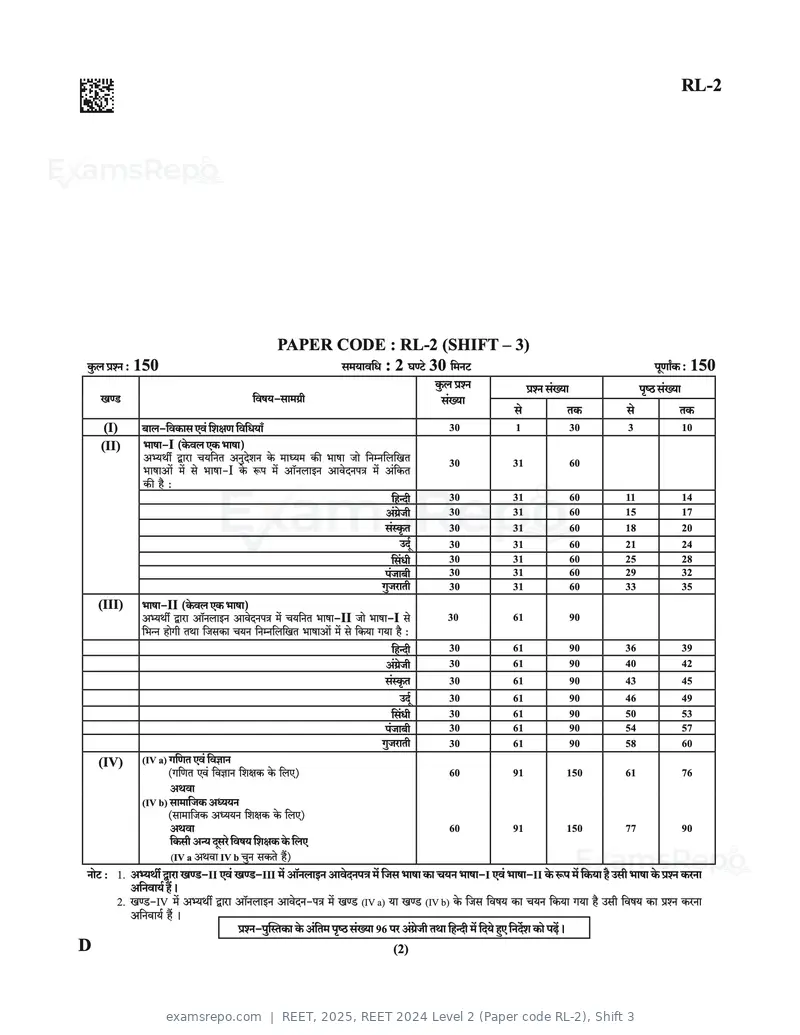
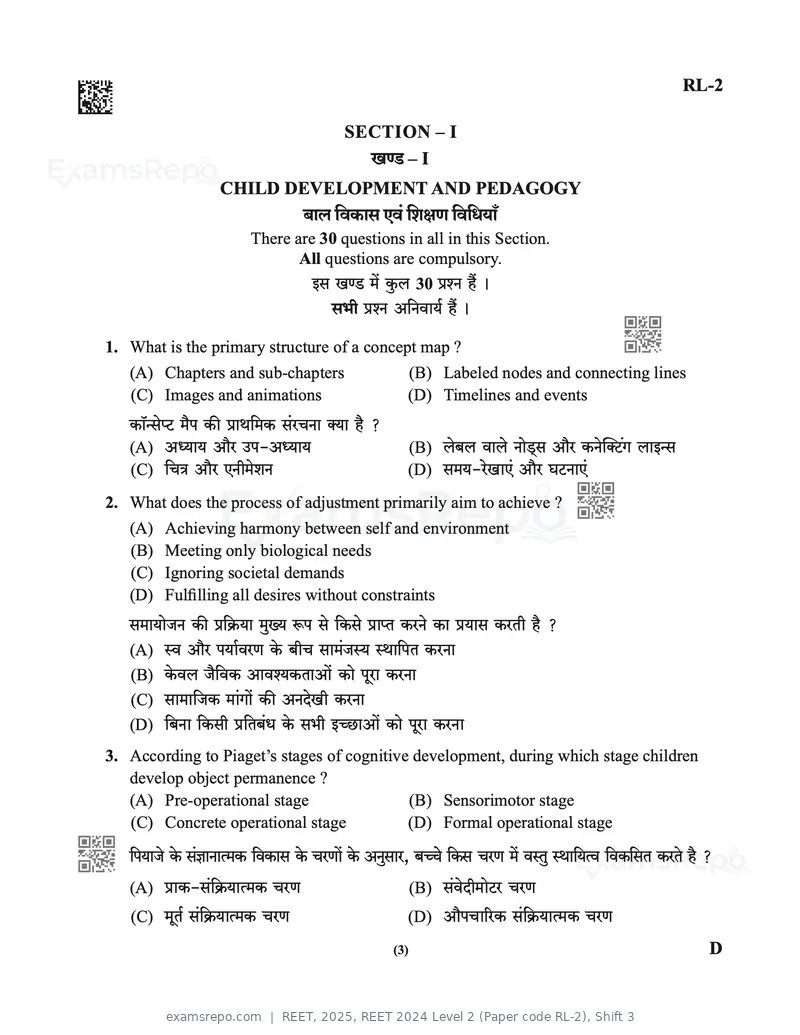
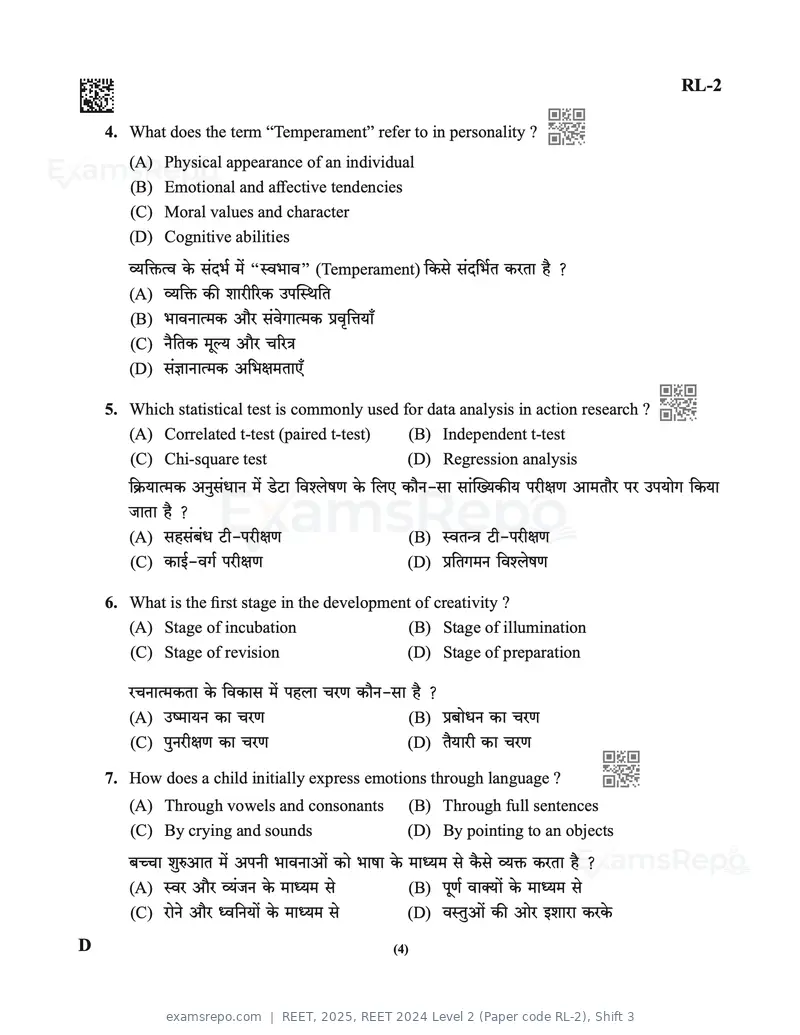
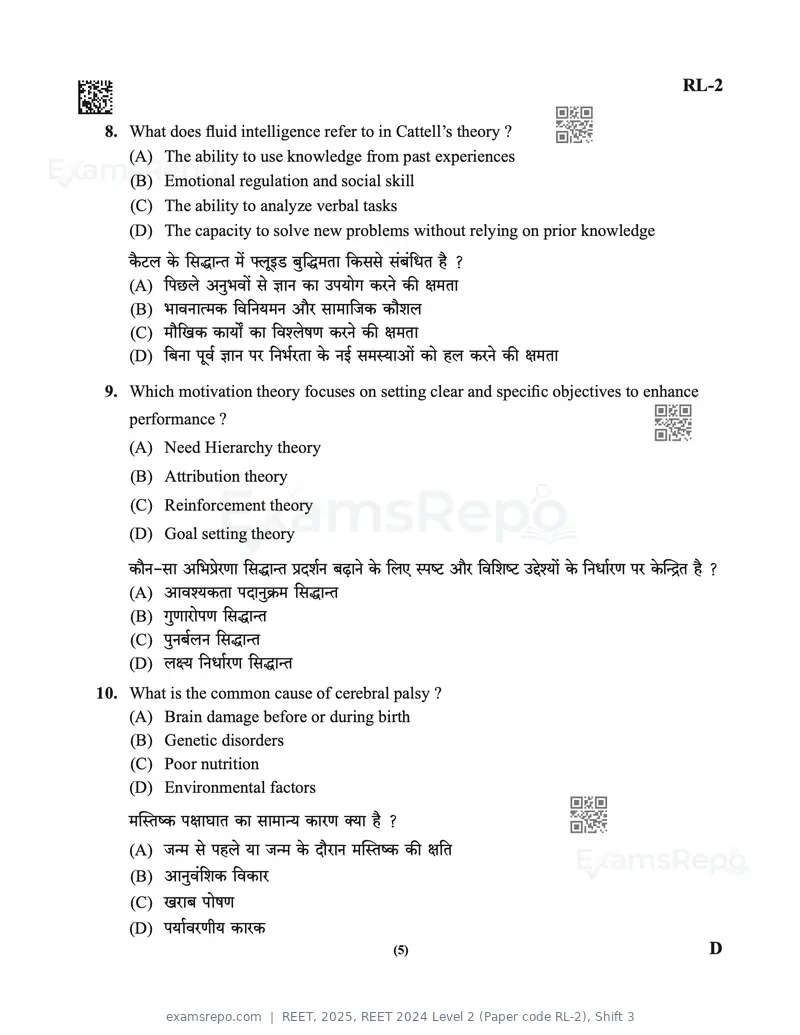
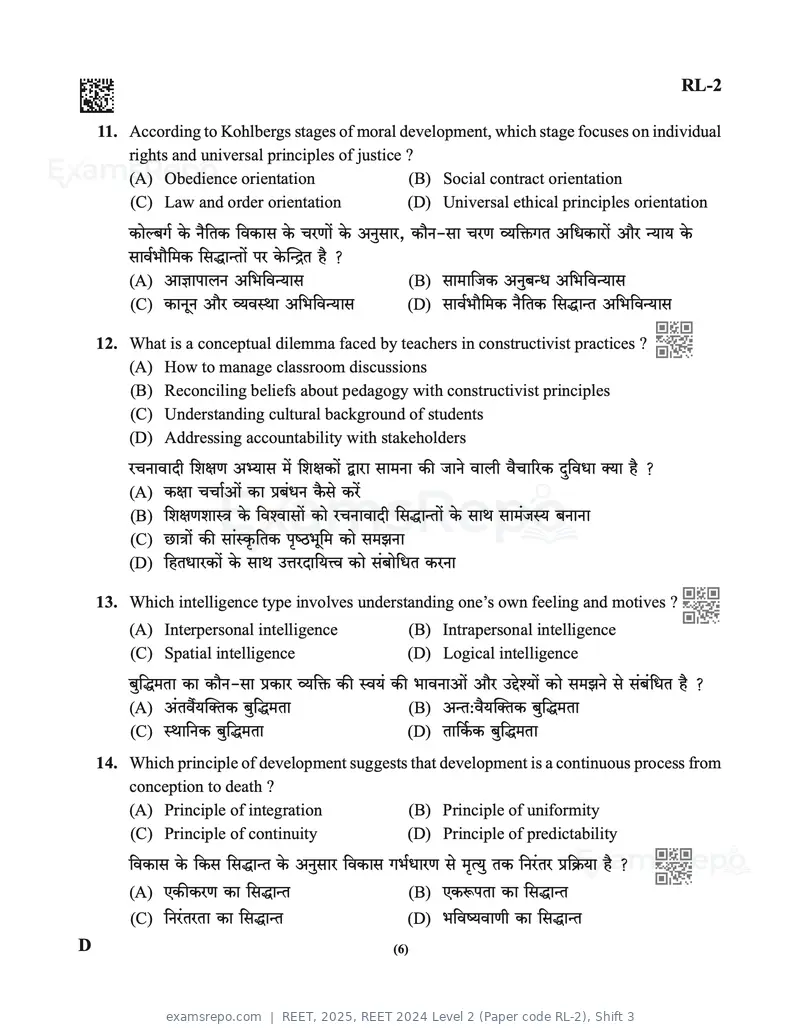
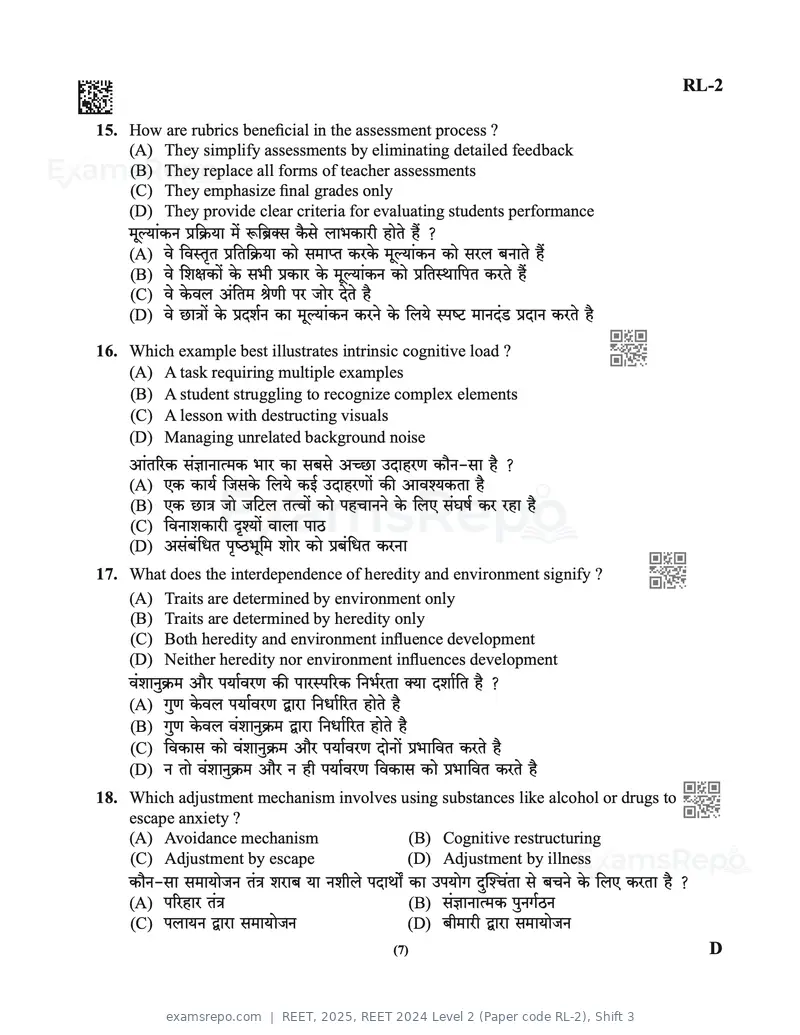
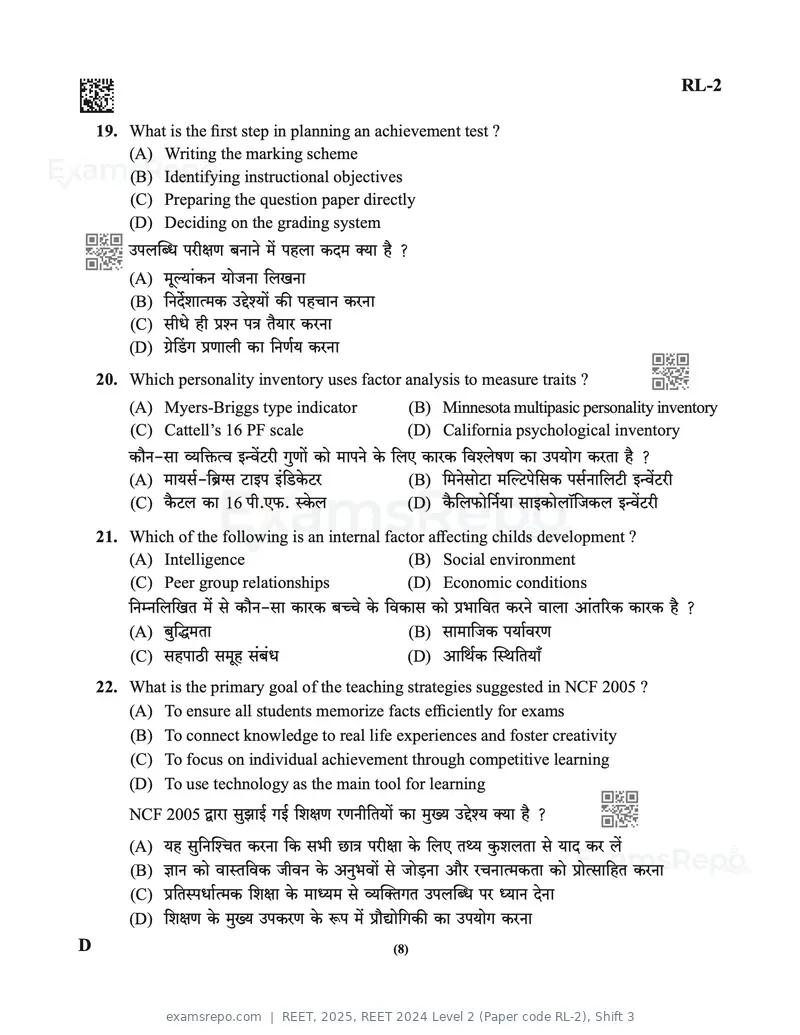
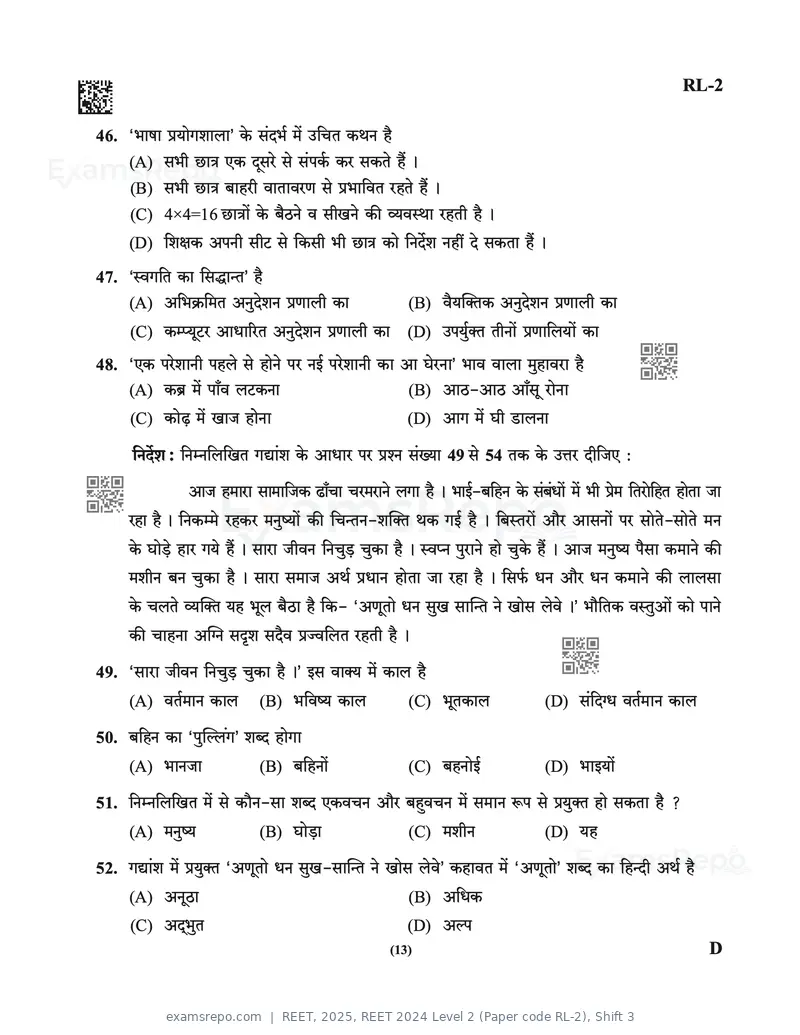
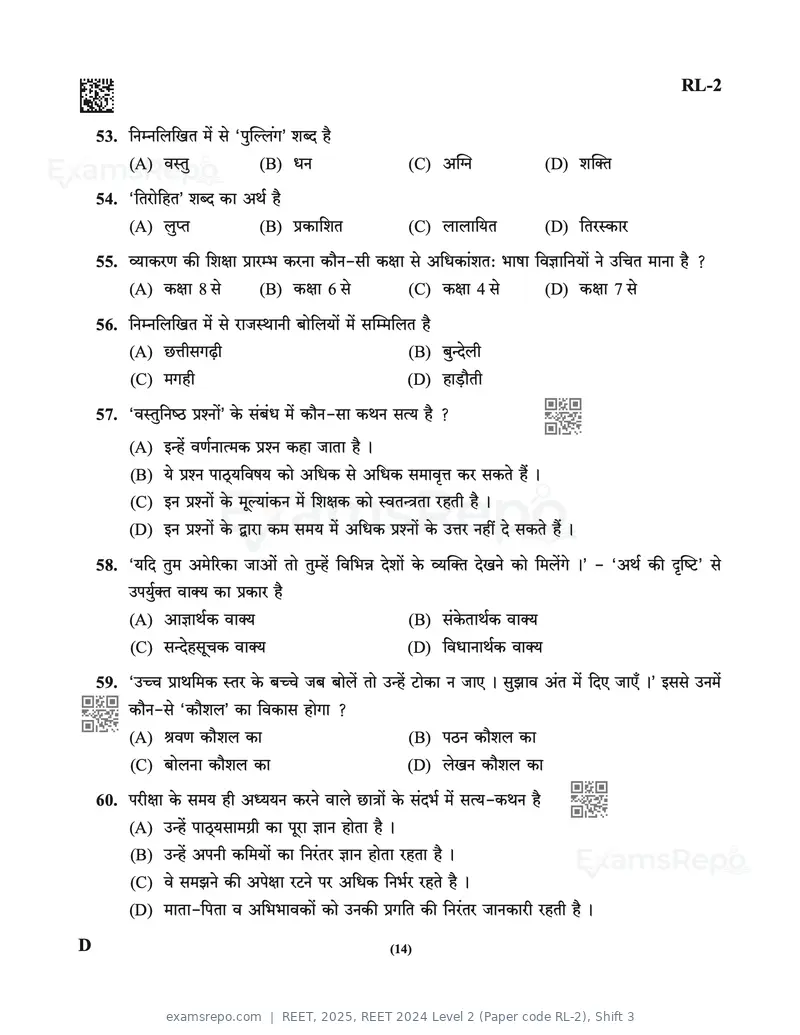
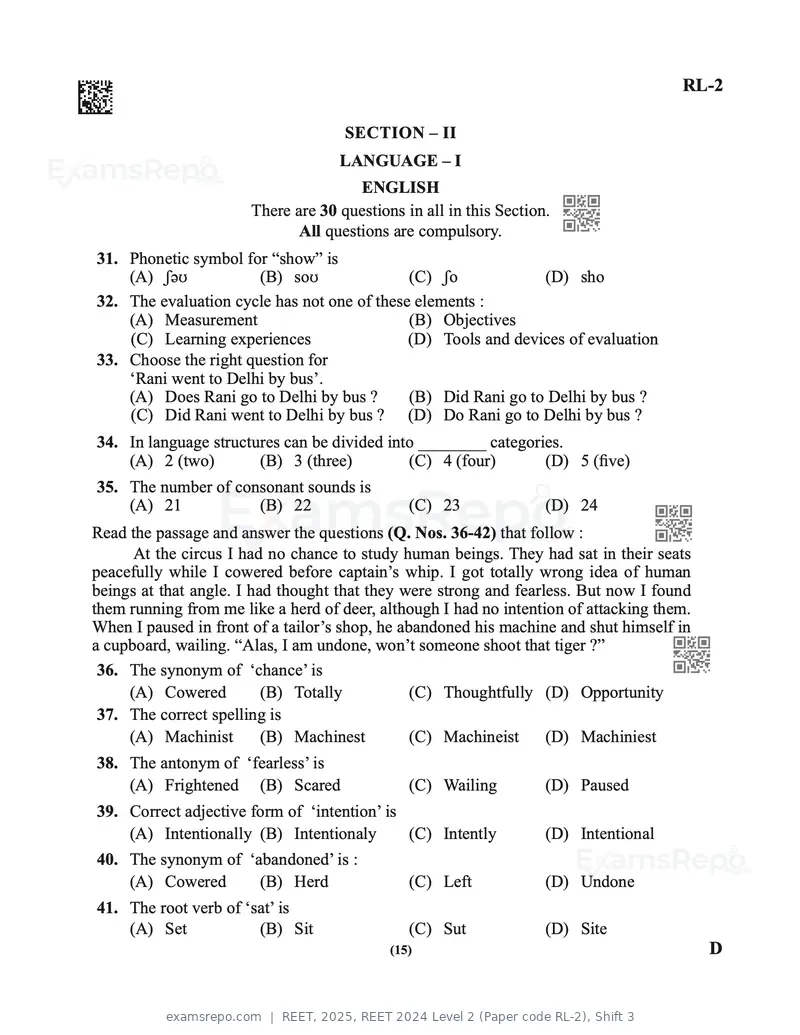
Text of page 303
RL-2

                                     SECTION – II
                                    LANGUAGE – I
                                       ENGLISH
                       There are 30 questions in all in this Section.
                              All questions are compulsory.
31. Phonetic symbol for “show” is
    (A) ʃəʊ            (B) soʊ               (C) ʃo            (D) sho
32. The evaluation cycle has not one of these elements :
    (A) Measurement                          (B) Objectives
    (C) Learning experiences                 (D) Tools and devices of evaluation
33. Choose the right question for
    ‘Rani went to Delhi by bus’.
    (A) Does Rani go to Delhi by bus ?       (B) Did Rani go to Delhi by bus ?
    (C) Did Rani went to Delhi by bus ? (D) Do Rani go to Delhi by bus ?
34. In language structures can be divided into ________ categories.
    (A) 2 (two)        (B) 3 (three)         (C) 4 (four)       (D) 5 (five)
35. The number of consonant sounds is
    (A) 21           (B) 22                    (C) 23               (D) 24
Read the passage and answer the questions (Q. Nos. 36-42) that follow :
      At the circus I had no chance to study human beings. They had sat in their seats
peacefully while I cowered before captain’s whip. I got totally wrong idea of human
beings at that angle. I had thought that they were strong and fearless. But now I found
them running from me like a herd of deer, although I had no intention of attacking them.
When I paused in front of a tailor’s shop, he abandoned his machine and shut himself in
a cupboard, wailing. “Alas, I am undone, won’t someone shoot that tiger ?”
 36. The synonym of ‘chance’ is
     (A) Cowered          (B) Totally           (C) Thoughtfully (D) Opportunity
 37. The correct spelling is
     (A) Machinist        (B) Machinest         (C) Machineist     (D) Machiniest
38. The antonym of ‘fearless’ is
    (A) Frightened (B) Scared                  (C) Wailing          (D) Paused
39. Correct adjective form of ‘intention’ is
    (A) Intentionally (B) Intentionaly       (C) Intently           (D) Intentional
40. The synonym of ‘abandoned’ is :
    (A) Cowered      (B) Herd                  (C) Left             (D) Undone
41. The root verb of ‘sat’ is
    (A) Set            (B) Sit                 (C) Sut              (D) Site
                                            (15)                                           D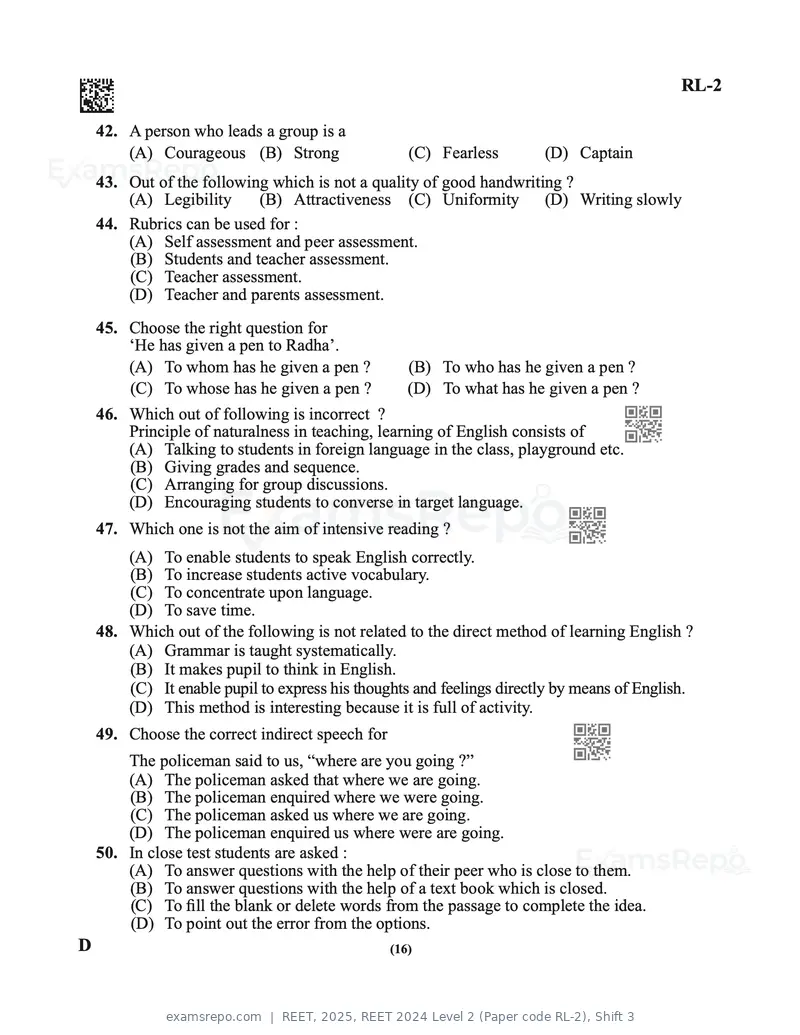
Text of page 304
RL-2

    42. A person who leads a group is a
        (A) Courageous (B) Strong                   (C) Fearless       (D) Captain
    43. Out of the following which is not a quality of good handwriting ?
        (A) Legibility     (B) Attractiveness (C) Uniformity (D) Writing slowly
    44. Rubrics can be used for :
        (A) Self assessment and peer assessment.
        (B) Students and teacher assessment.
        (C) Teacher assessment.
        (D) Teacher and parents assessment.
    45. Choose the right question for
        ‘He has given a pen to Radha’.
        (A) To whom has he given a pen ?            (B) To who has he given a pen ?
        (C) To whose has he given a pen ?           (D) To what has he given a pen ?
    46. Which out of following is incorrect ?
        Principle of naturalness in teaching, learning of English consists of
        (A) Talking to students in foreign language in the class, playground etc.
        (B) Giving grades and sequence.
        (C) Arranging for group discussions.
        (D) Encouraging students to converse in target language.
    47. Which one is not the aim of intensive reading ?
        (A) To enable students to speak English correctly.
        (B) To increase students active vocabulary.
        (C) To concentrate upon language.
        (D) To save time.
    48. Which out of the following is not related to the direct method of learning English ?
        (A) Grammar is taught systematically.
        (B) It makes pupil to think in English.
        (C) It enable pupil to express his thoughts and feelings directly by means of English.
        (D) This method is interesting because it is full of activity.
    49. Choose the correct indirect speech for
        The policeman said to us, “where are you going ?”
        (A) The policeman asked that where we are going.
        (B) The policeman enquired where we were going.
        (C) The policeman asked us where we are going.
        (D) The policeman enquired us where were are going.
    50. In close test students are asked :
        (A) To answer questions with the help of their peer who is close to them.
        (B) To answer questions with the help of a text book which is closed.
        (C) To fill the blank or delete words from the passage to complete the idea.
        (D) To point out the error from the options.
D                                                (16)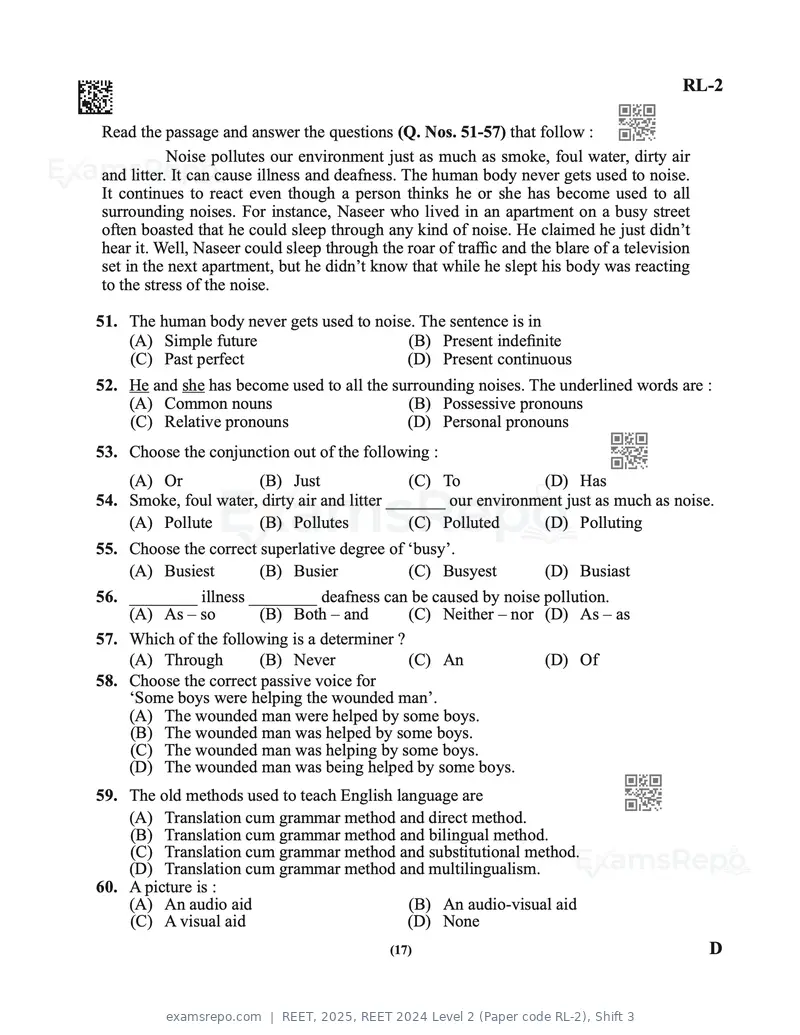
Text of page 305
RL-2

Read the passage and answer the questions (Q. Nos. 51-57) that follow :
           Noise pollutes our environment just as much as smoke, foul water, dirty air
and litter. It can cause illness and deafness. The human body never gets used to noise.
It continues to react even though a person thinks he or she has become used to all
surrounding noises. For instance, Naseer who lived in an apartment on a busy street
often boasted that he could sleep through any kind of noise. He claimed he just didn’t
hear it. Well, Naseer could sleep through the roar of traffic and the blare of a television
set in the next apartment, but he didn’t know that while he slept his body was reacting
to the stress of the noise.

51. The human body never gets used to noise. The sentence is in
    (A) Simple future                      (B) Present indefinite
    (C) Past perfect                       (D) Present continuous
52. He and she has become used to all the surrounding noises. The underlined words are :
    (A) Common nouns                        (B) Possessive pronouns
    (C) Relative pronouns                   (D) Personal pronouns
53. Choose the conjunction out of the following :
    (A) Or            (B) Just                 (C) To           (D) Has
54. Smoke, foul water, dirty air and litter _______ our environment just as much as noise.
    (A) Pollute       (B) Pollutes             (C) Polluted     (D) Polluting
55. Choose the correct superlative degree of ‘busy’.
    (A) Busiest        (B) Busier            (C) Busyest            (D) Busiast
56. ________ illness ________ deafness can be caused by noise pollution.
    (A) As – so        (B) Both – and        (C) Neither – nor (D) As – as
57. Which of the following is a determiner ?
    (A) Through        (B) Never             (C) An            (D) Of
58. Choose the correct passive voice for
    ‘Some boys were helping the wounded man’.
    (A) The wounded man were helped by some boys.
    (B) The wounded man was helped by some boys.
    (C) The wounded man was helping by some boys.
    (D) The wounded man was being helped by some boys.
59. The old methods used to teach English language are
    (A) Translation cum grammar method and direct method.
    (B) Translation cum grammar method and bilingual method.
    (C) Translation cum grammar method and substitutional method.
    (D) Translation cum grammar method and multilingualism.
60. A picture is :
    (A) An audio aid                        (B) An audio-visual aid
    (C) A visual aid                        (D) None
                                            (17)                                              D
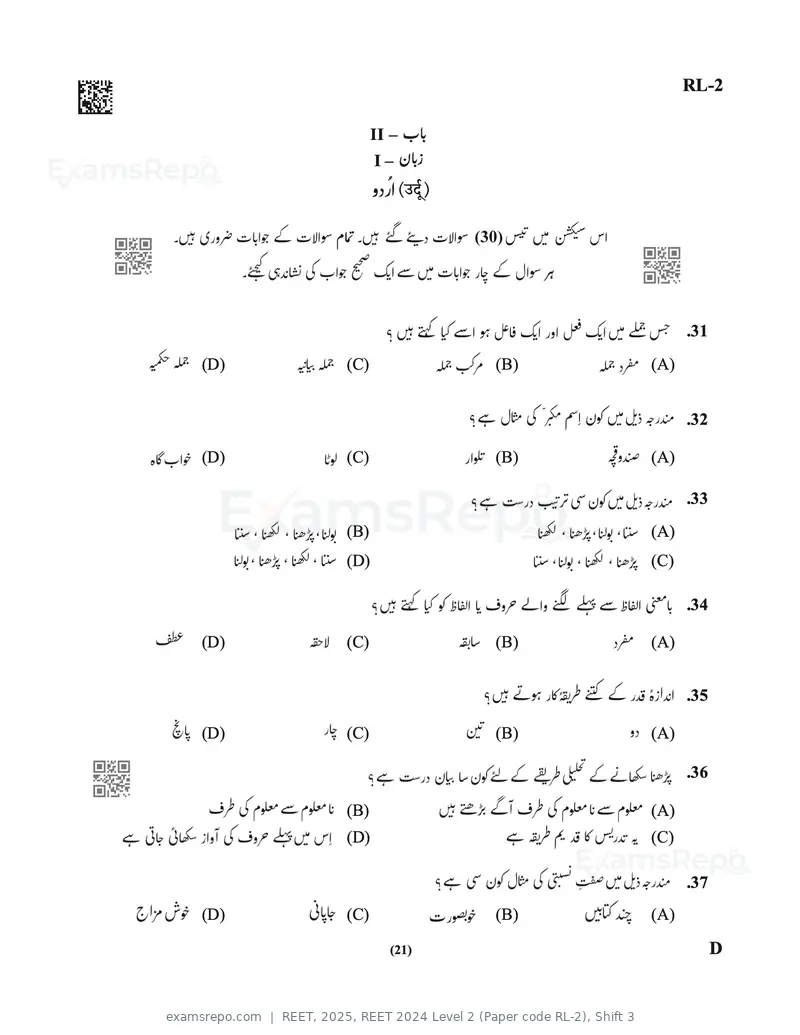
Text of page 309
RL-2

            II –
            I–
                   (CXÿ© )


                                         .31
(D)   (C)                    (B)   (A)


                                         .32

(D)   (C)                    (B)   (A)

                                         .33
      (B)                          (A)
      (D)                          (C)

                                         .34

(D)   (C)                    (B)   (A)


                                         .35

(D)   (C)                    (B)   (A)

                                         .36

      (B)                          (A)
      (D)                          (C)

                                         .37
(D)   (C)                    (B)   (A)

              (21)                             D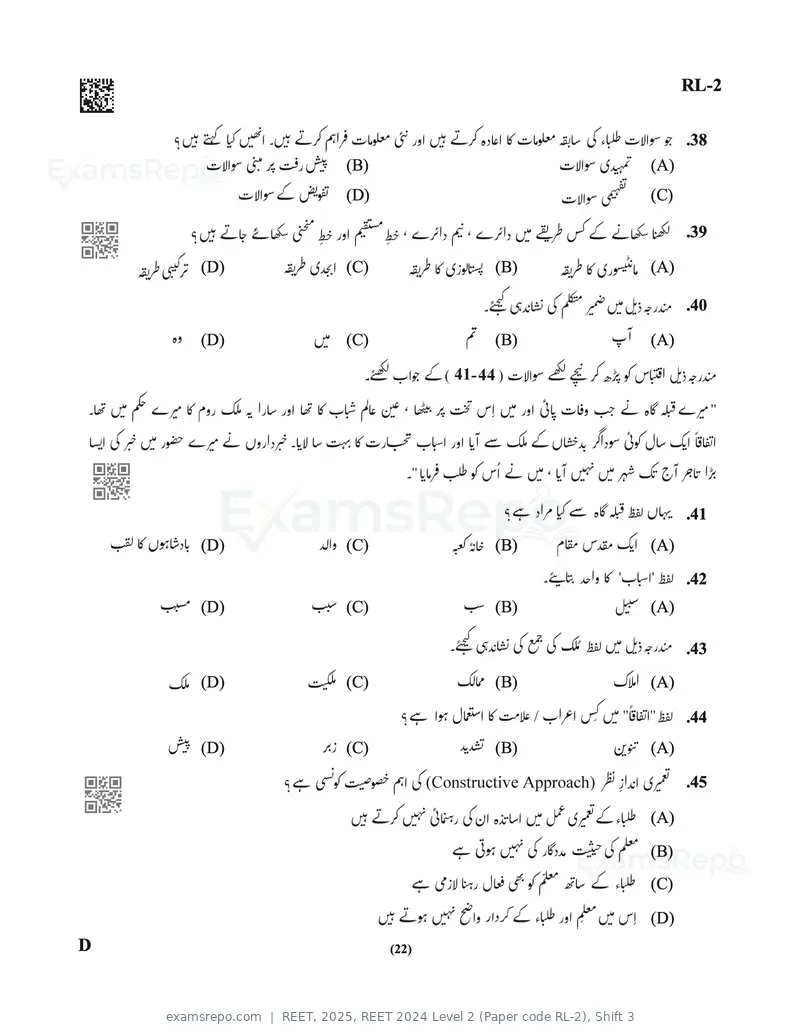
Text of page 310
RL-2

                                   .38
          (B)                (A)
          (D)                (C)

                                   .39

    (D)   (C)          (B)   (A)

                                   .40

    (D)   (C)          (B)   (A)


                                   .41
    (D)   (C)          (B)   (A)
                                   .42
    (D)   (C)          (B)   (A)

                                   .43
    (D)   (C)          (B)   (A)

                                   .44
    (D)   (C)          (B)   (A)

                                   .45

                             (A)
                             (B)
                             (C)

                             (D)
D               (22)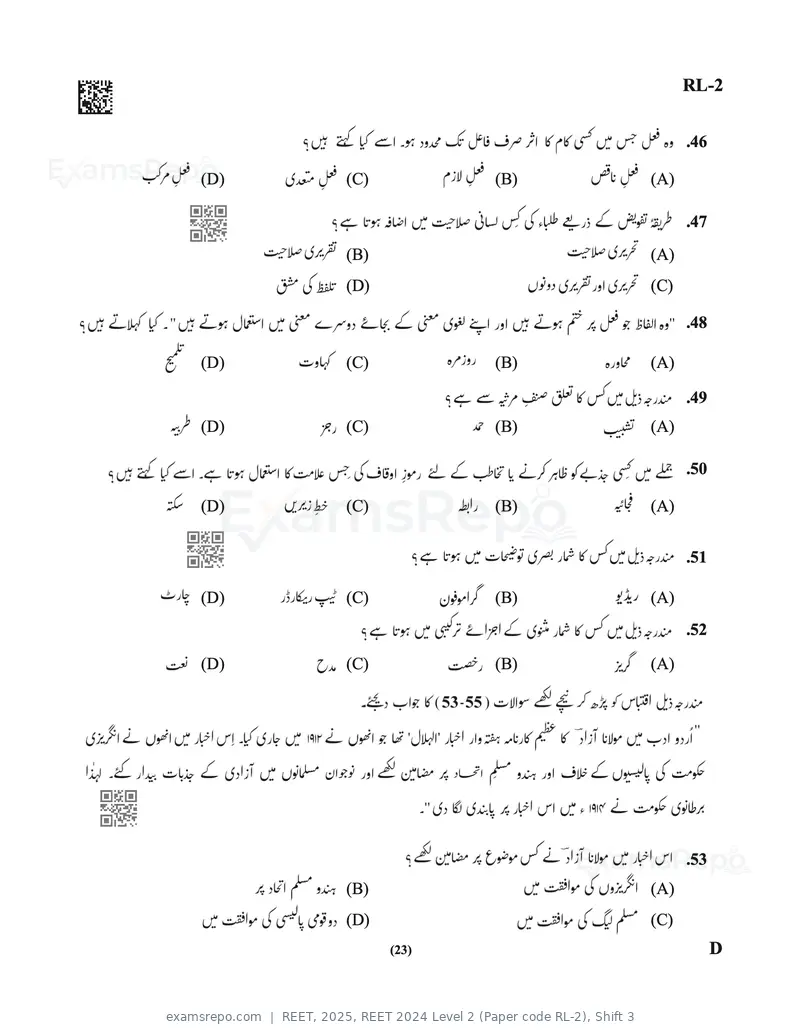
Text of page 311
RL-2


                               .46

(D)   (C)          (B)   (A)

                               .47
      (B)                (A)
      (D)                (C)

                               .48

(D)   (C)          (B)   (A)

                               .49
(D)   (C)          (B)   (A)

                               .50

(D)   (C)          (B)   (A)

                               .51

(D)   (C)          (B)   (A)
                               .52

(D)   (C)          (B)   (A)


                               .53
      (B)                (A)
      (D)                (C)
            (23)                     D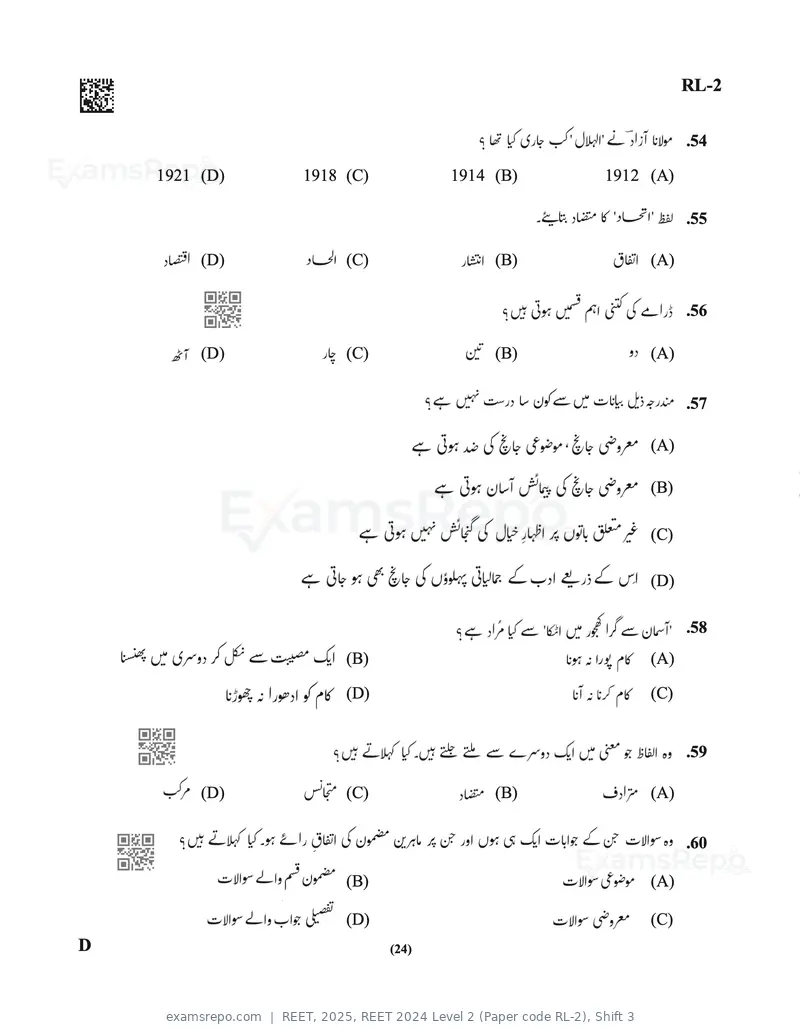
Text of page 312
RL-2

                                                       .54

    1921 (D)   1918 (C)          1914 (B)   1912 (A)

                                                       .55

         (D)        (C)               (B)        (A)

                                                       .56

         (D)        (C)               (B)        (A)

                                                       .57

                                                 (A)

                                                 (B)

                                                 (C)

                                                 (D)

                                                       .58
                    (B)                          (A)

                    (D)                          (C)


                                                       .59

         (D)        (C)               (B)        (A)

                                                       .60

                    (B)                          (A)

                    (D)                          (C)
D                         (24)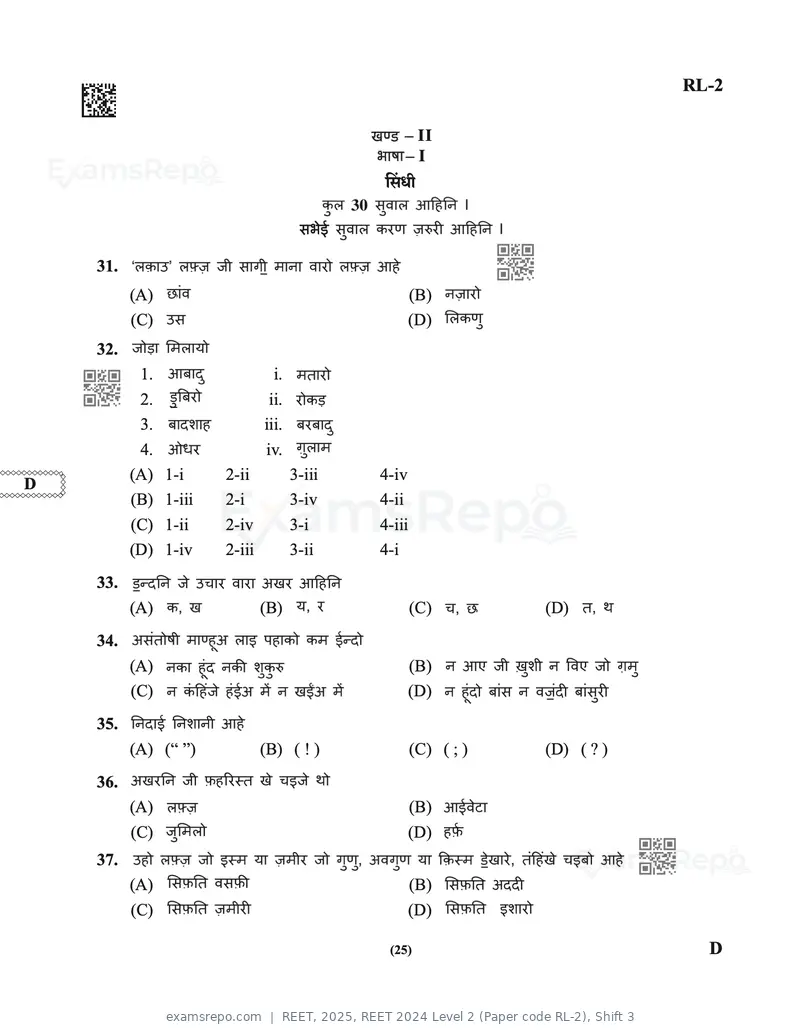
Text of page 313
RL-2

                                                 – II
                                                 –I
                                              qgYr


    31.
          (A)                                    (B)
          (C)                                    (D)
    32.
           1.                   i.
           2.                  ii.
           3.                 iii.
           4.                 iv.
          (A) 1-i     2-ii           3-iii   4-iv
D
          (B) 1-iii   2-i            3-iv    4-ii
          (C) 1-ii    2-iv           3-i     4-iii
          (D) 1-iv    2-iii          3-ii    4-i
    33.
          (A)                 (B)                    (C)         (D)
    34.
          (A)                                    (B)
          (C)                                    (D)
    35.
          (A) (“ ”)           (B) ( ! )              (C) ( ; )   (D) ( ? )
    36.
          (A)                                    (B)
          (C)                                    (D)
    37.
          (A)                                    (B)
          (C)                                    (D)

                                              (25)                             D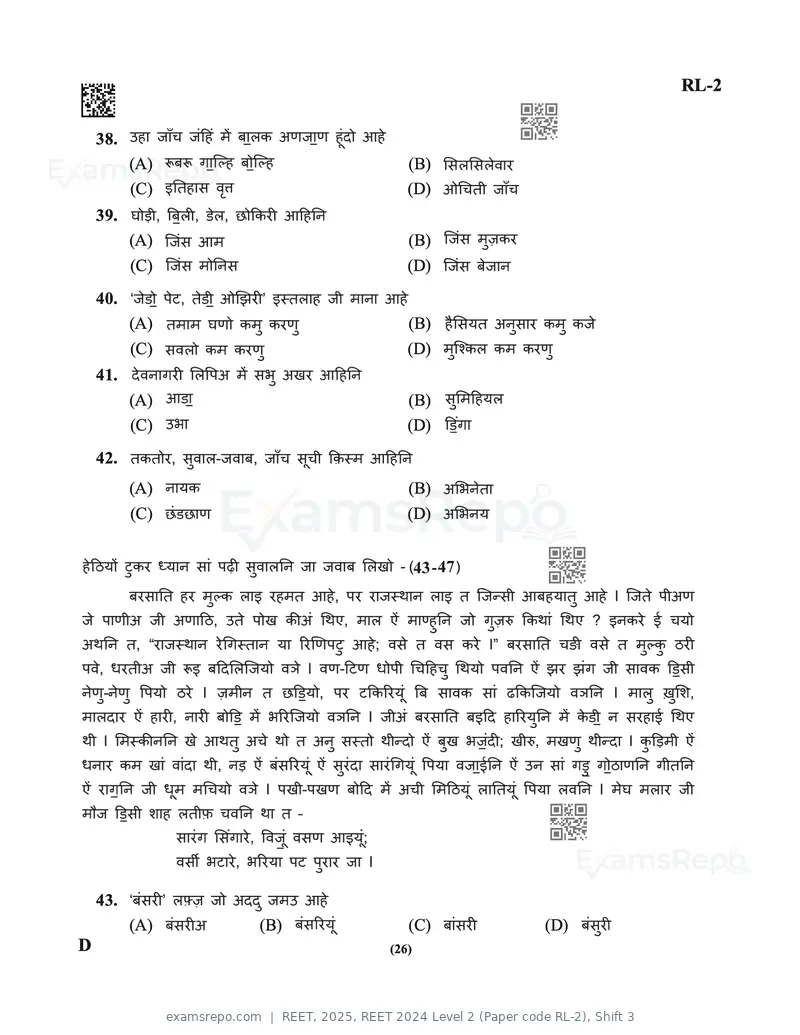
Text of page 314
RL-2

    38.
          (A)            (B)
          (C)            (D)
    39.
          (A)            (B)
          (C)            (D)
    40.
          (A)            (B)
          (C)            (D)
    41.
          (A)            (B)
          (C)            (D)
    42.
          (A)            (B)
          (C)            (D)


    43.
          (A)   (B)      (C)   (D)
D                     (26)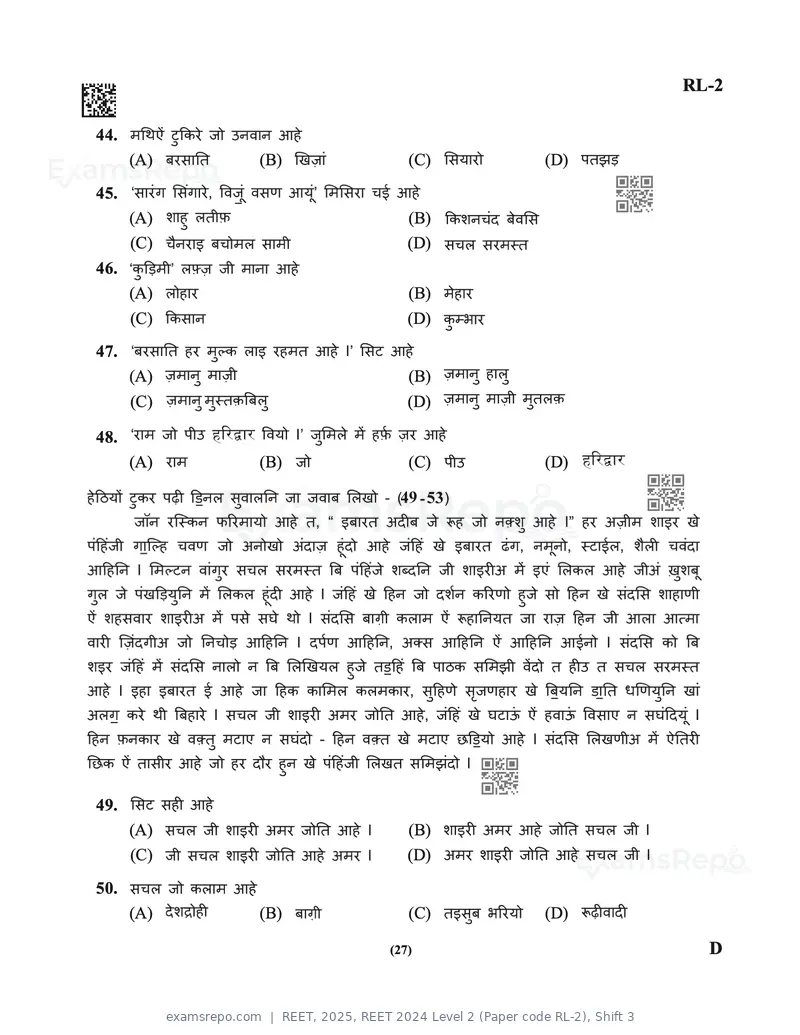
Text of page 315
RL-2

44.
      (A)   (B)      (C)   (D)
45.
      (A)            (B)
      (C)            (D)
46.
      (A)            (B)
      (C)            (D)
47.
      (A)            (B)
      (C)            (D)

48.
      (A)   (B)      (C)   (D)


49.
      (A)            (B)
      (C)            (D)
50.
      (A)   (B)      (C)   (D)

                  (27)             D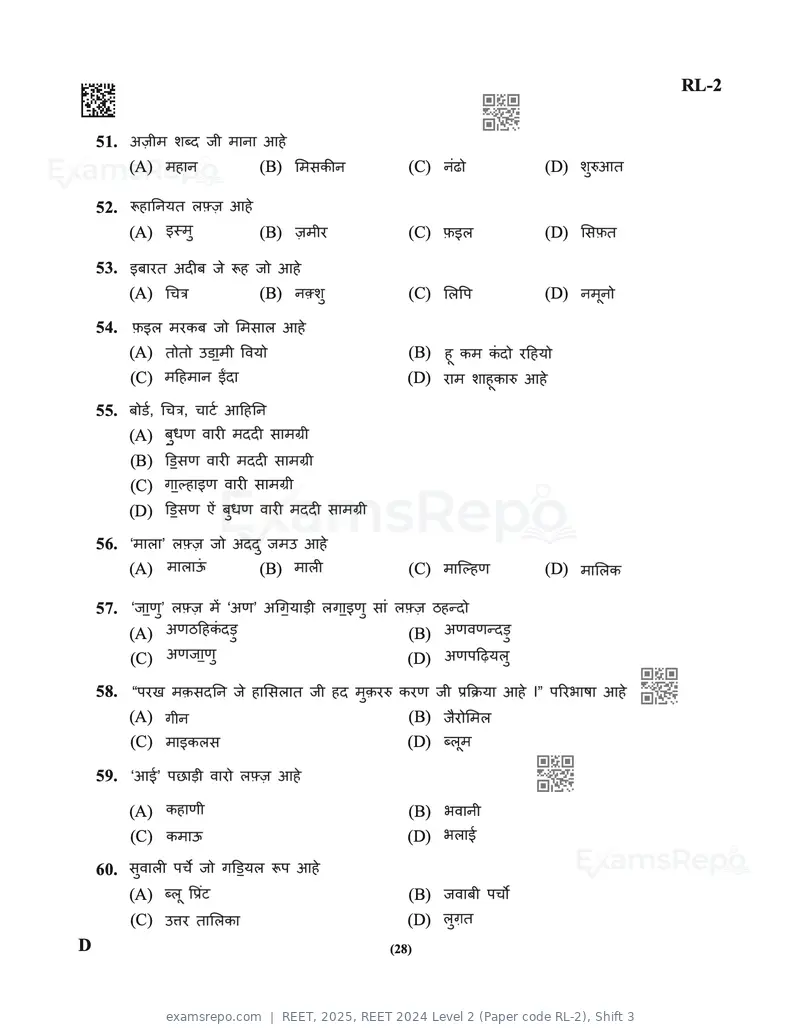
Text of page 316
RL-2


    51.
          (A)   (B)      (C)   (D)

    52.
          (A)   (B)      (C)   (D)

    53.
          (A)   (B)      (C)   (D)

    54.
          (A)            (B)
          (C)            (D)
    55.
          (A)
          (B)
          (C)
          (D)
    56.
          (A)   (B)      (C)   (D)

    57.
          (A)            (B)
          (C)            (D)
    58.
          (A)            (B)
          (C)            (D)

    59.

          (A)            (B)
          (C)            (D)
    60.
          (A)            (B)
          (C)            (D)
D                     (28)
Text of page 317
RL-2

                            – II
                             –I
                           ( n§Om~r)


31.                                         :
      (A)   (B)              (C)           (D)
32.                   :
      (A)   (B)              (C)           (D)
33.                                    :
      (A)
      (B)
      (C)
      (D)
34.


                  :
      (A)   (B)              (C)           (D)
35.

      (A)   (B)              (C)           (D)
36.

      (A)   (B)              (C)           (D)
37.


      (A)                    (B)
      (C)                    (D)
38.                          :
      (A)                    (B)
      (C)                    (D)
                          (29)                     D
Text of page 318
RL-2

    39.
          (A)                (B)
          (C)                (D)
    40.

          (A)   (B)          (C)   (D)

    41.               :
          (A)                (B)
          (C)                (D)
    42.                                  :
          (A)                (B)
          (C)                (D)


    43.
          (A)   (B)          (C)   (D)
    44.
          (A)   (B)          (C)   (D)
    45.
          (A)   (B)          (C)   (D)
D                         (30)
Text of page 319
RL-2

46.

      (A)   (B)      (C)       (D)

47.


      (A)            (B)
      (C)            (D)

48.
      (A)
      (B)
      (C)
      (D)

49.                        :
      (A)            (B)
      (C)            (D)

50.
      (A)
      (B)
      (C)
      (D)

51.                                  :
      (A)            (B)
      (C)            (D)
52.

      (A)   (B)      (C)       (D)

53.
      (A)            (B)
      (C)            (D)
                  (31)                     D
Text of page 320
RL-2

    54.

          (A)
          (B)
          (C)
          (D)
    55.
          (A)   (B)          (C)   (D)
    56.

          (A)                (B)
          (C)                (D)


    57.
          (A)   (B)          (C)   (D)
    58.               :
          (A)   (B)          (C)   (D)
    59.
          (A)   (B)          (C)   (D)
    60.
          (A)   (B)          (C)   (D)
D                         (32)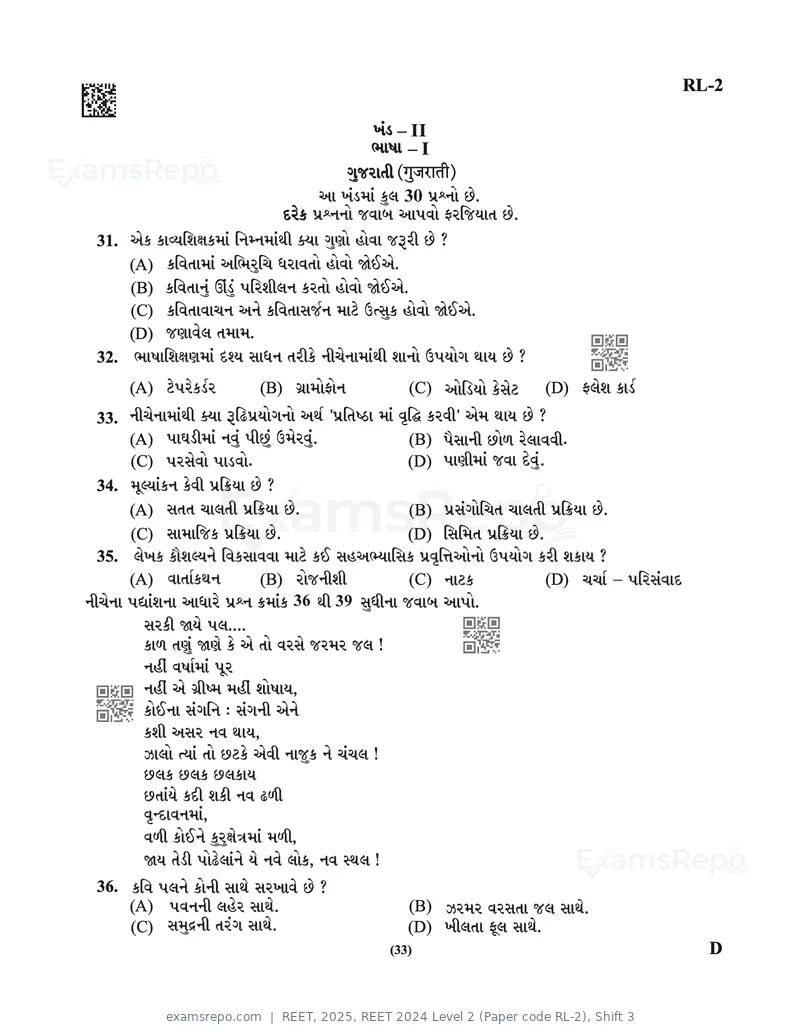
Text of page 321
RL-2

                   – II
                    –I
                   (JwOamVr)>


31.
      (A)
      (B)
      (C)
      (D)
32.
      (A)   (B)      (C)        (D)
33.
      (A)            (B)
      (C)            (D)
34.
      (A)            (B)
      (C)            (D)
35.
      (A)   (B)      (C)        (D)


36.
      (A)            (B)
      (C)            (D)
                  (33)                  D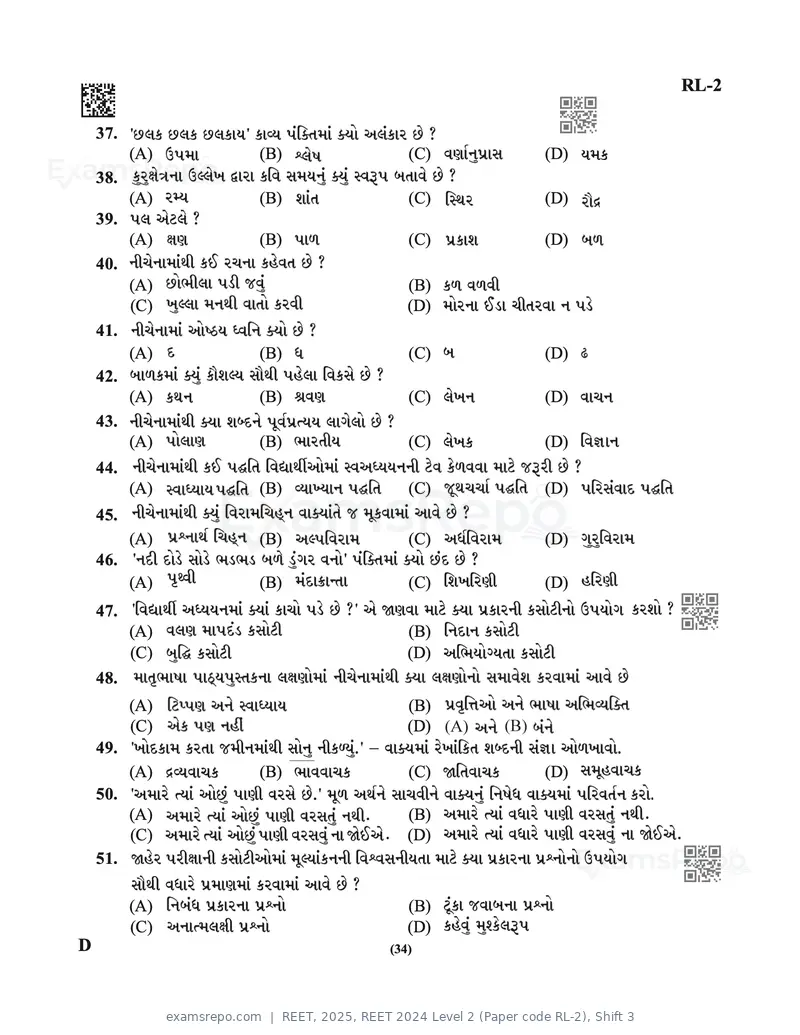
Text of page 322
RL-2

    37.
          (A)   (B)      (C)   (D)
    38.
          (A)   (B)      (C)   (D)
    39.
          (A)   (B)      (C)   (D)
    40.
          (A)            (B)
          (C)            (D)
    41.
          (A)   (B)      (C)   (D)
    42.
          (A)   (B)      (C)   (D)
    43.
          (A)   (B)      (C)   (D)
    44.
          (A)   (B)      (C)   (D)
    45.
          (A)   (B)      (C)   (D)
    46.
          (A)   (B)      (C)   (D)
    47.
          (A)            (B)
          (C)            (D)
    48.
          (A)            (B)
          (C)            (D)
    49.
          (A)   (B)      (C)   (D)
    50.
          (A)            (B)
          (C)            (D)
    51.

          (A)            (B)
          (C)            (D)
D                     (34)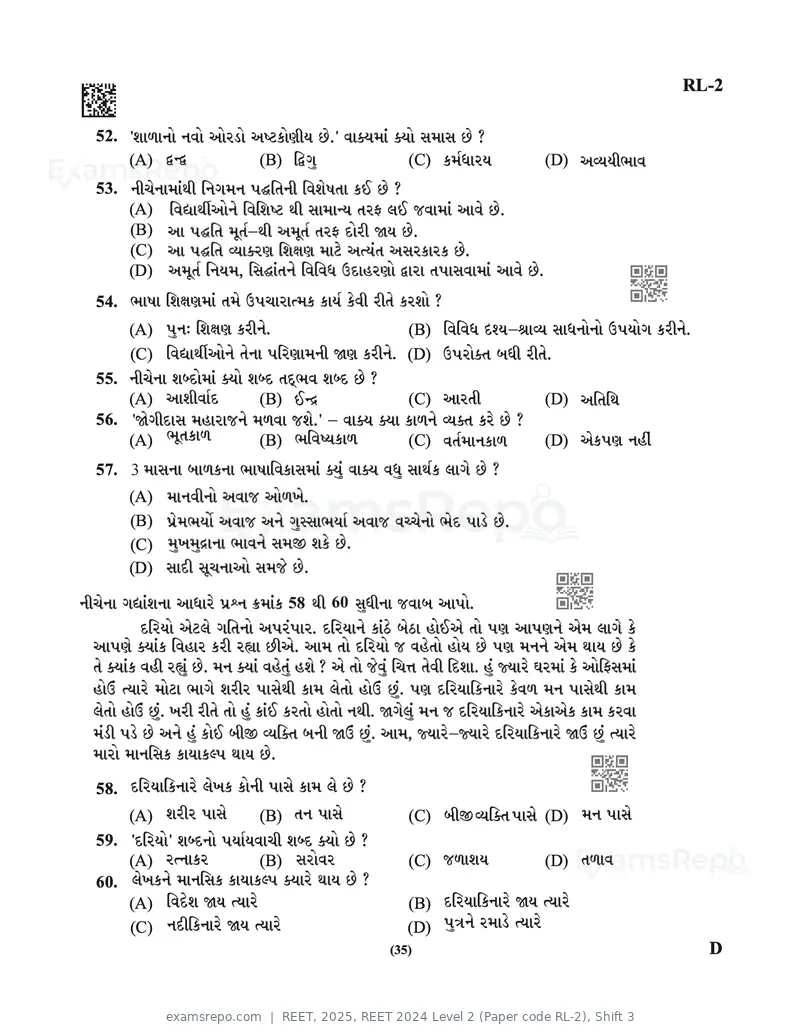
Text of page 323
RL-2

52.
      (A)   (B)      (C)   (D)
53.
      (A)
      (B)
      (C)
      (D)
54.
      (A)            (B)
      (C)            (D)
55.
      (A)   (B)      (C)   (D)
56.
      (A)   (B)      (C)   (D)
57.
      (A)
      (B)
      (C)
      (D)


58.
      (A)   (B)      (C)   (D)
59.
      (A)   (B)      (C)   (D)
60.
      (A)            (B)
      (C)            (D)
                  (35)             D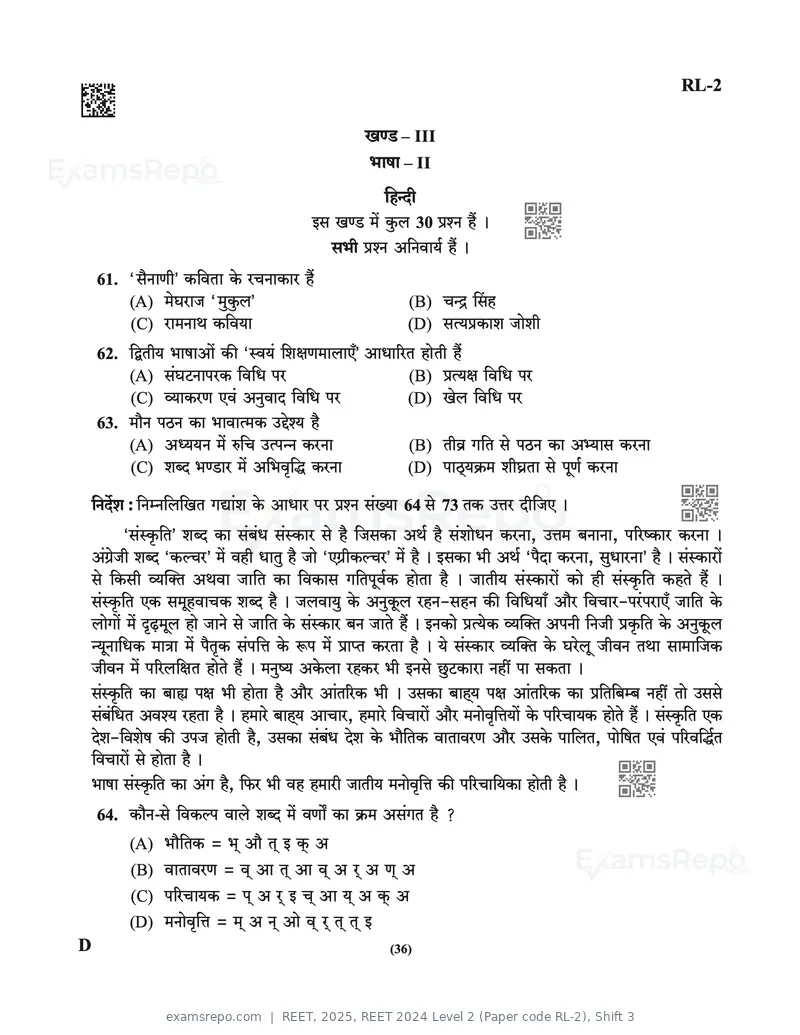
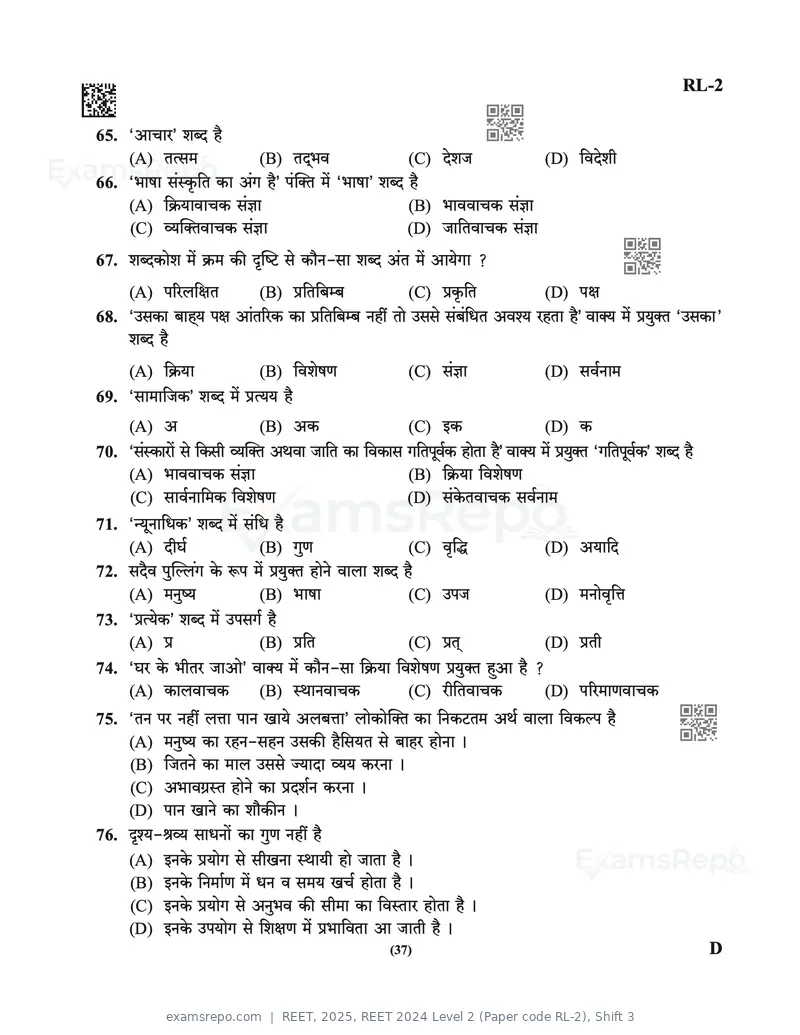
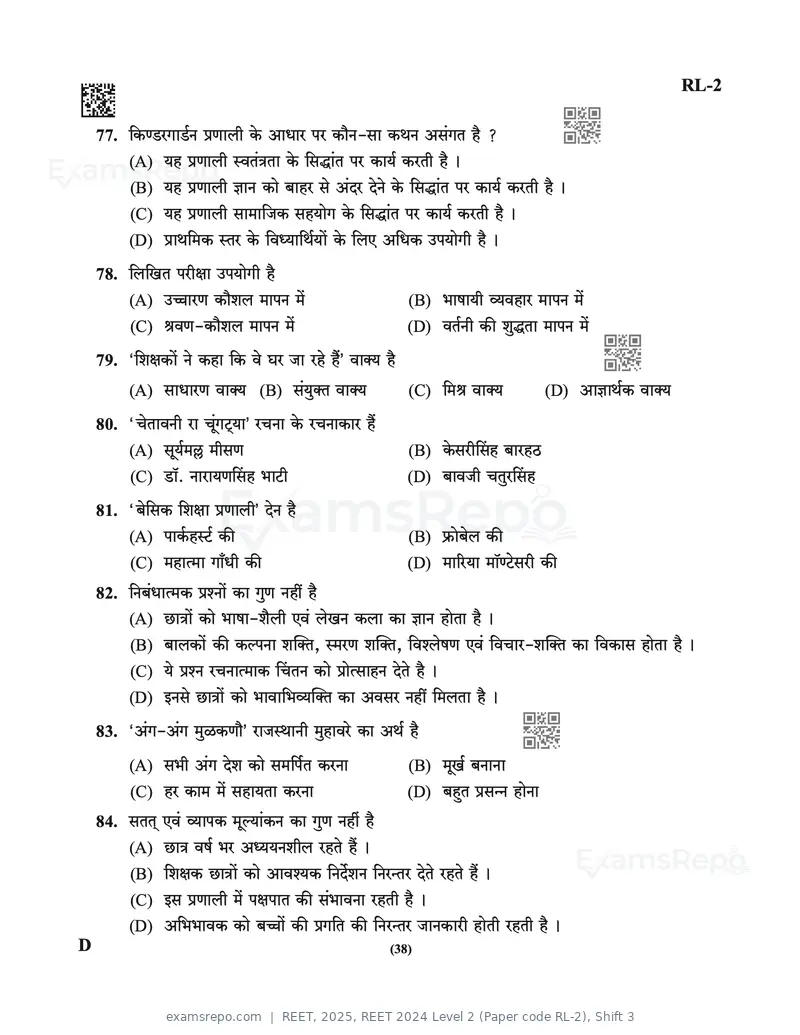
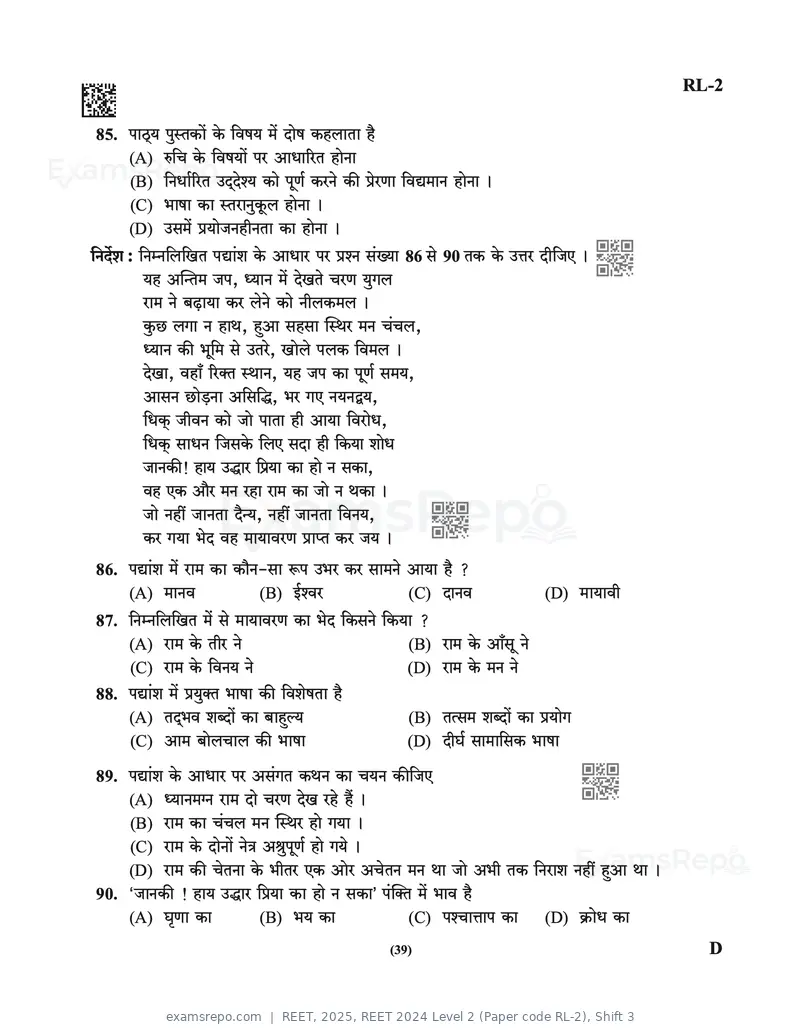
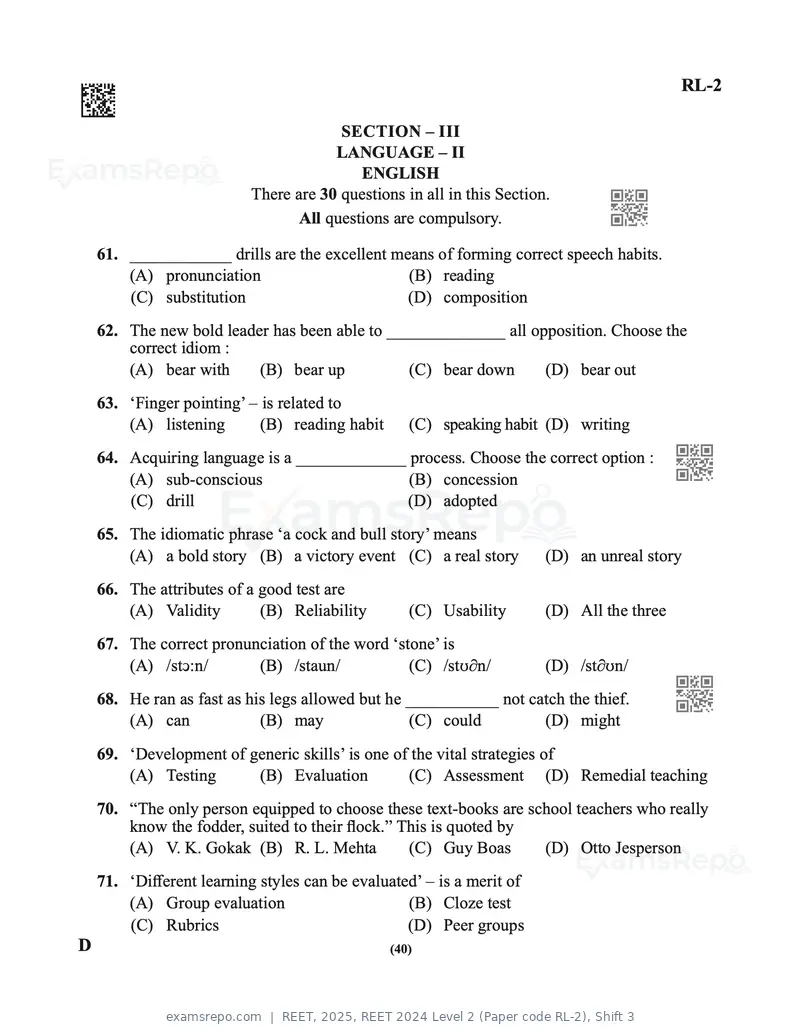
Text of page 328
RL-2

                                        SECTION – III
                                       LANGUAGE – II
                                           ENGLISH
                           There are 30 questions in all in this Section.
                                  All questions are compulsory.

    61. ____________ drills are the excellent means of forming correct speech habits.
        (A) pronunciation                       (B) reading
        (C) substitution                        (D) composition
    62. The new bold leader has been able to ______________ all opposition. Choose the
        correct idiom :
        (A) bear with     (B) bear up           (C) bear down     (D) bear out
    63. ‘Finger pointing’ – is related to
        (A) listening       (B) reading habit      (C) speaking habit (D) writing
    64. Acquiring language is a _____________ process. Choose the correct option :
        (A) sub-conscious                     (B) concession
        (C) drill                            (D) adopted
    65. The idiomatic phrase ‘a cock and bull story’ means
        (A) a bold story (B) a victory event (C) a real story           (D) an unreal story
    66. The attributes of a good test are
        (A) Validity        (B) Reliability        (C) Usability        (D) All the three
    67. The correct pronunciation of the word ‘stone’ is
        (A) /stͻ:n/       (B) /staun/            (C) /stʊ∂n/            (D) /st∂ʊn/
    68. He ran as fast as his legs allowed but he ___________ not catch the thief.
        (A) can             (B) may               (C) could         (D) might
    69. ‘Development of generic skills’ is one of the vital strategies of
        (A) Testing      (B) Evaluation          (C) Assessment (D) Remedial teaching
    70. “The only person equipped to choose these text-books are school teachers who really
        know the fodder, suited to their flock.” This is quoted by
        (A) V. K. Gokak (B) R. L. Mehta          (C) Guy Boas      (D) Otto Jesperson
    71. ‘Different learning styles can be evaluated’ – is a merit of
        (A) Group evaluation                      (B) Cloze test
        (C) Rubrics                               (D) Peer groups
D                                               (40)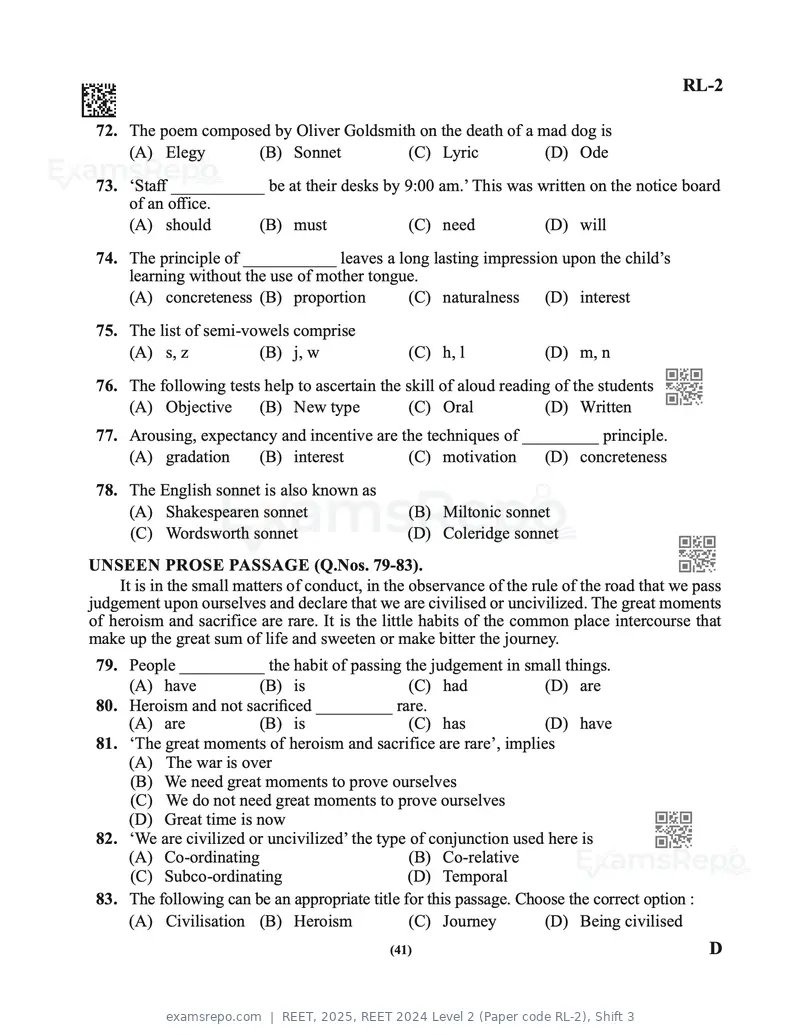
Text of page 329
RL-2

 72. The poem composed by Oliver Goldsmith on the death of a mad dog is
     (A) Elegy       (B) Sonnet          (C) Lyric            (D) Ode
 73. ‘Staff ___________ be at their desks by 9:00 am.’ This was written on the notice board
     of an office.
     (A) should       (B) must               (C) need            (D) will
 74. The principle of ___________ leaves a long lasting impression upon the child’s
     learning without the use of mother tongue.
     (A) concreteness (B) proportion         (C) naturalness (D) interest
 75. The list of semi-vowels comprise
     (A) s, z           (B) j, w                 (C) h, l            (D) m, n
 76. The following tests help to ascertain the skill of aloud reading of the students
     (A) Objective      (B) New type           (C) Oral             (D) Written
 77. Arousing, expectancy and incentive are the techniques of _________ principle.
     (A) gradation     (B) interest          (C) motivation      (D) concreteness
 78. The English sonnet is also known as
     (A) Shakespearen sonnet                     (B) Miltonic sonnet
     (C) Wordsworth sonnet                       (D) Coleridge sonnet
UNSEEN PROSE PASSAGE (Q.Nos. 79-83).
    It is in the small matters of conduct, in the observance of the rule of the road that we pass
judgement upon ourselves and declare that we are civilised or uncivilized. The great moments
of heroism and sacrifice are rare. It is the little habits of the common place intercourse that
make up the great sum of life and sweeten or make bitter the journey.
 79. People __________ the habit of passing the judgement in small things.
     (A) have           (B) is                  (C) had             (D) are
 80. Heroism and not sacrificed _________ rare.
     (A) are            (B) is                  (C) has             (D) have
 81. ‘The great moments of heroism and sacrifice are rare’, implies
     (A) The war is over
     (B) We need great moments to prove ourselves
     (C) We do not need great moments to prove ourselves
     (D) Great time is now
 82. ‘We are civilized or uncivilized’ the type of conjunction used here is
     (A) Co-ordinating                          (B) Co-relative
     (C) Subco-ordinating                       (D) Temporal
 83. The following can be an appropriate title for this passage. Choose the correct option :
     (A) Civilisation (B) Heroism               (C) Journey         (D) Being civilised
                                              (41)                                             D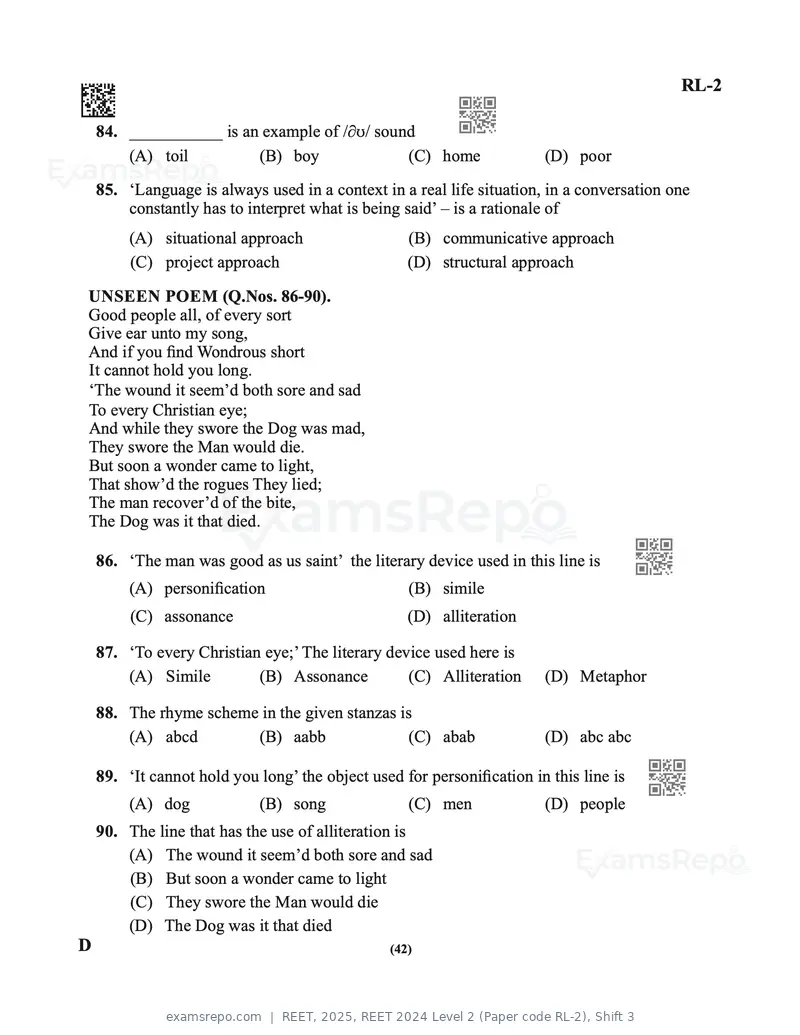
Text of page 330
RL-2

    84. ___________ is an example of /∂ʊ/ sound
        (A) toil         (B) boy              (C) home                  (D) poor

    85. ‘Language is always used in a context in a real life situation, in a conversation one
        constantly has to interpret what is being said’ – is a rationale of
         (A) situational approach                  (B) communicative approach
         (C) project approach                      (D) structural approach

UNSEEN POEM (Q.Nos. 86-90).
Good people all, of every sort
Give ear unto my song,
And if you find Wondrous short
It cannot hold you long.
‘The wound it seem’d both sore and sad
To every Christian eye;
And while they swore the Dog was mad,
They swore the Man would die.
But soon a wonder came to light,
That show’d the rogues They lied;
The man recover’d of the bite,
The Dog was it that died.

    86. ‘The man was good as us saint’ the literary device used in this line is
         (A) personification                       (B) simile
         (C) assonance                             (D) alliteration

    87. ‘To every Christian eye;’ The literary device used here is
        (A) Simile         (B) Assonance          (C) Alliteration      (D) Metaphor

    88. The rhyme scheme in the given stanzas is
        (A) abcd        (B) aabb               (C) abab                 (D) abc abc

    89. ‘It cannot hold you long’ the object used for personification in this line is
         (A) dog             (B) song              (C) men              (D) people
    90. The line that has the use of alliteration is
        (A) The wound it seem’d both sore and sad
        (B) But soon a wonder came to light
        (C) They swore the Man would die
        (D) The Dog was it that died
D                                               (42)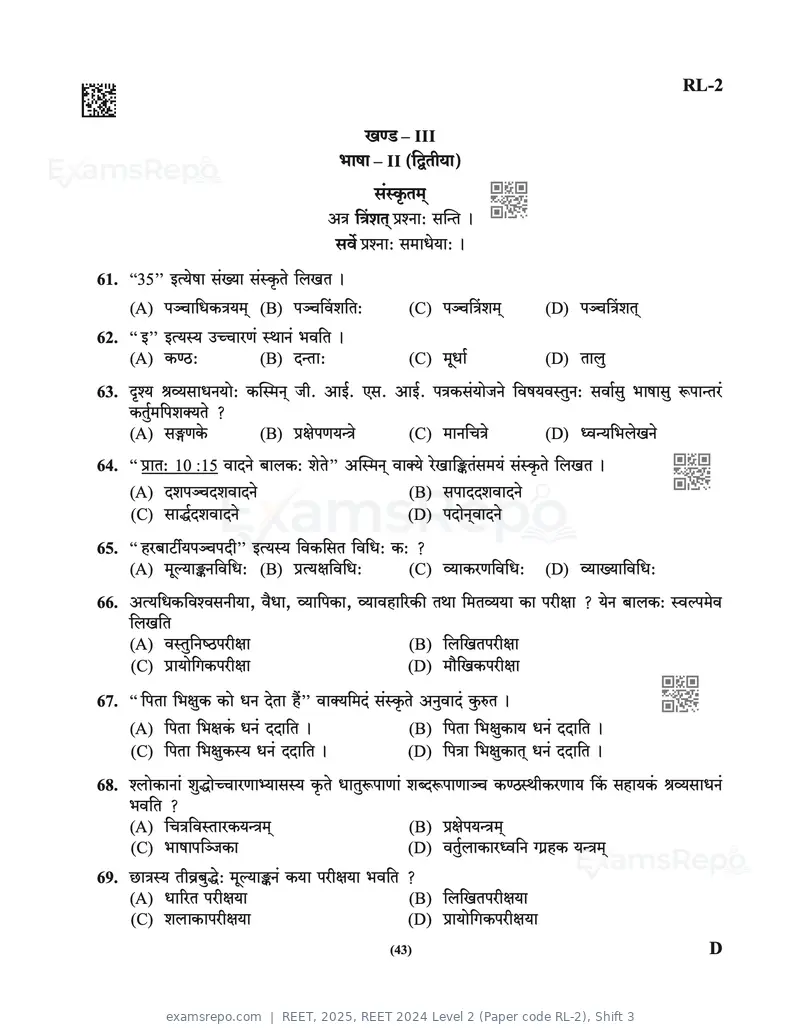
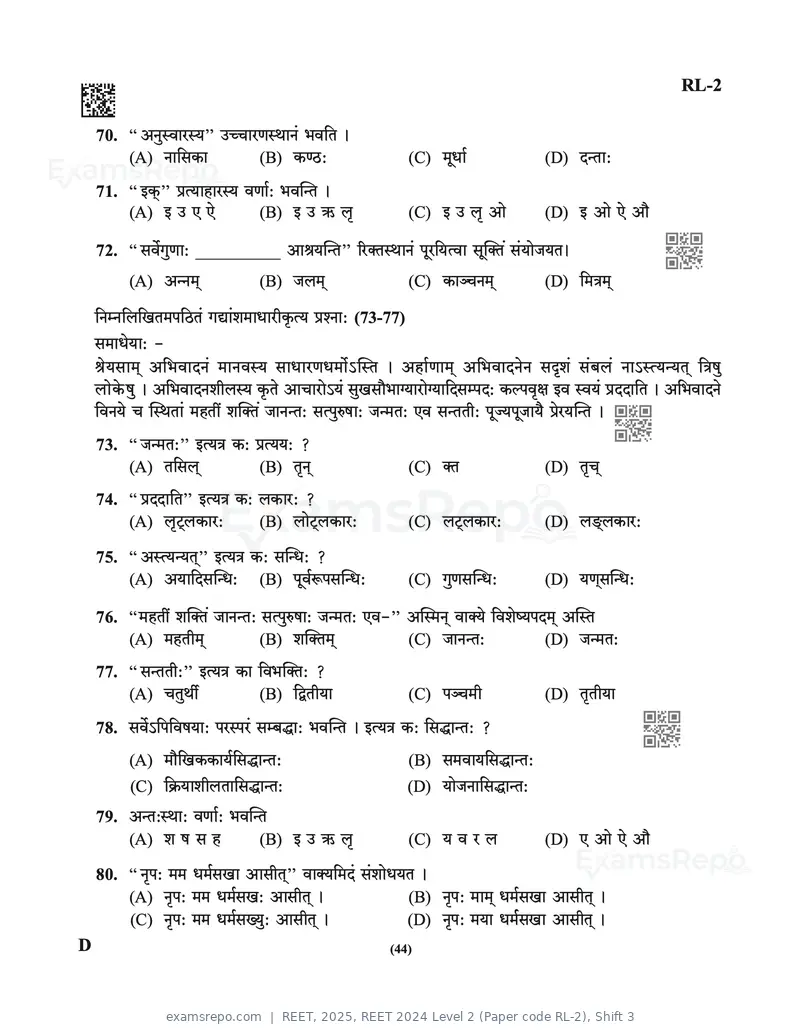
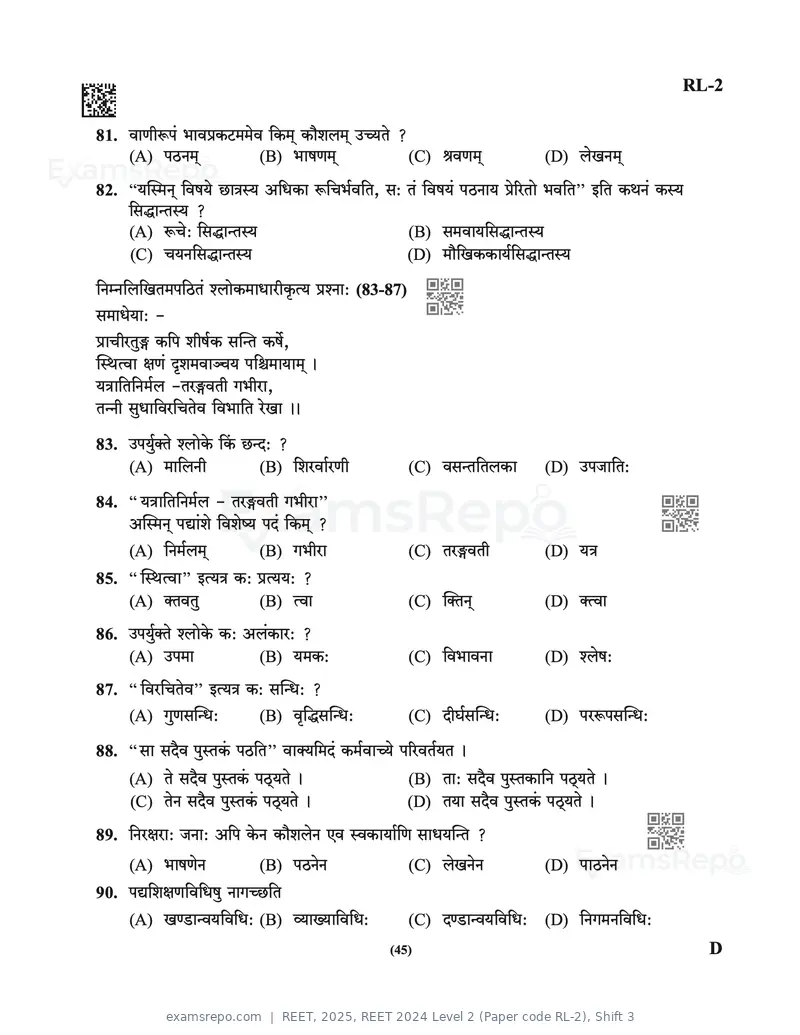
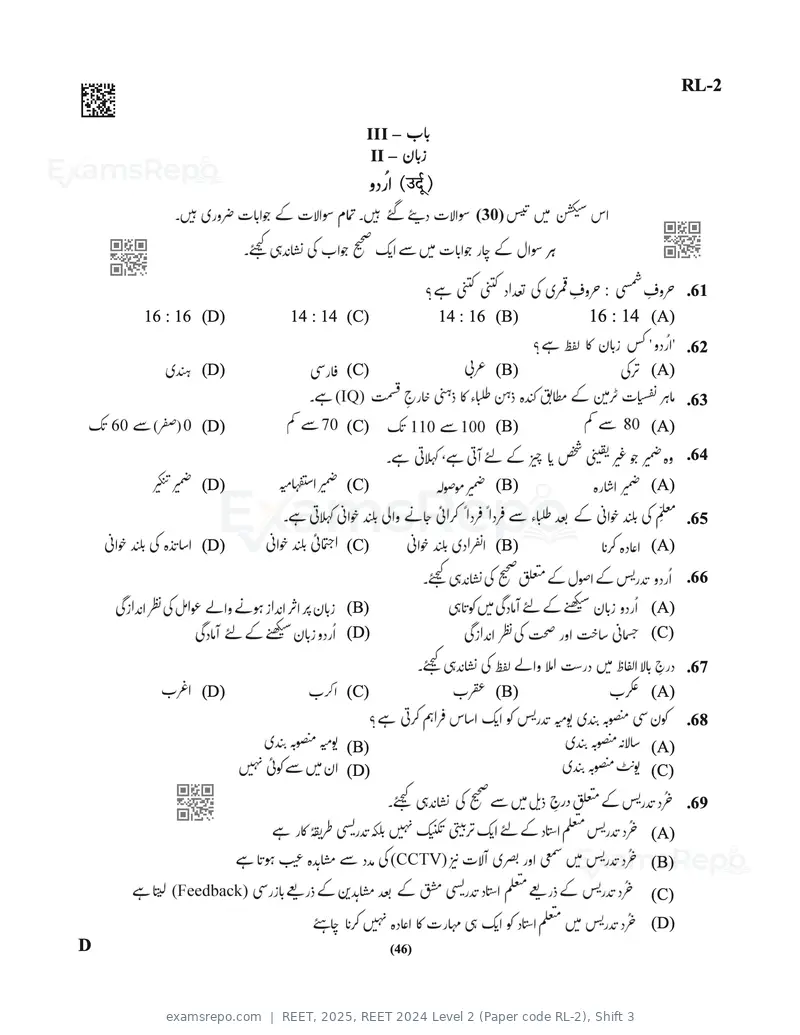
Text of page 334
RL-2

                            III –
                             II –
                                 (CXÿ© )


                                                                       .61
    16 : 16 (D)   14 : 14 (C)              14 : 16 (B)   16 : 14 (A)
                                                                       .62
           (D)           (C)                      (B)           (A)
                                                                       .63
           (D)           (C)                      (B)           (A)
                                                                       .64
           (D)           (C)                      (B)           (A)
                                                                       .65
           (D)           (C)                      (B)           (A)
                                                                       .66
                         (B)                                    (A)
                         (D)                                    (C)

                                                                       .67
           (D)           (C)                      (B)           (A)
                                                                       .68
                         (B)                                    (A)
                         (D)                                    (C)
                                                                       .69
                                                                (A)
                                                                (B)
                                                                (C)
                                                                (D)
D                               (46)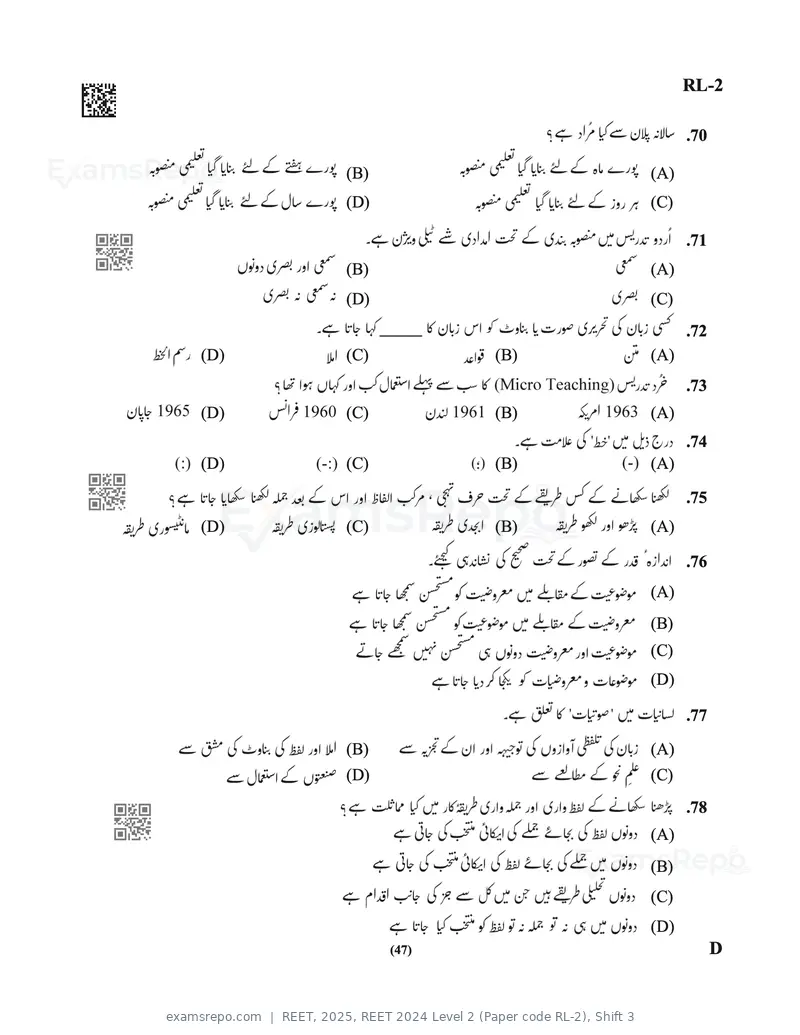
Text of page 335
RL-2

                               .70

      (B)                (A)
      (D)                (C)

                               .71
      (B)                (A)
      (D)                (C)
                               .72
(D)   (C)          (B)   (A)
                               .73
(D)   (C)          (B)   (A)
                               .74
(D)   (C)          (B)   (A)

                               .75
(D)   (C)          (B)   (A)

                               .76
                         (A)
                         (B)
                         (C)
                         (D)

                               .77
      (B)                (A)
      (D)                (C)
                               .78
                         (A)
                         (B)
                         (C)
                         (D)
            (47)                     D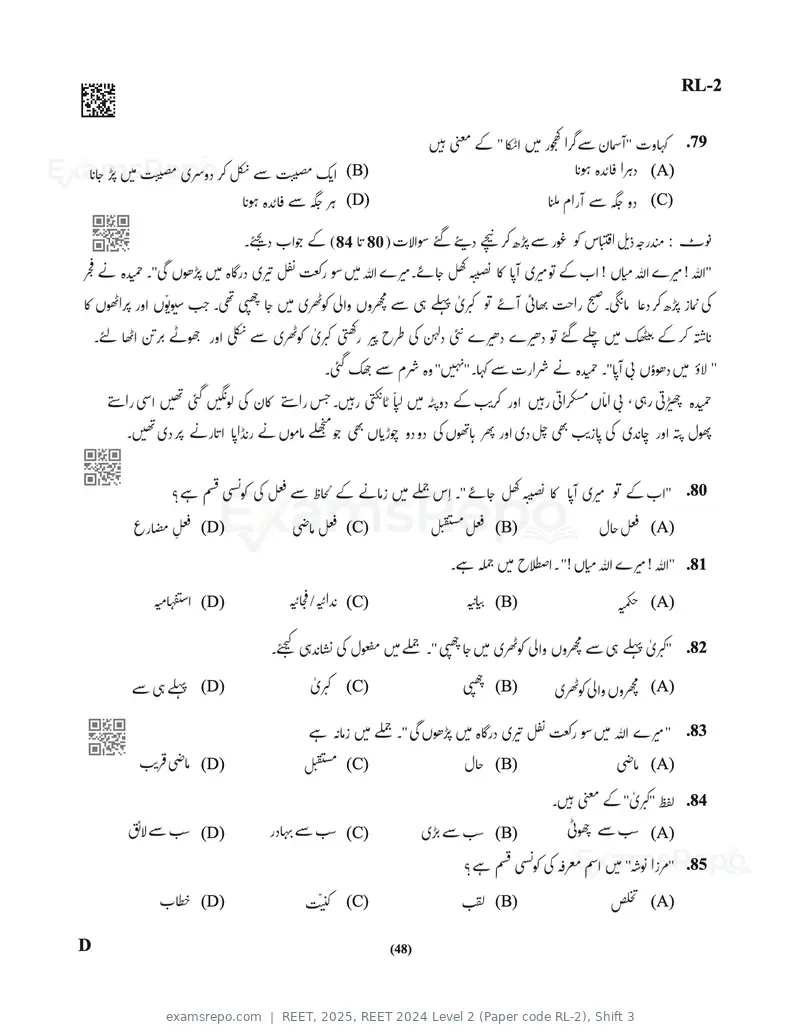
Text of page 336
RL-2


                                   .79
          (B)                (A)
          (D)                (C)


                                   .80

    (D)   (C)          (B)   (A)

                                   .81

    (D)   (C)          (B)   (A)

                                   .82

    (D)   (C)          (B)   (A)

                                   .83
    (D)   (C)          (B)   (A)

                                   .84
    (D)   (C)          (B)   (A)
                                   .85

    (D)   (C)          (B)   (A)

D               (48)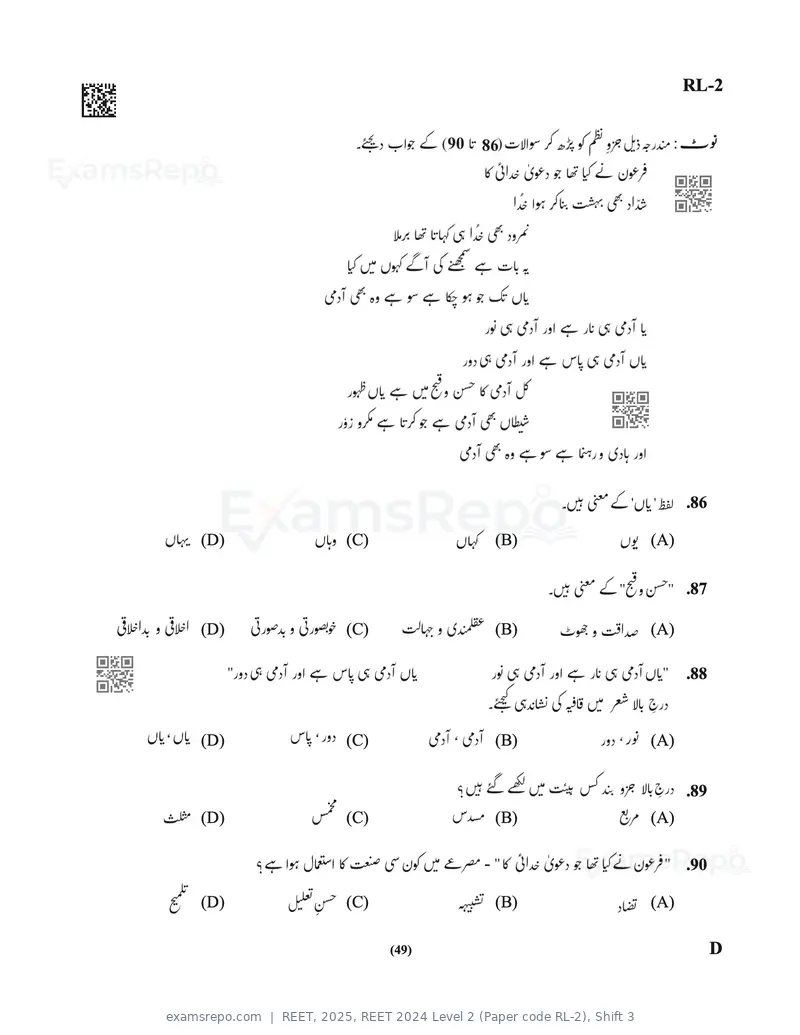
Text of page 337
RL-2


                               .86

(D)   (C)          (B)   (A)

                               .87

(D)   (C)          (B)   (A)

                               .88


(D)   (C)          (B)   (A)

                               .89
(D)   (C)          (B)   (A)

                               .90

(D)   (C)          (B)   (A)

            (49)                     D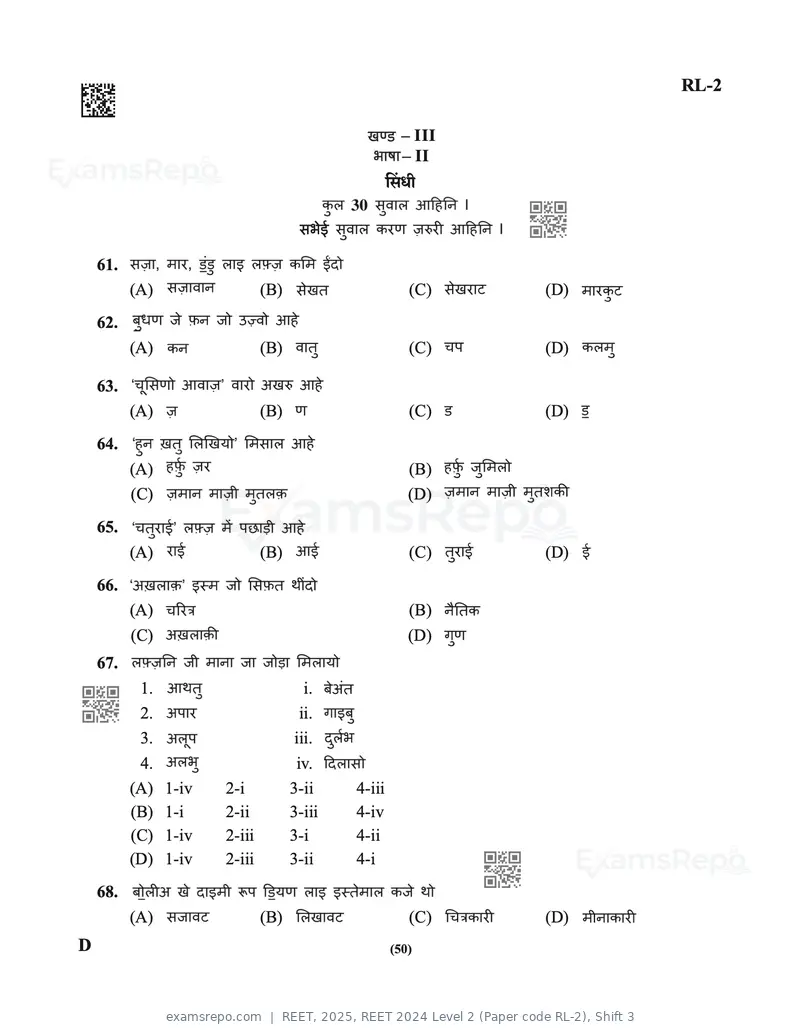
Text of page 338
RL-2

                                                     – III
                                                     – II
                                                   qgYr


    61.
          (A)                (B)                      (C)    (D)
    62.
          (A)                (B)                      (C)    (D)

    63.
          (A)                (B)                      (C)    (D)
    64.
          (A)                                         (B)
          (C)                                         (D)
    65.
          (A)                (B)                      (C)    (D)
    66.
          (A)                                         (B)
          (C)                                         (D)
    67.
           1.                         i.
           2.                        ii.
           3.                       iii.
           4.                       iv.
          (A) 1-iv   2-i           3-ii    4-iii
          (B) 1-i    2-ii          3-iii   4-iv
          (C) 1-iv   2-iii         3-i     4-ii
          (D) 1-iv   2-iii         3-ii    4-i
    68.
          (A)                (B)                      (C)    (D)
D                                                  (50)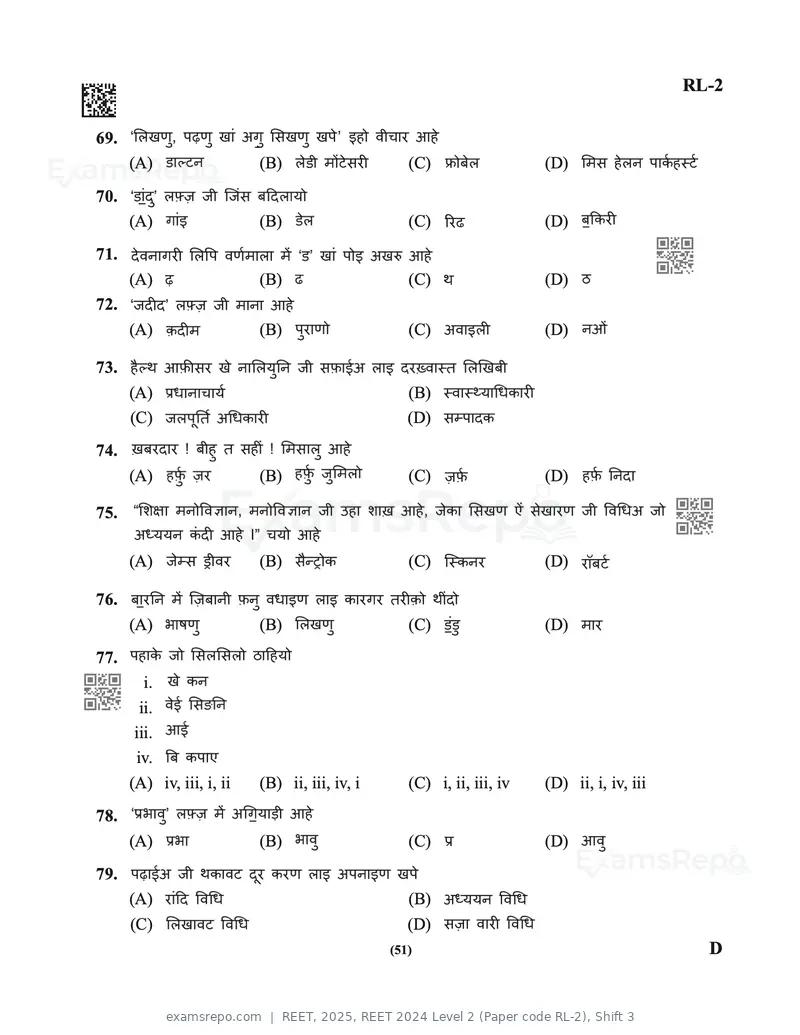
Text of page 339
RL-2

69.
      (A)                  (B)                     (C)                  (D)
70.
      (A)                  (B)                     (C)                  (D)
71.
      (A)                  (B)                     (C)                  (D)
72.
      (A)                  (B)                     (C)                  (D)

73.
      (A)                                          (B)
      (C)                                          (D)
74.
      (A)                  (B)                     (C)                  (D)

75.

      (A)                  (B)                     (C)                  (D)

76.
      (A)                  (B)                     (C)                  (D)
77.
         i.
        ii.
       iii.
       iv.
      (A) iv, iii, i, ii   (B) ii, iii, iv, i      (C) i, ii, iii, iv   (D) ii, i, iv, iii
78.
      (A)                  (B)                     (C)                  (D)
79.
      (A)                                          (B)
      (C)                                          (D)
                                                (51)                                           D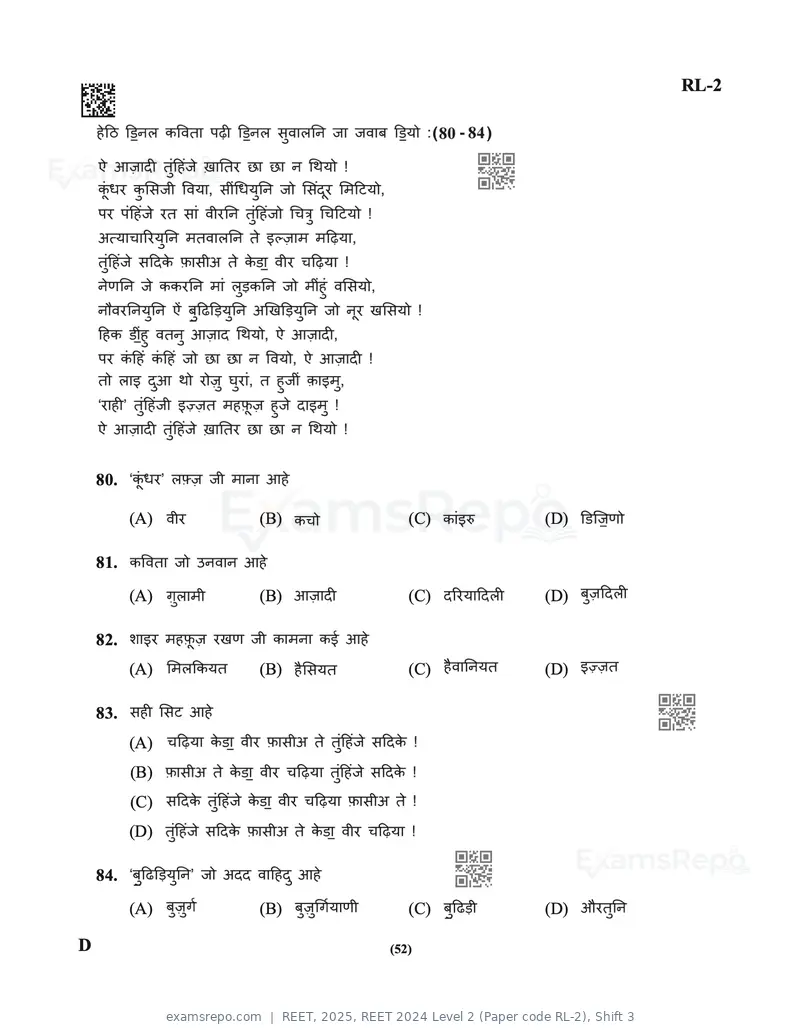
Text of page 340
RL-2


    80.

          (A)   (B)      (C)   (D)

    81.
          (A)   (B)      (C)   (D)

    82.
          (A)   (B)      (C)   (D)

    83.
          (A)
          (B)
          (C)
          (D)

    84.
          (A)   (B)      (C)   (D)

D                     (52)
Text of page 341
RL-2

85.
      (A)            (B)
      (C)            (D)


86.
      (A)   (B)      (C)   (D)

87.
      (A)   (B)      (C)   (D)
88.
      (A)
      (B)
      (C)
      (D)
89.
      (A)            (B)
      (C)            (D)

90.
      (A)   (B)      (C)   (D)
                  (53)             D
Text of page 342
RL-2

                       – III
                         – II
                       ( n§Om~r)


    61.
          (A)   (B)      (C)           (D)

    62.
          (A)            (B)
          (C)            (D)
    63.
          (A)
          (B)
          (C)
          (D)
    64.


          (A)            (B)
          (C)            (D)
    65.                            :
          (A)            (B)
          (C)            (D)
    66.

          (A)            (B)
          (C)            (D)
    67.                        :
          (A)   (B)      (C)           (D)
    68.
          (A)   (B)      (C)           (D)
D                     (54)
Text of page 343
RL-2

69.                              :
      (A)            (B)
      (C)            (D)
70.

      (A)   (B)      (C)   (D)
71.
      (A)            (B)
      (C)            (D)
72.                                   :
      (A)            (B)
      (C)            (D)


73.
      (A)   (B)      (C)   (D)
74.
      (A)   (B)      (C)   (D)

75.

      (A)
      (B)
      (C)
      (D)
76.
      (A)   (B)      (C)   (D)
                  (55)                    D
Text of page 344
RL-2

    77.

          (A)            (B)
          (C)            (D)
    78.

          (A)            (B)
          (C)            (D)
    79.

          (A)            (B)
          (C)            (D)
    80.
          (A)   (B)      (C)   (D)
    81.

          (A)            (B)
          (C)            (D)

    82.
          (A)            (B)
          (C)            (D)
    83.          :
          (A)
          (B)
          (C)
          (D)
    84.
          (A)            (B)
          (C)            (D)
    85.


          (A)            (B)
          (C)            (D)
D                     (56)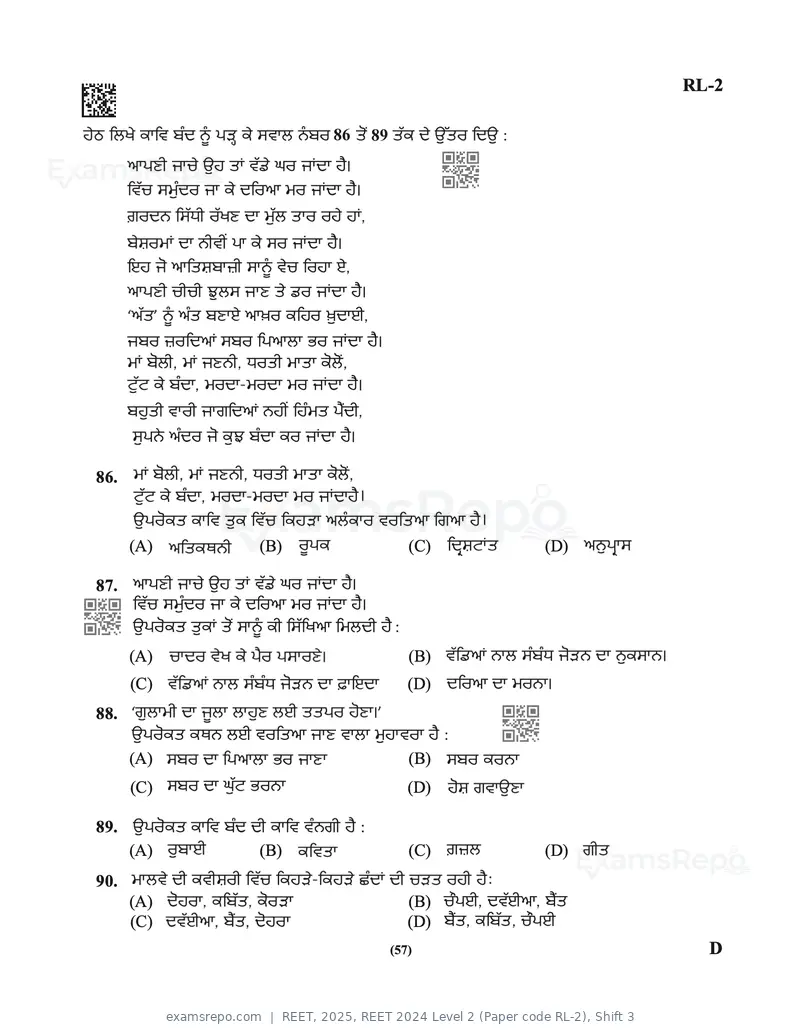
Text of page 345
RL-2


86.


      (A)   (B)      (C)   (D)

87.


      (A)            (B)
      (C)            (D)
88.

      (A)            (B)
      (C)            (D)

89.
      (A)   (B)      (C)   (D)
90.
      (A)            (B)
      (C)            (D)
                  (57)             D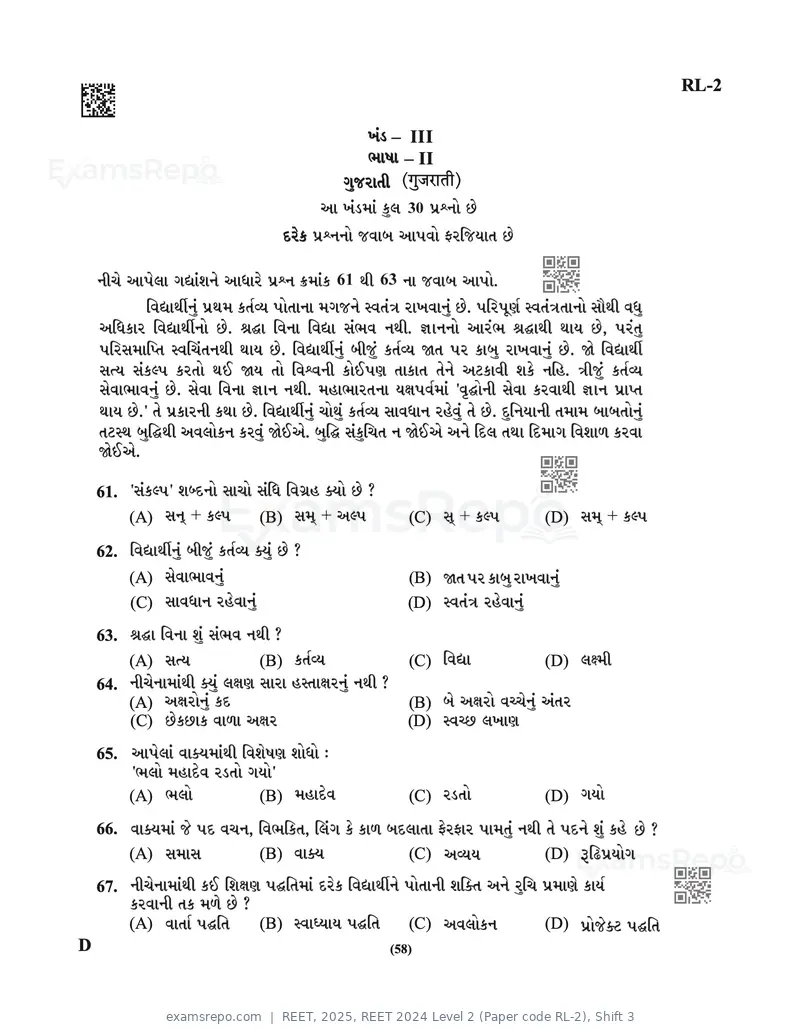
Text of page 346
RL-2

                      – III
                       – II
                        (JwOamVr)>


    61.
          (A)   (B)      (C)         (D)

    62.
          (A)            (B)
          (C)            (D)
    63.
          (A)   (B)      (C)         (D)
    64.
          (A)            (B)
          (C)            (D)
    65.

          (A)   (B)      (C)         (D)
    66.
          (A)   (B)      (C)         (D)
    67.

          (A)   (B)      (C)         (D)
D                     (58)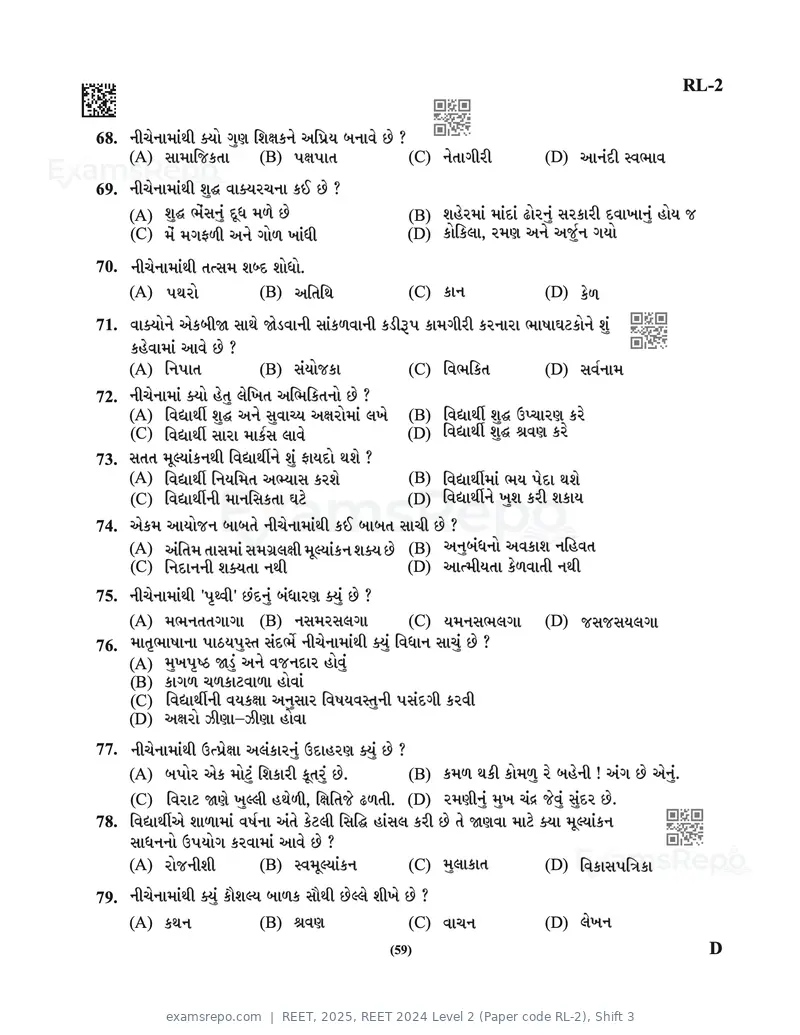
Text of page 347
RL-2

68.
      (A)   (B)      (C)   (D)
69.
      (A)            (B)
      (C)            (D)
70.
      (A)   (B)      (C)   (D)
71.

      (A)   (B)      (C)   (D)
72.
      (A)            (B)
      (C)            (D)
73.
      (A)            (B)
      (C)            (D)
74.
      (A)            (B)
      (C)            (D)
75.
      (A)   (B)      (C)   (D)
76.
      (A)
      (B)
      (C)
      (D)
77.
      (A)            (B)
      (C)            (D)
78.

      (A)   (B)      (C)   (D)
79.
      (A)   (B)      (C)   (D)
                  (59)             D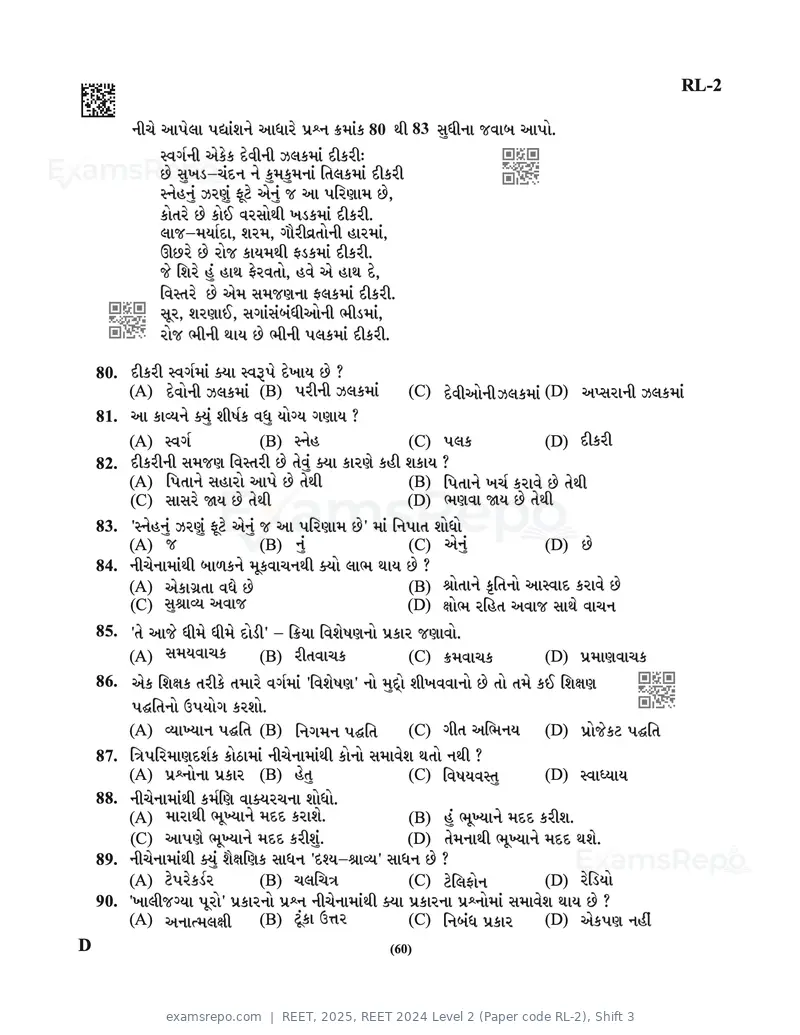
Text of page 348
RL-2


    80.
          (A)   (B)      (C)   (D)
    81.
          (A)   (B)      (C)   (D)
    82.
          (A)            (B)
          (C)            (D)
    83.
          (A)   (B)      (C)   (D)
    84.
          (A)            (B)
          (C)            (D)
    85.
          (A)   (B)      (C)   (D)
    86.

          (A)   (B)      (C)   (D)
    87.
          (A)   (B)      (C)   (D)
    88.
          (A)            (B)
          (C)            (D)
    89.
          (A)   (B)      (C)   (D)
    90.
          (A)   (B)      (C)   (D)
D                     (60)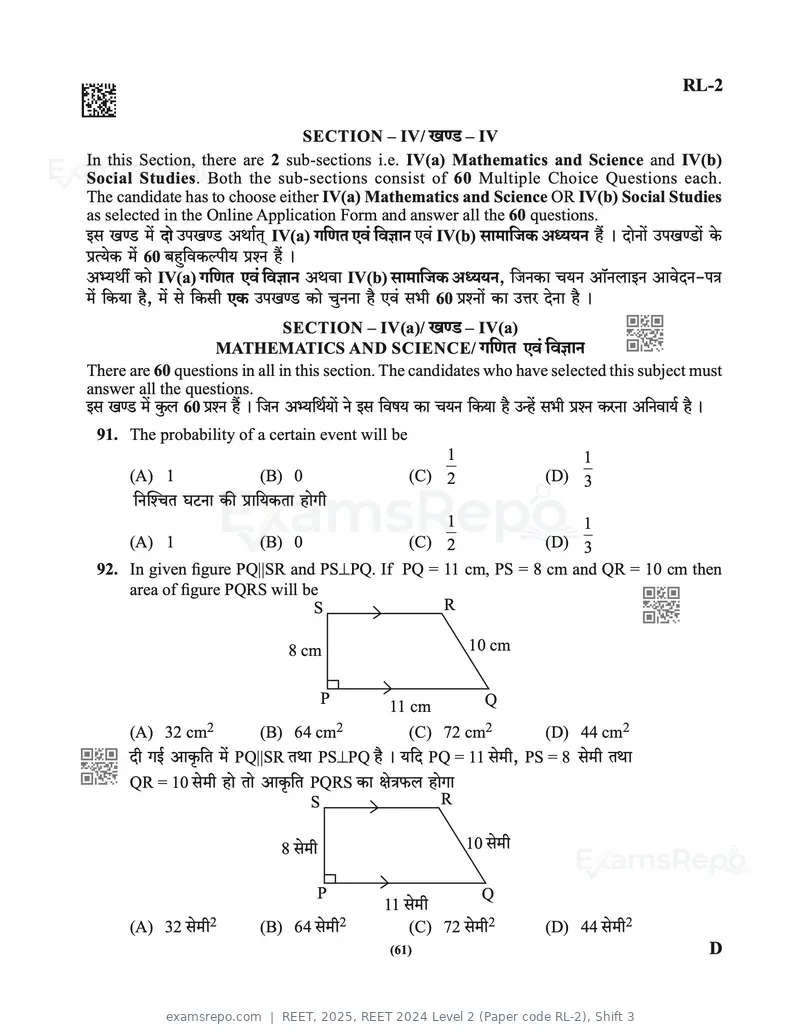
Text of page 349
RL-2

                                   SECTION – IV/ IÊS> – IV
In this Section, there are 2 sub-sections i.e. IV(a) Mathematics and Science and IV(b)
Social Studies. Both the sub-sections consist of 60 Multiple Choice Questions each.
The candidate has to choose either IV(a) Mathematics and Science OR IV(b) Social Studies
as selected in the Online Application Form and answer all the 60 questions.
Bg IÊS> _| Xmo CnIÊS> AWm©V² IV(a) J{UV Ed§ {dkmZ Ed§ IV(b) gm_m{OH$ AÜ``Z h¢ & XmoZm| CnIÊS>m| Ho$
àË`oH$ _| 60 ~hþ{dH$ënr` àíZ h¢ &
Aä`Wu H$mo IV(a) J{UV Ed§ {dkmZ AWdm IV(b) gm_m{OH$ AÜ``Z, {OZH$m M`Z Am°ZbmBZ AmdoXZ-nÌ
_| {H$`m h¡, _| go {H$gr EH$ CnIÊS> H$mo MwZZm h¡ Ed§ g^r 60 àíZm| H$m CÎma XoZm h¡ &
                                SECTION – IV(a)/ IÊS> – IV(a)
                     MATHEMATICS AND SCIENCE/ J{UV Ed§ {dkmZ
There are 60 questions in all in this section. The candidates who have selected this subject must
answer all the questions.
Bg IÊS> _| Hw$b 60 àíZ h¢ & {OZ Aä`{W©`m| Zo Bg {df` H$m M`Z {H$`m h¡ CÝh| g^r àíZ H$aZm A{Zdm`© h¡ &
 91. The probability of a certain event will be
                                                       1                    1
      (A) 1                (B) 0                   (C) 2                (D) 3
       {ZpíMV KQ>Zm H$s àm{`H$Vm hmoJr
                                               1                 1
     (A) 1              (B) 0              (C) 2             (D) 3
 92. In given figure PQ||SR and PS⊥PQ. If PQ = 11 cm, PS = 8 cm and QR = 10 cm then
     area of figure PQRS will be
                               S               R

                                8 cm                        10 cm


                                       P        11 cm          Q
      (A) 32 cm2           (B) 64 cm2           (C) 72 cm2        (D) 44 cm2
      Xr JB© AmH¥${V _| PQ||SR VWm PS⊥PQ h¡ & `{X PQ = 11 go_r, PS = 8 go_r VWm
      QR = 10 go_r hmo Vmo AmH¥${V PQRS H$m joÌ\$b hmoJm
                                   S                 R

                              8 go_r                        10 go_r

                                    P                       Q
                                               11 go_r
      (A) 32 go_r2         (B) 64 go_r2           (C) 72 go_r2          (D) 44 go_r2
                                                (61)                                              D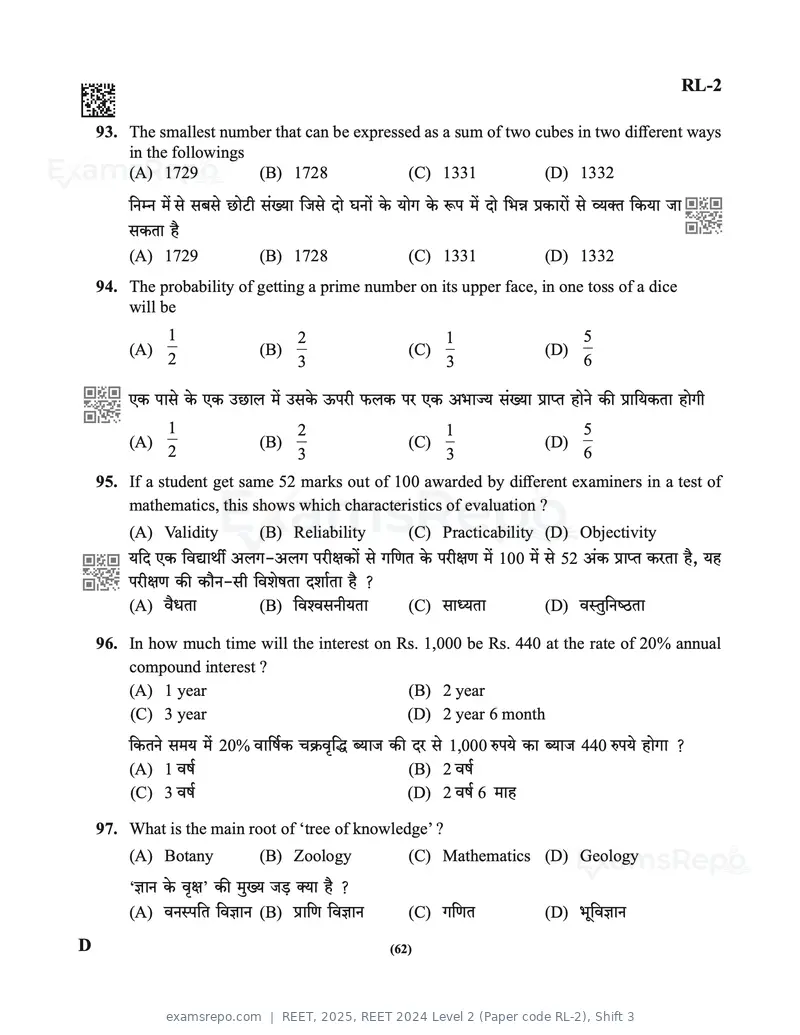
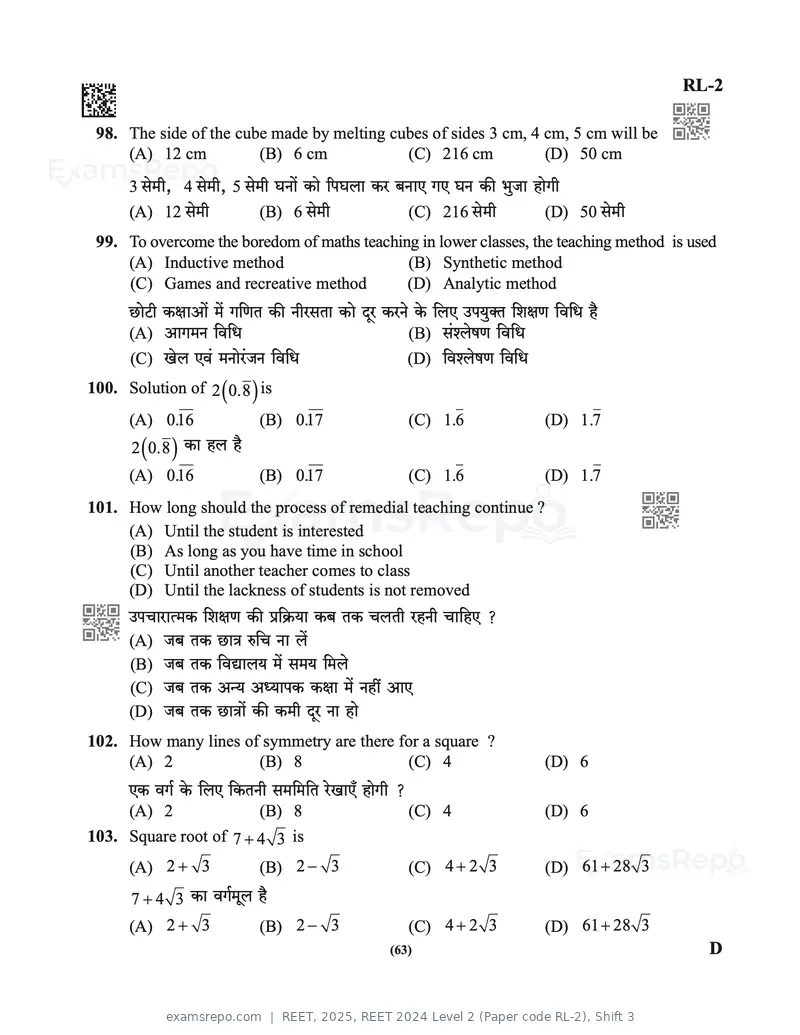
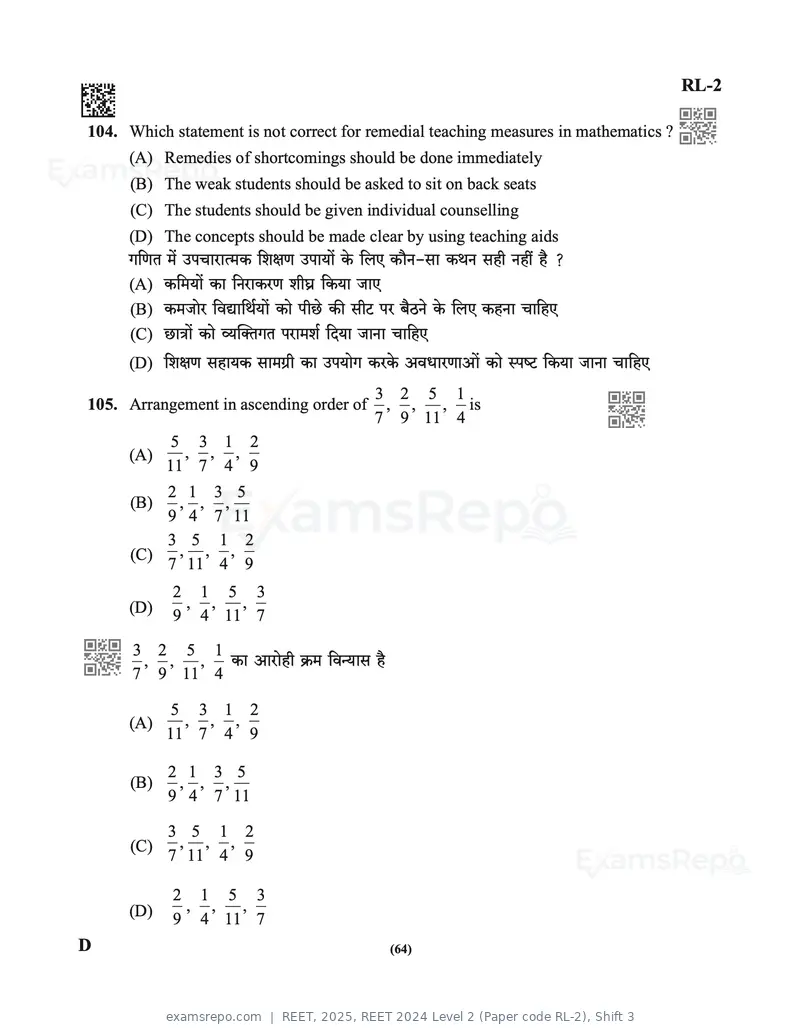
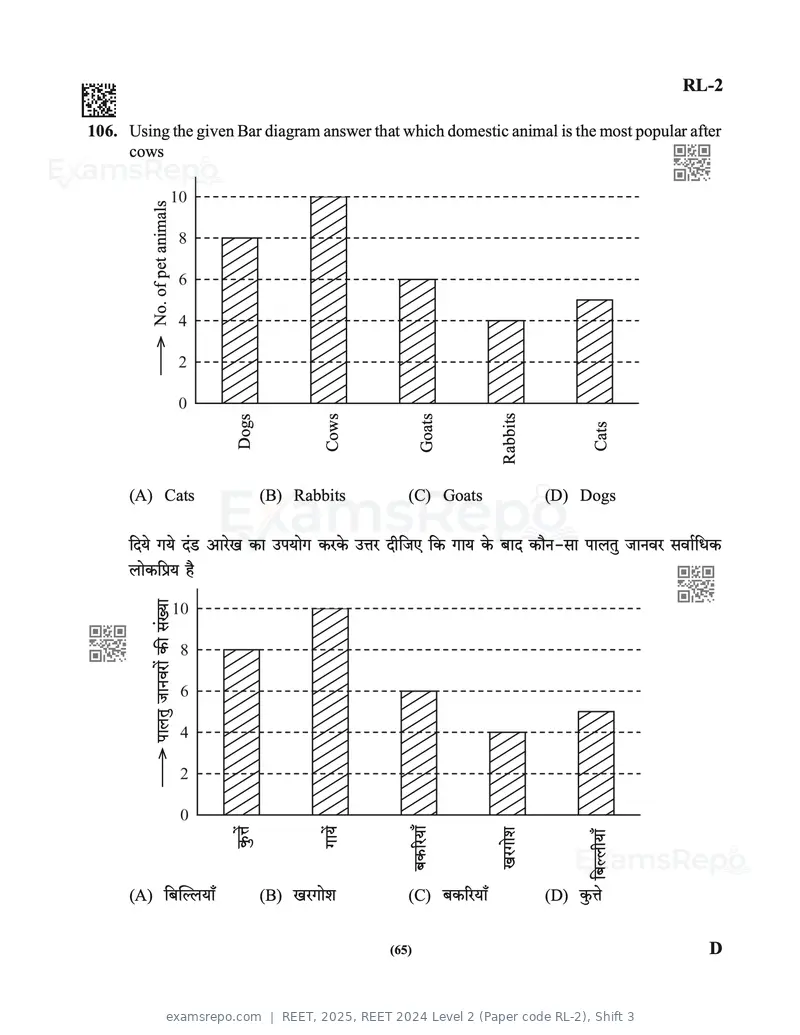
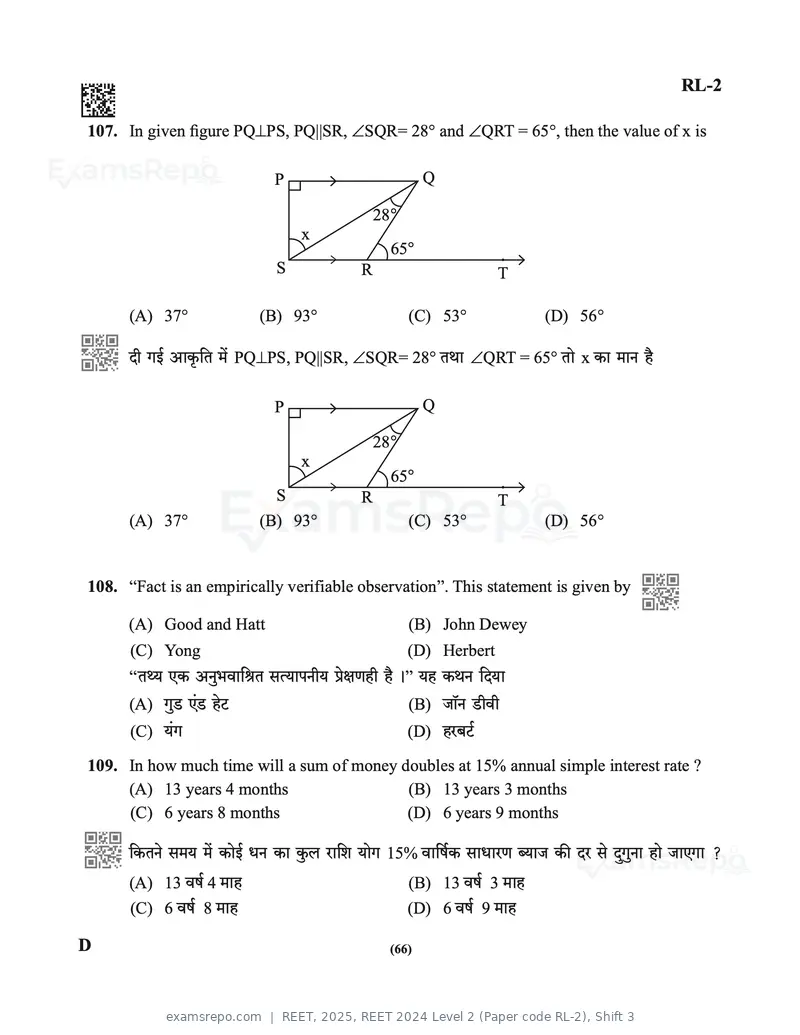
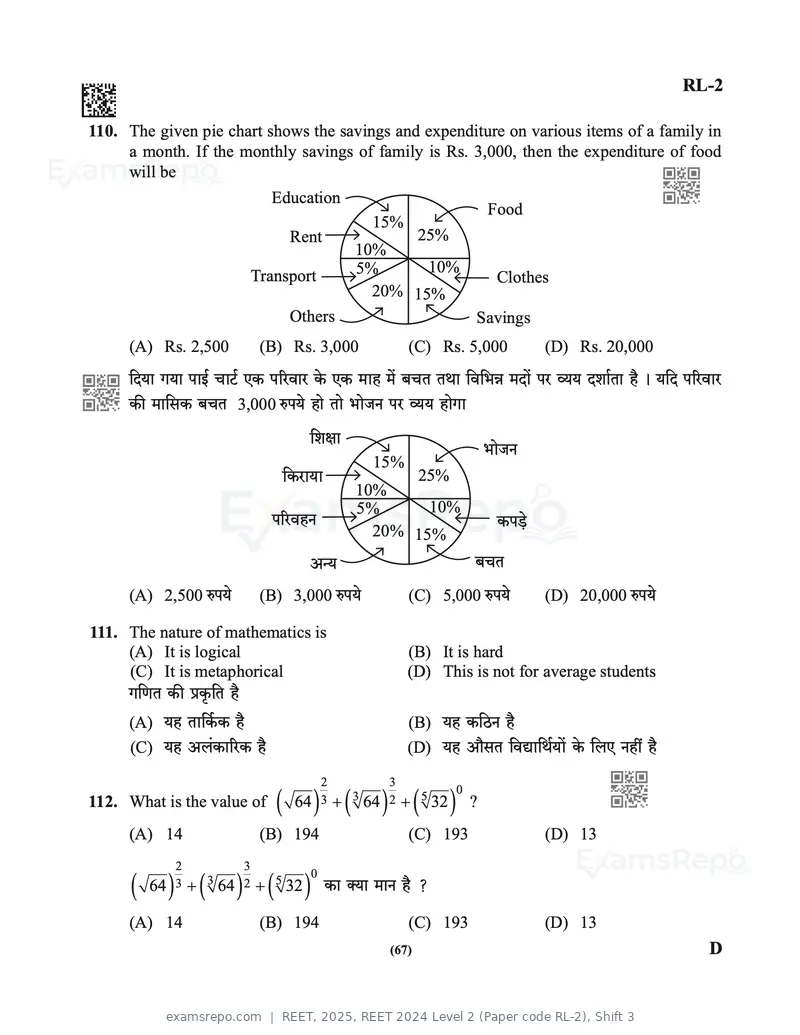
Text of page 355
RL-2

110. The given pie chart shows the savings and expenditure on various items of a family in
     a month. If the monthly savings of family is Rs. 3,000, then the expenditure of food
     will be
                            Education
                                                              Food
                                           15%
                              Rent             25%
                                         10%
                                         5%      10%
                        Transport                              Clothes
                                           20% 15%
                              Others                        Savings
     (A) Rs. 2,500       (B) Rs. 3,000            (C) Rs. 5,000          (D) Rs. 20,000
     {X`m J`m nmB© MmQ>© EH$ n[adma Ho$ EH$ _mh _| ~MV VWm {d{^Þ _Xm| na ì`` Xem©Vm h¡ & `{X n[adma
     H$s _m{gH$ ~MV 3,000 én`o hmo Vmo ^moOZ na ì`` hmoJm
                                 {ejm
                                                             ^moOZ
                                            15%
                             {H$am`m           25%
                                         10%
                                         5%      10%
                            n[adhZ                             H$n‹S>o
                                           20% 15%
                                 AÝ`                        ~MV
     (A) 2,500 én`o      (B) 3,000 én`o           (C) 5,000 én`o         (D) 20,000 én`o

111. The nature of mathematics is
     (A) It is logical                            (B) It is hard
     (C) It is metaphorical                       (D) This is not for average students
     J{UV H$s àH¥${V h¡
     (A) `h Vm{H©$H$ h¡                           (B) `h H${R>Z h¡
     (C) `h Ab§H$m[aH$ h¡                         (D) `h Am¡gV {dÚm{W©`m| Ho$ {bE Zht h¡
                                     2        3
                            ( 64 ) (         ) (        )
                                                       0
112. What is the value of            3 + 3 64 2 + 5 32   ?
     (A) 14              (B) 194                  (C) 193                (D) 13
            2        3
      ( 64 ) (        ) (       ) H$m Š`m _mZ h¡ ?
                              0
            3 + 3 64 2 + 5 32


     (A) 14              (B) 194                  (C) 193                (D) 13
                                              (67)                                               D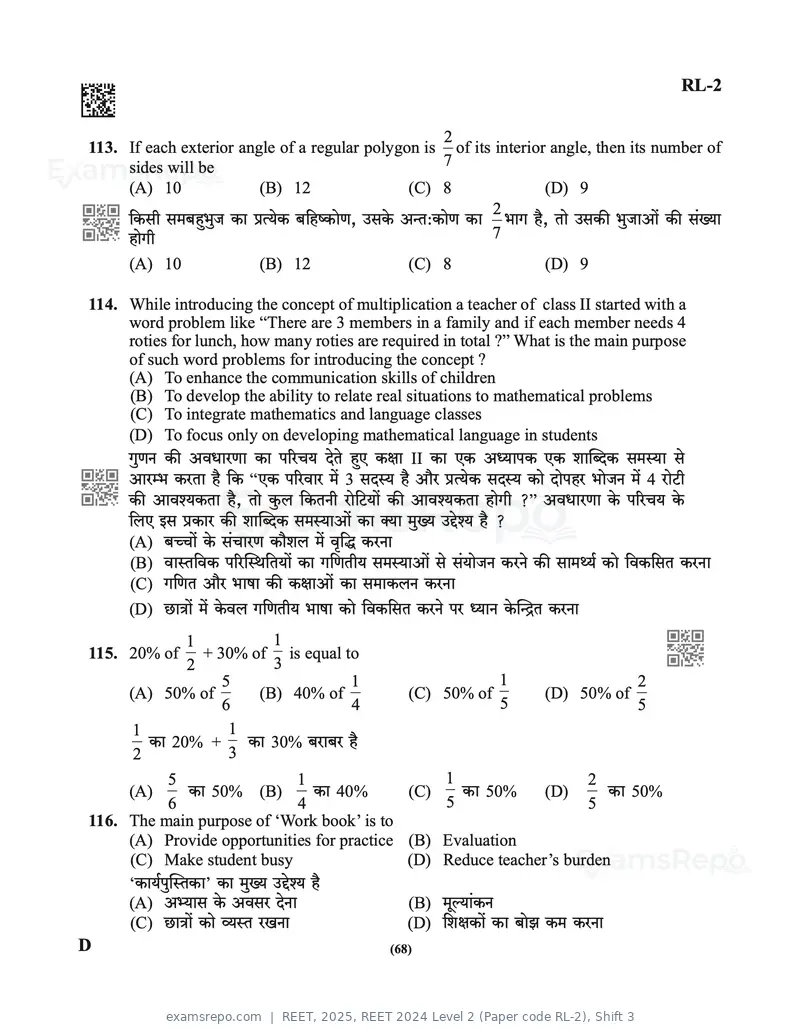
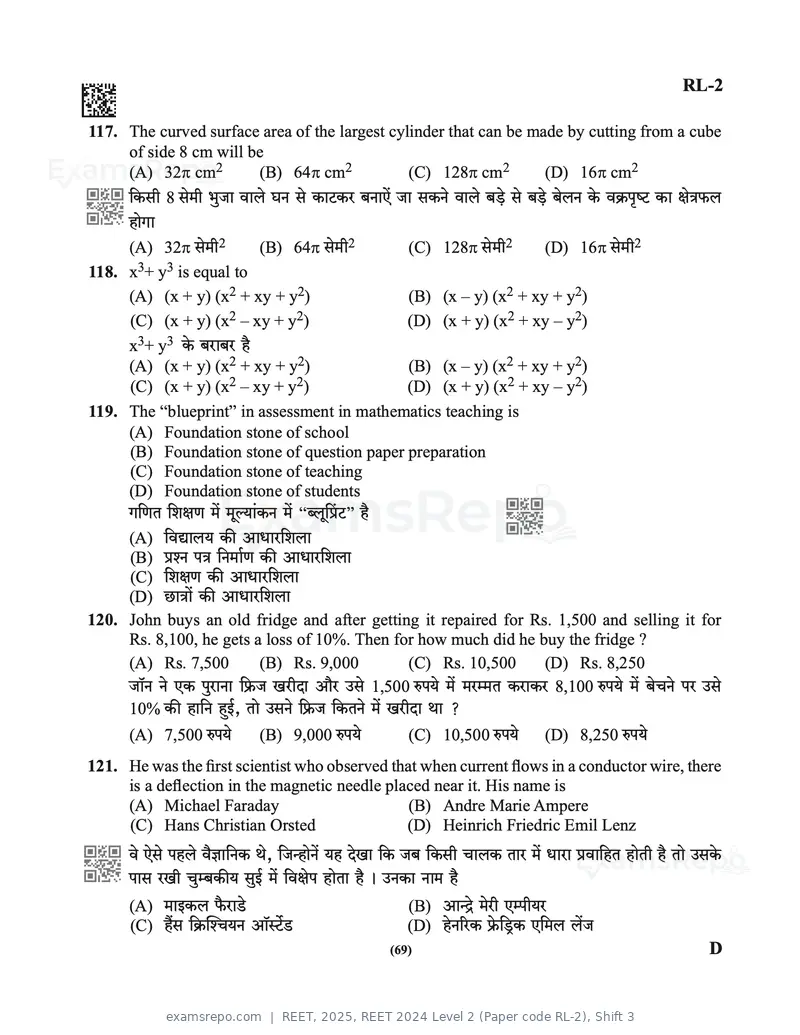
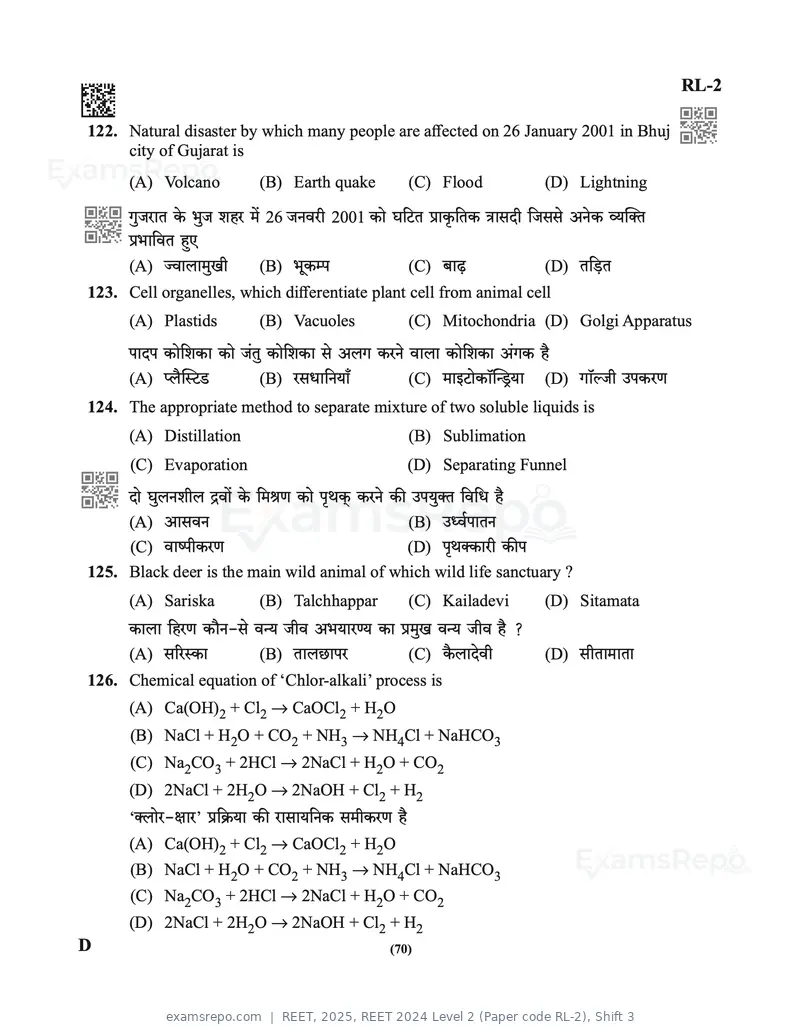
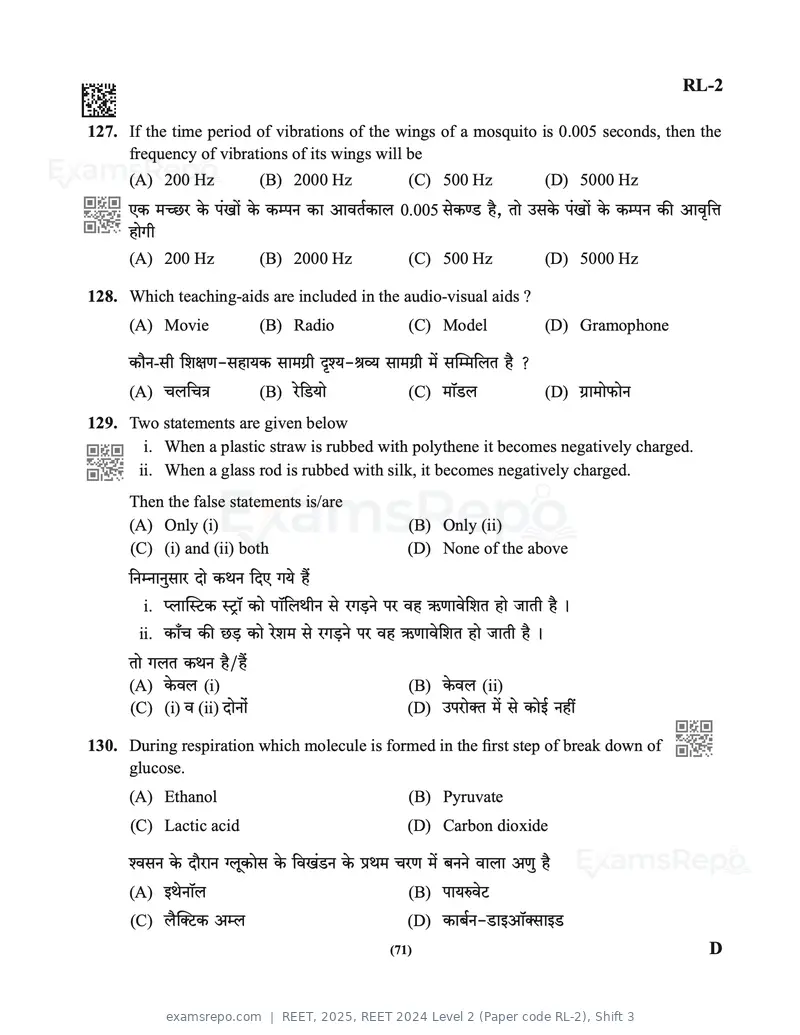
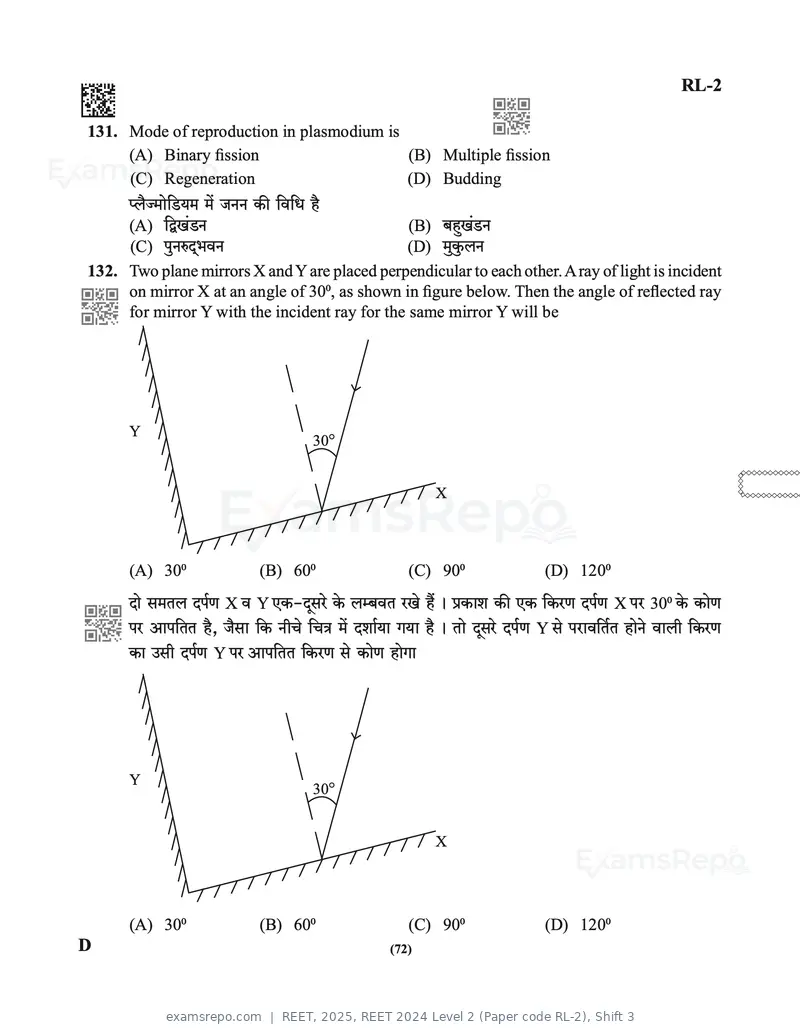
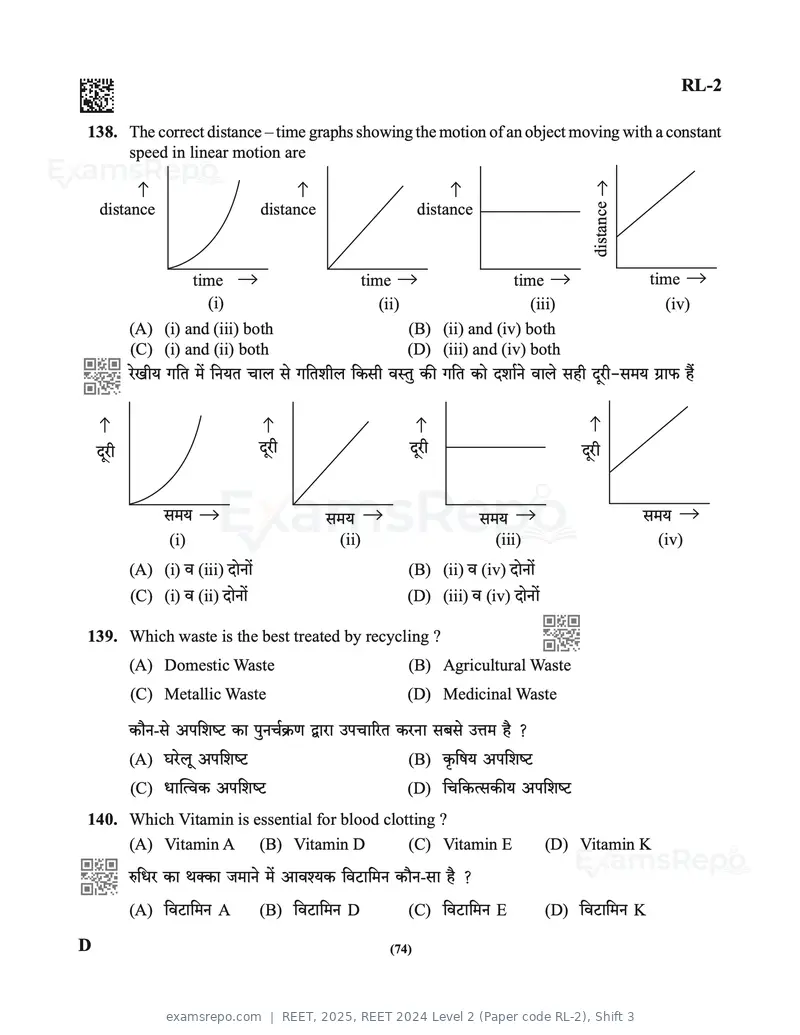
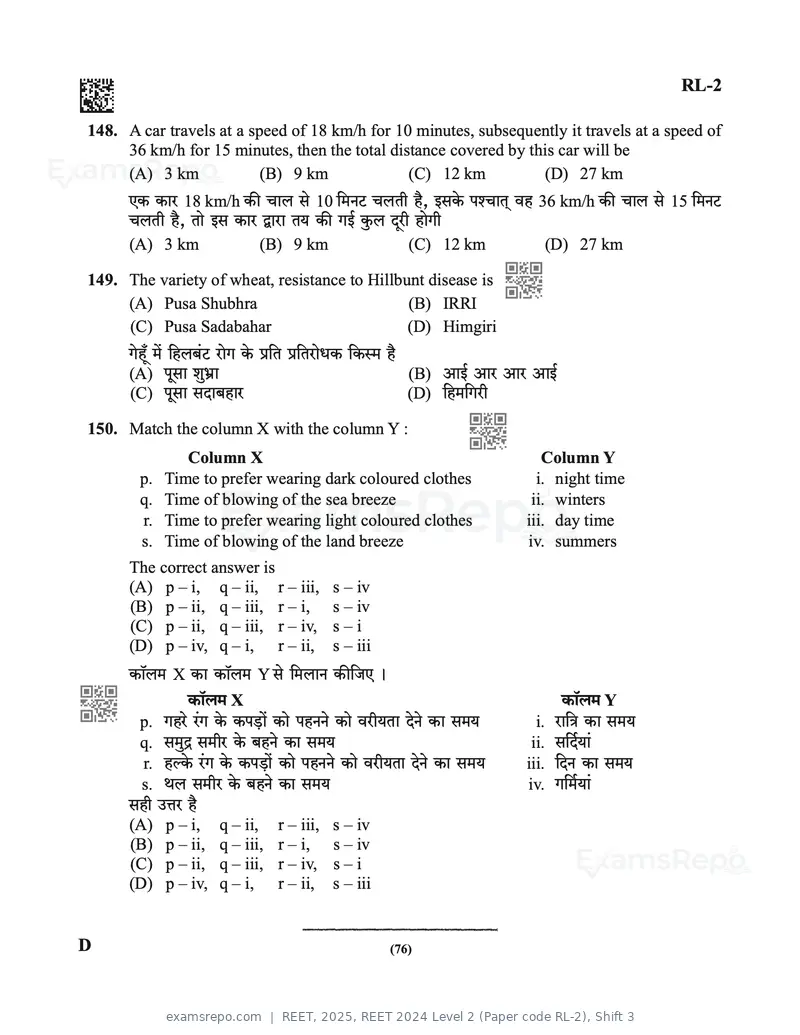
Text of page 364
RL-2

148. A car travels at a speed of 18 km/h for 10 minutes, subsequently it travels at a speed of
     36 km/h for 15 minutes, then the total distance covered by this car will be
     (A) 3 km             (B) 9 km             (C) 12 km          (D) 27 km
      EH$ H$ma 18 km/h H$s Mmb go 10 {_ZQ> MbVr h¡, BgHo$ níMmV² dh 36 km/h H$s Mmb go 15 {_ZQ>
      MbVr h¡, Vmo Bg H$ma Ûmam V` H$s JB© Hw$b Xÿar hmoJr
      (A) 3 km               (B) 9 km                    (C) 12 km          (D) 27 km

149. The variety of wheat, resistance to Hillbunt disease is
     (A) Pusa Shubhra                          (B) IRRI
     (C) Pusa Sadabahar                        (D) Himgiri
      Johÿ± _| {hb~§Q> amoJ Ho$ à{V à{VamoYH$ {H$ñ_ h¡
      (A) nygm ew^«m                                   (B) AmB© Ama Ama AmB©
      (C) nygm gXm~hma                                 (D) {h_{Jar

150. Match the column X with the column Y :
             Column X                                                        Column Y
       p. Time to prefer wearing dark coloured clothes                      i. night time
       q. Time of blowing of the sea breeze                                ii. winters
       r. Time to prefer wearing light coloured clothes                   iii. day time
       s. Time of blowing of the land breeze                              iv. summers
      The correct answer is
      (A) p – i, q – ii, r – iii,           s – iv
      (B) p – ii, q – iii, r – i,           s – iv
      (C) p – ii, q – iii, r – iv,          s–i
      (D) p – iv, q – i, r – ii,            s – iii
      H$m°b_ X H$m H$m°b_ Y go {_bmZ H$s{OE &
               H$m°b_ X                                                         H$m°b_ Y
        p. Jhao a§J Ho$ H$n‹S>m| H$mo nhZZo H$mo dar`Vm XoZo H$m g_`        i. am{Ì H$m g_`
        q. g_wÐ g_ra Ho$ ~hZo H$m g_`                                      ii. g{X©`m§
         r. hëHo$ a§J Ho$ H$n‹S>mo§ H$mo nhZZo H$mo dar`Vm XoZo H$m g_`   iii. {XZ H$m g_`
        s. Wb g_ra Ho$ ~hZo H$m g_`                                       iv. J{_©`m§
      ghr CÎma h¡
      (A)   p – i, q – ii,       r – iii,   s – iv
      (B)   p – ii, q – iii,     r – i,     s – iv
      (C)   p – ii, q – iii,     r – iv,    s–i
      (D)   p – iv, q – i,       r – ii,    s – iii


D                                                     (76)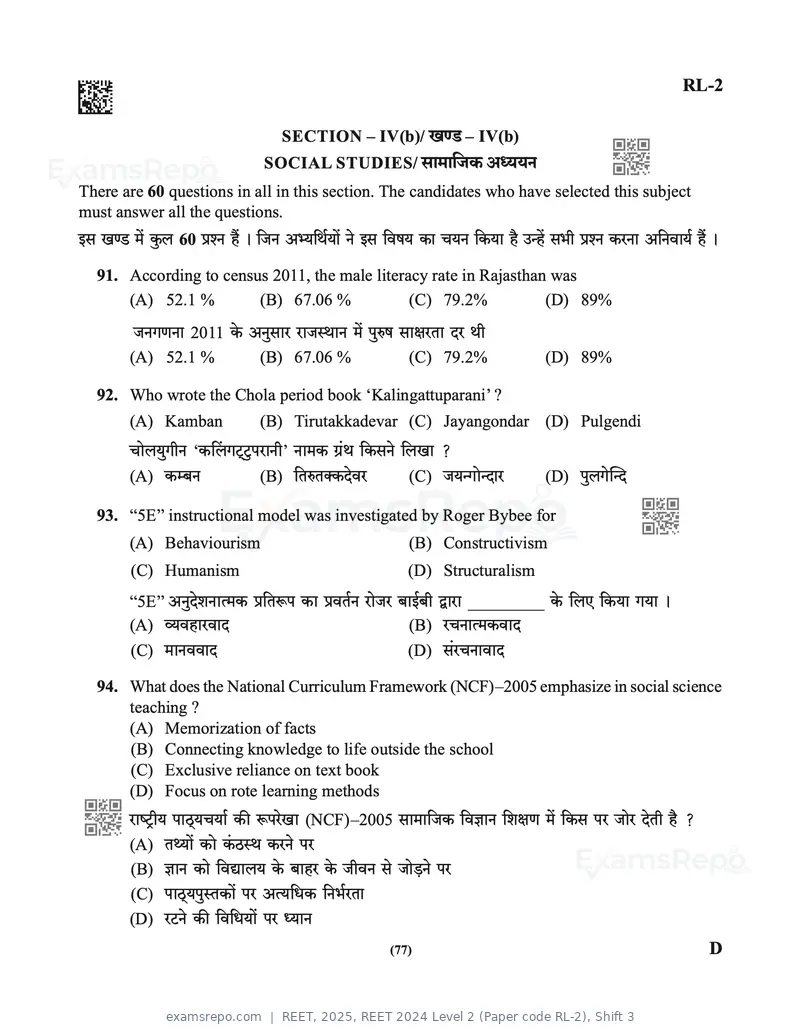
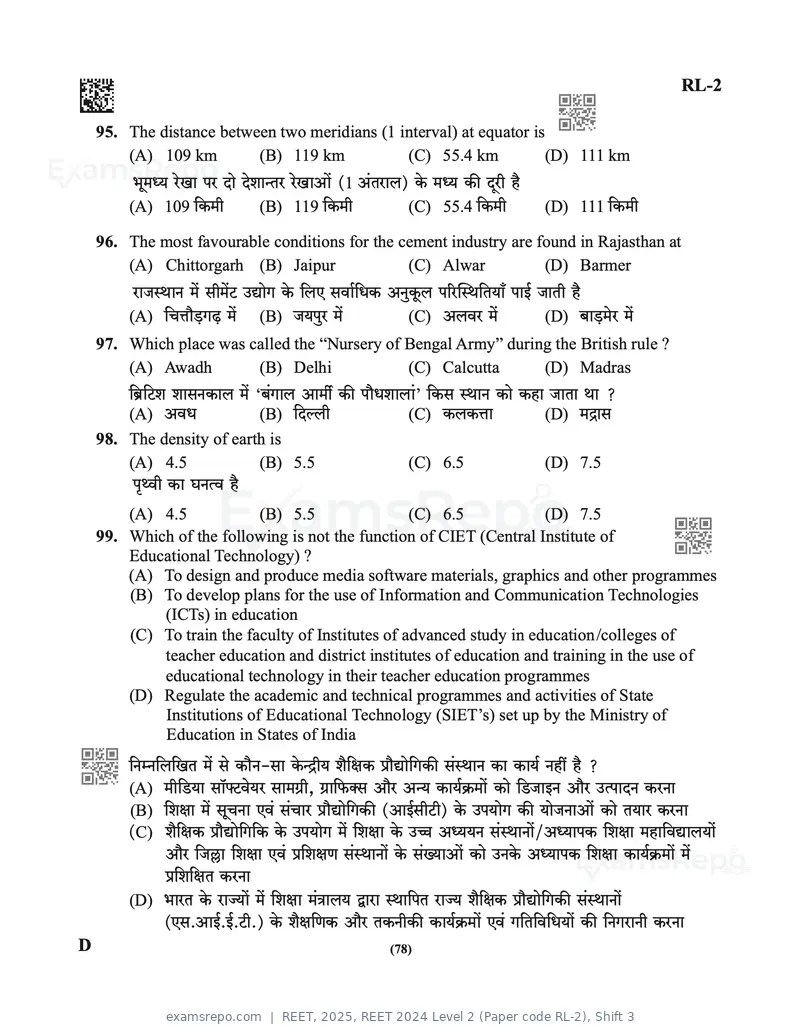
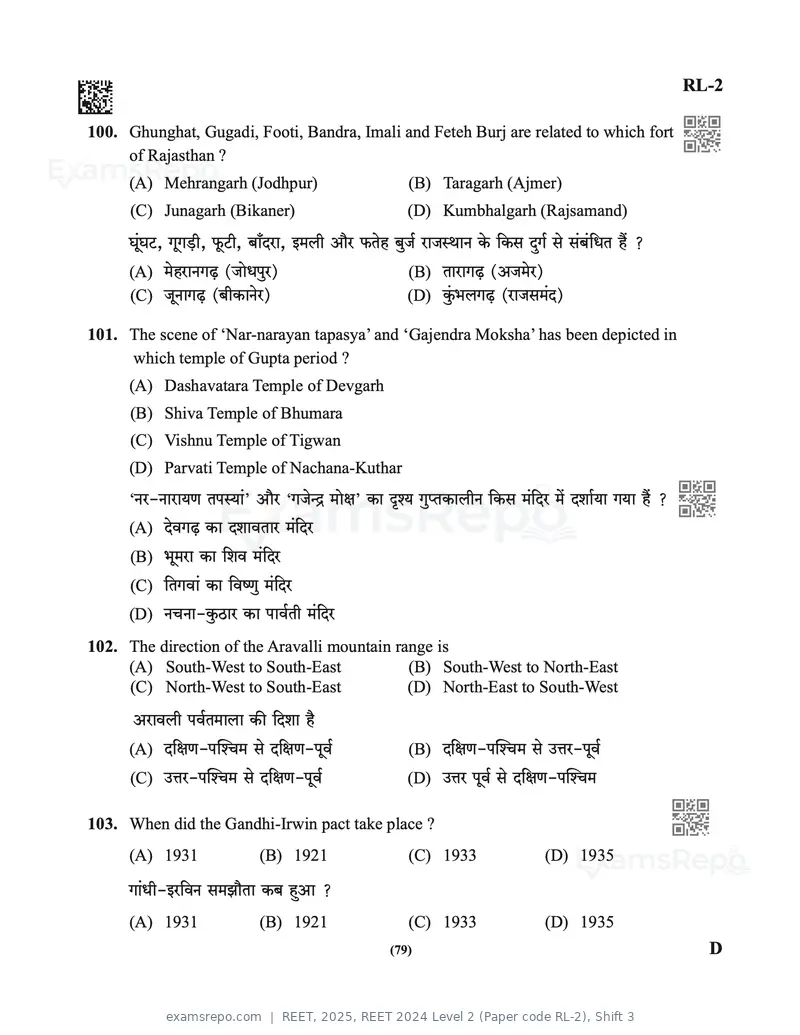
Text of page 367
RL-2

100. Ghunghat, Gugadi, Footi, Bandra, Imali and Feteh Burj are related to which fort
     of Rajasthan ?
     (A) Mehrangarh (Jodhpur)                         (B) Taragarh (Ajmer)
      (C) Junagarh (Bikaner)                          (D) Kumbhalgarh (Rajsamand)
     Ky§KQ>, JyJ‹S>r, \y$Q>r, ~m±Xam, B_br Am¡a \$Voh ~wO© amOñWmZ Ho$ {H$g XþJ© go g§~§{YV h¢ ?
     (A) _ohamZJ‹T> (OmoYnwa)                           (B) VmamJ‹T> (AO_oa)
     (C) OyZmJ‹T> (~rH$mZoa)                            (D) Hw§$^bJ‹T> (amOg_§X)

101. The scene of ‘Nar-narayan tapasya’ and ‘Gajendra Moksha’ has been depicted in
     which temple of Gupta period ?
     (A) Dashavatara Temple of Devgarh
      (B) Shiva Temple of Bhumara
      (C) Vishnu Temple of Tigwan
     (D) Parvati Temple of Nachana-Kuthar
     ‘Za-Zmam`U Vnñ`m§’ Am¡a ‘JOoÝÐ _moj’ H$m Ñí` JwßVH$mbrZ {H$g _§{Xa _| Xem©`m J`m h¢ ?
     (A) XodJ‹T> H$m XemdVma _§{Xa
      (B) ^y_am H$m {ed _§{Xa
      (C) {VJdm§ H$m {dîUw _§{Xa
     (D) ZMZm-Hw$R>ma H$m nmd©Vr _§{Xa
102. The direction of the Aravalli mountain range is
     (A) South-West to South-East             (B) South-West to North-East
     (C) North-West to South-East             (D) North-East to South-West
      Aamdbr nd©V_mbm H$s {Xem h¡
     (A) X{jU-npíM_ go X{jU-nyd©                      (B) X{jU-npíM_ go CÎma-nyd©
     (C) CÎma-npíM_ go X{jU-nyd©                      (D) CÎma nyd© go X{jU-npíM_

103. When did the Gandhi-Irwin pact take place ?
     (A) 1931               (B) 1921                  (C) 1933                (D) 1935

     Jm§Yr-Ba{dZ g_Pm¡Vm H$~ hþAm ?
     (A) 1931               (B) 1921                  (C) 1933                (D) 1935
                                                   (79)                                              D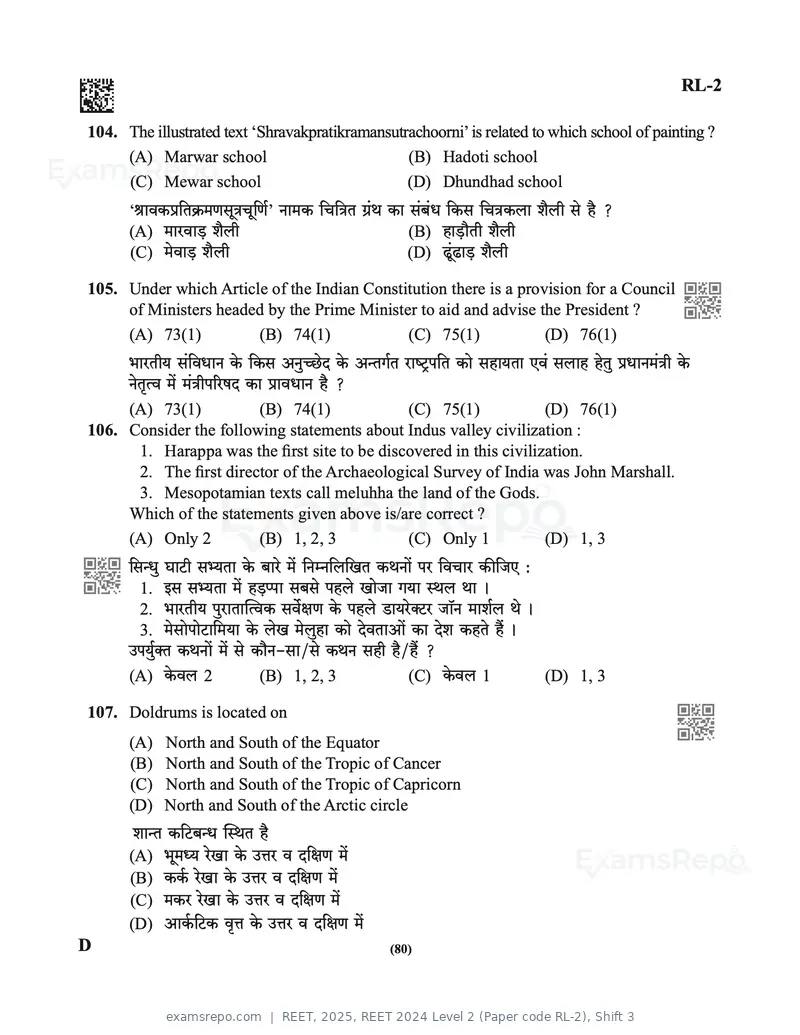
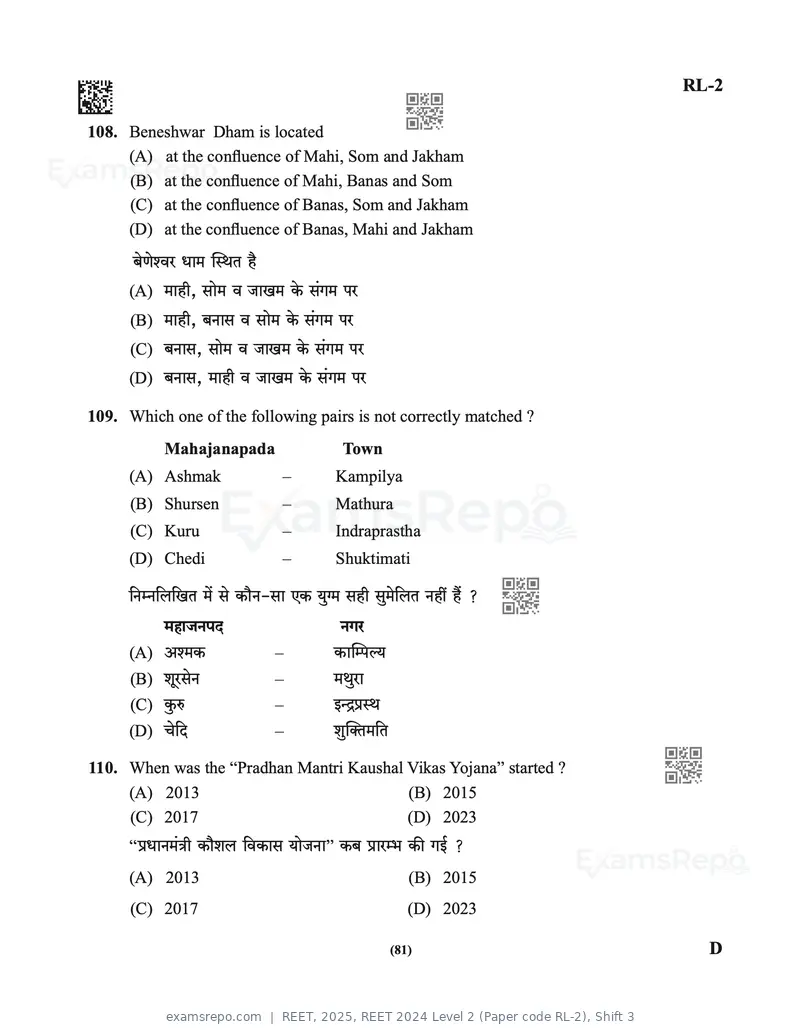
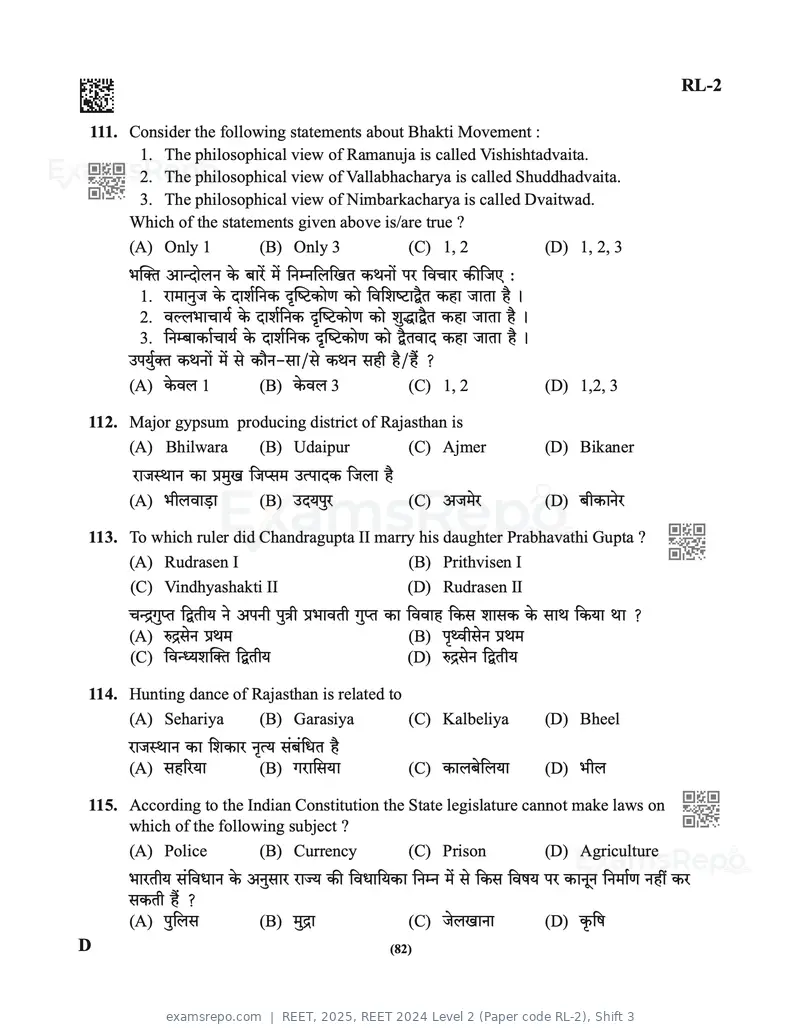
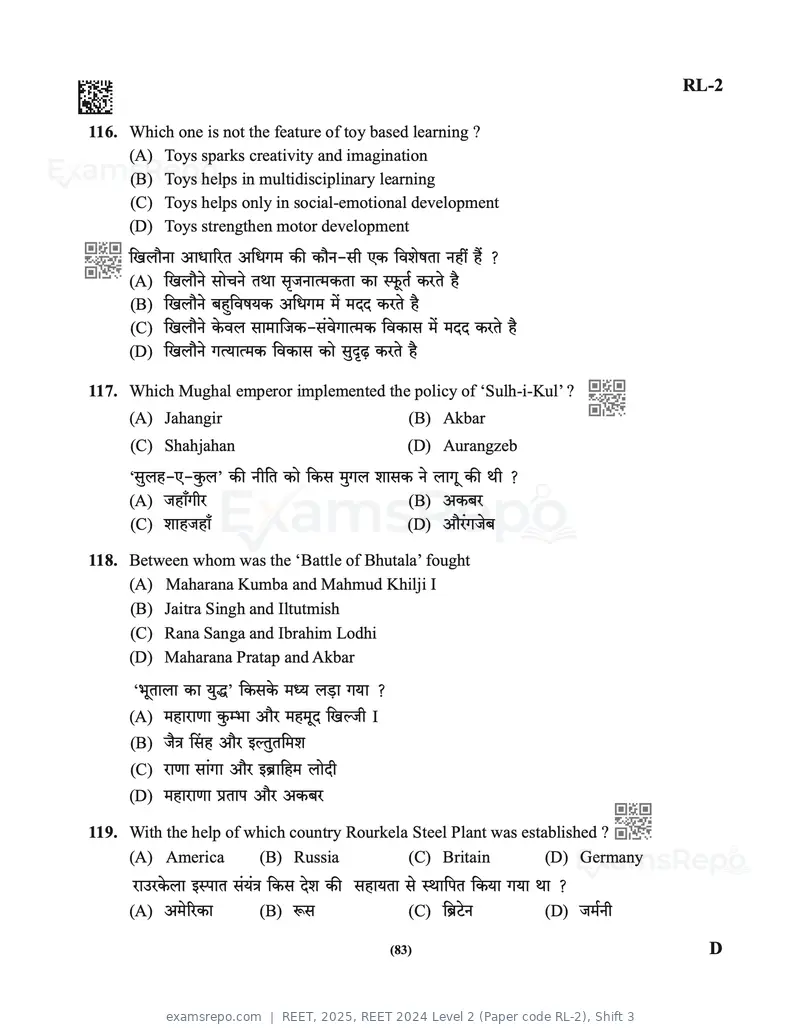
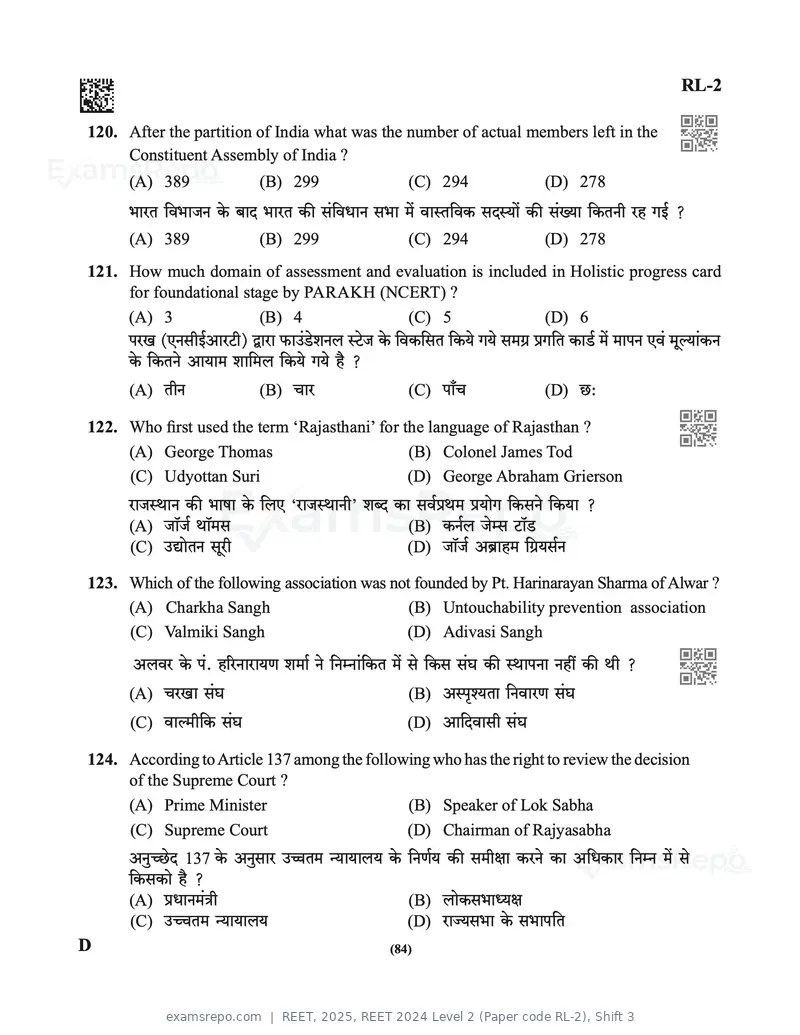
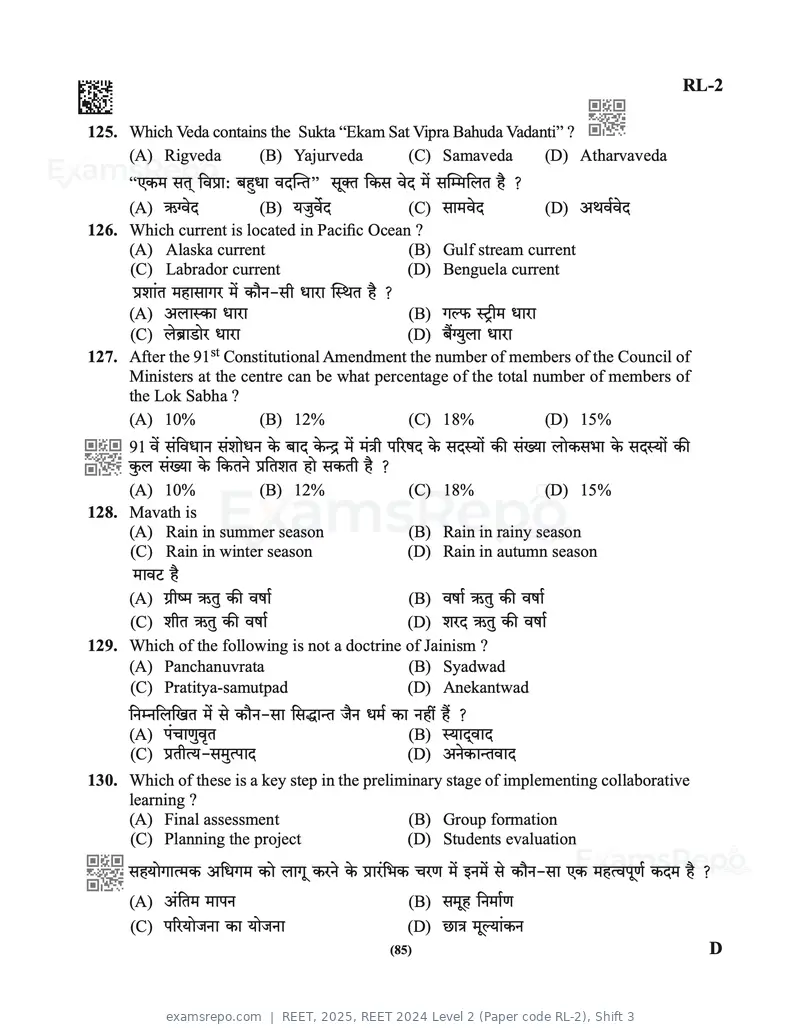
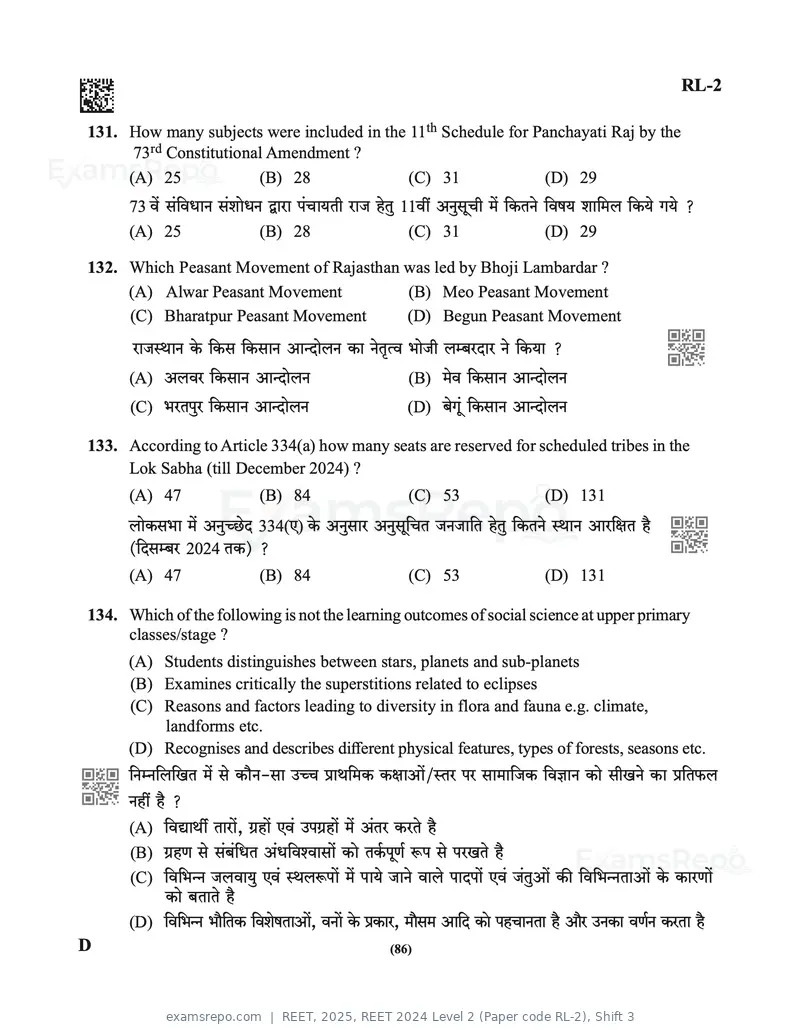
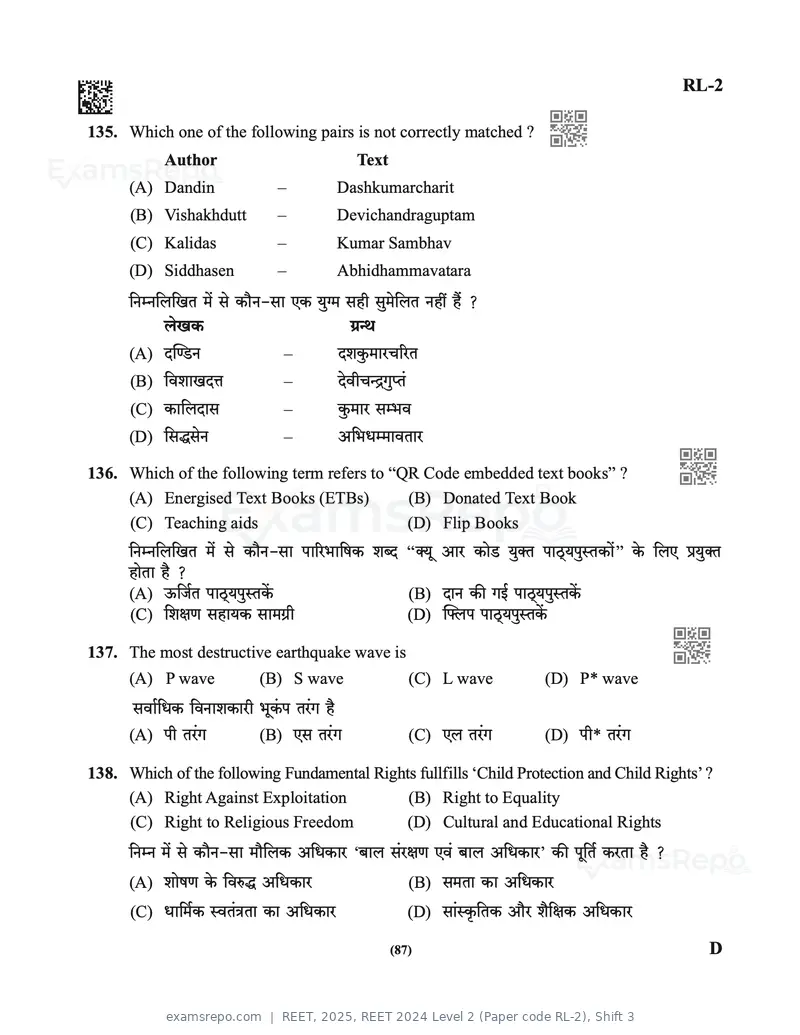
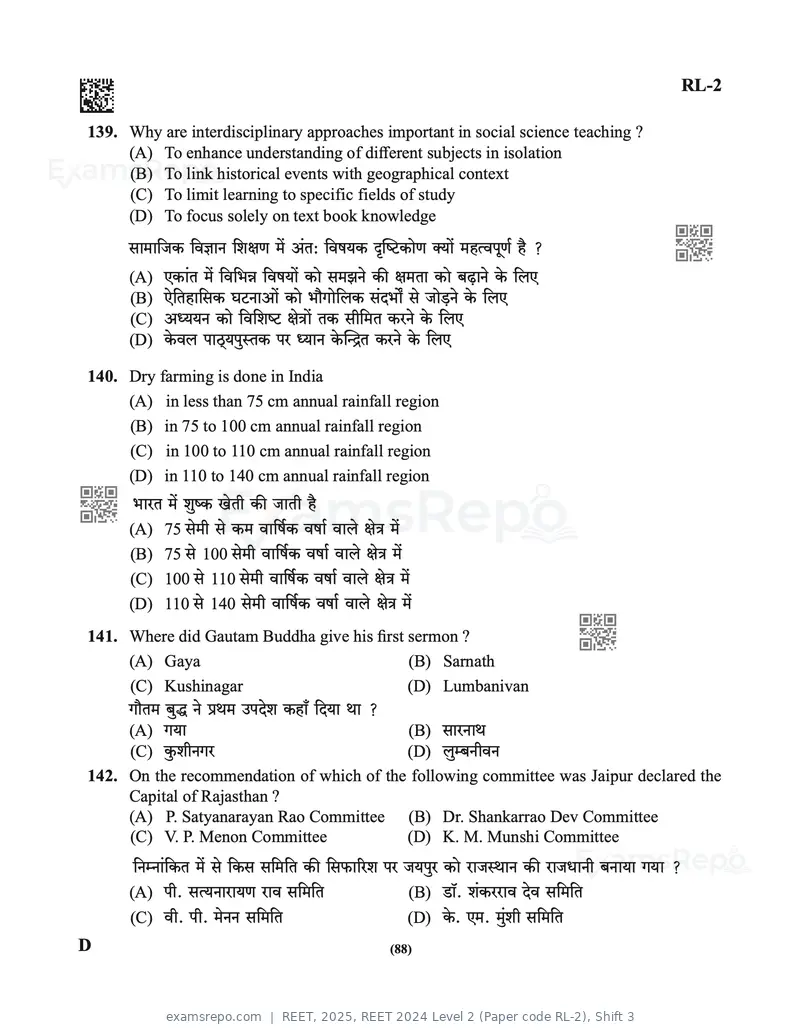
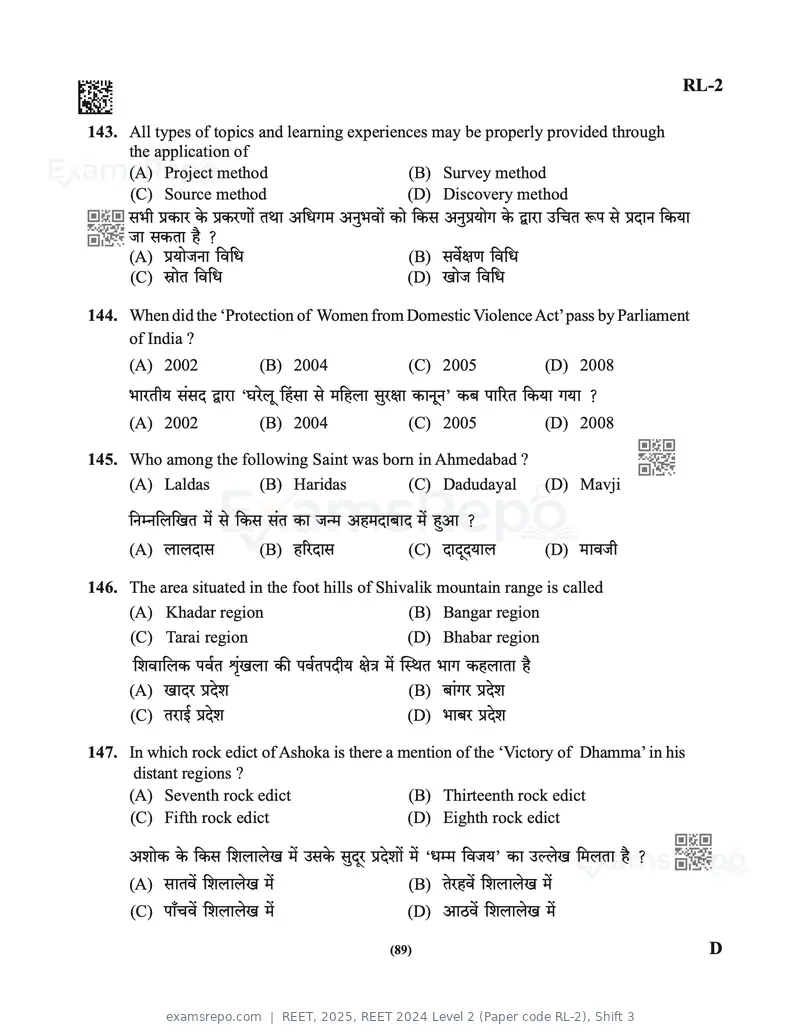
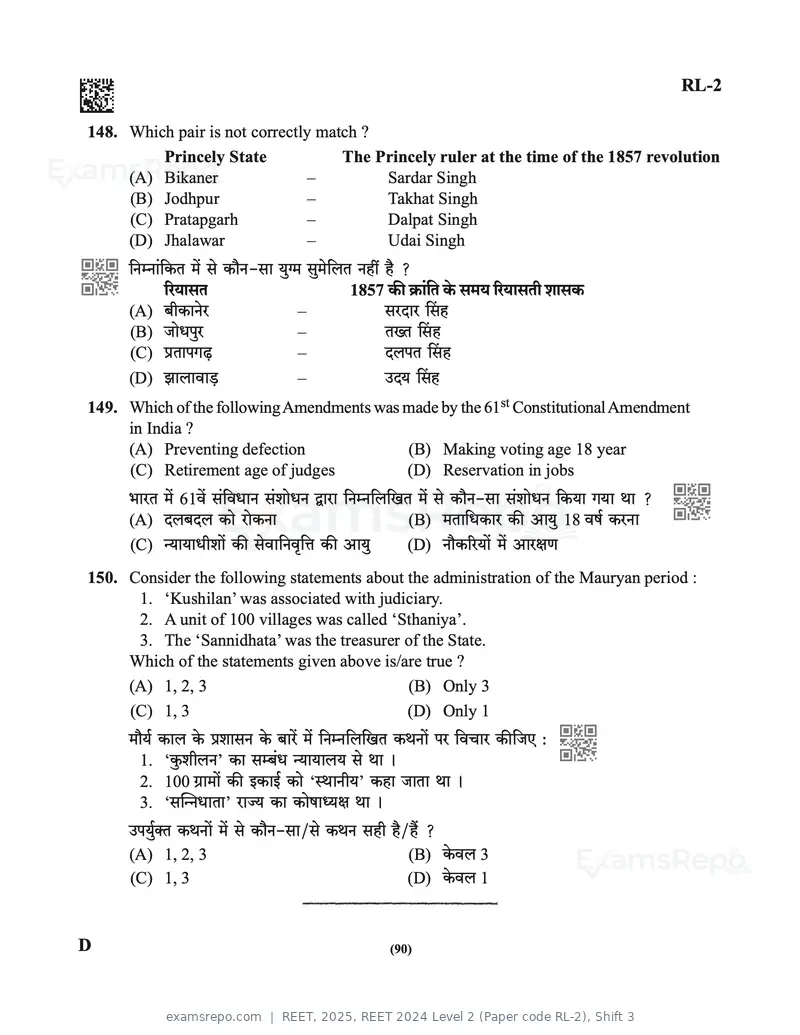
Text of page 383
DO
            NO
              T
(95)              WR
                    IT
                       EH
                         ER
                            E
D                               RL-2
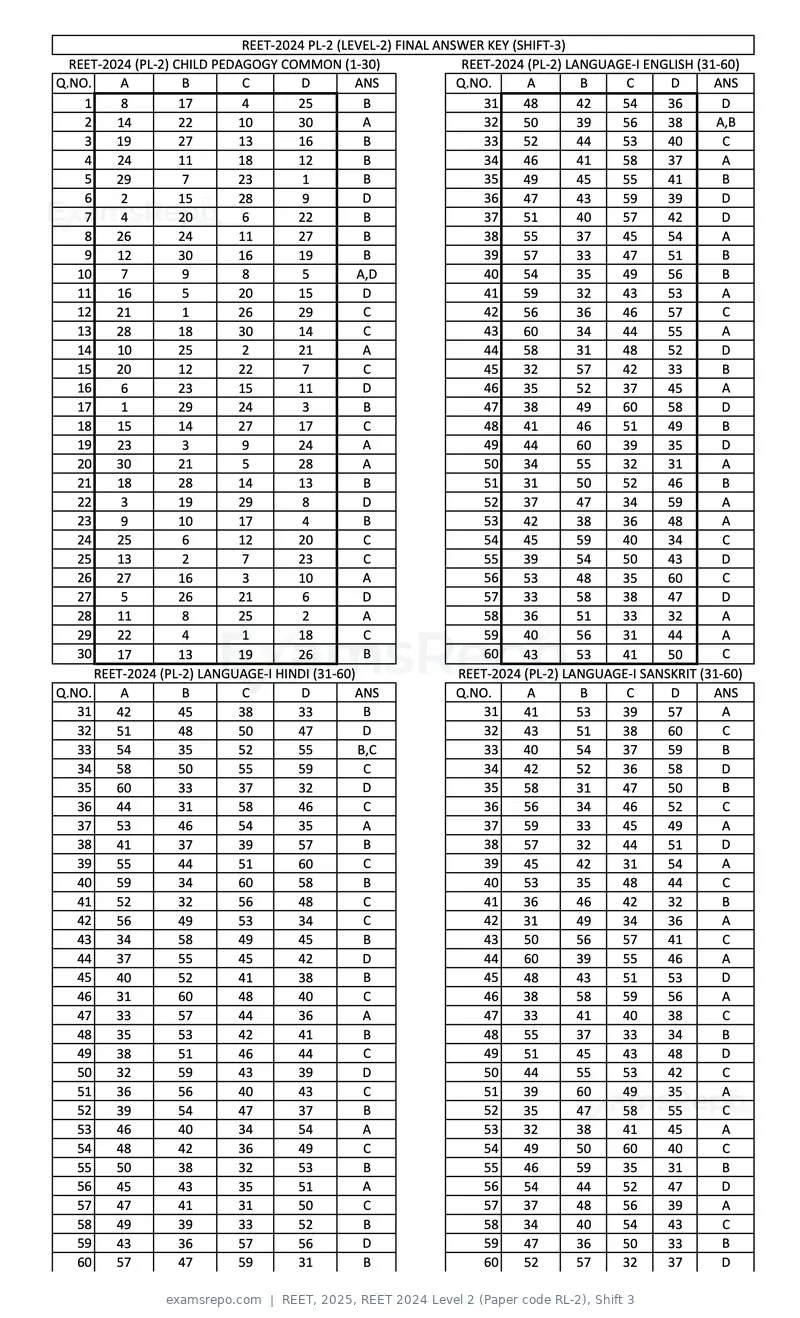
Text of page 1
REET-2024 PL-2 (LEVEL-2) FINAL ANSWER KEY (SHIFT-3)
  REET-2024 (PL-2) CHILD PEDAGOGY COMMON (1-30)                 REET-2024 (PL-2) LANGUAGE-I ENGLISH (31-60)
Q.NO.     A         B        C        D        ANS             Q.NO.      A        B    C      D       ANS
    1     8         17       4       25          B                 31    48        42   54     36       D
    2    14         22      10       30          A                 32    50        39   56     38      A,B
    3    19         27      13       16          B                 33    52        44   53     40       C
    4    24         11      18       12          B                 34    46        41   58     37       A
    5    29          7      23        1          B                 35    49        45   55     41       B
    6     2         15      28        9          D                 36    47        43   59     39       D
    7     4         20       6       22          B                 37    51        40   57     42       D
    8    26         24      11       27          B                 38    55        37   45     54       A
    9    12         30      16       19          B                 39    57        33   47     51       B
   10     7          9       8        5         A,D                40    54        35   49     56       B
   11    16          5      20       15          D                 41    59        32   43     53       A
   12    21          1      26       29          C                 42    56        36   46     57       C
   13    28         18      30       14          C                 43    60        34   44     55       A
   14    10         25       2       21          A                 44    58        31   48     52       D
   15    20         12      22        7          C                 45    32        57   42     33       B
   16     6         23      15       11          D                 46    35        52   37     45       A
   17     1         29      24        3          B                 47    38        49   60     58       D
   18    15         14      27       17          C                 48    41        46   51     49       B
   19    23          3       9       24          A                 49    44        60   39     35       D
   20    30         21       5       28          A                 50    34        55   32     31       A
   21    18         28      14       13          B                 51    31        50   52     46       B
   22     3         19      29        8          D                 52    37        47   34     59       A
   23     9         10      17        4          B                 53    42        38   36     48       A
   24    25          6      12       20          C                 54    45        59   40     34       C
   25    13          2       7       23          C                 55    39        54   50     43       D
   26    27         16       3       10          A                 56    53        48   35     60       C
   27     5         26      21        6          D                 57    33        58   38     47       D
   28    11          8      25        2          A                 58    36        51   33     32       A
   29    22          4       1       18          C                 59    40        56   31     44       A
   30    17         13      19       26          B                 60    43        53   41     50       C
      REET-2024 (PL-2) LANGUAGE-I HINDI (31-60)                REET-2024 (PL-2) LANGUAGE-I SANSKRIT (31-60)
Q.NO.     A         B        C        D        ANS             Q.NO.      A        B    C      D       ANS
   31    42         45      38       33          B                 31    41        53   39     57       A
   32    51         48      50       47          D                 32    43        51   38     60       C
   33    54         35      52       55         B,C                33    40        54   37     59       B
   34    58         50      55       59          C                 34    42        52   36     58       D
   35    60         33      37       32          D                 35    58        31   47     50       B
   36    44         31      58       46          C                 36    56        34   46     52       C
   37    53         46      54       35          A                 37    59        33   45     49       A
   38    41         37      39       57          B                 38    57        32   44     51       D
   39    55         44      51       60          C                 39    45        42   31     54       A
   40    59         34      60       58          B                 40    53        35   48     44       C
   41    52         32      56       48          C                 41    36        46   42     32       B
   42    56         49      53       34          C                 42    31        49   34     36       A
   43    34         58      49       45          B                 43    50        56   57     41       C
   44    37         55      45       42          D                 44    60        39   55     46       A
   45    40         52      41       38          B                 45    48        43   51     53       D
   46    31         60      48       40          C                 46    38        58   59     56       A
   47    33         57      44       36          A                 47    33        41   40     38       C
   48    35         53      42       41          B                 48    55        37   33     34       B
   49    38         51      46       44          C                 49    51        45   43     48       D
   50    32         59      43       39          D                 50    44        55   53     42       C
   51    36         56      40       43          C                 51    39        60   49     35       A
   52    39         54      47       37          B                 52    35        47   58     55       C
   53    46         40      34       54          A                 53    32        38   41     45       A
   54    48         42      36       49          C                 54    49        50   60     40       C
   55    50         38      32       53          B                 55    46        59   35     31       B
   56    45         43      35       51          A                 56    54        44   52     47       D
   57    47         41      31       50          C                 57    37        48   56     39       A
   58    49         39      33       52          B                 58    34        40   54     43       C
   59    43         36      57       56          D                 59    47        36   50     33       B
   60    57         47      59       31          B                 60    52        57   32     37       D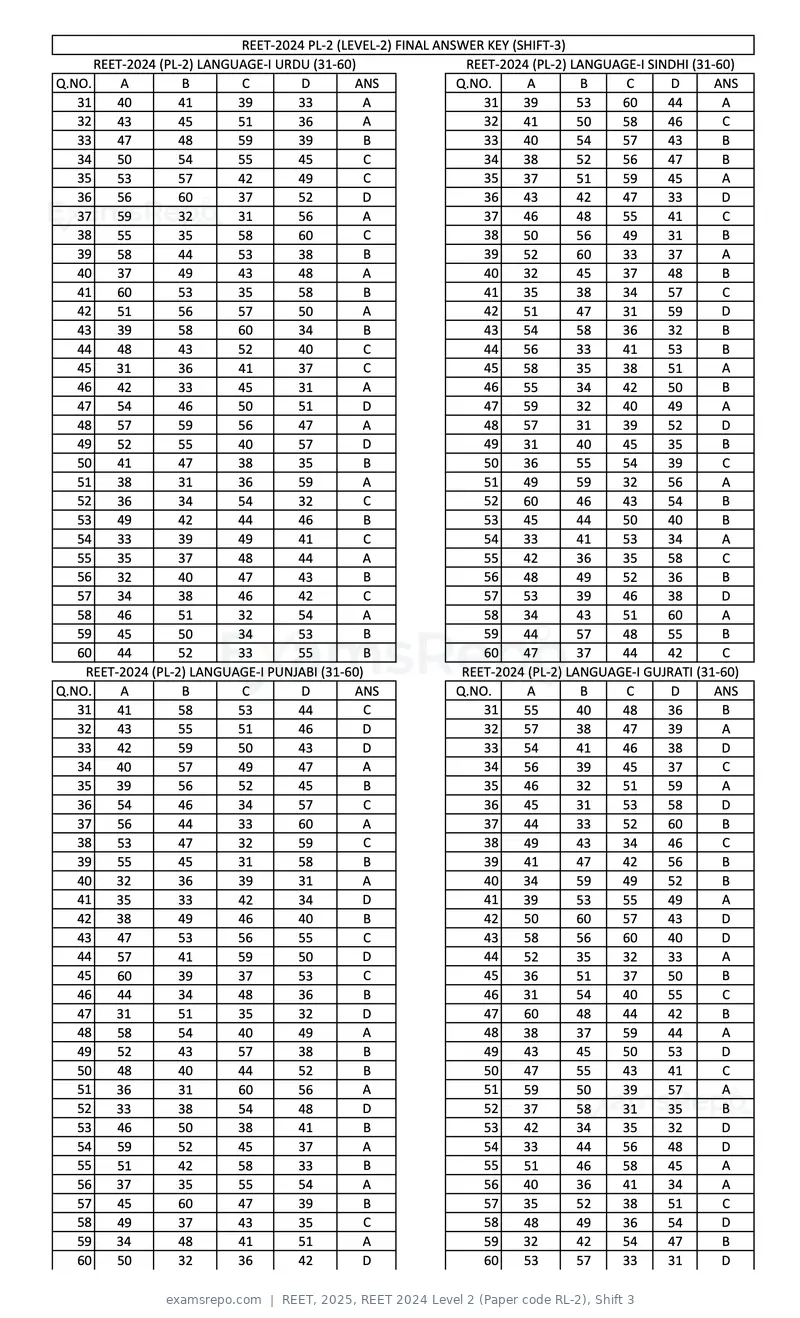
Text of page 2
REET-2024 PL-2 (LEVEL-2) FINAL ANSWER KEY (SHIFT-3)
      REET-2024 (PL-2) LANGUAGE-I URDU (31-60)                  REET-2024 (PL-2) LANGUAGE-I SINDHI (31-60)
Q.NO.     A         B       C        D        ANS             Q.NO.      A        B     C      D       ANS
   31    40        41       39       33        A                  31    39        53   60      44       A
   32    43        45       51       36        A                  32    41        50   58      46       C
   33    47        48       59       39        B                  33    40        54   57      43       B
   34    50        54       55       45        C                  34    38        52   56      47       B
   35    53        57       42       49        C                  35    37        51   59      45       A
   36    56        60       37       52        D                  36    43        42   47      33       D
   37    59        32       31       56        A                  37    46        48   55      41       C
   38    55        35       58       60        C                  38    50        56   49      31       B
   39    58        44       53       38        B                  39    52        60   33      37       A
   40    37        49       43       48        A                  40    32        45   37      48       B
   41    60        53       35       58        B                  41    35        38   34      57       C
   42    51        56       57       50        A                  42    51        47   31      59       D
   43    39        58       60       34        B                  43    54        58   36      32       B
   44    48        43       52       40        C                  44    56        33   41      53       B
   45    31        36       41       37        C                  45    58        35   38      51       A
   46    42        33       45       31        A                  46    55        34   42      50       B
   47    54        46       50       51        D                  47    59        32   40      49       A
   48    57        59       56       47        A                  48    57        31   39      52       D
   49    52        55       40       57        D                  49    31        40   45      35       B
   50    41        47       38       35        B                  50    36        55   54      39       C
   51    38        31       36       59        A                  51    49        59   32      56       A
   52    36        34       54       32        C                  52    60        46   43      54       B
   53    49        42       44       46        B                  53    45        44   50      40       B
   54    33        39       49       41        C                  54    33        41   53      34       A
   55    35        37       48       44        A                  55    42        36   35      58       C
   56    32        40       47       43        B                  56    48        49   52      36       B
   57    34        38       46       42        C                  57    53        39   46      38       D
   58    46        51       32       54        A                  58    34        43   51      60       A
   59    45        50       34       53        B                  59    44        57   48      55       B
   60    44        52       33       55        B                  60    47        37   44      42       C
    REET-2024 (PL-2) LANGUAGE-I PUNJABI (31-60)                REET-2024 (PL-2) LANGUAGE-I GUJRATI (31-60)
Q.NO.     A         B       C        D        ANS             Q.NO.      A        B     C      D       ANS
   31    41        58       53       44        C                  31    55        40   48      36       B
   32    43        55       51       46        D                  32    57        38   47      39       A
   33    42        59       50       43        D                  33    54        41   46      38       D
   34    40        57       49       47        A                  34    56        39   45      37       C
   35    39        56       52       45        B                  35    46        32   51      59       A
   36    54        46       34       57        C                  36    45        31   53      58       D
   37    56        44       33       60        A                  37    44        33   52      60       B
   38    53        47       32       59        C                  38    49        43   34      46       C
   39    55        45       31       58        B                  39    41        47   42      56       B
   40    32        36       39       31        A                  40    34        59   49      52       B
   41    35        33       42       34        D                  41    39        53   55      49       A
   42    38        49       46       40        B                  42    50        60   57      43       D
   43    47        53       56       55        C                  43    58        56   60      40       D
   44    57        41       59       50        D                  44    52        35   32      33       A
   45    60        39       37       53        C                  45    36        51   37      50       B
   46    44        34       48       36        B                  46    31        54   40      55       C
   47    31        51       35       32        D                  47    60        48   44      42       B
   48    58        54       40       49        A                  48    38        37   59      44       A
   49    52        43       57       38        B                  49    43        45   50      53       D
   50    48        40       44       52        B                  50    47        55   43      41       C
   51    36        31       60       56        A                  51    59        50   39      57       A
   52    33        38       54       48        D                  52    37        58   31      35       B
   53    46        50       38       41        B                  53    42        34   35      32       D
   54    59        52       45       37        A                  54    33        44   56      48       D
   55    51        42       58       33        B                  55    51        46   58      45       A
   56    37        35       55       54        A                  56    40        36   41      34       A
   57    45        60       47       39        B                  57    35        52   38      51       C
   58    49        37       43       35        C                  58    48        49   36      54       D
   59    34        48       41       51        A                  59    32        42   54      47       B
   60    50        32       36       42        D                  60    53        57   33      31       D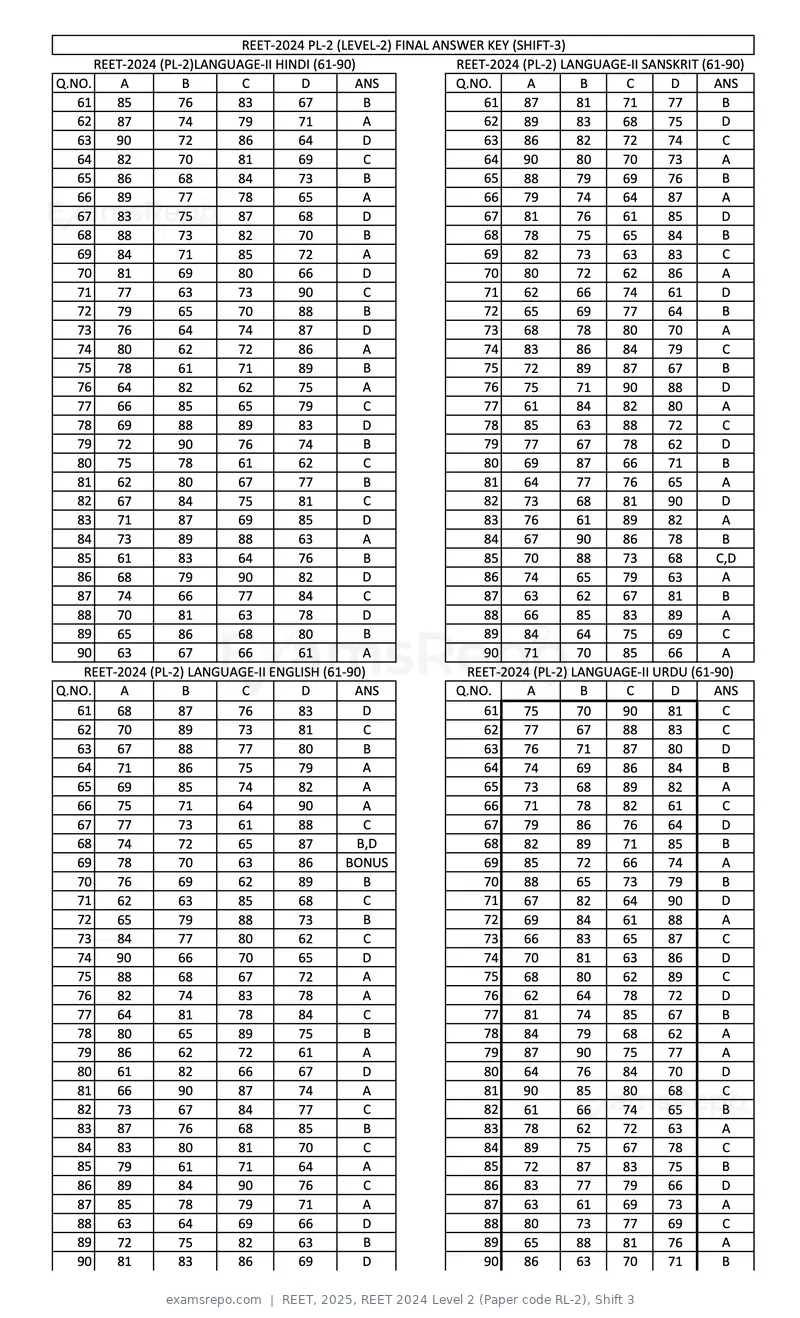
Text of page 3
REET-2024 PL-2 (LEVEL-2) FINAL ANSWER KEY (SHIFT-3)
      REET-2024 (PL-2)LANGUAGE-II HINDI (61-90)               REET-2024 (PL-2) LANGUAGE-II SANSKRIT (61-90)
Q.NO.     A         B       C        D         ANS            Q.NO.      A        B    C       D      ANS
   61    85        76      83        67          B                61    87       81   71      77       B
   62    87        74      79        71          A                62    89       83   68      75       D
   63    90        72      86        64          D                63    86       82   72      74       C
   64    82        70      81        69          C                64    90       80   70      73       A
   65    86        68      84        73          B                65    88       79   69      76       B
   66    89        77      78        65          A                66    79       74   64      87       A
   67    83        75      87        68          D                67    81       76   61      85       D
   68    88        73      82        70          B                68    78       75   65      84       B
   69    84        71      85        72          A                69    82       73   63      83       C
   70    81        69      80        66          D                70    80       72   62      86       A
   71    77        63      73        90          C                71    62       66   74      61       D
   72    79        65      70        88          B                72    65       69   77      64       B
   73    76        64      74        87          D                73    68       78   80      70       A
   74    80        62      72        86          A                74    83       86   84      79       C
   75    78        61      71        89          B                75    72       89   87      67       B
   76    64        82      62        75          A                76    75       71   90      88       D
   77    66        85      65        79          C                77    61       84   82      80       A
   78    69        88      89        83          D                78    85       63   88      72       C
   79    72        90      76        74          B                79    77       67   78      62       D
   80    75        78      61        62          C                80    69       87   66      71       B
   81    62        80      67        77          B                81    64       77   76      65       A
   82    67        84      75        81          C                82    73       68   81      90       D
   83    71        87      69        85          D                83    76       61   89      82       A
   84    73        89      88        63          A                84    67       90   86      78       B
   85    61        83      64        76          B                85    70       88   73      68      C,D
   86    68        79      90        82          D                86    74       65   79      63       A
   87    74        66      77        84          C                87    63       62   67      81       B
   88    70        81      63        78          D                88    66       85   83      89       A
   89    65        86      68        80          B                89    84       64   75      69       C
   90    63        67      66        61          A                90    71       70   85      66       A
    REET-2024 (PL-2) LANGUAGE-II ENGLISH (61-90)               REET-2024 (PL-2) LANGUAGE-II URDU (61-90)
Q.NO.     A         B       C        D         ANS            Q.NO.      A        B    C       D      ANS
   61    68        87      76        83          D                61    75       70   90      81       C
   62    70        89      73        81          C                62    77       67   88      83       C
   63    67        88      77        80          B                63    76       71   87      80       D
   64    71        86      75        79          A                64    74       69   86      84       B
   65    69        85      74        82          A                65    73       68   89      82       A
   66    75        71      64        90          A                66    71       78   82      61       C
   67    77        73      61        88          C                67    79       86   76      64       D
   68    74        72      65        87         B,D               68    82       89   71      85       B
   69    78        70      63        86      BONUS                69    85       72   66      74       A
   70    76        69      62        89          B                70    88       65   73      79       B
   71    62        63      85        68          C                71    67       82   64      90       D
   72    65        79      88        73          B                72    69       84   61      88       A
   73    84        77      80        62          C                73    66       83   65      87       C
   74    90        66      70        65          D                74    70       81   63      86       D
   75    88        68      67        72          A                75    68       80   62      89       C
   76    82        74      83        78          A                76    62       64   78      72       D
   77    64        81      78        84          C                77    81       74   85      67       B
   78    80        65      89        75          B                78    84       79   68      62       A
   79    86        62      72        61          A                79    87       90   75      77       A
   80    61        82      66        67          D                80    64       76   84      70       D
   81    66        90      87        74          A                81    90       85   80      68       C
   82    73        67      84        77          C                82    61       66   74      65       B
   83    87        76      68        85          B                83    78       62   72      63       A
   84    83        80      81        70          C                84    89       75   67      78       C
   85    79        61      71        64          A                85    72       87   83      75       B
   86    89        84      90        76          C                86    83       77   79      66       D
   87    85        78      79        71          A                87    63       61   69      73       A
   88    63        64      69        66          D                88    80       73   77      69       C
   89    72        75      82        63          B                89    65       88   81      76       A
   90    81        83      86        69          D                90    86       63   70      71       B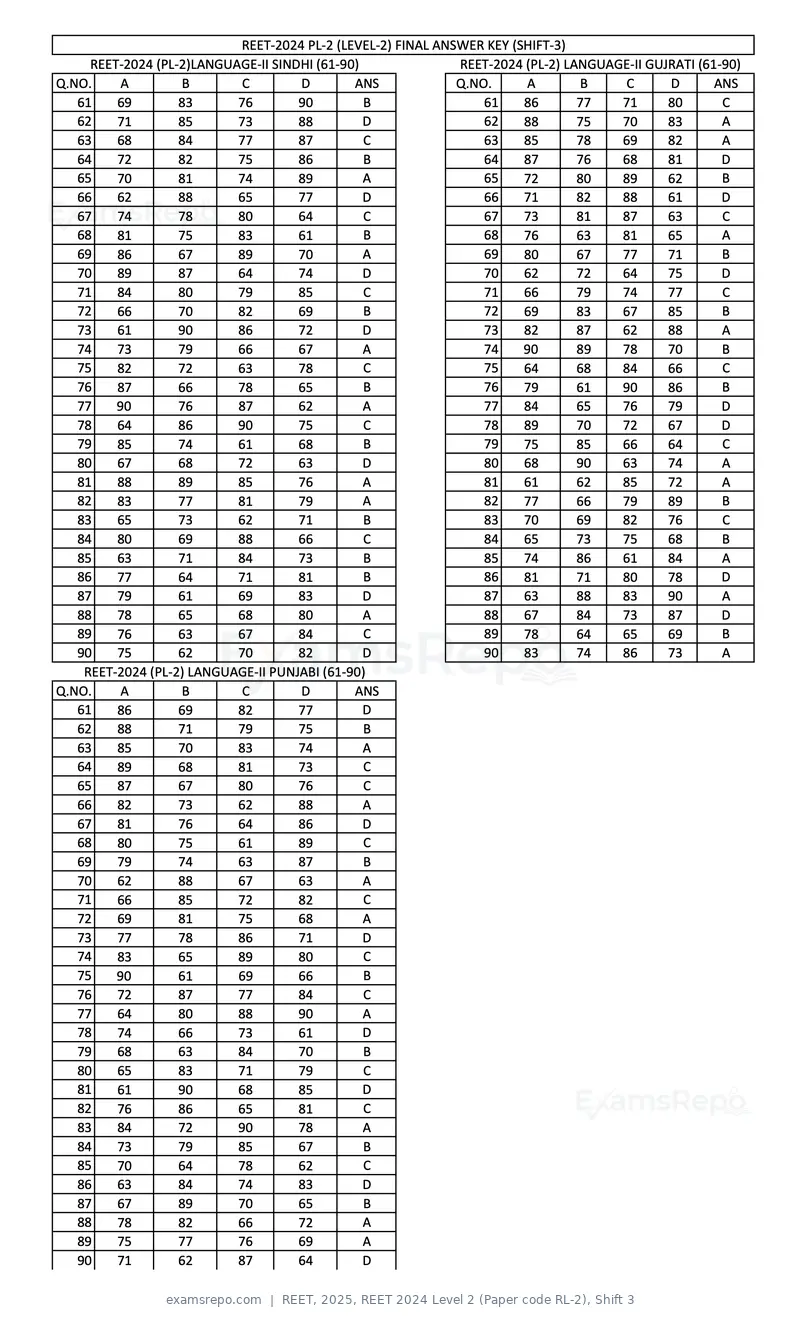
Text of page 4
REET-2024 PL-2 (LEVEL-2) FINAL ANSWER KEY (SHIFT-3)
     REET-2024 (PL-2)LANGUAGE-II SINDHI (61-90)              REET-2024 (PL-2) LANGUAGE-II GUJRATI (61-90)
Q.NO.    A         B       C         D        ANS            Q.NO.     A        B    C       D       ANS
   61    69        83      76        90         B                61    86       77   71      80       C
   62    71        85      73        88         D                62    88       75   70      83       A
   63    68        84      77        87         C                63    85       78   69      82       A
   64    72        82      75        86         B                64    87       76   68      81       D
   65    70        81      74        89         A                65    72       80   89      62       B
   66    62        88      65        77         D                66    71       82   88      61       D
   67    74        78      80        64         C                67    73       81   87      63       C
   68    81        75      83        61         B                68    76       63   81      65       A
   69    86        67      89        70         A                69    80       67   77      71       B
   70    89        87      64        74         D                70    62       72   64      75       D
   71    84        80      79        85         C                71    66       79   74      77       C
   72    66        70      82        69         B                72    69       83   67      85       B
   73    61        90      86        72         D                73    82       87   62      88       A
   74    73        79      66        67         A                74    90       89   78      70       B
   75    82        72      63        78         C                75    64       68   84      66       C
   76    87        66      78        65         B                76    79       61   90      86       B
   77    90        76      87        62         A                77    84       65   76      79       D
   78    64        86      90        75         C                78    89       70   72      67       D
   79    85        74      61        68         B                79    75       85   66      64       C
   80    67        68      72        63         D                80    68       90   63      74       A
   81    88        89      85        76         A                81    61       62   85      72       A
   82    83        77      81        79         A                82    77       66   79      89       B
   83    65        73      62        71         B                83    70       69   82      76       C
   84    80        69      88        66         C                84    65       73   75      68       B
   85    63        71      84        73         B                85    74       86   61      84       A
   86    77        64      71        81         B                86    81       71   80      78       D
   87    79        61      69        83         D                87    63       88   83      90       A
   88    78        65      68        80         A                88    67       84   73      87       D
   89    76        63      67        84         C                89    78       64   65      69       B
   90    75        62      70        82         D                90    83       74   86      73       A
    REET-2024 (PL-2) LANGUAGE-II PUNJABI (61-90)
Q.NO.    A         B       C         D        ANS
   61    86        69      82        77         D
   62    88        71      79        75         B
   63    85        70      83        74         A
   64    89        68      81        73         C
   65    87        67      80        76         C
   66    82        73      62        88         A
   67    81        76      64        86         D
   68    80        75      61        89         C
   69    79        74      63        87         B
   70    62        88      67        63         A
   71    66        85      72        82         C
   72    69        81      75        68         A
   73    77        78      86        71         D
   74    83        65      89        80         C
   75    90        61      69        66         B
   76    72        87      77        84         C
   77    64        80      88        90         A
   78    74        66      73        61         D
   79    68        63      84        70         B
   80    65        83      71        79         C
   81    61        90      68        85         D
   82    76        86      65        81         C
   83    84        72      90        78         A
   84    73        79      85        67         B
   85    70        64      78        62         C
   86    63        84      74        83         D
   87    67        89      70        65         B
   88    78        82      66        72         A
   89    75        77      76        69         A
   90    71        62      87        64         D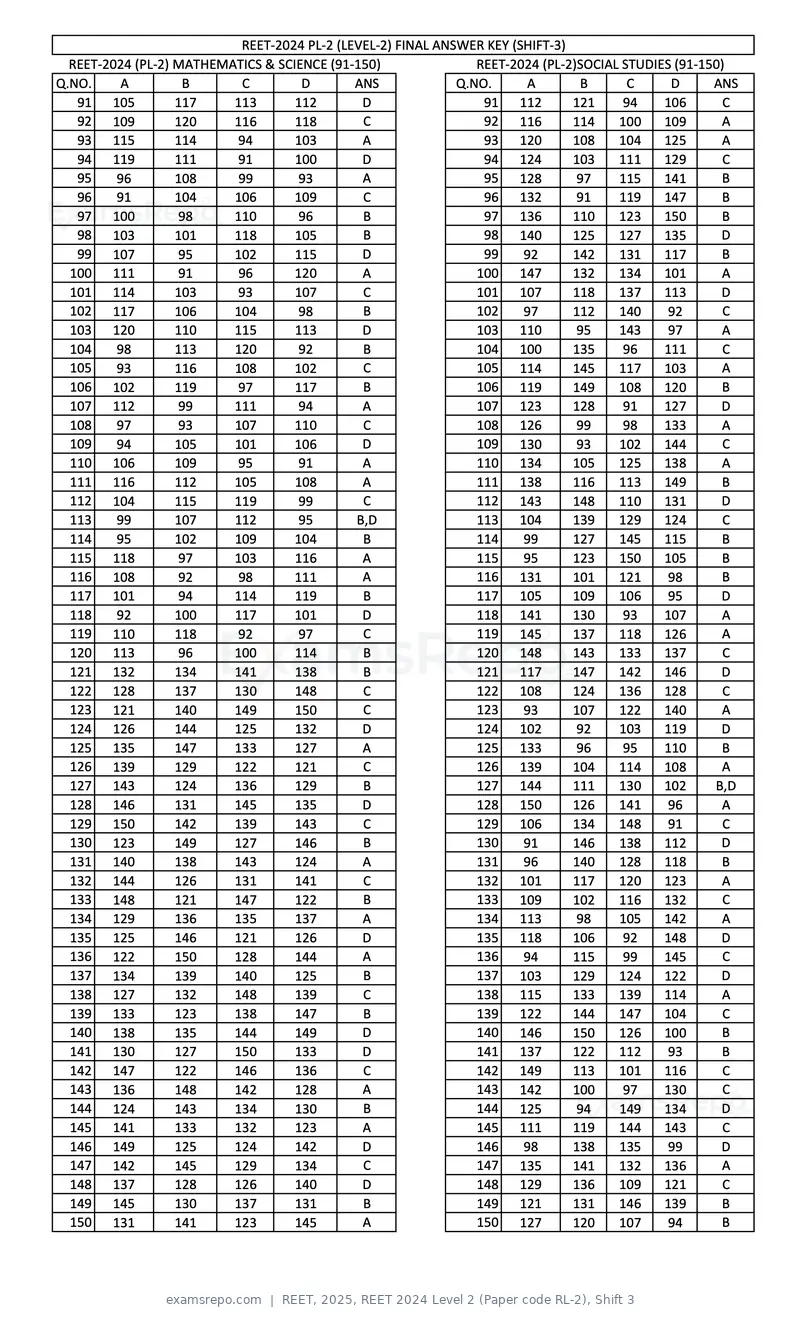
Text of page 5
REET-2024 PL-2 (LEVEL-2) FINAL ANSWER KEY (SHIFT-3)
  REET-2024 (PL-2) MATHEMATICS & SCIENCE (91-150)               REET-2024 (PL-2)SOCIAL STUDIES (91-150)
Q.NO.    A          B      C         D       ANS             Q.NO.     A        B       C     D      ANS
   91 105          117    113       112       D                  91 112        121     94    106       C
   92 109          120    116       118       C                  92 116        114    100    109      A
   93 115          114    94        103       A                  93 120        108    104    125      A
   94 119          111    91        100       D                  94 124        103    111    129       C
   95    96        108     99        93       A                  95 128         97    115    141      B
   96    91        104    106       109       C                  96 132         91    119    147      B
   97 100           98    110        96       B                  97 136        110    123    150      B
   98 103          101    118       105       B                  98 140        125    127    135      D
   99 107           95    102       115       D                  99    92      142    131    117      B
  100 111           91    96        120       A                 100 147        132    134    101      A
  101 114          103    93        107       C                 101 107        118    137    113      D
  102 117          106    104        98       B                 102    97      112    140     92       C
  103 120          110    115       113       D                 103 110         95    143     97      A
  104    98        113    120       92        B                 104 100        135     96    111       C
  105    93        116    108       102       C                 105 114        145    117    103      A
  106 102          119    97        117       B                 106 119        149    108    120      B
  107 112           99    111        94       A                 107 123        128     91    127      D
  108    97        93     107       110       C                 108 126         99     98    133      A
  109    94        105    101       106       D                 109 130         93    102    144       C
  110 106          109    95         91       A                 110 134        105    125    138      A
  111 116          112    105       108       A                 111 138        116    113    149      B
  112 104          115    119        99       C                 112 143        148    110    131      D
  113    99        107    112       95       B,D                113 104        139    129    124       C
  114    95        102    109       104       B                 114    99      127    145    115      B
  115 118           97    103       116       A                 115    95      123    150    105      B
  116 108           92    98        111       A                 116 131        101    121     98      B
  117 101           94    114       119       B                 117 105        109    106     95      D
  118    92        100    117       101       D                 118 141        130     93    107      A
  119 110          118    92         97       C                 119 145        137    118    126      A
  120 113           96    100       114       B                 120 148        143    133    137       C
  121 132          134    141       138       B                 121 117        147    142    146      D
  122 128          137    130       148       C                 122 108        124    136    128       C
  123 121          140    149       150       C                 123    93      107    122    140      A
  124 126          144    125       132       D                 124 102         92    103    119      D
  125 135          147    133       127       A                 125 133         96     95    110      B
  126 139          129    122       121       C                 126 139        104    114    108      A
  127 143          124    136       129       B                 127 144        111    130    102     B,D
  128 146          131    145       135       D                 128 150        126    141     96      A
  129 150          142    139       143       C                 129 106        134    148     91       C
  130 123          149    127       146       B                 130    91      146    138    112      D
  131 140          138    143       124       A                 131    96      140    128    118      B
  132 144          126    131       141       C                 132 101        117    120    123      A
  133 148          121    147       122       B                 133 109        102    116    132       C
  134 129          136    135       137       A                 134 113         98    105    142      A
  135 125          146    121       126       D                 135 118        106     92    148      D
  136 122          150    128       144       A                 136    94      115     99    145       C
  137 134          139    140       125       B                 137 103        129    124    122      D
  138 127          132    148       139       C                 138 115        133    139    114      A
  139 133          123    138       147       B                 139 122        144    147    104       C
  140 138          135    144       149       D                 140 146        150    126    100      B
  141 130          127    150       133       D                 141 137        122    112     93      B
  142 147          122    146       136       C                 142 149        113    101    116       C
  143 136          148    142       128       A                 143 142        100     97    130       C
  144 124          143    134       130       B                 144 125         94    149    134      D
  145 141          133    132       123       A                 145 111        119    144    143       C
  146 149          125    124       142       D                 146    98      138    135     99      D
  147 142          145    129       134       C                 147 135        141    132    136      A
  148 137          128    126       140       D                 148 129        136    109    121       C
  149 145          130    137       131       B                 149 121        131    146    139      B
  150 131          141    123       145       A                 150 127        120    107     94      B
Page 1 of 384
Source: Board of Secondary Education. Question paper published by Board of Secondary Education.