
RPSC Programmer 2016: Analyst-Cum-Programmer 2014, Paper - II
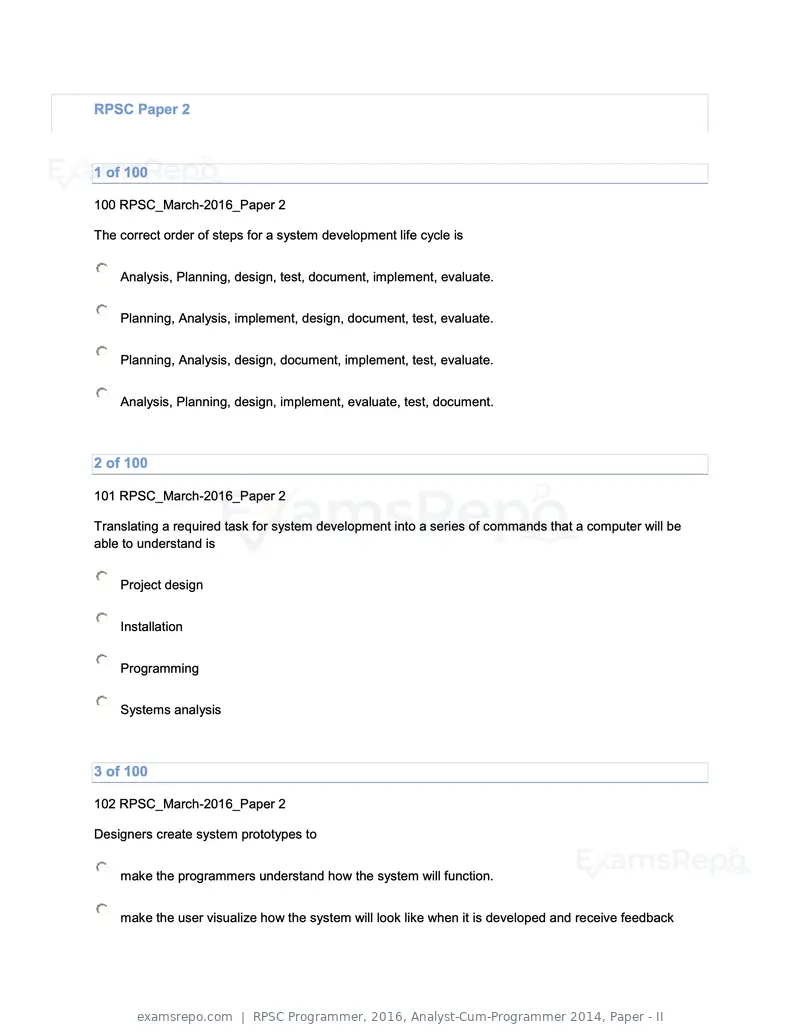
Text of page 1
RPSC Paper 2


1 of 100

100 RPSC_March-2016_Paper 2

The correct order of steps for a system development life cycle is


    Analysis, Planning, design, test, document, implement, evaluate.


    Planning, Analysis, implement, design, document, test, evaluate.


    Planning, Analysis, design, document, implement, test, evaluate.


    Analysis, Planning, design, implement, evaluate, test, document.


2 of 100

101 RPSC_March-2016_Paper 2

Translating a required task for system development into a series of commands that a computer will be
able to understand is


    Project design


    Installation


    Programming


    Systems analysis


3 of 100

102 RPSC_March-2016_Paper 2

Designers create system prototypes to


    make the programmers understand how the system will function.


    make the user visualize how the system will look like when it is developed and receive feedback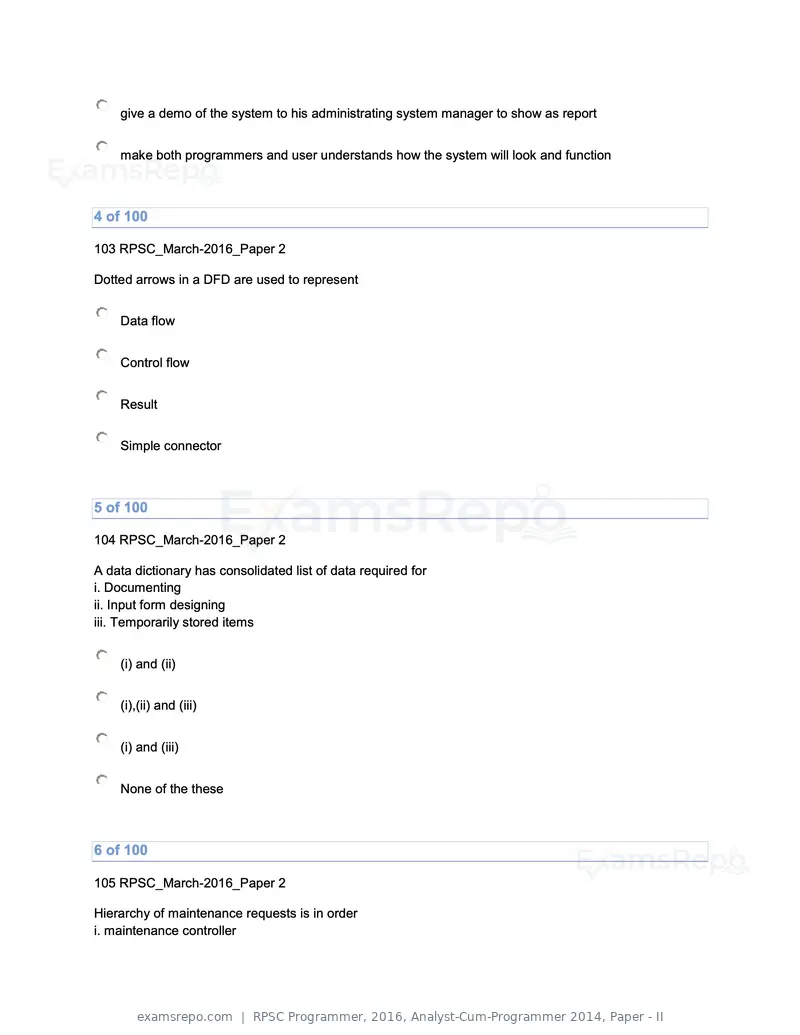
Text of page 2
give a demo of the system to his administrating system manager to show as report


    make both programmers and user understands how the system will look and function


4 of 100

103 RPSC_March-2016_Paper 2

Dotted arrows in a DFD are used to represent


    Data flow


    Control flow


    Result


    Simple connector


5 of 100

104 RPSC_March-2016_Paper 2

A data dictionary has consolidated list of data required for
i. Documenting
ii. Input form designing
iii. Temporarily stored items


    (i) and (ii)


    (i),(ii) and (iii)


    (i) and (iii)


    None of the these


6 of 100

105 RPSC_March-2016_Paper 2

Hierarchy of maintenance requests is in order
i. maintenance controller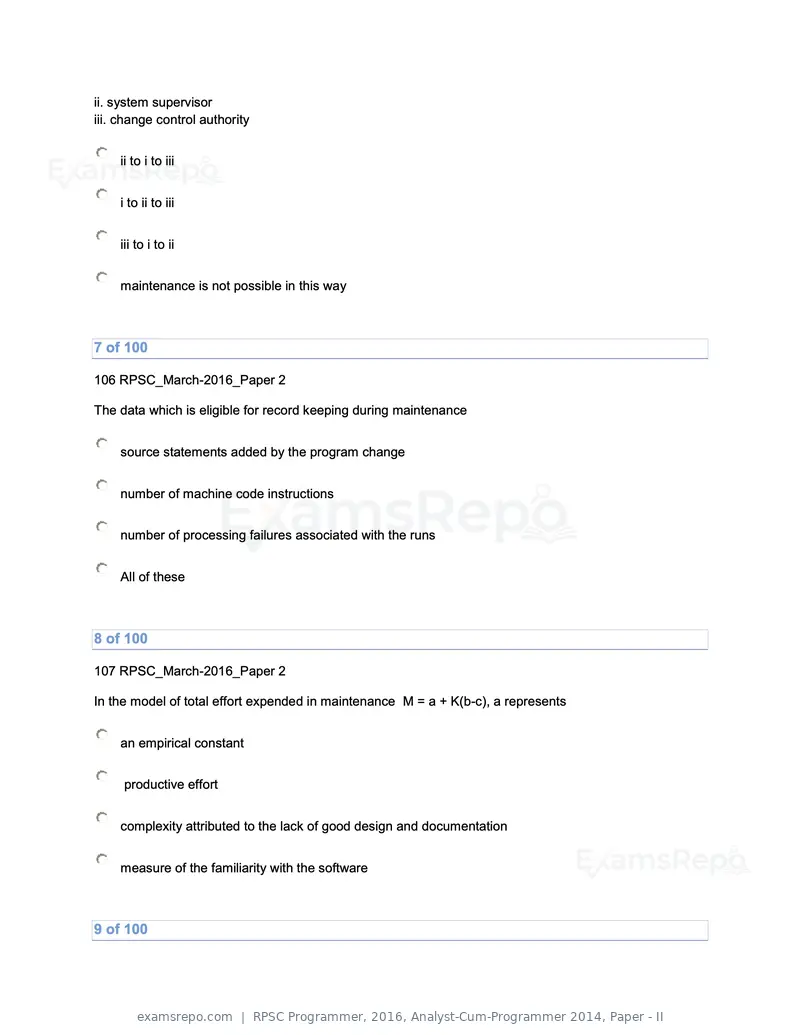
Text of page 3
ii. system supervisor
iii. change control authority


    ii to i to iii


    i to ii to iii


    iii to i to ii


    maintenance is not possible in this way


7 of 100

106 RPSC_March-2016_Paper 2

The data which is eligible for record keeping during maintenance


    source statements added by the program change


    number of machine code instructions


    number of processing failures associated with the runs


    All of these


8 of 100

107 RPSC_March-2016_Paper 2

In the model of total effort expended in maintenance M = a + K(b-c), a represents


    an empirical constant


     productive effort


    complexity attributed to the lack of good design and documentation


    measure of the familiarity with the software


9 of 100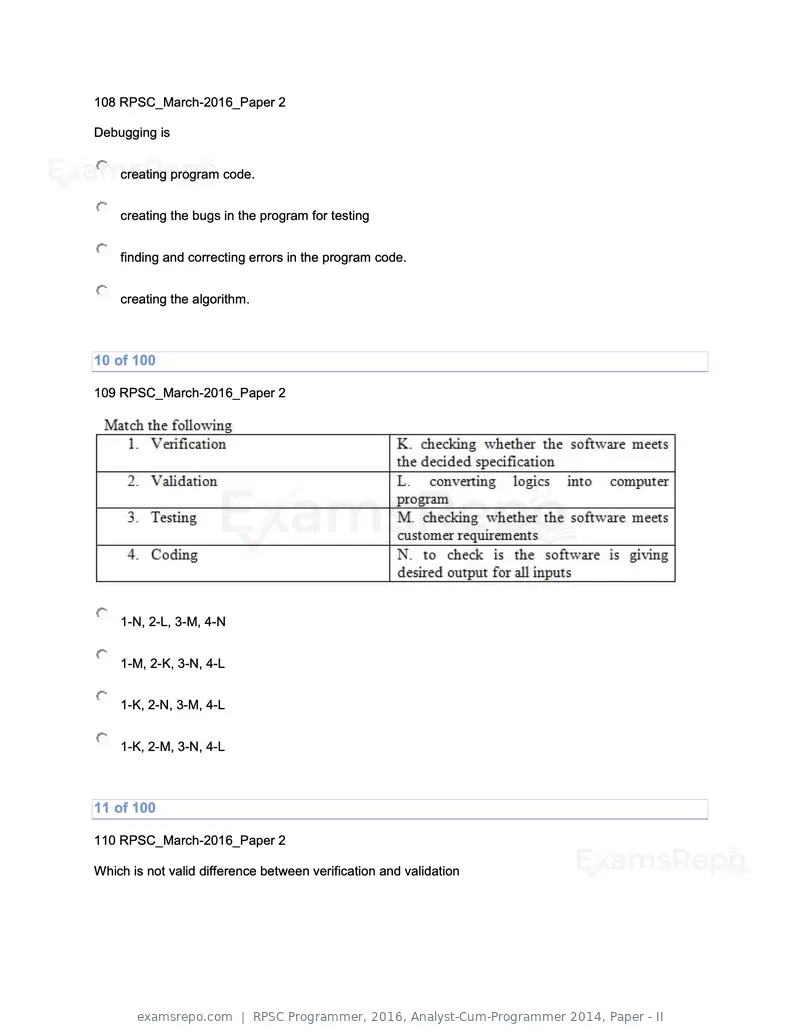
Text of page 4
108 RPSC_March-2016_Paper 2

Debugging is


    creating program code.


    creating the bugs in the program for testing


    finding and correcting errors in the program code.


    creating the algorithm.


10 of 100

109 RPSC_March-2016_Paper 2


    1-N, 2-L, 3-M, 4-N


    1-M, 2-K, 3-N, 4-L


    1-K, 2-N, 3-M, 4-L


    1-K, 2-M, 3-N, 4-L


11 of 100

110 RPSC_March-2016_Paper 2

Which is not valid difference between verification and validation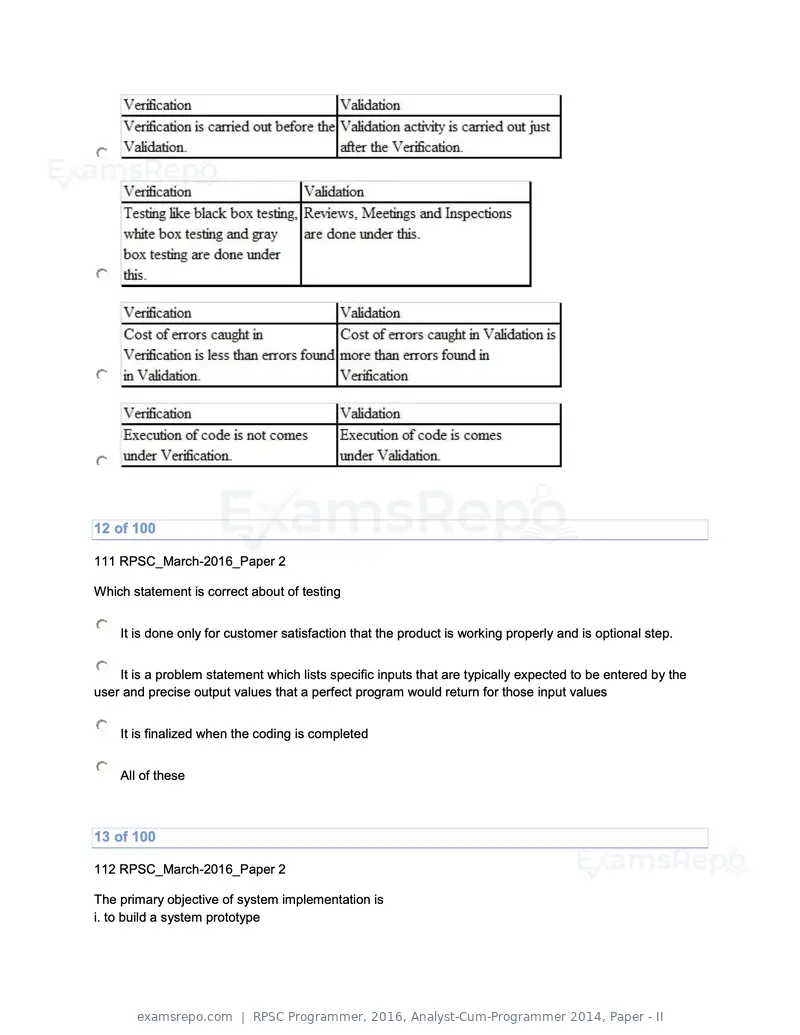
Text of page 5
12 of 100

111 RPSC_March-2016_Paper 2

Which statement is correct about of testing


    It is done only for customer satisfaction that the product is working properly and is optional step.


    It is a problem statement which lists specific inputs that are typically expected to be entered by the
user and precise output values that a perfect program would return for those input values


    It is finalized when the coding is completed


    All of these


13 of 100

112 RPSC_March-2016_Paper 2

The primary objective of system implementation is
i. to build a system prototype
Text of page 6
ii. to train users to operate the system
iii. to implement designed system using computers
iv. write programs, create databases and test with live data


    i, iii


    i, ii, iii


    ii ,iii


    iii, iv


14 of 100

113 RPSC_March-2016_Paper 2

Which design is perfect for long use, maintainability and up-gradation


    use good software tools


    use the best hardware available


    design the system in independent modules


    Create versions of the program frequently


15 of 100

114 RPSC_March-2016_Paper 2

The system analyst is required to perform the task(s) include
i. defining and prioritizing information requirement of an organization
ii. gathering data, facts and opinions of users in an organization
iii. drawing up specifications of the system for an organization
iv. designing, coding and evaluating the system


    i and ii


    i, ii and iv


    i, ii and iii
Text of page 7
i, ii, iii and iv


16 of 100

115 RPSC_March-2016_Paper 2

Which of the following is not the primary design objective


    Cost


    Reusability


    Understandable code for user


    Security


17 of 100

116 RPSC_March-2016_Paper 2

A system when made of several discrete components is called


    Top-down


    Bottom up


    Modular


    Linear


18 of 100

117 RPSC_March-2016_Paper 2

Which of the following is true for cohesion and coupling


    Coupling taken place between multiple modules whereas cohesion is the strength of various
elements inside a module


    A good design must have very high cohesion
Text of page 8
A good design must have very low coupling


    All of these


19 of 100

118 RPSC_March-2016_Paper 2

Which of the following is not advantage of structured design


    Critical interfaces are designed first


    Controls for upgrades are very easy and low cost


    Early versions of design can give pre-review of system


    Real life systems can be easily modeled


20 of 100

119 RPSC_March-2016_Paper 2

In IPO charts P stands for


    Program


    Process


    Publish


    Presumption


21 of 100

120 RPSC_March-2016_Paper 2

Which is not a reason to consult user while designing of structured walk


    Probability of success improves with involvement of user
Text of page 9
Feedback is received which is very important


    User and programmer can communicate to decide the price of the software


    User can be trained and made understood about system


22 of 100

121 RPSC_March-2016_Paper 2

The correct order of input form design stages is
i. Determining the contents of the input
ii. Choosing appropriate input device
iii. Identify the inputs required by the system
iv. Designing forms for input


    iii-i-ii-iv


    i-iii-ii-iv


    i-iii-iv-ii


    iii-i-iv-ii


23 of 100

122 RPSC_March-2016_Paper 2

From the following which is not the activity of software maintenance


    corrective maintenance


    adaptive maintenance: modifies software to properly interface with a changing environment


    preventive maintenance


    reverse engineering


24 of 100
Text of page 10
123 RPSC_March-2016_Paper 2

Correct order of stages of testing


    Unit, integration, system, regression, acceptance


    System, regression, unit, integration, acceptance


    Unit, system, regression, integration, acceptance


    System, integration, unit, acceptance, regression


25 of 100

124 RPSC_March-2016_Paper 2

Organizational chart is an example of


    IPO


    HIPO


    Step chart


    Process chart


26 of 100

125 RPSC_March-2016_Paper 2

Structured charts are developed after


    Designing


    Coding


    Requirement gathering


    Requirement analysis
Text of page 11
27 of 100

126 RPSC_March-2016_Paper 2

Out of following which comes under requirement specification


    Functional implementation


    Temporary Data collection


    User feedback about project


    Data flow models


28 of 100

127 RPSC_March-2016_Paper 2

The model in which system development is broken down into a number of sequential sections or stages
represented by boxes, with each stage being completed before work starts on the following one. The
outputs from one stage are used as inputs to the next.


    Spiral model


    Waterfall model


    Structured model


    None of these


29 of 100

128 RPSC_March-2016_Paper 2

The spiral model is advantageous than waterfall model


    When the requirements of the system are well understood by the users


    When the requirements are not well formed or understood by the users


    When the product comes after one stage easily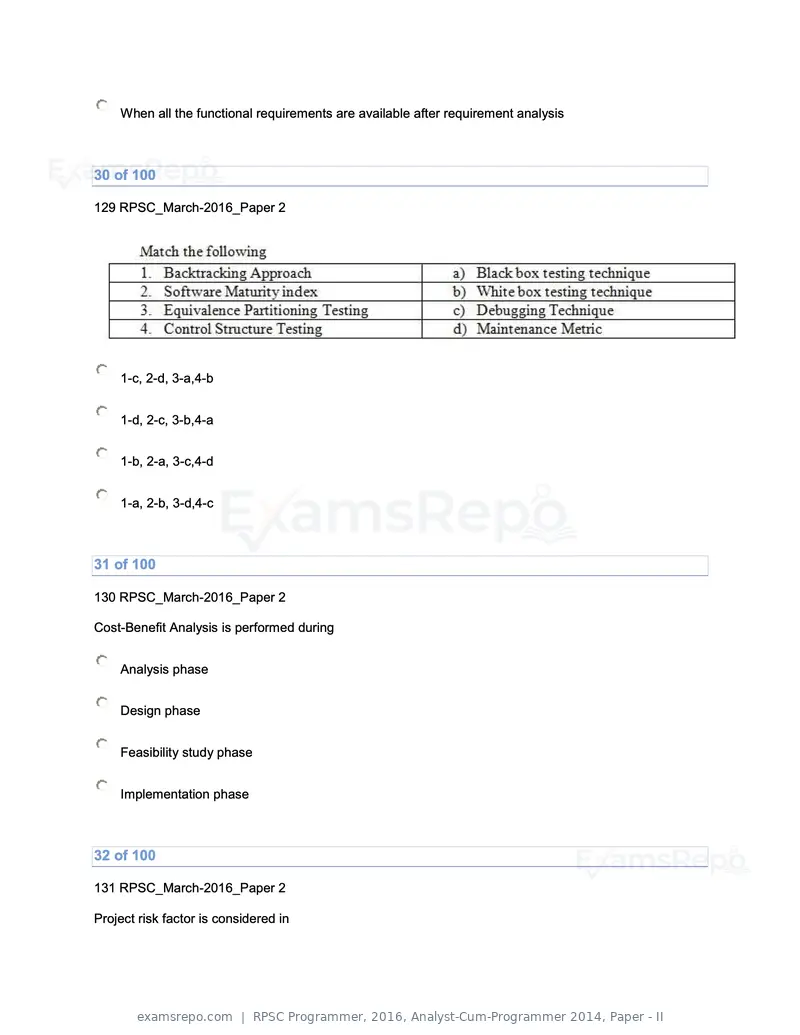
Text of page 12
When all the functional requirements are available after requirement analysis


30 of 100

129 RPSC_March-2016_Paper 2


    1-c, 2-d, 3-a,4-b


    1-d, 2-c, 3-b,4-a


    1-b, 2-a, 3-c,4-d


    1-a, 2-b, 3-d,4-c


31 of 100

130 RPSC_March-2016_Paper 2

Cost-Benefit Analysis is performed during


    Analysis phase


    Design phase


    Feasibility study phase


    Implementation phase


32 of 100

131 RPSC_March-2016_Paper 2

Project risk factor is considered in
Text of page 13
Spiral model


    Waterfall model


    Prototyping model


    Iterative enhancement model


33 of 100

132 RPSC_March-2016_Paper 2

A software project classifies system entities, their activities and relationships. The classification and
abstraction of system entities is important. .....................methodology most clearly shows the classification
and abstraction of entities in the system


    Prototyping Model


    Data Flow Model


    RAD model


    None of these


34 of 100

133 RPSC_March-2016_Paper 2

In unit testing, interface testing is performed to assess


    Efficiency


    Behavior


    Functional Independence


    Internal logic of code


35 of 100
Text of page 14
134 RPSC_March-2016_Paper 2

Which of following is NOT defined in a good software requirement specification (SRS) document


    Functional requirement


    Non Functional requirement


    Goals of Implementation


    Algorithms for software Implementation


36 of 100

135 RPSC_March-2016_Paper 2


    i-c, ii-d, iii-a, iv-b


    i-d, ii-c, iii-b, iv-a


    i-a, ii-c, iii-d, iv-b


    i-c, ii-a, iii-d, iv-b


37 of 100

136 RPSC_March-2016_Paper 2

Which of the following is not regression test case?
Text of page 15
A representative sample of tests that will exercise all software functions


    Additional tests that focus on software functions that are likely to be affected by the change


    Tests that focus on the software components that have been changed


    Low-level components are combined into clusters that perform a specific software sub-function


38 of 100

137 RPSC_March-2016_Paper 2

After Development phase, a document is prepared


    Program specification


    System specification


    Design specification


    None of these


39 of 100

138 RPSC_March-2016_Paper 2

A diagram that shows the major subsystems in an object-oriented system is called a


    System flowchart


    Design class diagram


    Class diagram


    Component diagrams


40 of 100

139 RPSC_March-2016_Paper 2
Text of page 16
During the planning phase of the system development life cycle (SDLC), the ____ helps to define the
scope of the problem.


    critical path method (CPM) chart


    project evaluation and review technique (PERT) chart


    proof of concept prototype


    context diagram


41 of 100

140 RPSC_March-2016_Paper 2

Clients play what role in the development of a new system?


    Develop the project plan


    Define the business processes


    Fund the project


    Lead the project team


42 of 100

141 RPSC_March-2016_Paper 2

Questionnaires can be useful in information gathering when users ____.


     are widely distributed geographically


     need prompting to respond to questions


    are not well-informed


    do not have time for interviews


43 of 100
Text of page 17
142 RPSC_March-2016_Paper 2

____ requirements are based on the procedures and rules that the organization uses to run its business.


    Functional


    Logical


    Physical


    None of these


44 of 100

143 RPSC_March-2016_Paper 2

The first item to be reviewed during a structured walkthrough is the documentation that was developed as
part of the ____ phase of the systems development life cycle (SDLC).


    design


    analysis


    planning


    implementation


45 of 100

144 RPSC_March-2016_Paper 2

Error report is an example of


    Process


    Output process


    Input process


    None of these
Text of page 18
46 of 100

145 RPSC_March-2016_Paper 2

An external entity in the system is


    Unit outside the system and controllable by system analyst


    External unit which will be designed


    A unit which is not shown in DFD


    A unit outside the system and works completely independent manner


47 of 100

146 RPSC_March-2016_Paper 2

The controlling factor which does not governs the software maintainability


    use of standardized programming languages


    inefficient maintenance team taking much time


    standardized structure of the documentation


    availability of test cases


48 of 100

147 RPSC_March-2016_Paper 2

The code used for the validation purpose is known


    Debugging code


    Self-checking code


    Sequence code


    Group classification code
Text of page 19
49 of 100

148 RPSC_March-2016_Paper 2

Feasibility checking is the step performed


    Before requirements specifications are drawn up


    during the period when requirements specifications are drawn up


    After all requirements specifications are drawn up


    at any time


50 of 100

149 RPSC_March-2016_Paper 2

What is incorrect about DFDs


    process models have as many level 1 diagrams as there are processes on the level 0 diagram


    every process in the level 1 DFD would be decomposed into its own level 1 DFD


    The purpose of the level 0 DFD is to show all the major high-level processes of the system and how
they are interrelated


    level 1 DFD shows how level 0 processes operates in greater detail


51 of 100

150 RPSC_March-2016_Paper 2

Effective software project management focuses on four P's which are


    people, performance, payoff, product


    people, product, performance, process


    people, product, process, project
Text of page 20
people, process, payoff, product


52 of 100

151 RPSC_March-2016_Paper 2

The first step in project planning is to


    determine the budget


    select a team organizational model.


    determine the project constraints.


    establish the objectives and scope


53 of 100

152 RPSC_March-2016_Paper 2

The application of knowledge, skills, tools and techniques to project activities to meet the project
requirements.


    Software quality control


    Software project management


    Software process management


    Software project planning


54 of 100

153 RPSC_March-2016_Paper 2

Which of the following is a tool of time management for software development


    Project network diagrams


    Gantt charts
Text of page 21
Critical-path analyses


    All of these


55 of 100

154 RPSC_March-2016_Paper 2


    i-c, ii-a, iii-b


    i-a, ii-c, iii-b


    i-a, ii-b, iii-c


    i-c, ii-b, iii-a


56 of 100

155 RPSC_March-2016_Paper 2

What information is not essentially required in a project progress report


    Reporting period to which it refers


    Days taken and cost to complete the report


    Authors of the report


    Date of submission
Text of page 22
57 of 100

156 RPSC_March-2016_Paper 2

Which of following is not the aim of project progress report


    Provide an overview of project’s progress up to date


    To keep it as a document for customer satisfaction


    Ensure that the key stakeholders are regularly informed


    Inform the key stakeholders about issues that require immediate action or resolution


58 of 100

157 RPSC_March-2016_Paper 2

Objectives of risk management do not include


    Minimize the effort in software coding


    Minimize adverse impacts to project scope, cost, and schedule


    Maximize opportunities to improve the project’s objectives with lower cost, shorter schedules,
enhanced scope and higher quality


    Minimize management by crisis


59 of 100

158 RPSC_March-2016_Paper 2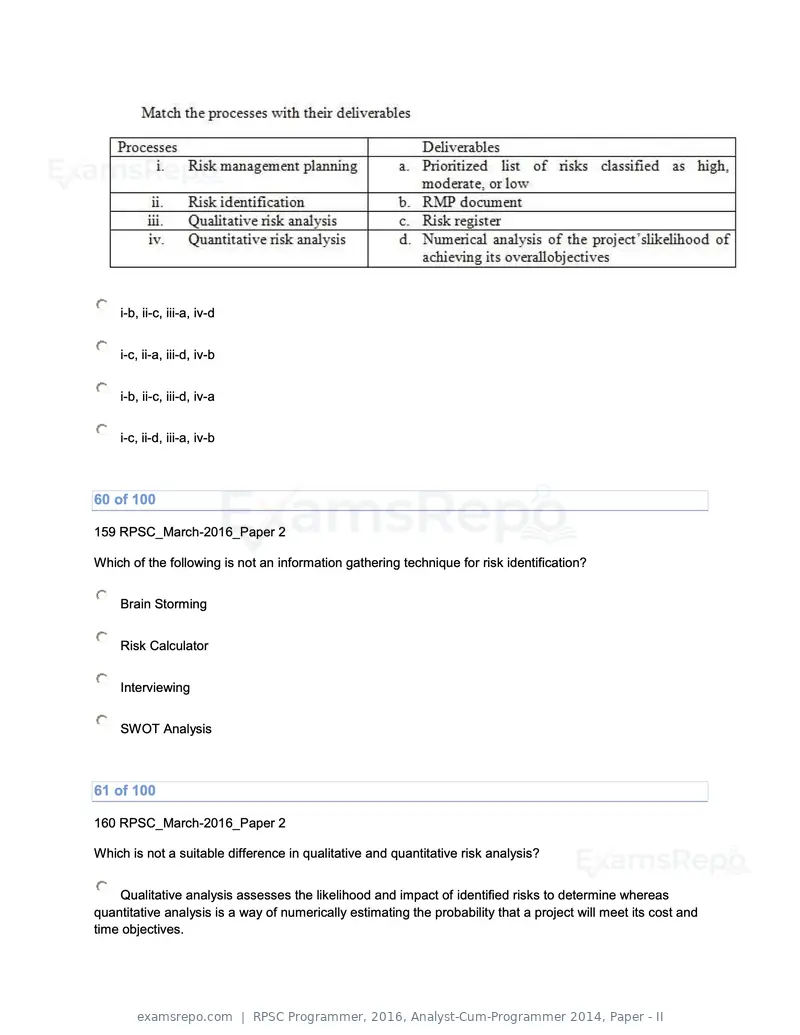
Text of page 23
i-b, ii-c, iii-a, iv-d


    i-c, ii-a, iii-d, iv-b


    i-b, ii-c, iii-d, iv-a


    i-c, ii-d, iii-a, iv-b


60 of 100

159 RPSC_March-2016_Paper 2

Which of the following is not an information gathering technique for risk identification?


    Brain Storming


    Risk Calculator


    Interviewing


    SWOT Analysis


61 of 100

160 RPSC_March-2016_Paper 2

Which is not a suitable difference in qualitative and quantitative risk analysis?


    Qualitative analysis assesses the likelihood and impact of identified risks to determine whereas
quantitative analysis is a way of numerically estimating the probability that a project will meet its cost and
time objectives.
Text of page 24
Quantitative risk analysis involves statistical techniques whereas qualitative analysis is found using
impact matrix.


    Qualitative risk analysis generally follows qualitative analysis.


    None of these


62 of 100

161 RPSC_March-2016_Paper 2

Which statement is false?


      Organizations that achieve high levels of maturity in the people management area have a higher
likelihood of implementing effective software engineering practices.


    The software developer and analyst must meet to define product objectives and scope alone.


     Without information of technical and management constraints, it is impossible to define accurate
estimates of the cost and risk.


    Umbrella activities are independent of any one framework activity and occur throughout the process


63 of 100

162 RPSC_March-2016_Paper 2
                                     5
Which is not the meaning of W’s W HH


    Why is the system being developed?


    Who is responsible for a function?


    What will be done, by when?


    Where the organizational hierarchy plays its role?


64 of 100

163 RPSC_March-2016_Paper 2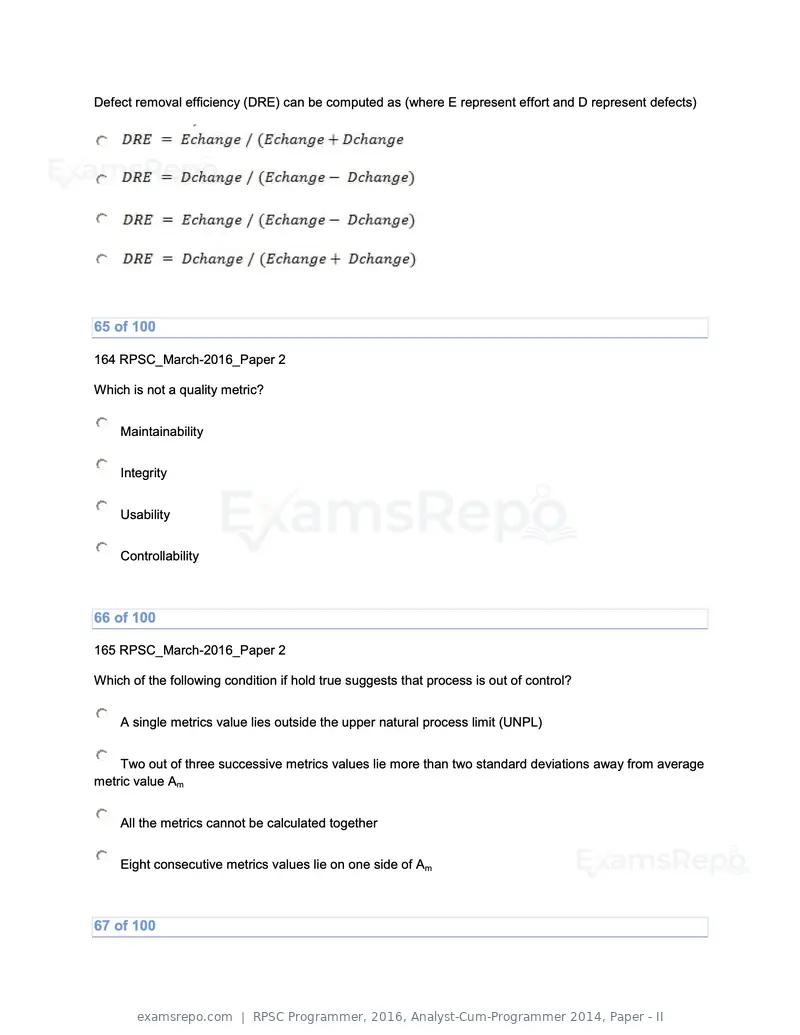
Text of page 25
Defect removal efficiency (DRE) can be computed as (where E represent effort and D represent defects)


65 of 100

164 RPSC_March-2016_Paper 2

Which is not a quality metric?


    Maintainability


    Integrity


    Usability


    Controllability


66 of 100

165 RPSC_March-2016_Paper 2

Which of the following condition if hold true suggests that process is out of control?


    A single metrics value lies outside the upper natural process limit (UNPL)


    Two out of three successive metrics values lie more than two standard deviations away from average
metric value Am


    All the metrics cannot be calculated together


    Eight consecutive metrics values lie on one side of Am


67 of 100
Text of page 26
166 RPSC_March-2016_Paper 2

Which is not a reusable software resource from the following


    Off-the-shelf components


    Full-experience components


    Environmental components


    Partial-experience components


68 of 100

167 RPSC_March-2016_Paper 2

Which of the following is not a good and reliable cost and effort estimate


    Delay estimation until late in the project


    Ask from customer about his budget


    Base estimates on similar projects that have already been completed


    Use relatively simple decomposition techniques to generate project cost and effort estimates


69 of 100

168 RPSC_March-2016_Paper 2


    Effort


    Estimation variable


    Empirical constant


    Time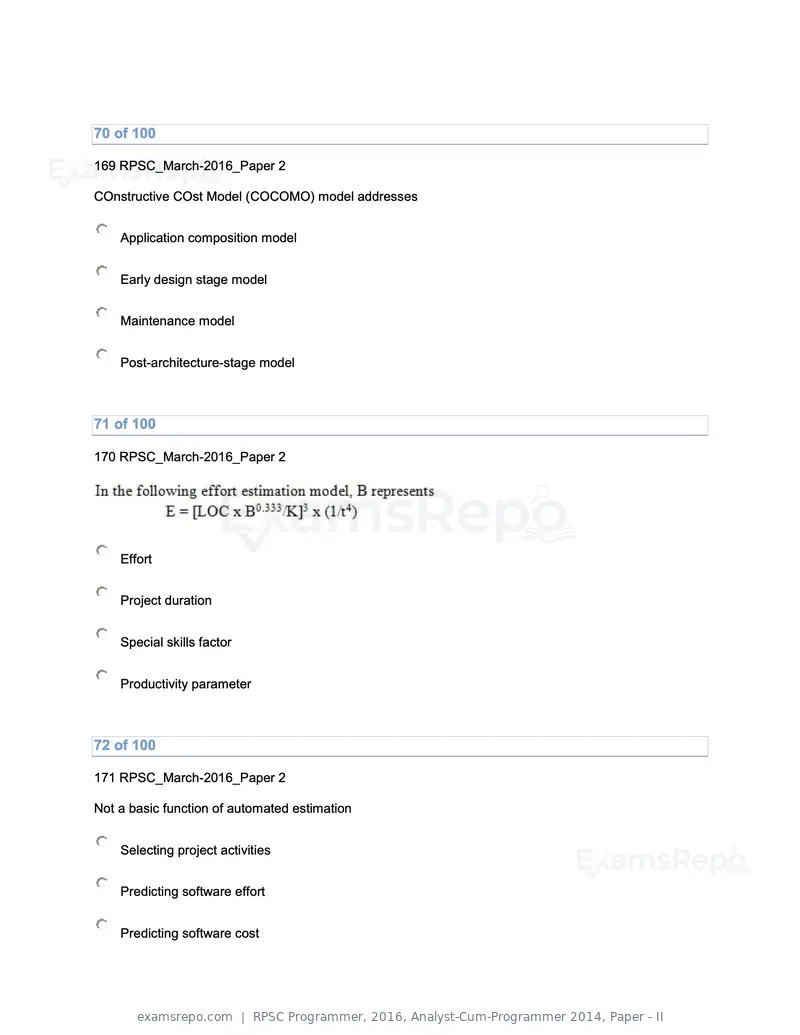
Text of page 27
70 of 100

169 RPSC_March-2016_Paper 2

COnstructive COst Model (COCOMO) model addresses


    Application composition model


    Early design stage model


    Maintenance model


    Post-architecture-stage model


71 of 100

170 RPSC_March-2016_Paper 2


    Effort


    Project duration


    Special skills factor


    Productivity parameter


72 of 100

171 RPSC_March-2016_Paper 2

Not a basic function of automated estimation


    Selecting project activities


    Predicting software effort


    Predicting software cost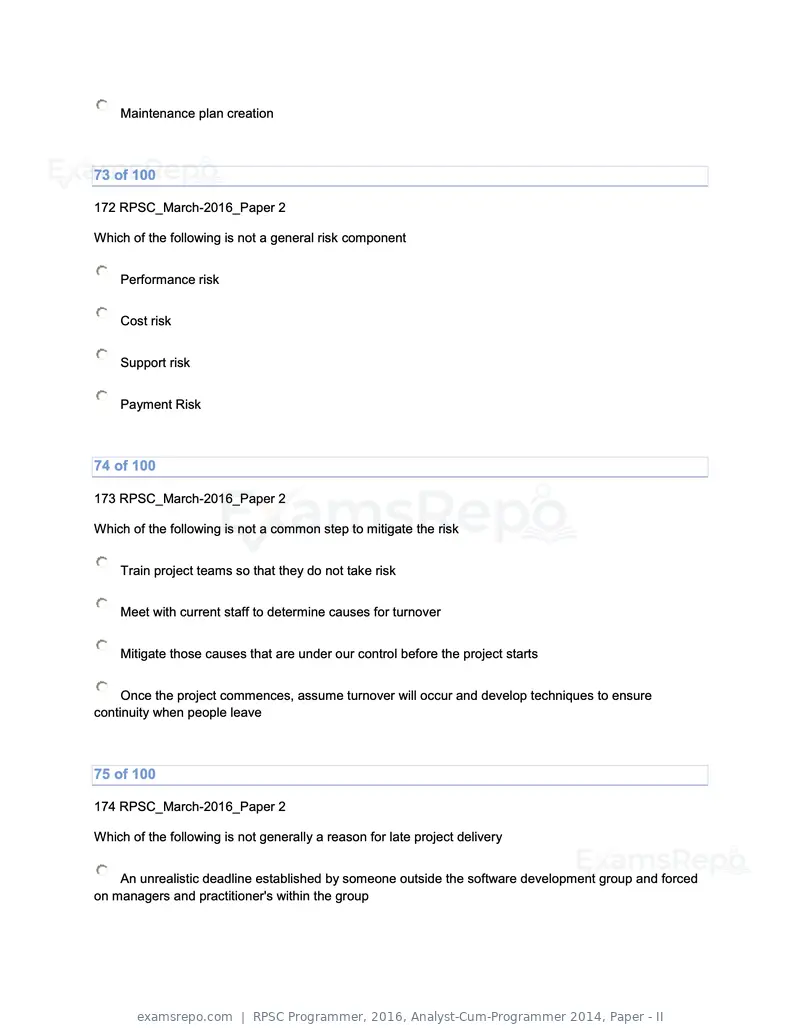
Text of page 28
Maintenance plan creation


73 of 100

172 RPSC_March-2016_Paper 2

Which of the following is not a general risk component


    Performance risk


    Cost risk


    Support risk


    Payment Risk


74 of 100

173 RPSC_March-2016_Paper 2

Which of the following is not a common step to mitigate the risk


    Train project teams so that they do not take risk


    Meet with current staff to determine causes for turnover


    Mitigate those causes that are under our control before the project starts


     Once the project commences, assume turnover will occur and develop techniques to ensure
continuity when people leave


75 of 100

174 RPSC_March-2016_Paper 2

Which of the following is not generally a reason for late project delivery


    An unrealistic deadline established by someone outside the software development group and forced
on managers and practitioner's within the group
Text of page 29
Changing customer requirements that are not reflected in schedule changes


    Customer not releasing payment


     An honest underestimate of the amount of effort and/or the number ofresources that will be required
to do the job


76 of 100

175 RPSC_March-2016_Paper 2

______________________is an activity that distributes estimated effort across the planned project
duration by allocating the effort to specific software engineering tasks


    Software project scheduling


    Software project management


    Software planning


    Software effort estimation


77 of 100

176 RPSC_March-2016_Paper 2

Issues guiding software project scheduling


    Interdependency


    Time allocation


    Both Interdependency & Time Allocation


    None of these


78 of 100

177 RPSC_March-2016_Paper 2
Text of page 30
Reliable decomposition technique under software project estimation is


    Process based estimation


    Software sizing


    Problem based estimation


    All of these


79 of 100

178 RPSC_March-2016_Paper 2

The correct order of earned value calculation steps is
i. Estimate effort for work planned
ii. budgeted cost of work scheduled
iii. Estimate budget for work performed


    i-ii-iii


    ii-i-iii


    iii-i-ii


    ii-iii-i


80 of 100

179 RPSC_March-2016_Paper 2

The auditing and reporting functions of management are part of


    Cost of quality


    Quality control


    Quality assurance


    Quality evaluation
Text of page 31
81 of 100

180 RPSC_March-2016_Paper 2

Which of the following is not a fundamental source of change


    New business or market conditions dictate changes in product requirements


    New customer needs demand modification


    Problems in the organization


    Commitment to other customer


82 of 100

181 RPSC_March-2016_Paper 2

________________combines procedures and tools to manage different up-gradations of configuration
objects that are created during the software process


    Maintenance schedule


    Version control


    Evolutionary design


    Data flow model


83 of 100

182 RPSC_March-2016_Paper 2

Which of the following risk is the failure of a purchased component to perform as expected?


    Product risk


    Project risk


    Business risk


    Programming risk
Text of page 32
84 of 100

183 RPSC_March-2016_Paper 2

Software interoperability is:


    The ability of a software system to work on different hardware platforms


    The ability of a software system to work under different operating systems


    The ability of a software system to exchange information with other software systems and to use the
exchanged information


    The ability to replace a software system with another software system that has similar functionality


85 of 100

184 RPSC_March-2016_Paper 2

Cyclomatic Complexity is :


    number of operands in program


    number of decision points +1


    number of operators in program


    None of these


86 of 100

185 RPSC_March-2016_Paper 2

Grade of a product


    Means the same thing as quality


    can be used interchangeably with quality


    Is the level of product or service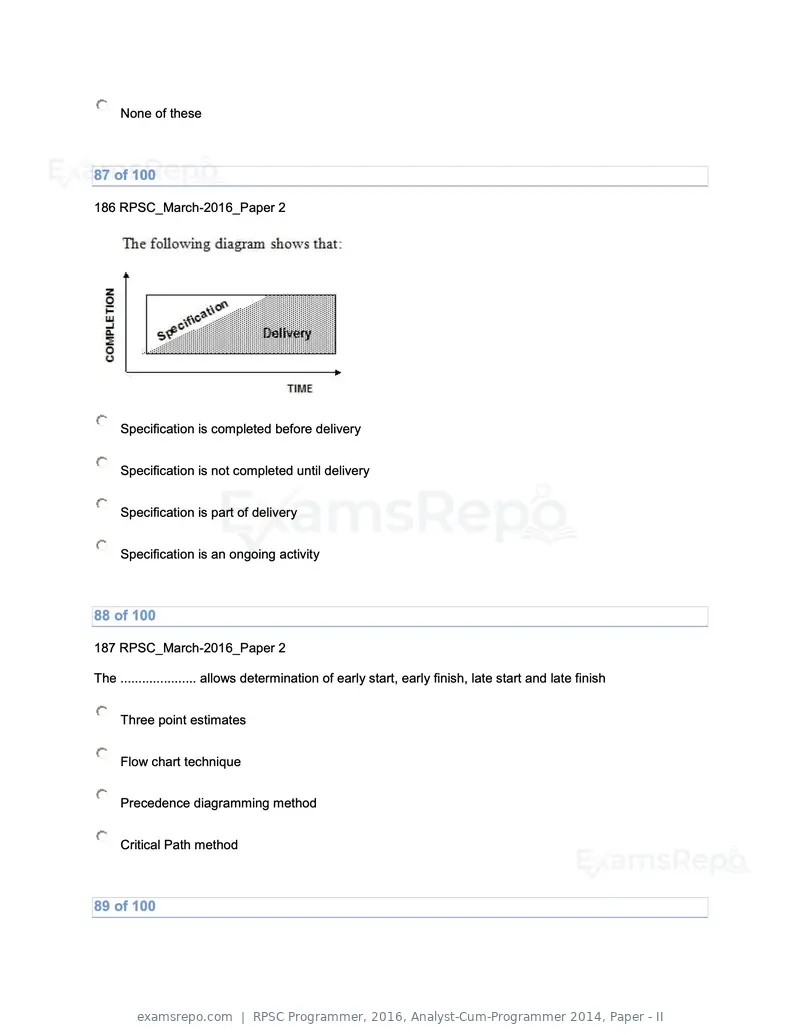
Text of page 33
None of these


87 of 100

186 RPSC_March-2016_Paper 2


     Specification is completed before delivery


     Specification is not completed until delivery


     Specification is part of delivery


     Specification is an ongoing activity


88 of 100

187 RPSC_March-2016_Paper 2

The ..................... allows determination of early start, early finish, late start and late finish


     Three point estimates


     Flow chart technique


     Precedence diagramming method


     Critical Path method


89 of 100
Text of page 34
188 RPSC_March-2016_Paper 2

______________is the degree to which the design specifications are followed during manufacturing


    Quality of development


    Quality of conformance


    Quality of design


    None of the these


90 of 100

189 RPSC_March-2016_Paper 2

Top-level problem solving and internal team coordination are managed by a team leader in which
approach


    Controlled centralized


    Controlled decentralized


    Democratic decentralized


    Partial centralized


91 of 100

190 RPSC_March-2016_Paper 2


    i-a, ii-b, iii-c, iv-d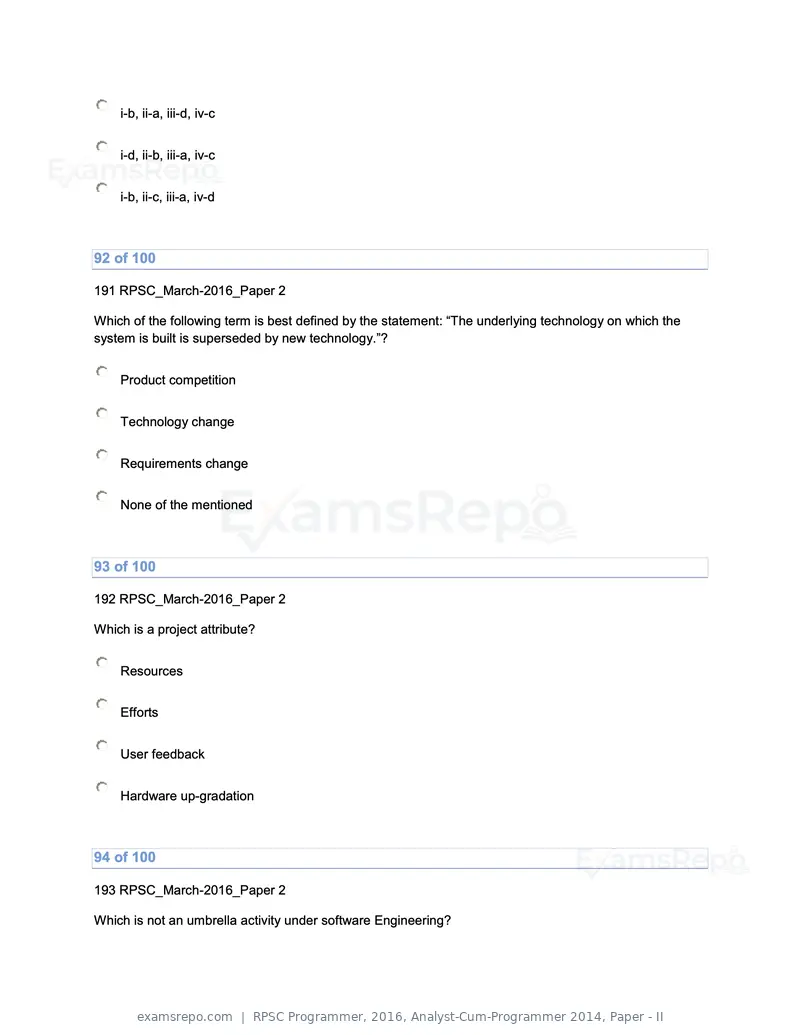
Text of page 35
i-b, ii-a, iii-d, iv-c


    i-d, ii-b, iii-a, iv-c


    i-b, ii-c, iii-a, iv-d


92 of 100

191 RPSC_March-2016_Paper 2

Which of the following term is best defined by the statement: “The underlying technology on which the
system is built is superseded by new technology.”?


    Product competition


    Technology change


    Requirements change


    None of the mentioned


93 of 100

192 RPSC_March-2016_Paper 2

Which is a project attribute?


    Resources


    Efforts


    User feedback


    Hardware up-gradation


94 of 100

193 RPSC_March-2016_Paper 2

Which is not an umbrella activity under software Engineering?
Text of page 36
Software quality assurance


    Software configuration management


    Document preparation and production


    Software Encryption


95 of 100

194 RPSC_March-2016_Paper 2

Product quality is defined as:


    Delivering a product with correct requirements


    Delivering a product using correct development procedures


    Delivering a product which is developed iteratively


    Delivering a product using high quality procedures


96 of 100

195 RPSC_March-2016_Paper 2

Which type of risk factor is most likely to cause problems for a software project which develops military
software?


    Unused or unusable software


    Legal expenses


    Excessive paperwork


    High maintenance costs


97 of 100

196 RPSC_March-2016_Paper 2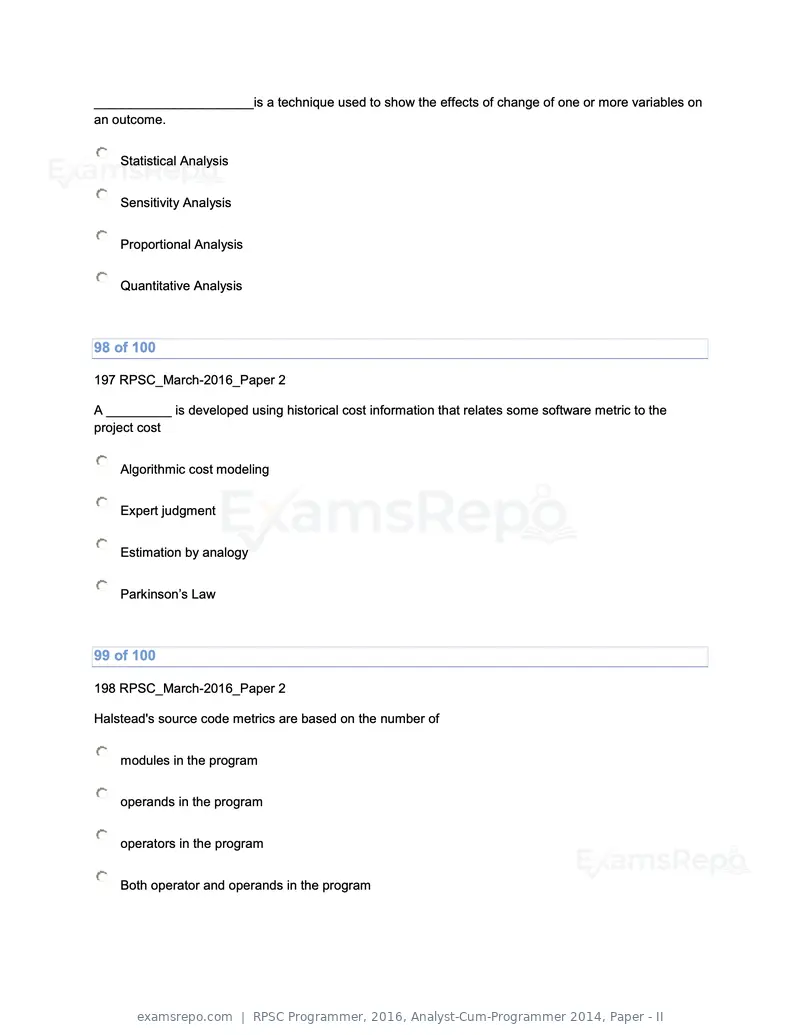
Text of page 37
______________________is a technique used to show the effects of change of one or more variables on
an outcome.


    Statistical Analysis


    Sensitivity Analysis


    Proportional Analysis


    Quantitative Analysis


98 of 100

197 RPSC_March-2016_Paper 2

A _________ is developed using historical cost information that relates some software metric to the
project cost


    Algorithmic cost modeling


    Expert judgment


    Estimation by analogy


    Parkinson’s Law


99 of 100

198 RPSC_March-2016_Paper 2

Halstead's source code metrics are based on the number of


    modules in the program


    operands in the program


    operators in the program


    Both operator and operands in the program
Text of page 38
100 of 100

199 RPSC_March-2016_Paper 2

Which of the following is not an approach to software cost estimation?


    Empirical


    Heuristic


    Analytical


    Critical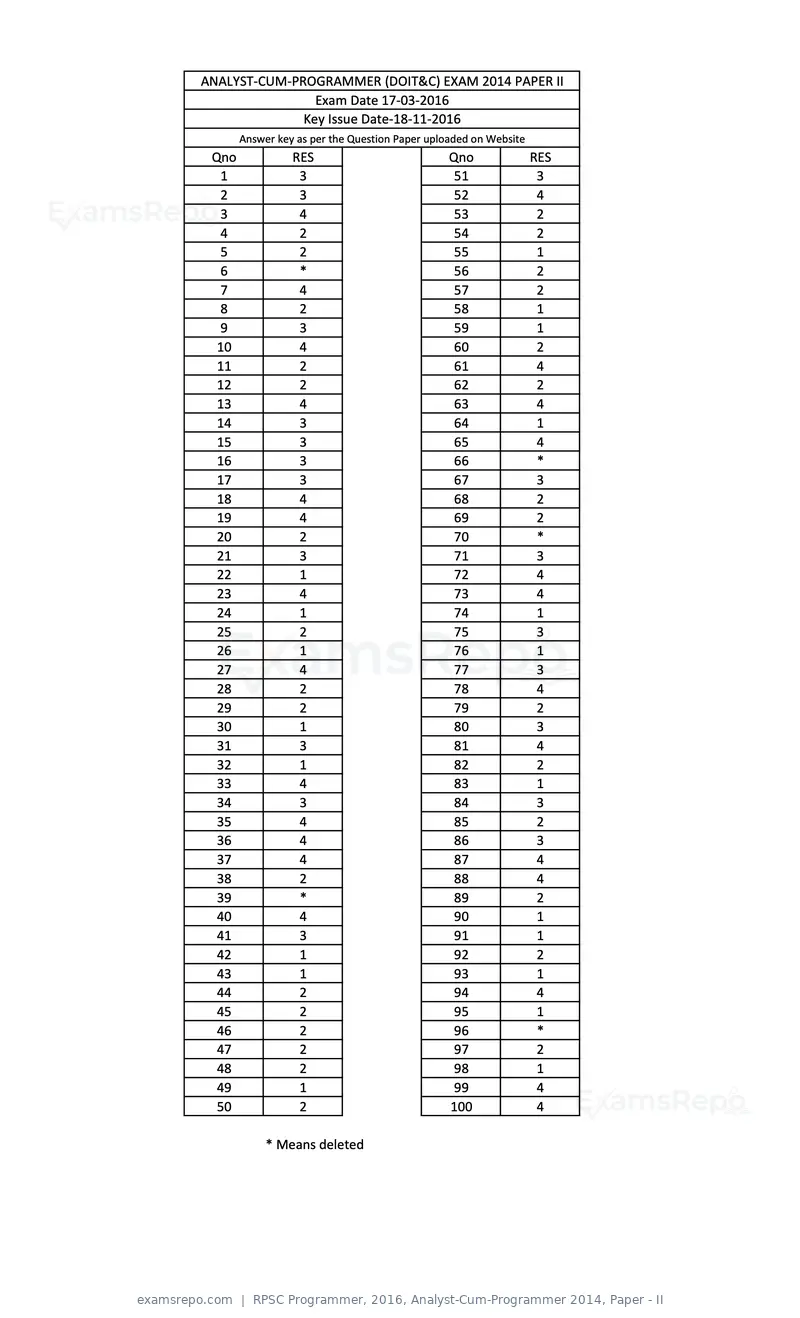
Text of page 1
ANALYST-CUM-PROGRAMMER (DOIT&C) EXAM 2014 PAPER II
                Exam Date 17-03-2016
              Key Issue Date-18-11-2016
       Answer key as per the Question Paper uploaded on Website
 Qno             RES                            Qno               RES
  1               3                              51                3
  2               3                              52                4
  3               4                              53                2
  4               2                              54                2
  5               2                              55                1
  6               *                              56                2
  7               4                              57                2
  8               2                              58                1
  9               3                              59                1
  10              4                              60                2
  11              2                              61                4
  12              2                              62                2
  13              4                              63                4
  14              3                              64                1
  15              3                              65                4
  16              3                              66                *
  17              3                              67                3
  18              4                              68                2
  19              4                              69                2
  20              2                              70                *
  21              3                              71                3
  22              1                              72                4
  23              4                              73                4
  24              1                              74                1
  25              2                              75                3
  26              1                              76                1
  27              4                              77                3
  28              2                              78                4
  29              2                              79                2
  30              1                              80                3
  31              3                              81                4
  32              1                              82                2
  33              4                              83                1
  34              3                              84                3
  35              4                              85                2
  36              4                              86                3
  37              4                              87                4
  38              2                              88                4
  39              *                              89                2
  40              4                              90                1
  41              3                              91                1
  42              1                              92                2
  43              1                              93                1
  44              2                              94                4
  45              2                              95                1
  46              2                              96                *
  47              2                              97                2
  48              2                              98                1
  49              1                              99                4
  50              2                             100                4

            * Means deleted
Page 1 of 38
Source: Rajasthan Public Service Commission. Question paper published by Rajasthan Public Service Commission.