
TS SET 2012: Paper II, Anthropology
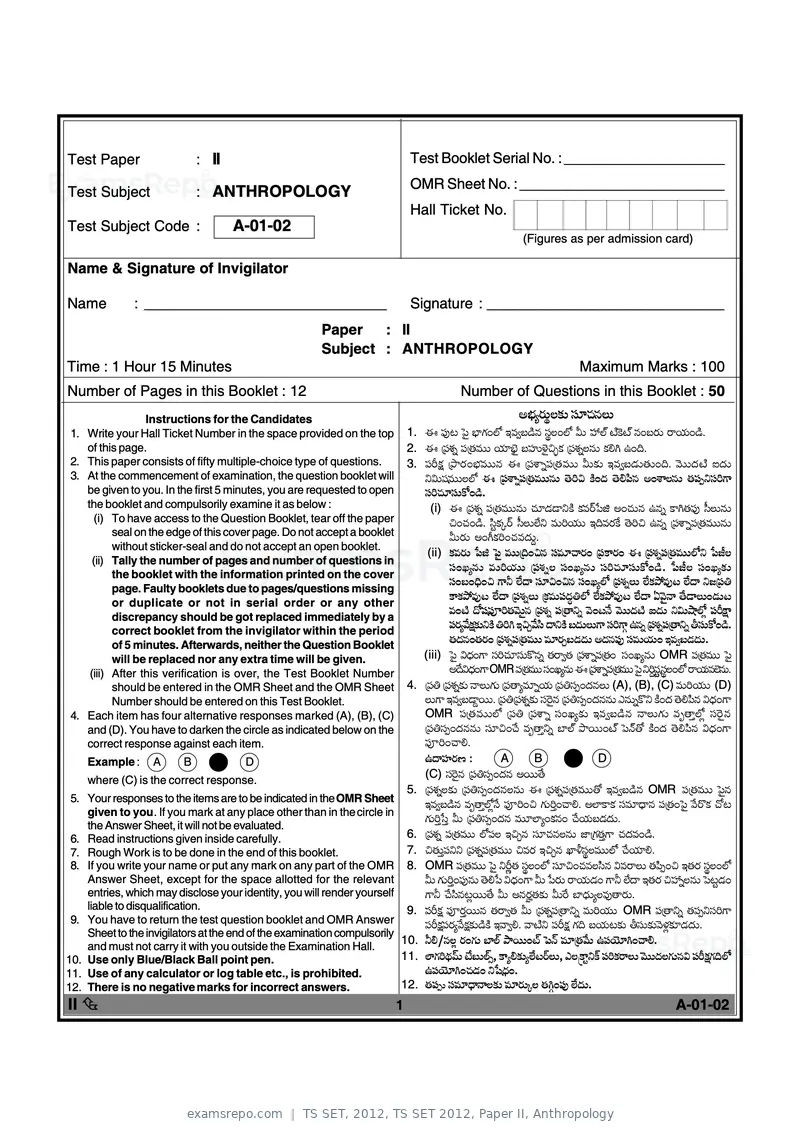
Text of page 1
Test Paper : II Test Booklet Serial No. : ______________________
OMR Sheet No. : ________________________________
Test Subject : ANTHROPOLOGY
Hall Ticket No.
Test Subject Code : A-01-02
(Figures as per admission card)
Name & Signature of Invigilator
Name : ____________________________________ Signature : ___________________________________
Paper : II
Subject : ANTHROPOLOGY
Time : 1 Hour 15 Minutes Maximum Marks : 100
Number of Pages in this Booklet : 12 Number of Questions in this Booklet : 50
Instructions for the Candidates A¿æýÅÆæÿ$¦ËMæü$ çÜ*^èþ¯èþË$
1. Write your Hall Ticket Number in the space provided on the top 1. D ç³#r ò³O ¿êVæü ÌZ CÐèþÓºyìþ¯èþ çÜ¦Ë ÌZ Ò$ çàÌý sìýMðüsý ¯èþ ºÆæÿ$ Æ>Äæý$ yìþ.
of this page. 2. D {ç³Ôèý² ç³{èþÐèþ$$ Äæý*¿ñýO ºçßý$âñýO_eMæü {ç³Ôèý²Ë¯èþ$ MæüÍW E ¨.
2. This paper consists of fifty multiple-choice type of questions. 3. ç³Èæü {´ëÆæÿ ¿æýÐèþ$$¯èþ D {ç³Ôé²ç³{èþÐèþ$$ Ò$Mæü$ CÐèþÓºyæþ$èþ$ ¨. Ððþ$$§æþsìý I§æþ$
3. At the commencement of examination, the question booklet will °Ñ$çÙÐèþ$$ËÌZ D {ç³Ôé²ç³{èþÐèþ$$¯èþ$ ðþÇ_ Mìü §æþ ðþÍí³¯èþ A Ôé˯èþ$ èþç³µ°çÜÇV>
be given to you. In the first 5 minutes, you are requested to open çÜÇ^èþ*çÜ$Mø yìþ.
the booklet and compulsorily examine it as below : (i) D {ç³Ôèý² ç³{èþÐèþ$$¯èþ$ ^èþ*yæþyé°Mìü MæüÐèþÆÿõ³h A ^èþ$¯èþ E¯èþ² M>Wèþç³# ïÜË$¯èþ$
(i) To have access to the Question Booklet, tear off the paper _ ^èþ yìþ. íÜtMæüPÆÿ ïÜË$Ìôý° Ðèþ$ÇÄæý$$ C¨ÐèþÆæÿMóü ðþÇ_ E¯èþ² {ç³Ôé²ç³{èþÐèþ$$¯èþ$
seal on the edge of this cover page. Do not accept a booklet Ò$Ææÿ$ A XMæüÇ ^èþÐèþ§æþ$ª.
without sticker-seal and do not accept an open booklet.
(ii) MæüÐèþÆæÿ$ õ³h ò³O Ðèþ$${¨ _¯èþ çÜÐèþ*^éÆæÿ {ç³M>Ææÿ D {ç³Ôèý²ç³{èþÐèþ$$ÌZ° õ³iË
(ii) Tally the number of pages and number of questions in
the booklet with the information printed on the cover
çÜ Qůèþ$ Ðèþ$ÇÄæý$$ {ç³Ôèý²Ë çÜ Qůèþ$ çÜÇ^èþ*çÜ$Mø yìþ. õ³iË çÜ QÅMæü$
page. Faulty booklets due to pages/questions missing
çÜ º «¨ _ V>± Ìôý§é çÜ*_ _¯èþ çÜ QÅÌZ {ç³Ôèý²Ë$ ÌôýMæü´ùÐèþ#r Ìôý§é °f{ç³
or duplicate or not in serial order or any other
M>Mæü´ùÐèþ#r Ìôý§é {ç³Ôèý²Ë$ {MæüÐèþ$糧æþ®ÌZ ÌôýMæü´ùÐèþ#r Ìôý§é HÐðþO¯é óþyéË$ yæþ$r
discrepancy should be got replaced immediately by a
Ðèþ sìý §øçÙç³NÇèþÐðþ$O¯èþ {ç³Ôèý² ç³{é°² Ððþ r¯óþ Ððþ$$§æþsìý I§æþ$ °Ñ$ÚëÌZÏ ç³È>
correct booklet from the invigilator within the period
ç³ÆæÿÅÐóþæüMæü$°Mìü ÇW C_aÐóþíÜ §é°Mìü º§æþ$Ë$V> çÜÇV>Y E¯èþ² {ç³Ôèý²ç³{é°² ¡çÜ$Mø yìþ.
of 5 minutes. Afterwards, neither the Question Booklet
èþ§æþ¯èþ èþÆæÿ {ç³Ôèý²ç³{èþÐèþ$$ Ðèþ*Ææÿaºyæþ§æþ$ A§æþ¯èþç³# çÜÐèþ$Äæý$ CÐèþÓºyæþ§æþ$.
will be replaced nor any extra time will be given. (iii) ò³O Ñ«§æþ V> çÜÇ^èþ*çÜ$Mö¯èþ² èþÆ>Óèþ {ç³Ôé²ç³{èþ çÜ Qůèþ$ OMR ç³{èþÐèþ$$ ò³O
(iii) After this verification is over, the Test Booklet Number A§óþÑ«§æþ V> OMR ç³{èþÐèþ$$ çÜ Qůèþ$ D {ç³Ôé²ç³{èþÐèþ$$ ò³O °ÇªçÙtt çÜ¦Ë ÌZ Æ>Äæý$ÐèþÌñý¯èþ$.
should be entered in the OMR Sheet and the OMR Sheet 4. {ç³ {ç³Ôèý²Mæü$ ¯éË$Væü$ {ç³éÅÐèþ*²Äæý$ {ç³çܵ §æþ¯èþË$ (A), (B), (C) Ðèþ$ÇÄæý$$ (D)
Number should be entered on this Test Booklet. Ë$V> CÐèþÓºyézÆÿ$$. {ç³{ç³Ôèý²Mæü$ çÜÆðÿO¯èþ {ç³çܵ §æþ¯èþ¯èþ$ G¯èþ$²Mö° Mìü §æþ ðþÍí³¯èþ Ñ«§æþ V>
4. Each item has four alternative responses marked (A), (B), (C) OMR ç³{èþÐèþ$$ÌZ {ç³ {ç³Ôé² çÜ QÅMæü$ CÐèþÓºyìþ¯èþ ¯éË$Væü$ Ðèþé¢ÌZÏ çÜÆðÿO¯èþ
and (D). You have to darken the circle as indicated below on the {ç³çܵ §æþ¯èþ¯èþ$ çÜ*_ ^óþ Ðèþ颰² »êÌý ´ëÆÿ$$ sý ò³¯þø Mìü §æþ ðþÍí³¯èþ Ñ«§æþ V>
correct response against each item. ç³NÇ ^éÍ.
Example : A B C D E§éçßýÆæÿ×ý : A B C D
(C) çÜÆðÿO¯èþ {ç³çܵ §æþ¯èþ AÆÿ$$óþ
where (C) is the correct response.
5. {ç³Ôèý²ËMæü$ {ç³çܵ §æþ¯èþ˯èþ$ D {ç³Ôèý²ç³{èþÐèþ$$ø CÐèþÓºyìþ¯èþ OMR ç³{èþÐèþ$$ ò³O¯èþ
5. Your responses to the items are to be indicated in the OMR Sheet
CÐèþÓºyìþ¯èþ Ðèþé¢ÌZϯóþ ç³NÇ _ Væü$Ç¢ ^éÍ. AÌêM>Mæü çÜÐèþ*«§é¯èþ ç³{èþ ò³O ÐóþÆöMæü ^ør
given to you. If you mark at any place other than in the circle in
the Answer Sheet, it will not be evaluated.
Væü$Ç¢õÜ¢ Ò$ {ç³çܵ §æþ¯èþ Ðèþ$*ÌêÅ Mæü¯èþ ^óþÄæý$ºyæþ§æþ$.
6. Read instructions given inside carefully. 6. {ç ³Ôèý² ç³{èþÐèþ$$ ÌZç³Ë C_a¯èþ çÜ*^èþ¯èþ˯èþ$ gê{Væüèþ¢V> ^èþ§æþÐèþ yìþ.
7. Rough Work is to be done in the end of this booklet. 7. _è þ$¢ç³°° {ç³Ôèý²ç³{èþÐèþ$$ _ÐèþÆæÿ C_a¯èþ RêäçܦËÐèþ$$ÌZ ^óþÄæý*Í.
8. If you write your name or put any mark on any part of the OMR 8. OMR ç³{èþÐèþ$$ ò³O °È~èþ çÜ¦Ë ÌZ çÜ*_ ^èþÐèþËíܯèþ ÑÐèþÆ>Ë$ èþí³µ _ CèþÆæÿ çÜ¦Ë ÌZ
Answer Sheet, except for the space allotted for the relevant Ò$ Væü$Ç¢ ç³#¯èþ$ ðþÍõ³ Ñ«§æþ V> Ò$ õ³Ææÿ$ Æ>Äæý$yæþ V>± Ìôý§é CèþÆæÿ _à²Ë¯èþ$ ò³rtyæþ
entries, which may disclose your identity, you will render yourself V>± ^óþíܯèþrÏÆÿ$$óþ Ò$ A¯èþÆæÿáèþMæü$ Ò$Æóÿ »ê«§æþ$ÅËÐèþ#éÆæÿ$.
liable to disqualification. 9. çç³Èæü ç³NÆæÿ¢Æÿ$$¯èþ èþÆ>Óèþ Ò$ {ç³Ôèý²ç³{é°² Ðèþ$ÇÄæý$$ OMR ç³{é°² èþç³µ°çÜÇV>
9. You have to return the test question booklet and OMR Answer ç³Èæüç³ÆæÿÅÐóþæüMæü$yìþMìü CÐéÓÍ. Ðésìý° ç³Èæü Væü¨ ºÄæý$rMæü$ ¡çÜ$Mæü$ÐðþâæýÏMæü*yæþ§æþ$.
Sheet to the invigilators at the end of the examination compulsorily
10. ±Í/¯èþËÏ Ææÿ Væü$ »êÌý ´ëÆÿ$$ sý ò³¯þ Ðèþ*{èþÐóþ$ Eç³Äñý*W ^éÍ.
and must not carry it with you outside the Examination Hall.
10. Use only Blue/Black Ball point pen. 11. ÌêVæüÇ£æþÐþ$ sôýº$ÌýÞ, M>ÅÍMæü$ÅÌôýrÆÿË$, GË[M>t°Mü ç³ÇMæüÆ>Ë$ Ððþ$$§æþËVæü$¯èþÑ ç³ÈæüVæü¨ÌZ
11. Use of any calculator or log table etc., is prohibited. Eç³Äñý*W ^èþyæþ °õÙ«§æþ .
12. There is no negative marks for incorrect answers. 12. èþç³ çÜÐèþ*«§é¯éËMæü$ Ðèþ*Ææÿ$PË èþWY ç³# Ìôý§æþ$.
II 1 A-01-02
Text of page 2
*A0102* II 2 A-01-02
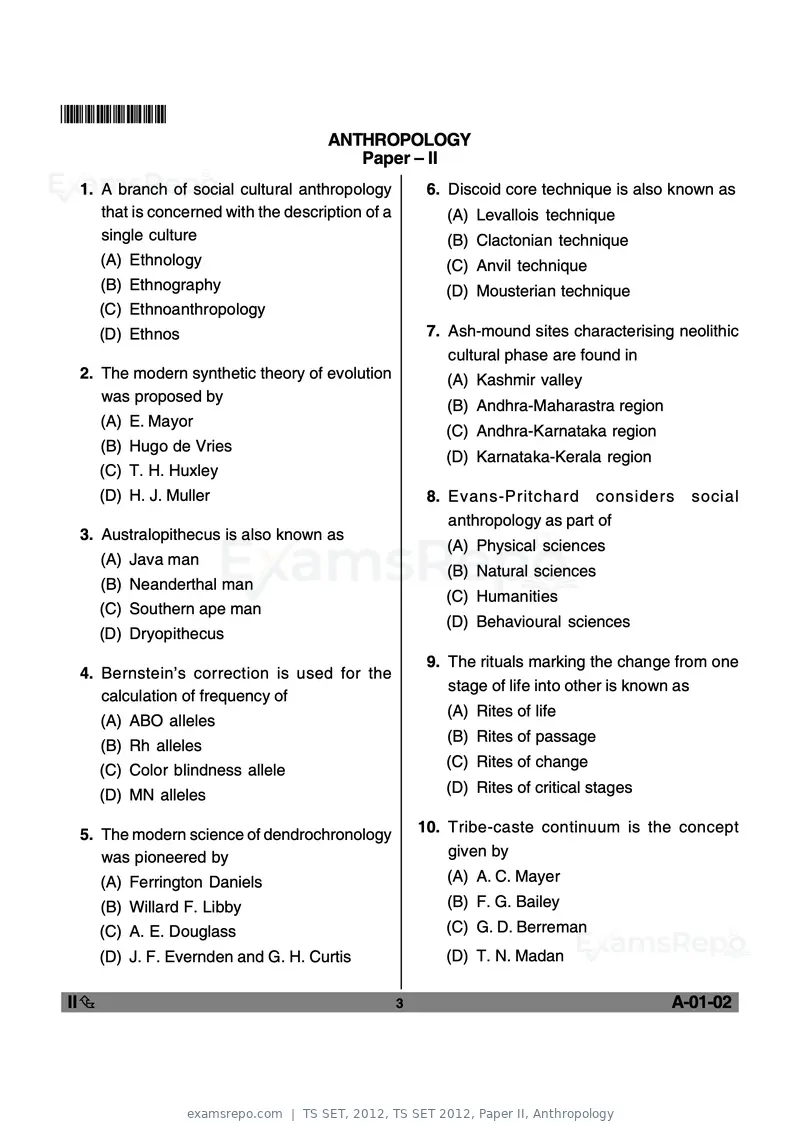
Text of page 3
*A0102*
ANTHROPOLOGY
Paper – II
1. A branch of social cultural anthropology 6. Discoid core technique is also known as
that is concerned with the description of a (A) Levallois technique
single culture (B) Clactonian technique
(A) Ethnology (C) Anvil technique
(B) Ethnography (D) Mousterian technique
(C) Ethnoanthropology
(D) Ethnos 7. Ash-mound sites characterising neolithic
cultural phase are found in
2. The modern synthetic theory of evolution (A) Kashmir valley
was proposed by
(B) Andhra-Maharastra region
(A) E. Mayor
(C) Andhra-Karnataka region
(B) Hugo de Vries
(D) Karnataka-Kerala region
(C) T. H. Huxley
(D) H. J. Muller 8. Evans-Pritchard considers social
anthropology as part of
3. Australopithecus is also known as
(A) Physical sciences
(A) Java man
(B) Natural sciences
(B) Neanderthal man
(C) Humanities
(C) Southern ape man
(D) Behavioural sciences
(D) Dryopithecus
9. The rituals marking the change from one
4. Bernstein’s correction is used for the
stage of life into other is known as
calculation of frequency of
(A) Rites of life
(A) ABO alleles
(B) Rites of passage
(B) Rh alleles
(C) Rites of change
(C) Color blindness allele
(D) MN alleles (D) Rites of critical stages
5. The modern science of dendrochronology 10. Tribe-caste continuum is the concept
was pioneered by given by
(A) Ferrington Daniels (A) A. C. Mayer
(B) Willard F. Libby (B) F. G. Bailey
(C) A. E. Douglass (C) G. D. Berreman
(D) J. F. Evernden and G. H. Curtis (D) T. N. Madan
II 3 A-01-02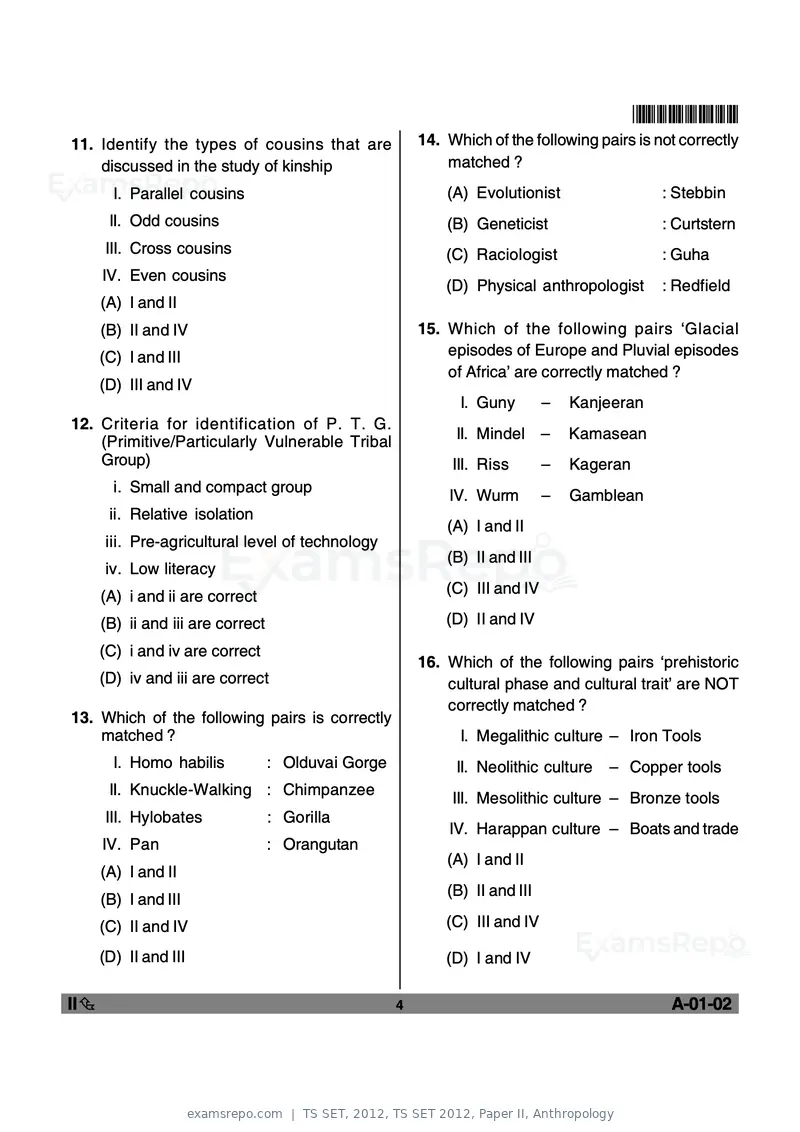
Text of page 4
*A0102*
11. Identify the types of cousins that are 14. Which of the following pairs is not correctly
discussed in the study of kinship matched ?
I. Parallel cousins (A) Evolutionist : Stebbin
II. Odd cousins (B) Geneticist : Curtstern
III. Cross cousins (C) Raciologist : Guha
IV. Even cousins
(D) Physical anthropologist : Redfield
(A) I and II
(B) II and IV 15. Which of the following pairs ‘Glacial
(C) I and III episodes of Europe and Pluvial episodes
of Africa’ are correctly matched ?
(D) III and IV
I. Guny – Kanjeeran
12. Criteria for identification of P. T. G.
(Primitive/Particularly Vulnerable Tribal II. Mindel – Kamasean
Group) III. Riss – Kageran
i. Small and compact group
IV. Wurm – Gamblean
ii. Relative isolation
(A) I and II
iii. Pre-agricultural level of technology
(B) II and III
iv. Low literacy
(A) i and ii are correct (C) III and IV
(B) ii and iii are correct (D) II and IV
(C) i and iv are correct
16. Which of the following pairs ‘prehistoric
(D) iv and iii are correct cultural phase and cultural trait’ are NOT
correctly matched ?
13. Which of the following pairs is correctly
matched ? I. Megalithic culture – Iron Tools
I. Homo habilis : Olduvai Gorge II. Neolithic culture – Copper tools
II. Knuckle-Walking : Chimpanzee
III. Mesolithic culture – Bronze tools
III. Hylobates : Gorilla
IV. Harappan culture – Boats and trade
IV. Pan : Orangutan
(A) I and II
(A) I and II
(B) II and III
(B) I and III
(C) II and IV (C) III and IV
(D) II and III (D) I and IV
II 4 A-01-02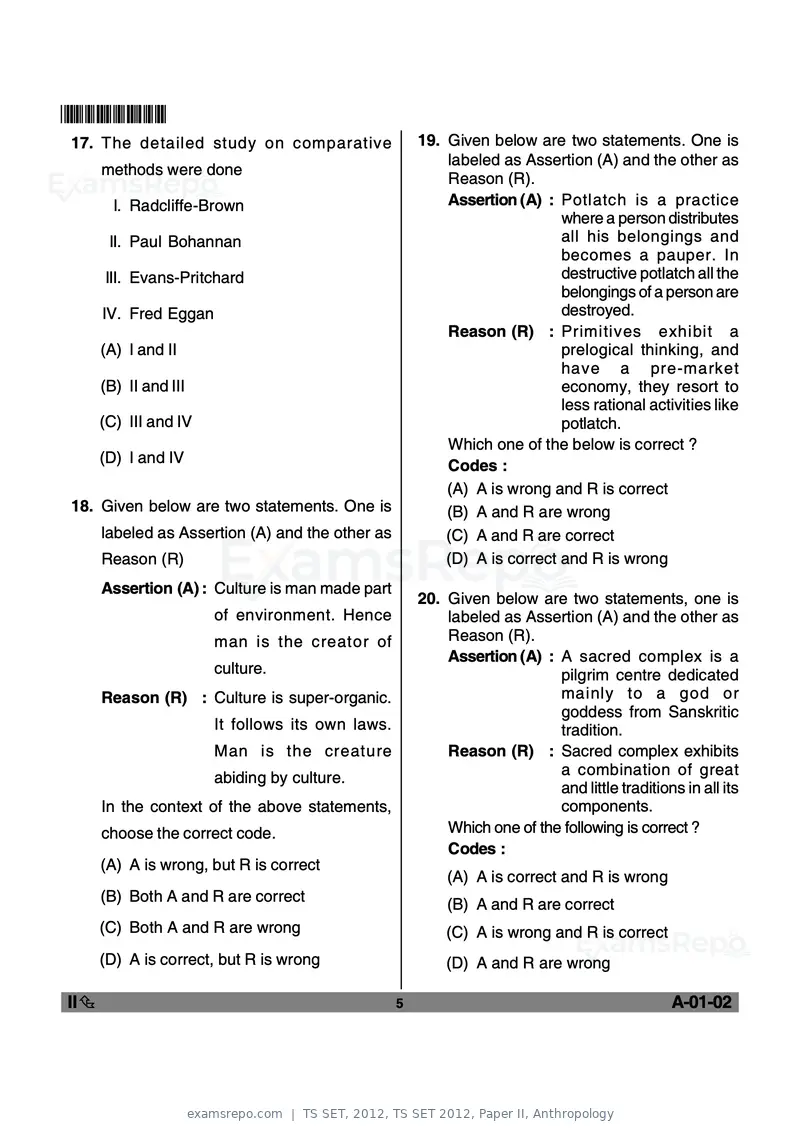
Text of page 5
*A0102*
17. The detailed study on comparative 19. Given below are two statements. One is
labeled as Assertion (A) and the other as
methods were done
Reason (R).
I. Radcliffe-Brown Assertion (A) : Potlatch is a practice
where a person distributes
II. Paul Bohannan all his belongings and
becomes a pauper. In
III. Evans-Pritchard destructive potlatch all the
belongings of a person are
IV. Fred Eggan destroyed.
Reason (R) : Primitives exhibit a
(A) I and II prelogical thinking, and
have a pre-market
(B) II and III economy, they resort to
less rational activities like
(C) III and IV potlatch.
Which one of the below is correct ?
(D) I and IV Codes :
(A) A is wrong and R is correct
18. Given below are two statements. One is (B) A and R are wrong
labeled as Assertion (A) and the other as (C) A and R are correct
Reason (R) (D) A is correct and R is wrong
Assertion (A) : Culture is man made part
20. Given below are two statements, one is
of environment. Hence labeled as Assertion (A) and the other as
man is the creator of Reason (R).
Assertion (A) : A sacred complex is a
culture. pilgrim centre dedicated
Reason (R) : Culture is super-organic. mainly to a god or
goddess from Sanskritic
It follows its own laws. tradition.
Man is the creature Reason (R) : Sacred complex exhibits
a combination of great
abiding by culture.
and little traditions in all its
In the context of the above statements, components.
choose the correct code. Which one of the following is correct ?
Codes :
(A) A is wrong, but R is correct
(A) A is correct and R is wrong
(B) Both A and R are correct
(B) A and R are correct
(C) Both A and R are wrong (C) A is wrong and R is correct
(D) A is correct, but R is wrong (D) A and R are wrong
II 5 A-01-02
Text of page 6
*A0102*
21. Given below are two statements. One is 23. Given below are two statements, one is
labeled as Assertion (A) and the other as labelled as Assertion (A) and the other as
Reason (R). Reason (R).
Assertion (A) : Anthropology looks at Assertion (A) : Palaeolithic art found on
institutions and cave walls and ceilings and
processes from the point on rock-shelters had
of view of the people immense value in
being studied reconstruction of prehistoric
Reason (R) : Applied anthropologists social behaviour.
are employed as Reason (R) : The paintings of male and
consultants in corporate female figures in various
commercial organizations. hunting and gathering
They contribute to the scene, cultural activities like
marketing strategies of dancing, barbequing etc. are
their employers. part of palaeolithic art.
In the context of the above two statements, (A) A is correct and R is wrong
which one of the following is correct ? (B) A and R are correct
Codes :
(C) A is wrong and R is correct
(A) A is correct and R is wrong (D) A and R are wrong
(B) A is wrong and R is correct
24. Given below are two statements, one is
(C) Both A and R are wrong labeled as Assertion (A) and the other as
(D) Both A and R are correct Reason (R).
Assertion (A) : Harappan culture is
22. Given below are two statements. One is considered as ‘Civilization’
labeled as Assertion (A) and the other as due to crafts specialization,
Reason (R). agricultural innovation,
Assertion (A) : Polymorphism is the result trade and centralized
of human variation authority.
Reason (R) : ABO blood group system Reason (R) : Harappan people improved
is the typical example of farming techniques,
produced surplus food and
polymorphism
had organized overseas
(A) A true and R false trade.
(A) A is correct and R is wrong
(B) Both A and R false
(B) A and R are correct
(C) A false and R true (C) A is wrong and R is correct
(D) Both A and R true (D) A and R are wrong
II 6 A-01-02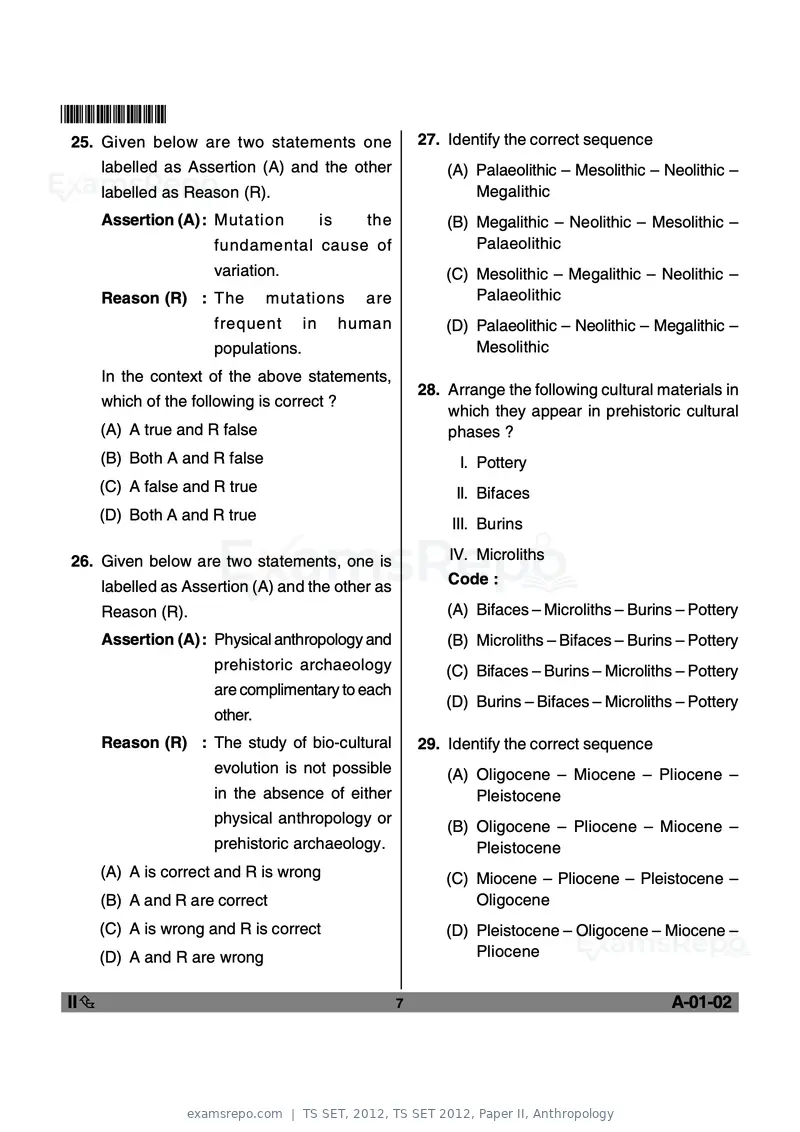
Text of page 7
*A0102*
25. Given below are two statements one 27. Identify the correct sequence
labelled as Assertion (A) and the other (A) Palaeolithic – Mesolithic – Neolithic –
labelled as Reason (R). Megalithic
Assertion (A) : Mutation is the (B) Megalithic – Neolithic – Mesolithic –
fundamental cause of Palaeolithic
variation. (C) Mesolithic – Megalithic – Neolithic –
Reason (R) : The mutations are Palaeolithic
frequent in human (D) Palaeolithic – Neolithic – Megalithic –
populations. Mesolithic
In the context of the above statements,
28. Arrange the following cultural materials in
which of the following is correct ?
which they appear in prehistoric cultural
(A) A true and R false phases ?
(B) Both A and R false I. Pottery
(C) A false and R true II. Bifaces
(D) Both A and R true
III. Burins
26. Given below are two statements, one is IV. Microliths
labelled as Assertion (A) and the other as Code :
Reason (R). (A) Bifaces – Microliths – Burins – Pottery
Assertion (A) : Physical anthropology and (B) Microliths – Bifaces – Burins – Pottery
prehistoric archaeology (C) Bifaces – Burins – Microliths – Pottery
are complimentary to each
(D) Burins – Bifaces – Microliths – Pottery
other.
Reason (R) : The study of bio-cultural 29. Identify the correct sequence
evolution is not possible (A) Oligocene – Miocene – Pliocene –
in the absence of either Pleistocene
physical anthropology or
(B) Oligocene – Pliocene – Miocene –
prehistoric archaeology. Pleistocene
(A) A is correct and R is wrong (C) Miocene – Pliocene – Pleistocene –
(B) A and R are correct Oligocene
(C) A is wrong and R is correct (D) Pleistocene – Oligocene – Miocene –
(D) A and R are wrong Pliocene
II 7 A-01-02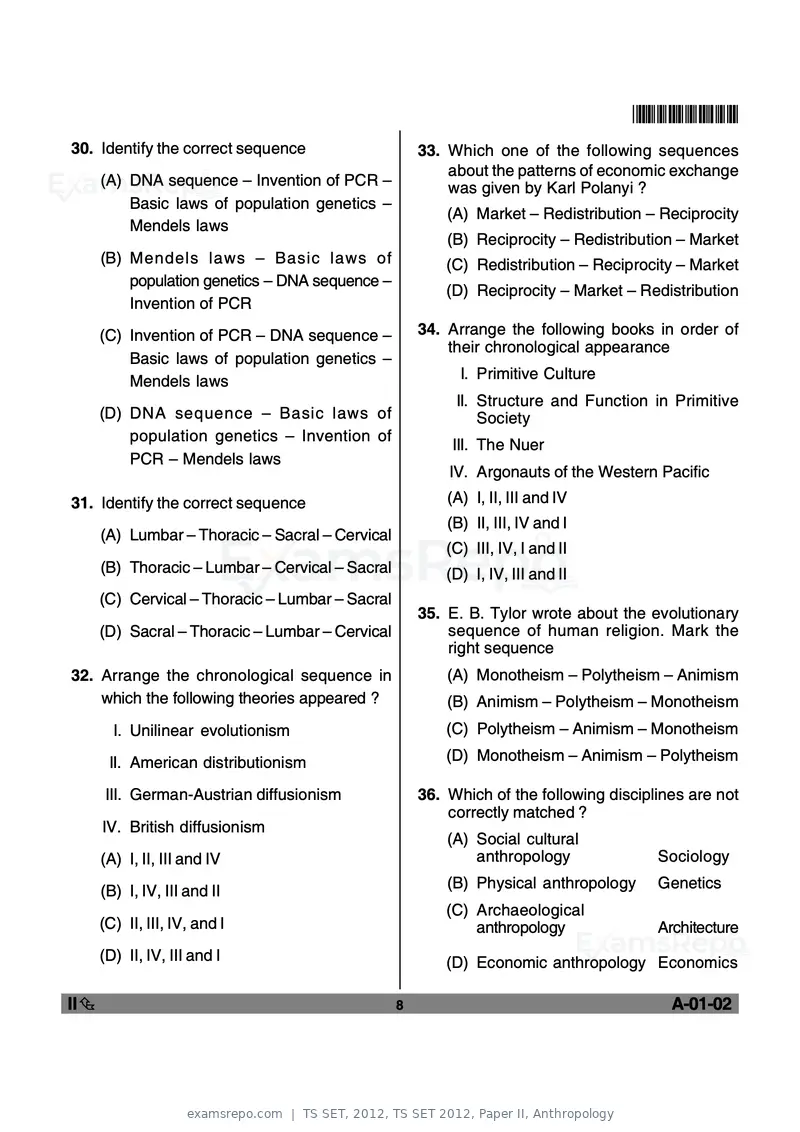
Text of page 8
*A0102*
30. Identify the correct sequence 33. Which one of the following sequences
about the patterns of economic exchange
(A) DNA sequence – Invention of PCR – was given by Karl Polanyi ?
Basic laws of population genetics –
(A) Market – Redistribution – Reciprocity
Mendels laws
(B) Reciprocity – Redistribution – Market
(B) Mendels laws – Basic laws of (C) Redistribution – Reciprocity – Market
population genetics – DNA sequence –
(D) Reciprocity – Market – Redistribution
Invention of PCR
(C) Invention of PCR – DNA sequence – 34. Arrange the following books in order of
their chronological appearance
Basic laws of population genetics –
Mendels laws I. Primitive Culture
II. Structure and Function in Primitive
(D) DNA sequence – Basic laws of Society
population genetics – Invention of
III. The Nuer
PCR – Mendels laws
IV. Argonauts of the Western Pacific
31. Identify the correct sequence (A) I, II, III and IV
(B) II, III, IV and I
(A) Lumbar – Thoracic – Sacral – Cervical
(C) III, IV, I and II
(B) Thoracic – Lumbar – Cervical – Sacral (D) I, IV, III and II
(C) Cervical – Thoracic – Lumbar – Sacral
35. E. B. Tylor wrote about the evolutionary
(D) Sacral – Thoracic – Lumbar – Cervical sequence of human religion. Mark the
right sequence
32. Arrange the chronological sequence in (A) Monotheism – Polytheism – Animism
which the following theories appeared ? (B) Animism – Polytheism – Monotheism
I. Unilinear evolutionism (C) Polytheism – Animism – Monotheism
II. American distributionism (D) Monotheism – Animism – Polytheism
III. German-Austrian diffusionism 36. Which of the following disciplines are not
correctly matched ?
IV. British diffusionism
(A) Social cultural
(A) I, II, III and IV anthropology Sociology
(B) Physical anthropology Genetics
(B) I, IV, III and II
(C) Archaeological
(C) II, III, IV, and I anthropology Architecture
(D) II, IV, III and I (D) Economic anthropology Economics
II 8 A-01-02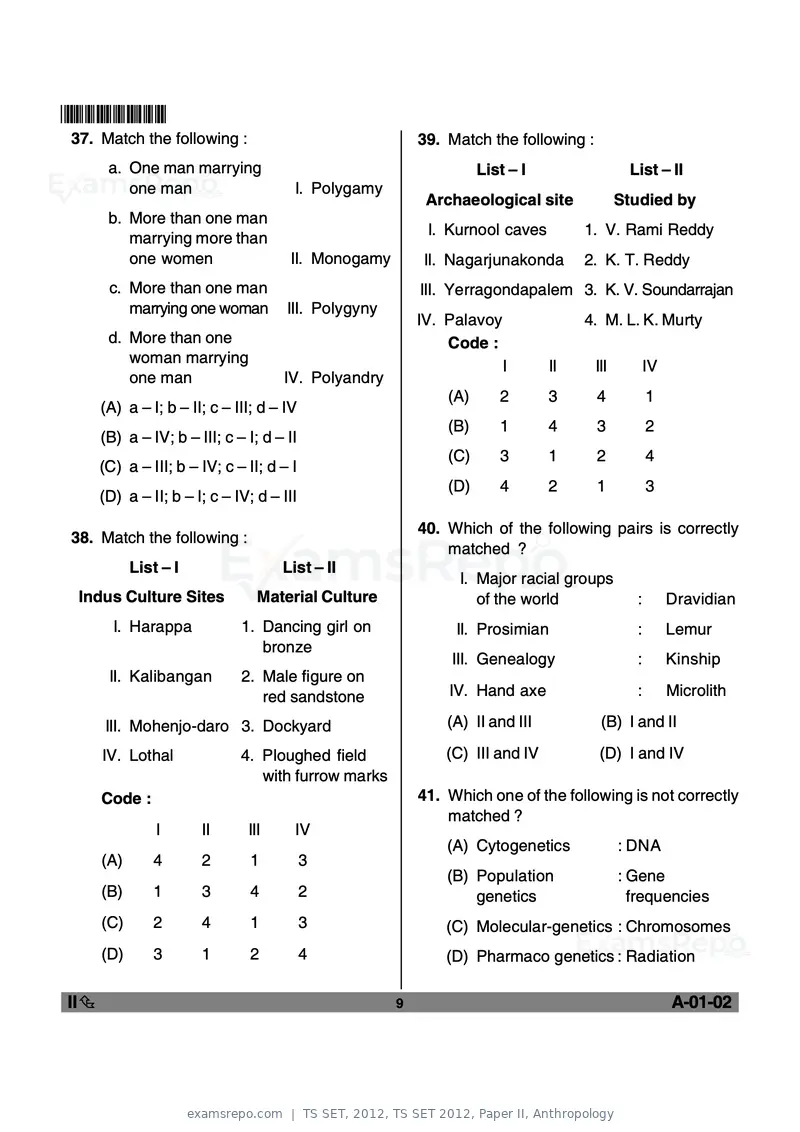
Text of page 9
*A0102*
37. Match the following : 39. Match the following :
a. One man marrying List – I List – II
one man I. Polygamy
Archaeological site Studied by
b. More than one man
I. Kurnool caves 1. V. Rami Reddy
marrying more than
one women II. Monogamy II. Nagarjunakonda 2. K. T. Reddy
c. More than one man III. Yerragondapalem 3. K. V. Soundarrajan
marrying one woman III. Polygyny
IV. Palavoy 4. M. L. K. Murty
d. More than one Code :
woman marrying
I II III IV
one man IV. Polyandry
(A) 2 3 4 1
(A) a – I; b – II; c – III; d – IV
(B) 1 4 3 2
(B) a – IV; b – III; c – I; d – II
(C) 3 1 2 4
(C) a – III; b – IV; c – II; d – I
(D) 4 2 1 3
(D) a – II; b – I; c – IV; d – III
40. Which of the following pairs is correctly
38. Match the following :
matched ?
List – I List – II
I. Major racial groups
Indus Culture Sites Material Culture of the world : Dravidian
I. Harappa 1. Dancing girl on II. Prosimian : Lemur
bronze
III. Genealogy : Kinship
II. Kalibangan 2. Male figure on
red sandstone IV. Hand axe : Microlith
III. Mohenjo-daro 3. Dockyard (A) II and III (B) I and II
IV. Lothal 4. Ploughed field (C) III and IV (D) I and IV
with furrow marks
Code : 41. Which one of the following is not correctly
matched ?
I II III IV
(A) Cytogenetics : DNA
(A) 4 2 1 3
(B) Population : Gene
(B) 1 3 4 2 genetics frequencies
(C) 2 4 1 3 (C) Molecular-genetics : Chromosomes
(D) 3 1 2 4 (D) Pharmaco genetics : Radiation
II 9 A-01-02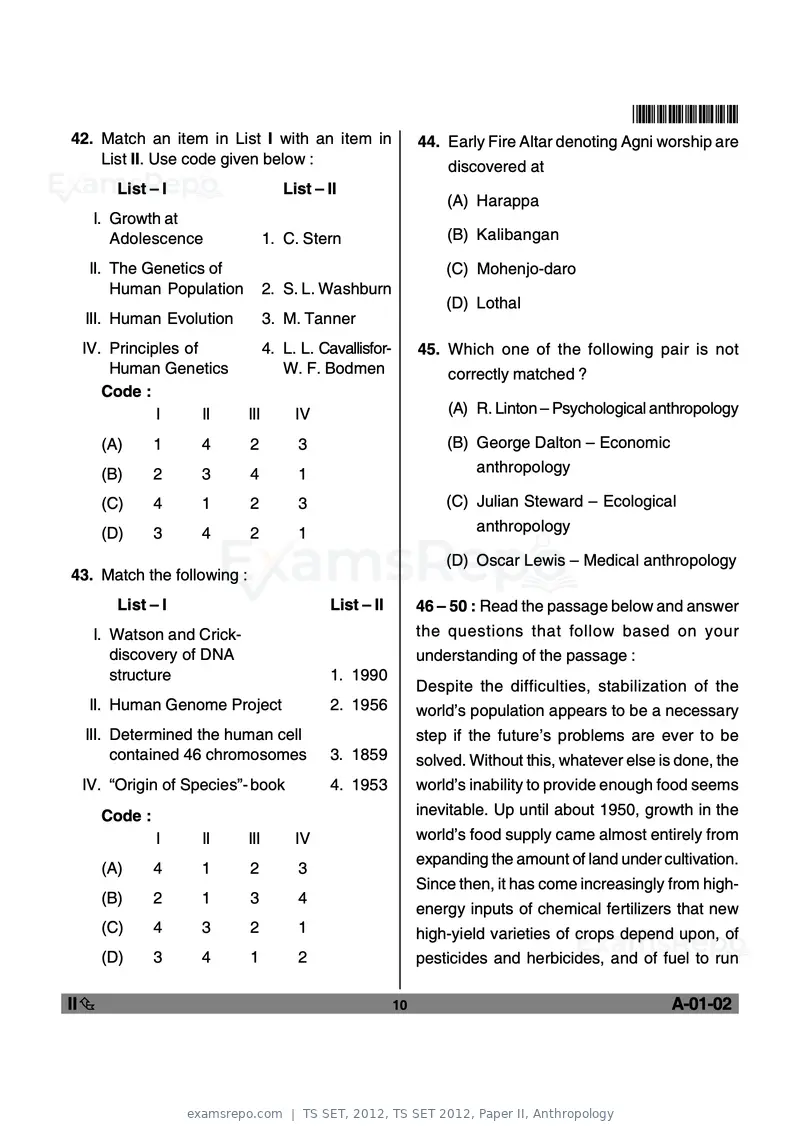
Text of page 10
*A0102*
42. Match an item in List I with an item in 44. Early Fire Altar denoting Agni worship are
List II. Use code given below : discovered at
List – I List – II
(A) Harappa
I. Growth at
Adolescence 1. C. Stern (B) Kalibangan
II. The Genetics of (C) Mohenjo-daro
Human Population 2. S. L. Washburn
(D) Lothal
III. Human Evolution 3. M. Tanner
IV. Principles of 4. L. L. Cavallisfor- 45. Which one of the following pair is not
Human Genetics W. F. Bodmen correctly matched ?
Code :
I II III IV (A) R. Linton – Psychological anthropology
(A) 1 4 2 3 (B) George Dalton – Economic
(B) 2 3 4 1 anthropology
(C) 4 1 2 3 (C) Julian Steward – Ecological
(D) 3 4 2 1 anthropology
(D) Oscar Lewis – Medical anthropology
43. Match the following :
List – I List – II 46 – 50 : Read the passage below and answer
I. Watson and Crick- the questions that follow based on your
discovery of DNA understanding of the passage :
structure 1. 1990
Despite the difficulties, stabilization of the
II. Human Genome Project 2. 1956 world’s population appears to be a necessary
III. Determined the human cell step if the future’s problems are ever to be
contained 46 chromosomes 3. 1859 solved. Without this, whatever else is done, the
IV. “Origin of Species”- book 4. 1953 world’s inability to provide enough food seems
Code : inevitable. Up until about 1950, growth in the
I II III IV world’s food supply came almost entirely from
expanding the amount of land under cultivation.
(A) 4 1 2 3
Since then, it has come increasingly from high-
(B) 2 1 3 4
energy inputs of chemical fertilizers that new
(C) 4 3 2 1 high-yield varieties of crops depend upon, of
(D) 3 4 1 2 pesticides and herbicides, and of fuel to run
II 10 A-01-02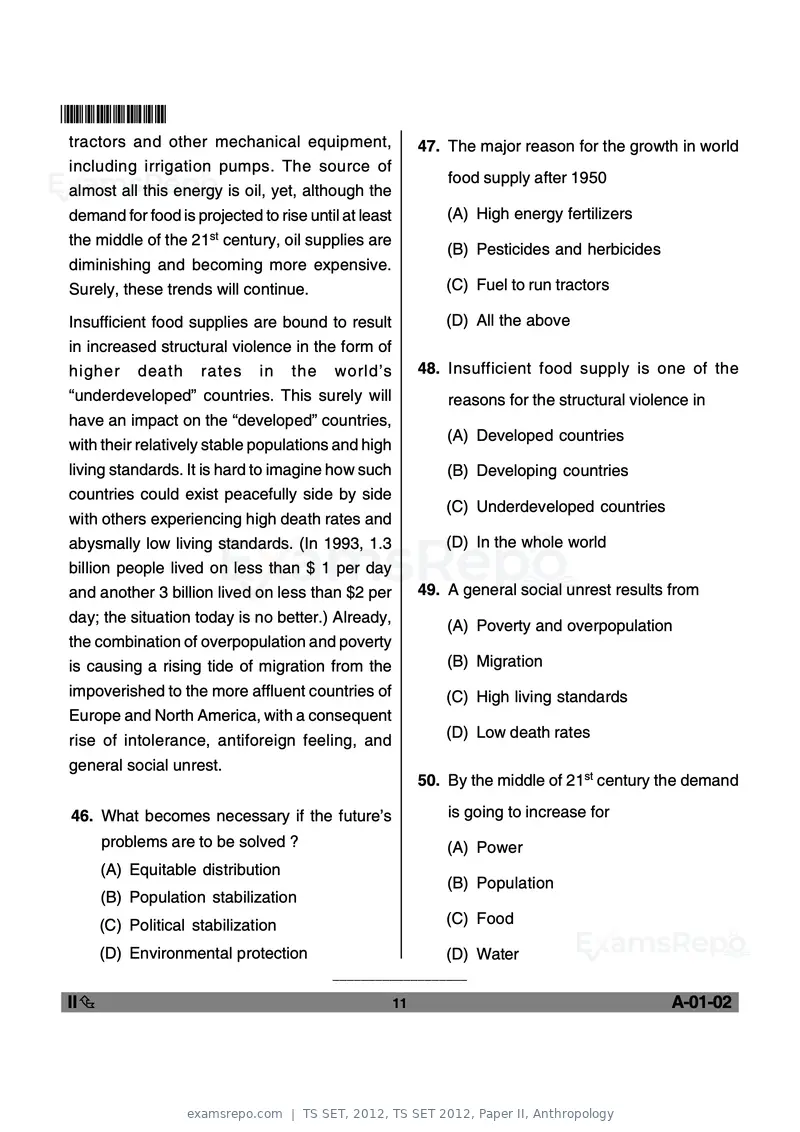
Text of page 11
*A0102*
tractors and other mechanical equipment, 47. The major reason for the growth in world
including irrigation pumps. The source of
food supply after 1950
almost all this energy is oil, yet, although the
demand for food is projected to rise until at least (A) High energy fertilizers
the middle of the 21st century, oil supplies are
(B) Pesticides and herbicides
diminishing and becoming more expensive.
Surely, these trends will continue. (C) Fuel to run tractors
Insufficient food supplies are bound to result (D) All the above
in increased structural violence in the form of
higher death rates in the world’s 48. Insufficient food supply is one of the
“underdeveloped” countries. This surely will reasons for the structural violence in
have an impact on the “developed” countries,
(A) Developed countries
with their relatively stable populations and high
living standards. It is hard to imagine how such (B) Developing countries
countries could exist peacefully side by side
(C) Underdeveloped countries
with others experiencing high death rates and
abysmally low living standards. (In 1993, 1.3 (D) In the whole world
billion people lived on less than $ 1 per day
and another 3 billion lived on less than $2 per 49. A general social unrest results from
day; the situation today is no better.) Already,
(A) Poverty and overpopulation
the combination of overpopulation and poverty
is causing a rising tide of migration from the (B) Migration
impoverished to the more affluent countries of (C) High living standards
Europe and North America, with a consequent
rise of intolerance, antiforeign feeling, and (D) Low death rates
general social unrest.
50. By the middle of 21st century the demand
46. What becomes necessary if the future’s is going to increase for
problems are to be solved ? (A) Power
(A) Equitable distribution
(B) Population
(B) Population stabilization
(C) Political stabilization (C) Food
(D) Environmental protection (D) Water
___________________
II 11 A-01-02
Text of page 12
*A0102*
Space for Rough Work
II 12 A-01-02Official key not published for this paper.
Page 1 of 12
Source: Telangana State Eligibility Test. Question paper published by Telangana State Eligibility Test.