
TS SET 2013: Paper II, Mathematical Sciences
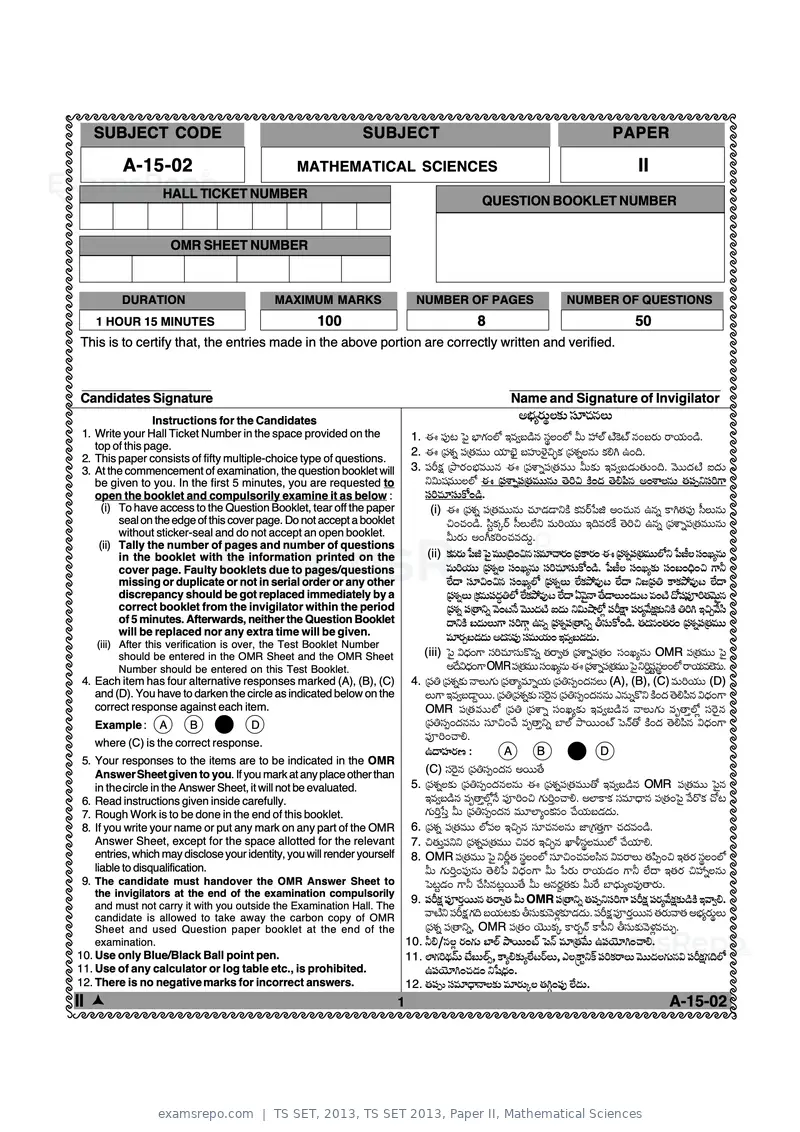
Text of page 1
CCCCCCCCCCCCCCCCCCCCCCCCCCCCCCCCCCCCCCCCCCCCCCCCCCCCCCCCCCCCCCCCCCCCCCCCCCC
CCCCCCCCCCCCCCCCCCCCCCCCCCCCCCCCCCCCCCCCCCCCCCCCCCCCCCCCCCCCCCCCCCCCCCCCCCCCCCCCCCCCCCCCCCCCCCCCCCCC CCCCCCCCCCCCCCCCCCCCCCCCCCCCCCCCCCCCCCCCCCCCCCCCCCCCCCCCCCCCCCCCCCCCCCCCCCCCCCCCCCCCCCCCCCCCCCCCCCCC
SUBJECT CODE SUBJECT PAPER
A-15-02 MATHEMATICAL SCIENCES II
HALL TICKET NUMBER
QUESTION BOOKLET NUMBER
OMR SHEET NUMBER
DURATION MAXIMUM MARKS NUMBER OF PAGES NUMBER OF QUESTIONS
1 HOUR 15 MINUTES 100 8 50
This is to certify that, the entries made in the above portion are correctly written and verified.
Candidates Signature Name and Signature of Invigilator
Instructions for the Candidates A¿æýÅÆæÿ$¦ËMæü$ çÜ*^èþ¯èþË$
1. Write your Hall Ticket Number in the space provided on the 1. D ç³#r ò³O ¿êVæü ÌZ CÐèþÓºyìþ¯èþ çÜ¦Ë ÌZ Ò$ çàÌý sìýMðüsý ¯èþ ºÆæÿ$ Æ>Äæý$ yìþ.
top of this page.
2. D {ç³Ôèý² ç³{èþÐèþ$$ Äæý*¿ñýO ºçßý$âñýO_eMæü {ç³Ôèý²Ë¯èþ$ MæüÍW E ¨.
2. This paper consists of fifty multiple-choice type of questions.
3. At the commencement of examination, the question booklet will 3. ç³Èæü {´ëÆæÿ ¿æýÐèþ$$¯èþ D {ç³Ôé²ç³{èþÐèþ$$ Ò$Mæü$ CÐèþÓºyæþ$èþ$ ¨. Ððþ$$§æþsìý I§æþ$
be given to you. In the first 5 minutes, you are requested to °Ñ$çÙÐèþ$$ËÌZ D {ç³Ôé²ç³{èþÐèþ$$¯èþ$ ðþÇ_ Mìü §æþ ðþÍí³¯èþ A Ôé˯èþ$ èþç³µ°çÜÇV>
open the booklet and compulsorily examine it as below : çÜÇ^èþ*çÜ$Mø yìþ.
(i) To have access to the Question Booklet, tear off the paper (i) D {ç³Ôèý² ç³{èþÐèþ$$¯èþ$ ^èþ*yæþyé°Mìü MæüÐèþÆÿõ³h A ^èþ$¯èþ E¯èþ² M>Wèþç³# ïÜË$¯èþ$
seal on the edge of this cover page. Do not accept a booklet _ ^èþ yìþ. íÜtMæüPÆÿ ïÜË$Ìôý° Ðèþ$ÇÄæý$$ C¨ÐèþÆæÿMóü ðþÇ_ E¯èþ² {ç³Ôé²ç³{èþÐèþ$$¯èþ$
without sticker-seal and do not accept an open booklet. Ò$Ææÿ$ A XMæüÇ ^èþÐèþ§æþ$ª.
(ii) Tally the number of pages and number of questions
in the booklet with the information printed on the (ii) MæüÐèþÆæÿ$ õ³h ò³O Ðèþ$${¨ _¯èþ çÜÐèþ*^éÆæÿ {ç³M>Ææÿ D {ç³Ôèý²ç³{èþÐèþ$$ÌZ° õ³iË çÜ Qůèþ$
cover page. Faulty booklets due to pages/questions Ðèþ$ÇÄæý$$ {ç³Ôèý²Ë çÜ Qůèþ$ çÜÇ^èþ*çÜ$Mø yìþ. õ³iË çÜ QÅMæü$ çÜ º «¨ _ V>±
missing or duplicate or not in serial order or any other Ìôý§é çÜ*_ _¯èþ çÜ QÅÌZ {ç³Ôèý²Ë$ ÌôýMæü´ùÐèþ#r Ìôý§é °f{ç³ M>Mæü´ùÐèþ#r Ìôý§é
discrepancy should be got replaced immediately by a {ç³Ôèý²Ë$ {MæüÐèþ$糧æþ®ÌZ ÌôýMæü´ùÐèþ#r Ìôý§é HÐðþO¯é óþyéË$ yæþ$r Ðèþ sìý §øçÙç³NÇèþÐðþ$O¯èþ
correct booklet from the invigilator within the period {ç³Ôèý² ç³{é°² Ððþ r¯óþ Ððþ$$§æþsìý I§æþ$ °Ñ$ÚëÌZÏ ç³È> ç³ÆæÿÅÐóþæüMæü$°Mìü ÇW C_aÐóþíÜ
of 5 minutes. Afterwards, neither the Question Booklet §é°Mìü º§æþ$Ë$V> çÜÇV>Y E¯èþ² {ç³Ôèý²ç³{é°² ¡çÜ$Mø yìþ. èþ§æþ¯èþ èþÆæÿ {ç³Ôèý²ç³{èþÐèþ$$
will be replaced nor any extra time will be given.
(iii) After this verification is over, the Test Booklet Number
Ðèþ*Ææÿaºyæþ§æþ$ A§æþ¯èþç³# çÜÐèþ$Äæý$ CÐèþÓºyæþ§æþ$.
should be entered in the OMR Sheet and the OMR Sheet (iii) ò³O Ñ«§æþ V> çÜÇ^èþ*çÜ$Mö¯èþ² èþÆ>Óèþ {ç³Ôé²ç³{èþ çÜ Qůèþ$ OMR ç³{èþÐèþ$$ ò³O
Number should be entered on this Test Booklet. A§óþÑ«§æþ V> OMR ç³{èþÐèþ$$ çÜ Qůèþ$ D {ç³Ôé²ç³{èþÐèþ$$ ò³O °ÇªçÙtt çÜ¦Ë ÌZ Æ>Äæý$ÐèþÌñý¯èþ$.
4. Each item has four alternative responses marked (A), (B), (C) 4. {ç³ {ç³Ôèý²Mæü$ ¯éË$Væü$ {ç³éÅÐèþ*²Äæý$ {ç³çܵ §æþ¯èþË$ (A), (B), (C) Ðèþ$ÇÄæý$$ (D)
and (D). You have to darken the circle as indicated below on the Ë$V> CÐèþÓºyézÆÿ$$. {ç³{ç³Ôèý²Mæü$ çÜÆðÿO¯èþ {ç³çܵ §æþ¯èþ¯èþ$ G¯èþ$²Mö° Mìü §æþ ðþÍí³¯èþ Ñ«§æþ V>
correct response against each item. OMR ç³{èþÐèþ$$ÌZ {ç³ {ç³Ôé² çÜ QÅMæü$ CÐèþÓºyìþ¯èþ ¯éË$Væü$ Ðèþé¢ÌZÏ çÜÆðÿO¯èþ
Example : A B C D {ç³çܵ §æþ¯èþ¯èþ$ çÜ*_ ^óþ Ðèþ颰² »êÌý ´ëÆÿ$$ sý ò³¯þø Mìü §æþ ðþÍí³¯èþ Ñ«§æþ V>
where (C) is the correct response.
ç³NÇ ^éÍ.
E§éçßýÆæÿ×ý : A B C D
5. Your responses to the items are to be indicated in the OMR
Answer Sheet given to you. If you mark at any place other than (C) çÜÆðÿO¯èþ {ç³çܵ §æþ¯èþ AÆÿ$$óþ
in the circle in the Answer Sheet, it will not be evaluated. 5. {ç³Ôèý²ËMæü$ {ç³çܵ §æþ¯èþ˯èþ$ D {ç³Ôèý²ç³{èþÐèþ$$ø CÐèþÓºyìþ¯èþ OMR ç³{èþÐèþ$$ ò³O¯èþ
6. Read instructions given inside carefully. CÐèþÓºyìþ¯èþ Ðèþé¢ÌZϯóþ ç³NÇ _ Væü$Ç¢ ^éÍ. AÌêM>Mæü çÜÐèþ*«§é¯èþ ç³{èþ ò³O ÐóþÆöMæü ^ør
7. Rough Work is to be done in the end of this booklet. Væü$Ç¢õÜ¢ Ò$ {ç³çܵ §æþ¯èþ Ðèþ$*ÌêÅ Mæü¯èþ ^óþÄæý$ºyæþ§æþ$.
8. If you write your name or put any mark on any part of the OMR 6. {ç³Ôèý² ç³{èþÐèþ$$ ÌZç³Ë C_a¯èþ çÜ*^èþ¯èþ˯èþ$ gê{Væüèþ¢V> ^èþ§æþÐèþ yìþ.
Answer Sheet, except for the space allotted for the relevant 7. _èþ$¢ç³°° {ç³Ôèý²ç³{èþÐèþ$$ _ÐèþÆæÿ C_a¯èþ RêäçܦËÐèþ$$ÌZ ^óþÄæý*Í.
entries, which may disclose your identity, you will render yourself 8. OMR ç³{èþÐèþ$$ ò³O °È~èþ çÜ¦Ë ÌZ çÜ*_ ^èþÐèþËíܯèþ ÑÐèþÆ>Ë$ èþí³µ _ CèþÆæÿ çÜ¦Ë ÌZ
liable to disqualification. Ò$ Væü$Ç¢ ç³#¯èþ$ ðþÍõ³ Ñ«§æþ V> Ò$ õ³Ææÿ$ Æ>Äæý$yæþ V>± Ìôý§é CèþÆæÿ _à²Ë¯èþ$
9. The candidate must handover the OMR Answer Sheet to ò³rtyæþ V>± ^óþíܯèþrÏÆÿ$$óþ Ò$ A¯èþÆæÿáèþMæü$ Ò$Æóÿ »ê«§æþ$ÅËÐèþ#éÆæÿ$.
9. ç³Èæü ç³NÆæÿ¢Æÿ$$¯èþ èþÆ>Óèþ Ò$ OMR ç³{é°² èþç³µ°çÜÇV> ç³Èæü ç³ÆæÿÅÐóþæüMæü$yìþMìü CÐéÓÍ.
the invigilators at the end of the examination compulsorily
and must not carry it with you outside the Examination Hall. The
candidate is allowed to take away the carbon copy of OMR Ðésìý° ç³Èæü Væü¨ ºÄæý$rMæü$ ¡çÜ$Mæü$ÐðþâæýÏMæü*yæþ§æþ$. ç³Èæü ç³NÆæÿ¢Æÿ$$¯èþ èþÆæÿ$Ðéèþ A¿æýÅÆæÿ$¦Ë$
Sheet and used Question paper booklet at the end of the {ç³Ôèý² ç³{é°², OMR ç³{èþ Äñý$$MæüP M>Ææÿ¾¯þ M>ï³° ¡çÜ$Mæü$ÐðþâæýÏÐèþ^èþ$a.
examination. 10. ±Í/¯èþËÏ Ææÿ Væü$ »êÌý ´ëÆÿ$$ sý ò³¯þ Ðèþ*{èþÐóþ$ Eç³Äñý*W ^éÍ.
10. Use only Blue/Black Ball point pen. 11. ÌêVæüÇ£æþÐþ$ sôýº$ÌýÞ, M>ÅÍMæü$ÅÌôýrÆÿË$, GË[M>t°Mü ç³ÇMæüÆ>Ë$ Ððþ$$§æþËVæü$¯èþÑ ç³ÈæüVæü¨ÌZ
11. Use of any calculator or log table etc., is prohibited. Eç³Äñý*W ^èþyæþ °õÙ«§æþ .
12. There is no negative marks for incorrect answers. 12. èþç³ çÜÐèþ*«§é¯éËMæü$ Ðèþ*Ææÿ$PË èþWY ç³# Ìôý§æþ$.
II æ 1 A-15-02
CCCCCCCCCCCCCCCCCCCCCCCCCCCCCCCCCCCCCCCCCCCCCCCCCCCCCCCCCCCCCCCCCCCCCCCCCCC
Text of page 2
*A1502*


                   HE
                     RE

            WR
              ITE

        NO
          T
       DO


II æ           2            A-15-02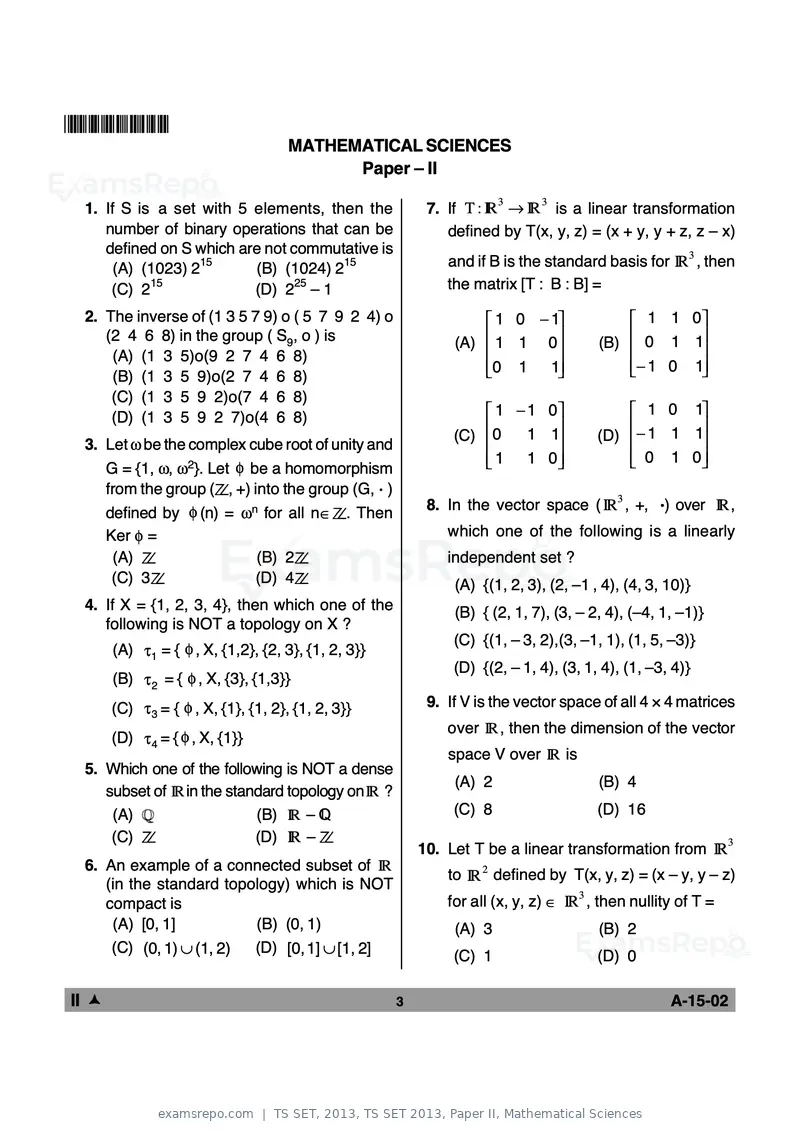
Text of page 3
*A1502*
                                     MATHEMATICAL SCIENCES
                                           Paper – II
                                                                      3     3
 1. If S is a set with 5 elements, then the               7. If T : IR → IR is a linear transformation
    number of binary operations that can be                  defined by T(x, y, z) = (x + y, y + z, z – x)
    defined on S which are not commutative is                                                        3
      (A) (1023) 2
                   15
                         (B) (1024) 2
                                      15                     and if B is the standard basis for IR , then
     (C) 2
           15                   25
                         (D) 2 – 1                           the matrix [T : B : B] =

 2. The inverse of (1 3 5 7 9) o ( 5 7 9 2 4) o                   ⎡ 1 0 − 1⎤               ⎡ 1 1 0⎤
                                                                                           ⎢         ⎥
    (2 4 6 8) in the group ( S9, o ) is                       (A) ⎢ 1 1 0⎥             (B) ⎢ 0 1 1⎥
     (A) (1 3 5)o(9 2 7 4 6 8)                                    ⎢        ⎥
                                                                  ⎢⎣0 1 1⎥⎦                ⎢⎣− 1 0 1⎥⎦
     (B) (1 3 5 9)o(2 7 4 6 8)
     (C) (1 3 5 9 2)o(7 4 6 8)
     (D) (1 3 5 9 2 7)o(4 6 8)                                    ⎡ 1 − 1 0⎤               ⎡ 1 0 1⎤
                                                                  ⎢                        ⎢        ⎥
                                                              (C) ⎢0    1 1⎥⎥          (D) ⎢− 1 1 1⎥
 3. Let ω be the complex cube root of unity and
                                                                  ⎢⎣ 1 1 0⎥⎦               ⎢⎣ 0 1 0⎥⎦
    G = {1, ω, ω2}. Let φ be a homomorphism
    from the group ( , +) into the group (G, ⋅ )
                                                          8. In the vector space ( IR , +, .) over IR ,
                                                                                         3
    defined by φ (n) = ωn for all n ∈ . Then
    Ker φ =                                                  which one of the following is a linearly
     (A)                   (B) 2                             independent set ?
     (C) 3                 (D) 4                              (A) {(1, 2, 3), (2, –1 , 4), (4, 3, 10)}
 4. If X = {1, 2, 3, 4}, then which one of the                (B) { (2, 1, 7), (3, – 2, 4), (–4, 1, –1)}
    following is NOT a topology on X ?
                                                              (C) {(1, – 3, 2),(3, –1, 1), (1, 5, –3)}
       (A) τ1 = { φ , X, {1,2}, {2, 3}, {1, 2, 3}}
                                                              (D) {(2, – 1, 4), (3, 1, 4), (1, –3, 4)}
       (B) τ2 = { φ , X, {3}, {1,3}}
       (C) τ3 = { φ , X, {1}, {1, 2}, {1, 2, 3}}          9. If V is the vector space of all 4 × 4 matrices
                                                             over IR , then the dimension of the vector
       (D) τ4 = { φ , X, {1}}
                                                             space V over IR is
 5. Which one of the following is NOT a dense
                                                              (A) 2                    (B) 4
    subset of IR in the standard topology on IR ?
     (A)                    (B) IR – Q                        (C) 8                    (D) 16
     (C)                    (D) IR –                                                                        3
                                                         10. Let T be a linear transformation from IR
 6. An example of a connected subset of IR
                                                             to IR 2 defined by T(x, y, z) = (x – y, y – z)
    (in the standard topology) which is NOT
                                                                                   3
    compact is                                               for all (x, y, z) ∈ IR , then nullity of T =
     (A) [0, 1]          (B) (0, 1)                           (A) 3                    (B) 2
     (C) (0, 1) ∪ (1, 2) (D) [0, 1] ∪ [1, 2]
                                                              (C) 1                    (D) 0

II æ                                                 3                                            A-15-02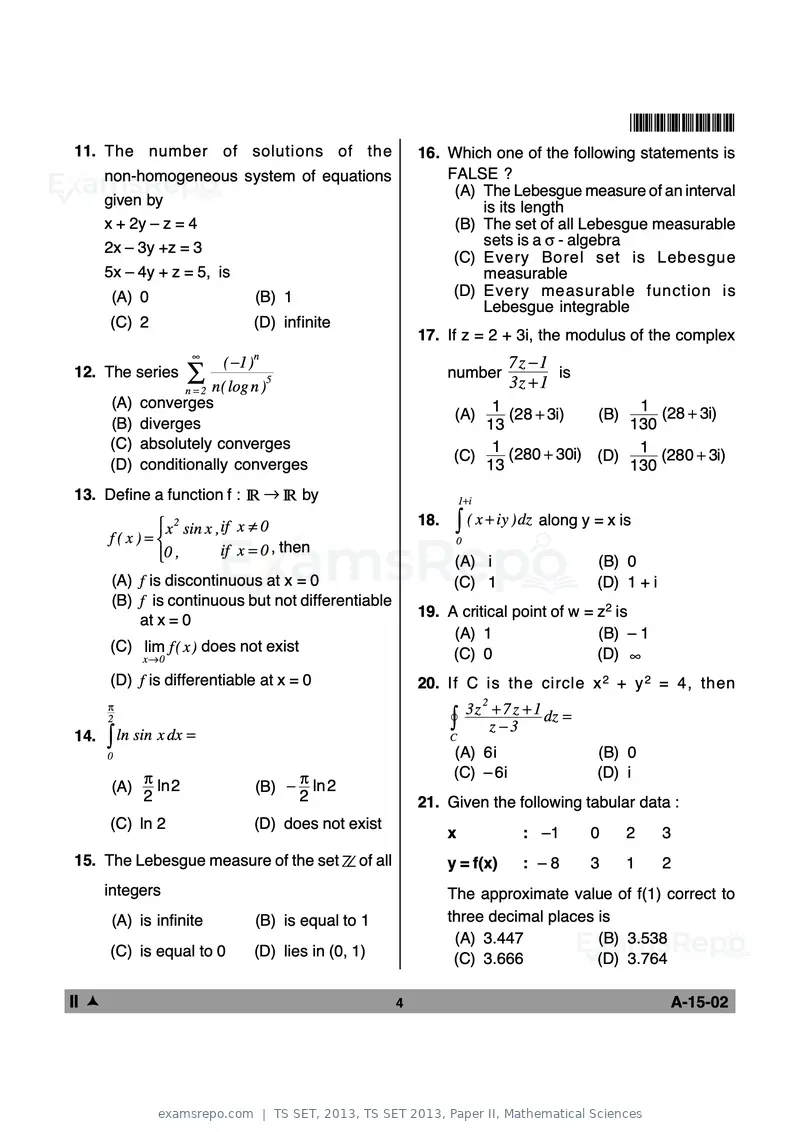
Text of page 4
*A1502*
11. The number of solutions of the                            16. Which one of the following statements is
       non-homogeneous system of equations                        FALSE ?
                                                                   (A) The Lebesgue measure of an interval
       given by                                                        is its length
       x + 2y – z = 4                                              (B) The set of all Lebesgue measurable
       2x – 3y +z = 3                                                  sets is a σ - algebra
                                                                   (C) Every Borel set is Lebesgue
       5x – 4y + z = 5, is                                             measurable
        (A) 0                (B) 1                                 (D) Every measurable function is
                                                                       Lebesgue integrable
       (C) 2                 (D) infinite
                                                              17. If z = 2 + 3i, the modulus of the complex
                       ∞
                          ( −1 )
                             n
                                                                               7z −1
12. The series ∑                                                    number            is
                  n = 2 n ( log n )
                                   5                                           3z + 1
       (A) converges                                                     1 (28 + 3i)        1 (28 + 3i)
                                                                     (A)               (B)
       (B) diverges                                                     13                 130
       (C) absolutely converges                                          1 (280 + 30i)      1 (280 + 3i)
                                                                    (C)                (D)
       (D) conditionally converges                                      13                 130
13. Define a function f : IR → IR by                                    1+i


       f(x)= ⎨
               ⎧ x 2 sin x , if x ≠ 0                         18.    ∫ ( x + iy ) dz along y = x is
                                                                     0
               ⎩0 ,          if x = 0 , then
                                                                    (A) i                    (B) 0
       (A) f is discontinuous at x = 0                              (C) 1                    (D) 1 + i
       (B) f is continuous but not differentiable
                                                              19. A critical point of w = z2 is
           at x = 0
                                                                   (A) 1                  (B) – 1
       (C) lim f ( x ) does not exist                              (C) 0                  (D) ∞
              x→ 0

       (D) f is differentiable at x = 0                       20. If C is the circle x 2 + y 2 = 4, then
       π                                                             3 z 2 + 7 z + 1 dz =
       2
                                                                    ∫ z −3
14. ∫ ln sin x dx =                                                 C
       0                                                            (A) 6i                   (B) 0
              π ln 2                    π ln 2                      (C) – 6i                 (D) i
        (A)                  (B) −
              2                         2                     21. Given the following tabular data :
       (C) ln 2              (D) does not exist
                                                                    x            : –1       0     2      3
15. The Lebesgue measure of the set              of all             y = f(x)     : –8       3     1      2
       integers                                                     The approximate value of f(1) correct to
        (A) is infinite      (B) is equal to 1                      three decimal places is
                                                                     (A) 3.447           (B) 3.538
       (C) is equal to 0     (D) lies in (0, 1)                      (C) 3.666           (D) 3.764

II æ                                                      4                                              A-15-02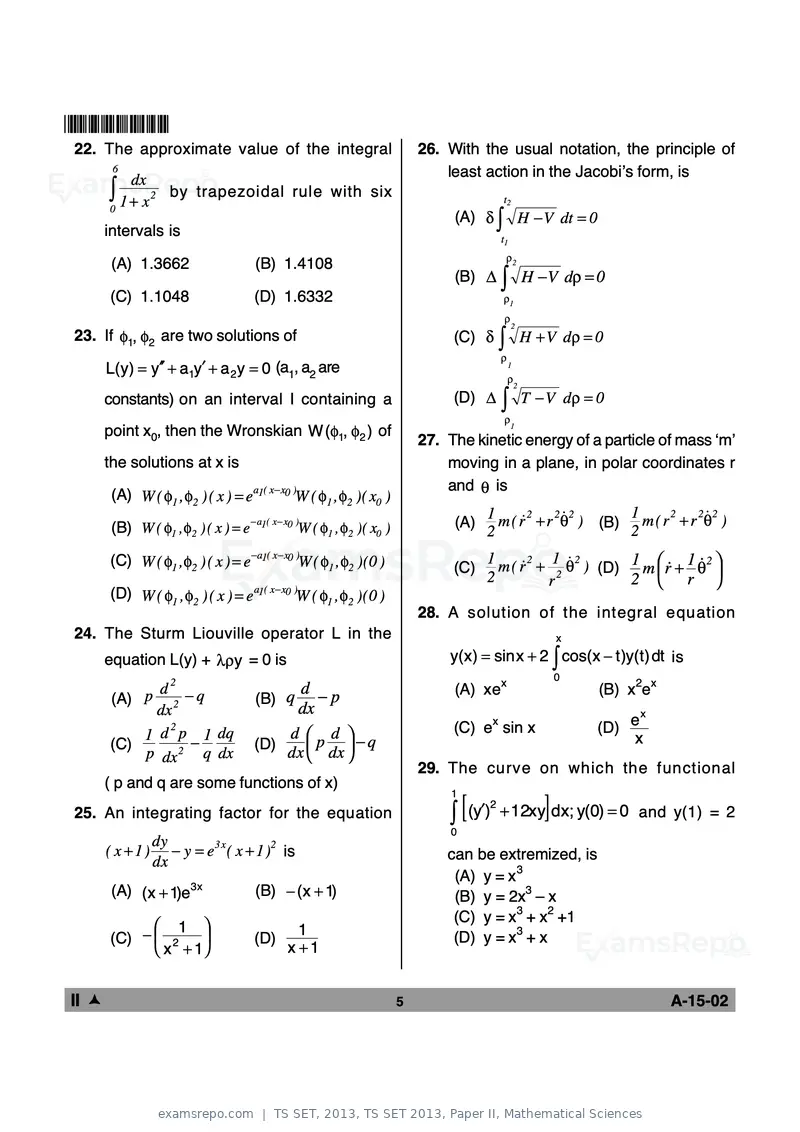
Text of page 5
*A1502*
22. The approximate value of the integral 26. With the usual notation, the principle of
6 least action in the Jacobi’s form, is
dx
∫ 1 + x 2 by trapezoidal rule with six t2
0
(A) δ ∫ H − V dt = 0
intervals is t1
ρ2
(A) 1.3662 (B) 1.4108
(C) 1.1048 (D) 1.6332
(B) Δ ∫ H −V dρ = 0
ρ1
ρ
2
23. If φ1, φ2 are two solutions of (C) δ ∫ H + V dρ = 0
ρ
L(y) = y′′ + a1y′ + a 2 y = 0 (a1, a2 are 1
ρ
2
constants) on an interval I containing a (D) Δ ∫ T − V dρ = 0
ρ
point x0, then the Wronskian W (φ1, φ2 ) of 1
27. The kinetic energy of a particle of mass ‘m’
the solutions at x is moving in a plane, in polar coordinates r
and θ is
(A) W ( φ1 , φ2 ) ( x ) = ea1( x− x0 )W ( φ1 , φ2 )( x0 )
(B) m ( r + r θ )
− a1( x − x0 )
1 m ( r2 + r 2θ 2 ) 1 2 2 2
(B) W ( φ1 , φ2 ) ( x ) = e W ( φ1 , φ2 )( x0 ) (A)
2 2
(C) W ( φ1 , φ2 ) ( x ) = e−a1( x− x0 )W ( φ1 , φ2 )( 0 ) (C)
1 m ( r2 + 1 θ 2 )
(D) m ⎜⎛ r + θ ⎞⎟
1 1 2
2 r
2
2 ⎝ r ⎠
(D) W ( φ1 , φ2 ) ( x ) = ea1( x− x0 )W ( φ1 , φ2 )( 0 )
28. A solution of the integral equation
24. The Sturm Liouville operator L in the x
equation L(y) + λρy = 0 is y(x) = sin x + 2 ∫ cos(x − t )y(t ) dt is
0
d2 d (A) xe
x 2 x
(B) x e
(A) p 2 − q (B) q − p
dx dx x
(D) e
x
2
1 d p − 1 dq d ⎛ p d ⎞−q (C) e sin x
(C) (D) ⎜ ⎟ x
p dx 2 q dx dx ⎝ dx ⎠
29. The curve on which the functional
( p and q are some functions of x)
∫ [ (y′) + 12xy] dx; y(0) = 0 and y(1) = 2
1
2
25. An integrating factor for the equation
0
dy
( x + 1 ) − y = e3 x ( x + 1 )2 is can be extremized, is
dx
(A) y = x3
(A) (x + 1)e3x (B) − (x + 1) 3
(B) y = 2x – x
(C) y = x + x2 +1
3
⎛ 1 ⎞ 1
(C) − ⎜ 2 ⎟ 3
(D) (D) y = x + x
⎝ x + 1⎠ x +1
II æ 5 A-15-02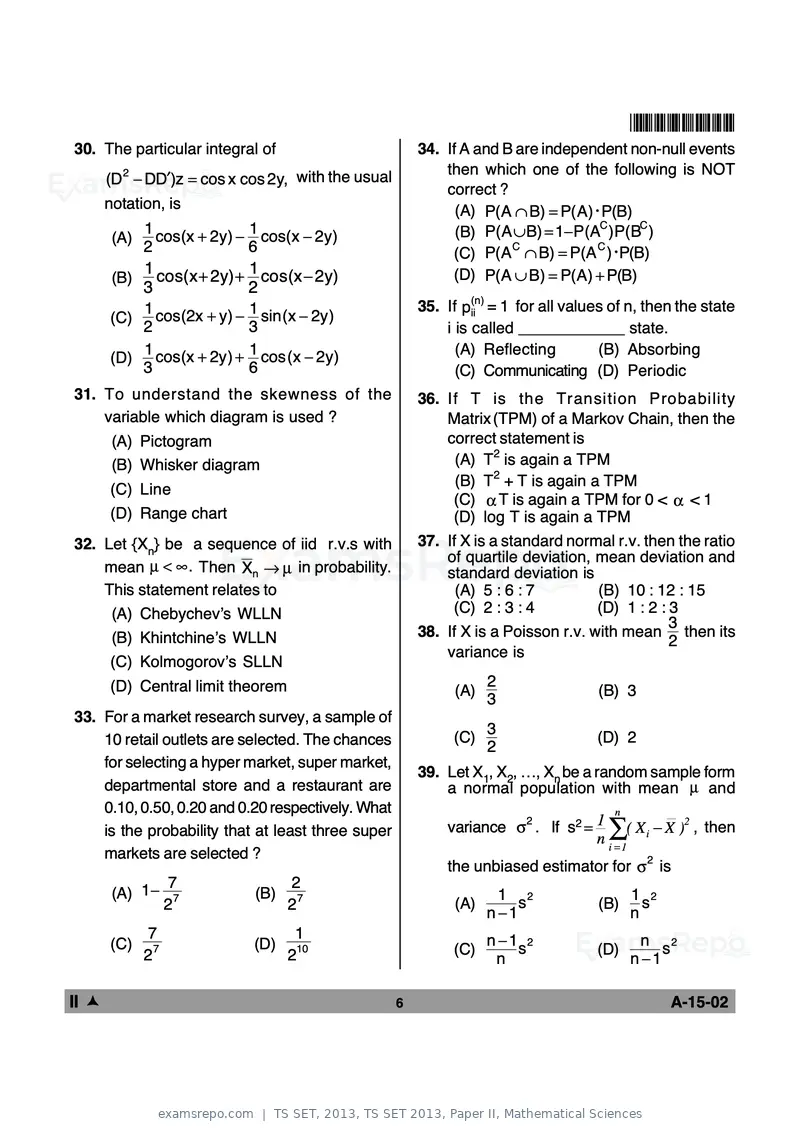
Text of page 6
*A1502*
30. The particular integral of                          34. If A and B are independent non-null events
                                                            then which one of the following is NOT
       (D2 − DD′)z = cos x cos 2y, with the usual
                                                            correct ?
       notation, is                                           (A) P(A ∩ B) = P(A ) ⋅ P(B)
                                                                                    C     C
        (A)
           1 cos(x + 2y) − 1 cos(x − 2y)                      (B) P(A ∪ B) = 1− P(A )P(B )
          2                6                                 (C) P(A ∩ B) = P(A ) ⋅P(B)
                                                                      C            C

           1               1                                 (D) P(A ∪ B) = P(A ) + P(B)
       (B) cos(x + 2y) + cos(x − 2y)
          3                2
           1               1                            35. If p(n)
                                                                 ii = 1 for all values of n, then the state
       (C) cos(2x + y) − sin (x − 2y )
          2                3                                i is called ____________ state.
           1               1                                  (A) Reflecting         (B) Absorbing
       (D) cos(x + 2y ) + cos (x − 2y)
          3                6                                  (C) Communicating (D) Periodic
31. To understand the skewness of the                   36. If T is the Transition Probability
    variable which diagram is used ?                        Matrix (TPM) of a Markov Chain, then the
        (A) Pictogram                                       correct statement is
        (B) Whisker diagram                                   (A) T2 is again a TPM
                                                              (B) T2 + T is again a TPM
       (C) Line
                                                             (C) α T is again a TPM for 0 < α < 1
       (D) Range chart                                       (D) log T is again a TPM
32. Let {Xn} be a sequence of iid r.v.s with            37. If X is a standard normal r.v. then the ratio
                                                            of quartile deviation, mean deviation and
    mean μ < ∞ . Then Xn → μ in probability.                standard deviation is
    This statement relates to                                 (A) 5 : 6 : 7         (B) 10 : 12 : 15
        (A) Chebychev’s WLLN                                 (C) 2 : 3 : 4          (D) 1 : 2 : 3
                                                                                                3
        (B) Khintchine’s WLLN                           38. If X is a Poisson r.v. with mean then its
                                                                                                2
                                                            variance is
       (C) Kolmogorov’s SLLN
       (D) Central limit theorem                                   2
                                                             (A)                     (B) 3
                                                                   3
33. For a market research survey, a sample of
                                                                   3
    10 retail outlets are selected. The chances              (C)                    (D) 2
                                                                   2
    for selecting a hyper market, super market,
                                                        39. Let X1, X2, …, Xn be a random sample form
    departmental store and a restaurant are                 a normal population with mean μ and
    0.10, 0.50, 0.20 and 0.20 respectively. What                                       n
    is the probability that at least three super                                      ∑
                                                            variance σ . If s2 = 1 ( X i − X )2 , then
                                                                         2
                                                                                 n i =1
    markets are selected ?
                                                            the unbiased estimator for σ2 is
                   7               2
        (A) 1−              (B)                                      1 s2                  1 s2
                   27              27                        (A)                     (B)
                                                                   n −1                    n
              7                     1                              n − 1s 2                  n s2
       (C)                  (D)                              (C)                    (D)
              27                   210                              n                      n −1

II æ                                                6                                             A-15-02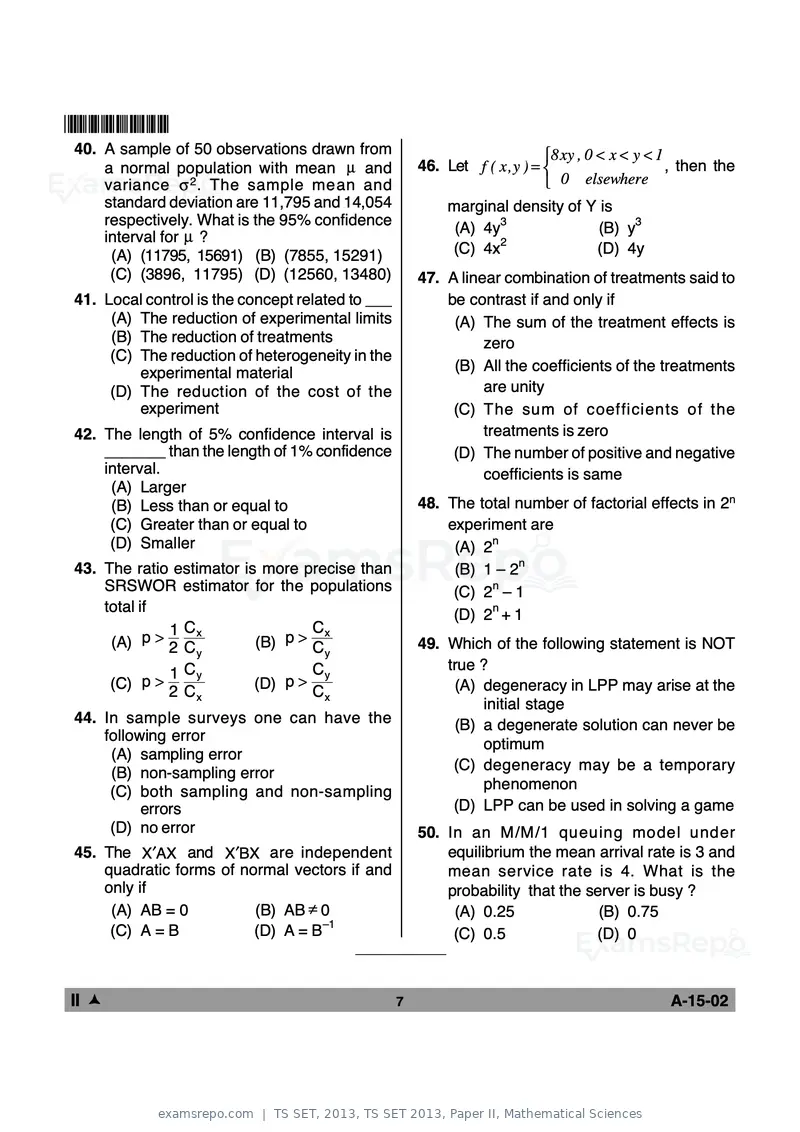
Text of page 7
*A1502*
40. A sample of 50 observations drawn from                                  ⎧8 xy , 0 < x < y < 1
    a normal population with mean μ and               46. Let f ( x , y ) = ⎨                     , then the
    variance σ 2 . The sample mean and                                      ⎩ 0 elsewhere
    standard deviation are 11,795 and 14,054              marginal density of Y is
    respectively. What is the 95% confidence                      3                         3
                                                           (A) 4y                     (B) y
    interval for μ ?
     (A) (11795, 15691) (B) (7855, 15291)                  (C) 4x2                    (D) 4y
     (C) (3896, 11795) (D) (12560, 13480)             47. A linear combination of treatments said to
41. Local control is the concept related to ___           be contrast if and only if
     (A) The reduction of experimental limits              (A) The sum of the treatment effects is
     (B) The reduction of treatments                            zero
     (C) The reduction of heterogeneity in the
         experimental material                             (B) All the coefficients of the treatments
     (D) The reduction of the cost of the                       are unity
         experiment                                        (C) The sum of coefficients of the
42. The length of 5% confidence interval is                     treatments is zero
    _______ than the length of 1% confidence               (D) The number of positive and negative
    interval.                                                   coefficients is same
     (A) Larger
     (B) Less than or equal to                        48. The total number of factorial effects in 2n
     (C) Greater than or equal to                         experiment are
     (D) Smaller                                                n
                                                           (A) 2
43. The ratio estimator is more precise than               (B) 1 – 2n
    SRSWOR estimator for the populations                         n
                                                           (C) 2 – 1
    total if                                                     n
                                                           (D) 2 + 1
             1 Cx                 Cx
     (A) p > 2 C          (B) p > C                   49. Which of the following statement is NOT
                 y                  y
               C                  C                       true ?
             1 y                    y
     (C) p >              (D) p >                          (A) degeneracy in LPP may arise at the
             2 Cx                 Cx
                                                                initial stage
44. In sample surveys one can have the                     (B) a degenerate solution can never be
    following error
                                                                optimum
     (A) sampling error
                                                           (C) degeneracy may be a temporary
     (B) non-sampling error
     (C) both sampling and non-sampling                         phenomenon
          errors                                           (D) LPP can be used in solving a game
     (D) no error                                     50. In an M/M/1 queuing model under
45. The X′AX and X′BX are independent                     equilibrium the mean arrival rate is 3 and
    quadratic forms of normal vectors if and              mean service rate is 4. What is the
    only if                                               probability that the server is busy ?
     (A) AB = 0          (B) AB ≠ 0                        (A) 0.25              (B) 0.75
                                   –1
     (C) A = B           (D) A = B                         (C) 0.5              (D) 0
                                         _____________


II æ                                              7                                              A-15-02
Text of page 8
*A1502*
       Space for Rough Work


II æ            8               A-15-02
Official key not published for this paper.
Page 1 of 8
Source: Telangana State Eligibility Test. Question paper published by Telangana State Eligibility Test.