
TS SET 2018: Paper II, Linguistics

Text of page 1
Subject Code Subject
Question Booklet Number
A-29-18 LinguistIcs
hALL tICKET number PaPER
ii
OMR Sheet Number nUMBER OF qUESTIONS
100
dURATION mAXIMUM mARKS nUMBER OF pAGES
2 hOUrs 200 16
This is to certify that, the entries made in the above portion are correctly written and verified.
Candidates Signature Name and Signature of Invigilator
Instructions for the Candidates A¿æýÅǦMìü çÜ*^èþ¯èþË$
1. Write your Hall Ticket Number in the space provided on the top
D ç³#r ò³O ¿êVæü…ÌZ CÐèþÓºyìþ¯èþ çܦ˅ÌZ Ò$ àÌŒýsìýMðüsŒý ¯èþ…ºÆæÿ$ Æ>Äæý$…yìþ.
1.
of this page. D {ç³Ôèý² ç³{™èþÐèþ$$ Ðèþ…§æþ (100) ºçßý$âñýO_eMæü {ç³Ôèý²Ë¯èþ$ MæüÍW E…¨.
2.
2. This paper consists of hundred multiple-choice type of questions.
ç³È„æü {´ëÆæÿ…¿æýÐèþ$$¯èþ D {ç³Ô>²ç³{™èþÐèþ$$ Ò$Mæü$ CÐèþÓºyæþ$™èþ$…¨ Ððþ$$§æþsìý I§æþ$
3. At the commencement of examination, the question booklet will
3.
°Ñ$çÙÐèþ$$ËÌZ D {ç³Ô>²ç³{™èþÐèþ$$¯èþ$ ™ðþÇ_ Mìü…§æþ ™ðþÍí³¯èþ A…Ô>˯èþ$ ™èþç³µ°çÜÇV>
be given to you. In the first 5 minutes, you are requested to open
the booklet and compulsorily examine it as below : çÜÇ^èþ*çÜ$Mø…yìþ.
(i) D {ç³Ôèý² ç³{™èþÐèþ$$¯èþ$ ^èþ*yæþyé°Mìü MæüÐèþÆŠÿ õ³h A…^èþ$¯èþ E¯èþ² M>W™èþç³# ïÜË$¯èþ$
(i) To have access to the Question Booklet, tear off the paper
seal on the edge of this cover page. Do not accept a booklet _…^èþ…yìþ. M>W™èþç³# ïÜË$Ìôý° Ðèþ$ÇÄæý$$ C¨ÐèþÆæÿMóü ™ðþÇ_ E¯èþ² {ç³Ô>²ç³{™èþÐèþ$$¯èþ$
without sticker-seal and do not accept an open booklet. Ò$Ææÿ$ A…XMæüÇ…^èþÐèþ§æþ$ª.
(ii) Tally the number of pages and number of questions (ii) MæüÐèþÆæÿ$ õ³h ò³O Ðèþ$${¨…_¯èþ çÜÐèþ*^éÆæÿ… {ç³M>Ææÿ… D {ç³Ôèý² ç³{™èþÐèþ$$ÌZ° õ³iË
in the booklet with the information printed on the çÜ…Qůèþ$ Ðèþ$ÇÄæý$$ {ç³Ôèý²Ë çÜ…Qůèþ$ çÜÇ^èþ*çÜ$Mø…yìþ.õ³iË çÜ…QÅMæü$ çÜ…º…«¨…_
cover page. Faulty booklets due to pages/questions V>± Ìôý§é çÜ*_…_¯èþ çÜ…QÅÌZ {ç³Ôèý²Ë$ ÌôýMæü´ùÐèþ#r Ìôý§é °f{糆 M>Mæü´ùÐèþ#r
missing or duplicate or not in serial order or any other Ìôý§é {ç³Ôèý²Ë$ {MæüÐèþ$糧æþ®†ÌZ ÌôýMæü´ùÐèþ#r Ìôý§é HÐðþO¯é ™óþyéË$…yæþ$r
discrepancy should be got replaced immediately by a Ðèþ…sìý §øçÙç³NÇ™èþÐðþ$O¯èþ {ç³Ôèý² ç³{™é°² Ððþ…r¯óþ Ððþ$$§æþsìý I§æþ$ °Ñ$ÚëÌZÏ ç³È„>
correct booklet from the invigilator within the period ç³ÆæÿÅÐóþ„æüMæü$°Mìü †ÇW C_aÐóþíÜ §é°Mìü º§æþ$Ë$V> çÜÇV>Y E¯èþ² {ç³Ôèý²ç³{™é°²
of 5 minutes. Afterwards, neither the Question Booklet ¡çÜ$Mø…yìþ. ™èþ§æþ¯èþ…™èþÆæÿ… {ç³Ôèý²ç³{™èþÐèþ$$ Ðèþ*Ææÿaºyæþ§æþ$ A§æþ¯èþç³# çÜÐèþ$Äæý$…
will be replaced nor any extra time will be given. CÐèþÓºyæþ§æþ$.
(iii) After this verification is over, the Test Booklet Number
(iii) ò³O Ñ«§æþ…V> çÜÇ^èþ*çÜ$Mö¯èþ² ™èþÆ>Ó™èþ {ç³Ô>²ç³{™èþ… çÜ…Qůèþ$ OMR ç³{™èþÐèþ$$ ò³O
should be entered in the OMR Sheet and the OMR Sheet
Number should be entered on this Test Booklet.
A§óþÑ«§æþ…V> OMR ç³{™èþÐèþ$$ çÜ…Qůèþ$ D {ç³Ô>²ç³{™èþÐèþ$$ ò³O °Ç®çÙt çܦ˅ÌZ
4. Each item has four alternative responses marked (A), (B), (C)
Æ>Äæý$ÐèþÌñý¯èþ$.
4. {糆 {ç³Ôèý²Mæü$ ¯éË$Væü$ {ç³™éÅÐèþ*²Äæý$Ë$ (A), (B), (C) Ðèþ$ÇÄæý$$ (D) Ë$V>
and (D). You have to darken the circle as indicated below on the
correct response against each item. CÐèþÓºyézÆÿ$$. {糆 {ç³Ôèý²Mæü$ çÜÆðÿO¯èþ fÐéº$¯èþ$ G¯èþ$²Mö° OMR ç³{™èþÐèþ$$ÌZ {糆 {ç³Ô>²
Example : A B C D çÜ…QÅMæü$ CÐèþÓºyìþ¯èþ ¯éË$Væü$ Ðèþ–™é¢ÌZÏ çÜÆðÿO¯èþ fÐéº$ çÜ*_…^óþ Ðèþ–™é¢°² »êÌŒý ´ëÆÿ$$…sŒý
ò³¯Œþ™ø Mìü…§æþ ™ðþÍí³¯èþ Ñ«§æþ…V> ç³NÇ…^éÍ
where (C) is the correct response.
E§éçßýÆæÿ×ý : A B C D
5. Your responses to the items are to be indicated in the OMR Answer
Sheet given to you. If you mark at any place other than in the (C) ç Ü Æð ÿ O ¯ è þ {ç ³ †ç Ü µ…§æ þ ¯è þ AÆÿ$$™ó þ .
circle or half circle or semi circle in the Answer Sheet, it will not 5. {ç³Ôèý²ËMæü$ fÐéº$¯èþ$ D {ç³Ôèý²ç³{™èþÐèþ$$™ø CÐèþÓºyìþ¯èþ OMR ç³{™èþÐèþ$$ ò³O¯èþ CÐèþÓºyìþ¯èþ
be evaluated. Ðèþ–™é¢ÌZϯóþ ç³NÇ…_ Væü$Ç¢…^éÍ. AÌêM>Mæü çÜÐèþ*«§é¯èþ ç³{™èþ… ò³O ÐóþÆöMæü ^ør Væü$Ç¢…_¯èþ
6. Read instructions given inside carefully. ÌôýMæü çÜVæü Ðèþ–™èþ¢… Ìôý§é AçÜ…ç³NÆæÿ~ Ðèþ–™é¢°² °…í³¯èþ Ò$ fÐéº$ Ðèþ$*ÌêÅ…Mæü¯èþ…
7. Rough Work is to be done in the end of this booklet. ^óþÄæý$ºyæþ§æþ$.
8. If you write your name or put any mark on any part of the OMR 6. {ç³Ôèý² ç³{™èþÐèþ$$ ÌZç³Ë C_a¯èþ çÜ*^èþ¯èþ˯èþ$ gê{Væü™èþ¢V> ^èþ§æþÐèþ…yìþ.
Answer Sheet, except for the space allotted for the relevant 7. _™èþ$¢ç³°° {ç³Ôèý²ç³{™èþÐèþ$$ _ÐèþÆæÿ C_a¯èþ Rêä çܦËÐèþ$$ÌZ ^óþÄæý*Í.
entries, which may disclose your identity, you will render yourself
8. OMRç³{™èþÐèþ$$ ò³O °È~™èþ çܦ˅ÌZ çÜ*_…^èþÐèþËíܯèþ ÑÐèþÆ>Ë$ ™èþí³µ…_ C™èþÆæÿ çܦ˅ÌZ Ò$
liable to disqualification.
9. The candidate must handover the OMR Answer Sheet to Væü$Ç¢…ç³#¯èþ$ ™ðþÍõ³ Ñ«§æþ…V> Ò$ õ³Ææÿ$ Æ>Äæý$yæþ… V>± Ìôý§é C™èþÆæÿ _à²Ë¯èþ$ ò³rtyæþ…
the invigilators at the end of the examination compulsorily V>± ^óþíܯèþrÏÆÿ$$™óþ Ò$ A¯èþÆæÿá™èþMæü$ Ò$Æóÿ »ê«§æþ$ÅËÐèþ#™éÆæÿ$.
and must not carry it with you outside the Examination Hall. 9. ç³È„æü ç³NÆæÿ¢Æÿ$$¯èþ ™èþÆ>Ó™èþ OMR ç³{™é°² ™èþç³µ°çÜÇV> ç³È„æü ç³ÆæÿÅÐóþ„æüMæü$yìþMìü CÐéÓÍ.
The candidate is allowed to take away the carbon copy of Ðésìý° ç³È„æü Væü¨ ºÄæý$rMæü$ ¡çÜ$Mæü$ÐðþâæýåMæü*yæþ§æþ$. ç³È„æü ç³NÆæÿ¢Æÿ$$¯èþ ™èþÆæÿ$Ðé™èþ
OMR Sheet and used Question paper booklet at the end of the A¿æýÅÆæÿ$¦Ë$ {ç³Ôèý² ç³{™é°² OMR ç³{™èþ… Äñý$$MæüP M>Ææÿ¾¯Œþ M>ï³° ¡çÜ$Mæü$ÐðþâæýåÐèþ^èþ$a
examination. 10. ±Í/¯èþËÏ Ææÿ…Væü$ »êÌŒý ´ëÆÿ$$…sŒý ò³¯Œþ Ðèþ*{™èþÐóþ$ Eç³Äñý*W…^éÍ.
10. Use only Blue/Black Ball point pen. 11. ÌêVæüÇ£æþÐŒþ$ sôýº$ÌŒýÞ, M>ÅÍMæü$ÅÌôýrÆŠÿË$, GË[M>t°MŠü ç³ÇMæüÆ>Ë$ Ððþ$$§æþËVæü$¯èþÑ ç³È„æü
11. Use of any calculator or log table etc., is prohibited.
12. There is no negative marks for incorrect answers.
Væü¨ÌZ Eç³Äñý*W…^èþyæþ… °õÙ«§æþ….
12. ™èþ糚 çÜÐèþ*«§é¯éËMæü$ Ðèþ*Ææÿ$PË ™èþWY…ç³# Ìôý§æþ$.
II 1 A-29-18

Text of page 2
*A2918*
RE
HE
ITE
WR
T
NO
DO
II 2 A-29-18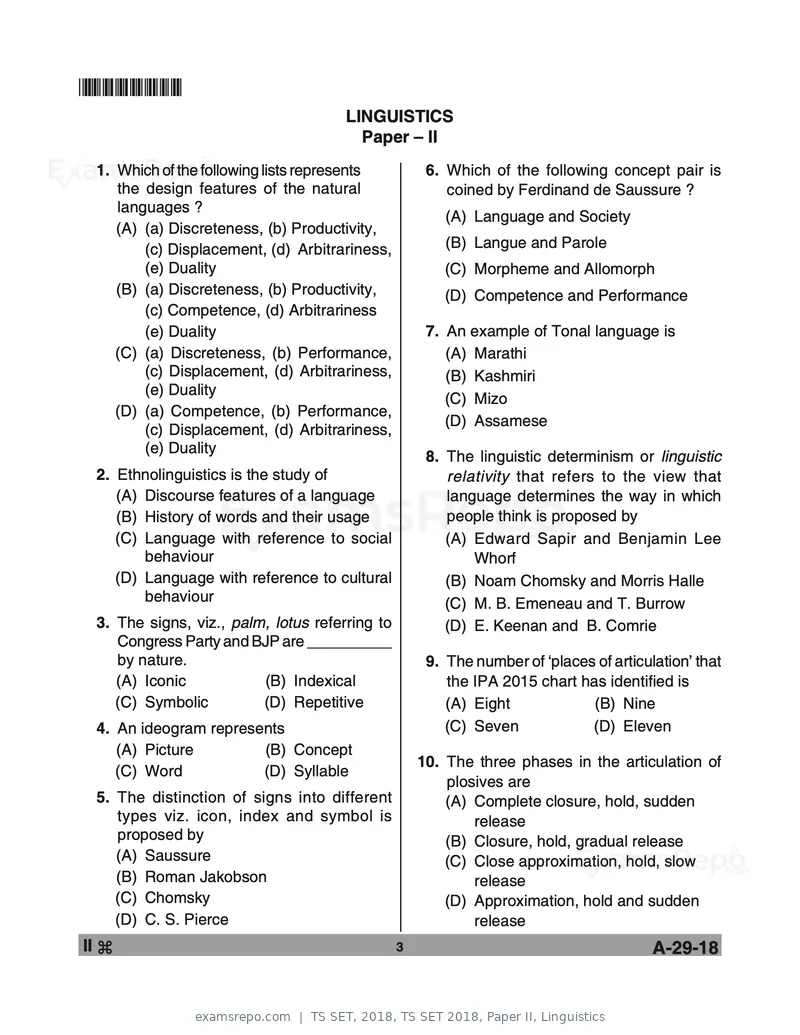
Text of page 3
*A2918*
LinguistIcs
Paper – II
1. Which of the following lists represents 6. Which of the following concept pair is
the design features of the natural coined by Ferdinand de Saussure ?
languages ?
(A) Language and Society
(A) (a) Discreteness, (b) Productivity,
(c) Displacement, (d) Arbitrariness, (B) Langue and Parole
(e) Duality (C) Morpheme and Allomorph
(B) (a) Discreteness, (b) Productivity, (D) Competence and Performance
(c) Competence, (d) Arbitrariness
(e) Duality 7. An example of Tonal language is
(C) (a) Discreteness, (b) Performance, (A) Marathi
(c) Displacement, (d) Arbitrariness, (B) Kashmiri
(e) Duality
(C) Mizo
(D) (a) Competence, (b) Performance,
(D) Assamese
(c) Displacement, (d) Arbitrariness,
(e) Duality
8. The linguistic determinism or linguistic
2. Ethnolinguistics is the study of relativity that refers to the view that
(A) Discourse features of a language language determines the way in which
(B) History of words and their usage people think is proposed by
(C) Language with reference to social (A) Edward Sapir and Benjamin Lee
behaviour Whorf
(D) Language with reference to cultural (B) Noam Chomsky and Morris Halle
behaviour (C) M. B. Emeneau and T. Burrow
3. The signs, viz., palm, lotus referring to (D) E. Keenan and B. Comrie
Congress Party and BJP are __________
by nature. 9. The number of ‘places of articulation’ that
(A) Iconic (B) Indexical the IPA 2015 chart has identified is
(C) Symbolic (D) Repetitive (A) Eight (B) Nine
4. An ideogram represents (C) Seven (D) Eleven
(A) Picture (B) Concept
10. The three phases in the articulation of
(C) Word (D) Syllable
plosives are
5. The distinction of signs into different (A) Complete closure, hold, sudden
types viz. icon, index and symbol is release
proposed by (B) Closure, hold, gradual release
(A) Saussure (C) Close approximation, hold, slow
(B) Roman Jakobson release
(C) Chomsky (D) Approximation, hold and sudden
(D) C. S. Pierce release
II 3 A-29-18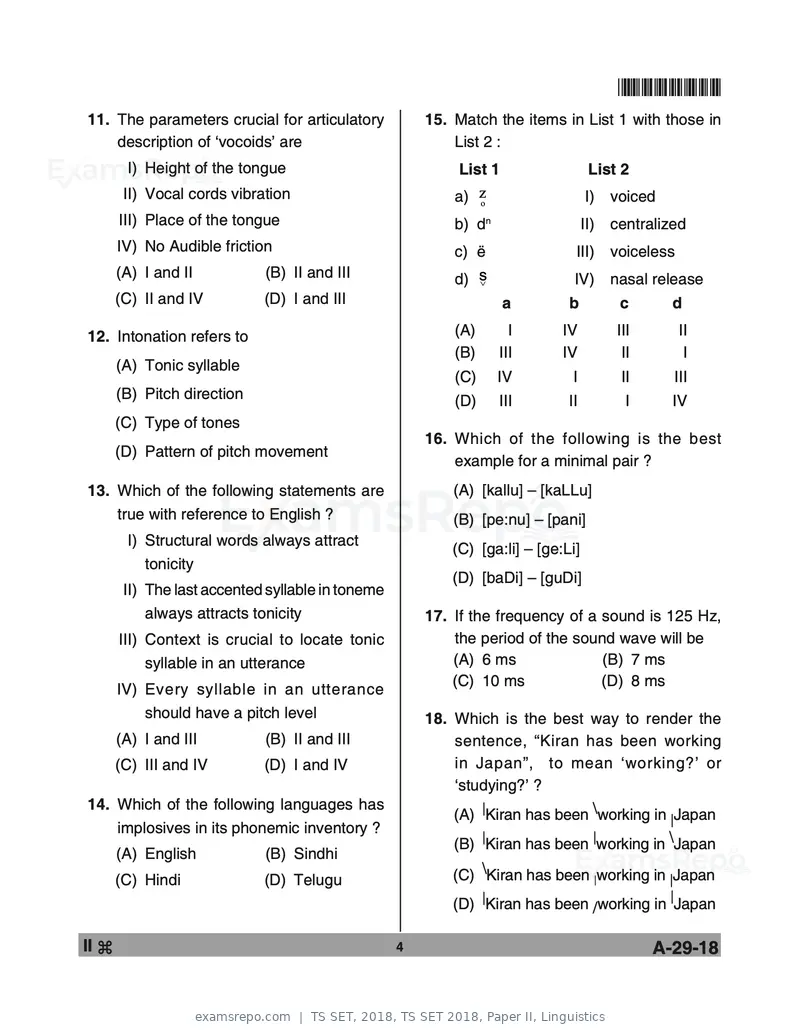
Text of page 4
*A2918*
11. The parameters crucial for articulatory 15. Match the items in List 1 with those in
description of ‘vocoids’ are List 2 :
I) Height of the tongue List 1 List 2
II) Vocal cords vibration a) z o I) voiced
III) Place of the tongue b) dn II) centralized
IV) No Audible friction c) ë III) voiceless
(A) I and II (B) II and III d) s∨ IV) nasal release
(C) II and IV (D) I and III a b c d
12. Intonation refers to (A) I IV III II
(B) III IV II I
(A) Tonic syllable
(C) IV I II III
(B) Pitch direction (D) III II I IV
(C) Type of tones
16. Which of the following is the best
(D) Pattern of pitch movement
example for a minimal pair ?
13. Which of the following statements are (A) [kallu] – [kaLLu]
true with reference to English ? (B) [pe:nu] – [pani]
I) Structural words always attract
(C) [ga:li] – [ge:Li]
tonicity
(D) [baDi] – [guDi]
II) The last accented syllable in toneme
always attracts tonicity 17. If the frequency of a sound is 125 Hz,
III) Context is crucial to locate tonic the period of the sound wave will be
syllable in an utterance (A) 6 ms (B) 7 ms
(C) 10 ms (D) 8 ms
IV) Every syllable in an utterance
should have a pitch level 18. Which is the best way to render the
(A) I and III (B) II and III sentence, “Kiran has been working
(C) III and IV (D) I and IV in Japan”, to mean ‘working?’ or
‘studying?’ ?
14. Which of the following languages has
(A) |Kiran has been \working in Japan |
implosives in its phonemic inventory ?
(B) Kiran has been working in \Japan
| |
(A) English (B) Sindhi
(C) Hindi (D) Telugu (C) \Kiran has been |working in |Japan
|
(D) |Kiran has been /working in Japan
II 4 A-29-18
Text of page 5
*A2918*
19. Across human languages, phonemes 24. Match the items in List 1 with those
are in List 2 :
(A) Complementary List 1 List 2
(B) Contrastive a) Autosegmental I) Rhyme
(C) Allophonic phonology
(D) Phonetic b) Metrical II) Level
phonology ordering
20. When becomes
c) Optimality III) Coarticulation
the phonological process
theory
involved is
d) Lexical IV) Evaluator
(A) Nasalization
phonology
(B) Devoicing a b c d
(C) Assimilation (A) III I IV II
(D) Labialization (B) I III II IV
21. ‘Aspiration’ in English (C) III I II IV
(D) III IV I II
(A) Is allophonic
(B) Is phonemic 25. “Sound Pattern of English” is the work of
(C) Occurs on the last consonant of (A) Noam Chomsky and Morris Halle
the word
(B) Paul Kiparsky and K. P. Mohanan
(D) Occurs on the initial consonant of
(C) Willam Greaves and Michael
the word
Halliday
22. In the word the lateral consonant (D) Daniel Jones and Peter Roach
is
I) [-syllabic] II) [+ syllabic] 26. The term, ‘neutralization’ is used to
refer to
III) [-sonorant] IV) [+dorsal]
(A) Loss of a phoneme in the word-final
(A) I and II (B) II and IV
position
(C) II and III (D) III and IV (B) Loss of aspiration of a phoneme in a
particular environment
23. The feature matrix [+ vocoid, + syllabic,
(C) Loss of distinction between
+ sonorant, + continuant, + voiced]
two phonemes in a particular
represents the consonant environment
(A) /I/ (B) /j/ (D) Loss of a consonant in the word-initial
(C) / æ / (D) /w/ position
II 5 A-29-18
Text of page 6
*A2918*
27. The sequence of segments in the 33. The word ‘blackbird’ is a compound of
English word ‘split’ may be divided the type
into __________ that order. (A) Tatpurusha
(A) coda and onset (B) Dvandva
(B) nucleus and onset (C) Bahuvrihi
(C) onset, nucleus and coda (D) Karmadharaya
(D) coda, nucleus and onset
34. _________ is the list of all the word-
28. The ‘extra-syllabic’ consonant(s) in the forms of a lexeme.
word ‘texts’ is/are (A) Paradigm (B) Syntagm
(A) [t] (B) [kts] (C) Lexicon (D) Dictionary
(C) [ts] (D) [ekts]
35. Morphs that belong to a morpheme are
29. The word formation rule applied in the always in _________distribution.
formation of the word ‘lab’ is called (A) Contrastive
(A) Clipping (B) Back formation
(B) Complementary
(C) Blend (D) Acronym
(C) Overlapping
30. Which of the following represents (D) Inclusive
the correct derivation of the word
‘unsolvability’ ? 36. The process wherein a potential
expression is prevented from
(A) [[[un[solve]]able]ity]
occurring because another expression
(B) [un[[[solve]able]ity]]
with the same meaning and function
(C) [[un[[solve]able]]ity] already exists is called
(D) [[un[solvable]]ity] (A) Clipping (B) Attrition
(C) Blocking (D) Truncation
31. The forms ‘ring’, ‘rang’ and ‘rung’ are
(A) Three words and one lexeme 37. The hypothesis which places
word-formation (derivation and
(B) Three words and three lexemes
compounding) in the pre-syntactic
(C) Three lexemes but one word
component and inflection in the
(D) Three lexemes with one meaning post-syntactic component is
32. Which of the following is not an (A) Distributed morphology
allomorph of the negative prefix ‘in-’ ? (B) Split morphology
(A) Il- (B) Ir- (C) Relational morphology
(C) Is- (D) Im-
(D) Generative morphology
II 6 A-29-18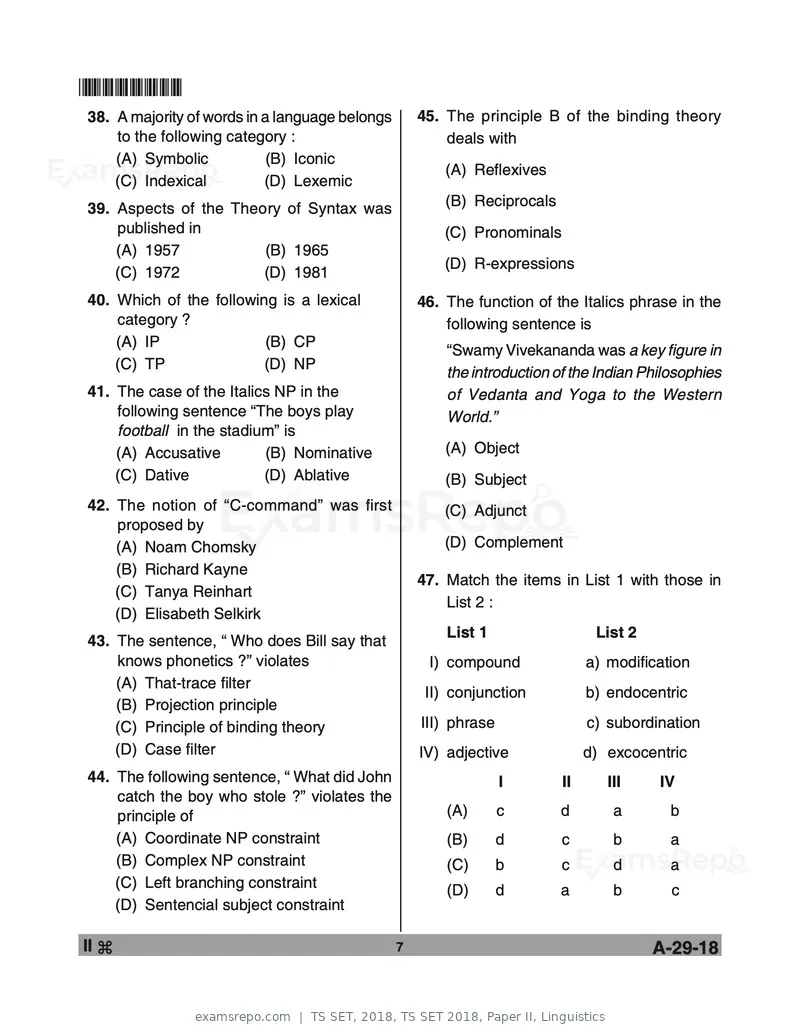
Text of page 7
*A2918*
38. A majority of words in a language belongs 45. The principle B of the binding theory
to the following category : deals with
(A) Symbolic (B) Iconic
(A) Reflexives
(C) Indexical (D) Lexemic
39. Aspects of the Theory of Syntax was (B) Reciprocals
published in (C) Pronominals
(A) 1957 (B) 1965
(D) R-expressions
(C) 1972 (D) 1981
40. Which of the following is a lexical 46. The function of the Italics phrase in the
category ? following sentence is
(A) IP (B) CP
“Swamy Vivekananda was a key figure in
(C) TP (D) NP
the introduction of the Indian Philosophies
41. The case of the Italics NP in the of Vedanta and Yoga to the Western
following sentence “The boys play World.”
football in the stadium” is
(A) Accusative (B) Nominative (A) Object
(C) Dative (D) Ablative (B) Subject
42. The notion of “C-command” was first (C) Adjunct
proposed by
(A) Noam Chomsky (D) Complement
(B) Richard Kayne
47. Match the items in List 1 with those in
(C) Tanya Reinhart
List 2 :
(D) Elisabeth Selkirk
List 1 List 2
43. The sentence, “ Who does Bill say that
knows phonetics ?” violates I) compound a) modification
(A) That-trace filter
II) conjunction b) endocentric
(B) Projection principle
(C) Principle of binding theory III) phrase c) subordination
(D) Case filter IV) adjective d) excocentric
44. The following sentence, “ What did John I II III IV
catch the boy who stole ?” violates the
principle of (A) c d a b
(A) Coordinate NP constraint (B) d c b a
(B) Complex NP constraint (C) b c d a
(C) Left branching constraint (D) d a b c
(D) Sentencial subject constraint
II 7 A-29-18
Text of page 8
*A2918*
48. Which of the following statements 51. ‘Good-bad’ is an example of
are true ? (A) Relational opposites
I) Each argument bears one and only (B) Directional opposites
one theta role (C) Gradable antonyms
II) ‘Expletive it’ occurs in a theta (D) Incompatible antonyms
position
III) In a passive sentence, an NP 52. Statement 1 : Homonyms are words
argument moves from a theta- that are spelt the same, but have
position to a non-theta position different meanings.
IV) Wh-phrase, after movement, is in a
theta position Statement 2 : Homophones are
(A) I and III (B) II and III words that are spelt differently but
(C) I and IV (D) II and IV have the same pronunciation and
different meaning.
49. In the sentence, “John is pig-headed’, (A) Only statement 1 is true
the word ‘pig-headed’ means ‘stubborn’.
(B) Only statement 2 is true
In semantics, this type of meaning is
called (C) Both the statements are true
(A) Denotative (D) Both the statements are false
(B) Emotive
(C) Connotative 53. The sentence, “Nehal is alive” is true
(D) Conative when
1. Nehal belongs to a set of animate
50. Match the items in List 1 with those
objects.
in List 2.
2. Nehal belongs to a set of currently
List 1 List 2
living things.
I) animal-dog a) meronymy (A) Only 1 is true
II) long-short b) synonymy (B) Only 2 is true
(C) Both 1 and 2 are true
III) movie-film c) hyponymy
(D) Both 1 and 2 are false
IV) hand-arm d) antonymy
54. The actual utterance and its
I II III IV
ostensible meaning is
(A) c a d b
(A) Locutionary act
(B) c d b a
(B) Illocutionary act
(C) b a d c
(C) Perlocutionary act
(D) b c d a
(D) Speech act
II 8 A-29-18
Text of page 9
*A2918*
55. Sentence 1 : John missed the meeting 60. _______________ claimed for the first
after his car broke down. time from India that Sanskrit, Greek,
Sentence 2 : John missed the meeting Latin, Gothic and Old Persian have come
because his car broke down. from a common source.
The relationship between the (A) Jules Bloch
sentences 1 and 2 is (B) William Jones
(C) Sir George Grierson
(A) Entailment (D) Max Muller
(B) Implicature
61. “ __________ paradox states that sound
(C) Assumption
change, which is highly regular, causes
(D) Presupposition irregularity whereas analogy, which
56. Which one of the following is NOT a type is irregular causes regularity (Anttila,
of deixis ? 1989).”
(A) Place (B) Time (A) Sturtevant’s (B) Saussure’s
(C) Person (D) Gender (C) Martinette’s (D) Grimm’s
57. ‘Conceptual Semantics’ framework is 62. The understanding that Modern
developed by Indo-Aryan languages are typologically
(A) Gottlob Frege similar to the Dravidian languages is an
(B) Ray Jackendoff indication of the existence of a
(C) H. Grice (A) Dravidian substratum
(D) Beth Levin (B) Indo-Aryan substratum
(C) Foreign language substratum
58. The notion of ‘Semantic field’ is
found in (D) Indo-Aryan superstratum
(A) Discourse analysis
63. ____________ is often considered as
(B) Conversation analysis
the wastebasket of linguistic changes.
(C) Speech act theory
(A) Sound change
(D) Componential analysis
(B) Semantic change
59. _____________ is responsible for (C) Analogy
the introduction of the concept of (D) Borrowing
diachronic linguistics into linguistics.
64. Forms which are etymologically related
(A) Charles F. Hockett
but lack formal relationship in a paradigm
(B) Ferdinand de Saussure
are called as
(C) Roman Jakobson
(A) Variants (B) Suppletives
(D) Franz Boas (C) Alternants (D) Alloforms
II 9 A-29-18
Text of page 10
*A2918*
65. If A : A’ then B : X is to B : B’ is formulated 69. Identify one of the following statements
as ___________ analogy. that appropriately refers to “Code-
(A) Levelling switching”.
(B) Proportional (A) The use of a secret code in the
(C) Hypercorrection repertoire of an interaction
(D) Folketymology (B) The use of jargon within the language
of the interaction
66. The most appropriate definition of
(C) The use of more than one language,
computational linguistics would be
dialect or register in the interaction
(A) Computational modelling of
(D) The use of loanwords in the
natural language
conversation
(B) Computing natural language data
(C) Computational analysis of natural 70. The “Scheduled Languages” of India
language refers to
(D) Computer processing of natural (A) All the national languages of India
language (B) The languages defined in the VIII
schedule of the constitution of India
67. In the sentence “Fruit flies like a
(C) All the languages spoken by the
banana”, what sort of ambiguity is
scheduled tribes of India
found ?
(D) All the classical languages of India
(A) Phonological and phonetic
ambiguity 71. Pidgin refers to the
(B) Morphological and syntactic (A) A linguistic code that incorporates
ambiguity words from both source languages
(C) Syntactic and Semantic ambiguity and has a simplified grammatical
(D) Semantic and pragmatic structure
ambiguity (B) A language that combines words
from one source language and the
68. __________ is the process of assigning
grammar of another language
a linguistic structure to a given string of
(C) A language that has extensive
a language.
(A) Generation borrowings from a different
(B) Parsing language
(C) Analysing (D) A language or a code that is
(D) None of the above specially used in business activities
II 10 A-29-18
Text of page 11
*A2918*
72. In uppu biskit, the word uppu (salt) from 76. The variety of language unique to an
Telugu combines with the English word individual or the speech habits of an
biscuit. This kind of formation of the individual is called
compound is called (A) Idiolect
(A) Borrowed word (B) Mesolect
(B) Loan word
(C) Sociolect
(C) Loan Blend
(D) Borrowed translation (D) Dialect
73. The ability to use knowledge of grammar 77. The parameters that refer to the usage
and vocabulary appropriately in social of a language due to the ethnicity,
contexts is called religion, economic status, gender, level
(A) Linguistics competence of education, etc., of the interlocutors is
(B) Strategic competence called as
(C) Communicative competence (A) Linguistic variables
(D) Bilateral competence (B) Sociolinguistic variables
74. In a democracy, the determinant of the (C) Parametric variables
choice of a language as the medium of (D) Discourse variables
instruction shall be based on one of the 78. A person losing linguistic ability due to
following. aging is called
(A) The language of the majority
(A) Schizophrenia
(B) The official language of a province
(C) The language of globalization (B) Parkinson disease
(D) The language that earns livelihood (C) Alzheimer’s disease
75. The most vital factor that determines (D) Memory loss
the continuity of a language in the 79. The most effective period of language
society is acquisition where in language
(A) Contribution of the language to the acquisition results in native-like
gross domestic product competence is called as
(B) Contribution of the language to the
cultural development (A) Critical period
(C) Increasing literacy rate in the (B) Acquisition time
concerned language
(C) Effective period
(D) Use of the language in different
domains (D) Competence period
II 11 A-29-18
Text of page 12
*A2918*
80. ‘Fossilization’ in second language 84. The language teaching method based
acquisition means on the understanding that L2 learners go
(A) Creolization through similar stages as L1 learners is
(B) Creation of a new variety of (A) Grammar Translation Method
language
(B) Audio-lingual method
(C) Pause in the progress of learning a
target language (C) Direct method
(D) Permanent cessation of progress of (D) Natural method
learning a target language
85. Match the items in List 1 with those in
81. A person suffering from Broca’s List 2.
aphasia
(A) Can understand other’s speech but List 1 List 2
cannot speak a. Total Physical I. Widdowson
(B) Cannot understand other’s speech Response
but can speak Method
(C) Can neither understand other’s
b. Direct method II. Krashen
speech nor speak
(D) Can understand only his speech c. Communicative
Language
82. Noticeable deviations from adult Teaching III. Gouin
grammar of a native speaker which d. Natural IV. Asher
reflect the competence of the learner Approach
are a b c d
(A) Mistakes (B) Mismatches (A) IV III I II
(C) Gaps (D) Errors
(B) II III IV I
83. Which one of the following features do (C) I IV II III
not characterize the grammar translation (D) IV II III I
method of language teaching ?
86. Corresponding to the English phrasal
(A) Reading and writing are emphasized
verbs like get up, give away, etc. Indian
over listening and speaking
languages abundantly exhibit _________
(B) A detailed analysis of grammar
rules verbs.
(C) Vocabulary selection is based on (A) Compound
bilingual word lists (B) Composite
(D) Grammar is taught inductively wherein
(C) Coordinate
the learner is able to formulate rules
after doing a number of exercises (D) Complex
II 12 A-29-18
Text of page 13
*A2918*
87. Relative clauses of English, introduced 91. A machine readable dictionary is
by relative pronouns, like which, that, (A) An electronic database of words
who etc., have their corresponding (B) An electronic database of words and
constructions in Indian languages an application software for queries
realized by
(C) A morphological analyser of words
(A) Participial verbs
(D) A software application
(B) Relational verbs
(C) Linking verbs 92. The preparation phase of making a
(D) Pronominalized verbs dictionary involves :
I. Planning of dictionary
88. Compounds that are known in the Indian
Linguistics as ‘Bahuvrihi’ are known II. Editing of entries
as _____________ compounds in the III. Selection of entries
Western tradition. IV. Collection of material
(A) Exocentric (B) Endocentric
(A) I and II
(C) Synthetic (D) Root
(B) I, II and III
89. “Languages that have SOV order have
(C) I, II and IV
postpositions and languages that have
postpositions have SOV order.” What (D) I, III and IV
kind of linguistic universal is this ?
93. WordNet is a relational database of
(A) Absolute universal
(A) A set of synonymous words
(B) Statistical universal
(B) A set of cognitive synonyms
(C) Bidirectional universal
(C) A set of partial synonyms
(D) Syntactic universal
(D) A set of words based on syntactic
90. In a reverse dictionary of English categories
(A) Words are in reverse alphabetical
94. Translation from one language into
order
another or reinterpretation of the message
(B) The word, ‘Discuss’ is printed as
in another linguistic code is called
‘ssucsid’
(A) Interlingual Translation
(C) Words are sorted on the basis
of suffixes (B) Intralingual Translation
(D) Words are sorted on the basis of the (C) Intersemiotic Translation
last letter of each word (D) Intertextual Translation
II 13 A-29-18
Text of page 14
*A2918*
95. The notion of formal vs. dynamic 97. The notion of ‘Cultural Turn’ which states
the inseparability between translation and
equivalence in translation is proposed by
a given cultural milieu is proposed by
(A) Peter Newmark
(A) Susan Bassnett
(B) Eugene Nida (B) Peter Newmark
(C) Susan Bassnett (C) Andre Lefevere
(D) Catford (D) Gideon Toury
96. Choose which one of the following 98. Itamar Even Zohar proposed one of the
conclusions is true of the statements most influential theories of translation
below : which is called as
Statement A : Problems in translation (A) Cultural Turn
also occur because of fundamental (B) Polysystems Theory
differences between two language (C) Communicative Translation
systems that differ in their very basic (D) Andre Polycultural Theory
sense.
99. A ‘regular expression’ is
Statement B : Therefore it will be more (A) A set of characters that define a
difficult to translate from English (an Indo- search pattern
European language) into Malayalam (a (B) A set of alphabet that are regularly
Dravidian language) because they differ used
in all linguistic aspects. (C) An expression which does not have
exceptions
(A) Statement B logically follows from (D) An expression that is used
Statement A regularly
(B) Statement B does not logically follow
100. The book, ‘Telugu Vakyam’ is
from Statement A
authored by
(C) The statements are independent of (A) Chekuri Ramarao
each other (B) Peri Bhaskar Rao
(D) Both the statements do not logically (C) K. V. Subba Rao
follow each other (D) Bh. Krishnamurti
II 14 A-29-18
Text of page 15
*A2918*
Space for Rough Work
II 15 A-29-18
Text of page 16
*A2918*
Space for Rough Work
II 16 A-29-18Official key not published for this paper.
Page 1 of 16
Source: Telangana State Eligibility Test. Question paper published by Telangana State Eligibility Test.