
TS SET 2018: Paper II, Physical Sciences
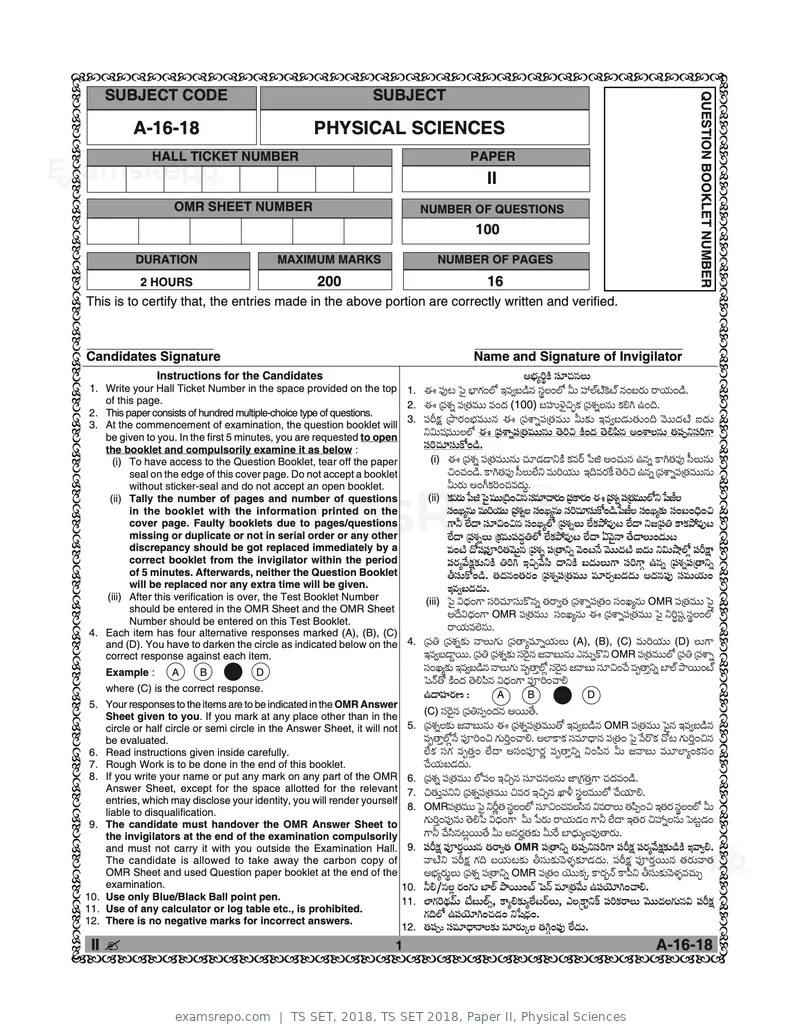
Text of page 1
Subject Code Subject
Question Booklet Number
A-16-18 physical sciences
hALL tICKET number PaPER
ii
OMR Sheet Number nUMBER OF qUESTIONS
100
dURATION mAXIMUM mARKS nUMBER OF pAGES
2 hOUrs 200 16
This is to certify that, the entries made in the above portion are correctly written and verified.
Candidates Signature Name and Signature of Invigilator
Instructions for the Candidates A¿æýÅǦMìü çÜ*^èþ¯èþË$
1. Write your Hall Ticket Number in the space provided on the top
D ç³#r ò³O ¿êVæü…ÌZ CÐèþÓºyìþ¯èþ çܦ˅ÌZ Ò$ àÌŒýsìýMðüsŒý ¯èþ…ºÆæÿ$ Æ>Äæý$…yìþ.
1.
of this page. D {ç³Ôèý² ç³{™èþÐèþ$$ Ðèþ…§æþ (100) ºçßý$âñýO_eMæü {ç³Ôèý²Ë¯èþ$ MæüÍW E…¨.
2.
2. This paper consists of hundred multiple-choice type of questions.
ç³È„æü {´ëÆæÿ…¿æýÐèþ$$¯èþ D {ç³Ô>²ç³{™èþÐèþ$$ Ò$Mæü$ CÐèþÓºyæþ$™èþ$…¨ Ððþ$$§æþsìý I§æþ$
3. At the commencement of examination, the question booklet will
3.
°Ñ$çÙÐèþ$$ËÌZ D {ç³Ô>²ç³{™èþÐèþ$$¯èþ$ ™ðþÇ_ Mìü…§æþ ™ðþÍí³¯èþ A…Ô>˯èþ$ ™èþç³µ°çÜÇV>
be given to you. In the first 5 minutes, you are requested to open
the booklet and compulsorily examine it as below : çÜÇ^èþ*çÜ$Mø…yìþ.
(i) D {ç³Ôèý² ç³{™èþÐèþ$$¯èþ$ ^èþ*yæþyé°Mìü MæüÐèþÆŠÿ õ³h A…^èþ$¯èþ E¯èþ² M>W™èþç³# ïÜË$¯èþ$
(i) To have access to the Question Booklet, tear off the paper
seal on the edge of this cover page. Do not accept a booklet_…^èþ…yìþ. M>W™èþç³# ïÜË$Ìôý° Ðèþ$ÇÄæý$$ C¨ÐèþÆæÿMóü ™ðþÇ_ E¯èþ² {ç³Ô>²ç³{™èþÐèþ$$¯èþ$
without sticker-seal and do not accept an open booklet. Ò$Ææÿ$ A…XMæüÇ…^èþÐèþ§æþ$ª.
(ii) Tally the number of pages and number of questions (ii) MæüÐèþÆæÿ$ õ³h ò³O Ðèþ$${¨…_¯èþ çÜÐèþ*^éÆæÿ… {ç³M>Ææÿ… D {ç³Ôèý² ç³{™èþÐèþ$$ÌZ° õ³iË
in the booklet with the information printed on the çÜ…Qůèþ$ Ðèþ$ÇÄæý$$ {ç³Ôèý²Ë çÜ…Qůèþ$ çÜÇ^èþ*çÜ$Mø…yìþ.õ³iË çÜ…QÅMæü$ çÜ…º…«¨…_
cover page. Faulty booklets due to pages/questions V>± Ìôý§é çÜ*_…_¯èþ çÜ…QÅÌZ {ç³Ôèý²Ë$ ÌôýMæü´ùÐèþ#r Ìôý§é °f{糆 M>Mæü´ùÐèþ#r
missing or duplicate or not in serial order or any other Ìôý§é {ç³Ôèý²Ë$ {MæüÐèþ$糧æþ®†ÌZ ÌôýMæü´ùÐèþ#r Ìôý§é HÐðþO¯é ™óþyéË$…yæþ$r
discrepancy should be got replaced immediately by a Ðèþ…sìý §øçÙç³NÇ™èþÐðþ$O¯èþ {ç³Ôèý² ç³{™é°² Ððþ…r¯óþ Ððþ$$§æþsìý I§æþ$ °Ñ$ÚëÌZÏ ç³È„>
correct booklet from the invigilator within the period ç³ÆæÿÅÐóþ„æüMæü$°Mìü †ÇW C_aÐóþíÜ §é°Mìü º§æþ$Ë$V> çÜÇV>Y E¯èþ² {ç³Ôèý²ç³{™é°²
of 5 minutes. Afterwards, neither the Question Booklet ¡çÜ$Mø…yìþ. ™èþ§æþ¯èþ…™èþÆæÿ… {ç³Ôèý²ç³{™èþÐèþ$$ Ðèþ*Ææÿaºyæþ§æþ$ A§æþ¯èþç³# çÜÐèþ$Äæý$…
will be replaced nor any extra time will be given. CÐèþÓºyæþ§æþ$.
(iii) After this verification is over, the Test Booklet Number
(iii) ò³O Ñ«§æþ…V> çÜÇ^èþ*çÜ$Mö¯èþ² ™èþÆ>Ó™èþ {ç³Ô>²ç³{™èþ… çÜ…Qůèþ$ OMR ç³{™èþÐèþ$$ ò³O
should be entered in the OMR Sheet and the OMR Sheet
Number should be entered on this Test Booklet.
A§óþÑ«§æþ…V> OMR ç³{™èþÐèþ$$ çÜ…Qůèþ$ D {ç³Ô>²ç³{™èþÐèþ$$ ò³O °Ç®çÙt çܦ˅ÌZ
4. Each item has four alternative responses marked (A), (B), (C)
Æ>Äæý$ÐèþÌñý¯èþ$.
4. {糆 {ç³Ôèý²Mæü$ ¯éË$Væü$ {ç³™éÅÐèþ*²Äæý$Ë$ (A), (B), (C) Ðèþ$ÇÄæý$$ (D) Ë$V>
and (D). You have to darken the circle as indicated below on the
correct response against each item. CÐèþÓºyézÆÿ$$. {糆 {ç³Ôèý²Mæü$ çÜÆðÿO¯èþ fÐéº$¯èþ$ G¯èþ$²Mö° OMR ç³{™èþÐèþ$$ÌZ {糆 {ç³Ô>²
Example : A B C D ç Ü…QÅMæü$ CÐèþÓºyìþ¯èþ ¯éË$Væü$ Ðèþ–™é¢ÌZÏ çÜÆðÿO¯èþ fÐéº$ çÜ*_…^óþ Ðèþ–™é¢°² »êÌŒý ´ëÆÿ$$…sŒý
ò³¯Œþ™ø Mìü…§æþ ™ðþÍí³¯èþ Ñ«§æþ…V> ç³NÇ…^éÍ
where (C) is the correct response.
E§éçßýÆæÿ×ý : A B C D
5. Your responses to the items are to be indicated in the OMR Answer
(C) çÜÆðÿO¯èþ {糆çܵ…§æþ¯èþ AÆÿ$$™óþ.
Sheet given to you. If you mark at any place other than in the
circle or half circle or semi circle in the Answer Sheet, it will not 5. {ç³Ôèý²ËMæü$ fÐéº$¯èþ$ D {ç³Ôèý²ç³{™èþÐèþ$$™ø CÐèþÓºyìþ¯èþ OMR ç³{™èþÐèþ$$ ò³O¯èþ CÐèþÓºyìþ¯èþ
be evaluated. Ðèþ–™é¢ÌZϯóþ ç³NÇ…_ Væü$Ç¢…^éÍ. AÌêM>Mæü çÜÐèþ*«§é¯èþ ç³{™èþ… ò³O ÐóþÆöMæü ^ør Væü$Ç¢…_¯èþ
6. Read instructions given inside carefully. ÌôýMæü çÜVæü Ðèþ–™èþ¢… Ìôý§é AçÜ…ç³NÆæÿ~ Ðèþ–™é¢°² °…í³¯èþ Ò$ fÐéº$ Ðèþ$*ÌêÅ…Mæü¯èþ…
7. Rough Work is to be done in the end of this booklet. ^óþÄæý$ºyæþ§æþ$.
8. If you write your name or put any mark on any part of the OMR 6. {ç³Ôèý² ç³{™èþÐèþ$$ ÌZç³Ë C_a¯èþ çÜ*^èþ¯èþ˯èþ$ gê{Væü™èþ¢V> ^èþ§æþÐèþ…yìþ.
Answer Sheet, except for the space allotted for the relevant 7. _™èþ$¢ç³°° {ç³Ôèý²ç³{™èþÐèþ$$ _ÐèþÆæÿ C_a¯èþ Rêä çܦËÐèþ$$ÌZ ^óþÄæý*Í.
entries, which may disclose your identity, you will render yourself
8. OMRç³{™èþÐèþ$$ ò³O °È~™èþ çܦ˅ÌZ çÜ*_…^èþÐèþËíܯèþ ÑÐèþÆ>Ë$ ™èþí³µ…_ C™èþÆæÿ çܦ˅ÌZ Ò$
liable to disqualification.
9. The candidate must handover the OMR Answer Sheet to Væü$Ç¢…ç³#¯èþ$ ™ðþÍõ³ Ñ«§æþ…V> Ò$ õ³Ææÿ$ Æ>Äæý$yæþ… V>± Ìôý§é C™èþÆæÿ _à²Ë¯èþ$ ò³rtyæþ…
the invigilators at the end of the examination compulsorily V>± ^óþíܯèþrÏÆÿ$$™óþ Ò$ A¯èþÆæÿá™èþMæü$ Ò$Æóÿ »ê«§æþ$ÅËÐèþ#™éÆæÿ$.
and must not carry it with you outside the Examination Hall. 9. ç³È„æü ç³NÆæÿ¢Æÿ$$¯èþ ™èþÆ>Ó™èþ OMR ç³{™é°² ™èþç³µ°çÜÇV> ç³È„æü ç³ÆæÿÅÐóþ„æüMæü$yìþMìü CÐéÓÍ.
The candidate is allowed to take away the carbon copy of Ðésìý° ç³È„æü Væü¨ ºÄæý$rMæü$ ¡çÜ$Mæü$ÐðþâæýåMæü*yæþ§æþ$. ç³È„æü ç³NÆæÿ¢Æÿ$$¯èþ ™èþÆæÿ$Ðé™èþ
OMR Sheet and used Question paper booklet at the end of the A¿æýÅÆæÿ$¦Ë$ {ç³Ôèý² ç³{™é°² OMR ç³{™èþ… Äñý$$MæüP M>Ææÿ¾¯Œþ M>ï³° ¡çÜ$Mæü$ÐðþâæýåÐèþ^èþ$a
examination. 10. ±Í/¯èþËÏ Ææÿ…Væü$ »êÌŒý ´ëÆÿ$$…sŒý ò³¯Œþ Ðèþ*{™èþÐóþ$ Eç³Äñý*W…^éÍ.
10. Use only Blue/Black Ball point pen. 11. ÌêVæüÇ£æþÐŒþ$ sôýº$ÌŒýÞ, M>ÅÍMæü$ÅÌôýrÆŠÿË$, GË[M>t°MŠü ç³ÇMæüÆ>Ë$ Ððþ$$§æþËVæü$¯èþÑ ç³È„æü
11. Use of any calculator or log table etc., is prohibited.
12. There is no negative marks for incorrect answers.
Væü¨ÌZ Eç³Äñý*W…^èþyæþ… °õÙ«§æþ….
12. ™èþ糚 çÜÐèþ*«§é¯éËMæü$ Ðèþ*Ææÿ$PË ™èþWY…ç³# Ìôý§æþ$.
II 1 A-16-18

Text of page 2
*A1602*
RE
HE
ITE
WR
T
NO
DO
II 2 A-16-18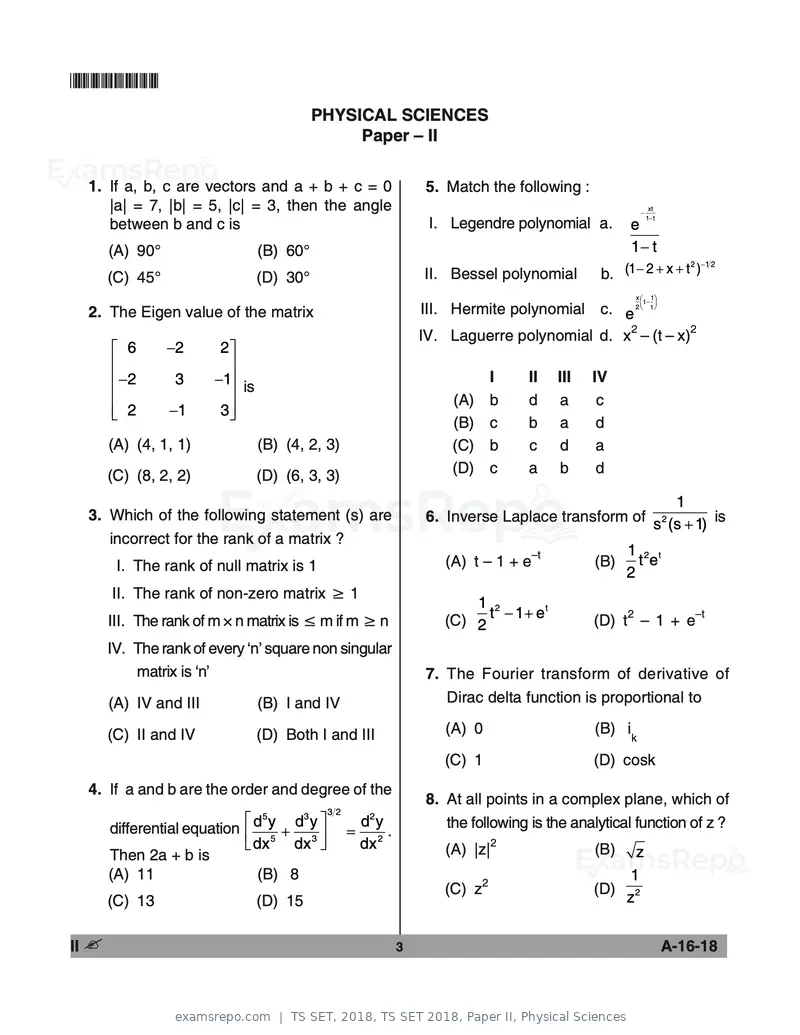
Text of page 3
*A1602*
physical sciences
Paper – II
1. If a, b, c are vectors and a + b + c = 0 5. Match the following :
|a| = 7, |b| = 5, |c| = 3, then the angle −
xt
1− t
between b and c is I. Legendre polynomial a. e
1 − t
(A) 90° (B) 60°
2 −1 2
(C) 45° (D) 30° II. Bessel polynomial b. (1 − 2 + x + t )
x 1
t−
2. The Eigen value of the matrix III. Hermite polynomial c. e 2 t
IV. Laguerre polynomial d. x2 – (t – x)2
6 −2 2
−2 3 −1 is I II III IV
(A) b d a c
2 −1 3
(B) c b a d
(A) (4, 1, 1) (B) (4, 2, 3) (C) b c d a
(C) (8, 2, 2) (D) (6, 3, 3) (D) c a b d
1
3. Which of the following statement (s) are 6. Inverse Laplace transform of s 2 (s + 1) is
incorrect for the rank of a matrix ?
1 2 t
I. The rank of null matrix is 1 (A) t – 1 + e–t (B) te
2
II. The rank of non-zero matrix ≥ 1
1 2
(C) 2 t − 1 + e
t
III. The rank of m × n matrix is ≤ m if m ≥ n (D) t2 – 1 + e–t
IV. The rank of every ‘n’ square non singular
matrix is ‘n’ 7. The Fourier transform of derivative of
(A) IV and III (B) I and IV Dirac delta function is proportional to
(C) II and IV (D) Both I and III (A) 0 (B) ik
(C) 1 (D) cosk
4. If a and b are the order and degree of the
8. At all points in a complex plane, which of
32
5
3 2
differential equation d y + d y =
dy
.
the following is the analytical function of z ?
dx 5
dx
3
dx 2 (A) |z|2 (B)
Then 2a + b is z
(A) 11 (B) 8 1
(C) z2 (D) 2
(C) 13 (D) 15 z
II 3 A-16-18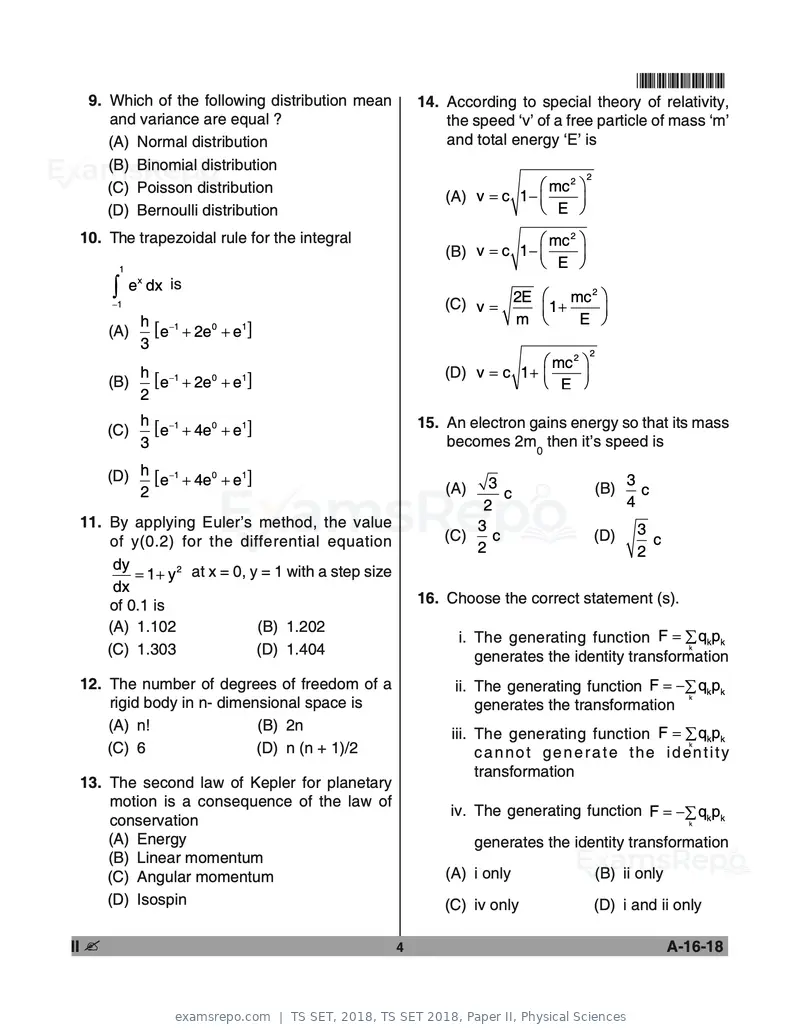
Text of page 4
*A1602*
9. Which of the following distribution mean 14. According to special theory of relativity,
and variance are equal ? the speed ‘v’ of a free particle of mass ‘m’
(A) Normal distribution and total energy ‘E’ is
(B) Binomial distribution
2
(C) Poisson distribution mc 2
(A) v = c 1 −
(D) Bernoulli distribution E
10. The trapezoidal rule for the integral mc 2
(B) v = c 1 −
1 E
∫ e dx is
x
(C) v = 2E mc 2
−1
1+
h [ −1 m E
(A) e + 2e0 + e1 ]
3 2
mc 2
h [ −1 (D) v = c 1 +
(B) e + 2e0 + e1 ] E
2
h [ −1 15. An electron gains energy so that its mass
(C) e + 4e0 + e1 ]
3 becomes 2m0 then it’s speed is
(D) h [e−1 + 4e0 + e1 ] 3 3
2 (A) c (B) c
2 4
11. By applying Euler’s method, the value 3 3
of y(0.2) for the differential equation (C) c (D) c
2 2
dy
= 1 + y 2 at x = 0, y = 1 with a step size
dx
of 0.1 is 16. Choose the correct statement (s).
(A) 1.102 (B) 1.202
i. The generating function F = ∑k qkpk
(C) 1.303 (D) 1.404 generates the identity transformation
12. The number of degrees of freedom of a ii. The generating function F = −∑ qkpk
rigid body in n- dimensional space is
k
generates the transformation
(A) n! (B) 2n
iii. The generating function F = ∑ qkpk
(C) 6 (D) n (n + 1)/2 cannot generate the identity
k
transformation
13. The second law of Kepler for planetary
motion is a consequence of the law of
iv. The generating function F = −∑ qkpk
conservation k
(A) Energy generates the identity transformation
(B) Linear momentum
(C) Angular momentum (A) i only (B) ii only
(D) Isospin (C) iv only (D) i and ii only
II 4 A-16-18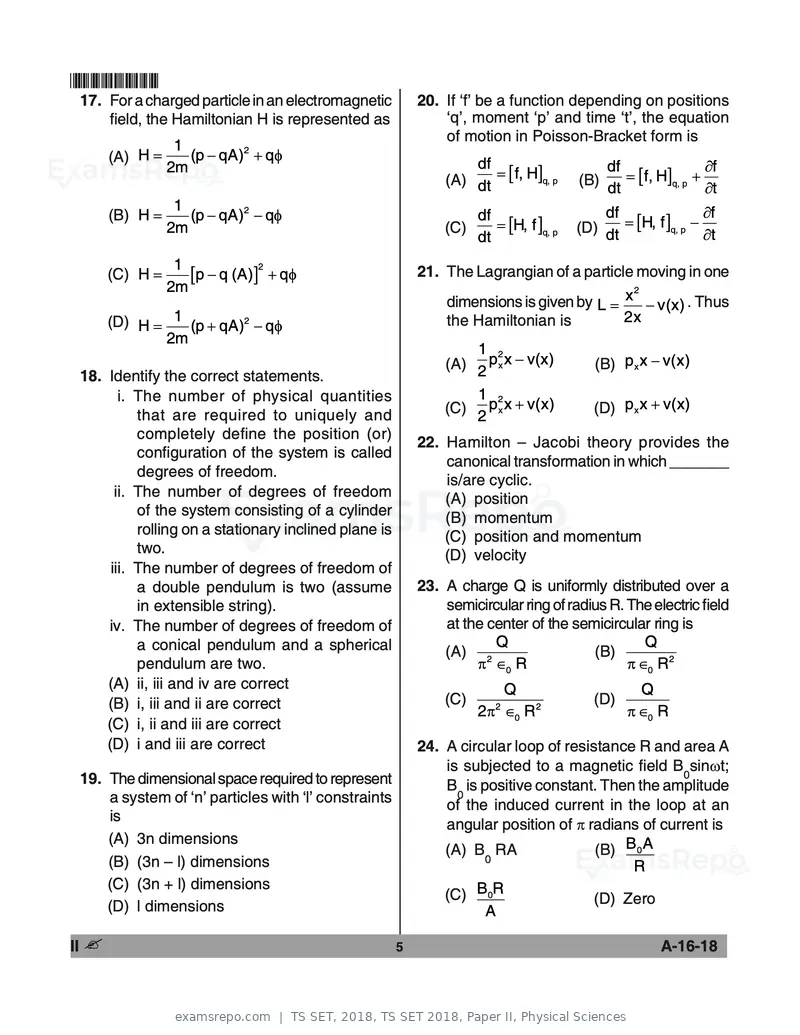
Text of page 5
*A1602*
17. For a charged particle in an electromagnetic 20. If ‘f’ be a function depending on positions
field, the Hamiltonian H is represented as ‘q’, moment ‘p’ and time ‘t’, the equation
of motion in Poisson-Bracket form is
1
(A) H = (p − qA )2 + qφ
df
2m df ∂f
(A) dt = [ f, H]q, p (B) = [ f, H]q, p +
dt ∂t
1 df ∂f
(B) H = (p − qA )2 − qφ df
2m (C) = [H, f ]q, p (D) dt = [H, f ]q, p − ∂t
dt
1
[p − q (A)] + qφ
2
(C) H = 21. The Lagrangian of a particle moving in one
2m 2
dimensions is given by L = x − v(x ) . Thus
(D) H = 1 (p + qA )2 − qφ the Hamiltonian is 2x
2m
1 2
(A) 2 px x − v(x ) (B) px x − v(x )
18. Identify the correct statements.
i. The number of physical quantities 1 2
that are required to uniquely and (C) px x + v(x ) (D) px x + v(x )
2
completely define the position (or)
22. Hamilton – Jacobi theory provides the
configuration of the system is called
canonical transformation in which _______
degrees of freedom.
is/are cyclic.
ii. The number of degrees of freedom (A) position
of the system consisting of a cylinder (B) momentum
rolling on a stationary inclined plane is (C) position and momentum
two. (D) velocity
iii. The number of degrees of freedom of
a double pendulum is two (assume 23. A charge Q is uniformly distributed over a
in extensible string). semicircular ring of radius R. The electric field
iv. The number of degrees of freedom of at the center of the semicircular ring is
a conical pendulum and a spherical Q Q
(A) 2 (B)
pendulum are two. π ∈0 R π ∈0 R2
(A) ii, iii and iv are correct Q Q
(B) i, iii and ii are correct (C) (D)
2π ∈0 R2
2
π ∈0 R
(C) i, ii and iii are correct
(D) i and iii are correct 24. A circular loop of resistance R and area A
is subjected to a magnetic field B0sinωt;
19. The dimensional space required to represent B0 is positive constant. Then the amplitude
a system of ‘n’ particles with ‘l’ constraints of the induced current in the loop at an
is
angular position of π radians of current is
(A) 3n dimensions
(A) B0 RA (B) B0 A
(B) (3n – l) dimensions R
(C) (3n + l) dimensions
(C) B0R (D) Zero
(D) l dimensions A
II 5 A-16-18
Text of page 6
*A1602*
25. The torque on a rectangular coil placed in 29. For a vector potential A ( r , t ), the divergence
a uniform magnetic field is large when kt
of A is ∇ ⋅ A = − 3 where k is a constant
(A) number of turns of the coil is less r
of appropriate dimension. If the vector and
(B) number of turns of the coil is large
scalar potential are in Lorentz gauge, then
(C) plane of the coil is parallel to the field
(D) area of the coil is small the scalar potential is
2 kc 2 t 2
(A) kt (B)
26. If a charge moves along a rectangular loop r3 2r 3
and uniform magnetic field is applied in a
direction perpendicular to the plane of the (C) kt (D)
kt 2
r4 c 3r 3
loop, then
30. In a rectangular wave guide, the mode
(A) Kinetic energy of the charge remains
that propagates with minimum attenuation
constant
through the wave guide is
(B) Potential energy is higher than kinetic (A) TE01 (B) TE10
energy of the charge
(C) TM10 (D) TM11
(C) Kinetic energy is not constant along
the loop 31. An electromagnetic wave is propagating in
(D) Force is non-uniform in one direction and free space along Z-direction. If the electric
uniform in another direction of the loop
field is given by E = cos(ωt − kz)i,ˆ where
27. The vector potential at the position defined 2π then the magnetic field
by vector r in a uniform magnetic field B ω = ck ; k = ;
λ
can be represented is
1
1 (A) B = cos(ωt − kz)jˆ
(A) B × r (B) (B × r ) c
2 1
(C) ∇ (D) ( ∇ × B ) × r (B) B = sin(ωt − kz)jˆ
× (B × r ) c
1
(C) B = cos(ωt − kz)iˆ
28. In the following equations, which one c
represents that the electric field is to be 1
(D) B = sin(ωt − kz)iˆ
zero; E is electric field and B is magnetic c
field 32. Given a wave with the dispersion relation
ω = ck + m with k > 0 and m > 0, which
(A) ∫ E ⋅ ds = 0 one of the following is true ?
area (A) Group velocity is greater than phase
velocity
(B) ∫ E ⋅ dl = 0
(B) Group velocity is smaller than phase
d velocity
(C) ∫ E ⋅ ds = − dt ∫ B ⋅ dl
area
(C) Group velocity and phase velocity are
equal
∂
(D) ∫ B ⋅ dl = µ I + µ ∈0 ∫ E ⋅ ds
(D) No define relation between group
0 0 ∂t velocity and phase velocity
II 6 A-16-18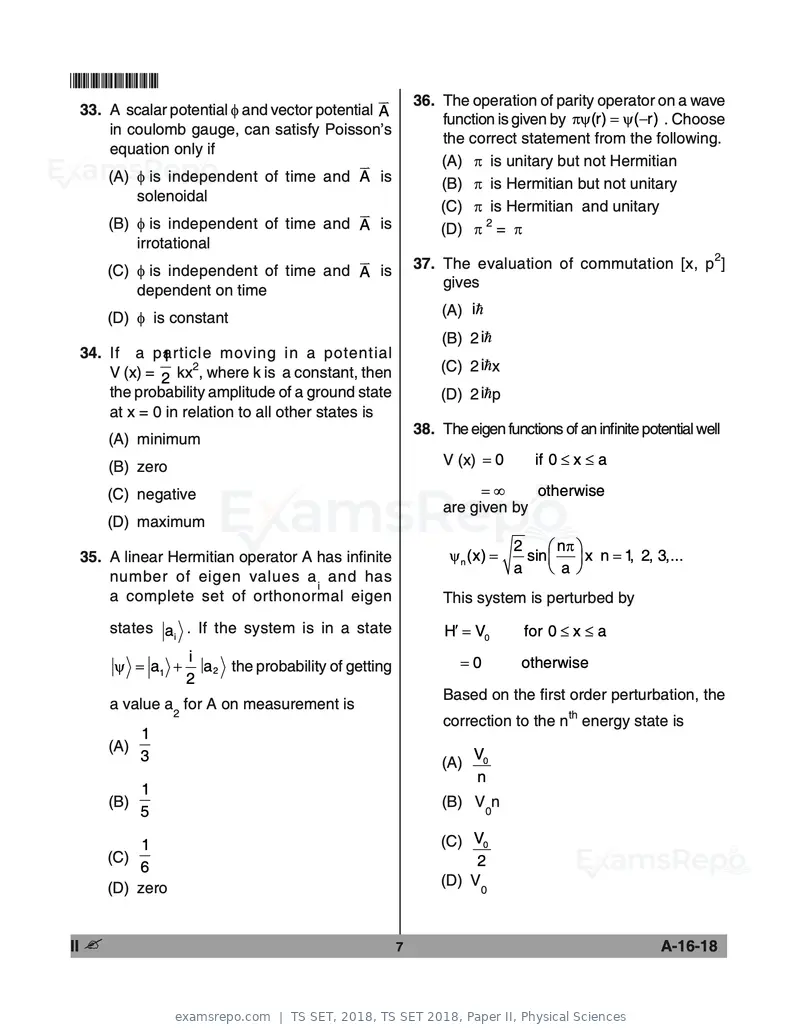
Text of page 7
*A1602*
36. The operation of parity operator on a wave
33. A scalar potential φ and vector potential A
function is given by πψ(r) = ψ(−r) . Choose
in coulomb gauge, can satisfy Poisson’s
the correct statement from the following.
equation only if
(A) is unitary but not Hermitian
(A) φ is independent of time and A is (B) is Hermitian but not unitary
solenoidal
(C) is Hermitian and unitary
(B) φ is independent of time and A is (D) 2 =
irrotational
37. The evaluation of commutation [x, p 2]
(C) φ is independent of time and A is
gives
dependent on time
(D) φ is constant (A) i
(B) 2 i
34. If a particle
1 moving in a potential
2
V (x) = 2 kx , where k is a constant, then (C) 2 ix
the probability amplitude of a ground state (D) 2 ip
at x = 0 in relation to all other states is
38. The eigen functions of an infinite potential well
(A) minimum
(B) zero V (x) = 0 if 0 ≤ x ≤ a
(C) negative =∞ otherwise
are given by
(D) maximum
2 nπ
35. A linear Hermitian operator A has infinite ψ n (x) = sin x n = 1, 2, 3,...
a a
number of eigen values a i and has
a complete set of orthonormal eigen This system is perturbed by
states ai . If the system is in a state H′ = V0 for 0 ≤ x ≤ a
i
ψ = a1 + a 2 the probability of getting = 0 otherwise
2
Based on the first order perturbation, the
a value a2 for A on measurement is
th
correction to the n energy state is
1
(A)
3 V
(A) 0
n
1
(B) (B) V0n
5
1 (C) V0
(C) 2
6
(D) zero (D) V0
II 7 A-16-18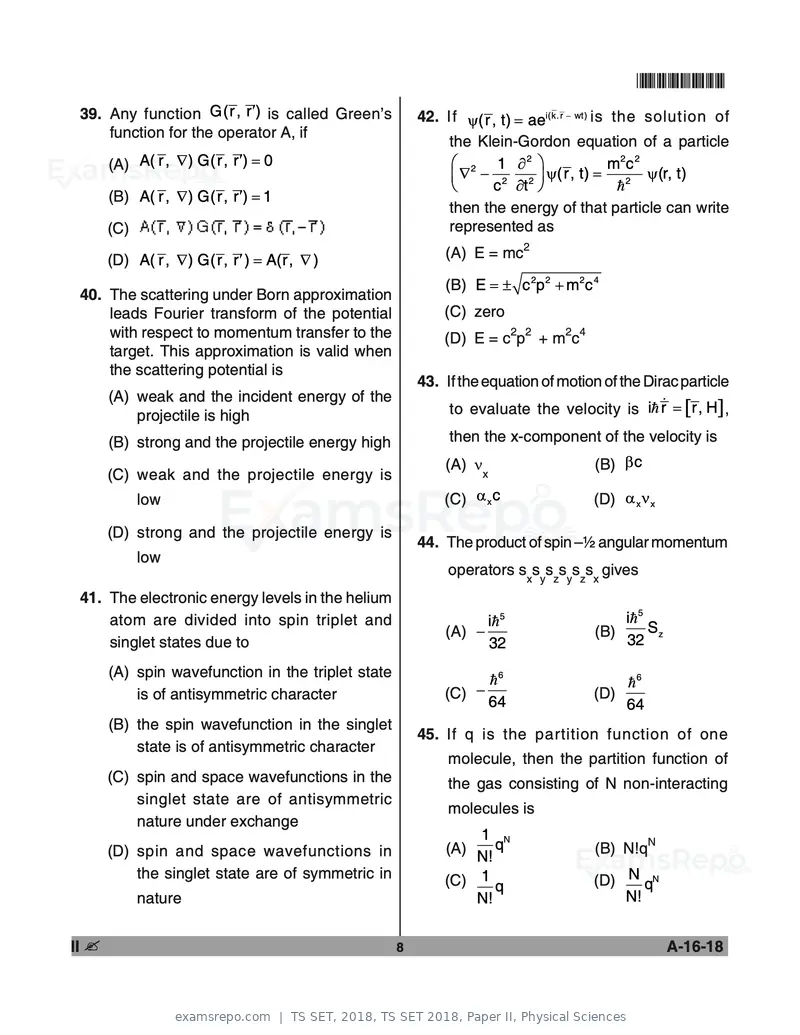
Text of page 8
*A1602*
39. Any function G(r , r′) is called Green’s 42. If ψ(r , t) = aei(k. r − wt) is the solution of
function for the operator A, if
the Klein-Gordon equation of a particle
(A) A( r , ∇) G(r , r′) = 0 2 1 ∂2 m2 c 2
∇ − 2 2 ψ(r , t) = ψ(r, t)
c ∂t 2
(B) A( r , ∇) G(r , r′) = 1
then the energy of that particle can write
(C) represented as
(D) A( r , ∇) G(r , r′ ) = A(r , ∇ ) (A) E = mc2
(B) E = ± c 2p2 + m2 c 4
40. The scattering under Born approximation
leads Fourier transform of the potential (C) zero
with respect to momentum transfer to the (D) E = c2p2 + m2c4
target. This approximation is valid when
the scattering potential is
43. If the equation of motion of the Dirac particle
(A) weak and the incident energy of the
projectile is high to evaluate the velocity is i r = [r , H] ,
(B) strong and the projectile energy high then the x-component of the velocity is
(A) ν (B) βc
(C) weak and the projectile energy is x
low (C) α x c (D) α x ν x
(D) strong and the projectile energy is
44. The product of spin –½ angular momentum
low
operators sxsyszsyszsx gives
41. The electronic energy levels in the helium
atom are divided into spin triplet and i 5 i 5
(A) − (B) Sz
singlet states due to 32 32
(A) spin wavefunction in the triplet state 6 6
is of antisymmetric character (C) − (D)
64 64
(B) the spin wavefunction in the singlet
45. If q is the partition function of one
state is of antisymmetric character
molecule, then the partition function of
(C) spin and space wavefunctions in the the gas consisting of N non-interacting
singlet state are of antisymmetric
molecules is
nature under exchange
1 N
(D) spin and space wavefunctions in (A) q (B) N!qN
N!
the singlet state are of symmetric in (C) 1 q (D) N qN
nature N!
N!
II 8 A-16-18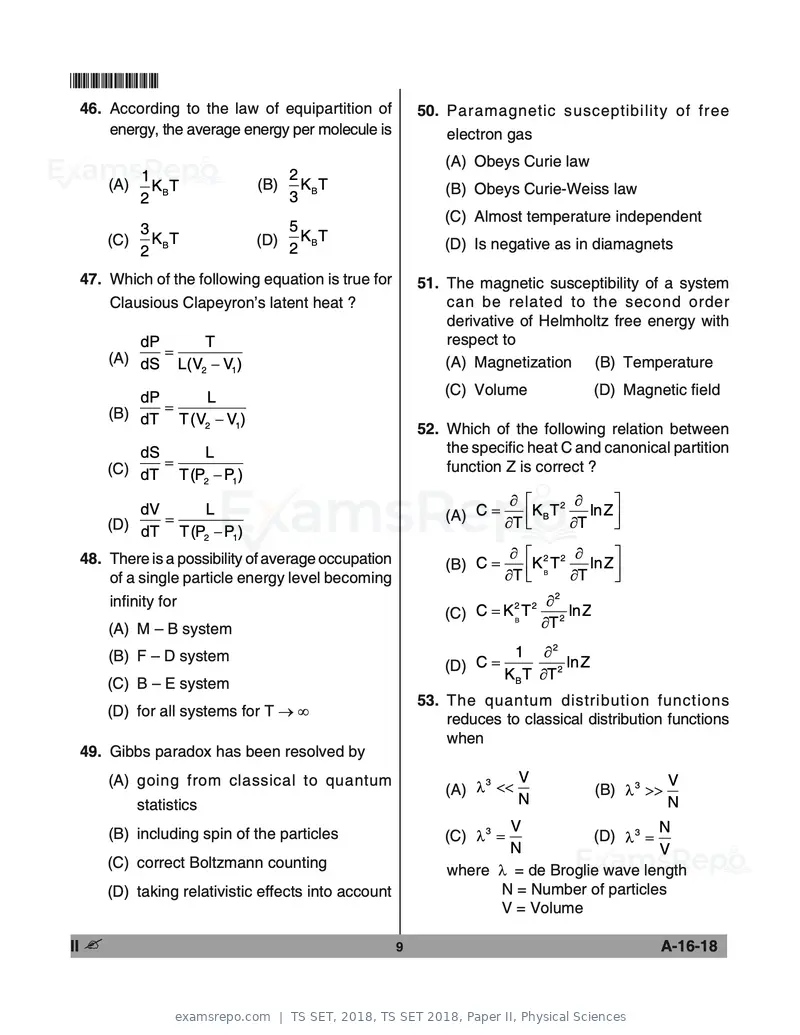
Text of page 9
*A1602*
46. According to the law of equipartition of 50. Paramagnetic susceptibility of free
energy, the average energy per molecule is electron gas
(A) Obeys Curie law
1 2
(A) KB T (B) KB T (B) Obeys Curie-Weiss law
2 3
(C) Almost temperature independent
3 5
(C) KB T (D) KB T (D) Is negative as in diamagnets
2 2
47. Which of the following equation is true for 51. The magnetic susceptibility of a system
Clausious Clapeyron’s latent heat ? can be related to the second order
derivative of Helmholtz free energy with
dP T respect to
(A) dS = L(V − V ) (A) Magnetization (B) Temperature
2 1
dP L (C) Volume (D) Magnetic field
=
(B) dT T (V − V )
2 1
52. Which of the following relation between
dS L the specific heat C and canonical partition
(C) dT = T (P − P ) function Z is correct ?
2 1
∂ 2 ∂
dV L (A) C = ∂T KB T ∂T ln Z
(D) dT = T (P − P )
2 1
48. There is a possibility of average occupation ∂ 2 2 ∂
(B) C = KB T ln Z
of a single particle energy level becoming ∂T ∂T
infinity for ∂2
(C) C = K B T
2 2
ln Z
(A) M – B system ∂T 2
(B) F – D system 1 ∂2
(D) C = ln Z
KB T ∂T 2
(C) B – E system
53. The quantum distribution functions
(D) for all systems for T → ∞
reduces to classical distribution functions
when
49. Gibbs paradox has been resolved by
(A) going from classical to quantum V V
(A) λ <<
3
(B) λ 3 >>
statistics N N
(B) including spin of the particles V N
(C) λ 3 = (D) λ 3 =
N V
(C) correct Boltzmann counting where λ = de Broglie wave length
(D) taking relativistic effects into account N = Number of particles
V = Volume
II 9 A-16-18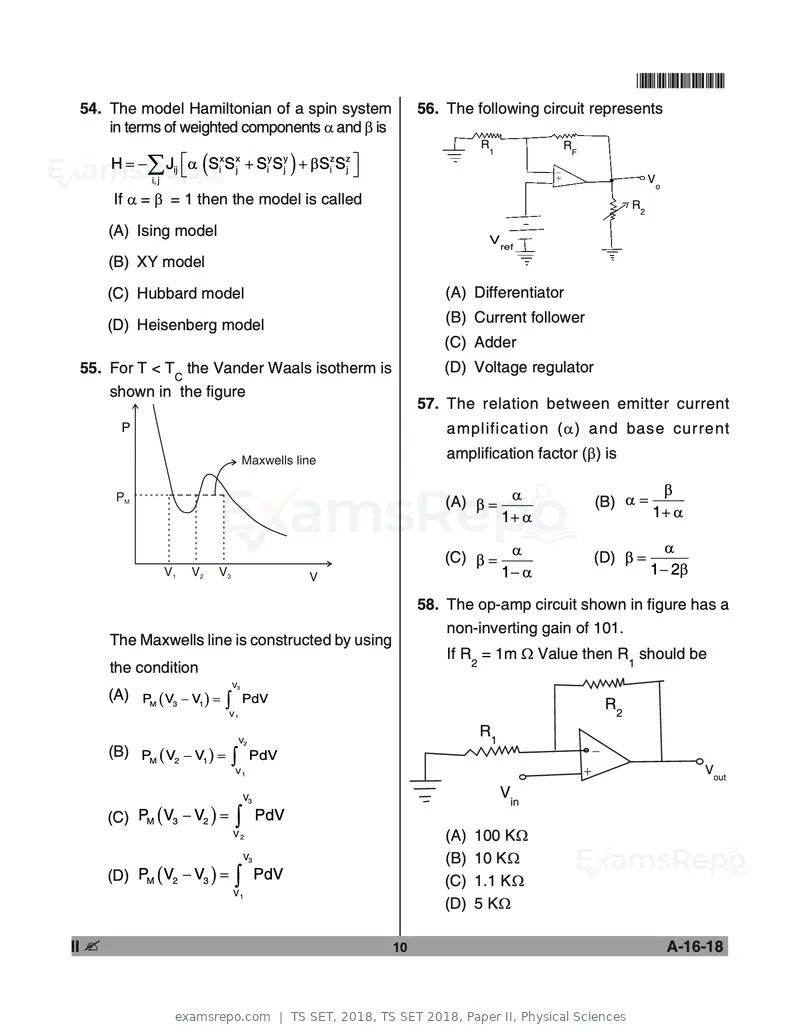
Text of page 10
*A1602*
54. The model Hamiltonian of a spin system 56. The following circuit represents
in terms of weighted components α and β is
R1 RF
H = −∑ Jij α ( Six Sxj + Siy Syj ) + βSizSzj –
i, j + Vo
If α = β = 1 then the model is called
R2
(A) Ising model
Vref
(B) XY model
(C) Hubbard model (A) Differentiator
(D) Heisenberg model (B) Current follower
(C) Adder
55. For T < TC the Vander Waals isotherm is (D) Voltage regulator
shown in the figure
57. The relation between emitter current
P amplification (α) and base current
amplification factor (β) is
β
(A) β = α (B) α =
1+ α 1+ α
α
(C) β = α (D) β =
1− α 1 − 2β
58. The op-amp circuit shown in figure has a
non-inverting gain of 101.
The Maxwells line is constructed by using
If R2 = 1m Ω Value then R1 should be
the condition
V3
(A) PM ( V3 − V1 ) = ∫ PdV
V1
R2
V2
R1
(B) PM ( V2 − V1 ) = ∫ PdV –
V1 + Vout
V3 Vin
(C) PM ( V3 − V2 ) = ∫ PdV
V2 (A) 100 K Ω
V3 (B) 10 K Ω
(D) PM ( V2 − V3 ) = ∫ PdV (C) 1.1 K Ω
V1
(D) 5 K Ω
II 10 A-16-18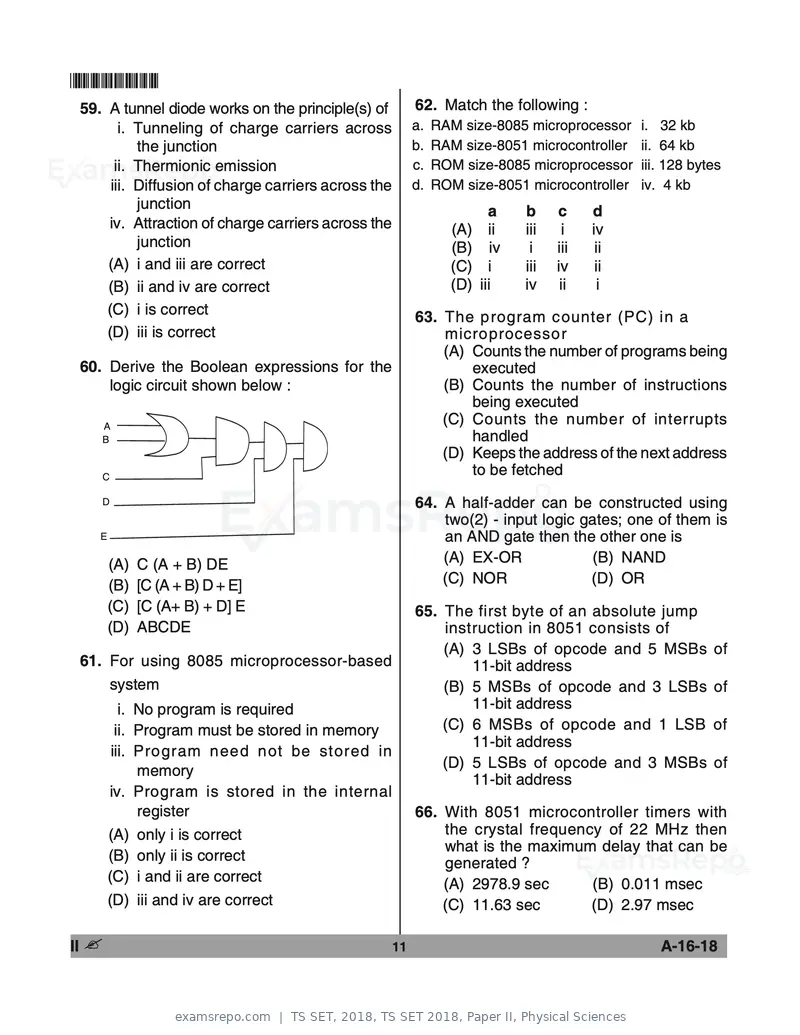
Text of page 11
*A1602*
59. A tunnel diode works on the principle(s) of 62. Match the following :
i. Tunneling of charge carriers across a. RAM size-8085 microprocessor i. 32 kb
the junction b. RAM size-8051 microcontroller ii. 64 kb
ii. Thermionic emission c. ROM size-8085 microprocessor iii. 128 bytes
iii. Diffusion of charge carriers across the d. ROM size-8051 microcontroller iv. 4 kb
junction a b c d
iv. Attraction of charge carriers across the (A) ii iii i iv
junction (B) iv i iii ii
(A) i and iii are correct (C) i iii iv ii
(B) ii and iv are correct (D) iii iv ii i
(C) i is correct 63. The program counter (PC) in a
(D) iii is correct microprocessor
(A) Counts the number of programs being
60. Derive the Boolean expressions for the executed
logic circuit shown below : (B) Counts the number of instructions
being executed
A
(C) Counts the number of interrupts
B handled
(D) Keeps the address of the next address
C
to be fetched
D 64. A half-adder can be constructed using
two(2) - input logic gates; one of them is
E an AND gate then the other one is
(A) C (A + B) DE (A) EX-OR (B) NAND
(B) [C (A + B) D + E] (C) NOR (D) OR
(C) [C (A+ B) + D] E 65. The first byte of an absolute jump
(D) ABCDE instruction in 8051 consists of
(A) 3 LSBs of opcode and 5 MSBs of
61. For using 8085 microprocessor-based 11-bit address
system (B) 5 MSBs of opcode and 3 LSBs of
i. No program is required 11-bit address
ii. Program must be stored in memory (C) 6 MSBs of opcode and 1 LSB of
11-bit address
iii. Program need not be stored in
(D) 5 LSBs of opcode and 3 MSBs of
memory
11-bit address
iv. Program is stored in the internal
register 66. With 8051 microcontroller timers with
(A) only i is correct the crystal frequency of 22 MHz then
what is the maximum delay that can be
(B) only ii is correct generated ?
(C) i and ii are correct (A) 2978.9 sec (B) 0.011 msec
(D) iii and iv are correct (C) 11.63 sec (D) 2.97 msec
II 11 A-16-18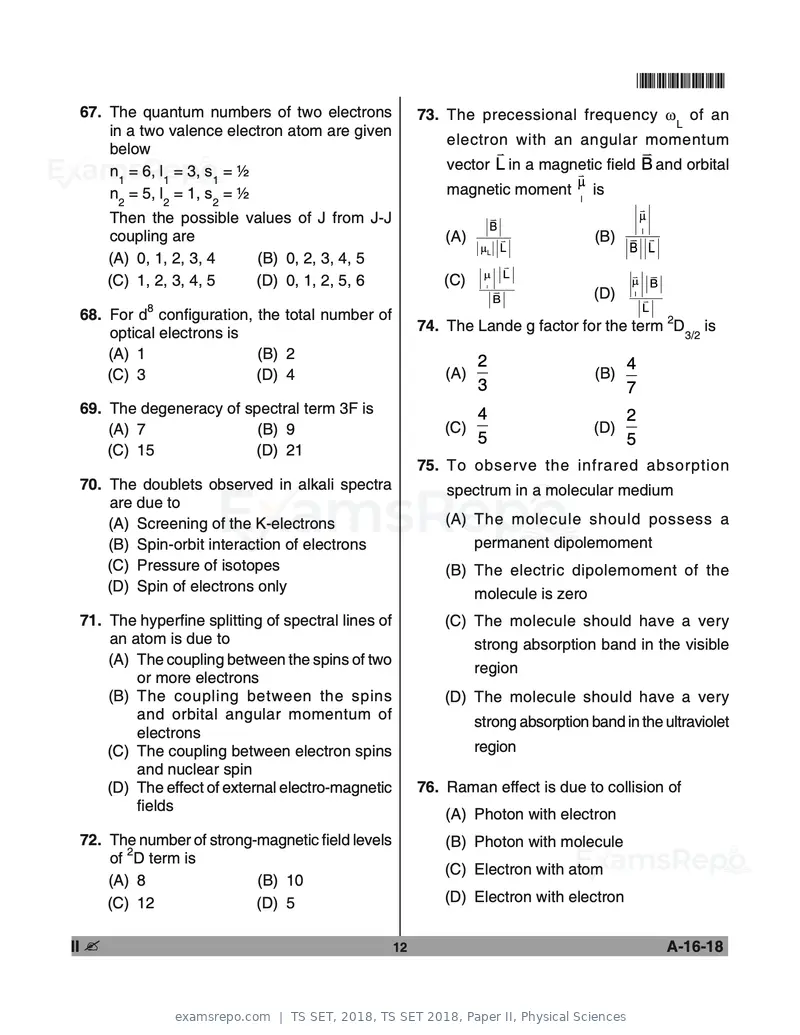
Text of page 12
*A1602*
67. The quantum numbers of two electrons 73. The precessional frequency ω L of an
in a two valence electron atom are given
electron with an angular momentum
below
n1 = 6, l1 = 3, s1 = ½ vector L in a magnetic
field B and orbital
µ
n2 = 5, l2 = 1, s2 = ½ magnetic moment l is
Then the possible values of J from J-J µ
B
coupling are (A) (B) l
µL L B L
(A) 0, 1, 2, 3, 4 (B) 0, 2, 3, 4, 5
µ L
(C) 1, 2, 3, 4, 5 (D) 0, 1, 2, 5, 6 (C) µ B
l
(D) l
B
8 L
68. For d configuration, the total number of
optical electrons is 74. The Lande g factor for the term 2D3/2 is
(A) 1 (B) 2 2 4
(C) 3 (D) 4 (A) (B)
3 7
69. The degeneracy of spectral term 3F is 4 2
(A) 7 (B) 9 (C) (D)
5 5
(C) 15 (D) 21
75. To observe the infrared absorption
70. The doublets observed in alkali spectra spectrum in a molecular medium
are due to
(A) Screening of the K-electrons (A) The molecule should possess a
(B) Spin-orbit interaction of electrons permanent dipolemoment
(C) Pressure of isotopes (B) The electric dipolemoment of the
(D) Spin of electrons only molecule is zero
71. The hyperfine splitting of spectral lines of (C) The molecule should have a very
an atom is due to strong absorption band in the visible
(A) The coupling between the spins of two
region
or more electrons
(B) The coupling between the spins (D) The molecule should have a very
and orbital angular momentum of strong absorption band in the ultraviolet
electrons
(C) The coupling between electron spins region
and nuclear spin
(D) The effect of external electro-magnetic 76. Raman effect is due to collision of
fields
(A) Photon with electron
72. The number of strong-magnetic field levels (B) Photon with molecule
2
of D term is
(C) Electron with atom
(A) 8 (B) 10
(D) Electron with electron
(C) 12 (D) 5
II 12 A-16-18
Text of page 13
*A1602*
77. Match the typical spectra of stable 81. Which of the following statement is
incorrect ?
molecules with the corresponding wave
number range. (A) Hall effect explains the type of charge
carriers
1. Electronic i. 106 cm–1 and above
spectra (B) Hall effect measures the mobility of
charge carriers
2. Rotational ii. 105 – 106 cm–1
spectra (C) Hall effect measures the resistance of
8 2 –1 charge carriers
3. Molecule iii. 10 – 10 cm
dissociation (D) Hall effect provides the density of
(A) 1 – ii, 2 – i; 3 – iii charge carriers
(B) 1 – ii, 2 – iii; 3 – i
82. The temperature (T) dependence of
(C) 1 – iii, 2 – ii; 3 – i
ferromagnetic susceptibility (χ) with curie
(D) 1 – i, 2 – ii; 3 – iii
temperature (T ) is
c
78. The no. of Bravais lattices in monoclinic C
crystal structure (A) for T < Tc
T + Tc
(A) 1 (B) 2
C
(C) 3 (D) 4 (B) for T > Tc
T + Tc
79. In a cubic crystal, the Bragg’s angle for
C
first order reflection from (1, 1, 0) plane is (C) for T > Tc
30°. If the wavelength of X-rays is 1.54 A, T − Tc
the lattice parameter is
C
(A) 2.37 A (B) 2.27 A (D)
T − Tc for T < Tc
(C) 2.17 A (D) 2.07 A
83. The second Brillouin zone range of
K-values
80. Which of the following parameters are
related to Grevneisen relation ? π π
(A) From − to +
(A) Th ermal conductivity, thermal a a
expansion coefficient, heat capacity
π
(B) Thermal expansion coefficient, specific (B) From 0 to
a
heat and compressibility
π 2π π 2π
(C) Thermal expansion coefficient, specific (C) From − to − and + to
heat and electrical conductivity a a a a
(D) Thermal conductivity, heat capacity −π
(D) From 0 to
and compressibility a
II 13 A-16-18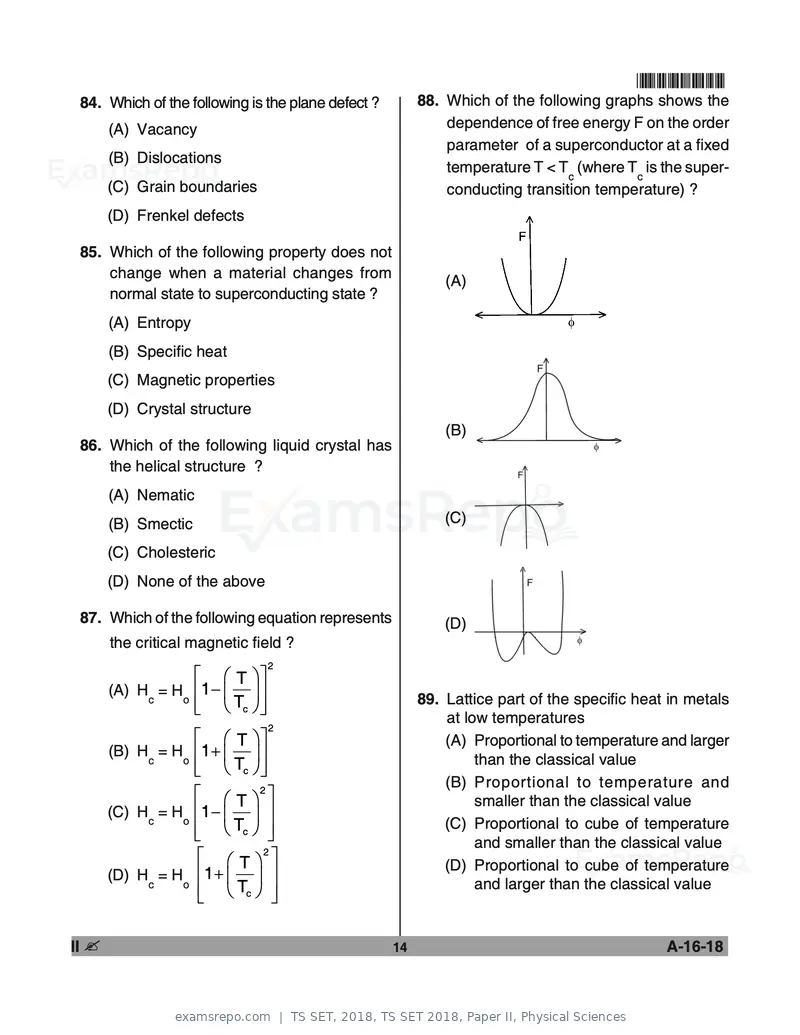
Text of page 14
*A1602*
84. Which of the following is the plane defect ? 88. Which of the following graphs shows the
(A) Vacancy dependence of free energy F on the order
parameter of a superconductor at a fixed
(B) Dislocations
temperature T < Tc (where Tc is the super-
(C) Grain boundaries conducting transition temperature) ?
(D) Frenkel defects
85. Which of the following property does not
change when a material changes from (A)
normal state to superconducting state ?
(A) Entropy
(B) Specific heat
(C) Magnetic properties
(D) Crystal structure
(B)
86. Which of the following liquid crystal has
the helical structure ?
(A) Nematic
(B) Smectic (C)
(C) Cholesteric
(D) None of the above
87. Which of the following equation represents (D)
the critical magnetic field ?
2
T
(A) H = H 1 −
c o
Tc 89. Lattice part of the specific heat in metals
at low temperatures
2
T (A) Proportional to temperature and larger
(B) H = H 1 +
than the classical value
c o
Tc
(B) Proportional to temperature and
T 2 smaller than the classical value
(C) Hc = Ho 1 −
Tc (C) Proportional to cube of temperature
and smaller than the classical value
T 2 (D) Proportional to cube of temperature
(D) H = H 1 +
c o
Tc and larger than the classical value
II 14 A-16-18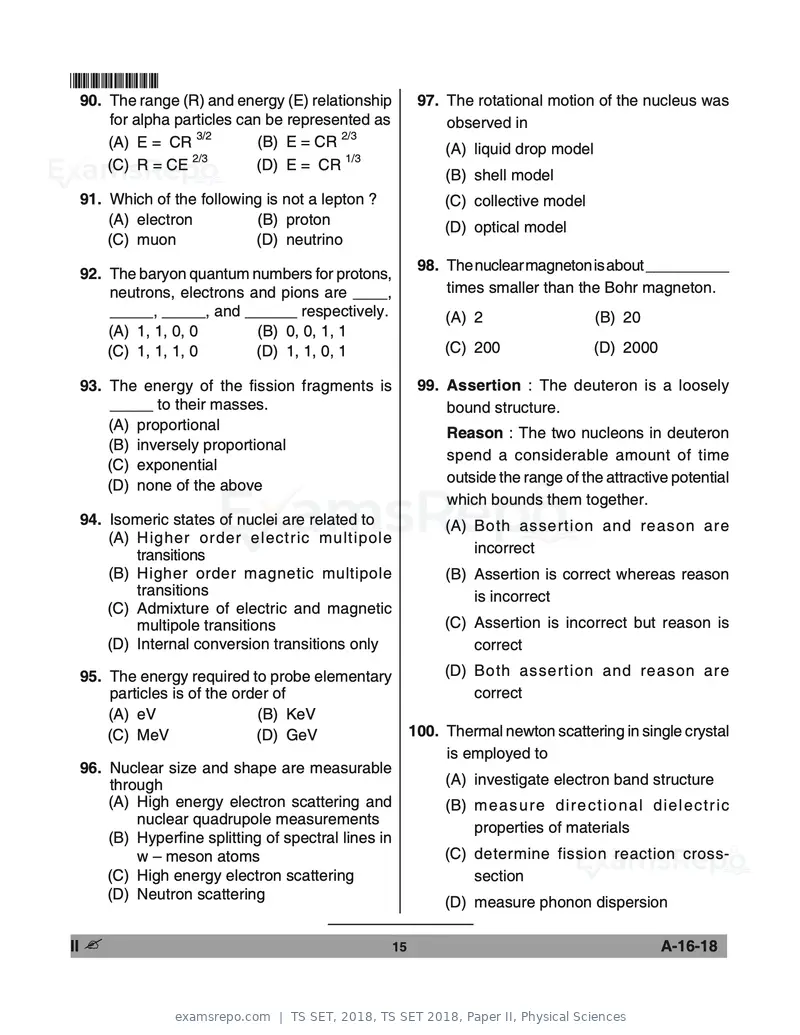
Text of page 15
*A1602*
90. The range (R) and energy (E) relationship 97. The rotational motion of the nucleus was
for alpha particles can be represented as observed in
3/2
(A) E = CR (B) E = CR 2/3 (A) liquid drop model
2/3
(C) R = CE (D) E = CR 1/3
(B) shell model
91. Which of the following is not a lepton ? (C) collective model
(A) electron (B) proton
(D) optical model
(C) muon (D) neutrino
98. The nuclear magneton is about __________
92. The baryon quantum numbers for protons,
neutrons, electrons and pions are ____, times smaller than the Bohr magneton.
_____, _____, and ______ respectively. (A) 2 (B) 20
(A) 1, 1, 0, 0 (B) 0, 0, 1, 1
(C) 1, 1, 1, 0 (D) 1, 1, 0, 1 (C) 200 (D) 2000
93. The energy of the fission fragments is 99. Assertion : The deuteron is a loosely
_____ to their masses. bound structure.
(A) proportional
Reason : The two nucleons in deuteron
(B) inversely proportional
spend a considerable amount of time
(C) exponential
(D) none of the above outside the range of the attractive potential
which bounds them together.
94. Isomeric states of nuclei are related to (A) Both assertion and reason are
(A) Higher order electric multipole
transitions incorrect
(B) Higher order magnetic multipole (B) Assertion is correct whereas reason
transitions is incorrect
(C) Admixture of electric and magnetic
multipole transitions (C) Assertion is incorrect but reason is
(D) Internal conversion transitions only correct
95. The energy required to probe elementary (D) Both assertion and reason are
particles is of the order of correct
(A) eV (B) KeV
(C) MeV (D) GeV 100. Thermal newton scattering in single crystal
is employed to
96. Nuclear size and shape are measurable
through (A) investigate electron band structure
(A) High energy electron scattering and (B) measure directional die l e c t r i c
nuclear quadrupole measurements
properties of materials
(B) Hyperfine splitting of spectral lines in
w – meson atoms (C) determine fission reaction cross-
(C) High energy electron scattering section
(D) Neutron scattering
(D) measure phonon dispersion
II 15 A-16-18
Text of page 16
*A1602*
Space for Rough Work
II 16 A-16-18Official key not published for this paper.
Page 1 of 16
Source: Telangana State Eligibility Test. Question paper published by Telangana State Eligibility Test.