
UKPSC AE 2022: Uttarakhand Combined State Engineering Service Examination, ELECTRICAL ENGINEERING (PAPER II)
Text of page 2
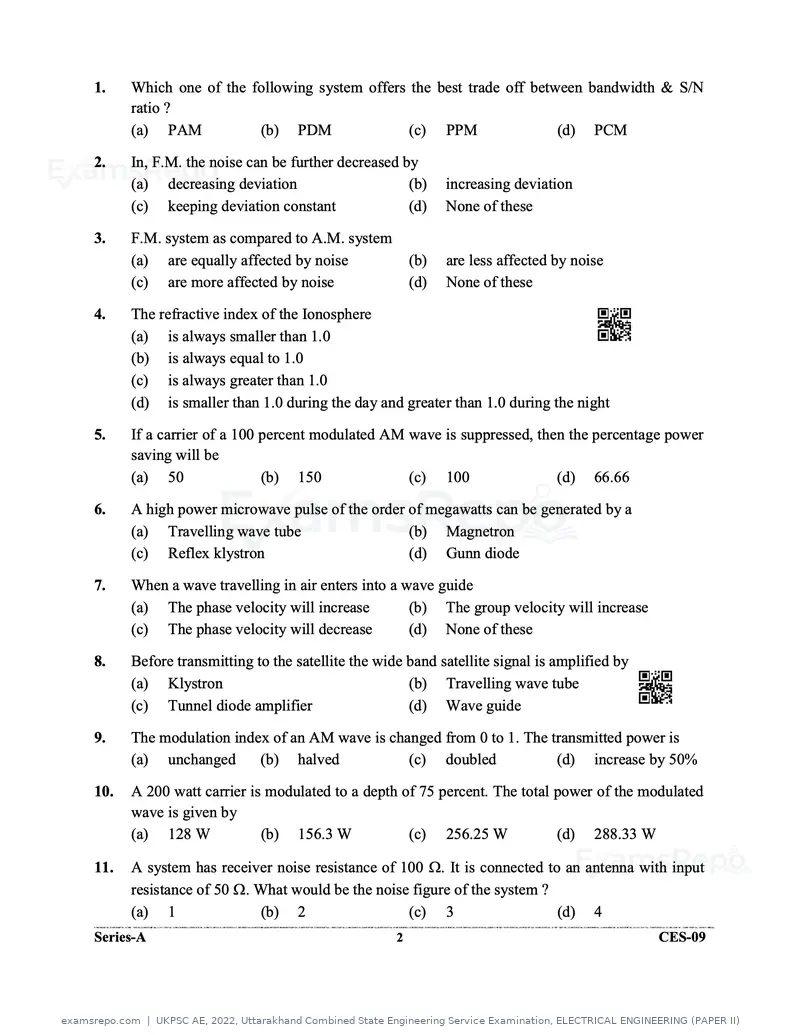
1. Which one of the following system offers the best trade off between bandwidth & S/N
ratio ?
(a) PAM (b) PDM (c) PPM (d) PCM
2. In, F.M. the noise can be further decreased by
(a) decreasing deviation (b) increasing deviation
(c) keeping deviation constant (d) None of these
3. F.M. system as compared to A.M. system
(a) are equally affected by noise (b) are less affected by noise
(c) are more affected by noise (d) None of these
4. The refractive index of the Ionosphere
(a) is always smaller than 1.0
(b) is always equal to 1.0
(c) is always greater than 1.0
(d) is smaller than 1.0 during the day and greater than 1.0 during the night
5. If a carrier of a 100 percent modulated AM wave is suppressed, then the percentage power
saving will be
(a) 50 (b) 150 (c) 100 (d) 66.66
6. A high power microwave pulse of the order of megawatts can be generated by a
(a) Travelling wave tube (b) Magnetron
(c) Reflex klystron (d) Gunn diode
7. When a wave travelling in air enters into a wave guide
(a) The phase velocity will increase (b) The group velocity will increase
(c) The phase velocity will decrease (d) None of these
8. Before transmitting to the satellite the wide band satellite signal is amplified by
(a) Klystron (b) Travelling wave tube
(c) Tunnel diode amplifier (d) Wave guide
9. The modulation index of an AM wave is changed from 0 to 1. The transmitted power is
(a) unchanged (b) halved (c) doubled (d) increase by 50%
10. A 200 watt carrier is modulated to a depth of 75 percent. The total power of the modulated
wave is given by
(a) 128 W (b) 156.3 W (c) 256.25 W (d) 288.33 W
11. A system has receiver noise resistance of 100 . It is connected to an antenna with input
resistance of 50 . What would be the noise figure of the system ?
(a) 1 (b) 2 (c) 3 (d) 4
Series-A 2 CES-09
Text of page 3
1. S/N ?
(a) PAM (b) PDM (c) PPM (d) PCM
2. F.M.
(a) (b)
(c) (d)
3. .. ..
(a) (b)
(c) (d)
4.
(a) 1.0
(b) 1.0
(c) 1.0
(d) 1.0 1.0
5. 100% AM
(a) 50 (b) 150 (c) 100 (d) 66.66
6. ?
(a) (b) (c) (d)
7.
(a) (b)
(c) (d)
8.
(a) (b)
(c) (d)
9. AM 0 1
(a) (b) (c) (d) 50%
10. 200 75
(a) 128 (b) 156.3 (c) 256.25 (d) 288.33
11. 100 50
(Noise)
(a) 1 (b) 2 (c) 3 (d) 4
CES-09 3 Series-A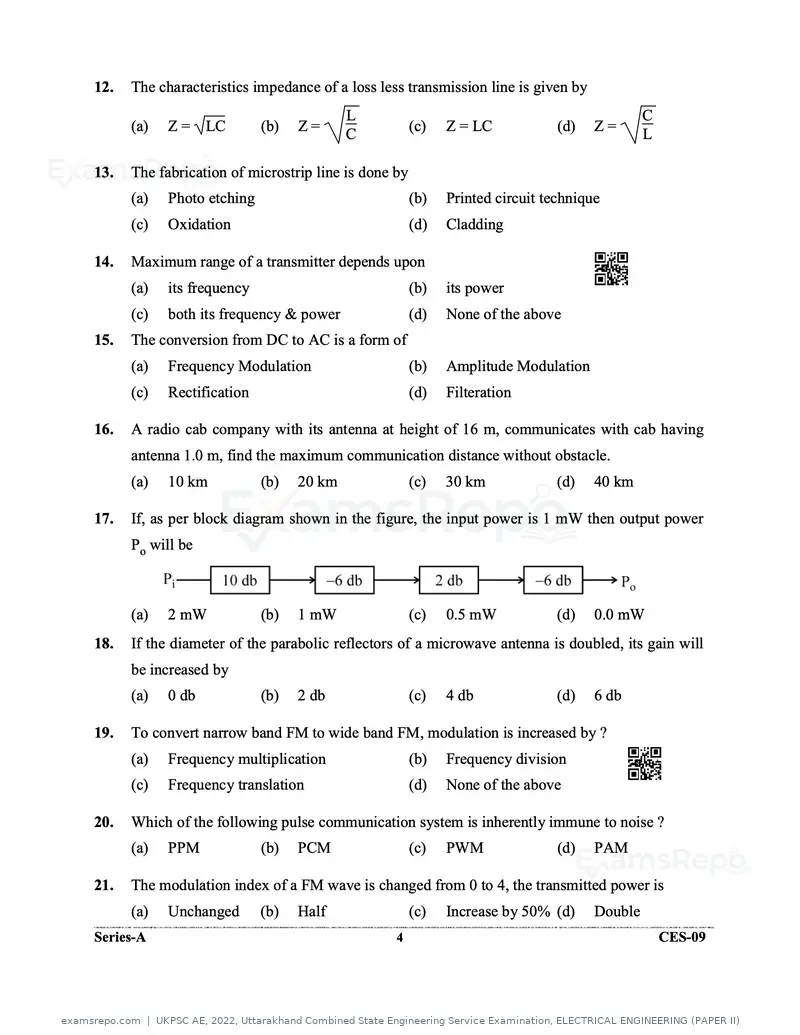
Text of page 4
12.   The characteristics impedance of a loss less transmission line is given by
                                          L                                                  C
      (a)   Z = LC          (b)   Z=                  (c)   Z = LC            (d)   Z=
                                          C                                                  L

13.   The fabrication of microstrip line is done by
      (a)   Photo etching                             (b)   Printed circuit technique
      (c)   Oxidation                                 (d)   Cladding

14.   Maximum range of a transmitter depends upon
      (a)   its frequency                             (b)   its power
      (c)   both its frequency & power                (d)   None of the above
15.   The conversion from DC to AC is a form of
      (a)   Frequency Modulation                      (b)   Amplitude Modulation
      (c)   Rectification                             (d)   Filteration

16.   A radio cab company with its antenna at height of 16 m, communicates with cab having
      antenna 1.0 m, find the maximum communication distance without obstacle.
      (a)   10 km           (b)   20 km               (c)   30 km             (d)   40 km

17.   If, as per block diagram shown in the figure, the input power is 1 mW then output power
      Po will be


      (a)   2 mW            (b)   1 mW                (c)   0.5 mW            (d)   0.0 mW
18.   If the diameter of the parabolic reflectors of a microwave antenna is doubled, its gain will
      be increased by
      (a)   0 db            (b)   2 db                (c)   4 db              (d)   6 db

19.   To convert narrow band FM to wide band FM, modulation is increased by ?
      (a)   Frequency multiplication                  (b)   Frequency division
      (c)   Frequency translation                     (d)   None of the above

20.   Which of the following pulse communication system is inherently immune to noise ?
      (a)   PPM             (b)   PCM                 (c)   PWM               (d)   PAM

21.   The modulation index of a FM wave is changed from 0 to 4, the transmitted power is
      (a)   Unchanged       (b)   Half                (c)   Increase by 50% (d)     Double
Series-A                                         4                                               CES-09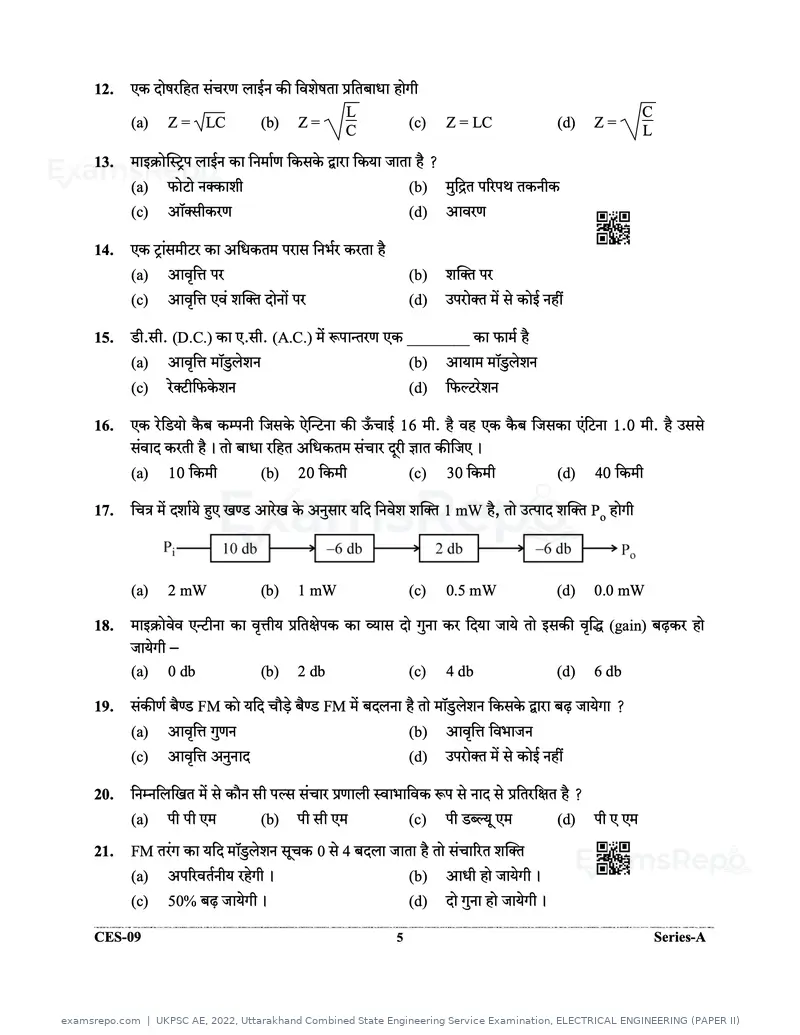
Text of page 6
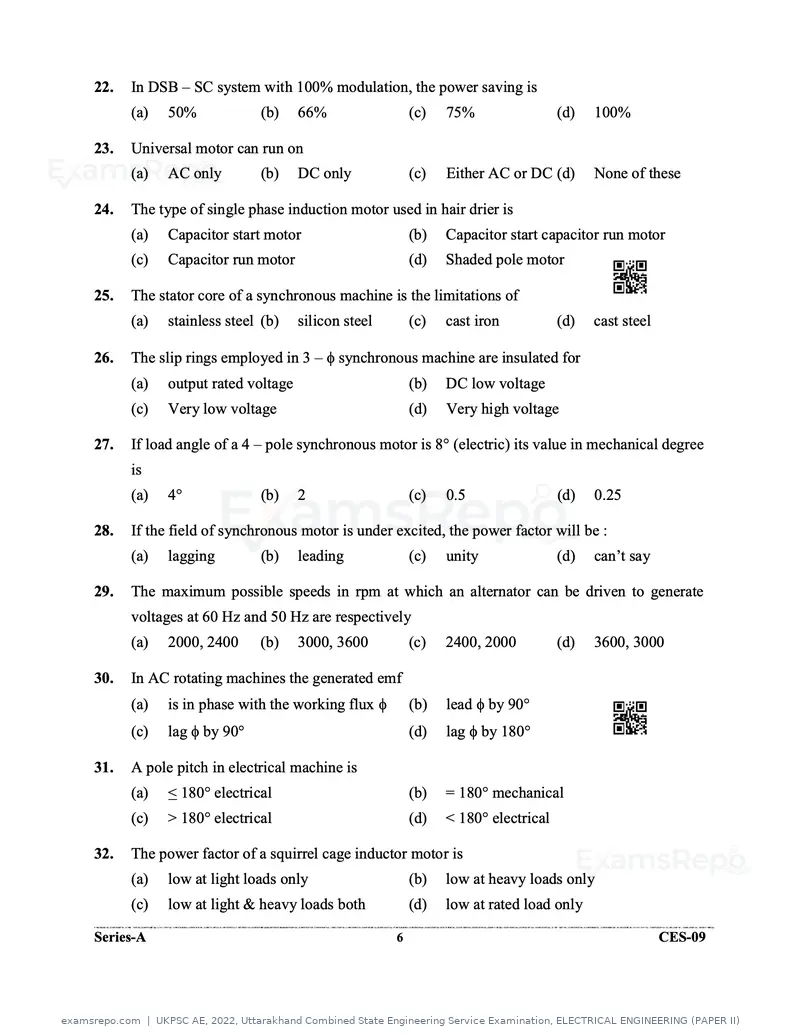
22. In DSB – SC system with 100% modulation, the power saving is
(a) 50% (b) 66% (c) 75% (d) 100%
23. Universal motor can run on
(a) AC only (b) DC only (c) Either AC or DC (d) None of these
24. The type of single phase induction motor used in hair drier is
(a) Capacitor start motor (b) Capacitor start capacitor run motor
(c) Capacitor run motor (d) Shaded pole motor
25. The stator core of a synchronous machine is the limitations of
(a) stainless steel (b) silicon steel (c) cast iron (d) cast steel
26. The slip rings employed in 3 – synchronous machine are insulated for
(a) output rated voltage (b) DC low voltage
(c) Very low voltage (d) Very high voltage
27. If load angle of a 4 – pole synchronous motor is 8° (electric) its value in mechanical degree
is
(a) 4° (b) 2 (c) 0.5 (d) 0.25
28. If the field of synchronous motor is under excited, the power factor will be :
(a) lagging (b) leading (c) unity (d) can’t say
29. The maximum possible speeds in rpm at which an alternator can be driven to generate
voltages at 60 Hz and 50 Hz are respectively
(a) 2000, 2400 (b) 3000, 3600 (c) 2400, 2000 (d) 3600, 3000
30. In AC rotating machines the generated emf
(a) is in phase with the working flux (b) lead by 90°
(c) lag by 90° (d) lag by 180°
31. A pole pitch in electrical machine is
(a) < 180° electrical (b) = 180° mechanical
(c) > 180° electrical (d) < 180° electrical
32. The power factor of a squirrel cage inductor motor is
(a) low at light loads only (b) low at heavy loads only
(c) low at light & heavy loads both (d) low at rated load only
Series-A 6 CES-09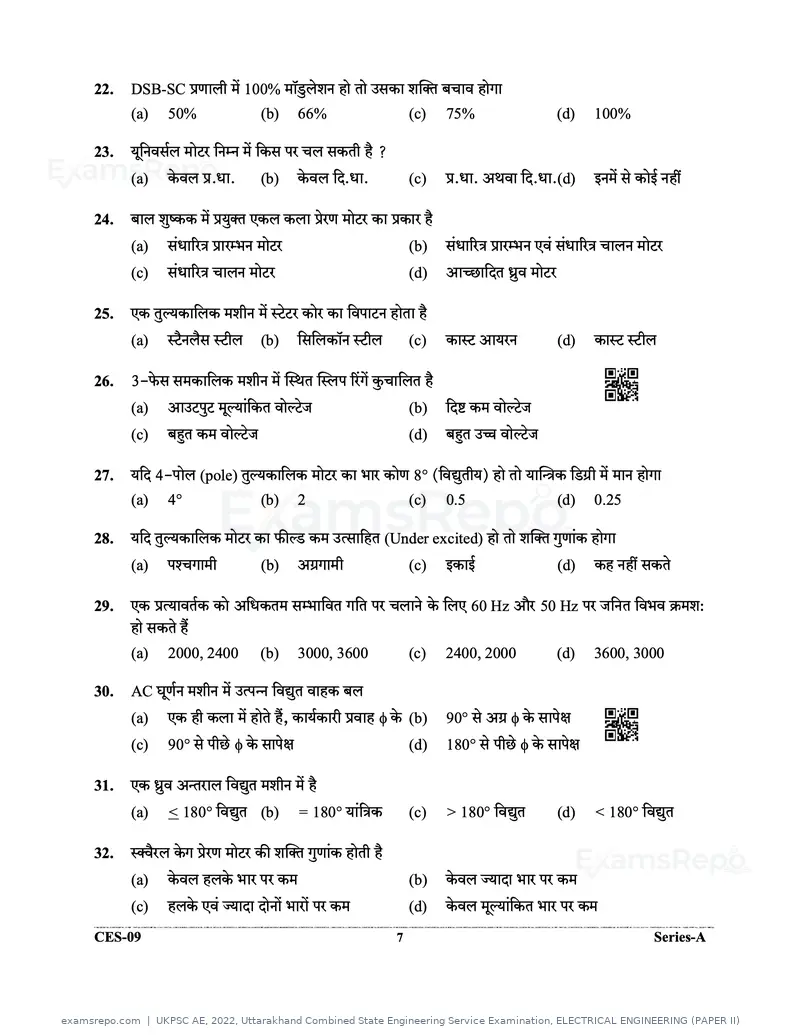
Text of page 7
22. DSB-SC 100%
(a) 50% (b) 66% (c) 75% (d) 100%
23. ?
(a) .. (b) .. (c) .. ..(d)
24.
(a) (b)
(c) (d)
25.
(a) (b) (c) (d)
26. 3-
(a) (b)
(c) (d)
27. 4- (pole) 8 ()
(a) 4° (b) 2 (c) 0.5 (d) 0.25
28. (Under excited)
(a) (b) (c) (d)
29. 60 Hz 50 Hz :
(a) 2000, 2400 (b) 3000, 3600 (c) 2400, 2000 (d) 3600, 3000
30. AC
(a) , (b) 90
(c) 90 (d) 180
31.
(a) < 180 (b) = 180 (c) > 180 (d) < 180
32.
(a) (b)
(c) (d)
CES-09 7 Series-A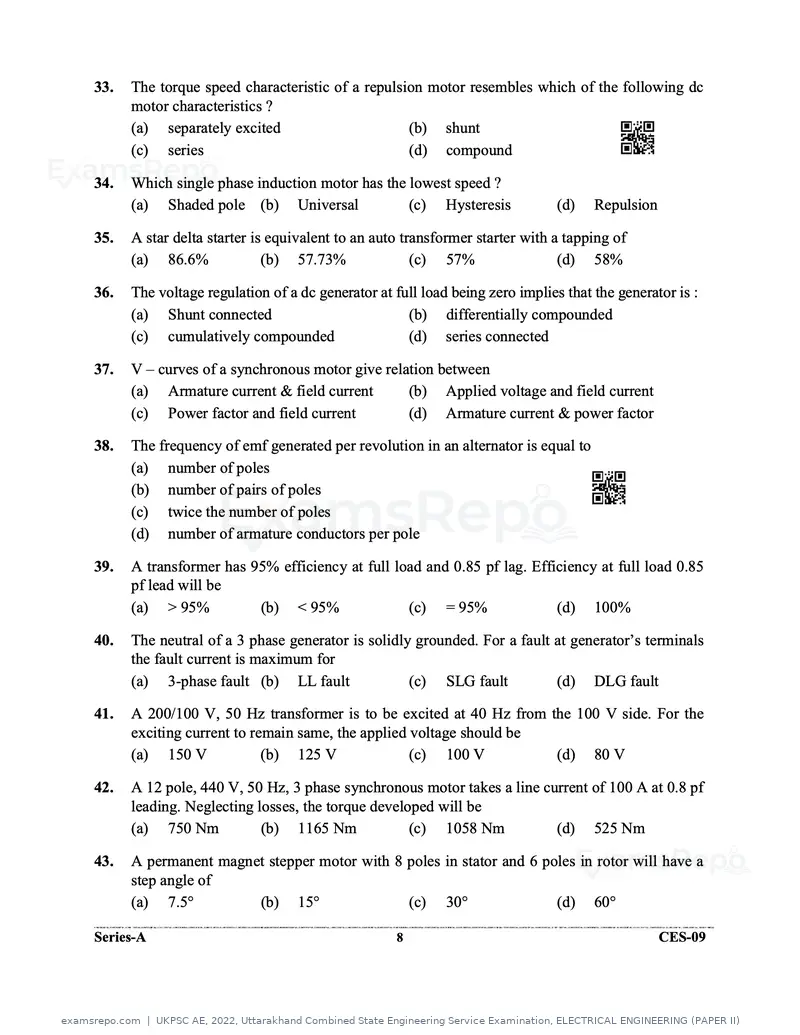
Text of page 8
33.   The torque speed characteristic of a repulsion motor resembles which of the following dc
      motor characteristics ?
      (a) separately excited                      (b) shunt
      (c) series                                  (d) compound

34.   Which single phase induction motor has the lowest speed ?
      (a) Shaded pole (b) Universal              (c) Hysteresis               (d)   Repulsion

35.   A star delta starter is equivalent to an auto transformer starter with a tapping of
      (a) 86.6%              (b) 57.73%               (c) 57%                 (d) 58%

36.   The voltage regulation of a dc generator at full load being zero implies that the generator is :
      (a) Shunt connected                           (b) differentially compounded
      (c) cumulatively compounded                   (d) series connected

37.   V – curves of a synchronous motor give relation between
      (a) Armature current & field current       (b) Applied voltage and field current
      (c) Power factor and field current         (d) Armature current & power factor

38.   The frequency of emf generated per revolution in an alternator is equal to
      (a) number of poles
      (b) number of pairs of poles
      (c) twice the number of poles
      (d) number of armature conductors per pole

39.   A transformer has 95% efficiency at full load and 0.85 pf lag. Efficiency at full load 0.85
      pf lead will be
      (a) > 95%          (b) < 95%               (c) = 95%               (d) 100%

40.   The neutral of a 3 phase generator is solidly grounded. For a fault at generator’s terminals
      the fault current is maximum for
      (a) 3-phase fault (b) LL fault               (c) SLG fault          (d) DLG fault

41.   A 200/100 V, 50 Hz transformer is to be excited at 40 Hz from the 100 V side. For the
      exciting current to remain same, the applied voltage should be
      (a) 150 V             (b) 125 V              (c) 100 V         (d) 80 V

42.   A 12 pole, 440 V, 50 Hz, 3 phase synchronous motor takes a line current of 100 A at 0.8 pf
      leading. Neglecting losses, the torque developed will be
      (a) 750 Nm           (b) 1165 Nm             (c) 1058 Nm          (d) 525 Nm

43.   A permanent magnet stepper motor with 8 poles in stator and 6 poles in rotor will have a
      step angle of
      (a) 7.5°         (b) 15°                (c) 30°                 (d) 60°

Series-A                                          8                                             CES-09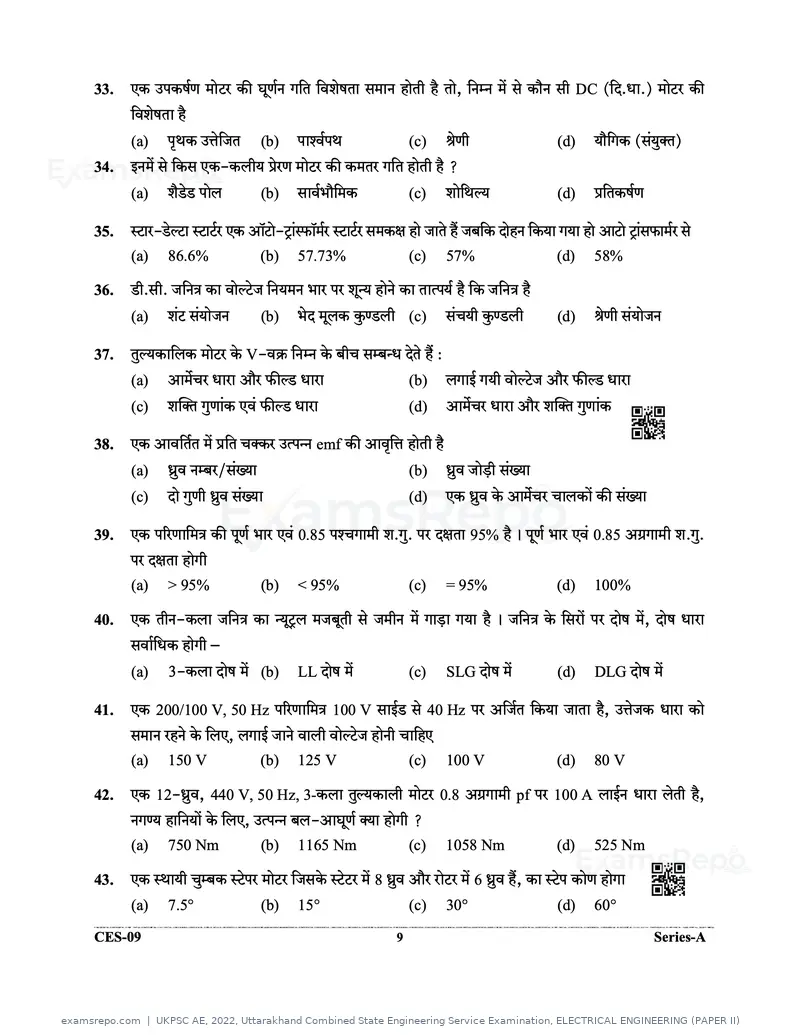
Text of page 9
33. , DC (..)
(a) (b) (c) (d) ()
34. - ?
(a) (b) (c) (d)
35. - -
(a) 86.6% (b) 57.73% (c) 57% (d) 58%
36. ..
(a) (b) (c) (d)
37. V- :
(a) (b)
(c) (d)
38. emf
(a) / (b)
(c) (d)
39. 0.85 .. 95% 0.85 ..
(a) > 95% (b) < 95% (c) = 95% (d) 100%
40. - ,
–
(a) 3- (b) LL (c) SLG (d) DLG
41. 200/100 V, 50 Hz 100 V 40 Hz ,
,
(a) 150 V (b) 125 V (c) 100 V (d) 80 V
42. 12-, 440 V, 50 Hz, 3- 0.8 pf 100 A ,
, - ?
(a) 750 Nm (b) 1165 Nm (c) 1058 Nm (d) 525 Nm
43. 8 6 ,
(a) 7.5 (b) 15 (c) 30 (d) 60
CES-09 9 Series-A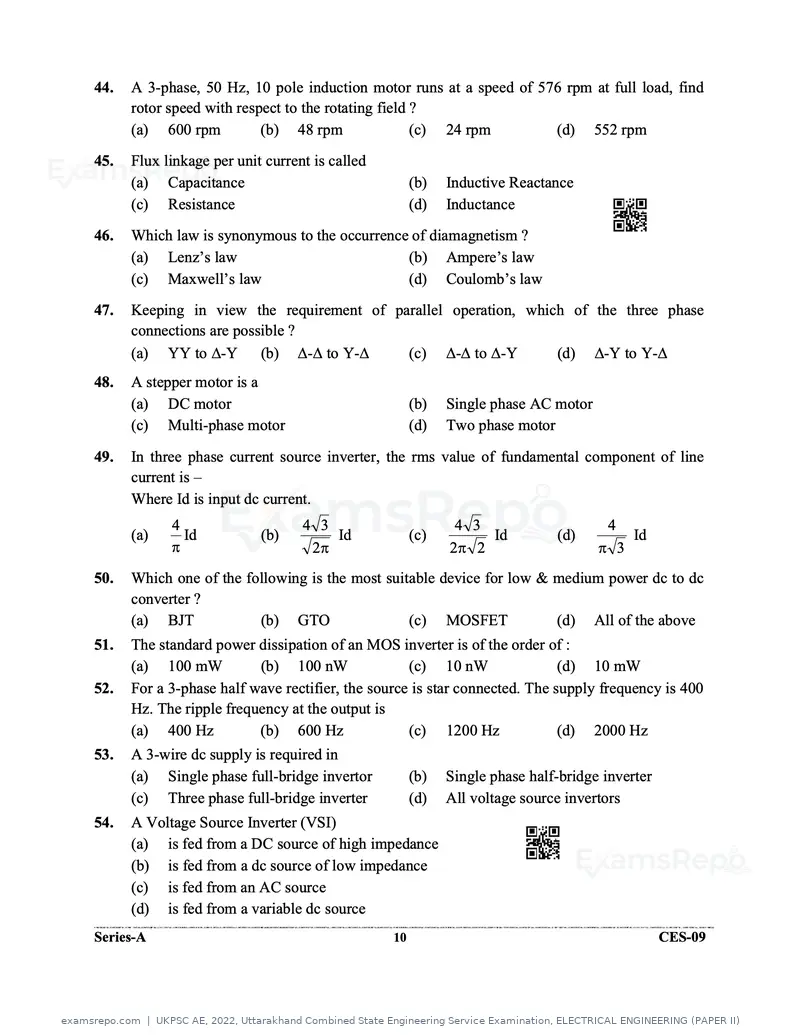
Text of page 10
44. A 3-phase, 50 Hz, 10 pole induction motor runs at a speed of 576 rpm at full load, find
rotor speed with respect to the rotating field ?
(a) 600 rpm (b) 48 rpm (c) 24 rpm (d) 552 rpm
45. Flux linkage per unit current is called
(a) Capacitance (b) Inductive Reactance
(c) Resistance (d) Inductance
46. Which law is synonymous to the occurrence of diamagnetism ?
(a) Lenz’s law (b) Ampere’s law
(c) Maxwell’s law (d) Coulomb’s law
47. Keeping in view the requirement of parallel operation, which of the three phase
connections are possible ?
(a) YY to -Y (b) - to Y- (c) - to -Y (d) -Y to Y-
48. A stepper motor is a
(a) DC motor (b) Single phase AC motor
(c) Multi-phase motor (d) Two phase motor
49. In three phase current source inverter, the rms value of fundamental component of line
current is –
Where Id is input dc current.
4 4 3 4 3 4
(a) Id (b) Id (c) Id (d) Id
2 2 2 3
50. Which one of the following is the most suitable device for low & medium power dc to dc
converter ?
(a) BJT (b) GTO (c) MOSFET (d) All of the above
51. The standard power dissipation of an MOS inverter is of the order of :
(a) 100 mW (b) 100 nW (c) 10 nW (d) 10 mW
52. For a 3-phase half wave rectifier, the source is star connected. The supply frequency is 400
Hz. The ripple frequency at the output is
(a) 400 Hz (b) 600 Hz (c) 1200 Hz (d) 2000 Hz
53. A 3-wire dc supply is required in
(a) Single phase full-bridge invertor (b) Single phase half-bridge inverter
(c) Three phase full-bridge inverter (d) All voltage source invertors
54. A Voltage Source Inverter (VSI)
(a) is fed from a DC source of high impedance
(b) is fed from a dc source of low impedance
(c) is fed from an AC source
(d) is fed from a variable dc source
Series-A 10 CES-09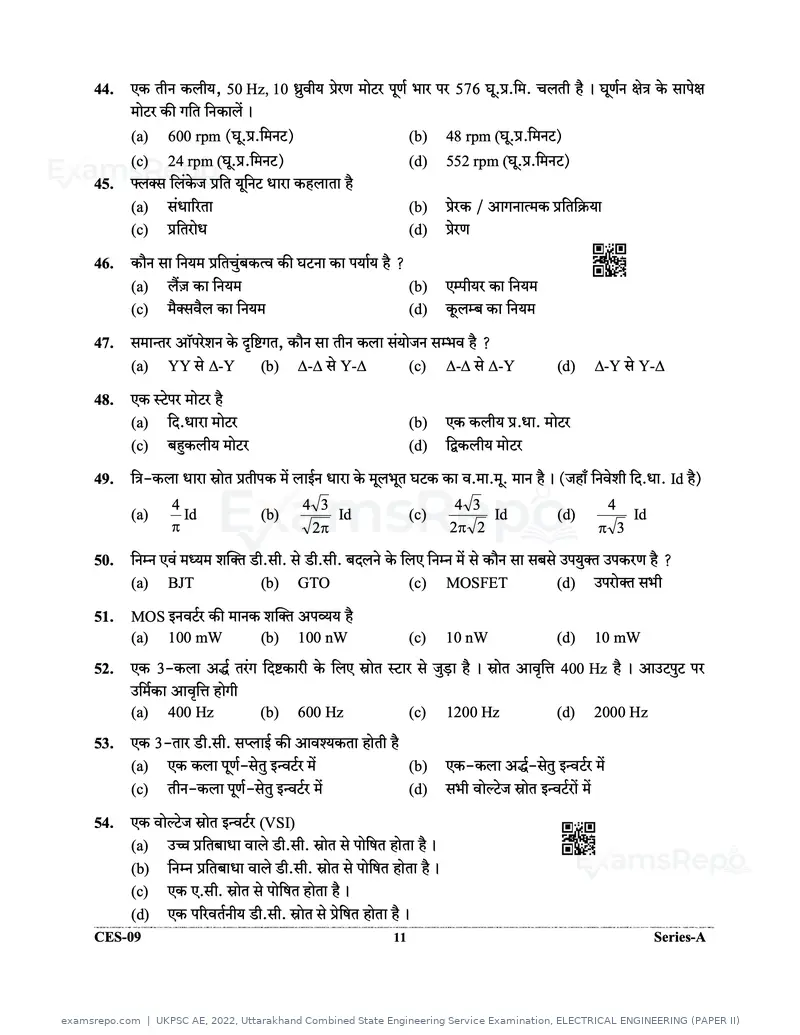
Text of page 12
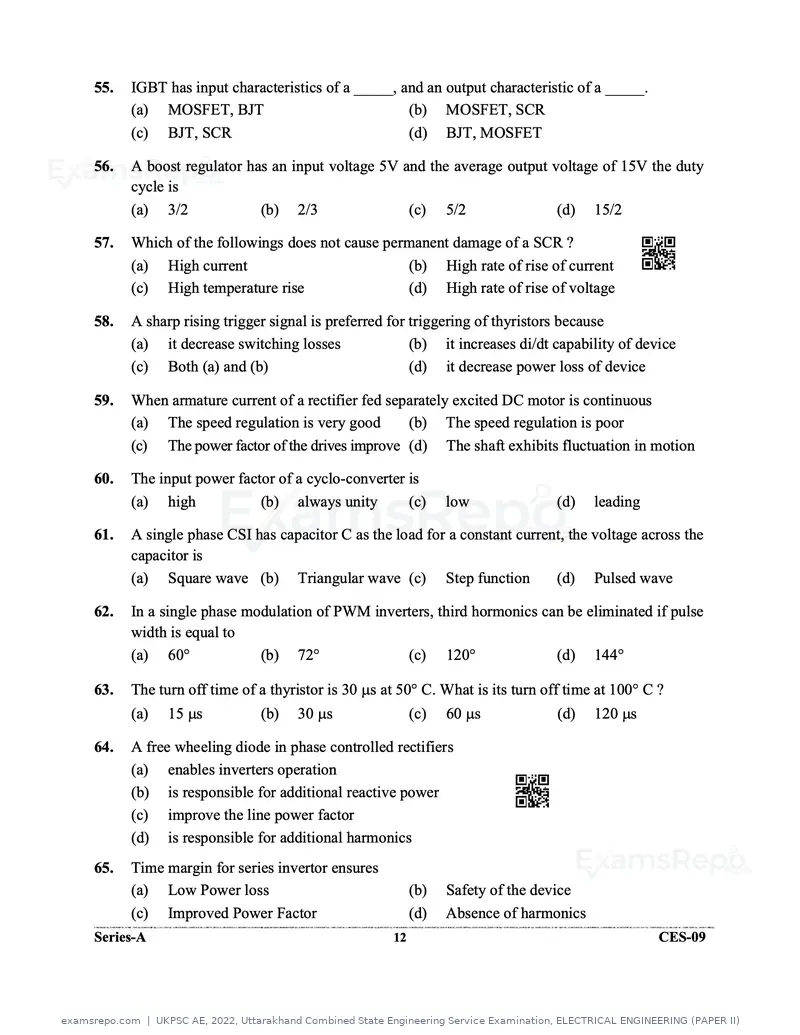
55. IGBT has input characteristics of a _____, and an output characteristic of a _____.
(a) MOSFET, BJT (b) MOSFET, SCR
(c) BJT, SCR (d) BJT, MOSFET
56. A boost regulator has an input voltage 5V and the average output voltage of 15V the duty
cycle is
(a) 3/2 (b) 2/3 (c) 5/2 (d) 15/2
57. Which of the followings does not cause permanent damage of a SCR ?
(a) High current (b) High rate of rise of current
(c) High temperature rise (d) High rate of rise of voltage
58. A sharp rising trigger signal is preferred for triggering of thyristors because
(a) it decrease switching losses (b) it increases di/dt capability of device
(c) Both (a) and (b) (d) it decrease power loss of device
59. When armature current of a rectifier fed separately excited DC motor is continuous
(a) The speed regulation is very good (b) The speed regulation is poor
(c) The power factor of the drives improve (d) The shaft exhibits fluctuation in motion
60. The input power factor of a cyclo-converter is
(a) high (b) always unity (c) low (d) leading
61. A single phase CSI has capacitor C as the load for a constant current, the voltage across the
capacitor is
(a) Square wave (b) Triangular wave (c) Step function (d) Pulsed wave
62. In a single phase modulation of PWM inverters, third hormonics can be eliminated if pulse
width is equal to
(a) 60° (b) 72° (c) 120° (d) 144°
63. The turn off time of a thyristor is 30 s at 50° C. What is its turn off time at 100° C ?
(a) 15 s (b) 30 s (c) 60 s (d) 120 s
64. A free wheeling diode in phase controlled rectifiers
(a) enables inverters operation
(b) is responsible for additional reactive power
(c) improve the line power factor
(d) is responsible for additional harmonics
65. Time margin for series invertor ensures
(a) Low Power loss (b) Safety of the device
(c) Improved Power Factor (d) Absence of harmonics
Series-A 12 CES-09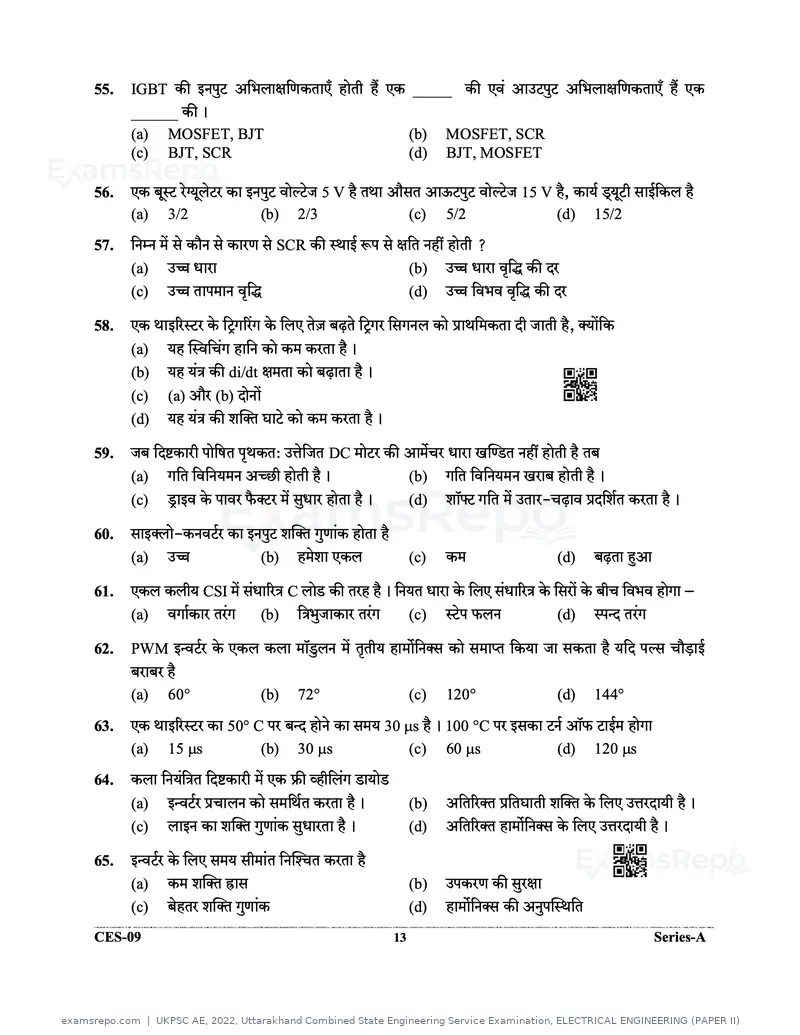
Text of page 13
55. IGBT _____
______
(a) MOSFET, BJT (b) MOSFET, SCR
(c) BJT, SCR (d) BJT, MOSFET
56. 5 V 15 V ,
(a) 3/2 (b) 2/3 (c) 5/2 (d) 15/2
57. SCR ?
(a) (b)
(c) (d)
58. ,
(a)
(b) di/dt
(c) (a) (b)
(d)
59. : DC
(a) (b)
(c) (d) -
60. -
(a) (b) (c) (d)
61. CSI C –
(a) (b) (c) (d)
62. PWM
(a) 60 (b) 72 (c) 120 (d) 144
63. 50 C 30 s 100 C
(a) 15 s (b) 30 s (c) 60 s (d) 120 s
64.
(a) (b)
(c) (d)
65.
(a) (b)
(c) (d)
CES-09 13 Series-A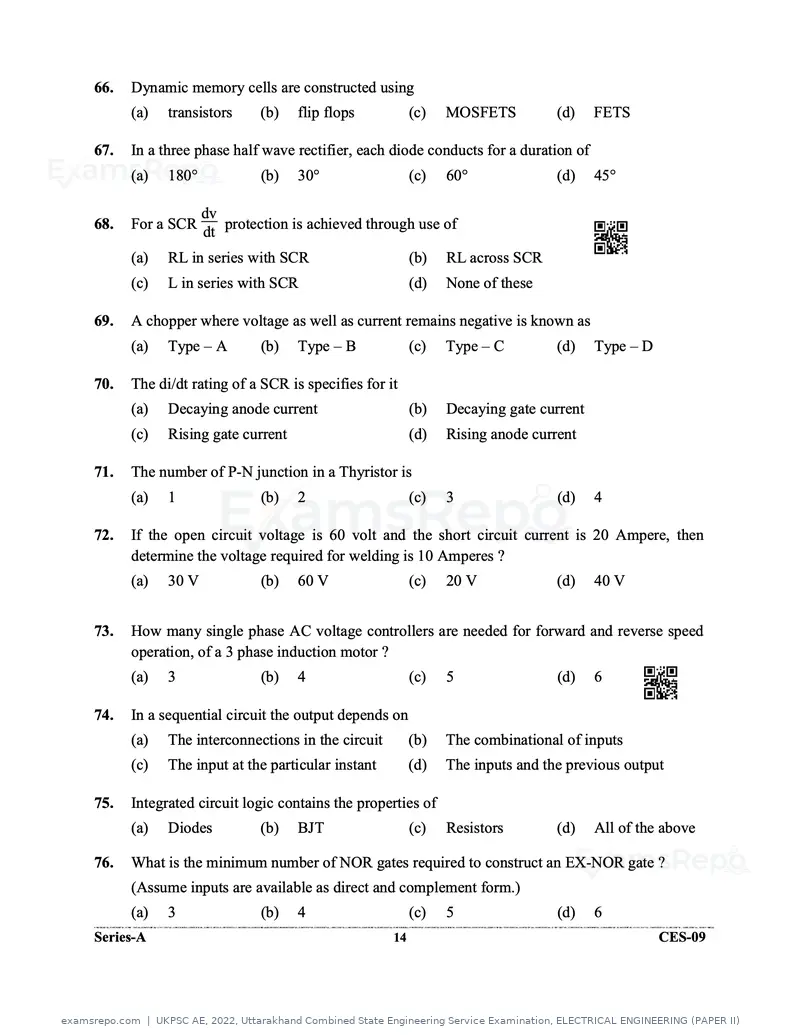
Text of page 14
66.   Dynamic memory cells are constructed using
      (a)   transistors     (b)   flip flops           (c)   MOSFETS          (d)    FETS

67.   In a three phase half wave rectifier, each diode conducts for a duration of
      (a)   180°            (b)   30°                  (c)   60°              (d)    45°

                   dv
68.   For a SCR       protection is achieved through use of
                   dt
      (a)   RL in series with SCR                      (b)   RL across SCR
      (c)   L in series with SCR                       (d)   None of these

69.   A chopper where voltage as well as current remains negative is known as
      (a)   Type – A        (b)   Type – B             (c)   Type – C         (d)    Type – D

70.   The di/dt rating of a SCR is specifies for it
      (a)   Decaying anode current                     (b)   Decaying gate current
      (c)   Rising gate current                        (d)   Rising anode current

71.   The number of P-N junction in a Thyristor is
      (a)   1               (b)   2                    (c)   3                (d)    4

72.   If the open circuit voltage is 60 volt and the short circuit current is 20 Ampere, then
      determine the voltage required for welding is 10 Amperes ?
      (a)   30 V            (b)   60 V                 (c)   20 V             (d)    40 V


73.   How many single phase AC voltage controllers are needed for forward and reverse speed
      operation, of a 3 phase induction motor ?
      (a)   3               (b)   4                    (c)   5                (d)    6

74.   In a sequential circuit the output depends on
      (a)   The interconnections in the circuit        (b)   The combinational of inputs
      (c)   The input at the particular instant        (d)   The inputs and the previous output

75.   Integrated circuit logic contains the properties of
      (a)   Diodes          (b)   BJT                  (c)   Resistors        (d)    All of the above

76.   What is the minimum number of NOR gates required to construct an EX-NOR gate ?
      (Assume inputs are available as direct and complement form.)
      (a)   3               (b)   4                    (c)   5                (d)    6
Series-A                                          14                                            CES-09
Text of page 15
66. ?
(a) (b)
(c) (MOSFETS) (d) (FETS)
67. - ?
(a) 180 (b) 30 (c) 60 (d) 45
68. SCR dv/dt
(a) SCR RL (b) RL SCR
(c) L SCR (d)
69. - ,
(a) -A (b) -B (c) -C (d) -D
70. SCR di/dt ?
(a) (b)
(c) (d)
71. P-N ?
(a) 1 (b) 2 (c) 3 (d) 4
72. 60 volt 20 ,
, 10
(a) 30 V (b) 60 V (c) 20 V (d) 40 V
73. ..
?
(a) 3 (b) 4 (c) 5 (d) 6
74.
(a) (b)
(c) (d)
75. ?
(a) (b) (c) (d)
76. - NOR ?
( )
(a) 3 (b) 4 (c) 5 (d) 6
CES-09 15 Series-A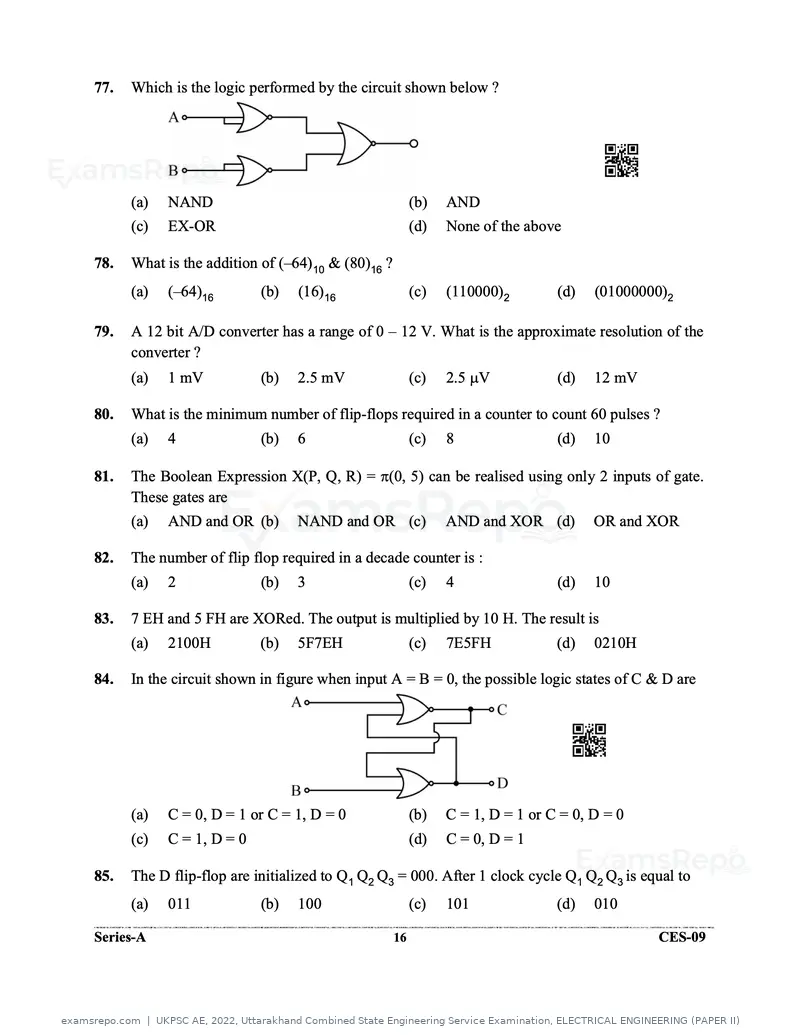
Text of page 16
77. Which is the logic performed by the circuit shown below ?
(a) NAND (b) AND
(c) EX-OR (d) None of the above
78. What is the addition of (–64)10 & (80)16 ?
(a) (–64)16 (b) (16)16 (c) (110000)2 (d) (01000000)2
79. A 12 bit A/D converter has a range of 0 – 12 V. What is the approximate resolution of the
converter ?
(a) 1 mV (b) 2.5 mV (c) 2.5 V (d) 12 mV
80. What is the minimum number of flip-flops required in a counter to count 60 pulses ?
(a) 4 (b) 6 (c) 8 (d) 10
81. The Boolean Expression X(P, Q, R) = (0, 5) can be realised using only 2 inputs of gate.
These gates are
(a) AND and OR (b) NAND and OR (c) AND and XOR (d) OR and XOR
82. The number of flip flop required in a decade counter is :
(a) 2 (b) 3 (c) 4 (d) 10
83. 7 EH and 5 FH are XORed. The output is multiplied by 10 H. The result is
(a) 2100H (b) 5F7EH (c) 7E5FH (d) 0210H
84. In the circuit shown in figure when input A = B = 0, the possible logic states of C & D are
(a) C = 0, D = 1 or C = 1, D = 0 (b) C = 1, D = 1 or C = 0, D = 0
(c) C = 1, D = 0 (d) C = 0, D = 1
85. The D flip-flop are initialized to Q1 Q2 Q3 = 000. After 1 clock cycle Q1 Q2 Q3 is equal to
(a) 011 (b) 100 (c) 101 (d) 010
Series-A 16 CES-09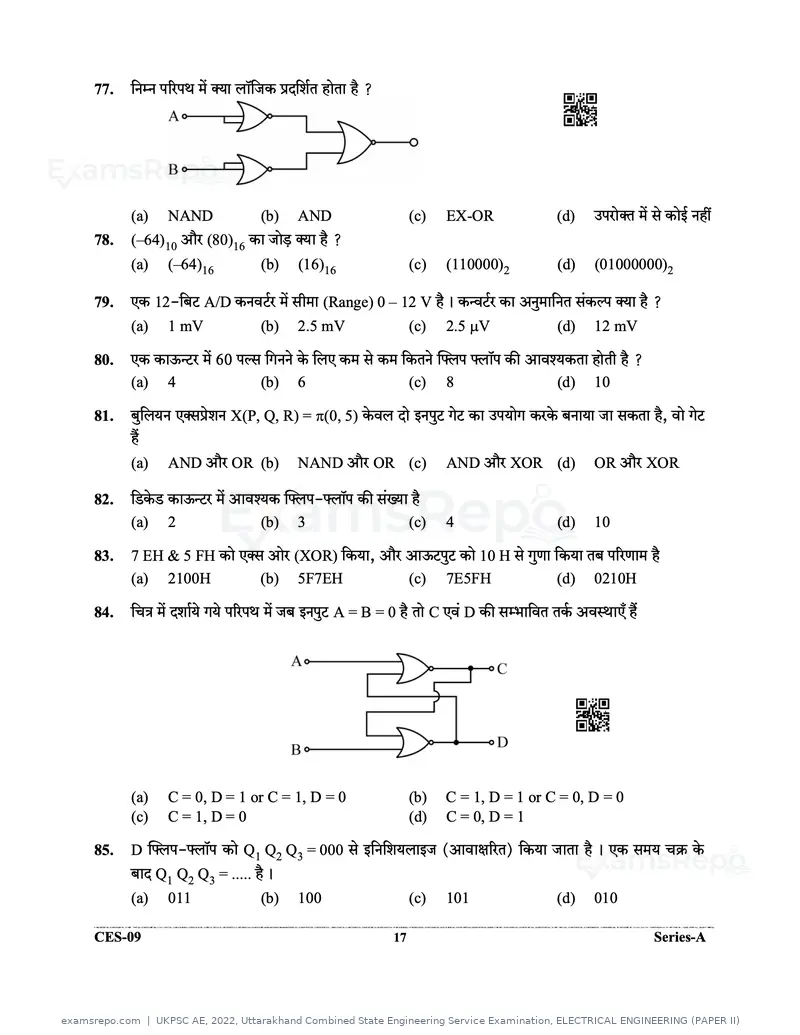
Text of page 17
77. ?
(a) NAND (b) AND (c) EX-OR (d)
78. (–64)10 (80)16 ?
(a) (–64)16 (b) (16)16 (c) (110000)2 (d) (01000000)2
79. 12- A/D (Range) 0 – 12 V ?
(a) 1 mV (b) 2.5 mV (c) 2.5 V (d) 12 mV
80. 60 ?
(a) 4 (b) 6 (c) 8 (d) 10
81. X(P, Q, R) = (0, 5) ,
(a) AND OR (b) NAND OR (c) AND XOR (d) OR XOR
82. -
(a) 2 (b) 3 (c) 4 (d) 10
83. 7 EH & 5 FH (XOR) , 10 H
(a) 2100H (b) 5F7EH (c) 7E5FH (d) 0210H
84. A = B = 0 C D
(a) C = 0, D = 1 or C = 1, D = 0 (b) C = 1, D = 1 or C = 0, D = 0
(c) C = 1, D = 0 (d) C = 0, D = 1
85. D - Q1 Q2 Q3 = 000 ()
Q1 Q2 Q3 = .....
(a) 011 (b) 100 (c) 101 (d) 010
CES-09 17 Series-A
Text of page 18
86. What are the values respectively R1 and R2 in the expression ?
(235)R = (565)10 = (865)R
1 2
(a) 8, 16 (b) 16, 8 (c) 6, 16 (d) 12, 8
87. Which one of the following logic families can be operated using a supply voltage from 3V
to 15V ?
(a) TTL (b) ECL (c) PMOS (d) CMOS
88. IC 7483 is a
(a) TTL Binary adder (b) TT clock
(c) 8 – bit binary subtractor (d) None of the above
89. The power failure alarm must be connected to which one of the following inputs of
8085 ?
(a) RST 7.5 (b) TRAP (c) INTR (d) HOLD
90. The logic circuit of figure is a
(a) half adder (b) XOR (c) equality detector (d) full adder
91. Terminal count of Mod-10 binary counter is
(a) 0000 (b) 1010 (c) 1001 (d) 1111
92. A modulus – 16 ripple counter is holding the count (1001) 2. What will the count be after
31 clock pulses ?
(a) (1000)2 (b) (1010)2 (c) (1011)2 (d) (1101)2
93. A Decoder is a
(a) One input many output device (b) Many input one output device
(c) Many input many output device (d) One input one output device
94. The gain & distortion of an amplifier are respectively 150 and 5%, when used with a 10%
negative feedback, the % distortion would be
(a) 5/16 (b) 9/16 (c) 6 (d) 8
95. How fast can the output of an Op Amp change by 10V, if its slew rate is 1V/s ?
(a) 5 s (b) 10 s (c) 15 s (d) 20 s
Series-A 18 CES-09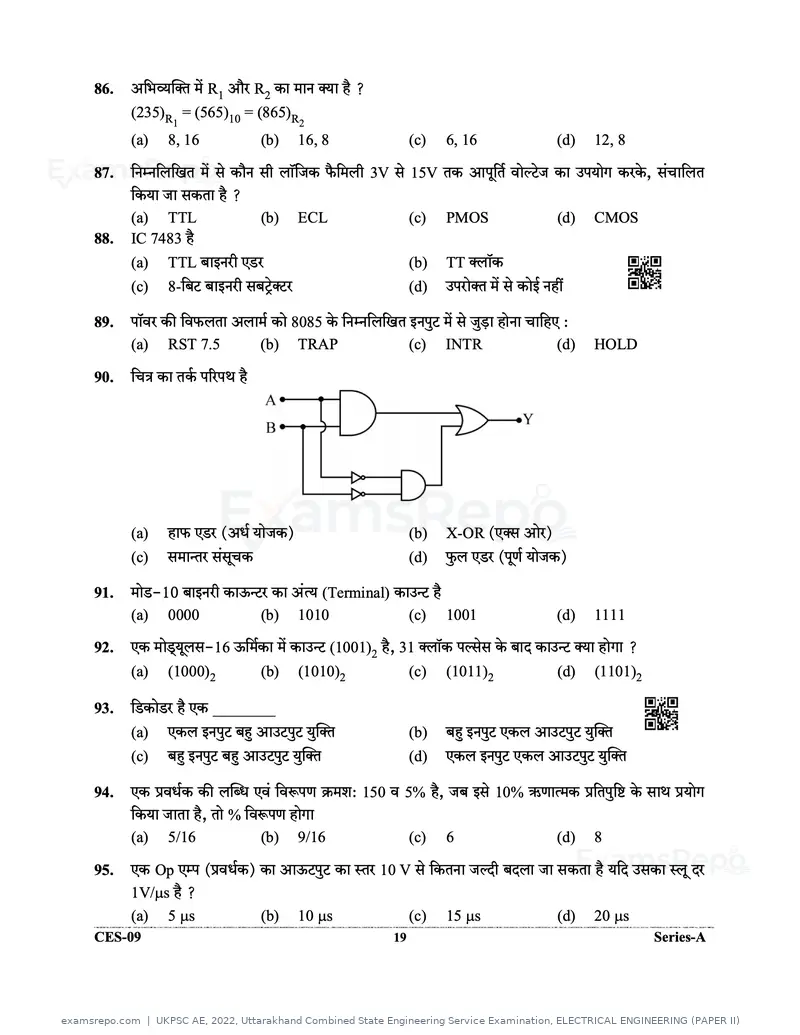
Text of page 19
86. R1 R2 ?
(235)R = (565)10 = (865)R
1 2
(a) 8, 16 (b) 16, 8 (c) 6, 16 (d) 12, 8
87. 3V 15V ,
?
(a) TTL (b) ECL (c) PMOS (d) CMOS
88. IC 7483
(a) TTL (b) TT
(c) 8- (d)
89. 8085 :
(a) RST 7.5 (b) TRAP (c) INTR (d) HOLD
90.
(a) ( ) (b) X-OR ( )
(c) (d) ( )
91. -10 (Terminal)
(a) 0000 (b) 1010 (c) 1001 (d) 1111
92. -16 (1001)2 , 31 ?
(a) (1000)2 (b) (1010)2 (c) (1011)2 (d) (1101)2
93. ________
(a) (b)
(c) (d)
94. : 150 5% , 10%
, %
(a) 5/16 (b) 9/16 (c) 6 (d) 8
95. Op () 10 V
1V/s ?
(a) 5 s (b) 10 s (c) 15 s (d) 20 s
CES-09 19 Series-A
Text of page 20
96.   Decimal number 9 in Gray code is
      (a) 1100           (b) 0110                    (c)   1101             (d)   1111

97.   FF16 when converted to 8421 BCD is
      (a)   0000 0101 0101                           (b)   0010 0101 0101
      (c)   1111 0101 0101                           (d)   1000 0101 0101

98.   The parallel outputs of a counter circuit represent the
      (a) parallel data word                        (b) clock frequency
      (c) counter modulus                           (d) clock count

                                                                    –
99.   If A and B are Boolean variables, then what is (A + B) . (A + B) equal to ?
      (a) B               (b) A                   (c) A + B              (d) AB

100. Types of data acquisition system used in process control can be
     (a) An analog data acquisition system       (b) A digital data acquisition system
     (c) (a) & (b) both                          (d) None of these

                                                                                 9
101. For a unity feedback system with open loop transfer function G(S) =             , the damping
                                                                              S(S+2)
      ratio is
      (a) 1/3              (b)   1/2                 (c)   1                (d)   2

102. The _____ translate a byte from one code to another code.
     (a) XLAT            (b) XCHG               (c) POP                     (d)   PUSH

103. In a microprocessor system, suppose TRAP, HOLD, RESET pin got activated at the same
     time, while the processor was executing some instructions, then it will first respond to
     (a) TRAP             (b) HOLD              (c) RESET                (d) None of above

104. Basic steps of execution of an instruction is
     (a) Fetch → Execute → Decode                  (b)     Decode → Fetch → Execute
     (c) Execute → Fetch → Decode                  (d)     Fetch → Decode → Execute

105. A microprocessor with a 12 bit address bus will be able to access
     (a) 1 K bytes      (b) 4 K bytes           (c) 8 K bytes               (d)   10 K bytes

106. The ________ pin is used to select direct command word.
     (a) A0             (b) D7 – D6              (c) A12                    (d)   AD7 – AD6

107. Flash & EPROM are types of
     (a) Volatile memory                             (b)   Non-volatile memory
     (c) ALU                                         (d)   Register
Series-A                                        20                                         CES-09
Text of page 21
96. 9
(a) 1100 (b) 0110 (c) 1101 (d) 1111
97. FF16 8421 BCD
(a) 0000 0101 0101 (b) 0010 0101 0101
(c) 1111 0101 0101 (d) 1000 0101 0101
98. (OUTPUT)
(a) (b)
(c) (d)
–
99. A B (A + B) . (A + B) ?
(a) B (b) A (c) A+B (d) AB
100. () ?
(a) (b)
(c) (a) (b) (d)
9
101. loop G(S) =
S(S 2)
(a) 1/3 (b) 1/2 (c) 1 (d) 2
102. _______
(a) XLAT (b) XCHG (c) POP (d) PUSH
103. , TRAP, HOLD, RESET ,
,
(a) TRAP (b) HOLD (c) RESET (d)
104.
(a) → → (b) → →
(c) → → (d) → →
105. 12-bit
(a) 1 (b) 4 (c) 8 (d) 10
106. _______
(a) A0 (b) D7 – D6 (c) A12 (d) AD7 – AD6
107. (Flash) (EPROM) ?
(a) (b) -
(c) ... (d)
CES-09 21 Series-A
Text of page 22
108. A serial input port is receiving 8 bits in 8 successive time slots of 1 s each. How many
maximum no. of bytes can be received in 1 sec. ?
(a) 125 (b) 1250 (c) 12500 (d) 125000
109. Process of resetting or setting a bit or each bit of a byte by NOT operation is known as
(a) Compare (b) Compliment (c) Decrement (d) Fetcher
110. An 8-bit timer is programmed to receive internal pulse at the rate of 1 s. What should be
the value of X preloaded, so that if time outs and generate an overflow interrupt after 25
sec. ?
(a) E7H (b) E6H (c) E8H (d) E9H
111. In a micro-processor with 16 Address and 12 data lines, the maximum number of op-codes
is _______.
(a) 26 (b) 28 (c) 212 (d) 216
112. The following 8085 instructions are executed sequentially :
XRA A
MOV L, A
MOV H, L
INX H
DAD H
After execution, the content of HL pair is
(a) 0000 H (b) 0101 H (c) 0001 H (d) 0002 H
113. An m-bit microprocessor has an m-bit
(a) Flag register (b) Instruction register
(c) Data counter (d) Program counter
114. The Resolution of a 0 – 10 V, 4 bit DAC is
(a) 1.25 volt (b) 0.125 volt (c) 0.0625 volt (d) 0.625 volt
115. If the size of memory of a given memory chip is 2 K byte, starting address is 0000H, find
the last address.
(a) 03FFH (b) 0400H (c) 07FFH (d) 0800H
116. The Binary equivalent of Hex number 3F8 is
(a) 011011100001 (b) 001111111000
(c) 000110101101 (d) 011000110000
117. The value of LSB of 8-bit DAC for 5 volt supply is
(a) 39 mV (b) 19.5 mV (c) 0.62 V (d) 1.3 V
118. A p is designed to access 2KPROM, 4KROM & 64KRAM. The number of address lines
required to access these memories by the P is
(a) 16 (b) 17 (c) 18 (d) 19
Series-A 22 CES-09
Text of page 23
108. 1 s 8 8
?
(a) 125 (b) 1250 (c) 12500 (d) 125000
109. NOT
?
(a) (b) (c) (d)
110. 8 1 s X
, 25 sec ?
(a) E7H (b) E6H (c) E8H (d) E9H
111. 16 12 , - _______
(a) 26 (b) 28 (c) 212 (d) 216
112. 8085 :
XRA A
MOV L, A
MOV H, L
INX H
DAD H
, HL ______
(a) 0000 H (b) 0101 H (c) 0001 H (d) 0002 H
113. m- m- ________
(a) (b) (c) (d)
114. 0-10 V, 4 DAC
(a) 1.25 (b) 0.125 (c) 0.0625 (d) 0.625
115. 2 K , 0000H ,
(a) 03FFH (b) 0400H (c) 07FFH (d) 0800H
116. 3F8
(a) 011011100001 (b) 001111111000
(c) 000110101101 (d) 011000110000
117. 8-bit DAC 5 Volt LSB ?
(a) 39 mV (b) 19.5 mV (c) 0.62 V (d) 1.3 V
118. p 2KPROM, 4KROM 64KRAM ,
p
(a) 16 (b) 17 (c) 18 (d) 19
CES-09 23 Series-A
Text of page 24
119. Ready pin of microprocessor is used
(a) to indicate that microprocessor is ready to receive inputs.
(b) to indicate that microprocessor is ready to receive outputs.
(c) to introduce wait – state.
(d) to provide direct memory access.
120. The number of bits processed in a single instruction is known as
(a) Instruction Set (b) Bandwidth
(c) Band speed (d) Instruction speed
121. The RAM which is created using bipolar transistors is called
(a) Dynamic RAM (b) Static RAM
(c) Permanent RAM (d) DDR RAM
122. What type of memory is not directly addressable by the CPU and requires special software
called EMS (Expanded Memory Specification) ?
(a) Extended (b) Base (c) Expanded (d) Conventional
123. Which microprocessor pins are used to request and acknowledge a DMA transfer ?
(a) reset & ready (b) ready & wait
(c) HOLD and HLDA (d) None of these
124. The time required to refresh a typical DRAM is
(a) 2-4 s (b) 2-4 ns (c) 2-4 ms (d) 2-4 ps
125. Process field bus (PROFI-BUS) is a/an
(a) American Standard (b) African Standard
(c) Asian Standard (d) German Standard
126. A system of equation represented by AX = 0, where X is a column vector of unknown and
A is a matrix containing coefficient, has a non-trivial solution when A is
(a) Non singular (b) Singular (c) Symmetric (d) Hermetian
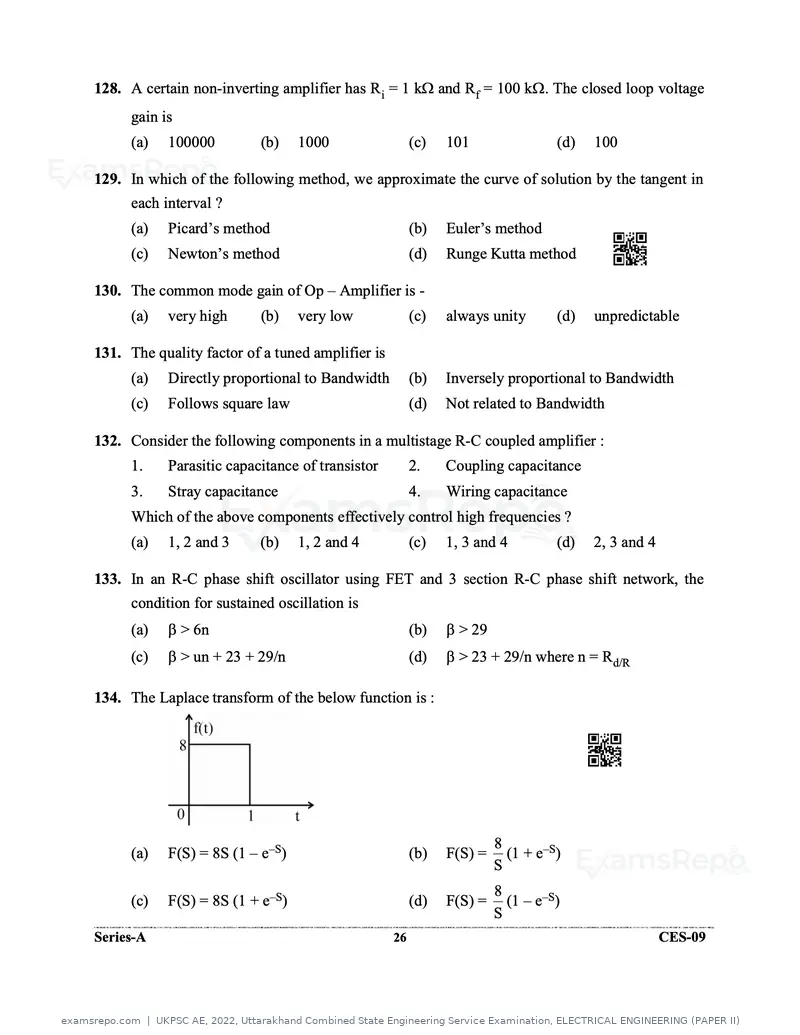
127. Find io for the given Op-Amp circuit
(a) 10 mA (b) 20 mA (c) –2.5 mA (d) –10 mA
Series-A 24 CES-09
Text of page 26
128. A certain non-inverting amplifier has Ri = 1 kand Rf = 100 k. The closed loop voltage
gain is
(a) 100000 (b) 1000 (c) 101 (d) 100
129. In which of the following method, we approximate the curve of solution by the tangent in
each interval ?
(a) Picard’s method (b) Euler’s method
(c) Newton’s method (d) Runge Kutta method
130. The common mode gain of Op – Amplifier is -
(a) very high (b) very low (c) always unity (d) unpredictable
131. The quality factor of a tuned amplifier is
(a) Directly proportional to Bandwidth (b) Inversely proportional to Bandwidth
(c) Follows square law (d) Not related to Bandwidth
132. Consider the following components in a multistage R-C coupled amplifier :
1. Parasitic capacitance of transistor 2. Coupling capacitance
3. Stray capacitance 4. Wiring capacitance
Which of the above components effectively control high frequencies ?
(a) 1, 2 and 3 (b) 1, 2 and 4 (c) 1, 3 and 4 (d) 2, 3 and 4
133. In an R-C phase shift oscillator using FET and 3 section R-C phase shift network, the
condition for sustained oscillation is
(a) > 6n (b) > 29
(c) > un + 23 + 29/n (d) > 23 + 29/n where n = Rd/R
134. The Laplace transform of the below function is :
8
(a) F(S) = 8S (1 – e–S) (b) F(S) = (1 + e–S)
S
8
(c) F(S) = 8S (1 + e–S) (d) F(S) = (1 – e–S)
S
Series-A 26 CES-09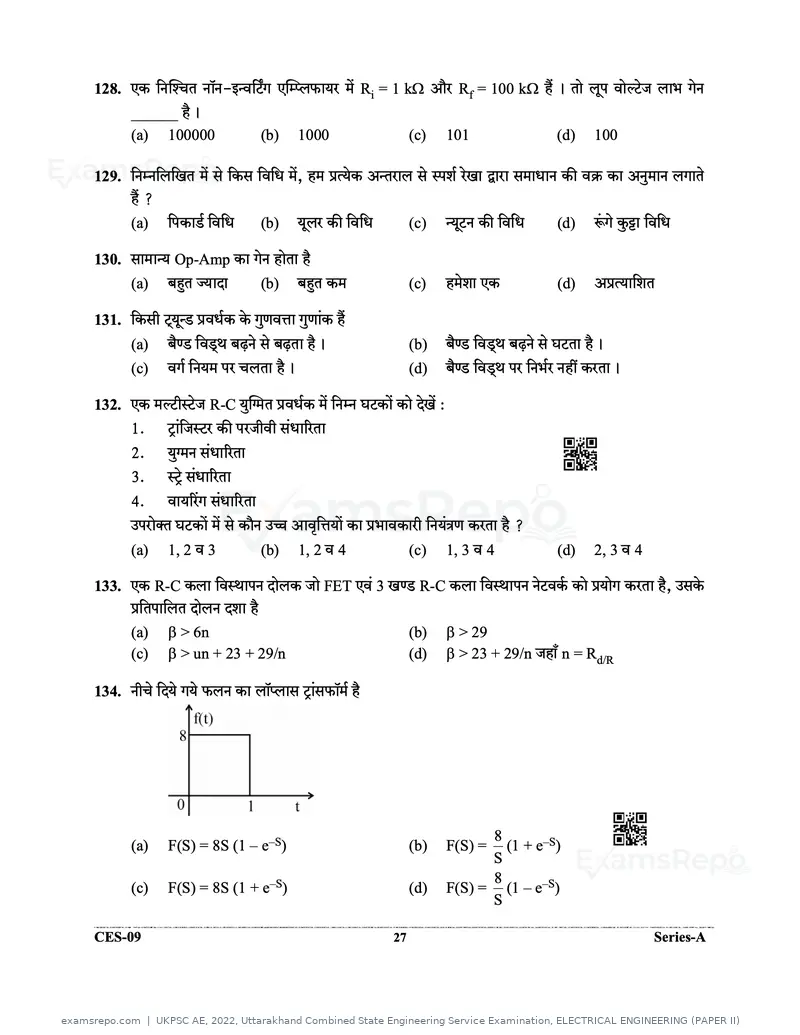
Text of page 27
128. - Ri = 1 k Rf = 100 k
______
(a) 100000 (b) 1000 (c) 101 (d) 100
129. ,
?
(a) (b) (c) (d)
130. Op-Amp
(a) (b) (c) (d)
131.
(a) (b)
(c) (d)
132. R-C :
1.
2.
3.
4.
?
(a) 1, 2 3 (b) 1, 2 4 (c) 1, 3 4 (d) 2, 3 4
133. R-C FET 3 R-C ,
(a) > 6n (b) > 29
(c) > un + 23 + 29/n (d) > 23 + 29/n n = Rd/R
134.
8
(a) F(S) = 8S (1 – e–S) (b) F(S) = (1 + e–S)
S
8
(c) F(S) = 8S (1 + e–S) (d) F(S) = (1 – e–S)
S
CES-09 27 Series-A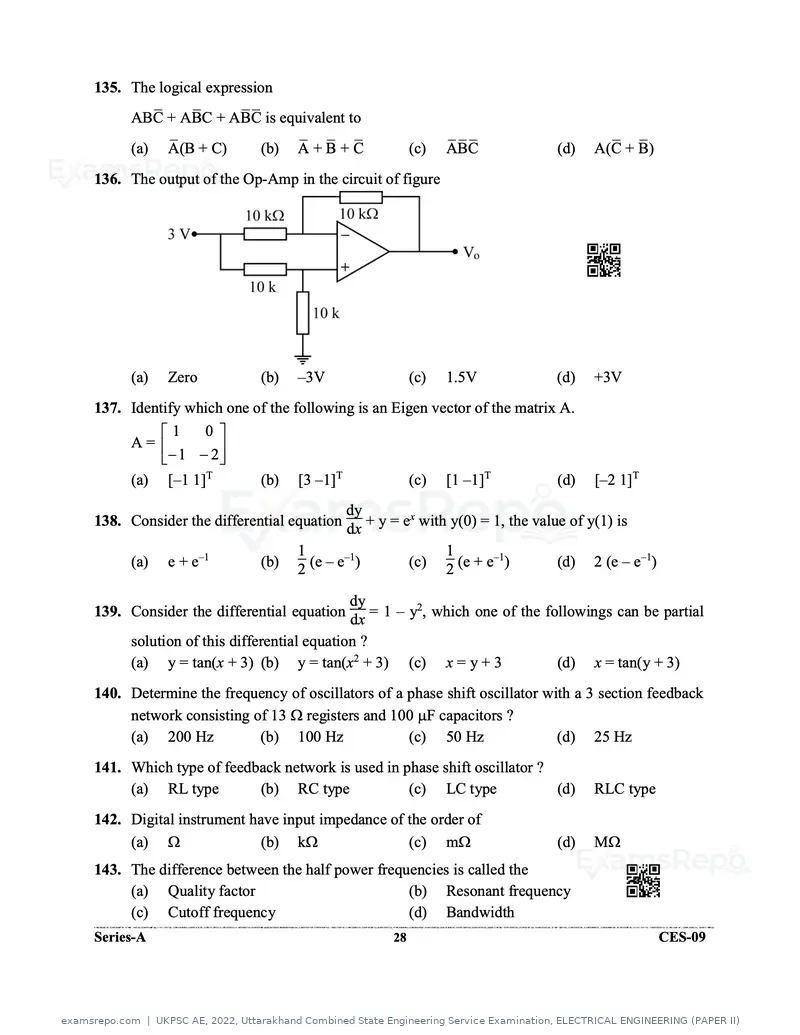
Text of page 28
135. The logical expression
– – ––
ABC + ABC + ABC is equivalent to
– – – – ––– – –
(a) A(B + C) (b) A + B + C (c) ABC (d) A(C + B)
136. The output of the Op-Amp in the circuit of figure
(a) Zero (b) –3V (c) 1.5V (d) +3V
137. Identify which one of the following is an Eigen vector of the matrix A.
1 0
A=
1 2
(a) [–1 1]T (b) [3 –1]T (c) [1 –1]T (d) [–2 1]T
dy
138. Consider the differential equation + y = ex with y(0) = 1, the value of y(1) is
dx
1 1
(a) e + e–1 (b) (e – e–1) (c) (e + e–1) (d) 2 (e – e–1)
2 2
dy
139. Consider the differential equation = 1 – y2, which one of the followings can be partial
dx
solution of this differential equation ?
(a) y = tan(x + 3) (b) y = tan(x2 + 3) (c) x = y + 3 (d) x = tan(y + 3)
140. Determine the frequency of oscillators of a phase shift oscillator with a 3 section feedback
network consisting of 13 registers and 100 F capacitors ?
(a) 200 Hz (b) 100 Hz (c) 50 Hz (d) 25 Hz
141. Which type of feedback network is used in phase shift oscillator ?
(a) RL type (b) RC type (c) LC type (d) RLC type
142. Digital instrument have input impedance of the order of
(a) (b) k (c) m (d) M
143. The difference between the half power frequencies is called the
(a) Quality factor (b) Resonant frequency
(c) Cutoff frequency (d) Bandwidth
Series-A 28 CES-09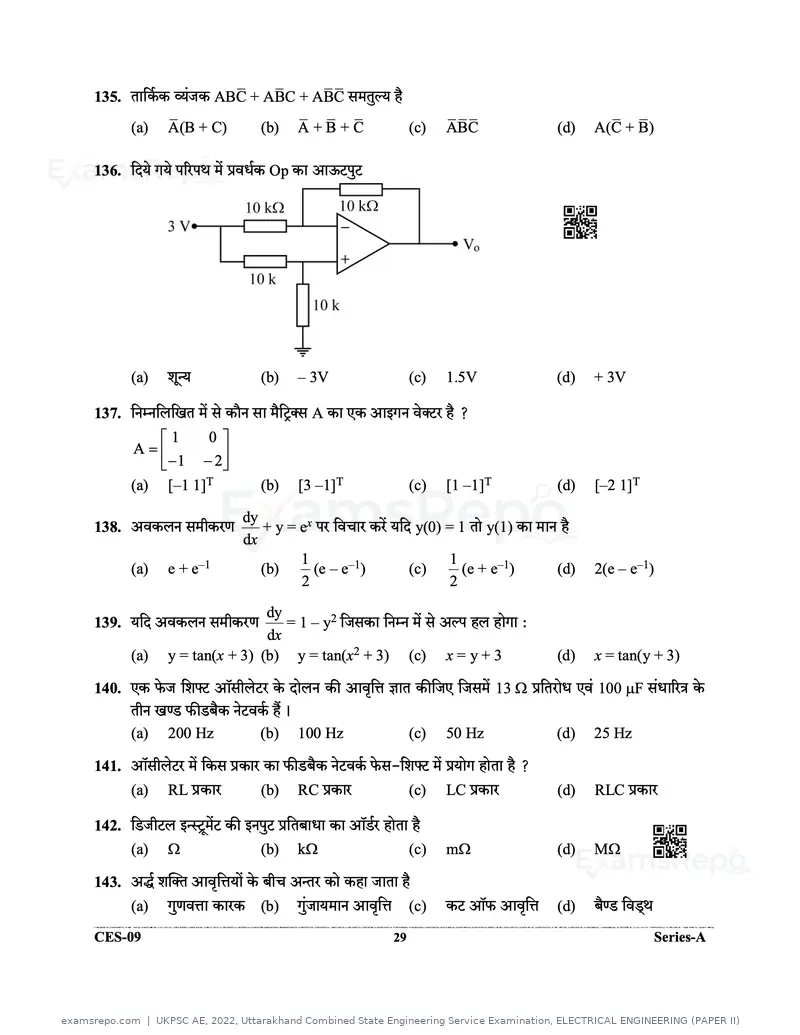
Text of page 29
– – ––
135. ABC + ABC + ABC
– – – – ––– – –
(a) A(B + C) (b) A + B + C (c) ABC (d) A(C + B)
136. Op
(a) (b) – 3V (c) 1.5V (d) + 3V
137. A ?
1 0
A
1 2
(a) [–1 1]T (b) [3 –1]T (c) [1 –1]T (d) [–2 1]T
dy
138. + y = ex y(0) = 1 y(1)
dx
1 1
(a) e + e–1 (b) (e – e–1) (c) (e + e–1) (d) 2(e – e–1)
2 2
dy
139. = 1 – y2 :
dx
(a) y = tan(x + 3) (b) y = tan(x2 + 3) (c) x = y + 3 (d) x = tan(y + 3)
140. 13 100 F
(a) 200 Hz (b) 100 Hz (c) 50 Hz (d) 25 Hz
141. - ?
(a) RL (b) RC (c) LC (d) RLC
142.
(a) (b) k (c) m (d) M
143.
(a) (b) (c) (d)
CES-09 29 Series-A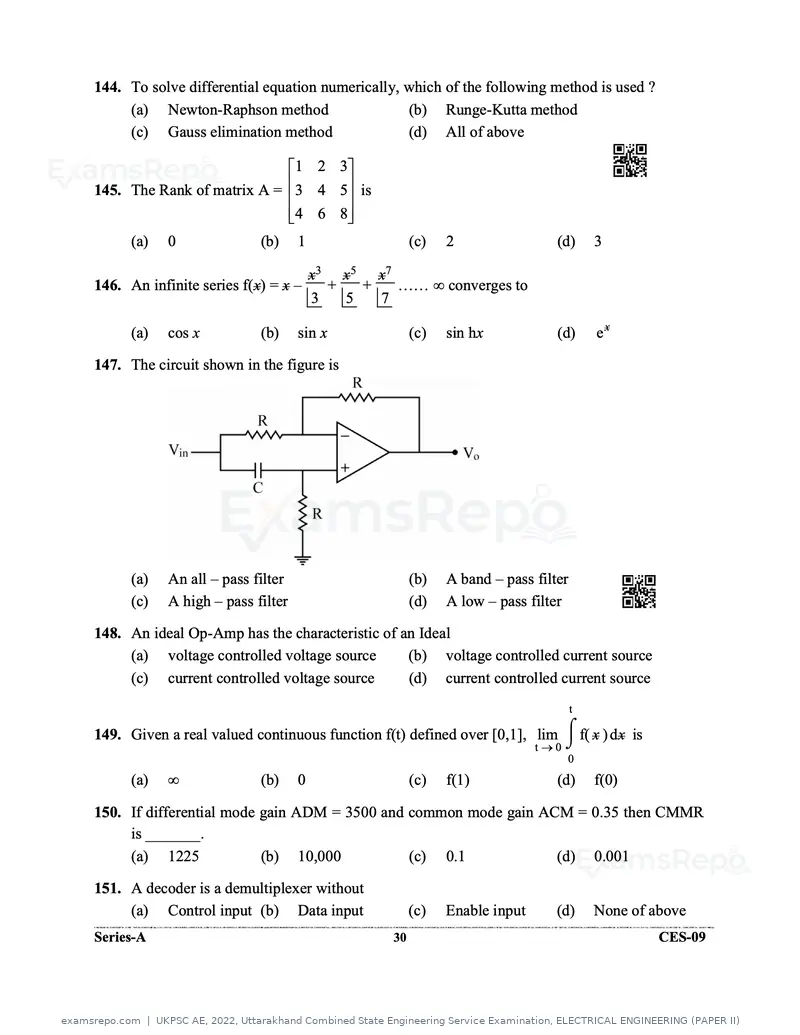
Text of page 30
144. To solve differential equation numerically, which of the following method is used ?
(a) Newton-Raphson method (b) Runge-Kutta method
(c) Gauss elimination method (d) All of above
1 2 3
145. The Rank of matrix A = 3 4 5 is
4 6 8
(a) 0 (b) 1 (c) 2 (d) 3
–x3 –x5 –x7
146. An infinite series f(–x) = –x – + + …… converges to
3 5 7
(a) cos x (b) sin x (c) sin hx (d) ex
147. The circuit shown in the figure is
(a) An all – pass filter (b) A band – pass filter
(c) A high – pass filter (d) A low – pass filter
148. An ideal Op-Amp has the characteristic of an Ideal
(a) voltage controlled voltage source (b) voltage controlled current source
(c) current controlled voltage source (d) current controlled current source
t
.
149. Given a real valued continuous function f(t) defined over [0,1], lim .f( x ) d x is
t 0
0
(a) (b) 0 (c) f(1) (d) f(0)
150. If differential mode gain ADM = 3500 and common mode gain ACM = 0.35 then CMMR
is _______.
(a) 1225 (b) 10,000 (c) 0.1 (d) 0.001
151. A decoder is a demultiplexer without
(a) Control input (b) Data input (c) Enable input (d) None of above
Series-A 30 CES-09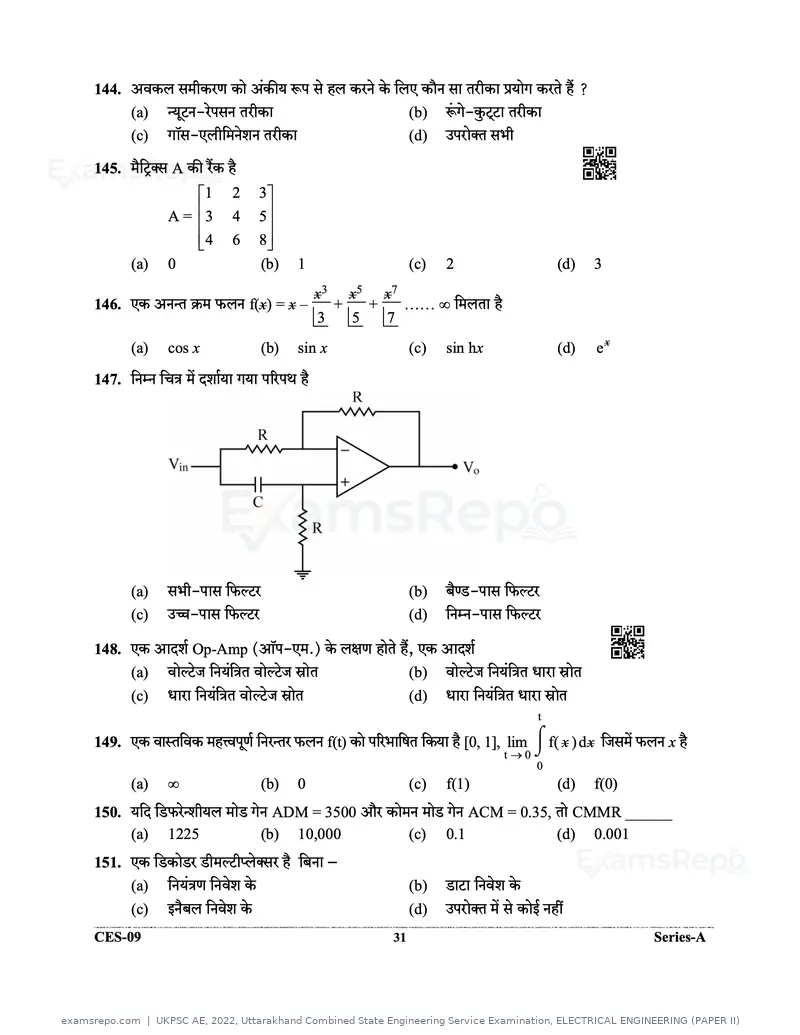
Text of page 31
144. ?
(a) - (b) -
(c) - (d)
145. A
1 2 3
A = 3 4 5
4 6 8
(a) 0 (b) 1 (c) 2 (d) 3
–x3 –x5 –x7
146. f(x–) = –x – + + ……
3 5 7
(a) cos x (b) sin x (c) sin hx (d) ex
147.
(a) - (b) -
(c) - (d) -
148. Op-Amp (-.) ,
(a) (b)
(c) (d)
t
.
149. f(t) [0, 1], lim .f( x ) d x x
t 0
0
(a) (b) 0 (c) f(1) (d) f(0)
150. ADM = 3500 ACM = 0.35, CMMR ______
(a) 1225 (b) 10,000 (c) 0.1 (d) 0.001
151. –
(a) (b)
(c) (d)
CES-09 31 Series-A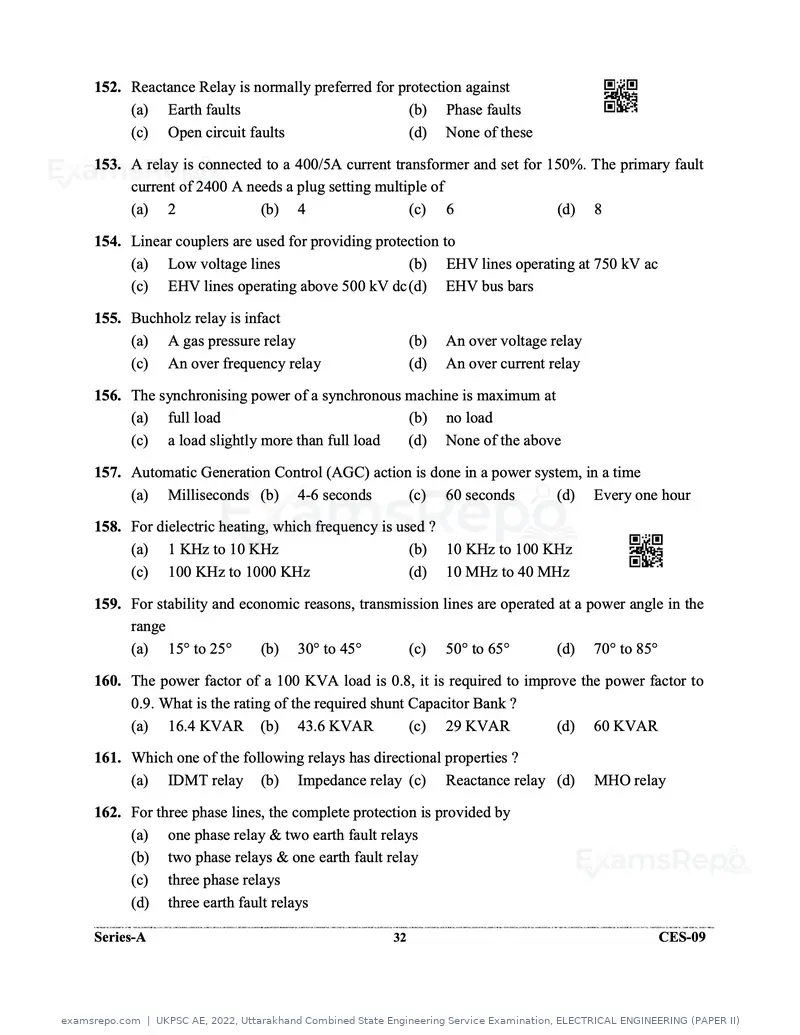
Text of page 32
152. Reactance Relay is normally preferred for protection against
     (a) Earth faults                            (b) Phase faults
     (c) Open circuit faults                     (d) None of these

153. A relay is connected to a 400/5A current transformer and set for 150%. The primary fault
     current of 2400 A needs a plug setting multiple of
     (a) 2               (b) 4                   (c) 6                 (d) 8

154. Linear couplers are used for providing protection to
     (a) Low voltage lines                       (b) EHV lines operating at 750 kV ac
     (c) EHV lines operating above 500 kV dc (d) EHV bus bars

155. Buchholz relay is infact
     (a) A gas pressure relay                       (b)   An over voltage relay
     (c) An over frequency relay                    (d)   An over current relay

156. The synchronising power of a synchronous machine is maximum at
     (a) full load                            (b) no load
     (c) a load slightly more than full load  (d) None of the above

157. Automatic Generation Control (AGC) action is done in a power system, in a time
     (a) Milliseconds (b) 4-6 seconds         (c) 60 seconds         (d) Every one hour

158. For dielectric heating, which frequency is used ?
     (a) 1 KHz to 10 KHz                          (b) 10 KHz to 100 KHz
     (c) 100 KHz to 1000 KHz                      (d) 10 MHz to 40 MHz

159. For stability and economic reasons, transmission lines are operated at a power angle in the
     range
     (a) 15° to 25°       (b) 30° to 45°        (c) 50° to 65°          (d) 70° to 85°

160. The power factor of a 100 KVA load is 0.8, it is required to improve the power factor to
     0.9. What is the rating of the required shunt Capacitor Bank ?
     (a) 16.4 KVAR (b) 43.6 KVAR                   (c) 29 KVAR        (d) 60 KVAR

161. Which one of the following relays has directional properties ?
     (a) IDMT relay (b) Impedance relay (c) Reactance relay (d)                   MHO relay

162. For three phase lines, the complete protection is provided by
     (a) one phase relay & two earth fault relays
     (b) two phase relays & one earth fault relay
     (c) three phase relays
     (d) three earth fault relays

Series-A                                       32                                         CES-09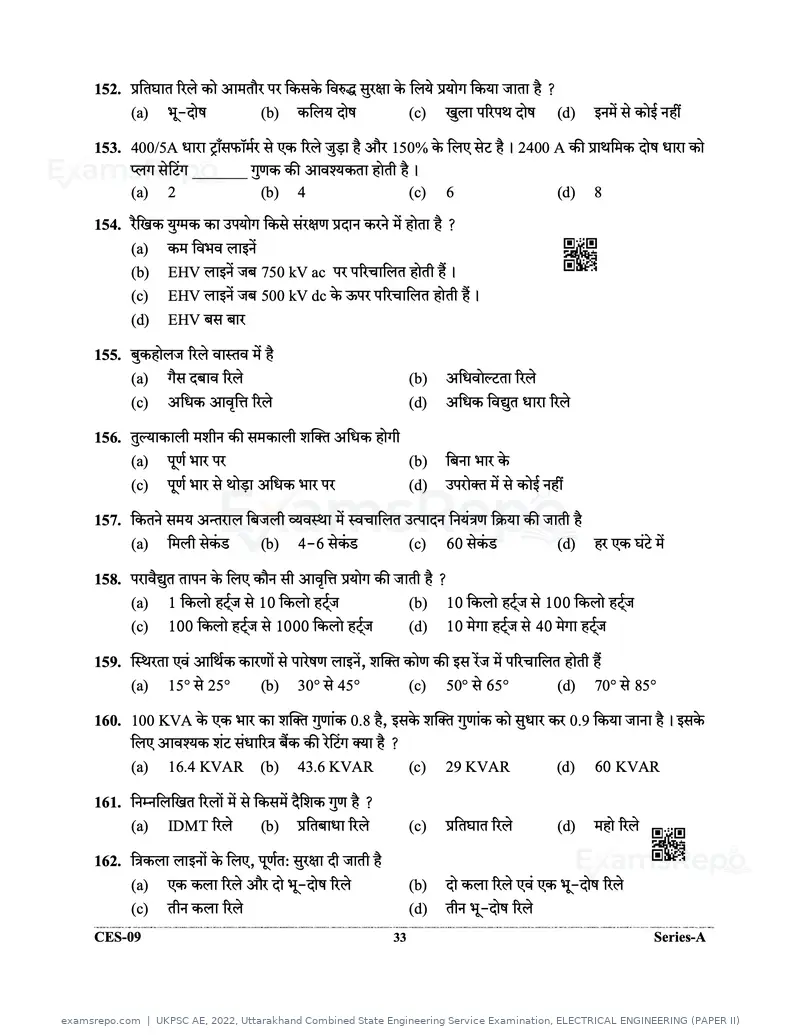
Text of page 33
152. ?
(a) - (b) (c) (d)
153. 400/5A 150% 2400 A
_______
(a) 2 (b) 4 (c) 6 (d) 8
154. ?
(a)
(b) EHV 750 kV ac
(c) EHV 500 kV dc
(d) EHV
155.
(a) (b)
(c) (d)
156.
(a) (b)
(c) (d)
157.
(a) (b) 4-6 (c) 60 (d)
158. ?
(a) 1 10 (b) 10 100
(c) 100 1000 (d) 10 40
159. ,
(a) 15 25 (b) 30 45 (c) 50 65 (d) 70 85
160. 100 KVA 0.8 , 0.9
?
(a) 16.4 KVAR (b) 43.6 KVAR (c) 29 KVAR (d) 60 KVAR
161. ?
(a) IDMT (b) (c) (d)
162. , :
(a) - (b) -
(c) (d) -
CES-09 33 Series-A
Text of page 34
163. Short line fault of 132 kV or above is most effectively cleared by
(a) Vacuum circuit breaker (b) Minimum oil circuit breaker
(c) SF6 circuit breaker (d) Air blast circuit breaker
164. Which one of the following protection is not used for protection of Turbo alternator ?
(a) Over-speed protection (b) Over-flexing protection
(c) Thermal protection (d) Earth fault protection
165. A negative sequence relay is commonly used to protect
(a) An alternator (b) A transformer
(c) A transmission line (d) A busbar
166. Which one of the following does not have an effect on Corona ?
(a) spacing between conductors (b) conductor size
(c) line voltage (d) length of conductor
167. A fuse acts as
(a) fault detector (b) interruptor (c) Both (a) & (b) (d) None of these
168. Basic quantity measured in a distance relay is
(a) Impedance (b) Current difference
(c) Voltage difference (d) None of these
169. Time interval between closure of trip circuit and final arc extinction in circuit breaker is
called
(a) Relay time (b) Fault clearing time
(c) Breaker time (d) Overshoot time
170. The operating time of circuit breaker between instant of receiving trip signal and final
contact separation is
(a) 0.06 – 0.09 sec (b) 0.1 – 0.2 sec
(c) 0.03 – 0.06 sec (d) 0.3 – 0.6 sec
171. The operating time of an impedance relay is a function of
(a) Ratio of time voltage at the relay to fault current.
(b) Ratio of the fault current to the line voltage of the relay.
(c) CT and PT ratios.
(d) Frequency of the fault current.
172. Two transmission lines having surge impedance of 100 ohms are joined by a cable. For no
reflection to occur the surge impedance of the cable should be
(a) 100 /o r (b) 100 o r (c) 50 (d) 100
Series-A 34 CES-09
Text of page 35
163. 132 kV
(a) (b)
(c) SF6 (d)
164. ?
(a) (b)
(c) (d) -
165.
(a) (b)
(c) (d) -
166. (CORONA) ?
(a) (b)
(c) (d)
167.
(a) (b)
(c) (a) (b) (d)
168.
(a) (b) (c) (d)
169. ?
(a) (b)
(c) (d)
170.
?
(a) 0.06 – 0.09 sec (b) 0.1 – 0.2 sec
(c) 0.03 – 0.06 sec (d) 0.3 – 0.6 sec
171.
(a)
(b)
(c) CT PT
(d)
172. 100 ,
(a) 100 /o r (b) 100 o r (c) 50 (d) 100
CES-09 35 Series-A
Text of page 36
173. Series compensation of EHV lines is
     (a) Reduce the fault level
     (b) improve the steady state stability limit
     (c) as a substitute for synchronous pulse modifier
     (d) None of the above

174. The power transmission capability of an EHV AC transmission line is
     (a) directly proportional to the length of the line.
     (b) proportional to the square of the length of the line.
     (c) inversely proportional to the length of the line.
     (d) independent of the length of the line.

175. Which of the following statement is correct ?
     (a) load factor = capacity factor × utilization factor
     (b) utilization factor = capacity factor × load factor
     (c) capacity factor = load factor / utilization factor
     (d) capacity factor = load factor × utilization factor

176. Consider the following tests related to testing of circuit breakers –
     1.   Mechanical test                          2.     Short circuit test
     3.   Dielectric test                          4.     Thermal test
     Out of these routine tests are
     (a) 1, 2 and 3       (b) 2, 3 and 4           (c) 1, 2, 3 and 4         (d)   1, 2 and 4

177. The frequency modulation FM radio frequency range is nearby
     (a) 250 – 300 MHz                        (b) 150 – 200 MHz
     (c) 90 – 105 MHz                         (d) 30 – 70 MHz

178. The fidelity of a receiver relates to variation of the output with the modulating frequency
     when the output load is
     (a) resistive                                 (b) inductive
     (c) capacitive                                (d) a combination of all above
179. High frequency waves follow
     (a) The line of sight direction                  (b)   The ground wave propagation
     (c) The ionosphere propagation                   (d)   The curvilinear propagation
180. The signal contaminated with large noise are demodulated by
     (a) envelop detector
     (b) synchronous detector
     (c) envelope detector followed by low filter
     (d) envelope detector followed by high pass filter

Series-A                                         36                                             CES-09

Text of page 38
Space For Rough Work / Series-A 38 CES-09

Text of page 39
Space For Rough Work / CES-09 39 Series-A

Text of page 40
Space For Rough Work / Series-A 40 CES-09
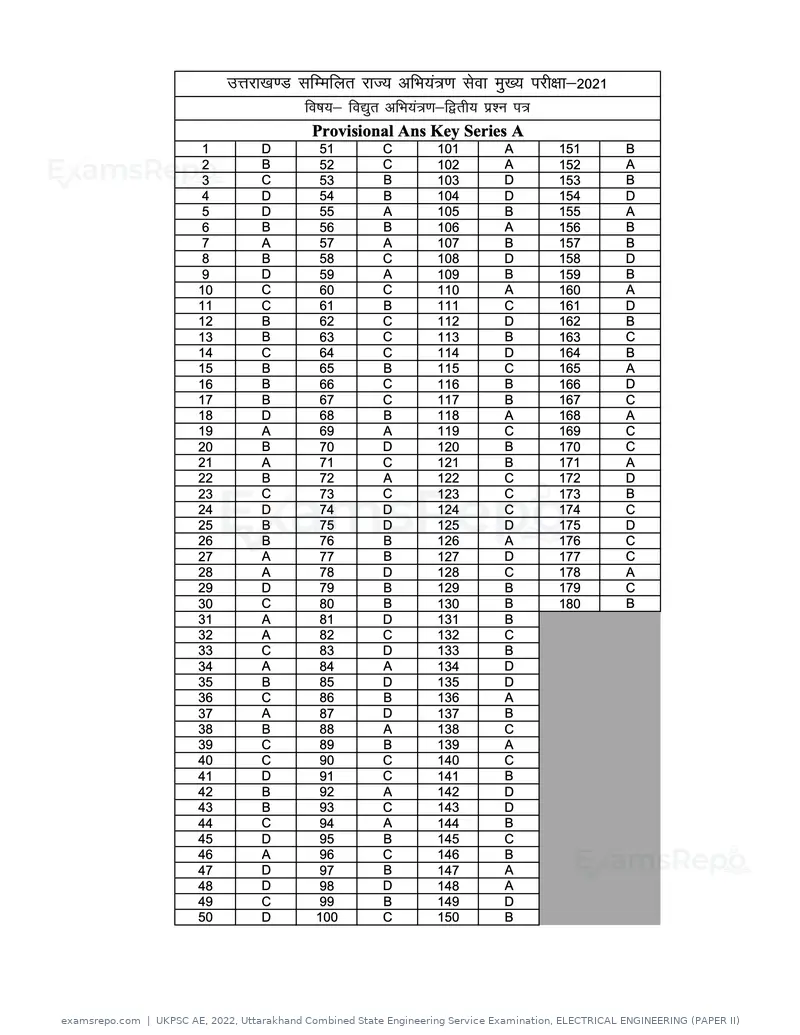
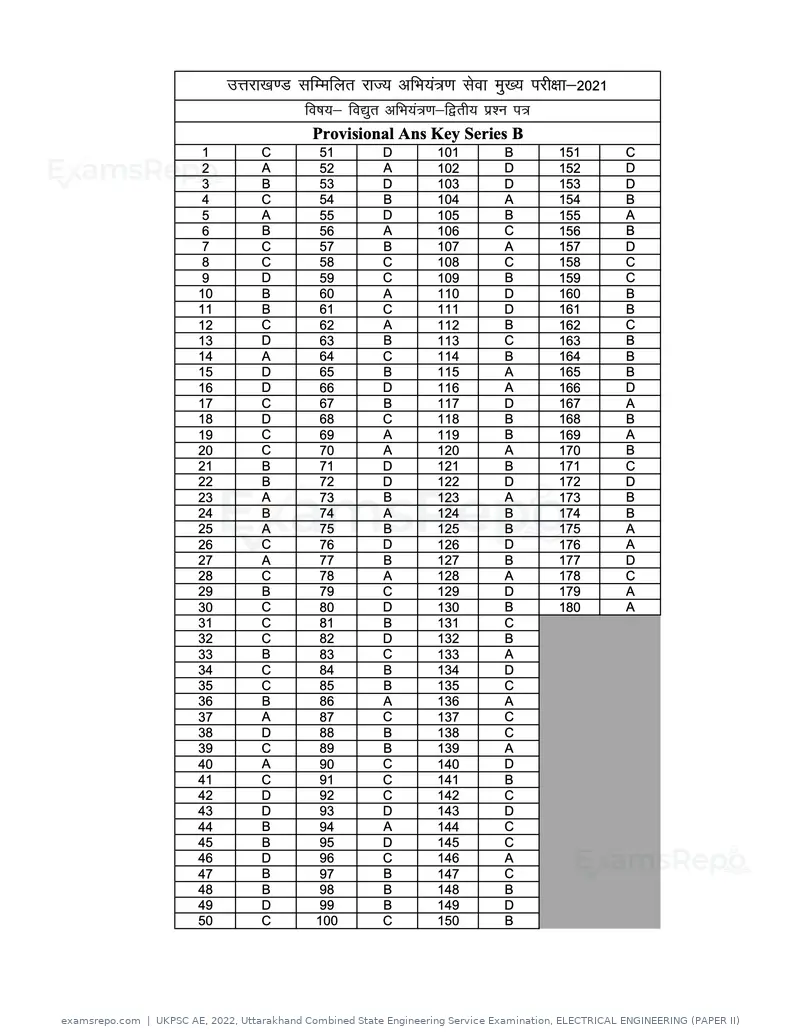
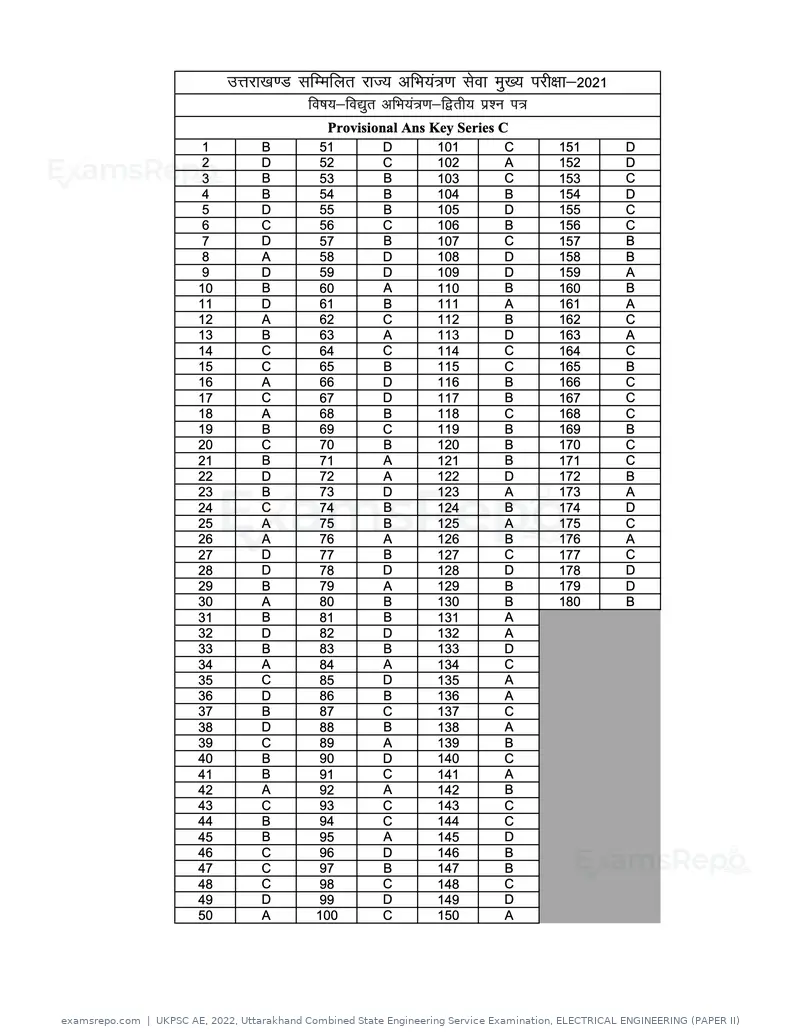
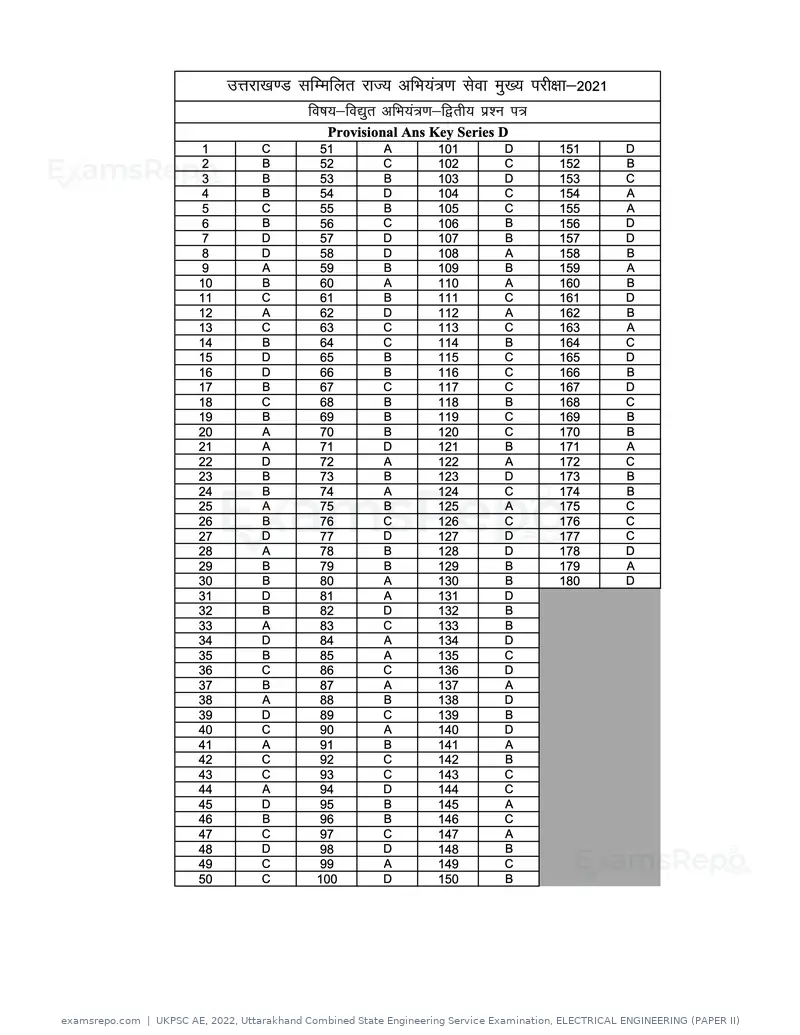
Page 1 of 40
Source: Uttarakhand Public Service Commission. Question paper published by Uttarakhand Public Service Commission.