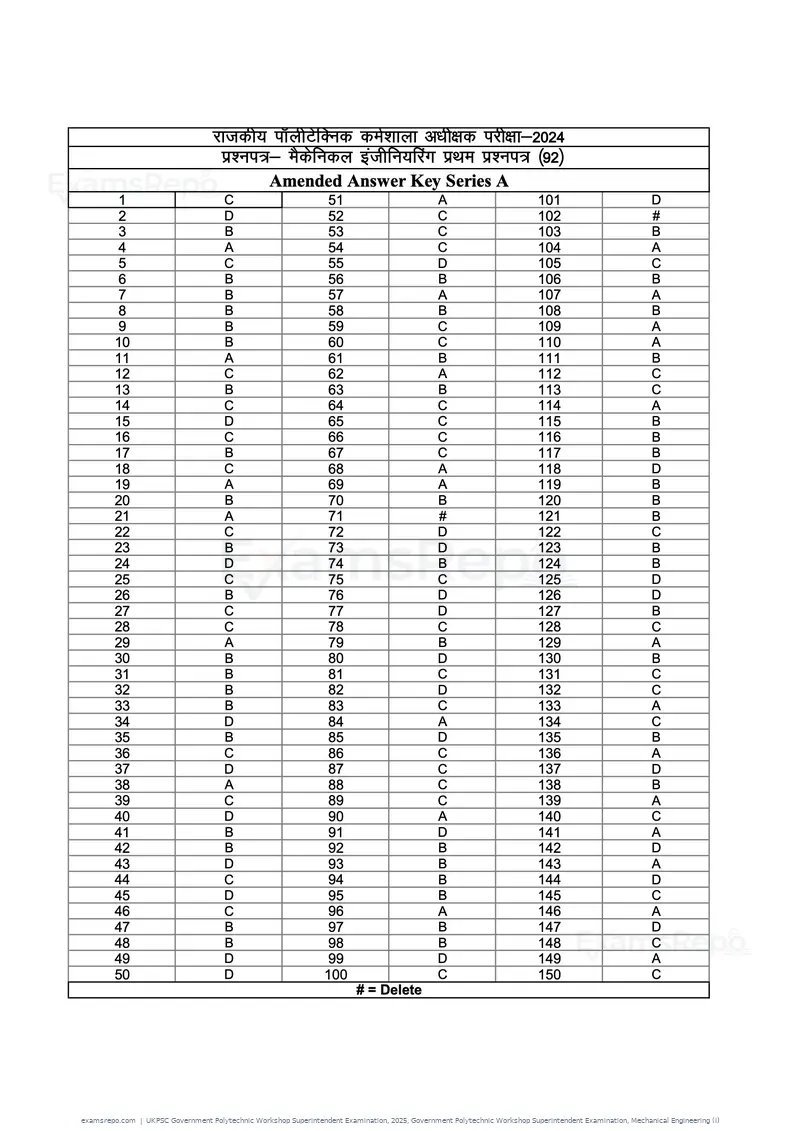
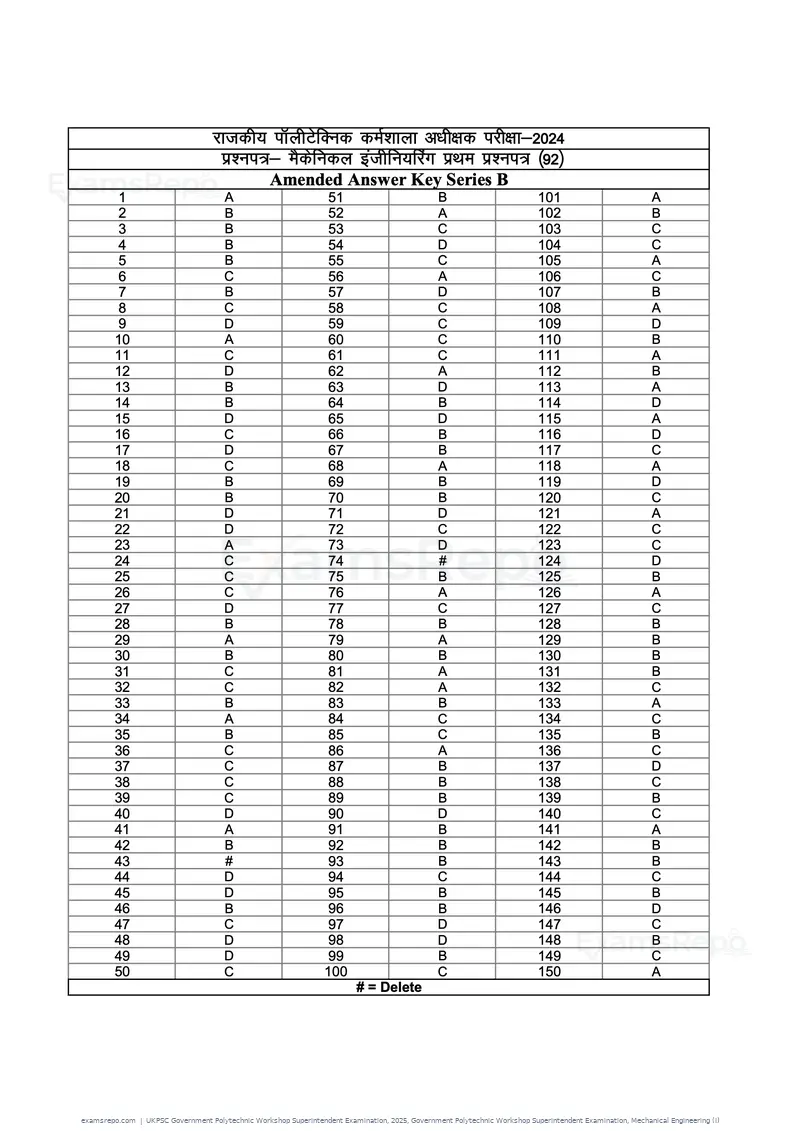
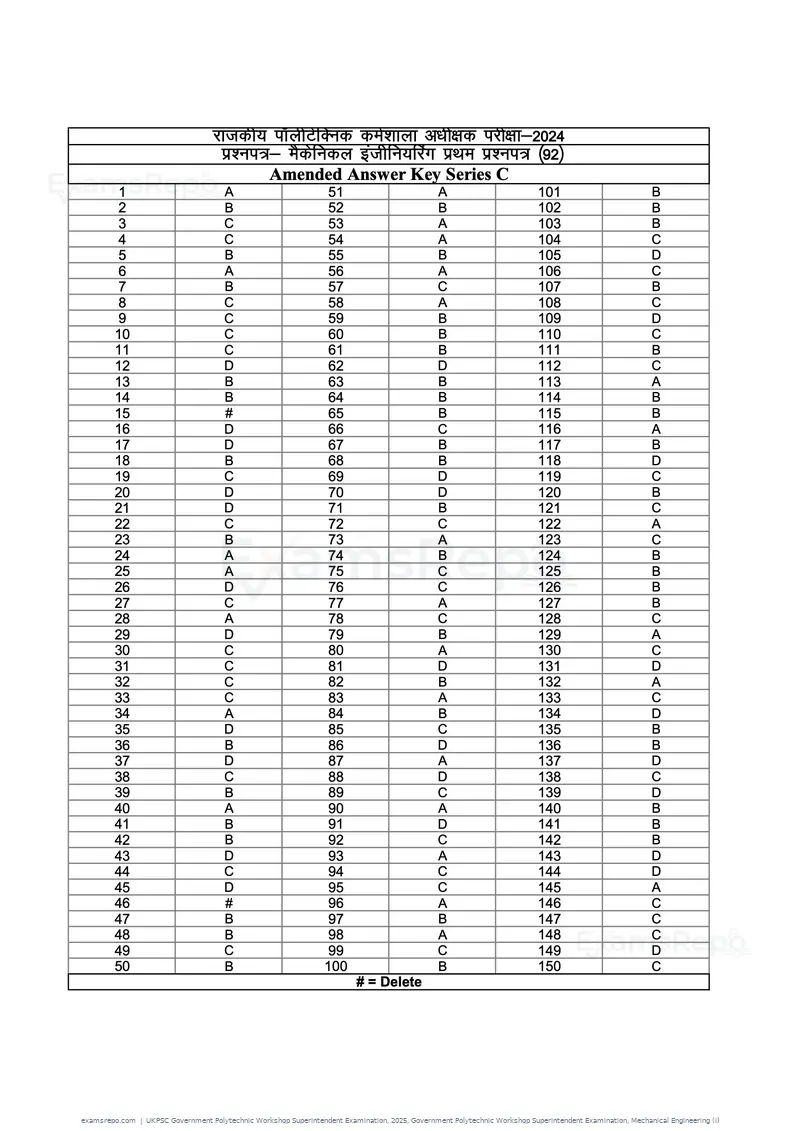
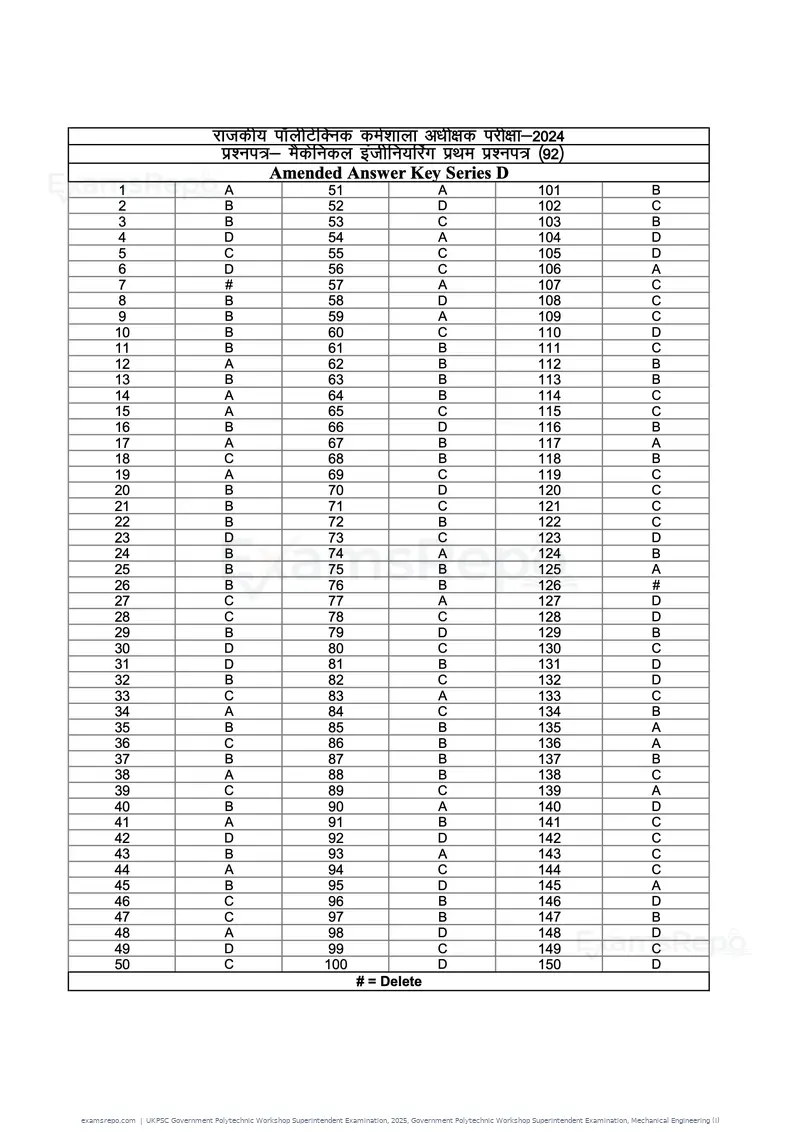
Machine-translated by Google. Questions are authored in English.
Top

UKPSC Government Polytechnic Workshop Superintendent Examination 2025: Mechanical Engineering (I)
  • Language: Bilingual
  • 32 pages
UKPSC Government Polytechnic Workshop Superintendent Examination 2025 question paper, Government Polytechnic Workshop Superintendent Examination, Mechanical Engineering (I), page 1 of 32
Page 1 of 32
UKPSC Government Polytechnic Workshop Superintendent Examination 2025 question paper, Government Polytechnic Workshop Superintendent Examination, Mechanical Engineering (I), page 2 of 32
Page 2 of 32
Text of page 2
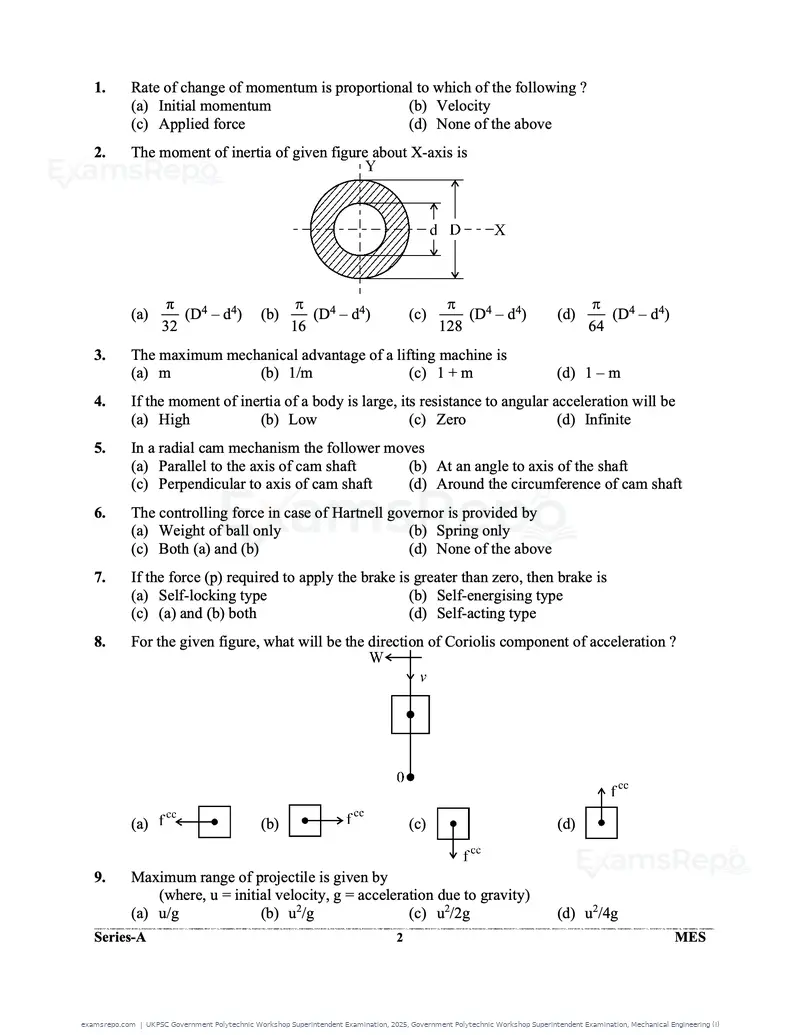
1.   Rate of change of momentum is proportional to which of the following ?
     (a) Initial momentum                     (b) Velocity
     (c) Applied force                        (d) None of the above
2.   The moment of inertia of given figure about X-axis is


                                            MES_Mechanical
                                             MES_MechanicalEngg._(P-I)_Set-A
                                                            Engg._(P-I)_Set-A
            π                                                                                       
     (a)      (D4 – d4)   (b)      (D4 – d4)                     (c)                (D4 – d4)   (d)      (D4 – d4)
           32                   16                                              128                   64


                                            MES_Mechanical Engg._(P-I)_Set-A
                                             MES_Mechanical Engg._(P-I)_Set-A
3.   The maximum mechanical advantage of a lifting machine is
     (a) m           (b) 1/m                  (c) 1 + m                                         (d) 1 – m
4.   If the moment of inertia of a body is large, its resistance to angular acceleration will be
     (a) High            (b) Low                    (c) Zero                 (d) Infinite


                                           MES_Mechanical
                                           MES_MechanicalEngg._(P-I)_Set-A
                                                          Engg._(P-I)_Set-A
5.   In a radial cam mechanism the follower moves
     (a) Parallel to the axis of cam shaft     (b) At an angle to axis of the shaft
     (c) Perpendicular to axis of cam shaft    (d) Around the circumference of cam shaft
6.   The controlling force in case of Hartnell governor is provided by
     (a) Weight of ball only                      (b) Spring only
     (c) Both (a) and (b)                         (d) None of the above
7.   If the force (p) required to apply the brake is greater than zero, then brake is
     (a) Self-locking type                          (b) Self-energising type


                                           MES_Mechanical
                                           MES_MechanicalEngg._(P-I)_Set-A
     (c) (a) and (b) both                           (d) Self-acting type


                                                           Engg._(P-I)_Set-A
8.   For the given figure, what will be the direction of Coriolis component of acceleration ?


                                           MES_Mechanical Engg._(P-I)_Set-A
                                           MES_Mechanical Engg._(P-I)_Set-A


                                           MES_Mechanical
                                           MES_MechanicalEngg._(P-I)_Set-A
                                                           Engg._(P-I)_Set-A
     (a)                  (b)                                    (c)                            (d)


9.   Maximum range of projectile is given by
         (where, u = initial velocity, g = acceleration due to gravity)
     (a) u/g              (b) u2/g                 (c) u2/2g                                    (d) u2/4g
Series-A                                                   2                                                         MES
UKPSC Government Polytechnic Workshop Superintendent Examination 2025 question paper, Government Polytechnic Workshop Superintendent Examination, Mechanical Engineering (I), page 3 of 32
Page 3 of 32
Text of page 3
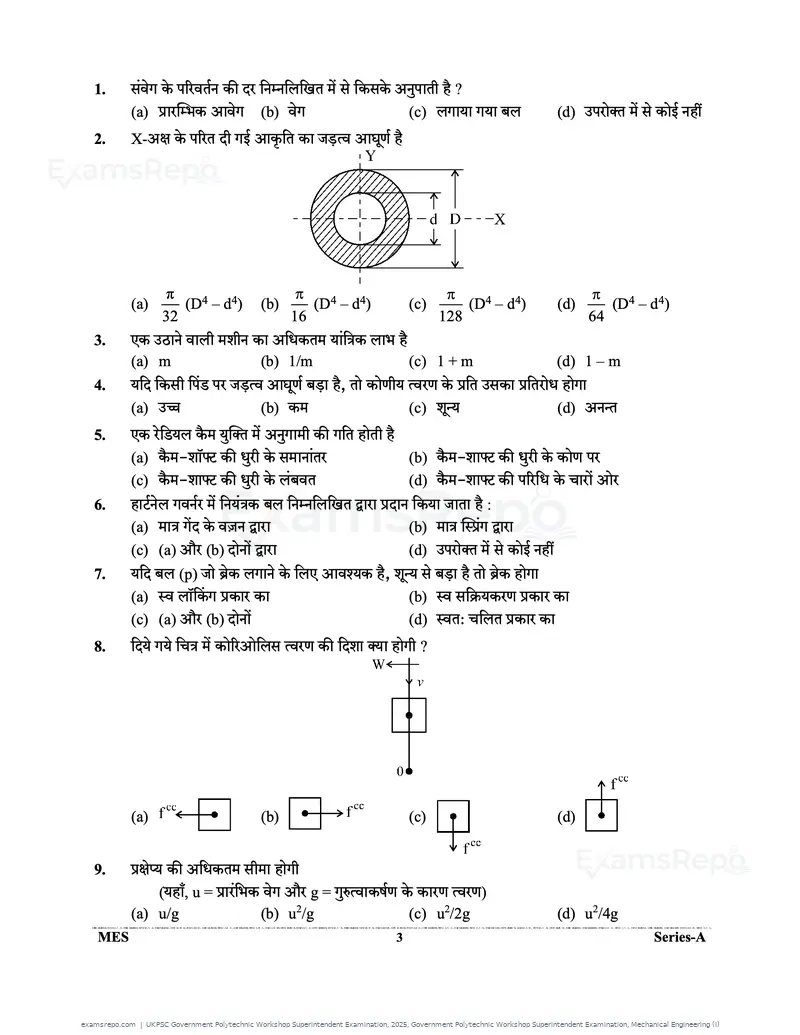
1.               ?
      (a)   (b)                      (c)                                    (d)     
2.    X-         


             π                                   MES_MechanicalEngg._(P-I)_Set-A
                                                 MES_Mechanical  Engg._(P-I)_Set-A                        
      (a)      (D4 – d4)    (b)      (D4 – d4)                       (c)                 (D4 – d4)   (d)      (D4 – d4)
            32                    16                                                 128                   64


                                                  MES_MechanicalEngg._(P-I)_Set-A
                                                 MES_Mechanical  Engg._(P-I)_Set-A
3.            
      (a) m                 (b) 1/m                                 (c) 1 + m                        (d) 1 – m
4.           ,        
      (a)                    (b)                   (c)                     (d) 


                                                MES_MechanicalEngg._(P-I)_Set-A
                                                               Engg._(P-I)_Set-A
               


                                               MES_Mechanical
5.
      (a) -                    (b) -     
      (c) -                        (d) -     
6.               :
      (a)                               (b)   
      (c) (a)  (b)                       (d)     
7.      (p)       ,       


                                                MES_MechanicalEngg._(P-I)_Set-A
                                                               Engg._(P-I)_Set-A
      (a)                               (b)    


                                               MES_Mechanical
      (c) (a)  (b)                           (d) :   
8.              ?


                                                MES_MechanicalEngg._(P-I)_Set-A
                                               MES_Mechanical  Engg._(P-I)_Set-A


                                                MES_MechanicalEngg._(P-I)_Set-A
                                               MES_Mechanical  Engg._(P-I)_Set-A
      (a)                   (b)                                      (c)                             (d)


9.        
           (, u =    g =    )
      (a) u/g               (b) u2/g                                (c) u2/2g                        (d) u2/4g
MES                                                           3                                                        Series-A
UKPSC Government Polytechnic Workshop Superintendent Examination 2025 question paper, Government Polytechnic Workshop Superintendent Examination, Mechanical Engineering (I), page 4 of 32
Page 4 of 32
Text of page 4
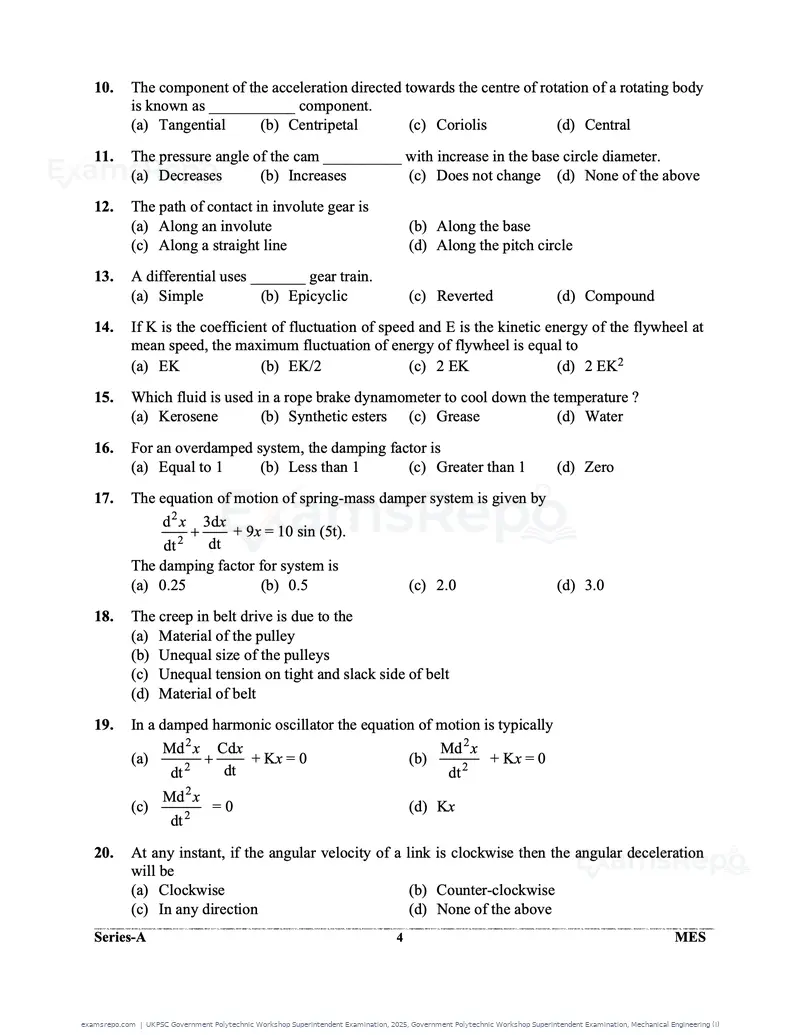
10.   The component of the acceleration directed towards the centre of rotation of a rotating body
      is known as ___________ component.
      (a) Tangential     (b) Centripetal          (c) Coriolis            (d) Central
11.   The pressure angle of the cam __________ with increase in the base circle diameter.
      (a) Decreases       (b) Increases        (c) Does not change (d) None of the above
12.   The path of contact in involute gear is
      (a) Along an involute                                       (b) Along the base


                                             MES_Mechanical
                                              MES_MechanicalEngg._(P-I)_Set-A
      (c) Along a straight line                                   (d) Along the pitch circle


                                                             Engg._(P-I)_Set-A
13.   A differential uses _______ gear train.
      (a) Simple           (b) Epicyclic                          (c) Reverted                       (d) Compound
14.   If K is the coefficient of fluctuation of speed and E is the kinetic energy of the flywheel at


                                             MES_Mechanical Engg._(P-I)_Set-A
      mean speed, the maximum fluctuation of energy of flywheel is equal to


                                              MES_Mechanical Engg._(P-I)_Set-A
      (a) EK                (b) EK/2                (c) 2 EK                 (d) 2 EK2
15.   Which fluid is used in a rope brake dynamometer to cool down the temperature ?
      (a) Kerosene         (b) Synthetic esters (c) Grease              (d) Water


                                            MES_Mechanical
                                            MES_MechanicalEngg._(P-I)_Set-A
                                                           Engg._(P-I)_Set-A
16.   For an overdamped system, the damping factor is
      (a) Equal to 1     (b) Less than 1       (c) Greater than 1                                    (d) Zero
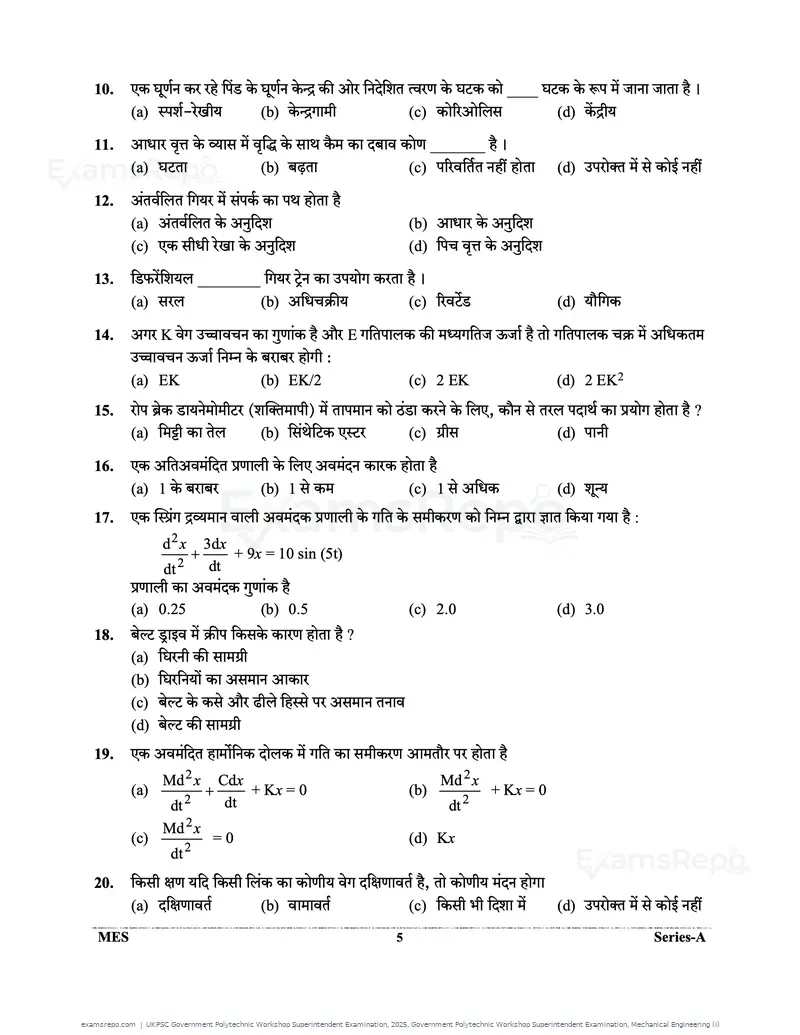
17.   The equation of motion of spring-mass damper system is given by
            d2 x3dx
              2
                    
                    + 9x = 10 sin (5t).
           dt    dt
      The damping factor for system is
      (a) 0.25           (b) 0.5                                  (c) 2.0                            (d) 3.0


                                            MES_Mechanical
                                            MES_MechanicalEngg._(P-I)_Set-A
                                                            Engg._(P-I)_Set-A
18.   The creep in belt drive is due to the
      (a) Material of the pulley
      (b) Unequal size of the pulleys
      (c) Unequal tension on tight and slack side of belt


                                            MES_Mechanical Engg._(P-I)_Set-A
      (d) Material of belt


                                            MES_Mechanical Engg._(P-I)_Set-A
19.   In a damped harmonic oscillator the equation of motion is typically
            Md 2 x          Cdx                                                  Md 2 x
      (a)                      + Kx = 0                          (b)                     + Kx = 0
             dt 2            dt                                                   dt 2


                                            MES_Mechanical
                                            MES_MechanicalEngg._(P-I)_Set-A
            Md 2 x


                                                            Engg._(P-I)_Set-A
      (c)               =0                                        (d) Kx
             dt 2

20.   At any instant, if the angular velocity of a link is clockwise then the angular deceleration
      will be
      (a) Clockwise                                 (b) Counter-clockwise
      (c) In any direction                          (d) None of the above
Series-A                                                    4                                                       MES
UKPSC Government Polytechnic Workshop Superintendent Examination 2025 question paper, Government Polytechnic Workshop Superintendent Examination, Mechanical Engineering (I), page 5 of 32
Page 5 of 32
Text of page 5
10.                  ____        
      (a) -          (b)                (c)         (d) 

11.               _______  
      (a)               (b)                 (c)                                   (d)     

12.          
      (a)                                             (b)   


                                                   MES_MechanicalEngg._(P-I)_Set-A
                                                  MES_Mechanical  Engg._(P-I)_Set-A
      (c)                                           (d)    

13.    ________       
      (a)            (b)                (c)                                               (d) 


                                                   MES_MechanicalEngg._(P-I)_Set-A
                                                                  Engg._(P-I)_Set-A
       K       E          


                                                  MES_Mechanical
14.
            :
      (a) EK                   (b) EK/2                              (c) 2 EK                             (d) 2 EK2
15.      ()       ,         ?


                                                 MES_MechanicalEngg._(P-I)_Set-A
                                                                Engg._(P-I)_Set-A
      (a)            (b)          (c)                    (d) 


                                                MES_Mechanical
16.         
    (a) 1        (b) 1              (c) 1              (d) 
17.                  :
           d2 x       3dx
                         + 9x = 10 sin (5t)
           dt 2        dt
          


                                                 MES_MechanicalEngg._(P-I)_Set-A
                                                MES_Mechanical  Engg._(P-I)_Set-A
      (a) 0.25                 (b) 0.5                               (c) 2.0                              (d) 3.0
18.         ?
    (a)   
    (b)    


                                                 MES_MechanicalEngg._(P-I)_Set-A
                                                MES_Mechanical  Engg._(P-I)_Set-A
    (c)         
    (d)   
19.            
           Md 2 x                                                                     Md 2 x


                                                 MES_MechanicalEngg._(P-I)_Set-A
                                                                Engg._(P-I)_Set-A
                   Cdx


                                                MES_Mechanical
      (a)             + Kx = 0                                      (b)                       + Kx = 0
           dt 2     dt                                                                 dt 2
          Md 2 x
      (c)         =0                                                 (d) Kx
           dt 2
20.            ,    
      (a)        (b)              (c)             (d)     
MES                                                            5                                                            Series-A
UKPSC Government Polytechnic Workshop Superintendent Examination 2025 question paper, Government Polytechnic Workshop Superintendent Examination, Mechanical Engineering (I), page 6 of 32
Page 6 of 32
Text of page 6
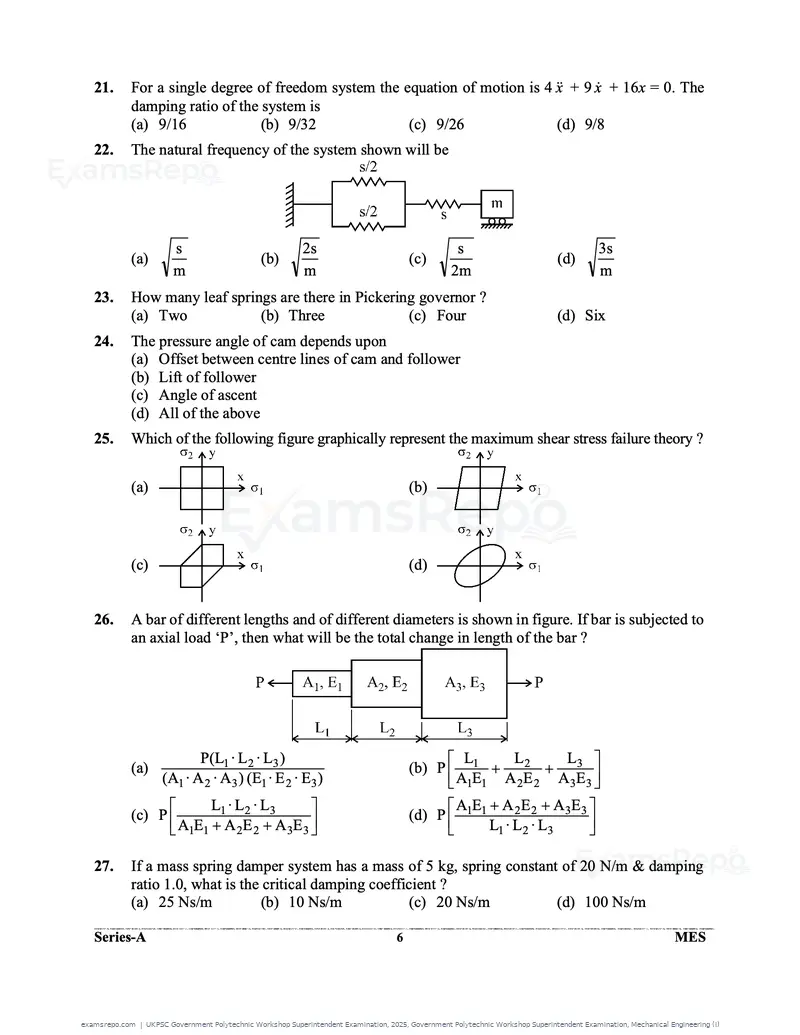
21.   For a single degree of freedom system the equation of motion is 4 x + 9 x + 16x = 0. The
      damping ratio of the system is
      (a) 9/16             (b) 9/32              (c) 9/26                (d) 9/8
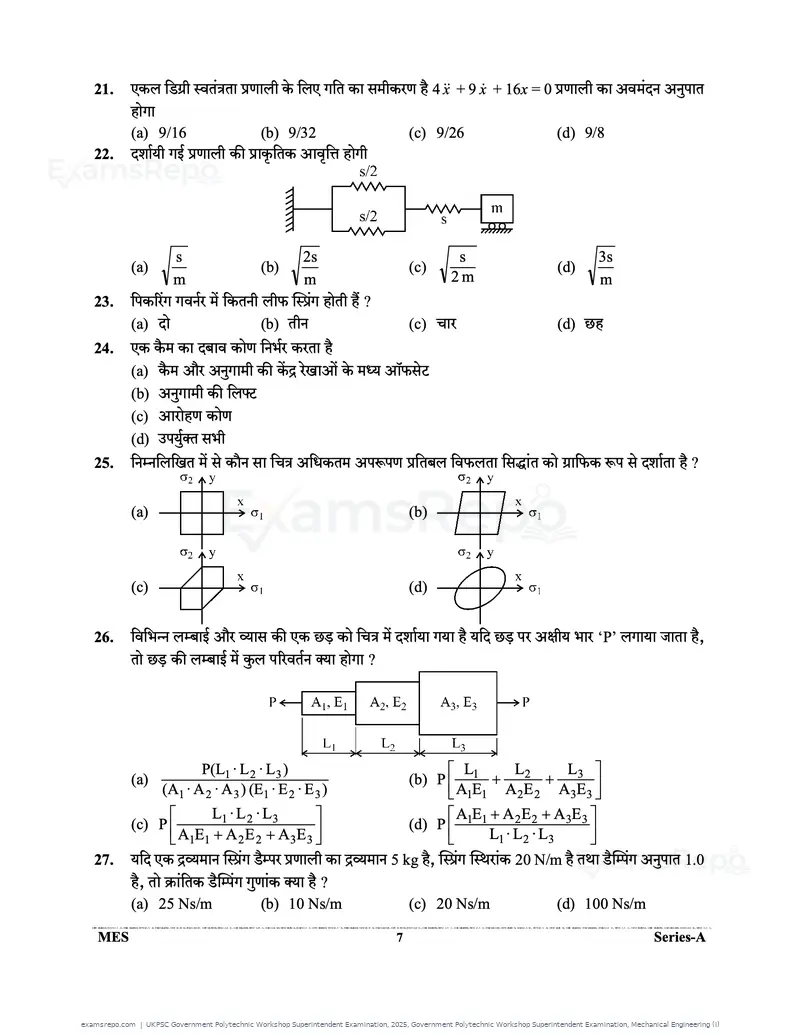
22.   The natural frequency of the system shown will be


                                                 MES_Mechanical
                                                  MES_MechanicalEngg._(P-I)_Set-A
              s                         2s                                            s              3s


                                                                 Engg._(P-I)_Set-A
      (a)                       (b)                                   (c)                     (d)
              m                         m                                            2m              m
23.   How many leaf springs are there in Pickering governor ?
      (a) Two            (b) Three               (c) Four                                     (d) Six


                                                 MES_Mechanical Engg._(P-I)_Set-A
24.   The pressure angle of cam depends upon


                                                  MES_Mechanical Engg._(P-I)_Set-A
      (a) Offset between centre lines of cam and follower
      (b) Lift of follower
      (c) Angle of ascent
      (d) All of the above


                                                MES_Mechanical
                                                MES_MechanicalEngg._(P-I)_Set-A
25.   Which of the following figure graphically represent the maximum shear stress failure theory ?


                                                               Engg._(P-I)_Set-A
      (a)                                                             (b)


      (c)                                                             (d)


                                                MES_Mechanical
                                                MES_MechanicalEngg._(P-I)_Set-A
                                                                Engg._(P-I)_Set-A
26.   A bar of different lengths and of different diameters is shown in figure. If bar is subjected to
      an axial load ‘P’, then what will be the total change in length of the bar ?


                                                MES_Mechanical Engg._(P-I)_Set-A
      (a)
                   P(L1 · L 2 · L3 )            MES_Mechanical Engg._(P-I)_Set-A
                                                                             L
                                                                      (b) P  1 
                                                                                       L2       L 
                                                                                               3 


                                                MES_Mechanical
                                                MES_MechanicalEngg._(P-I)_Set-A
            (A1 · A 2 · A3 ) (E1 · E 2 · E3 )                                A1E1 A 2E 2 A3E 3 


                                                                Engg._(P-I)_Set-A
                 L1 · L 2 · L3                                             A E  A 2 E 2  A 3E 3 
      (c) P                                                         (d) P  1 1                    
              A E
             1 1  A   E
                       2 2    A  E
                                 3 3                                            L1 · L 2 · L3      

27.   If a mass spring damper system has a mass of 5 kg, spring constant of 20 N/m & damping
      ratio 1.0, what is the critical damping coefficient ?
      (a) 25 Ns/m           (b) 10 Ns/m             (c) 20 Ns/m         (d) 100 Ns/m

Series-A                                                        6                                         MES
UKPSC Government Polytechnic Workshop Superintendent Examination 2025 question paper, Government Polytechnic Workshop Superintendent Examination, Mechanical Engineering (I), page 7 of 32
Page 7 of 32
Text of page 7
21.             4 x + 9 x + 16x = 0    
      
      (a) 9/16                  (b) 9/32                               (c) 9/26                   (d) 9/8
22.         


                                                     MES_MechanicalEngg._(P-I)_Set-A
                                                    MES_Mechanical  Engg._(P-I)_Set-A
              s                          2s                                              s               3s
      (a)                       (b)                                     (c)                       (d)
              m                          m                                              2m               m
23.         ?
    (a)                 (b)                  (c)          (d) 


                                                     MES_MechanicalEngg._(P-I)_Set-A
                                                    MES_Mechanical  Engg._(P-I)_Set-A
24.        
    (a)         
    (b)   
    (c)  


                                                   MES_MechanicalEngg._(P-I)_Set-A
                                                  MES_Mechanical  Engg._(P-I)_Set-A
    (d)  
25.                  ?


      (a)                                                               (b)


      (c)                                                               (d)


                                                   MES_MechanicalEngg._(P-I)_Set-A
                                                  MES_Mechanical  Engg._(P-I)_Set-A
26.                     ‘P’   ,
               ?


                                                   MES_MechanicalEngg._(P-I)_Set-A
                                                  MES_Mechanical  Engg._(P-I)_Set-A
                   P(L1 · L 2 · L 3 )                                          L        L2        L 
      (a)                                                               (b) P  1               3 


                                                   MES_MechanicalEngg._(P-I)_Set-A
                                                  MES_Mechanical  Engg._(P-I)_Set-A
            (A1 · A 2 · A 3 ) (E1 · E 2 · E 3 )                                 A E
                                                                               1 1    A   E
                                                                                         2 2      A 3E 3 
                  L1 · L 2 · L3                                              A E  A 2 E 2  A 3E 3 
      (c) P                                                           (d) P  1 1                     
             A1E1  A 2 E 2  A 3E 3                                             L1 · L 2 · L3       
27.           5 kg ,   20 N/m     1.0
      ,       ?
      (a) 25 Ns/m               (b) 10 Ns/m                            (c) 20 Ns/m                (d) 100 Ns/m

MES                                                              7                                               Series-A
UKPSC Government Polytechnic Workshop Superintendent Examination 2025 question paper, Government Polytechnic Workshop Superintendent Examination, Mechanical Engineering (I), page 8 of 32
Page 8 of 32
Text of page 8
28.   A simply supported beam of length ‘l’ is carrying a point load ‘W’ at the centre. Its
      deflection at the centre will be :
            Wl 3                    Wl 3                                          Wl 3             Wl 3
      (a)                     (b)                                  (c)                      (d)
            3EI                     12EI                                          48EI            192EI

29.   The crippling load for a column by Euler’s formula when both ends are hinged is :
          (where l = Actual length and EI = flexure rigidity)
            π 2 EI                  π 2 EI                                        4π 2 EI         2π 2 EI


                                              MES_Mechanical
                                               MES_MechanicalEngg._(P-I)_Set-A
      (a)                     (b)                                  (c)                      (d)
             l2                     4l 2                                            l2              l2


                                                              Engg._(P-I)_Set-A
30.   The relationship between effective length (L e) and actual length (l) when one end of the
      column is fixed and other is free in order to calculate crippling load is :


                                              MES_Mechanical Engg._(P-I)_Set-A
                                                               l                      l
      (a) Le = l          (b) Le = 2l               (c) Le =                 (d) Le =


                                               MES_Mechanical Engg._(P-I)_Set-A
                                                               2                       2

31.   The distortion energy density at a point in a stressed body is expressed as
                1
      (a) U =       [(1 – 2)2 + (2 – 3)2 + (3 – 1)2]


                                             MES_Mechanical
                                             MES_MechanicalEngg._(P-I)_Set-A
               6G


                                                            Engg._(P-I)_Set-A
                 1
      (b) U =        [(1 – 2)2 + (2 – 3)2 + (3 – 1)2]
               12G
                     2
      (c) U =            y
                     3
                   1
      (d) U =        [ – (2 + 3)]
                   E 1

32.   For a material the value of modulus of elasticity and bulk modulus is same, the possible


                                             MES_Mechanical
                                             MES_MechanicalEngg._(P-I)_Set-A
      Poisson’s ratio is


                                                             Engg._(P-I)_Set-A
      (a) 0.11            (b) 0.33              (c) 0.66               (d) 0.13

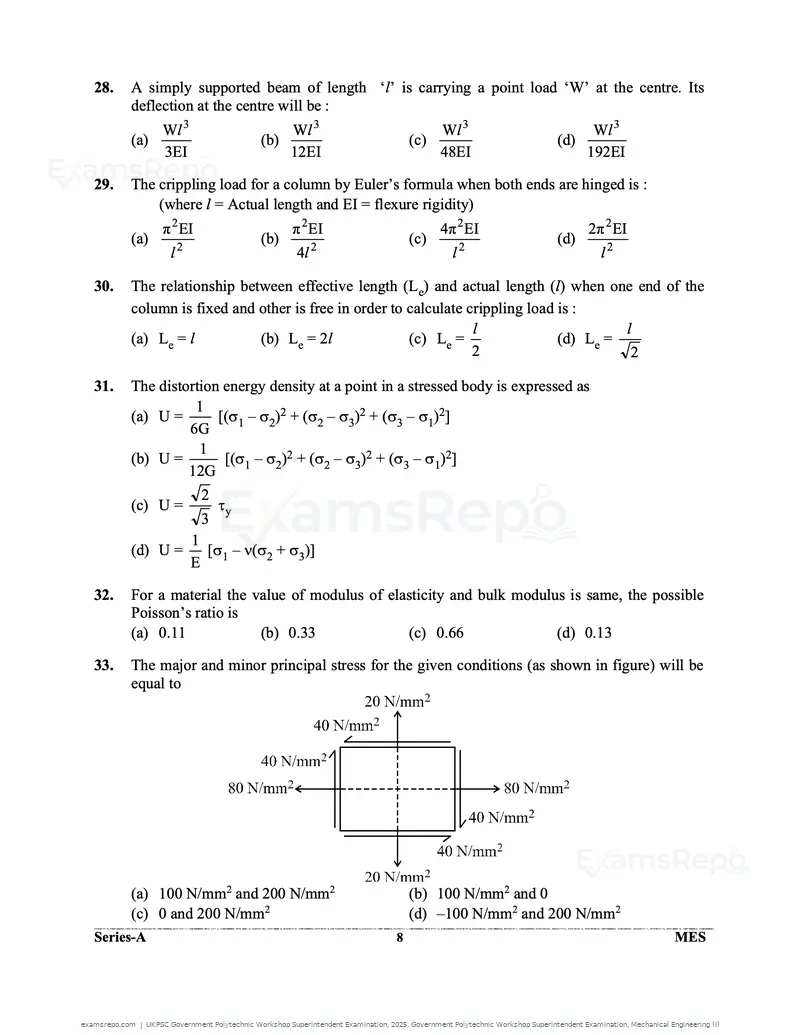
33.   The major and minor principal stress for the given conditions (as shown in figure) will be
      equal to


                                             MES_Mechanical Engg._(P-I)_Set-A
                                             MES_Mechanical Engg._(P-I)_Set-A


                                             MES_Mechanical
                                             MES_MechanicalEngg._(P-I)_Set-A
                                                             Engg._(P-I)_Set-A

      (a) 100 N/mm2 and 200 N/mm2                                  (b) 100 N/mm2 and 0
      (c) 0 and 200 N/mm2                                          (d) –100 N/mm2 and 200 N/mm2
Series-A                                                     8                                              MES
UKPSC Government Polytechnic Workshop Superintendent Examination 2025 question paper, Government Polytechnic Workshop Superintendent Examination, Mechanical Engineering (I), page 9 of 32
Page 9 of 32
Text of page 9
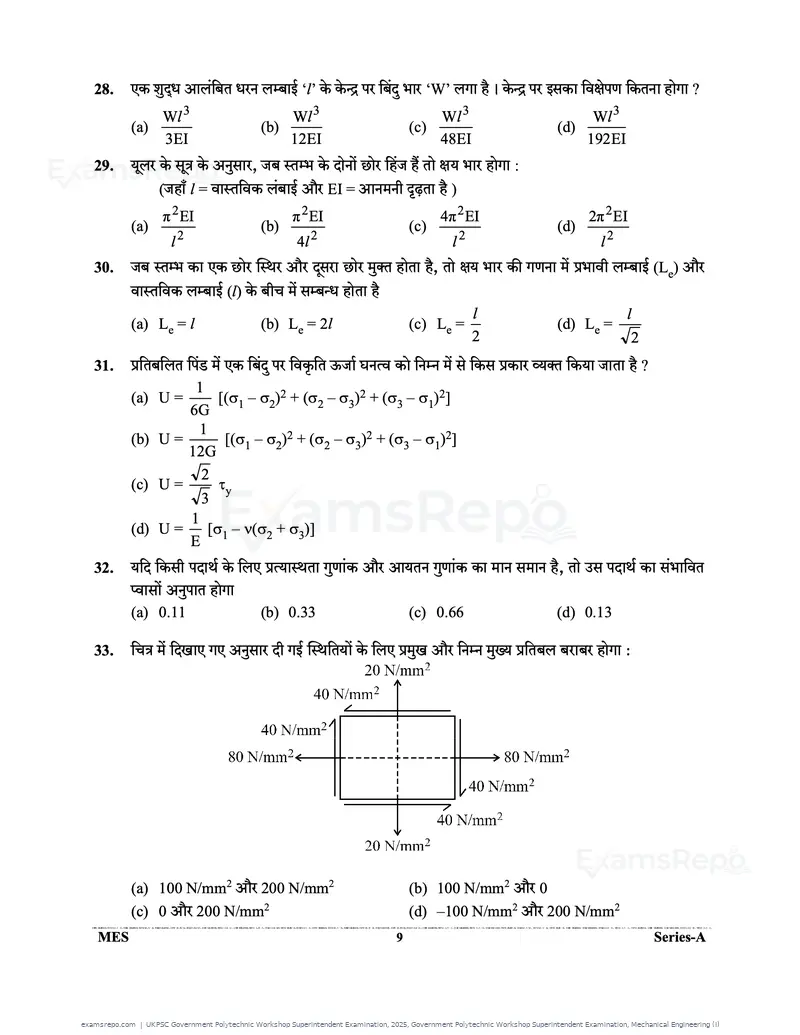
28.        ‘l’      ‘W’          ?
          Wl 3                    Wl 3                                     Wl 3                        Wl 3
      (a)                     (b)                                      (c)                        (d)
          3EI                     12EI                                     48EI                       192EI
29.       ,            :
           ( l =    EI =    )
            π 2 EI                  π 2 EI                                             4π 2 EI          2π 2 EI
      (a)                     (b)                                      (c)                        (d)


                                                    MES_MechanicalEngg._(P-I)_Set-A
                                                   MES_Mechanical  Engg._(P-I)_Set-A
             l2                     4l 2                                                 l2               l2
30.              ,         (Le) 
        (l)      
                                                                                              l                l
      (a) Le = l              (b) Le = 2l                              (c) Le =                   (d) Le =


                                                    MES_MechanicalEngg._(P-I)_Set-A
                                                   MES_Mechanical  Engg._(P-I)_Set-A
                                                                                              2                   2
31.                      ?
               1
      (a) U =       [(1 – 2)2 + (2 – 3)2 + (3 – 1)2]
              6G


                                                  MES_MechanicalEngg._(P-I)_Set-A
                                                                 Engg._(P-I)_Set-A
                1


                                                 MES_Mechanical
      (b) U =        [(1 – 2)2 + (2 – 3)2 + (3 – 1)2]
              12G
                2
      (c) U =       y
                3
              1
      (d) U =     [ – (2 + 3)]
              E 1
32.                ,     
        


                                                  MES_MechanicalEngg._(P-I)_Set-A
                                                 MES_Mechanical  Engg._(P-I)_Set-A
      (a) 0.11                (b) 0.33                                (c) 0.66                    (d) 0.13

33.                    :


                                                  MES_MechanicalEngg._(P-I)_Set-A
                                                 MES_Mechanical  Engg._(P-I)_Set-A


                                                  MES_MechanicalEngg._(P-I)_Set-A
                                                 MES_Mechanical  Engg._(P-I)_Set-A

      (a) 100 N/mm2  200 N/mm2                                     (b) 100 N/mm2  0
      (c) 0  200 N/mm2                                             (d) –100 N/mm2  200 N/mm2
MES                                                             9                                                     Series-A
UKPSC Government Polytechnic Workshop Superintendent Examination 2025 question paper, Government Polytechnic Workshop Superintendent Examination, Mechanical Engineering (I), page 10 of 32
Page 10 of 32
Text of page 10
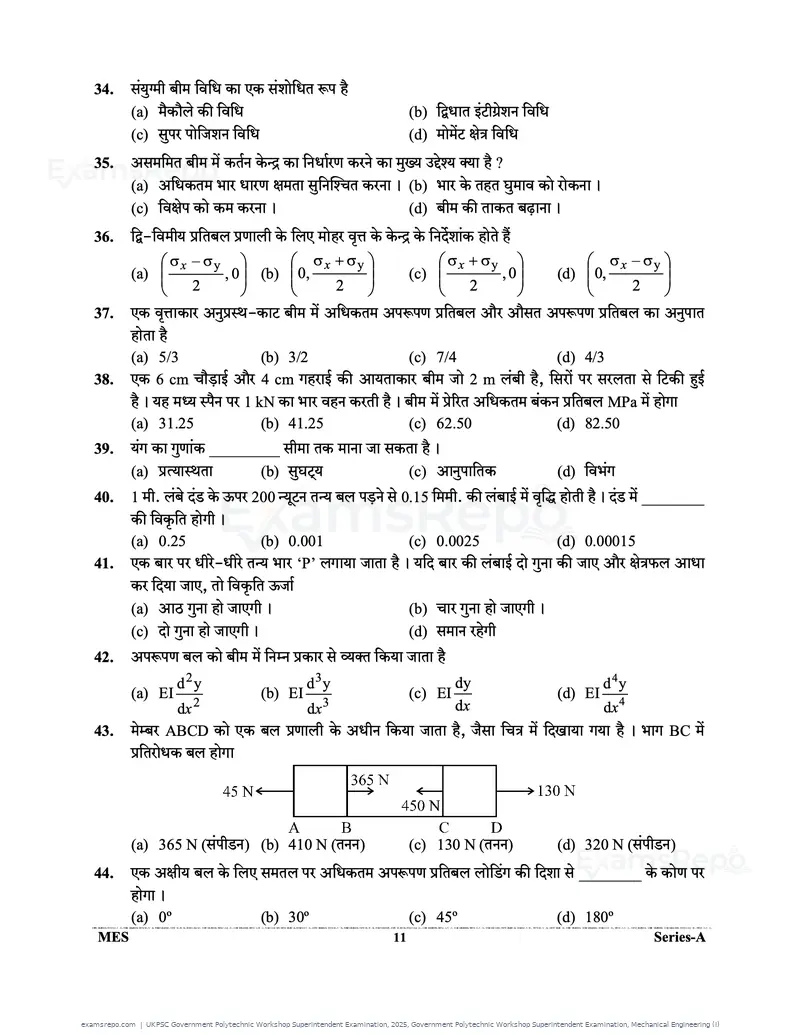
34.   Conjugate beam method is a modified form of
      (a) Macaulay’s method                    (b) Doubled integration method
      (c) Superposition method                 (d) Moment area method
35.   What is the primary purpose of determining the shear centre in unsymmetrical beams ?
      (a) To ensure maximum load bearing capacity
      (b) To prevent twisting under loads
      (c) To minimize deflection
      (d) To increase beam strength


                                            MES_Mechanical
                                             MES_MechanicalEngg._(P-I)_Set-A
36.   For a two dimensional stress system the coordinates of the centre of Mohr’s circle are


                                                            Engg._(P-I)_Set-A
            x – y            x  y             x  y                x – y 
      (a)         , 0  (b)  0,       
                                                (c)           , 0    (d)  0,        
                                                                                           
               2                   2                  2                        2    
37.   The ratio of maximum shear stress to the average shear stress in a circular cross-section


                                            MES_Mechanical Engg._(P-I)_Set-A
      beam is


                                             MES_Mechanical Engg._(P-I)_Set-A
      (a) 5/3           (b) 3/2                 (c) 7/4                (d) 4/3
38.   A rectangular beam of width 6 cm and depth 4 cm is 2 m long and is simply supported at the
      ends. It carries a load of 1 kN at mid-span. The maximum bending stress induced in the
      beam in MPa is


                                           MES_Mechanical
                                           MES_MechanicalEngg._(P-I)_Set-A
      (a) 31.25             (b) 41.25            (c) 62.50               (d) 82.50


                                                          Engg._(P-I)_Set-A
39.   Young’s modulus is defined up to _________ limit.
      (a) Elastic        (b) Plastic           (c) Proportional                      (d) Fracture
40.   A bar of length 1 m extends by 0.15 mm under a tensile force of 200 N. The strain produced
      in the bar is ________.
      (a) 0.25             (b) 0.001            (c) 0.0025               (d) 0.00015
41.   A bar is subjected to gradually applied tensile load ‘P’. If the length of the bar is doubled
      and area is halved, the strain energy will :


                                           MES_Mechanical
                                           MES_MechanicalEngg._(P-I)_Set-A
      (a) Become eight times                       (b) Become four times


                                                           Engg._(P-I)_Set-A
      (c) Become double                            (d) Remain the same
42.   Shear force in a beam is expressed as
             d2y                  d3y                                           dy            d4y
      (a) EI 2            (b) EI 3                               (c) EI              (d) EI


                                           MES_Mechanical Engg._(P-I)_Set-A
             dx                   dx                                            dx            dx 4


                                           MES_Mechanical Engg._(P-I)_Set-A
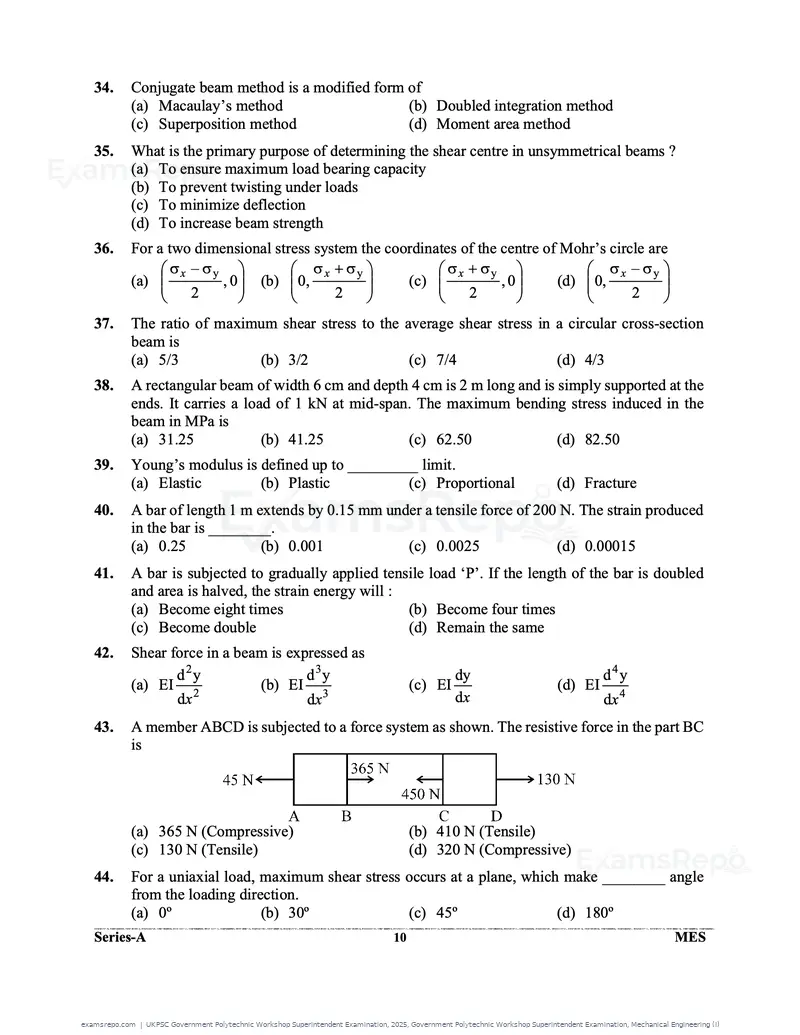
43.   A member ABCD is subjected to a force system as shown. The resistive force in the part BC
      is


                                           MES_Mechanical
                                           MES_MechanicalEngg._(P-I)_Set-A
                                                           Engg._(P-I)_Set-A
      (a) 365 N (Compressive)                                    (b) 410 N (Tensile)
      (c) 130 N (Tensile)                                        (d) 320 N (Compressive)
44.   For a uniaxial load, maximum shear stress occurs at a plane, which make ________ angle
      from the loading direction.
      (a) 0º               (b) 30º              (c) 45º                 (d) 180º
Series-A                                                  10                                         MES
UKPSC Government Polytechnic Workshop Superintendent Examination 2025 question paper, Government Polytechnic Workshop Superintendent Examination, Mechanical Engineering (I), page 11 of 32
Page 11 of 32
Text of page 11
34.        
    (a)                             (b)   
    (c)                           (d)   
35.              ?
    (a)        (b)       
    (c)                           (d)     


                                                  MES_MechanicalEngg._(P-I)_Set-A
                                                 MES_Mechanical  Engg._(P-I)_Set-A
36. -            
            x – y             x  y                                x  y               x – y 
      (a)         , 0  (b)  0,       
                                                                    (c)         , 0    (d)  0,       
                                                                                                            
               2                   2                                      2                     2    
37.     -           


                                                  MES_MechanicalEngg._(P-I)_Set-A
                                                                 Engg._(P-I)_Set-A
       


                                                 MES_Mechanical
      (a) 5/3                (b) 3/2                (c) 7/4                 (d) 4/3
38.    6 cm   4 cm      2 m  ,      
            1 kN             MPa  
      (a) 31.25              (b) 41.25              (c) 62.50               (d) 82.50


                                                MES_MechanicalEngg._(P-I)_Set-A
                                               MES_Mechanical  Engg._(P-I)_Set-A
39.    _________       
    (a)            (b)                 (c)               (d) 
40. 1 .     200      0.15 .          ________
       
      (a) 0.25              (b) 0.001                (c) 0.0025                  (d) 0.00015
41.      -   ‘P’               
      ,   


                                                MES_MechanicalEngg._(P-I)_Set-A
                                               MES_Mechanical  Engg._(P-I)_Set-A
    (a)                        (b)     
    (c)                        (d)  
42.            
               d2y                   d3y                                             dy              d4y


                                                MES_MechanicalEngg._(P-I)_Set-A
                                               MES_Mechanical  Engg._(P-I)_Set-A
      (a) EI                (b) EI                                   (c) EI                 (d) EI
             dx 2             dx 3                                          dx 4     dx
43.    ABCD         ,         BC 
        


      (a) 365 N () (b) 410 N ()        MES_MechanicalEngg._(P-I)_Set-A
                                               MES_Mechanical  Engg._(P-I)_Set-A
                                                                     (c) 130 N ()        (d) 320 N ()
44.                 ________   
       
      (a) 0º                (b) 30º                                 (c) 45º                 (d) 180º
MES                                                         11                                             Series-A
UKPSC Government Polytechnic Workshop Superintendent Examination 2025 question paper, Government Polytechnic Workshop Superintendent Examination, Mechanical Engineering (I), page 12 of 32
Page 12 of 32
Text of page 12
45.   Which of the following mechanical test provide a relationship between stress amplitude and
      No. of cycles ?
      (a) Tensile test                           (b) Creep test
      (c) Fracture toughness test                (d) Fatigue test
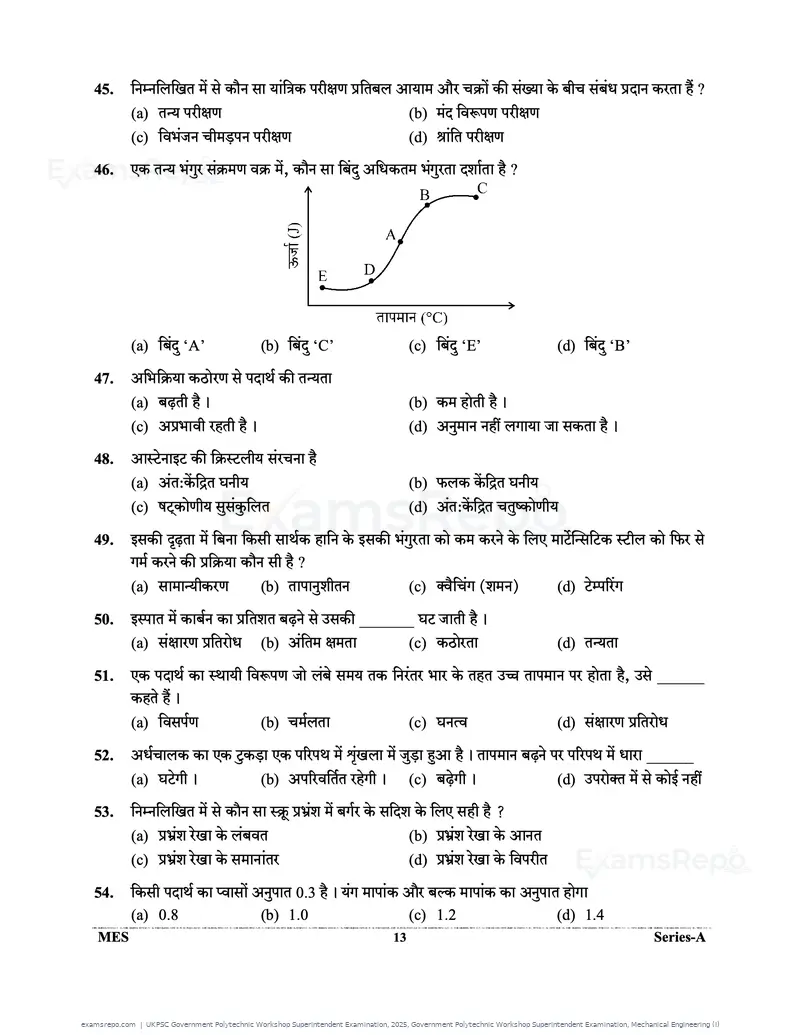
46.   In a ductile to brittle transition curve, which point shows maximum brittleness ?


                                               MES_Mechanical
                                                MES_MechanicalEngg._(P-I)_Set-A
                                                               Engg._(P-I)_Set-A


                                               MES_Mechanical Engg._(P-I)_Set-A
      (a) Point ‘A’        (b) Point ‘C’                            (c) Point ‘E’         (d) Point ‘B’


                                                MES_Mechanical Engg._(P-I)_Set-A
47.   The ductility of a material with work hardening
      (a) Increases                               (b) Decreases
      (c) Remains unaffected                      (d) Cannot predict


                                              MES_Mechanical
                                              MES_MechanicalEngg._(P-I)_Set-A
48.   The crystal structure of Austenite is


                                                             Engg._(P-I)_Set-A
      (a) Body centered cubic                                       (b) Face centered cubic
      (c) Hexagonal closed packed                                   (d) Body centered tetragonal
49.   The process of reheating the martensite steel to reduce its brittleness without any significant
      loss in its hardness is
      (a) Normalising        (b) Annealing         (c) Quenching             (d) Tempering
50.   As the percentage of carbon increases in steel, its _________ decreases.


                                              MES_Mechanical
                                              MES_MechanicalEngg._(P-I)_Set-A
      (a) Corrosion resistance                    (b) Ultimate strength


                                                              Engg._(P-I)_Set-A
      (c) Hardness                                (d) Ductility
51.   The permanent deformation of a material that occurs at high temperature under constant
      loading over a long period of time is called


                                              MES_Mechanical Engg._(P-I)_Set-A
      (a) Creep                                    (b) Toughness


                                              MES_Mechanical Engg._(P-I)_Set-A
      (c) Density                                  (d) Corrosion resistance
52.   A piece of semiconductor is connected in series in a circuit. On increasing the temperature,
      the current in the circuit will __________.
      (a) Decrease                                (b) Remain unchanged


                                              MES_Mechanical
                                              MES_MechanicalEngg._(P-I)_Set-A
      (c) Increase                                (d) None of the above


                                                              Engg._(P-I)_Set-A
53.   Which one of the following is correct for Burger’s vector in screw dislocation ?
      (a) Perpendicular to the dislocation line   (b) Inclined to the dislocation line
      (c) Parallel to the dislocation line        (d) Opposite to the dislocation line
54.   Poisson’s ratio of material is 0.3. The ratio of Young’s modulus to bulk modulus is
      (a) 0.8              (b) 1.0                   (c) 1.2               (d) 1.4
Series-A                                                     12                                           MES
UKPSC Government Polytechnic Workshop Superintendent Examination 2025 question paper, Government Polytechnic Workshop Superintendent Examination, Mechanical Engineering (I), page 13 of 32
Page 13 of 32
Text of page 13
45.                      ?
      (a)                                 (b)   
      (c)                        (d)  

46.        ,        ?


                                                 MES_MechanicalEngg._(P-I)_Set-A
                                                MES_Mechanical  Engg._(P-I)_Set-A


                                                 MES_MechanicalEngg._(P-I)_Set-A
                                                MES_Mechanical  Engg._(P-I)_Set-A
      (a)  ‘A’         (b)  ‘C’                           (c)  ‘E’          (d)  ‘B’

47.        
      (a)                                                    (b)    
      (c)                                              (d)       


                                               MES_MechanicalEngg._(P-I)_Set-A
                                              MES_Mechanical  Engg._(P-I)_Set-A
48.       
      (a) :                                             (b)   
      (c)                                        (d) : 

49.                      
             ?
      (a)         (b)          (c)  ()        (d) 


                                               MES_MechanicalEngg._(P-I)_Set-A
                                              MES_Mechanical  Engg._(P-I)_Set-A
50.           _______    
      (a)   (b)            (c)                                (d) 

51.                    ,  ______


                                               MES_MechanicalEngg._(P-I)_Set-A
                                              MES_Mechanical  Engg._(P-I)_Set-A
        
      (a)           (b)              (c)                (d)  

52.                      ______
      (a)         (b)    (c)                     (d)     


                                               MES_MechanicalEngg._(P-I)_Set-A
                                              MES_Mechanical  Engg._(P-I)_Set-A
53.                  ?
      (a)                              (b)    
      (c)                           (d)    

54.        0.3          
      (a) 0.8               (b) 1.0                                (c) 1.2                 (d) 1.4
MES                                                        13                                              Series-A
UKPSC Government Polytechnic Workshop Superintendent Examination 2025 question paper, Government Polytechnic Workshop Superintendent Examination, Mechanical Engineering (I), page 14 of 32
Page 14 of 32
Text of page 14
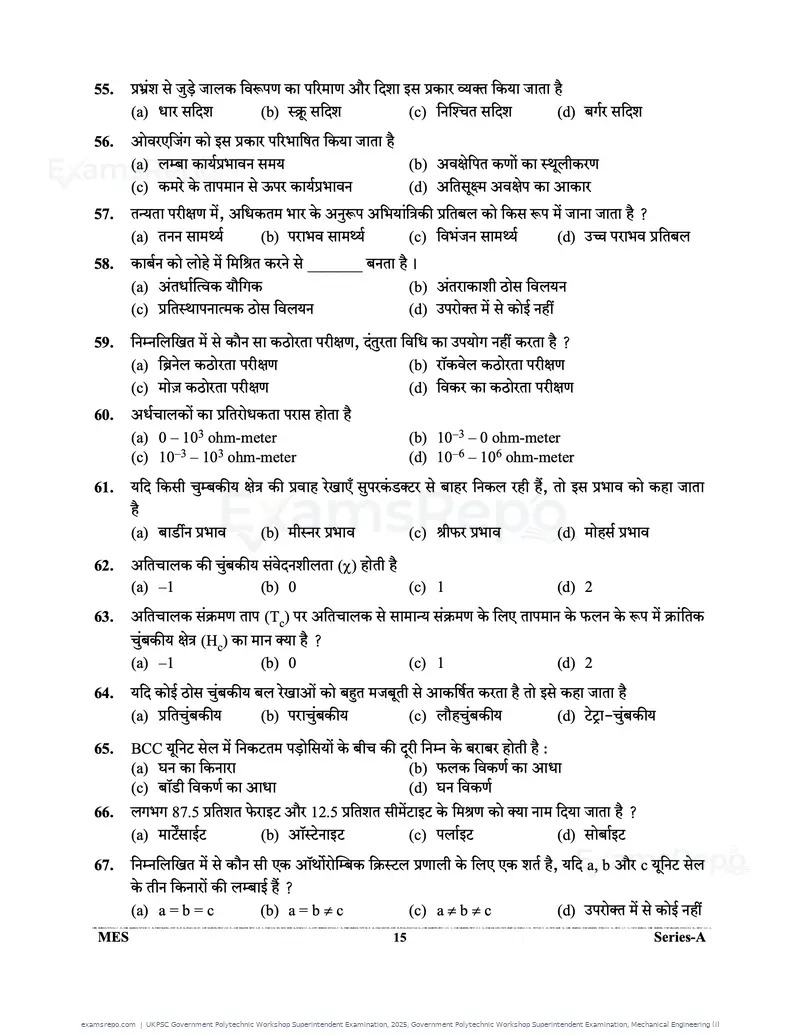
55.   The magnitude and direction of the lattice distortion associated with a dislocation is
      expressed as
      (a) Edge vector  (b) Screw vector        (c) Fixed vector       (d) Burger vector
56.   Overaging is defined as
      (a) Long ageing times                                       (b) Coarsening of precipitate particles
      (c) Ageing above room temperature                           (d) Ultrafine precipitate size

57.   In a tensile test, the engineering stress corresponding to the maximum load is known as


                                             MES_Mechanical
                                              MES_MechanicalEngg._(P-I)_Set-A
      (a) Tensile strength                            (b) Yield strength


                                                             Engg._(P-I)_Set-A
      (c) Fracture strength                           (d) Upper yield stress
58.   Carbon forms _________ when added to iron.
      (a) Intermetallic compound              (b) Interstitial solid solution


                                             MES_Mechanical Engg._(P-I)_Set-A
      (c) Substitutional solid solution       (d) None of the above


                                              MES_Mechanical Engg._(P-I)_Set-A
59.   Which one of the following hardness test does not use indentation method ?
      (a) Brinell hardness test                  (b) Rockwell hardness test
      (c) Mohs hardness test                     (d) Vicker’s hardness test


                                            MES_Mechanical
                                            MES_MechanicalEngg._(P-I)_Set-A
60.   Semiconductors have resistivity in the range of


                                                           Engg._(P-I)_Set-A
      (a) 0 – 103 ohm-meter                       (b) 10–3 – 0 ohm-meter
      (c) 10–3 – 103 ohm-meter                    (d) 10–6 – 106 ohm-meter
61.   If the flux lines of a magnetic field are ejected out of the superconductor. This effect is
      known as
      (a) Bardeen effect (b) Meissner effect       (c) Schreiffer effect (d) Mohr’s effect

62.   The magnetic susceptibility () of superconductor is


                                            MES_Mechanical
                                            MES_MechanicalEngg._(P-I)_Set-A
      (a) –1             (b) 0                    (c) 1                                  (d) 2


                                                            Engg._(P-I)_Set-A
63.   What is the value of critical magnetic field (H c) as a function of temperature for the
      superconducting to normal transition at superconducting transition temperature (T c) ?
      (a) –1               (b) 0                                  (c) 1                  (d) 2


                                            MES_Mechanical Engg._(P-I)_Set-A
                                            MES_Mechanical Engg._(P-I)_Set-A
64.   If a solid attracts the magnetic lines of force very strongly, it is called as
      (a) Diamagnetic (b) Paramagnetic                (c) Ferromagnetic         (d) Tetramagnetic
65.   In a BCC unit cell, the distance between the nearest neighbours is equal to the following
      (a) Edge of the cube                         (b) Half the face diagonal


                                            MES_Mechanical
                                            MES_MechanicalEngg._(P-I)_Set-A
      (c) Half of the body diagonal                (d) Cube diagonal


                                                            Engg._(P-I)_Set-A
66.   What is the name given to a mixture of nearly 87.5 percent ferrite and 12.5 percent cementite ?
      (a) Martensite      (b) Austenite            (c) Pearlite              (d) Sorbite
67.   Which one of the following is a condition for orthorhombic crystal system if a, b and c are
      the three edge lengths of the unit cell ?
      (a) a = b = c        (b) a = b  c          (c) a  b  c          (d) None of the above
Series-A                                                   14                                               MES
UKPSC Government Polytechnic Workshop Superintendent Examination 2025 question paper, Government Polytechnic Workshop Superintendent Examination, Mechanical Engineering (I), page 15 of 32
Page 15 of 32
Text of page 15
55.                 
      (a)           (b)              (c)         (d)  
56.        
    (a)                             (b)    
    (c)                   (d)    
57.   ,              ?


                                                  MES_MechanicalEngg._(P-I)_Set-A
                                                 MES_Mechanical  Engg._(P-I)_Set-A
    (a)            (b)          (c)             (d)   
58.        _______   
    (a)                             (b)   
    (c)                        (d)     


                                                  MES_MechanicalEngg._(P-I)_Set-A
                                                 MES_Mechanical  Engg._(P-I)_Set-A
59.       ,        ?
    (a)                            (b)   
    (c)                             (d)    
60.      


                                                MES_MechanicalEngg._(P-I)_Set-A
                                               MES_Mechanical  Engg._(P-I)_Set-A
      (a) 0 – 103 ohm-meter                                         (b) 10–3 – 0 ohm-meter
      (c) 10–3 – 103 ohm-meter                                      (d) 10–6 – 106 ohm-meter
61.               ,      
      
      (a)        (b)            (c)             (d)  

62.       ()  
      (a) –1                (b) 0                                   (c) 1                (d) 2


                                                MES_MechanicalEngg._(P-I)_Set-A
                                               MES_Mechanical  Engg._(P-I)_Set-A
63.      (Tc)              
        (Hc)     ?
      (a) –1                (b) 0                                   (c) 1                (d) 2


                                                MES_MechanicalEngg._(P-I)_Set-A
                                                               Engg._(P-I)_Set-A
                       


                                               MES_Mechanical
64.
      (a)           (b)           (c)             (d) -

65.   BCC               :
      (a)                                 (b)    


                                                MES_MechanicalEngg._(P-I)_Set-A
                                                               Engg._(P-I)_Set-A
      (c)                           (d)  


                                               MES_Mechanical
66.    87.5    12.5           ?
      (a)       (b)           (c)                (d) 
67.                ,  a, b  c  
            ?
      (a) a = b = c         (b) a = b  c           (c) a  b  c           (d)     
MES                                                         15                                   Series-A
UKPSC Government Polytechnic Workshop Superintendent Examination 2025 question paper, Government Polytechnic Workshop Superintendent Examination, Mechanical Engineering (I), page 16 of 32
Page 16 of 32
Text of page 16
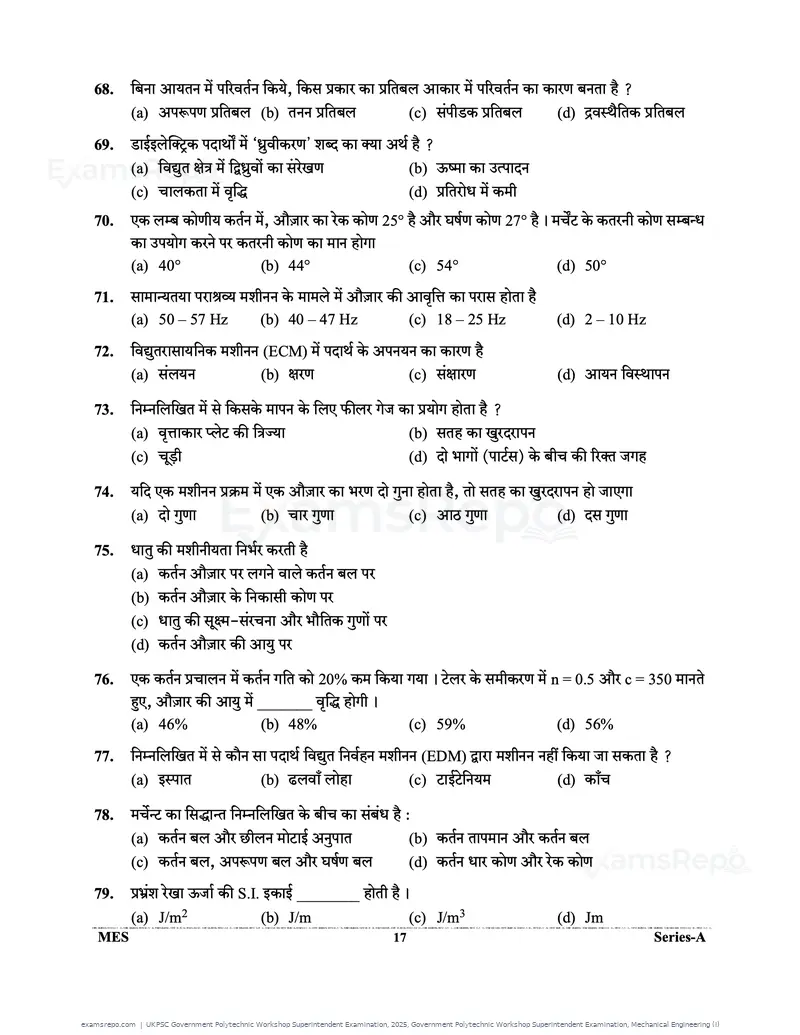
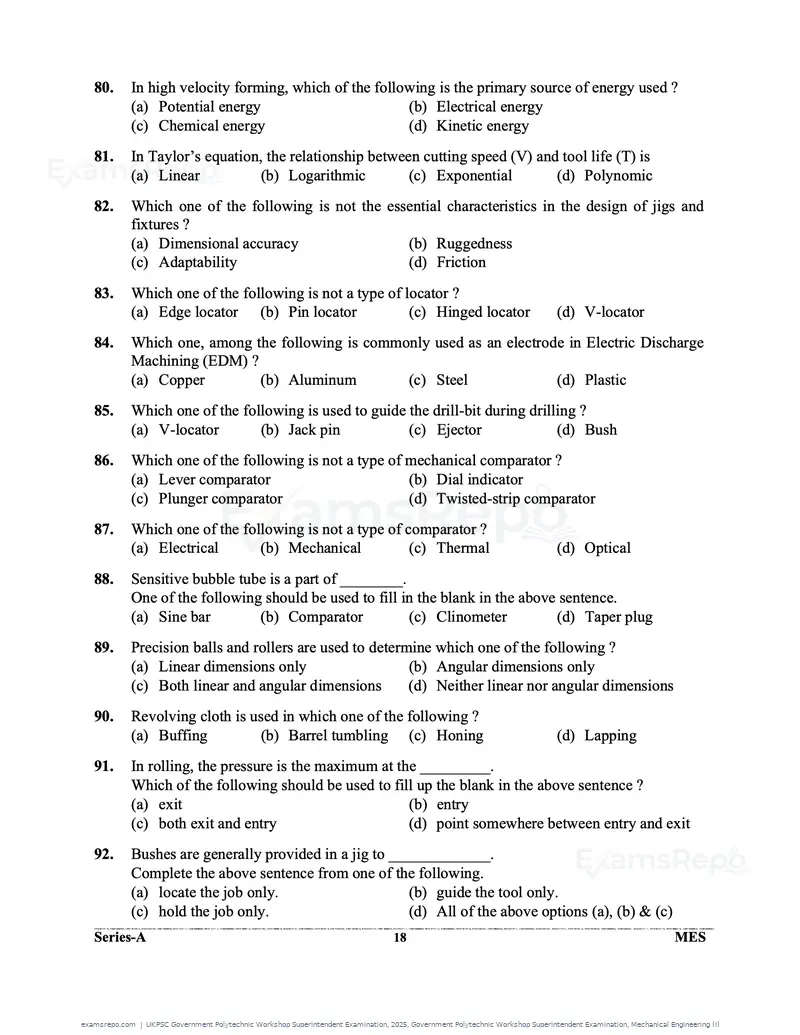
68.   Which type of stress results in a change in shape without a change in volume ?
      (a) Shear stress                             (b) Tensile stress
      (c) Compressive stress                       (d) Hydrostatic stress
69.   In dielectric materials, what does the term “polarization” refer to
      (a) the alignment of dipoles in an electric field
      (b) the generation of heat
      (c) increase in conductivity


                                             MES_Mechanical
                                              MES_MechanicalEngg._(P-I)_Set-A
      (d) decrease in resistance


                                                             Engg._(P-I)_Set-A
70.   In an orthogonal cutting, rake angle of the tool is 25º and the friction angle is 27º. Using
      Merchant’s shear angle relationship, the value of shear angle will be :
      (a) 40º             (b) 44º                  (c) 54º                 (d) 50º
71.   Generally the frequency of the tool in the case of Ultrasonic Machining (USM) is in the


                                             MES_Mechanical Engg._(P-I)_Set-A
      range of


                                              MES_Mechanical Engg._(P-I)_Set-A
      (a) 50 – 57 Hz      (b) 40 – 47 Hz         (c) 18 – 25 Hz        (d) 2 – 10 Hz
72.   In Electrochemical Machining (ECM), the material removal is due to
      (a) Fusion          (b) Erosion          (c) Corrosion           (d) Ion displacement


                                            MES_Mechanical
                                            MES_MechanicalEngg._(P-I)_Set-A
73.   For which of the following measurement, feeler gauge is used ?


                                                           Engg._(P-I)_Set-A
      (a) Radius of a circular plate            (b) Surface roughness
      (c) Thread                                (d) Gap between two parts
74.   If feed of a tool in a machining process is doubled, roughness of surface will become
      (a) two times          (b) four times         (c) eight times        (d) ten times
75.   Machinability of a metal depends upon
      (a) cutting forces acting on cutting tool.
      (b) clearance angle of cutting tool.


                                            MES_Mechanical
                                            MES_MechanicalEngg._(P-I)_Set-A
      (c) microstructure and physical properties of the metal.


                                                            Engg._(P-I)_Set-A
      (d) cutting tool life.
76.   In a cutting operation, the cutting speed was reduced by 20%. Assuming n = 0.5 and c = 350
      in Taylor’s equation, the increase in tool life will be ________.


                                            MES_Mechanical Engg._(P-I)_Set-A
      (a) 46%               (b) 48%                  (c) 59%             (d) 56%


                                            MES_Mechanical Engg._(P-I)_Set-A
77.   Which of the following material cannot be machined by Electrical Discharge Machining
      (EDM) ?
      (a) Steel          (b) Cast iron         (c) Titanium          (d) Glass


                                            MES_Mechanical
                                            MES_MechanicalEngg._(P-I)_Set-A
78.   Merchant’s theory deals with the relationship between


                                                            Engg._(P-I)_Set-A
      (a) cutting force and chip thickness ratio
      (b) cutting temperature and cutting force
      (c) cutting force, shear force and friction force
      (d) cutting edge angle and rake angle
79.   S.I. unit of line energy of dislocation is __________.
      (a) J/m2               (b) J/m                 (c) J/m3                    (d) Jm
Series-A                                                   16                                 MES
UKPSC Government Polytechnic Workshop Superintendent Examination 2025 question paper, Government Polytechnic Workshop Superintendent Examination, Mechanical Engineering (I), page 17 of 32
Page 17 of 32
Text of page 17
68.       ,            ?
      (a)   (b)                 (c)          (d)  

69.    ‘’      ?
    (a)                   (b)   
    (c)                                (d)   
70.     ,     25°     27°       


                                                 MES_MechanicalEngg._(P-I)_Set-A
                                                MES_Mechanical  Engg._(P-I)_Set-A
            
      (a) 40°               (b) 44°                                (c) 54°          (d) 50°

71.               
      (a) 50 – 57 Hz        (b) 40 – 47 Hz                         (c) 18 – 25 Hz   (d) 2 – 10 Hz


                                                 MES_MechanicalEngg._(P-I)_Set-A
                                                MES_Mechanical  Engg._(P-I)_Set-A
72.     (ECM)       
      (a)           (b)                 (c)                           (d)  

73.                ?


                                               MES_MechanicalEngg._(P-I)_Set-A
                                                              Engg._(P-I)_Set-A
      (a)                       (b)   


                                              MES_Mechanical
      (c)                                     (d)   ()     

74.               ,      
      (a)        (b)                (c)                  (d)  

75.        
      (a)        


                                               MES_MechanicalEngg._(P-I)_Set-A
                                                              Engg._(P-I)_Set-A
      (b)      


                                              MES_Mechanical
      (c)   -    
      (d)     

76.          20%         n = 0.5  c = 350 


                                               MES_MechanicalEngg._(P-I)_Set-A
                                              MES_Mechanical  Engg._(P-I)_Set-A
      ,     _______   
      (a) 46%               (b) 48%                                (c) 59%          (d) 56%

77.            (EDM)        ?
      (a)              (b)            (c)         (d) 


                                               MES_MechanicalEngg._(P-I)_Set-A
                                              MES_Mechanical  Engg._(P-I)_Set-A
78.            :
      (a)                (b)     
      (c)  ,                 (d)      

79.       S.I.  ________   
      (a) J/m2              (b) J/m                                (c) J/m3         (d) Jm
MES                                                        17                                       Series-A
UKPSC Government Polytechnic Workshop Superintendent Examination 2025 question paper, Government Polytechnic Workshop Superintendent Examination, Mechanical Engineering (I), page 18 of 32
Page 18 of 32
Text of page 18
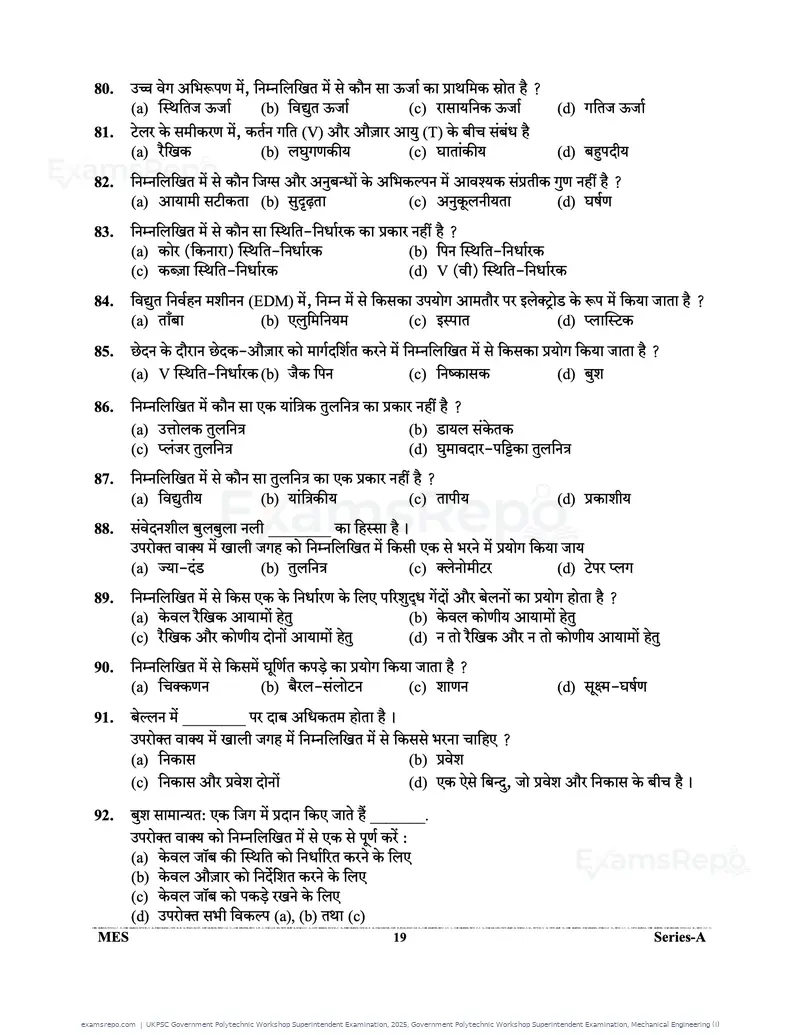
80.   In high velocity forming, which of the following is the primary source of energy used ?
      (a) Potential energy                        (b) Electrical energy
      (c) Chemical energy                         (d) Kinetic energy
81.   In Taylor’s equation, the relationship between cutting speed (V) and tool life (T) is
      (a) Linear          (b) Logarithmic          (c) Exponential        (d) Polynomic
82.   Which one of the following is not the essential characteristics in the design of jigs and
      fixtures ?


                                            MES_Mechanical
                                             MES_MechanicalEngg._(P-I)_Set-A
      (a) Dimensional accuracy                 (b) Ruggedness


                                                            Engg._(P-I)_Set-A
      (c) Adaptability                         (d) Friction
83.   Which one of the following is not a type of locator ?
      (a) Edge locator (b) Pin locator             (c) Hinged locator           (d) V-locator


                                            MES_Mechanical Engg._(P-I)_Set-A
84.   Which one, among the following is commonly used as an electrode in Electric Discharge


                                             MES_Mechanical Engg._(P-I)_Set-A
      Machining (EDM) ?
      (a) Copper        (b) Aluminum         (c) Steel              (d) Plastic
85.   Which one of the following is used to guide the drill-bit during drilling ?


                                           MES_Mechanical
                                           MES_MechanicalEngg._(P-I)_Set-A
      (a) V-locator       (b) Jack pin            (c) Ejector               (d) Bush


                                                          Engg._(P-I)_Set-A
86.   Which one of the following is not a type of mechanical comparator ?
      (a) Lever comparator                        (b) Dial indicator
      (c) Plunger comparator                      (d) Twisted-strip comparator
87.   Which one of the following is not a type of comparator ?
      (a) Electrical      (b) Mechanical           (c) Thermal                  (d) Optical
88.   Sensitive bubble tube is a part of ________.


                                           MES_Mechanical
                                           MES_MechanicalEngg._(P-I)_Set-A
      One of the following should be used to fill in the blank in the above sentence.


                                                           Engg._(P-I)_Set-A
      (a) Sine bar        (b) Comparator           (c) Clinometer          (d) Taper plug
89.   Precision balls and rollers are used to determine which one of the following ?
      (a) Linear dimensions only                    (b) Angular dimensions only


                                           MES_Mechanical Engg._(P-I)_Set-A
      (c) Both linear and angular dimensions        (d) Neither linear nor angular dimensions


                                           MES_Mechanical Engg._(P-I)_Set-A
90.   Revolving cloth is used in which one of the following ?
      (a) Buffing          (b) Barrel tumbling (c) Honing                       (d) Lapping
91.   In rolling, the pressure is the maximum at the _________.


                                           MES_Mechanical
                                           MES_MechanicalEngg._(P-I)_Set-A
      Which of the following should be used to fill up the blank in the above sentence ?


                                                           Engg._(P-I)_Set-A
      (a) exit                                     (b) entry
      (c) both exit and entry                      (d) point somewhere between entry and exit
92.   Bushes are generally provided in a jig to _____________.
      Complete the above sentence from one of the following.
      (a) locate the job only.                     (b) guide the tool only.
      (c) hold the job only.                       (d) All of the above options (a), (b) & (c)
Series-A                                                  18                                     MES
UKPSC Government Polytechnic Workshop Superintendent Examination 2025 question paper, Government Polytechnic Workshop Superintendent Examination, Mechanical Engineering (I), page 19 of 32
Page 19 of 32
Text of page 19
80.    ,           ?
    (a)       (b)              (c)        (d)  
81.    ,   (V)    (T)    
    (a)            (b)               (c)            (d) 
82.                  ?
      (a)   (b)                    (c)       (d) 


                                                  MES_MechanicalEngg._(P-I)_Set-A
                                                                 Engg._(P-I)_Set-A
83.        -     ?


                                                 MES_Mechanical
      (a)  () -              (b)  -
      (c)  -                       (d) V () -
84.      (EDM) ,               ?
      (a)             (b)           (c)                    (d) 


                                                  MES_MechanicalEngg._(P-I)_Set-A
                                                 MES_Mechanical  Engg._(P-I)_Set-A
85.      -             ?
      (a) V - (b)                     (c)             (d) 

86.              ?


                                                MES_MechanicalEngg._(P-I)_Set-A
                                                               Engg._(P-I)_Set-A
      (a)                             (b)  


                                               MES_Mechanical
      (c)                              (d) - 
87.              ?
      (a)            (b)            (c)                          (d) 
88.      ________    
                     
      (a) -          (b)               (c)             (d)  


                                                MES_MechanicalEngg._(P-I)_Set-A
                                                               Engg._(P-I)_Set-A
                       ?


                                               MES_Mechanical
89.
      (a)                       (b)    
      (c)           (d)         
90.              ?


                                                MES_MechanicalEngg._(P-I)_Set-A
                                                               Engg._(P-I)_Set-A
      (a)            (b) -         (c)                          (d) -


                                               MES_Mechanical
91.     ________      
                  ?
      (a)                                      (b) 


                                                MES_MechanicalEngg._(P-I)_Set-A
                                                               Engg._(P-I)_Set-A
      (c)                        (d)   ,        


                                               MES_Mechanical
92.    :        _______.
                :
      (a)         
      (b)       
      (c)       
      (d)    (a), (b)  (c)
MES                                                         19                                       Series-A
UKPSC Government Polytechnic Workshop Superintendent Examination 2025 question paper, Government Polytechnic Workshop Superintendent Examination, Mechanical Engineering (I), page 20 of 32
Page 20 of 32
Text of page 20
93.   The ductility of the material _________ with work-hardening.
      Which of the following should be used to fill up the blank in the above sentence ?
      (a) increases                               (b) decreases
      (c) may increase or decrease                (d) remains constant
94.   Anisotropy in rolled components is caused by :
      (a) grain enlargement                      (b) grain orientation
      (c) elongation                             (d) alloying


                                             MES_Mechanical
                                              MES_MechanicalEngg._(P-I)_Set-A
95.   What does the Operating Characteristic curve (O.C. curve) represent ?


                                                             Engg._(P-I)_Set-A
      (a) The probability of rejecting a good lot (b) The probability of accepting a good lot
      (c) The cost of quality control             (d) The required sample size
96.   In the context of single sampling plan, the Acceptable Quality Level (AQL) is :


                                             MES_Mechanical Engg._(P-I)_Set-A
      (a) the maximum level of defects allowed in a batch.


                                              MES_Mechanical Engg._(P-I)_Set-A
      (b) the maximum sample size.
      (c) the limit for rejection.
      (d) the probability of accepting a defective lot.
97.   The Average Sample Number (ASN) is a measure of :


                                            MES_Mechanical
                                            MES_MechanicalEngg._(P-I)_Set-A
      (a) average lot size


                                                           Engg._(P-I)_Set-A
      (b) the expected value of sample size required to accept a lot.
      (c) the maximum sample size.
      (d) the average cost of sample.
98.   A fixed positon layout is best suited for :
      (a) continuous flow production                              (b) a very big and heavy product
      (c) mass production                                         (d) batch production
99.   Which of the following is not a type of material handling device ?


                                            MES_Mechanical
                                            MES_MechanicalEngg._(P-I)_Set-A
      (a) Conveyor        (b) Crane               (c) Robot              (d) Ladder


                                                            Engg._(P-I)_Set-A
100. The Economic Order Quantity (EOQ) is a model used to determine which one of the
     following ?
     (a) The maximum stock level.


                                            MES_Mechanical Engg._(P-I)_Set-A
     (b) The minimum order quantity.


                                            MES_Mechanical Engg._(P-I)_Set-A
     (c) The optimal order quantity that minimises the total inventory cost.
     (d) The reorder point.
101. In the finite production rate inventory model, what happens if the production rate is higher


                                            MES_Mechanical
                                            MES_MechanicalEngg._(P-I)_Set-A
     than the demand rate ?


                                                            Engg._(P-I)_Set-A
     (a) Inventory will accumulate indefinitely.
     (b) Inventory level will remain constant.
     (c) Inventory will deplete.
     (d) The production process will be stopped cyclically.
102. The tool used in ultrasonic machining is generally made of :
     (a) Steel            (b) Carbide            (c) Brass                              (d) Aluminium
Series-A                                                   20                                           MES
UKPSC Government Polytechnic Workshop Superintendent Examination 2025 question paper, Government Polytechnic Workshop Superintendent Examination, Mechanical Engineering (I), page 21 of 32
Page 21 of 32
Text of page 21
93.     -   ________  
                 ?
     (a)               (b)                  (c)            (d)  
94.         ?
     (a) -  (b) -  (c) -               (d) - 
95.    (O.C. )     ?


                                             MES_MechanicalEngg._(P-I)_Set-A
                                                            Engg._(P-I)_Set-A
     (a)        (b)       


                                            MES_Mechanical
     (c) -                        (d)    
96.   ()      (AQL)  :
     (a)  ()      
     (b)   


                                             MES_MechanicalEngg._(P-I)_Set-A
                                            MES_Mechanical  Engg._(P-I)_Set-A
     (c)    
     (d)        
97.    (ASN)  
     (a)    


                                           MES_MechanicalEngg._(P-I)_Set-A
                                          MES_Mechanical  Engg._(P-I)_Set-A
     (b)              
     (c)    
     (d)    
98.  -    
     (a)                          (b)        
     (c) -                              (d)  ()  
99.          ?


                                           MES_MechanicalEngg._(P-I)_Set-A
                                          MES_Mechanical  Engg._(P-I)_Set-A
     (a)             (b)  ( ) (c)               (d) 
100.    (EOQ)             
        ?
     (a)   


                                           MES_MechanicalEngg._(P-I)_Set-A
                                          MES_Mechanical  Engg._(P-I)_Set-A
     (b)   
     (c)             
     (d) : 
101.         - -   ,    ?


                                           MES_MechanicalEngg._(P-I)_Set-A
                                          MES_Mechanical  Engg._(P-I)_Set-A
     (a)        
     (b)      
     (c)     
     (d)          
102.               ?
     (a)              (b)               (c)                  (d) 
MES                                                    21                               Series-A
UKPSC Government Polytechnic Workshop Superintendent Examination 2025 question paper, Government Polytechnic Workshop Superintendent Examination, Mechanical Engineering (I), page 22 of 32
Page 22 of 32
Text of page 22
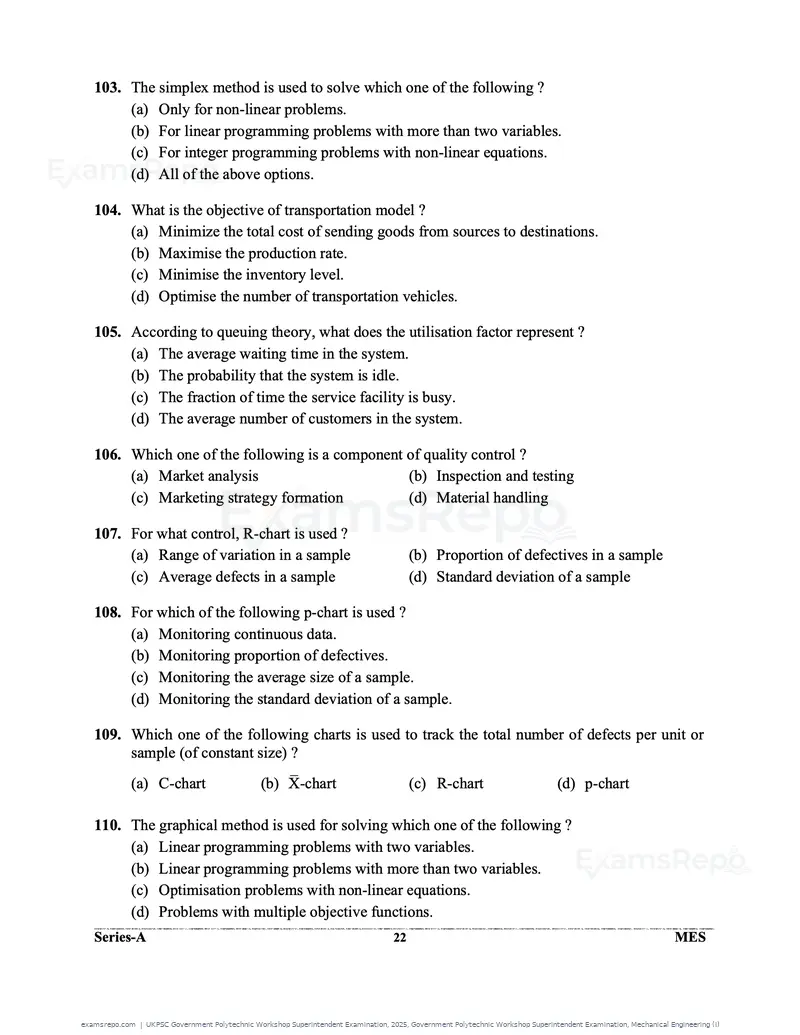
103. The simplex method is used to solve which one of the following ?
     (a) Only for non-linear problems.
     (b) For linear programming problems with more than two variables.
     (c) For integer programming problems with non-linear equations.
     (d) All of the above options.

104. What is the objective of transportation model ?
     (a) Minimize the total cost of sending goods from sources to destinations.


                                            MES_Mechanical
                                             MES_MechanicalEngg._(P-I)_Set-A
     (b) Maximise the production rate.


                                                            Engg._(P-I)_Set-A
     (c) Minimise the inventory level.
     (d) Optimise the number of transportation vehicles.


                                            MES_Mechanical Engg._(P-I)_Set-A
105. According to queuing theory, what does the utilisation factor represent ?


                                             MES_Mechanical Engg._(P-I)_Set-A
     (a) The average waiting time in the system.
     (b) The probability that the system is idle.
     (c) The fraction of time the service facility is busy.
     (d) The average number of customers in the system.


                                           MES_Mechanical
                                           MES_MechanicalEngg._(P-I)_Set-A
                                                          Engg._(P-I)_Set-A
106. Which one of the following is a component of quality control ?
     (a) Market analysis                       (b) Inspection and testing
     (c) Marketing strategy formation          (d) Material handling

107. For what control, R-chart is used ?
     (a) Range of variation in a sample                          (b) Proportion of defectives in a sample
     (c) Average defects in a sample                             (d) Standard deviation of a sample


                                           MES_Mechanical
                                           MES_MechanicalEngg._(P-I)_Set-A
108. For which of the following p-chart is used ?


                                                           Engg._(P-I)_Set-A
     (a) Monitoring continuous data.
     (b) Monitoring proportion of defectives.
     (c) Monitoring the average size of a sample.


                                           MES_Mechanical Engg._(P-I)_Set-A
     (d) Monitoring the standard deviation of a sample.


                                           MES_Mechanical Engg._(P-I)_Set-A
109. Which one of the following charts is used to track the total number of defects per unit or
     sample (of constant size) ?
                               –


                                           MES_Mechanical
                                           MES_MechanicalEngg._(P-I)_Set-A
     (a) C-chart          (b) X-chart           (c) R-chart            (d) p-chart


                                                           Engg._(P-I)_Set-A
110. The graphical method is used for solving which one of the following ?
     (a) Linear programming problems with two variables.
     (b) Linear programming problems with more than two variables.
     (c) Optimisation problems with non-linear equations.
     (d) Problems with multiple objective functions.
Series-A                                                  22                                                MES
UKPSC Government Polytechnic Workshop Superintendent Examination 2025 question paper, Government Polytechnic Workshop Superintendent Examination, Mechanical Engineering (I), page 23 of 32
Page 23 of 32
Text of page 23
103.               ?
      (a)  - 
      (b)        
      (c)      
      (d)   

104.       ?


                                                   MES_MechanicalEngg._(P-I)_Set-A
                                                  MES_Mechanical  Engg._(P-I)_Set-A
      (a)              
      (b)      
      (c) -    
      (d)        


                                                   MES_MechanicalEngg._(P-I)_Set-A
                                                  MES_Mechanical  Engg._(P-I)_Set-A
105.    ,       ?
      (a)                                       (b)      
      (c) -                               (d)      


                                                 MES_MechanicalEngg._(P-I)_Set-A
                                                MES_Mechanical  Engg._(P-I)_Set-A
106.      -     ?
      (a) - (b)    (c)  -                               (d)  

107.     R- ()      ?
      (a)    -                               (b)      
      (c)                                             (d)    


                                                 MES_MechanicalEngg._(P-I)_Set-A
                                                MES_Mechanical  Engg._(P-I)_Set-A
108.      p- ()      ?
      (a)                                          (b)     
      (c)                                   (d)      


                                                 MES_MechanicalEngg._(P-I)_Set-A
                                                                Engg._(P-I)_Set-A
109.            (  )        


                                                MES_Mechanical
           ?
      (a) C- ()                                              (b) X - ()
      (c) R- ()                                              (d) p- ()


                                                 MES_MechanicalEngg._(P-I)_Set-A
                                                MES_Mechanical  Engg._(P-I)_Set-A
110.               ?
      (a)      
      (b)        
      (c) -    
      (d) -   
MES                                                          23                                                Series-A
UKPSC Government Polytechnic Workshop Superintendent Examination 2025 question paper, Government Polytechnic Workshop Superintendent Examination, Mechanical Engineering (I), page 24 of 32
Page 24 of 32
Text of page 24
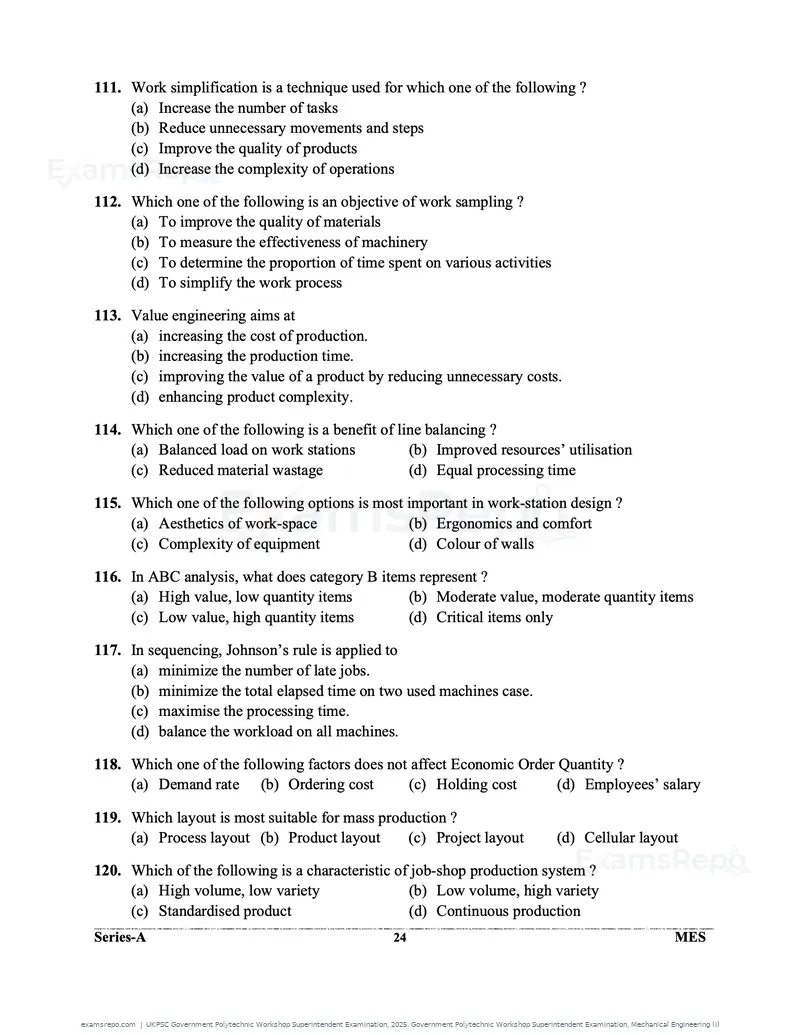
111. Work simplification is a technique used for which one of the following ?
     (a) Increase the number of tasks
     (b) Reduce unnecessary movements and steps
     (c) Improve the quality of products
     (d) Increase the complexity of operations

112. Which one of the following is an objective of work sampling ?
     (a) To improve the quality of materials


                                           MES_Mechanical
                                            MES_MechanicalEngg._(P-I)_Set-A
     (b) To measure the effectiveness of machinery


                                                           Engg._(P-I)_Set-A
     (c) To determine the proportion of time spent on various activities
     (d) To simplify the work process

113. Value engineering aims at


                                           MES_Mechanical Engg._(P-I)_Set-A
     (a) increasing the cost of production.


                                            MES_Mechanical Engg._(P-I)_Set-A
     (b) increasing the production time.
     (c) improving the value of a product by reducing unnecessary costs.
     (d) enhancing product complexity.


                                          MES_Mechanical
                                          MES_MechanicalEngg._(P-I)_Set-A
114. Which one of the following is a benefit of line balancing ?


                                                         Engg._(P-I)_Set-A
     (a) Balanced load on work stations           (b) Improved resources’ utilisation
     (c) Reduced material wastage                 (d) Equal processing time

115. Which one of the following options is most important in work-station design ?
     (a) Aesthetics of work-space               (b) Ergonomics and comfort
     (c) Complexity of equipment                (d) Colour of walls

116. In ABC analysis, what does category B items represent ?


                                          MES_Mechanical
                                          MES_MechanicalEngg._(P-I)_Set-A
     (a) High value, low quantity items        (b) Moderate value, moderate quantity items


                                                          Engg._(P-I)_Set-A
     (c) Low value, high quantity items        (d) Critical items only

117. In sequencing, Johnson’s rule is applied to
     (a) minimize the number of late jobs.


                                          MES_Mechanical Engg._(P-I)_Set-A
     (b) minimize the total elapsed time on two used machines case.


                                          MES_Mechanical Engg._(P-I)_Set-A
     (c) maximise the processing time.
     (d) balance the workload on all machines.

118. Which one of the following factors does not affect Economic Order Quantity ?


                                          MES_Mechanical
                                          MES_MechanicalEngg._(P-I)_Set-A
     (a) Demand rate (b) Ordering cost          (c) Holding cost       (d) Employees’ salary


                                                          Engg._(P-I)_Set-A
119. Which layout is most suitable for mass production ?
     (a) Process layout (b) Product layout      (c) Project layout             (d) Cellular layout

120. Which of the following is a characteristic of job-shop production system ?
     (a) High volume, low variety                 (b) Low volume, high variety
     (c) Standardised product                     (d) Continuous production
Series-A                                                 24                                      MES
UKPSC Government Polytechnic Workshop Superintendent Examination 2025 question paper, Government Polytechnic Workshop Superintendent Examination, Mechanical Engineering (I), page 25 of 32
Page 25 of 32
Text of page 25
111.      -      ?
     (a)      
     (b)         
     (c)       
     (d)      

112.      -    ?


                                                  MES_MechanicalEngg._(P-I)_Set-A
                                                 MES_Mechanical  Engg._(P-I)_Set-A
     (a)      
     (b)      
     (c)           
     (d) -   
113. -   


                                                  MES_MechanicalEngg._(P-I)_Set-A
                                                 MES_Mechanical  Engg._(P-I)_Set-A
     (a)    
     (b) -  
     (c)     -  
     (d) -  


                                                MES_MechanicalEngg._(P-I)_Set-A
                                               MES_Mechanical  Engg._(P-I)_Set-A
114.     , -     ?
     (a) -                  (b)     
     (c)                          (d)   

115.     -         ?
     (a) -                      (b)  (-)  
     (c)                          (d)   
116. ABC  ,  B      ?


                                                MES_MechanicalEngg._(P-I)_Set-A
                                               MES_Mechanical  Engg._(P-I)_Set-A
     (a)  ,           (b)  ,     
     (c)  ,           (d)    
117.  ,        
     (a)    ()      


                                                MES_MechanicalEngg._(P-I)_Set-A
                                               MES_Mechanical  Engg._(P-I)_Set-A
     (b)             
     (c) -    
     (d)        
118.                ?


                                                MES_MechanicalEngg._(P-I)_Set-A
                                               MES_Mechanical  Engg._(P-I)_Set-A
     (a) -           (b)          (c)             (d)   
119.    -      ?
     (a)   (b)            (c)   (d)  
120.     -       ?
     (a)  ,                      (b)  ,  
     (c)                             (d)  
MES                                                         25                           Series-A
UKPSC Government Polytechnic Workshop Superintendent Examination 2025 question paper, Government Polytechnic Workshop Superintendent Examination, Mechanical Engineering (I), page 26 of 32
Page 26 of 32
Text of page 26
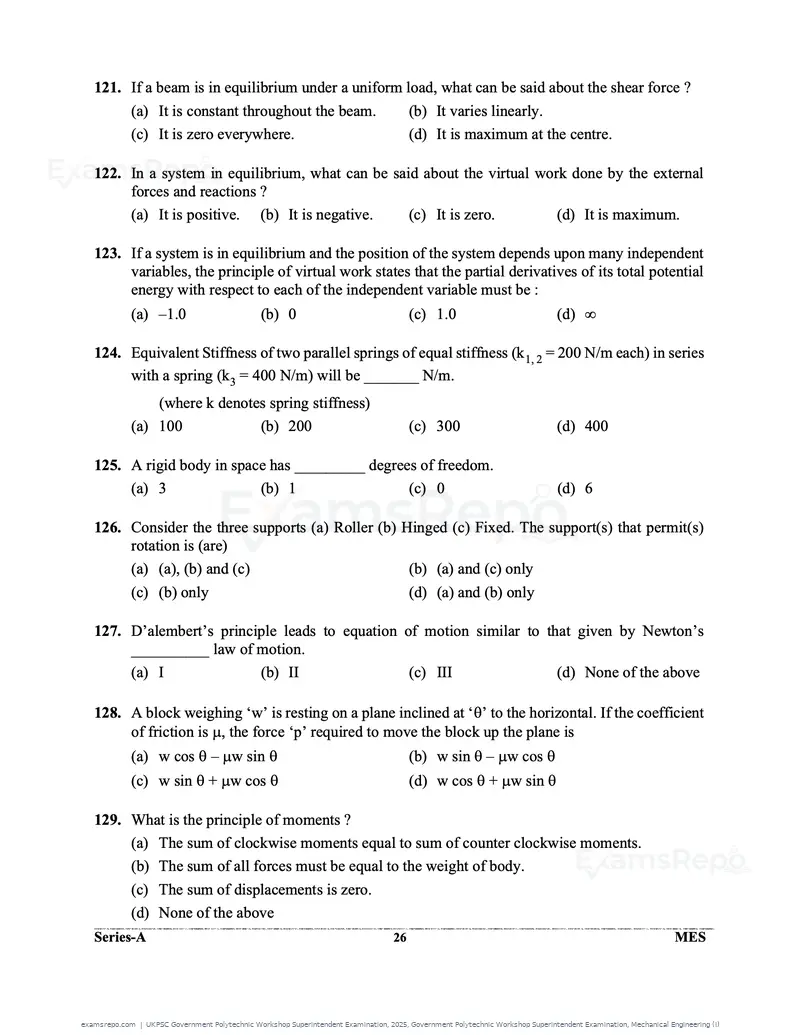
121. If a beam is in equilibrium under a uniform load, what can be said about the shear force ?
     (a) It is constant throughout the beam.      (b) It varies linearly.
     (c) It is zero everywhere.                   (d) It is maximum at the centre.

122. In a system in equilibrium, what can be said about the virtual work done by the external
     forces and reactions ?
     (a) It is positive. (b) It is negative.    (c) It is zero.        (d) It is maximum.


                                              MES_Mechanical
                                               MES_MechanicalEngg._(P-I)_Set-A
                                                              Engg._(P-I)_Set-A
123. If a system is in equilibrium and the position of the system depends upon many independent
     variables, the principle of virtual work states that the partial derivatives of its total potential
     energy with respect to each of the independent variable must be :
      (a) –1.0              (b) 0                                  (c) 1.0                  (d) 


                                              MES_Mechanical Engg._(P-I)_Set-A
                                               MES_Mechanical Engg._(P-I)_Set-A
124. Equivalent Stiffness of two parallel springs of equal stiffness (k 1, 2 = 200 N/m each) in series
     with a spring (k3 = 400 N/m) will be _______ N/m.
          (where k denotes spring stiffness)


                                             MES_Mechanical
                                             MES_MechanicalEngg._(P-I)_Set-A
      (a) 100            (b) 200                                   (c) 300                  (d) 400


                                                            Engg._(P-I)_Set-A
125. A rigid body in space has _________ degrees of freedom.
     (a) 3               (b) 1                 (c) 0                                        (d) 6

126. Consider the three supports (a) Roller (b) Hinged (c) Fixed. The support(s) that permit(s)
     rotation is (are)
     (a) (a), (b) and (c)                        (b) (a) and (c) only
     (c) (b) only                                (d) (a) and (b) only


                                             MES_Mechanical
                                             MES_MechanicalEngg._(P-I)_Set-A
                                                             Engg._(P-I)_Set-A
127. D’alembert’s principle leads to equation of motion similar to that given by Newton’s
     __________ law of motion.
     (a) I              (b) II                 (c) III               (d) None of the above


                                             MES_Mechanical Engg._(P-I)_Set-A
                                             MES_Mechanical Engg._(P-I)_Set-A
128. A block weighing ‘w’ is resting on a plane inclined at ‘’ to the horizontal. If the coefficient
     of friction is , the force ‘p’ required to move the block up the plane is
      (a) w cos  – w sin                                        (b) w sin  – w cos 


                                             MES_Mechanical
                                             MES_MechanicalEngg._(P-I)_Set-A
      (c) w sin  + w cos                                       (d) w cos  + w sin 


                                                             Engg._(P-I)_Set-A
129. What is the principle of moments ?
     (a) The sum of clockwise moments equal to sum of counter clockwise moments.
     (b) The sum of all forces must be equal to the weight of body.
     (c) The sum of displacements is zero.
     (d) None of the above
Series-A                                                    26                                        MES
UKPSC Government Polytechnic Workshop Superintendent Examination 2025 question paper, Government Polytechnic Workshop Superintendent Examination, Mechanical Engineering (I), page 27 of 32
Page 27 of 32
Text of page 27
121.          ,            ?
      (a)    ()                                    (b)      
      (c)                                                 (d)      

122.      ,               
          ?
      (a)     (b)                                 (c)              (d)    


                                                     MES_MechanicalEngg._(P-I)_Set-A
                                                    MES_Mechanical  Engg._(P-I)_Set-A
123.                 ,   
                       
        ?
      (a) –1.0                (b) 0                                    (c) 1.0                    (d) 


                                                     MES_MechanicalEngg._(P-I)_Set-A
                                                    MES_Mechanical  Engg._(P-I)_Set-A
124.       (    k1, 2 = 200 N/m)    ( 
      k3 = 400 N/m)              _______ N/m  
            ( k      )


                                                   MES_MechanicalEngg._(P-I)_Set-A
                                                  MES_Mechanical  Engg._(P-I)_Set-A
      (a) 100                 (b) 200                                  (c) 300                    (d) 400

125.        _________   
     (a) 3                (b) 1                (c) 0                                              (d) 6

126.      (a)   (b)   (c)        
      ( )    ():
      (a) (a), (b)  (c)                                             (b)  (a)  (c)


                                                   MES_MechanicalEngg._(P-I)_Set-A
                                                                  Engg._(P-I)_Set-A
      (c)  (b)                                                      (d)  (a)  (b)


                                                  MES_Mechanical
127. ’          __________      
        
      (a) I                   (b) II                                   (c) III                    (d)     


                                                   MES_MechanicalEngg._(P-I)_Set-A
                                                  MES_Mechanical  Engg._(P-I)_Set-A
128.  ‘w’      ‘’             ,    
        ‘p’    
      (a) w cos  – w sin                                            (b) w sin  – w cos 
      (c) w sin  + w cos                                           (d) w cos  + w sin 


                                                   MES_MechanicalEngg._(P-I)_Set-A
                                                  MES_Mechanical  Engg._(P-I)_Set-A
129.      ?
      (a)       ,             
      (b)            
      (c)        
      (d)     
MES                                                            27                                                   Series-A
UKPSC Government Polytechnic Workshop Superintendent Examination 2025 question paper, Government Polytechnic Workshop Superintendent Examination, Mechanical Engineering (I), page 28 of 32
Page 28 of 32
Text of page 28
130. In the principle of virtual work, the work done by the self-weight of a body is taken into
     consideration when
     (a) centre of gravity moves horizontally (b) centre of gravity moves vertically
     (c) shear centre moves horizontally         (d) shear center moves vertically
131. Screw jack works on the principle of
     (a) Horizontal plane                                         (b) Vertical plane
     (c) Inclined plane                                           (d) All of the above


                                             MES_Mechanical
                                              MES_MechanicalEngg._(P-I)_Set-A
132. Which of the following forces do not cause the rotation ?
     (a) Parallel        (b) Non-parallel        (c) Concurrent                          (d) Non-concurrent


                                                             Engg._(P-I)_Set-A
133. The angle of repose () holds the following relation with the angle of friction () in the
     limiting equilibrium
     (a)  =             (b)  = 2           (c)  = /2            (d)  = 


                                             MES_Mechanical Engg._(P-I)_Set-A
                                              MES_Mechanical Engg._(P-I)_Set-A
134. A body is subjected to three forces as shown in figure. Body will be in equilibrium, if ‘x’ is
     equal to


                                            MES_Mechanical
                                            MES_MechanicalEngg._(P-I)_Set-A
                                                           Engg._(P-I)_Set-A
     (a) 1.0 m             (b) 2.0 m                              (c) 0.25 m             (d) 0.5 m
135. If VA and VB are the velocities at points A and B of link AB, AO and BO are the distances
     of the points A and B from the instantaneous centre, then relation between velocities will be
          VA BO                                       VA AO
     (a)                                         (b)      
          VB AO                                       VB BO
     (c) VA · VB = AO · BO                        (d) VA · AO = VB · BO


                                            MES_Mechanical
                                            MES_MechanicalEngg._(P-I)_Set-A
                                                            Engg._(P-I)_Set-A
136. A body is rotating with an angular velocity of 8 rad/s. After 4 seconds the angular velocity
     of the body becomes 16 rad/s. What will be the angular acceleration of the body ?
     (a) 2 rad/s2        (b) 4 rad/s2            (c) 8 rad/s2             (d) 16 rad/s2


                                            MES_Mechanical Engg._(P-I)_Set-A
137. In a reciprocating pump mechanism the velocity of piston depends upon, which of the


                                            MES_Mechanical Engg._(P-I)_Set-A
     following ?
     (a) Radius of crank                    (b) Length of connecting rod
     (c) Angular velocity of crank          (d) All of the above
138. A tangential force of 1500 N is acting on a shaft of diameter 10 mm, what will be the work


                                            MES_Mechanical
                                            MES_MechanicalEngg._(P-I)_Set-A
     done by the force for one revolution of the shaft ?


                                                            Engg._(P-I)_Set-A
     (a) 7.5 N·m         (b) 15 N·m             (c) 150 N·m          (d) 300 N·m
139. 1 kg block is resting on a surface with coefficient of friction  = 0.1. A force of 0.8 N is
     applied to the block as shown. Determine the frictional force


     (a) 0.8 N             (b) 0.98 N                             (c) 1.2 N              (d) 0
Series-A                                                   28                                            MES
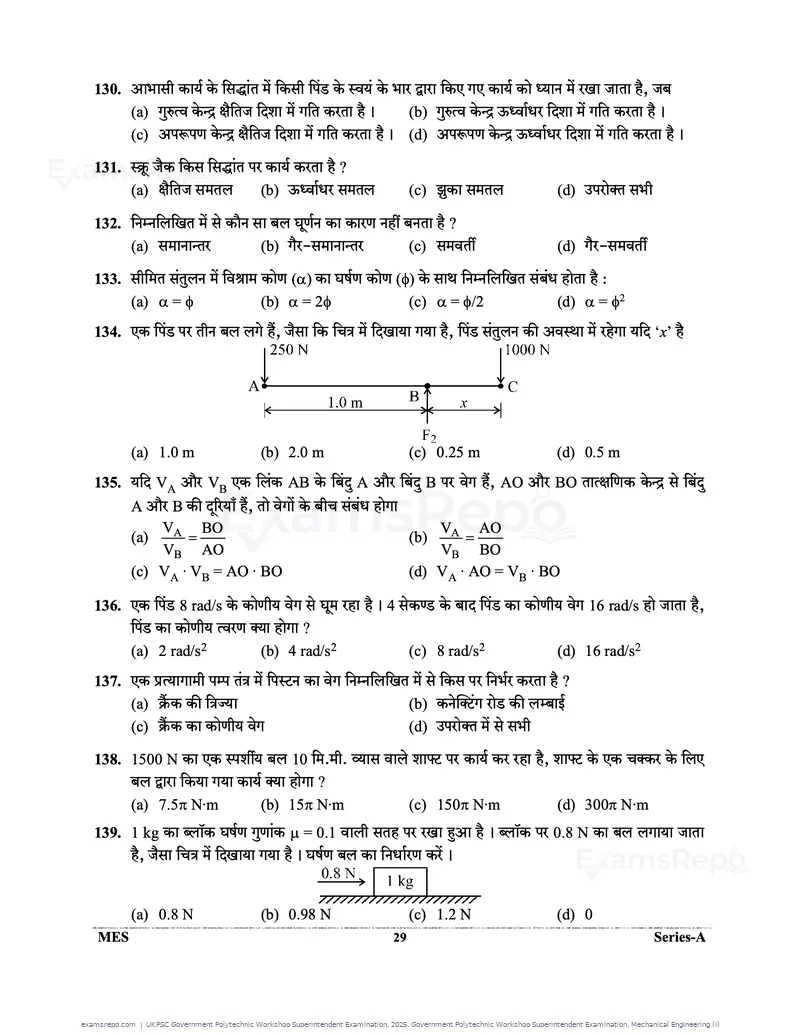
UKPSC Government Polytechnic Workshop Superintendent Examination 2025 question paper, Government Polytechnic Workshop Superintendent Examination, Mechanical Engineering (I), page 29 of 32
Page 29 of 32
Text of page 29
130.                     , 
     (a)                (b)         
     (c)          (d)         

131.         ?
     (a)         (b)                            (c)      (d)  

132.             ?


                                                  MES_MechanicalEngg._(P-I)_Set-A
                                                 MES_Mechanical  Engg._(P-I)_Set-A
     (a)           (b) -        (c)                          (d) -

133.      ()    ()       :
     (a)  =              (b)  = 2              (c)  = /2             (d)  = 


                                                  MES_MechanicalEngg._(P-I)_Set-A
                                                                 Engg._(P-I)_Set-A
134.       ,       ,        ‘x’ 


                                                 MES_Mechanical


                                                MES_MechanicalEngg._(P-I)_Set-A
                                               MES_Mechanical  Engg._(P-I)_Set-A
      (a) 1.0 m             (b) 2.0 m                               (c) 0.25 m       (d) 0.5 m
135.  VA  VB   AB   A   B   , AO  BO    
      A  B   ,      
           VA BO                                               VA AO
      (a)                                                 (b)     
           VB AO                                               VB BO
      (c) VA · VB = AO · BO                                (d) VA · AO = VB · BO


                                                MES_MechanicalEngg._(P-I)_Set-A
                                               MES_Mechanical  Engg._(P-I)_Set-A
136.   8 rad/s         4        16 rad/s   ,
           ?
     (a) 2 rad/s2          (b) 4 rad/s2                (c) 8 rad/s2            (d) 16 rad/s2
137.                 ?


                                                MES_MechanicalEngg._(P-I)_Set-A
                                               MES_Mechanical  Engg._(P-I)_Set-A
     (a)                                (b)    
     (c)                            (d)    

138. 1500 N     10 ..        ,      


                                                MES_MechanicalEngg._(P-I)_Set-A
                                                               Engg._(P-I)_Set-A
            ?


                                               MES_Mechanical
     (a) 7.5 N·m        (b) 15 N·m          (c) 150 N·m             (d) 300 N·m
139. 1 kg      = 0.1          0.8 N    
      ,             


      (a) 0.8 N             (b) 0.98 N                              (c) 1.2 N        (d) 0
MES                                                         29                                         Series-A
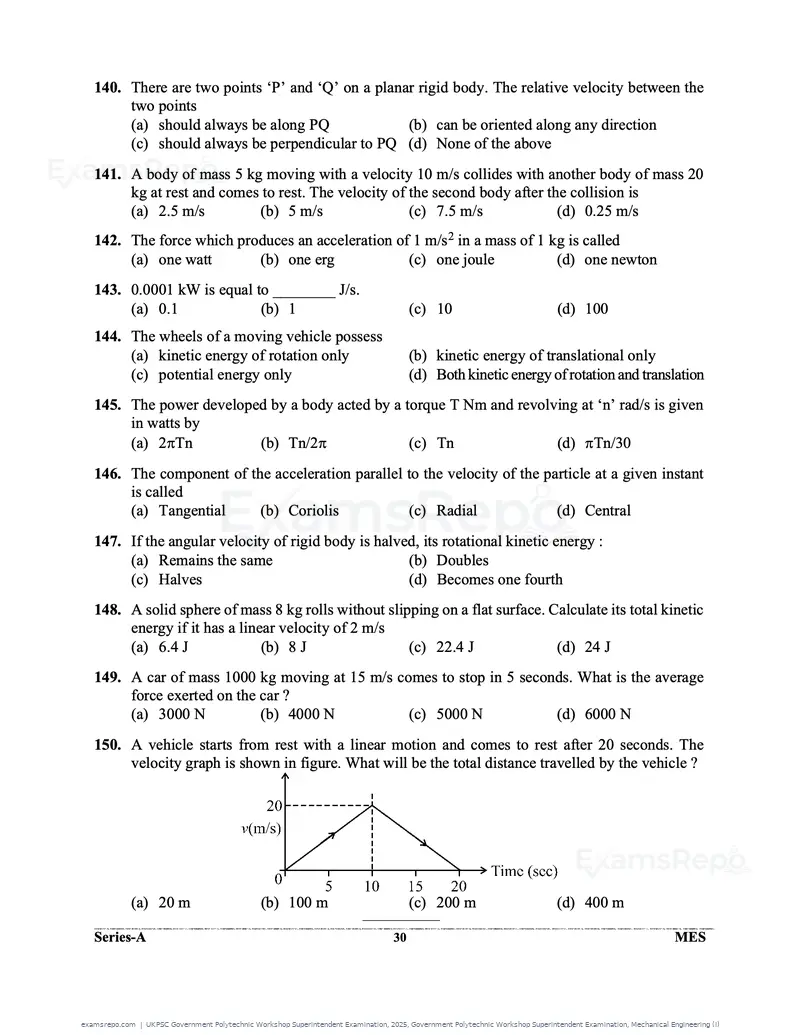
UKPSC Government Polytechnic Workshop Superintendent Examination 2025 question paper, Government Polytechnic Workshop Superintendent Examination, Mechanical Engineering (I), page 30 of 32
Page 30 of 32
Text of page 30
140. There are two points ‘P’ and ‘Q’ on a planar rigid body. The relative velocity between the
     two points
     (a) should always be along PQ              (b) can be oriented along any direction
     (c) should always be perpendicular to PQ (d) None of the above
141. A body of mass 5 kg moving with a velocity 10 m/s collides with another body of mass 20
     kg at rest and comes to rest. The velocity of the second body after the collision is
     (a) 2.5 m/s         (b) 5 m/s                 (c) 7.5 m/s             (d) 0.25 m/s


                                             MES_Mechanical
                                              MES_MechanicalEngg._(P-I)_Set-A
142. The force which produces an acceleration of 1 m/s 2 in a mass of 1 kg is called


                                                             Engg._(P-I)_Set-A
     (a) one watt       (b) one erg             (c) one joule            (d) one newton
143. 0.0001 kW is equal to ________ J/s.
     (a) 0.1             (b) 1                                    (c) 10                   (d) 100


                                             MES_Mechanical Engg._(P-I)_Set-A
144. The wheels of a moving vehicle possess


                                              MES_Mechanical Engg._(P-I)_Set-A
     (a) kinetic energy of rotation only                          (b) kinetic energy of translational only
     (c) potential energy only                                    (d) Both kinetic energy of rotation and translation
145. The power developed by a body acted by a torque T Nm and revolving at ‘n’ rad/s is given


                                            MES_Mechanical
                                            MES_MechanicalEngg._(P-I)_Set-A
     in watts by
                                                                    (d) Tn/30


                                                           Engg._(P-I)_Set-A
     (a) 2Tn          (b) Tn/2               (c) Tn
146. The component of the acceleration parallel to the velocity of the particle at a given instant
     is called
     (a) Tangential     (b) Coriolis            (c) Radial               (d) Central
147. If the angular velocity of rigid body is halved, its rotational kinetic energy :
     (a) Remains the same                          (b) Doubles
     (c) Halves                                    (d) Becomes one fourth


                                            MES_Mechanical
                                            MES_MechanicalEngg._(P-I)_Set-A
148. A solid sphere of mass 8 kg rolls without slipping on a flat surface. Calculate its total kinetic


                                                            Engg._(P-I)_Set-A
     energy if it has a linear velocity of 2 m/s
     (a) 6.4 J              (b) 8 J                (c) 22.4 J               (d) 24 J
149. A car of mass 1000 kg moving at 15 m/s comes to stop in 5 seconds. What is the average


                                            MES_Mechanical Engg._(P-I)_Set-A
     force exerted on the car ?


                                            MES_Mechanical Engg._(P-I)_Set-A
     (a) 3000 N           (b) 4000 N          (c) 5000 N            (d) 6000 N
150. A vehicle starts from rest with a linear motion and comes to rest after 20 seconds. The
     velocity graph is shown in figure. What will be the total distance travelled by the vehicle ?


                                            MES_Mechanical
                                            MES_MechanicalEngg._(P-I)_Set-A
                                                            Engg._(P-I)_Set-A

      (a) 20 m             (b) 100 m                              (c) 200 m                (d) 400 m

Series-A                                                   30                                                  MES
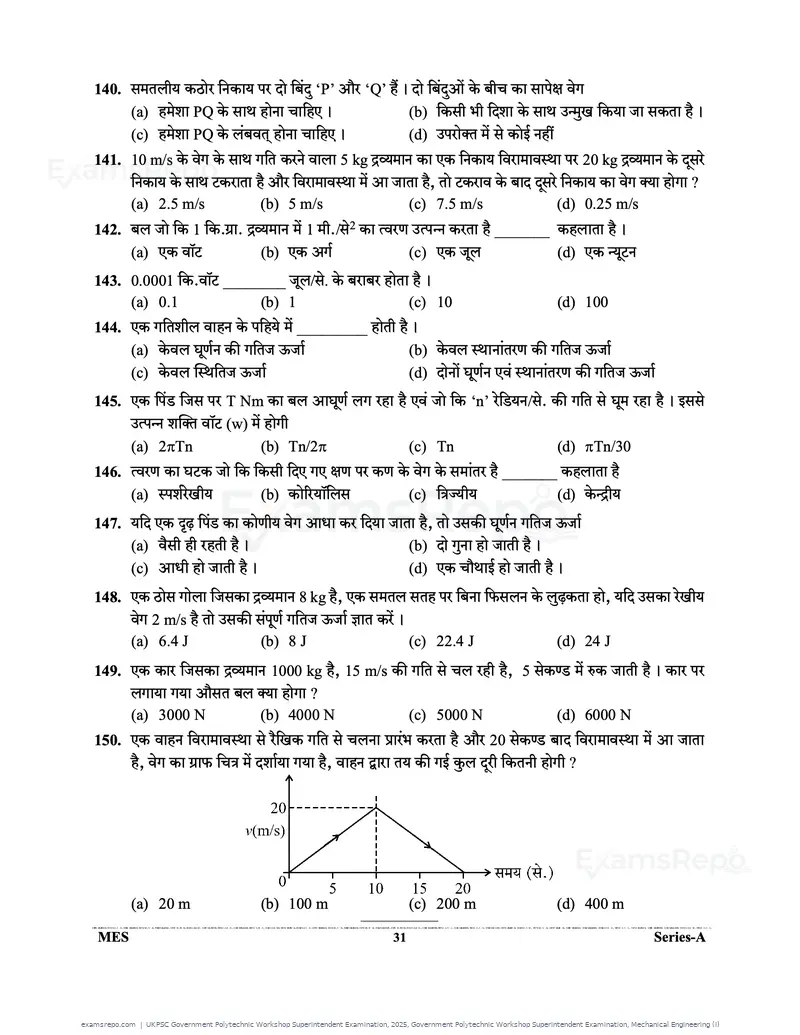
UKPSC Government Polytechnic Workshop Superintendent Examination 2025 question paper, Government Polytechnic Workshop Superintendent Examination, Mechanical Engineering (I), page 31 of 32
Page 31 of 32
Text of page 31
140.       ‘P’  ‘Q’         
     (a)  PQ                     (b)           
     (c)  PQ                  (d)     
141. 10 m/s        5 kg       20 kg   
               ,           ?
     (a) 2.5 m/s           (b) 5 m/s                (c) 7.5 m/s                  (d) 0.25 m/s


                                                  MES_MechanicalEngg._(P-I)_Set-A
                                                                 Engg._(P-I)_Set-A
142.    1 ..   1 ./2      _______   


                                                 MES_Mechanical
     (a)            (b)                 (c)               (d)  
143. 0.0001 . ________ /.     
     (a) 0.1             (b) 1                     (c) 10                            (d) 100
144.       _________   


                                                  MES_MechanicalEngg._(P-I)_Set-A
                                                 MES_Mechanical  Engg._(P-I)_Set-A
     (a)                       (b)     
     (c)                            (d)       
145.     T Nm          ‘n’ /.        
        (w)  


                                                MES_MechanicalEngg._(P-I)_Set-A
                                               MES_Mechanical  Engg._(P-I)_Set-A
     (a) 2Tn              (b) Tn/2            (c) Tn                    (d) Tn/30
146.                 _______  
     (a)        (b)       (c)                 (d) 
147.            ,     
     (a)                             (b)      
     (c)                            (d)      


                                                MES_MechanicalEngg._(P-I)_Set-A
                                                               Engg._(P-I)_Set-A
148.      8 kg ,         ,   


                                               MES_Mechanical
      2 m/s         
     (a) 6.4 J              (b) 8 J                   (c) 22.4 J       (d) 24 J
149.     1000 kg , 15 m/s      , 5        


                                                MES_MechanicalEngg._(P-I)_Set-A
                                                               Engg._(P-I)_Set-A
           ?


                                               MES_Mechanical
     (a) 3000 N         (b) 4000 N            (c) 5000 N              (d) 6000 N
150.             20      
     ,        ,          ?


                                                MES_MechanicalEngg._(P-I)_Set-A
                                               MES_Mechanical  Engg._(P-I)_Set-A


      (a) 20 m              (b) 100 m                               (c) 200 m        (d) 400 m

MES                                                         31                                   Series-A
UKPSC Government Polytechnic Workshop Superintendent Examination 2025 question paper, Government Polytechnic Workshop Superintendent Examination, Mechanical Engineering (I), page 32 of 32
Page 32 of 32
Text of page 32
Series-A


           MES_Mechanical
           MES_MechanicalEngg._(P-I)_Set-A
                           Engg._(P-I)_Set-A    MES_Mechanical
                                                 MES_MechanicalEngg._(P-I)_Set-A
                                                                Engg._(P-I)_Set-A
32         MES_Mechanical Engg._(P-I)_Set-A
           MES_Mechanical Engg._(P-I)_Set-A     MES_Mechanical Engg._(P-I)_Set-A
                                                 MES_Mechanical Engg._(P-I)_Set-A
           MES_Mechanical
           MES_MechanicalEngg._(P-I)_Set-A
                           Engg._(P-I)_Set-A   MES_Mechanical
                                               MES_MechanicalEngg._(P-I)_Set-A
                                                              Engg._(P-I)_Set-A

                                                                                    Space For Rough Work /     


MES
Page 1 of 32

Source: Uttarakhand Public Service Commission. Question paper published by Uttarakhand Public Service Commission.

Other years