
UKPSC Lab Assistant 2024: Lab Assistant, Higher Education (Group-C) Exam, GEOGRAPHY
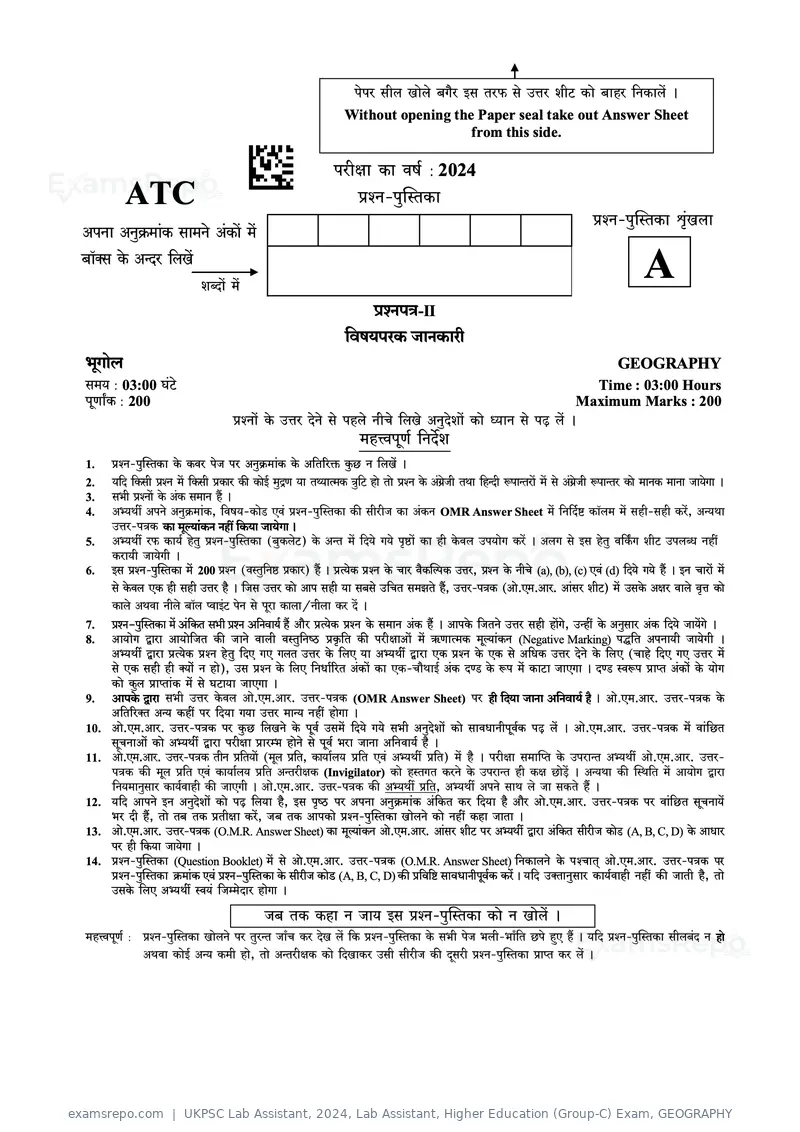
Text of page 2
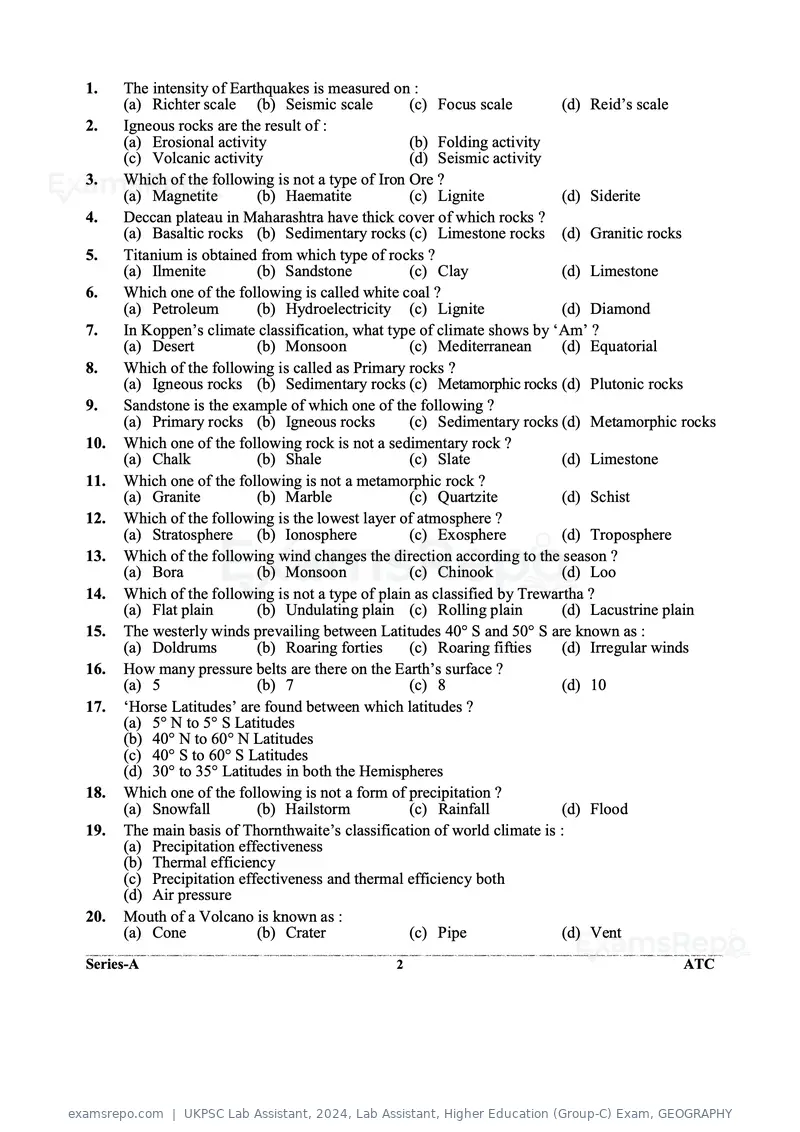
1.    The intensity of Earthquakes is measured on :
      (a) Richter scale (b) Seismic scale          (c) Focus scale         (d) Reid’s scale
2.    Igneous rocks are the result of :
      (a) Erosional activity                       (b) Folding activity
      (c) Volcanic activity                        (d) Seismic activity
3.    Which of the following is not a type of Iron Ore ?
      (a) Magnetite        (b) Haematite           (c) Lignite             (d) Siderite
4.    Deccan plateau in Maharashtra have thick cover of which rocks ?
      (a) Basaltic rocks (b) Sedimentary rocks (c) Limestone rocks (d) Granitic rocks
5.    Titanium is obtained from which type of rocks ?
      (a) Ilmenite         (b) Sandstone           (c) Clay                (d) Limestone
6.    Which one of the following is called white coal ?
      (a) Petroleum        (b) Hydroelectricity (c) Lignite                (d) Diamond
7.    In Koppen’s climate classification, what type of climate shows by ‘Am’ ?
      (a) Desert           (b) Monsoon             (c) Mediterranean       (d) Equatorial
8.    Which of the following is called as Primary rocks ?
      (a) Igneous rocks (b) Sedimentary rocks (c) Metamorphic rocks (d) Plutonic rocks
9.    Sandstone is the example of which one of the following ?
      (a) Primary rocks (b) Igneous rocks          (c) Sedimentary rocks (d) Metamorphic rocks
10.   Which one of the following rock is not a sedimentary rock ?
      (a) Chalk            (b) Shale               (c) Slate               (d) Limestone
11.   Which one of the following is not a metamorphic rock ?
      (a) Granite          (b) Marble              (c) Quartzite           (d) Schist
12.   Which of the following is the lowest layer of atmosphere ?
      (a) Stratosphere (b) Ionosphere              (c) Exosphere           (d) Troposphere
13.   Which of the following wind changes the direction according to the season ?
      (a) Bora             (b) Monsoon             (c) Chinook             (d) Loo
14.   Which of the following is not a type of plain as classified by Trewartha ?
      (a) Flat plain       (b) Undulating plain (c) Rolling plain          (d) Lacustrine plain
15.   The westerly winds prevailing between Latitudes 40° S and 50° S are known as :
      (a) Doldrums         (b) Roaring forties     (c) Roaring fifties     (d) Irregular winds
16.   How many pressure belts are there on the Earth’s surface ?
      (a) 5                (b) 7                   (c) 8                   (d) 10
17.   ‘Horse Latitudes’ are found between which latitudes ?
      (a) 5° N to 5° S Latitudes
      (b) 40° N to 60° N Latitudes
      (c) 40° S to 60° S Latitudes
      (d) 30° to 35° Latitudes in both the Hemispheres
18.   Which one of the following is not a form of precipitation ?
      (a) Snowfall         (b) Hailstorm           (c) Rainfall            (d) Flood
19.   The main basis of Thornthwaite’s classification of world climate is :
      (a) Precipitation effectiveness
      (b) Thermal efficiency
      (c) Precipitation effectiveness and thermal efficiency both
      (d) Air pressure
20.   Mouth of a Volcano is known as :
      (a) Cone             (b) Crater              (c) Pipe                (d) Vent
Series-A                                      2                                           ATC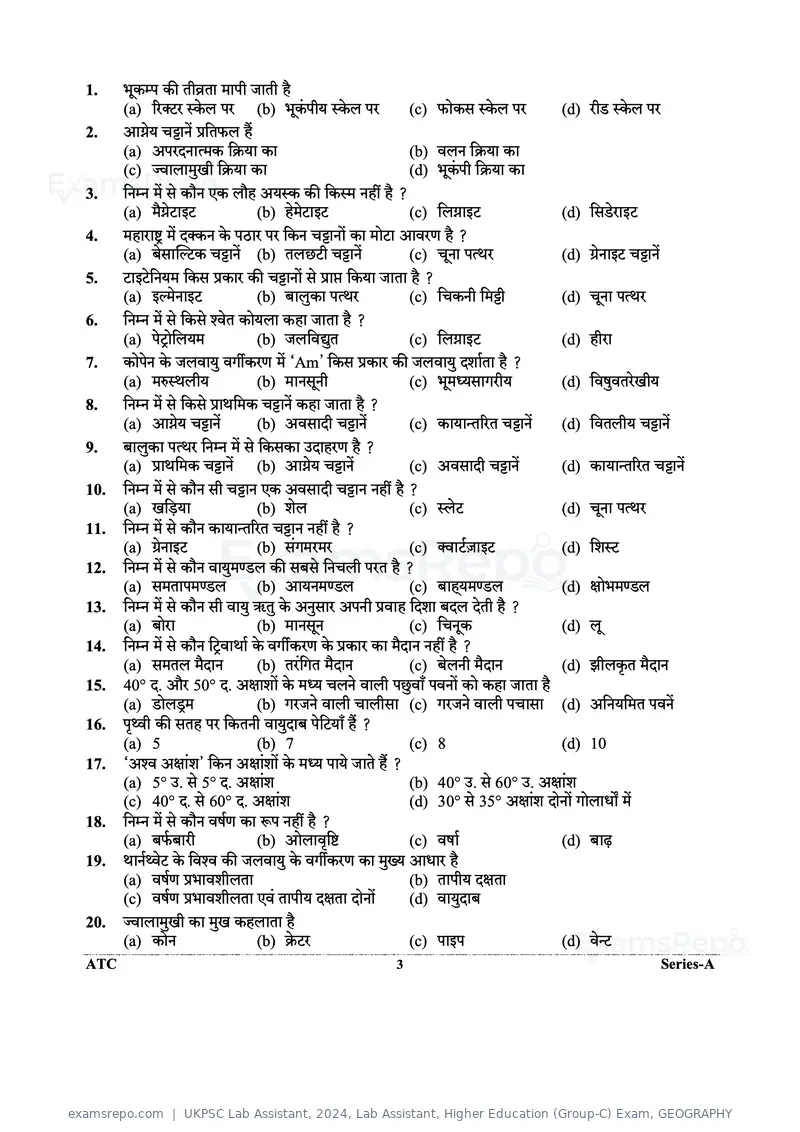
Text of page 3
1.
(a) (b) (c) (d)
2.
(a) (b)
(c) (d)
3. ?
(a) (b) (c) (d)
4. ?
(a) (b) (c) (d)
5. ?
(a) (b) (c) (d)
6. ?
(a) (b) (c) (d)
7. ‘Am’ ?
(a) (b) (c) (d)
8. ?
(a) (b) (c) (d)
9. ?
(a) (b) (c) (d)
10. ?
(a) (b) (c) (d)
11. ?
(a) (b) (c) (d)
12. ?
(a) (b) (c) (d)
13. ?
(a) (b) (c) (d)
14. ?
(a) (b) (c) (d)
15. 40 . 50 .
(a) (b) (c) (d)
16. ?
(a) 5 (b) 7 (c) 8 (d) 10
17. ‘ ’ ?
(a) 5 . 5 . (b) 40 . 60 .
(c) 40 . 60 . (d) 30 35
18. ?
(a) (b) (c) (d)
19.
(a) (b)
(c) (d)
20.
(a) (b) (c) (d)
ATC 3 Series-A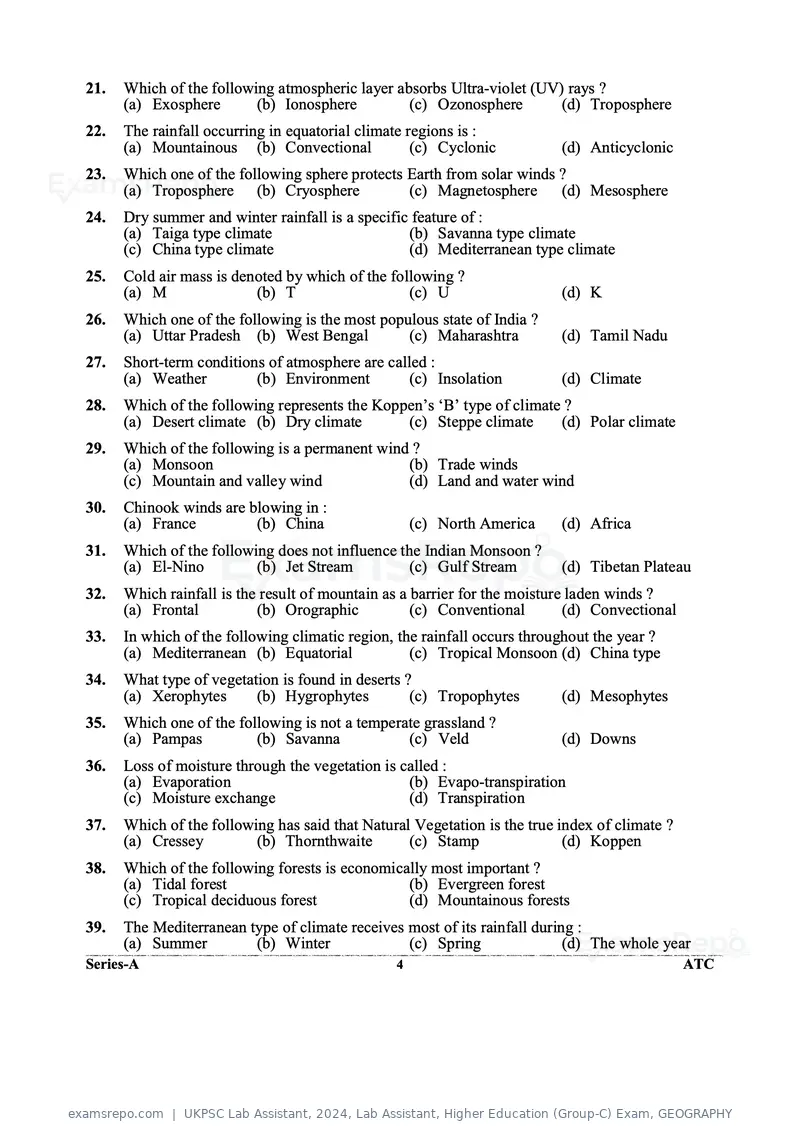
Text of page 4
21.   Which of the following atmospheric layer absorbs Ultra-violet (UV) rays ?
      (a) Exosphere       (b) Ionosphere         (c) Ozonosphere        (d) Troposphere
22.   The rainfall occurring in equatorial climate regions is :
      (a) Mountainous (b) Convectional              (c) Cyclonic          (d) Anticyclonic
23.   Which one of the following sphere protects Earth from solar winds ?
      (a) Troposphere (b) Cryosphere             (c) Magnetosphere      (d) Mesosphere
24.   Dry summer and winter rainfall is a specific feature of :
      (a) Taiga type climate                      (b) Savanna type climate
      (c) China type climate                      (d) Mediterranean type climate
25.   Cold air mass is denoted by which of the following ?
      (a) M               (b) T                   (c) U                   (d) K
26.   Which one of the following is the most populous state of India ?
      (a) Uttar Pradesh (b) West Bengal          (c) Maharashtra          (d) Tamil Nadu
27.   Short-term conditions of atmosphere are called :
      (a) Weather         (b) Environment         (c) Insolation          (d) Climate
28.   Which of the following represents the Koppen’s ‘B’ type of climate ?
      (a) Desert climate (b) Dry climate        (c) Steppe climate      (d) Polar climate
29.   Which of the following is a permanent wind ?
      (a) Monsoon                               (b) Trade winds
      (c) Mountain and valley wind              (d) Land and water wind
30.   Chinook winds are blowing in :
      (a) France         (b) China                  (c) North America     (d) Africa
31.   Which of the following does not influence the Indian Monsoon ?
      (a) El-Nino         (b) Jet Stream          (c) Gulf Stream         (d) Tibetan Plateau
32.   Which rainfall is the result of mountain as a barrier for the moisture laden winds ?
      (a) Frontal          (b) Orographic           (c) Conventional        (d) Convectional
33.   In which of the following climatic region, the rainfall occurs throughout the year ?
      (a) Mediterranean (b) Equatorial             (c) Tropical Monsoon (d) China type
34.   What type of vegetation is found in deserts ?
      (a) Xerophytes      (b) Hygrophytes          (c) Tropophytes        (d) Mesophytes
35.   Which one of the following is not a temperate grassland ?
      (a) Pampas          (b) Savanna            (c) Veld                 (d) Downs
36.   Loss of moisture through the vegetation is called :
      (a) Evaporation                             (b) Evapo-transpiration
      (c) Moisture exchange                       (d) Transpiration
37.   Which of the following has said that Natural Vegetation is the true index of climate ?
      (a) Cressey         (b) Thornthwaite        (c) Stamp                (d) Koppen
38.   Which of the following forests is economically most important ?
      (a) Tidal forest                           (b) Evergreen forest
      (c) Tropical deciduous forest              (d) Mountainous forests
39.   The Mediterranean type of climate receives most of its rainfall during :
      (a) Summer         (b) Winter              (c) Spring                (d) The whole year
Series-A                                        4                                              ATC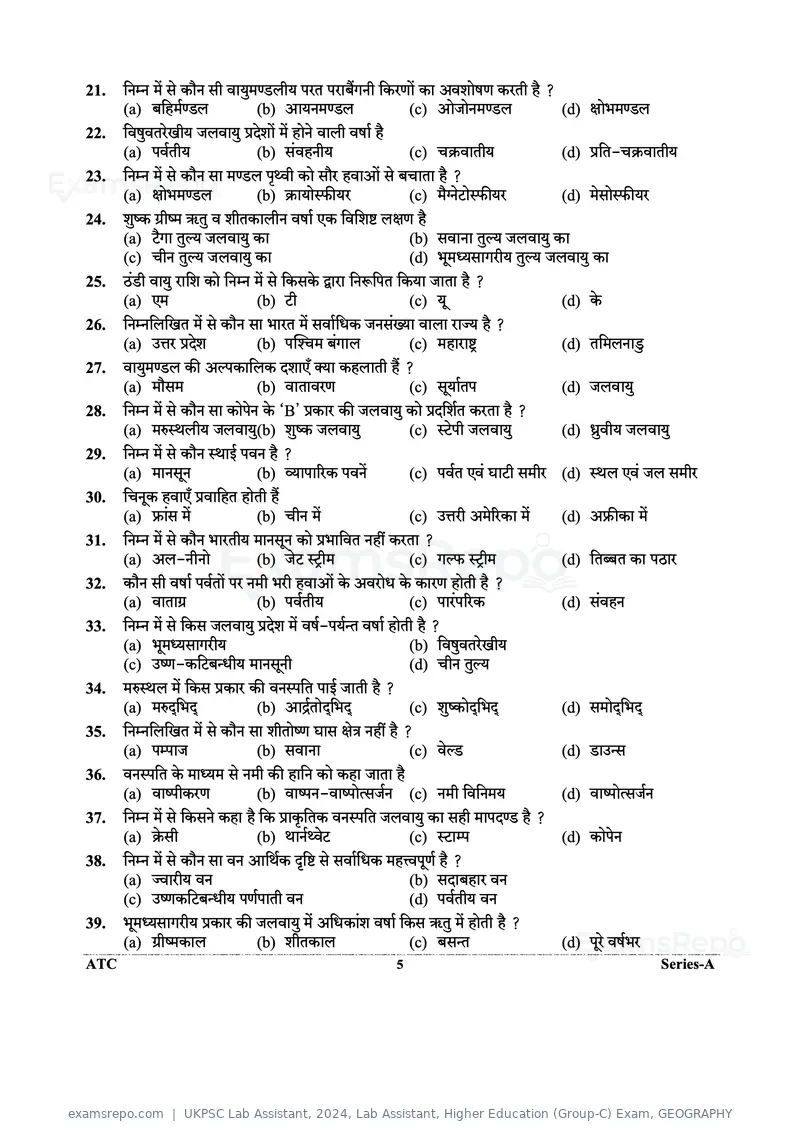
Text of page 5
21. ?
(a) (b) (c) (d)
22.
(a) (b) (c) (d) -
23. ?
(a) (b) (c) (d)
24.
(a) (b)
(c) (d)
25. ?
(a) (b) (c) (d)
26. ?
(a) (b) (c) (d)
27. ?
(a) (b) (c) (d)
28. ‘B’ ?
(a) (b) (c) (d)
29. ?
(a) (b) (c) (d)
30.
(a) (b) (c) (d)
31. ?
(a) - (b) (c) (d)
32. ?
(a) (b) (c) (d)
33. - ?
(a) (b)
(c) - (d)
34. ?
(a) (b) (c) (d)
35. ?
(a) (b) (c) (d)
36.
(a) (b) - (c) (d)
37. ?
(a) (b) (c) (d)
38. ?
(a) (b)
(c) (d)
39. ?
(a) (b) (c) (d)
ATC 5 Series-A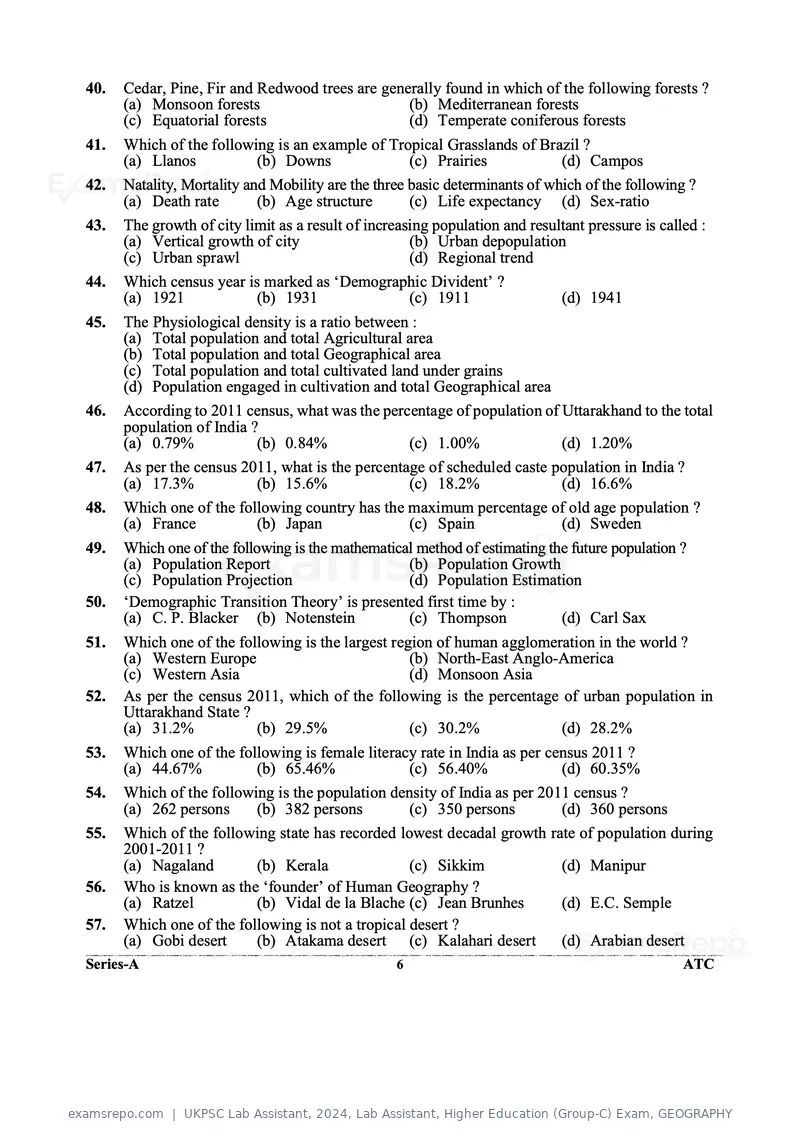
Text of page 6
40. Cedar, Pine, Fir and Redwood trees are generally found in which of the following forests ?
(a) Monsoon forests (b) Mediterranean forests
(c) Equatorial forests (d) Temperate coniferous forests
41. Which of the following is an example of Tropical Grasslands of Brazil ?
(a) Llanos (b) Downs (c) Prairies (d) Campos
42. Natality, Mortality and Mobility are the three basic determinants of which of the following ?
(a) Death rate (b) Age structure (c) Life expectancy (d) Sex-ratio
43. The growth of city limit as a result of increasing population and resultant pressure is called :
(a) Vertical growth of city (b) Urban depopulation
(c) Urban sprawl (d) Regional trend
44. Which census year is marked as ‘Demographic Divident’ ?
(a) 1921 (b) 1931 (c) 1911 (d) 1941
45. The Physiological density is a ratio between :
(a) Total population and total Agricultural area
(b) Total population and total Geographical area
(c) Total population and total cultivated land under grains
(d) Population engaged in cultivation and total Geographical area
46. According to 2011 census, what was the percentage of population of Uttarakhand to the total
population of India ?
(a) 0.79% (b) 0.84% (c) 1.00% (d) 1.20%
47. As per the census 2011, what is the percentage of scheduled caste population in India ?
(a) 17.3% (b) 15.6% (c) 18.2% (d) 16.6%
48. Which one of the following country has the maximum percentage of old age population ?
(a) France (b) Japan (c) Spain (d) Sweden
49. Which one of the following is the mathematical method of estimating the future population ?
(a) Population Report (b) Population Growth
(c) Population Projection (d) Population Estimation
50. ‘Demographic Transition Theory’ is presented first time by :
(a) C. P. Blacker (b) Notenstein (c) Thompson (d) Carl Sax
51. Which one of the following is the largest region of human agglomeration in the world ?
(a) Western Europe (b) North-East Anglo-America
(c) Western Asia (d) Monsoon Asia
52. As per the census 2011, which of the following is the percentage of urban population in
Uttarakhand State ?
(a) 31.2% (b) 29.5% (c) 30.2% (d) 28.2%
53. Which one of the following is female literacy rate in India as per census 2011 ?
(a) 44.67 (b) 65.46 (c) 56.40 (d) 60.35
54. Which of the following is the population density of India as per 2011 census ?
(a) 262 persons (b) 382 persons (c) 350 persons (d) 360 persons
55. Which of the following state has recorded lowest decadal growth rate of population during
2001-2011 ?
(a) Nagaland (b) Kerala (c) Sikkim (d) Manipur
56. Who is known as the ‘founder’ of Human Geography ?
(a) Ratzel (b) Vidal de la Blache (c) Jean Brunhes (d) E.C. Semple
57. Which one of the following is not a tropical desert ?
(a) Gobi desert (b) Atakama desert (c) Kalahari desert (d) Arabian desert
Series-A 6 ATC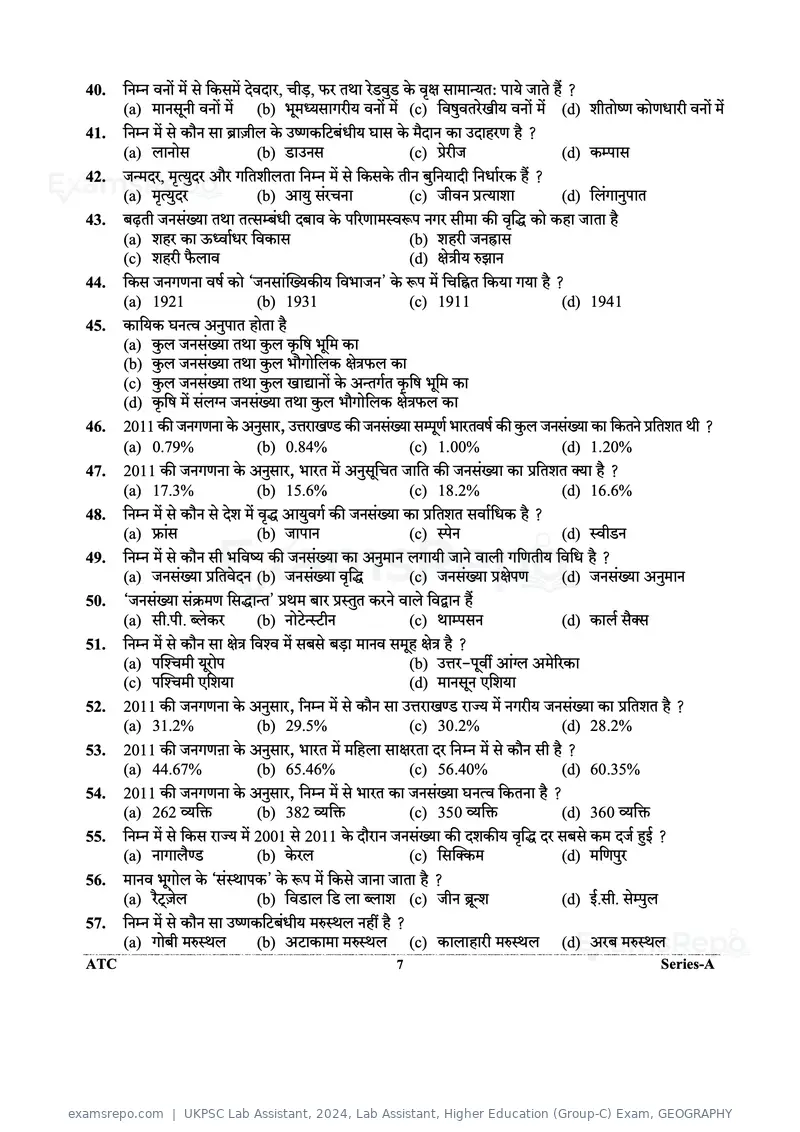
Text of page 7
40. , , : ?
(a) (b) (c) (d)
41. ?
(a) (b) (c) (d)
42. , ?
(a) (b) (c) (d)
43.
(a) (b)
(c) (d)
44. ‘ ’ ?
(a) 1921 (b) 1931 (c) 1911 (d) 1941
45.
(a)
(b)
(c)
(d)
46. 2011 , ?
(a) 0.79 (b) 0.84 (c) 1.00 (d) 1.20
47. 2011 , ?
(a) 17.3 (b) 15.6 (c) 18.2 (d) 16.6
48. ?
(a) (b) (c) (d)
49. ?
(a) (b) (c) (d)
50. ‘ ’
(a) .. (b) (c) (d)
51. ?
(a) (b) -
(c) (d)
52. 2011 , ?
(a) 31.2 (b) 29.5 (c) 30.2 (d) 28.2
53. 2011 , ?
(a) 44.67 (b) 65.46 (c) 56.40 (d) 60.35
54. 2011 , ?
(a) 262 (b) 382 (c) 350 (d) 360
55. 2001 2011 ?
(a) (b) (c) (d)
56. ‘’ ?
(a) (b) (c) (d) ..
57. ?
(a) (b) (c) (d)
ATC 7 Series-A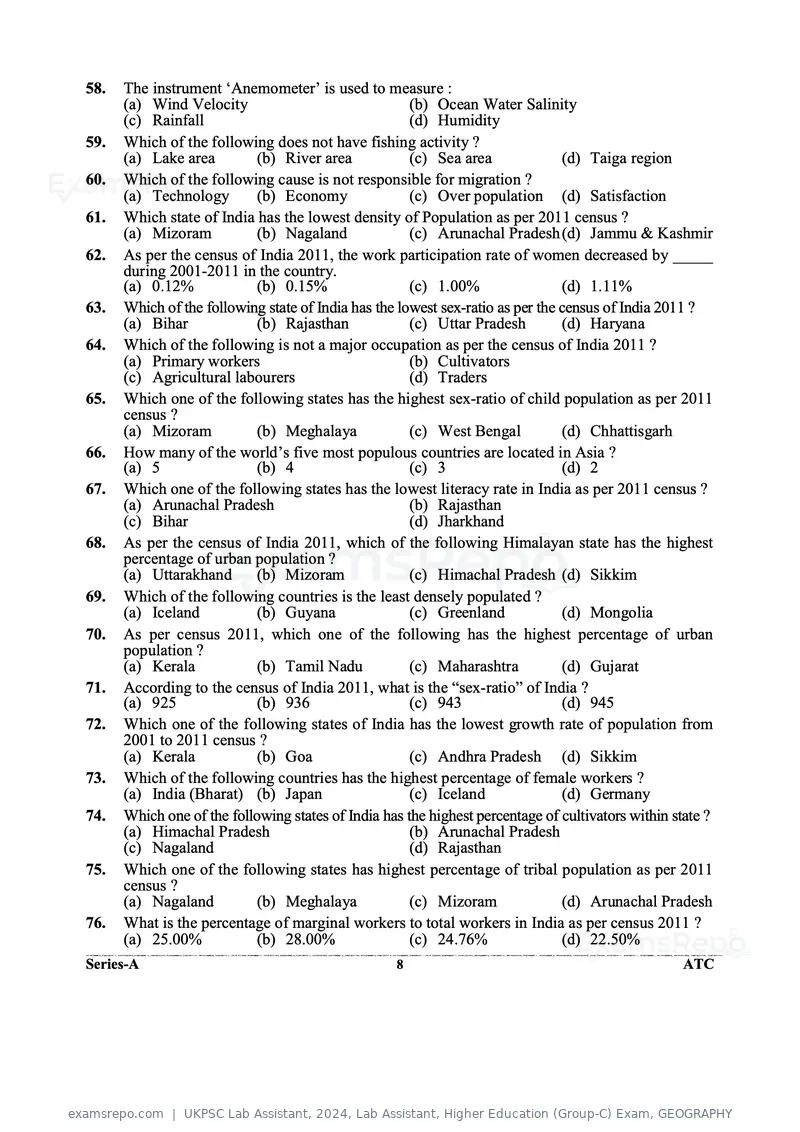
Text of page 8
58. The instrument ‘Anemometer’ is used to measure :
(a) Wind Velocity (b) Ocean Water Salinity
(c) Rainfall (d) Humidity
59. Which of the following does not have fishing activity ?
(a) Lake area (b) River area (c) Sea area (d) Taiga region
60. Which of the following cause is not responsible for migration ?
(a) Technology (b) Economy (c) Over population (d) Satisfaction
61. Which state of India has the lowest density of Population as per 2011 census ?
(a) Mizoram (b) Nagaland (c) Arunachal Pradesh (d) Jammu & Kashmir
62. As per the census of India 2011, the work participation rate of women decreased by _____
during 2001-2011 in the country.
(a) 0.12 (b) 0.15 (c) 1.00 (d) 1.11
63. Which of the following state of India has the lowest sex-ratio as per the census of India 2011 ?
(a) Bihar (b) Rajasthan (c) Uttar Pradesh (d) Haryana
64. Which of the following is not a major occupation as per the census of India 2011 ?
(a) Primary workers (b) Cultivators
(c) Agricultural labourers (d) Traders
65. Which one of the following states has the highest sex-ratio of child population as per 2011
census ?
(a) Mizoram (b) Meghalaya (c) West Bengal (d) Chhattisgarh
66. How many of the world’s five most populous countries are located in Asia ?
(a) 5 (b) 4 (c) 3 (d) 2
67. Which one of the following states has the lowest literacy rate in India as per 2011 census ?
(a) Arunachal Pradesh (b) Rajasthan
(c) Bihar (d) Jharkhand
68. As per the census of India 2011, which of the following Himalayan state has the highest
percentage of urban population ?
(a) Uttarakhand (b) Mizoram (c) Himachal Pradesh (d) Sikkim
69. Which of the following countries is the least densely populated ?
(a) Iceland (b) Guyana (c) Greenland (d) Mongolia
70. As per census 2011, which one of the following has the highest percentage of urban
population ?
(a) Kerala (b) Tamil Nadu (c) Maharashtra (d) Gujarat
71. According to the census of India 2011, what is the “sex-ratio” of India ?
(a) 925 (b) 936 (c) 943 (d) 945
72. Which one of the following states of India has the lowest growth rate of population from
2001 to 2011 census ?
(a) Kerala (b) Goa (c) Andhra Pradesh (d) Sikkim
73. Which of the following countries has the highest percentage of female workers ?
(a) India (Bharat) (b) Japan (c) Iceland (d) Germany
74. Which one of the following states of India has the highest percentage of cultivators within state ?
(a) Himachal Pradesh (b) Arunachal Pradesh
(c) Nagaland (d) Rajasthan
75. Which one of the following states has highest percentage of tribal population as per 2011
census ?
(a) Nagaland (b) Meghalaya (c) Mizoram (d) Arunachal Pradesh
76. What is the percentage of marginal workers to total workers in India as per census 2011 ?
(a) 25.00 (b) 28.00 (c) 24.76 (d) 22.50
Series-A 8 ATC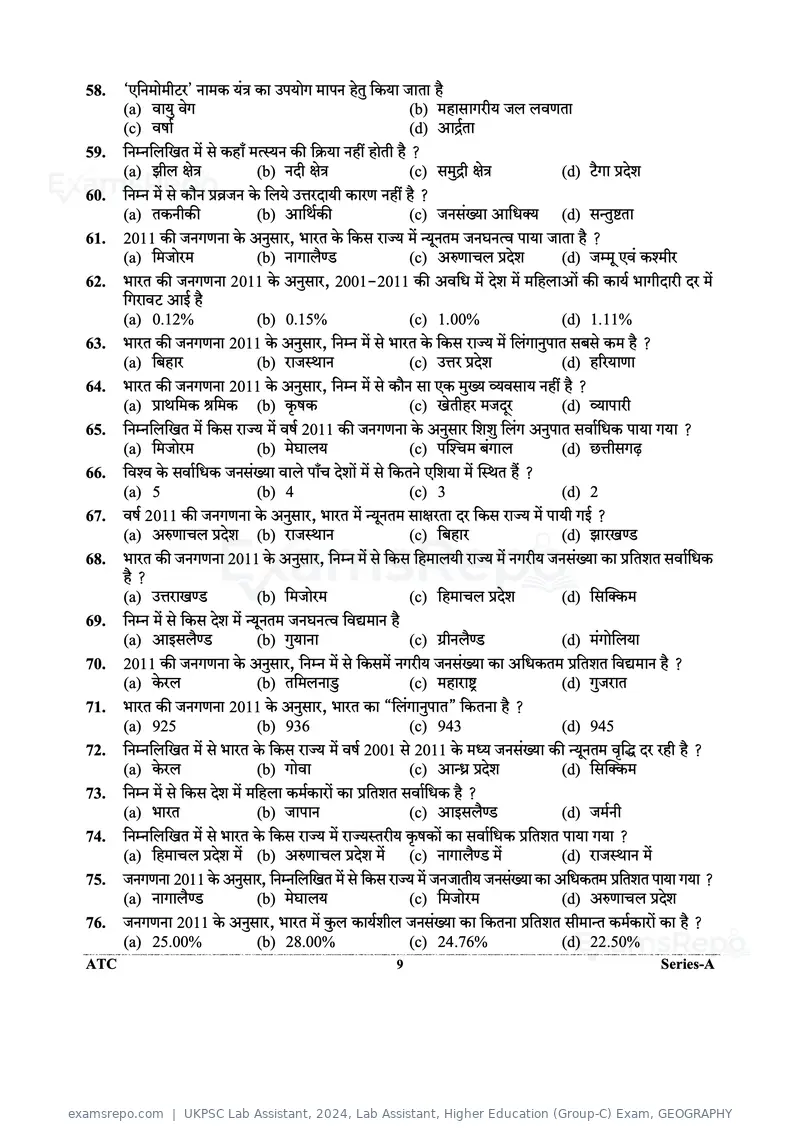
Text of page 9
58. ‘’
(a) (b)
(c) (d)
59. ?
(a) (b) (c) (d)
60. ?
(a) (b) (c) (d)
61. 2011 , ?
(a) (b) (c) (d)
62. 2011 , 2001-2011
(a) 0.12 (b) 0.15 (c) 1.00 (d) 1.11
63. 2011 , ?
(a) (b) (c) (d)
64. 2011 , ?
(a) (b) (c) (d)
65. 2011 ?
(a) (b) (c) (d)
66. ?
(a) 5 (b) 4 (c) 3 (d) 2
67. 2011 , ?
(a) (b) (c) (d)
68. 2011 ,
?
(a) (b) (c) (d)
69.
(a) (b) (c) (d)
70. 2011 , ?
(a) (b) (c) (d)
71. 2011 , “” ?
(a) 925 (b) 936 (c) 943 (d) 945
72. 2001 2011 ?
(a) (b) (c) (d)
73. ?
(a) (b) (c) (d)
74. ?
(a) (b) (c) (d)
75. 2011 , ?
(a) (b) (c) (d)
76. 2011 , ?
(a) 25.00 (b) 28.00 (c) 24.76 (d) 22.50
ATC 9 Series-A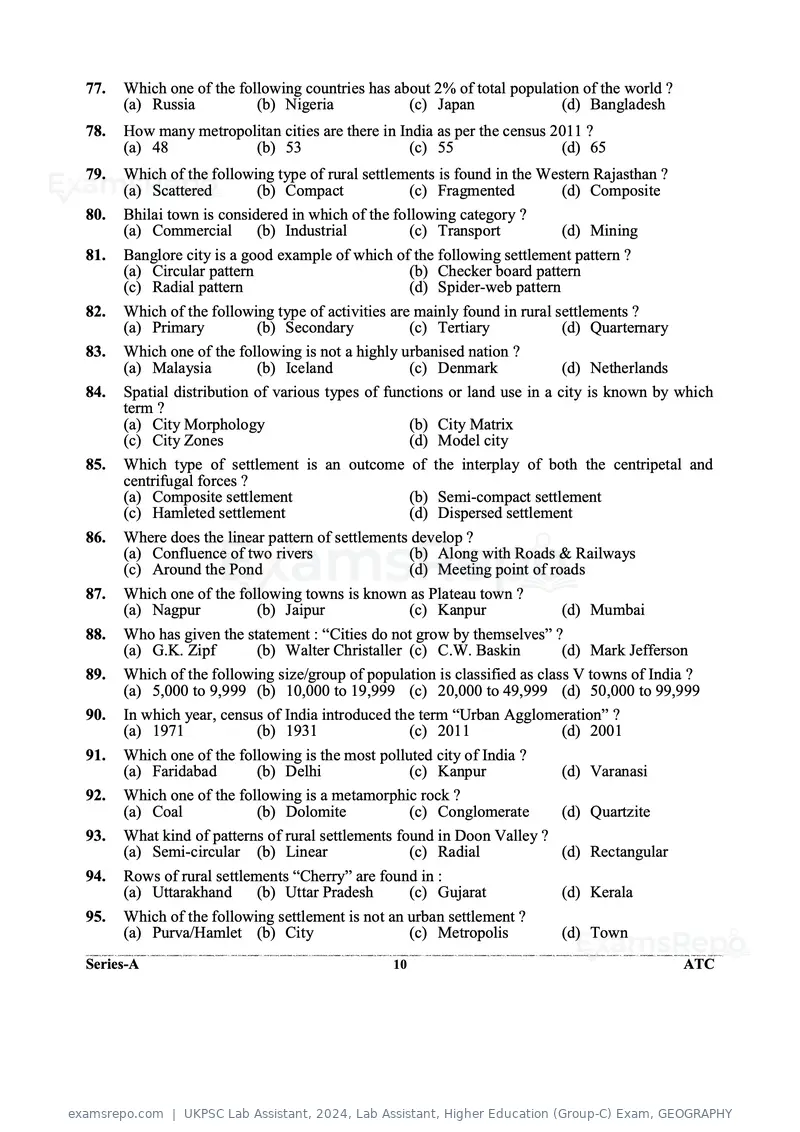
Text of page 10
77.   Which one of the following countries has about 2% of total population of the world ?
      (a) Russia          (b) Nigeria            (c) Japan               (d) Bangladesh
78.   How many metropolitan cities are there in India as per the census 2011 ?
      (a) 48           (b) 53                     (c) 55                 (d) 65
79.   Which of the following type of rural settlements is found in the Western Rajasthan ?
      (a) Scattered        (b) Compact             (c) Fragmented          (d) Composite
80.   Bhilai town is considered in which of the following category ?
      (a) Commercial       (b) Industrial          (c) Transport           (d) Mining
81.   Banglore city is a good example of which of the following settlement pattern ?
      (a) Circular pattern                         (b) Checker board pattern
      (c) Radial pattern                           (d) Spider-web pattern
82.   Which of the following type of activities are mainly found in rural settlements ?
      (a) Primary          (b) Secondary           (c) Tertiary            (d) Quarternary
83.   Which one of the following is not a highly urbanised nation ?
      (a) Malaysia         (b) Iceland             (c) Denmark             (d) Netherlands
84.   Spatial distribution of various types of functions or land use in a city is known by which
      term ?
      (a) City Morphology                          (b) City Matrix
      (c) City Zones                               (d) Model city
85.   Which type of settlement is an outcome of the interplay of both the centripetal and
      centrifugal forces ?
      (a) Composite settlement                     (b) Semi-compact settlement
      (c) Hamleted settlement                      (d) Dispersed settlement
86.   Where does the linear pattern of settlements develop ?
      (a) Confluence of two rivers                 (b) Along with Roads & Railways
      (c) Around the Pond                          (d) Meeting point of roads
87.   Which one of the following towns is known as Plateau town ?
      (a) Nagpur           (b) Jaipur              (c) Kanpur              (d) Mumbai
88.   Who has given the statement : “Cities do not grow by themselves” ?
      (a) G.K. Zipf        (b) Walter Christaller (c) C.W. Baskin          (d) Mark Jefferson
89.   Which of the following size/group of population is classified as class V towns of India ?
      (a) 5,000 to 9,999 (b) 10,000 to 19,999 (c) 20,000 to 49,999 (d) 50,000 to 99,999
90.   In which year, census of India introduced the term “Urban Agglomeration” ?
      (a) 1971             (b) 1931                (c) 2011                (d) 2001
91.   Which one of the following is the most polluted city of India ?
      (a) Faridabad        (b) Delhi               (c) Kanpur              (d) Varanasi
92.   Which one of the following is a metamorphic rock ?
      (a) Coal             (b) Dolomite            (c) Conglomerate        (d) Quartzite
93.   What kind of patterns of rural settlements found in Doon Valley ?
      (a) Semi-circular (b) Linear                 (c) Radial              (d) Rectangular
94.   Rows of rural settlements “Cherry” are found in :
      (a) Uttarakhand      (b) Uttar Pradesh       (c) Gujarat             (d) Kerala
95.   Which of the following settlement is not an urban settlement ?
      (a) Purva/Hamlet (b) City                    (c) Metropolis          (d) Town
Series-A                                       10                                            ATC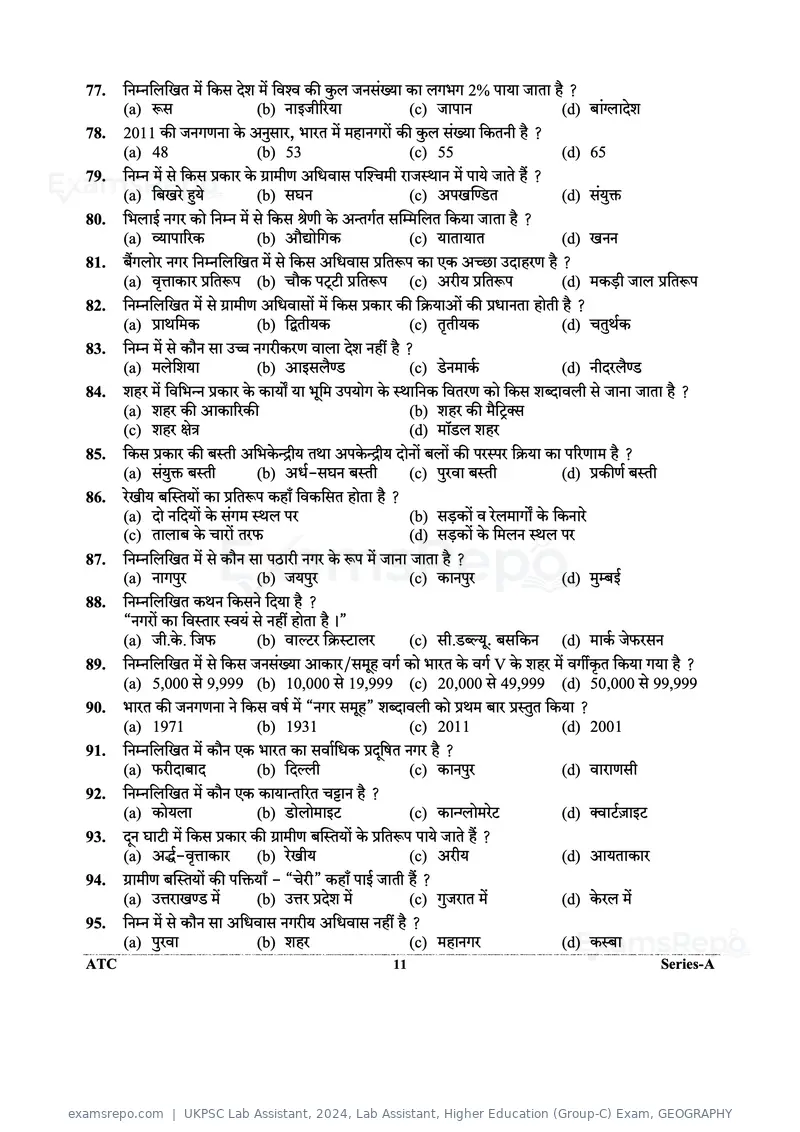
Text of page 11
77. 2 ?
(a) (b) (c) (d)
78. 2011 , ?
(a) 48 (b) 53 (c) 55 (d) 65
79. ?
(a) (b) (c) (d)
80. ?
(a) (b) (c) (d)
81. ?
(a) (b) (c) (d)
82. ?
(a) (b) (c) (d)
83. ?
(a) (b) (c) (d)
84. ?
(a) (b)
(c) (d)
85. ?
(a) (b) - (c) (d)
86. ?
(a) (b)
(c) (d)
87. ?
(a) (b) (c) (d)
88. ?
“ ”
(a) .. (b) (c) .. (d)
89. / V ?
(a) 5,000 9,999 (b) 10,000 19,999 (c) 20,000 49,999 (d) 50,000 99,999
90. “ ” ?
(a) 1971 (b) 1931 (c) 2011 (d) 2001
91. ?
(a) (b) (c) (d)
92. ?
(a) (b) (c) (d)
93. ?
(a) - (b) (c) (d)
94. - “” ?
(a) (b) (c) (d)
95. ?
(a) (b) (c) (d)
ATC 11 Series-A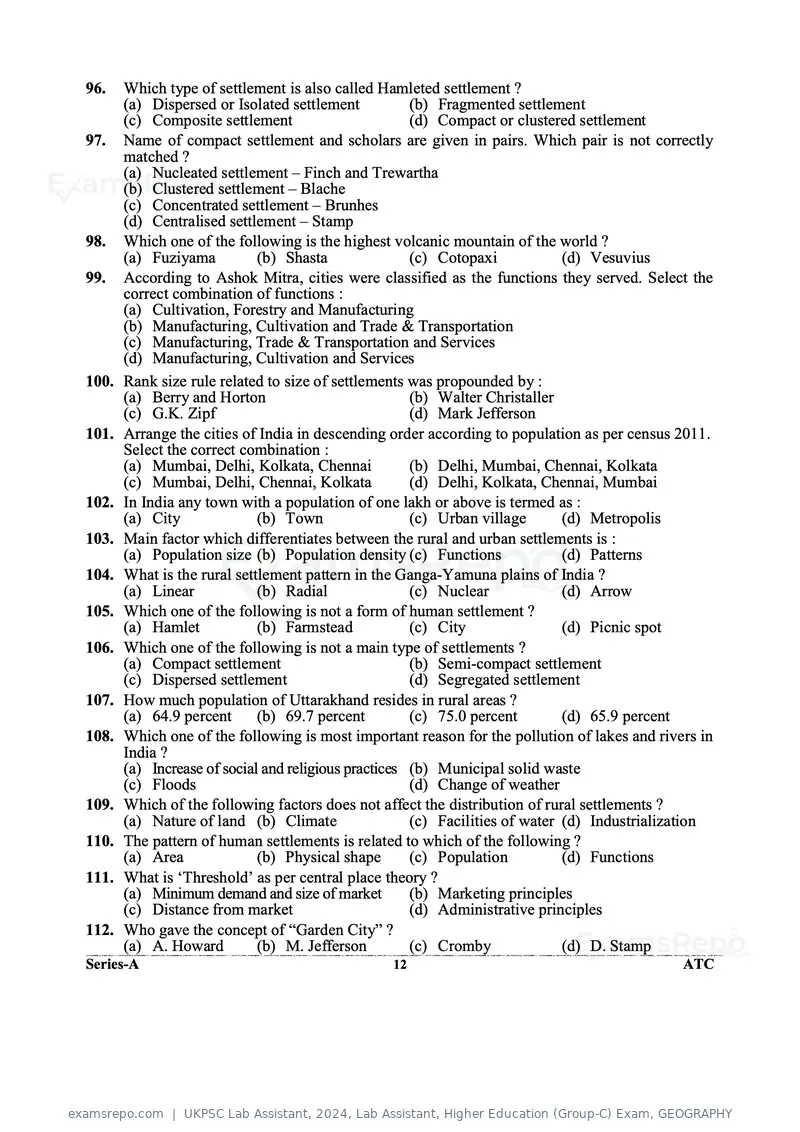
Text of page 12
96.  Which type of settlement is also called Hamleted settlement ?
     (a) Dispersed or Isolated settlement           (b) Fragmented settlement
     (c) Composite settlement                       (d) Compact or clustered settlement
97. Name of compact settlement and scholars are given in pairs. Which pair is not correctly
     matched ?
     (a) Nucleated settlement – Finch and Trewartha
     (b) Clustered settlement – Blache
     (c) Concentrated settlement – Brunhes
     (d) Centralised settlement – Stamp
98. Which one of the following is the highest volcanic mountain of the world ?
     (a) Fuziyama          (b) Shasta               (c) Cotopaxi            (d) Vesuvius
99. According to Ashok Mitra, cities were classified as the functions they served. Select the
     correct combination of functions :
     (a) Cultivation, Forestry and Manufacturing
     (b) Manufacturing, Cultivation and Trade & Transportation
     (c) Manufacturing, Trade & Transportation and Services
     (d) Manufacturing, Cultivation and Services
100. Rank size rule related to size of settlements was propounded by :
     (a) Berry and Horton                           (b) Walter Christaller
     (c) G.K. Zipf                                  (d) Mark Jefferson
101. Arrange the cities of India in descending order according to population as per census 2011.
     Select the correct combination :
     (a) Mumbai, Delhi, Kolkata, Chennai            (b) Delhi, Mumbai, Chennai, Kolkata
     (c) Mumbai, Delhi, Chennai, Kolkata            (d) Delhi, Kolkata, Chennai, Mumbai
102. In India any town with a population of one lakh or above is termed as :
     (a) City              (b) Town                 (c) Urban village       (d) Metropolis
103. Main factor which differentiates between the rural and urban settlements is :
     (a) Population size (b) Population density (c) Functions               (d) Patterns
104. What is the rural settlement pattern in the Ganga-Yamuna plains of India ?
     (a) Linear            (b) Radial               (c) Nuclear             (d) Arrow
105. Which one of the following is not a form of human settlement ?
     (a) Hamlet            (b) Farmstead            (c) City                (d) Picnic spot
106. Which one of the following is not a main type of settlements ?
     (a) Compact settlement                         (b) Semi-compact settlement
     (c) Dispersed settlement                       (d) Segregated settlement
107. How much population of Uttarakhand resides in rural areas ?
     (a) 64.9 percent      (b) 69.7 percent         (c) 75.0 percent        (d) 65.9 percent
108. Which one of the following is most important reason for the pollution of lakes and rivers in
     India ?
     (a) Increase of social and religious practices (b) Municipal solid waste
     (c) Floods                                     (d) Change of weather
109. Which of the following factors does not affect the distribution of rural settlements ?
     (a) Nature of land (b) Climate                 (c) Facilities of water (d) Industrialization
110. The pattern of human settlements is related to which of the following ?
     (a) Area              (b) Physical shape       (c) Population          (d) Functions
111. What is ‘Threshold’ as per central place theory ?
     (a) Minimum demand and size of market          (b) Marketing principles
     (c) Distance from market                       (d) Administrative principles
112. Who gave the concept of “Garden City” ?
     (a) A. Howard         (b) M. Jefferson         (c) Cromby              (d) D. Stamp
Series-A                                       12                                           ATC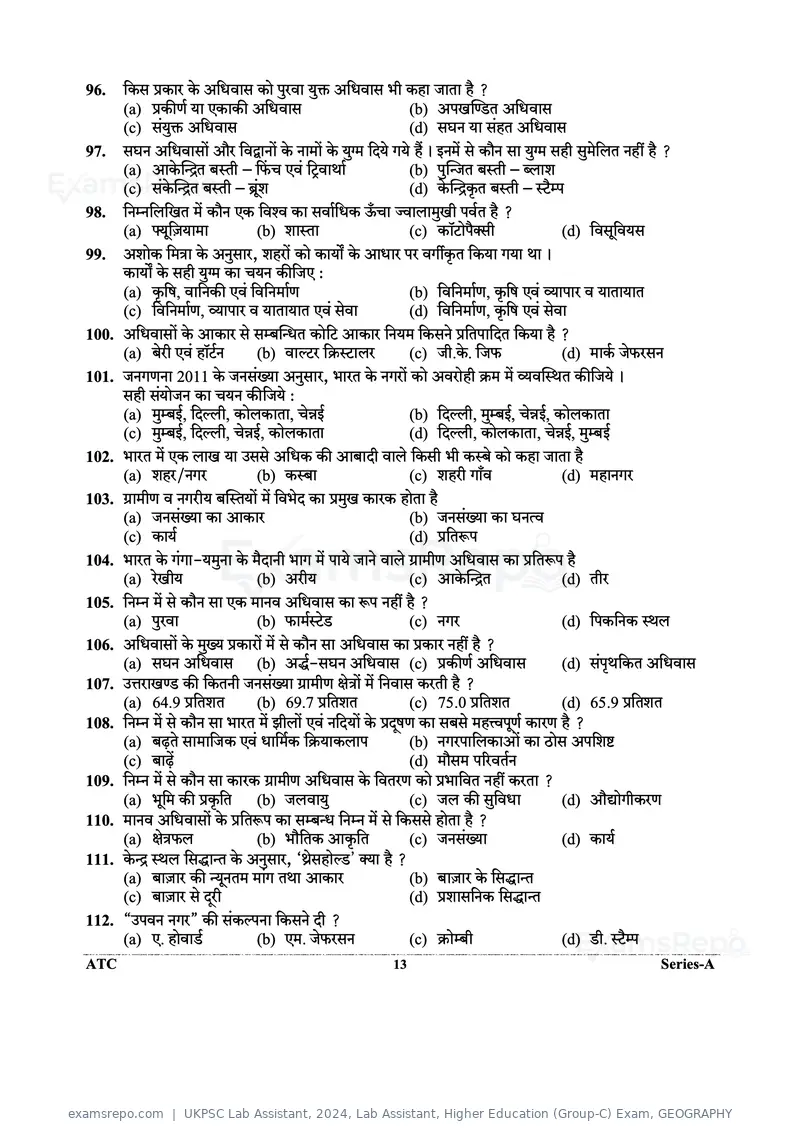
Text of page 13
96. ?
(a) (b)
(c) (d)
97. ?
(a) – (b) –
(c) – (d) –
98. ?
(a) (b) (c) (d)
99. ,
:
(a) , (b) ,
(c) , (d) ,
100. ?
(a) (b) (c) .. (d)
101. 2011 ,
:
(a) , , , (b) , , ,
(c) , , , (d) , , ,
102.
(a) / (b) (c) (d)
103.
(a) (b)
(c) (d)
104. -
(a) (b) (c) (d)
105. ?
(a) (b) (c) (d)
106. ?
(a) (b) - (c) (d)
107. ?
(a) 64.9 (b) 69.7 (c) 75.0 (d) 65.9
108. ?
(a) (b)
(c) (d)
109. ?
(a) (b) (c) (d)
110. ?
(a) (b) (c) (d)
111. , ‘’ ?
(a) (b)
(c) (d)
112. “ ” ?
(a) . (b) . (c) (d) .
ATC 13 Series-A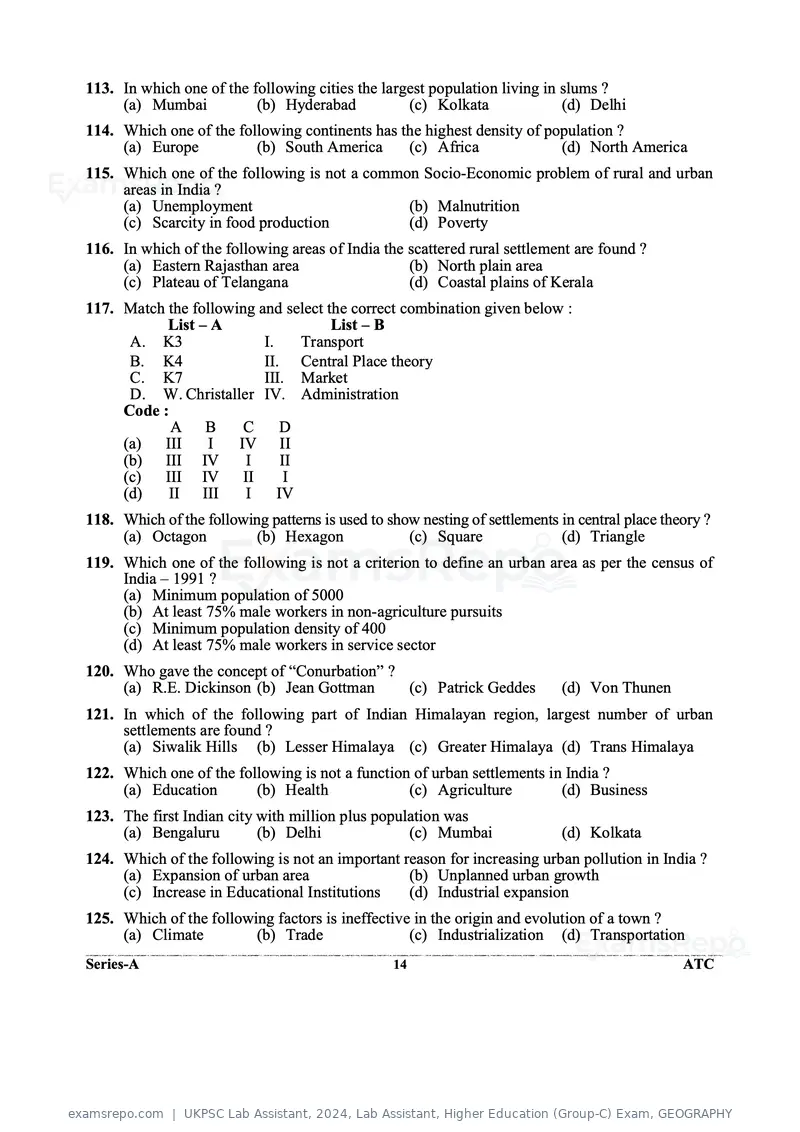
Text of page 14
113. In which one of the following cities the largest population living in slums ?
     (a) Mumbai           (b) Hyderabad           (c) Kolkata              (d) Delhi
114. Which one of the following continents has the highest density of population ?
     (a) Europe          (b) South America      (c) Africa              (d) North America
115. Which one of the following is not a common Socio-Economic problem of rural and urban
     areas in India ?
     (a) Unemployment                         (b) Malnutrition
     (c) Scarcity in food production          (d) Poverty
116. In which of the following areas of India the scattered rural settlement are found ?
     (a) Eastern Rajasthan area                   (b) North plain area
     (c) Plateau of Telangana                     (d) Coastal plains of Kerala
117. Match the following and select the correct combination given below :
           List – A                  List – B
      A. K3               I.     Transport
      B. K4               II. Central Place theory
      C. K7               III. Market
      D. W. Christaller IV. Administration
     Code :
            A B        C      D
     (a)  III     I   IV II
     (b) III IV        I      II
     (c)  III IV II            I
     (d)   II III      I     IV
118. Which of the following patterns is used to show nesting of settlements in central place theory ?
     (a) Octagon          (b) Hexagon              (c) Square               (d) Triangle
119. Which one of the following is not a criterion to define an urban area as per the census of
     India – 1991 ?
     (a) Minimum population of 5000
     (b) At least 75% male workers in non-agriculture pursuits
     (c) Minimum population density of 400
     (d) At least 75% male workers in service sector
120. Who gave the concept of “Conurbation” ?
     (a) R.E. Dickinson (b) Jean Gottman     (c) Patrick Geddes             (d) Von Thunen
121. In which of the following part of Indian Himalayan region, largest number of urban
     settlements are found ?
     (a) Siwalik Hills (b) Lesser Himalaya (c) Greater Himalaya (d) Trans Himalaya
122. Which one of the following is not a function of urban settlements in India ?
     (a) Education       (b) Health              (c) Agriculture         (d) Business
123. The first Indian city with million plus population was
     (a) Bengaluru         (b) Delhi              (c) Mumbai                (d) Kolkata
124. Which of the following is not an important reason for increasing urban pollution in India ?
     (a) Expansion of urban area                 (b) Unplanned urban growth
     (c) Increase in Educational Institutions    (d) Industrial expansion
125. Which of the following factors is ineffective in the origin and evolution of a town ?
     (a) Climate         (b) Trade                (c) Industrialization (d) Transportation
Series-A                                         14                                             ATC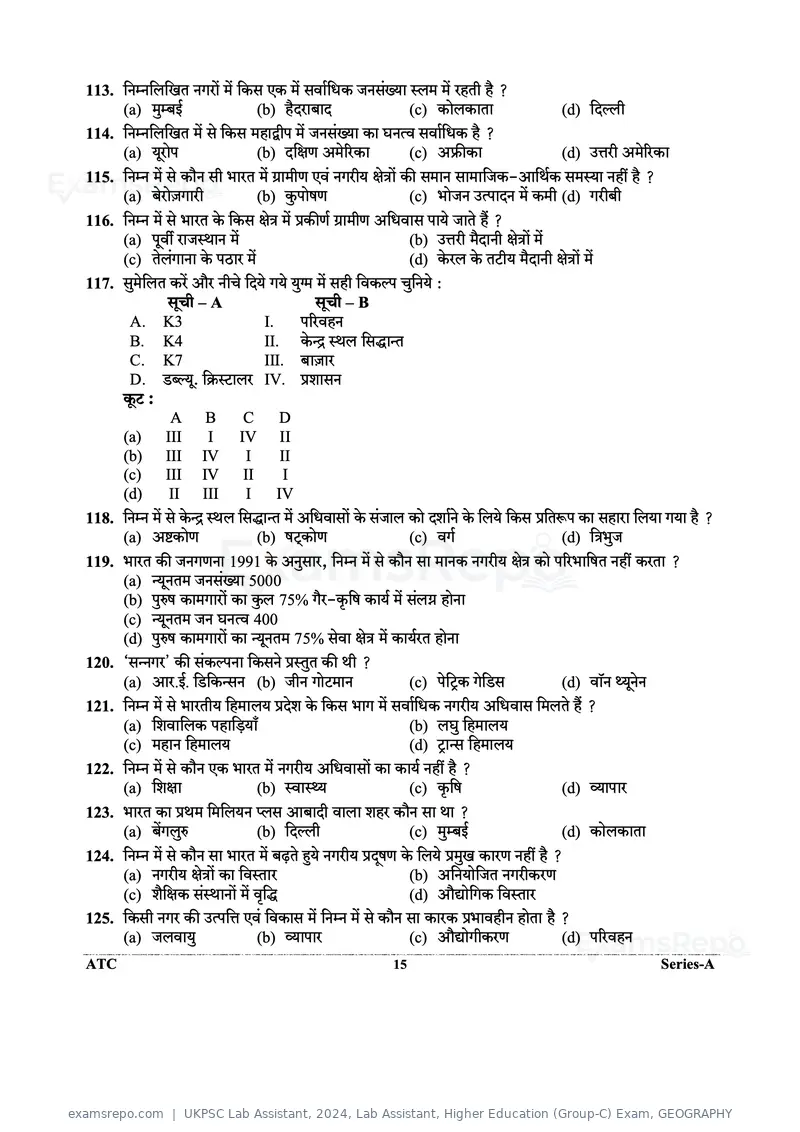
Text of page 15
113. ?
(a) (b) (c) (d)
114. ?
(a) (b) (c) (d)
115. - ?
(a) (b) (c) (d)
116. ?
(a) (b)
(c) (d)
117. :
– A – B
A. K3 I.
B. K4 II.
C. K7 III.
D. . IV.
:
A B C D
(a) III I IV II
(b) III IV I II
(c) III IV II I
(d) II III I IV
118. ?
(a) (b) (c) (d)
119. 1991 , ?
(a) 5000
(b) 75 -
(c) 400
(d) 75
120. ‘’ ?
(a) .. (b) (c) (d)
121. ?
(a) (b)
(c) (d)
122. ?
(a) (b) (c) (d)
123. ?
(a) (b) (c) (d)
124. ?
(a) (b)
(c) (d)
125. ?
(a) (b) (c) (d)
ATC 15 Series-A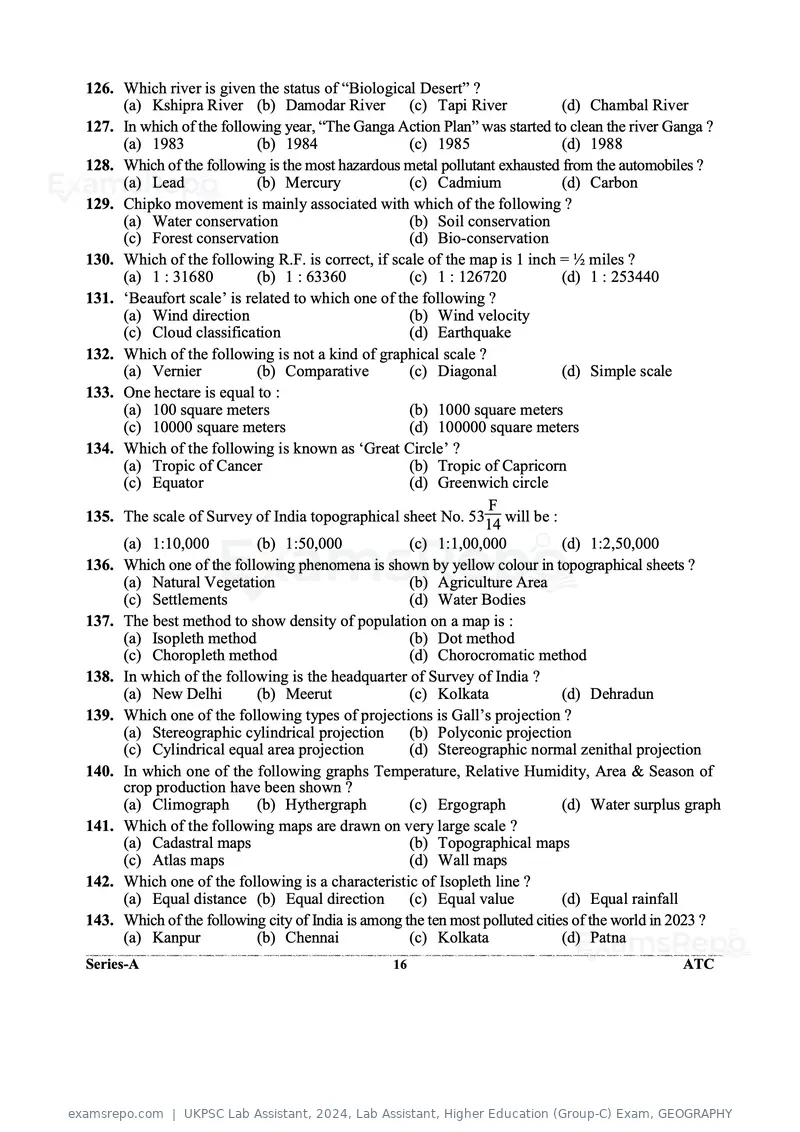
Text of page 16
126. Which river is given the status of “Biological Desert” ?
     (a) Kshipra River (b) Damodar River (c) Tapi River                       (d) Chambal River
127. In which of the following year, “The Ganga Action Plan” was started to clean the river Ganga ?
     (a) 1983              (b) 1984                 (c) 1985                  (d) 1988
128. Which of the following is the most hazardous metal pollutant exhausted from the automobiles ?
     (a) Lead              (b) Mercury              (c) Cadmium               (d) Carbon
129. Chipko movement is mainly associated with which of the following ?
     (a) Water conservation                         (b) Soil conservation
     (c) Forest conservation                        (d) Bio-conservation
130. Which of the following R.F. is correct, if scale of the map is 1 inch = ½ miles ?
     (a) 1 : 31680         (b) 1 : 63360            (c) 1 : 126720            (d) 1 : 253440
131. ‘Beaufort scale’ is related to which one of the following ?
     (a) Wind direction                             (b) Wind velocity
     (c) Cloud classification                       (d) Earthquake
132. Which of the following is not a kind of graphical scale ?
     (a) Vernier           (b) Comparative          (c) Diagonal              (d) Simple scale
133. One hectare is equal to :
     (a) 100 square meters                          (b) 1000 square meters
     (c) 10000 square meters                        (d) 100000 square meters
134. Which of the following is known as ‘Great Circle’ ?
     (a) Tropic of Cancer                           (b) Tropic of Capricorn
     (c) Equator                                    (d) Greenwich circle
                                                                 F
135. The scale of Survey of India topographical sheet No. 5314 will be :
     (a) 1:10,000          (b) 1:50,000             (c) 1:1,00,000            (d) 1:2,50,000
136. Which one of the following phenomena is shown by yellow colour in topographical sheets ?
     (a) Natural Vegetation                         (b) Agriculture Area
     (c) Settlements                                (d) Water Bodies
137. The best method to show density of population on a map is :
     (a) Isopleth method                            (b) Dot method
     (c) Choropleth method                          (d) Chorocromatic method
138. In which of the following is the headquarter of Survey of India ?
     (a) New Delhi         (b) Meerut               (c) Kolkata               (d) Dehradun
139. Which one of the following types of projections is Gall’s projection ?
     (a) Stereographic cylindrical projection       (b) Polyconic projection
     (c) Cylindrical equal area projection          (d) Stereographic normal zenithal projection
140. In which one of the following graphs Temperature, Relative Humidity, Area & Season of
     crop production have been shown ?
     (a) Climograph        (b) Hythergraph          (c) Ergograph             (d) Water surplus graph
141. Which of the following maps are drawn on very large scale ?
     (a) Cadastral maps                             (b) Topographical maps
     (c) Atlas maps                                 (d) Wall maps
142. Which one of the following is a characteristic of Isopleth line ?
     (a) Equal distance (b) Equal direction         (c) Equal value           (d) Equal rainfall
143. Which of the following city of India is among the ten most polluted cities of the world in 2023 ?
     (a) Kanpur            (b) Chennai              (c) Kolkata               (d) Patna
Series-A                                         16                                            ATC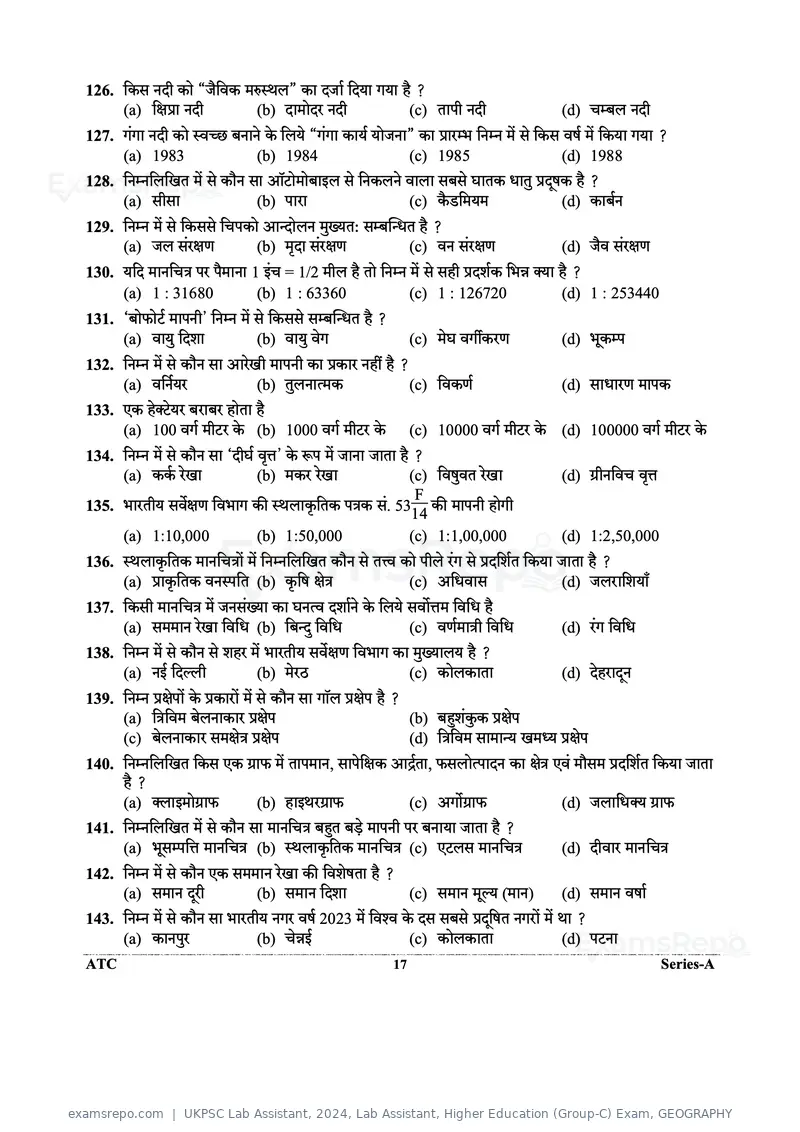
Text of page 17
126. “ ” ?
(a) (b) (c) (d)
127. “ ” ?
(a) 1983 (b) 1984 (c) 1985 (d) 1988
128. ?
(a) (b) (c) (d)
129. : ?
(a) (b) (c) (d)
130. 1 = 1/2 ?
(a) 1 : 31680 (b) 1 : 63360 (c) 1 : 126720 (d) 1 : 253440
131. ‘ ’ ?
(a) (b) (c) (d)
132. ?
(a) (b) (c) (d)
133.
(a) 100 (b) 1000 (c) 10000 (d) 100000
134. ‘ ’ ?
(a) (b) (c) (d)
F
135. . 5314
(a) 1:10,000 (b) 1:50,000 (c) 1:1,00,000 (d) 1:2,50,000
136. ?
(a) (b) (c) (d)
137.
(a) (b) (c) (d)
138. ?
(a) (b) (c) (d)
139. ?
(a) (b)
(c) (d)
140. , ,
?
(a) (b) (c) (d)
141. ?
(a) (b) (c) (d)
142. ?
(a) (b) (c) () (d)
143. 2023 ?
(a) (b) (c) (d)
ATC 17 Series-A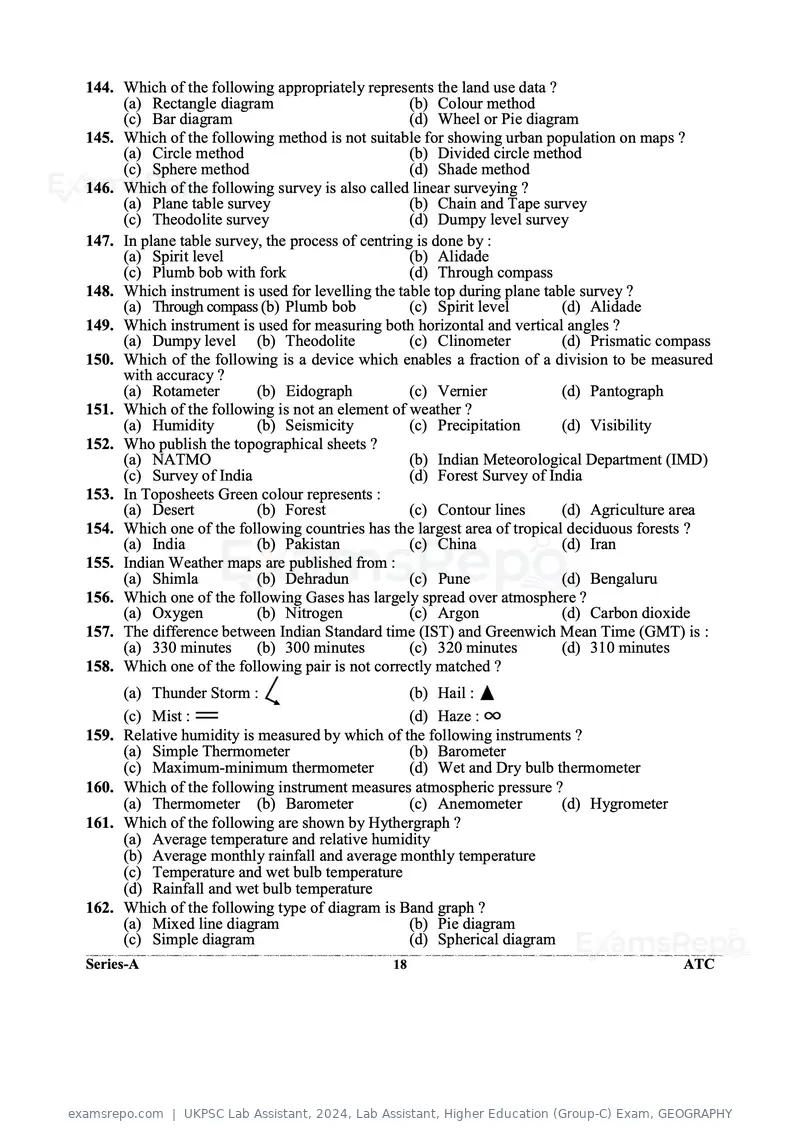
Text of page 18
144. Which of the following appropriately represents the land use data ?
     (a) Rectangle diagram                         (b) Colour method
     (c) Bar diagram                               (d) Wheel or Pie diagram
145. Which of the following method is not suitable for showing urban population on maps ?
     (a) Circle method                             (b) Divided circle method
     (c) Sphere method                             (d) Shade method
146. Which of the following survey is also called linear surveying ?
     (a) Plane table survey                        (b) Chain and Tape survey
     (c) Theodolite survey                         (d) Dumpy level survey
147. In plane table survey, the process of centring is done by :
     (a) Spirit level                              (b) Alidade
     (c) Plumb bob with fork                       (d) Through compass
148. Which instrument is used for levelling the table top during plane table survey ?
     (a) Through compass (b) Plumb bob             (c) Spirit level       (d) Alidade
149. Which instrument is used for measuring both horizontal and vertical angles ?
     (a) Dumpy level (b) Theodolite                (c) Clinometer         (d) Prismatic compass
150. Which of the following is a device which enables a fraction of a division to be measured
     with accuracy ?
     (a) Rotameter        (b) Eidograph            (c) Vernier            (d) Pantograph
151. Which of the following is not an element of weather ?
     (a) Humidity         (b) Seismicity           (c) Precipitation      (d) Visibility
152. Who publish the topographical sheets ?
     (a) NATMO                                     (b) Indian Meteorological Department (IMD)
     (c) Survey of India                           (d) Forest Survey of India
153. In Toposheets Green colour represents :
     (a) Desert           (b) Forest               (c) Contour lines      (d) Agriculture area
154. Which one of the following countries has the largest area of tropical deciduous forests ?
     (a) India            (b) Pakistan             (c) China              (d) Iran
155. Indian Weather maps are published from :
     (a) Shimla           (b) Dehradun             (c) Pune               (d) Bengaluru
156. Which one of the following Gases has largely spread over atmosphere ?
     (a) Oxygen           (b) Nitrogen             (c) Argon              (d) Carbon dioxide
157. The difference between Indian Standard time (IST) and Greenwich Mean Time (GMT) is :
     (a) 330 minutes      (b) 300 minutes          (c) 320 minutes        (d) 310 minutes
158. Which one of the following pair is not correctly matched ?
     (a) Thunder Storm :                        (b) Hail :
     (c) Mist :                                 (d) Haze :
159. Relative humidity is measured by which of the following instruments ?
     (a) Simple Thermometer                     (b) Barometer
     (c) Maximum-minimum thermometer            (d) Wet and Dry bulb thermometer
160. Which of the following instrument measures atmospheric pressure ?
     (a) Thermometer (b) Barometer              (c) Anemometer        (d) Hygrometer
161. Which of the following are shown by Hythergraph ?
     (a) Average temperature and relative humidity
     (b) Average monthly rainfall and average monthly temperature
     (c) Temperature and wet bulb temperature
     (d) Rainfall and wet bulb temperature
162. Which of the following type of diagram is Band graph ?
     (a) Mixed line diagram                     (b) Pie diagram
     (c) Simple diagram                         (d) Spherical diagram
Series-A                                      18                                          ATC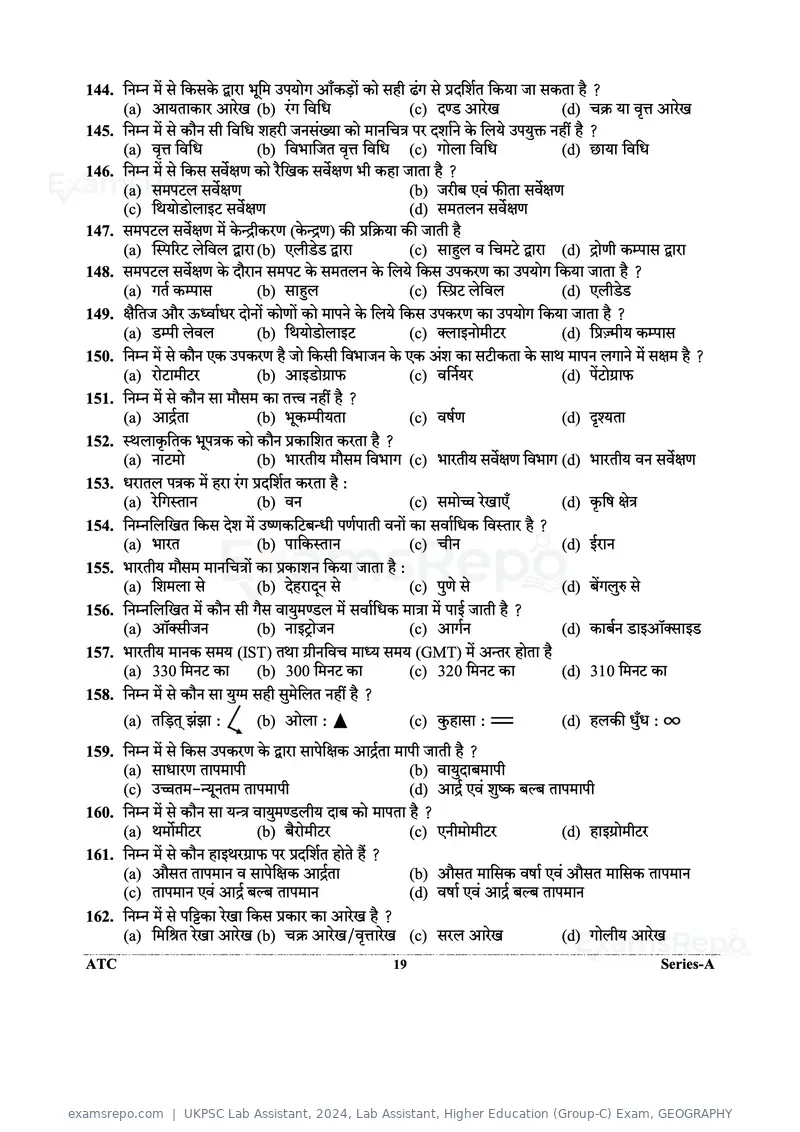
Text of page 19
144. ?
(a) (b) (c) (d)
145. ?
(a) (b) (c) (d)
146. ?
(a) (b)
(c) (d)
147. ()
(a) (b) (c) (d)
148. ?
(a) (b) (c) (d)
149. ?
(a) (b) (c) (d)
150. ?
(a) (b) (c) (d)
151. ?
(a) (b) (c) (d)
152. ?
(a) (b) (c) (d)
153. :
(a) (b) (c) (d)
154. ?
(a) (b) (c) (d)
155. :
(a) (b) (c) (d)
156. ?
(a) (b) (c) (d)
157. (IST) (GMT)
(a) 330 (b) 300 (c) 320 (d) 310
158. ?
(a) : (b) : (c) : (d) :
159. ?
(a) (b)
(c) - (d)
160. ?
(a) (b) (c) (d)
161. ?
(a) (b)
(c) (d)
162. ?
(a) (b) / (c) (d)
ATC 19 Series-A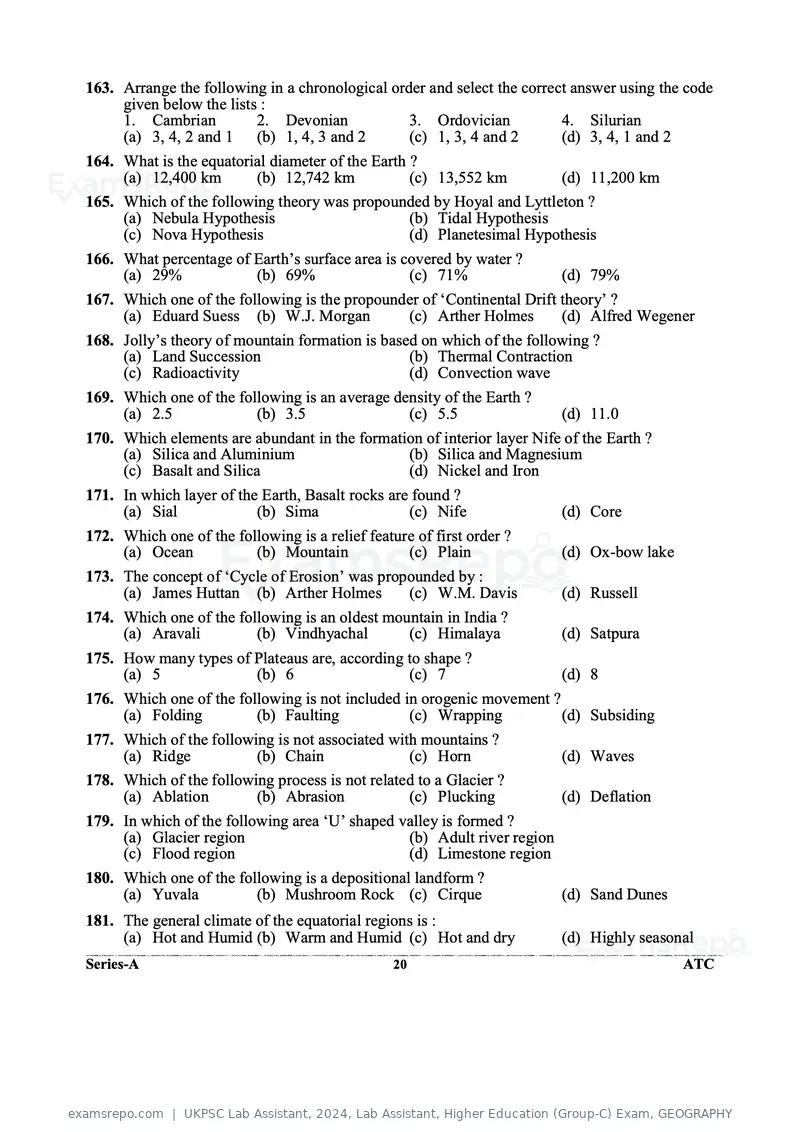
Text of page 20
163. Arrange the following in a chronological order and select the correct answer using the code
given below the lists :
1. Cambrian 2. Devonian 3. Ordovician 4. Silurian
(a) 3, 4, 2 and 1 (b) 1, 4, 3 and 2 (c) 1, 3, 4 and 2 (d) 3, 4, 1 and 2
164. What is the equatorial diameter of the Earth ?
(a) 12,400 km (b) 12,742 km (c) 13,552 km (d) 11,200 km
165. Which of the following theory was propounded by Hoyal and Lyttleton ?
(a) Nebula Hypothesis (b) Tidal Hypothesis
(c) Nova Hypothesis (d) Planetesimal Hypothesis
166. What percentage of Earth’s surface area is covered by water ?
(a) 29 (b) 69 (c) 71 (d) 79
167. Which one of the following is the propounder of ‘Continental Drift theory’ ?
(a) Eduard Suess (b) W.J. Morgan (c) Arther Holmes (d) Alfred Wegener
168. Jolly’s theory of mountain formation is based on which of the following ?
(a) Land Succession (b) Thermal Contraction
(c) Radioactivity (d) Convection wave
169. Which one of the following is an average density of the Earth ?
(a) 2.5 (b) 3.5 (c) 5.5 (d) 11.0
170. Which elements are abundant in the formation of interior layer Nife of the Earth ?
(a) Silica and Aluminium (b) Silica and Magnesium
(c) Basalt and Silica (d) Nickel and Iron
171. In which layer of the Earth, Basalt rocks are found ?
(a) Sial (b) Sima (c) Nife (d) Core
172. Which one of the following is a relief feature of first order ?
(a) Ocean (b) Mountain (c) Plain (d) Ox-bow lake
173. The concept of ‘Cycle of Erosion’ was propounded by :
(a) James Huttan (b) Arther Holmes (c) W.M. Davis (d) Russell
174. Which one of the following is an oldest mountain in India ?
(a) Aravali (b) Vindhyachal (c) Himalaya (d) Satpura
175. How many types of Plateaus are, according to shape ?
(a) 5 (b) 6 (c) 7 (d) 8
176. Which one of the following is not included in orogenic movement ?
(a) Folding (b) Faulting (c) Wrapping (d) Subsiding
177. Which of the following is not associated with mountains ?
(a) Ridge (b) Chain (c) Horn (d) Waves
178. Which of the following process is not related to a Glacier ?
(a) Ablation (b) Abrasion (c) Plucking (d) Deflation
179. In which of the following area ‘U’ shaped valley is formed ?
(a) Glacier region (b) Adult river region
(c) Flood region (d) Limestone region
180. Which one of the following is a depositional landform ?
(a) Yuvala (b) Mushroom Rock (c) Cirque (d) Sand Dunes
181. The general climate of the equatorial regions is :
(a) Hot and Humid (b) Warm and Humid (c) Hot and dry (d) Highly seasonal
Series-A 20 ATC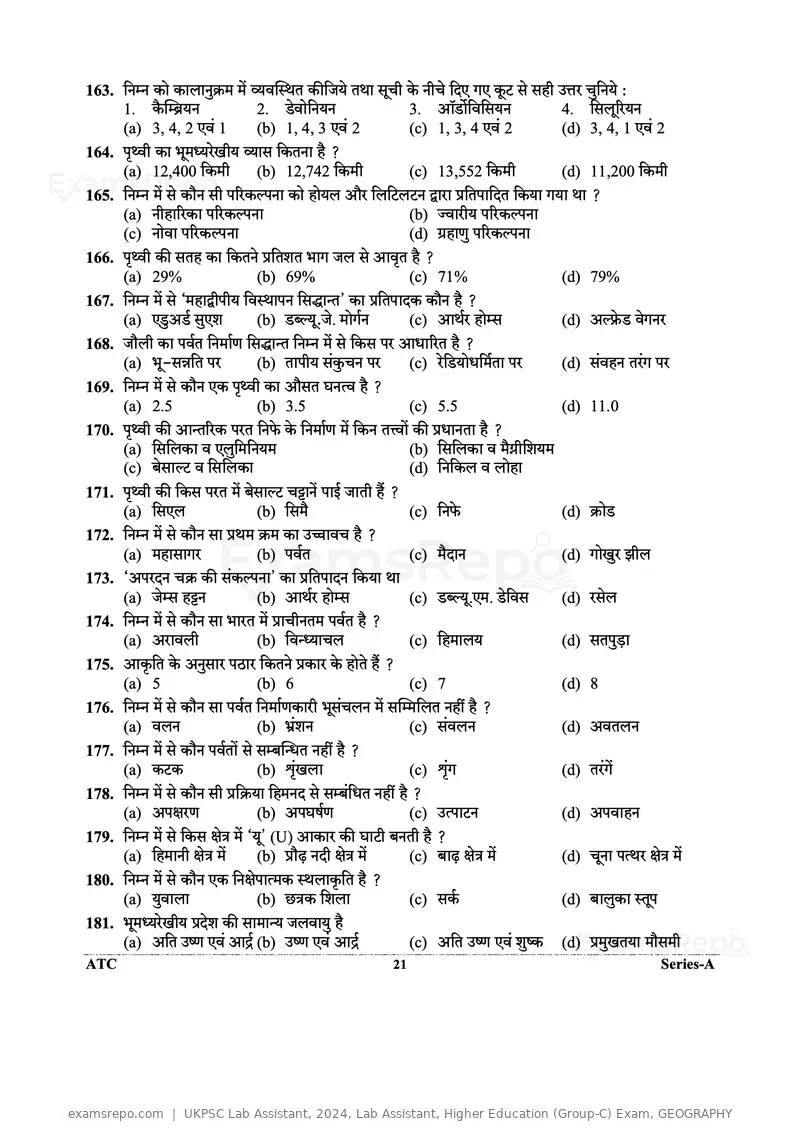
Text of page 21
163. :
1. 2. 3. 4.
(a) 3, 4, 2 1 (b) 1, 4, 3 2 (c) 1, 3, 4 2 (d) 3, 4, 1 2
164. ?
(a) 12,400 (b) 12,742 (c) 13,552 (d) 11,200
165. ?
(a) (b)
(c) (d)
166. ?
(a) 29 (b) 69 (c) 71 (d) 79
167. ‘ ’ ?
(a) (b) .. (c) (d)
168. ?
(a) - (b) (c) (d)
169. ?
(a) 2.5 (b) 3.5 (c) 5.5 (d) 11.0
170. ?
(a) (b)
(c) (d)
171. ?
(a) (b) (c) (d)
172. ?
(a) (b) (c) (d)
173. ‘ ’
(a) (b) (c) .. (d)
174. ?
(a) (b) (c) (d)
175. ?
(a) 5 (b) 6 (c) 7 (d) 8
176. ?
(a) (b) (c) (d)
177. ?
(a) (b) (c) (d)
178. ?
(a) (b) (c) (d)
179. ‘’ (U) ?
(a) (b) (c) (d)
180. ?
(a) (b) (c) (d)
181.
(a) (b) (c) (d)
ATC 21 Series-A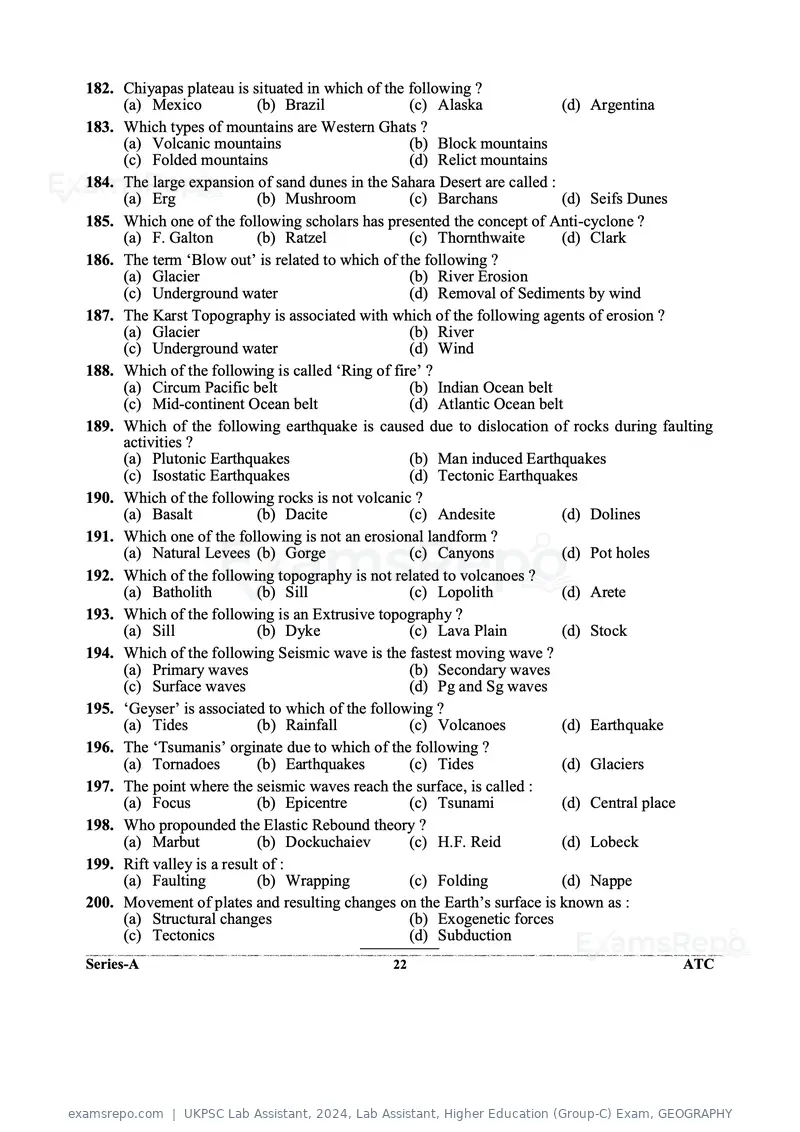
Text of page 22
182. Chiyapas plateau is situated in which of the following ?
     (a) Mexico             (b) Brazil            (c) Alaska             (d) Argentina
183. Which types of mountains are Western Ghats ?
     (a) Volcanic mountains                       (b) Block mountains
     (c) Folded mountains                         (d) Relict mountains
184. The large expansion of sand dunes in the Sahara Desert are called :
     (a) Erg                (b) Mushroom          (c) Barchans           (d) Seifs Dunes
185. Which one of the following scholars has presented the concept of Anti-cyclone ?
     (a) F. Galton          (b) Ratzel            (c) Thornthwaite       (d) Clark
186. The term ‘Blow out’ is related to which of the following ?
     (a) Glacier                                  (b) River Erosion
     (c) Underground water                        (d) Removal of Sediments by wind
187. The Karst Topography is associated with which of the following agents of erosion ?
     (a) Glacier                                  (b) River
     (c) Underground water                        (d) Wind
188. Which of the following is called ‘Ring of fire’ ?
     (a) Circum Pacific belt                      (b) Indian Ocean belt
     (c) Mid-continent Ocean belt                 (d) Atlantic Ocean belt
189. Which of the following earthquake is caused due to dislocation of rocks during faulting
     activities ?
     (a) Plutonic Earthquakes                     (b) Man induced Earthquakes
     (c) Isostatic Earthquakes                    (d) Tectonic Earthquakes
190. Which of the following rocks is not volcanic ?
     (a) Basalt             (b) Dacite            (c) Andesite           (d) Dolines
191. Which one of the following is not an erosional landform ?
     (a) Natural Levees (b) Gorge                 (c) Canyons            (d) Pot holes
192. Which of the following topography is not related to volcanoes ?
     (a) Batholith          (b) Sill              (c) Lopolith           (d) Arete
193. Which of the following is an Extrusive topography ?
     (a) Sill               (b) Dyke              (c) Lava Plain         (d) Stock
194. Which of the following Seismic wave is the fastest moving wave ?
     (a) Primary waves                            (b) Secondary waves
     (c) Surface waves                            (d) Pg and Sg waves
195. ‘Geyser’ is associated to which of the following ?
     (a) Tides              (b) Rainfall          (c) Volcanoes          (d) Earthquake
196. The ‘Tsumanis’ orginate due to which of the following ?
     (a) Tornadoes          (b) Earthquakes       (c) Tides              (d) Glaciers
197. The point where the seismic waves reach the surface, is called :
     (a) Focus              (b) Epicentre         (c) Tsunami            (d) Central place
198. Who propounded the Elastic Rebound theory ?
     (a) Marbut             (b) Dockuchaiev       (c) H.F. Reid          (d) Lobeck
199. Rift valley is a result of :
     (a) Faulting           (b) Wrapping          (c) Folding            (d) Nappe
200. Movement of plates and resulting changes on the Earth’s surface is known as :
     (a) Structural changes                       (b) Exogenetic forces
     (c) Tectonics                                (d) Subduction
Series-A                                     22                                        ATC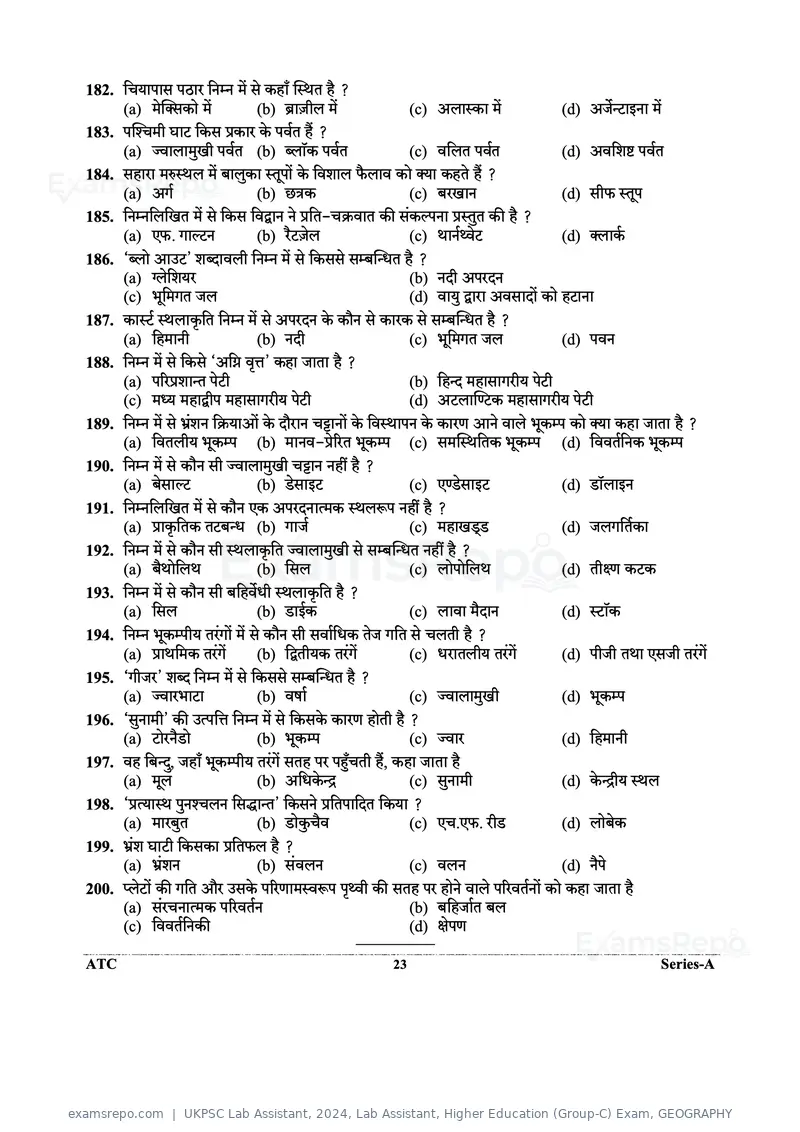
Text of page 23
182. ?
(a) (b) (c) (d)
183. ?
(a) (b) (c) (d)
184. ?
(a) (b) (c) (d)
185. - ?
(a) . (b) (c) (d)
186. ‘ ’ ?
(a) (b)
(c) (d)
187. ?
(a) (b) (c) (d)
188. ‘ ’ ?
(a) (b)
(c) (d)
189. ?
(a) (b) - (c) (d)
190. ?
(a) (b) (c) (d)
191. ?
(a) (b) (c) (d)
192. ?
(a) (b) (c) (d)
193. ?
(a) (b) (c) (d)
194. ?
(a) (b) (c) (d)
195. ‘’ ?
(a) (b) (c) (d)
196. ‘’ ?
(a) (b) (c) (d)
197. , ,
(a) (b) (c) (d)
198. ‘ ’ ?
(a) (b) (c) .. (d)
199. ?
(a) (b) (c) (d)
200.
(a) (b)
(c) (d)
ATC 23 Series-A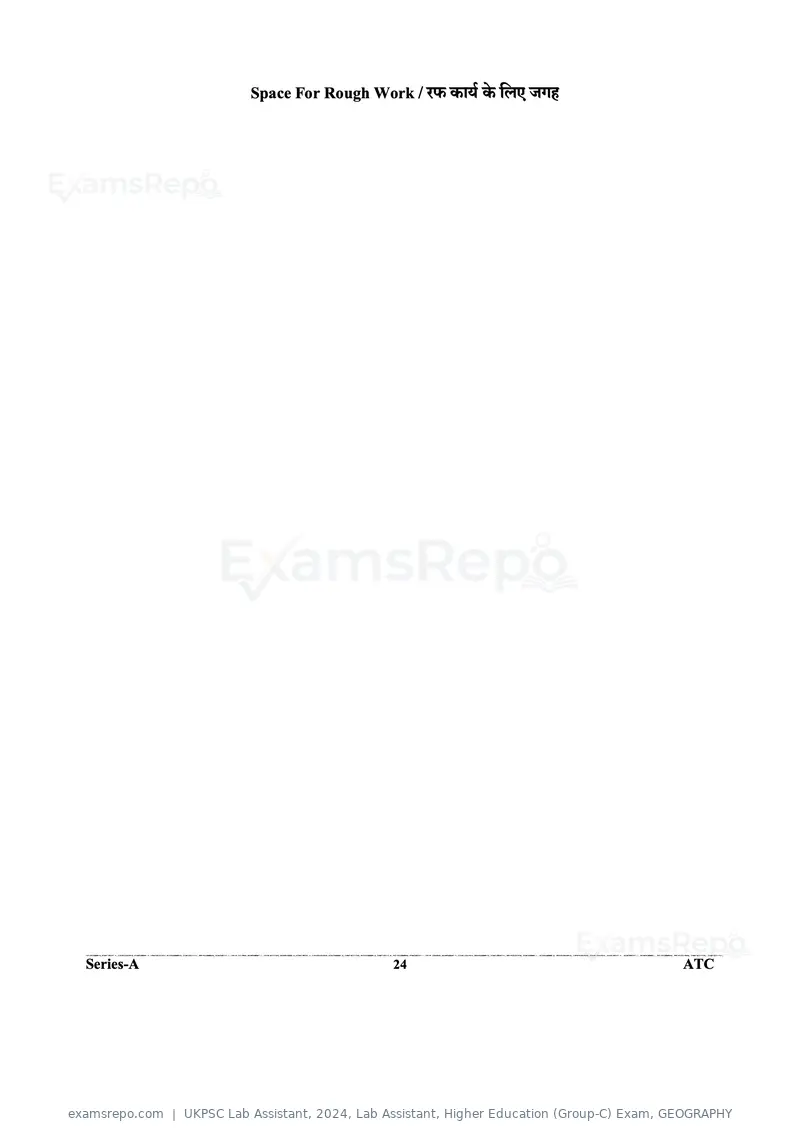
Text of page 24
Space For Rough Work / Series-A 24 ATC
Page 1 of 24
Source: Uttarakhand Public Service Commission. Question paper published by Uttarakhand Public Service Commission.