
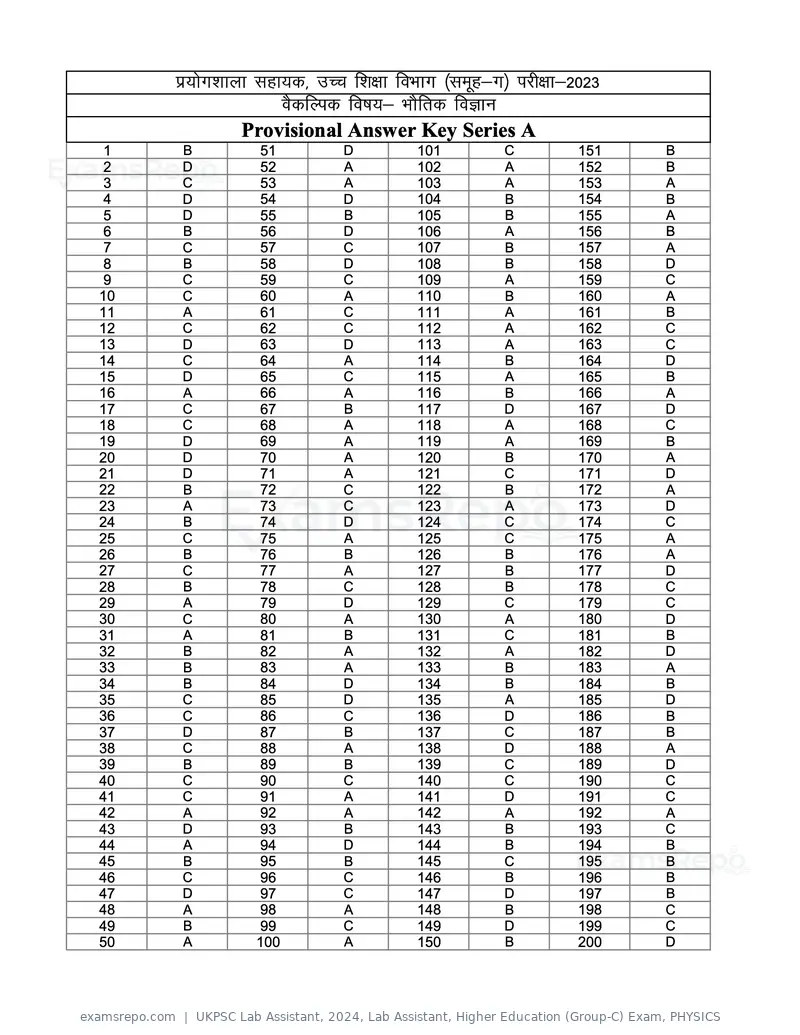
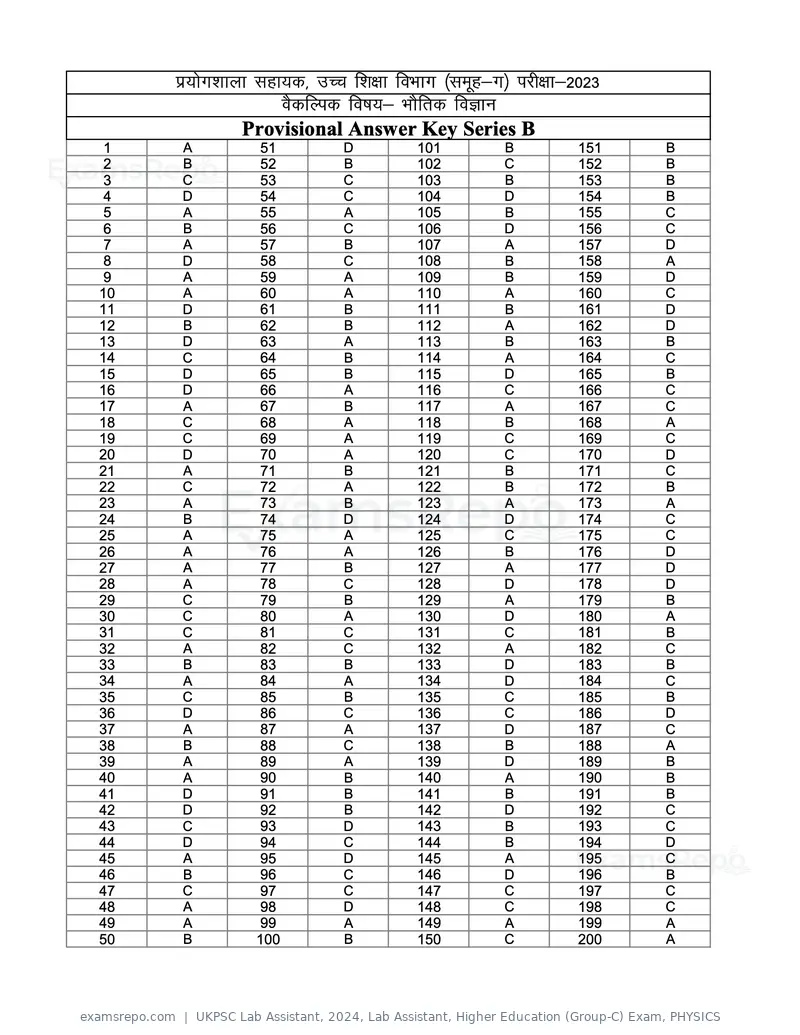
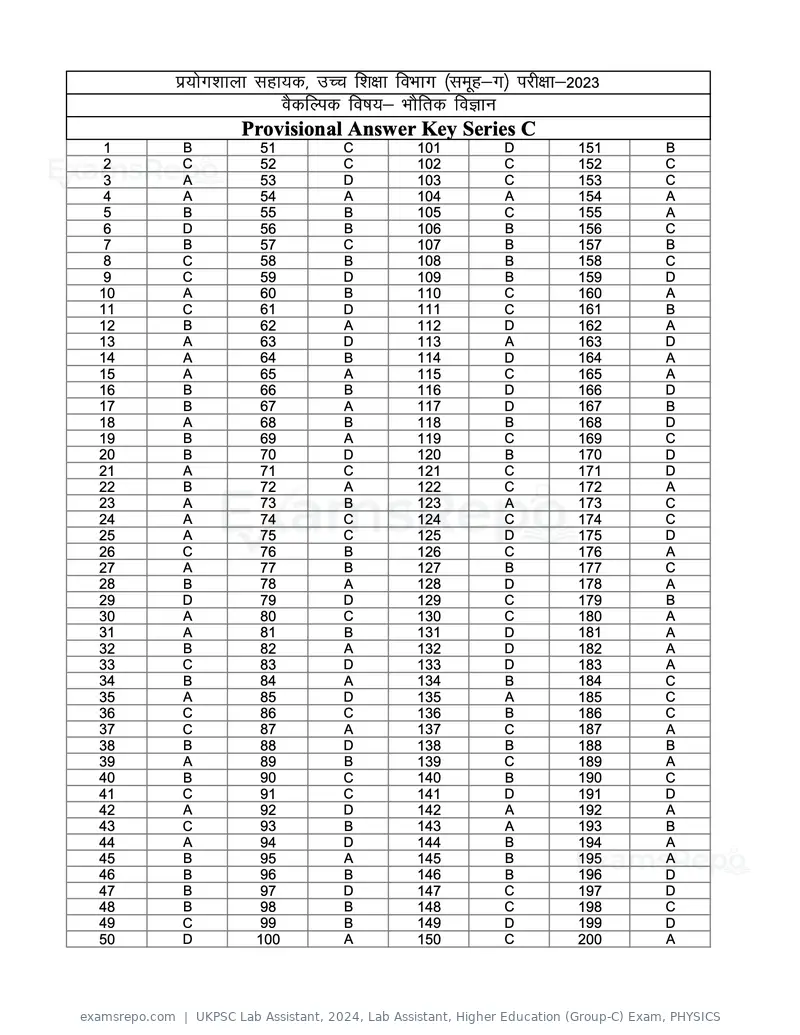
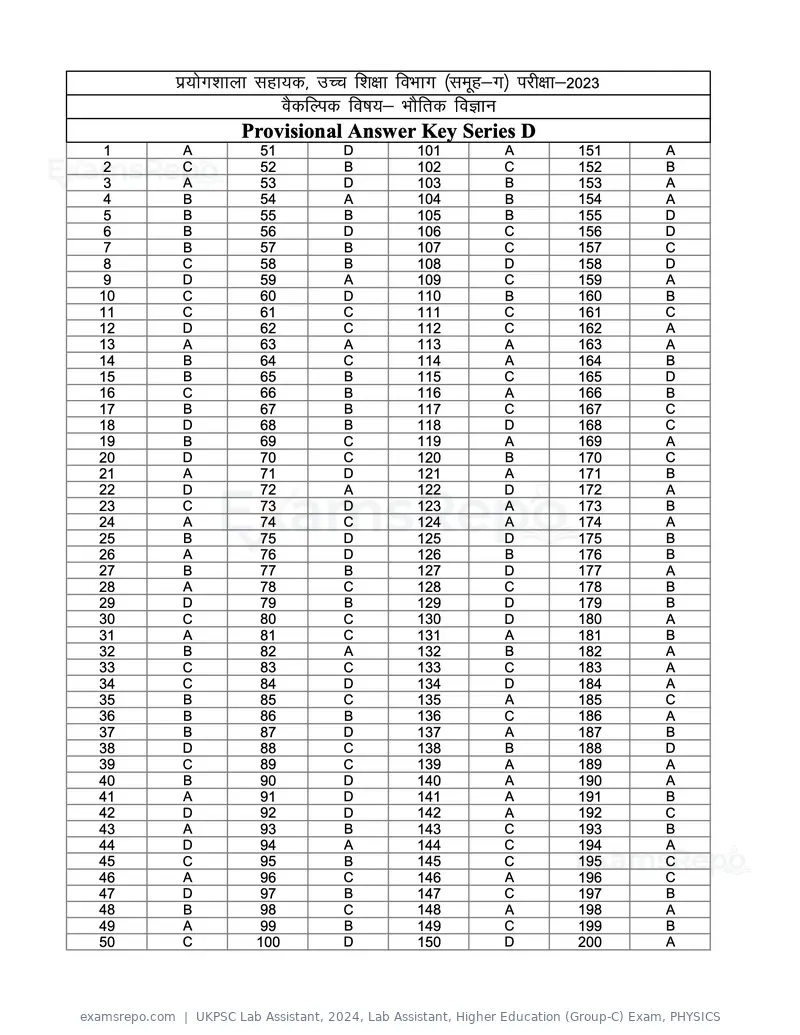
UKPSC Lab Assistant 2024: Lab Assistant, Higher Education (Group-C) Exam, PHYSICS
Text of page 2
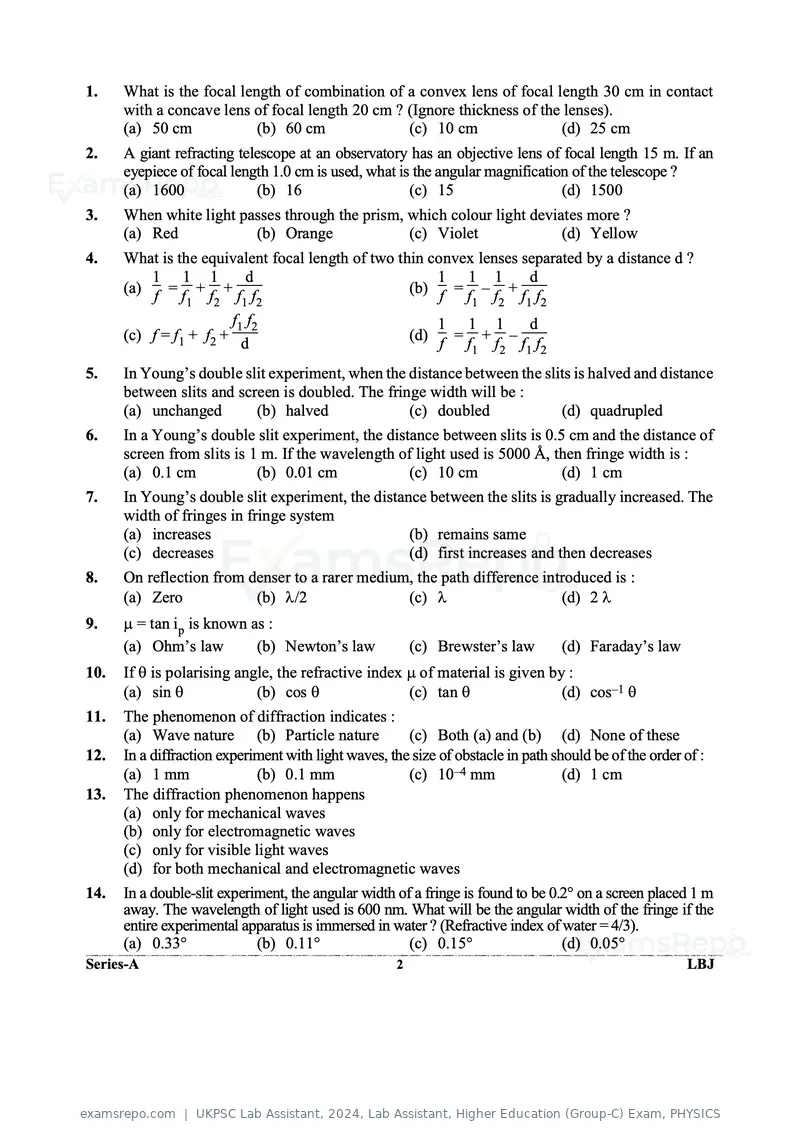
1. What is the focal length of combination of a convex lens of focal length 30 cm in contact
with a concave lens of focal length 20 cm ? (Ignore thickness of the lenses).
(a) 50 cm (b) 60 cm (c) 10 cm (d) 25 cm
2. A giant refracting telescope at an observatory has an objective lens of focal length 15 m. If an
eyepiece of focal length 1.0 cm is used, what is the angular magnification of the telescope ?
(a) 1600 (b) 16 (c) 15 (d) 1500
3. When white light passes through the prism, which colour light deviates more ?
(a) Red (b) Orange (c) Violet (d) Yellow
4. What is the equivalent focal length of two thin convex lenses separated by a distance d ?
1 1 1 d 1 1 1 d
(a) f = f + f + f f (b) f = f – f + f f
1 2 1 2 1 2 1 2
f1 f2 1 1 1 d
(c) f = f1 + f2 + d (d) f = f + f – f f
1 2 1 2
5. In Young’s double slit experiment, when the distance between the slits is halved and distance
between slits and screen is doubled. The fringe width will be :
(a) unchanged (b) halved (c) doubled (d) quadrupled
6. In a Young’s double slit experiment, the distance between slits is 0.5 cm and the distance of
screen from slits is 1 m. If the wavelength of light used is 5000 Å, then fringe width is :
(a) 0.1 cm (b) 0.01 cm (c) 10 cm (d) 1 cm
7. In Young’s double slit experiment, the distance between the slits is gradually increased. The
width of fringes in fringe system
(a) increases (b) remains same
(c) decreases (d) first increases and then decreases
8. On reflection from denser to a rarer medium, the path difference introduced is :
(a) Zero (b) /2 (c) (d) 2
9. = tan ip is known as :
(a) Ohm’s law (b) Newton’s law (c) Brewster’s law (d) Faraday’s law
10. If is polarising angle, the refractive index of material is given by :
(a) sin (b) cos (c) tan (d) cos–1
11. The phenomenon of diffraction indicates :
(a) Wave nature (b) Particle nature (c) Both (a) and (b) (d) None of these
12. In a diffraction experiment with light waves, the size of obstacle in path should be of the order of :
(a) 1 mm (b) 0.1 mm (c) 10–4 mm (d) 1 cm
13. The diffraction phenomenon happens
(a) only for mechanical waves
(b) only for electromagnetic waves
(c) only for visible light waves
(d) for both mechanical and electromagnetic waves
14. In a double-slit experiment, the angular width of a fringe is found to be 0.2 on a screen placed 1 m
away. The wavelength of light used is 600 nm. What will be the angular width of the fringe if the
entire experimental apparatus is immersed in water ? (Refractive index of water = 4/3).
(a) 0.33° (b) 0.11° (c) 0.15° (d) 0.05°
Series-A 2 LBJ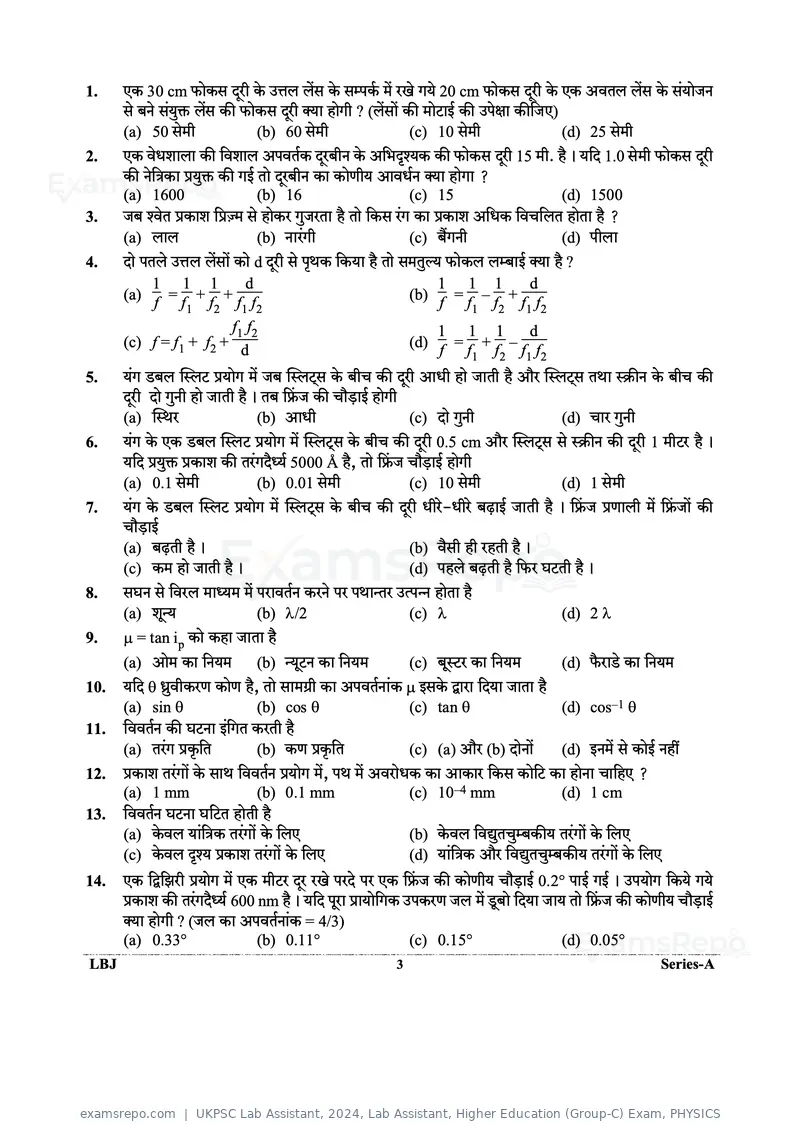
Text of page 3
1. 30 cm 20 cm
? ( )
(a) 50 (b) 60 (c) 10 (d) 25
2. 15 . 1.0
?
(a) 1600 (b) 16 (c) 15 (d) 1500
3. ?
(a) (b) (c) (d)
4. d ?
1 1 1 d 1 1 1 d
(a) f = f + f + f f (b) f = f – f + f f
1 2 1 2 1 2 1 2
f1 f2 1 1 1 d
(c) f = f1 + f2 + d (d) f = f + f – f f
1 2 1 2
5.
(a) (b) (c) (d)
6. 0.5 cm 1
5000 Å ,
(a) 0.1 (b) 0.01 (c) 10 (d) 1
7. -
(a) (b)
(c) (d)
8.
(a) (b) /2 (c) (d) 2
9. = tan ip
(a) (b) (c) (d)
10. ,
(a) sin (b) cos (c) tan (d) cos–1
11.
(a) (b) (c) (a) (b) (d)
12. , ?
(a) 1 mm (b) 0.1 mm (c) 10–4 mm (d) 1 cm
13.
(a) (b)
(c) (d)
14. 0.2
600 nm
? ( = 4/3)
(a) 0.33° (b) 0.11° (c) 0.15° (d) 0.05°
LBJ 3 Series-A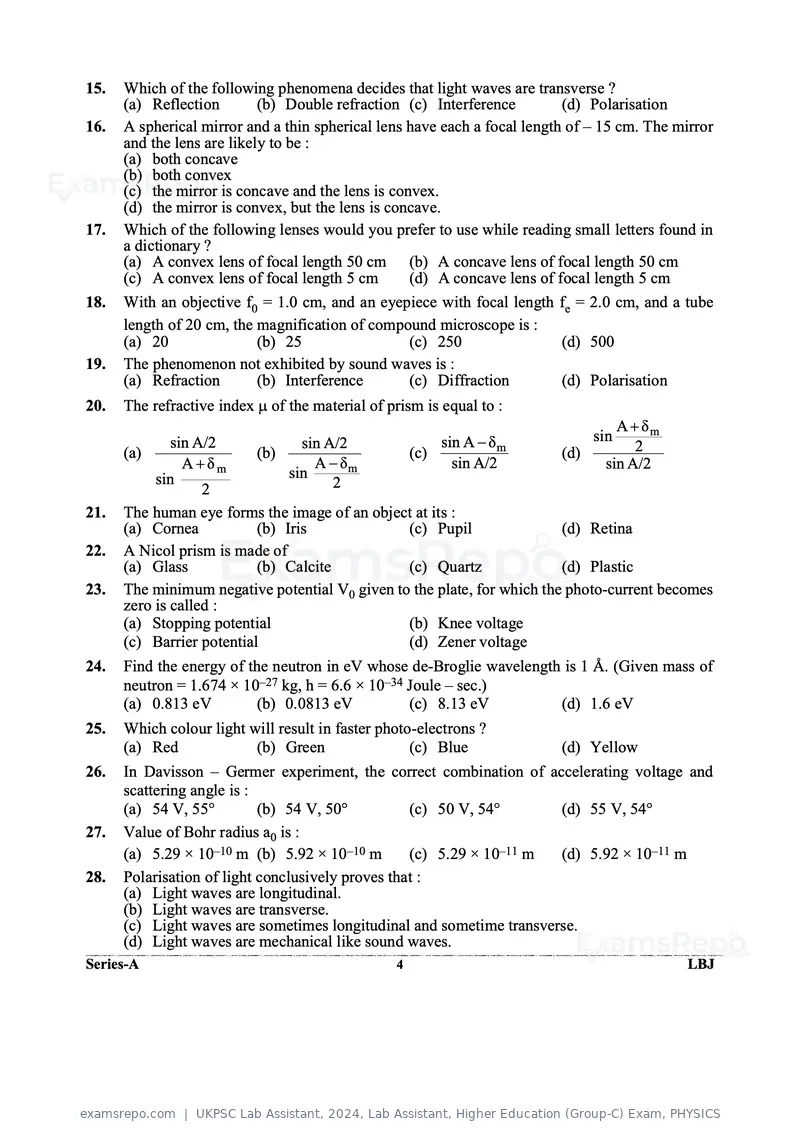
Text of page 4
15. Which of the following phenomena decides that light waves are transverse ?
(a) Reflection (b) Double refraction (c) Interference (d) Polarisation
16. A spherical mirror and a thin spherical lens have each a focal length of – 15 cm. The mirror
and the lens are likely to be :
(a) both concave
(b) both convex
(c) the mirror is concave and the lens is convex.
(d) the mirror is convex, but the lens is concave.
17. Which of the following lenses would you prefer to use while reading small letters found in
a dictionary ?
(a) A convex lens of focal length 50 cm (b) A concave lens of focal length 50 cm
(c) A convex lens of focal length 5 cm (d) A concave lens of focal length 5 cm
18. With an objective f0 = 1.0 cm, and an eyepiece with focal length fe = 2.0 cm, and a tube
length of 20 cm, the magnification of compound microscope is :
(a) 20 (b) 25 (c) 250 (d) 500
19. The phenomenon not exhibited by sound waves is :
(a) Refraction (b) Interference (c) Diffraction (d) Polarisation
20. The refractive index of the material of prism is equal to :
A δm
sin A/2 sin A/2 sin A δ m sin
(a) (b) (c) (d) 2
Aδm A δ m sin A/2 sin A/2
sin sin
2 2
21. The human eye forms the image of an object at its :
(a) Cornea (b) Iris (c) Pupil (d) Retina
22. A Nicol prism is made of
(a) Glass (b) Calcite (c) Quartz (d) Plastic
23. The minimum negative potential V0 given to the plate, for which the photo-current becomes
zero is called :
(a) Stopping potential (b) Knee voltage
(c) Barrier potential (d) Zener voltage
24. Find the energy of the neutron in eV whose de-Broglie wavelength is 1 Å. (Given mass of
neutron = 1.674 × 10⁻²⁷ kg, h = 6.6 × 10⁻³⁴ Joule – sec.)
(a) 0.813 eV (b) 0.0813 eV (c) 8.13 eV (d) 1.6 eV
25. Which colour light will result in faster photo-electrons ?
(a) Red (b) Green (c) Blue (d) Yellow
26. In Davisson – Germer experiment, the correct combination of accelerating voltage and
scattering angle is :
(a) 54 V, 55° (b) 54 V, 50° (c) 50 V, 54° (d) 55 V, 54°
27. Value of Bohr radius a0 is :
(a) 5.29 × 10⁻¹⁰ m (b) 5.92 × 10⁻¹⁰ m (c) 5.29 × 10⁻¹¹ m (d) 5.92 × 10⁻¹¹ m
28. Polarisation of light conclusively proves that :
(a) Light waves are longitudinal.
(b) Light waves are transverse.
(c) Light waves are sometimes longitudinal and sometime transverse.
(d) Light waves are mechanical like sound waves.
Series-A 4 LBJ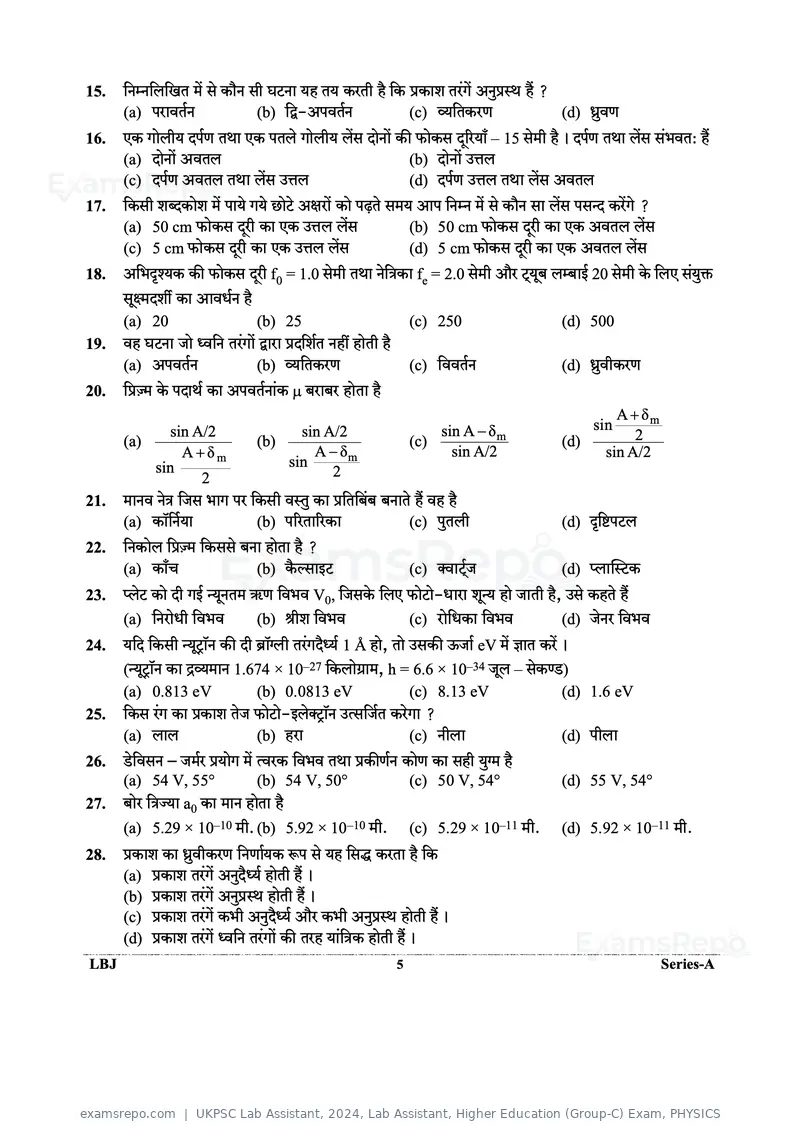
Text of page 6
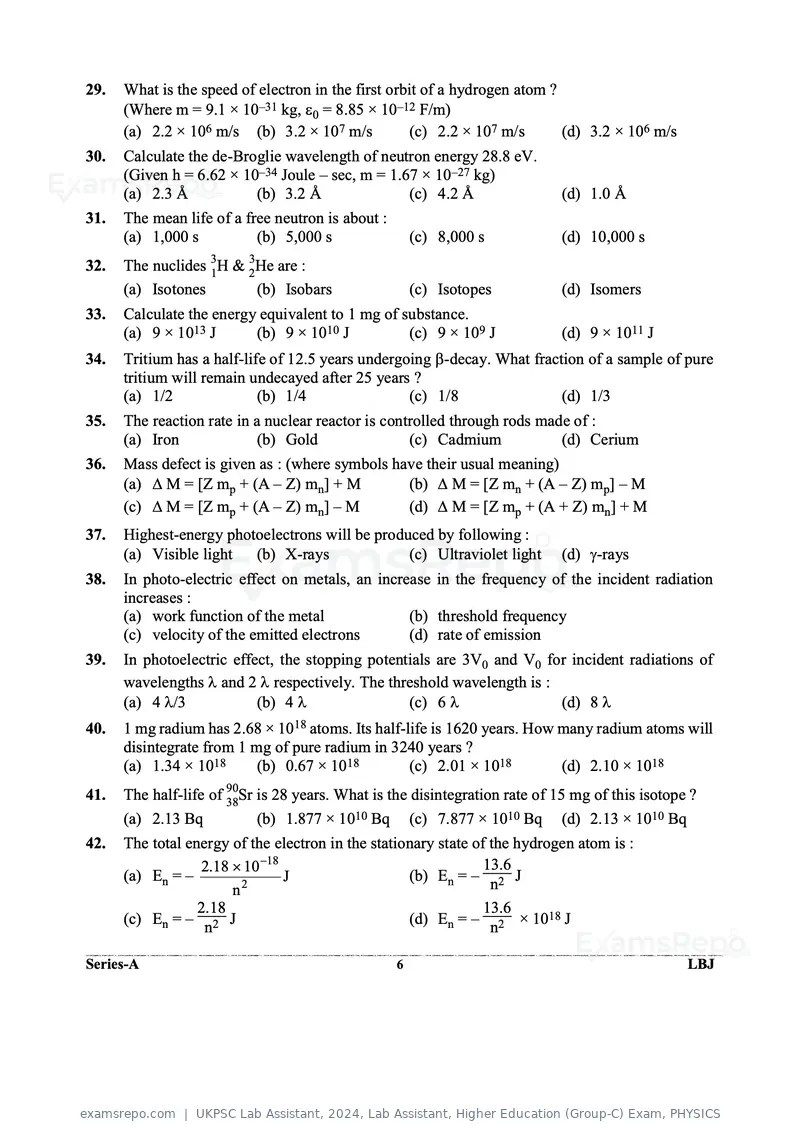
29. What is the speed of electron in the first orbit of a hydrogen atom ?
(Where m = 9.1 × 10⁻³¹ kg, 0 = 8.85 × 10⁻¹² F/m)
(a) 2.2 × 10⁶ m/s (b) 3.2 × 10⁷ m/s (c) 2.2 × 10⁷ m/s (d) 3.2 × 10⁶ m/s
30. Calculate the de-Broglie wavelength of neutron energy 28.8 eV.
(Given h = 6.62 × 10⁻³⁴ Joule – sec, m = 1.67 × 10⁻²⁷ kg)
(a) 2.3 Å (b) 3.2 Å (c) 4.2 Å (d) 1.0 Å
31. The mean life of a free neutron is about :
(a) 1,000 s (b) 5,000 s (c) 8,000 s (d) 10,000 s
3 3
32. The nuclides 1H & 2He are :
(a) Isotones (b) Isobars (c) Isotopes (d) Isomers
33. Calculate the energy equivalent to 1 mg of substance.
(a) 9 × 10¹³ J (b) 9 × 10¹⁰ J (c) 9 × 10⁹ J (d) 9 × 10¹¹ J
34. Tritium has a half-life of 12.5 years undergoing -decay. What fraction of a sample of pure
tritium will remain undecayed after 25 years ?
(a) 1/2 (b) 1/4 (c) 1/8 (d) 1/3
35. The reaction rate in a nuclear reactor is controlled through rods made of :
(a) Iron (b) Gold (c) Cadmium (d) Cerium
36. Mass defect is given as : (where symbols have their usual meaning)
(a) M = [Z mp + (A – Z) mn] + M (b) M = [Z mn + (A – Z) mp] – M
(c) M = [Z mp + (A – Z) mn] – M (d) M = [Z mp + (A + Z) mn] + M
37. Highest-energy photoelectrons will be produced by following :
(a) Visible light (b) X-rays (c) Ultraviolet light (d) -rays
38. In photo-electric effect on metals, an increase in the frequency of the incident radiation
increases :
(a) work function of the metal (b) threshold frequency
(c) velocity of the emitted electrons (d) rate of emission
39. In photoelectric effect, the stopping potentials are 3V0 and V0 for incident radiations of
wavelengths and 2 respectively. The threshold wavelength is :
(a) 4 /3 (b) 4 (c) 6 (d) 8
40. 1 mg radium has 2.68 × 10¹⁸ atoms. Its half-life is 1620 years. How many radium atoms will
disintegrate from 1 mg of pure radium in 3240 years ?
(a) 1.34 × 10¹⁸ (b) 0.67 × 10¹⁸ (c) 2.01 × 10¹⁸ (d) 2.10 × 10¹⁸
90
41. The half-life of 38Sr is 28 years. What is the disintegration rate of 15 mg of this isotope ?
(a) 2.13 Bq (b) 1.877 × 10¹⁰ Bq (c) 7.877 × 10¹⁰ Bq (d) 2.13 × 10¹⁰ Bq
42. The total energy of the electron in the stationary state of the hydrogen atom is :
2.18 10 18 13.6
(a) En = – J (b) E n = – J
n2 n2
2.18 13.6
(c) En = – 2 J (d) En = – 2 × 10¹⁸ J
n n
Series-A 6 LBJ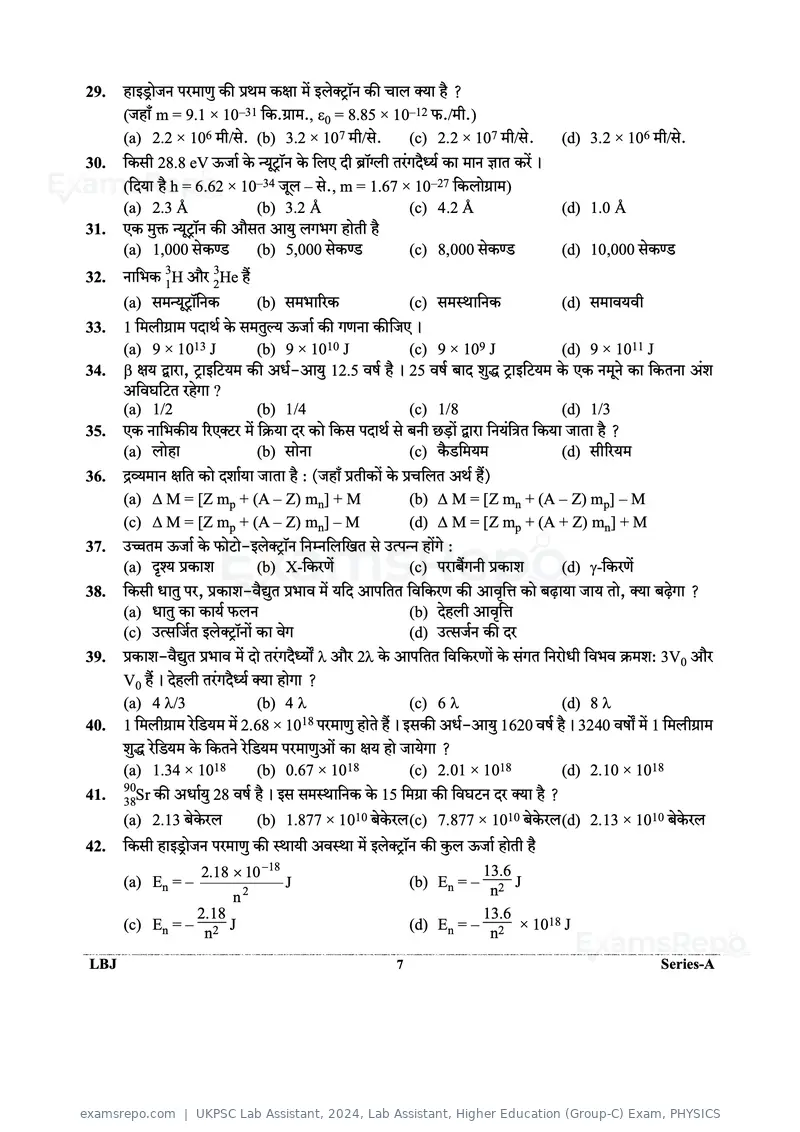
Text of page 7
29. ?
( m = 9.1 × 10⁻³¹ .., 0 = 8.85 × 10⁻¹² ./.)
(a) 2.2 × 10⁶ /. (b) 3.2 × 10⁷ /. (c) 2.2 × 10⁷ /. (d) 3.2 × 10⁶ /.
30. 28.8 eV
( h = 6.62 × 10⁻³⁴ – ., m = 1.67 × 10⁻²⁷ )
(a) 2.3 Å (b) 3.2 Å (c) 4.2 Å (d) 1.0 Å
31.
(a) 1,000 (b) 5,000 (c) 8,000 (d) 10,000
3 3
32. 1H 2He
(a) (b) (c) (d)
33. 1
(a) 9 × 10¹³ J (b) 9 × 10¹⁰ J (c) 9 × 10⁹ J (d) 9 × 10¹¹ J
34. , - 12.5 25
?
(a) 1/2 (b) 1/4 (c) 1/8 (d) 1/3
35. ?
(a) (b) (c) (d)
36. : ( )
(a) M = [Z mp + (A – Z) mn] + M (b) M = [Z mn + (A – Z) mp] – M
(c) M = [Z mp + (A – Z) mn] – M (d) M = [Z mp + (A + Z) mn] + M
37. - :
(a) (b) X- (c) (d) -
38. , - , ?
(a) (b)
(c) (d)
39. - 2 : 3V0
V0 ?
(a) 4 /3 (b) 4 (c) 6 (d) 8
40. 1 2.68 × 10 - 1620 3240 1
18
?
(a) 1.34 × 10¹⁸ (b) 0.67 × 10¹⁸ (c) 2.01 × 10¹⁸ (d) 2.10 × 10¹⁸
90
41. 38Sr 28 15 ?
(a) 2.13 (b) 1.877 × 10¹⁰ (c) 7.877 × 10¹⁰ (d) 2.13 × 10¹⁰
42.
2.18 10 18 13.6
(a) En = – J (b) En = – J
n2 n2
2.18 13.6
(c) En = – J (d) En = – 2 × 10¹⁸ J
n2 n
LBJ 7 Series-A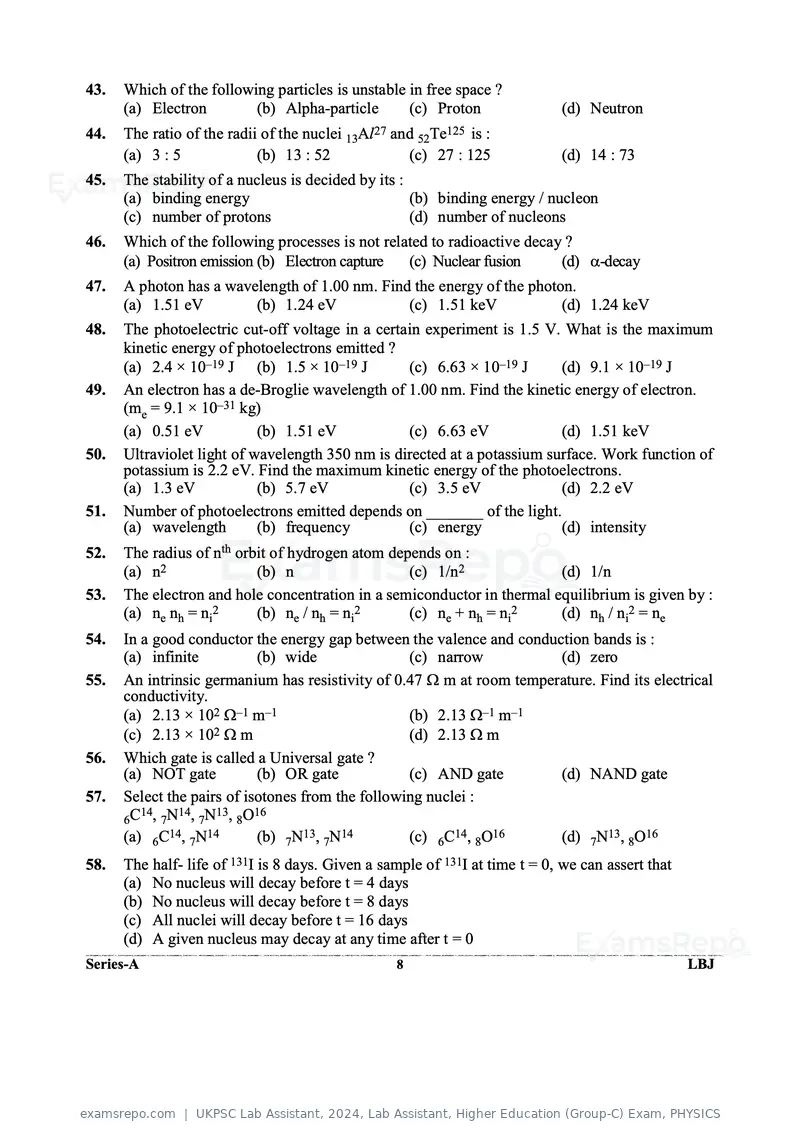
Text of page 8
43. Which of the following particles is unstable in free space ?
(a) Electron (b) Alpha-particle (c) Proton (d) Neutron
44. The ratio of the radii of the nuclei 13 Al27 and 52 Te125 is :
(a) 3 : 5 (b) 13 : 52 (c) 27 : 125 (d) 14 : 73
45. The stability of a nucleus is decided by its :
(a) binding energy (b) binding energy / nucleon
(c) number of protons (d) number of nucleons
46. Which of the following processes is not related to radioactive decay ?
(a) Positron emission (b) Electron capture (c) Nuclear fusion (d) -decay
47. A photon has a wavelength of 1.00 nm. Find the energy of the photon.
(a) 1.51 eV (b) 1.24 eV (c) 1.51 keV (d) 1.24 keV
48. The photoelectric cut-off voltage in a certain experiment is 1.5 V. What is the maximum
kinetic energy of photoelectrons emitted ?
(a) 2.4 × 10⁻¹⁹ J (b) 1.5 × 10⁻¹⁹ J (c) 6.63 × 10⁻¹⁹ J (d) 9.1 × 10⁻¹⁹ J
49. An electron has a de-Broglie wavelength of 1.00 nm. Find the kinetic energy of electron.
(me = 9.1 × 10⁻³¹ kg)
(a) 0.51 eV (b) 1.51 eV (c) 6.63 eV (d) 1.51 keV
50. Ultraviolet light of wavelength 350 nm is directed at a potassium surface. Work function of
potassium is 2.2 eV. Find the maximum kinetic energy of the photoelectrons.
(a) 1.3 eV (b) 5.7 eV (c) 3.5 eV (d) 2.2 eV
51. Number of photoelectrons emitted depends on _______ of the light.
(a) wavelength (b) frequency (c) energy (d) intensity
52. The radius of nth orbit of hydrogen atom depends on :
(a) n2 (b) n (c) 1/n2 (d) 1/n
53. The electron and hole concentration in a semiconductor in thermal equilibrium is given by :
(a) ne nh = ni2 (b) ne / nh = ni2 (c) ne + nh = ni2 (d) nh / ni2 = ne
54. In a good conductor the energy gap between the valence and conduction bands is :
(a) infinite (b) wide (c) narrow (d) zero
55. An intrinsic germanium has resistivity of 0.47 m at room temperature. Find its electrical
conductivity.
(a) 2.13 × 10² –1 m–1 (b) 2.13 –1 m–1
(c) 2.13 × 10 m
2 (d) 2.13 m
56. Which gate is called a Universal gate ?
(a) NOT gate (b) OR gate (c) AND gate (d) NAND gate
57. Select the pairs of isotones from the following nuclei :
14 14 13 16
6C , 7N , 7N , 8O
(a) 6C14, 7N14 (b) 7N13, 7N14 (c) 6C14, 8O16 (d) 7N13, 8O16
58. The half- life of 131I is 8 days. Given a sample of 131I at time t = 0, we can assert that
(a) No nucleus will decay before t = 4 days
(b) No nucleus will decay before t = 8 days
(c) All nuclei will decay before t = 16 days
(d) A given nucleus may decay at any time after t = 0
Series-A 8 LBJ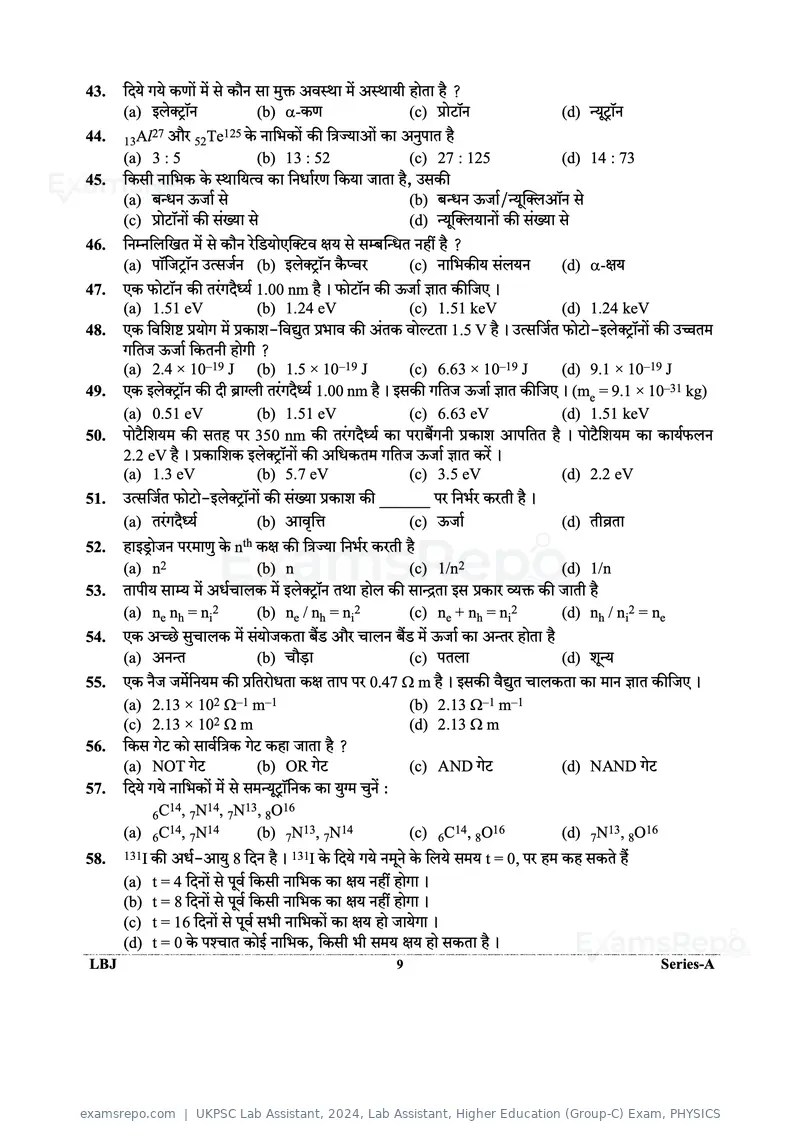
Text of page 10
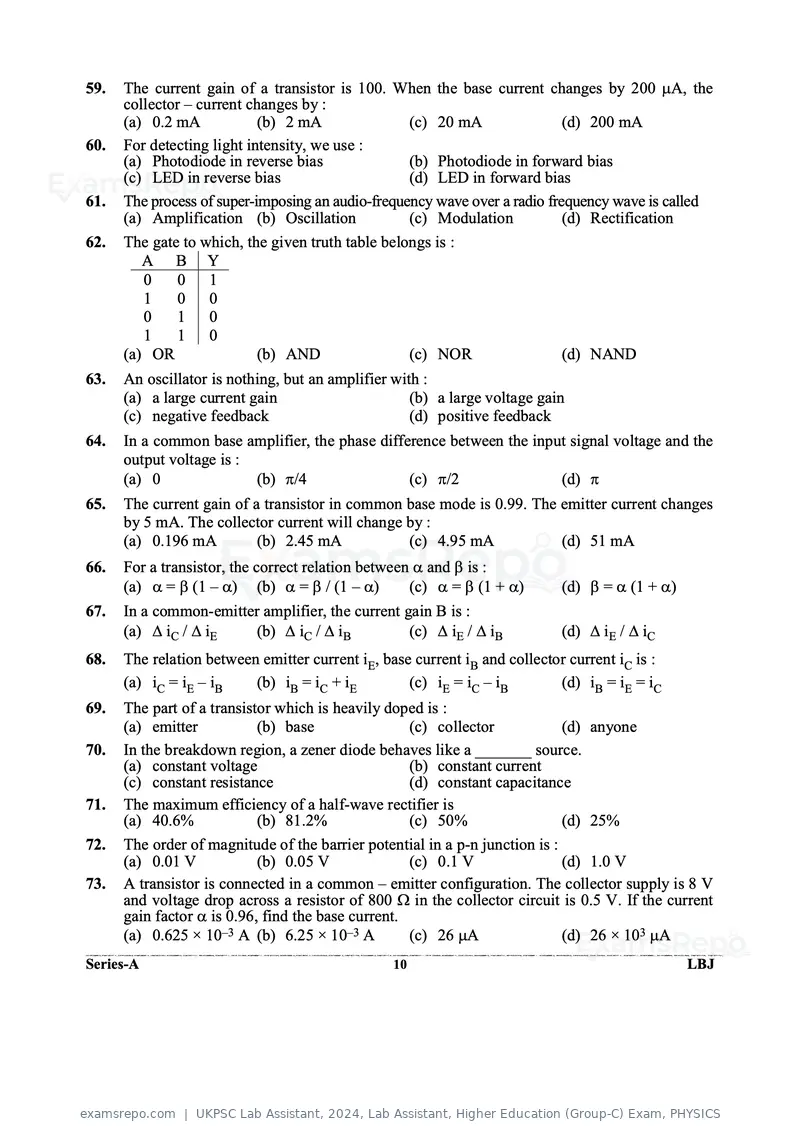
59. The current gain of a transistor is 100. When the base current changes by 200 A, the
collector – current changes by :
(a) 0.2 mA (b) 2 mA (c) 20 mA (d) 200 mA
60. For detecting light intensity, we use :
(a) Photodiode in reverse bias (b) Photodiode in forward bias
(c) LED in reverse bias (d) LED in forward bias
61. The process of super-imposing an audio-frequency wave over a radio frequency wave is called
(a) Amplification (b) Oscillation (c) Modulation (d) Rectification
62. The gate to which, the given truth table belongs is :
A B Y
0 0 1
1 0 0
0 1 0
1 1 0
(a) OR (b) AND (c) NOR (d) NAND
63. An oscillator is nothing, but an amplifier with :
(a) a large current gain (b) a large voltage gain
(c) negative feedback (d) positive feedback
64. In a common base amplifier, the phase difference between the input signal voltage and the
output voltage is :
(a) 0 (b) /4 (c) /2 (d)
65. The current gain of a transistor in common base mode is 0.99. The emitter current changes
by 5 mA. The collector current will change by :
(a) 0.196 mA (b) 2.45 mA (c) 4.95 mA (d) 51 mA
66. For a transistor, the correct relation between and is :
(a) = (1 – ) (b) = / (1 – ) (c) = (1 + ) (d) = (1 + )
67. In a common-emitter amplifier, the current gain B is :
(a) iC / iE (b) iC / iB (c) iE / iB (d) iE / iC
68. The relation between emitter current iE, base current iB and collector current iC is :
(a) iC = iE – iB (b) iB = iC + iE (c) iE = iC – iB (d) iB = iE = iC
69. The part of a transistor which is heavily doped is :
(a) emitter (b) base (c) collector (d) anyone
70. In the breakdown region, a zener diode behaves like a _______ source.
(a) constant voltage (b) constant current
(c) constant resistance (d) constant capacitance
71. The maximum efficiency of a half-wave rectifier is
(a) 40.6% (b) 81.2% (c) 50% (d) 25%
72. The order of magnitude of the barrier potential in a p-n junction is :
(a) 0.01 V (b) 0.05 V (c) 0.1 V (d) 1.0 V
73. A transistor is connected in a common – emitter configuration. The collector supply is 8 V
and voltage drop across a resistor of 800 in the collector circuit is 0.5 V. If the current
gain factor is 0.96, find the base current.
(a) 0.625 × 10⁻³ A (b) 6.25 × 10⁻³ A (c) 26 A (d) 26 × 103 A
Series-A 10 LBJ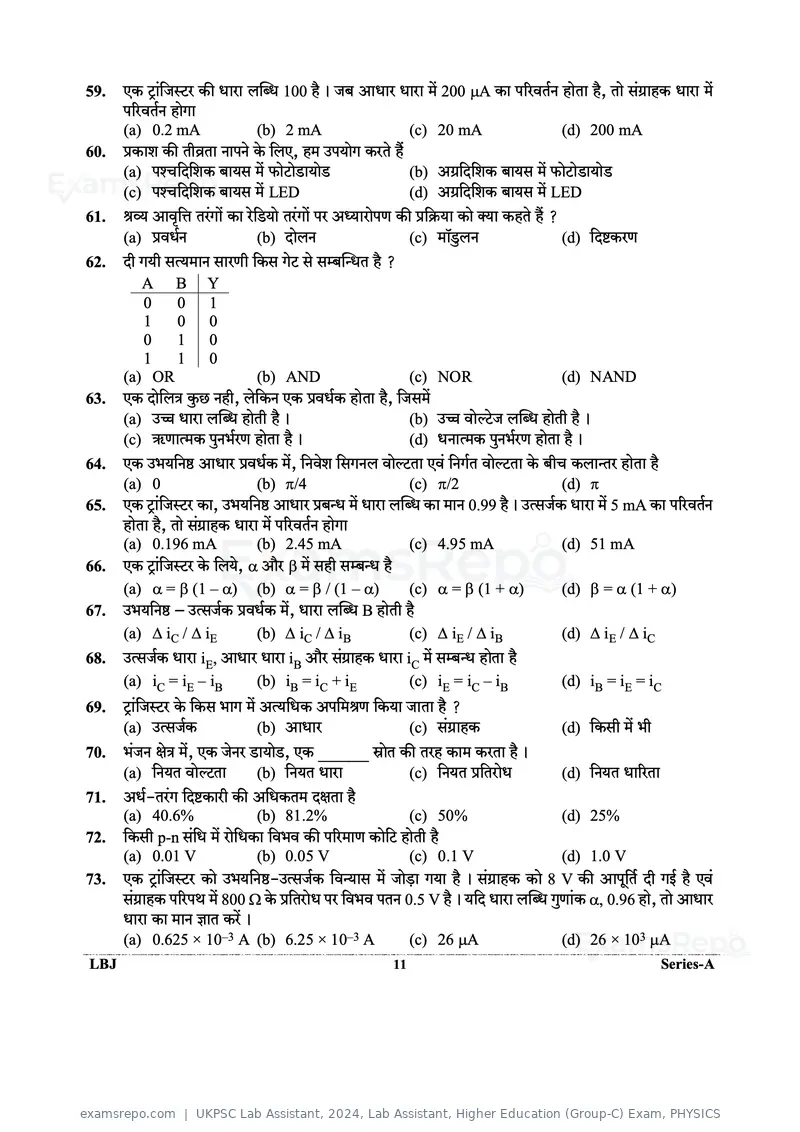
Text of page 12
74.   A p-n junction diode cannot be used :
      (a) as rectifier                                  (b) for detecting light intensity
      (c) for obtaining light radiation                 (d) as an amplifier
75.   Zener diode is fabricated by :
      (a) heavy doping                                  (b) light doping
      (c) moderate doping                               (d) No effect of doping
76.   An n-type and a p-type Si can be obtained by doping pure Si with :
      (a) sodium and magnesium respectively (b) phosphorus and boron respectively
      (c) boron and phosphorous respectively (d) indium and sodium respectively
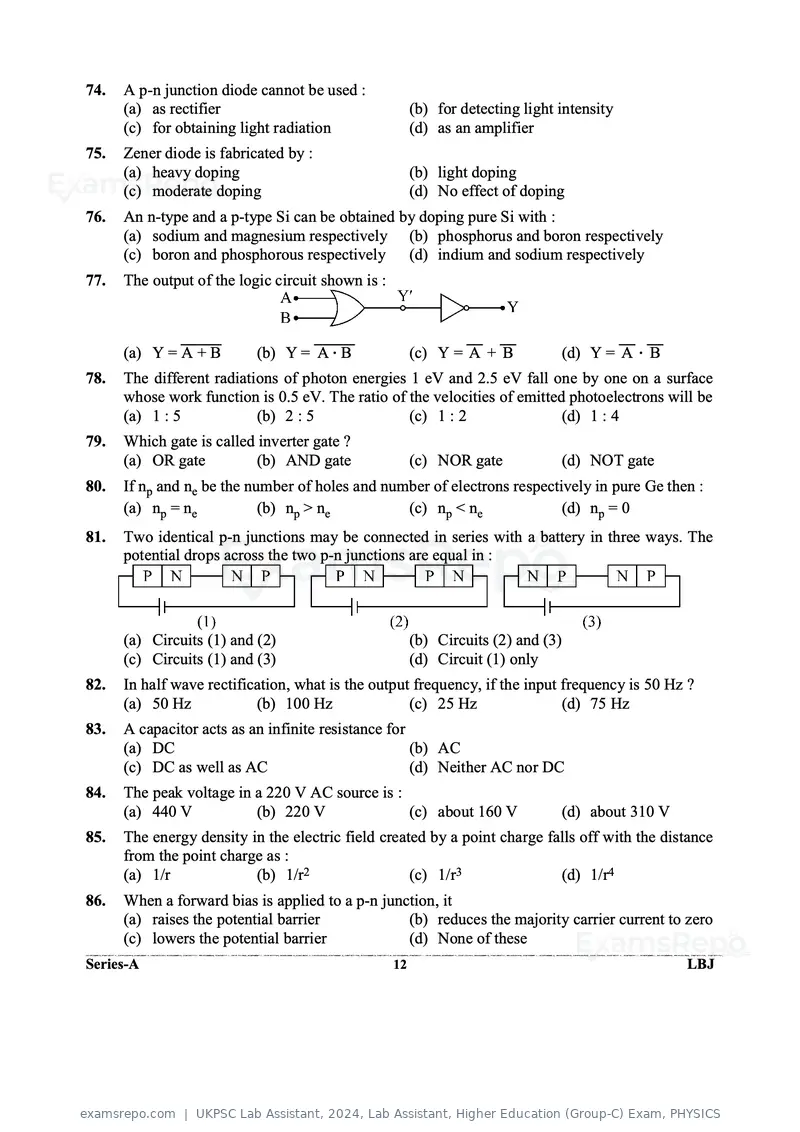
77.   The output of the logic circuit shown is :


              _____                _____                        __ __                   __ __
      (a) Y = A + B        (b) Y = A . B                (c) Y = A + B           (d) Y = A . B
78.   The different radiations of photon energies 1 eV and 2.5 eV fall one by one on a surface
      whose work function is 0.5 eV. The ratio of the velocities of emitted photoelectrons will be
      (a) 1 : 5            (b) 2 : 5              (c) 1 : 2                (d) 1 : 4
79.   Which gate is called inverter gate ?
      (a) OR gate          (b) AND gate                 (c) NOR gate            (d) NOT gate
80.   If np and ne be the number of holes and number of electrons respectively in pure Ge then :
      (a) np = ne           (b) np > ne          (c) np < ne              (d) np = 0
81.   Two identical p-n junctions may be connected in series with a battery in three ways. The
      potential drops across the two p-n junctions are equal in :


      (a) Circuits (1) and (2)                          (b) Circuits (2) and (3)
      (c) Circuits (1) and (3)                          (d) Circuit (1) only
82.   In half wave rectification, what is the output frequency, if the input frequency is 50 Hz ?
      (a) 50 Hz            (b) 100 Hz               (c) 25 Hz                (d) 75 Hz
83.   A capacitor acts as an infinite resistance for
      (a) DC                                         (b) AC
      (c) DC as well as AC                           (d) Neither AC nor DC
84.   The peak voltage in a 220 V AC source is :
      (a) 440 V           (b) 220 V              (c) about 160 V                (d) about 310 V
85.   The energy density in the electric field created by a point charge falls off with the distance
      from the point charge as :
      (a) 1/r             (b) 1/r2                  (c) 1/r3               (d) 1/r4
86.   When a forward bias is applied to a p-n junction, it
      (a) raises the potential barrier            (b) reduces the majority carrier current to zero
      (c) lowers the potential barrier            (d) None of these
Series-A                                           12                                             LBJ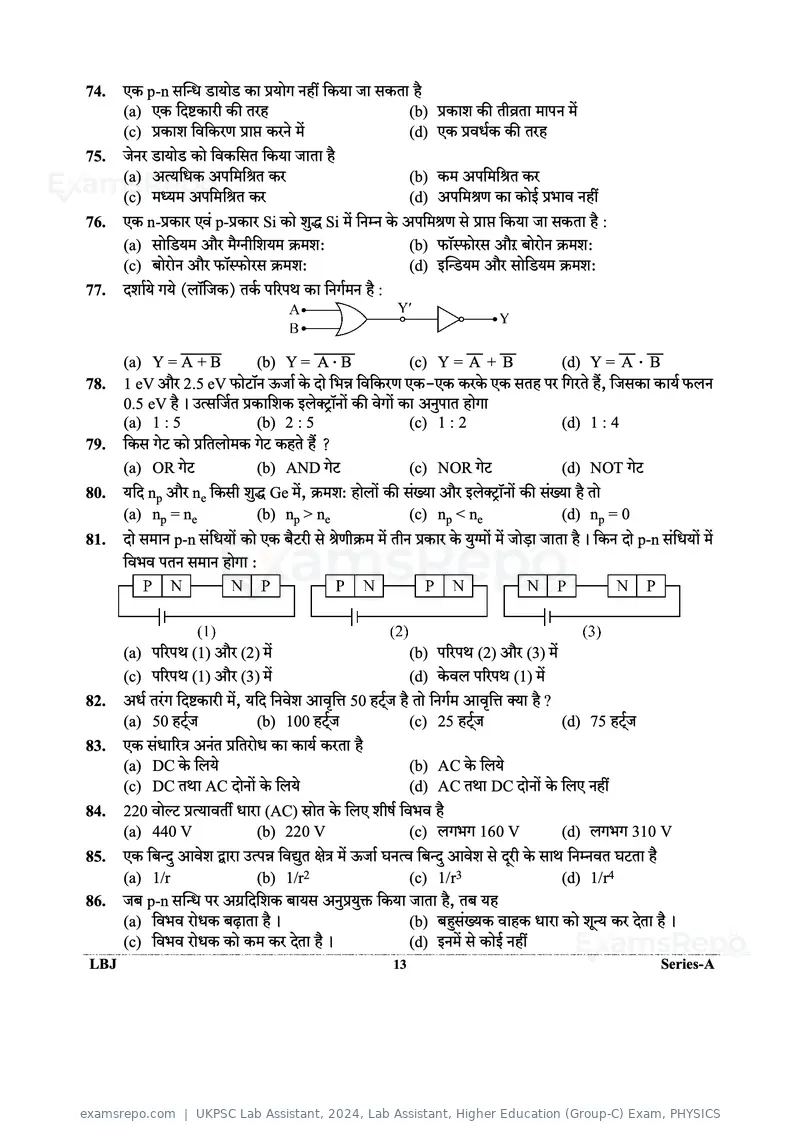
Text of page 13
74. p-n
(a) (b)
(c) (d)
75.
(a) (b)
(c) (d)
76. n- p- Si Si :
(a) : (b) :
(c) : (d) :
77. () :
_____ _____ __ __ __ __
(a) Y = A + B (b) Y = A . B (c) Y = A + B (d) Y = A . B
78. 1 eV 2.5 eV - ,
0.5 eV
(a) 1 : 5 (b) 2 : 5 (c) 1 : 2 (d) 1 : 4
79. ?
(a) OR (b) AND (c) NOR (d) NOT
80. np ne Ge , :
(a) np = ne (b) np > ne (c) np < ne (d) np = 0
81. p-n p-n
:
(a) (1) (2) (b) (2) (3)
(c) (1) (3) (d) (1)
82. , 50 ?
(a) 50 (b) 100 (c) 25 (d) 75
83.
(a) DC (b) AC
(c) DC AC (d) AC DC
84. 220 (AC)
(a) 440 V (b) 220 V (c) 160 V (d) 310 V
85.
(a) 1/r (b) 1/r2 (c) 1/r3 (d) 1/r4
86. p-n ,
(a) (b)
(c) (d)
LBJ 13 Series-A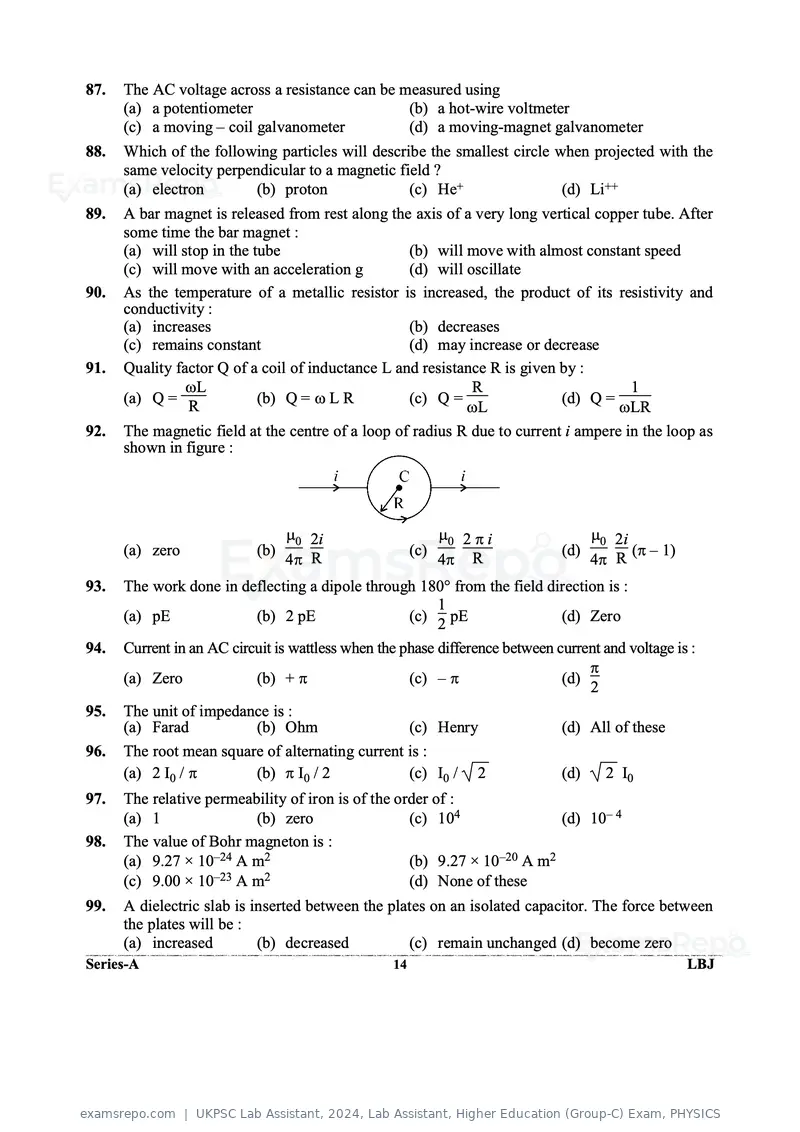
Text of page 14
87. The AC voltage across a resistance can be measured using
(a) a potentiometer (b) a hot-wire voltmeter
(c) a moving – coil galvanometer (d) a moving-magnet galvanometer
88. Which of the following particles will describe the smallest circle when projected with the
same velocity perpendicular to a magnetic field ?
(a) electron (b) proton (c) He+ (d) Li++
89. A bar magnet is released from rest along the axis of a very long vertical copper tube. After
some time the bar magnet :
(a) will stop in the tube (b) will move with almost constant speed
(c) will move with an acceleration g (d) will oscillate
90. As the temperature of a metallic resistor is increased, the product of its resistivity and
conductivity :
(a) increases (b) decreases
(c) remains constant (d) may increase or decrease
91. Quality factor Q of a coil of inductance L and resistance R is given by :
L R 1
(a) Q = R (b) Q = L R (c) Q = (d) Q =
L LR
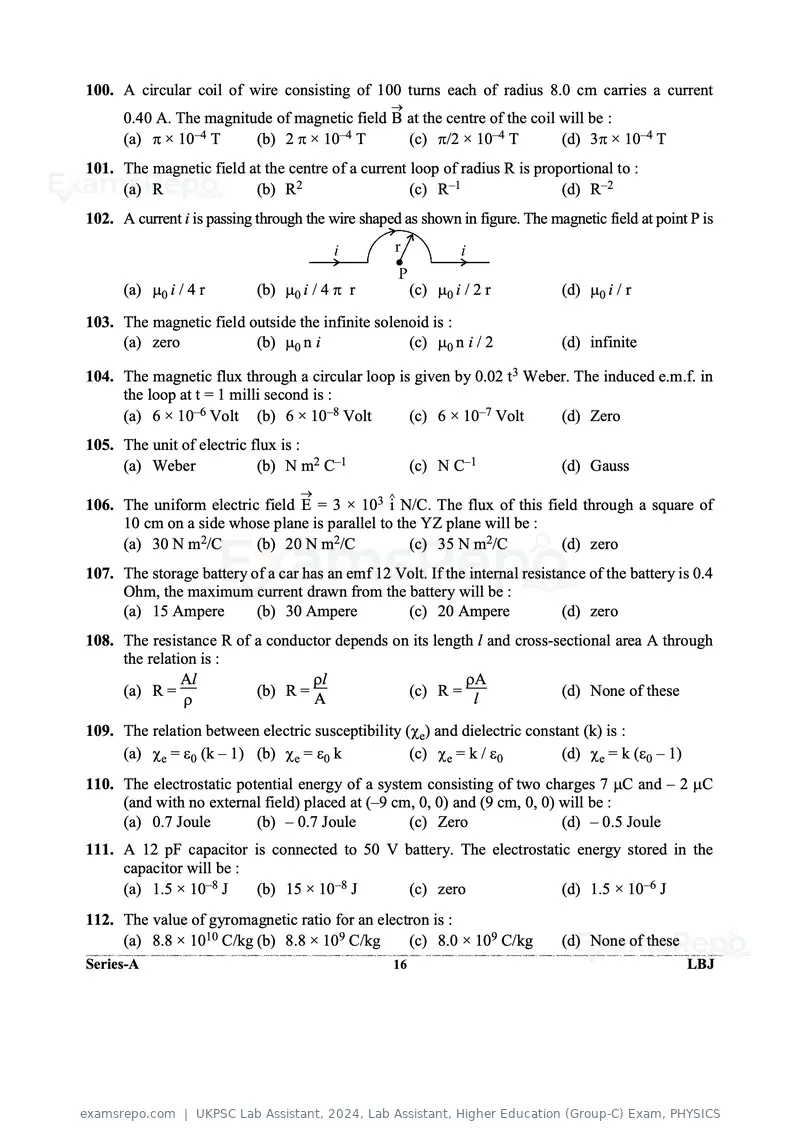
92. The magnetic field at the centre of a loop of radius R due to current i ampere in the loop as
shown in figure :
0 2i 0 2 i 0 2i
(a) zero (b) (c) (d) ( – 1)
4 R 4 R 4 R
93. The work done in deflecting a dipole through 180 from the field direction is :
1
(a) pE (b) 2 pE (c) 2 pE (d) Zero
94. Current in an AC circuit is wattless when the phase difference between current and voltage is :
(a) Zero (b) + (c) – (d)
95. The unit of impedance is :
(a) Farad (b) Ohm (c) Henry (d) All of these
96. The root mean square of alternating current is :
(a) 2 I0 / (b) I0 / 2 (c) I0 / 2 (d) 2 I0
97. The relative permeability of iron is of the order of :
(a) 1 (b) zero (c) 104 (d) 10– 4
98. The value of Bohr magneton is :
(a) 9.27 × 10⁻²⁴ A m2 (b) 9.27 × 10⁻²⁰ A m2
(c) 9.00 × 10⁻²³ A m2 (d) None of these
99. A dielectric slab is inserted between the plates on an isolated capacitor. The force between
the plates will be :
(a) increased (b) decreased (c) remain unchanged (d) become zero
Series-A 14 LBJ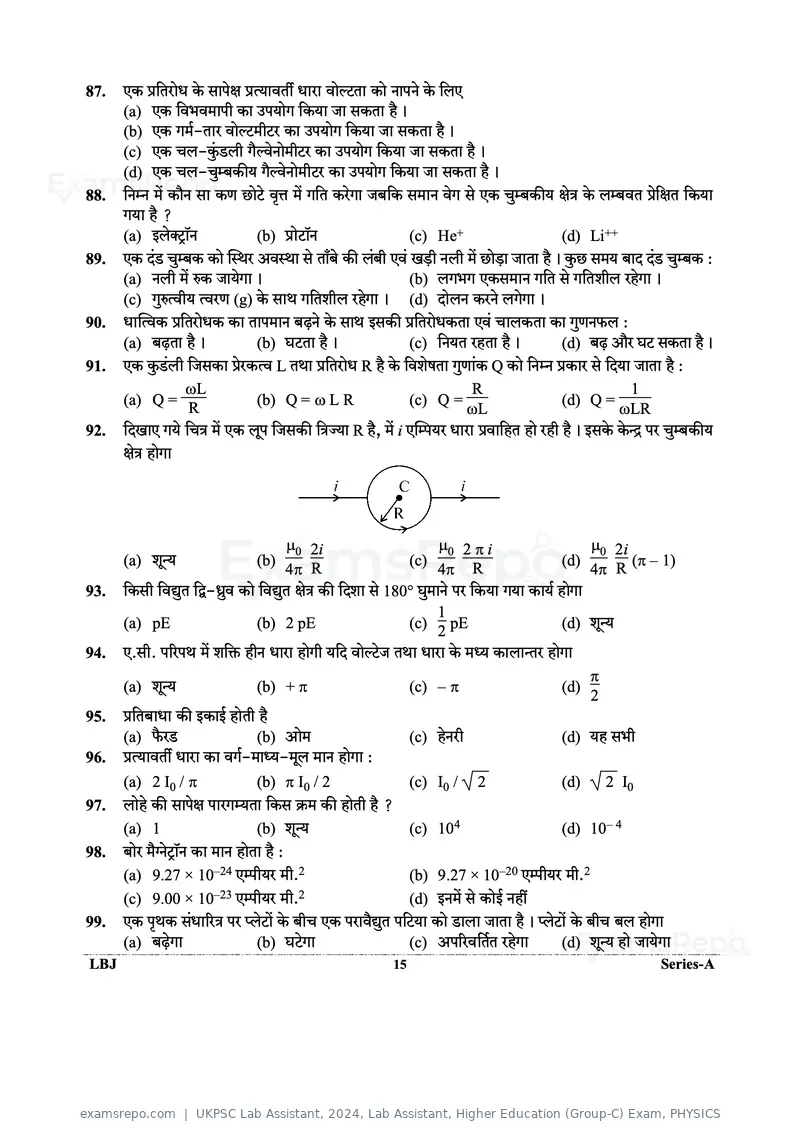
Text of page 16
100. A circular coil of wire consisting of 100 turns each of radius 8.0 cm carries a current
0.40 A. The magnitude of magnetic field B at the centre of the coil will be :
(a) × 10–4 T (b) 2 × 10⁻⁴ T (c) /2 × 10–4 T (d) 3 × 10⁻⁴ T
101. The magnetic field at the centre of a current loop of radius R is proportional to :
(a) R (b) R2 (c) R–1 (d) R–2
102. A current i is passing through the wire shaped as shown in figure. The magnetic field at point P is
(a) 0 i / 4 r (b) 0 i / 4 r (c) 0 i / 2 r (d) 0 i / r
103. The magnetic field outside the infinite solenoid is :
(a) zero (b) 0 n i (c) 0 n i / 2 (d) infinite
104. The magnetic flux through a circular loop is given by 0.02 t3 Weber. The induced e.m.f. in
the loop at t = 1 milli second is :
(a) 6 × 10⁻⁶ Volt (b) 6 × 10⁻⁸ Volt (c) 6 × 10⁻⁷ Volt (d) Zero
105. The unit of electric flux is :
(a) Weber (b) N m2 C–1 (c) N C–1 (d) Gauss
106. The uniform electric field E = 3 × 10³ ^i N/C. The flux of this field through a square of
10 cm on a side whose plane is parallel to the YZ plane will be :
(a) 30 N m2/C (b) 20 N m2/C (c) 35 N m2/C (d) zero
107. The storage battery of a car has an emf 12 Volt. If the internal resistance of the battery is 0.4
Ohm, the maximum current drawn from the battery will be :
(a) 15 Ampere (b) 30 Ampere (c) 20 Ampere (d) zero
108. The resistance R of a conductor depends on its length l and cross-sectional area A through
the relation is :
Al l A
(a) R = (b) R = A (c) R = l (d) None of these
109. The relation between electric susceptibility (e) and dielectric constant (k) is :
(a) e = 0 (k – 1) (b) e = 0 k (c) e = k / 0 (d) e = k (0 – 1)
110. The electrostatic potential energy of a system consisting of two charges 7 C and – 2 C
(and with no external field) placed at (–9 cm, 0, 0) and (9 cm, 0, 0) will be :
(a) 0.7 Joule (b) – 0.7 Joule (c) Zero (d) – 0.5 Joule
111. A 12 pF capacitor is connected to 50 V battery. The electrostatic energy stored in the
capacitor will be :
(a) 1.5 × 10⁻⁸ J (b) 15 × 10–8 J (c) zero (d) 1.5 × 10⁻⁶ J
112. The value of gyromagnetic ratio for an electron is :
(a) 8.8 × 10¹⁰ C/kg (b) 8.8 × 10⁹ C/kg (c) 8.0 × 10⁹ C/kg (d) None of these
Series-A 16 LBJ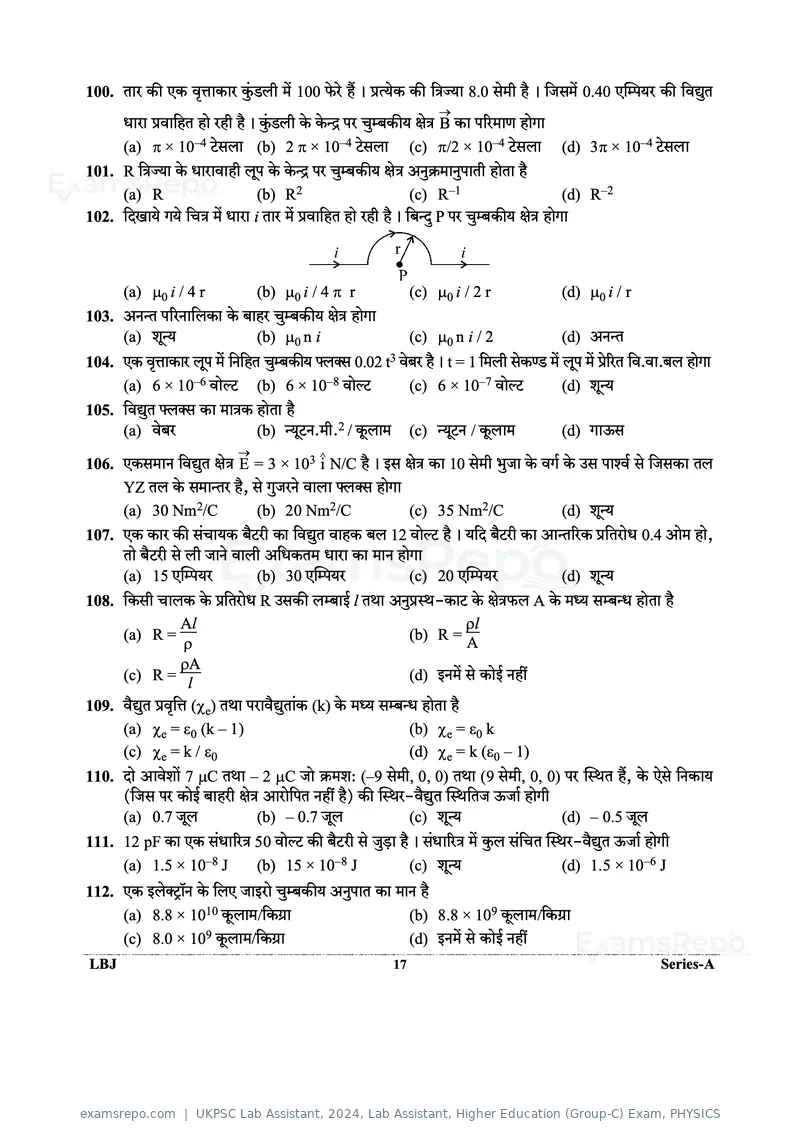
Text of page 17
100. 100 8.0 0.40
B
(a) × 10–4 (b) 2 × 10⁻⁴ (c) /2 × 10–4 (d) 3 × 10⁻⁴
101. R
(a) R (b) R2 (c) R–1 (d) R–2
102. i P
(a) 0 i / 4 r (b) 0 i / 4 r (c) 0 i / 2 r (d) 0 i / r
103.
(a) (b) 0 n i (c) 0 n i / 2 (d)
104. 0.02 t3 t = 1 ..
(a) 6 × 10⁻⁶ (b) 6 × 10⁻⁸ (c) 6 × 10⁻⁷ (d)
105.
(a) (b) ..2 / (c) / (d)
106. E = 3 × 10³ ^i N/C 10
YZ ,
(a) 30 Nm2/C (b) 20 Nm2/C (c) 35 Nm2/C (d)
107. 12 0.4 ,
(a) 15 (b) 30 (c) 20 (d)
108. R l - A
Al l
(a) R = (b) R = A
A
(c) R = l (d)
109. (e) (k)
(a) e = 0 (k – 1) (b) e = 0 k
(c) e = k / 0 (d) e = k (0 – 1)
110. 7 C – 2 C : (–9 , 0, 0) (9 , 0, 0) ,
( ) -
(a) 0.7 (b) – 0.7 (c) (d) – 0.5
111. 12 pF 50 -
(a) 1.5 × 10⁻⁸ J (b) 15 × 10–8 J (c) (d) 1.5 × 10⁻⁶ J
112.
(a) 8.8 × 10¹⁰ / (b) 8.8 × 10⁹ /
(c) 8.0 × 10⁹ / (d)
LBJ 17 Series-A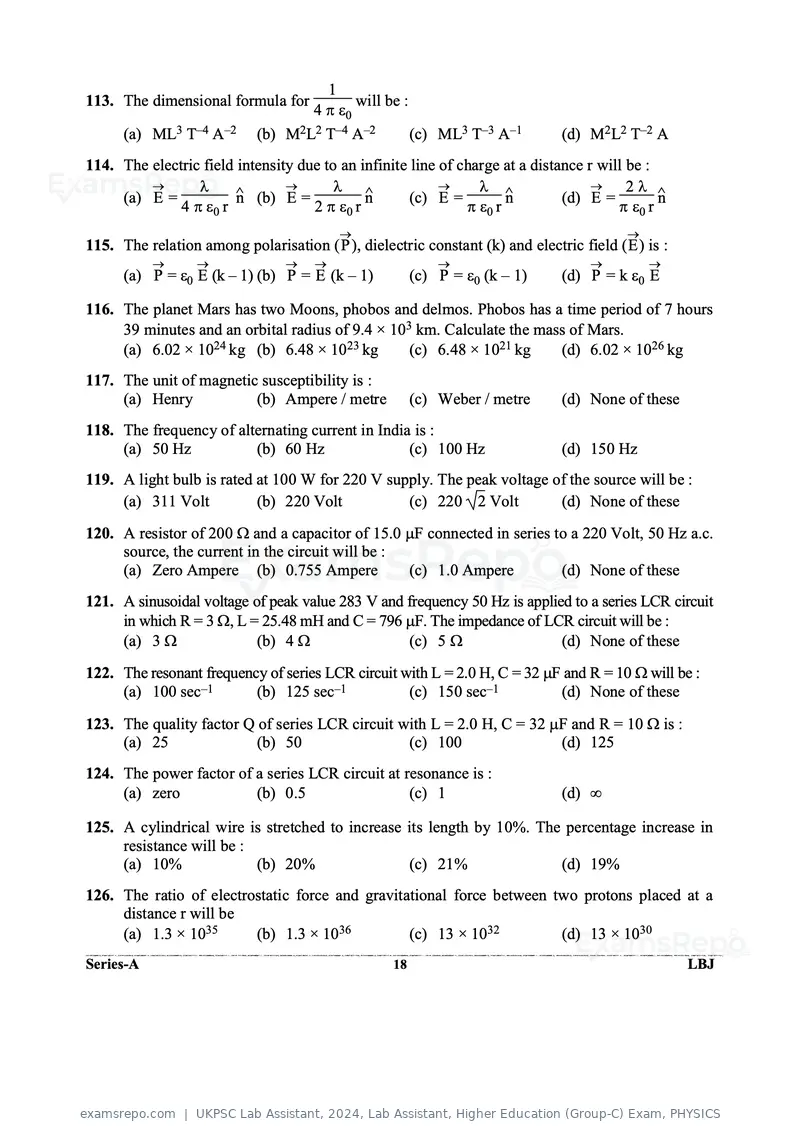
Text of page 18
1
113. The dimensional formula for will be :
4 0
(a) ML3 T–4 A–2 (b) M2L2 T–4 A–2 (c) ML3 T–3 A–1 (d) M2L2 T–2 A
114. The electric field intensity due to an infinite line of charge at a distance r will be :
^ ^ 2 ^
(a) E = n^ (b) E = n (c) E = n (d) E = n
4 0 r 2 0 r 0 r 0 r
115. The relation among polarisation ( P), dielectric constant (k) and electric field ( E) is :
(a) P = 0 E (k – 1) (b) P = E (k – 1) (c) P = 0 (k – 1) (d) P = k 0 E
116. The planet Mars has two Moons, phobos and delmos. Phobos has a time period of 7 hours
39 minutes and an orbital radius of 9.4 × 10³ km. Calculate the mass of Mars.
(a) 6.02 × 1024 kg (b) 6.48 × 10²³ kg (c) 6.48 × 10²¹ kg (d) 6.02 × 1026 kg
117. The unit of magnetic susceptibility is :
(a) Henry (b) Ampere / metre (c) Weber / metre (d) None of these
118. The frequency of alternating current in India is :
(a) 50 Hz (b) 60 Hz (c) 100 Hz (d) 150 Hz
119. A light bulb is rated at 100 W for 220 V supply. The peak voltage of the source will be :
(a) 311 Volt (b) 220 Volt (c) 220 2 Volt (d) None of these
120. A resistor of 200 and a capacitor of 15.0 F connected in series to a 220 Volt, 50 Hz a.c.
source, the current in the circuit will be :
(a) Zero Ampere (b) 0.755 Ampere (c) 1.0 Ampere (d) None of these
121. A sinusoidal voltage of peak value 283 V and frequency 50 Hz is applied to a series LCR circuit
in which R = 3 , L = 25.48 mH and C = 796 F. The impedance of LCR circuit will be :
(a) 3 (b) 4 (c) 5 (d) None of these
122. The resonant frequency of series LCR circuit with L = 2.0 H, C = 32 F and R = 10 will be :
(a) 100 sec–1 (b) 125 sec–1 (c) 150 sec–1 (d) None of these
123. The quality factor Q of series LCR circuit with L = 2.0 H, C = 32 F and R = 10 is :
(a) 25 (b) 50 (c) 100 (d) 125
124. The power factor of a series LCR circuit at resonance is :
(a) zero (b) 0.5 (c) 1 (d)
125. A cylindrical wire is stretched to increase its length by 10%. The percentage increase in
resistance will be :
(a) 10% (b) 20% (c) 21% (d) 19%
126. The ratio of electrostatic force and gravitational force between two protons placed at a
distance r will be
(a) 1.3 × 1035 (b) 1.3 × 1036 (c) 13 × 1032 (d) 13 × 1030
Series-A 18 LBJ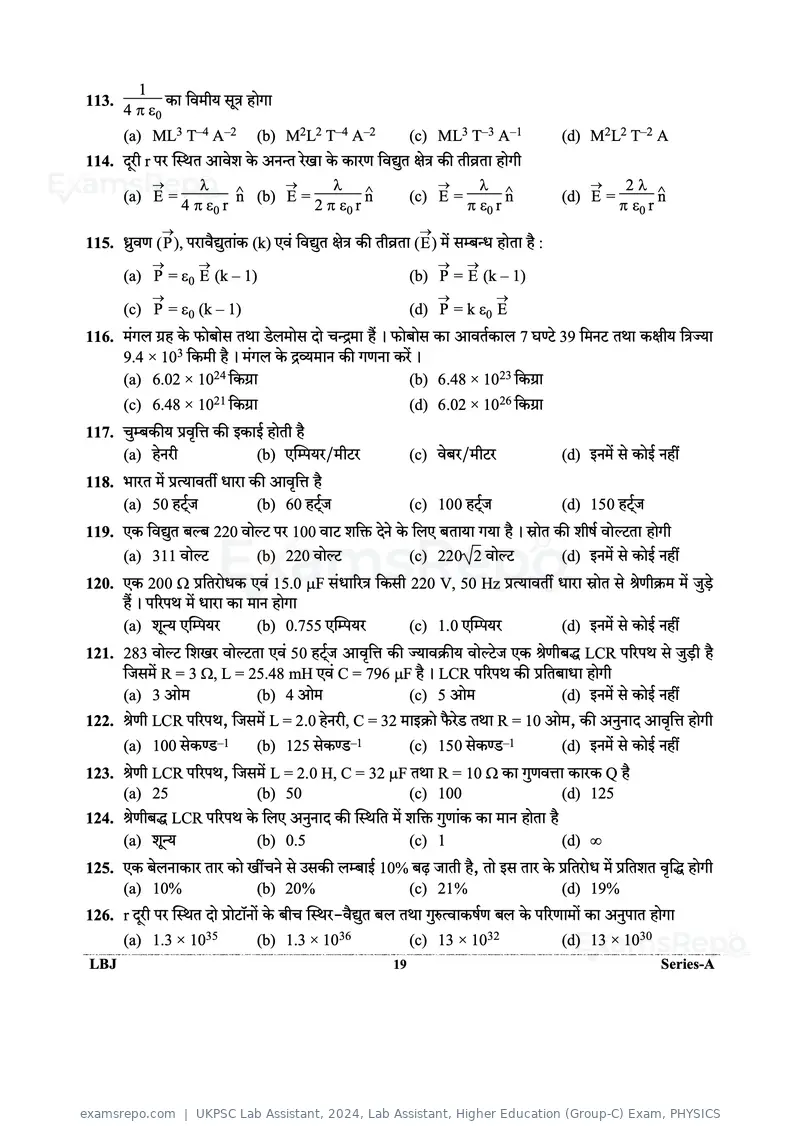
Text of page 19
1
113.
4 0
(a) ML3 T–4 A–2 (b) M2L2 T–4 A–2 (c) ML3 T–3 A–1 (d) M2L2 T–2 A
114. r
^ ^ 2 ^
(a) E = n^ (b) E = n (c) E = n (d) E = n
4 0 r 2 0 r 0 r 0 r
115. ( P), (k) ( E) :
(a) P = 0 E (k – 1) (b) P = E (k – 1)
(c) P = 0 (k – 1) (d) P = k 0 E
116. 7 39
9.4 × 10³
(a) 6.02 × 1024 (b) 6.48 × 10²³
(c) 6.48 × 10²¹ (d) 6.02 × 1026
117.
(a) (b) / (c) / (d)
118.
(a) 50 (b) 60 (c) 100 (d) 150
119. 220 100
(a) 311 (b) 220 (c) 220 2 (d)
120. 200 15.0 F 220 V, 50 Hz
(a) (b) 0.755 (c) 1.0 (d)
121. 283 50 LCR
R = 3 , L = 25.48 mH C = 796 F LCR
(a) 3 (b) 4 (c) 5 (d)
122. LCR , L = 2.0 , C = 32 R = 10 ,
(a) 100 –1 (b) 125 –1 (c) 150 –1 (d)
123. LCR , L = 2.0 H, C = 32 F R = 10 Q
(a) 25 (b) 50 (c) 100 (d) 125
124. LCR
(a) (b) 0.5 (c) 1 (d)
125. 10% ,
(a) 10% (b) 20% (c) 21% (d) 19%
126. r -
(a) 1.3 × 1035 (b) 1.3 × 1036 (c) 13 × 1032 (d) 13 × 1030
LBJ 19 Series-A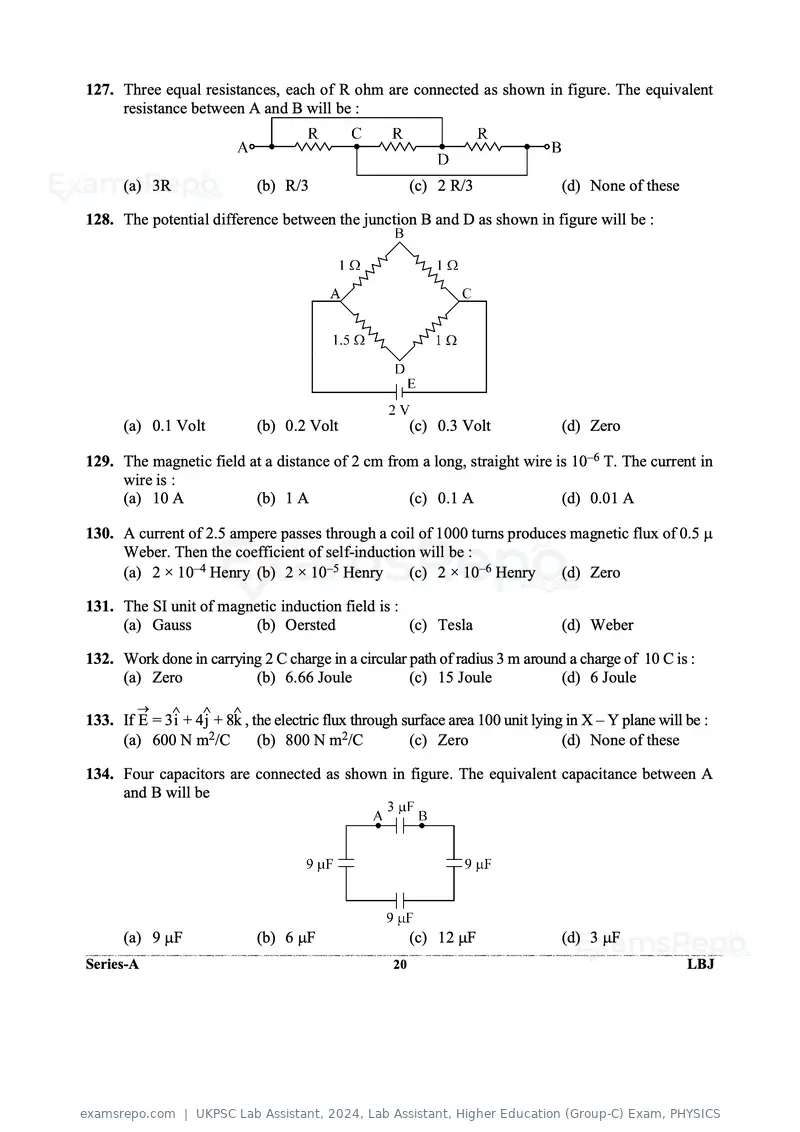
Text of page 20
127. Three equal resistances, each of R ohm are connected as shown in figure. The equivalent
resistance between A and B will be :
(a) 3R (b) R/3 (c) 2 R/3 (d) None of these
128. The potential difference between the junction B and D as shown in figure will be :
(a) 0.1 Volt (b) 0.2 Volt (c) 0.3 Volt (d) Zero
129. The magnetic field at a distance of 2 cm from a long, straight wire is 10–6 T. The current in
wire is :
(a) 10 A (b) 1 A (c) 0.1 A (d) 0.01 A
130. A current of 2.5 ampere passes through a coil of 1000 turns produces magnetic flux of 0.5
Weber. Then the coefficient of self-induction will be :
(a) 2 × 10⁻⁴ Henry (b) 2 × 10⁻⁵ Henry (c) 2 × 10⁻⁶ Henry (d) Zero
131. The SI unit of magnetic induction field is :
(a) Gauss (b) Oersted (c) Tesla (d) Weber
132. Work done in carrying 2 C charge in a circular path of radius 3 m around a charge of 10 C is :
(a) Zero (b) 6.66 Joule (c) 15 Joule (d) 6 Joule
133. If E = 3^i + 4^j + 8k^ , the electric flux through surface area 100 unit lying in X – Y plane will be :
(a) 600 N m2/C (b) 800 N m2/C (c) Zero (d) None of these
134. Four capacitors are connected as shown in figure. The equivalent capacitance between A
and B will be
(a) 9 F (b) 6 F (c) 12 F (d) 3 F
Series-A 20 LBJ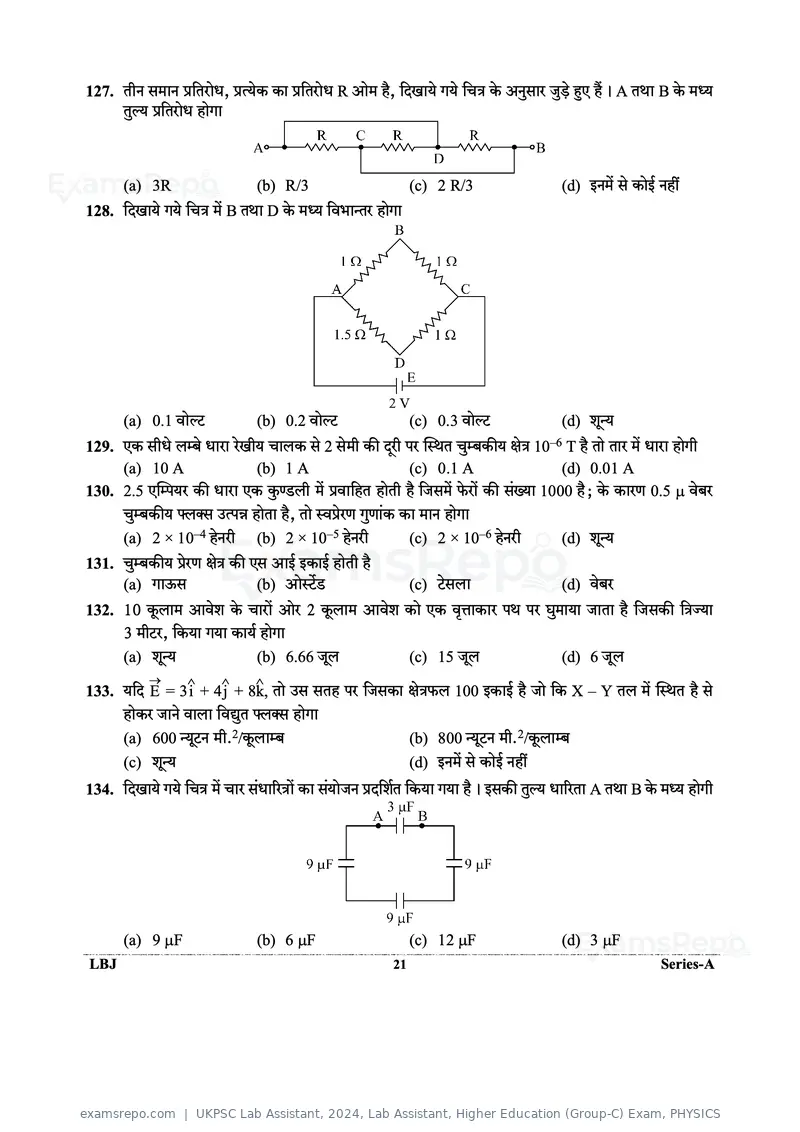
Text of page 21
127. , R , A B
(a) 3R (b) R/3 (c) 2 R/3 (d)
128. B D
(a) 0.1 (b) 0.2 (c) 0.3 (d)
129. 2
10–6 T
(a) 10 A (b) 1 A (c) 0.1 A (d) 0.01 A
130. 2.5 1000 ; 0.5
,
(a) 2 × 10⁻⁴ (b) 2 × 10⁻⁵ (c) 2 × 10⁻⁶ (d)
131.
(a) (b) (c) (d)
132. 10 2
3 ,
(a) (b) 6.66 (c) 15 (d) 6
133. E = 3^i + 4^j + 8k,
^ 100 X – Y
(a) 600 .2/ (b) 800 .2/
(c) (d)
134. A B
(a) 9 F (b) 6 F (c) 12 F (d) 3 F
LBJ 21 Series-A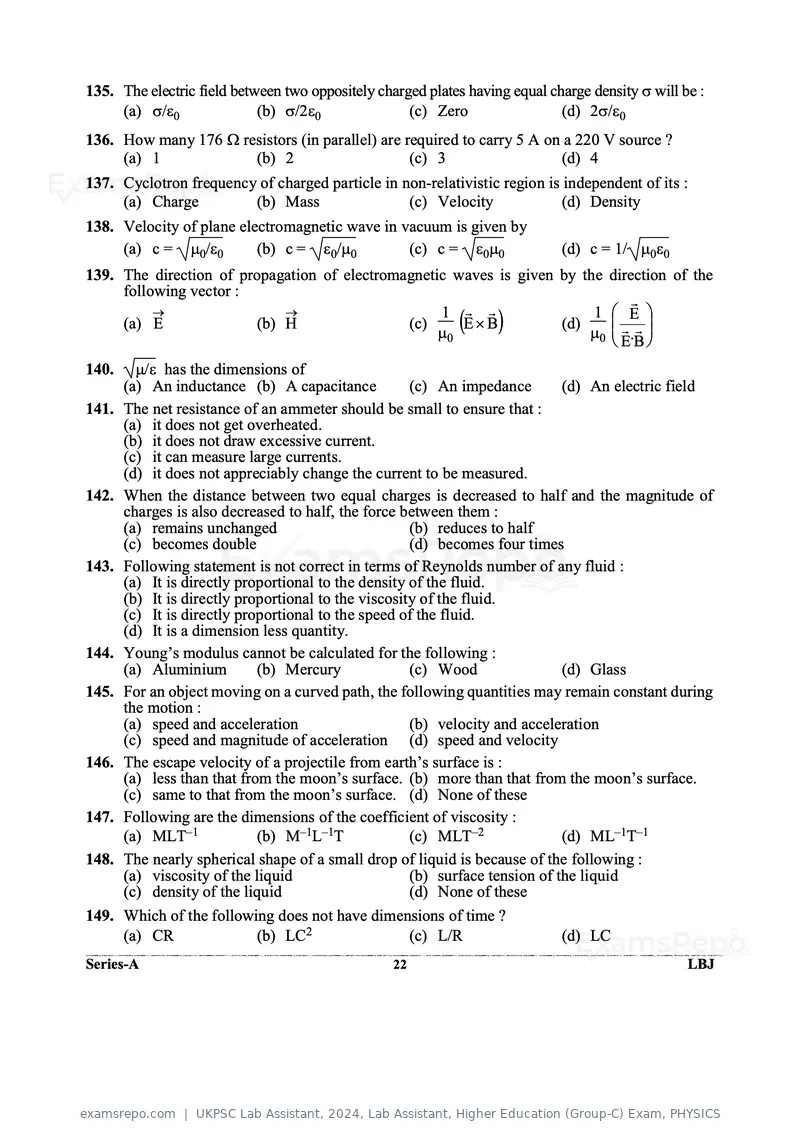
Text of page 22
135. The electric field between two oppositely charged plates having equal charge density will be :
(a) /0 (b) /20 (c) Zero (d) 2/0
136. How many 176 resistors (in parallel) are required to carry 5 A on a 220 V source ?
(a) 1 (b) 2 (c) 3 (d) 4
137. Cyclotron frequency of charged particle in non-relativistic region is independent of its :
(a) Charge (b) Mass (c) Velocity (d) Density
138. Velocity of plane electromagnetic wave in vacuum is given by
(a) c = 0/0 (b) c = 0/0 (c) c = 00 (d) c = 1/ 00
139. The direction of propagation of electromagnetic waves is given by the direction of the
following vector :
(a) E
(b) H (c)
1
0
EB (d)
1 E
0 .
E B
140. / has the dimensions of
(a) An inductance (b) A capacitance (c) An impedance (d) An electric field
141. The net resistance of an ammeter should be small to ensure that :
(a) it does not get overheated.
(b) it does not draw excessive current.
(c) it can measure large currents.
(d) it does not appreciably change the current to be measured.
142. When the distance between two equal charges is decreased to half and the magnitude of
charges is also decreased to half, the force between them :
(a) remains unchanged (b) reduces to half
(c) becomes double (d) becomes four times
143. Following statement is not correct in terms of Reynolds number of any fluid :
(a) It is directly proportional to the density of the fluid.
(b) It is directly proportional to the viscosity of the fluid.
(c) It is directly proportional to the speed of the fluid.
(d) It is a dimension less quantity.
144. Young’s modulus cannot be calculated for the following :
(a) Aluminium (b) Mercury (c) Wood (d) Glass
145. For an object moving on a curved path, the following quantities may remain constant during
the motion :
(a) speed and acceleration (b) velocity and acceleration
(c) speed and magnitude of acceleration (d) speed and velocity
146. The escape velocity of a projectile from earth’s surface is :
(a) less than that from the moon’s surface. (b) more than that from the moon’s surface.
(c) same to that from the moon’s surface. (d) None of these
147. Following are the dimensions of the coefficient of viscosity :
(a) MLT–1 (b) M–1L–1T (c) MLT–2 (d) ML–1T–1
148. The nearly spherical shape of a small drop of liquid is because of the following :
(a) viscosity of the liquid (b) surface tension of the liquid
(c) density of the liquid (d) None of these
149. Which of the following does not have dimensions of time ?
(a) CR (b) LC2 (c) L/R (d) LC
Series-A 22 LBJ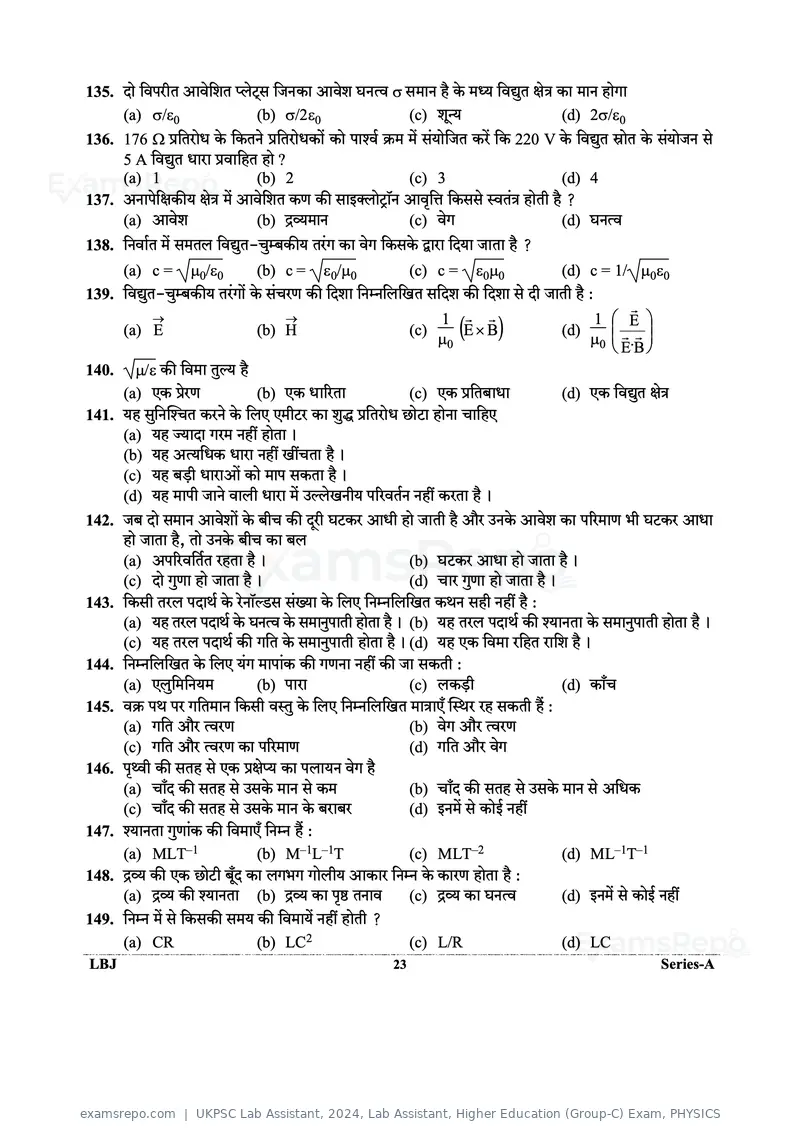
Text of page 23
135.
(a) /0 (b) /20 (c) (d) 2/0
136. 176 220 V
5 A ?
(a) 1 (b) 2 (c) 3 (d) 4
137. ?
(a) (b) (c) (d)
138. - ?
(a) c = 0/0 (b) c = 0/0 (c) c = 00 (d) c = 1/ 00
139. - :
(a) E
(b) H
(c)
1
0
EB (d)
1 E
0 .
E B
140. /
(a) (b) (c) (d)
141.
(a)
(b)
(c)
(d)
142.
,
(a) (b)
(c) (d)
143. :
(a) (b)
(c) (d)
144. :
(a) (b) (c) (d)
145. :
(a) (b)
(c) (d)
146.
(a) (b)
(c) (d)
147. :
(a) MLT–1 (b) M–1L–1T (c) MLT–2 (d) ML–1T–1
148. :
(a) (b) (c) (d)
149. ?
(a) CR (b) LC2 (c) L/R (d) LC
LBJ 23 Series-A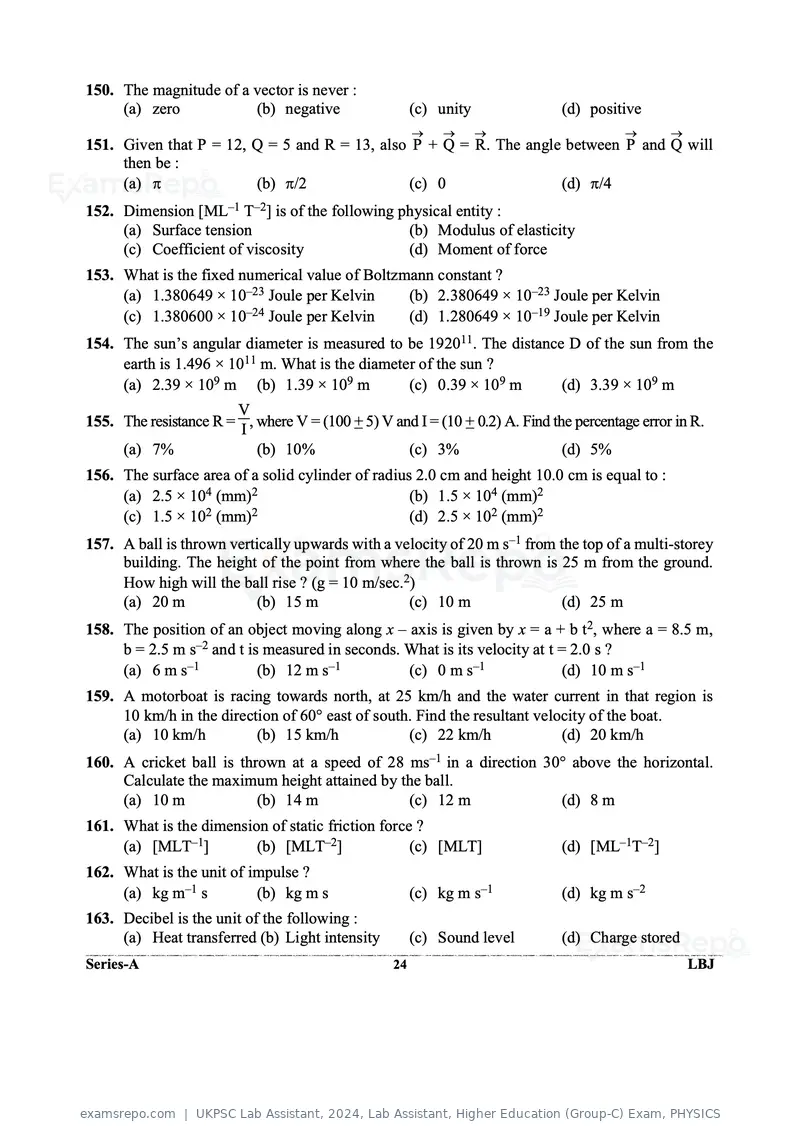
Text of page 24
150. The magnitude of a vector is never :
(a) zero (b) negative (c) unity (d) positive
151. Given that P = 12, Q = 5 and R = 13, also P + Q = R. The angle between P and Q will
then be :
(a) (b) /2 (c) 0 (d) /4
152. Dimension [ML–1 T–2] is of the following physical entity :
(a) Surface tension (b) Modulus of elasticity
(c) Coefficient of viscosity (d) Moment of force
153. What is the fixed numerical value of Boltzmann constant ?
(a) 1.380649 × 10⁻²³ Joule per Kelvin (b) 2.380649 × 10⁻²³ Joule per Kelvin
(c) 1.380600 × 10⁻²⁴ Joule per Kelvin (d) 1.280649 × 10⁻¹⁹ Joule per Kelvin
154. The sun’s angular diameter is measured to be 192011. The distance D of the sun from the
earth is 1.496 × 10¹¹ m. What is the diameter of the sun ?
(a) 2.39 × 10⁹ m (b) 1.39 × 10⁹ m (c) 0.39 × 10⁹ m (d) 3.39 × 10⁹ m
V
155. The resistance R = I , where V = (100 + 5) V and I = (10 + 0.2) A. Find the percentage error in R.
(a) 7% (b) 10% (c) 3% (d) 5%
156. The surface area of a solid cylinder of radius 2.0 cm and height 10.0 cm is equal to :
(a) 2.5 × 10⁴ (mm)2 (b) 1.5 × 10⁴ (mm)2
2
(c) 1.5 × 10 (mm) 2 (d) 2.5 × 10² (mm)2
157. A ball is thrown vertically upwards with a velocity of 20 m s–1 from the top of a multi-storey
building. The height of the point from where the ball is thrown is 25 m from the ground.
How high will the ball rise ? (g = 10 m/sec.2)
(a) 20 m (b) 15 m (c) 10 m (d) 25 m
158. The position of an object moving along x – axis is given by x = a + b t2, where a = 8.5 m,
b = 2.5 m s–2 and t is measured in seconds. What is its velocity at t = 2.0 s ?
(a) 6 m s–1 (b) 12 m s–1 (c) 0 m s–1 (d) 10 m s–1
159. A motorboat is racing towards north, at 25 km/h and the water current in that region is
10 km/h in the direction of 60 east of south. Find the resultant velocity of the boat.
(a) 10 km/h (b) 15 km/h (c) 22 km/h (d) 20 km/h
160. A cricket ball is thrown at a speed of 28 ms–1 in a direction 30 above the horizontal.
Calculate the maximum height attained by the ball.
(a) 10 m (b) 14 m (c) 12 m (d) 8 m
161. What is the dimension of static friction force ?
(a) [MLT–1] (b) [MLT–2] (c) [MLT] (d) [ML–1T–2]
162. What is the unit of impulse ?
(a) kg m–1 s (b) kg m s (c) kg m s–1 (d) kg m s–2
163. Decibel is the unit of the following :
(a) Heat transferred (b) Light intensity (c) Sound level (d) Charge stored
Series-A 24 LBJ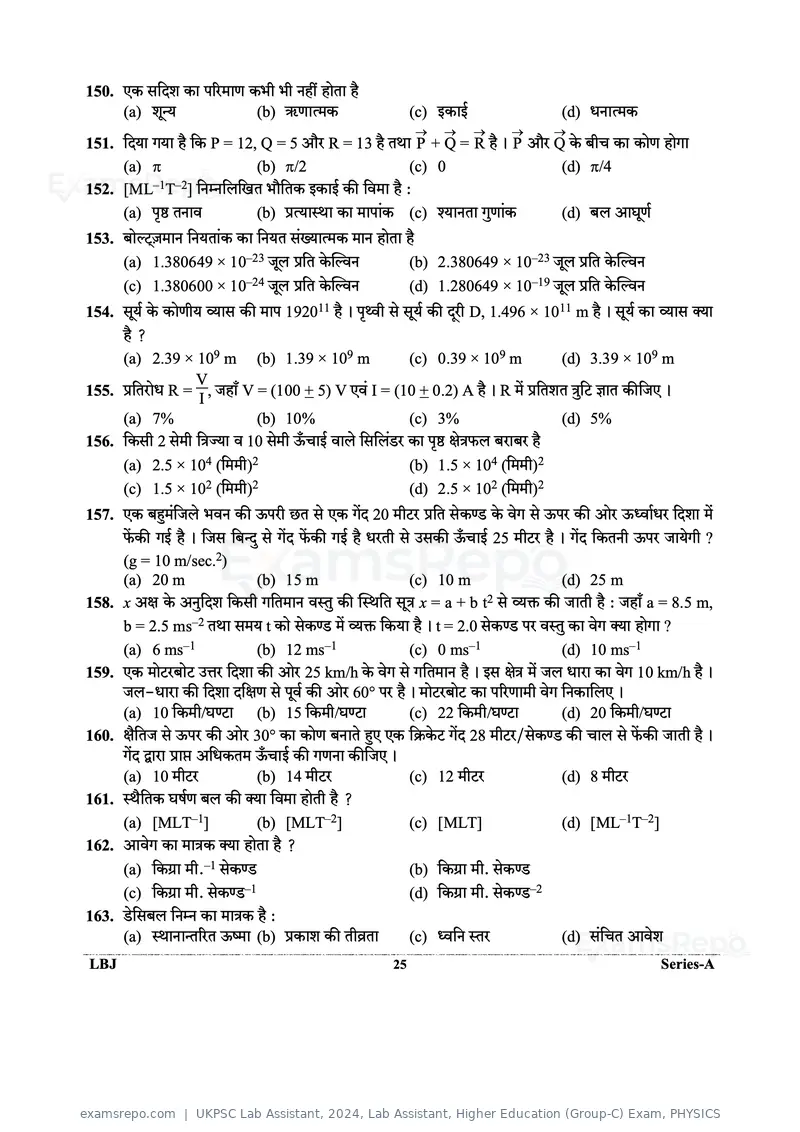
Text of page 25
150.
(a) (b) (c) (d)
151. P = 12, Q = 5 R = 13 P + Q = R P Q
(a) (b) /2 (c) 0 (d) /4
152. [ML–1T–2] :
(a) (b) (c) (d)
153.
(a) 1.380649 × 10⁻²³ (b) 2.380649 × 10⁻²³
(c) 1.380600 × 10⁻²⁴ (d) 1.280649 × 10⁻¹⁹
154. 192011 D, 1.496 × 10¹¹ m
?
(a) 2.39 × 10⁹ m (b) 1.39 × 10⁹ m (c) 0.39 × 10⁹ m (d) 3.39 × 10⁹ m
V
155. R = I , V = (100 + 5) V I = (10 + 0.2) A R
(a) 7% (b) 10% (c) 3% (d) 5%
156. 2 10
(a) 2.5 × 10⁴ ()2 (b) 1.5 × 10⁴ ()2
(c) 1.5 × 10² ()2 (d) 2.5 × 10² ()2
157. 20
25 ?
(g = 10 m/sec.2)
(a) 20 m (b) 15 m (c) 10 m (d) 25 m
158. x x = a + b t2 : a = 8.5 m,
b = 2.5 ms–2 t t = 2.0 ?
(a) 6 ms–1 (b) 12 ms–1 (c) 0 ms–1 (d) 10 ms–1
159. 25 km/h 10 km/h
- 60
(a) 10 / (b) 15 / (c) 22 / (d) 20 /
160. 30 28 /
(a) 10 (b) 14 (c) 12 (d) 8
161. ?
(a) [MLT–1] (b) [MLT–2] (c) [MLT] (d) [ML–1T–2]
162. ?
(a) .–1 (b) .
(c) . –1 (d) . –2
163. :
(a) (b) (c) (d)
LBJ 25 Series-A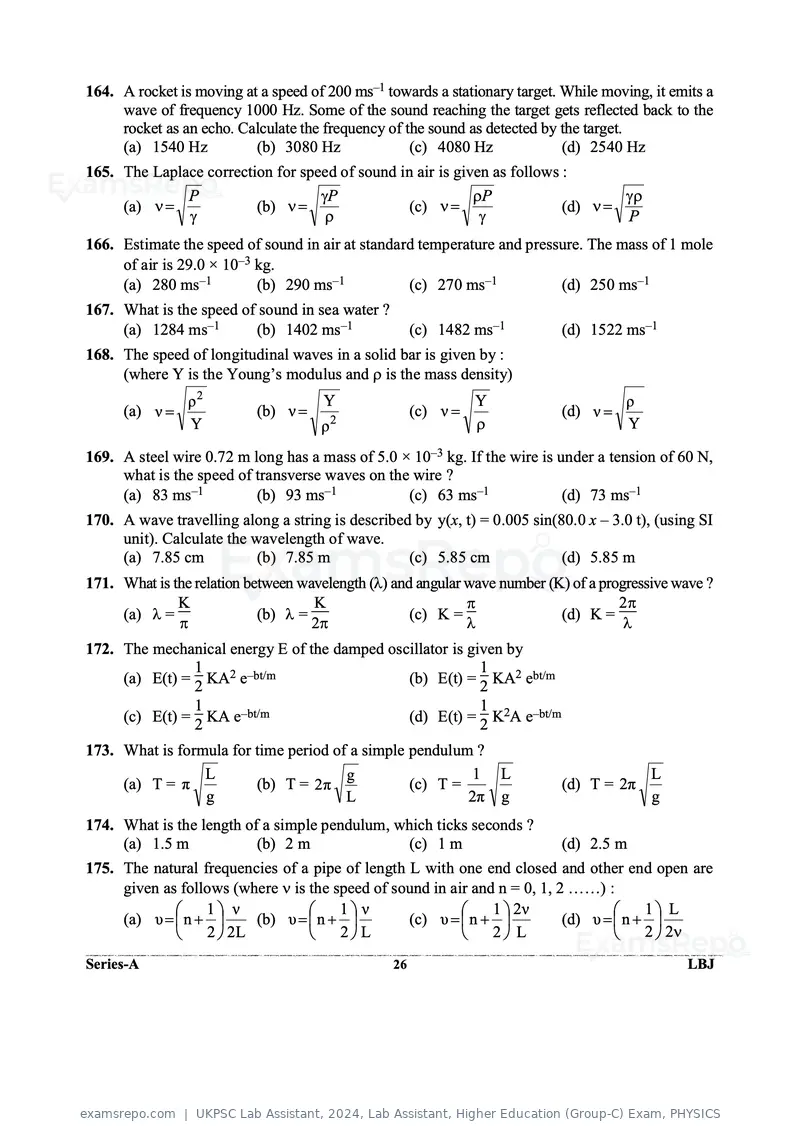
Text of page 26
164. A rocket is moving at a speed of 200 ms–1 towards a stationary target. While moving, it emits a
wave of frequency 1000 Hz. Some of the sound reaching the target gets reflected back to the
rocket as an echo. Calculate the frequency of the sound as detected by the target.
(a) 1540 Hz (b) 3080 Hz (c) 4080 Hz (d) 2540 Hz
165. The Laplace correction for speed of sound in air is given as follows :
P P P
(a) (b) (c) (d)
P
166. Estimate the speed of sound in air at standard temperature and pressure. The mass of 1 mole
of air is 29.0 × 10⁻³ kg.
(a) 280 ms–1 (b) 290 ms–1 (c) 270 ms–1 (d) 250 ms–1
167. What is the speed of sound in sea water ?
(a) 1284 ms–1 (b) 1402 ms–1 (c) 1482 ms–1 (d) 1522 ms–1
168. The speed of longitudinal waves in a solid bar is given by :
(where Y is the Young’s modulus and is the mass density)
ρ2 Y Y ρ
(a) ν (b) ν (c) ν (d) ν
Y ρ 2 Y
169. A steel wire 0.72 m long has a mass of 5.0 × 10⁻³ kg. If the wire is under a tension of 60 N,
what is the speed of transverse waves on the wire ?
(a) 83 ms–1 (b) 93 ms–1 (c) 63 ms–1 (d) 73 ms–1
170. A wave travelling along a string is described by y(x, t) = 0.005 sin(80.0 x – 3.0 t), (using SI
unit). Calculate the wavelength of wave.
(a) 7.85 cm (b) 7.85 m (c) 5.85 cm (d) 5.85 m
171. What is the relation between wavelength () and angular wave number (K) of a progressive wave ?
K K 2
(a) = (b) = (c) K = (d) K =
2
172. The mechanical energy E of the damped oscillator is given by
1 1
(a) E(t) = 2 KA2 e–bt/m (b) E(t) = 2 KA2 ebt/m
1 1
(c) E(t) = 2 KA e–bt/m (d) E(t) = 2 K2A e–bt/m
173. What is formula for time period of a simple pendulum ?
L g 1 L L
(a) T = π (b) T = 2π (c) T = (d) T = 2π
g L 2π g g
174. What is the length of a simple pendulum, which ticks seconds ?
(a) 1.5 m (b) 2 m (c) 1 m (d) 2.5 m
175. The natural frequencies of a pipe of length L with one end closed and other end open are
given as follows (where is the speed of sound in air and n = 0, 1, 2 ……) :
1 ν 1 ν 1 2ν 1 L
(a) υ n (b) υ n (c) υ n (d) υ n
2 2L 2 L 2 L 2 2
Series-A 26 LBJ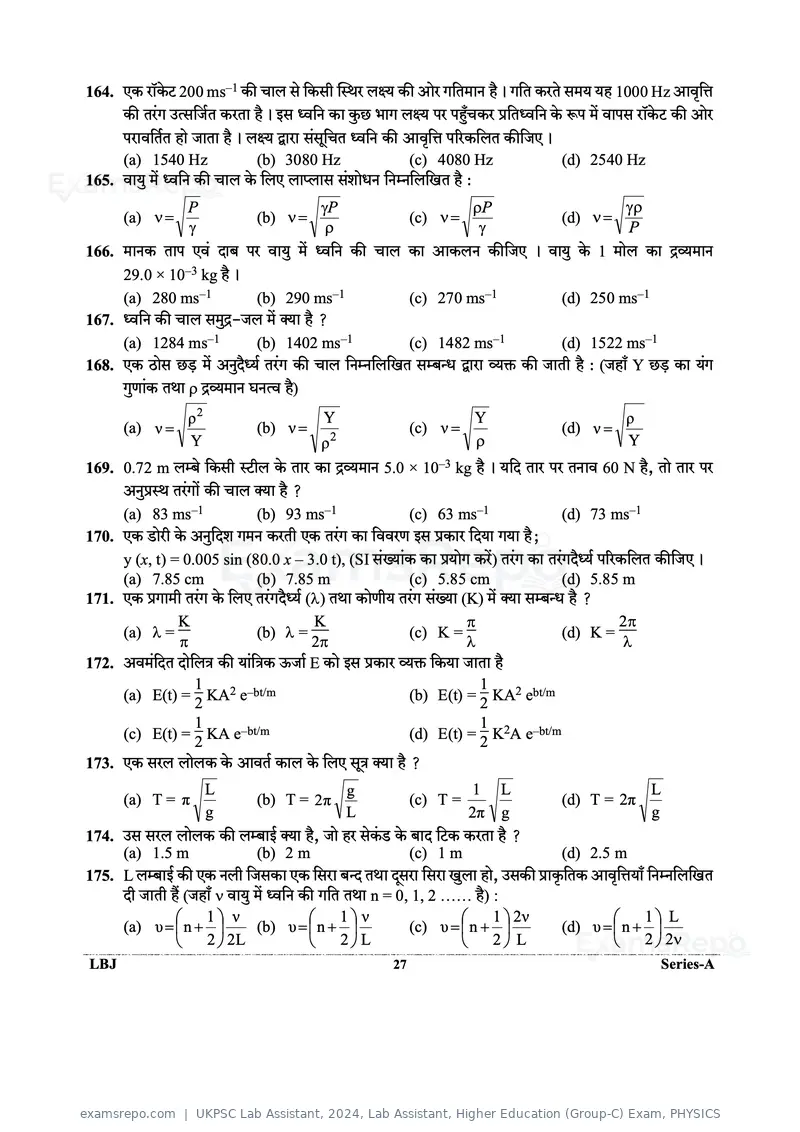
Text of page 27
164. 200 ms–1 1000 Hz
(a) 1540 Hz (b) 3080 Hz (c) 4080 Hz (d) 2540 Hz
165. :
P P P
(a) (b) (c) (d)
P
166. 1
29.0 × 10⁻³ kg
(a) 280 ms–1 (b) 290 ms–1 (c) 270 ms–1 (d) 250 ms–1
167. - ?
(a) 1284 ms–1 (b) 1402 ms–1 (c) 1482 ms–1 (d) 1522 ms–1
168. : ( Y
)
ρ2 Y Y ρ
(a) ν (b) ν (c) ν (d) ν
Y ρ 2 Y
169. 0.72 m 5.0 × 10⁻³ kg 60 N ,
?
(a) 83 ms–1 (b) 93 ms–1 (c) 63 ms–1 (d) 73 ms–1
170. ;
y (x, t) = 0.005 sin (80.0 x – 3.0 t), (SI )
(a) 7.85 cm (b) 7.85 m (c) 5.85 cm (d) 5.85 m
171. () (K) ?
K K 2
(a) = (b) = (c) K = (d) K =
2
172. E
1 1
(a) E(t) = 2 KA2 e–bt/m (b) E(t) = 2 KA2 ebt/m
1 1
(c) E(t) = 2 KA e–bt/m (d) E(t) = 2 K2A e–bt/m
173. ?
L g 1 L L
(a) T = π (b) T = 2π (c) T = (d) T = 2π
g L 2π g g
174. , ?
(a) 1.5 m (b) 2 m (c) 1 m (d) 2.5 m
175. L ,
( n = 0, 1, 2 …… ) :
1 ν 1 ν 1 2ν 1 L
(a) υ n (b) υ n (c) υ n (d) υ n
2 2L 2 L 2 L 2 2
LBJ 27 Series-A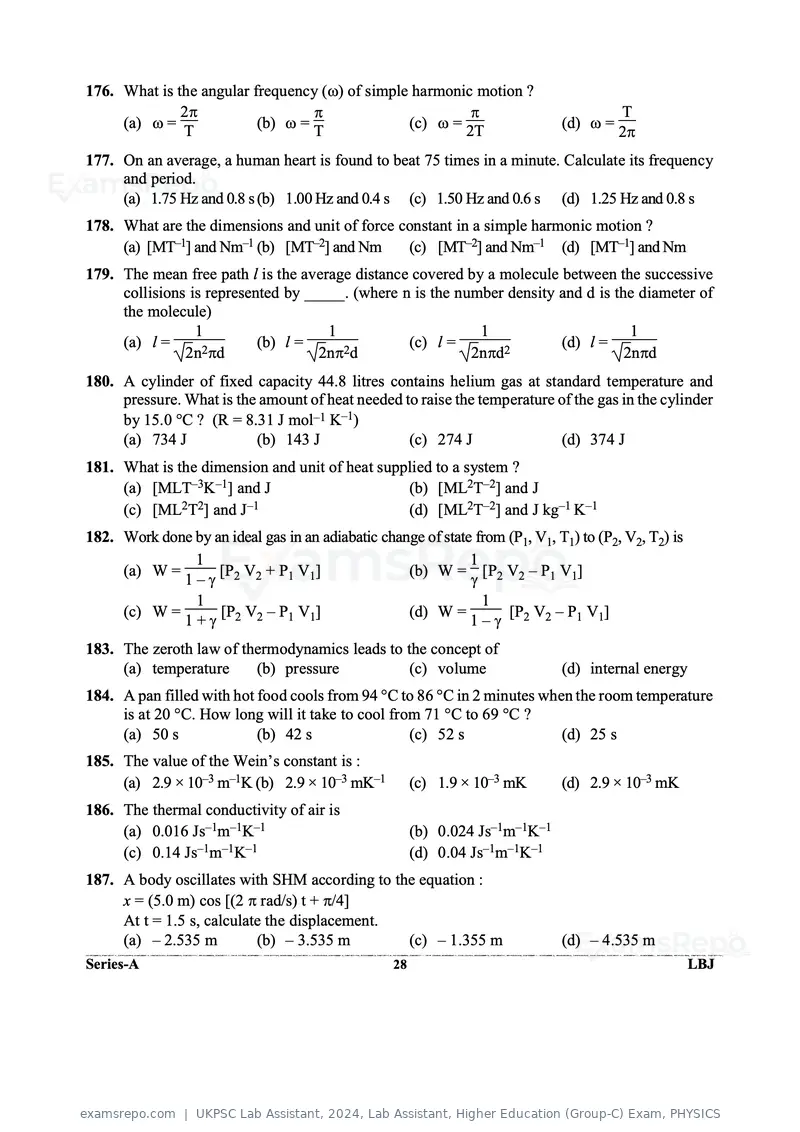
Text of page 28
176. What is the angular frequency () of simple harmonic motion ?
2 T
(a) = T (b) = T (c) = 2T (d) =
2
177. On an average, a human heart is found to beat 75 times in a minute. Calculate its frequency
and period.
(a) 1.75 Hz and 0.8 s (b) 1.00 Hz and 0.4 s (c) 1.50 Hz and 0.6 s (d) 1.25 Hz and 0.8 s
178. What are the dimensions and unit of force constant in a simple harmonic motion ?
(a) [MT–1] and Nm–1 (b) [MT–2] and Nm (c) [MT–2] and Nm–1 (d) [MT–1] and Nm
179. The mean free path l is the average distance covered by a molecule between the successive
collisions is represented by _____. (where n is the number density and d is the diameter of
the molecule)
1 1 1 1
(a) l = (b) l = (c) l = (d) l =
2n d
2 2
2n d 2nd2 2nd
180. A cylinder of fixed capacity 44.8 litres contains helium gas at standard temperature and
pressure. What is the amount of heat needed to raise the temperature of the gas in the cylinder
by 15.0 °C ? (R = 8.31 J mol–1 K–1)
(a) 734 J (b) 143 J (c) 274 J (d) 374 J
181. What is the dimension and unit of heat supplied to a system ?
(a) [MLT–3K–1] and J (b) [ML2T–2] and J
(c) [ML2T2] and J–1 (d) [ML2T–2] and J kg–1 K–1
182. Work done by an ideal gas in an adiabatic change of state from (P1, V1, T1) to (P2, V2, T2) is
1 1
(a) W = [P2 V2 + P1 V1] (b) W = [P2 V2 – P1 V1]
1–
1 1
(c) W = [P2 V2 – P1 V1] (d) W = [P V – P1 V1]
1+ 1– 2 2
183. The zeroth law of thermodynamics leads to the concept of
(a) temperature (b) pressure (c) volume (d) internal energy
184. A pan filled with hot food cools from 94 °C to 86 °C in 2 minutes when the room temperature
is at 20 °C. How long will it take to cool from 71 °C to 69 °C ?
(a) 50 s (b) 42 s (c) 52 s (d) 25 s
185. The value of the Wein’s constant is :
(a) 2.9 × 10⁻³ m–1K (b) 2.9 × 10⁻³ mK–1 (c) 1.9 × 10⁻³ mK (d) 2.9 × 10⁻³ mK
186. The thermal conductivity of air is
(a) 0.016 Js–1m–1K–1 (b) 0.024 Js–1m–1K–1
(c) 0.14 Js–1m–1K–1 (d) 0.04 Js–1m–1K–1
187. A body oscillates with SHM according to the equation :
x = (5.0 m) cos [(2 rad/s) t + /4]
At t = 1.5 s, calculate the displacement.
(a) – 2.535 m (b) – 3.535 m (c) – 1.355 m (d) – 4.535 m
Series-A 28 LBJ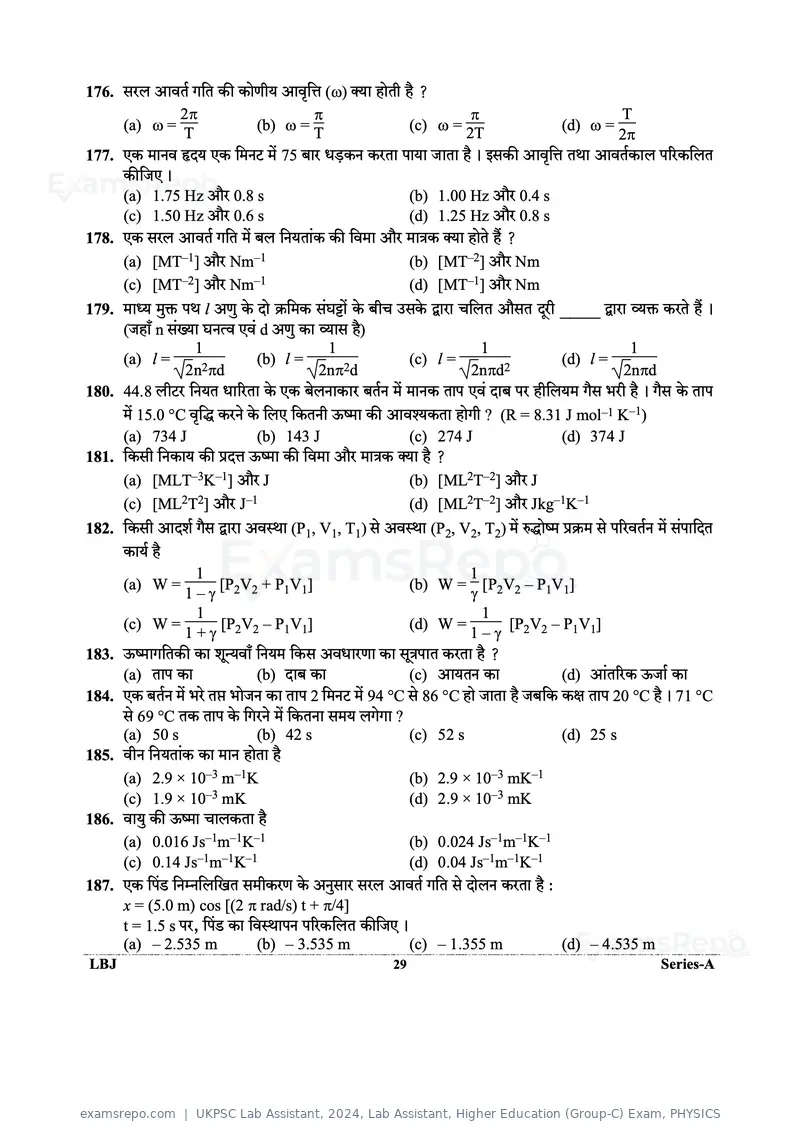
Text of page 29
176. () ?
2 T
(a) = T (b) = T (c) = 2T (d) =
2
177. 75
(a) 1.75 Hz 0.8 s (b) 1.00 Hz 0.4 s
(c) 1.50 Hz 0.6 s (d) 1.25 Hz 0.8 s
178. ?
(a) [MT–1] Nm–1 (b) [MT–2] Nm
(c) [MT–2] Nm–1 (d) [MT–1] Nm
179. l ____
( n d )
1 1 1 1
(a) l = (b) l = (c) l = (d) l =
2n d
2 2
2n d 2nd2 2nd
180. 44.8
15.0 °C ? (R = 8.31 J mol–1 K–1)
(a) 734 J (b) 143 J (c) 274 J (d) 374 J
181. ?
(a) [MLT–3K–1] J (b) [ML2T–2] J
(c) [ML2T2] J–1 (d) [ML2T–2] Jkg–1K–1
182. (P1, V1, T1) (P2, V2, T2)
1 1
(a) W = [P V + P1V1] (b) W = [P V – P1V1]
1– 2 2 2 2
1 1
(c) W = [P V – P1V1] (d) W = [P V – P1V1]
1+ 2 2 1– 2 2
183. ?
(a) (b) (c) (d)
184. 2 94 °C 86 °C 20 °C 71 °C
69 °C ?
(a) 50 s (b) 42 s (c) 52 s (d) 25 s
185.
(a) 2.9 × 10⁻³ m–1K (b) 2.9 × 10⁻³ mK–1
(c) 1.9 × 10⁻³ mK (d) 2.9 × 10⁻³ mK
186.
(a) 0.016 Js–1m–1K–1 (b) 0.024 Js–1m–1K–1
(c) 0.14 Js–1m–1K–1 (d) 0.04 Js–1m–1K–1
187. :
x = (5.0 m) cos [(2 rad/s) t + /4]
t = 1.5 s ,
(a) – 2.535 m (b) – 3.535 m (c) – 1.355 m (d) – 4.535 m
LBJ 29 Series-A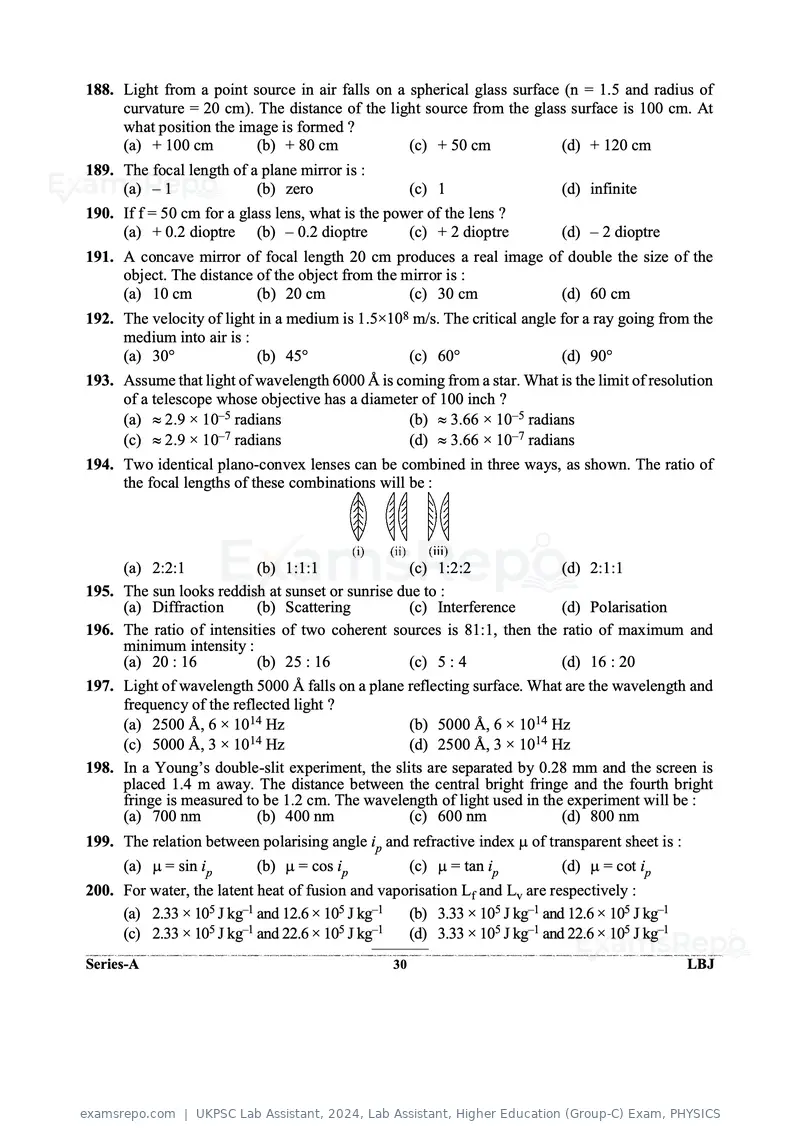
Text of page 30
188. Light from a point source in air falls on a spherical glass surface (n = 1.5 and radius of
curvature = 20 cm). The distance of the light source from the glass surface is 100 cm. At
what position the image is formed ?
(a) + 100 cm (b) + 80 cm (c) + 50 cm (d) + 120 cm
189. The focal length of a plane mirror is :
(a) – 1 (b) zero (c) 1 (d) infinite
190. If f = 50 cm for a glass lens, what is the power of the lens ?
(a) + 0.2 dioptre (b) – 0.2 dioptre (c) + 2 dioptre (d) – 2 dioptre
191. A concave mirror of focal length 20 cm produces a real image of double the size of the
object. The distance of the object from the mirror is :
(a) 10 cm (b) 20 cm (c) 30 cm (d) 60 cm
192. The velocity of light in a medium is 1.5×10⁸ m/s. The critical angle for a ray going from the
medium into air is :
(a) 30° (b) 45° (c) 60° (d) 90°
193. Assume that light of wavelength 6000 Å is coming from a star. What is the limit of resolution
of a telescope whose objective has a diameter of 100 inch ?
(a) 2.9 × 10⁻⁵ radians (b) 3.66 × 10⁻⁵ radians
(c) 2.9 × 10⁻⁷ radians (d) 3.66 × 10⁻⁷ radians
194. Two identical plano-convex lenses can be combined in three ways, as shown. The ratio of
the focal lengths of these combinations will be :
(a) 2:2:1 (b) 1:1:1 (c) 1:2:2 (d) 2:1:1
195. The sun looks reddish at sunset or sunrise due to :
(a) Diffraction (b) Scattering (c) Interference (d) Polarisation
196. The ratio of intensities of two coherent sources is 81:1, then the ratio of maximum and
minimum intensity :
(a) 20 : 16 (b) 25 : 16 (c) 5 : 4 (d) 16 : 20
197. Light of wavelength 5000 Å falls on a plane reflecting surface. What are the wavelength and
frequency of the reflected light ?
(a) 2500 Å, 6 × 10¹⁴ Hz (b) 5000 Å, 6 × 10¹⁴ Hz
(c) 5000 Å, 3 × 10¹⁴ Hz (d) 2500 Å, 3 × 10¹⁴ Hz
198. In a Young’s double-slit experiment, the slits are separated by 0.28 mm and the screen is
placed 1.4 m away. The distance between the central bright fringe and the fourth bright
fringe is measured to be 1.2 cm. The wavelength of light used in the experiment will be :
(a) 700 nm (b) 400 nm (c) 600 nm (d) 800 nm
199. The relation between polarising angle ip and refractive index of transparent sheet is :
(a) = sin ip (b) = cos ip (c) = tan ip (d) = cot ip
200. For water, the latent heat of fusion and vaporisation Lf and Lv are respectively :
(a) 2.33 × 10⁵ J kg–1 and 12.6 × 10⁵ J kg–1 (b) 3.33 × 10⁵ J kg–1 and 12.6 × 10⁵ J kg–1
(c) 2.33 × 10⁵ J kg–1 and 22.6 × 10⁵ J kg–1 (d) 3.33 × 10⁵ J kg–1 and 22.6 × 10⁵ J kg–1
Series-A 30 LBJ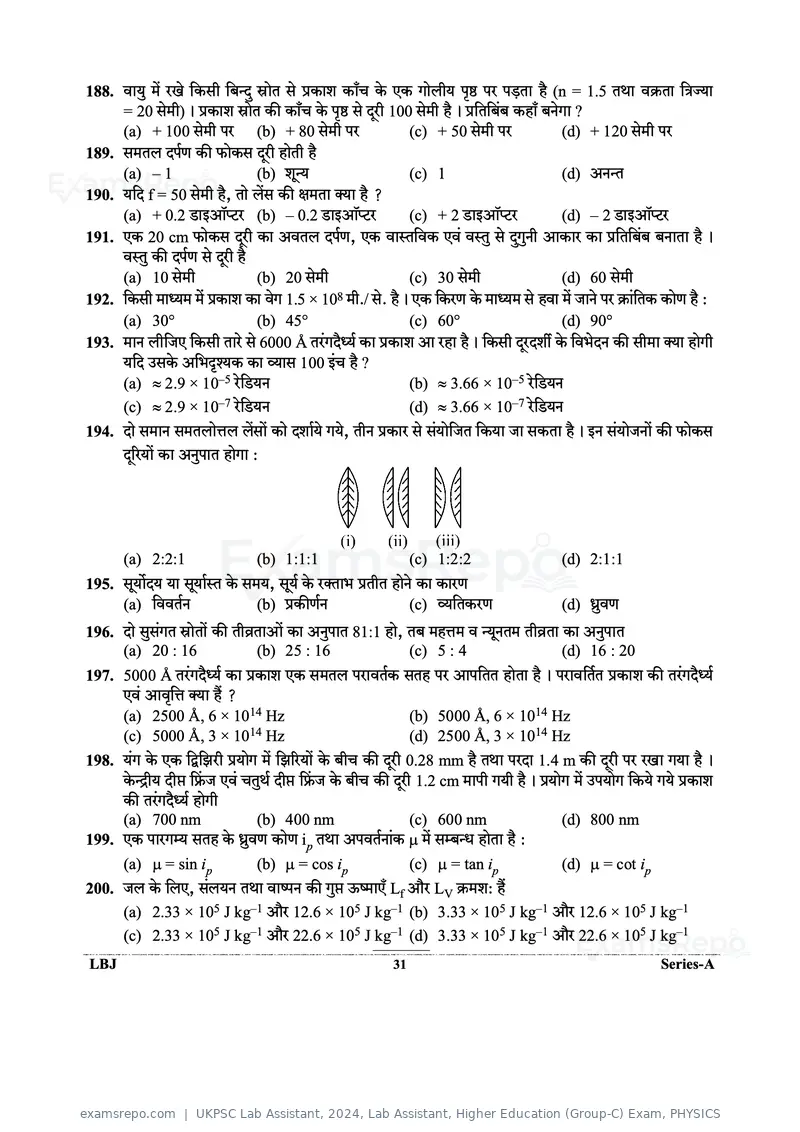
Text of page 31
188. (n = 1.5
= 20 ) 100 ?
(a) + 100 (b) + 80 (c) + 50 (d) + 120
189.
(a) – 1 (b) (c) 1 (d)
190. f = 50 , ?
(a) + 0.2 (b) – 0.2 (c) + 2 (d) – 2
191. 20 cm ,
(a) 10 (b) 20 (c) 30 (d) 60
192. 1.5 × 10 ./ . :
8
(a) 30° (b) 45° (c) 60° (d) 90°
193. 6000 Å
100 ?
(a) 2.9 × 10⁻⁵ (b) 3.66 × 10⁻⁵
(c) 2.9 × 10⁻⁷ (d) 3.66 × 10⁻⁷
194. ,
:
(a) 2:2:1 (b) 1:1:1 (c) 1:2:2 (d) 2:1:1
195. ,
(a) (b) (c) (d)
196. 81:1 ,
(a) 20 : 16 (b) 25 : 16 (c) 5 : 4 (d) 16 : 20
197. 5000 Å
?
(a) 2500 Å, 6 × 10¹⁴ Hz (b) 5000 Å, 6 × 10¹⁴ Hz
(c) 5000 Å, 3 × 10¹⁴ Hz (d) 2500 Å, 3 × 10¹⁴ Hz
198. 0.28 mm 1.4 m
1.2 cm
(a) 700 nm (b) 400 nm (c) 600 nm (d) 800 nm
199. ip :
(a) = sin ip (b) = cos ip (c) = tan ip (d) = cot ip
200. , Lf LV :
(a) 2.33 × 10⁵ J kg–1 12.6 × 10⁵ J kg–1 (b) 3.33 × 10⁵ J kg–1 12.6 × 10⁵ J kg–1
(c) 2.33 × 10⁵ J kg–1 22.6 × 10⁵ J kg–1 (d) 3.33 × 10⁵ J kg–1 22.6 × 10⁵ J kg–1
LBJ 31 Series-A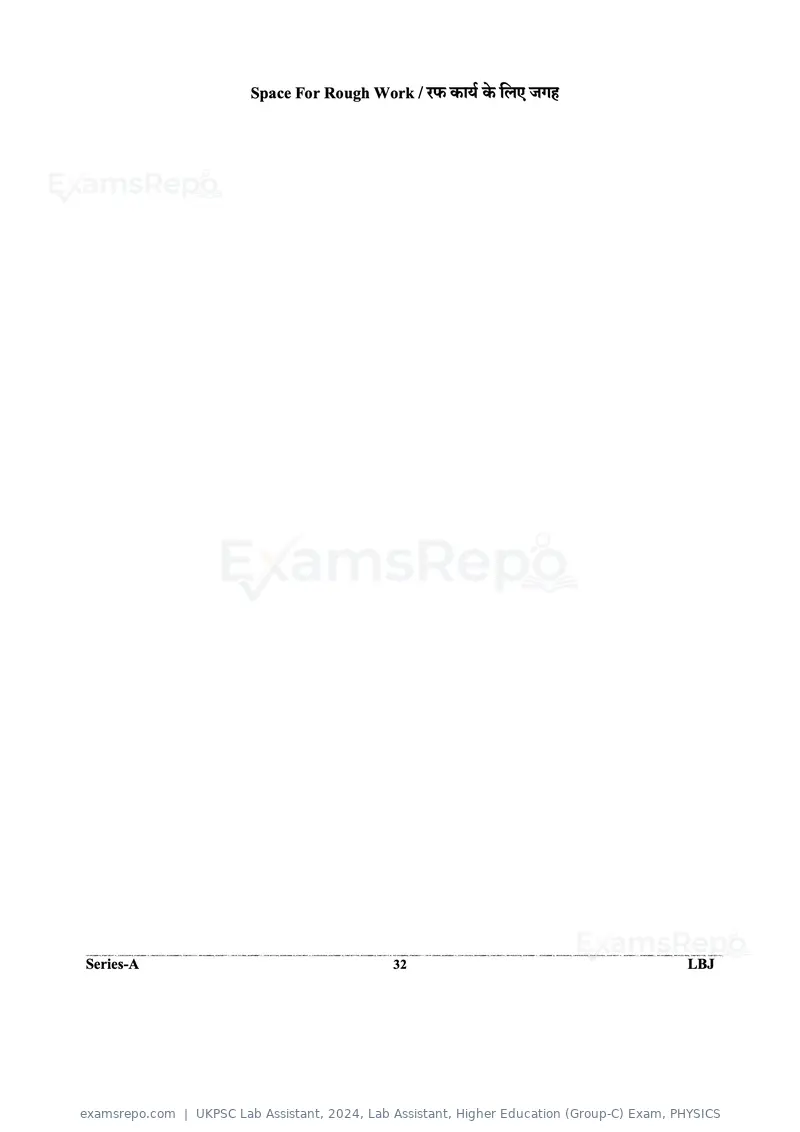
Text of page 32
Space For Rough Work / Series-A 32 LBJ
Page 1 of 32
Source: Uttarakhand Public Service Commission. Question paper published by Uttarakhand Public Service Commission.