
Machine-translated by Google. Questions are authored in English.
Top

Boundary Layer Theory Questions and Answers

11.

Consider a steady, and incompressible flow over a body with characteristic length L. The boundary layer thickness at a distance x from the leading edge is \(\delta\). Which one of the following assumptions is correct for deriving the Prandtl boundary layer equations?

Exam Year(s)

GATE XE - 2026,

Answer: D

The assumption is \(\delta \ll L\).

Prandtl's boundary layer equations come from an order-of-magnitude analysis of the Navier-Stokes equations in a thin layer next to the wall. Because the layer is thin compared with the body length, gradients across it (in y) are much larger than gradients along it (in x). This lets the streamwise diffusion term \(\partial^{2}u/\partial x^{2}\) be dropped and shows that the pressure is nearly constant across the layer, imposed by the outer flow.

If \(\delta\) were comparable to or larger than L, none of these simplifications would hold, which rules out the other three options.

Please log in or register to report this question.
12.

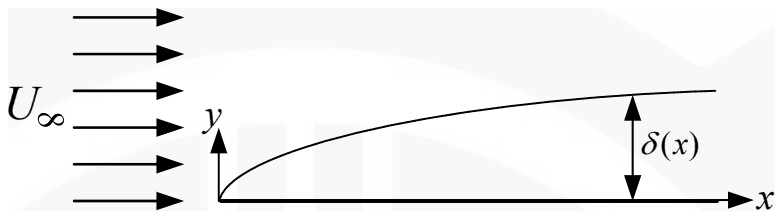
Consider a steady, laminar, and incompressible flow over a flat plate, as shown in the figure. With freestream velocity \(U_{\infty}\) and kinematic viscosity \(\nu_{1}\), the boundary layer thickness at a distance \(x_{1}\) from the leading edge is \(\delta_{1}\). If the kinematic viscosity of the fluid is increased by a factor of four \((\nu_{2} = 4\nu_{1})\), the boundary layer thickness \((\delta_{2})\) at \(x_{1}\) with same \(U_{\infty}\) will be equal to

A uniform stream U infinity approaching a flat plate along the x-axis, with the boundary layer thickness delta(x) growing from the leading edge

Exam Year(s)

GATE XE - 2026,

Answer: C

The new thickness is \(2\delta_{1}\).

For a laminar flat-plate boundary layer (Blasius):

\[ \begin{aligned} \delta &\approx \frac{5x}{\sqrt{Re_{x}}} = 5\sqrt{\frac{\nu x}{U_{\infty}}} \\ &\propto \sqrt{\nu} \end{aligned} \]

At the same x and U, multiplying the kinematic viscosity by 4 multiplies the thickness by \(\sqrt{4} = 2\).

\(4\delta_{1}\) assumes thickness proportional to viscosity, \(\delta_{1}/2\) has the dependence inverted, and \(\delta_{1}\) ignores viscosity altogether. A more viscous fluid diffuses momentum further from the wall, so the layer thickens.

Please log in or register to report this question.
Direction for [ Question No: 13 To 14 ] :

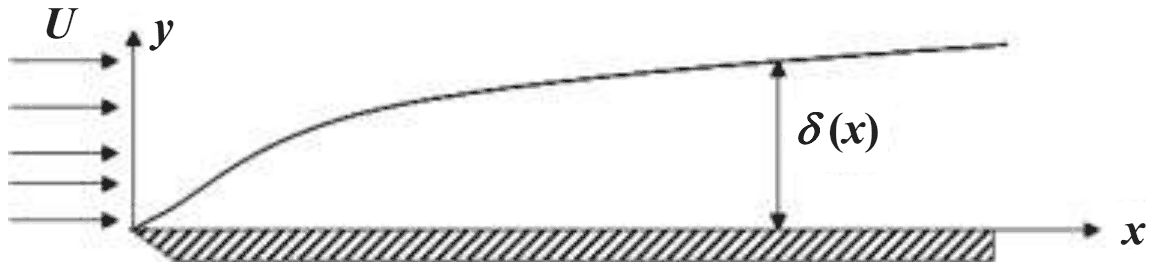
The hydrodynamic boundary layer over a flat plate is shown in the figure below. The velocity in the x-direction is approximated as \(u = a + by + cy^{2}\), where a, b and c are constants. U is the free stream velocity and \(\delta\) is the boundary-layer thickness at any point x on the plate.

Uniform stream U meeting a flat plate along the x axis; the boundary layer edge rises from the leading edge to height delta(x) above the plate

Answer: A

The profile is \(u/U = 2(y/\delta) - (y/\delta)^{2}\).

Apply the three boundary conditions: no slip at the wall, free-stream velocity at the edge, and a smooth join with the free stream (zero slope) at the edge.

\[ \begin{aligned} u(0) = 0 &\Rightarrow a = 0 \\ \left.\tfrac{du}{dy}\right|_{\delta} = 0 &\Rightarrow b + 2c\delta = 0 \\ u(\delta) = U &\Rightarrow b\delta + c\delta^{2} = U \end{aligned} \]

These give \(b = 2U/\delta\) and \(c = -U/\delta^{2}\). The '+' option gives u = 3U at the edge. The 1.5 and 0.5 coefficients belong to a cubic profile and do not satisfy the zero-slope condition for a quadratic.

Please log in or register to report this question.

14.

The displacement thickness (in mm) when \(\delta = 6\) mm, is

Exam Year(s)

GATE XE - 2012,

Answer: B

The displacement thickness is 2 mm.

With \(\eta = y/\delta\) and the profile \(u/U = 2\eta - \eta^{2}\):

\[ \begin{aligned} \delta^{*} &= \delta\int_{0}^{1}\left(1 - \frac{u}{U}\right)d\eta \\ &= \delta\int_{0}^{1}(1 - 2\eta + \eta^{2})\,d\eta \\ &= \delta\left(1 - 1 + \tfrac{1}{3}\right) = \frac{6}{3} = 2\ \text{mm} \end{aligned} \]

Displacement thickness measures the outward shift of the streamlines caused by the slowed fluid, so it must be positive and smaller than \(\delta\); the negative options are impossible. 2.25 mm would come from a different (cubic) profile.

Please log in or register to report this question.

Loading…
Tags: Boundary Layer Theory Questions and Answers || Boundary Layer Theory MCQ Questions and Answers || Boundary Layer Theory GK Questions and Answers || Boundary Layer Theory GK MCQ Questions || Boundary Layer Theory Multiple Choice Questions and Answers || Boundary Layer Theory GK || GK on Boundary Layer Theory || Fluid Mechanics Questions and Answers || Fluid Mechanics MCQ Questions and Answers || Fluid Mechanics GK Questions and Answers || GK on Fluid Mechanics