
Machine-translated by Google. Questions are authored in English.
Top

Flow Over Immersed Bodies Questions and Answers

Direction for [ Question No: 1 To 1 ] :

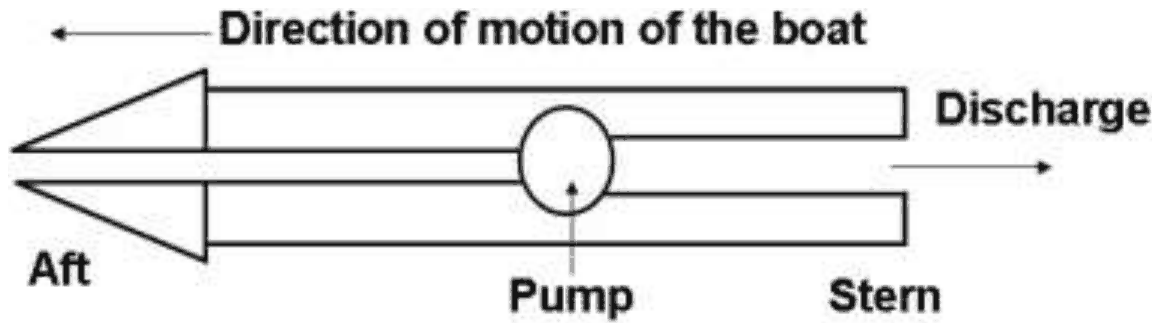
A boat is propelled in still water at a velocity of 5 m/s by taking water at the rate of 1 m3/s from the aft side and discharging it through the stern using a pump, as shown in the figure below. The velocity of the discharge jet relative to the boat is 9 m/s. The effect of pressure at the intake and discharge can be neglected. The density of water may be taken as 1000 kg/m3.

Boat moving towards the aft end; water enters a duct at the aft, a pump in the duct discharges it as a jet from the stern

1.

The power (in kW) required to propel the boat is

Exam Year(s)

GATE XE - 2012,

Answer: B

The propulsive power is 20 kW.

Relative to the boat, water enters at the boat speed, 5 m/s, and leaves at 9 m/s. The thrust is the rate of change of its momentum:

\[ \begin{aligned} F &= \rho Q(V_{j} - V) = 1000(1)(9 - 5) = 4000\ \text{N} \\ P &= FV = 4000 \times 5 = 20000\ \text{W} = 20\ \text{kW} \end{aligned} \]

A common slip is to ignore the momentum the water already has relative to the boat when it enters, which inflates the thrust to 9000 N. Only the momentum difference times the boat speed gives the useful propulsive power, and 10, 50 and 90 kW do not follow from that balance.

Please log in or register to report this question.
2.

A very small particle of diameter \(d_{p}\) and density \(\rho_{p}\) freely settles at constant velocity in a tank of depth L containing liquid of viscosity \(\mu_{l}\). The density of the liquid is \(\rho_{l}\) where \(\rho_{l} \lt \rho_{p}\). The velocity of particle in the liquid can be expressed as

Exam Year(s)

GATE AG - 2016,

Answer: C

The settling velocity is \(\frac{g(\rho_{p} - \rho_{l})d_{p}^{2}}{18\mu_{l}}\), Stokes' law.

A very small particle settles in the laminar (Stokes) regime. At terminal velocity the net weight balances the Stokes drag \(3\pi\mu_{l} d_{p} v\):

\[ \begin{aligned} \frac{\pi d_{p}^{3}}{6}(\rho_{p} - \rho_{l})g &= 3\pi\mu_{l} d_{p} v \\ v &= \frac{g(\rho_{p} - \rho_{l})d_{p}^{2}}{18\mu_{l}} \end{aligned} \]

The tank depth \(L\) plays no part in a terminal velocity, which rules out every option containing \(L\). Those options also fail dimensionally: only \(d_{p}^{2}\) gives a velocity with the other factors.

Please log in or register to report this question.
3.

A solid spherical bead of lead (uniform density = 11000 kg/m3) of diameter \(d\) = 0.1 mm sinks with a constant velocity \(V\) in a large stagnant pool of a liquid (dynamic viscosity = 1.1 × 10⁻³ kg·m·s). The coefficient of drag is given by \(c_{D} = \frac{24}{Re}\), where the Reynolds number (Re) is defined on the basis of the diameter of the bead. The drag force acting on the bead is expressed as \(D = (c_{D})(0.5\rho V^{2})\left(\frac{\pi d^{2}}{4}\right)\), where ρ is the density of the liquid. Neglect the buoyancy force. Using \(g\) = 10 m/s2, the velocity \(V\) is __________ m/s.

Exam Year(s)

GATE ME - 2022,

Answer: C

The settling velocity is \(\frac{1}{18}\) m/s.

With \(c_{D} = 24/Re = 24\mu/(\rho V d)\), the drag reduces to Stokes' law, \(D = 3\pi\mu V d\); the liquid density cancels. At constant velocity the drag balances the weight (buoyancy is neglected):

\[ \begin{aligned} 3\pi\mu V d &= \rho_{s}\,g\,\frac{\pi d^{3}}{6} \\ V &= \frac{\rho_{s} g d^{2}}{18\mu} = \frac{11000 \times 10 \times 10^{-8}}{18 \times 1.1 \times 10^{-3}} \\ &= \frac{1}{18}\ \text{m/s} \end{aligned} \]

The other fractions do not satisfy the force balance; 1/24 is the trap of using the 24 of the drag law in place of the 18 of Stokes' settling velocity.

Please log in or register to report this question.

4.

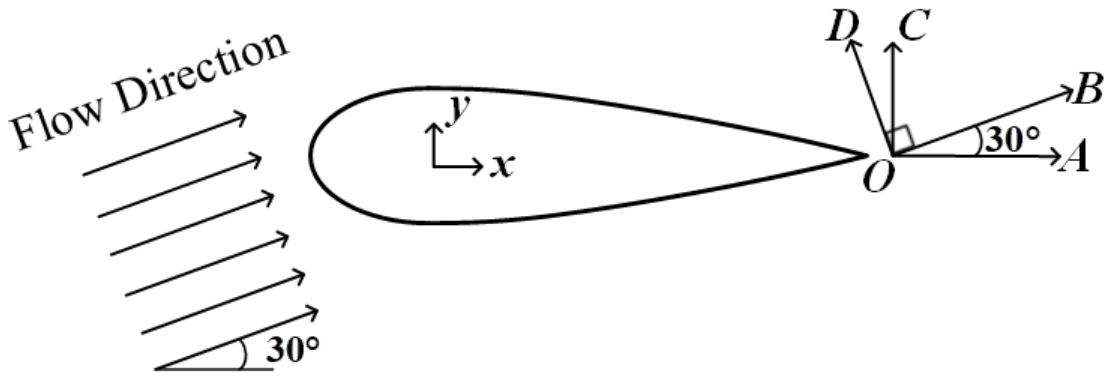
Consider a fluid flow around an airfoil as shown in figure.

Airfoil along the x axis with the flow approaching at 30 degrees to x. From the trailing edge O, OA points along x, OB at 30 degrees to x, OC along y, and OD at right angles to OB

The directions of drag force and lift force, respectively are along

Exam Year(s)

GATE XE - 2024,

Answer: D

Drag acts along OB and lift along OD.

By definition, drag is the component of the aerodynamic force parallel to the free-stream velocity, and lift is the component perpendicular to it. The free stream approaches at 30 degrees to the airfoil's x axis, and OB is drawn at 30 degrees to x, so OB is the free-stream direction and drag acts along it. OD is drawn at right angles to OB, so it is the lift direction.

OA and OC are the body (chord) axes. Forces along them are the axial and normal components, which coincide with drag and lift only at zero angle of attack.

Please log in or register to report this question.

5.

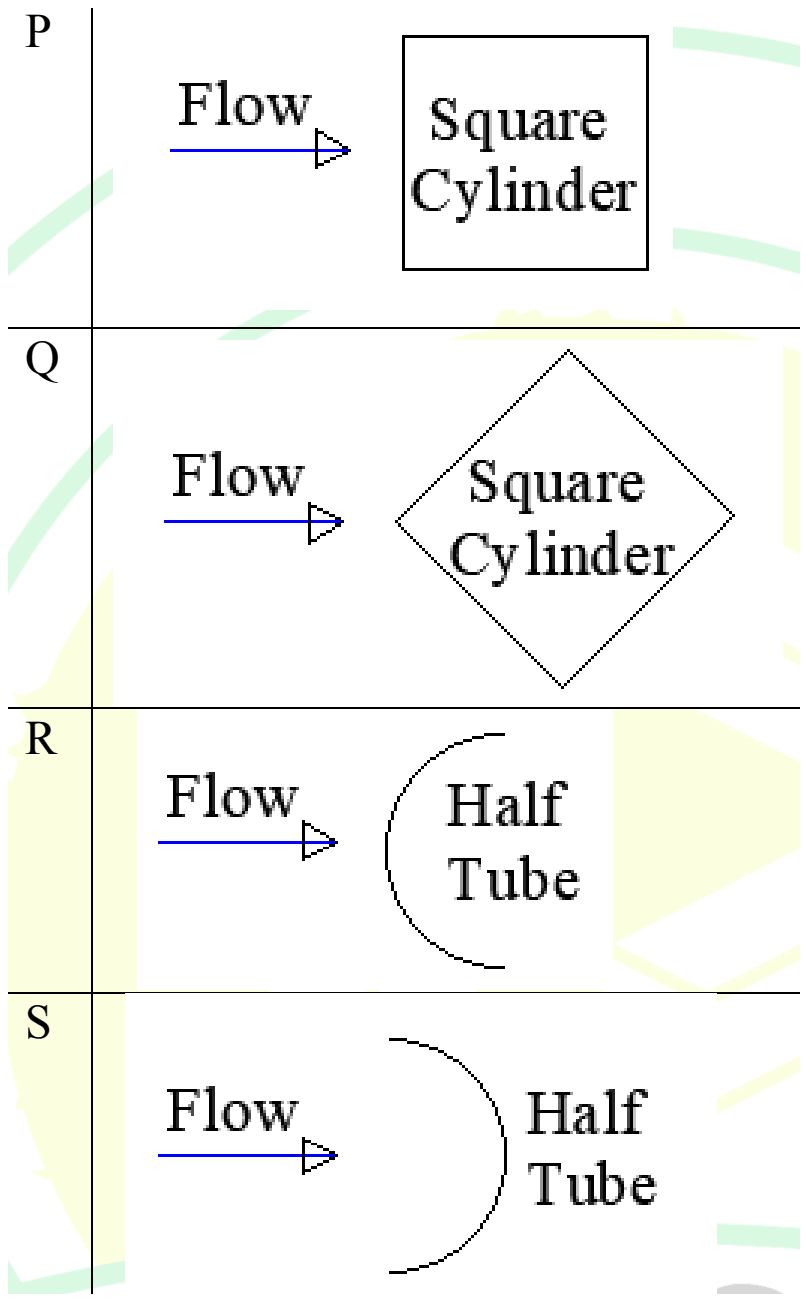
Group-I shows different two-dimensional bodies and Group-II mentions their total drag coefficient \((C_{D})\) based on frontal area while facing parallel flow of fluid having Reynolds number \(Re \ge 10^{4}\) along the direction of arrow. The bodies are placed symmetrically with respect to the flow direction.

Group-I:

Four bodies facing flow from the left: P a square cylinder with a flat face to the flow, Q a square cylinder with a corner to the flow, R a half tube with its convex side to the flow, S a half tube with its concave side to the flow

Group-II: 1. 1.2   2. 1.6   3. 2.1   4. 2.3

Which one of the following options identifies the correct match between Group-I and Group-II, as per the concept of degree of streamlining?

Exam Year(s)

GATE XE - 2025,

Answer: A

The match is P-3, Q-2, R-1, S-4.

At high Reynolds number drag on bluff bodies is mostly pressure drag, set by how abruptly the flow separates. The more streamlined the face toward the flow, the lower the drag coefficient.

  • R, the half tube with its convex side to the flow, is the most streamlined: \(C_{D} \approx 1.2\).
  • Q, the square cylinder with a corner to the flow, splits the flow gradually: \(C_{D} \approx 1.6\).
  • P, the square cylinder with a flat face to the flow, separates at sharp corners: \(C_{D} \approx 2.1\).
  • S, the half tube with its concave side to the flow, traps the flow like a cup: \(C_{D} \approx 2.3\), the highest.

Options putting the concave half tube at 1.2 (S-1) or the convex half tube at 1.6 or 2.3 reverse the effect of streamlining.

Please log in or register to report this question.

6.

Air flows with a freestream velocity U over four different bodies having same frontal area facing the flow direction, as shown in the figure. Which one of the following bodies has the lowest pressure (form) drag force for Reynolds number, \(Re \ge 10^{4}\)?

Four bodies of equal frontal area in a stream U: P a rectangular block, Q a block rounded at the front only, R a block rounded at both ends, S a body rounded at the front and tapering to a point at the rear

Exam Year(s)

GATE XE - 2026,

Answer: D

The lowest pressure drag is on Body S.

At Reynolds numbers of \(10^{4}\) and above, form drag is set mainly by flow separation at the rear. A rounded nose lets the flow follow the surface at the front, and a long, gradually tapering tail lets the flow decelerate slowly along it, so it stays attached and the low-pressure wake is narrow. Body S has both, a streamlined shape.

Body P, a blunt block, separates at its sharp front corners and leaves a wide wake, the highest drag. Body Q rounds the nose but still ends in a blunt base. Body R rounds the rear corners too, but its rear is still bluff compared with S's long taper, so its wake is wider than S's.

Please log in or register to report this question.

Loading…
Tags: Flow Over Immersed Bodies Questions and Answers || Flow Over Immersed Bodies MCQ Questions and Answers || Flow Over Immersed Bodies GK Questions and Answers || Flow Over Immersed Bodies GK MCQ Questions || Flow Over Immersed Bodies Multiple Choice Questions and Answers || Flow Over Immersed Bodies GK || GK on Flow Over Immersed Bodies || Fluid Mechanics Questions and Answers || Fluid Mechanics MCQ Questions and Answers || Fluid Mechanics GK Questions and Answers || GK on Fluid Mechanics