
Machine-translated by Google. Questions are authored in English.
Top

Fluid Statics Questions and Answers

Direction for [ Question No: 1 To 2 ] :

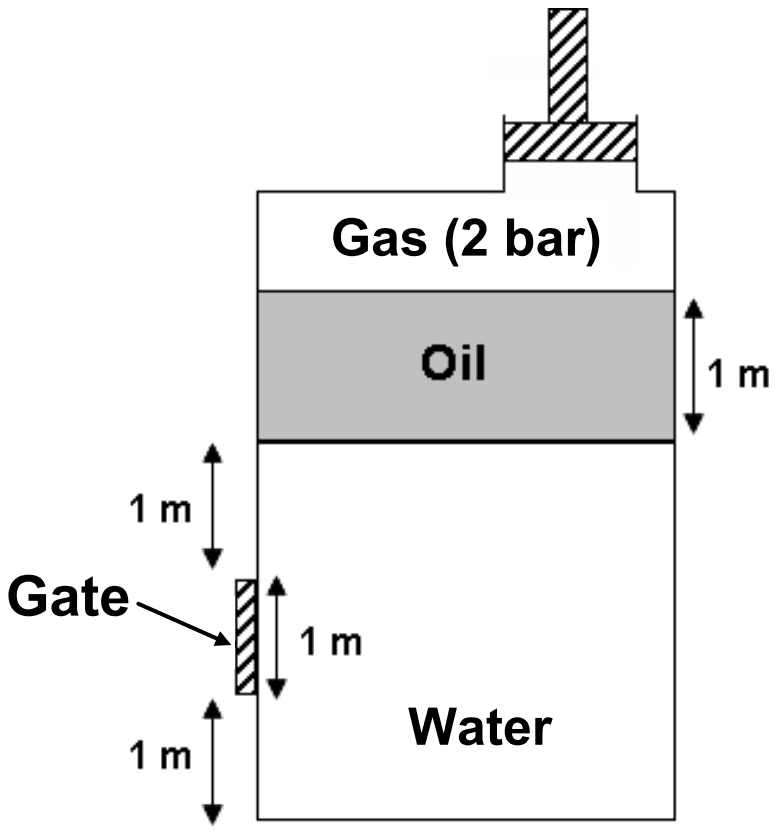
A vessel containing water (density 1000 kg/m3) and oil (density 800 kg/m3), pressurized by gas, is shown in the figure below. Assume that the gravitational acceleration is 10 m/s2.

Closed vessel with gas at 2 bar above a 1 m layer of oil on water; a 1 m high gate in the side wall, 1 m below the oil-water interface and 1 m above the bottom

1.

The pressure (in bar) exerted on the bottom wall inside the vessel is approximately

Exam Year(s)

GATE XE - 2012,

Answer: B

The pressure on the bottom is about 2.38 bar.

Add the gas pressure and the weight of each liquid column above the bottom. The water below the oil layer is 1 + 1 + 1 = 3 m deep.

\[ \begin{aligned} p &= p_{gas} + \rho_{oil}g h_{oil} + \rho_{w}g h_{w} \\ &= 2 \times 10^{5} + 800(10)(1) + 1000(10)(3) \\ &= 200000 + 8000 + 30000 = 238000\ \text{Pa} \end{aligned} \]

That is 2.38 bar (1 bar = 105 Pa). The options 0.238, 23.8 and 238 are the same digits with the bar-to-pascal conversion slipped by a factor of ten or more.

Please log in or register to report this question.

2.

The gate is 1 m wide perpendicular to the plane of the paper. The force (in N) exerted on the gate is approximately

Exam Year(s)

GATE XE - 2012,

Answer: C

The force on the gate is about \(2.23 \times 10^{5}\) N.

For a plane vertical gate the resultant force is the pressure at its centroid times its area. The centroid is 1.5 m below the oil-water interface (1 m to the top of the gate plus half its 1 m height).

\[ \begin{aligned} p_{c} &= 2 \times 10^{5} + 800(10)(1) + 1000(10)(1.5) \\ &= 223000\ \text{Pa} \\ F &= p_{c}A = 223000 \times (1 \times 1) = 2.23 \times 10^{5}\ \text{N} \end{aligned} \]

The gas pressure dominates, which is why the answer is so large. The other options differ only by powers of ten, the result of dropping the gas pressure's 105 or mis-converting bar.

Please log in or register to report this question.
3.

Consider a liquid jet of diameter 'd'. Let 'p' be the pressure intensity inside the liquid jet above the outside pressure and '\(\sigma\)' be the surface tension of the liquid. What will be the correct mathematical expression to determine the surface tension on the liquid jet (\(\sigma\))?

Exam Year(s)

DSSSB JE - 2023,

Answer: A

Cut the jet along a diameter and consider a length L. The pressure force on the half jet is \(p \times d \times L\), acting over the projected area. It is balanced by the surface tension acting on the two edges of the cut, \(2\sigma L\):

\[ p\,d\,L = 2\sigma L \Rightarrow \sigma = \frac{pd}{2} \]

The factors pd/4, pd/6 and pd/8 are not given by this balance. For a spherical droplet the relation is \(p = 4\sigma/d\), so \(\sigma = pd/4\) belongs to a droplet, not a jet, and pd/8 is the relation for a soap bubble with its two surfaces.

Please log in or register to report this question.
4.

Which of the following factors influence the magnitude of hydrostatic pressure on the unit length of a dam?

Exam Year(s)

DSSSB JE - 2023,

Answer: B

The key gives the shape of the dam face towards the upstream side, because the hydrostatic pressure acts on the face in contact with the water, and the total force on a unit length depends on the water depth and on how that face is shaped (its slope or curvature fixes both the magnitude and the direction of the resultant). The density of the dam material, the shape of the downstream face and the overall length of the dam do not alter the pressure of the water on the upstream face. I have followed the official key for this question.

Please log in or register to report this question.
5.

______ are the devices which are used for measuring the pressure by balancing the fluid column by a spring or dead weight.

Exam Year(s)

DSSSB JE - 2023,

Answer: C

Mechanical gauges, such as the Bourdon tube gauge, the diaphragm gauge and the dead-weight gauge, measure pressure by balancing the pressure of the fluid against a spring or a dead weight. Simple manometers, differential manometers and piezometers are all manometric devices that balance the pressure against a column of liquid, and they have no spring or weight. The piezometer is the simplest of these and measures the pressure in a pipe by the height of the liquid in a tube.

Please log in or register to report this question.

6.

When the pressure between two points is measured using a mercury-water manometer, it shows a gauge difference of 400 mm, as in the given figure. What will be the difference in pressure?

(Take the specific gravity of mercury as 13.6)

A U-tube manometer with water above mercury in both limbs; the mercury level in the right limb is 400 mm below that in the left limb.

Exam Year(s)

DSSSB JE - 2023,

Answer: A

Both limbs hold water above the mercury, so the pressure difference between the two points equals the unbalanced column of mercury less the water displaced by it. The mercury surface in the right limb is 0.4 m below that in the left. In terms of metres of water:

\[ \begin{aligned} \Delta p = h\,(S_{Hg} - S_w) = 0.4\,(13.6 - 1) \\ &= 0.4 \times 12.6 = 5.04\ \text{m of water} \end{aligned} \]

The value 12.6 m is the factor without the 0.4 m, and 5.84 m would come from adding the specific gravity of water instead of subtracting it (0.4 x 14.6). The figure of 14.6 is the sum of the specific gravities, not an answer.

Please log in or register to report this question.

7.

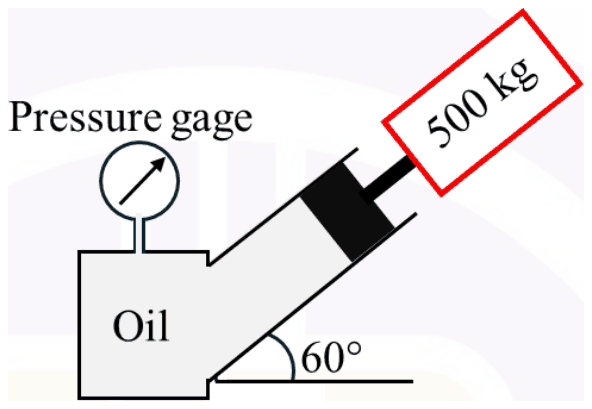
A hydraulic crane supports a mass of 500 kg with its piston-cylinder actuator, inclined at 60° with horizontal, as shown in the figure below. The diameter of the piston is 30 cm and gravitational acceleration is 10 \(\text{m/s}^{2}\). Neglecting mass of the piston, the reading of the pressure gage in kPa (gage) is

An oil reservoir with a pressure gage feeds a piston-cylinder inclined at 60 degrees to the horizontal, whose rod carries a 500 kg mass

Exam Year(s)

GATE ME - 2026,

Answer: A

The gage reads about 61.26 kPa.

The actuator acts along its own axis, inclined at \(60^{\circ}\), so it carries the component of the weight along that axis:

\[ \begin{aligned} F &= mg\sin 60^{\circ} = 5000 \times 0.866 = 4330\ \text{N} \\ A &= \pi(0.3)^{2}/4 = 0.07069\ \text{m}^{2} \\ p &= 4330/0.07069 = 61.26\ \text{kPa} \end{aligned} \]

70.71 kPa is the full weight over the area, ignoring the inclination, and 35.35 kPa uses \(\cos 60^{\circ}\) instead of \(\sin 60^{\circ}\). 6.13 is the correct figure divided by 10.

Please log in or register to report this question.

8.

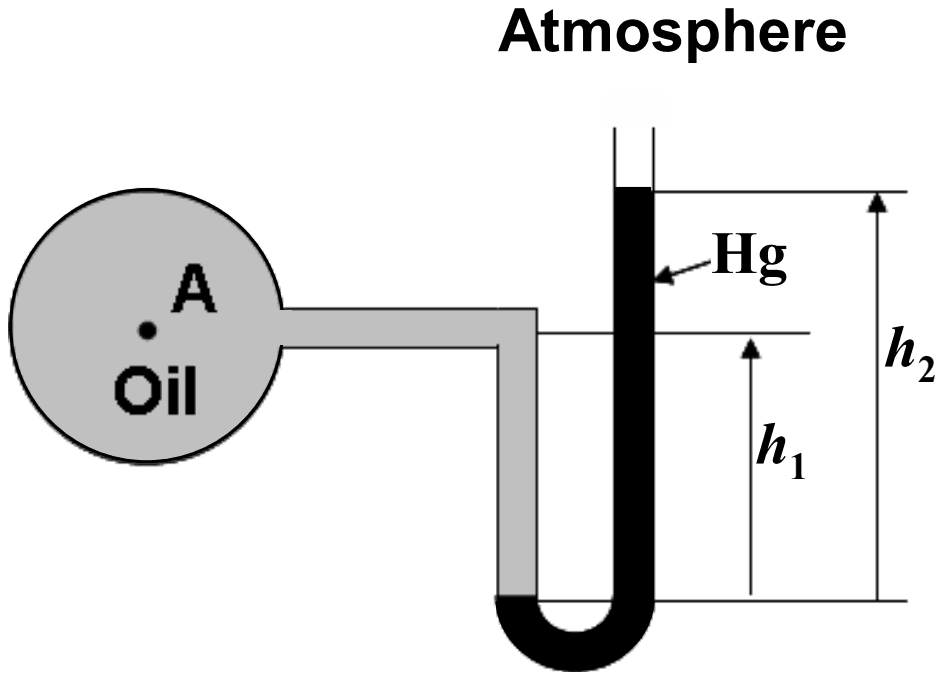
A U-tube mercury (Hg) manometer as shown below is employed to measure the pressure of an oil-filled vessel. The densities of Hg and oil are 13600 kg/m3 and 800 kg/m3, respectively. The gravitational acceleration may be taken as 10 m/s2. The gauge pressure (in Pa) at point A when h1 = 0.5 m and h2 = 0.9 m, is approximately

Oil vessel with point A joined by a horizontal tube to a U-tube; mercury rises h2 above the interface in the open limb, the tube is h1 above it

Exam Year(s)

GATE XE - 2012,

Answer: A

The gauge pressure at A is about \(118.4 \times 10^{3}\) Pa.

Start at the oil-mercury interface at the bottom of the U. The open limb carries mercury a height \(h_{2}\) above it, open to the atmosphere; the oil side rises \(h_{1}\) from the interface to the level of A. Equating pressures at the interface level:

\[ \begin{aligned} p_{A} + \rho_{oil} g h_{1} &= \rho_{Hg} g h_{2} \\ p_{A} &= 13600(10)(0.9) - 800(10)(0.5) \\ &= 122400 - 4000 = 118400\ \text{Pa} \end{aligned} \]

That is \(118.4 \times 10^{3}\) Pa, about 118 kPa gauge. The options 118.4, 11.84 and 1.184 are the same digits with the wrong power of ten.

Please log in or register to report this question.

9.

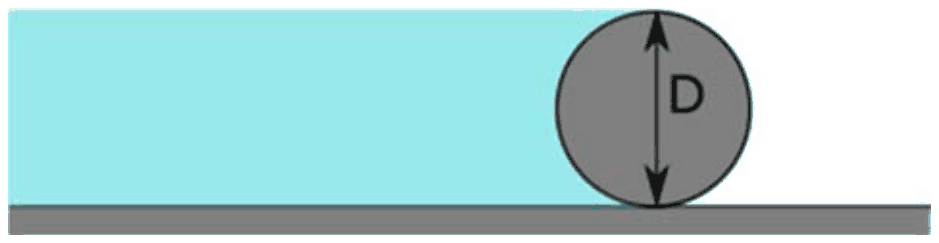
A heavy horizontal cylinder of diameter \(D\) supports a mass of liquid having density \(\rho\) as shown in the figure. Find out the vertical component of force exerted by the liquid per unit length of the cylinder if \(g\) is the acceleration due to gravity.

A cylinder of diameter D resting on a horizontal floor, with liquid on its left side filled up to the level of its top

Exam Year(s)

GATE XE - 2022,

Answer: B

The vertical force is \(\frac{\pi D^{2}}{8}\rho g\) per unit length, acting upward.

The liquid touches the left half of the cylinder, from the floor contact at the bottom up to the top, where the free surface lies. The vertical force on a curved surface equals the weight of liquid, real or imaginary, between the surface and the free-surface level.

  • On the upper-left quarter the liquid lies above the surface and pushes down.
  • On the lower-left quarter the liquid pushes up, with the imaginary liquid column reaching up to the free surface.

The two columns overlap except for the half-circle itself, so the net force is the weight of liquid that would fill the left half of the cylinder:

\[ \begin{aligned} F_{V} &= \rho g \cdot \frac{1}{2}\cdot\frac{\pi D^{2}}{4} \\ &= \frac{\pi D^{2}}{8}\rho g \end{aligned} \]

\(\pi D^{2}/4\) is the buoyancy of the whole cylinder, which would need liquid all round it; the other two options do not correspond to any part of the wetted surface.

Please log in or register to report this question.

10.

The actual pressure at a given position is called as-

Exam Year(s)

RSMSSB JE - 2025, RSMSSB - 2025,

Answer: A

The actual pressure is called absolute pressure.

Absolute pressure is measured from a perfect vacuum (zero pressure), so it is the true pressure at the point. Gauge pressure is measured relative to the local atmosphere: absolute = gauge + atmospheric.

Atmospheric pressure is just the pressure of the surrounding air, and vacuum pressure is the amount by which a pressure falls short of atmospheric. Neither is the actual pressure at an arbitrary position.

Please log in or register to report this question.

Loading…
Tags: Fluid Statics Questions and Answers || Fluid Statics MCQ Questions and Answers || Fluid Statics GK Questions and Answers || Fluid Statics GK MCQ Questions || Fluid Statics Multiple Choice Questions and Answers || Fluid Statics GK || GK on Fluid Statics || Fluid Mechanics Questions and Answers || Fluid Mechanics MCQ Questions and Answers || Fluid Mechanics GK Questions and Answers || GK on Fluid Mechanics