
Machine-translated by Google. Questions are authored in English.
Top

Solutions and Phase Equilibria Questions and Answers

1.

If xA and xB are the respective mole fractions of A and B in an ideal solution of the two and TA, TB, T are the fusion temperatures of pure A, pure B and the ideal solution respectively, then

Exam Year(s)

GATE Chemistry - 2012,

Answer: D

The correct relation is the one with A's enthalpy of fusion, A's melting point and a negative exponent: \(1-x_{B}=\)\(\exp[\frac{-\Delta H^{o}_{fus(A)}}{R}(\frac{1}{T}-\frac{1}{T_{A}})]\).

The solution freezes when its component A is in equilibrium with pure solid A, so the condition involves A's enthalpy of fusion and A's melting point. For an ideal solution:

\[ \begin{aligned} \ln x_{A} &= -\frac{\Delta H_{fus(A)}}{R}\left(\frac{1}{T} - \frac{1}{T_{A}}\right) \\ x_{A} &= 1 - x_{B} \end{aligned} \]

Exponentiating gives the last option. A check: T lies below TA, so 1/T - 1/TA is positive, the exponent is negative and xA is less than 1, as it must be.

The two options with B's enthalpy and TB describe solid B separating instead, and the option with a positive exponent would make xA greater than 1.

Please log in or register to report this question.
2.

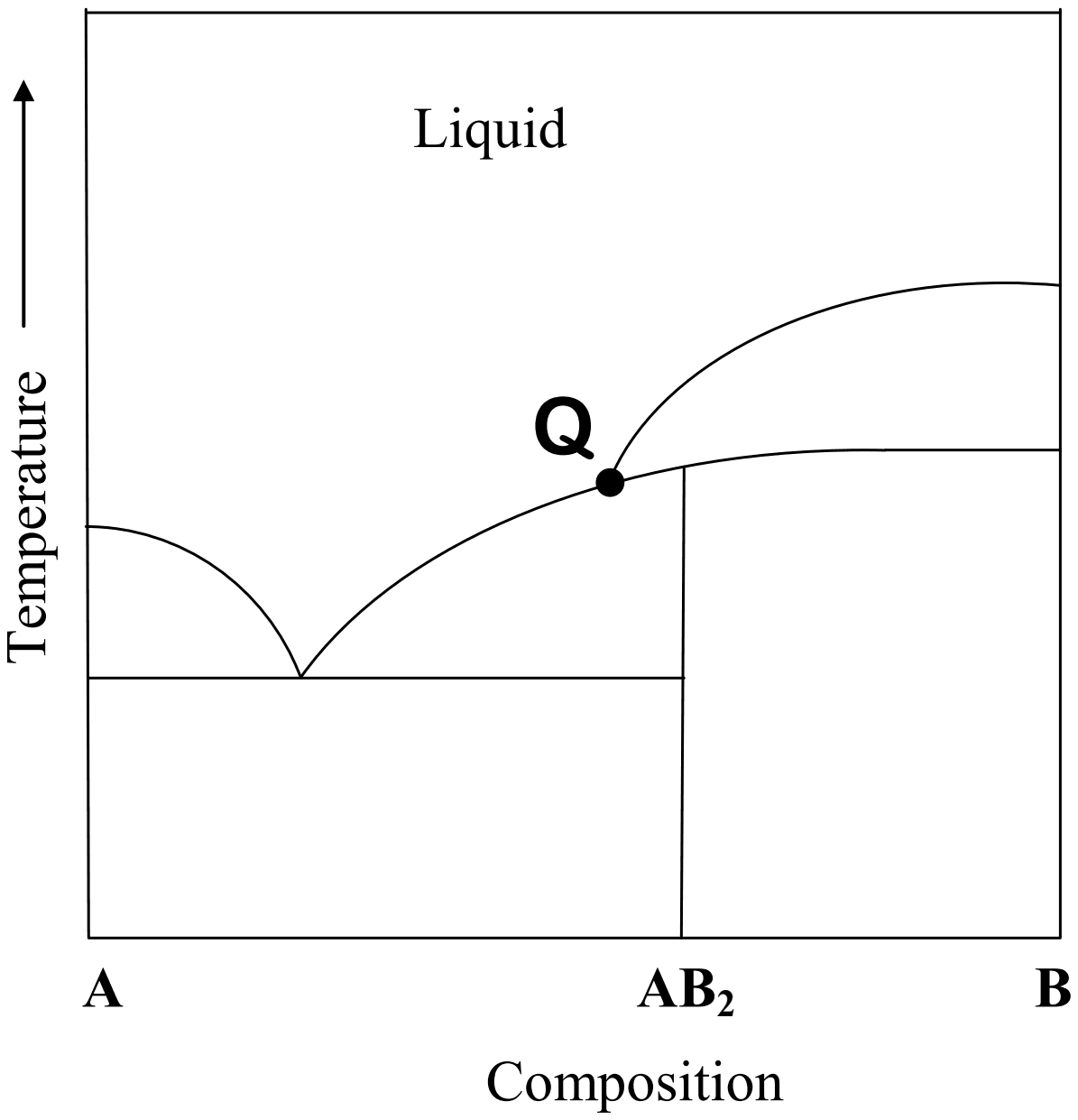
Consider the phase diagram given below.

Temperature-composition phase diagram from A through AB2 to B: a eutectic between A and AB2, and a liquidus rising towards B that meets a horizontal line at point Q, at the temperature where AB2 decomposes; the region above is labelled Liquid

At the intersection point Q the phases that are in equilibrium are

Exam Year(s)

GATE Chemistry - 2012,

Answer: C

At Q, solid B, solid AB2 and liquid are in equilibrium.

The vertical line for AB2 does not reach the liquid region: it stops at a horizontal line, so AB2 melts incongruently. At that temperature AB2 decomposes into solid B and a liquid of composition Q. Q is the peritectic point, where the liquidus coming down from the B side meets the horizontal peritectic line.

On the peritectic line three phases coexist: solid B, solid AB2 and liquid of composition Q. With three phases in a two-component system at fixed pressure, there are no degrees of freedom left, which is why the line is horizontal.

Solid A is not involved at Q: A appears only at the eutectic on the left. A three-solid equilibrium, or a four-phase one, is impossible at an invariant point of a binary system.

Please log in or register to report this question.
3.

m1 and m2 are the slopes (dP/dT) of the solid-liquid equilibrium lines in the P-T phase diagrams of H2O and CO2, respectively. For P \(\lt\) 10 atm, the values of m1 and m2 are

Exam Year(s)

GATE Chemistry - 2017,

Answer: D

The slopes are \(m_{1} \lt 0\) and \(m_{2} \gt 0\).

The Clapeyron equation gives the slope of the solid-liquid line:

\[ \frac{dP}{dT} = \frac{\Delta H_{fus}}{T\,\Delta V_{fus}} \]

\(\Delta H_{fus}\) is always positive, so the sign of the slope is the sign of the volume change on melting. Ice is less dense than liquid water, so water contracts on melting (\(\Delta V_{fus} \lt 0\)) and its melting line slopes backwards: \(m_{1} \lt 0\). Solid CO2 is denser than the liquid, like most substances, so \(\Delta V_{fus} \gt 0\) and \(m_{2} \gt 0\).

Water is the unusual case, so any option giving both slopes the same sign, or reversing the two, is wrong.

Please log in or register to report this question.

4.

Hexane and heptane are completely miscible. At 25 °C, the vapor pressures of hexane and heptane are 0.198 atm and 0.06 atm, respectively. The mole fractions of hexane and heptane in the vapor phase for a solution containing 4 M hexane and 6 M heptane, respectively, are:

Exam Year(s)

GATE Chemistry - 2021,

Answer: A

The vapour mole fractions are 0.688 hexane and 0.312 heptane.

Treat 4 and 6 as the relative amounts, so the liquid mole fractions are 0.4 and 0.6. By Raoult's law the partial pressures are

\[ \begin{aligned} p_{\mathrm{hex}} &= 0.4 \times 0.198 = 0.0792\ \mathrm{atm} \\ p_{\mathrm{hep}} &= 0.6 \times 0.06 = 0.036\ \mathrm{atm} \end{aligned} \]

\[ y_{\mathrm{hex}} = \frac{0.0792}{0.1152} = 0.688 \]

So hexane is 0.688 and heptane 0.312 of the vapour. The vapour is richer in the more volatile hexane than the liquid is. 0.400 and 0.600 are the liquid composition, and 0.312 and 0.688 swaps the two components.

Please log in or register to report this question.

5.

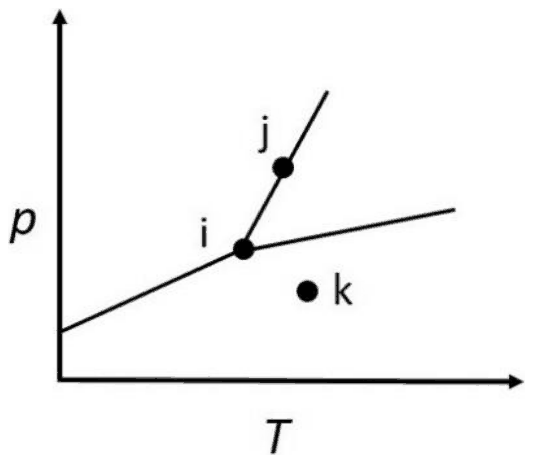
The phase diagram of a single component system is given below.

Pressure-temperature phase diagram with three boundary lines meeting at point i; point j lies on one boundary line above i; point k lies inside a region away from the lines.

The option with the correct number of degrees of freedom corresponding to the labelled points i, j, and k, respectively, is

Exam Year(s)

GATE Chemistry - 2025,

Answer: A

The degrees of freedom are 0, 1, 2.

For one component the Gibbs phase rule gives

\[ F = C - P + 2 = 3 - P. \]

  • Point i is where three boundary lines meet, the triple point, with three phases in equilibrium: F = 0, so both p and T are fixed.
  • Point j lies on a boundary line, where two phases coexist: F = 1, so fixing T fixes p.
  • Point k lies inside a single-phase region: F = 2, so p and T can both vary.

The option 3, 2, 1 forgets to subtract the phases, and 2, 0, 1 and 0, 2, 1 assign the counts to the wrong points.

Please log in or register to report this question.

6.

For the following reaction,

2 Pb3O4(s) \(\rightleftharpoons\) 6 PbO(s) + O2(g)

The correct option showing the number of phases (P), number of components (C) and degrees of freedom (F) is

Exam Year(s)

GATE Chemistry - 2026,

Answer: A

The correct option is P = 3, C = 2, F = 1.

  • Phases: Pb3O4(s), PbO(s) and O2(g). Each solid is a separate phase and the gas is one more, so P = 3.
  • Components: three species linked by one equilibrium, so C = 3 - 1 = 2 (for example PbO and O2).

\[ F = C - P + 2 = 2 - 3 + 2 = 1 \]

The system is univariant, like CaCO3 decomposing: fixing the temperature fixes the equilibrium O2 pressure. P = 3, C = 3 ignores the reaction relation. The options with P = 2 count the two solids as one phase, but two distinct solids are always two phases.

Please log in or register to report this question.

7.

The density of 3 M aqueous solution of a solute 'X' is 1.86 g mL-1 . The molality of the solution is (Molar mass of solute 'X' is 120 g mol-1 )

Exam Year(s)

KEAM - 2025,

Answer: C

The molality is 2m.

Take 1 L of solution. Its mass is \(1000 \times 1.86 = 1860\) g, and it holds 3 mol of X, which weigh \(3 \times 120 = 360\) g. The solvent (water) is the rest:

\[ \begin{aligned} m_{\text{water}} &= 1860 - 360 = 1500\ \text{g} = 1.5\ \text{kg} \\ \text{molality} &= \frac{3}{1.5} = 2\ \text{mol kg}^{-1} \end{aligned} \]

3m confuses molality with molarity; 1m and the others come from forgetting to subtract the solute's mass or using the solution's volume as the solvent's mass.

Please log in or register to report this question.

8.

Which of the following solvent has highest value of Molal elevation constant, Kb?

Exam Year(s)

KEAM - 2025,

Answer: C

The highest \(K_{b}\) is that of Carbon tetrachloride.

Approximate ebullioscopic constants (K kg mol-1) are: carbon tetrachloride 5.03, chloroform 3.63, acetic acid 3.07, cyclohexane 2.79 and carbon disulphide 2.34.

\(K_{b} = \frac{RT_{b}^{2}M}{1000\,\Delta_{vap}H}\) is large for a heavy solvent with a modest enthalpy of vaporisation, which is why \(CCl_{4}\) tops the list.

Please log in or register to report this question.

9.

Which of the following gas has highest solubility in water at 298 K?

Exam Year(s)

KEAM - 2025,

Answer: A

The most soluble gas is formaldehyde.

Formaldehyde is a small polar molecule that forms hydrogen bonds with water and reacts with it to form the hydrate (methanediol); its 37-40% aqueous solution is sold as formalin. It is far more soluble than the other gases.

CO2 is only moderately soluble, vinyl chloride is slightly soluble, and the non-polar gases methane and argon are poorly soluble, their solubility governed by a large Henry's law constant.

Please log in or register to report this question.

10.

N2 exerts a partial pressure of 7.648 bar when dissolved in 1 litre of water at 298 K. What is the mole fraction of N2 at same temperature? ( Henry's law constant (KH) for N2 at 298 K = 76.4 k bar)

Exam Year(s)

KEAM - 2025,

Answer: C

The mole fraction of nitrogen is \(10^{-4}\).

Henry's law states that the partial pressure of a gas over a solution is proportional to its mole fraction in the solution, \(p = K_{H} x\). Writing both pressures in bar (76.4 kbar = 76400 bar):

\[ \begin{aligned} x &= \frac{p}{K_{H}} = \frac{7.648}{76400} \\ &= 1.0 \times 10^{-4} \end{aligned} \]

The key step is converting kilobar to bar; leaving the constant as 76.4 would give 0.1, which is not even close to a dissolved gas fraction. \(10^{-3}\), \(10^{-5}\) and the other powers are each at least a factor of ten away from the computed value. A large \(K_{H}\) means low solubility, so a small mole fraction is expected for nitrogen.

Please log in or register to report this question.

Loading…
Tags: Solutions and Phase Equilibria Questions and Answers