
Machine-translated by Google. Questions are authored in English.
Top

Electronic Devices Questions and Answers

Answer: B

At absolute zero the valence band is completely occupied and the conduction band is completely empty.

Each of the N silicon atoms has 4 valence electrons, 4N in all, and the bands formed from these levels have 4N states each. At 0 K all 4N electrons fill the lower (valence) band and none has the energy to cross the gap of about 1.1 eV, so the upper (conduction) band is empty.

That is why pure silicon is an insulator at absolute zero. A partly filled conduction band needs thermal energy or doping, and the other options describe states that do not occur at 0 K.

Please log in or register to report this question.
Answer: E

The rate of fall depends on the inverse of the product of the capacitance and effective load resistance.

Between peaks, the filter capacitor discharges through the load. Its voltage falls as \(V = V_0e^{-t/RC}\), so the rate of fall is governed by \(\frac{1}{R_L C}\). A larger time constant \(R_L C\) means a slower fall and a smoother output, which is why large capacitors are used.

The rate does not depend directly on \(R_L C\), nor on the capacitance alone, nor on a sum or difference of reactance and resistance.

Please log in or register to report this question.

23.

A particle executes SHM with a time period T. If its maximum acceleration is doubled keeping the amplitude constant, its new time period is

Exam Year(s)

KEAM - 2026,

Answer: D

The new time period is \(\frac{T}{\sqrt{2}}\).

In SHM the maximum acceleration is \(a_{max} = \omega^{2}A\). With A fixed, doubling \(a_{max}\) doubles \(\omega^{2}\).

\[ \begin{aligned} \omega'^{2} &= 2\omega^{2} \Rightarrow \omega' = \sqrt{2}\,\omega \\ T' &= \frac{2\pi}{\omega'} = \frac{T}{\sqrt{2}} \end{aligned} \]

\(\frac{T}{2}\) would need \(\omega\) to double, which means \(a_{max}\) four times larger. \(\sqrt{2}T\) and 2T go the wrong way: a larger restoring acceleration makes the motion faster, not slower.

Please log in or register to report this question.

Answer: B

In a pure semiconductor, the number of electrons equals the number of holes.

In an intrinsic semiconductor every free electron is created by breaking a covalent bond, which leaves a hole behind. Electrons and holes are therefore produced in pairs, so ne = nh = ni.

An excess of electrons is the mark of an n-type and an excess of holes of a p-type doped semiconductor. Both electrons and holes carry current in a pure semiconductor, so 'only electrons' and 'only holes' are wrong.

Please log in or register to report this question.

25.

When the electric field applied across a conductor is doubled without changing its temperature, the drift velocity

Exam Year(s)

KEAM - 2026,

Answer: A

The drift velocity doubles.

Drift velocity is \(v_{d} = \frac{eE\tau}{m} = \mu E\), where the relaxation time \(\tau\) (and so the mobility \(\mu\)) depends on temperature. With the temperature unchanged, \(\tau\) stays the same, so \(v_{d}\) is directly proportional to \(E\): doubling the field doubles the drift velocity.

Tripling or quadrupling would need \(v_{d}\) to depend on a higher power of \(E\), and halving or no change would contradict the direct proportionality. This proportionality is the microscopic basis of Ohm's law.

Please log in or register to report this question.

Answer: A

The incorrectly matched pair is Cut-in voltage - Voltage up to which voltage-independent reverse current exists.

The cut-in (knee or threshold) voltage belongs to forward bias: it is the forward voltage beyond which the current rises sharply, about 0.7 V for silicon and 0.3 V for germanium. The small, nearly voltage-independent current is the reverse saturation current, which flows under reverse bias below breakdown.

The other pairs are correct: under reverse bias only a small leakage current flows until breakdown; with no bias the diffusion and drift currents cancel; at breakdown a sudden large current flows (by avalanche or Zener effect); and beyond the barrier voltage in forward bias the current rises nearly linearly.

Please log in or register to report this question.

27.

Ripple frequency in full-wave rectifier of input frequency \(f\) is:

Exam Year(s)

KEAM - 2026,

Answer: C

The ripple frequency is \(2f\).

A full-wave rectifier turns both half-cycles of the input into output pulses in the same direction, so there are two output pulses in each input cycle. The output therefore repeats at twice the input frequency, for example 100 Hz for 50 Hz mains.

\(f\) is the ripple frequency of a half-wave rectifier, which passes only one half-cycle per input cycle. \(\frac{f}{2}\), \(3f\) and \(4f\) do not correspond to either circuit.

Please log in or register to report this question.

Answer: C

Doped with phosphorus, the semiconductor becomes n-type.

Phosphorus is pentavalent (group 15). Four of its valence electrons bond with neighbouring Si or Ge atoms and the fifth is free to conduct, so phosphorus is a donor and produces an n-type semiconductor. Arsenic and antimony are also pentavalent donors.

Indium and boron are trivalent (group 13) acceptors that create holes, giving p-type material. So 'indium becomes n-type', 'boron becomes n-type', 'antimony becomes p-type' and 'arsenic becomes p-type' all have the type the wrong way round.

Please log in or register to report this question.

29.

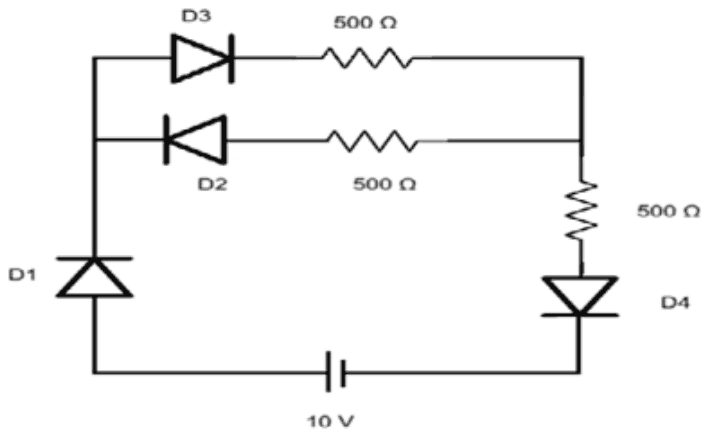
Four ideal diodes are connected as shown then the current drawn from the battery is

Circuit: a 10 V battery in series with diode D1, then two parallel branches, D3 with 500 ohm and D2 with 500 ohm, then a 500 ohm resistor and diode D4

Exam Year(s)

KEAM - 2026,

Answer: B

The current drawn is 10 mA.

The battery's longer plate, its positive terminal, faces diode D1, so current leaves it towards D1, whose arrow points up the left side. D1 conducts. At the junction the current can take D3 or D2. D3 points from the left to the right, so it conducts; D2 points the other way, so it is reverse biased and carries nothing. The current therefore goes through D3 and its 500 Ω resistor, comes down through the third 500 Ω resistor and passes D4, whose arrow points downward, so D4 conducts, and returns to the battery.

Ideal diodes that conduct have no drop, so the circuit is two 500 Ω resistors in series:

\[ \begin{aligned} I &= \frac{V}{R} = \frac{10}{500 + 500} \\ &= 0.01\ \text{A} = 10\ \text{mA} \end{aligned} \]

Zero would need a blocked diode in the only path, which is not the case. 20 mA would need both upper branches to conduct, and 50 or 100 mA would need resistances of 200 or 100 Ω, far below what the circuit has.

Please log in or register to report this question.

30.

In a diode rectifier, the capacitors with large values of C are used in filter circuits in order to

Exam Year(s)

KEAM - 2026,

Answer: C

Large capacitors are used to increase the time constant to high value.

In a rectifier filter, the capacitor charges to the peak voltage and then discharges through the load between peaks. A large C makes the time constant RC much longer than the gap between peaks, so the capacitor discharges only slightly and the output stays close to the peak: the ripple is reduced.

So large C does not increase the ripple or make the capacitor discharge quickly, and it does not reduce or double the peak voltage.

Please log in or register to report this question.

Loading…
Tags: Electronic Devices Questions and Answers