
Machine-translated by Google. Questions are authored in English.
Top

Laminar Flow Questions and Answers

11.

Consider the steady, incompressible, and fully developed laminar flow of a fluid through a circular pipe. Here, \(\Delta P\) is the pressure drop in the direction of the flow and \(V\) is the average axial velocity of the fluid at any cross-section. The relation between \(\Delta P\) and \(V\) is:

\[ \Delta P = K V^{n} \]

Here, \(K\) and \(n\) are constants.

Which one of the following options is the correct value of \(n\)?

Exam Year(s)

GATE XE - 2025,

Answer: A

The exponent is \(n = 1\).

Fully developed laminar flow in a circular pipe obeys the Hagen-Poiseuille equation:

\[ \Delta P = \frac{32\mu L V}{D^{2}} \]

The pressure drop is directly proportional to the average velocity, so \(K = 32\mu L/D^{2}\) and \(n = 1\). Equivalently, the laminar friction factor \(f = 64/Re\) falls as \(1/V\), cancelling one power of \(V\) in the Darcy-Weisbach \(V^{2}\).

\(n = 2\) is the fully rough turbulent limit, \(n = 1.75\) is smooth-pipe turbulent flow (Blasius friction factor), and 0.5 has no physical basis here.

Please log in or register to report this question.
12.

For a laminar, incompressible, and fully-developed flow through a circular pipe, the ratio of the maximum velocity to the average velocity of the flow is

Exam Year(s)

GATE XE - 2026,

Answer: B

The ratio is 2.

Fully developed laminar pipe flow (Hagen-Poiseuille flow) has a parabolic profile:

\[ u(r) = u_{max}\left(1-\frac{r^{2}}{R^{2}}\right) \]

Averaging over the circular cross-section:

\[ \begin{aligned} \bar{u} &= \frac{1}{\pi R^{2}}\int_{0}^{R}u_{max}\left(1-\frac{r^{2}}{R^{2}}\right)2\pi r\,dr \\ &= \frac{u_{max}}{2} \end{aligned} \]

So \(u_{max}/\bar{u} = 2\). The value 1.5 belongs to laminar flow between parallel plates, where the profile is parabolic across a slot rather than a circle. 3 and 4 have no basis for laminar flow.

Please log in or register to report this question.
13.

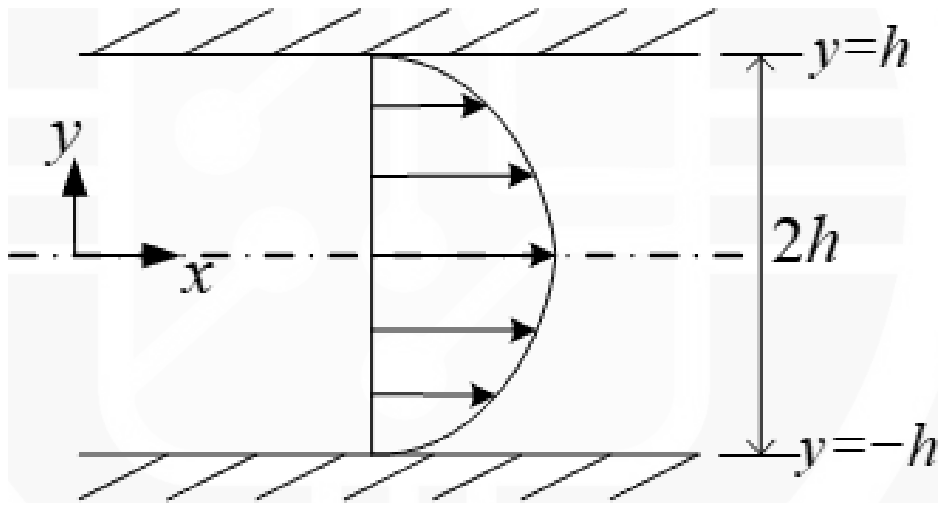
A steady, laminar, and incompressible flow between a pair of infinite parallel plates is driven by a constant pressure gradient \((-dp/dx)\). The plates are separated by a distance 2h, as shown in the figure. The fully-developed velocity profile of the flow is

\[ \begin{aligned} u(y) = &-\frac{dp}{dx}\frac{h^{2}}{2\mu} \\ &\times\left(1-\frac{y^{2}}{h^{2}}\right), \end{aligned} \]

where \(\mu\) is the dynamic viscosity.

The values of y, for which the local flow velocity is equal to the average flow velocity, are

Two fixed parallel plates at y = h and y = -h with a parabolic velocity profile between them, fastest on the centreline y = 0

Exam Year(s)

GATE XE - 2026,

Answer: D

The local velocity equals the average at \(y = \pm\frac{h}{\sqrt{3}}\).

Write the profile as \(u = u_{max}(1-y^{2}/h^{2})\). Its average across the gap is:

\[ \begin{aligned} \bar{u} &= \frac{1}{2h}\int_{-h}^{h}u_{max}\left(1-\frac{y^{2}}{h^{2}}\right)dy \\ &= \frac{2}{3}u_{max} \end{aligned} \]

Setting the local velocity equal to it:

\[ \begin{aligned} 1-\frac{y^{2}}{h^{2}} &= \frac{2}{3} \\ y &= \pm\frac{h}{\sqrt{3}} \approx \pm 0.577h \end{aligned} \]

\(\pm h/\sqrt{2}\) is where the velocity is half the maximum, and \(\pm h/2\) and \(\pm h/3\) give 3/4 and 8/9 of the maximum.

Please log in or register to report this question.

14.

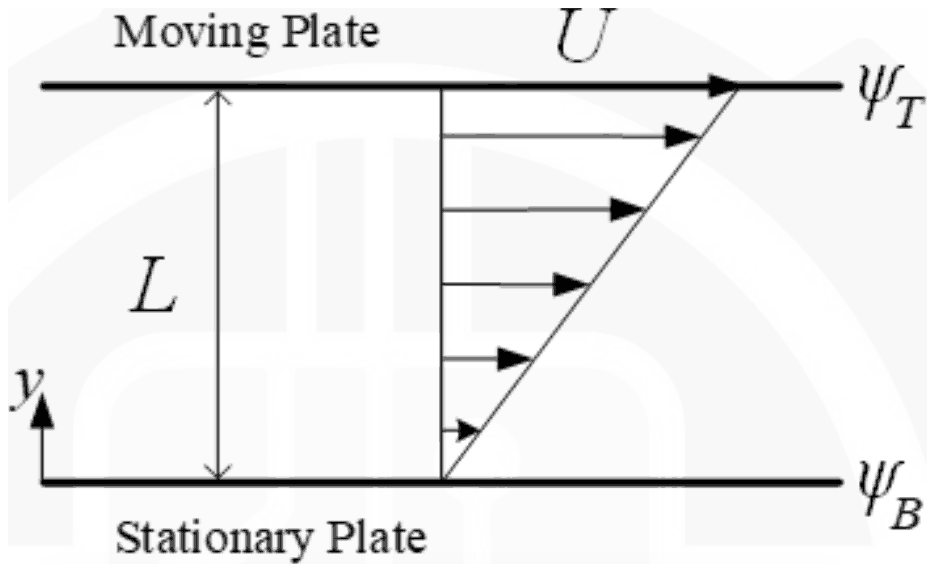
An incompressible fluid flows between a pair of infinite plates separated by a distance L. The top plate is moving with a constant velocity U, whereas the bottom plate is stationary, as shown in the figure. The difference of the stream functions \((\psi_{T}-\psi_{B})\) at the two plates for a laminar and fully-developed flow is equal to

A stationary bottom plate with stream function psi B and a top plate a distance L above moving at U with stream function psi T; the velocity profile between them rises linearly from zero to U

Exam Year(s)

GATE XE - 2026,

Answer: A

The difference is \(\frac{UL}{2}\).

In plane Couette flow with no pressure gradient the profile is linear, \(u = Uy/L\). The difference in stream function between two streamlines equals the volume flow rate per unit width between them:

\[ \begin{aligned} \psi_{T}-\psi_{B} &= \int_{0}^{L}u\,dy \\ &= \int_{0}^{L}\frac{Uy}{L}\,dy = \frac{UL}{2} \end{aligned} \]

Equivalently, the average velocity is U/2 across a gap L. UL would need the whole gap to move at U, and 2UL and 4UL exceed even that.

Please log in or register to report this question.

Direction for [ Question No: 15 To 15 ] :

Figure shows two parallel plates (upper plate at \(x = b\) and lower one at \(x = -b\)) of length L (aligned in \(z\) direction) and infinite width (in \(y\) direction, normal to the plane of the figure). Two immiscible, incompressible liquids are flowing steadily in the \(z\) direction through the thin passage between the plates under the influence of horizontal pressure gradient \((P_{0} - P_{L})/L\). During the flow, the passage is always half-filled with denser fluid I (viscosity \(\mu^{I}\)) at the bottom and rest is occupied by lighter fluid II (viscosity \(\mu^{II}\); \(\mu^{II} \lt \mu^{I}\)). Considering exactly planar interface between the fluids and no instabilities in the flow, the shear stress, \(\tau_{xz}\) is expressed as:

15.

\[ \begin{aligned} \tau_{xz} = \frac{(P_{0} - P_{L})b}{L} &\Bigg[ \left(\frac{x}{b}\right) \\ &- \frac{1}{2}\left(\frac{\mu^{I} - \mu^{II}}{\mu^{I} + \mu^{II}}\right) \Bigg] \end{aligned} \]

Which one of the following options correctly identifies the location of the point having maximum velocity of the flow?

Exam Year(s)

GATE XE - 2025,

Answer: A

The maximum velocity lies above the interface.

Velocity is greatest where \(du/dx = 0\), which is where the shear stress \(\tau_{xz}\) is zero. Setting the bracket to zero:

\[ \begin{aligned} \frac{x}{b} &= \frac{1}{2} \\ &\times \frac{\mu^{I} - \mu^{II}}{\mu^{I} + \mu^{II}} \end{aligned} \]

Since \(\mu^{II} \lt \mu^{I}\), the right side is positive, so the maximum lies at \(x \gt 0\). The interface is at \(x = 0\), because the passage between \(x = -b\) and \(x = b\) is half filled with fluid I at the bottom. The maximum is therefore in the less viscous fluid II, above the interface.

It would be at the interface only for equal viscosities, and it cannot be at the top plate, where no-slip makes the velocity zero. 'Below the interface' would need the lower fluid to be the less viscous one.

Please log in or register to report this question.

16.

The equation of motion for laminar flow of a real fluid is:

Exam Year(s)

RSMSSB JE - 2025, RSMSSB JE Agriculture - 2025, RSMSSB - 2025,

Answer: A

The equation of motion for laminar flow of a real fluid is the Navier-Stokes Equation.

The Navier-Stokes equations are Newton's second law for a fluid element including the viscous forces, so they describe real (viscous) fluids. Laminar flow is where they can be solved most readily.

Euler's equation is the same law with viscosity left out, so it applies to ideal fluids, and Bernoulli's equation is its integral along a streamline for steady, ideal, incompressible flow. The Hagen-Poiseuille equation is one particular solution of Navier-Stokes, for laminar flow in a circular pipe, not the general equation of motion.

Please log in or register to report this question.

Loading…
Tags: Laminar Flow Questions and Answers || Laminar Flow MCQ Questions and Answers || Laminar Flow GK Questions and Answers || Laminar Flow GK MCQ Questions || Laminar Flow Multiple Choice Questions and Answers || Laminar Flow GK || GK on Laminar Flow || Fluid Mechanics Questions and Answers || Fluid Mechanics MCQ Questions and Answers || Fluid Mechanics GK Questions and Answers || GK on Fluid Mechanics