
Machine-translated by Google. Questions are authored in English.
Top

Fluid Dynamics and Bernoullis Equation Questions and Answers

Direction for [ Question No: 1 To 1 ] :

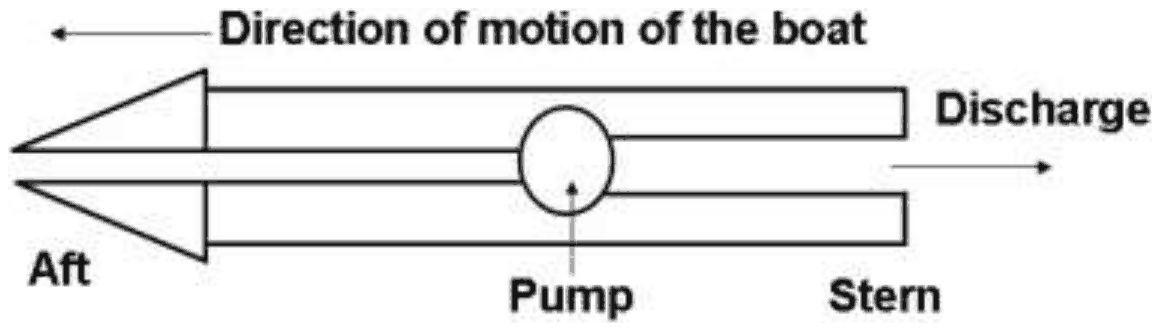
A boat is propelled in still water at a velocity of 5 m/s by taking water at the rate of 1 m3/s from the aft side and discharging it through the stern using a pump, as shown in the figure below. The velocity of the discharge jet relative to the boat is 9 m/s. The effect of pressure at the intake and discharge can be neglected. The density of water may be taken as 1000 kg/m3.

Boat moving towards the aft end; water enters a duct at the aft, a pump in the duct discharges it as a jet from the stern

1.

The total kinetic energy imparted to the water per second (in kW) by the pump is

Exam Year(s)

GATE XE - 2012,

Answer: C

The pump imparts 28 kW of kinetic energy.

In the boat's frame, water enters at 5 m/s and is discharged at 9 m/s, so the pump raises its kinetic energy per second by

\[ \begin{aligned} \dot{E} &= \tfrac{1}{2}\rho Q(V_{j}^{2} - V^{2}) \\ &= \tfrac{1}{2}(1000)(1)(81 - 25) = 28000\ \text{W} \end{aligned} \]

that is 28 kW. Of this, 20 kW goes into propelling the boat (the previous question) and the remaining 8 kW is left in the wake, which gives a propulsive efficiency of 20/28, about 71 percent. The option 81 uses only the jet speed, and 25 only the inlet speed.

Please log in or register to report this question.
2.

Bernoulli's equation is directly derived from the conservation of which of the following?

Exam Year(s)

DSSSB - 2023,

Answer: D

Bernoulli's equation is derived from the conservation of energy. It is the energy equation for a flowing fluid along a streamline, in which pressure energy, kinetic energy and potential energy add up to a constant. The conservation of mass leads to the continuity equation and the conservation of momentum to the momentum equation, so the answer is energy.

Please log in or register to report this question.
Answer: A

Bernoulli's equation applies to incompressible and non-viscous flows, and in its usual form along a streamline in steady flow. It is derived for an ideal fluid that has constant density and has no friction, so energy is conserved with no loss to viscosity. In viscous or compressible flow additional terms are required (head loss, change of density), so those options are wrong.

The equation states that the sum of pressure head, velocity head and elevation head stays constant along a streamline.

Please log in or register to report this question.
4.

In a hydraulic jump, where the flow changes from supercritical to subcritical flow, what happens to the momentum flux?

Exam Year(s)

DSSSB - 2023,

Answer: D

The momentum flux remains constant before and after a hydraulic jump, as the key says. In the analysis of a hydraulic jump the momentum equation is applied to a control volume, and the sum of the pressure force and momentum flux is the same on both sides, while energy is lost in the jump. The depth increases and the velocity decreases across the jump, but this does not alter the momentum flux. The options of a decrease, increase or zero momentum flux are wrong.

Please log in or register to report this question.
5.

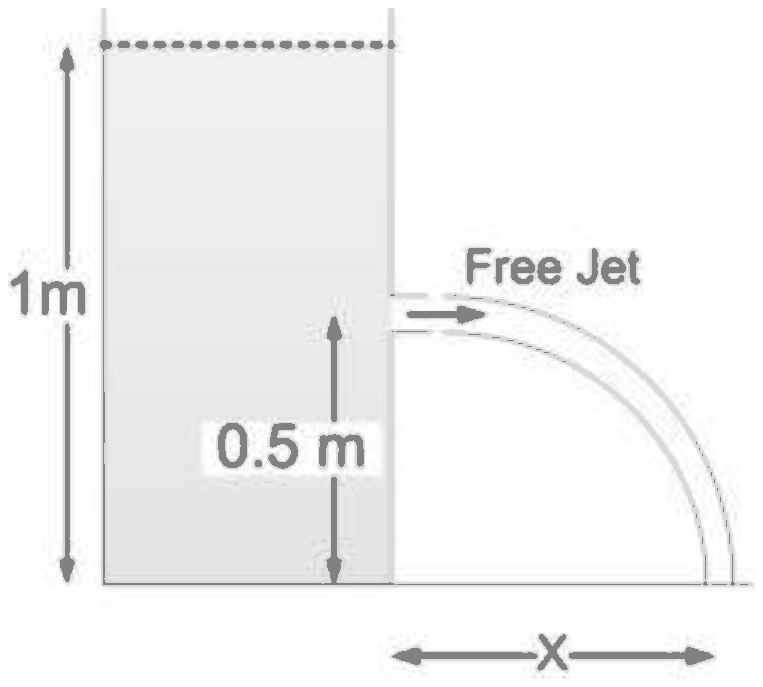
A tank open at the top with a water level of 1 m, as shown in the figure, has a hole at a height of 0.5 m. A free jet leaves horizontally from the smooth hole. The distance X (in m) where the jet strikes the floor is

Open tank standing on the floor with water 1 m deep; a free jet leaves horizontally from a hole 0.5 m above the floor and lands a distance X from the tank wall

Exam Year(s)

GATE ME - 2018,

Answer: B

The jet strikes the floor 1.0 m from the tank.

The hole is 0.5 m below the water surface, so by Torricelli's theorem the jet leaves horizontally at \(v = \sqrt{2g \times 0.5} = \sqrt{g}\). It then falls the 0.5 m from the hole to the floor:

\[ \begin{aligned} t &= \sqrt{\frac{2 \times 0.5}{g}} = \frac{1}{\sqrt{g}} \\ X &= vt = \sqrt{g} \times \frac{1}{\sqrt{g}} = 1.0\ \text{m} \end{aligned} \]

In general X = \(2\sqrt{h_{1}h_{2}}\), with \(h_{1}\) the depth of the hole below the surface and \(h_{2}\) its height above the floor; here \(2\sqrt{0.5 \times 0.5} = 1\). 0.5 m halves this, and 2.0 or 4.0 m would need a much greater head or drop.

Please log in or register to report this question.
6.

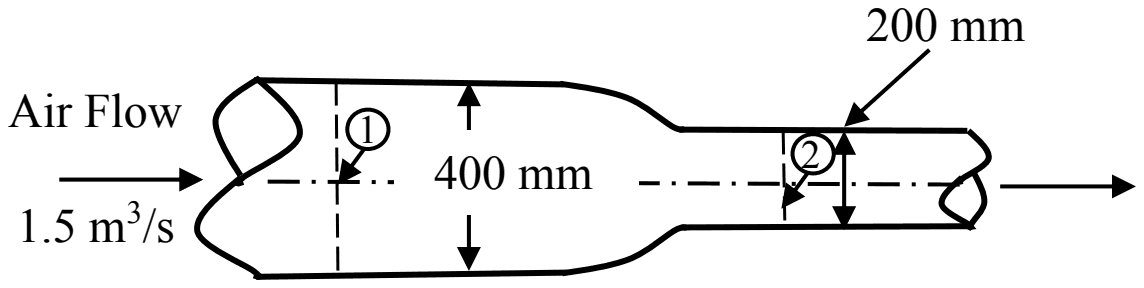
Air flows at the rate of 1.5 m3/s through a horizontal pipe with a gradually reducing cross-section as shown in the figure. The two cross-sections of the pipe have diameters of 400 mm and 200 mm. Take the air density as 1.2 kg/m3 and assume inviscid incompressible flow. The change in pressure (p2 − p1) (in kPa) between sections 1 and 2 is

Pipe carrying air flow of 1.5 cubic metres per second from left to right, narrowing from section 1 of diameter 400 mm to section 2 of diameter 200 mm

Exam Year(s)

GATE ME - 2018,

Answer: A

The pressure change is -1.28 kPa.

Continuity gives the velocities from Q = 1.5 m3/s:

\[ \begin{aligned} V_{1} &= \frac{1.5}{\pi(0.2)^{2}} = 11.94\ \text{m/s} \\ V_{2} &= \frac{1.5}{\pi(0.1)^{2}} = 47.75\ \text{m/s} \end{aligned} \]

Bernoulli's equation for a horizontal pipe then gives

\[ \begin{aligned} p_{2} - p_{1} &= \frac{\rho}{2}\left(V_{1}^{2} - V_{2}^{2}\right) \\ &= 0.6\,(142.5 - 2280.0) \\ &= -1282\ \text{Pa} \approx -1.28\ \text{kPa} \end{aligned} \]

The pressure falls as the flow speeds up in the narrower section, so the change is negative; +1.28 has the sign reversed. 2.56 doubles the result by dropping the 1/2, and -2.13 does not follow from these data.

Please log in or register to report this question.
7.

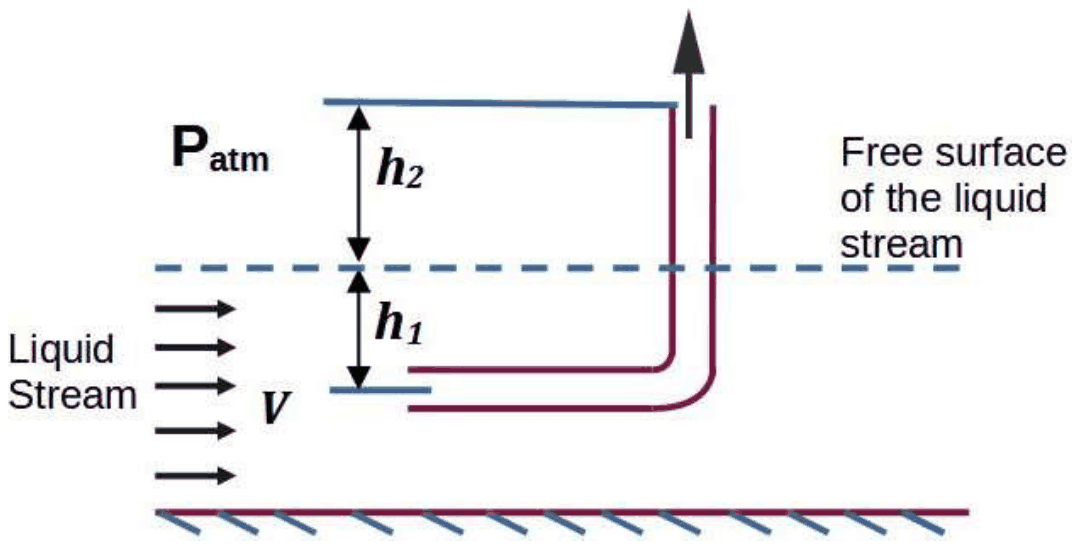
A tube of uniform diameter \(D\) is immersed in a steady flowing inviscid liquid stream of velocity \(V\), as shown in the figure. Gravitational acceleration is represented by \(g\). The volume flow rate through the tube is ______.

An L-shaped tube with its open end facing the oncoming liquid stream of velocity V at depth h1 below the free surface; the vertical leg rises to an outlet h2 above the free surface, open to atmospheric pressure

Exam Year(s)

GATE ME - 2022,

Answer: D

The flow rate is \(\tfrac{\pi}{4}D^{2}\sqrt{V^{2} - 2gh_{2}}\).

The flow is steady and inviscid, so Bernoulli's equation holds along the streamline that enters the tube mouth and leaves at the top. Work in heads, with gauge pressure and the free surface as datum. Far upstream at the depth of the mouth, the pressure head is \(h_{1}\), the elevation is \(-h_{1}\) and the speed is \(V\). At the outlet, the pressure head is zero (atmospheric), the elevation is \(h_{2}\) and the speed is \(v\):

\[ \begin{aligned} h_{1} - h_{1} + \frac{V^{2}}{2g} &= h_{2} + \frac{v^{2}}{2g} \\ v &= \sqrt{V^{2} - 2gh_{2}} \end{aligned} \]

The depth \(h_{1}\) cancels: the extra hydrostatic pressure at the mouth exactly offsets the extra height the liquid must climb. Multiplying by the area \(\pi D^{2}/4\) gives the answer.

\(\tfrac{\pi}{4}D^{2}V\) ignores the rise of \(h_{2}\) above the surface. \(\sqrt{2gh_{2}}\) and \(\sqrt{2g(h_{1} + h_{2})}\) treat the liquid as if it fell through a height, when here it is the stream's kinetic energy that lifts it.

Please log in or register to report this question.
8.

The steady velocity field in an inviscid fluid of density 1.5 is given to be \(\vec{V} = (y^{2} - x^{2})\hat{i} + (2xy)\hat{j}\). Neglecting body forces, the pressure gradient at \((x = 1, y = 1)\) is __________ .

Exam Year(s)

GATE ME - 2022,

Answer: C

The pressure gradient is \(-6\hat{i} - 6\hat{j}\).

For an inviscid fluid with no body force, Euler's equation gives \(\nabla p = -\rho\,\vec{a}\), where \(\vec{a}\) is the convective acceleration of the steady field. With \(u = y^{2} - x^{2}\) and \(v = 2xy\), at (1, 1) we have \(u = 0\), \(v = 2\), \(\partial u/\partial y = 2y = 2\) and \(\partial v/\partial y = 2x = 2\):

\[ \begin{aligned} a_{x} &= u\frac{\partial u}{\partial x} + v\frac{\partial u}{\partial y} = 0 + 2 \times 2 = 4 \\ a_{y} &= u\frac{\partial v}{\partial x} + v\frac{\partial v}{\partial y} = 0 + 2 \times 2 = 4 \end{aligned} \]

\[ \begin{aligned} \nabla p &= -1.5\,(4\hat{i} + 4\hat{j}) \\ &= -6\hat{i} - 6\hat{j} \end{aligned} \]

\(-4\hat{i} - 4\hat{j}\) is the acceleration with its sign reversed but without the density factor. \(10\hat{j}\) and \(20\hat{i}\) have no basis in the field: at (1, 1) both components of the acceleration are equal, so the gradient must have equal components too.

Please log in or register to report this question.
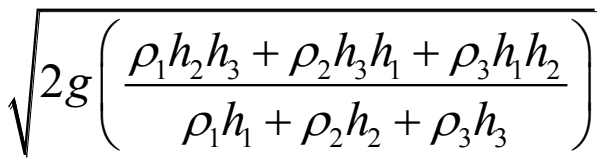
9.

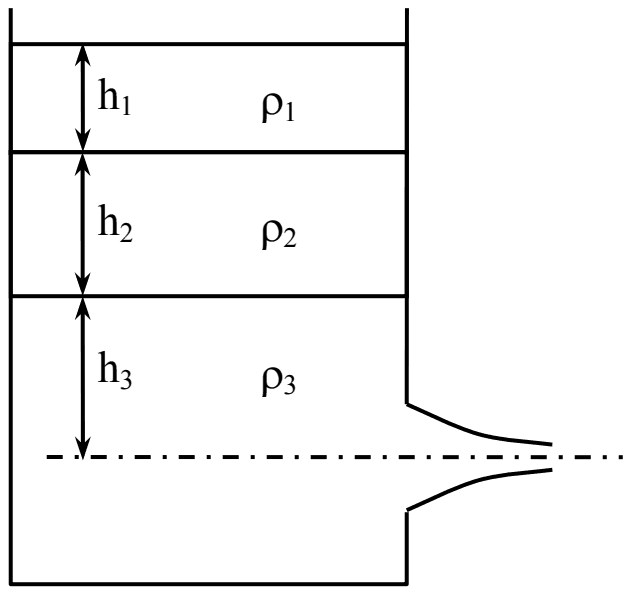
A large tank with a nozzle attached contains three immiscible, inviscid fluids as shown. Assuming that the changes in h1, h2 and h3 are negligible, the instantaneous discharge velocity is

A tank holding three fluid layers, from the top: density rho1 depth h1, density rho2 depth h2, and density rho3 whose depth h3 is measured down to the axis of a side nozzle

Exam Year(s)

GATE ME - 2012,

Answer: A

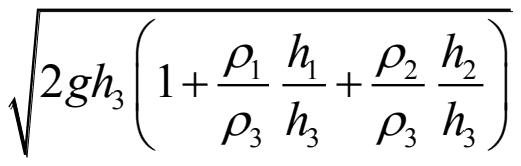
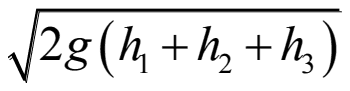
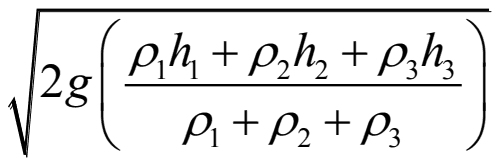
The discharge velocity is (A):

\[ \begin{aligned} v &= \sqrt{2gh_3 X} \\ X &= 1+\frac{\rho_1}{\rho_3}\frac{h_1}{h_3} \\ &\quad +\frac{\rho_2}{\rho_3}\frac{h_2}{h_3} \end{aligned} \]

The static pressure at the nozzle axis is the weight of all three layers above it:

\[ p = \rho_{1}gh_{1}+\rho_{2}gh_{2}+\rho_{3}gh_{3} \]

The fluid leaving the nozzle is fluid 3, so applying Bernoulli's equation to it, from rest in the tank to the jet at atmospheric pressure:

\[ \begin{aligned} \tfrac{1}{2}\rho_{3}v^{2} &= p \\ v^{2} &= 2g\left(h_{3}+\frac{\rho_{1}h_{1}}{\rho_{3}}+\frac{\rho_{2}h_{2}}{\rho_{3}}\right) \end{aligned} \]

Taking \(h_{3}\) out of the bracket gives option (A). Option (B), \(\sqrt{2g(h_{1}+h_{2}+h_{3})}\), is right only if all three densities are equal. Options (C) and (D) average the densities in ways that do not come from the pressure balance. They reduce to the right result only in special cases, not for three layers of different density in general.

Please log in or register to report this question.

10.

Consider two identical tanks with a bottom hole of diameter d. One tank is filled with water and the other tank is filled with engine oil. The height of the fluid column h is same in both the cases. The fluid exit velocity in the two tanks are \(V_{1}\) and \(V_{2}\). Neglecting all losses, which one of the following options is correct?

Exam Year(s)

GATE ME - 2025,

Answer: B

The exit velocities are equal: \(V_{2} = V_{1}\).

Neglecting losses, Torricelli's result from Bernoulli's equation gives the jet speed as \(V = \sqrt{2gh}\). Density cancels from both sides of the energy balance, so the velocity depends only on the head \(h\), which is the same for both tanks.

Viscosity would make the oil jet slower in reality, but the question says to neglect all losses, so \(V_{2} \lt V_{1}\) is not the answer intended. The data are sufficient, and nothing makes the oil faster.

Please log in or register to report this question.

Loading…
Tags: Fluid Dynamics and Bernoullis Equation Questions and Answers || Fluid Dynamics and Bernoullis Equation MCQ Questions and Answers || Fluid Dynamics and Bernoullis Equation GK Questions and Answers || Fluid Dynamics and Bernoullis Equation GK MCQ Questions || Fluid Dynamics and Bernoullis Equation Multiple Choice Questions and Answers || Fluid Dynamics and Bernoullis Equation GK || GK on Fluid Dynamics and Bernoullis Equation || Fluid Mechanics Questions and Answers || Fluid Mechanics MCQ Questions and Answers || Fluid Mechanics GK Questions and Answers || GK on Fluid Mechanics