
Machine-translated by Google. Questions are authored in English.
Top

Velocity and Acceleration Analysis Questions and Answers

1.

A slider is moving on a straight link at a sliding velocity of 0.5 m s−1. The straight link is pivoted at one end and makes angular movement at a rate of 1.0 rad s−1. Coriolis acceleration of the slider in m s−2 is

Exam Year(s)

GATE AG - 2012,

Answer: C

The Coriolis acceleration is 1.00 m s−2.

A point sliding along a rotating link has a Coriolis component of acceleration of magnitude \(2\omega v\), perpendicular to the link:

\[ \begin{aligned} a_{c} &= 2\omega v \\ &= 2 \times 1.0 \times 0.5 \\ &= 1.0\ \text{m s}^{-2} \end{aligned} \]

0.50 is what you get by leaving out the factor 2, which is the usual slip. 0.25 halves the product again, and 4.00 has no basis in the formula.

Please log in or register to report this question.
2.

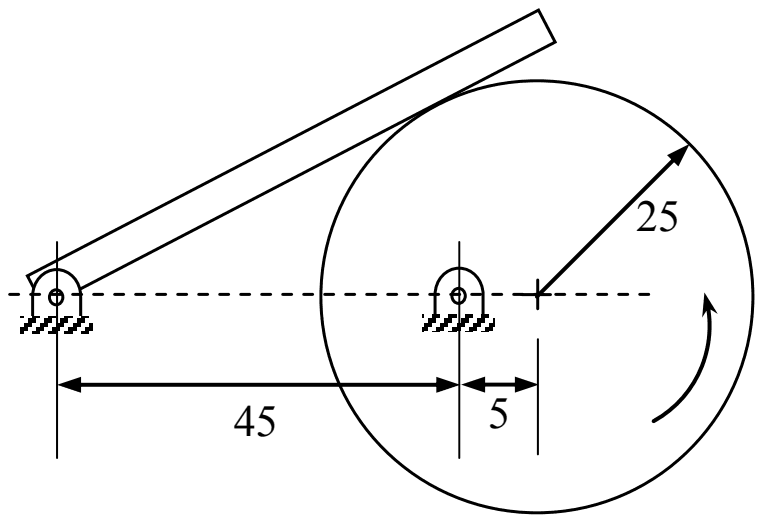
In the mechanism given below, if the angular velocity of the eccentric circular disc is 1 rad/s, the angular velocity (rad/s) of the follower link for the instant shown in the figure is

A flat follower link pivoted at the left rests tangent on a circular disc of radius 25. The disc turns about a pivot 45 to the right of the link pivot, and its centre is a further 5 to the right of its own pivot

Note: All dimensions are in mm.

Exam Year(s)

GATE ME - 2012,

Answer: B

The follower turns at 0.1 rad/s.

The common normal at the point where the link touches the disc is perpendicular to the link and passes through the disc's geometric centre. In the position shown, that centre lies on the line joining the two fixed pivots, so it is the instantaneous centre shared by the disc and the follower. Measured from the pivots, it is 5 mm from the disc pivot and 45 + 5 = 50 mm from the follower pivot. By the angular velocity ratio theorem:

\[ \begin{aligned} \frac{\omega_{f}}{\omega_{d}} &= \frac{5}{50} \\ \omega_{f} &= 0.1 \times 1 = 0.1\ \text{rad/s} \end{aligned} \]

10.0 is the same ratio inverted (50/5), which would make the follower turn faster than the disc driving it. 0.05 and 5.0 do not correspond to the distances in the figure.

Please log in or register to report this question.
3.

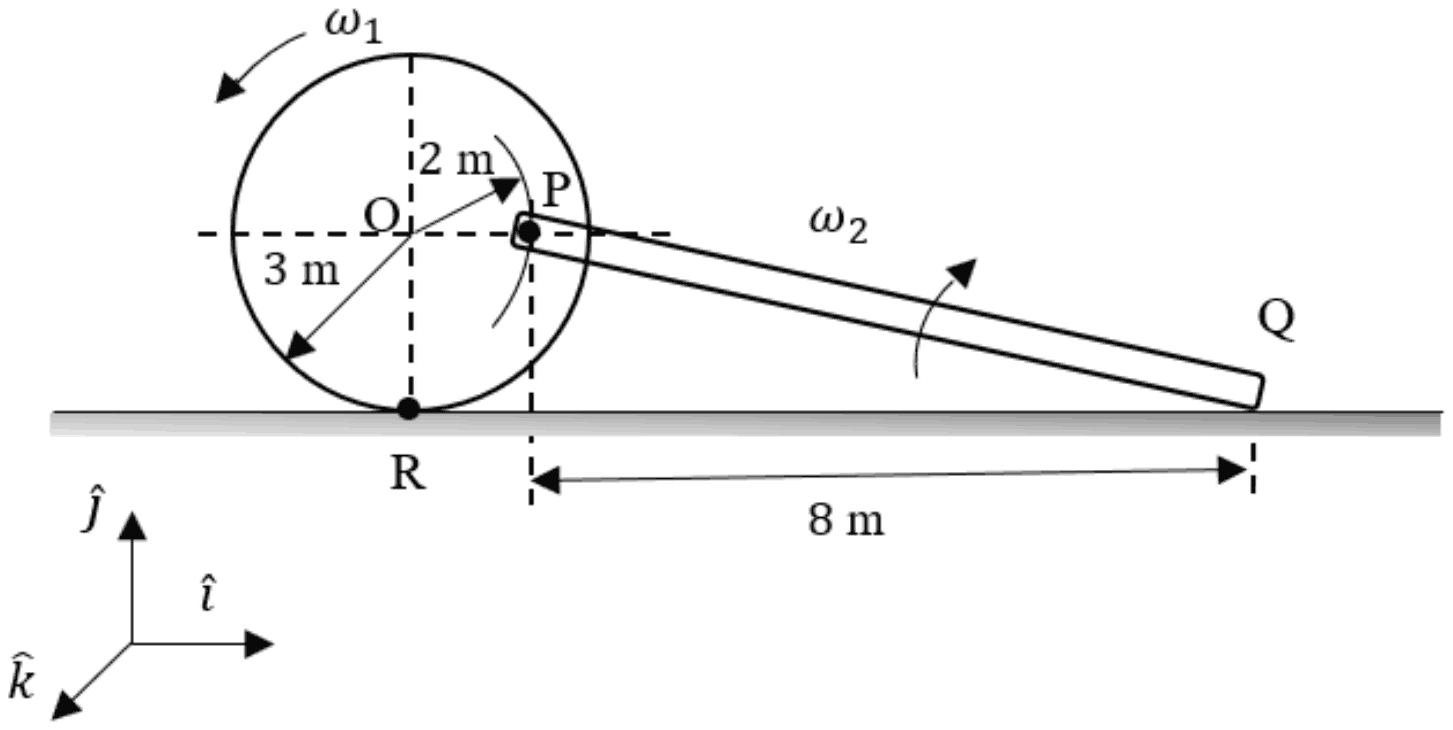
The figure shows a wheel rolling without slipping on a horizontal plane with angular velocity \(\omega_{1}\). A rigid bar PQ is pinned to the wheel at P while the end Q slides on the floor.

What is the angular velocity \(\omega_{2}\) of the bar PQ?

Wheel of radius 3 m with centre O touching the floor at R; P lies 2 m from O on the horizontal through O; bar PQ runs to Q on the floor, 8 m horizontally beyond P

Exam Year(s)

GATE ME - 2023,

Answer: D

The angular velocity of the bar is \(\omega_{2} = 0.25\omega_{1}\).

Rolling without slipping makes the contact point R the instantaneous centre of the wheel. Take R as the origin: O is at (0, 3) and P, 2 m from O along the horizontal through O, is at (2, 3). So

\[ \begin{aligned} v_{P} &= \omega_{1}\,RP = \omega_{1}\sqrt{2^{2} + 3^{2}} \\ &= \sqrt{13}\,\omega_{1} \end{aligned} \]

and \(v_{P}\) is perpendicular to RP. Q, 8 m to the right of P, is at (10, 0) and slides along the floor, so its velocity is horizontal. The instantaneous centre I of the bar lies on the normal to each velocity: on the line RP extended, and on the vertical through Q. The line RP is \(y = 1.5x\), so at \(x = 10\) it gives I = (10, 15).

\[ \begin{aligned} IP &= \sqrt{8^{2} + 12^{2}} = 4\sqrt{13} \\ \omega_{2} &= \frac{v_{P}}{IP} \\ &= \frac{\sqrt{13}\,\omega_{1}}{4\sqrt{13}} \\ &= 0.25\,\omega_{1} \end{aligned} \]

The ratio is fixed by the geometry alone: the bar's centre I is four times as far from P as the wheel's centre R is, so the bar turns at a quarter of the wheel's rate. \(\omega_{2} = \omega_{1}\) would need the two centres equally far from P, and \(2\omega_{1}\) and \(0.5\omega_{1}\) do not match the distances in the figure.

Please log in or register to report this question.

Answer: A

The angular acceleration is the first expression, with \(n^{2} - 1\) over \((n^{2} - \sin^{2}\theta)^{3/2}\).

With crank radius r, connecting rod length l and \(n = l/r\), the connecting rod's angle \(\beta\) satisfies \(\sin\beta = \sin\theta / n\). Differentiating twice with respect to time at constant crank speed \(\omega\) gives

\[ \begin{aligned} \alpha_{c} &= -\omega^{2} \sin\theta \\ &\quad \times \frac{n^{2} - 1}{(n^{2} - \sin^{2}\theta)^{3/2}} \end{aligned} \]

The options differ only in the numerator sign or the power in the denominator. The \(3/2\) power comes from differentiating \((n^{2} - \sin^{2}\theta)^{-1/2}\), so powers of \(1/2\) or \(5/2\), or a numerator \(n^{2} + 1\), are wrong.

Please log in or register to report this question.

5.

In a slider crank mechanism, the value of piston acceleration at inner dead center (IDC) is :

Exam Year(s)

RSMSSB JE - 2025, RSMSSB - 2025,

Answer: A

The acceleration at inner dead centre is \(rw^{2}\left(1 + \frac{1}{n}\right)\).

The piston acceleration in a slider crank mechanism, with \(n = l/r\), is approximately

\[ \begin{aligned} a &= r\omega^{2}\cos\theta \\ &\quad + \frac{r\omega^{2}\cos 2\theta}{n} \end{aligned} \]

At inner dead centre \(\theta = 0\), so both cosines equal 1 and \(a = r\omega^{2}(1 + 1/n)\). At outer dead centre, \(\theta = 180^\circ\), it becomes \(r\omega^{2}(1 - 1/n)\) in magnitude, which is the option with the minus sign. The other two do not follow from the formula.

Please log in or register to report this question.

Answer: C

The piston acceleration is \(\omega^{2}r\left(\cos\theta + \frac{\cos 2\theta}{n}\right)\), where \(n = l/r\).

For a crank of radius r turning at \(\omega\) with connecting rod length l, the piston displacement is approximately \(x = r\left[(1 - \cos\theta) + \frac{\sin^2\theta}{2n}\right]\). Differentiating once gives the velocity and twice gives the acceleration:

\[ \begin{aligned} v &= \omega r\left(\sin\theta + \frac{\sin 2\theta}{2n}\right) \\ a &= \omega^2 r\left(\cos\theta + \frac{\cos 2\theta}{n}\right) \end{aligned} \]

The sine forms belong to the velocity expression, not the acceleration, and the minus signs are wrong: at \(\theta = 0\) the acceleration is greatest, \(\omega^2 r(1 + 1/n)\), which needs a plus.

Please log in or register to report this question.

7.

For a rigid link, the velocity of one end of the link related to another end will be :

Exam Year(s)

RSMSSB JE - 2025, RSMSSB - 2025,

Answer: C

The velocity is at right angle to the link.

A rigid link cannot change length, so neither end can have any velocity relative to the other along the line joining them. The only relative motion possible is rotation about the other end, and the velocity of a point rotating about another point is perpendicular to the line joining them.

This is the basis of every velocity diagram: the relative velocity of B with respect to A is drawn perpendicular to AB. A component parallel to the link, or at 45° to it, would stretch or shorten the link, and −180° is simply a direction along the link.

Please log in or register to report this question.

8.

According to Kennedy's theorem, the instantaneous centre of three bodies having relative motion lie on a :

Exam Year(s)

RSMSSB JE - 2025, RSMSSB - 2025,

Answer: C

The three instantaneous centres lie on a straight line.

Kennedy's theorem, the theorem of three centres, states that if three bodies have plane motion relative to one another, their three instantaneous centres lie on one straight line. It is used to locate instantaneous centres that cannot be found by inspection.

The centres are three distinct points in general, so they cannot coincide at a single point, and the theorem says nothing about a curved path or a centre of curvature.

Please log in or register to report this question.

9.

The total number of instantaneous centre for a mechanism consisting of 'n' links is :

Exam Year(s)

RSMSSB JE - 2025, RSMSSB - 2025,

Answer: A

The total number of instantaneous centres is \(\frac{n(n-1)}{2}\).

Every pair of links in a mechanism has one instantaneous centre, so the number of centres is the number of ways of choosing two links from n:

\[ N = \binom{n}{2} = \frac{n(n-1)}{2} \]

A four-bar chain, for example, has \(\frac{4 \times 3}{2} = 6\) instantaneous centres. The options n, \(\frac{n}{2}\) and \(\frac{n-1}{2}\) do not count the pairs; for four links they give 4, 2 and 1.5, and a count of centres cannot be fractional.

Please log in or register to report this question.

10.

The total number of instantaneous centres for a mechanism containing 'n' links is given by :

Exam Year(s)

RSMSSB JE - 2025, RSMSSB - 2025,

Answer: A

The number of instantaneous centres is \(\frac{n(n-1)}{2}\).

Every pair of links in a mechanism has one instantaneous centre. The number of pairs that can be formed from n links is the number of combinations of n taken two at a time.

\[ N = \frac{n(n-1)}{2} \]

A four-bar chain therefore has 6 instantaneous centres. \(n(n-1)\) counts each pair twice, and \((n-1)\) and \((n-1)/2\) undercount.

Please log in or register to report this question.

Loading…
Tags: Velocity and Acceleration Analysis Questions and Answers || Velocity and Acceleration Analysis MCQ Questions and Answers || Velocity and Acceleration Analysis GK Questions and Answers || Velocity and Acceleration Analysis GK MCQ Questions || Velocity and Acceleration Analysis Multiple Choice Questions and Answers || Velocity and Acceleration Analysis GK || GK on Velocity and Acceleration Analysis || Theory of Machines Questions and Answers || Theory of Machines MCQ Questions and Answers || Theory of Machines GK Questions and Answers || GK on Theory of Machines