
BPSC Exam 2025: Integrated 70th Combined Main (Written) Competitive Examination, Optional, Chemistry

Text of page 1
Serial No.
                                                                                                  Booklet Series
                      02/GO/CC/M-2025 – 08
afafafafafafafafafa

            I
fafafafafafafafafaf
                                                             Candidate’s Roll Number


                                                                      Question Booklet
                                                                                                         I
                                                                       CHEMISTRY
                      Time Allowed : 2 Hours                                                                      Maximum Marks : 100

                           Read the following instructions carefully before you begin to answer the questions.

                                                                IMPORTANT INSTRUCTIONS
                       1. This Question Booklet contains 100 questions in all.
                       2. All questions carry equal marks.
                       3. Attempt all questions.
                       4. An Answer Sheet has been supplied inside the Question Booklet to mark the answers. You must write your
                          Roll Number and encode it and write other particulars in the space provided in the Answer Sheet, failing
                          which your Answer Sheet will not be evaluated.
                       5. Immediately after commencement of the examination, you should check up your Question Booklet and
                          attached Answer Sheet and ensure that the Question Booklet Series is printed on the top right-hand corner
                          of the Question Booklet and the series encoded in Answer Sheet are same. Also please check that the
                          Question Booklet contains 24 printed pages including two pages (Page Nos. 22 and 23) for Rough Work and
                          no page or question is missing or unprinted or torn or repeated or Question Booklet and Answer Sheet have                 I
                                                                                                                  Answer Sheet, get it replaced
                          immediately by a complete Question Booklet with OMR sheet of the same series.
                       6. If there is any sort of mistake either of printing or of factual nature, then out of English and Hindi versions of the
                          questions, the English version will be treated as standard.
                       7. You must write your Roll Number in the space provided on the top of this page. Do not write anything else on the
                          Question Booklet.
                       8. Questions and their responses are printed in English and Hindi versions in this Question Booklet. Each question
                          comprises of four responses — (A), (B), (C) and (D). You are to select ONLY ONE correct response and mark it in
                          your Answer Sheet. In case you feel that there are more than one correct response, mark the response which you
                          consider the best. In any case choose ONLY ONE response for each question.
                       9. In the Answer Sheet, there are four circles — A , B , C and D against each question. To answer the questions,
                          you are to mark with Black/Blue ink ballpoint pen ONLY ONE circle of your choice for each question. Select only
                          one response for each question and mark it in your Answer Sheet. If you mark more than one circle for one question,
                          the answer will be treated as wrong. Use Black/Blue ink ballpoint pen only to mark the answer in the Answer
                          Sheet. Any erasure or change is not allowed.
                      10. You should not remove or tear off any sheet from the Question Booklet. You are not allowed to take this Question
                          Booklet and the Answer Sheet out of the Examination Hall during the examination. After the examination has
                          concluded, you must hand over your Answer Sheet to the Invigilator. Thereafter, you are permitted to take away
                          the Question Booklet with you.
                      11. Failure to comply with any of the above instructions will render you liable to such action or penalty as the Commission
                          may decide at their discretion.
                      12. Candidates must assure before leaving the Examination Hall that their Answer Sheets will be kept in Self Adhesive
                          LDPE Bag and completely packed/sealed in their presence.

                                            Ü`mZ X| : AZwXoem| H$m {hÝXr ê$nmÝVa Bg nwpñVH$m Ho$ ApÝV_ n¥îR> na N>nm h¡ &
                                                                                 -1-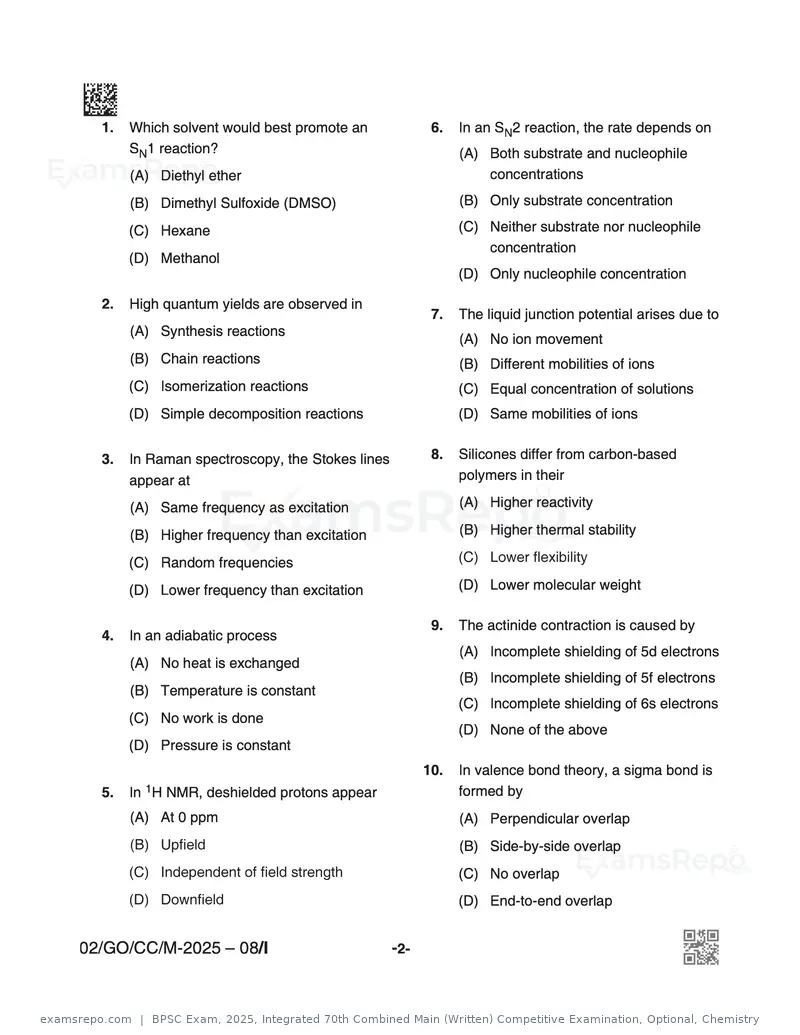
Text of page 2
1.   Which solvent would best promote an              6.   In an SN2 reaction, the rate depends on
       SN1 reaction?                                         (A) Both substrate and nucleophile
       (A) Diethyl ether                                         concentrations
       (B) Dimethyl Sulfoxide (DMSO)                         (B) Only substrate concentration

       (C) Hexane                                            (C) Neither substrate nor nucleophile
                                                                 concentration
       (D) Methanol
                                                             (D) Only nucleophile concentration

  2.   High quantum yields are observed in
                                                        7.   The liquid junction potential arises due to
       (A) Synthesis reactions
                                                             (A) No ion movement
       (B) Chain reactions                                   (B) Different mobilities of ions
       (C) Isomerization reactions                           (C) Equal concentration of solutions
       (D) Simple decomposition reactions                    (D) Same mobilities of ions


  3.   In Raman spectroscopy, the Stokes lines          8.   Silicones differ from carbon-based
       appear at                                             polymers in their

       (A) Same frequency as excitation                      (A) Higher reactivity

       (B) Higher frequency than excitation                  (B) Higher thermal stability

       (C) Random frequencies
       (D) Lower frequency than excitation                   (D) Lower molecular weight

                                                        9.   The actinide contraction is caused by
  4.   In an adiabatic process
                                                             (A) Incomplete shielding of 5d electrons
       (A) No heat is exchanged
                                                             (B) Incomplete shielding of 5f electrons
       (B) Temperature is constant
                                                             (C) Incomplete shielding of 6s electrons
       (C) No work is done
                                                             (D) None of the above
       (D) Pressure is constant
                                                       10.   In valence bond theory, a sigma bond is
  5.   In 1H NMR, deshielded protons appear                  formed by
       (A) At 0 ppm                                          (A) Perpendicular overlap
                                                             (B) Side-by-side overlap
                                                             (C) No overlap
                                                             (D) End-to-end overlap


02/GO/CC/M-2025 – 08/I                           -2-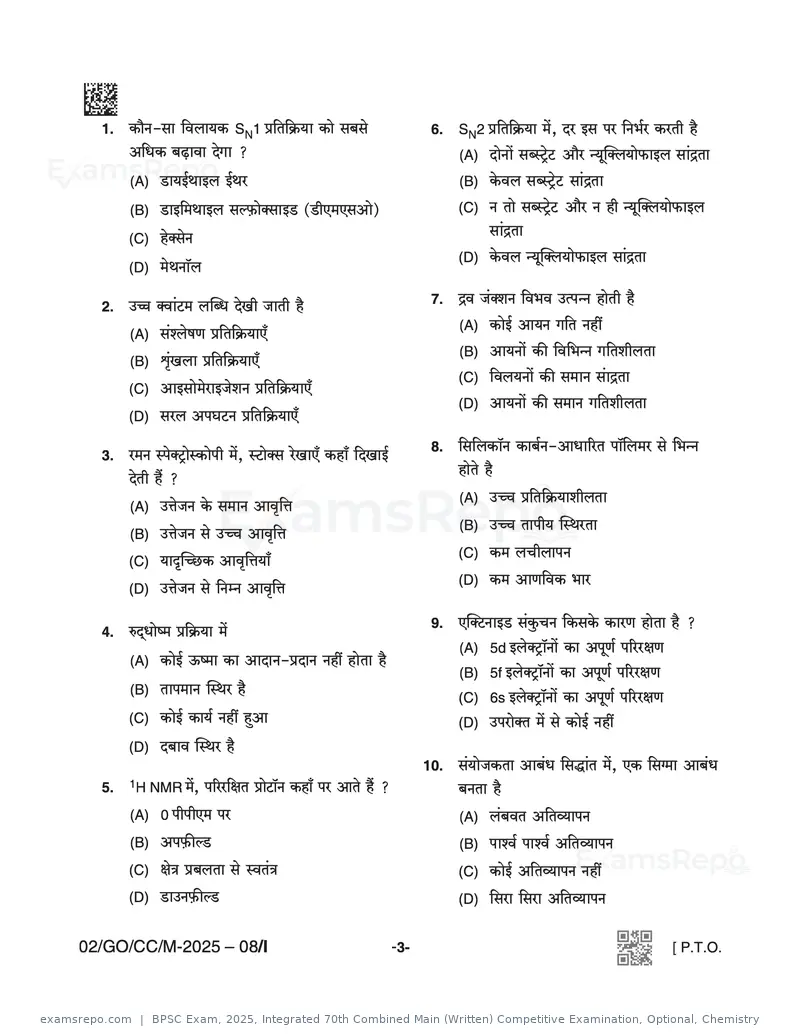
Text of page 4
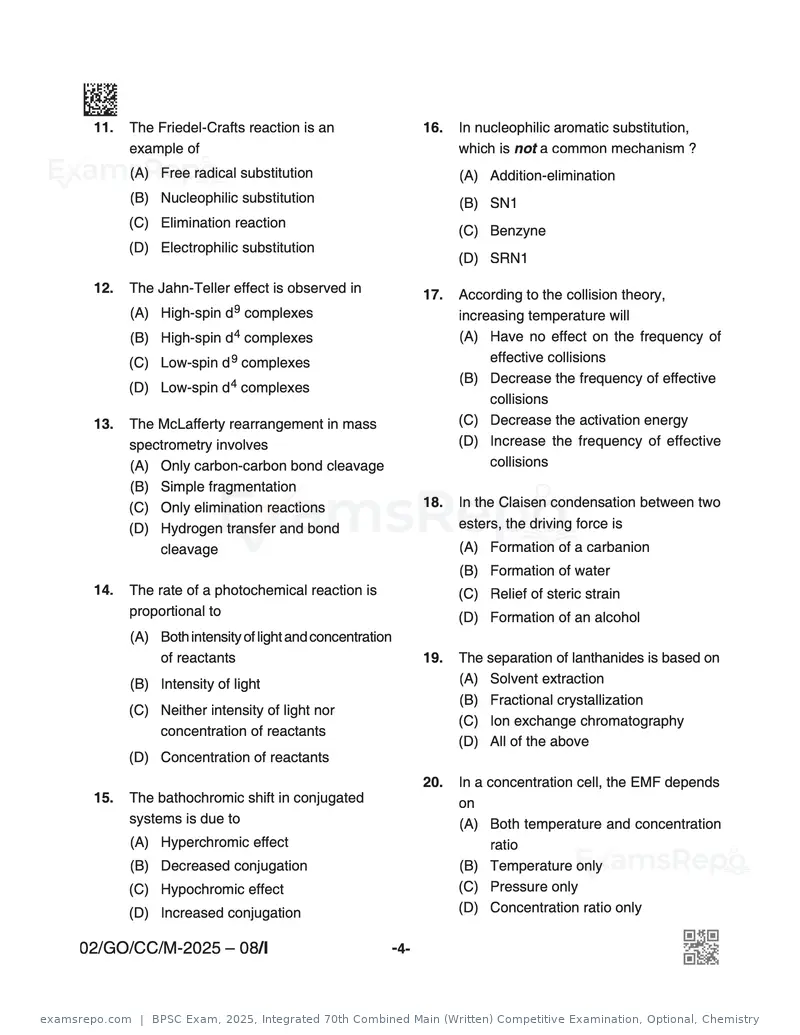
11.   The Friedel-Crafts reaction is an                 16.   In nucleophilic aromatic substitution,
       example of                                              which is not a common mechanism ?
       (A) Free radical substitution                           (A) Addition-elimination
       (B) Nucleophilic substitution                           (B) SN1
       (C) Elimination reaction
                                                               (C) Benzyne
       (D) Electrophilic substitution
                                                               (D) SRN1

 12.   The Jahn-Teller effect is observed in             17.   According to the collision theory,
       (A) High-spin d 9 complexes                             increasing temperature will
       (B) High-spin d 4 complexes                             (A) Have no effect on the frequency of
       (C) Low-spin d 9 complexes                                   effective collisions
                                                               (B) Decrease the frequency of effective
       (D) Low-spin d 4 complexes
                                                                    collisions
 13.   The McLafferty rearrangement in mass                    (C) Decrease the activation energy
       spectrometry involves                                   (D) Increase the frequency of effective
       (A) Only carbon-carbon bond cleavage                         collisions
       (B) Simple fragmentation
       (C) Only elimination reactions                    18.   In the Claisen condensation between two
       (D) Hydrogen transfer and bond                          esters, the driving force is
           cleavage                                            (A) Formation of a carbanion
                                                               (B) Formation of water
 14.   The rate of a photochemical reaction is                 (C) Relief of steric strain
       proportional to                                         (D) Formation of an alcohol
       (A) Both intensity of light and concentration
           of reactants                                  19.   The separation of lanthanides is based on
       (B) Intensity of light                                  (A) Solvent extraction
                                                               (B) Fractional crystallization
       (C) Neither intensity of light nor
                                                               (C) Ion exchange chromatography
           concentration of reactants
                                                               (D) All of the above
       (D) Concentration of reactants
                                                         20.   In a concentration cell, the EMF depends
 15.   The bathochromic shift in conjugated                    on
       systems is due to                                       (A) Both temperature and concentration
       (A) Hyperchromic effect                                      ratio
       (B) Decreased conjugation                               (B) Temperature only
       (C) Hypochromic effect                                  (C) Pressure only
       (D) Increased conjugation                               (D) Concentration ratio only

02/GO/CC/M-2025 – 08/I                             -4-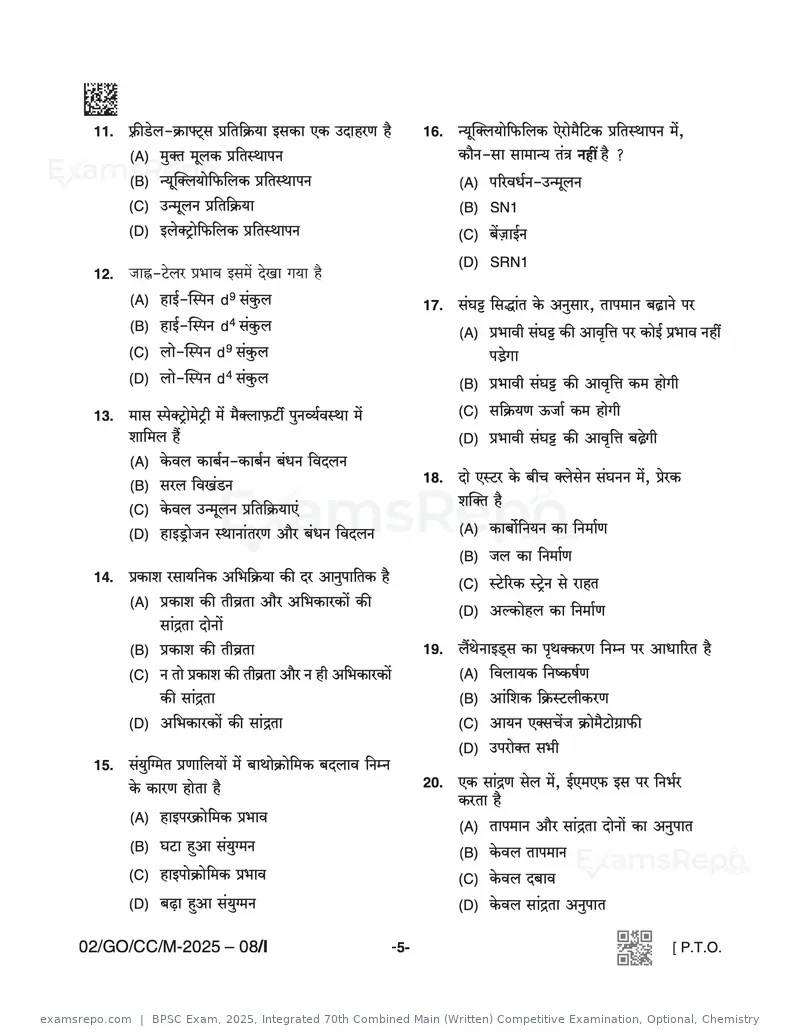

Text of page 6
21.   The Wagner-Meerwein rearrangement                 26.
       involves                                                chemistry depends on
       (A) Both hydride and alkyl shifts                       (A) Both molecular weight and shape
       (B) Hydride shift                                       (B) Molecular weight only
       (C) Neither hydride nor alkyl shifts                    (C) Neither molecular weight nor shape
       (D) Alkyl shift                                         (D) Shape only

 22.   Which spectroscopic technique is                  27.   The Onsager limiting law for the molar
       most useful for determining molecular                   conductivity of an electrolyte is valid at
       connectivity ?                                          (A) Intermediate concentrations
       (A) NMR                                                 (B) All concentrations
       (B) UV-Visible                                          (C) Low concentrations
       (C) Mass spectrometry                                   (D) High concentrations
       (D) IR
                                                         28.   The Reimer-Tiemann reaction is used
 23.   According to Fajan’s rules, covalent                    to introduce which functional group to
       character increases with                                phenols ?
       (A) Larger cation and smaller anion                     (A) Amino group
       (B) Smaller cation and larger anion                     (B) Nitro group
       (C) Higher charge on cation                             (C) Sulfonic acid group

       (D) Both (B) and (C)                                    (D) Formyl group


 24.   E2 elimination reactions show                     29.   The charge transfer transitions in
                                                               complexes occur between
       (A) Zero-order kinetics
                                                               (A) Bonding and antibonding orbitals
       (B) First-order kinetics
                                                               (B) t2g and eg orbitals
       (C) Third-order kinetics
                                                               (C) Metal d orbitals and ligand orbitals
       (D) Second-order kinetics
                                                               (D) None of the above
 25.   In a photoelectric cell, the photocurrent
       depends on                                        30.   The presence of radicals is best detected
                                                               by
       (A) Intensity of incident light
                                                               (A) EPR spectroscopy
       (B) Wavelength of incident light
                                                               (B) UV spectroscopy
       (C) Both (A) and (B)
                                                               (C) NMR spectroscopy
       (D) Neither (A) nor (B)
                                                               (D) IR spectroscopy

02/GO/CC/M-2025 – 08/I                             -6-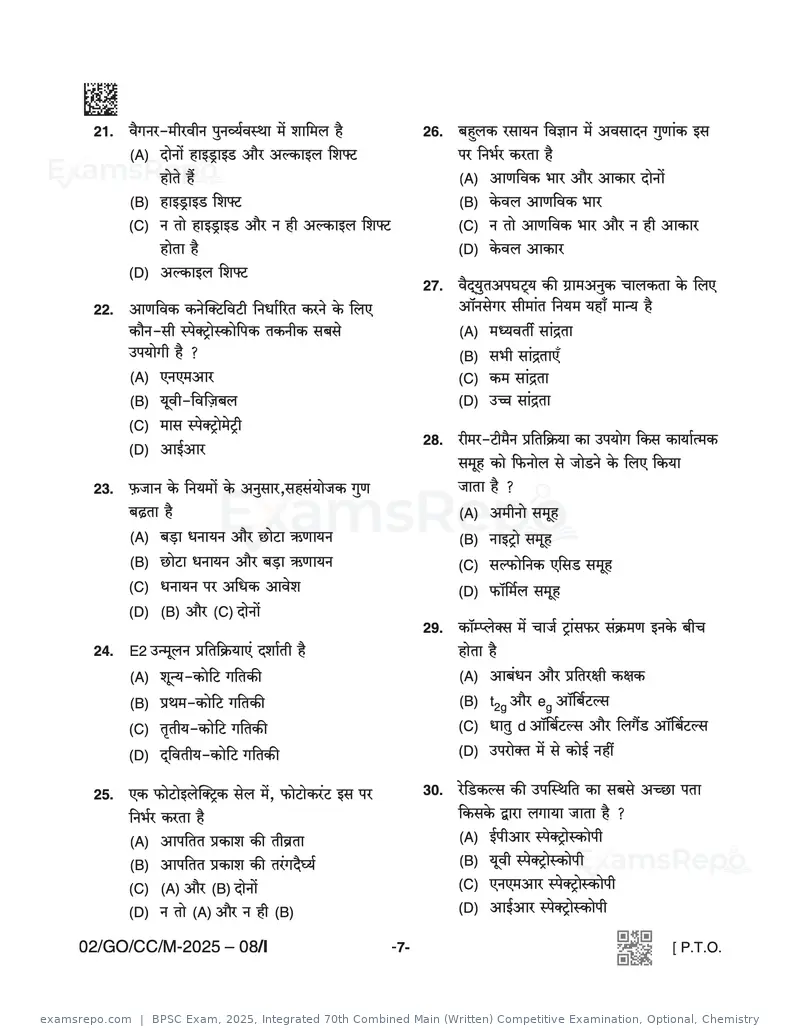

Text of page 8
31.   Enthalpy of formation of elements in their         36.   What determines the intensity of
       standard states is                                       vibrational-rotational transitions ?
                                                                (A) Both dipole moment and temperature
       (B) Unity                                                (B) Only dipole moment
       (C) Depends on the element                               (C) Only temperature
       (D) Zero                                                 (D) None of the above

 32.   The nitrogen rule in mass spectrometry             37.   In the addition of HBr to propene, the
       states that molecules containing                         major product is
       (A) Any nitrogen has even mass                           (A) Both in equal amounts
       (B) An odd number of nitrogen have even                  (B) 1-bromopropane
            mass                                                (C) 2-bromopropane
       (C) Any nitrogen has odd mass                            (D) None of the above
       (D) An odd number of nitrogen have odd
            mass                                          38.   The metal-metal bond in
                                                                [Cr2(CH3COO)4(H2O)2] is best described
 33.   The reducing strength of metals in liquid
                                                                as
       ammonia follows the order
                                                                (A) Triple bond
       (A) Cs < Rb < K < Na < Li
                                                                (B) Single bond
       (B) Li < Na < K < Rb < Cs
                                                                (C) Quadruple bond
       (C) Cs > Rb > K > Na > Li
                                                                (D) Double bond
       (D) Li > Na > K > Rb > Cs
                                                          39.   The rule of mutual exclusion applies to
 34.   The Frank-Condon principle explains
                                                                (A) Only polar molecules
       (A) Electronic transitions
                                                                (B) All molecules
                                                                (C) Only non-polar molecules
       (C) Spin-orbit coupling
                                                                (D) Only centrosymmetric molecules

                                                          40.   Born-Haber cycle is used to calculate
 35.   Frenkel defect is commonly found in                      which energy ?
       (A) AgCl                                                 (A) Ionization enthalpy
       (B) NaCl                                                 (B) Covalent bond energy
       (C) CsCl                                                 (C) Electron gain enthalpy
       (D) KCI                                                  (D) Lattice energy

02/GO/CC/M-2025 – 08/I                              -8-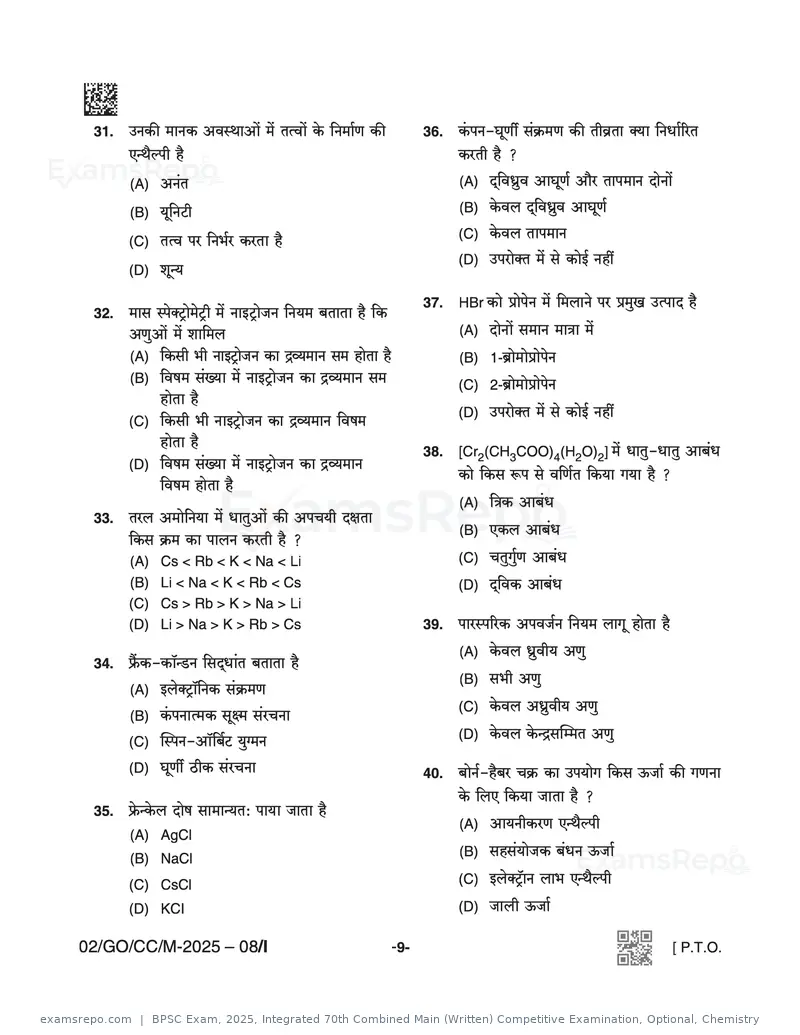

Text of page 10
41.   In the benzyne mechanism, the                     46.   Polystyrene is produced by
       intermediate has                                        (A) Step-growth polymerization
       (A) sp3 hybridization
                                                               (B) Addition polymerization
       (B) sp hybridization
                                                               (C) Ring-opening polymerization
       (C) Both sp and sp2 hybridization
       (D) sp2 hybridization                                   (D) Condensation polymerization

 42.   N-Bromosuccinimide (NBS) is commonly              47.   For an ideal gas, internal energy
       used for
                                                               (A) Depends on temperature only
       (A) Alcohol oxidation
       (B) Allylic bromination                                 (B) Depends on volume only

       (C) Ketone reduction                                    (C) Depends on both pressure and
       (D) Aromatic nitration                                      volume
                                                               (D) Depends on pressure only
 43.   Which crystal system has all sides equal
       and all angles 90° ?                              48.   The number of fundamental vibrational
       (A) Monoclinic                                          modes for a linear triatomic molecule is
       (B) Triclinic                                           (A) 5
       (C) Orthorhombic
                                                               (B) 3
       (D) Cubic
                                                               (C) 6
 44.   The major product of the Cannizzaro                     (D) 4
       reaction with benzaldehyde is
       (A) Benzyl alcohol and benzene                    49.   The law of rational indices states that
       (B) Benzyl alcohol and benzoic acid                     (A) Indices can be irrational numbers
       (C) Two molecules of benzoic acid
                                                               (B) All indices must be whole numbers
       (D) Benzene and benzoic acid
                                                               (C) Indices must be prime numbers
 45.   The molecularity of a reaction refers to                (D) The ratio of indices must be rational
       (A) The order of the reaction with                          numbers
           respect to each reactant
       (B) The number of bonds broken/formed             50.   The Perkin reaction is a method to
                                                               prepare which compound ?
           in the rate-determining step
                                                               (A)     -hydroxy acids
       (C) The number of elementary steps in
           the reaction mechanism                              (B)       -unsaturated acids

       (D) The number of reactant molecules                    (C)   -keto esters
           that collide to form products                       (D)   -hydroxy aldehydes

02/GO/CC/M-2025 – 08/I                            -10-

Text of page 12
51.   The shielding of 4f electrons in                 56.   The value of G at equilibrium is
       lanthanides is due to
                                                              (A) Zero
       (A) 6s and 6p electrons
                                                              (B) Positive
       (B) 5s and 5p electrons
                                                              (C) Depends on temperature
       (C) 4f electrons themselves
                                                              (D) Negative
       (D) 5d and 6s electrons
                                                        57.   Which reactive intermediate is sp2
 52.   Lattice energy generally increases with                hybridized with one empty p orbital ?
       (A) Decreasing charge on ions                          (A) Carbanion
       (B) Decreasing size of ions                            (B) Carbene
       (C) Increasing size of ions                            (C) Free radical
       (D) None of these                                      (D) Carbocation

 53.                                                    58.   According to the Debye-Hückel theory,
       occurs at
       (A) 1250 – 400 cm–1                                    inversely proportional to
       (B) 4000 – 3000 cm–1                                   (A) The cube root of the ion charge
       (C) Above 4000 cm–1
                                                              (B) The square root of the ion charge
       (D) 3000 – 1250 cm–1
                                                              (C) The cube of the ion charge
 54.   Which of the following is not a                        (D) The square of the ion charge
       characteristics of fuel cells ?
                                                        59.
       (B) Continuous supply of reactants                     (A) Electron-nuclear coupling
       (C) Single use only                                    (B) Electron-electron coupling
       (D) Direct conversion of chemical                      (C) Spin-orbit coupling
           energy to electrical energy
                                                              (D) Nuclear-nuclear coupling

 55.   The Aldol condensation product forms
                                                        60.   For a particle in a one-dimensional box
       via
       (A) Initial formation of a free radical                (A) All energy level are equally spaced

       (B) Initial formation of an enolate                    (B) Energy is continuous

       (C) Initial formation of a carbene                     (C) Energy is independent of box length
       (D) Initial formation of a carbocation                 (D) Energy is quantized

02/GO/CC/M-2025 – 08/I                           -12-

Text of page 14
61.   The high strength of Nylon is primarily           66.   Which electronic transition has the
       due to                                                  highest energy ?
       (A) Covalent bonding                                    (A)         *
       (B) Hydrogen bonding                                    (B) n       *
       (C) Ionic bonding                                       (C) n       *
       (D) van der Waals forces                                (D)         *

 62.   According to the absolute reaction rate           67.   The electronic spectra of lanthanide
       theory, the rate constant is proportional to            complexes exhibit
       (A) Concentration
                                                               (A) Continuous absorption
       (B) Activation energy
                                                               (B) Broad bands
       (C) Partition function
       (D) Pressure                                            (C) No absorption
                                                               (D) Sharp lines
 63.   Which mass analyzer provides the
       highest resolution ?                              68.   According to Kirchhoff’s equation

                                                               (A)     H varies inversely with temperature
       (B) Quadrupole
       (C) Fourier transform ion cyclotron                     (B)     H is independent of temperature
           resonance                                           (C)     H is always constant
       (D) Ion trap
                                                               (D)     H varies with temperature according
 64.   Which of the following is the strongest                       to Cp
       reducing agent among the lanthanides ?
                                                         69.   Borazines differ from benzene in
       (A) Eu2+
                                                               (A) Electronic distribution
       (B) Ce3+
                                                               (B) Ring size
       (C) Yb2+
                                                               (C) Number of       electrons
       (D) Sm2+
                                                               (D) Bond angles
 65.   A Schottky defect in an ionic crystal
                                                         70.   The EMF of a concentration cell
       (A) Creates equal numbers of cation and
           anion vacancies                                     (A) Is independent of temperature

       (B) Creates only cation vacancies                       (B) Increases with temperature

       (C) Creates interstitial ions
                                                                     temperature
       (D) Creates only anion vacancies
                                                               (D) Decreases with temperature

02/GO/CC/M-2025 – 08/I                            -14-

Text of page 16
71.   First-order coupling in NMR occurs when          76.   The rotational energy levels of a diatomic
       (A) Coupling constants are large                       molecule are
                                                              (A) Inversely proportional to J
       (B) Chemical shifts are similar
                                                              (B) Equally spaced
       (C) Coupling constants are small
                                                              (C) Independent of J
       (D) Chemical shifts are very different                 (D) Proportional to J (J+1)

 72.                                                    77.   The stability of the +2 oxidation state in
       (A) Independent of the rate constant                   actinides
       (B) Inversely proportional to the rate                 (A) Remains constant across the series
           constant                                           (B) Increases across the series
       (C) Proportional to the square root of                 (C) Varies irregularly across the series
           the rate constant                                  (D) Decreases across the series
       (D) Directly proportional to the rate
           constant                                     78.   The phase of X-ray waves after
                                                              diffraction
 73.   Ziegler-Natta catalysts are used in the                (A) Is always zero
       synthesis of                                           (B) Can be directly measured
                                                              (C) Is always /2
       (A) Branched polyethylene
                                                              (D) Cannot be directly measured
       (B) Isotactic polypropylene
       (C) Polyvinyl chloride                           79.   The g-tensor in ESR becomes
       (D) Random copolymers                                  anisotropic due to
                                                              (A) Electron spin
 74.   E1CB mechanisms are most likely when                   (B) Nuclear spin
                                                              (C) Rotation
       (A) Strong acid is present
                                                              (D) Orbital angular momentum
       (B) The leaving group is poor
       (C) The -hydrogen is very acidic                 80.   Which of the following is not a type of
                                                              pericyclic reaction ?
       (D) The substrate is primary
                                                              (A) Sigmatropic rearrangement
 75.   The Schrödinger wave equation for a                    (B) Cycloaddition
       hydrogen atom                                          (C) Nucleophilic addition
       (A) Can be solved exactly for the hydrogen             (D) Electrocyclic reaction
           atom
                                                        81.   Miller indices (hkl) represent
       (B) Is time dependent only                             (A) Unit cell dimensions
       (C) Cannot predict electron energies                   (B) Points in a crystal
       (D) Provides exact solutions for                       (C) Atomic coordinates
           multi-electron atoms                               (D) Crystal faces

02/GO/CC/M-2025 – 08/I                           -16-

Text of page 18
82.   The Michael addition is an example of            87.   The hydrogen-oxygen fuel cell
       (A) Free radical addition
                                                              (B) Uses KOH as electrolyte
       (B) Electrophilic addition
                                                              (C) Produces CO2 as byproduct
       (C) Pericyclic reaction
                                                              (D) Operates at room temperature
       (D) Nucleophilic addition
                                                        88.   The effect of isotopic substitution on
 83.                                                          rotational constant B is
       electrolyte approaches unity as the
                                                              (A) Decreases B
       concentration approaches
                                                              (B) No change
       (A) 1 molar
       (B) Zero                                               (C) Doubles B

       (C) 0.1 molar                                          (D) Increases B

                                                        89.   The entropy change for an isothermal
                                                              reversible expansion of an ideal gas is
 84.   The pinacol-pinacolone rearrangement
       occurs under                                           (A) nR In(P2/P1)
       (A) Neutral conditions                                 (B) nR In(V2/V1)
       (B) Basic conditions                                   (C) Zero
       (C) Photochemical conditions                           (D) – nR In(V2/V1)
       (D) Acidic conditions
                                                        90.   In which one of the following substances
 85.   The quantum number that determines                     standard enthalpy of formation is not
                                                              equal to zero ?
       the shape of an orbital is
                                                              (A) Copper
       (A) Magnetic quantum number (m)
                                                              (B) Hydrogen
       (B) Principal quantum number (n)
                                                              (C) Phosphorus
       (C) Spin quantum number (s)
                                                              (D) Diamond
       (D) Azimuthal quantum number (l)

                                                        91.   In an octahedral complex, the t2g orbitals
 86.   End group analysis is most accurate for
                                                              are
       (A) Crosslinked polymers
                                                              (A) Lower in energy than eg orbitals
       (B) Very high molecular weight
           polymers                                           (B) Degenerate

       (C) Inorganic polymers                                 (C) Non-bonding
       (D) Low molecular weight polymers                      (D) Higher in energy than eg orbitals


02/GO/CC/M-2025 – 08/I                           -18-

Text of page 20
92.   The Beckmann rearrangement converts               97.   The trans
       (A) Oximes to amides                                    as
       (B) Ketones to amides                                   (A) The ratio of the ion’s concentration to
       (C) Amides to amines                                         the total ion concentration
       (D) Aldehydes to amines                                 (B) The fraction of the total current carried
                                                                    by that ion
 93.   Liquid crystals
       (A) Have random molecular arrangement                   (C) The ratio of the ion’s charge to the
       (B) Have properties of both solids and                       total charge of all ions
            liquids                                            (D) The ratio of the ion’s mobility to the
       (C) Are very rigid
                                                                    sum of the mobilities of all ions
       (D) Are always transparent

 94.   In light scattering experiments on                98.   Liquid sulfur dioxide is considered as
       polymer solutions, the intensity of
                                                               (A) Amphiprotic solvent
       scattered light is proportional to
       (A) Cube of molecular weight                            (B) Protic solvent

       (B) Molecular weight                                    (C) Non-polar solvent
       (C) Square root of molecular weight                     (D) Aprotic solvent
       (D) Square of molecular weight

 95.   The number of lobes in a p orbital is             99.   The Gibbs-Helmholtz equation relates

       (A) 3                                                   (A) Temperature and free energy

       (B) 1                                                   (B) Pressure and volume

       (C) 4                                                   (C) Pressure and temperature
       (D) 2                                                   (D) Temperature and entropy

 96.   Which of the following statements about
       photochemical reactions is correct ?             100.   LiAlH4 reduces carboxylic acids to

       (A) They require absorption of light                    (A) Secondary alcohols
       (B) They require thermal energy only                    (B) Aldehydes
       (C) They always produce free radicals                   (C) Ketones
       (D) They occur only in the presence of a
                                                               (D) Primary alcohols
           catalyst


02/GO/CC/M-2025 – 08/I                           -20-


Official key not published for this paper.
Page 1 of 24
Source: Bihar Public Service Commission. Question paper published by Bihar Public Service Commission.