
CBSE Assistant Secretary 2024: Assistant Secretary, CBSE Recruitment Examination, Tier 2 (RAS-1124), Academics and Training, English
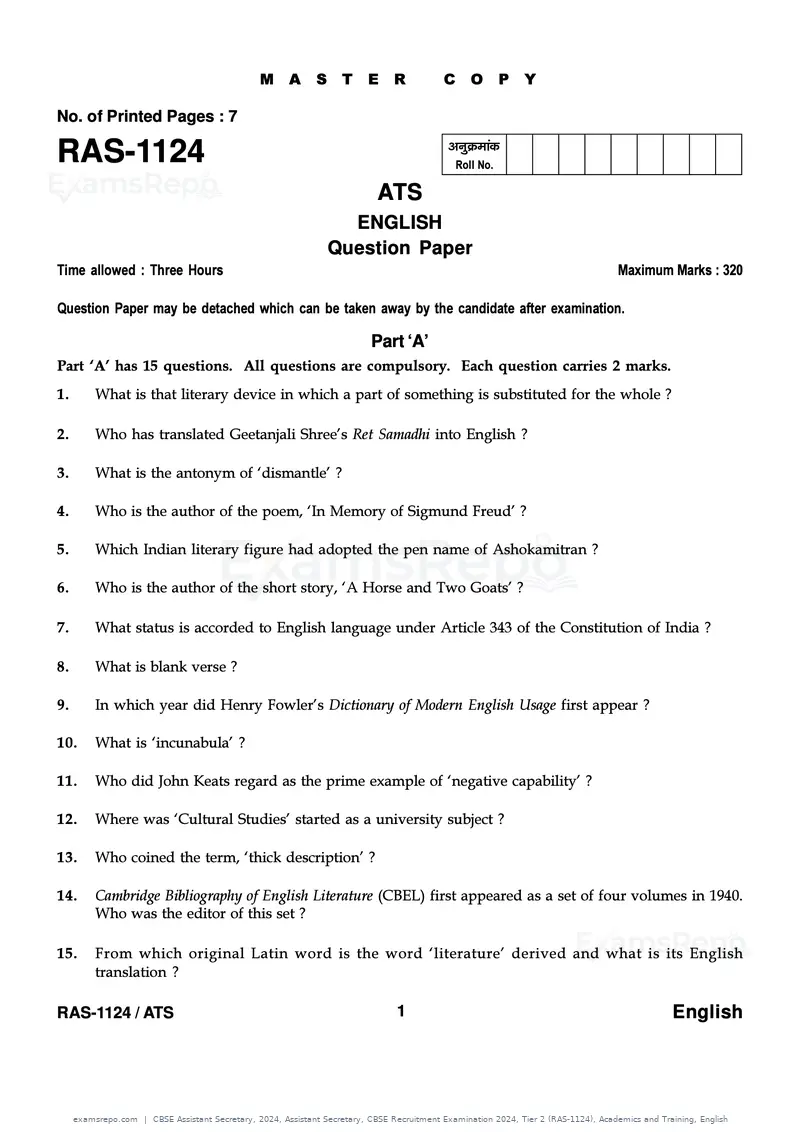
Text of page 1
M   A    S    T   E   R      C      O       P   Y

No. of Printed Pages : 7

RAS-1124                                                      •ŸÈ∑˝§◊Ê¥∑§
                                                                 Roll No.

                                                   ATS
                                               ENGLISH
                                             Question Paper
Time allowed : Three Hours                                                              Maximum Marks : 320

Question Paper may be detached which can be taken away by the candidate after examination.

                                                  Part ‘A’
Part ‘A’ has 15 questions. All questions are compulsory. Each question carries 2 marks.
1.    What is that literary device in which a part of something is substituted for the whole ?

2.    Who has translated Geetanjali Shree’s Ret Samadhi into English ?

3.    What is the antonym of ‘dismantle’ ?

4.    Who is the author of the poem, ‘In Memory of Sigmund Freud’ ?

5.    Which Indian literary figure had adopted the pen name of Ashokamitran ?

6.    Who is the author of the short story, ‘A Horse and Two Goats’ ?

7.    What status is accorded to English language under Article 343 of the Constitution of India ?

8.    What is blank verse ?

9.    In which year did Henry Fowler’s Dictionary of Modern English Usage first appear ?

10.   What is ‘incunabula’ ?

11.   Who did John Keats regard as the prime example of ‘negative capability’ ?

12.   Where was ‘Cultural Studies’ started as a university subject ?

13.   Who coined the term, ‘thick description’ ?

14.   Cambridge Bibliography of English Literature (CBEL) first appeared as a set of four volumes in 1940.
      Who was the editor of this set ?

15.   From which original Latin word is the word ‘literature’ derived and what is its English
      translation ?

RAS-1124 / ATS                                        1                                          English
Text of page 2
M   A   S   T   E   R      C   O   P   Y

                                                 Part ‘B’
Part ‘B’ has 25 questions. Out of which any 20 questions are to be answered. Each question carries
5 marks. The question may be answered in maximum 30 words.
Read the following poem and answer the questions that follow in not more than 30 words each.
      To a Daughter Leaving Home
      When I taught you
      at eight to ride
      a bicycle, loping along
      beside you
      as you wobbled away
      on two round wheels,
      my own mouth rounding
      in surprise when you pulled
      ahead down the curved
      path of the park,
      I kept waiting
      for the thud
      of your crash as I
      sprinted to catch up,
      while you grew
      smaller, more breakable
      with distance,
      pumping, pumping
      for your life, screaming
      with laughter,
      the hair flapping
      behind you like a
      handkerchief waving
      goodbye.

16.   The poem describes an eight-year old learning to ride a bicycle but why is it titled as
      ‘Leaving Home’?


17.   Who is the speaker of the poem? What are her feelings towards the girl riding a bicycle ?


18.   Comment on the evocative imagery of the poem.

RAS-1124 / ATS                                       2                                      English
Text of page 3
M   A   S   T   E   R      C    O   P   Y

Read the following extract and answer the questions that follow in not more than 30 words each.

       I have seen many by their death give a good or an ill repute to their whole life. Scipio, the father-
in-law of Pompey, in dying, well removed the ill opinion that till then every one had conceived of him.
Epaminondas being asked which of the three he had in greatest esteem, Chabrias, Iphicrates, or himself.
“You must first see us die.” said he, “before that question can be resolved.” And, in truth, he would
infinitely wrong that man who would weigh him without the honour and grandeur of his end.
      God has ordered all things as it has best pleased Him; but I have, in my time, seen three of the most
execrable persons that ever I knew in all manner of abominable living, and the most infamous to boot,
who all died a very regular death, and in all circumstances composed, even to perfection. There are
brave and fortunate deaths : I have seen death cut the thread of the progress of a prodigious advancement,
and in the height and flower of its increase, of a certain person, with so glorious an end that, in my
opinion, his ambitious and generous designs had nothing in them so high and great as their interruption.
He arrived, without completing his course, at the place to which his ambition aimed, with greater glory
than he could either have hoped or desired, anticipating by his fall the name and power to which he
aspired in perfecting his career. In the judgment I make of another man’s life, I always observe how he
carried himself at his death; and the principal concern I have for my own is that I may die well - that is,
patiently and tranquilly.

19.   How does the author measure the reputation of a whole life ?


20.   What does the author consider a fortunate death ?


21.   What is the author’s assessment of another man’s life and how does he wish to die himself ?


Read the following extract and answer the questions that follow in not more than 30 words each.
      All the world’s a stage,
      And all the men and women merely players;
      They have their exits and their entrances,
      And one man in his time plays many parts,
      His acts being seven ages. At first the infant,
      Mewling and puking in the nurse’s arms.
      Then, the whining school-boy with his satchel
      And shining morning face, creeping like snail
      Unwillingly to school. And then the lover,
      Sighing like furnace, with a woeful ballad
      Made to his mistress’ eyebrow. Then, a soldier,


RAS-1124 / ATS                                          3                                       English
Text of page 4
M   A    S   T    E   R     C   O   P   Y

      Full of strange oaths, and bearded like the pard,
      Jealous in honour, sudden, and quick in quarrel,
      Seeking the bubble reputation
      Even in the cannon’s mouth. And then, the justice,
      In fair round belly, with a good capon lined,
      With eyes severe, and beard of formal cut,
      Full of wise saws, and modern instances,
      And so he plays his part. The sixth age shifts
      Into the lean and slippered pantaloon,
      With spectacles on nose and pouch on side,
      His youthful hose, well saved, a world too wide
      For his shrunk shank, and his big manly voice,
      Turning again toward childish treble, pipes
      And whistles in his sound. Last scene of all,
      That ends this strange eventful history,
      Is second childishness and mere oblivion,
      Sans teeth, sans eyes, sans taste, sans everything.

22.   What picture of school stage is presented ?


23.   How does the ‘last scene’ of human life play out ?


24.   Comment on the persuasive power of the passage.


Read the following extract and answer the questions that follow in not more than 30 words each.
      His flock of chickens had already gone in roost, and the yard was quiet - chickens will begin to
announce themselves hours before sunrise as if they can’t wait for the day to get started but they are
equally interested in an early bedtime. Tom had grown used to sleeping through their early morning
summons, all his family had, but in the last few weeks he’d been waking as soon as he heard the first
hens peep, before even the roosters took up their reveille. The sounds they made in those first dark
moments of the day had begun to seem to him as soft and devotional as an Angelus bell. And he had
begun to dread the evenings - to wish, like the chickens, to climb into bed and close his eyes as soon as
shadows lengthened and light began to seep out of the sky.
      He let himself into the woodshed and sat down on a pile of stacked wood and rested his elbows on
his knees and rocked himself back and forth. His body felt swollen with something inexpressible, and he
thought if he could just weep he’d begin to feel better. He sat and rocked and eventually began to cry,
which relieved nothing, but then he began to be racked with great coughing sobs that went on until
whatever it was that had built up inside him had been slightly released. When his breathing eased, he
went on sitting there rocking back and forth quite a while, looking at his boots, which were caked with
manure and bits of hay. Then he wiped his eyes with his handkerchief and went into the house and sat
down to dinner with his wife and son.

25.   What is the reader told about Tom’s early morning habit ?


RAS-1124 / ATS                                        4                                       English
Text of page 5
M    A   S   T   E    R        C   O   P   Y

26.   What did Tom do in the woodshed ?


27.   What evidence is there in the passage which suggests that Tom lives on a farm ?


28.   Why does Arms and the Man carry the subtitle, ‘an anti-romantic comedy’ ?


29.   Comment on the play on the word ‘nothing’ in the opening scene of King Lear.


30.   The narrator in O. Henry’s ‘The Gift of the Magi’, begins with an account of money. What role
      money plays in the life of Della and Jim ?


31.   Why is Mme Loisel hesitant to attend the ministerial ball in Maupassant’s ‘The Necklace’?


32.   Why did the Duke give commands to stop ‘all smiles’ of his last Duchess in Robert Browning’s
      ‘My Last Duchess’ ?


33.   What is the role of the speaking ‘I’ with which Shelley’s ‘Ozymandias’ opens ?


34.   Who is Pilate in Bacon’s essay, ‘Of Truth’ ?


35.   How does Jonathan Swift use the image of the inverted tree in his ‘A Meditation Upon a
      Broom-Stick’ ?


36.   What is the source and context of the phrase, ‘egotistical sublime’ ?


37.   Why is cultural studies radically interdisciplinary ?


38.   How does Jacques Derrida critique Saussure’s problematic of the sign ?


39.   What are ‘substantives’ in textual editing ?


40.   Why did T.B. Macaulay believe that the British Government should promote European literature
      and science among Indians ?


RAS-1124 / ATS                                       5                                     English
Text of page 6
M   A    S   T   E   R       C   O    P   Y

                                                 Part ‘C’
Part ‘C’ has 12 questions. Out of which any 10 questions are to be answered. Each question carries
10 marks. The question may be answered in maximum 100 words.


41.   Comment on the sleepwalking scene in Macbeth.


42.   Nissim Ezekiel’s ‘Night of the Scorpion’ ends with the line : “Thank God the scorpion picked on me
      and spared my children”. How does this concluding statement enhance the reading experience of
      the poem ?


43.   What do you think is the importance of the ‘beast’ in Lord of the Flies ?


44.   Make an estimate of Samuel Johnson’s role as a lexicographer.


45.   How does the interaction of text and reader create meaning ?


46.   What are some recurrent issues in teaching of English to Indian students ?


47.   Write a note on dramatic monologue.


48.   How can we use a literary work to map the interplay of traditional and subversive discourses
      circulating in the culture ?


49.   Write a note on John Locke’s Essay Concerning Human Understanding.


50.   What are Ideological State Apparatuses (ISA) ?


51.   What is the function of bibliography in textual scholarship ?


52.   Write a note on the acculturation model in second-language acquisition.

RAS-1124 / ATS                                       6                                       English
Text of page 7
M   A    S   T   E   R       C   O    P   Y

                                                 Part ‘D’
Part ‘D’ has 5 questions. Out of which any 3 questions are to be answered. Each question carries
30 marks. The question may be answered in maximum 300 words.
53.   Discuss Jane Eyre as the story of a woman trying to be free.


54.   How do the themes of love, marriage and trickery play out in Shakespeare’s dramaturgy ?


55.   Consider the first four lines of ‘The World Is Too Much With Us’ : “The world is too much with us;
      late and soon/Getting and spending, we lay waste our powers;/ Little we see in Nature that is
      ours;/ We have given our hearts away, a sordid boon!” What do they mean to you ? How do these
      lines resonate with your own lived experience ?


56.   Write a note for the need for a pragmatic and inclusive language policy in education and the
      promotion of English in this regard.


57.   In classroom study of literature, close reading still plays a central role, as it does in much literary
      scholarship. Do you agree ? Make an assessment of the pervasive influence of formalism to this
      day.


RAS-1124 / ATS                                       7                                           English
Official key not published for this paper.
Page 1 of 7
Source: Central Board of Secondary Education. Question paper published by Central Board of Secondary Education.