
GPSC Assistant Engineer 2018: Preliminary, Assistant Engineer (Civil) Class-2
Text of page 1
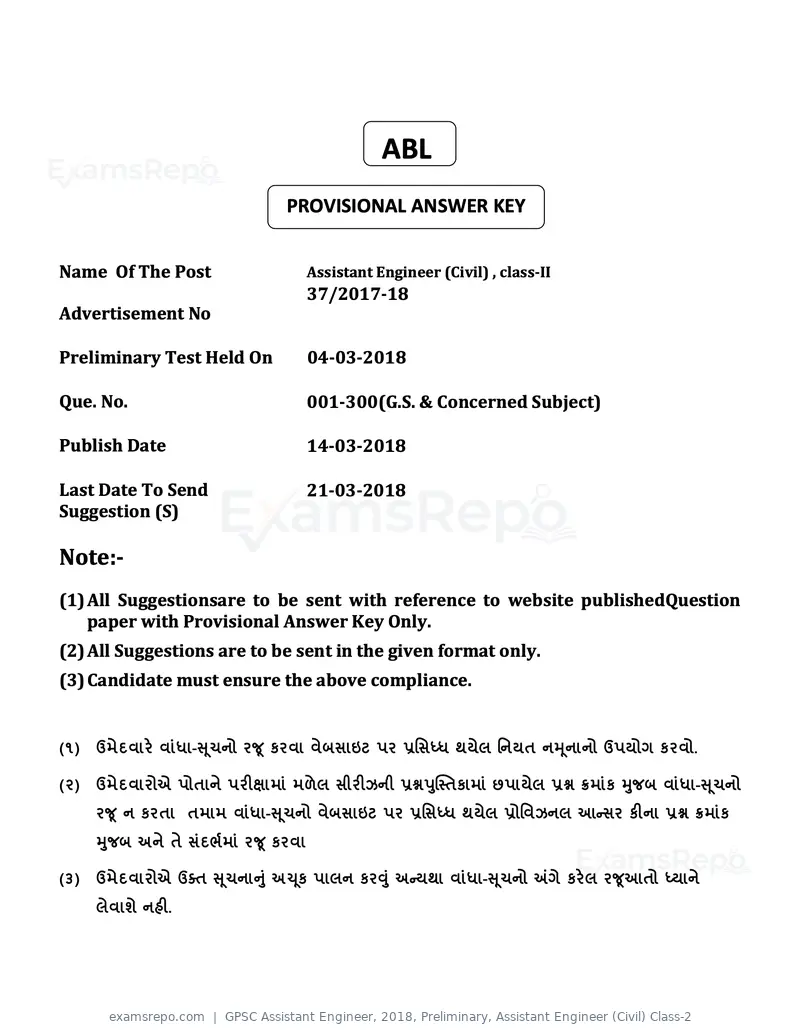
ABL
                                  PROVISIONAL ANSWER KEY


Name Of The Post                       Assistant Engineer (Civil) , class-II
                                       37/2017-18
Advertisement No

Preliminary Test Held On               04-03-2018

Que. No.                               001-300(G.S. & Concerned Subject)

Publish Date                           14-03-2018

Last Date To Send                      21-03-2018
Suggestion (S)

Note:-
(1) All Suggestionsare to be sent with reference to website publishedQuestion
    paper with Provisional Answer Key Only.
(2) All Suggestions are to be sent in the given format only.
(3) Candidate must ensure the above compliance.


(૧)   ઉમેદવાર� વાંધા-� ૂચનો ર�ૂ કરવા વેબસાઇટ પર પ્રિસધ્ધ થયેલ િનયત ન� ૂનાનો ઉપયોગ કરવો.

(૨)   ઉમેદવારોએ પોતાને પર�ક્ષામાં મળે લ સીર�ઝની પ્ર���ુ સ્તકામાં છપાયેલ પ્ર� ક્રમાંક �જ
                                                                                      ુ બ વાંધા-� ૂચનો
      ર�ૂ ન કરતા તમામ વાંધા-� ૂચનો વેબસાઇટ પર પ્રિસધ્ધ થયેલ પ્રોિવઝનલ આન્સર ક�ના પ્ર� ક્રમાંક
       ુ બ અને તે સંદભર્માં ર�ૂ કરવા
      �જ

(૩)   ઉમેદવારોએ ઉક્ત � ૂચના� ંુ અ� ૂક પાલન કર� ંુ અન્યથા વાંધા-� ૂચનો �ગે કર� લ ર�ૂઆતો ધ્યાને
      લેવાશે નહ�.
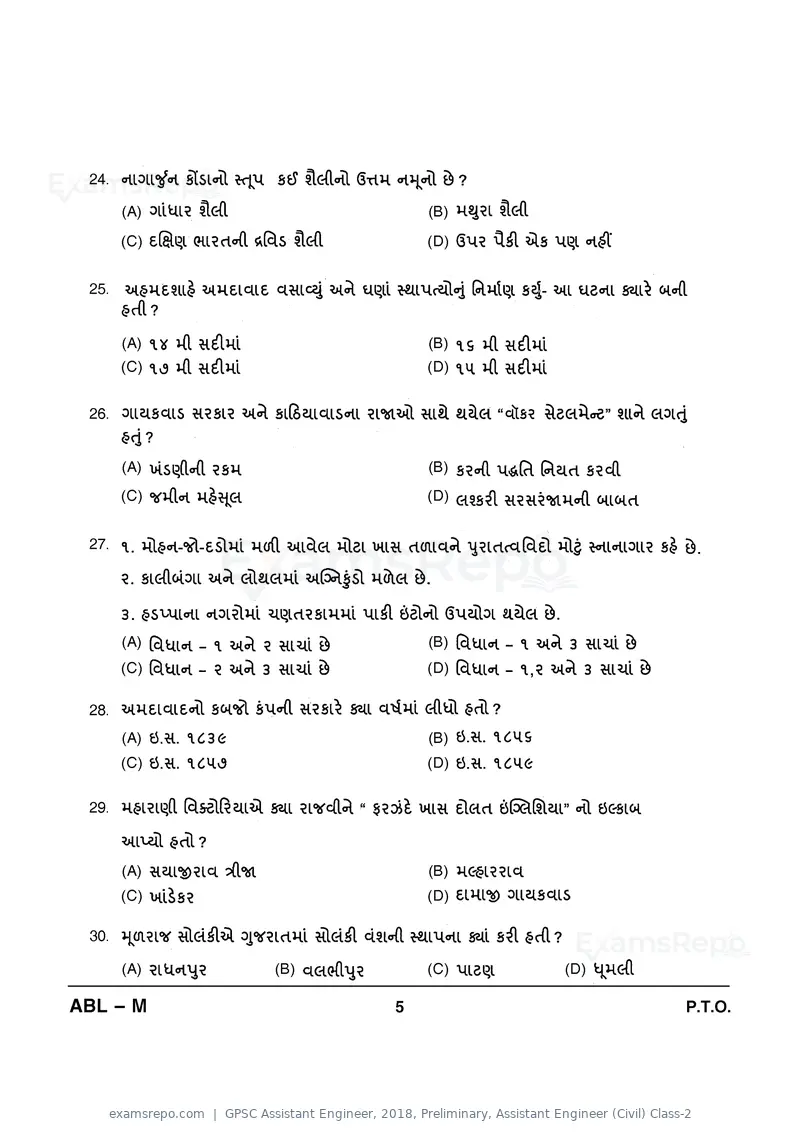
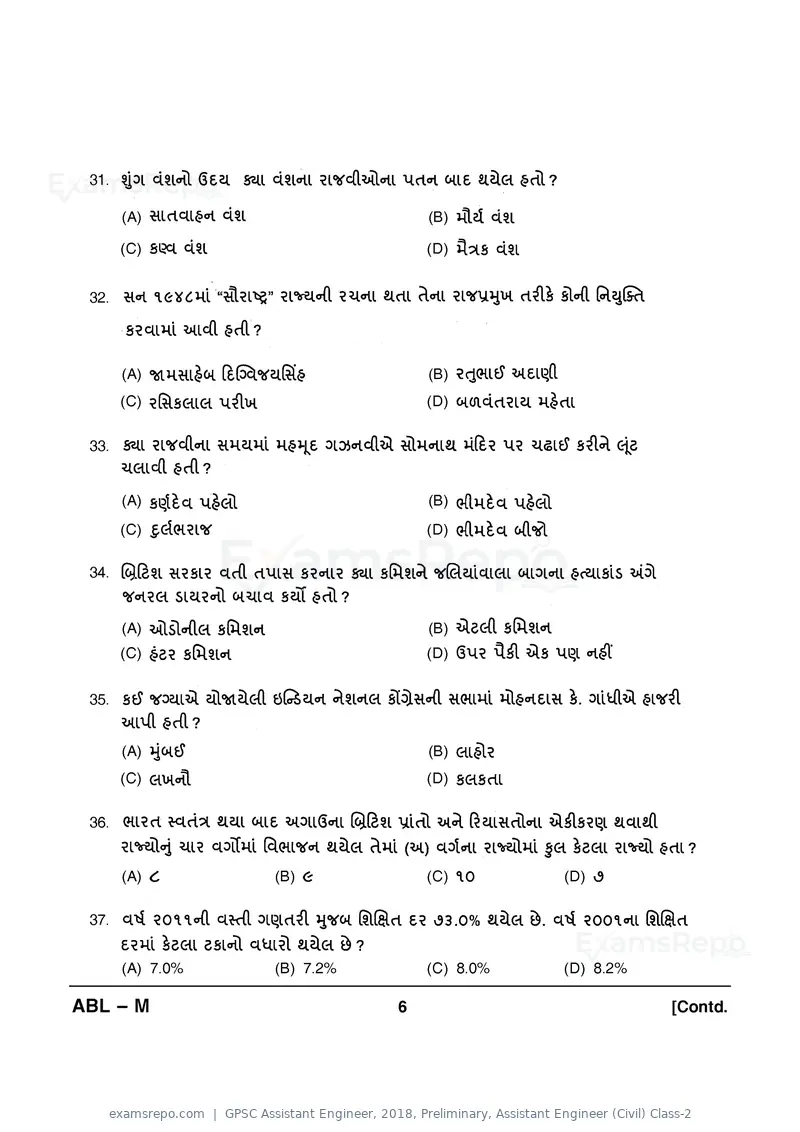
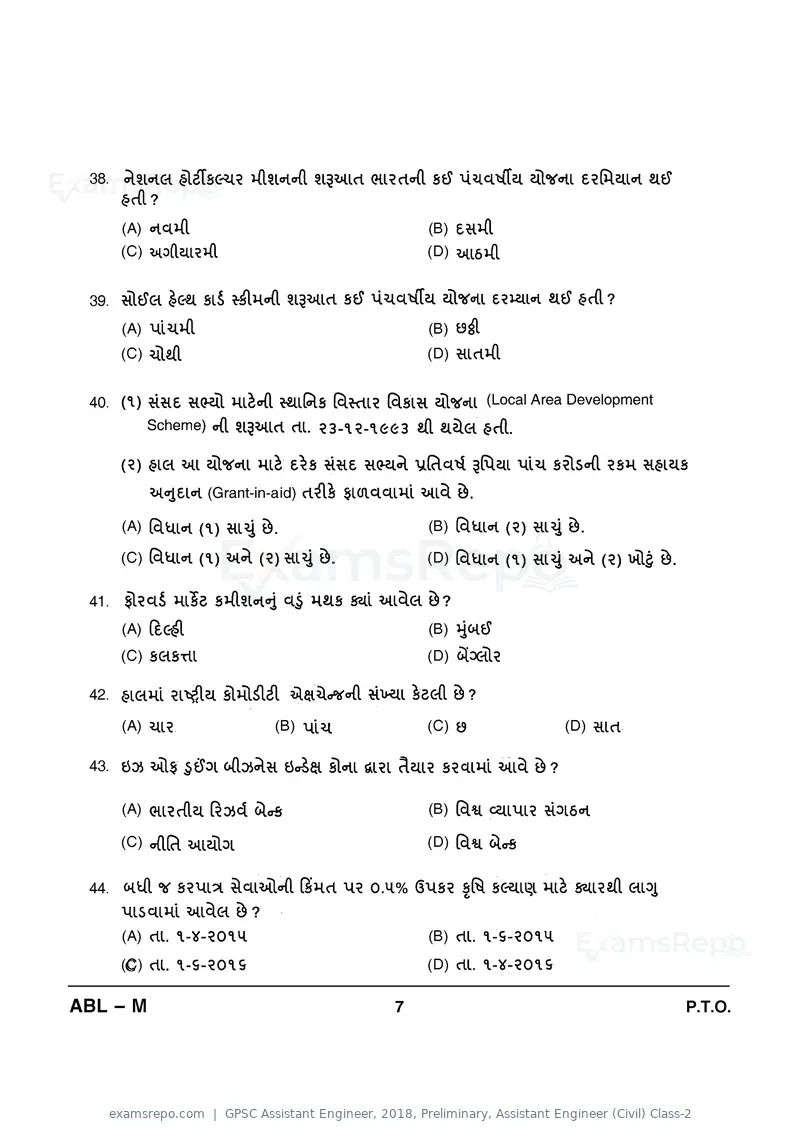
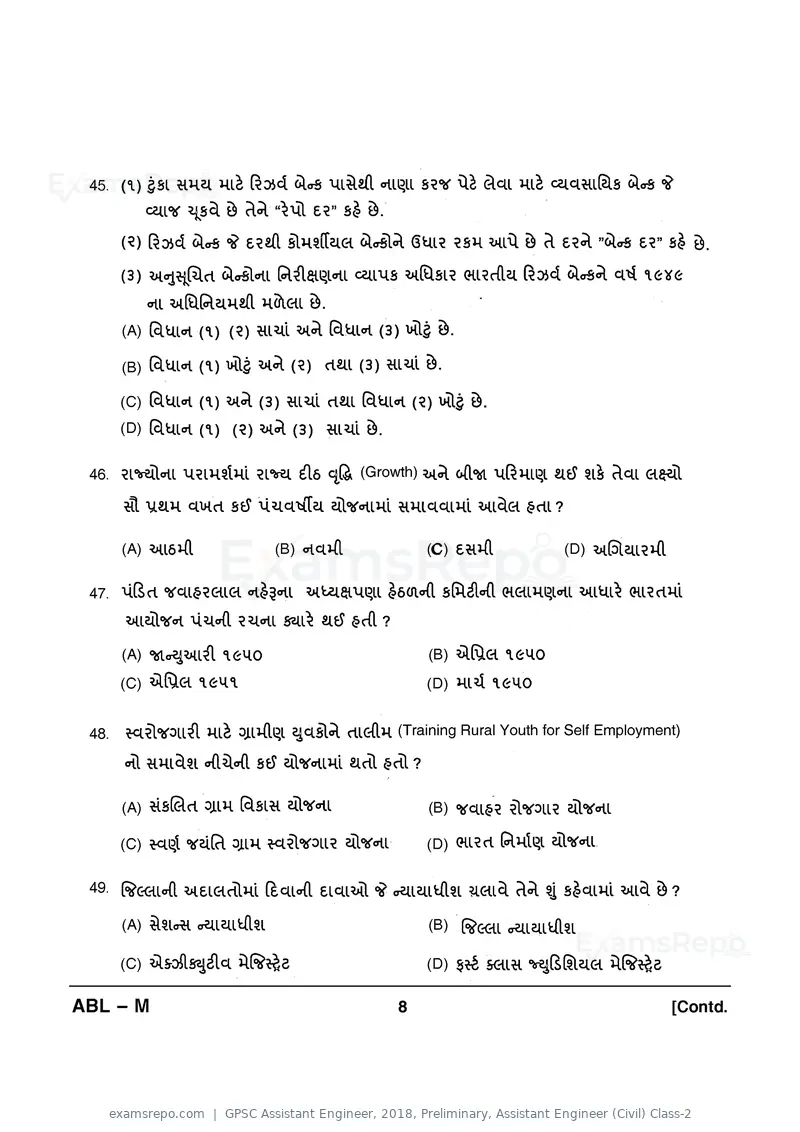
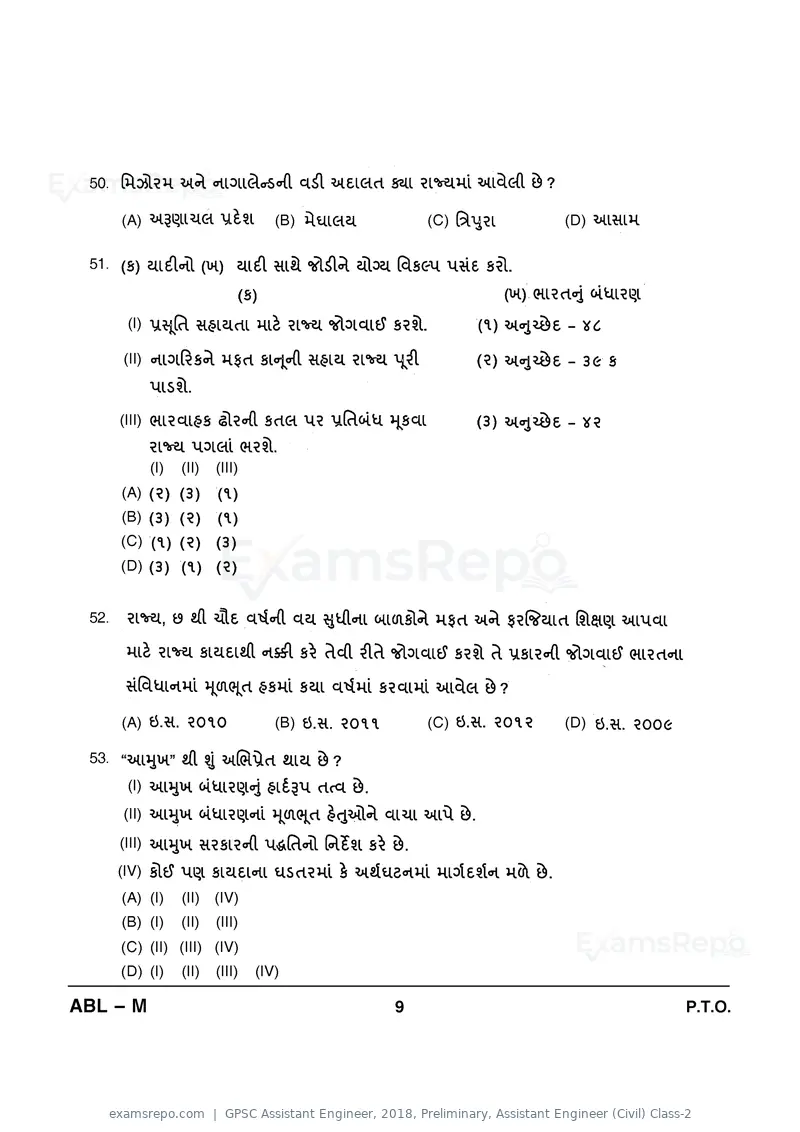
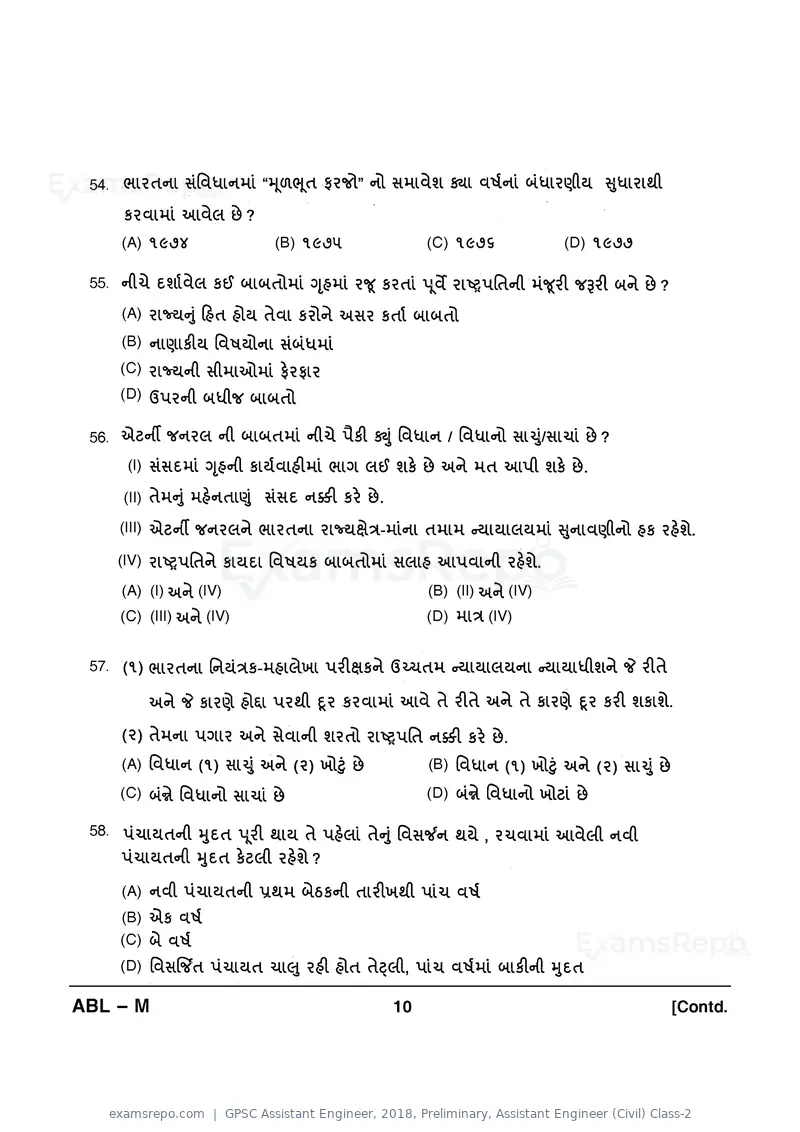
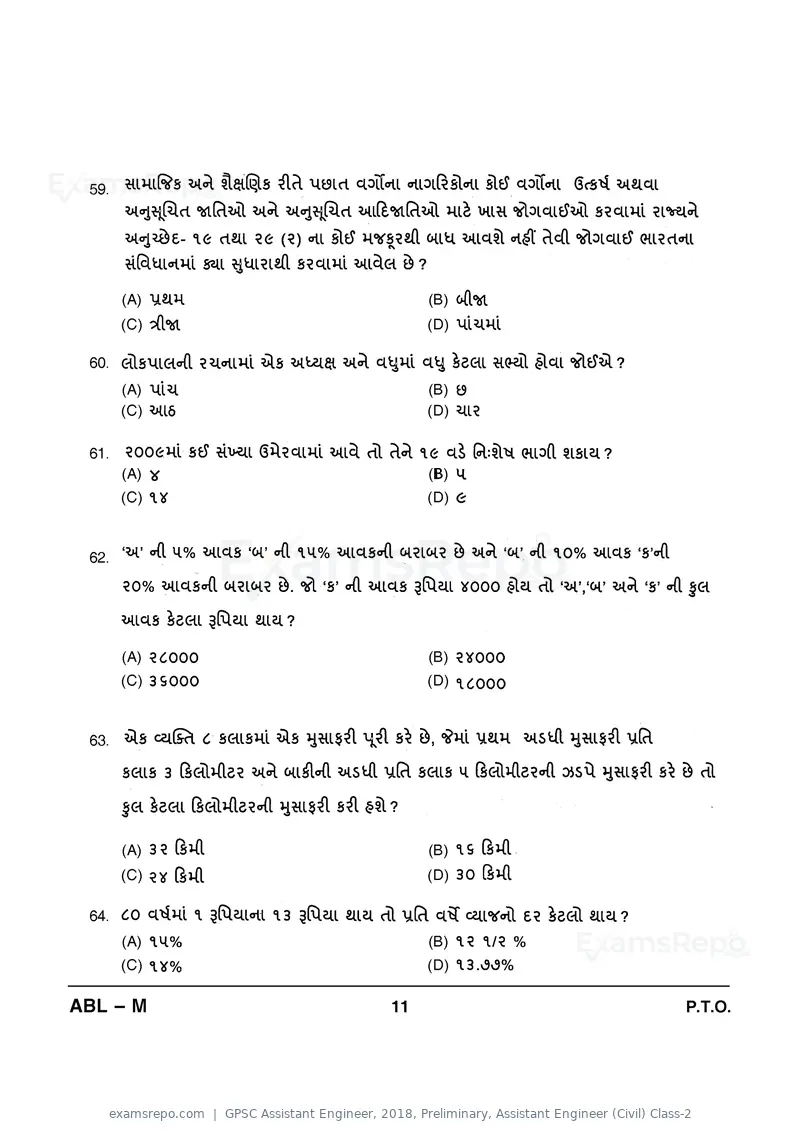
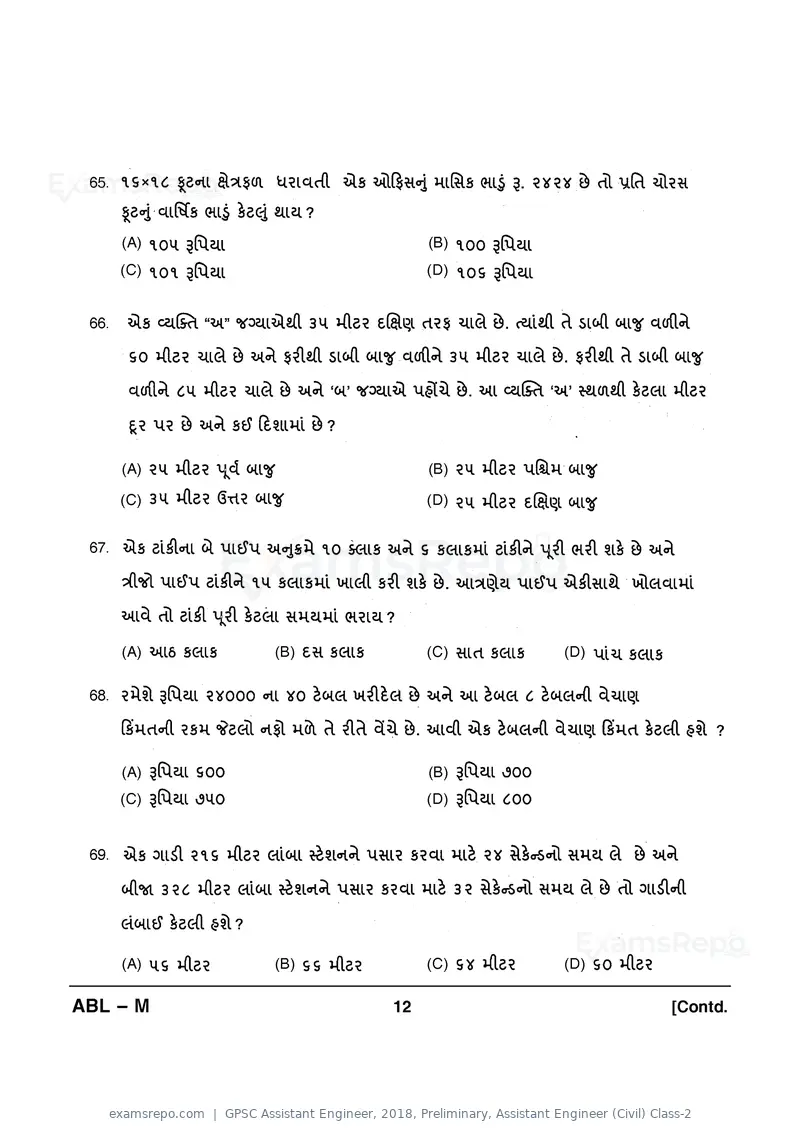
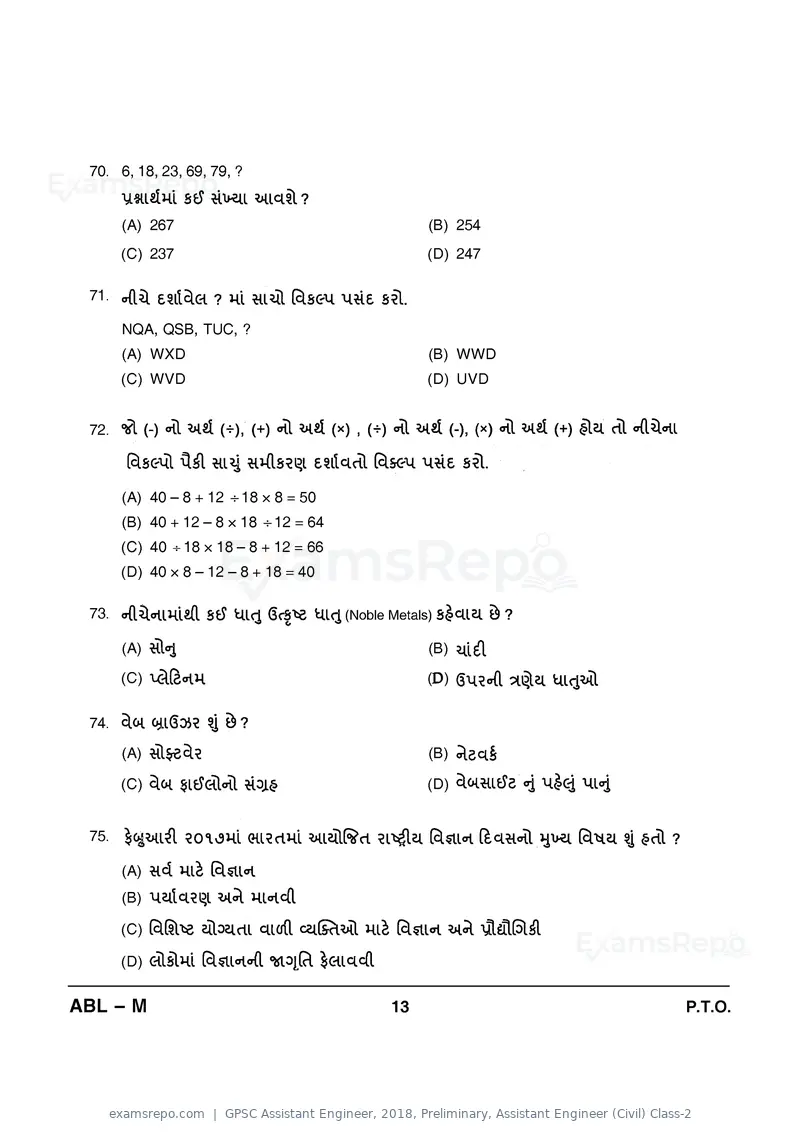
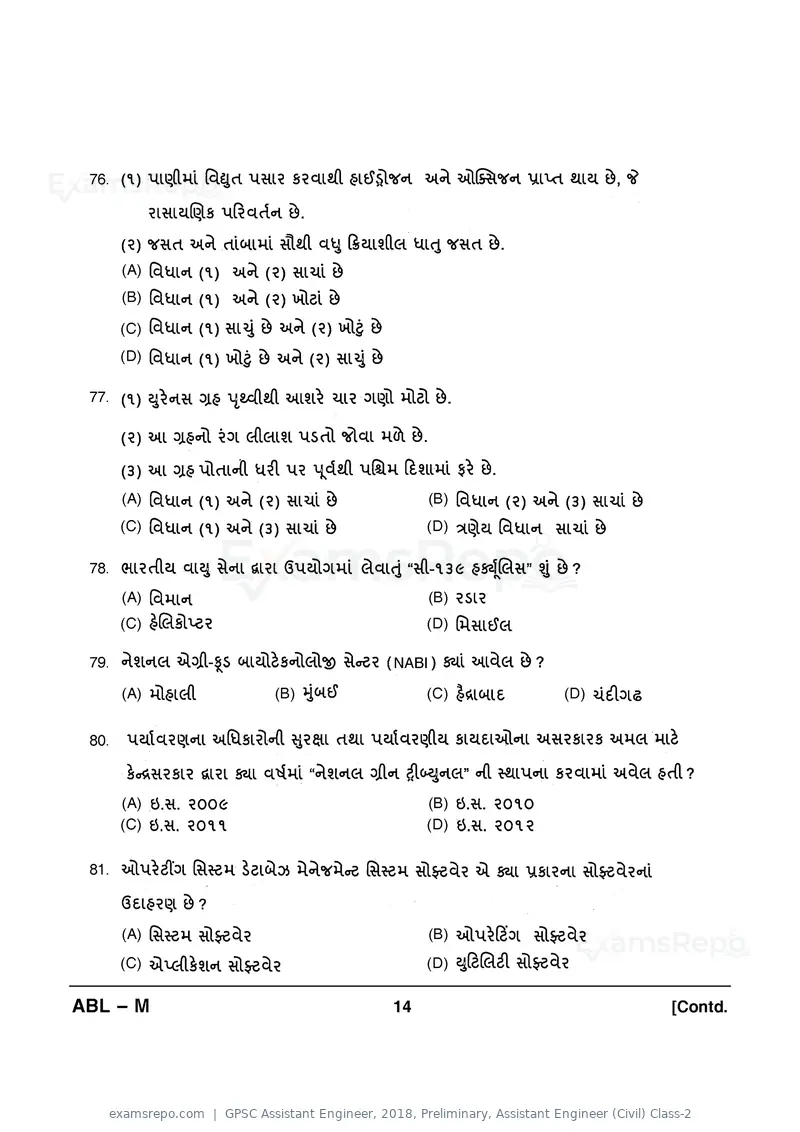
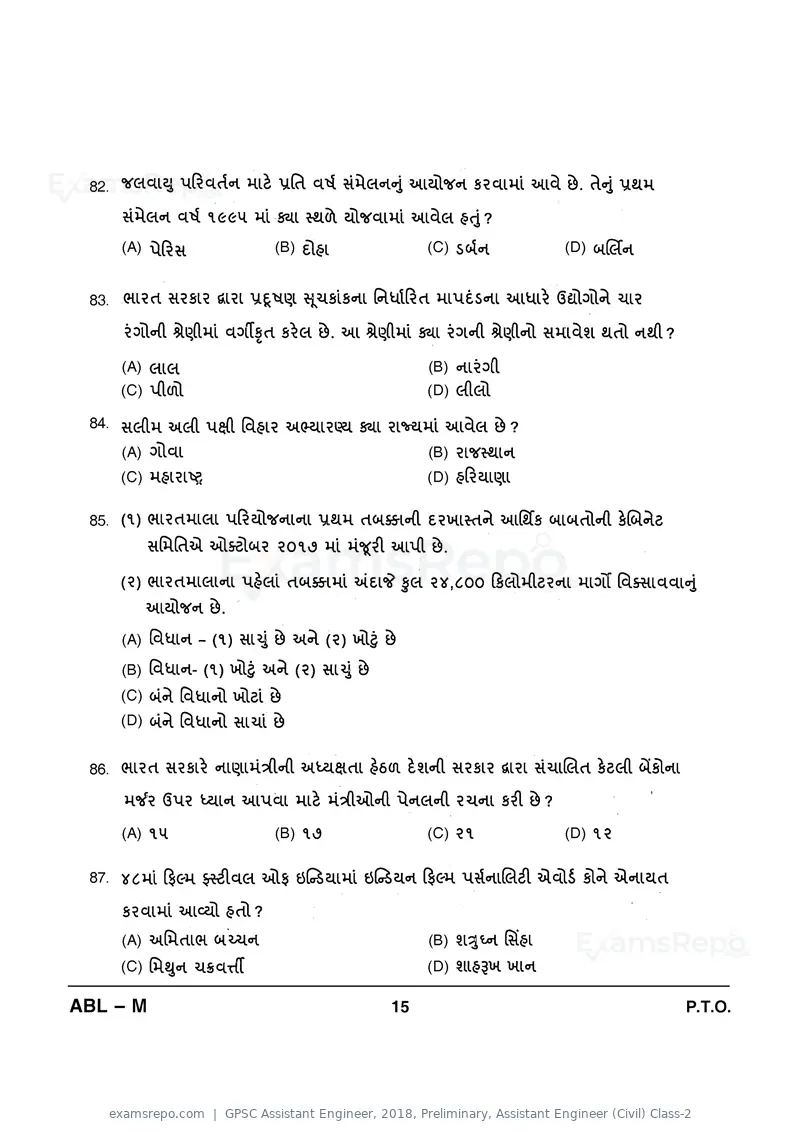
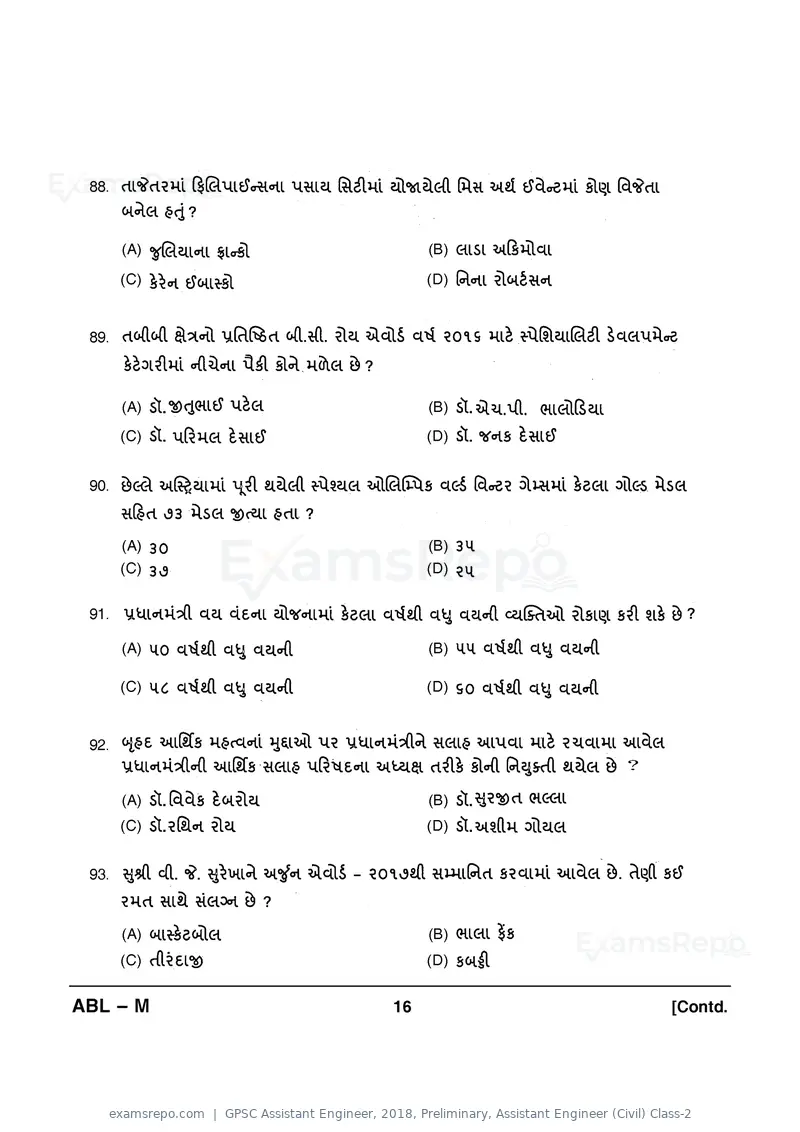
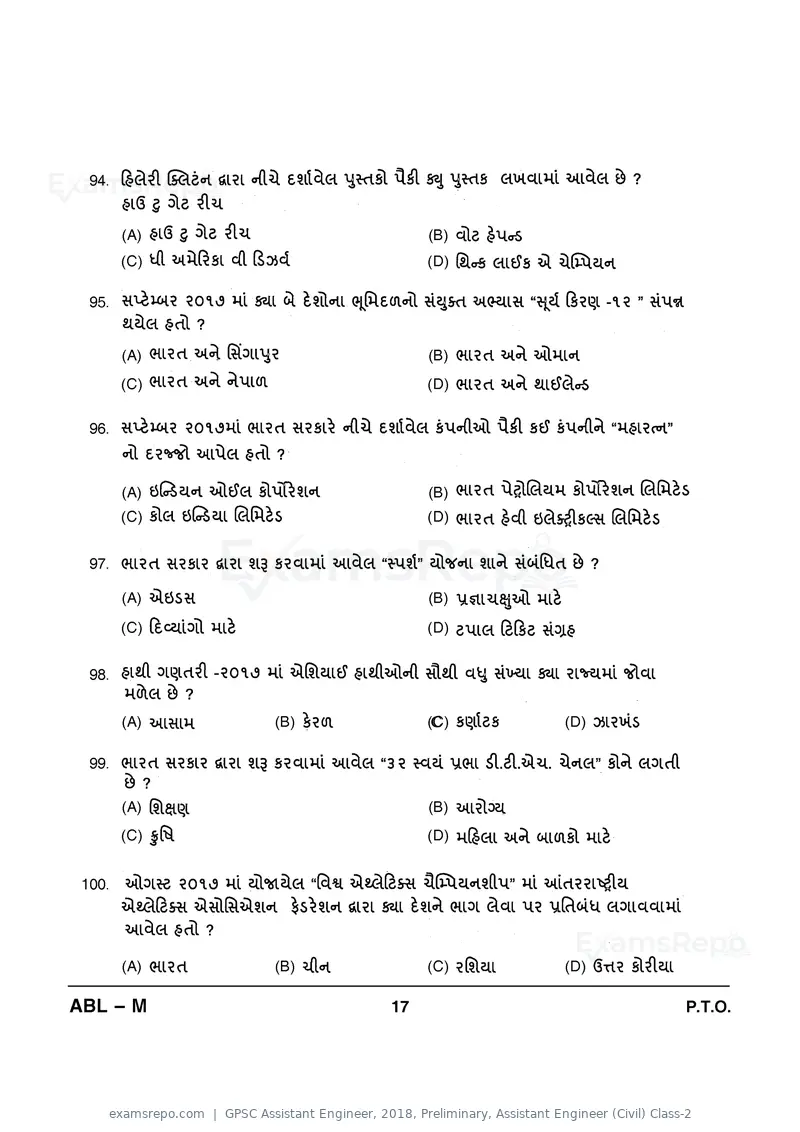
Text of page 18
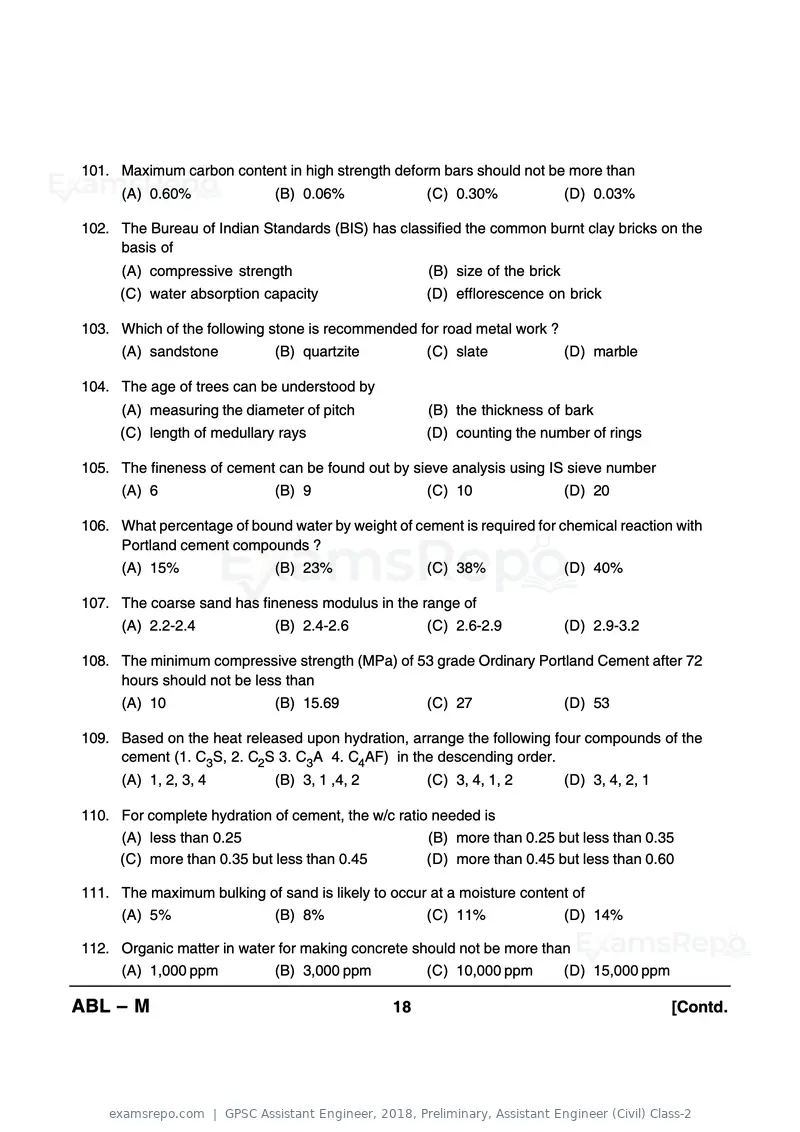
101. Maximum carbon content in high strength deform bars should not be more than
      (A) 0.60%              (B) 0.06%              (C) 0.30%               (D) 0.03%

102. The Bureau of Indian Standards (BIS) has classified the common burnt clay bricks on the
     basis of
      (A) compressive strength                      (B) size of the brick
     (C) water absorption capacity                  (D) efflorescence on brick

103. Which of the following stone is recommended for road metal work ?
      (A) sandstone          (B) quartzite          (C) slate               (D) marble

104. The age of trees can be understood by
      (A) measuring the diameter of pitch           (B) the thickness of bark
     (C) length of medullary rays                   (D) counting the number of rings

105. The fineness of cement can be found out by sieve analysis using IS sieve number
      (A) 6                  (B) 9                  (C) 10                  (D) 20

106. What percentage of bound water by weight of cement is required for chemical reaction with
     Portland cement compounds ?
      (A) 15%                (B) 23%                (C) 38%                 (D) 40%

107. The coarse sand has fineness modulus in the range of
      (A) 2.2-2.4            (B) 2.4-2.6            (C) 2.6-2.9             (D) 2.9-3.2

108. The minimum compressive strength (MPa) of 53 grade Ordinary Portland Cement after 72
     hours should not be less than
      (A) 10                 (B) 15.69              (C) 27                  (D) 53

109. Based on the heat released upon hydration, arrange the following four compounds of the
     cement (1. C3S, 2. C2S 3. C3A 4. C4AF) in the descending order.
      (A) 1, 2, 3, 4         (B) 3, 1 ,4, 2         (C) 3, 4, 1, 2          (D) 3, 4, 2, 1

110. For complete hydration of cement, the w/c ratio needed is
     (A) less than 0.25                             (B) more than 0.25 but less than 0.35
     (C) more than 0.35 but less than 0.45          (D) more than 0.45 but less than 0.60

111. The maximum bulking of sand is likely to occur at a moisture content of
     (A) 5%               (B) 8%                   (C) 11%              (D) 14%

112. Organic matter in water for making concrete should not be more than
     (A) 1,000 ppm          (B) 3,000 ppm          (C) 10,000 ppm      (D) 15,000 ppm

ABL – M                                        18                                            [Contd.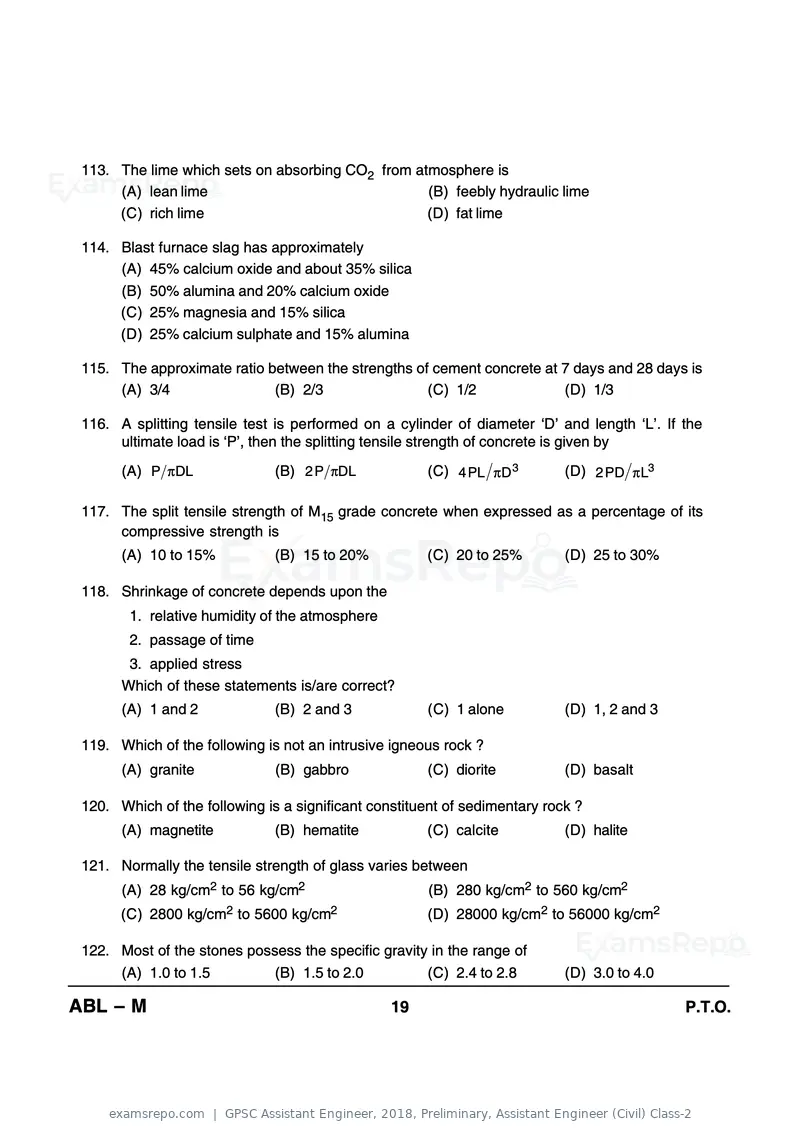
Text of page 19
113. The lime which sets on absorbing CO2 from atmosphere is
      (A) lean lime                               (B) feebly hydraulic lime
      (C) rich lime                               (D) fat lime

 114. Blast furnace slag has approximately
      (A) 45% calcium oxide and about 35% silica
      (B) 50% alumina and 20% calcium oxide
      (C) 25% magnesia and 15% silica
      (D) 25% calcium sulphate and 15% alumina

 115. The approximate ratio between the strengths of cement concrete at 7 days and 28 days is
      (A) 3/4                (B) 2/3                (C) 1/2             (D) 1/3

 116. A splitting tensile test is performed on a cylinder of diameter ‘D’ and length ‘L’. If the
      ultimate load is ‘P’, then the splitting tensile strength of concrete is given by

       (A) P πDL               (B) 2 P πDL            (C) 4 PL πD 3         (D) 2 PD πL3

 117. The split tensile strength of M15 grade concrete when expressed as a percentage of its
      compressive strength is
       (A) 10 to 15%           (B) 15 to 20%          (C) 20 to 25%         (D) 25 to 30%

 118. Shrinkage of concrete depends upon the
        1. relative humidity of the atmosphere
        2. passage of time
        3. applied stress
       Which of these statements is/are correct?
       (A) 1 and 2             (B) 2 and 3            (C) 1 alone           (D) 1, 2 and 3

 119. Which of the following is not an intrusive igneous rock ?
       (A) granite             (B) gabbro             (C) diorite           (D) basalt

 120. Which of the following is a significant constituent of sedimentary rock ?
       (A) magnetite           (B) hematite           (C) calcite           (D) halite

 121. Normally the tensile strength of glass varies between
       (A) 28 kg/cm2 to 56 kg/cm2                     (B) 280 kg/cm2 to 560 kg/cm2
       (C) 2800 kg/cm2 to 5600 kg/cm2                 (D) 28000 kg/cm2 to 56000 kg/cm2

 122. Most of the stones possess the specific gravity in the range of
      (A) 1.0 to 1.5         (B) 1.5 to 2.0          (C) 2.4 to 2.8         (D) 3.0 to 4.0

ABL – M                                          19                                          P.T.O.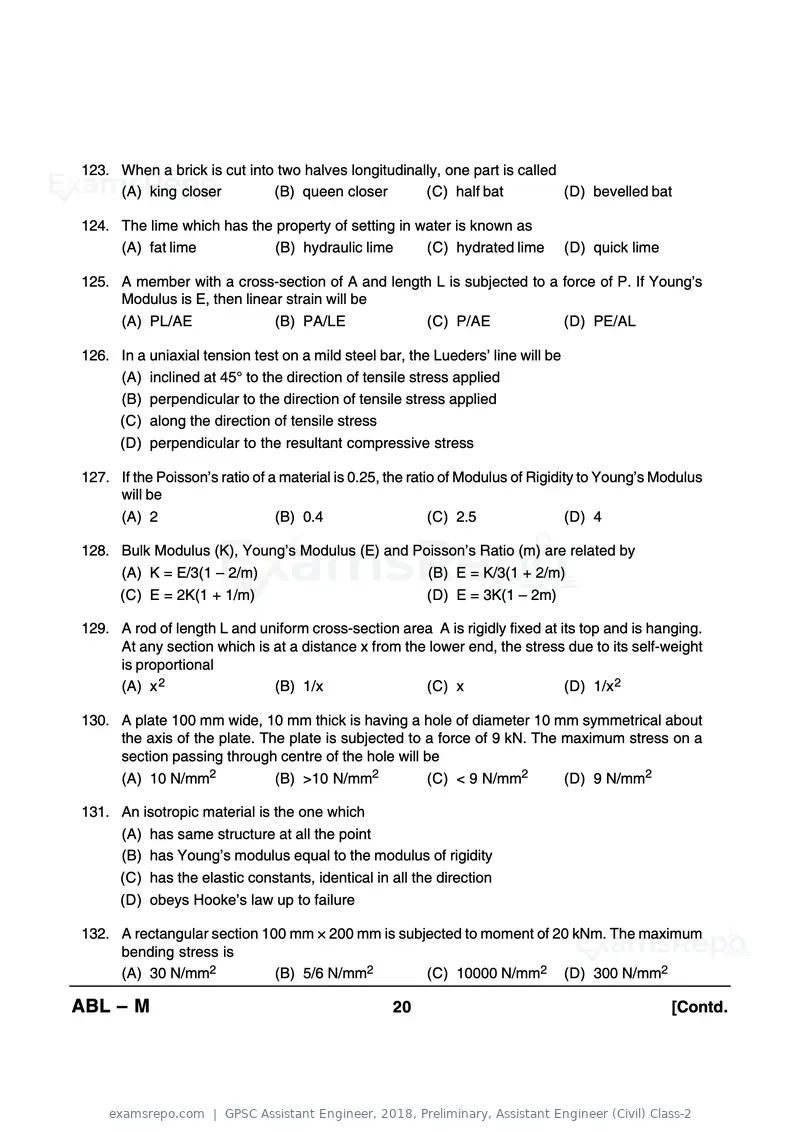
Text of page 20
123. When a brick is cut into two halves longitudinally, one part is called
     (A) king closer         (B) queen closer        (C) half bat           (D) bevelled bat

124. The lime which has the property of setting in water is known as
     (A) fat lime           (B) hydraulic lime      (C) hydrated lime            (D) quick lime

125. A member with a cross-section of A and length L is subjected to a force of P. If Young’s
     Modulus is E, then linear strain will be
     (A) PL/AE               (B) PA/LE           (C) P/AE              (D) PE/AL

126. In a uniaxial tension test on a mild steel bar, the Lueders’ line will be
     (A) inclined at 45° to the direction of tensile stress applied
     (B) perpendicular to the direction of tensile stress applied
     (C) along the direction of tensile stress
     (D) perpendicular to the resultant compressive stress

127. If the Poisson’s ratio of a material is 0.25, the ratio of Modulus of Rigidity to Young’s Modulus
     will be
     (A) 2                      (B) 0.4                    (C) 2.5                (D) 4

128. Bulk Modulus (K), Young’s Modulus (E) and Poisson’s Ratio (m) are related by
     (A) K = E/3(1 – 2/m)                        (B) E = K/3(1 + 2/m)
     (C) E = 2K(1 + 1/m)                         (D) E = 3K(1 – 2m)

129. A rod of length L and uniform cross-section area A is rigidly fixed at its top and is hanging.
     At any section which is at a distance x from the lower end, the stress due to its self-weight
     is proportional
     (A) x 2                 (B) 1/x                 (C) x                   (D) 1/x 2

130. A plate 100 mm wide, 10 mm thick is having a hole of diameter 10 mm symmetrical about
     the axis of the plate. The plate is subjected to a force of 9 kN. The maximum stress on a
     section passing through centre of the hole will be
     (A) 10 N/mm2             (B) >10 N/mm2           (C) < 9 N/mm2        (D) 9 N/mm2

131. An isotropic material is the one which
     (A) has same structure at all the point
     (B) has Young’s modulus equal to the modulus of rigidity
     (C) has the elastic constants, identical in all the direction
     (D) obeys Hooke’s law up to failure

132. A rectangular section 100 mm × 200 mm is subjected to moment of 20 kNm. The maximum
     bending stress is
     (A) 30 N/mm2            (B) 5/6 N/mm2        (C) 10000 N/mm2 (D) 300 N/mm2

ABL – M                                            20                                             [Contd.
Text of page 21
133. The assumption that the cross section plane before bending remain plane even after bending
      means
      (A) the strain in the fibres is proportional to their distances from the neutral axis
      (B) the bending moment will be resisted by the central core of the section
      (C) the stresses in the fibres are proportional to their distances from the neutral axis
      (D) the neutral axis lies at mid height

 134. A cantilever AB is subjected to a concentrated load at the free end. The slope and deflection
      at the free end are WL2/2 EI and WL3/3 EI. If the same load is applied at mid-span point, the
      deflection at the free end will be
      (A) 5 WL3/384 EI         (B) 5 WL3/48 EI         (C) WL3/6 EI          (D) WL3/16 EI

 135. The expression EI(d4y/dx4) at any section for a beam is equal to
       (A) load intensity at the section               (B) S. F. at the section
       (C) B. M. at the section                        (D) the slope at that section

 136. If a shaft is subjected to pure twisting moment, an element on the surface is subjected to
      (A) normal tensile stress                        (B) normal compressive stress
      (C) pure shear stress                            (D) bending stress

 137. The maximum shear stress produced in a shaft is 5 N/mm2. The shaft is of 40 mm diameter.
      The value of twisting moment is
      (A) 628 Nm             (B) 62.8 Nm            (C) 125.6 Nm         (D) 1256 Nm

 138. What is tenacity ?
      (A) ultimate strength in tension                 (B) ultimate strength in compression
      (C) ultimate shear stress                        (D) ultimate impact strength

 139. When a shaft of diameter d is subjected to a bending moment M and torque T, the equivalent
      B. M. is given by

             M + M2 + T 2                                    M − M2 + T 2
       (A)                                             (B)
                 2                                               2

             16                                              32
       (C)      3
                  M + M2 + T2                          (D)      4
                                                                  M + M2 + T2
             πd                                              πd

 140. The work done to strain a material within elastic limits is known as
      (A) resistance         (B) virtual work         (C) resilience       (D) work modulus

 141. A pull of 20 t is suddenly applied to a rod of cross-sectional area 40 cm2. The stress
      produced in the rod is equal to
      (A) 0.5 t/cm2           (B) 1.0 t/cm2         (C) 2.0 t/cm2        (D) 4 t/cm2

ABL – M                                          21                                             P.T.O.
Text of page 22
142. Let the strains produced in length and diameter of the cylindrical rod be α and β respectively.
     Then the volumetric strain is given by
      (A) α + 2β               (B) α + β               (C) α − β             (D) α − 2β

143. A rod of length L is hanging vertically and carries a load P at the bottom. If the weight per
     unit length of the rod be w, then the tensile force in the rod at a distance y from the support
     is given by
     (A) P                    (B) P – wy               (C) P + wy              (D) P + w(L – y)

144. The moment of inertia of a rectangular section about the base is
     (A) twice the moment of inertia about the centroidal axis
     (B) three times the moment of inertia about the centroidal axis
     (C) four times the moment of inertia about the centroidal axis
     (D) six times the moment of inertia about the centroidal axis

145. Which of the following represents the shear force at a section of the beam ?

               d4 y                     d3 y                    d2 y                  dy
      (A) EI                   (B) EI                  (C) EI                (D) EI
               dx 4                     dx 3                    dx 2                  dx

146. A rectangular beam carries a maximum bending moment of M. If its depth is doubled, its
     moment carrying capacity will be
      (A) M                    (B) 2 M                 (C) 3 M               (D) 4 M

147. A simply supported beam of span L carrying a uniformly distributed load registers a deflection
     of y cm at the centre. If the span of the beam is doubled, the deflection at the centre for the
     same uniformly distributed load would be
      (A) 2y                   (B) 4y                  (C) 8y                (D) 16y

148. Two beams, one having a square cross-section and another having a circular cross-section,
     are subjected to the same amount of bending moment. If the cross-sectional area as well
     as the material of both the beams are same then
      (A) maximum bending stress developed in both the beams is the same
      (B) the circular beam experiences more bending stress than the square one
      (C) the square beam experiences more bending stress than the circular one
      (D) both the beams will experience the same deformation

149. A rectangular section has dimensions of 10 cm x 20 cm. The ratio of the moment of inertia
     about x-axis passing through its centroid to the moment of inertia about y-axis passing
     through its centroid is equal to
      (A) 8                    (B) 4                   (C) 6                 (D) 2

ABL – M                                           22                                           [Contd.
Text of page 23
150. Arrange the following sections in increasing torsional stiffness :
        1. Open ring section
        2. Close ring section
        3. L-section
        4. Circular disk section
       (A) 1, 2, 3, 4           (B) 3, 1, 2, 4           (C) 3, 2, 1, 4         (D) 4, 3, 1, 2

 151. Torsional failure surface of ductile material occurs at
       (A) transverse plane                              (B) 60° to the transverse plane
       (C) 45° to the transverse plane                   (D) any random plane

 152. State true or false :
        1. Any two orthogonal surfaces are sufficient to completely specify the principal stresses for
           a biaxial state of stress.
        2. Only one surface is required to specify the maximum shear stress completely.
       (A) 1 is true but 2 is false                      (B) 1 is false, but 2 is true
       (C) both 1 and 2 are true                         (D) both 1 and 2 are false

 153. Which of the following yield criteria are suitable for ductile and isotropic material ?
        1. Maximum normal stress theory
        2. Maximum shear stress theory
        3. Maximum energy distortion theory
        4. Maximum compressive theory
       (A) 1 and 2
       (B) 2 and 3
       (C) 1, 2 and 3
       (D) 1, 2, 3 and 4

 154. Which one of the following is conservative failure theory for brittle material ?
       (A) Maximum normal stress theory                  (B) Maximum shear theory
       (C) Coulomb-Mohr theory                           (D) St. Venant theory

 155. Statistically indeterminate beam can be solved by :
        1. Displacement method
        2. Energy Method
        3. Matrix Method
        4. Four moment equation Method
       (A) 1 and 2              (B) 2 and 3              (C) 1, 2 and 3         (D) 1, 2, 3 and 4

ABL – M                                            23                                               P.T.O.
Text of page 24
156. Structures having more reactions than that required for necessary and sufficient conditions
     are
      1. Hyperstatic
      2. Determinate
      3. Indeterminate
      4. Hypostatic
     (A) Only 1             (B) 1 and 3             (C) Only 2           (D) 2 and 4

157. Maximum deflection at mid-span of a simply supported beam with UDL is

            WL3                      5WL3                   5WL4                  5WL4
      (A)                      (B)                    (C)                   (D)
            48EI                     48EI                   384EI                 48EI

158. Unit load method is based on
     (A) internal strain energy                       (B) theorem of minimum potential energy
     (C) theorem of minimum deflection                (D) Castigliano’s theorem

159. Deflection of simply supported beam at mid-span under a concentrated load is

            WL3                      WL2                    WL3                   WL3
      (A)                      (B)                    (C)                   (D)
            48EI                     8EI                    3EI                   96EI

160. Williot-Mohr diagram is used to find
     (A) displacement in a structure                  (B) settlement of a structure
      (C) strain energy in a structure                (D) principal stresses in a structure

161. A circle is marked on a mild steel plate and then it is subjected to two normal stresses is a
     mutually perpendicular direction along with simple shear. After the loading, the circle
      (A) assumes the shape of a ellipse              (B) assumes the shape of a cycloid
      (C) remains as a circle                         (D) assumes the shape of a square

162. Flexibility method is also called as :
       1. force method
       2. compatibility method
       3. consistent deformation method
      (A) Only 1            (B) 1 and 2               (C) 1 and 3           (D) 1, 2 and 3

163. Matrix stiffness method
       1. forms the basis for computerization
       2. yields the displacements and forces in one go
       3. can be used to analyse both determinate and indeterminate structure
      (A) 1 and 2           (B) 1 and 3            (C) 2 and 3          (D) 1, 2 and 3

ABL – M                                          24                                           [Contd.
Text of page 25
164. Depending on the transmission of loads to joints, bridges are classified as
      (A) Deck type         (B) Pratt type           (C) Warren type        (D) Howe type

 165. The tensile strength of concrete to be used in the design of reinforced concrete member is

       (A) 0.2 fck             (B) 0.1 fck             (C) 0.7 fck           (D) zero

 166. In the fourth amendment May 2013 of IS 456-2000, M60 grade has been shifted to
      (A) standard concrete from high strength concrete
      (B) high strength concrete from high strength standard concrete
      (C) standard concrete from an ordinary concrete
      (D) ordinary concrete from a standard concrete

 167. The modulus of elasticity E = 5000 fck where fck is the characteristic compressive strength
       of concrete specified in IS:456-2000 is based on
       (A) tangent modulus                            (B) initial tangent modulus
       (C) secant modulus                             (D) chord modulus

 168. The minimum percentage of tension reinforcement in R.C.C. beams is
              85                                                                    0.4bs
       (A) </ f                (B) </ 6                (C) </ 4              (D) </ 0.87f
               y                                                                         y


 169. The maximum diameter of the reinforcement bars in R.C.C. beam is limited to
      (A) 28 mm
      (B) 40 mm
      (C) one-eighth of the least dimension of the beams
      (D) one-tenth of the depth of beams

 170. If W is the load per unit area on a circular slab of radius R, then the maximum radial moment
      at the centre of a simply supported slab is equal to

             WR2                                             2WR2
       (A)                                             (B)
              16                                              16

           3WR2                                            5WR2
       (C)                                             (D)
            16                                              16

 171. The lap length of a direct tension reinforcement bar in a R.C.C. beams should be more than
      (A) 16 times the diameter of the bar
      (B) 48 times the diameter of the bar
      (C) thrice the development length or 24 times the diameter of the bar
      (D) twice the development length or 30 times the diameter of the bar

ABL – M                                          25                                             P.T.O.
Text of page 26
172. The minimum vertical space of the main reinforcement in R.C.C. beam is
     (A) the diameter of the larger bar or 5 mm more than the nominal maximum size of the coarse
         aggregate
     (B) the diameter of the larger bar or two-thirds the nominal maximum size of the coarse aggregate
     (C) 5 mm more than the diameter of the bar
     (D) 15 mm

173. A column is regarded as long column if the ratio of its effective length to least lateral radius
     of gyration is more than
     (A) 150                  (B) 100                (C) 60                  (D) 40

174. The minimum percentage of longitudinal reinforcement in R.C.C. column is
     (A) 6               (B) 0.8                   (C) 1.2             (D) 4

175. If ‘w’ is the weight per unit volume, ‘p’ the safe bearing capacity, and ‘ ϕ ’ is the angle of
     repose of the soil retained by the retaining wall, the minimum depth of foundation to be
     calculated as
                              2                           2
          p ⎛ 1 − sin ϕ ⎞             p ⎛ 1 + sin ϕ ⎞              p ⎛ 1 − sin ϕ ⎞         p ⎛ 1 + sin ϕ ⎞
      (A)    ⎜            ⎟       (B)    ⎜            ⎟        (C) w ⎜⎜ 1 + sin ϕ ⎟⎟   (D) w ⎜⎜ 1 − sin ϕ ⎟⎟
          w ⎜⎝ 1 + sin ϕ ⎟⎠           w ⎜⎝ 1 − sin ϕ ⎟⎠               ⎝            ⎠          ⎝            ⎠

176. The minimum percentage of mild steel reinforcement to be provided in any direction in a
     retaining wall is
     (A) 0.12            (B) 0.15                 (C) 0.20           (D) 0.22

177. Normally counterforts in a retaining wall are spaced at an interval of
     (A) > 2m                                        (B) 1/3 to 1/2 of the height of the wall
     (C) 2 times the height of the wall              (D) 4.5 m to 5.5 m

178. If ‘p’ is the net upward pressure on a square footing of side ‘b’ for a square column of side
     ‘a’, the maximum bending moment is given by

            pb2                         pb(b − a)2                   p.b.a 2                 p(b − a)2
      (A)                         (B)                          (C)                     (D)
             8                              8                           8                        8

179. Two way shear in a R.C.C. footing is checked at a distance equal to ____________ of the
     footing from the face of the column.
     (A) one-fourth of the effective depth         (B) one-half of the effective depth
     (C) three-fourth of the effective depth       (D) the effective depth

180. The amount of reinforcement provided in precast concrete piles is usually governed by
     (A) hammer force                             (B) direct load on the pile
     (C) frictional resistance                    (D) handling forces

ABL – M                                                   26                                              [Contd.
Text of page 27
181. The allowable tension stress due to bending for M20 concrete in R.C.C. water tanks is
      (in N/mm2)
       (A) 1.2                   (B) 1.5                   (C) 1.7                (D) 2.0

 182. For sections up to a thickness of 100 mm, the minimum area of mild steel reinforcement to
      be provided in walls, floors and roofs of water tank in two particular directions should be
      (A) 0.2% of the concrete section                 (B) 0.3% of the concrete section
       (C) 0.5% of the concrete section                    (D) 0.8% of the concrete section

 183. Which of the following losses of prestress occurs only in pre-tensioning and not in
      post-tensioning ?
       (A) elastic shortening of concrete                  (B) shrinkage of concrete
       (C) creep of concrete                               (D) loss due to friction

 184. For pre-tensioned prestressed concrete, the grade of concrete shall be not less than
       (A) M 30                  (B) M 40                  (C) M 50               (D) M 60

 185. The maximum compressive strain permitted in R.C.C. columns at failure load is
       (A) 0.002                 (B) 0.003                 (C) 0.035              (D) 0.004

 186. A soft storey is characterised by vertical discontinuity in
       (A) strength              (B) stiffness             (C) infill wall        (D) size of shear wall

 187. A simply supported beam shall be deemed to be a deep beam when the ratio of the effective
      span (L) to the overall depth (D) is
       (A) less than 2.0         (B) more than 2.0         (C) less than 2.5      (D) more than 2.5

 188. In working stress design, if the modular ratio is ‘m’, steel ratio is ‘r’, the critical neutral axis
      constant ‘k’ is given by
            m                         m                          m+r                    m −r
       (A) m − r                 (B) m + r                 (C)                    (D)
                                                                  m                      m

 189. Expansion joints are provided if the lengths of the concrete structure exceeds
      (A) 35 m               (B) 45 m                  (C) 15 m             (D) 25 m

 190. In case of staggered pitch, pitch may be ___________ of values specified for not staggered
      pitch.
      (A) increased by 20%                           (B) increased by 50%
      (C) decreased by 20%                           (D) decreased by 50%

 191. For commonly used HSFG bolts (IS1367 part3, grade 8.8) yield stress fyb is
       (A) 280 N/mm2             (B) 360 N/mm2             (C) 640 N/mm2          (D) 940 N/mm2

ABL – M                                              27                                                P.T.O.
Text of page 28
192. The prying forces are additional
     (A) shearing forces on the bolts because of long joint
     (B) bending forces on the bolts because of long joint
     (C) tensile forces due to the flexibility of connected parts leading to deformation
     (D) forces due to friction between the connected parts

193. The minimum size of the fillet weld that can be used is
     (A) 2 mm              (B) 3 mm                  (C) 4 mm                (D) 5 mm

194. For a tension member, the design shear capacity of bolts carrying shear through packing
     plate in excess of 6 mm shall be decreased by a factor of (Note: tpk is the thickness of the
     thicker packing plate)
     (A) 1-0.125 tpk        (B) 1-0.0125 tpk       (C) 1-0.250 tpk         (D) 1-0.0250 tpk

195. If the effective length of a prismatic compression member is 0.8 L, then the support conditions
     should be (Note: L is the unsupported length)
     (A) at one end both rotation and translation is restrained, whereas at the other end translation is
           restrained, but the rotation is free
     (B) at both ends both translation and rotation are restrained
     (C) at both ends translations are restrained but rotations are free
     (D) at one end translation is restrained while at the other end rotation is restrained

196. Lacing bar shall be inclined at an angle θ which should be between
     (A) 20°-50°              (B) 30°-60°           (C) 40°-70°         (D) 50°-80°

197. The slenderness ratio of lacing bar should not exceed
     (A) 135                (B) 145                 (C) 155                  (D) 165

198. The thickness of battens shall be
     (A) 1/10th of effective length of batten
      (B) 1/15th of effective length of batten
      (C) 1/10th of the distance between the innermost connecting lines of rivets, bolt or welds
      (D) 1/15th of the distance between the innermost connecting lines of rivets, bolt or welds

199. The design compressive stress of an axially loaded compression member in IS-800-2007
     is given by
     (A) Rankine formula                            (B) Secant formula
     (C) Merchant Rankine formula                  (D) Perry Robertson formula

200. An example of light moment connection is
     (A) framed connection                             (B) unstiffened seat connection
     (C) clip angle connection                         (D) split beam connection

ABL – M                                          28                                           [Contd.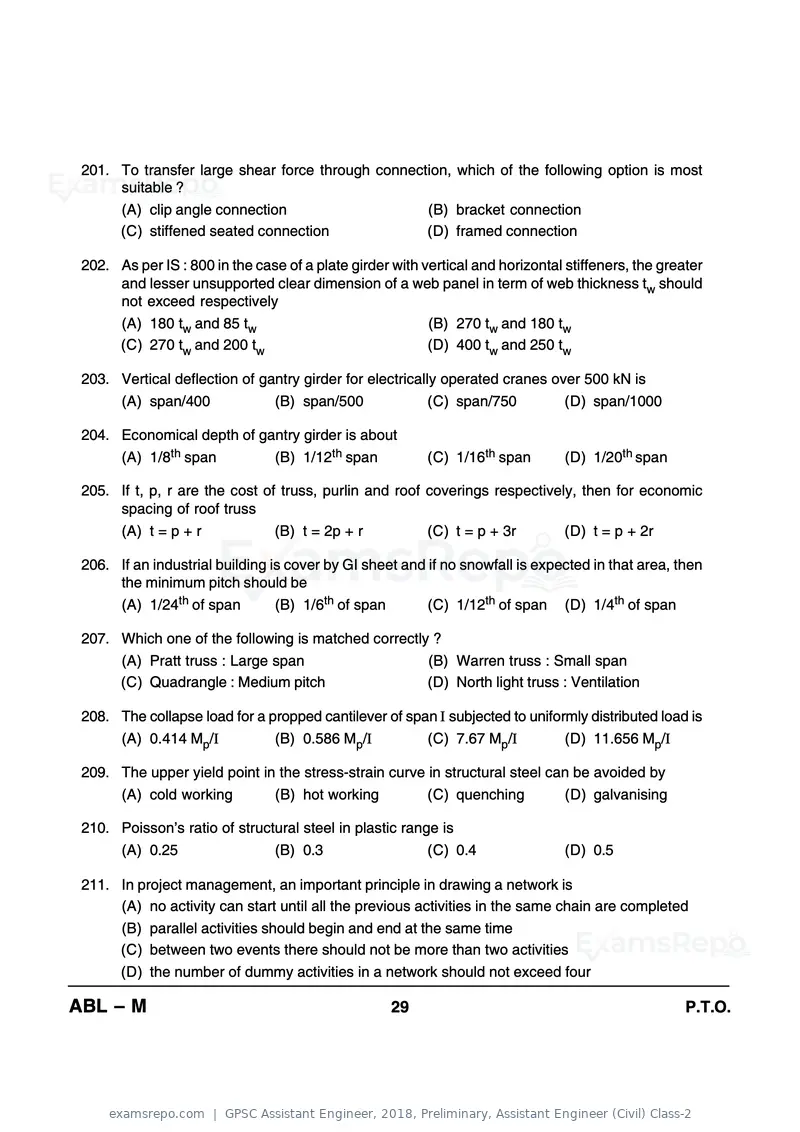
Text of page 29
201. To transfer large shear force through connection, which of the following option is most
      suitable ?
      (A) clip angle connection                    (B) bracket connection
      (C) stiffened seated connection              (D) framed connection

 202. As per IS : 800 in the case of a plate girder with vertical and horizontal stiffeners, the greater
      and lesser unsupported clear dimension of a web panel in term of web thickness tw should
      not exceed respectively
      (A) 180 tw and 85 tw                                (B) 270 tw and 180 tw
      (C) 270 tw and 200 tw                               (D) 400 tw and 250 tw

 203. Vertical deflection of gantry girder for electrically operated cranes over 500 kN is
      (A) span/400             (B) span/500               (C) span/750        (D) span/1000

 204. Economical depth of gantry girder is about
      (A) 1/8th span        (B) 1/12th span               (C) 1/16th span        (D) 1/20th span

 205. If t, p, r are the cost of truss, purlin and roof coverings respectively, then for economic
      spacing of roof truss
      (A) t = p + r             (B) t = 2p + r          (C) t = p + 3r       (D) t = p + 2r

 206. If an industrial building is cover by GI sheet and if no snowfall is expected in that area, then
      the minimum pitch should be
      (A) 1/24th of span         (B) 1/6th of span       (C) 1/12th of span (D) 1/4th of span

 207. Which one of the following is matched correctly ?
      (A) Pratt truss : Large span                   (B) Warren truss : Small span
      (C) Quadrangle : Medium pitch                  (D) North light truss : Ventilation

 208. The collapse load for a propped cantilever of span I subjected to uniformly distributed load is
      (A) 0.414 Mp/I           (B) 0.586 Mp/I          (C) 7.67 Mp/I          (D) 11.656 Mp/I

 209. The upper yield point in the stress-strain curve in structural steel can be avoided by
      (A) cold working        (B) hot working          (C) quenching         (D) galvanising

 210. Poisson’s ratio of structural steel in plastic range is
      (A) 0.25                 (B) 0.3                   (C) 0.4                 (D) 0.5

 211. In project management, an important principle in drawing a network is
      (A) no activity can start until all the previous activities in the same chain are completed
      (B) parallel activities should begin and end at the same time
      (C) between two events there should not be more than two activities
      (D) the number of dummy activities in a network should not exceed four

ABL – M                                             29                                               P.T.O.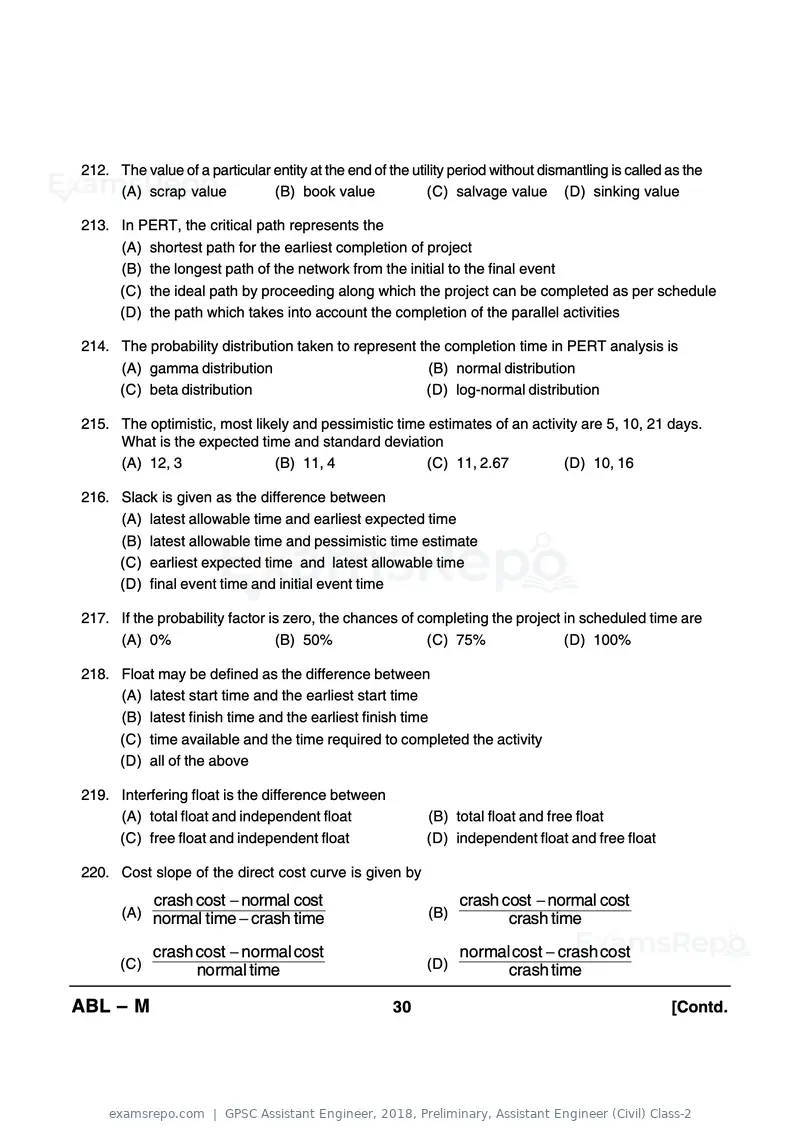
Text of page 30
212. The value of a particular entity at the end of the utility period without dismantling is called as the
     (A) scrap value           (B) book value              (C) salvage value (D) sinking value

213. In PERT, the critical path represents the
     (A) shortest path for the earliest completion of project
     (B) the longest path of the network from the initial to the final event
     (C) the ideal path by proceeding along which the project can be completed as per schedule
     (D) the path which takes into account the completion of the parallel activities

214. The probability distribution taken to represent the completion time in PERT analysis is
     (A) gamma distribution                            (B) normal distribution
     (C) beta distribution                            (D) log-normal distribution

215. The optimistic, most likely and pessimistic time estimates of an activity are 5, 10, 21 days.
     What is the expected time and standard deviation
     (A) 12, 3                (B) 11, 4              (C) 11, 2.67          (D) 10, 16

216. Slack is given as the difference between
     (A) latest allowable time and earliest expected time
     (B) latest allowable time and pessimistic time estimate
     (C) earliest expected time and latest allowable time
     (D) final event time and initial event time

217. If the probability factor is zero, the chances of completing the project in scheduled time are
     (A) 0%                     (B) 50%                 (C) 75%               (D) 100%

218. Float may be defined as the difference between
     (A) latest start time and the earliest start time
     (B) latest finish time and the earliest finish time
     (C) time available and the time required to completed the activity
     (D) all of the above

219. Interfering float is the difference between
     (A) total float and independent float                 (B) total float and free float
     (C) free float and independent float                  (D) independent float and free float

220. Cost slope of the direct cost curve is given by
            crash cost − normal cost                             crash cost − normal cost
      (A) normal time − crash time                         (B)          crash time
            crash cost − normal cost                             normal cost − crash cost
      (C)         normal time                              (D)         crash time

ABL – M                                              30                                              [Contd.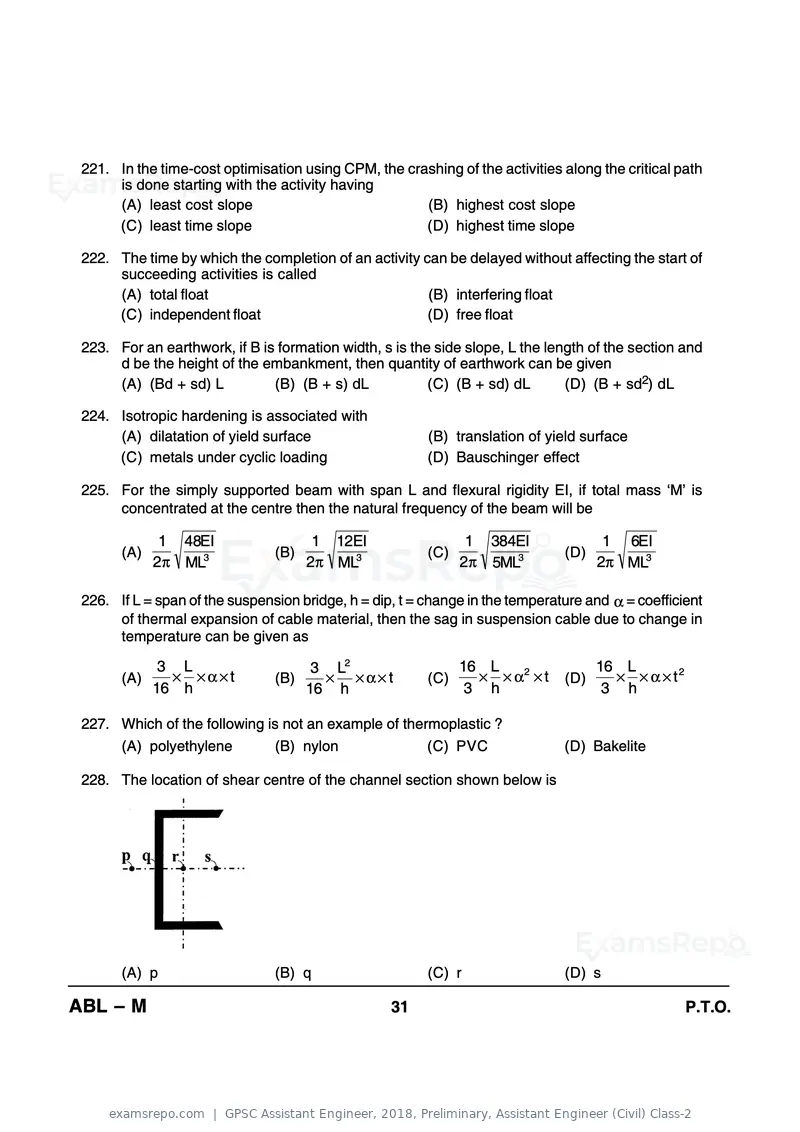
Text of page 31
221. In the time-cost optimisation using CPM, the crashing of the activities along the critical path
      is done starting with the activity having
      (A) least cost slope                            (B) highest cost slope
      (C) least time slope                            (D) highest time slope

 222. The time by which the completion of an activity can be delayed without affecting the start of
      succeeding activities is called
      (A) total float                                  (B) interfering float
      (C) independent float                            (D) free float

 223. For an earthwork, if B is formation width, s is the side slope, L the length of the section and
      d be the height of the embankment, then quantity of earthwork can be given
      (A) (Bd + sd) L          (B) (B + s) dL            (C) (B + sd) dL       (D) (B + sd2) dL

 224. Isotropic hardening is associated with
      (A) dilatation of yield surface                    (B) translation of yield surface
      (C) metals under cyclic loading                    (D) Bauschinger effect

 225. For the simply supported beam with span L and flexural rigidity EI, if total mass ‘M’ is
      concentrated at the centre then the natural frequency of the beam will be

              1 48EI                   1 12EI                   1 384EI               1 6EI
       (A)                      (B)                      (C)                   (D)
             2π ML3                   2π ML3                   2π 5ML3               2π ML3

 226. If L = span of the suspension bridge, h = dip, t = change in the temperature and α = coefficient
      of thermal expansion of cable material, then the sag in suspension cable due to change in
      temperature can be given as

            3 L                      3 L2                      16 L                  16 L
       (A)   × ×α×t             (B)   × × α× t           (C)     × × α2 × t    (D)     × × α × t2
           16 h                     16 h                        3 h                   3 h

 227. Which of the following is not an example of thermoplastic ?
      (A) polyethylene        (B) nylon               (C) PVC                  (D) Bakelite

 228. The location of shear centre of the channel section shown below is


       (A) p                    (B) q                    (C) r                 (D) s

ABL – M                                            31                                               P.T.O.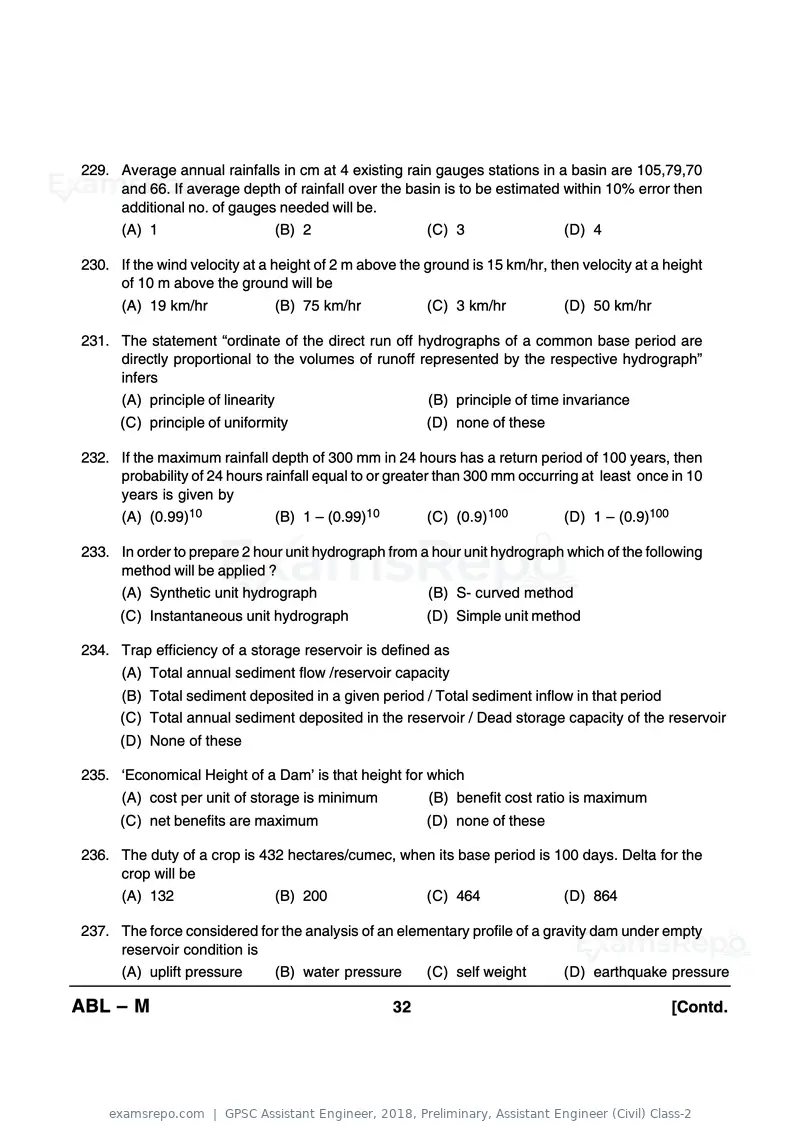
Text of page 32
229. Average annual rainfalls in cm at 4 existing rain gauges stations in a basin are 105,79,70
     and 66. If average depth of rainfall over the basin is to be estimated within 10% error then
     additional no. of gauges needed will be.
     (A) 1                   (B) 2                    (C) 3                 (D) 4

230. If the wind velocity at a height of 2 m above the ground is 15 km/hr, then velocity at a height
     of 10 m above the ground will be
      (A) 19 km/hr             (B) 75 km/hr            (C) 3 km/hr           (D) 50 km/hr

231. The statement “ordinate of the direct run off hydrographs of a common base period are
     directly proportional to the volumes of runoff represented by the respective hydrograph”
     infers
     (A) principle of linearity                      (B) principle of time invariance
      (C) principle of uniformity                      (D) none of these

232. If the maximum rainfall depth of 300 mm in 24 hours has a return period of 100 years, then
     probability of 24 hours rainfall equal to or greater than 300 mm occurring at least once in 10
     years is given by
     (A) (0.99)10              (B) 1 – (0.99)10          (C) (0.9) 100       (D) 1 – (0.9)100

233. In order to prepare 2 hour unit hydrograph from a hour unit hydrograph which of the following
     method will be applied ?
     (A) Synthetic unit hydrograph                    (B) S- curved method
      (C) Instantaneous unit hydrograph                (D) Simple unit method

234. Trap efficiency of a storage reservoir is defined as
      (A) Total annual sediment flow /reservoir capacity
      (B) Total sediment deposited in a given period / Total sediment inflow in that period
      (C) Total annual sediment deposited in the reservoir / Dead storage capacity of the reservoir
      (D) None of these

235. ‘Economical Height of a Dam’ is that height for which
      (A) cost per unit of storage is minimum          (B) benefit cost ratio is maximum
      (C) net benefits are maximum                     (D) none of these

236. The duty of a crop is 432 hectares/cumec, when its base period is 100 days. Delta for the
     crop will be
     (A) 132                 (B) 200              (C) 464               (D) 864

237. The force considered for the analysis of an elementary profile of a gravity dam under empty
     reservoir condition is
     (A) uplift pressure    (B) water pressure       (C) self weight        (D) earthquake pressure

ABL – M                                           32                                           [Contd.
Text of page 33
238. Sprinkler irrigation system is suitable when
      (A) the land gradient is steep and the soil is easily erodible
      (B) the soil is having low permeability
      (C) the water table is low
      (D) the crops to be grown have deep roots

 239. The amount of irrigation water required to meet the evapotranspiration needs of the crop
      during its full growth is called
      (A) Variable Irrigation requirement           (B) Effective irrigation requirement
      (C) Consumptive irrigation requirement        (D) Net irrigation requirement

 240. A tube well having a capacity of 4 m3 per hour operates for 20 hours each day during the
      irrigation season. How much area can be commanded if the irrigation interval is 20 days
      and depth of irrigation is 7 cm
      (A) 1.71 × 10⁴ m2         (B) 1.14 × 10⁴ m2   (C) 22.9 × 10⁴ m2 (D) 2.29 × 10⁴ m2

 241. A channel designed by Lacey’s theory has a mean velocity of 1 m/sec. If silt factor is unity,
      then hydraulic mean radius will be
      (A) 1.5 m             (B) 2 m                (C) 2.5 m            (D) 1 m

 242. When the outflow from a storage reservoir is uncontrolled as in a freely operating spillway,
      the peak of outflow hydrograph occurs at
      (A) the point of intersection of the inflow and outflow hydrographs
      (B) a point after the intersection of the inflow and outflow hydrographs
      (C) the tail of inflow hydrograph
      (D) a point before the intersection of the inflow and outflow hydrographs

 243. The vertical hydraulic conductivity of the top soil at certain stage is 0.2 cm/hr. A storm of
      intensity 0.5 cm/h occurs over the soil for an indefinite period. Assuming the surface drainage
      to be adequate, the infiltration rate after the storm has lasted for a very long time shall be
      (A) < 0.2 cm/hr                                     (B) 0.2 cm/hr
      (C) between 0.2 and 0.5 cm/hr                       (D) 0.5 cm/hr

 244. A catchment consists of 35 % area with runoff coefficient 0.45 with the remaining 65 % area
      with runoff coefficient 0.55. The equivalent runoff coefficient will be
      (A) 0.505                 (B) 0.515              (C) 0.500              (D) 0.450

 245. A linear reservoir is one in which
      (A) Storage varies linearly with time
      (B) Storage varies linearly with outflow rate
      (C) Storage varies linearly with inflow rate
      (D) Storage varies linearly with elevation

ABL – M                                           33                                              P.T.O.
Text of page 34
246. A canal was designed to supply the irrigation needs of 1200 hectares of land growing rice of
     140 days base period having a Delta of 134 cms. If this canal water is used to irrigate wheat of
     base period 120 days having a Delta of 52 cm, the area (in hectares) that can be irrigated is
      (A) 2650                  (B) 3608                 (C) 543                (D) None of these

247. The consumptive use of water for a crop during a particular stage of growth is 2.0 mm/day.
     The maximum depth of available water in the root zone is 60 mm. Irrigation is required when
     the amount of available water is 50% of the maximum available water in the root zone.
     Frequency of irrigation should be
      (A) 10 days               (B) 15 days              (C) 20 days            (D) 25 days

248. As per the Lacey’s method for design of alluvial channels, identify the TRUE statement
     from the following :
      (A) Wetted perimeter increases with an increase in design discharge.
      (B) Hydraulic radius increases with an increase in slit factor.
      (C) Wetted perimeter decreases with an increase in design discharge.
      (D) Wetted perimeter increases with an increase in slit factor.

249. Submerged unit weight is based on principle of
      (A) Darcy                 (B) Terzaghi             (C) Archmedis          (D) Reynolds

250. The specific gravity of soil sample is 2.7 and its void ratio is 0.945. When it is fully saturated,
     the moisture content of the soil will be
      (A) 2.8 %                 (B) 25 %                 (C) 35 %               (D) 95 %

251. Stoke’s law is applicable for spheres of diameter ranging between
      (A) 0.002 to 0.0002 mm                              (B) 0.2 to 0.0002 mm
      (C) 0.02 to 0.0002 mm                              (D) 2 to 0.02 mm

252. The admixture of sand or silt to clay causes
      (A) Decrease in liquid limit and increase in plasticity index
      (B) Decrease in liquid limit and no change in plasticity index
      (C) Decrease in both liquid limit and plasticity index
      (D) Increase in both liquid limit and plasticity index

253. According to IS Classification system, the soils can be classified into
      (A) 18 Groups             (B) 15 Groups            (C) 3 Groups           (D) 7 Groups

254. A soil has the liquid limit of 60 % and plastic limit of 20 %. Then the classification of soil as
     per IS soil classification system is
     (A) CL                    (B) CI                   (C) CH                (D) MH

ABL – M                                             34                                            [Contd.
Text of page 35
255. Flow between any two points in a soil depends only on the difference in
       (A) Pressure head       (B) Total head            (C) Velocity head     (D) Datum head

 256. The coefficient of permeability of a soil is 4 × 10 -5 cm/sec for a certain pore fluid. If the
      viscosity of the pore fluid is reduced to half, then the coefficient of permeability will be
       (A) 4 × 10⁻⁵ cm/sec                               (B) 8 × 10⁻⁵ cm/sec
       (C) 2 × 10⁻⁵ cm/sec                               (D) 16 × 10-5 cm/sec

 257. Due to rise in temperature , the viscosity and unit weight at percolating fluid are reduced to
      70 % and 90 % respectively. Other things being constant, the change in coefficient of
      permeability will be
       (A) 20.0 %              (B) 28.6 %                (C) 63.0 %            (D) 77.8 %

 258. The permeability of a soil deposit in-situ can be best obtained by
       (A) Falling head permeameter                      (B) Constant head permeameter
       (C) Pumping test                                  (D) Yield test

 259. The hydraulic head that would produce a quick condition in a sand stratum of thickness of
      2 m, if G = 2.7 and e = 0.7, is
       (A) 0.5                 (B) 2                     (C) 1                 (D) 2.5

 260. The value of hydraulic gradient corresponding to zero resultant body force is called the
       (A) Critical hydraulic gradient                   (B) Effective hydraulic gradient
       (C) Total hydraulic gradient                      (D) Zero hydraulic gradient

 261. Piping occurs when
       (A) Effective stress is zero                      (B) Flow is downwards
       (C) Flow is upwards                               (D) Flow is horizontal

 262. The quantity of seepage depends on which of the following statements ?
        1. The coefficient of permeability
        2. The differential head across the flow path
        3. The length of flow path
       (A) 1 and 2             (B) 1, 2 and 3            (C) 1 and 3           (D) 2 and 3

 263. A clay layer of thickness 10 cm and initial void ratio 0.5 undergoes settlement so that the
      final void ratio is 0.2. The settlement of the layer in cm is
       (A) 1                   (B) 1.5                   (C) 2                 (D) 2.5

 264. The unit of coefficient of consolidation is
       (A) cm/sec              (B) cm2 /sec              (C) cm/sec 2          (D) No unit

ABL – M                                             35                                           P.T.O.
Text of page 36
265. Secondary consolidation is
     (A) Caused by hydrodynamic lag
     (B) Caused by creep
     (C) Large for the pressures below the pre consolidation pressure
     (D) Very small for highly plastic clays and organic clays

266. Two identically clay samples of the same size designated as A and B are subjected to
     consolidation under identical conditions. Drainage takes place through one face in sample A
     and through both the faces in sample B. 50% consolidation of sample A occurs in 10 minutes.
     The time required for 50 % consolidation to occur in sample B in minutes will be
     (A) 40                  (B) 10                   (C) 5                (D) 2.5

267. The failure plane in direct shear test is
     (A) Vertical             (B) Horizontal            (C) Inclined           (D) None

268. If the cohesion of a pure clay found in an unconfined compressive strength test is 1 kg/cm2,
     then its unconfined compressive strength in kg/cm2 is
      (A) 0.5                  (B) 2                    (C) 1                  (D) 4

269. In an undrained triaxial compression test, the sample failed at a deviator stress of 200 kN/m2
     when the cell pressure was 100 kN/m2. The cohesion intercept in this case would be
     (A) 200 kN/m2             (B) 100 kN/m2          (C) 300 kN/m2          (D) 50 kN/m2

270. In a compaction test if the compacting effort is increased, it will result in
     (A) Increase in maximum dry density and the Optimum Moisture Content
     (B) Increase in maximum dry density but Optimum Moisture Content remains same
     (C) Increase in maximum dry density and decrease in Optimum Moisture Content
     (D) No change in maximum dry density and Optimum Moisture Content

271. In a plate load test, the size of plate recommended for gravely and dense sandy soil is
     (A) 30 cm square          (B) 60 cm square      (C) 75 cm square (D) 90 cm square

272. The cohesion and the density of a soil are 2 t/m2 and 2 t/m3 respectively. For a factor of
     safety of 2 and stability number 0.1, the safe height of slope is
      (A) 2.5 m                (B) 10 m                 (C) 5 m                (D) 50 m

273. If the ratio of width of foundation to the width of plate is 5 times, the ratio of corresponding
     settlements in a clayey soil is
     (A) 1 : 1                  (B) 1 : 5               (C) 15 : 1              (D) 5 : 1

274. According to Terzaghi’s theory, the ultimate bearing capacity at ground surface for a purely
     cohesive soil and for a smooth base of a strip footing is (Note: C is the unit of cohesive soil).
     (A) 2.57 C               (B) 5.14 C              (C) 5.7 C               (D) 6.2 C

ABL – M                                            36                                           [Contd.
Text of page 37
275. Group efficiency of a friction pile in a clay is
      (A) Exactly 100%                                   (B) Greater than 100%
      (C) Less than 100%                                 (D) Almost 100%

 276. Under reamed piles are usually
      (A) Precast Piles                                  (B) Driven Piles
      (C) Bore Piles                                     (D) Bore or Driven Piles

 277. The range of N values for a very loose sand is
      (A) 0 to 4             (B) 4 to 10             (C) 10 to 30             (D) 30 to 50

 278. When the velocity distribution is uniform over the cross-section, the correction factor for
      momentum is
      (A) 0                   (B) 1                   (C) 4/3              (D) 2

 279. The hydraulic jump always occurs from
      (A) below critical depth to above critical depth
      (B) above critical depth to below critical depth
      (C) below critical depth to above normal depth
      (D) above normal depth to below normal depth

 280. The flow in channels is considered to be in transitional state if the Reynolds number is
      (A) less than 500                               (B) between 500 and 2000
      (C) between 2000 and 4000                       (D) greater than 4000

 281. The height of hydraulic jump is equal to the
      (A) initial depth                                  (B) conjugate depth
      (C) difference in the alternating depth            (D) difference in the conjugate depth

 282. The specific speed of a turbine is defined as the speed of a unit of such a size that it
      (A) delivers unit discharge at the unit head
      (B) delivers unit discharge at the unit power
      (C) produces unit power for unit head
      (D) none of these

 283. An irrigation canal has a steady discharge Q at a section where a cross regulation (gate) is
      provided for control purposes. If the gate of the regulator, which is normally fully open, is
      suddenly lowered down to a half open position then a rapidly varied unsteady flow results.
      In such a case, it would take the form of a
      (A) +ve surge moving u/s and a –ve surge moving d/s
      (B) +ve surge moving d/s and a –ve surge moving u/s
      (C) +ve surge moving u/s and a +ve surge moving d/s
      (D) –ve surge moving u/s and a –ve surge moving d/s

ABL – M                                            37                                            P.T.O.
Text of page 38
284. Streamlines and Equipotential lines are lines that
      (A) Can be drawn graphically for viscous flow around any boundary
      (B) Form meshes of perfect squares
      (C) Are orthogonal wherever they meet
      (D) Can be determined mathematically for all boundary conditions

285. The descending order of precision among the following types of survey is
       1. Chain
       2. Compass
       3. Theodolite
       4. Micro-optic theodolite
      (A) 1, 2, 3, 4             (B) 4, 1, 2, 3         (C) 4, 3, 2, 1         (D) 4, 3, 1, 2

286. Pick the incorrect pair :
      (A) Butt Rod : Measuring offsets
      (B) Invar Tape : Baseline Measurement
      (C) Plasters laths : Marking terminal points
      (D) Prism square : Setting right angles

287. Systematic errors in surveying are
      (A) Self Compensating                             (B) Always Positive
      (C) Always Negative                               (D) Cumulative

288. Agonic lines pass through points of
      (A) Zero Dip                                      (B) Equal Declination
      (C) Equal Dip                                     (D) Zero Declination

289. The process of turning the telescope of a Theodolite in a horizontal plane is called
      (A) Transiting             (B) Plunging           (C) Swinging           (D) Reversing

290. Which one of the following is carried out by two theodolite method ?
      (A) Circular curve ranging                        (B) Tachometry survey
      (C) Geodetic survey                               (D) Astronomical survey

291. Which one of the following statement is incorrect ?
      (A) The contour lines are closed curves
      (B) In steep slopes, the spacing of contours is small
      (C) Contour interval on a map can vary
      (D) Contour lines cross a ridge at right angles

ABL – M                                           38                                            [Contd.
Text of page 39
292. IRC standard loading for bridge designs are
      (A) Class A, Class B, Class AB and Class 70-R
      (B) Class A, Class B, Class AB and Class 90-R
      (C) Class A, Class B, Class BB and Class 70-R
      (D) Class A, Class B, Class AA and Class 70-R

 293. Suspension bridges are
      (A) movable bridges                              (B) suitable for long spans
      (C) suitable for short spans                     (D) used for navigable channels

 294. The stream at the ideal bridge site should be
      (A) Well defined and as deep as possible
      (B) Well defined and as wide as possible
      (C) Well defined and as narrow as possible
      (D) Deep and as wide as possible

 295. Floats are used to measure
      (A) Discharge of stream                          (B) Velocity of stream
      (C) Flood discharge                              (D) Afflux

 296. The sensitiveness of a bubble tube in a theodolite would decrease if
      (A) the viscosity of the liquid is increased
      (B) the radius of curvature of the internal surface of the tube is increased
      (C) the diameter of the tube is increased
      (D) the length of the vapour bubble is increased

 297. Keeping the instrument height as 1.5 m, height of staff 4 m, the slope of the ground as 1 in
      10, the sight distance on the down-slope must be less than
      (A) 25 m                (B) 30 m               (C) 15 m               (D) 20 m

 298. California Bearing Ratio is a
      (A) Measure of soil strength
      (B) Method of soil identification
      (C) Measure to indicate the relative strengths of paving materials
      (D) Measure of shear strength under lateral confinement

 299. Which of the following pavement can be used, for construction on black cotton soils?
      (A) Flexible pavement                        (B) Semi-flexible pavement
      (C) Rigid pavement                           (D) Semi-Rigid pavement

 300. Lacustrine soils are soils
      (A) transported by rivers and streams        (B) transported by glaciers
      (C) deposited in sea beds                    (D) deposited in lake beds
                                        _______________


ABL – M                                          39                                            P.T.O.
Text of page 1
Gujarat Public Service Commission
                                      (1) Lecturer, Sanskrit Ayurveda ,Class-II Advt. No.64/ 2017-18, P.T. Date :-04-03-2018,(ABM)
                                       (2) Assistant Engineer (Civil ),Class-II Advt. No.37/ 2017-18, P.T. Date :-04-03-2018,(ABL)
                                                         FINAL ANSWER                  K E Y,         General Studies ( 001 - 100 )
Q.No.     'A'     'B'     'C'    'D' Q.No.       'A'     'B'     'C'     'D' Q.No.     'A'      'B'      'C'   'D' Q.No.   'A'   'B'   'C'   'D' Q.No.   'A'   'B'   'C'   'D'
  1       B       A       B       C      21       A       C       B       B       41    C       B        A     B    61     B     A     D     A   81      A     A     B     D
  2       D       C       C       D      22       C       A       A       C       42    A       D        D     A    62     D     C     A     D   82      C     C     D     A
  3       C       *       D       A      23       *       C       D      D        43    C       C        C     D    63     C     A     C     C   83      A     D     B     C
  4       *       A       A       B      24       A       D       A      A        44    D       A        A     A    64     A     C     B     A   84      C     C     A     B
  5       C       B       C       D      25       B       C       C       C       45    C       C        D     C    65     C     C     C     D   85      C     A     C     C
  6       B       B       B       A      26       B       B       C      B        46    B       B        C     B    66     D     B     A     A   86      B     B     A     A
  7       C       A       D       D      27       A       C       D      D        47    C       A        A     A    67     A     A     C     C   87      A     C     D     C
  8       D       D       C       C      28       D       D       A       C       48    D       D        D     D    68     D     B     D     A   88      B     D     C     D
  9       C       C       D       A      29       C       A       B      D        49    A       A        A     C    69     C     C     C     C   89      C     C     A     C
 10       D       D       C       C      30       D       C       D       C       50    C       C        C     D    70     D     D     A     C   90      D     D     C     A
 11       B       A       B       C      31       A       D       A       B       51    D       B        C     A    71     B     A     B     C   91      A     D     A     B
 12       A       D       D       A      32       D       A       C      D        52    A       D        A     C    72     D     B     D     A   92      B     A     C     D
 13       D       C       C       D      33       C       C       *       C       53    C       B        C     *    73     B     D     C     C   93      D     D     A     C
 14       A       A       *       A      34       A       B       A       *       54    B       A        D     A    74     A     C     A     D   94      C     C     C     A
 15       C       D       C       C      35       D       C       B       C       55    C       C        C     B    75     C     C     C     C   95      C     D     C     C
 16       C       C       B       B      36       C       B       B      B        56    A       A        A     B    76     A     B     D     A   96      B     C     B     D
 17       D       A       C       A      37       A       D       A       C       57    C       D        B     D    77     D     D     A     B   97      D     D     A     A
 18       A       D       D       B      38       D       C       D      D        58    D       C        D     B    78     C     C     D     D   98      C     A     B     D
 19       B       A       C       C      39       A       *       C       C       59    C       A        C     A    79     A     D     C     C   99      D     B     C     C
 20       D       C       D       D      40       C       C       D      D        60    A       C        C     C    80     C     C     D     C   100     C     D     D     D
* These Questions are cancelled
Answer Keys ( Provisional) of the above examination is declared FINAL as above.
GANDHINAGAR                             Date : 24-04-2018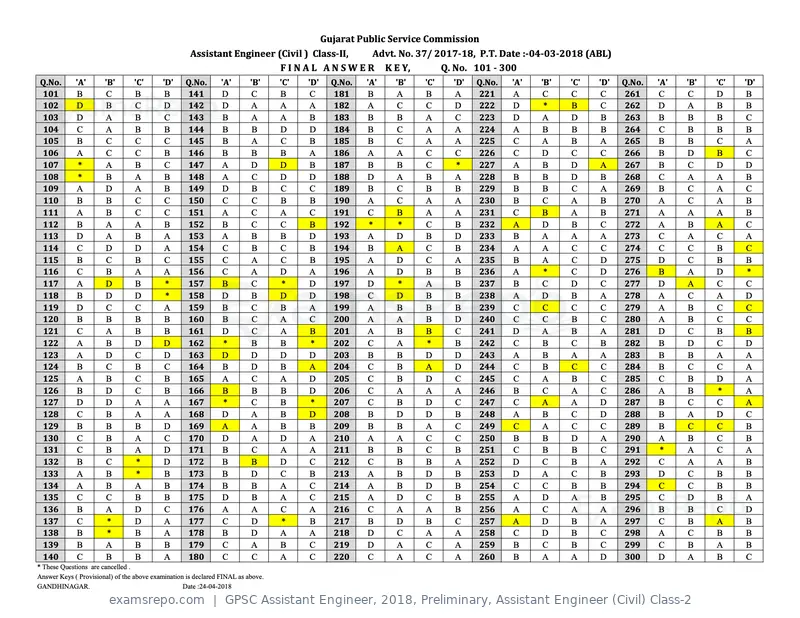
Text of page 2
Gujarat Public Service Commission
Assistant Engineer (Civil ) Class-II, Advt. No. 37/ 2017-18, P.T. Date :-04-03-2018 (ABL)
F I N A L A N S W E R K E Y, Q. No. 101 - 300
Q.No. 'A' 'B' 'C' 'D' Q.No. 'A' 'B' 'C' 'D' Q.No. 'A' 'B' 'C' 'D' Q.No. 'A' 'B' 'C' 'D' Q.No. 'A' 'B' 'C' 'D'
101 B C B B 141 D C B C 181 B A B A 221 A C C C 261 C C D B
102 D B C D 142 D A A A 182 A C C D 222 D * B C 262 D A B B
103 D A B C 143 B A A B 183 B B A C 223 D A D B 263 B B B C
104 C A B B 144 B B D D 184 B C A A 224 A B B B 264 C B B B
105 B C C C 145 B A C B 185 B C A A 225 C A B A 265 B B C A
106 A C C B 146 B B B A 186 A A C C 226 C D C C 266 B D B C
107 * A B C 147 A D D B 187 B B C * 227 A B D A 267 B C D D
108 * B A B 148 A C D D 188 D A B A 228 B B D B 268 C A A B
109 A D A B 149 D B C C 189 B C B B 229 B B C A 269 B C A C
110 B B C C 150 C C B B 190 A C A A 230 B C A B 270 A C A B
111 A B C C 151 A C A C 191 C B A A 231 C B A B 271 A A A B
112 B A A B 152 B C C B 192 * * C B 232 A D B C 272 A B A C
113 D A B A 153 A B B D 193 A D B D 233 B A A A 273 C A C A
114 C D D A 154 C B C B 194 B A C B 234 A A C C 274 C C B C
115 B C B C 155 C A C B 195 A D C A 235 B A C D 275 D C B B
116 C B A A 156 C A D A 196 A D B B 236 A * C D 276 B A D *
117 A D B * 157 B C * D 197 D * A B 237 B C D C 277 D A C C
118 B D D * 158 D B D D 198 C D B B 238 A D B A 278 A C A D
119 D C C A 159 B C B A 199 A B B B 239 C C C C 279 A B C C
120 B B B B 160 B C A C 200 A A B D 240 C C B C 280 A B C C
121 C A B B 161 D C A B 201 A B B C 241 D A B A 281 D C B B
122 A B D D 162 * B B * 202 C A * B 242 C B C B 282 B D C D
123 A D C D 163 D D D D 203 B B D D 243 A B A A 283 B B A A
124 B C B C 164 B D B A 204 C B A D 244 C B C C 284 B C C A
125 A B C B 165 A C A D 205 C B D C 245 C A B C 285 C B D A
126 B D C B 166 B B B D 206 C A A A 246 B C A C 286 A B * A
127 D D A A 167 * C B * 207 C B D C 247 C A A D 287 B C C A
128 C B A A 168 D A B D 208 B D D B 248 A B C D 288 B A D C
129 B B B D 169 A A B B 209 B B A C 249 C A C C 289 B C C B
130 C B A C 170 D A D A 210 A A C C 250 B B D A 290 A B C B
131 C B A D 171 B C A A 211 B B C B 251 C B B C 291 * A C A
132 B C * D 172 B B D C 212 C B B A 252 D C B A 292 C A A B
133 A B * B 173 B D C B 213 A B D B 253 D A C B 293 D C B B
134 A B A B 174 B B A C 214 A B D B 254 C C B B 294 C C B B
135 C C B B 175 D B A C 215 A D C B 255 A D A B 295 C D B A
136 B A D C 176 A A C A 216 C A A B 256 A C A A 296 B B C D
137 C * D A 177 C D * B 217 B D B C 257 A D B A 297 C B A B
138 B * B A 178 B D A A 218 D C A A 258 C D B C 298 A C B B
139 B A B B 179 C A B C 219 D A C A 259 B C B C 299 C B A B
140 C B B A 180 C C A C 220 C A C A 260 B A A D 300 D A B C
* These Questions are cancelled .
Answer Keys ( Provisional) of the above examination is declared FINAL as above.
GANDHINAGAR. Date :24-04-2018Page 1 of 39
Source: Gujarat Public Service Commission. Question paper published by Gujarat Public Service Commission.