
GPSC Engineering Services 2025: GWSSB Engineering Service (Mechanical), Preliminary, Mechanical Engineering

Text of page 1
BMX-2
                                                   PROVISIONAL ANSWER KEY

Name of the post                             Gujarat Water Supply and Sewerage Board Engi. Service (Mechanical)-Executive
                                             Engi. (Mech.), Class-1 and Deputy Executive Engi. (Mech.), Class-2
Advertisement No.                           78/2024-25
Preliminary Test Held On                     27-04-2025
Que. No                                      001-300
Publish Date                                 06-05-2025
Last Date to Send Suggestion (s)             09-05-2025
THE LINK FOR ONLINE OBJECTION SYSTEM WILL START FROM 07-05-2025 ; 10:00 AM ONWARDS

                                                      Instructions / સ ૂચના
Candidate must ensure compliance to the instructions mentioned below, else objections shall not be considered: -
(1) Candidates have to pay fees of Rs.100/- for each objection. The fees can be paid from the link given herewith.

(2) The Candidate will be able to submit objection only after payment of the fees. The generation of the receipt will only be
    considered as final submission.
(3) The Candidate must retain the receipt of the payment of the fees. The fees, once paid, will not be refunded under any
    circumstances.
(4) All the objections should be submitted through ONLINE OBJECTION SUBMISSION SYSTEM only. Physical or
    submission through any other means will not be considered.
(5) All objections are to be submitted with reference to the Master Question Paper published with provisional answer key,
    published herewith on the website / online objection submission system. Objections should be sent referring to the
    Question No. & options of the Master Question Paper. Objections regarding question nos. and options other than
    provisional answer key (Master Question Paper) shall not be considered.
(6) Objections and answers suggested by the candidate should be in compliance with the responses given by him in his
    answer sheet. Objections shall not be considered, in case, if responses given in the answer sheet /response sheet and
    submitted objections are differed.
(7) Supportive document to the objection must be uploaded, without which objection will not be considered.

ઉમેદવારે નીચેની સ ૂચનાઓન ું પાલન કરવાની તકેદારી રાખવી, અન્યથા વાુંધા-સ ૂચન અંગે કરે લ રજૂઆતો ધ્યાને લેવાશે નહીં

(1) ઉમેદવારે દરે ક વાાંધા દીઠ રૂપિયા ૧૦૦/-ફી ભરવાની રહેશે. જે ફી આ સાથે આિેલ લીંક ઉિરથી ભરી શકાશે.

(2) ફી ભયાા બાદ જ વાાંધો સબમીટ થઈ શક્શે. ફી ભયાાની આખરી િહોંચ જ આખરી સબમીશન ગણાશે.

(3) ફી ભયાા ની િહોંચ ઉમેદવારે સાચવી રાખવાની રહેશે. એક વાર ભરે લ ફી કોઈ િણ િરરસ્થથપિમાાં િરિ આિવામાાં આવશે નરહ.

(4)   વાાંધા ફક્િ ઓનલાઈન ઓબ્જેકશન સબમીશન સીસ્ટમ દ્વારા જ સબમીટ કરવાના રહેશે. રૂબરૂ, ટિાલ અથવા ઈ-મેઈલ કે અન્ય કોઈ રીિે
      આયોગને મોકલવામાાં આવેલ વાાંધા ધ્યાને લેવામાાં આવશે નહીં, જેની ખાસ નોંધ લેવી.

(5) ઉમેદવારે િોિાને િરીક્ષામાાં મળે લ પ્રશ્નપુસ્થિકામાાં છિાયેલ પ્રશ્નક્રમાાંક મુજબ વાાંધા-સ ૂચનો રજૂ ન કરિાાં, િમામ વાાંધા-સ ૂચનો વેબસાઈટ િર
      પ્રપસધ્ધ થયેલ પ્રોપવઝનલ આન્સર કી (માથટર પ્રશ્નિત્ર) ના પ્રશ્નક્રમાાંક મુજબ અને િે સાંદભામાાં રજૂ કરવા. માથટર પ્રશ્નિત્રમાાં પનરદિ ષ્ટ પ્રશ્ન અને
      પવકલ્િ પસવાયના વાાંધા ધ્યાને લેવામાાં આવશે નહીં.

(6) ઉમેદવારે પ્રશ્નના પવકલ્િ િર વાાંધો રજૂ કરે લ છે અને પવકલ્િ રૂિે જે જવાબ સ ૂચવેલ છે એ જવાબ ઉમેદવારે િોિાની ઉત્તરવહીમાાં આિેલ હોવો
      જોઈએ. ઉમેદવારે સ ૂચવેલ જવાબ અને ઉત્તરવહીનો જવાબ ભભન્ન હશે િો ઉમેદવારે રજૂ કરે લ વાાંધા ધ્યાને લેવાશે નહીં.

(7) વાાંધા માટે સાંદભા જોડવો આવશ્યક છે , જેના પવના વાાંધો ધ્યાને લેવામાાં આવશે નહીં.


 Website link for online objection submission system: https://www.formonline.co.in/GPSC_TRACK/SearchPage.aspx
Text of page 2
M

1.   The specific heat at a constant pressure for an ideal gas _______________.
     (A) is higher than specific heat at a constant volume
     (B) is lower than the specific heat at a constant volume
     (C) is equal to the specific heat at a constant volume
     (D) may be higher or lower than the specific heat at constant volume

2.   The absolute pressure in water at a depth of 9 m is read to be 185 kPa. If the density of
      water is 1000 kg/m3 and acceleration due to gravity is 10 m/s2, then the local atmospheric
      pressure is _________.
     (A) 275 kPa                                   (B) 95 kPa
     (C) 101.325 kPa                               (D) 100 kPa

3.   The barometer of a mountain hiker reads 750 mbars at the beginning of a hiking trip and
      630 mbars at the end. If the average air density is 1.20 kg/m3 and the acceleration due to
      gravity is 10 m/s2, then what is the vertical distance climbed by the hiker?
     (A) 1000 m                                    (B) 10 m
     (C) 850 m                                     (D) 930 m

4.   The pressure gauge on an air tank shows 75 kPa when the diver is 10 m down in the ocean.
      If the density of water is 1000 kg/m3, atmospheric pressure is 100 kPa, and acceleration
      due to gravity is 10 m/s2 , then what is the reading on the pressure gauge at the depth of
      17.5 m?
     (A) 200 kPa                                   (B) 275 kPa
     (C) 101.325 kPa                               (D) 17.5 kPa

5.   Water at 200 kPa has a quality of 50%. The volume fraction of Vg /Vtotal is __________.
     (A) Greater than 50%                          (B) Lesser than 50%
     (C) Equal to 1                                (D) Lesser than 25%

6.   A mixture of liquid air and gaseous air _____________.
     (A) Is a pure substance                       (B) Is not a pure substance
     (C) Is a homogeneous mixture                  (D) Is a chemically homogeneous mixture

7.   A steel tank contains 6 kg of propane (liquid + vapor) at 20°C with a volume of 0.015 m3.
      The critical volume of propane is 0.00454 m3/kg. The tank is now slowly heated. The liquid
      level inside the tank mill eventually ____________________.
     (A) Rise to the top of the tank.              (B) Drop to the bottom of the tank.
     (C) Remains constant.                         (D) Cannot be determined.


2 | [BMX-2]                                                                              [Contd.
Text of page 3
M

8.    Equal masses of air are sealed in two vessels, one of volume V and the other of volume 2V.
      If the first vessel is maintained at a temperature of 300 K and the other vessel at 600 K,
      then the ratio of the pressure in the two vessels is __________________.
      (A) 1:2		                                     (B) 2:1

      (C) 1:1		                                     (D) 1:4

9.    An ideal gas mixture is filled inside the balloon and expands according to the relation
      PV0.6 = Constant. The temperature inside the balloon will _____________.
      (A) Increase                                  (B) Decrease

      (C) Remain constant                           (D) Not be determined

10.   A pure substance is __________________________.
      (A) Two-component system existing in one or more phases
      (B) One component system existing in one phase
      (C) Two-component system existing in one phase
      (D) One component system existing in one or more phases

11.   Choose the correct alternative.
      (A) The slope of an isothermal process is greater than that of an isentropic process on the
          P-v diagram
      (B) The slope of an isothermal process is equal to the isentropic process on the P-v diagram
      (C) No definite relation can be established between the slope of an isothermal process and
          an isentropic process on the P-v diagram
      (D) The slope of an isentropic process is greater than that of an isothermal process on the
          P-v diagram

12.   A saturated vapor is compressed to half its volume without changing its temperature. The
      result is that ___________________.
      (A) All the vapor condenses to liquid.
      (B) The saturated vapor converts to superheated vapor.
      (C) The pressure of the vapor doubles as compared to its initial value.
      (D) Some of the vapor condenses and the pressure does not change.


[BMX-2]                                                                               P.T.O.]  |  3
Text of page 4
M

13.   Extensive property of a system is one whose value ____________________.
      (A) Depends on the mass of the system.
      (B) Does not depend on the mass of the system
      (C) Is not dependent on the path followed but on the state
      (D) Is dependent on the path followed and not on the state

14.   A container is filled with a sample of an ideal gas at the pressure of 1.5 atm. The gas is
       compressed isothermally to one-fourth of its original volume. What is the new pressure of
       the gas?
      (A) 2 atm                                      (B) 3 atm
      (C) 4 atm                                      (D) 6 atm

15.   A container with rigid walls is filled with a sample of ideal gas. The absolute temperature
      of the gas is doubled. What happens to the pressure of the gas?
      (A) Doubles                                   (B) Quadruples
      (C) Triples                                   (D) Decreased to one-half

16.   Which of the following is correct?
      (A) Absolute pressure = Gauge pressure + Atmospheric pressure
      (B) Gauge pressure = Absolute pressure + Atmospheric pressure
      (C) Atmospheric pressure = Absolute pressure + Gauge pressure
      (D) Absolute pressure = Gauge pressure – Atmospheric pressure

17.   If a pure substance contained in a rigid vessel passes through the critical state during
       heating, its initial state should be __________________________.
      (A) Sub-cooled water.                         (B) Saturated water.
      (C) Saturated liquid-vapor mixture.           (D) Saturated steam.

18.   A series of operations, which take place in a certain order and restore the initial condition
       is known as __________________________.
      (A) Reversible cycle                           (B) Irreversible cycle
      (C) Thermodynamic cycle                        (D) System cycle

19.   The change in enthalpy of water in a system equals the heat supplied under constant
       _________condition.
      (A) Specific volume                            (B) Pressure
      (C) Temperature                                (D) Internal energy


4 | [BMX-2]                                                                                 [Contd.
Text of page 5
M

20.   The door of a running refrigerator inside a room was left open. Which of the following
      statements is correct?
      (A) The room will gradually warm up
      (B) The room will be cooled to the temperature inside the refrigerator
      (C) The room will be cooled very slightly
      (D) The temperature of the air in room will remain unaffected

21.   For which case will the cooking time be the shortest?
      (A) Uncovered                                  (B) Covered with a light lid
      (C) Covered with a heavy lid                   (D) Same for all

22.   A piston-cylinder arrangement initially contains air at 250 kPa and 600 K. The system is
       allowed to cool to half of the initial volume at constant pressure. The work done per unit
       mass is given by ____________.
      (A) + 86.10 kJ/kg                              (B) + 102.5 kJ/kg
      (C) – 102.5 kJ/kg                              (D) – 86.10 kJ/kg

23.   During a certain reversible process, the change in internal energy of a closed system is
       stated to be equal to the net heat transferred. Such a condition exists when the process is
       executed ____________.
      (A) Adiabatically                              (B) Isobarically
      (C) Isothermally                               (D) Isochorically

24.   In a general compression process, 2 kJ of mechanical work is supplied to 5 kg of working
      substance, and 800 J of heat is rejected to the cooling jacket. The change in specific internal
      energy is _________________________.
      (A) 560 J/kg                                   (B) – 560 J/kg
      (C) – 240 J/kg                                 (D) 240 J/kg

25.   A domestic refrigerator is loaded with fresh food and the door is closed. During a certain
      period, the machine consumes 1.25 kWh of electrical energy in cooling the food and the
      internal energy of the system decreases by 4500 kJ. The magnitude of net heat transfer for
      the system is _________.
      (A) – 4500.347 kJ                              (B) 4500.347 kJ
      (C) – 9000 kJ                                  (D) 9000 kJ


[BMX-2]                                                                                  P.T.O.]  |  5
Text of page 6
M

26.   Air at 300 K and 5 atm is throttled by a valve to 1 atm. If the valve is adiabatic and the change
      in kinetic energy is negligible, then the exit temperature of air will be _____________.
      (A) 60 K                                        (B) 1500 K
      (C) 300 K                                       (D) 340 K

27.   An air-conditioning system operating on the reversed Carnot cycle is required to remove
      heat from the house at a rate of 32 kJ/s to maintain its temperature constant at 300 K.
      If the temperature of the outdoors is 320 K, then the power required to operate this air-
      conditioning system is ___________________________.
      (A) 2.1kW                                       (B) 0.58 kW
      (C) 2 kW                                        (D) 1.58 kW

28.   Two Carnot heat engines are operating in series such that the heat sink of the first
      engine serves as the heat source of the second one. If the source temperature of the first
      engine is 1200 K and the sink temperature of the second engine is 300 K and the thermal
      efficiencies of both engines are the same, then temperature of the intermediate reservoir
      is ________________.
      (A) 750 K                                       (B) 450 K
      (C) 600 K                                       (D) 650 K

29.   A unit mass of an ideal gas at temperature T undergoes a reversible isothermal process
      from pressure P1 to pressure P2 while losing heat to the surroundings at temperature T in
      the amount of q. If the gas constant of the gas is R, then the entropy change of the gas (∆s)
      during this process is __________.


      (A)                		                            (B)


      (C)                     		                       (D)

30.   A hot water pipe at 80°C is losing heat to the surrounding air at 5°C at a rate of 2200 W.
      The rate of entropy generation in the universe is___________.
      (A) 7.9 W/K                                      (B) 6.23 W/K
      (C) 1.68 W/K                                     (D) 14.13 W/K


6 | [BMX-2]                                                                                     [Contd.
Text of page 7
M

31.   A house is maintained at 27°C in winter by electric-resistance heater. If the outdoor
       temperature is 7°C, then the second-law efficiency of the resistance heater is ___________.
      (A) 15%                                       (B) 100%
      (C) 6.66%                                     (D) 0%

32.   A 1000 W iron is left on the ironing board with its base exposed to the air at 27°C. If the
       temperature of the base of the iron is 157°C, then the rate of exergy destruction for this
       process due to heat transfer in steady operation is ______________.
      (A) 1000 W                                    (B) 698 W
      (C) 1433.33 W                                 (D) 9200 W

33.   Keeping the limitations imposed by the second-law of thermodynamics in mind, choose
      the wrong statement below.
      (A) A heat engine cannot have a thermal efficiency of 100%.
      (B) For all reversible processes, the second-law efficiency is 100%.
      (C) The second-law efficiency of a heat engine cannot be greater than its thermal efficiency.
      (D) The second-law efficiency of a process is 100% if no entropy is generated during that
          process.

34.   In an ideal Otto cycle, the air is compressed from 1.20 kg/m3 and 2.2 L to 0.20 L, and the
      network output of the cycle is 400 kJ/kg. The Mean Effective Pressure (MEP) for this cycle
      is ________________.
      (A) 528 kPa                                   (B) 264 kPa
      (C) 612 kPa                                   (D) 528 kPa

35.   Consider a simple ideal Rankine cycle with fixed boiler and condenser pressures. The
      cycle is modified with regeneration that involves one open feed water heater. Select the
      correct statement per unit mass of steam flowing through the boiler.
      (A) The turbine work output will decrease.
      (B) The amount of heat rejected will increase.
      (C) The cycle thermal efficiency will decrease.
      (D) The quality of steam at the turbine exit will decrease.

36.   An ideal Brayton cycle has a network output of 150 kJ/kg and a backwork ratio of 0.4. If
       both the turbine and the compressor had an isentropic efficiency of 90%, then the network
       output of the cycle would be _____________________.
      (A) 95 kJ/kg                                  (B) 45 kJ/kg
      (C) 101.4 kJ/kg                               (D) 109.3 kJ/kg


[BMX-2]                                                                                P.T.O.]  |  7
Text of page 8
M

37.   Consider a simple ideal Rankine cycle. If the condenser pressure is lowered while keeping
       the turbine inlet state the same, then select the correct statement.
      (A) the turbine work output will decrease.
      (B) the amount of heat rejected will decrease.
      (C) the cycle efficiency will decrease.
      (D) the moisture content at the turbine exit will decrease.

38.   n-Octane has _________________.
      (A) Straight chain structure with 8 carbon atoms
      (B) Ring chain structure with 8 carbon atoms
      (C) Branched chain structure with 8 carbon atoms
      (D) None of the options

39.   Hydrocarbons are decomposed into smaller hydrocarbons with better anti-knocking
       properties by ___________.
      (A) Polymerization                            (B) Thermal cracking
      (C) Catalytic cracking                        (D) Hydrogenation

40.   In a typical medium-speed 4-stroke cycle diesel engine, the inlet valve _______________.
      (A) Opens at 20° before top-dead center and closes at 35° after the bottom-dead center
      (B) Opens at top-dead center and closes at bottom-dead center
      (C) Opens at 10° after top-dead center and closes 20° before the bottom-dead center
      (D) May open or close anywhere

41.   The operation of forcing additional air under pressure into the engine cylinder is known
       as ___________.
      (A) Supercharging                             (B) Carburetion
      (C) Turbulence                                (D) Delay period

42.   The compression ratio of I.C. Engines is ___________.
      (A) The ratio of volumes of air in the cylinder before compression stroke and after
          compression stroke
      (B) Volume displaced by piston per stroke and clearance volume in the cylinder
      (C) Ratio of pressure after compression and before compression
      (D) Swept volume/cylinder volume


8  | [BMX-2]                                                                            [Contd.
Text of page 9
M

43.   The theoretically correct air fuel ratio for petrol engine is of the order of ___________.
      (A) 6 : 1                                      (B) 9 : 1
      (C) 12 : 1                                     (D) 25 : 1

44.   Number of working strokes per min for a four stroke cycle engine are _________ the speed
       of the engine in RPM.
      (A) Equal to                                   (B) One-half
      (C) Twice                                      (D) Four-times

45.   Volumetric efficiency of the engine is affected by _____________.
      (A) The density of fresh charge
      (B) The exhaust gas in the clearance volume
      (C) The design of the intake and the exhaust manifolds
      (D) All the given options

46.   In an internal combustion engine, the process of removing the burnt gases from the
      combustion chamber of the engine cylinder is known as _________________.
      (A) Scavenging                                 (B) Detonation
      (C) Supercharging                              (D) Polymerisation

47.   The ignition of the charge by some hot surface within the engine before the passage of
       spark is called ________________.
      (A) Preignition                                (B) Detonation
      (C) Ignition delay                             (D) Auto-ignition

48.   A fuel that produces same knock as obtained with 85% of iso-octane and 15% of n-heptane
      has an octane number of ______________.
      (A) 70                                         (B) 85
      (C) 15                                         (D) 5.66

49.   If the air-fuel ratio is higher than the stoichiometric air-fuel ratio, then
      (A) Thermal efficiency increases
      (B) Thermal efficiency decreases
      (C) Complete combustion of the fuel takes place.
      (D) Complete dissociation of fuel takes place.


[BMX-2]                                                                                P.T.O.]  |  9
Text of page 10
M

50.   Which of the following is not a component of vapour absorption refrigeration system?
      (A) Compressor                                (B) Generator
      (C) Absorber                                  (D) Evaporator

51.   The refrigerant used in domestic refrigerators is generally ________.
      (A) R134a                                     (B) carbon dioxide
      (C) oxygen                                    (D) ammonia

52.   In a vapour compression refrigeration cycle, the heat is absorbed by the refrigerant in
       a __________.
      (A) Expansion valve                           (B) Condenser
      (C) Compressor                                (D) Evaporator

53.   One of the purpose of sub-cooling the liquid refrigerant is to __________.
      (A) Increase cooling effect
      (B) Reduce compressor overheating
      (C) Reduce compressor discharge temperature
      (D) Ensure that only liquid and not the vapor enters the expansion (throttling) valve

54.   One ton of refrigeration means ___________.
      (A) The standard unit used in refrigeration problems
      (B) The cooling effect produced by melting 1 ton of ice
      (C) The refrigeration effect to freeze 1 ton of water at 0°C into ice at 0°C in 24 hours
      (D) The refrigeration effect to produce 1 ton of ice at NTP conditions

55.   The bank of tubes available at the backside of the refrigerator are _____________.
      (A) condenser tubes                           (B) evaporator tubes
      (C) refrigerant cooling tubes                 (D) capillary tubes

56.   The refrigerant for a refrigerator should have _____________________.
      (A) High sensible heat                        (B) High total heat
      (C) High latent heat                          (D) Low latent heat

57.   The COP of a refrigeration cycle with lowering of condenser temperature, keeping the
       evaporator temperature constant will _______________.
      (A) Increase                                  (B) Decrease
      (C) No change                                 (D) Unpredictable


10  | [BMX-2]                                                                              [Contd.
Text of page 11
M

58.   The leaks in a refrigeration system using freon are detected by ___________.
      (A) Halide torch which on detection produces greenish flame lighting
      (B) Sulphur sticks which on detection gives white smoke
      (C) Using reagents
      (D) Sensing reduction in pressure

59.   The advantage of dry compression is that ___________.
      (A) It permits higher speeds to be used
      (B) It permits complete evaporation in the evaporator
      (C) It results in high volumetric and mechanical efficiency
      (D) All the given options

60.   Heat in the amount of 100 kJ is transferred directly from a hot reservoir at 1200 K to a
       cold reservoir at 600 K. The entropy generation during the process is________________.
      (A) 0.0833 kJ/K                                 (B) 0.1666 kJ/K
      (C) – 0.0833 kJ/K                               (D) – 0.1666 kJ/K

61.   Critical radius of insulation for a sphere is ___________ times more than critical radius of
       cylinder for the same convective conditions.
      (A) 2                                           (B) 0.5
      (C) 3		                                         (D) 4

62.   Under which of the following convective conditions, the possibility of fins not augmenting
      the heat transfer is more?
      (A) Natural convection in air                   (B) Natural convection in water
      (C) Forced convection in air                    (D) Boiling heat transfer

63.   Two insulating materials A and B of same thickness are available to reduce the heat loss
      from a cylindrical surface carrying steam. If Ka> Kb, which of the following statement is
      true related to heat loss from the cylinder? Where Ka and Kb are the thermal conductivities
      of the two layers of insulations respectively. Neglect the contact resistance.
      (A) Material A layer on the bare cylinder followed by Material B layer will lead to reduced
           heat loss.
      (B) Material B layer on the bare cylinder followed by Material A layer will lead to reduced
          heat loss.
      (C) Relative positions of the layer do not affect the heat loss
      (D) It is not possible to predict the effect on heat transfer based on the relative position of
           the insulation.


[BMX-2]                                                                                  P.T.O.]  |  11
Text of page 12
M

64.   Find the maximum diameter of a cylinder having K = 10W/mK when exposed to convective
      environment having h = 40W/m2K can satisfy the condition for applying the lumped heat
      capacity system during transient conduction heat transfer.
      (A) 5 cm                                      (B) 1 cm
      (C) 10 cm                                     (D) 2 cm

65.   General heat conduction equation is a Partial Differential Equation (PDE), but for which
      of the following conditions, it is deduced to an Ordinary Differential Equation (ODE)?
      (A) Two-dimensional steady state conduction
      (B) One-dimensional transient conduction
      (C) One-dimensional steady state conduction with heat generation
      (D) Three-dimensional steady state conduction

66.   In which of the following cases, the concept of adiabatic mixing cup temperature is used
      in convective heat transfer?
      (A) Forced convection over a flat plate
      (B) Forced convection across the cylinders
      (C) Free convection
      (D) Forced convection through tubes

67.   If two-dimensional steady state conduction is applied to a rectangular fin with large
      thickness dissipating the heat to the atmosphere, which of the following nodes will be
      having the highest temperature in the fin?
      (A) Corner node at the end of the fin
      (B) Surface node at the end of the fin
      (C) Central node at the midpoint of the fin
      (D) Bottom surface node near the end of the fin

68.   For which of the following cases the thickness of thermal and hydrodynamic boundary
      layers will be equal at any location from the leading edge for the flow over a flat plate?
      (A) Re = 2 × 10⁵ and Pr = 5                   (B) Re = 7 × 10⁵ and Pr = 0.5
      (C) Re = 3 × 10⁵ and Pr = 1                   (D) Re = 1 × 10⁵ and Pr = 0.2


12 | [BMX-2]                                                                               [Contd.
Text of page 13
M

69.   A heat engine receives heat from a source at 1000°C and rejects the waste heat to a sink at
      50°C. If heat is supplied to this engine at a rate of 100 kJ/s, then the maximum power that
       can be produced from heat engine is __________________.
      (A) 25.4 kW                                    (B) 55.4 kW
      (C) 74.6 kW                                    (D) 95.0 kW

70.   A hot cylinder maintained at a surface temperature of Tw OC having L>>D is exposed to
      atmospheric air at Ta OC under natural convection. In which of the following cases, heat
      transfer loss from the cylinder is expected to be the highest?
      (A) Keeping the cylinder vertical
      (B) Keeping the cylinder horizontal
      (C) Keeping the cylinder inclined at 45O.
      (D) Keeping the cylinder inclined at 60O to horizontal

71.   In which of the following cases the convective heat loss in the enclosed space is expected to
      be zero?
      (A) Horizontal enclosed space having top surface at a higher temperature than the bottom
          surface.
      (B) Horizontal enclosed space having top surface at a lower temperature than the bottom
          surface.
      (C) Vertical enclosed space having left surface on higher temperature more than the right
          surface with Gr > 3000
      (D) Vertical enclosed space having right surface on higher temperature than the left
          surface with Gr > 5000.

72.   Which of the following convective heat transfer situation is applicable to measure the
      velocity of fluid using hot wire anemometer?
      (A) Flow over a flat surface
      (B) Flow across the cylinder
      (C) Flow through tubes
      (D) Free convection from a horizontal cylinder

73.   Golf ball surface is deliberately made rough to induce_______ flow and _____ drag force.
      (A) Turbulent, reduce                         (B) Laminar, increase
      (C) Turbulent, increase                       (D) Laminar, reduce


[BMX-2]                                                                                P.T.O.]  |  13
Text of page 14
M

74.   Which of the following heat transfer equipment do not belong to the category of flow
       across bank of tubes?
      (A) Air cooled condensers used in domestic air conditioners
      (B) Radiators used in automobile
      (C) Regenerative air preheaters used in power plants
      (D) Evaporators used in the window air conditioners

75.   Which of the following heat transfer equipment used in a thermal power plant has the
      effectiveness as a function of NTU only?
      (A) Economiser                                (B) Condenser
      (C) Superheater                               (D) Air preheater

76.   Which of the following Laws of Radiation gives the monochromatic emissive power of a
       black body?
      (A) Stefan-Boltzmann Law                      (B) Kirchhoff’s Law
      (C) Planck’s Law                              (D) Wien’s displacement Law

77.   For which of the following surfaces, the radiation shape factor within itself is zero?
      (A) Hemispherical cavity                      (B) Convex surface
      (C) Concave surface                           (D) Cylindrical hole

78.   Which of the wavelengths of radiation given below falls within the visible spectrum?
      (A) 1 µm                                      (B) 100 µm
      (C) 0.5 µm                                    (D) 0.01 µm

79.   If the surface temperature of a black body is 2900K, then the maximum monochromatic
       emissive power will be corresponding to __________ µm.
      (A) 10                                        (B) 1
      (C) 100                                       (D) 1000

80.   Which of the following surface property is 1 for a white body?
      (A) Absorptivity                              (B) Reflectivity
      (C) Transmissivity                            (D) Emissivity

81.   Which of the following heat exchanger is likely to have the lowest overall heat transfer
       coefficient?
      (A) Air preheater                             (B) Surface condenser
      (C) Economiser                                (D) Radiator


14 | [BMX-2]                                                                               [Contd.
Text of page 15
M

82.   In a condenser, steam condenses at a temperature of 80 OC. The cold water enters at a
      temperature of 30 OC. If the exit temperature of the water is 55 OC, then the effectiveness
      of the condenser is_________.
      (A) 0.75                                     (B) 1
      (C) 0.5                                      (D) 0.25

83.   In which of the following heat exchanger, Arithmetic Mean Temperature Difference
       (AMTD) is used instead of LMTD to find the heat transfer?
      (A) Parallel flow for which mhCph= mcCpc
      (B) Counter flow for which mhCph= mcCpc
      (C) Cross-flow having mhCph< mcCpc
      (D) Cross-flow having mhCph > mcCpc

84.   If the thickness of the plates is more than 30 mm, then which welding joint is preferable
       among the following?
       (A) Square-butt joint                         (B) Single U-shaped butt joint
      (C) Single V-shaped butt joint               (D) Double V-shaped butt joint

85.   Which of the following component of a hydropower plant is likely to fail due to water
       hammer effect?
      (A) Dam                                      (B) Hydro Turbine
      (C) Penstock                                 (D) Surge tank

86.   Which of the following loss in a power boiler will increase due to the failure of brick
      lining?
      (A) Incomplete combustion loss               (B) Unburnt carbon loss
      (C) Skin loss                                (D) Stack loss

87.   A coal based thermal power of large capacity needs to combust 200TPH of coal. It has five
      stage combustion with tangential firing system from four corners. Combustion capacity of
      each burner should be________ TPH. (TPH represents tonnes per hour)
      (A) 100                                      (B) 10
      (C) 20                                       (D) 200

88.   Flue gas temperature in the stack of the boiler is measured to be more than the design
      value. Possible reason for the problem is__________.
      (A) Incomplete combustion of coal            (B) Soot blowers not working properly
      (C) Supply of more excess air                (D) Refractory lining failure


[BMX-2]                                                                             P.T.O.]  |  15
Text of page 16
M

89.   Total installed capacity of Nuclear Power Plants in India as of now (February 2025) is
       about ____%.
      (A) 10                                       (B) 50
      (C) 2                                        (D) 5

90.   Which of the following “Triple Ts” is important to ensure proper combustion in a power
      boiler?
      (A) Time, Temperature and Turbulence
      (B) Time, Temperature and Transformation
      (C) Transformation, Temperature and Turbulence
      (D) Time, Temperature and Treatment

91.   In the flue gas analysis in a boiler, the composition of oxygen and nitrogen are estimated
      to be higher than the standard values. Which of the following measure will resolve the
      problem?
      (A) Reduces the excess air                   (B) Increases the excess air
      (C) Decreases the coal feed rate             (D) Reduces residence time

92.   Ultimate analysis of the coal used in a thermal power plant indicates percentage of
       Sulphur as 1% by mass and the specific coal consumption is 1kg/kWh. Assuming complete
       combustion, the amount of SO2 generated per unit of power generation from the power
       plant is_____ grams/kWh.
      (A) 10                                       (B) 20
      (C) 100                                      (D) 2

93.   Which of the following heat transfer equipment of a coal based power boiler of two pass
      type receives heat both by convection and radiation?
      (A) Economiser                               (B) Primary Superheater
      (C) Secondary Superheater                    (D) Air preheater

94.   Which of the following materials used in Gas turbine blades can withstand the highest
       temperature of operation?
      (A) Austenitic stainless steel               (B) Nickel based super alloys
      (C) Thoria dispersed nickel                  (D) Ferritic stainless steel

95.   Problem of cavitation do not occur in _______ hydro turbine.
      (A) Pelton                                   (B) Radial flow Francis
      (C) Axial flow Kaplan                        (D) Mixed flow Francis Turbine


16 | [BMX-2]                                                                             [Contd.
Text of page 17
M

96.   Identify the odd one from the list given below based on its application.
      (A) Pelton                                   (B) Darrieus
      (C) Kaplan                                   (D) Francis

97.   Which of the following law is applicable for wind power generation?
      (A) Betz’s law                               (B) Lambert’s law
      (C) Snell’s law                              (D) Planck’s law

98.   Which is the closest value of maximum solar heat flux received in India?
      (A) 200 W/m2                                 (B) 5000 W/m2
      (C) 1000 W/m2                                (D) 10000 W/m2

99.   Heat Recovery Steam Generator (HRSG) is used in which of the following power cycles?
      (A) Otto cycle                               (B) Diesel cycle
      (C) Combined cycle                           (D) Dual cycle

100. In which of the following heat transfer equipment in a power boiler, the term Circulation
     Ratio (CR) is used?
      (A) Evaporator                               (B) Economiser
      (C) Air preheater                            (D) Superheater

101. Performance efficiency of cooling towers used in a power plant is measured
     by ________ × 100.
      (A) Range / (Range + Approach)               (B) Approach / (Range + Approach)
      (C) (Range + Approach) / Range               (D) (Range + Approach) / Approach

102. The value of critical Reynold's number for flow across the sphere is_______.
      (A) 5 × 10⁵                                  (B) 2300
                5
      (C) 2 × 10                                   (D) 1000

103. With the increase of temperature, the kinematic viscosity of a gaseous fluid will ______
      and the kinematic viscosity of a liquid fluid will _____.
      (A) Decreases, Increases                     (B) Increases, Decreases
      (C) Increases, Increases                     (D) Decreases, Decreases

104. In a fully developed laminar flow through a tube, the velocity profile at any given
     cross-section is ______________.
      (A) Elliptical                               (B) Straight line
      (C) Parabolic                                (D) Hyperbolic


[BMX-2]                                                                             P.T.O.]  |  17
Text of page 18
M

105. In which of the following flow, the velocity discontinuity is zero?
     (A) Streamlined flow                           (B) Turbulent flow
     (C) Wake flow                                  (D) Vortex flow

106. Moody’s diagram in fluid flow indicates variation of _______ as a function of _________.
     (A) Friction Factor, Re                        (B) Friction Factor, Diameter
     (C) Drag Coefficient, Re                       (D) Re, Velocity

107. In which of the following hydro turbine, the draft tube is not used?
     (A) Tangential flow impulse turbine            (B) Axial flow reaction turbine
     (C) Mixed flow reaction turbine                (D) Radial flow reaction turbine

108. The approximate value of angle of attack on an airfoil section to have maximum lift
     coefficient is_________.
     (A) 0°                                         (B) 15°
     (C) 45°                                        (D) 60°

109. Which of the following flow measuring instrument has the highest Coefficient of Discharge?
     (A) Orifice meter                              (B) V Notch
     (C) Venturimeter                               (D) Flow Nozzle

110. Bourdon Gauge is used to measure______.
     (A) Temperature                                (B) Pressure
     (C) Flow                                       (D) Viscosity

111. Pecklet Number is given by_____.
     (A) Multiplication of Re and Pr                (B) Multiplication of Gr and Pr
     (C) Multiplication of Re and Gr                (D) Multiplication of Re and Sc

112. A barometer measures 750 mm of Hg column at the top of a tall building and 760 mm at
     the ground level. If 13.6 is the specific gravity of Hg, taking g = 10m/s2, then the height of
      the building is_________. Take density of the air as 1 kg/m3.
     (A) 13.6 m                                     (B) 136 m
     (C) 1360 m                                     (D) 1000 m

113. In India, the solar collectors are kept at angular inclination facing ________ direction to
     get the maximum utility.
     (A) North               (B) South              (C) East               (D) West


18  | [BMX-2]                                                                              [Contd.
Text of page 19
M

114. Which of the following Particulate Emission control methods is preferred in Fluidised Bed
      Combustion boilers?
     (A) Cyclone separators                       (B) Bag house
     (C) Electrostatic precipitator               (D) Settling chambers

115. Which of the following term refers to IGCC technology for power generation?
     (A) Integrated Gasification and Combined Cycle
     (B) Integrated Gasification and Carbon Capture
     (C) Integrated Gasturbine Carbon Capture
     (D) Internal Gas Combustion Cycle

116. Which of the following air in a power boiler is used to dry the moisture in the coal and
      pneumatically transports the coal to the burners?
     (A) Primary Air                              (B) Secondary Air
     (C) Tertiary Air                             (D) Turbine-cooling Air

117. Which of the following is used to estimate the hydropower potential in a river?
     (A) Flow-Duration Curve                      (B) Velocity – Duration Curve
     (C) Altitude curve                           (D) Flow pattern curve

118. Which of the following power plants is used to meet the peak demand of power as per the
      load duration curve?
     (A) Pumped Hydropower plants                 (B) Captive power plants
     (C) Base Load power plants                   (D) Pit head power plants

119. Characteristics length used to determine the Grashoff’s number for natural convection
     heat transfer from a horizontal flat plate is given by_________. (Where A = Area of the
      plate and P = Perimeter of the plate.)
     (A) 4A/P                                     (B) A/P
     (C) 2A/3P                                    (D) 4A/3P

120. For which of the following situation of convective heat transfer, Dittus-Boelter equation
     is used?
     (A) Laminar flow over a flat plate           (B) Turbulent flow through tubes
     (C) Laminar flow over cylinders              (D) Pool boiling

121. The value of             is__________.

     (A) 8/15              (B) 8/35               (C) 5π/32               (D) 4π/15


[BMX-2]                                                                               P.T.O.]  |  19
Text of page 20
M

122. The area bounded by the curve y = x3, the y-axis and the lines y = 1 and y = 8 is ____________

     (A)              		                            (B)

     (C)     		                                     (D)

123. The value of                  is equal to _________.

     (A)            		                              (B)


     (C)            		                              (D)

124. Displacement of any object is equal to _________________.
     (A) Double integral of its momentum            (B) Double integral of its force
     (C) Double integral of its velocity            (D) Double integral of its acceleration

125. Among the following equations, which one represents Moment of Inertia of a plane region
     relative to x-axis?
     (A) ∫∫ xyf (x, y) dxdy		                       (B) ∫∫ x2f (x, y) dxdy
     (C) ∫∫ y2f (x, y) dxdy		                       (D) ∫∫ (x2 + y2) f (x, y) dxdy

126. The total mass of the region in the cube 0 < x < 1, 0 < y < 1, 0 < z < 1 with density at any
      point given by xyz is__________.
     (A) 8                                          (B) 1
     (C) 0.25                                       (D) 0.125

127. Which theorem gives the relation between volume and surface integers?
     (A) Green’s theorem                            (B) Gauss’s divergence theorem
     (C) Stokes’ theorem                            (D) Rayleigh’s theorem

128. 7 – 5 – 2 + 7 – 5 – 2 + 7 – 5 – 2 …….∞ is ___________ series.
     (i) convergence
     (ii) divergence
     (iii) oscillatory
     (A) (i) only                                   (B) (ii) only
     (C) (iii) only                                 (D) (i) and (iii)


20  | [BMX-2]                                                                              [Contd.
Text of page 21
M

129. The radius of convergence for the series 1 + x + 2! x2 + 3! x3 + ....... is equal to _________.
     (A) 0                                           (B) 1
     (C) e                                           (D) ∞

130. The solution for (1 + x2) dy = (1 + y2) dx is ________. Where c is constant.
     (A) tan–1 (y – x) = c (1 + xy)                  (B) tan–1 (y + x) = c (1 – xy)
     (C) (y – x) = c (1 + xy)		                      (D) (y + x) = c (1 – xy)

131. The general solution for the differential equation                           is___________.

     (A) y = C1ex + C2e2x + C3e–2x                   (B) y = C1ex + C2e4x
     (C) y = C1ex + C2e–x + C3e2x + C4e–2x           (D) y = C1ex + C2e–x + C3e4x + C4e–4x

132. The general solution for the Clairaut’s equation sin (px) cosy = cos(px) sin y + p is _____
     (A) y = cx – sin–1 c		                          (B) y = sin–1 cx – sin–1 c
     (C) y = sin cx – c		                            (D) y = tancx – sin–1 c

133. Solution of the differential equation                   is____________.

     (A)                 		                          (B)

     (C)                		                           (D)


134. Solution of the differential equation y" – 2y' + 10 = 0 is_________ if y'(0) = –5, y(0) = 1.
     (A) y = ex (cos3x – sin3x)                      (B) y = e–x (cos3x – 2sin3x)
     (C) y = e3x (cosx – sinx)                       (D) y = ex (cos3x – 2sin3x)

135. Which of the following condition is correct on which the function f(z) = (x2 – y2) + 2i (x – y)
     is analytic and C-R equations are satisfied?
     (A) x = 1, y = –1                               (B) x = –1, y = 1
     (C) x = 1, y = 1                                (D) x = –1, y = –1

136. For what value of ‘n’, ∫c (z –3)n dz = 2pi, where C is |z – 3| = 4?
     (A) n = –1                                      (B) n < –1
     (C) n > 1		                                     (D) n = 1


[BMX-2]                                                                                 P.T.O.]  |  21
Text of page 22
M

137. Among the following, which one gives zeroes obtained by evaluating the function


     (A) z = i, z = – i		                            (B) z = 1, z = –1
     (C) z = 2, z = 1		                              (D) z = –2i, z = – i

138. Which of the following is the residue of function               ?

     (A) – 1                                         (B) 1
     (C) 0                                           (D) 0.5
139. Residues at the poles of            is _______________.

     (A) –1, 1                                       (B)


     (C) 1, 1		                                      (D)

140. A thin cylinder of diameter d, length l and thickness t is subjected to an internal pressure p.
     What would be the ratio of hoop strain to longitudinal strain if the Poisson’s ratio of shell
     material is 0.25?
     (A) 4.25                (B) 3.50                (C) 1.50                  (D) 0.286

141. In the point of contraflexture in a beam, ________.
     (A) Bending moment is zero                      (B) Shear force is zero
     (C) Slope is zero                               (D) Bending moment is maximum

142. Neutral axis of a beam is existing where ______________.
     (A) Shear force is zero                         (B) Bending stress is zero
     (C) Should be passed through centroid           (D) Bending stress is maximum

143. If a shaft has undergone twisting moment of 12 Nm and bending moment of 16 Nm, then
     the resultant bending moment will be _______________.
     (A) 36 Nm               (B) 28 Nm               (C) 20 Nm                 (D) 18 Nm

144. A solid circular shaft of diameter 10 mm is subjected to a torque of 22 Nm. The maximum
     principal stress experienced on the shaft is closest to __________.
     (A) 11.2 MPa                                    (B) 22.4 MPa
     (C) 112 MPa                                     (D) 224 MPa


22 | [BMX-2]                                                                                 [Contd.
Text of page 23
M

145. The variation of shear stress in a circular shaft under torsion is ______________.
      (A) Linear                                      (B) Constant
      (C) Parabolic                                   (D) Hyperbolic

146. The axial rigidity of a square cross-section bar (length ‘L’ and sides ‘a’) is equal to________,
     where E = Modulus of elasticity.

     (A)         		                                   (B)

     (C)         		                                   (D)

147. The modulus of elasticity in terms of bulk modulus (K) and modulus of
      rigidity (G) is ____________.


      (A)          		                                 (B)


     (C)             		                               (D)

148. Under bi-axial loading (10 N tensile load in both x and y direction), the maximum shear
     stress will be____________.
      (A) 14.14 N                                     (B) 10 N
      (C) 5 N                                         (D) 0 N

149. For pure shear(τ) loading, the centre coordinate of Mohr’s circle will be __________.
      (A) 0, 0                                        (B) τ, 0
      (C) τ/2, τ/2                                    (D) τ, τ

150. For a ductile material, the area under the stress strain curve upto fracture point is known
      as ____________.
      (A) Modulus of resilience                       (B) Modulus of toughness
      (C) Hardness                                    (D) Modulus of elasticity

151. When the shear force diagram is a parabolic curve between two points, it indicates that
      there is a ___________.
      (A) Uniformly varying load between the two points
      (B) Point load at the two points
      (C) No loading between the two points
      (D) Uniformly distributed load between the two points


[BMX-2]                                                                                  P.T.O.]  |  23
Text of page 24
M

152. The maximum principal stress theory of failure was postulated by________.
     (A) Castigliano                              (B) Tresca
     (C) St. Venant                               (D) Rankine

153. For a moving load on a simply supported beam, the maximum bending moment occurs
     at___________.
     (A) Supports                                 (B) Mid-span of the beam
     (C) Under the loading point                  (D) None of the above

154. Under singularity function, the unit concentrated moment (applied at a distance ‘a’) is
      represented as________.
     (A) < x – a >1                               (B) < x – a >2
     (C) < x – a >–1                              (D) < x – a >–2

155. In a cantilever beam (length ‘L’) under uniform varying load (zero at free end and 'w' per
      unit length at the fixed end), the maximum bending moment of the beam will be________

     (A)       		                                 (B)

     (C)       		                                 (D)

156. In a transversely-loaded beam, the maximum compressive stress occurs at the _________.
     (A) Either bottom or top edge of the beam
     (B) Neutral axis of the beam
     (C) Centre of gravity of the beam
     (D) None of the above

157. The diameter of the kern of a circular cross-section of diameter ‘d’ is ____________.
     (A) d/2                                      (B) d/3
     (C) d/4                                      (D) d/6

158. Forces that act in the same plane but do not meet at a single point is known
     as ______________.
     (A) Non-coplanar concurrent forces
     (B) Coplanar concurrent forces
     (C) Coplanar non-concurrent forces
     (D) Non-coplanar non-concurrent forces


24 | [BMX-2]                                                                            [Contd.
Text of page 25
M

159. Among the following forces, which can possibly act on a moving body in a straight line?
     (A) Friction force                            (B) Tangential force
     (C) Centripetal force                         (D) Centrifugal force

160. A uniform ladder of length 10 m and weighing 20 N is placed against a smooth vertical
      wall with its lower end 6 m from the wall. In this position the ladder is just to slip. What
      is the coefficient of friction between the ladder and the floor?
     (A) 0.237                                     (B) 0.375
     (C) 0.667                                     (D) 0.792

161. A simply supported beam (Length ‘L’, Modulus of Elasticity ‘E’ and Moment of
     Inertia ‘I’) is under uniformly distributed load ‘w’. The slope at the supports is________.

     (A)         		                                (B)


     (C)         		                                (D)

162. The ratio of strength of a solid shaft to that of a hollow shaft subjected to torsion is
     __________. Assume that both the shafts are of the same material and of the same outer
     diameter whereas the inner diameter of hollow shaft being half of the outer diameter.
     (A) 15/16                                     (B) 16/15
     (C) 7/8                                       (D) 8/7

163. When two shafts are joined in parallel, then________ is the same for both shafts, but if
      two shafts are joined in series, then_________ is the same for both shafts.
     (A) Angle of twist, torque                    (B) Torque, angle of twist
     (C) Angle of twist, shear stress              (D) Shear stress, torque

164. The pre-dominant effect of an axial tensile force on a helical spring is ___________.
     (A) Tensile force                             (B) Compressive force
     (C) Twisting                                  (D) Bending

165. If both ends of a column (Length ‘L’, Modulus of Elasticity ‘E’ and Moment of Inertia ‘I’)
      are hinged, then Euler crippling load will be __________.

     (A)         		                                (B)


     (C)         		                                (D)


[BMX-2]                                                                              P.T.O.]  |  25
Text of page 26
M

166. A minor load of __________ is applied to seat the specimen in the Rockwell test.
     (A) 5 kg                                      (B) 10 kg
     (C) 60 kg                                     (D) 150 kg

167. The following data were obtained during the tensile test of a hypothetical material
     specimen having 10 mm diameter and 200 mm length:
     i) Extension at a load of 44 kN = 0.1 mm    ii) Load at elastic limit = 220 kN
     iii) Maximum load = 300 kN                   iv) Total extension = 10 mm
     v) Diameter of rod at failure = 20 mm
     Young’s modulus is ______________.
     (A) 112 GPa                                  (B) 28 GPa
     (C) 660 GPa                                  (D) 142 GPa

168. In Brinell test to measure the hardness of grey cast iron, ball indenter of diameter______
      mm and _________ kgf load is used.
     (A) 5, 1000                                   (B) 10, 1000
     (C) 5, 3000                                   (D) 10, 3000

169. Among the following, which one is FALSE?
     (A) In Izod impact test, the specimen is placed vertically with the notch facing the hammer.
     (B) In Charpy test, the specimen is supported at both ends as a simple beam.
     (C) Charpy test is used for testing the impact resistance of plastics and other brittle
         materials.
     (D) Izod impact test measures the energy required to initiate and propagate a crack.

170. The topline of roof truss is known as__________.
     (A) Apex                                     (B) Tie line
     (C) Pitch line                               (D) Ridge line

171. A bevel gear pitch angle is 12°, addendum angle is 8° and dedendum angle is 4°. So the
     face angle will be __________
     (A) 20°                                      (B) 16°
     (C) 12°                                      (D) 4°

172. The π times of module for a spur gear is known as _______________.
     (A) Circular pitch                           (B) Diametral pitch
     (C) Addendum                                 (D) Pitch circle diameter


26 | [BMX-2]                                                                             [Contd.
Text of page 27
M

173. Equivalent dynamic load of an anti-friction bearing is more if
     (A) Inner race rotates                       (B) Outer race rotates
     (C) Radial load is more than axial load      (D) Radial load is less than axial load

174. The fit, H8-j7 is a kind of ____________.
     (A) Clearance fit                            (B) Interference fit
     (C) Transition fit                           (D) Press fit

175. The maximum amplitude of completely reversed stress that the standard specimen can
      sustain for an unlimited number of cycles without fatigue failure is ______________.
     (A) Fatigue life                             (B) Endurance limit
     (C) Yield strength                           (D) Ultimate strength

176. In a chain drive, driven chain sprocket of radius 300 mm having 40 teeth, the chain pitch
      will be___________ mm.
     (A) 600 sin 4.5°                             (B) 300 sin 9°
     (C) 300 sin 4.5°                             (D) 600 sin 9°

177. For a V-belt drive, the coefficient of friction between the belt and the pulley side is
      0.3 and pulley groove angle is 60°. The apparent co-efficient of friction for the V-belt
      is ____________.
     (A) 0.15                 (B) 0.26            (C) 0.34                 (D) 0.60

178. Among the following statements, which statement is FALSE?
     (A) Cotter joint is not used to connect two co-axial rods, which are subjected to either
         axial forces.
     (B) Knuckle joint is used to connect two rods whose axes either coincide or intersect and
         lie in one plane.
     (C) Knuckle joint is unsuitable to connect two rotating shafts which transmit torque.
     (D) Cotter joint is not used for connecting shafts that rotate and transmit torque.

179. The most accurate way to design the failure of brittle material is obtained by__________.
     (A) Maximum principal stress theory          (B) Maximum shear stress theory
     (C) Distortion energy theory                 (D) Tresca’s stress theory

180. Any fatigue failure when the number of stress cycles are less than ________ is known as
      low-cycle fatigue.
     (A) 102                  (B) 103             (C) 104                  (D) 106


[BMX-2]                                                                               P.T.O.]  |  27
Text of page 28
M

181. If Kt is the theoretical stress concentration factor and Kf is the fatigue stress concentration
      factor, the notch sensitivity of a specimen is equal to 0.5, then which relation is true?
     (A) Kf – Kt = 0.5                                        (B) Kt – Kf = 0.5
     (C) 2Kf – Kt = 1                                         (D) 2Kt – Kf = 1

182. For design against fluctuating load, the Gerber theory follows _________ curve.
     (A) Straight line                                        (B) Parabolic
     (C) Hyperbolic                                           (D) None of the above

183. A machine component is subjected to fluctuating stress that varies from 40 to
     100 N/mm2. The corrected endurance limit stress for the machine component is
     270 N/mm2. The ultimate tensile strength and yield strength of the material are
      600 N/mm2 and 450 N/mm2 respectively. The factor of safety using Goodman line
     is__________.
     (A) 3.75                                                 (B) 4.39
     (C) 4.50                                                 (D) 5.41

184. Among the following threads, which can transmit power and motion only in one direction?
     (A) Square threads                                       (B) Acme threads
     (C) Trapezoidal threads                                  (D) Buttress threads

185. The torque transmitting capacity of a clutch can be increased by __________.
     (i) Friction material with higher co-efficient of friction
     (ii) Increase plate pressure
     (iii) Decrease mean radius of friction disk
     (A) (i) and (ii)                                         (B) (ii) and (iii)
     (C) (i) and (iii)                                        (D) (i), (ii) and (iii)

186. A block brake is shown in the figure. If the coefficient of friction is µ, then what is the
     condition to avoid self-locking?            Drum
                                                       R


     (A) b > µc
     (B) b – a ≤ µc                  c
                                                           Block
                                           Lever
     (C) a > µc
                                                                   P

                                           a
     (D) a ≤ µc                                    b


28  | [BMX-2]                                                                                [Contd.
Text of page 29
M

187. If we want noiseless environment, which bearing is more appropriate?
     (A) Angular contact bearing                   (B) Tapered roller bearing
     (C) Deep groove ball bearing                  (D) Thrust ball bearing

188. Static load carrying capacity of a rolling contact bearing is given by _________.
     (A) Reynold's equation                        (B) Stribeck’s equation
     (C) Petroff’s equation                        (D) Lewis equation

189. Needle bearing is considered as __________.
     (A) Taper roller bearing                      (B) Cylindrical roller bearing
     (C) Deep groove ball bearing                  (D) Thrust ball bearing

190. A pair of worm gears is designated as 1/30/10/8. The pitch circle diameter of worm
     will be __________ mm.
     (A) 80 mm                                     (B) 240 mm
     (C) 30 mm                                     (D) 300 mm

191. In a planar four bar linkage, the lengths of link will be ‘a’, ‘b’, ‘c’ and ‘d’ in ascending
     order of length, then as per Grashof’s law, which statement is correct?

     (A) a + b < c + d 		                          (B) a + c < b + d
     (C) a + d < b + c		                           (D) b + c < a + d

192. The Coriolis component of acceleration is equal to _______. if the angular velocity of the
      link is ‘ω’ and the relative velocity of the slider is ‘v’.
     (A) 2 ωv                                      (B) ω v
     (C) 0.5 ωv                                    (D) 1.414 ωv

193. ABCD is a four bar mechanism in which AB = 300mm and CD = 450mm. AB and CD are
      both perpendicular to the fixed link AD. If the velocity of B at this condition is “v”, then
      the velocity of C is approximately ________.
     (A) 0.67 v               (B) v                (C) 1.5 v              (D) 2.25 v

194. The two elements of a kinematic pair are said to form a higher pair when they ____________.
     (A) permit relative motion.
     (B) are kept in contact by the action of external forces when in motion
     (C) have a line or point contact when in motion
     (D) have a surface contact when in motion


[BMX-2]                                                                                P.T.O.]  |  29
Text of page 30
M

195. In a kinematic chain, the relationship between the number of links (L) and the number of
     kinematic pairs (P) is _____________________.
     (A) L + 4 = 2P                                    (B) L – 4 = 2P
     (C) 2L – 4 = P                                    (D) 3L – 4 = 2P

196. The total number of instantaneous centers for a mechanism consisting of ‘n’ links are_____.

     (A)           		                                  (B)

     (C) n – 1                                         (D) n

197. The train value of a gear train is _____________.
     (A) 1.5 times of velocity ratio of a gear train
     (B) Double of velocity ratio of a gear train
     (C) Equal to velocity ratio of a gear train
     (D) Reciprocal of velocity ratio of a gear train

198. In automobile, the differential gear is an example of ____________.
     (A) Simple gear train                             (B) Reverted gear train
     (C) Compound gear train                           (D) Epicyclic gear train

199. The effect of an unbalanced primary force along the line of stroke in a reciprocating engine
     produces _________.
     (i) Swaying couple
     (ii) Variation in tractive force
     (iii) Constant tractive force
     (A) (i) and (ii)                                  (B) (i) and (iii)
     (C) (ii) only                                     (D) (iii) only

200. Which of the following are positive displacement pump?
     (i) Centrifugal pump                              (ii) Diffuser pump
     (iii) Rotary pump                                 (iv) Reciprocating pump.
     (A) (i) and (ii)                                  (B) (i), (iii) and (iv)
     (C) (ii), (iii) and (iv)                          (D) (iii) and (iv)


30  | [BMX-2]                                                                             [Contd.
Text of page 31
M

201. Which of the following statements are true for the Aspiration Effect?
     1. Occurs if the pressure inside the gating system reaches a negative value.
     2. Gasses get entrapped into the liquid metal being poured.
     3. It is the basis for the design of the riser.
     (A) 1, 2 and 3                                    (B) 1 and 2
     (C) 1 and 3                                       (D) 2 and 3

202. During the solidification of casting, the total contraction of casting takes place in the
     following three stages.
     S1: the contraction of the liquid from the pouring temperature to the freezing temperature
     S2: the contraction associated with the change of phase from liquid to solid
     S3: the contraction of the solid casting from the freezing temperature to the room
         temperature.
     The correct methods of compensating contractions are __________________.
     (A) S1: Riser, and S2 & S3: Shrinkage allowance
     (B) S1 and S2: Riser and S3: Shrinkage allowance
     (C) S1, S2 & S3: Riser
     (D) S1, S2 & S3: Shrinkage allowance

203. The permeability of sand mold increases initially by adding water due to ________________.
     (A) Bonding of sand particles by clay             (B) Coating of sand particles by clay
     (C) Filling of water among sand particles         (D) Removal of clay

204. A cube (side = 60 mm) and a sphere (diameter = 60 mm) were casted using copper. The
     solidification times of the cube would be ______ times of the solidification time of the
     sphere.
     (A) 2		                                           (B) 1
     (C) 0.5                                           (D) 1.5

205. The pattern allowances which is negative in nature is ______________.
     (A) Shrinkage allowance                           (B) Machining allowance
     (C) Draft allowance                               (D) Shaking allowance

206. A rectangular block (500 mm × 400 mm × 300 mm) of steel with a central of 80 mm
     diameter is to be cast. If shrinkage allowance is 21 mm/m, then the hole diameter for a
     wood pattern will be ________.
     (A) 81.68 mm                                      (B) 78.32 mm
     (C)  59 mm                                        (D) 101 mm


[BMX-2]                                                                                P.T.O.]  |  31
Text of page 32
M

207. In the study of phase diagrams, the rule which helps to calculate the relative proportions
      of liquid and solid material present in the mixture at any given temperature is known
     as __________.
     (A) Hume-Rothery rule                         (B) Lever rule
     (C) Gibb’s phase rule                         (D) Empirical rule

208. The cold working of steel can be performed __________.
     (A) Above recrystallization temperature
     (B) At melting temperature
     (C) Below recrystallization temperature
     (D) At room temperature

209. The phenomenon that artificially increases the dielectric constant of plastics containing
      filler is known as ________________.
     (A) Gamma polarization                        (B) Interfacial polarization
     (C) Post-forming drawing                      (D) Reinforcement drawing

210. A plate of 50 mm thickness needs to be reduced to 30 mm. The number of passes needed
      on a rolling mill having rolls of diameter 200 mm and having 0.1 as the friction coefficient
      between the roll surface and material is _________.
     (A) 20                                        (B) 15
     (C) 30                                        (D) 25

211. In a punching sheet metal operation, the clearance is provided on ___________.
     (A) Punch                                     (B) Die
     (C) Punch and die                             (D) Not required

212. The state of stress present in extrusion operation is _________.
     (A) Biaxial compression and shear
     (B) Biaxial tension and compression
     (C) Biaxial compression and tension
     (D) Tri-axial compression

213. In powder metallurgy, the debinding step in the sintering operation causes ___________.
     (A) Melting and solidification                (B) Mechanical interlocking
     (C) Diffusion of atoms                        (D) Evaporation of binder


32 | [BMX-2]                                                                              [Contd.
Text of page 33
M

214. The porosity of powder metallurgy products is eliminated without any change in product
     dimension by _______________.
     (A) Infiltration                             (B) Machining
     (C) Forging                                  (D) Hot-isostatic pressing

215. The addition of alloying element nickel to cast iron will primarily improve
     (A) Wear resistance                          (B) Toughness
     (C) Carbide formation                        (D) Machinability

216. The condition that decreases the built-up edge formation is ____________.
     (A) Low cutting speed                        (B) Using a small positive rake angle
     (C) With sharper tool                        (D) Dry cutting

217. The maximum energy which can be stored in a body up to the elastic limit is called
     as __________.
     (A) Proof resilience                         (B) Modulus of resilience
     (C) Impact toughness                         (D) Endurance strength

218. The main advantage of the radial drilling machine is that
     (A) It is very compatible and handy for machining
     (B) It is accurate, economical, portable and least time-consuming while machining
     (C) Heavy workpieces can be machined in any position without moving them
     (D) Small workpieces can be machined and it can be used for mass production

219. A machining process is called orthogonal cutting if the angle between cutting velocity and
      cutting edge is __________.
     (A) 90°                                      (B) Any angle except 90°
     (C) Below 90°                                (D) Above 90°

220. Notch wear generally develops over _____________.
     (A) Rake face                                (B) Flank face
     (C) Nose                                     (D) Shank

221. In orthogonal machining, a 10° rake angle tool was used for machining. The uncut thickness
      of the material is 0.45 mm and the measured chip thickness is 0.5 mm. The chip thickness
      ratio will be _____________.
     (A) 0.55                                     (B) 1.1
     (C) 0.9                                      (D) 0.45


[BMX-2]                                                                            P.T.O.]  |  33
Text of page 34
M

222. When the generatrix is circular and the directrix is a straight line in the plane of generatrix,
      the developed surface would be____________.
      (A) Plain surface                               (B) Surface of revolution
      (C) Cylindrical surface                         (D) Two straight lines

223. Hard automation is also called as ____________.
      (A) Selective automation                        (B) Total automation
      (C) Group technology                            (D) Fixed position automation

224. The method of CNC programming, which enables the programmer to describe the part
     geometry using variables is _____________.
      (A) Computer-assisted part programming
      (B) Computer-aided drafting programming
      (C) Conversational programming
      (D) Parametric programming Trim

225. In an open loop control system, the motor used is ____________.
      (A) Servo                                       (B) Brushless DC
      (C) Stepper                                     (D) DC

226. The orthogonal joint of the robot is referred to as _______.
      (A) L joint                                     (B) U joint
      (C) T joint                                     (D) V joint

227. The non-destructive inspection employed for castings of tubes and pipes to check the
     overall resistance to bursting is ________________.
      (A) Radiographic inspection                    (B) Magnetic particle inspection
      (C) Fluorescent penetrant                      (D) Pressure testing

228. Which one of the following factors is/are to be considered while selecting a microcontroller?
      1. Memory requirements                         2. Processing speed required
      3. Number of input/output pins                 4. Peripheral module
      (A) 1, 2 and 4 only                            (B) 1, 2 and 3 only
      (C) 2, 3 and 4 only                            (D) 1, 2, 3 and 4

229. The phases present in perlite are _______________.
      (A) Cementite and Austenite                    (B) Austenite and Ferrite
      (C) Martensite and Ferrite                     (D) Ferrite and Cementite


34 | [BMX-2]                                                                                  [Contd.
Text of page 35
M

230. The machining process that involves use of deflector coils for controlling X-Y motion of
     beam is ________.
     (A) Ion Beam Machining                       (B) Electron Beam Machining
     (C) Electric Discharge Machining             (D) Laser Beam Machining

231. Which one of the following materials is difficult to machine using the Electrochemical
     Machining process?
     (A) Titanium                                 (B) Alumina
     (C) Copper                                   (D) Aluminum

232. In the Ion Beam Machining process, the layer through which the electron penetrates and
     remains undisturbed is called as ______________.
     (A) Dissipation layer                        (B) Penetration layer
     (C) Absorption layer                         (D) Transparent layer

233. Which of the following features is/are not relevant to variable reluctance stepper motors?
     1. Smaller rotor mass; more responsive
     2. Step size is small
     3. More sluggish
     (A) 1 only                                   (B) 2 only
     (C) 3 only                                   (D) 2 and 3

234. Match the following (process with the type of medium used in it).
     1. Ion beam Machining                        a. Electrolyte
     2. Ultra sonic Machining                     b. Dielectric
     3. Electro chemical Machining                c. Abrasive slurry
     4. Electric Discharge Machining              d. Vacuum
     (A) 1-d, 2-c, 3-b, 4-a                       (B) 1-c, 2-d, 3-b, 4-a
     (C) 1-c, 2-a, 3-d, 4-b                       (D) 1-d, 2-c, 3-a, 4-b

235. In abrasive water jet machining, the use of abrasives is to _____________ as compared to
     water jet machining.
     (A) Decrease material removal rate
     (B) Increase material removal rate
     (C) Does not affect the material removal rate
     (D) Cooling of machining zone


[BMX-2]                                                                           P.T.O.]  |  35
Text of page 36
M

236. In Abrasive Jet Machining, the main mechanism of material removal is
     (A) Ablation                                    (B) Sputtering of atoms
     (C) Ion transfer                                (D) Brittle and tinny fracture

237. The ability of a solid material to resist time-dependent deformation under constant stress
     particularly at elevated temperatures is
     (A) Hardness                                    (B) Brittleness
     (C) Toughness                                   (D) Creep resistance

238. Examine the below statements carefully and select the correct answers using the codes
      given below:
     Statement (I): The greater the chemical affinity of two metals, the more restricted their
     solid solubility and the greater the tendency of the formation of a compound.
     Statement (II): Wider the separation of elements in the periodic table, the lower their
     chemical affinity.
     (A) Both Statement (I) and Statement (II) are individually true and Statement (II) is the
          correct explanation of Statement (I)
     (B) Both Statement (I) and Statement (II) are individually true, but Statement (II) is not
         the correct explanation of Statement (I)
     (C) Statement (I) is true, but Statement (II) is false
     (D) Statement (I) is false, but Statement (II) is true

239. The eutectic reaction for the Iron-Carbon system occurs at _____________.
     (A) 650 °C                                      (B) 1147 °C
     (C) 1570 °C                                     (D) 780 °C

240. The time-dependent recoverable deformation under load is called as __________.
     (A) Elastic                                     (B) Elastic after-effect
     (C) Visco-elastic                               (D) Anelastic

241. The unit cell of a certain type of crystal is defined by three vectors: a, b and c. The vectors
     are mutually perpendicular, but a ≠ b ≠ c. The crystal structure is ______________.
     (A) Triclinic                                   (B) Tetragonal
     (C) Orthorhombic                                (D) Monoclinic

242. The compound which shows both Schottky as well as Frenkel defects is ___________.
     (A) AgF                                         (B) AgCl
     (C) NaCl                                        (D) None of the above


36 | [BMX-2]                                                                                 [Contd.
Text of page 37
M

243. Ultrasonic non-destructive testing is used on materials to identify _______________.
     (A) Ultimate tensile strength                 (B) Cracks below the material surface
     (C) Yield strength                            (D) Hardness

244. Welding flame with excess oxygen is known as _______________.
     (A) Oxidizing flame                           (B) Neutral flame
     (C) Carburizing flame                         (D) Reducing flame

245. Which of the following case hardening processes results in a change in the composition of
      a steel component?
     1. Carburizing, 2. Cyaniding, 3. Nitriding and 4. Flame Hardening.
     (A) 2, 3 and 4 only                           (B) 1, 3 and 4 only
     (C) 1, 2 and 3 only                           (D) 1, 2, 3 and 4

246. In additive manufacturing, a part is fabricated by ____________.
     (A) Welding two bulk parts                    (B) Layer-by-layer processing
     (C) Bulk shaping                              (D) Removal of material

247. Which one of the following is a solid-state welding process?
     (A) Arc welding
     (B) Friction stir welding
     (C) Gas welding
     (D) Laser welding

248. Fused Deposition modelling is a
     (A) Casting process                           (B) Machining process
     (C) 3D printing process                       (D) Forming processes

249. Which of the following statements for generative artificial intelligence is/are true/false?
     (1) Works on ML models
     (2) It can create new content like images, text, videos and music.
     (A) Both statements are true                  (B) Only 1 is true
     (C) Only 2 is true                            (D) Both the statements are false

250. Which forming process is capable of creating rail roads?
     (A) Extrusion                                 (B) Wire drawing
     (C) Rolling                                   (D) Deep drawing


[BMX-2]                                                                              P.T.O.]  |  37
Text of page 38
M

251. Which of the following is the primary purpose of statistical process control (SPC) in
      quality assurance?
     (A) To identify defective products at the end of the production line
     (B) To monitor and control the production process to ensure that it operates at its full potential
     (C) To design products that meet customer specifications
     (D) To perform post-production audits of finished goods

252. In a Six Sigma methodology, what is the goal of the "Define" phase in the DMAIC process?
     (A) To measure the current state of the process and identify defects
     (B) To identify the root causes of defects
     (C) To determine the scope, objectives and customer requirements of the improvement project
     (D) To ensure that the solution will be implemented across all processes

253. Which of the following inspection technique is most commonly used for detecting surface
     cracks or irregularities in metallic materials?
     (A) Ultrasonic testing                            (B) Magnetic particle testing
     (C) X-ray inspection                              (D) Visual inspection

254. In quality assurance, what is the difference between 'conformance' and 'performance'
      testing?
     (A) Conformance testing checks if the product meets the design specifications, while performance
         testing evaluates the product's functionality and behavior under real-world conditions.
     (B) Conformance testing is done after manufacturing, while performance testing is conducted
          during the design phase.
     (C) Conformance testing ensures the product meets customer preferences, while performance
          testing evaluates cost-effectiveness.
     (D) Conformance testing checks the design features, while performance testing evaluates the
          material properties.

255. Which of the following is a characteristic of a "closed-loop" quality control system?
     (A) The system makes changes to the process based on real-time feedback and continuously adjusts
         the process to meet quality standards.
     (B) The system tests products at the end of the production line and accepts or rejects them based
         on quality standards.
     (C) The system relies solely on pre-set inspection standards and does not make adjustments during
         production.
     (D) The system only monitors the output of the production process without any active corrective
         measures.


38  | [BMX-2]                                                                                    [Contd.
Text of page 39
M

256. Given a shaft with a basic size of 100 mm and a tolerance of ± 0.05 mm and a hole with a
      basic size of 100 mm and a tolerance of ±0.10 mm, what type of fit is created?
     (A) Clearance fit                              (B) Interference fit
     (C) Transition fit                             (D) None of the above

257. A hole has a basic size of 50 mm and a tolerance of ± 0.02 mm, while a shaft has a basic size
      of 50 mm and a tolerance of ± 0.05 mm. What is the maximum clearance possible between
      the shaft and the hole?
     (A) 0.07 mm                                    (B) 0.05 mm
     (C) 0.10 mm                                    (D) 0.03 mm

258. If a shaft has a basic size of 75 mm and a tolerance of ± 0.02 mm, and a hole has a basic
     size of 75 mm with a tolerance of ± 0.04 mm, what type of fit will result?
     (A) Clearance fit                              (B) Interference fit
     (C) Transition fit                             (D) None of the above

259. What is the least count of a Vernier caliper with 1 cm main scale divisions and 10 divisions
     on the Vernier scale, where the 10 divisions on the Vernier scale correspond to 8 divisions
      on the main scale?
     (A) 0.01 mm                                    (B) 0.2 mm
     (C) 0.05 mm                                    (D) 0.1 mm

260. A micrometer screw gauge has a pitch of 0.5 mm and 50 divisions on the thimble. What is
      the least count of the micrometer?
     (A) 0.01 mm                                    (B) 0.02 mm
     (C) 0.1 mm                                     (D) 0.05 mm

261. Which of the following is a common type of comparator used for measuring small
     deviations in length with high precision?
     (A) Micrometer comparator                      (B) Optical comparator
     (C) Mechanical comparator                      (D) Digital comparator

262. What is the primary advantage of using laser light in interferometry?
     (A) Laser light is more easily reflected
     (B) Laser light has a very long wavelength
     (C) Laser light is coherent and monochromatic
     (D) Laser light is polarized


[BMX-2]                                                                               P.T.O.]  |  39
Text of page 40
M

263. In a Michelson interferometer, what happens to the interference pattern if the mirror in
     one arm is moved by a distance equal to half the wavelength of light?
     (A) The interference pattern shifts by one full cycle
     (B) The interference pattern disappears
     (C) The interference pattern remains unchanged
     (D) The interference pattern shifts by half a cycle

264. For a linear programming problem to have a bounded feasible region, which of the
     following must be true?
     (A) The number of constraints must be greater than the number of variables.
     (B) The objective function must be linear.
     (C) The feasible region must be constrained by at least two linear inequalities.
     (D) The feasible region must be closed and finite.

265. What is the optimal solution for the following linear programming problem?
     Maximize Z = 3x1 + 2x2
     Subject to: x1+ 2x2 ≤ 6, 4x1+ 3x2 ≥ 12, x1 ≥ 0, x2 ≥ 0
     (A) (2,2), Z = 10
     (B) (3,1), Z = 9
     (C) (1,3), Z = 7
     (D) No feasible solution.

266. Which of the following is true about the dual problem in linear programming?
     (A) The primal and dual problems have the same objective function.
     (B) The optimal values of the primal and dual problems are always equal.
     (C) The dual variables correspond to the right-hand sides of the primal constraints.
     (D) The dual variables represent decision variables of the primal problem.

267. What does degeneracy in the simplex method refer to?
     (A) When there are multiple optimal solutions.
     (B) When the objective function has no direction of improvement.
     (C) When a solution corresponds to more than one basic feasible solution.
     (D) When the feasible region is unbounded.


40  | [BMX-2]                                                                           [Contd.
Text of page 41
M

268. For the following linear programming problem:
     Maximize Z = 5x1+ 4x2
     Subject to: x1 + x2 ≤ 10, x1 ≥ 2, x2 ≥ 3
     What is the optimal value of Z?
     (A) 40                                        (B) 47
     (C)  52                                       (D) 50

269. The dual of the linear programming problem is:
     Minimize W = 4y1+ 3y2
     Subject to
     y1 + 2y2 ≥ 5
     2y1 + y2 ≥  4, y1> = 0, y2> = 0
     Which of the following best describes y1and y2 in linear programing problem?
     (A) They represent the coefficients in the primal objective function.
     (B) They represent the amount of resources used in the primal constraints.
     (C) They are called shadow prices in the primal problem.
     (D) They correspond to the variables in the primal objective.

270. For the linear programming problem: Maximize Z = x1 + 3x2
     Subject to: 2x1 + x2 ≤ 8 and x1 + 2x2 ≤ 6
     Which point gives the optimal solution?
     (A) (2, 2)		                                  (B) (3, 1)
     (C) (4, 1)		                                  (D) (1, 3)

271. What does it mean for a linear programming problem to be unbounded?
     (A) The objective function can increase or decrease without any limit.
     (B) There are no feasible solutions.
     (C) The constraints form a closed feasible region.
     (D) The solution is optimal and finite.

272. In the Simplex method, which of the following is true when an optimal solution has been
     reached?
     (A) There are no positive coefficients in the objective row.
     (B) All the variables are basic.
     (C) The solution is infeasible.
     (D) The objective function value has decreased.


[BMX-2]                                                                           P.T.O.]  |  41
Text of page 42
M

273. What for is the Slack variable used in linear programming?
     (A) To turn a “less than or equal” constraint into an equality.
     (B) To represent the unused portion of a resource in a constraint.
     (C) To help convert a minimization problem into a maximization one.
     (D) To turn a “less than or equal” constraint into an equality and to represent the unused
         portion of a resource in a constraint.

274. Which of the following is NOT an assumption of linear programming?
     (A) The objective function is linear.
     (B) All constraints are linear inequalities or equalities.
     (C) The decision variables must be integers.
     (D) The feasible region is convex.

275. When using the Simplex method, the first step is to
     (A) Check if the current solution is optimal.
     (B) Identify the pivot element to enter the basis.
     (C) Convert inequalities into equalities by adding slack variables.
     (D) Calculate the optimal value of the objective function.

276. Which of the following is a correct interpretation of the shadow price in the context of the
     dual problem?
     (A) The rate of change in the objective value per unit increase in the right-hand side of a
         constraint.
     (B) The cost of increasing the decision variable.
     (C) The amount by which the constraint limit can be relaxed.
     (D) The coefficient of the decision variable in the objective function.

277. In the Transportation Problem, if the total supply is greater than the total demand, then
     what happens to the excess supply?
     (A) The problem is infeasible.
     (B) The excess supply is ignored.
     (C) The excess supply is allocated to a dummy destination.
     (D) The supply is adjusted to match demand.


42 | [BMX-2]                                                                              [Contd.
Text of page 43
M

278. Which of the following methods can be used to find an initial feasible solution for the
      Transportation Problem?
     (A) Hungarian method                         (B) North-West Corner Rule
     (C) Simplex method                           (D) Dual Simplex Method

279. In the Transportation Problem, after finding an initial feasible solution using the North-
      West Corner method, which of the following steps should be taken next?
     (A) Use the Vogel’s Approximation Method (VAM) to optimize the solution.
     (B) Perform a transportation optimization procedure such as the stepping-stone method
         or the MODI method.
     (C) The solution is already optimal and no further steps are required.
     (D) Perform an integer programming solution.

280. In the Transportation Problem, if there is no initial feasible solution then what method
      should be used to introduce a feasible solution?
     (A) Add a dummy supply or demand.
     (B) Use the MODI method.
     (C) Apply the Hungarian method.
     (D) Increase the supply and demand to make them equal.

281. In the MODI method (Modified Distribution Method) for solving the Transportation
      Problem, what is the first step?
     (A) Calculate the initial feasible solution using the Least Cost Method.
     (B) Compute the potential values (u and v) for each supply and demand node.
     (C) Determine the cost matrix for each route.
     (D) Perform a cost minimization check.

282. Which of the following is true about the feasible solution in a balanced Transportation
     Problem?
     (A) The number of allocations is equal to the number of supply nodes.
     (B) The number of allocations equals the total number of supply and demand.
     (C) The number of allocations is one less than the total number of supply and demand.
     (D) The number of allocations is equal to the number of demand nodes.

283. Which of the following methods can be used to solve an Assignment Problem?
     (A) Simplex method                           (B) Hungarian method
     (C) North-West Corner rule                   (D) Modified Distribution Method


[BMX-2]                                                                            P.T.O.]  |  43
Text of page 44
M

284. In the Hungarian method, the first step is to _______________.
     (A) Subtract the row minimum from each element in the matrix.
     (B) Subtract the column minimum from each element in the matrix.
     (C) Find the assignment that minimizes the total cost.
     (D) Create a feasible allocation matrix.

285. In an Assignment Problem, after applying the Hungarian method, if the number of zeros
     in each row and column is more than one, then what should be done next?
     (A) Assign the tasks to workers with the most zeros in each row and column.
     (B) Apply the Modified Distribution Method to check for optimality.
     (C) Draw lines to cover the zeros and adjust the matrix accordingly.
     (D) Select the zero with the lowest cost for each task.

286. In a maximization version of the Assignment Problem, what needs to be done to apply the
     Hungarian method?
     (A) Subtract each element from the largest value in the matrix.
     (B) Use the least cost assignment first.
     (C) Minimize the total cost by using the existing cost matrix.
     (D) Introduce a dummy column to balance the matrix.

287. In CPM, what does the "Critical Path" represent?
     (A) The longest duration path through the network.
     (B) The shortest duration path through the network.
     (C) The path with the least number of activities.
     (D) The path that includes the most complex activities.

288. In the context of PERT and CPM, what does the "slack time" or "float" of an activity
     represent?
     (A) The amount of time an activity can be delayed without affecting the project's overall
         completion time.
     (B) The maximum time an activity can be delayed without increasing its cost.
     (C) The total time required to complete the entire project.
     (D) The time taken for all activities in a project to be completed simultaneously.


44 | [BMX-2]                                                                              [Contd.
Text of page 45
M

289. If an activity has a crash time of 4 days and a normal time of 6 days and the crash cost is
     Rs 2 Lakh, then what is the crash cost per day?
     (A) 0.5 Lakh                                  (B) 0.4 Lakh
     (C) 0.8 Lakh                                  (D) 1 Lakh

290. In PERT analysis, what is the standard deviation of the activity duration, given the
     Optimistic Time (OT), Pessimistic Time (PT), and most likely Time (TM)?
     (A) (PT – OT) / 6                             (B) (PT – TM) / 6
     (C) (PT – OT) / 3                             (D) (OT – TM) / 6

291. What is the primary purpose of a Zener diode?
     (A) To rectify AC signals                     (B) To limit current
     (C) To regulate voltage in reverse bias       (D) To amplify signals

292. Which of the following components is used for controlling the power factor in an
     AC circuit?
     (A) Resistor                                  (B) Capacitor
     (C) Inductor                                  (D) Transformer

293. What is the main function of a transformer in an AC circuit?
     (A) To increase the voltage and decrease the current
     (B) To decrease the voltage and increase the current
     (C) To change DC to AC
     (D) To rectify AC into DC

294. What does the term “virtual ground” mean in an operational amplifier (op-amp)
      configuration?
     (A) A point where the potential is equal to ground
     (B) A point that is not connected to any physical ground but behaves like a ground
     (C) The non-inverting input of the op-amp
     (D) A point with no voltage

295. In a digital circuit, what logic gate is formed by combining an AND gate and a NOT gate?
     (A) NAND gate                                 (B) NOR gate
     (C) XOR gate                                  (D) XNOR gate


[BMX-2]                                                                             P.T.O.]  |  45
Text of page 46
M

296. What is the purpose of the bypass capacitor in an amplifier circuit?
     (A) To increase gain at high frequencies
     (B) To block DC signals and allow AC signals
     (C) To provide feedback for stability
     (D) To filter out noise from the power supply

297. In a full-wave rectifier, how many diodes are used?
     (A) One                                      (B) Two
     (C) Three                                    (D) Four

298. Which of the following is NOT a characteristic of an ideal op-amp?
     (A) Infinite open-loop gain                  (B) Infinite input impedance
     (C) Zero output impedance                    (D) Finite bandwidth

299. In a transistor, the minority carriers in the base are ____________.
     (A) Holes in the N-type base and electrons in the P-type base
     (B) Electrons in the N-type base and holes in the P-type base
     (C) Only electrons
     (D) Only holes

300. For a resistive load, the phase difference between the current and voltage is __________.
     (A) 0°                                       (B) 90°
     (C) 180°                                     (D) 45°
                                       ______________


46 | [BMX-2]                                                                           [Contd.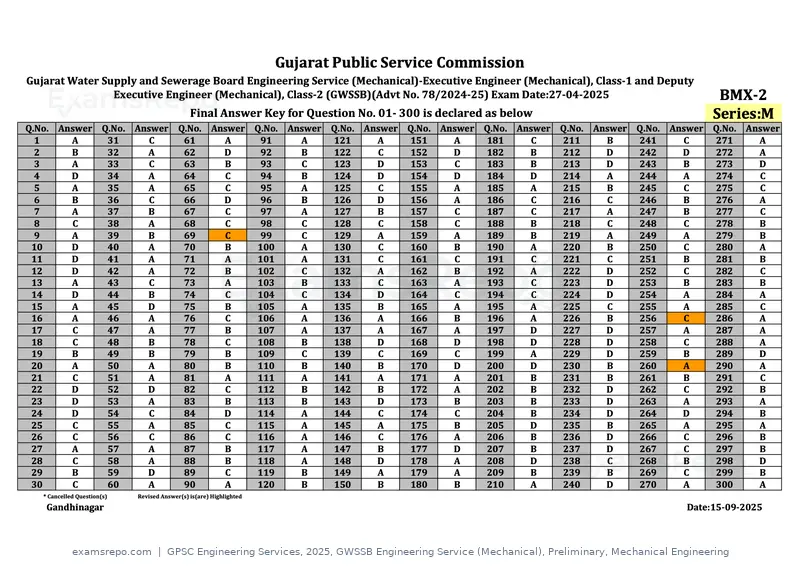
Text of page 1
Gujarat Public Service Commission
Gujarat Water Supply and Sewerage Board Engineering Service (Mechanical)-Executive Engineer (Mechanical), Class-1 and Deputy
                Executive Engineer (Mechanical), Class-2 (GWSSB)(Advt No. 78/2024-25) Exam Date:27-04-2025                      BMX-2
                                               Final Answer Key for Question No. 01- 300 is declared as below                  Series:M
Q.No. Answer Q.No. Answer Q.No. Answer Q.No. Answer Q.No. Answer Q.No. Answer Q.No. Answer Q.No. Answer Q.No. Answer Q.No. Answer
  1     A     31     C     61     A     91     A    121     A    151     A    181     C    211     B    241     C    271     A
  2     B     32     A     62     D     92     B    122     C    152     D    182     B    212     D    242     D    272     A
  3     A     33     C     63     B     93     C    123     D    153     C    183     B    213     D    243     B    273     D
  4     D     34     A     64     C     94     B    124     D    154     D    184     D    214     A    244     A    274     C
  5     A     35     A     65     C     95     A    125     C    155     A    185     A    215     B    245     C    275     C
  6     B     36     C     66     D     96     B    126     D    156     A    186     C    216     C    246     B    276     A
  7     A     37     B     67     C     97     A    127     B    157     C    187     C    217     A    247     B    277     C
  8     C     38     A     68     C     98     C    128     C    158     C    188     B    218     C    248     C    278     B
  9     A     39     B     69     C     99     C    129     A    159     A    189     B    219     A    249     A    279     B
 10     D     40     A     70     B    100     A    130     C    160     B    190     A    220     B    250     C    280     A
 11     D     41     A     71     A    101     A    131     C    161     C    191     C    221     C    251     B    281     B
 12     D     42     A     72     B    102     C    132     A    162     B    192     A    222     D    252     C    282     C
 13     A     43     C     73     A    103     B    133     C    163     A    193     C    223     D    253     B    283     B
 14     D     44     B     74     C    104     C    134     D    164     C    194     C    224     D    254     A    284     A
 15     A     45     D     75     B    105     A    135     B    165     A    195     A    225     C    255     A    285     C
 16     A     46     A     76     C    106     A    136     A    166     B    196     A    226     B    256     C    286     A
 17     C     47     A     77     B    107     A    137     A    167     A    197     D    227     D    257     A    287     A
 18     C     48     B     78     C    108     B    138     D    168     D    198     D    228     D    258     C    288     A
 19     B     49     B     79     B    109     C    139     C    169     C    199     A    229     D    259     B    289     D
 20     A     50     A     80     B    110     B    140     B    170     D    200     D    230     B    260     A    290     A
 21     C     51     A     81     A    111     A    141     A    171     A    201     B    231     B    261     B    291     C
 22     D     52     D     82     C    112     B    142     B    172     A    202     B    232     D    262     C    292     B
 23     D     53     A     83     B    113     B    143     D    173     B    203     B    233     D    263     A    293     A
 24     D     54     C     84     D    114     A    144     C    174     C    204     B    234     D    264     D    294     B
 25     C     55     A     85     C    115     A    145     A    175     B    205     D    235     B    265     A    295     A
 26     C     56     C     86     C    116     A    146     C    176     A    206     B    236     D    266     C    296     B
 27     A     57     A     87     B    117     A    147     B    177     D    207     B    237     D    267     C    297     B
 28     C     58     A     88     B    118     A    148     D    178     A    208     D    238     C    268     B    298     D
 29     B     59     D     89     C    119     B    149     A    179     A    209     B    239     B    269     C    299     B
 30     C     60     A     90     A    120     B    150     B    180     B    210     A    240     D    270     A    300     A
   * Cancelled Question(s)   Revised Answer(s) is(are) Highlighted
    Gandhinagar                                                                                                           Date:15-09-2025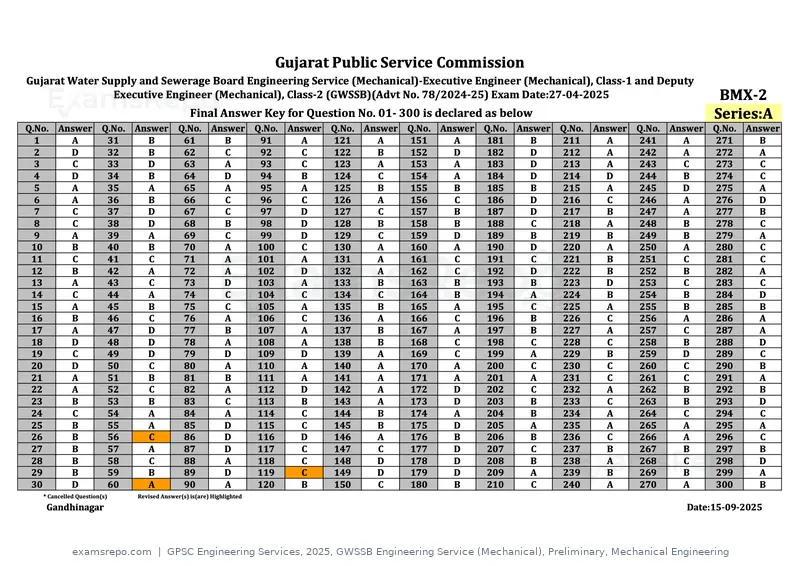
Text of page 2
Gujarat Public Service Commission
Gujarat Water Supply and Sewerage Board Engineering Service (Mechanical)-Executive Engineer (Mechanical), Class-1 and Deputy
                Executive Engineer (Mechanical), Class-2 (GWSSB)(Advt No. 78/2024-25) Exam Date:27-04-2025                      BMX-2
                                               Final Answer Key for Question No. 01- 300 is declared as below                  Series:A
Q.No. Answer Q.No. Answer Q.No. Answer Q.No. Answer Q.No. Answer Q.No. Answer Q.No. Answer Q.No. Answer Q.No. Answer Q.No. Answer
  1     A     31     B     61     B     91     A    121     A    151     A    181     B    211     A    241     A    271     B
  2     D     32     B     62     C     92     C    122     B    152     D    182     D    212     A    242     A    272     A
  3     C     33     D     63     A     93     C    123     A    153     A    183     D    213     A    243     C    273     C
  4     D     34     B     64     D     94     B    124     C    154     A    184     D    214     D    244     B    274     C
  5     A     35     A     65     A     95     A    125     B    155     B    185     B    215     A    245     D    275     A
  6     A     36     B     66     C     96     C    126     A    156     C    186     D    216     C    246     A    276     D
  7     C     37     D     67     C     97     D    127     C    157     B    187     D    217     B    247     A    277     B
  8     C     38     D     68     B     98     D    128     B    158     B    188     C    218     A    248     B    278     C
  9     A     39     A     69     C     99     D    129     C    159     D    189     B    219     B    249     B    279     A
 10     B     40     B     70     A    100     C    130     A    160     A    190     D    220     A    250     A    280     C
 11     C     41     C     71     A    101     A    131     A    161     C    191     C    221     B    251     C    281     C
 12     B     42     A     72     A    102     D    132     A    162     C    192     D    222     B    252     B    282     A
 13     A     43     C     73     D    103     A    133     B    163     B    193     B    223     D    253     C    283     C
 14     C     44     A     74     C    104     C    134     C    164     B    194     A    224     B    254     B    284     D
 15     A     45     B     75     C    105     A    135     B    165     A    195     C    225     A    255     B    285     B
 16     B     46     C     76     A    106     C    136     A    166     C    196     B    226     C    256     A    286     A
 17     A     47     D     77     B    107     A    137     B    167     A    197     B    227     A    257     C    287     A
 18     D     48     D     78     A    108     A    138     B    168     C    198     C    228     C    258     B    288     D
 19     C     49     D     79     D    109     D    139     A    169     C    199     A    229     B    259     D    289     C
 20     D     50     C     80     A    110     A    140     A    170     A    200     C    230     C    260     C    290     B
 21     A     51     B     81     B    111     A    141     A    171     A    201     A    231     C    261     C    291     A
 22     A     52     C     82     A    112     D    142     A    172     D    202     C    232     A    262     B    292     B
 23     B     53     B     83     C    113     B    143     A    173     D    203     B    233     C    263     B    293     D
 24     C     54     A     84     A    114     C    144     B    174     A    204     B    234     A    264     C    294     C
 25     B     55     A     85     D    115     C    145     B    175     D    205     A    235     A    265     A    295     A
 26     B     56     C     86     D    116     D    146     A    176     B    206     B    236     C    266     A    296     C
 27     B     57     A     87     D    117     C    147     C    177     D    207     C    237     B    267     B    297     B
 28     B     58     C     88     A    118     C    148     D    178     D    208     B    238     A    268     C    298     D
 29     B     59     B     89     D    119     C    149     D    179     D    209     A    239     B    269     B    299     A
 30     D     60     A     90     A    120     B    150     C    180     B    210     C    240     A    270     A    300     B
   * Cancelled Question(s)   Revised Answer(s) is(are) Highlighted
    Gandhinagar                                                                                                           Date:15-09-2025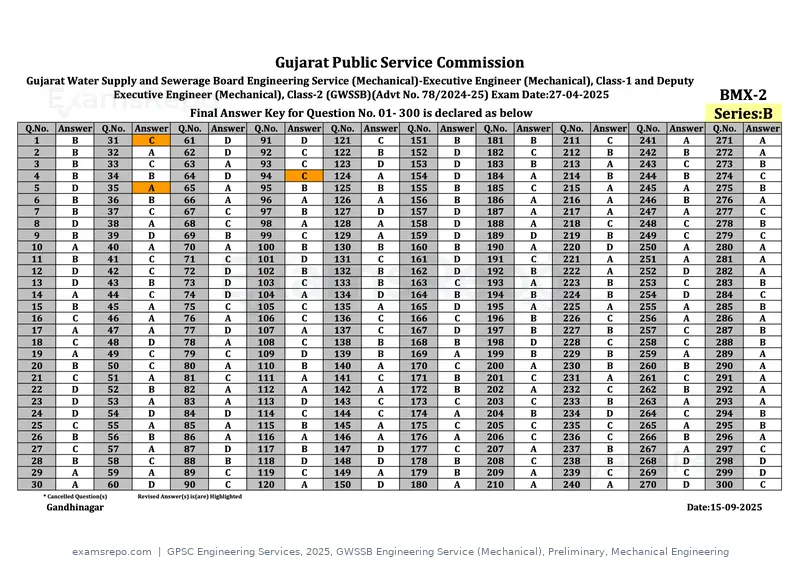
Text of page 3
Gujarat Public Service Commission
Gujarat Water Supply and Sewerage Board Engineering Service (Mechanical)-Executive Engineer (Mechanical), Class-1 and Deputy
                Executive Engineer (Mechanical), Class-2 (GWSSB)(Advt No. 78/2024-25) Exam Date:27-04-2025                      BMX-2
                                               Final Answer Key for Question No. 01- 300 is declared as below                  Series:B
Q.No. Answer Q.No. Answer Q.No. Answer Q.No. Answer Q.No. Answer Q.No. Answer Q.No. Answer Q.No. Answer Q.No. Answer Q.No. Answer
  1     B     31     C     61     D     91     D    121     C    151     B    181     B    211     C    241     A    271     A
  2     B     32     A     62     D     92     C    122     B    152     D    182     C    212     B    242     B    272     A
  3     B     33     C     63     A     93     C    123     D    153     D    183     B    213     A    243     C    273     B
  4     B     34     B     64     D     94     C    124     A    154     D    184     A    214     B    244     B    274     C
  5     D     35     A     65     A     95     B    125     B    155     B    185     C    215     A    245     A    275     B
  6     B     36     B     66     A     96     A    126     A    156     B    186     A    216     A    246     B    276     A
  7     B     37     C     67     C     97     B    127     D    157     D    187     A    217     A    247     A    277     C
  8     D     38     A     68     C     98     A    128     A    158     D    188     A    218     C    248     C    278     B
  9     B     39     D     69     B     99     C    129     A    159     D    189     D    219     B    249     C    279     C
 10     A     40     A     70     A    100     B    130     B    160     B    190     A    220     D    250     A    280     A
 11     B     41     C     71     C    101     D    131     C    161     D    191     C    221     A    251     A    281     A
 12     D     42     C     72     D    102     B    132     B    162     D    192     B    222     A    252     D    282     A
 13     D     43     B     73     D    103     C    133     B    163     C    193     A    223     B    253     C    283     B
 14     A     44     C     74     D    104     A    134     D    164     B    194     B    224     B    254     D    284     C
 15     B     45     A     75     C    105     C    135     A    165     D    195     A    225     A    255     A    285     B
 16     C     46     A     76     A    106     C    136     C    166     C    196     B    226     C    256     A    286     A
 17     A     47     A     77     D    107     A    137     C    167     D    197     B    227     B    257     C    287     B
 18     C     48     D     78     A    108     C    138     B    168     B    198     D    228     C    258     C    288     B
 19     A     49     C     79     C    109     D    139     B    169     A    199     B    229     B    259     A    289     A
 20     B     50     C     80     A    110     B    140     A    170     C    200     A    230     B    260     B    290     A
 21     C     51     A     81     C    111     A    141     C    171     B    201     C    231     A    261     C    291     A
 22     D     52     B     82     A    112     A    142     A    172     B    202     A    232     C    262     B    292     A
 23     D     53     A     83     A    113     D    143     C    173     C    203     C    233     B    263     A    293     A
 24     D     54     D     84     D    114     C    144     C    174     A    204     B    234     D    264     C    294     B
 25     C     55     A     85     A    115     B    145     A    175     C    205     C    235     C    265     A    295     B
 26     B     56     B     86     A    116     A    146     A    176     A    206     C    236     C    266     B    296     A
 27     C     57     A     87     D    117     B    147     D    177     C    207     A    237     B    267     A    297     C
 28     B     58     C     88     B    118     D    148     D    178     B    208     C    238     B    268     D    298     D
 29     A     59     A     89     C    119     C    149     A    179     B    209     A    239     C    269     C    299     D
 30     A     60     D     90     C    120     A    150     D    180     A    210     A    240     A    270     D    300     C
   * Cancelled Question(s)   Revised Answer(s) is(are) Highlighted
    Gandhinagar                                                                                                           Date:15-09-2025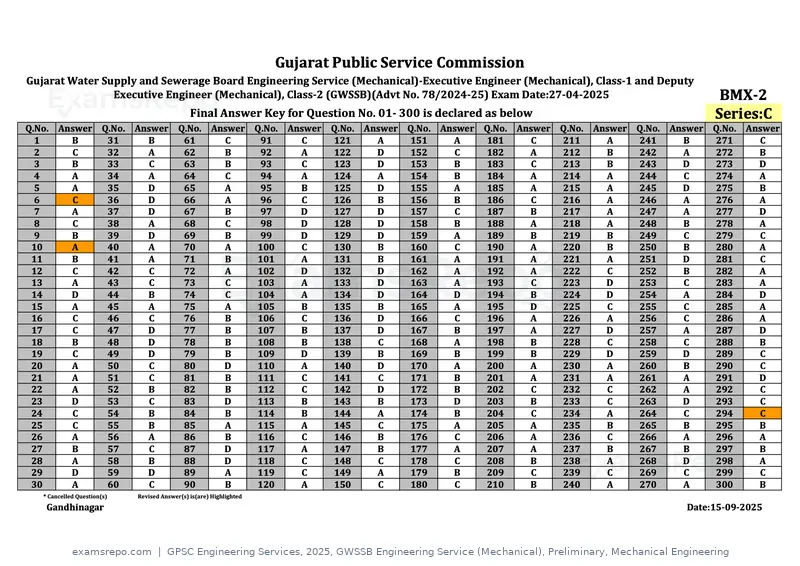
Text of page 4
Gujarat Public Service Commission
Gujarat Water Supply and Sewerage Board Engineering Service (Mechanical)-Executive Engineer (Mechanical), Class-1 and Deputy
                Executive Engineer (Mechanical), Class-2 (GWSSB)(Advt No. 78/2024-25) Exam Date:27-04-2025                      BMX-2
                                               Final Answer Key for Question No. 01- 300 is declared as below                  Series:C
Q.No. Answer Q.No. Answer Q.No. Answer Q.No. Answer Q.No. Answer Q.No. Answer Q.No. Answer Q.No. Answer Q.No. Answer Q.No. Answer
  1     B     31     B     61     C     91     C    121     A    151     A    181     C    211     A    241     B    271     C
  2     C     32     A     62     B     92     A    122     D    152     C    182     A    212     B    242     A    272     B
  3     B     33     C     63     B     93     C    123     D    153     B    183     C    213     B    243     D    273     D
  4     A     34     A     64     C     94     A    124     A    154     B    184     A    214     A    244     C    274     A
  5     A     35     D     65     A     95     B    125     D    155     A    185     A    215     A    245     D    275     B
  6     C     36     D     66     A     96     C    126     B    156     B    186     C    216     A    246     A    276     A
  7     A     37     D     67     B     97     D    127     D    157     C    187     B    217     A    247     A    277     D
  8     C     38     A     68     C     98     D    128     D    158     B    188     A    218     A    248     B    278     A
  9     B     39     D     69     B     99     D    129     D    159     A    189     B    219     B    249     C    279     C
 10     A     40     A     70     A    100     C    130     B    160     C    190     A    220     B    250     B    280     A
 11     B     41     A     71     B    101     A    131     B    161     A    191     A    221     A    251     D    281     C
 12     C     42     C     72     A    102     D    132     D    162     A    192     A    222     C    252     B    282     A
 13     A     43     C     73     C    103     A    133     D    163     A    193     C    223     D    253     C    283     A
 14     D     44     B     74     C    104     A    134     D    164     D    194     B    224     D    254     A    284     D
 15     A     45     A     75     A    105     B    135     B    165     A    195     D    225     C    255     C    285     A
 16     C     46     C     76     B    106     C    136     D    166     C    196     A    226     A    256     C    286     A
 17     C     47     D     77     B    107     B    137     D    167     B    197     A    227     D    257     A    287     D
 18     B     48     D     78     B    108     B    138     C    168     A    198     B    228     C    258     C    288     B
 19     C     49     D     79     B    109     D    139     B    169     B    199     B    229     D    259     D    289     C
 20     A     50     C     80     D    110     A    140     D    170     A    200     A    230     A    260     B    290     C
 21     A     51     C     81     B    111     C    141     C    171     B    201     A    231     A    261     A    291     D
 22     A     52     B     82     B    112     C    142     D    172     B    202     C    232     C    262     A    292     C
 23     D     53     C     83     D    113     B    143     B    173     D    203     B    233     C    263     D    293     C
 24     C     54     B     84     B    114     B    144     A    174     B    204     C    234     A    264     C    294     C
 25     C     55     B     85     A    115     A    145     C    175     A    205     A    235     B    265     B    295     B
 26     A     56     A     86     B    116     C    146     B    176     C    206     A    236     C    266     A    296     A
 27     B     57     C     87     D    117     A    147     B    177     A    207     A    237     B    267     B    297     B
 28     A     58     B     88     D    118     C    148     C    178     C    208     B    238     A    268     D    298     A
 29     D     59     D     89     A    119     C    149     A    179     B    209     C    239     C    269     C    299     C
 30     A     60     C     90     B    120     A    150     C    180     C    210     B    240     A    270     A    300     B
   * Cancelled Question(s)   Revised Answer(s) is(are) Highlighted
    Gandhinagar                                                                                                           Date:15-09-2025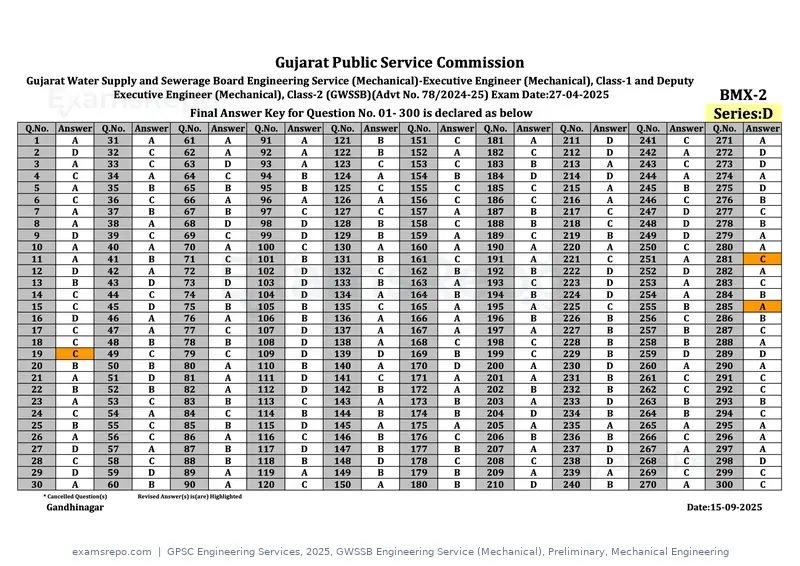
Text of page 5
Gujarat Public Service Commission
Gujarat Water Supply and Sewerage Board Engineering Service (Mechanical)-Executive Engineer (Mechanical), Class-1 and Deputy
                Executive Engineer (Mechanical), Class-2 (GWSSB)(Advt No. 78/2024-25) Exam Date:27-04-2025                      BMX-2
                                               Final Answer Key for Question No. 01- 300 is declared as below                  Series:D
Q.No. Answer Q.No. Answer Q.No. Answer Q.No. Answer Q.No. Answer Q.No. Answer Q.No. Answer Q.No. Answer Q.No. Answer Q.No. Answer
  1     A     31     A     61     A     91     A    121     B    151     C    181     A    211     D    241     C    271     A
  2     D     32     C     62     A     92     A    122     B    152     A    182     C    212     D    242     A    272     D
  3     A     33     C     63     D     93     A    123     C    153     C    183     B    213     A    243     C    273     D
  4     C     34     A     64     C     94     B    124     A    154     B    184     D    214     D    244     A    274     A
  5     A     35     B     65     B     95     B    125     C    155     C    185     C    215     A    245     B    275     D
  6     C     36     C     66     A     96     A    126     A    156     C    186     C    216     A    246     C    276     B
  7     A     37     B     67     B     97     C    127     C    157     A    187     B    217     C    247     D    277     C
  8     A     38     A     68     D     98     D    128     B    158     C    188     B    218     C    248     D    278     B
  9     D     39     C     69     C     99     D    129     B    159     A    189     C    219     B    249     D    279     A
 10     A     40     A     70     A    100     C    130     A    160     A    190     A    220     A    250     C    280     A
 11     A     41     B     71     C    101     B    131     B    161     C    191     A    221     C    251     A    281     C
 12     D     42     A     72     B    102     D    132     C    162     B    192     B    222     D    252     D    282     A
 13     B     43     D     73     D    103     D    133     B    163     A    193     C    223     D    253     A    283     C
 14     C     44     C     74     A    104     D    134     A    164     B    194     B    224     D    254     A    284     B
 15     C     45     D     75     B    105     B    135     C    165     A    195     A    225     C    255     B    285     A
 16     D     46     A     76     A    106     B    136     A    166     A    196     B    226     B    256     C    286     B
 17     C     47     A     77     C    107     D    137     A    167     A    197     A    227     B    257     B    287     C
 18     C     48     B     78     B    108     D    138     A    168     C    198     C    228     B    258     B    288     A
 19     C     49     C     79     C    109     D    139     D    169     B    199     C    229     B    259     D    289     D
 20     B     50     B     80     A    110     B    140     A    170     D    200     A    230     D    260     A    290     A
 21     A     51     D     81     A    111     D    141     C    171     A    201     A    231     B    261     C    291     C
 22     B     52     B     82     A    112     D    142     B    172     A    202     B    232     B    262     C    292     C
 23     A     53     C     83     B    113     C    143     A    173     B    203     A    233     D    263     B    293     B
 24     C     54     A     84     C    114     B    144     B    174     B    204     D    234     B    264     B    294     C
 25     B     55     C     85     B    115     D    145     A    175     A    205     A    235     A    265     A    295     A
 26     A     56     C     86     A    116     C    146     B    176     C    206     B    236     B    266     C    296     A
 27     D     57     A     87     B    117     D    147     B    177     B    207     A    237     D    267     A    297     A
 28     C     58     C     88     B    118     B    148     D    178     C    208     C    238     D    268     C    298     D
 29     D     59     D     89     A    119     A    149     B    179     B    209     A    239     A    269     C    299     C
 30     A     60     B     90     A    120     C    150     A    180     B    210     D    240     B    270     A    300     C
   * Cancelled Question(s)   Revised Answer(s) is(are) Highlighted
    Gandhinagar                                                                                                           Date:15-09-2025
Page 1 of 46
Source: Gujarat Public Service Commission. Question paper published by Gujarat Public Service Commission.