
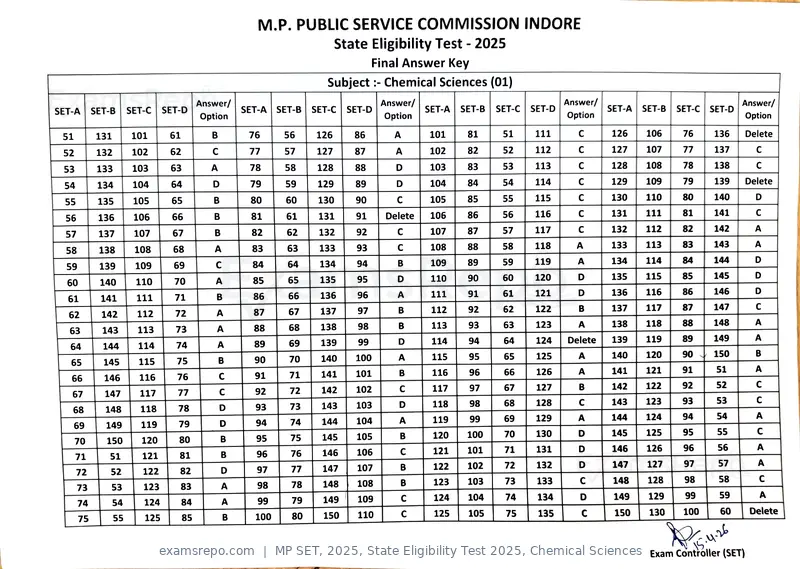
MP SET 2025: State Eligibility Test, Chemical Sciences

Text of page 1
R/P/P/2025/II                                             Question Booklet No.


                                           Subject-CHEMICAL SCIENCES
  SET             A                                                                 )                250107377
                                                       Paper II (Optional)


  'Name                                                Subject-Code-01

   3T^lTf^
                                                          I          Candidate should write his/her
   Roll No.                                                          Roll No. in the given boxes.

   ■gfer          ^ Tf^/No. of Printed Pages: 38                                    ^ U^' ^ ^ft^/Total No. of Questions : 100
   WT ; 3 ^ 3T87IT ^                                            ^                          a^f^^^KR■^^qfe'Maximum Marks : 200
   Time Allowed : 3 Hours to complete both 1st and Ilnd question paper
                                                                            "f^tr
         ^                  'TNi3Tf-%^ ■g              15^      i vOntraf                                  stm ^          fi
               WT w               t' 1 trt^ Tt^                   ft ggr       fi        Rtehc^ ■^' a^ grtr-gggt (5^.T^.3tiT.          )w
                      git gji^ gf^ tgfe        ^ <nicii g?^ i
             g^tgtr g ^ gyr-gr "I'        "PiengiT iso            g?g t ggr g?^ g^g 2 argj g^ ^ 1 gt^' gyg-gg g
          g?g atPtgi^ t' 1         gtrr ^ 2 argr ^jngJt 1 at^gftg g^        g^ arg?     i grai<*tg>' qygi'tb-t gg giggig
         g^ f I
               g?^-gg I                                         g?g-gg                              (g^g ^nsir i-so)
               g^T-gg ir               '             ^ "gg^ t^gg gg g^g-gg                          (g?g       51-150)
         ^ g^g-^ftg^              ^        atigrur     gr g?i^ gf 11g^t^rsff git           ft         t 'fe ^ ■^Ptf^gg git' "fe gyg-'^ftggg
         ^     ^^               3ffT           I arggr % g# ^ git ^jift g?g-^(^gai gtggcg gfg it 1
         ^ggr ggr-gggt (ait.T^.3nT. irts) gr ^rafftg wptt gr ft aira?ggr gfgfegf gst, apg Tsn^' gr gff i
         HpqiiJ jnjt vf ^ gyg-^fidtbi ^ PigiRd wg gr ft git, at?gg g;^ g^ ggr ggr-gg (att.Ttg.atir. ?ftg) gr ^g^ 1
                  gyg irfe# g^ git gitf "^cr gr g?gnggr ggjR ^ "jRr gt gyg ^ ifft ggr afitsit wr^' if tt      "ggrar
         git grggr gigt gn^gr 1
         f^i# g^               pgg tget g 'fegt g^rr gg f^ggrf^ ■fegr^g agf^ gg ggtg gfirg ■! 1
         ^ aim««i^ g^-^f^q>i W)cn^ ^            "511^ gg^ ^y'ctin.ft grTT-ggg? (^.t^.agr. Tfir) "^f ggr                ftrf%g girt %
         <i«<d gji^ gfcT      ^ ^ ggtg git 1
         g%r ggpg ^ ^ gygnf 3Tt.T^.agT. vftg gtt^^ git       ^ g?gni.^ ar^raf. g?^ rjt^ i
                 (aTt.t^.anr.) gr ■axu       g^        gt^ Iti^yft gT^ «»ai,ti            git 1
                                           INSTRUCTIONS TO THE CANDIDATES
         This Question Booklet is printed in two languages—Hindi and English. Candidates can select any one of the
         two languages according to their convenience.
         Each question has four options. There is only one correct answer to each question. Choose the appropriate
         option and darken/blacken the corresponding circle on the Answer Sheet (OMR Sheet) with black point pen.
         In tMs examination there are two question papers, consisting of 150 objective type questions and each question
         carries 2 marks. Both the question papers and all the questions are compulsory. Two (2) marks shall be
         awarded for each correct answer. Unanswered question will not be given any marks. There is no provisions
         for Negative Marking.
               PaperI                                 General paper                                   (Q. No. 1-50)
              Paper n        Question paper on the Subject opted by the examinee                     (Q. No. 51-150)
   4.    No. of pages consisting of this question booklet is indicated over the cover page. Candidates are advised to
         ensure that all the pages of Question Booklet are properly printed and binded. Otherwise they may demand
         the other Question Booklet of the same set.
   5.    Kindly make necessary entries on the Answer Sheet (OMR Sheet) only at the places indicated and nowhere else.
   6.    Examinee should do all rough work on the spaces meant for rough work on the pages given in the Question
         Booklet and nowhere else, not even on the Answer Sheet (OMR Sheet).
   7.    If there is any sort of mistake either of printing or of factual nature in any question, then out of the Hindi and
         English versions of the question, the ffindi version will be treated as standard one.
   8.    Use of any type of calculator, log table or any t3q>e of electronic devices etc. are not allowed.
   9.    Use only black ball point pen to mark the answers in the Answer Sheet (OMR Sheet) only after you are
         instructed to open the Question Booklet.
   10. Candidates will leave the Examination Hall only after handing over the Answer Sheet (OMR Sheet) to the
         Invigilator at the end of the examination.
   11.   Before answering on Answer Sheet (OMR Sheet) ensure to follow the instructions given for that.

.S/01/2025/A
Text of page 2
(SPACE FOR ROUGH WORK)


S/01/2025/A


Text of page 6
60. The correct statements,for dithionite and
     dithionate ions from the following are :        3H1'44      IvlM, "(Hsl              :

     (1) Both have S-S bond.                        (1)              S-S            t I
     (2) Both are dianionic.                       . (2)                       (dianionic) f 1
    • (3) Oxidation state of sulphur is +3 and
          +5 respectively.                                    +3 ^ +5 t I       ■

     (4) Sulphur in dithionate has two lone         (4)                ^        ^             2
          pairs of electrons.                                       ^f I
     Codes :                                         W •
     (A).(l),(2) and (3) Only                       (A)^(1),(2)                (3)
    (B) (1), (2) and (4) Only        ■              (B)^(1),(2) sSk (4)
    (C) (2),(3) and (4) Only                        (C)           (2),(3) 3Tk (4)
    (D) (1) and (2) Only                            (D)           (1) 3^(2)

61. The hybridisation found in complex ion       61. [FeFgf"."?!^ 3WT               "qPlT ^ ^1^
     [FeFgf- is : •                                            t:
     (A) (P-sp^                                     (A) <Psp^
     (B) sp^P                                       (B) sp^(P
     (C) dsp^                                       (C) dsp^
     (D) sp^                                        (D) sjP

62. Which one of the following shows             62. fFTfefer        ^^                   31^^
     relatively stronger trans effect ?              wm "ST^ffTcT wr t ?
    (A) NO                                          (A) NO

     (B) NO2                                        (B) NO2
     (C) Py                                       : .(C) Py'
     (D) H2a          -                             (D) H2O


(N)(3)S/01/2025/A
Text of page 7
63. Spin only formula is :                   63.             ^ "I :

    (A)      =yJn(n +2)BM                          (A) h,=7«(« +2)BM

    (B)      =«(rt + 2)BM                          (B)     = n(n +2)BM
                                                                     I


    (C) n,=V247+I)BM                               (C) h^=72s(s+1)BM

    (D)      =7l(L +1)+4j(s-1)BM                   (D)     =^L(L +1)+ 45(5-1)BM

64. Which of the following lanthanide pair   64. rnHPetR^d                awff    ^
                                                                                             »


     ions do not exhibit colour ?                            v\           ^            t ?

    (A) La^"*" and Lu^"^                           (A) La3+ aSk Lu3+
    (B) Nd3+ and Er^^                              (B) Nd3+3lk.Er3+
    (C) Pm3+andHo3+                                (C) Pm3+3TkHo3+

    (D) Sm^"^ and Dy^"^                            (D) Sm3+3^:Dy3+

65. Wilkinson's catalyst is :                65.                   ^:

    (A) (Ph3P)3RhCO                                (A) (Ph3P)3RhCO

    (B) (Ph3P)3RhCl                                (B) (Ph3P)3RhCl

    (C) (Ph3P)3Rh(HCl)                             (C) (Ph3P)3Rh(HCl)

    (D) (Ph3P)3RuCl                                (D) (Ph3P)3RuCl

66. Number of terminal and bridging CO       66. Fe2(CO)9        efer       % CO
     ligand in Fe2(CO)9 is respectively :          ^               t:

    .(A) 5 and 4           (B) 4 and 5             (A) 5     4           (B) 4 afk 5
    (C) 6 and 3            (D) 3 and 6             (C) 6 a^k 3           (D) 3 a^k 6
(N){3)S/01/2025/A                                                                  P.T.O.

Text of page 9
71. Rf(Retention factor) is related to whiph     71. Rf                     PiMPdrt^d "^f
     of the following separation techniques ?                                       t ?
    (A) High,         Pressure         Liquid
                                                     (A) ^3^ ^ cRd                        (HPLC)
          Chromatography (HPLC)
                                                     (B)
    (B) Paper Adsorption Chromatography

    (C) Gas Chromatography
                                                     (C) ^

    (D) Flash Chromatography                         (D)        cjuWp^cbl

72. Among the following analytical methods,      72. PdMPdndd                             ^
     which one is based on thermal analysis ?
                                                                            ^ STT^irf^ t ?
    (A) Potentiometric method
                                                     (A)
    (B) Conductometric method
                                                     (B) -dlddidlHIHl
    (C) Volumetric method
                                  I      , ■"

                                                     (C) 3TO^mnt
     (D) Differential scanning calorimetry

         method                                      (D)                    cgcrlldPHil

73. For Fe^"'",+le~           the value of E®    73. Fe^"^+le~;F^Fe^'^ it                      ^

     is + 0.771 V. Then what will be the value       TTFT +0.771 V t I ^ 25°C tR

     of E for the Fe^"^/Fe2"^ half cell, if
                                                   ■ [Fe3+] = 10-^M -^«1T [Fe2+] = 10"^ M
                                                    . i\,   Fe3+/Fe2+             ^           E ^
     [Fe3+] = io^ M and [Fe^+J = 10"^ M
                                                     FfH            ?
     at 25°C ?
                                                     (A) + 0.592 V          (B) - 0.692 V
     (A) + 0.592 V       (B) - 0.692 V
                                                     (C) + 0.770 V          (D) - 0.948 V
     (C) + 0.770 V       (D) - 0.948 V

(IM)(3)S/01/2025/A                                                                          P.T.O.
Text of page 10
74. The role of chlorophylls is very                      74.         ^ -mm                   ^
     important in the photosynthesis ofplants.
     Which     metal      ion   is   present     in             tI               ^          ^ 3TPH
     chlorophylls ?                                             im % 7

    (A) Mg2+                (B) Zn2+                            (A) Mg2+                 (B) Zn2+
    (C) Ni2+                (D) Fe2+                            (C) Ni2+                 (D) Fe2+

75. Which one from the following is the                   75.                  ^
     structure of cis-platin ?

    (A) Octahedral structure                                    (A)

    (B) Square planar structure                                 (B) ^
    (C) Pyramidal structure                                     (C) PM^lPH^d
   '(D), Hexagonal structure                                    (D)


76. Which one of the following is the most                76. PHMPdPtdd          ^
     important bio-inorganic pharmaceutical                     ^-^chl4PH=6                                    t
     isotope used for the radiomedical                          M                              ^ "51^^
     purposes ?

    (A)                     (B)                                 (A) 99Tc                 (B) 99Mo
    (C)-95Ru                (D) 2i2Bi                           (C) 95Ru                 P) 212Bi

77. The half-life         period (^1/2) of a              77.                           ^          3I^-3TT^^
     radionuclide is determined          by the                 (^1/2) ^               PlHPriRdd           m
     following equation :                                       Ph'Hi ^jJRTT     :

                  0.693                                                        0.693
    (A) ^1/2 =                                                  (A) ti/2 =               (B) q/2 -
                   X                   . 0.693                                                         0.693

                  0.593                                                        0.593                   0.0593
    (C) hn =                {D) ty2~       «                    (C) hn = ^               (I^) ^1/2 =


(N)(3)S/01/2025/A                                     8
Text of page 11
78.
78. Raman Spectroscopy can be used for
    which of the following ?
                                                      (A) 3#^                 ^
    (A) Elucidation of molecular structure
                                                      (B)
    (B) Locating various functional groups
    (C) Locating chemical bonds ,in                   (C) STOjsif ■£[ TRTFlfe
         molecules

    (D) All of the above                              (D) <iq£=kl ^

79. ■ Which among the following metals         79.

     is widely- used in nitrogen fixation             31^ ^ ^1# ^ rdHprlRsid                 ^
     process ?                                                "i" ?

    (A) Zinc                                          (A)

    (B) Nickel                                        (B)

    (C) Cobalt                                         (C)

    (D) Molybdenum                                     (D)


80. The measured absorbance of a solution       80.                    ^ 3i^dir4)d       1

     with path length of 1 cm is 0.544. IfAe           ■q8I           ^ "^81 0.544 t I
     concentration is 1.4 x 10"^ M,then what           1.4 X 10⁻³ M       ^          ^ %i 3#^
     will be the molar absorptivity for the                           =tHI sVll ?
     sample ?
                                                       (A) 250.4 L mol"l cm"^
     (A) 250.4 L mol~^ cm"^
                                                       (B) 560.1 L moH cm~^
     (B) 560.1 L mol-1 cm'^
                                                       (C) 388.5 L mol"^ cm"^
     (C) 388.5 L mol-l cnr^
     (D) 406.3 L mol"^ cm"^                            (D) 406.3 L mol"^ cm""^

                                                                                         P.T.O.
 (N){3)S/01/2025/A

Text of page 13
84. Which is an example of D2h group ?     ■ 84. D2h                                       t?
    (A) Trans CHCI = CHCI                              (A)^ CHCI = CHCl

    (B) Naphthalene                                    (B)               ■

    (C) Pyridine                                       (C)

    (D) SFg                                            (D) Sf/
85. Which of the folowing- has S4 axis ?    85. S4               rHMRrifed        ^           t?
    (A) CO2             (B) C2H2                       (A) CO2 ,                (B) C2H2
                                                                                     ■2^2


    (C) BF3             (D) S0|"                       (C) BF3                       0^"
                                                                                (D) SO^"

86. PCI4 and PClg ions belong to point      86. PClJ                           PClg       3TPFT


     groups             respectively.                                  '1%^ 'B'p f I
    (A) Td and                                          (A) Tj ak Oh
    (B) S4 and Sg                                     ■ (B). S4 3fR:S6
    (C) D4handD6h                                       (C) D^h^Dch
    (D) C2h and D2h                                     (D) C2h31^D2h

87. The term symbol for groimd state of         87.            (Na)          clel^ 31^^
                                                         t


     sodium (Na) is :                                   ^           "Rcfe                  t:

    (A) 2Pi/2           ■ (B) 2Si/2                     (A) 2Pi/2        - . (B) 2Si/2
     (C) ISo            (D)                      • (C) ISo                      (D) IPi

88. Which has the shortest bond length ?        88.          ^^                             t ?

     (A) NO             (B) N0+                         (A) NO                   (B) N0+

     (C) N02+           (D) NO"                   •     (C) N02+                 (D) NO"


(l\I)(3)S/01/2025/A                        11                                                 P.T.O.
Text of page 14
89. For combining atomic orbitals for the
                                                  89.                      ^^^ LCAO Mr
     formation of molecular orbitals by
                                                        ^                                      Pl^RlRslct
     LCAO method, the incorrect condition
    ' is :

     (A) Orbitals must have same or nearly              (A)               WTH

             same energy.                                     ^           ^snftrr I

     (B) Orbitals must have same symmetry               (B)               ^                           ^
             about the nuclear axis.                                  "^FTR                1

     (C) Orbitals must overlap to the                   (C)               ^ ^Pdo^im
             maximum extent.                                  ^ I

    (D) Orbitals must be of the same                    (D) ^                         ^ W1F3 ^ ^
             atom.                                            ^^TflTT i

90. Sy       component      of spin    angular
     momentum for all stable particles
                                                                  — -qshui
     like      electron,    proton,    neutron                    2
                                                                                      ^ -qsh"!


      spin      system is represented by:                     ^ Sv ^'=<'Hq ^ :


                                                                    0
    (A)                                                 (A)           1    0
                 i    0

                                                                  /
                ^0   r                                              0      r
    (B)
                 1   0
                                                        (B) 4rh
                                                            2         1    0   ✓


                 1    0'                                              1    0
    (C)                                                 (C) lyh 0
                 0   -1                                                   -1
                                                                  \


                 1   0^
    (D) nS 0                                                      ^1       0^
                     1                                  (D)
                                                                  0        1


(N)(3)S/01/2025/A                            12
Text of page 15
91. In the rotational spectra of CO the          91.         CO                           "frsTW
     rotational constant B is 1.922 cm~^. The          B ^ 1TH 1.922                      CO ^

     moment of inertia (I) for CO will be :                            ® #1T :            .        ■

    (A) 1.922 X 10⁻¹⁰ kgin2                            (A).1.922 X 10-10 hgm2
    (B) 14.554 X 10-47                                 (B) 14.554 X 10-47 kgm2
    (C) 6.0 X 10⁻³⁴ kgm2                               (C) 6.0 X 10⁻³⁴ kgin2
    (D) 24.8 X 10⁻³⁰ kgm2                              (D) 24.8 X 10⁻³⁰ kgin2

'92. The number of fundamental bands             92.

     observed in infrared spectrum of benzene          ^ WTT            ;
     is :
                                                       (A) 20                  ®) 36
    (A) 20               (B) 36
    (C) 30               (D) 12                        (C) 30                 (D) 12


93. If force constant/(or A:) = 10 x 10^ gs-^    93.      ^t¥lOT/(or^)= 10 X 103 gs-2
    and reduced mass p.=9.97 x 10-^4 then                               11 = 9.97 x 10⁻²⁴ g    ^
     the wave number (v) for stretching
     vibration of carbon-carbon double .bond
     will be:
                                                             (v)       "HH ^"^Wr ?
    (A) 3100 cm-l        (B) 2970 cm"!                 (A) 3100 cm-1          (B) 2970 cm-l
     (C) 1000"cm-l       ■ (D) 1680 cm^l               (C) 1000 cm-1          (D) 1680 cm-^

94. Raman lines on the lower frequency           94.                        fdM STT^frf   3^
     side of the -excitation frequency are
                                                       ^hH ^<2I|3TI"            ^ I
     known as :
                                                       (A)
     (A) Stokes' lines
                                                       (B)              (yPdwlcHl)
     (B) Anti-stokes' lines
     (C) Rayleigh line                                 (C)

     (D) None of the above                             (D) ^M^dd        ^ ^^
(N)(3)S/01/2025/A                               13                                        P.T.O.

Text of page 17
98. For a thermodynamically irreversible
     process,the following statement is correct:            ftHfinnad           tirM "I" :

    (A)                   =0                            (A) AS^y^ + AS^^ = 0
    (B) AS,y3 + AS,^ > 0                                (B) AS^y^ + AS^^^ > 0
    (C) AS^y^ + AS,^ < 0                                (C) AS,y, + AS,^<0
    (D) AS^y, + AS^,^ < 0                               (D) AS,y3 + AS,^ < 0

99. If the molar ionic conductance at infinite      99. ^                           NaOH, NaCl
     dilution of strong electrolytes NaOH,                  BaCl2 ^
     NaCl and BaCl2 are 248.1 x 10^;                    3TFlto ^l<ri4idl            248.1 x 10"^;
     126.5 X 1(H and 280.0 x I(H Sm^ moH                126.5 X 10-^13^*280.0 x lO^Sm^'moH
     respectively, then the molar ionic
                                                        t, ^                   -q^ Ba(0H)2 ^
     conductance of Ba(0H)2 at infinite
                                                                           -durt^tidi "^blt :
     dilution will be :

     (A) 332 X 10^ Sm2 mo]r^                            (A) 332 X 10"^ Sm2 mol"!
     (B) 220 X 10"^ Sm2 mol"^                           (B) 220 X 10"^ Sm2 mol-l
     (C) 523.2 X 10"^ Sm2 moH                           (C) 523.2 X l(H Sm2 mol-^
     (D) 228.6 X 10⁻⁴ sm2 mol"!                         (D) 228.6 X 10-^ Sm2 moH

100. Eel               reaction                     100.' ^ ^

      Zn2"^(aq)+2e";F^Zn(s) is -0.76 V                  Zn^'^(aq)+2e~ ^Zn(s)        Egi =- 0.76 V
     and for the half cell reaction :■

            Cul + e" ^ Cu(s) +r (aq)                           Cul + e" ^ Cu(s) +1" (aq)
     is + 0.17 V then the standard potential
                                                        "il Eei= + 0.17V t, ^.PHHrdPsId^'^
      (Eceiij for the following cell will be :          ^ Tinqr            (e^ii) im :
        Zn I Zn^'^Om) || r(lm);CuI| Cu
                                                          Zn I Zn2"^(lm) |1 r(lm);CuI| Cu
      (A) + 0.59 V         (B) - 0.59 V
                                                        (A) + 0.59 V          (B) - 0.59 V
      (C) +b.93V'          (D) + 1.76 V                 (C) +0.93.V '         0) + 1.76 V
(N)(3)S/01/2025/A                                  15                                        P.T.O,
Text of page 18
101. A decomposition reaction, has a half life     101.                             Rui,
     that does not depend on the initial
     concentration of the reactant. What is the                                    t, fit
     order of the reaction ?                              ^^^                 .?
     (A) Zero order reaction                              (A)^^
     (B) Second order reaction                            (B)         ^ 3;tM^
    (C) First order reaction                              (C)        ^
    (D) Order cannot be determined due to
          insufficient information                              ^^                   t I

102. The half life of a substance in a first       102. "Fram ^ ^                  ^
     order reaction is 15 minutes. The rate               ■q^«f ^ 37;^ 371^^ 15 fiR3 t I
     constant of the reaction is :

    (A) 3.62 X 10⁻²                                       (A) 3.62 X 10⁻²

    (B) 3.62 X 10⁻³                                       (B) 3.62 X 10⁻³ ■

    (C) 4.62 X 10⁻²                                       (C) 4.62 X 10⁻²

    (D) 2.11 X 10⁻³-                                      (D) 2.11 X 10⁻³

103. The Langmuir isotherm equation is :           103:         3nf^8pf            t :

               KP                                                    KP
    (A) 0=                                                (A) 0 =
             KP-1                                                   KP-1

               KT                                                    KT
    (B) 6=                                                (B) 0 =
             KP-1                                                   KP-1


               KP                                                    KP
    (C) 0=                                                (C) 0 =
             KP+1                                                   KP + 1

               KT                                                    KT
    (D) 0=                                                (D) 0 =
             KT-1                                                   KT-1


(N)(3)S/01/2025/A                             16
Text of page 19
104. Consider the following statements with       104.                     ^ "fer
       respect to Tyndall effect :

       1. The diameter of the dispersed                     1.    yqilRd         ^ ozrm            iRTm
             particles, is not much smaller than                 ^                        ^^^
             the wavelength of the light used.                   i I
      2.     The refractive indices of the
           dispersed phase and dispersion
           medium differ greatly in magnitude.                         t I
      The correct statement is :                          ^             t:
      (A) Only I                                          (A)           1
     (B) ■ Only 2                                         (B) qiqcri 2
     (C) 1 and 2 both are correct                         (C) 1         2         ^f I
     (D) I and 2 both are incorrect                       (D) 1         2 #tF 31^ f I
 105. How many atoms are in the unit cell of       105.                     "ettRt ^V-qii if
     a face centred cubic structiue ?                                              f j
     (A) 1                (B) 2                           (A) 1                   (B) 2
     (C) 4                (D) 14                        (Q 4                     (D) 14
106- A face centred cubic arrangement of A
                                                   106. A         B -qTHHI ^
     and B atoms, where A atoms are at the
     comers of the umt cell and B atoms at          .


     the face centres. One of the A atom is               B WTT^            ^t, ^ -jTc^
     missing from one comer in each unit                          ^          A WTPy               t I
     cell. What is the simplest formula of the
                                                        ■4lR|ch ^ WRTB            ^^ 7
     compound ?

    (A) A3B7             (B) A7B3-                      (A) A3B7 ■               (B) A7B3
    (C) A7B24            (D) A3B24                      (C) A7B24              ■ (D) A3B24 .

(N)(3)S/01/2025/A                            17
                                                                                               P.T.O,
Text of page 20
107. The Bragg's equation is ;                 107. tn             t :

                                                       (A) rB = 2dsmX
    (A) ■/70 = 2t^sinA,                                            i.


     (B) /7 = 2c/sin0                                  (B) « = 2c^sin0

                                                       (C) rik = 2dsmd
     (C) M>, = 2(isin0


     (D) KX = 2(icos0                                  (D) nX = 2d cos 0
                                                                        I                   J


108. Polydispersity Index (PDI) is :            108.                            (PDI) t :

      (A) Uw/Mn                                        (A) Uw/Un


      (B) Mn/Mw                                        (B) Mw/Mw                    ' '' '

      (C) MrtxMw                                       (C) M/jxMw

                                                       (D)
      (D)' Mw^Mn


 109. The difference between the true value     109.


      and measured value with regard to sign

      is known as ;
                                       •   ^
                                                        (A>.-f^^            ■
       (A) Absolute error
                                                       '(B).
       (B) Indeterminate enor

                                                        (C)
       (C) Relative enor

       (D) Accuiacy                                     (D)


  (N)(3)S/01/2025/A                            18
Text of page 21
110. The result of an analysis is 16.Q7 a
                                               g I 110. r           i          ..
                                                                            ^ -qfiim .
                                                                                     36.97 •  .
                                                                                           Tm t,

       compared with the accepted value of
                                                                           TTH 37.06 -m i ■]
      37.06 g. What is the relative error in part

      per thousand ?

                                                         (A) 0.09 irfw F5TR WJ
      (A) 0.09 parts per thousand •

                                                          (B) - 0.09                   W]
      (B) - 0.09 parts per thousand


      (C) 2.4 parts per thous^d                          (C) 2.4 3#              qpT


      (D) - 2.4 parts per thousand''                     (D) - 2.4 3# ^                     ^


                              *           ✓         I
 111. Choose the correct lUPAC name of the j                            =hisfPic(i
     following organic compound :


    (A) 2-Butoxy-3, 4-dimethyl pentane                  (A) 2-^^|Zh^-3, 4-:§TffiT8?T|^ ^

    (B) I-Butoxy-3, 4-dimethyl pentane                  (B)                  4-^ST^S!7T^

    (C) 2-Butoxy-2, 3-dimethyl pentane

    (D) d-Butoxy-2, 3-dimethyl pentane
                                                        (E>) l-«iiT<wT-2, 3-^Tffi?81I^

(N)(3)S/01/2025/A                             19
                                                                                                P.T.O.

Text of page 23
114. Which of the following statements is              114. 4lR|ch I 3?^ II ^                 PlHRrifed
      correct for- compound I and II ?                                             ^ t,              .
                        yH ' H ,,               ^CH-.          H,C^               ./H   H..               'CH,
            c=c=c                    c=c=c                        /C=C=C^                     c=c=c
       H                                                        H                  H H3C/                \,
                                                                                                          'H
              . (I)                   (II)                             (I)                    ■ (II)
     (A) Both I and II are chiral compounds                    (A) I alh: II                    4iRich
             and a pair of entantiomers

     (B) Both I and 11 are achiral compounds                   (B) I         II                 4lR|ch t, afk
            and pair of diastereomers •                                                                   t 1

     (C) Both I and II are chiral compounds                    (C) I         II                  4f7T^
            and-a pair of diastereomers

     (D) Both I and II are achiral compounds                   (D) I     II                   4inic^' f cfarr
            and a pair of enantiomers                                                    f* I

 115. The addition of bromine to methyl                 115.                                     ^^^
     acetylene        which   gives       trans-1,2-           ^-1,2                    "31^ ifel t I ^
     dibromopropene. This reaction is :                        Slf^lfeTT t :

    (A) Stereoselective reaction                           (A)

    (B) Stereospecific reaction                            (B)           Ww arfqflrqT

    (C) Both            stereoselective        and         (C)           ci<u)|cHch

           stereospecific

    (D) Neither          stereoselective       nor         (D) ^ ^ Pifqn ci<u||f4c^ Tjj
           stereospecific reaction

(N)(3)S/01/2025/A                                 21
                                                                                                   P.T.O.
Text of page 24
116. Which of the following compounds is.
    non-benzenoid and antiaromatic ?             irg                t?


    (A)                (B)                       (A)


                                                    (C)


117. In the following reaction of benzene    117.           ^ iHMRrinsld

     which is the major product ?                   <icHK             "I" ?■
                       C1                                                 ei

                         -> Product
                                                           ^ /V :
                  AlCh                                             AlCf


     (B)                                             (B)


      (C)                                            (C)


      (D) None of the above                         .(D) ^M^dd      ^^
 (N)(3)S/01/2025/A                          22
Text of page 25
118. In thfe Piriacol-Pinacolone re^angemerit       118.                                          i{
       reaction, which of the following reaction             Pi*^RnRsia ■4" ^
      intermediate rearranges ?

      (A) Free Radical
                                                             (A)

      (B) Carbene
                                                             (B)

    • (C) ■ Carbonium ion
                                                             (C) "^iT^iFTFFT
     (D) Carbanion
                                                             (D)

 119. Select the correct decreasing order of . 119. Pi^ri.f^Raci                     ^
      stability of the following carbanions ; '          ^^        ^:
     (I)   HjCOy-i
                                                         (I) H3CO—/ V-CH,

                                                         (II) OjN
     (H) O2N—i \—CH.

     (m)   rvae.                                         (HI)                  CH2


                                                                                     e.


     (IV) HjC        /               e

                                     CH-
                                           ■■i           (TV) H3C                    CH.


                                                        (A) n>iii>i>iv
     (A) ii>m>i>iv

                                                        (B) III > IV > I> n
     (B) m>iv>i>n

     (C) IV>I>U>III                                     (C) iv>i>n>iii


    (D) i>ii>m>iv                                       (D) I >11 > in> rv
                 »       ,1.   ll-


(N)(3)S/01/2025/A                                23
                                                                                           P.T.O.
Text of page 26
120. Which of the following are true for        120.                      ^            r-iMRnfea      ^

    generation of carbene ?

    (I) Treatment of chloroform with base                 (I)                           ^

    (II) Photolysis of ketene                             (H) qMr ^

    (in) Isoelectronic decomposition of                   (ni)                ^                    37Wq
          diazomethane
                                                           (IV) ^l^0.p3l<lH ^
     (IV) Production by diazirines.
                                                     ■     W'
     Codes :

                                                           (A) (i)3^^(rv)
     (A) (I) and (IV)
                                                           (B) ai)        (in)
     (B) (II) and (III)
                                                         ■ (C) a). (II)       (HI)
     (C) (I),(U) and (III)
                                                           (D) (I), (n), (III) 3^(IV)
     (D) (D,(II), (III) and (IV)


 121. The rate of       reaction depends on :
                                                 121. Sj.j^                 ^          ft"?! '♦'■(.cil t :
                                                            (A)                   qr
     (A) The nucleophile

                                                            (B) =+ii4h ctichivi
     (B) The carbon skeleton

                                                            (C)         ^^
      (C) The leaving group

                                                            (D) "3q^
      (D) All of the above

 (N)(3)S/01/2025/A                              24
Text of page 27
122.                                 •
122. Major product in the reaction are :
                           HBr
                                  ■» A
    /V^OH                                                                OH

                                                               OH
         OH
                                                                          HBr
                     HBr                                                          B
                            ^ B


     (« ..Ax =                                  Br                   A
                                                                                                          Br


        (B) A =                                               (B) A =                 Br
                                 Br
                                                                                               Br
                                           Br


                                                                                      B =: /
                                  B =
                                                                         Br                    Br
                    Br                    Br


        (C)
              A =            •    B =


        (D) A = /\X\ Br
                                                              (D) A = /^V^Br
                                                                                B=
                           B=                   Br


                                                       123.
 123.


                                                                                "N'        COOR
                                        COOR


         This reaction occurs by :.
                                                               ■q?                                  ^ ^
     . (A) El                    (B) E2                        (A) El             (B) E2
         (C) EiCB                (D) Both El and E2            (C) El C B         (D)>          El         E2
                                                                                                     P.T.O.
  (Nl(3)S/01/2025/A                                   25
Text of page 28
124. The reaction proceeds via :                 124. ^                     ^f .


       Y\                       x/V NEtj              "Y\ NHEt,^ \y\/NEtj
           CI
                                                           Cl

      (A) Sn>                 (B) 8^2                 (A) Sn>?TO              (B) 8^2 OT
      (C) Sn'                 (D) 8^2'                (C) S^' gro             (D) 8^,2'SRT

                     0
                                                                     o

                 A.            Me
                                                                  A.           Me
  125. A ±^2;                                      125. A ^
                                              +
                 PhaP                                                                         +
                                         Cl                       PhaP
                                99.5%                                                    Cl
                                                                                 99.5%

                              Me'
                                              CI                              Me-
                                    0.5%                                                      Cl
                                                                                     0.5%

      Reactant A is ;
                                                                     A t:
           Me
                                                           • Me


     (A)
                                                     (A)
                     OH
                                                                     OH


                Me
                                                                Me


     (B)
                                                     (B)
           OH            OH
                                                           OH            OH

           Me
                                                           Me
    (C)
                                                    (C)
                     ^OH                                              ^OH
    (D) Both (A) and (C)                            (D)         (A) 3^ (C)

(N)(3)S/01/2025/A                             26

Text of page 30
127. P                >        127. P                >
            t-B402H
           Ti(Oi-Pr)4                     Ti(Oi-Pr)4


      Reactant P is :                          P ^ f ?■


                                    (B)


    (C)                             (C)


    (D)                            (D)


(N)(3)S/01/2025/A           28


Text of page 33
132. Identify the correct product of the            132. r-iMfeiRsId          ^^            ^
    following reaction :
          3   2
                       CH3 CH3
    < 4
                                                                ■      r. Y               -» ?


                           c=o                                 6    7
          6   7

                        CH.


                                                                              CH.
                           CH
    (A)                                                  (A)


                                                                         CH
                     CH


                     C—0=0                                               C—C=0
    (B)                                                  (B)


                                                                               CH.

     (C)                                                  (C)
                           CH,                                                CH,


                    CHO                                                 CHO


     (D)                                                  (D)
                    CH,                                                 CH,


 133. Which of the following reagent is              133. rdHrdP^d
     used to treat furan to get 2-furan sulfonic
     acid ?                                               t ?
     (A) SO3 in pyridine solvent at 100°C                 (A) 100°C      PMR^Id PddWdi"     SO3
     (B) Dilute H2SO4 at 200°C ■■                         (B) 200°C      ^ H2SO4

     (C) SOjatlOO^C                                       (C) 100°C      SO2

     (D) Dilute.H2SO4 at 100°C                            (D) lOO^C ^ ^ H2SO4

                                                   31                                     P.T.O.
 (N)(3)S/01/2025/A
Text of page 34
134. Which of the following statement is not        134."
       correct ?
                                                           •t ?
      (A) Pyridine is           more   basic than-         (A) IhR-s1-1              ^      T^* 37f^
            pyrole                                                       t
      (B) Pyridine is less basic than aliphatic            (B) RiRsli                 TTTSiTfe Ti^ ^
            primary amine
      (C) Pyridine is less basic than trimethyl
           amine
                                                                ^             t
     (D) Pyridine      is       less   basic   than        (D) PmRsIi             ^         ^
           pyrole                                              t
 135. Identify the compound X in the                  135. Ri^-iRiRaci
      following chemical reaction :                        X^                cblRlM. :
                        [O]                                                    [o]
                    :N KMnO^                               kJk^N KMno/
                                       COOH
                                                                                         COOH


                       a               COOH
                                               + X

                                                                               a         COOH
                                                                                                + X


     (A)                                                  (A)
            'K
                                                                  'N'
                     COOH
                                                                          COOH
    (B)

                                COOH
                                                          ®CX
                                                                                     COOH
    (C)               O                                                      O
                            N                            (C)     "
           HOOC                                                                  N
                                                                HOOC

              O
                                                                     O


    (D) HOv^JI^N
                                                                HO^'^Y^
                                                         (D) H0.,JL^N
              O
                                                                     O

(N)(3)S/01/2025/A                                32

Text of page 36
138. Identify the compound having molecular    138.             ^            ^ ^9^1002 i I
    formula C9H10O2 on the basic of.the                         ^        "'r 4iRi=ti ^
     following spectral data :
     IR (cm-l); 1740, 1600-1400, 1220, 750            IR (cm-f); "1740, 1600-1400, 1220, 750
    PMR(6 ppm): 1.96(3H,S), 5.08(2H,S)                PMR(8 ppm): 1.96(3H,S),5.08(2H,S)
                                 7.22(5H,S)
                                                                                 7.22(5H,S)

                          O
                                                                         O


                    0         CH,
                                                                    O         CH,

    (A) fO                                            (A) 10
            CHj     o                                        CH,     o
                     C —OCH,
    (B) O                                                            C —OCH
                                                      (B) O

                     o    -
                     II
            CH,— C —CH,
                                                                     C —CH

                     OH.
    (C) O

                     O


             CH,— C —CH,
                                                                     C —CH


    (D)[O


(N)(3)S/01/2025/A                             34
Text of page 37
139.    iTiaA
                of a diene calculated-on the basis       139.                  ^          smihw          WTT
       of absp^tion band is 237 nm, identify                        ^         ^ 237 nm, t, ^ t¥=#feT
       the correct structure from the following                               "4*                   ^ ■^^'1
       structiu-es :


       (A)                                                          (A)


       (B.)                                                         (B)


       (C)                                                          (C)


       (D)                                                          (D)


140. A compound with molecular formula                       140.         "#1^ ^ 3713^3^ CjHgO f I
       CjHgO shows the following spectral data :                    ^4^ OT                    t 1
       UV           : 300 run'        40)                           UV        : 300 nm (E,,, 40)
       IR (cm"'): 1720 Strong Band                                  IR (cm"') : 1720 cik -fe
       PMR (5): 2.00 (6H, S)                                        PMR (6) : 2.00 (6H, S)
       -Identify the correct structure ;                            ^ 4ffw ^                        :
                           .                *       ■


       (A) CH2=CH—0 —CH3                                            (A) CH2 = CH—O —CH3

                       o                        ^                                   O

       (B) CH3—C—CH3 ^                                                      II
                                                                    (B) CH3—C—CH3
                                0                                                        0 ■
                                 II
   • (C) CH,—CH,—C —H                                               (C) CH3—CHj—c —H

                   0

       (D)
                               CH,                                  ™                   c„.
(N)(3)S/01/2025/A                                       35                                              P.T.O.
Text of page 38
141. Which     of      the     following    oxide     141. PiMRnHsin

     nanoparticles are normally used in sun.                             ^ wihr                       ^

     screen creams ?

    (A) Ti02                  (B) RUO3                       (A) Ti02                (B) RUO3

    (C) SesOg                 (D) S2O7                       (C) Se203               (D) S2O7

142. Which of the following is not a 'Bottom-         142. Pi+-iRinan "4* ^
     up'     approach        for   synthesis   of                      ^                          WFT ^
     nanoparticles ?
                                                                           ^icil ?
    (A) Sol-gel method
                                                             (A)
    (B) Physical Vapour Deposition (PVD)
           method                                            (B)
   - (C) Mechanical alloying
                                                             (C)
    (D) Chemical             Vapour     Deposition
           method                                            (D)            ^


143. How many principles are recognized as            143.         WH (#T                               fefd
     principles of green chemistry ?

    (A) 8                     (B) 10                         (A) 8                   (B) 10

     (C) 12                  , (D) 14                        (C)' 12                 (D) 14


144. Which of the following is not considered         144. Pi*^RiRaa

     as solid acid catalyst ?                                      tidiRi-w)         "^TRT       t" ?
     (A) Anionic clays                                       (A)

     (B) Mixed oxides of silica-alumina                      (B)                             fMpJia
     (C) Zeolites                                            (C)

     (D) Acidic clays                                        (D) 3T^

(N)(3)S/01/2025/A                                    36
Text of page 39
145. Which of the following is not a volatile
     anaesthetic ?                                            t ?

    (A) Diethyl ether                                   (A)

    (B) Chloroform                                      (B)

    (C) Ketamine                                     .(C)

    (D) Trichloroethanol                             - (D)


146. What is meant by the binding site of a      146.           ^                      ^^
     receptor ?                                         t ?

     (A) The area ofa macromolecular target             (A).                                ^ WT fer
          that is occupied by a drug when it                   TK ^            t I
          binds.                                        (B) ^^^^                            ^^ eTa?T

     (B) The portion of the drug to which a                          t I   ■

          drug target binds.                            (C)         "SRI

   . (C) The functional groups used by a                                        ^^
          drug in binding to a drug target                            I


     (D) The bonds involved in binding a                (D) ^^             ^^
         - drug to its target                                                  Bonds)


147. Which of the following molecules            147. rHMPvlPsid "A                  3^*3
                                                        MWW "^f A-dsiH ^
     behave like a host in supramolecular
     chemistry ?
                                                        t ?
                                                        (A)
     (A) Crown ethers
                                                        (B)
     (B) Dimethyl ether
                                                        (C) ^ifi3f8T^ im
     (C) Diethyl ether
                                                        (D) "Apsi^ WT
     (D) Methyl ethyl etljer

(N)(3)S/01/2025/A                               37                                             P.T.O.
Text of page 40
148. Which of the following examples does        148. rHHRrinsJd

    not represent      7c-part • of cation-7i                  ^ n-W] ^                 ?

    interaction ?
                                                        (A)'
    (A) Ferrocene
                                                        (B) ^ vOT
    (B) Zeise's salt

                                                        (C)
    (C) Graphite

    (D) Silver-ion-benzene                              (D)


149. Atmospheric pollution is normally

    studied in which of the layers ?                           W         ^t ?

    (A) Troposphere and Stratosphere                    (A)          ^


    (B) Stratosphere and Ionosphere                     (B)          ^


    (C) Ionosphere and Troposphere                      (C)            ^

    (D) Mesosphere and Stratosphere                     (D)          ^


150. Gaseous air pollution is not due            150.          ^         rHHpdn^d   ^
    to ;                                          •                  ^f ?

    (A) Oxides of Sulphur                               (A) WFT ^

    (B) Oxides of Nitrogen                              (B)        ^

    (C) Oxides of Carbon                                (C) ^^1^ ^

    (D) Hydrocarbons                                    (D)

(N)(3)S/01/2025/A                           38
Text of page 41
(SPACE FOR ROUGH WORK)


(N)(3)S/01/2025/A/P-39

Text of page 42
(SPACE FOR ROUGH WORK)


(N)(3}S/01/2025/A/P-40

Text of page 43
Txjr

              (SPACE FOR ROUGH WORK)


S/01/2025/A
Text of page 44
(SPACE FOR ROUGH WORK)


S/01/2025/A



Page 1 of 44
Source: Madhya Pradesh Public Service Commission. Question paper published by Madhya Pradesh Public Service Commission.