
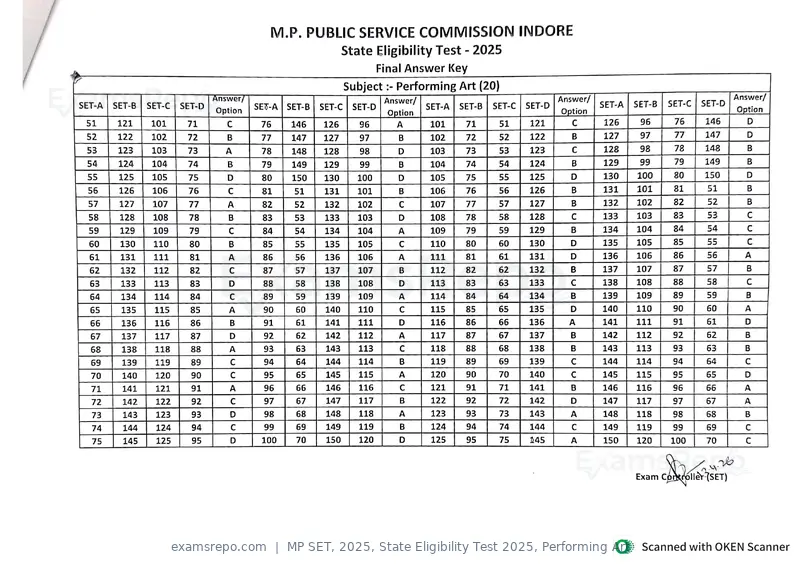
MP SET 2025: State Eligibility Test, Performing Art

Text of page 1
-gj.
                                                   R/P/P/2025/II                                                       Question Booklet No.


                                             Subject-PERFORMING ART
 SET              A                                            WT-W(           )
                                                            Paper H (Optional)
                                                                       «»j)s-20
                                                            Subject-Code-20
  Name

                                                              ^          Candidate should write his/her
  Roll No.                                                                Roll No. in the given boxes.

              ^ ^T^/No.of Printed Pages:32                                                               ^Vii/Total No. of Questions: 100
  TFR : 3             1T2FT ^ fsd1'4 IRH-'RW                                                   3TfW?m "'jnf^/Maximum Marks:200
  Time Allowed :3 Hours to complete both 1st and Ilnd question paper

     4)5                  ^                ^           if         ^ 1 ntti$frof anHt ^fewr^Rir                   ^im             ^i
             TI9T if W Richer f I                                      ^3tfT       t I"3^tet=T^^^rlT-Tta^(3it.T3^.3nT.                         )"nT
                  ^git        ^tgr^^^ gncir                        i
                  H     TTjT-gsr ^ PdWH        P)cii«ht iso gt^^rer Tranr ^ u?^ frar ■ogto                     2 3T9i gsr t" 1             g
     "ffSR atfggnf      1 tn^g?      ggr ^       2 afgr            gngit i aj^gftg tr?^         g^t^ arg? g^ ^ 1 gtungigi "^j^tfaig g>T giggig
              1
             tiFT-gg 1                                      Tngng wg-g^                                  (g^g ^ngn i-so)
             tiTg-gg 11                    gftyrdf           *tgPid "fegg g>r tt^g-gr                    (g^g tnsn si-iso)
           gyg-^tggiT if             tnsir anggg            gr gyiff gf ^ 1 gtt^igf git gcii5       gifiit ^          ^fkf^grr "sst   g?g-^fw<»>(
     %                ^^            afrr        ^ 1 sprar %               ^t? ^ ^sft g?g-^g^ Htdiw grg                      1
     "^iggr ggr-gggr (att.t^.anr. ritg) gr "f^rgfftg rgprt gr 1^ agg^g^ gftrffegr g^, api wjil gr g^ 1
     gft?jT?fF rnft rv gird g^g-'^f^ggjT       f^rsrfRg rgrg gr ^ <t»^, aptr g?^ 1^ ggr gnr-gg {ait.T^.3iir.                   ) gr dt g^ 1
            r<»i«l g^g if fg>gt gggr ^ ^tf             gr gsgigrg? gsRir                  gt gyg ^          ggr arddt ^gfsft if ^      gigfsr
     git Hn<« gigr gn^nr 1
     l^rft ggjtr gji ^^^zr, gifg iqci g                     ggrrr gn f^ggrPr^ fggrfg arr^ gg gdtg gRirt                 1
     gjg anggit g^g-^frggjr r3tc3% gji           '^gr gnd gggt gygig^^ ggr-g^^ (3it.Tj|^.atrr.                   ) if grrr ^ 1*rf%g "^r^ ^ f^ri
     ^gn           gf?t           ig ^ ggtg        1
     gft^ rnggi '5t% g? gygig^ 3it.T^.3Tir.             dt^rgr git             g^grr^     angsft gj^             1
     ■arTT-gggr (art.T^.srrr'.) gr grrr ^ ^ g§R 1^ gr^                                  gpR gjrgr                    gi^ 1
                                           INSTRUCTIONS TO THE CANDIDATES
  1. This Question Booklet is printed in two languages—^Hindi and English. Candidates can select any one of the
     two languages according to their convenience.
  2. Each question has four options. There is only one correct answer to each question. Choose the appropriate
     option and darken/blacken the corresponding circle on the Answer Sheet (OMR Sheet) withblack point pen.
  3. In this examination there are two questionpapers, consisting of160 objective type questions and each question
     carries 2 marks. Both the question papers and all the questions are compulsory. Two (2) marks shall be
     awarded for each correct answer. Unanswered question will not be given any marks. There is no provisions
     for Negative Marking.
           PaperI                           General paper                          (Q. No. 1*50)
          PaperII       Question paper on the Subject opted by the examinee (Q. No. 51-160)
  4. No. of pages consisting of this question booklet is indicated over the cover page. Candidates are advised to
     ensure that all the pages of Question Booklet are properly printed and binded. Otherwise they may demand
     the other Question Booklet of the same set.
  5. Eandly make necessary entries on the Answer Sheet (OMR Sheet) only at the places indicated andnowhere else.
  6. Examinee should do ^1rough work on the spaces meant for rough work on the pages givenin the Question
     Booklet and nowhere else, not even on the Answer Sheet (OMR Sheet).
  7. If there is any sort of mistake either ofprintingor of factual naturein any question, then out of theHindi and
     English versions of the question, the Hindi version will he treated as standard one.
  8. Use of any type of calculator, log table or any type of electronic devices etc. are not allowed.
  9. Use only black ball point pen to mark the answers in the Answer Sheet (OftlR Sheet) only after you are
      instructed to open the Question Booklet.
  10. Candidates will leave the Examination Hall only after handing over the Answer Sheet (OMR Sheet) to the
     Invigilator at the end of the examination.
  11. Before answering on Answer Sheet (OMR Sheet) ensure to follow the instructions given for that.

(N}S/20/2025/A
Text of page 2
(SPACE FOR ROUGH WORK)


(N)S/20/2025/A
Text of page 3
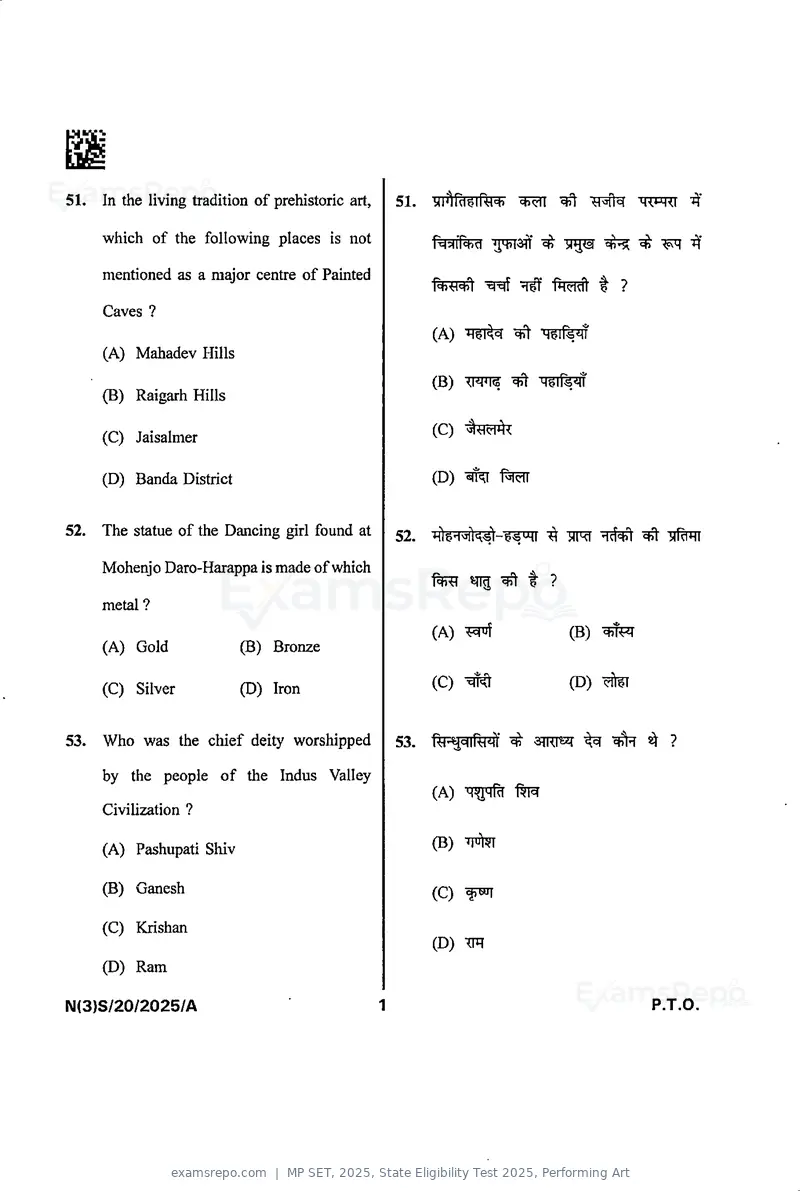
51. In the living tradition of prehistoric art,       51. yi'llfleiRi't)

     which of the following places is not

     mentioned as a major centre of Painted
                                                                   ^       -fiR# t ?
     Caves ?
                                                           (A) "11^ ^
     (A) Mahadev Hills
                                                           (B) Wl^ ^ wtM
     (B) Raigarh Hills

                                                           (C)
     (C) Jaisalmer

     (D) Banda District                                    (D)


52. The statue of the Dancing girl found at

     Mohenjo Daro-Harappa is made of which

     metal ?

                                                           (A)^             (B)
     (A) Gold             (B) Bronze

     (C) Silver           (D) Iron                         (C)^             (D)^


53. Who was the chief deity worshipped                53. t^r^qiRiAi ^ STRRzr ^        ^ ?
     by the people of the Indus Valley
                                                           (A)
     Civilization ?


     (A) Pashupati Shiv                                    (B)

     (B) Ganesh                                            (C) ^

     (C) Krishan
                                                           (D) TR
     (D) Ram

N(3)S/20/2025/A                                   1                                    P.T.O.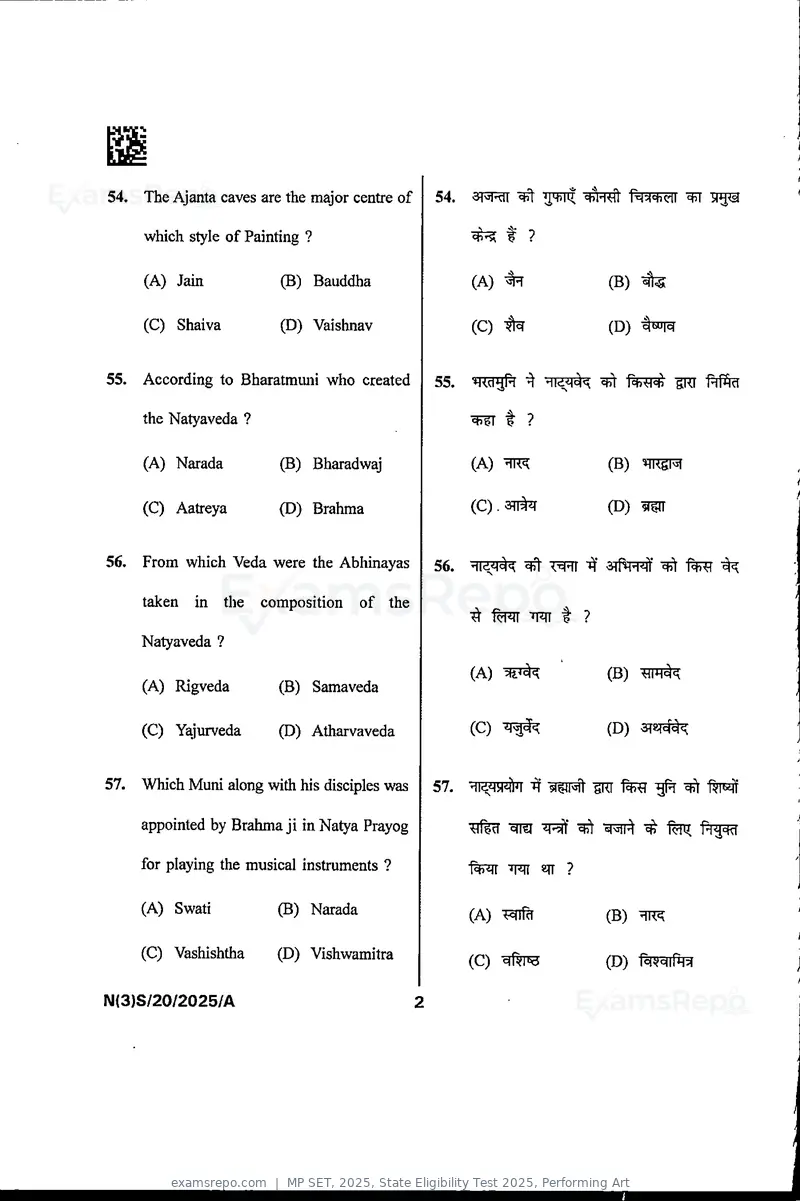
Text of page 4
54. The Ajanta caves are the major centre of

     which style of Painting ?                       ^# ?

    (A) Jain             (B) Bauddha                 (A) ^                 (B) 4^

    (C) Shaiva           (D) Vaishnav                (C)                   (D)


55. According to Bharatmimi who created

     the Natyaveda ?                                 ^t ?

    (A) Narada           (B) Bharadwaj               (A)                   (B) WR

    (C) Aatreya         (D) Brahma                   (C). 3TT^             (D) WT


56. From which Veda were the Abhinayas         56.         ^          ii          ^      M

     taken in the      composition   of the
                                                     ^ tOT W t ?
     Natyaveda ?

                                                     (A)                   (B)
    (A) Rigveda         (B) Samaveda

    (C) Yajurveda       (D) Atharvaveda              (C)                   (D)


57. Which Muni along with his disciples was    57.           Tf       OT          #1 ^

     appointed by Brahma ji inNatya Prayog

    for playing the musical instruments ?            ■f^RT "W «TT ?

    (A) Swati           (B) Narada                   (A)                   (B) "^11^

    (C) Vashishtha      (D) Vishwamitra              (C)                   (D)

N(3)S/20/2025/A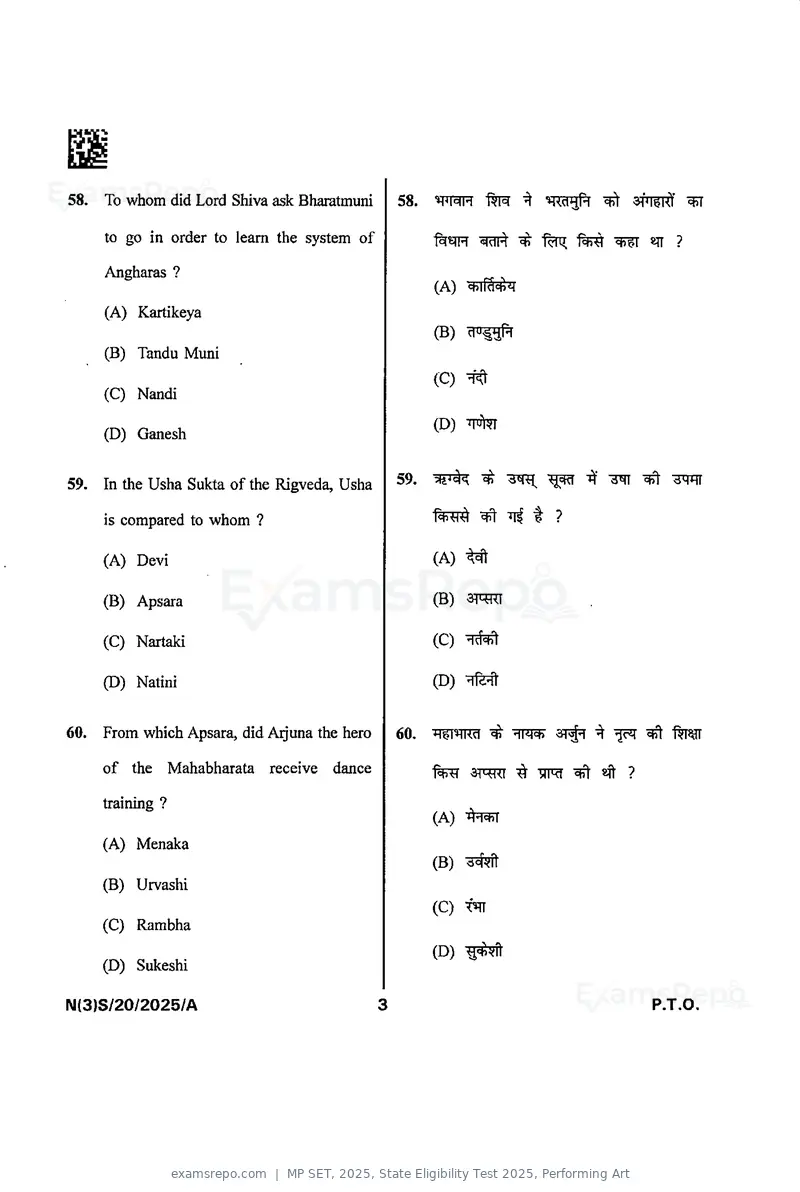
Text of page 5
58.   To whom did Lord Shiva ask Bharatmuni     58.                 ^       ^       ^

      to go in order to learn the system of                                      ^ ?

      Angharas ?
                                                      (A)
      (A) Kartikeya
                                                      (B) rFigfr
      (B) Tandu Muni
                                                      (C) ^
      (C) Nandi

                                                      (D)
      (D) Ganesh


59. In the Usha Sukta of the Rigveda, Usha      59.          ^          ^   -m -3^ WTT

      is compared to whom ?                                  ^      f ?

      (A) Devi                                        (A) M

      (B) Apsara                                      (B) ami

      (C) Nartaki                                     (C)

      (D) Natini                                      (D)


60. From which Apsara, did Aijuna the hero      60.            ^            ^^ iw
      of the   Mahabharata    receive   dance               3TW ^ TIRT ^ aft ?
      training ?
                                                      (A) A'ictil
      (A) Menaka
                                                      (B) -3^
      (B) Urvashi
                                                      (C)
      (C) Rambha
                                                      (D)
      (D) Sukeshi

N(3)S/20/2025/A                                                                  P.T.O.
Text of page 6
61. The traditional name for Nritya-Natya          61.                     ^          ^     ^
      Yakshagana is :

      (A) Bhagavatar Atta                                (A)            37THT

      (B) Kodangi                                        (B)

      (C) Chauki                                         (C)

      (D) Banna                                          (D)

62.   The tribal   folk   dances   are   related   62.               ^^                 aik-Tiki
      with :                                             ^t ?
      (A) Historical                                     (A)

      (B) Sringarik                                      (B)

      (C) Religious and Ethnic                           (C)
      (D) Commercial                                     (D)

63. 'Rai' is a popular Folk Dance of which         63. 'Tff'             ^            ^
      region of Madhya Pradesh ?

      (A) Nimar           (B) Baghel Khand               (A)                    (B)

      (C) Malwa           (D) Bundel Khand               (C) TTT^               (D)

64. Which Folk dance is performed in               64.         ^           ^ wfq           ^

      devotion to folk deity Baba Ram Dev ji                   ^cidi ®fM xrq^         ■s^TTmqr

      by the people of Kamad caste ?                           t ?

      (A) Pada                                           (A) T5

      (B) Ghumar                                         (B) ^

      (C) Terataali                                      (C) ^Itldldl
      (D) Kachchi Ghodi                                  (D)         ^

N(3)S/20/2025/A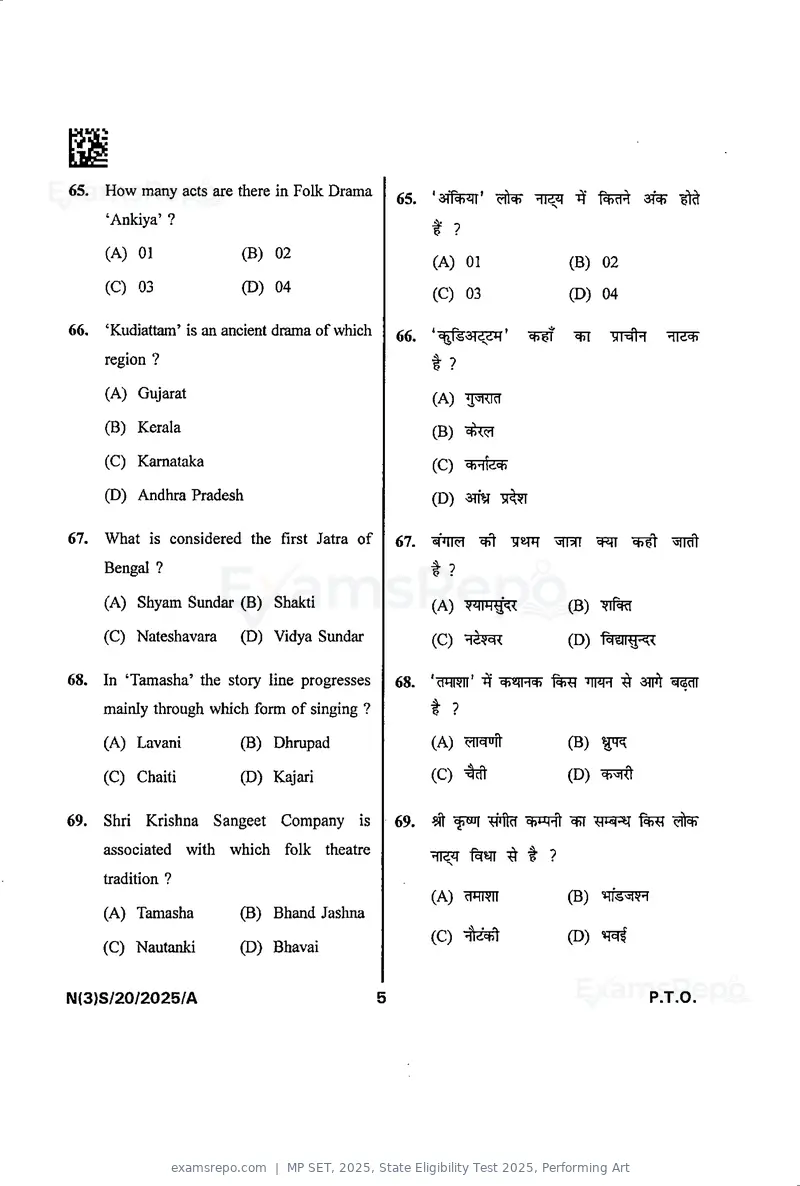
Text of page 7
65. How many acts are there in Folk Drama
      'Ankiya' ?
                                                          f ?
      (A) 01               (B) 02
                                                          (A) 01              (B) 02
      (C) 03               (D) 04                         (C) 03              (D) 04

66.   *Kudiattam' is an ancient drama of which
                                                    66.                     Wf ^
      region ?                                            t?
      (A) Gujarat                                         (A) "ipOT
      (B) Kerala                                          (B)^
      (C) Kamataka                                        (C)
      (D) Andhra Pradesh                                  (D) srm 31^

67.   What is considered the first Jatra of         67.         ^ 3raPT          ^ ^^
      Bengal ?                                            i?
      (A) Shyam Sundar (B) Shakti                         (A)                 (B)

      (C) Nateshavara      (D) Vidya Sundar               (C) ^1^?^           (D)

68. In 'Tamasha' the story line progresses          68. 'wm'                 1^ "TO ^ 3TT^
      mainly through which form of singing ?              t ?
      (A) Lavani           (B) Dhrupad                    (A) ^11^            (B)
      (C) Chaiti           (D) Kajari                     (C) ^               (D)

69. Shri Krishna Sangeet Company is                 69.            ifntcT
      associated    with   which   folk   theatre
                                                                      ^t ?
      tradition ?
                                                          (A)                 (B)
      (A) Tamasha          (B) Bhand Jashna
                                                          (C) -tefl           (D) ^
      (C) Nautanki         (D) Bhavai


N(3)S/20/2025/A                                                                         P.T.O.
Text of page 8
70. Which instrument is played along with     70.                PHHRriRsJd ft* ft

      the Chhau dance ?                             mi mm i ?

      (A) Timki             (B) Tabla'              (A)            (B)


      (C) Dhol              (D) Pakhawaj            (C) ^          (D)


71.   In which Dharmi does the artist use     71.           ft
                                                            ' mmK               ^ wr

      objects while performing Abhinaya ?                 ^ WT mm t ?

      (A) Lokdharmi                                 (A)


      (B) Natyadharmi                               (B)


      (C) Nrityadharmi                              (C)


      (D) All of the above                          (D)


72.   Which Vritti is full of adornment and   72. ^^Hftl ^                 3FT ft

      soft dance ?                                  i ?

      (A) Bharti Vritti                             (A)


      (B) Aarbhati Vritti                           (B)      ^

      (C) Kaishiki Vritti                           (C)      ^

      (D) Satvati Vritti                            (D)      ^


N(3)S/20/2025/A
Text of page 9
73. Under which 'Pravritti' do the people of   73. aRPT, "SRM,                   ^^

     Assam, Bengal, Odisha, Bihar fall ?                     ^ SRFfcI 3TT^ f ?

    (A) Avanti                                       (A)

    (B) Panchali                                     (B)


    (C) Dakshinatya                                  (C)

    (D) Audramagadhi                                 (D) sqfeiiFmt


74. "Nepathya Rachana Vidhan" comes            74.                  ^


     under which Abhinaya ?                          ^           -STM    ?

    (A) Aangik          (B) Vaacliik                 (A)                 (B)

    (C) Aaharya         (D) Satvik                   (C)                 (D)


75. How     many   Shlokas are there in        75. 'WTO Tf«T'            ^             # ?
    'Dashrupak Granth' ?
                                                     (A) 502             (B) 400
    (A) 502             (B) 400
                                                     (C) 1011            (D) 302
    (C) 1011            (D) 302


76. In which chapter of Natyashastra 'Poorva

     Rang Vidhan' is discussed thoroughly ?          ^         aq?2iFT         W t ?

    (A) 5 ■             (B) 6                        (A) 5               (B) 6

    (C) 17              (D) 20                       (C) 17              (D) 20


N(3)S/20/2025/A                                                                    P.T.O.
Text of page 10
77. Plow many gods of Rangmanch have               77.                 ^ cM 3TE2TF7               ^

     been discussed in the third chapter of                               ^^ ^              t ?
     Natyashastra ?
                                                         (A) 44                   (B) 45
    (A) 44              (B) 45
                                                         (C) 51                   (D) 105
    (C) 51              (D) 105


78. Description of 'Chitrabhinaya' is found        78.                  ^                   ^^


     in which chapter of Natyashastra ?


    (A) 23              (B) 24                           (A) 23                   (B) 24


    (C) 25              (D) 26                           (C) 25                   (D) 26


79. Plow many 'Dhruvas' used in 'Poorva            79.                 fepft           ^ TpfhT tor

     Rang'?                                              ^sndT "t" ?

    (A) 4               (B) 5                            (A) 4                    (B) 5

    (C) 6               (D) 7                            (C) 6                    (D) 7


80. 'Sangrali', *Karika' and 'Nirukta' are         80. 'w',                    ?r«TT

     discussed   in   which     chapter   of

     Natyashastra ?                                      ^        t ?

    (A) 3               (B) 4                            (A) 3                    (B) 4

    (C) 5               (D) 6                            (C) 5                    (D) 6


N(3)S/20/2025/A                                8
Text of page 11
81. Aaropwad theory is described by whom ?    81.                ^                  siTEIFf

                                                    ^      ^     t ?
    (A) Bhatt Shaakuk
                                                    (A) ^
    (B) Bhatta Lollat
                                                    (B) ^
    (C) Bhatt Nayak
                                                    (C)

    (D) Abhinava Gupta                              (D) STTto ^


82, Name ofthe theory described by Abhinava   82. ^        ^              aqfro "3^ wi

     Gupta as explanation to Rasa Sutra ?           ■f^ m ^            ^      f ?

    (A) Anukaranvad                                 (A)

    (B) Anumitivad                                  (B)


    (C) Abhivyanjanavad

    (D) None of the above                           (D)


83. Four main rasas given by the Bharat       83.         ^ OT        ^        ^

     Muni are :                                     ? ?


    (A) Shringar, Adbhut, Raudra, Vibhatsa          (A) »fTR, 37^^,


    (B) Hasya, Veer, Raudra, Vibhatsa               (B) WTPT,          ^hMi

    (C) Hasya, Adbhut, Raudra, Bhayanaka            (C) ?TFT, 31^^,


    (D) Shringar, Veer, Raudra, Vibhatsa            (D) im,


N{3)S/20/2025/A                                                                 P.T.O.
Text of page 12
84,   What is the other name of Sanchari      84.          'm ^                 ^        ■«

      Bhava ?                                             "I" ?

      (A) Vyabhichari Bhava                         (A)            ^


      (B) Sthai Bhava                               (B)           ^


      (C) Uddipan Bhava                             (C) -3^^ m

      (D) Anuchari Bhava                            (D) 311^ 'm


85, How many total number of Bhavas are       85. w           ^               ^

      proposed by Bharat Muni in the Natya

      Shastra ?

                                                    (A) 52                 (B) 50
      (A) 52             (B) 50

      (C) 49             (D) 51                     (C) 49                 (D) 51


86. Rasa emerges from which of the            86, PHHfdfed         ^                i{

      following combinations ?                              ^ t ?

      (A) Vibhava, Anubhava, Vayabhichari
                                                    (A)                             TO
           Bhava
                                                    (B)           TO, TFT, ^
      (B) Sthai Bhava, Raga, Tala
                                                    (C)             "31^
      (C) Nritta, Nritya, Natya

                                                    (D) -3^1^         ^ ^ -3^*
      (D) None of the above

N(3)S/20/2025/A                          10
Text of page 13
87.    What are the external causes of Rasa            87. ^                           ^^

      Nishpatti (creation) ?                                 f ?

      (A) Bhava                                              (A) ^

      (B) Vibhava                                            (B)

      (C) Anubhava                                           (C) 3T5TO

      (D) Sthayi Bhava                                       (D)


88. What is the main purpose of art ?                  88.          ^                    ^

                                                             ^t ?
      (A) Only entertainment
                                                             (A)            Tpten
      (B) Earning money
                                                             (B) ^
      (C) Competition
                                                             (C) yPd^lPldl
      (D) Expression of beauty                               (D)            ^

89.   Which    element is      essential   in   the    89.         ^                ter ^^

      definition of art ?                                    -M % 7

      (A) Creativity                                         (A)

      (B) Science                                            (B)

      (C) Mathematics                                        (C) TTfriTcr

      (D) Sports                                             (D) ^


N(3)S/20/2025/A                                   11                                     P.T.O.
Text of page 14
90. What      will   be     described   through

      Aesthetics ?                                           t ?

      (A) Mood                                               (A) TFT ^

      (B) Dance .                                            (B)        ^


      (C) Description ofaesthetical experience               (C)                   sm               ^

           through senses

      (D) Philosophy                                         (D)^^


91.   Kikuli and Sammi are the dances from :           91.           3ftT      ^^             t ?

      (A) Bangladesh        (B) Nepal                        (A)                   (B) klFT

      (C) Afghanistan       (D) Pakistan                     (C)                   (D)


92. The classical dances of Myanmar are                92. "Ri™ ^                    ^

      collectively known as :                                        ■^siRfT f :

      (A) Pwe               (B) Khon                         (A) k                 (B) ^

      (C) Foun Lep          (D) Noh                          (C)        ^          (D) %

93.   Find the odd one out :                           93. 3TTOI feeq ^                  ;

      (A) Khon              (B) Ram Thai                     (A) liFl              (B) ^

      (C) Pwe               (D) Lakhon                       (C) ^                 (D)


N(3)S/20/2025/A                                   12
Text of page 15
94.   Noh is one of tlie classical dance dramas    94. %•                          ^

      of:                                                ^ 1?^ t I

      (A) Cambodia        (B) Japan                      (A)                (B) ^5TNH

      (C) Indonesia       (D) China                      (C) WWw            (D)^

95. 'Kolain'    a   famous    folk   dance   of    95.                  ^         yRHsS

      Sri Lanka is a :                                   t:

      (A) Mask Dance                                     (A) "5^ ^

      (B) Sword Dance                                    (B)         ^

      (C) Pot Dance                                      (C) ^^

      (D) Peacock Dance                                  (D)      ^


96.   One of the theatrical dances of Korea       96. ^IR^i ^

      IS :                                               t:

      (A) Kandian         (B) Pwe                        (A)                (B) ^

      (C) Shoyo           (D) Naiandi                    (C)                (D)


97. One of the important props of Chinese         97.          MKMRch    ^^

      traditional dance is 'Sen' which means :                 W 3T«f t :

      (A) Sword           (B) Fan                        (A) cT^r^          (B) W

      (C) Hat             (D) Bag                        (C) ^              (D) ^

N(3)S/20/2025/A                               13                                          P.T.O.
Text of page 16
98.   Khmer of Cambodia is a :                    98.              ^                      :


      (A) Folk Dance                                    (A)               f

      (B) Classical Dance                               (B)                      t

      (C) Religious Dance                               (C)               ^t

      (D) Court Dance                                   (D)                     f

99. Choose the one which is not correct :         99. ^                               ^       t:

      (A) No        elaborated   abhinaya   is          (A)                           ^         tor

           performed.                                         ^t I

      (B) Decorative body movements are                 (B) ^vijicjcil yilORcb                ^ "3^

           used.                                                       -mi t I

      (C) No story telling is used          in          (C) ^             ^                        ^
           dance.                                             ■^fFTl" I

      (D) Playing of Gammelon is used.                  (D)               ^ wk fen ^ t I

100. One of the most popular Philippine           100. "feftfer ^                     vfefe        ^

      dances Tinikling is a :                           niPHfe^l           :

      (A) Sword Dance                                   (A) cicrlcjK            "I"

      (B) Mask Dance                                    (B)               ^ t

      (C) Handkerchief Dance                            (C)                     t

      (D) Bamboo Dance                                  (D) ^              "I

N(3)S/20/2025/A                              14
Text of page 17
101. 'Malvikagnimitram' a Sanskrit drama is          101.                                 m


     autliored by whom ?                                          W t ?

    (A) Bhasa             (B) Shudraka                      (A) mf           (B)^


    (C) Kalidasa          (D) Ashwaghosha                   (C)              (D)


102. If two Sarpashirsha Hastas are placed on        102.         ^         ^^

     the opposite shoulders, that Hasta is

     known by which name according to
                                                                      ^ ^ "sfHT    ?
     Natyashastra ?
                                                            (A)
    (A) Swastika

                                                            (B)
    (B) Gajadanta

    (C) Avahittha                                           (C) ;^T^i%?ST

    (D) Vardhaman                                           (D)


103. What is Apasrita ?                              103. 3Tq^ W t ?

    (A) Karana                                              (A)

    (B) Hasta Prachara                                      (B) ^ TraR

    (C) Parshwakarma                                        (C) Miy4cb4

    (D) Angahara                                            (D) 3Tq0K


N(3)S/20/2025/A                                 15                                     P.T.O.
Text of page 18
104. What is Sambhranta according to              104.             ^            ^

    Natyashastra ?                                       t?

    (A) \^abhichari Bhava                                (A)

    (B) Angahara                                         (B)


    (C) Mandala                                          (C) TTW

    (D) Chan                                             (D) ^


105. What is the sequence of Gangavatarana        105.             ^ ^^ t ?

     Karana ?
                                                         (A) 35

    (A) 35
                                                         (B) 49
    (B) 49
                                                         (C) 101
    (C) 101

                                                         (D) 108
    (D) 108


106. How many types of Shirobheda (Head           106. aifw ^^                  3^:

     Movements) are there according to                   ^^t ?
     Abhinaya Darpan ?
                                                         (A) 8         (B) 9
    (A) 8                (B) 9
                                                         (C) 10        (D) 11
    (C) 10               (D) 11


N(3)S/20/2025/A                              16
Text of page 19
mi

107. Which hand gestures are used to depict         107. -stter ^^                            ^^

     Shani Hasta according to Abhinaya                     ^                                 ^ "SpfhT

     Darpan ?                                                    t ?

    (A) Trishula in left, Shikhara in riglit               (A)        "ft*

    (B) Shikhara in left, Trishula in right                (B) ^             Ikim,

    (C) Shikhara in left, Pataka in right                  (C)                       "^if^

    (D) Pataka in left, Trishula in right                  (D)        "4"

108. According to Natyashastra, when two            108.           ^                 m il               Wf
     Shukatunda Hastas are placed on the
                                                           ^^^ sik                                 ^ JM
    chest bent downwards, what is that Hasta
                                                                             ^         TO «f)5<niai "I ?
    known as ?


    (A) Talamukha       (B) Vardhamana
                                                           (A)                       (B) ^«kTPT

    (C) Avahittha       (D) Lalita                         (C)                       (D) dRia


109. According to Natyashastra, what is             109.                     ^                TfT^ TO
    Mrigapluta ?                                           t ?

    (A) Karana                                             (A) TO^T

    (B) Akasha Chari                                       (B) aiTTOT ^

    (C) Angahara                                           (C) 3PT?R

    (D) Mandala                                            (D) tPW

N(3)S/20/2025/A                                17                                                  P.T.O.
Text of page 20
110. How many types of Abhisarika Nayika            110.         ^                    ^

     are there based on time ?                                   ^^ t ?

    (A) 8               (B) 7                              (A) 8          (B) 7


    (C) 5               (D) 3                              (C) 5      (D) 3


111. Tillana is performed in which of the
                                                    111. PdcrdHl ^ ^ 1%^" iim % 7

     following ?
                                                           (A)
    (A) Kathak

                                                           (B)
    (B) Kathakali


    (C) Oddisi (Odissi)                                    (C)


    (D) Bharatanatyam


112. Pung instrument is used in which of the        112.                     TRPT   "^^ITdT


     following ?                                           t ?

    (A) Bharatanatyam

                                                           (B)
    (B) Manipuri

                                                           (C) WSi
    (C) Chhau

                                                           (D)
    (D) Kathakali


N(3)S/20/2025/A                                18
Text of page 21
113, Match List-I with List-II ;                   113.           ^ ■^-11                         cbin-iii.

          List-I                   List-II


     (a) Katliak           (i)   Mridangam                 (a)                     (i) ^3^

    (b) Bharatanatyam (ii) Tabla                           (b)                     (ii)

    (c) Kathakali          (ill) Mukhveeiia                (c)                     (iii)

    (d) Kuchipudi          (iv) Chenda                     (d)                     (iv)


     Codes :                                               W '

          (a)      (b)   (c) (d)                                  (a)    (b)    (c)        (d)

    (A) (i)        (ii) (iv) (iii)                         (A)    (i)    (ii)   (iv)      (iii)


    (B) (ii)       (i)   (iii) (iv)                        (B)    (ii)   (i)    (iii)     (iv)


    (C) (ii)       (i)   (iv) (iii)                       . (C)   (ii)   (i)    (iv)      (iii)


    (D) (i)        (iv) (iii) (ii)                         (D)    (i)    (iv)   (iii)     (ii)


114. Which instrument is played in Kathakali       114.              ^                       ^^

     dance form ?                                          ^Idl t ?

    (A) Nagma                                             (A) -im

    (B) Chenda                                            (B)

    (C) Manjira                                           (C)

    (D) Pung                                              (D) yt


N(3)S/20/2025/A                               19                                                       P.T.O.
Text of page 22
115. Which of the following Muslim rulers is    115.                     ^                  ^

     known for his valuable contribution in


     Kathak Dance ?                                              «IHT "^jn^TT ^ ?


    (A) Aurangzeb                                          (A)


    (B) Shah Jahan                                         (B)


    (C) Humayun                                      . (c) wn,

    (D) Wajid Ali Shah                                     (D)               w


116. Devdasis are known by which name in            116.           ^        ^         ^     ^

     the temples of Odisha ?                                 "^iHT        ^ ?

    (A) Mahari             (B) Devadasi                    (A)                  (B)


    (C) Nartaki            (D) Artist                      (C)                  (D)


117. Which Vritti is used in Mohiniattam ?          117. -qtMaipT               ^^        ^t ?

    (A) Bharti Vritti                                      (A)


    (B) Kaishiki Vritti                                    (B)


     (C) Saatvati Vritti                                   (C) ^ITc^ ^

     (D) Arabhati Vritti                                   (D) 3TRq^ ^

N(3)S/20/2025/A                                20
Text of page 23
118. 'Sapta Suladi' Taal is related to which    118.             ^^               ^


     Taal system ?                                     ^t ?

    (A) North Indian Taal System                       (A)^ TOik m\ "^1^

    (B) South Indian Taal System                       (B)


    (C) Nortli-South Indian Taal System                (C)              mdk TTM

    (D) None of the above                              (D)          ^^

119. Which of the following is related with     119. PHHrvin^d     ^

     Jagannath Puri ?                                  "5^ ^ t ?

    (A) Surdas                                         (A)


    (B) Tulsidas                                       (B)


    (C) Jaydev                                         (C)

    (D) Shankardev                                     (D)


120. Which Guru founded Kalakshetra ?           120.          ^ WRT          ^    ^?

    (A) Madame Menaka                                  (A) "fen Alchi

    (B) Vallathol Narayana Menon                       (B)         HRPFT ^

    (C) Rukmini Devi Arundale                          (C)


    (D) Yamini Krishna Murthy                          (D)


N(3)S/20/2025/A                            21                                     P.T.O.
Text of page 24
121. The    Kathak      Choreographer   who    121.                                   ^^

     pioneered ensemble works and was                 ^             sfk 2025
     awarded Padmavibhushan in 2025 was :                 •HHlPifl "fefT ^                 I

    (A) Pandit Biiju Maharaj                              (A) "q.

    (B) Kumudini Lakhia                                   (B)

    (C) Shovana Narayan                                   (C)       HKNUI

    (D) Uma Sharma                                        (D) ^^

122. The visionary who started the Kuchipudi       122.                  ^            ^^

     art academy in Chennai was :                     ^                      ^:

    (A) Shobha Naidu                                      (A)

    (B) Anuradha Jonnalagadda                             (B)        4Hlle|J|<^l

    (C) Vedantam Lakshmi Narayana Sastri                  (C)               HRm

    (D) Vempati Chinna Satyam                             (D)               WR.


123. Which ancient Indian dance text was           123.              ^ "qra Crr'sr)

     inscribed in the UN Memory of the                ^(UN)                    ^^

     World Register ?                                           "fen "W ®IT,           I

    (A) Natya Shastra                                     (A)

    (B) Abhinaya Darpana                                  (B) 3TfW ^

    (C) Rigveda                                           (C)

    (D) Shaiva Texts                                      (D) ^

N(3)S/20/2025/A                               22
Text of page 25
124. The fusion of Katliak with which other          124.         ^       ^                ^

     European dance      has seen through                   ^8? ^              ^           "qr

     collaborations their synthesis on stage in

     terms of rhythm and technique ?                        t ?

    (A) Tap dance                                           (A) tq ^

    (B) Hip hop                                             (B)   ^


    (C) Flamenco                                            (C)


    (D) Salsa                                               (D) Tum


125. Which       Choreographer's         work        125.               ^ "qFT           ^


    encompassed an exploration of breath,
                                                                      ^ TflWT ^           A
    feminity and the power of the female
                                                            ■Rfl^ ^ ^          ^ #5T
    body in her work of using the form of

    Bharatanatyam ?                                         (A)

    (A) Chandralekha
                                                            (B)
    (B) Shobhana Chandrakumar
                                                            (C) Wnrft M
    (C) Rukmini Devi

    (D) Padma Subramanyam                                   (D) "q^


                                                                           t


N(3)S/20/2025/A                                 23                                     P.T.O.
Text of page 26
126. 'Natanam adinar'(Siva danced) a dance       126.                     (1^ ^

     composition by Meenakshi Sunderam

     Pillai   was   first   performed    and                       ^ fer ^                 ft
     popularised by which male dancer ?                 fen ^                        ?

    (A) Mavin Khoo                                      (A) Rife ^

    (B) Uday Shankar                                    (B)       ?fe

    (C) Bliarat Sharma                                  (C) TO wft

    (D) Ram Gopal                                       (D) RR ftfer

127. Which dance was first taught at Tagore's    127. tftR ^ wfefepT ft R? "^nRT                RT
     Shantiniketan after he had seen its                fe           ft        felRIR^

     inspiring performance at Sylhet ?                  ^ RK RRft             froiRT RRT RT ?

    (A) Kathakali                                       (A) RsR^tJcnl

    (B) Mohiniattam                                     (B) RfetR^

    (C) Kandyan                                         (C)

    (D) Manipuri dance                                  (D) RfR^ft

128. 'Bhoomika' was an independent dance         128.            RR? WR                   RT fefe
     group formed by :                                  RqiTO-            -ft Rft «ft I

     (A) Maya Rao                                       (A) RIRT RR

     (B) Narendra Sharma                                (B)       ^

     (C) Bharat Sharma                                  (C) TO ^

     (D) Rajendra Gangani                               (D) Tlft^ RRlftl


N(3)S/20/2025/A                                 24
Text of page 27
129. If Khajuraho Dance festival is organized

     by    Madhya      Pradesh      government,         'm sTFter tor « I, -ii

     Konark Dance festival is conducted


     by.           government.                           t ?


    (A) Jharkhand                                       (A)


    (B) Odisha                                          (B)


    (C) West Bengal                                     (C) ""7^^


    (D) Andlira Pradesh                                 (D) 3TfN "3^


130. The protection and promotion of folk and         130. ^^                 ^       -spRrahr


     tribal arts of different parts of the country


     is taken up by.             under Ministiy


     of Culture.
                                                         t ?

                                                        (A)
    (A) CCRT

                                                        (B)     "^fnkT
    (B) State Sangeet Natak Academy

                                                        (C)         ^?fntcr   31^1^
    (C) Centi'al Sangeet Natak Academy

                                                        (D)         ^i^rddi ^
    (D) Zonal Cultural Centres


N(3)S/20/2025/A                                  25                                   P.T.O.
Text of page 28
131. Rudolf Steiner's tlierapeutic method is      131.              ^                     3™

     known for having what kind of basis ?               ^             37mTfcT t ?

    (A) Cultural and Social                              (A)            sftr 4HlHlDl=h

    (B) Philosophical and Spiritual                      (B)           3k

    (C) Scientific and Medical                           (C)           3fR
    (D) Technical and Mechanical                         (D)           3k

132. The early development of Modem Dance         132. ifef                          mfe feRT
     therapy movement was based on the

     principles established by :
                                                         (A)       WT
    (A) Martha Graham
                                                         (B)        crINl'l
    (B) Rudolf Laban

    (C) Merce Cunnigham                                  (C) tRf

    (D) Mary Vigman                                   (D) M

133. In the 1950s, Veronica Sherbome used         133. "klfeT           ^ 1950             ^

    Laban-based therapy with :                           rM* ^           vRH 3TmTfeT ^ ^

                                                         wkr        ?
    (A) School Children
                                                      (A)          ^
    (B) Classical Dancers
                                                      (B)           -qfe
    (C) Psychiatric Patients
                                                      (C)                M
    (D) Athletes
                                                      (D) Patniel

N(3)S/20/2025/A                              26
Text of page 29
134. What is the fundamental concept of         134.                  sM                    ^

    Dance Movement Therapy (DMT)?                      feSRl ^ t ?

    (A) Mind and body are separate.                    (A) 'FT                3RPT      I

    (B) Mind is superior to body.                      (B) "TT           ^t I

    (C) Mind and body are inseparable.                 (C) 'FT afk ^                    t 1

    (D) Body controls the mind.                        (D)          iFT ^            WT t 1

135. What example was set by Rai Umanath        135.                     ^

    Bali ?                                                   ?


    (A) By opening a Kathak School.                    (A)          rci^M'4             I

    (B) By teaching Kathak to their son.               (B)          ^^                         I

    (C) By sending their daughters to                  (C) 3ml              ^                      '4*
         Kathak class.


    (D) By organizing music conferences.               (D) ^Fft?T             ^l4lFld          I

136. According to Sushila Mitra how is          136.                 ^ 3T3^TR, R. TTcT^ ^
    Pt. Bhatkhande described ?                     ^                           TTTT t ?

    (A) Farsighted and clever person                   (A)           3Tk ^

    (B) Very strict teacher                            (B)

    (C) Artist with modem ideas                        (C) 3TTHFt^             ^TFTT didldiK

    (D) Anti dance                                     (D)


N(3)S/20/2025/A                            27                                               P.T.O.
Text of page 30
137. What important work did Mohanrao           137.


     Shankar Kaiayanpurkar do for the

     students of Marris college ?
                                                       fen ?

    (A) Created a new style of Kathak
                                                       (A)              ^^
          dance


    (B) Developed the first systematic
                                                                  fen
          Kathak dance curriculum


    (C) Invented musical instruments                   (C)        mm

    (D) Taught classical singing                       (D)         nm ^

138. Until which year did Pt. Mohanrao serve    138. "n.           ^                 #itn

     at Bhatkhande     Hindustani Sangeet              Wfeim           fel ^ TT^     "SOT

     Mahavidyalaya ?                                   ^ ?

    (A) 1960            (B) 1965                       (A) I960           (B) 1965

    (C) 1971            (D) 1980                       (C) 1971           (D) 1980

139. What position did Mohanrao ji hold at      139.           ^^          ^         ^
     the Kathak Kendra in Delhi ?                      "fer                    ?

    (A) Instructor                                     (A)

    (B) Director                                       (B)

    (C) Assistant Professor                            (C) WW STRFf

    (D) President                                      (D)

N(3)S/20/2025/A                            28
Text of page 31
t40. 'Blueprint' prepared by Mohanrao was           140.                   "SKf        IVi^i

     related to wliich field ?


    (A) Institutionalized education system of              (A)                     ^ ■^OTFTcT

          Katliak Dance                                           yuildl


    (B) Folk Dance Training                                (B) crlW-jcq

    (C) Dance Costume Making                               (C) ^                  fTRfoT

    (D) Sound Technique Training                           (D) ^


141. "The Academie Royale de Dance" was             141.                      ^            ^ WFTT ^

     established in the year 1661 by :                     1661                   ?[RI ^             ?

    (A) Louis XVI         (B) Henery 11                    (A) ^ XVI                (B)         II

    (C) Nicholas II       (D) Louis XIV                    (C)              II      (D) ^ XIV

142. The young dancers who dance in a group         142. "Ih                               ^^^
     in a Ballet performance are referred to as:                  ^ ^               ^ncTT ^ ?

    (A) Coryphees                                          (A)

    (B) Corps de Ballet                                    (B)         ^ ^

    (C) Soloist                                            (C)

    (D) Prima Ballerina                                    (D) wn ^clddl


N(3)S/20/2025/A                                29                                                P.T.O.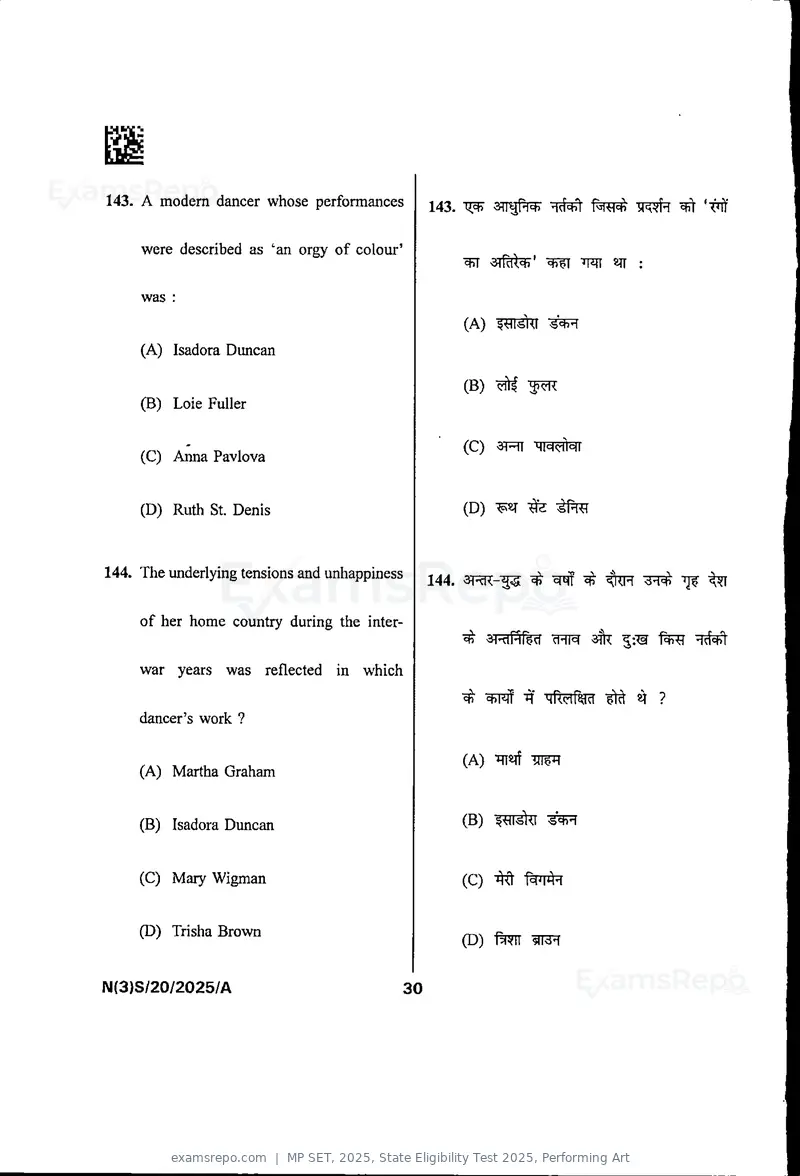
Text of page 32
143. A modern dancer whose performances         143.                                ^

     were described as 'an orgy of colour'


     was :


                                                       (A)
    (A) Isadora Duncan

                                                       (B)
    (B) Loie Fuller

                                                       (C) 3F1T
    (C) Aima Pavlova


    (D) Ruth St. Denis                                 (D) ^ ^


144. The underlying tensions and unhappiness
                                                144.              ^ ^^                  ^

     of her home country during the inter-
                                                       ^ 3FTlf%cr cHM          ^
     war years was reflected in which
                                                         ^               itii ^ 7
     dancer's work ?


                                                       (A)        WTT
    (A) Martha Graham


    (B) Isadora Duncan                                 (B)


    (C) Mary Wigman                                    (C)


    (D) Trisha Brown
                                                       (D) tOT

N(3)S/20/2025/A                            30
Text of page 33
145. The body was allowed to follow the            145.                              ^        ^

     natural ebb and flow of breathing in its

     dance movements in the works of:                     37^^ ^ ^                 ^ ^ sh I

    (A) Doris Humphrey                                    (A)

    (B) Isadora Duncan                                    (B)

    (C) Mary Wigman                                       (C) "to

    (D) Martha Graham                                     (D)


146. 'Petrouchka' and 'Les Sylphides' were         146.              sfk

     dynamic ballets of wliich choreographer ?

    (A) Michel Fokine (B) Diaghileff                      (A)                (B)

    (C) Nijinsky         (D) Balanchine                   (C)                (D)


147. One of the earliest pioneers of Indian        147. Wtfhr 3TT^Pich       ^ "^STRlt

     modern dance, who used European                        ^ 13^                           ^

    theatrical techniques with Indian classical                 ^ "RTar                      ^

     and folk dances was :                                        fen, "HW         «n :

    (A) Uday Shankar                                      (A) ^ ^fe

    (B) Mamta Shankar                                     (B) TTOT ?fe

    (C) Rukmini Devi                                      (C) ^PcWun

    (D) Ragini Devi                                       (D) Tlfe ^

N(3)S/20/2025/A                               31                                          P.T.O.
Text of page 34
148. A western modem dancer who initially     148.


     used orientalist themes in her dance             ft*          y^fd^l* ft* y^ciKl

     productions was :                               ^          tor «TT :


    (A) Anna Pavlova                                 (A)        MMdHi

    (B) Ruth St. Denis                               (B)      ft^ iftra

    (C) Simkie                                       (C)

    (D) La Meri                                      (D) m ftft

149. What aspect of stage craft has been a    149.             ^ %ti TOftq              "qr

     major contribution of the west on the

     Indian dance proscenium ?                        ^Vkh      t ?

    (A) Costume                                      (A)

    (B) Make-up                                      (B) ft^Ts^p (ftr^)

    (C) Light design                                 (C)

    (D) Sound                                        (D)


150. 'Ballet d action' was coined by :            150. 'ftft ^ ttWT'              ^™
                                                      an ?
    (A) Martha Graham

    (B) Isadora Duncon
                                                     , (A) "Rjaif WT

                                                     (B)
    (C) Noverre

                                                     (C)
    (D) Ted Shawn

                                                     (D)      WT

N(3)S/20/2025/A                              32
Text of page 35
chi4

                 (SPACE FOR ROUGH WORK)


(N)S/20/2025/A
Text of page 36
(SPACE FOR ROUGH WORK)


(N)S/20/2025/A
Page 1 of 36
Source: Madhya Pradesh Public Service Commission. Question paper published by Madhya Pradesh Public Service Commission.