
MP SET 2025: State Eligibility Test, Philosophy
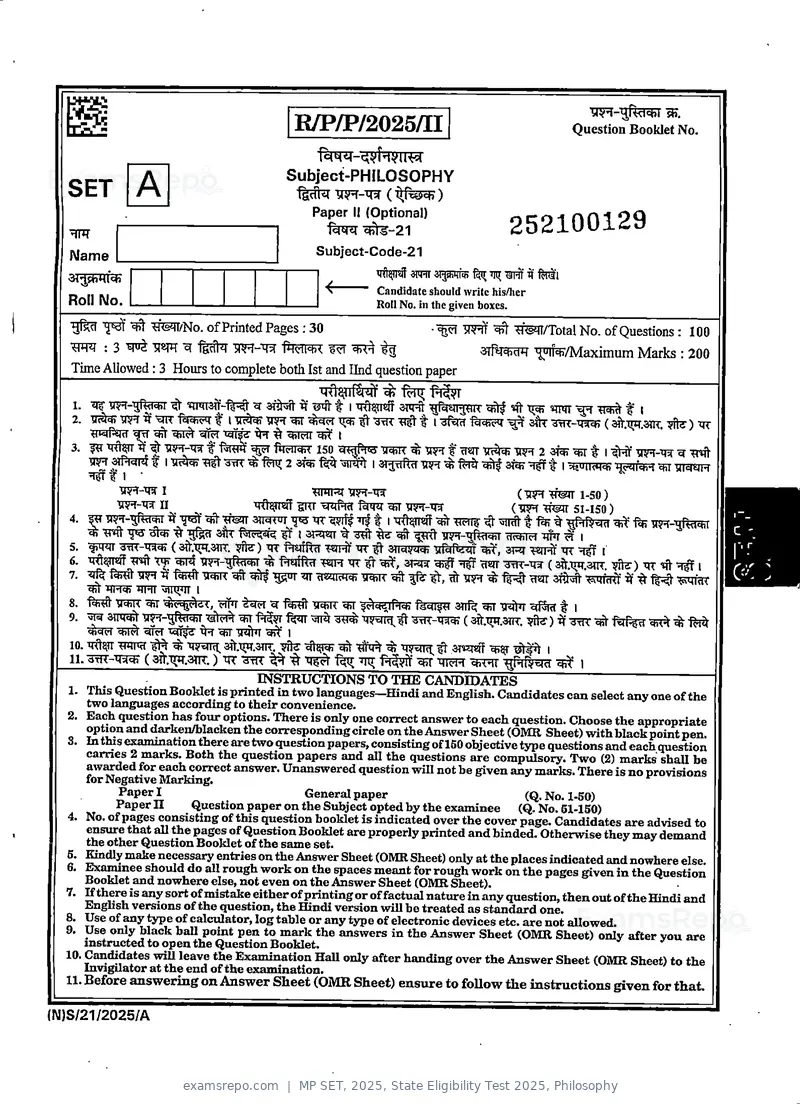
Text of page 1
yv'i-'ilwcht
                                                 R/P/P/2025/II                                            Question Booklet No.


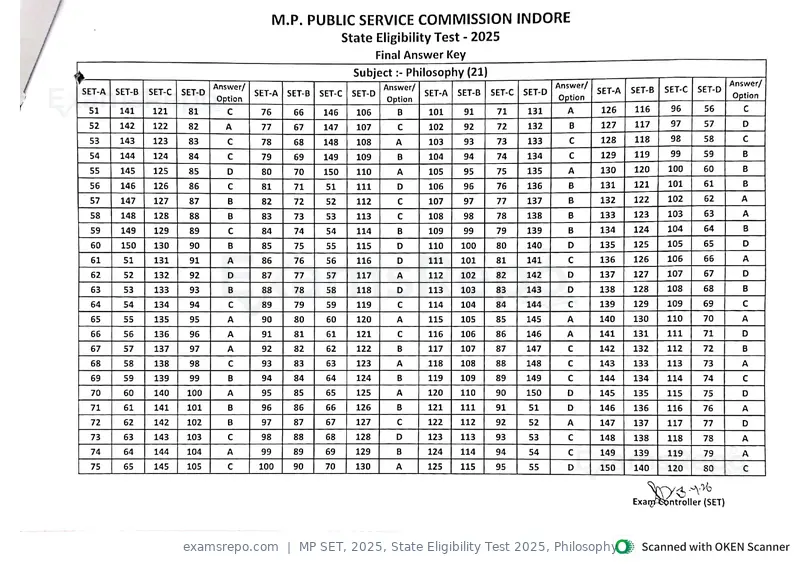
                                               Subiect-PHILOSOPHY
 SET            A                                                          )
                                                    Paper II (Optional)
                                                       1%^ ^-21                             252100129
  Name                                               Subject-Code-21

  3T^5TTfap                                                                ar^gwi*"         BPif
                                                       ^        Candidate should write his/her
  Roll No.                                                      Roll No.in the given boxes.
                  wn/No.ofPrinted Pages ;30                                            ^ Tfen/Total No. of Questions: 100
  TPPT : 3 wk "SiapT "Et r&rtl^ 'SR^-'qEr "fem             ^tg                        3TtecPT gyrfe/Maximum Marks : 200
  Time Allowed: 3 Hours to complete both 1st and Ilnd question paper

                                                     1                      g?tf ^
            tl?T •? giT fqcngM f                                   I     Rt<heM    sftT «TmT^^       t* i
                                                                                                  (3^toan?.     Tjr
     «i*««Pyrl ^            "^TeT »oTs6 ^ %leir I
     ^                I
                                      ^fteiraT 150 ctWpiWi traiT ^ m f rWr afgy-^i^t
                                 ^^icTtr 2 3igj
                                                                                 "5^ 2 315?i ^mitUch
                                                                                             ^t I           ^^
                                                                                                          ^ uich^h
           ?1
                   I                                wHi'^ m-TTT                               Cn^          1-50)
                   II                  trtt^rraf "gRT ■gtrfNfi  gjr                                       si-iso)
     ^                   ^         3traTw ^ xjT         Tif 11■yOywT ^                ^     1 % ^pifjTjd ^ % uy^-TrferajT
     ^^ ^                  anr 1^r=^ ^ i ai^^rar % ^ ^ gft ^ht)                           d<^H upt ^ i
       TflT-Tra^ ( 3ff.T^.3nT. jffe) TJT t^iufftcT TOHf TtT t 3TraTO                  ^', 31^ T^IPTf tTT I
                   w^                    ^ IWIttT          ^^                   ^^                   (sit.T^.anT. ?rte) tit lit      i
                Wi ^-ferdt traiiT ^ gitf ^or tit tRWi^ trair git ^            tfr ti?TT ^          h^t 3^ wiM                     Tsurar
     g>T        UTT TiUT^ I
     Pftdl MctiK g?!           HR              "ferft ggnr g^ iFtggil^ "fegi^g anfg g>r ggpr gfSnr t* i
                 g^-^fWchi 11^3^ giT -f^ ^                             griT-ggg? (^.^.anr. vh?) grn: git                  grr^ % ic^
     <««<« gjiM gi?r utT^'d     gn* wt git i
     Tidffl- TTOpg     ^ gggin^ 3Tt.T^.aTTT.       ^tggr ^ #i% ^            jt 3T«wf grgr           i
     ^■n<-M;tch ( ^ff.Trg.aTTT. ) tTT '3tR'                grr          gjr "qi^ giTgT                     1
                                       INSTRUCTIONS TO THE CANDIDA'^
    This Question Booklet is printed in two languages—Hindi and English. Candidates can select any one of the
    two languages according to their convenience.
    Each que^on has four options. There is only one correct answer to each question. Choose the appropriate
    option and darken/blacken the corresponding circle on the Answer Sheet (OMR Sheet) withblack point pen.
    In this exanunation there are two question papers, consisting of160 objective type questions and each question
     carries 2 marks. Both the question papers and all the questions are compulsory. Two (2) marks shall be
     aw^ded for each correct answer. Unanswered question will not be given any marks. There is no provisions
     for Negative Marking.
         PaperI                            General paper                          (Q. No. 1-50)
         Paper n      Question paper on the Subject opted by the examinee (Q. No. 51-150)
    No. of pages consisting of this question booklet is indicated over the cover page. Candidates are advised to
    ensure th^ all the pages of Question Booklet are properly printed and binded. Otherwise they may demand
     the other Question Booklet of the same set.
    ^dly make necessary entries on the Answer Sheet (OMR Sheet) only at the places indicated and nowhere else.
    Examinee should do all rough work on the spaces meant for rough work on the pages givenin the Question
    Booklet and nowhere else, not even on the Answer Sheet (OMR Sheet).
    Hthere is any sort of mistake either of printing or offactual nature in any question, then out oftheHindi and
    Engbsh versions of the question, the Hindi version will be treated as standard one.
    Use of any type of calculator, log table or any type of electronic devices etc. are not allowed.
    Use only black ball point pen to mark the answers in the Answer Sheet (OMR Sheet) only after vou are
    instructed to open the Question Booklet.
    Candidates will leave the Examination Hall only after handing over the Answer Sheet (OMR Sheet) to the
    Invigilator at the end of the examination.
    Before answering on Answer Sheet (OMR Sheet) ensure to foUow the instructions given for that.
N)S/21/2025/A
Text of page 2
chl4

                 (SPACE FOR ROUGH WORK)


(N)S/21/2025/A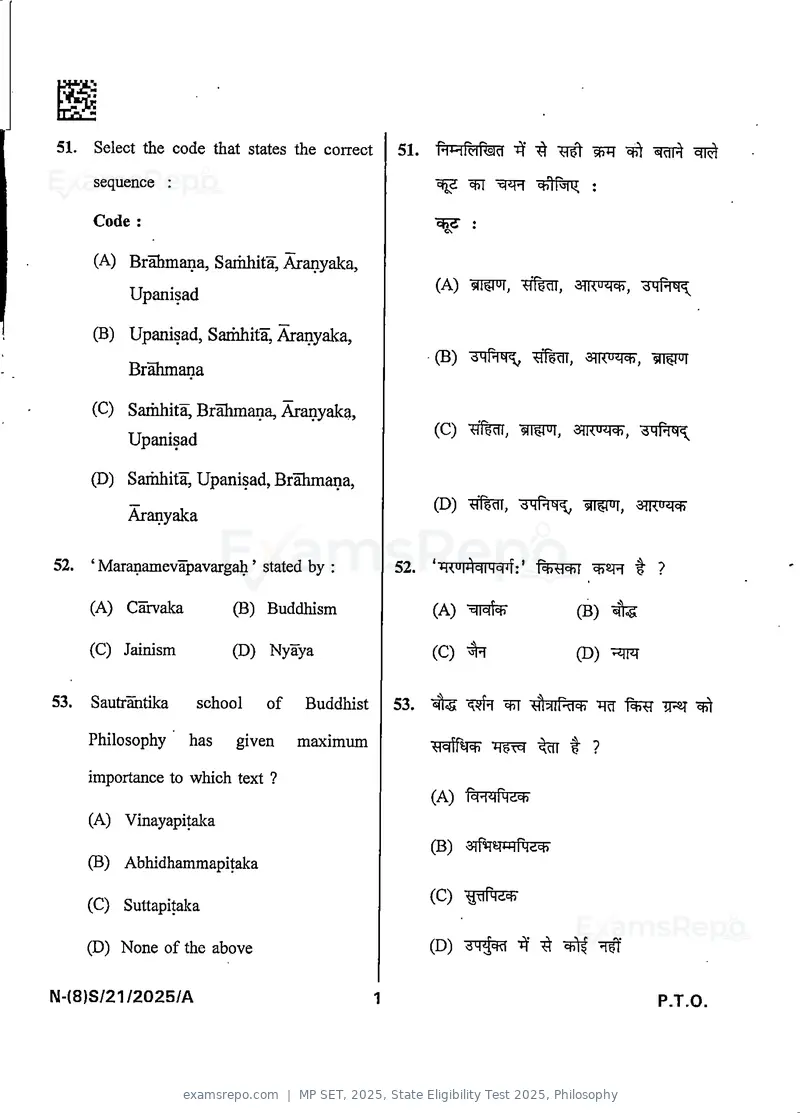
Text of page 3
51. Select the code that states the correct   51. PlMidRsld                     ^^      ^
       sequence :


       Code :                                              :
                                                      Cv


      (A) BrMimana, Saihhita, Aranyaka,
                                                    (A)
           Upanisad

      (B) Upanisad, Samhita, Aranyaka,
                                                    (B)
           Brahmana

      (C) Saihhit^ Brahmana, Aranyaka,
                                                    (C)
           Upanisad

      (D) Saihhita, Upanisad,Brahmana,
                                                    (P)                     9tT^, 3TPM^
           Aranyaka

52. 'Maranamevapavargah * stated by :         52.                                t ?

      (A) Carvaka         (B) Buddhism              (A)                   (B) ^
      (C) Jainism         (D) Nyaya                 (C) ^                 (D)^

53.   Sautrmitika    school   of   Buddhist   53.                   -Hl^Updch        TRT ^
      Philosophy    has   given    maximum

      importance to which text ?
                                                    (A) fq^qrHich
      (A) Vinayapi^a
                                                    (B)
      (B) Abhidhammapitaka

      (C) Suttapitaka                               (C) iirlRldcb

      (D) None of the above                         (D)                 ^

l\l-(8)S/21/2025/A                                                                   P.T.O.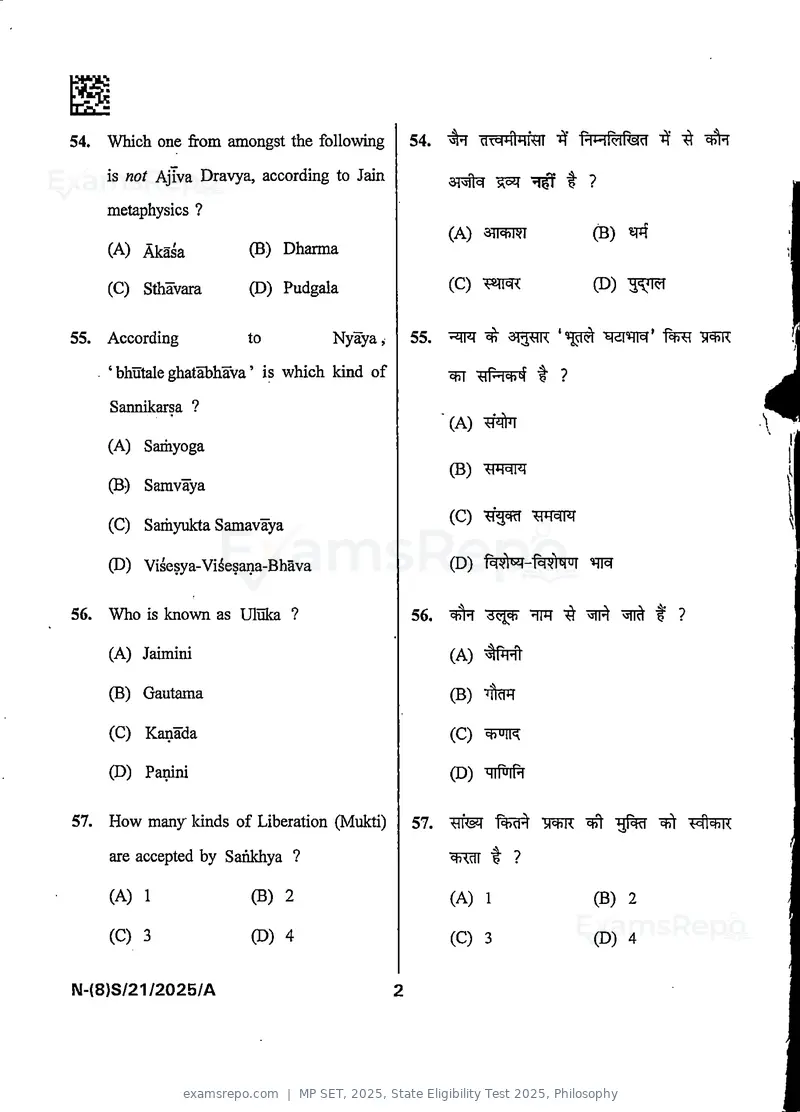
Text of page 4
54, Which one from amongst the following        54.         clwMgr       PdHRtRsId         ^
       is not Ajiva Dravya, according to Jain               ^^ t ?
       metaphysics ?
                                                      (A)                 (B)
      (A) Akasa          (B) Dharma

      (C) Sthavara       (D) Pudgala                  (C)                 (D)^


55. According             to         Nyaya,

      -'bhutale ghatabhava' is which kind of          ^           t ?
       Sannikarsa ?
                                                      (A) RPk                                  A

      (A) Sariiyoga
                                                      (B) RTOR
      (B) Samvaya
                                                      (C)         "wmt
      (C) Sariiyukta Samavaya

      (D) Visesya-Vi^esana-Bhava                      (D)                 w


56.    Who is known as Uluka ?                  56.               -IIH               ^ ?

      (A) Jaimini                                     (A)

      (B) Gautama                                     (B) ita
      (C) Kanada                                      (C)

      (D) Panini                                      (D)

57. How many kinds of Liberation (Mukti)        57.                      ^           ^ wlchK

       are accepted by Sahkhya ?                            t ?

      (A) 1               (B) 2                       (A) 1               (B) 2

      (C) 3               (D) 4                       (C) 3               (D) 4


i\I-(8)S/21/2025/A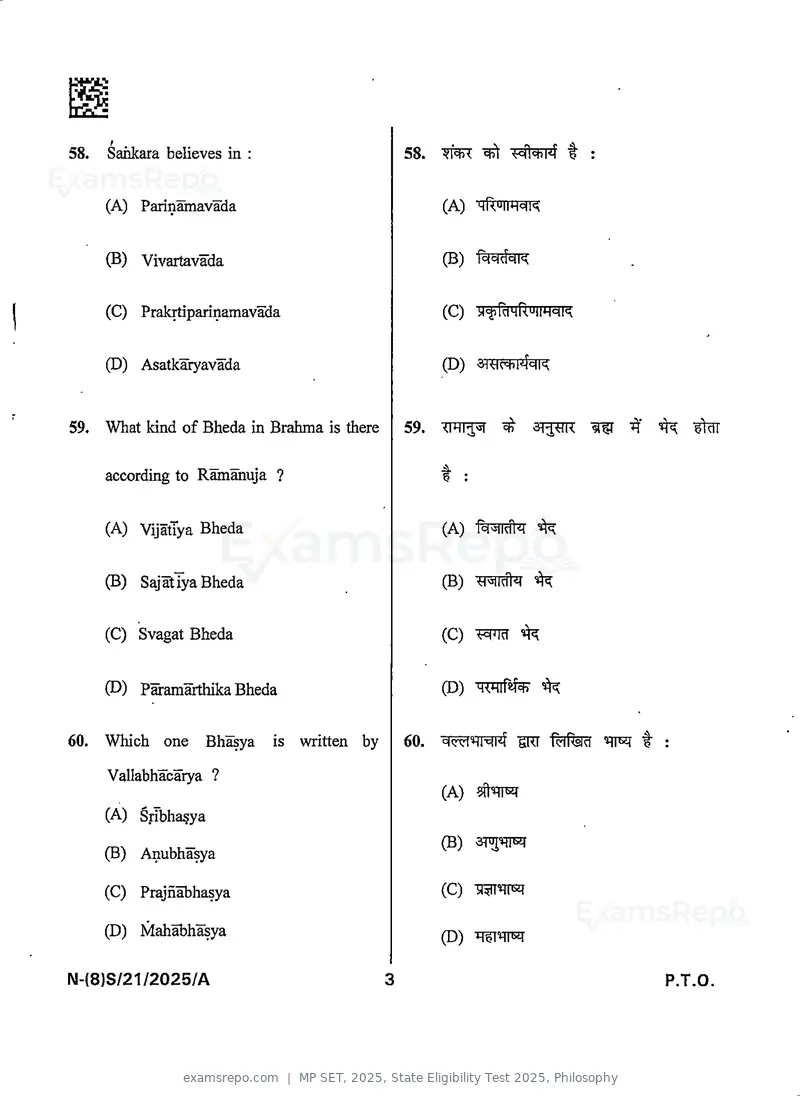
Text of page 5
f

58.   Sankara believes in :                   58.         ^ ^lchl4 t :

      (A) Parin^avada                               (A) 4Ruimc|K


      (B) Vivartavada                               (B)


      (C) Prakrtiparinamavada                       (C)


      (D) Asatk^av^da                               (D)


59.   What kind of Bheda in Brahma is there   59.           ^               ^^

      according to R^ahuja ?                        t:

      (A) VijatTya Bheda                            (A)         ^

      (B) Saj^iya Bheda                             (B)         ^

      (C) Svagat Bheda                              (C) WTd ^

      (D) P^amaithika Bheda                         (D)         ^

60. Which one Bhasya          is written by   60.            "gPT RnRsia   t" ;
      Vallabhacarya ?
                                                    (A)
      (A) Sribha^ya
                                                    (B)
      (B) Anubhasya

      (C) Prajn^hasya                               (C)

      (D) Mahabhasya                                (D) rnmrn

N-{8)S/21/2025/A                                                              P.T.O.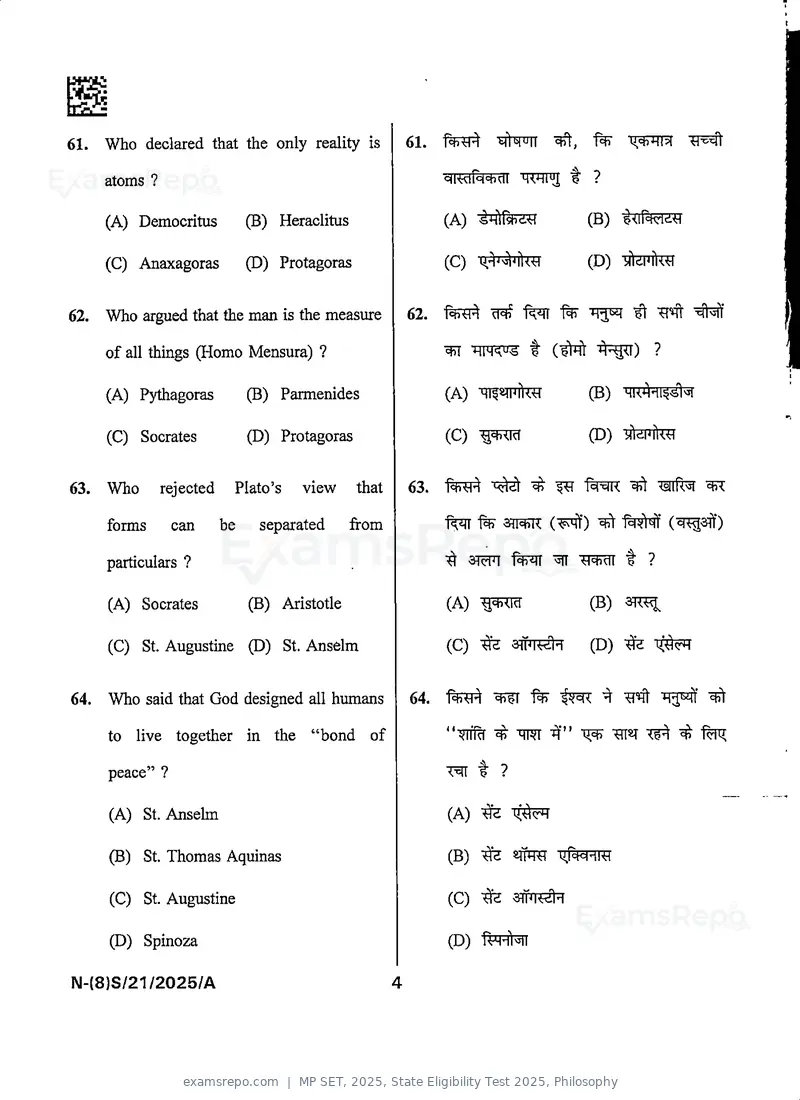
Text of page 6
61. Who declared that the only reality is              61.


     atoms ?


    (A) Democritus             (B) Heraclitus                (A)                   (B)

    (C) Anaxagoras             (D) Protagoras                (C)                   (D) dzptef

62, Who argued that the man is the measure             62.                               ^

     of all things (Homo Mensura) ?                          ^             t ("dd            ?

    (A) Pythagoras             (B) Parmenides                (A) "qifSTFter        (B)

    (C) Socrates               (D) Protagoras                (C)                   (D) dsRtef

63. Who        rejected    Plato's    view      that   63.                 ^ ^ f^'ciK qfrl           ^

     forms      can       be     separated     from

     particulars ?                                           ^ 3WT            ^ 'mm t ?

    (A) Socrates               (B) Aristotle                 (A)                   (B)

    (C) St. Augustine (D) St. Anselm                         (C)         aiHIwld   (D) ^

64. Who said that God designed all humans              64.                          ^

     to live together in the "bond of                               ^ -qRT                       ^

     peace" ?                                                      t ?

     (A) St. Anselm                                          (A) ^

     (B) St. Thomas Aquinas                                  (B) ^ afro "dWlRT

     (C) St. Augustine                                       (C) ^

     (D) Spinoza                                             (D) PWHkl

I\l-(8)S/21/2025/A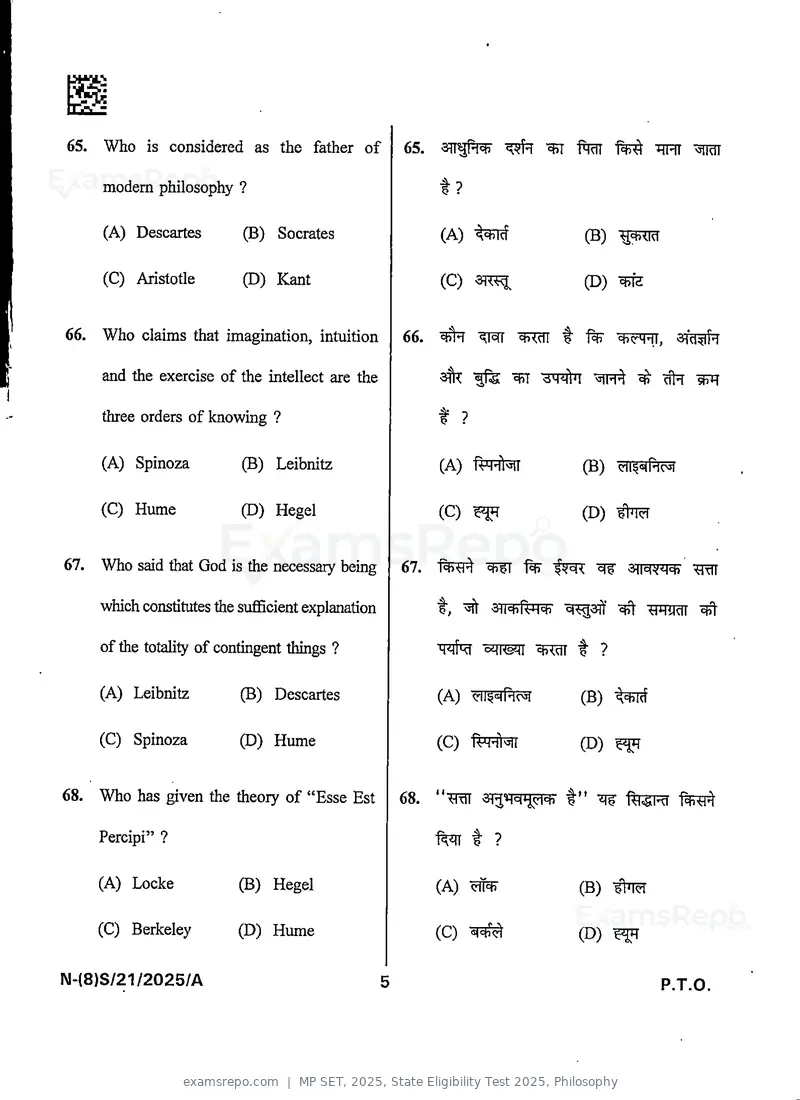
Text of page 7
65.    Who is considered as the father of            65.           ^           ihrTT     TTFfT "5IKIT

       modem philosophy ?                                  t?

      (A) Descartes         (B) Socrates                   (A)                  (B)

      (C) Aristotle        (D) Kant                        (C)                 (D) TO


66. Who claims that imagination, intuition           66. ctili          ctxai f" 1% chrnij,
      and the exercise of the intellect are the

      three orders of knowing ?                            t ?

      (A) Spinoza          (B) Leibnitz                    (A) -fFETkr         (B)

      (C) Hume             (D) Hegel                       (C) ^               (D)


67. Who said that God is the necessary being         67.          TO %           ^             TO

      which constitutes the suflScient explanation         t;                "^a;#      tortt ^
      of the totality of contingent things ?                              TOT t ?

      (A) Leibnitz         (B) Descartes                   (A)                 (B)

      (C) Spinoza          (D) Hume                        (C) -froNn          (D) ^


68. Who has given the theory of "Esse Est            68. "TO                      ^

      Percipi" ?                                                 t ?

      (A) Locke            (B) Hegel                       (A) cTO             (B) itm

      (C) Berkeley         (D) Hume                        (C)                 (D) ^

IM-(8)S/21/2025/A                                                                         P.T.O.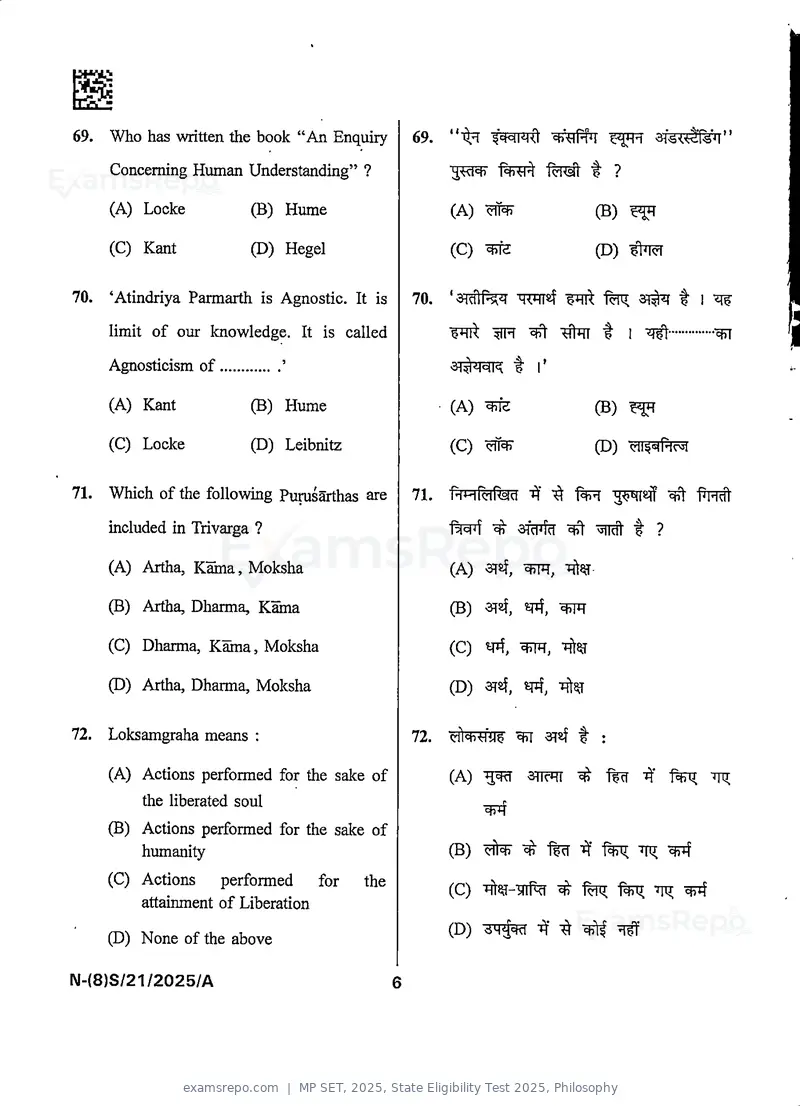
Text of page 8
69. Who has written the book "An Enquiry
     Concerning Human Understanding" ?                                          t ?

    (A) Locke           (B) Hume                      (A) ^                     (B)

    (C) Kant            (D) Hegel                     (C)                       (D)

70. *Atindriya Parmarth is Agnostic. It is      70.                wrrsf ^              a#q f i ^
    limit of our knowledge. It is called                           ^             "I I
    Agnosticism of            '                       3#^!^ t r

    (A) Kant            (B) Hume                      (A) ^                     (B) ^

    (C) Locke           (D) Leibnitz                  (C) ^TRfi"                (D)


71. Which of the following Pumsarthas are       71. PHHRriRsld       ^                    ^
    included in Trivarga ?                                  ^ STcFfd ^                "I ?

    (A) Artha, Kaina, Moksha                          (A)

    (B) Artha, Dharma, K^a                            (B)              ^

    (C) Dharma, K^a, Moksha                           (C)              -pftaj
    (D) Artha, Dharma, Moksha                         (D) arsf,

72. Loksamgraha means :                         72.            ^           t:

    (A) Actions performed for the sake of             (A) "5^ aiTciTT ^                          ^
         the liberated soul

    (B) Actions performed for the sake of
        humanity                                      (B) ^^ 1W                         Tfir ^
    (C) Actions      performed      for   the
                                                      (C)              ^                 Tra;
         attainment of Liberation

    (D) None of the above
                                                      (D)              ^ ^^

I\l-(8)S/21/2025/A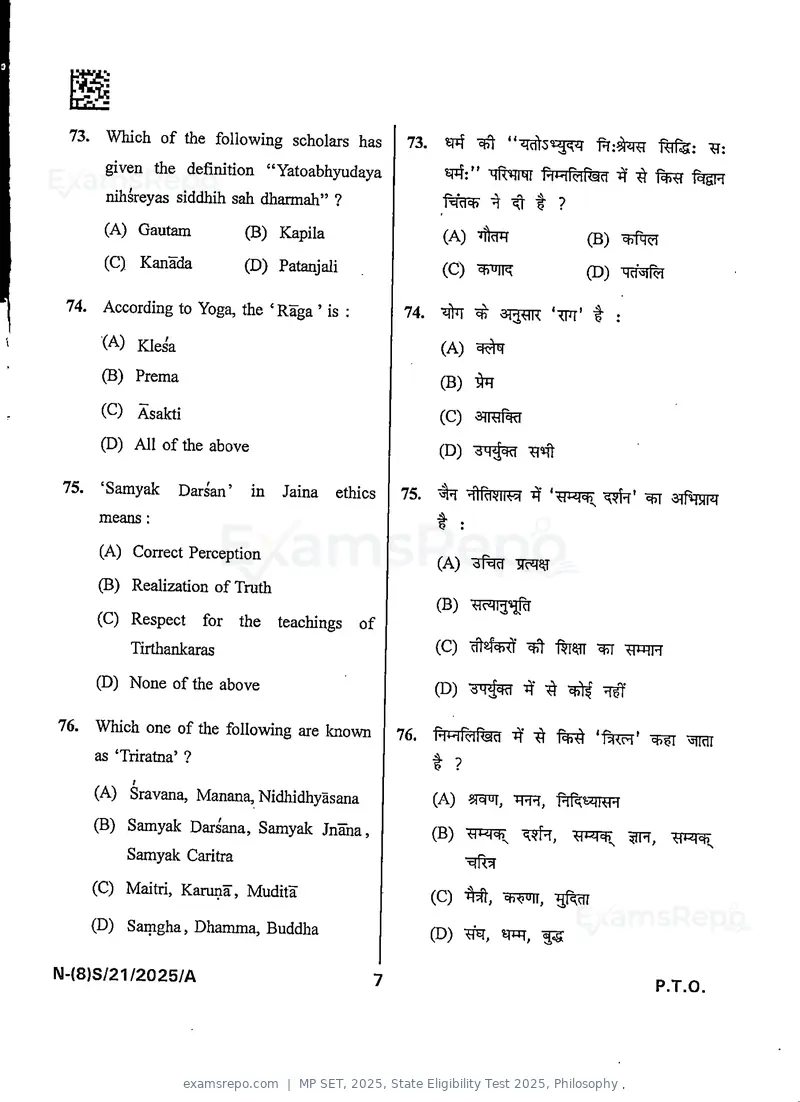
Text of page 9
73. Which of the following scholars has     73.                                     1%fe: -R:
      given the definition "Yatoabhyudaya                         PjHRiRstd       ^ fer -fegFT
      nihsreyas siddhih sah dhannah" ?                        ^t ?
     (A) Gautam          (B) Kapila                (A)                    (B) cbftjcri
     (C) Kanada          (D) Patanjali             (C)                    (D)
 74. According to Yoga, the'Raga'is ;       74. "qhr ^ 37^^ '"tk' t ;
     (^) Kles'a                                    (A) ^
     (B) Prema                                     (B) ^
     (^) Asakti                                    (C) sirafe
     (D) All of the above                          (D)

75. 'Samyak Darsan' in Jaina ethics         75. "tr             "4*                ^
     means:
                                                   t:
    (A) Correct Perception
                                                   (A) "31%
    (B) Realization of Truth
                                                   (B)
    (C) Respect for the teachings of
         Tirthankaras                              (C)                         ^ ^uiH

    (D) None of the above                          (D)            ^^
76. Which one of the following are known    76. Pi^RiRaa
    as Triratna' ?
                                                   t ?
    (A) Sravana, Manana,Nidhidhyasana          (A) ^cju|^
    (B) Samyak Darsana, Samyak Jnaha,          (B)
        Samyak Caritra

   (C) Maitri, Karuna, Mudita                  (C)                    -gferi
   (D) Samgha, Dhamma, Buddha                  (D)               ^

N-(8)S/21/2025/A
                                                                                     P.T.O.
Text of page 10
77. Meaning of Rta is :                            77. "5!icr            f :

    (A) World                                            (A) WR

    (®) Darsan                                           (B)

    (C) Cosmic order                                     (C)       ^

    (D) None of the above                                (D)            ^

78. The person with a steady mind is called:       78.            Tpf                     t:

    (A) Sthitaprajna    (B) Prajnasri                    (A)                  (B)

    (C) VanaprastW      (D) Gnhastha                     (C)                  (D)


79. The root-meaning of Bhagvadagita's             79.            ^            ^^

     doctrine of Niskama Karma is :                      ^ a;T2f t :
    (A) Performing actions considering one
                                                         (A) wf ^                   ^
          self as an instrument of God

    (B) Performing actions without any

          attachment
                                                         (B) to toft STRlto ^ ^
    (C) Performing actions for others
                                                         (C)            fto
    (D) Performing actions for attaining

          liberation                                     (D) Tftaj-'RTftd ^ to; ^

80. "Apurva is an invisible power." This           80.          TT^ 37^ -^Tto t l" "21?
     statement belongs to whom ?                         toi^ t ?

    (A) Jaimini         (B) Kanada                       (A)                  (B)

     (C) Kapila         (D) Sahara                       (C)                  (D)


N-(8)S/21/2025/A                               8
Text of page 11
81, Who is the exponent of the deontological
     theory of lightness ?                            ^           ^f ?

     (A) A.C. Ewing                                   (A) R."#.
     (B) C.D. Broad                                   (B)         ^

     (C) W.D.Ross                                     (C)          ^

     (D) All of the above                             (D)

82, Who envisaged the concept of "My            82.               ^ 1%%^ chcloil ^
     station and my duties" in the context of                             ctidoq" ^ fcj-cjK
     a person's specific duty ?

     (A) Socrates       (B) Aristotle                 (A)               (B)

    (C) Bradley         (D) Plato                     (C)               (D)

83, What is the main virtue according to        83.         ^                          ^
     Kant ?                                           t ?

    (A) Justice                                       (A)

    (B) Courage                                       (B)

    (C) Sense of Duty                                 (C) "^Rfoqwror
    (D) Temperance                                    (D) wr


84, According to whom 'virtue is habit' ?       84. 1^^^ 37^;^                  t' ?
    (A) Socrates        (B) Aristotle                 (A)              (B)

    (C) Plato           (D) Kant                      (C)              (D) ^


N-(8)S/21/2025/A                            c                                     P.T.O.
Text of page 12
i££
85. Which of the following alternatives is        85.                                         [q=hcrM
     true regarding the ethical theory of
     perfectionism ?                                        ^t ?
    (A) Self realization is the highest good              (A)                       t
     (B) Perfectionism reconciles egoism and              (B)                                     ^
          altruism                                                      t
    (C) Perfectionism ends conflict between               (C)                    3^ ^^C|K ^
         'rationalism and hedonism                                     ^                "I"
    (D) All of the above                                  (D)

86. Which ofthe following theories or concepts        86. rHHPdRsId        feSRT RT               ^
     hold that moral qualities of actions are
     directly identified by conscience ?                  ^^                ^i ?
    (A) Ethical hedonism                                  (A)

     (B) Psychological hedonism                           (B)

     (C) Teleological ethics                              (C)

     (D) Intuitionism                                     (D)

87. Which one of the following alternatives           87. wftfeRR ^             PHHPdPtsld
     is correct regarding utilitarianism ?                             ^t ?
     (A) The moral quality of an action
                                                          (A) PtTtil   ^         "IJ0| "5^1^
          depends on its consequences
     (B) Moral quality is implicit in the
                                                                ■q^        "I

          action only                                     (B)          ^        ^             t
     (C) It is a deontological theory
                                                          (C) ^                     i
     (D) Moral laws are not based on

          experience
                                                          (D)                                 t

IM-(8)S/21/2025/A                                10
Text of page 13
88. What is the Highest Good ?                     88.                 ^f 7

    (A) It is absolute good                              (A)                   t
    (B) It is not desired as a means to                  (B)

          another higher good

    (C) It is good in itself                             (C) ^                 t

    (D) All of the above                                 (D)


89. Who while regarding virtues as the             89.                  ^ ^cjT-oxI

     supreme good, has said that it consists in          "p;                             flflfT

     good will ?                                         t ?

    (A) Mill                                             (A)

    (B) Bentham                                          (B)

    (C) Kant                                             (C)

    (D) None of the above                                (D)            ^

90. Who said that "Quantity of pleasure            90.          ^iFT               ^

    being equal pushpin is as good as                          ^ PTRr
    poetry" ?                                            f Riddl Cti[qcll" ?

    (A) Bentham                                          (A)

    (B) Mill                                             (B)

    (C) Rashdall                                         (C)

    (D) Hobbes                                           (D) im

IM-(8)S/21/2025/A                             11                                       P.T.O.
Text of page 14
91. 'Integral Yoga' is related to which of the    91. 'wm                           RHRrlRsld   ^
      following Philosophers ?                          ^                     t ?
      (A) B.R. Ambedkar                                 (A)

      (B) Deen Dayal Upadhyaya                          (B)

      (C) Shri Anrobindo                                (C) ^
      (D) Narayan Guru                                  (D) -wim

92. Deen Dayal Upadhyaya's Philosophy is          92.                          ^

      known as :                                        t:
      (A) Scientific Humanism                           (A)

      (B) Integral Humanism                             (B)         RpmK

      (C) Existentalistic Humanism                      (C)

      (D) None of the above                             (D)

93. Under the 'concept of philosophy' K.C.        93.          ^
      Bhattacharya talks about how many
      grades of theoretic consciousness ?                              ?

      (A) Four            (B) Two                       (A) ^                  (B) i[
      (C) Three           (D) One                       (C) #r                 (D)

94.   The central element of B.R. Ambedkar's      94.                         ^           ^^
      social philosophy is :                                    "dc^ t :
      (A) Political Freedom                             (A) <Mdl[acti
      (B) Annihilation of caste and social              (B) ^^dlfd^T^TT dTT
           equality                                           ^HHdl


      (C) Globalization                                 (C)

      (D) Spiritualization                              (D)


N-(8)S/21/2025/A                                 12
Text of page 15
95. According to      New     Humanism      of     95. WT-Wl.                ^                       ^
     M.N. Roy :

    (A) The individual is prior to society.            (A)                    ^        t I
    (B) The society is prior to individual.            (B) 'W^                         t I
    (C) Both society and individual are at             (C)           -^arr                        ^ -qr
         par.                                                f I
    (D) None of the above                              (D)                    ^

96. Match correct order of the following           96. PiMRriRaa                                  RiRsld
    writers and books written by them :                         qq           Ihoih            :

         Writers                 Books
                                                                                         "iWcb
    (1) B.R. Ambedkar        (a) An Idealistic         (1)                           (a) Rq
                                 \^ew of Life

    (2) Maulana Azad         (b) The Religion                                           ^ Sqqr ^1^4)
                                 of Man
                                                       (2) -^IHI SITSIK              (b)^
    (3) S. Radhakrishnan (c) The Buddha

                                 and His               (3)                           (c) ^ ^
                                 Dhamma

    (4) Rabindranath        (d) India Wins            (4) <q1-s-i|8T Mc              (d)f%qi
        Tagore                   Freedom
    Code :
                                                      ^ =
   (A) (l)-(b), (2)-(c), (3)-(a), (4)-(d)             (A) (l)-(b), (2)-(c), (3)-(a), (4)-(d)
   (B) (l)-(c), (2)-(d), (3)-(a), (4)-(b)             (B) (l)-(c), (2)-(d), (3)-(a), (4)-(b)
   (C) (l)-(a), (2)-(b), (3)-(c), (4)-(d)             (C) (l)-(a), (2)-(b), (3)-(c), (4)-(d)
   (D) (l)-(b). (2)-(d), (3)-(a), (4)-(c)             (D) (l)-(b), (2)-(d), (3)-(a), (4)-(c)

W-(8)S/21/2025/A                              13                                              p.T.O.
Text of page 16
97. Which of the following Philosophers            97. rHHRrlHsld       ^                  W%

    said, "Our Philosophy is the same as

    that of Shankaracharya ?"                                   t ?"

    (A) Swami Dayanand Saraswati                         (A) Wit WK

    (B) Jiddu Krishnamurti                               (B)

    (C) Sree Narayan Guru                                (C) ^

    (D) B.R. Ambedkar                                    (D) ^t.fflR.        ch<

98. Which of the following is correct about        98.          ^ '11^ wrsr' ^ ^          PlMpQiRsid

     Gandhi's *Hind Swaraj' ?                            ■4* ^ ^            t ?

    (A) It was written in 1908 and                       (A) 1908                           TO "4*
         supported industrialisation in India.                                 ^                t 1

    (B) It is on Education.                              (B) ^                      t I
    (C) It is based on explanation of God.               (C) "4?         ^ Ws^IT "qr 3TT??Tfer t I
    (D) It was written in 1908 and a severe              (D) 1908                 ^ "3^

         condemnation of * modem civilization'.                             qt# 3q#qqT t i


99. 'Satyashodhak Samaj' was founded by            99.                  WF' ^ WRI fel "WF

     which social reformer ?


    (A) Sant Kabi Bhima Bhoi                              (A)       ^ ^ ^

     (B) Jyotiba Phule                                    (B)

     (C) Maulana Azad                                     (C)           31MF

     (D) Mohammad Iqbal                                   (D) eIfRF

N-(8)S/21/2025/A                                  14
Text of page 17
100. In the writings of Sant Kabi Bhima Bhoi          100. W ^^ ^ ^
     in which form has God been described ?                  ^           RtrW            [^^1 "MI             ?
    (A) As Shunya                                            (A) ^ ^ ^
    (B) As concrete idol                                     (B)                      ^
    (C) As nature                                            (C)          ^
    (D) As inert matter                                      (D) ^              ^
101. Which one of the following thinkers has          101. rHHPeiRsid PcixiKchT         ^ fer
     given the idea of Logical Atomism ?                     cllPh'ch           ^                ^t ?
    (A) Russell            (B) Wittgenstein                  (A)                      (B)
    (C) Moore              (D) Strawson                      (C)                      (D)

102. Match the List I with List II and select         102.         I^             n      [hcrll'l dilRrjl!,
     the correct answer with the given codes :                          ^              ^^                         :
          List I                  List II

    (a) Ryle               (1) truth is                      (a) <1^01                (1) WT a^icqfro^
                                  subjectivity                                              "t
    (b) Ayer               (2) speech act                    (b)                      (2)
    (c) Kierkegaard        (3) ghost in                      (c) Mmd                  (3) "q#!
                                  machine theory                                             ■feRT

    (d) Austin             (4) having right to               (d) arffer               (4) ^ ^ -q;^
                                  be sure as a

                                  condition of
                                  knowledge
    Code :
                                                             ^ '
         (a)       (b)      (c)        (d)                         (a)      (b)        (c)          (d)
    (A) (4)        (3)      (1)        (2)                   (A) (4)        (3)        (1)         (2)
    (B) (3)        (4)      (1)        (2)                   (B) (3)        (4)        (1)         (2)
    (C) (3)        (2)      (1)        (4)                   (C) (3)        (2)        (1)         (4)
    (D) (1)        (4) ■    (3)        (2)                   (D) (1)        (4)        (3)         (2)
N-(8)S/21/2025/A                                 15                                                  P.T.O.
Text of page 18
103. Which of the following philosophers has         103. PiHPeiRsld ^                          ^

     said "The world is the totality of facts,              t                  ^          t,
     not of things" ?                                       'm         ?


    (A) Husserl          (B) Russell                        (A)                (B)

    (C) Wittgenstein     (D) Moore                          (C)                (D) iJC


104. "Existence precedes Essence". This              104.          ^^              t I"

     dictum is of:                                          t:

    (A) Heidegger        (B) Nietzsche                      (A)            ^   (B)        "qn

    (C) Sartre           (D) Keirkegaard                    (C)        m       (D)              ^


105. Tractatus-Logico-Philosophicus' book is

     written by :                                           M t:

    (A) Early Wittgenstein                                  (A)                    -m

    (B) Later Wittgenstein                                  (B)            "fefelfq m

    (C) Husserl                                             (C)        m

    (D) Ayer                                                (D)        -m


106. "Rationalism may be discarded, but life-        106.                      ^         t,
     useful beliefs cannot be discarded."

     Whose belief is this ?


    (A) Dewey            (B) James                          (A) "sHt           (B) ^

    (C) Peirce           (D) Brentano                       (C)                (D)

N-{8)S/21/2025/A                                16
Text of page 19
107. In the critique of dialectical reason,          107.                                   if
      Sartre abandoned the individualistic view                         ^          ^^ "qfwT
      of existentialism and adopted an integral
      view. This view is related to :                        Tfsifer t :
     (A) Humanism          (B) Marxism                      (A) HHcidlclK ^ (B) HIcHlciK
     (C) Pragmatism        (D) Hedonism                     (C)               ^ (D)          ^

108. Which of the following is not related to        108. PHHRrifed         ^^
      the phenomenological method process ?                 ^           ^             t ?
     (A) Reduction         (B) Mixture                      (A)                (B) -fTTOT
     (C) Ideation          (D) Bracketing                   (C)                (D)

109. What are Moore's ultimate ideals ?              109.      ^                            ^ ?
     (i)    Fellow feelings among humans                    (i) Rm ^                  bW
     (ii) Aesthetic enjoyment                               (ii)
     (iii) Pleasure                                         (iii) 1®I3^
     (iv) Salvation                                         (iv)
     Code :

     (A) (i) and (iii)     (B) (i) and (ii)                 (A) (i)3Tk(iii)    (B) (i)3i[k(ii)
     (C) (iii) and (iv) (D) (iv)                            (C) (iii)4!:(iv) (D) (iv)
110. What is the mind according to Gilbert Ryle ?    110.                         fpT f ;
     (A) Absolute matter                                    (A)         ^
     (B) Physical matter                                    (B)         ^
     (C) Separated matter                                   (C) ^ ^           ^
    (D) Being without a body but having an                  (D) 'roh:       ■gkn: ^ mk siPft
           integral existence

N-(8)S/21/2025/A                                17                                          p.T.O.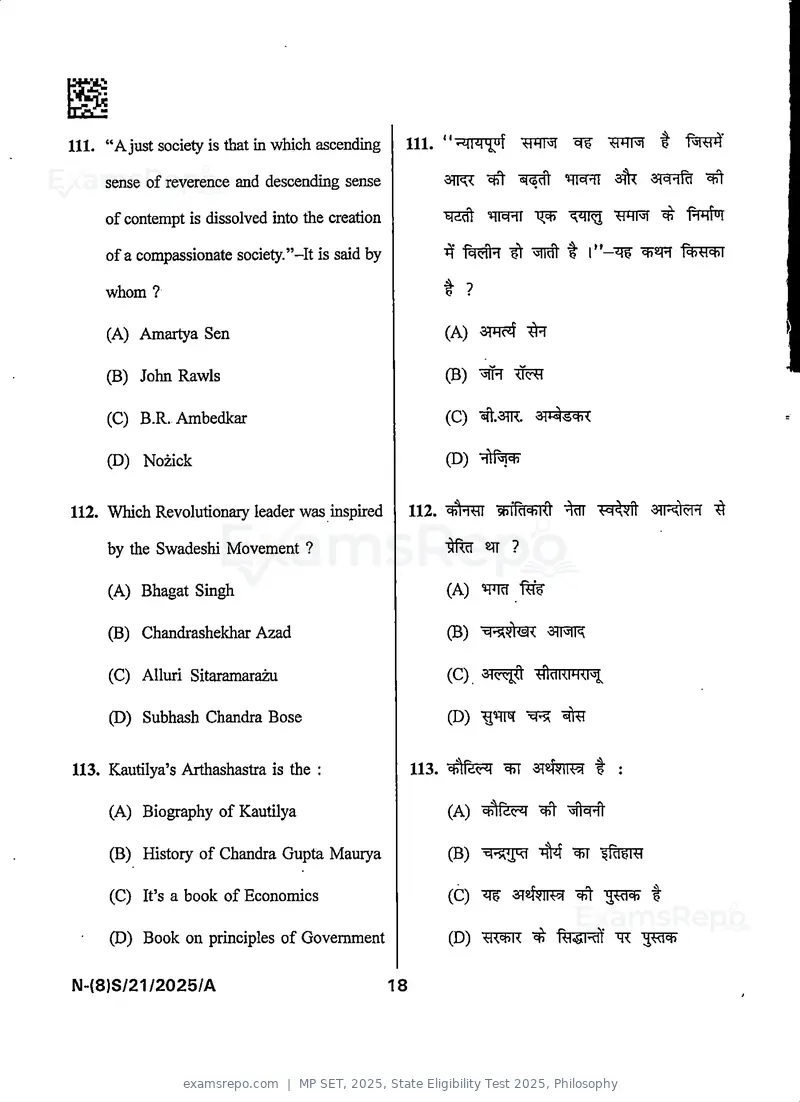
Text of page 20
111. "Ajust society is that in which ascending     111.                           ^


     sense of reverence and descending sense                  3TT^ ^ si(sa1                    ^

     of contempt is dissolved into the creation

     of a compassionate society."-It is said by                       ^^t i'

     whom ?                                                   t ?

     (A) Amartya Sen                                      (A)

     (B) John Rawls                                           (B) ^ tf^

     (C) B.R. Ambedkar                                        (C) ^.STR.

     (D) Nozick                                               (D)


112. Which Revolutionary leader was inspired       112.             stiiRi=bi<1

     by the Swadeshi Movement ?                               ifer SIT ?

     (A) Bhagat Singh                                         (A) ^ETcT kfe

     (B) Chandrashekhar Azad                                  (B)

     (C) Alluri Sitaramara^                                   (C) 31^ -RkTPJTO^

     (D) Subhash Chandra Bose                                 (D)       ^^

113. Kautilya's Arthashastra is the :                  113.          ^ 378^1^ t :

     (A) Biography of Kautilya                                (A)          ^

     (B) History of Chandra Gupta Maurya                      (B)                 ^ i%T^

     (C) It's a book of Economics                             (C) "^TF 3l8feT^ ^ ^5^1^ t

     (D) Book on principles of Government                     (D)          ^ felRff "qr "5?^

N-(8)S/21/2025/A                                  18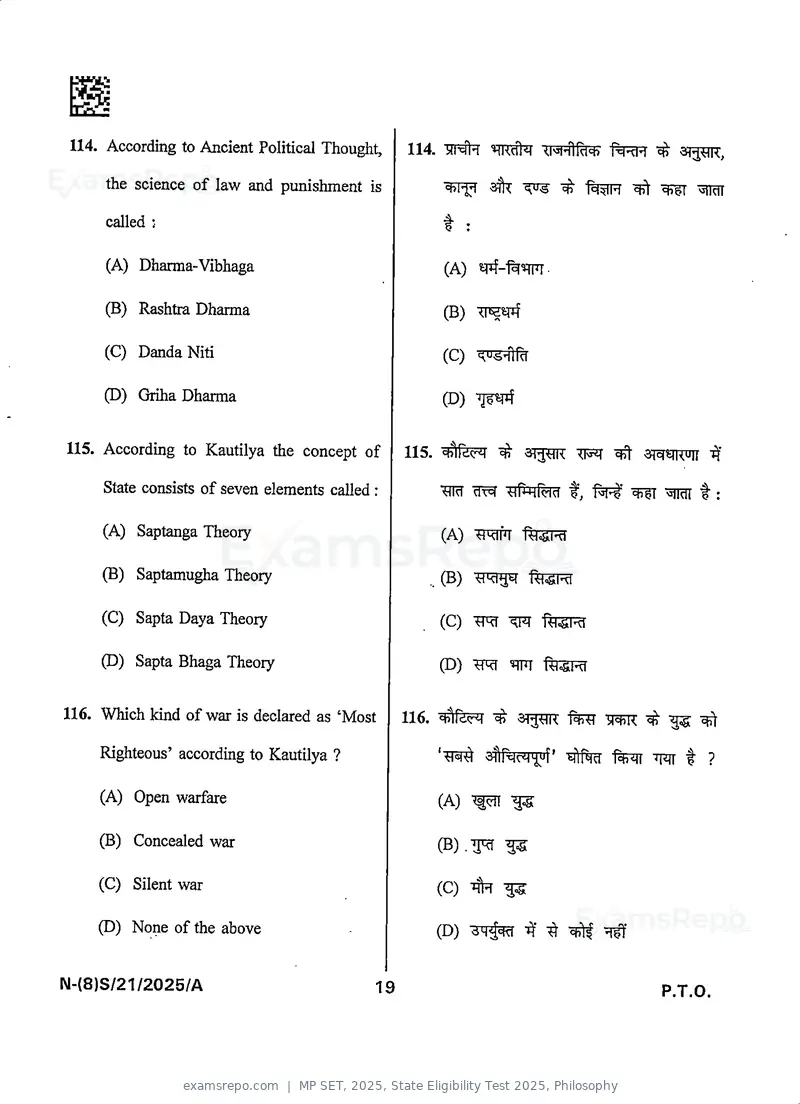
Text of page 21
114. According to Ancient Political Thought,     114. 3rr#T           <NHlfdch      ^
     the science of law and punishment is

     called :                                           t:

     (A) Dharma-Vibhaga                                 (A)

     (B) Rashtra Dharma                                 (B)

     (C) Danda Niti                                     (C)

     (D) Griha Dharma                                   (D)


115. According to Kautilya the concept of        115.                       TRT ^

     State consists of seven elements called :          ■?TRr ^            t*,              t:

    (A) Saptanga Theory                                 (A) TTWT RHc^H

    (B) Saptamugha Theoiy                               (B)

    (C) Sapta Daya Theory                               (C) TTRT      "f^RI

    (D) Sapta Bhaga Theory                              (D) ^ ^ fejRf

116. Which kind of war is declared as 'Most      116.                      "f^ "51^ ^       ^

     Righteous' according to Kautilya ?                       sterJTjyf'            "TO t ?
    (A) Open warfare                                    (A)

    (B) Concealed war                                   (B) .llRr ^

    (C) Silent war                                      (C) ifk ^
    (D) None of the above                               (D)                ^


N-(8)S/21/2025/A                            19                                          P.T.O.
Text of page 22
117. The antithesis of constitutionalism is      117.                     ^              ^ W WT

     called :                                               t:

    (A) Socialism       (B) Feudalism                       (A)                   (B)

    (C) Totalitarianism (D) Pluralism                       (C)                   (D)


118. What is the major wealcness of king         118. Tm                      ^ ^

     Yudhisthira that lead to the loss of his

     kingdom ?                                                           ?


    (A) Intoxicants                                         (A)

    (B) Women                                               (B)

    (C) Gambling                                            (C)

    (D) Hunting                                             (D)


119. How many types of wars have been                119.                                    ^

     discussed by Kautilya ?                                      t ?

    (A) One             (B) Two                             (A) ^                 (B) ^

    (C) Three           (D) Four                            (C)                   (D) ^


120. Which ofthe following is not a component        120. srtilRrlRsid        ^ ^ Tt^ "qfeR ^
     of the Evolutionary Theory of Family ?                                      ^         t ?

    (A) Consanguineous Family                               (A)

    (B) Punaluant Family                                    (B)          "qfeR

     (C) Patriarchal Family                                 (C)

    (D) Matriarchal Family                                  (D)                  "qfeR

N-(8)S/21/2025/A                                20
Text of page 23
121. According to Plato the reason for man to     121. KIclI ^
       be just is :
                                                          ^                -I" j
      (A) The fear of society                             (A)                      ^

      (B) Divine Command                                  (B)

      (C) The Purity of Soul                              (C)              ^^
      (D) Virtue of Human being                           (D)

 122. According to Hobbes, the passion for the     122.                                           31^^ "fr
      formation of a state firom the state of             ^1^ ^                    "qiT c+iKU|       ;
      nature was because of:
                                                          (A)        ^^
     (A)■ The fear of death
                                                       (B)                   ^                        ^
     (B) For being in the state of equality                     1^
     (C) For getting reputation                        (C)                 "JIM           ^

     (D) An inherent demand for organisation           (D)             ^ 3fdf^ff|H TFT ^

123. Bernard William's Tdea of Equality'           123. 3=R^ '-yHHai ^                      fr*
     argues in favour of :
                                                                     "4'                  f ?
    (A) Equality of capability and freedom             (A)            ^                  ^ iiHHdl
    (B) Equality ofeducation and employment           (B)            ^ ^Nttr ^ wmr
    (C) Equality of need and merit                    (C) 3iiq;;^ch(l(               ^IJiJdl ^ wra
    (D) Political equality and equality of            (D)                      -H^Hdl              37^^
         opportunity                                         ^HHdl


N-{8)S/21/2025/A                              21
                                                                                                      P.T.O.
Text of page 24
r£^

124. "Justice is the first virtue of social      124.          'UiHito             ^ "srsm

     institutions, as truth is of systems of            t, "fer 3m: WT             yuiiM
     thought." It is a statement by which of                  t !"             pjHrelfeld
     the following thinkers ?


    (A) Plato           (B) Aristotle                   (A)                  (B) 37^

    (C) John Rawls      (D) Amartya Sen                 (C) "sfR tf^         (D)         iR

125. The aim of government, according to         125.                    ^              ^

     Ronald Dworkin must be :
                                                        #TT          :

    (A) Equality of income                              (A) 37PT ^ TFTPM

    (B) Equality of property                            (B)       ^ ^HHdl

    (C) Equality of social status                       (C)              IMcf ^ ^MHdl

    (D) Equality of resources                           (D) "OT?#' ^ ^HHdl

126. According to Amartya Sen, well being can    126.            ^ SIJHR ch(r4iui ^ PdHl^Rsld
     conflict with which of the following ?               ^                           t ?

    (A) Agency freedom                                  (A) arpTO^

    (B) Wellbeing freedom
                                                        (B) di<rqnj| WOT

    (C) Both (A) and (B)
                                                        (C) #if (A)          (B)
    (D) None of the above
                                                        (D)              ^^

l\l-(8)S/21/2025/A                              22
Text of page 25
127. According to Marx, the immediate aim       127.                                 "dc=bl(rl "3^?^

     of communism is :                                 t:

    (A) Formation of proletarian into a class          (A)            ^

    (B) Overthrow of bourgeois supremacy               (B) *1^1 HPd            ^ -qrr^

    (C) Conquest of the political power by             (C)                w ^                  WJ

         the proletarian

    (D) All of the above                               (D)


128. Multiculturalism addresses which of the    128.                  PlHprlRsld         ^

    following issues ?                                         WT t ?

    (A) Gender equality                                (A)            llHHdl

    (B) General rights of citizens                     (B) diqRcbT ^ itlHM

    (C) Discrimination in society                      (C) wm

    (D) Supports the majority in society           (D) mm                      ^


129. Who is the author of 'A Theory of

    Justice' ?                                         t ?.

    (A) Plato                                      (A)

    (B) John Rawls                                 (B) ^ tf^

   (C) Aristotle                                   (C) ^

   (D) Dworkin                                     (D) -s^ciTRhd

N-(8)S/21/2025/A                           23                                            p.T.O.
Text of page 26
130. Rousseau's      idea   behind    the    social     130. write 3^"^ teRT ^            ^^

    contract theory is based on :                           ^ teR t ?

    (A) Advanced society                                    (A) "Bwr


    (B) General will                                        (B)


    (C) Industrial revolution                               (C) sMte

    (D) Citizenship                                         (D) wtedT


131, Demarcate    the       distribution    in   'E'    131. 'E'          ^               ^

     proposition :                                                    :


    (A) S distributed, P undistributed                      (A) "3.

    (B) S distributed, P distributed                        (B)               1^.

    (C) S undistributed, P undistributed                    (C)

    (D) S undistributed, P distributed                      (D)       aqoqTRT, 1^.


132. What is the relationship between                   132. crater 'A' alk 'O'^' ^feir       ^

     proposition 'A' and '0' ?                              t ?

    (A) Contradictory                                       (A) <^NIdl

     (B) Contrary                                           (B)


     (C) Subcontrary                                        (C)

     (D) Subalternation                                     (D)

IM-(8)S/21/2025/A                                      24
Text of page 27
133. The formula of T proposition in Boolean        133.              ii T (snf)               ^
      method is :                                           ^Hlcb<u| t :
     (A) S P 9^ 0                                           (A) ^     ^0

     (B) SP = 0                                             (B) ^ W = 0              V.
     (C) S P        0                                      (C) ^ W ^ 0
     (D) SP = 0                                            (D) ^     =0

 134. Which     proposition ■ is       correctly    134.       m, 1^                      ^ 3T^
     represented in the given picture ?                    ^t ?


    (A) S P               (B) SP                           (A) ^ ^             (B) ^
    (C) S P               (D) S P                          (Q Z fk            (D) ^

135. All dogs are mammals.                          135.      ^ WWfi t I
    No cat is dog.                                     ^             ^            t I
    So, no cat is mammal.
                                                                                          f I
    Which fallacy is present in this syllogism ?                           cblH-HI        f ?
    (A) Fallacy of xmdistributed middle                (A) SToTO                     ^
    (B) Existential fallacy                            (B)           ^
   (C) Fallacy of illicit minor                        (C)           ^         ^
   (D) Fallacy of illicit major                        (D)                  -q^

N-(8)S/21/2025/A                               25                                         P.T.O,
Text of page 28
136. If A, B, C are given True value and X,     136.^ ST,                                         ^
       Y, Z are given False, then decide the               X, ^ SIWT f, ^               oMvjlcb
       value of the statement :                                    :


            ~(BvX). -(YvZ)                                       ~         V -q) .      V ■^)

    (A) False                                              (A) ST^

       (B) True                                            (B) ^

       (C) Doubtful                                        (C)

       (D) None of the above                               (D)


137. Which ■ figure is valid in all the         137.               ST^^                       ^   ^

       moods ?                                             t ?

       (A) All             (B) A O 0                       (A) T3;. sn^. sTTf. (B) "q;. srl.

       (C) EAE             (D) E I O                       (C) t        i            (D) t STlf. 4,

138.         A 3B                                   138.         ^     3    T


            -B /     -A                                                7 /


       What is the name of this rule of                    ST^iTFT ^                      ^ ^
       Inference ?                                         t ?

       (A) Modus Ponens                                    (A)

       (B) Modus Tollens                                   (B)

       (C) Disjunctive Syllogism                           (C)

       (D) Constructive Dilemma                            (D)

N-{8)S/21/2025/A                               26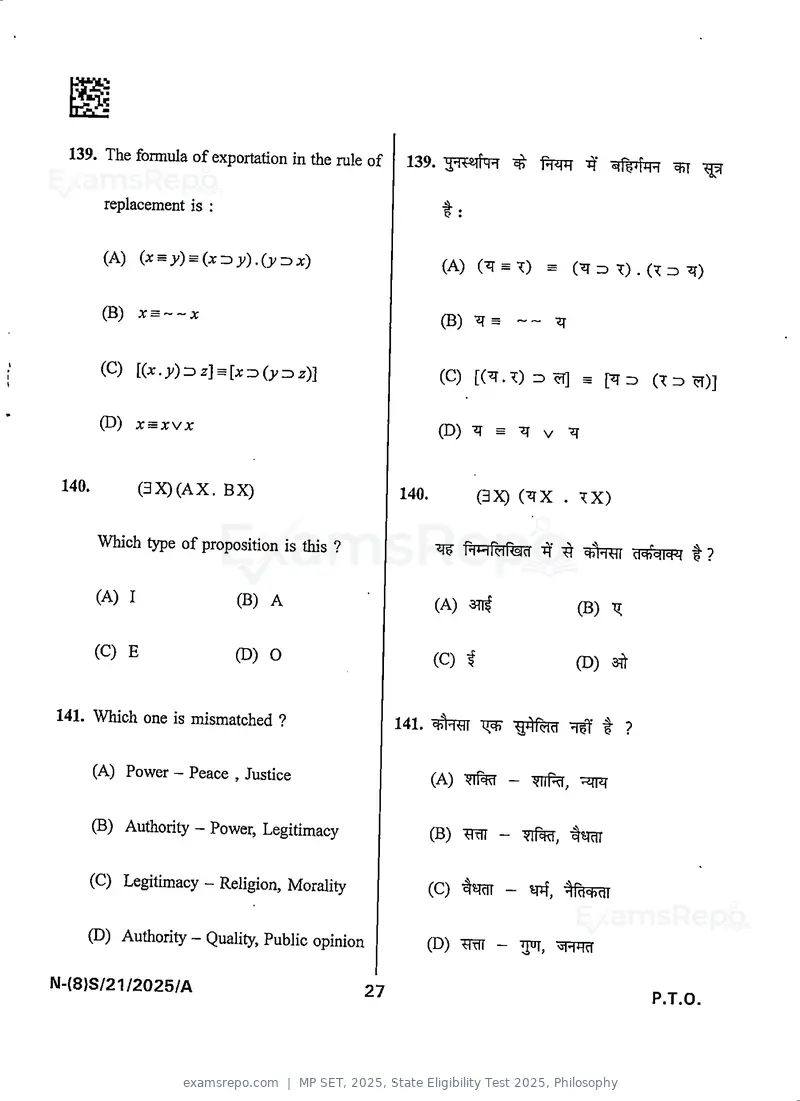
Text of page 29
139. The formula of exportation in the rule of    139.                       twT             ^

        replacement is :                                   t:

        (A) (x = y)= ix:Dy).(yzDx')                        (A) (■q' = T) = ("21 3 T) . (^ 3 "^T)

        (B)                                                (B)                  ^

        (C) [(x.y)^z]=[x:D(y=:,z)]                         (C) [("^T. -=0 3          = p =3 (X 3 ^)]

        (D) x = xvx
                                                           (D) ^         ^ V ^


 140.         (3X)(AX. BX)                         140.            (3X) (^X . TX)

        Which type of proposition is this ?                      fHHrcrlRsJd    ^                t?

     (A) I                 (B) A                          (A) ^                      (B) R

     (C) E                 (D) O                          (C) f                      (D) #

141. Which one is mismatched ?                     141.            -q^                 t ?

    (A) Power - Peace , Justice                           (A)

    (B) Authority - Power, Legitimacy                     (B) "^mr -

    (C) Legitimacy - Religion, Morality                   (C)                    ^faqicii

    (D) Authority — Quality, Public opinion               (D) Tfdl - "jq,

N-(8)S/21/2025/A                              27
                                                                                             P.T.O.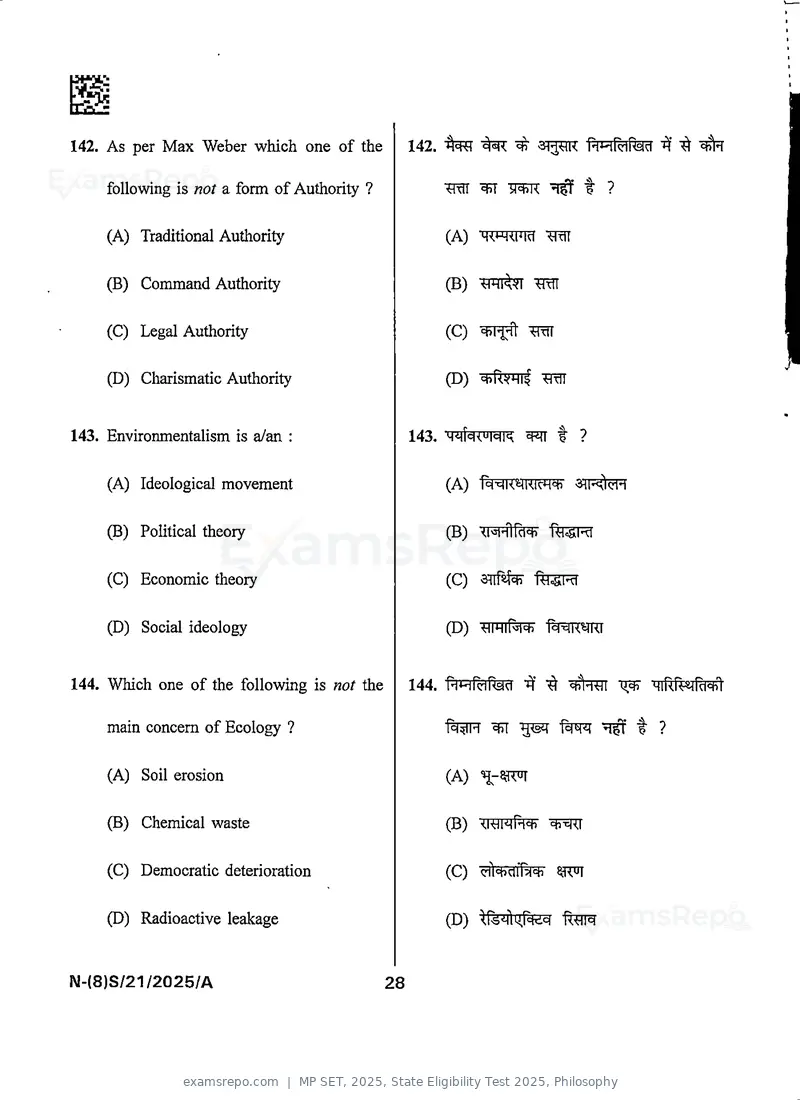
Text of page 30
142. As per Max Weber which one of the            142.         ^^              RMRrlRsld    ^

    following is not a form of Authority ?


    (A) Traditional Authority                            (A) WWId TRiT


    (B) Command Authority                                (B)           TPdT

    (C) Legal Authority                                  (C)          W


    (D) Charismatic Authority                            (D) doUmi W


143. Environmentalism is a/an :                   143.               ^t ?

    (A) Ideological movement                             (A) Pci-ciK^m^icMdi

    (B) Political theory                                 (B)


    (C) Economic theory                                  (C)           "feRT

    (D) Social ideology                                  (D)


144, Which one of the following is not the        144. PHHprlReld       ^

     main concern of Ecology ?                                  ^                    "I ?

    (A) Soil erosion                                     (A)

    (B) Chemical waste                                   (B)

    (C) Democratic deterioration                         (C) ofedffw

    (D) Radioactive leakage                              (D)


N-(8)S/21/2025/A                             28
Text of page 31
145. Which one of the following is not the       145. rHHRrlRsId
      part of environmental ethics ?
                                                                   ^               t ?
      (A) Animal world
                                                          (A)      ^
      (B) Plant world
                                                          (B) cjdwRl

     (C) Material world
                                                          (C)

     (D) Metaphysical world                               (D)            ^

 146. "Man has acquired priority in
     comparison to animals."-Who said ?                         t i"                sn 7
     (A) Peter Singer                                    (A) "te Wnr
     (B) Michael Tooley                                  (B)            ^
     (C) Sidgwick                                        (C) Ri-Jlfqch
    (D) Mackenzie
                                                         (D)

147. According to Ame Naess-which one of          147.           ^ 3i5?TK--pjHrvjRdd
     the following is not the laid down theory                                          ^ TTf^PTTf^
    of environmental ethics ?
                                                         ■teRl ^ t ?
    (A) Internal values, vested values                   (A) aiir^Rch        a=F#ff^
    (B) Values in themselves
                                                         (B)

    (C) Eradication of Bio-diversity                     (C) ^
   (D) Teleological need values
                                                     (D)                 aHldi^qchcir

N-(8)S/21/2025/A                             29
                                                                                           P.T.O.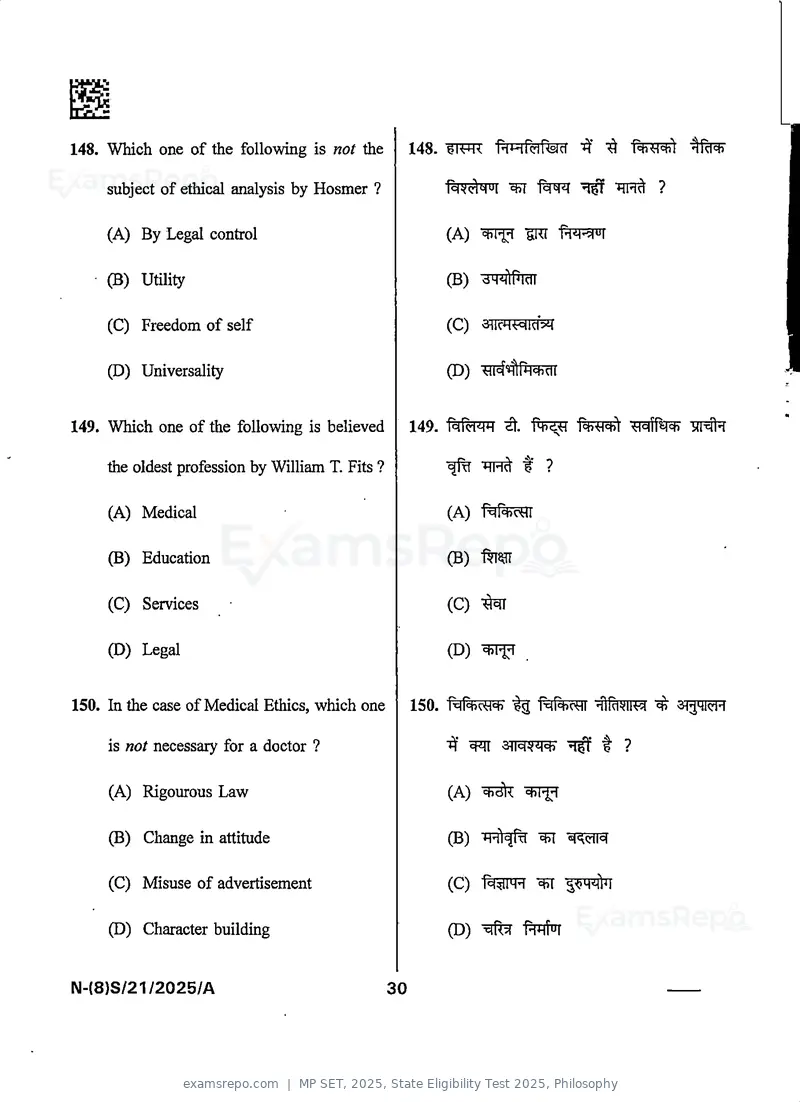
Text of page 32
148. Which one of the following is not the        148. WTFTT rdHfcriRsid

     subject of ethical analysis by Hosmer ?

    (A) By Legal control                                 (A)

   ■ (B) Utility                                         (B) wfcr

    (C) Freedom of self                                  (C) 3Tl^R^Rf5£I

    (D) Universality                                     (D) ^^IrHchcIl

149. Which one of the following is believed       149.


     the oldest profession by William T. Fits ?                      t ?

    (A) Medical                                          (A)

    (B) Education                                        (B)

    (C) Services                                         (C) ^

    (D) Legal                                            (D)


150. In the case of Medical Ethics, which one       150. P^Ph<^di         f^PhoHl d1Pd!^ll^ ^

     is not necessary for a doctor ?                        ^                -=1^ t ?

    (A) Rigourous Law                                    (A)

    (B) Change in attitude                               (B) "rFftcfftf

    (C) Misuse of advertisement                          (C) PcidlHH ^

    (D) Character building                               (D)         fFiW


N-(8)S/21/2025/A                               30
Text of page 33
(SPACE FOR ROUGH WORK)


(N)S/21/2025/A

Text of page 34
(SPACE FOR ROUGH WORK)


(N)S/21/2025/A
Page 1 of 34
Source: Madhya Pradesh Public Service Commission. Question paper published by Madhya Pradesh Public Service Commission.