
MP SET 2025: State Eligibility Test, Visual Art
Text of page 1
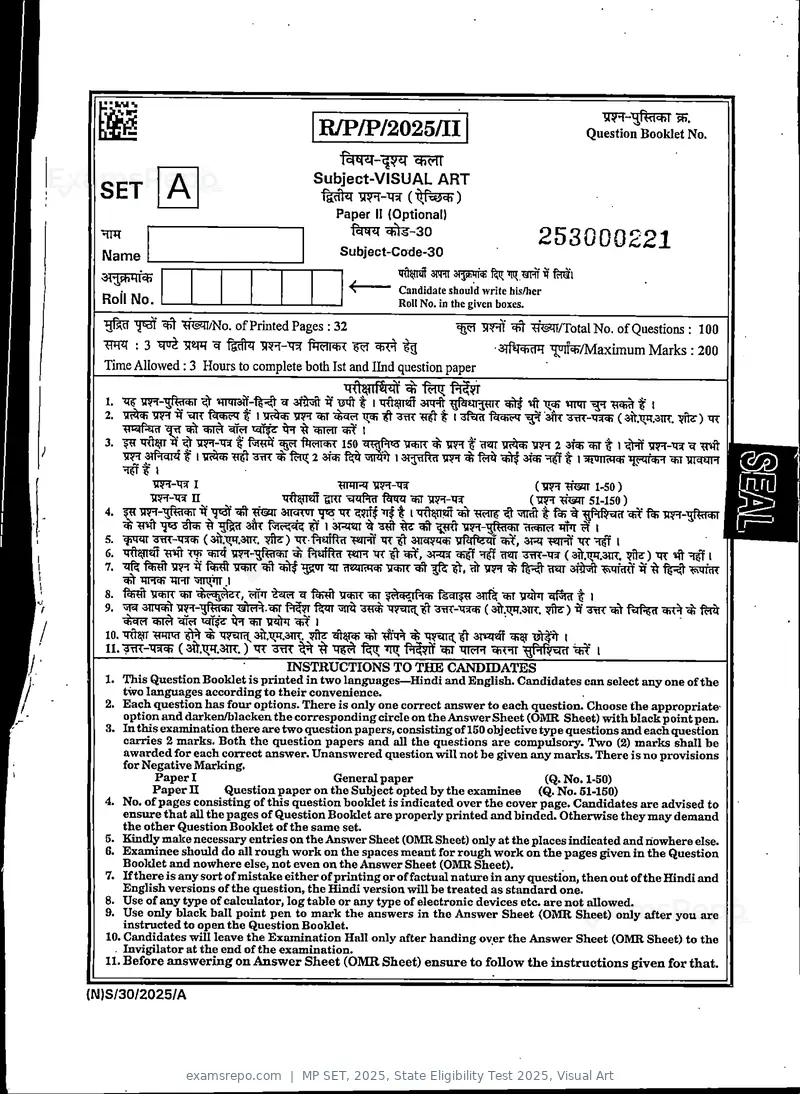
RyP/P/2025/II                                             Question Booklet No.


                                                 Subject-VISUAL ART
 SET               A                              lactic         )
                                                     Paper II (Optional)
 HR
                                                      Subject-Code-30
                                                                                                 253000221
  Name
                                                                 vrtyidf 3Prn 3ijtnHi«h   /sbt ''f tcfti
                                                          ^      Candidate should write his/her
  Roil No.                                                       Roll No. in the given boxes.

  ■gf^   ^ TT?^/No. of Printed Pages : 32                                    ^          ^ TfeqT/Total No. of Questions : 100
  WT : 3   TI«W ^                                             ^                       ■STfsT^nR gyitaviaximum Marks : 200
  Time Allowed: 3 Hours to complete both 1st and Ilnd question paper
                                             TRt^nM ^           ^I$?T
                                 ^ 3fM if t i             am* g^ir^RiT gitf         rum          [
        "5?^ if "inr (q«»)eM t 1   tiTT "aiT         '3ttt 11         "fett^w 'afrr     (5tit.iR.3nT. "vfte) r
              ^^          ^      ^ ^iTHT ^ 1
        ^ TTftglR ^        t'    ^ Oic1l«h< ISO tiWpiy TRJTT % tl^ f Wta> "m 2 3f5> w 11^               ^^
        "577 arf^rarf f' i                       2 am?          1 ai^dRd               "afff araj      "t 1 itrmttmr         "^ii
               i
                       I                                                                        ("n^Tg^JT 1-50)
                       n                  "tdyiyl •gitr             ^                           (tiTT^nsiT si-iso)
        ^ Ti?T-^r«qii if         ^ gtar stramr ^ tit ^7^ "nf 11              ^          ^         t ^ ^ gPil^^^d "cr^       tt?T-q[^d)i
        ^ -^wt Y3 ^              afir        ^ 1 amror ^ ^ ^ ^                              timjivt rft ^ 1
             BtiT-Tmg. (ajt.tpr.anr. jffe) -qr-Wftit Tsinf qr it 3tra?qqj uPiPdtii          ^          qr   i
        qfN^jwf t^^^q^q-gRiiqir ^ fWfttTTORqT^q;^, amm                                 trar ^rrr-qq (3it.gq.3nT, ?ffe) qr qtq^ i
        ■q^      q^q t^idt qqnr                     qr qamqqr qqjir     gfe ■^, qt q^q ■%           trar aSr^t "^ufdOf if           qmfar
        ^ qiqeff qiqr qm^ .1
        ■fe# qqnr qq         effq            q        qqnr qq ^vTaqr^rar f^qrpt aqf^ qq qdtq q^iq •!■ 1
        ^qanqa^ q^-^Rddai tit^.qq                ^^            q^qigift qqT-qqqj (^.gq.anr. ^) -Sf qqr ^ ftrP^q qit^ ^ ^
              qq^ qtct              qq qqtq qi^ 1
       . qdyr wnqr           ^ q^qig 3it.gq.3TTT. 7ft7^^^Tffq%%qyqTg^3nqqf qr^tjt^ t
       .grTT-qq^ (3it.gq.3gT.) qr            ^ ggn            -qg          gq gimq qjiqr gP-ilv^ri            i
                                          INSTRUCTIONS TO THE CANDIDATES
        Ttis Question Booklet is printed in two languages—Hindi and English. Candidates can select any one of the
        two languages according to their convenience.
        Each question has foiur options. There is only one correct answer to each question. Choose the appropriate-
        option and darken/blacken the corresponding circle on the Answer Sheet (OMR Sheet) withblack point pen.
        In this examination there are two question papers, consisting of 150 objective type questions and each question
        carries 2 marks. Both the question papers and all the questions are compidsory. Two (2) marks shall be
        awarded for each correct answer. Unanswered question willnot be given any marks. There is no provisions
        for Negative Marking.
              PaperI                               General paper                                  (Q. No. 1-50)
              PaperII           Question paper on the Subject opted by the examinee              (Q. No. 51-150)
  4.    No. of pages consisting of this question booklet is indicated over the cover page. Candidates are advised to
        ensure that all the pages of Question Booklet are properly printed and binded. Otherwise they may demand
        the other Question Booklet of the same set.
  5.    Kindly make necessary entries on the Answer Sheet (OMR Sheet) only at the places indicated and nowhere else.
  6.    Examinee should do ^1rough work on the spaces meant for rough work on the pages given in the Question
        Booklet and nowhere else, not even on the Answer Sheet (OMR Sheet).
  7.    If there is any sort of mistake either of printing or of factual nature in any question, then out ofthe Hindi and
        English versions of the question, the Hindi version will he treated as standard one.
  8.    Use of any type of calculator, log table or any type of electronic devices etc. are not allowed.
  9.    Use only black ball point pen to mark the answers in the Answer Sheet (OMR Sheet) only after you are
        instructed to open the Question Booklet.
  10. Candidates will leave the Examination Hall only after handing over the Answer Sheet (OMR Sheet) to the
        Invigilator at the end of the examination.
  11.   Before answering on Answer Sheet (OMR Sheet) ensure to follow the instructions given for that.

{N)S/30/2025/A
Text of page 2
(SPACE FOR ROUGH WORK)


(N)S/30/2025/A
Text of page 3
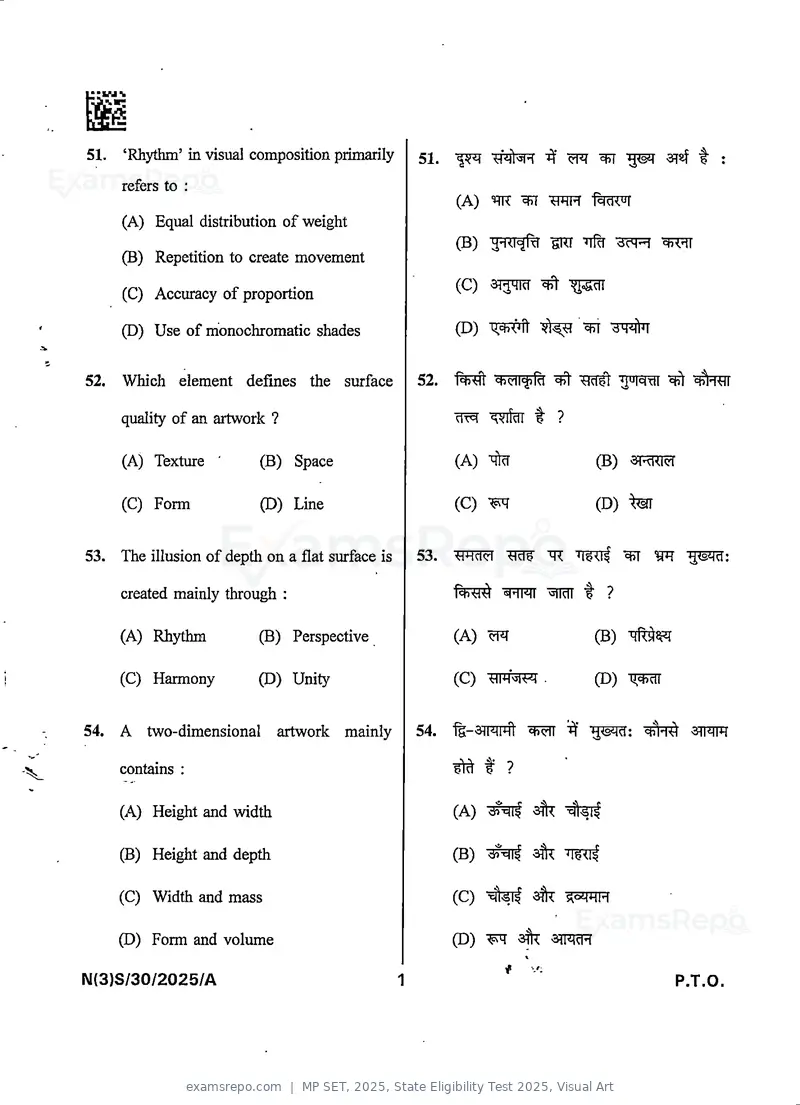
51. 'Rhythm' in visual composition primarily     51.                         ^           t:
      refers to :
                                                       (A) m ^
      (A) Equal distribution of weight
                                                       (B)
      (B) Repetition to create movement

      (C) Accuracy of proportion
                                                       (C) a^gqicf ^

      (D) Use of monochromatic shades                  (D) "crqPFft "91^ "qri

52.   Which   element   defines the   surface


      quality of an artwork ?                                ^qrfdT t ?

      (A) Texture '      (B) Space                     (A) ikr              (B) SRRioT

      (C) Form           (D) Line                      (C) ^                (D) fer

53. The illusion of depth on a flat surface is   53.   TRddT Tm                   dd ^


      created mainly through :

      (A) Rhythm         (B) Perspective               (A)                  (B)

      (C) Harmony        (D) Unity                     (C)            .     (D)


54. A two-dimensional artwork mainly             54. H-aMTTt                -g?^:        3W7

      contains :                                       ^f ?

      (A) Height and width                             (A)

      (B) Height and depth                             (B)           3lk 'rmi

      (C) Width and mass                               (C)           37k stoqqn

      (D) Form and volume                              (D) ^ 3^ 3TR?Fr
                                                                 %


N(3)S/30/2025/A                                                                       P.T.O.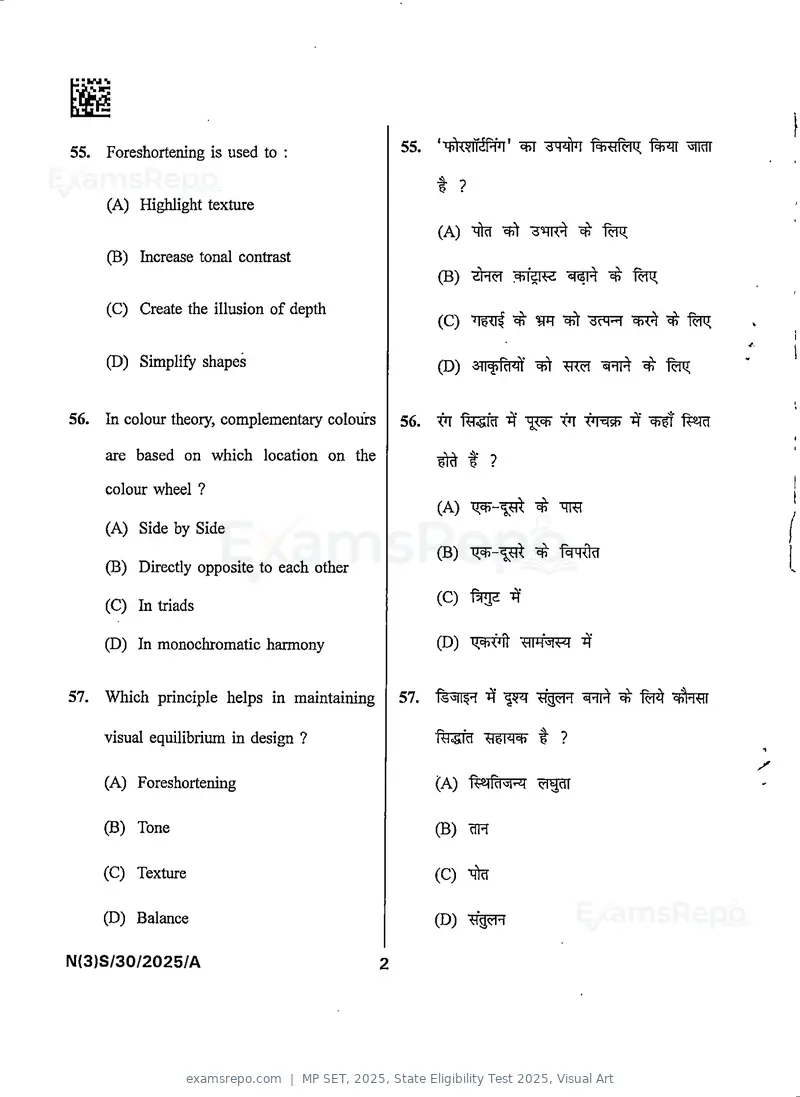
Text of page 4
55. Foreshortening is used to :               55.               ^ Wik

                                                    t ?
    (A) Highlight texture
                                                    (A)        ^
    (B) Increase tonal contrast
                                                    (B)                        ^
    (C) Create the illusion of depth
                                                    (C) "TWrif ^ ^^                    ^

    (D) Simplify shapes                             (D) sTT^fM ^ wr                ^

56. In colour theory, complementary colours   56. ^             ^ v\               ^
     are based on which location on the             ^f ?
     colour wheel ?
                                                    (A)                  "TO
    (A) Side by Side
                                                    (B)              ^
    (B) Directly opposite to each other
                                                    (C)
    (C) In triads

    (D) In monochromatic harmony                    (D)         WTTOi "4*

57. Which principle helps in maintaining      57.              ^           ^^          ^troi

     visual equilibrium in design ?                                  t ?

    (A) Foreshortening                              (A) I^STiclTOi

    (B) Tone                                        (B) cIH

    (C) Texture                                     (C) "qki

    (D) Balance                                     (D)

N(3)S/30/2025/A
Text of page 5
58. In atmospheric perspective, distant        58.                         ^^                ^
    objects appear :                                            t ?

    (A) Sharper                                      (A) 3#!^

    (B) Warm and saturated                           (B) "Tri

    (C) Lighter and less detailed                    (C)              ^            ^

    (D) Darker and more detailed                     (D)        3^ 3Tte7

59. Colours from light combine and form        59.         ^ ^ 3TFTO            rHcrl=b<     ^

    new visual sensations based on :                                 3IT??K ^         ^t ?

    (A) Subtractive system                           (A) "ERM

    (B) Primary colour                               (B) "5^^ ^

    (C) Triadic                                      (C) ^

    (D) Additive system                              (D)


60. Study      of   visual   perception   is   60. ^ 315^ ^                 ^ W W^
    called :                                   ■     t ?

    (A) Optics                                       (A) 3ffp2^

    (B) Aesthetics                                   (B)

    (C) Gestalt Psychology                           (C)         tpitfwr

    (D) Chromatics                                   (D) 5hlAfe=HH

IM(3)S/30/2025/A                                                                           P.T.O.
Text of page 6
61. The famous tradition of Blue Pottery in

     India is from :                                       t ?

    (A) Kathiawad         (B) Jaipur                (A) ^iPciqicll^      (B)

    (C) Banaras           (D) Hyderabad             (C) Wmi              (D)


62. 'Dhokra Casting' technique is from :      62.                             W ^t ?

    (A) Rajasthan                                   (A) TTSRSIFf

    (B) Uttar Pradesh                               (B)

    (C) Madhya Pradesh                              (0)      ^

    (D) Uttarakhand                                 (D)


63. Which one of the following is a popidar   63.   riMfdRsId                  'mm ^

     tradition craft of Banaras ?                                             t ?

    (A) Metal craft       (B) Wood craft            (A) ^ 1km            (B)        1km

    (C) Embroidery        (D) Phulkari              (c)                  (D) "jeTddft

64. Which technique is used in traditional    64. WWTd 'TTPTT^ ^Tlf'                      ^

    'Sanganeri print' ?                             ^        t ?

    (A) Lino cut                                    (A)

    (B) Wood block                                  (B)          OTT

    (C) Silk screen                                 (C)

    (D) Tie and dye                                 (D) zif -alk       "gRl
IM(3)S/30/2025/A
Text of page 7
65. In 'Dhokara Casting Process' the moulds

     are made of :                                        t ?

    (A) Brick dust and lime                         (A)^(fe                  ^

    (B) Sand and lime                               (B) "^1^


    (C) Clay and husk                               (C)            ^^

    (D) Lime and wood powder                        (D) ^ ^              ^

66. In which technique is 'Paraffin Wax'      66.


     used ?                                                        t ?

    (A) Tie and Dye                                 (A)       srk ^

    (B) Block Print                                 (B)

    (C) Silk Screen Print                       . (C)

    (D) Batik                                       (D) cillich

67. From which place is 'Pichhvai Art'        67. 'fmif             ^        ^     if ?
    originated ?.
                                                    (A)
    (A) Nathdwara
                                                    (B) #
    (B) Bundi
                                                    (C) <Mlcbl^<
    (C) Bikaner
                                                    (D)
    (D) Kishangarh

I\I(3)S/30/2025/A                         !                                      P.T.O.
Text of page 8
68. In photography 'ISO' stands for :

    (A) Indian Standard Organization                   t ?

    (B) International School Organization              (A)           Tnw


    (C) International       Organization   for         (B)


          Standardization                              (C)


    (D) Indian School Organization                     (D)


69. A popular Indian handicraft 'Phulkari' is

     asspciated from which state ?                     ^                 f ?

    (A) Kashmir                                        (A)

    (B) Punjab                                         .(B)

    (C) Gujarat                                        (C) TpiW

    (D) Rajasthan                                      (D)


70. 'Madhubani Paintings' have traditionally     70.           fechdl* MKMRch          ^

     been created by :                                 OT                   t" ?

    (A) Only male artist                               (A)          "3^ =hdl=hK

    (B) Only Government artist                         (B) <^=101          cficnichK

    (C) Only western women artists                     (C) chqtn hR-cihI Hleoii =heiict)K

    (D) Traditionally women of the region              (D) MK'qRcb           ^^

N(3)S/30/2025/A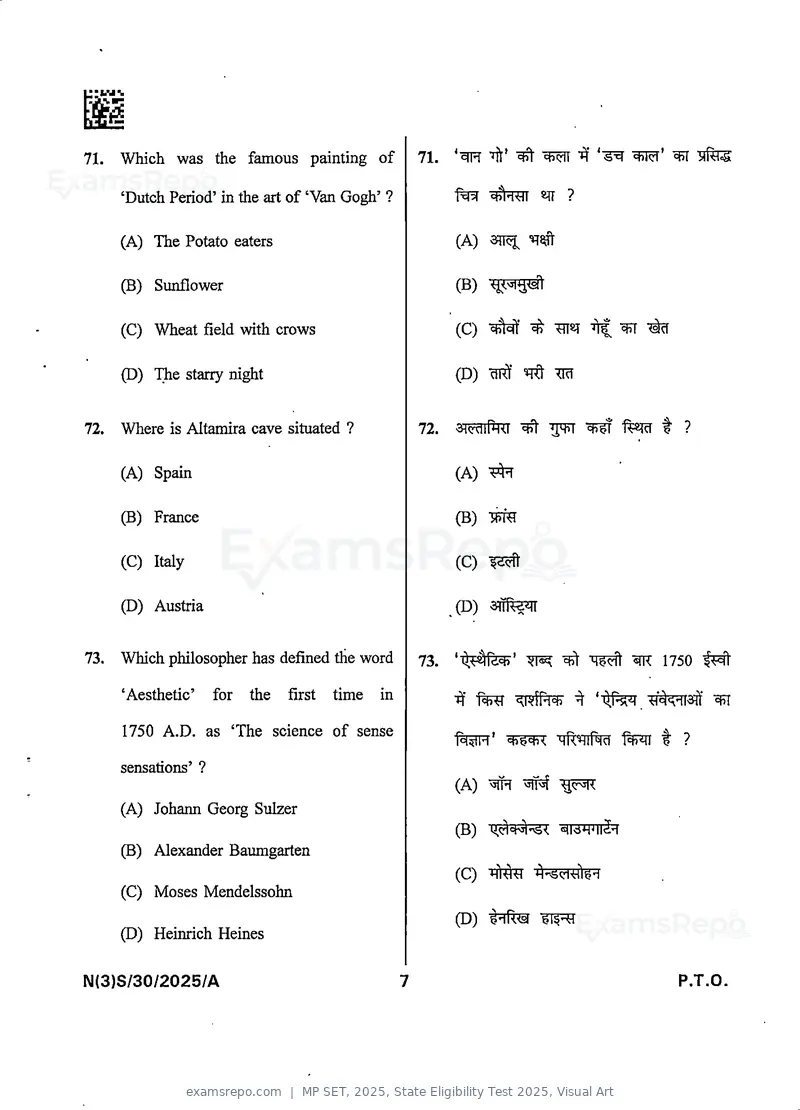
Text of page 9
71. Which was the famous painting of                  71.           ^                 W'^

      'Dutch Period' in the art of'Van Gogh'?               ^             SIT ?


      (A) The Potato eaters                                 (A) 3^1^

      (B) Sunflower                                         (B)

      (C) Wheat field with crows                            (C)         ^

      (D) The starry night                                  (D)         ^ TlcT

72.   Where is Altamira cave situated ?               72. ^crdlfHO ^ liqiT ^ 1^ t ?

      (A) Spain                                             (A)

      (B) France                                            (B) "STRT

      (C) Italy                                             (C)

      (D) Austria                                           (D)


73. Which philosopher has defined the word            73.               ^^            ^ 1750

      'Aesthetic'     for   the   first   time   in

      1750 A.D. as 'The science of sense

      sensations' ?
                                                            (A) -SiPT
      (A) Johann Georg Sulzer
                                                            (B)             ^iwrrir
      (B) Alexander Baumgarten
                                                            (C)
      (C) Moses Mendelssohn
                                                            (D)
      (D) Heinrich Heines


N(3)S/30/2025/A                                                                           P.T.O.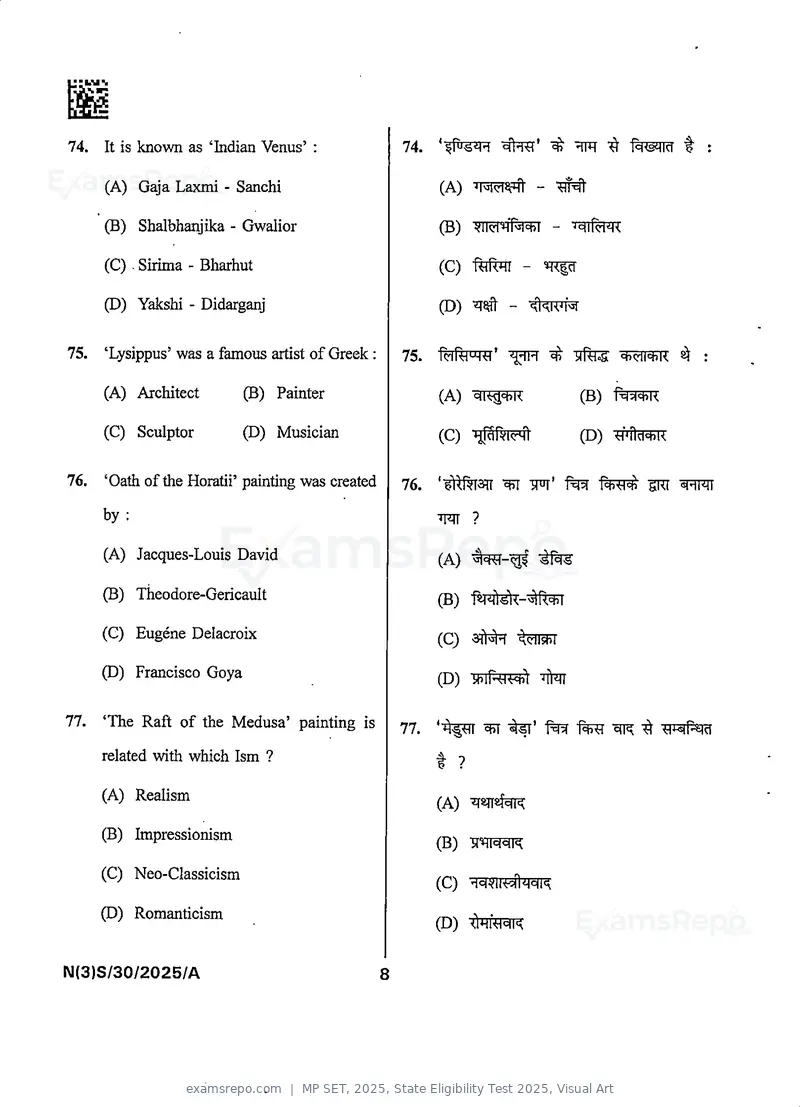
Text of page 10
74.   It is known as 'Indian Venus' :                74. 'iteH               ^ "HFT ^        t:

      (A) Gaja Laxmi - Sanchi                              (A)

      (B) Shalbhanjika - Gwalior                           (B) wnfeTT -

      (C) - Sirima - Bharhut                               (C) Mm - mp

      (D) Yakshi - Didarganj                               (D)         - xkrpk

75. 'Lysippus' was a famous artist of Greek:         75.                     ^               ^ :

      (A) Architect       (B) Painter                      (A) cil^'=tiK         (B) "f^WR
      (C) Sculptor        (D) Musician                     (C) ^rar^lcrql        P) "HiteR

76. 'Oath of the Horatii' painting was created       76.                   -m'

      by :                                                 "W ?

      (A) Jacques-Louis David                              (A)

      (B) Theodore-Gericault                               (B)

      (C) Eugene Delacroix                                 (C)

      (D) Francisco Goya                                   (D) IhlP-HWil Ml

77. 'The Raft of the Medusa' painting is             77.          ^

      related with which Ism ?
                                                           t ?
      (A) Realism
                                                           (A)
      (B) Impressionism
                                                           (B)

      (C) Neo-Classicism
                                                           (C) HcjiJll^lqcjic^
      (D) Romanticism
                                                           (D)


N(3)S/30/2025/A                                  8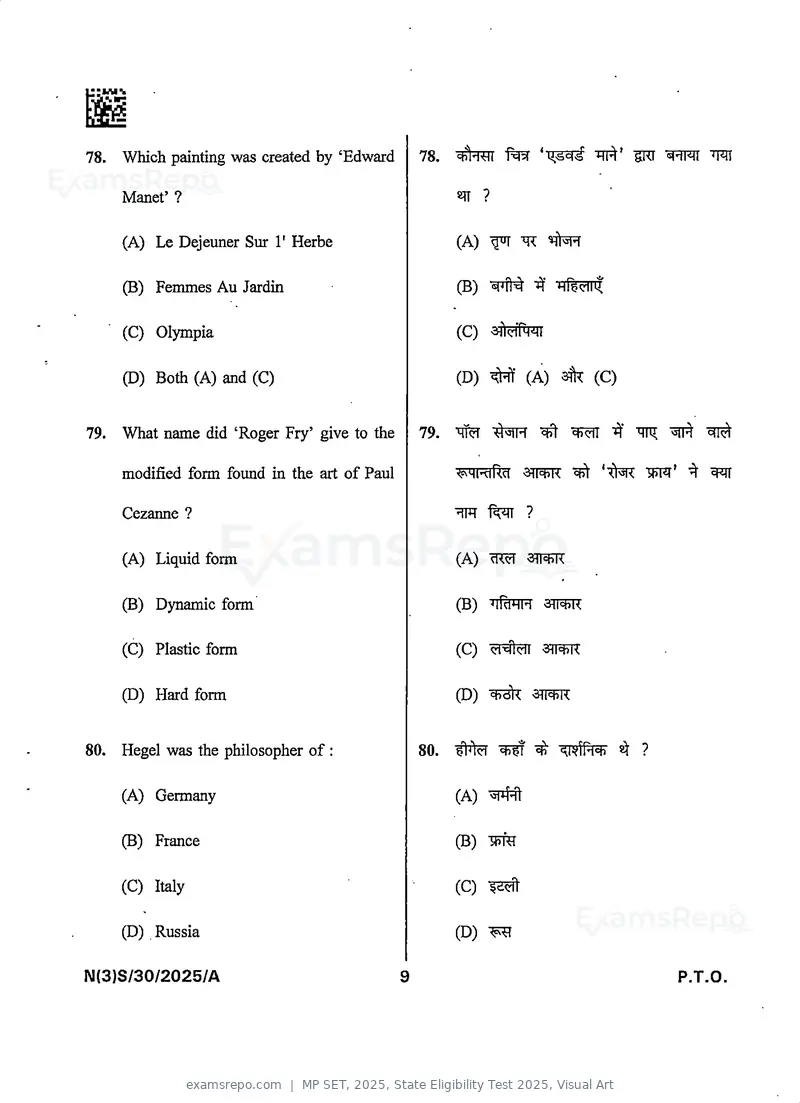
Text of page 11
78. Which painting was created by 'Edward     78.                    hiA' "SITT      TRT

     Manet' ?                                       8TT ?


    (A) Le Dejeuner Sur 1' Herbe                    (A) ^


    (B) Femmes Au Jardin                            (B)


    (C) Olympia                                     (C)

    (D) Both (A) and (C)                            (D) ^ (A)        (C)

79. What name did 'Roger Fry' give to the     79.                ^

     modified form found in the art of Paul         ^MWRci 3TTTO ^           Wr'     ^

     Cezanne ?                                      ■^TFT    ?


    (A) Liquid form                                 (A) ^

    (B) Dynamic form                                (B) JlPdHH aWR

    (C) Plastic form                                (C)

    (D) Hard form                                   (D)      3?™:


80. Hegel was the philosopher of :            80.           ^^          8^ ?

    (A) Germany                                     (A)

    (B) France                                      (B) W

    (C) Italy                                       (C)

    (D) Russia                                      (D)

I\I(3)S/30/2025/A                                                                 P.T.O,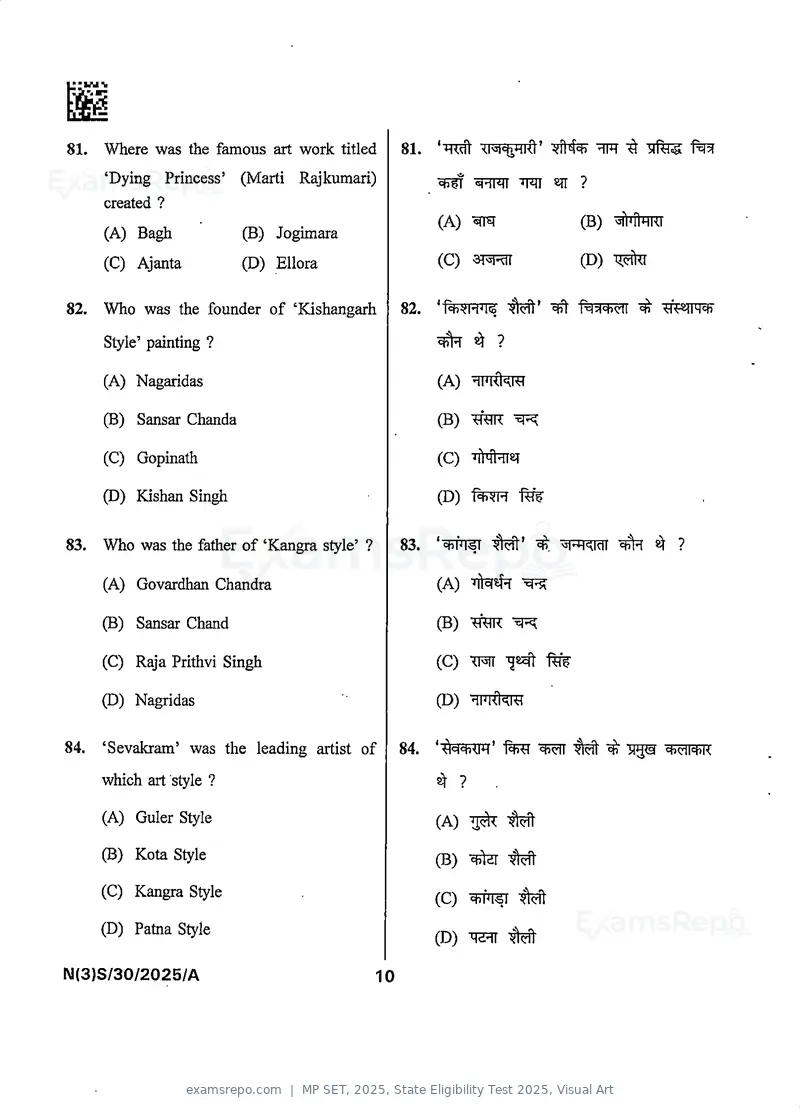
Text of page 12
81.    Where was the famous art work titled    81. '"PRdt                     ^
      'Dying Princess' (Marti Rajkumari)             ^          "TO S7T ?
      created ?
                                                     (A) ^              (B)
      (A) Bagh            (B) Jogimara
      (C) Ajanta          (D) Ellora                 (C)                (D)


82. Who was the founder of 'Kishangarh         82.                  ^          ^

      Style' painting ?

      (A) Nagaridas                                  (A) WRkRT

      (B) Sansar Chanda                              (B)       ^

      (C) Gopinath                                   (C) "rft#n2T

      (D) Kishan Singh                               (D)        ^

83. Who was the father of 'Kangra style' ?     83.                  ^         ^^ ?

      (A) Govardhan Chandra                          (A)        ^

      (B) Sansar Chand                               (B)

      (C) Raja Prithvi Singh                         (C) W "^8^ ftfe

      (D) Nagridas                                   (D)


84. 'Sevakram' was the leading artist of       84.                  ^

      which art style ?                              ^ ?

      (A) Guler Style                                (A)      ^
      (B) Kota Style                                 (B)^
      (C) Kangra Style                               (C)       ^
      (D) Patna Style
                                                     (D)      ^
N(3)S/30/2025/A                           10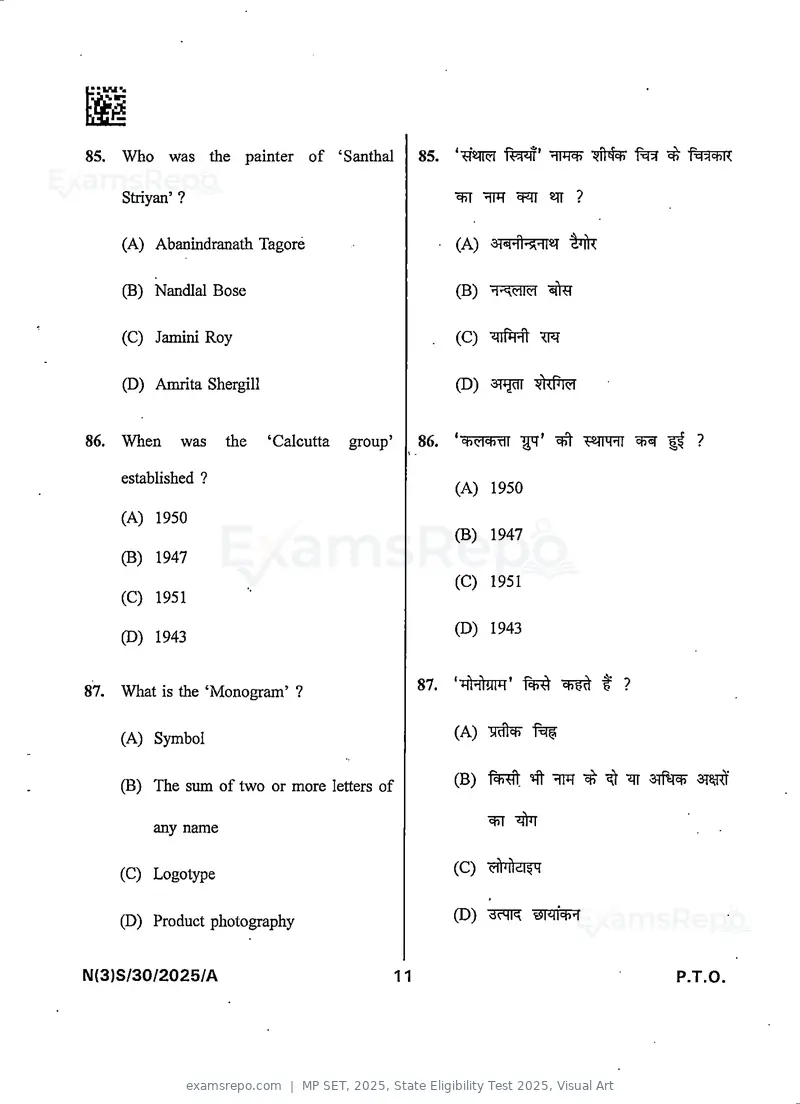
Text of page 13
85. Who was the painter of 'Santhal             85.         1^'                   ^ "fero

    Striyan' ?


    (A) Abanindranath Tagore                      ■ (A)               trk

    (B) Nandlal Bose                                  (B)

    (C) Jamini Roy                                    (C)         m


    (D) Amrita Shergill                               (D)


86. When     was    the   'Calcutta   group'    86.           "P' ^           ^      ?

    established ?
                                                      (A) 1950
    (A) 1950
                                                      (B) 1947
    (B) 1947
                                                      (C) 1951
    (C) 1951

                                                      (D) 1943
    (D) 1943


87. What is the 'Monogram' ?                    87. 'iMuiH'                 f ?

    (A) Symbol                                        (A)        ^

    (B) The sum of two or more letters of             (B)        ^ "TO ^ ^ "^TT      378^*

        any name


    (C) Logotype                                      (C)


    (D) Product photography                           (D)


I\I(3)S/30/2025/A                          11                                      P.T.O.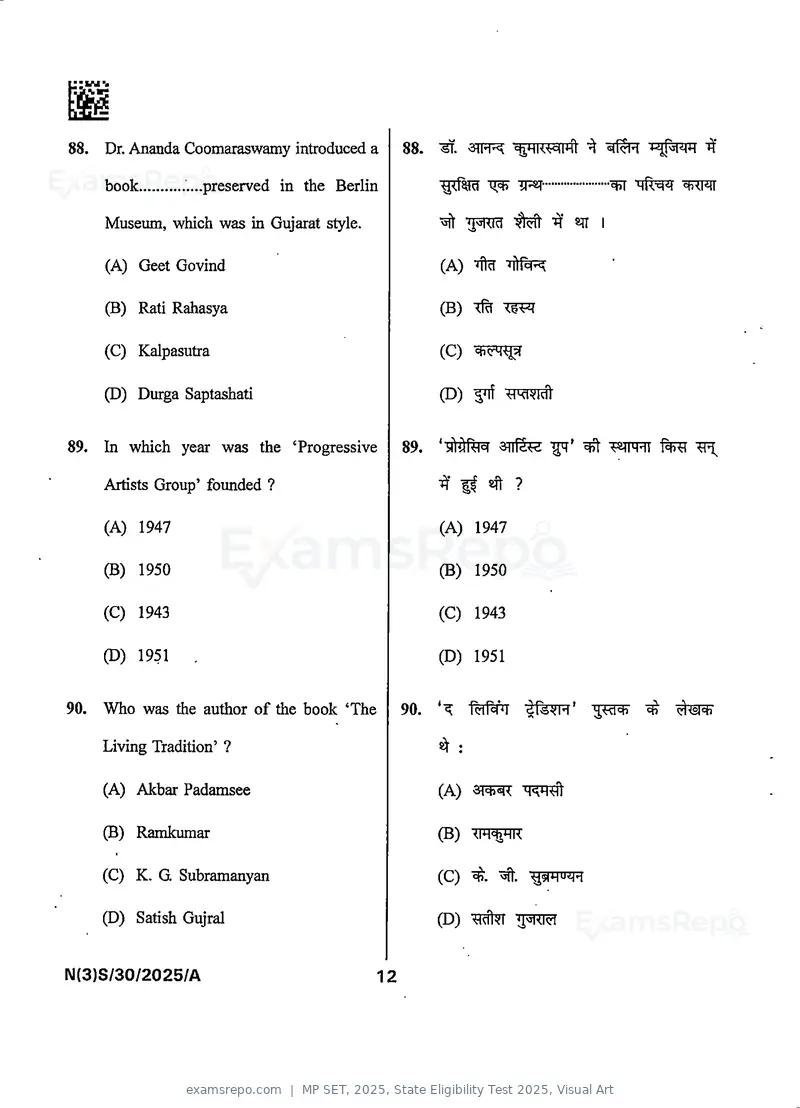
Text of page 14
88. Dr. Ananda Coomaraswamy introduced a         88.


      book       ....preserved in the Berlin                         1RT-


      Museum, which was in Gujarat style.

      (A) Geet Govind                                  (A) "nln

      (B) Rati Rahasya                                 (B) Tfn

      (C) Kalpasutra                                   (C)

      (D) Durga Saptashati                             (D) ^

89. In which year was the 'Progressive           89.                        ^ TBFPTT ^

      Artists Group' founded ?                            ^ sit ?

      (A) 1947                                         (A) 1947

      (B) 1950                                         (B) 1950

      (C) 1943                                         (C) 1943

      (D) 1951                                         (D) 1951


90.   Who was the author of the book 'The        90.         l^rf^               ^

      Living Tradition' ?                              ^:

      (A) Akbar Padamsee                               (A)

      (B) Ramkumar                                     (B) <IM4iHK

      (C) K. G. Subramanyan                            (C)

      (D) Satish Gujral                                (D) B^ftB lp5Ri^


N(3)S/30/2025/A                             12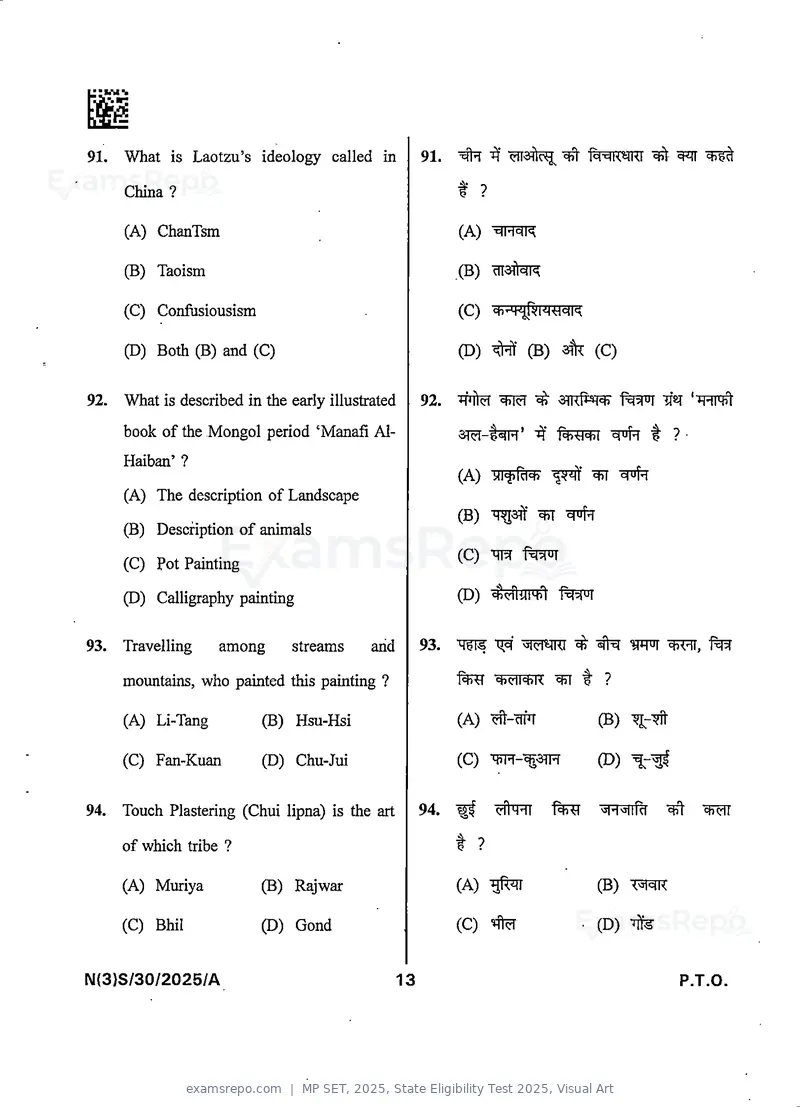
Text of page 15
91. What is Laotzu's ideology called in

     China ?                                             # ?

     (A) ChanTsm                                         (A)

     (B) Taoism                                          (B)

     (C) Confiisiousism                                  (C)

     (D) Both (B) and (C)                                (D)        (B) sfk (C)

92. What is described in the early illustrated

     book of the Mongol period 'Manafi Al-                                         t ?■
     Haiban' ?
                                                         (A) yi^Pd^         m
     (A) The description of Landscape
                                                         (B)         ^^
    (B) Description of animals
                                                         (C) "m
    (C) Pot Painting

    (D) Calligraphy painting                             (D)


93. Travelling     among      streams     arid     93.                     ^^ ww\

     mountains, who painted this painting ?                    dieii=hK -m t ?

    (A) Li-Tang           (B) Hsu-Hsi                    (A)                (B)

    (C) Fan-Kuan          (D) Chu-Jui                    (C) -qiPT-^a^Fr    (D)


94. Touch Plastering (Chui lipna) is the art       94.                                 ^

     of which tribe ?                                    t ?

    (A) Muriya            (B) Rajwar                     (A) "gfw           (B)

    (C) Bhil              (D) Gond                       (C) ^             ■ (D) Tfe

IM(3)S/30/2025/A                              13                                       P.T.O.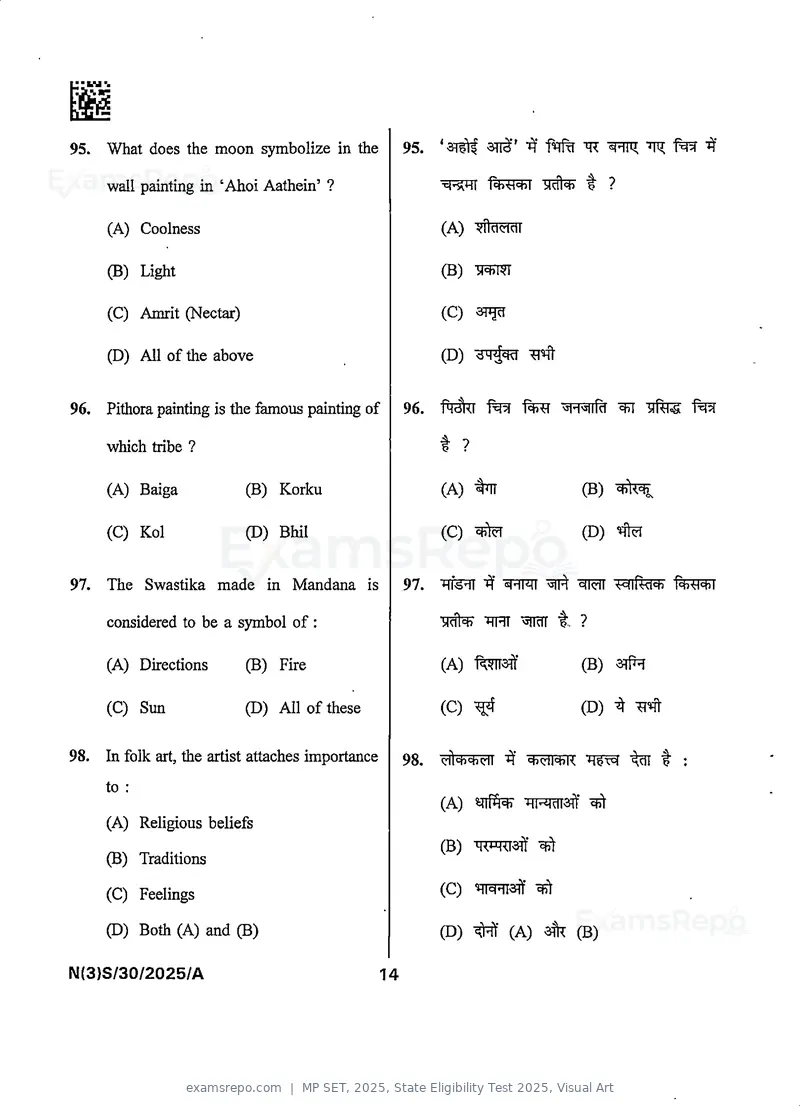
Text of page 16
95. What does the moon symbolize in the            95. '31^ 3TT§*'            TR WT

      wall painting in 'Ahoi Aathein' ?                         Pcb^chl       t ?

      (A) Coolness                                       (A) vDcidcil

      (B) Light                                          (B)

      (C) Amrit (Nectar)                                 (C) 37^5^

      (D) All of the above                               (D)


96, Pithora painting is the famous painting of     96.               fei            ^ Tffe fe

      which tribe ?                                      t ?

      (A) Baiga           (B) Korku                      (A) ^                (B)

      (C) Kol             (D) Bhil                       (C) ^                (D) ^

97.   The Swastika made in Mandana is

      considered to be a symbol of:                            RHT W t. ?

      (A) Directions      (B) Fire                       (A)                  (B) 3#^

      (C) Sun             (D) All of these               (C) ^                (D) ^ "H#

98. In folk art, the artist attaches importance    98. eilchchdl "4* ^on^hK             ^
      to :
                                                         (A)                  ^
      (A) Religious beliefs
                                                         (B) "qr^RTSlf ^
      (B) Traditions

      (C) Feelings                                       (C) ^qT^3if ^

      (D) Both (A) and (B)                               (D)      (A) 3ik (B)

N(3)S/30/2025/A                               14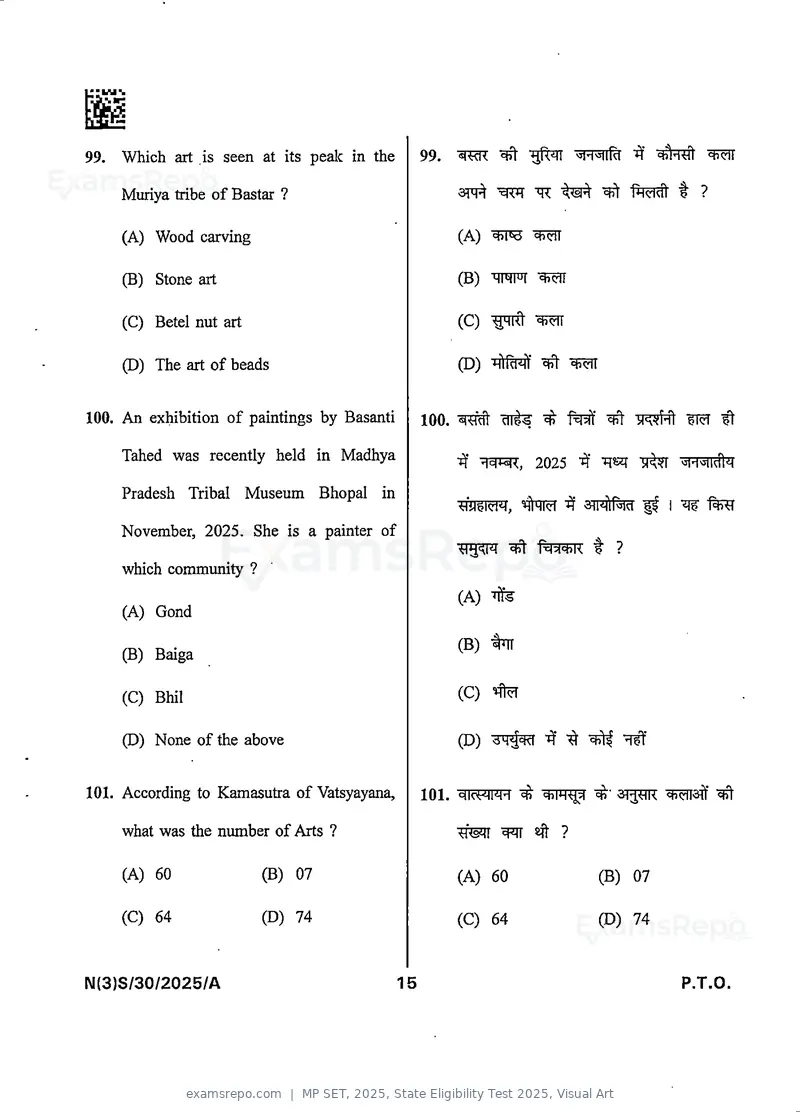
Text of page 17
99. Which art is seen at its pealc in the        99. TOT ^ "gfW "TOfTfcl              TOT

    Muriya tribe of Bastar ?                                    -qr      ^         t ?

    (A) Wood carving                                (A)         TOT

    (B) Stone art                                   (B) "qiTO TOT

    (C) Betel nut art                               (C)         TOT

    (D) The art of beads                            (D)         ^ TOIT

100. An exhibition of paintings by Basanti       100. TOt Tnif ^ feff ^             TO ^
    Tahed was recently held in Madhya                  -qror, 2025 ■4*             to*
    Pradesh Tribal Museum Bhopal in
                                                     TmTO4,                  if i 'm 1to
    November, 2025. She is a painter of
                                                           ^ tachK t ?
     which community ?
                                                     (A) "nfe
    (A) Gond

    (B) Baiga
                                                     (B) ^

    (C) Bhil                                         (C) *

    (D) None of the above                            (D)              ^ ^

101. According to Kamasutra of Vatsyayana,       101. TOTOT ^                     TOJarf ^

     what was the number of Arts ?                   *T TO ^ ?

    (A) 60              (B) 07                       (A) 60              (B) 07

    (C) 64              (D) 74                       (C) 64              (D) 74


N(3)S/30/2025/A                             15                                     P.T.O.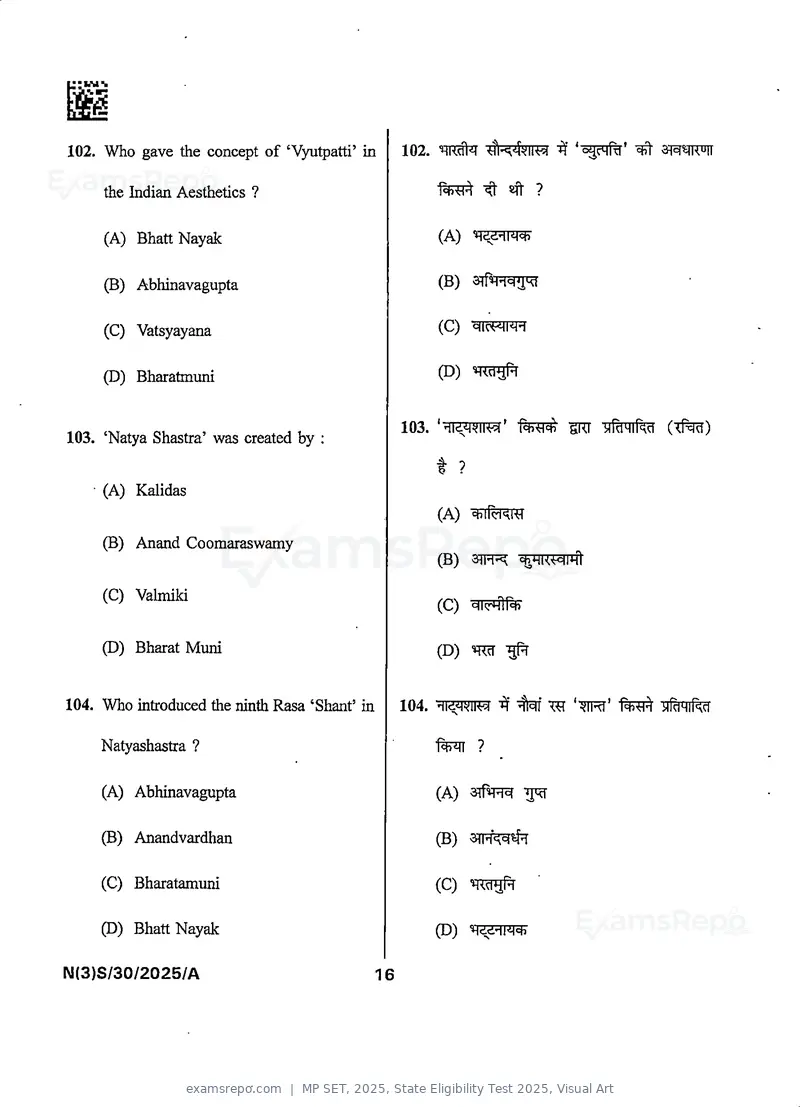
Text of page 18
102. Who gave the concept of 'Vyutpatti' in      102.


     the Indian Aesthetics ?


     (A) Bhatt Nayak                                    (A)


     (B) Abhinavagupta                                  (B)


     (C) Vatsyayana                                     (C)


    (D) Bharatmuni                                      (D)


                                                 103.                       MPdHir^d (Tf%)
103. 'Natya Shastra' was created by :
                                                        t ?
    ■ (A) Kalidas
                                                        (A)
    (B) Anand Coomaraswamy
                                                        (B)

    (C) Valmiki
                                                        (C) qiCTHlPt)

    (D) Bharat Muni                                     (D) TO


104. Who introduced the ninth Rasa 'Shant' in    104.                   ^          yPdHlRd

     Natyashastra ?                                           ?


    (A) Abhinavagupta                                   (A) aiP^TO

    (B) Anandvardhan                                    (B)

    (C) Bharatamuni                                     (C) TO^

    (D) Bhatt Nayak                                     (D)

N(3)S/30/2025/A                             16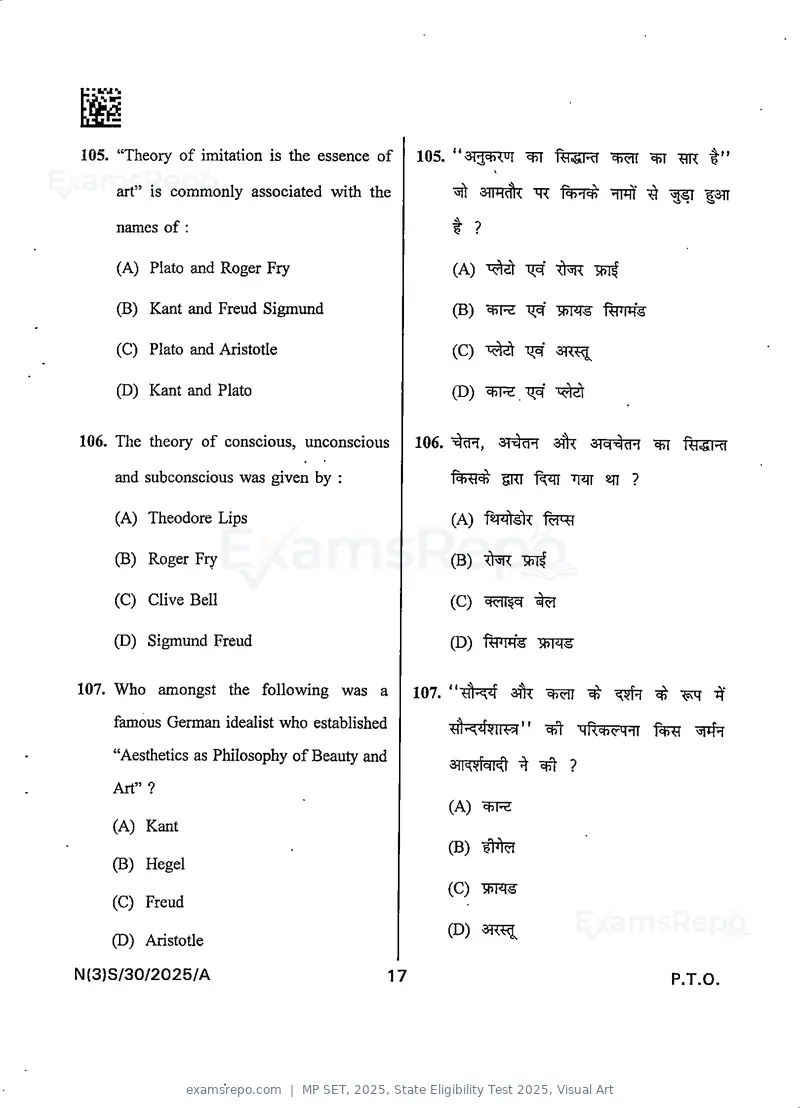
Text of page 19
V


105. "Theory of imitation is the essence of      105.               ^                  ^       t"

       art" is commonly associated with the             #             "qr        TRif ^       137T
       names of :                                       t ?

      (A) Plato and Roger Fry                           (A)                   "SiTf

      (B) Kant and Freud Sigmund                        (B) Chili

      (C) Plato and Aristotle                           (C)

      (D) Kant and Plato                                (D)


106. The theory of conscious, imconscious        106.          sr^cTT sfrc Siq^lai ^ f^T^TRT
      and subconscious was given by :                                       "W STT ?


      (A) Theodore Lips                                 (A)

      (B) Roger Fry                                     (B) ^

      (C) CliveBell                                     (C) cHrll^q

      (D) Sigmund Freud                                 (D)


107. Who amongst the following was a             107.           ^
      famous German idealist who established
                                                                             qR^^rmi
      "Aesthetics as Philosophy of Beauty and

      Art" ?
                                                        (A)
      (A) Kant
                                                        (B)
      (B) Hegel
                                                        (C)
      (C) Freud
                                                        (D)^
      (D) Aristotle

N(3)S/30/2025/A                             17                                             P.T.O.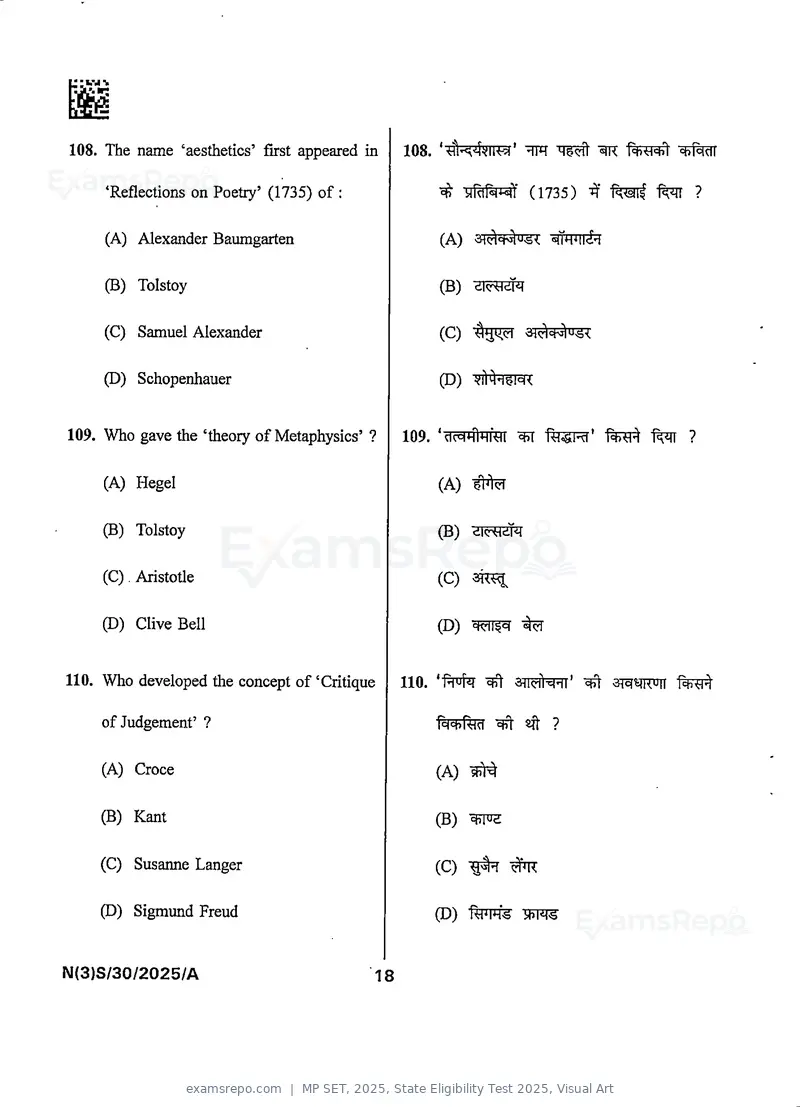
Text of page 20
108. The name 'aesthetics' first appeared in    108.                  "q^ ^ 1%^

     'Reflections on Poetry' (1735) of :               ^ yRiR^T (1735)            ?

    (A) Alexander Baumgarten                           (A)            WTT^

    (B) Tolstoy                                        (B)

    (C) Samuel Alexander                               (C)


    (D) Schopenhauer                                   (D)


109. Who gave the 'theory of Metaphysics' ?     109.            ^ IWrT*           ?


    (A) Hegel                                          (A)

    (B) Tolstoy                                        (B)

    (C). Aristotle                                     (C) ^

    (D) CliveBell                                      (D)        ^

110. Who developed the concept of 'Critique     110.         ^ STT#^' ^

    of Judgement' ?                                    Pqchf^d ^ sfl ?

    (A) Croce                                          (A)^

    (B) Kant                                           (B)

    (C) Susanne Langer                                 (C)

    (D) Sigmund Freud                                  (D) Iwf^


N(3)S/30/2025/A                            18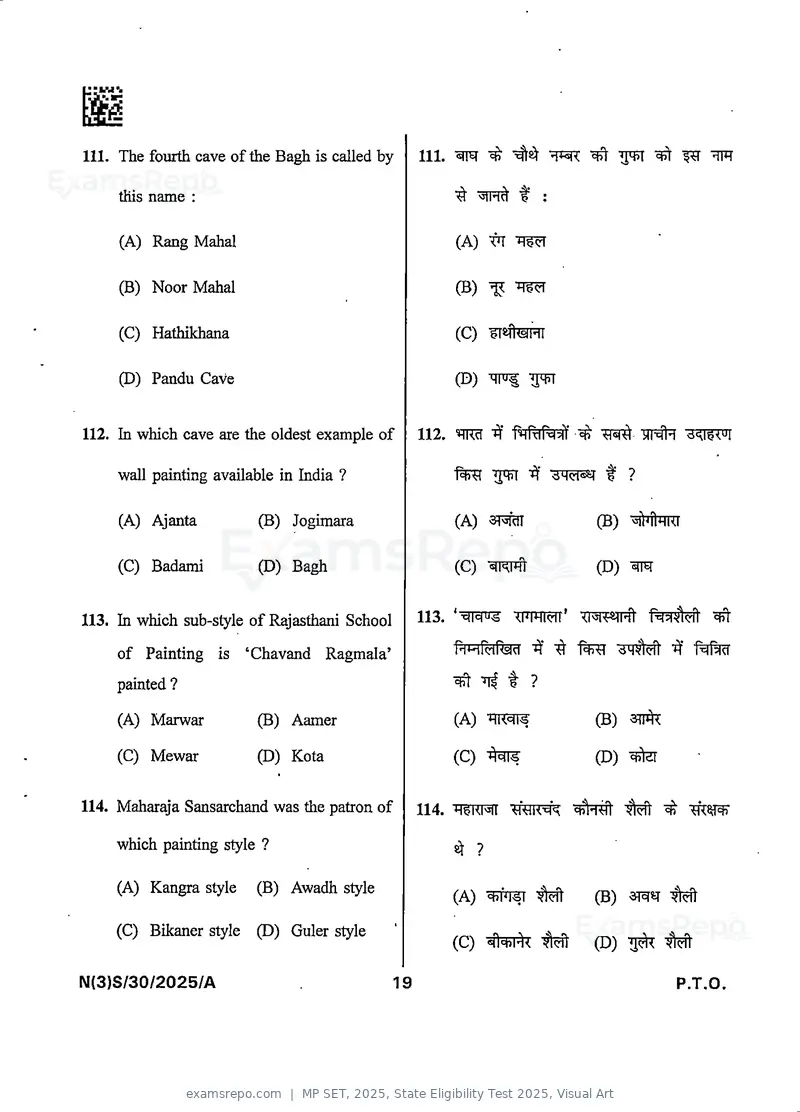
Text of page 21
111. The fourth cave of the Bagh is called by    111.                  iWK ^ IpPT ^ ^

     this name :                                                       ;


    (A) Rang Mahal                                      (A) in

    (B) Noor Mahal                                      (B) "^33 ■'W

    (C) Hathikhana                                      (C)

    (D) Pandu Cave                                      (D) RFl ipfTT


112. In which cave are the oldest example of     112.


     wall painting available in India ?                        ■jjqn            t ?

    (A) Ajanta           (B) Jogimara                   (A) SMfiT              (B) ^ntRRT

    (C) Badami           (D) Bagh                       (C) rkirI              (D) RTR


113. In which sub-style of Rajasthani School     113.             XmM'                        Rft

     of Painting is 'Chavand Ragmala'                   rHMPtrlRsId        ^ fer         if

     painted ?                                          Rft Tf^ t ?

    (A) Marwar          (B) Aamer                       (A) RRRI^             (B) 3T1^
    (C) Mewar           (D) Kota                        (C)                   (D) Rfer

114. Maharaja Sansarchand was the patron of      114. H6KNI                              ^

     which painting style ?                             si ?

    (A) Kangra style (B) Awadh style
                                                        (A)            ^      (B)        ^
    (C) Bikaner style (D) Guler style
                                                        (C)                   (D) "3^

N(3)S/30/2025/A                             19                                           P.T.O.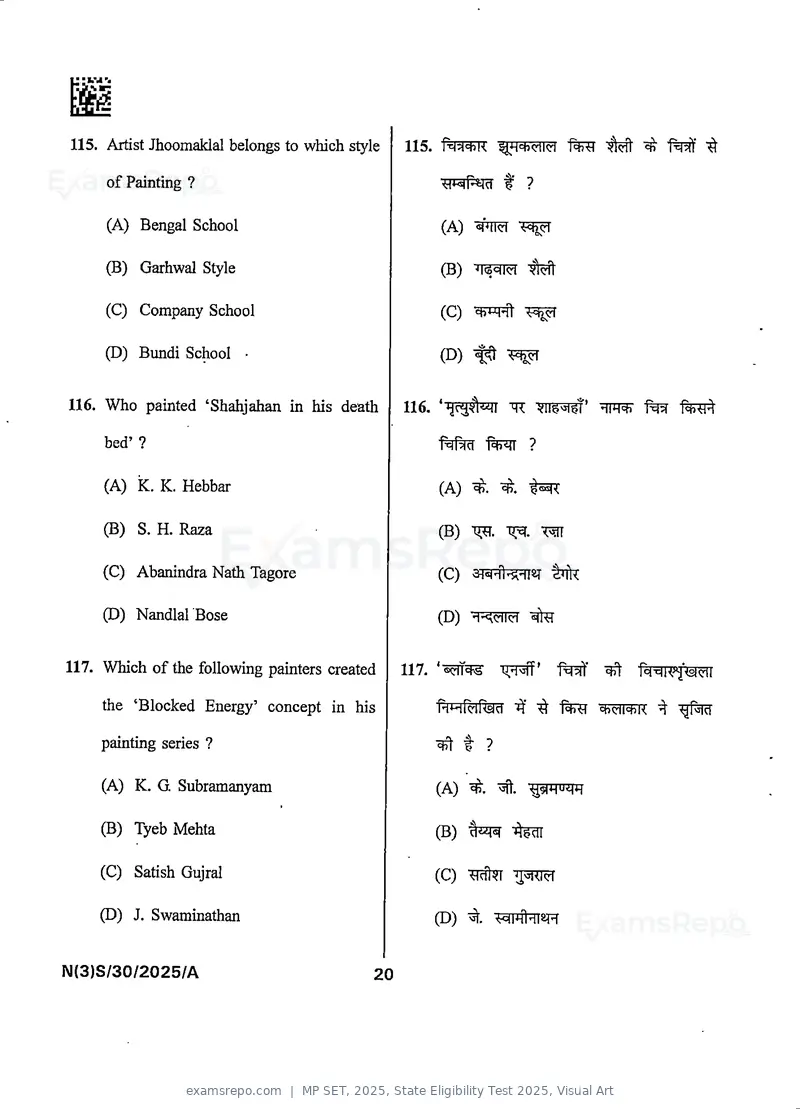
Text of page 22
115. Artist Jhoomaklal belongs to which style   115.                               ^ ^ 1^* ^

      of Painting ?                                               f ?

     (A) Bengal School                                  (A) oiMiQi

     (B) Garhwal Style                                  (B)

     (C) Company School                                 (C)

     (D) Bimdi School •                                 (D)


116. Who painted 'Shahjahan in his death         116.               "qr

      bed' ?                                            pcll^Cl           ?

     (A) k. K. Hebbar                                   (A)

     (B) S. H. Raza                                     (B) RH. -cr^. TM

     (0) Abanindra Nath Tagore                          (C)                   tnk

     (D) Nandlal Bose                                   (D)


117. Which of the following painters created

     the 'Blocked Energy' concept in his                fdMl^RsId                   cbdldiK ^

     painting series ?                              ^t ?

     (A) K. G. Subramanyam                          (A)

    (B) Tyeb Mehta                                  (B)

    (C) Satish Gujral                               (C) TOkr ipHM

    (D) J. Swaminathan                              (D)


I\l(3)S/30/2025/A                           20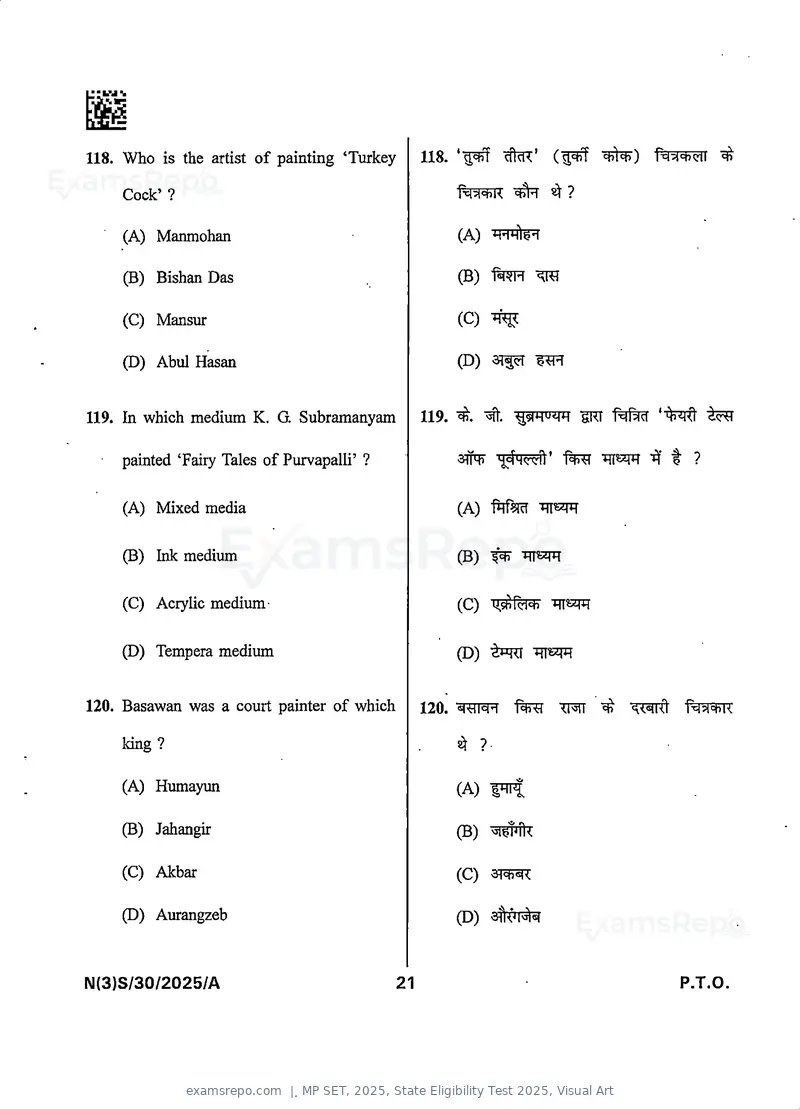
Text of page 23
118. Who is the artist of painting 'Turkey        118. *1^ cfkR'                     ^
     Cock' ?                                                        ^?

    (A) Manmohan                                         (A) Wfe

    (B) Bishan Das                                       (B) 1%^ ^

    (C) Mansur                                           (C) ^

    (D) Abul Hasan                                       (D)


119. In which medium K. G. Subramanyam            119.                  ^


     painted 'Fairy Tales of Purvapalli' ?               STRi i^cfMcrxrlV ^    t ?

    (A) Mixed media                                      (A)       TTT^


    (B) Ink medium                                       (B) ^

    (C) Acrylic medium-                                  (C)

    (D) Tempera medium                                   (D)


120. Basawan was a court painter of which         120. "sram         TIW ^ Wfl feRTTC

    king ?                                               8^ ?-

    (A) Htimayun                                         (A) wi
    (B) Jahangir                                         (B)

    (C) Akbar                                            (C)

    (D) Aurangzeb                                        (D)


N(3)S/30/2025/A                              21                                 P.T.O.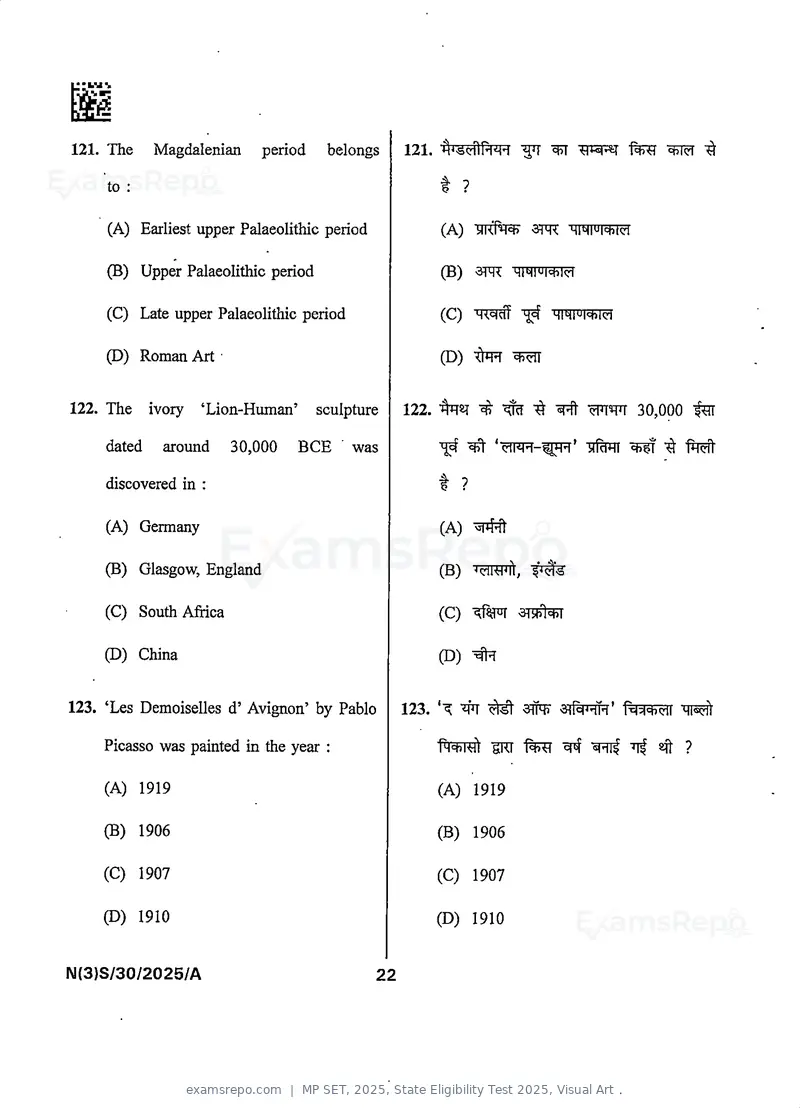
Text of page 24
121. The     Magdalenian   period   belongs       121.              ^^                        ^
     to :                                                t ?

    (A) Earliest upper Palaeolithic period               (A) mte              mmuicbicri

    (B) Upper Palaeolithic period                        (B) 3P7T "qrwTO^r

    (C) Late upper Palaeolithic period                   (C)

    (D) Roman Art ■                                      (D)


122. The ivory *Lion-Human' sculpture             122. "^21       ^       ^ Wim 30,000
     dated    around   30,000   BCE      was                  ^                 3rfOT ^    liidt

     discovered in :                                     t ?

    (A) Germany                                          (A)

    (B) Glasgow, England                                 (B) TvIRFTt,

    (C) South Africa                                   (C)

    (D) China                                          (D) ^

123. 'Les Demoiselles d' Avignon' by Pablo        123. '"5;     cr^-sl 3TP^                Hlsoil

    Picasso was painted in the year :                  ferat m ^^^ "nf aft ?

    (A) 1919                                           (A) 1919

    (B) 1906                                           (B) 1906

    (C) 1907                                           (C) 1907

    (D) 1910                                           (D) 1910


IN!(3)S/30/2025/A                            22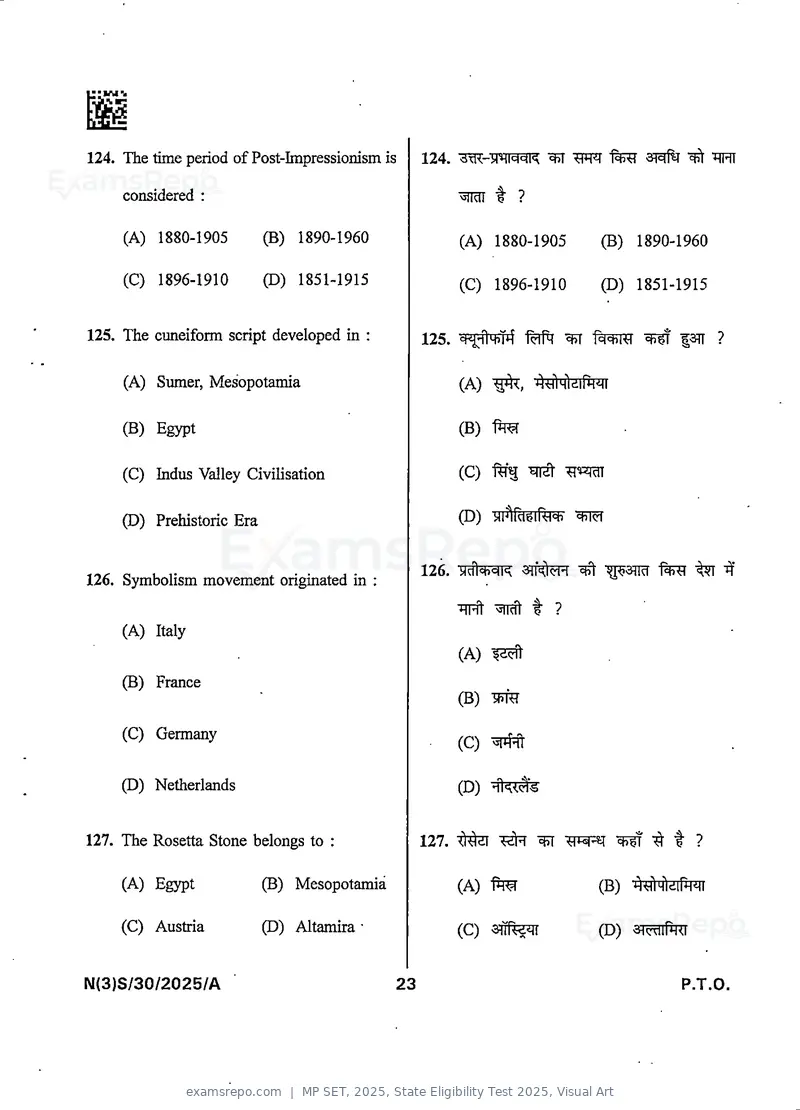
Text of page 25
124. The time period of Post-Impressionism is    124.               ^ WT "fer             "RHT

     considered :                                             i ?

    (A) 1880-1905         (B) 1890-1960                 (A) 1880-1905    (B) 1890-1960

    (C) 1896-1910       (D) 1851-1915                   (C) 1896-1910    (D) 1851-1915


125. The cuneiform script developed in :         125.                ^              ^37T ?

    (A) Sumer, Mesopotamia                              (A)

    (B) Egypt                                           (B) Pm

    (C) Indus Valley Civilisation                       (C)      ^

    (D) Prehistoric Era                                 (D)


                                                 126. yd1=hciK          ^           ^^
126. Symbolism movement originated in :
                                                        ■qnt ^ t ?
    (A) Italy
                                                        (A)
    (B) France
                                                        (B) W

    (C) Germany
                                                        (C) ^

    (D) Netherlands                                     (D)


127. The Rosetta Stone belongs to :              127.                       '<^61   ^ ?

    (A) Egypt           (B) Mesopotamia                 (A)              (B)

    (C) Austria         (D) Altamira •                  (C) 3Tff^        (D) STvmfw

l\I(3)S/30/2025/A                           23                                      P.T.O.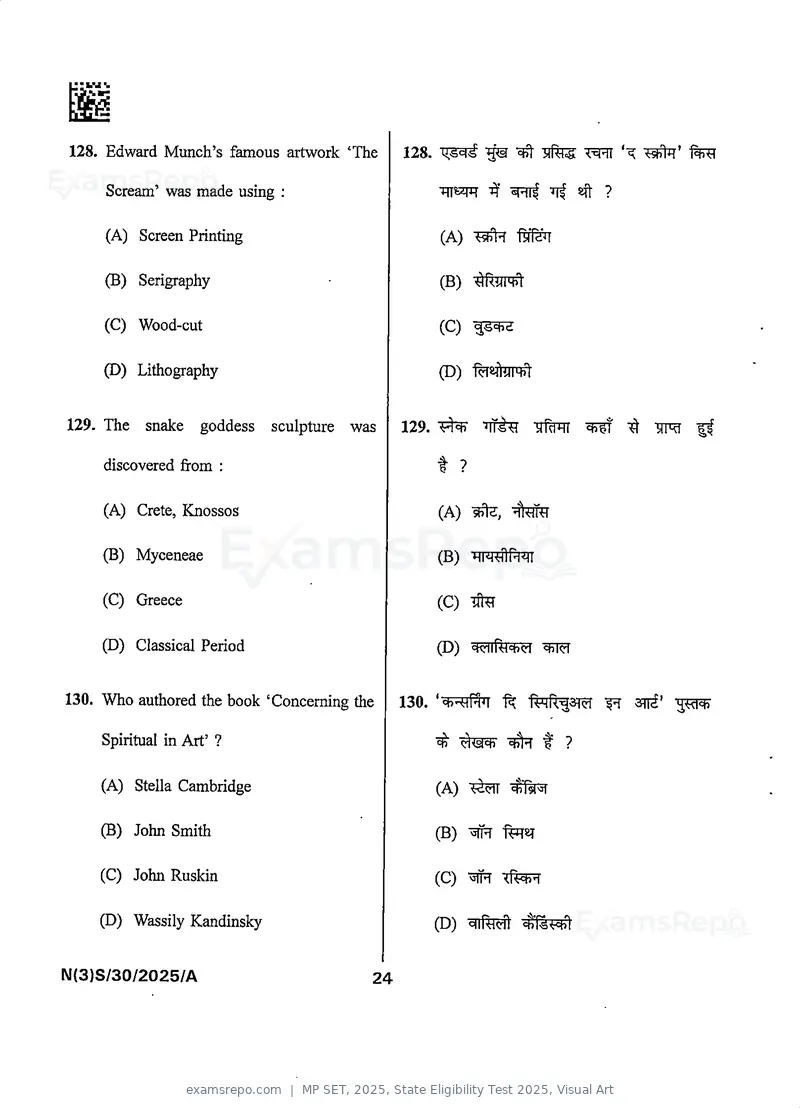
Text of page 26
128. Edward Munch's famous artwork 'The       128.                  ^ Jfe wn             1%^

     Scream' was made using :

    (A) Screen Printing                              (A)

    (B) Serigraphy                                   (B)

    (C) Wood-cut                                     (C)

    (D) Lithography                                  (D)


129. The snake goddess sculpture was          129.                             ^    "SIRT ff
     discovered from :                               t ?

    (A) Crete, Knossos                               (A)

    (B) Myceneae                                     (B)

    (C) Greece                                       (C) iM

    (D) Classical Period                             (D)


130. Who authored the book 'Concerning the    130.                             ^ 371^'

     Spiritual in Art' ?                                el'ist'Ti       "f ?

    (A) Stella Cambridge                             (A)            4)1^^

    (B) John Smith                                   (B) "SiH iFTq

    (C) John Ruskin                                  (C)

    (D) Wassily Kandinsky                        (D) qiRicil

N{3)S/30/2025/A                          24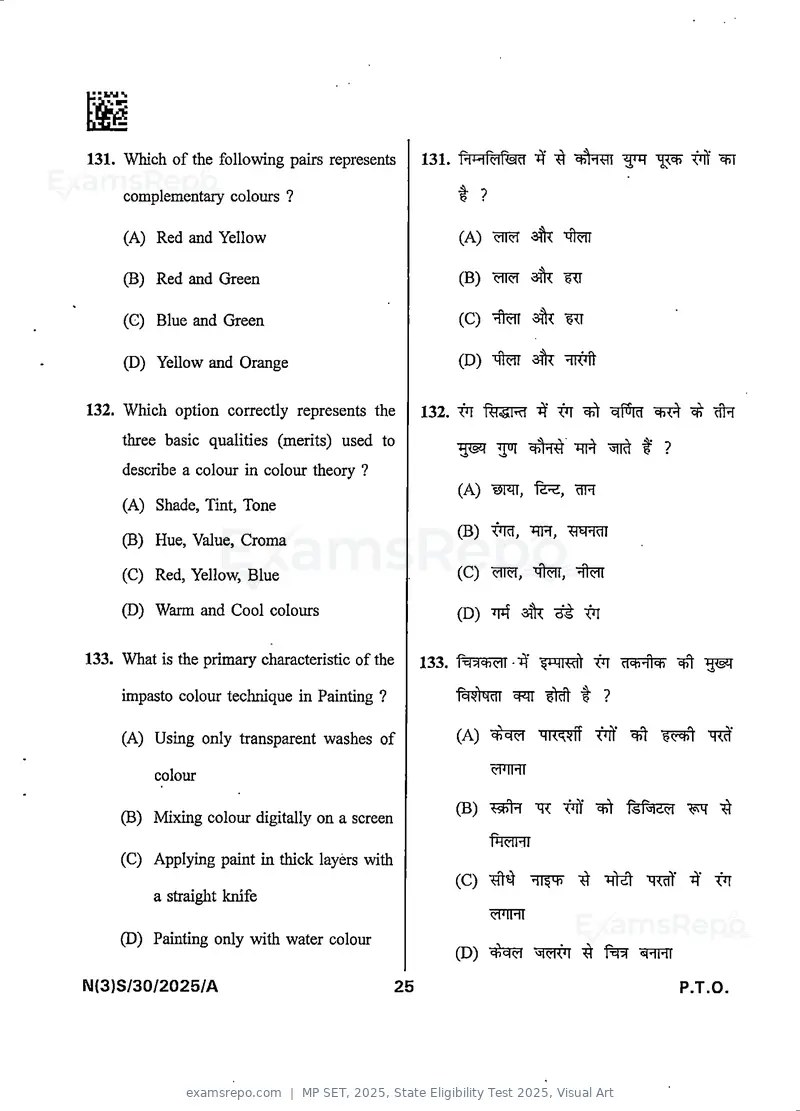
Text of page 27
131. Which of the following pairs represents       131. PinRriUsid        ^                    ^

     complementary colours ?                              t ?

     (A) Red and Yellow                                   (A) ^ITqT sfk ""tIm

     (B) Red and Green                                    (B) ^               ^

     (G) Blue and Green                                   (C)                 KT

     (D) Yellow and Orange                                (D)           afk

132. Which option correctly represents the         132.                      ^ ^ cjPici    ^ #7
     three basic qualities (merits) used to
     describe a colour in colour theory ?
                                                          (A) "OTT,            m
     (A) Shade, Tint, Tone
                                                          (B) jm, RH,
     (B) Hue, Value, Croma

     (C) Red, Yellow, Blue                                (C)           %TT,

    (D) Warm and Cool colours                             (D)       sSk ^

133. What is the primary characteristic of the     133.                              dcbHiqi ^ 3^
     impasto colour technique in Painting ?                       ^^ t ?

    (A) Using only transparent washes of                  (A)                      tfi ^      W
                                                                WTHT
          colour

                                                          (B)           TR
    (B) Mixing colour digitally on a screen
                                                                rnmi
    (C) Applying paint in thick layers with
                                                          (C)                  ^ tM W "4* fn
          a straight knife
                                                                WTFTT

    (D) Painting only with water colour
                                                          (D)                  ^
N{3)S/30/2025/A                               25                                           P.T.O.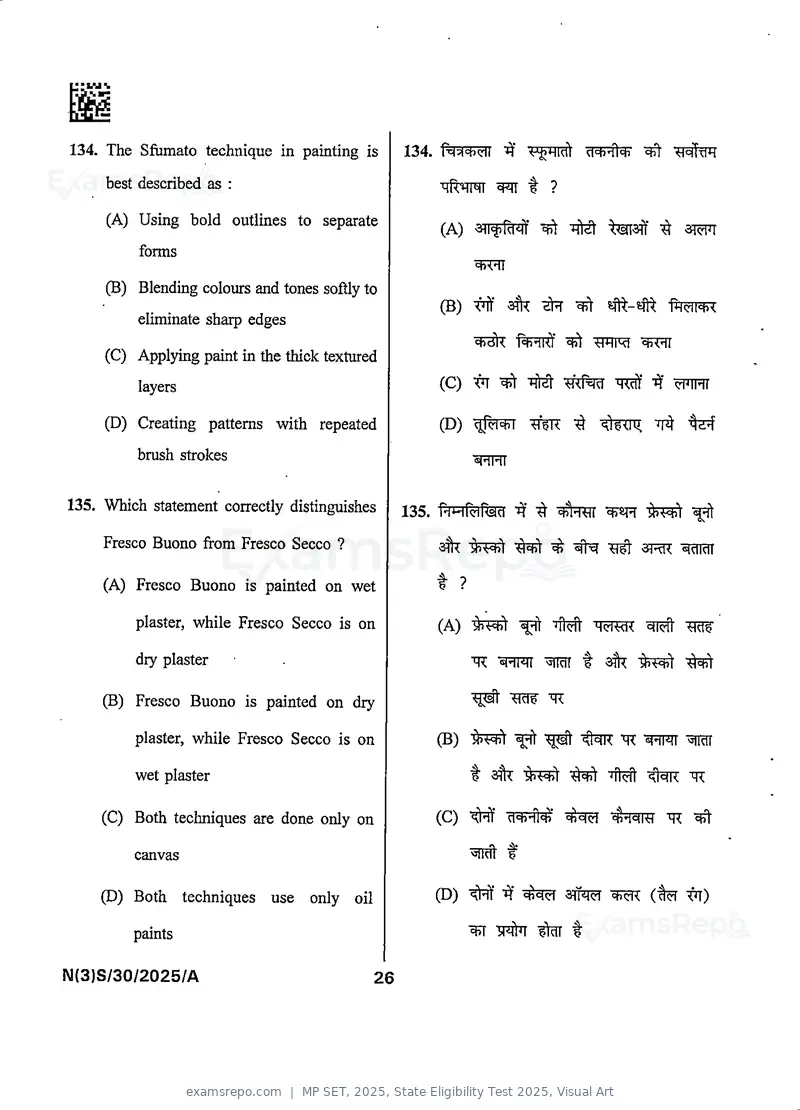
Text of page 28
134. The Sfumato technique in painting is       134.                                      ^

     best described as :                                       ^t ?
     (A) Using bold outlines to separate
                                                       (A)           ^           feisif ^ 37^
          forms

    (B) Blending colours and tones softly to
                                                       (B) M         ^                        PHeltcht
          eliminate sharp edges
                                                                   "feRf ^
    (C) Applying paint in the thick textured

          layers                                       (C) ^        tM             Wif           qFMT

    (D) Creating patterns with repeated                (D)                  ^              M ^
          brush strokes                                      WTT


135. Which statement correctly distinguishes    135.                                              ^
     Fresco Buono from Fresco Secco ?                  3^          ^^                     aTRR

    (A) Fresco Buono is painted on wet                 t ?

         plaster, while Fresco Secco is on             (A)                      HQi'Hit

         dry plaster                                                  wr t sfk                   ^

    (B) Fresco Buono is painted on dry                       ^        -q^

         plaster, while Fresco Secco is on             (B)                          "qr qiNI

         wet plaster                                         t 37k terl ^^                        "qi:

    (0) Both techniques are done only on           (C) tldl                 chqei 4q^Ri "q^ ^
         canvas


    (D) Both techniques use only oil               (D)                   3fl^                     tq)

         paints                                              qq Rqkr ^ t

lM(3)S/30/2025/A                           26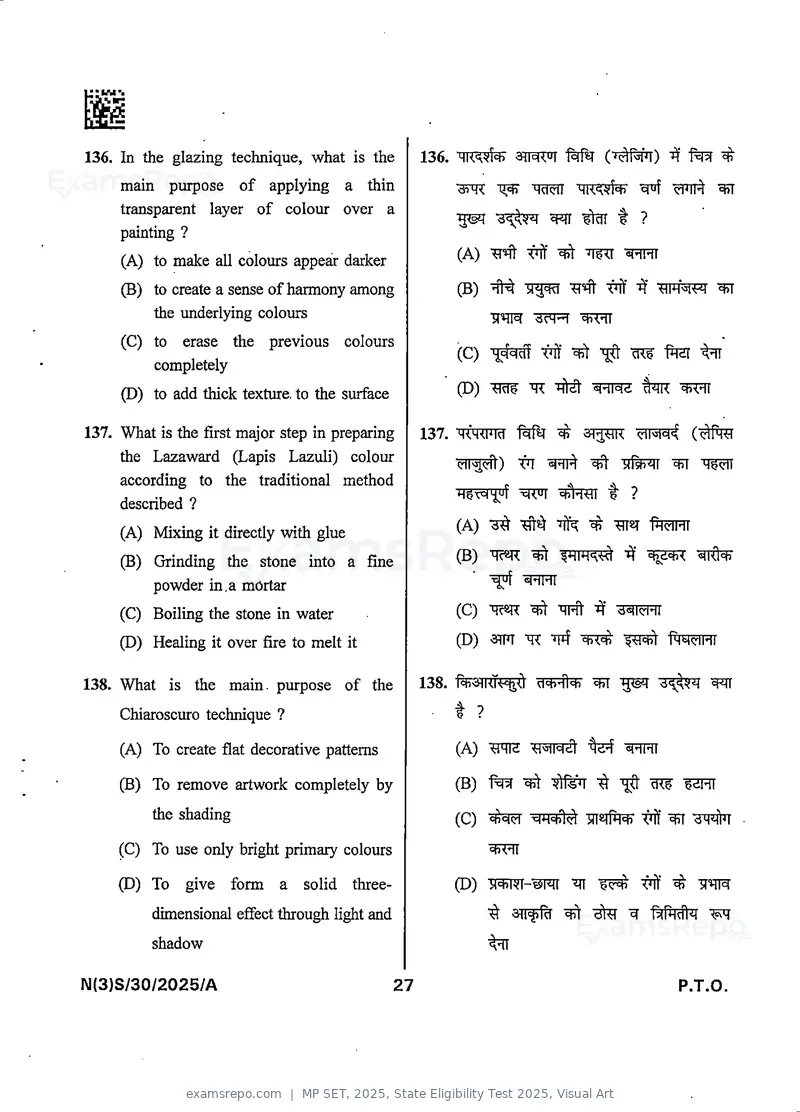
Text of page 29
136. In the glazing technique, what is the
     main purpose of applying a thin                                   Hcieil                 (rl'llA ^
     transparent layer of colour over a
     painting ?
    (A) to make all colours appear darker                  (A)             ^
    (B) to create a sense of harmony among                 (B)                                       ^
        the underlying colours                                   "3^

    (C) to erase the previous colours
                                                           (C)                  ^                    ^
        completely
    (D) to add thick texture, to the surface               (D)         "qr ^          ^
137. What is the first major step in preparing        137. "qWTO           ^
     the Lazaward (Lapis Lazuli) colour
     according to the traditional method
                                                                     WT             f ?
     described ?

    (A) Mixing it directly with glue                       (A) "5^         Tifq ^
    (B) Grinding the stone into a fine                     (B) RcSR "qrl                  ctiiqri.
          powder in.a mortar
    (C) Boiling the stone in water                         (C) "qcSR ^ RFft
    (D) Healing it over fire to melt it                    (D) aim "qr ^                      PMMcrlHI

138. What is the main, purpose of the                 138. f^aiRR^ d^Hl^ ^
     Chiaroscuro technique ?                           ■   t ?
    (A) To create flat decorative patterns                 (A) "OTz

    (B) To remove artwork completely by                    (B)       ^                    W
          the shading                                      (C)                  "RTsife #* ^ wk
    (C) To use only bright primary colours

    (D) To give form a solid three-                        (D) 3miWT-wrr mr                   ^
          dimensional effect through light and                   ^          ^ ^ ^ tWhq
          shadow


I\l(3)S/30/2025/A                                27                                             P.T.O.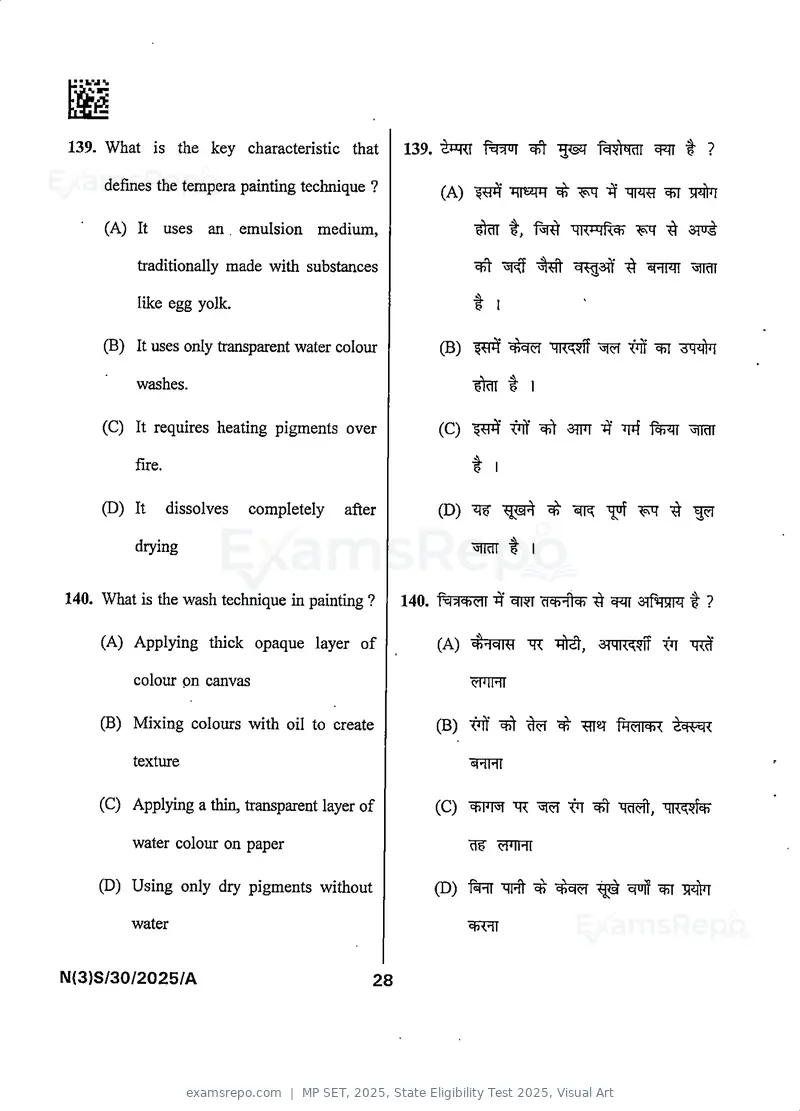
Text of page 30
139. What is the key characteristic that            139.                 ^ "3^ Mm ^ t ?
     defines the tempera painting technique ?              (A)^              ^^ ^               ^
     (A) It uses an, emulsion medium,

          traditionally made with substances

          like egg yolk.

     (B) It uses only transparent water colour             (B)                         ^       ^ wiin

          washes.                                                      f I

    (C) It requires heating pigments over                  (C)                   37FT ft' "nft RirHi

          fire.                                                  t I

    (D) It        dissolves   completely   after           (D)               ^          3ft ^ ft 3^
          drying                                                 •5IM t I

140. What is the wash technique in painting ?       140.              ft*^             ft ^            t?

    (A) Applying thick opaque layer of                     (A)           "qr fttft,             ftr "q^*
         colour pn canvas                                        vRHT


    (B) Mixing colours with oil to create                  (B) ftft          ^
         texture


    (C) Applying a thin, transparent layer of          (C) ctiMM "q^             ftr      Mcieil, "qRqft^
         water colour on paper                                   ^ QIUMI


    (D) Using only dry pigments without                (D) R1-II "qift       «iqcrl            ^ ■qqft
         water


N(3)S/30/2025/A                                28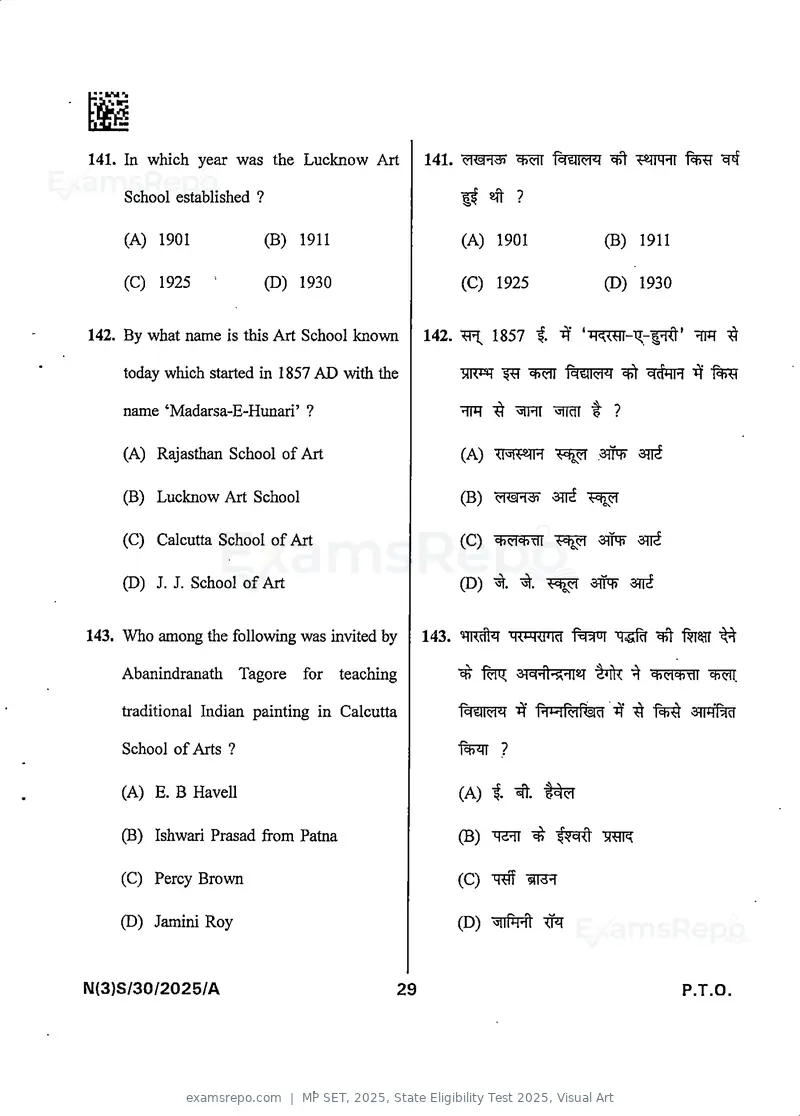
Text of page 31
141. In which year was the Lucknow Art          141.                              ^                ^

     School established ?                              ^         ?

    (A) 1901            (B) 1911                       (A) 1901               (B) 1911

    (C) 1925            (D) 1930                       (C) 1925               (D) 1930


142. By what name is this Art School known      142.         1857 i                                ^

     today which started in 1857 AD with the

     name 'Madarsa-E-Hunari' ?                                               t" ?

    (A) Rajasthan School of Art                        (A)                            ^

    (B) Lucknow Art School                             (B)            ^

    (C) Calcutta School of Art                         (C) 4jd=b-dl                   ^

    (D) J. J. School of Art                            (D)                  3TR) arrf

143. Who among the following was invited by     143. TOh WWM                            ^

     Abanindranath Tagore for teaching                                              ^ =hetctitii

    traditional Indian painting in Calcutta                          PHHRrifeld     ^

    School of Arts ?                                         ?


    (A) E. BHavell                                 (A) "f.           "1^

    (B) Ishwari Prasad from Patna                  (B)               ^

    (C) Percy Brown                                (C)           ^13^

    (D) Jamini Roy                                 (D)               ^


l\I(3)S/30/2025/A                          29                                                P.T.O.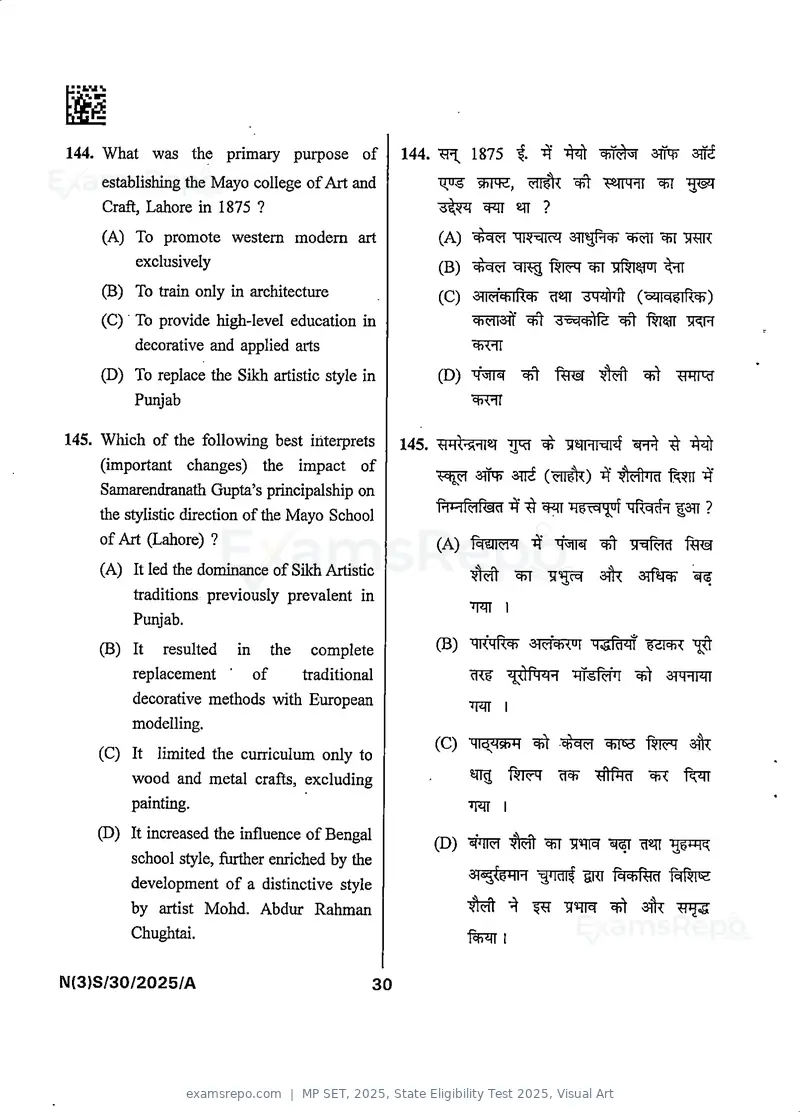
Text of page 32
144. What was the primary purpose of                144.         1875 i                                 3TO 3#^
     establishing the Mayo college of Art and
     Craft, Lahore in 1875 ?                                     ^ SIT ?

     (A) To promote western modem art                      (A)                                           ^ mK
          exclusively                                      (B)          'mg              ^                ^
     (B) To train only in architecture                     (C) ^M*=hlRch ^STT                        (oqi^wrfw)
     (C) To provide high-level education in
          decorative and applied arts
    (D) To replace the Sikh artistic style in              (D)              ^ 1w                      ^ WRf
          Punjab

145. Which of the following best iiiterprets        145. '^■hW'IIST                   3T?^Hl"c!i4             441
    (important changes) the impact of
                                                                 ^ 371^ (en^)                   !?1dTid         4"*
     Samarendranath Gupta's principalship on
     the stylistic direction of the Mayo School            PiMPcrir^d         ^                     -qfefck 13TT ?
     of Art (Lahore) ?                                     (A)              "4*             ^ MTHpdd
    (A) It led the dominance of Sildi Artistic                   ^ ^                        afk aTp^T^ ^
          traditions previously prevalent in
                                                                 "W     I
          Punjab.
    (B) It    resulted   in    the    complete             (B) MK*MR<h                     HoiPd-M?
          replacement ' of           traditional                          ^ilPM-MH HkPdM ^ 3TWTT
          decorative methods with European                       "W     I
          modelling.
    (C) It limited the curriculum only to
                                                           (C) ^\6^shH ^                                      afe
        wood and metal crafts, excluding
        painting.                                                TO   I

    (D) It increased the influence of Bengal
                                                           (D) qMnn               ^                   "dSTI
        school style, further enriched by the
        development of a distinctive style                                   irof m irofkr faffw
          by artist Mohd. Abdur Rahman
          Chughtai.                                                   1


(\l(3)S/30/2025/A                              30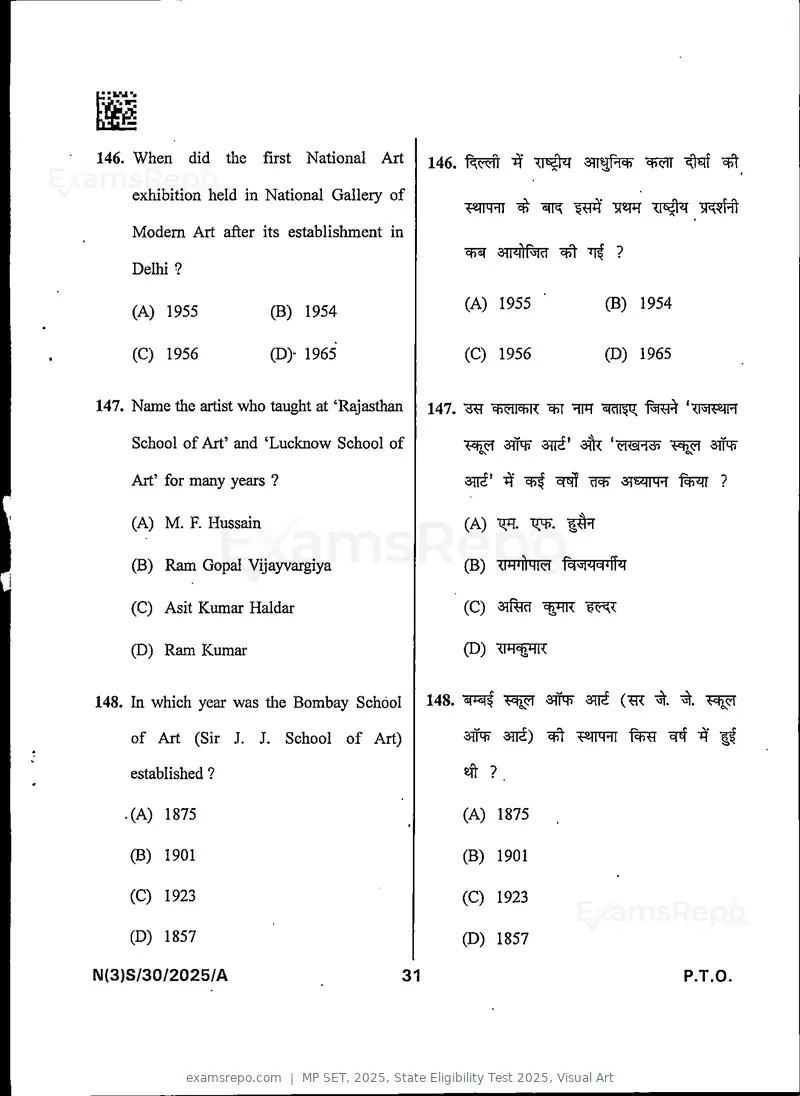
Text of page 33
146. When      did   the   first   National   Art    146. "fe#                              ^^
     exhibition held in National Gallery of

     Modem Art after its establishment in

     Delhi ?

                                                            (A) 1955             (B) 1954
    (A) 1955               (B) 1954

    (C) 1956               (D)- 1965                        (C) 1956             (D) 1965


147. Name the artist who taught at 'Rajasthan        147.^              ^                   'XTSRSth

     School of Art' and 'Lucknow School of                    Cs
                                                                              -sik          Cv
                                                                                                 3ffqr

     Art' for many years ?                                  311^'     ^^^ 3TE3Tm fen ?

    (A) M. F. Hussain                                       (A)

    (B) Ram Gopal Vijayvargiya                              (B) wifer fem#?

    (C) Asit Kumar Haldar                                   (C) 3lfel

    (D) Ram Kumar                                           (D)


148. In which year was the Bombay School             148.               afe          (w:

     of Art (Sir J. J. School of Art)                       3TO 3n^)          X^TFFTT "fel ^

     established ?                                          «Tt ? .

   .(A) 1875                                                (A) 1875

    (B) 1901                                                (B) 1901

    (C) 1923                                                (C) 1923

    (D) 1857                                                (D) 1857

N(3)S/30/2025/A                                 31                                          P.T.O.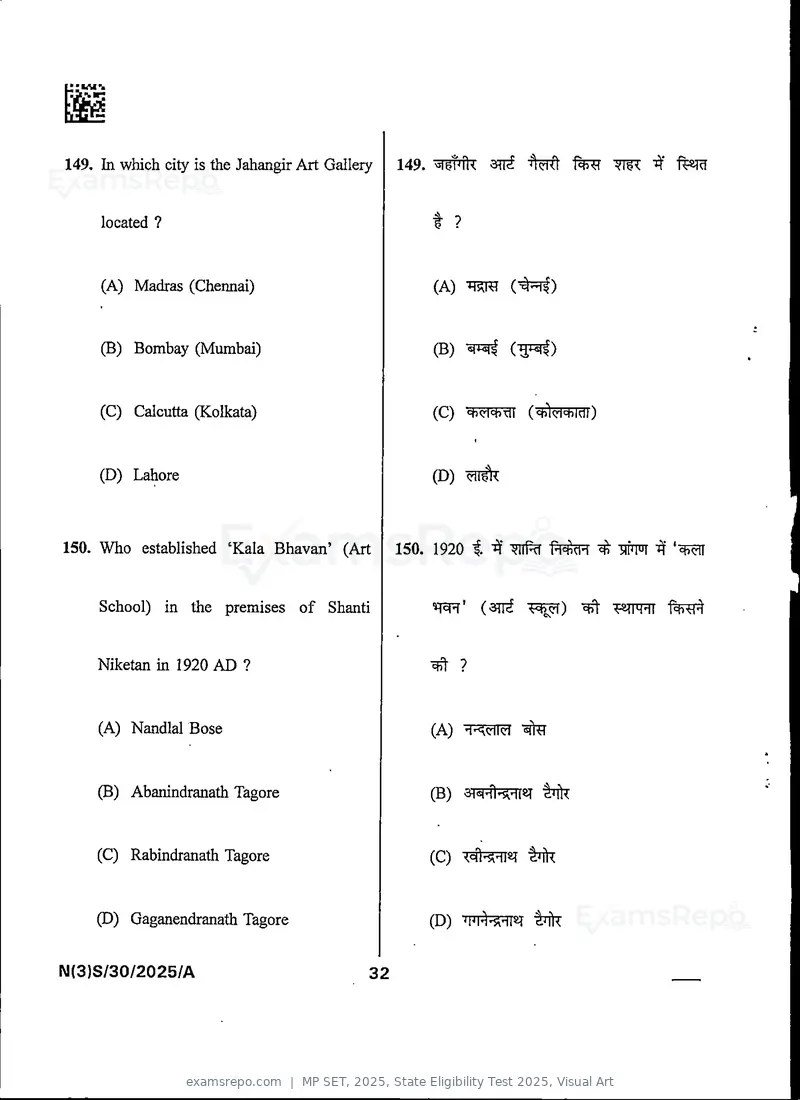
Text of page 34
149. In which city is the Jahangir Art Gallery    149.                                "4*


     located ?                                           t ?


    (A) Madras (Chennai)                                 (A)


    (B) Bombay (Mumbai)                                  (B)^


    (C) Calcutta (Kolkata)                               (C)


    (D) Lahore                                           (D)


150. Who established 'Kala Bhavan' (Art           150. 1920 t                    ^ 3im ^


     School) in the premises of Shanti                          (STT^ ■?^) ^

    Niketan in 1920 AD ?                                 ^ ?


    (A) Nandlal Hose                                     (A) -i^Qiiei


    (B) Abanindranath Tagore                             (B)              tifk


    (C) Rabindranath Tagore                              (C)            tiik


    (D) Gaganendranath Tagore                            (D)            tnk

N(3)S/30/2025/A                              32
Text of page 35
(SPACE FOR ROUGH WORK)


(N)S/30/2025/A
Text of page 36
(SPACE FOR ROUGH WORK)


(I\l)S/30/2025/A
Page 1 of 36
Source: Madhya Pradesh Public Service Commission. Question paper published by Madhya Pradesh Public Service Commission.