
TS SET 2012: Paper II, Law
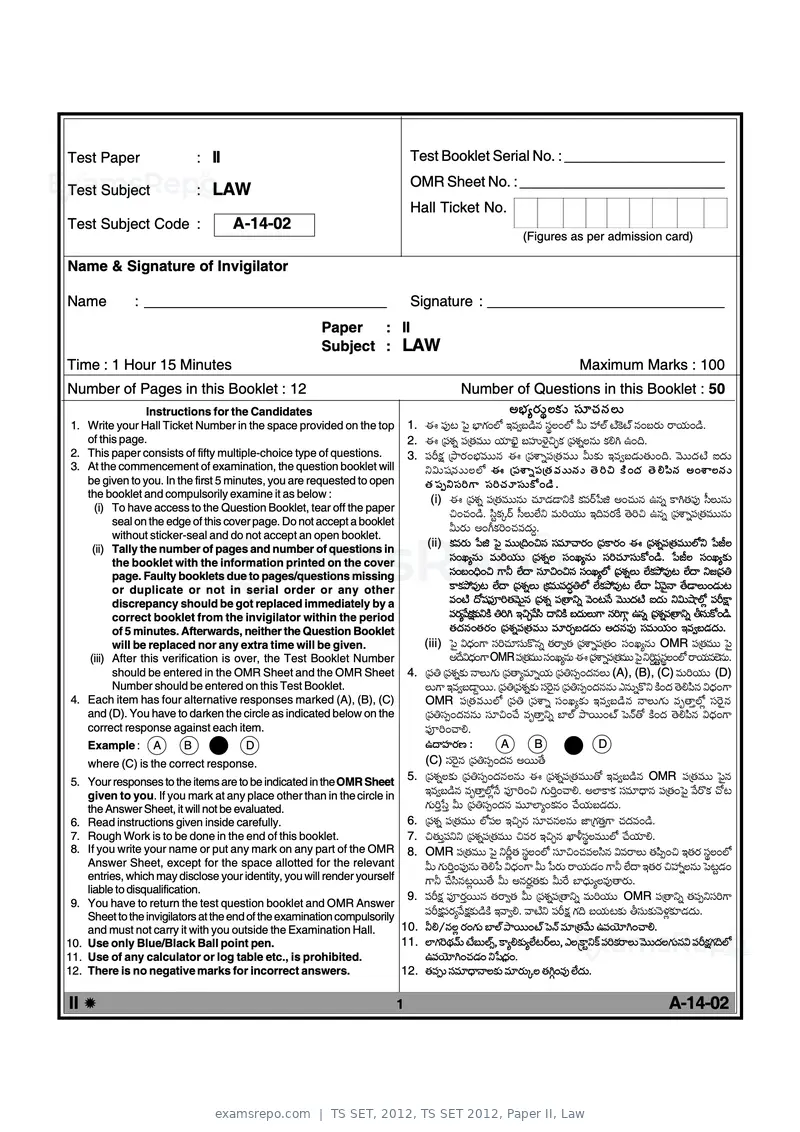
Text of page 1
Test Paper : II Test Booklet Serial No. : ______________________
OMR Sheet No. : ________________________________
Test Subject : LAW
Hall Ticket No.
Test Subject Code : A-14-02
(Figures as per admission card)
Name & Signature of Invigilator
Name : ____________________________________ Signature : ___________________________________
Paper : II
Subject : LAW
Time : 1 Hour 15 Minutes Maximum Marks : 100
Number of Pages in this Booklet : 12 Number of Questions in this Booklet : 50
Instructions for the Candidates A¿æýÅÆæÿ$¦ËMæü$ çÜ*^èþ¯èþË$
1. Write your Hall Ticket Number in the space provided on the top 1. D ç³#r ò³O ¿êVæü ÌZ CÐèþÓºyìþ¯èþ çÜ¦Ë ÌZ Ò$ çàÌý sìýMðüsý ¯èþ ºÆæÿ$ Æ>Äæý$ yìþ.
of this page. 2. D {ç³Ôèý² ç³{èþÐèþ$$ Äæý*¿ñýO ºçßý$âñýO_eMæü {ç³Ôèý²Ë¯èþ$ MæüÍW E ¨.
2. This paper consists of fifty multiple-choice type of questions. 3. ç³Èæü {´ëÆæÿ ¿æýÐèþ$$¯èþ D {ç³Ôé²ç³{èþÐèþ$$ Ò$Mæü$ CÐèþÓºyæþ$èþ$ ¨. Ððþ$$§æþsìý I§æþ$
3. At the commencement of examination, the question booklet will °Ñ$ç Ù Ðè þ $$ËÌZ D {ç ³ Ôé²ç ³ {è þ Ðè þ $$¯è þ $ ð þ Ç_ Mì ü §æ þ ð þ Íí ³ ¯è þ A Ôé˯è þ $
be given to you. In the first 5 minutes, you are requested to open è þ ç ³ µ°ç Ü ÇV> ç Ü Ç^è þ *ç Ü $Mø yì þ .
the booklet and compulsorily examine it as below : (i) D {ç³Ôèý² ç³{èþÐèþ$$¯èþ$ ^èþ*yæþyé°Mìü MæüÐèþÆÿõ³h A ^èþ$¯èþ E¯èþ² M>Wèþç³# ïÜË$¯èþ$
(i) To have access to the Question Booklet, tear off the paper
_ ^èþ yìþ. íÜtMæüPÆÿ ïÜË$Ìôý° Ðèþ$ÇÄæý$$ C¨ÐèþÆæÿMóü ðþÇ_ E¯èþ² {ç³Ôé²ç³{èþÐèþ$$¯èþ$
seal on the edge of this cover page. Do not accept a booklet
Ò$Ææÿ$ A XMæüÇ ^èþÐèþ§æþ$ª.
without sticker-seal and do not accept an open booklet.
(ii) Tally the number of pages and number of questions in
(ii) MæüÐèþÆæÿ$ õ³h ò³O Ðèþ$${¨ _¯èþ çÜÐèþ*^éÆæÿ {ç³M>Ææÿ D {ç³Ôèý²ç³{èþÐèþ$$ÌZ° õ³iË
the booklet with the information printed on the cover çÜ Qůèþ$ Ðèþ$ÇÄæý$$ {ç³Ôèý²Ë çÜ Qůèþ$ çÜÇ^èþ*çÜ$Mø yìþ. õ³iË çÜ QÅMæü$
page. Faulty booklets due to pages/questions missing çÜ º «¨ _ V>± Ìôý§é çÜ*_ _¯èþ çÜ QÅÌZ {ç³Ôèý²Ë$ ÌôýMæü´ùÐèþ#r Ìôý§é °f{ç³
or duplicate or not in serial order or any other M>Mæü´ùÐèþ#r Ìôý§é {ç³Ôèý²Ë$ {MæüÐèþ$糧æþ®ÌZ ÌôýMæü´ùÐèþ#r Ìôý§é HÐðþO¯é óþyéË$ yæþ$r
discrepancy should be got replaced immediately by a Ðèþ sìý §øçÙç³NÇèþÐðþ$O¯èþ {ç³Ôèý² ç³{é°² Ððþ r¯óþ Ððþ$$§æþsìý I§æþ$ °Ñ$ÚëÌZÏ ç³È>
correct booklet from the invigilator within the period ç³ÆæÿÅÐóþæüMæü$°Mìü ÇW C_aÐóþíÜ §é°Mìü º§æþ$Ë$V> çÜÇV>Y E¯èþ² {ç³Ôèý²ç³{é°² ¡çÜ$Mø yìþ.
of 5 minutes. Afterwards, neither the Question Booklet èþ§æþ¯èþ èþÆæÿ {ç³Ôèý²ç³{èþÐèþ$$ Ðèþ*Ææÿaºyæþ§æþ$ A§æþ¯èþç³# çÜÐèþ$Äæý$ CÐèþÓºyæþ§æþ$.
will be replaced nor any extra time will be given. (iii) ò³O Ñ«§æþ V> çÜÇ^èþ*çÜ$Mö¯èþ² èþÆ>Óèþ {ç³Ôé²ç³{èþ çÜ Qůèþ$ OMR ç³{èþÐèþ$$ ò³O
(iii) After this verification is over, the Test Booklet Number A§óþÑ«§æþ V> OMR ç³{èþÐèþ$$ çÜ Qůèþ$ D {ç³Ôé²ç³{èþÐèþ$$ ò³O °ÇªçÙtt çÜ¦Ë ÌZ Æ>Äæý$ÐèþÌñý¯èþ$.
should be entered in the OMR Sheet and the OMR Sheet 4. {ç³ {ç³Ôèý²Mæü$ ¯éË$Væü$ {ç³éÅÐèþ*²Äæý$ {ç³çܵ §æþ¯èþË$ (A), (B), (C) Ðèþ$ÇÄæý$$ (D)
Number should be entered on this Test Booklet. Ë$V> CÐèþÓºyézÆÿ$$. {ç³{ç³Ôèý²Mæü$ çÜÆðÿO¯èþ {ç³çܵ §æþ¯èþ¯èþ$ G¯èþ$²Mö° Mìü §æþ ðþÍí³¯èþ Ñ«§æþ V>
4. Each item has four alternative responses marked (A), (B), (C) OMR ç³{èþÐèþ$$ÌZ {ç³ {ç³Ôé² çÜ QÅMæü$ CÐèþÓºyìþ¯èþ ¯éË$Væü$ Ðèþé¢ÌZÏ çÜÆðÿO¯èþ
and (D). You have to darken the circle as indicated below on the {ç³çܵ §æþ¯èþ¯èþ$ çÜ*_ ^óþ Ðèþ颰² »êÌý ´ëÆÿ$$ sý ò³¯þø Mìü §æþ ðþÍí³¯èþ Ñ«§æþ V>
correct response against each item. ç³NÇ ^éÍ.
Example : A B C D E§éçßýÆæÿ×ý : A B C D
where (C) is the correct response. (C) çÜÆðÿO¯èþ {ç³çܵ §æþ¯èþ AÆÿ$$óþ
5. Your responses to the items are to be indicated in the OMR Sheet
5. {ç³Ôèý²ËMæü$ {ç³çܵ §æþ¯èþ˯èþ$ D {ç³Ôèý²ç³{èþÐèþ$$ø CÐèþÓºyìþ¯èþ OMR ç³{èþÐèþ$$ ò³O¯èþ
given to you. If you mark at any place other than in the circle in CÐèþÓºyìþ¯èþ Ðèþé¢ÌZϯóþ ç³NÇ _ Væü$Ç¢ ^éÍ. AÌêM>Mæü çÜÐèþ*«§é¯èþ ç³{èþ ò³O ÐóþÆöMæü ^ør
the Answer Sheet, it will not be evaluated. Væü$Ç¢õÜ¢ Ò$ {ç³çܵ §æþ¯èþ Ðèþ$*ÌêÅ Mæü¯èþ ^óþÄæý$ºyæþ§æþ$.
6. Read instructions given inside carefully. 6. {ç³Ôèý² ç³{èþÐèþ$$ ÌZç³Ë C_a¯èþ çÜ*^èþ¯èþ˯èþ$ gê{Væüèþ¢V> ^èþ§æþÐèþ yìþ.
7. Rough Work is to be done in the end of this booklet. 7. _èþ$¢ç³°° {ç³Ôèý²ç³{èþÐèþ$$ _ÐèþÆæÿ C_a¯èþ RêäçܦËÐèþ$$ÌZ ^óþÄæý*Í.
8. If you write your name or put any mark on any part of the OMR 8. OMR ç³{èþÐèþ$$ ò³O °È~èþ çÜ¦Ë ÌZ çÜ*_ ^èþÐèþËíܯèþ ÑÐèþÆ>Ë$ èþí³µ _ CèþÆæÿ çÜ¦Ë ÌZ
Answer Sheet, except for the space allotted for the relevant Ò$ Væü$Ç¢ ç³#¯èþ$ ðþÍõ³ Ñ«§æþ V> Ò$ õ³Ææÿ$ Æ>Äæý$yæþ V>± Ìôý§é CèþÆæÿ _à²Ë¯èþ$ ò³rtyæþ
entries, which may disclose your identity, you will render yourself V>± ^óþíܯèþrÏÆÿ$$óþ Ò$ A¯èþÆæÿáèþMæü$ Ò$Æóÿ »ê«§æþ$ÅËÐèþ#éÆæÿ$.
liable to disqualification.
9. çç³Èæü ç³NÆæÿ¢Æÿ$$¯èþ èþÆ>Óèþ Ò$ {ç³Ôèý²ç³{é°² Ðèþ$ÇÄæý$$ OMR ç³{é°² èþç³µ°çÜÇV>
9. You have to return the test question booklet and OMR Answer
Sheet to the invigilators at the end of the examination compulsorily
ç³Èæüç³ÆæÿÅÐóþæüMæü$yìþMìü CÐéÓÍ. Ðésìý° ç³Èæü Væü¨ ºÄæý$rMæü$ ¡çÜ$Mæü$ÐðþâæýÏMæü*yæþ§æþ$.
and must not carry it with you outside the Examination Hall. 10. ±Í/¯èþËÏ Ææÿ Væü$ »êÌý ´ëÆÿ$$ sý ò³¯þ Ðèþ*{èþÐóþ$ Eç³Äñý*W ^éÍ.
10. Use only Blue/Black Ball point pen. 11. ÌêVæüÇ£æþÐþ$ sôýº$ÌýÞ, M>ÅÍMæü$ÅÌôýrÆÿË$, GË[M>t°Mü ç³ÇMæüÆ>Ë$ Ððþ$$§æþËVæü$¯èþÑ ç³ÈæüVæü¨ÌZ
11. Use of any calculator or log table etc., is prohibited. Eç³Äñý*W ^èþyæþ °õÙ«§æþ .
12. There is no negative marks for incorrect answers. 12. èþç³ çÜÐèþ*«§é¯éËMæü$ Ðèþ*Ææÿ$PË èþWY ç³# Ìôý§æþ$.
II ð 1 A-14-02
Text of page 2
*A1402*


IIð   2     A-14-02
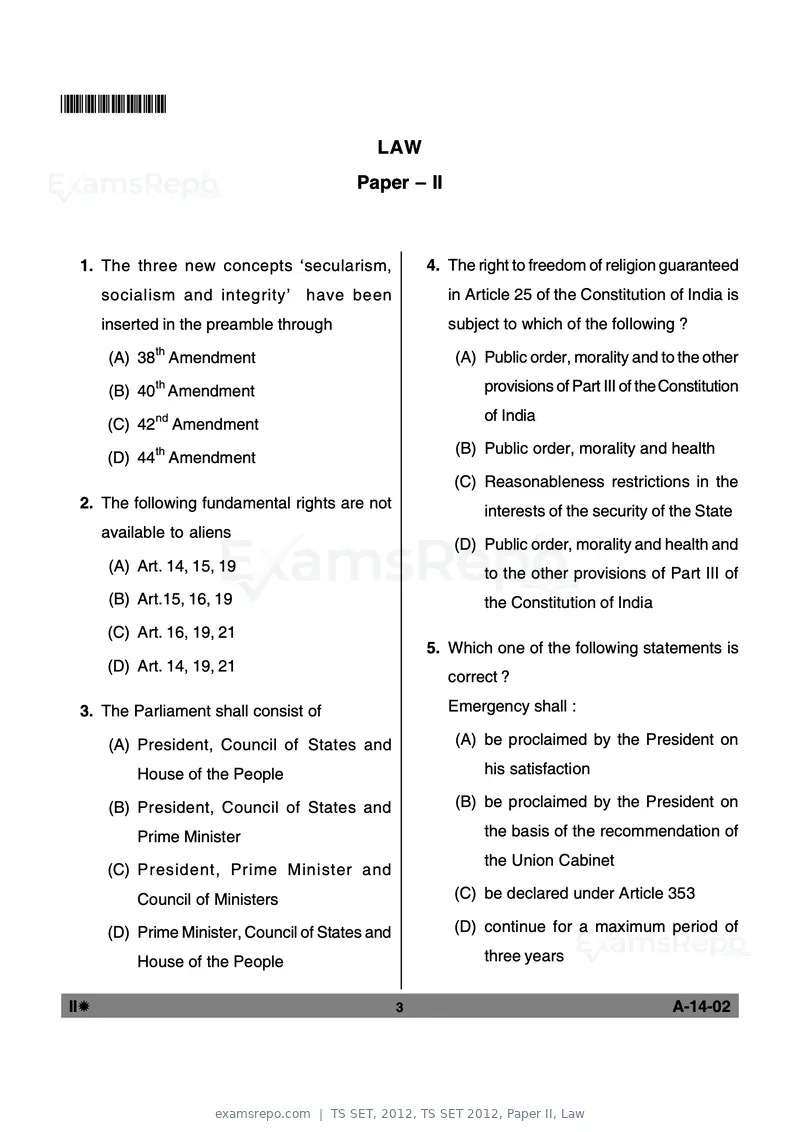
Text of page 3
*A1402*

                                            LAW
                                          Paper – II


 1. The three new concepts ‘secularism,               4. The right to freedom of religion guaranteed
      socialism and integrity’    have been              in Article 25 of the Constitution of India is
      inserted in the preamble through                   subject to which of the following ?

       (A) 38th Amendment                                 (A) Public order, morality and to the other
             th
       (B) 40 Amendment                                       provisions of Part III of the Constitution
                                                              of India
      (C) 42nd Amendment
                                                          (B) Public order, morality and health
      (D) 44th Amendment
                                                          (C) Reasonableness restrictions in the
 2. The following fundamental rights are not                  interests of the security of the State
      available to aliens
                                                          (D) Public order, morality and health and
       (A) Art. 14, 15, 19                                    to the other provisions of Part III of
       (B) Art.15, 16, 19                                     the Constitution of India
      (C) Art. 16, 19, 21
                                                      5. Which one of the following statements is
      (D) Art. 14, 19, 21
                                                         correct ?

 3. The Parliament shall consist of                      Emergency shall :

       (A) President, Council of States and               (A) be proclaimed by the President on

           House of the People                                his satisfaction

       (B) President, Council of States and               (B) be proclaimed by the President on

           Prime Minister                                     the basis of the recommendation of
                                                              the Union Cabinet
      (C) President, Prime Minister and
           Council of Ministers                           (C) be declared under Article 353

      (D) Prime Minister, Council of States and           (D) continue for a maximum period of

           House of the People                                three years


IIð                                               3                                          A-14-02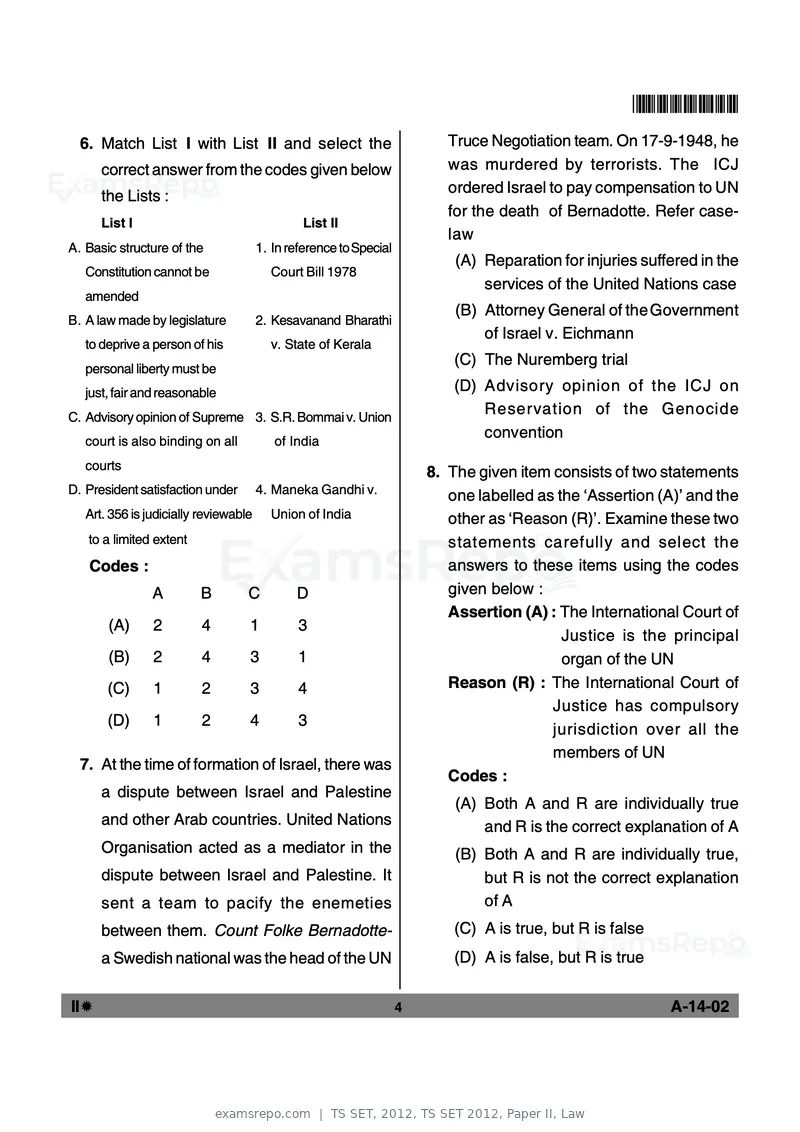
Text of page 4
*A1402*
  6. Match List I with List II and select the                              Truce Negotiation team. On 17-9-1948, he
      correct answer from the codes given below                            was murdered by terrorists. The ICJ
                                                                           ordered Israel to pay compensation to UN
      the Lists :
                                                                           for the death of Bernadotte. Refer case-
      List I                                    List II
                                                                           law
A. Basic structure of the              1. In reference to Special
                                                                            (A) Reparation for injuries suffered in the
   Constitution cannot be                Court Bill 1978
                                                                                services of the United Nations case
   amended
                                                                            (B) Attorney General of the Government
B. A law made by legislature           2. Kesavanand Bharathi
                                                                                of Israel v. Eichmann
   to deprive a person of his            v. State of Kerala
                                                                            (C) The Nuremberg trial
   personal liberty must be
   just, fair and reasonable                                                (D) Advisory opinion of the ICJ on
C. Advisory opinion of Supreme 3. S.R. Bommai v. Union
                                                                                Reservation of the Genocide
                                                                                convention
   court is also binding on all           of India
   courts
                                                                        8. The given item consists of two statements
D. President satisfaction under        4. Maneka Gandhi v.                 one labelled as the ‘Assertion (A)’ and the
   Art. 356 is judicially reviewable     Union of India                    other as ‘Reason (R)’. Examine these two
   to a limited extent                                                     statements carefully and select the
   Codes :                                                                 answers to these items using the codes
                A        B         C          D                            given below :
                                                                           Assertion (A) : The International Court of
       (A)      2         4        1           3
                                                                                            Justice is the principal
       (B)      2         4        3           1                                            organ of the UN
       (C)      1         2        3           4                           Reason (R) : The International Court of
                                                                                          Justice has compulsory
       (D)      1         2        4           3
                                                                                          jurisdiction over all the
                                                                                          members of UN
  7. At the time of formation of Israel, there was
                                                                           Codes :
      a dispute between Israel and Palestine
                                                                            (A) Both A and R are individually true
      and other Arab countries. United Nations                                  and R is the correct explanation of A
      Organisation acted as a mediator in the                               (B) Both A and R are individually true,
      dispute between Israel and Palestine. It                                  but R is not the correct explanation
      sent a team to pacify the enemeties                                       of A
      between them. Count Folke Bernadotte-                                 (C) A is true, but R is false
      a Swedish national was the head of the UN                             (D) A is false, but R is true


IIð                                                                 4                                       A-14-02
Text of page 5
*A1402*
   9. ‘Jus cogens’ means                                        11. The U.N.O. has been prohibited from
                                                                   intervening in matters which are
        (A) peremptory norms of general
                                                                   essentially within the domestic jurisdiction
              international law from which no
                                                                   of any State. Yet the
              derogation is permissible
                                                                    (A) Security Council can intervene when
        (B) rules      of    ancient            customary                it decides on enforcement action
              international law which are rendered                  (B) Security Council can intervene to
              redundant in modern times                                  stop religious strife in a country
        (C) abrogation of a rule in a treaty by a                   (C) General Assembly can intervene
              subsequent treaty                                          under the ‘uniting for peace’
                                                                         Resolution
        (D) rule developed from a bilateral treaty
              which has found universal                             (D) Security Council can intervene for the
                                                                         release of hostage taken by a State
 10. Match List I with List II and select the
                                                                12. Which of the following is among the
       correct answer from the codes given below
                                                                   purpose of the UN as laid down in Article 1
       the Lists :                                                 of the U.N. charter ?
           List I                            List II                I. To maintain international peace and
A. The conception of one world        1. Jeremy Bentham                security

B. The term ‘International Law’       2. Wendell Wilkie             II. To develop friendly relation among
                                                                       nations
  was coined by
                                                                   III. To ensure that non-members of the
C. The Franconia                      3. Anzilotti
                                                                       United Nations Act in accordance with
D. Pacta Sunt Servanda                4. Lord Coleridge                the U.N. charter
                                                                   IV. To achieve international co-operation
  Codes :
                                                                       in solving international problems of an
                A       B         C         D                          economic         social    cultural    or
                                                                       humanitarian character
        (A)     1       3         2         4
                                                                    (A) I, II, III are correct
        (B)     3       2         4         1
                                                                    (B) I, III, IV are correct
        (C)     2       1         4         3
                                                                    (C) I, II, IV are correct
        (D)     4       1         2         3                       (D) II, III, IV are correct

 IIð                                                        5                                         A-14-02
Text of page 6
*A1402*
13. That a legal system arises from the                  17. Kelsen’s theory of law is called pure theory
    combination of primary and secondary                     because Kelsen
    rules was enunciated by                                   (A) Purely discussed jurisprudence only
       (A) Austin             (B) Hart                        (B) Defined law in accordance with
                                                                  morality and purity
      (C) Bentham             (D) Kelsen
                                                              (C) Separated law from religion, ethics,
14. Which one of the schools of jurisprudence                     sociology and history
    considers that ‘a reasoned scale of values                (D) Discussed law purely in terms of
                                                                  justice
    can be discovered as a basis for legal
    development’ ?                                       18. “Law as such is found and not made. It is
       (A) Analytical         (B) Philosophical              to be found in popular faith, common
      (C) Historical          (D) Sociological               convictions, customs, traits, habits,
                                                             traditions which in course of time grow into
15. Consider the following statements with                   legal rules”. This concept was propounded
    regard to natural law                                    by
                                                               (A) Thibaut          (B) Henry Maine
      1. The central notion of natural law is the
                                                              (C) Savingny          (D) Salmond
         existence of objective moral principles
      2. These principles are discovered by              19. Which among the following is recently
         reference to legal sources as the                   declared as a ground for divorce for
         constitution, codes and so on                       Hindu’s by the Supreme Court of India
      3. These principles depend on the                       (A) Cruelty
         essential nature of man                              (B) Conversion
       (A) 1, 2, 3 are correct                                (C) Irretrievable break down of marriage
                                                              (D) Mutual consent
       (B) 1, 2 are correct
      (C) 2, 3 are correct                               20. Match List I with List II and select the
      (D) 1, 3 are correct                                   correct answer from the codes given below
                                                             the Lists :
16. Which of the following statements are                         List I                      List II
    correct ?                                            I. Gita Hariharan v. Reserve     1. Marriage
       I. Ownership can be legal and vested                Bank of India
          ownership                                     II. Bai Tahira v. Ali Hussain     2. Divorce
      II. Ownership can be legal and equitable          III. Md. Amin v. Vakil Ahmed      3. Maintenance
          ownership                                     IV. Dastane v. Dastane            4. Guardianship
      III. Ownership can be trust and beneficial          Codes :
           ownership                                                  I          II     III      IV
      Select the correct answer                               (A)     1          4      3        2
       (A) I and II           (B) I and III                   (B)     2          3      4        1
                                                              (C)     3          4      2        1
      (C) I, II and III       (D) II and III
                                                              (D)     4          3      1        2

IIð                                                 6                                                   A-14-02
Text of page 7
*A1402*
21. Arrange the following sources of Hindu            24. Which among the following is not a source
      Law sequentially in the chronological               of Mohammedan Law ?
      order                                                (A) Koran            (B) Hadith

       I. Dharma Sutra                                     (C) Qiyas            (D) Shariat

      II. Custom                                      25. Which among the following is the source
      III. Veda                                           of Mohammedan Law derived from the
                                                          Islamic jurists analogical deductions ?
      IV. Dharma Shastra
                                                           (A) Koran            (B) Hadith
       (A) III, II, IV, I   (B) IV, III, II, I
                                                           (C) Qiyas            (D) Shariat
       (C) III, I, IV, II   (D) II, III, IV, I
                                                      26. The given item consists of two statements
22. Select the correct statements from the                one labelled as the ‘Assertion (A)’ and the
      following                                           other as ‘Reason (R)’. Examine these two
                                                          statements carefully and select the
       I. Hindu marriage requires compulsory
                                                          answers to these items using the codes
          registration
                                                          given below:
      II. Mohammedans marriage requires                   Assertion (A) : Mensrea is scribed in
          compulsory registration                                           Indian Penal Code by
      III. Special Marriage Act mandates                                    use of the following
                                                                            terms, to describe the
          compulsory registration
                                                                            essentials of offences,
      IV. All the above are correct                                         such as voluntarily,
       (A) IV               (B) II and III                                  knowingly, with the
       (C) I and II         (D) I and III                                   intention.
                                                          Reason (R) : Mensrea is an essential
23. Which among the following provides for                                element of a crime
      penal consequences if marriage is                                   however Indian Law does
                                                                          not mandate it generally
      solemnised between a female aged below
                                                                          but mandates it by
      18 years and a male aged below 21 years ?
                                                                          implication
       (A) Special Marriage Act 1954                      (A) Both A and R are true
       (B) Hindu Marriage Act 1955                        (B) Both A and R are false
       (C) Child Marriage Restraint Act 1929              (C) A is true but R is false
       (D) Christian Marriage Act 1872                    (D) R is true but A is false

IIð                                               7                                        A-14-02
Text of page 8
*A1402*

27. Match List I with List II and select the                    30. Mr. A, a doctor informs his patient that it
    correct answer from the codes given below                       may be difficult for him to survive. The
    the Lists:                                                      patient died as a consequence of shock.
               List I                     List II                   Mr. A is
       I. Conspiracy                1. Section 21 of IPC             (A) liable as he has not taken reasonable
      II. Private Defence           2. Section 120 of IPC                care
      III. Common Intention         3. Section 96 of IPC             (B) liable as he knows the consequences
      IV. Public Servant            4. Section 34 of IPC                 of his communication
      Codes :                                                       (C) not liable as it amounts to professional
           I        II   III   IV                                        hazard
       (A) 1        4     2    3                                    (D) not liable if he does it in good faith
       (B) 2        3     4    1
                                                                31. Mr. A instigates a child to mix poison in Z’s
       (C) 4        2     3    1
                                                                    food. The child by mistake mixes the poison
       (D) 3        1     4    2
                                                                    in Y’s food who was sitting adjacent to Z.
28. Which among the following fall under                            Which among the following is correct ?
    General Exceptions as per the Indian                             (A) Mr. A is liable
    Penal Code ?                                                     (B) Mr. A is not liable
       I. Mistake                                                   (C) Child is liable
      II. Private Defence
                                                                    (D) Neither Mr. A nor the child is liable
      III. Insanity
      IV. Consent                                               32. Hadley v Bxendale deals with
                                                                     (A) Consideration
      Select the correct answer
                                                                     (B) Fraud
        (A) I, II and III
                                                                    (C) Frustration
        (B) II, III and IV
                                                                    (D) Rules as to damages
        (C) I, III and IV
        (D) II, III and I                                       33. The effect of frustration of a contract is to
                                                                    operate as
29. Which is not defined in Indian Penal Code ?
                                                                     (A) Mode of discharge
      (A) Public Servant
      (B) Suicide                                                    (B) Mode of performance

      (C) Mischief                                                  (C) Breach of contract
      (D) Theft                                                     (D) Mistake of contract


IIð                                                         8                                         A-14-02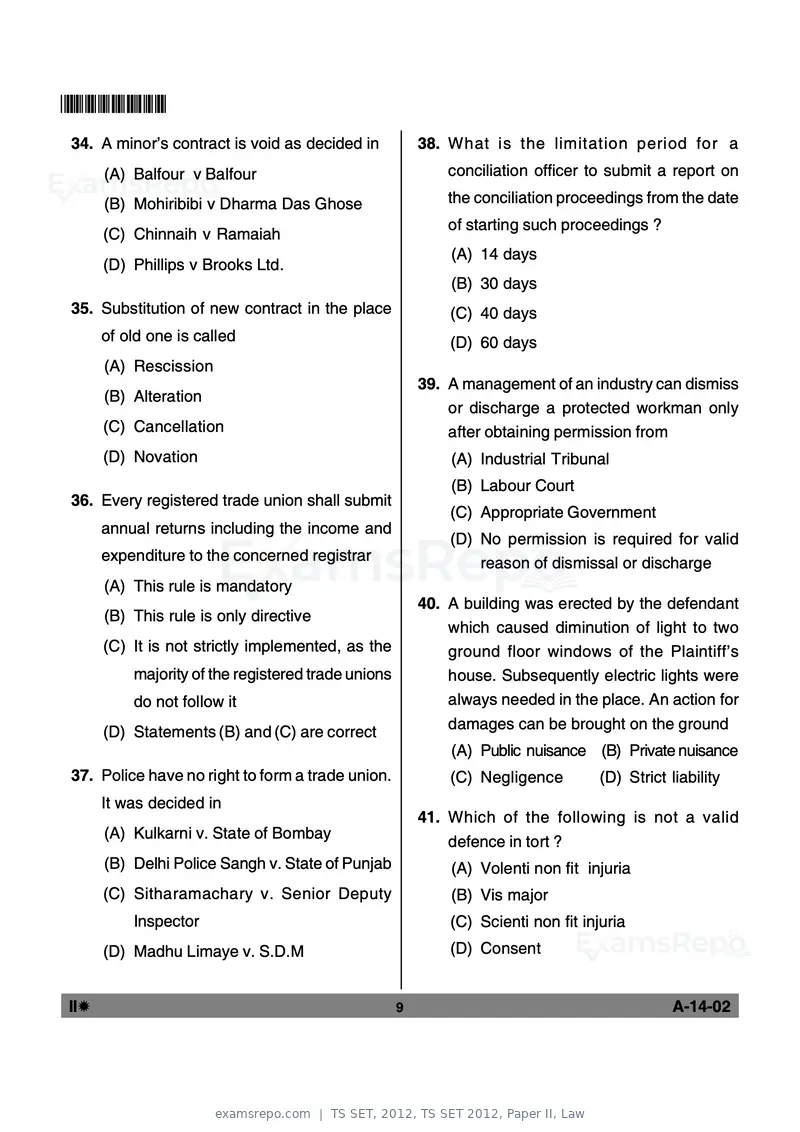
Text of page 9
*A1402*
34. A minor’s contract is void as decided in            38. What is the limitation period for a
      (A) Balfour v Balfour                                 conciliation officer to submit a report on

      (B) Mohiribibi v Dharma Das Ghose                     the conciliation proceedings from the date
                                                            of starting such proceedings ?
      (C) Chinnaih v Ramaiah
                                                            (A) 14 days
      (D) Phillips v Brooks Ltd.
                                                            (B) 30 days
35. Substitution of new contract in the place               (C) 40 days
      of old one is called                                  (D) 60 days
      (A) Rescission
                                                        39. A management of an industry can dismiss
      (B) Alteration
                                                            or discharge a protected workman only
      (C) Cancellation                                      after obtaining permission from
      (D) Novation                                          (A) Industrial Tribunal
                                                            (B) Labour Court
36. Every registered trade union shall submit
                                                            (C) Appropriate Government
      annual returns including the income and
                                                            (D) No permission is required for valid
      expenditure to the concerned registrar                    reason of dismissal or discharge
      (A) This rule is mandatory
                                                        40. A building was erected by the defendant
      (B) This rule is only directive
                                                            which caused diminution of light to two
      (C) It is not strictly implemented, as the            ground floor windows of the Plaintiff’s
          majority of the registered trade unions           house. Subsequently electric lights were
          do not follow it                                  always needed in the place. An action for
                                                            damages can be brought on the ground
      (D) Statements (B) and (C) are correct
                                                            (A) Public nuisance (B) Private nuisance
37. Police have no right to form a trade union.             (C) Negligence        (D) Strict liability
      It was decided in
                                                        41. Which of the following is not a valid
      (A) Kulkarni v. State of Bombay
                                                            defence in tort ?
      (B) Delhi Police Sangh v. State of Punjab             (A) Volenti non fit injuria
      (C) Sitharamachary v. Senior Deputy                   (B) Vis major
          Inspector                                         (C) Scienti non fit injuria
      (D) Madhu Limaye v. S.D.M                             (D) Consent


IIð                                                 9                                         A-14-02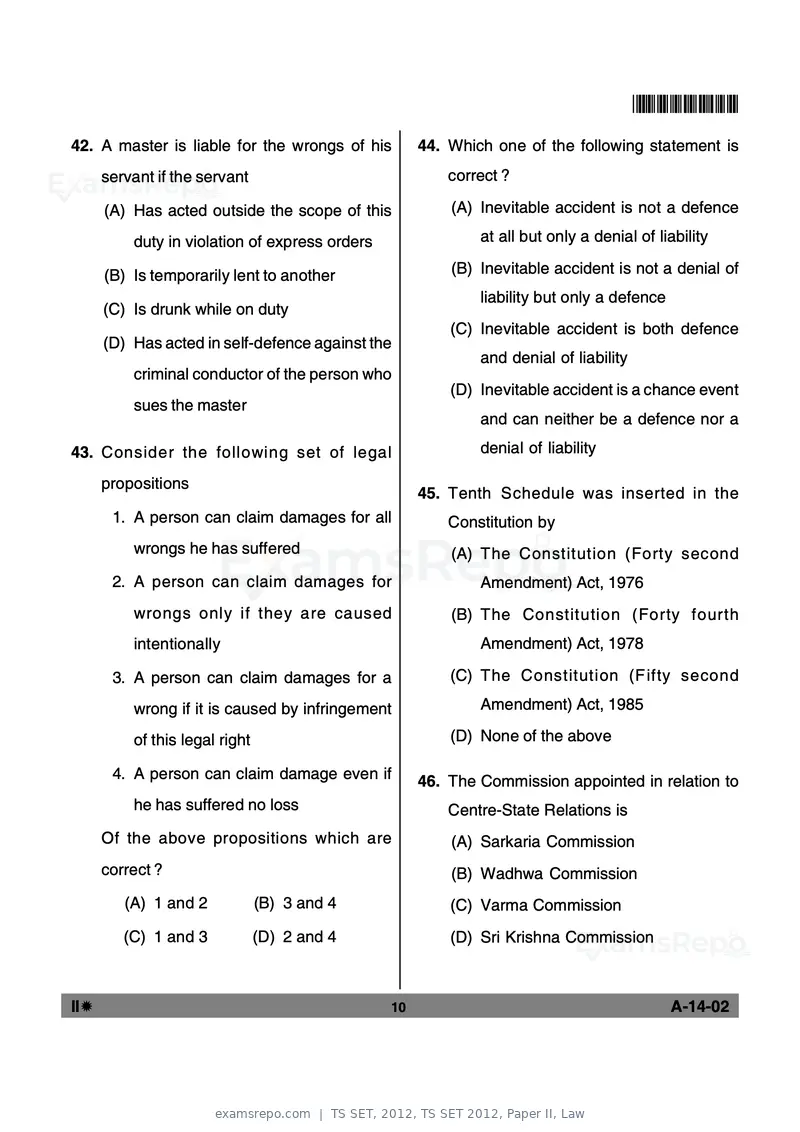
Text of page 10
*A1402*
42. A master is liable for the wrongs of his         44. Which one of the following statement is
      servant if the servant                             correct ?

      (A) Has acted outside the scope of this            (A) Inevitable accident is not a defence

          duty in violation of express orders                at all but only a denial of liability

      (B) Is temporarily lent to another                 (B) Inevitable accident is not a denial of
                                                             liability but only a defence
      (C) Is drunk while on duty
                                                         (C) Inevitable accident is both defence
      (D) Has acted in self-defence against the
                                                             and denial of liability
          criminal conductor of the person who
                                                         (D) Inevitable accident is a chance event
          sues the master
                                                             and can neither be a defence nor a

43. Consider the following set of legal                      denial of liability

      propositions
                                                     45. Tenth Schedule was inserted in the
       1. A person can claim damages for all             Constitution by
          wrongs he has suffered                         (A) The Constitution (Forty second
       2. A person can claim damages for                     Amendment) Act, 1976
          wrongs only if they are caused                 (B) The Constitution (Forty fourth
          intentionally                                      Amendment) Act, 1978

       3. A person can claim damages for a               (C) The Constitution (Fifty second

          wrong if it is caused by infringement              Amendment) Act, 1985

          of this legal right                            (D) None of the above

       4. A person can claim damage even if          46. The Commission appointed in relation to
          he has suffered no loss                        Centre-State Relations is
      Of the above propositions which are                (A) Sarkaria Commission
      correct ?                                          (B) Wadhwa Commission
         (A) 1 and 2            (B) 3 and 4              (C) Varma Commission
         (C) 1 and 3            (D) 2 and 4              (D) Sri Krishna Commission


IIð                                             10                                          A-14-02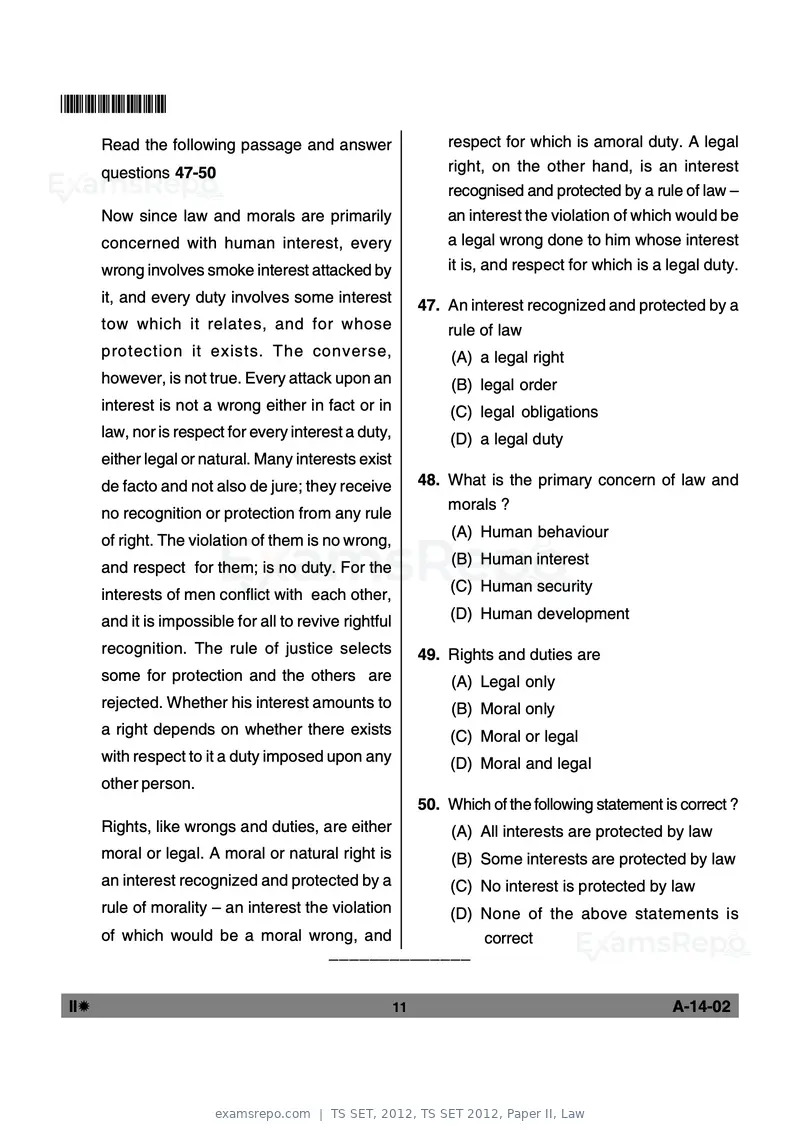
Text of page 11
*A1402*
      Read the following passage and answer                      respect for which is amoral duty. A legal
      questions 47-50                                            right, on the other hand, is an interest
                                                                 recognised and protected by a rule of law –
      Now since law and morals are primarily                     an interest the violation of which would be
      concerned with human interest, every                       a legal wrong done to him whose interest
      wrong involves smoke interest attacked by                  it is, and respect for which is a legal duty.

      it, and every duty involves some interest              47. An interest recognized and protected by a
      tow which it relates, and for whose                        rule of law
      protection it exists. The converse,                         (A) a legal right
      however, is not true. Every attack upon an                  (B) legal order
      interest is not a wrong either in fact or in               (C) legal obligations
      law, nor is respect for every interest a duty,             (D) a legal duty
      either legal or natural. Many interests exist
      de facto and not also de jure; they receive            48. What is the primary concern of law and
                                                                 morals ?
      no recognition or protection from any rule
                                                                  (A) Human behaviour
      of right. The violation of them is no wrong,
                                                                  (B) Human interest
      and respect for them; is no duty. For the
                                                                 (C) Human security
      interests of men conflict with each other,
      and it is impossible for all to revive rightful            (D) Human development

      recognition. The rule of justice selects               49. Rights and duties are
      some for protection and the others are                      (A) Legal only
      rejected. Whether his interest amounts to                   (B) Moral only
      a right depends on whether there exists                    (C) Moral or legal
      with respect to it a duty imposed upon any                 (D) Moral and legal
      other person.
                                                             50. Which of the following statement is correct ?
      Rights, like wrongs and duties, are either                  (A) All interests are protected by law
      moral or legal. A moral or natural right is                 (B) Some interests are protected by law
      an interest recognized and protected by a                  (C) No interest is protected by law
      rule of morality – an interest the violation               (D) None of the above statements is
      of which would be a moral wrong, and                             correct
                                          ––––––––––––––

IIð                                                     11                                         A-14-02
Text of page 12
*A1402*

      Space for Rough Work


IIð           12               A-14-02
Official key not published for this paper.
Page 1 of 12
Source: Telangana State Eligibility Test. Question paper published by Telangana State Eligibility Test.