
TS SET 2012: Paper II, Linguistics
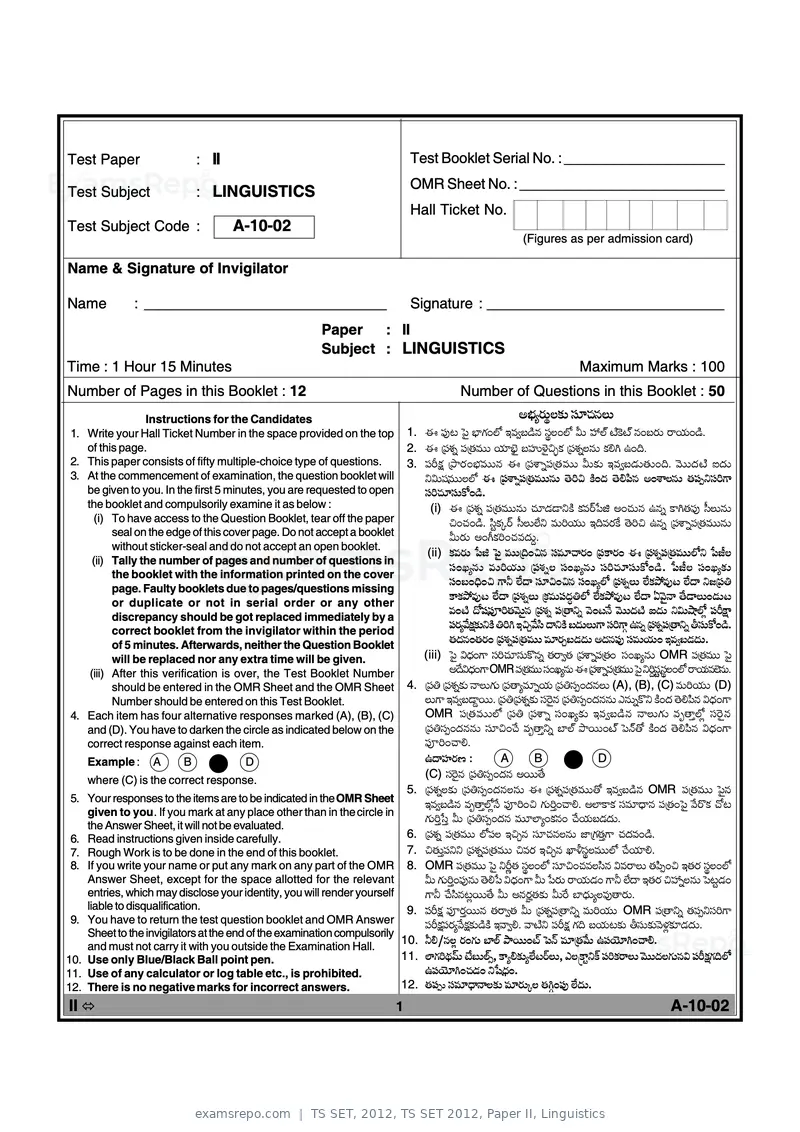
Text of page 1
Test Paper : II Test Booklet Serial No. : ______________________
OMR Sheet No. : ________________________________
Test Subject : LINGUISTICS
Hall Ticket No.
Test Subject Code : A-10-02
(Figures as per admission card)
Name & Signature of Invigilator
Name : ____________________________________ Signature : ___________________________________
Paper : II
Subject : LINGUISTICS
Time : 1 Hour 15 Minutes Maximum Marks : 100
Number of Pages in this Booklet : 12 Number of Questions in this Booklet : 50
Instructions for the Candidates A¿æýÅÆæÿ$¦ËMæü$ çÜ*^èþ¯èþË$
1. Write your Hall Ticket Number in the space provided on the top 1. D ç³#r ò³O ¿êVæü ÌZ CÐèþÓºyìþ¯èþ çÜ¦Ë ÌZ Ò$ çàÌý sìýMðüsý ¯èþ ºÆæÿ$ Æ>Äæý$ yìþ.
of this page. 2. D {ç³Ôèý² ç³{èþÐèþ$$ Äæý*¿ñýO ºçßý$âñýO_eMæü {ç³Ôèý²Ë¯èþ$ MæüÍW E ¨.
2. This paper consists of fifty multiple-choice type of questions. 3. ç³Èæü {´ëÆæÿ ¿æýÐèþ$$¯èþ D {ç³Ôé²ç³{èþÐèþ$$ Ò$Mæü$ CÐèþÓºyæþ$èþ$ ¨. Ððþ$$§æþsìý I§æþ$
3. At the commencement of examination, the question booklet will °Ñ$çÙÐèþ$$ËÌZ D {ç³Ôé²ç³{èþÐèþ$$¯èþ$ ðþÇ_ Mìü §æþ ðþÍí³¯èþ A Ôé˯èþ$ èþç³µ°çÜÇV>
be given to you. In the first 5 minutes, you are requested to open çÜÇ^èþ*çÜ$Mø yìþ.
the booklet and compulsorily examine it as below : (i) D {ç³Ôèý² ç³{èþÐèþ$$¯èþ$ ^èþ*yæþyé°Mìü MæüÐèþÆÿõ³h A ^èþ$¯èþ E¯èþ² M>Wèþç³# ïÜË$¯èþ$
(i) To have access to the Question Booklet, tear off the paper _ ^èþ yìþ. íÜtMæüPÆÿ ïÜË$Ìôý° Ðèþ$ÇÄæý$$ C¨ÐèþÆæÿMóü ðþÇ_ E¯èþ² {ç³Ôé²ç³{èþÐèþ$$¯èþ$
seal on the edge of this cover page. Do not accept a booklet Ò$Ææÿ$ A XMæüÇ ^èþÐèþ§æþ$ª.
without sticker-seal and do not accept an open booklet.
(ii) MæüÐèþÆæÿ$ õ³h ò³O Ðèþ$${¨ _¯èþ çÜÐèþ*^éÆæÿ {ç³M>Ææÿ D {ç³Ôèý²ç³{èþÐèþ$$ÌZ° õ³iË
(ii) Tally the number of pages and number of questions in
the booklet with the information printed on the cover
çÜ Qůèþ$ Ðèþ$ÇÄæý$$ {ç³Ôèý²Ë çÜ Qůèþ$ çÜÇ^èþ*çÜ$Mø yìþ. õ³iË çÜ QÅMæü$
page. Faulty booklets due to pages/questions missing
çÜ º «¨ _ V>± Ìôý§é çÜ*_ _¯èþ çÜ QÅÌZ {ç³Ôèý²Ë$ ÌôýMæü´ùÐèþ#r Ìôý§é °f{ç³
or duplicate or not in serial order or any other
M>Mæü´ùÐèþ#r Ìôý§é {ç³Ôèý²Ë$ {MæüÐèþ$糧æþ®ÌZ ÌôýMæü´ùÐèþ#r Ìôý§é HÐðþO¯é óþyéË$ yæþ$r
discrepancy should be got replaced immediately by a
Ðèþ sìý §øçÙç³NÇèþÐðþ$O¯èþ {ç³Ôèý² ç³{é°² Ððþ r¯óþ Ððþ$$§æþsìý I§æþ$ °Ñ$ÚëÌZÏ ç³È>
correct booklet from the invigilator within the period
ç³ÆæÿÅÐóþæüMæü$°Mìü ÇW C_aÐóþíÜ §é°Mìü º§æþ$Ë$V> çÜÇV>Y E¯èþ² {ç³Ôèý²ç³{é°² ¡çÜ$Mø yìþ.
of 5 minutes. Afterwards, neither the Question Booklet
èþ§æþ¯èþ èþÆæÿ {ç³Ôèý²ç³{èþÐèþ$$ Ðèþ*Ææÿaºyæþ§æþ$ A§æþ¯èþç³# çÜÐèþ$Äæý$ CÐèþÓºyæþ§æþ$.
will be replaced nor any extra time will be given. (iii) ò³O Ñ«§æþ V> çÜÇ^èþ*çÜ$Mö¯èþ² èþÆ>Óèþ {ç³Ôé²ç³{èþ çÜ Qůèþ$ OMR ç³{èþÐèþ$$ ò³O
(iii) After this verification is over, the Test Booklet Number A§óþÑ«§æþ V> OMR ç³{èþÐèþ$$ çÜ Qůèþ$ D {ç³Ôé²ç³{èþÐèþ$$ ò³O °ÇªçÙtt çÜ¦Ë ÌZ Æ>Äæý$ÐèþÌñý¯èþ$.
should be entered in the OMR Sheet and the OMR Sheet 4. {ç³ {ç³Ôèý²Mæü$ ¯éË$Væü$ {ç³éÅÐèþ*²Äæý$ {ç³çܵ §æþ¯èþË$ (A), (B), (C) Ðèþ$ÇÄæý$$ (D)
Number should be entered on this Test Booklet. Ë$V> CÐèþÓºyézÆÿ$$. {ç³{ç³Ôèý²Mæü$ çÜÆðÿO¯èþ {ç³çܵ §æþ¯èþ¯èþ$ G¯èþ$²Mö° Mìü §æþ ðþÍí³¯èþ Ñ«§æþ V>
4. Each item has four alternative responses marked (A), (B), (C) OMR ç³{èþÐèþ$$ÌZ {ç³ {ç³Ôé² çÜ QÅMæü$ CÐèþÓºyìþ¯èþ ¯éË$Væü$ Ðèþé¢ÌZÏ çÜÆðÿO¯èþ
and (D). You have to darken the circle as indicated below on the {ç³çܵ §æþ¯èþ¯èþ$ çÜ*_ ^óþ Ðèþ颰² »êÌý ´ëÆÿ$$ sý ò³¯þø Mìü §æþ ðþÍí³¯èþ Ñ«§æþ V>
correct response against each item. ç³NÇ ^éÍ.
Example : A B C D E§éçßýÆæÿ×ý : A B C D
(C) çÜÆðÿO¯èþ {ç³çܵ §æþ¯èþ AÆÿ$$óþ
where (C) is the correct response.
5. {ç³Ôèý²ËMæü$ {ç³çܵ §æþ¯èþ˯èþ$ D {ç³Ôèý²ç³{èþÐèþ$$ø CÐèþÓºyìþ¯èþ OMR ç³{èþÐèþ$$ ò³O¯èþ
5. Your responses to the items are to be indicated in the OMR Sheet
CÐèþÓºyìþ¯èþ Ðèþé¢ÌZϯóþ ç³NÇ _ Væü$Ç¢ ^éÍ. AÌêM>Mæü çÜÐèþ*«§é¯èþ ç³{èþ ò³O ÐóþÆöMæü ^ør
given to you. If you mark at any place other than in the circle in
the Answer Sheet, it will not be evaluated.
Væü$Ç¢õÜ¢ Ò$ {ç³çܵ §æþ¯èþ Ðèþ$*ÌêÅ Mæü¯èþ ^óþÄæý$ºyæþ§æþ$.
6. Read instructions given inside carefully. 6. {ç ³Ôèý² ç³{èþÐèþ$$ ÌZç³Ë C_a¯èþ çÜ*^èþ¯èþ˯èþ$ gê{Væüèþ¢V> ^èþ§æþÐèþ yìþ.
7. Rough Work is to be done in the end of this booklet. 7. _è þ$¢ç³°° {ç³Ôèý²ç³{èþÐèþ$$ _ÐèþÆæÿ C_a¯èþ RêäçܦËÐèþ$$ÌZ ^óþÄæý*Í.
8. If you write your name or put any mark on any part of the OMR 8. OMR ç³{èþÐèþ$$ ò³O °È~èþ çÜ¦Ë ÌZ çÜ*_ ^èþÐèþËíܯèþ ÑÐèþÆ>Ë$ èþí³µ _ CèþÆæÿ çÜ¦Ë ÌZ
Answer Sheet, except for the space allotted for the relevant Ò$ Væü$Ç¢ ç³#¯èþ$ ðþÍõ³ Ñ«§æþ V> Ò$ õ³Ææÿ$ Æ>Äæý$yæþ V>± Ìôý§é CèþÆæÿ _à²Ë¯èþ$ ò³rtyæþ
entries, which may disclose your identity, you will render yourself V>± ^óþíܯèþrÏÆÿ$$óþ Ò$ A¯èþÆæÿáèþMæü$ Ò$Æóÿ »ê«§æþ$ÅËÐèþ#éÆæÿ$.
liable to disqualification. 9. çç³Èæü ç³NÆæÿ¢Æÿ$$¯èþ èþÆ>Óèþ Ò$ {ç³Ôèý²ç³{é°² Ðèþ$ÇÄæý$$ OMR ç³{é°² èþç³µ°çÜÇV>
9. You have to return the test question booklet and OMR Answer ç³Èæüç³ÆæÿÅÐóþæüMæü$yìþMìü CÐéÓÍ. Ðésìý° ç³Èæü Væü¨ ºÄæý$rMæü$ ¡çÜ$Mæü$ÐðþâæýÏMæü*yæþ§æþ$.
Sheet to the invigilators at the end of the examination compulsorily
10. ±Í/¯èþËÏ Ææÿ Væü$ »êÌý ´ëÆÿ$$ sý ò³¯þ Ðèþ*{èþÐóþ$ Eç³Äñý*W ^éÍ.
and must not carry it with you outside the Examination Hall.
10. Use only Blue/Black Ball point pen. 11. ÌêVæüÇ£æþÐþ$ sôýº$ÌýÞ, M>ÅÍMæü$ÅÌôýrÆÿË$, GË[M>t°Mü ç³ÇMæüÆ>Ë$ Ððþ$$§æþËVæü$¯èþÑ ç³ÈæüVæü¨ÌZ
11. Use of any calculator or log table etc., is prohibited. Eç³Äñý*W ^èþyæþ °õÙ«§æþ .
12. There is no negative marks for incorrect answers. 12. èþç³ çÜÐèþ*«§é¯éËMæü$ Ðèþ*Ææÿ$PË èþWY ç³# Ìôý§æþ$.
II Ù 1 A-10-02
Text of page 2
*A1002*


IIÙ   2     A-10-02
Text of page 3
*A1002*
                                         LINGUISTICS

                                               Paper – II

 1. Cognates are                                             3. The study of sign systems is called
       (A) The words occurring in languages                      (A) Semiotics            (B) Anthropology
           belonging to different language
           families                                              (C) Linguistics          (D) Semantics
       (B) Phonetically similar words occurring
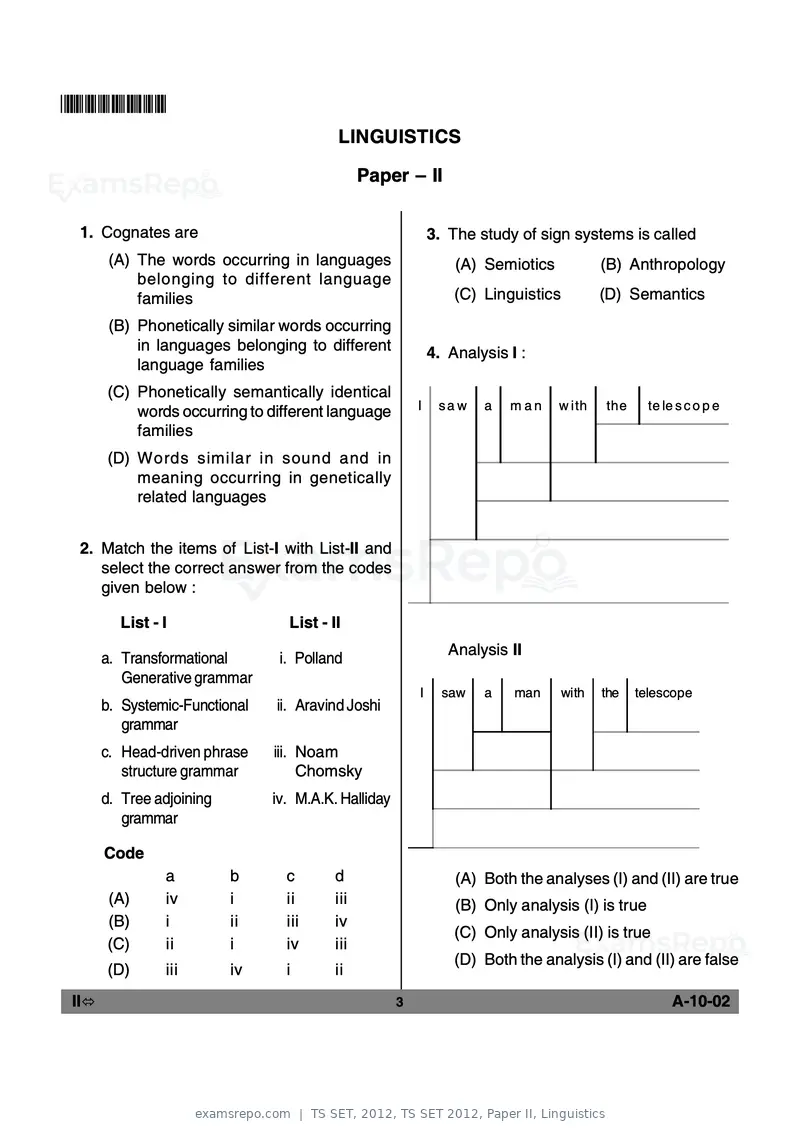
           in languages belonging to different               4. Analysis I :
           language families
      (C) Phonetically semantically identical
                                                         I    sa w   a   m an    w ith    the     te le s c o p e
          words occurring to different language
          families
      (D) Words similar in sound and in
          meaning occurring in genetically
          related languages


 2. Match the items of List-I with List-II and
    select the correct answer from the codes
    given below :

        List - I                 List - II
                                                                Analysis II
      a. Transformational       i. Polland
         Generative grammar
                                                         I     saw   a    man      with   the   telescope
      b. Systemic-Functional   ii. Aravind Joshi
         grammar
      c. Head-driven phrase    iii. Noam
         structure grammar          Chomsky
      d. Tree adjoining        iv. M.A.K. Halliday
         grammar

      Code
               a          b      c       d                       (A) Both the analyses (I) and (II) are true
      (A)      iv         i      ii      iii                     (B) Only analysis (I) is true
      (B)      i          ii     iii     iv
                                                                 (C) Only analysis (II) is true
      (C)      ii         i      iv      iii
                                                                 (D) Both the analysis (I) and (II) are false
      (D)      iii        iv     i       ii
IIÙ                                                  3                                                 A-10-02
Text of page 4
*A1002*
 5. Assertion (A) : [K] and [Kh] contrast with            7. [n] sound is syllabic in the word
                         each other in Telugu.                (A) Cartoon

      Assertion (B) : [K] and [K h ] are in                   (B) Ring
                      complementary distribution              (C) Button
                         in Telugu.                           (D) Badminton

       (A) (A) is true (B) is false
                                                          8. The relation between ‘signifier’ and
                                                             ‘signified’ is
       (B) (A) is false (B) is true
                                                              (A) Logical
      (C) Both (A) and (B) are true                           (B) Natural
                                                              (C) Conventional
      (D) Both (A) and (B) are false
                                                              (D) Biological

 6. Match the items of List-I with List-II and
                                                          9. Exocentric constructions are
      select the correct answer from the codes
                                                              (A) two headed
      given below :
                                                              (B) left-headed
        List - I                   List - II                  (C) single-headed

      a. Coda                     i. Historical               (D) right-headed
                                    Linguistics
                                                         10. Lines drawn on a map to identify the
      b. Back formation          ii. Semantics               phonological features of a language is
      c. Componential            iii. Morphology             called
         analysis                                             (A) Isophone
                                                              (B) Isotap
      d. Proto language          iv. Phonology
                                                              (C) Isolexes
      Code :                                                  (D) Isogloss
                   a       b          c        d
                                                         11. The larynx is composed of
       (A)         ii      iv         iii      i
                                                              (A) vocal cords
       (B)         i       ii         iv       iii            (B) glottis and trachea
                                                              (C) vocal cords that can vibrate along
      (C)          iv      iii        ii       i
                                                                  their entire length
      (D)          iii     i          ii       iv             (D) three main cartilages

IIÙ                                                  4                                           A-10-02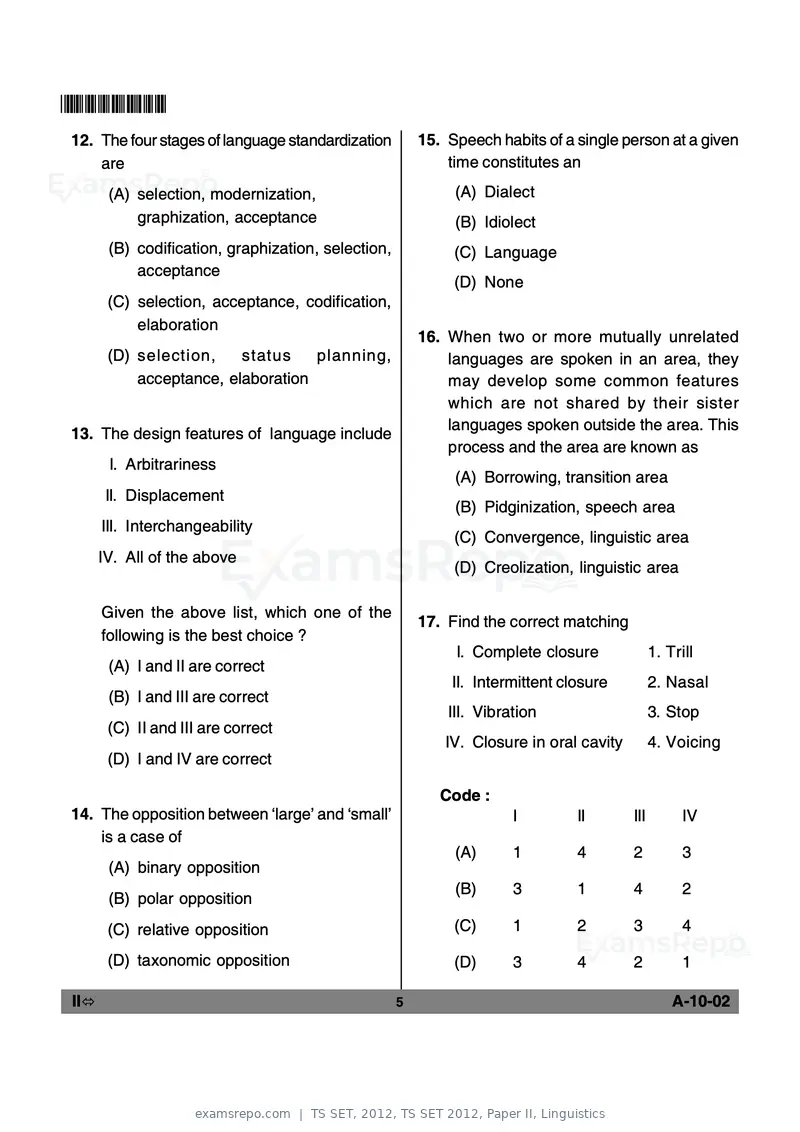
Text of page 5
*A1002*
12. The four stages of language standardization         15. Speech habits of a single person at a given
    are                                                     time constitutes an
       (A) selection, modernization,                         (A) Dialect
           graphization, acceptance                          (B) Idiolect
       (B) codification, graphization, selection,            (C) Language
           acceptance
                                                             (D) None
       (C) selection, acceptance, codification,
           elaboration
                                                        16. When two or more mutually unrelated
       (D) selection,    status    planning,                languages are spoken in an area, they
           acceptance, elaboration                          may develop some common features
                                                            which are not shared by their sister
                                                            languages spoken outside the area. This
13. The design features of language include
                                                            process and the area are known as
       I. Arbitrariness
                                                             (A) Borrowing, transition area
      II. Displacement
                                                             (B) Pidginization, speech area
      III. Interchangeability
                                                             (C) Convergence, linguistic area
      IV. All of the above
                                                             (D) Creolization, linguistic area

      Given the above list, which one of the
                                                        17. Find the correct matching
      following is the best choice ?
                                                             I. Complete closure               1. Trill
       (A) I and II are correct
                                                             II. Intermittent closure          2. Nasal
       (B) I and III are correct
                                                            III. Vibration                     3. Stop
       (C) II and III are correct
                                                            IV. Closure in oral cavity         4. Voicing
       (D) I and IV are correct

                                                           Code :
14. The opposition between ‘large’ and ‘small’                        I         II       III         IV
    is a case of
                                                             (A)      1         4        2           3
       (A) binary opposition
                                                             (B)      3         1        4           2
       (B) polar opposition
       (C) relative opposition                               (C)      1         2        3           4

       (D) taxonomic opposition                              (D)      3         4        2           1

IIÙ                                                 5                                              A-10-02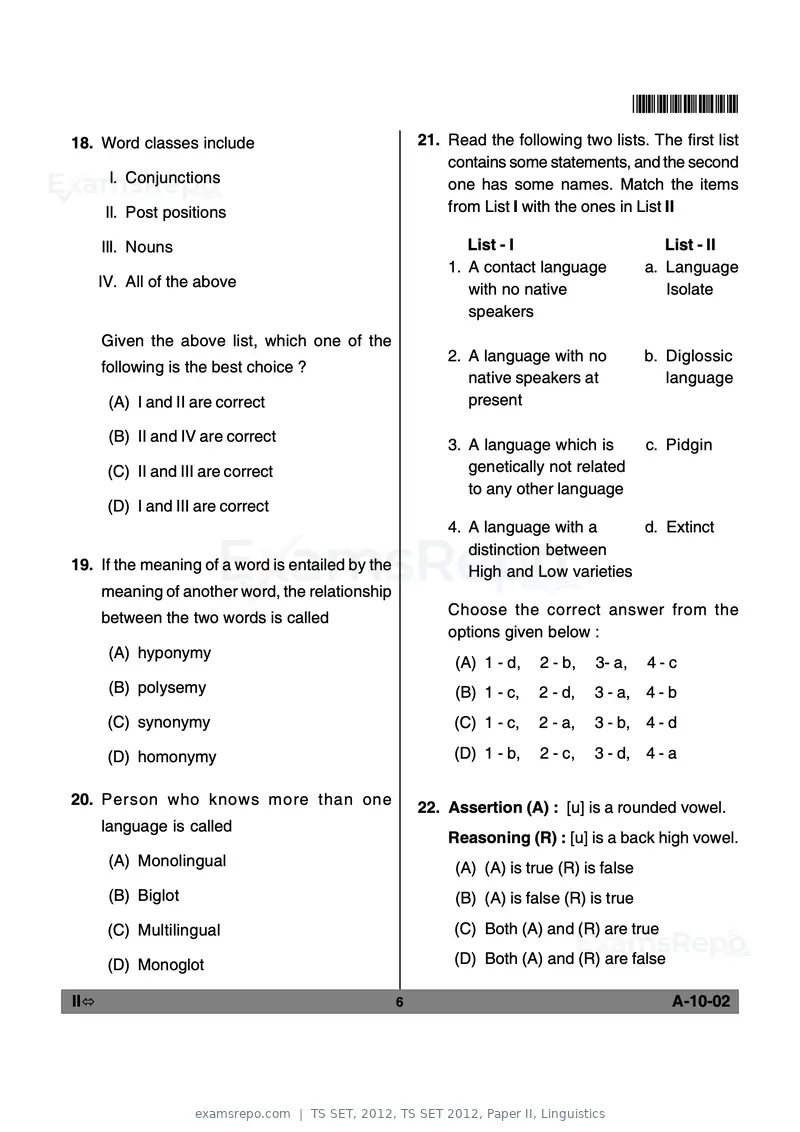
Text of page 6
*A1002*
18. Word classes include                              21. Read the following two lists. The first list
                                                          contains some statements, and the second
       I. Conjunctions                                    one has some names. Match the items
       II. Post positions                                 from List I with the ones in List II

      III. Nouns                                             List - I                        List - II
                                                          1. A contact language           a. Language
      IV. All of the above                                   with no native                  Isolate
                                                             speakers
      Given the above list, which one of the
                                                          2. A language with no           b. Diglossic
      following is the best choice ?
                                                             native speakers at              language
       (A) I and II are correct                              present

       (B) II and IV are correct
                                                          3. A language which is          c. Pidgin
       (C) II and III are correct                            genetically not related
                                                             to any other language
       (D) I and III are correct
                                                          4. A language with a      d. Extinct
                                                             distinction between
19. If the meaning of a word is entailed by the              High and Low varieties
      meaning of another word, the relationship
      between the two words is called                     Choose the correct answer from the
                                                          options given below :
       (A) hyponymy
                                                           (A) 1 - d,   2 - b,   3- a,    4-c
       (B) polysemy                                        (B) 1 - c,   2 - d,   3 - a, 4 - b
       (C) synonymy                                        (C) 1 - c,   2 - a,   3 - b, 4 - d

       (D) homonymy                                        (D) 1 - b,   2 - c,   3 - d, 4 - a

20. Person who knows more than one                    22. Assertion (A) : [u] is a rounded vowel.
      language is called
                                                          Reasoning (R) : [u] is a back high vowel.
       (A) Monolingual                                     (A) (A) is true (R) is false
       (B) Biglot                                          (B) (A) is false (R) is true
       (C) Multilingual                                    (C) Both (A) and (R) are true

       (D) Monoglot                                        (D) Both (A) and (R) are false

IIÙ                                               6                                          A-10-02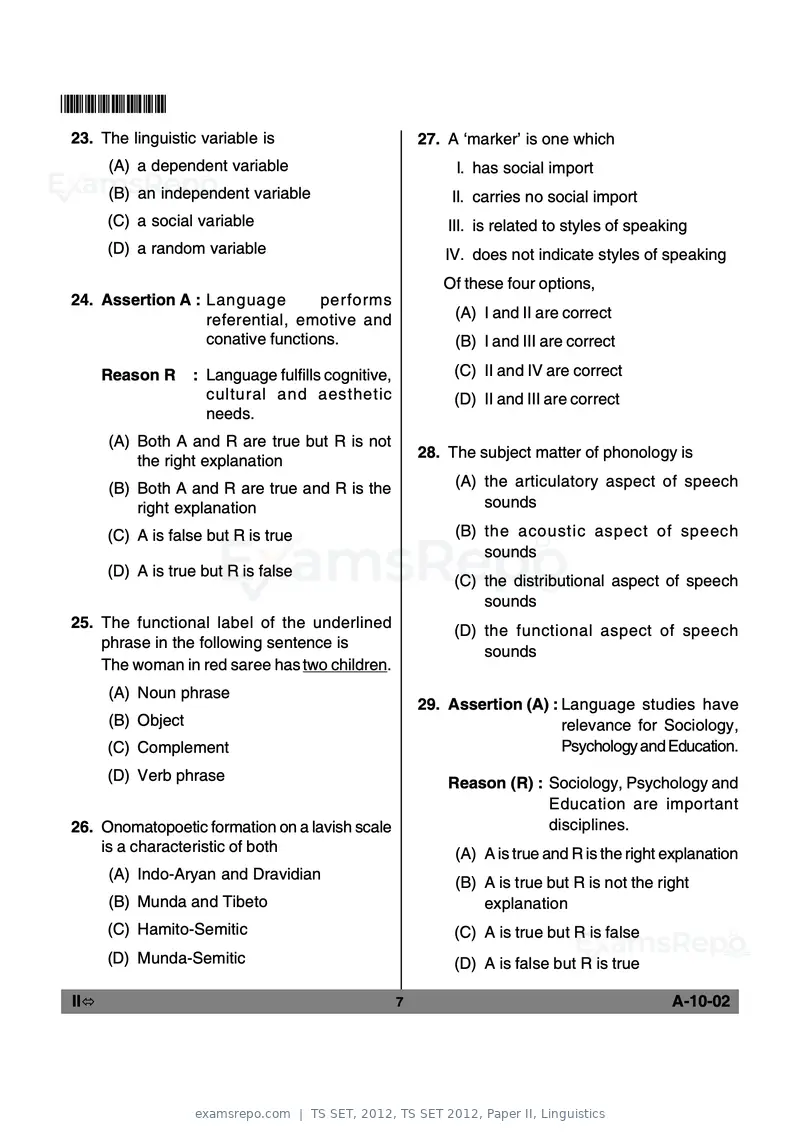
Text of page 7
*A1002*
23. The linguistic variable is                          27. A ‘marker’ is one which
      (A) a dependent variable                               I. has social import
      (B) an independent variable                           II. carries no social import
      (C) a social variable                                 III. is related to styles of speaking
      (D) a random variable                                IV. does not indicate styles of speaking
                                                           Of these four options,
24. Assertion A : Language        performs
                  referential, emotive and                   (A) I and II are correct
                  conative functions.                        (B) I and III are correct

      Reason R     : Language fulfills cognitive,            (C) II and IV are correct
                     cultural and aesthetic                  (D) II and III are correct
                     needs.
      (A) Both A and R are true but R is not
                                                        28. The subject matter of phonology is
          the right explanation
      (B) Both A and R are true and R is the                 (A) the articulatory aspect of speech
          right explanation                                      sounds

      (C) A is false but R is true                           (B) the acoustic aspect of speech
                                                                 sounds
      (D) A is true but R is false
                                                             (C) the distributional aspect of speech
                                                                 sounds
25. The functional label of the underlined                   (D) the functional aspect of speech
    phrase in the following sentence is
                                                                 sounds
    The woman in red saree has two children.
      (A) Noun phrase
                                                        29. Assertion (A) : Language studies have
      (B) Object                                                            relevance for Sociology,
      (C) Complement                                                        Psychology and Education.
      (D) Verb phrase                                       Reason (R) : Sociology, Psychology and
                                                                         Education are important
26. Onomatopoetic formation on a lavish scale                            disciplines.
    is a characteristic of both                              (A) A is true and R is the right explanation
      (A) Indo-Aryan and Dravidian
                                                             (B) A is true but R is not the right
      (B) Munda and Tibeto                                       explanation
      (C) Hamito-Semitic                                     (C) A is true but R is false
      (D) Munda-Semitic                                      (D) A is false but R is true

IIÙ                                                 7                                         A-10-02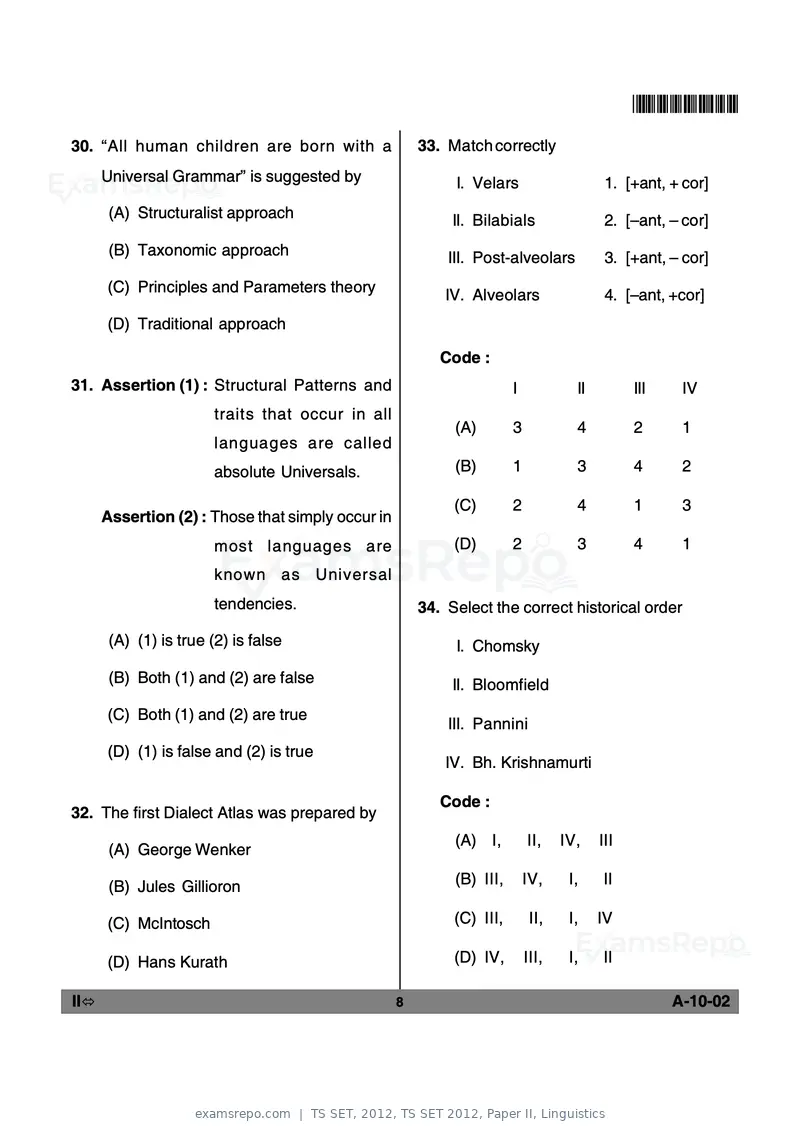
Text of page 8
*A1002*

30. “All human children are born with a                33. Match correctly
      Universal Grammar” is suggested by                    I. Velars                     1. [+ant, + cor]
       (A) Structuralist approach                           II. Bilabials                 2. [–ant, – cor]
       (B) Taxonomic approach                              III. Post-alveolars            3. [+ant, – cor]
      (C) Principles and Parameters theory                 IV. Alveolars                  4. [–ant, +cor]
      (D) Traditional approach

                                                          Code :
31. Assertion (1) : Structural Patterns and                            I            II         III    IV
                        traits that occur in all
                                                            (A)        3            4          2      1
                        languages are called
                        absolute Universals.                (B)        1            3          4      2

                                                            (C)        2            4          1      3
      Assertion (2) : Those that simply occur in
                        most languages are                  (D)        2            3          4      1
                        known as Universal
                        tendencies.                    34. Select the correct historical order

       (A) (1) is true (2) is false                         I. Chomsky
       (B) Both (1) and (2) are false                       II. Bloomfield
      (C) Both (1) and (2) are true
                                                           III. Pannini
      (D) (1) is false and (2) is true
                                                           IV. Bh. Krishnamurti

                                                          Code :
32. The first Dialect Atlas was prepared by
                                                            (A) I,         II,    IV,    III
       (A) George Wenker

       (B) Jules Gillioron                                  (B) III,       IV,     I,    II

      (C) McIntosch                                         (C) III,        II,    I,    IV

      (D) Hans Kurath                                       (D) IV,        III,    I,    II

IIÙ                                                8                                                 A-10-02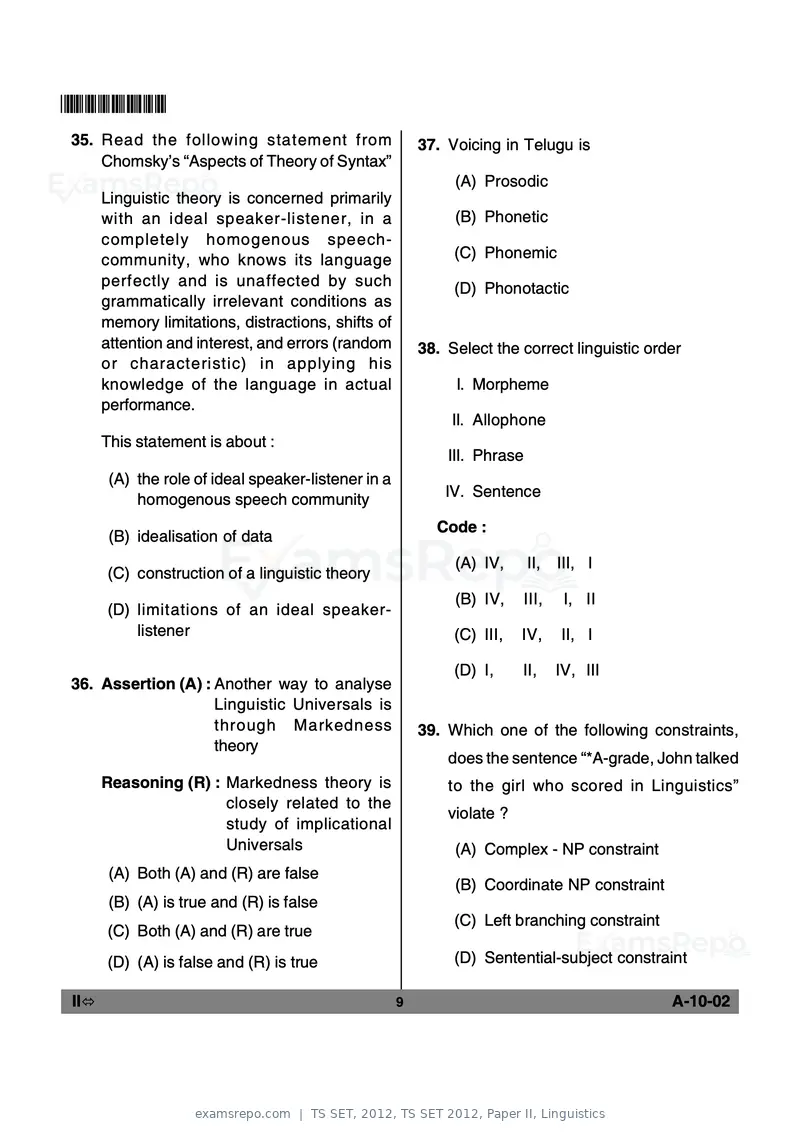
Text of page 9
*A1002*
35. Read the following statement from                    37. Voicing in Telugu is
    Chomsky’s “Aspects of Theory of Syntax”
                                                              (A) Prosodic
      Linguistic theory is concerned primarily
      with an ideal speaker-listener, in a                    (B) Phonetic
      completely homogenous speech-
      community, who knows its language                       (C) Phonemic
      perfectly and is unaffected by such                     (D) Phonotactic
      grammatically irrelevant conditions as
      memory limitations, distractions, shifts of
      attention and interest, and errors (random         38. Select the correct linguistic order
      or characteristic) in applying his
      knowledge of the language in actual                     I. Morpheme
      performance.
                                                              II. Allophone
      This statement is about :
                                                             III. Phrase
       (A) the role of ideal speaker-listener in a
                                                             IV. Sentence
           homogenous speech community
                                                           Code :
       (B) idealisation of data
                                                              (A) IV,      II,   III, I
      (C) construction of a linguistic theory
                                                              (B) IV,    III,     I, II
      (D) limitations of an ideal speaker-
          listener                                            (C) III,   IV,     II, I

                                                              (D) I,     II,     IV, III
36. Assertion (A) : Another way to analyse
                    Linguistic Universals is
                    through Markedness                   39. Which one of the following constraints,
                    theory
                                                             does the sentence “*A-grade, John talked
      Reasoning (R) : Markedness theory is                   to the girl who scored in Linguistics”
                      closely related to the
                                                             violate ?
                      study of implicational
                      Universals                              (A) Complex - NP constraint
       (A) Both (A) and (R) are false
                                                              (B) Coordinate NP constraint
       (B) (A) is true and (R) is false
                                                              (C) Left branching constraint
      (C) Both (A) and (R) are true
      (D) (A) is false and (R) is true                        (D) Sentential-subject constraint

IIÙ                                                  9                                        A-10-02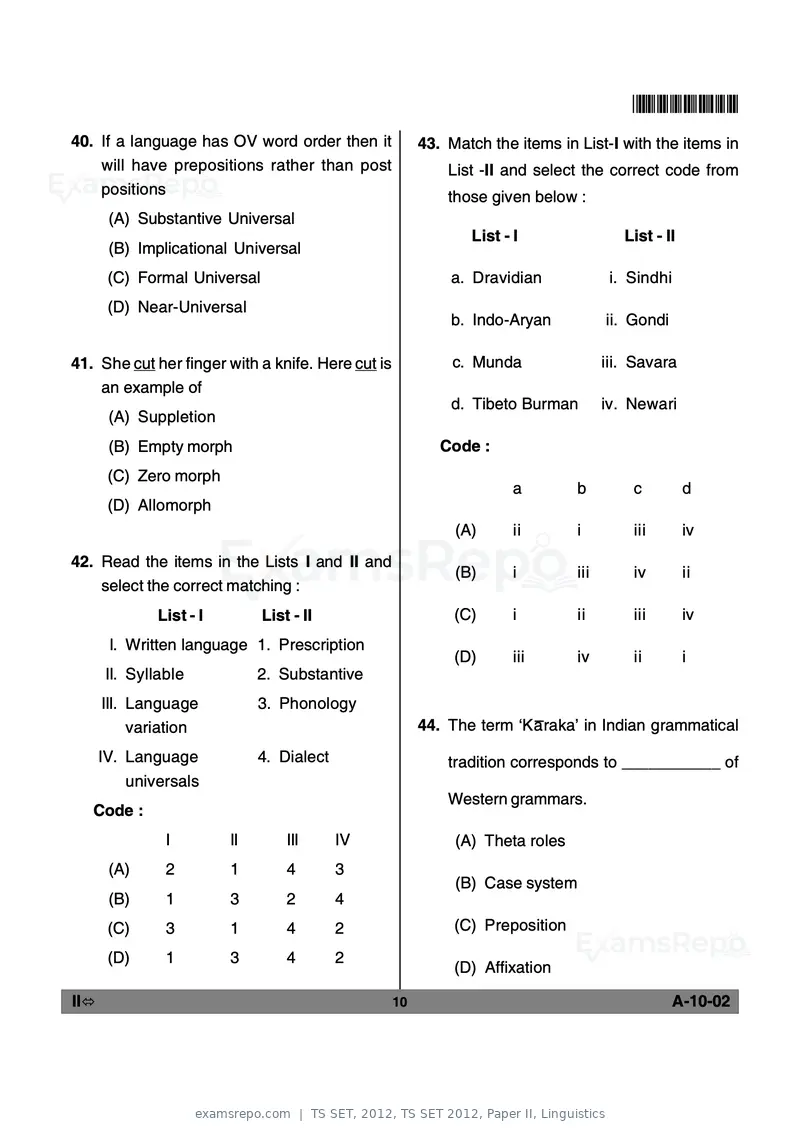
Text of page 10
*A1002*
40. If a language has OV word order then it             43. Match the items in List-I with the items in
    will have prepositions rather than post                 List -II and select the correct code from
    positions                                               those given below :
       (A) Substantive Universal
                                                               List - I                 List - II
       (B) Implicational Universal
       (C) Formal Universal                                 a. Dravidian              i. Sindhi
       (D) Near-Universal
                                                            b. Indo-Aryan            ii. Gondi

41. She cut her finger with a knife. Here cut is             c. Munda                iii. Savara
    an example of
                                                            d. Tibeto Burman         iv. Newari
       (A) Suppletion
       (B) Empty morph                                     Code :
       (C) Zero morph
                                                                      a        b         c          d
       (D) Allomorph
                                                             (A)      ii       i         iii        iv
42. Read the items in the Lists I and II and
                                                             (B)      i        iii       iv         ii
    select the correct matching :
              List - I        List - II                      (C)      i        ii        iii        iv
       I. Written language 1. Prescription
                                                             (D)      iii      iv        ii         i
      II. Syllable            2. Substantive
      III. Language           3. Phonology
           variation                                    44. The term ‘Ka–raka’ in Indian grammatical
      IV. Language            4. Dialect                    tradition corresponds to ___________ of
          universals
                                                            Western grammars.
   Code :
               I         II       III      IV                (A) Theta roles
       (A)     2         1        4        3
                                                             (B) Case system
       (B)     1         3        2        4
       (C)     3         1        4        2                 (C) Preposition

       (D)     1         3        4        2
                                                             (D) Affixation

IIÙ                                                10                                             A-10-02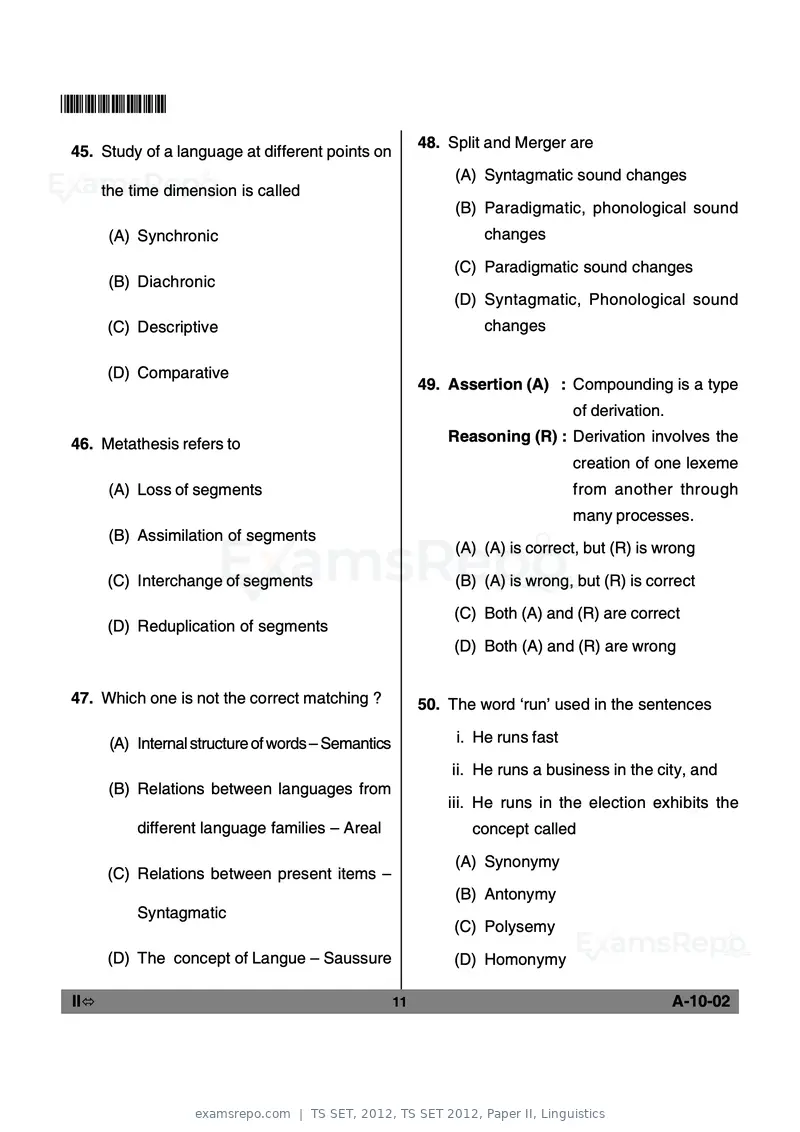
Text of page 11
*A1002*
                                                          48. Split and Merger are
45. Study of a language at different points on
                                                               (A) Syntagmatic sound changes
      the time dimension is called
                                                               (B) Paradigmatic, phonological sound
       (A) Synchronic                                              changes

                                                              (C) Paradigmatic sound changes
       (B) Diachronic
                                                              (D) Syntagmatic, Phonological sound
      (C) Descriptive                                              changes

      (D) Comparative
                                                          49. Assertion (A) : Compounding is a type
                                                                                 of derivation.

46. Metathesis refers to                                      Reasoning (R) : Derivation involves the
                                                                                 creation of one lexeme
       (A) Loss of segments                                                      from another through
                                                                                 many processes.
       (B) Assimilation of segments
                                                               (A) (A) is correct, but (R) is wrong

      (C) Interchange of segments                              (B) (A) is wrong, but (R) is correct

                                                              (C) Both (A) and (R) are correct
      (D) Reduplication of segments
                                                              (D) Both (A) and (R) are wrong


47. Which one is not the correct matching ?               50. The word ‘run’ used in the sentences

       (A) Internal structure of words – Semantics             i. He runs fast

                                                              ii. He runs a business in the city, and
       (B) Relations between languages from
                                                              iii. He runs in the election exhibits the
           different language families – Areal                   concept called

                                                               (A) Synonymy
      (C) Relations between present items –
                                                               (B) Antonymy
           Syntagmatic
                                                              (C) Polysemy
      (D) The concept of Langue – Saussure                    (D) Homonymy

IIÙ                                                  11                                           A-10-02
Text of page 12
*A1002*
      Space for Rough Work


IIÙ            12              A-10-02
Official key not published for this paper.
Page 1 of 12
Source: Telangana State Eligibility Test. Question paper published by Telangana State Eligibility Test.