
TS SET 2012: Paper II, Mathematical Sciences
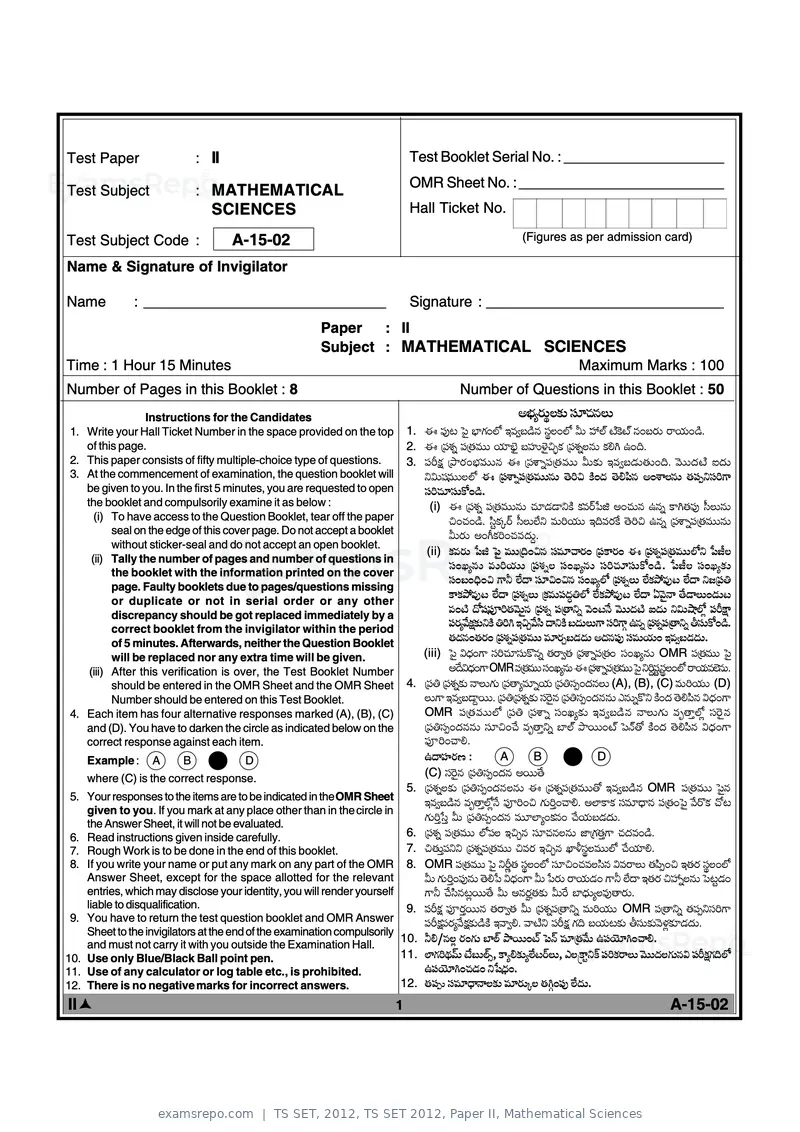
Text of page 1
Test Paper : II Test Booklet Serial No. : ______________________
OMR Sheet No. : ________________________________
Test Subject : MATHEMATICAL
SCIENCES Hall Ticket No.
Test Subject Code : A-15-02 (Figures as per admission card)
Name & Signature of Invigilator
Name : ____________________________________ Signature : ___________________________________
Paper : II
Subject : MATHEMATICAL SCIENCES
Time : 1 Hour 15 Minutes Maximum Marks : 100
Number of Pages in this Booklet : 8 Number of Questions in this Booklet : 50
Instructions for the Candidates A¿æýÅÆæÿ$¦ËMæü$ çÜ*^èþ¯èþË$
1. Write your Hall Ticket Number in the space provided on the top 1. D ç³#r ò³O ¿êVæü ÌZ CÐèþÓºyìþ¯èþ çÜ¦Ë ÌZ Ò$ çàÌý sìýMðüsý ¯èþ ºÆæÿ$ Æ>Äæý$ yìþ.
of this page. 2. D {ç³Ôèý² ç³{èþÐèþ$$ Äæý*¿ñýO ºçßý$âñýO_eMæü {ç³Ôèý²Ë¯èþ$ MæüÍW E ¨.
2. This paper consists of fifty multiple-choice type of questions. 3. ç³Èæü {´ëÆæÿ ¿æýÐèþ$$¯èþ D {ç³Ôé²ç³{èþÐèþ$$ Ò$Mæü$ CÐèþÓºyæþ$èþ$ ¨. Ððþ$$§æþsìý I§æþ$
3. At the commencement of examination, the question booklet will °Ñ$çÙÐèþ$$ËÌZ D {ç³Ôé²ç³{èþÐèþ$$¯èþ$ ðþÇ_ Mìü §æþ ðþÍí³¯èþ A Ôé˯èþ$ èþç³µ°çÜÇV>
be given to you. In the first 5 minutes, you are requested to open çÜÇ^èþ*çÜ$Mø yìþ.
the booklet and compulsorily examine it as below : (i) D {ç³Ôèý² ç³{èþÐèþ$$¯èþ$ ^èþ*yæþyé°Mìü MæüÐèþÆÿõ³h A ^èþ$¯èþ E¯èþ² M>Wèþç³# ïÜË$¯èþ$
(i) To have access to the Question Booklet, tear off the paper _ ^èþ yìþ. íÜtMæüPÆÿ ïÜË$Ìôý° Ðèþ$ÇÄæý$$ C¨ÐèþÆæÿMóü ðþÇ_ E¯èþ² {ç³Ôé²ç³{èþÐèþ$$¯èþ$
seal on the edge of this cover page. Do not accept a booklet Ò$Ææÿ$ A XMæüÇ ^èþÐèþ§æþ$ª.
without sticker-seal and do not accept an open booklet.
(ii) MæüÐèþÆæÿ$ õ³h ò³O Ðèþ$${¨ _¯èþ çÜÐèþ*^éÆæÿ {ç³M>Ææÿ D {ç³Ôèý²ç³{èþÐèþ$$ÌZ° õ³iË
(ii) Tally the number of pages and number of questions in
the booklet with the information printed on the cover
çÜ Qůèþ$ Ðèþ$ÇÄæý$$ {ç³Ôèý²Ë çÜ Qůèþ$ çÜÇ^èþ*çÜ$Mø yìþ. õ³iË çÜ QÅMæü$
page. Faulty booklets due to pages/questions missing
çÜ º «¨ _ V>± Ìôý§é çÜ*_ _¯èþ çÜ QÅÌZ {ç³Ôèý²Ë$ ÌôýMæü´ùÐèþ#r Ìôý§é °f{ç³
or duplicate or not in serial order or any other
M>Mæü´ùÐèþ#r Ìôý§é {ç³Ôèý²Ë$ {MæüÐèþ$糧æþ®ÌZ ÌôýMæü´ùÐèþ#r Ìôý§é HÐðþO¯é óþyéË$ yæþ$r
discrepancy should be got replaced immediately by a
Ðèþ sìý §øçÙç³NÇèþÐðþ$O¯èþ {ç³Ôèý² ç³{é°² Ððþ r¯óþ Ððþ$$§æþsìý I§æþ$ °Ñ$ÚëÌZÏ ç³È>
correct booklet from the invigilator within the period
ç³ÆæÿÅÐóþæüMæü$°Mìü ÇW C_aÐóþíÜ §é°Mìü º§æþ$Ë$V> çÜÇV>Y E¯èþ² {ç³Ôèý²ç³{é°² ¡çÜ$Mø yìþ.
of 5 minutes. Afterwards, neither the Question Booklet
èþ§æþ¯èþ èþÆæÿ {ç³Ôèý²ç³{èþÐèþ$$ Ðèþ*Ææÿaºyæþ§æþ$ A§æþ¯èþç³# çÜÐèþ$Äæý$ CÐèþÓºyæþ§æþ$.
will be replaced nor any extra time will be given. (iii) ò³O Ñ«§æþ V> çÜÇ^èþ*çÜ$Mö¯èþ² èþÆ>Óèþ {ç³Ôé²ç³{èþ çÜ Qůèþ$ OMR ç³{èþÐèþ$$ ò³O
(iii) After this verification is over, the Test Booklet Number A§óþÑ«§æþ V> OMR ç³{èþÐèþ$$ çÜ Qůèþ$ D {ç³Ôé²ç³{èþÐèþ$$ ò³O °ÇªçÙtt çÜ¦Ë ÌZ Æ>Äæý$ÐèþÌñý¯èþ$.
should be entered in the OMR Sheet and the OMR Sheet 4. {ç³ {ç³Ôèý²Mæü$ ¯éË$Væü$ {ç³éÅÐèþ*²Äæý$ {ç³çܵ §æþ¯èþË$ (A), (B), (C) Ðèþ$ÇÄæý$$ (D)
Number should be entered on this Test Booklet. Ë$V> CÐèþÓºyézÆÿ$$. {ç³{ç³Ôèý²Mæü$ çÜÆðÿO¯èþ {ç³çܵ §æþ¯èþ¯èþ$ G¯èþ$²Mö° Mìü §æþ ðþÍí³¯èþ Ñ«§æþ V>
4. Each item has four alternative responses marked (A), (B), (C) OMR ç³{èþÐèþ$$ÌZ {ç³ {ç³Ôé² çÜ QÅMæü$ CÐèþÓºyìþ¯èþ ¯éË$Væü$ Ðèþé¢ÌZÏ çÜÆðÿO¯èþ
and (D). You have to darken the circle as indicated below on the {ç³çܵ §æþ¯èþ¯èþ$ çÜ*_ ^óþ Ðèþ颰² »êÌý ´ëÆÿ$$ sý ò³¯þø Mìü §æþ ðþÍí³¯èþ Ñ«§æþ V>
correct response against each item. ç³NÇ ^éÍ.
Example : A B C D E§éçßýÆæÿ×ý : A B C D
(C) çÜÆðÿO¯èþ {ç³çܵ §æþ¯èþ AÆÿ$$óþ
where (C) is the correct response.
5. {ç³Ôèý²ËMæü$ {ç³çܵ §æþ¯èþ˯èþ$ D {ç³Ôèý²ç³{èþÐèþ$$ø CÐèþÓºyìþ¯èþ OMR ç³{èþÐèþ$$ ò³O¯èþ
5. Your responses to the items are to be indicated in the OMR Sheet
CÐèþÓºyìþ¯èþ Ðèþé¢ÌZϯóþ ç³NÇ _ Væü$Ç¢ ^éÍ. AÌêM>Mæü çÜÐèþ*«§é¯èþ ç³{èþ ò³O ÐóþÆöMæü ^ør
given to you. If you mark at any place other than in the circle in
the Answer Sheet, it will not be evaluated.
Væü$Ç¢õÜ¢ Ò$ {ç³çܵ §æþ¯èþ Ðèþ$*ÌêÅ Mæü¯èþ ^óþÄæý$ºyæþ§æþ$.
6. Read instructions given inside carefully. 6. {ç ³Ôèý² ç³{èþÐèþ$$ ÌZç³Ë C_a¯èþ çÜ*^èþ¯èþ˯èþ$ gê{Væüèþ¢V> ^èþ§æþÐèþ yìþ.
7. Rough Work is to be done in the end of this booklet. 7. _èþ$¢ç³°° {ç³Ôèý²ç³{èþÐèþ$$ _ÐèþÆæÿ C_a¯èþ RêäçܦËÐèþ$$ÌZ ^óþÄæý*Í.
8. If you write your name or put any mark on any part of the OMR 8. OMR ç³{èþÐèþ$$ ò³O °È~èþ çÜ¦Ë ÌZ çÜ*_ ^èþÐèþËíܯèþ ÑÐèþÆ>Ë$ èþí³µ _ CèþÆæÿ çÜ¦Ë ÌZ
Answer Sheet, except for the space allotted for the relevant Ò$ Væü$Ç¢ ç³#¯èþ$ ðþÍõ³ Ñ«§æþ V> Ò$ õ³Ææÿ$ Æ>Äæý$yæþ V>± Ìôý§é CèþÆæÿ _à²Ë¯èþ$ ò³rtyæþ
entries, which may disclose your identity, you will render yourself V>± ^óþíܯèþrÏÆÿ$$óþ Ò$ A¯èþÆæÿáèþMæü$ Ò$Æóÿ »ê«§æþ$ÅËÐèþ#éÆæÿ$.
liable to disqualification. 9. çç³Èæü ç³NÆæÿ¢Æÿ$$¯èþ èþÆ>Óèþ Ò$ {ç³Ôèý²ç³{é°² Ðèþ$ÇÄæý$$ OMR ç³{é°² èþç³µ°çÜÇV>
9. You have to return the test question booklet and OMR Answer ç³Èæüç³ÆæÿÅÐóþæüMæü$yìþMìü CÐéÓÍ. Ðésìý° ç³Èæü Væü¨ ºÄæý$rMæü$ ¡çÜ$Mæü$ÐðþâæýÏMæü*yæþ§æþ$.
Sheet to the invigilators at the end of the examination compulsorily
10. ±Í/¯èþËÏ Ææÿ Væü$ »êÌý ´ëÆÿ$$ sý ò³¯þ Ðèþ*{èþÐóþ$ Eç³Äñý*W ^éÍ.
and must not carry it with you outside the Examination Hall.
10. Use only Blue/Black Ball point pen. 11. ÌêVæüÇ£æþÐþ$ sôýº$ÌýÞ, M>ÅÍMæü$ÅÌôýrÆÿË$, GË[M>t°Mü ç³ÇMæüÆ>Ë$ Ððþ$$§æþËVæü$¯èþÑ ç³ÈæüVæü¨ÌZ
11. Use of any calculator or log table etc., is prohibited. Eç³Äñý*W ^èþyæþ °õÙ«§æþ .
12. There is no negative marks for incorrect answers. 12. èþç³ çÜÐèþ*«§é¯éËMæü$ Ðèþ*Ææÿ$PË èþWY ç³# Ìôý§æþ$.
IIæ 1 A-15-02
Text of page 2
*A1303*


IIæ   2     A-15-02
Text of page 3
*A1303*
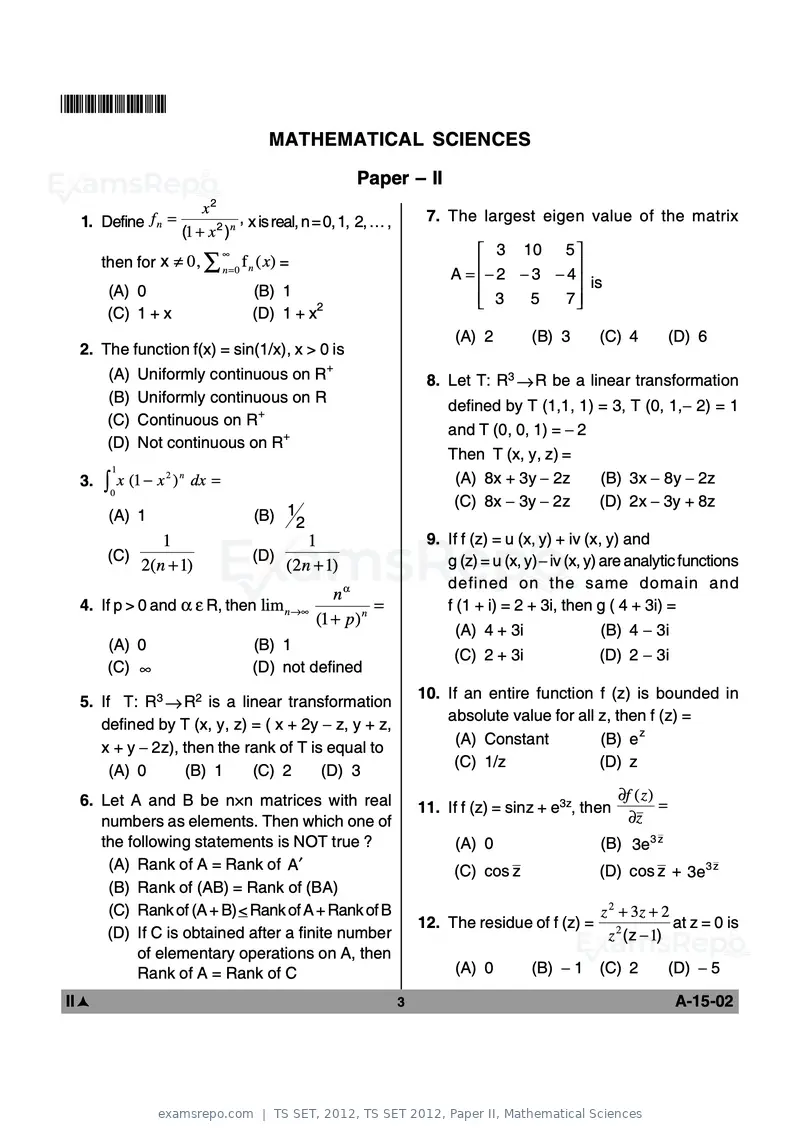
                                     MATHEMATICAL SCIENCES

                                                      Paper – II
                        x2                                           7. The largest eigen value of the matrix
 1. Define f n =                , x is real, n = 0, 1, 2, … ,
                    (1 + x 2 )n
                            ∞                                                 ⎡ 3 10 5 ⎤
      then for x ≠ 0, ∑ n = 0 f n ( x) =
                                                                         A = ⎢⎢ − 2 − 3 − 4⎥⎥
                                                                                               is
       (A) 0                     (B) 1                                        ⎢⎣ 3    5   7 ⎥⎦
       (C) 1 + x                 (D) 1 + x2
                                                                          (A) 2        (B) 3      (C) 4            (D) 6
 2. The function f(x) = sin(1/x), x > 0 is
       (A) Uniformly continuous on R+                                8. Let T: R3 → R be a linear transformation
       (B) Uniformly continuous on R
                                                                        defined by T (1,1, 1) = 3, T (0, 1,− 2) = 1
       (C) Continuous on R+
                                                                        and T (0, 0, 1) = − 2
       (D) Not continuous on R+
                                                                        Then T (x, y, z) =
       1
 3. ∫ x (1 − x 2 ) n dx =                                                (A) 8x + 3y − 2z     (B) 3x − 8y − 2z
       0
                                                                         (C) 8x − 3y − 2z     (D) 2x − 3y + 8z
       (A) 1                      (B) 12
                 1                          1                        9. If f (z) = u (x, y) + iv (x, y) and
       (C)                       (D)                                    g (z) = u (x, y) − iv (x, y) are analytic functions
             2( n + 1)                  ( 2n + 1)
                                                                        defined on the same domain and
                                                 nα
 4. If p > 0 and α ε R, then lim n→∞                     =              f (1 + i) = 2 + 3i, then g ( 4 + 3i) =
                                              (1 + p ) n
                                                                          (A) 4 + 3i               (B) 4 − 3i
       (A) 0                     (B) 1
                                                                         (C) 2 + 3i               (D) 2 − 3i
       (C) ∞                     (D) not defined
                                                                    10. If an entire function f (z) is bounded in
 5. If T: R3 → R2 is a linear transformation
                                                                        absolute value for all z, then f (z) =
    defined by T (x, y, z) = ( x + 2y − z, y + z,
                                                                          (A) Constant         (B) e z
    x + y − 2z), then the rank of T is equal to
                                                                         (C) 1/z               (D) z
      (A) 0      (B) 1     (C) 2      (D) 3
 6. Let A and B be n×n matrices with real                                                             ∂f ( z )
                                                                    11. If f (z) = sinz + e3z, then            =
    numbers as elements. Then which one of                                                              ∂z
    the following statements is NOT true ?                                (A) 0                    (B) 3e3 z
     (A) Rank of A = Rank of A′                                          (C) cos z                (D) cos z + 3e3 z
     (B) Rank of (AB) = Rank of (BA)
     (C) Rank of (A + B) < Rank of A + Rank of B                                                   z 2 + 3z + 2
                                                                    12. The residue of f (z) =                   at z = 0 is
     (D) If C is obtained after a finite number                                                      z 2 (z − 1)
          of elementary operations on A, then
          Rank of A = Rank of C                                           (A) 0        (B) − 1    (C) 2            (D) − 5

IIæ                                                             3                                                  A-15-02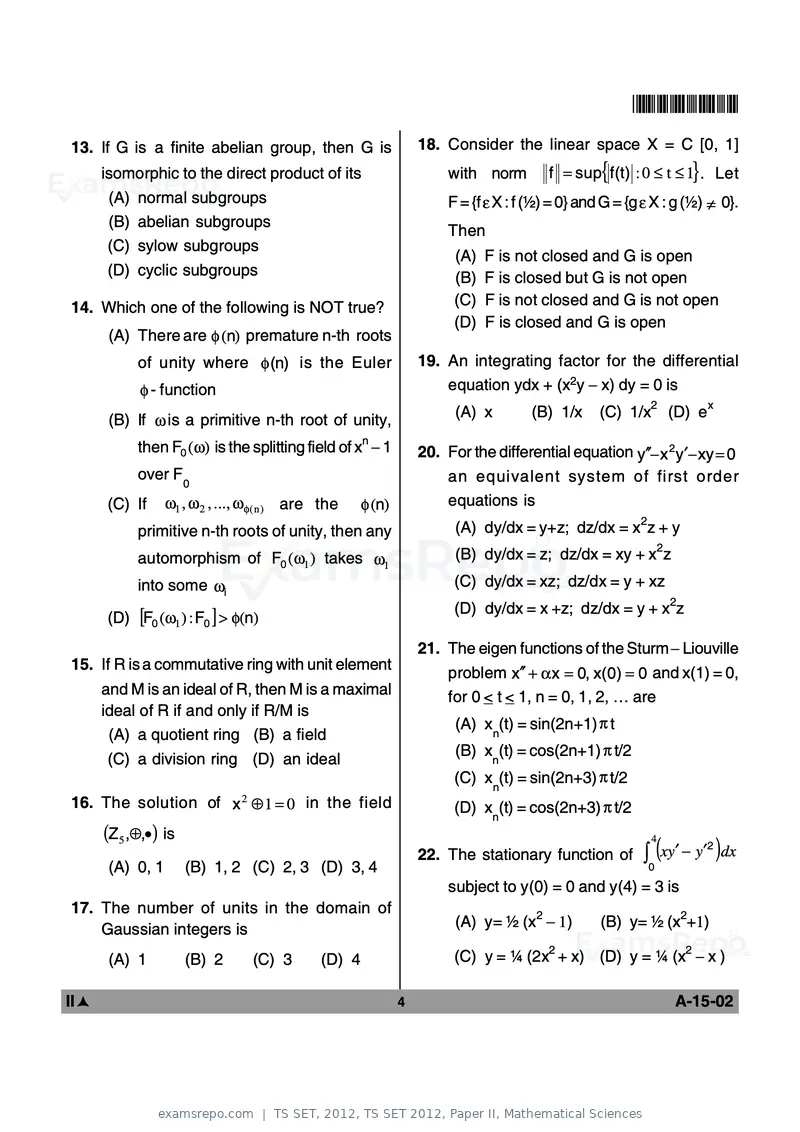
Text of page 4
*A1303*

13. If G is a finite abelian group, then G is                    18. Consider the linear space X = C [0, 1]
      isomorphic to the direct product of its                         with norm        f = sup{ f(t) : 0 ≤ t ≤ 1}. Let
       (A) normal subgroups                                           F = {f ε X : f (½) = 0} and G = {gε X : g (½) ≠ 0}.
       (B) abelian subgroups
                                                                      Then
       (C) sylow subgroups
                                                                       (A) F is not closed and G is open
       (D) cyclic subgroups                                            (B) F is closed but G is not open
14. Which one of the following is NOT true?                            (C) F is not closed and G is not open
                                                                       (D) F is closed and G is open
       (A) There are φ (n) premature n-th roots
           of unity where φ (n) is the Euler                     19. An integrating factor for the differential
            φ - function                                             equation ydx + (x2y − x) dy = 0 is
                                                                       (A) x        (B) 1/x     (C) 1/x2 (D) ex
       (B) If ω is a primitive n-th root of unity,
           then F0 (ω) is the splitting field of xn − 1          20. For the differential equation y′′− x 2 y′− xy = 0
           over F0                                                   an equivalent system of first order
      (C) If      ω1 , ω2 , ..., ωφ( n ) are the     φ (n)           equations is
           primitive n-th roots of unity, then any                     (A) dy/dx = y+z; dz/dx = x2z + y
                                                                                                             2
           automorphism of F0 (ω1 ) takes ω1                           (B) dy/dx = z; dz/dx = xy + x z
           into some ωi                                                (C) dy/dx = xz; dz/dx = y + xz
                                                                       (D) dy/dx = x +z; dz/dx = y + x2z
      (D) [F0 (ω1 ) : F0 ] > φ(n)
                                                                 21. The eigen functions of the Sturm − Liouville
15. If R is a commutative ring with unit element
                                                                     problem x′′ + α x = 0, x(0) = 0 and x(1) = 0,
      and M is an ideal of R, then M is a maximal                    for 0 < t < 1, n = 0, 1, 2, … are
      ideal of R if and only if R/M is
                                                                       (A) xn(t) = sin(2n+1) π t
       (A) a quotient ring (B) a field
                                                                       (B) xn(t) = cos(2n+1) π t/2
       (C) a division ring (D) an ideal
                                                                       (C) xn(t) = sin(2n+3) π t/2
16. The solution of x 2 ⊕ 1 = 0 in the field                           (D) xn(t) = cos(2n+3) π t/2
      (Z5 ,⊕,•) is                                                                                       4
                                                                                                           2
                                                                                                             (
                                                                 22. The stationary function of ∫ xy′ − y ′ dx       )
       (A) 0, 1      (B) 1, 2 (C) 2, 3 (D) 3, 4                                                          0

                                                                      subject to y(0) = 0 and y(4) = 3 is
17. The number of units in the domain of
    Gaussian integers is                                               (A) y= ½ (x2 − 1)        (B) y= ½ (x2+1)

       (A) 1         (B) 2       (C) 3       (D) 4                     (C) y = ¼ (2x2 + x) (D) y = ¼ (x2 − x )

IIæ                                                          4                                                   A-15-02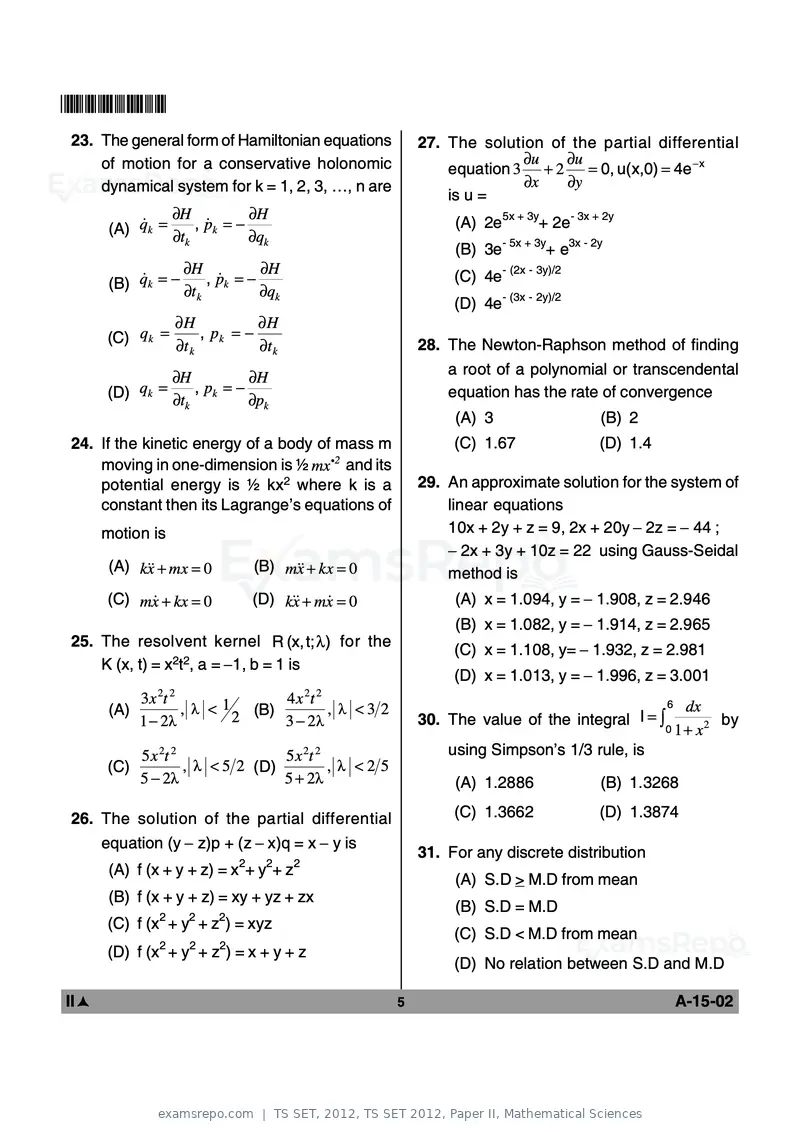
Text of page 5
*A1303*
23. The general form of Hamiltonian equations              27. The solution of the partial differential
    of motion for a conservative holonomic                               ∂u   ∂u
                                                               equation 3 + 2    = 0, u(x,0) = 4e − x
    dynamical system for k = 1, 2, 3, …, n are                           ∂x   ∂y
                                                               is u =
                ∂H           ∂H
      (A) qk = ∂t , pk = − ∂q                                 (A) 2e5x + 3y+ 2e- 3x + 2y
                    k          k
                                                                (B) 3e- 5x + 3y+ e3x - 2y
                  ∂H            ∂H
      (B) qk = − ∂t , p k = − ∂q                              (C) 4e- (2x - 3y)/2
                                                                (D) 4e- (3x - 2y)/2
                        k          k

               ∂H          ∂H
      (C) qk = ∂t , pk = − ∂t                              28. The Newton-Raphson method of finding
                    k              k
                                                               a root of a polynomial or transcendental
               ∂H          ∂H
      (D) qk = ∂t , pk = − ∂p                                  equation has the rate of convergence
                    k          k
                                                                (A) 3                   (B) 2
24. If the kinetic energy of a body of mass m                   (C) 1.67                (D) 1.4
    moving in one-dimension is ½ mx•2 and its
    potential energy is ½ kx2 where k is a                 29. An approximate solution for the system of
    constant then its Lagrange’s equations of                  linear equations
      motion is                                                10x + 2y + z = 9, 2x + 20y − 2z = − 44 ;
                                                               − 2x + 3y + 10z = 22 using Gauss-Seidal
      (A) kx + mx = 0       (B) mx + kx = 0                method is
      (C) mx + kx = 0        (D) kx + mx = 0                (A) x = 1.094, y = − 1.908, z = 2.946
                                                                (B) x = 1.082, y = − 1.914, z = 2.965
25. The resolvent kernel R (x, t; λ) for the
                                                                (C) x = 1.108, y= − 1.932, z = 2.981
    K (x, t) = x2t2, a = −1, b = 1 is
                                                                (D) x = 1.013, y = − 1.996, z = 3.001
            3x t
              2 2
                                 4x t  2 2
                                                                                                  6     dx
      (A)          ,  < 1 2 (B)        ,  <3 2
            1 − 2               3 − 2                    30. The value of the integral I = ∫0              by
                                                                                                      1 + x2
            5 x 2t 2               5 x 2t 2                    using Simpson’s 1/3 rule, is
      (C)            ,  < 5 2 (D)          ,  <2 5
            5 − 2                 5 + 2                       (A) 1.2886              (B) 1.3268

26. The solution of the partial differential                    (C) 1.3662              (D) 1.3874
    equation (y − z)p + (z − x)q = x − y is
                                                           31. For any discrete distribution
      (A) f (x + y + z) = x2+ y2+ z2
                                                                (A) S.D > M.D from mean
      (B) f (x + y + z) = xy + yz + zx
                                                                (B) S.D = M.D
      (C) f (x2 + y2 + z2) = xyz
                                                                (C) S.D < M.D from mean
      (D) f (x2 + y2 + z2) = x + y + z
                                                                (D) No relation between S.D and M.D

IIæ                                                    5                                              A-15-02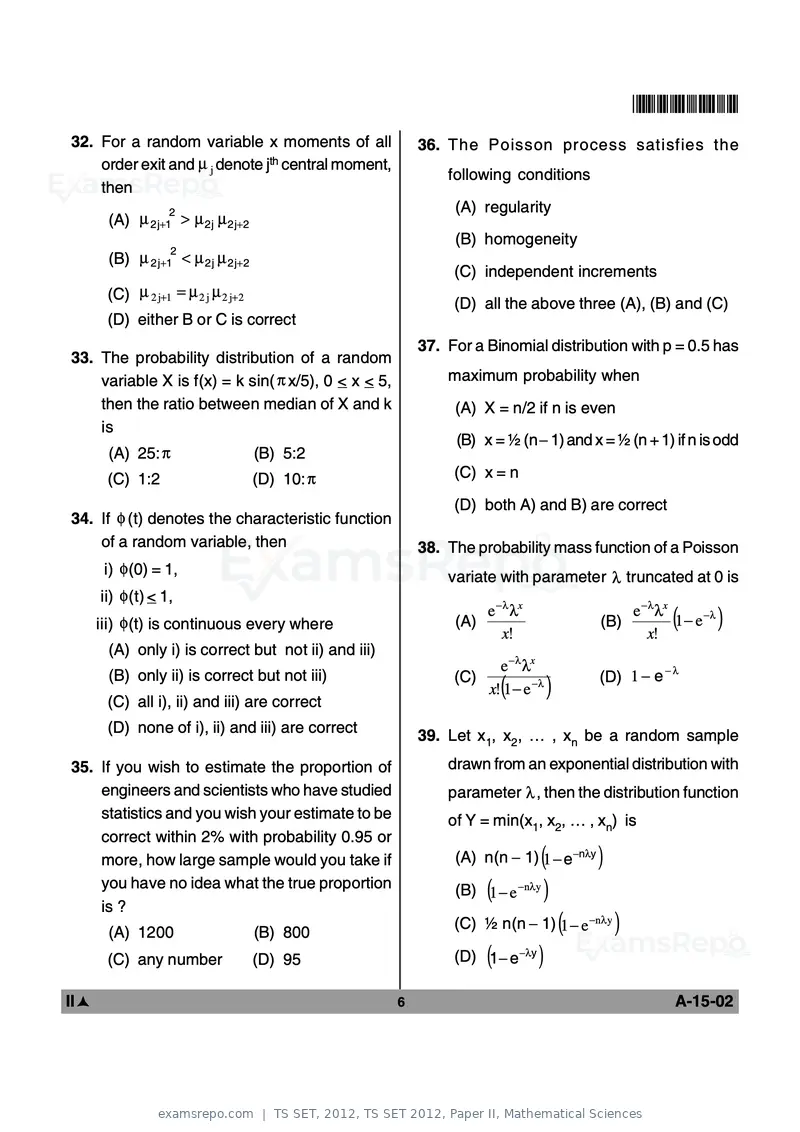
Text of page 6
*A1303*
32. For a random variable x moments of all               36. The Poisson process satisfies the
    order exit and μ j denote jth central moment,
                                                             following conditions
    then
                   2                                          (A) regularity
       (A) μ 2 j+1 > μ2 j μ2 j+2
                                                              (B) homogeneity
                   2
       (B) μ 2 j+1 < μ 2 j μ 2 j+ 2
                                                              (C) independent increments
       (C) μ 2 j+1 = μ 2 j μ 2 j+ 2
                                                              (D) all the above three (A), (B) and (C)
       (D) either B or C is correct
                                                         37. For a Binomial distribution with p = 0.5 has
33. The probability distribution of a random
    variable X is f(x) = k sin( π x/5), 0 < x < 5,           maximum probability when
    then the ratio between median of X and k                  (A) X = n/2 if n is even
    is
                                                              (B) x = ½ (n − 1) and x = ½ (n + 1) if n is odd
       (A) 25: π                      (B) 5:2
       (C) 1:2                        (D) 10: π               (C) x = n

                                                              (D) both A) and B) are correct
34. If φ (t) denotes the characteristic function
    of a random variable, then                           38. The probability mass function of a Poisson
       i) φ(0) = 1,                                          variate with parameter λ truncated at 0 is
      ii) φ(t) < 1,
                                                                    e − λ λx                       e − λ λx
      iii) φ(t) is continuous every where                     (A)
                                                                       x!
                                                                                           (B)
                                                                                                      x!
                                                                                                           (1 − e −λ   )
       (A) only i) is correct but not ii) and iii)
                                                                      e − λ λx
       (B) only ii) is correct but not iii)                   (C)                          (D) 1 − e − λ
       (C) all i), ii) and iii) are correct
                                                                        (
                                                                    x! 1 − e −λ    )
       (D) none of i), ii) and iii) are correct
                                                         39. Let x1, x2, … , xn be a random sample
35. If you wish to estimate the proportion of                drawn from an exponential distribution with
    engineers and scientists who have studied                parameter λ , then the distribution function
    statistics and you wish your estimate to be              of Y = min(x1, x2, … , xn) is
    correct within 2% with probability 0.95 or
    more, how large sample would you take if                                   (
                                                              (A) n(n − 1) 1 − e−nλy       )
    you have no idea what the true proportion
                                                                    (
                                                              (B) 1 − e −nλy   )
    is ?
       (A) 1200                       (B) 800
                                                              (C) ½ n(n − 1) 1 − e −nλy(       )
       (C) any number                 (D) 95                        (
                                                              (D) 1− e−λy      )
IIæ                                                  6                                                     A-15-02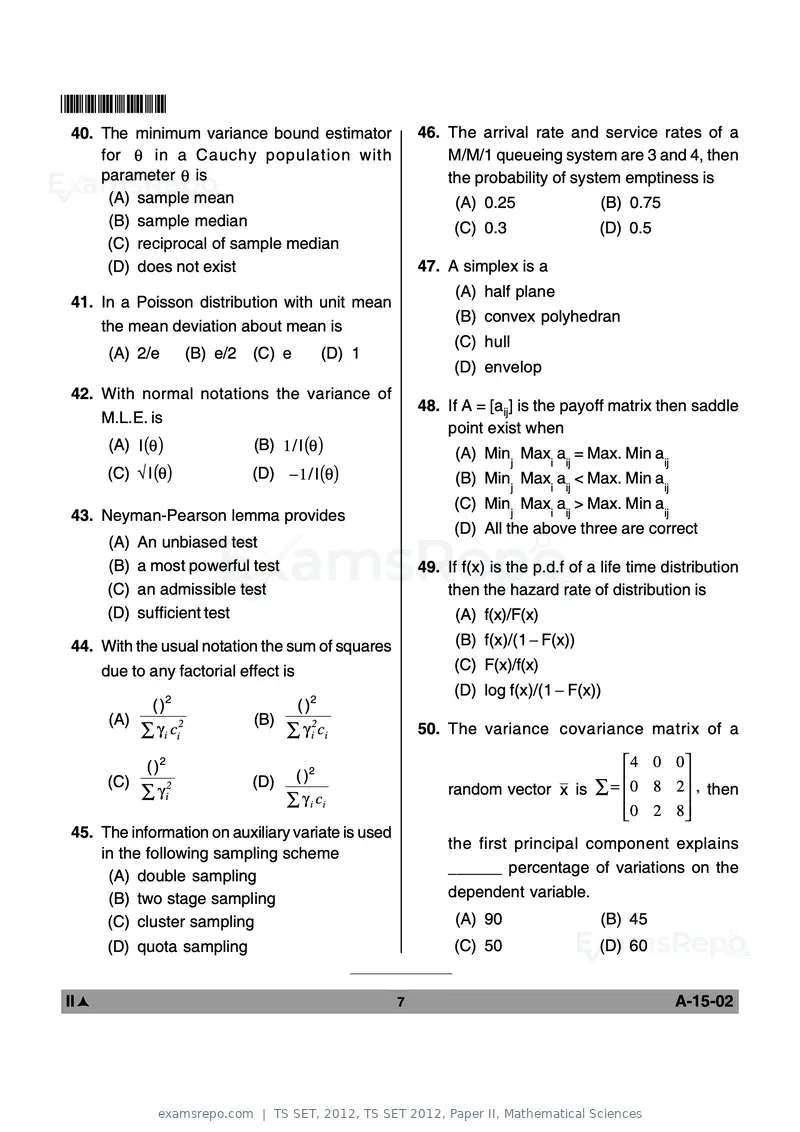
Text of page 7
*A1303*
40. The minimum variance bound estimator                  46. The arrival rate and service rates of a
    for θ in a Cauchy population with                         M/M/1 queueing system are 3 and 4, then
    parameter θ is                                            the probability of system emptiness is
     (A) sample mean                                            (A) 0.25               (B) 0.75
     (B) sample median                                         (C) 0.3                 (D) 0.5
     (C) reciprocal of sample median
     (D) does not exist                                   47. A simplex is a
                                                                (A) half plane
41. In a Poisson distribution with unit mean
                                                                (B) convex polyhedran
    the mean deviation about mean is
                                                               (C) hull
       (A) 2/e         (B) e/2   (C) e        (D) 1
                                                               (D) envelop
42. With normal notations the variance of
                                                          48. If A = [aij] is the payoff matrix then saddle
    M.L.E. is
                                                              point exist when
       (A) I (θ )                (B) 1 / I (θ )
                                                                (A) Minj Maxi aij = Max. Min aij
      (C) √ I (θ)                (D) − 1 / I (θ)                (B) Minj Maxi aij < Max. Min aij
                                                               (C) Minj Maxi aij > Max. Min aij
43. Neyman-Pearson lemma provides
                                                               (D) All the above three are correct
      (A) An unbiased test
      (B) a most powerful test                            49. If f(x) is the p.d.f of a life time distribution
      (C) an admissible test                                  then the hazard rate of distribution is
      (D) sufficient test                                       (A) f(x)/F(x)
44. With the usual notation the sum of squares                  (B) f(x)/(1 − F(x))
      due to any factorial effect is                           (C) F(x)/f(x)
                                                               (D) log f(x)/(1 − F(x))
            ( )2                      ( )2
       (A)                       (B)
           ∑ γ i ci2                 ∑ γ i2 ci            50. The variance covariance matrix of a

          ( )2                           2
                                                                                     ⎡4 0 0⎤
      (C)                        (D) ( )                                             ⎢       ⎥
                                                              random vector x is ∑ = ⎢0 8 2⎥ , then
          ∑ γ i2                     ∑ γ i ci
                                                                                     ⎢⎣0 2 8⎥⎦
45. The information on auxiliary variate is used
                                                              the first principal component explains
    in the following sampling scheme
                                                              ______ percentage of variations on the
     (A) double sampling
     (B) two stage sampling                                   dependent variable.
     (C) cluster sampling                                       (A) 90                 (B) 45
      (D) quota sampling                                       (C) 50                  (D) 60


IIæ                                                   7                                            A-15-02
Text of page 8
*A1303*
      Space for Rough Work


IIæ            8               A-15-02
Official key not published for this paper.
Page 1 of 8
Source: Telangana State Eligibility Test. Question paper published by Telangana State Eligibility Test.