
TS SET 2012: Paper II, Physical Sciences
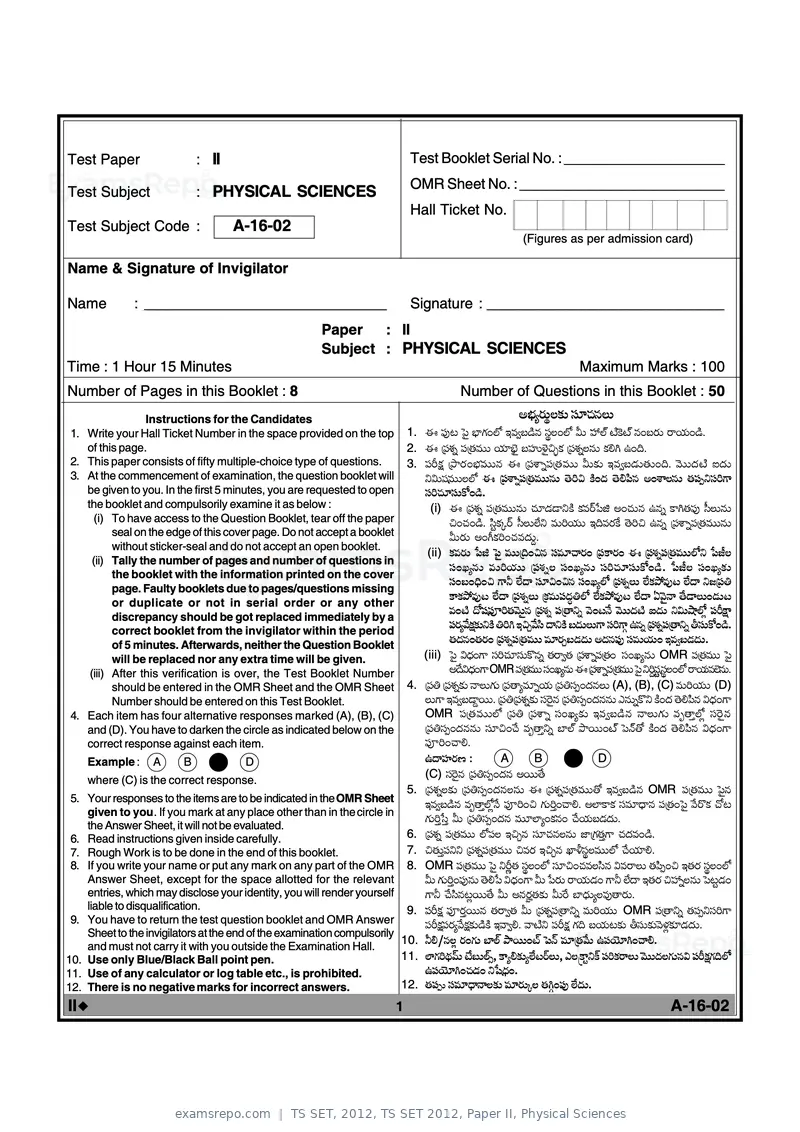
Text of page 1
Test Paper : II Test Booklet Serial No. : ______________________
OMR Sheet No. : ________________________________
Test Subject : PHYSICAL SCIENCES
Hall Ticket No.
Test Subject Code : A-16-02
(Figures as per admission card)
Name & Signature of Invigilator
Name : ____________________________________ Signature : ___________________________________
Paper : II
Subject : PHYSICAL SCIENCES
Time : 1 Hour 15 Minutes Maximum Marks : 100
Number of Pages in this Booklet : 8 Number of Questions in this Booklet : 50
Instructions for the Candidates A¿æýÅÆæÿ$¦ËMæü$ çÜ*^èþ¯èþË$
1. Write your Hall Ticket Number in the space provided on the top 1. D ç³#r ò³O ¿êVæü ÌZ CÐèþÓºyìþ¯èþ çÜ¦Ë ÌZ Ò$ çàÌý sìýMðüsý ¯èþ ºÆæÿ$ Æ>Äæý$ yìþ.
of this page. 2. D {ç³Ôèý² ç³{èþÐèþ$$ Äæý*¿ñýO ºçßý$âñýO_eMæü {ç³Ôèý²Ë¯èþ$ MæüÍW E ¨.
2. This paper consists of fifty multiple-choice type of questions. 3. ç³Èæü {´ëÆæÿ ¿æýÐèþ$$¯èþ D {ç³Ôé²ç³{èþÐèþ$$ Ò$Mæü$ CÐèþÓºyæþ$èþ$ ¨. Ððþ$$§æþsìý I§æþ$
3. At the commencement of examination, the question booklet will °Ñ$çÙÐèþ$$ËÌZ D {ç³Ôé²ç³{èþÐèþ$$¯èþ$ ðþÇ_ Mìü §æþ ðþÍí³¯èþ A Ôé˯èþ$ èþç³µ°çÜÇV>
be given to you. In the first 5 minutes, you are requested to open çÜÇ^èþ*çÜ$Mø yìþ.
the booklet and compulsorily examine it as below : (i) D {ç³Ôèý² ç³{èþÐèþ$$¯èþ$ ^èþ*yæþyé°Mìü MæüÐèþÆÿõ³h A ^èþ$¯èþ E¯èþ² M>Wèþç³# ïÜË$¯èþ$
(i) To have access to the Question Booklet, tear off the paper _ ^èþ yìþ. íÜtMæüPÆÿ ïÜË$Ìôý° Ðèþ$ÇÄæý$$ C¨ÐèþÆæÿMóü ðþÇ_ E¯èþ² {ç³Ôé²ç³{èþÐèþ$$¯èþ$
seal on the edge of this cover page. Do not accept a booklet Ò$Ææÿ$ A XMæüÇ ^èþÐèþ§æþ$ª.
without sticker-seal and do not accept an open booklet.
(ii) MæüÐèþÆæÿ$ õ³h ò³O Ðèþ$${¨ _¯èþ çÜÐèþ*^éÆæÿ {ç³M>Ææÿ D {ç³Ôèý²ç³{èþÐèþ$$ÌZ° õ³iË
(ii) Tally the number of pages and number of questions in
the booklet with the information printed on the cover
çÜ Qůèþ$ Ðèþ$ÇÄæý$$ {ç³Ôèý²Ë çÜ Qůèþ$ çÜÇ^èþ*çÜ$Mø yìþ. õ³iË çÜ QÅMæü$
page. Faulty booklets due to pages/questions missing
çÜ º «¨ _ V>± Ìôý§é çÜ*_ _¯èþ çÜ QÅÌZ {ç³Ôèý²Ë$ ÌôýMæü´ùÐèþ#r Ìôý§é °f{ç³
or duplicate or not in serial order or any other
M>Mæü´ùÐèþ#r Ìôý§é {ç³Ôèý²Ë$ {MæüÐèþ$糧æþ®ÌZ ÌôýMæü´ùÐèþ#r Ìôý§é HÐðþO¯é óþyéË$ yæþ$r
discrepancy should be got replaced immediately by a
Ðèþ sìý §øçÙç³NÇèþÐðþ$O¯èþ {ç³Ôèý² ç³{é°² Ððþ r¯óþ Ððþ$$§æþsìý I§æþ$ °Ñ$ÚëÌZÏ ç³È>
correct booklet from the invigilator within the period
ç³ÆæÿÅÐóþæüMæü$°Mìü ÇW C_aÐóþíÜ §é°Mìü º§æþ$Ë$V> çÜÇV>Y E¯èþ² {ç³Ôèý²ç³{é°² ¡çÜ$Mø yìþ.
of 5 minutes. Afterwards, neither the Question Booklet
èþ§æþ¯èþ èþÆæÿ {ç³Ôèý²ç³{èþÐèþ$$ Ðèþ*Ææÿaºyæþ§æþ$ A§æþ¯èþç³# çÜÐèþ$Äæý$ CÐèþÓºyæþ§æþ$.
will be replaced nor any extra time will be given. (iii) ò³O Ñ«§æþ V> çÜÇ^èþ*çÜ$Mö¯èþ² èþÆ>Óèþ {ç³Ôé²ç³{èþ çÜ Qůèþ$ OMR ç³{èþÐèþ$$ ò³O
(iii) After this verification is over, the Test Booklet Number A§óþÑ«§æþ V> OMR ç³{èþÐèþ$$ çÜ Qůèþ$ D {ç³Ôé²ç³{èþÐèþ$$ ò³O °ÇªçÙtt çÜ¦Ë ÌZ Æ>Äæý$ÐèþÌñý¯èþ$.
should be entered in the OMR Sheet and the OMR Sheet 4. {ç³ {ç³Ôèý²Mæü$ ¯éË$Væü$ {ç³éÅÐèþ*²Äæý$ {ç³çܵ §æþ¯èþË$ (A), (B), (C) Ðèþ$ÇÄæý$$ (D)
Number should be entered on this Test Booklet. Ë$V> CÐèþÓºyézÆÿ$$. {ç³{ç³Ôèý²Mæü$ çÜÆðÿO¯èþ {ç³çܵ §æþ¯èþ¯èþ$ G¯èþ$²Mö° Mìü §æþ ðþÍí³¯èþ Ñ«§æþ V>
4. Each item has four alternative responses marked (A), (B), (C) OMR ç³{èþÐèþ$$ÌZ {ç³ {ç³Ôé² çÜ QÅMæü$ CÐèþÓºyìþ¯èþ ¯éË$Væü$ Ðèþé¢ÌZÏ çÜÆðÿO¯èþ
and (D). You have to darken the circle as indicated below on the {ç³çܵ §æþ¯èþ¯èþ$ çÜ*_ ^óþ Ðèþ颰² »êÌý ´ëÆÿ$$ sý ò³¯þø Mìü §æþ ðþÍí³¯èþ Ñ«§æþ V>
correct response against each item. ç³NÇ ^éÍ.
Example : A B C D E§éçßýÆæÿ×ý : A B C D
(C) çÜÆðÿO¯èþ {ç³çܵ §æþ¯èþ AÆÿ$$óþ
where (C) is the correct response.
5. {ç³Ôèý²ËMæü$ {ç³çܵ §æþ¯èþ˯èþ$ D {ç³Ôèý²ç³{èþÐèþ$$ø CÐèþÓºyìþ¯èþ OMR ç³{èþÐèþ$$ ò³O¯èþ
5. Your responses to the items are to be indicated in the OMR Sheet
CÐèþÓºyìþ¯èþ Ðèþé¢ÌZϯóþ ç³NÇ _ Væü$Ç¢ ^éÍ. AÌêM>Mæü çÜÐèþ*«§é¯èþ ç³{èþ ò³O ÐóþÆöMæü ^ør
given to you. If you mark at any place other than in the circle in
the Answer Sheet, it will not be evaluated.
Væü$Ç¢õÜ¢ Ò$ {ç³çܵ §æþ¯èþ Ðèþ$*ÌêÅ Mæü¯èþ ^óþÄæý$ºyæþ§æþ$.
6. Read instructions given inside carefully. 6. {ç ³Ôèý² ç³{èþÐèþ$$ ÌZç³Ë C_a¯èþ çÜ*^èþ¯èþ˯èþ$ gê{Væüèþ¢V> ^èþ§æþÐèþ yìþ.
7. Rough Work is to be done in the end of this booklet. 7. _è þ$¢ç³°° {ç³Ôèý²ç³{èþÐèþ$$ _ÐèþÆæÿ C_a¯èþ RêäçܦËÐèþ$$ÌZ ^óþÄæý*Í.
8. If you write your name or put any mark on any part of the OMR 8. OMR ç³{èþÐèþ$$ ò³O °È~èþ çÜ¦Ë ÌZ çÜ*_ ^èþÐèþËíܯèþ ÑÐèþÆ>Ë$ èþí³µ _ CèþÆæÿ çÜ¦Ë ÌZ
Answer Sheet, except for the space allotted for the relevant Ò$ Væü$Ç¢ ç³#¯èþ$ ðþÍõ³ Ñ«§æþ V> Ò$ õ³Ææÿ$ Æ>Äæý$yæþ V>± Ìôý§é CèþÆæÿ _à²Ë¯èþ$ ò³rtyæþ
entries, which may disclose your identity, you will render yourself V>± ^óþíܯèþrÏÆÿ$$óþ Ò$ A¯èþÆæÿáèþMæü$ Ò$Æóÿ »ê«§æþ$ÅËÐèþ#éÆæÿ$.
liable to disqualification. 9. çç³Èæü ç³NÆæÿ¢Æÿ$$¯èþ èþÆ>Óèþ Ò$ {ç³Ôèý²ç³{é°² Ðèþ$ÇÄæý$$ OMR ç³{é°² èþç³µ°çÜÇV>
9. You have to return the test question booklet and OMR Answer ç³Èæüç³ÆæÿÅÐóþæüMæü$yìþMìü CÐéÓÍ. Ðésìý° ç³Èæü Væü¨ ºÄæý$rMæü$ ¡çÜ$Mæü$ÐðþâæýÏMæü*yæþ§æþ$.
Sheet to the invigilators at the end of the examination compulsorily
10. ±Í/¯èþËÏ Ææÿ Væü$ »êÌý ´ëÆÿ$$ sý ò³¯þ Ðèþ*{èþÐóþ$ Eç³Äñý*W ^éÍ.
and must not carry it with you outside the Examination Hall.
10. Use only Blue/Black Ball point pen. 11. ÌêVæüÇ£æþÐþ$ sôýº$ÌýÞ, M>ÅÍMæü$ÅÌôýrÆÿË$, GË[M>t°Mü ç³ÇMæüÆ>Ë$ Ððþ$$§æþËVæü$¯èþÑ ç³ÈæüVæü¨ÌZ
11. Use of any calculator or log table etc., is prohibited. Eç³Äñý*W ^èþyæþ °õÙ«§æþ .
12. There is no negative marks for incorrect answers. 12. èþç³ çÜÐèþ*«§é¯éËMæü$ Ðèþ*Ææÿ$PË èþWY ç³# Ìôý§æþ$.
II¿ 1 A-16-02
Text of page 2
*A1602*


II¿   2      A-16-02
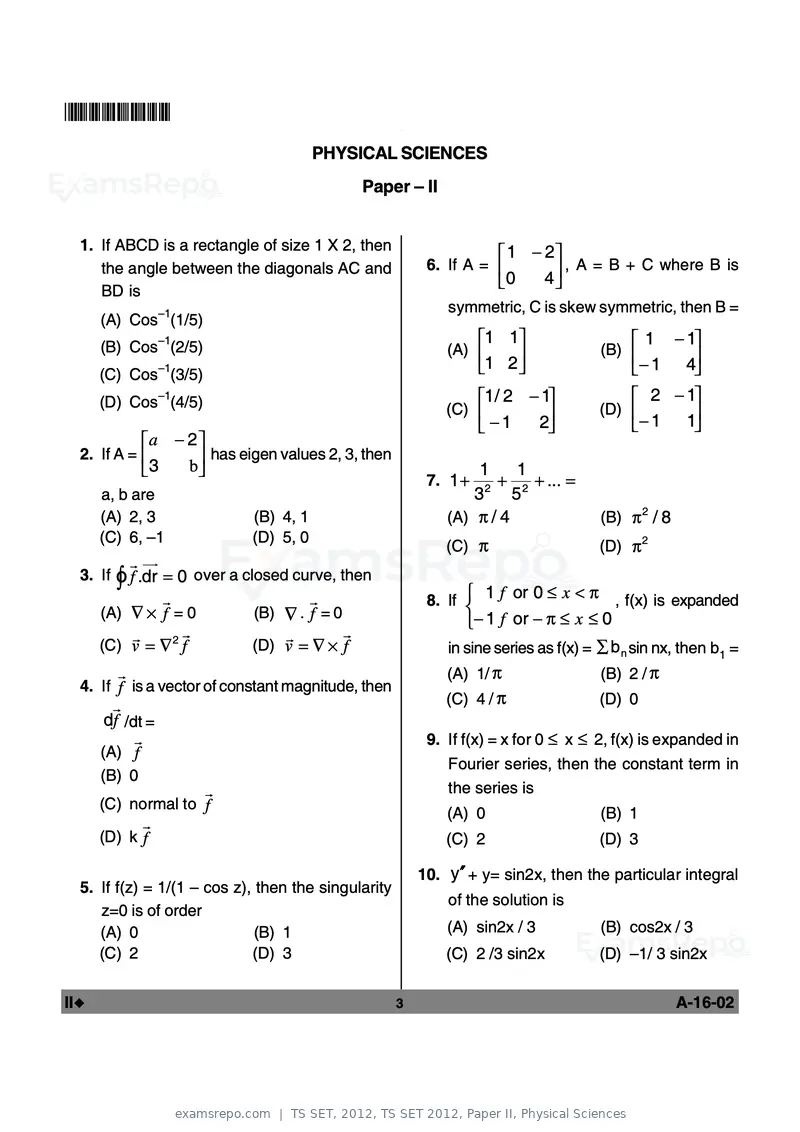
Text of page 3
*A1602*
                                        PHYSICAL SCIENCES
                                              Paper – II


  1. If ABCD is a rectangle of size 1 X 2, then
                                                                     ⎡ 1 − 2⎤
     the angle between the diagonals AC and               6. If A = ⎢           , A = B + C where B is
                                                                     ⎣0    4 ⎥⎦
     BD is
             –1                                              symmetric, C is skew symmetric, then B =
      (A) Cos (1/5)
      (B) Cos–1(2/5)
                                                                   ⎡1 1⎤                   ⎡ 1 − 1⎤
                                                             (A) ⎢      ⎥             (B) ⎢       ⎥
      (C) Cos–1(3/5)                                               ⎣1 2 ⎦                  ⎣− 1 4⎦
      (D) Cos–1(4/5)                                               ⎡1/ 2 − 1⎤              ⎡ 2 − 1⎤
                                                             (C) ⎢                    (D) ⎢       ⎥
                                                                   ⎣ −1   2⎥⎦              ⎣− 1 1⎦
              ⎡a − 2⎤
  2. If A = ⎢          has eigen values 2, 3, then
              ⎣3   b⎥⎦                                            1     1
                                                          7. 1 +   2
                                                                     + 2 + ... =
      a, b are                                                   3     5
      (A) 2, 3               (B) 4, 1                        (A) π / 4                (B) π2 / 8
      (C) 6, –1              (D) 5, 0
                                                             (C) π                    (D) π2

  3. If o
        ∫ f .dr = 0 over a closed curve, then
                                                        8. If ⎧ 1 f or 0 ≤ x < π , f(x) is expanded
      (A) ∇ × f = 0           (B) ∇ . f = 0                     ⎨
                                                              ⎩− 1 f or − π ≤ x ≤ 0

     (C)  = ∇ 2 f           (D)  = ∇ × f                   in sine series as f(x) = ∑ b n sin nx, then b1 =
                                                            (A) 1/ π                 (B) 2 / π
  4. If f is a vector of constant magnitude, then
                                                            (C) 4 / π                (D) 0
      df /dt =
                                                         9. If f(x) = x for 0 ≤ x ≤ 2, f(x) is expanded in
     (A) f
                                                             Fourier series, then the constant term in
      (B) 0
                                                            the series is
      (C) normal to f
                                                             (A) 0                    (B) 1

      (D) k f                                                (C) 2                    (D) 3

                                                         10. y′′ + y= sin2x, then the particular integral
  5. If f(z) = 1/(1 – cos z), then the singularity
                                                             of the solution is
     z=0 is of order
     (A) 0                    (B) 1                          (A) sin2x / 3            (B) cos2x / 3
     (C) 2                   (D) 3                           (C) 2 /3 sin2x           (D) –1/ 3 sin2x


II¿                                                  3                                             A-16-02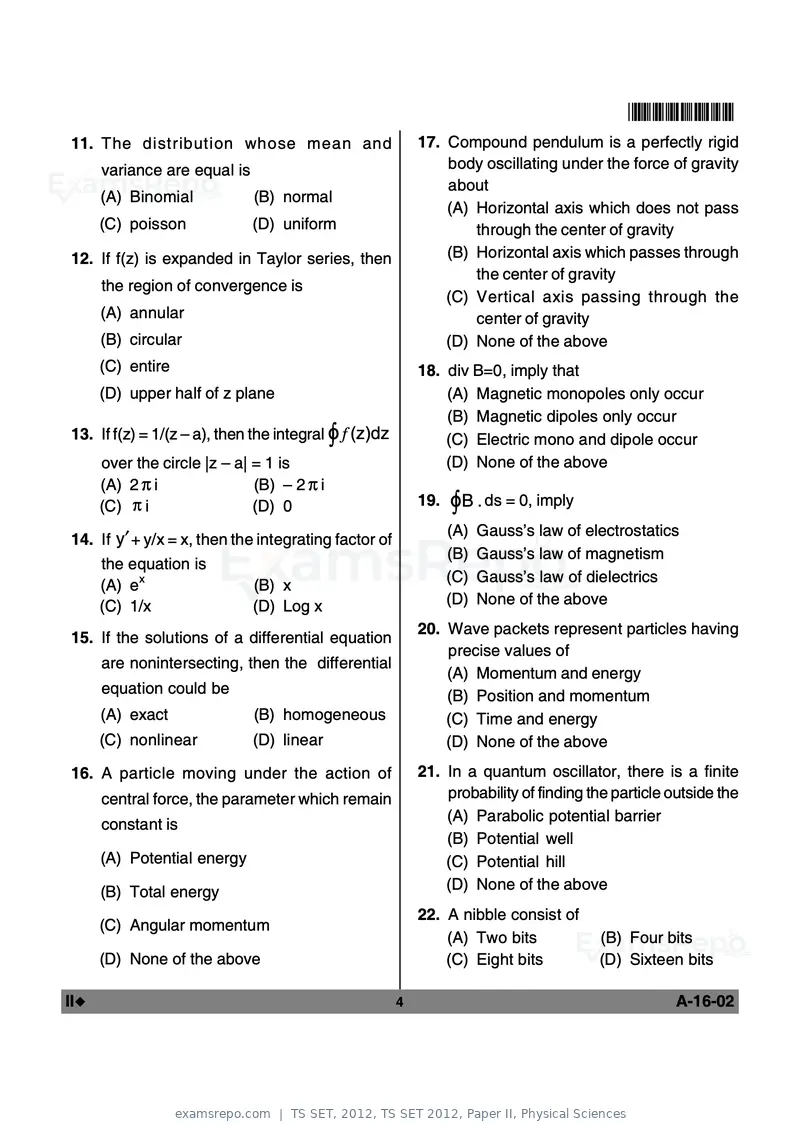
Text of page 4
*A1602*
11. The distribution whose mean and                        17. Compound pendulum is a perfectly rigid
      variance are equal is                                    body oscillating under the force of gravity
                                                               about
      (A) Binomial            (B) normal
                                                               (A) Horizontal axis which does not pass
      (C) poisson             (D) uniform                          through the center of gravity
12. If f(z) is expanded in Taylor series, then                 (B) Horizontal axis which passes through
                                                                   the center of gravity
      the region of convergence is
                                                               (C) Vertical axis passing through the
      (A) annular                                                  center of gravity
      (B) circular                                             (D) None of the above
      (C) entire                                           18. div B=0, imply that
      (D) upper half of z plane                                (A) Magnetic monopoles only occur
                                                               (B) Magnetic dipoles only occur
13. If f(z) = 1/(z – a), then the integral o
                                           ∫ f (z)dz           (C) Electric mono and dipole occur
      over the circle |z – a| = 1 is                           (D) None of the above
      (A) 2 π i               (B) – 2 π i
          π
      (C) i                   (D) 0                        19. o
                                                               ∫ B . ds = 0, imply
                                                               (A) Gauss’s law of electrostatics
14. If y′ + y/x = x, then the integrating factor of
                                                               (B) Gauss’s law of magnetism
    the equation is
                                                               (C) Gauss’s law of dielectrics
    (A) ex                   (B) x
    (C) 1/x                  (D) Log x                         (D) None of the above
                                                           20. Wave packets represent particles having
15. If the solutions of a differential equation
                                                               precise values of
      are nonintersecting, then the differential
                                                               (A) Momentum and energy
      equation could be                                        (B) Position and momentum
      (A) exact               (B) homogeneous                  (C) Time and energy
      (C) nonlinear           (D) linear                       (D) None of the above
16. A particle moving under the action of                  21. In a quantum oscillator, there is a finite
      central force, the parameter which remain                probability of finding the particle outside the
                                                               (A) Parabolic potential barrier
      constant is
                                                               (B) Potential well
      (A) Potential energy                                     (C) Potential hill
      (B) Total energy                                         (D) None of the above
                                                           22. A nibble consist of
      (C) Angular momentum
                                                               (A) Two bits            (B) Four bits
      (D) None of the above                                    (C) Eight bits          (D) Sixteen bits

II¿                                                    4                                            A-16-02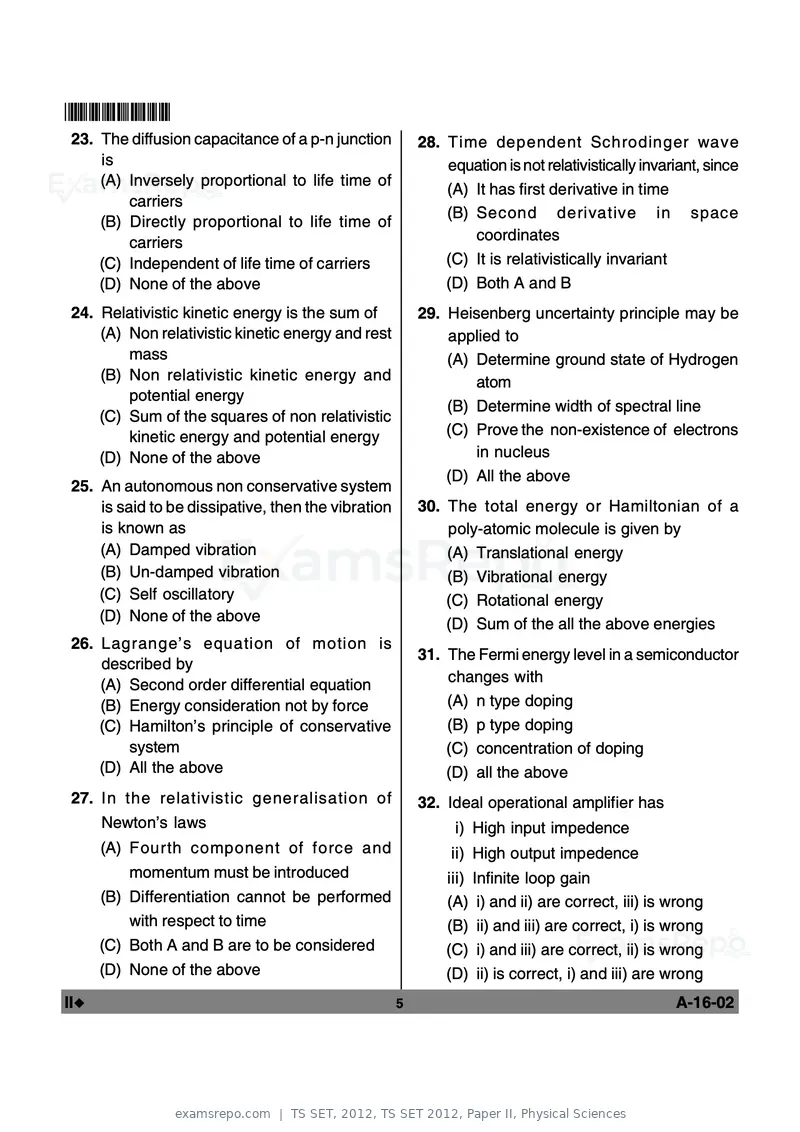
Text of page 5
*A1602*
23. The diffusion capacitance of a p-n junction         28. Time dependent Schrodinger wave
    is                                                      equation is not relativistically invariant, since
    (A) Inversely proportional to life time of
                                                            (A) It has first derivative in time
        carriers
                                                            (B) Second derivative in space
    (B) Directly proportional to life time of
        carriers                                                coordinates
    (C) Independent of life time of carriers                (C) It is relativistically invariant
    (D) None of the above                                   (D) Both A and B
24. Relativistic kinetic energy is the sum of           29. Heisenberg uncertainty principle may be
    (A) Non relativistic kinetic energy and rest            applied to
        mass                                                (A) Determine ground state of Hydrogen
    (B) Non relativistic kinetic energy and                     atom
        potential energy
                                                            (B) Determine width of spectral line
    (C) Sum of the squares of non relativistic
        kinetic energy and potential energy                 (C) Prove the non-existence of electrons
    (D) None of the above                                       in nucleus
                                                            (D) All the above
25. An autonomous non conservative system
    is said to be dissipative, then the vibration       30. The total energy or Hamiltonian of a
    is known as                                             poly-atomic molecule is given by
    (A) Damped vibration                                    (A) Translational energy
    (B) Un-damped vibration                                 (B) Vibrational energy
    (C) Self oscillatory                                    (C) Rotational energy
    (D) None of the above                                   (D) Sum of the all the above energies
26. Lagrange’s equation of motion is
                                                        31. The Fermi energy level in a semiconductor
    described by
    (A) Second order differential equation                  changes with
    (B) Energy consideration not by force                   (A) n type doping
    (C) Hamilton’s principle of conservative                (B) p type doping
        system                                              (C) concentration of doping
    (D) All the above                                       (D) all the above
27. In the relativistic generalisation of               32. Ideal operational amplifier has
      Newton’s laws                                           i) High input impedence
      (A) Fourth component of force and                      ii) High output impedence
          momentum must be introduced                       iii) Infinite loop gain
      (B) Differentiation cannot be performed               (A) i) and ii) are correct, iii) is wrong
          with respect to time                              (B) ii) and iii) are correct, i) is wrong
      (C) Both A and B are to be considered                 (C) i) and iii) are correct, ii) is wrong
      (D) None of the above                                 (D) ii) is correct, i) and iii) are wrong
II¿                                                 5                                             A-16-02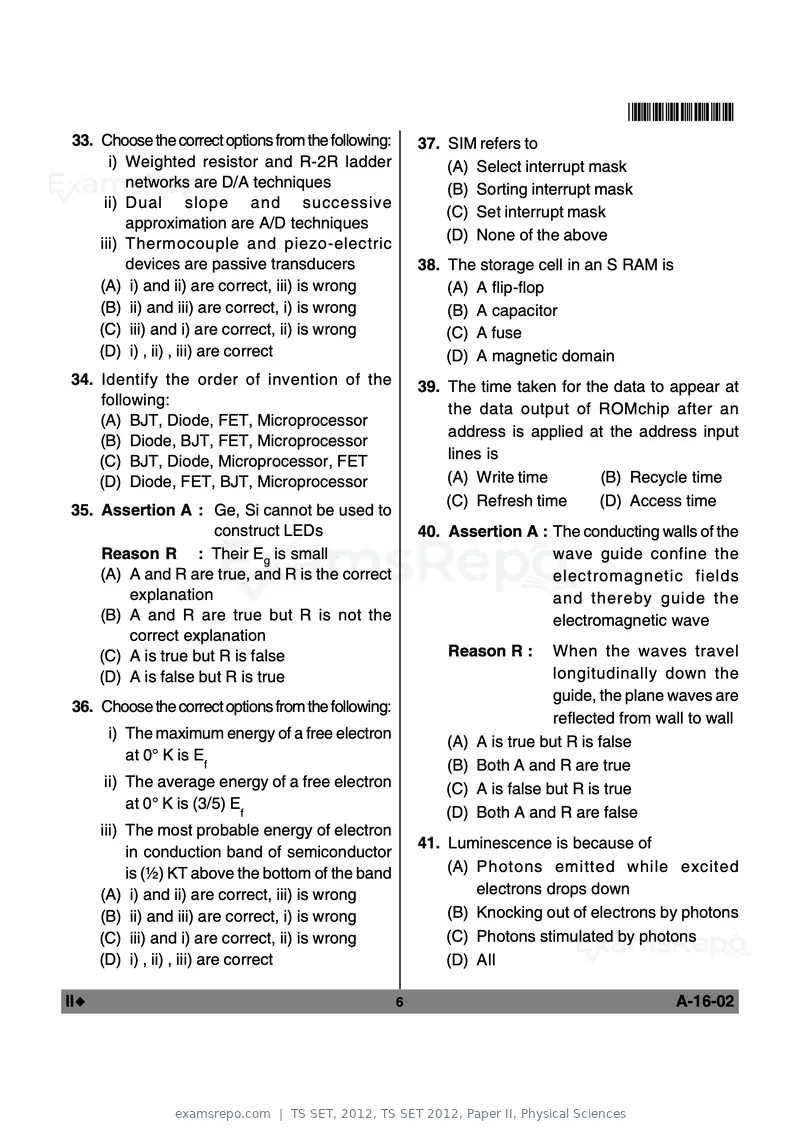
Text of page 6
*A1602*
33. Choose the correct options from the following:       37. SIM refers to
      i) Weighted resistor and R-2R ladder                   (A) Select interrupt mask
         networks are D/A techniques                         (B) Sorting interrupt mask
     ii) Dual slope and successive
                                                             (C) Set interrupt mask
         approximation are A/D techniques
                                                             (D) None of the above
    iii) Thermocouple and piezo-electric
         devices are passive transducers                 38. The storage cell in an S RAM is
    (A) i) and ii) are correct, iii) is wrong                (A) A flip-flop
    (B) ii) and iii) are correct, i) is wrong                (B) A capacitor
    (C) iii) and i) are correct, ii) is wrong                (C) A fuse
    (D) i) , ii) , iii) are correct                          (D) A magnetic domain
34. Identify the order of invention of the               39. The time taken for the data to appear at
    following:
                                                             the data output of ROMchip after an
    (A) BJT, Diode, FET, Microprocessor
                                                             address is applied at the address input
    (B) Diode, BJT, FET, Microprocessor
    (C) BJT, Diode, Microprocessor, FET                      lines is
    (D) Diode, FET, BJT, Microprocessor                      (A) Write time       (B) Recycle time
                                                             (C) Refresh time     (D) Access time
35. Assertion A : Ge, Si cannot be used to
                     construct LEDs                      40. Assertion A : The conducting walls of the
    Reason R : Their Eg is small                                           wave guide confine the
    (A) A and R are true, and R is the correct                             electromagnetic fields
        explanation                                                        and thereby guide the
    (B) A and R are true but R is not the                                  electromagnetic wave
        correct explanation
    (C) A is true but R is false                             Reason R :     When the waves travel
    (D) A is false but R is true                                            longitudinally down the
                                                                            guide, the plane waves are
36. Choose the correct options from the following:
                                                                            reflected from wall to wall
       i) The maximum energy of a free electron             (A) A is true but R is false
          at 0° K is Ef
                                                            (B) Both A and R are true
      ii) The average energy of a free electron             (C) A is false but R is true
          at 0° K is (3/5) Ef
                                                            (D) Both A and R are false
      iii) The most probable energy of electron
                                                         41. Luminescence is because of
           in conduction band of semiconductor
           is (½) KT above the bottom of the band            (A) Photons emitted while excited
      (A) i) and ii) are correct, iii) is wrong                  electrons drops down
      (B) ii) and iii) are correct, i) is wrong              (B) Knocking out of electrons by photons
      (C) iii) and i) are correct, ii) is wrong              (C) Photons stimulated by photons
      (D) i) , ii) , iii) are correct                        (D) All

II¿                                                  6                                         A-16-02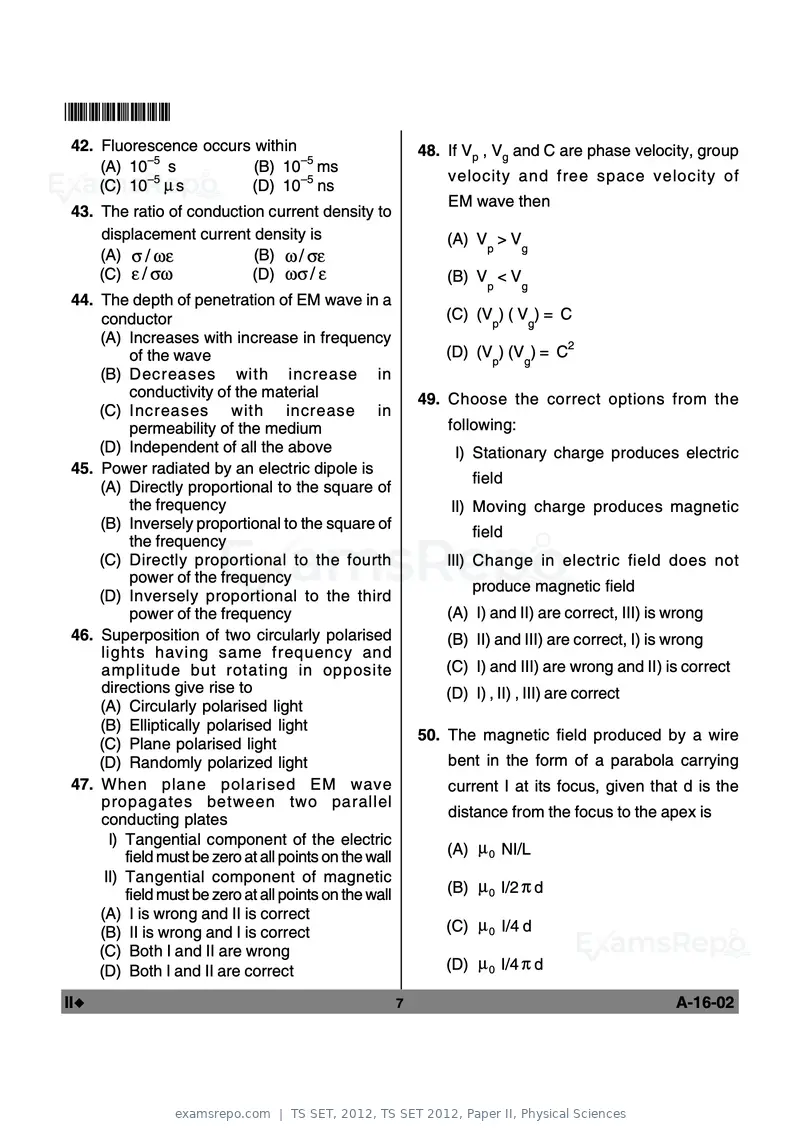
Text of page 7
*A1602*
42. Fluorescence occurs within                              48. If Vp , Vg and C are phase velocity, group
    (A) 10–5 s          (B) 10–5 ms
                                                                velocity and free space velocity of
    (C) 10–5 μ s       (D) 10–5 ns
                                                                EM wave then
43. The ratio of conduction current density to
    displacement current density is                             (A) Vp > Vg
    (A) σ / ωε            (B) ω / σε
    (C) ε / σω            (D) ωσ / ε                            (B) Vp < Vg
44. The depth of penetration of EM wave in a
    conductor                                                   (C) (Vp) ( Vg) = C
    (A) Increases with increase in frequency                                         2
          of the wave                                           (D) (Vp) (Vg) = C
    (B) Decreases with increase in
          conductivity of the material                      49. Choose the correct options from the
    (C) Increases with increase in
          permeability of the medium                            following:
    (D) Independent of all the above                             I) Stationary charge produces electric
45. Power radiated by an electric dipole is
                                                                    field
    (A) Directly proportional to the square of
          the frequency                                         II) Moving charge produces magnetic
    (B) Inversely proportional to the square of
                                                                    field
          the frequency
    (C) Directly proportional to the fourth                     III) Change in electric field does not
          power of the frequency
                                                                    produce magnetic field
    (D) Inversely proportional to the third
          power of the frequency                                (A) I) and II) are correct, III) is wrong
46. Superposition of two circularly polarised                   (B) II) and III) are correct, I) is wrong
    lights having same frequency and
    amplitude but rotating in opposite                          (C) I) and III) are wrong and II) is correct
    directions give rise to                                     (D) I) , II) , III) are correct
    (A) Circularly polarised light
    (B) Elliptically polarised light
                                                            50. The magnetic field produced by a wire
    (C) Plane polarised light
    (D) Randomly polarized light                                bent in the form of a parabola carrying
47. When plane polarised EM wave                                current I at its focus, given that d is the
    propagates between two parallel
    conducting plates                                           distance from the focus to the apex is
      I) Tangential component of the electric
         field must be zero at all points on the wall           (A) μ 0 NI/L
     II) Tangential component of magnetic
         field must be zero at all points on the wall           (B) μ 0 I/2 π d
    (A) I is wrong and II is correct
    (B) II is wrong and I is correct                            (C) μ 0 I/4 d
    (C) Both I and II are wrong
    (D) Both I and II are correct                               (D) μ 0 I/4 π d

II¿                                                     7                                           A-16-02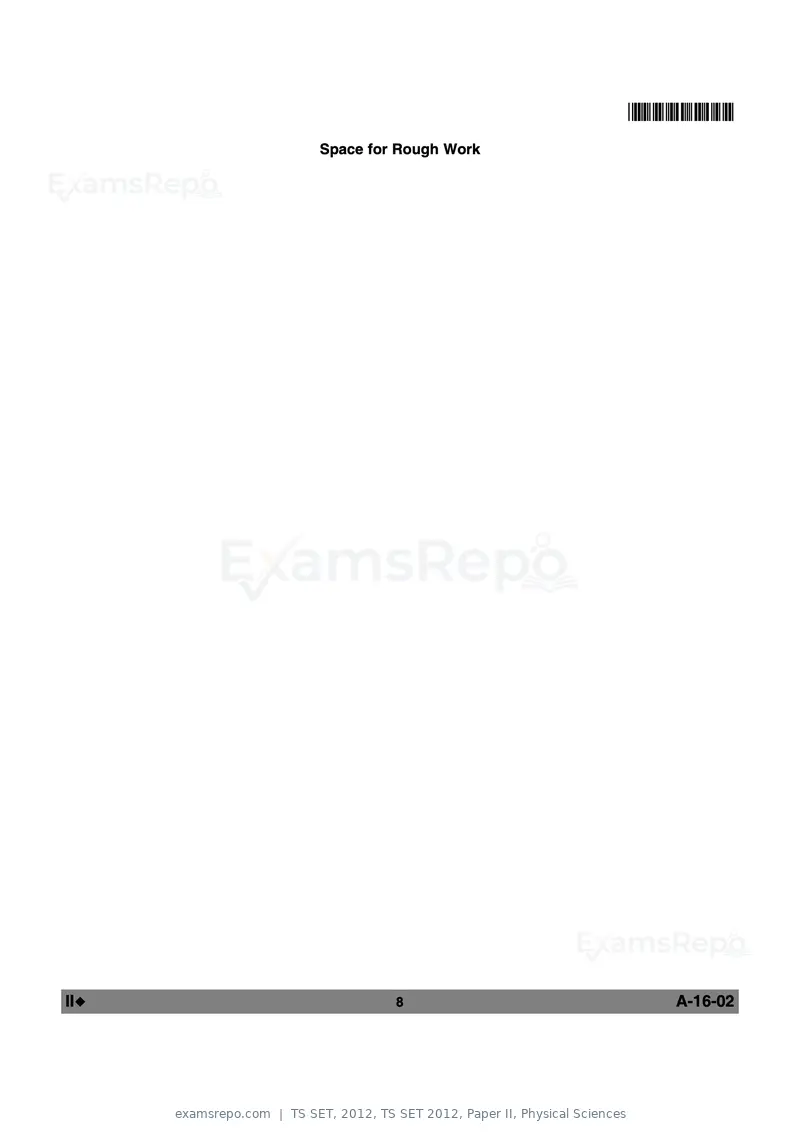
Text of page 8
*A1602*
      Space for Rough Work


II¿            8                A-16-02
Official key not published for this paper.
Page 1 of 8
Source: Telangana State Eligibility Test. Question paper published by Telangana State Eligibility Test.