
TS SET 2012: Paper II, Physical Education
Text of page 1
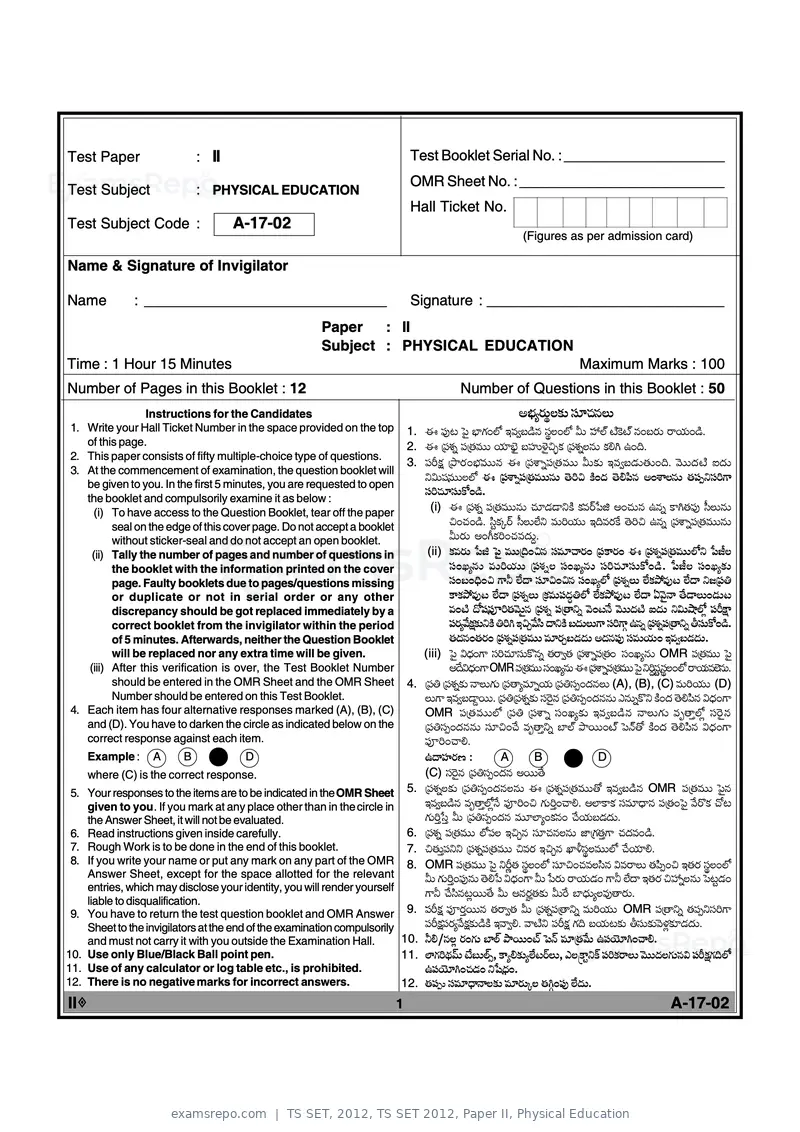
Test Paper : II Test Booklet Serial No. : ______________________
OMR Sheet No. : ________________________________
Test Subject : PHYSICAL EDUCATION
Hall Ticket No.
Test Subject Code : A-17-02
(Figures as per admission card)
Name & Signature of Invigilator
Name : ____________________________________ Signature : ___________________________________
Paper : II
Subject : PHYSICAL EDUCATION
Time : 1 Hour 15 Minutes Maximum Marks : 100
Number of Pages in this Booklet : 12 Number of Questions in this Booklet : 50
Instructions for the Candidates A¿æýÅÆæÿ$¦ËMæü$ çÜ*^èþ¯èþË$
1. Write your Hall Ticket Number in the space provided on the top 1. D ç³#r ò³O ¿êVæü ÌZ CÐèþÓºyìþ¯èþ çÜ¦Ë ÌZ Ò$ çàÌý sìýMðüsý ¯èþ ºÆæÿ$ Æ>Äæý$ yìþ.
of this page. 2. D {ç³Ôèý² ç³{èþÐèþ$$ Äæý*¿ñýO ºçßý$âñýO_eMæü {ç³Ôèý²Ë¯èþ$ MæüÍW E ¨.
2. This paper consists of fifty multiple-choice type of questions.
3. ç³Èæü {´ëÆæÿ ¿æýÐèþ$$¯èþ D {ç³Ôé²ç³{èþÐèþ$$ Ò$Mæü$ CÐèþÓºyæþ$èþ$ ¨. Ððþ$$§æþsìý I§æþ$
3. At the commencement of examination, the question booklet will
°Ñ$çÙÐèþ$$ËÌZ D {ç³Ôé²ç³{èþÐèþ$$¯èþ$ ðþÇ_ Mìü §æþ ðþÍí³¯èþ A Ôé˯èþ$ èþç³µ°çÜÇV>
be given to you. In the first 5 minutes, you are requested to open
çÜÇ^èþ*çÜ$Mø yìþ.
the booklet and compulsorily examine it as below :
(i) To have access to the Question Booklet, tear off the paper
(i) D {ç³Ôèý² ç³{èþÐèþ$$¯èþ$ ^èþ*yæþyé°Mìü MæüÐèþÆÿõ³h A ^èþ$¯èþ E¯èþ² M>Wèþç³# ïÜË$¯èþ$
seal on the edge of this cover page. Do not accept a booklet _ ^èþ yìþ. íÜtMæüPÆÿ ïÜË$Ìôý° Ðèþ$ÇÄæý$$ C¨ÐèþÆæÿMóü ðþÇ_ E¯èþ² {ç³Ôé²ç³{èþÐèþ$$¯èþ$
without sticker-seal and do not accept an open booklet. Ò$Ææÿ$ A XMæüÇ ^èþÐèþ§æþ$ª.
(ii) Tally the number of pages and number of questions in (ii) MæüÐèþÆæÿ$ õ³h ò³O Ðèþ$${¨ _¯èþ çÜÐèþ*^éÆæÿ {ç³M>Ææÿ D {ç³Ôèý²ç³{èþÐèþ$$ÌZ° õ³iË
the booklet with the information printed on the cover çÜ Qůèþ$ Ðèþ$ÇÄæý$$ {ç³Ôèý²Ë çÜ Qůèþ$ çÜÇ^èþ*çÜ$Mø yìþ. õ³iË çÜ QÅMæü$
page. Faulty booklets due to pages/questions missing çÜ º «¨ _ V>± Ìôý§é çÜ*_ _¯èþ çÜ QÅÌZ {ç³Ôèý²Ë$ ÌôýMæü´ùÐèþ#r Ìôý§é °f{ç³
or duplicate or not in serial order or any other M>Mæü´ùÐèþ#r Ìôý§é {ç³Ôèý²Ë$ {MæüÐèþ$糧æþ®ÌZ ÌôýMæü´ùÐèþ#r Ìôý§é HÐðþO¯é óþyéË$ yæþ$r
discrepancy should be got replaced immediately by a Ðèþ sìý §øçÙç³NÇèþÐðþ$O¯èþ {ç³Ôèý² ç³{é°² Ððþ r¯óþ Ððþ$$§æþsìý I§æþ$ °Ñ$ÚëÌZÏ ç³È>
correct booklet from the invigilator within the period ç³ÆæÿÅÐóþæüMæü$°Mìü ÇW C_aÐóþíÜ §é°Mìü º§æþ$Ë$V> çÜÇV>Y E¯èþ² {ç³Ôèý²ç³{é°² ¡çÜ$Mø yìþ.
of 5 minutes. Afterwards, neither the Question Booklet èþ§æþ¯èþ èþÆæÿ {ç³Ôèý²ç³{èþÐèþ$$ Ðèþ*Ææÿaºyæþ§æþ$ A§æþ¯èþç³# çÜÐèþ$Äæý$ CÐèþÓºyæþ§æþ$.
will be replaced nor any extra time will be given. (iii) ò³O Ñ«§æþ V> çÜÇ^èþ*çÜ$Mö¯èþ² èþÆ>Óèþ {ç³Ôé²ç³{èþ çÜ Qůèþ$ OMR ç³{èþÐèþ$$ ò³O
(iii) After this verification is over, the Test Booklet Number A§óþÑ«§æþ V> OMR ç³{èþÐèþ$$ çÜ Qůèþ$ D {ç³Ôé²ç³{èþÐèþ$$ ò³O °ÇªçÙtt çÜ¦Ë ÌZ Æ>Äæý$ÐèþÌñý¯èþ$.
should be entered in the OMR Sheet and the OMR Sheet 4. {ç³ {ç³Ôèý²Mæü$ ¯éË$Væü$ {ç³éÅÐèþ*²Äæý$ {ç³çܵ §æþ¯èþË$ (A), (B), (C) Ðèþ$ÇÄæý$$ (D)
Number should be entered on this Test Booklet. Ë$V> CÐèþÓºyézÆÿ$$. {ç³{ç³Ôèý²Mæü$ çÜÆðÿO¯èþ {ç³çܵ §æþ¯èþ¯èþ$ G¯èþ$²Mö° Mìü §æþ ðþÍí³¯èþ Ñ«§æþ V>
4. Each item has four alternative responses marked (A), (B), (C) OMR ç³{èþÐèþ$$ÌZ {ç³ {ç³Ôé² çÜ QÅMæü$ CÐèþÓºyìþ¯èþ ¯éË$Væü$ Ðèþé¢ÌZÏ çÜÆðÿO¯èþ
and (D). You have to darken the circle as indicated below on the {ç³çܵ §æþ¯èþ¯èþ$ çÜ*_ ^óþ Ðèþ颰² »êÌý ´ëÆÿ$$ sý ò³¯þø Mìü §æþ ðþÍí³¯èþ Ñ«§æþ V>
correct response against each item. ç³NÇ ^éÍ.
Example : A B C D E§éçßýÆæÿ×ý : A B C D
where (C) is the correct response. (C) çÜÆðÿO¯èþ {ç³çܵ §æþ¯èþ AÆÿ$$óþ
5. Your responses to the items are to be indicated in the OMR Sheet 5. {ç³Ôèý²ËMæü$ {ç³çܵ §æþ¯èþ˯èþ$ D {ç³Ôèý²ç³{èþÐèþ$$ø CÐèþÓºyìþ¯èþ OMR ç³{èþÐèþ$$ ò³O¯èþ
given to you. If you mark at any place other than in the circle in CÐèþÓºyìþ¯èþ Ðèþé¢ÌZϯóþ ç³NÇ _ Væü$Ç¢ ^éÍ. AÌêM>Mæü çÜÐèþ*«§é¯èþ ç³{èþ ò³O ÐóþÆöMæü ^ør
the Answer Sheet, it will not be evaluated. Væü$Ç¢õÜ¢ Ò$ {ç³çܵ §æþ¯èþ Ðèþ$*ÌêÅ Mæü¯èþ ^óþÄæý$ºyæþ§æþ$.
6. Read instructions given inside carefully. 6. {ç³Ôèý² ç³{èþÐèþ$$ ÌZç³Ë C_a¯èþ çÜ*^èþ¯èþ˯èþ$ gê{Væüèþ¢V> ^èþ§æþÐèþ yìþ.
7. Rough Work is to be done in the end of this booklet. 7. _èþ$¢ç³°° {ç³Ôèý²ç³{èþÐèþ$$ _ÐèþÆæÿ C_a¯èþ RêäçܦËÐèþ$$ÌZ ^óþÄæý*Í.
8. If you write your name or put any mark on any part of the OMR 8. OMR ç³{èþÐèþ$$ ò³O °È~èþ çÜ¦Ë ÌZ çÜ*_ ^èþÐèþËíܯèþ ÑÐèþÆ>Ë$ èþí³µ _ CèþÆæÿ çÜ¦Ë ÌZ
Answer Sheet, except for the space allotted for the relevant Ò$ Væü$Ç¢ ç³#¯èþ$ ðþÍõ³ Ñ«§æþ V> Ò$ õ³Ææÿ$ Æ>Äæý$yæþ V>± Ìôý§é CèþÆæÿ _à²Ë¯èþ$ ò³rtyæþ
entries, which may disclose your identity, you will render yourself
V>± ^óþíܯèþrÏÆÿ$$óþ Ò$ A¯èþÆæÿáèþMæü$ Ò$Æóÿ »ê«§æþ$ÅËÐèþ#éÆæÿ$.
liable to disqualification.
9. You have to return the test question booklet and OMR Answer 9. çç³Èæü ç³NÆæÿ¢Æÿ$$¯èþ èþÆ>Óèþ Ò$ {ç³Ôèý²ç³{é°² Ðèþ$ÇÄæý$$ OMR ç³{é°² èþç³µ°çÜÇV>
Sheet to the invigilators at the end of the examination compulsorily ç³Èæüç³ÆæÿÅÐóþæüMæü$yìþMìü CÐéÓÍ. Ðésìý° ç³Èæü Væü¨ ºÄæý$rMæü$ ¡çÜ$Mæü$ÐðþâæýÏMæü*yæþ§æþ$.
and must not carry it with you outside the Examination Hall. 10. ±Í/¯èþËÏ Ææÿ Væü$ »êÌý ´ëÆÿ$$ sý ò³¯þ Ðèþ*{èþÐóþ$ Eç³Äñý*W ^éÍ.
10. Use only Blue/Black Ball point pen. 11. ÌêVæüÇ£æþÐþ$ sôýº$ÌýÞ, M>ÅÍMæü$ÅÌôýrÆÿË$, GË[M>t°Mü ç³ÇMæüÆ>Ë$ Ððþ$$§æþËVæü$¯èþÑ ç³ÈæüVæü¨ÌZ
11. Use of any calculator or log table etc., is prohibited. Eç³Äñý*W ^èþyæþ °õÙ«§æþ .
12. There is no negative marks for incorrect answers. 12. èþç³ çÜÐèþ*«§é¯éËMæü$ Ðèþ*Ææÿ$PË èþWY ç³# Ìôý§æþ$.
II¹ 1 A-17-02
Text of page 2
*A1702*


II¹   2      A-17-02
Text of page 3
*A1702*
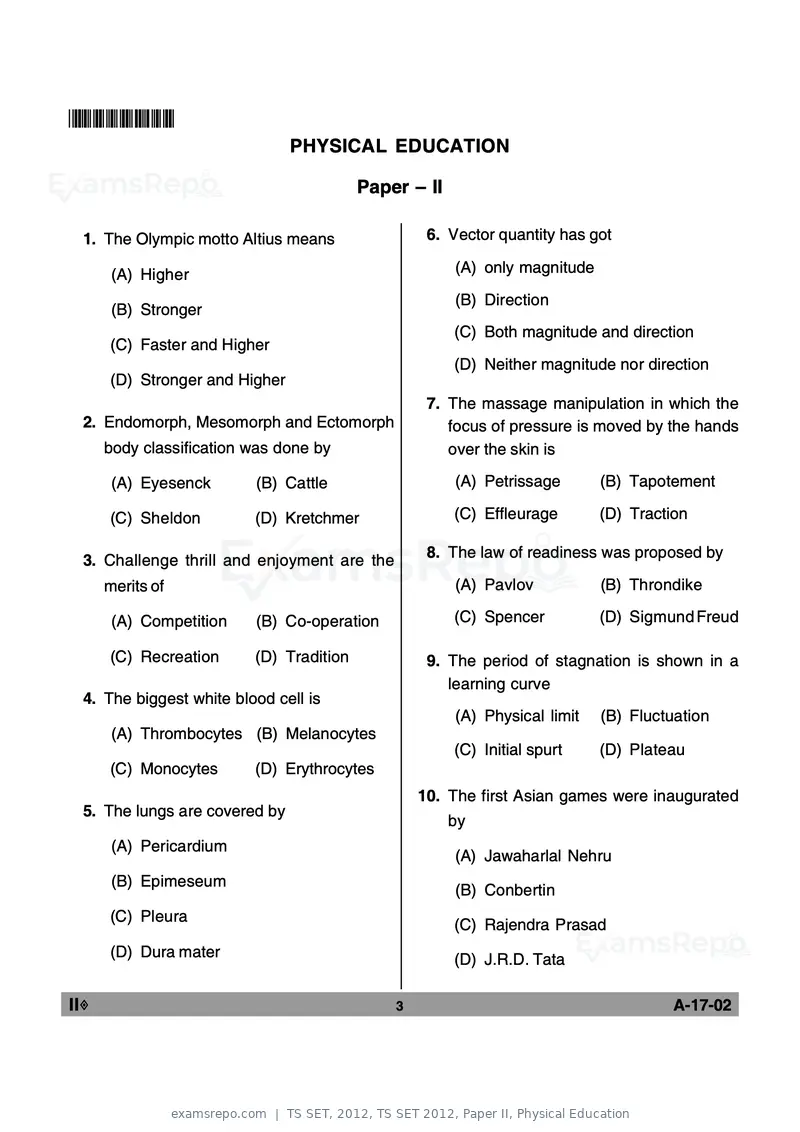
                                PHYSICAL EDUCATION

                                          Paper – II

  1. The Olympic motto Altius means                6. Vector quantity has got

       (A) Higher                                      (A) only magnitude

                                                       (B) Direction
       (B) Stronger
                                                       (C) Both magnitude and direction
      (C) Faster and Higher
                                                       (D) Neither magnitude nor direction
      (D) Stronger and Higher
                                                   7. The massage manipulation in which the
  2. Endomorph, Mesomorph and Ectomorph               focus of pressure is moved by the hands
      body classification was done by                 over the skin is

       (A) Eyesenck       (B) Cattle                   (A) Petrissage       (B) Tapotement

      (C) Sheldon         (D) Kretchmer                (C) Effleurage       (D) Traction

  3. Challenge thrill and enjoyment are the        8. The law of readiness was proposed by

      merits of                                        (A) Pavlov           (B) Throndike

       (A) Competition    (B) Co-operation             (C) Spencer          (D) Sigmund Freud

      (C) Recreation      (D) Tradition            9. The period of stagnation is shown in a
                                                      learning curve
  4. The biggest white blood cell is
                                                       (A) Physical limit   (B) Fluctuation
       (A) Thrombocytes (B) Melanocytes
                                                       (C) Initial spurt    (D) Plateau
      (C) Monocytes       (D) Erythrocytes
                                                  10. The first Asian games were inaugurated
  5. The lungs are covered by
                                                       by
       (A) Pericardium
                                                       (A) Jawaharlal Nehru
       (B) Epimeseum
                                                       (B) Conbertin
      (C) Pleura
                                                       (C) Rajendra Prasad
      (D) Dura mater                                   (D) J.R.D. Tata

II¹                                           3                                       A-17-02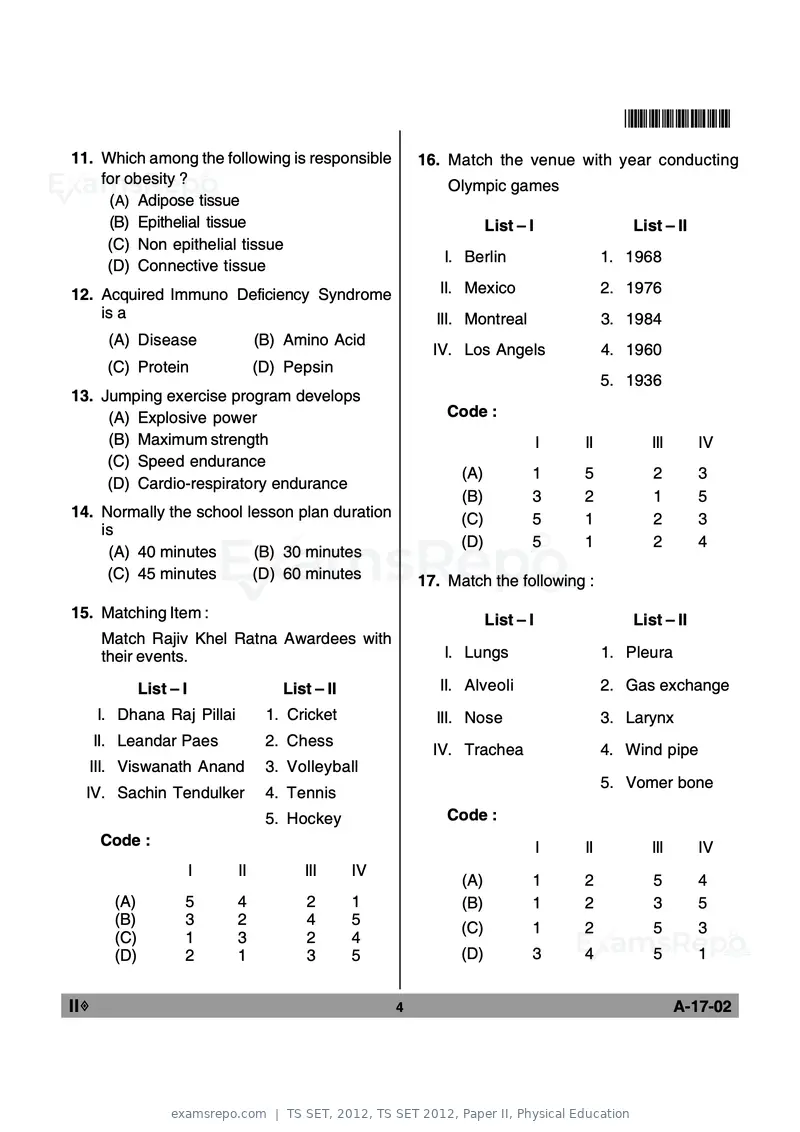
Text of page 4
*A1702*
11. Which among the following is responsible               16. Match the venue with year conducting
    for obesity ?                                              Olympic games
     (A) Adipose tissue
     (B) Epithelial tissue                                             List – I                List – II
     (C) Non epithelial tissue
                                                              I. Berlin                    1. 1968
     (D) Connective tissue
12. Acquired Immuno Deficiency Syndrome                       II. Mexico                   2. 1976
    is a                                                     III. Montreal                 3. 1984
        (A) Disease                (B) Amino Acid
                                                             IV. Los Angels                4. 1960
        (C) Protein                (D) Pepsin
                                                                                           5. 1936
13. Jumping exercise program develops
     (A) Explosive power                                       Code :
     (B) Maximum strength                                                         I   II          III      IV
     (C) Speed endurance
                                                                 (A)          1       5           2        3
     (D) Cardio-respiratory endurance
                                                                 (B)          3       2           1        5
14. Normally the school lesson plan duration                     (C)          5       1           2        3
    is
                                                                 (D)          5       1           2        4
     (A) 40 minutes      (B) 30 minutes
     (C) 45 minutes      (D) 60 minutes                    17. Match the following :
15. Matching Item :                                                    List – I                List – II
       Match Rajiv Khel Ratna Awardees with
       their events.                                          I. Lungs                     1. Pleura

               List – I               List – II               II. Alveoli                  2. Gas exchange
       I. Dhana Raj Pillai          1. Cricket               III. Nose                     3. Larynx
      II. Leandar Paes              2. Chess
                                                             IV. Trachea                   4. Wind pipe
      III. Viswanath Anand          3. Volleyball
                                                                                           5. Vomer bone
  IV. Sachin Tendulker              4. Tennis
                                    5. Hockey                  Code :
       Code :                                                                     I   II          III      IV
                          I   II         III      IV
                                                                 (A)          1       2           5        4
         (A)          5       4          2        1              (B)          1       2           3        5
         (B)          3       2          4        5
                                                                 (C)          1       2           5        3
         (C)          1       3          2        4
         (D)          2       1          3        5              (D)          3       4           5        1


II¹                                                    4                                                A-17-02
Text of page 5
*A1702*
18. Match the following                                           20. Match the following List I with List II :
               List– I                       List – II                       List – I            List – II
       I. Couple                       1. Inertia                      I. Esteem needs 1. Primary needs of
                                                                                          organism
      II. Spin                         2. Torque                      II. Social needs 2. Protection and
            st                                                                            security
      III. I Law of motion 3. Two forces in
                                                                     III. Safety needs 3. Needs to think about
                              opposite direction
                                                                                          fellow human being
                              at different points
                                                                    IV. Physiological 4. Selfish and egoistic
  IV. Moments of force 4. Magnus force                                    needs

                                       5. Angle of pull                                  5. Agressive and
                                                                                            criminal
       Code :                                                         Code :
                          I       II            III      IV                        I       II         III     IV
         (A)             3        2             4        5              (A)        4       3          2       5
                                                                        (B)        4       3          2       1
         (B)             4        3             5        2              (C)        1       2          5       4
         (C)             3        4             1        2              (D)        5       1          3       2
         (D)             2        1             3        4
                                                                  21. Match the sports sciences and their study
                                                                      given under List I and List II
19. Match the following :
               List – I                      List – II                     List – I             List – II
                                                                      I. Psychology    1. Functions of the body
       I. Anxiety             1. Rational emotional                                       in relation to exercise
                                 reaction                             II. Biomechanics 2. Application of
                                                                                          mechanical
      II. Agression           2. Feeling pleasure
                                                                                          principles
      III. Stress             3. Imposed and event                   III. Exercise     3. Behaviour
                                 related                                  Physiology
                                                                    IV. Sports         4. Organisation and
  IV. Fear                    4. Infliction of harm
                                                                          Management      administration of
                              5. Anticipation of danger                                   sports activities
       Code :                                                                             5. Study of Bones and
                                                                                             Muscles
                          I       II            III      IV           Code :
         (A)             5        4             3        1                          I       II        III     IV
         (B)             2        4             3        1              (A)        3       2          1       5
         (C)             5        4             3        2              (B)        3       2          1       4
                                                                        (C)        4       5          2       3
         (D)             1        2             5        4
                                                                        (D)        5       2          1       4

II¹                                                           5                                             A-17-02
Text of page 6
*A1702*
22. Match the name of the person with the test                 24. Match the following :
    invented
                                                                           List – I                 List – II
               List – I                List – II
       I. Charles Mecloy        1. Athletic ability test          I. Reliability          1. Historical study
      II. Frederic W.Cozen 2. General motor                       II. Level of            2. Test and Re-test
                              ability test
                                                                     confidence
      III. E. Kretchmer         3. Anthropometric test
  IV. Edward Hitchok            4. Body types                    III. Past, vents         3. Case study

                                5. Motor educability             IV. Survey study         4. 0.05
                                   test
                                                                                          5. Questionnaire
       Code :
                          I    II         III      IV              Code :
         (A)          5        4          2        1                                  I   II           III      IV
         (B)          4        3          1        2
                                                                     (A)          2       4            1        3
         (C)          2        1          4        3
         (D)          2        3          4        1                 (B)          2       4            1        5

23. Match the following tests with their aim of                      (C)          2       4            3        1
    measuring variable
                                                                     (D)          2       4            3        5
               List – I                List – II
       I. 50 mtr run          1. Cardio-respiratory            25. Which of the following are the objectives
                                 endurance                         of physical education ?
       II. Sit-ups            2. Explosive power
                                                                  I. Organic Development
      III. Vertical Jump      3. Speed
  IV. 12 minutes              4. Strength Endurance               II. Neuromuscular Development
      run/walk
                                                                 III. Economic Development

       Code :                                                    IV. Emotional Development
                          I    II         III      IV               (A) I, II and IV are correct
         (A)          3        4          2        1
                                                                    (B) I, II and III are correct
         (B)          3        4          1        2
                                                                    (C) II, III and IV are correct
         (C)          3        1          2        4
         (D)          4        1          3        2                (D) I, III and IV are correct


II¹                                                        6                                                 A-17-02
Text of page 7
*A1702*
26. Anatomical age of the human being is       29. The psychological factors that effect sports
    assessed by                                    performance
       I. Age in years                            I. Fatigue
      II. Ossification of bones                   II. Stress
      III. Stages of dentition                   III. Anxiety
  IV. Days and Months                            IV. Agression
        (A) I and II are correct                    (A) I, II and III are correct
        (B) I and III are correct                   (B) II, III and IV are correct
        (C) II and III are correct                  (C) I, II and IV are correct
        (D) I and IV are correct                    (D) II, III and I are correct

27. The pharmacological agents used as         30. Which of the following variables have
    ergogenic aids are                             least influence on motivation in sports ?
       I. Ampheta mines                           I. Sex
      II. Beta Blockers                           II. Age
      III. Blood Doping                          III. Complexion

  IV. Dieretics                                  IV. Religion

        (A) I, II and III are correct               (A) I and III are correct
                                                    (B) II and III are correct
        (B) I, II and IV are correct
                                                    (C) IV and I are correct
        (C) II, III and IV are correct
                                                    (D) III and IV are correct
        (D) I, III and IV are correct
                                               31. Name the two institutions of physical
28. The possible movements of the elbow
                                                   education and sports which came under
    joints are
                                                   SNIPES
       I. Flexion
                                                  I. YMCA College of Physical Education
      II. Extension
                                                  II. LCPE
      III. Circumduction
                                                 III. HVP Mandal
  IV. Abduction                                  IV. NSNIS Patiala
        (A) I and II are correct                    (A) I and III are correct
        (B) I and III are correct                   (B) II and I are correct
        (C) II and III are correct                  (C) II and IV are correct
        (D) I, II and III are correct               (D) III and IV are correct


II¹                                        7                                         A-17-02
Text of page 8
*A1702*
32. The power of resistance to the body is       35. Identify the stages of development of
       obtained through
                                                     human being in order
      I. Typhus
      II. Tetanus                                     (A) Infancy, Childhood, Adolescence,
  III. Natural immunity
                                                           Adulthood
  IV. Acquired immunity
        (A) I and II are correct                      (B) Infancy, Childhood, Adulthood,
        (B) I and III are correct
                                                           Adolescence
       (C) I and IV are correct
       (D) III and IV are correct                     (C) Childhood, Adulthood, Infancy,

33. The tournament in which one team will                  Adolescence
       play against all teams
                                                      (D) Infancy, Adulthood, Childhood,
      I. Seeding
      II. Round Robin                                      Adolescence
  III. Knock-out
  IV. League                                     36. Arrange the following events in order that

        (A) I and IV are correct                     occur during muscular contraction as per
        (B) I, II and III are correct                sliding filament theory. Use the code given
       (C) II and IV are correct                     below.
       (D) I, II and IV are correct
                                                        I. Excitation
34. Items come under delimitations
                                                       II. Relaxation
      I. Diet habits
      II. Number of subjects                           III. Contraction
  III. Number of groups
                                                      IV. Coupling
  IV. Age groups
        (A) II, III and IV are correct            Code :
        (B) I, III and V are correct
                                                      (A) I, IV, III, II    (B) I, III, IV, II
       (C) I, II and III are correct
       (D) I, II and IV are correct                   (C) IV, III, II, I   (D) I, II, IV, III

II¹                                          8                                            A-17-02
Text of page 9
*A1702*
37. Arrange sequentially the following                   40. Arrange the training seasons in order
      according to grade of mobility                        I. Mid season
       (A) Synarthrosis, Amphiarthrosis,                    II. Early season
           Diarthroses
                                                           III. Competitive season
       (B) Synarthrosis, Diarthroses,
                                                           IV. Off season
           Amphiarthrosis
                                                              (A) II, I,III, IV     (B) II, I, IV, III
      (C) Amphiarthrosis, Synarthrosis,
          Diarthroses,                                        (C) I, II, III, IV    (D) I, II, IV, III

      (D) Diarthroses, Synarthrosis,                     41. Arrange the events of heptathlon in the first
          Amphiarthrosis                                     day competition

38. Arrange the following as per the sequence               I. High Jump

       (A) Law of acceleration, Law of reaction,            II. 100 mts Hurdles
           Law of inertia                                  III. 200 mts race
       (B) Law of reaction, Law of inertia, Law            IV. Shot put
           of acceleration
                                                              (A) I, IV, III, II    (B) II, I, IV, III
      (C) Law of inertia, Law of acceleration,
                                                              (C) II, I, III, IV    (D) I, II, IV, III
          Law of reaction

      (D) Law of acceleration, Law of inertia,           42. Arrange the steps to be followed in the
          Law of reaction                                    computation of rank order correlation

39. Arrange the learning curve stages in                              6ΣD2
    sequence                                                I. 1 −
                                                                     N(N2 − 1)
       (A) Plateau, Initial spurt, Physical limit,
           Fluctuation                                      II. Difference between ranks

       (B) Initial spurt, Plateau, Fluctuation,            III. Conversion of data into rank
           Physical limit

      (C) Physical limit, Fluctuation, Plateau,            IV. Squared differences
          Initial spurt
                                                              (A) II, III, IV, I    (B) I, II, III, IV
      (D) Fluctuation, Physical limit, Initial
                                                              (C) II, III, I, IV    (D) III, II, IV, I
          spurt, Plateau

II¹                                                  9                                            A-17-02
Text of page 10
*A1702*
  Assertion and Reasoning :
                                                         45. Assertion (A) : Rest between heats in

43. Assertion : The relationships between                                      running events is
                    personality traits and
                                                                               mandatory in a standard
                    physique were consistent
                    with common cultural stereo                                athletic meet.
                    type.
                                                             Reason (R) : Rest between heats helps
      Reasoning : Fat individuals are said to
                                                                             the athletes to regenerate
                     be slow in reacting to love,
                     eating and to be socially                               energy.
                     relaxed and greedy.
                                                              (A) Both (A) and (R) are wrong
      (A) Both (A) and (R) are true and R is
          the correct explanation of (A)
                                                              (B) (A) is correct but (R) is wrong
      (B) Both (A) and (R) are true but (R) is
          not the correct explanation of (A)                  (C) (A) is wrong but (R) is correct

      (C) (A) is true but (R) is false
                                                              (D) Both (A) and (R) are correct
      (D) (A) is false but (R) is true
                                                         46. Assertion (A) : Standard test is valid,
44. Assertion (A) : Using drugs in
                       sports enhance the                                     reliable and objective.
                       performance.
                                                             Reason (R) : University examinations
      Reasoning (R) : Using drugs in sports
                            is unethical and                                are standard tests.
                            harmful to health.
                                                              (A) Both (A) and (R) are wrong
      (A) (A) is false and (R) is true
                                                              (B) (A) is wrong but (R) is right
      (B) Both (A) and (R) are true
                                                              (C) (A) is correct but (R) is wrong
      (C) Both (A) and (R) are false
                                                              (D) Both (A) and (R) are right
      (D) (A) is true and (R) is false


II¹                                                 10                                          A-17-02
Text of page 11
*A1702*

      Question No. 47 to 50 :                             47. When the lung space is increased, the
                                                              pressure within the lungs
      Inspiration is an active process involving
                                                               (A) Decreases
      the diaphragm and the external intercostal
                                                               (B) Increases
      muscles. The ribs and sternum are moved
      by the external intercostal muscles. The                 (C) Do not change
      ribs swing up and out. The sternum swings                (D) None of the above
      up and forward. At the same time, the
      diaphragm contracts, flattening down                48. The process of expiration is

      toward the abdomen. These action                         (A) Active process
      expand all three dimensions of the
                                                               (B) Passive process
      thoracic cage. When the lungs are
                                                               (C) Neutral process
      expanded, the air within them has more
      space to fill, so the pressure within the                (D) None of the above
      lungs, decreases. As a result, the pressure
                                                          49. In the process of exhalation an increase
      in the lungs, intrapulmonary pressure is
                                                              of pressure in the thorax takes place due
      less than the pressure of the air outside
                                                              to
      the body. Because the respiratory tract is
                                                               (A) Relaxation of diaphragm
      open to the outside, air rushes into the
      lungs to reduce this pressure difference.                (B) Relaxation of intercostal muscles
      Thus air is brought into the lungs during                (C) Ribs, sternum and lower back
      inspiration.
                                                               (D) All of the above
      Expiration is a passive process involving
      relaxation. As the diaphragm relaxes, it            50. The movement of ribs and sternum will be
      returns to normal upward arched position.               done by the

      As the external intercostal muscle relax,                (A) External intercostal muscle
      the ribs and sternum lower back into their
                                                               (B) Pectoralin major
      resting position. This increases the
                                                               (C) Deltoid
      pressure in the thorax, so air is forced out
      of the lungs. Thus expiration takes place.               (D) None of the above


II¹                                                  11                                      A-17-02
Text of page 12
*A1702*
      Space for Rough Work


II¹            12               A-17-02
Official key not published for this paper.
Page 1 of 12
Source: Telangana State Eligibility Test. Question paper published by Telangana State Eligibility Test.