
TS SET 2012: Paper III, Mathematical Sciences
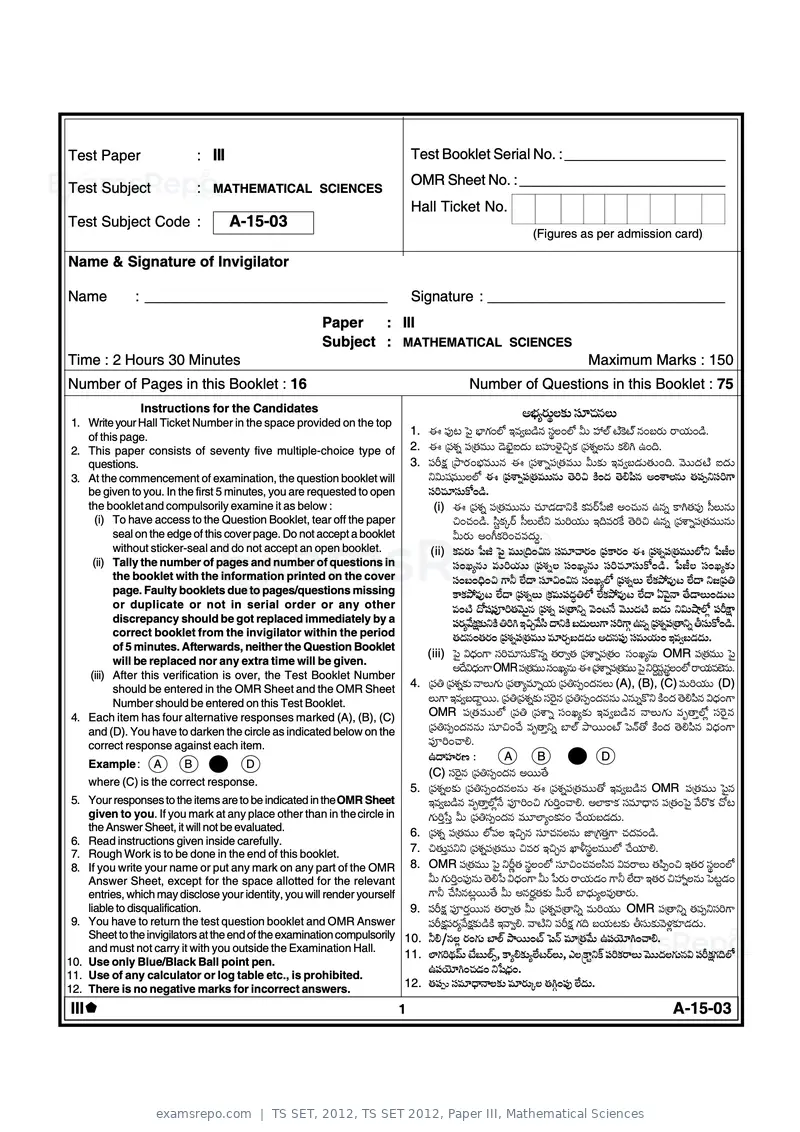
Text of page 1
Test Paper : III Test Booklet Serial No. : ______________________
OMR Sheet No. : ________________________________
Test Subject : MATHEMATICAL SCIENCES
Hall Ticket No.
Test Subject Code : A-15-03
(Figures as per admission card)
Name & Signature of Invigilator
Name : ____________________________________ Signature : ___________________________________
Paper : III
Subject : MATHEMATICAL SCIENCES
Time : 2 Hours 30 Minutes Maximum Marks : 150
Number of Pages in this Booklet : 16 Number of Questions in this Booklet : 75
Instructions for the Candidates A¿æýÅÆæÿ$¦ËMæü$ çÜ*^èþ¯èþË$
1. Write your Hall Ticket Number in the space provided on the top
1. D ç³#r ò³O ¿êVæü ÌZ CÐèþÓºyìþ¯èþ çÜ¦Ë ÌZ Ò$ çàÌý sìýMðüsý ¯èþ ºÆæÿ$ Æ>Äæý$ yìþ.
of this page.
2. This paper consists of seventy five multiple-choice type of 2. D {ç³Ôèý² ç³{èþÐèþ$$ yðþ¿ñýOI§æþ$ ºçßý$âñýO_eMæü {ç³Ôèý²Ë¯èþ$ MæüÍW E ¨.
questions. 3. ç³Èæü {´ëÆæÿ ¿æýÐèþ$$¯èþ D {ç³Ôé²ç³{èþÐèþ$$ Ò$Mæü$ CÐèþÓºyæþ$èþ$ ¨. Ððþ$$§æþsìý I§æþ$
3. At the commencement of examination, the question booklet will °Ñ$çÙÐèþ$$ËÌZ D {ç³Ôé²ç³{èþÐèþ$$¯èþ$ ðþÇ_ Mìü §æþ ðþÍí³¯èþ A Ôé˯èþ$ èþç³µ°çÜÇV>
be given to you. In the first 5 minutes, you are requested to open çÜÇ^èþ*çÜ$Mø yìþ.
the booklet and compulsorily examine it as below : (i) D {ç³Ôèý² ç³{èþÐèþ$$¯èþ$ ^èþ*yæþyé°Mìü MæüÐèþÆÿõ³h A ^èþ$¯èþ E¯èþ² M>Wèþç³# ïÜË$¯èþ$
(i) To have access to the Question Booklet, tear off the paper _ ^èþ yìþ. íÜtMæüPÆÿ ïÜË$Ìôý° Ðèþ$ÇÄæý$$ C¨ÐèþÆæÿMóü ðþÇ_ E¯èþ² {ç³Ôé²ç³{èþÐèþ$$¯èþ$
seal on the edge of this cover page. Do not accept a booklet Ò$Ææÿ$ A XMæüÇ ^èþÐèþ§æþ$ª.
without sticker-seal and do not accept an open booklet. (ii) MæüÐèþÆæÿ$ õ³h ò³O Ðèþ$${¨ _¯èþ çÜÐèþ*^éÆæÿ {ç³M>Ææÿ D {ç³Ôèý²ç³{èþÐèþ$$ÌZ° õ³iË
(ii) Tally the number of pages and number of questions in çÜ Qůèþ$ Ðèþ$ÇÄæý$$ {ç³Ôèý²Ë çÜ Qůèþ$ çÜÇ^èþ*çÜ$Mø yìþ. õ³iË çÜ QÅMæü$
the booklet with the information printed on the cover çÜ º «¨ _ V>± Ìôý§é çÜ*_ _¯èþ çÜ QÅÌZ {ç³Ôèý²Ë$ ÌôýMæü´ùÐèþ#r Ìôý§é °f{ç³
page. Faulty booklets due to pages/questions missing M>Mæü´ùÐèþ#r Ìôý§é {ç³Ôèý²Ë$ {MæüÐèþ$糧æþ®ÌZ ÌôýMæü´ùÐèþ#r Ìôý§é HÐðþO¯é óþyéË$ yæþ$r
or duplicate or not in serial order or any other Ðèþ sìý §øçÙç³NÇèþÐðþ$O¯èþ {ç³Ôèý² ç³{é°² Ððþ r¯óþ Ððþ$$§æþsìý I§æþ$ °Ñ$ÚëÌZÏ ç³È>
discrepancy should be got replaced immediately by a ç³ÆæÿÅÐóþæüMæü$°Mìü ÇW C_aÐóþíÜ §é°Mìü º§æþ$Ë$V> çÜÇV>Y E¯èþ² {ç³Ôèý²ç³{é°² ¡çÜ$Mø yìþ.
correct booklet from the invigilator within the period èþ§æþ¯èþ èþÆæÿ {ç³Ôèý²ç³{èþÐèþ$$ Ðèþ*Ææÿaºyæþ§æþ$ A§æþ¯èþç³# çÜÐèþ$Äæý$ CÐèþÓºyæþ§æþ$.
of 5 minutes. Afterwards, neither the Question Booklet
(iii) ò³O Ñ«§æþ V> çÜÇ^èþ*çÜ$Mö¯èþ² èþÆ>Óèþ {ç³Ôé²ç³{èþ çÜ Qůèþ$ OMR ç³{èþÐèþ$$ ò³O
will be replaced nor any extra time will be given.
A§óþÑ«§æþ V> OMR ç³{èþÐèþ$$ çÜ Qůèþ$ D {ç³Ôé²ç³{èþÐèþ$$ ò³O °ÇªçÙt çÜ¦Ë ÌZ Æ>Äæý$ÐèþÌñý¯èþ$.
(iii) After this verification is over, the Test Booklet Number
should be entered in the OMR Sheet and the OMR Sheet
4. {ç³ {ç³Ôèý²Mæü$ ¯éË$Væü$ {ç³éÅÐèþ*²Äæý$ {ç³çܵ §æþ¯èþË$ (A), (B), (C) Ðèþ$ÇÄæý$$ (D)
Number should be entered on this Test Booklet. Ë$V> CÐèþÓºyézÆÿ$$. {ç³{ç³Ôèý²Mæü$ çÜÆðÿO¯èþ {ç³çܵ §æþ¯èþ¯èþ$ G¯èþ$²Mö° Mìü §æþ ðþÍí³¯èþ Ñ«§æþ V>
4. Each item has four alternative responses marked (A), (B), (C) OMR ç³{èþÐèþ$$ÌZ {ç³ {ç³Ôé² çÜ QÅMæü$ CÐèþÓºyìþ¯èþ ¯éË$Væü$ Ðèþé¢ÌZÏ çÜÆðÿO¯èþ
and (D). You have to darken the circle as indicated below on the {ç³çܵ §æþ¯èþ¯èþ$ çÜ*_ ^óþ Ðèþ颰² »êÌý ´ëÆÿ$$ sý ò³¯þø Mìü §æþ ðþÍí³¯èþ Ñ«§æþ V>
correct response against each item. ç³NÇ ^éÍ.
E§éçßýÆæÿ×ý : A B C D
Example : A B C D
(C) çÜÆðÿO¯èþ {ç³çܵ §æþ¯èþ AÆÿ$$óþ
where (C) is the correct response.
5. {ç³Ôèý²ËMæü$ {ç³çܵ §æþ¯èþ˯èþ$ D {ç³Ôèý²ç³{èþÐèþ$$ø CÐèþÓºyìþ¯èþ OMR ç³{èþÐèþ$$ ò³O¯èþ
5. Your responses to the items are to be indicated in the OMR Sheet CÐèþÓºyìþ¯èþ Ðèþé¢ÌZϯóþ ç³NÇ _ Væü$Ç¢ ^éÍ. AÌêM>Mæü çÜÐèþ*«§é¯èþ ç³{èþ ò³O ÐóþÆöMæü ^ør
given to you. If you mark at any place other than in the circle in Væü$Ç¢õÜ¢ Ò$ {ç³çܵ §æþ¯èþ Ðèþ$*ÌêÅ Mæü¯èþ ^óþÄæý$ºyæþ§æþ$.
the Answer Sheet, it will not be evaluated. 6. {ç³Ôèý² ç³{èþÐèþ$$ ÌZç³Ë C_a¯èþ çÜ*^èþ¯èþ˯èþ$ gê{Væüèþ¢V> ^èþ§æþÐèþ yìþ.
6. Read instructions given inside carefully.
7. Rough Work is to be done in the end of this booklet.
7. _èþ$¢ç³°° {ç³Ôèý²ç³{èþÐèþ$$ _ÐèþÆæÿ C_a¯èþ RêäçܦËÐèþ$$ÌZ ^óþÄæý*Í.
8. If you write your name or put any mark on any part of the OMR 8. OMR ç³{èþÐèþ$$ ò³O °È~èþ çÜ¦Ë ÌZ çÜ*_ ^èþÐèþËíܯèþ ÑÐèþÆ>Ë$ èþí³µ _ CèþÆæÿ çÜ¦Ë ÌZ
Answer Sheet, except for the space allotted for the relevant Ò$ Væü$Ç¢ ç³#¯èþ$ ðþÍõ³ Ñ«§æþ V> Ò$ õ³Ææÿ$ Æ>Äæý$yæþ V>± Ìôý§é CèþÆæÿ _à²Ë¯èþ$ ò³rtyæþ
entries, which may disclose your identity, you will render yourself V>± ^óþíܯèþrÏÆÿ$$óþ Ò$ A¯èþÆæÿáèþMæü$ Ò$Æóÿ »ê«§æþ$ÅËÐèþ#éÆæÿ$.
liable to disqualification. 9. çç³Èæü ç³NÆæÿ¢Æÿ$$¯èþ èþÆ>Óèþ Ò$ {ç³Ôèý²ç³{é°² Ðèþ$ÇÄæý$$ OMR ç³{é°² èþç³µ°çÜÇV>
9. You have to return the test question booklet and OMR Answer ç³Èæüç³ÆæÿÅÐóþæüMæü$yìþMìü CÐéÓÍ. Ðésìý° ç³Èæü Væü¨ ºÄæý$rMæü$ ¡çÜ$Mæü$ÐðþâæýÏMæü*yæþ§æþ$.
Sheet to the invigilators at the end of the examination compulsorily 10. ±Í/¯èþËÏ Ææÿ Væü$ »êÌý ´ëÆÿ$$ sý ò³¯þ Ðèþ*{èþÐóþ$ Eç³Äñý*W ^éÍ.
and must not carry it with you outside the Examination Hall.
11. ÌêVæüÇ£æþÐþ$ sôýº$ÌýÞ, M>ÅÍMæü$ÅÌôýrÆÿË$, GË[M>t°Mü ç³ÇMæüÆ>Ë$ Ððþ$$§æþËVæü$¯èþÑ ç³ÈæüVæü¨ÌZ
10. Use only Blue/Black Ball point pen.
11. Use of any calculator or log table etc., is prohibited.
Eç³Äñý*W ^èþyæþ °õÙ«§æþ .
12. There is no negative marks for incorrect answers.
12. èþç³ çÜÐèþ*«§é¯éËMæü$ Ðèþ*Ææÿ$PË èþWY ç³# Ìôý§æþ$.
IIIÀ 1 A-15-03
Text of page 2
*A1503*


IIIÀ   2    A-15 – 03
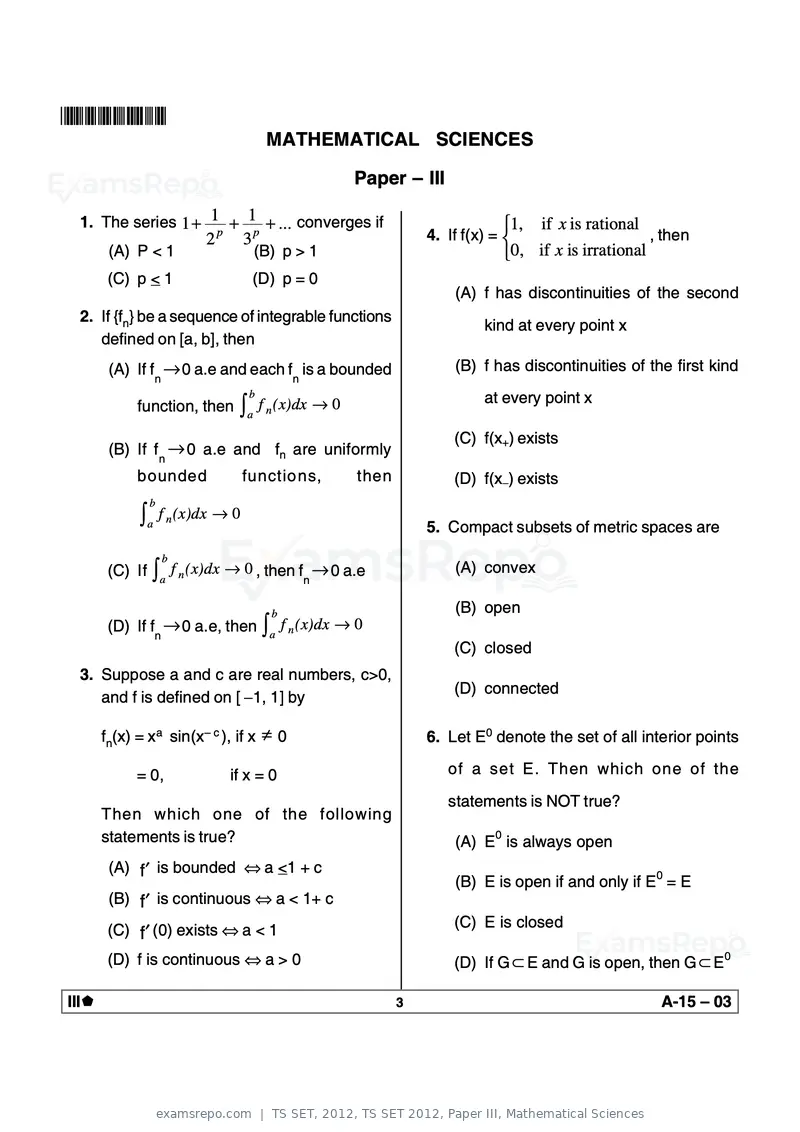
Text of page 3
*A1503*
                                     MATHEMATICAL SCIENCES

                                                     Paper – III

 1. The series 1 + 1p + 1p + ... converges if                                ⎧1, if x is rational
                        2       3                                4. If f(x) = ⎨                     , then
        (A) P < 1                   (B) p > 1                                ⎩0, if x is irrational
        (C) p < 1                   (D) p = 0
                                                                     (A) f has discontinuities of the second
 2. If {fn} be a sequence of integrable functions
                                                                          kind at every point x
    defined on [a, b], then
        (A) If fn → 0 a.e and each fn is a bounded                   (B) f has discontinuities of the first kind
                                b                                         at every point x
             function, then ∫a f n (x)dx → 0

                                                                     (C) f(x+) exists
        (B) If fn → 0 a.e and fn are uniformly
             bounded            functions,            then           (D) f(x−) exists
               b
             ∫a f n (x)dx → 0                                    5. Compact subsets of metric spaces are
                   b
        (C) If ∫a f n (x)dx → 0 , then fn → 0 a.e                    (A) convex

                                      b                              (B) open
        (D) If fn → 0 a.e, then ∫a        f n (x)dx → 0
                                                                     (C) closed
 3. Suppose a and c are real numbers, c>0,
                                                                     (D) connected
    and f is defined on [ −1, 1] by

       fn(x) = xa sin(x– c ), if x ≠ 0                           6. Let E0 denote the set of all interior points

            = 0,            if x = 0                                of a set E. Then which one of the

                                                                    statements is NOT true?
       Then which one of the following
       statements is true?                                           (A) E0 is always open
        (A) f ′ is bounded ⇔ a <1 + c
                                                                     (B) E is open if and only if E0 = E
        (B) f′ is continuous ⇔ a < 1+ c
        (C) f′ (0) exists ⇔ a < 1                                    (C) E is closed

        (D) f is continuous ⇔ a > 0                                  (D) If G ⊂ E and G is open, then G ⊂ E0

IIIÀ                                                         3                                       A-15 – 03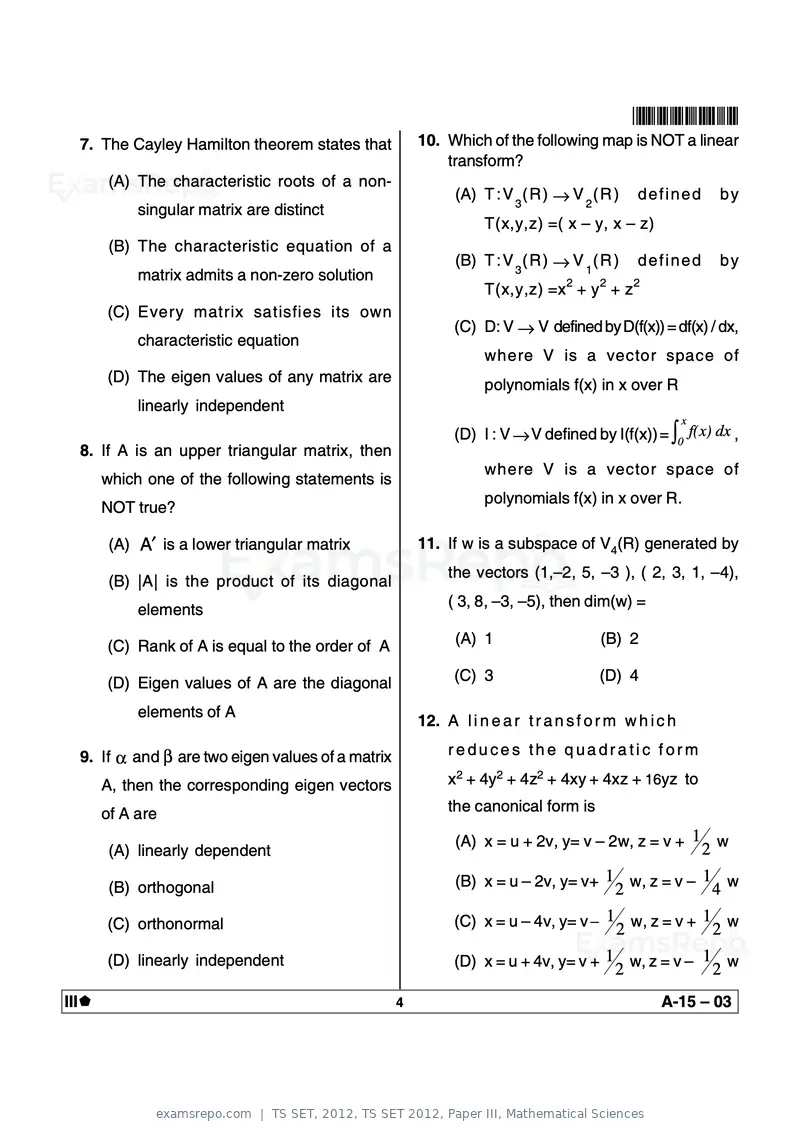
Text of page 4
*A1503*
  7. The Cayley Hamilton theorem states that           10. Which of the following map is NOT a linear
                                                           transform?
        (A) The characteristic roots of a non-
                                                             (A) T : V 3 ( R ) → V 2 ( R )   defined       by
            singular matrix are distinct
                                                                  T(x,y,z) =( x – y, x – z)
        (B) The characteristic equation of a
                                                             (B) T : V 3 ( R ) → V 1 ( R )   defined       by
            matrix admits a non-zero solution
                                                                  T(x,y,z) =x2 + y 2 + z 2
       (C) Every matrix satisfies its own
                                                             (C) D: V → V defined by D(f(x)) = df(x) / dx,
            characteristic equation
                                                                  where V is a vector space of
       (D) The eigen values of any matrix are                     polynomials f(x) in x over R
            linearly independent
                                                                                                       x
                                                             (D) I : V → V defined by I(f(x)) = ∫0 f(x) dx ,
  8. If A is an upper triangular matrix, then
                                                                  where V is a vector space of
       which one of the following statements is
                                                                  polynomials f(x) in x over R.
       NOT true?

        (A) A′ is a lower triangular matrix            11. If w is a subspace of V4(R) generated by
                                                            the vectors (1,–2, 5, –3 ), ( 2, 3, 1, –4),
        (B) |A| is the product of its diagonal
                                                            ( 3, 8, –3, –5), then dim(w) =
            elements

       (C) Rank of A is equal to the order of A              (A) 1                    (B) 2

       (D) Eigen values of A are the diagonal                (C) 3                    (D) 4

            elements of A
                                                       12. A l i n e a r t r a n s f o r m w h i c h

  9. If α and β are two eigen values of a matrix            reduces the quadratic form

       A, then the corresponding eigen vectors              x2 + 4y2 + 4z2 + 4xy + 4xz + 16yz to

       of A are                                             the canonical form is

                                                             (A) x = u + 2v, y= v – 2w, z = v + 1 2 w
        (A) linearly dependent

        (B) orthogonal                                       (B) x = u – 2v, y= v+ 1 2 w, z = v – 1 4 w

       (C) orthonormal                                       (C) x = u – 4v, y= v − 1 2 w, z = v + 1 2 w

       (D) linearly independent                              (D) x = u + 4v, y= v + 1 w, z = v – 1 w
                                                                                     2            2
IIIÀ                                               4                                             A-15 – 03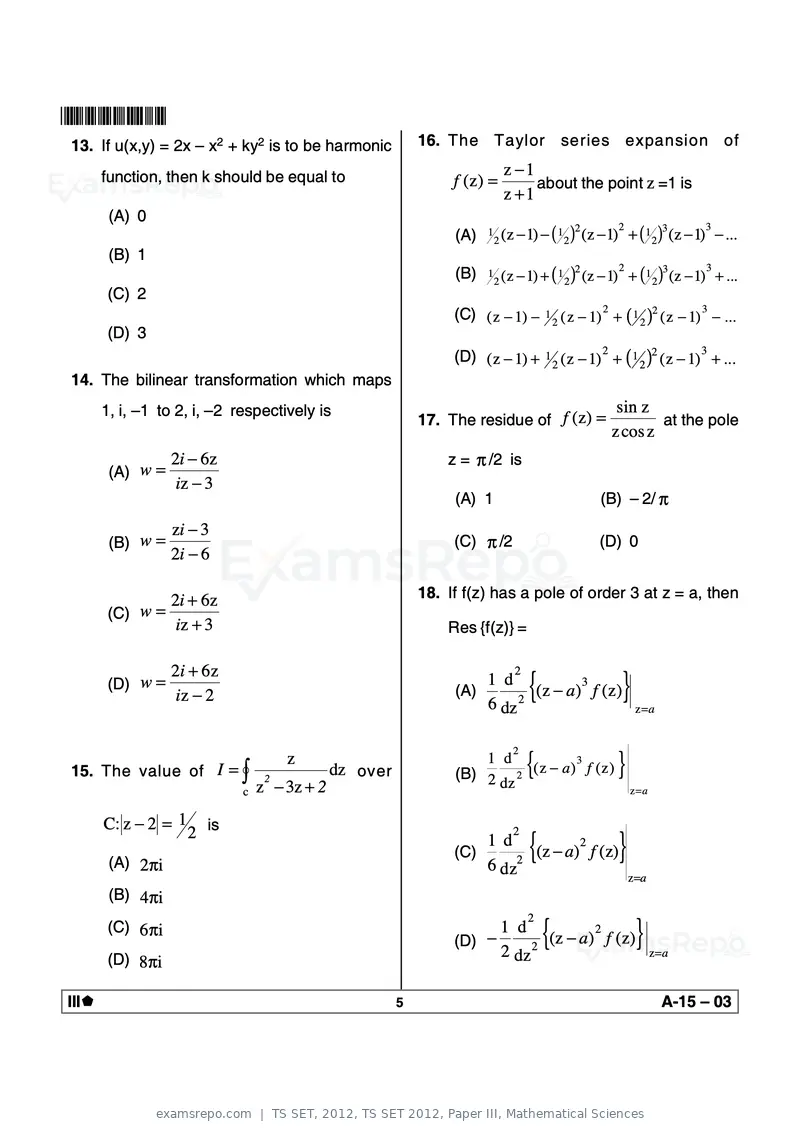
Text of page 5
*A1503*
13. If u(x,y) = 2x – x2 + ky2 is to be harmonic                 16. The Taylor series expansion of

       function, then k should be equal to                                       z −1
                                                                     f (z) =          about the point z =1 is
                                                                                 z +1
        (A) 0
                                                                     (A)   1
                                                                               2 (z − 1) −     ( 1 2 )2 (z −1)2 + ( 1 2 )3 (z − 1)3 − ...
        (B) 1
                                                                     (B)   1
                                                                               2 ( z − 1) +    ( 1 2 )2 (z − 1) 2 + ( 1 2 )3 (z − 1)3 + ...
       (C) 2
                                                                     (C) ( z − 1) − 1 2 ( z − 1) 2 + ( 1 2 )2 ( z − 1) 3 − ...
       (D) 3
                                                                     (D) ( z − 1) + 1 2 ( z − 1) 2 + ( 1 2 )2 ( z − 1) 3 + ...
14. The bilinear transformation which maps
       1, i, –1 to 2, i, –2 respectively is                                                                   sin z
                                                                17. The residue of f (z) =                           at the pole
                                                                                                             z cos z
                  2i − 6z                                           z = π /2 is
        (A) w =
                   iz − 3
                                                                     (A) 1                                (B) – 2/ π
                  zi − 3
        (B) w =                                                      (C) π /2                             (D) 0
                  2i − 6

                  2i + 6z                                       18. If f(z) has a pole of order 3 at z = a, then
       (C) w =
                   iz + 3                                           Res {f(z)} =

                  2i + 6 z
                                                                                       {                       }
                                                                                   2
       (D) w =                                                       (A)
                                                                         1 d             3
                                                                                ( z − a ) f (z )
                  iz − 2                                                 6 dz 2
                                                                                                                   z =a


                                                                                       {                      }
                                                                                   2
                                        z                                1 d          3
15. The value of I = ∫             2
                                                  dz over            (B) 2 2 ( z − a ) f ( z )
                             c z       − 3z + 2                            dz                                     z=a


       C: z − 2 = 1
                      2 is
                                                                                       {                      }
                                                                                   2
                                                                         1 d          2
                                                                     (C)       (z − a) f (z)
        (A) 2πi                                                          6 dz2
                                                                                                                  z =a
        (B) 4πi

                                                                                           {                       }
                                                                                       2
       (C) 6πi                                                             1 d            2
                                                                     (D) −      2
                                                                                  (z − a ) f ( z)
       (D) 8πi                                                             2 dz                                          z=a


IIIÀ                                                        5                                                             A-15 – 03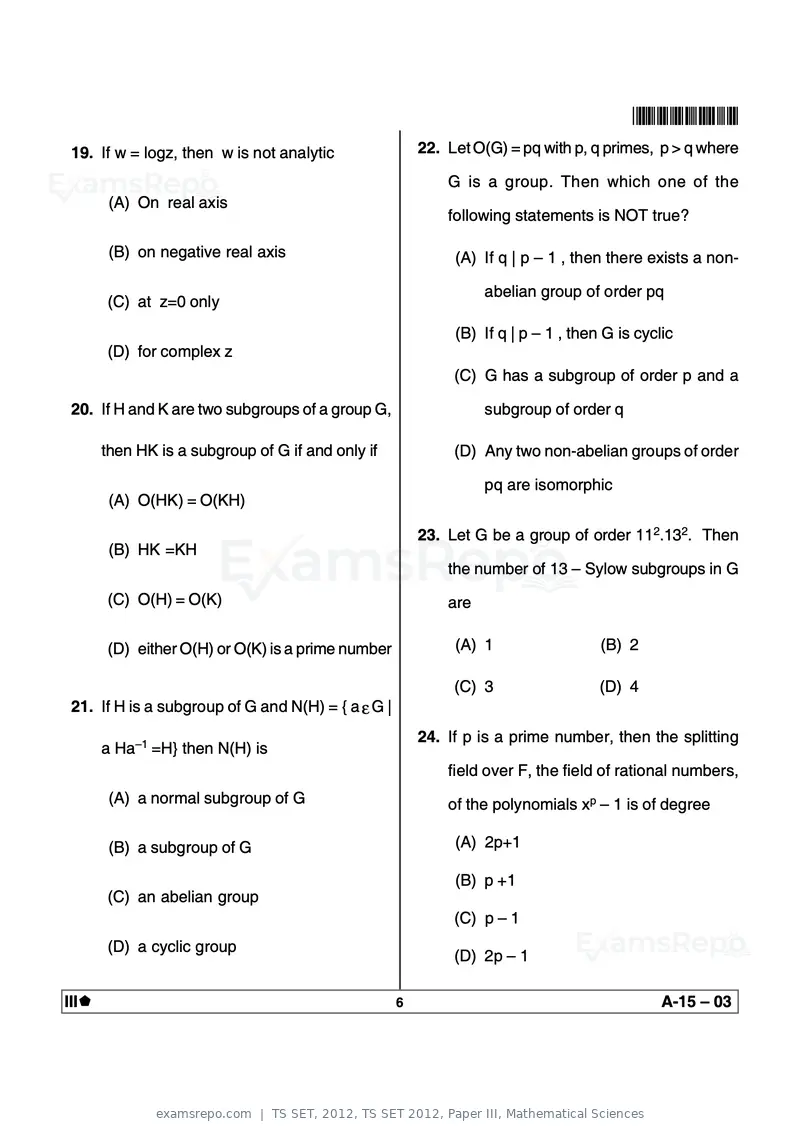
Text of page 6
*A1503*
19. If w = logz, then w is not analytic                22. Let O(G) = pq with p, q primes, p > q where

                                                           G is a group. Then which one of the
        (A) On real axis
                                                           following statements is NOT true?

        (B) on negative real axis                           (A) If q | p – 1 , then there exists a non-

                                                                 abelian group of order pq
       (C) at z=0 only
                                                            (B) If q | p – 1 , then G is cyclic
       (D) for complex z
                                                            (C) G has a subgroup of order p and a

20. If H and K are two subgroups of a group G,                   subgroup of order q

       then HK is a subgroup of G if and only if            (D) Any two non-abelian groups of order

                                                                 pq are isomorphic
        (A) O(HK) = O(KH)

                                                       23. Let G be a group of order 112.132. Then
        (B) HK =KH
                                                           the number of 13 – Sylow subgroups in G
       (C) O(H) = O(K)                                     are

       (D) either O(H) or O(K) is a prime number            (A) 1                  (B) 2

                                                            (C) 3                  (D) 4
21. If H is a subgroup of G and N(H) = { a ε G |
                                                       24. If p is a prime number, then the splitting
       a Ha–1 =H} then N(H) is
                                                           field over F, the field of rational numbers,
        (A) a normal subgroup of G                         of the polynomials xp – 1 is of degree

        (B) a subgroup of G                                 (A) 2p+1

                                                            (B) p +1
       (C) an abelian group
                                                            (C) p – 1
       (D) a cyclic group
                                                            (D) 2p – 1

IIIÀ                                               6                                         A-15 – 03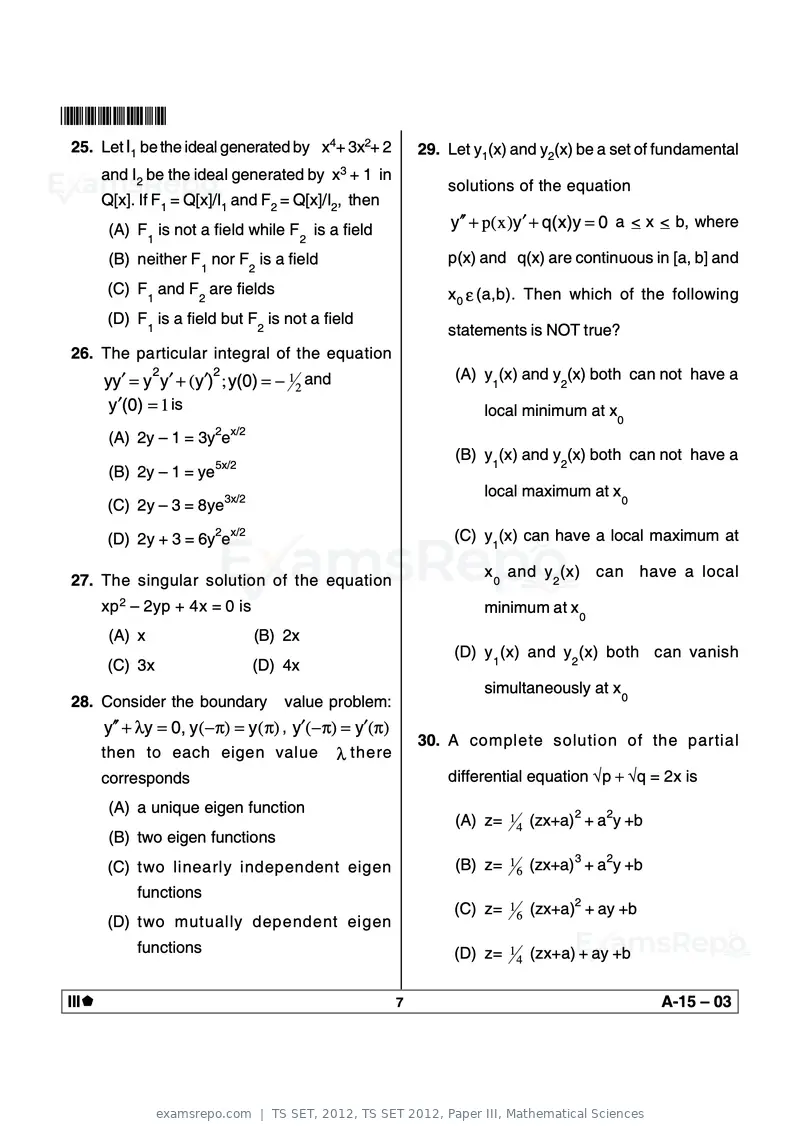
Text of page 7
*A1503*
25. Let I1 be the ideal generated by x4+ 3x2+ 2               29. Let y1(x) and y2(x) be a set of fundamental
       and I2 be the ideal generated by x3 + 1 in
                                                                  solutions of the equation
       Q[x]. If F1 = Q[x]/I1 and F2 = Q[x]/I2, then
        (A) F1 is not a field while F2 is a field                 y′′ + p( x )y′ + q(x)y = 0 a < x < b, where

        (B) neither F1 nor F2 is a field                          p(x) and q(x) are continuous in [a, b] and
       (C) F1 and F2 are fields                                   x0 ε (a,b). Then which of the following
       (D) F1 is a field but F2 is not a field
                                                                  statements is NOT true?
26. The particular integral of the equation
                2        2                                         (A) y1(x) and y2(x) both can not have a
       yy′ = y y′ + ( y′) ; y(0) = − 1 2 and
        y ′(0) = 1 is                                                  local minimum at x
                                                                                            0
                         2 x/2
        (A) 2y – 1 = 3y e
                                                                   (B) y1(x) and y2(x) both can not have a
        (B) 2y – 1 = ye5x/2
                                                                       local maximum at x0
       (C) 2y – 3 = 8ye3x/2

       (D) 2y + 3 = 6y2ex/2                                        (C) y1(x) can have a local maximum at

                                                                       x 0 and y 2 (x) can have a local
27. The singular solution of the equation
       xp 2 – 2yp + 4x = 0 is                                          minimum at x0
        (A) x                    (B) 2x
                                                                   (D) y 1 (x) and y2 (x) both can vanish
       (C) 3x                    (D) 4x
                                                                       simultaneously at x0
28. Consider the boundary            value problem:
       y′′ + λy = 0, y (− π) = y ( π) , y′(− π) = y′(π)
                                                              30. A complete solution of the partial
       then to each eigen value                λ there
       corresponds                                                differential equation √p + √q = 2x is
        (A) a unique eigen function
                                                                   (A) z= 1 4 (zx+a)2 + a2y +b
        (B) two eigen functions
       (C) two linearly independent eigen                          (B) z= 1 6 (zx+a)3 + a2y +b
            functions
                                                                   (C) z= 1 6 (zx+a)2 + ay +b
       (D) two mutually dependent eigen
            functions                                              (D) z= 1 4 (zx+a) + ay +b


IIIÀ                                                      7                                      A-15 – 03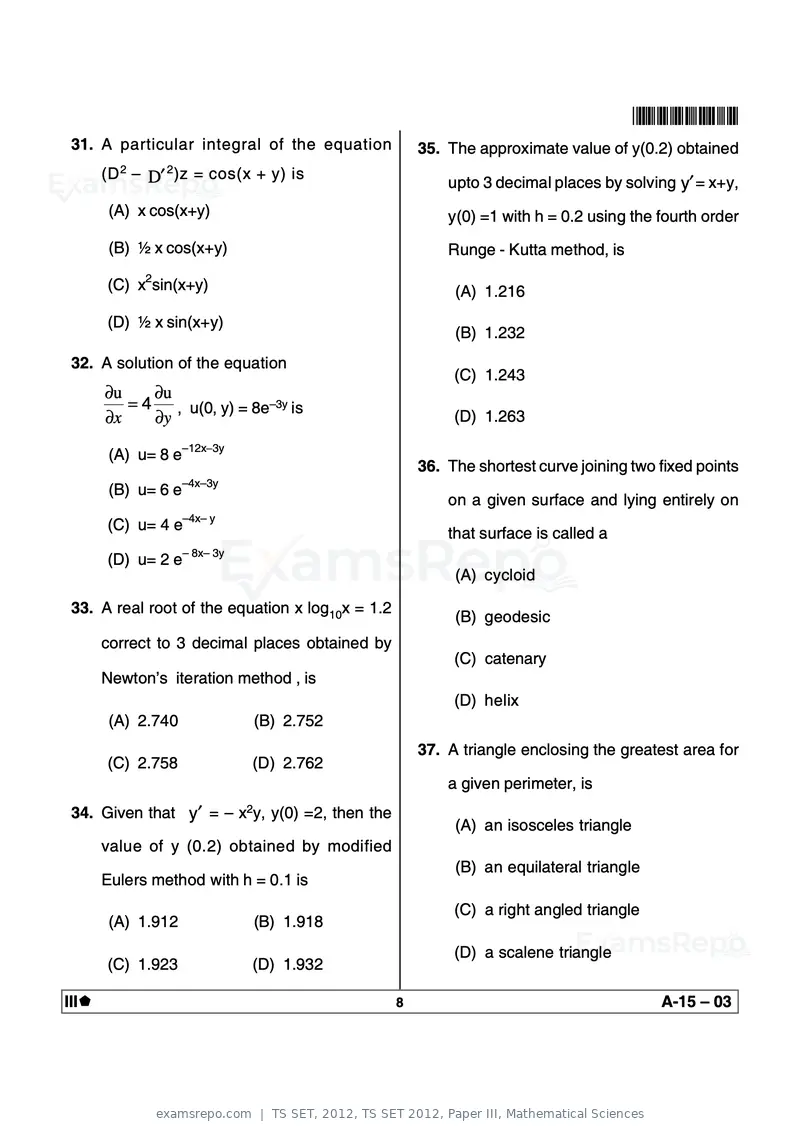
Text of page 8
*A1503*
31. A particular integral of the equation            35. The approximate value of y(0.2) obtained
       (D 2 – D′ 2 )z = cos(x + y) is
                                                         upto 3 decimal places by solving y′ = x+y,
        (A) x cos(x+y)                                   y(0) =1 with h = 0.2 using the fourth order
        (B) ½ x cos(x+y)                                 Runge - Kutta method, is

       (C) x2sin(x+y)                                     (A) 1.216
       (D) ½ x sin(x+y)
                                                          (B) 1.232
32. A solution of the equation
                                                          (C) 1.243
       ∂u    ∂u
          = 4 , u(0, y) = 8e–3y is
       ∂x    ∂y                                           (D) 1.263

        (A) u= 8 e–12x−3y
                                                     36. The shortest curve joining two fixed points
                    –4x–3y
        (B) u= 6 e
                                                         on a given surface and lying entirely on
       (C) u= 4 e–4x– y
                                                         that surface is called a
                     – 8x– 3y
       (D) u= 2 e
                                                          (A) cycloid

33. A real root of the equation x log10x = 1.2
                                                          (B) geodesic
       correct to 3 decimal places obtained by
                                                          (C) catenary
       Newton’s iteration method , is
                                                          (D) helix
        (A) 2.740               (B) 2.752
                                                     37. A triangle enclosing the greatest area for
       (C) 2.758                (D) 2.762
                                                         a given perimeter, is
34. Given that y′ = – x2y, y(0) =2, then the
                                                          (A) an isosceles triangle
       value of y (0.2) obtained by modified
                                                          (B) an equilateral triangle
       Eulers method with h = 0.1 is
                                                          (C) a right angled triangle
        (A) 1.912               (B) 1.918
                                                          (D) a scalene triangle
       (C) 1.923                (D) 1.932

IIIÀ                                             8                                      A-15 – 03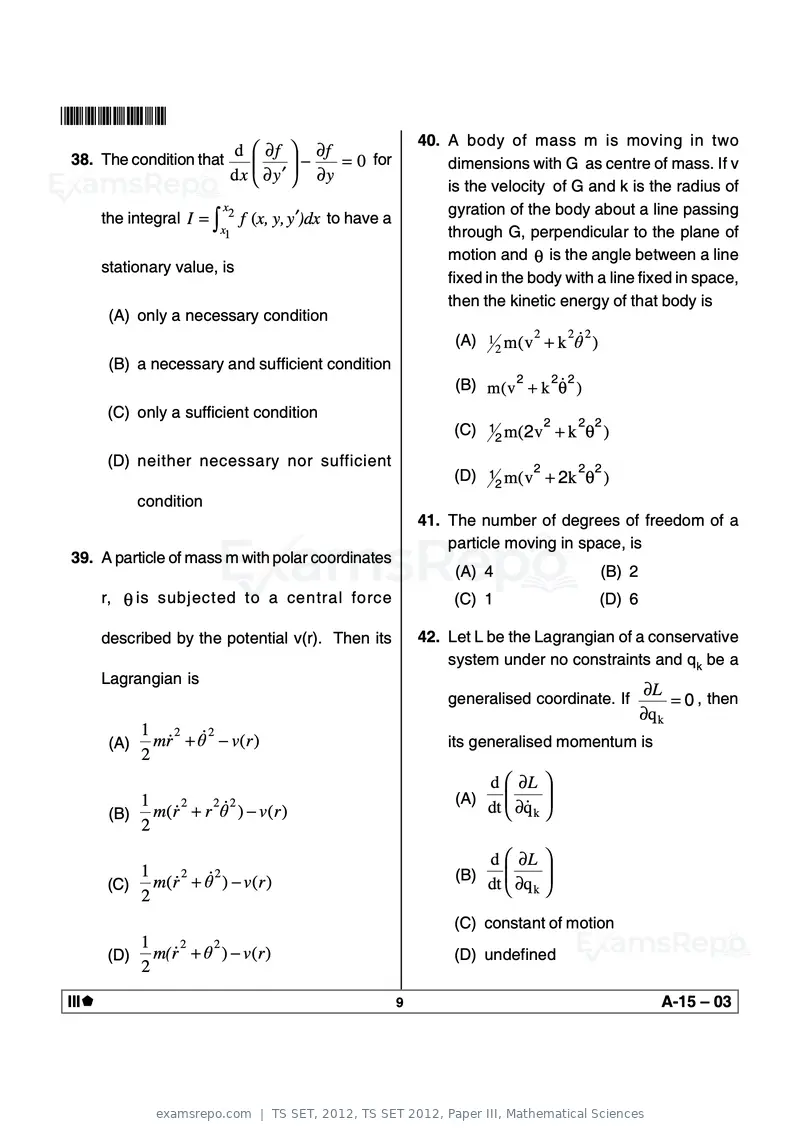
Text of page 9
*A1503*
                                                                 40. A body of mass m is moving in two
                                d ⎛ ∂ f ⎞ ∂f
38. The condition that             ⎜         ⎟−    = 0 for           dimensions with G as centre of mass. If v
                               d x ⎜⎝ ∂ y ′ ⎠⎟ ∂ y
                                                                     is the velocity of G and k is the radius of
                           x                                         gyration of the body about a line passing
       the integral I = ∫ 2 f (x, y, y′)dx to have a
                           x1                                        through G, perpendicular to the plane of
                                                                     motion and θ is the angle between a line
       stationary value, is
                                                                     fixed in the body with a line fixed in space,
                                                                     then the kinetic energy of that body is
        (A) only a necessary condition
                                                                                            + k  )
                                                                                        2      2 2
                                                                      (A)   1
                                                                                2 m(v
        (B) a necessary and sufficient condition
                                                                      (B) m ( v 2 + k 2θ 2 )
       (C) only a sufficient condition
                                                                                            2     2 2
                                                                      (C)   1 m(2 v
                                                                             2                  +k θ )
       (D) neither necessary nor sufficient                                             2         2 2
                                                                      (D)   1 m( v
                                                                             2              + 2k θ )
              condition
                                                                 41. The number of degrees of freedom of a
                                                                     particle moving in space, is
39. A particle of mass m with polar coordinates
                                                                      (A) 4                            (B) 2
       r, θ is subjected to a central force                           (C) 1                            (D) 6

       described by the potential v(r). Then its                 42. Let L be the Lagrangian of a conservative
                                                                     system under no constraints and qk be a
       Lagrangian is
                                                                                                               ∂L
                                                                     generalised coordinate. If                     = 0 , then
                                                                                                               ∂q k
              1 2 2
        (A)     mr +  − v( r )                                     its generalised momentum is
              2
                                                                            d ⎛ ∂L ⎞
                                                                      (A)       ⎜        ⎟
           1
        (B) m( r + r  ) − v (r )
                 2   2 2
                                                                            dt ⎝⎜ ∂q k ⎟⎠
           2
                                                                            d ⎛ ∂L ⎞
          1                                                           (B)       ⎜       ⎟
       (C) m(r +  ) − v (r )                                             dt ⎝⎜ ∂q k ⎟⎠
               2    2
           2
                                                                      (C) constant of motion
              1     2   2
       (D)      m(r +  ) − v ( r )                                  (D) undefined
              2

IIIÀ                                                         9                                                    A-15 – 03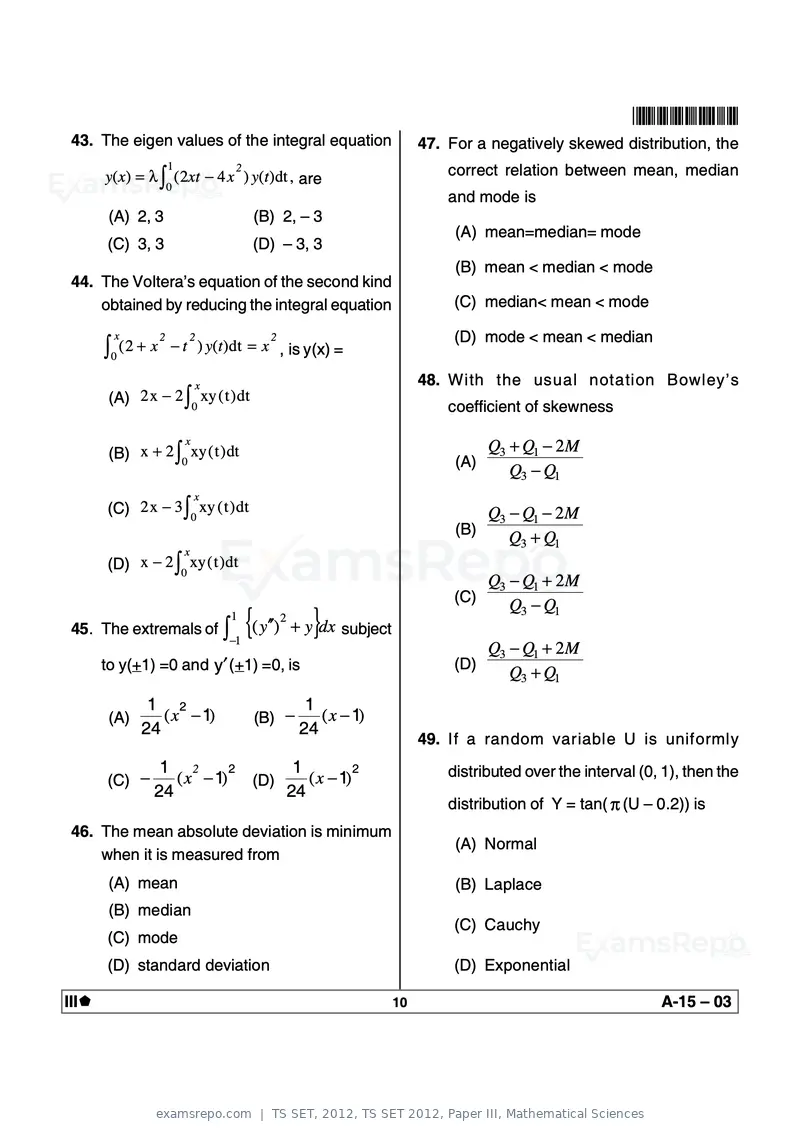
Text of page 10
*A1503*
43. The eigen values of the integral equation                       47. For a negatively skewed distribution, the
                     1            2
       y(x) = λ ∫ ( 2xt − 4 x ) y(t)dt , are                            correct relation between mean, median
                     0
                                                                        and mode is
        (A) 2, 3                       (B) 2, – 3
                                                                         (A) mean=median= mode
       (C) 3, 3                        (D) – 3, 3
                                                                         (B) mean < median < mode
44. The Voltera’s equation of the second kind
    obtained by reducing the integral equation                           (C) median< mean < mode
         x       2       2               2                               (D) mode < mean < median
       ∫0 ( 2 + x − t ) y(t)dt = x , is y(x) =
                             x                                      48. With the usual notation Bowley’s
        (A) 2 x − 2 ∫0 xy ( t ) dt
                                                                        coefficient of skewness

                         x
        (B) x + 2 ∫0 xy ( t ) dt                                               Q3 + Q1 − 2M
                                                                         (A)
                                                                                  Q3 − Q1
                             x
       (C) 2 x − 3 ∫0 xy ( t ) dt                                              Q3 − Q1 − 2M
                                                                         (B)
                                                                                  Q3 + Q1
                         x
       (D) x − 2 ∫0 xy ( t ) dt
                                                                               Q3 − Q1 + 2M
                                                                         (C)
                                                                                  Q3 − Q1
45. The extremals of ∫
                                 1

                                 −1
                                      {( y′′) + y}dx subject
                                             2

                                                                               Q3 − Q1 + 2M
       to y(+1) =0 and y′ (+1) =0, is                                    (D)
                                                                                  Q3 + Q1
               1 2                                1
        (A)      ( x − 1)              (B) −        ( x − 1)
              24                                 24
                                                                    49. If a random variable U is uniformly
                 1 2       2     1          2                           distributed over the interval (0, 1), then the
       (C) −       ( x − 1) (D)    ( x − 1)
                24              24
                                                                        distribution of Y = tan( π (U – 0.2)) is
46. The mean absolute deviation is minimum
                                                                         (A) Normal
    when it is measured from
        (A) mean                                                         (B) Laplace
        (B) median
                                                                         (C) Cauchy
       (C) mode
       (D) standard deviation                                            (D) Exponential

IIIÀ                                                           10                                        A-15 – 03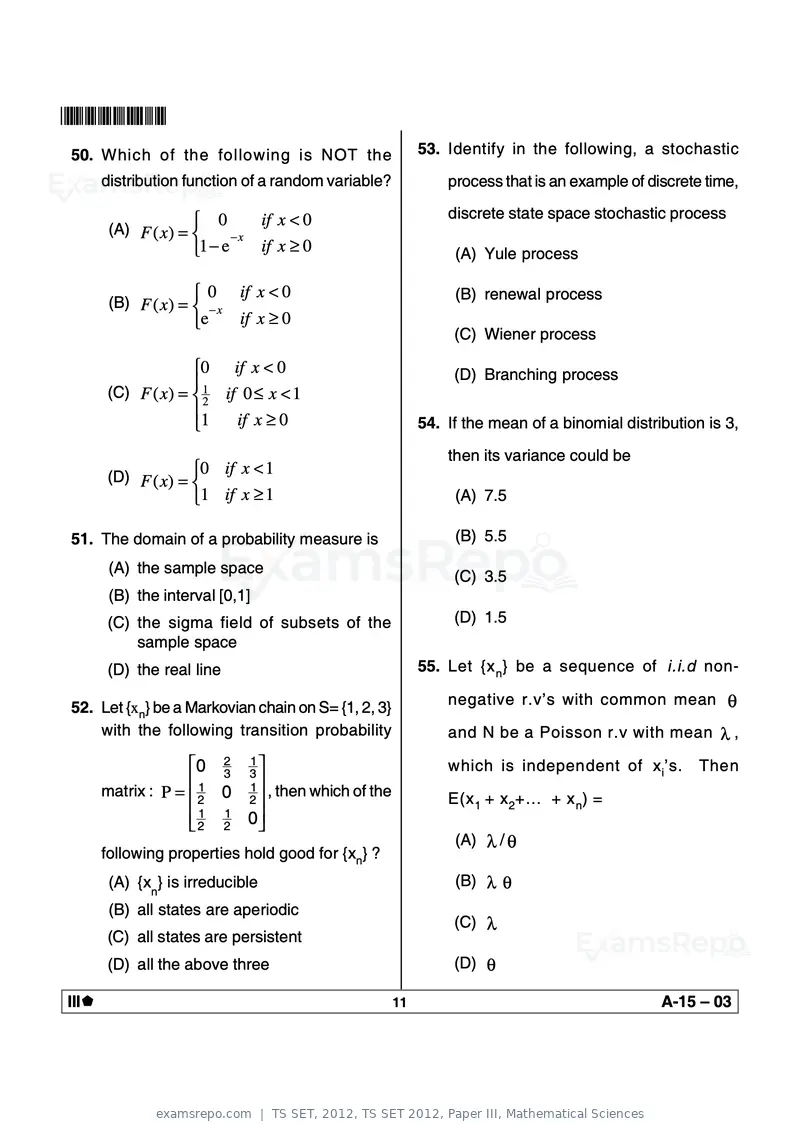
Text of page 11
*A1503*
50. Which of the following is NOT the                     53. Identify in the following, a stochastic
       distribution function of a random variable?            process that is an example of discrete time,

                     ⎧ 0          if x < 0                    discrete state space stochastic process
        (A) F ( x ) = ⎨     −x
                     ⎩1 − e       if x ≥ 0                     (A) Yule process

                      ⎧ 0     if x < 0                         (B) renewal process
        (B) F ( x ) = ⎨ − x
                      ⎩e      if x ≥ 0
                                                               (C) Wiener process

                     ⎧0 if x < 0                               (D) Branching process
                     ⎪
       (C) F ( x ) = ⎨ 12 if 0 ≤ x < 1
                     ⎪1     if x ≥ 0
                     ⎩                                    54. If the mean of a binomial distribution is 3,

                                                              then its variance could be
       (D) F ( x) = ⎧
                     0 if x < 1
                    ⎨
                    ⎩1 if x ≥ 1                                (A) 7.5

51. The domain of a probability measure is                     (B) 5.5
        (A) the sample space
                                                               (C) 3.5
        (B) the interval [0,1]
       (C) the sigma field of subsets of the                   (D) 1.5
           sample space
       (D) the real line                                  55. Let {x n } be a sequence of i.i.d non-

52. Let {xn} be a Markovian chain on S= {1, 2, 3}             negative r.v’s with common mean θ
    with the following transition probability                 and N be a Poisson r.v with mean λ ,

                   ⎡0 23 31 ⎤                                 which is independent of xi’s.         Then
                   ⎢          ⎥
       matrix : P = 21 0 21 , then which of the
                   ⎢          ⎥                               E(x 1 + x 2 +… + x n ) =
                   ⎢⎣ 21 21 0⎥⎦
                                                               (A) λ / θ
       following properties hold good for {xn} ?
        (A) {xn} is irreducible                                (B) λ θ
        (B) all states are aperiodic
                                                               (C) λ
       (C) all states are persistent
       (D) all the above three                                 (D) θ

IIIÀ                                                 11                                       A-15 – 03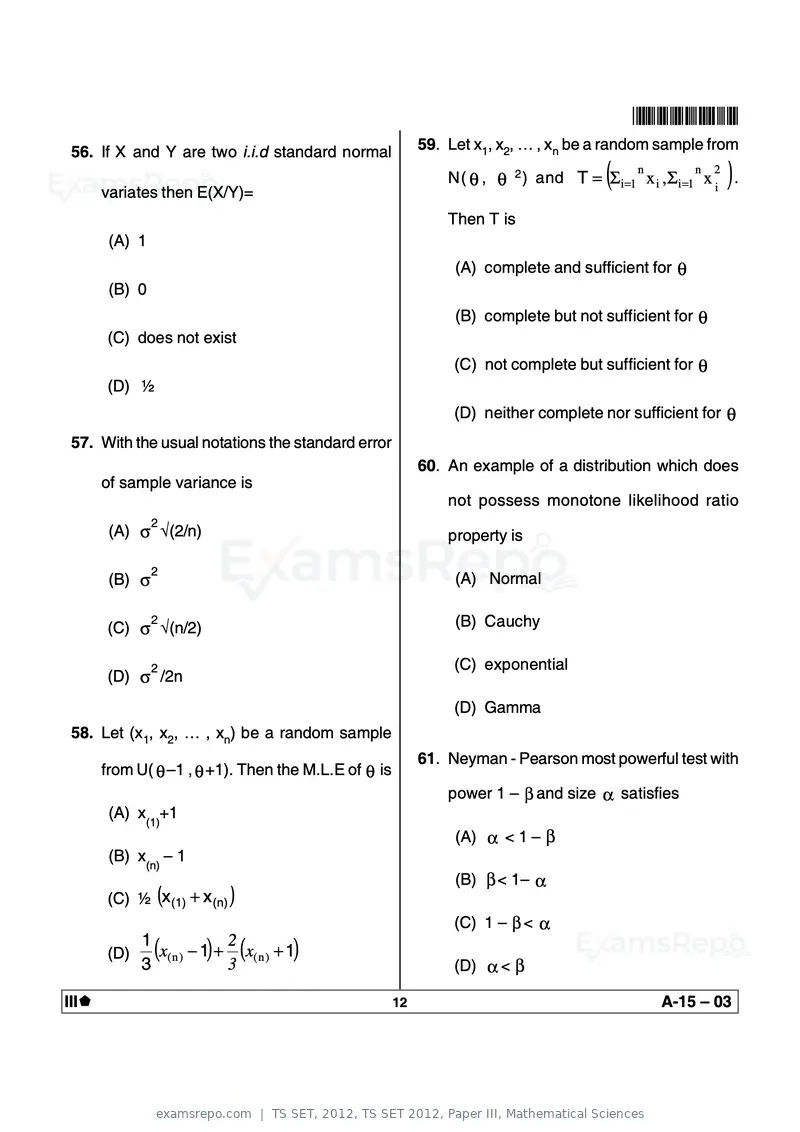
Text of page 12
*A1503*
56. If X and Y are two i.i.d standard normal               59. Let x1, x2, … , xn be a random sample from

       variates then E(X/Y)=
                                                                                      (    n        n   2
                                                               N( θ , θ 2 ) and T = Σi =1 x i , Σi =1 x i . )
                                                               Then T is
        (A) 1
                                                                (A) complete and sufficient for θ
        (B) 0
                                                                (B) complete but not sufficient for θ
       (C) does not exist
                                                                (C) not complete but sufficient for θ
       (D) ½
                                                                (D) neither complete nor sufficient for θ
57. With the usual notations the standard error
                                                           60. An example of a distribution which does
       of sample variance is
                                                               not possess monotone likelihood ratio
                2
        (A) σ √(2/n)                                           property is

                2
        (B) σ                                                   (A) Normal

                2
       (C) σ √(n/2)                                             (B) Cauchy

                2                                               (C) exponential
       (D) σ /2n
                                                                (D) Gamma
58. Let (x1, x2, … , xn) be a random sample
                                                           61. Neyman - Pearson most powerful test with
       from U( θ –1 , θ +1). Then the M.L.E of θ is
                                                               power 1 – β and size α satisfies
        (A) x(1)+1
                                                                (A) α < 1 – β
        (B) x(n) – 1
                                                                (B) β < 1– α
       (C) ½ (x(1) + x (n) )
                                                                (C) 1 – β < α
           1               2
       (D)
           3
             (x( n ) − 1) + (x( n ) + 1)
                           3                                    (D) α < β

IIIÀ                                                  12                                       A-15 – 03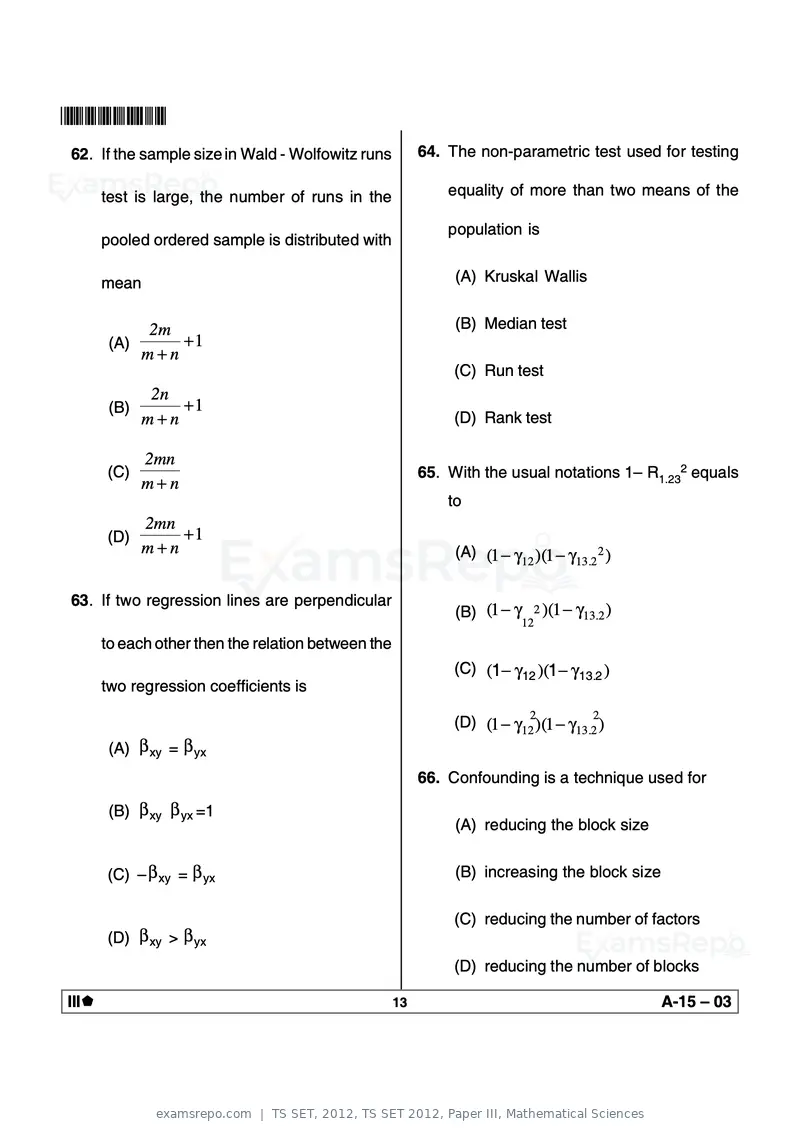
Text of page 13
*A1503*
62. If the sample size in Wald - Wolfowitz runs           64. The non-parametric test used for testing

       test is large, the number of runs in the               equality of more than two means of the

                                                              population is
       pooled ordered sample is distributed with

       mean                                                    (A) Kruskal Wallis


               2m                                              (B) Median test
        (A)       +1
              m+n
                                                               (C) Run test
               2n
        (B)       +1
              m+n                                              (D) Rank test

              2mn
       (C)                                                65. With the usual notations 1– R1.232 equals
              m+n
                                                              to
              2mn
       (D)        +1
              m+n                                              (A) (1 − γ12 )(1 − γ13.2 2 )


63. If two regression lines are perpendicular
                                                               (B) (1 − γ      2 )(1 − γ
                                                                                        13.2 )
                                                                          12
       to each other then the relation between the
                                                               (C) (1− γ12 )(1− γ 13.2 )
       two regression coefficients is
                                                                            2             2
                                                               (D) (1 − γ12 )(1 − γ13.2 )
        (A) β xy = β yx
                                                          66. Confounding is a technique used for

        (B) β xy β yx =1
                                                               (A) reducing the block size


       (C) – β xy = β yx                                       (B) increasing the block size

                                                               (C) reducing the number of factors
       (D) β xy > β yx
                                                               (D) reducing the number of blocks

IIIÀ                                                 13                                          A-15 – 03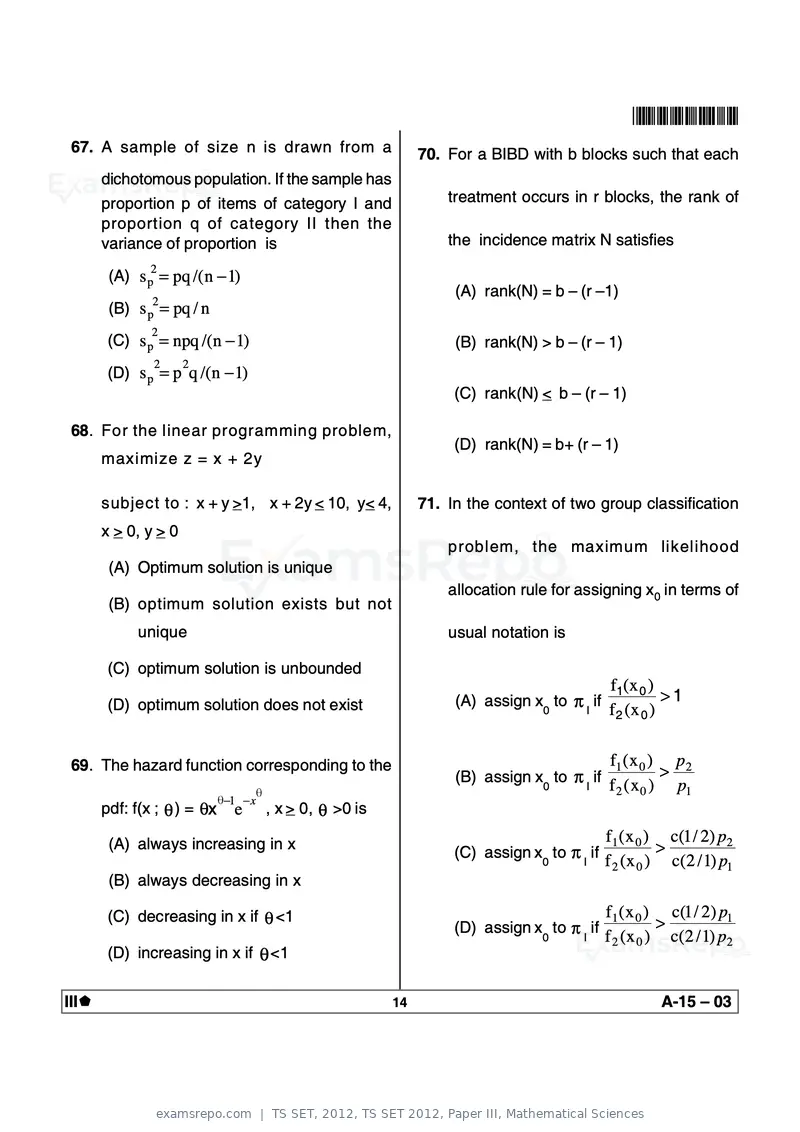
Text of page 14
*A1503*
67. A sample of size n is drawn from a                                70. For a BIBD with b blocks such that each
       dichotomous population. If the sample has
       proportion p of items of category I and                            treatment occurs in r blocks, the rank of
       proportion q of category II then the
       variance of proportion is                                          the incidence matrix N satisfies
               2
        (A) s p = pq /( n − 1)
                                                                           (A) rank(N) = b – (r –1)
               2
        (B) s p = pq / n
               2
        (C) s p = npq /( n − 1)                                            (B) rank(N) > b – (r – 1)
               2      2
        (D) s p = p q /( n − 1)
                                                                           (C) rank(N) < b – (r – 1)

68. For the linear programming problem,
                                                                           (D) rank(N) = b+ (r – 1)
       maximize z = x + 2y

       subject to : x + y >1, x + 2y < 10, y< 4,                      71. In the context of two group classification
       x > 0, y > 0
                                                                          problem, the maximum likelihood
        (A) Optimum solution is unique
                                                                          allocation rule for assigning x0 in terms of
        (B) optimum solution exists but not
            unique                                                        usual notation is

        (C) optimum solution is unbounded
                                                                                                     f1( x 0 )
        (D) optimum solution does not exist                                (A) assign x0 to π I if             >1
                                                                                                     f2 (x 0 )


69. The hazard function corresponding to the                                                         f1 ( x 0 ) p2
                                                                           (B) assign x0 to π I if              >
                                                                                                     f 2 ( x 0 ) p1
                                 −1 − x


       pdf: f(x ; θ ) = θx         e          , x > 0, θ >0 is


        (A) always increasing in x                                                                   f1 ( x 0 ) c(1 / 2) p2
                                                                           (C) assign x0 to π I if              >
                                                                                                     f 2 ( x 0 ) c( 2 / 1) p1
        (B) always decreasing in x

        (C) decreasing in x if θ <1                                                                  f1 ( x 0 ) c(1 / 2) p1
                                                                           (D) assign x0 to π I if              >
                                                                                                     f 2 ( x 0 ) c( 2 / 1) p2
        (D) increasing in x if θ <1


IIIÀ                                                             14                                            A-15 – 03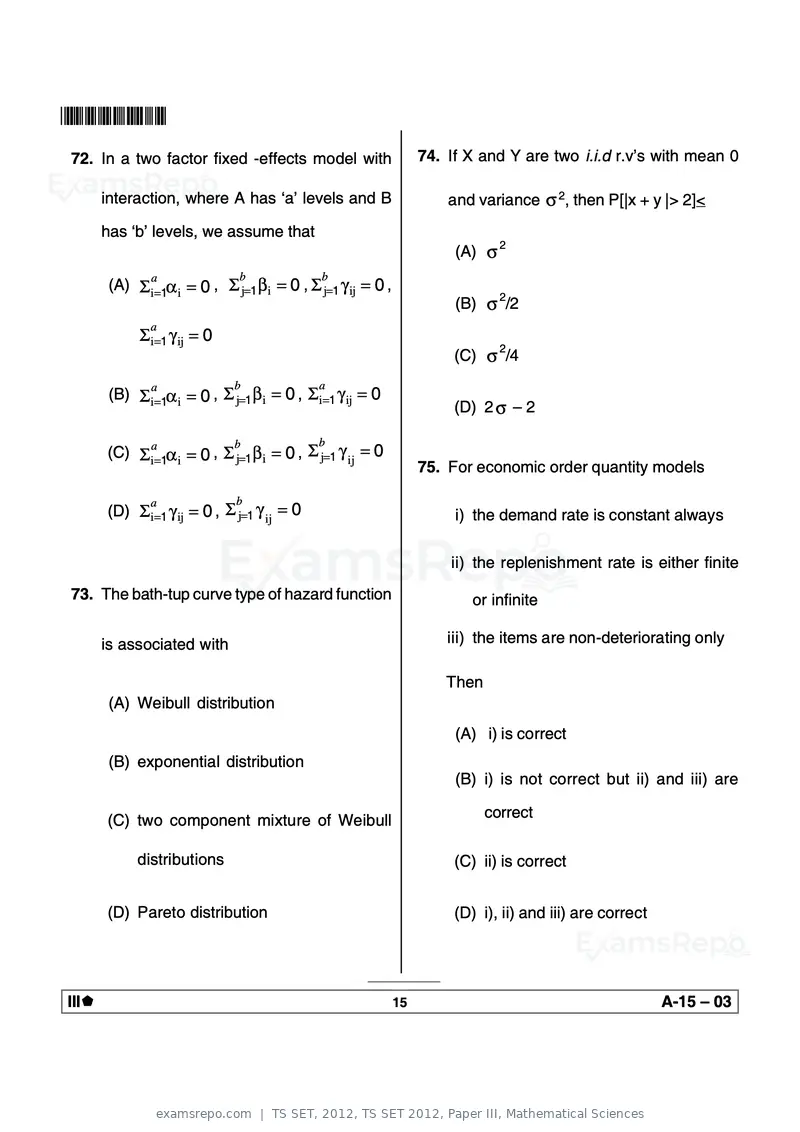
Text of page 15
*A1503*

72. In a two factor fixed -effects model with                     74. If X and Y are two i.i.d r.v’s with mean 0

       interaction, where A has ‘a’ levels and B                      and variance σ 2, then P[|x + y |> 2]<
       has ‘b’ levels, we assume that
                                                                       (A) σ 2
               a               b             b
        (A) Σi =1α i = 0 , Σ j=1 βi = 0 , Σ j=1 γ ij = 0 ,
                                                                       (B) σ 2/2
               a
             Σi=1 γ ij = 0
                                                                       (C) σ 2/4
               a              b              a
        (B) Σi =1α i = 0 , Σ j=1 βi = 0 , Σi =1 γ ij = 0
                                                                       (D) 2 σ – 2

               a              b              b
       (C) Σi =1α i = 0 , Σ j=1 βi = 0 , Σ j=1 γ ij = 0
                                                                  75. For economic order quantity models

               a              b
       (D) Σi =1 γ ij = 0 , Σ j=1 γ ij = 0                             i) the demand rate is constant always

                                                                      ii) the replenishment rate is either finite
73. The bath-tup curve type of hazard function                            or infinite

       is associated with                                             iii) the items are non-deteriorating only

                                                                      Then
        (A) Weibull distribution
                                                                       (A) i) is correct
        (B) exponential distribution
                                                                       (B) i) is not correct but ii) and iii) are

       (C) two component mixture of Weibull                                  correct

             distributions                                             (C) ii) is correct


       (D) Pareto distribution                                         (D) i), ii) and iii) are correct


IIIÀ                                                         15                                           A-15 – 03
Text of page 16
*A1503*
       Space for Rough Work


IIIÀ            16             A-15 – 03
Official key not published for this paper.
Page 1 of 16
Source: Telangana State Eligibility Test. Question paper published by Telangana State Eligibility Test.