
TS SET 2012: Paper III, Physical Sciences
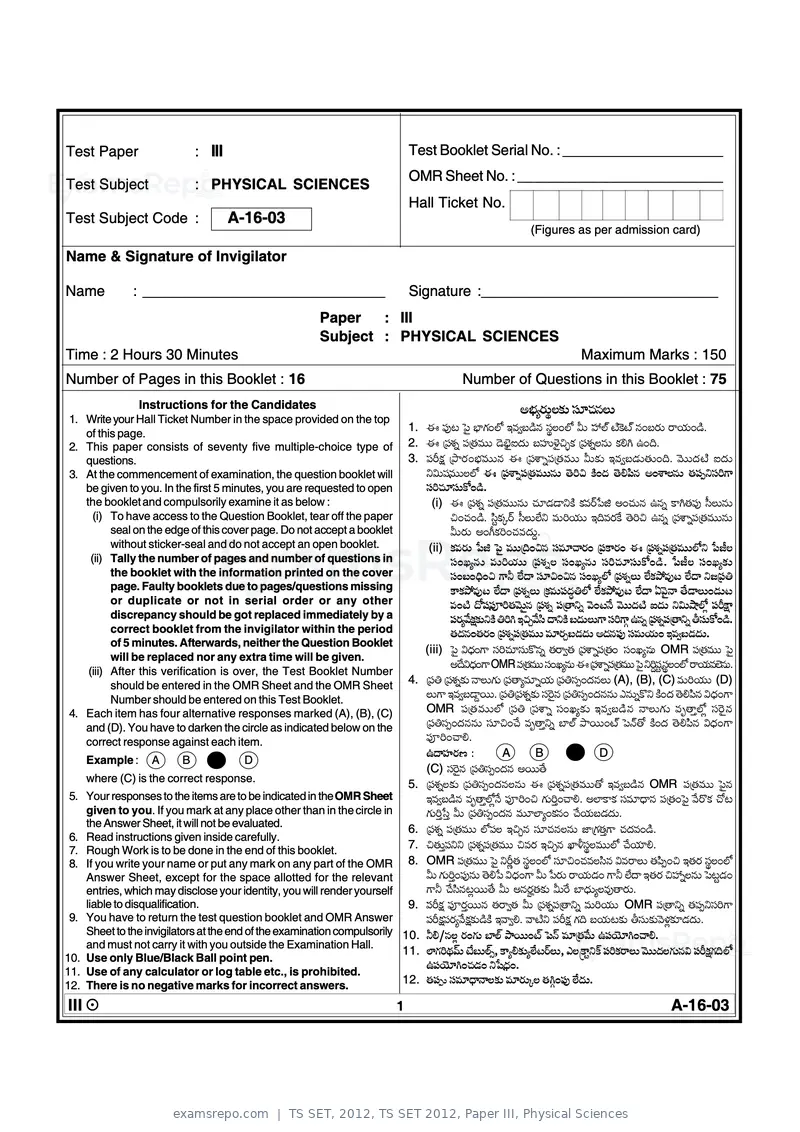
Text of page 1
Test Paper : III Test Booklet Serial No. : ______________________
OMR Sheet No. : ________________________________
Test Subject : PHYSICAL SCIENCES
Hall Ticket No.
Test Subject Code : A-16-03
(Figures as per admission card)
Name & Signature of Invigilator
Name : ____________________________________ Signature :___________________________________
Paper : III
Subject : PHYSICAL SCIENCES
Time : 2 Hours 30 Minutes Maximum Marks : 150
Number of Pages in this Booklet : 16 Number of Questions in this Booklet : 75
Instructions for the Candidates A¿æýÅÆæÿ$¦ËMæü$ çÜ*^èþ¯èþË$
1. Write your Hall Ticket Number in the space provided on the top
1. D ç³#r ò³O ¿êVæü ÌZ CÐèþÓºyìþ¯èþ çÜ¦Ë ÌZ Ò$ çàÌý sìýMðüsý ¯èþ ºÆæÿ$ Æ>Äæý$ yìþ.
of this page.
2. This paper consists of seventy five multiple-choice type of 2. D {ç³Ôèý² ç³{èþÐèþ$$ yðþ¿ñýOI§æþ$ ºçßý$âñýO_eMæü {ç³Ôèý²Ë¯èþ$ MæüÍW E ¨.
questions. 3. ç³Èæü {´ëÆæÿ ¿æýÐèþ$$¯èþ D {ç³Ôé²ç³{èþÐèþ$$ Ò$Mæü$ CÐèþÓºyæþ$èþ$ ¨. Ððþ$$§æþsìý I§æþ$
3. At the commencement of examination, the question booklet will °Ñ$çÙÐèþ$$ËÌZ D {ç³Ôé²ç³{èþÐèþ$$¯èþ$ ðþÇ_ Mìü §æþ ðþÍí³¯èþ A Ôé˯èþ$ èþç³µ°çÜÇV>
be given to you. In the first 5 minutes, you are requested to open çÜÇ^èþ*çÜ$Mø yìþ.
the booklet and compulsorily examine it as below : (i) D {ç³Ôèý² ç³{èþÐèþ$$¯èþ$ ^èþ*yæþyé°Mìü MæüÐèþÆÿõ³h A ^èþ$¯èþ E¯èþ² M>Wèþç³# ïÜË$¯èþ$
(i) To have access to the Question Booklet, tear off the paper _ ^èþ yìþ. íÜtMæüPÆÿ ïÜË$Ìôý° Ðèþ$ÇÄæý$$ C¨ÐèþÆæÿMóü ðþÇ_ E¯èþ² {ç³Ôé²ç³{èþÐèþ$$¯èþ$
seal on the edge of this cover page. Do not accept a booklet Ò$Ææÿ$ A XMæüÇ ^èþÐèþ§æþ$ª.
without sticker-seal and do not accept an open booklet. (ii) MæüÐèþÆæÿ$ õ³h ò³O Ðèþ$${¨ _¯èþ çÜÐèþ*^éÆæÿ {ç³M>Ææÿ D {ç³Ôèý²ç³{èþÐèþ$$ÌZ° õ³iË
(ii) Tally the number of pages and number of questions in çÜ Qůèþ$ Ðèþ$ÇÄæý$$ {ç³Ôèý²Ë çÜ Qůèþ$ çÜÇ^èþ*çÜ$Mø yìþ. õ³iË çÜ QÅMæü$
the booklet with the information printed on the cover çÜ º «¨ _ V>± Ìôý§é çÜ*_ _¯èþ çÜ QÅÌZ {ç³Ôèý²Ë$ ÌôýMæü´ùÐèþ#r Ìôý§é °f{ç³
page. Faulty booklets due to pages/questions missing M>Mæü´ùÐèþ#r Ìôý§é {ç³Ôèý²Ë$ {MæüÐèþ$糧æþ®ÌZ ÌôýMæü´ùÐèþ#r Ìôý§é HÐðþO¯é óþyéË$ yæþ$r
or duplicate or not in serial order or any other Ðèþ sìý §øçÙç³NÇèþÐðþ$O¯èþ {ç³Ôèý² ç³{é°² Ððþ r¯óþ Ððþ$$§æþsìý I§æþ$ °Ñ$ÚëÌZÏ ç³È>
discrepancy should be got replaced immediately by a ç³ÆæÿÅÐóþæüMæü$°Mìü ÇW C_aÐóþíÜ §é°Mìü º§æþ$Ë$V> çÜÇV>Y E¯èþ² {ç³Ôèý²ç³{é°² ¡çÜ$Mø yìþ.
correct booklet from the invigilator within the period èþ§æþ¯èþ èþÆæÿ {ç³Ôèý²ç³{èþÐèþ$$ Ðèþ*Ææÿaºyæþ§æþ$ A§æþ¯èþç³# çÜÐèþ$Äæý$ CÐèþÓºyæþ§æþ$.
of 5 minutes. Afterwards, neither the Question Booklet
(iii) ò³O Ñ«§æþ V> çÜÇ^èþ*çÜ$Mö¯èþ² èþÆ>Óèþ {ç³Ôé²ç³{èþ çÜ Qůèþ$ OMR ç³{èþÐèþ$$ ò³O
will be replaced nor any extra time will be given.
A§óþÑ«§æþ V> OMR ç³{èþÐèþ$$ çÜ Qůèþ$ D {ç³Ôé²ç³{èþÐèþ$$ ò³O °ÇªçÙt çÜ¦Ë ÌZ Æ>Äæý$ÐèþÌñý¯èþ$.
(iii) After this verification is over, the Test Booklet Number
should be entered in the OMR Sheet and the OMR Sheet
4. {ç³ {ç³Ôèý²Mæü$ ¯éË$Væü$ {ç³éÅÐèþ*²Äæý$ {ç³çܵ §æþ¯èþË$ (A), (B), (C) Ðèþ$ÇÄæý$$ (D)
Number should be entered on this Test Booklet. Ë$V> CÐèþÓºyézÆÿ$$. {ç³{ç³Ôèý²Mæü$ çÜÆðÿO¯èþ {ç³çܵ §æþ¯èþ¯èþ$ G¯èþ$²Mö° Mìü §æþ ðþÍí³¯èþ Ñ«§æþ V>
4. Each item has four alternative responses marked (A), (B), (C) OMR ç³{èþÐèþ$$ÌZ {ç³ {ç³Ôé² çÜ QÅMæü$ CÐèþÓºyìþ¯èþ ¯éË$Væü$ Ðèþé¢ÌZÏ çÜÆðÿO¯èþ
and (D). You have to darken the circle as indicated below on the {ç³çܵ §æþ¯èþ¯èþ$ çÜ*_ ^óþ Ðèþ颰² »êÌý ´ëÆÿ$$ sý ò³¯þø Mìü §æþ ðþÍí³¯èþ Ñ«§æþ V>
correct response against each item. ç³NÇ ^éÍ.
Example : A B C D
E§éçßýÆæÿ×ý : A B C D
(C) çÜÆðÿO¯èþ {ç³çܵ §æþ¯èþ AÆÿ$$óþ
where (C) is the correct response.
5. {ç³Ôèý²ËMæü$ {ç³çܵ §æþ¯èþ˯èþ$ D {ç³Ôèý²ç³{èþÐèþ$$ø CÐèþÓºyìþ¯èþ OMR ç³{èþÐèþ$$ ò³O¯èþ
5. Your responses to the items are to be indicated in the OMR Sheet CÐèþÓºyìþ¯èþ Ðèþé¢ÌZϯóþ ç³NÇ _ Væü$Ç¢ ^éÍ. AÌêM>Mæü çÜÐèþ*«§é¯èþ ç³{èþ ò³O ÐóþÆöMæü ^ør
given to you. If you mark at any place other than in the circle in Væü$Ç¢õÜ¢ Ò$ {ç³çܵ §æþ¯èþ Ðèþ$*ÌêÅ Mæü¯èþ ^óþÄæý$ºyæþ§æþ$.
the Answer Sheet, it will not be evaluated. 6. {ç³Ôèý² ç³{èþÐèþ$$ ÌZç³Ë C_a¯èþ çÜ*^èþ¯èþ˯èþ$ gê{Væüèþ¢V> ^èþ§æþÐèþ yìþ.
6. Read instructions given inside carefully.
7. Rough Work is to be done in the end of this booklet.
7. _èþ$¢ç³°° {ç³Ôèý²ç³{èþÐèþ$$ _ÐèþÆæÿ C_a¯èþ RêäçܦËÐèþ$$ÌZ ^óþÄæý*Í.
8. If you write your name or put any mark on any part of the OMR 8. OMR ç³{èþÐèþ$$ ò³O °È~èþ çÜ¦Ë ÌZ çÜ*_ ^èþÐèþËíܯèþ ÑÐèþÆ>Ë$ èþí³µ _ CèþÆæÿ çÜ¦Ë ÌZ
Answer Sheet, except for the space allotted for the relevant Ò$ Væü$Ç¢ ç³#¯èþ$ ðþÍõ³ Ñ«§æþ V> Ò$ õ³Ææÿ$ Æ>Äæý$yæþ V>± Ìôý§é CèþÆæÿ _à²Ë¯èþ$ ò³rtyæþ
entries, which may disclose your identity, you will render yourself V>± ^óþíܯèþrÏÆÿ$$óþ Ò$ A¯èþÆæÿáèþMæü$ Ò$Æóÿ »ê«§æþ$ÅËÐèþ#éÆæÿ$.
liable to disqualification. 9. çç³Èæü ç³NÆæÿ¢Æÿ$$¯èþ èþÆ>Óèþ Ò$ {ç³Ôèý²ç³{é°² Ðèþ$ÇÄæý$$ OMR ç³{é°² èþç³µ°çÜÇV>
9. You have to return the test question booklet and OMR Answer ç³Èæüç³ÆæÿÅÐóþæüMæü$yìþMìü CÐéÓÍ. Ðésìý° ç³Èæü Væü¨ ºÄæý$rMæü$ ¡çÜ$Mæü$ÐðþâæýÏMæü*yæþ§æþ$.
Sheet to the invigilators at the end of the examination compulsorily 10. ±Í/¯èþËÏ Ææÿ Væü$ »êÌý ´ëÆÿ$$ sý ò³¯þ Ðèþ*{èþÐóþ$ Eç³Äñý*W ^éÍ.
and must not carry it with you outside the Examination Hall.
11. ÌêVæüÇ£æþÐþ$ sôýº$ÌýÞ, M>ÅÍMæü$ÅÌôýrÆÿË$, GË[M>t°Mü ç³ÇMæüÆ>Ë$ Ððþ$$§æþËVæü$¯èþÑ ç³ÈæüVæü¨ÌZ
10. Use only Blue/Black Ball point pen.
11. Use of any calculator or log table etc., is prohibited.
Eç³Äñý*W ^èþyæþ °õÙ«§æþ .
12. There is no negative marks for incorrect answers.
12. èþç³ çÜÐèþ*«§é¯éËMæü$ Ðèþ*Ææÿ$PË èþWY ç³# Ìôý§æþ$.
III 1 A-16-03
Text of page 2
*A1603* III 2 A-16-03
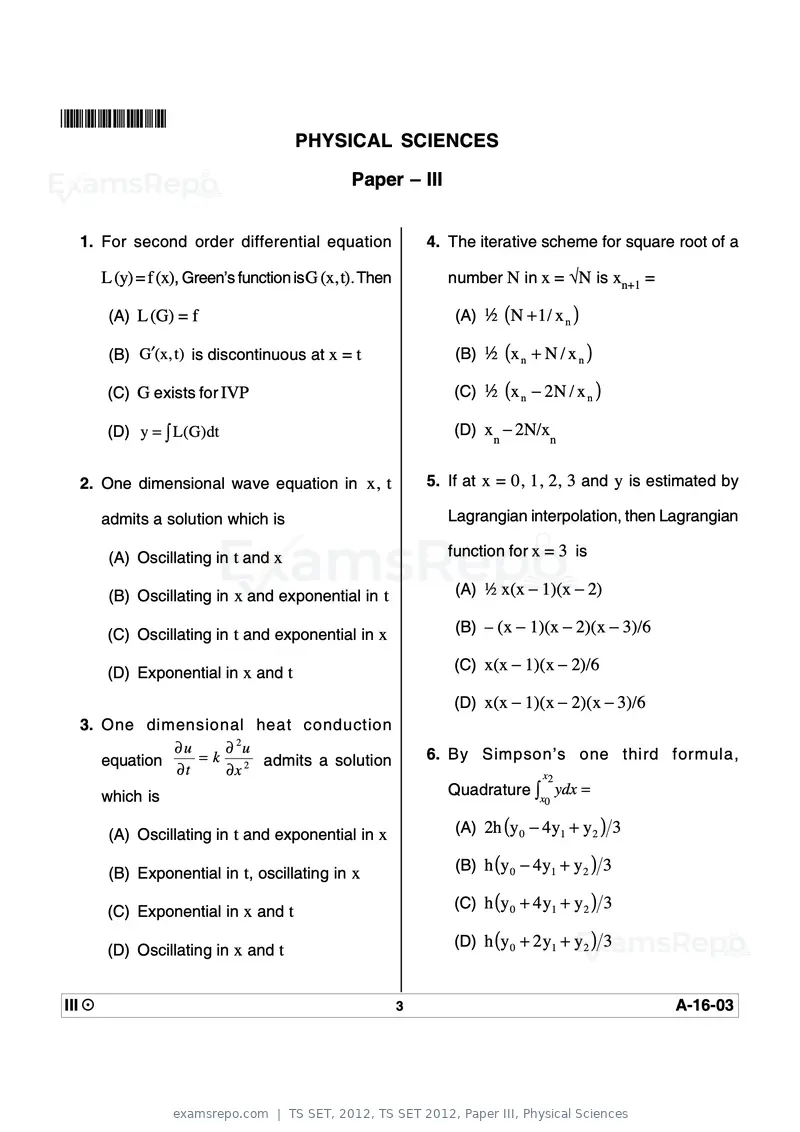
Text of page 3
*A1603*
PHYSICAL SCIENCES
Paper – III
1. For second order differential equation 4. The iterative scheme for square root of a
L (y) = f (x), Green’s function is G (x, t). Then number N in x = √N is xn+1 =
(A) L (G) = f (A) ½ (N + 1 / x n )
(B) G′(x, t) is discontinuous at x = t (B) ½ (x n + N / x n )
(C) G exists for IVP (C) ½ (x n − 2 N / x n )
(D) y = ∫ L(G )dt (D) x − 2N/x
n n
2. One dimensional wave equation in x, t 5. If at x = 0, 1, 2, 3 and y is estimated by
admits a solution which is Lagrangian interpolation, then Lagrangian
(A) Oscillating in t and x function for x = 3 is
(B) Oscillating in x and exponential in t (A) ½ x(x − 1)(x − 2)
(C) Oscillating in t and exponential in x (B) − (x − 1)(x − 2)(x − 3)/6
(D) Exponential in x and t (C) x(x − 1)(x − 2)/6
(D) x(x − 1)(x − 2)(x − 3)/6
3. One dimensional heat conduction
∂u ∂ 2u 6. By Simpson’s one third formula,
equation = k admits a solution
∂t ∂x 2 x2
which is Quadrature ∫x ydx =
0
(A) Oscillating in t and exponential in x (A) 2h (y 0 − 4 y1 + y 2 ) 3
(B) Exponential in t, oscillating in x (B) h (y 0 − 4 y1 + y 2 ) 3
(C) h (y 0 + 4 y1 + y 2 ) 3
(C) Exponential in x and t
(D) h (y 0 + 2 y1 + y 2 ) 3
(D) Oscillating in x and t
III 3 A-16-03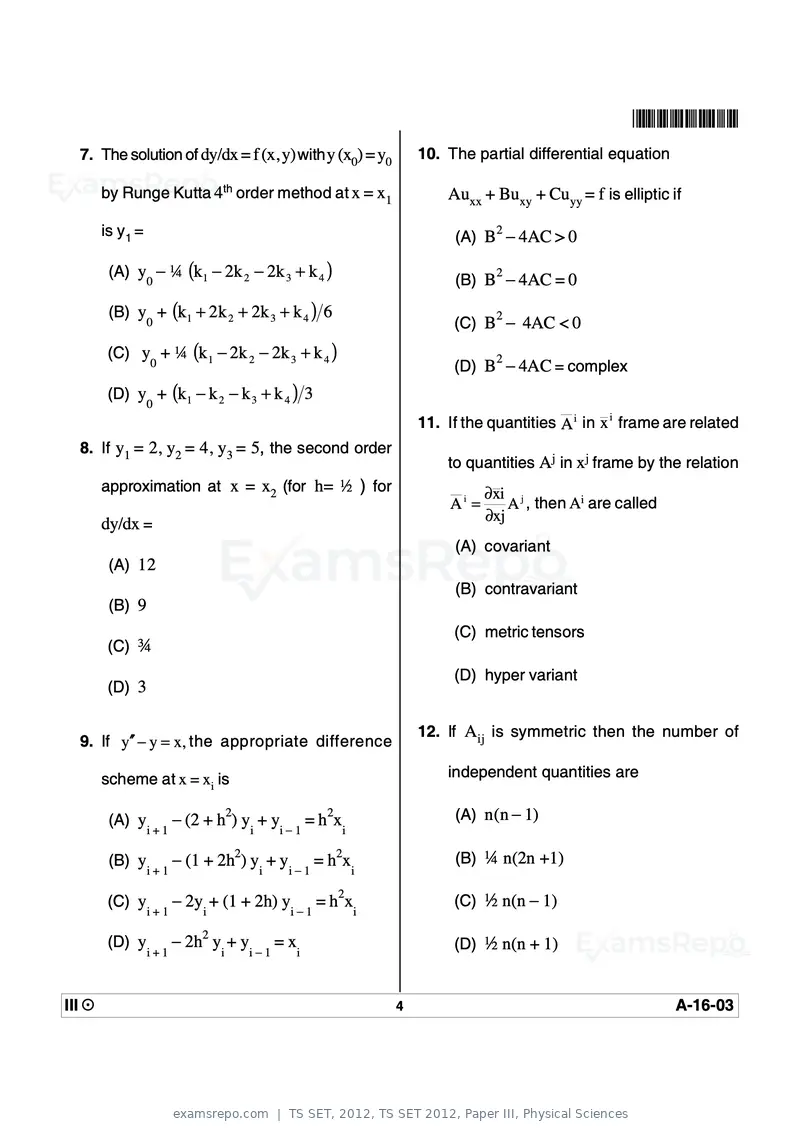
Text of page 4
*A1603*
7. The solution of dy/dx = f (x, y) with y (x0) = y0 10. The partial differential equation
by Runge Kutta 4th order method at x = x1 Auxx + Buxy + Cuyy = f is elliptic if
is y1 = 2
(A) B − 4AC > 0
(A) y − ¼ (k1 − 2k 2 − 2k 3 + k 4 ) 2
0 (B) B − 4AC = 0
(B) y + (k1 + 2k 2 + 2k 3 + k 4 ) 6 2
0 (C) B − 4AC < 0
(C) y + ¼ (k1 − 2k 2 − 2k 3 + k 4 ) 2
0 (D) B − 4AC = complex
(D) y + (k1 − k 2 − k 3 + k 4 ) 3
0
11. If the quantities A i in x i frame are related
8. If y1 = 2, y2 = 4, y3 = 5, the second order
to quantities Aj in xj frame by the relation
approximation at x = x2 (for h= ½ ) for ∂xi j
Ai = A , then Ai are called
∂xj
dy/dx =
(A) covariant
(A) 12
(B) contravariant
(B) 9
(C) metric tensors
(C) ¾
(D) hyper variant
(D) 3
12. If Aij is symmetric then the number of
9. If y′′ − y = x, the appropriate difference
scheme at x = xi is independent quantities are
(A) y − (2 + h2
) y + y = h 2
xi (A) n(n − 1)
i+1 i i−1
(B) y − (1 + 2h2) yi + yi − 1 = h2xi (B) ¼ n(2n +1)
i+1
2
(C) y − 2y + (1 + 2h) y = h xi (C) ½ n(n − 1)
i+1 i i−1
(D) y − 2h2 y + y =x (D) ½ n(n + 1)
i+1 i i−1 i
III 4 A-16-03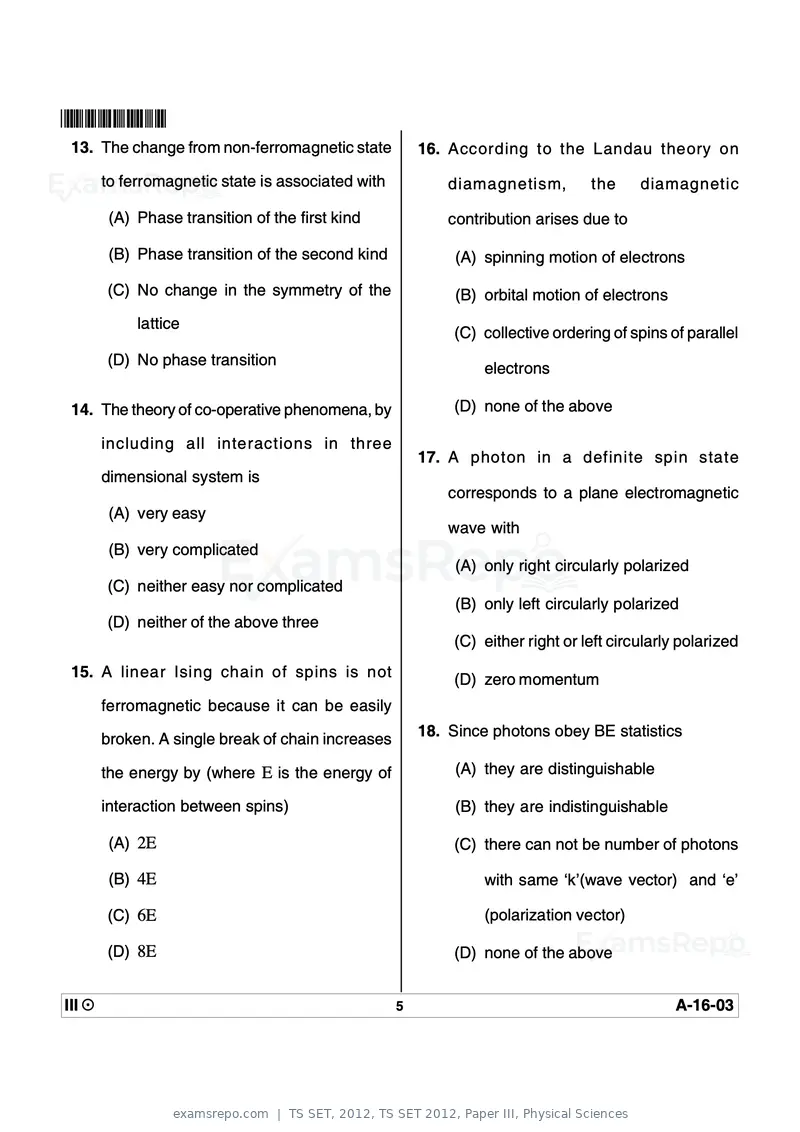
Text of page 5
*A1603*
13. The change from non-ferromagnetic state 16. According to the Landau theory on
to ferromagnetic state is associated with diamagnetism, the diamagnetic
(A) Phase transition of the first kind contribution arises due to
(B) Phase transition of the second kind (A) spinning motion of electrons
(C) No change in the symmetry of the (B) orbital motion of electrons
lattice
(C) collective ordering of spins of parallel
(D) No phase transition
electrons
14. The theory of co-operative phenomena, by (D) none of the above
including all interactions in three
17. A photon in a definite spin state
dimensional system is
corresponds to a plane electromagnetic
(A) very easy
wave with
(B) very complicated
(A) only right circularly polarized
(C) neither easy nor complicated
(B) only left circularly polarized
(D) neither of the above three
(C) either right or left circularly polarized
15. A linear Ising chain of spins is not (D) zero momentum
ferromagnetic because it can be easily
18. Since photons obey BE statistics
broken. A single break of chain increases
the energy by (where E is the energy of (A) they are distinguishable
interaction between spins) (B) they are indistinguishable
(A) 2E (C) there can not be number of photons
(B) 4E with same ‘k’(wave vector) and ‘e’
(C) 6E (polarization vector)
(D) 8E (D) none of the above
III 5 A-16-03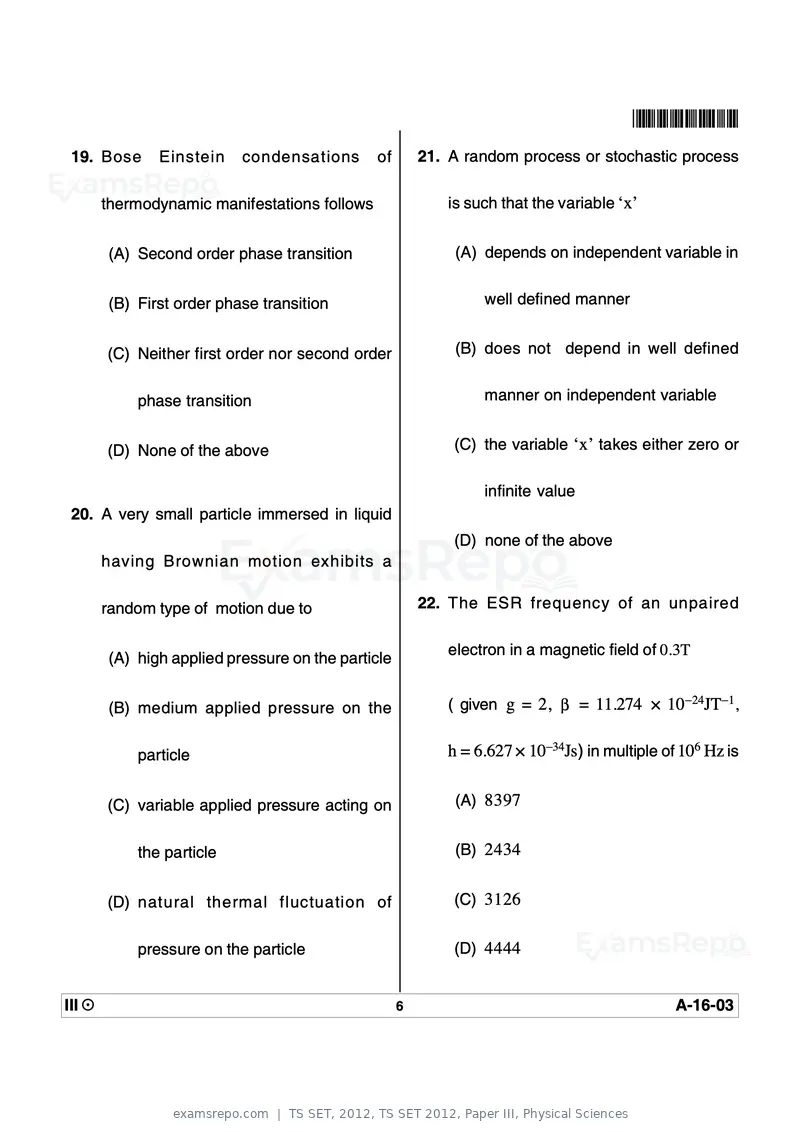
Text of page 6
*A1603*
19. Bose Einstein condensations of 21. A random process or stochastic process
thermodynamic manifestations follows is such that the variable ‘x’
(A) Second order phase transition (A) depends on independent variable in
(B) First order phase transition well defined manner
(C) Neither first order nor second order (B) does not depend in well defined
phase transition manner on independent variable
(D) None of the above (C) the variable ‘x’ takes either zero or
infinite value
20. A very small particle immersed in liquid
(D) none of the above
having Brownian motion exhibits a
random type of motion due to 22. The ESR frequency of an unpaired
electron in a magnetic field of 0.3T
(A) high applied pressure on the particle
(B) medium applied pressure on the ( given g = 2, β = 11.274 × 10⁻²⁴JT−1,
particle h = 6.627 × 10⁻³⁴Js) in multiple of 106 Hz is
(C) variable applied pressure acting on (A) 8397
the particle (B) 2434
(D) natural thermal fluctuation of (C) 3126
pressure on the particle (D) 4444
III 6 A-16-03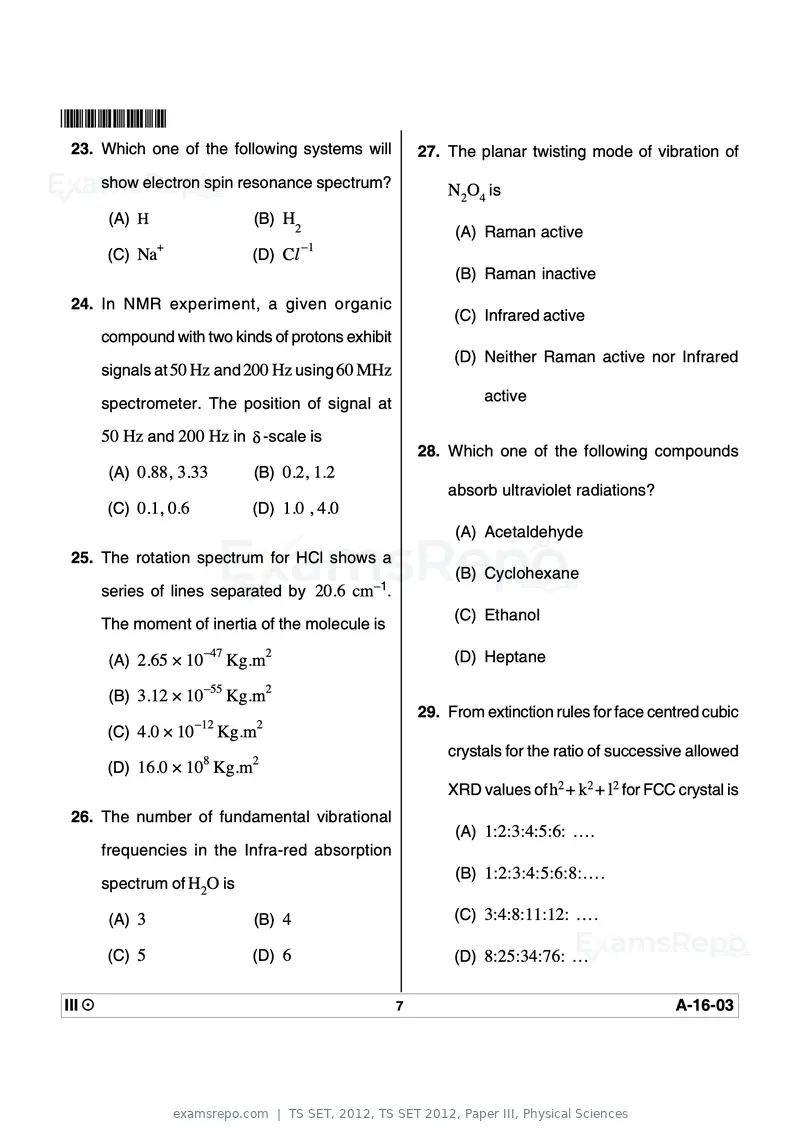
Text of page 7
*A1603*
23. Which one of the following systems will 27. The planar twisting mode of vibration of
show electron spin resonance spectrum? N2O4 is
(A) H (B) H
2 (A) Raman active
+ −1
(C) Na (D) Cl
(B) Raman inactive
24. In NMR experiment, a given organic
(C) Infrared active
compound with two kinds of protons exhibit
(D) Neither Raman active nor Infrared
signals at 50 Hz and 200 Hz using 60 MHz
spectrometer. The position of signal at active
50 Hz and 200 Hz in δ -scale is
28. Which one of the following compounds
(A) 0.88, 3.33 (B) 0.2, 1.2
absorb ultraviolet radiations?
(C) 0.1, 0.6 (D) 1.0 , 4.0
(A) Acetaldehyde
25. The rotation spectrum for HCl shows a
(B) Cyclohexane
series of lines separated by 20.6 cm−1.
(C) Ethanol
The moment of inertia of the molecule is
−47 (D) Heptane
(A) 2.65 × 10 Kg.m2
−55
(B) 3.12 × 10 Kg.m2
29. From extinction rules for face centred cubic
−12 2
(C) 4.0 × 10 Kg.m
8 2
crystals for the ratio of successive allowed
(D) 16.0 × 10 Kg.m
XRD values of h2 + k2 + l2 for FCC crystal is
26. The number of fundamental vibrational
(A) 1:2:3:4:5:6: ….
frequencies in the Infra-red absorption
(B) 1:2:3:4:5:6:8:….
spectrum of H2O is
(A) 3 (B) 4 (C) 3:4:8:11:12: ….
(C) 5 (D) 6 (D) 8:25:34:76: …
III 7 A-16-03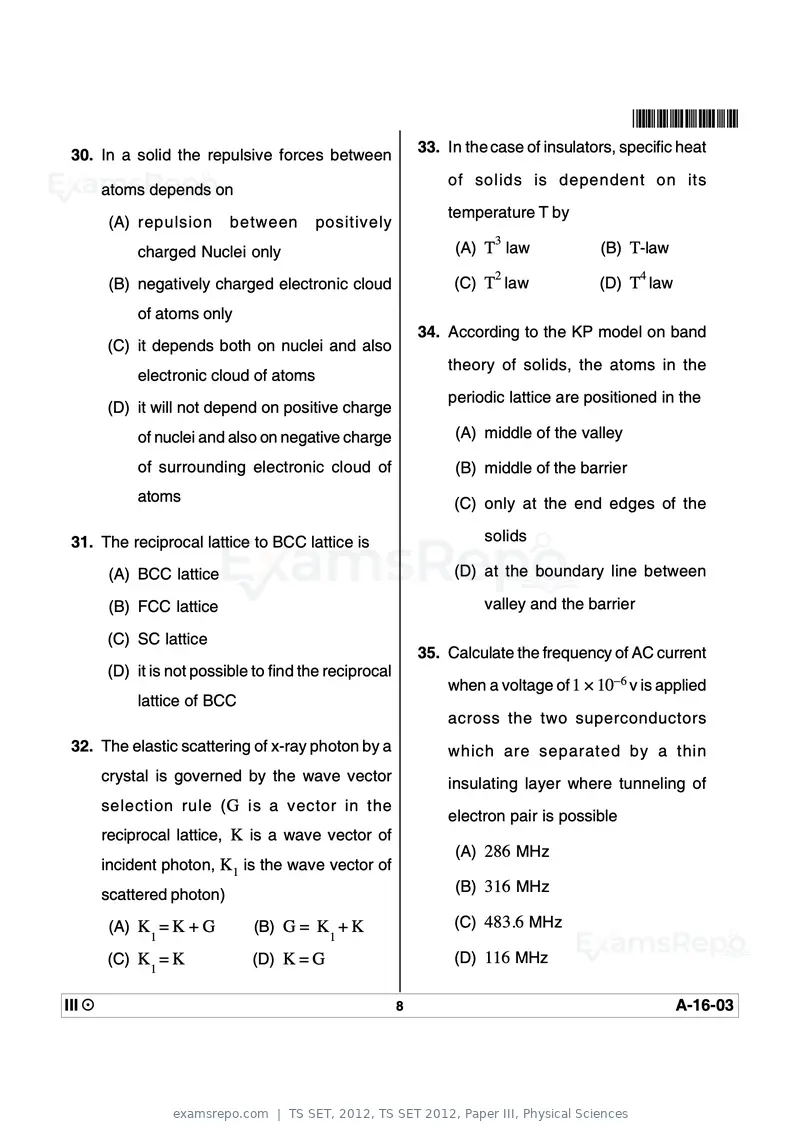
Text of page 8
*A1603*
33. In the case of insulators, specific heat
30. In a solid the repulsive forces between
of solids is dependent on its
atoms depends on
temperature T by
(A) repulsion between positively
3
charged Nuclei only (A) T law (B) T-law
2 4
(B) negatively charged electronic cloud (C) T law (D) T law
of atoms only
34. According to the KP model on band
(C) it depends both on nuclei and also
theory of solids, the atoms in the
electronic cloud of atoms
periodic lattice are positioned in the
(D) it will not depend on positive charge
of nuclei and also on negative charge (A) middle of the valley
of surrounding electronic cloud of (B) middle of the barrier
atoms (C) only at the end edges of the
31. The reciprocal lattice to BCC lattice is solids
(A) BCC lattice (D) at the boundary line between
(B) FCC lattice valley and the barrier
(C) SC lattice
35. Calculate the frequency of AC current
(D) it is not possible to find the reciprocal
when a voltage of 1 × 10⁻⁶ v is applied
lattice of BCC
across the two superconductors
32. The elastic scattering of x-ray photon by a which are separated by a thin
crystal is governed by the wave vector insulating layer where tunneling of
selection rule ( G is a vector in the
electron pair is possible
reciprocal lattice, K is a wave vector of
(A) 286 MHz
incident photon, K1 is the wave vector of
scattered photon) (B) 316 MHz
(A) K = K + G (B) G = K + K (C) 483.6 MHz
1 1
(C) K = K (D) K = G (D) 116 MHz
1
III 8 A-16-03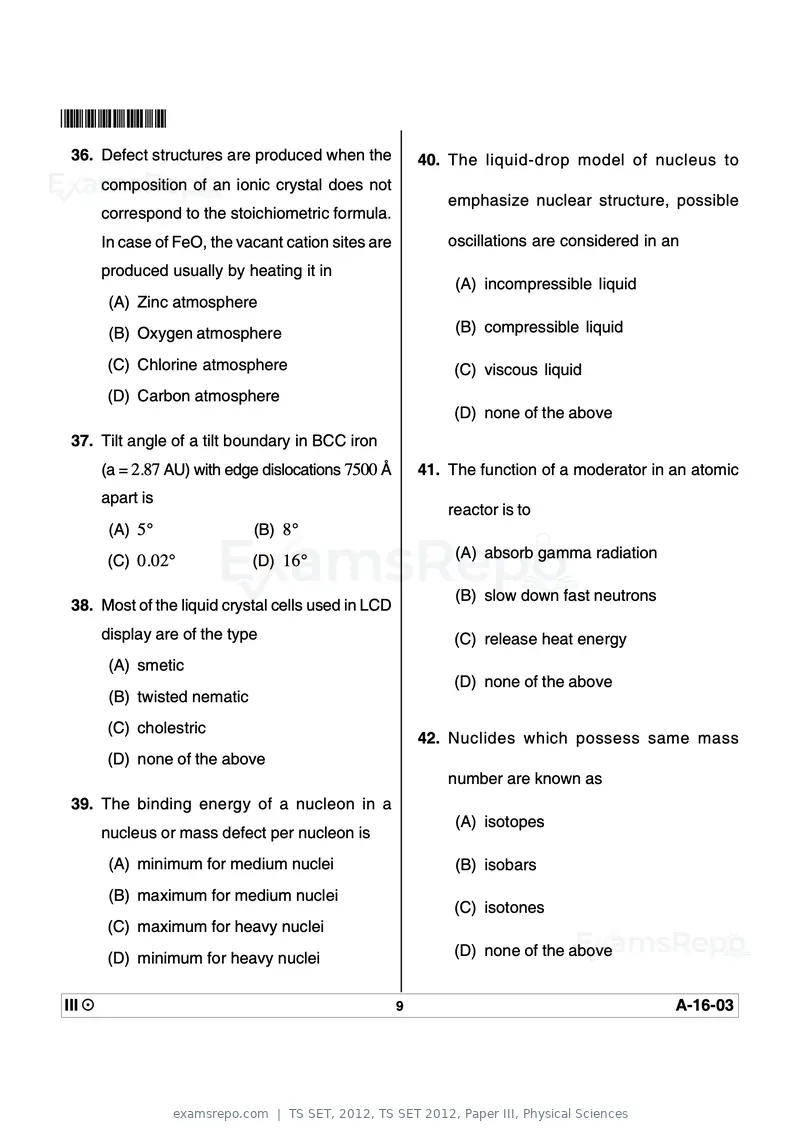
Text of page 9
*A1603*
36. Defect structures are produced when the 40. The liquid-drop model of nucleus to
composition of an ionic crystal does not
emphasize nuclear structure, possible
correspond to the stoichiometric formula.
In case of FeO, the vacant cation sites are oscillations are considered in an
produced usually by heating it in
(A) incompressible liquid
(A) Zinc atmosphere
(B) Oxygen atmosphere (B) compressible liquid
(C) Chlorine atmosphere (C) viscous liquid
(D) Carbon atmosphere
(D) none of the above
37. Tilt angle of a tilt boundary in BCC iron
(a = 2.87 AU) with edge dislocations 7500 Å 41. The function of a moderator in an atomic
apart is
reactor is to
(A) 5° (B) 8°
(A) absorb gamma radiation
(C) 0.02° (D) 16°
(B) slow down fast neutrons
38. Most of the liquid crystal cells used in LCD
display are of the type (C) release heat energy
(A) smetic
(D) none of the above
(B) twisted nematic
(C) cholestric
42. Nuclides which possess same mass
(D) none of the above
number are known as
39. The binding energy of a nucleon in a
(A) isotopes
nucleus or mass defect per nucleon is
(A) minimum for medium nuclei (B) isobars
(B) maximum for medium nuclei
(C) isotones
(C) maximum for heavy nuclei
(D) minimum for heavy nuclei (D) none of the above
III 9 A-16-03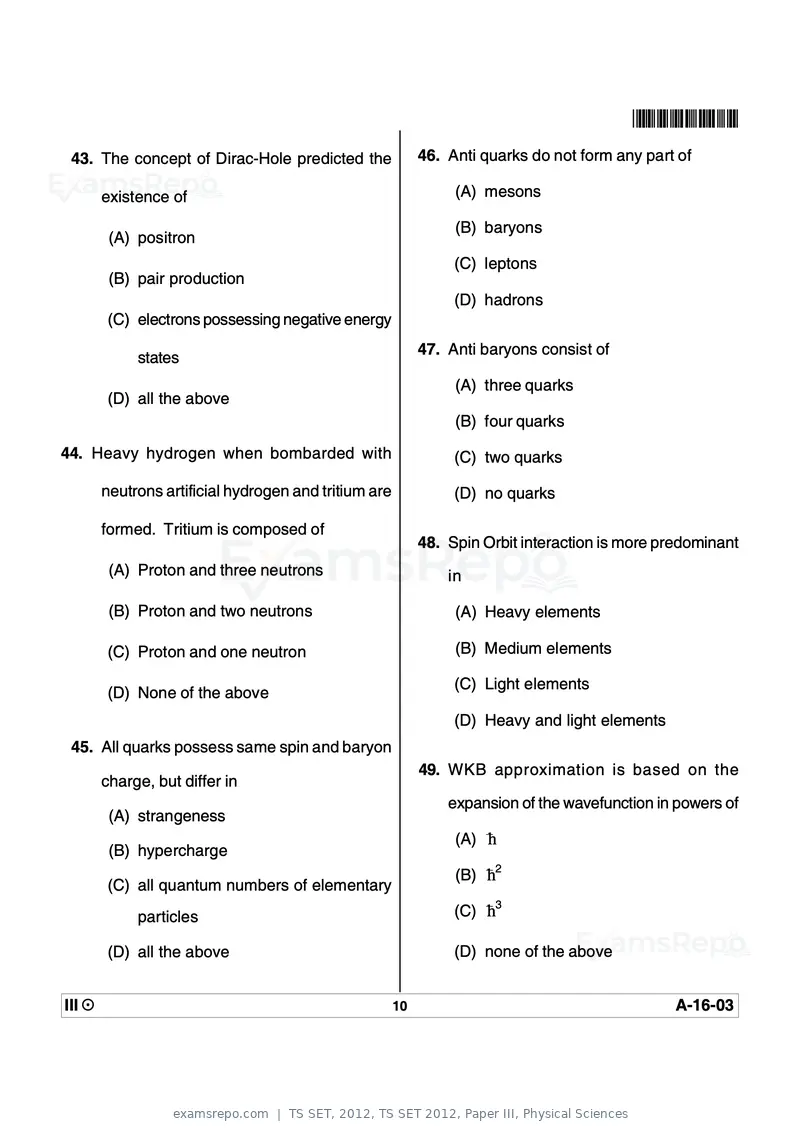
Text of page 10
*A1603*
43. The concept of Dirac-Hole predicted the 46. Anti quarks do not form any part of
existence of (A) mesons
(B) baryons
(A) positron
(C) leptons
(B) pair production
(D) hadrons
(C) electrons possessing negative energy
47. Anti baryons consist of
states
(A) three quarks
(D) all the above
(B) four quarks
44. Heavy hydrogen when bombarded with (C) two quarks
neutrons artificial hydrogen and tritium are (D) no quarks
formed. Tritium is composed of
48. Spin Orbit interaction is more predominant
(A) Proton and three neutrons in
(B) Proton and two neutrons (A) Heavy elements
(C) Proton and one neutron (B) Medium elements
(C) Light elements
(D) None of the above
(D) Heavy and light elements
45. All quarks possess same spin and baryon
49. WKB approximation is based on the
charge, but differ in
expansion of the wavefunction in powers of
(A) strangeness
(A) h
(B) hypercharge
(B) h2
(C) all quantum numbers of elementary
particles (C) h3
(D) all the above (D) none of the above
III 10 A-16-03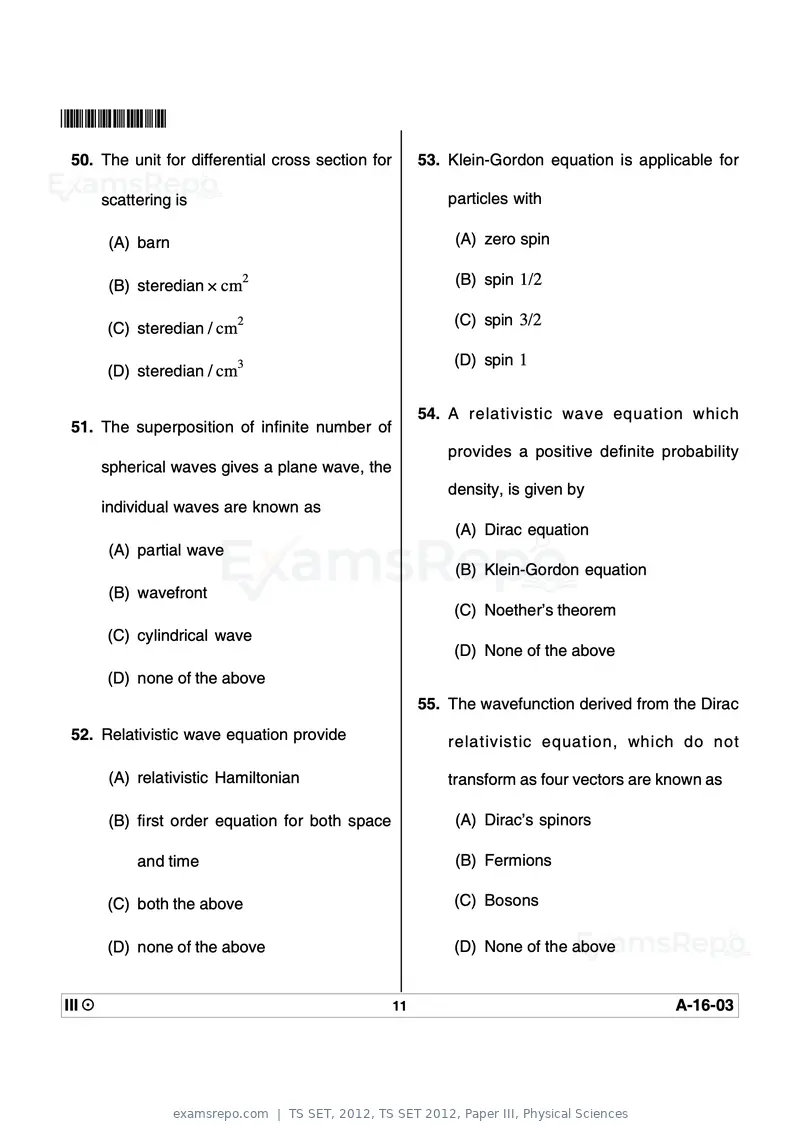
Text of page 11
*A1603*
50. The unit for differential cross section for 53. Klein-Gordon equation is applicable for
scattering is particles with
(A) barn (A) zero spin
(B) steredian × cm
2 (B) spin 1/2
2 (C) spin 3/2
(C) steredian / cm
3 (D) spin 1
(D) steredian / cm
54. A relativistic wave equation which
51. The superposition of infinite number of
provides a positive definite probability
spherical waves gives a plane wave, the
density, is given by
individual waves are known as
(A) Dirac equation
(A) partial wave
(B) Klein-Gordon equation
(B) wavefront
(C) Noether’s theorem
(C) cylindrical wave
(D) None of the above
(D) none of the above
55. The wavefunction derived from the Dirac
52. Relativistic wave equation provide relativistic equation, which do not
(A) relativistic Hamiltonian transform as four vectors are known as
(B) first order equation for both space (A) Dirac’s spinors
and time (B) Fermions
(C) both the above (C) Bosons
(D) none of the above (D) None of the above
III 11 A-16-03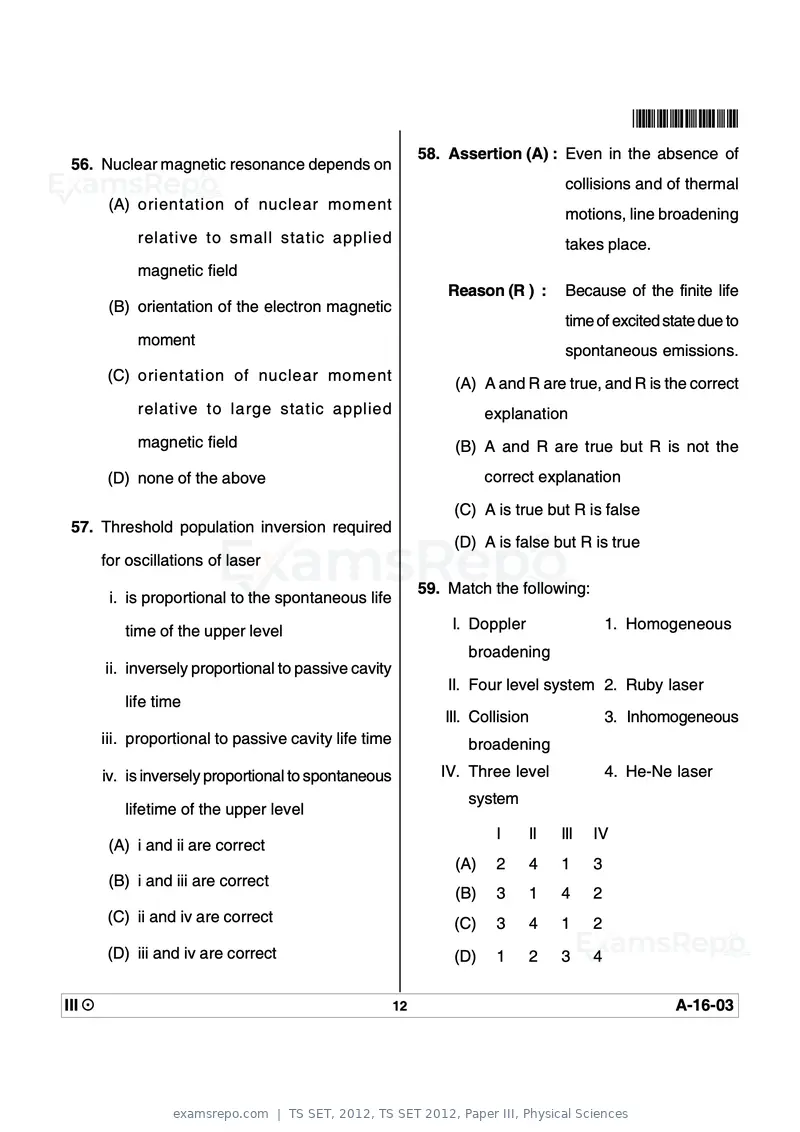
Text of page 12
*A1603*
58. Assertion (A) : Even in the absence of
56. Nuclear magnetic resonance depends on
collisions and of thermal
(A) orientation of nuclear moment
motions, line broadening
relative to small static applied takes place.
magnetic field
Reason (R ) : Because of the finite life
(B) orientation of the electron magnetic
time of excited state due to
moment
spontaneous emissions.
(C) orientation of nuclear moment
(A) A and R are true, and R is the correct
relative to large static applied explanation
magnetic field (B) A and R are true but R is not the
(D) none of the above correct explanation
(C) A is true but R is false
57. Threshold population inversion required
(D) A is false but R is true
for oscillations of laser
59. Match the following:
i. is proportional to the spontaneous life
time of the upper level I. Doppler 1. Homogeneous
broadening
ii. inversely proportional to passive cavity
II. Four level system 2. Ruby laser
life time
III. Collision 3. Inhomogeneous
iii. proportional to passive cavity life time broadening
iv. is inversely proportional to spontaneous IV. Three level 4. He-Ne laser
system
lifetime of the upper level
I II III IV
(A) i and ii are correct
(A) 2 4 1 3
(B) i and iii are correct
(B) 3 1 4 2
(C) ii and iv are correct (C) 3 4 1 2
(D) iii and iv are correct (D) 1 2 3 4
III 12 A-16-03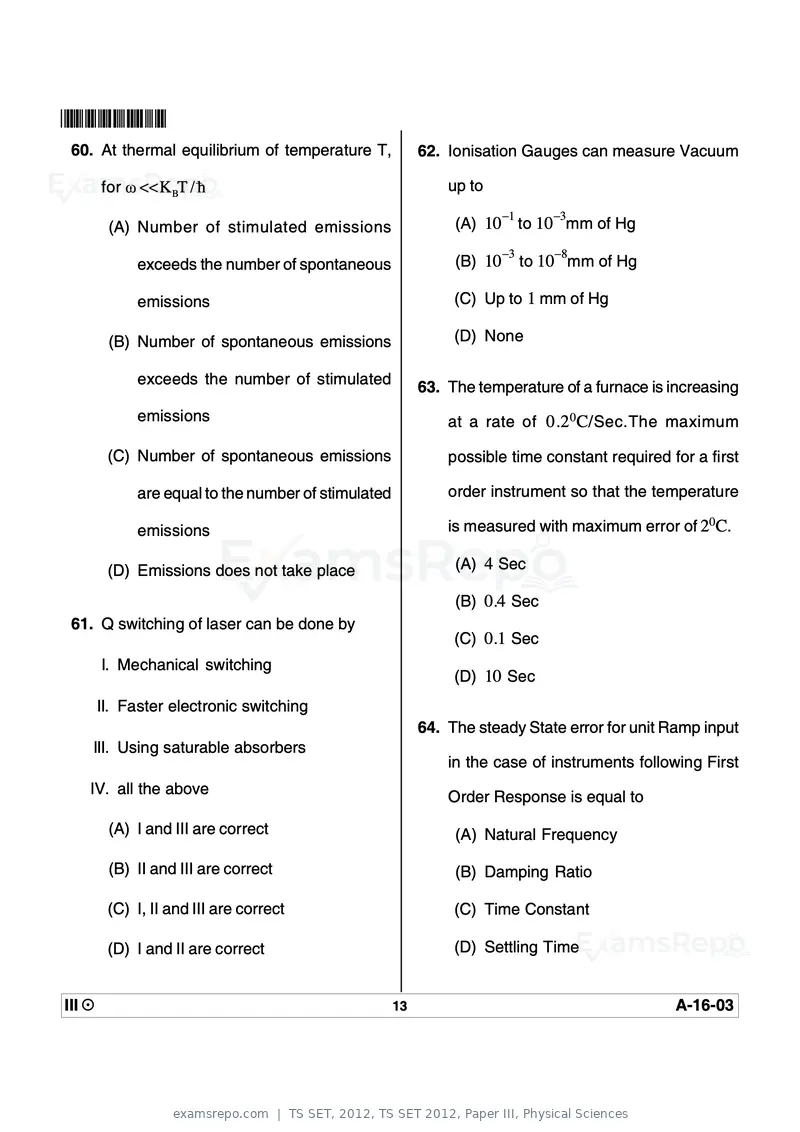
Text of page 13
*A1603*
60. At thermal equilibrium of temperature T, 62. Ionisation Gauges can measure Vacuum
for << KBT / h up to
−1 −3
(A) Number of stimulated emissions (A) 10 to 10 mm of Hg
−3 −8
exceeds the number of spontaneous (B) 10 to 10 mm of Hg
emissions (C) Up to 1 mm of Hg
(B) Number of spontaneous emissions (D) None
exceeds the number of stimulated 63. The temperature of a furnace is increasing
emissions at a rate of 0.2 0C /Sec.The maximum
(C) Number of spontaneous emissions possible time constant required for a first
are equal to the number of stimulated order instrument so that the temperature
emissions is measured with maximum error of 20C.
(D) Emissions does not take place (A) 4 Sec
(B) 0.4 Sec
61. Q switching of laser can be done by
(C) 0.1 Sec
I. Mechanical switching
(D) 10 Sec
II. Faster electronic switching
64. The steady State error for unit Ramp input
III. Using saturable absorbers
in the case of instruments following First
IV. all the above Order Response is equal to
(A) I and III are correct (A) Natural Frequency
(B) II and III are correct (B) Damping Ratio
(C) I, II and III are correct (C) Time Constant
(D) I and II are correct (D) Settling Time
III 13 A-16-03
Text of page 14
*A1603*
65. Dummy Strain Gauges are used for 69. Match the following:
(A) Compensation for Temperature
I. Chi-Square Test 1. Loading Effects
changes
II. Standard 2. Recovery of
(B) Increasing the sensitivity of the bridge
Deviation signal from
in which they are used
(C) Calibration of Strain Gauges noise
(D) None of the above III. Impedance 3. Analysis of
Matching Random Errors
66. How many Op-Amps are required to
IV. Lock-in Detector 4. Feedback
implement the following equation
5. Goodness of Fit
Vo = − Rf [V1 / R1 + V2 / R 2 + V3 / R 3 ] ?
(A) 1 (B) 2 I II III IV
(C) 3 (D) 4 (A) 5 3 1 2
(B) 3 4 5 1
67. In the Bath Tub Curve representing the
failure rate of components/Instruments, the (C) 2 1 3 4
Region I of the curve corresponds to (D) 1 2 5 4
(A) Constant Failure Region
70. The number of terms in semi-emperical
(B) Infant Mortality Region
mass formula is
(C) Wear Out Region
(A) 6 (B) 7
(D) None of the above
(C) 8 (D) 9
68. Which of the following circuits are used in
signal conditioning ? 71. In a nuclear reaction p+12C → d+11C, by
I. Filters proton with a laboratory energy of 10MeV
II. Attenuators incident on to stationary 12C nucleus, the
III. Amplifiers equivalent centre of energy of proton is
(A) I & II only (B) II & III only (A) 9.23 MeV (B) 10.00 MeV
(C) All (D) None (C) 11.52 MeV (D) 8.46 MeV
III 14 A-16-03
Text of page 15
*A1603*
72. Nuclear forces have the following 74. Assertion (A) : Electrons reside inside
characteristics: the nucleus.
I. Nuclear forces are saturated
Reason (R) : Nuclei emit electrons in
II. Nuclear forces are spin independent
beta decay.
III. Nuclear forces are charge
(A) A and R are true, and R is the correct
independent
explanation
IV. Nuclear forces are non central forces
(B) A and R are true but R is not the
(A) I,III and IV are correct
correct explanation
(B) II and III are correct
(C) A is true but R is false
(C) I, II and III are correct
(D) A is false but R is true
(D) I and II are correct
75. Assertion (A) : Nuclear force is very
73. Physical quantities that are conserved in
a nuclear reaction are attractive.
I. Energy Reason (R) : Stable nuclei exist in
II. Charge nature.
III. Spin (A) A and R are true, and R is the correct
IV. Hyper charge explanation
(A) I, III and IV are correct (B) A and R are true but R is not the
(B) I, II and III are correct correct explanation
(C) I, II and IV are correct (C) A is true but R is false
(D) I and IV are correct (D) A is false but R is true
III 15 A-16-03
Text of page 16
*A1603*
Space for Rough Work
III 16 A-16-03Official key not published for this paper.
Page 1 of 16
Source: Telangana State Eligibility Test. Question paper published by Telangana State Eligibility Test.