
TS SET 2014: Paper II, Public Administration
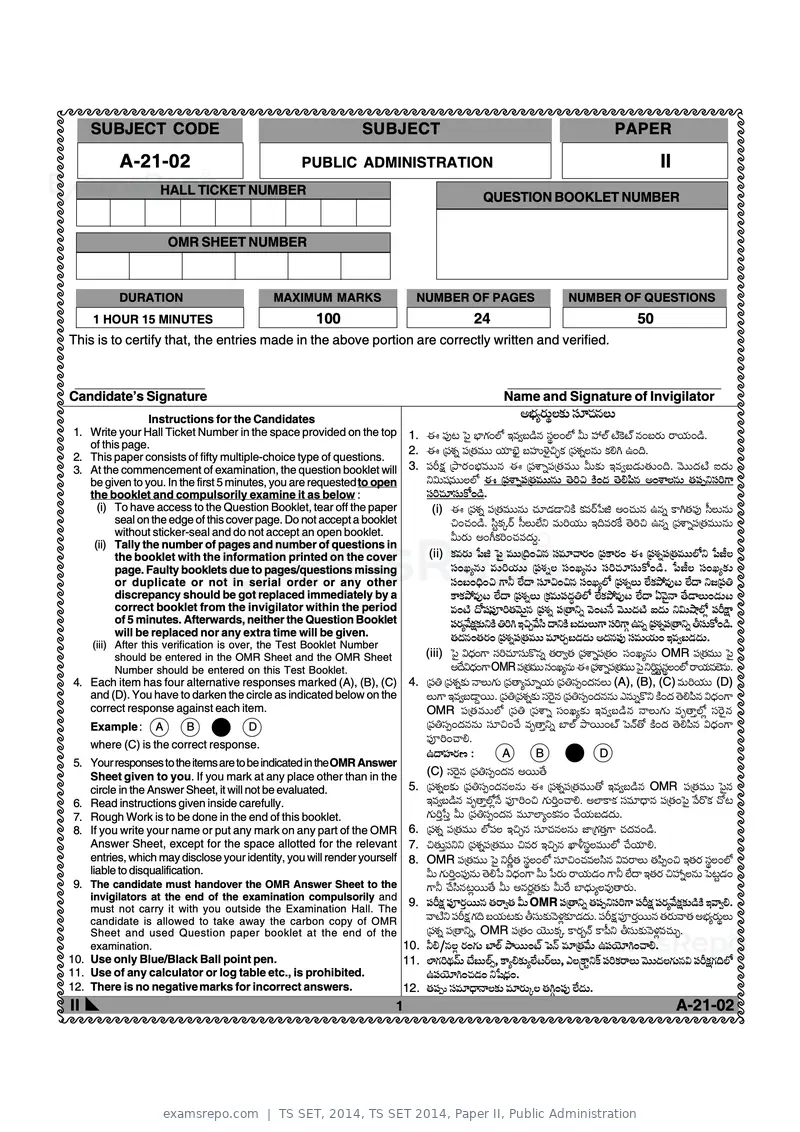
Text of page 1
CCCCCCCCCCCCCCCCCCCCCCCCCCCCCCCCCCCCCCCCCCCCCCCCCCCCCCCCCCCCCCCCCCCCCCCCCCC
CCCCCCCCCCCCCCCCCCCCCCCCCCCCCCCCCCCCCCCCCCCCCCCCCCCCCCCCCCCCCCCCCCCCCCCCCCCCCCCCCCCCCCCCCCCCCCCCCCCC CCCCCCCCCCCCCCCCCCCCCCCCCCCCCCCCCCCCCCCCCCCCCCCCCCCCCCCCCCCCCCCCCCCCCCCCCCCCCCCCCCCCCCCCCCCCCCCCCCCC
SUBJECT CODE SUBJECT PAPER
A-21-02 PUBLIC ADMINISTRATION II
HALL TICKET NUMBER
QUESTION BOOKLET NUMBER
OMR SHEET NUMBER
DURATION MAXIMUM MARKS NUMBER OF PAGES NUMBER OF QUESTIONS
1 HOUR 15 MINUTES 100 24 50
This is to certify that, the entries made in the above portion are correctly written and verified.
Candidate’s Signature Name and Signature of Invigilator
Instructions for the Candidates A¿æýÅÆæÿ$¦ËMæü$ çÜ*^èþ¯èþË$
1. Write your Hall Ticket Number in the space provided on the top 1. D ç³#r ò³O ¿êVæü ÌZ CÐèþÓºyìþ¯èþ çÜ¦Ë ÌZ Ò$ çàÌý sìýMðüsý ¯èþ ºÆæÿ$ Æ>Äæý$ yìþ.
of this page.
2. D {ç³Ôèý² ç³{èþÐèþ$$ Äæý*¿ñýO ºçßý$âñýO_eMæü {ç³Ôèý²Ë¯èþ$ MæüÍW E ¨.
2. This paper consists of fifty multiple-choice type of questions.
3. At the commencement of examination, the question booklet will 3. ç³Èæü {´ëÆæÿ ¿æýÐèþ$$¯èþ D {ç³Ôé²ç³{èþÐèþ$$ Ò$Mæü$ CÐèþÓºyæþ$èþ$ ¨. Ððþ$$§æþsìý I§æþ$
be given to you. In the first 5 minutes, you are requested to open °Ñ$çÙÐèþ$$ËÌZ D {ç³Ôé²ç³{èþÐèþ$$¯èþ$ ðþÇ_ Mìü §æþ ðþÍí³¯èþ A Ôé˯èþ$ èþç³µ°çÜÇV>
the booklet and compulsorily examine it as below : çÜÇ^èþ*çÜ$Mø yìþ.
(i) To have access to the Question Booklet, tear off the paper (i) D {ç³Ôèý² ç³{èþÐèþ$$¯èþ$ ^èþ*yæþyé°Mìü MæüÐèþÆÿõ³h A ^èþ$¯èþ E¯èþ² M>Wèþç³# ïÜË$¯èþ$
seal on the edge of this cover page. Do not accept a booklet _ ^èþ yìþ. íÜtMæüPÆÿ ïÜË$Ìôý° Ðèþ$ÇÄæý$$ C¨ÐèþÆæÿMóü ðþÇ_ E¯èþ² {ç³Ôé²ç³{èþÐèþ$$¯èþ$
without sticker-seal and do not accept an open booklet. Ò$Ææÿ$ A XMæüÇ ^èþÐèþ§æþ$ª.
(ii) Tally the number of pages and number of questions in
the booklet with the information printed on the cover (ii) MæüÐèþÆæÿ$ õ³h ò³O Ðèþ$${¨ _¯èþ çÜÐèþ*^éÆæÿ {ç³M>Ææÿ D {ç³Ôèý²ç³{èþÐèþ$$ÌZ° õ³iË
page. Faulty booklets due to pages/questions missing çÜ Qůèþ$ Ðèþ$ÇÄæý$$ {ç³Ôèý²Ë çÜ Qůèþ$ çÜÇ^èþ*çÜ$Mø yìþ. õ³iË çÜ QÅMæü$
or duplicate or not in serial order or any other çÜ º «¨ _ V>± Ìôý§é çÜ*_ _¯èþ çÜ QÅÌZ {ç³Ôèý²Ë$ ÌôýMæü´ùÐèþ#r Ìôý§é °f{ç³
discrepancy should be got replaced immediately by a M>Mæü´ùÐèþ#r Ìôý§é {ç³Ôèý²Ë$ {MæüÐèþ$糧æþ®ÌZ ÌôýMæü´ùÐèþ#r Ìôý§é HÐðþO¯é óþyéË$ yæþ$r
correct booklet from the invigilator within the period Ðèþ sìý §øçÙç³NÇèþÐðþ$O¯èþ {ç³Ôèý² ç³{é°² Ððþ r¯óþ Ððþ$$§æþsìý I§æþ$ °Ñ$ÚëÌZÏ ç³È>
of 5 minutes. Afterwards, neither the Question Booklet ç³ÆæÿÅÐóþæüMæü$°Mìü ÇW C_aÐóþíÜ §é°Mìü º§æþ$Ë$V> çÜÇV>Y E¯èþ² {ç³Ôèý²ç³{é°² ¡çÜ$Mø yìþ.
will be replaced nor any extra time will be given. èþ§æþ¯èþ èþÆæÿ {ç³Ôèý²ç³{èþÐèþ$$ Ðèþ*Ææÿaºyæþ§æþ$ A§æþ¯èþç³# çÜÐèþ$Äæý$ CÐèþÓºyæþ§æþ$.
(iii) After this verification is over, the Test Booklet Number
should be entered in the OMR Sheet and the OMR Sheet (iii) ò³O Ñ«§æþ V> çÜÇ^èþ*çÜ$Mö¯èþ² èþÆ>Óèþ {ç³Ôé²ç³{èþ çÜ Qůèþ$ OMR ç³{èþÐèþ$$ ò³O
Number should be entered on this Test Booklet. A§óþÑ«§æþ V> OMR ç³{èþÐèþ$$ çÜ Qůèþ$ D {ç³Ôé²ç³{èþÐèþ$$ ò³O °ÇªçÙtt çÜ¦Ë ÌZ Æ>Äæý$ÐèþÌñý¯èþ$.
4. Each item has four alternative responses marked (A), (B), (C) 4. {ç³ {ç³Ôèý²Mæü$ ¯éË$Væü$ {ç³éÅÐèþ*²Äæý$ {ç³çܵ §æþ¯èþË$ (A), (B), (C) Ðèþ$ÇÄæý$$ (D)
and (D). You have to darken the circle as indicated below on the Ë$V> CÐèþÓºyézÆÿ$$. {ç³{ç³Ôèý²Mæü$ çÜÆðÿO¯èþ {ç³çܵ §æþ¯èþ¯èþ$ G¯èþ$²Mö° Mìü §æþ ðþÍí³¯èþ Ñ«§æþ V>
correct response against each item. OMR ç³{èþÐèþ$$ÌZ {ç³ {ç³Ôé² çÜ QÅMæü$ CÐèþÓºyìþ¯èþ ¯éË$Væü$ Ðèþé¢ÌZÏ çÜÆðÿO¯èþ
Example : A B C D {ç³çܵ §æþ¯èþ¯èþ$ çÜ*_ ^óþ Ðèþ颰² »êÌý ´ëÆÿ$$ sý ò³¯þø Mìü §æþ ðþÍí³¯èþ Ñ«§æþ V>
where (C) is the correct response.
ç ³NÇ ^éÍ.
E§éçßýÆæÿ×ý : A B C D
5. Your responses to the items are to be indicated in the OMR Answer
Sheet given to you. If you mark at any place other than in the (C) çÜÆðÿO¯èþ {ç³çܵ §æþ¯èþ AÆÿ$$óþ
circle in the Answer Sheet, it will not be evaluated. 5. {ç³Ôèý²ËMæü$ {ç³çܵ §æþ¯èþ˯èþ$ D {ç³Ôèý²ç³{èþÐèþ$$ø CÐèþÓºyìþ¯èþ OMR ç³{èþÐèþ$$ ò³O¯èþ
6. Read instructions given inside carefully. CÐèþÓºyìþ¯èþ Ðèþé¢ÌZϯóþ ç³NÇ _ Væü$Ç¢ ^éÍ. AÌêM>Mæü çÜÐèþ*«§é¯èþ ç³{èþ ò³O ÐóþÆöMæü ^ør
7. Rough Work is to be done in the end of this booklet. Væü$Ç¢õÜ¢ Ò$ {ç³çܵ §æþ¯èþ Ðèþ$*ÌêÅ Mæü¯èþ ^óþÄæý$ºyæþ§æþ$.
8. If you write your name or put any mark on any part of the OMR 6. {ç³Ôèý² ç³{èþÐèþ$$ ÌZç³Ë C_a¯èþ çÜ*^èþ¯èþ˯èþ$ gê{Væüèþ¢V> ^èþ§æþÐèþ yìþ.
Answer Sheet, except for the space allotted for the relevant 7. _èþ$¢ç³°° {ç³Ôèý²ç³{èþÐèþ$$ _ÐèþÆæÿ C_a¯èþ RêäçܦËÐèþ$$ÌZ ^óþÄæý*Í.
entries, which may disclose your identity, you will render yourself 8. OMR ç³{èþÐèþ$$ ò³O °È~èþ çÜ¦Ë ÌZ çÜ*_ ^èþÐèþËíܯèþ ÑÐèþÆ>Ë$ èþí³µ _ CèþÆæÿ çÜ¦Ë ÌZ
liable to disqualification. Ò$ Væü$Ç¢ ç³#¯èþ$ ðþÍõ³ Ñ«§æþ V> Ò$ õ³Ææÿ$ Æ>Äæý$yæþ V>± Ìôý§é CèþÆæÿ _à²Ë¯èþ$ ò³rtyæþ
9. The candidate must handover the OMR Answer Sheet to the V>± ^óþíܯèþrÏÆÿ$$óþ Ò$ A¯èþÆæÿáèþMæü$ Ò$Æóÿ »ê«§æþ$ÅËÐèþ#éÆæÿ$.
invigilators at the end of the examination compulsorily and
9. ç³Èæü ç³NÆæÿ¢Æÿ$$¯èþ èþÆ>Óèþ Ò$ OMR ç³{é°² èþç³µ°çÜÇV> ç³Èæü ç³ÆæÿÅÐóþæüMæü$yìþMìü CÐéÓÍ.
must not carry it with you outside the Examination Hall. The
candidate is allowed to take away the carbon copy of OMR Ðésìý° ç³Èæü Væü¨ ºÄæý$rMæü$ ¡çÜ$Mæü$ÐðþâæýÏMæü*yæþ§æþ$. ç³Èæü ç³NÆæÿ¢Æÿ$$¯èþ èþÆæÿ$Ðéèþ A¿æýÅÆæÿ$¦Ë$
Sheet and used Question paper booklet at the end of the {ç³Ôèý² ç³{é°², OMR ç³{èþ Äñý$$MæüP M>Ææÿ¾¯þ M>ï³° ¡çÜ$Mæü$ÐðþâæýÏÐèþ^èþ$a.
examination. 10. ±Í/¯èþËÏ Ææÿ Væü$ »êÌý ´ëÆÿ$$ sý ò³¯þ Ðèþ*{èþÐóþ$ Eç³Äñý*W ^éÍ.
10. Use only Blue/Black Ball point pen. 11. ÌêVæüÇ£æþÐþ$ sôýº$ÌýÞ, M>ÅÍMæü$ÅÌôýrÆÿË$, GË[M>t°Mü ç³ÇMæüÆ>Ë$ Ððþ$$§æþËVæü$¯èþÑ ç³ÈæüVæü¨ÌZ
11. Use of any calculator or log table etc., is prohibited. Eç³Äñý*W ^èþyæþ °õÙ«§æþ .
12. There is no negative marks for incorrect answers. 12. èþç³ çÜÐèþ*«§é¯éËMæü$ Ðèþ*Ææÿ$PË èþWY ç³# Ìôý§æþ$.
II x 1 A-21-02
CCCCCCCCCCCCCCCCCCCCCCCCCCCCCCCCCCCCCCCCCCCCCCCCCCCCCCCCCCCCCCCCCCCCCCCCCCC
Text of page 2
*A2102*


                   HE
                     RE

            WR
              ITE

        NO
          T
       DO


II x           2            A-21-02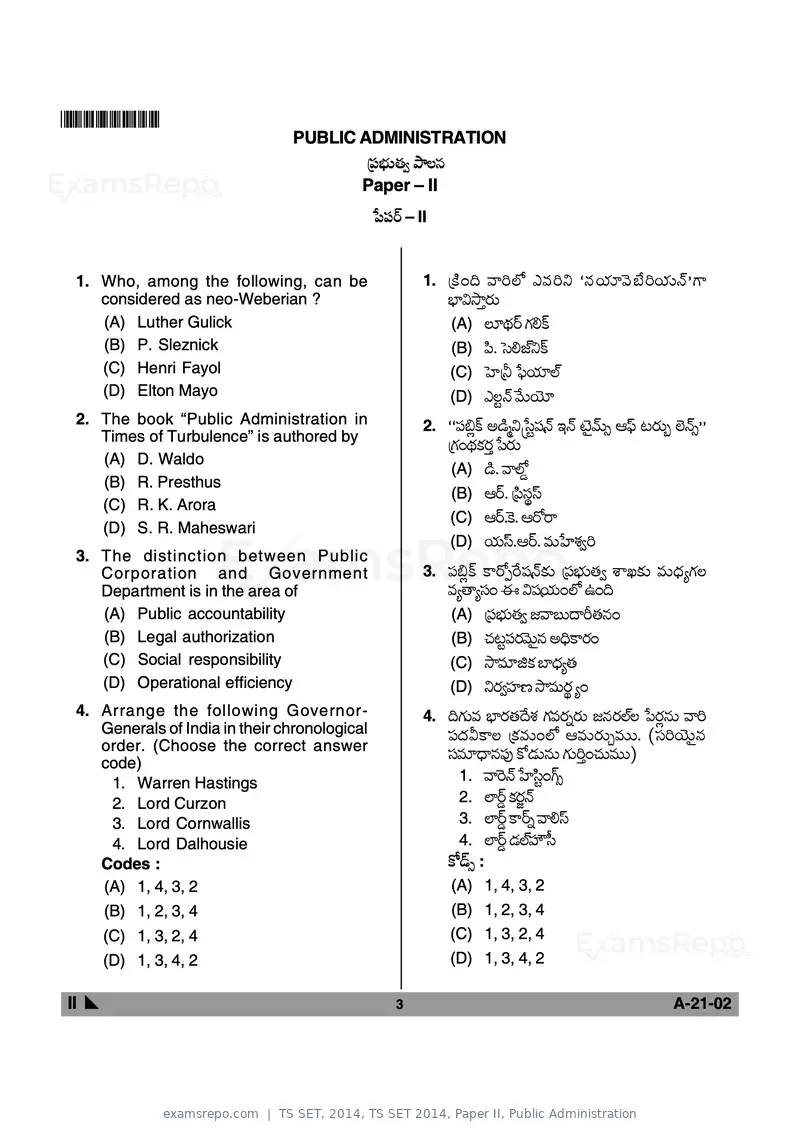
Text of page 3
*A2102*
PUBLIC ADMINISTRATION
Æ>{糿æý$èþÓ ´ë˯èþ
Paper – II
õ³ç³Æÿ – II
1. Who, among the following, can be 1. {Mìü ¨ ÐéÇÌZ GÐèþÇ° "¯èþÄæý*Ððþ»ôýÇÄæý$¯þ'V>
considered as neo-Weberian ? ¿êÑÝë¢Ææÿ$
(A) Luther Gulick (A) Ë*£æþÆÿ VæüÍMü
(B) P. Sleznick (B) í³. òÜÍgý°Mü
(C) Henri Fayol (C) òßý{± õÄæý*Ìý
(D) Elton Mayo (D) GËt¯þ Ðóþ$Äñý*
2. The book “Public Administration in 2. ""ç³¼ÏMü Ayìþð[õÜtçÙ¯þ C¯þ sñýOÐþ$Þ B rÆæÿ$¾ Ìñý¯þÞ''
Times of Turbulence” is authored by
{Væü £æþMæüÆæÿ¢ õ³Ææÿ$
(A) D. Waldo
(A) yìþ. ÐéÌZz
(B) R. Presthus
(B) BÆÿ. {í³çܦÜ
(C) R. K. Arora
(C) BÆÿ.Mðü. BÆøÆ>
(D) S. R. Maheswari
(D) Äæý$Ü.BÆÿ. Ðèþ$õßýÔèýÓÇ
3. The distinction between Public
Corporation and Government 3. ç³¼ÏMü M>ÆøµÆóÿçÙ¯þMæü$ {糿æý$èþÓ ÔéQMæü$ Ðèþ$«§æþÅVæüË
Department is in the area of ÐèþÅéÅçÜ D ÑçÙÄæý$ ÌZ E ¨
(A) Public accountability (A) {糿æý$èþÓ fÐéº$§éÈèþ¯èþ
(B) Legal authorization (B) ^èþrtç³ÆæÿÐðþ$O¯èþ A«¨M>Ææÿ
(C) Social responsibility (C) ÝëÐèþ*hMæü »ê«§æþÅèþ
(D) Operational efficiency (D) °ÆæÿÓçßý×ý ÝëÐèþ$Ææÿ¦üÅ
4. Arrange the following Governor- 4. ¨Væü$Ðèþ ¿êÆæÿèþ§óþÔèý VæüÐèþÆæÿ²Ææÿ$ f¯èþÆæÿÌýË õ³Ææÿϯèþ$ ÐéÇ
Generals of India in their chronological 糧æþÒM>Ë {MæüÐèþ$ ÌZ BÐèþ$Ææÿ$aÐèþ$$. (çÜÇÄñý$O¯èþ
order. (Choose the correct answer çÜÐèþ*«§é¯èþç³# Møyæþ$¯èþ$ Væü$Ç¢ ^èþ$Ðèþ$$)
code)
1. Warren Hastings 1. ÐéÆðÿ¯þ õßýíÜt VüÞ
2. Lord Curzon 2. ÌêÆÿz MæüÆæÿj¯þ
3. Lord Cornwallis 3. ÌêÆÿz M>Æÿ² ÐéÍÜ
4. Lord Dalhousie 4. ÌêÆÿz yæþÌýçßoïÜ
Codes : MøyþÞ :
(A) 1, 4, 3, 2 (A) 1, 4, 3, 2
(B) 1, 2, 3, 4 (B) 1, 2, 3, 4
(C) 1, 3, 2, 4 (C) 1, 3, 2, 4
(D) 1, 3, 4, 2 (D) 1, 3, 4, 2
II x 3 A-21-02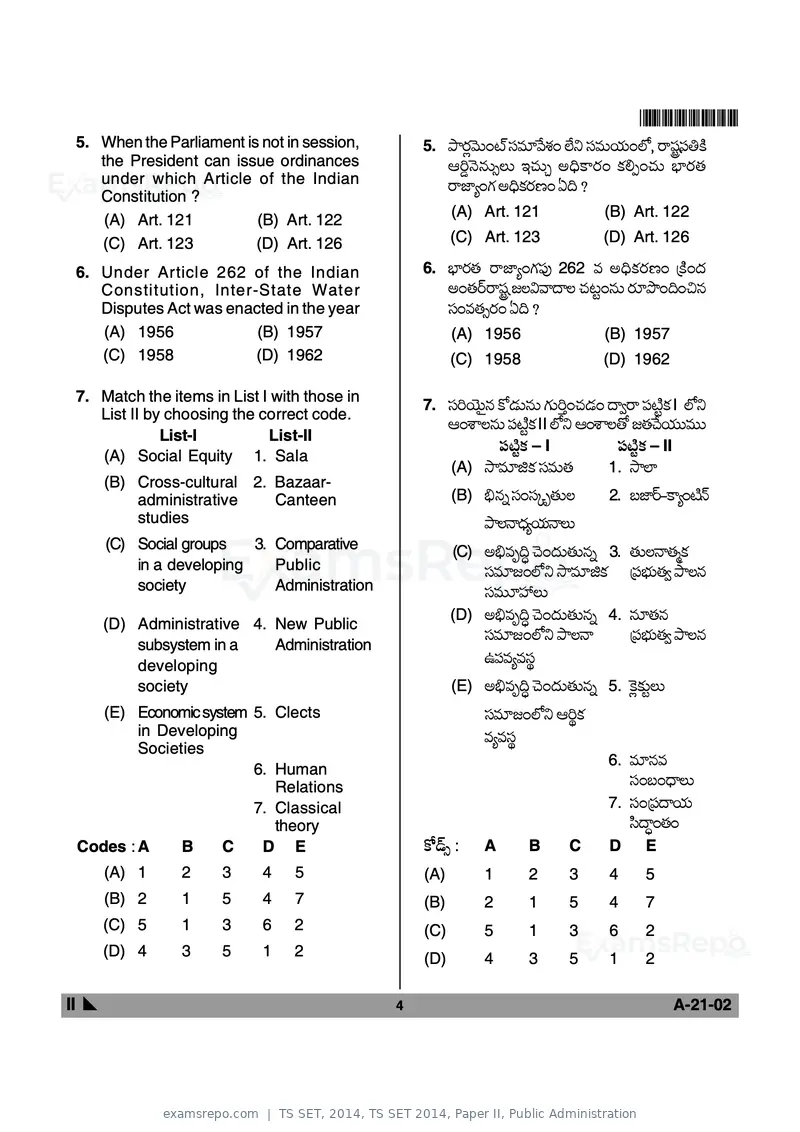
Text of page 4
*A2102*
5. When the Parliament is not in session, 5. ´ëÆæÿÏÐðþ$ sý çÜÐèþ*ÐóþÔèý Ìôý° çÜÐèþ$Äæý$ ÌZ, Æ>çÙç³Mìü
the President can issue ordinances BÇz¯ðþ¯èþ$ÞË$ C^èþ$a A«¨M>Ææÿ Mæü͵ ^èþ$ ¿êÆæÿèþ
under which Article of the Indian Æ>gêÅ Væü A«¨MæüÆæÿ×ý H¨ ?
Constitution ?
(A) Art. 121 (B) Art. 122
(A) Art. 121 (B) Art. 122
(C) Art. 123 (D) Art. 126 (C) Art. 123 (D) Art. 126
6. Under Article 262 of the Indian 6. ¿êÆæÿè Æ>gêÅ Væüç³# 262 Ðèþ A«¨MæüÆæÿ×ý {Mìü §æþ
Constitution, Inter-State Water A èþÆÿÆ>çÙ fËÑÐé§éË ^èþrt ¯èþ$ Ææÿ*´÷ ¨ _¯èþ
Disputes Act was enacted in the year çÜ ÐèþèþÞÆæÿ H¨ ?
(A) 1956 (B) 1957 (A) 1956 (B) 1957
(C) 1958 (D) 1962 (C) 1958 (D) 1962
7. Match the items in List I with those in
List II by choosing the correct code.
7. çÜÇÄñý$O¯èþ Møyæþ$¯èþ$ Væü$Ç¢ ^èþyæþ §éÓÆ> ç³sìýtMæü I ÌZ°
B Ôé˯èþ$ ç³sìýtMæü II ÌZ° B ÔéËø fèþ^óþÄæý$$Ðèþ$$
List-I List-II
(A) Social Equity 1. Sala
ç³sìýtMæü – I ç³sìýtMæü – II
(A) ÝëÐèþ*hMæü çÜÐèþ$èþ 1. ÝëÌê
(B) Cross-cultural 2. Bazaar-
administrative Canteen (B) À¯èþ² çÜ çÜPèþ$Ë 2. ºgêÆÿ&M>Å sìý¯þ
studies ´ë˯髧æþÅÄæý$¯éË$
(C) Social groups 3. Comparative (C) AÀÐèþ¨® ^ðþ §æþ$èþ$¯èþ² 3. èþ$˯éèþÃMæü
in a developing Public çÜÐèþ*f ÌZ° ÝëÐèþ*hMæü {糿æý$èþÓ ´ë˯èþ
society Administration çÜÐèþ$*àË$
(D) AÀÐèþ¨® ^ðþ §æþ$èþ$¯èþ² 4. ¯èþ*èþ¯èþ
(D) Administrative 4. New Public
subsystem in a Administration
çÜÐèþ*f ÌZ° ´ë˯é {糿æý$èþÓ ´ë˯èþ
developing Eç³ÐèþÅÐèþçܦ
society (E) AÀÐèþ¨® ^ðþ §æþ$èþ$¯èþ² 5. MðüÏMæü$tË$
(E) Economic system 5. Clects çÜÐèþ*f ÌZ° BǦMæü
in Developing ÐèþÅÐèþçܦ
Societies
6. Ðèþ*¯èþÐèþ
6. Human
Relations çÜ º «§éË$
7. Classical 7. çÜ {糧éÄæý$
theory íÜ§é® èþ
Codes : A B C D E MøyþÞ : A B C D E
(A) 1 2 3 4 5 (A) 1 2 3 4 5
(B) 2 1 5 4 7 (B) 2 1 5 4 7
(C) 5 1 3 6 2 (C) 5 1 3 6 2
(D) 4 3 5 1 2 (D) 4 3 5 1 2
II x 4 A-21-02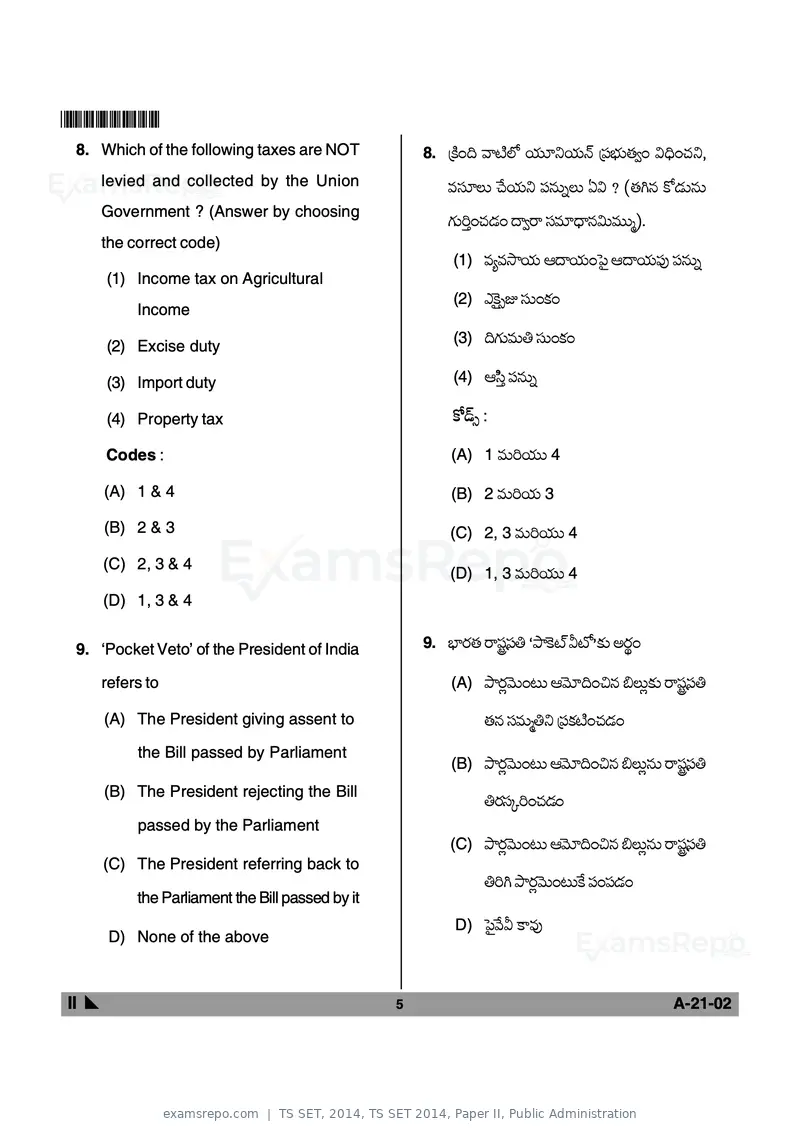
Text of page 5
*A2102*
8. Which of the following taxes are NOT 8. {Mìü ¨ ÐésìýÌZ Äæý$*°Äæý$¯þ {糿æý$èþÓ Ñ«¨ ^èþ°,
levied and collected by the Union ÐèþçÜ*Ë$ ^óþÄæý$° 糯èþ$²Ë$ HÑ ? (èþW¯èþ Møyæþ$¯èþ$
Government ? (Answer by choosing
Væü$Ç¢ ^èþyæþ §éÓÆ> çÜÐèþ*«§é¯èþÑ$Ðèþ$$Ã).
the correct code)
(1) ÐèþÅÐèþÝëÄæý$ B§éÄæý$ ò³O B§éÄæý$ç³# 糯èþ$²
(1) Income tax on Agricultural
(2) GMðüOÞk çÜ$ Mæü
Income
(2) Excise duty
(3) ¨Væü$Ðèþ$ çÜ$ Mæü
(3) Import duty (4) BíÜ¢ 糯èþ$²
(4) Property tax MøyþÞ :
Codes : (A) 1 Ðèþ$ÇÄæý$$ 4
(A) 1 & 4 (B) 2 Ðèþ$ÇÄæý$ 3
(B) 2 & 3 (C) 2, 3 Ðèþ$ÇÄæý$$ 4
(C) 2, 3 & 4
(D) 1, 3 Ðèþ$ÇÄæý$$ 4
(D) 1, 3 & 4
9. ‘Pocket Veto’ of the President of India 9. ¿êÆæÿèþ Æ>çÙç³ "´ëMðüsý ÒsZ'Mæü$ AÆæÿ¦
refers to (A) ´ëÆæÿÏÐðþ$ r$ BÐðþ*¨ _¯èþ ¼Ë$ÏMæü$ Æ>çÙç³
(A) The President giving assent to èþ¯èþ çÜÐèþ$ð {ç³Mæüsìý ^èþyæþ
the Bill passed by Parliament
(B) ´ëÆæÿÏÐðþ$ r$ BÐðþ*¨ _¯èþ ¼Ë$ϯèþ$ Æ>çÙç³
(B) The President rejecting the Bill
ÆæÿçÜPÇ ^èþyæþ
passed by the Parliament
(C) ´ëÆæÿÏÐðþ$ r$ BÐðþ*¨ _¯èþ ¼Ë$ϯèþ$ Æ>çÙç³
(C) The President referring back to
ÇW ´ëÆæÿÏÐðþ$ r$Móü ç³ ç³yæþ
the Parliament the Bill passed by it
D) ò³OÐóþÒ M>Ðèþ#
D) None of the above
II x 5 A-21-02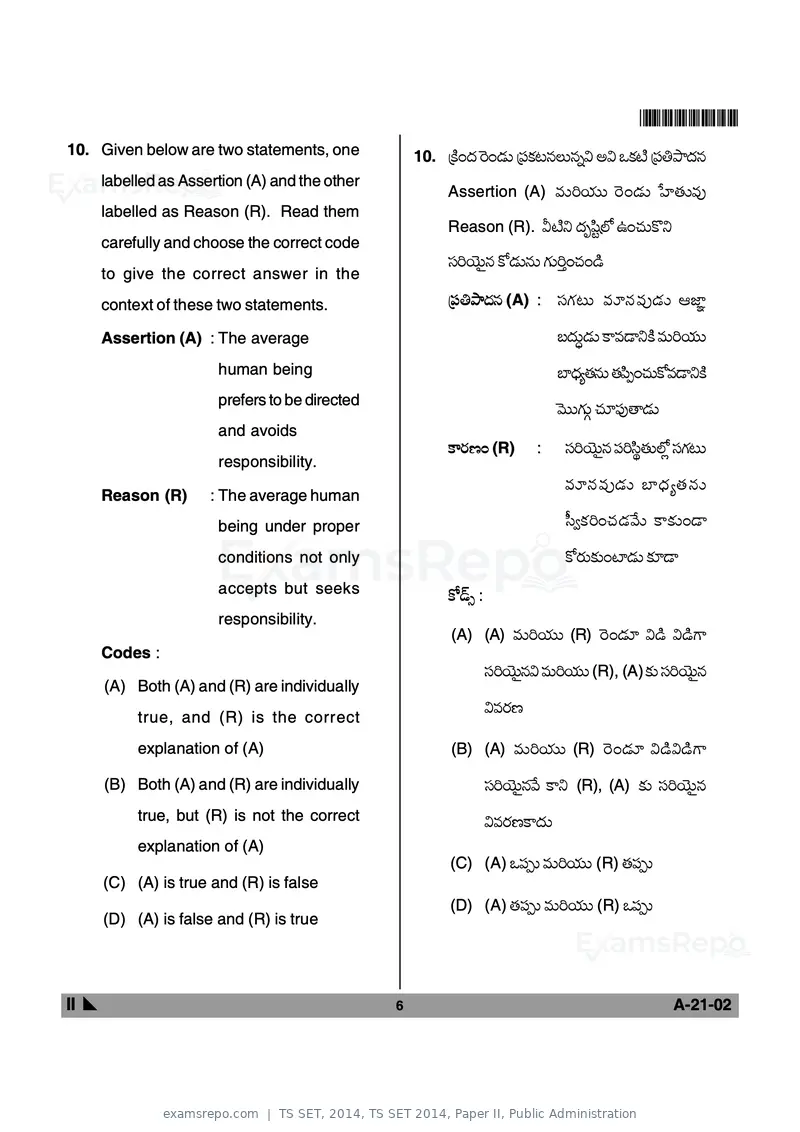
Text of page 6
*A2102*
10. Given below are two statements, one 10. {Mìü §æþ Æðÿ yæþ$ {ç³Mæür¯èþË$¯èþ²Ñ AÑ JMæüsìý {ç³´ë§æþ¯èþ
labelled as Assertion (A) and the other
Assertion (A) Ðèþ$ÇÄæý$$ Æðÿ yæþ$ õßýèþ$Ðèþ#
labelled as Reason (R). Read them
Reason (R). Òsìý° §æþíÙtÌZ E ^èþ$Mö°
carefully and choose the correct code
çÜÇÄñý$O¯èþ Møyæþ$¯èþ$ Væü$Ç¢ ^èþ yìþ
to give the correct answer in the
context of these two statements. {ç³´ë§æþ¯èþ (A) : çÜVæür$ Ðèþ*¯èþÐèþ#yæþ$ Bgêq
Assertion (A) : The average º§æþ$®yæþ$ M>Ðèþyé°Mìü Ðèþ$ÇÄæý$$
human being »ê«§æþÅèþ¯èþ$ èþí³µ ^èþ$MøÐèþyé°Mìü
prefers to be directed
Ððþ$$Væü$Y ^èþ*ç³#éyæþ$
and avoids
M>Ææÿ×ý (R) : çÜÇÄñý$O¯èþ ç³Çíܦèþ$ÌZÏ çÜVæür$
responsibility.
Ðè þ *¯è þ Ðè þ #yæ þ $ »ê« § æ þ Åè þ ¯è þ $
Reason (R) : The average human
being under proper ïÜÓMæüÇ ^èþyæþÐóþ$ M>Mæü$ yé
conditions not only MøÆæÿ$Mæü$ sêyæþ$ Mæü*yé
accepts but seeks MøyþÞ :
responsibility.
(A) (A) Ðèþ$ÇÄæý$$ (R) Æðÿ yæþ* Ñyìþ ÑyìþV>
Codes :
çÜÇÄñý$O¯èþÑ Ðèþ$ÇÄæý$$ (R), (A) Mæü$ çÜÇÄñý$O¯èþ
(A) Both (A) and (R) are individually
true, and (R) is the correct
ÑÐèþÆæÿ×ý
explanation of (A) (B) (A) Ðèþ$ÇÄæý$$ (R) Æðÿ yæþ* ÑyìþÑyìþV>
(B) Both (A) and (R) are individually çÜÇÄñý$O¯èþÐóþ M>° (R), (A) Mæü$ çÜÇÄñý$O¯èþ
true, but (R) is not the correct ÑÐèþÆæÿ× M>§æþ$ý
explanation of (A)
(C) (A) Jç³ Ðèþ$ÇÄæý$$ (R) èþç³
(C) (A) is true and (R) is false
(D) (A) èþç³ Ðèþ$ÇÄæý$$ (R) Jç³
(D) (A) is false and (R) is true
II x 6 A-21-02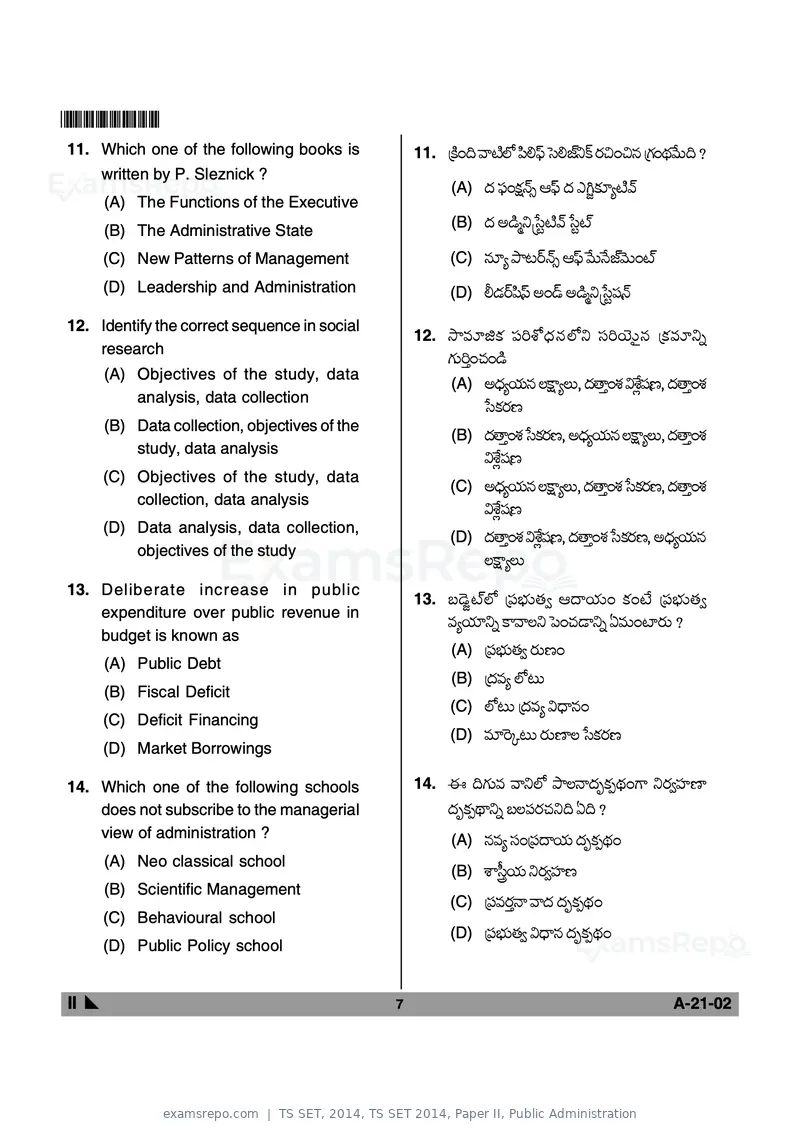
Text of page 7
*A2102*
11. Which one of the following books is 11. {Mìü ¨ ÐésìýÌZ í³Í òÜÍgý°Mü Ææÿ_ _¯èþ {Væü £æþÐóþ$¨ ?
written by P. Sleznick ?
(A) §æþ ç æü¯þÞ B §æþ GWjMæü*ÅsìýÐþ
(A) The Functions of the Executive
(B) The Administrative State (B) §æþ Ayìþð[õÜtsìýÐþ õÜtsý
(C) New Patterns of Management (C) ¯èþ*Å ´ërÆÿ¯þÞ B Ðóþ$¯óþgýÐðþ$ sý
(D) Leadership and Administration (D) ÎyæþÆÿíÙ³ A yþ Ayìþð[õÜtçÙ¯þ
12. Identify the correct sequence in social
12. ÝëÐèþ*hMæü ç³ÇÔZ«§æþ¯èþÌZ° çÜÇÄñý$O¯èþ {MæüÐèþ*°²
research
Væü$Ç¢ ^èþ yìþ
(A) Objectives of the study, data
(A) A«§æþÅÄæý$¯èþ Ë>ÅË$, §æþé¢ Ôèý ÑÔóýçÏÙ×ý, §æþé¢ Ôèý
analysis, data collection
õÜMæüÆæÿ×ý
(B) Data collection, objectives of the
(B) §æþé¢ Ôèý õÜMæüÆæÿ×ý, A«§æþÅÄæý$¯èþ Ë>ÅË$, §æþé¢ Ôèý
study, data analysis
ÑÔóýÏçÙ×ý
(C) Objectives of the study, data
(C) A«§æþÅÄæý$¯èþ Ë>ÅË$, §æþé¢ Ôèý õÜMæüÆæÿ×ý, §æþé¢ Ôèý
collection, data analysis
ÑÔóýÏçÙ×ý
(D) Data analysis, data collection,
(D) §æþé¢ Ôèý ÑÔóýçÏÙ×ý, §æþé¢ Ôèý õÜMæüÆæÿ×ý, A«§æþÅÄæý$¯èþ
objectives of the study
Ë>ÅË$
13. Deliberate increase in public
13. ºyðþjsýÌZ {糿æý$èþÓ B§éÄæý$ Mæü sôý {糿æý$èþÓ
expenditure over public revenue in
ÐèþÅÄæý*°² M>ÐéË° ò³ ^èþyé°² HÐèþ$ sêÆæÿ$ ?
budget is known as
(A) {糿æý$èþÓ Ææÿ$×ý
(A) Public Debt
(B) {§æþÐèþÅ ÌZr$
(B) Fiscal Deficit
(C) ÌZr$ {§æþÐèþÅ Ñ«§é¯èþ
(C) Deficit Financing
(D) Ðèþ*ÆðÿPr$ Ææÿ$×êË õÜMæüÆæÿ×ý
(D) Market Borrowings
14. Which one of the following schools 14. D ¨Væü$Ðèþ Ðé°ÌZ ´ë˯é§æþMæüµ£æþ V> °ÆæÿÓçßý×ê
does not subscribe to the managerial §æþMæüµ£é°² ºËç³Ææÿ^èþ°¨ H¨ ?
view of administration ? (A) ¯èþÐèþÅ çÜ {糧éÄæý$ §æþMæüµ£æþ
(A) Neo classical school
(B) ÔéïÜÄæý$ °ÆæÿÓçßý×ý
(B) Scientific Management
(C) {ç³ÐèþÆæÿ¢¯é Ðé§æþ §æþMæüµ£æþ
(C) Behavioural school
(D) {糿æý$èþÓ Ñ«§é¯èþ §æþMæüµ£æþ
(D) Public Policy school
II x 7 A-21-02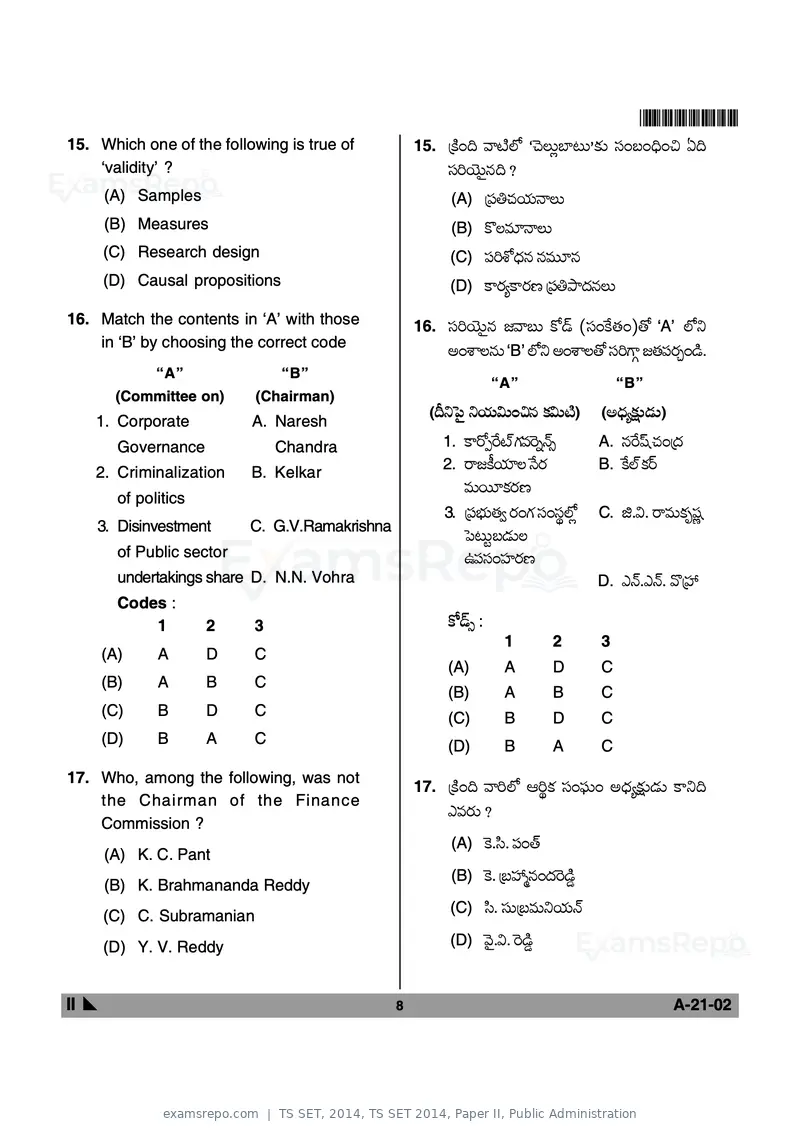
Text of page 8
*A2102*
15. Which one of the following is true of 15. {Mìü ¨ ÐésìýÌZ "^ðþË$Ï»êr$'Mæü$ çÜ º «¨ _ H¨
‘validity’ ? çÜÇÄñý$O¯èþ¨ ?
(A) Samples (A) {ç³^èþÄæý$¯éË$
(B) Measures (B) MöËÐèþ*¯éË$
(C) Research design (C) ç³ÇÔZ«§æþ¯èþ ¯èþÐèþ$*¯èþ
(D) Causal propositions (D) M>ÆæÿÅM>Ææÿ×ý {ç³´ë§æþ¯èþË$
16. Match the contents in ‘A’ with those 16. çÜÇÄñý$O¯èþ fÐéº$ Møyþ (çÜ Móüèþ )ø ‘A’ ÌZ°
in ‘B’ by choosing the correct code
A Ôé˯èþ$ ‘B’ ÌZ° A ÔéËø çÜÇV>Y fèþç³Ææÿa yìþ.
“A” “B”
“A” “B”
(Committee on) (Chairman)
(©°ò³O °Äæý$Ñ$ _¯èþ MæüÑ$sìý) (A«§æþÅæü$yæþ$)
1. Corporate A. Naresh
Governance Chandra 1. M>ÆøµÆóÿsý VæüÐèþÆðÿ²¯þÞ A. ¯èþÆóÿÙ ^èþ {§æþ
2. Æ>fMîüÄæý*Ë ¯óþÆæÿ B. MóüÌý MæüÆÿ
2. Criminalization B. Kelkar
Ðèþ$Æÿ$*MæüÆæÿ×ý
of politics
3. {糿æý$èþÓ Ææÿ Væü çÜ çܦÌZÏ C. h.Ñ. Æ>Ðèþ$MæüçÙ~
3. Disinvestment C. G.V.Ramakrishna
ò³r$tºyæþ$Ë
of Public sector Eç³çÜ çßýÆæÿ×ý
undertakings share D. N.N. Vohra D. G¯þ.G¯þ. Ðö{à
Codes :
1 2 3 MøyþÞ :
1 2 3
(A) A D C
(A) A D C
(B) A B C
(B) A B C
(C) B D C (C) B D C
(D) B A C (D) B A C
17. Who, among the following, was not
17. {Mìü ¨ ÐéÇÌZ BǦMæü çÜ ç$ A«§æþÅæü$yæþ$ M>°¨
the Chairman of the Finance
GÐèþÆæÿ$ ?
Commission ?
(A) Mðü.íÜ. ç³ þ
(A) K. C. Pant
(B) Mðü. {ºàïèþ §æþÆðÿyìþz
(B) K. Brahmananda Reddy
(C) íÜ. çÜ${ºÐèþ$°Äæý$¯þ
(C) C. Subramanian
(D) Y. V. Reddy (D) ÐðþO.Ñ. Æðÿyìþz
II x 8 A-21-02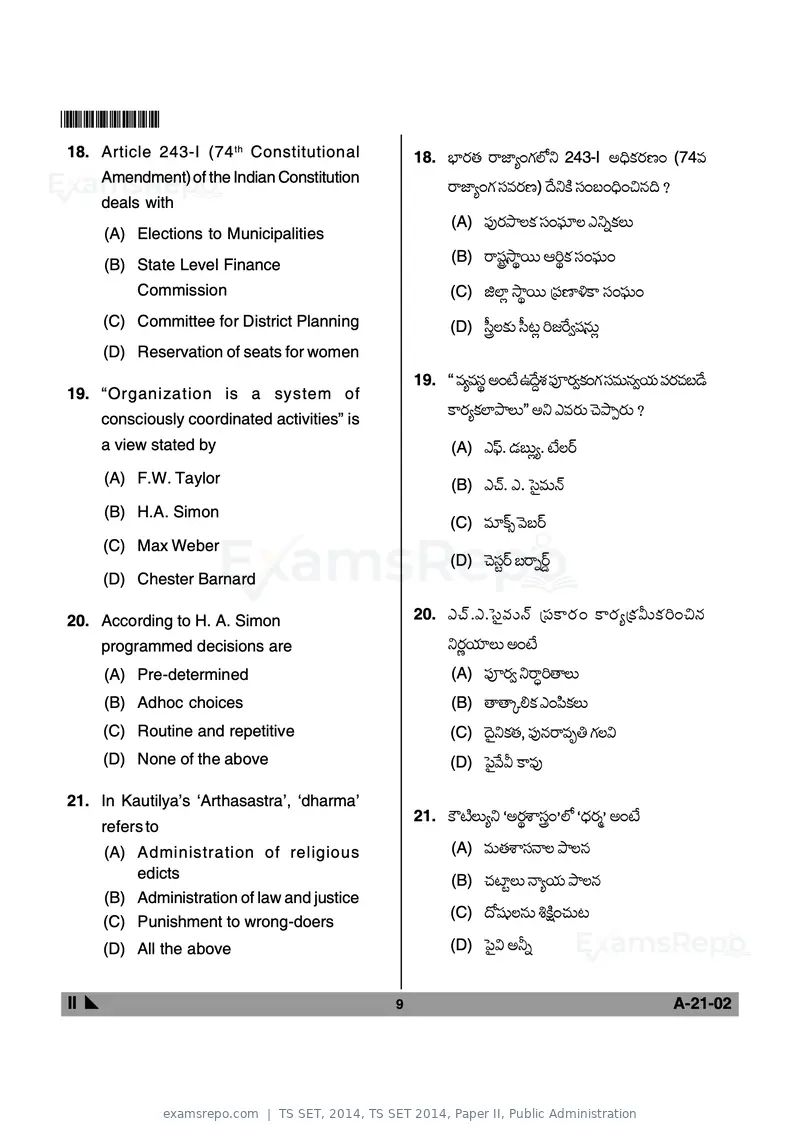
Text of page 9
*A2102*
18. Article 243-I (74 th Constitutional 18. ¿êÆæÿèþ Æ>gêÅ VæüÌZ° 243-I A«¨MæüÆæÿ×ý (74Ðèþ
Amendment) of the Indian Constitution
Æ>gêÅ Væü çÜÐèþÆæÿ×ý) §óþ°Mìü çÜ º «¨ _¯èþ¨ ?
deals with
(A) ç³#Ææÿ´ëËMæü çÜ ç*Ë G°²MæüË$
(A) Elections to Municipalities
(B) State Level Finance (B) Æ>çÙÝë¦Æÿ$$ BǦMæü çÜ ç$
Commission (C) hÌêÏ Ýë¦Æÿ$$ {ç³×êãM> çÜ ç$
(C) Committee for District Planning (D) ïÜËMæü$ ïÜrÏ ÇfÆóÿÓçÙ¯èþ$Ï
(D) Reservation of seats for women
19. “ ÐèþÅÐèþçܦ A sôý E§óþªÔèý ç³NÆæÿÓMæü Væü çÜÐèþ$¯èþÓÄæý$ ç³Ææÿ^èþºyóþ
19. “Organization is a system of
consciously coordinated activities” is
M>ÆæÿÅMæüÌê´ëË$” A° GÐèþÆæÿ$ ^ðþ´ëµÆæÿ$ ?
a view stated by (A) G. yæþº$ÏÅ. sôýËÆÿ
(A) F.W. Taylor (B) G^þ. G. òÜOÐèþ$¯þ
(B) H.A. Simon
(C) Ðèþ*MüÞ ÐðþºÆÿ
(C) Max Weber
(D) ^ðþçÜtÆÿ ºÆ>²Æÿz
(D) Chester Barnard
20. According to H. A. Simon 20. G^ þ .G.òÜO Ð è þ $¯ þ {ç ³ M>Ææ ÿ M>Ææ ÿÅ{Mæ ü Ò$Mæ ü Ç _¯è þ
programmed decisions are °Ææÿ~Äæý*Ë$ A sôý
(A) Pre-determined (A) ç³NÆæÿÓ °Æ>®ÇéË$
(B) Adhoc choices (B) ééPÍMæü G í³MæüË$
(C) Routine and repetitive (C) §ðþO°Mæüèþ, ç³#¯èþÆ>Ðèþ VæüËÑ
(D) None of the above (D) ò³OÐóþÒ M>Ðèþ#
21. In Kautilya’s ‘Arthasastra’, ‘dharma’
21. MúsìýË$Å° "AÆæÿ¦ÔéçÜ 'ÌZ "«§æþÆæÿÃ' A sôý
refers to
(A) Administration of religious (A) Ðèþ$èþÔéçܯéË ´ë˯èþ
edicts (B) ^èþsêtË$ ¯éÅÄæý$ ´ë˯èþ
(B) Administration of law and justice
(C) §øçÙ$˯èþ$ Õìü ^èþ$r
(C) Punishment to wrong-doers
(D) All the above (D) ò³OÑ A±²
II x 9 A-21-02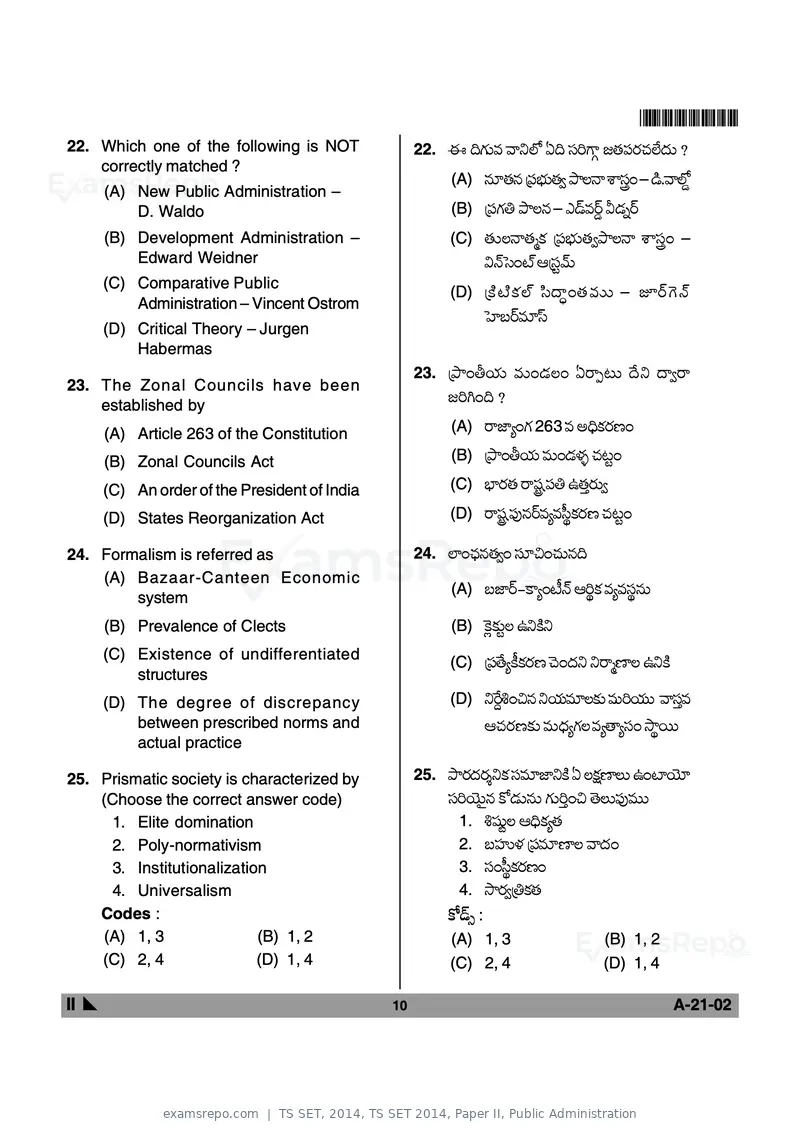
Text of page 10
*A2102*
22. Which one of the following is NOT 22. D ¨Væü$Ðèþ Ðé°ÌZ H¨ çÜÇV>Y fèþç³Ææÿ^èþÌôý§æþ$ ?
correctly matched ?
(A) ¯èþ*èþ¯èþ {糿æý$èþÓ ´ë˯é ÔéçÜ – yìþ.ÐéÌZz
(A) New Public Administration –
D. Waldo (B) {ç³Væü ´ë˯èþ – GyþÐèþÆÿz Òyæþ²Æÿ
(B) Development Administration – (C) èþ$˯éèþÃMæü {糿æý$èþÓ´ë˯é ÔéçÜ –
Edward Weidner ѯþòÜ sý B{çÜtÐþ$
(C) Comparative Public
(D) {Mì ü sì ý Mæ ü Ì ý í Ü §é® è þ Ðè þ $$ – lÆ ÿ Vð ü ¯ þ
Administration – Vincent Ostrom
òßýºÆÿÐèþ*Ü
(D) Critical Theory – Jurgen
Habermas
23. {´ë ¡Äæý$ Ðèþ$ yæþË HÆ>µr$ §óþ° §éÓÆ>
23. The Zonal Councils have been
established by
fÇW ¨ ?
(A) Article 263 of the Constitution (A) Æ>gêÅ Væü 263 Ðèþ A«¨MæüÆæÿ×ý
(B) Zonal Councils Act (B) {´ë ¡Äæý$ Ðèþ$ yæþâæýå ^èþrt
(C) An order of the President of India (C) ¿êÆæÿèþ Æ>çÙ ç³ Eèþ¢Ææÿ$Ó
(D) States Reorganization Act (D) Æ>çÙ ç³#¯èþÆÿÐèþÅÐèþïܦMæüÆæÿ×ý ^èþrt
24. Formalism is referred as 24. Ìê bèþ¯èþèþÓ çÜ*_ ^èþ$¯èþ¨
(A) Bazaar-Canteen Economic
system
(A) ºgêÆÿ&M>Å sîý¯þ BǦMæü ÐèþÅÐèþçܦ¯èþ$
(B) Prevalence of Clects (B) MðüÏMæü$tË E°Mìü°
(C) Existence of undifferentiated (C) {ç³óþÅMîüMæüÆæÿ×ý ^ðþ §æþ° °Æ>Ã×êË E°Mìü
structures
(D) The degree of discrepancy (D) °ÆóÿªÕ _¯èþ °Äæý$Ðèþ*ËMæü$ Ðèþ$ÇÄæý$$ ÐéçÜ¢Ðèþ
between prescribed norms and B^èþÆæÿ×ýMæü$ Ðèþ$«§æþÅVæüË ÐèþÅéÅçÜ Ýë¦Æÿ$$
actual practice
25. Prismatic society is characterized by 25. ´ëÆæÿ§æþÆæÿØ°Mæü çÜÐèþ*gê°Mìü H Ëæü×êË$ E sêÄñý*
(Choose the correct answer code) çÜÇÄñý$O¯èþ Møyæþ$¯èþ$ Væü$Ç¢ _ ðþË$ç³#Ðèþ$$
1. Elite domination 1. ÕçÙ$tË B«¨MæüÅèþ
2. Poly-normativism 2. ºçßý$âæý {ç³Ðèþ*×êË Ðé§æþ
3. Institutionalization 3. çÜ ïܦMæüÆæÿ×ý
4. Universalism 4. ÝëÆæÿÓ{Mæüèþ
Codes : MøyþÞ :
(A) 1, 3 (B) 1, 2 (A) 1, 3 (B) 1, 2
(C) 2, 4 (D) 1, 4 (C) 2, 4 (D) 1, 4
II x 10 A-21-02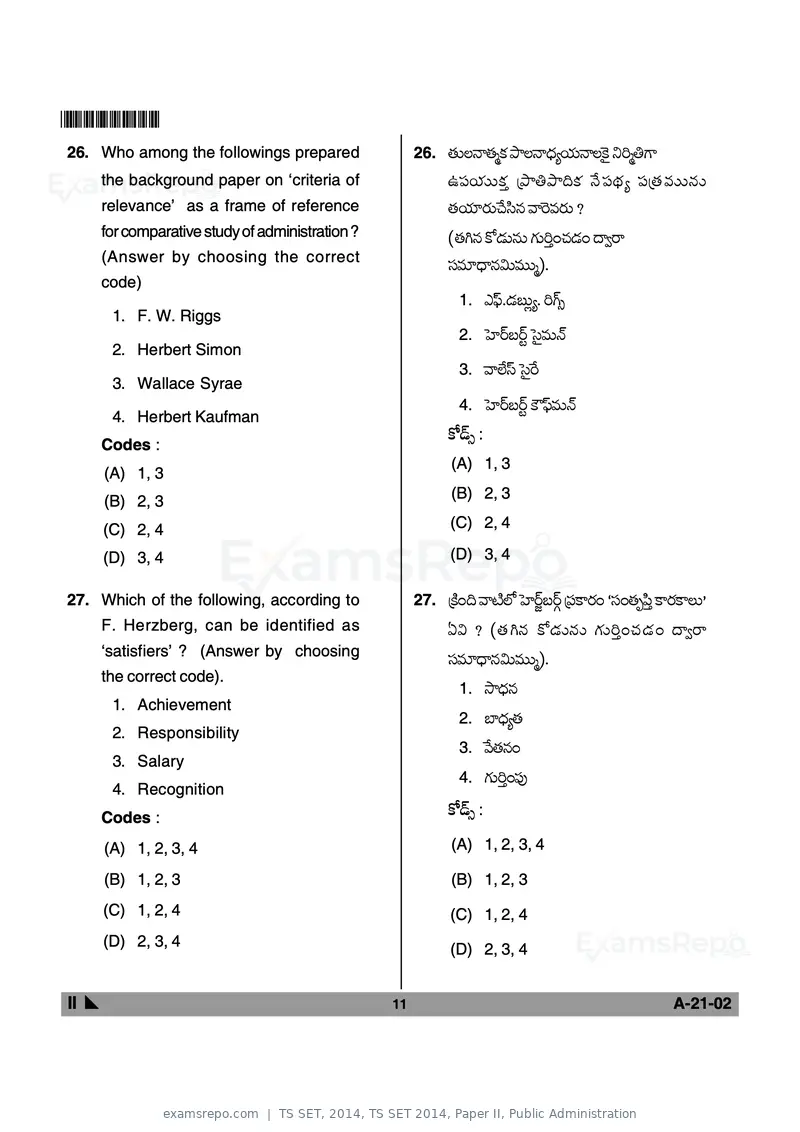
Text of page 11
*A2102*
26. Who among the followings prepared 26. èþ$˯éèþÃMæü ´ë˯髧æþÅÄæý$¯éËMðüO °ÇÃV>
the background paper on ‘criteria of Eç ³ Äæ ý $$Mæ ü ¢ {´ë´ë¨Mæ ü ¯ó þ ç ³ £æ þ Å ç ³ {è þ Ðè þ $$¯è þ $
relevance’ as a frame of reference èþÄæý*Ææÿ$^óþíܯèþ ÐéÆðÿÐèþÆæÿ$ ?
for comparative study of administration ? (èþW¯èþ Møyæþ$¯èþ$ Væü$Ç¢ ^èþyæþ §éÓÆ>
(Answer by choosing the correct çÜÐèþ*«§é¯èþÑ$Ðèþ$$Ã).
code)
1. G.yæþº$ÏÅ. ÇVüÞ
1. F. W. Riggs
2. òßýÆÿºÆÿt òÜOÐèþ$¯þ
2. Herbert Simon
3. ÐéÌôýÜ òÜOÆóÿ
3. Wallace Syrae
4. òßýÆÿºÆÿt MúÐèþ$¯þ
4. Herbert Kaufman
MøyþÞ :
Codes :
(A) 1, 3
(A) 1, 3
(B) 2, 3 (B) 2, 3
(C) 2, 4 (C) 2, 4
(D) 3, 4 (D) 3, 4
27. Which of the following, according to 27. {Mìü ¨ ÐésìýÌZ òßýÆÿjºÆÿY {ç³M>Ææÿ "çÜ èþí³¢ M>ÆæÿM>Ë$'
F. Herzberg, can be identified as HÑ ? (è þ W¯è þ Møyæ þ $¯è þ $ Væ ü $Ç¢ ^è þ yæ þ §éÓÆ>
‘satisfiers’ ? (Answer by choosing çÜÐèþ*«§é¯èþÑ$Ðèþ$$Ã).
the correct code).
1. Ý뫧æþ¯èþ
1. Achievement
2. »ê«§æþÅèþ
2. Responsibility
3. Ðóþèþ¯èþ
3. Salary
4. Væü$Ç¢ ç³#
4. Recognition
Codes : MøyþÞ :
(A) 1, 2, 3, 4 (A) 1, 2, 3, 4
(B) 1, 2, 3 (B) 1, 2, 3
(C) 1, 2, 4 (C) 1, 2, 4
(D) 2, 3, 4 (D) 2, 3, 4
II x 11 A-21-02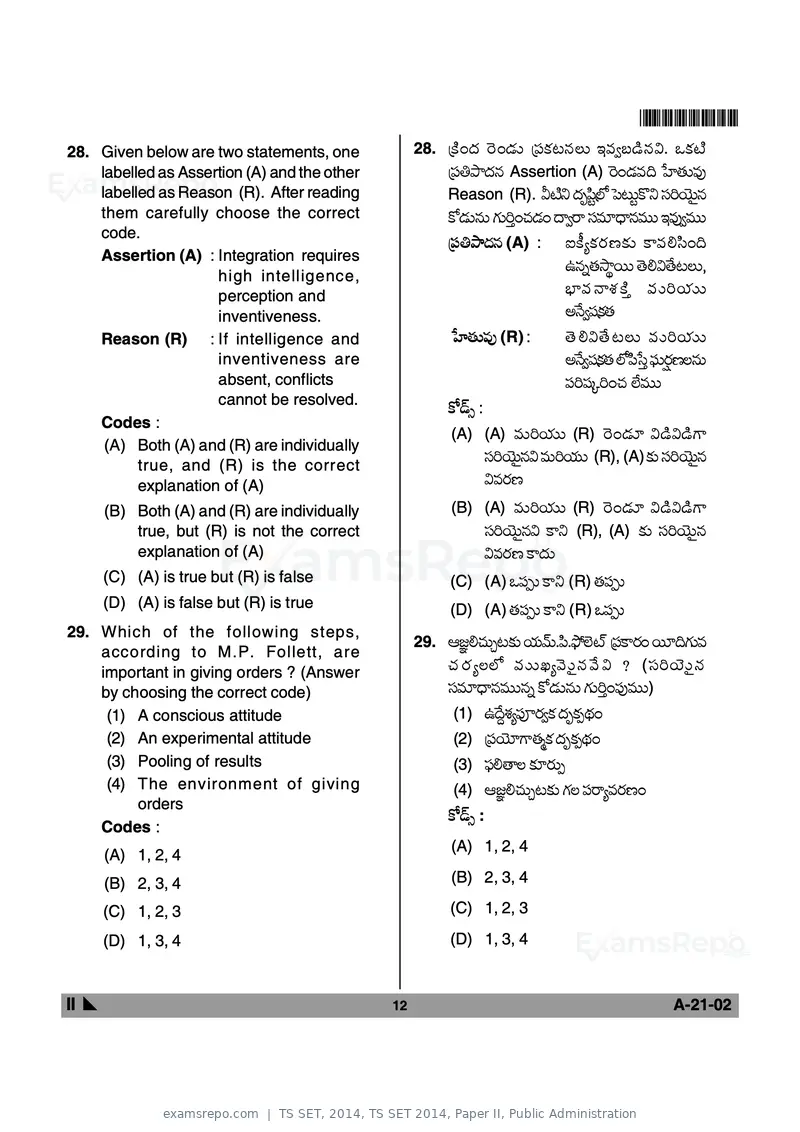
Text of page 12
*A2102*
28. Given below are two statements, one 28. {Mìü §æþ Æðÿ yæþ$ {ç³Mæür¯èþË$ CÐèþÓºyìþ¯èþÑ. JMæüsìý
labelled as Assertion (A) and the other {ç³´ë§æþ¯èþ Assertion (A) Æðÿ yæþÐèþ¨ õßýèþ$Ðèþ#
labelled as Reason (R). After reading Reason (R). Òsìý° §æþíÙtÌZ ò³r$tMö° çÜÇÄñý$O¯èþ
them carefully choose the correct Møyæþ$¯èþ$ Væü$Ç¢ ^èþyæþ §éÓÆ> çÜÐèþ*«§é¯èþÐèþ$$ CÐèþ#ÓÐèþ$$
code.
{ç³´ë§æþ¯èþ (A) : IMîüÅMæüÆæÿ×ýMæü$ M>ÐèþÍíÜ ¨
Assertion (A) : Integration requires
high intelligence,
E¯èþ²èþÝë¦Æÿ$$ ðþÍÑóþrË$,
perception and ¿êÐè þ ¯éÔè ý Mì ü ¢ Ðè þ $ÇÄæ ý $$
inventiveness. A¯óþÓçÙMæüèþ
Reason (R) : If intelligence and ýõßýèþ$Ðèþ# (R) : ð þ ÍÑó þ rË$ Ðè þ $ÇÄæ ý $$
inventiveness are A¯óþÓçÙMæüèþ ÌZí³õÜ¢ ç$ÆæÿÛ×ý˯èþ$
absent, conflicts ç³ÇçÙPÇ ^èþ ÌôýÐèþ$$
cannot be resolved.
MøyþÞ :
Codes :
(A) (A) Ðèþ$ÇÄæý$$ (R) Æðÿ yæþ* ÑyìþÑyìþV>
(A) Both (A) and (R) are individually
true, and (R) is the correct
çÜÇÄñý$O¯èþÑ Ðèþ$ÇÄæý$$ (R), (A) Mæü$ çÜÇÄñý$O¯èþ
explanation of (A) ÑÐèþÆæÿ×ý
(B) Both (A) and (R) are individually (B) (A) Ðèþ$ÇÄæý$$ (R) Æðÿ yæþ* ÑyìþÑyìþV>
true, but (R) is not the correct çÜÇÄñý$O¯èþÑ M>° (R), (A) Mæü$ çÜÇÄñý$O¯èþ
explanation of (A) ÑÐèþÆæÿ×ý M>§æþ$
(C) (A) is true but (R) is false (C) (A) Jç³ M>° (R) èþç³
(D) (A) is false but (R) is true (D) (A) èþç³ M>° (R) Jç³
29. Which of the following steps,
29. BfqÍ^èþ$arMæü$ Äæý$Ðþ$.í³.¸ùÌñ sý {ç³M>Ææÿ Æÿ$*¨Væü$Ðèþ
according to M.P. Follett, are
important in giving orders ? (Answer ^è þ Ææ ÿ ÅËÌZ Ðè þ $$QÅÐð þ $O ¯ è þ Ðó þ Ñ ? ( ç Ü ÇÄñ ý $O ¯ è þ
by choosing the correct code) çÜÐèþ*«§é¯èþÐèþ$$¯èþ² Møyæþ$¯èþ$ Væü$Ç¢ ç³#Ðèþ$$)
(1) A conscious attitude (1) E§óþªÔèýÅç³NÆæÿÓMæü §æþMæüµ£æþ
(2) An experimental attitude (2) {ç³Äñý*V>èþÃMæü §æþMæüµ£æþ
(3) Pooling of results (3) çÍéË Mæü*Ææÿ$µ
(4) The environment of giving (4) BfqÍ^èþ$arMæü$ VæüË ç³Æ>ÅÐèþÆæÿ×ý
orders
MøyþÞ :
Codes :
(A) 1, 2, 4
(A) 1, 2, 4
(B) 2, 3, 4 (B) 2, 3, 4
(C) 1, 2, 3 (C) 1, 2, 3
(D) 1, 3, 4 (D) 1, 3, 4
II x 12 A-21-02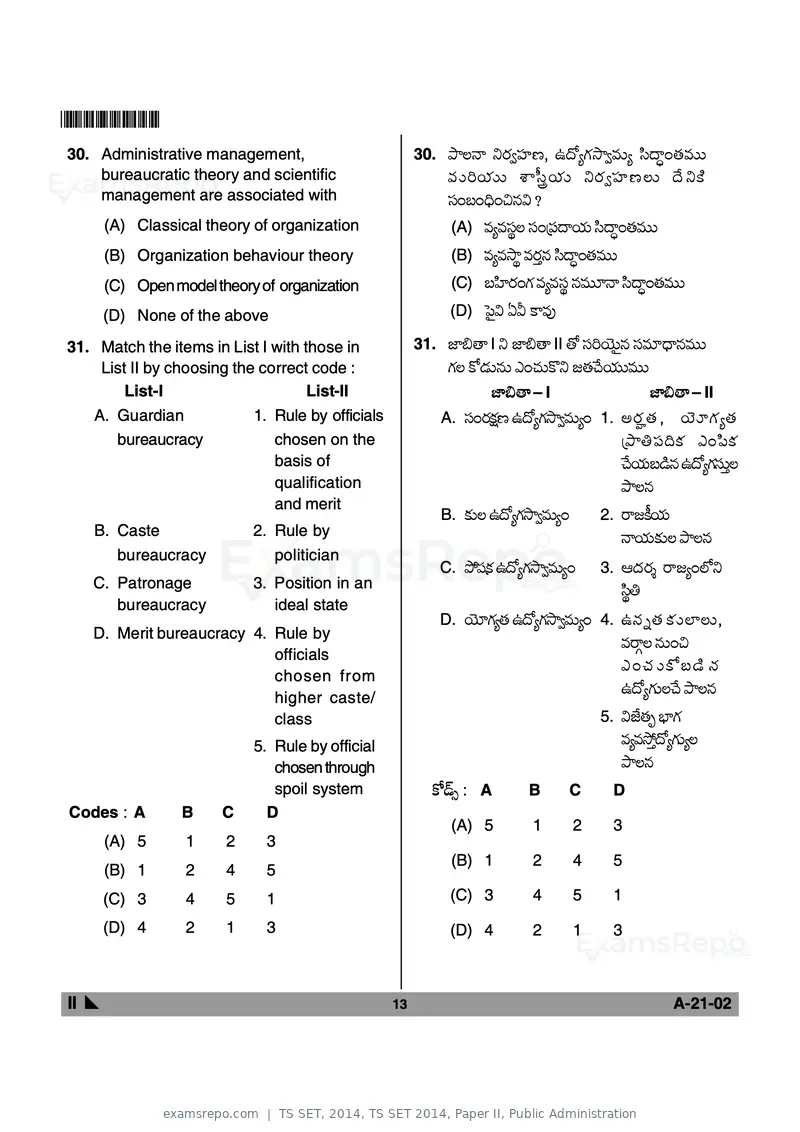
Text of page 13
*A2102*
30. Administrative management, 30. ´ëË¯é °ÆæÿÓçßý×ý, E§øÅVæüÝëÓÐèþ$Å íÜ§é® èþÐèþ$$
bureaucratic theory and scientific Ðè þ $ÇÄæ ý $$ Ôéï Ü Ä æ ý $ °Ææ ÿ Óç ß ý×ýË$ §ó þ °Mì ü
management are associated with çÜ º «¨ _¯èþÑ ?
(A) Classical theory of organization (A) ÐèþÅÐèþçÜ¦Ë çÜ {糧éÄæý$ íÜ§é® èþÐèþ$$
(B) Organization behaviour theory (B) ÐèþÅÐèþÝë¦ ÐèþÆæÿ¢¯èþ íÜ§é® èþÐèþ$$
(C) Open model theory of organization (C) ºíßýÆæÿ Væü ÐèþÅÐèþçܦ ¯èþÐèþ$*¯é íÜ§é® èþÐèþ$$
(D) None of the above (D) ò³OÑ HÒ M>Ðèþ#
31. Match the items in List I with those in 31. gê¼é I ° gê¼é II ø çÜÇÄñý$O¯èþ çÜÐèþ*«§é¯èþÐèþ$$
List II by choosing the correct code : VæüË Møyæþ$¯èþ$ G ^èþ$Mö° fèþ^óþÄæý$$Ðèþ$$
List-I List-II gê¼é – I gê¼é – II
A. Guardian 1. Rule by officials A. çÜ Ææÿæü×ý E§øÅVæüÝëÓÐèþ$Å 1. AÆæ ÿ á è þ , Äñ ý *Væ ü Åè þ
bureaucracy chosen on the {´ëç ³ ¨Mæ ü G í ³ Mæ ü
basis of ^óþÄæý$ºyìþ¯èþ E§øÅVæüçÜ$¢Ë
qualification ´ë˯èþ
and merit
B. Mæü$Ë E§øÅVæüÝëÓÐèþ$Å 2. Æ>fMîüÄæý$
B. Caste 2. Rule by ¯éÄæý$Mæü$Ë ´ë˯èþ
bureaucracy politician
C. ´ùçÙMæü E§øÅVæüÝëÓÐèþ$Å 3. B§æþÆæÿØ Æ>fÅ ÌZ°
C. Patronage 3. Position in an íܦ
bureaucracy ideal state
D. Äñý*VæüÅèþ E§øÅVæüÝëÓÐèþ$Å 4. E¯è þ ²è þ Mæ ü $ÌêË$,
D. Merit bureaucracy 4. Rule by
ÐèþÆ>YË ¯èþ$ _
officials
chosen from
G ^è þ $Møºyì þ ¯è þ
higher caste/
E§øÅVæü$Ë^óþ ´ë˯èþ
class 5. Ñgôýèþ ¿êVæü
5. Rule by official ÐèþÅÐèþÝù¢§øÅVæü$ÅË
chosen through ´ë˯èþ
spoil system MøyþÞ : A B C D
Codes : A B C D
(A) 5 1 2 3
(A) 5 1 2 3
(B) 1 2 4 5
(B) 1 2 4 5
(C) 3 4 5 1 (C) 3 4 5 1
(D) 4 2 1 3 (D) 4 2 1 3
II x 13 A-21-02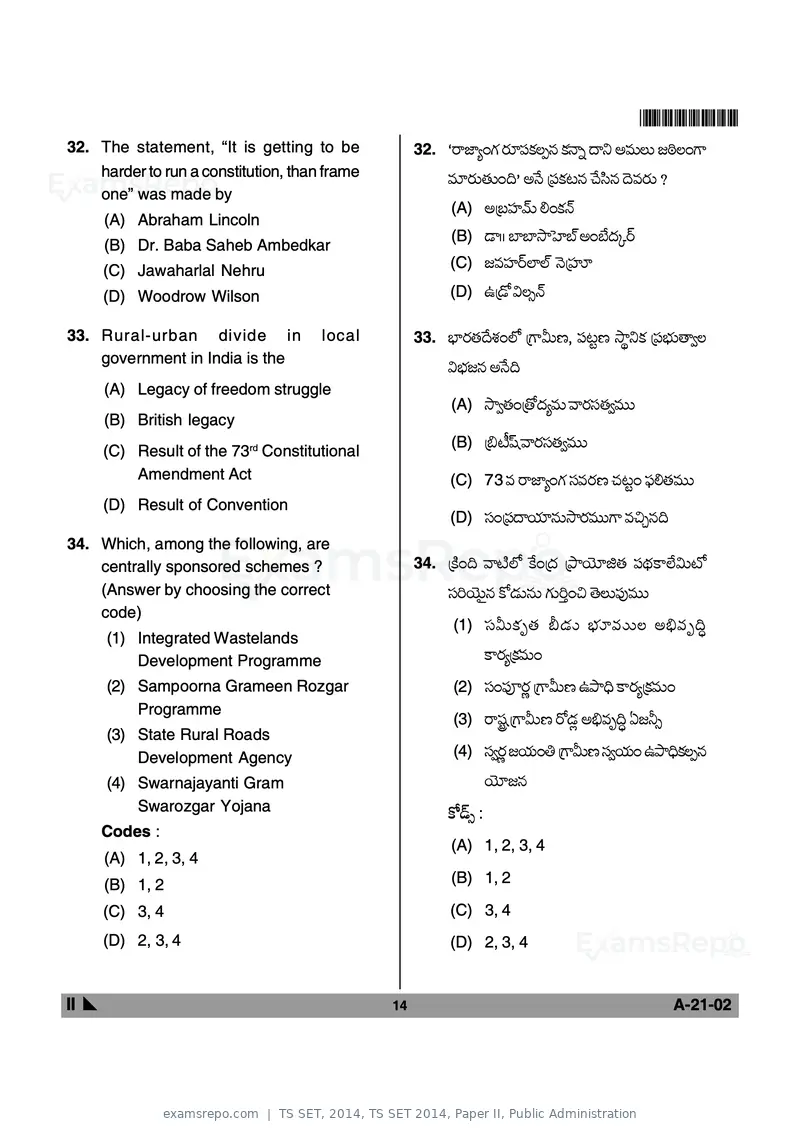
Text of page 14
*A2102*
32. The statement, “It is getting to be 32. "Æ>gêÅ Væü Ææÿ*ç³Mæü˵¯èþ Mæü¯é² §é° AÐèþ$Ë$ fvË V>
harder to run a constitution, than frame Ðèþ*Ææÿ$èþ$ ¨' A¯óþ {ç³Mæür¯èþ ^óþíܯèþ §ðþÐèþÆæÿ$ ?
one” was made by
(A) A{ºçßýÐþ$ Í Mæü¯þ
(A) Abraham Lincoln
(B) yé »ê»êÝëòßý»ý A »ôý§æþPÆÿ
(B) Dr. Baba Saheb Ambedkar
(C) Jawaharlal Nehru (C) fÐèþçßýÆÿÌêÌý ¯ðþ{çßý*
(D) Woodrow Wilson (D) E{yø ÑËÞ¯þ
33. Rural-urban divide in local 33. ¿êÆæÿèþ§óþÔèý ÌZ {V>Ò$×ý, ç³rt×ý Ý린Mæü {糿æý$éÓË
government in India is the
Ñ¿æýf¯èþ A¯óþ¨
(A) Legacy of freedom struggle
(A) ÝëÓèþ {ø§æþÅÐèþ$ ÐéÆæÿçÜèþÓÐèþ$$
(B) British legacy
(C) Result of the 73rd Constitutional
(B) {¼sîýÙ ÐéÆæÿçÜèþÓÐèþ$$
Amendment Act (C) 73 Ðèþ Æ>gêÅ Væü çÜÐèþÆæÿ×ý ^èþrt çÍèþÐèþ$$
(D) Result of Convention
(D) çÜ {糧éÄæý*¯èþ$ÝëÆæÿÐèþ$$V> Ðèþ_a¯èþ¨
34. Which, among the following, are
centrally sponsored schemes ? 34. {Mìü ¨ ÐésìýÌZ Móü {§æþ {´ëÄñý*hèþ ç³£æþM>ÌôýÑ$sZ
(Answer by choosing the correct çÜÇÄñý$O¯èþ Møyæþ$¯èþ$ Væü$Ç¢ _ ðþË$ç³#Ðèþ$$
code)
(1) ç Ü Ò$Mæ ü è þ ½yæ þ $ ¿æ ý *Ðè þ $$Ë AÀÐè þ ¨®
(1) Integrated Wastelands
Development Programme M>ÆæÿÅ{MæüÐèþ$
(2) Sampoorna Grameen Rozgar (2) çÜ ç³NÆæÿ~ {V>Ò$×ý E´ë«¨ M>ÆæÿÅ{MæüÐèþ$
Programme
(3) Æ>çÙ {V>Ò$×ý ÆøyæþÏ AÀÐèþ¨® Hf±Þ
(3) State Rural Roads
Development Agency (4) çÜÓÆæÿ~ fÄæý$ {V>Ò$×ý çÜÓÄæý$ E´ë«¨Mæü˵¯èþ
(4) Swarnajayanti Gram Äñý*f¯èþ
Swarozgar Yojana MøyþÞ :
Codes :
(A) 1, 2, 3, 4
(A) 1, 2, 3, 4
(B) 1, 2 (B) 1, 2
(C) 3, 4 (C) 3, 4
(D) 2, 3, 4 (D) 2, 3, 4
II x 14 A-21-02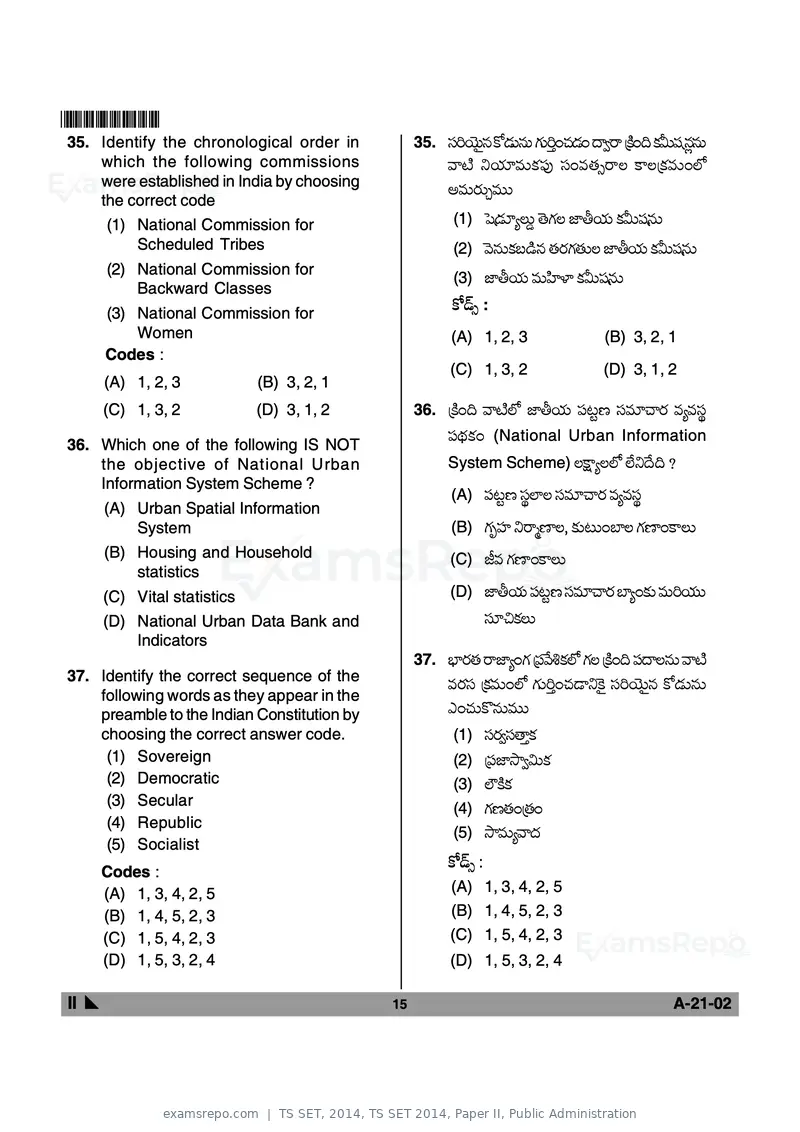
Text of page 15
*A2102*
35. Identify the chronological order in 35. çÜÇÄñý$O¯èþ Møyæþ$¯èþ$ Væü$Ç¢ ^èþyæþ §éÓÆ> {Mìü ¨ MæüÒ$çÙ ¯èþϯèþ$
which the following commissions Ðésìý °Äæý*Ðèþ$Mæüç³# çÜ ÐèþèþÞÆ>Ë M>Ë{MæüÐèþ$ ÌZ
were established in India by choosing AÐèþ$Ææÿ$aÐèþ$$
the correct code
(1) National Commission for (1) òÙyæþ*ÅË$z ðþVæüË gê¡Äæý$ MæüÒ$çÙ¯èþ$
Scheduled Tribes (2) Ððþ¯èþ$Mæüºyìþ¯èþ èþÆæÿVæüèþ$Ë gê¡Äæý$ MæüÒ$çÙ¯èþ$
(2) National Commission for
(3) gê¡Äæý$ Ðèþ$íßýâê MæüÒ$çÙ¯èþ$
Backward Classes
(3) National Commission for
MøyþÞ :
Women (A) 1, 2, 3 (B) 3, 2, 1
Codes :
(C) 1, 3, 2 (D) 3, 1, 2
(A) 1, 2, 3 (B) 3, 2, 1
(C) 1, 3, 2 (D) 3, 1, 2 36. {Mìü ¨ ÐésìýÌZ gê¡Äæý$ ç³rt×ý çÜÐèþ*^éÆæÿ ÐèþÅÐèþçܦ
36. Which one of the following IS NOT
ç³£æþMæü (National Urban Information
the objective of National Urban System Scheme) Ë>ÅËÌZ Ìôý°§óþ¨ ?
Information System Scheme ?
(A) ç³rt×ý çܦÌêË çÜÐèþ*^éÆæÿ ÐèþÅÐèþçܦ
(A) Urban Spatial Information
System (B) Væüçßý °Æ>Ã×êË, Mæü$r$ »êË Væü×ê M>Ë$
(B) Housing and Household (C) iÐèþ Væü×ê M>Ë$
statistics
(C) Vital statistics (D) gê¡Äæý$ ç³rt×ý çÜÐèþ*^éÆæÿ »êÅ Mæü$ Ðèþ$ÇÄæý$$
(D) National Urban Data Bank and çÜ*_MæüË$
Indicators
37. ¿êÆæÿèþ Æ>gêÅ Væü {ç³ÐóþÕMæüÌZ VæüË {Mìü ¨ 糧é˯èþ$ Ðésìý
37. Identify the correct sequence of the ÐèþÆæÿçÜ {MæüÐèþ$ ÌZ Væü$Ç¢ ^èþyé°MðüO çÜÇÄñý$O¯èþ Møyæþ$¯èþ$
following words as they appear in the
preamble to the Indian Constitution by G ^èþ$Mö¯èþ$Ðèþ$$
choosing the correct answer code. (1) çÜÆæÿÓçÜé¢Mæü
(1) Sovereign (2) {ç³gêÝëÓÑ$Mæü
(2) Democratic (3) ÌoMìüMæü
(3) Secular (4) Væü×ýèþ {èþ
(4) Republic
(5) ÝëÐèþ$ÅÐé§æþ
(5) Socialist
Codes :
MøyþÞ :
(A) 1, 3, 4, 2, 5 (A) 1, 3, 4, 2, 5
(B) 1, 4, 5, 2, 3 (B) 1, 4, 5, 2, 3
(C) 1, 5, 4, 2, 3 (C) 1, 5, 4, 2, 3
(D) 1, 5, 3, 2, 4 (D) 1, 5, 3, 2, 4
II x 15 A-21-02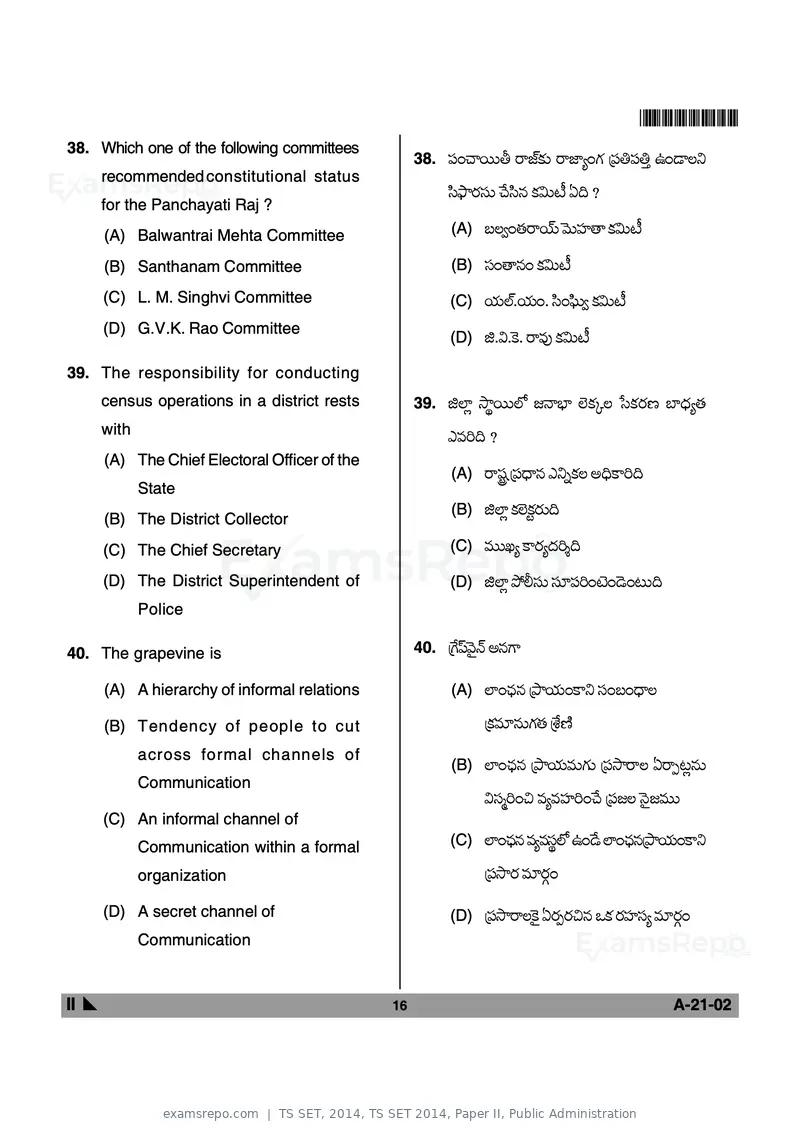
Text of page 16
*A2102*
38. Which one of the following committees
38. ç³ ^éÆÿ$$¡ Æ>gýMæü$ Æ>gêÅ Væü {ç³ç³¢ E yéË°
recommended constitutional status
íܸëÆæÿçÜ$ ^óþíܯèþ MæüÑ$sîý H¨ ?
for the Panchayati Raj ?
(A) Balwantrai Mehta Committee (A) ºËÓ èþÆ>Äý$ Ððþ$çßýé MæüÑ$sîý
(B) Santhanam Committee (B) çÜ é¯èþ MæüÑ$sîý
(C) L. M. Singhvi Committee (C) Äæý$Ìý.Äæý$ . íÜ í$Ó MæüÑ$sîý
(D) G.V.K. Rao Committee
(D) h.Ñ.Mðü. Æ>Ðèþ# MæüÑ$sîý
39. The responsibility for conducting
census operations in a district rests 39. hÌêÏ Ýë¦Æÿ$$ÌZ f¯é¿ê ÌñýMæüPË õÜMæüÆæÿ×ý »ê«§æþÅèþ
with GÐèþǨ ?
(A) The Chief Electoral Officer of the
(A) Æ>çÙ {糫§é¯èþ G°²MæüË A«¨M>Ǩ
State
(B) The District Collector
(B) hÌêÏ MæüÌñýMæütÆæÿ$¨
(C) The Chief Secretary (C) Ðèþ$$QÅ M>ÆæÿŧæþÇب
(D) The District Superintendent of (D) hÌêÏ ´ùÎçÜ$ çÜ*ç³Ç sñý yðþ r$¨
Police
40. The grapevine is 40. {Vóü³ÐðþO¯þ A¯èþV>
(A) A hierarchy of informal relations (A) Ìê bèþ¯èþ {´ëÄæý$ M>° çÜ º «§éË
(B) Tendency of people to cut {MæüÐèþ*¯èþ$Væüèþ {Ôóý×ìý
across formal channels of
(B) Ìê bèþ¯èþ {´ëÄæý$Ðèþ$Væü$ {ç³ÝëÆ>Ë HÆ>µrϯèþ$
Communication
ÑçÜÃÇ _ ÐèþÅÐèþçßýÇ ^óþ {ç³fË ¯ðþOfÐèþ$$
(C) An informal channel of
Communication within a formal (C) Ìê bèþ¯èþ ÐèþÅÐèþçܦÌZ E yóþ Ìê bèþ¯èþ{´ëÄæý$ M>°
organization {ç³ÝëÆæÿ Ðèþ*ÆæÿY
(D) A secret channel of (D) {ç³ÝëÆ>ËMðüO HÆæÿµÆæÿ_¯èþ JMæü ÆæÿçßýçÜÅ Ðèþ*ÆæÿY
Communication
II x 16 A-21-02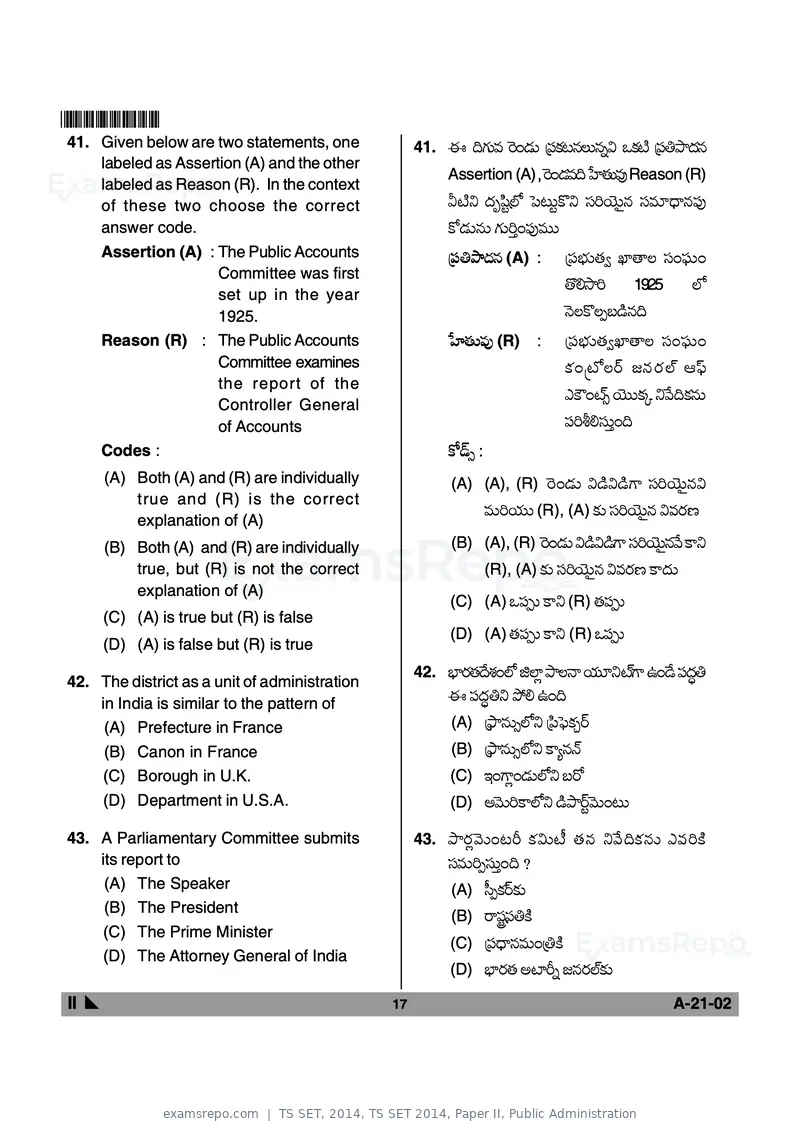
Text of page 17
*A2102*
41. Given below are two statements, one 41. D ¨Væü$Ðèþ Æðÿ yæþ$ {ç³Mæür¯èþË$¯èþ²Ñ JMæüsìý {ç³´ë§æþ¯èþ
labeled as Assertion (A) and the other
Assertion (A) , Æðÿ yæþÐèþ¨ õßýèþ$Ðèþ# Reason (R)
labeled as Reason (R). In the context
of these two choose the correct Òsìý° §æþíÙtÌZ ò³r$tMö° çÜÇÄñý$O¯èþ çÜÐèþ*«§é¯èþç³#
answer code. Møyæþ$¯èþ$ Væü$Ç¢ ç³#Ðèþ$$
Assertion (A) : The Public Accounts {ç³´ë§æþ¯èþ (A) : {糿æý$èþÓ RêéË çÜ ç$
Committee was first
set up in the year
öÍÝëÇ 1925 ÌZ
1925. ¯ðþËMö˵ºyìþ¯èþ¨
Reason (R) : The Public Accounts õßýèþ$Ðèþ# (R) : {糿æý$èþÓRêéË çÜ ç$
Committee examines Mæ ü [sZËÆ ÿ f¯è þ Ææ ÿÌ ý B
the report of the
Controller General
GMú sýÞ Äñý$$MæüP °Ðóþ¨Mæü¯èþ$
of Accounts ç³ÇÖÍçÜ$¢ ¨
Codes : MøyþÞ :
(A) Both (A) and (R) are individually (A) (A), (R) Æðÿ yæþ$ ÑyìþÑyìþV> çÜÇÄñý$O¯èþÑ
true and (R) is the correct
explanation of (A)
Ðèþ$ÇÄæý$$ (R), (A) Mæü$ çÜÇÄñý$O¯èþ ÑÐèþÆæÿ×ý
(B) Both (A) and (R) are individually (B) (A), (R) Æðÿ yæþ$ ÑyìþÑyìþV> çÜÇÄñý$O¯èþÐóþ M>°
true, but (R) is not the correct (R), (A) Mæü$ çÜÇÄñý$O¯èþ ÑÐèþÆæÿ×ý M>§æþ$
explanation of (A)
(C) (A) Jç³ M>° (R) èþç³
(C) (A) is true but (R) is false
(D) (A) èþç³ M>° (R) Jç³
(D) (A) is false but (R) is true
42. The district as a unit of administration
42. ¿êÆæÿèþ§óþÔèý ÌZ hÌêÏ ´ë˯é Äæý$*°sýV> E yóþ 糧æþ®
in India is similar to the pattern of D 糧æþ®° ´ùÍ E ¨
(A) Prefecture in France (A) {¸ë¯èþ$ÞÌZ° {í³òMæüaÆÿ
(B) Canon in France (B) {¸ë¯èþ$ÞÌZ° M>ůèþ¯þ
(C) Borough in U.K. (C) C V>Ï yæþ$ÌZ° ºÆø
(D) Department in U.S.A. (D) AÐðþ$ÇM>ÌZ° yìþ´ëÆÿtÐðþ$ r$
43. A Parliamentary Committee submits 43. ´ëÆæÿÏÐðþ$ rÈ MæüÑ$sîý èþ¯èþ °Ðóþ¨Mæü¯èþ$ GÐèþÇMìü
its report to çÜÐèþ$ǵçÜ$¢ ¨ ?
(A) The Speaker (A) ïܵMæüÆÿMæü$
(B) The President
(B) Æ>çÙç³Mìü
(C) The Prime Minister
(C) {糫§é¯èþÐèþ$ {Mìü
(D) The Attorney General of India
(D) ¿êÆæÿèþ AsêȲ f¯èþÆæÿÌýMæü$
II x 17 A-21-02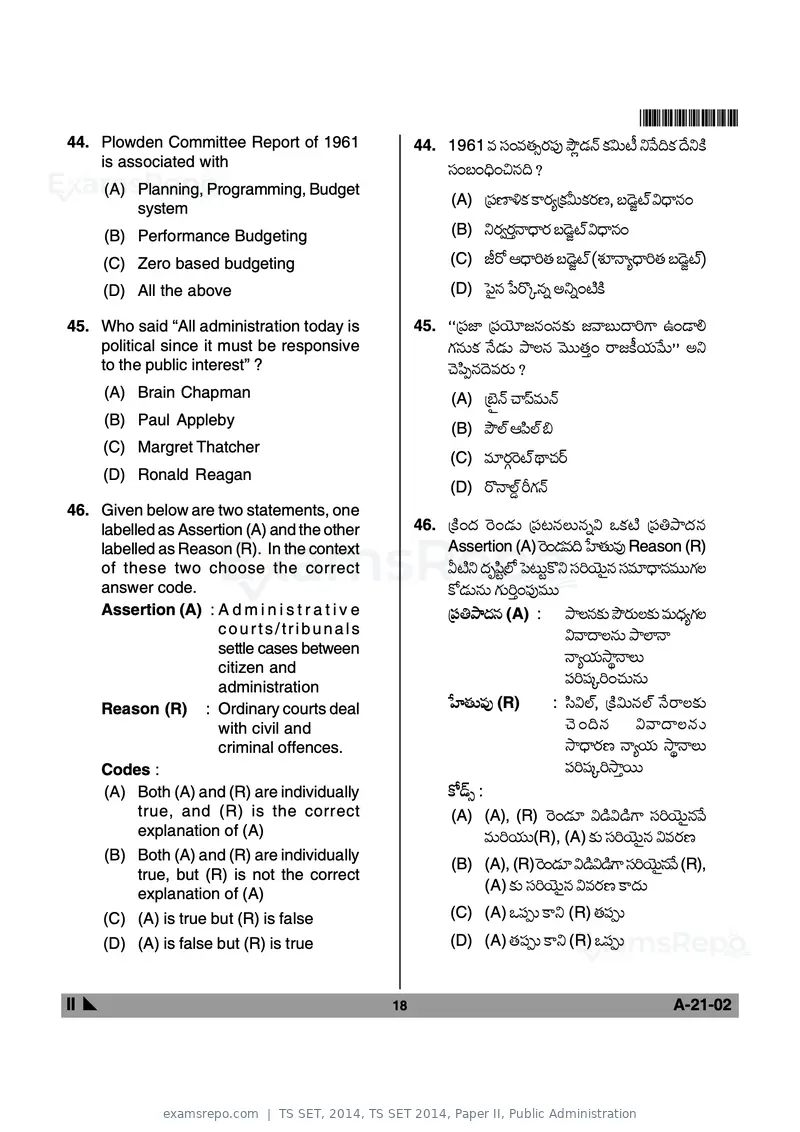
Text of page 18
*A2102*
44. Plowden Committee Report of 1961 44. 1961 Ðèþ çÜ ÐèþèþÞÆæÿç³# ´ûÏyæþ¯þ MæüÑ$sîý °Ðóþ¨Mæü §óþ°Mìü
is associated with çÜ º «¨ _¯èþ¨ ?
(A) Planning, Programming, Budget
(A) {ç³×êãMæü M>ÆæÿÅ{MæüÒ$MæüÆæÿ×ý, ºyðþjsý Ñ«§é¯èþ
system
(B) Performance Budgeting (B) °ÆæÿÓÆæÿ¢¯é«§éÆæÿ ºyðþjsý Ñ«§é¯èþ
(C) Zero based budgeting (C) iÆø B«§éÇèþ ºyðþjsý (Ôèý*¯éÅ«§éÇèþ ºyðþjsý)
(D) All the above (D) ò³O¯èþ õ³ÆöP¯èþ² A°² sìýMìü
45. Who said “All administration today is 45. ""{ç³gê {ç³Äñý*f¯èþ ¯èþMæü$ fÐéº$§éÇV> E yéÍ
political since it must be responsive Væü¯èþ$Mæü ¯óþyæþ$ ´ë˯èþ Ððþ$$èþ¢ Æ>fMîüÄæý$Ðóþ$'' A°
to the public interest” ? ^ðþí³µ¯èþ§ðþÐèþÆæÿ$ ?
(A) Brain Chapman (A) {»ñý¯þ ^é³Ðèþ$¯þ
(B) Paul Appleby
(B) ´ûÌý Bí³Ìý ¼
(C) Margret Thatcher
(C) Ðèþ*ÆæÿYÆðÿsý £é^èþÆÿ
(D) Ronald Reagan
(D) Æö¯éÌýz ÈVæü¯þ
46. Given below are two statements, one
labelled as Assertion (A) and the other 46. {Mìü §æþ Æðÿ yæþ$ {ç³r¯èþË$¯èþ²Ñ JMæüsìý {ç³´ë§æþ¯èþ
labelled as Reason (R). In the context Assertion (A) Æðÿ yæþÐèþ¨ õßýèþ$Ðèþ# Reason (R)
of these two choose the correct Òsìý° §æþíÙtÌZ ò³r$tMö° çÜÇÄñý$O¯èþ çÜÐèþ*«§é¯èþÐèþ$$VæüË
answer code. Møyæþ$¯èþ$ Væü$Ç¢ ç³#Ðèþ$$
Assertion (A) : A d m i n i s t r a t i v e {ç³´ë§æþ¯èþ (A) : ´ë˯èþMæü$ ´ûÆæÿ$ËMæü$ Ðèþ$«§æþÅVæüË
courts/tribunals ÑÐé§é˯èþ$ ´ëÌê¯é
settle cases between
¯éÅÄæý$Ý릯éË$
citizen and
administration
ç³ÇçÙPÇ ^èþ$¯èþ$
Reason (R) : Ordinary courts deal õßýèþ$Ðèþ# (R) : íÜÑÌý, {MìüÑ$¯èþÌý ¯óþÆ>ËMæü$
with civil and ^ð þ ¨¯è þ ÑÐé§é˯è þ $
criminal offences. Ý뫧éÆæÿ×ý ¯éÅÄæý$ Ý릯éË$
Codes : ç³ÇçÙPÇÝë¢Æÿ$$
(A) Both (A) and (R) are individually MøyþÞ :
true, and (R) is the correct (A) (A), (R) Æðÿ yæþ* ÑyìþÑyìþV> çÜÇÄñý$O¯èþÐóþ
explanation of (A) Ðèþ$ÇÄæý$$(R), (A) Mæü$ çÜÇÄñý$O¯èþ ÑÐèþÆæÿ×ý
(B) Both (A) and (R) are individually
(B) (A), (R) Æðÿ yæþ* ÑyìþÑyìþV> çÜÇÄñý$O¯èþÐóþ (R),
true, but (R) is not the correct
(A) Mæü$ çÜÇÄñý$O¯èþ ÑÐèþÆæÿ×ý M>§æþ$
explanation of (A)
(C) (A) is true but (R) is false (C) (A) Jç³ M>° (R) èþç³
(D) (A) is false but (R) is true (D) (A) èþç³ M>° (R) Jç³
II x 18 A-21-02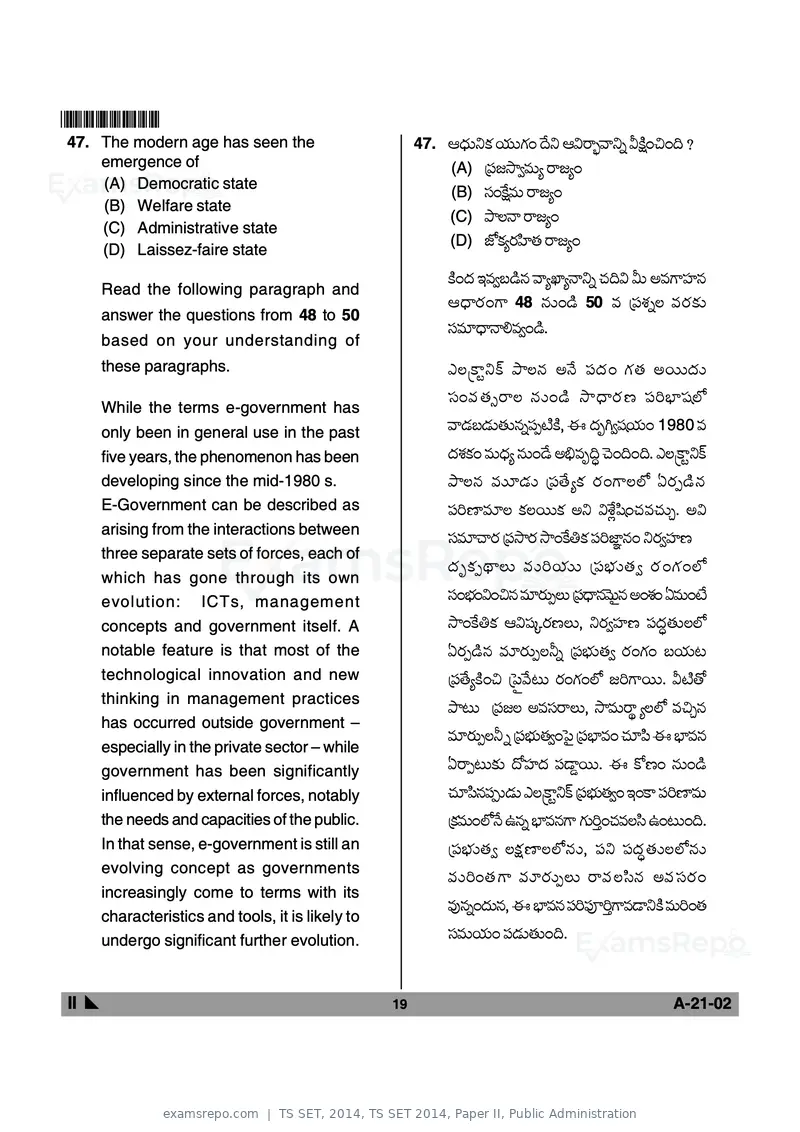
Text of page 19
*A2102*
47. The modern age has seen the 47. B«§æþ$°Mæü Äæý$$Væü §óþ° BÑÆ>ÂÐé°² Òìü _ ¨ ?
emergence of (A) {ç³fÝëÓÐèþ$Å Æ>fÅ
(A) Democratic state
(B) çÜ óüÐèþ$ Æ>fÅ
(B) Welfare state
(C) ´ë˯é Æ>fÅ
(C) Administrative state
(D) gZMæüÅÆæÿíßýèþ Æ>fÅ
(D) Laissez-faire state
Mìü §æþ CÐèþÓºyìþ¯èþ ÐéÅRêů鰲 ^èþ¨Ñ Ò$ AÐèþV>çßý¯èþ
Read the following paragraph and
B«§éÆæÿ V> 48 ¯èþ$ yìþ 50 Ðèþ {ç³Ôèý²Ë ÐèþÆæÿMæü$
answer the questions from 48 to 50
çÜÐèþ*«§é¯éÍÐèþÓ yìþ.
based on your understanding of
these paragraphs. GË[M>t°Mü ´ë˯èþ A¯óþ 糧æþ Væü èþ AÆÿ$$§æþ$
While the terms e-government has
ç Ü Ðè þ è þ ÞÆ>Ë ¯è þ $ yì þ Ýë« § éÆæ ÿ ×ý ç ³ Ç¿êç Ù ÌZ
only been in general use in the past Ðéyæþºyæþ$èþ$¯èþ²ç³µsìýMìü, D §æþWÓçÙÄæý$ 1980 Ðèþ
five years, the phenomenon has been §æþÔèýMæü Ðèþ$«§æþÅ ¯èþ$ yóþ AÀÐèþ¨® ^ðþ ¨ ¨. GË[M>t°Mü
developing since the mid-1980 s. ´ë˯èþ Ðèþ$*yæþ$ {ç³óþÅMæü Ææÿ V>ËÌZ HÆæÿµyìþ¯èþ
E-Government can be described as ç³Ç×êÐèþ*Ë MæüËÆÿ$$Mæü A° ÑÔóýÏíÙ ^èþÐèþ^èþ$a. AÑ
arising from the interactions between
çÜÐèþ*^éÆæÿ {ç³ÝëÆæÿ Ýë MóüMæü ç³Çgêq¯èþ °ÆæÿÓçßý×ý
three separate sets of forces, each of
§æ þ Mæ ü µ£éË$ Ðè þ $ÇÄæ ý $$ {ç ³ ¿æ ý $è þ Ó Ææ ÿ Væ ü ÌZ
which has gone through its own
evolution: ICTs, management çÜ ¿æý Ñ _¯èþ Ðèþ*Ææÿ$µË$ {糫§é¯èþÐðþ$O¯èþ A Ôèý HÐèþ$ sôý
concepts and government itself. A Ýë MóüMæü BÑçÙPÆæÿ×ýË$, °ÆæÿÓçßý×ý 糧æþ®èþ$ËÌZ
notable feature is that most of the HÆæÿµyìþ¯èþ Ðèþ*Ææÿ$µË±² {糿æý$èþÓ Ææÿ Væü ºÄæý$r
technological innovation and new {ç³óþÅMìü _ {ò³Ðóþr$ Ææÿ Væü ÌZ fÇV>Æÿ$$. Òsìýø
thinking in management practices
´ër$ {ç³fË AÐèþçÜÆ>Ë$, ÝëÐèþ$Æ>¦üÅËÌZ Ðèþ_a¯èþ
has occurred outside government –
Ðèþ*Ææÿ$µË± ² {糿æý$èþÓ ò³O {糿êÐèþ ^èþ*í³ D ¿êÐèþ¯èþ
especially in the private sector – while
government has been significantly HÆ>µr$Mæü$ §øçßý§æþ ç³yézÆÿ$$. D Mø×ý ¯èþ$ yìþ
influenced by external forces, notably ^èþ*í³¯èþç³yæþ$ GË[M>t°Mü {糿æý$èþÓ C M> ç³Ç×êÐèþ$
the needs and capacities of the public. {MæüÐèþ$ ÌZ¯óþ E¯èþ² ¿êÐèþ¯èþV> Væü$Ç¢ ^èþÐèþËíÜ E r$ ¨.
In that sense, e-government is still an {糿æý$èþÓ Ëæü ×êËÌZ¯èþ$, ç³° 糧æþ®èþ$ËÌZ¯èþ$
evolving concept as governments
Ðè þ $Ç è þ V> Ðè þ *Ææ ÿ$µË$ Æ>Ðè þ Ëí Ü ¯è þ AÐè þ ç Ü Ææ ÿ
increasingly come to terms with its
Ðèþ#¯èþ² §æþ$¯èþ, D ¿êÐèþ¯èþ ç³Çç³NÇ¢V>Ðèþyé°Mìü Ðèþ$Ç èþ
characteristics and tools, it is likely to
undergo significant further evolution. çÜÐèþ$Äæý$ ç³yæþ$èþ$ ¨.
II x 19 A-21-02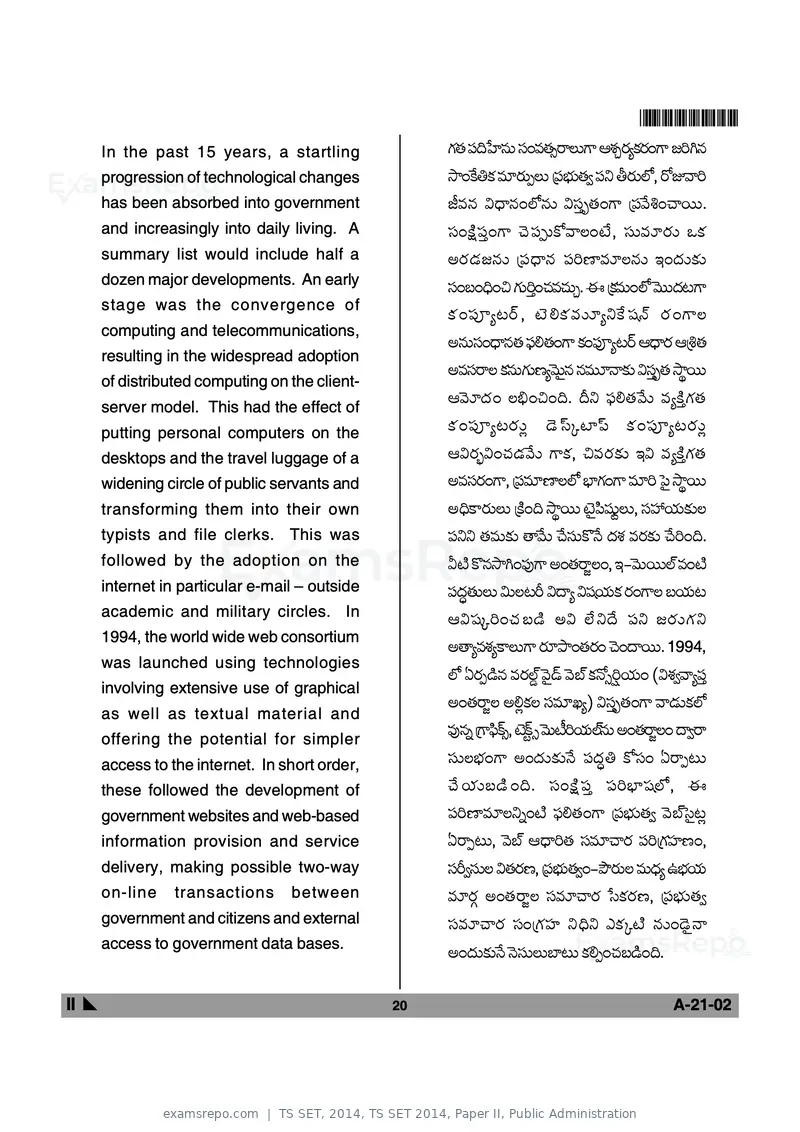
Text of page 20
*A2102*
In the past 15 years, a startling Væüèþ 糨õßý¯èþ$ çÜ ÐèþèþÞÆ>Ë$V> BÔèýaÆæÿÅMæüÆæÿ V> fÇW¯èþ
progression of technological changes Ýë MóüMæü Ðèþ*Ææÿ$µË$ {糿æý$èþÓ ç³° ¡Ææÿ$ÌZ, ÆøkÐéÇ
has been absorbed into government iÐèþ¯èþ Ñ«§é¯èþ ÌZ¯èþ$ ÑçÜ¢èþ V> {ç³ÐóþÕ ^éÆÿ$$.
and increasingly into daily living. A çÜ ìü ç³¢ V> ^ðþç³MøÐéË sôý, çÜ$Ðèþ*Ææÿ$ JMæü
summary list would include half a AÆæÿyæþf¯èþ$ {糫§é¯èþ ç³Ç×êÐèþ*˯èþ$ C §æþ$Mæü$
dozen major developments. An early çÜ º «¨ _ Væü$Ç¢ ^èþÐèþ^èþ$a. D {MæüÐèþ$ ÌZ Ððþ$$§æþrV>
stage was the convergence of
Mæ ü ç ³ NÅrÆ ÿ , sñ ý ÍMæ ü Ðè þ $*Å°Mó ü ç Ù ¯ þ Ææ ÿ V>Ë
computing and telecommunications,
A¯èþ$çÜ «§é¯èþèþ çÍèþ V> Mæü ç³NÅrÆÿ B«§éÆæÿ B{Õèþ
resulting in the widespread adoption
AÐèþçÜÆ>Ë Mæü¯èþ$Væü$×ýÅÐðþ$O¯èþ ¯èþÐèþ$*¯éMæü$ ÑçÜ¢èþ Ýë¦Æÿ$$
of distributed computing on the client-
server model. This had the effect of
BÐðþ*§æþ ËÀ _ ¨. ©° çÍèþÐóþ$ ÐèþÅMìü¢Væüèþ
putting personal computers on the Mæ ü ç ³ NÅrÆæ ÿ $Ï yð þ Ü Psê ³ Mæ ü ç ³ NÅrÆæ ÿ $Ï
desktops and the travel luggage of a BÑÆæÿÂÑ ^èþyæþÐóþ$ V>Mæü, _ÐèþÆæÿMæü$ CÑ ÐèþÅMìü¢Væüèþ
widening circle of public servants and AÐèþçÜÆæÿ V>, {ç³Ðèþ*×êËÌZ ¿êVæü V> Ðèþ*Ç ò³O Ýë¦Æÿ$$
transforming them into their own A«¨M>Ææÿ$Ë$ {Mìü ¨ Ýë¦Æÿ$$ sñýOí³çÙ$tË$, çÜàÄæý$Mæü$Ë
typists and file clerks. This was ç³°° èþÐèþ$Mæü$ éÐóþ$ ^óþçÜ$Mö¯óþ §æþÔèý ÐèþÆæÿMæü$ ^óþÇ ¨.
followed by the adoption on the Òsìý Mö¯èþÝëW ç³#V> A èþÆ>jË , C&Ððþ$Æÿ$$Ìý Ðèþ sìý
internet in particular e-mail – outside 糧æþ®èþ$Ë$ Ñ$ËrÈ Ñ§éÅ ÑçÙÄæý$Mæü Ææÿ V>Ë ºÄæý$r
academic and military circles. In BÑç Ù PÇ ^è þ ºyì þ AÑ Ìô ý °§ó þ ç ³ ° fÆæ ÿ $Væ ü °
1994, the world wide web consortium
AéÅÐèþÔèýÅM>Ë$V> Ææÿ*´ë èþÆæÿ ^ðþ §éÆÿ$$. 1994,
was launched using technologies
ÌZ HÆæÿµyìþ¯èþ ÐèþÆæÿÌýz ÐðþOyþ Ððþ»ý Mæü¯øÞÇÛÄæý$ (ÑÔèýÓÐéÅç³¢
involving extensive use of graphical
A èþÆ>jË AÍÏMæüË çÜÐèþ*QÅ) ÑçÜ¢èþ V> Ðéyæþ$MæüÌZ
as well as textual material and
offering the potential for simpler
Ðèþ#¯èþ² {V>íMüÞ, sñýMütüÞ Ððþ$sîýÇÄæý$Ìý¯èþ$ A èþÆ>jË §éÓÆ>
access to the internet. In short order, çÜ$Ë¿æý V> A §æþ$Mæü$¯óþ 糧æþ® MøçÜ HÆ>µr$
these followed the development of ^ó þ Äæ ý $ºyì þ ¨. ç Ü ì ü ç ³ ¢ ç ³ Ç¿êç Ù ÌZ, D
government websites and web-based ç³Ç×êÐèþ*Ë°² sìý çÍèþ V> {糿æý$èþÓ Ððþ»ýòÜOrÏ
information provision and service HÆ>µr$, Ððþ»ý B«§éÇèþ çÜÐèþ*^éÆæÿ ç³Ç{Væüçßý×ý ,
delivery, making possible two-way çÜÈÓçÜ$Ë ÑèþÆæÿ×ý, {糿æý$èþÓ &´ûÆæÿ$Ë Ðèþ$«§æþÅ E¿æýÄæý$
on-line transactions between Ðèþ*ÆæÿY A èþÆ>jË çÜÐèþ*^éÆæÿ õÜMæüÆæÿ×ý, {糿æý$èþÓ
government and citizens and external çÜÐèþ*^éÆæÿ çÜ {Væüçßý °«¨° GMæüPsìý ¯èþ$ yðþO¯é
access to government data bases.
A §æþ$Mæü$¯óþ ¯ðþçÜ$Ë$»êr$ Mæü͵ ^èþºyìþ ¨.
II x 20 A-21-02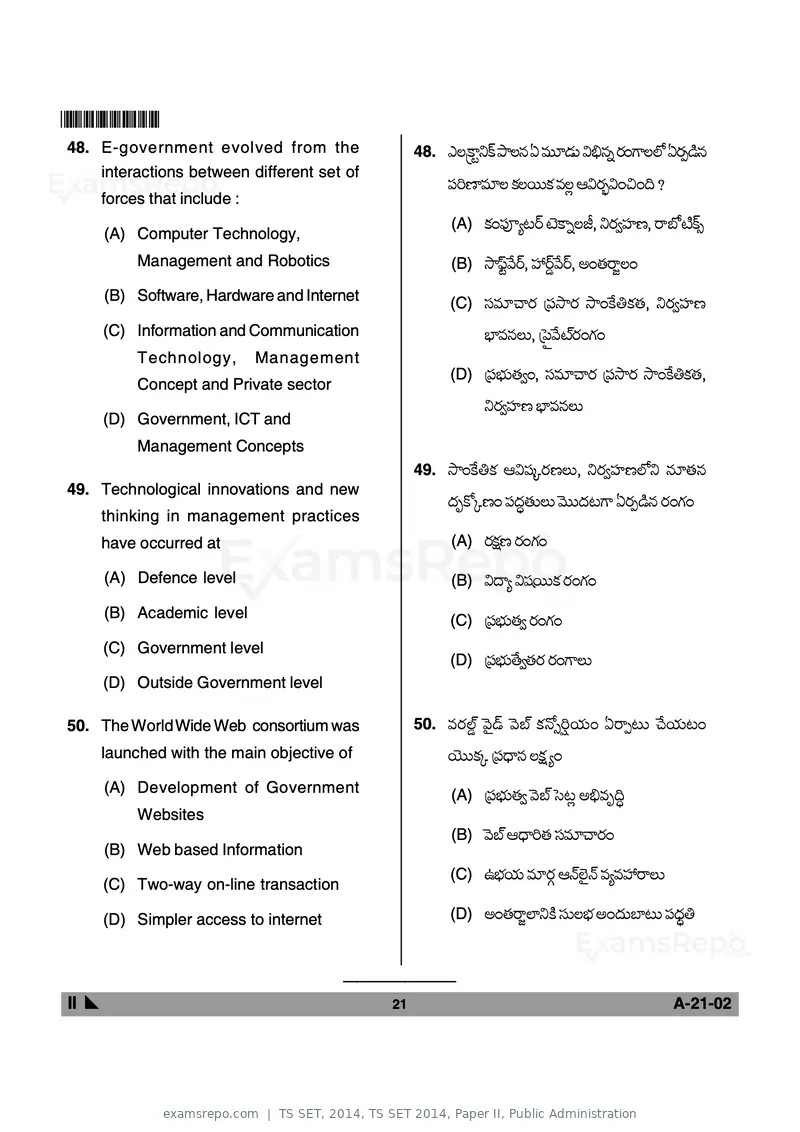
Text of page 21
*A2102*
48. E-government evolved from the 48. GË[M>t°Mü ´ë˯èþ H Ðèþ$*yæþ$ ÑÀ¯èþ² Ææÿ V>ËÌZ HÆæÿµyìþ¯èþ
interactions between different set of
ç³Ç×êÐèþ*Ë MæüËÆÿ$$Mæü ÐèþËÏ BÑÆæÿÂÑ _ ¨ ?
forces that include :
(A) Computer Technology,
(A) Mæü ç³NÅrÆÿ sñýM>²Ëi, °ÆæÿÓçßý×ý, Æ>»ZsìýMüÞ
Management and Robotics (B) ÝëtÐóþÆÿ, àÆÿzÐóþÆÿ, A èþÆ>jË
(B) Software, Hardware and Internet (C) çÜÐèþ*^éÆæÿ {ç³ÝëÆæÿ Ýë MóüMæüèþ, °ÆæÿÓçßý×ý
(C) Information and Communication ¿êÐèþ¯èþË$, {ò³ÐóþsýÆæÿ Væü
Technology, Management
Concept and Private sector
(D) {糿æý$èþÓ , çÜÐèþ*^éÆæÿ {ç³ÝëÆæÿ Ýë MóüMæüèþ,
°ÆæÿÓçßý×ý ¿êÐèþ¯èþË$
(D) Government, ICT and
Management Concepts
49. Ýë MóüMæü BÑçÙPÆæÿ×ýË$, °ÆæÿÓçßý×ýÌZ° ¯èþ*èþ¯èþ
49. Technological innovations and new
§æþMøP×ý 糧æþ®èþ$Ë$ Ððþ$$§æþrV> HÆæÿµyìþ¯èþ Ææÿ Væü
thinking in management practices
have occurred at (A) Ææÿæü×ý Ææÿ Væü
(A) Defence level (B) ѧéÅ ÑçÙÆÿ$$Mæü Ææÿ Væü
(B) Academic level (C) {糿æý$èþÓ Ææÿ Væü
(C) Government level
(D) {糿æý$óþÓèþÆæÿ Ææÿ V>Ë$
(D) Outside Government level
50. The World Wide Web consortium was 50. ÐèþÆæÿÌýz ÐðþOyþ Ððþ»ý Mæü ¯øÞÇÛÄæý$ HÆ>µr$ ^óþÄæý$r
launched with the main objective of Äñý$$MæüP {糫§é¯èþ ËæüüÅ
(A) Development of Government (A) {糿æý$èþÓ Ððþ»ý òÜrÏ AÀÐèþ¨®
Websites
(B) Ððþ»ý B«§éÇèþ çÜÐèþ*^éÆæÿ
(B) Web based Information
(C) Two-way on-line transaction
(C) E¿æýÄæý$ Ðèþ*ÆæÿY B¯þÌñýO¯þ ÐèþÅÐèþàÆ>Ë$
(D) Simpler access to internet (D) A èþÆ>jÌê°Mìü çÜ$Ë¿æý A §æþ$»êr$ 糫§æþ®
———————
II x 21 A-21-02
Text of page 22
*A2102*
       Space for Rough Work


II x           22               A-21-02
Text of page 23
*A2102*
          Space for Rough Work


II x               23            A-21-02
Text of page 24
*A2102*
       Space for Rough Work


II x            24              A-21-02
Official key not published for this paper.
Page 1 of 24
Source: Telangana State Eligibility Test. Question paper published by Telangana State Eligibility Test.