Machine-translated by Google. Questions are authored in English.
Top

TS SET 2018: Paper II, Mathematical Sciences
  • Paper code: 15
  • Language: Bilingual
  • 24 pages
TS SET 2018 question paper, TS SET 2018, Paper II, Mathematical Sciences, page 1 of 24
Page 1 of 24
Text of page 1



                                                                                                                                                                                    
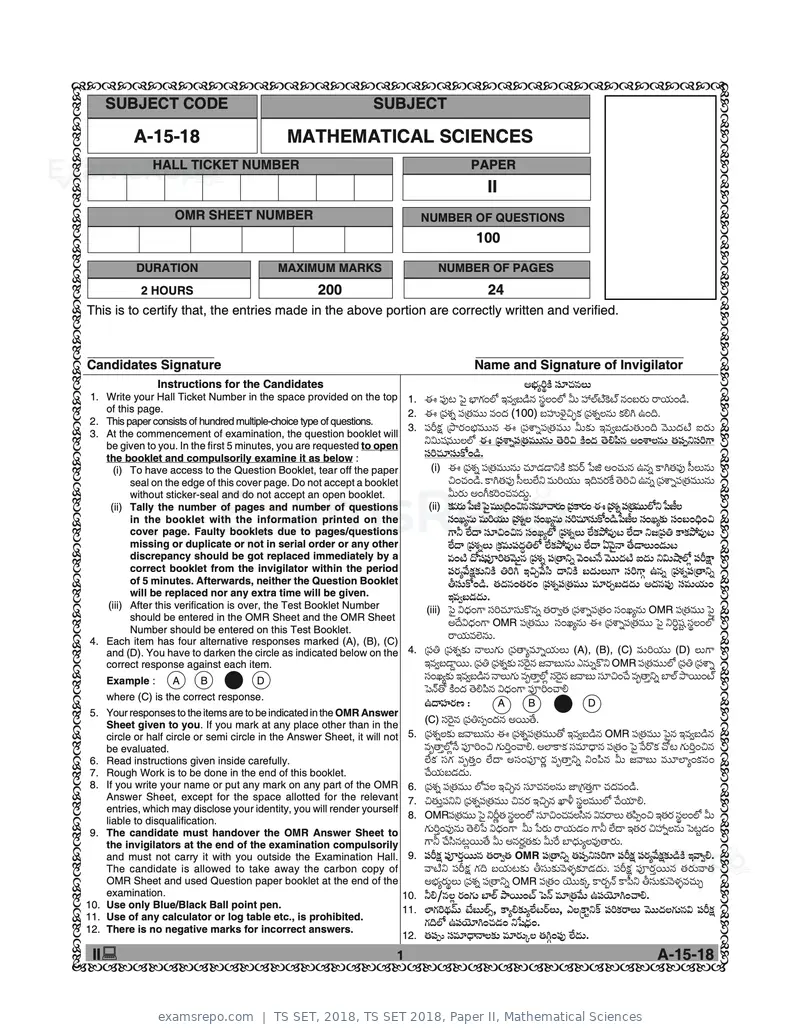
                    	Subject Code	Subject


                                                                                                                                                                                                                        Question Booklet Number
                                                                       A-15-18                           MATHEMATICAL SCIENCEs
                                                                	hALL tICKET number	PaPER
                                                                		                          ii

                                                                   OMR Sheet Number nUMBER OF qUESTIONS
                                                                                                                                                          100

                                                                       dURATION	                       mAXIMUM mARKS	                          nUMBER OF pAGES
                                                                        2 hOUrs                                 200                                          24
                                                         This is to certify that, the entries made in the above portion are correctly written and verified.


                                                         Candidates Signature	Name and Signature of Invigilator
                                                                            Instructions for the Candidates                                                                 A¿æýÅǦMìü çÜ*^èþ¯èþË$
                                                             1. Write your Hall Ticket Number in the space provided on the top
                                                                                                                         D ç³#r ò³O ¿êVæü…ÌZ CÐèþÓºyìþ¯èþ çܦ˅ÌZ Ò$ àÌŒýsìýMðüsŒý ¯èþ…ºÆæÿ$ Æ>Äæý$…yìþ.
                                                                                                                                       1.
                                                                of this page.                                            D {ç³Ôèý² ç³{™èþÐèþ$$ Ðèþ…§æþ (100) ºçßý$âñýO_eMæü {ç³Ôèý²Ë¯èþ$ MæüÍW E…¨.
                                                                                                                                       2.
                                                             2. This paper consists of hundred multiple-choice type of questions.
                                                                                                                         ç³È„æü {´ëÆæÿ…¿æýÐèþ$$¯èþ D {ç³Ô>²ç³{™èþÐèþ$$ Ò$Mæü$ CÐèþÓºyæþ$™èþ$…¨ Ððþ$$§æþsìý I§æþ$
                                                             3. At the commencement of examination, the question booklet will
                                                                                                                                       3.
                                                                                                                         °Ñ$çÙÐèþ$$ËÌZ D {ç³Ô>²ç³{™èþÐèþ$$¯èþ$ ™ðþÇ_ Mìü…§æþ ™ðþÍí³¯èþ A…Ô>˯èþ$ ™èþç³µ°çÜÇV>
                                                                be given to you. In the first 5 minutes, you are requested to open
                                                                the booklet and compulsorily examine it as below :       çÜÇ^èþ*çÜ$Mø…yìþ.
                                                                                                                             (i) D {ç³Ôèý² ç³{™èþÐèþ$$¯èþ$ ^èþ*yæþyé°Mìü MæüÐèþÆŠÿ õ³h A…^èþ$¯èþ E¯èþ² M>W™èþç³# ïÜË$¯èþ$
                                                                   (i) To have access to the Question Booklet, tear off the paper
                                                                       seal on the edge of this cover page. Do not accept a booklet  _…^èþ…yìþ. M>W™èþç³# ïÜË$Ìôý° Ðèþ$ÇÄæý$$ C¨ÐèþÆæÿMóü ™ðþÇ_ E¯èþ² {ç³Ô>²ç³{™èþÐèþ$$¯èþ$
                                                                       without sticker-seal and do not accept an open booklet.       Ò$Ææÿ$ A…XMæüÇ…^èþÐèþ§æþ$ª.
                                                                  (ii) Tally the number of pages and number of questions    (ii) MæüÐèþÆæÿ$ õ³h ò³O Ðèþ$${¨…_¯èþ çÜÐèþ*^鯿ÿ… {ç³M>Ææÿ… D {ç³Ôèý² ç³{™èþÐèþ$$ÌZ° õ³iË
                                                                       in the booklet with the information printed on the           çÜ…Qůèþ$ Ðèþ$ÇÄæý$$ {ç³Ôèý²Ë çÜ…Qůèþ$ çÜÇ^èþ*çÜ$Mø…yìþ.õ³iË çÜ…QÅMæü$ çÜ…º…«¨…_
                                                                       cover page. Faulty booklets due to pages/questions            V>± Ìôý§é çÜ*_…_¯èþ çÜ…QÅÌZ {ç³Ôèý²Ë$ ÌôýMæü´ùÐèþ#r Ìôý§é °f{糆 M>Mæü´ùÐèþ#r
                                                                       missing or duplicate or not in serial order or any other      Ìôý§é {ç³Ôèý²Ë$ {MæüÐèþ$ç³§æþ®†ÌZ ÌôýMæü´ùÐèþ#r Ìôý§é HÐðþO¯é ™óþyéË$…yæþ$r
                                                                       discrepancy should be got replaced immediately by a           Ðèþ…sìý §øçÙç³NÇ™èþÐðþ$O¯èþ {ç³Ôèý² ç³{™é°² Ððþ…r¯óþ Ððþ$$§æþsìý I§æþ$ °Ñ$ÚëÌZÏ ç³È„>
                                                                       correct booklet from the invigilator within the period        ç³ÆæÿÅÐóþ„æüMæü$°Mìü †ÇW C_aÐóþíÜ §é°Mìü º§æþ$Ë$V> çÜÇV>Y E¯èþ² {ç³Ôèý²ç³{™é°²
                                                                       of 5 minutes. Afterwards, neither the Question Booklet        ¡çÜ$Mø…yìþ. ™èþ§æþ¯èþ…™èþÆæÿ… {ç³Ôèý²ç³{™èþÐèþ$$ Ðèþ*Ææÿaºyæþ§æþ$ A§æþ¯èþç³# çÜÐèþ$Äæý$…
                                                                       will be replaced nor any extra time will be given.            CÐèþÓºyæþ§æþ$.
                                                                 (iii) After this verification is over, the Test Booklet Number
                                                                                                                          (iii) ò³O Ñ«§æþ…V> çÜÇ^èþ*çÜ$Mö¯èþ² ™èþÆ>Ó™èþ {ç³Ô>²ç³{™èþ… çÜ…Qůèþ$ OMR ç³{™èþÐèþ$$ ò³O
                                                                       should be entered in the OMR Sheet and the OMR Sheet
                                                                       Number should be entered on this Test Booklet.
                                                                                                                                     A§óþÑ«§æþ…V> OMR ç³{™èþÐèþ$$ çÜ…Qůèþ$ D {ç³Ô>²ç³{™èþÐèþ$$ ò³O °Ç®çÙt çܦ˅ÌZ
                                                             4. Each item has four alternative responses marked (A), (B), (C)
                                                                                                                                     Æ>Äæý$ÐèþÌñý¯èþ$.
                                                                                                                      4. {糆 {ç³Ôèý²Mæü$ ¯éË$Væü$ {ç³™éÅÐèþ*²Äæý$Ë$ (A), (B), (C) Ðèþ$ÇÄæý$$ (D) Ë$V>
                                                                and (D). You have to darken the circle as indicated below on the
                                                                correct response against each item.                      CÐèþÓºyézÆÿ$$. {糆 {ç³Ôèý²Mæü$ çÜÆðÿO¯èþ fÐéº$¯èþ$ G¯èþ$²Mö° OMR ç³{™èþÐèþ$$ÌZ {糆 {ç³Ô>²
                                            		 Example :         A   B   C   D                                           çÜ…QÅMæü$ CÐèþÓºyìþ¯èþ ¯éË$Væü$ Ðèþ–™é¢ÌZÏ çÜÆðÿO¯èþ fÐéº$ çÜ*_…^óþ Ðèþ–™é¢°² »êÌŒý ´ëÆÿ$$…sŒý
                                                                                                                         ò³¯Œþ™ø Mìü…§æþ ™ðþÍí³¯èþ Ñ«§æþ…V> ç³NÇ…^éÍ
                                            		 where (C) is the correct response.
                                                                                                                     		 E§éçßýÆæÿ×ý :                            A           B   C               D
                                             5. Your responses to the items are to be indicated in the OMR Answer
                                                Sheet given to you. If you mark at any place other than in the       		  (C)     ç Ü Æð ÿ O ¯ è þ {ç ³ †ç Ü µ…§æ þ ¯è þ AÆÿ$$™ó þ .
                                                circle or half circle or semi circle in the Answer Sheet, it will not 5. {ç³Ôèý²ËMæü$ fÐéº$¯èþ$ D {ç³Ôèý²ç³{™èþÐèþ$$™ø CÐèþÓºyìþ¯èþ OMR ç³{™èþÐèþ$$ ò³O¯èþ CÐèþÓºyìþ¯èþ
                                                be evaluated.                                                            Ðèþ–™é¢ÌZϯóþ ç³NÇ…_ Væü$Ç¢…^éÍ. AÌêM>Mæü çÜÐèþ*«§é¯èþ ç³{™èþ… ò³O ÐóþÆöMæü ^ør Væü$Ç¢…_¯èþ
                                             6. Read instructions given inside carefully.                                ÌôýMæü çÜVæü Ðèþ–™èþ¢… Ìôý§é AçÜ…ç³NÆæÿ~ Ðèþ–™é¢°² °…í³¯èþ Ò$ fÐéº$ Ðèþ$*ÌêÅ…Mæü¯èþ…
                                             7. Rough Work is to be done in the end of this booklet.                     ^óþÄæý$ºyæþ§æþ$.
                                             8. If you write your name or put any mark on any part of the OMR 6. {ç³Ôèý² ç³{™èþÐèþ$$ ÌZç³Ë C_a¯èþ çÜ*^èþ¯èþ˯èþ$ gê{Væü™èþ¢V> ^èþ§æþÐèþ…yìþ.
                                                Answer Sheet, except for the space allotted for the relevant 7. _™èþ$¢ç³°° {ç³Ôèý²ç³{™èþÐèþ$$ _ÐèþÆæÿ C_a¯èþ Rêä çܦËÐèþ$$ÌZ ^óþÄæý*Í.
                                                entries, which may disclose your identity, you will render yourself
                                                                                                                      8. OMRç³{™èþÐèþ$$ ò³O °È~™èþ çܦ˅ÌZ çÜ*_…^èþÐèþËíܯèþ ÑÐèþÆ>Ë$ ™èþí³µ…_ C™èþÆæÿ çܦ˅ÌZ Ò$
                                                liable to disqualification.
                                             9. The candidate must handover the OMR Answer Sheet to                      Væü$Ç¢…ç³#¯èþ$ ™ðþÍõ³ Ñ«§æþ…V> Ò$ õ³Ææÿ$ Æ>Äæý$yæþ… V>± Ìôý§é C™èþÆæÿ _à²Ë¯èþ$ ò³rtyæþ…
                                                the invigilators at the end of the examination compulsorily              V>± ^óþíܯèþrÏÆÿ$$™óþ Ò$ A¯èþÆæÿá™èþMæü$ Ò$Æóÿ »ê«§æþ$ÅËÐèþ#™éÆæÿ$.
                                                and must not carry it with you outside the Examination Hall. 9. ç³È„æü ç³NÆæÿ¢Æÿ$$¯èþ ™èþÆ>Ó™èþ OMR ç³{™é°² ™èþç³µ°çÜÇV> ç³È„æü ç³ÆæÿÅÐóþ„æüMæü$yìþMìü CÐéÓÍ.
                                                The candidate is allowed to take away the carbon copy of                 Ðésìý° ç³È„æü Væü¨ ºÄæý$rMæü$ ¡çÜ$Mæü$ÐðþâæýåMæü*yæþ§æþ$. ç³È„æü ç³NÆæÿ¢Æÿ$$¯èþ ™èþÆæÿ$Ðé™èþ
                                                OMR Sheet and used Question paper booklet at the end of the              A¿æýÅÆæÿ$¦Ë$ {ç³Ôèý² ç³{™é°² OMR ç³{™èþ… Äñý$$MæüP M>Ææÿ¾¯Œþ M>ï³° ¡çÜ$Mæü$ÐðþâæýåÐèþ^èþ$a
                                                examination.                                                         10. ±Í/¯èþËÏ Ææÿ…Væü$ »êÌŒý ´ëÆÿ$$…sŒý ò³¯Œþ Ðèþ*{™èþÐóþ$ Eç³Äñý*W…^éÍ.
                                            10. Use only Blue/Black Ball point pen.                                  11. ÌêVæüÇ£æþÐŒþ$ sôýº$ÌŒýÞ, M>ÅÍMæü$ÅÌôýrÆŠÿË$, GË[M>t°MŠü ç³ÇMæüÆ>Ë$ Ððþ$$§æþËVæü$¯èþÑ ç³È„æü
                                            11. Use of any calculator or log table etc., is prohibited.
                                            12. There is no negative marks for incorrect answers.
                                                                                                                         Væü¨ÌZ Eç³Äñý*W…^èþyæþ… °õÙ«§æþ….
                                                                                                                     12. ™èþ糚 çÜÐèþ*«§é¯éËMæü$ Ðèþ*Ææÿ$PË ™èþWY…ç³# Ìôý§æþ$.
         II                 1                A-15-18
        
TS SET 2018 question paper, TS SET 2018, Paper II, Mathematical Sciences, page 2 of 24
Page 2 of 24
Text of page 2
*A1518*


                     RE
                HE
               ITE
           WR
           T
       NO
      DO


II             2            A-15-18
TS SET 2018 question paper, TS SET 2018, Paper II, Mathematical Sciences, page 3 of 24
Page 3 of 24
Text of page 3
*A1518*
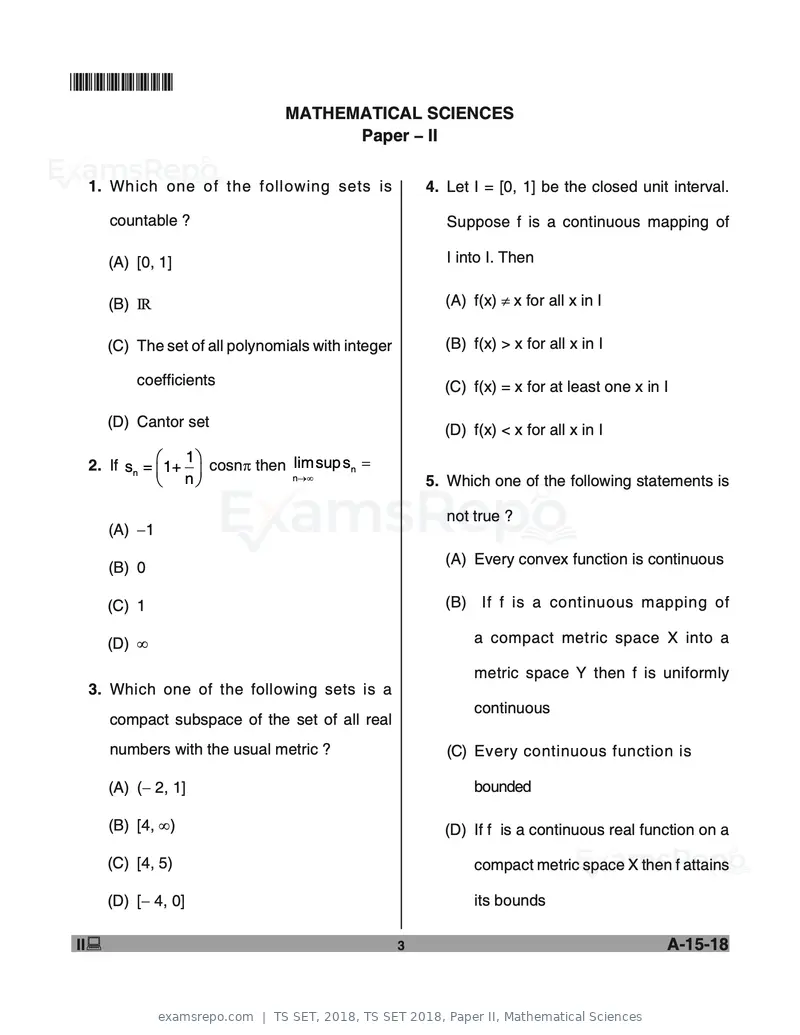
                                MATHEMATICAL SCIENCEs
                                      Paper − II

 1. Which one of the following sets is                  4. Let I = [0, 1] be the closed unit interval.

      countable ?                                          Suppose f is a continuous mapping of

      (A) [0, 1]                                           I into I. Then

      (B) IR                                              (A) f(x) ≠ x for all x in I

      (C) The set of all polynomials with integer         (B) f(x) > x for all x in I

          coefficients                                    (C) f(x) = x for at least one x in I

      (D) Cantor set
                                                          (D) f(x) < x for all x in I

 2. If sn =  1+  cosnπ then lim sup sn =
                 1
              n               n→∞
                                                        5. Which one of the following statements is

                                                           not true ?
      (A) −1
                                                          (A) Every convex function is continuous
      (B) 0

      (C) 1                                               (B) If f is a continuous mapping of

      (D) ∞                                                    a compact metric space X into a

                                                               metric space Y then f is uniformly
 3. Which one of the following sets is a
                                                               continuous
      compact subspace of the set of all real
      numbers with the usual metric ?                      (C) Every continuous function is

      (A) (− 2, 1]                                             bounded

      (B) [4, ∞)                                          (D) If f is a continuous real function on a

      (C) [4, 5)                                               compact metric space X then f attains

      (D) [− 4, 0]                                             its bounds

II                                                 3                                        A-15-18
TS SET 2018 question paper, TS SET 2018, Paper II, Mathematical Sciences, page 4 of 24
Page 4 of 24
Text of page 4
*A1518*
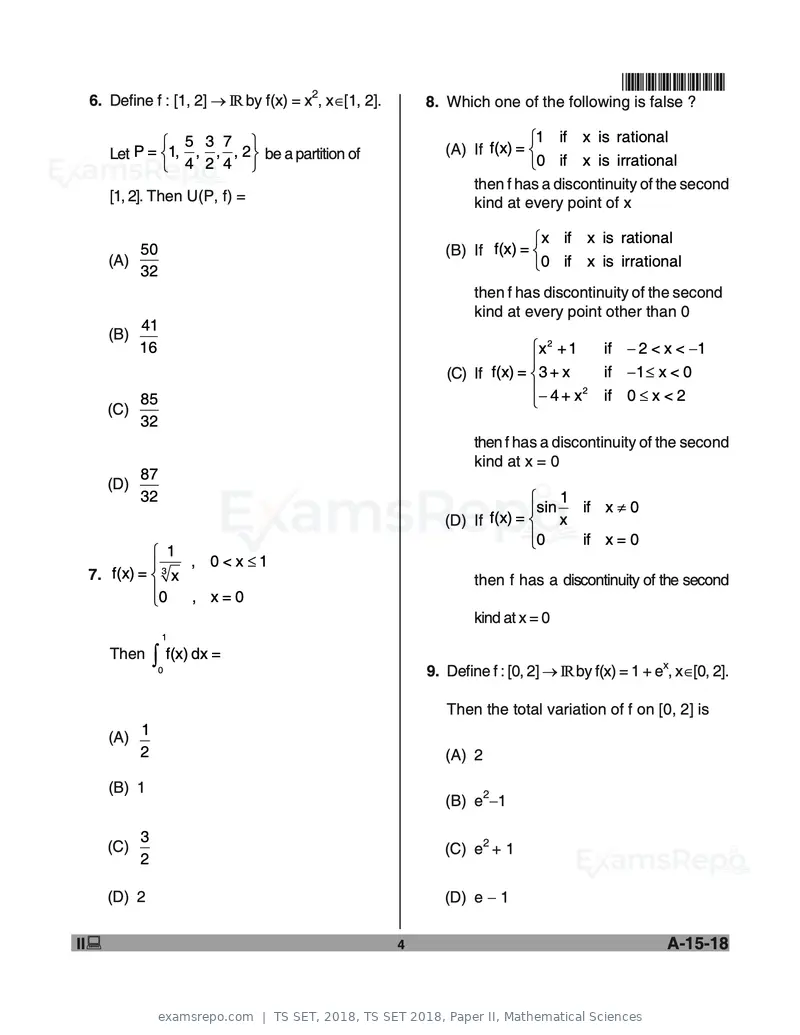
  6. Define f : [1, 2] → IR by f(x) = x2, x∈[1, 2].         8. Which one of the following is false ?

		             5 3 7                                                   1 if x is rational
      Let P = 1, , , , 2  be a partition of              (A) If f(x) = 
               4 2 4                                                   0 if x is irrational
                                                          		 then f has a discontinuity of the second
		 [1, 2]. Then U(P, f) =                                      kind at every point of x

                                                                             x if x is rational
          50                                                   (B) If f(x) = 
      (A)                                                                    0 if x is irrational
          32
                                                          		 then f has discontinuity of the second
                                                             kind at every point other than 0
            41
      (B)
            16                                                               x 2 + 1      if − 2 < x < −1
                                                                             
                                                               (C) If f(x) = 3 + x        if −1 ≤ x < 0
                                                                             − 4 + x 2    if 0 ≤ x < 2
            85                                                               
      (C)
            32
                                                          		 then f has a discontinuity of the second
                                                             kind at x = 0
            87
      (D)
            32                                                                1
                                                                             sin if x ≠ 0
                                                               (D) If f(x) =  x
                                                                             0  if x = 0
             1
                 , 0< x ≤1
  7. f(x) =  3 x                                         		 then f has a discontinuity of the second
            0    , x=0
            
                                                                    kind at x = 0
                 1

		 Then ∫ f(x) dx =
                 0                                          9. Define f : [0, 2] → IR by f(x) = 1 + ex, x∈[0, 2].

                                                               Then the total variation of f on [0, 2] is
      (A) 1
          2                                                    (A) 2

      (B) 1
                                                               (B) e2−1

            3
      (C)                                                      (C) e2 + 1
            2

      (D) 2                                                    (D) e − 1

II                                                   4                                               A-15-18
TS SET 2018 question paper, TS SET 2018, Paper II, Mathematical Sciences, page 5 of 24
Page 5 of 24
Text of page 5
*A1518*
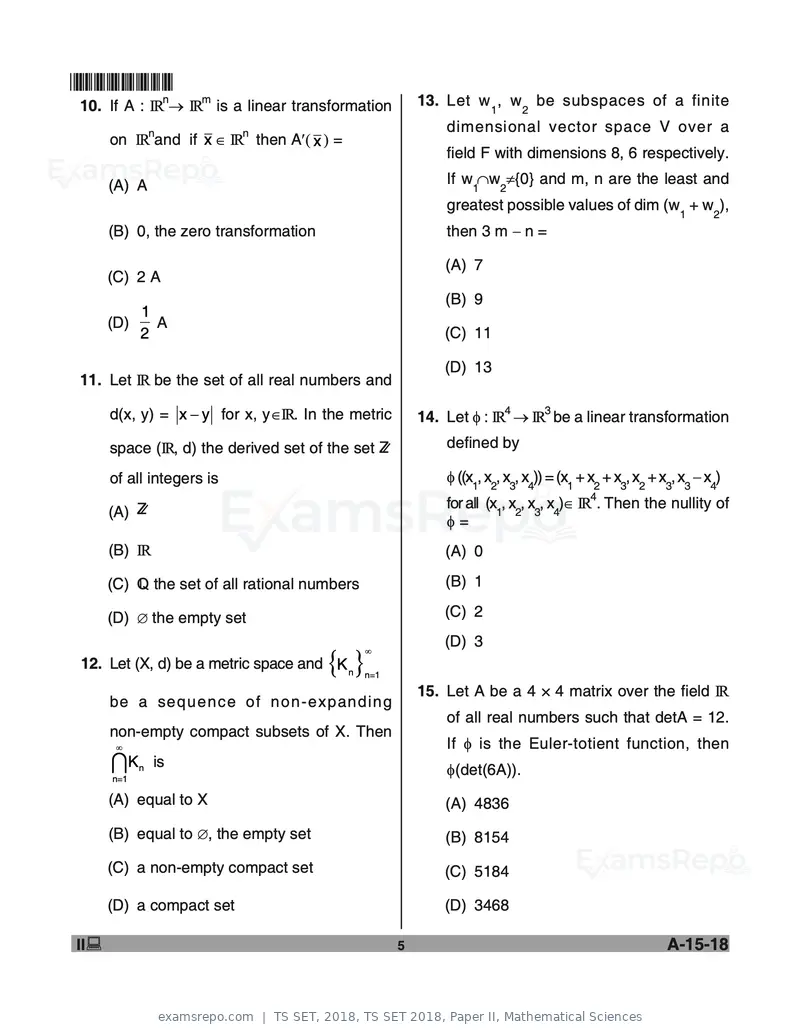
10. If A : IRn→ IRm is a linear transformation           13. Let w 1 , w 2 be subspaces of a finite
                                                               dimensional vector space V over a
      on IRnand if x ∈ IRn then A′( x ) =
                                                               field F with dimensions 8, 6 respectively.

      (A) A                                                    If w1∩w2≠{0} and m, n are the least and
                                                               greatest possible values of dim (w1 + w2),
      (B) 0, the zero transformation                           then 3 m − n =

                                                               (A) 7
      (C) 2 A
                                                               (B) 9
          1
      (D)   A
          2                                                   (C) 11

                                                              (D) 13
11. Let IR be the set of all real numbers and

      d(x, y) = x − y for x, y∈IR. In the metric         14. Let φ : IR4 → IR3 be a linear transformation

      space (IR, d) the derived set of the set Z               defined by

      of all integers is                                		 φ ((x1, x2, x3, x4)) = (x1 + x2 + x3, x2 + x3, x3 − x4)
                                                        		 for all (x1, x2, x3, x4)∈ IR4. Then the nullity of
      (A) Z
                                                           φ=
      (B) IR                                                   (A) 0

      (C)  the set of all rational numbers                    (B) 1

      (D) ∅ the empty set                                     (C) 2
                                                              (D) 3
                                       { }
                                              ∞
 12. Let (X, d) be a metric space and K n
                                              n=1

                                                         15. Let A be a 4 × 4 matrix over the field IR
		 be a sequence of non-expanding
                                                               of all real numbers such that detA = 12.
      non-empty compact subsets of X. Then
       ∞                                                       If φ is the Euler-totient function, then
       Kn is
      n=1
                                                               φ(det(6A)).
      (A) equal to X                                           (A) 4836
      (B) equal to ∅, the empty set                            (B) 8154
      (C) a non-empty compact set                             (C) 5184

      (D) a compact set                                       (D) 3468

II                                                 5                                                   A-15-18
TS SET 2018 question paper, TS SET 2018, Paper II, Mathematical Sciences, page 6 of 24
Page 6 of 24
Text of page 6
*A1518*
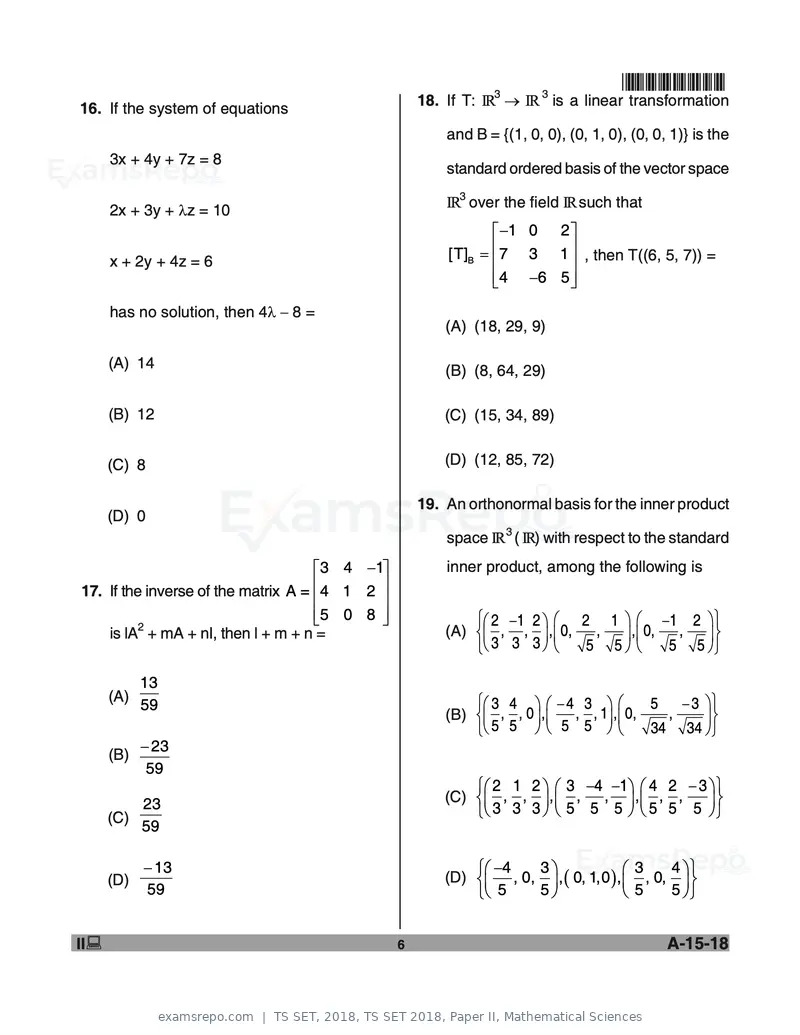
                                                         18. If T: IR3 → IR 3 is a linear transformation
 16. If the system of equations
                                                             and B = {(1, 0, 0), (0, 1, 0), (0, 0, 1)} is the
		 3x + 4y + 7z = 8
                                                             standard ordered basis of the vector space

                                                             IR3 over the field IR such that
		 2x + 3y + λz = 10
                                                                     −1 0 2 
                                                                             
		 x + 2y + 4z = 6                                      		 [ T ]B = 7 3 1  , then T((6, 5, 7)) =
                                                                    4 −6 5 

		 has no solution, then 4λ − 8 =
                                                             (A) (18, 29, 9)

      (A) 14                                                 (B) (8, 64, 29)

      (B) 12                                                 (C) (15, 34, 89)


      (C) 8                                                  (D) (12, 85, 72)

                                                         19. An orthonormal basis for the inner product
      (D) 0
                                                             space IR3 ( IR) with respect to the standard
                                       3 4 −1              inner product, among the following is
 17. If the inverse of the matrix A = 4 1 2 
                                       5 0 8                  2 −1 2   2 1   −1 2  
           2
		 is lA + mA + nI, then l + m + n =                         (A)  , ,  ,  0,  ,  ,  0,  ,  
                                                                  3 3 3      5 5       5 5 

            13
      (A)                                                         3 4   − 4 3           5   − 3 
            59
                                                             (B)  , , 0  ,  , , 1 ,  0,   ,     
                                                                  5 5   5 5             34 34  
            − 23
      (B)
             59
                                                                  2 1 2   3 −4 −1  4 2 − 3  
          23                                                 (C)  , ,  ,  ,   , , , ,      
      (C)                                                         3 3 3   5 5 5   5 5 5  
          59

            − 13                                                  −4  3                 3    4 
      (D)                                                    (D)  , 0,  , ( 0, 1, 0 ) ,  , 0,  
            59                                                    5   5                 5    5 


II                                                 6                                             A-15-18
TS SET 2018 question paper, TS SET 2018, Paper II, Mathematical Sciences, page 7 of 24
Page 7 of 24
Text of page 7
*A1518*
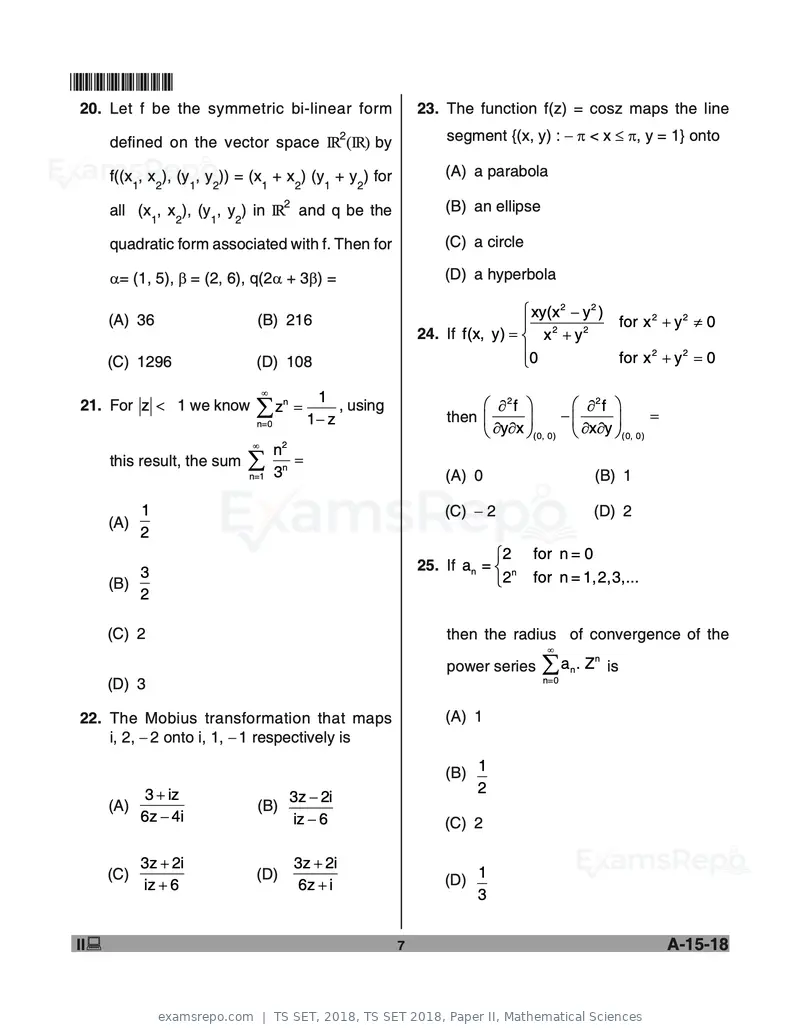
 20. Let f be the symmetric bi-linear form                   23. The function f(z) = cosz maps the line

      defined on the vector space IR2(IR) by                      segment {(x, y) : − π < x ≤ π, y = 1} onto

      f((x1, x2), (y1, y2)) = (x1 + x2) (y1 + y2) for             (A) a parabola

      all (x1, x2), (y1, y2) in IR2 and q be the                  (B) an ellipse

      quadratic form associated with f. Then for                  (C) a circle

      α= (1, 5), β = (2, 6), q(2α + 3β) =                         (D) a hyperbola

                                                                                xy(x 2 − y 2 )
      (A) 36                  (B) 216                                                          for x 2 + y 2 ≠ 0
                                                             24. If f(x, y ) =  x 2 + y 2
                                                                               0               for x 2 + y 2 = 0
      (C) 1296                (D) 108                                          
                                 ∞
                                        1
 21. For z < 1 we know ∑ zn =               , using                  ∂2 f            ∂2 f 
                                       1− z                 		 then               −               =
                                                                     ∂y∂x ( 0, 0 )  ∂x∂y ( 0, 0 )
                              n=0


                            n2
                             ∞
		 this result, the sum ∑ n =
                        n=1 3                                     (A) 0                    (B) 1

            1                                                     (C) − 2                  (D) 2
      (A)
            2
                                                                         2      for n = 0
            3                                                25. If an =  n
      (B)                                                                2      for n = 1,2,3,...
            2

      (C) 2                                                 		 then the radius of convergence of the
                                                                                   ∞

                                                                  power series ∑ an . Z is
                                                                                       n


      (D) 3                                                                        n=0


 22. The Mobius transformation that maps                          (A) 1
     i, 2, − 2 onto i, 1, − 1 respectively is

                                                                  (B) 1
             3 + iz                                                   2
                                     3z − 2i
      (A)                     (B)
            6z − 4i                  iz − 6                       (C) 2

            3z + 2i                  3z + 2i
      (C)
            iz + 6
                              (D)
                                     6z + i                       (D) 1
                                                                      3


II                                                     7                                                 A-15-18
TS SET 2018 question paper, TS SET 2018, Paper II, Mathematical Sciences, page 8 of 24
Page 8 of 24
Text of page 8
*A1518*
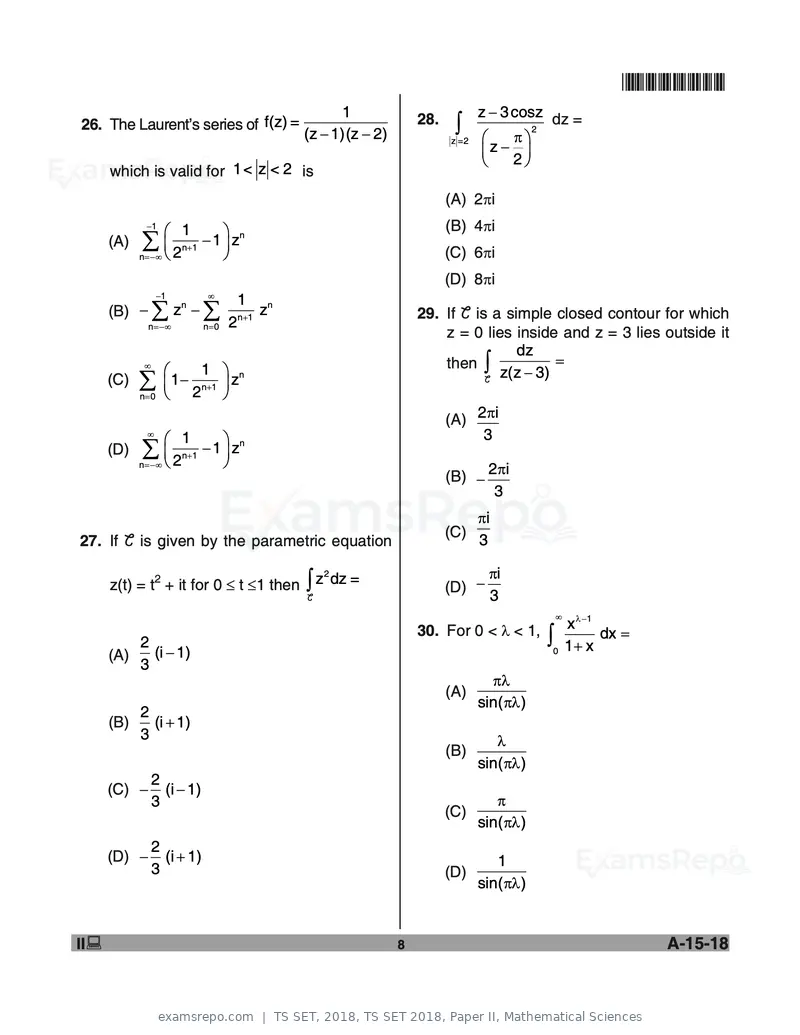
                                                         1                           z − 3 cosz dz =
 26. The Laurent’s series of f(z) =
                                                   (z − 1)(z − 2)
                                                                        28.
                                                                               ∫
                                                                              z =2       π
                                                                                                2

                                                                                     z − 2 
                                                                                           
		 which is valid for 1< z < 2 is
                                                                              (A) 2πi
             −1
                      1                                                     (B) 4πi
      (A)   ∑  2
            n= − ∞
                       n+1
                             − 1  zn
                                                                             (C) 6πi
                                                                              (D) 8πi
                  −1          ∞
                                        1
      (B) − ∑ z − ∑
                       n
                                        n+1
                                              zn                        29. If  is a simple closed contour for which
              n= − ∞         n= 0   2
                                                                            z = 0 lies inside and z = 3 lies outside it
                                                                                        dz
           ∞
                 1                                                        then ∫              =
      (C) ∑  1− n+1  zn                                                          
                                                                                     z( z − 3 )
          n= 0  2 
                                                                              (A) 2πi
              ∞
                      1                                                          3
      (D)   ∑  2     n+1
                             − 1  zn
                                 
                                                                              (B) − 2πi
            n= − ∞


                                                                                     3
                                                                                     πi
                                                                              (C)
 27. If  is given by the parametric equation                                        3

                                                                                      πi
      z(t) = t2 + it for 0 ≤ t ≤1 then ∫ z dz =
                                                       2
                                                                              (D) −
                                                                                     3
                                                                                                     ∞
                                                                        30. For 0 < λ < 1,             x λ−1
            2                                                                                       ∫0 1+ x dx =
      (A)     (i − 1)
            3
                                                                                       πλ
                                                                              (A)
                                                                                     sin(πλ)
            2
      (B)     (i + 1)
            3                                                                           λ
                                                                              (B)
                                                                                     sin(πλ)
               2
      (C) −      (i − 1)
               3                                                                        π
                                                                              (C)
                                                                                     sin(πλ)
               2
      (D) −      (i + 1)                                                                1
               3                                                              (D)
                                                                                     sin(πλ)


II                                                                 8                                              A-15-18
TS SET 2018 question paper, TS SET 2018, Paper II, Mathematical Sciences, page 9 of 24
Page 9 of 24
Text of page 9
*A1518*
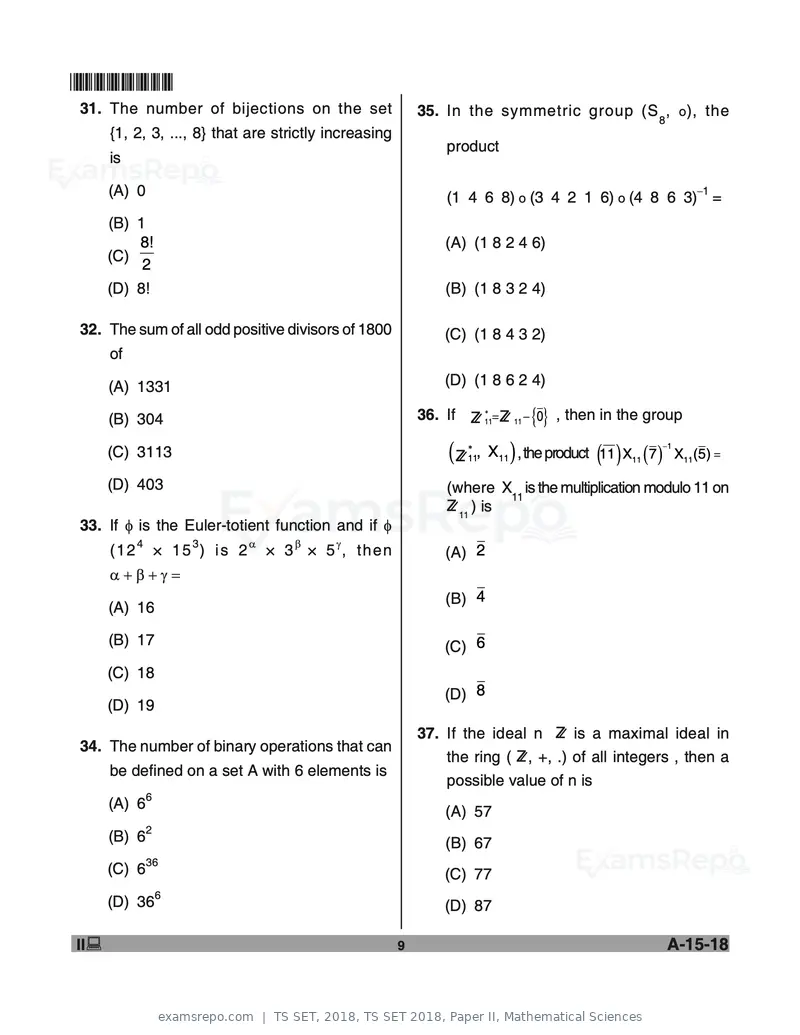
31. The number of bijections on the set                     35. In the symmetric group (S 8 , o ), the
      {1, 2, 3, ..., 8} that are strictly increasing
                                                                 product
      is

      (A) 0		                                              		 (1 4 6 8) o (3 4 2 1 6) o (4 8 6 3)−1 =
      (B) 1
          8!                                                     (A) (1 8 2 4 6)
      (C)
           2
      (D) 8!                                                     (B) (1 8 3 2 4)

32. The sum of all odd positive divisors of 1800                 (C) (1 8 4 3 2)
      of

      (A) 1331                                                   (D) (1 8 6 2 4)

      (B) 304                                               36. If Z 11∗ = Z 11 − {0} , then in the group

      (C) 3113                                                   (         )
                                                           		 Z 11, X11 , the product (11 ) X11 ( 7 ) X11(5) =
                                                                ∗                                    −1


      (D) 403                                              		 (where X11 is the multiplication modulo 11 on
                                                              Z 11 ) is
33. If φ is the Euler-totient function and if φ
      (12 4 × 15 3 ) is 2 α × 3 β × 5 γ , then                   (A) 2
      α+β+γ=
                                                                 (B) 4
      (A) 16

      (B) 17                                                     (C) 6
      (C) 18
                                                                 (D) 8
      (D) 19
                                                            37. If the ideal n Z is a maximal ideal in
34. The number of binary operations that can
                                                                the ring ( Z , +, .) of all integers , then a
      be defined on a set A with 6 elements is
                                                                possible value of n is
      (A) 66
                                                                 (A) 57
              2
      (B) 6                                                      (B) 67
              36
      (C) 6                                                      (C) 77
                  6
      (D) 36                                                     (D) 87

II                                                    9                                              A-15-18
TS SET 2018 question paper, TS SET 2018, Paper II, Mathematical Sciences, page 10 of 24
Page 10 of 24
Text of page 10
*A1518*
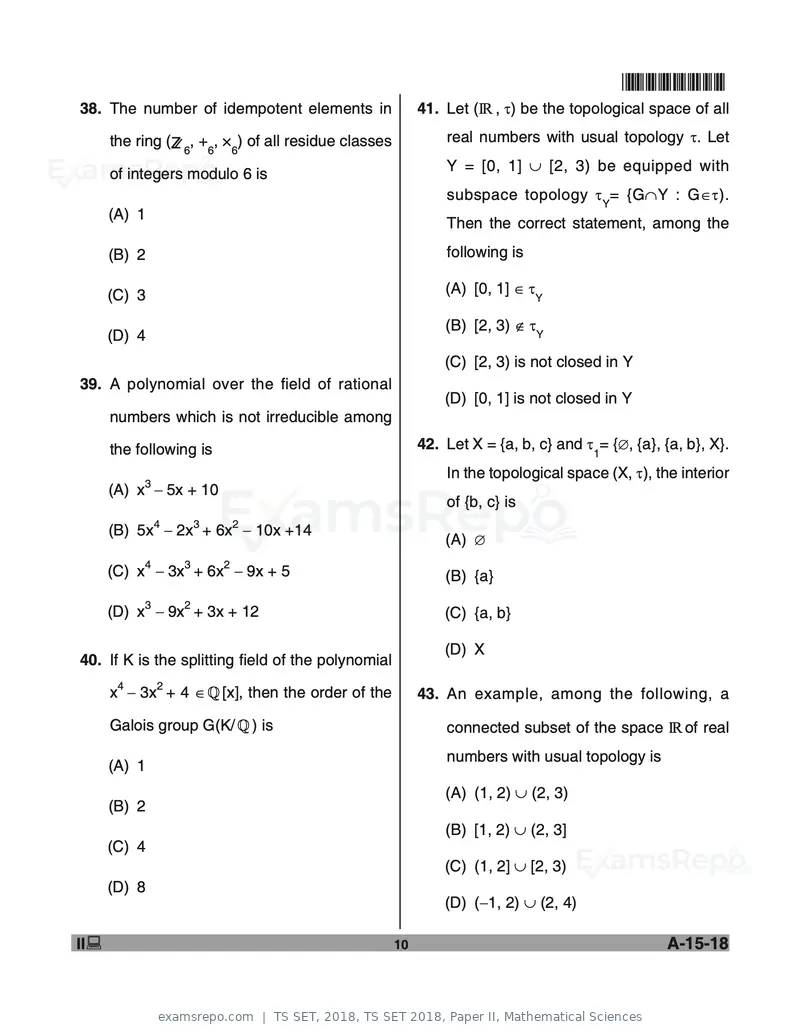
38. The number of idempotent elements in                   41. Let (IR , τ) be the topological space of all

      the ring (Z 6, +6, ×6) of all residue classes            real numbers with usual topology τ. Let
                                                               Y = [0, 1] ∪ [2, 3) be equipped with
      of integers modulo 6 is
                                                               subspace topology τy= {G∩Y : G∈τ).
      (A) 1
                                                               Then the correct statement, among the

      (B) 2                                                    following is

      (C) 3                                                    (A) [0, 1] ∈ τy

                                                               (B) [2, 3) ∉ τy
      (D) 4
                                                               (C) [2, 3) is not closed in Y
39. A polynomial over the field of rational
                                                               (D) [0, 1] is not closed in Y
      numbers which is not irreducible among

      the following is                                     42. Let X = {a, b, c} and τ1= {∅, {a}, {a, b}, X}.
                                                               In the topological space (X, τ), the interior
      (A) x3 − 5x + 10
                                                               of {b, c} is
      (B) 5x4 − 2x3 + 6x2 − 10x +14
                                                               (A) ∅

      (C) x4 − 3x3 + 6x2 − 9x + 5                              (B) {a}

      (D) x3 − 9x2 + 3x + 12                                   (C) {a, b}

                                                               (D) X
40. If K is the splitting field of the polynomial

      x4 − 3x2 + 4 ∈  [x], then the order of the          43. An example, among the following, a

      Galois group G(K/  ) is                                 connected subset of the space IR of real
                                                               numbers with usual topology is
      (A) 1
                                                               (A) (1, 2) ∪ (2, 3)
      (B) 2
                                                               (B) [1, 2) ∪ (2, 3]
      (C) 4
                                                               (C) (1, 2] ∪ [2, 3)
      (D) 8
                                                               (D) (−1, 2) ∪ (2, 4)

II                                                   10                                           A-15-18
TS SET 2018 question paper, TS SET 2018, Paper II, Mathematical Sciences, page 11 of 24
Page 11 of 24
Text of page 11
*A1518*
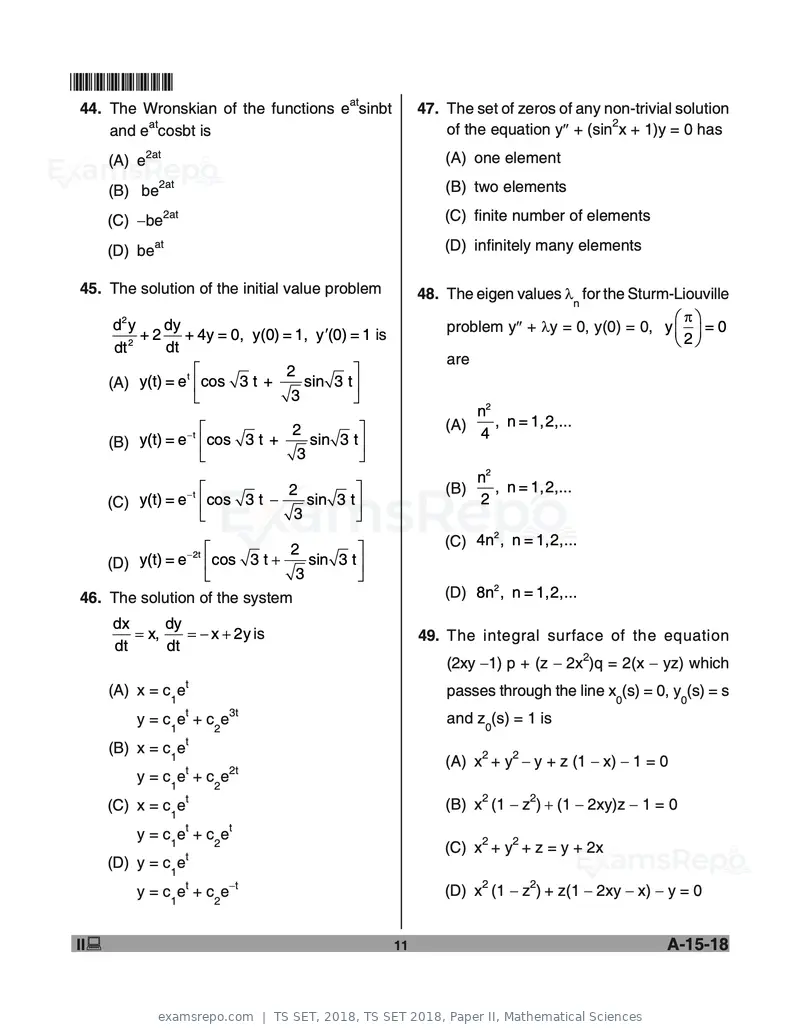
 44. The Wronskian of the functions eatsinbt           47. The set of zeros of any non-trivial solution
     and eatcosbt is                                       of the equation y″ + (sin2x + 1)y = 0 has

      (A) e2at                                             (A) one element

      (B) be2at                                            (B) two elements

      (C) −be2at                                           (C) finite number of elements

      (D) beat                                             (D) infinitely many elements

 45. The solution of the initial value problem         48. The eigen values λn for the sturm-Liouville
   d2 y    dy                                                                                π
                                                           problem y″ + λy = 0, y(0) = 0, y   = 0
		 2 + 2      + 4y = 0, y(0) = 1, y ′(0) = 1 is                                              2
   dt      dt
                                                           are
              t             2           
  (A) y(t) = e cos 3 t +       sin 3 t 
                             3          
                                                               n2
                                                           (A)    , n = 1,2,...
                  −t         2                               4
      (B) y(t) = e cos 3 t +    sin 3 t 
                              3         
                                                               n2
                  −t         2                           (B)    , n = 1,2,...
      (C) y(t) = e cos 3 t −    sin 3 t                      2
                              3         
                                                                  2
                                                           (C) 4n , n = 1,2,...
                    − 2t      2          
      (D) y(t) = e cos 3 t +     sin 3 t 
                               3         
 46. The solution of the system                            (D) 8n2 , n = 1,2,...
      dx      dy
		       = x,    = − x + 2y is                         49. The integral surface of the equation
      dt      dt
                                                           (2xy −1) p + (z − 2x2)q = 2(x − yz) which
      (A) x = c1et                                         passes through the line x (s) = 0, y (s) = s
                                                                                      0           0
                    t       3t
		 y = c1e + c2e                                           and z0(s) = 1 is
      (B) x = c1et
                    t       2t
                                                           (A) x2 + y2 − y + z (1 − x) − 1 = 0
		 y = c1e + c2e
      (C) x = c1et                                         (B) x2 (1 − z2) + (1 − 2xy)z − 1 = 0
		 y = c1et + c2et
                    t
                                                           (C) x2 + y2 + z = y + 2x
      (D) y = c1e
		 y = c1et + c2e−t                                        (D) x2 (1 − z2) + z(1 − 2xy − x) − y = 0


II                                               11                                         A-15-18
TS SET 2018 question paper, TS SET 2018, Paper II, Mathematical Sciences, page 12 of 24
Page 12 of 24
Text of page 12
*A1518*
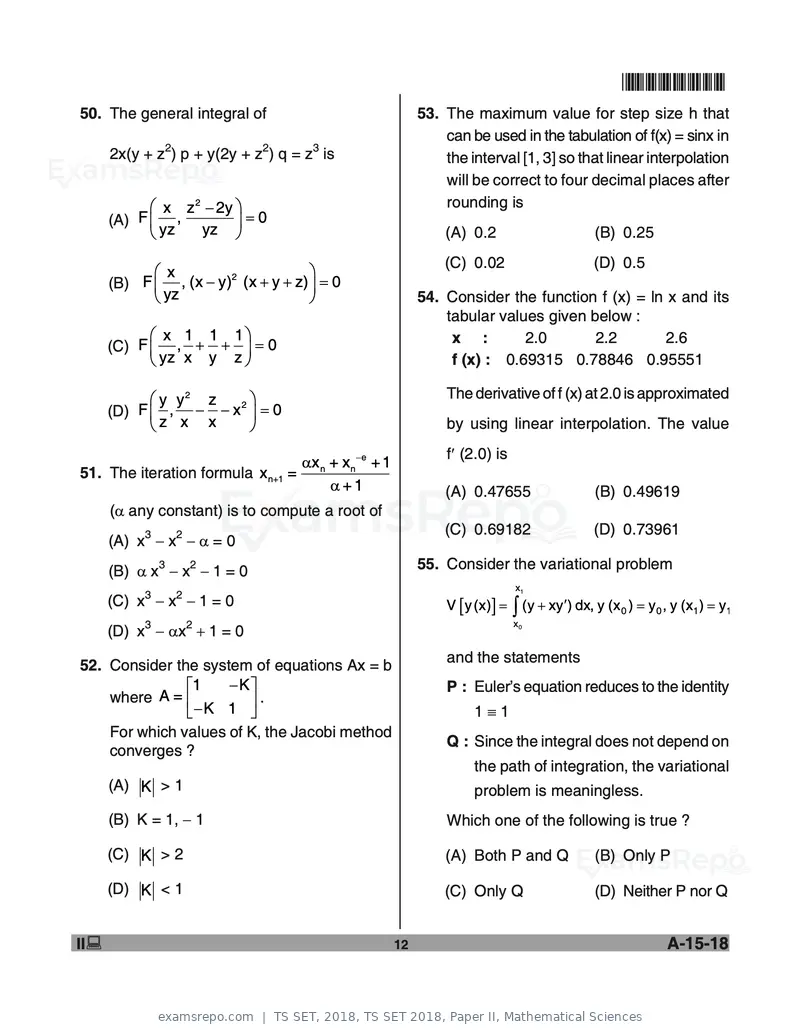
 50. The general integral of                             53. The maximum value for step size h that
                                                             can be used in the tabulation of f(x) = sinx in
		 2x(y + z2) p + y(2y + z2) q = z3 is                       the interval [1, 3] so that linear interpolation
                                                             will be correct to four decimal places after
            x z 2 − 2y                                     rounding is
      (A)  ,
         F              =0
            yz   yz                                        (A) 0.2                        (B) 0.25
                                                             (C) 0.02                       (D) 0.5
             x                      
      (B) F  , (x − y ) (x + y + z)  = 0
                        2

             yz                                        54. Consider the function f (x) = ln x and its
                                                             tabular values given below :
             x 1 1 1                                        x :        2.0       2.2       2.6
      (C) F  , + +  = 0
             yz x y z                                       f (x) : 0.69315 0.78846 0.95551

             y y2 z                                 		 The derivative of f (x) at 2.0 is approximated
                     2 
      (D) F  , − − x  = 0
            z x x                                          by using linear interpolation. The value
                                                             f′ (2.0) is
                                 αx + x n − e + 1
 51. The iteration formula xn+1 = n
                                    α +1                     (A) 0.47655                    (B) 0.49619
		 (α any constant) is to compute a root of
                                                             (C) 0.69182                    (D) 0.73961
      (A) x3 − x2 − α = 0
      (B) α x3 − x2 − 1 = 0                              55. Consider the variational problem
                                                                           x1
      (C) x3 − x2 − 1 = 0                                    V [ y (x )] = ∫ (y + xy ′) dx, y (x 0 ) = y 0 , y (x1 ) = y1
                                                                           x0
      (D) x3 − αx2 + 1 = 0
                                                     		 and the statements
 52. Consider the system of equations Ax = b
                1    −K                                   	P : Euler’s equation reduces to the identity
     where A =         .
                − K 1                                           1≡1
		 For which values of K, the Jacobi method
                                                             Q : Since the integral does not depend on
   converges ?
                                                                  the path of integration, the variational
      (A) K > 1                                                   problem is meaningless.
      (B) K = 1, − 1                                 		 Which one of the following is true ?

      (C) K > 2                                              (A) Both P and Q               (B) Only P

      (D) K < 1                                              (C) Only Q                     (D) Neither P nor Q


II                                                 12                                                     A-15-18
TS SET 2018 question paper, TS SET 2018, Paper II, Mathematical Sciences, page 13 of 24
Page 13 of 24
Text of page 13
*A1518*
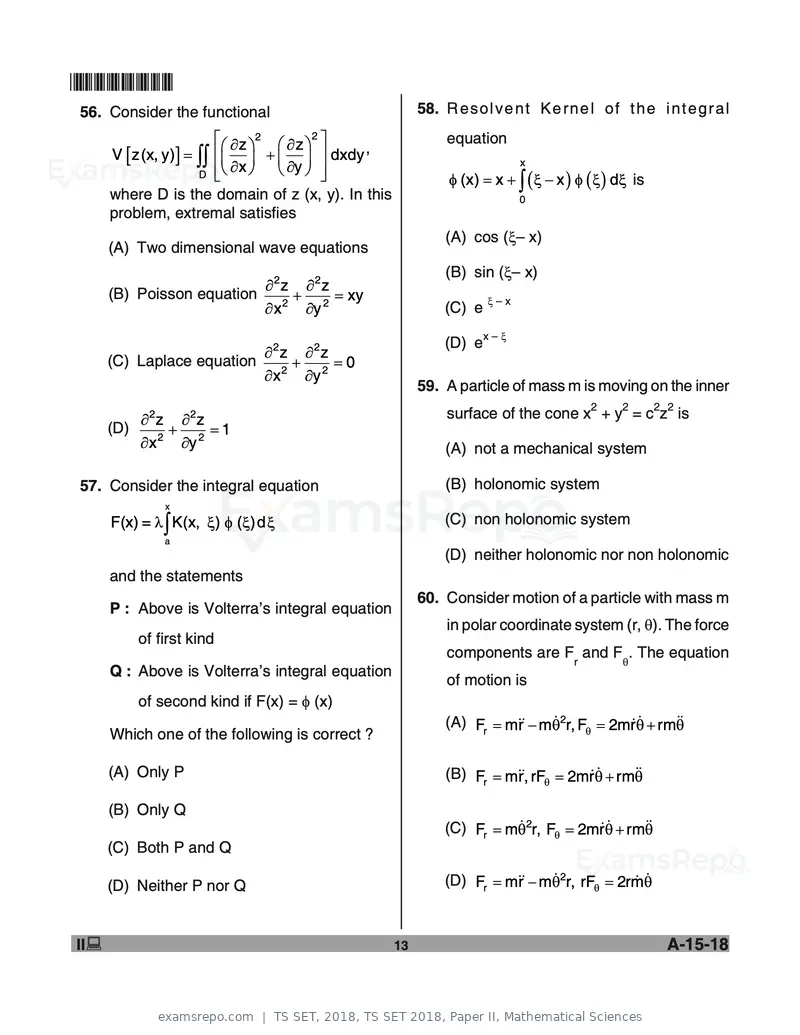
 56. Consider the functional                          58. R e s o l v e n t k e r n e l o f t h e i n t e g r a l
                        ∂ z  2  ∂ z  2     equation
   V [ z (x, y )] = ∫∫   +    dxdy ,
		                        ∂x        ∂y                        x
                    D                    φ (x ) = x + ∫ ( ξ − x ) φ ( ξ ) dξ is
		 where D is the domain of z (x, y). In this 		              0
   problem, extremal satisfies
                                                           (A) cos (ξ– x)
      (A) two dimensional wave equations
                                                           (B) sin (ξ– x)
                           ∂ 2z ∂ 2z
      (B) Poisson equation      +     = xy
                           ∂ x 2 ∂y 2                      (C) e ξ – x

                                                           (D) ex – ξ
                           ∂ 2z ∂ 2z
      (C) Laplace equation      +     =0
                           ∂ x 2 ∂y 2
                                                      59. A particle of mass m is moving on the inner

          ∂ 2z ∂ 2z                                        surface of the cone x2 + y2 = c2z2 is
      (D)      +     =1
          ∂ x 2 ∂y 2                                       (A) not a mechanical system

 57. Consider the integral equation                        (B) holonomic system
              x
		 F(x) = λ ∫ K(x, ξ) φ (ξ)d ξ                             (C) non holonomic system
            a

                                                           (D) neither holonomic nor non holonomic
		 and the statements
                                                      60. Consider motion of a particle with mass m
    	P : Above is Volterra’s integral equation
                                                           in polar coordinate system (r, θ). The force
          of first kind
                                                           components are Fr and Fθ. The equation
		 Q : Above is Volterra’s integral equation
                                                           of motion is
          of second kind if F(x) = φ (x)
                                                           (A) Fr = mr − mθ 2r, Fθ = 2mrθ + rm
                                                                                                   θ
		 Which one of the following is correct ?

      (A) Only P                                           (B) Fr = mr, rFθ = 2mrθ + rm
                                                                                           θ

      (B) Only Q
                                                           (C) Fr = mθ 2r, Fθ = 2mrθ + rm
                                                                                            θ
      (C) Both P and Q

      (D) Neither P nor Q                                  (D) Fr = mr − mθ 2r, rFθ = 2rm
                                                                                            θ


II                                              13                                                  A-15-18
TS SET 2018 question paper, TS SET 2018, Paper II, Mathematical Sciences, page 14 of 24
Page 14 of 24
Text of page 14
*A1518*
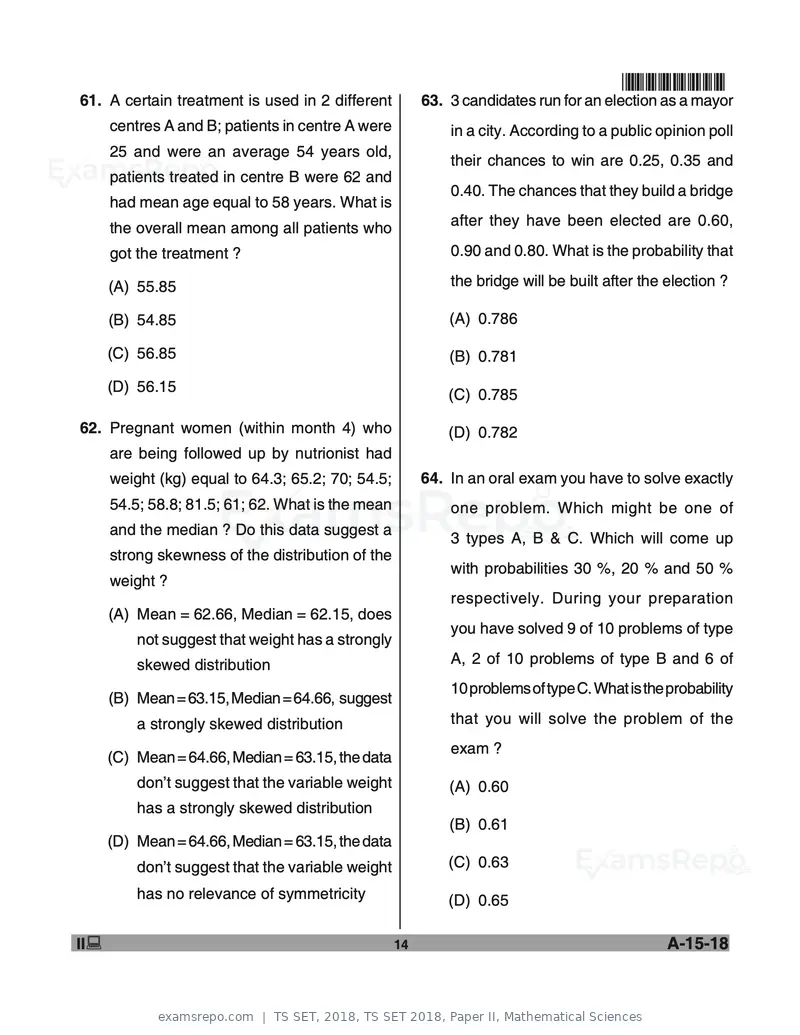
61. A certain treatment is used in 2 different          63. 3 candidates run for an election as a mayor
      centres A and B; patients in centre A were            in a city. According to a public opinion poll
      25 and were an average 54 years old,
                                                            their chances to win are 0.25, 0.35 and
      patients treated in centre B were 62 and
                                                            0.40. The chances that they build a bridge
      had mean age equal to 58 years. what is
      the overall mean among all patients who               after they have been elected are 0.60,

      got the treatment ?                                   0.90 and 0.80. What is the probability that

      (A) 55.85                                             the bridge will be built after the election ?

      (B) 54.85                                             (A) 0.786

      (C) 56.85                                             (B) 0.781
      (D) 56.15                                             (C) 0.785

62. Pregnant women (within month 4) who                     (D) 0.782
      are being followed up by nutrionist had
      weight (kg) equal to 64.3; 65.2; 70; 54.5;        64. In an oral exam you have to solve exactly
      54.5; 58.8; 81.5; 61; 62. what is the mean            one problem. Which might be one of
      and the median ? Do this data suggest a
                                                            3 types A, B & C. Which will come up
      strong skewness of the distribution of the
                                                            with probabilities 30 %, 20 % and 50 %
      weight ?
                                                            respectively. During your preparation
      (A) Mean = 62.66, Median = 62.15, does
                                                            you have solved 9 of 10 problems of type
          not suggest that weight has a strongly
          skewed distribution                               A, 2 of 10 problems of type B and 6 of
                                                            10 problems of type C. What is the probability
      (B) Mean = 63.15, Median = 64.66, suggest
          a strongly skewed distribution                    that you will solve the problem of the
                                                            exam ?
      (C) Mean = 64.66, Median = 63.15, the data
          don’t suggest that the variable weight            (A) 0.60
          has a strongly skewed distribution
                                                            (B) 0.61
      (D) Mean = 64.66, Median = 63.15, the data
          don’t suggest that the variable weight            (C) 0.63

          has no relevance of symmetricity                  (D) 0.65

II                                                14                                          A-15-18
TS SET 2018 question paper, TS SET 2018, Paper II, Mathematical Sciences, page 15 of 24
Page 15 of 24
Text of page 15
*A1518*
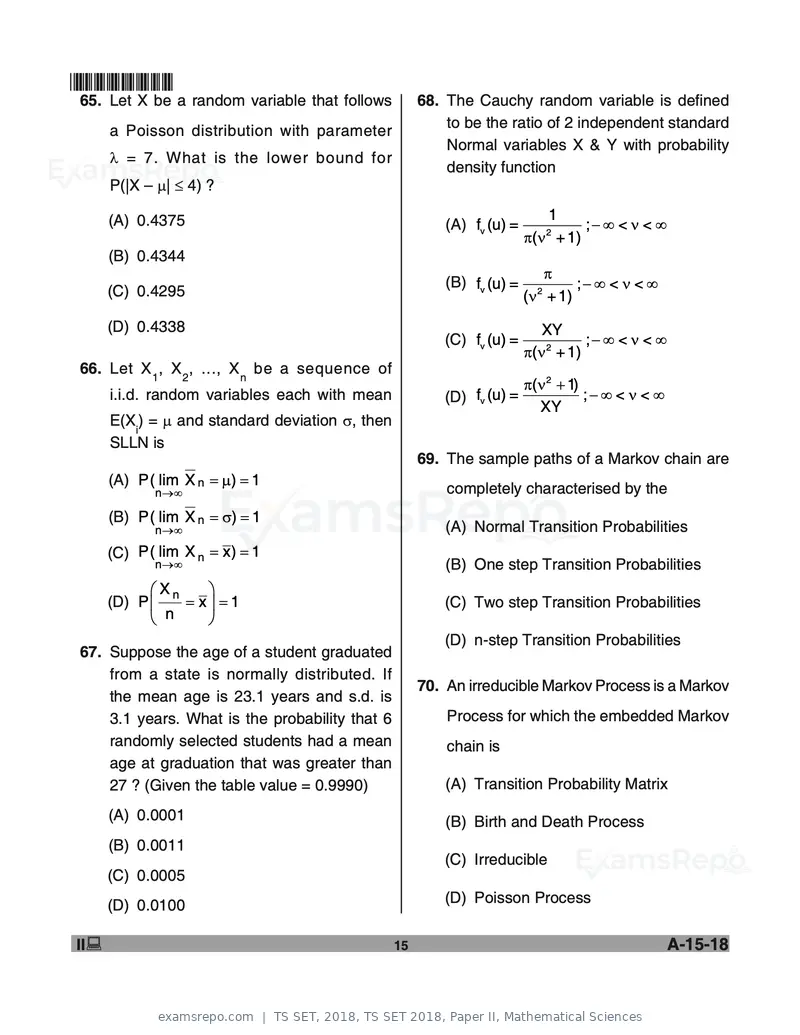
65. Let X be a random variable that follows           68. The Cauchy random variable is defined
                                                          to be the ratio of 2 independent standard
      a Poisson distribution with parameter
                                                          Normal variables X & Y with probability
      λ = 7. What is the lower bound for
                                                          density function
      P(|X – µ| ≤ 4) ?

      (A) 0.4375                                                            1
                                                          (A) fv (u) =            ;− ∞ < ν < ∞
                                                                         π(ν + 1)
                                                                               2

      (B) 0.4344
                                                                            π
                                                          (B) fv (u) =           ;− ∞ < ν < ∞
      (C) 0.4295                                                         (ν + 1)
                                                                           2


      (D) 0.4338                                                            XY
                                                         (C) fv (u) =               ;− ∞ < ν < ∞
                                                                         π(ν 2 + 1)
66. Let X 1 , X 2 , ..., X n be a sequence of
                                                                         π(ν 2 + 1)
      i.i.d. random variables each with mean             (D) fv (u) =               ;− ∞ < ν < ∞
                                                                           XY
      E(Xi) = µ and standard deviation σ, then
      SLLN is
                                                      69. The sample paths of a Markov chain are
      (A) P( lim X n = µ) = 1
             n→∞                                          completely characterised by the
      (B) P( lim X n = σ) = 1
             n→∞                                          (A) Normal Transition Probabilities
      (C) P( lim X n = x) = 1
             n→∞                                          (B) One step Transition Probabilities
             Xn    
      (D) P     = x =1                                 (C) Two step Transition Probabilities
             n     
                                                         (D) n-step Transition Probabilities
67. Suppose the age of a student graduated
    from a state is normally distributed. If
                                                      70. An irreducible Markov Process is a Markov
    the mean age is 23.1 years and s.d. is
    3.1 years. What is the probability that 6             Process for which the embedded Markov
    randomly selected students had a mean                 chain is
    age at graduation that was greater than
    27 ? (Given the table value = 0.9990)                 (A) Transition Probability Matrix

      (A) 0.0001                                          (B) Birth and Death Process
      (B) 0.0011
                                                         (C) Irreducible
      (C) 0.0005
                                                         (D) Poisson Process
      (D) 0.0100

II                                              15                                                A-15-18
TS SET 2018 question paper, TS SET 2018, Paper II, Mathematical Sciences, page 16 of 24
Page 16 of 24
Text of page 16
*A1518*
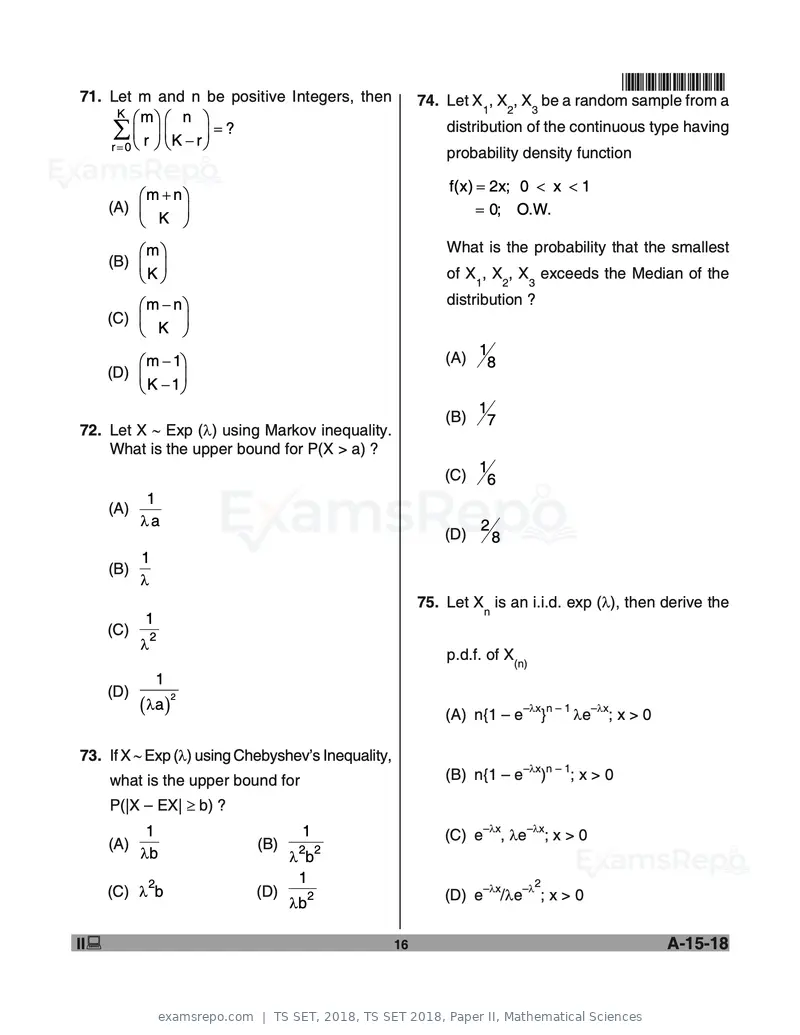
 71. Let m and n be positive Integers, then              74. Let X1, X2, X3 be a random sample from a
      K m  n 
     ∑   =?                                              distribution of the continuous type having
     r= 0  r  K − r 
                                                             probability density function

                                                        f(x ) = 2x; 0 < x < 1
          m + n
      (A)                                          		       = 0; O.W.
           K 
          m                                        		 What is the probability that the smallest
      (B)  
          K                                                of X1, X2, X3 exceeds the Median of the

          m − n                                            distribution ?
      (C)      
           K 
           m − 1                                           (A) 18
      (D)       
           K − 1
                                                                   1
                                                             (B)    7
 72. Let X ∼ Exp (λ) using Markov inequality.
     what is the upper bound for P(X > a) ?
                                                             (C) 16
             1
      (A)
            λa                                                     2
                                                             (D)       8
            1
      (B)
            λ
                                                         75. Let Xn is an i.i.d. exp (λ), then derive the
             1
      (C)       2
            λ
                                                             p.d.f. of X(n)
                 1
      (D)
            ( λa )
                     2

                                                             (A) n{1 – e–λx}n – 1 λe–λx; x > 0

 73. If X ∼ Exp (λ) using Chebyshev’s Inequality,
      what is the upper bound for                            (B) n{1 – e–λx)n – 1; x > 0
		 P(|X – EX| ≥ b) ?
             1                      1                        (C) e–λx, λe–λx; x > 0
      (A)                   (B)    2 2
            λb                    λ b
             2                     1                                          2
      (C) λ b               (D)        2                     (D) e–λx/λe–λ ; x > 0
                                  λb

II                                                 16                                           A-15-18
TS SET 2018 question paper, TS SET 2018, Paper II, Mathematical Sciences, page 17 of 24
Page 17 of 24
Text of page 17
*A1518*
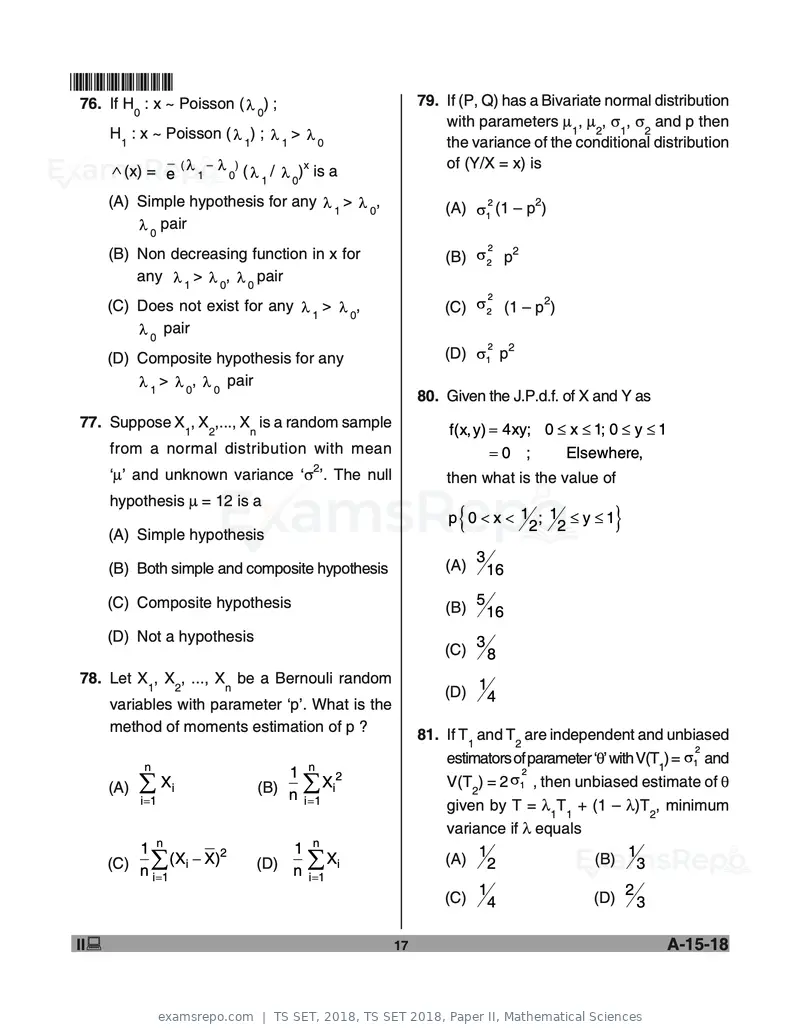
 76. If H0 : x ~ Poisson ( λ 0) ;                      79. If (P, Q) has a Bivariate normal distribution
                                                           with parameters µ1, µ2, σ1, σ2 and p then
		 H1 : x ~ Poisson ( λ 1) ; λ 1 > λ 0
                                                           the variance of the conditional distribution
      ∧ (x) = e ( λ 1 – λ 0) ( λ / λ )x is a               of (y/x = x) is
                                1   0

 (A) Simple hypothesis for any λ 1 > λ 0,                  (A) σ12 (1 – p2)
		 λ 0 pair
                                                                     2
      (B) Non decreasing function in x for                 (B) σ 2 p2
          any λ 1 > λ 0, λ 0 pair
                                                                     2
      (C) Does not exist for any λ 1 > λ 0,                (C) σ 2 (1 – p2)
          λ 0 pair
                                                           (D) σ1 p2
                                                                     2
 (D) Composite hypothesis for any
		 λ 1 > λ 0, λ 0 pair
                                                       80. Given the J.P.d.f. of x and y as
 77. Suppose X1, X2,..., Xn is a random sample        f(x, y ) = 4xy; 0 ≤ x ≤ 1; 0 ≤ y ≤ 1
      from a normal distribution with mean                     =0 ;      Elsewhere,

      ‘µ’ and unknown variance ‘σ2’. The null 		 then what is the value of
      hypothesis µ = 12 is a

      (A) Simple hypothesis
                                                             {
                                                   p 0 < x < 1 ; 1 ≤ y ≤1
                                                              2 2                      }
                                                      3
      (B) Both simple and composite hypothesis    (A) 16

      (C) Composite hypothesis                                   5
                                                           (B)       16
      (D) Not a hypothesis                                       3
                                                           (C)       8
 78. Let X1, X2, ..., Xn be a Bernouli random                    1
                                                           (D)    4
      variables with parameter ‘p’. what is the
      method of moments estimation of p ?              81. If T1 and T2 are independent and unbiased
                                                                                                     2
           n
                                                           estimators of parameter ‘θ’ with V(T1) = σ1 and
                                  1 n 2                                2
      (A) ∑ Xi                (B) n ∑ Xi                   V(T2) = 2 σ1 , then unbiased estimate of θ
          i =1                      i =1                   given by T = λ1T1 + (1 – λ)T2, minimum
                                                           variance if λ equals
          1 n                     1 n
      (C) n ∑ (Xi − X)
                      2
                              (D) n ∑ Xi                   (A) 12                  (B) 13
            i =1                    i =1
                                                           (C) 14                  (D) 2 3


II                                               17                                           A-15-18
TS SET 2018 question paper, TS SET 2018, Paper II, Mathematical Sciences, page 18 of 24
Page 18 of 24
Text of page 18
*A1518*
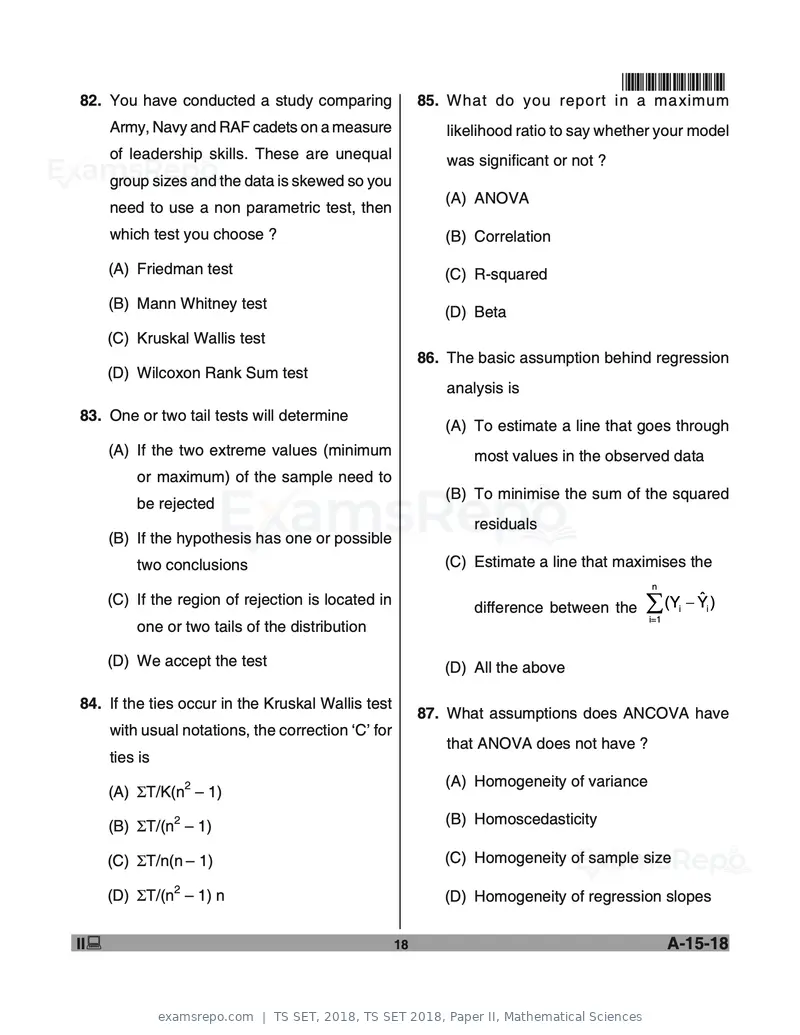
82. You have conducted a study comparing                  85. What do you report in a maximum
      Army, Navy and RAF cadets on a measure                  likelihood ratio to say whether your model
      of leadership skills. These are unequal                 was significant or not ?
      group sizes and the data is skewed so you
                                                              (A) ANOVA
      need to use a non parametric test, then
      which test you choose ?                                 (B) Correlation

      (A) Friedman test                                       (C) R-squared
      (B) Mann Whitney test
                                                              (D) Beta
      (C) Kruskal Wallis test
                                                          86. The basic assumption behind regression
      (D) Wilcoxon Rank Sum test
                                                              analysis is
83. One or two tail tests will determine
                                                              (A) To estimate a line that goes through
      (A) If the two extreme values (minimum                      most values in the observed data
          or maximum) of the sample need to
                                                              (B) To minimise the sum of the squared
          be rejected
                                                                  residuals
      (B) If the hypothesis has one or possible
          two conclusions                                     (C) Estimate a line that maximises the
                                                                                            n

                                                          		 difference between the ∑ (Yi − Yi )
      (C) If the region of rejection is located in                                          ˆ
                                                                                            i=1
          one or two tails of the distribution

      (D) We accept the test                                  (D) All the above

84. If the ties occur in the Kruskal Wallis test
                                                          87. What assumptions does ANCOVA have
      with usual notations, the correction ‘C’ for
                                                              that ANOVA does not have ?
      ties is
                                                              (A) Homogeneity of variance
      (A) ΣT/K(n2 – 1)

      (B) ΣT/(n2 – 1)                                         (B) Homoscedasticity

      (C) ΣT/n(n – 1)                                         (C) Homogeneity of sample size

      (D) ΣT/(n2 – 1) n                                       (D) Homogeneity of regression slopes


II                                                  18                                           A-15-18
TS SET 2018 question paper, TS SET 2018, Paper II, Mathematical Sciences, page 19 of 24
Page 19 of 24
Text of page 19
*A1518*
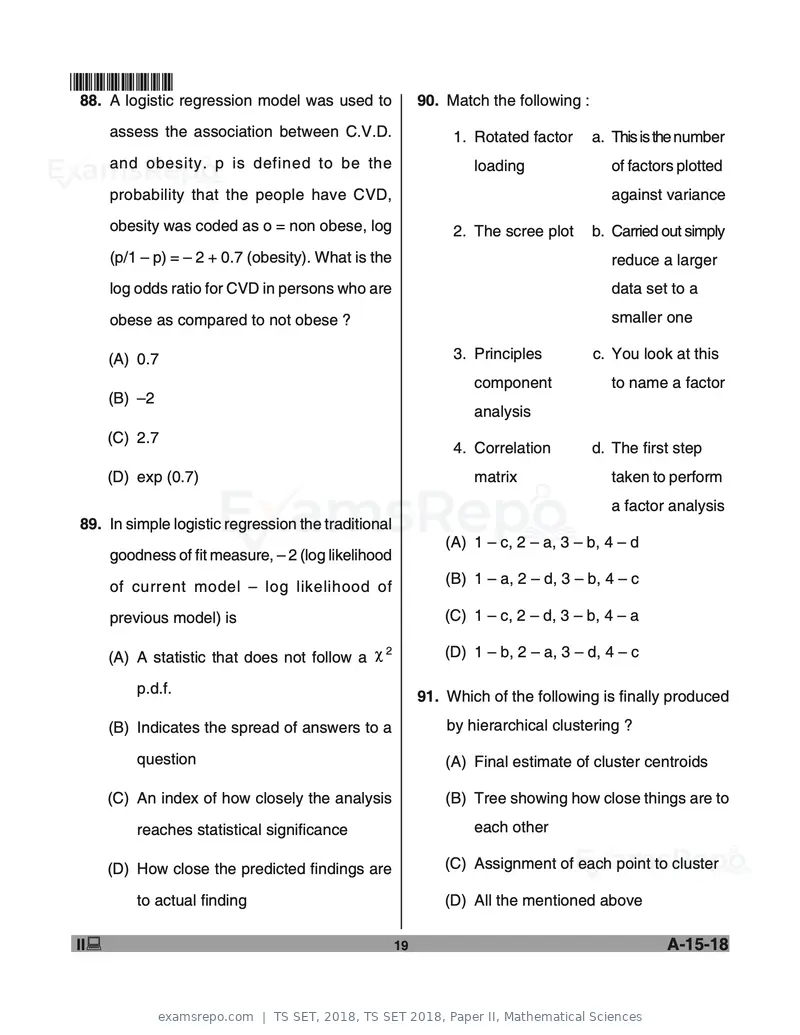
88. A logistic regression model was used to               90. Match the following :

      assess the association between C.V.D.                    1. Rotated factor      a. This is the number
      and obesity. p is defined to be the                         loading		 of factors plotted
      probability that the people have CVD,                       		 against variance

      obesity was coded as o = non obese, log                  2. The scree plot      b. Carried out simply
      (p/1 – p) = – 2 + 0.7 (obesity). what is the                		 reduce a larger
      log odds ratio for CVD in persons who are                   		 data set to a

      obese as compared to not obese ?                            		 smaller one

      (A) 0.7                                                  3. Principles          c. You look at this
                                                          		 component 		 to name a factor
      (B) –2
                                                          		 analysis
      (C) 2.7
                                                               4. Correlation         d. The first step
      (D) exp (0.7)                                       		 matrix		 taken to perform
                                                                  		 a factor analysis
89. In simple logistic regression the traditional
                                                              (A) 1 – c, 2 – a, 3 – b, 4 – d
      goodness of fit measure, – 2 (log likelihood
                                                              (B) 1 – a, 2 – d, 3 – b, 4 – c
      of current model – log likelihood of

      previous model) is                                      (C) 1 – c, 2 – d, 3 – b, 4 – a

      (A) a statistic that does not follow a χ 2              (D) 1 – b, 2 – a, 3 – d, 4 – c

          p.d.f.                                          91. Which of the following is finally produced

      (B) Indicates the spread of answers to a                by hierarchical clustering ?

          question                                            (A) Final estimate of cluster centroids

      (C) An index of how closely the analysis                (B) Tree showing how close things are to

          reaches statistical significance                        each other

      (D) How close the predicted findings are                (C) Assignment of each point to cluster

          to actual finding                                   (D) All the mentioned above

II                                                  19                                          A-15-18
TS SET 2018 question paper, TS SET 2018, Paper II, Mathematical Sciences, page 20 of 24
Page 20 of 24
Text of page 20
*A1518*
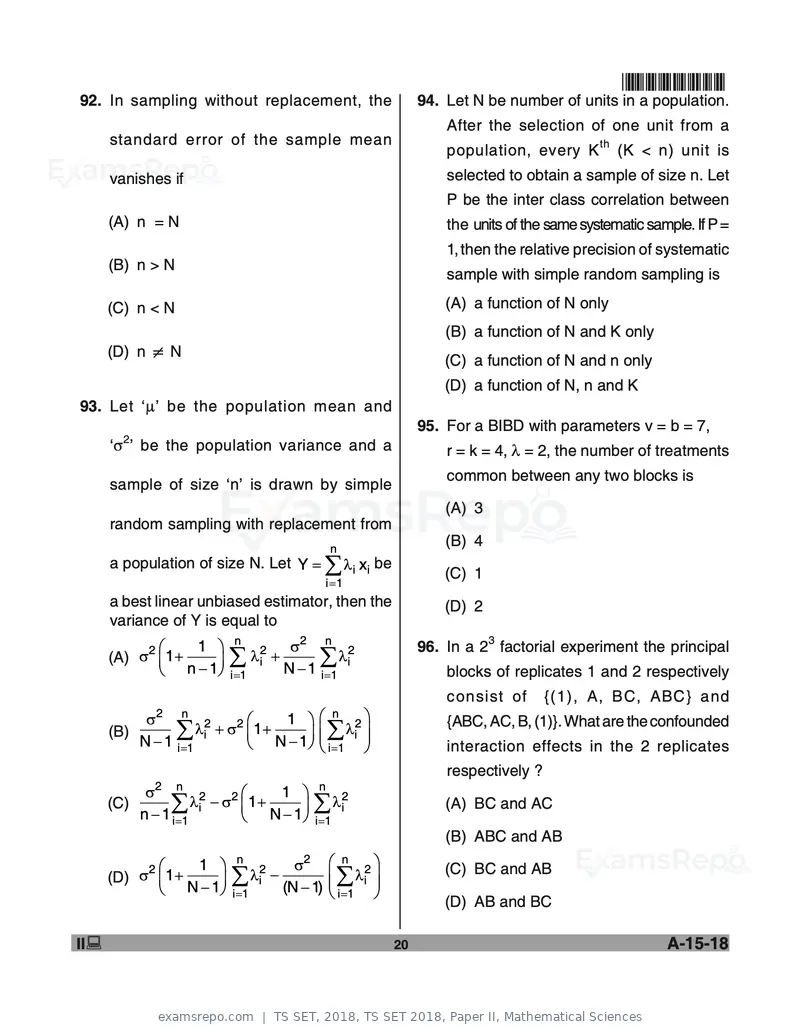
 92. In sampling without replacement, the                     94. Let N be number of units in a population.
                                                                  After the selection of one unit from a
      standard error of the sample mean
                                                                  population, every k th (k < n) unit is
      vanishes if                                                 selected to obtain a sample of size n. Let
                                                                  P be the inter class correlation between
      (A) n = N                                                   the units of the same systematic sample. If P =
                                                                  1, then the relative precision of systematic
      (B) n > N
                                                                  sample with simple random sampling is

      (C) n < N                                                   (A) a function of N only
                                                                  (B) a function of N and k only
      (D) n ≠ N
                                                                  (C) a function of N and n only
                                                                  (D) a function of N, n and k
 93. Let ‘µ’ be the population mean and
                                                              95. For a BIBD with parameters v = b = 7,
        2
      ‘σ ’ be the population variance and a 		 r = k = 4, λ = 2, the number of treatments
                                                                  common between any two blocks is
      sample of size ‘n’ is drawn by simple
                                                                  (A) 3
      random sampling with replacement from
                                                   n
                                                                  (B) 4
      a population of size N. Let Y = ∑ λi xi be
                                                                  (C) 1
                                                  i =1
		 a best linear unbiased estimator, then the                     (D) 2
   variance of Y is equal to
           2     1  n 2     σ2 n 2                          96. In a 23 factorial experiment the principal
      (A) σ  1 +    ∑ i N − 1 ∑ λi
                          λ +
             n − 1 i =1        i =1                             blocks of replicates 1 and 2 respectively
                                                                  consist of       {(1), a, BC, ABC} and
             σ 2   n
                                     1       n
                                                2                {ABC, AC, B, (1)}. What are the confounded
      (B)         ∑
            N − 1 i =1
                       λi2 + σ2  1 +     ∑ λi 
                                 N − 1  i =1                  interaction effects in the 2 replicates
                                                                  respectively ?
              2    n                          n
             σ                         1 
      (C)        ∑
            n − 1 i =1
                       λi2 − σ2  1 +
                                     N − 1  ∑ λi
                                             i =1
                                                   2
                                                                  (A) BC and AC

                                                                  (B) ABC and AB

           2     1  n 2     σ2  n 2                           (C) BC and AB
      (D) σ  1 +    ∑ i (N − 1)  ∑ λi 
                          λ −
             N − 1 i =1           i =1 
                                                                  (D) AB and BC

II                                                      20                                           A-15-18
TS SET 2018 question paper, TS SET 2018, Paper II, Mathematical Sciences, page 21 of 24
Page 21 of 24
Text of page 21
*A1518*
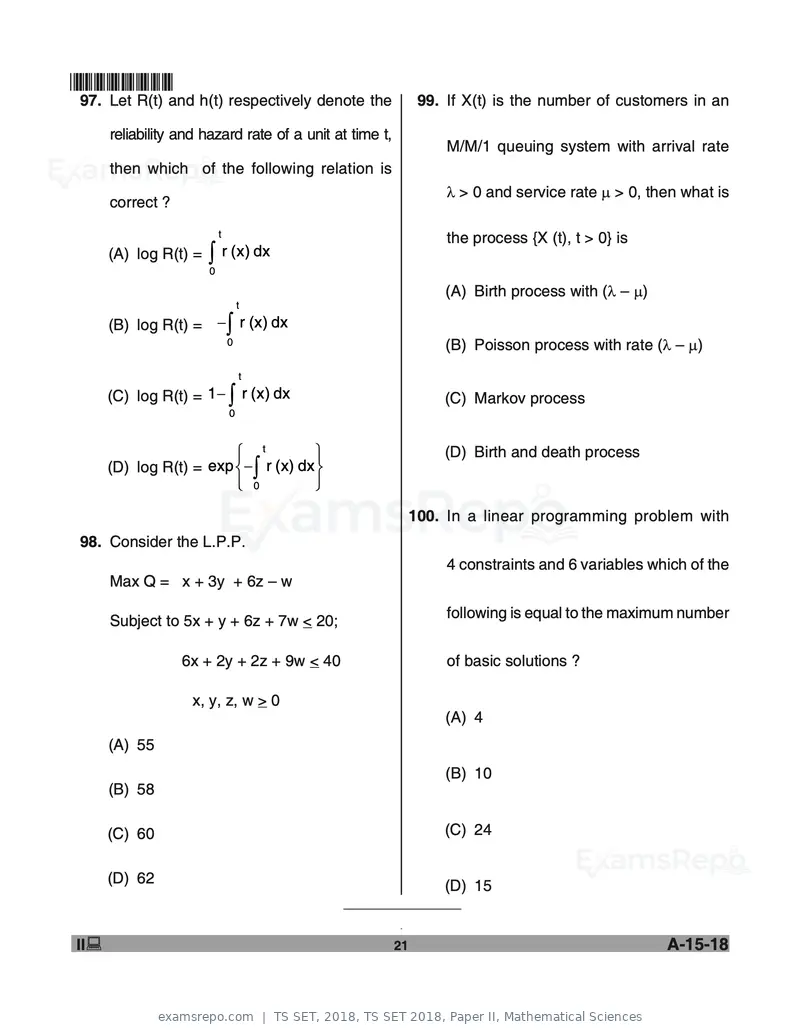
 97. Let R(t) and h(t) respectively denote the                 99. If X(t) is the number of customers in an

      reliability and hazard rate of a unit at time t,
                                                                   M/M/1 queuing system with arrival rate
      then which of the following relation is
                                                                   λ > 0 and service rate µ > 0, then what is
      correct ?
                           t                                       the process {X (t), t > 0} is
      (A) log R(t) = ∫ r (x ) dx
                       0

                                                                  (A) Birth process with (λ – µ)
                                   t

      (B) log R(t) = − ∫ r (x ) dx
                               0                                  (B) Poisson process with rate (λ – µ)
                                   t

      (C) log R(t) = 1 − ∫ r (x ) dx                              (C) Markov process
                               0


                          t                                   (D) Birth and death process
      (D) log R(t) = exp − ∫ r (x ) dx 
                           0           

                                                              100. In a linear programming problem with
 98. Consider the L.P.P.
                                                                   4 constraints and 6 variables which of the
		 Max Q = x + 3y + 6z – w

                                                                   following is equal to the maximum number
		 Subject to 5x + y + 6z + 7w < 20;

			               6x + 2y + 2z + 9w < 40                           of basic solutions ?

                    x, y, z, w > 0
                                                                  (A) 4
      (A) 55
                                                                  (B) 10
      (B) 58

      (C) 60                                                      (C) 24


      (D) 62                                               (D) 15
                                              _______________

II                                                      21                                        A-15-18
TS SET 2018 question paper, TS SET 2018, Paper II, Mathematical Sciences, page 22 of 24
Page 22 of 24
Text of page 22
*A1518*
      Space for Rough Work


II            22               A-15-18
TS SET 2018 question paper, TS SET 2018, Paper II, Mathematical Sciences, page 23 of 24
Page 23 of 24
Text of page 23
*A1518*
          Space for Rough Work


II                23            A-15-18
TS SET 2018 question paper, TS SET 2018, Paper II, Mathematical Sciences, page 24 of 24
Page 24 of 24
Text of page 24
*A1518*
      Space for Rough Work


II            24               A-15-18
Page 1 of 24

Source: Telangana State Eligibility Test. Question paper published by Telangana State Eligibility Test.