
UKPSC AE 2023: Uttarakhand Combined State Engineering Service Examination, Civil Engineering Second
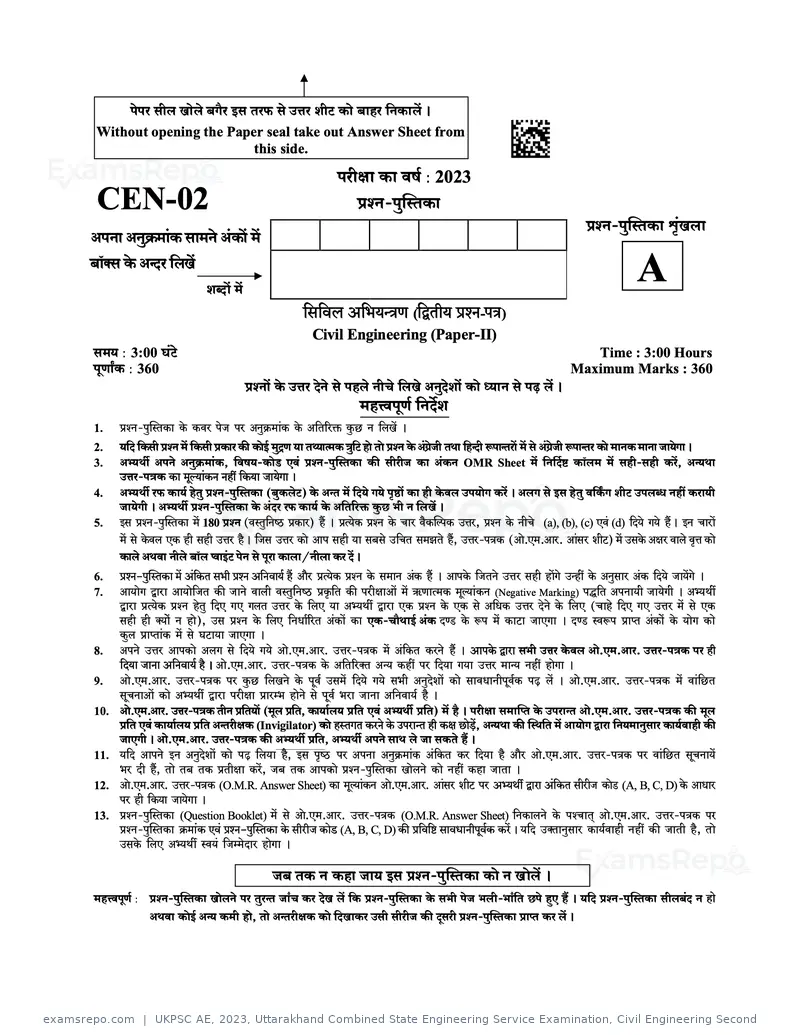
Text of page 2
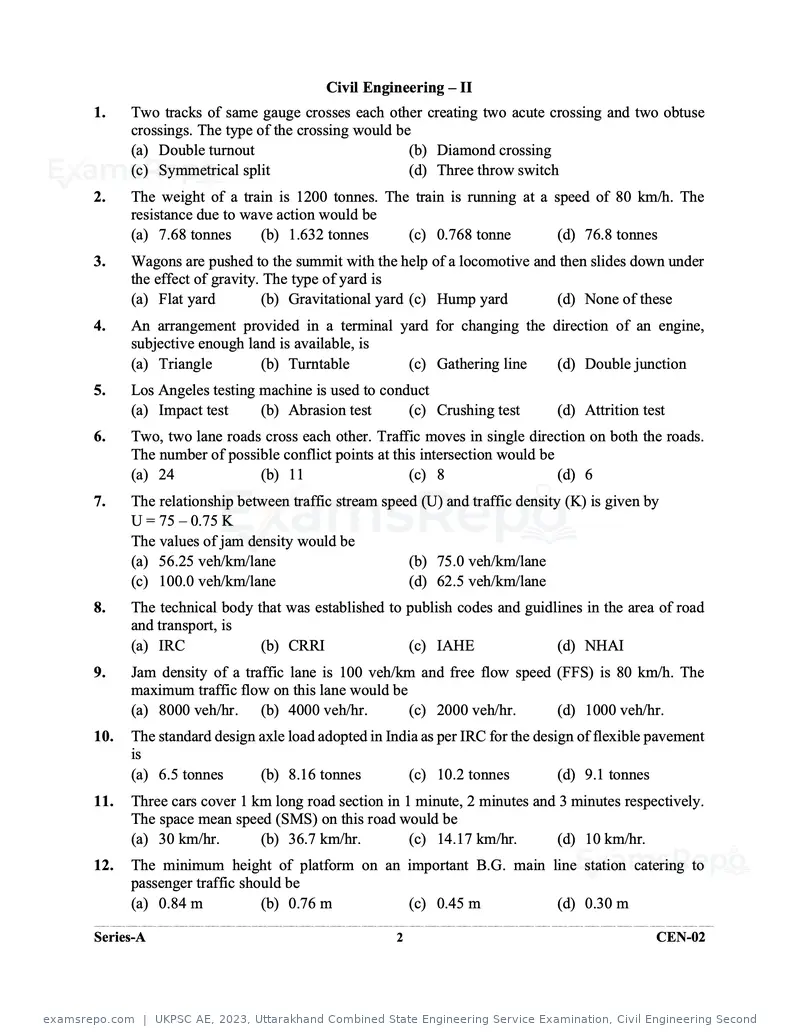
Civil Engineering – II
1.    Two tracks of same gauge crosses each other creating two acute crossing and two obtuse
      crossings. The type of the crossing would be
      (a) Double turnout                          (b) Diamond crossing
      (c) Symmetrical split                       (d) Three throw switch
2.    The weight of a train is 1200 tonnes. The train is running at a speed of 80 km/h. The
      resistance due to wave action would be
      (a) 7.68 tonnes     (b) 1.632 tonnes     (c) 0.768 tonne         (d) 76.8 tonnes
3.    Wagons are pushed to the summit with the help of a locomotive and then slides down under
      the effect of gravity. The type of yard is
      (a) Flat yard         (b) Gravitational yard (c) Hump yard       (d) None of these
4.    An arrangement provided in a terminal yard for changing the direction of an engine,
      subjective enough land is available, is
      (a) Triangle        (b) Turntable       (c) Gathering line   (d) Double junction
5.    Los Angeles testing machine is used to conduct
      (a) Impact test     (b) Abrasion test      (c) Crushing test         (d) Attrition test
6.    Two, two lane roads cross each other. Traffic moves in single direction on both the roads.
      The number of possible conflict points at this intersection would be
      (a) 24             (b) 11                    (c) 8                   (d) 6
7.    The relationship between traffic stream speed (U) and traffic density (K) is given by
      U = 75 – 0.75 K
      The values of jam density would be
      (a) 56.25 veh/km/lane                       (b) 75.0 veh/km/lane
      (c) 100.0 veh/km/lane                       (d) 62.5 veh/km/lane
8.    The technical body that was established to publish codes and guidlines in the area of road
      and transport, is
      (a) IRC             (b) CRRI               (c) IAHE               (d) NHAI
9.    Jam density of a traffic lane is 100 veh/km and free flow speed (FFS) is 80 km/h. The
      maximum traffic flow on this lane would be
      (a) 8000 veh/hr. (b) 4000 veh/hr.          (c) 2000 veh/hr.     (d) 1000 veh/hr.
10.   The standard design axle load adopted in India as per IRC for the design of flexible pavement
      is
      (a) 6.5 tonnes      (b) 8.16 tonnes          (c) 10.2 tonnes          (d) 9.1 tonnes
11.   Three cars cover 1 km long road section in 1 minute, 2 minutes and 3 minutes respectively.
      The space mean speed (SMS) on this road would be
      (a) 30 km/hr.       (b) 36.7 km/hr.         (c) 14.17 km/hr.      (d) 10 km/hr.
12.   The minimum height of platform on an important B.G. main line station catering to
      passenger traffic should be
      (a) 0.84 m           (b) 0.76 m      (c) 0.45 m           (d) 0.30 m

Series-A                                         2                                         CEN-02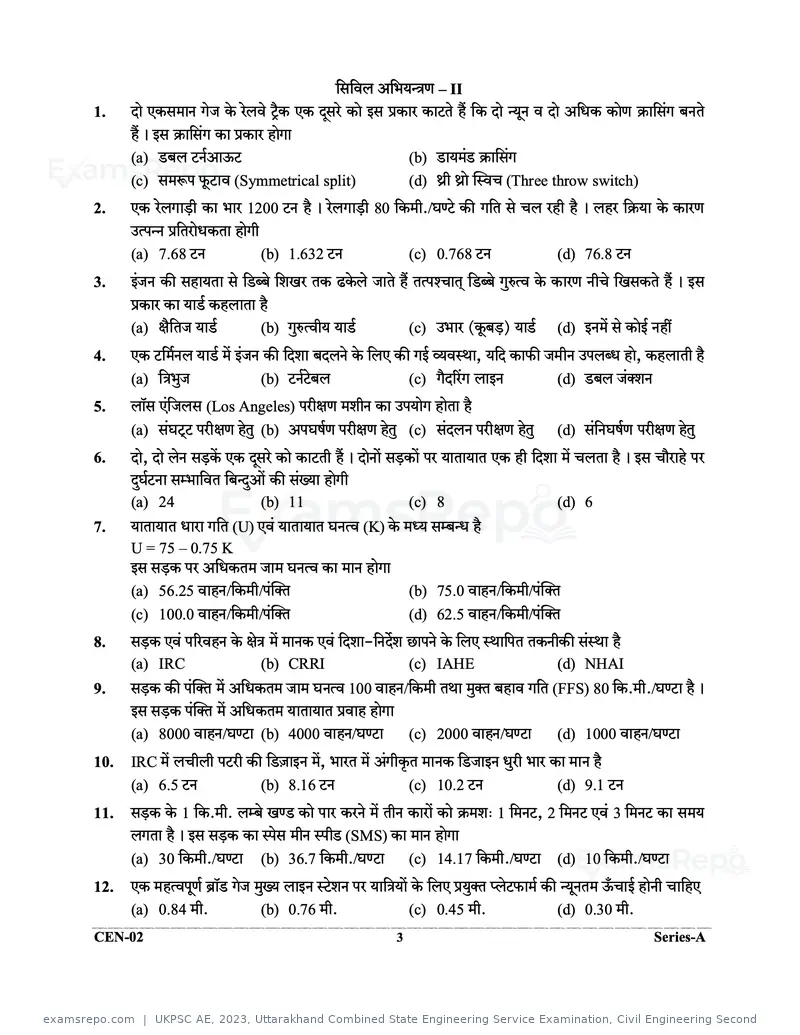
Text of page 3
– II
1.
(a) (b)
(c) (Symmetrical split) (d) (Three throw switch)
2. 1200 80 ./
(a) 7.68 (b) 1.632 (c) 0.768 (d) 76.8
3.
(a) (b) (c) () (d)
4. , ,
(a) (b) (c) (d)
5. (Los Angeles)
(a) (b) (c) (d)
6. ,
(a) 24 (b) 11 (c) 8 (d) 6
7. (U) (K)
U = 75 – 0.75 K
(a) 56.25 // (b) 75.0 //
(c) 100.0 // (d) 62.5 //
8. -
(a) IRC (b) CRRI (c) IAHE (d) NHAI
9. 100 / (FFS) 80 ../
(a) 8000 / (b) 4000 / (c) 2000 / (d) 1000 /
10. IRC ,
(a) 6.5 (b) 8.16 (c) 10.2 (d) 9.1
11. 1 .. 1 , 2 3
(SMS)
(a) 30 ./ (b) 36.7 ./ (c) 14.17 ./ (d) 10 ./
12.
(a) 0.84 . (b) 0.76 . (c) 0.45 . (d) 0.30 .
CEN-02 3 Series-A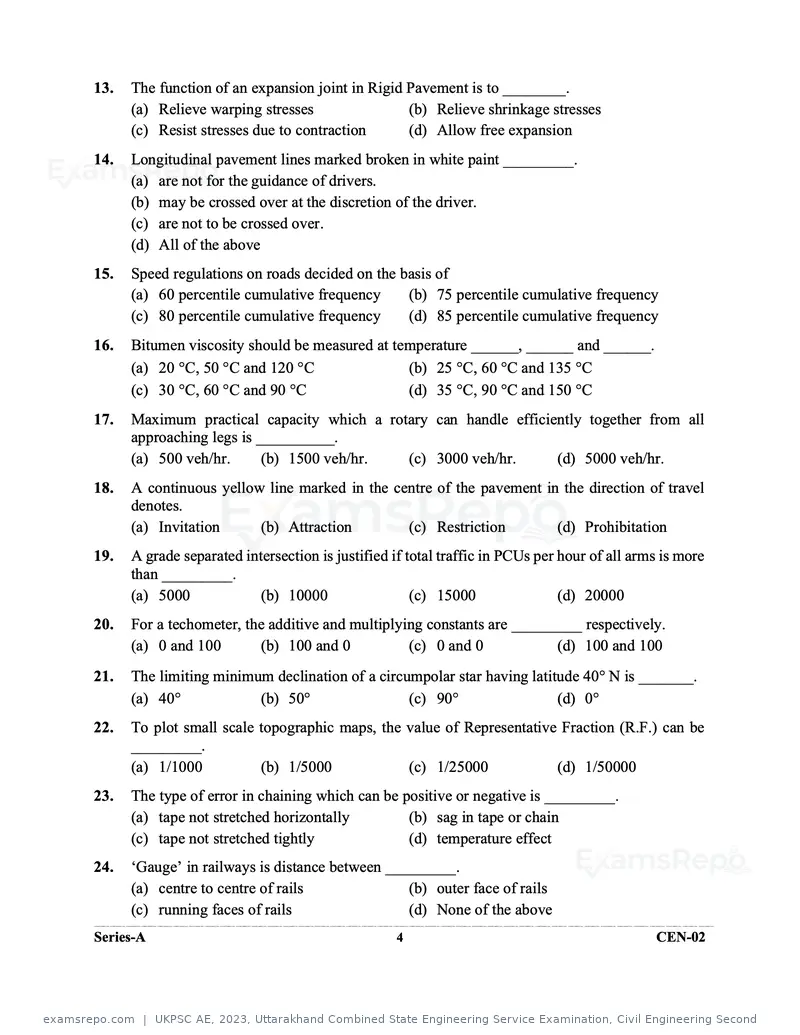
Text of page 4
13. The function of an expansion joint in Rigid Pavement is to ________.
(a) Relieve warping stresses (b) Relieve shrinkage stresses
(c) Resist stresses due to contraction (d) Allow free expansion
14. Longitudinal pavement lines marked broken in white paint _________.
(a) are not for the guidance of drivers.
(b) may be crossed over at the discretion of the driver.
(c) are not to be crossed over.
(d) All of the above
15. Speed regulations on roads decided on the basis of
(a) 60 percentile cumulative frequency (b) 75 percentile cumulative frequency
(c) 80 percentile cumulative frequency (d) 85 percentile cumulative frequency
16. Bitumen viscosity should be measured at temperature ______, ______ and ______.
(a) 20 C, 50 C and 120 C (b) 25 C, 60 C and 135 C
(c) 30 C, 60 C and 90 C (d) 35 C, 90 C and 150 C
17. Maximum practical capacity which a rotary can handle efficiently together from all
approaching legs is __________.
(a) 500 veh/hr. (b) 1500 veh/hr. (c) 3000 veh/hr. (d) 5000 veh/hr.
18. A continuous yellow line marked in the centre of the pavement in the direction of travel
denotes.
(a) Invitation (b) Attraction (c) Restriction (d) Prohibitation
19. A grade separated intersection is justified if total traffic in PCUs per hour of all arms is more
than _________.
(a) 5000 (b) 10000 (c) 15000 (d) 20000
20. For a techometer, the additive and multiplying constants are _________ respectively.
(a) 0 and 100 (b) 100 and 0 (c) 0 and 0 (d) 100 and 100
21. The limiting minimum declination of a circumpolar star having latitude 40 N is _______.
(a) 40 (b) 50 (c) 90 (d) 0
22. To plot small scale topographic maps, the value of Representative Fraction (R.F.) can be
_________.
(a) 1/1000 (b) 1/5000 (c) 1/25000 (d) 1/50000
23. The type of error in chaining which can be positive or negative is _________.
(a) tape not stretched horizontally (b) sag in tape or chain
(c) tape not stretched tightly (d) temperature effect
24. ‘Gauge’ in railways is distance between _________.
(a) centre to centre of rails (b) outer face of rails
(c) running faces of rails (d) None of the above
Series-A 4 CEN-02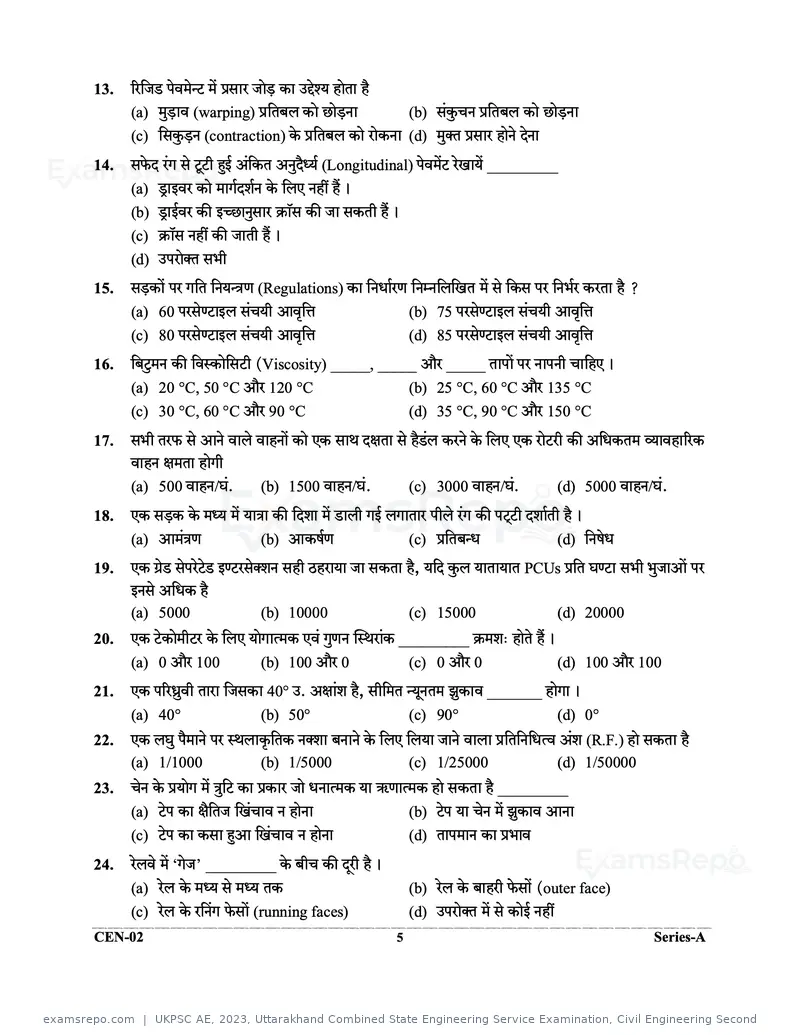
Text of page 5
13.
(a) (warping) (b)
(c) (contraction) (d)
14. (Longitudinal) _________
(a)
(b)
(c)
(d)
15. (Regulations) ?
(a) 60 (b) 75
(c) 80 (d) 85
16. (Viscosity) _____, _____ _____
(a) 20 C, 50 C 120 C (b) 25 C, 60 C 135 C
(c) 30 C, 60 C 90 C (d) 35 C, 90 C 150 C
17.
(a) 500 /. (b) 1500 /. (c) 3000 /. (d) 5000 /.
18.
(a) (b) (c) (d)
19. , PCUs
(a) 5000 (b) 10000 (c) 15000 (d) 20000
20. _________
(a) 0 100 (b) 100 0 (c) 0 0 (d) 100 100
21. 40 . , _______
(a) 40 (b) 50 (c) 90 (d) 0
22. (R.F.)
(a) 1/1000 (b) 1/5000 (c) 1/25000 (d) 1/50000
23. _________
(a) (b)
(c) (d)
24. ‘’ _________
(a) (b) (outer face)
(c) (running faces) (d)
CEN-02 5 Series-A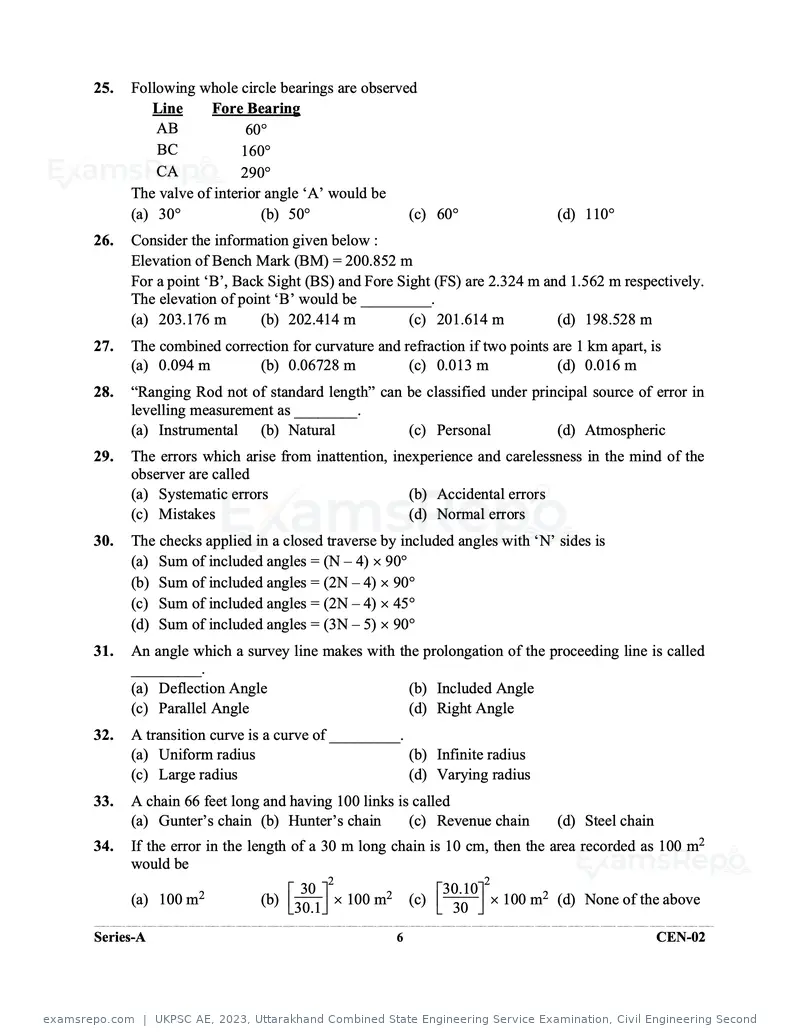
Text of page 6
25. Following whole circle bearings are observed
Line Fore Bearing
AB 60
BC 160
CA 290
The valve of interior angle ‘A’ would be
(a) 30 (b) 50 (c) 60 (d) 110
26. Consider the information given below :
Elevation of Bench Mark (BM) = 200.852 m
For a point ‘B’, Back Sight (BS) and Fore Sight (FS) are 2.324 m and 1.562 m respectively.
The elevation of point ‘B’ would be _________.
(a) 203.176 m (b) 202.414 m (c) 201.614 m (d) 198.528 m
27. The combined correction for curvature and refraction if two points are 1 km apart, is
(a) 0.094 m (b) 0.06728 m (c) 0.013 m (d) 0.016 m
28. “Ranging Rod not of standard length” can be classified under principal source of error in
levelling measurement as ________.
(a) Instrumental (b) Natural (c) Personal (d) Atmospheric
29. The errors which arise from inattention, inexperience and carelessness in the mind of the
observer are called
(a) Systematic errors (b) Accidental errors
(c) Mistakes (d) Normal errors
30. The checks applied in a closed traverse by included angles with ‘N’ sides is
(a) Sum of included angles = (N – 4) 90
(b) Sum of included angles = (2N – 4) 90
(c) Sum of included angles = (2N – 4) 45
(d) Sum of included angles = (3N – 5) 90
31. An angle which a survey line makes with the prolongation of the proceeding line is called
_________.
(a) Deflection Angle (b) Included Angle
(c) Parallel Angle (d) Right Angle
32. A transition curve is a curve of _________.
(a) Uniform radius (b) Infinite radius
(c) Large radius (d) Varying radius
33. A chain 66 feet long and having 100 links is called
(a) Gunter’s chain (b) Hunter’s chain (c) Revenue chain (d) Steel chain
34. If the error in the length of a 30 m long chain is 10 cm, then the area recorded as 100 m2
would be
2 2
30 30.10
(a) 100 m2 (b) 100 m2 (c) 100 m2 (d) None of the above
30.1 30
Series-A 6 CEN-02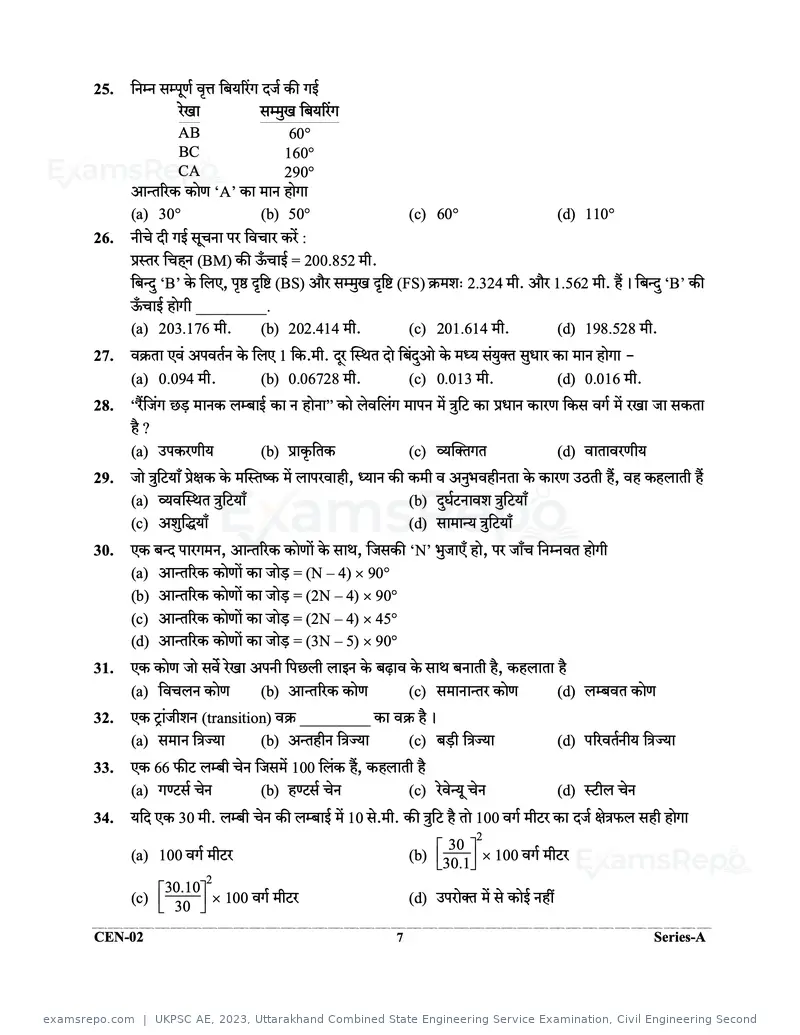
Text of page 7
25.
AB 60
BC 160
CA 290
‘A’
(a) 30 (b) 50 (c) 60 (d) 110
26. :
(BM) = 200.852 .
‘B’ , (BS) (FS) 2.324 . 1.562 . ‘B’
_________.
(a) 203.176 . (b) 202.414 . (c) 201.614 . (d) 198.528 .
27. 1 .. -
(a) 0.094 . (b) 0.06728 . (c) 0.013 . (d) 0.016 .
28. “ ”
?
(a) (b) (c) (d)
29. , ,
(a) (b)
(c) (d)
30. , , ‘N’ ,
(a) = (N – 4) 90
(b) = (2N – 4) 90
(c) = (2N – 4) 45
(d) = (3N – 5) 90
31. ,
(a) (b) (c) (d)
32. (transition) _________
(a) (b) (c) (d)
33. 66 100 ,
(a) (b) (c) (d)
34. 30 . 10 .. 100
2
30
(a) 100 (b) 100
30.1
2
30.10
(c) 100 (d)
30
CEN-02 7 Series-A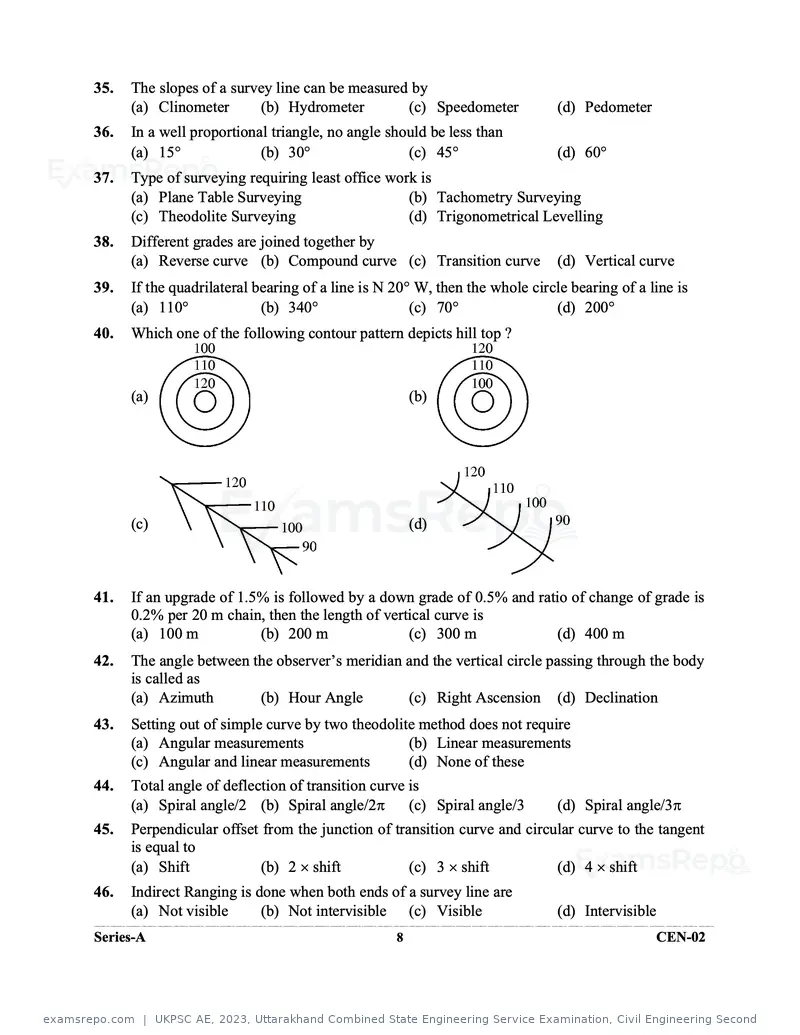
Text of page 8
35. The slopes of a survey line can be measured by
(a) Clinometer (b) Hydrometer (c) Speedometer (d) Pedometer
36. In a well proportional triangle, no angle should be less than
(a) 15 (b) 30 (c) 45 (d) 60
37. Type of surveying requiring least office work is
(a) Plane Table Surveying (b) Tachometry Surveying
(c) Theodolite Surveying (d) Trigonometrical Levelling
38. Different grades are joined together by
(a) Reverse curve (b) Compound curve (c) Transition curve (d) Vertical curve
39. If the quadrilateral bearing of a line is N 20 W, then the whole circle bearing of a line is
(a) 110 (b) 340 (c) 70 (d) 200
40. Which one of the following contour pattern depicts hill top ?
(a) (b)
(c) (d)
41. If an upgrade of 1.5% is followed by a down grade of 0.5% and ratio of change of grade is
0.2% per 20 m chain, then the length of vertical curve is
(a) 100 m (b) 200 m (c) 300 m (d) 400 m
42. The angle between the observer’s meridian and the vertical circle passing through the body
is called as
(a) Azimuth (b) Hour Angle (c) Right Ascension (d) Declination
43. Setting out of simple curve by two theodolite method does not require
(a) Angular measurements (b) Linear measurements
(c) Angular and linear measurements (d) None of these
44. Total angle of deflection of transition curve is
(a) Spiral angle/2 (b) Spiral angle/2 (c) Spiral angle/3 (d) Spiral angle/3
45. Perpendicular offset from the junction of transition curve and circular curve to the tangent
is equal to
(a) Shift (b) 2 shift (c) 3 shift (d) 4 shift
46. Indirect Ranging is done when both ends of a survey line are
(a) Not visible (b) Not intervisible (c) Visible (d) Intervisible
Series-A 8 CEN-02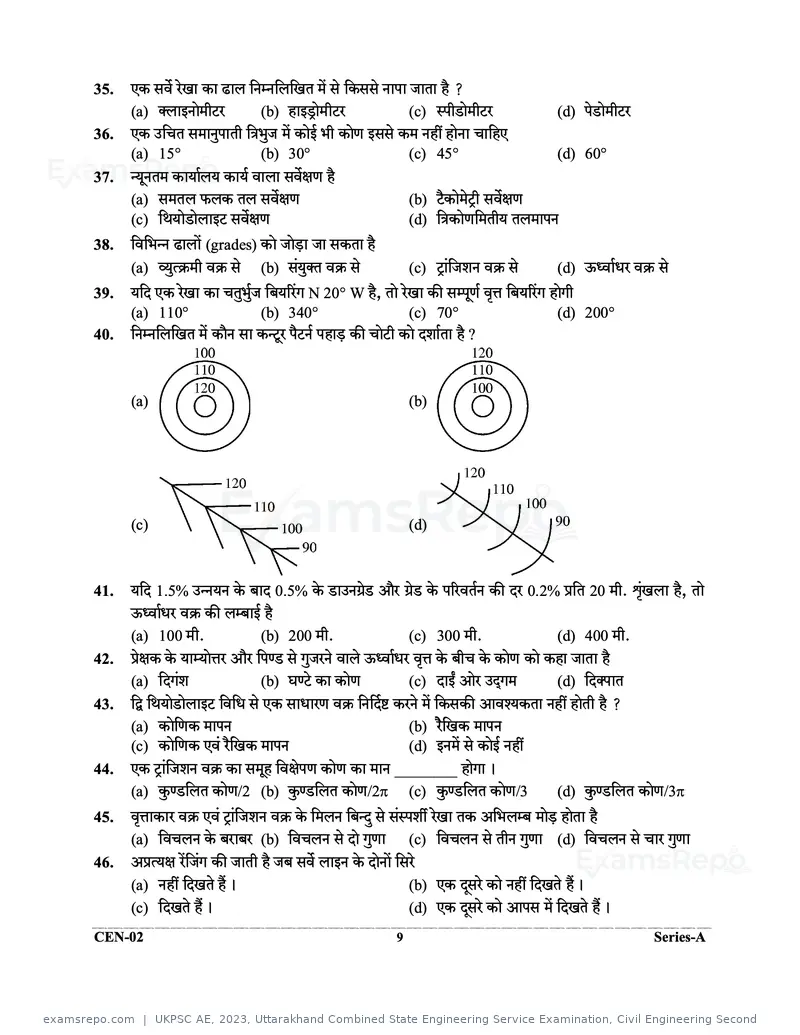
Text of page 9
35. ?
(a) (b) (c) (d)
36.
(a) 15 (b) 30 (c) 45 (d) 60
37.
(a) (b)
(c) (d)
38. (grades)
(a) (b) (c) (d)
39. N 20 W ,
(a) 110 (b) 340 (c) 70 (d) 200
40. ?
(a) (b)
(c) (d)
41. 1.5% 0.5% 0.2% 20 . ,
(a) 100 . (b) 200 . (c) 300 . (d) 400 .
42.
(a) (b) (c) (d)
43. ?
(a) (b)
(c) (d)
44. ________
(a) /2 (b) /2 (c) /3 (d) /3
45.
(a) (b) (c) (d)
46.
(a) (b)
(c) (d)
CEN-02 9 Series-A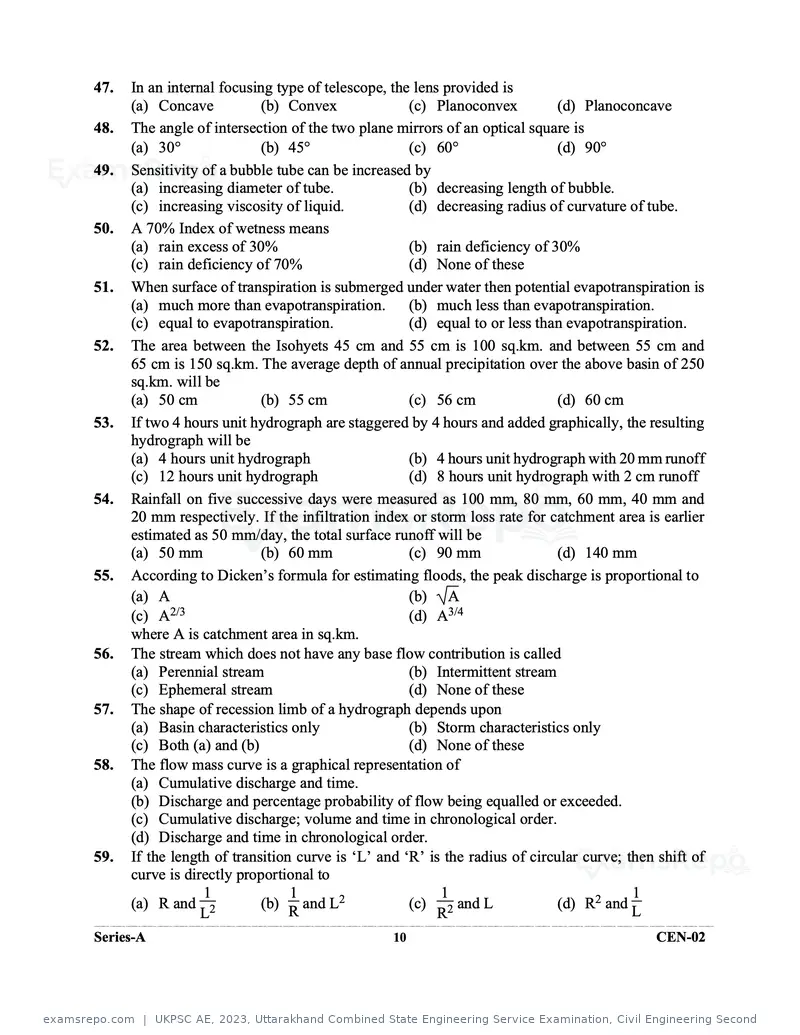
Text of page 10
47. In an internal focusing type of telescope, the lens provided is
(a) Concave (b) Convex (c) Planoconvex (d) Planoconcave
48. The angle of intersection of the two plane mirrors of an optical square is
(a) 30 (b) 45 (c) 60 (d) 90
49. Sensitivity of a bubble tube can be increased by
(a) increasing diameter of tube. (b) decreasing length of bubble.
(c) increasing viscosity of liquid. (d) decreasing radius of curvature of tube.
50. A 70% Index of wetness means
(a) rain excess of 30% (b) rain deficiency of 30%
(c) rain deficiency of 70% (d) None of these
51. When surface of transpiration is submerged under water then potential evapotranspiration is
(a) much more than evapotranspiration. (b) much less than evapotranspiration.
(c) equal to evapotranspiration. (d) equal to or less than evapotranspiration.
52. The area between the Isohyets 45 cm and 55 cm is 100 sq.km. and between 55 cm and
65 cm is 150 sq.km. The average depth of annual precipitation over the above basin of 250
sq.km. will be
(a) 50 cm (b) 55 cm (c) 56 cm (d) 60 cm
53. If two 4 hours unit hydrograph are staggered by 4 hours and added graphically, the resulting
hydrograph will be
(a) 4 hours unit hydrograph (b) 4 hours unit hydrograph with 20 mm runoff
(c) 12 hours unit hydrograph (d) 8 hours unit hydrograph with 2 cm runoff
54. Rainfall on five successive days were measured as 100 mm, 80 mm, 60 mm, 40 mm and
20 mm respectively. If the infiltration index or storm loss rate for catchment area is earlier
estimated as 50 mm/day, the total surface runoff will be
(a) 50 mm (b) 60 mm (c) 90 mm (d) 140 mm
55. According to Dicken’s formula for estimating floods, the peak discharge is proportional to
(a) A (b) A
(c) A2/3 (d) A3/4
where A is catchment area in sq.km.
56. The stream which does not have any base flow contribution is called
(a) Perennial stream (b) Intermittent stream
(c) Ephemeral stream (d) None of these
57. The shape of recession limb of a hydrograph depends upon
(a) Basin characteristics only (b) Storm characteristics only
(c) Both (a) and (b) (d) None of these
58. The flow mass curve is a graphical representation of
(a) Cumulative discharge and time.
(b) Discharge and percentage probability of flow being equalled or exceeded.
(c) Cumulative discharge; volume and time in chronological order.
(d) Discharge and time in chronological order.
59. If the length of transition curve is ‘L’ and ‘R’ is the radius of circular curve; then shift of
curve is directly proportional to
1 1 1 1
(a) R and 2 (b) and L2 (c) 2 and L (d) R2 and
L R R L
Series-A 10 CEN-02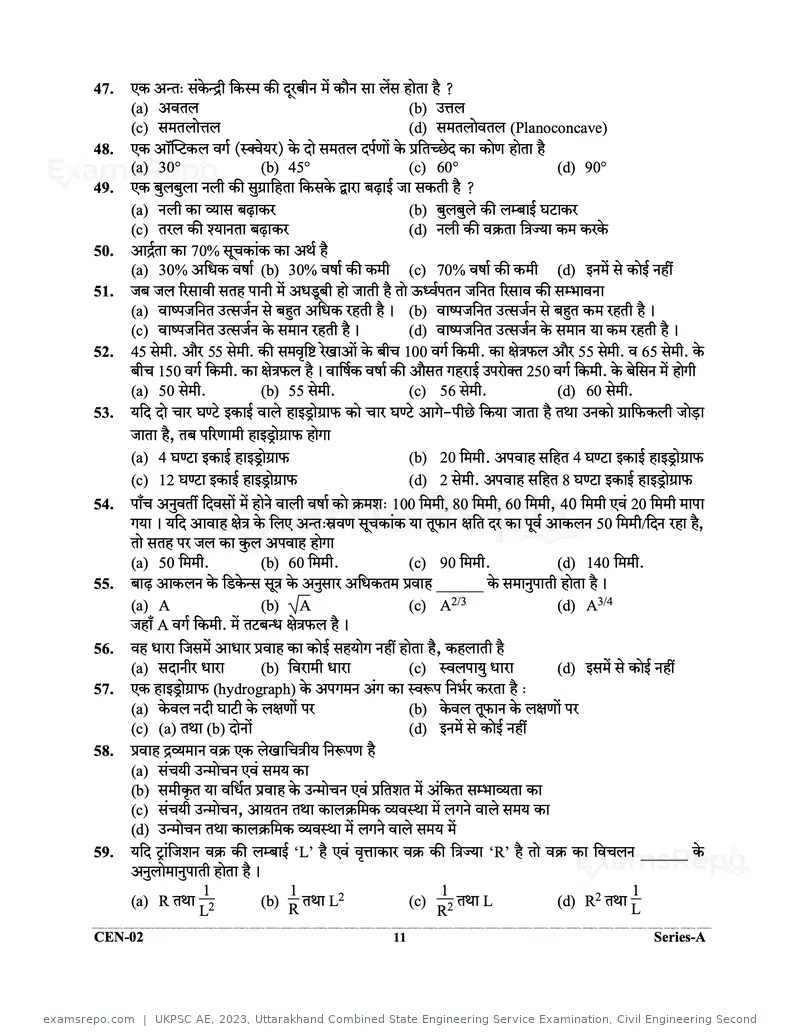
Text of page 11
47. ?
(a) (b)
(c) (d) (Planoconcave)
48. ()
(a) 30 (b) 45 (c) 60 (d) 90
49. ?
(a) (b)
(c) (d)
50. 70%
(a) 30% (b) 30% (c) 70% (d)
51.
(a) (b)
(c) (d)
52. 45 . 55 . 100 . 55 . 65 .
150 . 250 .
(a) 50 . (b) 55 . (c) 56 . (d) 60 .
53. -
,
(a) 4 (b) 20 . 4
(c) 12 (d) 2 . 8
54. 100 , 80 , 60 , 40 20
50 / ,
(a) 50 . (b) 60 . (c) 90 . (d) 140 .
55. ______
(a) A (b) A (c) A2/3 (d) A3/4
A .
56. ,
(a) (b) (c) (d)
57. (hydrograph)
(a) (b)
(c) (a) (b) (d)
58.
(a)
(b)
(c) ,
(d)
59. ‘L’ ‘R’ ______
1 1 1 1
(a) R 2 (b) L2 (c) 2 L (d) R2
L R R L
CEN-02 11 Series-A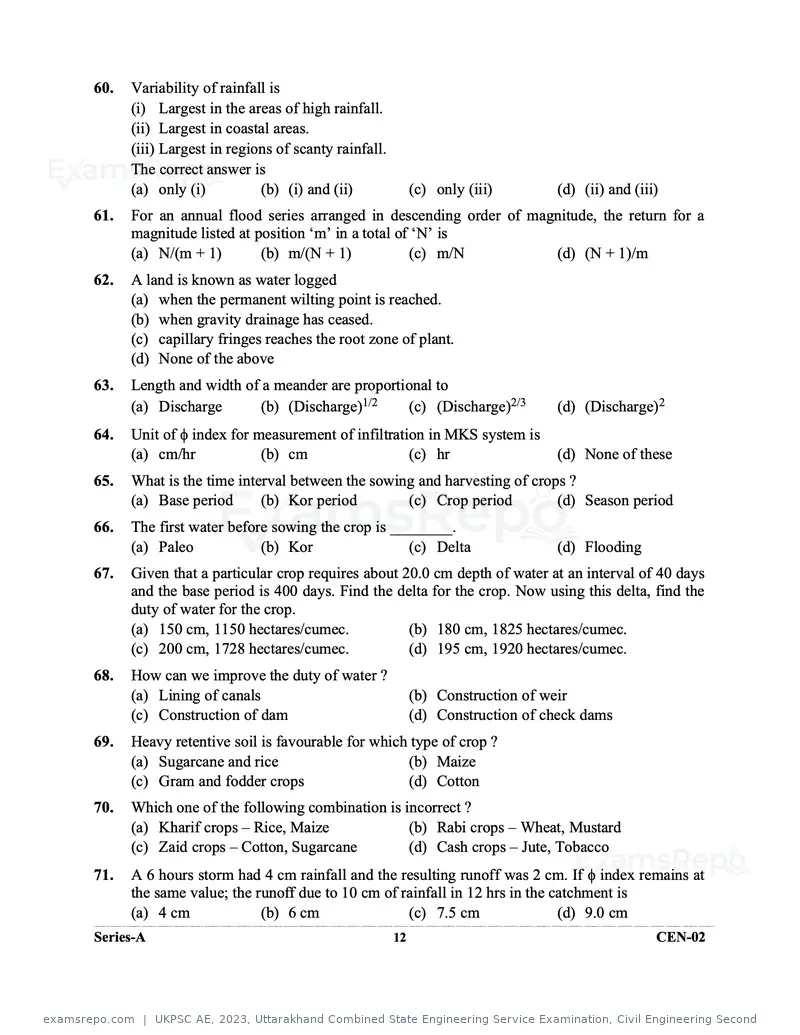
Text of page 12
60. Variability of rainfall is
(i) Largest in the areas of high rainfall.
(ii) Largest in coastal areas.
(iii) Largest in regions of scanty rainfall.
The correct answer is
(a) only (i) (b) (i) and (ii) (c) only (iii) (d) (ii) and (iii)
61. For an annual flood series arranged in descending order of magnitude, the return for a
magnitude listed at position ‘m’ in a total of ‘N’ is
(a) N/(m + 1) (b) m/(N + 1) (c) m/N (d) (N + 1)/m
62. A land is known as water logged
(a) when the permanent wilting point is reached.
(b) when gravity drainage has ceased.
(c) capillary fringes reaches the root zone of plant.
(d) None of the above
63. Length and width of a meander are proportional to
(a) Discharge (b) (Discharge)1/2 (c) (Discharge)2/3 (d) (Discharge)2
64. Unit of index for measurement of infiltration in MKS system is
(a) cm/hr (b) cm (c) hr (d) None of these
65. What is the time interval between the sowing and harvesting of crops ?
(a) Base period (b) Kor period (c) Crop period (d) Season period
66. The first water before sowing the crop is ________.
(a) Paleo (b) Kor (c) Delta (d) Flooding
67. Given that a particular crop requires about 20.0 cm depth of water at an interval of 40 days
and the base period is 400 days. Find the delta for the crop. Now using this delta, find the
duty of water for the crop.
(a) 150 cm, 1150 hectares/cumec. (b) 180 cm, 1825 hectares/cumec.
(c) 200 cm, 1728 hectares/cumec. (d) 195 cm, 1920 hectares/cumec.
68. How can we improve the duty of water ?
(a) Lining of canals (b) Construction of weir
(c) Construction of dam (d) Construction of check dams
69. Heavy retentive soil is favourable for which type of crop ?
(a) Sugarcane and rice (b) Maize
(c) Gram and fodder crops (d) Cotton
70. Which one of the following combination is incorrect ?
(a) Kharif crops – Rice, Maize (b) Rabi crops – Wheat, Mustard
(c) Zaid crops – Cotton, Sugarcane (d) Cash crops – Jute, Tobacco
71. A 6 hours storm had 4 cm rainfall and the resulting runoff was 2 cm. If index remains at
the same value; the runoff due to 10 cm of rainfall in 12 hrs in the catchment is
(a) 4 cm (b) 6 cm (c) 7.5 cm (d) 9.0 cm
Series-A 12 CEN-02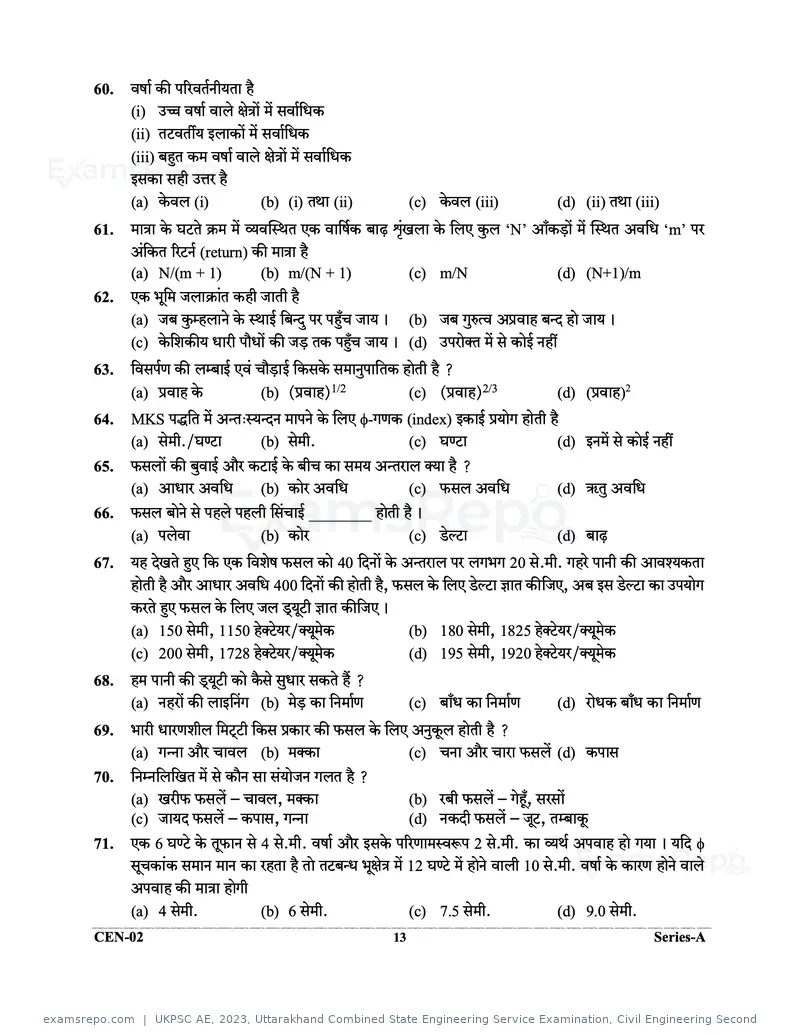
Text of page 13
60.
(i)
(ii)
(iii)
(a) (i) (b) (i) (ii) (c) (iii) (d) (ii) (iii)
61. ‘N’ ‘m’
(return)
(a) N/(m + 1) (b) m/(N + 1) (c) m/N (d) (N+1)/m
62.
(a) (b)
(c) (d)
63. ?
(a) (b) ()1/2 (c) ()2/3 (d) ()2
64. MKS - (index)
(a) ./ (b) . (c) (d)
65. ?
(a) (b) (c) (d)
66. ________
(a) (b) (c) (d)
67. 40 20 ..
400 , ,
(a) 150 , 1150 / (b) 180 , 1825 /
(c) 200 , 1728 / (d) 195 , 1920 /
68. ?
(a) (b) (c) (d)
69. ?
(a) (b) (c) (d)
70. ?
(a) – , (b) – ,
(c) – , (d) – ,
71. 6 4 .. 2 ..
12 10 ..
(a) 4 . (b) 6 . (c) 7.5 . (d) 9.0 .
CEN-02 13 Series-A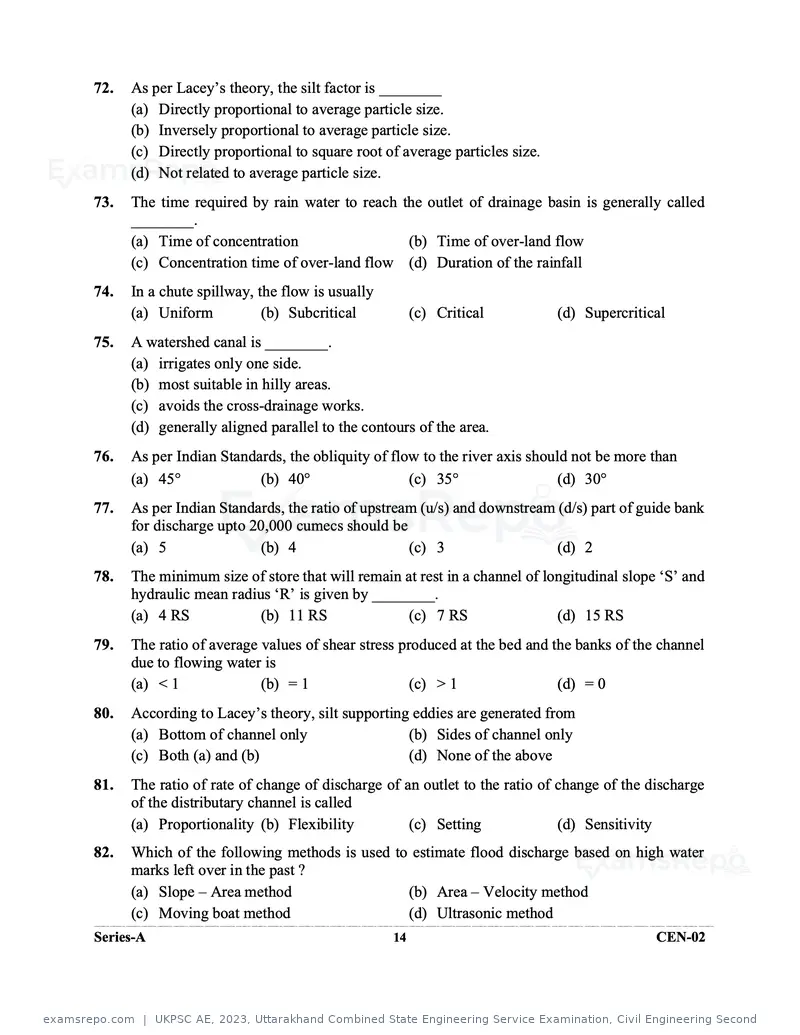
Text of page 14
72. As per Lacey’s theory, the silt factor is ________
(a) Directly proportional to average particle size.
(b) Inversely proportional to average particle size.
(c) Directly proportional to square root of average particles size.
(d) Not related to average particle size.
73. The time required by rain water to reach the outlet of drainage basin is generally called
________.
(a) Time of concentration (b) Time of over-land flow
(c) Concentration time of over-land flow (d) Duration of the rainfall
74. In a chute spillway, the flow is usually
(a) Uniform (b) Subcritical (c) Critical (d) Supercritical
75. A watershed canal is ________.
(a) irrigates only one side.
(b) most suitable in hilly areas.
(c) avoids the cross-drainage works.
(d) generally aligned parallel to the contours of the area.
76. As per Indian Standards, the obliquity of flow to the river axis should not be more than
(a) 45 (b) 40 (c) 35 (d) 30
77. As per Indian Standards, the ratio of upstream (u/s) and downstream (d/s) part of guide bank
for discharge upto 20,000 cumecs should be
(a) 5 (b) 4 (c) 3 (d) 2
78. The minimum size of store that will remain at rest in a channel of longitudinal slope ‘S’ and
hydraulic mean radius ‘R’ is given by ________.
(a) 4 RS (b) 11 RS (c) 7 RS (d) 15 RS
79. The ratio of average values of shear stress produced at the bed and the banks of the channel
due to flowing water is
(a) < 1 (b) = 1 (c) > 1 (d) = 0
80. According to Lacey’s theory, silt supporting eddies are generated from
(a) Bottom of channel only (b) Sides of channel only
(c) Both (a) and (b) (d) None of the above
81. The ratio of rate of change of discharge of an outlet to the ratio of change of the discharge
of the distributary channel is called
(a) Proportionality (b) Flexibility (c) Setting (d) Sensitivity
82. Which of the following methods is used to estimate flood discharge based on high water
marks left over in the past ?
(a) Slope – Area method (b) Area – Velocity method
(c) Moving boat method (d) Ultrasonic method
Series-A 14 CEN-02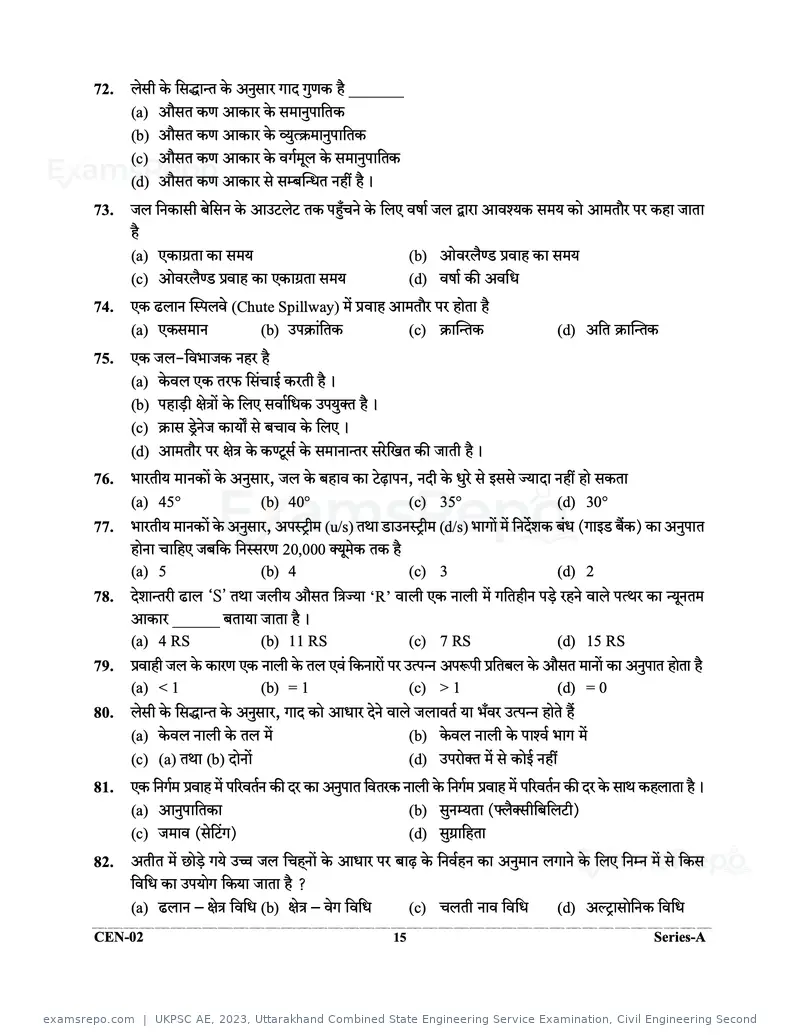
Text of page 15
72. _______
(a)
(b)
(c)
(d)
73.
(a) (b)
(c) (d)
74. (Chute Spillway)
(a) (b) (c) (d)
75. -
(a)
(b)
(c)
(d)
76. , ,
(a) 45 (b) 40 (c) 35 (d) 30
77. , (u/s) (d/s) ( )
20,000
(a) 5 (b) 4 (c) 3 (d) 2
78. ‘S’ ‘R’
______
(a) 4 RS (b) 11 RS (c) 7 RS (d) 15 RS
79.
(a) < 1 (b) = 1 (c) > 1 (d) = 0
80. ,
(a) (b)
(c) (a) (b) (d)
81.
(a) (b) ()
(c) () (d)
82.
?
(a) – (b) – (c) (d)
CEN-02 15 Series-A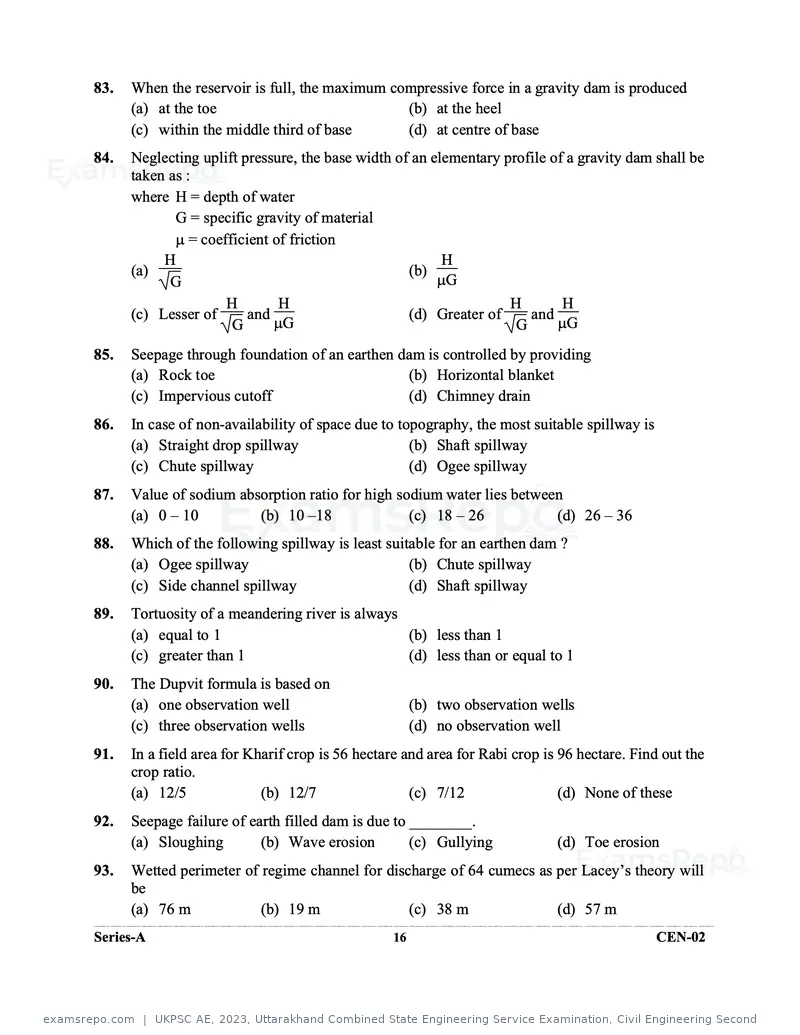
Text of page 16
83. When the reservoir is full, the maximum compressive force in a gravity dam is produced
(a) at the toe (b) at the heel
(c) within the middle third of base (d) at centre of base
84. Neglecting uplift pressure, the base width of an elementary profile of a gravity dam shall be
taken as :
where H = depth of water
G = specific gravity of material
= coefficient of friction
H H
(a) (b)
G G
H H H H
(c) Lesser of and (d) Greater of and
G G G G
85. Seepage through foundation of an earthen dam is controlled by providing
(a) Rock toe (b) Horizontal blanket
(c) Impervious cutoff (d) Chimney drain
86. In case of non-availability of space due to topography, the most suitable spillway is
(a) Straight drop spillway (b) Shaft spillway
(c) Chute spillway (d) Ogee spillway
87. Value of sodium absorption ratio for high sodium water lies between
(a) 0 – 10 (b) 10 –18 (c) 18 – 26 (d) 26 – 36
88. Which of the following spillway is least suitable for an earthen dam ?
(a) Ogee spillway (b) Chute spillway
(c) Side channel spillway (d) Shaft spillway
89. Tortuosity of a meandering river is always
(a) equal to 1 (b) less than 1
(c) greater than 1 (d) less than or equal to 1
90. The Dupvit formula is based on
(a) one observation well (b) two observation wells
(c) three observation wells (d) no observation well
91. In a field area for Kharif crop is 56 hectare and area for Rabi crop is 96 hectare. Find out the
crop ratio.
(a) 12/5 (b) 12/7 (c) 7/12 (d) None of these
92. Seepage failure of earth filled dam is due to ________.
(a) Sloughing (b) Wave erosion (c) Gullying (d) Toe erosion
93. Wetted perimeter of regime channel for discharge of 64 cumecs as per Lacey’s theory will
be
(a) 76 m (b) 19 m (c) 38 m (d) 57 m
Series-A 16 CEN-02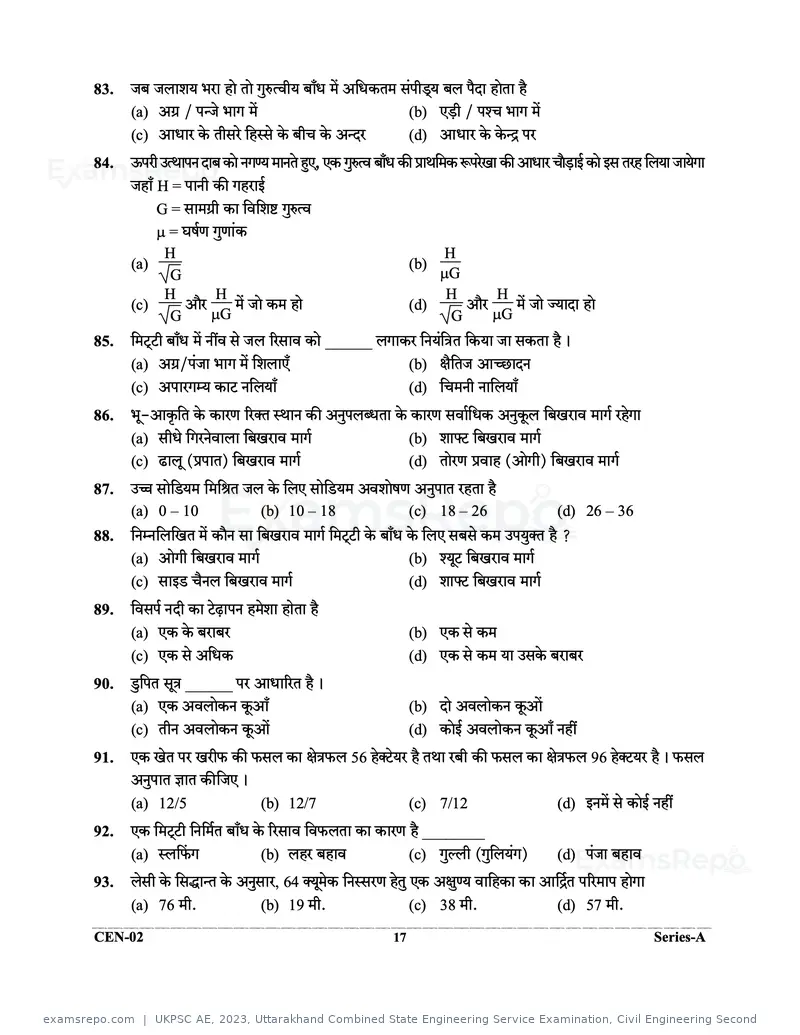
Text of page 17
83.
(a) / (b) /
(c) (d)
84. ,
H =
G =
=
H H
(a) (b)
G G
H H H H
(c) G (d) G
G G
85. ______
(a) / (b)
(c) (d)
86. -
(a) (b)
(c) () (d) ()
87.
(a) 0 – 10 (b) 10 – 18 (c) 18 – 26 (d) 26 – 36
88. ?
(a) (b)
(c) (d)
89.
(a) (b)
(c) (d)
90. ______
(a) (b)
(c) (d)
91. 56 96
(a) 12/5 (b) 12/7 (c) 7/12 (d)
92. ________
(a) (b) (c) () (d)
93. , 64
(a) 76 . (b) 19 . (c) 38 . (d) 57 .
CEN-02 17 Series-A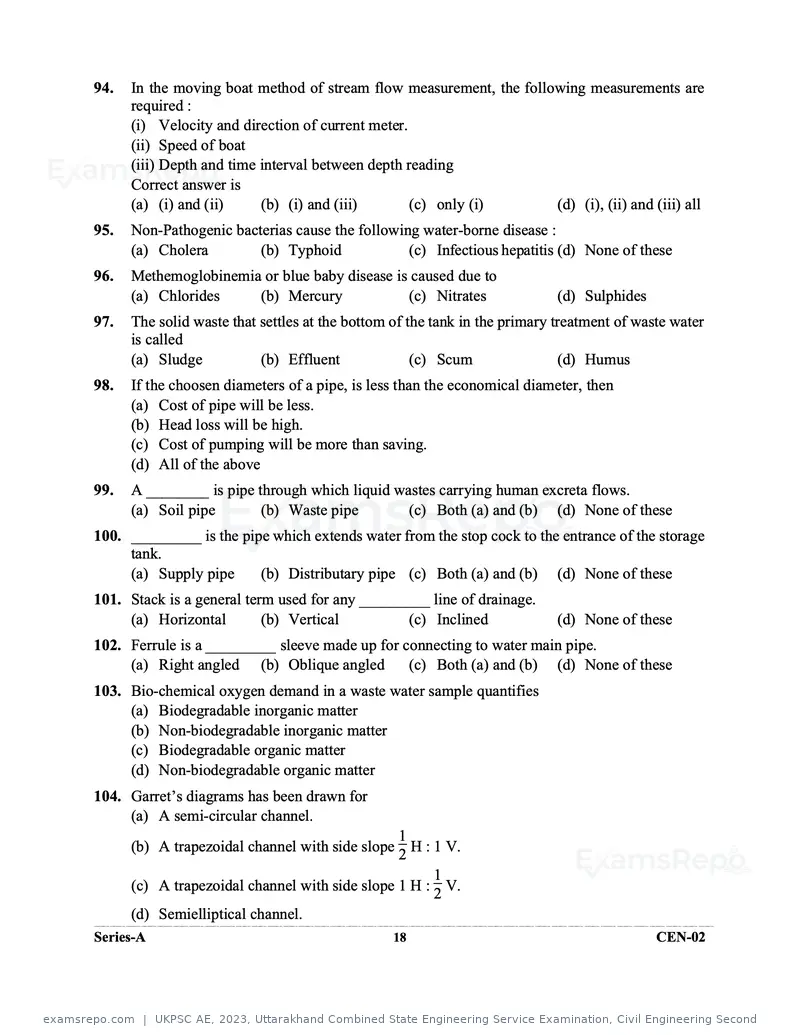
Text of page 18
94.   In the moving boat method of stream flow measurement, the following measurements are
      required :
      (i) Velocity and direction of current meter.
      (ii) Speed of boat
      (iii) Depth and time interval between depth reading
      Correct answer is
      (a) (i) and (ii)     (b) (i) and (iii)       (c) only (i)      (d) (i), (ii) and (iii) all
95.   Non-Pathogenic bacterias cause the following water-borne disease :
      (a) Cholera        (b) Typhoid             (c) Infectious hepatitis (d) None of these
96.   Methemoglobinemia or blue baby disease is caused due to
      (a) Chlorides    (b) Mercury             (c) Nitrates                (d) Sulphides
97.   The solid waste that settles at the bottom of the tank in the primary treatment of waste water
      is called
      (a) Sludge           (b) Effluent              (c) Scum                (d) Humus
98.   If the choosen diameters of a pipe, is less than the economical diameter, then
      (a) Cost of pipe will be less.
      (b) Head loss will be high.
      (c) Cost of pumping will be more than saving.
      (d) All of the above
99.   A ________ is pipe through which liquid wastes carrying human excreta flows.
      (a) Soil pipe       (b) Waste pipe        (c) Both (a) and (b) (d) None of these
100. _________ is the pipe which extends water from the stop cock to the entrance of the storage
     tank.
     (a) Supply pipe     (b) Distributary pipe (c) Both (a) and (b) (d) None of these
101. Stack is a general term used for any _________ line of drainage.
     (a) Horizontal        (b) Vertical         (c) Inclined               (d) None of these
102. Ferrule is a _________ sleeve made up for connecting to water main pipe.
     (a) Right angled (b) Oblique angled        (c) Both (a) and (b) (d) None of these
103. Bio-chemical oxygen demand in a waste water sample quantifies
     (a) Biodegradable inorganic matter
     (b) Non-biodegradable inorganic matter
     (c) Biodegradable organic matter
     (d) Non-biodegradable organic matter
104. Garret’s diagrams has been drawn for
     (a) A semi-circular channel.
                                                1
      (b) A trapezoidal channel with side slope   H : 1 V.
                                                2
                                                      1
      (c) A trapezoidal channel with side slope 1 H : V.
                                                      2
      (d) Semielliptical channel.
Series-A                                         18                                         CEN-02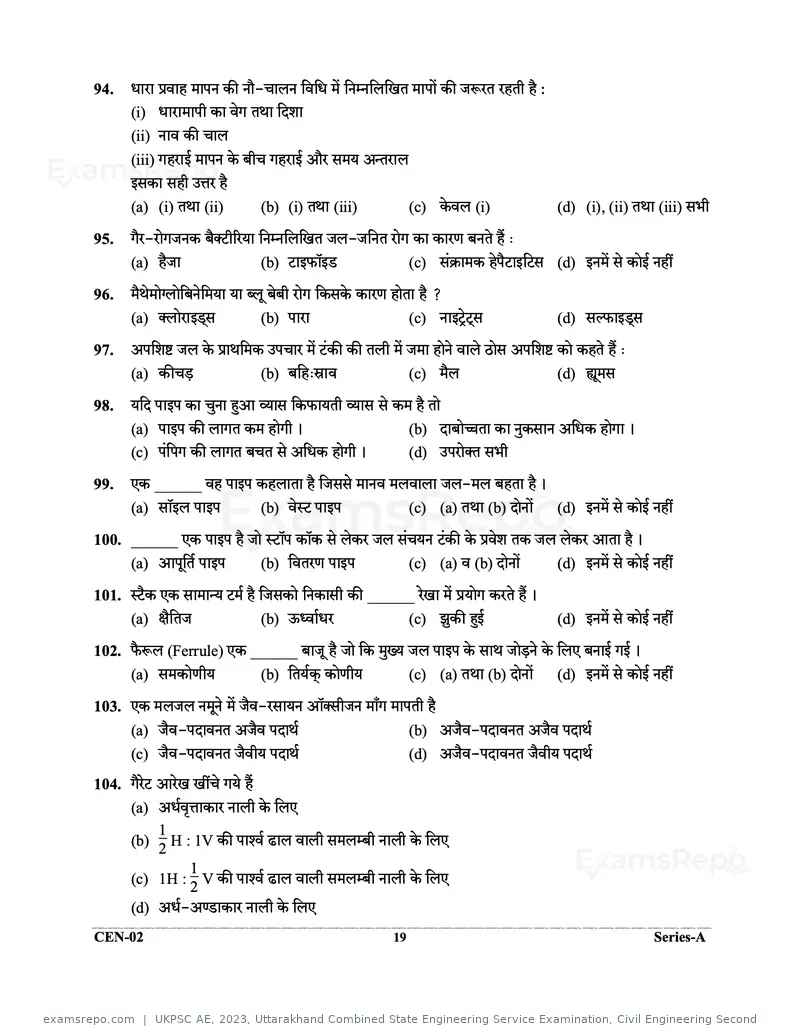
Text of page 19
94. - :
(i)
(ii)
(iii)
(a) (i) (ii) (b) (i) (iii) (c) (i) (d) (i), (ii) (iii)
95. - -
(a) (b) (c) (d)
96. ?
(a) (b) (c) (d)
97.
(a) (b) (c) (d)
98.
(a) (b)
(c) (d)
99. ______ -
(a) (b) (c) (a) (b) (d)
100. ______
(a) (b) (c) (a) (b) (d)
101. ______
(a) (b) (c) (d)
102. (Ferrule) ______
(a) (b) (c) (a) (b) (d)
103. -
(a) - (b) -
(c) - (d) -
104.
(a)
1
(b) H : 1V
2
1
(c) 1H : V
2
(d) -
CEN-02 19 Series-A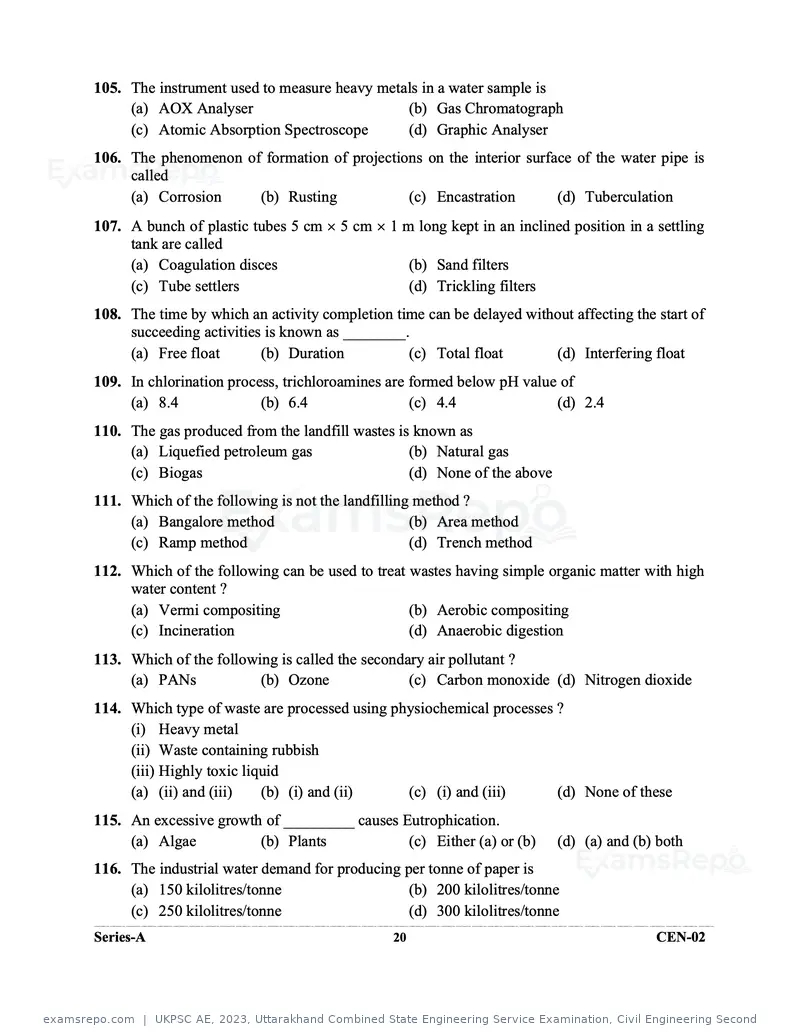
Text of page 20
105. The instrument used to measure heavy metals in a water sample is
(a) AOX Analyser (b) Gas Chromatograph
(c) Atomic Absorption Spectroscope (d) Graphic Analyser
106. The phenomenon of formation of projections on the interior surface of the water pipe is
called
(a) Corrosion (b) Rusting (c) Encastration (d) Tuberculation
107. A bunch of plastic tubes 5 cm 5 cm 1 m long kept in an inclined position in a settling
tank are called
(a) Coagulation disces (b) Sand filters
(c) Tube settlers (d) Trickling filters
108. The time by which an activity completion time can be delayed without affecting the start of
succeeding activities is known as ________.
(a) Free float (b) Duration (c) Total float (d) Interfering float
109. In chlorination process, trichloroamines are formed below pH value of
(a) 8.4 (b) 6.4 (c) 4.4 (d) 2.4
110. The gas produced from the landfill wastes is known as
(a) Liquefied petroleum gas (b) Natural gas
(c) Biogas (d) None of the above
111. Which of the following is not the landfilling method ?
(a) Bangalore method (b) Area method
(c) Ramp method (d) Trench method
112. Which of the following can be used to treat wastes having simple organic matter with high
water content ?
(a) Vermi compositing (b) Aerobic compositing
(c) Incineration (d) Anaerobic digestion
113. Which of the following is called the secondary air pollutant ?
(a) PANs (b) Ozone (c) Carbon monoxide (d) Nitrogen dioxide
114. Which type of waste are processed using physiochemical processes ?
(i) Heavy metal
(ii) Waste containing rubbish
(iii) Highly toxic liquid
(a) (ii) and (iii) (b) (i) and (ii) (c) (i) and (iii) (d) None of these
115. An excessive growth of _________ causes Eutrophication.
(a) Algae (b) Plants (c) Either (a) or (b) (d) (a) and (b) both
116. The industrial water demand for producing per tonne of paper is
(a) 150 kilolitres/tonne (b) 200 kilolitres/tonne
(c) 250 kilolitres/tonne (d) 300 kilolitres/tonne
Series-A 20 CEN-02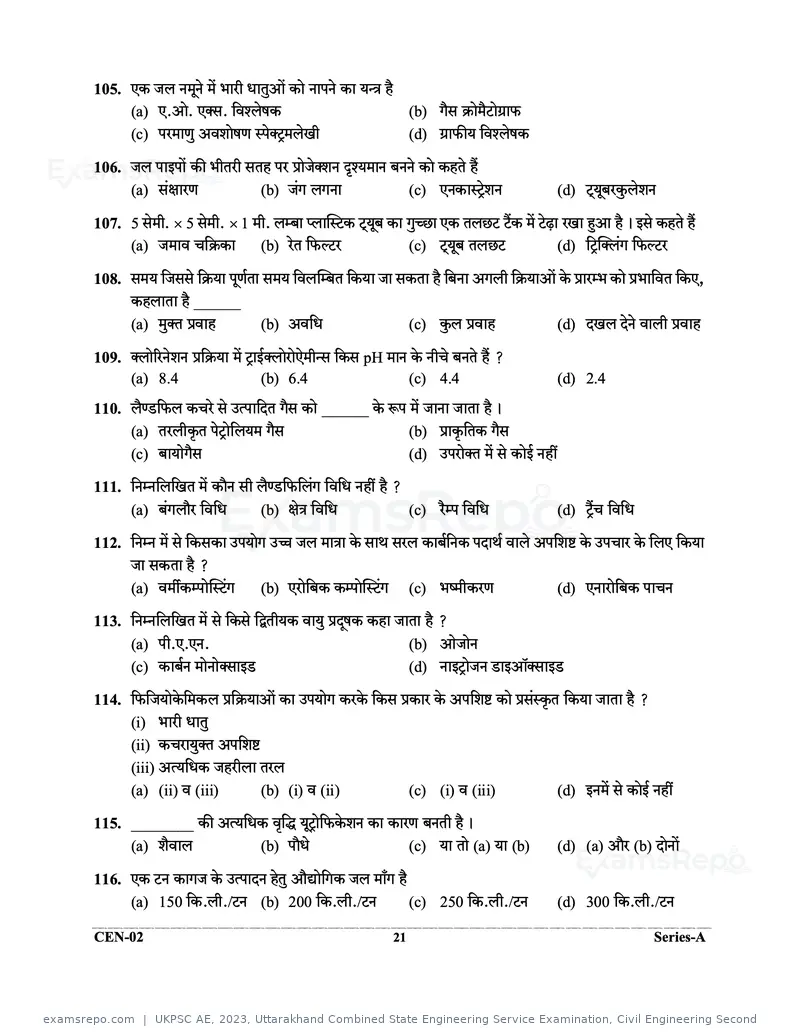
Text of page 21
105.
(a) .. . (b)
(c) (d)
106.
(a) (b) (c) (d)
107. 5 . 5 . 1 .
(a) (b) (c) (d)
108. ,
______
(a) (b) (c) (d)
109. pH ?
(a) 8.4 (b) 6.4 (c) 4.4 (d) 2.4
110. ______
(a) (b)
(c) (d)
111. ?
(a) (b) (c) (d)
112.
?
(a) (b) (c) (d)
113. ?
(a) ... (b)
(c) (d)
114. ?
(i)
(ii)
(iii)
(a) (ii) (iii) (b) (i) (ii) (c) (i) (iii) (d)
115. ________
(a) (b) (c) (a) (b) (d) (a) (b)
116.
(a) 150 ../ (b) 200 ../ (c) 250 ../ (d) 300 ../
CEN-02 21 Series-A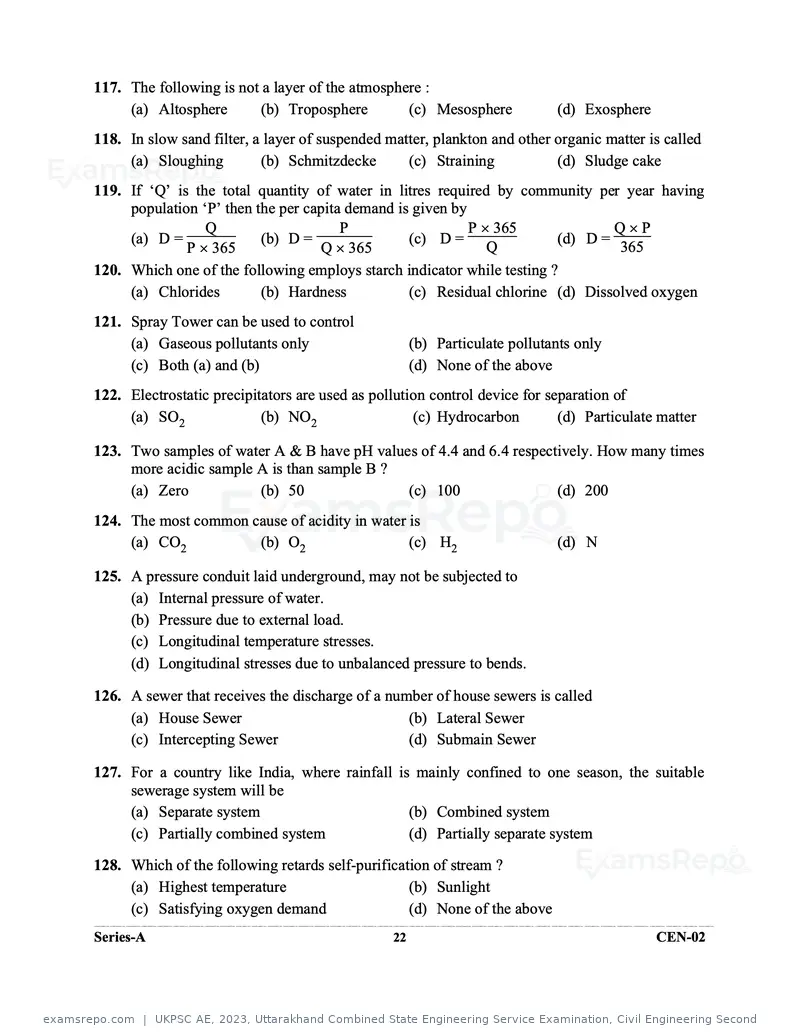
Text of page 22
117. The following is not a layer of the atmosphere :
(a) Altosphere (b) Troposphere (c) Mesosphere (d) Exosphere
118. In slow sand filter, a layer of suspended matter, plankton and other organic matter is called
(a) Sloughing (b) Schmitzdecke (c) Straining (d) Sludge cake
119. If ‘Q’ is the total quantity of water in litres required by community per year having
population ‘P’ then the per capita demand is given by
Q P P 365 QP
(a) D = (b) D = (c) D = (d) D =
P 365 Q 365 Q 365
120. Which one of the following employs starch indicator while testing ?
(a) Chlorides (b) Hardness (c) Residual chlorine (d) Dissolved oxygen
121. Spray Tower can be used to control
(a) Gaseous pollutants only (b) Particulate pollutants only
(c) Both (a) and (b) (d) None of the above
122. Electrostatic precipitators are used as pollution control device for separation of
(a) SO2 (b) NO2 (c) Hydrocarbon (d) Particulate matter
123. Two samples of water A & B have pH values of 4.4 and 6.4 respectively. How many times
more acidic sample A is than sample B ?
(a) Zero (b) 50 (c) 100 (d) 200
124. The most common cause of acidity in water is
(a) CO2 (b) O2 (c) H2 (d) N
125. A pressure conduit laid underground, may not be subjected to
(a) Internal pressure of water.
(b) Pressure due to external load.
(c) Longitudinal temperature stresses.
(d) Longitudinal stresses due to unbalanced pressure to bends.
126. A sewer that receives the discharge of a number of house sewers is called
(a) House Sewer (b) Lateral Sewer
(c) Intercepting Sewer (d) Submain Sewer
127. For a country like India, where rainfall is mainly confined to one season, the suitable
sewerage system will be
(a) Separate system (b) Combined system
(c) Partially combined system (d) Partially separate system
128. Which of the following retards self-purification of stream ?
(a) Highest temperature (b) Sunlight
(c) Satisfying oxygen demand (d) None of the above
Series-A 22 CEN-02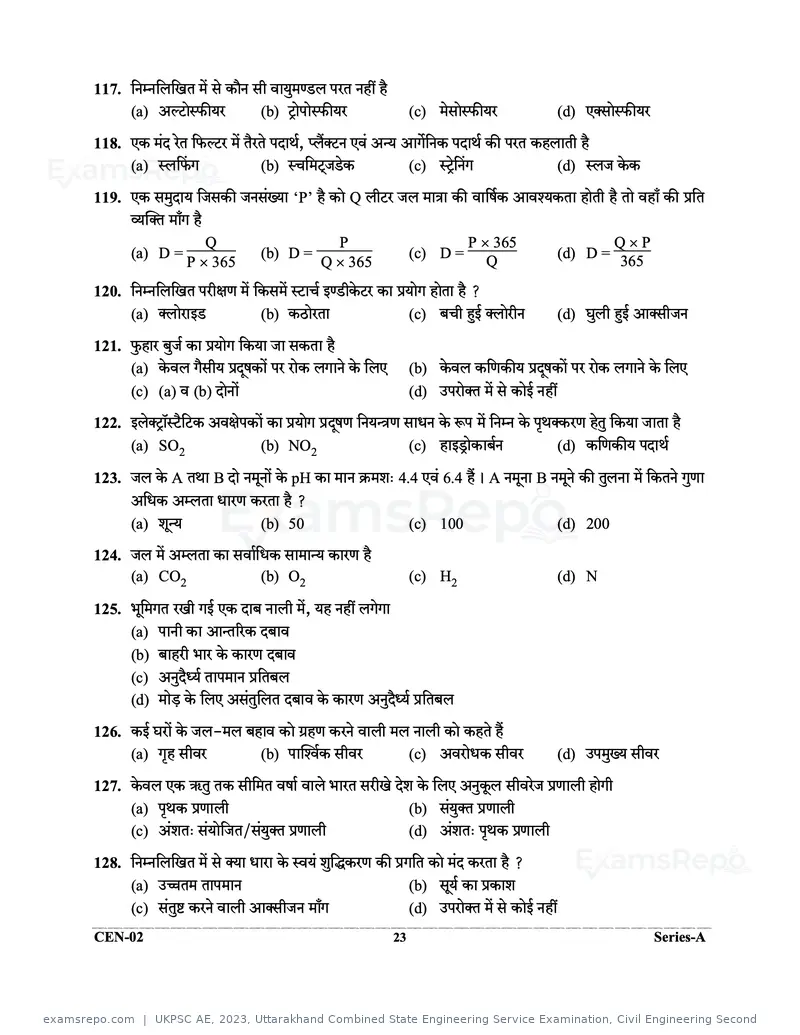
Text of page 23
117.
(a) (b) (c) (d)
118. ,
(a) (b) (c) (d)
119. ‘P’ Q
Q P P 365 QP
(a) D = (b) D = (c) D = (d) D =
P 365 Q 365 Q 365
120. ?
(a) (b) (c) (d)
121.
(a) (b)
(c) (a) (b) (d)
122.
(a) SO2 (b) NO2 (c) (d)
123. A B pH 4.4 6.4 A B
?
(a) (b) 50 (c) 100 (d) 200
124.
(a) CO2 (b) O2 (c) H2 (d) N
125. ,
(a)
(b)
(c)
(d)
126. -
(a) (b) (c) (d)
127.
(a) (b)
(c) / (d)
128. ?
(a) (b)
(c) (d)
CEN-02 23 Series-A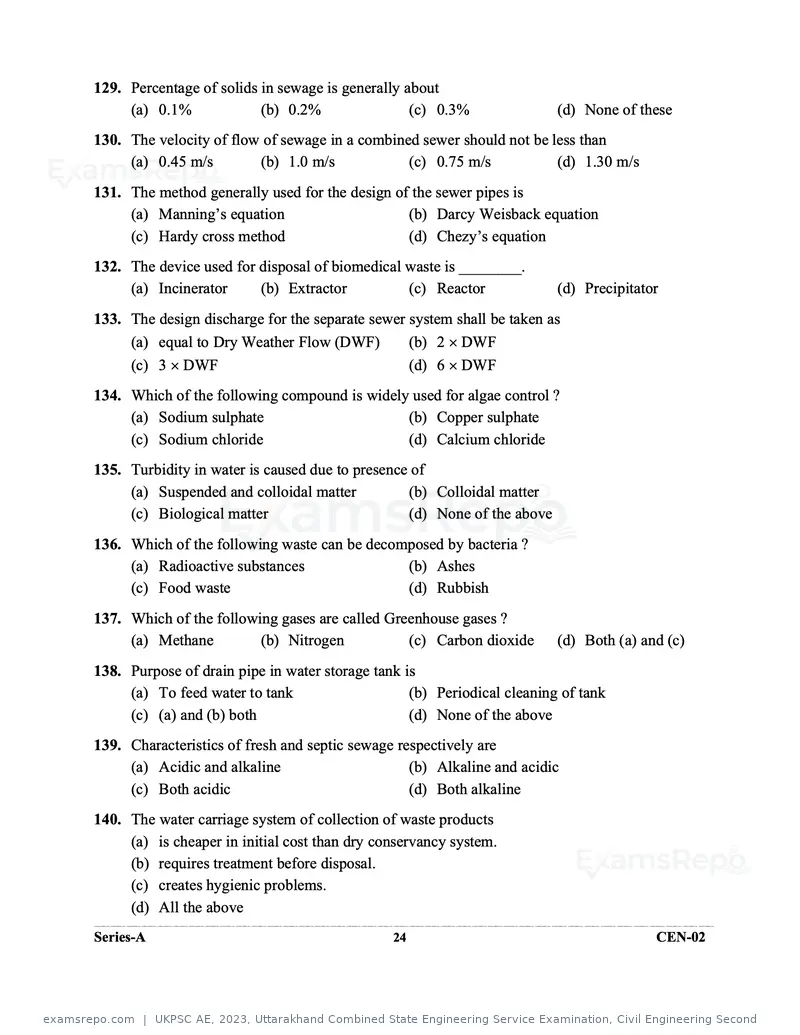
Text of page 24
129. Percentage of solids in sewage is generally about
(a) 0.1% (b) 0.2% (c) 0.3% (d) None of these
130. The velocity of flow of sewage in a combined sewer should not be less than
(a) 0.45 m/s (b) 1.0 m/s (c) 0.75 m/s (d) 1.30 m/s
131. The method generally used for the design of the sewer pipes is
(a) Manning’s equation (b) Darcy Weisback equation
(c) Hardy cross method (d) Chezy’s equation
132. The device used for disposal of biomedical waste is ________.
(a) Incinerator (b) Extractor (c) Reactor (d) Precipitator
133. The design discharge for the separate sewer system shall be taken as
(a) equal to Dry Weather Flow (DWF) (b) 2 DWF
(c) 3 DWF (d) 6 DWF
134. Which of the following compound is widely used for algae control ?
(a) Sodium sulphate (b) Copper sulphate
(c) Sodium chloride (d) Calcium chloride
135. Turbidity in water is caused due to presence of
(a) Suspended and colloidal matter (b) Colloidal matter
(c) Biological matter (d) None of the above
136. Which of the following waste can be decomposed by bacteria ?
(a) Radioactive substances (b) Ashes
(c) Food waste (d) Rubbish
137. Which of the following gases are called Greenhouse gases ?
(a) Methane (b) Nitrogen (c) Carbon dioxide (d) Both (a) and (c)
138. Purpose of drain pipe in water storage tank is
(a) To feed water to tank (b) Periodical cleaning of tank
(c) (a) and (b) both (d) None of the above
139. Characteristics of fresh and septic sewage respectively are
(a) Acidic and alkaline (b) Alkaline and acidic
(c) Both acidic (d) Both alkaline
140. The water carriage system of collection of waste products
(a) is cheaper in initial cost than dry conservancy system.
(b) requires treatment before disposal.
(c) creates hygienic problems.
(d) All the above
Series-A 24 CEN-02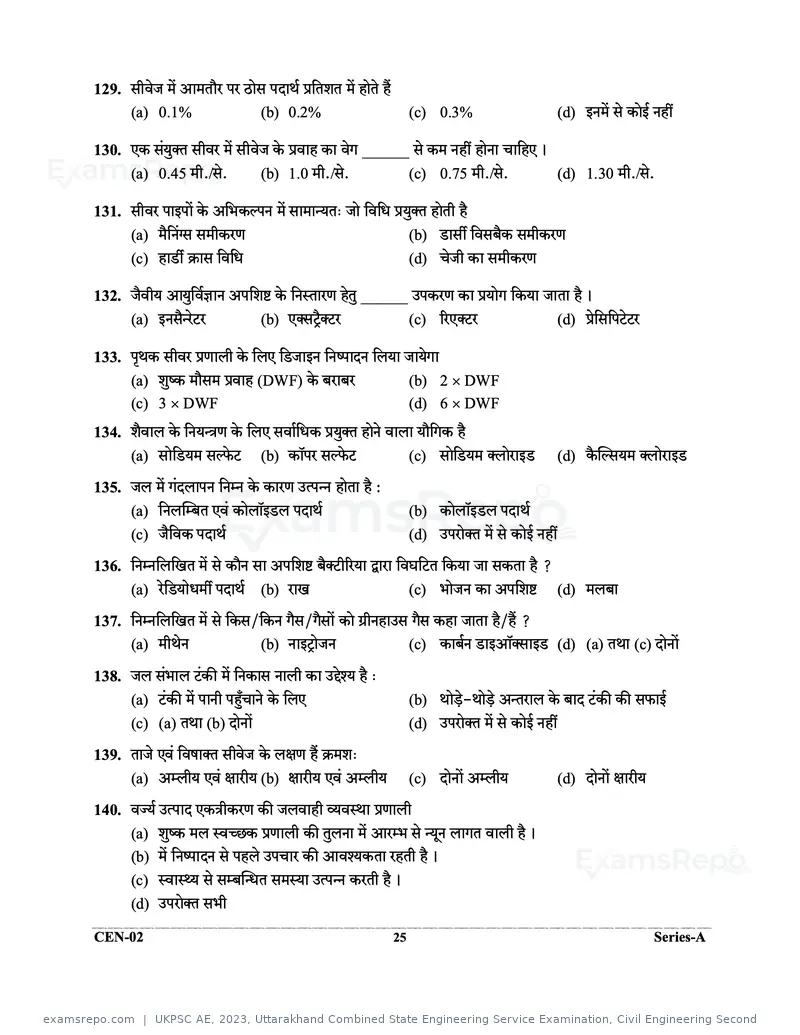
Text of page 25
129.
(a) 0.1% (b) 0.2% (c) 0.3% (d)
130. ______
(a) 0.45 ./. (b) 1.0 ./. (c) 0.75 ./. (d) 1.30 ./.
131.
(a) (b)
(c) (d)
132. ______
(a) (b) (c) (d)
133.
(a) (DWF) (b) 2 DWF
(c) 3 DWF (d) 6 DWF
134.
(a) (b) (c) (d)
135. :
(a) (b)
(c) (d)
136. ?
(a) (b) (c) (d)
137. / / / ?
(a) (b) (c) (d) (a) (c)
138.
(a) (b) -
(c) (a) (b) (d)
139.
(a) (b) (c) (d)
140.
(a)
(b)
(c)
(d)
CEN-02 25 Series-A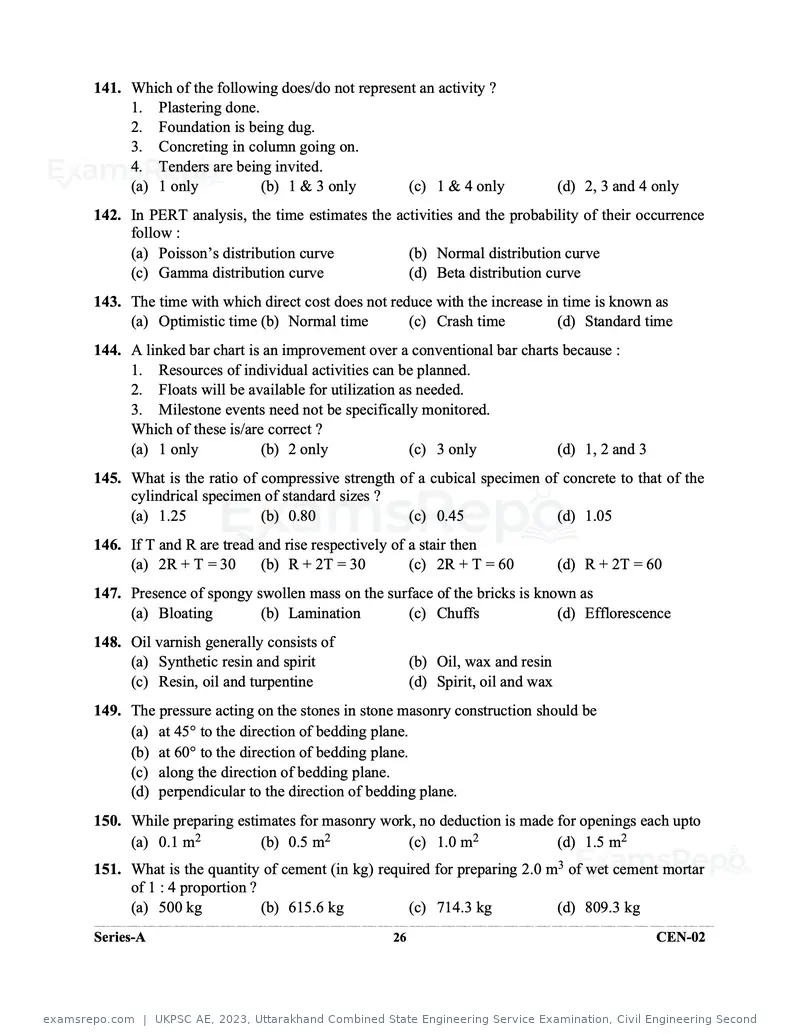
Text of page 26
141. Which of the following does/do not represent an activity ?
1. Plastering done.
2. Foundation is being dug.
3. Concreting in column going on.
4. Tenders are being invited.
(a) 1 only (b) 1 & 3 only (c) 1 & 4 only (d) 2, 3 and 4 only
142. In PERT analysis, the time estimates the activities and the probability of their occurrence
follow :
(a) Poisson’s distribution curve (b) Normal distribution curve
(c) Gamma distribution curve (d) Beta distribution curve
143. The time with which direct cost does not reduce with the increase in time is known as
(a) Optimistic time (b) Normal time (c) Crash time (d) Standard time
144. A linked bar chart is an improvement over a conventional bar charts because :
1. Resources of individual activities can be planned.
2. Floats will be available for utilization as needed.
3. Milestone events need not be specifically monitored.
Which of these is/are correct ?
(a) 1 only (b) 2 only (c) 3 only (d) 1, 2 and 3
145. What is the ratio of compressive strength of a cubical specimen of concrete to that of the
cylindrical specimen of standard sizes ?
(a) 1.25 (b) 0.80 (c) 0.45 (d) 1.05
146. If T and R are tread and rise respectively of a stair then
(a) 2R + T = 30 (b) R + 2T = 30 (c) 2R + T = 60 (d) R + 2T = 60
147. Presence of spongy swollen mass on the surface of the bricks is known as
(a) Bloating (b) Lamination (c) Chuffs (d) Efflorescence
148. Oil varnish generally consists of
(a) Synthetic resin and spirit (b) Oil, wax and resin
(c) Resin, oil and turpentine (d) Spirit, oil and wax
149. The pressure acting on the stones in stone masonry construction should be
(a) at 45 to the direction of bedding plane.
(b) at 60 to the direction of bedding plane.
(c) along the direction of bedding plane.
(d) perpendicular to the direction of bedding plane.
150. While preparing estimates for masonry work, no deduction is made for openings each upto
(a) 0.1 m2 (b) 0.5 m2 (c) 1.0 m2 (d) 1.5 m2
151. What is the quantity of cement (in kg) required for preparing 2.0 m3 of wet cement mortar
of 1 : 4 proportion ?
(a) 500 kg (b) 615.6 kg (c) 714.3 kg (d) 809.3 kg
Series-A 26 CEN-02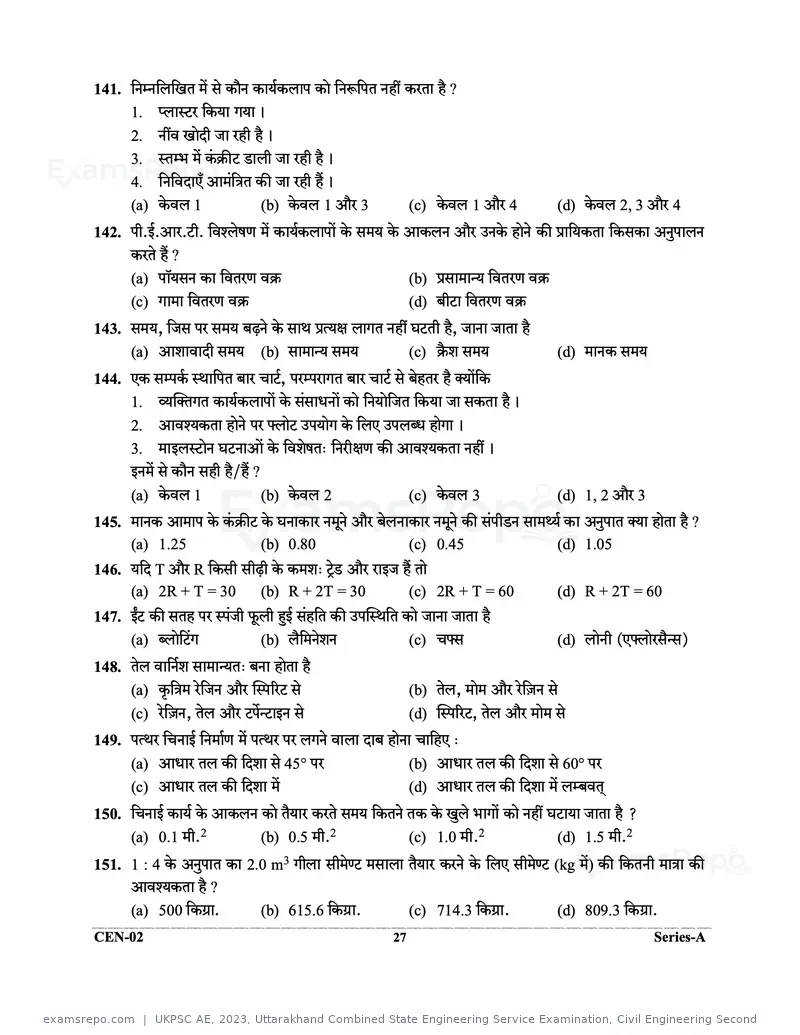
Text of page 27
141. ?
1.
2.
3.
4.
(a) 1 (b) 1 3 (c) 1 4 (d) 2, 3 4
142. ....
?
(a) (b)
(c) (d)
143. , ,
(a) (b) (c) (d)
144. ,
1.
2.
3.
/ ?
(a) 1 (b) 2 (c) 3 (d) 1, 2 3
145. ?
(a) 1.25 (b) 0.80 (c) 0.45 (d) 1.05
146. T R
(a) 2R + T = 30 (b) R + 2T = 30 (c) 2R + T = 60 (d) R + 2T = 60
147.
(a) (b) (c) (d) ()
148.
(a) (b) ,
(c) , (d) ,
149.
(a) 45 (b) 60
(c) (d)
150. ?
(a) 0.1 .2 (b) 0.5 .2 (c) 1.0 .2 (d) 1.5 .2
151. 1 : 4 2.0 m3 (kg )
?
(a) 500 . (b) 615.6 . (c) 714.3 . (d) 809.3 .
CEN-02 27 Series-A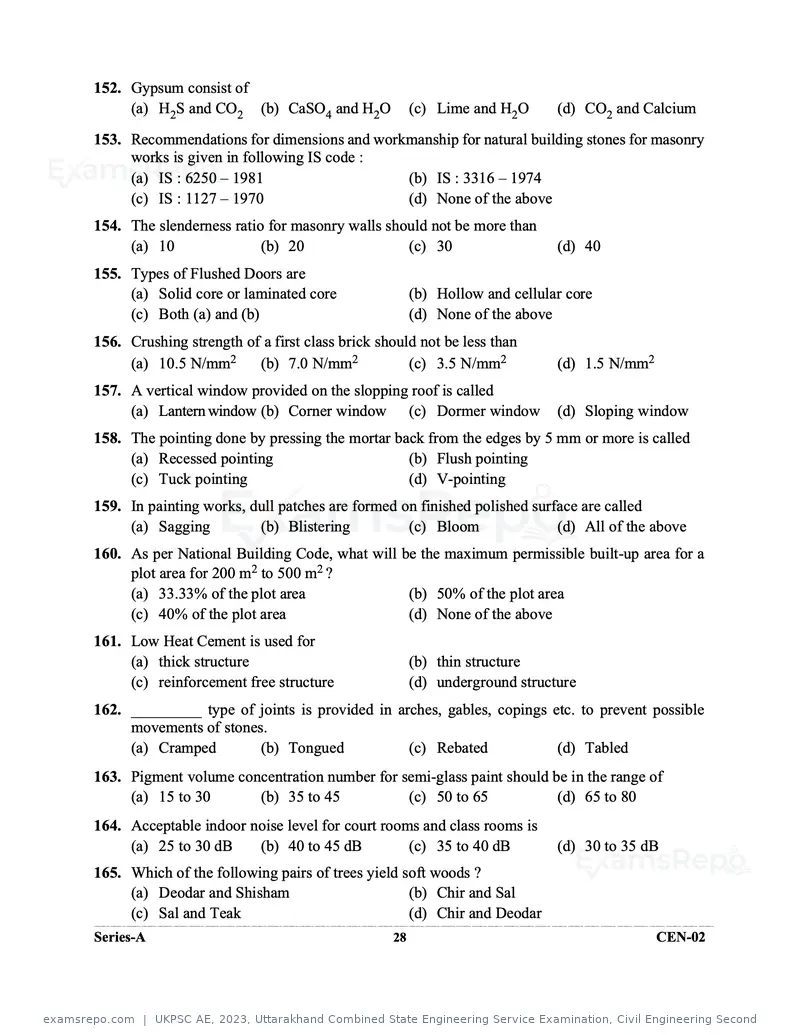
Text of page 28
152. Gypsum consist of
     (a) H2S and CO2 (b) CaSO4 and H2O               (c) Lime and H2O      (d) CO2 and Calcium

153. Recommendations for dimensions and workmanship for natural building stones for masonry
     works is given in following IS code :
     (a) IS : 6250 – 1981                   (b) IS : 3316 – 1974
     (c) IS : 1127 – 1970                   (d) None of the above
154. The slenderness ratio for masonry walls should not be more than
     (a) 10               (b) 20                (c) 30                     (d) 40
155. Types of Flushed Doors are
     (a) Solid core or laminated core                (b) Hollow and cellular core
     (c) Both (a) and (b)                            (d) None of the above
156. Crushing strength of a first class brick should not be less than
     (a) 10.5 N/mm2      (b) 7.0 N/mm2             (c) 3.5 N/mm2           (d) 1.5 N/mm2
157. A vertical window provided on the slopping roof is called
     (a) Lantern window (b) Corner window (c) Dormer window                (d) Sloping window
158. The pointing done by pressing the mortar back from the edges by 5 mm or more is called
     (a) Recessed pointing                      (b) Flush pointing
     (c) Tuck pointing                          (d) V-pointing
159. In painting works, dull patches are formed on finished polished surface are called
     (a) Sagging         (b) Blistering          (c) Bloom               (d) All of the above
160. As per National Building Code, what will be the maximum permissible built-up area for a
     plot area for 200 m2 to 500 m2 ?
     (a) 33.33% of the plot area               (b) 50% of the plot area
     (c) 40% of the plot area                  (d) None of the above
161. Low Heat Cement is used for
     (a) thick structure                             (b) thin structure
     (c) reinforcement free structure                (d) underground structure
162. _________ type of joints is provided in arches, gables, copings etc. to prevent possible
     movements of stones.
     (a) Cramped        (b) Tongued            (c) Rebated            (d) Tabled
163. Pigment volume concentration number for semi-glass paint should be in the range of
     (a) 15 to 30      (b) 35 to 45           (c) 50 to 65            (d) 65 to 80
164. Acceptable indoor noise level for court rooms and class rooms is
     (a) 25 to 30 dB    (b) 40 to 45 dB          (c) 35 to 40 dB           (d) 30 to 35 dB
165. Which of the following pairs of trees yield soft woods ?
     (a) Deodar and Shisham                       (b) Chir and Sal
     (c) Sal and Teak                             (d) Chir and Deodar
Series-A                                        28                                         CEN-02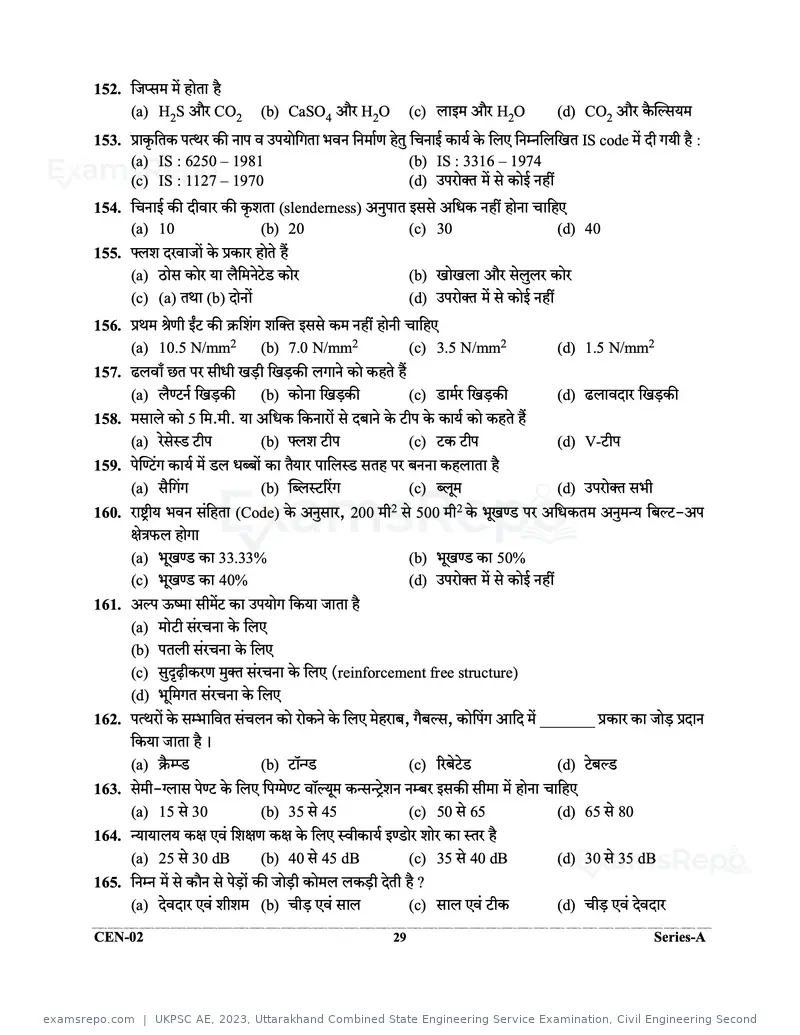
Text of page 30
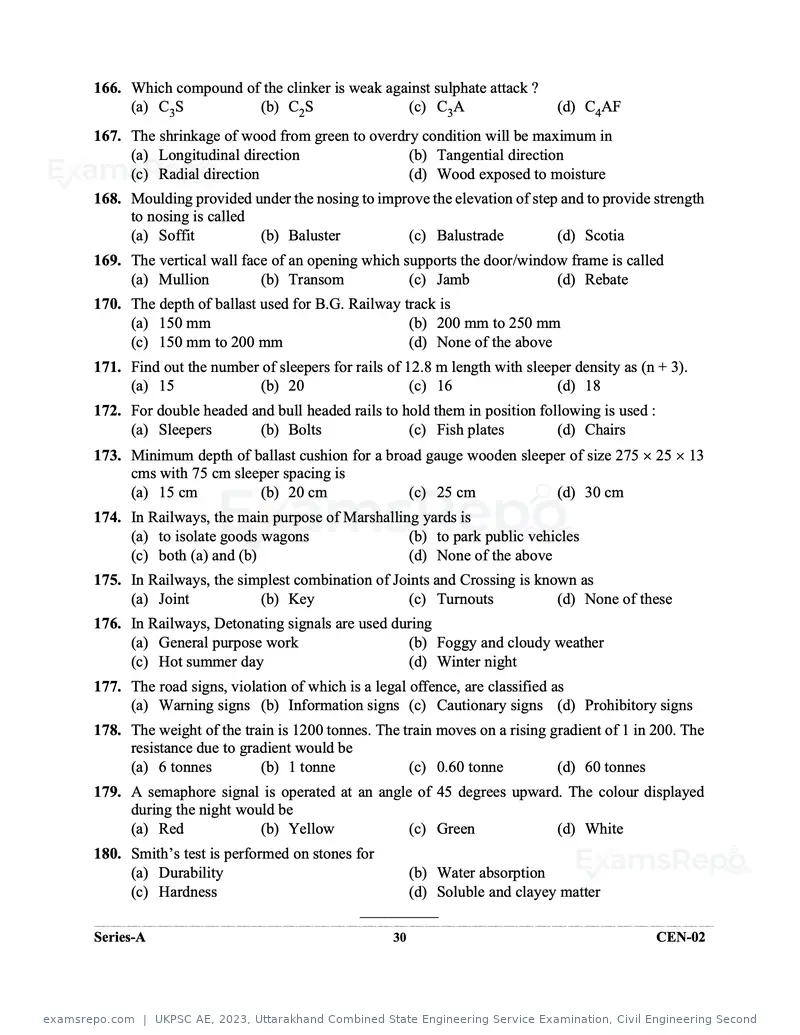
166. Which compound of the clinker is weak against sulphate attack ?
(a) C3S (b) C2S (c) C3A (d) C4AF
167. The shrinkage of wood from green to overdry condition will be maximum in
(a) Longitudinal direction (b) Tangential direction
(c) Radial direction (d) Wood exposed to moisture
168. Moulding provided under the nosing to improve the elevation of step and to provide strength
to nosing is called
(a) Soffit (b) Baluster (c) Balustrade (d) Scotia
169. The vertical wall face of an opening which supports the door/window frame is called
(a) Mullion (b) Transom (c) Jamb (d) Rebate
170. The depth of ballast used for B.G. Railway track is
(a) 150 mm (b) 200 mm to 250 mm
(c) 150 mm to 200 mm (d) None of the above
171. Find out the number of sleepers for rails of 12.8 m length with sleeper density as (n + 3).
(a) 15 (b) 20 (c) 16 (d) 18
172. For double headed and bull headed rails to hold them in position following is used :
(a) Sleepers (b) Bolts (c) Fish plates (d) Chairs
173. Minimum depth of ballast cushion for a broad gauge wooden sleeper of size 275 25 13
cms with 75 cm sleeper spacing is
(a) 15 cm (b) 20 cm (c) 25 cm (d) 30 cm
174. In Railways, the main purpose of Marshalling yards is
(a) to isolate goods wagons (b) to park public vehicles
(c) both (a) and (b) (d) None of the above
175. In Railways, the simplest combination of Joints and Crossing is known as
(a) Joint (b) Key (c) Turnouts (d) None of these
176. In Railways, Detonating signals are used during
(a) General purpose work (b) Foggy and cloudy weather
(c) Hot summer day (d) Winter night
177. The road signs, violation of which is a legal offence, are classified as
(a) Warning signs (b) Information signs (c) Cautionary signs (d) Prohibitory signs
178. The weight of the train is 1200 tonnes. The train moves on a rising gradient of 1 in 200. The
resistance due to gradient would be
(a) 6 tonnes (b) 1 tonne (c) 0.60 tonne (d) 60 tonnes
179. A semaphore signal is operated at an angle of 45 degrees upward. The colour displayed
during the night would be
(a) Red (b) Yellow (c) Green (d) White
180. Smith’s test is performed on stones for
(a) Durability (b) Water absorption
(c) Hardness (d) Soluble and clayey matter
__________
Series-A 30 CEN-02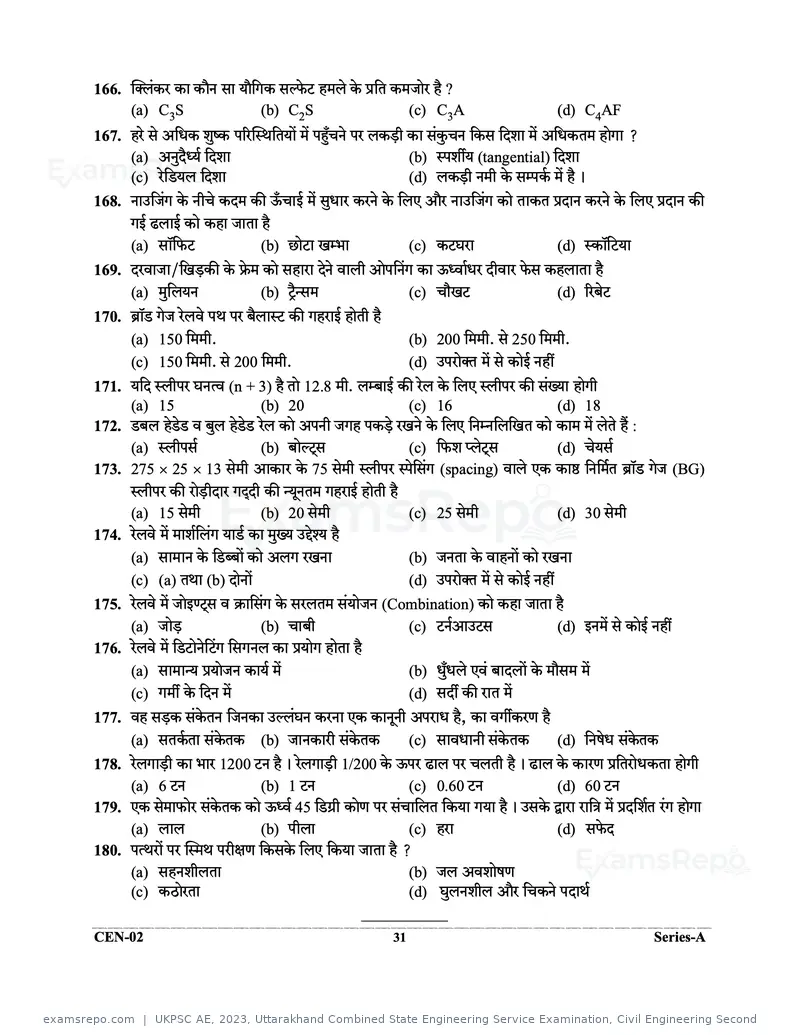
Text of page 31
166. ?
(a) C3S (b) C2S (c) C3A (d) C4AF
167. ?
(a) (b) (tangential)
(c) (d)
168.
(a) (b) (c) (d)
169. /
(a) (b) (c) (d)
170.
(a) 150 . (b) 200 . 250 .
(c) 150 . 200 . (d)
171. (n + 3) 12.8 .
(a) 15 (b) 20 (c) 16 (d) 18
172. :
(a) (b) (c) (d)
173. 275 25 13 75 (spacing) (BG)
(a) 15 (b) 20 (c) 25 (d) 30
174.
(a) (b)
(c) (a) (b) (d)
175. (Combination)
(a) (b) (c) (d)
176.
(a) (b)
(c) (d)
177. ,
(a) (b) (c) (d)
178. 1200 1/200
(a) 6 (b) 1 (c) 0.60 (d) 60
179. 45
(a) (b) (c) (d)
180. ?
(a) (b)
(c) (d)
___________
CEN-02 31 Series-A
Text of page 32
Space For Rough Work / Series-A 32 CEN-02
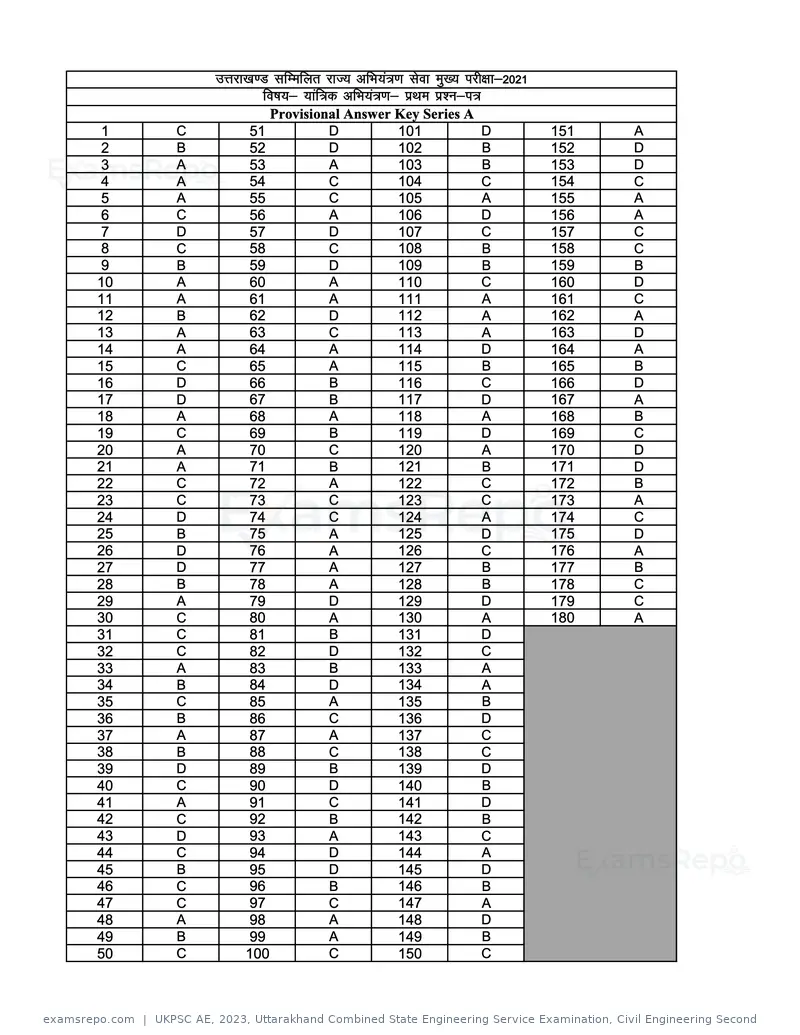
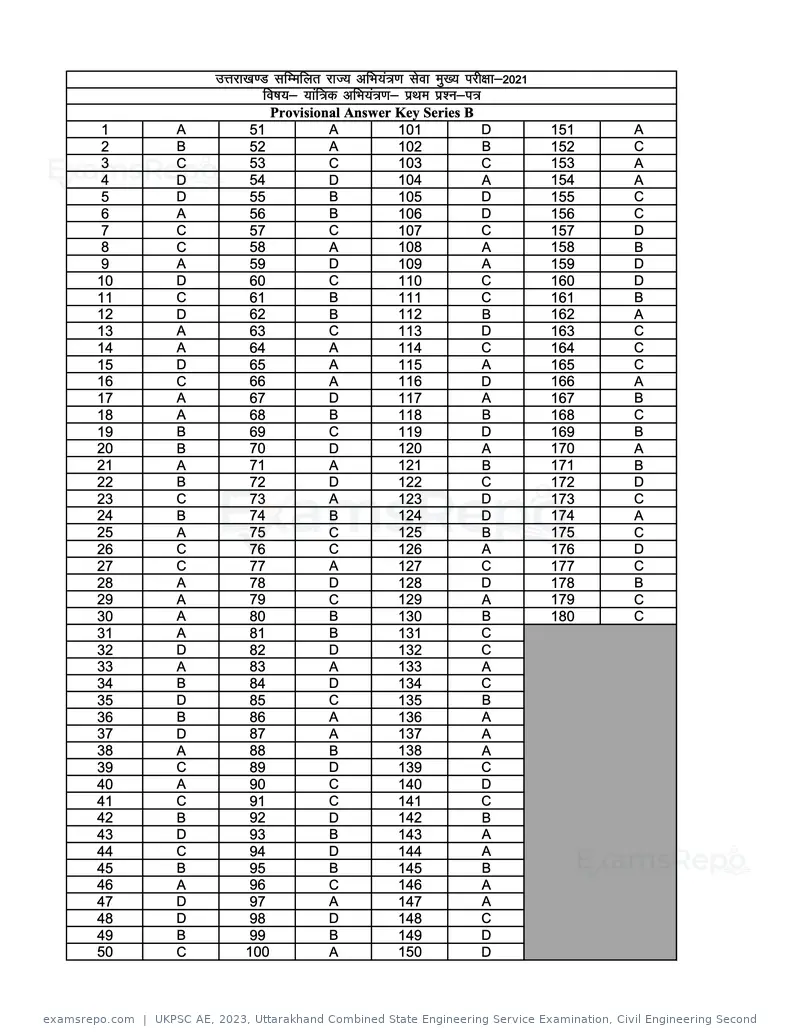
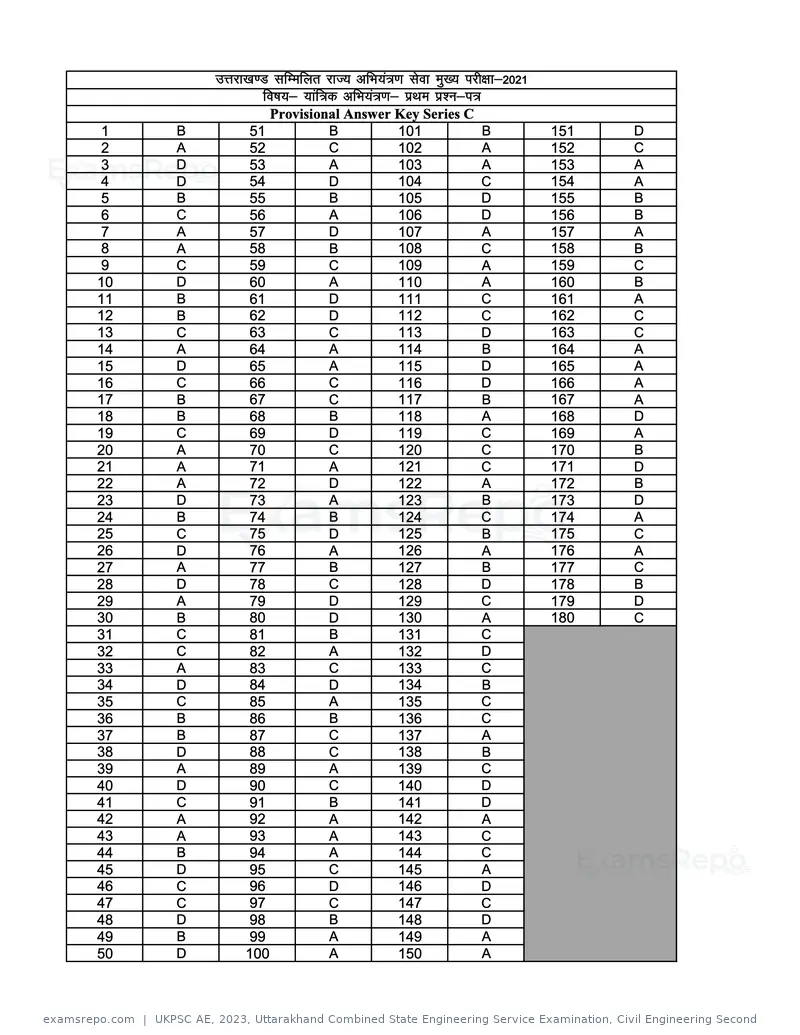
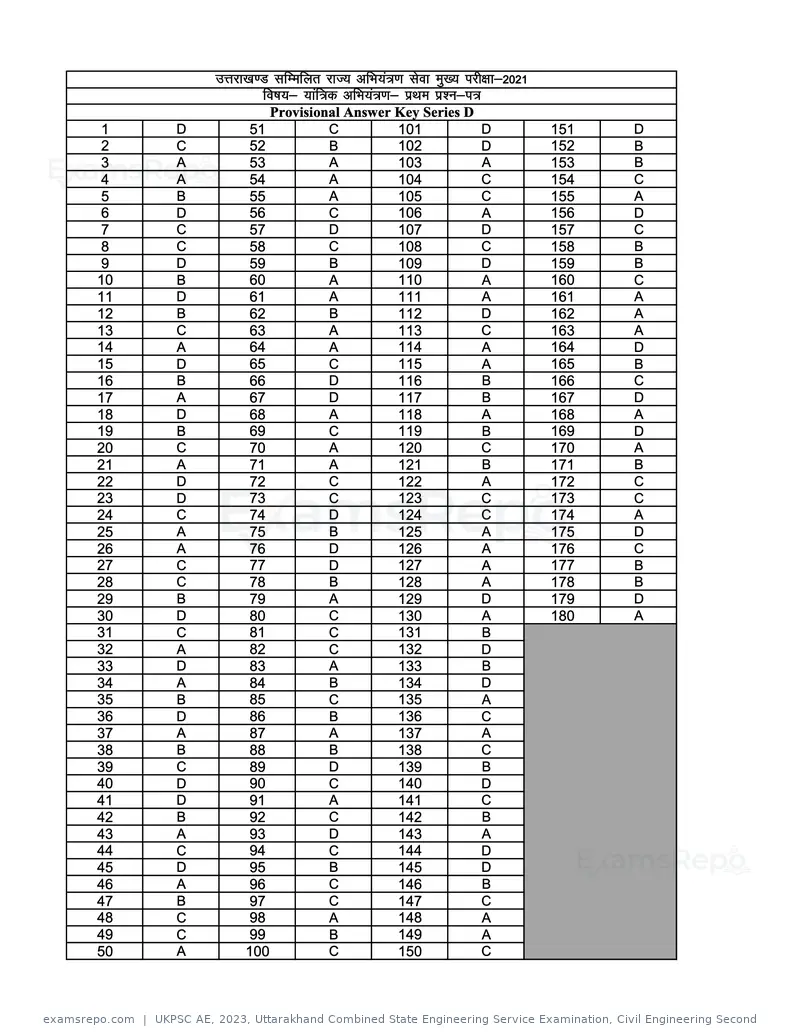
Page 1 of 32
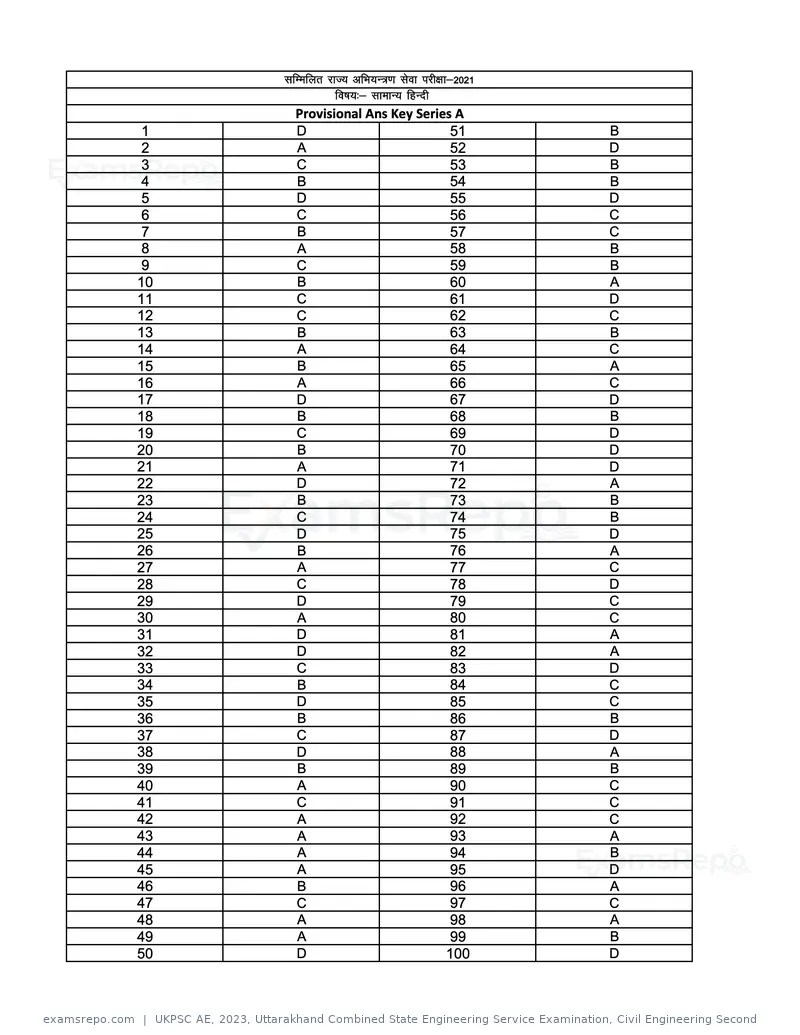
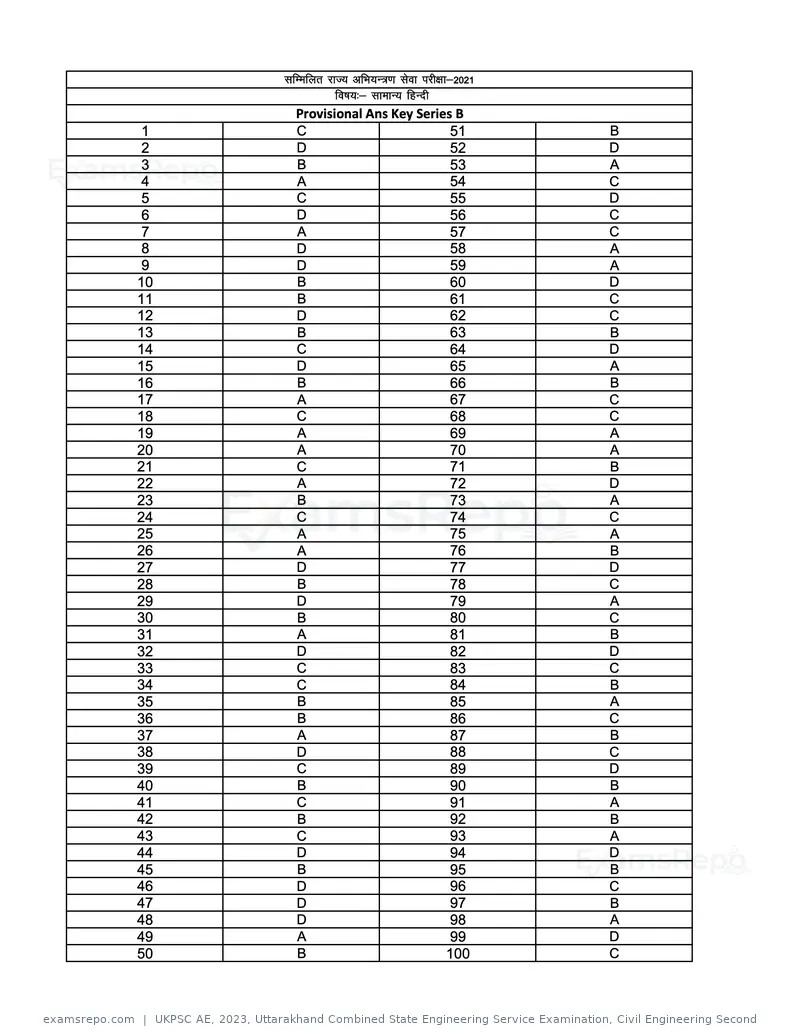
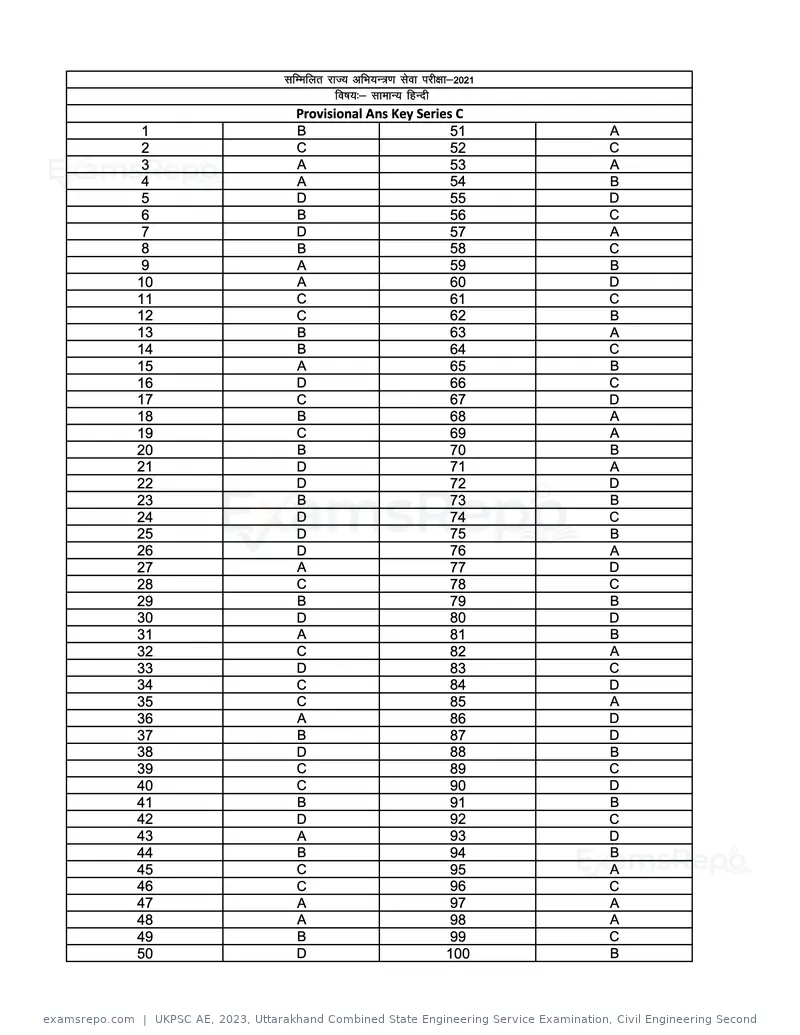
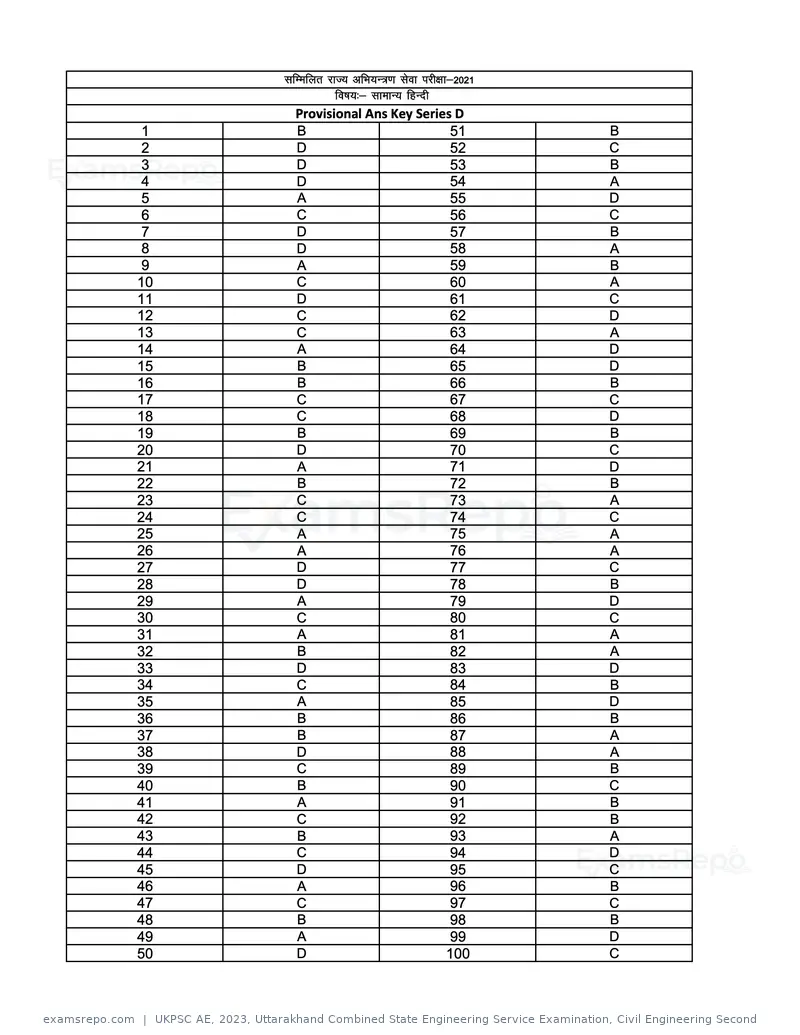
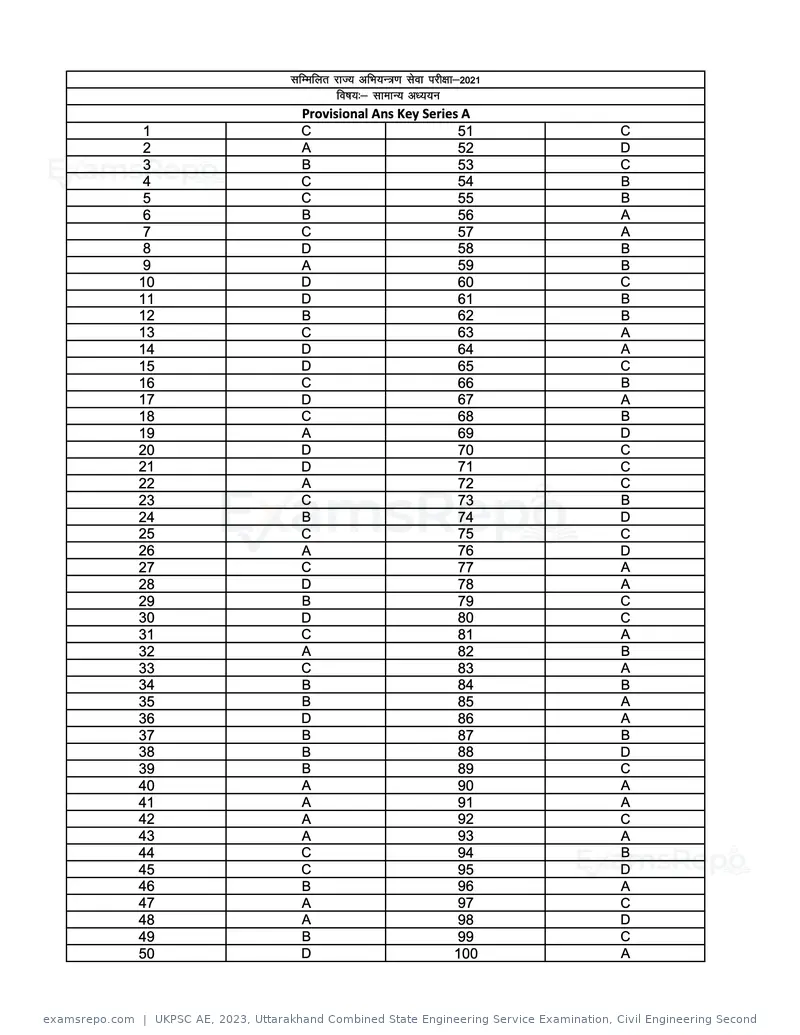
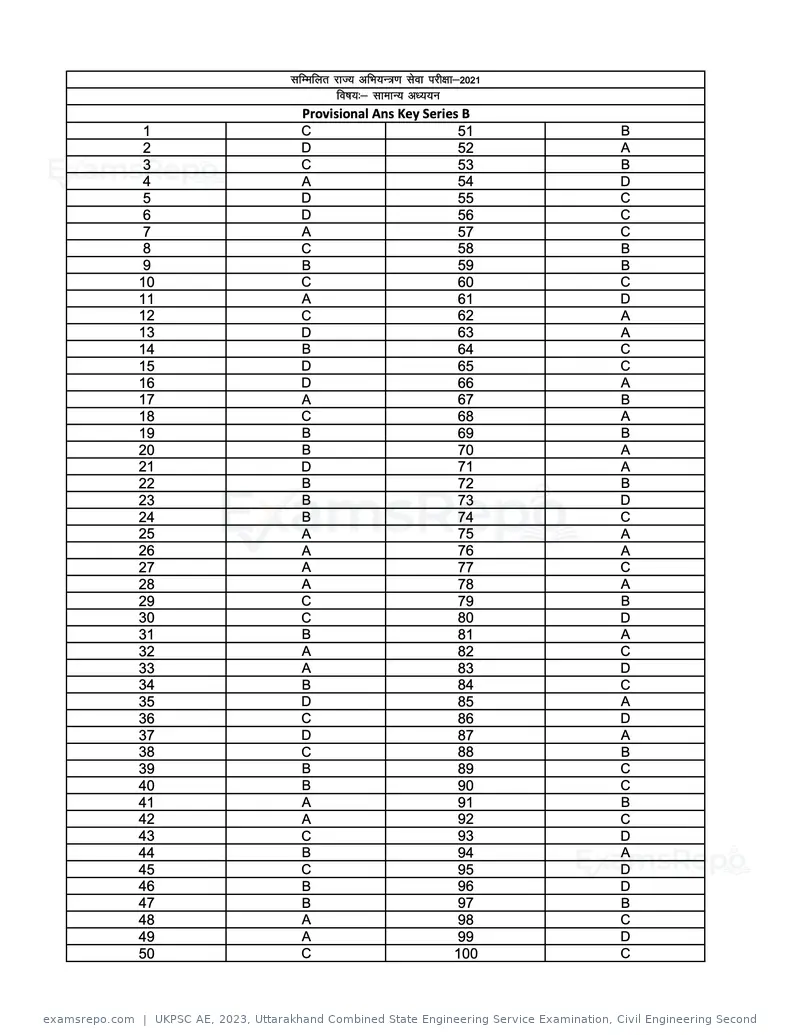
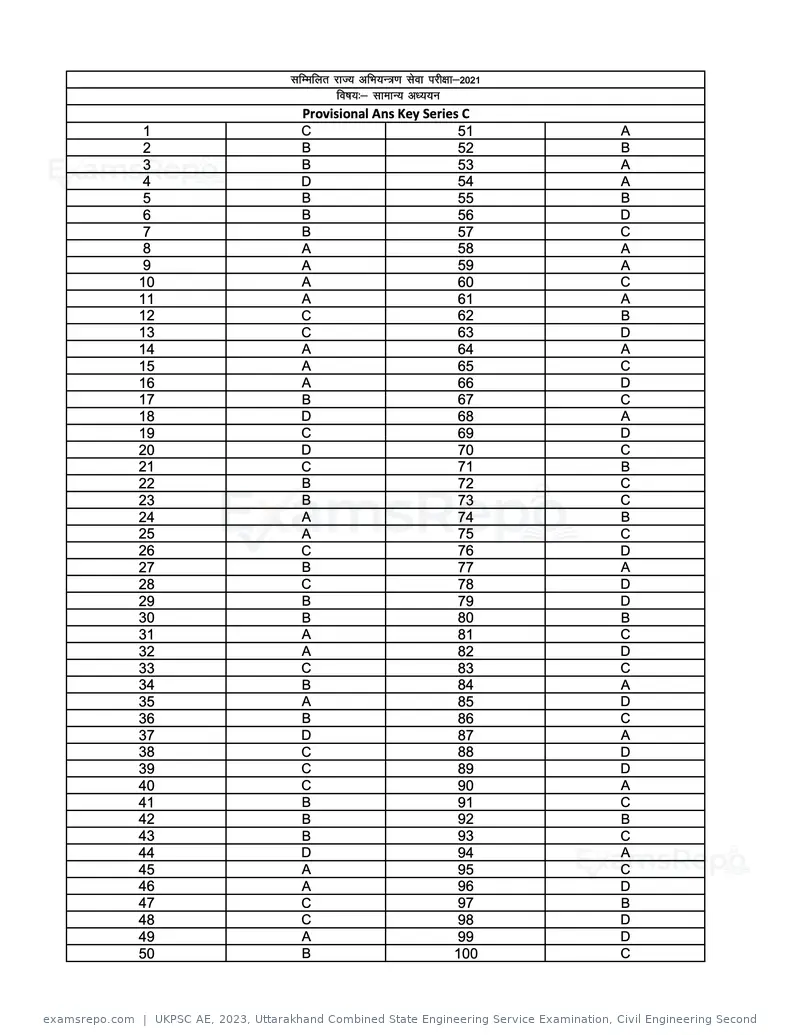
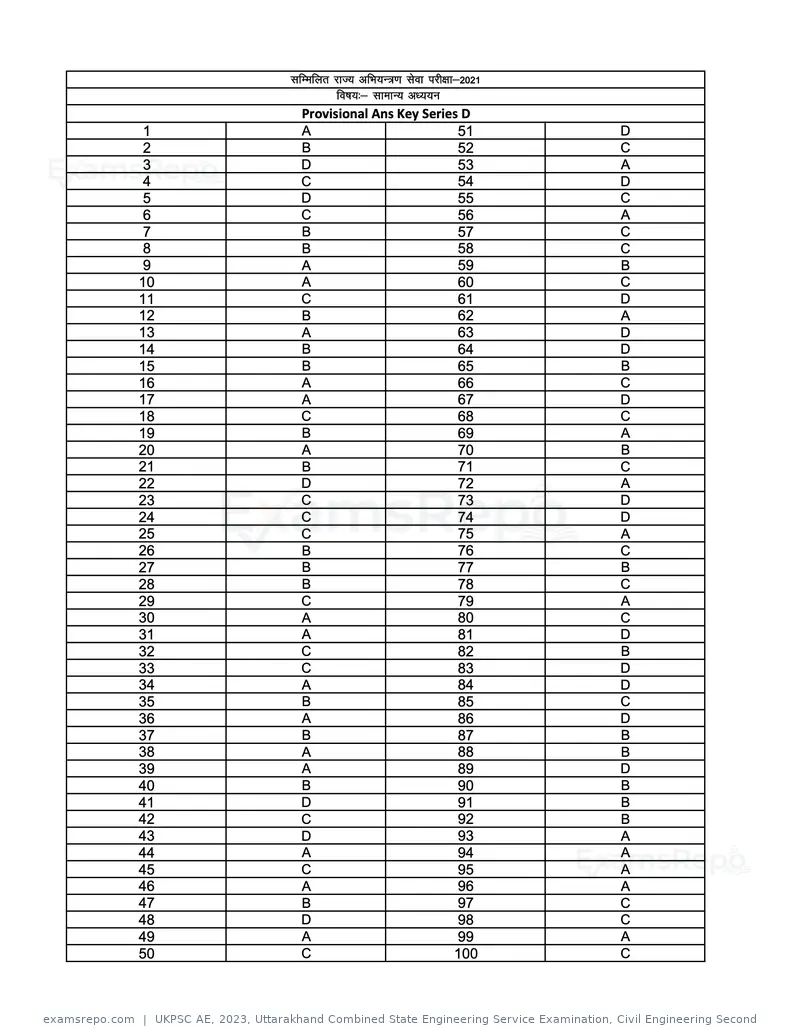
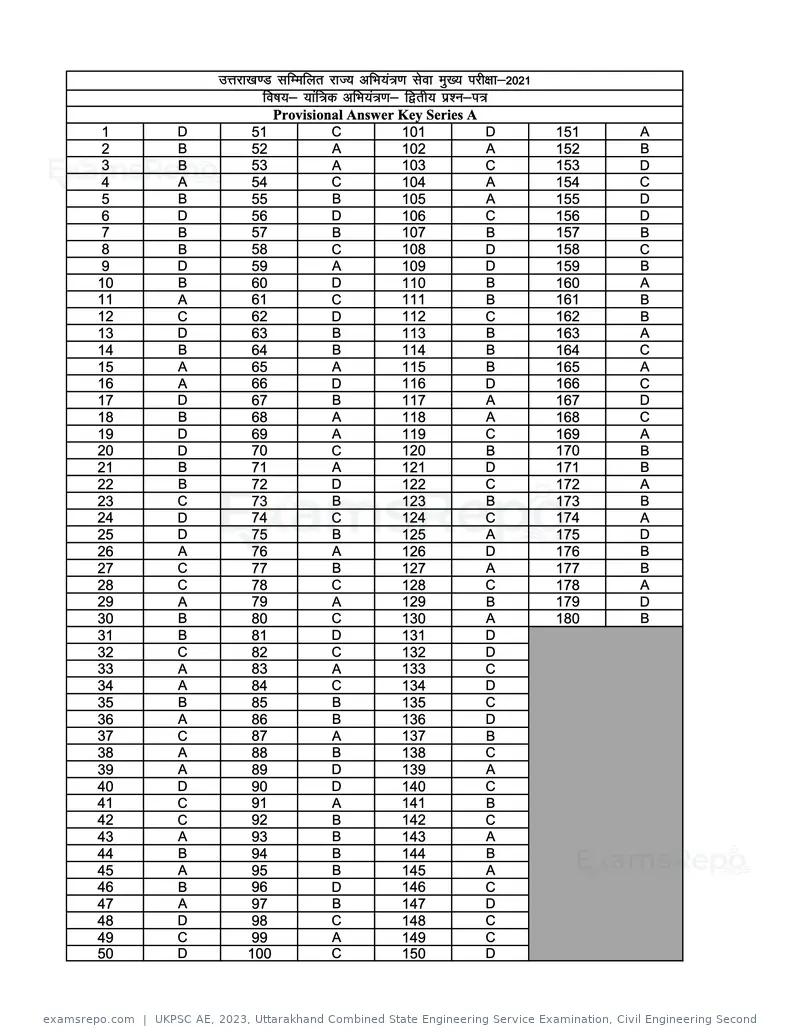
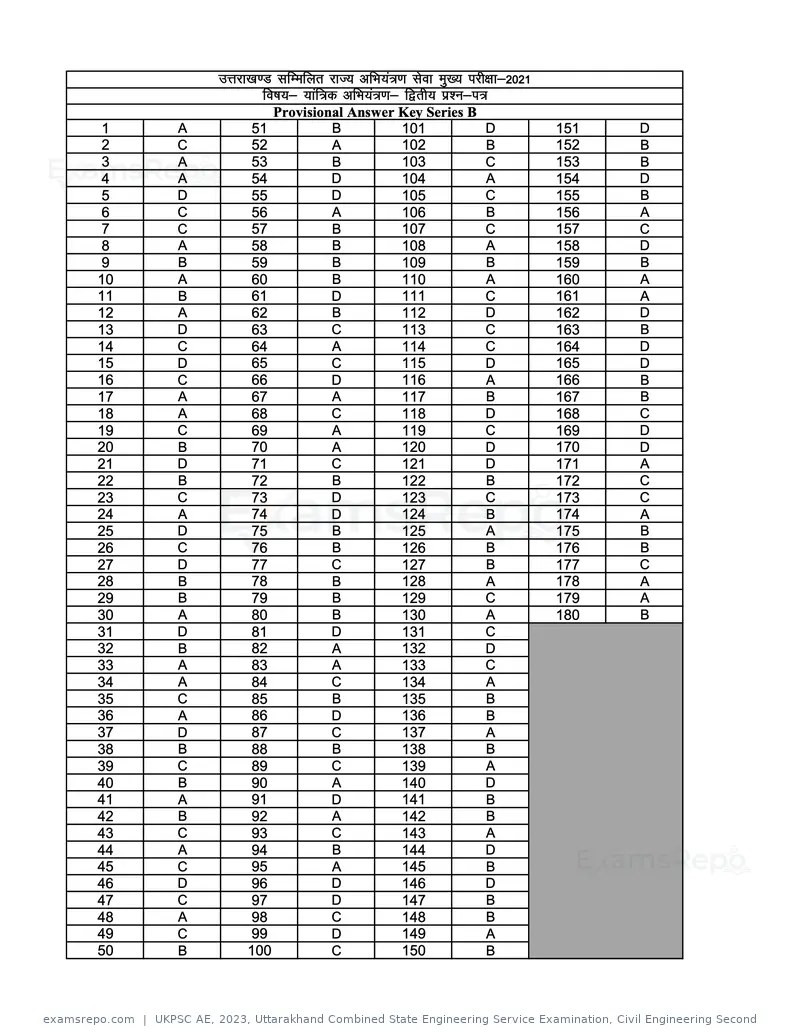
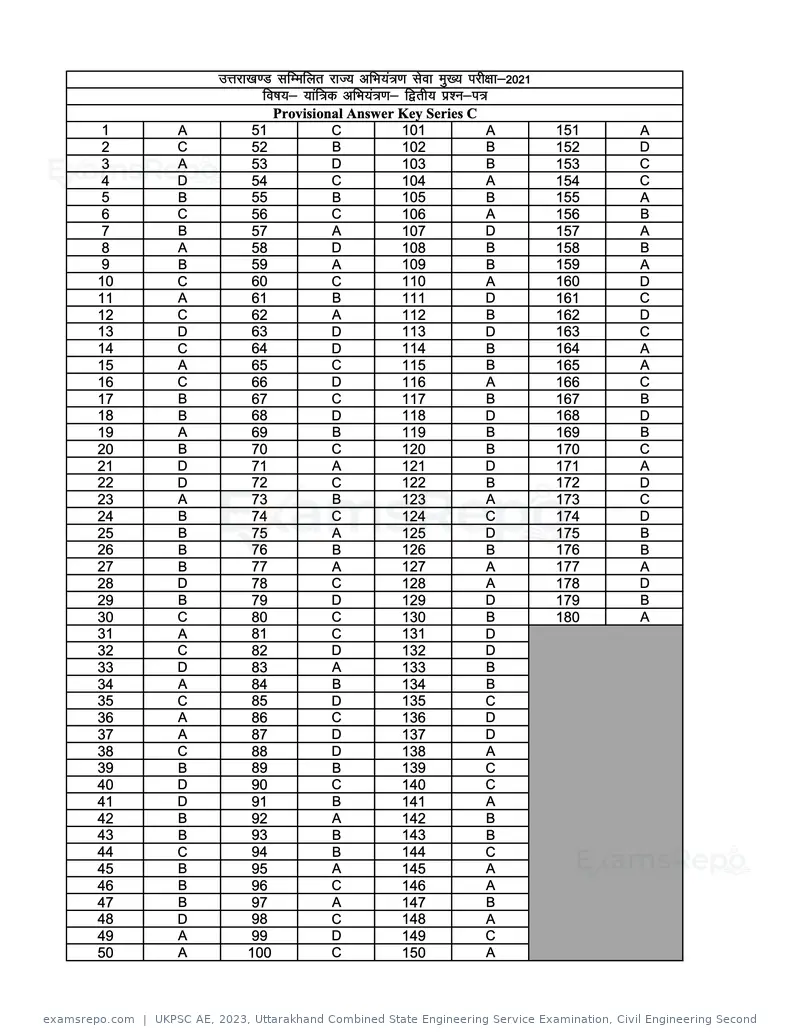
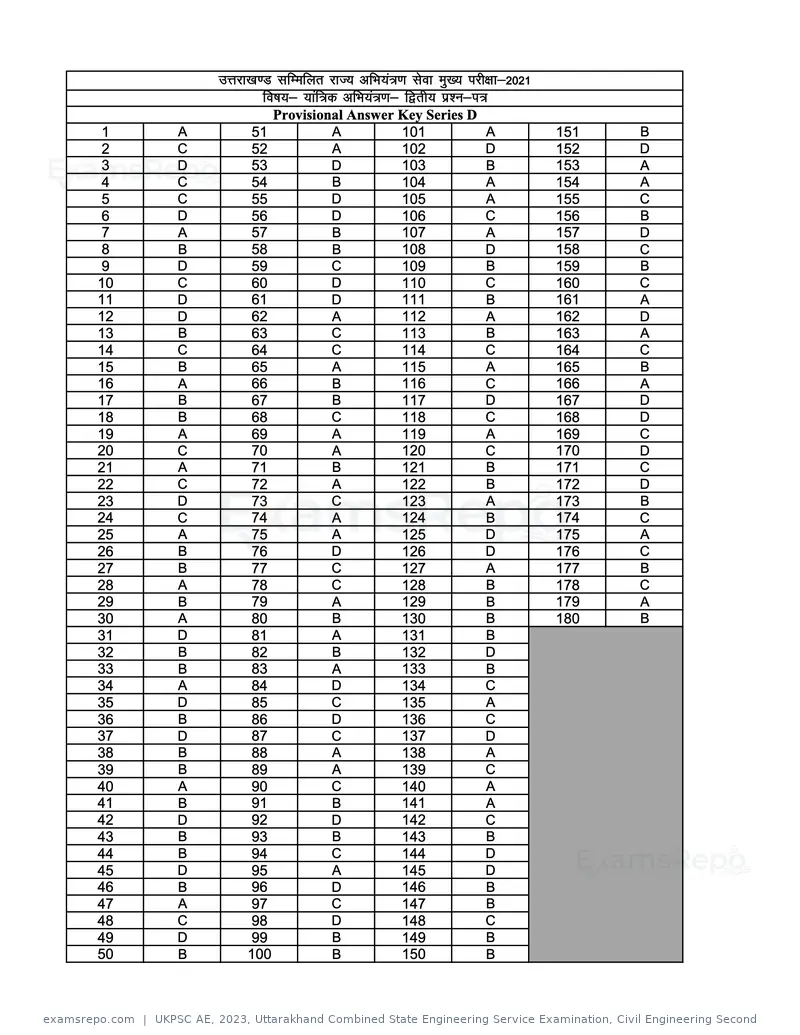
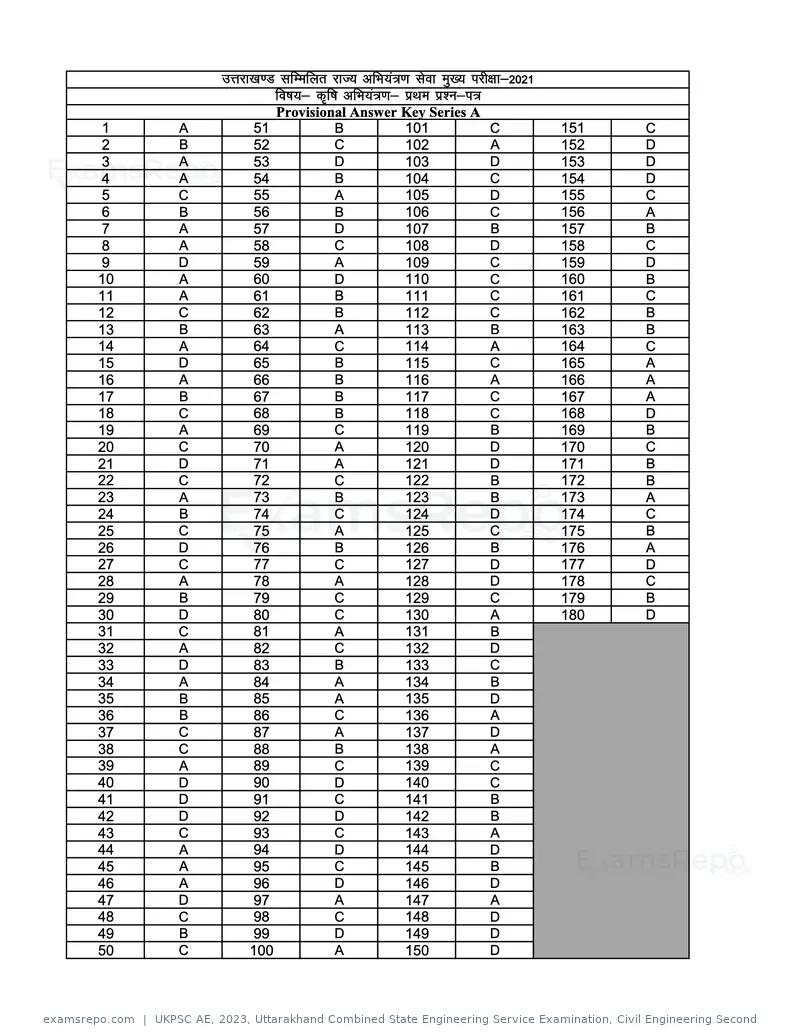
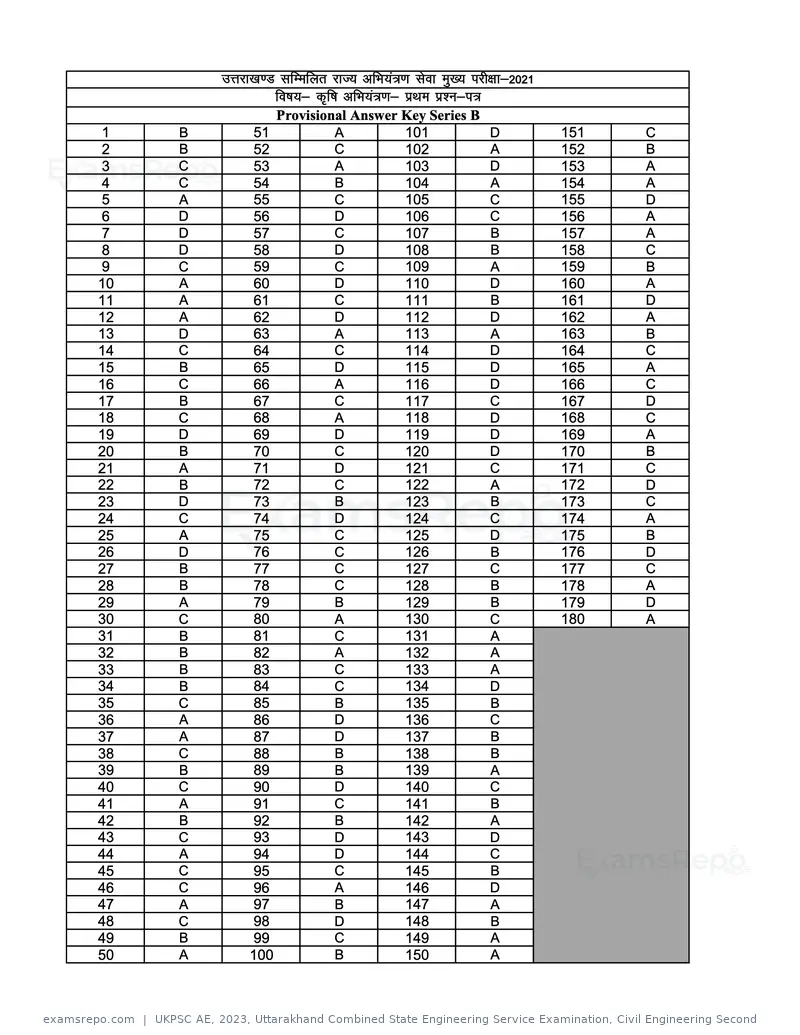
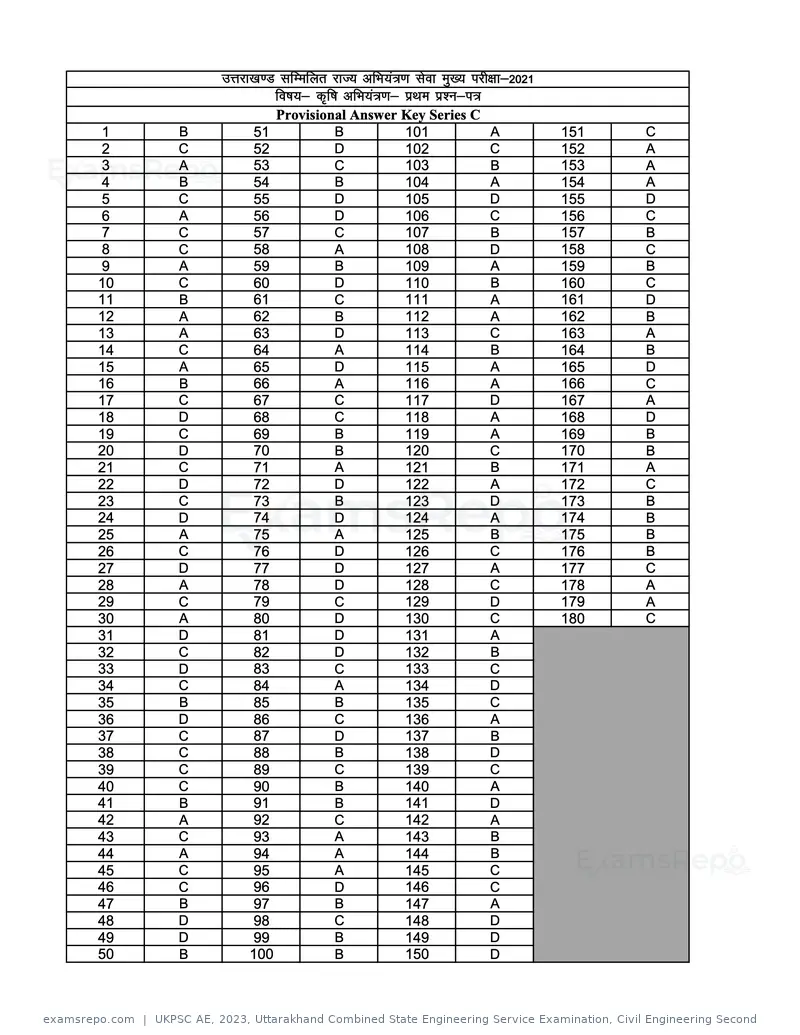
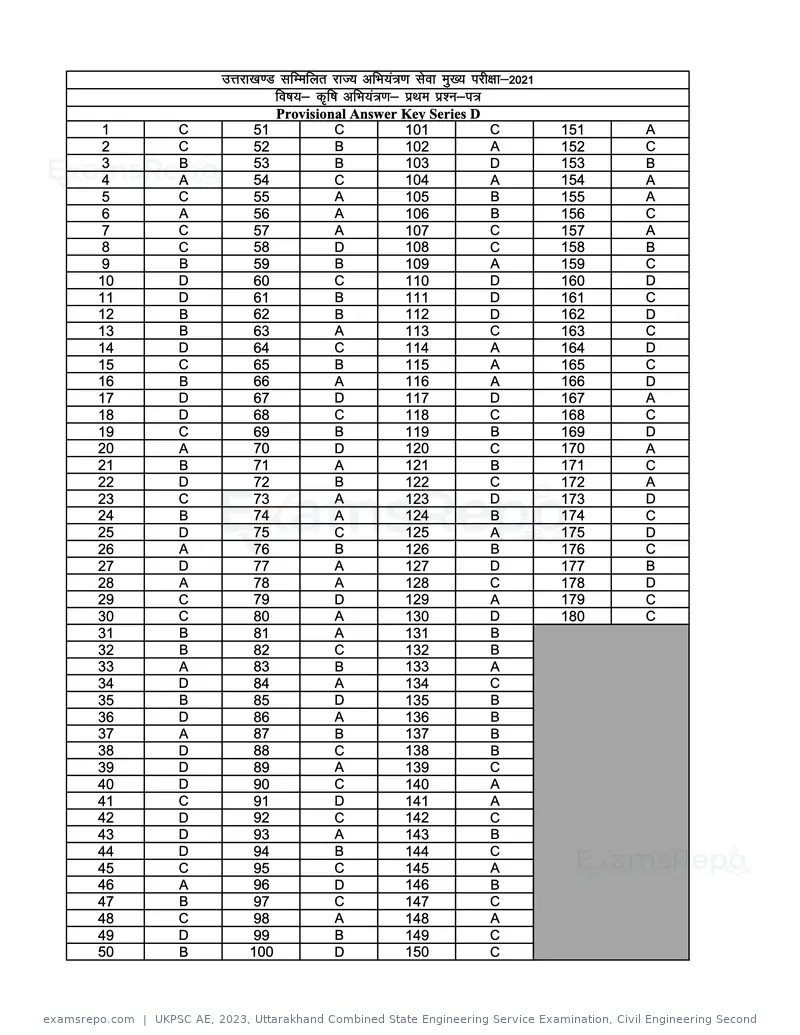
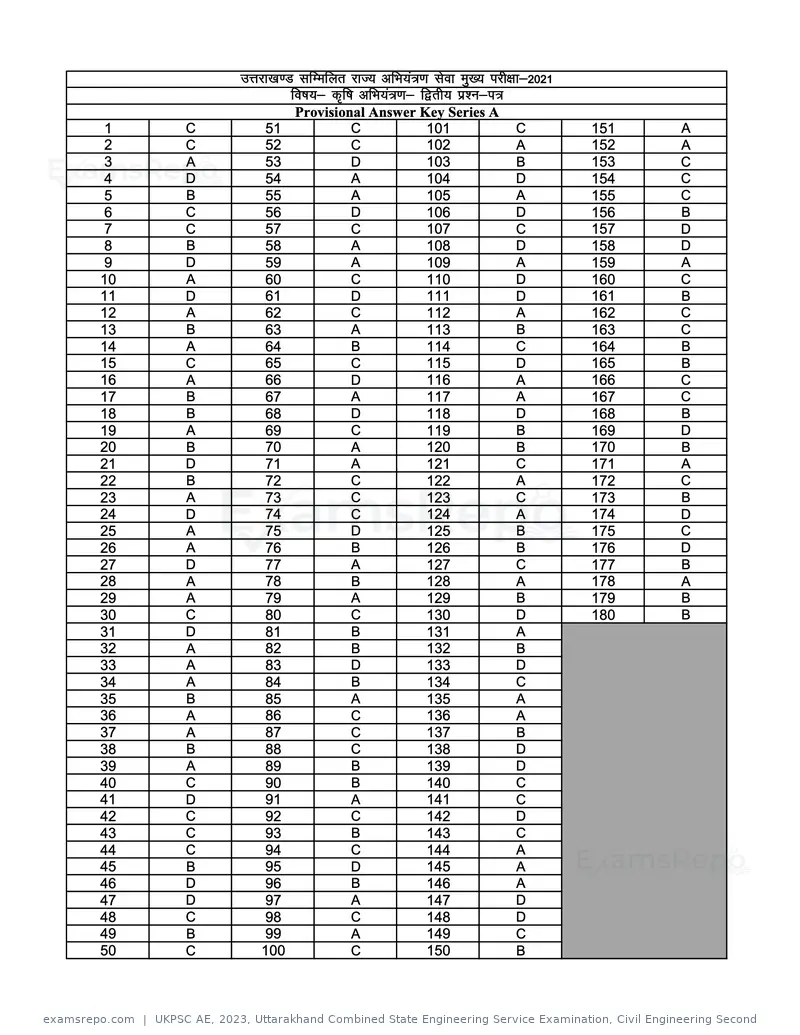
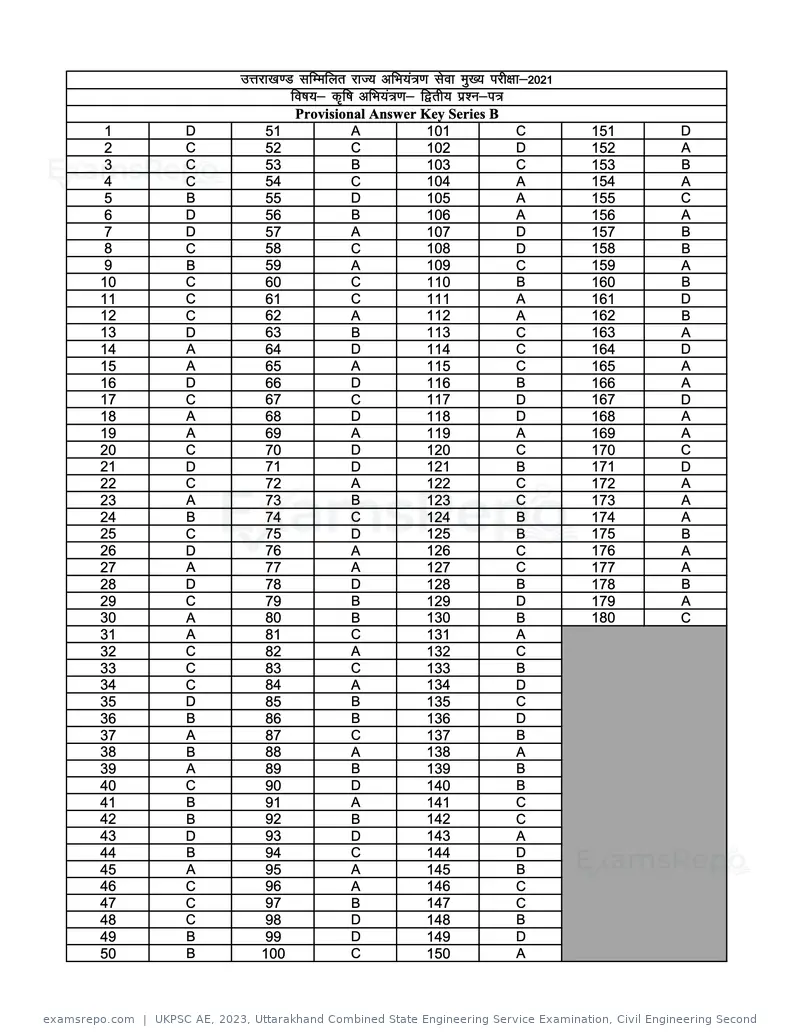
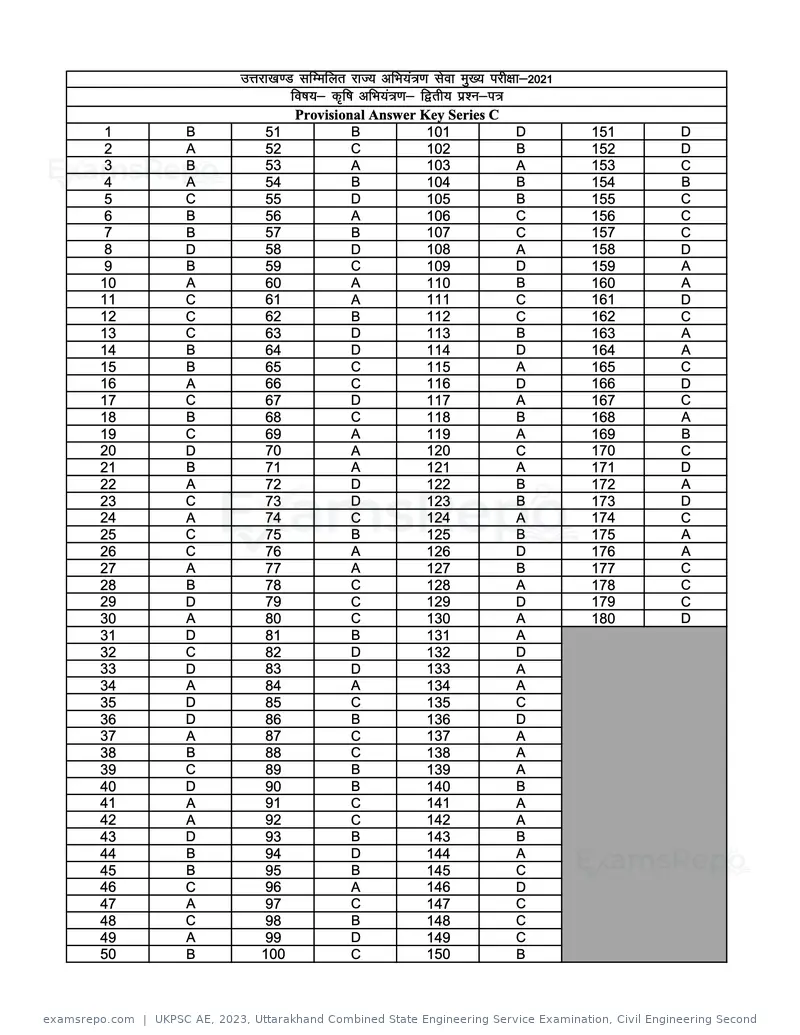
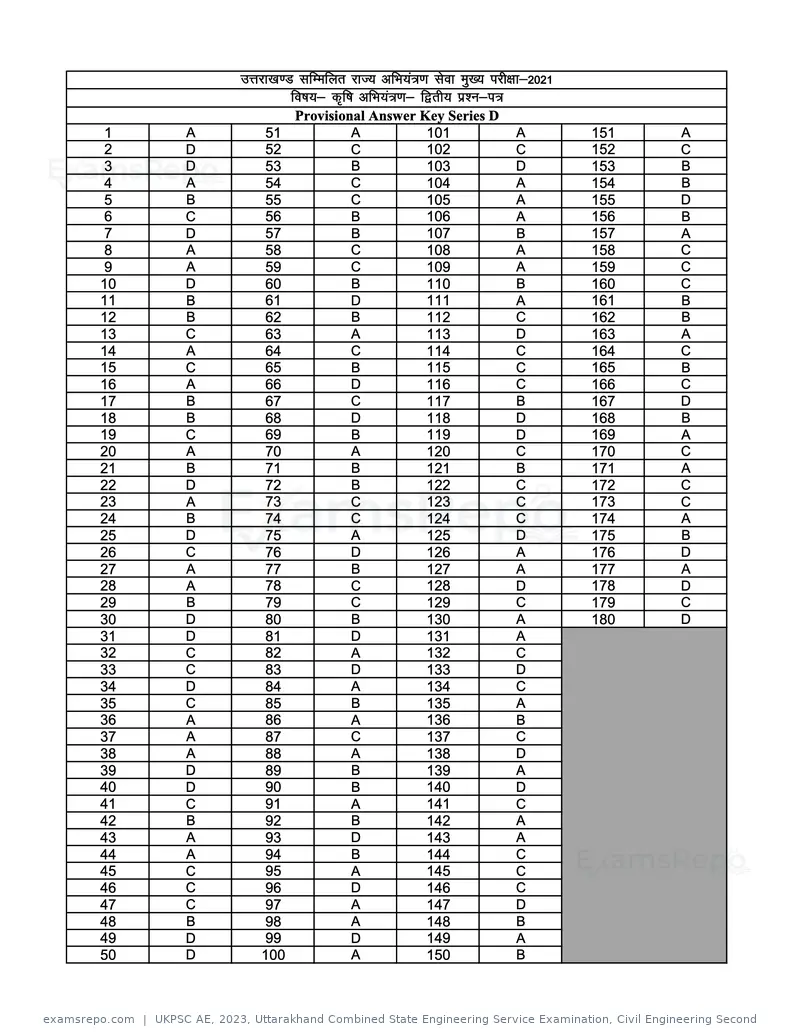
Source: Uttarakhand Public Service Commission. Question paper published by Uttarakhand Public Service Commission.